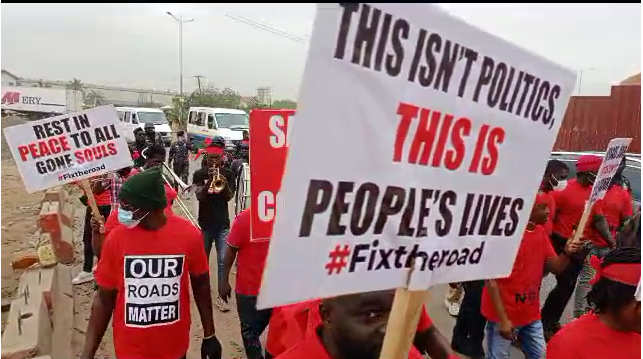
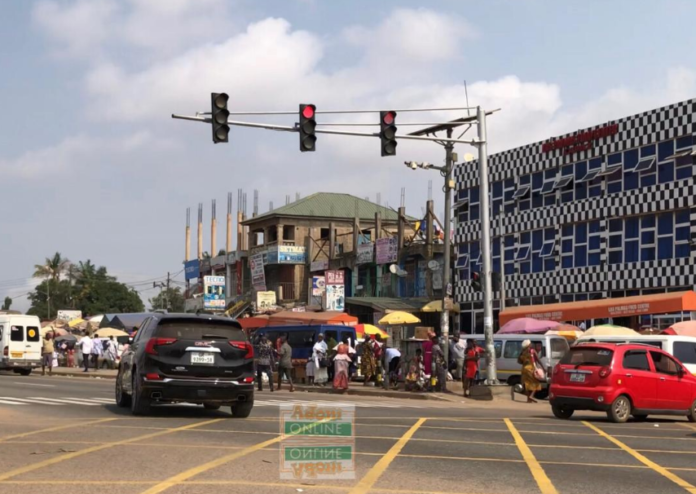
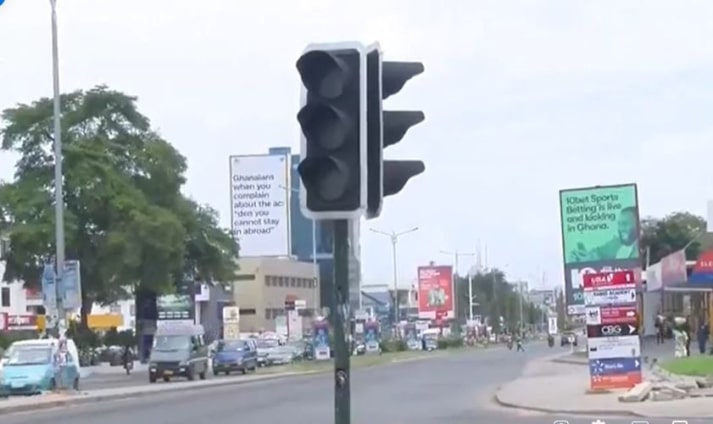
Students of Odorgonno Senior High School took to the Awoshie-Anyaa highway in protest, obstructing traffic in front of their school’s entrance.
On Monday, February 24, 2025, they demonstrated to demand urgent repairs of broken traffic signals and streetlights along the road.
Citing safety concerns, the students said their protest was triggered by the loss of a staff member, which they attributed to the non-functional lights.
Their demonstration led to a temporary standstill on the highway as they blocked vehicles from passing.
Footage seen by GhanaWeb shows the students voicing their grievances and calling for immediate action.
This protest follows a recent hit-and-run accident that resulted in the tragic death of the school’s security officer.
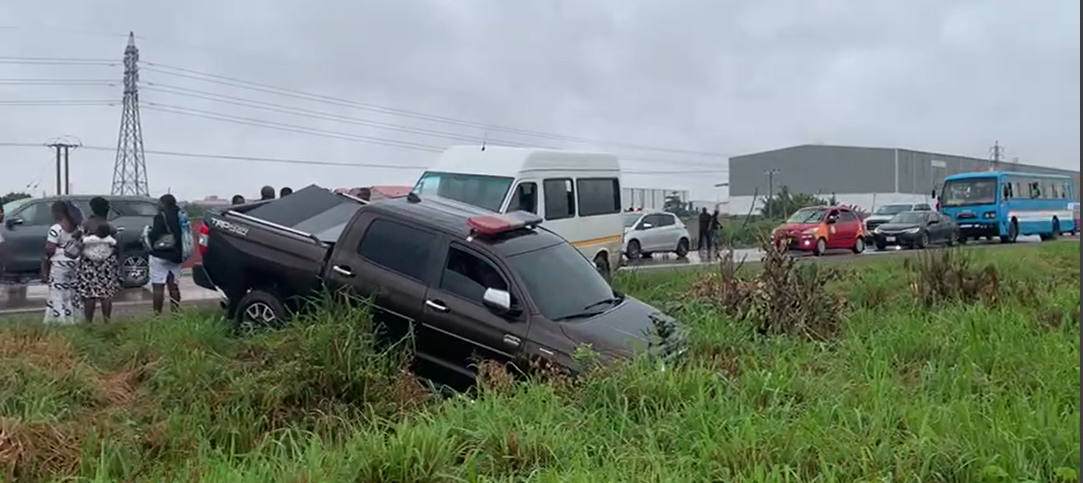
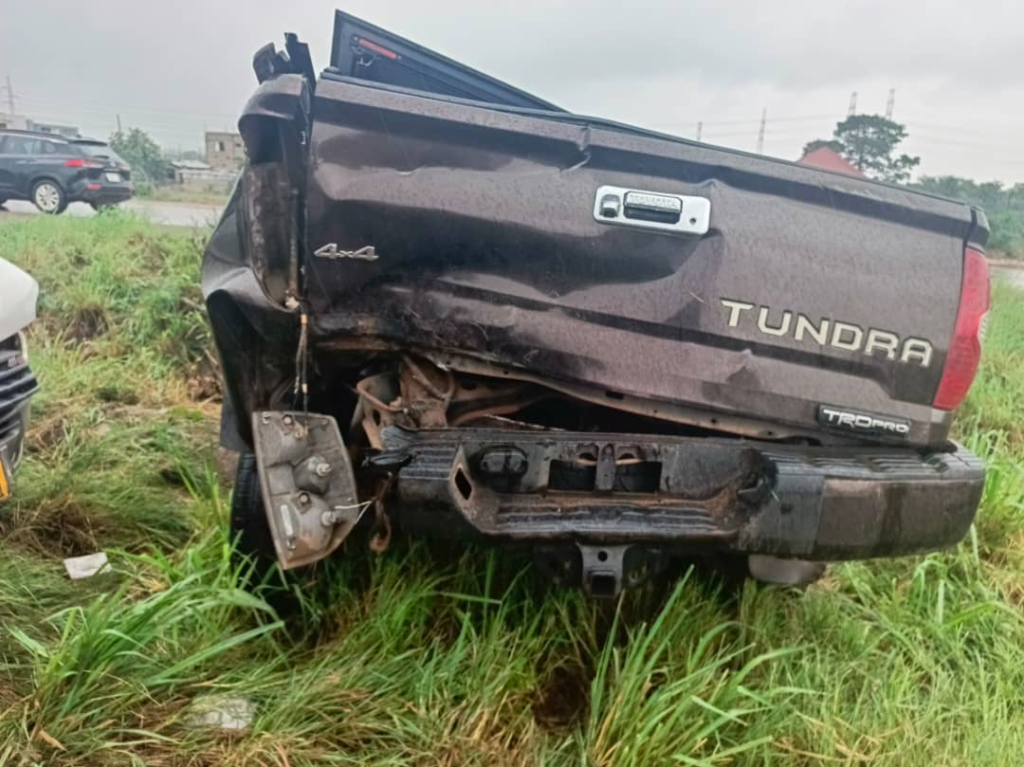
An accident occurred on the Tema-bound side of the Accra-Tema motorway involving a Toyota Tundra, a Benz 207 passenger vehicle, and a trailer truck on Saturday morning around 8 am.
The Toyota Tundra, which was reportedly from the office of the president and driven by a mechanic, was involved in the collision.
According to the driver of the Toyota Tundra, he had stopped to ask for directions to Toyota Ghana when the trailer truck struck his vehicle from behind.
The impact caused the Toyota Tundra to veer into the left lane, where it subsequently collided with the Benz 207 passenger vehicle.
Several individuals in the vehicles sustained minor injuries as a result of the crash.
The accident caused a significant traffic jam on the motorway, forcing other vehicles to use the shoulder of the road towards Tema while the scene was cleared.
Member of Parliament for Asante Akyem North, Andy Appiah-Kubi, has voiced strong support for a new Legislative Instrument (L.I.) that seeks to amend parts of the Road Traffic Regulations 2012.
The proposed L.I., currently before Parliament, aims to grant Members of Parliament (MPs) and Ministers of State certain privileges previously reserved for emergency and specialized vehicles.
The amendment to Regulation 74 of L.I. 2180 will allow the installation of sirens or bells as warning devices on vehicles owned by Supreme Court justices, MPs, and Ministers of State.
This legislative change is intended to facilitate the movement of these officials, who often face demanding schedules requiring travel to multiple locations for meetings and official duties.
Mr. Appiah-Kubi justified the amendment by highlighting the demanding nature of MPs’ and ministers’ work, which often involves numerous meetings and project planning sessions held in various locations. He emphasized that prolonged time spent in traffic negatively impacts the performance of these officials, potentially leading to delays in critical development projects.
“I know the schedule of work that ministers go through and how they postpone meetings outside ministries trying to finish their regular job in office and be confronted with limited time to reach the next destination for the next official duty. You subject such people to the conditions of traffic on the road. Such people cannot meet the deadline and therefore it is imperative for us to give some access to them to be able to meet the deadline,” he said in an interview on JoyNews.
He further argued that the current traffic conditions contribute to underperformance among some ministers, who are unable to navigate the congested roads swiftly. By granting MPs and ministers the ability to use sirens and bells, the proposed L.I. aims to alleviate the stress of traffic and enhance their capacity to attend meetings and perform their duties effectively.
Mr. Appiah-Kubi also recalled several instances where legislators and judges were arrested for speeding while attempting to reach their offices on time.
He noted that these situations underscore the need for the amendment, which would provide a practical solution to the challenges faced by high-ranking officials in performing their duties.
The Asante Akyem North MP concluded by stressing that the amendment would not only improve the efficiency of MPs and ministers but also hold them accountable for delivering on their mandates. “Eliminating such restrictive laws will enable us to hold these individuals accountable if they fail to deliver on their responsibilities,” he added.
The proposed amendment has sparked debate among various stakeholders, with some advocating for its potential benefits in improving governmental efficiency, while others raise concerns about the broader implications of extending such privileges to elected officials.
Residents of Tema Community 25, Kpone, Prampram, Gulf City, and commuters along the Tema to Aflao road staged a protest against severe traffic congestion, urging the completion of an abandoned road expansion project.
President Akufo-Addo initiated the ground-breaking ceremony on October 25, 2020, to upgrade the dual carriageway to international standards, including 10 lanes—six for the motorway and four for local traffic.
However, residents claim that four years later, there has been minimal progress. They are demanding the immediate return of the contractor to the site, as the delay is significantly impacting their daily lives.
Organizers speaking to JoyNews highlighted that the road’s current condition is deplorable, severely affecting local businesses and contributing to frequent accidents.
“Closure of shops and businesses due to the immense traffic; loss of lives as witnessed by the tragic death of a grandma, a former MP, who died here in traffic because she could not move to the hospital.”
“We urge the government to immediately recall the contractor to complete the road project and provide a timeline for the completion of the road rehabilitation. Ensure the safety of commuters and residents” they noted in their petition.
According to some residents, they occasionally endure traffic delays lasting three hours or longer.
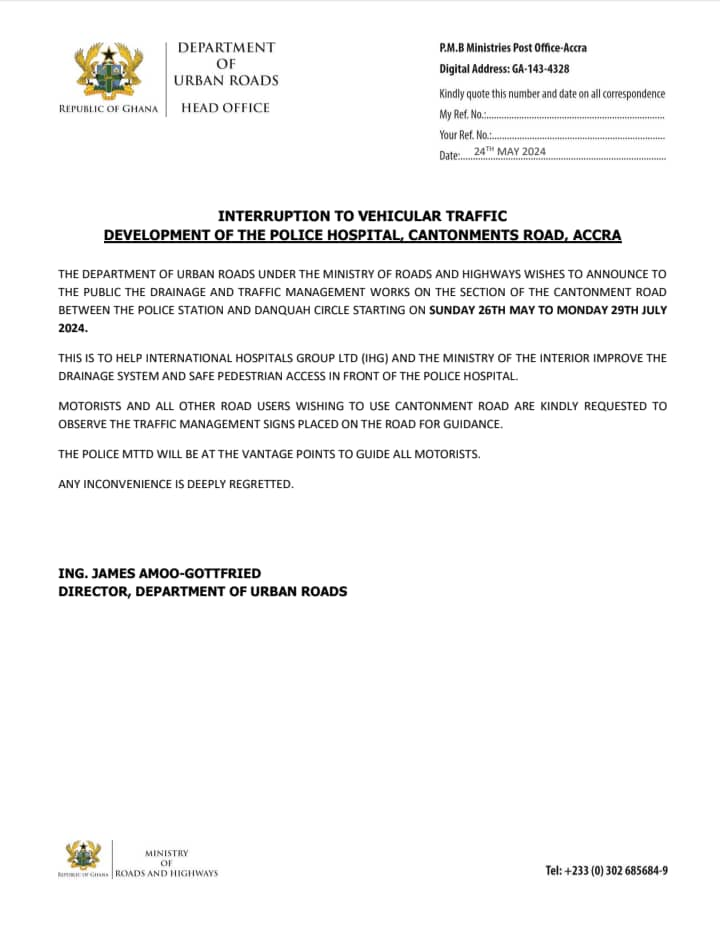
The Ministry of Roads and Highways, through its Department of Urban Roads, has announced a substantial disruption to traffic flow on Cantonments Road in Accra, effective from Sunday, May 26th, until Monday, July 29th, 2024.
This interruption is necessary for drainage and traffic management enhancements along the section of Cantonments Road stretching from the Police Station to Danquah Circle.
Part of a broader initiative, these improvements aim to upgrade the drainage system and ensure safer pedestrian access near the Police Hospital.
In collaboration with the Ministry of the Interior, the project is being undertaken with support from the International Hospitals Group Ltd (IHG). Its objective is to bolster infrastructure and safety measures around the Police Hospital, thereby creating a safer and more efficient environment for both pedestrians and drivers.
During this period, motorists and all road users intending to utilize Cantonments Road are urged to adhere to traffic management signs placed along the route. The Police Motor Traffic and Transport Department (MTTD) will be strategically positioned to assist motorists as needed.
The Department of Urban Roads acknowledges any inconvenience resulting from these necessary development works. Ing. James Amoo-Gottfried, Director of the Department, assures the public that these enhancements will yield significant long-term benefits for the community.
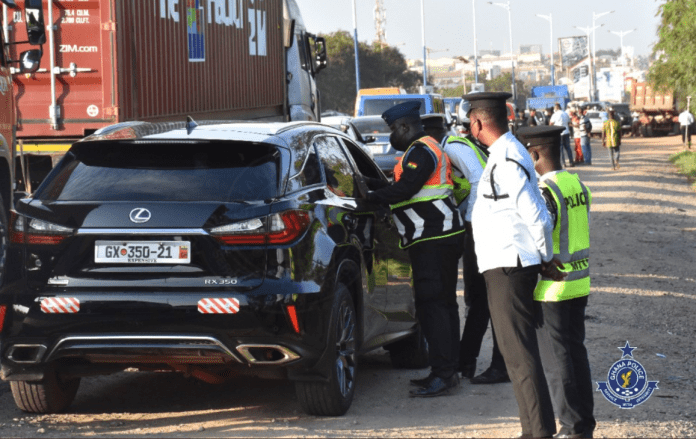
National Road Safety Authority (NRSA) has introduced on-the-spot fines for road traffic infractions, with fines ranging from GH¢120 to GH¢240, while more serious violations will be directed to the courts for legal action.
These violations will be identified using an artificial intelligence system called “Traffitech-Gh,” developed through a collaboration between the Ghana Police Service (GPS) and the National Road Safety Commission.
These devices equipped with sensors for automatic offense detection, in both picture and video formats, will be installed on major roads, roundabouts, traffic lights, and strategic locations.
To introduce this initiative, a stakeholder engagement session was conducted in Ho, involving participants from various public and private organizations in the Volta and Oti regions.
Chief Superintendent Alexander Kwaku Obeng, from the National Police Motor Transport and Traffic Department (MTTD), highlighted that this initiative aims to address road safety challenges, enhance enforcement, and provide a means for the Ghana Police Service to gather evidence in an automated, efficient, and acceptable manner for law enforcement and alleged perpetrators.
Collaborating with the Ghana Road Safety Authority, the Driver and Vehicle Licensing Authority (DVLA), and the National Insurance Commission, this program is themed “Police Invisible Eyes Are Watching (PIEAW).”
Chief Superintendent Obeng called on the public to take note of this development and comply with traffic rules and regulations.
This initiative, themed “Police Invisible Eyes Are Watching (PIEAW),” underscores the importance of adhering to traffic rules and regulations for public safety.
There appears to be an upsurge in traffic at the country’s ports, which appeared nearly deserted at the start of the year due to reduced trade volumes.
According to data from the Composite Index of Economic Activity, around 57,000 containers passed through ports as of July 2023.
“While this figure represents a substantial decline compared to July 2021, it marks a significant improvement over the approximately 40,000 containers recorded in January of this year,” Citi News reported.
The report also stated that Customs House Agents credited the modest improvement to the stabilization of the local currency, the cedi, along with other positive macroeconomic developments.
Yaw Kyei, President of the Customs House Agents Association, identified high port tariffs and foreign exchange costs, among other challenges encountered by importers.
He emphasized the importance of ensuring efficient port services to facilitate growth, highlighting the pivotal role of ports in trade and commerce.
Reports circulating on social media indicate that there is traffic congestion on the Ofankor-Accra road.
The reason for this development has been attributed to a protest by irate squatters who were allegedly evicted.
An anonymous source close to The Independent Ghana says the squatters selling wood at Moose were issued a 24-hour ultimatum to evict a portion of land.
The landowner allegedly brought in land guards to ensure the eviction. A confrontation erupted as the squatters failed to move from the said piece of land.
The land guards reportedly received backup from police personnel. During the clash, the land guards are said to have fired at the protestors, injuring about two individuals who are said to be receiving treatment at St. John’s Hospital at Tantra.
Some affected motorists have reached out to the Police Service for assistance.
Individuals heading to their workplace and school now face a hindrance.
Megapolis with world’s worst traffic gets train metro after 12-year wait
Lagos, Nigeria’s congested commercial hub, inaugurated its inaugural light-rail system on Monday, marking a significant milestone after 12 years of planning and development.
Construction of the 13-kilometer (8-mile) line commenced in 2009, with an initial service launch expected in 2011. However, funding challenges for the 100 billion naira ($132 million) project resulted in delays.
The line, constructed by China Civil Engineering Construction Corp., was officially opened by Lagos Governor Babajide Sanwo-Olu on Monday and is projected to accommodate 150,000 daily passengers, as reported by the Lagos Metropolitan Area Transport Authority.
Lagos, a city of 20 million inhabitants, grapples with some of the world’s worst traffic congestion, according to Numbeo, a crowd-sourced online database. While the new “blue line” rail system is expected to alleviate some of these issues, Sanwo-Olu emphasized in 2021 that the city, which draws Nigerians from all over the country, requires $15 billion over five years to enhance its road and transportation infrastructure.
During the inauguration event, Governor Sanwo-Olu, dressed in a train operator’s uniform, personally engaged with passengers, announcing station names and addressing the crowd.
When fully operational, the train will accommodate up to 1,200 passengers per trip and significantly reduce travel time from Mile 2 near Tin Can Island (the country’s busiest seaport) to Marina on Lagos Island, reducing it from potentially 3 hours to just 25 minutes.
“A mega city cannot function without an effective metro line,” said Adetilewa Adebajo, chief executive of Lagos-based CFG Advisory. “However, Lagos needs not just the metro line. It has to develop waterways too, being a coastal city. It needs an integrated transport system. Those are what will be able to relieve the congestions in the city.”
At present, the government grapples with an annual expenditure of approximately 4 trillion naira due to traffic gridlock, resulting in lost work-hours as commuters collectively spend 14.1 million hours daily stuck in traffic, as indicated by a 2021 report from Lagos-based Danne Institute of Research.
Governor Sanwo-Olu initially commissioned the blue line in December; however, operational commencement was delayed because the necessary facility to power the tracks was not ready. For the interim, the metro will utilize a diesel locomotive for four weeks until the power plant can be connected to the tracks.
Nigeria faces similar inefficiencies in its transportation infrastructure. For instance, in 2018, the government inaugurated a train linking the capital city, Abuja, with its airport. Five years later, train cars remain unused in a depot, while the country continues to service the project’s $500 million loans from the Export-Import Bank of China, amounting to $50 million annually.
Lagos has previously experimented with other mass transit solutions, such as the World Bank-funded bus rapid transit system (BRT-lite) introduced in 2008. While approximately 4 million people have obtained the required cards for BRT, the system struggles to meet the demands of the city’s growing population.
The blue line will initially operate 12 trips per day for two weeks, eventually increasing to 76 trips daily, serving an expected 150,000 passengers daily, according to the state administration. The second phase, which extends the network from Mile 2 to Okokomaiko and is en route to Badagry at the state’s border with neighboring Benin, is currently under construction, bringing the total track length to 27.5 kilometers.
Additionally, Lagos plans to complete another 37 kilometers of rail by the end of the year, connecting the eastern and western parts of the city to further alleviate traffic. This line, referred to as the “red line,” is reported to be 95% complete.
Lagos, home to major companies like Dangote Cement Plc, Unilever Plc, and Heineken NV, experiences a population density of 13,800 residents per square kilometer, significantly higher than cities like Johannesburg (3,100) and Dar es Salaam (6,900).
The Economist Intelligence Unit’s Global Livability index for 2023 ranked Lagos among the least livable cities out of 173 evaluated.
In June, President Bola Tinubu lifted price caps on gasoline and allowed the naira to depreciate, leading to significant increases in prices for various commodities, from transportation to food. As a result, many Lagos residents had to curtail their use of private vehicles.
Transportation expenses absorb the largest proportion of household budgets among major African cities, according to the World Bank.
To provide some relief to residents, the metro service will offer passengers half the recommended fare of 750 naira ($0.97) per trip, with the government subsidizing part of the cost to mitigate the impact of rising living costs, according to the Lagos Metropolitan Area Transport Authority. If the train operates at full capacity, this subsidy could cost the government 1.7 billion naira monthly, based on Bloomberg’s estimation.
“This will bring a huge relief to Lagos in terms of commuting from one point to another point,” said Frank Momoh, a businessman, who was on the metro on Monday. “I will drop my car for the train ride because it is faster and it is more convenient.”
The Motor Transport and Traffic Directorate (MTTD) of the Ghana Police Service has unveiled plans to implement an advanced automated system known as “Traffitech-GH,” aimed at bolstering the enforcement of road traffic regulations.
This innovative system will harness the capabilities of cameras and sensors to autonomously capture images and videos of vehicles found in violation of road traffic laws, including instances of speeding and running red lights.
COP Francis Ebenezer Doku, the Director-General of MTTD, elaborated on the Traffitech-GH system, indicating that it will leverage a combination of fixed, mobile, and radar gun devices to detect a range of infractions, encompassing speeding and disregarding red lights. The images or videos depicting these transgressions will be forwarded to the MTTD office for validation, subsequently triggering SMS notifications to vehicle owners regarding the required penalty payments.
Beyond addressing speeding and red-light violations, the Traffitech-GH system will extend its enforcement to other transgressions such as expired roadworthiness certificates, improper overtaking, failure to wear seat belts, utilization of expired driving licenses, operation of uninsured vehicles, distracted driving involving mobile devices, and misuse of sirens.
COP Francis Doku conveyed that the notifications from the Traffitech-GH system will furnish recipients with comprehensive details, including the precise location, date, and time of the infraction, the vehicle’s registration number, a description of the offense, the payment amount, and the due date. Offenders will have a 14-day window from the issuance of the notification to settle fines via Mobile Money, an exclusive online platform, or a designated bank.
Should the fine remain unpaid after the initial 14-day period, defaulters will incur an additional 1% penalty on the original fine for each day of delay.
The introduction of the Traffitech-GH system forms part of a concerted effort to fortify the enforcement of road traffic laws in Ghana and enhance overall road safety. The MTTD encourages the public to embrace and adhere to this innovative automated approach, recognizing its potential to contribute significantly to the reduction of road accidents.
A Bolt ride-hailing driver has reportedly been assaulted by a military personnel after a dispute stemming from a traffic incident.
The driver, associated with the Bolt platform, had a confrontation with a man dressed in military clothing due to what he perceived as reckless driving.
The incident occurred in Accra and resulted in a physical altercation.
The military personnel allegedly stabbed the driver’s head and physically assaulted him after the driver expressed concern about the soldier’s alleged reckless driving.
The driver suffered significant blood loss and had to be resuscitated by medical professionals at Deseret Hospital in Santa Maria, Accra.
A passenger in the car, Michelle Frimpong, recounted the incident, explaining that the dispute arose from a wrongful overtaking by another vehicle.
The Bolt driver extended his hand to touch the other vehicle, prompting the altercation.
The individual in military attire reportedly forced the driver out of the car and physically attacked him. The driver was subsequently taken to the hospital for treatment and is currently admitted.
This incident highlights the challenges and dangers that some ride-hailing drivers can face while performing their duties.
An individual dressed in military attire is said to have stabbed a driver who is linked with the ride-hailing service Bolt, following a disagreement in traffic.
The driver, who experienced substantial blood loss, was subsequently revived by medical professionals at Deseret Hospital in Santa Maria, Accra.
As indicated by reports from Citinewsroom.com, the driver cautioned the purported soldier about his irresponsible driving before the altercation occurred.
Responding to the driver’s warning, the soldier, whose identity remains unknown, attacked the driver and inflicted a stab wound to his head.
Michelle Frimpong, a passenger in the victim’s vehicle, provided an account of the events that unfolded regarding the reported traffic disagreement that resulted in the driver being stabbed.
“There was this 4×4 that was behind us, and he did a wrongful overtake and got in the middle of the road. So then it was too obvious, either we skid off the road or we allow him to use his car to scratch our car. Then the bolt driver stretched out his hand and touched the back of his car. And we said that if you wanted a way, show a trafficator and don’t do wrongful overtaking.
“So just a few minutes later, we saw that they had come to park in front of our car. Then this man came down, opened the door of our car, and pulled the bolt driver out of the car. Then the soldier guy came out of the car, pulled him back and closed the car.
“So it was the people around who said that he was stabbed so when I got out of the passenger’s side I realized blood oozing out of his head. So we had to rush him to the hospital.” Citinewsroom.com quoted him as having said.
The police service is yet to initiate a probe into the matter to establish the facts and deal with the culprit.
Some roads in Accra and other parts of the country will be blocked from today, Sunday March 26, 2023, following the arrival of US Vice President, Kamala Harris.
Details as announced by the Ghana Police Service indicates that the said roads include the Liberation road and the Ako Adjei interchange all in Accra.
On Sunday, March 26, 2023, “between the hours of midday and 4:00 pm, there will be intermittent roadblocks along the Liberation Road from the Kotoka International Airport (KIA) traffic intersection, through Opeibea, up to the National Theatre.”
On Monday, March 26, 2023, “between the hours of 9:00 am to 9:00 pm, there will be intermittent roadblocks from the National Theatre, through the AU Roundabout to the Jubilee House, and from the Jubilee House to the Emmanuel Eye Clinic area at Shiashie.
“There will also be intermittent roadblocks from the Ako Adjei Interchange through to the Labone Secondary School area and along the John Evans Atta Mills High Street and onto the Bukom Boxing Arena.”
Tuesday, 28th March, 2023, Traffic Arrangements Within Accra and Cape Coast
“In Accra, between the hours of 9:00 am to 12:00 pm, there will be intermittent roadblocks from the National Theatre, through the Ministries Traffic Intersection up to Castle Traffic Light at the Black Star Square.
“In Cape Coast between midday to 6:00 pm, there will be intermittent roadblocks from the Robert Mensah Sports Stadium, through Bakano Road and Aminstimadzi Road to Omanhene’s Palace and from the Omanhene’s Palace through Beace Road, up to the Cape Coast Castle.”
Wednesday, 29th March, 2023, Traffic Arrangements within Accra
“Between the hours of 8:00 am to 5:00 pm, there will be intermittent roadblocks from the National Theatre through the Jubilee House along the Liberation Road, up to the Pawpaw Street area in East Legon.”
The police have since urged all motorists within these areas to exercise patience with the police, while urging that they use alternate routes.
Detailed police officers are also expected to be deployed along these streets, the police statement added.
Statistics from the National Road Safety Authority (NRSA) indicate that over 45,000 people died in road accidents between 2000 and 2021 alone in Ghana.
The general road safety problems identified as the causes of the carnage were indiscipline among road users such as speeding excessively, wrong overtaking, drink-driving, non-adherence to mandatory rest periods, inattentiveness and distraction.
Others were pedestrians road crossing without due care, passengers not wearing seatbelts, motorcyclists not wearing crash helmets and disrespect to traffic rules, especially at signalized intersections.
Mr Daniel Wuaku, the Director of Planning and Programmes of the NRSA, made this known to the Ghana News Agency at a two-day workshop on Strategic Communication for Road Safety in Accra as part of efforts to help reduce accidents.
It was sponsored by Bloomberg Philanthropies Initiative for Global Road Safety and its international partners Vital Strategies, Johns Hopkins University, World Bank, Global Road Safety Fund, World Health Organisation and the World Resource Institute.
Mr Wuaku said with the regional distribution of fatalities in Ghana, Greater Accra top the list with 43.1 per cent, followed by Ashanti at 23.5 per cent and Eastern Region at 10.5 per cent.
He said travel speeds had a major effect on the probability of road traffic crashes and the severity of the injuries.
The Road Safety Expert said: “When a car knocked you down running on a speed limit of 32 kilometres your chance of survival is 95 per cent but when it was running on a limit of 64 kilometres your survival rate is 15 per cent.”
Mr Wuaku said, in view of the problems, the NRSA introduced the use of vehicle logbooks targeted at transport operators to help enforce the protocols on maximum driving hours and high speeds.
Another activity to enforce road regulation is a supply of speed guns to the Motor Transport and Traffic Department of the Police Service to check over-speeding and ongoing dialogue on the speed limiters in commercial vehicles.
He urged drivers to abide by road safety regulations and desist from acts such as speeding that puts the lives of passengers in danger.
Mr Osei Kuffour, the Initiative Coordinator for Bloomberg Philanthropies, highlighted some of the achievements when he welcomed the participants such as the launch of the Accra Road Safety Strategy Council, to effectively tackle the menace in the Accra Metropolis.
Others were donations of several policing items to the Police MTTD Taskforce, road safety enhancement work in several places in Accra and the commissioning of the Tactical Urbanism Project at James Town to curb fatalities.
Heavy traffic is expected to hit a major road stretch in the capital, Accra as the road contractor working on repair works between Boundary Road and Shiashie, has requested two more days to complete work.
The Boundary road was closed to motorists on Friday midnight to enable repair works on a 500-meter road commencing from Shiashie.
Resident Engineer, Ben Sackey who spoke to Citi News explained why they requested two more days to complete the work.
“Initially we anticipated that by tomorrow (Monday, October 18) we will open traffic but due to a few challenges we witnessed on the side, this will take us a day or two before we complete it.
“Our intention was to finish the work and then open it to traffic, but we have the second thought of doing the continuous work to the asphalt level before we open it to the public so that we do not come back.â€
The Ministry of Roads and Highways announced the blockage of the boundary road from the Tetteh Quarshie interchange to the public from 15th to 17th October 2021.
A statement from the Roads Ministry acting through the Department of Urban Roads stated, “There will be an interruption to traffic flow within Shaishie and its environs from midnight of Friday, 15th through to midnight of Sunday, 17th October 2021, to enable the contractor to undertake repair works [on parts of the road].â€
Over the weekend, there was massive traffic from the 37 Military hospital road towards Madina and also from the N1 road at Dzorwulu towards the Tetteh Quarshie roundabout.
The Ministry urged motorists to follow diversion signs to allow smooth flow of traffic while apologizing to the public.
Nine persons have been arrested by the Airport police command for persistent harassment of motorists along some traffic intersections within the Airport Division.
The Divisional Police Commander, C/Supt. Bismark Agyapong, led a team of officers on 23 June 2021, on an operation, which targeted loitering panhandling youth at major traffic intersections.
Sometimes, these beggars become aggressive when drivers and other road users fail to give them alms and end up scratching their vehicles with metal objects, hence their arrest.
The suspects, between 18 and 30 years old, were arrested around Shiashie, Ghana Standards Authority, N1-Dzorwulu traffic light and Okponglo.
Ashanti Regional Minister, Simon Osei-Mensah has given excuses as to why the four interchanges promised the people in the region by the government almost three years ago have not been fulfilled.
“Assessing the situation, we realize that if we start the construction of an interchange at Angloga Junction and one at Suame Roundabout, the traffic situation will worsen,†the Minister explained in an interview monitored by MyNewsGh.com.
According to Hon. Simon Osei-Mensah, all promises to build the four interchanges and to fix deteriorating roads in the Kumasi metropolis will be honoured however, critical thinking must be put in play. If you do a good thing at a bad time, it becomes bad thingâ€, Ashanti Regional Minister pointed out.
The Minister of Roads and Highways, Kwasi Amoako Atta, more than a year ago said the government is set to build four new standard interchanges in Kumasi to drastically reduce vehicular traffic in the Ashanti regional capital.
The project according to the minister will take place at Suame Roundabout, Anloga junction (Oforikrom), Bekwai roundabout and airport roundabout.
He disclosed that the government has 156 different road projects currently ongoing in the Region.
Adding that ring road will be constructed to ease movement for people travelling from Accra to the North and vice versa, who do not have anything to do in Kumasi.
Rows and rows of bumper-to-bumper traffic were seen across cities in Pakistan on Monday after the lockdown was eased, local media reported.
People also flocked to markets in cities, which opened for the first time in more than a month. The government earlier announced that it would lift its lockdown in phases to give some relief to the economy.
While public transport is still shut, factories and offices have opened, reported the Dawn newspaper.
“We opened today after almost two months; I am almost bankrupt and owe workers their salaries,†said Muhammad Sattar, a garment shop owner in Karachi.
But the easing of the lockdown comes amid concerns that cases are not receding in Pakistan. In fact, daily infection rates continue to grow. The country has witnessed more than 32,000 infections and 706 deaths, according to Johns Hopkins University data.