Armed groups that have been in charge of Tripoli for more than ten years have agreed to go away from Libya’s capital.
Imad Trabelsi, who is in charge of the inside of the country, said that a deal was made for the regular forces to be in charge of keeping the peace in Tripoli after talking for a long time.
He said only police for emergencies, city officers, and investigators would be there.
The agreement was made after several violent fights happened in the city in the last few months.
Many groups with weapons have caused a lot of trouble in Libya since Muammar Gaddafi was removed from power in 2011.
A lot of fighting and violence happened, and the ruler was killed. This caused a lack of safety and order in the country, and it has been very chaotic ever since.
Right now, Libya is split between two governments. The western government, led by Prime Minister Abdul Hamid Dbeibah in Tripoli, is recognized by other countries. In the east, there is another government led by military leader Khalifa Haftar.
During a meeting with reporters, Mr. Trabelsi said the militia should stay in their headquarters. The Libyan government will only use them for special missions in rare situations.
He said that after they left the capital, other cities would also be free. He mentioned that there would be no more stops or armed groups on the roads.
The agreement means that at least five armed groups will leave Tripoli by 9 April, the end of Ramadan. This includes one group that is located in an area where 10 people were killed recently.
The militias named in the article the General Security Force, the Special Deterrence Force, Brigade 444, Brigade 111, and the Stability Support Authority have a lot of weapons and control different parts of the city.
The groups were easily seen in Tripoli. They wore masks and set up checkpoints on the roads using armored vehicles with weapons on them.
But they often fought each other, and in one case in August, 55 people were killed and nearly 150 were injured.
They do not have to follow orders from the Libyan government, but they get money from the government. They were given more freedom to operate on their own by the government in 2021.
Tag: Tripoli
-
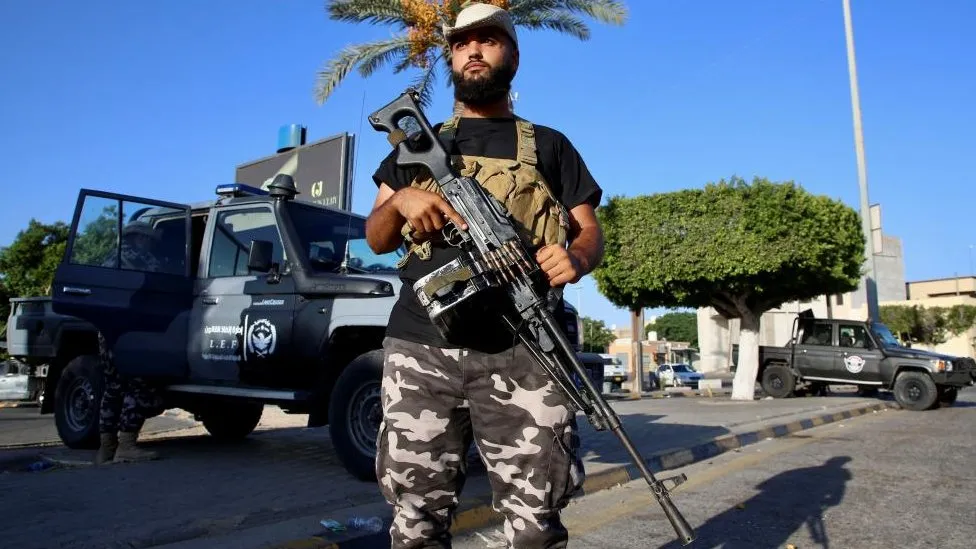
Militants asked to leave Tripoli by Libyan government following deal struck
-
17 former ISIS militants executed by Libyan court
The Prosecutor General’s office has announced that a criminal court in Tripoli on Monday sentenced 17 individuals to death for supporting the extremist organization Islamic State (EI) and engaging in lethal action on its behalf in Libya.
In addition to the 17 death sentences, the court sentenced two suspects to life in prison and 14 others to various prison terms, according to the same source. The nationalities of those convicted were not specified.
The 17 men were found guilty of committing “acts associated with” the EI and “undermining the state and social peace, adopting violence and armed action in the western city of Sabratha and its surroundings,” the prosecutor’s office added in a statement.
They were accused of “killing 53 people, destroying public buildings and making dozens of people disappear,” the source said.
Libya descended into chaos after the uprising that toppled Muammar Gaddafi’s regime in 2011, with rival powers, a myriad of armed militias and foreign mercenaries scattered across the country, amid foreign interference.
Taking advantage of the absence of the state, the iE has established itself in several Libyan cities, making Sirte its stronghold in June 2015 before being driven out in 2016. The jihadists who were not killed in the fighting or were arrested retreated to the desert but also to cities in western Libya.
EI fighters had briefly occupied the centre of Sabratha in February 2016 before government forces retook the city.
Libya voted in 2010 against a UN General Assembly resolution calling for a global moratorium on capital punishment, but no official statistics are available on the number of executions in the country.
Source: African News
-
Libya seeks to resume oil operations with global oil companies
The Libyan Government of National Unity, centred in Tripoli, has encouraged foreign oil companies with contracts with the national oil company to begin operations there.
The country’s National Oil Corporation, NOC, stated that it would assist the companies’ return and provide a safe working environment “in cooperation with the civil and military authorities in Libya.”

NOC Chief Farhat Bengdara Over the past ten years, armed groups and demonstrators have repeatedly invaded oil fields, leading to production halts.
The ongoing struggle between opposing governments in the country’s west and east for control of resources and power has increased tensions.
With the greatest crude oil reserves in Africa, Libya is desperately trying to boost output in order to finance much-needed improvements to the nation’s infrastructure for housing, transportation, and energy.
Your Friends Also Read: Business Edge | Ethiopia Continues Deregulation DriveThe National Unity Government also on said it had lifted the force majeure for oil and gas explorations. During the last major bout of conflict, groups affiliated with eastern commander Khalifa Haftar cut nearly all of Libya’s oil output for eight months.
“This call comes within the corporation’s efforts to lift force majeure after an objective follow-up and evaluation based on a realistic and logical analysis of the security situation, which has begun to improve dramatically,” NOC said.
It added that the improvement of the security situation has led to “the commencement of excavation work in sites where it was difficult to work in the recent past, in which there are now many global service companies.”
Your Friends Also Read: Ghana Owes Bretton Wood Institutions, Others $7.9bnNOC Chief Farhat Bengdara said in November that oil output had risen to 1.2 million barrels per day (bpd) from 600,000 bpd three months ago and that NOC does not expect any disruption in production.
-
Boat sinks off the coast of Syria, killing dozens of people
The health minister reported that 71 migrants’ bodies had been discovered when the boat they were on capsized off the coast of Syria.
Twenty survivors are receiving medical care in a hospital in Tartus, Syria.
Officials said Lebanese, Syrian and Palestinian nationals – including women and children – were believed to be among the 120-150 people who were on board when the boat sank on Thursday.
It is not clear what caused the accident. A rescue attempt is ongoing.
Officials added that the vessel had departed from Minyeh, a city near the Lebanese port city of Tripoli.
The boat is believed to have been heading to Europe when it sank.
Tartus, where survivors have been transported, is about 30 miles (50 km) north of Tripoli.
Victims’ families mourn in Tripoli
In a small dark room in a poor neighborhood in Tripoli, northern Lebanon, a family mourns.
Mustafa Mesto, 35, died with his two daughters and son, while his wife and her father are still in critical condition in a hospital in Syria.
Mustafa, was a Lebanese taxi driver, married to a Syrian Kurd who fled the war the country’s vicious civil war. One family fleeing devastation in two countries. They had hoped to reach Italy, dreaming of a better life.
But now their families, like those of others who lost their lives on this boat, are in shock.
Mustafa’s mother, Adla, sits in the middle of a big room filled with grieving relatives. She wails out loud, blaming the Lebanese government for her son’s fate.
“He ran away from poverty and the terrible conditions they left us in. These politicians could not care less about our lives. Nothing will bring him back to me, nothing will bring his little children back to me.”
Lebanon hosts an estimated 1.5 million Syrian refugees, and almost 14,000 from other countries, according to the UN High Commissioner for Refugees (UNHCR). It hosts the largest number of refugees per capita in the world.
However, the country is facing a severe economic crisis, fuelled by Covid-19 and the 2020 Beirut port explosion, with more than 80% of the population struggling to afford food and medicine.
The situation is having a severe impact on the country’s migrant population, many of whom are choosing to flee elsewhere, including to Europe.
Earlier this month, six people, including children, were killed when a boat carrying migrants from Lebanon to Europe sank off the coast of Turkey. The country’s coast guard said 73 migrants from four boats had been rescued.