The relationship between Tunisia and Morocco may be in disarray, but Tunisian Wissam Sultani will inspire the Atlas Lions on Wednesday against France in the World Cup semi-final in Qatar.
Football unites people when politics split them.
“On the pitch, politics has nothing to do. Supporting an Arab country, whatever it is, is a duty when it reaches this stage of the competition,” said Sultani, 41, who runs a fruit and vegetable stall in the central market of Tunis.
After breaking a glass ceiling by becoming the first African or Arab team to reach the last four of a World Cup, Morocco can indeed count on the support of an entire continent whose hopes it carries, by challenging the French title holders for a place in the final.
Morocco’s run, which eliminated the Spanish giants in the round of 16 and Cristiano Ronaldo’s Portugal in the quarterfinals, has sparked a surge of pride and excitement among neighbors Tunisia and Algeria, transcending political squabbles in the Maghreb, as well as in the rest of Africa.
In downtown Tunis, a sports store’s sound system blares Moroccan folk songs to attract customers. The red Atlas Lions jersey is the highlight of the display.
“Stand up”
The country is however in cold with Morocco, which reproaches him for having aligned with the position of Algeria in the Western Sahara issue, at the heart of extreme tensions between the two neighbors of the Maghreb.
In Algeria, if the official media have virtually ignored the performance of the Moroccans, sometimes content with the dry result, the private press has welcomed their achievements.
“It is quite normal that Algerians support Morocco, which is a Muslim country, brother and neighbor,” says Madjid, 58 years.
For Salim, 45 years old, employee of a public company, “Algerians are with the Moroccan team because it represents a Maghreb country and Amazigh” (Berber).
In the Maghreb as elsewhere in the Arab world, fans say their support for Morocco is increased tenfold when they see its supporters and players waving the Palestinian flag, showing their attachment to the Palestinian cause even though Rabat normalized relations with Israel in December 2020.
According to Tunisian sociologist Mohamed Jouili, this support for Morocco, which is becoming more and more apparent as the match against Les Bleus approaches, can also be explained by “France’s colonial past in the Maghreb.
“The countries of the region can not compete with France economically, militarily or geopolitically, but can stand up to 90 minutes on a soccer field and even beat it,” he added, recalling the victory of Tunisia in the group stage against the men of Didier Deschamps.
A leading human rights organization claims that a domestic abuse law adopted in Tunisia five years ago has not succeeded in protecting women.
In a new report, Human Rights Watch has concluded that poor implementation of what it describes as one of the strongest laws against domestic violence in the Middle East and North Africa has left Tunisian women at risk.
The group alleges that the Tunisian authorities have failed to systematically respond, investigate and provide protection to women who report violence.
FIFA has rejected France’s appeal about the disqualification of Antoine Griezmann’s goal in the shocking 1-0 World Cup loss to Tunisia last week.
In the eighth minute of stoppage time at Education City Stadium, Griezmann volleyed home, believing he had neutralized Wahbi Khazri’s goal.
Griezmann’s goal was disallowed by referee Michael Conger for an offside violation after the cheers subsided and the game reached its conclusion.
A Tunisia defender assisted Aurelien Tchouameni’s ball into the path of the Atletico Madrid forward, who was deemed to have been offside when he fired in.
However, the French Football Federation (FFF) believed that the goal should have been allowed because play had temporarily resumed when VAR intervened, which is against the rules.
“We are writing a complaint after Antoine Griezmann’s goal was, in our opinion, wrongly disallowed,” the FFF said last Wednesday.
The result would have changed to 1-1 if France had been successful in their appeal, but the group D standings would not have changed.
FIFA stated in a statement on Monday that they will not be looking into the situation any further.
“The FIFA Disciplinary Committee has dismissed the protest submitted by the French Football Association in relation to the Tunisia v France match,” the statement read.
Khazri’s superb strike ended reigning world champions France’s nine-game unbeaten run in the competition stretching back to the 2014 quarter-finals.
Les Blues went on to beat Poland 3-1 in Sunday’s last-16 tie and will now face England in the quarter-finals on Saturday.
The secretary-general of Tunisia’s powerful UGTT union claimed on Saturday that legislative elections due later this month serve no purpose.
Speaking before an audience, Noureddine Taboubi, denounced President Kais Saied’s constitutional reforms that in his view had neutralized political parties.
“We are heading for electionswithout colour or taste, they came as a result of a constitution that was not participatory, and there was no room for consensus or majority approval”, said Taboubi.
The union official left the threat of action hanging in the air.
“We warn the government against any measures targeting basic materials and leading to the starvation of the people, and we consider the secret agreements it has reached with the International Monetary Fund as non-binding for wage earners, and they will confront them in all legitimate and militant ways”, threatened the secretary-general.
Last year, President Kais Saied sacked the government and suspended parliament.
This year Saied extended his power grab with a constitutional referendum marred by an official turnout of barely 30 percent.
Only France, Brazil, and Portugal have already qualified for the World Cup knockout rounds, with many other teams facing a nerve-wracking penultimate matchday in their quest to advance to Qatar’s round of 16.
Favorites entering the tournament With victories over Serbia and Switzerland, Brazil easily advanced from Group G, while France became the first team to retain its global championship since the Selecao in 2006 to do so.
Portugal’s win over Uruguay on Monday in Group H ensured their place in the round of 16, but other teams like England, Spain, Germany, and Argentina still need results on matchday three to advance.
Another well-known team that hasn’t confirmed their participation in the FIFA World Cup’s latter rounds is the Netherlands, and Belgium must defeat Croatia in Group F to avoid an early elimination.
Here, we examine the potential outcomes depending on the final decision about group-stage action in the Middle East.
The Netherlands are essentially in charge of Group A and only need to avoid losing to Qatar, the group’s eliminated hosts.
If Ecuador defeats Senegal, who also needs to win, Louis van Gaal’s team will also go to the round of 16, but Aliou Cisse’s team will need Qatar to defeat the Netherlands to have any chance of competing.
Ecuador, who has performed admirably in their first two games, must defeat Senegal or draw to advance. However, if Qatar defeats the Netherlands, Gustavo Alfaro’s team may lose and not advance.
Group B
Against ferocious rivals Wales, England needs just to win or draw. However, as long as they avoid a four-goal loss against Wales, whose goal differential is six lower, the Three Lions would still advance.
Iran will automatically advance if they defeat the United States, who are aware that failure to defeat Carlos Queiroz’s team will result in their elimination from the competition.
Quieroz’s team might still finish first in Group B with a draw, but if Wales defeats Gareth Southgate’s England, goal differential would become important.
All four teams still have a chance to advance from the intriguing Group C, with Argentina—one of the pre-tournament favorites—necessitating a victory over Poland to ensure a spot in the round of 16.
The Albiceleste, though, might advance with a draw and would be eliminated in that scenario if Mexico and Saudi Arabia also shared the points.
However, Argentina will lose if Lionel Scaloni’s team is stopped and Herve Renard’s team defeats El Tri. Goal differential will decide the winner if Mexico wins and Argentina draws.
Poland would go through by avoiding defeat, but would be knocked out by a loss coupled with a Saudi Arabia victory over Mexico, who must win to have any chance of remaining in the tournament.
Goal difference will be used to divide the two teams if Saudi Arabia and Saudi Arabia tie and if Mexico triumphs and Czeslaw Michniewicz’s team loses.
Group D
As long as Australia doesn’t beat Denmark and France doesn’t lose to Tunisia, the French will win Group D; otherwise, the Socceroos would tie France on points with six. France is already in the round of 16 draw.
Even though a win would send Australia through, Graham Arnold’s team would still advance to the knockout round with a tie, barring Tunisia’s victory over France, which would allow Jalel Kadri’s team to advance on goal differential.
Unless Tunisia defeats France, Denmark would qualify with a victory over Australia. In that case, the difference between the Carthage Eagles and Kasper Hjulmand’s team would be determined by goal differential or goals scored.
Onto the next! France’s 2-1 win over Denmark moves them onto the round of 16.
Spain are the favourites to progress from Group E, requiring a win or draw against Japan. Defeat would see Luis Enrique’s side still go through on goal difference, unless Germany lose to Costa Rica.
Germany must pick up three points to stay in contention and would qualify as long as Spain defeat Japan, though a draw in the latter game or a win for Hajime Moriyasu’s men would see goal difference needed.
A win for Japan over Spain would take Moriyasu’s side through, while a draw – coupled with a stalemate for Germany – would also see the Samurai Blue make the knockout stage.
Costa Rica would earn a last-16 spot with victory and a point would also take them through if Spain overcome Japan. A draw in both games or a defeat for Fernando Suarez’s side sees them eliminated.
Group F
Croatia will pass through Group F if they avoid defeat against Belgium, who require victory against the 2018 runners-up to guarantee a place in the round of 16.
Such a win for Belgium would leave Croatia needing already eliminated Canada to overcome Morocco, with goal difference coming into play to separate Zlatko Dalic’s side from the Atlas Lions.
A draw is likely not enough for Belgium. They would need Morocco to lose to Canada and then rely on goal difference, though Walid Regragui’s men (+2) hold the advantage over Roberto Martinez’s side (-1) in the decisive metric.
Morocco would progress with victory over Canada, while a defeat would see Regragui’s side reliant on Belgium beating Croatia for goal difference to be decisive between Dalic’s men and the Atlas Lions for second.
Group G
Brazil have secured knockout football and will finish as Group G winners with anything other than defeat against Cameroon, who need victory against Tite’s side and results to go their way to make the last 16.
Rigobert Song’s men would be eliminated if they do not win, though victory is not guaranteed to secure progression as Switzerland could play out a high-scoring draw with Serbia to go through on goals scored, which is used if sides cannot be separated on goal difference – Cameroon are currently on -1 and Switzerland level in the latter metric.
The somewhat expected scenario of Cameroon losing to Brazil would see Serbia and Switzerland become a winner-takes-all clash.
Dragan Stojkovic’s side need victory to progress in that instance, while a draw would be enough for Switzerland. Goal difference would be required if Serbia (-2) and Cameroon (-1) both win their final encounters.
Portugal are already through and would top Group H by avoiding defeat against South Korea, who could still make a late charge for the round-of-16 stage should the result between Uruguay and Ghana go their way.
The permutations are straightforward for Uruguay and South Korea, who must win to avoid elimination, though qualification is not assured even with victory.
Both teams would be level on four points with victories, again leading to goal difference to separate. Yet, if Ghana beat Uruguay then South Korea’s result against Portugal will prove irrelevant for Paulo Bento’s side.
A draw for Ghana and a win for South Korea would also see goal difference required to split the two sides, with Bento’s men trailing the Black Stars by one in that metric, which could mean goals scored comes into it.
Tunisiawill take on its second game of the World Cup with ‘the knife between their teeth’.
Reassured by a very encouraging draw against Denmark, this Saturday, Jalel Kadri’s men must beat Australia, the presumed weakest team in group D.
The Carthage Eagles will be able to count on their entire squad and perhaps some fresh blood with the prodigy Hannibal Mejbri or the experienced Whabi Khazri.
For defender Mohamed Drager, “the pressure is still on especially as Australia has nothing to lose”. he says. “This willl be a final for them” adds Drager. “We will have to be ready. With the same spirit and concentration as against Denmark we can do something”.
The Australian Soccerroos, widely beaten by the French world champions 4-1, have no choice but to win. Graham Arnold will have a lot to play for and could choose to align his three players of South Sudanese rigine, the experienced Awer Mabil in attack and the defender Thomas Deng, but especially the big hope, Garang Kuol, 18 years only and future player of Newcastle.
Tunisian and Australian will have to wait for the result of France-Denmark to know more about their chances of progression in the tournament.
On the road to Zelfen, Tunisia, fields of prickly pear trees stretch as far as the eye can see: this plant is a “godsend” for this deprived region thanks to the anti-wrinkle oil that is extracted from it, which is very popular in cosmetics.
“Here is the capital of the prickly pear,” says Mohamed Rochdi Bannani proudly. It is one of the first in Tunisia to have invested in the processing of the seeds of the fruits of this cactus, to produce the precious and expensive oil – 350 euros per liter – increasingly sought after internationally for its anti-aging properties.
Owner of 420 hectares of certified organic fair trade prickly pear trees in Zelfen (central west), he produces 2,000 liters per year of oil from fig seeds, 95% of which is exported.
“This fruit has changed my life and that of the region. It has created wealth in an area where the prickly pear was a symbol of poverty,” confided to AFP Mr. Bannani, 52, surveying his field at the end of the harvest period.
Zelfen, in the heart of the governorate of Kasserine characterized by a poverty rate of 33% and 20% unemployment, has found with this fruit a source of local development.
About 30,000 hectares, including 3,000 hectares of organic fig trees, are cultivated in this small town bordering Algeria.
The sector employs more than 5,000 people, according to Boubaker Raddaoui, in charge of the sector for the Market Access Project for Agri-Food and Terroir Products (PAMPAT), supported by the United Nations Industrial Development Organization (UNIDO).
“Attractiveness”
Tunisia ranks fifth in the world in terms of area cultivated prickly pear for commercial purposes with 117,771 ha, behind Brazil, Mexico, Ethiopia and Morocco.
The North African country,
Nearly 8,000 liters were exported in 2021 for a turnover of 5 million euros, according to PAMPAT, which, since 2013, trains producers and helps them to organize in professional circuits.
“Exports jumped by 50% between 2019 and 2021, which shows us the attractiveness of the sector and the increase in demand from one year to another,” Raddaoui said.
The dynamism of the sector is such that the country has gone from five processing companies (mainly focused on oil) in the early 2000s to 55 in 2021, including 11 in the region of Zelfen, organized into cooperatives.
“Before, everyone wanted to leave (the region). Today, it is history thanks to the oil,” says Hamza Rochdi, a young farmer who cultivates the 40 hectares of family land.
“Thanks to the growing interest in this fruit, our working conditions have improved,” says Hanane Messaoudi, who has been picking figs for seven years and is now paid the minimum wage (nearly 500 dinars per month, about 150 euros).
“Not very demanding”
The prickly pear has the added advantage of not fearing the arid soil, for a country where water is becoming rarer, as in the entire region.
Tunisia has fallen well below the threshold of water shortage, estimated at 1,700 m3 per capita, with only 428 m3 per capita per year, according to the latest official figures dating from 2004.
“The prickly pear is undemanding, adapts to several types of soil and consumes little water. It is an ecological boon,” said Raddaoui.
In the footsteps of Zelfen, other regions are interested in this culture, like Nabeul (northeast) and Kairouan (center).
This craze has its limits, however, because of difficulties in entering very dynamic markets such as Japan or South Korea.
For the moment, Mohamed Rochdi Bannani transforms only 20% of his annual production (20,000 tons of fruit) into oil because of “marketing problems. “The markets are not 100% open,” he regrets.
In addition, even if it is sold at a high price in the form of cosmetics, “the oil of prickly pear is expensive to produce,” notes Salim Benmiled, who created in 2020 a processing plant in Thala, near Zelfen.
The world’s French-speaking leaders gathered in Tunisia, ended Sunday (Nov 20) their two-day meeting.
The conference took place against the backdrop of growing instability in the Sahel, the Great Lakes regions and popular discontent in francophone Africa.
The secretary general of the International Organisation of La Francophonie (IOF) was elected for a second term. She promised to do more to resolve crises.
“We are headed towards a Francophonie of the future, modernised, much more relevant in the midst of change which is not easy”, Louise Mushikiwabo said.
“We feel an obligation to offer our fellow Francophones the fruits of the organisation’s work. We feel an obligation to give more hope to Francophone youth.”
The head of the 88-member IOF bloc, said Sunday that “all the conflict zones were the subject of long debates”.
“The IOF is an organisation that can support and catalyse (efforts) to mediate between parties in conflict,” she added.
But tensions crept into the International Organisation of La Francophonie (IOF) conference itself when the Prime Minister of the Democratic Republic of Congo, Jean-Michel Sama Lukonde, refused to pose for a photo next to Paul Kagame, President of Rwanda.
The DRC accuses Rwanda of supporting M23 rebels who have seized swathes of territory in its eastern region, displacing tens of thousands of people and igniting regional tensions.
The IOF founded was in 1970, aims to promote the French language, develop economic cooperation and help mediate international conflicts.
Many African leaders have expressed dismay at the West’s rapid response to the war in Ukraine, in contrast to conflicts in their own countries.
The organisation, whose annual budget is under 100 million euros, has been accused of being “powerless” in the face of fraudulent elections, power grabs and coups in many of its member states.
French president Macron said the IOF should reclaim its diplomatic role, moments before Paris announced that it would seek to take on the organisation’s rotating presidency from 2024.
Sudan, Ethiopia, Senegal, Zimbabwe, Egypt, Tunisia, Mali, Mozambique, Morocco, Mauritania, Niger, Eritrea, Algeria, Sudan, Benin, Rwanda, Chad, Kenya, and Libya are just a few of the many African nations that have been identified as among the thirty (30) nations in the world that are most at risk from the effects of climate change.
According to reports, these nations are experiencing the negative effects of climate change, including food crises, ocean acidification from rising CO2 levels, droughts, flood risks, storms, melting glaciers, rising sea levels that affect low-lying areas and coastal cities, declining crop yields, especially in tropical regions, and water shortages.
These negative effects are leading to the destruction of tropical forests, forest fires, Malnutrition and heat stress, spread of vector-borne disease e.g., malaria, dengue fever etc., Physical displacement of populations and risks of mass migrations, Damage to ecosystems and species extinction, Sudden shifts in weather patterns and many more problems that are confronting humanity and the environment.
Thus, international economist and a member of tralac Advisory Board who is also a former Chief Economist at the Word Trade Center, Patrick Low has challenged African countries to seize the opportunity of the ongoing COP 27 in Egypt to concentrate on Green Growth to improve competitiveness and enhance access in big markets.
Addressing the 2022 tralac Annual Conference in Nairobi, Kenya, Patrick Low who currently serves as a fellow of the Asia Global Institute emphasized that there is the need for a clear and united African position to addressing the climate issues affecting the continent considering the fact that Africa’s population will double by 2050.
Patrick Low distinguished between two main approaches to tackling climate change issues; namely abatement and adaptation where abatement which is also referred to also mitigation seeks to reduce emissions while adaptation refers to preparing the environment to sustain a given level of global warming. He however advised Africa to focus on the sustained growth trajectory relying on particularly the current integrated continental trading under AfCFTA.
“Africa’s challenge is not abatement, but rather mapping out a sustainable growth trajectory. Green growth will improve competitiveness and enhance access in big markets,” he advised.
The Geneva-based consultant on trade and trade-related matters also charged the continent to Support the development of a negotiated carbon price among major emitters and a market for carbon credits particularly when all the major emitters are not necessarily part of the top-tier list of countries that face the worse threats from climate change.
“It is in all countries’ interest to act maximally, especially the major emitters on abatement and the richer countries also with finance for adaptation around the world,” he recommended.
Patrick Low encouraged Africans to continue pushing for countries particularly big emitters of CO2 to fulfill their commitment to climate change financing in order to have funds tackle the adaptation approach of handling climate change.
“Keep up the pressure on financing, remind RoW that Africa is an important carbon sink,” the international economist advocated.
He added that adaptation is about reducing the impact of global warming and big emitters can pursue meaningful abatement policies, but this is less true of small emitters who are the most vulnerable to climate change with disparate income and development levels, vulnerabilities afflicting dozens of countries powerless to address them, even though everyone can play the appropriate part and therefore a Unified Africa can team with other parts of the world to corporate on the levels of addressing all climate change issues.
The leader of a Tunisianopposition party and prominent critic of President Kais Saied announced Wednesday he had been barred from leaving the country, without any prior notice.
“This morning at Tunis-Carthage airport, I was banned from leaving the Tunisian territory without having been previously notified of any judicial decision,” wrote Fadhel Abdelkefi, an economist and former minister, on Twitter.
According to this party, “this illegal measure is further evidence of the tightening of political control and the accelerated drift of the regime of President Kais Saied to a dictatorship.
Afek Tounes also denounced a “repressive procedure that is part of the instrumentalization of state apparatus to repress the opposition and target political figures.
Contacted by AFP, the Ministry of the Interior said it was not aware of this case.
Several NGOs and political parties accuse President Saied, who has taken full powers since July 25, 2021, of repressing freedoms in Tunisia and of wanting to restore an authoritarian regime.
The power grab by President Saied, who also had the constitution amended this summer by referendum to reinstate an ultra-presidentialist regime, has shaken the young democracy in Tunisia, the country from which the Arab Spring revolts began in 2011.
The European Union on Monday granted 100 million euros to Tunisia, a country in the midst of a political and financial crisis.
The EU support program “aims to support economic recovery efforts and to consolidate the progress already made in the distribution of social aid to needy citizens and businesses,” said the EU delegation in Tunisia in a statement.
The first immediate disbursement of 40 million euros is granted to Tunisia under this program signed by the EU Ambassador to Tunisia, Marcus Cornaro, and the Minister of Economy and Planning, Samir Said.
The disbursement of the rest of the sum will be made “on the basis of effective progress in the implementation of structural reforms initiated by Tunisia,” according to the statement.
“We want to support as best we can the economic recovery following the pandemic of COVID-19, and help Tunisian households that suffer the consequences of Russian aggression against Ukraine on energy and food prices,” said Cornaro.
According to the statement, this gift “is part of the reforms agreed by Tunisia with the International Monetary Fund (IMF) for a future program.
Since the revolution of 2011, Tunisia has sunk into economic difficulties, aggravated by the Covid-19 pandemic, with growth at half-mast and very high unemployment.
Russia’s invasion of Ukraine in February deepened the crisis in a country highly dependent on grain and fuel imports, two sectors where prices are soaring.
Suffocating from a debt exceeding 100% of GDP, Tunisia obtained in mid-October an agreement in principle from the IMF for a new loan of some two billion dollars to be disbursed in installments starting in December.
In return, the government has committed to reforms including a gradual lifting of state subsidies for basic products (food and energy) and a restructuring of state-owned companies that have a monopoly in many sectors.
In Tunisia, the first floating solar station on a lake next to a Tunis industrial park has started to operate.
The expectation is that the 200-kilowatt project from a French renewables company, Qair, can be a prototype for bigger projects nationwide.
“When we started at the time, it was the first project in Africa for a floating solar power plant, i.e. in the water. The originality of this project means we can use water instead of taking up land that can be used for other things like farming or homes”, said Omar Bey, executive for the French-based renewables group Qair.
Using floating solar panels helps to conserve water resources whilst making the panels more energy efficient.
“Floating solar panels first of all allow the reduction of water evaporation when they are installed on a water body. So this evaporation of water in countries like Tunisia, Which is water-stressed, certainly allows the dams to keep more water reserves”, concluded the executive.
In 2015 Tunisia set ambitious targets for renewables but last year green sources accounted for only 2.8 percent of the country’s energy mix and the rest came from natural gas.
“We’re blessed with a lot of sunshine in Tunisia, and it’s not like in other places such as the Gulf, the solar panels have the characteristics and the sunshine is good, and we can exploit it, so why not let everyone put up solar panels? The field is developing and will keep on doing so”, said Hassen Amiri, manager of Sater Solar energy company.
Tunisia’s neighbour, Morocco, is leading in the region. The country currently produces around a fifth of its electricity from clean sources.
In the south-eastern Tunisian city of Zarzis, shops and government offices were closed, along with health services, except for emergency cases, on Tuesday (Oct 18).
Protesters demanded a renewed search for relatives who went missing in a failed migration attempt.
Chanting, slogans like the “people want the truth”, thousands once again took to the streets.
The pressure piling on authorities prompted the president to ask his Justice Minister to open an investigation.
“I assure you that this is a historic strike (in the city of Zarzis, ed)”, local activist Ezzedine Msalem, said.
“The state must reveal the truth. Today, we want to know the truth. It is a state crime that was perpetrated against the inhabitants of Zarzis with the burial (of bodies found at sea — believed to be passengers from the boat — in a cemetery for foreign migrants, ed) without identifying them before, nor having done any DNA analysis.”
Four people, suspected of being missing Tunisians, were buried in a nearby cemetery for foreign migrants — allegedly without efforts to identify them.
Those bodies have since been exhumed for identification, while another two bodies believed to be Tunisians were found.
One of the country’s largest unions, the UGTT trade union federation voiced support for the strike and demanded an inquiry into the rescue effort and how the bodies were buried.
The Tunisian Human Rights League said authorities had “not devoted the necessary resources to search and rescue operations in a timely way” and called for an inquiry into the burials.
Tunisian authorities intercepted nearly 200 migrants attempting to reach Europe over the weekend, the defense ministry said Tuesday.
According to official figures, more than 22,500 migrants have been intercepted since the start of the year, around half of them from sub-Saharan Africa.
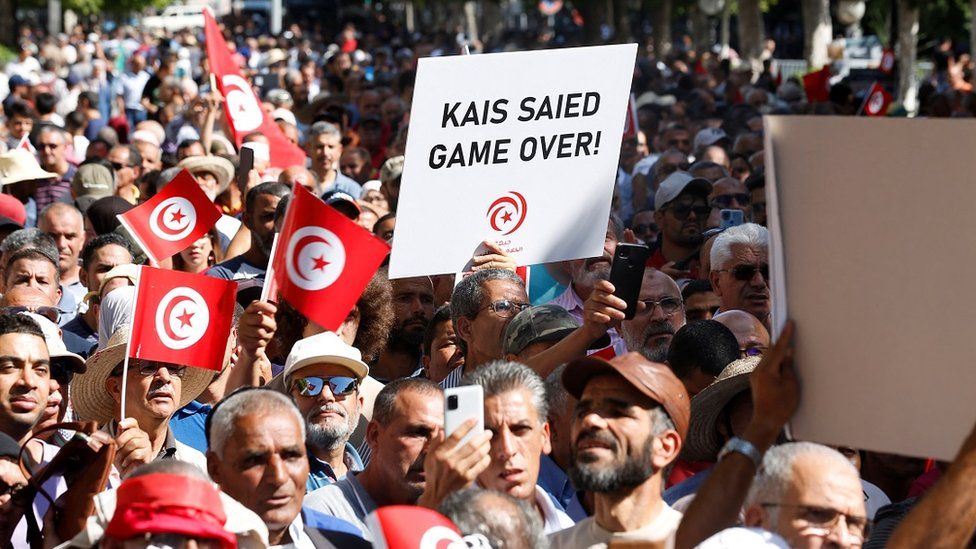
Thousands of demonstrators have marched to the streets of Tunisia’s capital to protest the president.
Parallel demonstrations by diametrically different political movements were organized in Tunis.
Both organisations condemned Kais Saied as an autocrat who is undoing the democratic gains gained since the 2011 revolt.
They also demanded accountability for the country’s economic crisis which has seen food and fuel shortages.
Critics of Mr Saied accuse him of staging a coup and attempting to turn Tunisia back into an autocracy – a system of government run by one person with absolute power.
After sacking the prime minister and suspending parliament in July 2021, a year later Mr Saied pushed through a constitution enshrining his one-man rule after a vote boycotted by the main opposition parties.
The new constitution replaced one drafted three years after the Arab Spring in 2011 which saw Tunisia overthrow late dictator Zine al-Abidine Ben Ali.
It gave the head of state full executive control, the supreme command of the army, and the ability to appoint a government without parliamentary approval.
Mr Saied has said it was needed to break a cycle of political paralysis and economic decay.
He said his reforms were being done in the spirit of the 2011 revolution and would ensure a better future.
His supporters welcomed his actions, saying the country needed a strong leader to tackle what they see as a fractious and corrupt system.
On Saturday, protesters in central Tunis chanted, “down, down”, “revolution against dictator Kais” and “the coup will fall”.
One of the marches was organised by the National Salvation Front, a coalition of opposition parties including the Islamist-inspired Ennahda that had dominated Tunisia’s parliament before its dissolution by Mr Saied.
Ali Laarayedh, Tunisia’s former prime minister and a senior Ennahda official, told AFP news agency that the protest was an expression of “anger at the state of affairs under Kais Saied”.
“We are telling him to leave.”
IMAGE SOURCE, REUTERS Image caption, Protesters call for President Kais Saied to go.
He added that if Mr Saied remains in power, “Tunisia will have no future”, citing growing despair, poverty, and unemployment.
The National Salvation Front has announced it will boycott a December vote to elect a new parliament with limited powers.
Ennahda’s deep ideological rival, the secular Free Destourian Party, also organized a protest in the capital on Saturday.
Some of its protesters carried empty containers to symbolise the rising cost of water due to inflation, which hit 9.1% in September.
Mr Saied “is doing nothing, and things are only getting worse”, said Souad, a pensioner in her 60s.
Around 1,500 people joined the Ennahda-led demonstration, while nearly 1,000 attended the PDL protest, the interior ministry told AFP.
Tunisia’s revolution in 2011 is often held up as the sole success of the Arab Spring revolts across the region – but it has not led to stability, either economically or politically.
The cash-strapped country reached a preliminary agreement with the International Monetary Fund on Saturday for a rescue package loan of $1.9bn (£1.7bn) to help it restore economic stability and strengthen social safety nets.
Tunisians have been hit with soaring food prices and shortages of basic staples in recent weeks, threatening to turn simmering discontent in the North African country – the cradle of the Arab Spring protests – into larger turmoil.
Sugar,vegetable oil, rice and even bottled water periodically disappear from supermarkets and grocery stores.
People stand in line for hours for these food essentials that have long been subsidized and are now increasingly available in rations only.
And when they appear on the shelves, many people cannot afford to pay the staggering price for them.
The government has blamed speculators, black market hoarders and the war in Ukraine, but economic experts say the government’s own budget crisis, and its inability to negotiate a long-sought loan from the International Monetary Fund, have added to Tunisia’s troubles.
Fights sometimes break out at food market queues, and scattered protests and sporadic clashes with police over rising prices and shortages have occurred around the country.
In a suburb of the capital, Tunis, a young itinerant fruit vendor recently killed himself after police seized the scales he used to weigh his wares.
His act of desperation revived memories of the 2010 self-immolation of another Tunisian vendor, Mohamed Bouazizi, which prompted protests that led to the ouster of long-time dictator Zine El Abidine Ben Ali, and provoked similar uprisings around the Arab world.
“I came to shop and found people fighting to buy and the prices were very high,” said shopper Amina Hamdi, despairing at trying to buy basic goods.
“It is not possible to live without food,” said Aicha during a recent shopping trip to the fish and meat market in Tunis. “We can live without furniture, construction material, but we have to eat.” She only gave her first name for fear of persecution by police for speaking out.
The Ministry of Commerce promised last month that shortages would ease, announcing the import of 20,000 tons of sugar from India to be available in time for Mouled, the birthday of the Prophet Muhammad.
But the night before the holiday, citizens formed long lines in front of supermarkets in the hope of getting a package of sugar, an essential food to prepare traditional dishes for the religious holiday.
Food isn’t the only thing in short supply. Lacking energy resources like those in neighboring Libya and Algeria, Tunisia relies heavily on imports and its long-running economic troubles mean it has limited leverage on international markets to secure the goods it needs.
Inflation has reached a record rate of 9.1%, the highest in three decades, according to the National Institute of Statistics.
The Central Bank of Tunisia (BCT) added a hit by increasing bank fees and interest rates, hindering access to consumer loans.
In Douar Hicher, an impoverished suburb on the outskirts of Tunis considered a barometer of popular discontent, hundreds of people took to the streets at night last month to denounce the deterioration of their living conditions.
With cries of ” work, freedom, dignity” – the flagship slogan of the 2010-2011 revolution – demonstrators blocked the town’s main artery by setting fire to tires, braving the police who sprayed tear gas to disperse them.
“Enough of speeches and promises, people are gripped by hunger and poverty,” read a banner erected by the demonstrators, their anger at the government and political elites palpable.
After sacking the prime minister and dissolving parliament, President Kaïs Saied has granted himself sweeping powers over the last year.
He said the moves were necessary to save the country amid protracted political and economic crisis, and many Tunisians welcomed them, but critics and Western allies say the power grab jeopardizes Tunisia’s young democracy.
Saied attributes the scarcity of food products and the rise in prices to “speculators” and those who hold a monopoly on goods they store in illegal depots.
He suggested that his main political rival, the Islamist movement Ennahdha, had some role, which the party firmly denies.
In a statement, the Salvation Front, a coalition of five opposition parties and several independent groups, called the demonstrations a sign of “a general explosion and the collapse of the social and political order.”
The general secretary of the powerful trade union UGTT, Noureddine Taboubi, blames the state’s overburdened budget.
The government is currently negotiating a $2 billion to $4 billion loan with the IMF to cope with a budget deficit aggravated by the COVID-19 pandemic and the fallout from Russia’s war in Ukraine. A high-ranking Tunisian delegation went to Washington on Saturday in the hope of finalizing a deal.
In return, Tunisia will have to commit to painful reforms, including shrinking the public administration sector – one of the world’s largest – which eats up about a third of the state budget.
The IMF is also demanding the gradual lifting of subsidies and the privatization of state-owned enterprises, which implies massive layoffs and a worsening of unemployment, already at 18% according to World Bank’s latest figures
Faced with such bleak prospects, Tunisians increasingly no longer hesitate to put their lives in danger to try to reach Europe in search of a better life.
The Tunisian Forum for Economic and Social Rights, an NGO that closely monitors migration, says 507 Tunisian migrants died or gone missing so far in 2022.
According to National Guard spokesman Houssameddine Jebabli, the coast guard thwarted more than 1,500 attempts at illegal migration to Italy from January to September 2022, involving entire families including nearly 2,500 children.
Representatives of Tunisia’s influential UGTT labour union say, the nation only has enough gasoline to last a week.
Typically, fuel reserve levels are established at 60 days.
Long queues of cars have been jamming roads in the capital, Tunis, waiting to fill their tanks.
Energy Minister Naila Nouira has denied that the fuel shortage is down to the government’s inability to pay for supplies, insisting instead that many motorists are taking more than they need.
She added that a tanker, full of petrol, is now being unloaded which will give the country several more days’ supply.
Many young Tunisians stillwant to take the perilous boat crossing over the Mediterranean because they believe they would be better off in nations like Italy, even though the economic situation in Europe is getting worse and governments are cracking down on migrants.
The husband of Hanan Erdidi has made a choice that will alter his life. He informed her of his impending departure the evening before we met in Tunis, the nation’s capital.
Many young Tunisians still want to take the perilous boat crossing over the Mediterranean because they believe they would be better off in nations like Italy, even though the economic situation in Europe is getting worse and governments are cracking down on migrants.
The husband of Hanan Erdidi has made a choice that will alter his life. He informed her of his impending departure the evening before we met in Tunis, the nation’s capital.
Smugglers have offered him a seat on a boat to Italy and he’s decided to take the risk: he’s had enough of being squeezed into a tiny, damp room in a former army barrack in Tunis with their two young children.
He wants better for his family and now he’s seizing his chance.
“Sometimes we both cry because our kids don’t have toys to play with. Even the clothes they wear are second-hand, given to us by other people,” Hanan tells me.
“Sometimes we prefer to keep the kids at home and not take them to the market, because if we take them there, they will see fruit. We can’t afford even things like apples or grapes. We keep them indoors, so they don’t cry over seeing the things we can’t buy for them.”
“My husband wants to leave to make our living conditions better. Either he improves our situation, or he dies at sea,” she says.
For men like Hanan’s husband, this is becoming a common choice.
Tunisia is in the grip of a cost-of-living crisis. The number of families in need has tripled since 2010 and now stands at almost one million.
Half of the country’s population is living in poverty. Last year, unemployment stood at almost 20%.
IMAGE SOURCE,GETTY IMAGES Image caption, A decade ago, Tunisia was at the forefront of political change in the region
This is the country that ignited the Arab Spring. It’s long been considered one of the movement’s very few success stories.
For many countries in North Africa and the Middle East, the uprisings more than a decade ago brought instability and chaos.
But Tunisia managed to claw its way towards democracy. Its president of 23 years – Zine al-Abidine Ben Ali – was deposed and a new constitution was carefully crafted, based on public will.
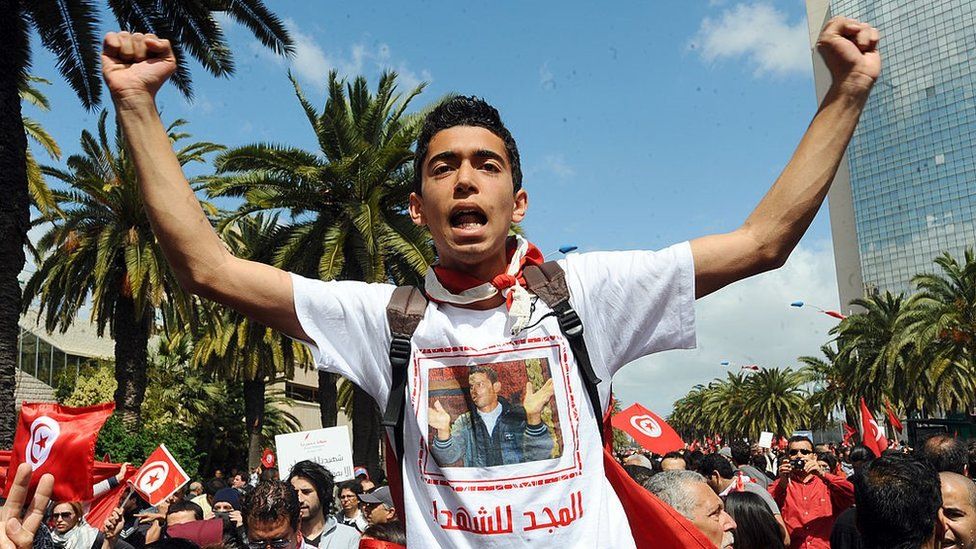
When thousands of chanting Tunisians first filled the streets at the end of 2010, marking the start of the Arab Spring, it was a visceral reaction to the death of a fruit and vegetable seller, Mohamed Bouazizi.
He set himself on fire outside a municipal building after having his cart confiscated by the authorities.
I wondered how fruit and vegetable sellers felt now, so I have gone to talk to them at one of Tunis’ many street markets.
Among piles of shining red tomatoes and sun-plumped seasonal fruit, a theme emerges – these men are saving whatever money they can, and then spending it all on dangerous boat trips, believing they will be better off in Europe.
They are unlikely to be deterred by a new right-wing government, which has promised a tough response to irregular migration, taking office following Sunday’s election.
One of them, Seif Eddin Hassouine, details how he has already spent $4,000 (£3,600) on two unsuccessful boat trips, each time intercepted by coastguards and sent back home. But he is about to do it again.
“This country has no jobs, no money, it’s better to leave,” he says.
Rachid Ben Jaafar, selling watermelons from a nearby stall, agrees: “Prices are high, life is very expensive, I can’t afford it any more. There’s no oil or sugar. Sometimes there’s no bread. How can people live? What can people do? All ways are closed.”
The original Arab Spring uprisings are branded deep into the memory of people here.
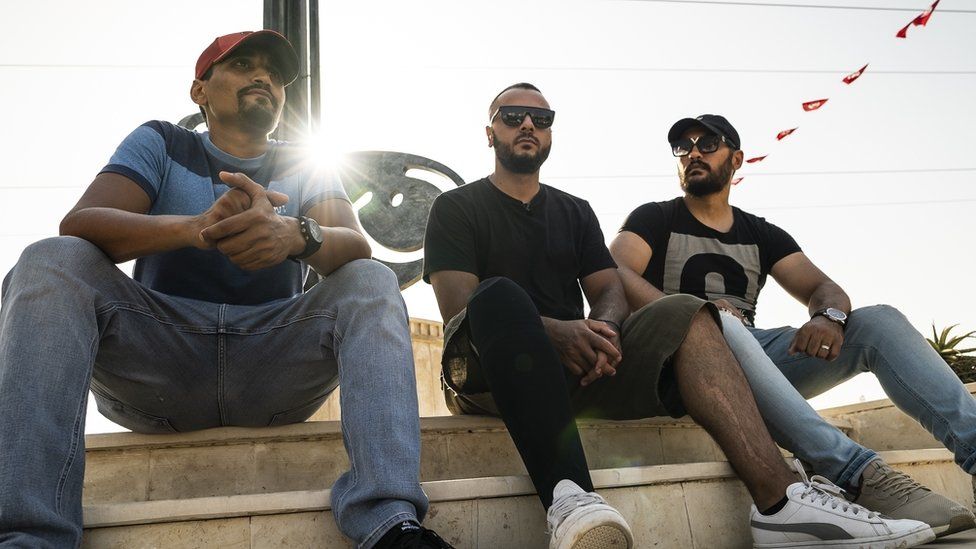
Walid Kassraoui sacrificed more than most. He was shot in the leg while demonstrating and it couldn’t be saved. Now he’s struggling to get a job, his prosthetic limb a daily reminder of what he’s lost.
IMAGE SOURCE,LEE DURANT/ BBC Image caption, Walid Kassraoui (C) is a father-of-two who lost his leg during the Arab Spring uprising
As we stand in the same street where he protested, he shows me a sign on the road. It lists the names of those who died there, including one of his closest friends.
“During the revolution, the slogans were all about finding jobs, freedoms, and national dignity,” he remembers. “Unfortunately, jobs and national dignity have not been achieved over the past 12 years. I’m a dad of two kids who is growing, I was hoping to raise them in better conditions, but unfortunately, I can’t.”
But those hard-fought rights and freedoms are being eroded as people hope they can trade them for jobs and better economic prospects.
President Kais Saied, a constitutional law professor, along with a small group of hand-picked allies, wrote a new framework for the country’s constitution, concentrating power in his own hands.
It was the culmination of a process that started in 2021 when he sacked the prime minister, dissolved the government, and suspended parliament.
In July, a referendum put these changes to the people, but the result was always a foregone conclusion.
In just a few hours, Tunisia’s constitutional landscape had rolled back more than a decade.
But for ordinary Tunisians, the focus now is on how to feed their families or find a job.
Left behind and desperately hoping the sea will spare her husband, Hanan sees a bleak future ahead of her.
“My mother and father are dead,” she cries. “I don’t have brothers, or anybody else. He is my mum, dad, brother – he’s everything to me. If he dies in the sea, I will be orphaned once again.”
In one district on the outskirts of Tunis riot police fired tear gas to disperse protesters who had blocked roads and were throwing stones at officers.
The demonstrators were angry at the suicide of a local man who had allegedly been harassed by police for selling fruit without authorisation.
Brentford’s Bryan Mbeumo made his Cameroon debut in a 2-0 defeat to Uzbekistan as the Indomitable Lions lost the first of two final warm-ups prior to naming their World Cup squad.
The forward represented France at junior level before switching allegiance to the central African nation of his father last month.
The 23-year-old played the full 90 minutes at Goyang Stadium near Seoul in the north of South Korea, where Nicolas Nkoulou returned for the first time since winning the 2017 Africa Cup of Nations final.
The Greece-based defender, 32, was persuaded to come out of international retirement by coach Rigobert Song for November’s World Cup in Qatar.
Mbeumo joined Brentford, with whom he has scored six Premier League goals, in 2019 after coming up the youth ranks in France, who he represented between 2015 and 2020 at varying age levels.
Yet Russia-based duo Hojimat Erkinov and Oston Urunov scored either side of half-time to give Uzbekistan the win over the five-time African champions, who begin their World Cup campaign against Switzerland in November.
Cameroon, who are also grouped with Brazil and Serbia in Group G at the finals, will take on hosts South Korea in another friendly, in the capital, on Tuesday.
Later on Friday, Morocco and Ghana take on Chile and Brazil respectively as they continue their preparations for the World Cup, with African champions Senegal facing Bolivia on Saturday.
Satisfied Tunisia
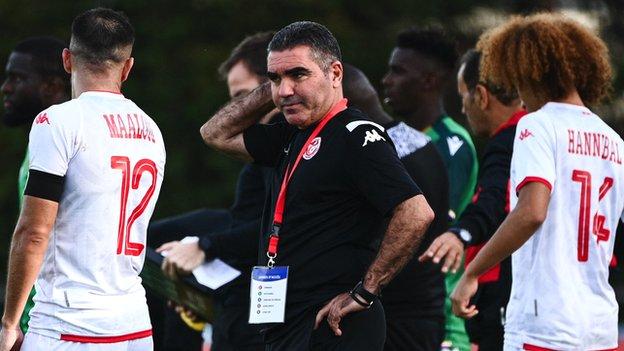
Elsewhere, Tunisia coach Jalal Kadri declared himself satisfied with his side’s tough 1-0 win over Comoros in the Parisian suburbs of Croissy-sur-Seine as their build-up to the World Cup continues.
Kuwait-based forward Taha Yassine Khenissi, who served a doping ban last year, headed home the only goal early in the second half on Thursday.
“We played against an opponent who proved again to be a top side as shown during the last Nations Cup, an opponent with quality, good potential and squad,” Kadri said of the debutants, who reached the last 16 earlier this year.
“After a difficult first half, we found our rhythm. The quality of the pitch prevented both teams from playing free-flowing football, but we are satisfied with the team’s continuous growth by keeping a winning trend going.
“We also achieved our objective to see a lot of players involved in order to give them game time on the pitch before the World Cup.”
Jalal Kadri has one more friendly left prior to naming his World Cup squad
Tunisia’s next friendly comes against five-time World Cup winners Brazil in a prestige clash on Tuesday, also in the French capital, with the Carthage Eagles suffering a 4-1 friendly loss to the South Americans in 1974 – the nations’ only previous senior meeting.
Lorient defender Montasser Talbi is aware of Brazil’s reputation in world football but insists they can spring a surprise.
“I’m sure a win is possible because we are an ambitious team. We showed it during the last Kirin Cup by beating Japan in their home and Chile,” the 24-year-old told BBC Sport Africa.
“We are fully confident and ambitious. We know it is going to be a special match – with sold-out capacity at the Parc des Princes against a wonderful team, maybe the best offensive squad in world football. But we must remain focussed.
“Since my childhood in France, we grew up knowing of Ronaldinho and Ronaldo and Brazil’s Joga Bonito [‘beautiful game’] – and that is still the case. They have good players, good with the ball such as Vinicius Jr. and Neymar. That’s a great and difficult challenge for any opponent.”
In Qatar, Tunisia will meet Denmark, Australia and defending champions France.
After spending the entire night being interrogated by counter-terrorism police, the leader of the largest party in the now-disbanded Tunisian parliament has been freed by the authorities.
Rached Ghannouchi has been accused of complicity in smuggling jihadists to Syria and Iraq, charges he has denied.
According to his lawyer, he will again be questioned later on Wednesday.
His Ennadha party has denounced his interrogation and that of the former prime minister, Ali Laarayedh, as a flagrant violation of human rights.
The Tunisian president, Kais Saied, has brooked no opposition to his rule since dissolving parliament last year.
Former Tunisianprime minister, Ali Larayedh, has been detained by anti-terrorism police over his alleged involvement in smuggling of jihadiststo Syria.
According to reports, a senior figure in the Islamist opposition Ennahda party Mr Larayedh had been questioned for hours as well.
Ennahda in a statement denounced this action as a flagrant violation of human rights.
Prty leader Rached Ghannouchi is due to be questioned later on Tuesday.
Ennahda rejects the charges.
President Kais Said has tightened his grip on the judiciary following his suspension of the Ennahda-dominated parliament last year.
The Minister, who is representing President Nana Addo Dankwa Akufo-Addo, is leading a Ghana team that includes Hon. Alan Kwadwo Kyeremanten, Minister for Trade and Industry, Hon. John Kumah, Deputy Minister for Finance and senior officials from the Ministries of Foreign Affairs and Regional Integration, Finance, Trade and Industry and Roads and Highways.
TICAD 8 will address Sustainable and inclusive growth, realizing sustainable and resilient society, and Building sustainable peace and stability.
A Business Forum involving business executives from Africa and Japan is expected to provide opportunities for investments and trade cooperation. Ghanaian executives are participating in the Forum.
As part of the visit, theGhana delegation will sign with Japanese officials two grant agreements for infrastructure projects to be funded by Japan. In addition, bilateral talks will be held with JETRO and JICA as well as with a number of leading Japanese firms.
The Foreign Minister will also hold bilateral talks with a number of Foreign Ministers and other officials.
In a statement, Hon. Ayorkor Botchwey noted the timeliness of the TICAD conference as African countries rededicate to efforts to build resilient economies beyond aid. She stressed the need to forge a new development cooperation consistent with the ambitions of the African people for peace and prosperity.
Ghana is expected to take the opportunity to advocate for the required higher-quality collaboration with Japan and other development partners.
The Tunisian president has published details of a new constitution that would vastly expand his powers.
Kais Saied, who has ruled by decree since sacking the government a year ago, says the draft document published in the official gazette, will be put to a referendum next month.
Under the proposals – drawn up by a committee handpicked by Mr Saied – most political power would be exercised by the president.
He would have ultimate authority over the judiciary and army as well as the government.
Critics accuse Mr Saied of dragging the country back towards the autocratic form of government that was overthrown during the Arab Spring revolt of 2014.
Opposition political parties have rejected the referendum in advance.
The International Monetary Fund (IMF) has expressed support for a wide-ranging but controversial economic reform programme being implemented by the government in Tunisia.
The country is facing a severe economic crisis and is asking for a $4bn (£3.2bn) loan.
Jihad Azour, the IMF’s Middle East director – after meeting President Kais Saied in Tunis on Wednesday – said he liked the reform plan and that the IMF was ready to discuss a loan.
The plan includes freezing wages, stopping recruitment in the public sector and cutting energy and food subsidies.
But there have been big protests and Tunisia’s powerful trade union movement has called nationwide strikes.
The president has already suspended parliament and sacked his entire cabinet.
He says he needs even more powers to better steer the country – his opponents say that amounts to a coup against democracy.
A military appeal court in Tunisia has sentenced a prominent political opponent of President Kais Saied to one year in prison and banned him from practising law for five years.
A lawyer for Seifeddine Makhlouf said his client had been charged with insulting a judge, and that the verdict was a real farce.
He said President Saied had created a judiciary that he could control and use against opponents.
Makhlouf heads the conservative Karama party, which is allied to the Islamist Ennadha party.
He has been one of the strongest critics of Mr Saied’s moves to establish what is effectively one-man rule.
Earlier this month, Mr Saied sacked dozens of judges, accusing them of protecting Islamists.
A former Tunisian MP and vocal critic of President Kais Saied has been sentenced by a military court to five months in prison for assaulting police officers last year, his lawyer told AFP on Tuesday.
The verdict by the Tunis military court was announced on Monday evening, his lawyer, Anouar Ouled Ali, told AFP.
Makhlouf has appealed against the sentence, the same source said.
Six other people, including three members of the political group, were sentenced to between three and six months in prison in the case, Ouled Ali added.
On 22 September 2021, the military justice had already arrested this former deputy for “attacking the dignity of the army” after an argument with judges of a military court.
He was released “under judicial supervision” in January 2022.
Tensions have been mounting at a Tunisian hospital that’s struggling with staff and bed shortages amid a surge of COVID-19 infections there.
One woman, whose mother was moved from a general bed to a wheelchair in the intensive care unit at a hospital in the northern town of Kairouan, was distraught.
“They put my mother in a wheelchair, like a dog, and left,” said Sana Kraiem. “They told me they can’t free up a bed occupied by a dead person and asked me to go.”
Over the past month, coronavirus numbers in Tunisia have reached their highest daily levels since the beginning of the pandemic, with Kairouan and three other regions particularly hard hit.
Vaccination rates remain low, according to data from Johns Hopkins University.
A temporary hospital has been set up on the outskirts of the town and the army has set up a military care facility with beds, monitoring equipment and ventilators.
But a health worker who works with coronavirus patients at Ibn Jazzar Hospital said the main problem was a lack of manpower.
“We need labour more than we need new equipment,” said Zahra Hedwej. “It’s very difficult to find volunteers (to work with COVID-19 patients) because some don’t know the level of their own physical immunity.”
Tunisia has reported Africa’s highest coronavirus death toll per capita, and currently has one of the continent’s highest infection rates.
It has registered almost 409,000 confirmed cases and over 14,700 deaths, according to Johns Hopkins University.
Tens of thousands of Tunisians have lost their jobs in a worsening economic crisis exacerbated by the Covid-19 pandemic as nearly a third of small to medium-sized businesses face bankruptcy.
A nighttime curfew around the capital Tunis began Thursday for 15 days.”The first wave of the epidemic (March to June) resulted in the loss of 165,000 jobs,” Bechir Boujday, a member of the board of the employers’ federation UTICA, told AFP Friday night.
Majdi Chabbar, manager of the Tunisian bar-restaurant “Le Marengo,” finds the current situation overwhelming, “If this (curfew) issue goes on, there are plenty of people who will be hurt. They won’t be able to hold on. There is no breath left. Not everyone can wait.”
Tunisia has seen a record shrinking of its economy with its GDP cut by 21.6% in the second quarter of 2020 and unemployment rising to 18% and predicted to be at 20% by the year’s end according to a study conducted by both the government and the United Nations due to what is being referred to as “unprecedented contraction of economic activity.”
The key tourism industry has been hit extra hard seeing a 60% plunge in common with numerous hotels on the brink of permanent closure.
Tunisia, with a population of around 11 million people, has reported nearly 27,000 confirmed COVID-19 cases and over 400 deaths.
Authorities warned earlier this month that hospitals were struggling to cope with an influx of Covid-19 patients.
Ten years after the revolution that tumbled the old regime, Tunisian leaders are struggling to meet the expectations of the people, who are unsatisfied with the lack of increase in their collective standard of living within the country.
US Defense Secretary Mark Esper signed a 10-year military cooperation deal with Tunis Wednesday during his first stop on a regional tour, hailing US-Tunisia collaboration over the conflict in neighbouring Libya.
The past decade has seen growing cooperation between the Pentagon and Tunisia, particularly on counter-terror training and securing the North African country’s long border with Libya, where jihadist groups operate and world powers back rival sides in a complex war.
“We look forward to expanding this relationship to help Tunisia protect its maritime ports and land borders, deter terrorism and keep the corrosive efforts of autocratic regimes out of your country,” Esper said in a speech after meeting President Kais Saied.
Speaking at a cemetery in Carthage housing the remains of over 2,800 American soldiers, mostly killed in World War II, he warned of the worldwide threat posed by “violent extremists”.
Esper also accused US rivals China and Russia of continuing “to intimidate and coerce their neighbours while expanding their authoritarian influence worldwide, including on this continent.”
He said Moscow and Beijing’s “malign, coercive, and predatory behaviour” aimed to “undermine African institutions”.
Washington in 2015 classified Tunisia as a Major Non-NATO Ally, allowing for reinforced military cooperation.
The two sides regularly hold joint exercises, and since 2011 Washington has invested more than $1 billion in the Tunisian military, according to the US Africa Command, Africom.
The deal signed Wednesday, full details of which have not been disclosed, lasts a decade and covers training and after-sales service of sophisticated American weapons, said officials in Esper’s entourage.
Tunisia in 2016 denied a Washington Post report that it had allowed the US to operate drones from its territory for missions in Libya against the Islamic State jihadist group.
But a court martial in 2017 in a case of sexual harassment by an American officer, reported in the US defence press, publicly confirmed the presence of an American squadron operating drones from within a Tunisian base in the northern region of Bizerte.
New US interest
The US has “regained interest” in longtime allies Tunisia and Morocco, Tunisian analyst Youssef Cherif said, citing the growing clout of jihadist groups in Libya and the Sahel region since the fall of former Libyan dictator Moamer Kadhafi.
“But Tunisia does not seem to have given its approval to use its airspace and its territory to conduct attacks,” he told AFP.
In May, the head of Africom said the US would send more troops to the country in light of the deteriorating situation in Libya, triggering an outcry in Tunisia.
Africom later clarified that it was only deploying “a small training unit” that would not engage in combat missions, and the Tunisian government said there were no plans for an American base in the country.
Esper also met his Tunisian counterpart Ibrahim Bartagi and gave him a replica of a pistol belonging to George Washington, a military leader who became the first president of the United States.
Presenting the gift, Esper said it was to remind Bartagi of the “importance of the civilian control of the military, the importance of an apolitical military.”
Esper was set to visit neighbouring Algeria on Thursday, becoming the first US defense secretary to do so since Donald Rumsfeld in 2006.
Esper will then head to Morocco, the other US Major Non-NATO Ally in the Maghreb region.
Hichem Mechichi, who until now has served as Tunisia’s interior minister, has been appointed to form the next government, the president’s office said Saturday. The 46-year-old lawyer succeeds Elyes Fakhfakh, who resigned earlier this month — but Mechichi was not one of the names proposed by the ruling political parties to President Kais Saied.
The president made the announcement in a video posted on the presidency’s website.
As well as being interior minister in the outgoing government, Mechichi has been a counsellor to President Saied, handling legal matters. He has previously been chief of staff at the transport ministry and also served in the social affairs ministry.
Mechichi now has a month to form a government against a backdrop of political tensions among the major parties.
At that point his choice will be put to a parliamentary vote of confidence and will need an absolute majority to succeed. Failing that, parliament will be dissolved and new elections organised within three months.
In the last elections held in October the Islamist-inspired Ennahdha came top but fell far short of a majority — holding 54 of 217 seats in parliament — and eventually agreed to join a coalition government.
Political divisions Fakhfakh’s resignation on July 15 after less than five months in office threatened fresh political deadlock in the North African nation as it struggles with the economic fallout from the coronavirus pandemic.
And it came as a political row deepened with the Islamist-inspired Ennahdha party, the largest in parliament, over allegations against him of conflicts of interest.
Relations between the 47-year-old outgoing premier and Ennahdha have been strained since the October legislative elections. Fakhfakh stepped down the same day the party filed a no-confidence motion against him.
Ennahdha had initially nominated an independent for premier but he failed to win the support of parliament, leading the president to name former finance minister Fakhfakh for the post.
Faced with the prospect of fresh elections, Ennahdha eventually agreed to join the coalition government.
Tunisia has been praised as a rare success story for democratic transition after the Arab Spring regional uprisings sparked by its 2011 revolution.
But its leaders have struggled to meet the expectations of the Tunisian people and the already fragile economy has been battered by the closure of the country’s borders due to the pandemic.
The illness has claimed around 50 lives and infected more than 1,400 people in Tunisia.
A blogger in Tunisia has been sentenced to six months in prison after sharing a satirical post about Covid-19 written in the form of a verse from the Koran.
Emna Charqui, 28, was arrested in May for sharing a message on Facebook urging people to follow hygiene rules in the style of Islam’s holy book.
Charqui said in a recent interview that she had no intention of provoking shock, but found the most amusing.
She was found guilty in a Tunis court of “inciting hatred between religions”.
She is not yet in custody as she intends to file an appeal.
On 2 May, Charqui shared a post on social media mimicking a Koranic verse. In it, the text called for people to wash their hands and observe social distancing in response to the coronavirus pandemic.
The image was reportedly designed and originally shared by an Algerian atheist who lives in France.
Charqui’s post appeared during the fasting month of Ramadan and while Tunisia was still largely under lockdown.
It caused a stir online, with some social media users labelling it offensive and calling for Charqui, an openly avowed atheist, to be punished.
Days later she was questioned by police.
On 27 May, following news that Charqui was facing trial over the Facebook post, Amnesty International released a statement calling for the Tunisian authorities to halt the prosecution.
“The prosecution of Emna is yet another illustration of how, despite Tunisia’s democratic progress, the authorities continue to use repressive law to undermine freedom of expression,” Amnesty’s North Africa director Amna Guellali said.
Ms Guellali said the right to freedom of expression extended to what “some might consider shocking or offensive” and called on the Tunisian government to amend the law “so they are compliant with human rights”.
Tunisia has reduced its nightly curfew hours for a second time.
A 12-hour curfew that was introduced a little under a month ago to help combat coronavirus has been reduced to six hours.
The country has not recorded any new cases of the disease for th ree days.
Health officials say half of those who have been recorded as having the infection have recovered and only a few people remain in hospital.
Some restrictions still remain: large public events are banned, a permit is required for travel between regions and shopping malls, bars and restaurants remain closed.
The interior ministry in Tunisia says that two men, including a suspected jihadist, have been arrested over an alleged plot to infect members of the security forces with coronavirus.
The ministry says that the suspected jihadist – recently released from prison – had tried to encourage those who might have the virus to cough on police and security officials.
The other man says that he was told to deliberately cough everywhere when he reported to his local police station – as part of the surveillance he was under.
Tunisian authorities have confirmed the country’s second case of coronavirus on Sunday.
The latest patient is a 65-year-year old Tunisian man who had returned from Italy.
He has been quarantined at a university hospital, according to a statement by the health ministry.
No other details were provided.
The first patient – also a Tunisian man who had entered the country by Italy but in this instance by boat – is said to be “improving” but remains under observation in a hospital in the resort city of Sousse, according to a health official.
Earlier this month, Tunisia suspended its passenger ferry service from the northern Italian city of Genoa, a few days after the first case of coronavirus was confirmed.
All flights to Italian cities were also moved to a separate terminal at Tunis’ international airport.
Tunisia’s former President Zine el-Abidine Ben Ali has died in exile aged 83, his family says.
Ben Ali led the country for 23 years and was credited with delivering stability and some economic prosperity.
But he received widespread criticism for suppressing political freedoms and for widespread corruption.
In 2011, he was forced from office following mass street protests. This triggered a wave of similar uprisings across the Arab world.
At least half a dozen countries in the region saw their president fall or conflicts break out in the wake of the former Tunisian leader’s downfall, in what became known as the Arab Spring.
Ben Ali fled to Saudi Arabia when he left office and was living there when he died on Thursday.
His funeral will take place on Friday in Saudi Arabia, his lawyer told Reuters news agency.
Obsessive control was his undoing
Analysis by Richard Hamilton, BBC News
Tunisia’s autocratic former president brought stability but little freedom to the country.
He came to power in 1987, ousting Habib Bourguiba to become Tunisia’s second-ever president. He promised reform, democracy, women’s rights and education.
But he failed to deliver a more free and open society.
In a diplomatic cable published by Wikileaks, a US ambassador described how the Ben Ali family was widely viewed as a “quasi-mafia”. It spoke of a “nexus of corruption” which bled the country dry.
And while he did bring some economic growth, no-one was really fooled by his three consecutive “99.9%” election victories.
His strict control of society shored up by a vast network of spies, informers and secret police kept Ben Ali in power. But in the end anger against that obsessive control proved to be his undoing.
He acted too slowly to stem the tide of that unexpected popular uprising.
In June 2011, a court in Tunisia sentenced Ben Ali in absentia to 35 years in prison for embezzling public money.
In 2012, he was sentenced to life – also in absentia – over the killing of protesters in the revolution in 2011. A separate court also sentenced him for 20 years for inciting violence and murder.
Ben Ali’s death comes just days after Tunisia held the second free presidential election since he was ousted.
It was brought forward after the death in July of the country’s first democratically elected president, Beji Caid Essebsi, who took office in 2014.
Tunisia is set to hold its second free presidential poll since the 2011 uprising that toppled ex-president Ben Ali and sparked the Arab Spring.
It was brought forward from November after the death in July of Beji Caid Essebsi, the first democratically elected president, who took office in 2014.
Twenty-six candidates, including two women, are running in the election.
It is widely viewed as a test of one of the world’s youngest democracies.
Tunisia: What you need to know Obituary: The world’s oldest sitting president Essebsi won Tunisia’s first free presidential elections in 2014 and was credited with largely maintaining stability in the country during his almost five-year rule.
At 92, he was the oldest sitting president in the world at the time of his death. Essebsi had previously confirmed that he was not planning to run for re-election.
Parliament speaker Mohamed Ennaceur is currently acting as interim president.
How does the vote work?
A candidate needs a majority of votes to win the election. If no-one gets a majority in the first round, the two candidates with most votes will face a second, decisive round.
The winning candidate will be appointed to office for a five-year term.
The constitution states that Tunisia’s president has control over defence, foreign policy and national security. The prime minister, chosen by parliament, is responsible for other portfolios.
Parliamentary elections are scheduled to take place in October.
Why is this election significant?
The country has won praise as the only democracy to emerge from the Arab Spring uprisings that began in Tunisia, before spreading across the Middle East and North Africa.
In what was hailed as a sign of its successful democratic transition, Tunisia this month held its first-ever televised debate of presidential candidates.
The campaign period featured the first-ever televised debate of presidential candidates.
However, it has not all been smooth sailing. In recent years, the country has suffered attacks by Islamists and economic problems, with unemployment a persistent issue.
In 2018, protesters across the country took to the streets to oppose the government’s austerity measures.
Prime Minister Youssef Chahed told Reuters news agency that economic opportunities must improve “if Tunisia is to join the club of strong democracy”.
How did we get here?
Tunisia is the birthplace of the Arab Spring uprisings.
Widespread discontent at economic hardship, decades of autocratic rule and corruption erupted into mass demonstrations in December 2010 after a street vendor set himself on fire when officials confiscated his cart.
The unrest led to the ousting in 2011 of President Ben Ali, who had been in power for 23 years.
Three years later, Tunisia’s parliament approved a new constitution, which detailed how the new democracy would be run.
The text was hailed by the United Nations as a “historic milestone”. Significant aspects included the recognition of equality between men and women, guaranteeing personal freedoms and splitting power between the president and prime minister.