According to President Recep Tayyip Erdogan, 16,170 people have died in Turkey alone. In Syria, 3,162 deaths have been reported.
The World Health Organization (WHO) says humanitarian organisations now have the challenge of ensuring those who survived the earthquakes continue to survive.
WHO’s incident response manager says there are thousands of people now surviving “out in the open, in worsening and horrific conditions”, with disrupted access to water, fuel, electricity and communications, amid sub-zero temperatures
Relief efforts in Syria have been complicated by years of conflict, but the first convoy of aid for opposition-held north-western Syria reportedly crossed into the territory from Turkey. Deliveries of life-saving aid had been halted for four days due to damage to roads and logistical issues
There has been anger in Turkey over claims that emergency services responded too slowly to the incident, with some people waiting days for help to reach them
Turkish President Recep Tayyip Erdogan yesterday accepted the government had encountered some problems, but said the situation was now “under control”.
The ratings agency Fitch suggests the disaster could cause economic losses exceeding $4bn (£3.3bn).
“Economic losses are hard to estimate as the situation is evolving, but they appear likely to exceed” $2 billion and could reach $4 billion “or more”, Fitch Ratings said.
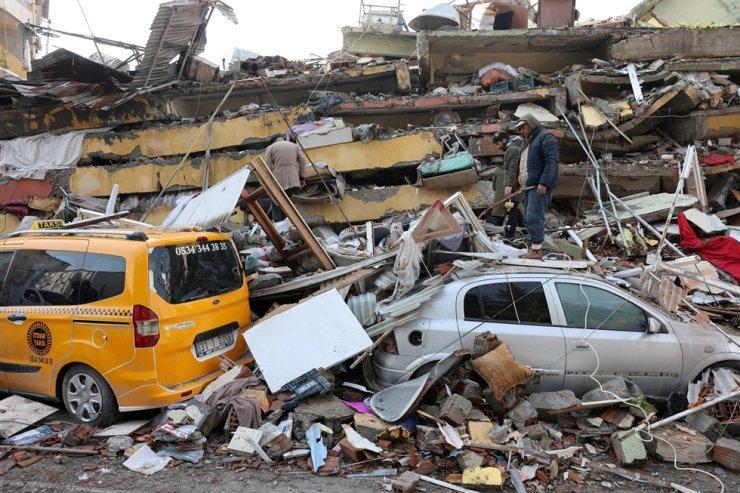
While rescuers continue to work frantically to save survivors from the rubble of collapsed buildings in Turkey, the chances of finding many more people alive are fading rapidly more than 72 hours after the devastating earthquakes.
Turkey’s Disaster Management Authority (AFAD) said 12,873 people died in the country from the earthquakes on Monday, while 2,950 people died in Syria, bringing the confirmed total to more than 15,800.
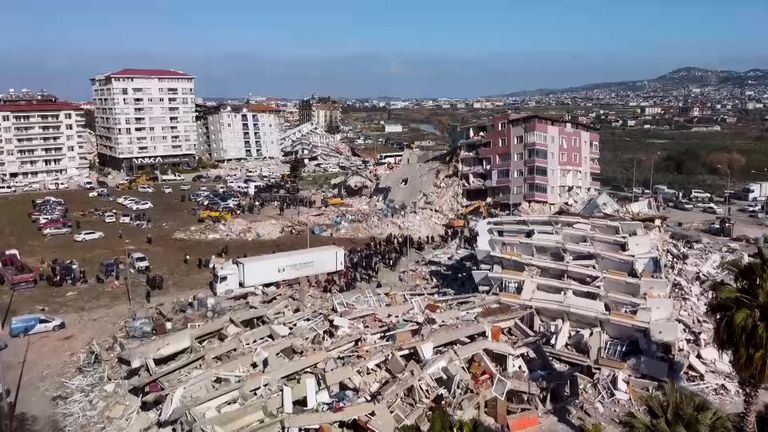
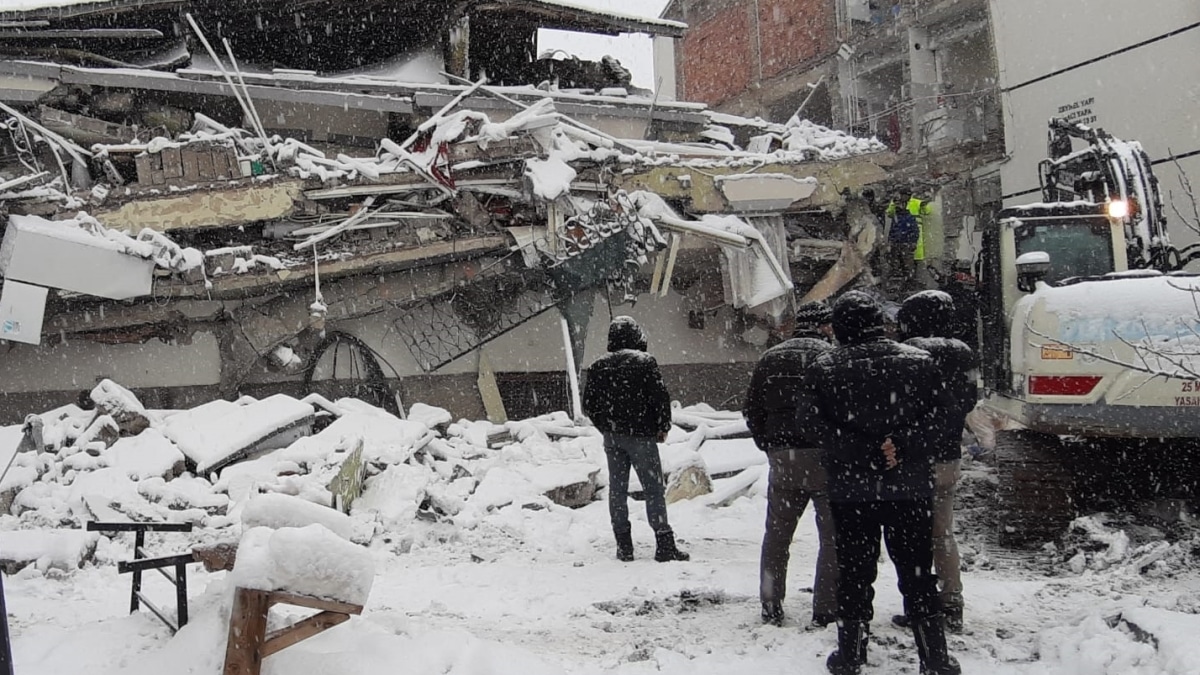
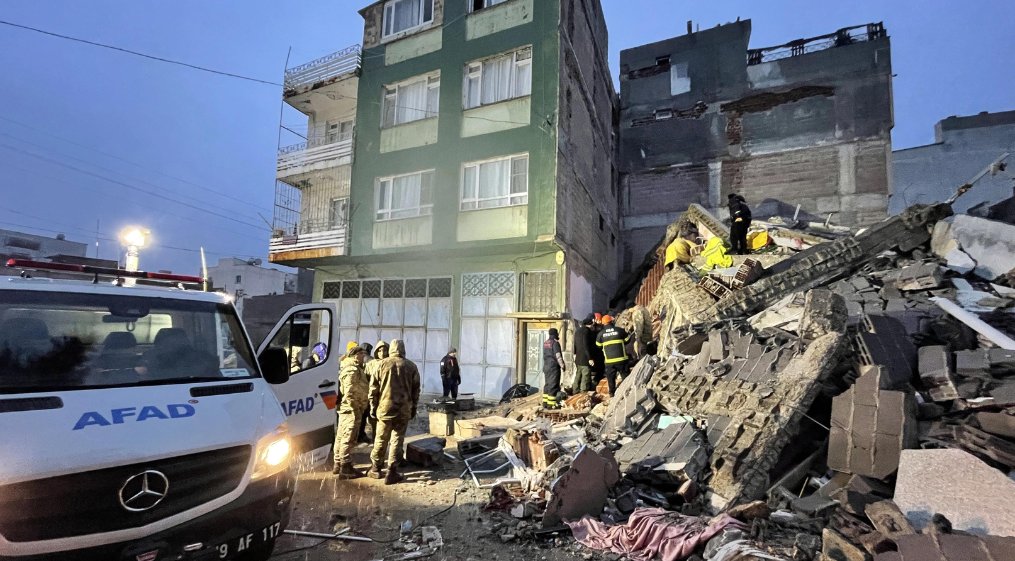
In Kahramanmaras, one of the worst-hit Turkish cities close to the epicentre, rescuers worked relentlessly to pull people from the rubble.
Al Jazeera’s Resul Serdar, reporting in front of a collapsed hotel in Kahmaranmaras on Thursday, said that an estimated 60 people remained under the rubble of the building.
“Unfortunately, since last night, no one came out of the rubble alive,” he said. “But some dead bodies – completely burned – have been taken out from the rubble by the rescue teams. There is a fire – it’s not clear what the source is, but it’s making the extraordinary work of the rescue teams even more difficult.”
Nearly 1,000 buildings in the southern Turkish city have collapsed, and more than 600 people are confirmed to have died there.
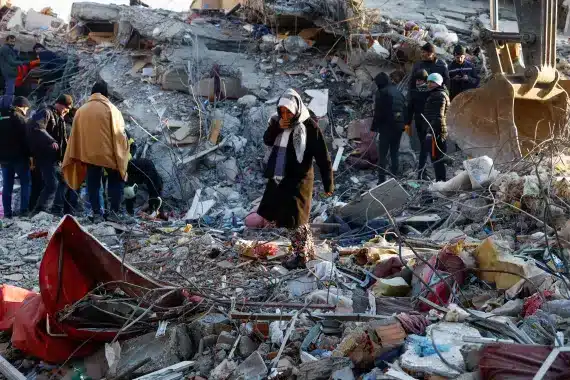
Serdar said many people had gathered by the rubble of the hotel, waiting for news of their loved ones, but that it was extremely cold in the city – especially overnight.
“The rescue efforts here are frantic, but with every passing minute the hopes are fading,” he said.
He admitted to problems with his government’s initial response.
“Of course, there are shortcomings,” he said. “The conditions are clear to see. It’s not possible to be ready for a disaster like this.
He added his government’s target was to rebuild the destruction in one year.
“We will start construction of new houses in all those 10 cities to make sure nobody is without a shelter. It will take some time to build those buildings of course,” he said.
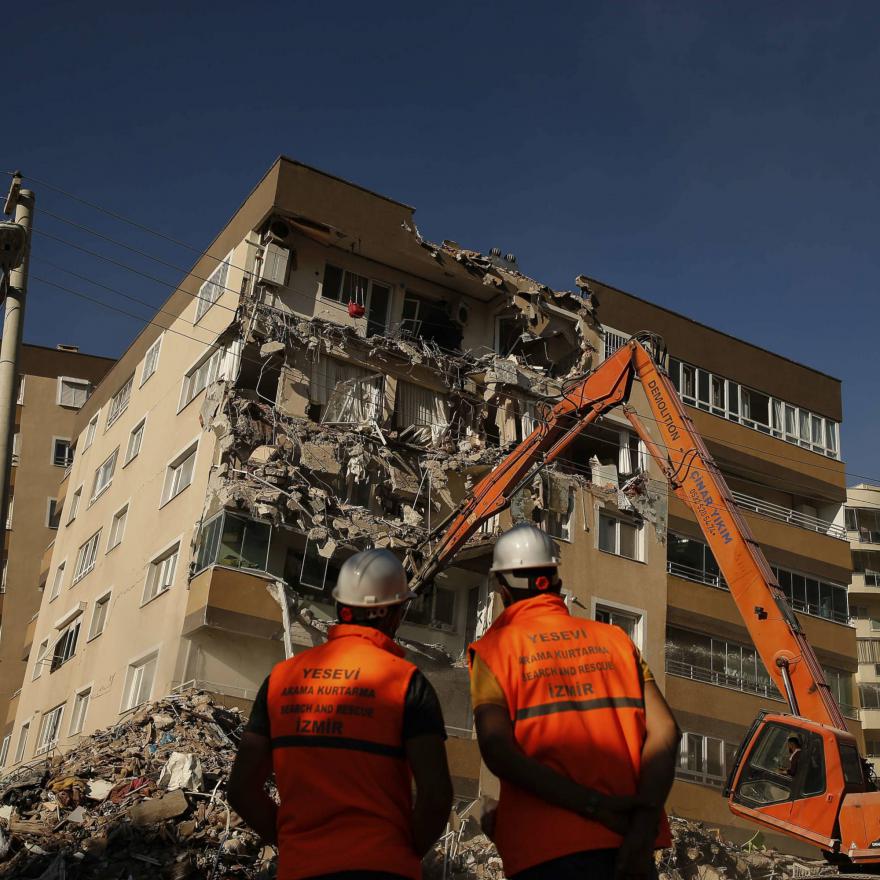
Rescue teams are at work in Kahramanmaras, southern Turkey [Ahmet Akpolat/DIA via AP]
Al Jazeera’s Stefanie Dekker, reporting from Gaziantep, near Turkey’s border with Syria, aftershocks were still continuing as rescuers searched for survivors and bodies.
More than 100 aftershocks have been registered since the first pre-dawn quake on Monday, increasing the risk of more buildings – as well as the mountains of rubble – collapsing.
Rescuers were at work to reach 22 people thought to still be trapped in a flattened building.
“Rescue workers have told us that as they have no longer heard any voices or sounds coming from under the rubble,” Dekker said. “This is now a recovery operation … no longer a rescue one.”
“As time goes on, the prospect of finding anyone alive under these crushing layers of concrete fades,” she added
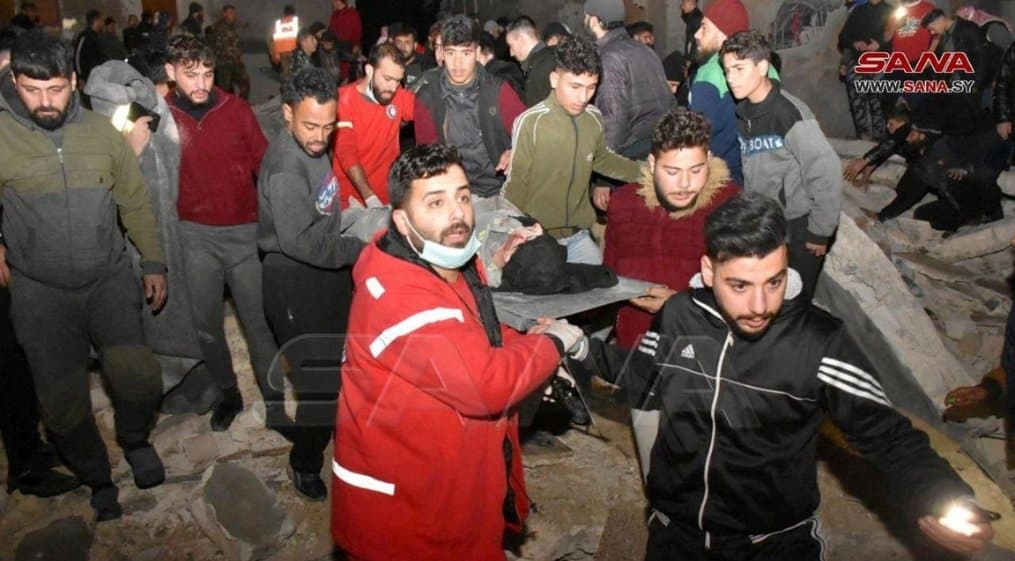
Ayad Shakir, resident of Harem, in the northwest Idlib province, told Al Jazeera he had been searching for his cousin and his cousin’s family since Monday.
“We pulled out four people yesterday, his wife and three of his children. We came back today and pulled out the husband, who is my cousin,” he said.
“He has another son and a little daughter, and now we are waiting to get them out.”
Abada Zikri, civil defence volunteer, told Al Jazeera that his team had pulled out a man and young girl alive in from rubble in Harem after 50 hours of work, but said the challenges they faced were immense.
“The civil defence teams are struggling [to find enough] heavy machinery, due to the massive area that has been damaged,” Zikri said.
“Over 400 sites were destroyed completely, and over 250 sites are partially damaged. We urge the international community to help.”
Authorities met with Twitter to “remind Twitter of its obligations on content takedowns and disinformation,” according to Netblocks, and this led to the restoration.
Without offering an official justification, Turkish authorities expressed concern about online misinformation.
The observatory first reported restrictions on the social media platform on Wednesday. Twitter’s ownerElon Musk subsequently said Turkey had indicated it would restore access to the platform soon.
ℹ️ Update: Metrics confirm access to Twitter is being restored in #Turkey following hours of filtering. The restoration comes after authorities held a meeting with Twitter to "remind Twitter of its obligations" on content takedowns and disinformation.
The window for finding survivors under the rubble is rapidly closing, experts have warned, but many distressed families claim that a lack of rescuers and supplies is reducing their chances of finding loved ones.
The president of Turkey has acknowledged that his nation’s response to the devastating earthquake that has claimed more than 15,000 lives has had “shortcomings.”
As the likelihood that more survivors will be discovered decreases, Recep Tayyip Erdogan is coming under increasing pressure from families who are frustrated by the rescue teams’ slow response.
At least 15,865 people across Turkey and Syria are now known to have lost their lives – 12,873 ofwhom were in Turkey.
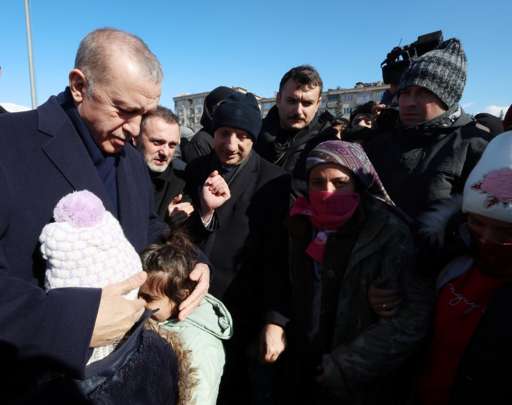
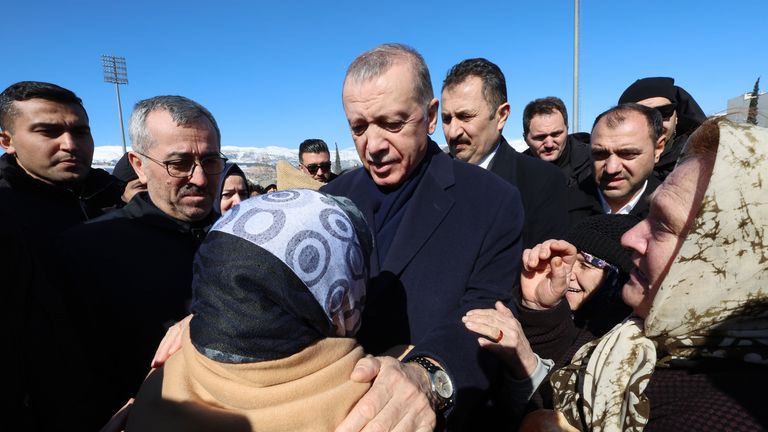
Image:President Recep Tayyip Erdogan speaks to an earthquake survivor. Pic: AP
Many Turks have complained of a lack of equipment, expertise and support to help those who are trapped – leaving them helpless as they hear cries from under the rubble.
During a visit to Hatay province, where more than 3,300 people have died and entire neighbourhoods have been destroyed, Erdogan said: “It is not possible to be prepared for such a disaster. We will not leave any of our citizens uncared for.”
Similar issues are being reported in neighbouring Syria, with the country’s UN ambassador conceding the government has a “lack of capabilities and a lack of equipment”.
Across Turkey and Syria, many of those in areas hardest hit by the 7.8 magnitude quake – and subsequent aftershocks – are afraid of going back into buildings.
“We survived the earthquake, but we will die here due to hunger and cold,” one man in the Turkish city of Antakya said.
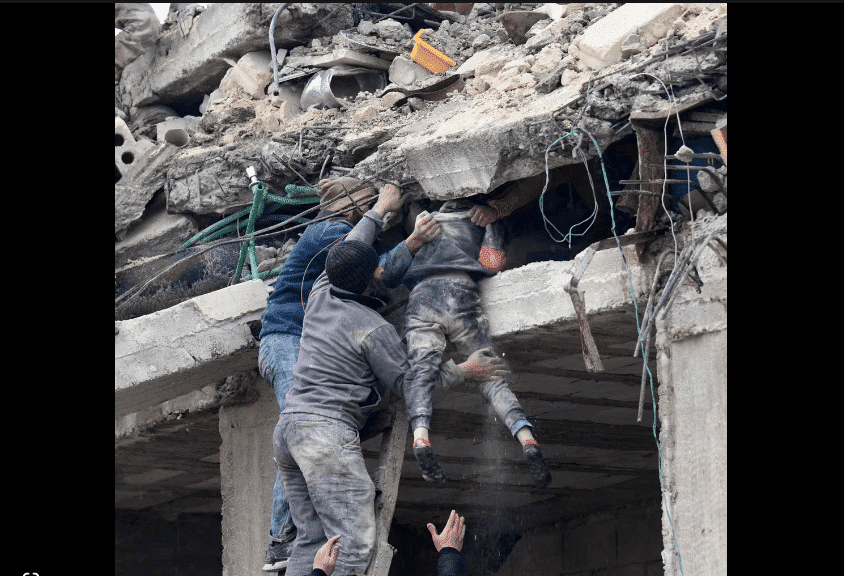
Some survivors are still being found – with footage showing a young girl in pyjamas and an older man holding an unlit cigarette between his fingers being lifted from debris.
https://imasdk.googleapis.com/js/core/bridge3.555.1_en.html#goog_1817367946Play Video – Dead bodies lie in the streetsDead bodies lie in the streets
Chances of survival are diminishing
According to experts, the survival window for those trapped is now closing rapidly – but nonetheless, it is too early to abandon all hope.
Natural hazards expert Steven Godby said: “The survival ratio on average within 24 hours is 74%, after 72 hours it is 22% and by the fifth day it is 6%.”
David Alexander, a professor of emergency planning and management atUniversity College London, said: “Statistically, today is the day when we’re going to stop finding people. That doesn’t mean we should stop searching.”
He went on to warn that the final number of fatalities may not be known for many weeks because of the sheer amount of rubble spanning Turkey and Syria.
https://imasdk.googleapis.com/js/core/bridge3.555.1_en.html#goog_635229091Play Video – ‘My children are in the building”My children are in the building’
‘Our hands cannot pick anything up’
While some rescue teams have access to excavators, others have little choice but to use their bare hands.
Ozel Pikal, who assisted with search efforts in the Turkish city of Malatya, fears some of those trapped may have frozen to death after temperatures fell to -6C.
“As of today, there is no hope left in Malatya. No one is coming out alive from the rubble,” he said.
Mr Pikal warned that damage to local roads – and a shortage of rescuers – was exacerbating attempts to save people.
He added: “Our hands cannot pick anything up because of the cold. Work machines are needed.”
Erdogan hits back at critics
Turkey’s president has pledged that the government will distribute 10,000 Turkish lira (£440) to families affected by the earthquake.
The natural disaster comes at a testing time for Mr Erdogan, who is facing an already challenging election campaign in May – fuelled by high inflation and an economic downturn.
Speaking to reporters, he criticised those spreading “lies and slander” about his government’s actions – and said it was a time for unity and solidarity.
“I cannot stomach people conducting negative campaigns for political interest,” he added.
Police in Turkey have been attempting to crack down on misinformation related to the earthquake response, and have arrested 18 people and identified over 200 accounts accused of “spreading fear and panic”.
Some internet service providers in the country have also restricted access to Twitter – affecting trapped survivors who have been using the social network to alert rescuers and their families.
The Turkish government has been known to temporarily restrict access to social media during national emergencies and terror attacks – and Twitter’s owner Elon Musk said: “We are reaching out to understand more.”
The situation in rebel-held northwest Syria is described as “tragic” and “permeated with the smell of death” by the Syrian Civil Defense group, which is appealing for donations of search and rescue equipment.
“The situation is tragic in every sense of the word. Unfortunately, hundreds of families are still under the rubble,” volunteer Asim Al-Yahya said, according to a tweet from the group, which is also known as the White Helmets.
“The situation is tragic in every sense of the word. Unfortunately, hundreds of families are still under the rubble. As the 3rd day of the earthquake enters, there is a great shortage of search & rescue equipment.”#WhiteHelmets volunteer Asim Al-Yahya#Syria#earthquakepic.twitter.com/NWDTmQW01r
In a separate tweet, the White Helmets said “death hangs over the neighbourhoods of Salqin”, a town west of the city of Idlib. “The smell of death is everywhere,” it said.
Death hangs over the neighborhoods of Salqin, west of #Idlib. The smell of death is everywhere. A number of #earthquake victims have been recovered in the city of Salqin, west of Idlib.#Syriapic.twitter.com/CnxKuV5FyY
The World Health Organization (WHO) has issued a warning that 20,000 people may die as a result of the earthquakes that struck Turkey and Syria.
Since the early hours of Monday morning, when a 7.8 magnitude earthquake struck south-eastern Turkey close to the Syrian border, at least 5,000 people have died. Both nations have experienced strong aftershocks in the hours that have followed, and thousands are believed to be trapped under the debris of collapsed buildings.
Rescuers have been working all night to save as many people as they can, but the region’s bitterly cold weather is making it harder for them to find survivors. According to the most recent data, injuries have been reported among more than 13,000 people in Turkey.
Turkey has declared a state of emergency in affected areas and has urged people not to use their mobile phones in order to allow rescuers to coordinate. As well as Turkey and Syria, millions of people in Cyprus, and Israel also felt the earthquake.
European leaders are promising to help the worst hit regions in any way they can, including UK Prime Minister Rishi Sunak. He tweeted: “My thoughts are with the people of Turkey and Syria this morning, particularly with those first responders working so valitanty to save those trapped by the earthquake.
“The UK stands ready to help in whatever way we can.”
My thoughts are with the people of Türkiye and Syria this morning, particularly with those first responders working so valiantly to save those trapped by the earthquake.
The UK stands ready to help in whatever way we can.
The first 7.8 magnitude earthquake hit the Pazarcik district of southern Kahramanmaras province at 4.17am. This was followed by a magnitude 6.4 quake in the southern Gaziantep province at 4.26am.
On Monday morning, as rescuers worked to save those trapped in the rubble, south east Turkey felt another significant 7.5 magnitude earthquake. Overnight, more powerful tremors hit Turkey with a 5.4 magnitude quake in the eastern side of the country.
Overall, there have been around 285 aftershocks since the first earthquake was felt. It is reported that over 5,000 buildings have collapsed in Turkey alone.
WHO Senior Emergency Officer for Europe, Catherine Smallwood, said: “We always see the same thing with earthquakes, unfortunately, which is that the initial reports of the numbers of people who have died or who have been injured will increase quite significantly in the week that follows.”
Following devastating earthquakes that claimed more than 4,600 lives and toppled buildings across southeast Turkey and northern Syria, President Recep Tayyip Erdogan of Turkey has declared seven days of national mourning, and Syria has asked the UN for assistance.
Authorities worry that the death toll from Monday’s magnitude 7.8 earthquake, which was followed by a magnitude 7.6 earthquake and several aftershocks, will rise as rescuers comb through piles of metal and concrete scattered across a region already troubled by Syria’s 12-year civil war and a refugee crisis in search of survivors.
Rescuers continued their search into Tuesday morning despite the bitter cold, hoping to find more survivors among the rubble as those who were trapped screamed for help from beneath mountains of debris.
Rescuers are battling heavy rain and snow as they race against the clock to find survivors of a devastating earthquake in south-east Turkey.
More than 4,300 people were killed and 15,000 injured in Turkey and over the border in Syria when the quake struck in the early hours of Monday.
The World Health Organization has warned the toll may rise dramatically as rescuers find more victims.
As day breaks, rescue teams are stepping up their search for survivors.
Many people in the disaster zone have been too scared to go back into buildings.
The 7.8 magnitude tremor struck at 04:17 (01:17 GMT) on Monday at a depth of 17.9km (11 miles) near the city of Gaziantep, according to the US Geological Survey.
Seismologists say it was one of the largest ever recorded in Turkey, where at least 2,921 people are now known to have died. Survivors say it took two minutes for the shaking to stop.
A later tremor had a magnitude of 7.5 and its epicentre was in the Elbistan district of Kahramanmaras province.
As dawn broke on Tuesday, traffic was at a standstill on the main highway to the Turkish city of Maras, close to the epicentre of the quake and believed to be one of the worst-affected areas.
Cars occasionally crawled forward, the wet road illuminated by glowing red brake lights.
Few rescuers have made it to this part of southern Turkey yet and everyone is trying to get there as fast as they can to assess the damage and give vital help.
One search and rescue team on their way to the city, their van loaded with specialist equipment and supplies, told the BBC they were eager to get there and start looking for survivors, but they had no idea how bad the devastation would be when they arrived.
Almost 8,000 people have been rescued from more than 4,700 destroyed buildings, Turkey’s Disaster and Emergency Management Authority (AFAD) said in its latest statement.
As aftershocks continue, rescuers in some areas have been digging through rubble with their bare hands looking for survivors.
But freezing conditions are hampering search efforts.
In the southern province of Hatay, the Reuters news agency reported that a woman’s voice was heard calling for help under a pile of rubble.
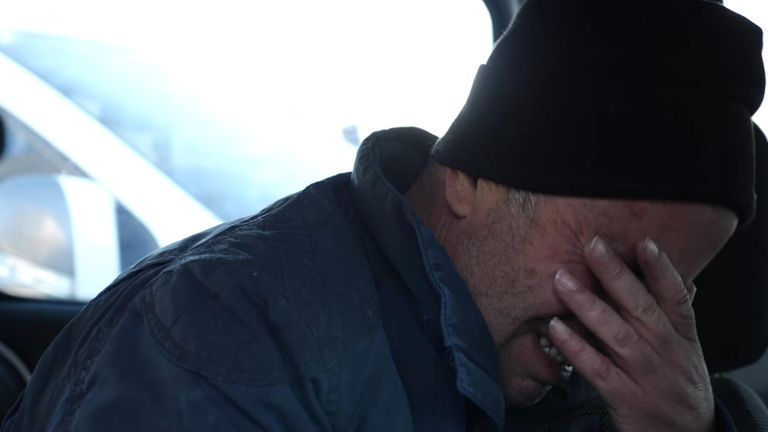
“They’re making noises, but nobody is coming,” a resident who gave his name as Deniz said while weeping.
“We’re devastated, we’re devastated. My God… They’re calling out. They’re saying, ‘Save us,’ but we can’t save them. How are we going to save them? There has been nobody since the morning.”
In the Turkish city of Osmaniye, near the epicentre, pouring rain hampered rescuers as they searched through the rubble looking for survivors.
The city was without power as the cold and rain set in.
One family camped on the street – despite the freezing temperatures – as they were scared of the aftershocks triggering another building to collapse.
Every time they felt an aftershock, the family moved closer into the middle of the street.
A hotel owner in the city told the BBC that of 14 guests staying that night, only seven had been found.
Countries around the world are sending support to help the rescue efforts, including specialist teams, sniffer dogs and equipment.
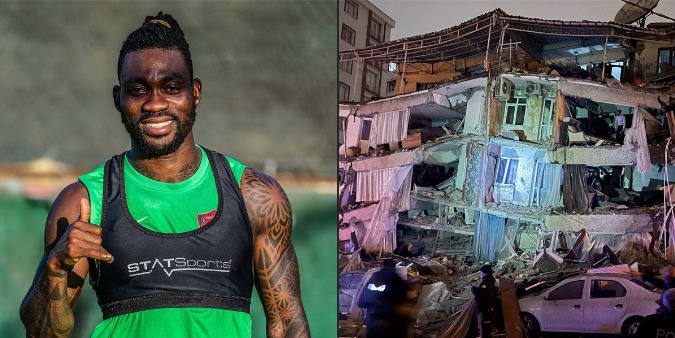
Christian Atsu, a 31-year-old professional soccer player for Hatayspor and former Premier League player for Chelsea and Newcastle, has been rescued after being trapped in the aftermath of a 7.7 magnitude earthquake in Turkey, reports say.
Atsu, although alive, has sustained injuries to his right foot and exhibited difficulty breathing and has been transported to a hospital for treatment.
The Turkish city of Hatay, where Atsu’s club is located, was one of the areas hardest hit by the disaster. Along with Atsu, the club’s sporting director, Taner Savut, and an interpreter were also trapped in the earthquake. There is yet to be news on their recovery.
A post on Newcastle’s Twitter account said: “Praying for some positive news,@ChristianAtsu20.” Atsu had just played a successful match, scoring the winning goal against Kasimpasa on Sunday.
In order to transport search and rescue teams, vehicles, a field hospital, tents, and other supplies to the earthquake-affected areas, Qatar says it will begin operating relief flights to Turkey, according to its state news agency.
Qatar-funded Qatar Charity, in addition to providing supplies to shelters inTurkey and Syria it is also going to distribute 27,000 hot meals in Gaziantep, where it has an office.
For the initial phases of its response, the group has set aside $6 million.
Smaller earthquakes known as aftershocks occur in the same region as an initial, larger earthquake.
Numerous experts have told us throughout the day that there may still be hundreds or even thousands of aftershocks, and they may last for weeks.
There were at least 43 aftershocks with a magnitude of 4.3 or higher that were reported by the United States Geological Survey, which only records the stronger aftershocks.
Hours later, at around 1.30 p.m. local time, a significant aftershock of 7.5 magnitude occurred, according to the report.
Powerful earthquakes have sent multistorey buildings crumbling to the ground in parts of Turkey and Syria, killing more than 2,000 people as rescue operations continue.
Two major fault lines along the Anatolian Plate have generated a number of big quakes. The initial magnitude 7.8 tremor on Monday morning, which was followed by a magnitude 7.6 quake hours later, had the same magnitude as one that killed about 30,000 people in 1939 in northeastern Turkey. A magnitude 7.4 earthquake struck the western city of Izmit in 1999 when more than 17,000 people died.
Experts say several factors have compounded the seismic event. “One of the reasons why the number of casualties has been so high is the poor quality of the buildings,” Mustafa Erdik, professor at Bogazici University’s Kandilli Observatory and Earthquake Research Institute in Istanbul, told Al Jazeera.
Turkey’s National Earthquake Strategy and Action Plan (PDF) for 2012 to 2023 highlighted how massive and rapid migration during the 1950s led to poorly supervised urban development, making cities “critically vulnerable” to natural hazards.
After the earthquake in 1999, Turkey’s institutions recognised an urgent need to reduce the risks in a quake-prone country, and the following year, legislation was approved to enforce mandatory design checks and construction inspections on all buildings.
Buildings constructed according to earthquake-resistant design codes, however, are still in the minority. “Those that have collapsed date prior to the year 2000,” Erdik said.
Nearly 2,900 buildings across southeastern Turkey had collapsed by 5pm (14:00 GMT), according to the country’s disaster agency.
At least two hospitals, one in Hatay and one in Iskenderun, were among them, said Al Jazeera’s Istanbul correspondent Sinem Koseoglu.
She added the large size of many multistorey buildings was complicating rescue efforts as violent aftershocks were still being registered.
Another reason for the high casualty figures is the time the first tremor hit. It struck as people slept at 4:17am (01:17 GMT) and trapped many under rubble.
Turkish authorities measured another earthquake at magnitude 7.6 at 1:24pm (10:24 GMT) four kilometres (2.5 miles) south-southeast of the town of Ekinozu in Kahramanmaras, where the magnitude 7.8 earthquake hit hours earlier.
Live local media footage showed more buildings collapsing in the town of Malatya during the latest massive quake.
Modern buildings were not the only ones damaged. The Gaziantep castle, which dates back to the Hittite kingdom and was expanded under the Roman Empire, has partially collapsed.
Video posted by local media showed parts of the castle tumbling down to the road below.
The Turkish government has declared a level 4 state of emergency, which includes a call for international assistance as well as the mobilisation of all national forces.
Chris Elders, professor at Australia’s Curtin University, said the depth of the initial earthquake at about 18km (11 miles) also contributed to making it particularly devastating.
At a shallow depth, he said, “the energy that’s released by the earthquake will be felt quite close to the surface with much greater intensity than if it was deeper in the crust.”
Naci Gorur, a seismologist at Turkey’s Academy of Sciences, urged local officials to immediately check the region’s dams for cracks to avert potentially catastrophic flooding.
Syria lacks resources to respond to emergency
In neighbouring Syria, buildings were reported to have collapsed in a swathe along the Turkish border extending from Aleppo and Hama to the Turkish city of Diyarbakir, more than 330km (200 miles) to the northeast.
Humanitarian organisations feared the current death toll in Syria – more than 750 people – could rise as rescue teams are severely underequipped to respond to the emergency.
“The machines are old, and there are not enough excavators to help,” Mey Al Sayegh, spokesperson for the International Federation of Red Cross and Red Crescent Societies, told Al Jazeera.
Tanya Evans, Syria director for the International Rescue Committee, said the quake was “yet another devastating blow to so many vulnerable populations already struggling after years of conflict”.
Initial reports from her staff on the ground indicated that the impact has been devastating in areas where a high number of displaced and vulnerable families are living, just as the country is hit by a snowstorm and temperatures plummet.
“This earthquake will only increase the quantity and severity of needs on the ground,” Evans said.