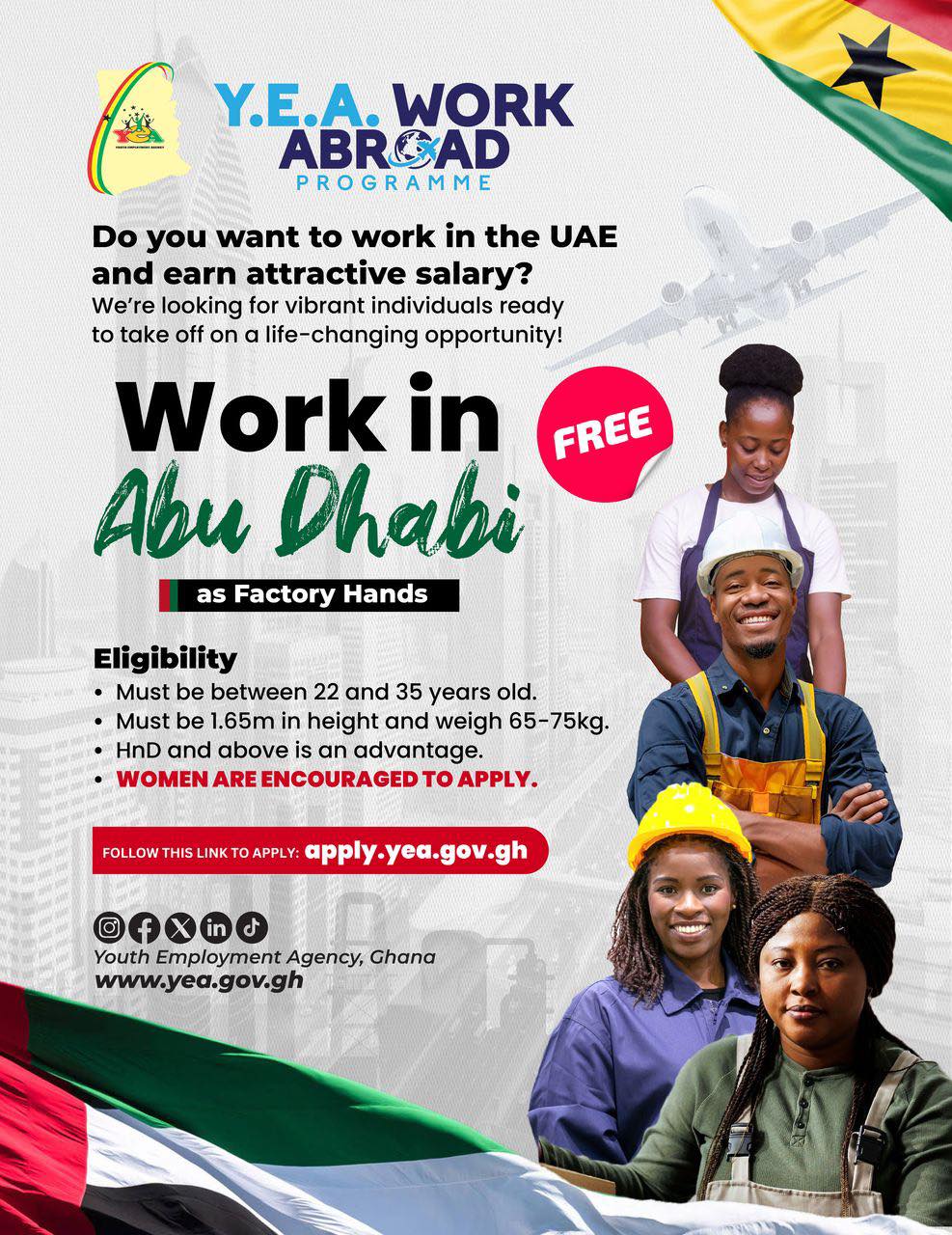
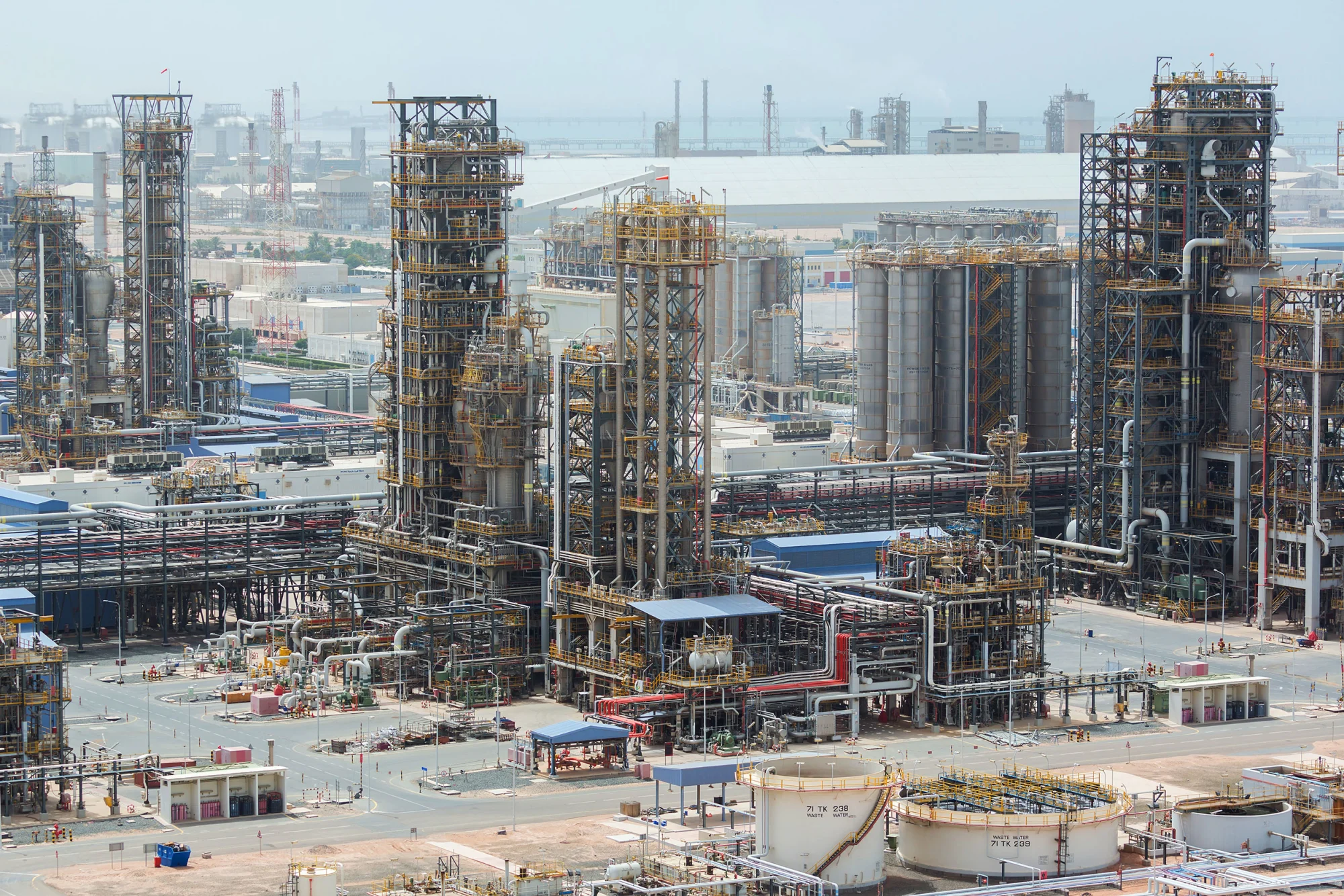
The Youth Employment Agency (YEA) has announced a fully sponsored employment opportunity for eligible Ghanaians to work in Abu Dhabi, United Arab Emirates, as factory hands.
According to details released by the agency, the programme is entirely free of charge, with no application fees, intermediary charges, or hidden costs. Selected candidates will be placed in well-paying roles, with all recruitment facilitated directly by YEA.
Applicants must meet specific criteria to qualify. Interested individuals should be between the ages of 22 and 35 years, stand at least 1.65 meters tall, and weigh between 65 and 75 kilograms. While a Higher National Diploma (HND) or higher qualification is considered advantageous, it is not a strict requirement.
The agency is particularly encouraging women to take advantage of this international job opportunity, as part of efforts to promote gender inclusivity in the workforce.
This initiative forms part of YEA’s broader goal of creating sustainable employment pathways for Ghanaian youth, both locally and abroad.
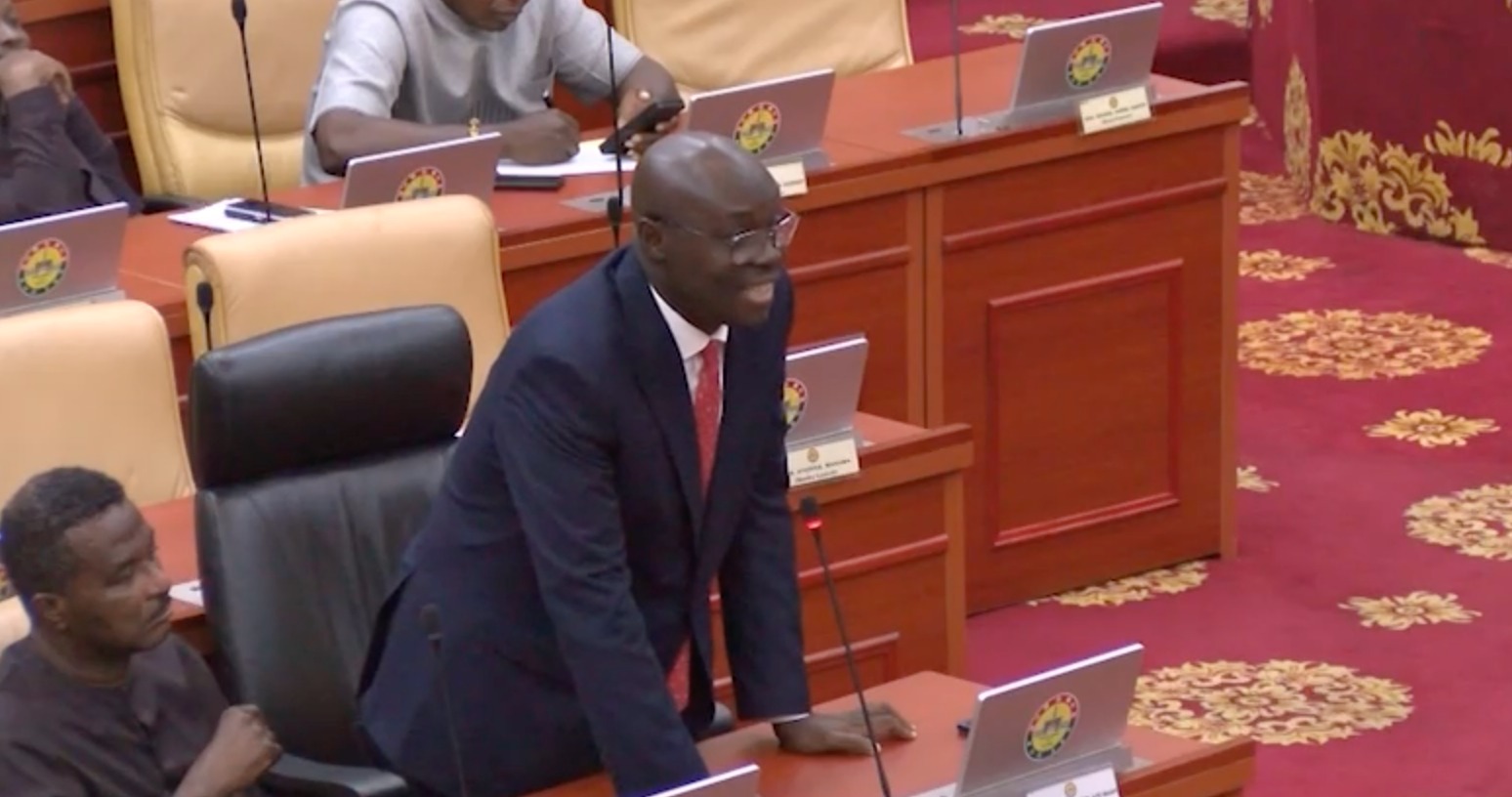
Majority Leader in Parliament, Dr. Cassiel Ato Forson, has dismissed allegations that President John Dramani Mahama chartered a private jet for his recent trip to the United Arab Emirates (UAE).
The claims, made by former Defence Minister Dominic Nitiwul, have fueled public speculation over the President’s travel arrangements. However, addressing Parliament on Wednesday, Dr. Forson refuted the assertions, clarifying that the President traveled on a commercial flight.
“I travelled with President Mahama on his recent trip to the UAE, and he didn’t use a private jet. I was on the flight with him, and we used Emirates,” Dr. Forson confirmed.
The Majority Leader challenged Mr. Nitiwul to provide proof to substantiate his claims, urging transparency on the matter.
“Mr. Speaker, the immediate past Defence Minister claimed that the President used a rented private jet, and I challenge him to bring evidence now,” he stated firmly.
Dr. Forson’s remarks aim to put to rest the controversy surrounding the President’s travel, emphasizing the administration’s commitment to cost-effective and transparent governance.
The Government of Ghana, through the Ministry of Lands and Natural Resources, has secured a $30 million grant from the United Arab Emirates (UAE) to support forest conservation efforts.
This funding, aimed at providing alternative livelihood support for communities near forest areas, is intended to incentivize forest protection, restoration, and reforestation initiatives.
This agreement forms part of Ghana’s commitment to achieving biodiversity and climate objectives under the Resilient Ghana Package, which was launched at the 2023 COP28 summit in Dubai. The initiative focuses on halting and reversing deforestation while promoting sustainable development.
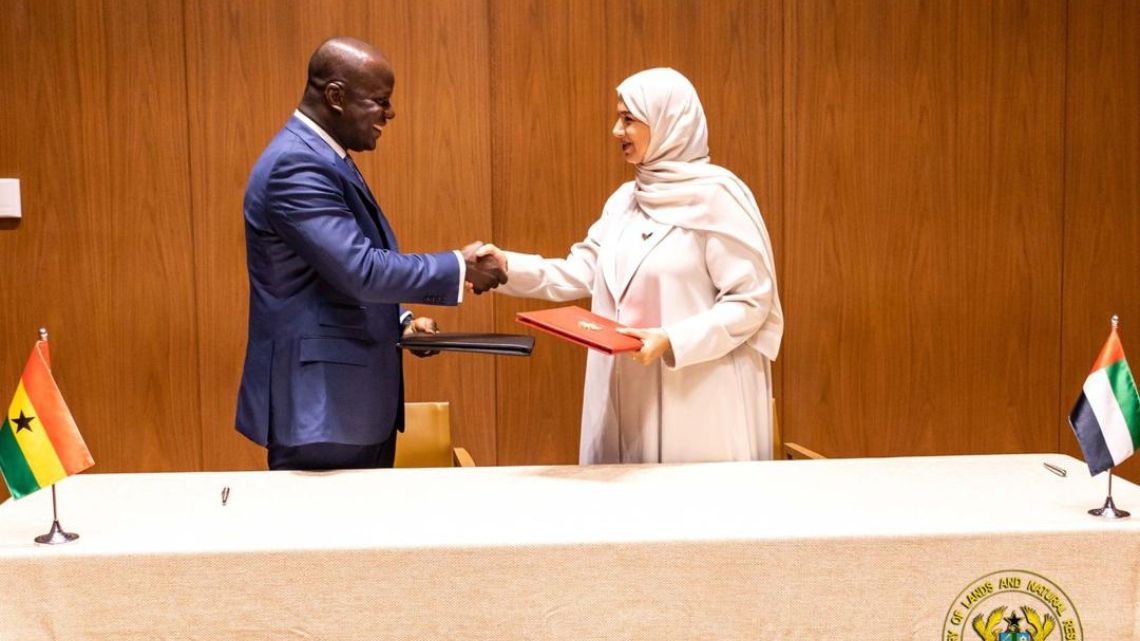
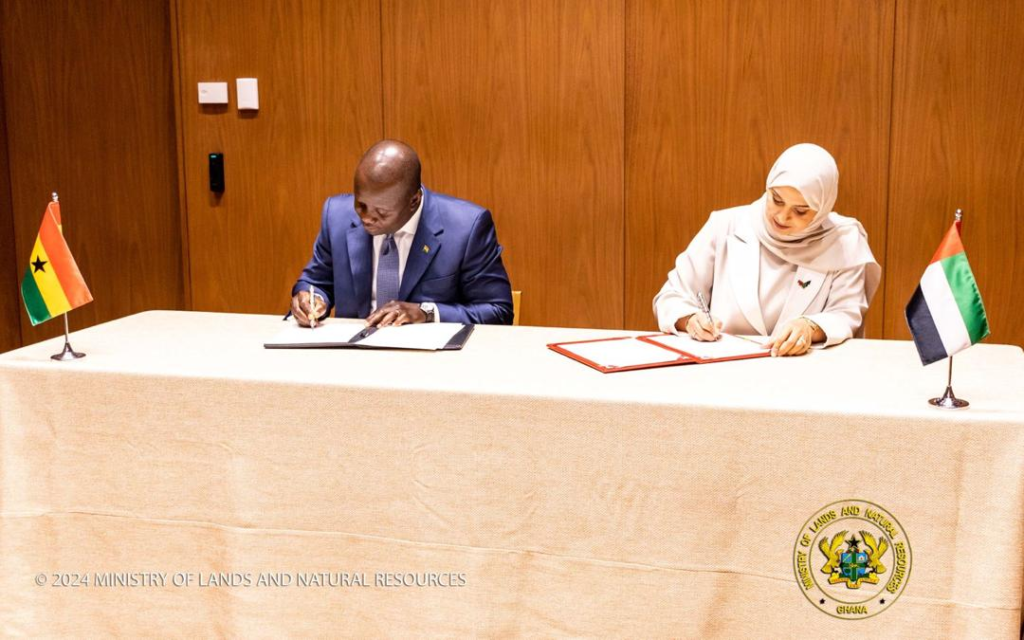
The deal was formalized on September 27, 2024, during the United Nations Climate Week in New York, where Ghana’s Minister for Lands and Natural Resources, Samuel A. Jinapor, and UAE’s Minister for Climate Change and Environment, H.E Dr. Amna Al Dahak Al Shamsi, signed a Letter of Intent to release the funds. The UAE’s High-Level Champion for COP28 and President of the International Union for Conservation of Nature (IUCN), H.E. Razan Khalifa Al Mubarak, was also present during the signing ceremony.
Speaking after the event, Samuel Jinapor expressed Ghana’s determination to implement strategies aimed at restoring habitats, protecting endangered species, and fostering resilient ecosystems. He acknowledged the daunting challenges but emphasized that collaboration and a shared vision could lead to sustainable solutions that benefit not only Ghana but the global community as well.
“I express deep appreciation to the Government of the UAE and all those involved in the negotiations leading to the signing of this agreement. Ghana will develop the necessary strategies to achieve the objectives of the Resilient Ghana Package,” Mr. Jinapor stated.
On her part, H.E. Amna Al Shamsi praised Ghana’s leadership in addressing forest loss and nature-based climate solutions. “Our partnership with Ghana is a testament to the UAE’s focus on global biodiversity, climate, and development goals. By backing comprehensive initiatives aimed at forest protection and enhancement, we aim to strengthen local livelihoods and foster greater community engagement,” she said.
The $30 million grant is a key component of the Resilient Ghana Package, which was introduced at COP28 as part of Ghana’s broader efforts under the Forest and Climate Leaders’ Partnership (FCLP). Launched by President Nana Addo Dankwa Akufo-Addo and former UK Prime Minister Rt. Hon. Rishi Sunak at COP27, the FCLP seeks to bring governments and stakeholders together to reduce forest loss and promote sustainable development.
The Resilient Ghana Package is built around three core pillars: nature-based industrialization and rural development, future-fit green jobs and livelihoods, and scaling climate ambition. It aims to reverse forest loss and degradation by 2030, in line with the Glasgow Leaders’ Declaration on Forests and Land Use.
The UAE’s financial commitment will support programs targeting specific landscapes in Ghana, as well as national-level interventions. The investment is expected to boost Ghana’s efforts to tackle deforestation, which has been driven primarily by agricultural expansion, illegal logging, and small-scale mining. From 2001 to 2015, Ghana lost over 209,000 hectares of forest, a deforestation rate of about 0.19% per year.
Despite these challenges, Ghana has made significant progress in recent years. Since 2017, the country has achieved a 48% improvement in forest cover in its high forest zones. Through the Resilient Ghana Package and the REDD+ Program, the government aims to further enhance these efforts and meet its 2030 targets.
As one of the world’s leading producers of cocoa, Ghana’s forest conservation efforts are also crucial for global supply chains and the achievement of international climate agreements, such as the Paris Agreement.
With this significant grant from the UAE, Ghana is poised to scale up its forest conservation initiatives, benefiting both the environment and local communities.
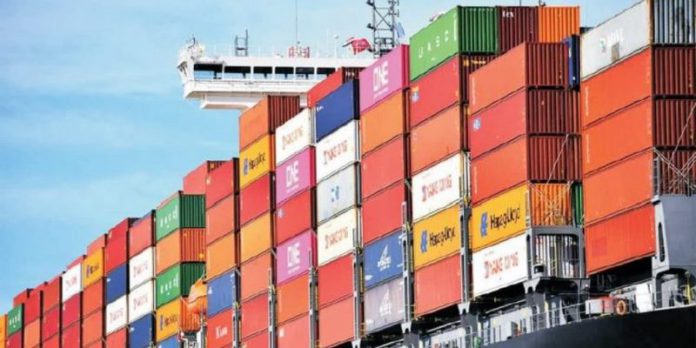
The United Arab Emirates (UAE) continues to be Ghana’s leading export destination for the second quarter of 2024, with exports totaling GH₵15.0 billion, according to data from the Ghana Statistical Service (GSS).
This figure accounts for 23.3 percent of Ghana’s total exports.
Following closely is Switzerland, with exports valued at GH₵13.2 billion, representing 20.5%, while South Africa ranks third, with exports reaching GH₵8.3 billion (12.9%), as indicated by the data.
A detailed analysis reveals that Ghana’s import market is dominated by gas oil (GH₵7.3 billion) and motor spirit super (GH₵7.2 billion), which together account for 24.7% of the total import value of GH₵58.8 billion.
China remains the largest supplier of imports to Ghana, contributing GH₵12.3 billion (20.9% of total imports), followed by the UAE with GH₵9.1 billion (15.4%) and the United Kingdom at GH₵5.2 billion (8.8%).
The Export and Import Unit Value Indices (UVIs) indicate significant price changes in key commodities.
“Export prices recorded a 40.5 percent year-on-year increase, driven largely by surging gold prices while import prices increased by 18.9 percent”.
Sudan has leveled accusations against theUnited Arab Emirates (UAE) for allegedly supplying arms to a paramilitary force involved in the country’s ongoing 14-month civil conflict, sparking a contentious debate at the United Nations Security Council (UNSC).
Sudan’s UN ambassador, Al-Harith Idriss al-Harith Mohamed, accused the UAE late on Tuesday of providing weaponry to the Rapid Support Forces (RSF), which has been engaged in combat with Sudan’s military since April 2023 and faces allegations of committing ethnic-based war crimes.
The Sudanese envoy asserted that Khartoum possesses evidence of these arms transfers and intends to submit a dossier on the UAE’s actions to the International Criminal Court.
Addressing reporters post-meeting, he emphasized urging the council to take decisive action, including public condemnation of the United Arab Emirates.
Sitting next to Mohamed at the horseshoe-shaped Security Council table, UAE Ambassador Mohamed Abushahab called Sudan’s charge “ludicrous” and designed to distract from “grave violations that are happening on the ground”.
Last stronghold
“If they seek an end to the conflict and civilian suffering, then why won’t they come to the Jeddah talks? Why are they blocking aid? What are you waiting for?” Abushahab asked.
In May, the United States and Saudi Arabia sought to resurrect ceasefire talks in Jeddah that stalled last year due to alleged violations of agreements on both sides. Sudan, however, refused to participate.
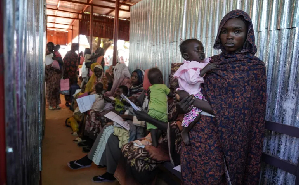
Aid agencies, which have warned that Sudan is on the brink of the world’s largest hunger crisis, have said aid is being blocked by all of the warring factions in the country.
In January, a UN report compiled for the UNSC said it had “credible” evidence that the UAE had sent weapons to the RSF “several times per week” via Amdjarass in northern Chad.The UAE denied the accusation.
Since the escalation of tensions between Sudanese armed forces and the RSF into full-scale conflict last year, more than 14,000 lives have been lost, with 33,000 people injured and 10 million displaced, according to the United Nations.
The dispute arose at the UN on Tuesday amid warnings from UN Assistant Secretary-General Martha Pobee about ethnic-based atrocities in Darfur, western Sudan.
Pobee emphasized the urgent need for an immediate ceasefire in el-Fasher, the capital of North Darfur, which is under siege by the RSF. She called for measures to prevent further atrocities, protect essential infrastructure, and alleviate civilian suffering.
El-Fasher, home to 1.8 million people, is the last stronghold of the Sudanese army in the Darfur region, infamous for genocide and war crimes dating back two decades.
The RSF, initially formed by Arab militias, is accused of killing up to 300,000 members of Black ethnic minority groups and displacing millions.
Last week, theUN Security Council approveda resolution demanding that the RSF end its siege of el-Fasher and withdraw all fighters threatening the safety and security of civilians.
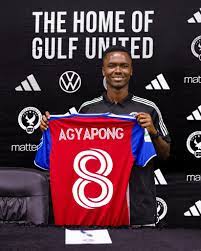
Ghanaian midfielder Sampson Agyapong has embarked on a fresh journey in his career by joining Gulf United, a club based in the United Arab Emirates(UAE).
Agyapong is one of nine new signings brought in by Gulf United to enhance their squad for the remainder of the season.
He arrives from his former club, West African Football Academy (WAFA), where he played in the Ghana Premier League.
His transfer to Gulf United signifies a significant role he is expected to play in the team’s efforts to avoid relegation in UAE Division One, with 13 games remaining in the season.
The club announced the arrival of their new signings on social media, emphasising their commitment to strengthening the team during the January transfer window.
Meanwhile, WAFA bid farewell to Agyapong, recognising his contributions to their team this season and wishing him success in his new endeavour abroad.
This move sees Agyapong returning to the United Arab Emirates, having previously spent time at Al Ain U21.
A cunning scam that spanned international borders, has observed a United Arab Emirates citizen, Farhad Omedi, fall victim to a fraudulent gold deal orchestrated by a Ghanaian and two Nigerians.
Omedi was lured to Accra, Ghana, where he was promised a lucrative gold transaction.
The Ghanaian accomplice, Baffour Abraham, and the two Nigerians, 39-year-old Sunday Olatunji and 51-year-old Israel Olawale Omoley, convinced Omedi to start with a substantial sum of $60,000 under the pretense of selling him genuine gold.
However, it turned out to be a well-coordinated scam.
Fortunately, the authorities were quick to act. The Dawhenya and Lakeside police apprehended Olatunji and Omoley, but Abraham managed to evade capture and is currently on the run.
Farhad Omedi, a native of the United Arab Emirates got lured to Accra, Ghana and was defrauded by a Ghanaian and two Nigerians of US$60,000 in a fake gold deal.
The two Nigerians, 39-year-old Sunday Olatunji and 51-year-old Israel Olawale Omoley have been arrested by the… pic.twitter.com/YFyP3lAloi
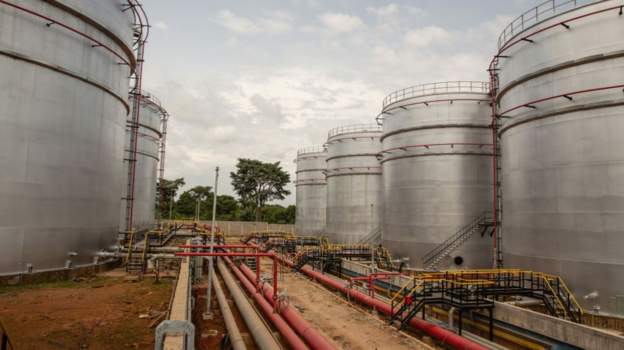
Uganda picked Alpha MBM Investments LLC from five companies for the project, according to Ruth Nankabirwa, the Energy and Mineral Development Minister.
The two groups are supposed to make an agreement in the next three months.
Ms Nankabirwa said she hopes they won’t spend much time trying to find money. She believes they can get the money and technology needed to help refine their crude oil and meet environmental regulations.
The minister said that rules will be made to lower the project’s pollution and lessen its impact on the environment.
The government says the refinery will help Uganda process some of its crude oil for money. Officials say there will be $20 billion invested in the sector.
The country plans to start selling crude oil in 2025.
“So far, the investments have helped the economy by $8. 6bn We expect to get even more, between $20bn-$25bn,” Ms Nankabirwa told Newsday.
Uganda is working on a new oil project. They want to build a pipeline that is 1,443km long to move oil from Western Uganda to Tanzania’s Tanga port for export.
The US Secretary of State, Antony Blinken, is having a meeting with the Crown Prince of Saudi Arabia, Mohammed bin Salman Al Saud. This is his most recent trip for his work in the Middle East.
He began his day with a visit to the UAE and will soon go to Israel.
Blinken is there to try to calm things down and stop a bigger fight in the area.
We will give you more information about the meeting when we have it.
In September, the environment minister of Zimbabwe gave control of a huge amount of land – almost 20% of the country – to a foreign company that is not well known. Blue Carbon was a recently started company that was small and led by a chief who was not new to running businesses. He was a royal from Dubai with a wealthy family known for ruling the city for a long time and having a lot of money from oil.
The company Blue Carbon from Dubai has gotten a lot of land in Africa to protect forests from being cut down. This will stop a lot of CO2 from going into the air and causing global warming. The land they got is as big as the United Kingdom.
Blue Carbon can use the conservation to make carbon credits. They can sell these credits to companies and governments. This helps to balance out the pollution caused by burning fossil fuels.
Several agreements to protect forests in Zimbabwe, Zambia, Kenya, Liberia, and Tanzania were announced before the United Nations’ COP28 climate summit in December. The summit will be hosted by the United Arab Emirates.
The UAE wants to use up all its oil in 50 years, even though scientists say we should stop using fossil fuels long before that.
A person speaking for the company did not tell CNN if the company will sell the credits to the UAE. However, because the chairman of Blue Carbon is related to Dubai’s ruler, it is assumed by many experts that the credits will be sold to the UAE to help reduce its carbon footprint. They could also be sold to other countries and companies that rely on oil in the Gulf and other places. CNN asked the UAE government to comment.
Blue Carbon did not tell CNN how big its projects are, how much money it has given out, or how many credits it wants to make. The deals are still in the early stages and have not been finished yet.
The company said it will show its deals at a big meeting in Dubai as an example of how to trade carbon. The yearly climate summit is a meeting where leaders from almost 200 countries will gather to figure out how and when to reduce the use of fossil fuels. The UAE will use its COP28 presidency to work hard to make sure that carbon removal is included as a major solution to the climate crisis. This means taking carbon out of the air, not just from forests, but also from burning oil and gas, and then storing it underground.
Climate supporters don’t like carbon removal and scientists don’t think it works well. They think it lets companies keep using fossil fuels and making money.
The UAE stands to lose a lot of money. Last year, oil and gas made up about 30% of the country’s total economic output and 13% of the products it sells to other countries, as stated by the US Department of Commerce. More than 80 countries want to stop using fossil fuels, and renewable energy like wind and solar is becoming cheaper than oil and gas in many places. So, eventually, market forces will make oil and gas go away.
If fossil fuel companies and lobbyists can persuade the world at COP28 to not depend too much on wind and solar power, and to keep extracting oil and gas.
The UAE is getting a lot of criticism because Sultan Al Jaber, who is in charge of the country’s oil and gas company and is their international climate envoy, is leading the negotiations. Over 100 US Congress members and European Parliament members in May asked for Al Jaber to be removed as COP28 president.
Al Jaber doesn’t think it’s a problem to have many jobs at once, he said in several interviews. ADNOC also said to CNN in an email that no one is better qualified to lead the talks. They mentioned his experience leading the nation’s renewable energy and oil and gas companies.
Al Jaber believes that companies that produce gas, oil, or coal should be involved in talks about climate change to make sure that the shift to renewable energy really happens.
Climate advocates don’t believe the argument because they think the fossil fuel industry has had enough time to take action on the issue, but hasn’t. Some companies that sell oil and gas were among the first to realize that their products were causing the Earth’s climate to change. About 40 years ago, they still made money from coal, oil, and gas.
“I believe that ADNOC is using the UN climate negotiations to make people think they care about the environment, even though they are one of the biggest oil companies in the world,” said Jamie Henn, who runs a non-profit group called Fossil Free Media that wants to stop using fossil fuels. “From the beginning, the UAE wanted to host this COP to show that they and their oil and gas industry are working to be part of the solution to climate change. ”
In 2020, the UAE produced about 0. 53% of the world’s CO2 emissions. Even though it has a small population of around 10 million people, it is the sixth-biggest polluter for every person. Even though the UAE has a small number of people, it was the seventh largest oil producer in the world in 2022.
Henn thought it was silly that the talks were being controlled by fossil fuel companies.
The international tobacco control negotiations are being controlled by Philip Morris, just like how they control things. Fortunately, the UN has rules that keep tobacco lobbyists out of the negotiations. “We need that at the COP. ” can be rewritten as “We need that at the conference of the parties. ”
The COP, which meets in a different city every year, has never had so many obvious conflicts of interest. Al Jaber is leading efforts to address climate change and reduce use of fossil fuels. Blue Carbon is closely connected to the UAE’s leaders, making it hard to tell if they support carbon offsets or want to keep producing fossil fuels.
In Dubai, at COP28, they will decide how to buy and sell carbon credits.
When CNN asked Blue Carbon if they were planning to make more deals to reduce carbon in Africa, a company spokesperson said they would announce new initiatives at COP28. A source familiar with COP28’s agenda said the company plans to use the deals to encourage using carbon credits to help with climate change.
Many countries have joined to work with Blue Carbon, and this is not a big surprise. The company that owns it, Global Carbon Investments, has promised to give $1. 5 billion to Zimbabwe as an advance payment for carbon credits. This is more money than the country spends on education and childcare put together, which are Zimbabwe’s largest national expenses.
With not much money coming from rich to poor countries to deal with the climate crisis, carbon credit schemes offer a new way for countries with a lot of forests to make money.
Destroying forests or letting them decay contributes to about 12% of the Earth’s temperature increase. They are important for the environment because they can take in carbon dioxide from the air.
However, many people have criticized the idea of trading carbon credits for not cutting down forests. Some of the largest companies in the world that claim to reduce carbon emissions may be using methods that make their impact on fighting climate change seem bigger than it actually is.
In November, Renat Heuberger, the CEO of South Pole, a company that trades carbon credits, resigned because it was found that they had exaggerated the environmental benefits of their Kariba forest project in Zimbabwe.
We are happy when people spend money to save forests. “Conserving forests is not a quick fix solution,” said Julia Jones, a scientist at Bangor University in Wales.
She said that we need to stop cutting down more forests and reduce emissions a lot. “Balancing the two without big investment in cutting emissions causes problems. ”
Land ownership is also a problem. Sometimes, native people are forced to leave their land so that big companies can make money from it, even though the land used to be seen as worthless.
According to the Forest Peoples Programme, more people are being forced to leave their homes in Kenya because the government is giving land for carbon credits.
“Those who have power over Africa’s forests can make a lot of money, and it looks like big companies are trying to take over Africa’s forests,” said Justin Kenrick, a senior advisor at the Forest Peoples Programme, in an email to CNN. “At the same time, conservation efforts in Kenya continue to follow a flawed colonial strategy of removing the people who are most knowledgeable about how to protect their forests. ”
No matter what happens at COP28, ADNOC, a company in the UAE that sells oil and gas, could benefit a lot. They might win big if they can show the world that they can provide the most energy. The “Minimum Emissions” slogan is a good way to help the environment, even as the earth gets hotter and scientists urge for quick cuts in using fossil fuels.
A spokesperson from ADNOC did not say how many people would go to COP28 for the company, but said that the idea that the company would gain from the conference is wrong.
ADNOC plans to increase the amount of oil they produce by 41% and the amount of gas they produce by 33% by the year 2030. This information comes from a study done by Global Witness, a non-profit organization that focuses on protecting the environment and human rights. This means that its greenhouse gas emissions have increased by 40%, according to Global Witness.
Other oil companies like Shell and BP have different plans than ExxonMobil. Shell’s production is expected to stay the same, while BP plans to reduce their production by 25% by 2030. ADNOC wants to produce more than both companies by 2030.
ADNOC is growing to become a big global oil company. It is buying oil and gas fields in other countries like Azerbaijan and partnering with BP to buy a part of Israel’s NewMed Energy to explore for gas in the eastern Mediterranean. It is also investing in projects related to things like solar and wind energy, as well as chemicals, the company told CNN.
ADNOC can currently produce 800,000 metric tons of something each year. But it wants to make 3 more megatons each year from two new facilities that are not finished yet. Even if ADNOC builds the facilities, it will take them more than 340 years to capture all the planet-heating carbon they are expected to emit between 2023 and 2030. This includes emissions from their operations and the use of their oil and gas.
ADNOC did not mention the calculation in its response to CNN. They only said their goal is to reach zero emissions by 2045 and they have put $15 billion towards this goal.
Before this year, most people probably never heard of ADNOC. Patrick Galey from Global Witness told CNN that the company’s CEO is supposed to reduce emissions at COP28, but the more we learn about the company, the more different it seems.
“ADNOC plans to keep making lots of oil for many years, and wants to become one of the top companies for making even more oil and gas. ”
Surprisingly, COP28 could be where ADNOC becomes a big worldwide oil company.
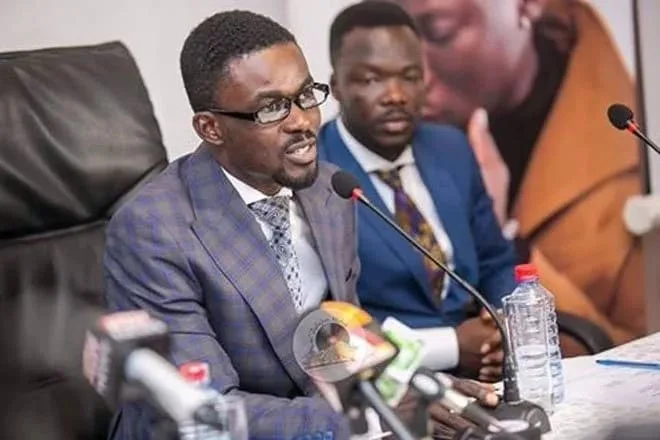
Former Chief Executive Officer of Menzgold, Nana Appiah Mensah, popularly known as NAM1, has revealed plans to organize a protest against the government of the United Arab Emirates (UAE).
The protest is scheduled to take place at various UAE embassies, including the one in Ghana.
In a post shared on X on Monday, November 20, 2023, NAM1 announced that the demonstration, expected to draw 2000 participants, aims to demand a $30 million compensation for what he claims was his unlawful detention by the UAE government.
Additionally, he stated that the protest will also serve as a platform to seek payment of outstanding arrears amounting to $43.8 million owed to him by a UAE-based entity.
“Brace up friends, for a 2,000-man protest at the UAE embassy in Ghana and elsewhere overseas SOON, to claim a USD$43.8 million dollars (750kg of Gold) owed me and another USD$30 million dollars as compensation, for my unjustifiable detention by the Dubai Police in 2018/2019,” he wrote.
Nana Appiah Mensah, commonly known as NAM1, has shared a collection of documents, among which is a letter dated June 11, 2018. This correspondence was directed to Horizon Royal Diamond DMCC, a Dubai-based firm, urging the settlement of a gold purchase agreement.
Included in the disclosed documents were particulars of NAM1’s arrest by the Dubai Police, primarily documented in the Arabic language.
It is noteworthy that on January 14, 2018, Assistant Commissioner of Police, David Eklu, officially confirmed the apprehension of Nana Appiah Mensah, the Chief Executive Officer of Menzgold Ghana Limited, by Dubai authorities. The arrest was linked to a problematic gold deal.
“His arrest in Dubai is to facilitate investigations into suspicions that he had involved in a gold trading deal gone bad within the Emirati jurisdiction,” He told the media.
A Ghanaian court issued a warrant for NAM1’s arrest after his gold dealership failed to reimburse the client for their money.
Brace up friends, for a 2,000 man protest at the UAE embassy in Ghana and elsewhere overseas SOON, to claim a USD$43.8 million dollars (750kg of Gold) owed me and another USD$30 million dollars as compensation, for my unjustifiable detention by the Dubai Police in 2018/2019.🇬🇭 💪🏽 pic.twitter.com/WbDxuJ85ga
Tanzania has recently finalized a 30-year port management agreement with the United Arab Emirates (UAE), a decision that has stirred significant controversy and opposition.
This landmark agreement entrusts Dubai Port (DP) World with the management of four berths or quays at Dar es Salaam, which happens to be Tanzania’s largest port. In addition to these four berths, DP World will engage in a collaborative effort with the Tanzania Ports Authority to oversee three more berths within the port’s premises.
A notable component of this partnership is DP World’s commitment to investing $250 million (£205 million) for the upgrading of the port’s infrastructure over the span of the next five years. This substantial investment aims to enhance the port’s capabilities and modernize its facilities.
However, the deal has not been without its share of criticism and opposition. Several activists, concerned citizens, and members of the opposition in Tanzania have raised objections to the agreement, claiming that it disproportionately favors the Emirati company at the expense of Tanzanian interests.
In response to the public outcry, the Tanzanian government has taken a controversial step by detaining over 22 individuals who were vocal in their opposition to the deal. While some have since been released, the situation has raised concerns, and human rights organization Amnesty International has been monitoring the developments closely.
Tanzanian authorities have defended the agreement, emphasizing that it does not encompass all port operations in the country. They assert that they retain the prerogative to terminate the contracts at any time if deemed necessary, further underscoring that the deal is expected to bolster national revenue and enhance overall efficiency within the port operations.
Despite the controversy and opposing voices, the Tanzanian government remains resolute in its pursuit of this port management agreement with the UAE as a crucial step towards economic development and progress.
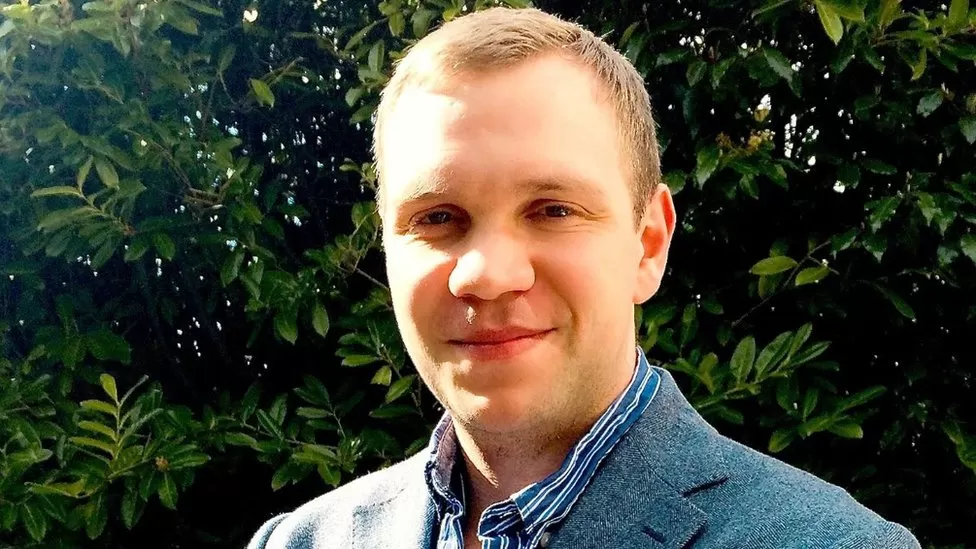
Matthew Hedges consistently maintained his innocence regarding the allegations against him. He explained that he was doing research for his PhD at Durham University. The Foreign Office (FDCO) acknowledged that he and his family had a very upsetting experience.
Dr Hedges, who lives in Exeter, said that he was very happy to receive an apology, which he referred to as an important turning point.
He had complained before to a person who helps resolve problems in the government. This person started an investigation into how the FDCO handled his situation.
The court decided that the FDCO did not do a good job of keeping the academic safe and they should give him £1,500 as payment for what happened. In2018,Dr. Hedges was in Abu Dhabi when he was accused of being a spy for MI6 and working for the UK government.
The UAE officials said they found evidence on his computer that showed he was working as a spy.
He was given a lifetime in prison, but the president of the country later forgave him.
Dr Hedges said that he was kept in handcuffs and alone in a small room,asked many questions for a longtime, and given various types of medications.
He said that what he went through had caused him to have post traumatic stress disorder and not being able to sleep.
Review of cases involving torture
On Monday, the FDCO acknowledged that Mr Hedges and his family had a very upsetting experience that had a strong effect on them.
“We agree with the ombudsman’s conclusion in Mr. Hedges’ case, and we apologize. We will also give the compensation that was suggested,” the statement said.
An investigation has started to examine the rules on how to handle cases of torture and mistreatment, and consular staff are receiving training.
Officials will also check how the Foreign, Commonwealth & Development Office (FDCO) helps British citizens who get arrested or are in prison in other countries.
The statement means that we want to do what is best for each person, and it is not okay to report torture or mistreatment without their permission because it can be dangerous.
Dr Hedges, who posted on social media, was happy about the apology and said it had been a difficult journey to get to this point.
“He said that the recognition from the FDCO about the torture and unfair treatment I experienced in the UAE is a significant moment, not only for me and my family, but for all British people. ”
The FCDO did not fulfill their responsibilities to a citizen, and I really hope that the many other British people who are currently being held and tortured will benefit from the FCDO’s promise to reevaluate their old and inadequate policies.
I’m sorry, but I still have a criminal record for spying for the British Government, and the apology doesn’t change that.
He said it was confusing that the UK still works with the UAE, even though they are unkind to British people.
“He added that the FCDO should do more to convince the UAE to prove my innocence because they have a strong relationship. ”
“I will keep fighting for people who have not been lucky to be set free or who have been unfairly accused of ridiculous things. Today, I am happy that the FCDO has agreed to do more to safeguard and assist British citizens. ”
DISCLAIMER: Independentghana.com will not be liable for any inaccuracies contained in this article. The views expressed in the article are solely those of the author’s, and do not reflect those of The Independent Ghana
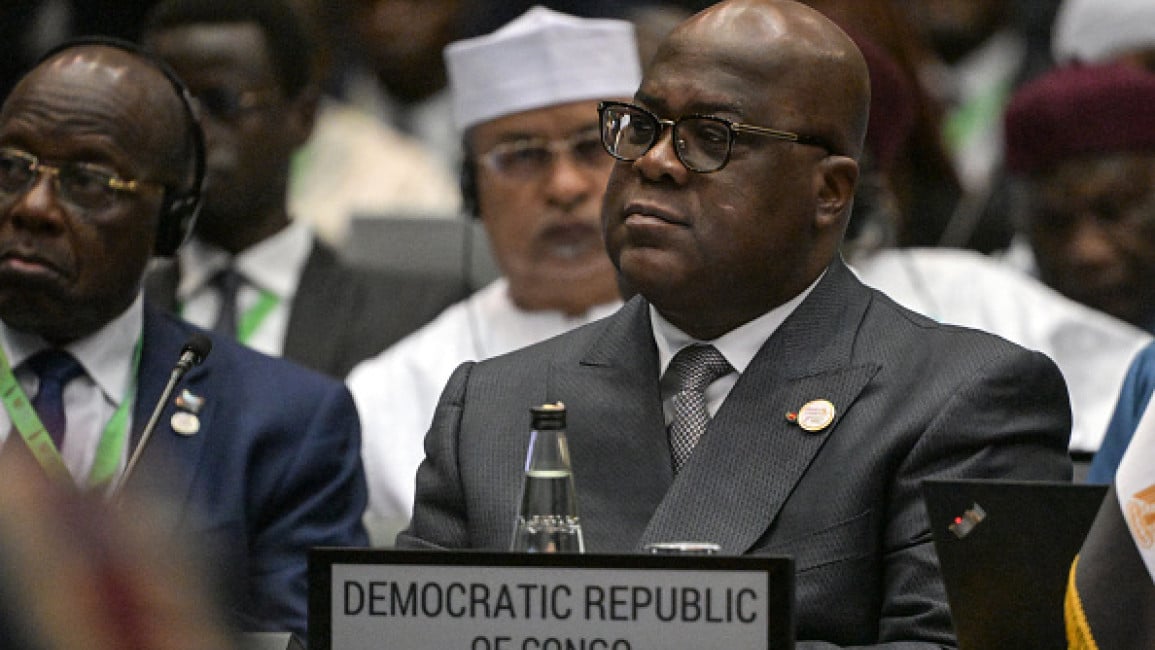
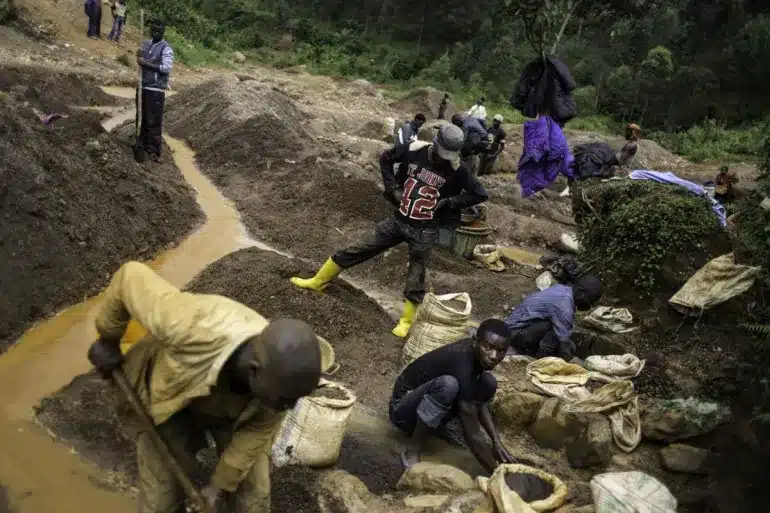
On Monday, President Félix Tshisekedi of the Democratic Republic of Congo (DRC) revealed that a $1.9 billion agreement had been signed between the United Arab Emirates and the state-owned mining company la Société aurifère du Kivu et du Maniema (Sakima).
The deal was finalized in Kinshasa by a UAE government delegation. As part of the partnership, the plan is to develop a minimum of four industrial mines in the troubled eastern areas of South Kivu and Maniema.
Sakima currently holds mining concessions in the region for various minerals including tin, tantalum, tungsten, and gold. However, the specific minerals covered by this agreement have not been disclosed by the government.
In December, the Democratic Republic of Congo (DRC) signed a 25-year contract with UAE company Primera Group, granting them export rights for artisanally mined ores. Artisanal mining involves independent miners who are not employed by mining companies.
The agreement provided Primera Group with a majority stake in two joint ventures, Primera Gold and Primera Metals, granting them preferential export rates for gold, coltan, tin, tantalum, and tungsten.
The DRC presented this initiative as a strategy to combat mineral trafficking to armed groups, particularly prevalent in the country’s eastern region.
The eastern part of the DRC has long been plagued by armed conflict, with the United Nations estimating the presence of up to 120 different militia groups in the area. These groups receive support, at least in part, through the trade of smuggled minerals.
However, a report published by the United Nations in June expressed concerns about the legality of artisanal mines supplying Primera Gold. The report highlighted the potential for the supply chain to be contaminated with ore from sites controlled by armed groups due to inadequate traceability mechanisms.
Despite these concerns, Primera Gold commenced operations in South Kivu in January and reportedly shipped a ton of certified gold in May, as reported by the Congolese Ministry of Finance.
The Congolese presidency, has stated that the Democratic Republic of the Congo (DRC) has entered into a $1.9 billion agreement with a state mining company from the United Arab Emirates (UAE) to develop a minimum of four mines in the volatile eastern region of the African country.
The partnership was signed in Kinshasa, the capital, by a delegation representing the Emirati government and the Societe Aurifere du Kivu et du Maniema (Sakima), as announced by President Felix Tshisekedi’s office on Monday.
The statement revealed that the deal would involve the establishment of “more than four industrial mines” in the provinces of South Kivu and Maniema. Sakima, a state-owned entity, already holds mining concessions for various minerals, including tin, tantalum, tungsten, and gold, in that particular region of the DRC.
However, specific information about the minerals to be extracted was not disclosed in the statement.
This agreement comes after the DRC signed a 25-year contract in December with Primera Group, a UAE firm, granting export rights for certain ores obtained through artisanal mining. Artisanal mining refers to the extraction of metals by independent miners who are not employed by mining companies.
Under the contract, Primera Group acquired a majority stake in two joint ventures, namely Primera Gold and Primera Metals. These ventures secured favorable export rates for artisanally mined gold, coltan, tin, tantalum, and tungsten.
The DRC has positioned this initiative as a means to counteract mineral smugglers and improve the livelihoods of informal miners, who have long been affected by the presence of militias in the eastern region. The area has been plagued by up to 120 such groups, as estimated by the United Nations, sustained in part by the illicit trade of minerals.
The longstanding conflict there has continued despite deployments of a regional peacekeeping force and a UN military contingent. At least 5 million people are internally displaced and one million more have fled abroad since the latest iteration of the conflict broke out in May 2021, according to the Norwegian Refugee Council.
Primera Gold began operations in South Kivu province in January and by May had shipped 1 tonne of certified gold, according to the Congolese finance ministry.
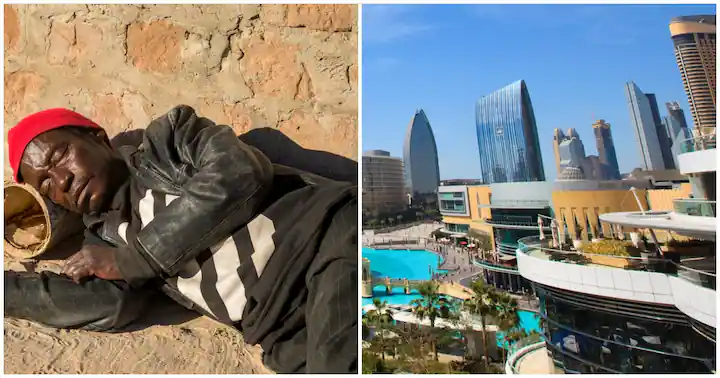
Social media has reacted to a viral video regarding a Ghanaian man who is currently residing in theUnited Arab Emirates (UAE) after he spoke candidly about the poor conditions he is currently experiencing.
The middle-aged Ghanaian man who spoke about his plight in Dubai admitted that things are tough for him and his other Ghanaian colleagues living in the country. Photo of homeless man and Dubai Man says he doesn’t want to return to Ghana despite being homeless
Photo credit: @Fraser Hall poco_bw/Getty Images Source: Getty Images
He revealed that he is homeless in Dubai and sleeps behind a flowerpot at the bus station along with some of his Ghanaian friends.
Quizzed whether he would love to return home, the young man surprisingly responded with a no.
His reason was that, the standard of living in Ghana had not improved, hence would prefer to stay on.
"Things are not better in Ghana, so for me to return and be disgraced, I would prefer to stay here," he said with confidence.
At the time of writing the report, the video had gathered over 2000 likes and 100 comments. Watch the video below: Ghanaians stunned at the comments of the homeless man
Netizens who reacted to the statement urged the man and others like him who have that mindset to reconsider their stance and return home.
Paul gee indicated:
Masa, u guys should come home. I have been there before but I came home and it's better for me now
GHANANIIBA indicated:
Even USA koraa some people are stranded, masa
deborahaduboatema stated:
Let's keep the faith, we will surely make it before returning back home. lnshalla
Faisal Mohammed952 replied:
How did u end up there? look for good company bro...
Earlier, YEN.com.gh reported that another young man in Saudi Arabia has revealed that he will gladly return to Ghana to continue with his former job if he is offered a good salary.
Paul Agbubilla, a university graduate and teacher by profession, in an interview with SVTV Africa said his decision to travel was premised on the hardships he was facing in Ghana.
Paul said his salary was inadequate, coupled with the fact that he owed a lot of people and needed money to settle his debt.
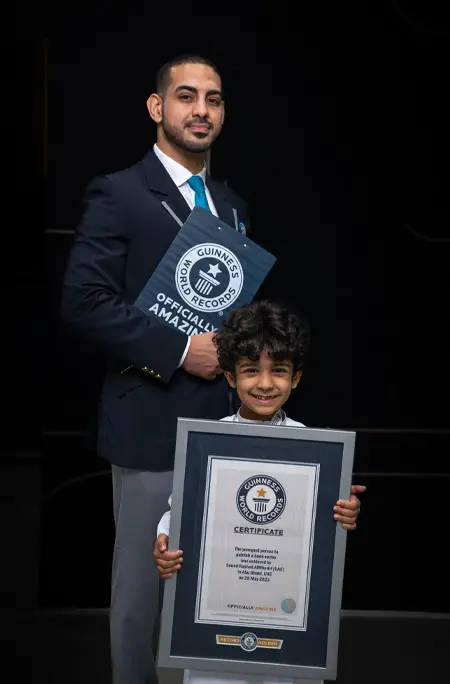
Achieving a world record is no small feat, achieving two is impressive, but to do it before the age of five is amazing to say the least.
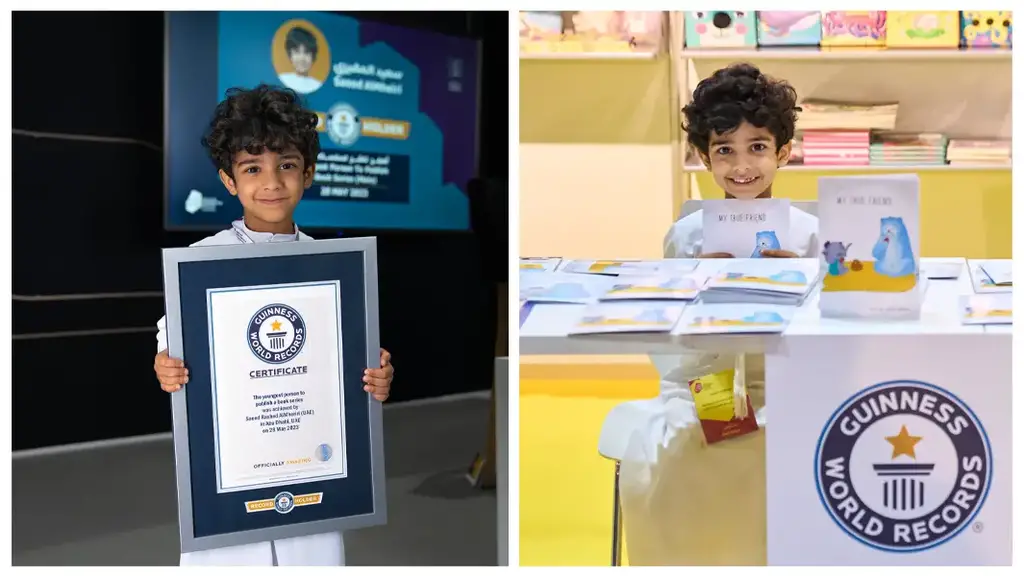
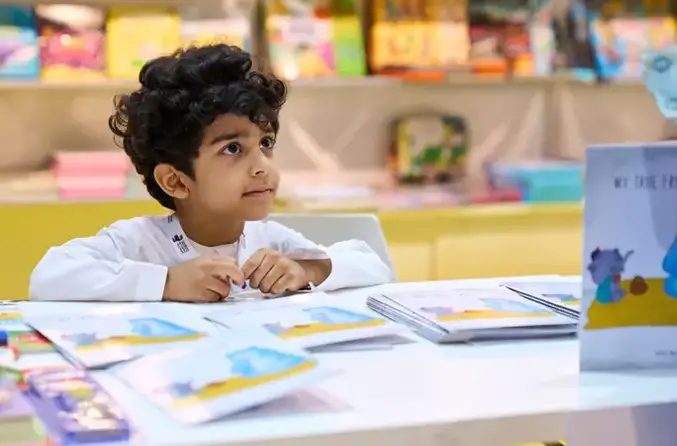
But that’s exactly what Saeed Rashed AlMheiri (UAE), who you might remember, achieved in March of this year the world record for youngest person to publish a book at the age of 4 years and 218 days, has done.
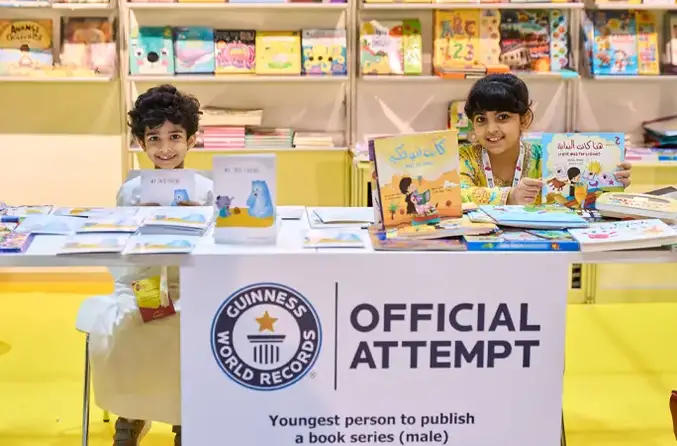
After 20 days, he managed to write a sequel to that book, earning him the title for youngest person to publish a book series (male) at the age of 4 years and 238 days old.
The book was published in the United Arab Emirates by Rainbow Chimney Educational Aids, a commercial publishing house that focuses on children aged up to 13 years old.
As per the records guidelines, the book must sell at least 1,000 printed copies, which the family managed to do during Abu Dhabi International Book Fair 2023.
His first book, titled The Elephant Saeed and the Bear, talks about an elephant, as Saeed puts it: “The elephant wanted to have a picnic on a mountain. He met a polar bear who instead of eating the elephant chooses to become his friend.”
His second book in the series, My True Friend, talks about the elephant saying farewell to his polar bear friend as he heads back home.
However, the elephant falls in water and calls for help, and the bear comes to the rescue.
The story ends with the elephant thanking his friend, or as Saeed put it: “Thank you for being a true friend”.
Saeed says: “My book teaches children how to be kind.”
Books are Saeed’s best friend, and he is also very fond of numbers and robotics.
He is a very ambitious young man and wants to become a scientist one day.
“When I grow up, I want to be a scientist and a superhero to save the Earth.”
His mother, Mouza AlDarmaki said that the family intends to inspire other children and encourage them to read and write.
“We want kids to believe in themselves, if Saeed can do it, they can too.”
Saeed’s inspiration comes from his sister, AlDhabi AlMheiri, who also published a book series at a young age.
AlDhabi also holds a Guinness World Records title for the youngest person to publish a bilingual book series (female) at the age of 8 years and 239 days old.
She published her book titled I Had An Idea And Here Was The Beginning in both English and Arabic.
“I want to tell children that they can be whatever they want to be if they try hard and read what they like in order to develop their minds.” – AlDhabi
We can’t wait to see what the future holds for these incredible young stars!
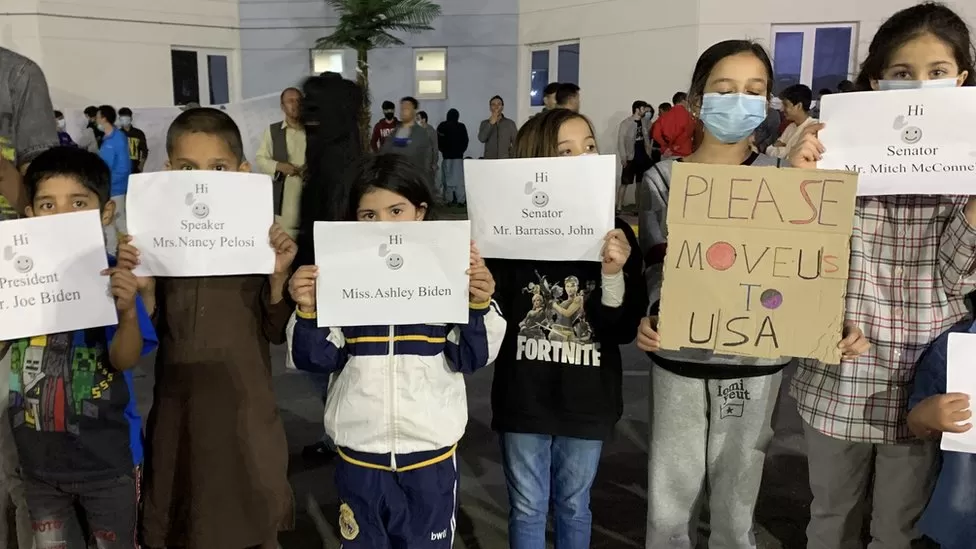
According to Human Rights Watch, the UAE arbitrarily detains at least 2,400 Afghan asylum seekers.
The adults and children detained in Abu Dhabi were evacuated from Kabul following the Taliban takeover in August 2021.
HRW said they were living in “cramped, miserable conditions” and “stranded in limbo” with no hope of being resettled.
The UAE denied that conditions were deplorable and stated that it was collaborating with the US to complete the resettlement process.
More than 10,000 other Afghans who were flown to the UAE were reportedly resettled in the United States, Canada, and other countries, while another 70,000 were evacuated directly to the United States before American troops left Kabul.
Following the Taliban takeover, Afghans were flown to Abu Dhabi and housed in two converted apartment complexes known as Emirates Humanitarian City and Tasameem Workers City.
HRW said in a report published on Wednesday that it had spoken to 16 Afghans detained at Emirates Humanitarian City, including eight who had previously worked at some point for US government-affiliated entities or programmes in Afghanistan.
They reported constraints on their freedom of movement, lack of access to fair and effective refugee status determination, lack of adequate access to legal counsel, inadequate education for children, and no psychosocial support.
The detainees also described overcrowding, decaying infrastructure and insect infestations, according to the US-based campaign group.
One unnamed Afghan was quoted as saying that Emirates Humanitarian City was “exactly like a prison”, while another described a “widespread mental health crisis among residents”.
Under international law and UN Refugee Agency guidance, asylum seekers and migrants should not be detained for administrative purposes unless it is necessary and proportional to achieve a legitimate aim, and only in the absence of viable alternatives.
HRW called on the UAE to release the detainees and provide access to fair and efficient processes for determining their status and protection needs.
“Governments should not ignore the shocking plight of these Afghans stranded in limbo in the UAE,” said Joey Shea, the group’s UAE researcher.
“The US government in particular, which co-ordinated the 2021 evacuations and with whom many evacuees worked before the Taliban takeover, should immediately step up and intervene to provide support and protection for these asylum seekers.”
An Emirati official told AFP news agency that the UAE was providing “high-quality housing, sanitation, health, clinical, counselling, education and food services” for the Afghans at Emirates Humanitarian City.
They also said the UAE was continuing to work with US authorities to “resettle the remaining evacuees in a timely manner”.
“We understand that there are frustrations and this has taken longer than intended to complete,” they added.
The US state department said there was an “enduring” US commitment to resettle all eligible Afghans, including those at Emirates Humanitarian City.
Tehran is upset that South Korean President Yoon Suk-yeol referred to Iran as an “enemy” of the United Arab Emirates.
As a result of South Korean President Yoon Suk-yeol comparing Tehran to the threat posed by North Korea and the “enemy” of the United Arab Emirates, Tehran and Seoul have summoned their respective embassies.
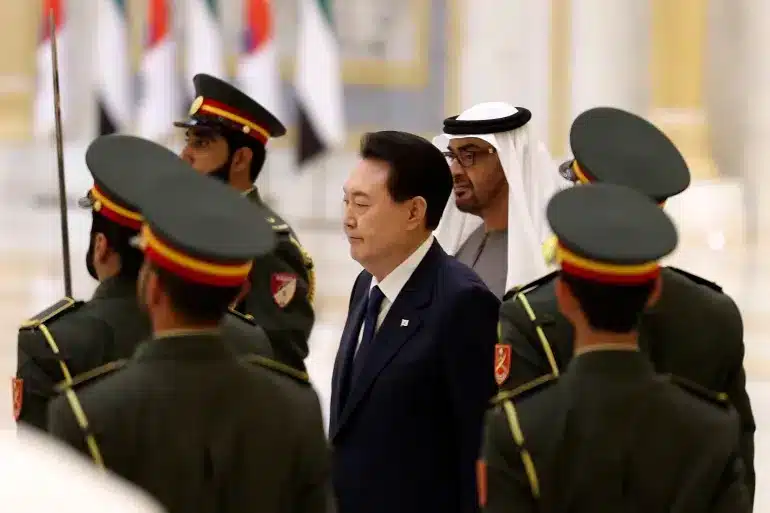
Yoon referred to the UAE as a “brother nation” of South Korea, citing the two countries’ expanding economic and military cooperation, while touring South Korean special forces stationed in Abu Dhabi on Monday.
The threat that Iran is allegedly posing to the UAE was then contrasted by Yoon with the danger that North Korea’s nuclear weapons pose to South Korea.
“The enemy of the UAE, its most-threatening nation, is Iran, and our enemy is North Korea,” Yoon said.
Yoon’s remarks triggered a stiff response from Iran’s foreign ministry, which said it was investigating Yoon’s “interfering statements”.
Iran’s deputy foreign minister on legal affairs, Reza Najafi, summoned the South Korean ambassador on Wednesday to protest against Yoon’s remarks, Iran’s official IRNA news agency said.
Najafi also accused Seoul of pursuing an “unfriendly approach” towards Iran, and noted the issue of Iranian funds frozen in South Korean banks. Iran has repeatedly demanded that Seoul release some $7bn of its funds frozen under US sanctions
On Thursday, South Korea’s First Vice Foreign Minister Cho Hyun-dong called in Iranian ambassador Saeed Badamchi Shabestari to explain Seoul’s stance “once again”, ministry spokesperson Lim Soo-suk said in a briefing.
“As we explained several times, [Yoon’s] reported comments were meant to encourage our troops serving their duties in the UAE, and had nothing to do with Iran’s foreign relations, including South Korea-Iran relations,” Lim said.
“Our government’s will to develop relations with Iran remains unchanged,” he said.
Yoon then compared the threat UAE supposedly faces from Iran to the threat South Korea faces from nuclear-armed North Korea.
“The enemy of the UAE, its most-threatening nation, is Iran, and our enemy is North Korea,” Yoon said.
Yoon’s remarks triggered a stiff response from Iran’s foreign ministry, which said it was investigating Yoon’s “interfering statements”.
Iran’s deputy foreign minister on legal affairs, Reza Najafi, summoned the South Korean ambassador on Wednesday to protest against Yoon’s remarks, Iran’s official IRNA news agency said.
Najafi also accused Seoul of pursuing an “unfriendly approach” towards Iran, and noted the issue of Iranian funds frozen in South Korean banks. Iran has repeatedly demanded that Seoul release some $7bn of its funds frozen under US sanctions.
On Thursday, South Korea’s First Vice Foreign Minister Cho Hyun-dong called in Iranian ambassador Saeed Badamchi Shabestari to explain Seoul’s stance “once again”, ministry spokesperson Lim Soo-suk said in a briefing.
“As we explained several times, [Yoon’s] reported comments were meant to encourage our troops serving their duties in the UAE, and had nothing to do with Iran’s foreign relations, including South Korea-Iran relations,” Lim said.
“Our government’s will to develop relations with Iran remains unchanged,” he said.
According to South Korea’s Yonhap News Agency, the foreign ministry in Seoul had stressed that Yoon’s comments were “irrelevant” to Seoul-Tehran relations, and also urged Iran against “unnecessary overinterpretation”.
Described by Yoon’s political opponents in South Korea as “diplomatically disastrous”, the spat comes as the UAE attempts to manage its relationship with Iran, which is an important business partner.
The UAE is also home to about 3,500 American soldiers and has spent billions of dollars buying South Korean surface-to-air missile systems as a means to protect itself against aerial attacks. Those threats include long-range drone attacks by Yemen’s Iran-backed Houthi rebels.
South Korea was once one of Iran’s biggest crude buyers in Asia and has now found itself squeezed by the tensions over Iran’s collapsed nuclear deal with world powers. Billions of dollars in Iranian funds remain frozen in South Korean banks after Washington reimposed sanctions on Tehran in 2018.
Iran held a South Korean oil tanker for months in 2021 amid the dispute. Both sides have been in talks over ways to unfreeze the funds and resume the oil trade.
According to South Korea’s Yonhap News Agency, the foreign ministry in Seoul had stressed that Yoon’s comments were “irrelevant” to Seoul-Tehran relations, and also urged Iran against “unnecessary overinterpretation”.
Described by Yoon’s political opponents inSouth Korea as “diplomatically disastrous”, the spat comes as the UAE attempts to manage its relationship with Iran, which is an important business partner.
The UAE is also home to about 3,500 American soldiers and has spent billions of dollars buying South Korean surface-to-air missile systems as a means to protect itself against aerial attacks. Those threats include long-range drone attacks by Yemen’s Iran-backed Houthi rebels.
South Korea was once one of Iran’s biggest crude buyers in Asia and has now found itself squeezed by the tensions over Iran’s collapsed nuclear deal with world powers. Billions of dollars in Iranian funds remain frozen in South Korean banks after Washington reimposed sanctions on Tehran in 2018.
Iran held a South Korean oil tanker for months in 2021 amid the dispute. Both sides have been in talks over ways to unfreeze the funds and resume the oil trade.
On December 11, a SpaceX Falcon 9 rocket launched from the Cape Canaveral Space Force Station in Florida, carrying the first Arab-built lunar spacecraft into space.
The Rashid Rover was built by Dubai’s Mohammed bin Rashid Space Centre (MBRSC) in the United Arab Emirates (UAE) and is being delivered by the HAKUTO-R lander, which was designed by Japanese lunar exploration company ispace. If the landing is successful, HAKUTO-R will be the first commercial spacecraft to make a controlled landing on the moon.
The mission is taking a low energy route to the moon and is due to arrive around April 2023. Once there, the rover will spend one lunar day (equivalent to 14.75 days on Earth) on the surface, conducting its main operations. It will spend a second lunar day conducting secondary operations, to check whether the rover will survive the moon’s tough nighttime environment, before decommissioning.
Scheduled to touch down in the Atlas crater the northeast part of the moon, the roverhas been designed to withstand the lunar night, when temperatures can reach as low as -183°C, or -297.4°F.
The Rashid Rover, named after the late Sheikh Rashid Al Saeed, the former ruler of Dubai, will analyze the plasma on the lunar surface and conduct experiments to understand more about lunar dust. Razor-sharp lunar dust particles can stick to and erode spacesuits and equipment, causing operational problems for astronauts.
The rover will be entirely solar-powered and equipped with four cameras, including a microscopic and thermal one.
The launch comes shortly after that of NASA’s Artemis I lunar mission and marks the first step in the UAE’s ambitious moon exploration program. The Gulf state plans to send several vehicles, including rovers and orbiters, to the moon, with a second rover planned to launch as soon as 2025.
Construction of the 10kg, four-wheel Rashid Rover began in 2017 at the MBRSC. It was designed by an entirely Emirati team. “The team did a great job in starting the mission and designing it,” Hamad Al Marzooqi, project manager of the Emirates Lunar Mission at the MBRSC told CNN.
The MBRSC is also using the mission to fuel ambitious plans for a Mars colony. It is hoping to build the first human settlement on the Red Planet by 2117. Al Marzooqi hopes that the lunar surface mission will be a stepping stone to Mars.
“We are starting small,” he says, “but we hope that this small step will be eventually the starting point to reach our targets.”
Following earlier news that Ghanaians had been barred from entering the United Arab Emirates (UAE), the Ministry of Foreign Affairs and Regional Integration has issued a statement to refute the claims.
According to the statement issued by the ministry, it has no such communication in its possession, and as such, the information should be disregarded.
“The said publication assigned no reason for the ban, but social media sources have alleged that it is aimed at keeping away visitors from African countries who usually overstay their visit visas in the UAE.
“The Ministry wishes to assure the general public that it has received no such communication from the authorities in the UAE and as such, the story should be disregarded,” it stated.
The ministry has however indicated that information available to it is that the UAE has reviewed its visa requirements.
“Meanwhile, information available to the Ministry indicates that the UAE has reviewed the requirements for its tourist and visit visas. The revision of visa regimes and requirements includes the following:
“The 30-day single entry visas have been put in hold, a 60-day multiple visa entry regime is currently in force, travellers to the UAE should secure a round-trio ticket and a hotel booking prior to the visa application,” it added.
The Ambassador of the United Arab Emirates (UAE) to Ghana, Amer Al Alawi, has refuted reports that Ghana and 19 other African Countries have been barred by his government from entering Dubai.
According to him, reports of the ban are mere rumours because his office has not received any official communication on it yet.
“There is nothing official regarding the rumours in the news. There is no official statement from my government or the other governments.
“So, our daily work routine is the same, it hasn’t changed. Until we find or receive an announcement or an official statement, we can’t talk about it.
“There is nothing. Maybe there is something under process but I can’t assure you,” Amer Al Alawi told the media on the side-lines of a tree planting event to symbolise 50 years of diplomatic ties between the UAE and Ghana.
The ambassador added that the UAE has rather made the process for applying for visas more flexible to make Dubai and other parts of the UAE easily accessible to Ghanaians and other nationals.
His comments come after reports indicated that the UAE had banned nationals of Ghana and 19 other African countries from entering its capital city, Dubai, effective Monday, October 24, 2022.
“The United Arab Emirates (UAE) has announced a visa ban on nationalities from 20 African countries seeking to visit Dubai.
“Countries affected include Ghana, Sierra Leone, Sudan, Cameroon, Nigeria, Liberia, Burundi, Republic of Guinea, Gambia, Togo, Democratic Republic of Congo, Senegal, Benin, Ivory Coast, Congo, Rwanda, Burkina Faso, Guinea Bissau, and Comoros. The ban takes immediate effect,” parts of a Facebook post shared by DW Africa on Monday read.
DW Africa stated that one of the reasons for the ban was that most nationals from the 20 countries always fail to leave Dubai after their visas have expired.
Norwegian startup Desert Control claims that it can fight desertification efficiently by spraying sand with Liquid NanoClay (LNC) and turning it into soil in a matter of hours.
In the past, we’ve featured many ‘green heroes‘ who have been fighting desertification for decades, using all sorts of techniques, from draught-resistant shrubbery to tree barriers, but now a startup claims to obtain much better results in the same harsh conditions in just seven hours. Invented in the early 2000s by Norwegian scientist Kristian Olesen, Liquid NanoClay is the secret behind Desert Control’s amazing achievements. When sprayed onto sand, this amazing invention trickles down and percolates the sand, turning it into water-retaining soil where plants can germinate and thrive.
Farmers have been using clay to increase the fertility of their lands for thousands of years, and the Nile Delta is famously fertile thanks to its clay, but working thick, heavy clay into less fertile land, let alone sand, has always been laborious and time-consuming. Desert Control managed to overcome this hurdle by making the clay particles in their NanoClay as small as possible.
Liquid NanoClay sounds fancy, but it’s made with just water and clay. The company’s secret is its ability to turn thick clay into a liquid “nearly as thin as water,” which is then sprayed over the sands, percolating the top layer all the way to a few dozen centimeters. The clay binds to the sand particles and forms a moisture-retaining soil that, while not as fertile as dark soil, can definitely support plant life.
Desert Control currently has its sights set on the UAE, a wealthy market that currently imports about 90 percent of its food, because growing anything in this desert environment is so tough. The technology has already proven its use, turning a barren desert into soil, but there is still the limitation of cost.
CNN reports the cost of treatment ranges from $2 to $5 per square meter (11 square feet), not exactly cheap, considering the vast areas that need to be treated with Liquid NanoClay in order for agricultural projects to make sense. However, Desert Control plans to develop units capable of producing large amounts of Liquid NanoClay, which would bring down the price considerably.
“If they are able to reduce the price and make it affordable for the least income countries, it could have a really huge impact on food security and the ability of many of those countries to use their own crops,” said Ismahane Elouafi, Director General of Dubai’s International Center for Biosaline Agriculture. “It could be tremendous.”
With 12 million hectares of fertile land being lost to desertification every year, Desert Control’s solution sounds like nothing short of a miracle. Being able to turn sand into plant-sustaining soil in just seven hours sounds unreal, but it works.
According to Desert Control, the effects of Liquid NanoClay last for about five years, after which the artificially-created soil needs a top-up.
The United Arab Emirateshas reportedly banned nationals of some 20 African countries from entering its capital city, Dubai.
“This is to inform you that we will not be posting 30 days visa applications for these nationalities effective today October 18, 2022,” the notice read in part.
countries affected by the visa ban include Uganda, Ghana, Sierra Leone, Sudan, Cameroon, Nigeria, Liberia, Burundi, Republic of Guinea, Gambia, Togo, Democratic Republic of Congo, Senegal, Benin, Ivory Coast, Congo, Rwanda, Burkina Faso, Guinea Bissau, Comoros, and the Dominican Republic.
In a notice issued to trade partners including travel agents, authorities indicated that all applications should be rejected.
“Any applications from the above-mentioned countries will be sent back or canceled.” According to reports.
this is not the first time some African countries have been banned from entering Dubai.
In December 2021, Emirates Airlines announced that eight African countries will not be accepted to travel through Dubai until further notice due to the spread of Covid 19.
It is however not clear the reason behind the latest ban.
The United Arab Emirates (UAE) has reportedly banned nationals of Ghana and 19 other African countries from entering its capital city, Dubai.
Even though the reason for the ban was not stated, it was expected to start on Monday, October 24, 2022, according to DW Africa.
“The United Arab Emirates (UAE) has announced a visa ban on nationalities from 20 African countries seeking to visit Dubai.
“Countries affected include Ghana, Sierra Leone, Sudan, Cameroon, Nigeria, Liberia, Burundi, Republic of Guinea, Gambia, Togo, Democratic Republic of Congo, Senegal, Benin, Ivory Coast, Congo, Rwanda, Burkina Faso, Guinea Bissau, and Comoros. The ban takes immediate effect,” parts of a Facebook post shared by DW Africa on Monday read.
This is not the first time Ghana and other African countries have been barred from travelling to Dubai.
Emirates Airline announced on December 28, 2021, that eight African countries will not be accepted to travel to or through Dubai until further notice due to the spread of the Omicron COVID-19 variant.
The countries included: Ghana Angola, Guinea, Kenya, Tanzania, Uganda, Cote d’Ivoire and Ethiopia.
The Sector Minister, Shirley Ayorkor Botchwey, in a press release stated that, her outfit is working with authorities in the United Arab Emirates to bring back these stranded citizens back to the country.
These stranded persons, according to Madam Ayorkor Botchwey, were misled by agents who promised them jobs in Dubai and the UAE.
The agents have, however, abandoned these persons, making them easy targets for arrest and detention by law enforcement agencies in the UAE.
The Ministry is thus cautioning persons who wish to travel, to do so through the appropriate authorities.
“Even though our stranded compatriots went to the UAE on their own, the government of Ghana is making necessary efforts in collaboration with the UAE authorities to effect the evacuation of our stranded nationalsâ€.
“The Ministry wishes to seize this opportunity to caution some prospective travellers of the Golf region to be mindful of nefarious activities by unscrupulous agents.â€
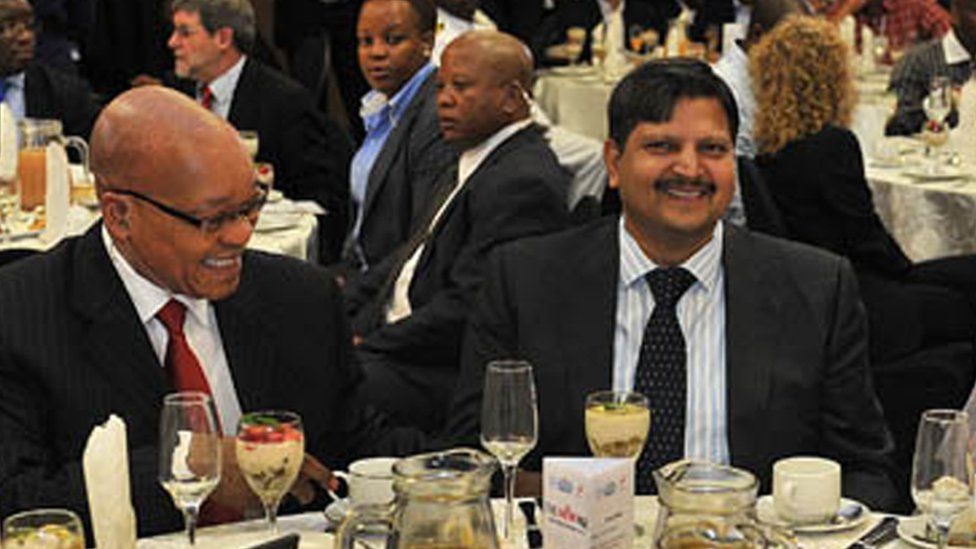
High-level talks have begun between the governments of South Africa and the United Arab Emirates to bring two brothers from the wealthy Gupta family to justice.
They are accused in South Africa of profiting from their close links with former President Jacob Zuma and exerting unfair influence.
All three deny any wrongdoing.
The wealthy Indian-born brothers, who are accused of fraud and money laundering, are expected to apply for bail in the next few days.
Rajesh and Atul, along with their brother Ajay Gupta – who has not been arrested – fled South Africa in 2018, around the same time former President Jacob Zuma was forced to resign following a string of corruption allegations against him.
The Guptas have been accused of using their association with Mr Zuma to cash in on huge government contracts by paying bribes.
The United States placed the Guptas on a sanctions list in 2019, after they were accused of being members of a significant corruption network.
South Africa successfully negotiated an extradition treaty with the United Arab Emirates last year, but it could take years before the accused are successfully extradited to face justice in South Africa.
Two brothers from the wealthy Gupta family have been arrested in the United Arab Emirates, the South African government has announced.
Atul and Rajesh Gupta are accused in South Africa of profiting from their close links with former president Jacob Zuma and exerting unfair influence.
Extradition talks are taking place with the UAE, South African officials say.
The brothers fled South Africa after a judicial commission began probing their involvement in corruption in 2018.
They are accused of paying financial bribes in order to win lucrative state contracts and influence powerful government appointments.
The family moved from India to South Africa in 1993. They also face accusations of money laundering in India, where tax officials raided properties belonging to them in 2018 in multiple cities, including their company office in capital Delhi.
Many of the most serious corruption allegations levelled against the Indian-born brothers focus on their relationship with Jacob Zuma, who was president of South Africa from 2009 until he was forced to step down amid a storm of corruption allegations nine years later.
The Gupta family is accused of using their close links with Mr Zuma to wield enormous political power across all levels of South African government – winning business contracts, influencing high-profile government appointments and misappropriating state funds.
Mr Zuma and the Guptas deny any wrongdoing.
After the brothers fled the country, South Africa negotiated an extradition treaty with the UAE in 2021.
President Cyril Ramaphosa’s government has said it hoped the agreement would lead to the return of the Guptas to face charges, but it was not immediately clear following the arrests whether the brothers will return to South Africa.
The Gupta family became so closely linked with Mr Zuma that a joint term was even coined for them – the Zuptas.
One of Mr Zuma’s wives, as well as a son and daughter, had positions working in senior roles for Gupta-controlled companies.
Many of the companies in the Gupta portfolio profited from lucrative contracts with government departments and state-owned corporations – where public officials say they were directly instructed by the family to take decisions that would advance the brothers’ business interests.
It is alleged that compliance was rewarded with money and promotion, while disobedience was punished with dismissal.
The list of public bodies accused of having been “captured” is extensive – the ministries of finance, natural resources and public enterprises, as well as agencies responsible for tax collection and communications, the national broadcaster SABC, the national carrier, South African Airways, the state-owned rail-freight operator and the energy giant Eskom – one of the largest utility companies on the planet.
A four-year investigation later published by the country’s top judge concluded that the wealthy brothers had become deeply embedded in the highest levels of government and Mr Zuma’s ruling African National Congress (ANC) party.
Reports published this year by investigators accuse the brothers of being linked to racketeering activity through the procurement of rail, ports and pipeline infrastructure.
Its authors also concluded that Mr Zuma “would do anything that the Guptas wanted him to do for them”.
Last year Mr Zuma was imprisoned for 15 months for refusing to testify before the same investigators. He was released on parole after serving two months of his sentence in jail.
Who are the Gupta brothers?
Ajay, Atul and Rajesh Gupta moved to South Africa from the Indian state of Uttar Pradesh in 1993, just as white-minority rule was ending.
It is said that when Atul arrived to set up the family business Sahara Computers, he was amazed by the lack of red tape.
They grew the company to employ more than 10,000 people in South Africa, also developing financial interests in the mining, air travel, energy, technology and media sectors.
Atul Gupta said he met Mr Zuma before he became president “when he was a guest in one of Sahara’s annual functions”.
Image source, South African governmentImage caption, South African President Jacob Zuma sits with Atul Gupta in 2012Source: BBC
Organised Labour has appealed to President Nana Addo Dankwa Akufo-Addo to use his executive powers to grant workers at least a 20 per cent Cost of Living Allowance (COLA) in the wake of the economic hardships being experienced in the country.
Addressing the 2022 May Day parade at the Black Star Square in Accra on Sunday, the Secretary-General of the Trades Union Congress (TUC), Dr Yaw Baah speaking on behalf of Organised Labour made the special request to the President.
“With the rising cost of living due to high inflation, we will like to appeal to you [President Akufo-Addo] to use your executive powers to grant a cost of living allowance (COLA) of at least 20 per cent to all public service workers.”
Dr Baah said the appeal was not only for those on the Single Spine Pay Policy (SSPP) but also for the Armed Forces, the police, prisons, immigration, fire and all the security and intelligence agencies. “The cost of living allowance must also be extended to workers in the private sector who are earning just GH¢365 a month.
“We also expect that this COLA will be extended to all those pensioners on the SSNIT scheme who are earning just GH¢300 per month. Mr President the proposed COLA will not only cushion workers and pensioners from the harsh effects of inflation but even more importantly, it is prevent mass poverty in this country among the working group who are contributing so much to the development of our country.
Watch the video below
“Mr President, Ghanaians are suffering too much, this is not the country that was envisaged by our leaders who fought with their tears and blood to gain independence for us. God has endowed us with gold, diamond, forest, ocean, oil and other resources, therefore, nothing can justify the high incidence of severe poverty, destitution and suffering in Ghana today, 65 years after independence.”
“It is obvious to us that the numerous IMF programmes in Ghana did not work, it is also clear to us that the partisan approach in dealing with Ghana’s problems is not working. What we need is our own homegrown solutions, supported by all the major stakeholders in the economy, including the executive, parliament, judiciary, workers and their unions, the business community , farmers, traders, NOGs, political parties and civil society organisations. We are confident that Mr President together we can transform our economy into a more resilient and prosperous one which can provide job for the youth and improve standard of living in all the 16 regions of the country.
Parliament has, on Thursday, August 5, 2021, approved a visa waiver agreement between Ghana and the United Arab Emirates, Daily Graphic has reported.
This means that Ghanaian passport holders seeking to travel to Dubai will be permitted free entry into the UAE per the visa waiver agreement.
According to details as contained in a Memorandum of Understanding (MoU) between the Government of Ghana and the UAE, the agreement comes with a mutual exemption of entry visa requirements with respect to diplomatic, service/special, and ordinary passport holders.
Foreign Affairs Minister, Shirley Ayorkor Botchway, earlier in May this year presented the MoU before the House, which was subsequently referred for consideration to the Committee of Foreign Affairs of which a report was later presented in accordance with Order 140(4) and 183 of the Standing Orders of Parliament.
Bryan Acheampong, Chairman of the Foreign Affairs Committee, presenting the report before parliament, explained that both Ghana and the UAE showed commitment to further foster bilateral relations.
Acheampong revealed that the visa-free waiver agreement between the two countries does not come with obligations imposing Ghana-UAE to admit persons of questionable character into their terrains.
The agreement, the chairman said, also does not impose financial obligations or financial gains on the two countries from its implementation date.
Bryan Acheampong, however, clarified that the visa waiver agreement which will facilitate the travel of government officials and diplomats is common, except this new arrangement allows for ordinary passport holders to also benefit.
Ghana International, Ernest Asante, has confirmed that he will be staying with UAE side Al-Fujairah Gat in the Arab Gulf League for one more season.
The experienced winger joined the UAE club last season from Saudi Arabian side Al Hazem in search for more playtime.
According to the 31-year-old, the club is interested in keeping him for next season and he is ready to help them win laurels.
“As a player with experience in the team, I hope to contribute in leading the young team to achieve the goals and aspirations of the fans and the management of the club next season, stressing that he and his teammates, including foreign players and citizens, bear great responsibilities in this aspect”
“Undoubtedly, the administration is interested in my staying with the team for the second season in a row, and I am physically read”.
“We train daily strongly with the Serbian coach Goran, who has great field experience in the competition, due to his training a number of teams in the past seasons, and he works with the technical staff in order to provide ideal preparation for the team before the start of the league”, he added.
Ahmed Shobier, former vice president of the Egypt Football Association, has revealed that the United Arab Emirates is close to hosting remaining Africa’s inter-clubs competitions.
Shobier made the revelations through his radio program on “On Sport FM”, that the UAE may host the semi-finals and finals of the 2019/2020 CAF Champions League and Confederation Cup.
The ex-Al Ahly SC goalkeeper said that CAF will mostly decide to cancel the two-legged semi-finals due to fears of Coronavirus, and therefore the two championships may end in only five days on neutral grounds.
Shobier stressed that the idea of entrusting the organization and hosting of the remaining matches to the Emirates would be similar to the Doha (Qatar) hosting of the CAF Super Cup in the last two editions.
It is noteworthy that the Confederation of African Football (CAF) will decide on Tuesday 30 June 2020 the fate of the CAF championships, at the level of clubs and teams, especially after the suspension of activities more than three months, due to the global pandemic coronavirus.
There is a tendency within CAF to postpone the 2021 Africa Cup of Nations, due to be held in Cameroon in January 2021 and rescheduled to January 2022.
The dates for the matches of the African club championships will be determined, whether the rest of the suspended season or the dates of the new version of the Champions League and the Confederation Cup.
Total export of goods from the United Arab Emirates (UAE) into Ghana in 2018, was valued at US$106 million, Director, International Offices of the Dubai Chamber of Commerce and Industry, (DCCI) Omar Abdulaziz Khan, told the Goldstreet Business in Dubai, while predicting great prospects for trade between the two countries going into the future.
Though the amount has reduced minimally compared to the 2017 total export of US$111 million from that country, the total in 2018 was however still way higher than that of 2016 exports, which was valued at US$81 million.
Instructively, total direct investment volumes between Ghana and the UAE as at the end of 2018, has reached US$4 billion particularly with investments by UAE-owned companies spread across various sectors of the Ghanaian economy, in high potential sectors such as agribusiness, tourism, textile and garments, utilities, manufacturing and minerals processing.
Data from the Ghana Investment Promotion Centre (GIPC) indicates that almost 30 companies from the UAE are set up and operating in Ghana.
Omar Abdulaziz Khan has however expressed excitement about the number of DCCI members who have their certificates of origin for doing business targeting Ghana.
In all, 1,641 members of the DCCI have their certificate of origin targeting Ghana and the DCCI believes this would serve as catalyst for deepening the existing bilateral trade between the two countries.
Meanwhile, the number of businesses exporting goods from the UAE to Ghana has increased steadily from 171 in 2016 to 198 in 2017 and 231 in 2018.
The Chamber noted that the potential synergies between the two countries are of great value to both in terms of trade and as such the UAE, particularly Dubai, looks forward to increasing its trade volumes with the country.
“The UAE continues to identify cocoa, cashew nuts, gold and fish as high potential imports, while potential exports from the UAE remains tea, mineral fuels, carpets, textile articles in that order†Abdulaziz Khan indicated.