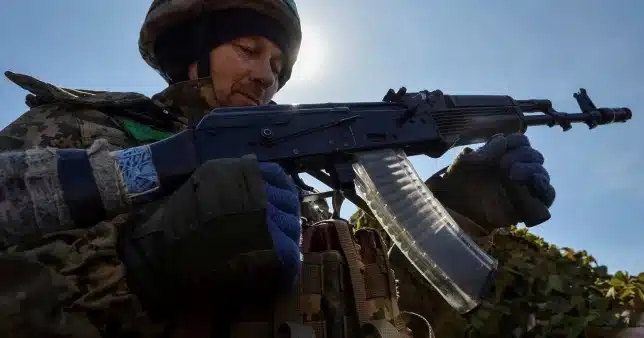
UK military special troops are operating in Ukraine, according to ‘top secret’ papers that have leaked.
According to the documents, there may have been more than half British special forces in Ukraine between February and March of this year.
Since the start of the conflict, the administration has kept secret the presence of special troops in Ukraine.
The UK embassy in Kyiv reported in June 2021 that its special troops had trained alongside Ukrainian military prior to Russia’s invasion.
Dozens of classified US documents that have been leaked online paint a detailed picture of the war in Ukraine, including sensitive details of Ukraine’s preparations for a spring counter-offensive.
Images of the classified files from the Pentago have appeared on messaging app Discord since February.
Complete with timelines and dozens of military acronyms, the documents, some marked ‘top secret’ also offer information on China and allies.
It is unknown where the forces are based in Ukraine (Picture: Getty)
The US government says it is investigating the source of the leak.
According to the document the UK has the largest contingent of special forces in Ukraine (50), followed by fellow Nato states Latvia (17), France (15), the US (14) and the Netherlands (1).
The document does not say where the forces are located or what they are doing.
In line with its standard policy on such matters, the UK’s Ministry of Defence has not commented, but in a tweet on Tuesday said the leak of alleged classified information had demonstrated what it called a ‘serious level of inaccuracy’.
It said: ‘Readers should be cautious about taking at face value allegations that have the potential to spread misinformation.’
It did not elaborate or suggest which specific documents it was referring to. However, Pentagon officials are quoted as saying the documents are real.
UK special forces are made up of several elite military units with distinct areas of expertise, and are regarded to be among the most capable in the world.
The units, which conduct undercover operations as well as covert surveillance and reconnaissance operations, are the UK military’s most secretive organisations.
Unlike the intelligence services, the special forces are not subject to external parliamentary oversight.
The British government has a policy of not commenting on its special forces, in contrast to other countries including the US.
US Defense Secretary Lloyd Austin said the Department of Justice had opened a criminal investigation and he was determined to find the source of the leak.
‘We will continue to investigate and turn over every rock until we find the source of this and the extent of it,’ he said.
After sightings of drones over or close to UK military locations last year, a number of events led to inquiries, according to recently made public records.
One of the incidents noted by the Ministry of Defence (MoD) was a pilot who reported a UAV at 20,000 feet.
Another incident included what is thought to have been a quadcopter drone that was reported to have “hovered over barracks.”
The UAVs were also recorded as coming within close proximity of military facilities, according to the information released by the MoD’s Directorate of Security & Resilience.
One was sighted over the roof of a building while another landed on an ‘upper roofed area’.
In total, there were 21 incidents between January 2022 and February this year, the response to a request by Metro.co.uk under the Freedom of Information Act shows.
On one occasion a security team was recorded as having located the operator. The incident report reads: ‘Report of drone flying.
‘Officers conducted area search, operator located. Spoken to by officers, who viewed footage from drone, operator voluntarily deleted all footage.’
Only one of the other reports, where a drone was being used at a pre-planned event, shows any sign of the operators having been located.
Two other incidents concerned an object described as a ‘drone/microlight glider’ which was seen by ‘multiple witnesses’ in one case.
Another report in the list of incidents states: ‘A drone (believed to be a quadcopter) hovered over barracks.’
Area searches were carried out in seven cases but no evidence of UAV activity was found.
The log in another of the incidents states: ‘Report from pilot of drone at 20,000 feet. Nothing seen from the ground, area search carried out for operator, no trace.’
A military facility’s own systems detected a UAV in one case. The log reads: ‘Drone system activated, showing drone. Officers attended, no trace.’
The information has been released at a time of heightened international concern about aerial spying by foreign powers.
A Chinese balloon was shot down by the US off the coast of South Carolina last month, with the Pentagon saying the craft had been used to spy on ‘strategic sites’. Europe is among at least five continents targeted by Beijing with the high-altitude balloons over the past few years, according to White House and Pentagon sources.
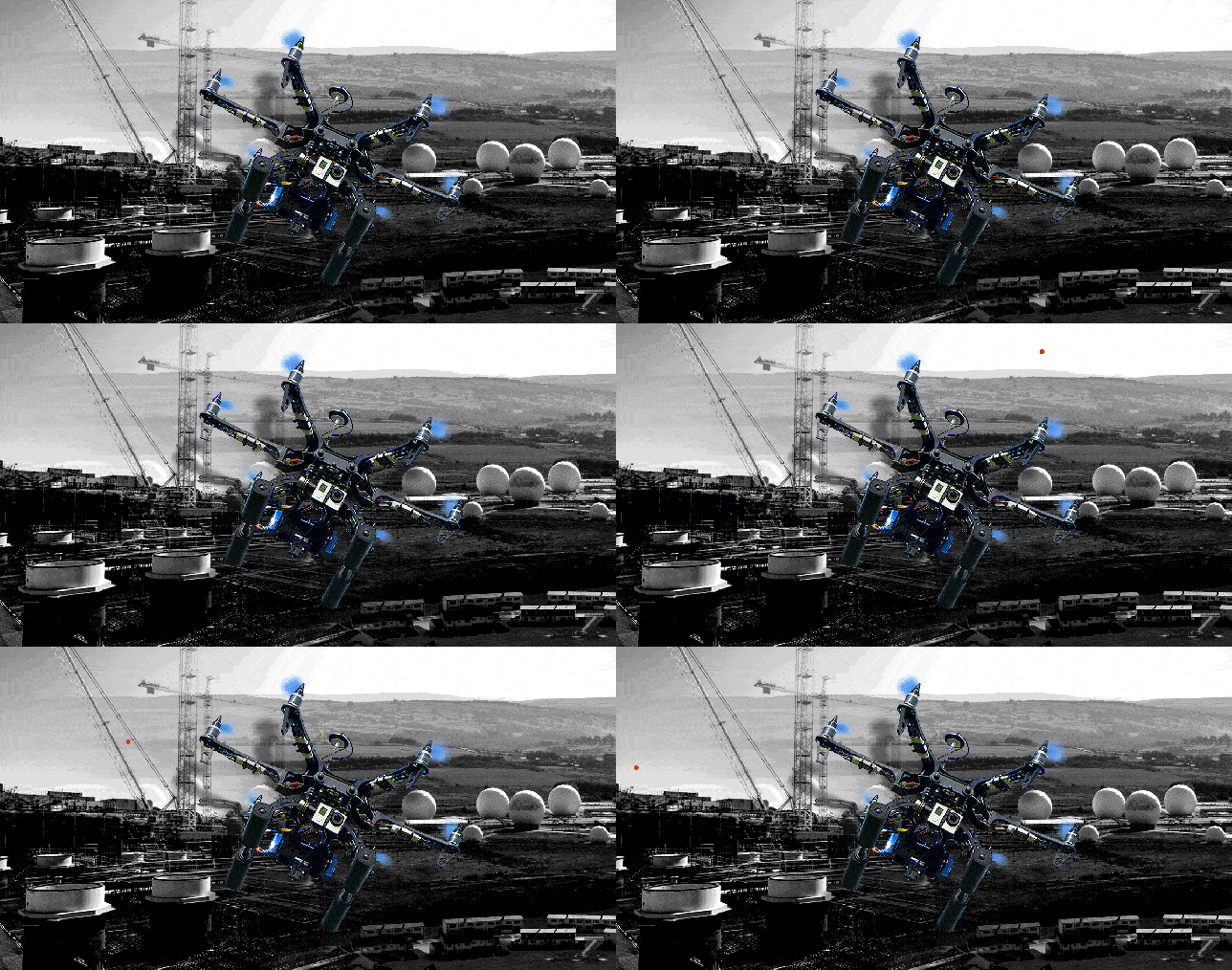
The ability to weaponise drones, as evidenced on the battlefield in Ukraine, and to co-ordinate and interlink the UAVs in ‘swarms’, has emerged as another aerial threat to critical infrastructure.
A swarm was reported on an unspecified date at a nuclear licensed in the UK between January 2014 and July 2020, according to the Office for National Regulation. No other details were released.
A group of up to six drones was reported to armed police ‘over and around’ Capenhurst nuclear site in Cheshire in July 2019, according to another disclosure from the Civil Nuclear Constabulary.
Such incidents are cloaked in secrecy by the various agencies involved on national security grounds and it is not known if the two reports are linked.
Drones, along with any type of unmanned aircraft, are banned under the Air Navigation Order from flying in the airspace of nuclear installations. The Civil Aviation Authority says that ‘flying may be restricted’ around other sites including military ranges, royal palaces and government buildings.
The new reports come at a time of heightened tensions between the West and China and Russia, which have each been linked to concerted physical and cyber spying operations in the UK.
Peter Burt, of Drone Wars UK, said: ‘These incidents highlight the potential that drones have to disrupt security arrangements.
‘Although most of the cases were probably the result of careless use by irresponsible owners, there is certainly a risk that some of them were more malicious in their intent.
‘It’s notable that in many of the cases the authorities were unable to trace the drone or its operator, which highlights the difficulties in countering the use of drones for illegal purposes. Drones are easily available and can be bought by anyone to use for criminal purposes.’
Drone reports between January 22 and February 23
Drone hovering over camp
Drone over roof of building
Drone on upper level roofed area
Unmanned aerial vehicle (UAV) heard but not seen
Drone/microlight glider sighted by multiple witnesses
Drone/microlight glider spotted
A drone (believed to be a quadcopter) hovered over barracks
Unauthorised drone flight
Report of drone sighting
Unmanned aerial system flying
Filming with drone
Drone sighting
Report of possible drone sighting. Search carried out, nothing found.
Report of drone, search carried out, officers found out it was a pre-planned event.
Report of drone flying, area search carried out, nothing found
Drone reported to be flying, officers carried out area search, no trace.
Report of drone flying. Area search carried out, no trace. Drone system activated, showing drone. Officers attended, no trace.
Report of drone flying, Officers conducted area search, operator located. Spoken to by officers, who viewed footage from drone, operator voluntarily deleted all footage.
Report from pilot of drone at 20,000 feet. Nothing seen from the ground, area search carried out for operator, no trace.
Report of drone flying, area search carried out by officer, no trace.
(Source: Ministry of Defence)
Mr Burt, who has studied UAV use and is part of the Nukewatch monitoring network, highlighted the weaponisation of drones, including as ‘kamikaze’ systems used to deadly effect in the Middle East and Ukraine.
‘Drones bought off-the-shelf have been adapted to deliver weapons by a number of non-state groups during conflicts in the Middle East, and in the Ukraine war,’ he said. ‘We have seen how even the simplest drones can be used for reconnaissance and intelligence-gathering.
‘The government is planning to deregulate UK airspace to allow greater commercial use of drones, meaning that drones will become far more intrusive into our everyday lives. These incidents give an indication of the difficulties that we can expect to arise in future in tracking down and tackling problems caused by rogue operators.’
The UK government is undertaking work to enhance the national response to the threats posed by increasingly sophisticated and widely used aerial systems at home and abroad.
This includes through the Defence and Security Accelerator, a project to find innovative ways to mitigate hostile use of the systems and the RAF’s Project Synergia, which has delivered counter-drone technology.
A Ministry of Defence spokesperson said: ‘We have robust security measures in place at all defence sites to respond to such incidents.
‘While we cannot comment on specific security arrangements or procedures, we continue to invest in a range of measures to tackle future threats, including counter-drone technology.’