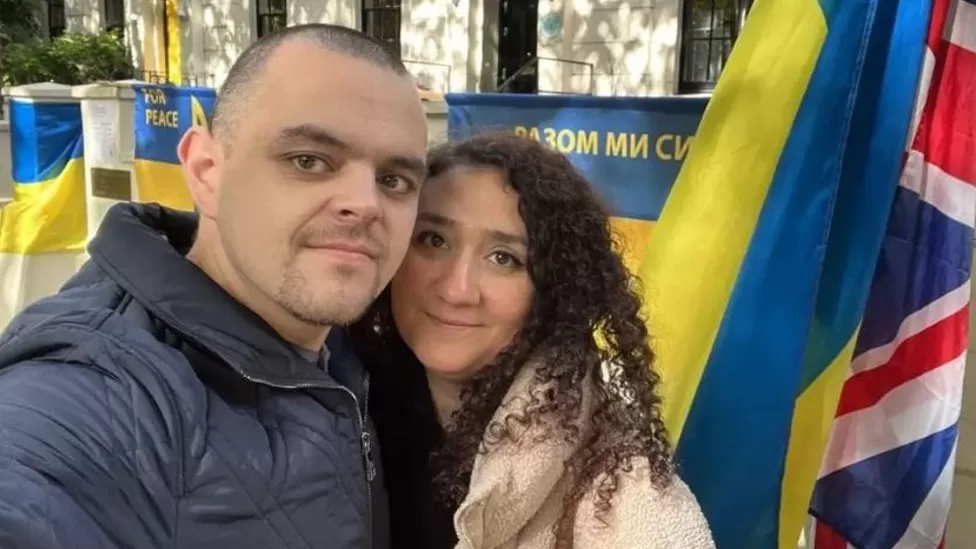
A former soldier who was taken prisoner and held captive by Russians has declared his intention to settle back in Ukraine.
Before being released last year, Aiden Aslin, a Newark resident, was imprisoned by forces in Mariupol that were supported by Russia and given the death penalty.
He revealed on the BBC’s Ukrainecast podcast that he would be returning to Ukraine with his Ukrainian fiancée, Diana Okovyta.
He intends to begin a career in conflict journalism there.
After completing the process of leaving the Ukrainian army, Mr. Aslin, who has published a book about his time in captivity, said he and Ms. Okovyta will want to settle down.
“It’s going to be a long drive, and hopefully everything will go as planned,” he remarked.
Although there is always a chance that you could be hurt or killed in one of the airstrikes, life goes on because we have been in Ukraine for such a long time, especially for a family that is there.
In addition, Mr. Aslin discussed his month-long detention by Russian military, which ended only after protracted discussions.
He described it as “like some old Soviet sort of police thing.”
There are no mattresses, only a concrete floor, no bathroom, and you get like a tiny piece of bread every day. In addition, everyone gets a two-liter bottle of water, so you’d be lucky to get maybe a quarter of a cup.
“Therefore, it’s just the bare minimum to keep you alive, and then on top of this, you have people that will get taken out – they’ll find out something about them, and you just hear them being taken beaten,”
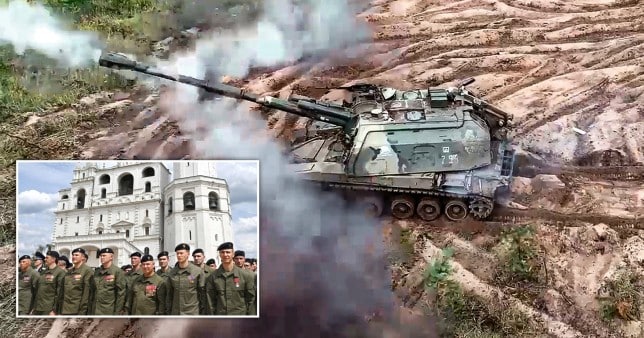
In order to launch a significant attack in the Kharkiv region of Ukraine, Russia is apparently building up a battle force of some 100,000 soldiers, according to reports from Kyiv.
The substantial Russian presence in the area, which the Ukrainian army’s spokesman Col. Serhi Cherevaty says is concentrated on retaking the city of Kupyansk, was confirmed.
Up until Kyiv’s counteroffensive in the autumn of last year, the city was an essential supply route and centre for Russia’s eastern invasion forces.
‘The enemy has concentrated a very powerful group,’ said Col Cherevaty told Ukrainian media. ‘More than 100,000 personnel, more than 900 tanks, more than 550 artillery systems and 370 rocket salvo systems.’
Keep up with the latest news on the Russia-Ukraine war on our live blog.
A Ukrainian military spokesman confirmed Russia had been amassing a huge fighting force to retake the city of Kupyansk (Picture: Getty)
He added: ‘They are concentrating everything in order to break through our defence. Our soldiers are firmly on the defensive. They do not allow the enemy to seize the initiative.’
Moscow’s troops have reportedly been in the area, but the recent uptick in attacks is seen to be a recent development.
‘This issue is not recent; it has been ongoing for many months, and our defense forces have consistently thwarted their progress with strong counterattacks,’ Chervaty said.
‘The presence of 100,000 personnel is not a recent development. The approximate number has been known [to Ukrainian military intelligence] for a considerable time.’
Cherevaty claimed the Russian attacks, though significant in scale, have been ineffective due to the low quality of Russian unit training and lack of real motivation.
‘Yes, it is big. We have to take into account its size. However, this number does not indicate a direct threat or a cause for concern,’ he added.
His comments come following reports that Vladimir Putin has increased the maximum age elegible for military service to 70 as he seeks to regain the intiative in the conflict with a big win.
Cherevaty’s claims were backed up by Ukrainian Army Land Forces Commander General Oleksandr Syrsky, who confirmed via Telegram that Russia had concentrated its forces to attack in the Kupyansk direction but has been unable to make a breakthrough thus far.
Syrsky, who commands Ukraine’s forces in the east, said Russia had recently reinforced its positions around Bakhmut with additional forces, but were steadily losing ground to the Ukrainians.
Meanwhile, Hanna Malyar, Ukraine’s deputy defence minister, suggested that the Kupyansk attack may be a diversionary tactic used to lift pressure on sectors of the battlefield in the south where Ukraine has been taking ground.
‘As soon as we seize the operational initiative and start moving forward, the enemy immediately activates in other directions to distract and drag in our forces,’ she said.
Kremlin sources also appeared to confirm movement in the direction of Kupyansk, although there is no consensus on the size and shape of the attacking force.
According to a report on Tuesday, the Russian military had claimed that its troops had advanced on a ‘limited section of the front’ near Kupyansk, after ‘successful offensive operations.’ The announcement did not say when the attack or attacks took place.
‘On the Kupyansk front, units from the Western group of troops continue successful offensive operations,’ a Kremlin statement said. ‘The total advance was up to two kilometres along the front and up to one and a half kilometres in depth’.
The Lyman-Kupyansk sector has experienced a period of relative calm in recent months, marked by sporadic air strikes, intermittent artillery fire, and occasional ground exchanges. The current front line in the sector was set in October 2022 after a successful Ukrainian counteroffensive and has seen minimal movement since then.
But over the past 24 hours, Ukrainian forces in the Kupyansk-Lyman sector registered a distinct upturn in Russian barrages, counting 536 strikes throughout the day with all calibers of artillery.
The news comes as Kyiv has softened its rhetoric regarding the effectiveness of their counter-offensive against Russia, with commanders now alluding to ‘slow but steady’ progress against the invaders instead of a lightning push towards the Sea of Azov.
On Tuesday, Sysrky told BBC’s Today programme that ‘our advance is really not going as fast as we would like.’
However, the US’s top general said on Tuesday that Ukraine’s counter-offensive was ‘far from a failure’, but that the fight ahead would be long and bloody.
‘I think there’s a lot of fighting left to go and I’ll stay with what we said before: This is going to be long. It’s going be hard. It’s going to be bloody,’ Mark Milley, the chairman of the joint chiefs of staff, said.
Britain’s Ministry of Defence also announced on Tuesday that it plans to spend an extra £2.5 billion on army munitions and create a new ‘global response force’, vowing to learn lessons from the war in Ukraine.
The MoD said the additional investment in stockpiles would cover the coming decade, and be paired with other spending and reforms intended to bolster ‘warfighting resilience’ and deterrence.
Vladimir Putin had vowed retaliation to the alleged attack on the Kerch bridge, which connects Russia to Crimea, earlier this week
Russian fighters supporting Ukraine cross the border into the Belgorod region of Russia, seize a checkpoint, and incite rage and uncertainty in Moscow.
As authorities continue “clearing the territory” following the cross-border incursion that started in Ukraine, residents of the settlements under attack in the Belgorod region of Russia have been relocated to other places, according to regional governor Vyacheslav Gladkov on Tuesday.
But questions linger about the groups behind the attack, how it took place, and what it means for the war: Was this a classic piece of a military sleight-of-hand, a brief show of force meant to confuse and distract Russian commanders? Does it signal the emergence of serious armed opposition inside Russia? Or are there murkier forces at work?
Here’s what you need to know.
A group of anti-Putin Russian nationals, who are aligned with the Ukrainian army, claimed responsibility for an attack in Russian’s southwestern region of Belgorod, which borders north-eastern Ukraine.
Russia’s Investigative Committee announced an investigation into the attack on Telegram, claiming: “Residential and administrative buildings and civilian infrastructure were subjected to mortar and artillery fire. As a result of these criminal actions, several civilians were wounded,”
Two areas of the region were then hit overnight by drones, according to regional Governor Vyacheslav Gladkov, causing two houses to catch fire. On Tuesday night, drone attacks sent nine people to hospital, Gladkov said.
One civilian from the village of Kozinka has died as a result of the cross-border fighting, Gladkov said on Tuesday. He added Wednesday that six districts of the Belgorod region, as well as the city itself, were targeted, but that a counter-terror operation launched in response had been lifted.
About 100 people were evacuated from the Russian border settlements of Glotovo and Kozinka in the Belgorod region, local authorities said.
Aleksey Baranovsky, a representative of the Kyiv-based Russian Armed Opposition Political Centre – the political wing of the Freedom of Russia Legion – told CNN that the operation had started Sunday night and fighting was “ongoing.”
He would not specify the number of fighters who had crossed the border into Russia. Baranovsky said the group wanted to “liberate our motherland from the tyranny of Putin.”
The Russian Ministry of Defense claimed in a daily briefing on Tuesday that its forces repelled attackers back into Ukrainian territory using air strikes, artillery fire and military units. It added: “The remnants of the nationalists were driven back to the territory of Ukraine, where they continued to be hit by fire until they were completely eliminated.”
The attackers appeared to have achieved surprise, apparently taking control of a border post and giving the world dramatic images of Russian nationals actively taking up arms against the Kremlin.
Smoke was also seen rising from apparent explosions in the regional capital of Belgorod, where local authorities confirmed what they described as two drone strikes.
The ground operation was far more ambitious than an incursion earlier this year into Russia’s southern Bryansk region that the Russians blamed on “armed Ukrainian nationalists.”
In a discussion with CNN’s Erin Burnett, retired Army Lt. Gen. Mark Hertling characterised the Belgorod operation as a raid — a surprise attack meant to keep the Russian military on the back foot ahead of a much-anticipated offensive by Kyiv.
“This is all part of shaping operations,” Hertling said. “What occurred today and it’s a magnificent tactic, is these Liberty of Russia Legion or Russian Volunteer Corps, the so-called little green men are going in the opposite direction, they’re trying to free Russian territory.”
“Little green men” was common shorthand for Russian special-forces troops who appeared in Crimea during Russia’s forcible annexation of the Black Sea peninsula in 2014.
Pro-Ukrainian activists on social media are already having a field day, posting memes that compare the Belgorod incident to Russia’s not-so-covert operations to prop up separatists in the Donbas region, joking the attackers would set up a Russian-style statelet called the “Bilhorod People’s Republic.”
The Freedom for Russia Legion said on Telegram early on Tuesday that it and another group, the Russian Volunteer Corps, “continue to liberate the Belgorod region!” The post described the groups as “patriot volunteers” and claimed that Russia was vulnerable to attack as “Russia has no reserves to respond to military crises. All military personnel are dead, wounded or in Ukraine.”
As one of its fighters, who goes by the call-sign “Caesar,” says in a video statement he recorded with his comrades before joining a cross-border raid into his motherland: “Russia will be free.”
CNN’s Sam Kiley interviewed that same fighter in December, while the group was fighting for Ukraine against Russian attacks on the frontline city of Bakhmut.
“From the first day of the war, my heart, the heart of a real Russian man, a real Christian, told me that I had to be here to defend the people of Ukraine,” Caesar said. CNN agreed not to reveal his name to protect his identity.
“It was a very difficult process,” Caesar said of joining the Ukrainian effort. “It took me several months to finally join the ranks of the defenders of Ukraine.”
Now with his family in Ukraine – where he considers them to be safer – Caesar said he was one of about 200 Russian citizens currently fighting alongside Ukrainian troops, against their own country’s armies. CNN has been unable independently to confirm this number.
The Ukrainian government, however, has distanced itself from the Russian fighters, saying they are operating independently in Russia.
“We can confirm that this operation is carried out by Russian citizens,” said Andriy Yusov, Ukrainian Defense Intelligence representative, in a comment to CNN: “In Ukraine these units are part of defense and security forces. In Russia they are acting as independent entities.”
As Russian officials condemned the attack, analysts noted widespread confusion in Russia’s information space about how the attack was allowed to take place and how Moscow should respond.
Russian bloggers and pundits reacted with a “degree of panic, factionalism, and incoherency as it tends to display when it experiences significant informational shocks,” the Institute for the Study of War (ISW) think tank wrote in its daily briefing on the conflict.
“The attack took Russian commentators by surprise,” the ISW assessed.
It has the potential to be embarrassing for President Vladimir Putin, who has for 15 months been leading an invasion he baselessly claimed was needed to keep Russia safe. With limited returns on the battlefield, Putin may now face discontent that the war is disrupting life at home.
Earlier this month, the Kremlin publicized an incident which saw two drones fly above the Kremlin. It remains unclear who was responsible – Moscow blamed Ukraine for what it called an attack on Putin’s life; Ukraine and the US denied any involvement – but the dramatic video could be framed by Putin’s internal critics as a visual example of the unraveling nature of Moscow’s war.
In a separate incident Monday evening, the Freedom of Russia Legion posted a video on Telegram that appears to show the blue and white so-called flag of free Russia flying over Moscow State University.
Other videos posted by the group also appear to show another Russian opposition flag flying over various areas of the Russian capital.
The group did not claim direct responsibility for the incidents and CNN could not independently verify the reports.
As has often been the case following supposed violence on Russian soil since Moscow invaded Ukraine, the incident has drawn sharply different accounts from the Kremlin and Kyiv.
Kremlin spokesperson Dmitry Peskov on Tuesday described the instigators as “Ukrainian militants, from Ukraine,” despite the fact that the group claiming responsibility is made up of Russian nationals. Peskov had previously said the Kremlin’s forces were working to push out a “sabotage and reconnaissance group,” according to state media TASS.
A Ukrainian official acknowledged that the units had carried out an operation in the area but insisted they were acting independently.
The Ukrainian National Security Adviser Oleksiy Danilov has told CNN those responsible for the cross border-raid in Belgorod are Russians who want to get rid of “the darkness” in their country, denying any involvement from Kyiv.
“They are Russians, it is their country and they have the right to be there,” Danilov told CNN Senior International Correspondent Frederik Pleitgen in an exclusive interview Tuesday. “There are some Russians who are on the side of the light and who went to deal with the darkness that exists in Russia now.
Danilov rejected accusations of Ukrainian involvement levied by Moscow against Kyiv and said the incident in Belgorod was solely a Russian matter.
Kyiv was, however, given advance warning about the cross-border raid, a Ukrainian defense source told CNN on Wednesday.
It is not entirely clear how the Russian formations fighting on the side of Ukraine are organized and equipped and how they answer to the Ukrainian military’s chain of command.
Some of the fighters appear to be operating up-armored Humvees and Mine-Resistant Ambush Protected vehicles that are apparently of US origin, although the vehicles have been widely exported and sold to different end-users around the globe.
In response to a query from CNN, Ukraine’s International Legion — which incorporates volunteers from around the world — said neither the Russian Volunteer Corps or the Freedom for Russia Legion belong to the International Legion of the Armed Forces of Ukraine.
It’s also a mystery how many fighters the Russian groups can actually muster. Open-source sleuths have scoured recent videos for clues to the identities of some of the individuals who appear to be fighting in Belgorod, including some with apparent far-right and extremist beliefs.
The attacks are unlikely to force a shift in momentum in the wider war in Ukraine, which has been largely focused in Ukraine’s eastern regions and has seen little territory change hands for several months. The conflict has been in a virtual stalemate and is more likely to be affected by Ukraine’s spring counter-offensive against Russian forces, which may already be underway.
But as with previous flashpoints away from the frontlines, it has the potential to shape the narrative surrounding the conflict in both Russia and Ukraine.
Moscow has always been eager to paint a picture of Russian victimhood as a pretext for ramping up attacks on Ukraine, given its public pretense that the invasion is an act of self-defense and is necessary to keep Russia safe. Putin will no doubt look to use these attacks to bolster that narrative, despite Kyiv’s denials that it had any official involvement.
It is possible that a short-term show of anger may also follow. After previous incidents that have embarrassed Russia – such as the murky drone incident above the Kremlin this month, and the strike on the bridge connecting Russia to occupied Crimea in October – Moscow has responded with a barrage of missile attacks across Ukraine, including on the capital Kyiv.
Putin will likely be eager to focus Russian attention on incidents away from the frontlines, where his forces have been struggling to land a significant blow against Ukrainian defenses – most clearly shown by the months-long, costly effort to capture the relatively insignificant city of Bakhmut.