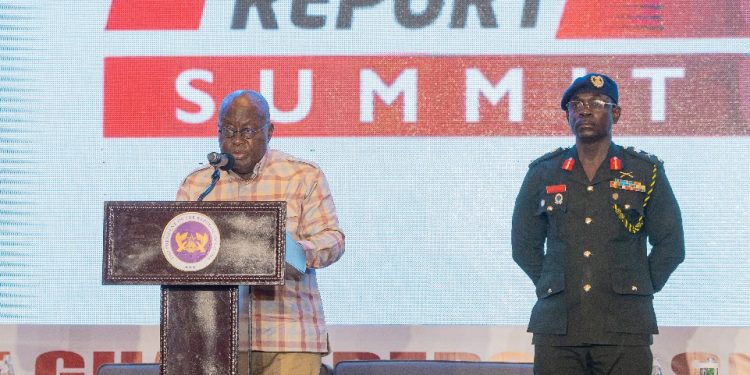
The Presidency officially announced President John Dramani Mahama’s departure for the 80th United Nations General Assembly (UNGA) in New York through a statement issued by the Presidential Spokesman and Minister in charge of Government Communications, Mr Felix Kwakye Ofosu, on Saturday, September 21.
The statement announced that the President will lead a high-level delegation and was scheduled to deliver his address to the Assembly today, Thursday, September 25. During his speech, he called for reforms to the UN Security Council and global financial architecture, emphasising the need to embrace gender equality to achieve global development.
Find his full speech below:
Madam President,
Mr Secretary-General, Excellencies,
Ladies and Gentlemen:
At this 80th session of the United Nations General Assembly, I would like to speak about Africa’s role in the future of the organisation. However, it is impossible to do that without first considering the collective role that Africa played in its founding, which was small and relatively insignificant.
Of the 51 Member States involved in the founding of the United Nations in 1945, only four were African: Egypt, Ethiopia, Liberia, and South Africa.
It is important to point out that the United Nations came into being in the aftermath of World War 2 because of the inability of its precursor, the League of Nations, to avert a large-scale global conflict, which had been its guiding purpose when it was founded in 1920 on the heels of World War 1.
Out of the 42 founding member states of the League of Nations, only three were African: Liberia, the Union of South Africa, and Ethiopia. Egypt joined later in 1937. Africa’s overall participation in the organisation’s founding was minimal and relatively unimportant.
That’s because, before all the other talks and meetings, representatives from a group of 14 nations gathered in Berlin for a series of discussions that began in 1884, which led to the partition and formal colonisation of the continent—also called the Scramble for Africa.
It has famously been written that “past is prologue.” Well, in the past, the majority of the 54 nations that now comprise Africa were never offered a seat at the table where plans for a new World Order were being drawn.
But, Madam President,
As fate would have it, the tables have turned, and Africa’s role in the authorship of whatever is yet to come for this world will be huge, and it will be consequential.
According to this organisation’s own projections, by the year 2050, more than 25% of the world’s population is expected to come from the African continent. Additionally, by 2050, one- third of all young people, aged 15 to 24, will be residing on the African continent.
So, you see, the future is African.
Allow me to say this once again, a little louder for the people in the back. The future is African!
Already today, Africa is a catalyst for human potential and development, as well as for economic reform and ecological stability. Africa is a catalyst for systemic change. If this reality—which is fact-based and straightforward—seems provocative or unsettling, perhaps it’s because you’re viewing it through the lens of centuries of racism, colonialism, imperialism, and the resulting implicit bias.
Maybe you’re unaware of the resilience of African nations or their remarkable ability to make a strong comeback, just when you think it’s safe to discount them.
That’s what is happening right now in Ghana. Our Constitution limits leaders to two four-year terms. In January, I was sworn in for a second term, which, I should add, is non-consecutive with the first. Our currency, the Ghana cedi, was rapidly depreciating.
Faced with rising inflation, a huge debt burden, and low morale amongst our citizens, my new administration quickly embarked on an ambitious programme of comprehensive transformation designed to restructure Ghana’s economic foundation and enhance our competitive standing globally. We refer to this process of recalibration as our reset agenda.
In just eight months, we have achieved a significant reduction in inflation, from 23.8% in December 2024 to 11.5% in August 2025, restoring price stability for our citizens. Additionally, the Ghana cedi has appreciated considerably against other currencies, with Bloomberg reporting it as the best-performing currency in the world at one point.
Our improved sovereign credit rating reflects increasing investor confidence. Our 24-Hour Economy Initiative promises to transform our economy. There is a renewed willingness among the people to trust that their elected officials have Ghana’s interests at heart and that we are progressing together.
Madam President,
I believe that, in honour of this milestone celebration, the United Nations should also embark on a process of serious recalibration and establish its own reset agenda. Since the organisation’s founding, the number of UN Member Nations has nearly quadrupled. And, quite frankly, it is not the same world that it was back then.
I mentioned earlier that I began my second non-consecutive term as president this past January. My first term ended in January 2017. In that span of time, the world had changed with such ferocity, my first days in office felt as though I’d just awakened from a Rip Van Winkle-style slumber. That was after only eight years; imagine, then, what it would be like after eighty years.
In 1945, the sun had not yet set on the largest empire in history; the most common mode of international travel was by sea; the personal computer had not been invented, let alone made portable; and television, a new convenience, was still in its infancy, albeit in black and white.
Relations between the US and the Soviet Union were turning frosty, with Winston Churchill declaring that “an iron curtain has descended across the Continent.”
Eighty years on, in today’s world, 100,000 commercial flights take off and land every day; libraries have been digitised so that volumes of literature can exist on a device small enough to fit inside your pocket. This is a world of cryptocurrency, Artificial Intelligence, social media, the Internet, and its dark, hidden dungeon —the dark web—all of which carry a potential threat to global peace and security.
Climate change is real, and we are fighting a losing battle against the loss of the Maldives and other island nations to the rising sea level, Timbuktu to desertification, and the Amazon Rainforest to global warming and deforestation.
Madam President,
The UN founding charter is outdated when it comes to representation. The most powerful post- World War 2 nations are still being rewarded with an almost totalitarian guardianship over the rest of the world. And yet, the first sentence in Chapter 2, Article 1 of the UN charter declares that “The Organisation is based on the principle of the sovereign equality of all its members.”
If this were truly the case, a continent as large as Africa with its numerous UN Member states would have at least one permanent seat on the Security Council. Furthermore, veto power should not be restricted to five nations, nor should it be absolute.
There must be a mechanism for the General Assembly to challenge a veto. No single nation should be able to exercise an absolute veto to serve its own interests in a conflict.
In 1995, during the 50th anniversary of the United Nations, Nelson Mandela stood in this very spot. He said, “The United Nations has to reassess its role, redefine its profile, and reshape its structures. It should truly reflect the diversity of our universe and ensure equity among the nations in the exercise of power within the system of international relations. In general, and the Security Council in particular.”
Thirty years later, we African leaders are still making the same request: for a permanent seat on the Security Council, with the power of veto. So, today, Madam President, I stand here in this exact spot, asking: if not now, then when?
We demand not only a reform of the Security Council, but also a reset of the global financial architecture, which is currently rigged against Africa. Africa must have a greater say in the world’s multilateral financial institutions.
While I am making requests, I would like to call for the removal of the blockade on Cuba. As Dr Kwame Nkrumah, our nation’s founder, famously said, “We seek to be friends of all and enemies to none.” The Cuban people shed their blood on African soil in the fight against apartheid. Indeed, Cuba has been, and continues to be, a faithful friend to Africa.
You see, the very fact that I can stand here and ask these things, and the fact that all nations can ostensibly gather here to address critical global issues, air grievances, and express concerns—that is what makes the survival of this organisation so important.
In every old city or village, you will find a town square, a courtyard, or a plaza that once served as a gathering place for the citizens and their leaders. Meetings and celebrations were held there, as were trials and elections. They were spaces that brought people together and held them as a community. Sadly, time and technology have eroded those spaces.
Madam President,
In many ways, the United Nations is the proverbial town square of our modern global village. And it has never been more critical for us to protect this one space that brings and holds the world’s nations together as a community.
The Internet, social media platforms, and Artificial Intelligence offer us the illusion of connectivity, when in fact they reinforce isolation by using algorithms that ensure we do not receive new ideas and perspectives, but rather more of the same. We are served alternative facts and manipulated images, making it easier to disseminate disinformation and sow seeds of division.
These are dangerous times. Our world is currently experiencing a rise in nationalism and economic instability. There is a general breakdown of multilateralism; various acts of aggression have been committed against the sovereignty of others, and nations are attempting to circumvent the very safeguards put in place to prevent large-scale global conflict.
These conditions are all too similar to the ones that led to the League of Nations’ failure in fulfilling its mandate. The denial of visas to President Abbas and the Palestinian delegation sets a bad precedent and should be deeply worrying to all member nations.
Ghana recognised the state of Palestine in 1988 and supported a two-state solution to the conflict.
Contrary to the claims of some, a two-state solution would not be a reward for Hamas but, rather, a reprieve for the hundreds of thousands of innocent people who have been facing collective punishment and forced starvation for no reason other than the fact that they are Palestinian.
For nearly two years, and for the fear of reprisal, we here in this General Assembly have been playing hide-and-seek with language to find the right words to help us avoid or excuse what we all know is taking place there.
But here’s the thing, it doesn’t matter what you call it: if it looks like a duck, swims like a duck, and quacks like a duck, well then… It must be a duck. The crimes in Gaza must stop.
Madam President,
I want to draw particular attention to the conflict in Sudan, which this body has described as the world’s largest humanitarian crisis. Twelve million people have had to flee their homes.
When we speak of migration, we refer to the 12 million new refugees, whom we, as a global community, should be willing to assist in much the same way that many member nations readily assisted new refugees from Ukraine.
Let’s dispense with euphemisms and dog-whistles and speak frankly. It’s not a mystery that when leaders of Western nations complain of their migration problems, they are often referring to immigrants from the Global South.
Many of those migrants are climate refugees. Interestingly, the Global North emits 75% more greenhouse gases than the Global South. However, the effects of climate change are more severe in the Global South because we lack the resources to address them effectively.
So, when the desert encroaches and our villages and towns become unlivable, we are forced to flee.
Warsan Shire, a Somali-British poet born in Kenya to Somalian refugee parents, was London’s first Youth Poet Laureate. She writes in her poem titled “Home”.
You have to understand that no one puts their children in a boat unless the water is safer than the land No one burns their palms
under trains beneath carriages
No one spends days and nights in the stomach of a truck feeding on newspaper unless the miles travelled mean something more than a journey.
Madam President,
We cannot normalise cruelty. We cannot normalise hatred.
We cannot normalise xenophobia and racism.
If we are going to tell a story, let’s not tell it slant. Let’s tell all the truth.
When we speak of migrants, we speak of Maame Ewusi-Mensah Frimpong, a judge on the US District Court for the Central District of California. She is the first Black female judge on any of California’s four federal district courts. She was born in America to immigrant parents from Ghana.
We speak of Peter Bossman, a medical doctor born in Ghana who moved to the town of Piran in Slovenia in the 1980s. He later became the first Black mayor of Piran, the first Black mayor in Slovenia, and in the whole of Eastern Europe.
We speak of T-Michael, the iconic Ghanaian-Norwegian artist and designer, and the late Kofi Annan, former United Nations Secretary-General and Nobel Peace Prize recipient, who was born in Ghana but spent his adulthood in various places in America and Europe.
These are people who have brought great distinction to the countries that they call home. Just as the migrants and the children of migrants before them did. These are not invaders or criminals.
Madam President,
The slave trade must be recognised as the greatest crime against humanity. As African Champion on reparations, Ghana intends to introduce a motion in this August body to that effect.
More than twelve and a half million Africans were forcibly taken against their will and transported to create wealth for the powerful Western nations.
We must demand reparations for the enslavement of our people and the colonisation of our land that resulted in the theft of natural resources, as well as the looting of artefacts and other items of cultural heritage that have yet to be returned in total. We recognise the value of our land and the value of our lives.
As did our coloniser, as well as the governments that happily paid reparations to former slave owners as compensation for the loss of their “property”—that “property” for which compensation was paid referred to enslaved people who had been freed.
Madam President,
An increasingly insecure world is witnessing upward spending on defence budgets of bilateral partners and steep cuts in Official Development Assistance. Since July 2024, there has been a 40% drop in humanitarian aid to Africa.
In this era of global uncertainty, Africa must exercise sovereignty over its natural resources to raise the necessary funds to ensure the well-being of its citizens.
The days of parceling out vast concession areas to foreign interests for exploitation must come to an end. We will continue to welcome foreign investment, but we must negotiate better for a bigger share of the natural resources that belong to us.
We are tired of the continued image of poverty-stricken, disease-ridden rural communities, living at the periphery of huge foreign-controlled natural resource concession areas. We are tired of having people extract the most they can from us and, in return, offer us the very least by way of respect, consideration, and dignity.
We are tired of not being represented in ways that reveal the richness and complexity of our history or acknowledge all that we have overcome to arrive here, in this liminal space of untold possibilities.
Allow me to echo the Indian-American writer, Arundhati Roy, who wrote: “Another world is not only possible, she is on her way. On a quiet day, I can hear her breathing.”
I want to add that for the sake of Africa, and quite selfishly, for the sake of my 18-year-old daughter, I hope this new world that is arriving is a place of safety and equality for women and girls. To succeed, we must empower everyone, including women and girls, to reach their full potential.
In closing, Madam President,
I would like to congratulate you on your election to preside over this historic 80th General Assembly, and on being the fifth woman to hold this distinction.
I would also like to congratulate Her Excellency Naana Jane Opoku-Agyemang on being the first woman Vice President of Ghana. Now every Ghanaian girl knows the heights to which she can ascend.
Words matter, but issues of representation matter even more, which is why Ghana looks forward to the appointment of a woman as Secretary General of this organisation in the future.
Madame President, Your Excellencies,
Thank you for your kind attention.