Tag: UN Secretary General

  • COP27:Joe Biden issues a rallying cry to world leaders on climate change

     US President Joe Biden says, it is the duty and responsibility of every nation to act on climate change.

    Mr. Biden spoke in Egypt following the president’s better-than-expected midterm election results in the United States.

    He claimed that the United States is a global climate leader because it has passed comprehensive climate legislation.

    The two-week meeting is attended by approximately 35,000 people in Sharm el-Sheikh.

    “The climate crisis is about human security, economic security, environmental security, national security and the very life of the planet,” said Mr Biden.

    He echoed UK Prime Minister Rishi Sunak’s comments on Monday that Russia’s war in Ukraine is a reason to act faster on climate.

    Noting that the past eight years have been the warmest on record, he described the impacts of climate change on Africa nations, including a four-year drought in the Horn of Africa.

    Mr Biden promised to tighten US rules on methane emissions from oil and gas companies. Methane is the most potent greenhouse gas and significantly contributes to the warming of Earth’s atmosphere.

    “Today, thanks to the actions we have taken, I can stand here as president of the United States of America and say with confidence the US will meet our emissions targets by 2030,” he said.

    He also pledged more money for poorer nations suffering from climate disasters, including drought and flooding. But the sums remain far short of what the US, along with other developed nations, have promised.

    “Joe Biden comes to COP27 and makes new promises but his old promises have not even been fulfilled. I’d rather have one apple in my hand than the promise of five that never come,” said Mohamed Adow, Power Shift Africa director.

    “The inconvenient truth is that the United States is grossly underperforming on its international climate finance commitments,” said president of World Resources Institute Ani Dasgupta.
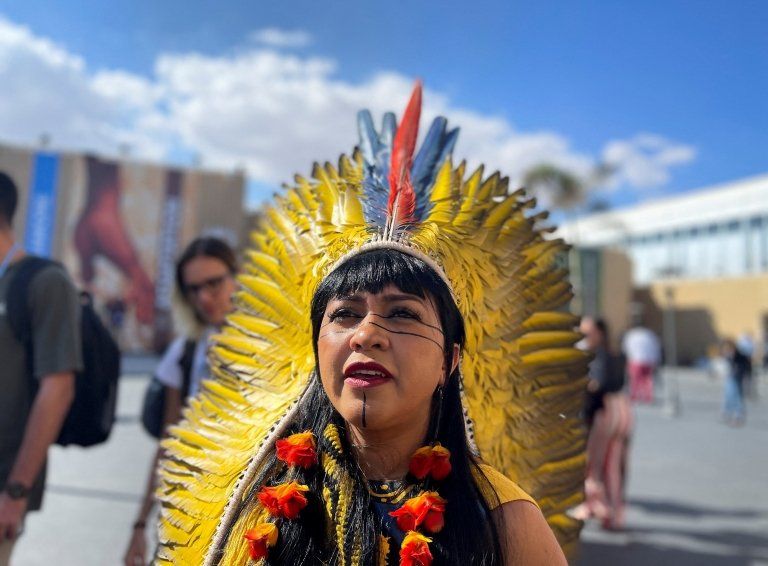
    Activists, NGOs, politicians and negotiators from around the world are at COP27
    IMAGE SOURCE,REUTERS Image caption, Activists, NGOs, politicians and negotiators from around the world are at COP27

    In August the US passed legislation to tackle climate change that experts have called “radical” and “historic”. The Inflation Reduction Act could reduce US greenhouse gas emissions by 40% by 2030.

    Mr Biden’s Democrat party feared that it would lose crucial seats in the mid-term elections on Tuesday, which could have weakened their climate agenda. But it performed better than expected.

    “While control of Congress is still being determined, one thing is certain: the massive climate-friendly investments in the Inflation Reduction Act are here to stay,” says Dan Lashof, director of World Resources Institute United States.

    Mr Biden also held talks with Egyptian President Abdul Fattah al-Sisi amid heightened concern over the fate of jailed British-Egyptian pro-democracy activist Alaa Abdel Fattah.

    There’s been no independent confirmation about Mr Abdel Fattah’s condition since he is said to have received “medical intervention” on Thursday, days after he began refusing water as part of a long hunger strike.

    It is the sixth day of the COP summit, which is focussed on implementing ambitious promises made at COP26 in Glasgow last year.

    Vulnerable nations have called on richer countries to pay for the irreversible damage climate change wrecks on their homes.

    “We will not give up… the alternative consigns us to a watery grave,” Bahamas Prime Minister Philip Davis said on Tuesday, urging nations to “get real”.

    They say developed nations owe this money because they became rich off decades of using fossil fuels.

    By contrast many less developed countries, particularly the small island nations most at risk, have contributed virtually nothing to total emissions.

    Richer nations have historically avoided the question of compensation or reparations, but the issue – referred to as “loss and damage” – was put on the COP agenda this year for the first time since the summits began 30 years ago.

    Human rights groups are highlighting the plight of an estimated 60,000 political prisoners in Egypt.

    In a reminder of the danger the world faces, UN Secretary General Antonio Guterres told the summit “we are on a highway to climate hell with our foot on the accelerator”.

    On Friday a report warned that emissions of carbon dioxide (CO2) are rising so quickly that there is a 50% chance the world will soon cross the crucial temperature threshold of 1.5C.

  • The United Nations considering sanctions against gang leader ‘Barbecue’ in Haiti

    UN Security Council resolution drafted by the United States and Mexico names ‘Barbecue’ as one of Haiti’s most powerful gang bosses.

    According to a draught resolution obtained by various news outlets, the United Nations Security Council is considering imposing asset freezes, travel bans, and arms embargoes on anybody who threatens Haiti’s peace, security, or stability.

    The first person to be sanctioned would be Jimmy Cherizier, who goes by the nickname “Barbecue” and is described in the United States and Mexico-drafted resolution as one of Haiti’s most influential gang leaders.

    “Cherizier and his G9 gang confederation are actively blocking the free movement of fuel from the Varreux fuel terminal,” the text says. “His actions have directly contributed to the economic paralysis and humanitarian crisis in Haiti.”

    Gangs last month blocked the entrance to Varreux to protest against a government announcement of a cut in fuel subsidies. Fuel supplies dried up and Haitians also face a shortage of drinking water amid a deadly outbreak of cholera.

    “One of the challenges in effectively dealing with insecurity is the nexus between the gangs and some of the elites in Haiti and outside of Haiti who is supporting them and directing them for their own purposes,” US Secretary of State Antony Blinken said in Washington on Thursday.

    “So we’ve been working together at the United Nations … to impose sanctions on those who are actually taking actions that support violence and support gangs,” he said at a joint news conference with visiting Mexican officials.

    UN Secretary-General Antonio Guterres has proposed that one or several countries send “a rapid action force” to help Haiti’s police remove a threat posed by armed gangs, according to a letter to the Security Council, seen by Reuters news agency on Sunday.

    In July, the council threatened targeted sanctions against criminal gangs and human rights abusers in Haiti and called on countries to stop the flow of guns to the Caribbean country.

    The US State Department this week announced visa sanctions against those who support Haitian gangs, responding to the humanitarian crisis created by the gang blockade.

    US Assistant Secretary of State Brian Nichols, who is leading a delegation of officials to the Caribbean nations, said in an interview with a local television station that Barbecue and the G9 gangs are directly contributing to the deaths of Haitians.


    “Yesterday, the United States designated 11 individuals for visa sanctions,” Nichols said, adding that he could not name the individuals per US policy.

    He said 1.2 million people in Haiti are at risk for cholera. Health experts say the gang blockade is making it more difficult to control the outbreak, which was announced this month.

    The 15-member Security Council could vote as early as Monday on the draft sanctions resolution, diplomats said. To be adopted a resolution needs nine votes in favour and no vetoes by Russia, China, the US, France, or Britain.

    China has been pushing for the Security Council to impose an arms embargo on criminal gangs in Haiti.

    A UN mission in Haiti works with the government to strengthen political stability and good governance, rights protection, and justice reform and to help with organising free and fair elections.

    UN peacekeepers were deployed to Haiti in 2004 after a rebellion led to the removal and exile of then-President Jean-Bertrand Aristide. Peacekeeping troops left in 2017 and were replaced by UN police, who left in 2019.


  • Dr. UN set to roll out another award show in November

    It appears that no amount of trolls, insults, and jail terms could deter Mr. Kwame Owusu Forjour, popularly known as Dr. UN, from organizing another edition of the infamous ‘Global Blueprint Excellence Awards’, as he is set to stage the next one in November.

    This comes after the maiden edition held on August 28, 2020, in Accra, which honoured a host of Ghanaian personalities and celebrities including Sarkodie, D-Black, Nathaniel Attoh, Daughters of Glorious Jesus, Natalie Fort, and many others.

    Dr. UN’s controversial awards scheme has since been described by many as a total sham following revelations that it had no affiliation with the United Nations (UN) as he had touted.

    He had been accused of using the United Nations and former UN Secretary-General, Kofi Annan’s name to make the award scheme appear credible, a claim he has fought off vehemently.

    Although he has suffered dire consequences, which include receiving severe trolls for giving out fake award plagues, being arrested on multiple counts, and being physically assaulted, among several others, Dr. UN said Ghanaians are in for another surprise.

    “I am not moved by what Ghanaians said about my awards. I have been through hell after organizing these awards. I have been beaten twice just for organizing an award. All that I have been through will not deter me from organizing another award,” He told Graphic Showbiz.

    “The venue and everything else is ready. Come November, it will happen. I do my things orderly and because I want to get everything right, I have whatever I need for the awards and trust me this awards will be super,” he added.

    Source:ghanaweb.com

  • Reform international financial structure – President Akufo-Addo to UN

    The urgent necessity for the international financial system to be changed in order to accommodate expanding and developing economies has been emphasized once more by President Nana Addo Dankwa Akufo-Addo.

    He asserted that “the need for system reform is compelling” and that the current framework was heavily skewed towards emerging and developing nations like Ghana.

    He continued by saying that tiny countries did not have access to the same pathways that were open to large nations, allowing them to take actions that would relieve pressure on their economy.

    He further said the structure, from its prejudiced tags, denied Africa access to cheaper borrowing and pushed the continent deeper into debt.

    The President made the urgent call when he addressed the second day of the 77th Session of the United Nations General Assembly in New York on Wednesday (September 21, 2022).

    Earlier in the day, the UN Secretary General, António Guterres; the President of the United States, Joe Biden; the Presidents of Iran, Ebrahim Rais; Hungary, Katalin Novák; Cote d’Ivoire, Alassane Ouattara, and Sierra Leone, Julius Maada Bio, had taken turns to make statements in the General Debate at the assembly.

    Financial Markets

    According to President Akufo-Addo, the financial markets had been set up to operate on rules designed for the benefit of the rich and powerful nations, saying that during times of crisis, the facade of international cooperation under which they purported to operate disappeared.

    He described the situation as savage lessons that African nations had to take in, as the world emerged from the grip of the COVID-19 pandemic to energy and food price hikes and a worldwide rise in the cost of living, noting: “The necessity for the reform of the system is compelling.”

    Credit ratings

    “To make matters worse, credit-rating agencies have been quick to downgrade economies in Africa, making it harder to service our debts. The tag of Africa as an investment risk is little more than, in substance, a self-fulfilling prophecy created by the prejudice of the international money market, which denies us access to cheaper borrowing, pushing us deeper into debts,” the President added.

    Background

    This is the fourth time the President has made this call.

    At the Summit on Financing African Economies in Paris, France on May 18, last year, he said the Bretton Woods Conference, which took place as World War II drew to a close, created a global financial architecture which had, over the last 77 years, proved to be unfavourable for Africa.

    There too, he called for the restructuring of the global financial architecture.

    At the 35th Ordinary Session of the Assembly of the African Union (AU) in Addis Ababa, Ethiopia, on February 6, this year, the President urged members of the union to work collectively to reform the global financial architecture and build and strengthen the union’s financial institutions.

    At the 57th African Development Bank and the 48th African Development Fund Annual General Meetings in Accra on May 24, this year, the President threw the challenge again to the global community.

    COVID-19

    Quoting from the World Bank observation last Thursday, that the global economy was enduring its steepest slowdown since 1970, President Akufo-Addo recounted how COVID-19 had brought in its wake serious health issues, coupled with a devastating global economic pandemic.

    He explained that high budget deficits were no longer the concerns of only developing nations, and that by 2021, COVID-19 had pushed Africa into the worst recession for half a century, with a slump in productivity and revenues, increased pressures on spending and spiraling public debts confronting the continent without relent.

    War in Ukraine

    He noted that while grappling with the consequences of COVID-19, Russia invaded Ukraine, aggravating the already difficult situation.

    “It is not just the dismay that we feel at seeing such deliberate devastation of cities and towns in Europe in the year 2022; we are feeling this war directly in our lives in Africa. Every bullet, every bomb, every shell that hits a target in Ukraine hits our pockets and our economies in Africa,” he explained.

    He said several African countries had inflation rates surging three to four times,