Tag: UN Women

  • Somali Govt faces backlash over male delegates at UN women’s conference

    Somali Govt faces backlash over male delegates at UN women’s conference

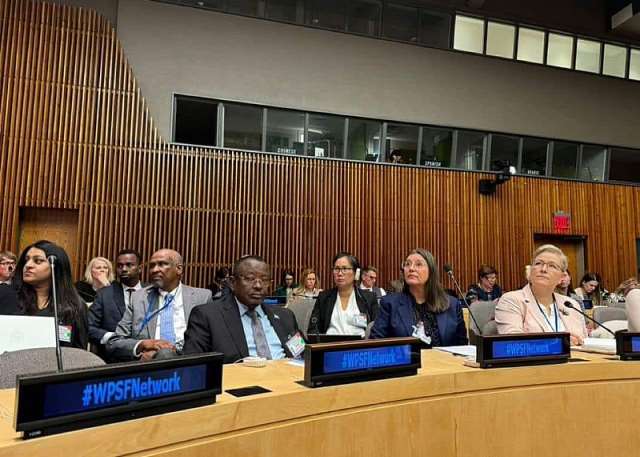
    Public outrage has surged on social media following Somalia’s Family Minister Gen Bashir Mohamed Jama’s post on X, featuring photos of himself and a male delegate representing Somalia at a UN conference focused on women’s issues.

    “It is tone-deaf for the Somali government to have men on the frontline, representing women at the conference,” Fathiya Absie, a well-known Somali author and human rights activist, told the BBC.

    A senior civil servant informed the BBC that Somalia’s four-member delegation to the Women, Peace, and Security Focal Points Network event in New York included two women, though they were not pictured.

    Among the 197 delegates from 57 countries registered for the event, only 21 were men.

    A group photo from the event—held earlier this week—has sparked further criticism from Somalis online, with many accusing the government of downplaying women’s issues.

    Photos from the conference posted on social media included one of Gen Jama with his adviser, former MP Abdullahi Godah Barre, and another of the two in a meeting room with a third man, identified as an aide.

    “He was not the only male minister present – there were a lot of other male ministers, such as Japan and China,” Mohamed Bashir, a senior civil servant at Somalia’s Ministry of Family and Human Development, told the BBC.

    The two female delegates representing Somalia were identified as Iman Elman, a well-known military officer, and Sadia Mohammed Nur, a civil servant from the ministry, according to the source.

    The online backlash has renewed public criticism over the government’s July decision to rename the Ministry of Women and Human Rights Development to the Ministry of Family and Human Rights Development.

    This change occurred when Gen Jama, a high-ranking military officer with previous roles such as leading the intelligence agency and prison service, was appointed to head the ministry.

    “Removing the word ‘women’ from the ministry’s title is an erasure of the struggles and specific needs of women. It generalises their issues under the broader term ‘family,’” Ms Absie said.

    Women’s rights in Somalia have been under scrutiny for many years.

    Women in Somalia – which has suffered a long civil war and a more recent Islamist insurgency – have long played a vital role in peacebuilding, often stepping into leadership roles and pushing for greater political participation.

    Despite this, there are not many women in positions of political influence.

    “Women were always the minority in leadership and now they have given the remaining ministries to men,” Ms Absie said.

    Some did defend the government, saying they did not see anything wrong with having a man with experience fronting the family ministry.

    But the voices of those calling for a stronger female presence are growing louder – and Mr Bashir said the ministry would be striving to give women a more significant role in future.

  • It will take 300 years to achieve gender equality – UN director

    It will take 300 years to achieve gender equality – UN director

    Efforts to advance gender equality are “vanishing before our eyes,” UN Secretary General António Guterres said in a Monday address to the Commission on the Status of Women.

    According to the most recent projections from UN Women, the UN agency devoted to gender equality and the empowerment of women, gender equality is “300 years away,” said Guterres, speaking to the important UN women’s rights group before March 8’s International Women’s Day.

    Guterres cited high rates of maternal mortality, girls being forced into early marriage, and girls being kidnapped and assaulted for attending school as evidence that hope of achieving gender equality “is growing more distant.”

    In his speech, Guterres did not mention Iran, which was expelled from the 45-member commission in December over protests following the death of Mahsa Amini in the custody of the country’s so-called “morality police.”

    “Women’s rights are being abused, threatened, and violated around the world,” Guterres said, naming a few countries in particular, including Afghanistan, where he said “women and girls have been erased from public life.”

    On Monday, young Afghan women gathered outside Kabul University to protest the ruling Taliban’s ban on female education, a restriction which a new UN report says may amount to “a crime against humanity.”

    The report presented to the Human Rights Council in Geneva on Monday also noted the rise in forced and child marriages, the ban excluding women from other public spaces like parks and gyms, and other restrictions limiting women’s ability to work and travel independently in Afghanistan.

    Guterres said the deputy secretary-general and the executive director of UN Women recently visited Afghanistan and conveyed to the Taliban authorities that “we will never give up fighting for” women and girls.

    “Crisis and conflict affect women and girls first and worst,” Guterres said, including the war in Ukraine as an example. Last year, the UN called for an investigation into reports of rape and sexual violence against Ukrainian women and children following Russia’s invasion.

    Guterres also said that “in many places, women’s sexual and reproductive rights are being rolled back,” though he didn’t specify where.

    Last June, the United States Supreme Court overturned Roe v. Wade, leaving the right to abortion up to individual states. The year before, a ban on abortions due to fetal defects took effect in Poland – essentially ending almost all abortions in the country.

    To achieve gender equality, Guterres called for “collective” and “urgent” action, from increasing education, income and employment for women and girls, especially in developing nations in the Global South, to promoting the participation of women and girls in science and technology.

    “Centuries of patriarchy, discrimination and harmful stereotypes have created a huge gender gap in science and technology,” Guterres said. “Let’s be clear: global frameworks are not working for the world’s women and girls. They need to change.”