Tag: United Nations Climate Change Conference

  • Uncertainty around the shipment of 600,000 barrels of Russian crude to Ghana

    Uncertainty around the shipment of 600,000 barrels of Russian crude to Ghana

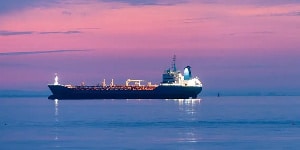
    The Herald is receiving conflicting information regarding the true owners of the 600,000 tonnes of Russian fuel that Bloomberg, an international business news network, has revealed were brought to and kept in tanks in Ghana.

    While some have connected the shipment to Platon, a Tema-based corporation, others have sought to link it to the Ghanaian government, claiming that Platon lacks the capacity to accept delivery of such a sizable shipment because it can only refine a meager 20,000 tonnes.

    The Herald’s checks on the current position of Theseus, the Crude Oil Tanker carrying the huge consignment said, it is “at West Africa reported 8 days ago by AIS. The vessel is en route to GH TEMA, sailing at a speed of 12.7 knots and expected to arrive there on Feb 24, 12:00. The vessel THESEUS (IMO: 9304825, MMSI 341750000) is a Crude Oil Tanker built in 2006 (17 years old) and currently sailing under the flag of St Kitts & Nevis– an island country and microstate located in the West Indies.

    But the development has raised concern on the claim that Deputy Energy Minister, Agyapa Mercer, had recently announced that the Tema Oil Refinery (TOR) was going to start refining crude oil, hence the fuel is being linked to the government as what the minister talked about.

    However, industry players who have sought to link the owners of the 600,000 tonnes of Russian fuel consignment to Platon which has been linked to both the Chinese, as well as some Eastern European countries, are of the view that even if TOR does not own it, it will eventually be refining and selling it in Ghana since it has the capacity to do.

    There are, however, questions being thrown around as to why Ghana will be taking delivery of Russian fuel although President Nana Akufo-Addo, has openly spoken against Russia’s military operations in Ukraine with Ghana voting twice at the United Nations (UN) in disapproval of the Russian.

    The second question is what will be the reaction of Western countries to Ghana over 600,000 tonnes of fuel from Russia, especially so when the country is begging the International Monetary Fund (IMF) for a US$3 billion bailout. Many believe there could be sanction if it’s established that Ghana had received the fuel, which is yet to be pumped out of the Theseus.

    Following Russia’s invasion of Ukraine, the European Union and US barred fuel imports from the former Soviet leader.

    Bloomberg reports that its tanker tracking data show that “The last signal from the vessel was on Sunday evening, by which time unloading had not begun. Its cargo was due to be pumped into storage tanks in Tema”.

    This comes on the back of the Ghana Government’s controversial gold-for-oil policy.

    Bloomberg, had reported that “a cargo of Russian oil is heading for storage tanks in Ghana, a nation that exports crude itself and is on the doorstep of two regional supply powerhouses.

    The development suggests that traders could be scouring the market for new buyers of Russian barrels after the European Union stopped almost all seaborne imports from the country in December.

    The bloc’s measures made Moscow hugely reliant on Chinese and Indian purchases.

    The tanker Theseus arrived in Ghana’s territorial waters on Friday carrying about 600,000 barrels of Russian oil from a port in the Black Sea, according to tanker tracking data compiled by Bloomberg.

    Its cargo was due to be pumped into storage tanks in Tema, people with knowledge of the matter said.

    The last signal from the vessel was on Sunday evening, by which time unloading had not begun.

    Russia is under pressure to sustain its oil revenue after the Group of Seven and the European Union imposed punishing sanctions on the country’s energy industry.

    Almost all European Union companies are prohibited from buying Russian crude and petroleum products or providing important services such as insurance to nations that buy such exports above a capped price.

    In December, Russia’s petroleum revenues dropped nearly 20 percent from the previous month after the price cap triggered big discounts on the nation’s crude, according to the International Energy Agency.

    The crude will be stored in tanks at the Tema Oil Refinery, the people said. The firm didn’t respond to requests for comment.

    When the tanker was en route to the country, the CEO of Ghana’s National Petroleum Authority CEO said the shipment would be blocked if it was bound for the country. The NPA didn’t respond to multiple requests for comment after it reached the West African nation’s territorial waters.

    The shipment to Tema would be the first time Russian oil has been delivered to a West African country since at least October 2018, tracking data show.

    Ghana itself is a small oil exporter, shipping an average of about 140,000 barrels a day over the past six months, according to tanker tracking data compiled by Bloomberg. It’s also next to Nigeria and Angola, the two biggest suppliers in sub-Saharan Africa.

    After sanctions were imposed on Russia, the nation directed crude exports toward China and India, upending global oil flows and the maritime industry.

    With Europe previously having been by far the largest market for Russian oil, that narrowed the nation’s pool of buyers dramatically. It also meant the barrels had to be discounted at the point of export to compensate for relatively high delivery costs.

    Source: Ghanaweb

  • 2023 Budget: Clear-cut national ESG framework paramount – KPMG

    The 2023 budget statement and economic policy must include a clear and viable path on climate action, access to affordable and clean energy, and high-quality education because governments around the world are being held more accountable by their citizens and investors for higher environmental, ethical, and social standards.

    This is a significant finding from a Pre-Budget Survey performed by the advising company KPMG, which collected 70 responses from “100 leading enterprises operating in Ghana across 10 sectors of the economy.”

    The report suggested that failure to swiftly address issues around Environmental, Social, and Governance (ESG) at a national level will have dire implications for the country’s near-term financing options, as well as its long-term environmental sustainability.

    Referencing the decision by global rating agencies Moody’s and Fitch to lower the country’s long-term issuer rating to ‘Caa2’ and ‘CCC’ respectively – in part due to its low ESG credit impact score – the KPMG said: “Government has the opportunity to seize this moment to re-establish its role with respect to driving gains on major ESG issues”.

    “Even though the government of Ghana signed the Paris Agreement, it needs to take action to save the environment. This includes, but is not limited to, regular tree-planting exercises and stopping illegal mining,” read the report signed off by Anthony Sarpong, Senior Partner and Head of Advisory & Markets.

    The comments come amid elevated concerns over the impact of climate change on rainfall patterns and sea levels, and the domino-effect these could have on natural disasters and food security.

    Furthermore, overall handling of the illegal mining (galamsey) menace by the state was deemed overwhelmingly inadequate – with the majority of respondents (84.3 percent) expressing dissatisfaction with government’s efforts in that regard, compared with only 2.9 percent of the respondents who were “highly satisfied”.

    With the value of ESG assets being estimated to rise to as much as US$160trillion by 2036, with the International Finance Corporation suggesting that climate-facing investment opportunities in emerging markets could reach US$23trillion by 2030, key financial sector players like the Bank of Ghana and Ghana Stock Exchange have developed ESG guidelines for institutions under their remit.

    Despite these opportunities, the investment in climate adaptation for nations in sub-Saharan Africa, which is estimated to cost between US$30-50 billion each year over the next decade – 2 to 3 percent of the gross domestic product, is considered prohibitively high for some governments.

    Richer, more industrialised nations have failed to meet a long-standing pledge to deliver US$100billion by 2020 to aid poorer countries adjust to climate change, falling short by US$17billion.

    This led to a number of voices at the 2022 United Nations Climate Change Conference (COP27), including that of President Nana Addo Dankwwa Akufo Addo, calling on those nations to redeem their pledges – seeing that they have contributed more to climate change than their less-industrialised peers.

    Analysts are however convinced that recent global developments show that each nation must lead its own ESG charge.

    “Now is the time for government to transform its mindset and consider ESG holistically as central to its mission… Now is the time for government to lead by example,” KPMG added.

  • Opoku Prempeh woos European support for Africa’s energy transition

    The Minister of Energy, Dr. Matthew Opoku Prempeh, has told world leaders that the aim of Africa is to develop without being caught up in a place of pollution.

    He said that the need for the developed world, including Europe, to transition in the area of energy, should be done hand in hand with Africa and not in a way that gives the continent the impression that it is not invited.

    Making a spirited contribution as a guest during a forum held on the sidelines of the 2022 United Nations Climate Change Conference in Egypt, the minister urged the world’s leaders to be equally interested in Africa’s transition.

    “Africa doesn’t want to pollute to develop. We want to have clean, sustainable, reliable, affordable energy to develop but someway somehow, somebody must pay for it. If you want Africans to pay for it, it will take a longer time so don’t tell me that when I say I’ll transit in 2070, you say it’s not ambitious. It is very ambitious in Ghana if I have to find 562 billion to do my transitional plan,” he said.

    Dr. Matthew Opoku Prempeh explained further that Africa needs support to go through the right channels in doing this right alongside the rest of the world.

    “So, for those who are talking, and we all know for the poor person who is hungry, he doesn’t care about where the food is coming from; he has to feed the family. So, if you want the food to come from a place, then provide him the access, the ability to be able to cultivate and do the needful.

    “So, all Africa is saying is that this transition, we all want to participate. It must be just, it must be fair, it must be equitable and not at the expense of Africa,” he stated.

    The minister also stated that there is the need for the world leaders to know that energy is a must for all.

    He said that while he calls for support for Africa, should it not come, the continent will develop nonetheless but not through the right channels.

    “Energy is not a luxury; it’s a fundamental right and so governments must work to ensure that the whole population has access to energy, to develop socio-economically… when a person doesn’t have energy, how does the person become productive?… the world should understand that if they don’t support Africa through grants, leverage funds, concessional funding, and also taking the hard work out, Africa will develop anyway, and they might develop through the bad way,” he said.


  • Ensure citizens have access to energy, it’s their fundamental right – Napo to African leaders

    Dr. Matthew Opoku Prempeh, the energy minister, has pleaded with African leaders to guarantee that their people have access to dependable power.He believed that having access to energy was not a luxury but rather a basic human right that all citizens should be able to enjoy.

    Dr. Matthew Opoku Prempeh emphasized the need for the continent to offer everyone access to affordable electricity.

    Speaking at the 2022 United Nations Climate Change Conference in Egypt, he said, “Energy is not a luxury but a right, a fundamental right and so governments must work to ensure that the whole population has access to energy to develop socio-economically.”

    He called for the usage of green energy on the continent and urged all to desist from polluting the environment.

  • Let’s unite against attempt to stop oil and gas exploitation in Africa – Napo speaks at COP27

    Ghana’s Minister for Energy, Dr. Matthew Opoku Prempeh, has charged his colleague Ministers for Energy at this year’s United Nations Climate Change Conference (COP27) in Egypt to have a united voice and stand up against attempts by environmentalists pushing for Africa to abandon its gas and oil resources and instead shift to renewable energy sources.

    “We should not allow ourselves to be divided,” Dr Matthew Opoku Prempeh made the call during a panel discussion at the recent African Energy Week 2022 in Cape Town, South Africa.

    According to Dr Opoku Prempeh, Africa is awash with huge minerals and oil and gas resources and, therefore, cannot abandon them while the majority of the youth are without jobs and struggling to survive.

    Dr Opoku Prempeh stated categorically that Africa would continue to exploit its mineral resources to bring development and lift the majority of the people from poverty.

    He warned that any attempt to abandon the continent’s huge mineral resources could trigger chaos.

    “We are going to use what God has given us to develop our nations,” he said.

    Using Ghana as an example, Dr Prempeh said millions of Ghanaians do not have jobs and “you want me to go and stand in front of them and say we’re not going to exploit our oil and gas? There will be a coup,” he stated.

    According to him, it appears that some people deliberately want to set up African leaders for coup d’état.

    “It was an existential threat for Africa to be told that don’t exploit your oil resources,” Dr Matthew Opoku Prempeh pointed out.

    Making a strong case for why oil and gas resources have to be exploited and not abandoned, Dr Matthew Opoku Prempeh said God in His wisdom created the sea, wind, and sun and put oil and gas resources under the earth for man’s exploitation.

    Shooting down the argument and supporting the shift from the use of fossil fuels to renewable sources of energy, Dr Matthew Opoku Prempeh said if the answer to energy security was in, say, solar energy, God would not have put oil under the desert of Saudi Arabia because of the abundance of sun.

    “If we are going to participate in the energy transition process, we are going to use what God has given us to achieve that,” he stated forcefully.

    “Why did God put oil in Gabon. He put the trees and He put the oil. We have to exploit both. You can’t say you want to exploit one and leave the other. How are you going to exploit one without touching the other?” He quizzed.

    COP27 is scheduled for November 7 and 18 in Egypt.