Tag: United Nations General Assembly

  • UN endorses landmark resolution declaring slave trade a crime against humanity

    UN endorses landmark resolution declaring slave trade a crime against humanity

    The United Nations General Assembly has agreed on a new decision saying the transatlantic slave trade was a very serious crime against humanity.

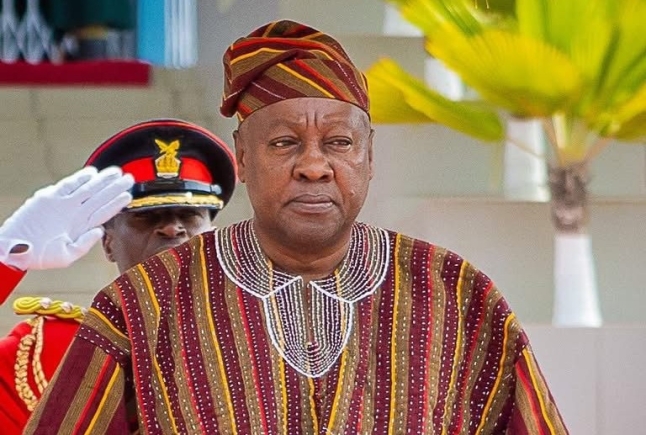
    This decision was strongly pushed by John Dramani Mahama, who has been leading calls for compensation and justice for African countries and people whose ancestors were enslaved.

    The decision was approved on Wednesday, March 25, 2026. Out of all the countries, 123 voted in support, 3 voted against it, and 53 chose not to vote.

    The Assembly described the slave trade as a terrible event that caused long periods of pain, violence, and economic hardship for millions of Africans and their descendants.

    It also called on countries that were involved in the slave trade in the past to sit down and have serious discussions with African countries and the African Union to find ways to address these historical wrongs.

    Overall, Mahama’s efforts at the global level have helped bring renewed attention to the issue of reparations and the need for justice over the slave trade.

    Here is the full text of President Mahama’s speech at the UN to commemorate International Day of Remembrance of victims of slavery

    Madam President, Excellencies, Heads of State and Government, Distinguished Delegates, Ladies and Gentlemen

    Progress is made in steps. It’s the forward motion toward something better, and the changes are often incremental. Today marks the International Day of Remembrance of the Victims of Slavery and the Transatlantic Slave Trade.

    It is a day on which we honour the memory of the approximately 13 million African men, women and children who were enslaved over the course of several centuries.

    We remember them through articles and oral histories, through broadcast programmes, books, music, visits to museums, monuments, and memorials, such as the Ark of Return, located right here at the Visitors Plaza of the United Nations Headquarters.

    Through these activities, we do more than remember. We document and educate; we gain a greater perspective; we find the delicate balance of learning from history so we do not repeat it, while leaving the pain behind. In doing so, we begin to heal, individually, within our immediate communities, and within the global community.

    This day of remembrance did not happen by accident. In 2006, our global community gathered here, just as we have done today, and resolved to designate the 25th of March of the following year, a Day of Remembrance. It marked progress.

    Then the following year, in 2007, we decided to make the event an annual one, so the 25th March of every year would be the International Day of Remembrance of the Victims of Slavery and the Transatlantic Slave Trade. That marked an additional step in our forward motion.

    It is, indeed, fortunate to be here today, two decades later, addressing the General Assembly on behalf of the African Group, regarding the draft resolution entitled “Declaration of the Trafficking of Enslaved Africans and Racialised Chattel Enslavement of Africans as the Gravest Crime Against Humanity.”

    In September last year, at the 80th session of the General Assembly, I stated that Ghana would move a motion to declare the transatlantic slave trade the gravest crime against humanity.

    This draft resolution is the result of months of consultation and consensus-building by continental bodies, nations, experts, scholars, and jurists, with the sole aim of achieving a united front and grounding the final outcome in truth, compassion, and moral conscience, remembrance, education, and dialogue.

    Today, we come together in solemn solidarity to affirm truth and pursue a route to healing and reparative justice. The adoption of this resolution serves as a safeguard against forgetting.

    I conclude with two significant quotes by two great leaders, one white, one black.

    Former President of the United States of America, Theodore Roosevelt, said, “With a great moral issue involved, neutrality does not serve righteousness; for to be neutral between right and wrong is to serve wrong.” Civil rights leader, Dr Martin Luther King, also reminds us that “the arc of the moral universe is long, but it bends toward justice.”

    We have travelled the long road, each step guided by a desire to be better, to do better; each step bringing us closer to the kind of world we would like to leave for our children.

    On this beautiful day in March, we are called to stand on the right side of history. Let it be recorded that when history beckoned, we did what was right for the memory of the millions who suffered the indignity of slavery.

    Let our vote on this resolution restore their dignity and humanity. I thank you.

  • Veto power should not be restricted to 5 nations – Mahama demands UN reform

    Veto power should not be restricted to 5 nations – Mahama demands UN reform

    President Mahama has joined calls for a permanent representation of Africa on the United Nations General Assembly, granting the continent the right to veto power.

    In his speech at the 80th United Nations General Assembly (UNGA) on Thursday, September 25, President Mahama explained that the long-standing tradition in which veto power is reserved for just five nations is outdated.

    The current arrangement, rooted in the post-World War II order, the President stressed, concentrates power in the hands of a few countries.

    He said, “Veto power should not be restricted to five nations, nor should it be absolute. There must be a mechanism for the General Assembly to challenge a veto. No single nation should be able to exercise an absolute veto to serve its own interests in a conflict.”

    Currently, five countries hold permanent seats on the United Nations Security Council (UNSC), which automatically grants them veto power. This allows any one of them to block substantive resolutions, even if all other members agree. Named the P5, they include the United States, the United Kingdom, France, Russia, and China.

    These countries were granted permanent status and veto rights in 1945, at the end of World War II, as part of the founding structure of the UN. Eight decades later, nothing has changed despite the shifting global order, President Mahama highlighted.

    He referred to Africa’s growing and youthful population, citing demographic projections that by 2050, Africa will be home to over a quarter of the world’s population and a third of its youth, hence, “the future is African.”

    He emphasised that it is time for the UN to grant Africa permanent representation on its council. He believes that just as Ghana is making adjustments, the UN must “reset” itself in light of the dramatic changes since 1945; however, the UN’s structures have not kept pace.

    “A continent as large as Africa, with its numerous UN member states, would have at least one permanent seat on the Security Council. Madame President, I believe that in honour of this milestone celebration, the United Nations should also embark on a process of serious recalibration and establish its own reset agenda. Since the organisation’s founding, the number of UN member nations has nearly quadrupled, and quite frankly, it is not the same world that it was back then when the UN was formed,” he stressed.

    He reiterated that if equality were truly upheld, Africa, with its 54 member states, would have at least one permanent seat on the Security Council.

    “The most powerful post-World War II nations are still being rewarded with an almost totalitarian guardianship over the rest of the world. And yet, the first sentence in Chapter 2, Article 1 of the UN Charter declares that ‘The Organisation is based on the principle of the sovereign equality of all its members,’” he said.

    Drawing on the words of Nelson Mandela, who in 1995 urged the UN to “reassess its role, redefine its profile, and reshape its structures,” President Mahama noted that little progress had been made three decades later.

    “Today, we African leaders are still making the same request: for a permanent seat on the Security Council, with the power of veto. So, I ask again: if not now, then when?” he declared.

    Another reform President Mahama urged the UN to pursue was gender equality, particularly empowering women and girls. He emphasised that women are indispensable in the world’s pursuit of development.

    He said the future must be one of inclusion and fairness. “Allow me to echo the Indian-American writer, Arundhati Roy, who wrote: ‘Another world is not only possible, she is on her way. On a quiet day, I can hear her breathing.’ I want to add that for the sake of Africa, and quite selfishly, for the sake of my 18-year-old daughter, I hope this new world that is arriving is a place of safety and equality for women and girls. To succeed, we must empower everyone, including women and girls, to reach their full potential,” he stated.

    He added that empowering women is not optional but essential for progress. “To succeed, we must empower everyone, including women and girls, to reach their full potential,” President Mahama said.

    President Mahama then congratulated Vice-President Naana Jane Opoku-Agyemang on becoming Ghana’s first female Vice-President, describing her rise as a milestone for women. “Now every Ghanaian girl knows the heights to which she can ascend,” he said.

    He also expressed hope that the United Nations will soon appoint its first female Secretary-General. “Words matter, but issues of representation matter even more,” he concluded.

    He did not leave out calls for reforms in the world’s financial architecture, which he said is currently rigged against Africa. Africa must have a greater say in the world’s multilateral financial institutions.

    “We demand not only a reform of the Security Council, but also a reset of the global financial architecture, which is currently rigged against Africa. Africa must have a greater say in the world’s multilateral financial institutions,” he mentioned, highlighting that despite Africa’s vast natural wealth from minerals to agricultural produce, it is often extracted without fair compensation, processing, or reinvestment on the continent.

    “Africa continues to be the source of raw materials for the world, yet we remain at the bottom of the value chain. This is not just unjust, it is unsustainable.”

    He also pleaded with global powers to remove the blockade on Cuba. He said, “…as Dr. Kwame Nkrumah, our nation’s founder, famously said, ‘We seek to be friends of all and enemies to none.’ The Cuban people shed their blood on African soil in the fight against apartheid. Indeed, Cuba has been, and continues to be, a faithful friend to Africa. You see, the very fact that I can stand here and ask these things, and the fact that all nations can ostensibly gather here to address critical global issues, air grievances, and express concerns, that is what makes the survival of this organisation so important,” he added.

  • Independence Day: Vladimir Putin’s message to Akufo-Addo

    Independence Day: Vladimir Putin’s message to Akufo-Addo

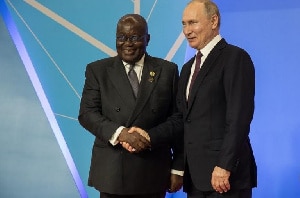
    The President of the Russian Federation, Vladimir Putin, has congratulated President Akufo-Addo and Ghanaians on the country’s 66th Independence Day celebration.

    In a letter addressed to Ghana’s President, Akufo-Addo, Putin wished him (Akufo-Addo) good health and success and Ghanaians peace.

    The Russian President also said that he hopes that the relationship between Ghana and Russia will continue to grow.

    “Please accept my sincere congratulations on the occasion of the National Holiday of the Republic of Ghana – the Independence Day!

    “I am confident that the traditionally friendly relations between Russia and Ghana will continue to develop for the sake of our peoples, contributing to a stronger security and stability on the African continent.

    “I wish you good health and every success, and all the citizens – peace and wellbeing,” Putin said in his letter.

    Meanwhile, Ghana voted in favour of a United Nations General Assembly resolution demanding that Russia leaves Ukraine, where it has in the last year waged a war against Kyiv’s plan at the time to join the Euro-military bloc, NATO.

    Ghana was one of 141 nations that voted ‘IN FAVOUR’ of the resolution with 7 countries voting ‘AGAINST’ and 32 ‘ABSTENTION.’

    A UN statement after the vote read: “The results were 141 member states in favour and seven against – Belarus, the Democratic People’s Republic of Korea, Eritrea, Mali, Nicaragua, Russia and Syria. Among the 32 abstentions were China, India and Pakistan.

    Akufo-Addo has also stated that Ghana was against Russia’s occupation of Ukraine and the use of African countries as training grounds for foreign powers, particularly Russia.

    “Apart from not accepting the idea of great powers once again making Africa their theatre of operation, we have a particular position that you know about over the Ukraine war, where we have been very, very vocal and up front about condemning the invasion of Ukraine by Russia,” he said at a meeting in Washington with officials of the US government, including Secretary of State Anthony Blinken, on Thursday, December 15, 2022.

  • International financial system skewed against Africa; reform it now – Akufo-Addo

    President Nana Addo Dankwa Akufo-Addo, has called for an urgent reform of the international financial system, as the current monetary system is skewed against developing countries.

    According to President Akufo-Addo, “the financial markets have been set up and operate on rules designed for the benefit of rich and powerful nations, and, during times of crisis, the façade of international co-operation, under which they purport to operate, disappears.”

    Taking his turn to speak at the United Nations General Assembly, on Wednesday, 21st September, in New York, the President stated “these are the savage lessons that we have had to take in, as the world emerged from the grip of the coronavirus to energy and food price hikes, and a worldwide rise in the cost of living. The necessity for reform of the system is compelling.”

    Stressing that “our world is currently not in a good place”, he recalled an observation by the World Bank which has described the global economy as “enduring its steepest slowdown since 1970.”

    With the world confronted by a devastating global economic pandemic, pushing Africa into its worst recession for half a century, President Akufo-Addo stated that a slump in productivity and revenues, increased pressures on spending and spiralling public debts confronted the continent without relent.

    “As we grappled with these economic challenges, Russia’s invasion of Ukraine burst upon us, aggravating an already difficult situation. It is not just the dismay that we feel at seeing such deliberate devastation of cities and towns in Europe in the year 2022, we are feeling this war directly in our lives in Africa. Every bullet, every bomb, every shell that hits a target in Ukraine, hits our pockets and our economies in Africa,” he said.

    Describing global inflation as “the number one enemy this year”, President Akufo-Addo noted that “it hit a 40-year-high in the US and UK in recent months. There is record inflation in the euro zone. Several African countries have inflation rates surging three to four times higher than what they were just two years ago.”

    In Ghana, the President indicated that “we are experiencing the highest inflation for 21 years. The high costs of food are hurting the poor, especially the urban poor, the most.”

    The spill over from the raising of interest rates by central banks across the world to combat inflation, according to the President, has been severe beyond borders, as global investors pull money out of developing economies to invest in bonds in the developed world.

    This, he explained further, has led to depreciating currencies and increased borrowing costs; meaning economies in Africa need to raise and spend more of our own currencies to service foreign debts in US dollars.

    “It has become clear, if ever there was any doubt, that the international financial structure is skewed significantly against developing and emerging economies like Ghana. The avenues that are opened to powerful nations to enable them take measures that would ease pressures on their economies are closed to small nations,” he said.

    To make matters worse, President Akufo-Addo noted that “credit rating agencies have been quick to downgrade economies in Africa, making it harder to service our debts. The tag of Africa as an investment risk is little more than, in substance, a self-fulfilling prophecy created by the prejudice of the international money market, which denies us access to cheaper borrowing, pushing us deeper into debts.”

    History, the President stressed, “will judge us harshly if we do not seize the opportunity to make the changes that will enable us deal with the many problems we face.”

    Sahel Conflict

    Touching on the conflict in the Sahel, President Akufo-Addo noted that the conflict has moved from the Sahel, inexorably, to the West African coastal countries, with all of Ghana’s neighbours suffering terrorist attacks, with some losing territorial space to the invading forces.

    The terrorist pressure, he explained, the terrorist pressure has provided a pretext for the unhappy reappearance of military rule in three (3) of the fifteen (15) member ECOWAS Community, two (2) of whom have borne the brunt of the terrorist outrages in the Region – Mali and Burkina Faso.

    “All of us in the Region are being forced to spend huge amounts of money on security. This is money we should be spending on educating and giving skills to our young people; on building much needed roads, bridges, hospitals and other such infrastructure, which we are spending to fight terrorists or to keep them out from destabilising our countries.”

    This, according to President Akufo-Addo, is a global problem, deserving the attention of the world community for a global solution.

  • Impose tax on fossil fuel firms ‘feasting’ on windfall profits – UN chief urges rich countries

    Although the UN’s chief cannot direct its members to implement windfall taxes, his remarks do send an “important signal”.
    All wealthy nations are being urged to impose a windfall tax on fossil fuel companies by the head of the United Nations.

    The industry is “feasting on hundreds of billions of dollars in subsidies and windfall profits while household budgets shrink and our planet burns”, Antonio Guterres told world leaders in New York.


    Money raised should be used to help people struggling with rising food and energy bills, as well as to compensate countries suffering the most severe effects of climate change, the secretary-general told the United Nations General Assembly, which is expected to be dominated by discussions of Russia’s invasion of Ukraine.


    In spite of demanding “polluters must pay”, Mr Guterres cannot mandate action from developed countries, many of which are grappling with extreme weather, high food and energy prices, and the Ukraine war.


    But Antony Froggatt, from international affairs, think tank Chatham House, said the statement “is an important signal” and highlights the “unequal nature of the current crisis, with some countries, companies, and citizens benefiting hugely”.


    But Mr Guterres has previously urged an end to funding for more oil and gas exploration and production, “which has not stopped these taking place”, Mr Froggatt added.


    The European Union plans to raise about €140bn (£121bn) by imposing windfall taxes on energy companies’ “abnormally high profits”, a move that could put pressure on Prime Minister Liz Truss


  • Akufo-Addo honors Nkrumah in his UN General Assembly address

    President Nana Addo Dankwa Akufo-Addo, the fifth president under the Fourth Republic, has honored Ghana’s first president, Osagyefo Dr. Kwame Nkrumah.

    He did this during the UNGA, or United Nations General Assembly, which began on September 19 and will be the 77th General Assembly in 2022, an annual gathering of world leaders in New York.

    In his speech on September 21, Akufo-Addo made a special mention of the Osagyefo while also highlighting the necessity of African unity in the face of current global concerns.

    As the first president’s birthday was on September 21, he also emphasized the importance of making the announcement on that day.

    “Mr President, I am contributing to this debate on a date that has special significance for us in Ghana. 21st September is the date we mark the birth of our first President, Dr Kwame Nkrumah.

    “He would have been one hundred and thirteen (113) years old today, and it is worth recalling on this day the driving force of his political career, which was to contribute to the birth of a united Africa, i.e., a United States of Africa.

    “We recognise today, more than ever before, the importance of the strength in unity of Africa, and we are working to shed that image of a helpless, hapless continent,” Akufo-Addo stresed.

    The president harped on the increasing need for Africa to embrace industralization and economic integration to drive collective progress.

    “There is a renewed commitment towards an inclusive and sustainable industrialisation and economic integration and the intensity of the challenges we face today is only matched, like never before, by the immensity of the opportunity before us.

    “We, the current leaders of Africa, should be determined not to waste the crisis that confronts us,” he added.

    Watch Akufo-Addo full address below:

    September 21, 2022 observed a national holiday

    The Minister of the Interior, Ambrose-Dery, declared the September 21 holiday since it marks the birthday of Osagyefo Dr. Kwame Nkrumah.

    Parliament in 2018 passed the new Public Holidays Act, 2018, to amend the Public Holidays Act, 2001.

    The Act replaced three public holidays, including September 21 and introduced two new holidays, January 7 (Constitution Day) and August 4 (Founders’ Day).

    According to the government, the real fight for Ghana’s independence started on August 4, 1947 (the day the United Gold Coast Convention, UGCC was formed), which is why it replaced the September 21 holiday.