Tag: United Nations Office on Drugs and Crime (UNODC)

  • UN Report reveals top bribe takers in Ghana

    UN Report reveals top bribe takers in Ghana

    A report by the United Nations Office on Drugs and Crime (UNODC) has revealed that Lands Commission Officers and Prosecutors, Judges or Magistrates are the public officials who receive the largest cash bribes in Ghana.

    The report, titled “Corruption in Ghana – People’s Experiences and Views“, is based on a survey of 15,000 households across the country in 2021.

    It collected evidence-based information on the forms, prevalence and typologies of corruption affecting the population of Ghana.

    According to the report, the average cash bribe paid to public officials in Ghana was GHC 220, but this varied depending on the type of service sought and the area where the bribe was paid.

    The report also found that more than a quarter of the adult population (26.7 per cent) paid bribes to a public official in 2021.

    The report showed that Lands Commission Officers received the highest average cash bribe of GHC 1,669, followed by Prosecutors, Judges or Magistrates with GHC 1,208.

    On the other hand, health workers (excluding doctors, nurses and midwives) received the lowest average cash bribe of GHC 91.

    The report also identified the main reasons for paying bribes, such as speeding up procedures, avoiding problems or fines, or showing appreciation.

    GHANA – Corruption Survey Report – 20.07.2022 by The Independent Ghana on Scribd

    It also revealed that most of the bribes were paid at the direct request of the public officials involved.

    Corruption is a major challenge in Ghana, which affects its democracy, development and national security.

    The report aims to provide benchmark indicators that can be used to inform relevant policies to curb administrative corruption in various public institutions in the country.
  • Thai army kills five alleged drug traffickers near “Golden Triangle”

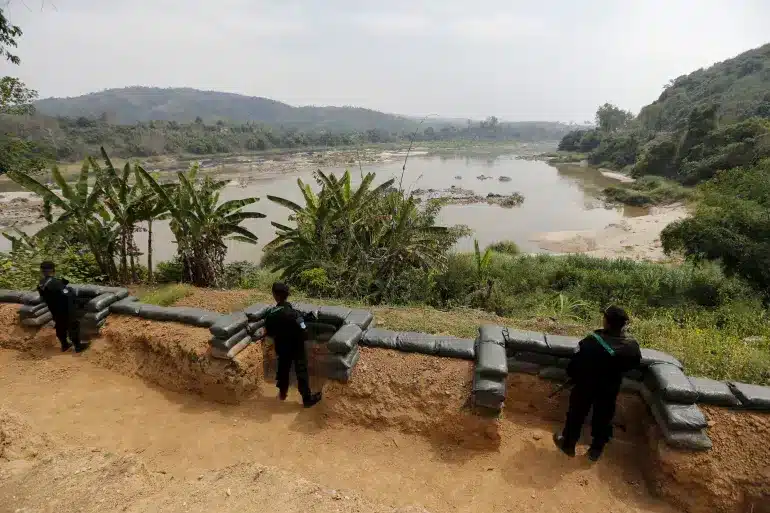
    Thai army kills five alleged drug traffickers near “Golden Triangle”

    After a fight between Thai security forces and alleged smugglers in Thailand’s north, almost 500,000 methamphetamine pills were discovered.

    Following a clash in Thailand’s north near the infamous “Golden Triangle” region, the Thai military has killed five suspected drug traffickers and found nearly 500,000 methamphetamine pills.

    In the early hours of Thursday, a military patrol in Chiang Rai province, close to the Golden Triangle, which is the area where the jungle borders of Thailand, Laos, and Myanmar meet, came across suspected smugglers carrying backpacks. The Golden Triangle has long been a lucrative hub for the illicit drug trade.

    The group of five opened fire after being refused a search and an armed confrontation that lasted about five minutes, according to a statement released by the Thai military’s Pha Muang Task Force.

    The five suspects were killed and no Thai soldiers were injured, the task force said, noting that close to half a million methamphetamine pills and a gun were found in the group’s possession.

    “Narcotics have been very prevalent [at the border] but recently there has been an order from the commander to step up law enforcement efforts,” Premchai Premkamol, an officer with Pha Muang Task Force, told AFP news agency.

    The latest clash follows two similar incidents – the killing of six alleged drug smugglers earlier this week in nearby Chiang Mai province and an altercation in December involving 15 deaths.

    According to anti-narcotics experts, the drug trade in the Golden Triangle region has surged since a military coup in Myanmar in February 2021 with reports that the production and trafficking of methamphetamine and opium has boomed since the military takeover.

    Thailand’s local Chiang Mai News outlet reported on Tuesday that six suspects were killed and 19 backpacks containing hundreds of kilogrammes of ketamine were recovered following a clash with suspected traffickers in Chiang Mai province.

    The United Nations Office on Drugs and Crime (UNODC) is poised to release a new report on opium cultivation in Myanmar, which the UN said had seen close to a decade of decline until production increased slightly in 2021.

    The increase in cultivation continued last year. Now, after the first full opium cultivation season “following the February 2021 military takeover – and it is clear the country is experiencing a profound change in the opium economy”, the UNODC said in a short statement on Thursday.

    Southeast Asia is awash with methamphetamine, and authorities netted a record billion pills across the Asian region in 2021, according to a UN report.

    Source: Aljazeera.com