Tag: US Secretary of State Antony Blinken

  • Ukrainian counteroffensive will start “in weeks” – US

    Ukrainian counteroffensive will start “in weeks” – US

    According to US Secretary of State Antony Blinken, Ukraine is about to start its long-awaited counteroffensive against Russia.

    Following months of rumours and false information concerning the nature of Ukraine’s next move, Mr. Blinken’s remarks represent the most credible assessment of the situation on the front lines to date.

    In an interview with German media outlet Funke, Mr. Blinken stated, “A counteroffensive that will likely commence in the coming weeks.”

    During the interview, Mr Blinken stated that there are ‘two goals for Ukraine’s many friends and partners’ in the current conflict with Russia.

    The first aim is helping Kiev win back territories, which means assisting in a counteroffensive, the diplomat argued.

    The second goal, according to the secretary of state, is supporting Ukraine in building up its medium- and long-term capacities to deter Russia and to allow Kiev to defend itself from any future attack.

    Addressing calls for Ukraine to commence peace talks with Russia, Blinken said: ’For some, the idea of ​​a ceasefire may seem tempting – and I understand that. 

    ‘But if this leads to the practical ratification by Russia of the seizure of significant Ukrainian territories, this will not be a just and lasting peace. 

    ‘Russia could regroup its troops and attack again after a certain time. Russia must reach a point where it is ready to enter into constructive negotiations. The goal must be a just and lasting peace.’

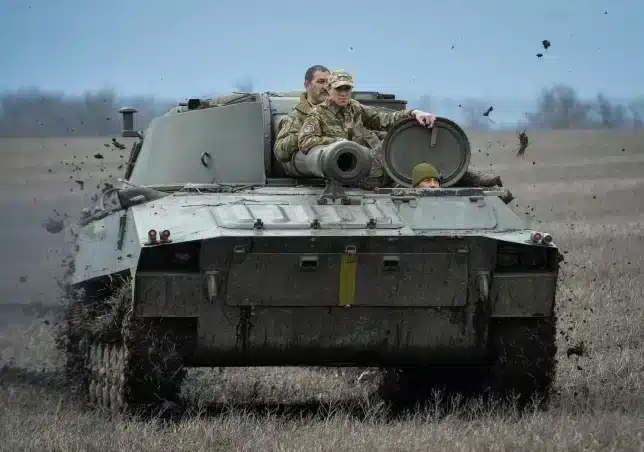
    Ukraine has spent much of the winter ensuring the essential preconditions for a successful counter-offensive are in place, including the completion of training and integration of new units, degrading the Russian rear, a resilient logistics chain and real-time intelligence.

    Kyiv is currently setting up several new corps, each of which would comprise several thousand troops.

    ‘Included in these will not only be new Western tanks, infantry fighting vehicles, wheeled vehicles and other equipment but also a lot of engineering equipment,’ Mick Ryan, formerly a general in the Australian army, told CNN.

    After months of preparation, these units may nearly be ready.

    It is thought the upcoming offensive this spring will see a ‘decisive battle’ which may determine the eventual outcome of the war.

    But Ukrainian Foreign Minister Dmitry Kuleba pointed out last week that Kiev is concerned that the planned advance would not result in Russia being ‘100%’ pushed out of the territories that Ukraine intends to reclaim. 

    He urged Kiev’s Western backers not to treat the counteroffensive as a make-or-break moment, and called on them to maintain their support regardless of its outcome.

    His comments follow news that secret Nato plans for the upcoming offensive had been leaked to Russia, although these plans have been dismissed as disinformation.

    A Telegram channel linked closely to Russia’s FSB security services had boasted on Friday of a ‘First breakthrough for Russian intelligence’ when it published photos of the leaked documents.

    It said that the five documents marked as ‘Top secret’ gave away valuable intelligence which exposed the expected supply of weapons, the number of troops and the consumption of ammunition,’ it said.

    But closer inspection of the documents revealed they had been doctored, with certain figures changed to appear more favoured to Russia.

    But the plans were rubbished by Mikhailo Podolyak, an adviser to Volodymyr Zelensky, who said: ‘Since the USSR’s collapse Russian intelligence has degraded to the extent that the only way to redeem itself after “Salisbury” and “three-day plans” is to photoshop and fake leaks.’

    Mr Podolyak told Russia they ‘will see the real plans on the ground soon’, although the Pentagon appears to be taking the leaks seriously.

    ‘We are aware of the reports of social media posts and the department is reviewing the matter,’ said Sabrina Singh, the deputy press secretary at the Pentagon.

    Speculation on the location of the counterattack has focused most recently on the occupied town of Melitopol, in the south of the country, which was captured by Russia early in the war.

    The city grants access to strategically important road and railway hubs which connect to the Zaporizhzhya region and other parts of Donbas and Crimea.

    Former Russian President Dmitry Medvedev has insisted that Ukrainian talk of a large-scale spring offensive that would also target Crimea is merely ‘propaganda.’ 

    However, he did warn that if the peninsula came under attack, Russia would be justified in using ‘all means of protection,’ including nuclear weapons.
  • On a rare call with Nicaragua’s FM, US chief envoy asks for a “dialogue”

    On a rare call with Nicaragua’s FM, US chief envoy asks for a “dialogue”

    A day after 222 prisoners were released, Blinken calls for dialogue during the infrequent high-level encounter between the two nations.

    In a rare high-level conversation between the two nations, US Secretary of State Antony Blinken spoke with his Nicaraguan counterpart, Foreign Minister Denis Moncada.

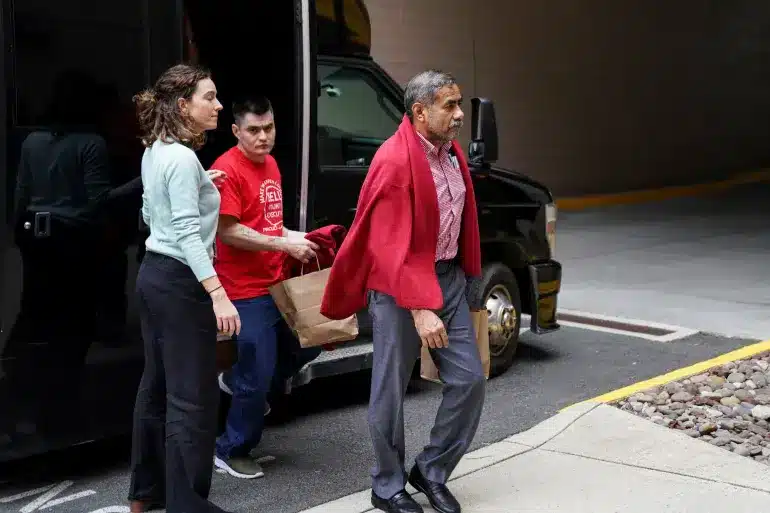
    The call was made on Friday, one day after Managua freed 222 political prisoners who had been detained during crackdowns following the country’s 2018-starting anti-government protests. Most of those detainees were given permission to visit America.

    The move has been seen as an attempt by President Daniel Ortega to begin to repair ties with the US. Relations have severely deteriorated in recent years as regional and Western powers have increasingly decried Ortega’s action and Washington has imposed a slew of sanctions.

    In a brief statement released after Friday’s call, US State Department spokesperson Ned Price said Blinken and Moncada discussed the prisoners as well as “the importance of constructive dialogue”.

    Price had previously said that weeks of negotiations had preceded the prisoners’ release, although Ortega has denied extensive talks preceded the release.

    Washington has said nothing was promised to Ortega in return for releasing the prisoners.

    US officials have said all of those released travelled to the US except for two of the prisoners who chose to stay in Nicaragua.

    One of those prisoners who chose to stay, Catholic bishop Rolando Alvarez, was sentenced to 26 years in prison on Friday, stripped of his citizenship and fined.

    US officials said they would allow the former prisoners to stay in the country for at least two years and would provide medical and legal support. Spain later said it would offer citizenship to the released.

    A court official in Nicaragua’s capital Managua, meanwhile, had said the prisoners were “deported” and called them “traitors to the homeland”.

    Speaking during a news conference on Friday, opposition leader Juan Sebastian Chamorro, who was among those released, said Ortega had freed the prisoners after “political pressure” had grown.

    “I think (Ortega) wanted to basically send the opposition outside of the country into exile,” he said.

    A former revolutionary, Ortega served as president of Nicaragua from 1979 to 1990.

    He returned to the presidency in 2007, and has been increasingly accused of rights abuses and seeking to consolidate power, including quashing presidential term limits and seizing control of all branches of the government.

    Following the mass arrest of opposition figures, Ortega easily won a fourth term in November 2021.

    US President Joe Biden, at the time, decried the vote as a “pantomime election”.

  • Why would China use a spy balloon when it has satellites – Experts quiz

    Why would China use a spy balloon when it has satellites – Experts quiz

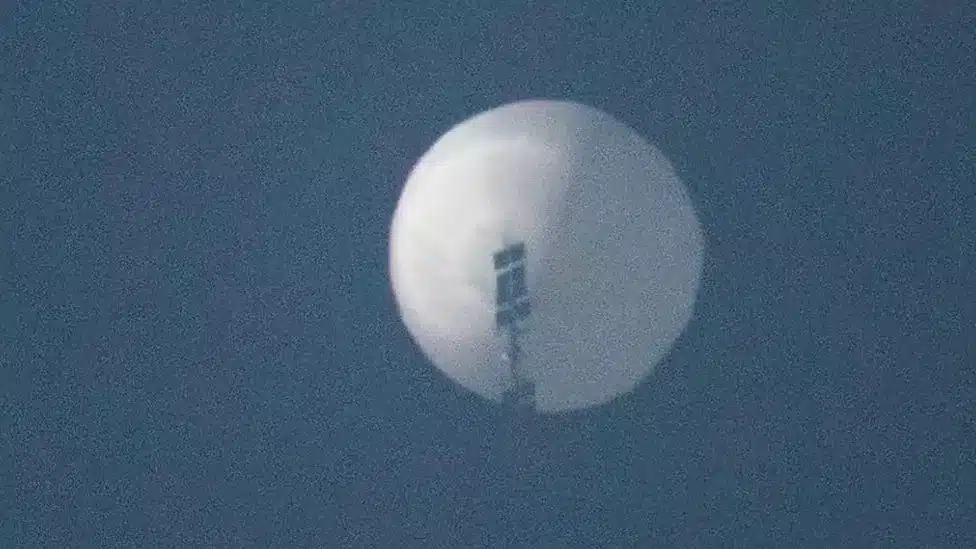
    Many people have been baffled by reports of a possible Chinese spy balloon floating over the US, wondering why Beijing would choose to spy on the US mainland using such a crude device.

    Although the capabilities of this specific balloon are unknown, experts claim that it primarily acts as a “signal” rather than a security risk.

    Days before US Secretary of State Antony Blinken’s trip to China, it was seen circling the state of Montana.

    President Xi Jinping of China is expected to be met by the top US diplomat, who will be the first person in his position to do so.

    “Beijing is probably trying to signal to Washington: ‘While we want to improve ties, we are also ever ready for sustained competition, using any means necessary’, without severely inflaming tensions.

    “And what better tool for this than a seemingly innocuous balloon,” independent air-power analyst He Yuan Ming told the BBC.

    Balloons are one of the oldest forms of surveillance technology. The Japanese military used them to launch incendiary bombs in the US during World War Two. They were also widely used by the US and the Soviet Union during the Cold War.

    More recently, the US has reportedly been considering adding high-altitude inflatables to the Pentagon’s surveillance network. Modern balloons typically hover between 24km-37km above the earth’s surface (80,000 ft and 120,000 ft).

    The US Department of Defence on Thursday said the balloon is “significantly above where civilian air traffic is active”. It also said it had “very high confidence” that the balloon belongs to China.

    But China expert Benjamin Ho said Beijing had more sophisticated surveillance technology at its disposal.

    “They have other means to spy out American infrastructure, or whatever information they wanted to obtain. The balloon was to send a signal to the Americans, and also to see how the Americans would react,” explained Dr Ho – coordinator of the China programme at Singapore’s S Rajaratnam School of International Studies.

    It may even be the case that China wanted the US to detect the balloon.

    “It’s possible that being spotted was the whole point. China might be using the balloon to demonstrate that it has a sophisticated technological capability to penetrate US airspace without risking a serious escalation. In this regard, a balloon is a pretty ideal choice,” said Arthur Holland Michel from the Carnegie Council for Ethics in International Affairs.

    Nevertheless, the experts point out that balloons can be fitted with modern technology like spy cameras and radar sensors, and there are some advantages to using balloons for surveillance – chief of which is that it is less expensive and easier to deploy than drones or satellites.

    The balloon’s slower speed also allows it to loiter over and monitor the target area for longer periods. A satellite’s movement, on the other hand, is restricted to its orbital pass.

    Although China has not admitted it launched the balloon, Mr Michel says it is unlikely anyone else could be responsible.

    “The [US Department of Defence] would likely not say that it is a Chinese balloon unless they have a fairly high degree of certainty that that is what it is.”

    The balloon’s anticipated flight path near certain missile bases suggests it is unlikely it has drifted off course, He Yuan Ming said.