There is a high likelihood that a toxic gas release will occur, according to authorities in the US state of Ohio, who have threatened to arrest anyone who refuses to leave an evacuation zone near the burning debris of a train derailment near the Pennsylvania state line.
On Monday, residents were preparing for their overnight stays, loading their pets into cars, and looking for hotel rooms as emergency personnel worked to avert a major explosion. As the threat of an explosion grew, police in the town of East Palestine left their communication hub.
“I’m worried about leaving and not getting back,” Mallory Burkett, who lives just outside the evacuation area, said Monday just before her family drove out of town. “I’m definitely going to come back, but I’m not sure when.”
Officials warned hundreds of residents who had declined to evacuate earlier to do so Sunday night, saying a rail car was at risk of a potential explosion that could launch deadly shrapnel as far as a mile.
About 50 cars, including 10 carrying hazardous materials, derailed in a fiery crash on Friday night, according to operator Norfolk Southern Railway and the US National Transportation Safety Board (NTSB). No injuries to crew, residents or first responders were reported.
Approximately 50 train cars derailed on Friday night in East Palestine, Ohio [NTSBGov/Handout via Reuters]
Norfolk Southern said 20 of the more than 100 cars on the train were classified as carrying hazardous materials — defined as cargo that could pose any kind of danger “including flammables, combustibles, or environmental risks”.
The cars involved carried combustible liquids, butyl acrylate and the residue of benzene from previous shipments, officials said.
Five were transporting vinyl chloride, which is used to make the polyvinyl chloride hard plastic resin in plastic products and is associated with an increased risk of liver cancer and other cancers, according to the federal government’s National Cancer Institute.
Authorities on Monday did not say what hazardous materials they were concerned about releasing into the air or how imminent that could be.
A statement from Ohio Governor Mike DeWine’s office warned on Sunday night of “the potential of a catastrophic tanker failure” after a “drastic temperature change” was observed in a rail car.
Police cars, snowploughs and military vehicles from the Ohio National Guard blocked streets leading into the town on Monday morning as authorities began enforcing what had previously been a strongly recommended evacuation zone within a 1.6km (1-mile) radius of the crash site.
East Palestine: Residents living within a mile of the train derailment site who have not yet left their homes are asked to immediately evacuate due to the potential of a major explosion. pic.twitter.com/F2BWmBipPx
Schools and many businesses were closed, and the local high school was turned into a shelter.
Norfolk Southern has opened an assistance centre in the town to gather information from affected residents. But some residents complained about a lack of information regarding the evacuation, which covered the homes of about half the town’s 4,800 residents.
Emergency responders were monitoring but keeping their distance from the fire. Remediation efforts could not begin while the cars smouldered, authorities said.
The three-member train crew received an alert about the mechanical defect “shortly before the derailment”, Michael Graham, a board member of the NTSB, said Sunday. Investigators identified the exact “point of derailment”, but the board was still working to determine which rail car experienced the axle issue, he said.
Mayor Trent Conaway, who declared a state of emergency in the town, said one person was arrested for going around barricades right up to the crash. He warned people to stay away and said they would risk arrest.
“I don’t know why anybody would want to be up there; you’re breathing toxic fumes if you’re that close,” he said, stressing that monitors of air quality away from the fire showed no levels of concern and that the town’s water is safe.
Drone footage shows the freight train derailment in East Palestine on February 6, 2023 [NTSBGov/Handout via Reuters]
Meetings between Mr. Blinken and President Xi Jinping and his Chinese counterpart were anticipated.
The visit would have taken place as tensions between the two nations are deteriorating.
According to China, the balloon veered off course due to bad weather and is used for meteorological research.
A statement from China’s Foreign Ministry said that it “regrets” the incident and will work with the US to resolve the issue.
Speaking to reporters on Friday, a senior state department official said that the conditions were not right for Mr Blinken to visit China but that another trip would be planned “at the earliest opportunity.”
The official added that Washington planned to maintain “open lines of communication” about the incident, which was described as “a clear violation” of US sovereignty.
While the official said that the US had acknowledged China’s claim about the balloon’s purpose, it stands by the Department of Defense’s assessment that it was being used for surveillance.
Mr Blinken’s visit was expected to take place on 5 and 6 February.
A US official quoted by the Associated Press said that the decision to abruptly halt the trip was made by Mr. Blinken and President Joe Biden.
China’s foreign ministry has apologised for what it called a civilian balloon that erred and entered American airspace.
The ministry claimed in a statement on Friday that the balloon that the US believed was being used for surveillance was actually a civilian “airship” that was being used for research, primarily for meteorological purposes.
According to the statement, the airship has little ability to steer and “deviated far from its planned course” due to winds.
It decided not to shoot down the balloon, which was potentially flying over sensitive sites, because of concerns of hurting people on the ground.
Reporting from the White House in Washington, DC, Al Jazeera’s Kimberly Halkett said that the balloon was first spotted by bystanders in the state of Montana.
“It was spotted by people on the ground who were wondering what was in the sky. That is how the US government first learned about this, incredibly,” she said. “It was then that the US government started tracking it.”
“There are going to have to be some answers as to why it was bystanders who first spotted this and not the military or the US government,” added Halkett.
Trip to Beijing
The news came as US Secretary of State Antony Blinken was expected to make his first trip to Beijing this weekend. The visit has not been formally announced, and it was not immediately clear if the balloon’s discovery would affect his travel plans.
Chinese Ministry of Foreign Affairs spokesperson Mao Ning had earlier said she had no information on the trip. But she added China had “no intention of violating the territory and airspace of any sovereign country” and urged for calm while the facts were established.
Blinken would be the highest-ranking member of President Joe Biden’s administration to visit China, on a mission to mitigate a sharp downturn in relations between the countries amid trade disputes and concerns about Beijing’s increasingly aggressive stance towards Taiwan and in the South China Sea.
A senior US defence official told Pentagon reporters on Thursday that the US had “very high confidence” that the object spotted over its airspace in recent days was a Chinese high-altitude balloon and that it was flying over sensitive sites to collect information.
The official, who had spoken on condition of anonymity, had confirmed that one of the places the balloon was spotted was Montana, which is home to one of the nation’s three nuclear missile silo fields at Malmstrom Air Force Base.
The official also said the US had assessed the balloon had “limited” value in terms of providing intelligence that could not be obtained by other technologies, such as spy satellites.
He said the balloon was travelling well above the height commercial aircraft fly at and did not present a threat to people on the ground.
Biden was briefed and asked the military to present options, according to a senior administration official, who was also not authorised to publicly discuss sensitive information. The senior defence official said the US prepared fighter jets, including F-22s, to shoot down the balloon if ordered.
Defence secretary Lloyd Austin and Army General Mark Milley, chairman of the Joint Chiefs of Staff, advised against taking “kinetic action” because of risks to the safety of people on the ground. Biden accepted that recommendation.
Even though the balloon was over a sparsely populated area, its size would create a debris field large enough that it could have put people at risk.
The defence official would not specify the size of the balloon but said commercial pilots could spot it from their cockpits.
China’s brazen disregard for U.S. sovereignty is a destabilizing action that must be addressed, and President Biden cannot be silent.
The balloon’s appearance adds to national security concerns among US lawmakers about China’s influence in the country, ranging from the prevalence of the hugely popular smartphone app TikTok to purchases of American farmland.
“China’s brazen disregard for US sovereignty is a destabilising action that must be addressed,” Republican Speaker of the House Kevin McCarthy tweeted.
The Pentagon said on February 2, 2023, that it was tracking a Chinese spy balloon flying high over the United States that appeared to be surveilling highly sensitive nuclear weapons sites [File: Eva Hambach/AFP]
The US is keeping tabs on a possible Chinese surveillance balloon that has recently been seen flying over important locations.
Defense officials stated that they had no doubt that China was the owner of the “high-altitude surveillance balloon.” Most recently, it was spotted flying over Montana in the west.
However, military authorities decided against shooting it down due to worries about the risk of falling debris.
China is yet to respond.
Canada announced on Friday that it was keeping an eye on “a possible second incident” involving a surveillance balloon, but it did not identify the possible perpetrator. According to the statement, it closely collaborates with the US to “protect Canada’s sensitive information from threats from foreign intelligence.”
The object flew over Alaska’s Aleutian Islands and through Canada before appearing over the city of Billings in Montana on Wednesday, officials said.
A senior defence official speaking on condition of anonymity said the government prepared fighter jets, including F-22s, in case the White House ordered the object to be shot down.
Top military leaders, including Defence Secretary Lloyd Austin and General Mark Milley, chairman of the US Joint Chiefs of Staff, met on Wednesday to assess the threat. Mr Austin was travelling in the Philippines at the time.
Montana, a sparsely populated state, is home to one of only three nuclear missile silo fields in the country, at Malmstrom Air Force Base, and officials said the apparent spy craft was flying over sensitive sites to collect information.
But they advised against taking “kinetic action” against the balloon because of the danger falling debris might pose to people on the ground.
The defence official, however, said there was no “significantly enhanced threat” of US intelligence being compromised because American officials “know exactly where this balloon is and exactly where it’s passing over”.
He added that there was also no threat to civilian aviation as the balloon was “significantly” above the altitude used by commercial airlines.
The official said the balloon is unlikely to give much more information than China can already collect using satellites.
The US had raised the matter with Chinese officials in their embassy in Washington DC and in Beijing, the official added.
During Thursday’s briefing at the Pentagon, officials declined to disclose the aircraft’s current location. They also refused to provide more details of the object, including its size.
“There have been reports of pilots seeing this thing even though it’s pretty high up in the sky,” the unnamed defence official said. “So you know, it’s sizable.”
They added that such surveillance balloons had been tracked in the past several years, but this one was “appearing to hang out for a longer period of time this time around”.
It confused social media users in Montana, with some posting images of a pale, round object high in the sky. Others reported seeing US military planes in the area, apparently monitoring the object.
Billings office worker Chase Doak told theAssociated Press news agency that he noticed the “big white circle in the sky” and went home to get a better camera.
“I thought maybe it was a legitimate UFO,” he said. “So I wanted to make sure I documented it and took as many photos as I could.”
Chinese state media has not reported on the incident, but it is being widely discussed on Chinese social media, with many amused at the reported use of balloons for surveillance.
“We have so many satellites, why would we need to use a balloon,” wrote one user on Weibo.
Senator Marco Rubio, the top Republican on the Senate Intelligence Committee, slammed China’s alleged balloon.
“The level of espionage aimed at our country by Beijing has grown dramatically more intense & brazen over the last 5 years,” he tweeted.
Montana Governor Greg Gianforte, a Republican, said in a statement that he had been briefed on the “deeply troubling” situation.
Speaking at an unrelated event in Washington DC on Thursday, CIA Director William Burns made no mention of the balloon, but called China the “biggest geopolitical challenge” currently facing the US.
The alleged spy craft is likely to increase tensions ahead of US Secretary of State Antony Blinken’s visit to China next week. It will be the first visit to the country by a Biden administration cabinet secretary.
The top US diplomat will be in Beijing to hold talks on a wide range of issues, including security, Taiwan and Covid-19.
He will also meet Chinese President Xi Jinping, as the Financial Times reported on Thursday.
Balloons are one of the oldest forms of surveillance technology. Compared to other airborne surveillance devices, they can be operated cheaply without personnel while remaining airborne for long periods of time.
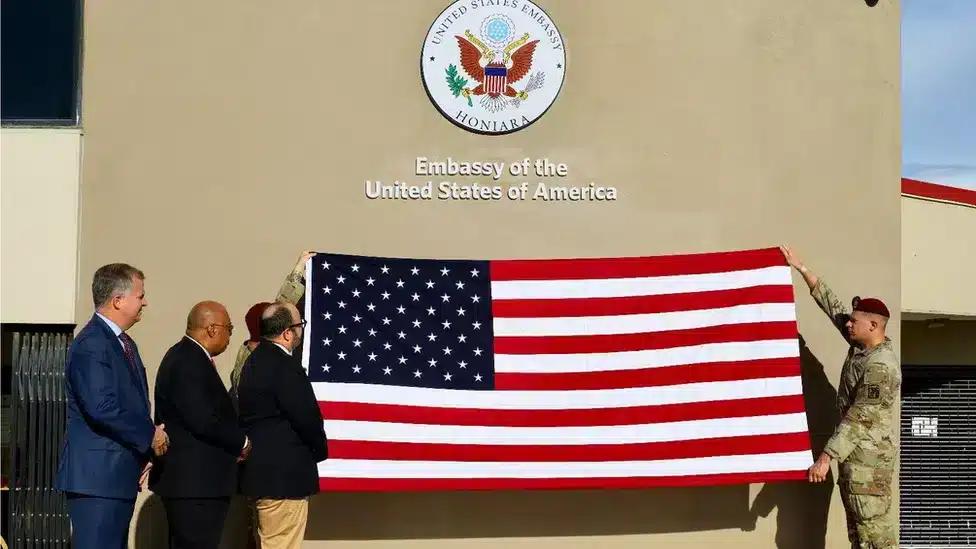
This comes after the tiny nation signed a security agreement with Beijing last year, a move that took Washington and its allies by surprise.
It happened after the US announced it would open its Honiara post, which had been closed since 1993 due to worries about China’s expanding military aspirations.
The opening of the embassy on Wednesday was missed by the Solomons’ PM.
However a foreign ministry spokesman said the re-established US embassy was welcomed by the government.
The region is strategically crucial for the US as a gateway to Asia for Pacific allies like Australia. Washington’s diplomatic presence has until now largely been centred in its Papua New Guinea post.
But US Secretary of State Antony Blinken on Wednesday said the Honiara embassy would help advance the US-Pacific partnership goals – signed last year – of keeping the region a place where “democracy can flourish”.
The embassy opening comes at “an important moment for the region we share”, he said in a video statement.
“Because more than any other part of the world – the Indo-Pacific region including the Pacific islands – will shape the world’s trajectory in the 21st Century.”
The United States of America is pleased to announce the opening of its Embassy in Honiara. We are committed to strengthening the enduring relationship between the U.S. and Solomon Islands! pic.twitter.com/tLGR37TkCb
The BBC is not responsible for the content of external sites.View original tweet on Twitter
Concerns about Beijing’s increasing influence and military expansion in the Pacific has prompted the US and Australia to step up their focus there in recent years.
Last September, US President Joe Biden invited 14 Pacific island nations to theWhite House for the first-ever in-person summit. Washington signed a sweeping partnership and development agreement with the island nations.
Solomon Islands PM Manasseh Sogavare also signed up to the deal despite reports in the lead-up that he might abstain.
Beijing last year had also accelerated efforts to gain influence in the region – to mixed effect.
While it inked a security deal with the Solomons in March, it failed to secure a trade and security deal with 10 regional countries a few months later despite a lobbying tour from China’s then Foreign Minister Wang Yi.
“China has no intention of competing with anyone, let alone engaging in geopolitical competition, and has never established a so-called sphere of influence,” said Mr Wang during the tour.
In recent times, Fiji, one of the biggest and most influential Pacific islands, has also announced it will cancel a police training exchange with China – formerly a close partner.
Fiji’s new government – elected in December – has indicated it prefers stronger ties with its traditional Pacific partners Australia and New Zealand over China.
Australia and NZ are also both members of the Pacific Islands Forum (PIF) – the region’s main bloc.
Several Pacific countries have advocated for regional unity in the face of superpower tensions and on Monday, many welcomed the announcement that Kiribati would return as a member.
Kiribati had withdrawn from the PIF last year in a move the country’s opposition said had been influenced by Beijing. The country’s leader had then said the forum wasn’t adequately addressing the concerns of Micronesian countries.
Dr Meg Keen from the Australia-based Lowy Institute said the US re-engagement was welcomed but it would remain to be seen “if the announcements are backed up by actions”.
She said the region could see a “diverse range of partnerships” as Pacific islands pursue development goals and funding.
The new US embassy also comes as Washington has been re-negotiating agreements with three island nations in the North Pacific – Micronesia, Palau and the Marshall Islands – who give exclusive military use rights to the US.
On July 7, 2021, President Moise was assassinated at his home in the capital of Haiti by what the police described as a hit squad made up primarily of foreign mercenaries.
One of the suspects is Colombian, and three of the suspects are dual US-Haitian citizens.
Later on Wednesday, they are scheduled to appear in a Miami federal court.
The investigation being conducted into President Moise’s assassination in Haiti has stalled, with investigators and judges receiving death threats. But as the plan to kill Mr Moise was allegedly hatched by Haitian-Americans in Florida, investigations are proceeding in the US.
The transfer of the four men from Haiti to Florida has brought the total number of suspects in US custody to seven.
Three of those who moved to the US have been charged with conspiracy to murder President Moise. The fourth, Christian Sanon, was charged with smuggling bullet-proof vests to Haiti for use in the plot.
Those charged with conspiracy to commit murder are:
Prosecutors allege that James Solages and Christian Sanon met in Florida in April 2021 to discuss “regime change” in Haiti.
According to police in Haiti, Mr Sanon, a Haitian-American doctor and pastor, had “political objectives” to replace Mr Moise as president.
Haiti’s police chief at the time of President Moise’s killing also said that Mr Sanon was the first person one of the assailants called as police surrounded them after the murder.
In a statement, the US Department of Justice (DoJ) said that while Mr Sanon had not been charged with conspiracy to murder, he “participated in crimes that culminated in the assassination of the Haitian president”.
According to the DoJ, James Solages, Joseph Vincent and Germán Rivera had originally planned to kidnap President Moise and take him to an unknown location while a new president was installed in his stead.
But when they failed to get a plane to take the Mr Moise away, they allegedly changed their plan.
“It is alleged that on July 6, 2021, Solages, Vincent, Rivera and others met at a house near President Moise’s residence, where firearms and equipment was distributed and Solages announced that the mission was to kill President Moise,” the DoJ statement said.
The other man, German Alejandro Rivera, is suspected of having recruited the Colombian mercenaries who made up the hit squad hired for the purpose.
All four men were arrested in Haiti shortly after President Moise’s assassination and been held in the Caribbean nation until their transfer on Tuesday.
If found guilty, Mr Sanon could face up to 20 years in jail while the three other suspect could be sentenced to life in prison.
The political void left by the killings has led to a surge in violence and lawlessness across Haiti.
According to a joint statement from the defence departments of the two nations, the Philippines and the United States have agreed to broaden their defence agreement, giving US troops access to four more military bases in the Southeast Asian country.
The deal was announced by US Defense Secretary Lloyd Austin while he was in Manila for talks with newly elected Philippine President Ferdinand Marcos Jr.
“The Philippines and the United States are proud to announce their plans to accelerate the full implementation of the Enhanced Defense Cooperation Agreement (EDCA) with the agreement to designate four new Agreed Locations in strategic areas of the country and the substantial completion of the projects in the existing five Agreed Locations,” the joint statement said. It was published on the websites of the US Department of Defense and on the Philippines’ Department of National Defense.
EDCA forms part of a decades-long security alliance between the US and the Philippines, and allows US troops to rotate through five Philippine bases, including those near disputed waters.
It also allows for the US military to store defence equipment and supplies on those bases.
The statement said the expansion would make the two countries’ alliance “stronger and more resilient” and “accelerate modernization of our combined military capabilities”.
The statement did not elaborate on the new locations, but said they would “allow more rapid support for humanitarian and climate-related disasters in the Philippines”. The US had allocated more than $82 million towards infrastructure investments at EDCA’s existing five sites, it added.
Ties between the Philippines and the United States have warmed since President Ferdinand Marcos Jr took office last year [Jam Sta Rosa/Pool via Reuters]
The expansion comes as China becomes increasingly assertive in pressing its claim to the self-ruled island of Taiwan, as well as in the South China Sea where it claims almost the entire waterway under its controversial nine-dash line. The Philippines, other Southeast Asian nations and Taiwan also have overlapping claims to the sea, which is a major global trade route.
The relationship between the Philippines and the US – longtime allies – was strained under Marcos Jr’s predecessor Rodrigo Duterte, who favoured China and threatened to sever ties with Washington and expel US troops.
But ties have warmed under the new administration, with US Vice President Kamala Harris visiting last November.
“This is really the dawn of a new era after a rocky few years,” said Al Jazeera correspondent Barnaby Lo, who is in Manila.
Tension in disputed seas
While most of the new bases are expected to be in Luzon, the western island of Palawan, facing the contested Spratly Islands in the South China Sea, is expected to get an additional base as well.
A senior US defence official told reporters on Wednesday that the Philippines was under “day-to-day pressure from (China) in ways that contravene international law”.
The US aims to ensure “they have the capability to defend their own sovereignty”, the official said.
The Philippines has often found itself on the front line of Beijing’s aggressive tactics in the South China Sea, where China’s maritime militia has established an almost constant presence in Manila’s exclusive economic zone.
In 2012, China took control of Scarborough Shoal from the Philippines after a months-long standoff that began when Manila discovered Chinese fishing boats around the rocky outcrops.
Tensions rose again in 2021 when the Philippines protested against China’s “continuing illegal presence and activities” near its islands in the South China Sea.
Beijing has ignored a 2016 international court ruling – in a case brought by the Philippines – that its claim to the South China Sea was without merit.
China also claims democratic Taiwan as part of its territory and has not ruled out the use of force to achieve its objective. Last year, after then US House Speaker Nancy Pelosi visited the island, Beijing conducted major war games around and across the island.
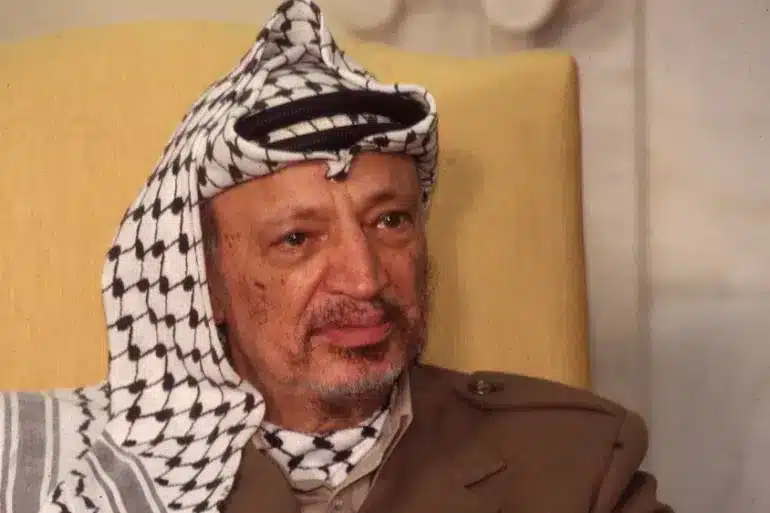
The US effort came after the failure of the Camp David negotiations in 2000 between Arafat and then-Israeli Prime Minister Ehud Barak. The talks followed the escalation of violence in the occupied territories of the West Bank and Gaza Strip.
According to the BBC documents, Bush expected early on that Ariel Sharon, who succeeded Barak, would use the Gaza Strip to sow divisions among the Palestinians.
The documents deal with discussions that took place between the United Kingdom and the US a few months after Bush and his administration, which was dominated by neoconservatives, entered the White House.
When Bush was inaugurated in January 2001, the second Palestinian uprising was at its height. It had erupted in late September 2000 when Sharon entered the courtyards of Al Aqsa Mosque, an act widely seen by Palestinians as a provocation.
The Bush administration called on Arafat to stop the uprising to lay the groundwork for the start of security negotiations with Israel. It also vetoed a draft resolution in the United Nations Security Council, which proposed sending a UN observer force to protect Palestinian civilians from Israeli forces in the occupied territories.
After the negotiations were aborted, telephone talks were held between Bush and then-British Prime Minister Tony Blair in which they discussed the Palestinian-Israeli conflict at length.
According to the minutes of the talks, the prime minister said Arafat was a liability.
He said the Palestinian leader “had reached the limits of what he can do constructively and he is only working to maintain his position”. He added that Arafat “no longer has anything to offer”, indicating that the leader had made all the possible concessions he could.
Bush endorsed what Blair had said, then described Arafat as “weak and useless”. He revealed that he had asked the CIA to search for possible successors to the Palestinian leader but said that the agency “researched the Palestinian scene thoroughly and concluded that there is no successor available”.
The British documents revealed that the US secretary of state at the time, Colin Powell, did not agree with Bush’s search for a replacement for Arafat.
Arafat died a few years later, on November 11, 2004, at a Paris hospital after a cerebral haemorrhage caused by a toxic substance – polonium – that was found on his clothes and body.
Palestinians and Arabs accused Israel of killing him. It denied any responsibility for his death.
The move would restructure the federal response to treat the virus asan endemic public health threat, ending some government support.
United States President Joe Biden has informed Congress that his administration will formally end two national emergencies declared to address the COVID-19 pandemic on May 11, restructuring the federal response to the virus as an endemic public health threat.
The announcement on Monday came in a statement opposing resolutions being brought to the floor this week by House Republicans to bring the emergency to an immediate end. House Republicans are also gearing up to launch investigations on the federal government’s response to the virus.
“An abrupt end to the emergency declarations would create wide-ranging chaos and uncertainty throughout the health care system – for states, for hospitals and doctors’ offices, and, most importantly, for tens of millions of Americans,” the Office of Management and Budget wrote in a Statement of Administration Policy.
The announcement comes as legislators have already ended elements of the emergencies that kept millions of Americans insured during the pandemic. The change would also mean the response can be managed through public health agencies’ normal authorities.
The move, combined with the drawdown of most federal COVID relief money, would also shift the development of vaccines and treatments away from the direct management of the federal government.
Health and Human Services Secretary Alex Azar first declared a public health emergency in response to COVID on January 31, 2020 during the administration of then-President Donald Trump. In March 2020, Trump declared the pandemic a national emergency.
The measures have been repeatedly extended by Biden since he took office in January 2021. The Biden administration had previously considered ending the emergency last year, but held off amid concerns about a potential “winter surge” in cases and to provide adequate time for providers, insurers and patients to prepare for its end.
The Centers for Disease Control and Prevention has recorded 1.1 million COVID deaths in the US since 2020, although the death rate has dropped dramatically since vaccines became widely available. The agency said about 3,700 people died from the virus last week.
US legislators have already blunted many federal programmes related to COVID, refusing for months to fulfil the Biden administration’s request for billions more dollars to extend free vaccines and testing.
The costs of COVID-19 vaccines are also expected to skyrocket once the government stops buying them, with Pfizer saying it will charge as much as $130 per dose. Only 15 percent of US residents have received the recommended, updated booster that has been offered since the last year.
Free at-home COVID tests will also come to an end, and hospitals will not get extra payments for treating patients after the emergency ends.
On Monday, the World Health Organization said the coronavirus remains a global health emergency, even as a key advisory panel for the group found the pandemic may be nearing an “inflexion point” where higher levels of immunity can lower virus-related deaths.
Biden’s announcement comes as the House of Representatives was scheduled to vote on Tuesday on legislation that would terminate the public health emergency.
According to experts in air defense, US-made F-16 fighter jets would give Ukraine an advantage over the Russian air force, but only if they were used in conjunction with potent missiles and targeting data that the West would also have to supply, drawing it more actively into the conflict.
Konstantinos Zikidis, a Hellenic Aerospace Industry aerospace engineer with extensive F-16 experience, said of the technology: “It’s not a panacea, not a game-changer.”
Despite President Joe Biden’s Monday statement that the United States would not send F-16s to Ukraine, the majority of NATO members in Europe have left the option open.
“The Sukhoi-35 is larger and faster and has a more powerful radar,” Zikidis told Al Jazeera of the Russian fighter jet the F-16 would be up against.
But the F-16 could overcome the Sukhoi-35 if it carried powerful Western missiles and received tracking data from airborne radar, Zikidis said.
If Ukraine were to receive F-16s, they would likely come from Poland, which has said it is ready to hand over part of its fleet.
These carry the AIM-9X Sidewinder missile, a 10-20km (6-12-mile) range short-range infrared guided missile “undetectable by the target plane’s defence systems”, Zikidis said.
“And they have the AIM-120 AMRAAM, which covers larger distances of up to 100km (62 miles)… [and] can continue to receive target updates from the aircraft that fired it.”
Both missiles are among NATO’s most advanced.
Wing commander Thanasis Papanikolaou, who has flown and commanded formations of F-16s, agrees that, if networked, the F-16 would offer Ukraine a clear advantage.
“The Russians are using older tactics, whereas Western tactics have evolved to use planes in combination with the navy, ground forces, [airborne] and naval radar intelligence – this Western type of warfare is very advanced,” Papanikolaou told Al Jazeera.
“The Su35 may have great abilities, but it is behind the F-16 if equipped with Link 16,” said Papanikolaou, referring to a NATO communications technology that data-links planes, ships and ground forces. “This enables every asset on the battlefield to share the same picture.”
If NATO’s AWACS airborne radar were to operate at the limit of Romanian airspace, it could illuminate virtually all of Crimea, a territory Ukraine says it wants to recapture, and reports suggest the White House is willing to consider helping Ukraine do.
Ukraine wants new tech
Ukraine has suggested it wants some of the most advanced versions of the F-16.
“If we get them, the advantages on the battlefield will be just immense … It’s not just F-16s. Fourth-generation aircraft, this is what we want,” Yuriy Sak, an adviser to defence minister Oleksiy Reznikov, told Reuters.
Poland, which operates fourth-generation F-16 Block 52+ planes, confirmed on Monday it was prepared to send them to Ukraine if NATO approved the move.
Experts say these carry a “sophisticated” on-board computer and powerful radar.
At the beginning of the war, Ukraine’s air force was spearheaded by 50 MiG-29 fighters and 32 Sukhoi-27s, but they were “overmatched” said a recent RUSI report.
“Russian aircraft could generally see and shoot further while their countermeasures were effective against Ukrainian air-to-air munitions,” the report said.
Moscow’s highly publicised aircraft losses in the opening days of the war dropped after the Russian air force brought in air defences and started jamming Ukrainian radar and hunting Ukrainian anti-air batteries.
Ukrainian pilots partly compensated for their disadvantage in numbers and technology by flying below enemy radar, but the limitations of this tactic were made painfully obvious last October when a Ukrainian Sukhoi-27 and a Sukhoi-24 were shot out of the sky by Russian missiles after performing a “jump” – a brief thrust into higher altitude – to fire at kamikaze drones or enemy air defences.
Western airborne radar failed to spot the incoming missiles, leading to suspicion that Russia may have begun to deploy its fearsome R-37M, a hypersonic missile believed to have been fired more than 200km (124 miles) away by a Sukhoi-57, Russia’s still-experimental multirole stealth fighter.
Against such a combination of arms, even the F-16 Block 52+ may not be a match, say experts, but it does underline Ukraine’s need for a generational leap in air attack capabilities.
Can it be done?
There are clear advantages to the F-16.
It is the world’s most-produced fighter jet, with many being decommissioned in Europe as NATO members transition to the F-35.
Lockheed Martin, which produces the F-16, told the Financial Times it can increase production to replace planes sent to Ukraine.
COO Frank St John said the company was “going to be ramping production on F-16s in Greenville [South Carolina, US] to get to the place where we will be able to backfill pretty capably any countries that choose to do third-party transfers to help with the current conflict”.
The Netherlands’ foreign minister, Wopke Hoekstra, said there were “no taboos” on weapons supplies to Ukraine, and recent reports had suggested that the US Pentagon had seriously considered sending F-16s.
But there are practical and symbolic concerns.
Training Ukrainian pilots on F-16s might not be carried out in time to make a difference in the war this year, say experts.
“The altimeter in Western planes, for example, is in feet. The Soviet altimeter is in metres. It’s two different ways of thinking,” said Papanikolaou.
“It would take many months, and they might have to be piloted by [Western] volunteer veterans,” said Zikidis.
Bringing in Western pilots, even as privateers, could create political complications.
“The Russians will try to present that NATO is directly involved in the Ukraine war, and will threaten nuclear war,” said Papanikolaou.
Ukraine has reportedly prepared a batch of 50 pilots who have flown in Western military exercises and could be trained in three months. And US Congressman Adam Kinzinge introduced a bill to train Ukrainian pilots and support crew on F-15 and F-16 fighter jets as early as June 23 last year. That bill was approved.
The symbolic concern is over losses of aircraft.
Western weaponry has proven largely superior to Soviet-era weaponry during the course of the Ukraine war. But Russia’s development of hypersonic missiles could prove a match for the F-16, ending the narrative of NATO superiority.
“It carries a risk,” said Zikidis. “If you lose an F-16 it will be a big story. Sukhois are falling out of the sky, but that’s not a story.”
Perhaps for such reasons, there are still naysayers in the Western alliance.
German chancellor Olaf Scholz, after bowing to pressure to send Leopard 2 battle tanks to Ukraine, said he would not be sending the jets.
“I made it clear very early on that we are not talking about combat aircraft, and I am doing the same here,” he told the Bundestag this month.
New recommendations for how pediatricians should handle childhood obesity have drawn some criticism in the US.
The American Academy of Pediatrics has advised children as young as six to receive intensive therapy, and those in their early teens to receive weight-loss medications or surgery.
However, some worry that this strategy will compromise living a healthy and active lifestyle.
In the US, one in five children is obese.
According to doctors, early intervention is necessary to avert chronic conditions like diabetes.
I meet Tracy and her 14-year-old daughter, Jaelynn, in a suburb of Washington. They live in a residential complex surrounded by highways and a few patches of green grass.
Tracy is upset – she’s just received the news that Jaelynn’s school is getting rid of the Physical Education class and replacing it with a health course taught in the classroom.
She’s worried because her daughter already doesn’t get much chance to move and socialise with her classmates. She thinks the new class will make it even more difficult.
Jaelynn tells me that last year she enrolled in a summer camp organised by the YMCA. She would go on field trips during the day and spend plenty of time outside.
“It was really fun,” she says. “I felt better, I felt healthier, and I loved making friends.”
Jaelynn has suffered from kidney disease since she was a child, and her being overweight negatively impacts her condition. But her mum says during the summer things started to improve.
“She lost twelve pounds in three months,” Tracy says. “Her nephrologist was really impressed that she could lose so much so quickly. Her health improved and her confidence as well.”
This change, Tracy tells me, showed her how important it was for her daughter to do activities outside.
For years, doctors have promoted a healthy lifestyle as the best way to fight childhood obesity. But in recent weeks the debate over this issue has reignited, as the American Academy of Paediatrics issued new guidelines for the first time in 15 years.
They say that eating well and exercising is not always enough.
“Medical treatment and prevention need to go hand in hand,” says Dr Nazrat Mirza, one of the authors of the guidelines.
“Obesity is a chronic medical condition and in addition to healthy lifestyle changes, we have shown that medication works, and surgery also works.”
Dr Mirza says the guidelines want to shatter the double standards that people with obesity face by making medical treatments readily available, like for any other condition.
“Just like asthma, just like hypertension,” she says. “In hypertension you would tell somebody to cut salt, but then the blood pressure is still high, so you’re still going to give them medication.”
But some doctors are concerned by the emphasis on intensive early intervention.
Dr Katy Miller works with teenagers struggling with eating disorders at Children’s Minnesota, and she fears these guidelines might be “setting kids up for a challenging relationship with their bodies”.
“We are proposing treatment strategies that are expensive and even in the best circumstances are often unsuccessful,” she says.
“How can we ask someone to diet when we’re not addressing things like poverty, food scarcity and housing instability?”
“I had a 15-year-old patient who had been told by doctors to lose weight,” she adds, “and his family has been living in extreme poverty. They had a change in their financial circumstances, and he said to me ‘do you know what the best part about having money is? You can buy fruit that isn’t mouldy’.”
On a cold grey day, I meet Julia. She’s a mum of three and she has just finished a year-long support group on healthy cooking organised by the YMCA.
Image caption,Mother of three Julia Guevara was diagnosed with high cholesterol and prediabetes during pregnancy
“I am the one who cooks at home,” she tells me proudly, “so if I cook healthy food, my family stays healthy.”
She was referred to the program because she had been diagnosed with high cholesterol and prediabetes during pregnancy. Her teenage son, she tells me, was starting to have health issues as well, and that motivated her.
While she cuts some fruit for her toddler, I ask her what she thinks of the new guidelines.
She shakes her head.
“As a parent, I’d first try changing the food we eat and getting my children to do sports,” she says.
“In our country, kids don’t have that many opportunities to exercise, and schools don’t have enough sports programs. Only if I had tried everything, would I consider it.”
On the opposite side of town, Tracy agrees. “Surgery and medication should be the last resort,” she says.
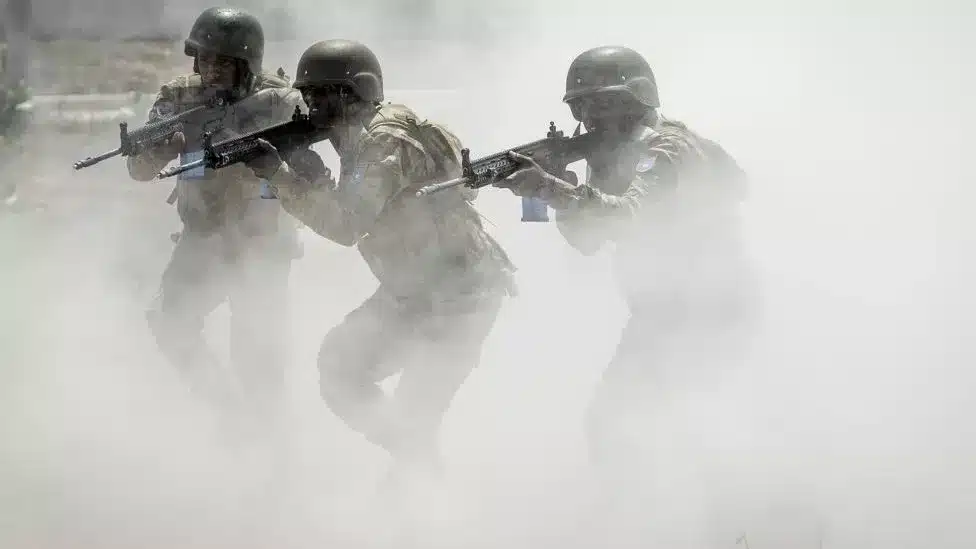
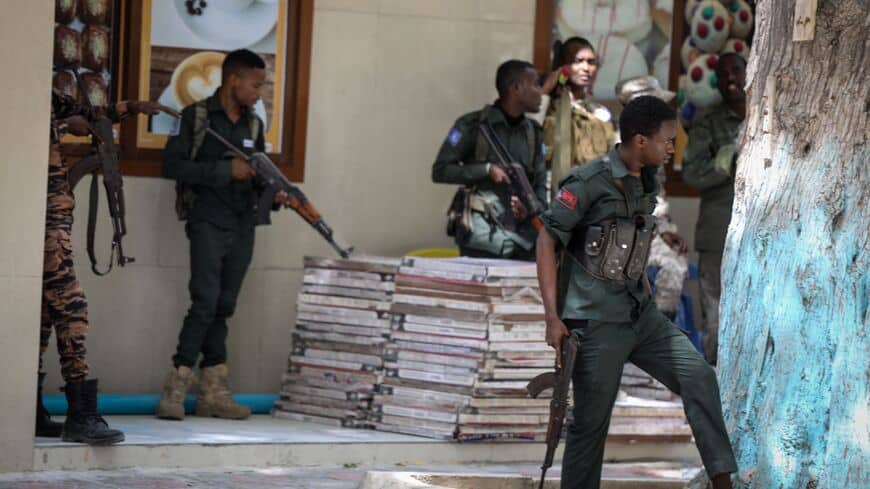
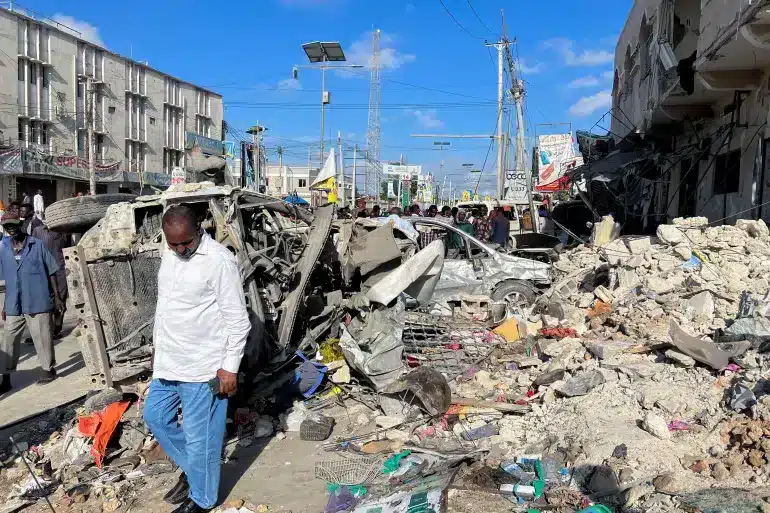
US forces have killed an Islamic State leader, Bilal al-Sudani, and 10 of his operatives in northern Somalia, American officials say.
He was killed after US special forces raided a remote mountainous cave complex hoping to capture him.
“Al-Sudani was responsible for fostering the growing presence of ISIS in Africa,” Defence Secretary Lloyd Austin said.
He also allegedly funded the group’s activities globally, Mr Austin added.
Analysts say the fact that US troops were sent under orders of President Joe Bidento kill or capture Sudani, rather than using a less risky drone strike, indicates his significance.
Details about the nature of the operation have not been released, however the soldiers were drafted in via helicopter, according to the New York Times with Sudani killed after a gunfight broke out.
The operation comes after President Biden redeployed hundreds of US troops to the country after his predecessor, Donald Trump, pulled them out. However, those forces are reportedly only there to train Somali soldiers, rather than conduct operations.
In recent years, the Islamic State group has reportedly expanded its activities into several African countries, including Mozambique and the Democratic Republic of Congo.
However Islamic State is a relatively small group in Somalia, with the al-Qaeda linked group al-Shabab far more prominent – it controls many southern areas.
Prior to joining Islamic State, Sudani allegedly did operational work for al-Shabab, assisting with training fighters. However he split from the group, along with others, to form an IS-affiliated group in the mid-2010s, according to security researcher Dino Mahtani.
He is accused of playing a “financial role with specialized skills which made him an important target for US counterterrorism action,” an anonymous US official told the AFP news agency.
Sudani became “an important figure in the attempt by this faction of Islamic State to build a trans-national network straddling Central Africa and East Africa and now with links down to Mozambique,” Mr Mahtani told the BBC’s Focus on Africa radio programme.
His group are “master weapon-smugglers into the northern part of Somalia” and also have connections in DR Congo, Mr Mahtani continued, so was therefore a “high priority” to capture or kill.
The operation to target Sudani is said to have taken months to plan.
Somalia has welcomed the killing of Sudani, according to the Voice of America news site.
“It’s a very positive and welcoming,” said Somali government security adviser Hussein Sheikh Ali.
He stressed that Islamic State was not as big a threat as al-Shabab in Somalia, but that Sudani was “dangerous”.
“The message is, that the leaders of all terror groups in Somalia are not safe,” he continued.
IS Somalia is one of the group’s smaller branches – claiming 32 attacks in 2022, mostly in the capital of Mogadishu.
One UN report from last year estimated the number of Islamic State fighters in Somalia was around 200 to 280 and that the country is used as a significant base to finance IS activity in Iraq and the Levant, but this has not been independently verified by the BBC.
Just last week IS published a rare propaganda video from its Somalia branch, which showed combat footage of clashes with Somali forces in a mountainous region in the north-eastern Bari region.
The raid comes less than a week after the US said a drone strike had killed 30 al-Shabab militants.
In recent months, pro-government forces in Somalia have been making progress against al-Shabab.
US forces have reportedly killed 10 of Bilal al-Obaida’s Sudanese operatives and an Islamic State leader in northern Somalia, according to American officials.
After US special forces raided a remote mountainous cave complex in an effort to seize him, he was killed.
According to Defence Secretary Lloyd Austin, “Al-Sudani was responsible for fostering the growing presence of ISIS in Africa.”
Mr. Austin added that he is also accused of funding the group’s operations around the world.
Analysts say the fact that US troops were sent under orders of President Joe Bidento kill or capture Sudani, rather than using a less risky drone strike, indicates his significance.
Details about the nature of the operation have not been released, however the soldiers were drafted in via helicopter, according to the New York Times with Sudani killed after a gunfight broke out.
The operation comes after President Biden redeployed hundreds of US troops to the country after his predecessor, Donald Trump, pulled them out. However, those forces are reportedly only there to train Somali soldiers, rather than conduct operations.
In recent years, the Islamic State group has reportedly expanded its activities into several African countries, including Mozambique and the Democratic Republic of Congo.
However Islamic State is a relatively small group in Somalia, with the al-Qaeda linked group al-Shabab far more prominent – it controls many southern areas.
Prior to joining Islamic State, Sudani allegedly did operational work for al-Shabab, assisting with training fighters.
He is accused of playing a “financial role with specialized skills which made him an important target for US counterterrorism action,” an anonymous US official told the AFP news agency.
The operation to target Sudani is said to have taken months to plan.
Somalia has welcomed the killing of Sudani, according to the Voice of America news site.
“It’s a very positive and welcoming,” said Somali government security adviser Hussein Sheikh Ali.
He stressed that Islamic State was not as big a threat as al-Shabab in Somalia, but that Sudani was “dangerous”.
“The message is, that the leaders of all terror groups in Somalia are not safe,” he continued.
IS Somalia is one of the group’s smaller branches – claiming 32 attacks in 2022, mostly in the capital of Mogadishu.
One UN report from last year estimated the number of Islamic State fighters in Somalia was around 200 to 280 and that the country is used as a significant base to finance IS activity in Iraq and the Levant, but this has not been independently verified by the BBC.
Just last week IS published a rare propaganda video from its Somalia branch, which showed combat footage of clashes with Somali forces in a mountainous region in the north-eastern Bari region.
The raid comes less than a week after the US said a drone strike had killed 30 al-Shabab militants.
In recent months, pro-government forces in Somalia have been making progress against al-Shabab.
They wanted to know if the FBI had additional information to support a ban in their state amid dire warnings by the law enforcement agency’s leadership and Republican governors that the Chinese-owned app posed serious threats to privacy and national security.
“Good morning gentlemen. We’re looking for any recommendations on TikTok after Maryland moved to ‘ban’ its use,” Jeff Brown, the chief information security officer for Connecticut, said in an email to a contact at the FBI on December 7.
“Our logic is captured below, but we’d be interested in your thoughts. Appreciate any feedback,” Brown said in the email, which was also sent to contacts at the Cybersecurity and Infrastructure Security Agency (CISA) and the Department of Homeland Security.
Brown included in his message an email chain in which he and Mark Raymond, Connecticut’s chief information officer (CIO), expressed agreement that Maryland’s ban appeared to be a case of “overreach”.
Offered a chance to provide additional information in support of a ban, the FBI contact declined.
[Connecticut Department of Administrative Services]
“I asked one of my analysts to reach out to our HQ,” the FBI agent, who leads a team in Connecticut focused on cybercrime, said in an email to Brown.
“She emailed me towards the end of the day to say that she couldn’t find evidence that we had any additional information to share.”
Maryland and other states that had announced TikTok bans appeared to have “based their decisions on news reports and other open source information about China in general, not specific to Tik Tok,” the FBI agent quoted his analyst as saying.
“Sorry we don’t have more to offer,” the FBI agent said.
The CISA contact, a cybersecurity adviser for Connecticut, told Brown he had “no additional” information and would recommend deferring to the guidance of the FBI.
Al Jazeera obtained the Connecticut state government emails, along with emails from several other state governments, after submitting public records requests with the 50 US states and the District of Columbia.
Cybersecurity officials in Connecticut last month asked the FBI for advice on banning TikTok [File: Yuri Gripas/Reuters]
Raymond, the Connecticut CIO, ultimately determined that the risk of TikTok was “low” based on the fact that, among other criteria, he had received no information suggesting Tiktok had misused data, concerns about the app appeared to have nothing to do with the platform itself, and a ban could “drive additional Chinese cyber activity and interest in Connecticut.”
He recommended that Connecticut Governor Ned Lamont, a Democrat, “take no action at this time” but continue to monitor the situation.
[Connecticut Department of Administrative Services]
When contacted by Al Jazeera for comment, Raymond said protecting state networks is an “extremely high priority for us”.
“We regularly review security threats against the state and act as warranted,” he said. “We are supportive of national action on topics that may threaten our national security and continue to work with all our partners on the most appropriate recommendations for our state.
The episode in Connecticut, which has not been previously reported, stands in contrast to the dire public warnings FBI Director Christopher Wray has made about TikTok.
Wray has repeatedly warned that China could use TikTok to “manipulate content” to carry out influence operations and steal personal data for espionage purposes.
“All of these things are in the hands of a government that doesn’t share our values, and that has a mission that’s very much at odds with what’s in the best interests of the United States,” Wray told a University of Michigan event last month. “That should concern us.”
In response to a request for comment, the FBI National Press Office directed Al Jazeera to past comments by Wray in which he said the agency is advising the Committee on Foreign Investment in the United States (CFIUS) amid its discussions with TikTok on ways to address national security fears and expressed concern about the Chinese government forcing companies to hand over sensitive data.
FBI Director Christopher Wray has repeatedly described TikTok as a national security threat [File: Graeme Jennings/pool via Reuters]
TikTok’s parent company ByteDance, which has its headquarters in Beijing and is incorporated in the Cayman Islands, argues that the FBI’s warnings about the app relate to purely hypothetical concerns and no evidence has been presented of wrongdoing.
ByteDance has long insisted it would never share user data with the Chinese government and says it is working to address hypothetical national security risks as part of a deal it is negotiating with CFIUS.
“As we have said before, these state and university bans are not driven by specific intelligence about TikTok and are driven by misinformation about our company and our service,” TikTok spokeswoman Brooke Oberwetter told Al Jazeera.
“We stand ready to fully brief state and local officials about our comprehensive plan to address national security concerns, plans developed under the oversight of our nation’s top national security agencies.”
Even as bans on TikTok gather steam, tech experts — and even some government officials, as in the case of Connecticut — acknowledge there is little technical evidence to justify the level of fear and anxiety the video-streaming platform, one of the world’s most popular apps, has inspired.
Instead, most arguments for restricting the app have rested on broader mistrust of Beijing, including fears the Chinese government could access users’ personal data or manipulate public opinion for nefarious ends.
“We haven’t seen any evidence that TikTok is a greater risk than any other social media platform,” Cliff Lampe, a professor of information at the University of Michigan, told Al Jazeera.
“The sole concern expressed is that its main owner is a Chinese company — even though most TikTok traffic in the US is managed on US servers. The logic is that the Chinese government could importune TikTok for private user data.”
TikTok’s parent company, ByteDance, has denied claims that the popular app poses a threat to privacy or national security [File: Dado Ruvic/Illustration]
While the Trump administration first put TikTok in the crosshairs in 2020 with proposals for an outright ban, efforts to stymie the app gained momentum after South Dakota announced its ban in November last year.
South Dakota Governor Kristi Noem claimed the Chinese Communist Party used the app to “manipulate the American people” and said her state would have no part in the “intelligence gathering operations of nations who hate us”.
Among Republicans, the party affiliation of Noem and other governors that rolled out early bans appears to have had some influence in persuading other states to follow suit.
In December last year, the Republican Governors Public Policy Committee (RGPPC), a public policy organisation for promoting conservative policy at the state level, sent out a newsletter to Republican-led state governments highlighting recent bans in South Dakota, South Carolina, Maryland and Texas.
“Within the past week, four Republican governors banned or limited the social media platform, TikTok, on state devices,” Zach Swint, a senior policy adviser for the RGPPC, wrote in the December 7 newsletter.
In North Dakota, which banned TikTok on state devices on December 13, the newsletter prompted the chief of staff to Governor Doug Burgum to request state cybersecurity officials to “quickly determine if we have any state devices using TikTok and if we should consider an action like other governors below”.
“Please expedite this and send a recommendation as quickly as possible,” Jace Beehler said in an email dated December 8.
Lampe, the University of Michigan professor, said that states appear to have looked to each other for lessons on how to handle TiKTok “given their lack of expertise in the area”.
“The danger of that, however, is that if the legislation is misguided then it will replicate itself quickly with little critical examination. My sense is that part of this is that legislatures are mostly run by older people, who may see a youth-oriented social platform as banal, so the danger of being too strict is low.”
Bipartisan concerns
At least 28 US states, including Texas, Alabama, North Carolina and Georgia, have introduced bans on TikTok for government devices so far. While a majority are led by Republican governors, Democratic-led states such as Wisconsin and North Carolina have also rolled out bans, which have increasingly attracted bipartisan support.
In December, US President Joe Biden signed legislation containing a ban for federal government devices, while a number of Republican politicians are pushing legislation to ban the app outright. Universities in Texas, Oklahoma, Arkansas, Georgia and Iowa have in recent weeks also announced bans for official devices.
Marc Faddoul, codirector of AI Forensics, a European non-profit that researches the mechanics of TikTok, said that concerns that the app has access to large amounts of personal data and could be used to sway public opinion are both reasonable and mired in hypocrisy.
“The concerns, I think, are legitimate but I think the US government’s position is hypocritical because the same concern is true for any other country with respect to the American platforms,” Faddoul told Al Jazeera, adding that it is also important to acknowledge that the US government has more respect for democratic norms than its Chinese counterpart.
“The US government could and has in the past leverage their power, their domestic companies for national security interests and could in the context of a war make use of it potentially to filter to promote specific types of information.”
Faddoul said discussions should focus more on protecting user data across the industry instead of just TikTok alone.
“I do believe that a better approach is to do something that is systematic for the whole industry in terms of data protection laws,” he said.
Connecticut Governor Ned Lamont has not announced restrictions on TikTok [File: Jessica Hill/AP]
Even as a majority of US states have rolled out TikTok bans, some state officials have expressed ambivalence about the app.
In some cases, state governments have carved out exemptions in recognition of the app’s usefulness for some official business.
In Utah, which banned TikTok on state devices on December 12, officials at the Division of Juvenile Justice and Youth Services sought an exemption to allow some staff to access the app, emails obtained by Al Jazeera through a public records request show.
In South Carolina, one of the first states to announce a ban, officials retroactively introduced changes to allow “identified” law enforcement personnel to access TikTok, according to emails obtained via a public records request.
In New Jersey, where Democrats control the governorship and both branches of the legislature, the state’s top cybersecurity official last month expressed a preference for restricting the app to “separate and isolated devices” rather than a total ban, according to emails revealed by Al Jazeera last month. New Jersey, like most other Democratic-led states, has yet to publicly announce restrictions on the app.
Some states appear to have preferred a quiet approach to limiting the use of TikTok.
In Michigan, Caleb Buhs, the state’s director of communications, told colleagues TikTok would be added to a list of social media platforms not approved for official use from the following month, emails show.
Michigan has not yet announced a ban on the app and Democrat Gretchen Whitmer, the state’s governor, continues to operate a TikTok account where she regularly posts videos.
Sara Collins, an expert in data protection and consumer privacy at the non-profit Public Knowledge, said TikTok’s links to China deserve scrutiny, but the controversy around the app has distracted from the broader lack of privacy protections in the internet age.
“Given China’s authoritarian government and its control of its corporations mean that TikTok rightly deserves additional scrutiny,” Collins told Al Jazeera.
“However, the discourse surrounding the TikTok bans have mostly moved away from addressing specific risks and become a convenient way for politicians to signal they are anti-China. TikTok, like all social media platforms, collects enormous amounts of data about its users. As we have seen with other major tech companies, this constant surveillance can cause harm.”
According to the Chinese government, Washington should stop pressuring Beijing to reduce Zambia’s debt and instead concentrate on preventing a domestic government default that might have an impact on the world economy.
“The biggest contribution that the US can make to the debt issues outside the country is to cope with its own debt problem and stop sabotaging other sovereign countries’ active efforts to solve their debt issues,” the Chinese embassy in Zambia said in a statement on Tuesday.
The US government has a cap of $31.4 trillion on how much it can borrow, and it reached that limit on Thursday.
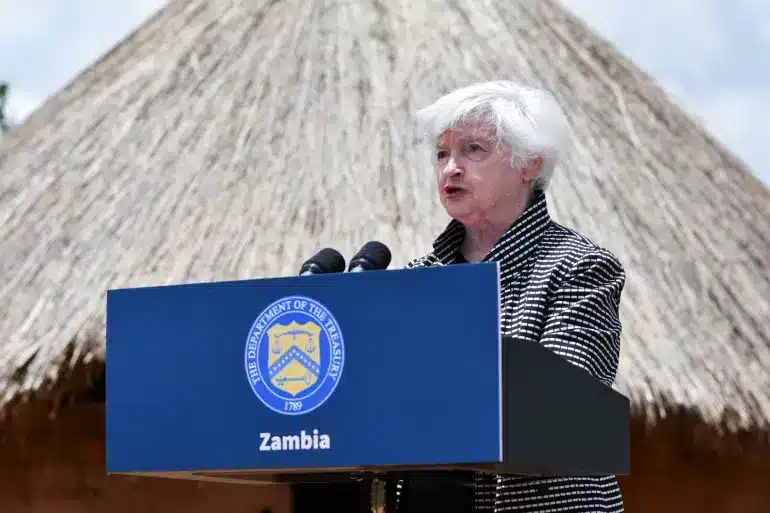
US Treasury Secretary Janet Yellen implemented “extraordinary measures” to ensure the US government can continue paying its bills in the short term and then travelled to Africa. On a visit to Zambia, she said it was crucial for the country to address its heavy debt burden with China.
The country failed to make a $42.5m bond payment in November 2020, becoming Africa’s first sovereign nation to default during the COVID-19 pandemic.
“It’s taken far too long already to resolve this matter,” Yellen said on Monday.
Washington is trying to woo African nations as the influence on the continent of its rivals Russia and China grows.
During her visit to Africa, which also included Senegal and South Africa, Yellen pushed to expand US trade and business ties.
“The United States is all in on Africa, and all in with Africa,” Yellen said on Friday in Dakar as she touted the fruits of a new “mutually beneficial” US economic strategy towards Africa.
In responding to Yellen, China zeroed in on the battle between Republican lawmakers and Democratic President Joe Biden’s administration over raising the US debt limit to allow more borrowing to keep the government running.
“Even if the US one day solves its debt problem, it is not qualified to make groundless accusations against or press other countries out of selfish interests,” the Chinese embassy statement said.
Chinese development banks have emerged as major lenders to poor countries around the world for natural resources, transport and power projects although that lending has fallen sharply and steadily since 2016, according to Boston University’s Global Development Policy Center.
New loan commitments dropped to eight projects totalling $3.7bn in 2021, down from a peak of 151 projects worth $80bn in 2016, according to data compiled by the centre.
At present, 22 low-income African countries are either already in debt distress or at high risk of debt distress, according to the UK-based Chatham House. Chinese lenders account for 12 per cent of Africa’s private and public external debt, which increased more than fivefold to $696bn from 2000 to 2020.
Washington has repeatedly expressed concern in recent weeks over Beijing’s alignment with Moscow as Russia wages its invasion of Ukraine.
Russian President Vladimir Putin in December said he expected his Chinese counterpart, Xi Jinping, to visit in 2023. If it were to take place, analysts say the visit could be interpreted as a public show of solidarity amid the war in Ukraine.
He also blamed the US for the deterioration in relations between the world’s two largest economies, saying Beijing has “firmly rejected” Washington’s “erroneous China policy” of applying pressure on trade and technology and criticising China over human rights and its claims to a broad swath of the Western Pacific.
Much has been written about the changing role of the United States as a global power. President Joe Biden and his administration have made repeated statements about reclaiming the US position as leader of the “free world” and promoter of democracy. This has come amid growing authoritarian trends across the globe, in part due to the increased influence of countries like Russia and China.
But one facet of American foreign policy and grand strategy seems to remain unaffected by this renewed effort to promote democracy: the US approach towards the Arab world.
The Biden administration seems to be just as lukewarm about democracy in the region as its predecessors. Although it has emphasised the importance of democracy to its foreign policy, it has essentially refused to hold human rights violators in the Middle East accountable – even when this affects American citizens.
Moreover, on the question of Palestine, another issue of importance to Arab nations which is directly related to democracy, the Biden administration has not changed track either. It continues to back the Israeli government, its occupation and apartheid, and its regional policies which undermine local democratic movements. Worse still, despite being critical of the Trump administration, Biden appears to be an enthusiastic supporter of its disastrous concessions to Israel.
The US embassy in Jerusalem remains and will continue to expand on stolen Palestinian land. The statements of “deep concern” over each new display of Israeli fascism at this point do nothing more than evoke expected derision. Most importantly, the US continues to push for an expansion of the Abraham Accords, despite the fact that it is perfectly clear they are nothing more than an authoritarian alliance.
The Middle Eastern exception to the American democracy-promotion strategy remains, and there seems to be little appetite among American decision-makers to apply the same ideas of sustainable global order to this troubled region.
This does not go unnoticed in the Arab world itself. Rulers now fully understand the limitations of heavily relying on their partnership with the US. In Washington, there was much consternation and rending of garments when Saudi Arabia demonstrated alignment with China on a variety of policy issues. Israeli politicians have also expressed their interest in better relations with Moscow, in spite of American kowtowing on the issue of Palestine.
Citizens of the region are also aware of the failed American strategy and blatant hypocrisy. They do not believe that the US is a bulwark against authoritarian forces. That much is apparent from the results of the eighth Arab Opinion Index conducted by the Arab Center Washington DC in 14 Arab countries.
According to the survey report, released earlier this month, the percentage of Arabs who think democracy is the best system of governance for their countries has grown from 67 percent in 2011 to 72 percent in 2022. But that does not mean that they see a role for the US in helping the region achieve democratic development.
Some 78 percent consider the US the biggest source of threat and instability in the region. By contrast, 57 percent think of Iran in these terms and 57 percent of Russia. This is despite the Iranian-backed crackdown on the Tishreen Revolution in Iraq in 2019-20 and its destabilising role across the region and the Russian bombardment of civilians in Syria over the past seven years.
American policymakers should consider what these numbers imply. The US’s reputation is so bad and so synonymous with hypocrisy that Arab respondents view actors like Iran and Russia as less threatening. But what is worse, perhaps, is how these views have become cemented across generations of Arab citizens.
Those who witnessed or participated in the Arab Spring have internalised disappointment with the American position, which was pro-democracy in rhetoric only and in reality, was supportive of authoritarianism.
Now a new generation of Arabs, who have demonstrated their own capacity for political mobilisation, is adopting the same views. The US has maintained policies that are hostile to pro-democracy forces in the region, whether in supporting regimes that facilitate repression transnationally or backing Israeli oppression of the Palestinians.
The Arab world continues to be rife with conflict, Arab regimes are largely failing to provide basic services and guarantee rights, and Arab citizens understandably see no benefit to American leadership on the world stage. Such widespread attitudes may not only undermine American interests in the region, but also pose a risk to the broader international system.
As American legitimacy deteriorates, this leaves a vacuum for other powers – such as Russia and China – to advance their interests and their anti-democracy ideologies, both in the Arab world and across the globe. Moreover, the prospect of democracy becomes less attractive to nations when the primary advocate for such an idea worldwide, the US, is seen as hypocritical. And as democracy recedes, this bodes poorly for the level of violence, conflict, and instability we will see in the future.
The last 12 years of authoritarian diffusion, refugees, and sectarian conflict should have taught us that instability in the Arab world can reverberate across the globe. But the American establishment has continued to wash its hands clean of its role in the Middle East while trying to stabilise it on shaky premises – by enabling authoritarian regimes and practices and maintaining the status quo in the region’s worsening conflicts.
The results of the Arab Opinion Index should be a red flag for Washington: There must be no Middle Eastern exception to US policies on global security and prosperity.
DISCLAIMER: Independentghana.com will not be liable for any inaccuracies contained in this article. The views expressed in the article are solely those of the author’s, and do not reflect those of The Independent Ghana
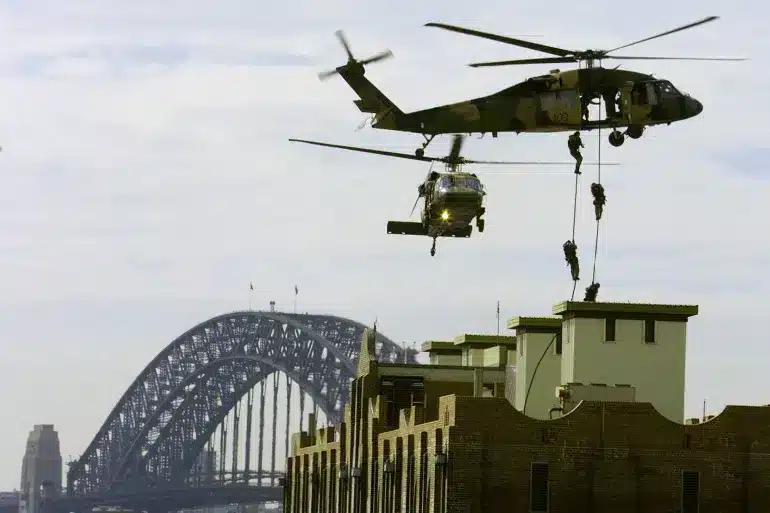
The European-designed Taipan helicopters in Australia’s fleet are being replaced by the Black Hawks ten years early.
A decade earlier than expected, Australia has announced that it will replace its fleet of Taipan military helicopters with 40 Black Hawk helicopters from the United States, at an estimated cost of 2.8 billion Australian dollars ($1.97 billion).
Defence Minister Richard Marles announced on Wednesday that Australia’s fleet of MRH-90 Taipan helicopters, which have been beset for years by expensive maintenance problems, will be replaced by UH-60M Black Hawks from US manufacturer Lockheed Martin Corp.
“We’ve just not got the flying hours out of the Taipan that we would need,” Marles told ABC News. “We’re confident that we can get that from the Black Hawks. It’s a platform we’re familiar with.”
The French government has a significant stake in Airbus – the European aerospace company that manufactures the Taipans – and Paris had been urging Australia to keep its 40-strong fleet.
Marles said he had spoken with his French counterpart several times and was confident the US helicopter deal “won’t interrupt” the renewed relationship with France.
In a statement, Airbus said it “acknowledges” the decision and that Australia remained a key market for the company.
Royal Australian Navy aircrew from the 808 Squadron beside their MRH90 Taipan helicopter in Wollongong, Australia in November 2021. Australia will ditch its fleet of European-designed Taipans and instead buy US Black Hawks [File: Kylie Gibson/ADF via AP]
Dropping the Taipans comes as relations between Paris and Canberra had warmed following Australia’s decision in 2021 to ditch French-made submarines for nuclear subs to be built by the United States and the United Kingdom.
The shock move by Australia’s then-conservative government to abruptly rip up the 90-billion-dollar ($62bn) agreement with France for the provision of submarines sparked a bitter diplomatic dispute and relations plummeted.
At the height of the controversy, French President Emmanuel Macron accused Australia’s then-Prime Minister Scott Morrison of lying about the deal, and Paris recalled its ambassador from Canberra.
Marles said he was confident that the helicopter deal would not damage relations with France, which had been somewhat repaired since the submarine row.
The acquisition of Black Hawks comes as Australia moves to boost defence spending amid China stepping up its presence in the Indo-Pacific region.
Australian Major General Jeremy King said the Black Hawks would meet the country’s strategic needs.
“This acquisition will mean we can continue to defend Australia and respond in times of need in a safe and effective way for years to come,” King told ABC News.
Al Jazeera takes a look at this federal holiday and what it means in theUnited States.
As the United States celebrates Martin Luther King Jr Day on Monday, we take a look at the celebration and its origins:
Martin Luther King Jr Day is a federal holiday in the United States that takes place on the third Monday in January. It honours the life and legacy of civil rights leader Martin Luther King Jr.
Each year, the celebration takes place on the Monday closest to his birthday, which is on January 15. This year, it is being held on January 16.
Sunday would have been King’s 94th birthday. He was assassinated in 1968 at the age of 39 in Memphis, Tennessee.
In 1983, President Ronald Reagan signed the holiday into law, and it was first observed on January 20, 1986. The first time all states observed it was in 2000.
Reagan said the holiday was meant to remember King and “the just cause he stood for”. “America is a more democratic nation, a more just nation, a more peaceful nation because Martin Luther King Jr became her pre-eminent non-violent commander,” Reagan said in 1983.
According to the White House, only three people in the US have a holiday observed in their honour: Christopher Columbus, George Washington, and King.
Banks and stock markets are closed on Monday, and generally, public schools observe the federal holiday too.
Reagan, in a televised speech in 1987 beamed by cable and satellite to high school students across the US, said King was an inspiration to all Americans, no matter what their race. [Dennis Cook/AP]
What was King’s legacy?
King led a campaign of non-violent protests and civil disobedience in the struggle to end discrimination, including racial segregation, in the US in the 1950s and 1960s.
He pushed for social and economic improvements for African Americans while also fighting for legal equality.
“King was a critical force in bringing the anti-Black, racist struggles facing Black Americans to the communities, living rooms and dinner tables of white Americans who had long had the privilege of overlooking and denying its existence,” journalist Jenn M Jackson wrote for Al Jazeera in 2021. “He did this while sacrificing his own safety and the safety of his family.”
Speaking about his legacy, Taylor Branch, his biographer, told Al Jazeera in 2018: “We were on the mission to redeem America from the triple scourge of racial bigotry, of war and poverty for a largely invisible minority, [and] to have that ambition is just stunning.”
Race was at the heart of this struggle, but the impact was also economic. Black people earned far less than white people, and King wanted to highlight that.
His long-term goal, according to Branch, was to launch a Poor People’s Campaign, a multiracial effort to eradicate poverty.
King led a non-violent movement. His strong beliefs in civil rights and non-violence also made him a fierce opponent of America’s participation in the Vietnam War.
King’s ideas and work made him increasingly unpopular during his lifetime. In 1966, 63 percent of Americans had an unfavourable view of King, up from 37 percent in 1963, according to a Gallup poll. Today, he is one of the most respected people in the country.
How is the US marking the holiday this year?
The King Center in Atlanta, led by his daughter Bernice King, launched its slate of Martin Luther King Jr Day events on Thursday with youth and adult summits to educate the public on ways to transform unjust systems in the US.
In Boston, civic organisations unveiled a 22-foot (6.7-metre) bronze statue honouring King and his wife, Coretta Scott King.
According to local media reports, the sculptor Han Willis Thomas found inspiration in a photograph of the civil rights leaders embracing after King learned that he won the 1964 Nobel Peace Prize.
President Joe Biden became the first sitting US president to speak at a Sunday service in the civil rights leader’s church in Atlanta. During his speech, he asked Americans to look at King’s life for lessons on extremism and injustice.
Biden speaks at Ebenezer Baptist Church in Atlanta, where King was pastor, during a service honouring the civil rights leader on January 15, 2023 [Carolyn Kaster/AP]
DISCLAIMER: Independentghana.com will not be liable for any inaccuracies contained in this article. The views expressed in the article are solely those of the author’s, and do not reflect those of The Independent Ghana
Washington says that it is impossible for citizens to return safely due to the armed conflict and humanitarian crisis in Somalia.
According to President Joe Biden’s administration, the humanitarian crisis and armed conflict in the African nation have created a situation that is too dangerous for them to return home, so the United States has temporarily lifted its ban on deporting Somali nationals living in the country.
The US Department of Homeland Security announced on Thursday that Somalia’s Temporary Protected Status (TPS) would be extended for another 18 months.
As a result of the change, the TPS status of about 430 Somali nationals will remain in effect until September 17, 2024, according to the department. Another 2,200 people who have lived in the US continuously since January 11 of this year are also qualified.
“Through the extension and redesignation of Somalia for Temporary Protected Status, the United States will be able to offer safety and protection to Somalis who may not be able to return to their country, due to ongoing conflict and the continuing humanitarian crisis,” Secretary of Homeland Security Alejandro Mayorkas said in the statement.
Washington grants TPS to nationals of countries where conditions temporarily make it too dangerous for them to return – such as in cases of armed conflict or environmental disasters, including earthquakes and hurricanes.
The US has extended TPS to people from Afghanistan, Yemen, Haiti, Cameroon and Ukraine, among other nations.
In December, a group of legislators from Biden’s Democratic Party urged the administration to extend and re-designate TPS for Somalia because the country is facing “a humanitarian crisis exacerbated by protracted armed conflict”.
“The security situation in Somalia remains extremely fraught, as [the armed group] al-Shabab continues to threaten the stability and safety of Somalia. Violence is rampant, with the highest number of recorded civilian casualties since 2017 according to the UN,” the legislators, who included Somali-American Congresswoman Ilhan Omar, said in a letter.
The United Nations said in December that, while famine had been narrowly averted in Somalia, the situation remained “catastrophic” amid widespread and severe food insecurity.
A report by UN officials and other experts, released last month, said more than 8 million people face “an unprecedented level of need” after five consecutive failed rainy seasons and “exceptionally high” food prices.
Meanwhile, al-Shabab has intensified its attacks in recent months as it fights government forces.
The al-Qaeda-affiliated group’s fighters were driven out of thecapital Mogadishu by African Union peacekeeping forces in 2011 but they still control parts of Somalia’s countryside.
President Hassan Sheikh Mohamud, who took office in May of last year, had pledged an “all-out war” against the group. Government troops and allied militias have made some battlefield gains against al-Shabab, recapturing territory long held by its fighters.
Last week, al-Shabab claimed responsibility for two car bomb blasts that killed at least 15 people in central Somalia’s Hiraan region.
The US and Japan announced a significant strengthening of their military relationship and upgrade of the US military’s force posture in the country on Wednesday, including the stationing of a newly redesignated Marine unit with advanced intelligence, surveillance capabilities and the ability to fire anti-ship missiles, according to two US officials briefed on the matter.
During a press conference with Secretary of State Antony Blinken, Japanese Foreign Minister Hayashi Yoshimasa, and Japanese Defense Minister Hamada Yasukazu, US Defense Secretary Lloyd Austin announced that the 12th Marine Regiment, an artillery regiment, would be renamed the 12th Marine Littoral Regiment.
“We’re replacing an artillery regiment with an outfit that’s, that’s more lethal, more agile, more capable,” he said, adding that the move would “bolster deterrence in the region and allow us to defend Japan and its people more effectively.”
The announcement sends a strong signal to China and came as part of a series of initiatives designed to underscore a rapid acceleration of security and intelligence ties between the countries.
The officials met on Wednesday as part of the annual US-Japan Security Consultative Committee meeting, days before President Joe Biden plans to meet with Japanese Prime Minister Fumio Kishida at the White House.
The newly revamped Marine unit will be based on Okinawa and is intended to provide a stand-in force that is able to defend Japan and quickly respond to contingencies, US officials said Wednesday. Okinawa is viewed as key to the US military’s operations in the Pacific – in part because of its close proximity to Taiwan. It houses more than 25,000 US military personnel and more than two dozen military installations. Roughly 70% of the US military bases in Japan are on Okinawa; one island within the Okinawa Prefecture, Yonaguni, sits less than 70 miles from Taiwan, according to the Council on Foreign Relations.
One official described it as “one of the most significant adjustments to US military force posture in the region in years,” emphasizing the Pentagon’s desire to shift from past wars in the Middle East to future wars in the Indo-Pacific. The change comes as simulated war games from a prominent Washington think tank found that Japan, and Okinawa in particular, would play a critical role in a military conflict with China, providing the United States with forward deployment and basing options.
“I think it is fair to say that, in my view, 2023 is likely to stand as the most transformative year in US force posture in the region in a generation,” said Ely Ratner, the Assistant Secretary of Defense for Indo-Pacific Security Affairs, at the American Enterprise Institute last month.
The news follows the stand-up of the first Marine Littoral Regiment in Hawaii last year, in which the 3rd Marine Regiment in Hawaii became the 3rd Marine Littoral Regiment—a key part of the Marine Corps’ modernization effort outlined in the 2030 Force Design report from Gen. David Berger.
As the service has described them, the Marine Littoral Regiments are a “mobile, low-signature” unit able to conduct strikes, coordinate air and missile defense, and support surface warfare.
The Washington Post was the first to report the soon-to-be-announced changes.
For decades, Mexican leaders have promised more humane migration policies, only to wage a brutal war on migrants on behalf of the US.
For his first international foray of 2023, United States President Joe Biden has swung down to Mexico City to attend the latest iteration of the North American Leaders’ Summit, charmingly dubbed the “Three Amigos Summit”.
The meeting is kicking off on January 9 with a bilateral encounter between Biden and Mexican President Andrés Manuel López Obrador, also known as AMLO. The third “amigo” is Canadian Prime Minister Justin Trudeau.
One major topic for friendly discussion between Biden and AMLO will inevitably be migration, as the US continues to battle a “migrant crisis” of unprecedented proportions – a crisis that would hardly be so critical if the US simply refrained from messing up other people’s countries in the first place.
As of the end of the fiscal year on September 30, 2022, there had been no fewer than 2.38 million apprehensions of undocumented people on the US-Mexico border, an increase of 37 percent from the previous year. Between September 2021 and June 2022, meanwhile, Mexico detained a record 345,584 people transiting its territory, most of them en route to the US.
As the long-dead Mexican dictator Porfirio Díaz is said to have once observed: “Poor Mexico, so far from God, so close to the United States” – a proximity that in recent decades has meant that Mexico gets to perform the anti-migrant dirty work of its northern neighbour, self-appointed proprietor of the world’s number-one Very Important Border.
In 2021, I had the opportunity to witness just how dirty this work can be in Tapachula, the notorious “jail-city” in the Mexican state of Chiapas near the border with Guatemala which effectively serves as a trap for countless northbound asylum seekers from Central and South America as well as Asia and Africa. I was detained for one night in Tapachula’s Siglo XXI, Mexico’s largest immigration detention centre whose name means “21st century” in Spanish.
At the inauguration of the prison in 2006, then-Mexican President (and former Coca-Cola Mexico CEO) Vicente Fox had assured everyone that detainees would enjoy “all the comforts” – including human rights – in keeping with Mexico’s “humanist policy” vis-à-vis undocumented people on the move.
Fifteen years later, I got to experience firsthand the “comforts” of Siglo XXI for visa-related transgressions – the subject of my new book, Inside Siglo XXI. Needless to say, this is not something that normally happens to US citizens; a friend in Tapachula would later refer to me as the “gringa collateral damage” of imperial anti-migrant policy. My bags were confiscated at the door and affixed with premade printed tags, on which the word “CONGO” was crossed out in purple marker and replaced with “ESTADOS UNIDOS” (United States).
Inside the prison, the only real comforts were the compassion and solidarity exhibited by my fellow detainees, who unlike me had undergone arduous and often traumatising journeys to reach Mexico and were now only being further traumatised. There is a good reason that journalists are not allowed inside the overcrowded, abuse-ridden complex – except when, as in my case, they accidentally are.
AMLO, who before assuming office in 2018 had promised a more humane approach to migration, has been only too eager to go back on his word in order to kiss the gringos’ derriere, even while pretending that what he is really doing is upholding Mexican national sovereignty. In spite of his ostensibly left-wing orientation, AMLO managed to be pretty good amigos with Biden’s predecessor Donald Trump – a right-wing tyrant and source of the idea that Mexicans are drug dealers, criminals, and rapists.
In his book A la mitad del camino (Halfway There), the self-declaredly “post-neoliberal” AMLO jubilantly recalls his July 2020 summoning to Washington by the “gentleman” Trump for the signing of the US-Mexico-Canada Agreement (USMCA), otherwise known as NAFTA 2.0 and the updated version of neoliberal punishment of Mexico under the guise of free trade.
As journalist Garry Leech has pointed out in the book Asylum for Sale: Profit and Protest in the Migration Industry, the USMCA might “be more accurately called the United States Migrant Control Agreement”, thwarting as it does the free movement of Mexican and other labourers across borders while rolling out the red carpet for corporate capital.
Recounting his excursion to Washington, AMLO proposes a preposterous revision of that old phrase from Porfirio Díaz: “Blessed Mexico, so close to God and not so far from the United States”. He also pats himself on the back for reducing the movement of people trying to cross into the US by 75 percent over three months in 2019 after Trump had threatened to impose tariffs on Mexican imports (how is that for free trade?).
And Biden has only made it more fun to be “not so far from theUnited States”. In April 2021, White House press secretary Jen Psaki reported that, thanks to bilateral discussions, the Mexican government had “made the decision to maintain 10,000 troops at its southern border, resulting in twice as many daily migrant interdictions”.
Indeed, under AMLO, migration policy in Mexico has undergone unprecedented militarisation. Mexico’s National Migration Institute (INM) has been increasingly populated with current and former members of the armed forces, notwithstanding the military’s track record of torture and extrajudicial killings.
Behind all the dehumanised talk of “border security” and “interdictions”, of course, is the fact that this is an all-out war on extremely vulnerable people criminalised for their vulnerability.
The casualties of this war on migrants include a young Honduran woman named Kimberly, whom I met in Siglo XXI and who had fled Honduras after her two sisters were killed. They include the countless asylum seekers who have disappeared while transiting Mexico towards perceived safety. They include those subjected to a novel experiment in 2021, which entailed being flown from northern to southern Mexico and then expelled into the Guatemalan jungle.
In the end, this is not Mexico’s war. But by taking migration enforcement orders from the US and replicating the brutality of a US border security regime, Mexico is reinforcing a militarised US border that discriminates against Mexicans themselves – who regularly risk their own lives to cross it.
Whatever else happens at the Three Amigos Summit, Porfirio Díaz was right about one thing: the US is a terrible amigo.
DISCLAIMER: Independentghana.com will not be liable for any inaccuracies contained in this article. The views expressed in the article are solely those of the author’s, and do not reflect those of The Independent Ghana
The trip came after the announcement of a new immigration policy that rights groups say could endanger the lives of asylum seekers.
US President Joe Biden visited the US-Mexico border for the first time since taking office in January 2022.
The hours-long visit on Sunday followed the Biden administration’s recently announced policy initiative to address an increase in undocumented border crossings.
The politically charged issue has dogged the Democratic president since he took office, with Republican critics accusing the administration of being too lenient and rights groups alleging that the newly announced measures will endanger the lives of asylum seekers.
The stop in the city of El Paso, Texas, took place as Biden travelled to Mexico, where he is set to meet President Andres Manuel Lopez Obrador on Monday before attending a three-way summit with Canadian Prime Minister Justin Trudeau the following day in Mexico City.
“They need a lot of resources. We’re going to get it for them,” Biden told reporters in Texas, where he met border agents at the Bridge of the Americas, which connects El Paso to the Mexican city of Ciudad Juarez, and is one of the busiest ports of entry between the two countries.
During the visit, Biden watched as border officers in El Paso demonstrated how they search vehicles for drugs, money and other contraband. He later inspected a section of the tall fencing along the border between El Paso and Ciudad Juarez.
Meanwhile, in a sign of the deep political tensions over immigration, Republican Governor Greg Abbott handed Biden a letter on his arrival that said the alleged “chaos” at the border was the “direct result” of the president’s failure to enforce federal laws.
Controversial asylum policies
Last week, the Biden administration unveiled new immigration rules it anticipates will “substantially reduce” the number of people seeking to cross the southern border, Biden told reporters at the time.
The rules create a new programme that allows a legal pathway for as many as 30,000 Cuban, Haitian, Nicaraguan and Venezuelan nationals to enter the US a month and receive two-year work permits, provided they have sponsors in the US and pass background checks.
In turn, the policy allows US authorities to expel to Mexico residents of those four countries who irregularly cross the border and bar them from accessing the programme. Mexico has agreed to accept 30,000 expelled residents of the four countries in a month, according to the administration.
Rights groups say the policy is harmful to individuals who have no other choice but to irregularly cross the border to seek asylum. They charge the new policy is an extension of the former President Donald Trump-era Title 42, which allows authorities to rapidly expel adult asylum seekers crossing the border, citing COVID-19 health concerns.
After a lengthy court battle, a US federal judge in November ordered Title 42 be lifted, but the US Supreme Court late last month agreed to consider whether Republican-led states can challenge the end of the policy, leaving it in place for the time being.
In the wake of last week’s announcement, Heidi Altman, policy director at the National Immigrant Justice Center, accused the Biden administration of “openly rejecting” US law, which “clearly says it is legal to arrive at the border & seek asylum”.
On board Air Force One on Sunday, Homeland Security Secretary Alejandro Mayorkas told reporters that the administration was trying to “incentivise a safe and orderly way and cut out the smuggling organisations”.
He said the policy was “not a ban at all”, but an attempt to protect migrants and refugees from the trauma smuggling can create.
Drugs, economy top Mexico visit
Following the border visit, Biden was set to continue on to Mexico, where the increase in crossings, as well as efforts to fight the trafficking of fentanyl and other drugs that have fuelled a deadly addiction crisis in the US, were set to top the agenda of the bilateral meeting with Lopez Obrador.
On Saturday, National Security Council spokesperson John Kirby said Washington was “making strides” with its partners to seize illicit opioids and other drugs, calling it an “ongoing effort”.
Mexico has long been plagued by cartel-related bloodshed that has seen more than 340,000 people murdered since the government deployed the military in its war on drugs in 2006. On the campaign trail, Lopez Obrador promised to move away from the militarised approach, but critics say he has made only superficial changes. Still, he has said that Mexico City is seeking investment in regional economic development from Washington.
Days before Biden’s visit, Mexican security forces captured a son of notorious drug kingpin Joaquin “El Chapo” Guzman, who is serving a life sentence in the US.
On Tuesday, efforts to strengthen economic ties are set to dominate a trilateral summit of the leaders of the US, Mexico, and Canada.
The meeting comes amid an ongoing Mexican energy dispute with the US and Canada, with Washington and Ottawa arguing that Lopez Obrador’s efforts to give control of the market to his cash-strapped state energy companies breach the United States-Mexico-Canada (USMCA) trade deal.
The US and Canada have launched dispute resolution proceedings against Mexico, casting a pall over hopes of supporting cooperation in jobs and investment.
On Thursday, a US warship crossed the Taiwan Strait, which separates Taiwan from the Chinese mainland, drawing ire from Beijing.
According to the US military, the USS Chung-passage Hoon’s demonstrated US support for a “free and open Indo-Pacific”.
However, a spokesman for the Chinese embassy in Washington claimed the trip was made to “flex muscles” and charged that the US was “undermining peace and stability.”
Last year, tensions in the Taiwan Strait rose sharply.
After former US House Speaker Nancy Pelosi‘s visit to the island in August, China conducted its largest military drills ever there.
China claims Taiwan as part of its territory and has vowed to unify it, by force if necessary. Self-ruled Taiwan sees itself as distinct from the mainland.
The Chinese military said it had monitored the USS Chung-Hoon’s transit. Its embassy spokesman added the country would “safeguard its national sovereignty and territorial integrity.”
The vessel is named after Rear Admiral Gordon Pai’ea Chung-Hoon, who served in the US navy during the Second World War.
Tensions between Washington and Beijing have risen in recent years and Taiwan is a flashpoint in the relationship, with the US walking a diplomatic tightrope on the issue.
The US abides by the “One China” policy – a cornerstone of the two countries’ diplomatic relationship which recognises only one Chinese government – and has formal ties with Beijing and not Taiwan.
But it also maintains a “robust unofficial” relationship with the island. That includes selling weapons for Taiwan to defend itself.
Last month, the US accused a Chinese air force jet of carrying out an unsafe manoeuvre after it flew within 20 feet of a US air force plane over the South China Sea.
China subsequently accused the US plane of carrying out an unsafe action.
The first ever honey bee vaccine has been given the green light for use in the US.
It was developed to stop American foulbrood disease, a bacterial infection that is known to weaken colonies by attacking bee larvae, from killing people.
According to the biotech company responsible for its development, the US Department of Agriculture (USDA) approved a conditional licence for the vaccine this week.
Bees are important pollinators and are involved in many ecosystem processes.
The vaccine could serve as a “breakthrough in protecting honey bees”, Dalan Animal Health CEO Annette Kleiser said in a statement.
It works by introducing an inactive version of the bacteria into the royal jelly fed to the queen, whose larvae then gain immunity.
The US has seen annual reductions in honey bee colonies since 2006, according to the USDA.
The USDA says many, sometimes overlapping, factors threaten honey bee health, including parasites, pests and disease, as well as a phenomenon called Colony Collapse Disorder, which occurs when worker bees abandon a hive and leave behind the queen.
Pollinators such as bees, birds, and bats are responsible for about a third of the world’s crop production, according to the United Nation’s Food and Agricultural Organization.
American foulbrood disease poses a challenge for beekeepers as it is highly contagious and has no cure. The only treatment method requires burning the colony of infected bees along with the hives and equipment and treating nearby colonies with antibiotics.
The new vaccine contains an inactive version of the bacteria that causes American foulbrood disease, Paenibacillus larvae, according to Dalan Animal health.
According to the biotech company, which specializes in insect health and immunology, the bacteria are incorporated into the royal jelly feed given by worker bees to the queen bee, who then ingests the feed and retains some of the vaccine in her ovaries.
It says this gives bee larvae immunity to the disease as they hatch and reduces death from the illness.
The new vaccine could mark an “exciting step forward for beekeepers,” California State Beekeepers Association board member Trevor Tauzer said in a statement.
“If we can prevent an infection in our hives, we can avoid costly treatments and focus our energy on other important elements of keeping our bees healthy,” he said.
Dalan plans to distribute the vaccine “on a limited basis” to commercial beekeepers and said the product would probably be available for purchase in the US this year.
US regulators have warned banks about the dangers associated with the cryptocurrency market for the first time ever in a joint statement.
Financial institutions were warned by the watchdogs to watch out for potential fraud, legal uncertainty, and deceptive statements made by companies dealing in digital assets.
Banks were also warned about the industry’s “contagion risk.”
It happens just two months after the collapse of the trading platform FTX rocked the cryptocurrency sector.
In a joint statement, the US Federal Reserve, the Federal Deposit Insurance Corporation, and the Office of the Comptroller of the Currency said they were closely monitoring the crypto activities of banking organizations.
“The events of the past year have been marked by significant volatility and the exposure of vulnerabilities in the crypto-asset sector,” the statement said.
The regulators also said that issuing or holding crypto tokens, which are stored on public, decentralized networks, was “highly likely to be inconsistent with safe and sound banking practices.”
Banks were also encouraged to take steps to avoid problems in the digital asset market spreading to the wider financial system.
“It is important that risks related to the crypto-asset sector that cannot be mitigated or controlled do not migrate to the banking system,” it added.
Tuesday’s statement comes after months of hesitancy by US financial industry watchdogs to issue uniform guidelines on cryptocurrencies, despite banks inviting clearer advice from regulators.
FTX shock
The cryptocurrency industry was rocked by the collapse of FTX in November.
It was the world’s second largest cryptocurrency exchange and the entry point for millions of people into the digital asset market.
On Tuesday, FTX’s former chief executive, Sam Bankman-Fried, officially denied charges that he defrauded customers and investors.
He pleaded not guilty in a US court to claims that he took customer deposits at FTX to fund his other firm, Alameda Research, buy property, and make political donations.
Two of Mr Bankman-Fried’s closest colleagues have already pleaded guilty and are cooperating with the investigation, which has shaken the entire cryptocurrency industry.
Mr Bankman-Fried was one of the most high-profile figures in the sector, known for his political ties, celebrity endorsements, and bailouts of other struggling firms.
He has been accused by the US of building “a house of cards on a foundation of deception” while telling investors that it was one of the safest buildings in crypto”.
Egypt has received a looted ancient Egyptian sarcophagus that was previously on display in a US museum.
The 2.9-meter (9.5-foot)-long “Green Coffin” belonged to a priest by the name of Ankhenmaat and is from the Late Dynastic Period, which lasted from 664 BC to 332 BC.
An international network of art smugglers stole it from the Abu Sir Necropolis in northernEgypt and smuggled it into the US in 2008.
A collector loaned it to the Houston Museum of Natural Science in 2013.
The sarcophagus was repatriated after an investigation that lasted several years and was formally handed over by US diplomats at a ceremony in Cairo on Monday. The event was attended by Egypt’s Foreign Minister Sameh Shoukry and Tourism and Antiquities Minister Ahmed Issa.
Image caption,Mostafa Waziri, the top official at the Supreme Council of Antiquities, inspected the sarcophagus
“Today’s ceremony is emblematic of the long history of co-operation between the United States and Egypt on antiquities protection and cultural heritage preservation,” said US chargé d’affaires in Egypt, Daniel Rubinstein.
Mr Issa said the return of the sarcophagus showed Egypt’s strenuous efforts to recover smuggled artefacts.
In September, Manhattan District Attorney Alvin Bragg said the Green Coffin, which was valued at over $1m (£830,000), was illegally trafficked out of Egypt by a multinational network of antiquities smugglers.
The network was also responsible for trafficking the “Gold Coffin”, which was which was returned to Egypt in 2019, the Stele of Pa-di-Sena, which is also from the Late Dynastic Period and was handed over in 2020, and five pieces seized from New York’s Metropolitan Museum of Art last year.
The US is not the only country to have returned antiquities to Egypt recently.
In 2021, Israel handed over 95 relics which had been smuggled into the country or found for sale in Jerusalem.
Last month, a university in theRepublic of Ireland said it was planning to repatriate a sarcophagus, mummified human remains and canopic jars.
The office of the US Trade Representative stated that the decision was taken because of worries about “unconstitutional change” in the political system.
According to the US Trade Representative’s (USTR) office, Burkina Fasohas been removed from the US’s trade preference programme due to serious concerns over an “unconstitutional change” in the country’s government.
Two military coups in Burkina Faso occurred in 2022 as a result of frustration with the government’s inability to stop armed group activity. Although efforts to increase security have been made by both the previous and current military governments, the attacks have persisted.
The African Growth and Opportunity Act (AGOA) provides sub-Saharan African nations with duty-free access to the US if they meet specific eligibility requirements, including making progress towards political pluralism.
The USTR’s office said Burkina Faso had failed to meet the requirements of the AGOA statute and would be given “clear benchmarks” for a pathway towards reinstatement to the trade programme, adding that Washington would work with Ouagadougou.
On Monday, the Burkinabe Ministry of Foreign Affairs reacted to the decision by repeating a November statement saying the timetable for a return to democracy had not changed.
Burkina Faso had committed to returning to constitutional rule in 24 months in a July agreement with the West African regional bloc ECOWAS.
Burkina Faso, one of the world’s poorest countries, has been in the grip of a conflict in which armed groups linked to al-Qaeda and ISIL (ISIS) have killed thousands of civilians and created one of the continent’s fastest-growing humanitarian crises.
Nearly two million people have been displaced who reside in makeshift camps, many run by the United Nations, that dot the arid countryside.
The violence, which has rumbled on for about seven years, has been focused in the north and east, crippling local economies, causing mass hunger, and restricting access to aid organisations.
Just before Christmas, Burkina Faso’s military government asked a seniorUN official to exit the country. The UN contested the decision saying “the doctrine of persona non grata does not apply to United Nations officials”.
Following a collision between a Chinese jet and a US plane over the South China Sea, the defence ministry claims that the US twisted the facts.
Following a collision between a Chinese fighter jet and an American surveillance plane over the disputed South China Sea, China’s defense ministry accused the United States of breaking international law and engaging in “slander and sensationalism.”
The announcement was made late on Saturday, days after the US military asserted that on December 21, a Chinese J-11 fighter jet flew within 6 meters (20 feet) of a US RC-135 aircraft, causing the latter to do evasive maneuvers to avoid a collision.
But Tian Julin, a spokesperson for China’s defence ministry, said the US Indo-Pacific Command had distorted facts about the incident and that it was the US aircraft that had engaged in “dangerous maneuvers” against the Chinese jet.
Tian said the US aircraft was conducting intentional close-in reconnaissance on China’s southern coastline when the People’s Liberation Army sent fighter jets to track and monitor the plane.
Despite multiple warnings from the Chinese side, the US aircraft suddenly altered its flight stance in a “dangerous approach movement, which seriously compromised the flight safety of the Chinese military aircraft,” he said.
The defence ministry also released a video of the incident, which it said showed the US aircraft manoeuvring towards the Chinese jet.
“The United States deliberately misleads public opinion … in an attempt to confuse the international audience,” Tian said.
“We solemnly request the US side to restrain the actions of frontline naval and air forces, strictly abide by related international laws and agreements, and prevent accidents in the sea and the air.”
China claims almost the entire South China Sea as its sovereign territory, but parts of it are contested by Vietnam, the Philippines, Malaysia, Taiwan and Brunei.
Trillions of dollars in trade flow every year through the waterway, which also contains rich fishing grounds and gas fields.
US military planes and ships routinely carry out surveillance operations and travel through the region, moves that China says are not good for peace.
Relations between the US and China have been tense, with friction rising between the world’s two largest economies over a range of issues, including Beijing’s human rights record and its claims over the self-ruled island of Taiwan.
President of Ukraine, Volodymyr Zelensky, has announced that he will meet with Joe Biden, the president of the United States, on Wednesday in Washington.
His journey abroad marks his first since Russia’s invasion in February.
The White House has additionally confirmed the visit and stated that it will give Ukraine a Patriot missile battery, greatly enhancing its air defence capabilities.
Mr. Zelensky will also meet with various people and address Congress.
“On my way to the US to strengthen resilience and defense capabilities of Ukraine,” he wrote on Twitter.
The Ukrainian president has also spoken frequently to world leaders over the telephone and by video call – often from his office in Kyiv.
But the surprise visit to a foreign country marks a first since the war began and also signals the importance of Ukraine’s relationship with the US, which has played a leading role in providing military support.
In its briefing ahead of Mr Zelensky’s visit, the White House confirmed a new package of nearly $2bn (£1.6bn) of security assistance for Ukraine.
That includes a new Patriot missile system, which will help Ukraine to protect its infrastructure against Russian attacks. Ukrainian officials have long been appealing for more powerful air defence systems from the West.
Russia has been targeting Ukraine’s energy sector, plunging millions into darkness in winter with temperatures several degrees below freezing.
The White House said it will train Ukrainian troops on how to use the Patriot system in a “third country” and that this “will take some time”.
Work is also currently under way in the US to push through a bill that would give Ukraine more than $40bn (£33bn) in extra funding heading into 2023.
In terms of overall spending on direct military support since the start of the conflict, the US has committed far more than any other country.
President Zelensky says the monthly cost of defence for Ukraine was about $5bn (£4.1bn).
His visit to Washington comes a day after he made an unannounced visit to the front-line city of Bakhmut, where Ukrainian and Russian forces have fought a fierce, months-long battle.
He met troops and handed out awards to soldiers, the presidency said.
The visit was a significant show of defiance – and a demonstration of support for Ukrainian forces engaged in some of the fiercest battles in recent weeks.
Soldiers gave Mr Zelensky a Ukrainian flag with their names signed on it and asked him to give it to President Biden and the US Congress, in a moment that was captured on camera.
On the same day, Russian President Vladimir Putin awarded medals inside the Kremlin to figures involved in the Russian invasion.
IMAGE SOURCE,REUTERS Image caption, Vladimir Putin awarded National Guard Sergeant Lev Makeyev the Order of Courage
Since Russia invaded Ukraine on 24 February, the US military estimates that at least 100,000 Russian and 100,000 Ukrainian soldiers have been killed or injured, along with some 40,000 civilian deaths.
The UN has recorded 7.8 million people as refugees from Ukraine across Europe, including Russia. However, the figure does not include those who have been forced to flee their homes but remain in Ukraine
US congressional investigation into the Capitol riot last year has revealed that, former President Donald Trump should be charged with crimes such as insurrection.
The justice department should bring charges against Mr. Trump, was the unanimous vote of the Democratic-led committee.
A fresh video of former Trump aide Hope Hicks warning him about his legacy was also shown on the panel.
On January 6, 2021, Trump supporters stormed Congress and prevented Joe Biden from being sworn in as president.
Trump, who insists he did nothing wrong, attacked the panel in a statement, calling it a “kangaroo court.”
After spending around 18 months investigating the riot, the House of Representatives select committee recommended at their final meeting on Monday that Mr Trump face four charges:
The justice department – whose prosecutors are already considering whether to charge Mr Trump – does not have to follow a congressional committee’s referral.
While the panel’s actions are mostly symbolic, the chairman described the proposed charges as a “roadmap to justice”.
A justice department spokesman declined to comment on Monday about the referral.
“An insurrection is a rebellion against the authority of the United States,” said congressman Jamie Raskin, a Maryland Democrat who serves on the committee.
“It is a grave federal offence, anchored in the Constitution itself.”
The panel’s seven Democrats and two Republicans released their preliminary 161-page executive summary on Monday.
The House committee has argued Mr Trump spread claims that he knew were false about the 2020 presidential election being stolen, before pressuring state officials, the justice department and his own vice-president to help overturn his defeat. The panel accuses him of inciting the riot at Congress in a last-ditch bid to block the peaceful transfer of power to Mr Biden.
The full report, spanning hundreds of pages, is due to be released on Wednesday.
On Monday, the panel also released a new video from their deposition with longtime Trump aide Hope Hicks, who said she had warned Mr Trump that by continuing to make false claims about the election, he and his team were “damaging his legacy”.
Mr Trump had shrugged off her concern, she said.
The then-Republican president, she testified, “said something along the lines of, ‘Nobody will care about my legacy if I lose, so that won’t matter.
“‘The only thing that matters is winning.’”
The committee also criticised the president’s eldest daughter Ivanka Trump, a former White House aide, for not being “forthcoming” with investigators.
Ms Trump and White House press secretary Kayleigh McEnany “displayed a lack of full recollection of certain issues, or were not otherwise as frank or direct” as other aides to Mr Trump, the report said.
Mr Trump’s presidential campaign, which he launched last month, released a statement accusing the committee of holding “show trials by Never Trump partisans who are a stain on this country’s history”.
“This Kangaroo court has been nothing more than a vanity project that insults Americans’ intelligence and makes a mockery of our democracy.”
IMAGE SOURCE,GETTY IMAGES Image caption, A Trump bust being held up during the day of the riot at the US Capitol
The committee also said it would refer four Republican members of Congress to the House ethics committee, including Republican leader Kevin McCarthy, for failing to comply with the committee.
“If we are to survive as a nation of laws and democracy, this can never happen again,” said committee chairman Bennie Thompson, a Mississippi Democrat.
After scheduled flights from the US were delayed for several hours, British Airways issued an apology.
The airline reported that a technical problem with its third-party flight planning supplier was urgently under investigation.
BA travellers have mentioned spending hours in lines at airports.
The airline apologised for any inconvenience caused to its customers’ plans and said it tried to get planes out of the gate as quickly as possible.
Passengers have taken to Twitter to report waiting at John F. Kennedy International Airport for more than three hours.
Others said they had been sitting on planes parked on runways for hours, before being moved back to the airport.
In a statement, British Airways said: “Our flights due to depart the USA tonight are currently delayed due to a technical issue with our third-party flight planning supplier, which we are urgently investigating.
“We’re sorry for any disruption this will cause to our customers’ plans, our aim is for these flights to depart as quickly as possible.”
Secretary of State Antony Blinkenurged Peruvian political figures to lower tensions and seek “reconciliation.”
After top US diplomat Antony Blinken spoke on the phone with the troubled South American leader, Washington said it “looked forward to working closely” on shared goals with the newly appointed Peruvian President Dina Boluarte.
In light of the ongoing unrest in Peru following the ouster of President Pedro Castillo earlier this month, the US Department of State confirmed the talks between Blinken and Boluarte on Sunday. Two days earlier, the call had been made.
“Secretary Blinken encouraged Peru’s institutions and civil authorities to redouble their efforts to make needed reforms and safeguard democratic stability,” the State Department said in a statement.
Boluarte was sworn in by Peru’s Congress to replace Castillo on December 7 after lawmakers ousted the former president, who had announced plans to “temporarily” dissolve Congress and rule by decree in what he said was an effort to “re-establish the rule of law and democracy”.
Boluarte previously served as vice president to Castillo, who has been arrested on charges of rebellion and conspiracy after his removal. On Thursday, a Peruvian court extended the left-wing leader’s pre-trial detention to 18 months.
Castillo had faced multiple crises during his short tenure as president. Sworn in July 2021, the teacher and union leader from rural Peru faced corruption allegations, a grim approval rating, and a stillborn legislative agenda thwarted by an opposition-dominated Congress.
Now Boluarte is facing a crisis of her own as demonstrators demand her resignation.
Blinken’s call with Boluarte came amid political chaos and ongoing anti-government protests calling for early elections and Castillo’s release.
“The United States looks forward to working closely with President Boluarte on shared goals and values related to democracy, human rights, security, anti-corruption, and economic prosperity,” the State Department said.
“Secretary Blinken stressed the need for all Peruvian actors to engage in constructive dialogue to ease political divisions and focus on reconciliation.”
In a national address on Saturday, Boluarte called on Congress to authorise early elections “in line” with the demands of the people of Peru.
Boluarte’s administration had declared a nationwide state of emergency on Wednesday, suspending freedom of movement and assembly in a bid to quell the unrest, which has left several people dead.
Earlier this week, Mexican President Andres Manuel Lopez Obrador slammed the measure, calling for respect for human rights and civil liberties in Peru.
“Force must not be used, the people must not be repressed and freedomsmust be guaranteed,” Lopez Obrador said during a news conference.
A press release from Netflix on Tuesday, the documentary about Prince Harry and Meghan, Duchess of Sussex, received 81.55 million hours of viewing in its first week. The duration of that documentary’s premiere week on the streaming service was the longest ever.
In 85 nations, the show made the Top 10 TV list and peaked at No. 1 in the UK. One billion people watched the Addams Family drama “Wednesday,” which was one of the most watched Netflix series that week.
On Thursday, part two of “Harry and Meghan” with three additional episodes focusing on their choice to leave the Royal Family will be available on Netflix.
In a trailer for the second part of the documentary, Prince Harry tells viewers, “they were happy to lie to protect my brother,” while his wife says “I wasn’t being thrown to the wolves, I was being fed to the wolves.”
Prince Harry discusses “institutional gaslighting” in a new trailer for part two of their highly anticipated Netflix docuseries, which will have three episodes and will be available Thursday.
In the clip, released Monday, the Duke of Sussex discusses stepping back from royal duties and ponders what might have happened to the couple “had we not got out when we did.”
“Our security was being pulled. Everyone in the world knew where we were,” Meghan says.
In the first three episodes of the docuseries, which have already aired, the couple shared intimate details of their courtship, took aim at the “unconscious bias” inside the royal family, and criticized the media attention they’d been subjected to — particularly from Britain’s tabloid press.
In a Netflix web posting introducing the trailer for the second installment of the series, the company said, “Theirs is one of the most high-profile love stories in history, and even the most plugged-in fans and followers of their story have never heard it told like this before.”
On Tuesday, President Joe Bidensigned historic new federal protections for same-sex and interracial couples into law, closing a personal and societal evolution on a topic that has seen increasing acceptance over the past ten years.
Before tens of thousands of invited guests on the South Lawn, Biden signed the Respect for Marriage Act in a ceremony the White House claimed captured the significance of the time.
“Marriage is a simple proposition. Who do you love? And will you be loyal to that person you love?” the president asked from the South Lawn. “It’s not more complicated than that.”
Biden said the law he was about to sign recognizes that “everyone should have the right to answer those questions for themselves without the government interference,” and secures the federal “protections that come with marriage.”
“For most of our nation’s history, we denied interracial couples and same sex couples from these protections,” Biden said. “It failed to treat them with equal dignity and respect. And now, this law requires an interracial marriage and same-sex marriage must be recognized as legal in every state in the nation.”
The new law officially voids the Defense of Marriage Act, which defined marriage as between a man and a woman. It mandates that states honor the validity of out-of-state marriage licenses, including same-sex and interracial unions.
As a senator, Biden voted for the Defense of Marriage Act in 1996. The bill signing Tuesday amounted to the culmination of his transformation on the issue. The bill passed in the House with 39 Republicans joining Democrats in support, after getting through the Senate with 12 Republican senators.
Such a bill had seemed improbable for many in Washington not that long ago,even as public opinion on same-sex marriage has continued to shift over the years: 68% of Americans supported same-sex marriage in 2021, up 14 percentage points from 2014, according to surveys from the nonprofit, nonpartisan Public Religious Research Institute.
But the public rallying and push to pass federal protections for same-sex and interracial marriage intensified this year after the Supreme Court overturned Roe v. Wade, sparking fresh fears that the nation’s highest court would also reconsider other existing rights around marriage equality.
The day the Supreme Court’s landmark ruling was issued in June, Biden warned that Justice Clarence Thomas “explicitly called to reconsider the right of marriage equality, the right of couples to make their choices on contraception. This is an extreme and dangerous path the Court is now taking us on.”
He would go on to give similar warnings on the campaign trail leading up to the midterms: “We want to make it clear: It’s not just about Roe and choice. It’s about – it’s about marriage – same-sex marriage. It’s about contraception. It’s about a whole range of things that are on the docket,” he said at a Democratic National Committee reception in August.
For Biden, Tuesday’s event bookended a moment a decade ago that helped spark a national political transformation on the issue. When he was serving a vice president, Biden shocked the country with an unexpected declaration delivered in an interview on NBC’s “Meet the Press”: He came out in public support of same-sex marriage for the first time.
“I am absolutely comfortable with the fact that men marrying men, women marrying women, and heterosexual men and women marrying another are entitled to the same exact rights, all the civil rights, all the civil liberties,” Biden said when asked whether he was comfortable with same-sex marriage.
Those words – which Biden insisted in subsequent years were unplanned – marked a stunning personal evolution for the longtime creature of Washington, who as senator had voted to block federal recognition of same-sex marriages and previously insisted that marriage should only take place between a man and a woman.
The interview would also turn out to be a watershed moment in modern American politics, prompting then-President Barack Obama to stake out the same position several days later and giving permission to other national leaders to also follow suit.
“That single interview was a transformative moment in Biden’s development as a politician. In the Senate, as a presidential candidate and as vice president, he always had been very cautious around LGBT issues, afraid of taking any position that opponents could use to portray him as a left-winger,” Sasha Issenberg, author of “The Engagement: America’s Quarter-Century Struggle Over Same-Sex Marriage,” told CNN. “But the reception to what he said on ‘Meet the Press’ was universal praise within his party, especially from LGBT advocates and donors who had previously been skeptical of him.”
Basking in the hero-treatment from liberal activists, Biden would go on to aggressively associate himself with LGBT causes in the years to come, and has in particularly been “unusually bold” when it comes to transgender rights, Issenberg said.
Among the guests invited to the bill signing at the White House Tuesday were prominent members of the LGBTQ community and activists.
They included Judy Kasen-Windsor, widow of gay rights activist Edie Windsor; Matthew Haynes, co-owner of Club Q, the LGBTQ club in Colorado Springs where a gunman last month killed five people in a mass shooting; Club Q shooting survivors James Slaugh and Michael Anderson; and a number of plaintiffs from cases that culminated in the landmark civil rights case Obergefell vs. Hodges, in which the Supreme Court ruled in 2015 that same-sex couples can marry nationwide.
Philanthropist and Democratic donor David Bohnett, who has been an outspoken gay- and transgender-rights activist and longtime supporter of Biden, told CNN that Tuesday’s bill signing could not come at a more crucial moment.
“[Biden] has demonstrated his support for decades for lesbian and gay civil rights, and Tuesday’s signing into law is a reaffirmation of that during this time when rights are under assault,” Bohnett said. “I think we’re here in response to the hateful and discriminatory actions and tactics by so many in the right-wing and so many that want to dismantle the rights that we fought so hard for for a long time.”
US Ambassador to Ghana Virginia Palmersays, calls for the protection of the rights of people of same-sex orientation should not be misconstrued as an attempt to push such interests.
“We don’t want your straight children to be gay, we want your gay children to be safe and I think it is very important that any sort of threat on one group demonstrates that the rights of other people can be encroached upon,” she said.
In an interview with JoyNews’ Foreign Affairs programme, Ambassador Palmer stated that all forms of discrimination are bad, thus the need for social protection policies to safeguard the minority group.
In Ghana, intimate same-sex relationships are punishable by a three-year prison sentence.
A bill named the “Promotion of Proper Human Sexual Rights and Ghanaian Family Values”, was proposed months after Ghana’s first LGBT community centre opened in Accra in January last year.
The bill seeks to increase jail terms to up to a decade and makes cross-dressing and public displays of same-sex affection punishable by fines or detention. It also makes the distribution of material deemed pro-LGBTby news organisations or websites illegal.
As attacks mount, advocates say the government must do more to combat hate speech and gun crimes.
Following a spate of recent attacks in the United Stateson LGBTQ communities, advocates say the government must do more to protect vulnerable citizens.
A man opened fire at a gay and lesbian nightclub in Colorado late last month, killing five people and injuring at least 17 others. The suspect is accused of hate crimes, murder, and assault.
During a year in which President Joe Biden has warned of rising violence against LGBTQ communities, right-wing protesters have increasingly targeted drag shows.
Days after the Colorado shooting, the Department of Homeland Security issued a bulletin highlighting the risk of terrorism against LGBTQ citizens and other marginalised groups, noting that “lone offenders and small groups motivated by a range of ideological beliefs and/or personal grievances continue to pose a persistent and lethal threat”.
But while this acknowledgement is a step in the right direction, rights groups say, it is not enough.
“We are living in a time where there is this rising threat of violence from extreme far-right group across the spectrum of marginalised communities. It’s frightening, but it’s not surprising, unfortunately,” Laurel Powell, a spokesperson for the Human Rights Campaign, a Washington-based LGBTQ+ advocacy group, told Al Jazeera.
“The world we live in today is not one where you can easily divide online and the ‘real world’ … It doesn’t happen in a vacuum, and is being driven by very loud and animated extremist individuals who are stoking this hate online – and it, unfortunately, has real-world consequences.”
Social media companies and other internet platforms must do more to provide a space free from harassment, she said, while the plague of gun violence in the US also needs to be addressed.
“The epidemic of hate against the LGBTQ+ community can’t be separated from the fight against gun violence,” Powell said. “They’re inextricably linked.”
“The scary thing is how it has continued to increase in being more overtly violent,” Tonya Agnew, a spokesperson for the New York-based Family Equality group, which advocates for LGBTQ issues, told Al Jazeera.
“After Club Q [the Colorado shooting], it was just so scary,” she added, noting that the presence of gun-toting protesters outside local drag events marks an alarming trend. “Having armed protesters standing outside because someone happens to be wearing a lot of makeup and a fabulous outfit and reading to children, they find that offensive. So, it’s really just a scary time.”
The animus of protesters has been reflected in hundreds of legislative proposals introduced around the country this year in an effort to restrict the rights of those in LGBTQ communities. This only serves to embolden people who harbour bigoted beliefs, Agnew said.
The recent midterm elections, however, offer some reason for hope, Powell said, “The people who went all-in with their anti-LGBTQ+ rhetoric, for the most part, didn’t win. That message did not resonate with people,” she said.
“We know the vast majority of Americans are in favour of marriage equality. We know that the vast majority of Americans, when asked the question, ‘Do you believe that it’s a parent’s right to give their children the healthcare they need?’ – of course, they agree with that.”
Ashton Rose, a non-binary college student in Minnesota, said the Department of Homeland Security’s bulletin only matters to the extent that it is followed by legislative action.
“Are we going to start talking about reforming gun legislation? Are we going to start being more critical of casual hate speech in the media? Are we going to start supporting families?” Rose asked.
“This is part of the straight [person] silence thing. It shouldn’t be our job to have to stop people from killing us … The responsibility shouldn’t fall entirely on us,” they said. “And yet, it often feels like it does. It’s not enough for allies to be like, ‘Oh I’m here for you and support you.’
“People need to be using the power they have when they can, because we can’t do it all.”
African leaders are making their way to Washington ahead of President Joe Biden’s US-Africa summit.
According to organisers, the three-day summit, which begins on Tuesday, will aim to demonstrate President Biden’s administration’s commitment to the continent.
The summit has been invited to 49 heads of state, including African Union Commission Chairperson Moussa Faki Mahamat.
Mali, Guinea, Sudan, and Burkina Faso were not invited because they are suspended by the African Union. Eritrea was also left out.
Some African leaders have been tweeting about their departure to the summit:
We’ve left for the #USA to participate in the #USAfricaLeadersSummit22 to be hosted by @POTUS@JoeBiden.
While there we’ll hold bilateral talks with fellow Heads of State and Corporate leaders to showcase #Zambia. 🇿🇲 🇺🇸
US basketball star and Olympic gold medalist, Brittney Griner has been freed in a prisoner-swap and is now in US custody.
Russia agreed to swap her for its citizen, Viktor Bout, an infamous arms dealer nicknamed “Merchant of Death”.
The two-time Olympic gold medalist and all-star center for the Phoenix Mercury of the WNBA was held in February after customs officers at Moscow’s Sheremetyevo Airport allegedly discovered vape cartridges containing cannabis oil in her luggage.
Grinerconfirmed having the canisters in her suitcase at trial, but she claimed she packed them accidentally while rushing to catch her trip and had no malicious intent.
In written remarks, her defense team claimed that she had received a cannabis prescription to relieve chronic pain.
She was found guilty in August and given a nine-year prison term.
Viktor was caught in elaborate 2008 DEA sting operation in Thailand. He was convicted on terrorism charges and was sentenced to 25 years in prison.
He is a former Soviet military translator whose clients included warlords, rogue states in Africa, Asia, South America.
An 18-year-old college student in the state of Arkansas has reportedly become the country’s youngest black mayor.
Jaylen Smith graduated from high school in May. On Tuesday, he was elected mayor of Earle, a rural town 30 miles (48 kilometres) west of Memphis, Tennessee.
His family is celebrating despite the fact that he is not the first 18-year-old mayor in US history.
Mr Smith told the Washington Post on Wednesday, “My mom can’t stop crying.”
He was a Democrat who won in the town of 1,800 people while most US political observers were focused on a Senate race in Georgia.
“It’s Time to Build a Better Chapter of Earle, Arkansas,” Mr Smith wrote on Facebook to celebrate his victory over the city’s street and sanitation superintendent.
“I would like to thank all my supporters for stepping up getting people to the polls. I am truly grateful for you all.”
The vote result was 235 to 185, according to a tally from the Crittenden County Clerk’s office.
The new mayor ran on a platform of improving the police force, repairing the city’s drainage system, addressing abandoned houses and improving community involvement.
As mayor, he also plans to bring a major grocery store to the community – the only one in town closed years ago.
While in high school, he served as president of the school’s student government association, and had leadership roles in school clubs.
“You have to start somewhere – you really do,” he told the Post. “I didn’t want to be 30 or 40 and become a mayor when I could be one right now.”
He received advice during his campaign from the mayor of the city of Little Rock, Arkansas, which has a population of over 200,000.
Little Rock’s city leader Frank Scott Jr, who also serves as president of the African American Mayors Association, praised the victory.
“I’m excited for Jaylen and the entire community in Earle as he becomes the youngest-ever African American mayor elected in the country,” he told CNN.
“I’m proud of his willingness to enter into public service at such a young age and his aspirational goals for the City.”
Mr Smith plans to continue his studies at Arkansas State University Mid-South as he juggles his mayoral duties, and hopes someday to become a prosecutor.
In 2005, 18-year-old Michael Sessions won a race to be mayor of the town of Hillsdale, Michigan – before he had even completed high school.
At the time, his school principal was quoted saying: “I told him that if he wins, he’ll still need to finish his homework. I’d hate to have to suspend a city official.”
The Senate unanimously approved legislation to restrict private ownership of big cats such as lions and tigers in the United States.
The Big Cat Public Safety Act would prevent individuals from keeping the animals as pets and from exposing them to public petting and photographing.
Following the release of the Netflix documentary series Tiger King, efforts to limit private ownership have increased.
President Joe Biden must now sign the bill into law.
Democratic Congressman Mike Quigley, who introduced the bill into the House, said on social media that it will mean “a lot of big cats will live better lives”.
According to estimates from conservationists, as many as 7,000 tigers are living in the US either in zoos or privately owned – nearly double the estimated 3,890 tigers living in the wild worldwide.
Many in the US are on public display, where the hunt for profits in some privately-owned facilities are alleged to drive a ” relentless breeding cycle that floods the exotic pet trade with surplus tigers who have outgrown the cub stage”, according to the Animal Welfare Institute.
What’s more, the institute alleges facilities that offer cub petting have been known to kill tigers once they can no longer be used to make money.
Under the new bill, possession of lions, tigers, leopards, cheetahs, jaguars, cougars or any hybrid of these species would be limited to wildlife sanctuaries, universities and certified zoos.
Those on display would need to be kept at least 15 feet (4.5 metres) away from the public or behind a barrier to prevent contact.
However, current owners of big cats will be allowed to keep their animals – as long as they don’t allow direct contact between them and the public and register them with the US Fish and Wildlife Service.
Susan Millward, executive director of the Animal Welfare Institute,has said the Big Cat Public Safety Act “will end the horrific exploitation of big cats and bolster public safety”.
“These beautiful but powerful predators deserve to live in the wild, not be kept in captivity for people’s entertainment—even as cubs,” she added.
Carole Baskin, one of the stars of the Tiger King series and the founder of the Big Cat Rescue sanctuary, has become a champion of the bill and has said she is “thrilled” by the outcome.
Meta has threatened to take down news content from Facebook in the United States.
It opposes a new law that would give news organisations more negotiating power over fees for content shared on Facebook.
Last year, a similar law in Australia caused news on Facebook to be temporarily suspended.
Meta claims that their platform does, in fact, increase traffic to struggling news outlets.
It says publishers put their content on Facebook because “it benefits their bottom line.”
The legislation, known as the Journalism Competition and Preservation Act (JCPA) was introduced in Congress by Minnesota Senator Amy Klobuchar and has bipartisan support.
Media companies argue that Meta generates huge sums of money from news articles shared on the platform.
Local news in particular struggled during the pandemic, as Meta made huge profits.
However Meta argues that this narrative is wrong. Instead, it says, Meta drives traffic to news sources.
Meta spokesperson Andy Stone said: “If Congress passes an ill-considered journalism bill as part of national security legislation, we will be forced to consider removing news from our platform altogether”.
Meta also argues that sharing news on Facebook accounts for only a fraction of its revenue.
A similar Australian law, which took effect in March 2021, led to a brief shutdown of Facebook news feeds in the country.
The company quickly reversed the decision after wide-ranging criticism – brokering a deal with the Australian government.
In a statement about Australia’s proposed law last year, a spokesperson for Meta said, “for Facebook, the business gain from news is minimal. News makes up less than 4% of the content people see in their News Feed.”
The US legislation is part of a larger set of laws aimed at tackling the dominance of Big Tech.
Supporters of the JCPA say social media will become America’s “de facto local newspapers” if the act doesn’t pass.
Matt Stoller, Director of Research at the American Economic Liberties Project, said media outlets were being “eaten alive” by Meta.
Dr Donald Senanu Agumenu, an International Leadership Consultant, Peace Ambassador with the Universal Peace Federation, and a Leadership Advisory Council Member of the International Cities of Peace, USA, was elected as an Snr Research Fellow at the Centre For African Diplomacy and Global Engagement(Afro- Global) launched under the theme – Mobilizing Global Citizenship in Building Resilient and Inclusive Post-Covid Global Economy.
The Centre aims to serve as a hub in providing cutting-edge scholarly research and training, as well as promoting public engagement on global policy issues using multidisciplinary perspectives and approaches to contribute towards the implementation of effective policies on various aspects of Africa’s global and diplomatic relations.
In so doing, the Centre aims to build networks across Africa, focusing on key countries such as Ghana, Nigeria, South Africa, Kenya, Egypt, and organizations such as AU, Ecowas, and the UN. The Centre will also identify areas of common African interest in relation to the rest of the world, and position Africa as a place of new and exciting opportunities for business and investment. The Centre will also offer practical training to public and private sector agencies in diplomacy, negotiation and contracts.
The Guest Speaker of the event, Rt Hon Alban Bagbin, the Speaker of the Parliament of Ghana, emphasised the role of Diplomacy and International Relations at the legislature in deepening research and understanding of international affairs and legislative processes to be more resilient in championing emerging trends complexities within Africa and beyond. He reiterated the readiness of the Ghanaian Parliament to partner with the Centre for African Diplomacy and Global Engagement in shaping policies.
In his inaugural address at the Ghana Institute of Management and Public Administration on the theme, the Rt. Hon Speaker touched on the need to undertake critical research in diplomacy, climate change, complexities of Post- Covid-19, gender-based violence, vaccine passports etc as critical issues.
He asserted that, global citizenship must be developed and harmonized around timeless values and principles of human dignity and sustainable institutions
The membership of the Centre was drawn from diverse disciplines and professional backgrounds across the continent.
Following the Netherlands‘ 3-1 victory over the United States in the World Cup round of 16 on Saturday, Memphis Depay took a shot at former NBA player and American TV analyst Charles Barkley.
Depay got things going in the triumph, which came after Barkley started yelling at teammates prior to their matchup in the elimination round.
Barkley said on NBA on TNT: “We’re going for the Netherlands. We opening up a can of whoop-a** ’cause I guarantee the Netherlands is in trouble.”
The official Dutch team Twitter account responded with a hype video of Barkley’s quotes shortly prior to kick-off with Barcelona attacker having the last laugh.
“Lotta bark, no bite,” Depay posted on Twitter only a few hours after the game, with an image of a forlorn-looking Barkley under the 3-1 scoreline.
The victory means the Netherlands will take on Argentina in the quarter-finals, while the USA’s World Cup is over.
Americans are fearing that Russia’s invasion of Ukraine could lead to a knock-on effect in Europe and possibly influence China to do something similar in Taiwan, the Wall Street Journal reported.
According to a national defence survey, while Americans support the US government sending weapons and providing financial support for Kyiv, they have less trust in their military leadership.
In total, the survey found that 57 percent of respondents said the US needs to continue supporting Ukraine, while 33 percent said they should focus on domestic issues and avoid angering Russia.
The U.S.has sent more than $19 billion in military aid to Ukraine this year, which 39% of Americans said was the right amount.
During Tuesday’s important 1-0 World Cup victory over Iran, United States captain Tyler Adams praised his team’s cohesion, and defender Tim Ream praised the captain’s influence.
At Al Thumama Stadium, Christian Pulisicscored the game-winning goal for the USA just before halftime, advancing them to the round of 16.
Due to the two countries’ tense relationship, geopolitical issues dominated the build-up to the match. This was their first World Cup meeting since a match in France in 1998 that was labeled the “most politically charged game” in tournament history.
Iran won the match 2-1 in Lyon, but this time, the USA crossed the finish line first. Gregg Berhalter’s team was significantly less effective after Pulisic was forced to leave the game at halftime due to a pelvic contusion that will be treated “day-to-day,” despite how much better they had been in the first half.
UPDATE: #USMNT forward Christian Pulisic has been diagnosed with a pelvic contusion and his status is day-to-day. pic.twitter.com/abZcjU6tco
Iran increased its pressure at the finish and twice in stoppage time came very close to winning, but the USA held out to schedule a match with the Netherlands.
Their development highlights how far the USA have come in recent years given that they did not even make it to the last World Cup, and Adams’ remarks captured the positive energy surrounding the team.
“For me, I have obviously dreamed of playing in a World Cup, and I didn’t know when that time would come,” he told reporters. “Obviously that has come now. I am very proud to be representing the US and this team.
“The group we have in this locker room is superb, every day we show up and try and get better, and focus on getting better.
“Tonight was one of those nights where you knew you could look to your left and look to your right and there was someone battling for you.”
The USA have only ever been beyond the last 16 at a men’s World Cup once in its current format, back in 2002 when a Landon Donovan-inspired side reached the quarter-finals.
Standing in the way of matching that accomplishment are the Netherlands, and the size of the task facing the USA is not lost on Adams, who rates the Oranje among the best in Qatar.
“Obviously it is a big opportunity for us; an amazing game,” he said. “We have obviously played against good teams here already like England; the Netherlands could be another favourite to win the World Cup and they have done really well to navigate their way through the tournament so far.
“They’ve some amazing players, we are going to have to be ready. For now, we will try to have some downtime and relax to regain our focus. Our coaches will obviously come up with a game plan to get us ready.”
Adams’ performance was vital to the USA prevailing, with the Leeds United midfielder’s poise key to their first-half control and his tenacity important in disrupting an improved Iran after the break.
His 84 touches, 62 completed passes and 12 recoveries were all highs for the match, while Adams also tallied the second-most tackle attempts (three) on the USA team, successfully taking back possession on each occasion.
Ream, playing behind Adams at centre-back, saw his captain’s performance at close quarters and was grateful for his protection.
“[Adams] makes everyone’s job a little bit easier. The amount of ground he covers, his energy, tenacity, work rate; it’s just incredible what he does on a football pitch.
“As he grows the team grows, you could see that. It’s a pleasure to play behind him.”
Of course, it was not the first time this week Adams has been under the spotlight.
He faced up to some awkward questions in Monday’s pre-match press conference, with an Iranian journalist calling him out over his pronunciation of Iran.
Suffice to say, Ream joined the chorus of praise for how Adams handled that particular situation.
“I thought it was brilliant,” Ream said. “It is what it is, that’s the world we’re living in right now.
“For him to handle it with the poise that he did, and the sincerity that he showed, I think was fantastic.”
Carlos Queiroz, the head coach of Iran, questioned the “disinformation” regarding threats made against his team and commended them for their efforts despite losing 1-0 to the United States and being ousted from the World Cup.
When they declined to sing the national anthem before their opening match in Qatar against England, Iran’s players participated in what appeared to be a show of solidarity with anti-government protestors in their own country.
According to human rights organizations, more than 400 people have died as a result of Iran’s crackdown on protests, which started after Mahsa Amini, a 22-year-old woman who was imprisoned for refusing to wear the required hijab, passed away in police detention in September.
Reports had claimed that the familiesof the players would be intimidated if they protested once again, but Queiroz responded firmly in his post-game press conference.
“The world, in the current circumstances, is full of stupidities,” he said. “If you hear from an anonymous source, you convey the information and in the space of two hours, some stupidities become truth.
“It’s disinformation, it’s a shame but it’s the truth. We have heard several stories about threats the players received.
“But what I can state is that thanks to their work, thanks to the conversations we had, the players started smiling again and understood who they were playing for, their mission.
“I’m very glad they were able to give a response on the field and give prestige to the shirt.”
Iran have now failed to get past the opening group phase at each of their six World Cup appearances (18 games); only Scotland (23) have played more games at the tournament with all of them coming in the opening group phase.
Queiroz was happy with his players’ efforts, though, adding: “I am very proud and I’m honoured to be a coach of this Iran squad, the players are fantastic.
“I said before that earlier in my career, I coached many teams, and throughout my career, I’ve never seen players that gave so much and received so little in return.
“They deserve all my respect and admiration. I’m incredibly proud of their efforts in training and in games, wearing the shirt of their country.”
Team USAis mounting one last-ditch effort to earn a spot in the Qatar World Cup knock-out stage.
The squad will play a tense and critical game against Iran on group B’s final day on Tuesday (Nov. 29)
The Stars and Stripes will count on Tim Weah the only scorer for the team in 2 matches.
The 22-year-old is the son of George Weah, Liberia’s acting president and the only African player awarded the ballon d’Or prize.
Together, they celebrated Weah Jr first’ goal in Qatar.
“Just thank God, thank my family, thank my teammates for pushing me everyday. It’s a dream come true to score in the World Cup. Hopefully, I can provide more for the team”, he said during after the draw against Wales.
USA versus Iran will take palce at Al Thumama Stadium on November 29 starting from10:00 p.m. local time.
The last World Cup clash between the United States and Iran 24 years ago is considered one of the most politically charged matches in soccer history.
In 1998, Iran won 2-1 in Lyon, a low point for the U.S. men’s team as Iranians celebrated in Tehran.
Iran have three points, and a draw would take them into the round of 16 as long as Wales fail to beat England, ealier on Tuesday evening.
The United States Federal Communications Commission (FCC)has announced it is banning telecommunications and video surveillance equipment from prominent Chinese brands, including Huawei and ZTE, citing an “unacceptable risk to national security”.
The five-member FCC said on Friday it had voted unanimously to adopt new rules that will block the importation or sale of the targeted products.
“Our unanimous decision represents the first time in the FCC’s history that we have voted to prohibit the authorization of communications and electronic equipment based on national security considerations,” FCC Commissioner Brendan Carr said in a statement on Friday.
He added that the move had “broad, bipartisan backing” among the US congressional leadership.
US security officials have warned that equipment from Chinese brands such as Huawei could be used to interfere with fifth-generation (5G) wireless networks and collect sensitive information.
The ban is the latest move in a years-long push “to keep US networks secure” by identifying and prohibiting devices deemed to be security threats, the FCC said.
Friday’s initiative also includes a ban on Hytera Communications, the Hangzhou Hikvision Digital Technology Company, and the Dahua Technology Company.
Huawei declined to provide comment to the Reuters news agency. ZTE, Dahua, Hikvision, and Hytera did not immediately respond to requests for comment.
Huawei and the Chinese government have long denied allegations of espionage and denounced US sanctions against Chinese technologies.
But in 2019, then-US President Donald Trump signed into law the Secure and Trusted Communications Networks Act, which established criteria to identify communications services Washington deemed could pose a risk to national security.
The services that were designated threats under that law were then subject to the Secure Equipment Act of 2021, signed by President Joe Biden.
That act created the groundwork for Friday’s announcement. It directed the FCC to “adopt rules clarifying that it will no longer review or issue new equipment licenses” to those companies.
At the time, Florida Senator Marco Rubio hailed Biden’s decision.
“The Chinese Communist Party will stop at nothing to exploit our laws and undermine our national security,” he said in a statement. “This legislation fixes a dangerous loophole in our law, curtailing their efforts to worm their way into our telecommunications networks.”
One of the largest manufacturers of telecommunications equipment in the world, Huawei has had an embattled relationship with the US and its allies, facing some of the heaviest sanctions ever placed on a single company in the US.
Huawei executive Meng Wanzhou was arrested and detained for nearly three years in Canada following allegations by the US Justice Department that she attempted to violate sanctions by trying to conduct business dealings with Iran.
She was indicted on bank and wire fraud charges and faced US extradition proceedings in a Canadian court, sparking a diplomatic crisis between Canada, the US, and China. Meng was released and returned to China in 2021.
Earlier this year, Canada joined the US in banning Huawei from 5G wireless networks.
Another FCC commissioner, Geoffrey Starks, described Friday’s ban as a preventive measure that would pay dividends in the future.
“By stopping equipment identified as a threat to the United States from entering our markets, we significantly decrease the risk that it can be used against us,” Starks said in a statement. “We also lower the possibility that we’ll need to rip and replace that equipment in the future. Ultimately, if it can’t get authorized, it can’t be deployed.”
The Guinness Book of Recordshas named an Elderly dog, who is 22 years old, as the oldest living dog in the world.
Although the dog’s owner Alex Wolf of Colorado, USA, adopted him from a rescue shelter in 2002, more than 20 years ago, he was actually born on September 24, 2000, two years earlier.
Alex, who is now 40 years old, claims to have met him while attending a California university.
Speaking to Today, Alex said; ‘He’s been there every step of the way. ‘I’m so glad we got him. He’s the best.
‘If we were having a later night, he would stay up, and if I was sleeping in, he would sleep in. He was one of the guys.’
Asked what he thought was the secret to his longevity, he said: ‘I give him all the credit. He’s gotten a lot of love, and I think he’s just a strong dog. He’s been there every step of the way. I’m so glad we got him. He’s the best.’
Alex had intended to have a larger dog than 7kg Gino when he originally went to the animal shelter to get a puppy.
However, once he met the dog, he realized he was the one and never turned around.
He said: ‘I’ve taken great care of him over the years and he is still in relatively very good shape…and really cute still which is surprising considering his age!’
Despite his accomplishment, Gino wasn’t the oldest dog ever recorded.
Bluey, an Australian cattle dog who lived to be 29 years old before being euthanized in 1939, holds the record for the longest lifespan.
A medium-sized dog typically lives 10 to 13 years.
Mercedes-Benz is set launch an online subscription service in the United States to help its electric vehicles accelerate faster.
The company will allow some of its vehicles to accelerate from 0-60mph in less than a second for an annual cost of $1,200 (£991) excluding tax.
It comes after rival manufacturer BMW introduced a subscription feature for heated seats earlier this year.
Mercedes has confirmed to BBC News that it does not intend to introduce “Acceleration Increase” in the UK at this time.
It will be available in the United States on the Mercedes-EQ EQE 350 and EQS 450, as well as their SUV counterparts.
According to the Mercedes US online store, the feature “electronically increases” the output of the car’s motor, as well as the torque.
All told, it estimates this amounts to a 20-24% increase in output, allowing a Mercedes-EQ 350 SUV to accelerate from0-60mph in about 5.2 seconds, as opposed to 6.2 seconds without the subscription.
‘Consumer backlash’
Jack McKeown, Association of Scottish Motoring Writers president and motoring editor of the Courier newspaper, in Dundee, said Mercedes’s new feature was “unsurprising but dispiriting”.
“When you pay a monthly subscription for a phone or for broadband, you’re paying for the company to supply and maintain a data network,” he said.
“Mercedes is asking you to pay for hardware it has already installed in the car – and which it presumably already made a profit margin on when you bought the car.
“Trying to leverage even more profit out of subscription services is a worrying trend and I hope there is a consumer backlash against it.”
‘Coming soon’
In July, BMW faced a backlash when it announced customers could pay £25 per month to unlock heated seats and steering wheels in their cars.
And in December 2021, Toyota announced it would charge some drivers $8 per month to remotely start their cars using a key fob.
In 2019, Tesla introduced “Acceleration Boost”, which makes its Model 3 vehicles accelerate from 0-60mph half a second faster for a one-time fee of $2,000.
The Acceleration Increase subscription is listed as “coming soon” on the US Mercedes storefront, with no exact date given for its release.