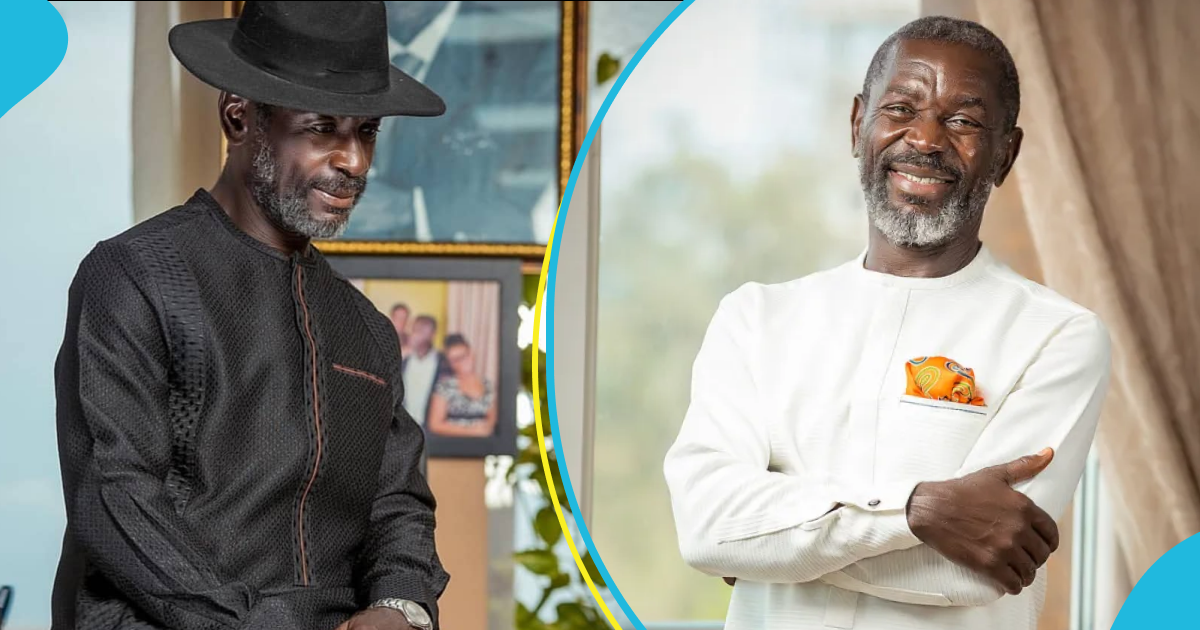
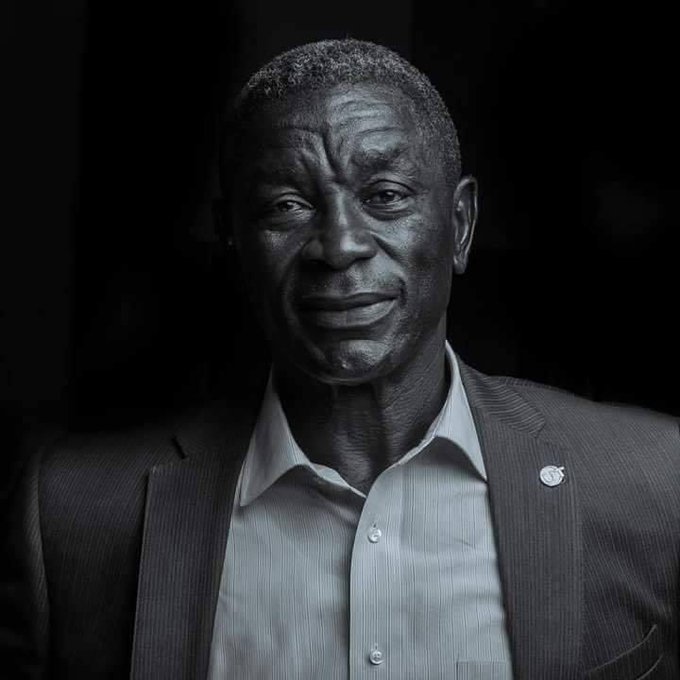
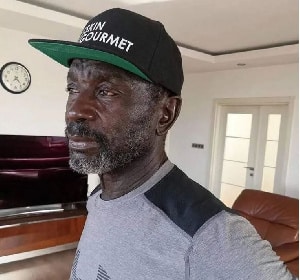
Board Chairman of Bills Micro-credit Limited, Richard Nii-Armah Quaye, has recognized Captain Prince Kofi Amoabeng, the founder of the now-defunct UT Bank.
Mr Quaye stated that Prince Kofi Amoabeng and his UT Financial Services granted him a loan of GH¢7,000 during the early phase of his business.
In his speech at the 15th anniversary celebration of Bills Micro-credit, previously known as Quick Credit, Richard Nii-Armah Quaye expressed his gratitude to Amoabeng for the financial support provided to his company.
“Captain, thank you so much. I want everyone to know that the first loan our company took was GH¢7,000 and it was from UT Financial Services”, he said, attracting applause from the audience.
Bills Micro-credit marked its 15th Anniversary on Thursday, May 20, with an elegant dinner at the Kempinski Gold Coast Hotel in Accra.
Charles Sampson, the overall best staff, was awarded a brand new Hyundai Tucson vehicle and a cash prize of GH¢200,000 by Bills Board Chairman, Richard Nii-Armah Quaye, in recognition of his long service and dedication.
Fourteen other employees of Bills Micro-credit, formerly Quick Credit, each received a brand new Toyota Vitz vehicle, while five selected workers were specially rewarded with a GH¢200,000 cash prize each.
Fifteen loyal customers of Bills were given 55-inch TV sets and interest-free loans of up to GH¢100,000 each.
Renowned business magnate Prince Kofi Amoabeng recently shared revealing details about his unique lifestyle, bragging that he had worn the same watch and shoe for more than 20 years.
In an exclusive Starr Chat conversation, Amoabeng revealed the fascinating backstory behind his timeless style choices with well-known radio host Bola Ray.
The former UT Bank CEO stunned listeners as he recounted his commitment to a single watch and shoe until a recent turn of events.
Amoabeng, now the brand ambassador for Caveman, explained how this new role prompted him to finally make a change in his long-standing accessories.
“I have been wearing the same watch and shoe for 20 years, but now I am the brand ambassador for Caveman, so I have changed it,” Amoabeng disclosed during the interview.
Delving into his financial journey, Amoabeng revealed a surprising decision he made during challenging times.
Struggling with the perception of success and wealth, he shared, “When things got tough, I sold my 8-bedroom house, which I felt I built by mistake. I had the money, so I felt I needed these things. When I was selling it, my friends were saying, ‘But Kofi, people will say you are broke,’ and I said exactly, I am broke.”
During the insightful conversation, Amoabeng also shed light on the complexities of wealth, expressing the challenges of identifying genuine friendships amid financial success. “When you have money, a lot of people gravitate towards you. It’s hard to tell who your real friends are, and that’s confusing,” he remarked, providing a unique perspective on the nuances of navigating prosperity and relationships.
Prince Kofi Amoabeng is a Ghanaian businessman and a former military officer of the Ghana Armed Forces.
He was a co-founder of UT Bank which collapsed in 2017 during Ghana’s banking crisis amid allegations that he had misappropriated funds from the bank.
The former Chief Executive Officer (CEO) of the collapsed UT Bank, Prince Kofi Amoabeng, reflects on his turbulent love and marriage experiences in an exclusive conversation with Starr FM.
He discloses two divorces and his promise to remain unmarried.
The 71-year-old entrepreneur likens his current stance on marriage to the United Nations, emphasising a desire to avoid a “third world war” in relationships.
Despite undisclosed details about his past unions and estranged relationships with his children, Amoabeng, who turns 72 in February, candidly shares that he currently has a girlfriend.
He disclosed this in an interview on Accra-based Starr FM, stating he is now like the United Nations.
“As for marriage, I am like the United Nations, after two world wars, we are doing everything possible to avoid the third,” he said.
It is not clear how many children the two marriages were blessed with but Mr Amoabeng in November 2021 disclosed he did not know the whereabouts of one of his sons.
According to him, they did not turn out the way he had anticipated, resulting in a severed rapport. However, the businessman who turns 72 in February says he has a girlfriend.
Prince Kofi Amoabeng is a Ghanaian businessman and a former military officer of the Ghanaian Armed Forces.
He was a co-founder of UT Bank which collapsed in 2017 during Ghana’s banking crisis amid allegations that he had misappropriated funds from the bank.
Former Chief Executive Officer of UT Bank and UT Holdings, Retired Captain Prince Kofi Amoabeng, has asserted that the government played a pivotal role in the collapse of UT Bank. Speaking on Starr Chat with Bola Ray on Thursday, January 25, 2024, Amoabeng outlined the circumstances surrounding the revocation of UT Bank’s license.
According to Amoabeng, at the time the government sought to revoke UT Bank’s license, he was actively in the process of bringing in investors. UT Bank, which was publicly listed on the Stock Exchange and boasted around 15,000 Ghanaian individual shareholders, faced a tumultuous period when the government decided to withdraw its license.
“UT was an iconic company for Ghanaians and we had an indigenous company that we could be proud of. We have won all kinds of awards including internal national awards,” he said.
He emphasized that the bank’s shares had value at the time the Bank of Ghana withdrew its license, and he believes the situation should have been addressed comprehensively. Amoabeng expressed his disappointment, stating.
“You killed it for what sake? So the issue is I don’t have the time to hate people and bear grudges, but as we sit here I am consumed by the passion to create leaders who are different. Leaders who will not look at the myopic thing but think about Ghana and Africa, that is what I am doing now.”
Highlighting the bank’s achievements, including national awards and a high ranking on the Ghana Club 100, Amoabeng argued that the decision to revoke the license was detrimental to the progress and reputation of the bank.
“We were number two at some point in time on Ghana Club 100, and a story I personally was invited to Oxford to share this idea, you don’t just kill it,” he asserted. “I am not talking about Kofi Amoabeng. I am talking about Ghana that we were able to build something that outside appreciate and will want to hear about, and you just killed it.”
Amoabeng concluded by expressing his dedication to nurturing leaders with a broader vision, ones who prioritize the well-being of Ghana and Africa. His comments shed light on the complexities surrounding the downfall of UT Bank and the broader implications for indigenous businesses in the country
During an interview on TV3’s The Day Show on November 2, 2023, Kofi Amoabeng mentioned that certain influential individuals within the Akufo-Addo administration, whom he referred to as ‘cockroaches’ driven by jealousy, used state institutions to target him and inflict harm.
He explained that while he was facing legal proceedings for alleged financial misconduct by the government, the court granted him permission to travel to the United States of America (US) for a medical examination.
However, according to him, powerful figures within the government manipulated state institutions to inform the US embassy that he posed a security risk, resulting in his prohibition from travelling for the medical check-up.
“I left the bank about 18 months before the bank closed. I’m in court now as we speak. I mean, 18 months, if there had been anything, it would have come out. Because there was a new MD (managing director) and the board was also functioning.
“I wanted to go for a medical check-up, and we went to court for them to release my passport to me. After up and down, up and down, the judge said, ‘I don’t see how I would keep his passport; let him go and check himself and come back because, after all, if he dies, the case would die’.
“I went to the American Embassy, and since I have been going to America since the 1980s, the embassy refused me an entry visa.
When I checked through the back doors, there was a letter from some government department saying I was a security risk,” he narrated.
Former Chief Executive Officer (CEO) of UT Bank, Kofi Amoabeng, has revealed that he left the bank 18 months before its collapse in 2017.
Speaking in an interview on TV3’s The Day Show on 2 November 2023, with host Bella Mundi, he said “I left the bank about 18 months before the bank closed. I’m in court now as we speak. I mean, 18 months — if there had been anything, it would have come out. Because there was a new MD (managing director) and the board was also functioning.” His detachment from the bank during its terminal phase was emphasised, hinting at his non-involvement in the ensuing financial debacle.
He revealed that although he was in court over the closure of the bank, he had nothing to hide.
On matters concerning his personal tribulations following the bank’s closure, Amoabeng revealed the legal challenges he faced just to obtain his passport for a medical check-up, “I wanted to go for a medical check-up, right? And we go to court for them to release my passport to me. After up and down, up and down, the judge said ‘I don’t see how I would keep his passport, let him go and check himself and come back because after all if he dies the case would die’.”
The struggle extended beyond the courtroom. Amoabeng narrated an incident that underscored his unexpected designation as a ‘security risk’ which led to the denial of an entry visa to the United States: “I went to the American Embassy, and I have been going to America since the 80s, the embassy refused me an entry visa. When I checked through the back door, there was a letter from some government department saying I was a security risk, or I shouldn’t be made to fly, even after the court had given me my passport,” he elucidated.
Amoabeng did not hold back on his views about the current state of political affairs and its impact on institutional integrity in Ghana. “What happens is that you have people who are envious, who are jealous, who are vindictive and they hide behind the institutions, they are like cockroaches actually, …so you will not see them, but you will know that they are causing havoc,” he expressed.
Further discussing the influence of government on state institutions, he said, “And it is also sad because the government when they come into power, they compromise the state institutions, all. They change all the heads and they put their puppets, or their cronies, or their cohort or whatever, and they can really make you uncomfortable if they want to. It is a matter of telling whoever you put there that, make the guy uncomfortable.”
Despite the adversities, Amoabeng‘s philosophical outlook remains unshaken. He shared his ethos on personal vendettas and the futility of hatred, “As I sit here, I still don’t hate anybody. I don’t have time, because I will be eating my own mind [up]. I don’t have it. So I only pray to God that whoever hates me, God should tone down on the punishment for the person. Because God loves me so if you hate me He will punish you. You should pray for your enemies. I pray for them, after all how much do you need.”
Amoabeng, who founded UT Bank in 1997, witnessed its rise to a significant player in Ghana’s banking sector. The bank’s journey came to an abrupt end in 2017 when the Bank of Ghana revoked its licence due to insolvency and capital deficiencies.
Beyond the financial loss, the closure impacted lives, leading to hardship among former employees — a sentiment Amoabeng reflects on with sombreness rather than bitterness. His recent book, “The UT Story: Humble Beginnings”, offers an introspective look at the bank’s narrative and its unforeseen end.
Founder of the now-defunct UT Bank, Capt. (rtd) Prince Kofi Amoabeng, in retrospection, has realised the decisions he made that led to the collapse of his financial institution.
Mr. Amoabeng was accused by the state of mishandling depositors’ cash by engaging in fictitious and unlawful activities which led to the collapse of UT Bank in 2017.
In that very year, he admits that his bank was not faring well at the time of the banking sector cleanup.
“The bank wasn’t doing that well at the time but the way the government acted, some banks were helped, some banks were closed. That is what irritates me,” he stated while citing political influence as reason for the ‘biased selection’.
In a recent interview on Kingdom FM, Prince Kofi Amoabeng noted that if given the opportunity to go back in time before the collapse of UT Bank, he would stay away from the actions that caused him his business.
He did not specifically name the exact actions he would stay away from as his submission was quite vague.
“Do you think if UT should be back to where it was and I go back, I would repeat those same mistakes? I won’t repeat the same mistakes. I know exactly the mistakes that I committed,” he said.
He made this submission while endorsing 2024 National Democratic Congress flagbearer, John Dramani Mahama, whom he saus is the best candidate to lead Ghana at this time, citing the experience he gained during his first term in office.
“…I look at President Mahama, and what I have to say about him is that we have never had somebody who has been president before becoming president again; it is only Mahama.
“And therefore, if you ask me, it is worth giving Mahama the chance because he has been there before.
Meanwhile, former President Mahama has noted that in his next administration, he would restore all financial institutions that were unfairly collapsed during the banking sector cleanup exercise.
Founder of the now-defunct UT Bank, Prince Kofi Amoabeng, has unveiled intriguing insights into his entrepreneurial journey and career development.
He recounted instances where he found himself in a battle for what he rightfully deserved when certain financial institutions, from which he aimed to secure loans, made irrational demands.
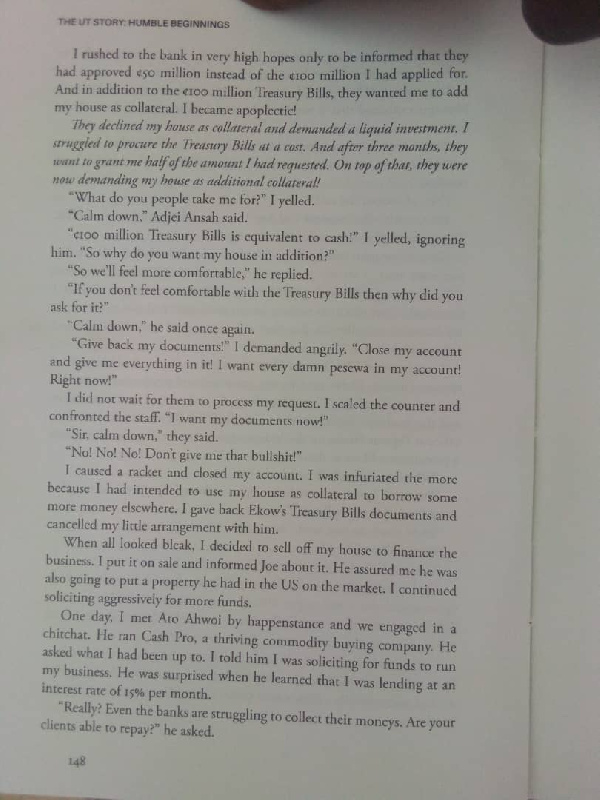
As disclosed in excerpts from his book titled “The UT Story – Humble Beginnings,” Amoabeng revealed that at a certain juncture, an undisclosed bank requested an investment in Treasury Bills of a specific value as collateral for him to obtain the desired loan amount.
Although he had initially proposed his property as collateral, the bank initially declined. Later, they approved only half of the requested amount, offering GHC 50 million instead of the GHC 100 million he sought. In addition, they demanded his house as extra collateral.
Frustration mounted, leading him to take an unexpected action: he leapt over the counter and demanded the closure of his account with the bank, insisting on retrieving all his funds.
“I rushed to the bank in very high hopes only to be informed that they had approved GHC 50 million instead of the GHC 100 million I had applied for. And in addition to the GHC 100 million Treasury Bills, they wanted me to add my house as collateral. I became apoplectic!
“They declined my house as collateral and demanded a liquid investment. I struggled to procure the Treasury Bills at a cost. And after three months, they want to grant me half of the amount I had requested. On top of that, they were now demanding my house as additional collateral!
“What do you people take me for? I yelled. [Calm down, Adjei Ansah said]. GHC 100 million Treasury Bills is equivalent to cash!] I yelled ignoring him. So why do you want my house in addition? [So we’ll feel more comfortable, he replied.] If you don’t feel comfortable with the Treasury Bills, then why did you ask for it?” he continued.
Amoabeng continued to recount, “I didn’t wait for them to process my request. I vaulted over the counter and confronted the staff, demanding my documents immediately. ‘Sir, please remain calm,’ they attempted to placate me. ‘No! No! No! Don’t feed me that nonsense!’ I created a scene and closed my account. I was even more furious because I had intended to utilize my house as collateral to secure additional funds from elsewhere.”
Ultimately, he returned the Treasury Bill documents he had obtained from a friend and sold his house to fund his business endeavors.
Below is a snippet of the page with the narration:
Founder of UT Bank, Prince Kofi Amoabeng, has revealed the circumstances surrounding how he learned about the takeover of his bank by the Bank of Ghana (BoG) in 2017.
During the period of the bank’s takeover, he was not actively involved in its operations. In subsequent interviews, he has maintained that the decision was partly politically motivated.
In a conversation on the Twitter podcast “Bro Code,” hosted by KalyJay, Amoabeng recounted the sequence of events that led him to the shocking news. It involved a series of missed calls and a call to his daughter, eventually leading to the revelation of the takeover.
“If you go to calls (on your phone), all the contacts you miss are red. I saw my whole phone was red. I thought I had pressed something. Then I checked and I had missed call numbering about 60.
“Then I said no, something is very wrong. Then I saw one of the missed calls was from my daughter and I called her and asked, ‘Awo, why is everybody looking for me?’ because I was very apprehensive…” he recounted.
His daughter directed him to listen in to the news because UT Bank was all over the media.
“And she said ‘haven’t you listened to the news this morning?’ I said no, she said go to any station, they are discussing the government’s decision to close UT Bank. I said ‘okay. Then it is done,” he added.
Meanwhile, the 2024 flagbearer for the National Democratic Congress (NDC) John Dramani Mahama has pledged to restore the licences of financial businesses who were run out of business unjustifiably should he win the next poll.
The former president made the promise while speaking at the University for Development Studies (UDS) in Tamale on Monday, May 15, 2023 to formally accept his role as flagbearer.
According to Mr Mahama, one of the objectives of the next NDC government will be to promote robust local participation in the banking and financial, telecommunication, tourism, mining, and agric and manufacturing sectors to grow the economy and create sustainable employment for the youth.
The banking crisis in Ghana led to the revocation of the licenses of more than 400 financial institutions that were licensed under the Act, 2016 (Act 930) by the Bank of Ghana (BoG) between 2017 and 2020.
The Central Bank conducted an Asset Quality Review of banks in 2015 and 2016, which identified several indigenous banks facing significant challenges.
These challenges included high levels of non-performing loans, undercapitalization, and weak corporate governance.
To address these issues, BEIGE, Sovereign, Construction, UniBank (owned by former Finance Minister Dr Kwabena Duffuor), and Royal Bank were merged to form a new entity known as the Consolidated Bank of Ghana.
Also, more than twenty financial institutions, including UT Bank which was owned by Prince Kofi Amoabeng, had their licenses revoked and given to a receivership.
Following the recapitalization of the banks and a new capital requirement, the number of banks in the country reduced from 36 to 23.
Ghana invested more than twelve billion Ghana cedis for this clean-up exercise in the banking sector.
In the trial of the former Chief Executive Officer of the now-defunct UT Bank Ghana, Prince Kofi Amoabeng, and others, fifth prosecution witness, Mr. Joseph Yeebo Sampana, provided significant evidence.
He revealed that three of Ghana Exim Bank’s investments with UT Bank were consolidated by GCB Bank, totaling GH¢25,877,825. Additionally, GCB Bank also assumed control of another investment worth GH¢5,133,728.80 that was previously held by UT Holdings.
Mr. Sampana, who serves as a treasurer with Exim Bank, submitted his witness statement on June 24, 2020, which was accepted as evidence without objection from the accused.
The five accused individuals in the trial are Johnson Pandit Asiama, the former Second Deputy Governor of the Bank of Ghana (BoG); Raymond Amantu, Head of Banking Supervision Department (BSD) at BoG; UT Holdings Limited, which held shares in UT Bank Ghana; Catherine Johnson, Head of Treasury; and Robert Kwesi Armah, General Manager of Corporate Banking, UT Bank.
The charges against the accused include willfully causing financial loss, abetment of crime, contravention of the Bank of Ghana Act, fraudulent causing of financial loss to the Republic, fraudulent breach of trust, deceit of public officer, and fabrication of evidence.
All of the accused individuals have pleaded not guilty to the charges and were granted bail with various conditions.
Mr. Sampana revealed that the GH¢5,133,728.80, previously with UT Holdings, initially represented an investment of GH¢4,475,246.05 with UT Bank.
He further informed the Court that Exim Bank only became aware of the transfer of the said amount to UT Holdings in the latter part of 2017, when it received a UT Holdings certificate of investment instead of a UT Bank certificate of investment.
Mr. Sampana also stated that UT Bank had engaged in business with Export Development Agricultural and Investment Fund (EDAIF) before EDAIF was converted into Exim Bank through Act 911 in March 2016. During that time, EDAIF operated as one of the Designated Financial Institutions (DFI).
“Based on the approval of Bank of Ghana for Exim Bank to operate as a DFI, Export Development Agricultural and Investment Fund (EDAIF) started giving out loans through UT Bank and when funds were placed with UT Bank, EDAIF was issued certificates of placement by UT Bank,” Sampana added.
During the trial, the witness disclosed that when GCB took over UT Bank, the management of Exim Bank and GCB convened to discuss an agreement. As per the proposal, GCB would assume control of all the investments Exim Bank had with UT Bank.
Under cross-examination by Counsel for the 3rd accused, UT Holdings Limited, the witness revealed that he had been an employee of Exim Bank for the past 13 years. He further disclosed that he is a qualified Chartered Accountant with 12 years of experience, having attended the University of Ghana where he studied Finance and Banking.
According to the witness, UT Bank had issued an investment certificate amounting to GH¢4,475,246.05, with an additional investment of GH¢4,703,548.25 made on January 30, 2017, and set to mature on May 1, 2017.
He clarified that the GH¢4,475,246.05 investment was rolled over upon maturity. However, Exim Bank later discovered that their investments with UT Bank had been transferred to UT Holdings after GCB’s takeover of UT Bank. The witness, however, was not aware of the exact date when the transfer of Exim Bank’s placement with UT Bank occurred.
Mr. Sampana explained that, at the time of the takeover by GCB, there was a balance remaining as a cost, as the initial amount was lower. Interest added to the amount eventually resulted in Exim Bank having GH¢4,703,548.25 as of August 2017.
He also stated that he possessed an investment certificate indicating the lesser amount before it appreciated to GH¢4,703,548.2.
In response to the Court’s request, the witness was ordered to produce all Exim Bank’s rollover certificates in his possession on the next adjourned date.
The case has been adjourned until October 17, 2023.
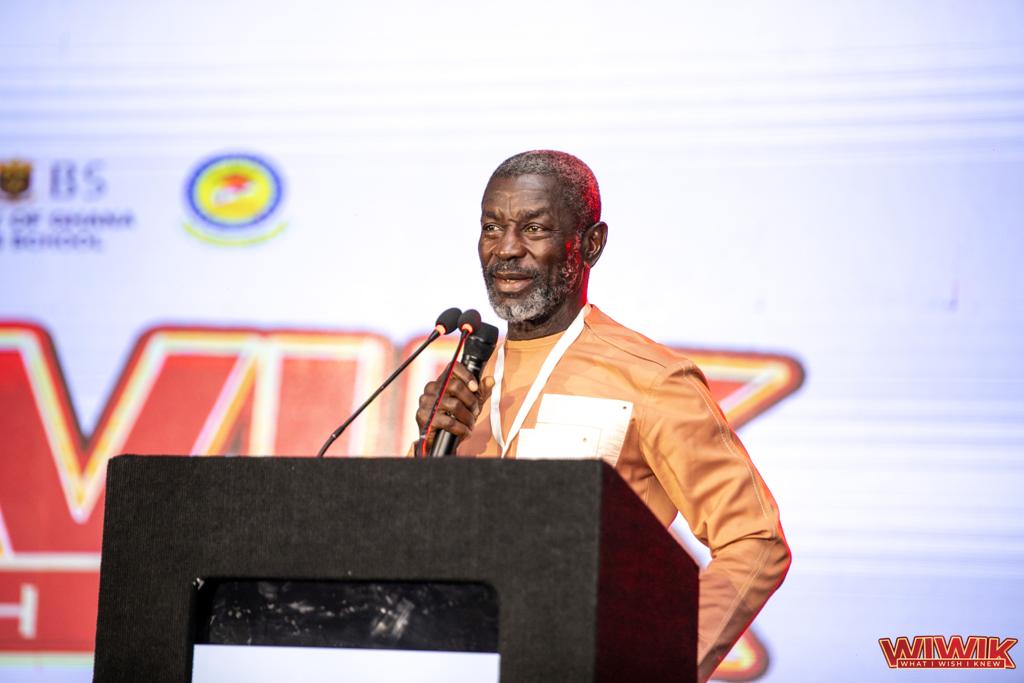
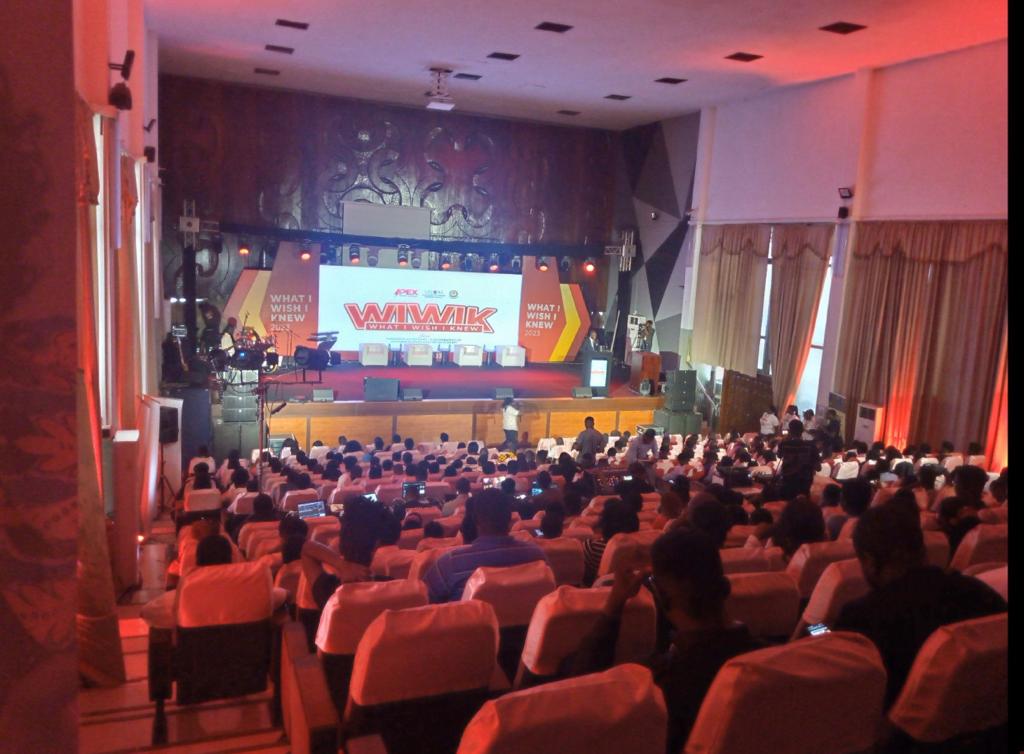
Former UT Bank Boss, Kofi Amoabeng delivered an inspiring speech during the 9th Edition of the What I Wish I Knew (WIWIK) Summit held at the University of Ghana.
He urged participants not to be afraid of failure but rather view it as an opportunity to bounce back even stronger.
In his address, Mr. Amoabeng highlighted some key factors that every entrepreneur must consider when starting and maintaining a business.
He emphasized the significance of managing family and friend relations, tradition, the church, and interactions with politicians. According to him, these factors play a critical role in the success of any business, and mishandling them can lead to various challenges.
Linking these factors to the UT Bank story, Mr. Amoabeng mentioned that “The problem I had with UT was that I was so hard I wasn’t doing either of these things”.
Advising upcoming entrepreneurs, he mentioned that “It is okay to be like me when you are small but when you come above the raider you must find a way around working with these people.”
The WIWIK Conference, held annually, has evolved into one of the most prominent personal development events on university campuses. Its primary objective is to enlighten, guide, and motivate final year undergraduate students.
This year’s conference featured Daniel Mckorley, the CEO of McDan, who shared his remarkable entrepreneurial journey with the participants. Distinguished panelists for this edition included Dr. Dennis Oteng, CEO of Ravens Consulting Gh, Prof. Carol Javis, a Professor in Knowledge Exchange and Innovation at Bristol Business School in the UK, Sammy Gyamfi, a prominent Politician, Audrey Naa Dei Kotey, Esq, FCCA, Managing Partner at Audrey Grey, and Chairperson of ACCA Ghana Network Panel, and Doris Ahiati, CEO of Crescendo Consult.
The event provided an excellent platform for students to learn from accomplished individuals, gain valuable insights, and be inspired to pursue their own paths to success.
This year’s conference was on the theme “Thriving in uncertainty; a conversation on intrapreneurship and entrepreneurship”.
Speaking to the media on the side, the convener of the WIWIK conference Dr. Bernard Tawiah mentioned that “These past years have been marked by shifting narratives and unexpected outcomes. During times of ongoing uncertainty, there is a constant need for everyone to deal effectively with disruption, adapt quickly to change and keep focused in order to succeed and thrive. This year’s conference has equipped our participants with a toolkit of simple, practical, evidence-based techniques that can apply in their intrapreneurship or entrepreneurship journey in these challenging times”.
McDan at WIWIK Conference 2023
During the WIWIK Conference, the keynote address was delivered by Hannah Ashiokai Akrong, the Human Resources Director of Vodafone Ghana. She emphasized the significance of nurturing an entrepreneurial spirit within organizations, coining it as “intrapreneurship.”
Akrong also highlighted the importance of creating an environment that fosters innovation and does not penalize failure. Dr. Dennis Oteng, CEO of Ravens Consult Gh, encouraged participants to prioritize the growth of their family businesses rather than solely seeking employment opportunities, especially given the challenges of the current business climate.
The WIWIK Conference was organized by the WIWIK Foundation, a non-profit organization, in partnership with the University of Ghana Business School, the Graduate Students Association of Ghana (GRASAG), and Crescendo Consult.
The 2023 edition of the conference was sponsored by Ravens Consulting Ghana, ACCA, Akosombo Textiles, MPA, Benchmark Professional Institute, and powered by Order Consult.
Founder of the now-defunct UT Bank, Prince Kofi Amoabeng, has counseled business owners to avoid specific groups of people if they want their enterprise to prosper and endure.
He asserts that it is necessary to keep away from pastors, legislators, traditional leaders, and families since they have the capacity to cause serious issues for the company that could ultimately result in its demise.
Speaking at the 25th-anniversary launch of Fairgreen Limited on July 26 in Accra, the former bank boss described these influencers as “necessary evils” which he believes must be handled with caution to avert business decline.
“Politicians and pastors are necessary evils because they can give you the right connections. However, they also need to milk you, and they can raise your company to a high status if you have the right relationships. But be careful. Don’t accept chieftaincy titles,” he advised.
He continued, “They will drain your finances and time, and you will be responsible for the expenses of durbars. These are the things that have set this country back. Make sure you don’t fall prey to any of them, whether it’s the church, chiefs, politicians, or your own families. You have to navigate carefully.”
In response to a question about the influence of family members on hiring methods, Mr. Amobeng advised business owners not to let that affect them.
“When you start a business, you are under the radar and can be a bit protective. But as you grow, you come under pressure. I call this pressure ‘dealing with the devil.’ You must deal with them. You can’t avoid them. Family, friends, and relatives will ask why you are always employing strangers when your family members are available. They want to kill the company. You need to be strong enough to fire them when they do something wrong. If you don’t have the will to fire them, don’t appoint them,” he urged.
In the meantime, the former head of a bank urged Fairgreen Limited management to keep creating an environment that is supportive of growth and longevity.
“You need to create a culture that is different from the Ghanaian culture. Ghanaian culture is generally one of laziness, pulling people down, disrespect, jealousy, trying to shift blame, and over-dependence on religion to the point that people don’t come to work. When you have a team, you must create a culture that will protect the company against these influences,” Amoabeng advised.
The University of Ghana has granted bail in the sum of GH $50,000 for the 18students who were detained for allegedly causing disturbances on campus.
The students were picked up last week by the Ghana Police Service following a clash on the University of Ghana campus on Tuesday, February 14, 2023.
The 18 were among aggrieved past and continuing students who stormed the University premises to protest Management’s new residential policy restricting continuing students from occupying the Commonwealth and Mensah Sarbah residential Halls to make way for level 100 and graduate students.
Subsequently, the students were put before an Accra Circuit Court and remanded into custody for unlawful conduct.
Appearing before Circuit Court 4 on February 20, the students were granted bail with two common sureties without justification.
Counsel for 16 of the 18 students, Albert Quashigah speaking after the court proceedings said the defense was only in court today to seek bail for the students which was granted.
“Our business today was only to apply for bail and the judge was generous and granted us the bail, and we are now taking steps to execute the bail that has been granted to us”.
Though he was optimistic, he feared the processes of the court may delay the bail execution and have the students released by the end of day today.
“This administrative process of the court can be a bit delayed, and we are hoping to execute the bail and have the students freed by the close of the day. It can take some time, but I am only hoping that we will be able to execute the bail to free these students, so they can return back to their studies,” Mr. Quashigah added.
Founder of the now-defunct UT Bank, Captain (rtd) Prince Kofi Amoabeng, has claimed that he is now poor, despite not being in need.
Speaking in a GTV interview on Friday, February 17, 2023, which was monitored by GhanaWeb, Kofi Amoabeng said that a lot of people think that he is still rich despite the fact that his bank collapsed some years ago.
He added that he lost all of his capital when the government shut down his bank, but he is able to get what to live on now.
“I don’t have wealth, I’m broke and Ghanaians should be happy, those who don’t like people who progress. It doesn’t make a difference because when I was whatever I was… I wore one shoe; I had one watch –this same watch. Now I still wear the same one shoe and one watch, so for me, it makes no difference.
“But Ghanaians tend to think I’ve got some wealth stashed somewhere because they are putting themselves in my shoes; they think if they were like me, if they had owned a bank then they would have a lot of money outside.
“But my wealth was in the bank and in the company; so, while the company and the bank were doing very well, I was worth a lot of money, but the bank went through losses, and so on, and so forth; therefore, my capital went with the bank. I think it’s not difficult to understand,” he said.
Dr. Johnson Asiama, a former second deputy governor, and Raymond Amanfu, a former head of the banking supervision department, have both been charged with wilfully inflicting financial loss to the state, according to the charge sheet submitted to the High Court.
Also, Head of Treasury of the UT Bank, Catherine Johnson; former Chief Executive Officer of UT Bank, Prince Kofi Amoabeng; and Robert Kwesi Armah, General Manager of Corporate Banking of UT Bank and UT Holdings – the parent company of UT Bank, have been charged with various offenses such as dishonest appropriation of US$7million and other deposits of customers and fraudulent breach of trust, among other charges.
The trial judge is His Lordship Justice Bright Mensah, a Justice of the Court of Appeal, sitting as an additional High Court judge.
So far, the prosecution has called Eric Nana Nipah, the Receiver of UT Bank (in receivership), Stephen Afotey, Registrar of the High Court (Commercial Division) and Stephen Antwi-Assimeng, a former Chief Executive Officer (CEO) of the defunct UT Bank to testify on its behalf.
In his testimony, the first Prosecution Witness, Eric Nana Nipah, informed the Court that several investments placed by various companies such as, SSNIT SOS Fund, Forestry Commission, ECG Staff Fund, WAICA-Re and the National Communications Authority with UT Bank were moved out to UT Holdings without proper authorization.
The second Prosecution Witness, Mr. Afotey, testified that an amount of US$7 million was deposited with UT Bank on the instructions of the Court. However, this amount could not be traced when UT Bank was taken over by GCB Bank.
In November, the Court heard the testimony of the third Prosecution Witness, Stephen Antwi-Assimeng, the Chief Executive Officer of UT Bank at the time of the revocation of its license. He testified that UT Bank was already on liquidity support from BoG at the time he joined the bank.
Mr. Antwi-Assimeng intimated that UT Bank relied heavily on borrowing from BoG to deal with its liquidity challenges.
In his testimony, Mr. Antwi-Assimeng indicated that UT Bank established letters of credit in the total sum of GH¢141million for some customers of the bank and these letters of credit were maturing in May and July of 2016. He further informed the Court that the customers did not provide funds for the Letters of Credit and neither did UT Bank have liquidity on maturity.
Testifying further, Mr. Antwi-Assimeng stated that the bank had situations where a number of international lenders were calling in their loans because UT Bank had defaulted and some of the loans had reached maturity.
He testified further that UT Bank was experiencing an average of GH¢40million loss of customer deposits, one of the bank’s key sources of liquidity. This, according to him, resulted in acute liquidity shortage, with UT Bank forced to pay higher interest rates to attract new depositors.
Proceeding further, Mr. Antwi-Assimeng informed the Court that UT Bank, on application to BoG, received liquidity support of GH¢460million with the instruction not to use any part of the additional liquidity support for unapproved purposes. He also informed the Court that the bank also applied to BOG for an unsecured liquidity support of GH¢30million.
He explained that UT Bank applied for the unsecured liquidity support because it did not have adequate securities to provide collateral for this facility.
The matter has been adjourned for further hearing in mid-December this year.
GhanaWeb Business understands that the proceedings will also impact former officials of the Bank of Ghana.
The charge sheet filed at the Accra High Court on February 5, 2020, named as accused persons Dr. Johnson Asiama; a former 2nd Deputy Governor of BoG, Raymond Amanfu; a former Head of the Banking Supervision Division (BSD) of BoG, Catherine Johnson; Head of Treasury of the UT Bank.
Others are Mr. Prince Kofi Amoabeng, a former Chief Executive Officer of UT Bank, Robert Kwesi Armah; General Manager of Corporate Banking of UT Bank and UT Holdings; the parent company of UT Bank.
The trial judge is His Lordship Justice Bright Mensah, a Justice of the Court of Appeal sitting as an additional High Court judge.
Dr. Asiama and Mr. Amanfu have been charged with willfully causing financial loss to the state, while Mr. Kofi Amoabeng and the other accused persons have been charged with various offenses such as dishonest appropriation of US$7 million and other deposits of customers, fraudulent breach of trust among other charges.
Eric Nana Nipah who is the first Prosecution Witness in his testimony told the Court that various investments placed by various companies such as, SSNIT SOS Fund, Forestry Commission, ECG Staff Fund, WAICA-Re and the National Communications Authority with UT Bank were moved out to UT Holdings without proper authorization.
He also testified that UT Holdings is not licensed to engage in such investment activities. The total amounts invested with UT Bank but transferred to UT Holdings without proper authorization is said to be GH¢51,334,387.08 and USD$8,799,917.
The second Prosecution Witness, Mr. Stephen Afotey, testified that an amount of US$7 million was deposited with UT Bank on the instructions of the Court.
This amount, he explained could not be traced when UT Bank was taken over by GCB Bank.
In November 2022, the Court heard the testimony of the third Prosecution Witness, Mr. Stephen Antwi-Assimeng who was serving as Chief Executive Officer of UT Bank at the time bank’s license was revoked.
The former CEO testified that UT Bank was already on liquidity support from BoG at the time he joined the bank. He intimated that UT Bank relied heavily on borrowing from BoG to deal with its liquidity challenges.
In his testimony, Antwi-Assimeng further indicated that UT Bank established letters of credit in the total sum of GH¢141 million, for some customers of the bank and added that these letters of credit were maturing in May and July of 2016.
He further informed the Court that the customers did not provide funds for the Letters of Credit and neither did UT Bank have liquidity on maturity.
Testifying further, Mr. Antwi-Assimeng stated that they had situations where a number of international lenders were calling in their loans because UT Bank had defaulted while some of the loans had reached maturity levels.
He also told the Court that UT Bank was experiencing an average of GH¢40 million loss of customer deposits, one of the bank’s key sources of liquidity. This, according to him, resulted in an acute liquidity shortage with UT Bank forced to pay higher interest rates to attract new depositors.
Proceeding further, Mr. Antwi-Assimeng informed the Court that UT Bank, on application to BoG, received liquidity support of GH¢460 million with the instruction not to use any part of the additional liquidity support for unapproved purposes.
He also told the Court that UT bank applied to BoG for unsecured liquidity support of GH¢30 million due to a lack of adequate securities to provide collateral for this facility.
Meanwhile, the matter has been adjourned for further hearing in mid-December 2022.
Captain (Rtd) Prince Kofi Amoabeng, the founder of the now-defunct Unique Trust Bank, has spoken out about how the banking sector clean-up exercise has affected his financial and personal life.
He claims that the demise of UT Bank and its consequences led him to sell off his mansion in order to keep from going bankrupt.
The former head of the UT bank revealed that he currently only had one pair of shoes and a watch to his name in an interview with Accra-based TV3.
“I have one watch and one shoe. So, I do not need much money. I don’t have to have a lot of money to enjoy life. I’m very comfortable. I live in an apartment. I sold my mansion to reorganise myself and for me not to go broke.”
“I’m not too much worried about people like me but I am worried about people who need validation and get so corrupt and do all sort of things that impacts the country and the younger generation negatively,” he added.
Following a recent image which went viral on social media, Prince Kofi Amoabeng said philanthropist and businessman, Seidu Agongo, offered to extend his benevolence to him when he appeared in images wearing an unusually scruffy beard.
The image however forced social media users to raise concerns over the health and well-being of the former UT bank founder.
The founder of the defunct UT Bank has disclosed the reason behind the selling of his mansion.
Capt. (rtd) Prince Kofi Amoabeng said he did that to prevent himself from getting broke.
Speaking in an interview with TV3 on Tuesday, October 4, he said he currently has just one watch and a pair of shoes.
However, Mr Amoabeng said he is comfortable with his current state.
“I have one watch and one shoe. So I don’t need much money. I don’t have to have a lot of money to enjoy life. I’m very comfortable.
“I live in an apartment. I sold my mansion to reorganise myself and for me not to go broke.
“I’m not too much worried about people like me but I’m worried about people who need validation and get so corrupt and do all sort of things that impacts the countryand the younger generation negatively,” he said.
Meanwhile, Capt. (rtd) Prince Kofi Amoabeng has also said a philanthropist and businessman, Seidu Agongo, offered to extend his benevolence to him when he appeared in images wearing an unusually scruffy beard.
Photo credit: GHbase.com
According to him, while other Ghanaians used those pictures to mock and laugh at him, Alhaji Agongo, contacted him on the quiet to ask if he could be of help in any financial difficulty that he might have found himself in.
He said this led to him forming a pleasant image of Mr Agongo’s personality, although he had not met him before.
“Actually, the reason why I could not say no to your invitation was because of Seidu Agongo’s personality,” he said.
“I have never set eyes on him but at some point in time, after the COVID-19pandemic hit, I started wearing this beard and I took a picture of myself and posted it on social media.
“That set tongues wagging that ‘I was on the verge of death’, ‘I’ am now a pauper,’ among other negative comments.
“But the boss of this place [CMG], Seidu Agongo, sent me a WhatsApp message that if I am in difficulty, I should send him my account number for him to give me some money.”
“Of course, I did not pursue it but I am ever so grateful that, at least, one Ghanaian thought that instead of laughing at him, let me help,” he added.
The founder of the defunct UT Bank has disclosed the reason behind the selling of his mansion.
Capt. (rtd) Prince Kofi Amoabeng said he did that to prevent himself from getting broke.
Speaking in an interview with TV3 on Tuesday, October 4, he said he currently has just one watch and a pair of shoes.
However, Mr Amoabeng said he is comfortable with his current state.
“I have one watch and one shoe. So I don’t need much money. I don’t have to have a lot of money to enjoy life. I’m very comfortable.
“I live in an apartment. I sold my mansion to reorganise myself and for me to get broke.
“I’m not too much worried about people like me but I’m worried about people who need validation and get so corrupt and do all sort of things that impacts the country and the younger generation negatively,” he said.
Meanwhile, Capt. (rtd) Prince Kofi Amoabeng has also said a philanthropist and businessman, Seidu Agongo, offered to extend his benevolence to him when he appeared in images wearing an unusually scruffy beard.
According to him, while other Ghanaians used those pictures to mock and laugh at him, Alhaji Agongo, contacted him in the quiet to ask if he could be of help in any financial difficulty that he might have found himself in.
He said this led to him forming a pleasant image of Mr Agongo’s personality, although he had not met him before.
“Actually, the reason why I could not say no to your invitation was because of Seidu Agongo’s personality,” he said.
“I have never set eyes on him but at some point in time, after the COVID-19 pandemichit, I started wearing this beard and I took a picture of myself and posted it on social media.
“That set tongues wagging that ‘I was on the verge of death’, ‘I’ am now a pauper,’ among other negative comments.
“But the boss of this place [CMG], Seidu Agongo, sent me a WhatsApp message that if I am in difficulty, I should send him my account number for him to give me some money.”
“Of course, I did not pursue it but I am ever so grateful that, at least, one Ghanaian thought that instead of laughing at him, let me help,” he added.
UT Bank founderPrince Kofi Amoabeng has expressed gratitude to businessman and philanthropist Seidu Agongo for being the only Ghanaian who offered to help him after a selfie of him with a raggedy beard and a sad face went viral on social media, leading Ghanaians to believe he was now a pauper on the verge of death as a result of the bank’s collapse.
Speaking to Nana Otu Darko on CTV’s breakfast show, Dwabre Mu, on Tuesday, 4 October 2022, Mr Amoabeng said the only reason he accepted an invitation to appear on the show was because the station belonged to Mr Agongo’s Class Media Group.
“Actually, the reason why I couldn’t say no to your invitation was because of his [Seidu Agongo’s] personality”, Mr Amoabeng told Nana Otu Darko, adding: “I’ve never set eyes on him but at some point in time, after the COVID-19 pandemic hit, I started wearing this beard and I took a picture of myself and I posted it on [social media] and that set tongues wagging that ‘I was on the verge of death’, ‘I’m now a pauper’, but the boss of this place [CMG], Seidu Agongo, sent me a WhatsApp message that if I’m in difficulty, I should send him my account number for him to give me some money”.
“Of course, I didn’t pursue it but I’m ever so grateful that, at least, one Ghanaian thought that instead of laughing at him, let me help”, he noted.
The Attorney General has been asked by the court to give all the evidence it intends to rely on in the case against the founder of the defunct UT Bank, Mr Prince Kofi Amoabeng, who is on trial in connection with the collapse of the bank.
Justice Philip Bright Mensah, a Justice of the Court of Appeal who sat as a High Court judge, ordered the AG on Thursday, 28 May 2020, to serve Mr Amoabeng and four others with all the necessary documents.
The Attorney General has up to June 22 to file the disclosures and serve them on the defence team.
Chief State Attorney Frances Mullen Ansah told the court on Thursday that his side was working to have the trial documents filed and served on the accused persons with the initial June 23 adjournment date in mind prior to the abridgement of time.
In February, Mr Amoabeng and five others were slapped with 42 charges by the state.
The charges came after an Accra Circuit Court on, Wednesday, 5 February 2020 dropped all the earlier charges against him.
The five others include Johnson Pandit Asiama (2nd Deputy Governor of the Bank of Ghana (BOG) between May 2016 and December 2017), Raymond Amanfu (Head of Banking Supervision Department (BSD) at BOG from 2014 to October 2017), UT Holdings Ltd. (company which held shares in UT Bank Ghana Limited (UT).), Catherine Johnson (Head of Treasury who had also acted as the Head of Corporate Banking of UT.) and Robert Kwesi Armah (General Manager of Corporate Banking of UT).
Police Prosecutor, ASP Emmanuel Nyamekye had earlier told the Circuit Court Judge, Emmanuel Essandoh that the state intended filing a fresh case against Mr Amoabeng at the High Court.
To this end, he said the trial of Mr Amoabeng at the Circuit Court was no longer necessary.
The businessman was arrested together with Mr Michael Nyinaku of the now-defunct Beige Bank and charged for mismanaging their banks which led to their collapse.