Lithuania’s military intelligence service has warned that Russia’s war against Ukraine, which was formerly only anticipated to last a few months, could continue for another two years.
Moscow still possesses a stockpile of Cold War-era weaponry, according to the secret agency, which it might deploy to “do enormous damage” to Ukraine.
Elegijus Paulavicius, the head of military intelligence, told reporters that Russia had been acquiring weapons and equipment throughout the lengthy Cold War.
‘We estimate that (its) resources would last for another two years of a war of the same intensity as today.’
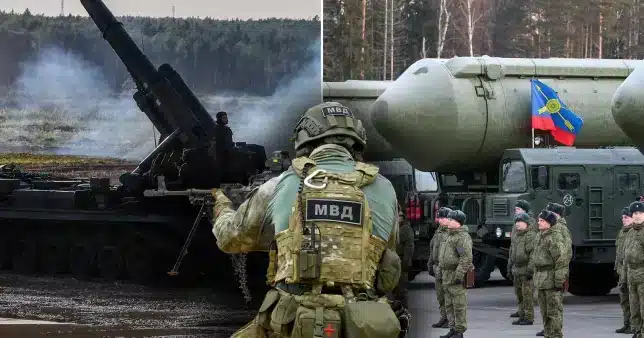
Western officials have struggled to put a number on how much equipment Russia has (Picture: TASS)
Paulavicius, the head of the Second Investigation Department, added that the agency’s figure is based on Russia receiving no support from other countries.
‘How long Russia is able to wage the war will also depend on the support for Russia’s military from states such as Iran and North Korea,’ he said, Reuters reported.
Fears are already mounting that China could provide Russia with ‘lethal’ weapons, while Iran has long faced accusations of sending the country drones.
The colonel’s estimate is in contrast to the Pentagon’s which last year expected the conflict to peter out this year as Russia’s equipment wears out.
Paulavicius was speaking in Vilnius as he announced a new report that suggested support in Russia for the war ‘is not as big as the regime’s propaganda tried to make it seem’.
‘Dissatisfaction with the regime’s policies is currently taking a passive form: mostly avoiding mobilisation, complaining about poor provision and disarray in the army,’ the document said.
Whether or not Russia’s allies – or those claiming impartiality – hand Vladimir Putin more weapons could be a game-changer (Picture: AP)
If Vladimir Putin issues another mobilisation decree or suffers even more losses on the battlefield, this ‘would have negative consequences for the stability of the regime’.
Data on how much weaponry and equipment Russia has is slim. One estimate places the monetary value of it all at more than $17,500,000,000.
It’s unclear how many military aircraft, helicopters, tanks, boats and other vehicles the Kremlin has at its disposal. Though the monitoring group UAWAR places the number of artillery systems Russia has at 10.
Russia has lost about half of its total number of modern tanks in the past year of the war, the International Institute for Strategic Studies estimated last month.
Though, the military think-tank said Russia still has thousands of older tanks in storage ready to be deployed.
The President of the Russian Federation, Vladimir Putin, has congratulated President Akufo-Addo and Ghanaians on the country’s 66th Independence Day celebration.
In a letter addressed to Ghana’s President, Akufo-Addo, Putin wished him (Akufo-Addo) good health and success and Ghanaians peace.
The Russian President also said that he hopes that the relationship between Ghana and Russia will continue to grow.
“Please accept my sincere congratulations on the occasion of the National Holiday of the Republic of Ghana – the Independence Day!
“I am confident that the traditionally friendly relations between Russia and Ghana will continue to develop for the sake of our peoples, contributing to a stronger security and stability on the African continent.
“I wish you good health and every success, and all the citizens – peace and wellbeing,” Putin said in his letter.
Meanwhile, Ghana voted in favour of a United Nations General Assembly resolution demanding that Russia leaves Ukraine, where it has in the last year waged a war against Kyiv’s plan at the time to join the Euro-military bloc, NATO.
Ghana was one of 141 nations that voted ‘IN FAVOUR’ of the resolution with 7 countries voting ‘AGAINST’ and 32 ‘ABSTENTION.’
A UN statement after the vote read: “The results were 141 member states in favour and seven against – Belarus, the Democratic People’s Republic of Korea, Eritrea, Mali, Nicaragua, Russia and Syria. Among the 32 abstentions were China, India and Pakistan.
Akufo-Addo has also stated that Ghana was against Russia’s occupation of Ukraine and the use of African countries as training grounds for foreign powers, particularly Russia.
“Apart from not accepting the idea of great powers once again making Africa their theatre of operation, we have a particular position that you know about over the Ukraine war, where we have been very, very vocal and up front about condemning the invasion of Ukraine by Russia,” he said at a meeting in Washington with officials of the US government, including Secretary of State Anthony Blinken, on Thursday, December 15, 2022.
In response to an alleged Ukrainian sabotage gang that has “taken hostages” in Russia, Vladimir Putin is anticipated to convene a meeting of his national security council today.
Unverified reports out of Moscow claim that up to 50 Ukrainians crossed the border in the Bryansk area.
‘An armed group of Ukrainian nationalists’ had penetrated, according to the Federal Security Service, which said in a statement to Russian news media that both its own forces and the army were attempting to exterminate them.
Some disinformation experts have already branded this as propaganda on Twitter, and a ‘possible false flag operation and disinformation campaign’ coming from the Kremlin.
Mykhailo Podolyak, adviser to Volodymyr Zelensky, also stressed this was ‘classic deliberate provocation’ from the invader.
In a statement on Twitter, he said: ‘Russia wants to scare its people to justify the attack on another country and the growing poverty after the year of war.
‘The partisan movement in Russia is getting stronger and more aggressive. Fear your partisans.’
Details remain unclear, but Bryansk governor Alexander Bogomaz said they had shot and killed one person.
‘Today, a Ukrainian sabotage and reconnaissance group penetrated the Klimovsky district in the village of Lubechanye,’ Bogomaz said on his Telegram channel.
‘Saboteurs fired on a moving car. As a result of the attack, one resident was killed and a 10-year-old child was wounded.’
He said Ukrainian armed forces had launched a drone attack and fired artillery shells at other areas near the border.
The state-owned RIA Novosti news agency reported on its Telegram channel that Kremlin spokesperson Dmitry Peskov said that Putin cancelled a planned trip to Stavropol ‘due to the situation in the Bryansk region’.
The president told the FSB this week that it needed to step up its guard against espionage and what he called terrorist threats emanating from Ukraine and the West.
‘Your task is to put a barrier in the way of sabotage groups, to stop attempts to illegally transport weapons and ammunition into Russia,’ he said in a speech on Tuesday.
According to reports, Vladimir Putin lives with his gymnast girlfriend on a sizable, closely secured country estate with a number of opulent residences and a playground for their young children.
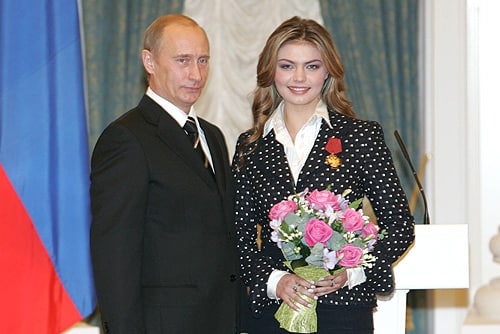
Per the Russian investigative news website, The Project, Alina Kabaeva, a 39-year-old Olympic rhythmic gymnastics champion who has long been associated with the 70-year-old Russian president, resides in a villa on Putin’s estate on Lake Valdai, about 250 miles north-west of Moscow.
According to the website, the Russian president allegedly used a slush fund in Cyprus to purchase his lover a property empire worth $120 million (£100 million).
According to The Project, Ms. Kabaeva’s mansion’s construction started in 2020 and was finished in 2021.
At nearly 13,000 square feet, the mansion was built entirely of wood in the style of a Russian dacha. Construction was carried out by a company owned by Yuri Kovalchuk, the Russian businessman also known as “Putin’s banker”.
Ms Kabaeva’s ruby-studded chandelier
Unnamed officials told The Project they had seen children on the premises, and satellite images taken between 2016 and 2020 showed a playground in the woods believed to have been built for the family.
The area has been frequented by Ms Kabaeva’s distant female relatives, described as her chaperones in leaked train manifests. The chaperones also reportedly own properties in the area.
The house where Ms Kabaeva is said to live is located just 800 metres (2,640ft) from Valdai, Putin’s best-guarded and most private residence, where he almost never holds public meetings.
Photographs of that mansion, leaked by a construction executive who worked around the house until 2005, showed opulent interiors reportedly inspired by Putin’s love for his hometown of St Petersburg and its eighteenth-century Hermitage Museum.
One image purportedly shows the president’s study bedecked with ornate mahogany furniture and featuring the secure landline phones used by top Kremlin officials.
In another room, gilded chairs can be seen arranged around a glass table and a spherical chandelier, with golden leaves hanging from the ceiling.
Room with gold chairsPutin’s bedroom
Guests to the house were encouraged to reach out and take one, the contractor claimed. Another photo appears to show a massive chandelier decorated with rubies.
The existence of the villa was first reported in 2021 by the team of Alexei Navalny, the jailed Russian opposition leader, who claimed that budget funds were used to lease the property from Mr Kovalchuk, the businessman.
Both the Russian president and Ms Kabaeva have repeatedly denied that they are in a relationship.
Unnamed officials who attended Putin’s private parties said they had never seen the two together but they have no doubt that they have a relationship, saying that only top-ranking officers in the president’s security detail were aware of the details of their arrangement.
In another sign of her proximity to Putin, Ms Kabaeva was, in 2014, appointed to lead Russia’s National Media Group, a sprawling media holding owned by Mr Kovalchuk, despite having no relevant experience. The position provides her with an annual income of about £8.6 million.
A swimming pool
The investigation drew on documents provided by an unnamed whistleblower described as an executive in the “business empire of one of the president’s closest friends” who was directly involved in managing a Cyprus-based company used as a slush fund for the president.
The whistleblower contacted the journalists as he was outraged by Russia’s invasion of Ukraine and said the Russian regime “must be stopped”.
Documents reviewed by The Project revealed how Putin’s close friends and their companies were pumping money into Ermira, the Cypriot company, which was later used to buy luxury estate and provide for the needs of Putin and his family.
The Russian leader was also accused of racking up profits from the sale of a popular vodka brand named after him that appeared on the market in the early 2000s. Property rights to the vodka were repeatedly transferred between his childhood friend Arkady Rotenberg and the Cyprus-based company.
The vodka sales alone would have earned Putin at least half a million dollars between 2004 and 2019, according to The Project’s estimates.
Known for her secretive lifestyle, Ms Kabaeva was revealed as the owner of a number of other luxury properties across Russia, including a penthouse in Sochi on the Black Sea which is believed to be the biggest apartment in Russia.
While the apartment was briefly on sale, 3D visualisations available online showed its over-the-top luxurious interiors such as a dining room with marble floors and walls and gilded bannister rails on the stairs between the floors.
The gymnast’s properties were registered in the name of her relatives, including her elderly grandmother.
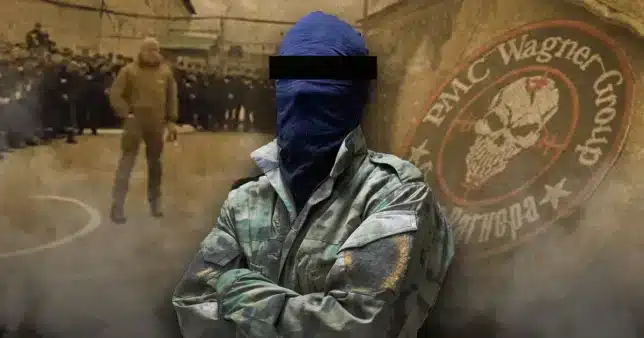
Russian mercenaries who were captured have exposed the lies they were given as inducements to join Vladimir Putin’s war in Ukraine.
Victor and Anatoliy were both incarcerated for a long time in Russia until recently, the one for the murder of a Chechen guy and the second for fighting.
That is, until Yevgeny Prigozhin, called “Putin’s chef,” arrived by helicopter at their prisons and made a promise to wipe their records clean and pay them £2,200 per month.
They were parachuted to the frontline as Wagner Group fighters after six weeks of ‘very tough training’ with assault rifles, machine guns and mines.
They spoke about being thrown into the horrors of war, seeing comrades slaughtered as worthless cannon fodder ahead of the Russian Army ahead of the one-year invasion anniversary tomorrow.
Viktor, a dad-of-two from Stavropolsky region in Kavkaz, said: ‘We were told other countries were involved in the war in Ukraine, including Britain, and that we were defending Russia against foreign terrorists.
‘We were told we would not
be fighting civilians, but fascists and soldiers from other countries.’
Soldiers reportedly linked to Wagner Group are said to be fighting with Assad’s forces in Syria The head of the Wagner mercenary group, Yevgeny Prigozhin, speaks to prisoners in Mariy El Republic
In total, about 200 men in his prison agreed to join the Wagner Group, with hopes of ‘a fresh start’ after the war in Ukraine is won.
After signing up in September last year, Viktor told the Mirror he was taken by bus to Rostov, near to Ukraine, and then to Luhansk, in Donbas,
‘With a criminal record I would not be able to get a job, and I felt I had no choice, even though it took a week for me to decide to join Wagner,’ the ex-builder said.
‘We would be sent in groups of 15 against what they said were just ten Ukrainian soldiers, then we’d discover there were up to 40 Ukrainians.’
Viktor described what was happening on the frontline of the war as ‘shocking and horrible’, detailing how he would see ‘arms and legs being shot off in battles’.
Like Viktor, Anatoliy was also captured by the Ukrainian Army while fighting as a mercenary for the influential group.
He had 18 months left on his three years and six-month sentence for brawling when Prigozhin flew into his prison looking for recruits.
Yevgeny Prigozhin gave a terrifying speech to prisonersA soldier wearing a patch bearing the Wagner Group’s insignia
The car mechanic, from Samara, central Russia, described the oligarch as a ‘serious man’.
Again like Viktor, Anatoliy said he was not told where he was being deployed to, but he ‘understood we would fight in Ukraine’.
‘We were doing full-scale attacks and I was in five big battles and Wagner Group was always ahead of the Army,’ he said.
Anatoliy was captured by Ukrainian forces after he and his Wagner comrades were sent into a battle against Kyiv’s forces in Donbas.
He said: ‘Eventually I was alone, pinned down by Ukrainian forces. Wagner Group sent in another detachment of ten men and the sniper killed five of them.
‘I was lying there with no more ammunition, a Ukrainian soldier standing above me with a machine gun. He fired into the ground near my legs as a warning. I was then taken prisoner unharmed.’
Wagner Group consists of around 50,000 soldiers largely recruited from Russian prisons.
China has categorically denied the US’s suggestion that it is considering giving Russia arms and ammunition for the Ukraine conflict.
According to last week’s remarks by US Secretary of State Antony Blinken, American information indicates Chinese companies may provide ‘lethal support’ to the Kremlin.
Beijing quickly brushed aside the suggestion as false and accused Washington of ‘finger-pointing’.
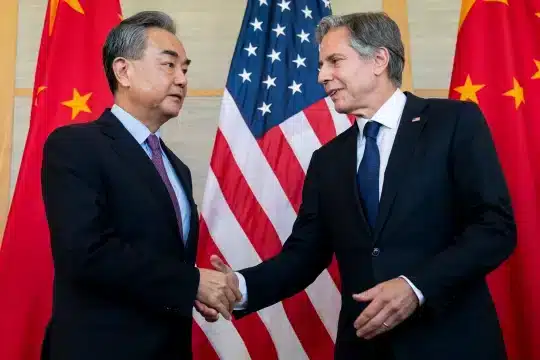
Antony Blinken and China’s top foreign diplomat, Wang Yi (Picture: AP)
But whether this will happen is not clear-cut, Bill Browder, once the largest foreign investor in Russia and now an outspoken Kremlin critic, told Sky News.
‘Russia used to be a big arms exporter but they’re in such bad shape they’ve had to go to the only two countries that are so sanctioned they don’t care – North Korea and Iran.
‘If China were to enter the game and give them weapons, that would be a game-changer for Russia. That would be terrible for Ukraine and it could lead to a third world war.’
But Browder raised his eyebrow at the likelihood of China actually flogging military supplies to Russia, stressing the nation ‘survives off of selling stuff’.
‘To us and many other people, if they all of a sudden were doing this nasty killing of Ukrainians – if we see an unexploded Chinese missile on the ground of Ukraine – that’s gonna lead to many people’s call for sanctions, economic counter-measures,’ he said.
Western officials have become increasingly concerned over China siding with Russia and arming the nation (Picture: AP)Russian President Vladimir Putin met with Wang Yi this week
‘And does China really want that, when that’s their economy? What’s in it for them, other than poking NATO, America and the UK in the eye.’
Browder said he isn’t surprised ‘at all’ the war is still dragging nearly a year on, with the one-year anniversary of the invasion tomorrow.
Now a brutal, bloody slog, the chief executive of Hermitage Capital Management said: ‘Neither side has any incentive to compromise in any way – Putin can’t.
‘For him, compromise or negotiation is a sign of weakness and weakness would mean putting him at risk of losing his power.
‘He’s committed so many gross atrocities, murders, rape, destruction of territory, that the Ukranians have no willingness to negotiate either.
‘So both sides are going to fight on.’
China has said it is an ‘impartial position’ over the Russia-Ukraine war
With neither side having a ‘military advantage’ over the other, Browder said he expects the war to keep ‘grinding on and on and on’.
‘It will go on until one side collapses or the other side collapses,’ Browder said, adding that Ukrainian soldiers could ‘physically’ push Russia out of the country to end the conflict.
That is why support for Ukraine from world leaders is both powerful and fragile, he said, noting that a simple change of government in the US could completely upend the playing field.
‘I can imagine we’ll be sitting here a year from now having the same conversation,’ Browder added.
Putin warmly welcomed China’s top foreign policy official, Wang Yi, to Moscow yesterday in a clear sign the Kremlin is keen to keep Beijing in its corner.
‘Our relations have never been directed against third countries,’ Wang told Putin, per reports. ‘Our relations have withstood pressure from the international community and are developing very stably.’
The Russian president earlier said he was looking forward to meeting with his ‘friend’ Xi Jinping, the Chinese leader, in Russia soon.
Bill Browder said he is not surprised that Putin’s war has stretched out for nearly a year (Picture: Getty Images)
Though, Wang met with Putin after a week-long tour of western Europe in which he insisted to European leaders China is not supporting the president’s invasion.
The office of French President Emmanuel Macron said the two discussed the war, agreeing they had ‘the same objective of contributing to peace in line with international law.’
Amid fears of the war escalating, Blinken told Mega TV on Tuesday: ‘Well, we are certainly not talking about World War III.
‘And what we want to do is not to broaden this war in any way but hopefully, bring it to an end.
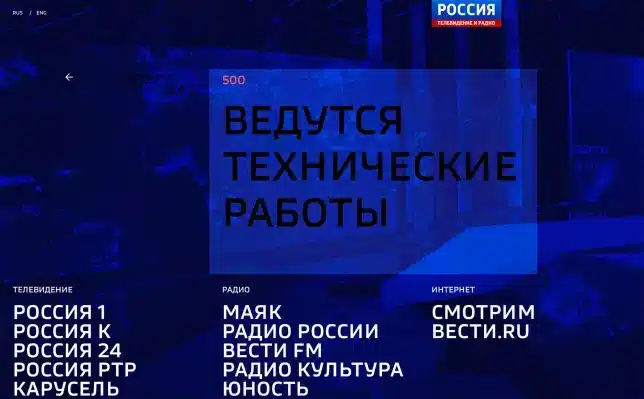
State-run RIA Novosti news agency said the outage was caused by a distributed denial of service attack.
Radio Mayak – also blocked – said the web channels were hit by hackers.
Before the speech started, state TV broadcast a segment showing technical preparations, saying the live stream would be carried across all major networks.
In his rambling address to the country, Putin claimed he ‘didn’t start the war’, referring to it as a ‘special military operation’.
He claimed Ukrainians have been waiting for his troops to ‘come to their help’ and that the West released a ‘genie in a bottle.’
The screen announced ‘Mistake 500’ (Picture: RossiyaTV/e2w)Putin said the West ‘started the war’ in the address to the nation (Picture: AP)
‘They started the war and we used the force to stop it,’ he said.
Putin repeatedly addressed the situation in the Donbas region – where vast areas are controlled by Russian separatist groups as a result of the war.
In his speech, he continued: ‘Step by step, carefully and consistently, we will resolve the tasks facing us.
‘Since 2014, the [people of the] Donbas had been fighting, defending their right to live on their own land, to speak their native language.
Putin: Ukraine started the war, West have kept it going
A family watches the broadcast of Vladimir Putin’s address in Moscow (Picture: AFP)
‘They fought and did not give up in the conditions of blockade and constant shelling, undisguised hatred on the part of the Kyiv regime.
‘We patiently tried to negotiate a peaceful way out of this most difficult conflict, but a completely different scenario was being prepared behind our backs.’
It is thought that just before the visit, Russia was made aware of Mr. Biden’s presence in Ukraine.
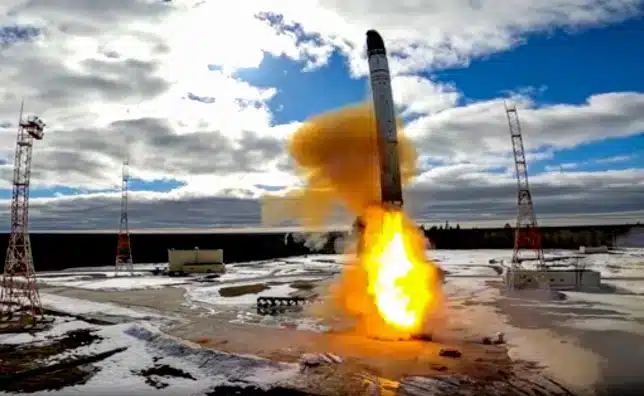
Vladimir Putin reportedly observed an ICBM test for the Satan II, which is believed to have failed, when he was in the city.
The missile is capable of delivering multiple nuclear warheads and is believed to have a range of almost 7000 miles.
According to American reports, the test launch was not considered an escalation of the conflict.
The weapon was also tested in April, mere weeks after Russia invaded Ukraine.
Volodymyr Zelenskiy and Joe Biden walk outside the Mariinskyi Palace (Picture: Reuters)The US President made the surprise trip ahead of the first anniversary of Russia’s invasion of Ukraine (Picture: APAImages/Shutterstock)
Mr Biden is yet to comment on the reported missile launch during his visit in Ukraine.
He had since travelled to Poland to praise allies in Europe.
The President warned of ‘hard and bitter days ahead’ but vowed that the US and allies ‘will not wave’ in supporting the Ukrainians.
‘One year ago, the world was bracing for the fall of Kyiv,” he said before a crowd of thousands outside Warsaw’s Royal Castle.
Both Russia and the US have an variety of deadly weapons at their disposal (Picture: Kevin OReilly/Dailymail.com)
‘I can report: Kyiv stands strong. Kyiv stands proud. It stands tall and, most important, it stands free.’
With Russia and Ukraine preparing spring offensives, Mr Biden insisted there will be no backing down from what he has portrayed as a global struggle between democracy and autocracy.
However, polling suggests American support for ongoing military assistance appears to be softening.
Earlier in the day, Mr Biden with Polish President Andrzej Duda as he began consultations with allies to prepare for a new phase of the war.
Joe Biden delivers a speech marking the one-year anniversary of the Russian invasion of Ukraine, at the Royal Castle Gardens in Warsaw. (Picture: AP/ Evan Vucci)Meanwhile, Vladimir Putin addressed the masses in Russia yesterday and claimed he didn’t start the war (Picture: AP)
Mr Duda praised the American president’s visit to Kyiv as ‘spectacular’, saying it ‘boosted morale of Ukraine’s defenders’.
He said the trip was ‘a sign that the free world, and its biggest leader, the president of the United States, stands by them’.
Mr Zelensky has been pushing the US and European allies to provide fighter jets and long-range missile systems known as ATACMS – which Mr Biden has declined to provide so far.
Yesterday, Putin made an appearance in Moscow to give a speech to Russians.
He claimed he ‘didn’t start the war’ in a rambling address that lasted near to two hours.
A selection of cabinet minsters, deputies and senators were all in attendance as the address is broadcast across the world.
Putin referred to the war as a ‘special military operation’ and referred to the situation in Ukraine as a ‘military coup’.
He claimed Ukrainians have been waiting for his troops to ‘come to their help’ and that the West released a ‘genie in a bottle.’
Putin said: ‘They started the war and we used the force to stop it.”
‘They spent $150bn to support militarily Kyiv’s regime.’
He went on to tell the audience each Russian has a ‘great responsibility’ to ‘protect our people on our historic land.’
Vladimir Putin, the president of Russia, announced that he is suspending his nation’s participation in the New START nuclear weapons reduction treaty with the United States, putting the final surviving agreement that governs the two greatest nuclear arsenals in the world in jeopardy.
The statement was made by Putin on Tuesday during his much-delayed annual state of the country address to the Russian National Assembly.
The deal places restrictions on how many deployed intercontinental nuclear warheads the US and Russia can each possess. The two parties would soon need to start talks on a new arms control pact because it was last renewed in early 2021 for five years.
Under the key nuclear arms control treaty, both the United States and Russia are permitted to conduct inspections of each other’s weapons sites, though inspections had been halted since 2020 due to the Covid-19 pandemic.
While Russia is not withdrawing from the pact completely, it appears to be formalizing its current position. For months, US officials have been frustrated over Russia’s lack of co-operation with the agreement.
According to US officials, Russia has continually refused to allow inspections of its nuclear facilities. “Russia is not complying with its obligation under the New START Treaty to facilitate inspection activities on its territory,” a US State Department spokesperson said in January.
“Russia’s refusal to facilitate inspection activities prevents the United States from exercising important rights under the treaty and threatens the viability of US-Russian nuclear arms control,” the spokesperson said.
A session of the Bilateral Consultative Commission on the treaty was slated to meet in Egypt in late November but was abruptly called off. The US has blamed Russia for this postponement, with a State Department spokesperson saying the decision was made “unilaterally” by Russia.
The latest development announced by Putin “puts (the) treaty on life support,” Hans Kristensen, the Director of the Nuclear Information Project, wrote on Twitter, questioning whether Russia will now stop exchanging data with US counterparts.
Putin’s nuclear saber rattling during the war has alarmed the US and its allies, though officials have repeatedly dismissed the moves as empty threats.
In December, Putin warned of the “increasing” threat of nuclear war, and this month, Dmitry Medvedev, deputy head of Russia’s Security Council, threatened that Russia losing the war could “provoke the outbreak of a nuclear war.”
“Nuclear powers do not lose major conflicts on which their fate depends,” Medvedev wrote in a Telegram post. “This should be obvious to anyone. Even to a Western politician who has retained at least some trace of intelligence.”
And though a US intelligence assessment in November suggested that Russian military officials discussed under what circumstances Russia would use a tactical nuclear weapon in Ukraine, the US has not seen any evidence that Putin has decided to take the drastic step of using one, officials told CNN.
Prior to Russia’s invasion of Ukraine, Boris Johnson has made claims that Vladimir Putin called him and threatened him with a missile strike in a “extraordinary” conversation.
The then-prime minister said Mr Putin told him it “would only take a minute”.
Mr Johnson said the comment was made after he warned the war would be an “utter catastrophe” during a “very long” call in February 2022.
Details of the exchange are revealed in a BBC documentary, examining Mr Putin’s interactions with world leaders.
Mr Johnson warned Mr Putin that invading Ukraine would lead to Western sanctions and more Nato troops on Russia’s borders.
He also tried to deter Russian military action by telling Mr Putin that Ukraine would not join Nato “for the foreseeable future”.
But Mr Johnson said: “He threatened me at one point, and he said, ‘Boris, I don’t want to hurt you but, with a missile, it would only take a minute’ or something like that. Jolly.
“But I think from the very relaxed tone that he was taking, the sort of air of detachment that he seemed to have, he was just playing along with my attempts to get him to negotiate.”
President Putin had been “very familiar” during the “most extraordinary call”, Mr Johnson said.
It is impossible to know if Mr Putin’s threat was genuine.
However, given previous Russian attacks on the UK – most recently in Salisbury in 2018 – any threat from the Russian leader, however lightly delivered, is probably one Mr Johnson would have had no choice but to take seriously.
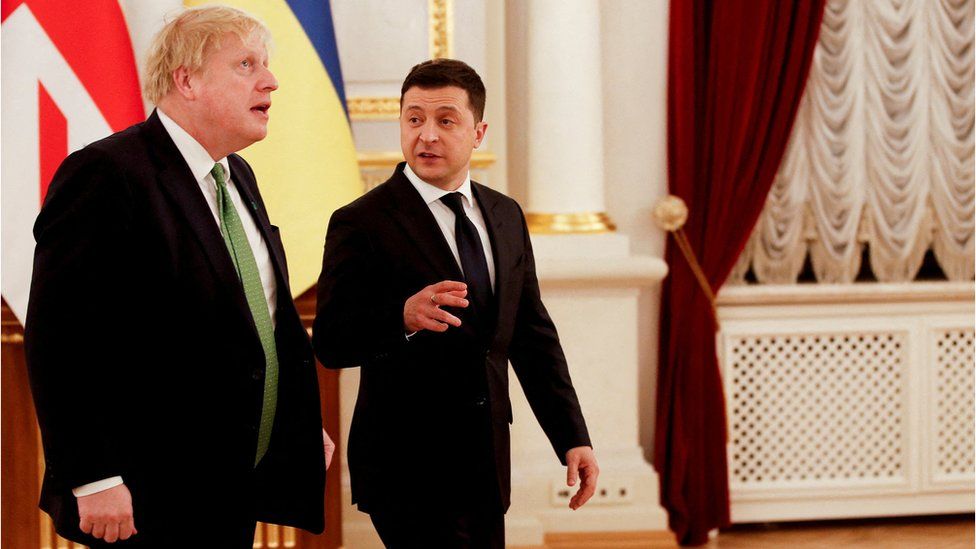
Image caption,Boris Johnson received a call from President Putin the day after he met Volodymyr Zelensky in Kyiv
Nine days later, on 11 February, Defence Secretary Ben Wallace flew to Moscow to meet his Russian counterpart, Sergei Shoigu.
The BBC documentary Putin Vs the West reveals Mr Wallace left with assurances that Russia would not invade Ukraine, but he said both sides knew it was a lie.
He described it as a “demonstration of bullying or strength, which is: I’m going to lie to you, you know I’m lying and I know you know I’m lying and I’m still going to lie to you.
“I think it was about saying ‘I’m powerful’,” Mr Wallace said.
He said the “fairly chilling, but direct lie” had confirmed his belief that Russia would invade.
As he left the meeting, he said Gen Valery Gerasimov – Russia’s chief of general staff – told him “never again will we be humiliated”.
Less than a fortnight later, as tanks rolled over the border on 24 February, Mr Johnson received a phone call in the middle of the night from President Zelensky.
“Zelensky’s very, very calm,” Mr Johnson recalled. “But, he tells me, you know, they’re attacking everywhere.”
Mr Johnson says he offered to help move the president to safety.
“He doesn’t take me up on that offer. He heroically stayed where he was.”
Putin Vs the West will be broadcast on Monday 30 January on BBC 2 at 21:00, and will be available on the iPlayer in the UK.
Alexander Lukashenko and Vladimir Putin spoke yesterday in Minsk, sparking rumours that Putin may be trying to convince Belarus to join the conflict.
According to experts, Belarus will not directly enter the conflict because Belarusian President Alexander Lukashenko “likely deflected” Mr. Putin’s efforts.
Belarus needs to defend its borders against the West and NATO, according to US-based think tank The Institute for the Study of War, which claimed Mr. Lukashenko was doing this to avoid taking part in the invasion.
In a joint news conference after the talks, both presidents refrained from discussing the invasion.
The ISW said that if Mr Lukashenko were planning on joining the war, he would likely “adjust his rhetoric to create some plausible explanation to his own people about why he was suddenly turning away from the fictitious NATO invasion threat”.
This is not to say the Kremlin hadn’t planned to pressure Belarus.
According to the think tank, Moscow has “attempted to conceal Putin’s likely original intentions to pressure Lukashenko”.
The ISW pointed out that Kremlinspokesperson Dmitry Peskov dismissed the speculation as “foolish” – and that he had avidly denied Russia’s intention to invade days before the war.
“But this denial is more likely an attempt to cover up Putin’s desperation to involve Lukashenko in the war and apparent failure – again – to do so,” the ISW said.
US President Joe Biden has said he would be ready to meet Russia’s Vladimir Putin “if in fact there is an interest in him deciding that he’s looking for a way to end the war”.
Addressing reporters alongside French President Emmanuel Macron, he stressed Mr Putin had not yet done that.
The two men stressed they would continue to stand against Russia’s war.
In response, the Kremlin said President Putin remained open to talks aimed “to ensure our interests”.
However, spokesman Dmitry Peskov told reporters that Moscow was certainly not ready to accept US conditions: “What did President Biden say in fact? He said that negotiations are possible only after Putin leaves Ukraine.”
It complicated the search for a mutual basis for talks, he said, that the US did not recognise “new territories” in Ukraine, which Russia claimed as its own at the end of September.
President Macron made clear that he had agreed with Mr Biden that they would never urge the Ukrainians to make a compromise “that will not be acceptable for them”.
They were speaking as a senior Ukrainian official said that between 10,000 and 13,000 of its soldiers had been killed since the start of Russia’s invasion on 24 February.
Neither Ukraine nor Russia tend to release figures for casualties, and the remarks by presidential adviser Mykhailo Podolyak have not been confirmed by the Ukrainian military.
Speaking to Ukrainian TV outlet Channel 24, Mr Podolyak said Kyiv was “openly talking about the number of the killed”. He added that the number of civilians killed could be “significant”. He also suggested that up to 100,000 Russian soldiers had been killed since the invasion.
In a video address on Wednesday, EU Commission head Ursula von der Leyen said that 100,000 Ukrainian troops had been killed. However a spokesperson for the EU Commission later clarified that this was a mistake, and the figure referred to those both killed and wounded. Ms von der Leyen had also spoken of 20,000 Ukrainian civilian deaths.
After their talks at the White House, the US and French presidents issued a joint statement pledging “continued support for Ukraine’s defence of its sovereignty and territorial integrity”, stepping up delivery of air defence systems and plans for an international conference on Ukraine in Paris on 13 December.
President Biden’s suggestion that he was ready to talk to the Russian leader came with a heavy caveat and his French counterpart said “we will never urge the Ukrainians to make a compromise that will not be acceptable for them.”
President Macron was speaking hours after Russian Foreign Minister Sergei Lavrov complained that European countries had offered nothing concrete so far in terms of mediation. “Macron, by the way, has been regularly stating over the last two weeks that he was planning a conversation with the Russian president,” he was quoted as saying, while adding that Russia had not had any signals via diplomatic channels.
Mr Lavrov named former US Secretary of State John Kerry as the kind of figure who had in the past been able to solve problems and engage in true dialogue.
During a visit to Australia, Finnish Prime Minister Sanna Marin said Europe had to build its defence capabilities: “Europe isn’t strong enough right now. We would be in trouble without the United States”
The Ukrainian military said Russia was using dummy nuclear-capable missiles to exhaust Ukraine’s air defences. Russia was using rockets designed for nuclear use without explosive warheads, Ukrainian military experts said, suggesting this might be because the country has used so many of its other missiles in massive strikes on Ukrainian infrastructure
Another senior adviser to President Zelensky, Oleg Ustenko, accused BP of being entitled to hundreds of millions of pounds in “blood money” from investments in Russia. BP said it was no longer receiving any profits from Russian energy giant Rosneft
TikTok is hosting dozens of videos glorifying violence by Russia’s Wagner group of mercenaries, according to a new report. The videos have been viewed more than a billion times, found US-based organisation NewsGuard. Tiktok said it will act against any content violating its policies.
Global leaders are debating topics like debt relief and food security at the G20 summit, which has begun on the Indonesian island of Bali.
Here’s what’s happened so far:
Ukraine President Volodymyr Zelensky made a virtual appearance at the summit, where he called for Russia’s “destructive war” to end
Similarly, UK PM Rishi Sunak criticised the “Putin regime”, saying it had “stifled domestic dissent and fabricated a veneer of validity only through violence”
Russian Foreign Minister Sergei Lavrov was in the room listening to Sunak’s comments – Vladimir Putin has decided not to attend.
Sunak also said he believed China posed a “systematic challenge” to the UK’s values, but did not clarify if he would commit – like his predecessor Liz Truss – to recategorising China as a “threat” to national security
About an hour ago, the leaders took a break from the summit to head for lunch at the luxury Apurva Kempinski hotel – with some of them being driven to the venue by Indonesian President Joko Widodo himself
Rishi Sunak’s only been in office for a matter of weeks.
This is his second overseas trip in the job — he dashed to the COP27 climate summit last week.
This summit will provide the first chance for a British PM to condemn Russia’s war in Ukraine to a senior Russian minister face to face.
Sunak will do that when all the countries’ representatives get together for a discussion involving all of them.
Russia’s Foreign Minister Sergei Lavrov is representing Vladimir Putin.
The prime minister confronts what he calls “the biggest economic crisis in a decade.”
It is a crisis, shared; big chunks of the world economy are already shrivelling or expected to soon.
But Rishi Sunakalso has to patch up what he calls the “mistakes” of his predecessor Liz Truss, and take on critics in his own party who fear cranking up taxes while simultaneously cutting spending risks making a bad situation worse.
On the first leg of this long flight to Bali, he told us the UK has stabilised “because people expect the government to take the decisions that will put our public finances on a sustainable trajectory… and that’s what the chancellor will do.”
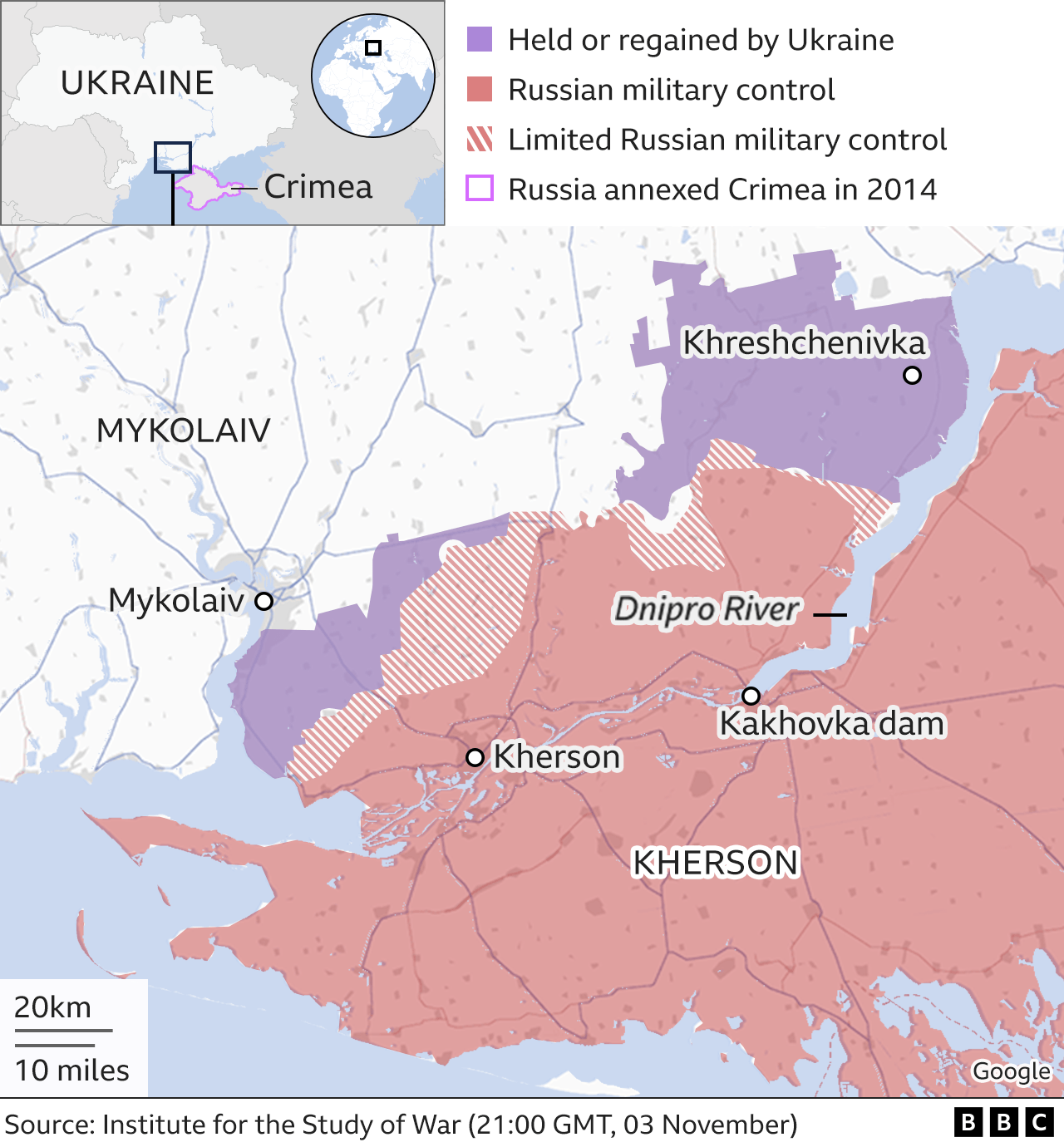
Russian President Vladimir Putin has publicly approved the evacuation of civilians from parts of Russian-occupied Kherson in southern Ukraine.
Kyiv’s forces have been steadily advancing on the strategic port city.
Mr Putin said people living in dangerous areas should leave as “the civilian population should not suffer”.
At least 70,000 people are reported to have been moved already from Kherson – the only major city gained by Moscow since its troops invaded in February.
Civilians at risk from shelling and attacks should be “removed”, Mr Putin said, during the Unity Day holiday in Moscow’s Red Square.
Kyiv accuses Russia of forcibly deporting Ukrainian civilians – which is considered a war crime – although Moscow denies this.
Russia’s intensive missile and drone strikes on civilian infrastructure across Ukraine have caused heavy casualties and damage, and forced Kyiv to impose frequent electricity blackouts.
Mr Putin’s comments followed reports on Thursday that Russian soldiers, too, had been leaving Kherson – in what would mark a major withdrawal.
A Kremlin-installed official in the region, Kirill Stremousov, told Russian media that Moscow was “likely” to pull its troops from the area.
Ukrainian officials remained cautious, warning that the reported move could be a trap to lure their soldiers into dangerous areas.
Kherson was captured soon after Russia attacked its neighbour on 24 February, but recently Ukrainian forces have steadily recaptured territory on the city’s outskirts.
Civilians were first urged to leave Kherson in the middle of last month, as the Russian army switched the city to defensive mode.
Military commanders later said they had completed an operation to evacuate the city’s residents, ahead of an expected battle there.
Russia claims the Kherson region and three other Ukrainian regions as its own territory, though it does not fully control any of them. It hastily arranged local “referendums” to justify the claim – a move condemned internationally.
Russia also annexed Ukraine’s Crimea peninsula in 2014.
During Friday’s speech in Red Square, Mr Putin also said some 318,000 military recruits had signed up for duty during a mobilisation, now complete – exceeding his target of 300,000.
Of these, Mr Putin said 49,000 were already involved in active fighting – a figure not independently verified by the BBC.
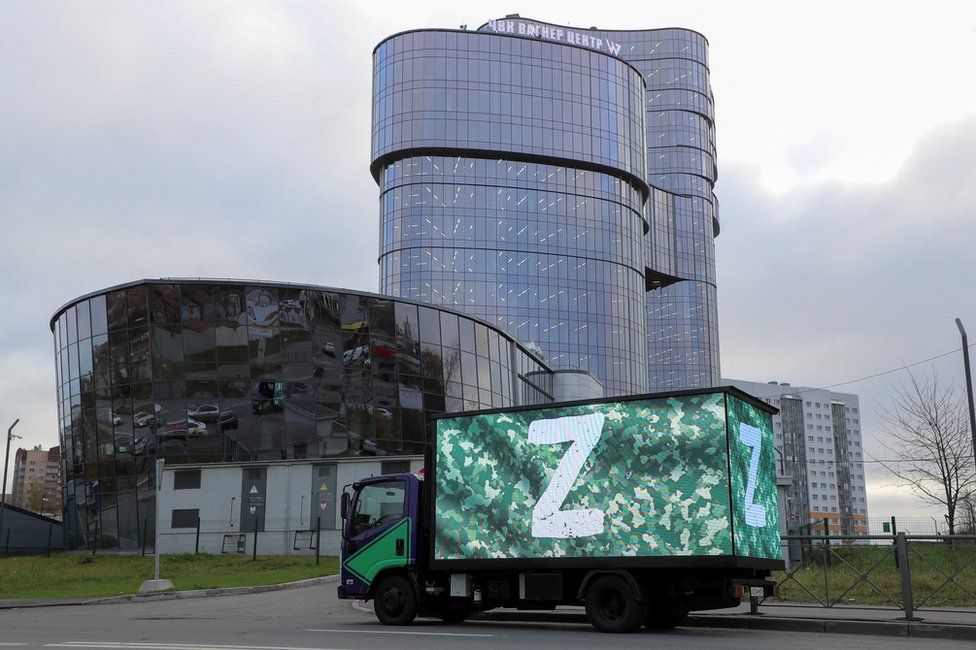
Meanwhile, a Russian private military company, the Wagner Group, has opened its first official headquarters, in St Petersburg.
Its fighters are reported to be active in the Russian campaign in Ukraine, and it has recruited prisoners to fight there, in exchange for their sentences being commuted in Russia.
Image source, ReutersImage caption, The new Wagner headquarters in St Petersburg
Wagner soldiers have repeatedly been accused of human rights violations, including in Syria, Libya and other conflicts.
Mr Putin has now amended the Russian law on calling up reservists to include men convicted of serious crimes who recently left prison.
The change means that convicted murderers and drug dealers who have recently been released could be conscripted to fight in Ukraine.
Former prisoners convicted of sex crimes against children or terrorism are still excluded from serving.
In his latest comments on the war, Ukrainian President Volodymyr Zelensky attacked the “absolutely insane stubbornness of the owners of today’s Russia”.
He said his enemy was uninterested in peace talks, but was instead sending “people to the meat grinder” – both mobilised troops and mercenary fighters.
Referring to the week’s “fiercest fighting”, Mr Zelensky singled out the eastern towns of Bakhmut and Soledar.
Turkey’s president has said that he and Putin agreed that Russian grains sent under the Black Sea export deal should go to poor African countries for free.
“In my phone call with Vladimir Putin, he said ‘Let’s send this grain to countries such as Djibouti, Somalia and Sudan for free’ – and we agreed,” Recep Tayyip Erdogan said in a speech to businesspeople in Istanbul.
His remarks on Friday came two days after Moscow resumed its participation in the UN and Turkish-brokered grain agreement, ending four days of non-cooperation that still saw exports continue from Ukrainian ports.
Putin has said that even if Russia withdraws from the deal again, it will substitute the entire volume of grain destined for the “poorest countries” for free from its own stocks.
Boris Johnson has told Sky News that he does not think Vladimir Putin will use a tactical nuclear weapon in his war in Ukraine.
There have been suggestions that the Russian president could carry out such a military strike as his forces continue to lose territory which they captured earlier in the invasion.
But in his first interview since leaving Number 10 for Sky News’ Ukraine: A Modern War programme, the ex-prime minister told Sky’s Mark Austin: “I don’t think he will, he’d be crazy to do so.”
Mr Johnson also said he will be traveling to the COP27 climate summit in Egypt next week, as question marks remain over whether Rishi Sunak will join him.
Mr Johnson said using a nuclear weapon would mean Mr Putin “would immediately tender Russia’s resignation from the club of civilised nations”.
The former UK leader said it would be a “total disaster” for Russia, which would be put into a “cryogenic economic freeze” and Mr Putin would “lose a lot of the middle ground of global tacit acquiescence that he’s had”.
Mentioning sub-Saharan Africa, Latin America, and South Asia, Mr Johnson said: “There’s a lot of willingness to give Putin the benefit of the doubt. That will go, the minute he does anything like that.
“He would also crucially lose the patronage of the Chinese. And in his own country, I think he would trigger an absolutely hysterical reaction.”
Mr Johnson said if there was such a military action from Mr Putin, there would have to be a response of some kind.
“There are all sorts of options” both in NATO and the P3 nations (US, UK, and France), he said.
He also said it was a “critical” and “pivotal moment” for the world.
Looking ahead to how the conflict could be resolved, the former PM warned about the danger of trying “to comprise and find some sort of deal, some grubby bargain with Putin”, trying to encourage the Ukrainians to trade some of their territory, which Mr Johnson said, “will only encourage Putin to make further aggression”.
Putin’s only aim is to ‘spread terror’
He said that it is going to be very difficult for the Ukrainians to accept any deal that stops short of a full return of all the areas taken by Russia since the invasion began on 24 February.
Mr Johnson also said it was “absolutely inevitable” that the Ukrainians will eventually win the war.
“We have to show strategic patience and continue to support them,” he added.
The UK has hitback after Moscow accused a Royal Navy unit of causing explosions along a key gas pipeline between Russia and Europe.
It said Russia had made the “false claims of an epic scale” to “detract from the disastrous handling of the illegal invasion of Ukraine”.
To detract from their disastrous handling of the illegal invasion of Ukraine, the Russian Ministry of Defence is resorting to peddling false claims of an epic scale
This invented story, says more about arguments going on inside the Russian Government than it does about the west
It also mentioned “arguments going on inside the Russian government”, referring to reports of disquiet among Vladimir Putin’s top officials over the war situation.
British military experts have said Russia’s claim is a “straight lie” and that the navy would not have the means to carry out such an attack.
We have been reporting todayabout the potential for Vladimir Putin to launch a nuclear attack and what the consequences of that might be.
Now, footage shared by the BBC’s Francis Scarr, who analyses Russian television, shows a Russian TV presenter calling for more strikes in the country.
During a panel discussion on Russia’s state television, Bogdan Bezpalko said the strikes on Monday “could not be a one-off”.
“It needs to be constant, for two to five weeks in order to disable all their infrastructure entirely,” he said.
“All their combined heat and power stations, thermal power stations, electrical power stations, all the traction substations, all power lines, all railway hubs.
“And then Ukraine will descend into cold and darkness. They won’t be able to bring in ammunition or fuel, and then the Ukrainian army will turn into a crowd of armed men with chunks of iron.
“This needs to be done constantly, not just once.”
Mr Bezpalko added that Ukrainian President Volodymyr Zelenskyywould use the recent attacks on the country to “request even more money and arms” and therefore it was important to “batter them constantly”.
Just another totally normal day on Russian TV
Talking head Bogdan Bezpalko says Ukraine needs to be “constantly battered” by missile strikes for several weeks so that the country “descends into cold and darkness” pic.twitter.com/aP8mdzVPsq
Hong Kong says, the superyacht of a Russian oligarch who is the target of Western sanctions will not be seized.
According to chief executive John Lee, Hong Kong will be subject to penalties imposed by the UN but not “unilateral” ones by “individual jurisdictions.”
The $521m (£472m) boat belongs to Alexei Mordashov, an ally of Russia’s President Vladimir Putin and one of the country’s richest men.
His yacht arrived in Hong Kong last week after sailing from Russia.
But Mr Mordashov is not believed to be on it. The billionaire was sanctioned by the US, the UK, and the EU after Russia invaded Ukraine earlier this year.
But Hong Kong’s government said it was not bound by those sanctions. For close to a week now, the multi-storey Nord superyacht has been a conspicuous sight in the city’s Victoria Harbour with the Russian flag flying at its mast.
“We will comply with United Nations sanctions, that is our system, that is our rule of law,” said Mr Lee, who has himself been sanctioned by the US for his role in implementing Hong Kong’s repressive national security law.
The US, EU, and the UK have sanctioned hundreds of Russians and their businesses. China, however, has remained a Russian ally and has so far not condemned Moscow’s decision to invade Ukraine.
“Hong Kong’s reputation as a financial centre depends on adherence to international laws and standards,” a US State Department spokesman said. “The possible use of Hong Kong as a safe haven by individuals evading sanctions from multiple jurisdictions further calls into question the transparency of the business environment.”
It’s unclear how long the superyacht will remain in Hong Kong’s waters.
Mr Mordashov’s spokesman told Bloomberg News the steel tycoon was in Moscow. Prior to the war in Ukraine, he was Russia’s richest man, according to Forbes, with a $29.1 billion fortune built through his steel and mining company Severstal.
The Nord is believed to be his biggest yacht asset. The 465-foot (141m) yacht is larger than a football field and is described as one of the world’s most extravagant boats, according to Forbes.
The billionaire had already lost one of his smaller boats, the 215ft Lady M, to Western sanctions in March after it was seized by Italian police in the port of Imperia.
Several Russianoligarchs‘ boats have been seized or denied entry to European ports this year under Western sanctions related to the war in Ukraine.
That’s prompted the movement of such boats to areas around the world considered beyond the reach of Western sanctions- including ports around Asia, Turkey, and the Caribbean.
As part of his nightly address on Monday, President Volodymr Zelensky filmed himself near recovery vehicles appearing to clean up one of the sites of the missile attacks.
“Restoration work is currently under way across the country. We will restore all objects that were damaged by today’s attack by Russian terrorists. It’s only a matter of time,” he said.
Zelensky added that Ukraine had managed to shoot down more than half of Russia’s missiles and drones , but he also warned of the ongoing threat.
“Follow the safety rules and pay attention to air sirens. The danger is still here but we are fighting,” the president cautioned.
Zelensky concluded his address by stating that Russia resorted to missile attacks because “they cannot oppose us on the battlefield.”
“Well, let’s make the battlefield even more painful for the enemy,” he said.
The EU must take Vladimir Putin’s threats he could use nuclear weapons in the conflict in Ukraine seriously, the bloc’s foreign policy chief has said.
Josep Borrell told the BBC’s Lyse Doucet that the war had reached a “dangerous moment”.
His remarks come as Russia begins a partial mobilisation and moves to annex four regions of Ukraine.
Mr Putin has faced setbacks on the battlefield, with his forces pushed back by a Ukrainian counter-offensive.
“Certainly it’s a dangerous moment because the Russian army has been pushed into a corner, and Putin’s reaction – threatening using nuclear arms – it’s very bad,” Mr Borrell said.
Seven months since Russia’s invasion of Ukraine began, analysts agree that President Putin’s forces are on the back foot, but he said a “diplomatic solution” must be reached, one that “preserves the sovereignty and territorial integrity of Ukraine”.
“Otherwise, we can finish the war, but we will not have peace, and we will have another war,” he said.
In a rare address to the nation earlier this week, Mr Putin said his country had “various weapons of destruction” and would “use all the means available to us”, adding: “I’m not bluffing”.
“When people say it is not a bluff, you have to take them seriously,” Mr Borrell said.
In the same speech President Putin announced the call-up of 300,000 Russians who have done compulsory military service, sparking protests and reports of people fleeing the country to avoid being sent to the front line.
It comes after a rapid counter-offensive in which Ukraine says it took more than 8,000 sq km (3,088 sq miles) back from Russian forces.
Now self-styled referendums on joining Russia are being held in four occupied regions. Ukraine has denounced these as annexation attempts, and reported that armed Russian soldiers are going door-to-door collecting votes.
Four seized regions of Ukraine are being held over by Russian-backed officials, who are holding so-called referendums on joining Russia.
These so-called elections, which have been denounced as invalid and fraudulent by Ukraine and the West, are being held over the course of five days in four front-line regions: two in the east and two in the south.
An annexation could lead to a claim by Russia that its territory is coming under attack from Western weapons supplied to Ukraine.
This could escalate the war further.
What is going on and why now?
Seven months after Russia’s invasion began, Vladimir Putinis on the back foot. Ukraine’s counter-offensive has recaptured swathes of territory seized since the 24 February invasion.
A vote on annexation is one of three steps taken by the Kremlin in an attempt to reset the war.
By annexing another 15% of sovereign Ukraine, Russia will be able to claim its territory is under attack from weapons provided by Nato and other Western countries to Ukraine. By calling up 300,000 extra troops, it can defend a front line of 1,000km (620 miles). The Kremlin has also criminalized desertion, surrender and going absent without leave during mobilization.
If Russia’s leader annexing territory sounds familiar, it is. When he ordered troops to seize Crimea in 2014, he followed it up with a vote rejected as an illegitimate sham by the international community.
This latest event has also been denounced as illegal by many Western countries, including international monitoring groups, the OSCE, and Russian media have already said that a Yes-vote is beyond doubt.
It is taking place over five days in Russia’s two proxy areas in Luhansk and Donetsk in the east, and in occupied parts of Kherson and Zaporizhzhia in the south.
What makes these votes a sham?
We have already seen how Crimea was annexed by Russia in 2014. While the Kremlin claimed 96.7% support, a leaked report from Russia’s Human Rights Council said only around 30% had voted and barely half supported annexation.
Not a shot had been fired in Crimea, and yet in this latest case voting is expected to take place in the middle of a war.
The four regions involved are either partially or completely under occupation.
In the south, the city of Kherson is not a safe place right now, with Russian soldiers struggling to hold back a big Ukrainian counter-offensive. The central administration building was hit by a series of missiles only last week.
A secure vote is impossible, and yet officials talk of 750,000 people registered and plans to incorporateoccupied parts of another Ukrainian region, Mykolayiv, into the annexed area.
Russian media reported that elected officials would go from door-to-door with portable ballot boxes from Friday to Monday.
Polling stations will only operate on the fifth day, 27 September, with officials citing security reasons.
Hundreds of stations are scheduled to open that day, with voters also able to cast ballots in regions outside their own – and refugees eligible to vote in parts of Russia itself.
Then there’s Zaporizhzhia’s capital, which remains securely in Ukrainian hands, so any vote to annex that region makes little sense.
Donetsk in the east is only 60% under Russian occupation and very much at the heart of the conflict.
Russia does control most of Luhansk in the northeast even if it has begun to lose ground. Russian news agencies showed flyers being handed out entitled “Russia is the future”.
Much of the pre-war population has fled the conflict. The head of Russia’s proxy authority in Donetsk, Denis Pushilin, ordered a mass evacuation days before the invasion.
Russian-backed leaders have been keen to stage votes for several months, but the decision to hold the vote was taken just three days in advance and smacks of desperation.
There will be no independent observers. Much of the voting will be online, although officials have promised extra security at polling stations.
What will change?
Ukrainian defense ministry adviser Yuriy Sak told the BBC the so-called referendums were doomed. “We are seeing that local populations are all in favour of returning to Ukraine, and this is why there’s so much guerrilla movement resistance in these territories.”
In any event, Kyiv says nothing will change and its forces will continue to push to liberate the territories.
Russia analyst Alexander Baunov says merely redefining the occupied areas as Russian territory is unlikely to stop Ukraine’s army, but it does send a message of intent to the populations under their control. And the Kremlin’s hope is that the West will balk at having its weapons fired at land declared by Moscow as Russian.
Alarmingly President Putin has spoken of using all means at his disposal “to protect Russia”. And in case there was any doubt at all. the deputy head of Russia’s security council, Dmitry Medvedev, made clear that nuclear weapons could also be used to protect annexed territories.
US Secretary of State Antony Blinken has spoken of a“dangerous escalation”, but reaffirmed Washington’s position that no Russian claim to Ukrainian soil could take away Ukraine’s right to defend itself.
Even Turkey, which has sought to play a mediating role, has damned the vote as illegitimate.
In her first public address as prime ministeron a world platform, Ms. Truss called the Russian president’s threat to use “all means at our disposal” to defend his nation “sabre rattling.”
Vladimir Putin’s nuclear threats are part of a desperate attempt to justify his “catastrophic” failure in Ukraine, Liz Truss has said.
In her first speech on the world stage as prime minister, Ms Truss accused the Russian president of “sabre rattling” after he said that his country would use “all the means at our disposal” to protect itself.
The comments appeared to suggest the conflict in Ukraine could spiral into a nuclear crisis.
Ms Truss said Mr Putin was “desperately trying to justify his catastrophic failures” in her address to the United Nations General Assembly (Unga) in New York.
“He is doubling down by sending even more reservists to a terrible fate,” she said.
“He is desperately trying to claim the mantle of democracy for a regime without human rights or freedoms.
“And he is making yet more bogus claims and saber-rattling threats.”
Ms Truss praised the “strength of collective purpose” in response to Mr Putin’s invasion so far, but said that aid for Ukraine must not wane.
And she told other world leaders that the UK will spend 3% of GDP on defence by 2030, repeating a promise she made when she campaigned to become Tory leader.
She added: “In the face of rising aggression we have shown we have the power to act and the resolve to see it through. But this must not be a one-off.
“This must be a new era in which we commit to ourselves, our citizens, and this institution that we will do whatever it takes – whatever it takes to deliver for our people and defend our values.”
The European Union has condemned Russia’s plans to hold referenda in parts of Ukraine and has said the outcomes will not be recognized.
In a statement, EU foreign affairs chief Josep Borrell said: “The European Union strongly condemns these planned illegal “referenda” which go against the legal and democratically elected Ukrainian authorities, are in violation of Ukraine’s independence, sovereignty, and territorial integrity, and in blatant breach of international law.”
Mr Borrell said those involved with these “referenda” will be held accountable and additional restrictive measures against Russia would be considered.
Moscow-controlled regions in eastern and southern Ukraine are set to hold referenda on becoming parts of Russia, which could give the Kremlin the pretext for a wider war because Vladimir Putin would be able to claim parts of his state were being attacked.
Claims have also appeared on Russian television and social media channels that Nato troops are actively involved in the war.
Nato member countries have been providing weaponry and logistical support, but have said they aren’t sending troops into Ukraine, which is not a member of the alliance.
We’ve looked at the evidence provided for these claims of Nato boots on the ground in Ukraine.
It’s well known that foreign fighters have joined Ukrainian military units. However, claims are being made by Russian officials and media outlets of serving Nato troops on the ground in Ukraine.
On 13 September, Ruslan Ostashko, the host of Vremya Pokazhet (Time Will Tell) on Russia’s Channel One said: “In the grand scheme of things, Ukrainian soldiers are there more for appearances, for having photos taken and uploading videos to TikTok, but it’s mainly Nato troops fighting there.”
Image source, Channel One
Image caption,
Ruslan Ostashko is the host of a daily talk show on Russia’s Channel One
Throughout the programme, footage taken from social media of foreigners allegedly fighting in Ukraine was shown as “evidence” of Nato boots on the ground.
Andrei Marochko, a military spokesman for the self-proclaimed Luhansk People’s Republic (LPR) in the east of Ukraine, told Russian state-owned news agency RIA Novosti: “Our intelligence agencies revealed the arrival of regular Nato officers in the Kharkiv region.
“The purpose of their trip to this area is to organise interaction between foreign and Ukrainian units.”
Mr Marochko has also told Russian state TV that Nato officers have arrived in Kramatorsk, a city in the Donetsk region of Ukraine.
Other claims are more generally about the presence of foreign fighters and don’t make the direct connection to Nato – but leave the link implied.
For example, Vladimir Kornilov, a columnist for RIA Novosti, has said there had been a “dramatic increase in video footage of people who’ve come to ‘liberate’ Izyum, with English being spoken.”
What evidence is being given?
It’s important to make a clear distinction between those foreign fighters who’ve travelled independently to Ukraine and troops deployed by Nato member countries.
Russian media outlets haven’t provided evidence of serving Nato personnel on the ground, only pointing to the presence of individual foreign fighters on the battlefield.
One of the fighters shown on the Vremya Pokazhet television programme is Malcolm Nance, a former US naval officer, who has regularly posted videos of himself in Ukraine over recent months.
One video, highlighted in the TV programme, shows Mr Nance with an artillery battery behind him, firing what he describes as “the first artillery shot of a massive combined arms, multi-axis ground offensive.”
With over a million followers on Twitter, there’s very little that could be considered covert about Mr Nance’s presence in Ukraine.
He is not currently serving in the US military and back in April, he shared online that he had joined the Ukrainian Foreign Legion.
A second individual identified in pro-Russian social media posts is another American, Rob-Roy Lane, who grew up in the US state of Idaho.
Mr Lane also regularly posts online videos of himself embedded with a Ukrainian military unit and names several other foreign volunteers in the team. These videos have been widely shared on pro-Russian social media channels.
There’s no online evidence to suggest he has any previous military experience. The US Department of Defense has not responded to requests for comment about his involvement with American military forces.
On his social media account, Mr Lane names several other members in his unit including two British nationals.
The UK’s Ministry of Defence said it would not comment on the service records of former personnel, or on their activities in conflict zones.
What support is Nato giving?
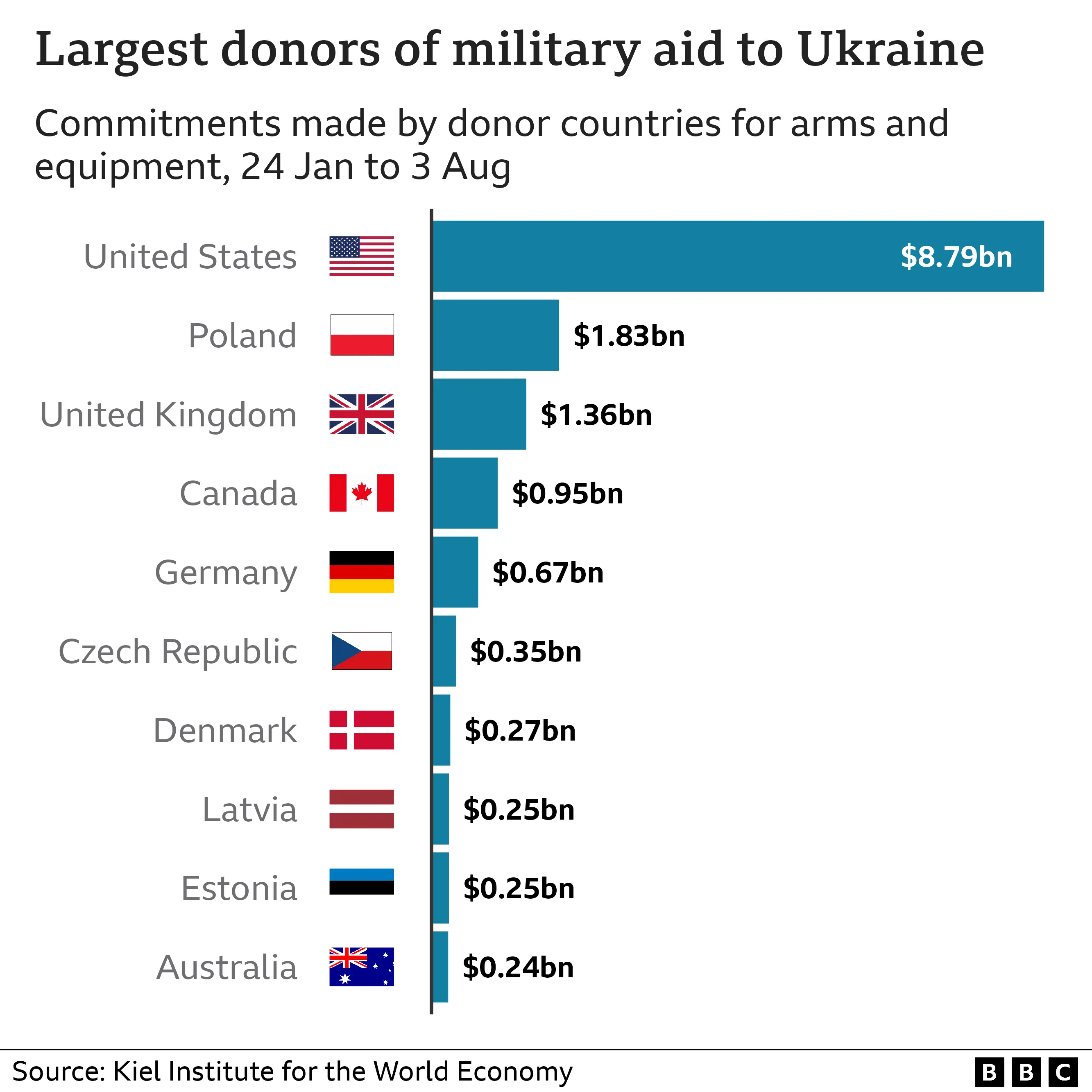
Nato member countries are providing large quantities of sophisticated weaponry and logistical support to Ukraine, with the United States by far the largest donor.
This equipment includes several weapon systems which are believed to have played key roles in the conflict so far, such as long-range rocket launchers and anti-tank weapons.
And there has also been Western media speculation that Nato members have been helping both with intelligence and the selection of military targets.
There are around 40,000 Nato troops stationed in alliance member countries in the region, such as in the Baltic states and Poland, with another 300,000 troops on high alert in response to Russia’s invasion.
Extensive training of Ukrainian forces by Nato members has been taking place outside the country, but no Nato member country has said it has contributed military personnel to fight in Ukraine.
“There is no evidence of Nato ground forces participating in Ukraine,” says Edward Arnold at the Royal United Services Institute (Rusi), a defence and security think tank.
“Nor of Nato commanders directing Ukrainian units on the battlefield,” he adds. “There is also a very low likelihood of this happening in the future as Nato seeks to mitigate escalation risks.”
Russia plans to call up about 300,000 reservists – that is, people who have had military training and, Vladimir Putin stressed, have specialist skills needed in the Ukraine conflict. They will include many reserve officers, including some over 60, pulled in from retirement.
Russia could in theory mobilise some 25 million people for military service, but that is not yet being considered. Both President Putin and Defence Minister Sergei Shoigu stressed that conscripts would not be sent to fight in Ukraine.
Mr Shoigu said the extra troops were required to defend a front line stretching for some 1,000km (600 miles).
The mobilisation will be spread over months – and Mr Putin has said previously that Russia is prepared for a long fight. Reuters news agency says it is Russia’s first mobilisation since World War Two, but the Kremlin did send thousands of conscripts to fight in Afghanistan in the 1980s, and later in Chechnya, in the North Caucasus.
Many poorly-trained conscripts were killed in those costly wars, and this time the Kremlin appears anxious to avoid fuelling anti-war sentiment.
Mr Putin said the partial mobilisation was necessary to ensure Russian territorial integrity.
Ukrainian president Volodymyr Zelensky said it showed Mr Putin wanted to drown Ukraine in blood – including that of his own soldiers.
The announcement applies to 300,000 military reservists.
They make up a fraction of the about 25 million Russian reservists – people who have done their military service which is compulsory in Russia.
The mobilisation is the first since World War II and comes after Ukraine made gains in a rapid counter-offensive this month, putting the Kremlin on the back foot.
The decree is short on detail. It says nothing about a cap on numbers or about any exceptions, such as not recruiting students or conscripts.
Instead, these details are left to regional heads to decide how to meet quotas. In theory, the net could be cast far wider than the Kremlin has specified.
However Russian officials said it would announce “very soon” those who would be exempt from its partial mobilisation.
The partial call-up stops short of full conscription, a move that would have risked turning a public that has so far largely been in favour of the conflict against it.
In a televised address, Mr Putin also issued a thinly veiled threat he could use nuclear weapons.
He said the West was engaging in “nuclear blackmail” and that Moscow had “lots of weapons to reply”.
“When the territorial integrity of our country is threatened, we will certainly use all the means at our disposal to protect Russia and our people. It’s not a bluff,” he said.
ANALYSIS: Steve Rosenberg: Putin raises stakes in deadly game
EXPLAINER: How many nuclear weapons does Russia have?
Mr Putin’s announcement of a partial mobilisation drew immediate condemnation from Ukraine’s allies.
Dutch Prime Minister Mark Rutte called the mobilisation “a sign of panic” while German Chancellor Olaf Scholz called it “an act of desperation”.
Mr Putin’s address has raised fears that some men of fighting age would not be allowed to leave Russia, even though Russia’s defence minister, Sergey Shoigu, said the call-up would be limited to those with combat experience.
He declined to comment on whether borders would be closed to those the call-up would be applicable to.
Flights out of Russia sold out fast following the announcement.
Liz Truss is delivering her address to the nation after being appointed the country’s new prime minister by the Queen.
The Tory leader, who became the UK’s third female prime minister today, begins by paying tribute to Boris Johnson who she says was a “hugely consequential prime minister”.
She says the UK now finds itself facing “global headwinds” caused by Russia’s war in Ukraine and now is the time to “tackle the issues that are holding Britain back”.
Ms Truss says she has a “bold plan” to “grow the economy through tax cuts and reform” and says she has three priorities.
“I will cut taxes to reward hard work and boost business-led growth and investment,” she says.
The new prime minister says she will deal “hands-on” with the energy crisis caused by Vladimir Putin‘s war and will “secure our future energy supply”.
“I will make sure that people can get doctors appointments and the NHS services they need. We will put our health service on a firm footing by delivering on the economy, on energy and on the NHS,” she says.
She adds: “As strong as the storm maybe I know that the British people are stronger.
“Our country was built by people who get things done. We have huge reserves of talent, energy, and determination. I am confident that together we can ride out the storm, we can rebuild our economy and we can become the modern, brilliant Britain that I know we can be.”
Hardliners have exploited the idea of a “Russian World” in foreign policy to defend acting abroad to help Russian speakers, such as in areas of Ukraine.
It indicates that although it was initially proposed as a soft power strategy, the concept is now firmly established in government policy.
The new policy stated that Moscow should further deepen its ties with the self-styled Donetsk People’s Republic and the Luhansk People’s Republic – two breakaway entities in eastern Ukraine, where the war continues to rage.
It also said it shouldstrengthen its links more withAbkhazia and Ossetia, two Georgian regions recognized as independent by Moscow after its war against Georgia in 2008.
And the policy stated Russia should increase cooperation with Slavic nations, China, and India, and further push its ties to the Middle East, Latin America, and Africa.
West Slavs are in Poland, the Czech Republic, and Slovakia, East Slavs are in Russia, Belarus, and Ukraine, while South Slavs are in Croatia, Bosnia and Herzegovina, Serbia, Bulgaria, North Macedonia, Montenegro, and Slovenia.
With the collapse of the Soviet Union in 1991, a number of Eastern Bloc countries broke away from the USSR and became independent, but around 25 million ethnic Russians found themselves living outside Russia.
Mr Putin called the collapse of the USSR the “greatest geopolitical catastrophe” and for years he has been highlighting what he sees as the tragic fate of those millions.
It was one of his predecessors, Mikhail Gorbachev, who failed to prevent the break-up and who died aged 91 last week.
Moscow has continued to view the former Soviet lands, from the Baltics to Central Asia, as its legitimate sphere of influence – a notion strongly resisted by many of those countries as well as by the West.
The new policy said the Russian Federation “provides support to its compatriots living abroad in the fulfillment of their rights, to ensure the protection of their interests and the preservation of their Russian cultural identity”.
There is somber music playing within the House of Unions’ Columned Hall. On the balcony, a sizable Gorbachev image in black and white is displayed.
In an open casket, the former president is surrounded by a guard of honor.
As they pass by, the people lay flowers. There is a sea of red carnations.
It was here that Gorbachev’s predecessors, Soviet leaders like Lenin, Stalin, and Brezhnev, lay in state, too.
Many Russians blame Mikhail Gorbachev for launching reforms that caused economic chaos and for letting the Soviet Union fall apart.
But in the streets around the Hall of Unions, long lines of Muscovites – young and old – are queuing up to pay their respects.
Liberal politician Grigory Yavlinsky is there and he says: “These people came to Gorbachev to say ‘Thank you Mr Gorbachev. You gave us a chance, but we lost this chance.”
One man who is not here is Vladimir Putin. The Kremlin’s official explanation: No space in his schedule. However, this is widely seen as a snub.
Mr Putin once called the dissolution of the USSR the “greatest geopolitical catastrophe of the century”.
Mr Gorbachev took power in 1985, introducing bold reforms and opening the USSR to the world.
But he was unable to prevent the collapse of the union in 1991, and many Russians blame him for the years of turmoil that ensued.
Outside Russia, he was widely respected, with the UN Secretary-General António Guterres saying he had “changed the course of history”, and US President Joe Biden calling him a “rare leader”.
But Saturday’s ceremony is not a state funeral – a sign that the current Kremlin leadership has little interest in honouring Mr Gorbachev’s legacy.
It was well known that Mr Putin and Mr Gorbachev had a strained relationship – their last meeting was reportedly in 2006.
IMAGE SOURCE,REUTERS
Image caption,
Former Soviet leaders who died lay in state in the same imposing Columned Hall of the House of Unions
Most recently, Mr Gorbachev was said to have been unhappy with Russia’s invasion of Ukraine, even though he had supported the annexation of Ukraine’s Crimea peninsula in 2014.
In recent years, his health had been in decline and he had been in and out of the hospital. In June, international media reported that he had been admitted after suffering from a kidney ailment.
He is seen in the West as an architect of reform who created the conditions for the end of the Cold War in 1991 – a time of deep tensions between the Soviet Union and Western nations, including the US and Britain.
He was awarded the Nobel Peace Prize in 1990 “for the leading role he played in the radical changes in East-West relations”.
But in the new Russia that emerged after 1991, he was on the fringes of politics, focusing on educational and humanitarian projects.
Gorbachev made one ill-fated attempt to return to political life in 1996, receiving just 0.5% of the vote in presidential elections.
IMAGE SOURCE, GETTY IMAGES
Image caption,
Ronald Reagan and Mikhail Gorbachev signed the Intermediate-Range Nuclear Forces Treaty in 1987
Vladimir Putin will “increase his disruption” in the West as he gets “deeper into trouble” in Ukraine, former British ambassador to Russia, Sir Roderic Lyne, has said.
Speaking to Sky News, Mr Lyne said: “I think he will try to encourage more conflict in the Balkans. I think we may well see the Russians being even more active in the east and in north Africa.”
The ambassador also said that he thought the Russian leader would “at some point” offer some kind of a ceasefire in return for recognition of annexation of four western provinces of Ukraine.
“I think he’s going to use a range of tactics as the situation on the ground in Ukraine becomes more and more difficult for his troops,” he continued.
Mr Lyne also said Ukrainian troops would not surrender their freedom and the conflict would most likely continue at a “much lower intensity”.
He said: “The intensity is going to go down as both sides are pretty exhausted, pretty depleted. And I think we’re heading into a sort of stalemate with intermittent fighting across the line of control and a long, drawn out war of attrition.”
The ambassador went on to say that Mr Putin had a “total obsession” with Ukraine and believed “pummelling” will allow him to win the war.
“There’s really no end in sight. It’s not just the last six months. This war has been going on for eight and a half years. And Putin has a total obsession with Ukraine,” he said.
“The Ukrainians are now fighting for their survival. They’re fighting for their freedom, fighting for their territory, and they’re not going to give up.
“We’d all love this horrible stop tomorrow. I’m afraid it’s not going to do so because Putin thinks that he can win a war of attrition.
“He thinks that if he goes on pummelling Ukraine, he rebuilds his military forces, that eventually and I do mean a long way down the road that he can win.
“I don’t believe he can, so long as Western support holds up for Ukraine.”
He said: “Putin’s main priority is to rebuild the Soviet empire and Ukraine is a very important puzzle in his plans.
“Right now we’re fighting for our independence. We are fighting also for you, for everyone . We are fighting for our values, for democratic values and for a democratic future.”
He also said Ukraine wanted to “build a European country” with “democratic values, human rights, and press freedom”.
“This is not accepted from Russian Federation,” he added.
Mr Klitschko also urged Western countries to stop trade relationships with Russia.
“If you send money to Russia, they will not use it for the economy and won’t invest this money for their population,” he said.
“If you send money to Russia, it is bloody money and the blood on this money is Ukrainian blood. Please stop trade relationships with Russia.”
Nelson Mandelawas once asked why he still had relationships with, among others, Fidel Castro and Yasser Arafat, the Cuban and Palestinian leaders who had been branded terrorists by Western powers. The revered South African statesman replied that it was a mistake “to think that their enemies should be our enemies.”
This stance has largely typified some African nations’ response to the Russia-Ukraine war. Across the continent, many appear hesitant to risk their own security, foreign investment and trade by backing one side in this conflict.
While there has been widespread condemnation of the attacks on Ukrainian civilians and their own citizens fleeing the warzone — from countries such as Ghana, Nigeria, Kenya — there has been a much more muted response from some key African nations.
Countries on the continent find themselves in a delicate position and will not want to get drawn into proxy battles, says Remi Adekoya, associate lecturer at England’s University of York.
“There’s a strong strand of thought in African diplomacy that says African states should maintain the principle of non-interference and so they shouldn’t get caught up in proxy wars between the East and the West. As some states did get caught up in proxy wars during the Cold War, for instance,” Adekoya told CNN.
One influential voice that has made it clear he will not make an enemy out of Russian leader Vladimir Putin is South African President Cyril Ramaphosa.
While addressing his country’s parliament Thursday, he said: “Our position is very clear … there are those who are insisting that we should take a very adversarial stance and position against, say Russia. And the approach that we have chosen to take … is we are insisting that there should be dialogue.”
After initially releasing a statement calling for Russia to immediately pull its forces out of Ukraine, South Africa has since laid the blame for the war directly at NATO’s doorstep for considering Ukraine’s membership into the military alliance, which Russia is against.
“The war could have been avoided if NATO had heeded the warnings from amongst its own leaders and officials over the years that its eastward expansion would lead to greater, not less instability in the region.” Ramaphosa said in parliament Thursday.
Former South African President Jacob Zuma also earlier issued a statement saying Russia “felt provoked.”
“Putin has been very patient with the western forces. He has been crystal clear about his opposition of the eastern expansion of … NATO into Ukraine … and is on the record about the military threat posed to Russia by the presence of the forces … it looks justifiable that Russia felt provoked,” Zuma said in a statement issued by his foundation on March 6.
South Africa has strong ties to Russia and Ramaphosa has written about being approached to be a mediator in the conflict given its membership of BRICS — a group of emerging economies comprising Brazil, Russia, India, China and South Africa.
The ties between the two countries also date back to apartheid times when the former Soviet Union supported South Africa and the African National Congress party in their liberation struggles. “Those favors have not been forgotten,” said Adekoya.
South Africa was one of 17 African nations to abstain on the UN resolution demanding that Russia immediately withdraw from Ukraine on March 2. It took a similar stance during Putin’s annexation of Crimea in 2014.
Nigeria and Egypt were among the 28 African nations that voted to condemn Russia, while eight others didn’t submit a vote. Eritrea was the only African country that outrightly voted against the resolution.
Zimbabwe’s foreign ministry said in a statement it was unconvinced that the UN resolution was driven towards dialogue, rather “it poured more fuel to the fire, thus complicating the situation.”
‘Strongman leadership’
Many of the countries that abstained from the UN vote are authoritarian regimes. They see Putin’s unilateral decision to invade Ukraine as a show of power and ego that they can appreciate and align with, Yetunde Odugbesan-Omede, a political analyst and professor at New York’s Farmingdale State College, told CNN.
One of those who have spoken out prominently in support of the Russian leader is Lt. Gen. Muhoozi Kainerugaba, the influential son of Ugandan President Yoweri Museveni.
His father has ruled Uganda with an iron fist for 36 years and there has been speculation that Kainerugaba is a would-be successor when the 78-year-old Museveni eventually stands down.
Kainerugaba tweeted that: “The majority of mankind (that are non-white) support Russia’s stand in Ukraine. Putin is absolutely right!”
Some African countries have also hesitated in speaking out against Russia because they want to “keep their options open if they face existential threats or some kind of revolution in their own country in the future,” said Adekoya.
“They saw Putin keep Assad in power in Syria because if not for Russia’s intervention, Assad’s regime would have fallen long ago,” he added.
Adekoya also pointed out that some of the muted response stems from what is perceived as Western hypocrisy.
Kenya’s UN Security Council representative Martin Kimani gave a powerful speech on the brink of Russia’s invasion of Ukraine.
Kimani drew a parallel between Ukraine’s emergence as an independent state after the collapse of the Soviet Union and the experience of post-colonial states in Africa, criticizing Vladimir Putin’s buildup of forces and his support for redrawing Ukraine’s borders by recognizing the breakaway statelets of Donetsk and Luhansk.
“Kenya rejects such a yearning from being pursued by force,” he said, referring to Russia’s recognition of the two territories as independent states. “We must complete our recovery from the embers of dead empires in a way that does not plunge us back into new forms of domination and oppression.”
During the speech, he also mentioned other nations on the Security Council who had breached international law and faced no sanctions. He didn’t mention them by name, but he was talking about the US and UK who invaded Iraq in 2003 … and were never really held to account,” Adekoya said.
“There are many people in many parts of the world who would like to see other regions gaining strength and would like to see the end of Western domination of the world order, putting it simply … of course, no right-thinking person in Africa or anywhere in the world looks at what is going on in Ukraine now and thinks that it’s a good thing … but many people do see the hypocrisy,” he added.
Establishing stronger ties
In recent years, Russia has established itself as one of Africa’s most valuable trading partners — becoming a major supplier of military hardware with key alliances in Nigeria, Libya, Ethiopia and Mali.
Africa accounted for 18% of Russian arms exports between 2016 and 2020, according to the Stockholm International Peace Research Institute (SIPRI) think tank.
Some analysts say the support or non-censure of Russia speaks to a wider sentiment in parts of Africa that Western policy positions do not always work in their favor.
“The message that Moscow is pushing is that if you are tired of the paternalistic way the West approaches you, we are going to be your security partners. It will be a relationship of equals,” Aanu Adeoye, a Russia-Africa analyst at Chatham House, told CNN.
Unlike many of its European counterparts, Russia is not a former colonial power in Africa and so has a wider scope of opportunity in making soft power moves that aim to challenge Western dominance on the continent.
The Soviet Union also had client relationships with many African states during the Cold War, and Moscow has looked to revive some of those ties.
Before the invasion, Russian state media outlet RT announced plans to set up a new hub in Kenya with a job ad that said it wanted to “cover stories that have been overlooked by other organizations” and that “challenge conventional wisdom about Africa.
Yet Africa has often been at the heart of the tussle for influence in the great power competitions between key geopolitical players such as the US, China and Russia.
Some countries are trying to leverage this position in a variety of ways.
Odugbesan-Omede explained that Tanzania, for example, has identified the current situation as a chance for its energy industry to profit. “Tanzania’s President, Samia Suluhu Hassan, sees this an opportunity to look for markets to export gas,” she said.
“Tanzania has the sixth largest gas reserve in Africa. While some African countries will sustain some economic shock from the Russian-Ukraine fight, others are trying to weather the storm by looking for new avenues of profitability,” Odugbesan-Omede added.
There is no intelligence that Vladimir Putin is unstable or in bad health, the director of the CIA has said.
There has been increasing unconfirmed media speculation that Mr Putin, who turns 70 this year, may be suffering from ill health, possibly cancer.
But William Burns said there was no evidence to suggest this, joking that he appeared “too healthy”.
His comments came as the US announced it would provide Ukraine with more long-range weapons.
Earlier Russian Foreign Minister Sergei Lavrov said Russia’s military focus in Ukraine was no longer “only” the east and implied Moscow’s strategy had changed after the West supplied Ukraine with such weapons.
‘Believer in control’
“There are lots of rumours about President Putin’s health and as far as we can tell he’s entirely too healthy,” Mr Burns said at the Aspen Security Forum in Colorado.
Responding to laughter, he added that this was not a formal intelligence judgement.
Mr Burns, who served as ambassador to Moscow, said he had been observing and dealing with the Russian leader for more than two decades.
Mr Putin is “a big believer in control, intimidation and getting even” and these traits have hardened over the last decade as his circle of advisers has contracted, the CIA chief said.
“He is convinced that his destiny as Russia’s leader is to restore Russia as a great power. He believes the key to doing that is to recreate a sphere of influence in Russia’s neighbourhood and he cannot do that without controlling Ukraine.”
Mr Burns travelled to Moscow in November to warn about the serious consequences for invading Ukraine following intelligence the US had collected about Russia’s plans. But the CIA director said he left “more troubled than when I arrived”.
The Russian president’s plans were based on “profoundly flawed assumptions and some real illusions especially about Ukraine and the will to resist”, Mr Burns said.
“Putin really does believe his rhetoric. I’ve heard him say this privately over the years that Ukraine is not a real country.
“Well, real countries fight back. And that’s what the Ukrainians have done.”
The US estimates that Russian casualties in Ukraine so far have reached around 15,000 killed and perhaps 45,000 wounded, Mr Burns said. He estimated that Ukrainian losses were a little less.
He added Russia’s current concentration of forces in the Donbas suggested the military had learned hard lessons.
Russia invaded Ukraine in February, claiming falsely that Russian-speakers in Ukraine’s eastern Donbas region had suffered a genocide and needed to be liberated.
Five months on, Russia has occupied parts of the east and south of the country, but it failed in its original aim of capturing Kyiv and has since claimed its main objective was the liberation of Donbas.
The US has accused Russia of preparing to annex parts of Ukraine.
But earlier on Wednesday the Russian foreign minister implied the US supplying long-range weapons could broaden Moscow’s military focus in Ukraine.
Despite Mr Lavrov’s apparent warnings, the US on Wednesday announced it would provide Ukraine with more long-range weapons.
Ukraine will receive another four Himars advanced rocket systems to hold the advance of Russian troops, bringing the total number to 16, Defence Secretary Lloyd Austin said.
Meanwhile Ukrainian First Lady Olena Zelenska addressed US Congress, asking for more air-defence systems to “help us to stop this terror against Ukrainians”.
She said the weapons could help assure a “joint great victory”.
In March Moscow refocused its efforts on seizing Ukraine’s Donbas area after failing to take Kyiv and other cities.
Mr Putin still has the same goals as the ones he held at the start of the conflict, the US’s top intelligence officer Ms Haines said – to take most of Ukraine.
But, she says, Russia is unlikely to achieve that goal any time soon.
“We perceive a disconnect between Putin’s near-term military objectives in this area and his military’s capacity, a kind of mismatch between his ambitions and what the military is able to accomplish,” she told a US Commerce Department conference.
Since failing to achieve its initial goal of capturing Kyiv, Russia has focused on seizing territory in the eastern Donbas region – a large, industrial area where Mr Putin falsely claims Ukraine has carried out a genocide against Russian speakers.
Russian forces have made gains there, recently taking control of the city of Severodonetsk, but progress has been slow and Ukrainian forces have put up strong resistance.
Long-running war
In her first public comments since May on the US intelligence assessment of the war, Ms Haines suggested Russia’s invasion would grind on “for an extended period of time” and that “the picture remains pretty grim”.
She said intelligence agencies see three scenarios of how the war could play out, the most likely being a slow moving conflict with Russia making “incremental gains, with no breakthrough”.
The other, less likely possibilities include a major Russian breakthrough, or a stabilisation of the frontlines with Ukraine achieving small gains.
It may mean Moscow becomes more dependent on “asymmetric tools” to target its enemies; including cyber attacks, efforts to control energy resources and even nuclear weapons.
Ms Haines’ comments came on Wednesday after Nato leaders pledged to stand behind Ukraine for as long as it takes -Â boosting their troop presence across Europe and inviting Finland and Sweden to join the group.
Nato chief Jens Stoltenberg called it the alliance’s biggest overhaul since the Cold War, with US President Joe Biden vowing that Nato would be “strengthened in all directions across every domain – land, air and sea”.
Responding to the possibility of the two Nordic countries becoming Nato members, Mr Putin accused the military alliance of deliberately escalating tension.
“If Nato troops and infrastructure are deployed, [Russia] will be compelled to respond,” Mr Putin said while on a trip to Turkmenistan.
Meanwhile, the UK government is to provide a further £1bn ($1.2bn) in military aid to Ukraine, a near-doubling of its support so far. Only the US has provided more military aid to Ukraine than the UK.
Ukraine’s President Volodymyr Zelensky says his country needs around $5bn (£4.12bn) a month to fund the war against Russia.
The sanctions imposed by the West on Russia after its invasion of Ukraine are “mad and thoughtless”, President Vladimir Putin has said.
Speaking at a forum in St Petersburg, he said “the economic blitzkrieg against Russia had no chance of succeeding from the very beginning”.
He said the restrictions were “more harmful” to those who imposed them.
Western nations have been seeking to strike a balance between punishing Russia and protecting their economies.
But speaking at the annual St Petersburg International Economic Forum, President Putin claimed the EU could lose more than $400bn (£326bn) because of its sanctions against Russia.
He said inflation was increasing across the 27-member bloc and the real interests of people in Europe were being sidelined – but did not explain what that meant.
However, Mr Putin’s own officials have warned that the Russian economy is suffering serious damage from the sanctions. Central Bank Governor Elvira Nabiullina said on Thursday that “15% of the country’s GDP” was threatened by the international response.
Ms Nabiullina also seemed gloomy about the prospects of any imminent recovery, telling delegates at a conference in St Petersburg that “it’s obvious to everyone that it won’t be as it was before”.
“External conditions have changed for a long time indeed, if not forever,” she said.
On Friday, the head of the country’s largest lender, Sberbank, warned that it could take more than a decade for Russia’s economy to return to 2021 levels.
But Mr Putin sought to strike an optimistic tone and also implored Russia’s major businesses to keep working in the country, amid reports that an increasing number of business owners were refocusing their efforts on overseas operations.
“Invest here. It’s safer in your own house. Those who didn’t want to listen to this have lost millions abroad,” Mr Putin said.
The 69-year-old leader also addressed fears of a global food crisis triggered by the continuing war in Ukraine, claiming that Russia was capable of significantly increasing its exports of grain and fertilisers. Grain exports alone could rise to some 50 million tonnes, he said.
Ukraine is one of the world’s top grain producers along with Russia, but has been unable to send supplies abroad because of a blockade of its Black Sea ports.
On Friday, fierce fighting continued in Ukraine’s eastern city of Severodonetsk.
Capturing Severodonetsk – and its twin city of Lysychansk – has for weeks been the key target for Russian troops.
Chinese leader Xi Jinping reiterated his support for Moscow on “sovereignty and security” matters in a call with counterpart Vladimir Putin on Wednesday, upholding his backing for the countries’ partnership despite the global backlash against Russia’s invasion of Ukraine.
Speaking on his 69th birthday, Xi also pledged to deepen strategic coordination between the two countries, according to China’s Foreign Ministry.
A separate readout from the Kremlin said the two leaders stressed their countries’ relations were “at an all-time high” and reaffirmed their commitment to “consistently deepen the comprehensive partnership.”
The call is thought to be the second time the two have spoken since Russia invaded Ukraine. They last spoke just days after Moscow launched what it insists on calling a “special military operation.”
China, too, has refrained from referring to Russia’s actions as an invasion and has walked a fine line on the issue. It has portrayed itself as calling for peace and upholding the global order while refusing to denounce Russia’s actions. It has also used its state media apparatus to mimic Kremlin lines blaming the United States and NATO for the crisis.
During Wednesday’s call, Xi stressed China had always “independently assessed the situation” in Ukraine and called for “all parties” to push for a “proper settlement of the Ukraine crisis” echoing language he used in a March call with US President Joe Biden.
China is “willing to continue to play its role” in promoting a “proper solution” to Ukraine, he said.
The Kremlin’s summary of the call took this position a step further, saying: “the President of China noted the legitimacy of Russia’s actions to protect fundamental national interests in the face of challenges to its security created by external forces.”
China’s lack of censure for Russia’s war in Ukraine has further strained Beijing’s tense relationship with the US and its allies.
US officials have repeatedly called on countries to condemn Russia’s actions and warned their Chinese counterparts against aiding Moscow. During the March call between Xi and Biden, the US President spelled out consequences if China gave material support, following US intelligence that Moscow asked Beijing for military assistance a claim both deny.
Trade ties
Wednesday’s call was also a chance for Putin and Xi to check in on a growing trade relationship.
Earlier this year, weeks before the Russian invasion, the two leaders in a face-to-face meeting said their countries had a “no limits” partnership and pledged to boost trade.
“Since the beginning of this year, bilateral relations have maintained a sound development momentum in the face of global turbulence and transformations,” Xi said in the Wednesday call.
“The Chinese side stands ready to work with the Russian side to push for the steady and long-term development of practical bilateral cooperation,” Xi said, pointing to the “steady progress” of their trade ties and the opening last week of the first cross-border highway bridge over the Amur River.
The two agreed to expand cooperation in energy, finance, manufacturing, and other areas, “taking into account the global economic situation that has become more complicated due to the illegitimate sanctions policy pursued by the West,” the Kremlin readout said.
The two countries also pledged to work together to strengthen communication and coordination in international bodies such as the United Nations where the two often vote as a bloc.
“China is also willing to work with Russia to promote solidarity and cooperation among emerging market countries … and push for the development of the international order and global governance towards a more just and reasonable direction,” Xi said, in a comment that hit on the countries’ shared aim of pushing back against what they view as the global hegemony of the United States.
Birthday greetings
The call was not the first time that Xi and Putin two strongmen drawn together by mutual distrust of the West have had engagements on each others’ birthdays.
In 2013, Xi presented Putin with a birthday cake and the two drank vodka together to mark the Russian leader’s 61st birthday during a conference in Indonesia. Xi later celebrated his 66th birthday during a 2019 summit in Tajikistan with Putin, who surprised him with ice cream, cake, and champagne.
Their personal relationship, in which Xi has described Putin as his “best and bosom friend” is also thought to bolster the dynamics of their strengthening rapport on the national level.
In its summary of the two leaders’ latest call, the Kremlin noted the conversation was held in a “traditionally warm and friendly atmosphere.”
African countries are innocent victims of the war in Ukraine and Russia should help ease their suffering, the head of the African Unionhas told Vladimir Putin at a meeting in Russia.
After talks in Sochi, Macky Sall said the Russian leader had promised to ease the export of cereals and fertiliser, but gave no details.
Mr Putin denied Moscow was preventing Ukrainian ports from exporting grain.
Over 40% of wheat consumed in Africa usually comes from Russia and Ukraine.
But Ukraine’s ports in the Black Sea have been largely blocked for exports since the conflict began. Kyiv and its allies blame Moscow for blockading the ports, which Ukraine has mined to prevent a Russian amphibious assault.
“Failure to open those ports will result in famine,” the UN’s crisis coordinator Amin Awad said in Geneva.
The war has exacerbated already existing shortages in Africa caused by bad harvests and insecurity.
Food prices have shot up across the continent since Russia invaded Ukraine 100 days ago, pushing huge numbers towards hunger.
The head of the World Food Programme, Mike Dunford, said more than 80 million people were acutely food insecure, acutely hungry in Africa – up from about 50 million people this time last year.
Chad has declared a national food emergency. A third of the population needs food aid, according to the UN and the government has appealed for international assistance.
Mr Sall, who is Senegal’s president, told Mr Putin he should be “aware that our countries, even if they are far from the theatre [of action], are victims of this economic crisis”.
He said he was also pleading on behalf of other countries in Asia, the Middle East and Latin America.
Mr Putin said Russia was ready to guarantee the safe export of Ukrainian grain via ports on the Azov and Black seas it controls. He said the best solution would be to lift sanctions on Belarus, a close Russian ally, so the grain could be shipped that way.
Some analysts argue the Kremlin is hoping that a looming food crisis will put political pressure on the West by provoking big new refugee flows towards Europe from food-insecure countries in the Middle East and Africa.
Before Friday’s meeting, Mr Putin said he was always on the side of Africa, but didn’t explicitly mention the continent’s food crisis.
Like many African countries, Senegal has avoided taking sides in the conflict and the Senegalese leader also said food supplies should be “outside” the West’s sanctions on Russia. He said he had made this point when he spoke to the European Council earlier in the week.
Last Friday, US President Joe Biden dismissed the idea that the West bore responsibility for the global price rises.
“This is a Putin price hike. Putin’s war has raised the price of food because Ukraine and Russia are two of the world’s major bread baskets for wheat and corn, the basic product for so many foods around the world,” he said.
Russian President Vladimir Putin has hogged global news headlines since February 24, 2022, when he ordered a special operation to be undertaken in neighbouring Ukraine.
Weeks on, the impact of the action which has been classified as an invasion by the EU and UN has led to deaths and destruction of Ukrainian towns as Moscow moves to remove the government in Kyiv.
We look at some key facts about the man in the center of affairs, Vladimir PutinÂ
1 – Full name, Vladimir Vladimirovich Putin, is Russia’s second longest-serving leader having come to power in 2000. During that period he has served both as President and Prime Minister of Russia.Â
2 – He will be chasing the 31-year record of Soviet leader Joseph Stalin who was in charge between 1922 till 1953.
3 – Thanks to a change in the Constitution in 2020, Putin can potentially remain in power beyond his current term which ends in 2024. He is eligible to contest for two more six-year terms starting 2024, meaning he can remain in power till 2036.
4 – Vladimir Putin is a one-time operative of KGB, the Soviet security agency. He entered politics after the collapse for the United Soviet Socialist Republics, USSR.Â
5 – Putin’s political career started in early 1990s when he worked as senior assistant to then mayor of St Petersburg, Anatoly Sobchak.
6 – In 1997, he entered the Kremlin, Russian presidency, as head of the Federal Security Service and was subsequently appointed as Prime Minister.
7 – On New Year Eve of 1999, then Russian President Boris Yeltsin resigned and put Putin in as president.
8- He has been with the Presidency since 2000 till date. Serving as Prime Minister between 2008 and 2016 under President Dmitry Medvedev.
9 – With respect to invading other territories, Ukraine is not Putin’s first foray. He also annexed Crimea in 2014 and reunited it with the Russian Federation.Â
10 – Putin divorced in 2013 with his wife of almost 30 years of marriage, Lyudmila Putina. She reportedly accused him of being a workaholic. Putin’s eldest daughter Maria is an academic who is specialized in endocrinology.
US President Joe Biden has told Congress that Vladimir Putin badly misjudged how the West would hit back once he invaded Ukraine.
In a primetime speech, Mr Biden vowed “an unwavering resolve that freedom will always triumph over tyranny”.
Democrats and Republicans reacted to Mr Biden’s appeal to show support for Ukraine by rising in unison to applaud.
His State of the Union address came as pandemic-weary Americans grapple with galloping inflation.
In an hour-long address to lawmakers on Tuesday night, the Democratic president said: “Putin’s war was premeditated and unprovoked. He rejected repeated efforts at diplomacy.
“He thought the West and Nato wouldn’t respond. And he thought he could divide us here at home.”
Mr Biden – whose chaotic withdrawal last year from Afghanistan damaged his popularity among Americans – added: “Putin was wrong. We were ready.”
He announced that the US would ban Russian aircraft from American airspace, following similar bans by Canadian and European authorities.
The US and it allies have launched a barrage of sanctions against Russia’s economy and financial system and Mr Putin himself. In his speech Mr Biden deviated from his prepared remarks by vowing further economic retaliation, warning Mr Putin: “He has no idea what’s coming.”
The US president also welcomed Ukrainian Ambassador Oksana Markarova, who received a standing ovation as she sat in US First Lady Jill Biden’s VIP box.
More coverage of Ukraine crisis
Hours before his address, Mr Biden spoke to Ukrainian President Volodymyr Zelensky to discuss what help the US could give his country after six days of the Russian assault.
“Let each of us… stand and send an unmistakable signal to Ukraine and to the world,” Mr Biden told his audience in the chamber of the House of Representatives.
It was one of the few moments in the speech where members of both deeply polarised parties rose together to clap and cheer for Ukraine, many of them waving Ukrainian flags that had been passed out before the president arrived.
Mr Biden’s first formal State of the Union speech, an annual event pushing a president’s agenda, came as his approval rating languishes.
Just 40.6% of Americans are happy with his job performance, according to the RealClearPolitics polling average.
After addressing his biggest foreign policy crisis, the invasion of Ukraine, Mr Biden confronted a host of domestic troubles dogging his presidency, from the enduring pandemic, to soaring consumer prices, to a wave of violent crime.
Ukraine flags and badges were in evidence
Although the US jobless rate has sunk to 4%, inflation has hit a 40-year high.
The president sought on Tuesday night to empathise with hard-pressed working families, saying: “I get it.”
He promised a plan for “building a better America”.
Mr Biden argued the best way to counter rocketing consumer prices was to boost domestic production of cars and semiconductors and rebuild the nation’s roads and bridges.
Opinion polls show Americans are also unhappy with Mr Biden’s handling of the coronavirus pandemic.
But on Tuesday, members of Congress who attended the speech were not required to wear masks for the first time in months.
Mr Biden said: “Last year Covid-19 kept us apart. This year we are finally together again.”Â
More than 2,000 Americans are still dying daily of Covid, according to the latest figures, the highest official tally of any country in the world.
With the nation’s homicide rate having hit a 25-year high, Mr Biden rejected calls to defund the police that were taken up by a wide spectrum of his fellow Democrats.
“The answer is not to defund the police,” said the president. “The answer is to fund them.”
Iowa Governor Kim Reynolds delivered the Republican response to Mr Biden’s speech.
She sought to portray a presidency that had sent America back to the late ’70s “when runaway inflation was hammering families, a violent crime wave was crashing on our cities, and the Soviet army was trying to redraw the world map”.
Russian missiles and rockets have hit the the cultural heart of Ukraine’s second city in what officials said was a deadly and “barbaric” attack.
An opera house, concert hall and government offices were hit in Freedom Square, in the centre of the north-eastern city, Kharkiv.
At least 20 people, including a child were injured, but authorities are still trying to clarify if anyone was killed.
The attack came as Ukraine’s president said Russia was committing war crimes.
“Russian forces have today cruelly targeted Kharkiv with artillery fire,” Mr Zelensky said. “This is a peaceful place, peaceful suburbs… The Russians knew where they were shooting…,” he said.
Video footage showed a missile hitting the local government building and exploding, causing a massive fireball.
Kharkiv has been bombed heavily for days now. Ukraine’s government accuses Russia of trying to lay siege to Kharkiv and other cities, including the capital Kyiv, where a huge Russian armoured convoy is approaching.
Ukraine’s Foreign Minister Dmytro Kuleba said the world must do more to punish Russia for the “barbaric” attack on Freedom Square and residential neighbourhoods, accusing the Russian President Vladimir Putin of committing “more war crimes out of fury, murders innocent civilians”.
The sixth day of Russia’s invasion of Ukraine has seen continued attacks on several fronts, but the Russian advance has reportedly been slowed by Ukrainian resistance.
People in the southern city of Kherson say it is now surrounded, and the mayor of Mariupol, a port city also in the south of Ukraine said it had been fired upon overnight.
Meanwhile new satellite images showed a 40-mile (64km) long Russian military convoy snaking its way toward the capital, Kyiv, where air raid sirens were again ringing out on Tuesday morning.
The convoy – which has appeared to slow in the last 24 hours – includes armoured vehicles, tanks, artillery and logistical vehicles, and is said to be less than 18 miles (30km) from Kyiv.
Kherson surrounded
The mayor of Kherson said Russian forces had set up checkpoints surrounding the city, which has a population of some 300,000 people, and is located in the south, near to Moscow-controlled Crimea.
But Mayor Igor Kolykhayev said defiantly on Facebook that the city “has been and will stay Ukrainian”.
A journalist in the city, Alena Panina told broadcaster Ukraine 24 that “the city is actually surrounded, there are a lot of Russian soldiers and military equipment on all sides, they set up checkpoints at the exits.”
There was still electricity, water, and heating in Kherson but said it was getting difficult to bring food into the city because it is stored in warehouses on Kherson’s outskirts, she added.
Mariupol
Also in the south, there were strong words from the mayor of the strategically located port city of Mariupol, who said the city had been under constant shelling.
“Russian Nazis seek the genocide of the Ukrainian nation,” Vadym Boychenko told Ukrainian 24 News. “We will fight until the last bullet… If they run out, we will use our teeth against the enemy that is moving towards Mariupol.”
Russian-backed separatist leader, Denis Pushilin, has said his forces will aim to encircle Mariupol on Tuesday, the Russian state-owned RIA Novosti news agency reported.
Investigation into war crimes
Claims that Russia is committing war crimes are mounting, with Ukraine’s president, local government officials, and Amnesty International saying the attacks on residential districts need to be investigated.
Russia has previously denied targeting residential areas, but the International Criminal Court (ICC) – which examines war crimes – is looking to open an investigation.
Chief prosecutor Karim Khan still needs the approval of ICC judges to begin work, but for now has asked his team to start collecting evidence of abuses, such as attacks on civilians.
Mr Khan said his investigation would look into alleged crimes arising from the fighting, as well as violations dating back to the initial Russian invasion in 2014. However any Russian nationals accused of committing war crimes, crimes against humanity or genocide in Ukraine, would have to be extradited by the Kremlin before standing trial in The Hague.
More than half a million people across Ukraine have fled their homes to escape the fighting, according to the United Nations, and more than 130 civilians have been killed in Ukraine since Thursday, including 13 children.
On Monday, envoys for Russia and Ukraine held talks at the Belarus border on Monday, but they reached no agreements other than a commitment to meet again in the next few days.
Mr Zelensky has also called for the West to consider a no-fly zone over Ukraine – something Washington has so far ruled out over fears it could draw the US into a direct conflict with Russia.