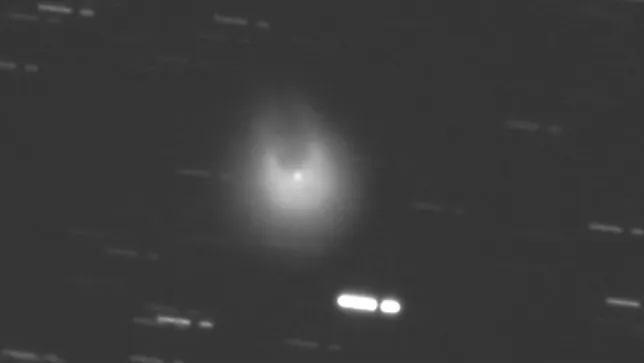
A comet that appeared to have grown horns due to an unusual volcanic eruption that was discovered by astronomers.
The strange occurrence was caused by a comet’s volcanic outburst, which turned it into a tiny star and sent supercold “magma” shooting into space.
Since the last time the comet was observed erupting, it had been about 70 years.
The comet 12P/Pons-Brooks (12P) is a cryovolcanic comet, often known as a cold volcano.
Unlike other comets, 12P’s interior builds up so much gas and ice that it can violently explode, ejecting streams of “cryomagma” through significant fissures in its outer shell.
According to Spaceweather.com, several astronomers observed a significant outburst from the comet last month that caused it to suddenly become about 100 times brighter than usual.
The abrupt rise in brightness has been linked to the coma, the comet’s surrounding cloud, filling up with gas and ice crystals expelled from the comet’s interior, increasing the amount of sunlight reflected back to Earth.
It appears as though the space rock has grown horns due to the enlarging coma.
According to Richard Miles, an astronomer with the British Astronomical Association who studies cryovolcanic comets, as of July 26 the comet’s coma was about 143,000 miles (230,000 kilometres) across, or more than 7,000 times wider than its nucleus, which has an estimated diameter of about 18.6 miles (30 kilometres).
According to reports, other scientists have compared the misshapen comet to the Millennium Falcon, one of the legendary Star Wars spacecraft.
Why does the comet appear to have horns?
According to Mr. Miles, the comet’s peculiar structure is most likely the result of a flaw in the nucleus of 12P.
As the gas and ice become too dispersed to reflect sunlight, the expanding coma is anticipated to eventually vanish.
Since 12P’s orbit places it too far from Earth for any similar eruptions to be seen, Mr. Miles continued, this was the first significant eruption from 12P to be discovered in 69 years.
One of the comets with the longest orbital durations is 12P. The comet travels to the outermost regions of the solar system throughout its approximately 71-year orbit around the Sun.
The comet will be visible in the night sky on April 21, 2024, when it will be closest to the Sun, and on June 2, 2024, when it will be closest to Earth.
Therefore, astronomers should keep a watch on this one since we might get a front-row seat to future eruptions over the next years.

