Vincent Piket, the EU Ambassador to Indonesia and Brunei Darussalam, has tweeted a picture of Ukrainian leader Volodymyr Zelensky delivering his speech to the G20 via video link.
Ukraine President Zelensky addressing the G20 summit in Bali. Impassioned yet detailed speech calling for the restoration of peace in and respect for the UN Charter, the principle of territorial integrity in Ukraine. pic.twitter.com/fxsXIpsuKV
Russia’s FM Sergei Lavrov was present as Zelensky delivered his comments, AFP reported.
As we reported earlier, Zelensky told the assembled leaders that “now is the time when the Russian destructive war must and can be stopped. It will save thousands of lives”.
President of Ukraine, Volodymyr Zelensky, has said that during his virtual conference with G20 leaders that Russia’s war “must end now.”
He also ruled out a third “Minsk agreement,” which alludes to two failed cease-fire agreements between Kiev and Moscow over the future of the eastern Donbas region.
Mr Zelensky said during his video call: “We will not allow Russia to wait, build up its forces, and then start a new series of terror and global destabilisation.
“There will be no Minsk 3, which Russia will violate immediately after the agreement.”
However, Russia has been critical of the Ukrainian president’s statement.
The RIA Novosti news agency reports that Kremlin spokesman Dmitry Peskov said Zelensky’s comments over the “Minsk 3” deal shows Russia that Kyiv is not interested in holding peace talks.
Ukrainian President Volodymyr Zelensky says that investigators have uncovered more than 400 war crimes in areas of Kherson abandoned by Russian forces as they retreated.
Mr Zelensky said the bodies of civilians and soldiers had been found.
The BBC has been unable to verify the allegations. Moscow denies its troops intentionally target civilians.
Meanwhile Ukrainian authorities imposed an overnight curfew and restricted travel in and out of Kherson.
“In the Kherson region, the Russian army left behind the same atrocities as in other regions of our country, where it was able to enter,” Mr Zelensky said in his nightly video address.
“We will find and bring to justice every murderer. Without a doubt.”
Since the start of the war, mass graves have been found in areas including Bucha, Izyum and Mariupol. Ukraine has accused Russian troops of being behind the atrocities.
A UN commission last month said that war crimes had been committed in Ukraine and that Russian forces were responsible for the “vast majority” of human rights violations at the start of the invasion.
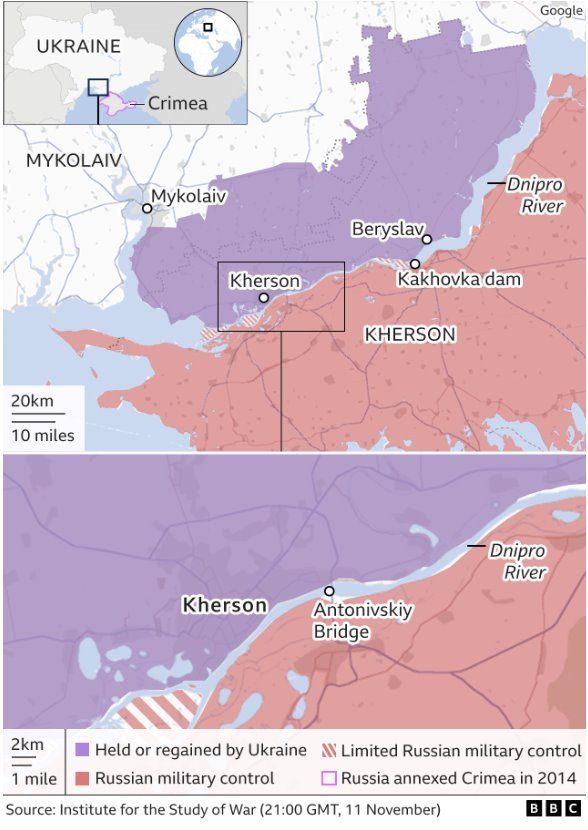
Kherson was the only regional capital to be captured by Russia since the February invasion of Ukraine.
The region, along with three others, was proclaimed by President Vladimir Putin to be part of Russia, at a ceremony in the Kremlin in September.
But Kherson city was liberated by Ukrainian troops on Friday. Crowds of flag-waving Ukrainians greeted Kyiv’s soldiers with hugs and kisses.
Officials have returned to run Kherson’s administration after the retreat of some 30,000 Russian occupation troops.
Ukrainians see it as a major national victory and humiliation for the Kremlin, on a par with the Russian withdrawal from the Kyiv suburbs in March.
There are fears that some Russian soldiers may have remained behind in disguise, while collaborators who helped the Russians during the occupation are now liable to be prosecuted.
Mr Zelensky said detention of Russian soldiers and mercenaries “who were left behind in this territory and neutralisation of saboteurs are also ongoing”.
Ukrainian forces are working to restore internet and television connections, while electricity and water supplies will be fixed “as soon as possible”, he said.
There are fears that Russian troops, now digging in on the opposite bank of the Dnipro river, may resume shelling.
Kherson officials have banned use of river transport from 13 to 19 November.
Russian explosives litter the region, and locals who fled have been warned not to return until their homes have been checked for mines or booby traps.
Kherson governor Yaroslav Yanushevych has told citizens to avoid crowded places and stay away from the city centre on Monday because the military will be de-mining there.
The overnight curfew was put in place from 17:00 to 08:00 (15:00 to 06:00 GMT).
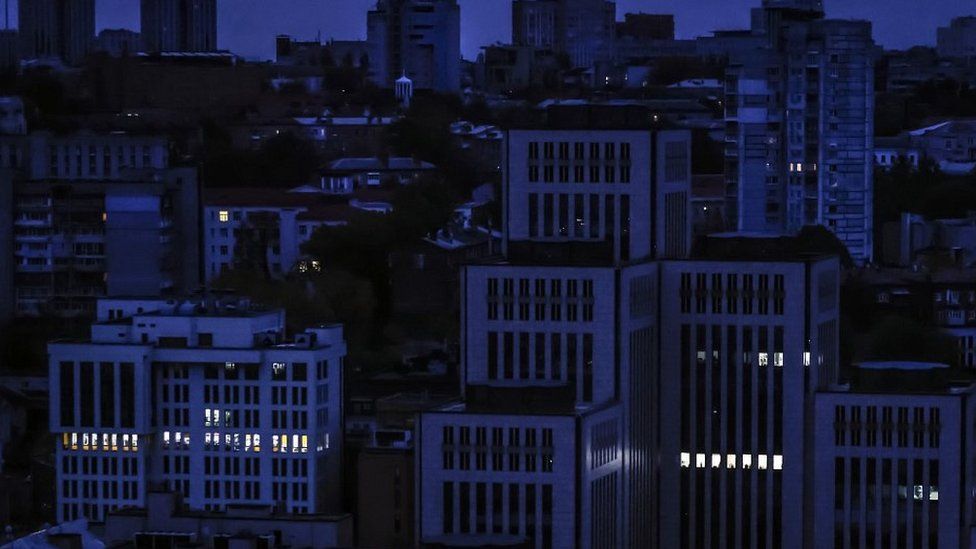
Because of Russian attacks on energy infrastructure, Ukrainian authorities have warned residents in Kyiv to expect longer power outages lasting more than four hours.
Rolling blackouts are affecting not only Kyiv but also Ukraine’s central regions, including Dnipro.
According to President Volodymyr Zelensky, approximately four million people have been affected, but “the shelling will not break us.”
This month Russia launched dozens of missiles and Iranian-made drones.
Ukraine’s energy infrastructure is being pounded by the air attacks – Mr Zelensky says about a third of the country’s electric power stations have been destroyed.
The Kyiv region has lost 30% of its power capacity, the private energy company DTEK says, meaning “unprecedented” power cuts will be necessary.
“Unfortunately the scale of restrictions is significant, much larger than it was before,” said DTEK director Dmytro Sakharuk.
The power cuts have meant curbs on the use of street lights and electric-powered public transport, besides the discomfort in people’s homes.
IMAGE SOURCE,EPA Image caption, The scene in Dnipro as street lighting is switched off
The EU and other international allies of Kyiv have condemned the deliberate targeting of civilian infrastructure – attacks that Ukraine sees as war crimes.
Ukraine’s second city Kharkiv, heavily damaged by Russian shelling, also faces long power cuts, along with the central cities of Zhytomyr, Poltava and Chernihiv.
Russia stepped up its missile attacks on Ukraine’s power stations and other civilian infrastructure in retaliation for the 9 October bombing of the Kerch Bridge – a key link to Russian-annexed Crimea.
President Vladimir Putin called that blast a Ukrainian “act of terrorism”. The bridge is a symbol of his campaign to incorporate large swathes of Ukraine into Russia.
A power station employee called Pavlo, quoted by AFP news agency, said “we are confronted by such damage for the first time”. The unnamed plant had twice been targeted by missiles and then by an Iranian-made “kamikaze” drone.
He said repairs had been underway for more than two weeks, but “there are difficulties in that the equipment that has been damaged is unique – it’s hard to find the same parts”.
In other developments:
Russia said it had mobilized 300,000 reservists – the target number set by defence minister Sergei Shoigu. He said 41,000 of those called up had already been deployed to the battlefield in Ukraine
Russia also said it had completed an operation to move thousands of civilians out of occupied Kherson, ahead of an expected battle with Ukrainian forces for the strategic southern city
President Zelensky accused Russia of dismantling medical facilities in Kherson – removing “equipment, ambulances, just everything” – and pressurising doctors to move to Russia
Chechen leader and Putin ally Ramzan Kadyrov admitted that a Chechen unit had suffered “big losses” – 23 fighters killed and 58 wounded in a Ukrainian artillery attack
UN Secretary-General Antonio Guterres has urged all parties to renew the grain export deal, which is due to expire next month. Russia has suggested it might not renew the deal. The agreement allowed Ukraine to resume exports in the Black Sea which had been blockedwhen Russia invaded.
Ukraine has indicated that it will continue its counter-offensive reclaiming land annexed by Russia in the south and east, despite yesterday’s escalation of missile attacks, a senior politician has told BBC News.
Our diplomatic correspondent Paul Adams spoke with Ihor Zhovkva, deputy head of Ukrainian President Volodymyr Zelensky’s office.
Zhovkva said Monday’s strikes were designed to cause panic, hitting major cities in the middle of rush hour.
But, he said, Russian President Vladimir Putin had failed to intimidate Ukrainians, even with the greater intensity of the strikes, which were seemingly targeted at both critical infrastructure and civilian targets.
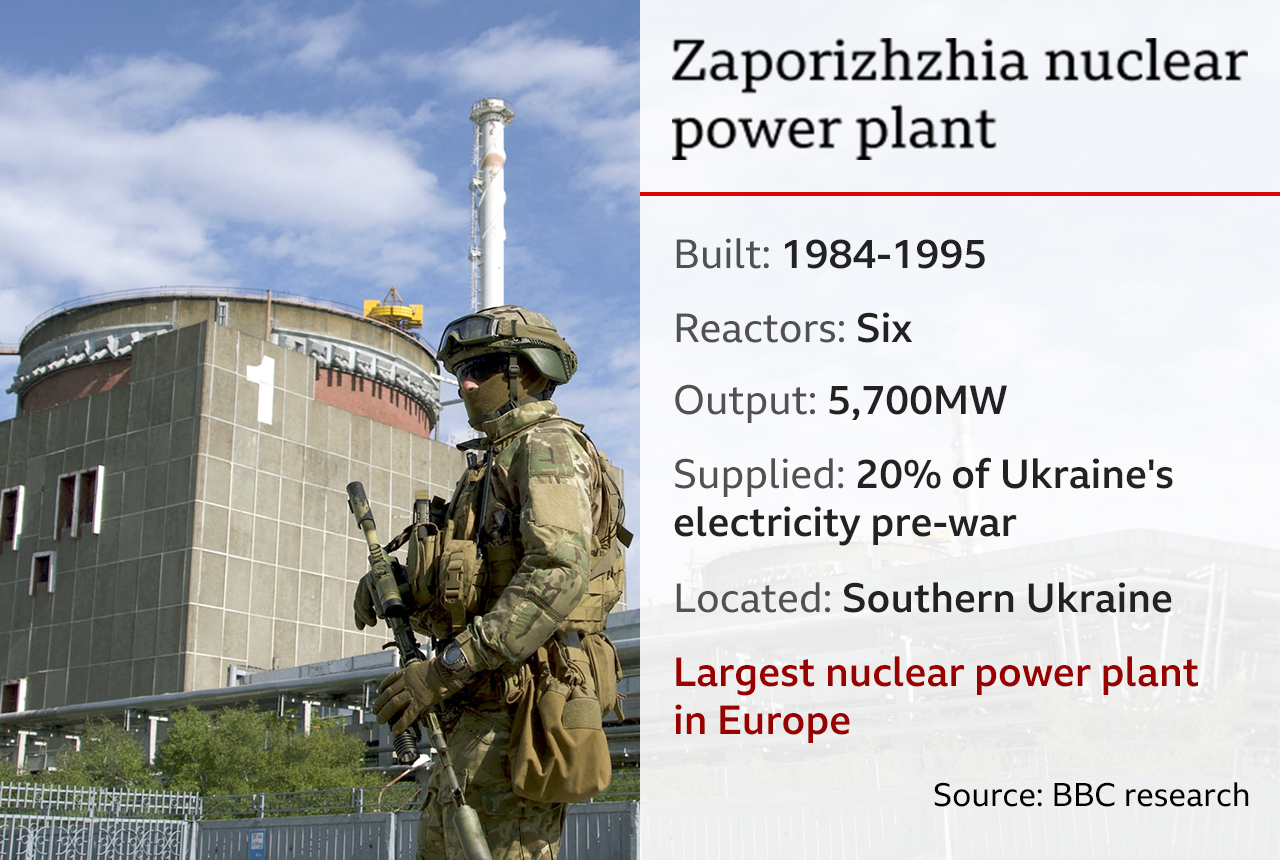
Vladimir Putin has said he trusted the report from the UN’s nuclear watchdog, the International Atomic Energy Agency (IAEA), but criticised the agency for not saying Ukraine was to blame for shelling the area.
Shelling continued while the 14-strong IAEA team visited the site and its head, Rafael Grossi, warned of a very real risk of nuclear disaster. Although most of the team left the plant after two days, it said two of its officials would remain there on a permanent basis.
In an emergency session of the Security Council, the UN Secretary General Antonio Guterres set out steps for the creation of a demilitarised zone around the plant.
Ukrainian President Volodymyr Zelensky welcomed calls by the IAEA for a safety protection zone at Zaporizhzhia.
On Wednesday Petro Kotyn, who runs Ukraine’s nuclear agency Energoatom, suggested a UN peacekeeping contingent could set up a security zone at Zaporizhzhia and Russian troops withdraw.
However, the IAEA was careful not to apportion blame to either side.
The IAEA’s report says that there were Russian military vehicles stationed in two turbine halls and under the overpass connecting the reactor units and includes a photo showing Russian-flagged military trucks with the Z insignia parked inside a large building.
However, on Wednesday Mr Putin denied that there was any Russian military equipment on-site at Zaporizhzhia.
The IAEA detailed the damage to the plant and said that while continued shelling had not yet triggered a nuclear emergency, it did present a constant threat to safety that “may lead to radiological consequences with great safety significance”.
There was an urgent need for “interim measures” to prevent a nuclear accident caused by military action, it added, saying all relevant parties would have to agree to a “nuclear safety and security protection zone” being set up to avoid further damage.
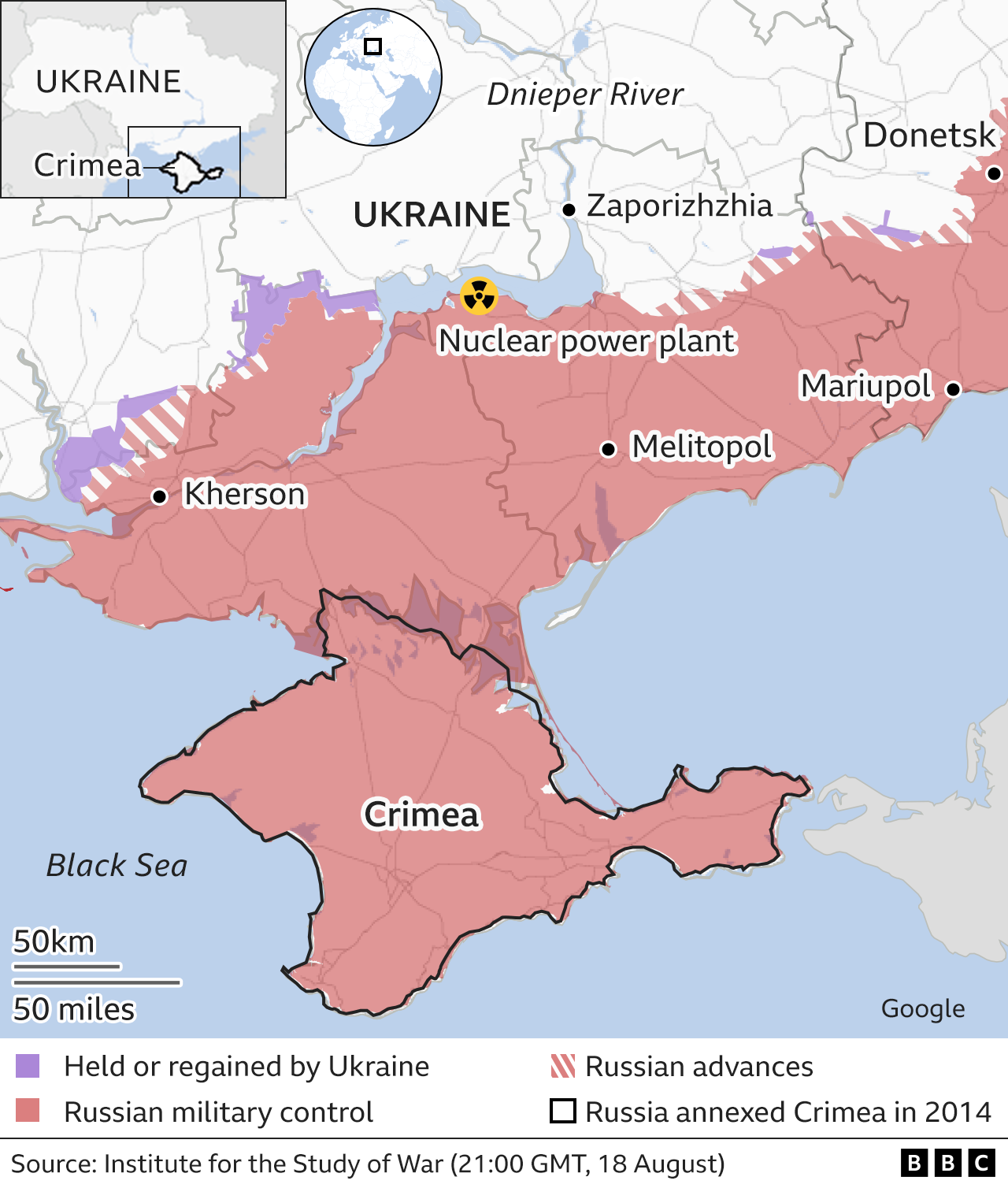
The plant lies on the southern bank of the River Dnieper, across the water from Ukrainian-held towns and military positions.
Meanwhile, the UK’s Ministry of Defence says fighting has continued in Ukraine on three fronts over the past 24 hours: in the east, in Donbas; in the north around Kharkiv, and in the south around Kherson.
The redeployment of Russian forces to southern Ukraine around Kherson has enabled Ukrainian forces to make progress in the Kharkiv region. according to the US-based Institute for the Study of War. The institute suggests Ukrainian forces may have taken a town near Balaklia as Russian troops retreated, blowing up bridges.
In his regular address on Saturday, Mr. Zelensky stated that “it is trying to attack with poverty and political disarray where it cannot yet attack with missiles.”
A few hours earlier, Russia had announced that its main gas pipeline to Europe would not reopen as scheduled.
Europe accused Russia of using its gas supplies to blackmail Europe amid the Ukraine conflict, which Moscow denies.
Energy prices have soared since Russia invaded Ukraine on 24 February and scarce supplies could push up costs even further.
There are growing fears families in the EU will be unable to afford the cost of heating this winter.
Governments across the continent are contemplating what measures to take to alleviate the crisis.
Germany – one of the countries worst affected by the Russian supply disruption – announced a €65bn (£56bn) package of help on Saturday.
Chancellor Olaf Scholtz said Russia was no longer a reliable energy partner.
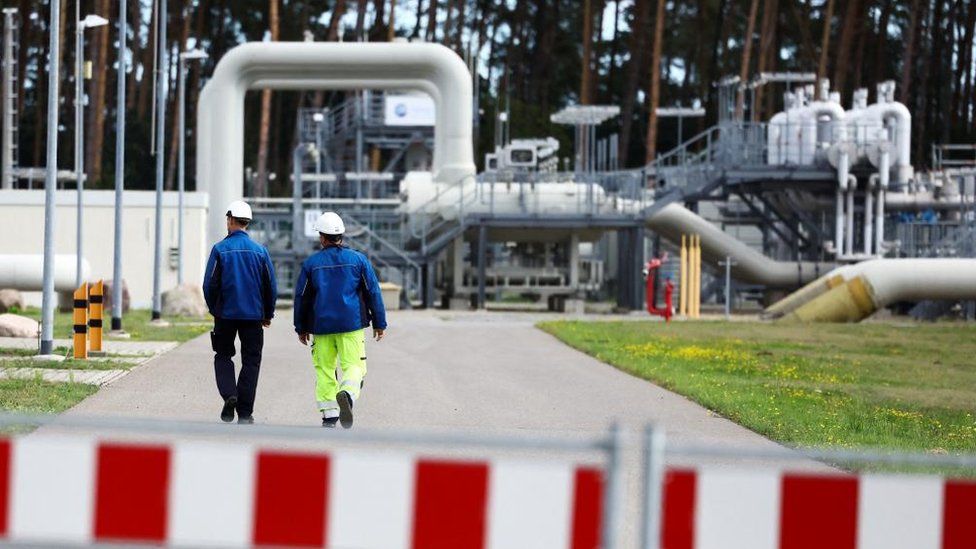
IMAGE SOURCE,REUTERS
Image caption,
The Nord Stream 1 pipeline in Lubmin, Germany
The stand-off with Russia has forced countries to fill their own gas supplies, with Germany’s stores increasing from less than half in June to 84% full today.
Europe is attempting to wean itself off Russian energy in an effort to reduce Moscow’s ability to finance the war.
The pipeline, which runs to Germany, had been shut for three days for what Gazprom described as maintenance work and had been due to reopen.
The interruption of the service was “sadly no surprise”, EU Council President Charles Michel said.
“Use of gas as a weapon will not change the resolve of the EU. We will accelerate our path towards energy independence. Our duty is to protect our citizens and support the freedom of Ukraine,” he tweeted in response to Gazprom’s announcement.
Moscow denies using energy supplies as an economic weapon against Western countries supporting Ukraine.
It has blamed the sanctions for holding up routine maintenance of Nord Stream 1, but the EU says this is a pretext.
Gazprom’s announcement came shortly after the G7 nations agreed to cap the price of Russian oil in support of Ukraine.
The G7 (Group of Seven) consists of the UK, US, Canada, France, Germany, Italy, and Japan.
Their introduction of a price cap means countries that sign up to the policy will be permitted to purchase only Russian oil and petroleum products transported via sea that are sold at or below the price cap.
However, Russia says it will not export to countries that participate in the cap.
On Friday, Ukrainian President Volodymyr Zelensky announced that prominent paramedic Yuliya Payevska, aka Tayra, had been freed from Russian captivity.
In a video posted on Telegram, he said: “I can announce today that we managed to free from captivity Tayra – Ukrainian paramedic Yuliya Payevska. I am grateful to all who worked to achieve this result. Tayra is already home. We will go on working to bring everybody back.”
Payevska was captured by Russian forces together with her driver in Mariupol in mid-March, where she’d been working as a paramedic, helping to evacuate injured soldiers and civilians.
Her husband believes she was taken to Russia. A propaganda video featuring her was carried by some pro-Kremlin Russian TV channels.
News of her release was welcomed by many Ukrainian commentators:
“It’s hard to imagine what Tayra has been through, but it’s so great that she is alive and home!” film director Iryna Tsilyk said.