Tag: WAEC

  • Computerized School Selection and Placement System in Ghana: Challenges and the way forward

    Computerized School Selection and Placement System in Ghana: Challenges and the way forward

    Computerized School Selection and Placement System in Ghana: Challenges and the way forward↗

    The purpose of the paper is to review literature on the challenges and the way forward of the Computerised School Selection and Placement System (CSSPS) in Ghana.

    Literature informs us that the key challenge to the Computerised School Selection and Placement System was the human factor in terms of refusal of parents and students to accept placement into other schools apart from their chosen high-endowed schools.

    It is also found from the literature in this paper that there was the challenge of some parents not being able to pay the school fees for their wards who have been placed in private schools due to the high cost of private schools’ fees.

    Methodologically, this paper relied primarily on secondary sources of information such as online literature on computerised school selection, archives, some excerpts from the Daily Graphic, among others.

    Parents, Headteachers of Junior High Schools (JHS) and Senior High Schools (SHS), students, policy makers, and stakeholders in education were the focus of this study.

    Finally, the review established that the CSSPS has become fertile ground for bribery and corruption in our dear country, Ghana.

    From the review, it is therefore recommended that there be a need to revisit the policy of developing some of the senior high schools in each region as model schools, with all the modern facilities required in a standard second cycle school.

    Also, we recommend that the Ministry of Education (MOE) and the Ghana Education Service (GES) should provide inputs in time to the least endowed schools and also upgrade the infrastructural facilities in the least endowed schools to make them attractive to students so as to reduce pressure on the highly endowed schools.

    Finally, we encourage stakeholders to get on board for us to see how best we could evaluate and modify the system for the betterment of the children and our nation.

    Keywords: Non-Governmental Organisations, challenges, prospects, students, second-cycle institutions, mechanical, manual.

    Introduction

    Prior to the initiation of the Computerised School Selection and Placement System (CSSPS), the selection and placement of students in second-cycle institutions was machine-driven and labour-intensive.

    The manual system was laborious and time-consuming. It was also characterised by several limitations and flaws, such as misplacement of student registration cards and forms, wrong shading of index and code numbers by students and heads of JHSs, undue delay in admissions, as well as loss of admission letters.

    Furthermore, the manual system was highly susceptible to human manipulation and machinations such as bribery and corruption.

    Rich and affluent parents used their monetary influence to secure placement for their wards in good and extremely endowed schools to the disadvantage of good students from poor homes.

    Similarly, the influence and pressure from “old boys” and “old girls” associations, PTA officials, protocol admissions, and insatiability by some heads of second-cycle institutions plagued the admission procedures of the manual system.

    Additionally, before the introduction of the CSSPS innovation, heads of very good and highly endowed schools indiscriminately and unilaterally set high personal cut-off grade points and admission standards to attract only the exceptionally good and gifted students to the detriment of the less brilliant and rural-setting students.

    Furthermore, in the era of the manual system, the period of the release of the Basic Education Certificate Examination (BECE) results was a terrible period for parents and students.

    Nervous parents had to travel to the selected schools of their wards to ascertain the admission status of their wards and to pay the admission fee on time to secure the place; otherwise, it would be given to another person.

    Indisputably, these problems that lumbered the manual system made it unbefitting as a selection and placement tool.

    However, the question that is often asked is whether the CSSPS has succeeded in surmounting the inadequacies that were inherent in the manual system.

    The peak of the problem is: What are the challenges and prospects of the Computerised School Selection and Placement System in Ghana?

    Hence, the main aim of this paper is to review literature on the challenges and prospects of the Computerised School Selection and Placement System in Ghana.

    Literature Review

    Pre-Computerized School Selection and Placement System

    In 1987, the Government of Ghana embraced a new educational system as part of the several reforms initiated to address deficiencies in the public sector.

    The long-term objective of the reform is to achieve universal basic education, expand, and increase access to secondary and tertiary education.

    To fulfil this, the educational system was given a new dimension with particular emphasis on diversification of content and quality.

    With the motive of increasing access to secondary and tertiary education, the Basic Education Certificate Examination (BECE) was introduced.

    Until recently, admissions to Senior High Schools had been the duty of heads of senior secondary institutions who met to select candidates for their schools based on merit and other factors defined by their communities.

    The selection and placement of qualified BECE candidates into Second Cycle schools of their choice was performed manually.

    Every year, heads of Senior High Schools and Technical Institutes together with Ghana Education Service (GES) officials met at selected regional centres to conduct the selection exercises (GINKS, 2008).

    The Computerised School Selection and Placement System in Ghana

    The CSSPS is the acronym for Computerised School Selection and Placement System. It is an automated merit-based computerised system which has replaced the laborious Manual System of Selection and Placement (MSSP) of qualified BECE candidates into second cycle (Senior High Schools and Technical/Vocational) institutions in Ghana.

    The CSSPS was introduced in 2005 as part of the Ministry of Education (MOE) and Ghana Education Service (GES) grand plan of programmes and interventions intended to expand access and improve the quality of education through teaching and learning as well as curricular development.

    The enactment of programmes and interventions was facilitated with the support of stakeholders in education, who also include Non-Governmental Organizations (NGOs) and development partners.

    The main purposes for the introduction of the CSSPS were: to improve and enhance efficiency in the school transition process (that is, transition from Junior High School to Senior High School); increase transparency, fairness and cost-effectiveness.

    Added to these was to increase access and participation in secondary education and finally to ensure equity and speed in the selection and placement process (Ajayi, 2009).

    In order to be eligible for consideration by the CSSPS process, candidates have to complete specially designed cards and scannable forms for processing by a computer software which was specifically and specially developed for the system.

    Since 2005, the process of selection and placement into senior high school, secondary technical and vocational school has been computerized. The

    main objectives for the introduction of the CSSPS were to promote efficiency, transparency, fairness and equity and speed in selection and placement. The main features of the CSSPS are as follows;

    Selection is based on scores of six subjects. A total of six subjects are used for the selection; this comprises four core subjects and two other best subjects.

    The core subjects are English, Mathematics, Science and Social Studies for Senior High Schools. For technical institutions, Pre-Technical Skills replace Social Studies as the fourth core subject.

    To qualify for selection and placement candidates’ grade in any of the four core subjects should not exceed five.

    The minimum grade for each of the best other two subjects should not exceed six and if added to the four core subjects must not exceed an aggregate of 30.

    A candidate whose grade for any of the core subjects exceeds five or cancelled by the West African Examinations Council (WAEC) will be deemed as not qualified for selection and placement.

    Inauguration of the Computerized School Selection and Placement System in Ghana

    Ghana inaugurated a Computerized School Selection and Placement System (CSSPS) in September 2005 with the aim of increasing transparency and enhancing the competence of the school transition process.

    Prior to this, the student selection and school admission were carried out manually at annual meeting of head teachers in each region following the announcement of examination results; students were required to choose all three of their schools from a single region to reduce the administrative burden of manual school assignment.

    Additionally, student selection cards were misplaced, and parents routinely complained that school assignment was based on preferential treatment and not actually on merit because well-connected students were admitted into top and highly endowed schools even if they did not have the requisite grades.

    The computerization mechanism was therefore designed to address several of the insufficiencies inherent in the manual system.

    Under the CSSPS, students could pick schools from multiple regions and there was to be limited interference from headmasters in the school’s selection and assignment process.

    The CSSPS uses a deferred acceptance algorithm for school assignment (Gale & Shapley, 1962). Under this procedure students are ranked according to their priority levels (that is, test scores in the case of the CSSPS); they are then proposed as a match to their first-choice school in order of their test score rankings.

    Students are assigned to their first choice if there is a space available. If the student is unassigned in the first round, then the second-choice school is considered, and the process repeats.

    In the second round, a student can displace another student who was assigned in the first round if the first-round student has a lower examination score. Under this algorithm, there is no penalty for ranking schools in an arbitrary order within the set of the three first choice schools.

    This contrasts with the Boston mechanism, which does not allow already assigned or placed students to be displaced in subsequent rounds.

    There are therefore, clear incentives for making a premeditated first choice under the Boston mechanism, which does not apply under the deferred acceptance algorithm.

    Students who are not placed or assigned to any of their chosen schools are assigned to any available space in their district or whenever possible.

    However, students who receive the passing grade may not be assigned to any school at all, if there are no spaces or vacancies remaining. Students are informed of their placement and are given 30 days to report at their schools of placement once the school year begins.

    Heads of SHS are then required to report any unfilled places to the Ministry of Education so that the spaces can be allocated to previously unassigned students.

    Ajayi (2009) revealed and exposed the fact that there is imperfect compliance to this regulation and anecdote evidence suggests that certain schools under report the availability of spaces in order to reserve some which they then allocate at their own discretion.

    To eliminate this problem, as a result of Ajayi’s revelation in the 2009 school placement exercise; many schools were assigned more students than the declared places.

    During the current school assignment process, the CSSPS makes enough effort to address socio economic inequality. Several schools were evaluated and assigned a deprivation score ranging from 0 (non–deprived) to 9 (highly-deprived).

    These scores are used to scale up test–scores for students from low–resourced Junior High School (JHS) and the rural schools in an attempt to compensate for the weaknesses of attending under-resourced schools especially in the rural areas.

    It can be noticed that the successive attempts of enhancement in the mechanism of selection and placement into SHSs is to enhance efficiency and to increase access into second cycle institutions since there is always excess demand for placement over the existing vacancies in the secondary schools.

    Potential Benefits of the Computerized School Selection and Placement System

    The CSSPS presents numerous potential benefits among which are:

    achieving the government’s long-term objective of universal basic education, expanding, and increasing access to secondary and tertiary education;

    reduction in stratified societies (class societies) since the system does not discriminate between the rich and the poor;

    enhanced national integration through the system’s ability to allow students to choose schools from more than one region;

    improved teaching and learning since selection and placement are done on merit;

    effective, efficient, transparent, simple and speed in the procedure of selection and placement;

    removal of decentralized selection constraints on regional basis by allowing the choice of schools from any combination of regions (www.ghanaschoolsnet.com, 2011);

    promotion of fairness and equity by enabling pupils who performed well to gain admission to schools of their choice irrespective of whether the school is a first, second or third option. The system also ensures that no school admits more students than the vacancies available for each programme;

    reduction in human error during the process of capturing registration data;

    easy access to placement results through Short Messaging Service (SMS) where candidates only text their identity card numbers and instantly receive replies on their placement status indicating the secondary school where they were placed and the program (SISCO, 2007). Compared to the manual method of selection and placement, parents and guardians now see the computerized system as being more objective than subjective.

    Challenges of the Computerized School Selection and Placement System (CSSPS)

    There have been allegations of corruption in the media (Aboagye, 2011) in spite of various assurances from the Ministry of Education. Among the problems and criticisms are the following:

    Some parents complain that because of high cost of private schools fees, those who find their wards placed in the private schools do have problem of school fees.

    Also because of the distributive nature of the system, students who are placed in schools far away find it difficult to cope with distance.

    There is also the problem of female students being placed in male schools and vice versa (Asare, 2010).

    While these problems have been attributed to the registration process in the schools where most students make mistakes in shading wrong, some people think the CSSPS is not working well (GINKS, 2008).

    It also alleged that some heads of schools do not make available to candidates the WAEC register which lists all schools with designated codes for correct shading. It is also reported that about fifty thousand errors were committed in 2011 alone due to the above challenges faced by the new system of selection (www.ghanaschoolsnet.com, 2011; GINKS, 2008).

    It is in the light of these problems that this paper tries to assess the CSSPS from the stake- holders’ perspective. Among the stakeholders for this research are Heads of both JHS and SHS, parents whose wards have gone through the CSSPS, students who have gone through the CSSPS as well as the implementers of the CSSPS.

    Babah (2011) researched on the topic; “Stakeholders’ Perception of The Computerized School Selection and Placement System: A Study of The Greater Accra Region, Ghana.”

    The study was intended to find out whether the CSSPS was a better alternative to the manual system in the process of selection of qualified students in the Senior High Schools (SHSs) in the Greater Accra Region of Ghana.

    A sample size of 306 was selected from a population of 994. Stratified and simple random sampling procedures were employed to select the subjects in the study sample. Respondents to the questionnaire and interview were randomly selected.

    A pilot study was conducted in the Eastern Region to test the validity and reliably of the instrument.

    The Cronbach’s alpha coefficient reliability at 0.7 was recorded. The data generated was processed and converted into percentages to facilitate the analysis and discussion processes.

    From the data collected and analysed, some of the challenges were found as; placement of students in distant schools not selected, inadequate information on the demographic features of the school, inability of candidates securing their first-choice school, errors in the selection process by candidates and refusal of parents and students to accept alternative placement.

    In summation, the researcher stated that the key challenge to the CSSPS was the human factor in terms of refusal of parents and students to accept placement into other schools apart from their chosen endowed schools.

    In support of this argument, Gyaase and Adu-Gyamfi (2012) highlighted the challenges of the CSSPS as: some parents complain that because of the high cost of private schools’ fees, those who find their wards placed in the private schools do have problems with school fees.

    Also, because of the distributive nature of the system, students who are placed in schools far away find it dangerous to cope with distance.

    Finally, they mentioned that there is the challenge of female students being placed in male schools and vice versa.

    Following the above challenges, Wesley-Otoo and Anokye (2016) discovered and discussed some challenges facing the CSSPS in Ghana. They highlighted the following;

    Lack of fairness in the distribution of school facilities is a challenge. Analysis of the SHSs, as captured by the appraisal document of the Secondary Education Improvement Project, shows that schools do not have the same funding in educational resources. If all schools had the same resources, the system would have been highly appreciated by all stakeholders. This implies that efforts to address the unfairness in school resources and or facilities will,

    to a large extent, make things much better than they are now. It has been observed that the issue of unfairness often makes parents and students choose schools described as Category “A” schools to the neglect of other ones. These ‘A’ schools are commonly recognised to be well endowed and popular and for which reason most parents would like their children to attend them. A review of the choice pattern of some Category “A” and “C” schools has shown that high information asymmetry on schools and/or preference for highly endowed SHSs at the expense of the so-called less-endowed ones.

    Poor publication of school information to the public has been identified to have posed some discomfort to the selection and placement exercise. Due to the dignity of most people to have their children in Category “A” schools, there have been series of direct appeals for admission from major stakeholders, including religious organisations, traditional rulers and old student groups.

    Insufficient and inaccurate data provided by candidates during registration for Basic Education Certificate Examination (BECE) have also been posing challenges. Sample cases have shown that male students whose forms bear “females” usually end up being placed in wrong ‘sex’ schools.

    Other problems include choice of schools without reference to their residential status and programmes on offer, the lack of concern of parents in the registration of their children resulting in rejection of placements by some parents and choice of schools without reference to the level of financial preparedness on the part of parents.

    In addition to the above, an online report by the Daily Graphic as of 16th September 2019 mentioned that the CSSPS challenge goes beyond errors with the system.

    Candidates are desirous to be placed in high-endowed schools, and, therefore, we find some schools getting more students than they can accommodate, whilst the reverse is the case for some schools.

    A clear example is in the year 2019, when all 721 public SHSs in the country declared 520,298 vacancies, while the number of candidates who qualify to be placed were 473,728.

    This, ordinarily, should be good news that all the candidates will secure placement, with as many as 46,570 places remaining vacant.

    While some schools are flooded with students, with some not getting accommodation for their students, other schools have their gates wide open, without anybody entering. The reason for this is that there is a notion that some schools are superior to others.

    Another challenge discussed by the Daily Graphic (2019) is that while the CSSPS may be a good initiative, reports of excessive human interference certainly defeat the goal of the system.

    In line with that, it was stated categorically that, currently, there are claims that some schools and officials of the Ghana Education Service (GES) are demanding certain amount of money specifically between GHc2,500 and GHc5,000 to get schools

    changed and some parents have actually succumbed and paid for the favour. This must be a serious gap on our conscience as a nation.

    Subsequently, our children now come to perceive that money is the solution to their failures even when they do not deserve some class of schools.

    Discussions

    Firstly, the review found out that CSSPS has been bedeviled with challenges such as; placing students in distant school which they did not select, placing students in schools which are opposite to their gender, low chances of candidates securing their first-choice of senior high schools selected and errors in the selection process by candidates and refusal of parents and students to accept alternative placement.

    Confirming what is above, Babah (2011) mentioned that the key challenge to the CSSPS was the human influence in terms of refusal of parents and students to accept placement into other schools apart from their chosen endowed schools.

    Secondly, it can be inferred from the review that there was the challenge of some parents complaining that they cannot pay the school fees for their wards who have been placed in private schools due to the high cost of private schools’ fees.

    We can decipher from the review that the CSSPS was faced with the challenge that some female students were placed in male schools and male students were placed in female schools.

    Gyaase and Gyamfi (2012) maintained that some parents complain that because of the high cost of private schools’ fees, those who find their wards placed in the private schools do have problems of school fees.

    They also added that there is challenge of female students being placed in male schools and vice versa.

    Finally, the review established that the CSSPS has become a fertile ground for bribery and corruption in our dear country Ghana.

    The 2019 daily graphic report stated emphatically that there are allegations that some schools and officials of the Ghana Education Service (GES) are demanding between GHc2,500 and GHc5,000 to get schools changed and some parents have succumbed to this irregular act.

    This act is a clear example of bribery and corruption, which is a serious stain on the moral uprightness of our dear nation, Ghana.

    Conclusions

    From the review done, it is can be concluded by the researchers that human factor is a necessary evil adding up to the challenges of the Computerized School Selection and Placement System (CSSPS).

    Furthermore, some parents are not being able to pay the school fees for their wards who have been placed in private schools because of the high amount of fees being paid by these private schools. As part of the conclusions, it was also revealed that CSSPS has become a fertile ground for bribery and corruption.

    for people who wield authority when it comes to the placement of Senior High School students. Some students are also placed in distant schools which they did not select, and also placed in schools which are opposite to their gender.

    These problems are worrying and disturbing. In view of these distasteful conclusions, the following recommendations have been made by researchers.

    Recommendations

    In the face of the challenges bedevilling the CSSPS in Ghana, and as a policy measure, we recommend the following to help us move forward as a nation;

    We must revisit the policy of developing some of the senior high schools in each region as model schools, with all the ultra-modern facilities required in a standard SHS, as a way of reducing the human traffic at these highly sought schools.

    If the nation is able to do this, it will go a long way to motivate many students to choose those model schools, as they know that the quality of education that they will receive in other schools will not be compromised and sacrificed.

    Ministry of Education (MOE) and Ghana Education Service (GES) should provide inputs in time to the least endowed schools and also upgrade the infrastructural facilities in the least endowed schools to make them attractive to students so as to reduce pressure on the highly endowed schools.

    If all schools had same or parallel distribution of resources regarding infrastructure, staff and instructional resources, the CSSPS would have been appreciated by many people. We, therefore, urge policy makers and other stakeholders of education to get on board for us to see how best we could review and modify the system for the betterment of our children and our dear nation.

    References:

    Amedahe, F.K; & Asamoah-Gyimah, E. (2005). Introduction to educational research. Cape Coast: Centre for Continuing Education of the University of Cape Coast (CCEUCC)

    Ajayi, K. (2009). Strategic behaviour and revealed preferences; lessons from choice and student’s placement in Ghana. Berkely: University of California.

    Babah, P. A. (2011). Stakeholders’ perception of the computerized school selection and placement system: A study of the Greater Accra Region, Ghana. Unpublished master’s thesis, University of Cape Coast, Cape Coast.

    Bacchus, M.K. (1966). Education for development and underdevelopment: Guyana’s  educational system and its implications for the third world. Waterloo, Ontario., Canada: Wilfrid Laurier University Press.

    CSSPS Report, (2005) Computerized School Selection and Placement System. Accra: MOE (Ministry of Education)

    CSSPS Report, (2006) Computerized School Selection and Placement System. Accra: MOE (Ministry of Education)

    Daily Graphic (2019). Allow CSSPS to work efficiently. Retrieved from https://www.graphic.com.gh/daily-graphic-editorials

    Descombes (2003). A good research guide: For small scale social research projects. (2nd ed) Maidenhead United Kingdom: Open University Press

    Duflo, E. Dupas, P., & Kremer, M. (2008). “Peer effect and the impact of tracking: Evidence from a randomised evaluation in Kenya” A working paper.

    Ebel, R. L. (1972). Essentials of educational measurement. Engle-wood Cliffs, NJ: Prentice Hall, Inc.

    Editorial Statement (2008). Accept CSSPS admission. Junior Graphic (2008 Wed, Nov.19) pp. 19-25.

    GINKS. (2008). Man or P.C: Ghana’s S.S.S selection process.

    Retrieved from http://www.ginks.org

    Gyaase, P. O., & Gyamfi, S. A. (2012). Transparency, equity and accessibility to secondary education in Ghana through e-governance: Stakeholders perspective of the computerized school selection and placement system in Ghana. International Journal of Basic Education, 2(2), 104-116.

    Robinson A. (1990). Co-operation or Exploitation? The argument against co-operative learning for talented students. Journal for the Education of the

    Gifted. 5, 13.

    Sarantakos, S. (2005). Social Research (3rd ed) Palgrave. New York: Academic Press.

    SISCO. (2007). Computerised school selection and placement system: Local solutions to local problem. Accra: Somuah Information Systems Co.

    Wesley-Otoo, E., & Anokye, K. (2016). CSSPS: Success, challenges and the way forward. Retrieved from https://www.graphic.com.gh.

    DISCLAIMER: Independentghana.com will not be liable for any inaccuracies contained in this article. The views expressed in the article are solely those of the author’s, and do not reflect those of The Independent Ghana
  • How to calculate your 2026 WASSCE aggregate for tertiary admission

    How to calculate your 2026 WASSCE aggregate for tertiary admission

    The provisional results of the 2026 West African Senior School Certificate Examination (WASSCE) have been released by the West African Examinations Council (WAEC).

    Candidates can now access their results online and begin calculating their provisional aggregates for tertiary admission applications. To check your results, you will need a valid WASSCE Result Checker containing a serial number and PIN. A result checker can be purchased by dialling *713*3998# or by visiting buycheckercodes.com.gh.

    After purchasing the checker, proceed to the official WAEC results portal at https://ghana.waecdirect.org/ and enter your Index Number, examination details, serial number, and PIN to access your results.

    How Is the WASSCE Aggregate Calculated?

    Once you have viewed your grades, you can calculate your provisional WASSCE aggregate following the guide below.

    Step 1: Know Your Grade Points

    Before you can add anything, you need to convert your letter grades (like A1 or C6) into numbers. The WASSCE grading system uses a standard scale:

    Step 2: Choose Three Relevant Core Subjects

    For many university programmes, the three core subjects usually include:

    English Language

    Core Mathematics

    Integrated Science or Social Studies, depending on the programme

    Check the admission requirements of your preferred university to know which core subjects apply.

    Step 3: Choose Three Relevant Elective Subjects

    Select the three elective subjects required for the programme you want to study.

    Do not simply choose your best three electives if they are not relevant to your intended course.

    Step 4: Add the Six Grade Points

    Add the points for your three relevant core subjects and three relevant elective subjects.

    For example:

    English Language — B3 = 3

    Core Mathematics — B2 = 2

    Integrated Science — C4 = 4

    Elective 1 — B2 = 2

    Elective 2 — B3 = 3

    Elective 3 — C4 = 4

    Your aggregate will be:

    3 + 2 + 4 + 2 + 3 + 4 = Aggregate 18

    Generally, the lower your aggregate, the better your overall score.

    Check the Requirements of Your Preferred University

    Your calculated aggregate should therefore be treated as a provisional estimate. Before submitting an application, check the official admission requirements of the university and programme you intend to pursue.

    If your aggregate is higher than the cut-off for your first-choice programme, you may still have other options, including considering related programmes with different entry requirements or improving specific grades through a future WASSCE for Private Candidates examination.

  • WASSCE 2026: WAEC releases provisional results

    WASSCE 2026: WAEC releases provisional results

    The West African Examinations Council (WAEC) has released the provisional results of the 2026 West African Senior School Certificate Examination (WASSCE) for school candidates.


    A total of 512,862 candidates from 1,022 schools were registered for this year’s examination, made up of 225,270 males and 287,592 females.


    The number of candidates increased by 11.07 per cent compared to the 461,736 candidates recorded for the 2025 examination.


    However, 5,049 candidates, representing 0.98 per cent, were absent from the examination, according to WAEC.


    In a statement dated September 4, the Council said the provisional results have been made available online. Heads of schools will receive login details to access the results of their candidates.


    Candidates who want to check their individual results can also do so through the WAEC Ghana website.


    Performance in core subjects
    In English Language, 315,094 candidates, representing 62.40 per cent, obtained grades from A1 to C6.


    For Core Mathematics, 306,234 candidates, representing 60.75 per cent, recorded grades between A1 and C6.


    A total of 309,605 candidates, representing 62.08 per cent, obtained A1 to C6 in Integrated Science.


    Social Studies recorded the strongest performance among the four core subjects, with 393,918 candidates, representing 78.04 per cent, obtaining grades between A1 and C6.


    On the other hand, 55,940 candidates, representing 11.08 per cent, received an F9 in English Language.


    Core Mathematics recorded 74,692 F9 grades, representing 14.82 per cent, while 76,136 candidates, representing 15.27 per cent, obtained F9 in Integrated Science.


    In Social Studies, 39,416 candidates, representing 7.81 per cent, received an F9.
    WAEC warns against fraudsters
    WAEC has also cautioned candidates and the general public to be wary of fraudsters who may promise to upgrade examination results in exchange for money.


    The Council said its results are secure and can be verified through its official results verification system.


    It added that candidates and institutions can also use the QR code provided by WAEC to authenticate examination results.

  • Only 17% of 2026 BECE candidates scored aggregates 6–18 – CSSPS

    Only 17% of 2026 BECE candidates scored aggregates 6–18 – CSSPS

    Only about 17 per cent of candidates who sat for the 2026 Basic Education Certificate Examination (BECE) obtained aggregates ranging from 6 to 18, the Computerised School Selection and Placement System (CSSPS) Secretariat has disclosed.

    According to the CSSPS Secretariat Coordinator, Sherif Sulemana, the figure represents approximately 107,000 candidates out of the nearly 620,000 who sat for the examination.

    “If you look at the data for the performance of the candidates, we only had about 17 per cent of the candidates getting aggregates from 6 to 18,” he said.

    Mr Sulemana made the disclosure during an appearance on Joy FM’s Super Morning Show on Thursday, September 3.

    He said the overall performance of candidates varied significantly, with some recording very low scores in the core subjects.

    “You find out somebody got one, somebody got ten over 100, somebody got, say, twelve, twenty over 100, and that qualifies as a failure,” he said.

    He further disclosed that about 35 per cent of candidates, representing approximately 252,000 students, obtained aggregates ranging from 6 to 24.

    “We only had about 252,000, or about 35 per cent of the candidates, getting from aggregate 6 to 24,” he added.

    The figures come as authorities prepare to place successful candidates into Senior High Schools (SHSs) and Senior High Technical Schools across the country.

    Mr Sulemana also disclosed that about 565,000 candidates qualified for placement under the CSSPS, while approximately 55,000 candidates did not meet the requirements for placement.

    He explained that eligibility for placement is largely determined by a candidate’s performance in English Language and Mathematics, with candidates who fail either subject disqualified from placement.

    Meanwhile, WAEC has withheld the subject results of 2,722 candidates from 229 schools who sat for the 2026 BECE over their alleged involvement in examination malpractice.

    WAEC has also cancelled the entire results of 601 candidates for engaging in various forms of examination malpractice.

    The development was contained in a press statement signed by the Head of Public Affairs at WAEC, John K. Kapi, on Wednesday, July 29.

    According to WAEC, the decision was approved at the 37th Meeting of the Final Awards and Examiners’ Appointment Committee for the BECE, held on July 21.

    The release of the BECE results has paved the way for the placement of successful candidates into Senior High Schools across the country.

    Commenting on the release of the results and the upcoming placement exercise, the Minister of Education, Haruna Iddrisu, assured the public that he would not interfere in the work of WAEC.

    “As I’ve always indicated as Minister, I don’t interfere with the work of assessment institutions like WAEC. It is within their domain,” Mr Iddrisu said.

    Mr Iddrisu, however, acknowledged the challenges parents and students face during the school placement process, particularly due to limited infrastructure and the growing demand for senior high school education.

    While conceding that available resources have not been sufficient to address the issue in its entirety, he said the government was pursuing measures to bridge the gap.

    Among the measures is the Sustainable Development for Improved Access to Tertiary Education and Jobs (STAR-J) project, which seeks to strengthen and expand infrastructure within the education sector.

  • CSSPS: About 55,000 BECE candidates to miss placement over failure in Maths, English

    CSSPS: About 55,000 BECE candidates to miss placement over failure in Maths, English

    About 55,000 candidates who sat for the Basic Education Certificate Examination (BECE) this year will not qualify for placement under the Computerised School Selection and Placement System (CSSPS).

    This was revealed by the Secretariat Coordinator, Sherif Sulemana, during an appearance on Joy FM’s Super Morning Show on Thursday, September 3.

    He explained that out of the approximately 620,000 candidates who sat for the examination, about 565,000 qualified for placement under the centralised system.

    “There are about 55,000,” he stated when asked about the number of candidates who did not qualify for placement. “Based on our analysis, we have about 565,000 qualified for placement this year,” he said.

    Why candidates missed placement

    Mr Sulemana explained that a candidate’s eligibility for placement is largely based on their performance in English Language and Mathematics, noting that candidates who failed either of the two subjects would not qualify for placement.

    His comments come as authorities prepare to place candidates into Senior High Schools (SHSs) and Senior High Technical Schools across the country.

    According to Mr Sulemana, the examination results also revealed varying levels of performance among candidates, with a considerable number recording low scores in some of the core subjects.

    “You find out somebody got one, somebody got ten over 100, somebody got, say, twelve, twenty over 100, and that qualifies as a failure,” he said.

    On the overall performance of candidates, Mr Sulemana said only about 17 percent obtained aggregates ranging from 6 to 18.

    “If you look at the data for the performance of the candidates, we only had about 17 percent of the candidates getting aggregates from 6 to 18,” he said.

    He noted that this represented approximately 107,000 candidates.

    Mr Sulemana further indicated that about 35 percent of candidates, representing approximately 252,000 students, obtained aggregates ranging from 6 to 24.

    “We only had about 252,000, or about 35 percent of the candidates, getting from aggregate 6 to 24,” he added.

    Candidates results witheld

    Meanwhile, the West African Examinations Council (WAEC) has withheld the subject results of 2,722 candidates from 229 schools who sat for the 2026 BECE over their alleged involvement in examination malpractice.

    WAEC has also cancelled the entire results of 601 candidates for engaging in various forms of examination malpractice.

    The development was contained in a press statement signed by the Head of Public Affairs at WAEC, John K. Kapi, on Wednesday, July 29.

    According to WAEC, the decision was approved at the 37th Meeting of the Final Awards and Examiners’ Appointment Committee for the BECE, held on July 21.

    The release of the BECE results has paved the way for the placement of successful candidates into Senior High Schools across the country.

    Commenting on the release of the results and the upcoming placement exercise, the Minister of Education, Haruna Iddrisu, assured the public that he would not interfere in the work of WAEC.

    “As I’ve always indicated as Minister, I don’t interfere with the work of assessment institutions like WAEC. It is within their domain,” Mr Iddrisu said.

    Mr Iddrisu, however, acknowledged the challenges parents and students face during the school placement process, particularly due to limited infrastructure and the growing demand for senior high school education.

    While conceding that available resources have not been sufficient to address the issue in its entirety, he said the government was pursuing measures to bridge the gap.

    Among the measures is the Sustainable Development for Improved Access to Tertiary Education and Jobs (STAR-J) project, which seeks to strengthen and expand infrastructure within the education sector.

  • WAEC considering to review 2026 BECE results

    WAEC considering to review 2026 BECE results

    The West African Examinations Council (WAEC) has disclosed its willingness to remark 2026 Basic Education Certificate Examination (BECE) scripts following calls for a review of the results.

    The Ghana National Council of Private Schools (GNACOPS) had earlier called on the examination body to audit BECE scripts, arguing that the results of some private school candidates appeared not to reflect their academic abilities.

    “That best candidate may not necessarily be the best elsewhere. There is somebody somewhere who may be better than your best candidate. And so, we treat them as individual candidates, and if there is a need for them to take a second look at their results, why not? We are ready to do that,” he said. 

    However, during an interview with the media, Head of Public Affairs at WAEC, John Kapi, noted that private schools would not be given direct access to students’ examination papers for independent scrutiny should the remarking exercise be conducted.

    Meanwhile, the West African Examinations Council (WAEC) has withheld the subject results of 2,722 candidates from 229 schools who sat for the 2026 Basic Education Certificate Examination over their alleged involvement in examination malpractice.

    In addition, WAEC has cancelled the entire results of 601 candidates for engaging in various forms of examination malpractice. This information was contained in a press statement signed by Head of Public Affairs John K. Kapi on Wednesday, July 29.

    According to WAEC, the new development was approved at the 37th Meeting of the Final Awards and Examiners’ Appointment Committee for the BECE, held on July 21. The release of the results will pave the way for the placement of successful candidates into Senior High Schools (SHS) across the country.

    The Minister assured the public that he would not interfere in the work of the assessment body. “As I’ve always indicated as Minister, I don’t interfere with the work of assessment institutions like WAEC. It is within their domain,” Mr Iddrisu said.

    The Minister acknowledged the challenges parents and students face during the school placement process, particularly due to limited infrastructure and the growing demand for senior high school education.While conceding that available resources have not been sufficient to tackle the issue in its entirety, he stressed that the government is pursuing measures to bridge the gap. Among these measures is the Sustainable Development for Improved Access to Tertiary Education and Jobs (STAR-J) project, which seeks to strengthen and expand infrastructure within the education sector.”Justifiably so, in truth, we have not had the resources to respond head-on to this challenge. To resolve it, we need adequate resources to expand infrastructure by way of classroom blocks and other educational facilities,” he said.

    Mr Iddrisu appealed for patience as the government works to improve the placement system. “You may have to give me another year, then I’ll be better off in resolving the school placement issues,” he said.

    According to him, the government is undertaking a review of the Computerised School Selection and Placement System (CSSPS) to strengthen accountability and ensure that school placements are awarded on merit, eliminating opportunities for favouritism and external interference. “We have had to set up a review committee of the placement system itself and subject it to scrutiny. Does it respect merit? Is it influenced by favouritism? Are politicians taking advantage of it to reward protocol rather than merit?” he stated.

    According to him, reforms are being introduced to ensure that parents and students make school choices based on actual results. “We intend to run an open, transparent placement system,” he said.

    The Minister added that under the new arrangement, BECE candidates will select schools only after their results have been released, allowing them to make informed decisions based on their grades.

    “Parents, take note: based on the aggregate of your son or daughter, you will know where your child belongs,” he said.

    In early July, the Ghana Education Service (GES) revealed that this year’s BECE candidates would begin selecting their senior high schools from July 20 to August 7. The education authority disclosed this in a notice dated July 6, announcing a nationwide training and sensitisation exercise on the 2026 School Selection Guidelines and Placement Procedures.

    GES further announced that the school selection process for BECE candidates would commence while the sensitisation exercise was ongoing. “Please note that BECE candidates will start selecting their schools from Monday, July 20, to Friday, August 7, 2026,” it stated.

    The statement further invited regional and metro/municipal/district directors of education to attend a training and sensitisation exercise on the 2026 School Selection Guidelines and Placement Procedures at their respective regional education offices.According to the statement, the exercise is aimed at preparing education directors to effectively supervise the school selection and placement process.

    The Service noted that the nationwide exercise was scheduled to take place from Wednesday, July 15, to Tuesday, July 28, 2026.

    “This training and sensitisation exercise is intended to provide deeper insight into the selection guidelines and enable you to offer effective oversight throughout the exercise,” the statement said.

  • 2026 BECE results set to be released by July 31 – Education Minister

    2026 BECE results set to be released by July 31 – Education Minister

    The results of the 2026 Basic Education Certificate Examination (BECE) are expected to be released by next week.

    Education Minister Haruna Iddrisu disclosed this while addressing the Government Accountability Series on Monday, July 20.

    According to the Minister, information available to him indicates that the results could be released before the end of July.

    “I am reliably informed that the BECE results should be out before the end of this month,” he stated.

    The release of the results will pave the way for the placement of successful candidates into senior high schools across the country.

    The Minister assured the public that he would not interfere in the work of the assessment body.

    “As I’ve always indicated as Minister, I don’t interfere with the work of assessment institutions like WAEC. It is within their domain,” Mr Iddrisu said.

    The Minister acknowledged the challenges parents and students face during the school placement process, particularly due to limited infrastructure and the growing demand for senior high school education.

    While conceding that available resources have not been sufficient to tackle the issue in its entirety, he stressed that the government is pursuing measures to bridge the gap. Among these measures is the Sustainable Development for Improved Access to Tertiary Education and Jobs (STAR-J) project, which seeks to strengthen and expand infrastructure within the education sector.

    “Justifiably so, in truth, we have not had the resources to respond head-on to this challenge. To resolve it, we need adequate resources to expand infrastructure by way of classroom blocks and other educational facilities,” he said.

    Mr Iddrisu appealed for patience as the government works to improve the placement system.

    “You may have to give me another year, then I’ll be better off in resolving the school placement issues,” he said.

    According to him, the government is undertaking a review of the Computerised School Selection and Placement System (CSSPS) to strengthen accountability and ensure that school placements are awarded on merit, eliminating opportunities for favouritism and external interference.

    “We have had to set up a review committee of the placement system itself and subject it to scrutiny. Does it respect merit? Is it influenced by favouritism? Are politicians taking advantage of it to reward protocol rather than merit?” he stated.

    According to him, reforms are being introduced to ensure that parents and students make school choices based on actual results.

    “We intend to run an open, transparent placement system,” he said.

    The Minister added that under the new arrangement, BECE candidates will select schools only after their results have been released, allowing them to make informed decisions based on their grades.

    “Parents, take note: based on the aggregate of your son or daughter, you will know where your child belongs,” he said.

    Meanwhile, in early July, the Ghana Education Service (GES) revealed that this year’s BECE candidates would begin selecting their senior high schools from July 20 to August 7.

    The education authority disclosed this in a notice dated July 6, announcing a nationwide training and sensitisation exercise on the 2026 School Selection Guidelines and Placement Procedures.

    GES further announced that the school selection process for BECE candidates would commence while the sensitisation exercise was ongoing.

    “Please note that BECE candidates will start selecting their schools from Monday, July 20, to Friday, August 7, 2026,” it stated.

    The statement further invited regional and metro/municipal/district directors of education to attend a training and sensitisation exercise on the 2026 School Selection Guidelines and Placement Procedures at their respective regional education offices.

    According to the statement, the exercise is aimed at preparing education directors to effectively supervise the school selection and placement process.

    The Service noted that the nationwide exercise was scheduled to take place from Wednesday, July 15, to Tuesday, July 28, 2026.

    “This training and sensitisation exercise is intended to provide deeper insight into the selection guidelines and enable you to offer effective oversight throughout the exercise,” the statement said.

  • BECE results to be released by end of July instead of August – WAEC

    BECE results to be released by end of July instead of August – WAEC

    The examination results of candidates who sat for this year’s Basic Education Certificate Examination (BECE) will be released a month earlier than in previous years, according to the West African Examinations Council (WAEC).

    The examination body said that, instead of August, candidates are expected to receive their results by the end of July.

    In an interview with Adom News, WAEC’s Head of Public Affairs, John Kapi, highlighted the council’s commitment to ensuring a smooth and credible marking process to meet the promised timeline.

    WAEC said it is currently collating scripts from all regions across the country for onward distribution to the various marking centres as part of the processes leading to the release of the results.

    “Candidates who sat for the 2026 BECE are expected to receive their results by the end of July. We are currently collating scripts from all regions across the country for onward distribution to the various marking centres. WAEC is committed to ensuring a smooth and credible marking process to meet the timelines promised,” he said.

    Mr. Kapi also revealed that forty-four (44) teachers, invigilators, and supervisors have been arrested for engaging in and aiding examination malpractice. He stressed that the act remains a criminal offence, adding that the suspects are being processed for prosecution, and reiterated that WAEC will not tolerate such acts.

    “Seven out of the 44 suspects arrested have already been charged and arraigned before the courts, while investigations into the remaining cases are ongoing,” he added.

    Mr. Kapi reiterated WAEC’s commitment to protecting the credibility of public examinations and ensuring that deserving candidates are rewarded fairly based on merit.

    Meanwhile, Education think tank Africa Education Watch has reiterated calls for a restructuring of the Basic Education Certificate Examination (BECE), describing the current one as “torture”.

    Taking to his official Facebook page on Thursday, May 7, the Executive Secretary of Africa Education Watch, Kofi Asare, slammed the system as archaic, questioning the logic behind examining candidates in 10 subjects over 5 days to determine their school placements, proposing that the number of examinable subjects be reduced to four core areas.

    “Piling 10 subjects over a 5-day high-stakes BECE just for sch placement is torture on learners. Reduce to 4 subjects: Math, English, Science & General Paper” parts of his statement read.

    He went on to recommend the adoption of aptitude tests and content assessments as alternatives to the traditional means used over the years.

    “ Others even use an aptitude test plus a content assessment. This is 2026, not 1996,” he added.

    According to him, the arrangement is outdated and does not reflect modern assessment systems used in other countries, where aptitude tests and continuous assessment are incorporated into placement processes.

    His comments come amid the ongoing 2026 Basic Education Certificate Examination, during which more than 10 students and invigilators have reportedly been arrested over examination malpractice.

    The nationwide examination, organised by the West African Examinations Council, is expected to run until May 11, with 620,141 candidates from 20,395 schools participating.

    Other stakeholders remarks on BECE

    Aside from Africa Education Watch, several individuals, institutions, and other stakeholders have also called for an overhaul of the BECE system. A lecturer at the University of Ghana, Dr Benjamin Otchere-Ankrah, has been particularly vocal on the issue over the years.

    During an interview yesterday, he reiterated his call for a transition away from what he described as a “cruel” system towards one that offers flexibility and gives students ample time to rest and engage in group discussions after each paper. He further suggested extending the examination period from five to ten days, with one paper written per day.

    He referred to the examination schedule of University students in Legon, where students are given about three weeks to write about five to seven papers.

    Considering the age of the BECE candidates, Dr Otchere suggested that such loads on the 13-15-year-old students are overwhelming and tiring, which tends to negatively affect the performance of the students.

  • 2026 WASSCE begins today with Oral English as first exam

    2026 WASSCE begins today with Oral English as first exam

    The 2026 West African Senior School Certificate Examination (WASSCE) starts today, with Oral English marking the start of the exams.

    Ghanaian candidates, joining the rest of the West African candidates, write the WASSCE, marks the first time in about six (6) years.

    In December last year, the Ghana Education Service (GES) announced that Ghana would rejoin the international West African Senior School Certificate Examination (WASSCE), starting from the May/June 2026 examination cycle.

    This was after, in 2020, the Akufo-Addo-led administration introduced the “Ghana-only WASSCE” under the then Education Minister, Yaw Osei-Adutwum. In the last five years, Ghanaian Senior High School candidates sat a localised version of the West African Senior School Certificate Examination (WASSCE), separate from the international May/June exams written by Nigeria, Sierra Leone, Liberia, and The Gambia.

    Also, it was reported that, due to COVID-19, which became a global plague, Ghana adjusted its exam calendar to fit its own reopening schedule for schools, which differed from other WAEC member countries.

    At the time, the government explained that the move was to deal with cross-border leakages of exam papers, which were undermining credibility. By isolating Ghana’s exam, they could better control distribution and monitoring.

    However, following the release of the 2025 provisional results by the education regulator, GES announced in a statement dated December 1, explaining facts surrounding the 2025 WASSCE results.

    Consequently, this year, Ghana joins the over 1 million students to sit for the exams. According to West African Examinations Council (WAEC), a total of 509,862 candidates are expected to sit for this year’s examination nationwide. The candidates comprise 225,274 males and 284,588 females.

    The 2026 examination process had already begun earlier with practical and project work in subjects such as Visual Arts and Home Economics.

    Although Ghanaian candidates have in recent years written Oral English as a standalone paper, this year’s exercise is being conducted simultaneously across all member countries of the Council.

    2025 WASSCE performance Ghana

    WAEC released the provisional results of the 2025 West African Senior Secondary Certificate Examination (WASSCE) on Saturday, November 29.

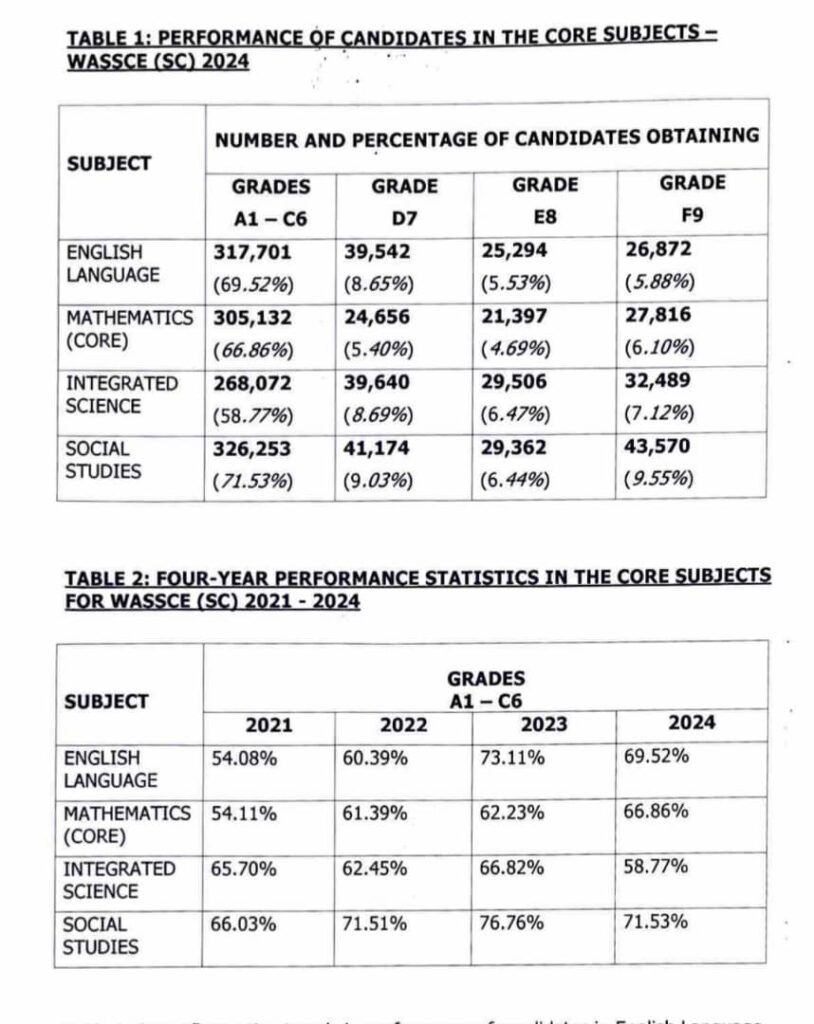
    The results show a massive surge in outright failure rates (Grade F9) across all four core subjects compared to the 2024 performance.

    According to the provisional results released by WAEC, the percentage of students who failed Social Studies increased steeply from 9.55% in 2024 to 27.50% in 2025, representing a 188% increase.

    The other core subjects, that is, Integrated Science and English Language, also saw a doubling of their previous failure rates.

    For Integrated Science, the failure rate increased by 8.93%; that is, the 2024 rate was 7.12%, and in 2025 it increased to 16.05%.

    The failure rate for the English Language also rose from 5.88% in 2024 to 12.86% in 2025. Core Mathematics recorded the sharpest decline, with the proportion of candidates who failed rising from 6.10% in 2024 to an alarming 26.77% in 2025, more than four times higher.

    Consequently, only 48.73% of candidates achieved grades A1 to C6, a steep drop from the 66.86% recorded in 2024. In absolute terms, 209,068 candidates passed Core Maths, while 114,872 (26.77%) failed outright with an F9. Put simply, for every four students who sat for the exam, one failed Core Mathematics.

    The core subjects are foundational: English, Mathematics, Integrated Science, and Social Studies are the backbone of Ghana’s education system. Failure in these means students lack the basic skills needed for higher education or employment.

    The failure of core subjects by candidates this year comes with several major concerns, including career opportunities, social consequences, and the likely impact on the country’s economy.

  • Seven suspects arrested over BECE malpractice granted bail

    Seven suspects arrested over BECE malpractice granted bail

    Seven individuals arrested over alleged examination malpractice during the ongoing Basic Education Certificate Examination (BECE) at the Kyebi Amanfrom Basic School examination centre in the Abuakwa South Municipality of the Eastern Region have been granted bail.


    The individuals include two headteachers, two teachers, a senior examination supervisor, and invigilators. The senior examination supervisor and the invigilators were allegedly caught by officials of the West African Examinations Council (WAEC), who stormed the examination centre unannounced.


    They were caught using their mobile phones to photograph examination question papers, which were subsequently sent to the headteachers. The questions were then sent to teachers to solve for the candidates in the examination hall through the supervisor and invigilators.


    The 2026 Basic Education Certificate Examination began on Monday, May 4, and will come to a close on Monday, May 11, with two papers scheduled daily at 9:00 a.m. and 1:00 p.m. A total of 619,985 candidates nationwide are expected to sit for the examination.


    At the regional level, a total of 58,412 candidates are expected to sit the exams in the Bono, Bono East, and Ahafo Regions. The Bono Region recorded the highest number with 24,983 candidates, followed by Bono East with 20,865, and Ahafo with 12,564.


    Beyond these three regions, the Northern Region has 37,111 candidates, while the Western Region registered 45,116 candidates. Altogether, the Ghana Education Service confirmed a national total of 620,141 candidates, comprising 304,349 boys and 315,792 girls.


    Before the exams, the West African Examinations Council (WAEC) issued a stern warning to candidates and stakeholders ahead of the 2026 BECE, declaring that any form of malpractice will attract severe consequences.


    According to WAEC, protecting the credibility of the examination remains the Council’s top priority.


    “Examination malpractice not only undermines academic integrity but also constitutes a direct violation of WAEC’s legal and regulatory framework,” Bono, Ahafo, and Bono East Regional Controller of WAEC, Daniel Nii Dodoo, told GBC News in an interview.


    Addressing longstanding concerns about irregularities in the former Brong Ahafo enclave, Mr Dodoo declared an end to the era of “show and pour,” where candidates relied on external assistance during examinations.

    “We have moved away from the old days when someone could assist you with answers. This time, it will be your competence on the paper, not anybody else’s,” he said.


    He appealed directly to teachers and parents to uphold ethical standards, warning that paying money to facilitate cheating is unacceptable.

    WAEC confirmed that candidates found guilty of malpractice risk having their results cancelled, with serious offences potentially leading to legal action.


    As the examination begins, WAEC’s message is clear: success in the 2026 BECE must be earned through honesty, discipline, and individual merit.


    The Minister for Education, Haruna Iddrisu, has announced that, in the coming days, the BECE will be restricted to learners who have progressed to Junior High School (JHS) Form 3.


    Addressing the media on Thursday, April 2, he said the government’s intention is to overhaul the country’s basic education system and improve learning outcomes.


    The Minister explained that some non–JHS 3 students are insufficiently prepared for the demands of the examination, resulting in poor performance.

    He added, “We have also made a determination that there are students who leap early—not yet in JHS 3 but who attempt to write BECE. That is unacceptable per the GES and WAEC guidelines.”


    According to him, the West African Examinations Council (WAEC) and the Ghana Education Service (GES) frown upon allowing non–JHS 3 learners to sit for the final-year examination.


    “That is why we are seeing a reflection of poor quality, because the student is not up to the task but forces himself to write BECE even when he is in Primary Six or JHS 1 or 2,” he noted.


    Meanwhile, 483,800 candidates have been placed into various Senior High Schools across the country out of the 590,000 candidates.
    On Monday, September 1, 2025, the school placement portal was opened for new entrants to verify their school choices, biodata, and other relevant information ahead of final placement.

    The deadline for the fact-checking exercise closed on Monday, September 8. Of this figure, 248,038 are females (51.4%), while 234,783 are males (48.6%).

    However, 107,509 candidates (18.2%) could not be matched with their initial school choices due to high demand for certain Category A schools.

  • BECE begins today, WAEC warns students against malpractice

    BECE begins today, WAEC warns students against malpractice

    The 2026 Basic Education Certificate Examination (BECE) is set to begin today, Monday, May 4, with a total of 619,985 candidates nationwide expected to sit the examination. The exams will run from Monday, May 4, to Monday, May 11, with two papers scheduled daily at 9:00 a.m. and 1:00 p.m.

    At the regional level, a total of 58,412 candidates are expected to sit the exams in the Bono, Bono East, and Ahafo Regions. The Bono Region recorded the highest number with 24,983 candidates, followed by Bono East with 20,865, and Ahafo with 12,564.

    Beyond these three regions, the Northern Region has 37,111 candidates, while the Western Region registered 45,116 candidates. Altogether, the Ghana Education Service confirmed a national total of 620,141 candidates, comprising 304,349 boys and 315,792 girls.

    The West African Examinations Council (WAEC) has issued a stern warning to candidates and stakeholders ahead of the 2026 BECE, declaring that any form of malpractice will attract severe consequences.

    According to WAEC, protecting the credibility of the examination remains the Council’s top priority.

    “Examination malpractice not only undermines academic integrity but also constitutes a direct violation of WAEC’s legal and regulatory framework,” Bono, Ahafo, and Bono East Regional Controller of WAEC, Daniel Nii Dodoo, told GBC News in an interview.

    Addressing longstanding concerns about irregularities in the former Brong Ahafo enclave, Mr. Dodoo declared an end to the era of “show and pour,” where candidates relied on external assistance during examinations. “We have moved away from the old days when someone could assist you with answers. This time, it will be your competence on the paper, not anybody else’s,” he said.

    He appealed directly to teachers and parents to uphold ethical standards, warning that paying money to facilitate cheating is unacceptable. WAEC confirmed that candidates found guilty of malpractice risk having their results cancelled, with serious offences potentially leading to legal action.

    As the examination begins, WAEC’s message is clear: success in the 2026 BECE must be earned through honesty, discipline, and individual merit.

    The Minister for Education, Haruna Iddrisu, has announced that, in the coming days, the BECE will be restricted to learners who have progressed to Junior High School (JHS) Form 3.

    Addressing the media on Thursday, April 2, he said the government’s intention is to overhaul the country’s basic education system and improve learning outcomes.

    The Minister explained that some non–JHS 3 students are insufficiently prepared for the demands of the examination, resulting in poor performance. He added, “We have also made a determination that there are students who leap early—not yet in JHS 3 but who attempt to write BECE. That is unacceptable per the GES and WAEC guidelines.”

    According to him, the West African Examinations Council (WAEC) and the Ghana Education Service (GES) frown upon allowing non–JHS 3 learners to sit for the final-year examination.

    “That is why we are seeing a reflection of poor quality, because the student is not up to the task but forces himself to write BECE even when he is in Primary Six or JHS 1 or 2,” he noted.

    Meanwhile, 483,800 candidates have been placed into various Senior High Schools across the country out of the 590,000 candidates.

    On Monday, September 1, 2025, the school placement portal was opened for new entrants to verify their school choices, biodata, and other relevant information ahead of final placement. The deadline for the fact-checking exercise closed on Monday, September 8.

    Of this figure, 248,038 are females (51.4%), while 234,783 are males (48.6%). However, 107,509 candidates (18.2%) could not be matched with their initial school choices due to high demand for certain Category A schools.

  • Neglect of basic education to be blamed for poor WASSCE results – President Mahama 

    Neglect of basic education to be blamed for poor WASSCE results – President Mahama 

    The provisional 2025 West African Senior Secondary Certificate Examination (WASSCE) results, released on Saturday, November 29, are described as the worst performance in the last four years, especially in Mathematics and Social Studies.

    Adding his voice to these concerns, President Mahama, speaking during an engagement, attributed the steep decline in student performance to years of neglect at the basic education level in the last seven years.

    According to him, the poor results reflect deep weaknesses in foundational learning, worsened by persistent delays in the release of the capitation grant and the inability to guarantee quality teaching at the basic level. He emphasised the need to prioritise foundational learning, warning that failure to do so will only produce candidates who lack quality and will ultimately be unable to contribute meaningfully to national productivity.

    “It emphasises the issue of foundational learning. One of the major things that has taken place in the last several years is the neglect of basic education, the inability to send the capitation grant, and the failure to ensure that we have quality teachers at the foundational or basic level. Because it is that level that prepares the child for secondary and tertiary education, and once you don’t get that level right, you will simply send the child through a conveyor belt like a factory, and when he comes out at the end, quality control will pick him out and say this one did not do well. So our focus must be on foundational learning,” President Mahama said.

    He described the situation as a serious concern for the government, parents, and the wider public, explaining that he has instructed the Minister of Education and other stakeholders to conduct a detailed analysis of the examiners’ report to determine what triggered the dramatic drop in performance, especially given that the same teachers and learning conditions were in place.

    “It has become an issue of great concern to the government, parents, and the public at large. I was speaking with the minister, and I have asked them to do an analysis of the examiner’s report and try to decipher what could have gone so disastrously wrong. It is mind-boggling that with the same teachers and the same factors in play, just from one batch to another, one batch performs so disastrously. We need to get to the bottom of it.”

    About the 2025 WASSCE results

    The results show a massive surge in outright failure rates (Grade F9) across all four core subjects compared to the 2024 performance.

    According to the provisional results released by WAEC, the percentage of students who failed Social Studies increased sharply from 9.55% in 2024 to 27.50% in 2025, representing a 188% rise. The other core subjects, Integrated Science and English Language, also saw their failure rates double, with Integrated Science rising from 7.12% in 2024 to 16.05% in 2025 and English Language from 5.88% in 2024 to 12.86% in 2025. Core Mathematics recorded the sharpest decline, with the proportion of candidates who failed rising from 6.10% in 2024 to an alarming 26.77% in 2025, more than four times higher.

    Consequently, only 48.73% of candidates achieved grades A1 to C6, a sharp drop from the 66.86% recorded in 2024. In absolute terms, 209,068 candidates passed Core Mathematics, while 114,872, or 26.77%, failed outright with an F9. Put simply, for every four students who sat for the exam, one failed Core Mathematics.

    The core subjects are foundational, with English, Mathematics, Integrated Science, and Social Studies forming the backbone of Ghana’s education system. Failure in these subjects means students lack the basic skills needed for higher education or employment.

    The mass failure comes with several major concerns relating to career opportunities, social consequences, and the country’s economic future. Students with F9 grades or those who failed any core subject now have their dreams of pursuing higher education, whether in Ghana or abroad, truncated.

    They will also face limitations in securing many formal jobs, creating long-term barriers to social mobility. A large cohort of underqualified youth weakens the skilled workforce, affecting productivity and innovation. High failure rates can lead to frustration, unemployment, and in some cases, social unrest. If failure rates are concentrated in certain regions or schools, it further highlights inequality in access to quality teaching and resources.

    Aside from these disturbing results, WAEC data shows a massive crackdown on examination malpractice. The Ghana Examinations Committee approved severe sanctions against thousands of candidates and dozens of educational personnel.

    The subject results of 6,295 candidates have been cancelled for smuggling unauthorised materials, including notes, textbooks, and printed material, into examination halls. The entire results of 653 candidates have been cancelled for smuggling mobile phones into the exam hall. 

    The subject results of 908 candidates and the entire results of 158 candidates remain withheld pending investigations into suspected offences, and results for candidates from 185 schools have also been withheld for alleged collusion. In addition, 35 persons, including 19 teachers, who compromised the integrity of the examination, face legal and disciplinary action, and already 19 of those individuals have been arraigned before the court and convicted with fines or prison terms.

    Before the exams, the Ghana Education Service (GES) warned 2025 candidates sitting for the WASSCE against examination malpractice, cautioning that offenders could face a 12- to 15-year jail term. This was announced by the Dormaa Central Municipal Public Relations Officer of the GES in the Bono Region, Nana Kumi Agyemang, during an engagement with the Ghana News Agency. According to him, offenders risk having their entire results cancelled or withheld.

    He also revealed that 2,179 candidates, comprising 1,075 males and 1,104 females from four Senior High Schools, are writing the exams in the municipality, including Christ Apostolic Church SHS, Dormaa SHS, Adehyeman SHS, and Salvation Army SHS.

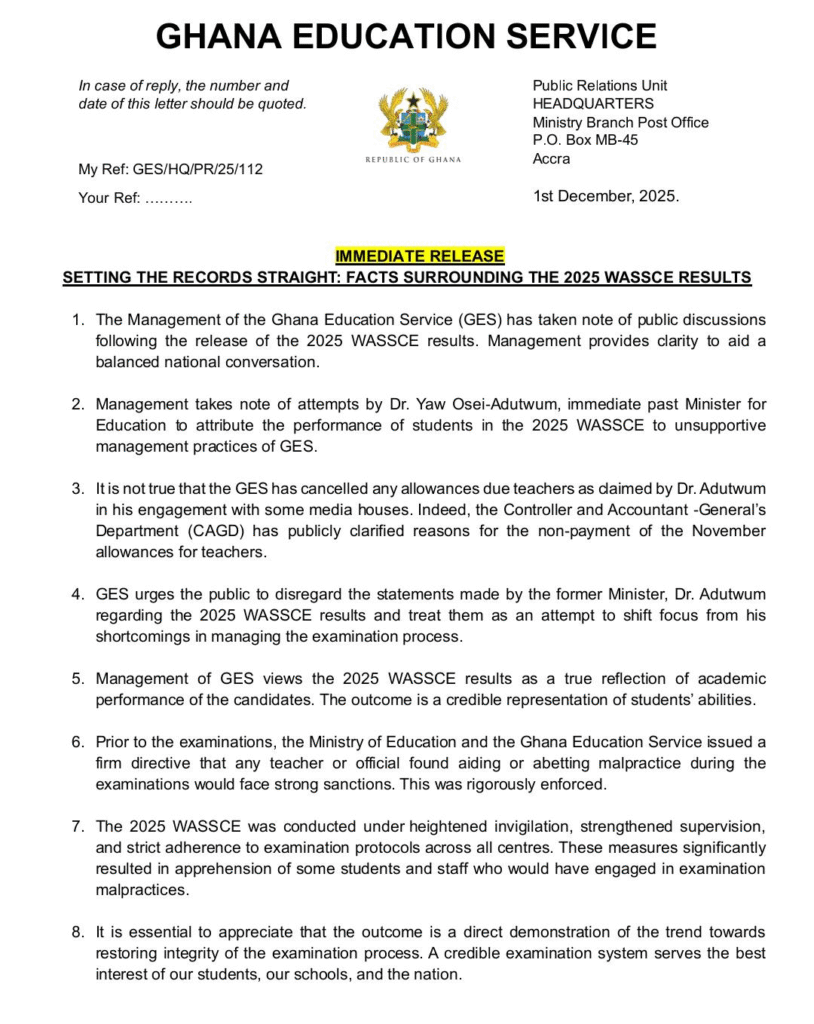
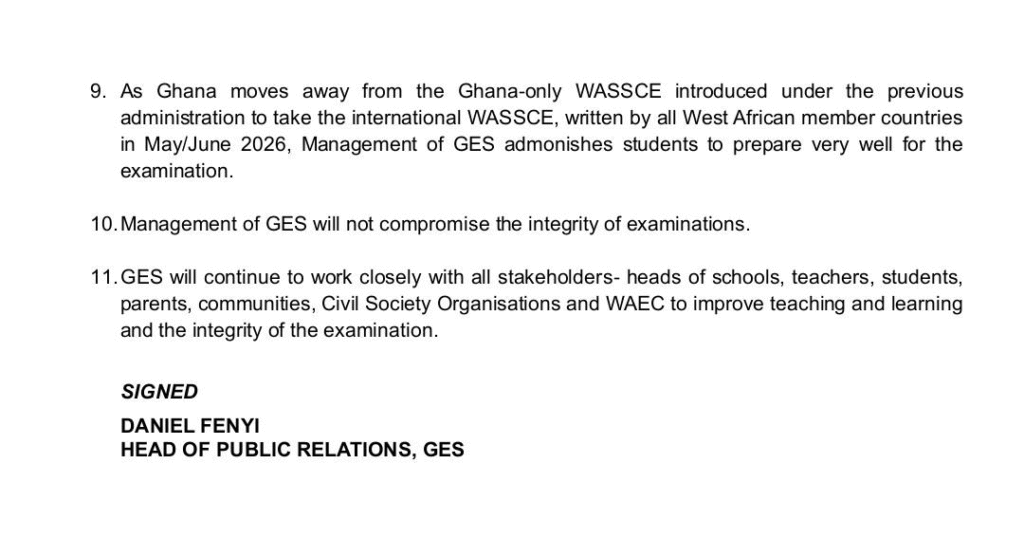
  • GES announces end of Ghana-only WASSCE from 2026

    GES announces end of Ghana-only WASSCE from 2026

    The Ghana Education Service (GES) has announced that Ghana will rejoin the international West African Senior School Certificate Examination (WASSCE), starting from the May/June 2026 examination cycle.

    In 2020, the Akufo-Addo-led administration introduced the “Ghana-only WASSCE” under the then Education Minister, Yaw Osei-Adutwum. In the last five years, Ghanaian Senior High School candidates sat a localized version of the West African Senior School Certificate Examination (WASSCE), separate from the international May/June exams written by Nigeria, Sierra Leone, Liberia, and The Gambia.

    Also, it was reported that, due to COVID-19, which became a global plague, Ghana adjusted its exam calendar to fit its own reopening schedule for schools, which differed from other WAEC member countries.

    At the time, the government explained that the move was to deal with cross-border leakages of exam papers, which were undermining credibility. By isolating Ghana’s exam, they could better control distribution and monitoring.

    However, following the release of the 2025 provisional results by the education regulator, GES announced in a statement dated December 1, explaining facts surrounding the 2025 WASSCE results.

    The statement revealed that: “As Ghana moves away from the Ghana-only WASSCE introduced under the previous administration to take the international WASSCE, written by all West African member countries in May/June 2026…”

    Consequently, it urged candidates to adequately prepare for the exams in the coming year, as it seeks to adopt the necessary measures to uphold the integrity of the exams without compromise.

    “…the Management of GES admonishes students to prepare very well for the examination. Management of GES will not compromise the integrity of examinations. GES will continue to work closely with all stakeholders, heads of schools, teachers, students, parents, communities, Civil Society Organisations, and WAEC, to improve teaching and learning and the integrity of the examination,” parts of the statement read.

    While GES, in its statement, didn’t explain the reason behind the return to the international WASSCE in 2026, according to WAEC, students in all five member countries write the same WASSCE because it ensures uniform standards of assessment, comparability of results, and credibility across the sub-region.

    It also helps students move freely across any of the West African countries to pursue higher education using their exam certificates and, later, even secure job opportunities since their certificates are recognized equally.

    Meanwhile, GES’ statement wasn’t only intended to announce the return to the international WASSCE next year, but also to address some remarks made by the former Education Minister, Dr. Adutwum, when the 2025 WASSCE results were released.

    Dr. Adutwum, in reaction to the abysmal performance by the students, particularly across the four core subjects, blamed the government. According to reports, Dr. Adutwum suggested that “the performance of students in the 2025 WASSCE was due to unsupportive management practices of GES,” adding that the government’s cancellation of allowances for teachers is a contributory factor to the students’ performance.

    GES, in response, stated that: “Management takes note of attempts by Dr. Yaw Osei-Adutwum, immediate past Minister for Education, to attribute the performance of students in the 2025 WASSCE to unsupportive management practices of GES. It is not true that the GES has cancelled any allowances due teachers, as claimed by Dr. Adutwum in his engagement with some media houses. Indeed, the Controller and Accountant-General’s Department (CAGD) has publicly clarified reasons for the non-payment of the November allowances for teachers.”

    It went on to charge the public to treat Dr. Adutwum’s remarks as a move to deflect attention from his failures in handling the examination process.

    “GES urges the public to disregard the statements made by the former Minister, Dr. Adutwum, regarding the 2025 WASSCE results and treat them as an attempt to shift focus from his shortcomings in managing the examination process,” the education agency added.

    It continued that: “Management of GES views the 2025 WASSCE results as a true reflection of the academic performance of the candidates. The outcome is a credible representation of students’ abilities. It is essential to appreciate that the outcome is a direct demonstration of the trend towards restoring the integrity of the examination process. A credible examination system serves the best interests of our students, our schools, and the nation.”

    WAEC released the provisional results of the 2025 West African Senior Secondary Certificate Examination (WASSCE) on Saturday, November 29.

    The results show a massive surge in outright failure rates (Grade F9) across all four core subjects compared to the 2024 performance.

    According to the provisional results released by WAEC, the percentage of students who failed Social Studies increased steeply from 9.55% in 2024 to 27.50% in 2025, representing a 188% increase.

    The other core subjects, that is, Integrated Science and English Language, also saw a doubling of their previous failure rates.

    For Integrated Science, the failure rate increased by 8.93%; that is, the 2024 rate was 7.12%, and in 2025 it increased to 16.05%.

    The failure rate for the English Language also rose from 5.88% in 2024 to 12.86% in 2025. Core Mathematics recorded the sharpest decline, with the proportion of candidates who failed rising from 6.10% in 2024 to an alarming 26.77% in 2025, more than four times higher.

    Consequently, only 48.73% of candidates achieved grades A1 to C6, a steep drop from the 66.86% recorded in 2024. In absolute terms, 209,068 candidates passed Core Maths, while 114,872 (26.77%) failed outright with an F9. Put simply, for every four students who sat for the exam, one failed Core Mathematics.

    The core subjects are foundational: English, Mathematics, Integrated Science, and Social Studies are the backbone of Ghana’s education system. Failure in these means students lack the basic skills needed for higher education or employment.

    The failure of core subjects by candidates this year comes with several major concerns, including career opportunities, social consequences, and the likely impact on the country’s economy.

  • 2025 WASSCE: Over 114k candidates obtained F9 in Core Maths – WAEC

    2025 WASSCE: Over 114k candidates obtained F9 in Core Maths – WAEC

    The provisional results of students who sat for the 2025 WASSCE have been released by the West African Examinations Council (WAEC).

    The examination council released the results on Saturday night, November 29. The results have highlighted a growing concern in Ghana’s education sector. The results reveal a significant spike in outright failure rates (F9) across all four core subjects compared to 2024. Core Mathematics recorded the sharpest decline, with the proportion of candidates who failed rising from 6.10% in 2024 to an alarming 26.77% in 2025, more than four times higher.

    Consequently, only 48.73% of candidates achieved grades A1 to C6, a steep drop from the 66.86% recorded in 2024. In absolute terms, 209,068 candidates passed Core Maths, while 114,872 (26.77%) failed outright with an F9. Put simply, for every four students who sat for the exam, one failed Core Mathematics.

    The results have sparked several concerns, with experts expressing worry about possible frustration among some students who failed Core Maths and excelled in other subjects. Given that Core Mathematics is a core subject that one is mandated to pass to secure entry into most higher education opportunities, particularly in Ghana, the country is set for a looming crisis.

    Core maths is considered a foundation for careers like engineering, medicine, economics, ICT, finance, and science. A mass failure means a huge limitation for the pool of qualified candidates for these critical professions.

    Also, as Ghana’s economy is gearing towards STEM (Science, Technology, Engineering, Mathematics) skills due to the evolving global workspace, high failure rates in Maths threaten the country’s ability to produce skilled graduates for modern industries.

    One of the concerns about failing Core Maths is the social consequence. These students mostly face limited career options, frustration, and unemployment risks.

    Also, another core subject which students failed was Social Studies. The percentage of students who failed Social Studies also saw a steep increase from 9.55% in 2024 to 27.50% in 2025, representing a 188% increase.

    The other core subjects, that is, Integrated Science and English Language, also saw a doubling of their previous failure rate.

    For Integrated Science, the failure rate increased by  8.93%; that is 2024 rate was 7.12% and in 2025 it increased to 16.05%.

    The failure rate for English Language also rose from 5.88% in 2024 to 12.86% in 2025.

    Aside from these disturbing failures, WAEC’s data shows a massive crackdown on examination malpractice.

    The Ghana Examinations Committee approved severe sanctions against thousands of candidates and dozens of educational personnel.

    The subject results of 6,295 candidates have been cancelled over their smuggling of unauthorised materials like notes, textbooks, and printed material into the examination hall.

    Also, the entire results of 653 candidates have been cancelled for smuggling mobile phones into the examination hall, while the subject results of 908 candidates and the entire results of 158 candidates remain withheld pending investigations into various suspected offences.

    Results for candidates from 185 schools were withheld for alleged collusion.

    In addition, 35 persons, including 19 teachers, who compromised the integrity of the examination face legal and disciplinary action. Already, 19 of those individuals have been arraigned before the court and convicted to fines or prison terms.

    Before the exams, the Ghana Education Service (GES) has warned 2025 candidates sitting for the 2025 West African Senior School Certificate Examination (WASSCE) against examination malpractice, threathening a twelve to fifteen-year jail term for culprits.

    This was announced by the Dormaa Central Municipal Public Relations Officer of the GES in the Bono Region, Nana Kumi Agyemang, during an engagement with the Ghana News Agency.

    According to him, offenders risk the cancellation of their entire examination, and he also said that offenders risk having their entire results cancelled or withheld.

    He also revealed that 2,179 candidates, comprising 1,075 males and 1,104 females, from four Senior High Schools (SHSs) are writing the exams in the Municipality. The schools include Christ Apostolic Church SHS, Dormaa SHS, Adehyeman SHS and Salvation Army SHS.

    As part of the measures put in place to ensure compliance with exam rules, Nana Kumi also revealed that the police have been deployed to various centres to monitor the students. This is also to prevent the students from using AI to solve their questions.

    “A monitoring team has been deployed to ensure the successful conduct of the exams, while the police have also been engaged to maintain law and order. Mobile phone use at the centres has been banned, and invigilators and supervisors are strictly enforcing the directive.”

    “The candidates are also under strict supervision to prevent the use of Artificial Intelligence (AI) for the examination,” Nana Agyemang added.

    He also warned candidates to stay away from sneaking prohibited materials like papers with answers of anything of that sort to the exam halls, urging them to face their papers with courage.

    “Candidates must avoid carrying prohibited materials into the examination halls. They should rather be confident and courageous in tackling their papers.”

    He also remarked on the rise in female participation:

    “The steady increase in the number of female candidates is encouraging. This can be attributed to government interventions such as the Free SHS policy, the distribution of free sanitary pads, and intensified education and counselling by girl-child education coordinators.”

    Before the examination council sent caution to the 2025 WASCE candidates, they had cancelled and withheld the subject results and entire results of some two thousand, two hundred and twenty-eight (2,228) candidates who sat for the 2025 Basic Education Certificate Examination (BECE).

    The Council made this known after revealing that it had released provisional results of candidates who sat for the BECE for School Candidates, 2025.

    Following the completion of investigations into several cases of irregularity detected during the conduct of the examination and marking of scripts, the 36th Meeting of the Final Awards and Examiners’ Appointment Committee for the BECE, 2025, held on Friday, August 15, 2025, approved the cancellation of the subject results of 718 candidates and the entire results of 177 candidates.

    The committee also withheld the subject results of 1,240 candidates and the entire results of 93 candidates.

  • Exposed invigilators in JoyNews’ BECE documentary exposé to be blacklisted – WAEC 

    Exposed invigilators in JoyNews’ BECE documentary exposé to be blacklisted – WAEC 

    Officials implicated in acts of corruption during the Basic Education Certificate Examination (BECE) will be blacklisted from ever taking part in West African Examinations Council (WAEC)-related activities again.

    This was announced by WAEC’s Director of Public Affairs, John Kapi, following a JoyNews Hotline investigation broadcast led by GH Probe’s Francisca Enchil. The investigation revealed alarming instances of cheating at examination centres, including Derby Avenue RC Basic School and St. George’s Anglican Basic School in Accra.

    As part of measures to penalize the officials involved in the exposé, Mr. Kapi stated, “Yes, that is what we usually do. We blacklist them, they no longer take part in any activity that has to do with the WAEC,” on JoyNews’ PM Express on September 8.

    He further emphasized that the Council cannot continue to work with individuals who have betrayed the trust placed in them during national examinations.

    “These are people who certainly have not proved that they are worthy of the trust that we repose in them. As far as this job is concerned, let me also indicate that when it comes to BECE, most of the decisions are taken by the Ghana Education Service. For example, the selection of supervisors and invigilators is done by the district exams officer,” he explained.

    The WAEC Director of Public Affairs added that whenever such issues arise, they expect the Ghana Education Service (GES) to take decisive action, respond appropriately, and ensure the right measures are taken against those involved.

    Dark World of BECE Documentary

    The 2025 Basic Education Certificate Examination (BECE), a crucial entry point to secondary education, has been marred by what appears to be one of the most alarming cases of organised malpractice ever exposed.

    A JoyNews Hotline investigation, spearheaded by GH Probe’s Francisca Enchil, uncovered how officials of the Ghana Education Service (GES), together with supervisors, headteachers, and invigilators, turned the national assessment into a coordinated racket—sacrificing academic integrity for monetary gain.

    At both Derby Avenue RC Basic and St. George’s Anglican Basic in Accra, invigilators asked for GH¢60 daily, supervisors accepted GH¢400 cash envelopes, and candidates were told to contribute to an ‘Aseda Offertory.’

    Instead of upholding strict monitoring, supervisors doubled as guards for invigilators, tipping them off whenever WAEC or National Security officials approached. Teachers and headteachers, though prohibited from the premises, roamed exam centres, bribed their way through, and in some instances fed answers straight to candidates.

    The exposé has triggered outrage. The Acting Director-General of the Ghana Education Service, Prof. Ernest Kofi Davis, has warned that teachers face dismissal if caught. Civil society voices, such as Kofi Asare of Africa Education Watch, caution that Ghana is “teaching children corruption in basic schools”—a dangerous normalisation of dishonesty.

    Meanwhile, the West African Examinations Council (WAEC) announced that at least 14 individuals had been arrested across the country for their involvement in malpractice in the 2025 West African Senior School Certificate Examination (WASSCE).

    The victims, according to the Council, were teachers, students, and invigilators.

    Speaking to the media on Friday, September 5, Head of Public Affairs at WAEC, John Kapi, noted, “As part of our commitment to upholding the integrity and credibility of our examination, we have deployed—for we had to employ a number of staff, as well as our own specialized personnel—to monitor the examination centres. Our monitoring teams have observed irregular activity at a number of the examination centres.”

    Three of the convicts were sentenced to a combined 20 months behind bars, as declared by the Kasoa-Ofaakor District Magistrate Court. The convicts include a teacher at Ghana College SHS, Samuel Armah, and two university students, Kwame Oteng Nkansah and Amedeka James.

    Armah, an invigilator, was sentenced to eight months imprisonment with a fine of 80 penalty units. He was caught dictating answers from his mobile phone to candidates during the Social Studies Paper 1.

    Nkansah, a level 100 student of Accra Technical University, impersonated one Quayson Francis Atta of Ghana College SHS. He received a jail term of six months with a fine of 80 penalty units.

    A level 100 student of the University of Ghana, James, was also granted a six-month jail term after attempting to write the exam in place of his twin brother, Amedeka Justice.

    On Monday, August 25, authorities caught an invigilator at the Forces SHTS with a phone loaded with exam questions while the West African Senior School Certificate Examination (WASSCE) was in progress. His phone contained exam questions on Picture Making and Oral English.

    On Wednesday, August 20, WAEC commenced the 2025 WASSCE with a total of 461,640 candidates who sat for the Oral English exam. The practical papers commenced on August 4. The number of students who sat for this year’s exams saw a 0.22 percent increase from 2024, when a total of 460,611 candidates sat for the WASSCE. This year’s candidates comprise 207,381 males and 254,259 females.

    Ahead of the exams, the Ghana Education Service (GES) released funds to cater for the 2025 WASSCE practical examinations for all Senior High Schools (SHSs) and Senior High Technical Schools (SHTSs) across the country. An amount of GH¢15,849,920 was released, according to reports.

    According to GES, in a statement issued on Saturday, July 27, and signed by the Head of Public Relations, Daniel Fenyi, the funds were expected to provide all necessary materials and supplies for the practical exams.

    “The Management of the Ghana Education Service (GES) announces that funds had been released to all Senior High Schools (SHS) and Senior High Technical Schools (SHTS) across the country to cover the fees for the 2025 WASSCE practicals. This payment ensures that all practical examinations scheduled for the 2025 WASSCE are fully supported, including the provision of the required materials and other essential resources,” the Service noted.

    WAEC cancelled and withheld the subject results and entire results of some 2,228 candidates who sat for the 2025 BECE. The Council made this known after revealing that it had released provisional results of candidates who sat for the BECE for School Candidates, 2025.

    Following the completion of investigations into several cases of irregularity detected during the conduct of the examination and marking of scripts, the 36th Meeting of the Final Awards and Examiners’ Appointment Committee for the BECE, 2025, held on Friday, August 15, 2025, approved the cancellation of the subject results of 718 candidates and the entire results of 177 candidates.

    The committee also withheld the subject results of 1,240 candidates and entire results of 93 candidates. Meanwhile, the subject results of some candidates from 119 schools have been cancelled. In addition, the subject results of some candidates from 87 schools have been withheld for further scrutiny.

    The withheld results may be cancelled or released based on the outcome of investigations by September 6, 2025. WAEC has indicated that candidates whose results have been cancelled or withheld should visit their website for details and reasons for the withholding or cancellation of results.

  • WAEC cancels, withholds results of over 2,000 BECE candidates for exam malpractice

    WAEC cancels, withholds results of over 2,000 BECE candidates for exam malpractice

    The West African Examinations Council has cancelled and withheld the subject results and entire results of some two thousand, two hundred and twenty-eight (2,228) candidates who sat for the 2025 Basic Education Certificate Examination (BECE).

    The Council made this known after revealing that it had released provisional results of candidates who sat for the BECE for School Candidates, 2025.

    Following the completion of investigations into a number of cases of irregularity detected during the conduct of the examination and marking of scripts, the 36th Meeting of the Final Awards and Examiners’ Appointment Committee for the BECE, 2025, held on Friday August 15, 2025 approved the cancellation of the subject results of 718 candidates and the entire results of 177 candidates.

    The committee also withheld the subject results of 1,240 candidates and entire results of 93 candidates.

    Meanwhile, the subject results of some candidates from 119 schools have been cancelled. In addition, the subject results of some candidates from 87 schools have been withheld for further scrutiny. The withheld results may be cancelled or released based on the outcome of investigations by September 6, 2025.

    WAEC has indicated that candidates whose results have been cancelled or withheld should visit their website for details and reasons for withholding or cancelling the results.

    Meanwhile, the Council will dispatch the results of school candidates to their respective schools through the Metropolitan/Municipal/District Directors of Education.

    The results are also available on the Council’s official website at www.waecgh.org for candidates who so desire to access them online.

    A total of 603,328 candidates, comprising 297,250 males and 306,078 females from 20,395 participating schools, entered for the school examination that commenced on June 11.

    This includes 72 candidates with visual impairment, 239 with hearing impairment and 161 candidates with other test accommodation needs. The examination was conducted at 2,237 centres across the country. Out of the total number, 2,526 candidates were absent.

    Ahead of the exams, Minister for Education, Haruna Iddrisu, entreated the candidates to remain focused and stay away from exam malpractices.

    Barely 72 hours after the commencement of the exams, the West African Examination Council announced that 10 individuals had been caught engaging in exam malpractice.

    “These 10 culprits have been handed over to law enforcement agencies. Their actions are criminal under WAEC law, and the police will now work to prosecute them in court.”

    “There was one supervisor who had a mobile phone. He had taken smart shots of the questions and posted them on social media. In addition, six other invigilators were found with mobile phones containing pictures of the examination questions,” Head of Public Affairs John Kapi told JoyNews.

    Two months ago, four persons were handed a 30-day prison sentence by the Kintampo Circuit Court in the Bono East Region for their involvement in examination malpractices during the recent Basic Education Certificate Examination (BECE).

    Presiding Judge Lily Amoah Kankan issued the ruling on Tuesday, June 17. Two others were fined, while three were remanded into police custody for further investigation.

    Diana Tii, a teacher at Krabonso D/A School, was caught distributing photocopied materials to candidates in the exam hall. In addition to her 30-day sentence, she signed a two-year bond to be of good behaviour.

    Sylvester, also a teacher, was found to have aided one Diana, a candidate, in sneaking the photocopies into the exam hall. He received the same 30-day sentence.

    Paul Busi, a student of Kintampo College of Health, was caught with computing questions on his phone. After pleading guilty with remorse, he was fined 100 penalty units, equivalent to GHS1,200.

    Edmond Merrato Boi, a teacher at Just Love International School in Kintampo, was caught solving computing questions at the school’s dining hall.

    He pleaded guilty with explanation and was sentenced to 30 days in prison with hard labour. Samuel Waabero, an administrator at the same school, was also caught solving computing questions in the dining hall.

    He received the same sentence after pleading guilty with explanation. Three other suspects are to reappear in court on July 2, 2025.

    Belinda Yaa Adjeiwaa, a fashion designer from Techiman, was found with photocopied answers to the Computing Paper 2. She has been remanded into police custody.

    Haruna Mohammed, a teacher at Kintampo SHS, was caught with a mobile phone containing Social Studies questions during the exam. He is also on remand.

    Sadique Abubakar, another teacher, was caught with answers to the Computing Paper 1 Objective Test. He was granted court bail of GHS10,000 with two sureties and is expected back in court on the same date.

    Proprietor of The Big Six Educational Complex located at Meduma in the Kwabre East Municipality, Afoakwa Sarpong, was also apprehended over an alleged case of assault by imprisonment.

    On Monday, June 17, the Educational Director for Kwabre East Municipal, Nana Adu Mensah Asare, accompanied by Ms. Mavis Okyere Anane, Public Relations Officer of the Education Directorate, effected the arrest of Mr. Afoakwa Sarpong. 

    The arrest stemmed from a disturbing incident that occurred on 16th June during the just-ended Basic Education Certificate Examination (BECE). 

    Mr. Sarpong is said to have unlawfully prevented two Junior High School (JHS) candidates, whose names have been withheld, from writing the Mathematics paper, citing their failure to pay registration fees.

    Preliminary reports indicate that the suspect confined the two candidates in a separate room at the examination centre and released them only after the examination had concluded. He has been handed over to the Mamponteng District Police Command.

    The number of candidates that registered for this year’s BECE (SC) is 5.99% higher than the 2024 entry figure. 

    Overall, 569,236 candidates participated in the 2024 BECE, comprising 282,703 boys and 286,533 girls from 19,505 schools.

    Special accommodations were provided for 59 visually impaired candidates, 263 with hearing impairments, and 161 others requiring specific assistance.

    The exam took place at 2,123 centres nationwide, though 3,845 candidates were marked as absent.

    The BECE for Private Candidates had 1,390 participants, 750 males and 640 females, taking the exam at 15 centres across the country’s regional capitals. Among them, 57 candidates did not show up for the exam.

    Some 33 school candidates and 3 private candidates had their results withheld due to investigations into possible irregularities. WAEC also flagged subject results from 149 schools, pending further investigations into reported malpractices.

    Following thorough investigations, the Final Awards and Examiners’ Appointment Committee, at its 35th meeting on October 16, 2024, decided to nullify the subject results for 377 school candidates and 3 private candidates.

    Also, two teachers were arrested in Jachie Pramso, Ashanti Region, over alleged examination malpractice, following the earlier arrest of three teachers and two residents in Bekwai.

  • WAEC adds 7 more exam depots to improve reach and efficiency

    WAEC adds 7 more exam depots to improve reach and efficiency

    The West African Examinations Council (WAEC) has added seven more examination depots to its original 169 across the country. This brings the total number of examination depots to 176, aimed at facilitating the smooth conduct of this year’s West African Senior School Certificate Examination (WASSCE).

    Speaking to the media, the Head of the National Office of WAEC, Dr Rosemond Wilson has assured that strict has been implemented to ensure the examination papers are not tampered with.

    She explained that  “In compliance with the council’s security regulations, question papers have been printed and packed. They will be sent to the fortified depots in readiness for the examination”.

    A total of 461,640 candidates 207,381 males and 254,259 females are expected to take the examination in 65 subjects at 701 centres nationwide. 

    On average, each candidate will sit for eight subjects. On August 5, Senior High and Technical schools across the country began the practical sessions for the 2025 WASSCE.

    The written papers are scheduled to begin from August 20 to September 19, 2025. Meanwhile, WAEC has assured that credible examinations and heightened security will be in place to ensure students write in a conducive environment.

    Four security posts have been established in Nkwanta and two other conflict-prone areas, ensuring safety for candidates participating in the 2025 West African Senior School Certificate Examination (WASSCE), which commenced yesterday, August 5.

    This was announced by the Director-General of GES, Prof. Ernest Kofi Davis, while addressing the media on August 4. “We are ensuring security presence in the schools, so there will be no day students this year. All candidates will remain on campus under security protection until they complete their exams,” Prof. Davis stated. “Those who need to be escorted will be taken back to the safe communities they came from. We have four security posts, one in Nkwanta and three in the Northern Region,” Prof. Ernest Kofi Davis stated.

    Addressing the issue of exam malpractices, Prof. Davis highlighted the Ashanti Region, where 76 out of 144 schools were implicated in various forms of misconduct. He has therefore emphatically stated that, “No examination malpractice will be tolerated this year,” he warned. “The GES Council has empowered us to dismiss individuals and supervisors found complicit in any form of cheating.”

    Adding his voice to the issue of exam malpractices, Deputy Minister for Education Dr. Clement Abas Apaak warned in a press release that any teaching or non-teaching staff caught assisting in exam malpractice risk severe penalties such as termination of appointment and legal action.

    “There must be zero tolerance for exam malpractice across the country; the young ones must grow in integrity and let no one of them be associated with exam malpractice.” Last month, management of the Ghana Education Service (GES) announced that all the schools under violent attacks were temporarily closed down to ensure safety of life and property.

    The GES received confirmed reports of violent incidents at Bawku SHS, Nalerigu SHS, and Zuarungu SHS. These incidents resulted in the tragic loss of student lives, injuries, and significant damage to school property.

    According to the Ghana Education Service, “these events, which occurred between 20th and 26th July 2025, have severely disrupted academic activities and caused deep distress among students, families, and school staff.”

    “The GES condemns in no uncertain terms these acts of violence,” the statement added. Counselling services are being strengthened for both students and staff to help them manage the trauma. The Ghana Education Service has expressed its condolences to the bereaved families and affected school communities.

    “We stand with them in this difficult moment and assure them of our full support. In addition, we officially announce that all the schools under violent attacks are temporarily closed down to ensure safety of life and property,” the statement added.

    The GES is currently collaborating with the Ministry of Education, WAEC, Regional and District Directors, and the leadership of the affected schools to take urgent steps to ensure that the SHS 3 students are able to sit for the upcoming WASSCE under safe and fair conditions.

    Special examination arrangements and secure centers are currently under consideration, the Ghana Education Service revealed. For SHS 1 and 2 students in the affected schools, the GES is exploring all viable learning avenues to ensure continuity of lessons while campuses remain closed for safety assessments. The GES has indicated that further details on these interventions will be communicated in due course.

    The Service has noted that it will continue to work closely with the security agencies to enhance safety on school campuses and to protect both students and personnel. On Sunday, July 20, due to allegations of theft, a mobile phone resulted in a melee involving Gurune and Kusasi students at Zuarungu Senior High School (SHS). The government has commenced evacuation of all students in educational institutions in Nalerigu Township and its environs in the North East Region, following the murder of two students.

    Unknown assailants on Saturday evening, July 26, claimed the lives of two male students of Nalerigu Senior High School (SHS) in the Northern Region. According to reports, the armed group stormed the school premises, proceeded to the dormitory, and opened fire on the two students—Lukman and Gideon.

    Assembly Member for the Denugu Electoral Area, Dasmani Fuseini, and uncle to one of the deceased students, is said to have confirmed the attack to the media. The remains of the deceased students are in the custody of the police at the time of reporting. The families are working to retrieve the bodies for burial.

    The police have commenced an investigation into the murder of the students that has been linked to the renewed Bawku conflict. Also in Bawku, a third-year student of Bawku Senior High School, Hakim Kundima, was killed on the school campus on Saturday evening by some armed men. Similar to the Nalerigu Senior High School incident, the armed men found their way into the school’s premises, dragged the deceased from the dormitory, and shot him. The Bawku Senior High School has been temporarily closed by the Municipal Education Directorate following the fatal shooting.

    In reaction to the recent violent attacks, the Minister for the Interior, Muntaka Mubarak, on the advice of the North East Regional Security Council and by Executive Instrument, has imposed curfew hours on Nalerigu Township and its environs in the North East Region from 2pm to 6am, effective Sunday, July 27, until further notice.

    The curfew has created an environment conducive for the evacuation of all students in various educational institutions in affected areas, some of whom have been unfortunately targeted in the conflict. There is a total ban on all persons in the Nalerigu township and its environs from carrying arms, ammunition, or any offensive weapons. As such, any individual found with any arms or ammunition will be arrested and prosecuted.

    The government has called on the chiefs, elders, opinion leaders, youth, and people of the area to exercise restraint in the face of the challenges confronting them as well as to use non-violent means to channel their energies into ensuring peace.

    Meanwhile, the government has reviewed the curfew hours for Bawku Municipality and its environs in the Upper East Region from 2pm to 6am, effective Sunday, July 27, until further notice. The government, in a statement issued on July 27, announced that it is stepping up its approach from peacekeeping to peace enforcement in Bawku and other affected areas due to the recent escalation of violence, which could derail the peacebuilding process.

    The Ghana Armed Forces have been deployed to maintain law and order and take all necessary measures to protect lives and property. Residents have been advised to fully cooperate with the Ghana Armed Forces to ensure peace.

    The Ghana Armed Forces has emphasised that it will employ all the necessary force to ensure peace prevails in Bawku, Upper East Region. In a press release, the Acting Director General of Public Relations, VA Arhin, explained that the new development follows a recent directive by His Excellency President John Dramani Mahama.

    According to the military, its new strategies will focus on conflict zone areas, such as Bawku, Binduri, Nalerigu, and Zebilla, to restore calm and prevent further escalation.

    “The Ghana Armed Forces wishes to inform the general public that following the directive by the President of the Republic and Commander-In-Chief of the Ghana Armed Forces, His Excellency John Dramani Mahama, the Ghana Armed Forces has, with immediate effect, transitioned to peace enforcement has become necessary due to the activities of armed elements that have intermittently resulted in violence, reprisal attacks and innocent deaths, highlighting a dangerous pattern that threatens not only Bawku but also the peace and security of our dear Nation.”

    “Ghana Armed Forces operations during this period will be conducted in areas to include Bawku, Binduri, Nalerigu and Zebilla. This peace enforcement phase will see the Military undertake robust and purposeful operations that would enhance community protection, while ensuring sanity returns to affected areas,” parts of the release read.

    The resurgence of violence was largely sparked by the return of Alhaji Seidu Abagre, a Mamprusi chief who had been enskinned in 2022, only to be exiled later when his enskinment was ruled illegal. His return to Bawku followed the withdrawal of an arrest warrant against him by a Kumasi High Court in October 2024, reigniting tensions between the Kusasi and Mamprusi communities.

    A few weeks ago, a confrontation between some members of the Ghana Armed Forces and locals in Bawku resulted in the death of five civilians and the destruction of a statue of the Bawku Naba, Naba Asigri Abugrago Azoka II.

    The reconstruction of the statue is expected to begin in the coming days, following a directive from His Excellency, President John Dramani Mahama. The statue, which was erected in 2024, is in honour of the Zugraan (Overlord) of the Kusaug Traditional Area, Asigri Abugrago Azoka II, a culturally revered figure in Bawku. It served as a strong emblem of tradition and communal pride.

    On April 15, Otumfuo formally announced that the critical mediation sessions would take place from April 28 to May 1 at the Manhyia Palace in Kumasi. However, it was postponed due to the complexity of the dispute in the locality. Otumfuo Osei Tutu II’s involvement in the peace process has been met with widespread approval, with many hopeful that his leadership will play a critical role in restoring peace and stability to the troubled Bawku region.

    The government has commended His Majesty Otumfuo Osei Tutu II for mediating the conflict and appreciates all stakeholders who are supporting the peace process. The Otumfuo mediation, with the genuine help of Nayiri and Zugraana, had almost brought finality to the conflict until the very recent killings, which have necessitated drastic actions to protect all in the interests of the greater good. The government is urging all parties to refrain from violence and support the peace process.

  • 10 suspects to be prosecuted for 2025 BECE malpractices – WAEC

    10 suspects to be prosecuted for 2025 BECE malpractices – WAEC

    The West African Examination Council has announced that 10 individuals caught engaging in exam malpractice amid the 2025 Basic Education Certificate Examination (BECE) have been handed over to the police for investigation and prosecution.

    This report comes barely 72 hours after the commencement of this year’s exams, with over 600,000 candidates participating.

    Head of Public Affairs, John Kapi, told JoyNews that the culprits include a student nurse and an administrator of a private school, whose offences include collusion, possession of unauthorised materials, and impersonation during examinations.

    “These 10 culprits have been handed over to law enforcement agencies. Their actions are criminal under WAEC law, and the police will now work to prosecute them in court.”

    “There was one supervisor who had a mobile phone. He had taken smart shots of the questions and posted them on social media. In addition, six other invigilators were found with mobile phones containing pictures of the examination questions,” he said.

    Mr Kapi acknowledged the swift response by WAEC officials who monitored and acted promptly to apprehend individuals who were actively trying to solve questions and pass the answers to candidates in the exam halls.

    He added that WAEC is “still gathering reports from other centres that could not be reached yesterday,”- which was June 11 at the time of this report.

    Mr Kapi assured that “personnel would be deployed to those areas to maintain order.”

    Also, the Ghana Education Service (GES) has also sent personnel to provide aid with the monitoring of examination centres nationwide.

    Ahead of the examination, Minister for Education, Haruna Iddrisu, expressed well wishes to the 603,328 candidates, urging the candidates to remain focused and stay away from exam malpractices.

    “As they enter the exam halls, I urge them to remain calm, focused, and determined and avoid any form of examination malpractice. Believe in their ability to succeed they will succeed. They prepared for this day and they will succeed through honest efforts.”

    However, his counsel was not heeded as WAEC revealed contrasting actions.

    This year’s exam has seen the participation of 18 juveniles with the Ghana Prisons Service. They expressed confidence after writing their first paper, signalling success after the release of results.

    In an unfortunate turn of events, some eight candidates from Nangbagu Yapala M/A JHS in the Northern Region were involved in a road accident on their way to write Tuesday’s paper at the Tamale Secondary School (Tamasco) examination centre in the Sagnarigu Municipality.

    The tragic incident occurred about 5km from the exam site when the tricycle transporting the students collided with a motorbike carrying a man and his wife.

    The motorcyclist died on the spot, while his wife and all eight students sustained various degrees of injuries.

    The affected students were prevented from writing Tuesday’s paper due to their health situation.

    The candidates sitting for this year’s exams comprise 297,250 males and 306,078 females.

  • WAEC announces provisional results for 12,452 private WASSCE candidates

    WAEC announces provisional results for 12,452 private WASSCE candidates

    The West African Examinations Council (WAEC) has released the provisional results for 12,452 candidates who sat for the 2025 first series of the West African Senior School Certificate Examination (WASSCE) for private candidates.

    Candidates can check their results via the WAEC online portal by entering their examination number and required credentials.

    The total number of candidates comprised 5,269 males and 7,998 females, while 738 registered candidates were absent from the examination.

    WAEC reported instances of malpractice during both the examination and the marking process. In a statement issued on Thursday, March 28, the Council announced that the subject results of 34 candidates and the entire results of 43 others have been withheld, pending investigations into these cases.

    The Council also warned the public against fraudsters who claim they can alter results for a fee through mobile money transfers. WAEC assured candidates that its results database is highly secure and that all results can be verified for authenticity.

    “The Council wishes to caution members of the public to be wary of scammers who contact candidates and promise to upgrade their results for a fee payable through mobile money transfers.

    “Candidates are to note that WAEC’s results database is well secured and all results can be authenticated. Institutions and organisations are therefore advised to confirm or verify results presented to them directly from WAEC or access the confirmation/verification service online at the WAEC official website, www.waecgh.org,” WAEC stated.

  • Over 10,000 withheld results released by WAEC

    Over 10,000 withheld results released by WAEC

    The West African Examinations Council (WAEC) has lifted the hold on all results from the 2024 West African Senior School Certificate Examination (WASSCE).

    Initially, over 10,000 results were withheld due to suspicions of malpractice, but WAEC had committed to making them available by February 28.

    This decision comes in the wake of a legal standoff and mounting pressure from the National Union of Ghana Students (NUGS), which had threatened nationwide demonstrations.

    Speaking to Citi News, WAEC’s Head of Public Affairs, John Kapi, confirmed that all results, including those previously entangled in legal disputes, have now been released.

    He said “As we promised, we kept to our promises. So by the close of February 28, we had uploaded all the results of the candidates whose results had been withheld.

    “The court had ordered that we should release the results of those The West African Examinations Council (WAEC) has released all withheld results from the 2024 West African Senior School Certificate Examination (WASSCE).

    WAEC had withheld over 10,000 results over suspected malpractices but pledged to release them by February 28.

    The decision follows a legal battle and threats of nationwide protests from the National Union of Ghana Students (NUGS).

    Speaking to Citi News, head of public affairs at WAEC, John Kapi, said there are currently no outstanding results, including those previously tied to a legal dispute with the Council.. And so we’ve gone ahead with all the results. So we don’t have any outstanding results as far as, you know, those exams are concerned.

    “Well, 28 was a Friday, and so we assume that the people are still waiting till the beginning of the week, you know, to begin to call the office and to register some complaints. But, again, I think that whatever we have put out there is a true reflection of the performance of the candidates in the examination.”

  • 2024 WASSCE for Private Candidates: 108 results withheld

    2024 WASSCE for Private Candidates: 108 results withheld

    The West African Examinations Council (WAEC) has released the provisional results for the 2024 West African Senior School Certificate Examination (WASSCE) for Private Candidates, Second Series.

    However, the results of 108 candidates have been withheld due to suspected malpractice, pending further investigations.

    A total of 38,316 candidates sat for the examination, comprising 17,596 males and 21,131 females. Despite registering, 1,354 candidates were absent.

    John Kapi, Head of Public Affairs at WAEC, confirmed in a statement on Friday, February 28, that irregularities were detected both during the examination and the subsequent marking process. As a result, the subject results of 303 candidates have also been withheld.

    Candidates can now check their results online via www.waecgh.org.

    Performance Breakdown

    The results for the four core subjects show varying levels of success:

    • English Language: 54.79% scored A1-C6, 13.49% obtained D7, 12.90% received E8, and 13.45% had F9.
    • Mathematics (Core): 37.44% scored A1-C6, 11.00% obtained D7, 12.30% received E8, while 37.42% had F9.
    • Integrated Science: 53.31% secured A1-C6, 12.02% obtained D7, 13.68% received E8, and 18.46% had F9.
    • Social Studies: 87.88% achieved A1-C6, 3.11% obtained D7, 2.26% received E8, and 5.76% had F9.

    Caution Against Scammers

    WAEC has issued a strong warning against individuals and fraudsters who claim they can alter examination results for a fee. The council assures the public that its database remains secure and that results can only be verified through official channels.

    “Institutions and organizations are encouraged to verify results directly from WAEC or use the online verification service at www.waecgh.org,” the statement added.

    WAEC expressed appreciation to all stakeholders who contributed to the smooth conduct of the examination and the timely release of results.

  • We must ensure innocent candidates are not unfairly penalized – WAEC

    We must ensure innocent candidates are not unfairly penalized – WAEC

    The Head of Legal Affairs at the West African Examinations Council (WAEC), Rev. Victor Brew, has reaffirmed the council’s commitment to ensuring that no innocent candidate is wrongly penalized in cases of suspected examination malpractice.

    Speaking in an interview on JoyNews on Friday, February 21, 2025, he emphasized that WAEC follows a rigorous verification process before making final decisions on withheld results. According to him, the council remains firm in its stance and will not be pressured into prematurely releasing results of candidates involved in malpractice investigations.

    “We should not be pushed into a situation where people would cheat, have their results withheld for further investigation, and we end up either canceling the results of innocent candidates or releasing the results of those who have cheated. That is really the process,” he stated.

    Rev. Brew explained that while WAEC understands concerns over delays in releasing results, the integrity of the examination process must be protected. He noted that external pressure, whether through media campaigns, court actions, or public demonstrations, will not influence the council’s decision-making.

    “No amount of media or court action or demonstrations should cause us to release the results of persons who have cheated,” he stressed.

    His remarks come after the Accra High Court dismissed WAEC’s request for a stay of execution in a case involving more than 10,500 withheld results. The court, presided over by Justice Ali Baba Abature in January 2025, ruled that WAEC must release the results, describing the council’s application as unmeritorious and imposing a cost of GH¢5,000 against it.

    Rev. Brew acknowledged the concerns regarding the duration of malpractice investigations and stated that with additional resources, WAEC could speed up the process.

    “We can talk about the length of time WAEC is willing to look at, and we are saying that with more resources, we can do this work maybe more speedily,” he added.

    In 2024, WAEC withheld the WASSCE results of over 10,000 candidates, citing evidence of examination malpractices. The council has since defended its decision, insisting that due process must be followed to ensure fairness for all candidates.

  • WAEC to appeal High Court’s ruling on withheld WASSCE results case

    WAEC to appeal High Court’s ruling on withheld WASSCE results case

    The West African Examinations Council (WAEC) has announced plans to challenge a High Court decision that dismissed its application regarding the release of withheld West African Senior School Certificate Examination (WASSCE) results.

    The court ruling came after four students, representing all affected candidates, filed a case against WAEC over the withholding of their results due to alleged examination irregularities and malpractice.

    In an interview with Citi News, WAEC’s Head of Legal Affairs, Rev. Victor Brew, confirmed that the council would seek a stay of execution at the Court of Appeal as part of the legal process.

    “We are going to repeat the stay of execution application at the court of appeal in line with what is established procedure in court matters,” he stated.

    Rev. Brew, however, assured that the broader release of results for candidates not directly involved in the ongoing legal proceedings would proceed as scheduled on February 28.

    “As for 28th [February], it is for the generality of all outstanding results and just to clarify these are just a portion of all the outstanding results. So even as these 10,000 candidates went to court, we are still working and so 28th is a date to say that all results finally would have been worked on,” he explained.

    He added that candidates cleared of any wrongdoing would have their results reinstated, while those found guilty of malpractice would face cancellations.

    “Those that are exonerated, they would have their results uncanceled. Those that will be found culpable will have their results canceled. Perhaps the only group of people will be those students who took us to court, and we have to respect the court procedure,” Rev. Brew noted.

    He also mentioned that the release would include candidates who failed to appear before WAEC for questioning regarding their withheld results.

  • WAEC to challenge ruling allowing release of withheld results

    WAEC to challenge ruling allowing release of withheld results

    The West African Examinations Council (WAEC) has indicated its intention to challenge a court decision preventing the release of withheld WASSCE results.

    An Accra High Court had earlier rejected WAEC’s request in a lawsuit filed by four students on behalf of others whose results were held due to suspected misconduct during the examination.

    In an interview with the media, WAEC’s Head of Legal Affairs, Rev. Victor Brew, confirmed that the results would still be made available on February 28, except for those directly linked to the legal dispute.

    “We are going to repeat the stay of execution application at the court of appeal in line with what is established procedure in court matters.

    “As for 28th [February], it is for the generality of all outstanding results and just to clarify these are just a portion of all the outstanding results. So even as these 10,000 candidates went to court, we are still working and so 28th is a date to say that all results finally would have been worked on.

    “Those that are exonerated, they would have their results uncanceled. Those that will be found culpable will have their results canceled. Perhaps the only group of people will be those students who took us to court, and we have to respect the court procedure.”

    He added that the results scheduled for release on February 28 would still cover students who did not attend WAEC’s inquiry regarding their withheld outcomes.

  • Court dismisses WAEC’s stay of execution application in withheld 2024 WASSCE results case

    Court dismisses WAEC’s stay of execution application in withheld 2024 WASSCE results case

    An Accra High Court has rejected the West African Examinations Council’s (WAEC) request for a stay of execution regarding an earlier ruling that ordered the release of withheld results from the 2024 West African Senior School Certificate Examination (WASSCE).

    The initial judgment, delivered on January 30, 2025, favored four students who had petitioned the court on behalf of all affected candidates. The court directed WAEC to release the results without attaching prejudicial footnotes, describing the council’s reasons for withholding the results as unclear and inconsistent. The court also highlighted that prolonged withholding could obstruct the academic and professional advancement of the students.

    Despite the ruling, WAEC sought a stay of execution pending an appeal. However, on February 20, 2025, presiding judge Justice Ali Baba Abature dismissed the application, stating that WAEC had failed to provide adequate justification for its actions. The court also imposed a GHS 5,000 fine on the examination body.

    WAEC had initially released the provisional results of 460,611 candidates from 1,003 schools on December 30, 2024. The examination period was marred by several irregularities, including candidates bringing unauthorized materials into exam halls, sharing questions on social media, and instances of invigilators allegedly assisting candidates.

    Following investigations, WAEC, with approval from the Ghana Examinations Committee, took disciplinary actions that included:

    • Cancelling subject results for 4,108 candidates for smuggling foreign materials into exam halls.
    • Cancelling entire results of 483 candidates caught with mobile phones during the exams.
    • Withholding subject results of 781 candidates and the full results of 209 candidates over various suspected offences.
    • Withholding subject results for candidates from 319 schools over suspected collusion.

    WAEC’s process for handling withheld results typically involves notifying affected schools, scrutinizing scripts, and granting students the opportunity to respond to the allegations through written statements.

    Some of the affected candidates challenged the council’s actions in court, resulting in the January ruling that ordered the release of their results. WAEC’s attempt to halt the enforcement of that decision has now been dismissed, with the council expected to release all withheld results by February 28, 2025, as investigations conclude.

  • NUGS threatens lawsuit against WAEC over withheld 2024 WASSCE results

    NUGS threatens lawsuit against WAEC over withheld 2024 WASSCE results

    The National Union of Ghana Students (NUGS) has vowed to take legal action against the West African Examinations Council (WAEC) over its decision to withhold the results of thousands of candidates, a move the union says has unfairly impacted university admissions.

    On Monday, February 17, NUGS officially informed the Greater Accra Regional Police Command of its intention to stage a protest to demand accountability from WAEC. The demonstration is expected to highlight grievances over the council’s handling of the 2024 West African Senior School Certificate Examination (WASSCE) results, particularly for students whose results have been withheld or canceled.

    Speaking to Citi News, NUGS President Daniel Korley Botchway emphasized that beyond protesting, the union is prepared to take the matter to court to challenge what it views as WAEC’s misuse of authority.

    “We seek to bring home the minds of Ghanaians to the abuse of power and discretionary power of WAEC that what they have done is an injustice and that it should not happen again.

    “Beyond this demonstration, it will not end there. We are also going to proceed to go to court. Admissions have closed. And so we are also going to get a declaration from the court to make sure that this doesn’t happen next year,” he stated.

    WAEC, which withheld the results of 10,520 candidates due to suspected widespread malpractice, has assured the public that it will conclude its investigations and release all withheld results by February 28. However, NUGS insists that the delay has already caused irreversible harm to affected students who were unable to secure placements in tertiary institutions.

    As tensions rise, all eyes remain on WAEC’s next steps, with NUGS determined to ensure that future candidates do not face similar setbacks.

  • NUGS to protest over withheld WASSCE results on Feb 25

    NUGS to protest over withheld WASSCE results on Feb 25

    The National Union of Ghana Students (NUGS) has scheduled a demonstration for Tuesday, February 25, 2025, to challenge the West African Examinations Council (WAEC) over its decision to revoke and withhold results for certain candidates who took the 2024 WASSCE.

    In preparation for the protest, NUGS has informed the Greater Accra Regional Police Command, insisting on the need for impartiality and accountability in how WAEC evaluates and processes examination results.

    Describing the move as unfair and an abuse of authority, NUGS issued a statement on Tuesday, February 18, condemning WAEC’s handling of the matter.

    “This demonstration is a protest against what we see as an injustice and an abuse of discretionary power by WAEC. NUGS demands urgent intervention to rectify this situation and ensure that affected students are given a fair opportunity to continue their education.

    “We call on all affected students, parents, concerned stakeholders, and all students to join us in this fight for justice,” the statement read.

    The National Union of Ghana Students (NUGS) has criticized WAEC’s approach, arguing that the withheld and annulled results have placed an undue burden on thousands of candidates.

    According to the union, even those who received their results late have been left at a disadvantage, as public universities have already finalized their admissions, leaving them without options.

    With this demonstration, NUGS seeks to push WAEC and other stakeholders to act promptly in resolving the issue and ensuring such setbacks do not happen again.

    “Even for those whose results have been released, the delay has rendered them ineligible for admission into public tertiary institutions, as all admission processes have now been concluded,” the union added.

  • Withheld 2024 WASSCE results to be released by February 28 – WAEC

    Withheld 2024 WASSCE results to be released by February 28 – WAEC

    The West African Examinations Council WAEC has confirmed that all withheld results from the 2024 WASSCE will be released by February 28, 2025.

    Speaking at a press conference on February 7, the council stated that its investigations into suspected malpractice and irregularities are almost complete.

    WAEC’s Head of Public Affairs, John Kapi, assured that the probe would be finalized in time for the results to be published as scheduled.

    “The Council has continued its hearing for the affected candidates and has been releasing results as appropriate. The Council wishes to assure all stakeholders that all cases of malpractice will be finalized, and results released by February 28,” Mr. Kapi stated.

    The promise to release the results comes after a legal fight and threats from the National Union of Ghana Students (NUGS) to hold protests over the delay.

    Although the exams were generally successful, WAEC found several cases of cheating, including copying answers, hiding cheat sheets, sneaking in phones, and working together in the exam hall.

    Acknowledging the legal situation, Mr. Kapi said the rise in cheating cases was concerning and called on everyone involved to help prevent it in order to protect the exam’s reputation.

    WAEC has held back over 10,500 results due to suspected cheating.

    In response to the growing frustration from parents and candidates, lawyer Martin Kpebu took legal action on behalf of those affected.

    On January 30, 2025, the High Court in Accra ordered WAEC to release the results immediately.

    The court ruled that WAEC’s decision to withhold the results without clear reasons was unjustified, as the reasons given were ambiguous, citing both “alleged examination malpractice” and “alleged irregularities.”

    Justice Ali Baba Abature, who presided over the case, emphasized that invigilators reported no malpractices or irregularities during the examination.

  • NUGS threatens demo, directs WAEC to release withheld WASSCE results in a week

    NUGS threatens demo, directs WAEC to release withheld WASSCE results in a week

    The West African Examinations Council (WAEC) is facing growing pressure to release the withheld results of certain students, with the National Union of Ghana Students (NUGS) leading calls for immediate action.

    The controversy stems from allegations of malpractice during the 2023 WASSCE, which led WAEC to hold back some results.

    However, on January 30, WAEC filed a stay of execution at the High Court, seeking to overturn an earlier directive to release the results.

    NUGS President, Daniel Korley Botchway, has issued a stern warning, demanding that WAEC resolve the matter within a week. He argues that the council has had ample time to conclude its investigations.

    “They should release all the results forthwith, within a week. Whatever investigations they are doing they should conclude within a week, because we went to them as far back as January 2, and from January 2 to now is over a month, they should have enough time to appeal all these results by now,” he said on February 4.

    At a press briefing, Botchway cautioned that if WAEC fails to act within the given timeframe, NUGS will escalate its response through legal action and nationwide protests.

    “They should release it within a week, failing which, we are going to commence a series of protests occupying their offices nationwide. And we’ll make sure that we are going to make it uncomfortable for them. If they cannot do the work, they should inform the government of Ghana, for the government of Ghana to employ a news examination body.”

  • Deadline for 2025 WASSCE Private Candidates registration set for Jan 8 – WAEC

    Deadline for 2025 WASSCE Private Candidates registration set for Jan 8 – WAEC

    The West African Examinations Council (WAEC) has announced January 8, as the deadline for registration for the 2025 West African Senior School Certificate Examination (WASSCE) for Private Candidates, First Series.

    In a notice issued by WAEC, the registration process, which is currently ongoing, allows candidates to sign up for the First Series of the private examination, popularly known as WASSCE PC1 which offers students a quicker path to improve their grades.

    The WASSCE for Private Candidates now gives individuals the opportunity to retake one or two papers without waiting an entire year, representing a significant departure from the previous system.

    The examination is scheduled to take place from January 24 to February 15, 2025, with candidates expected to write various subjects under secure and standardized conditions.

    WAEC has reaffirmed its commitment to maintaining the integrity and credibility of the examination.

    Candidates are advised to visit WAEC’s official website to access detailed registration guidelines and complete the process at accredited internet cafés approved by the council.

    The Ghana Examinations Committee has released a report detailing examination irregularities during the 2024 West African Senior School Certificate Examination (WASSCE).

    A total of 4,108 candidates had their subject results cancelled for bringing unauthorized materials, including prepared notes, textbooks, and printed materials, into examination halls.

    The results of 483 candidates were annulled for possessing mobile phones in examination halls, which is a violation of examination rules.

    Subject results for 781 candidates and the entire results of 209 candidates were withheld for various suspected offenses. These cases are still under investigation, and their final outcomes will depend on further findings.

    Additionally, the results of candidates from 319 schools have been withheld over alleged collusion during the examination. The withheld results are subject to release or cancellation based on the outcome of ongoing investigations.

  • WAEC releases 2024 WASSCE results

    WAEC releases 2024 WASSCE results

    The West African Examinations Council (WAEC) has officially released the provisional results for the 2024 West African Senior School Certificate Examination (WASSCE) for school candidates.

    In a statement issued on Monday, December 30, 2024, WAEC reported that subject results for 4,108 candidates have been cancelled, while 781 candidates have had their results withheld pending further investigation.

    Among these, 483 candidates faced the cancellation of their entire results for possessing mobile phones in the examination hall, and 209 candidates had their results withheld due to other suspected infractions.

    Candidates can now access their results online through the Council’s official website.

    A detailed analysis of the results reveals a decline in performance across three core subjects—English Language, Integrated Science, and Social Studies—compared to the previous year. Notably, performance in Core Mathematics remained steady.

    Furthermore, results from 319 schools have been withheld due to allegations of malpractice.

    These alleged irregularities include the use of unauthorized materials, such as prepared notes and printed documents, possession of mobile phones, candidate collusion, and coordinated cheating schemes involving some supervisors and school administrators.

  • WAEC receives additional GHC35m from govt

    WAEC receives additional GHC35m from govt

    The Head of Public Affairs for the West African Examinations Council (WAEC), John Kapi, has confirmed that the Ministry of Education has released an additional GHC 35 million to support the council’s operations.

    The government’s latest financial injection, channeled through the Ministry, is aimed at facilitating the continued marking of the 2024 WASSCE exams.

    Previously, GHC 25 million had been disbursed as part of the government’s efforts to address WAEC’s GHC 118 million debt.

    Mr Kapi emphasized that these funds will play a crucial role in accelerating the marking process, with the goal of ensuring that the results are available by the end of December.

    “It is true that the Director of Finance and the Head of the National Office of WAEC have confirmed receipt of a cheque for 35 million Ghana cedis from the Ministry of Education.

    “We are going to see how best we can work around the clock and ensure that we will be able to release the results by the end of this month.”

  • Ghana’s Afua Asantewaa hits 121hrs to complete Sing-a-thon

    Ghana’s Afua Asantewaa hits 121hrs to complete Sing-a-thon

    Ghanaian media figure Afua Asantewaa has concluded her sing-a-thon.

    This marks her second attempt to surpass the current record of 105 hours, which was set in 2012.

    For this year’s effort, she and her team selected Heroes Park in Kumasi as the venue for the record-breaking challenge.

    While the attempt didn’t garner widespread attention, it drew crowds from the region who came out to support her.

    Following the conclusion of her record-breaking endeavor, she shared a message on social media, expressing gratitude to Ghanaians for their unwavering support.

    She wrote, “Hello, Ghana!

    I just wanted to take a moment to express my heartfelt gratitude to each and every one of you for your amazing support during my Guinness World Records Longest Singing Marathon Individual attempt.

    Your energy, your encouragement, and your love fueled my spirit and gave me the strength to push through the challenges.

    Thank you for believing in me and for being part of this incredible journey. I am so proud to have represented Ghana on the global stage, and I am honored to have shared this experience with all of you.”

    This year, Afua Asantewaa achieved a time of 121 hours and 39 minutes.

  • WAEC resumes scanning of WASSCE objective answer sheets

    WAEC resumes scanning of WASSCE objective answer sheets

    The West African Examinations Council (WAEC) has announced that the scanning of objective answer sheets for the recently concluded West African Senior School Certificate Examination (WASSCE) is now underway.

    This follows the repair of essential scanning equipment, which had delayed the process. The repairs were made possible after the government allocated GH¢25 million to cover part of its debt to WAEC, allowing for the urgent restoration of the machines.

    On December 23, Mr. Kapi, WAEC’s Head of Public Affairs, confirmed that technicians had successfully restored three critical scanning machines needed to move forward with the process.

    “Some of the machines are not fully operational, but we’ve managed to tweak a few of them. Work will start with the scanning of the objective answer cards, although at a slower pace,” he explained.

    Despite initial setbacks and the ongoing holiday period, WAEC has recalled its staff from their Christmas break to fast-track the scanning process.

    The council is focused on ensuring the timely release of the WASSCE results.

    In addition to the scanning process, examiners are actively reviewing scripts that have been flagged for potential malpractice.

    While the partial payment has provided some financial relief, WAEC is still grappling with challenges.

    The council has stressed the urgency of repairing additional machines, compensating invigilators and supervisors, and boosting bandwidth capacity for uploading the results online.

    “Critical expenses remain unmet, and while we’ve received assurances of more funds from the government, further delays in disbursement could impact the timelines for releasing the results,” Mr. Kapi warned.

    “Critical expenses remain unmet, and while we’ve received assurances of more funds from the government, further delays in disbursement could impact the timelines for releasing the results,” Mr. Kapi warned.

    WAEC remains focused on addressing these challenges and is committed to delivering the results on time, despite facing operational setbacks.

    Nevertheless, the council continues to rely on government support to complete the result processing and meet the expectations of both candidates and stakeholders.

  • We cannot release results with GHS25m – WAEC to govt

    We cannot release results with GHS25m – WAEC to govt

    The West African Examinations Council (WAEC) has expressed frustration with the government’s payment of GH¢25 million, which only partially covers the GH¢118 million debt owed to them.

    WAEC believes the amount is insufficient to allow them to release the delayed 2024 West African Senior School Certificate Examination (WASSCE) results.

    The delay has raised concerns among students, parents, and schools, as WAEC’s ongoing financial issues continue to impact its work.

    John Kapi, WAEC’s Head of Public Relations, criticized the payment, stating that it doesn’t meet the Council’s urgent financial needs.

    “Obviously, that [the GH¢25 million] was just a drop in the ocean as far as the amount of money required for the job we are supposed to do is concerned,” Mr. Kapi indicated.

    He disclosed that WAEC owes its technicians GH¢25 million, and this debt must be settled before they can start working on the equipment required to process the results.

    “If we decide to invite the technicians today or even tomorrow, all they are going to ask for is the outstanding payment and so all of that GH¢25 million will go,” he explained, stressing the urgency of the situation.

    The delay in releasing the WASSCE results has left many students, parents, and schools in limbo, as they rely on the results for university admissions and other important academic steps.

    WAEC has stressed that more funds are needed to finish the necessary work and release the results.

    Educational leaders are calling on the government to fix the funding gap quickly, warning that if the delays continue, it could harm trust in the exam system and disrupt students’ educational progress.

  • GHS25m insufficient to release WASSCE results – WAEC to govt

    GHS25m insufficient to release WASSCE results – WAEC to govt

    The West African Examinations Council (WAEC) has raised concerns over the government’s release of GH¢25 million, which only partially addresses the GH¢118 million it owes the Council.

    WAEC have stated that the amount provided is insufficient to address the challenges preventing the release of the 2024 WASSCE results, which have been delayed due to the outstanding debt.

    Speaking to journalists, John Kapi, WAEC’s Public Relations Officer, underscored the urgent need for more financial support to enable the Council to fulfill its responsibilities.

    The delay has caused widespread frustration among students, parents, and educational institutions, as WAEC struggles to manage its financial obligations and restore normal operations.

    “Obviously, that [the GH¢25 million] was just a drop in the ocean as far as the amount of money required for the job we are supposed to do is concerned. We indicated to the minister earlier that we owed our technicians GH¢25 million, which we had to pay before they even started to work on the machines. Besides, there are other operations that we have to do.

    “Obviously, it is inadequate. If we decide to invite the technicians today or even tomorrow, all they are going to ask for is the outstanding payment. And so all of that GH¢25 million will go,” he added.

  • WAEC demands GHS118m from govt to repair faulty scanners for release of 2024 WASSCE results

    WAEC demands GHS118m from govt to repair faulty scanners for release of 2024 WASSCE results

    The West African Examinations Council (WAEC) has urged the government to promptly release the outstanding GHS 118 million to repair faulty scanners, enabling the timely release of the 2024 West African Senior School Certificate Examination (WASSCE) results.

    The delay is due to insufficient funds for repairs and other necessary operational activities.

    In a press release on December 9, WAEC stated that while the marking of essay and practical components was finalized by November 29, 2024, the scanning of objective test cards has been delayed because of a breakdown in the scanners.

    “The Council is awaiting the release of additional funds out of the outstanding balance of GHC118,000,000.00 from the Ministry of Education to enable the scanning process and other post-examination processes to continue smoothly,” the statement read.

    WAEC urged students, parents, and other stakeholders to ignore unofficial dates circulating on social media.

    Results will be released once all post-examination issues are fully addressed.

    The Council also appealed for patience from its examination officials and suppliers who are still awaiting payment.

    “Payment for their services will be made as soon as the needed funds are released from the Ministry of Education,” WAEC assured.

    WAEC’s appeal emphasizes the urgent requirement for the Ministry of Education to disburse the remaining funds to ensure the smooth finalization of the examination process and preserve public confidence in Ghana’s education system.

  • Ghana risks losing WAEC headquarters to Nigeria over $73m debt – Report

    Ghana risks losing WAEC headquarters to Nigeria over $73m debt – Report

    Ghana is allegedly threatened by the probability of losing the international headquarters of the West African Examinations Council (WAEC) to Nigeria due to an unsettled debt amounting to $73 million.

    “Ghana is set to lose the international headquarters of the West African Examinations Council (WAEC) to Nigeria due to an outstanding debt of $73 million,” a flier shared by Accra-based GHOne read.

    This comes after the West African Examination Council (WAEC) warned that the release of the 2024 West African Senior School Certificate Examination (WASSCE) results may be delayed due to the government’s outstanding debt of GH¢166 million.

    Head of Public Affairs of WAEC, John Kapi further explained that government has only paid one-third of WAEC’s 2024 budget of GH¢186 million, leaving unpaid arrears of GH¢40.4 million from previous years.

    The outstanding amount of GH¢166 million results from a combination of unpaid funds from the 2024 budget and arrears carried over from previous years.

    He noted that WAEC owes invigilators, supervisors and script checkers over GH¢4 million and expressed fear that if these arrears are not settled on time, it could delay the release of the 2024 results.

    “When it comes to the WASSCE, we still have quite a lot of money to collect. The fees for 2024 stood at GH¢186.437 million. Now, before the commencement of the examination, the government paid us GH¢60.976 million.

    “And so that’s all that we got. And that represented just about a third of the amount. So, the rest of the two-thirds has still not been paid. And we still have some outstanding from 2023. That’s about GH¢40.4 million.”

    He further noted “So, if you put these two together, we are hitting around GH¢165.9 million that we expect the government to provide for us so that we can conclude our activities for the year successfully. If for some reason they are not assured of payment and they choose to keep the scripts, then it is possible that the results will be delayed.”

  • WASSCE results could face delay if govt does not settle debt owed us – WAEC

    WASSCE results could face delay if govt does not settle debt owed us – WAEC

    Head of Public Affairs at the West African Examination Council (WAEC), John Kapi, has warned that the release of the 2024 West African Senior School Certificate Examination (WASSCE) results could be delayed due to an outstanding debt owed by the government.

    Initially, WAEC had anticipated releasing the results between December 9 and 15.

    However, Mr Kapi pointed out that the financial shortfall, particularly regarding the funds required for the marking and processing stages, may disrupt this schedule.

    In a conversation with Umaru Sanda Amadu on Eyewitness News on Citi FM, Mr Kapi explained that while the government had provided initial funds to support the exams, it has not yet delivered the additional payments needed to complete the post-examination procedures.

    Despite multiple meetings and assurances, the promised funds have not materialized, putting WAEC in a difficult situation as it prepares for the marking process.

    “Before the exam started, we indicated that the government had given us money to be able to conduct the examination, and the assurances were that once the exam was over, more releases would be made so that we would be able to go ahead with our post-examination activities.

    “But as we speak, despite meetings that have been held, we still have not had any money hitting our account yet, and so our fear is that this would jeopardize the marking exercise,” he stated.

    “…The amount for the WASSCE school candidates for 2024 was GH¢186,437,617.50. So, let’s say just about GH¢186 million. We received about GH¢60.9 million to commence the examination. We were looking at the second week of December, so at least between the 9th and the 15th of December, we are sure that we will be able to release the results.

    “But as we speak, lack of funds could jeopardize this and could make us move the release date forward,” Kapi stated.

  • Withheld BECE results to soon be released – WAEC

    Withheld BECE results to soon be released – WAEC

    The West African Examination Council (WAEC) has announced ongoing efforts to finalize and release the 2024 Basic Education Certificate Examination (BECE) results.

    According to a statement by WAEC, the results of 33 school candidates and three private candidates have been withheld, while subject results from candidates in 149 schools are under investigation due to reported irregularities.

    John Kapi, WAEC’s Head of Public Affairs, called for patience from parents and guardians as the council continues processing the results.

    “The pending is a result of some mistakes made by our supervisors and the candidates who did not follow instructions. So you would have, for example, maybe your music script is found where the music examiner has marked the music bit, but then the design bit of it cannot be marked by the same examiner.

    “So we will want to appeal to parents and guardians to exercise restraint because certainly we had our people working throughout the night and hopefully we would have those results released.”

    He further appealed for calm, assuring that WAEC staff are working diligently, even through the night, to ensure that the pending results are released soon.

  • 2024 BECE: WAEC releases results; 41 candidates face cancellation over exams malpractice

    2024 BECE: WAEC releases results; 41 candidates face cancellation over exams malpractice

    The West African Examinations Council (WAEC) has announced the release of the provisional results for candidates who participated in the 2024 Basic Education Certificate Examination (BECE) for both School and Private categories.

    In a statement issued on October 19, WAEC mentioned that the results for school candidates would be distributed to their respective institutions via the Metropolitan, Municipal, and District Directors of Education.

    The Council also revealed that some malpractices were identified during the examination process.

    Following thorough investigations, the Final Awards and Examiners’ Appointment Committee, at its 35th meeting on October 16, 2024, decided to nullify the subject results for 377 school candidates and 3 private candidates.

    Several candidates were penalised for misconduct during the examination, with some caught bringing unauthorised materials into the exam hall or engaging in cheating through collusion. As a result, WAEC nullified the entire results of 41 school candidates and 1 private candidate.

    Additionally, 33 school candidates and 3 private candidates had their results withheld due to ongoing investigations into possible irregularities.

    WAEC also flagged subject results from 149 schools, pending further investigations into reported malpractices, which may lead to either cancellation or release of the results, depending on the findings.

    Overall, 569,236 candidates participated in the exam, comprising 282,703 boys and 286,533 girls from 19,505 schools. Special accommodations were provided for 59 visually impaired candidates, 263 with hearing impairments, and 161 others requiring specific assistance.

    The exam took place at 2,123 centres nationwide, though 3,845 candidates were marked as absent.

    The BECE for Private Candidates had 1,390 participants, 750 males and 640 females, taking the exam at 15 centres across the country’s regional capitals. Among them, 57 candidates did not show up for the exam.

    How to buy BECE Results Checker with Shortcode & MoMo

    Dial 899550# on your mobile phone (any network).
    Select BECE 2024 Results Checker.
    Confirm the price and description, then choose option 1.
    Authorize the payment using Mobile Money.
    Receive the checker card via SMS with instructions to check your results.
    How to buy BECE Results Checker with *170# MTN MoMo

    Dial *170#
    Choose 2 [MoMo Pay & Pay Bill]
    Choose 2 [Pay Bill]
    Choose 5 [General Payment]
    Payment Code: FAST
    Amount: 25
    Reference: BECE
    Approve Transaction
    You will receive the checker card and the instructions to check your results via SMS instantly.

    How to buy 2024 BECE Result Checker on Phone with Mobile Money

    To check your BECE results, first buy a results checker from a trusted seller. Follow these steps to purchase your BECE Results Checker in 1 minute.

    Visit ResultsChecker.com.gh using your smartphone or PC.
    Select the card type (e.g., BECE Results Checker).
    Enter the quantity you need; the total will be calculated automatically.
    Click “Buy Now” and provide your name and phone number.
    Click “Proceed to Payment” and choose “Mobile Money.”
    Enter your MoMo number, verify with the OTP sent to your phone, and confirm the payment.
    Receive your BECE Results Checker details via SMS immediately.

  • Some WASSCE invigilators engaged in exam malpractice remanded, fined – WAEC

    Some WASSCE invigilators engaged in exam malpractice remanded, fined – WAEC

    The West African Examinations Council (WAEC) has revealed that several invigilators involved in malpractices during the recently concluded West African Senior School Certificate Examination (WASSCE) have either been fined or remanded, with others awaiting legal proceedings.

    The WASSCE, which began on Monday, August 5, 2024, with Visual Arts project work and ended on Friday, September 20, 2024, witnessed multiple instances of exam malpractice.

    WAEC identified infractions, including the distribution of answers to candidates, the smuggling of mobile phones into examination halls by both students and teachers, as well as the use of projectors and boards to display answers for students to copy.

    Head of Public Relations at WAEC, John Kapi, confirmed that legal actions are already underway against some of the invigilators involved, while investigations continue. He also noted that candidates found in breach of exam regulations would face consequences in line with WAEC’s policies.

    “Once we pick up a mobile phone from you, it is an obvious infraction, and with that, we cancel the entire results. With those that had the answers projected on the board, it was stopped, but you cannot stop the candidate from writing the exam at that particular moment. With those who ran away, we asked the heads of the schools to produce them,” Kapi explained.

    He further added, “Every other teacher who was picked up was handed over to the police. Some have had their cases already adjudicated. They have been charged. Some have paid fines. Others still have their cases in court. Others were remanded, a number of them. For the teachers, they were reported immediately, but for the candidates, they are usually allowed to finish their exam, and after that, we investigate what happened.”

    WAEC also expressed gratitude to stakeholders who reported attempts by certain schools to engage in cheating during the exams. The Council reaffirmed its commitment to maintaining the integrity of its examinations despite the challenges encountered.

    This year’s WASSCE saw a concerted effort to ensure that those involved in exam malpractice are held accountable, and WAEC has vowed to continue enforcing strict measures to promote credible and fair assessments across all examination centres.

  • Govt disburses GH¢50m to WAEC for WASSCE, BECE

    Govt disburses GH¢50m to WAEC for WASSCE, BECE

    Government has released GH¢50 million to the West African Examination Council (WAEC) to support the conduct of the Basic Education Certificate Examination (BECE) and the West African Senior School Certificate Examination (WASSCE).

    The Ministry of Education (MoE) in a statement on Thursday noted that disbursement reaffirms the government’s commitment to fulfilling its financial obligations to WAEC, ensuring that the Council’s operations continue without interruption.

    “We wish to reassure all stakeholders, especially students, parents, guardians, and the general public, of our dedication to sustaining an environment that fosters seamless, efficient, and high-quality education for all Ghanaian students,” it added.

    In June this year, the government paid WAEC an amount of GH¢47 million for the conduct of the Basic Education Certificate Examination (BECE).

    Initially, WAEC had only received GH₵2.3 million of the GH₵95.83 million debt. This led the council to request at least 50% of the total amount to conduct the examination and additional funds to process and release the results.

  • 2024 WASSCE: Over 15 students at Osu Presby almost miss first core paper due to lateness

    2024 WASSCE: Over 15 students at Osu Presby almost miss first core paper due to lateness

    Over 15 students from Osu Presbyterian Senior High School narrowly escaped being barred from the examination hall after arriving late for their first core subject exam, Social Studies.

    This situation unfolded during a visit by the West African Examination Council (WAEC) to the school, as part of efforts to enforce discipline in the ongoing West African Senior School Certificate Examination.

    Speaking to the media, Vincent Esuah, the headmaster of Osu Presbyterian Senior High School, noted that these students have a history of tardiness when it comes to school events and activities.

    He emphasized that he would not relax any of the examination rules for any student or group, regardless of the circumstances.

    “WAEC works with rules and regulations and the rules are that students are to be seated 30 minutes before a paper we already had a delay and we started the paper they [the students] are now coming. They have no reason for coming late, they are simply perpetual latecomers, and if you ask them, you will know why they are late and I will not allow anyone to breach the rules especially if you don’t have a special reason.”

    Meanwhile, Head of the WAEC National Office, Dr. Rosemond Wilson, emphasized that supervisors at all examination centers are required to enforce the rule of arriving 30 minutes before the start of each paper. This measure is intended to prevent any potential cheating.

    “In our rules and regulations, students are supposed to be seated 30 minutes before the start of a paper and they are not supposed to go out 30 minutes to the end of a paper, the supervisors are to adhere to this rule for a smooth conduct of the exam and candidates are to give a reason for their lateness.”

  • WAEC registers 460,611 candidates for 2024 WASSCE examination

    WAEC registers 460,611 candidates for 2024 WASSCE examination

    The West African Senior School Certificate Examination (WASSCE) which commenced Monday, August 19, 2024, has a total of 460,611 candidates, including 212,954 males and 247,657 females from 1,003 schools participating.

    It started in the aftermath of the completion of Visual Art Project work, which took place from August 5 to 16, 2024.

    Nonetheless, the examination period is said to come to an end on Friday, September 20, 2024.

    Meanwhile the 460,611 participants marks a 2.66% increase compared to the 2023 entry figure of 448,674.

    Additionally 1,000 centers nationwide are hosting students to write this year’s exams.

    Note that, WAEC has warned several Heads of Schools, Supervisors, and Invigilators to avoid unethical practices such as charged between GH¢200.00 and GH¢500.00 for assistance from invigilators, supervisors assigning teachers to oversee subjects they are currently teaching as well as enrolling individuals who are not their legitimate students.

    Furtherance to this, WAECcalls on all stakeholders, particularly supervisors and invigilators, to support efforts to uphold the examination’s integrity.

    They have as well encouraged candidates to strictly adhere to examination rules and be cautious of fraudulent websites that distribute fake questions.

    It is believed that these websites deceive candidates into subscribing to them, thereby distracting them from their studies.

  • 1,000 WAEC centers to begin nationwide exams on August 19

    1,000 WAEC centers to begin nationwide exams on August 19

    The West Africa Examination Council (WAEC) has announced that it had commenced all the administration of practical and theory papers for candidates in this year’s exams.

    This was stated in a press release by the council declaring that the practical and theory exams will begin on August 19, 2024, at 1,000 centres across the country.

    Additional information also indicates that all necessary security have been put in place to ensure that the exams run smoothly and candidates were advised to abide by rules and regulations and avoid exam malpractices.

    See the full press release below:

  • Some invigilators requesting GHC500 to help WASSCE candidates cheat – WAEC

    Some invigilators requesting GHC500 to help WASSCE candidates cheat – WAEC

    The West African Examinations Council (WAEC) has revealed that some invigilators are demanding between GHC200.00 and GHC500.00 from candidates to assist them in cheating during the upcoming West African Senior School Certificate Examination (WASSCE).

    As the exams commence on Monday, August 19, with practical and theory papers, WAEC disclosed in a statement that intelligence reports had uncovered organized cheating schemes involving certain schools and exam centres across the country.

    According to the statement, some supervisors at various examination centres have reportedly planned to assign teachers to invigilate subjects they teach, raising serious concerns about the fairness of the examination process.

    Additionally, WAEC discovered that certain schools had registered individuals who are not legitimate students, further threatening the credibility of the exams.

    “The Council has noted with concern grand schemes by a number of institutions to engage in mass cheating during the examination,” the statement read.

    “Intelligence information picked up indicates that candidates in some parts of the country are being charged sums of money between GHC200.00 and GHC500.00 in order to receive assistance from invigilators; supervisors at some centres are planning to assign teachers to invigilate subjects they teach; some schools have registered persons who are not their bona fide students.”

    In response, WAEC issued a stern warning to heads of schools, supervisors, and invigilators involved in these unethical practices.

    The Council emphasized that those caught aiding in cheating or compromising the examination’s integrity would face severe consequences, including the nullification of candidate entries and the cancellation of results.

    “The Council wishes to caution all heads of schools, supervisors, and invigilators to desist from this practice as all those involved will be dealt with according to the rules and regulations of the examination,” WAEC warned.

    “Examination centres that do not comply with the rules governing the examination will be relocated to WAEC-designated centres.”

    WAEC further appealed to all stakeholders, particularly supervisors and invigilators, to safeguard the integrity of the examination by maintaining the highest standards of conduct and reporting any suspicious activities.

    The WASSCE examination will conclude on Friday, September 20, 2024.

  • 2024 BECE: WAEC denies fabricating results in favor of any government

    2024 BECE: WAEC denies fabricating results in favor of any government

    Head of Public Affairs at the West African Examinations Council (WAEC), John K. Kapi, has denied claims that WAEC manipulates examination results for political reasons.

    He emphasized that WAEC maintains fairness and adheres to rigorous standards in their marking processes.

    “It’s untrue that we alter results to favour any government. No one should claim our exams are politically influenced. What candidates deserve is exactly what they receive,” Mr. Kapi stressed.

    He made this known in an interview with the media on Thursday, while addressing concerns about undue influence and compromised WAEC officials.

    Mr. Kapi asserted that there is no intent to appease any government by altering the marking scheme.

    “Such claims are baseless. No one within our organization would compromise our standards. We meticulously review and agree on marking schemes during coordination meetings to ensure consistency,” he explained.

    The WAEC official stated that examiners are directed to strictly follow the established criteria and are not allowed to use their discretion to benefit any candidate.

    “We stand by our rigorous processes to guarantee fair and impartial examination outcomes,” he added.

  • WAEC announces possible delay in release of BECE results over gov’t arrears

    WAEC announces possible delay in release of BECE results over gov’t arrears

    The West African Examinations Council (WAEC) has raised concerns about a potential delay in releasing the 2024 Basic Education Certificate Examination (BECE) results if the government does not disburse the remaining funds promptly.

    Speaking on Joy Prime’s Prime Morning, John K. Kapi, the head of public affairs for WAEC, discussed the significant impact that delayed government payments could have on the timely release of examination results.

    He emphasized that such delays could disrupt the academic calendar, affecting students, educational institutions, and the broader educational system.

    “So far, we are still writing the examinations. There are a lot of things that will go on after the examination before the marking and processing of results will begin. So, my belief is that by the time we start marking, looking at the process that has been started, we should be able to get the money in before the marking exercise starts,” Mr. Kapi stated.

    Despite the ongoing efforts by WAEC to ensure the government releases the remaining funds to support the timely processing of results, Mr. Kapi noted that only 60 to 65 percent of the required funds have been received so far. He expressed optimism that the remaining funds would be secured before the marking process begins.

    “Whatever we received is between 60 and 65 percent. As I speak, plans are afoot for the government to release the rest of the money to us to be able to complete the process and release results at the appropriate time,” he added.

    Mr. Kapi’s comments come in the wake of reports indicating that the government has been slow in disbursing funds to WAEC for the commencement of the examination.

    Despite government assurances about the pending disbursement, Mr. Kapi called for more proactive measures to prevent such funding delays in the future.

    He advocated for a structured and reliable funding mechanism to consistently support WAEC’s operations, especially during examination periods.

    “We need to ensure that WAEC is adequately funded well in advance of examination periods. This will not only prevent delays but also enhance the overall quality and reliability of the examination process,” he argued.

  • 2024 BECE: WAEC to prosecute individuals arrested for exam malpractice

    2024 BECE: WAEC to prosecute individuals arrested for exam malpractice

    The West Africa Examination Council (WAEC) has announced that individuals caught violating rules during the ongoing Basic Education Certificate Examination (BECE) are being prepared for legal action.

    More than nine people have been arrested in the ongoing BECE.

    In a statement released on Tuesday, WAEC emphasized that before the exams began, briefing sessions were conducted with District Directors of Education and Supervisors to inform them about new regulations governing the examination.

    “Among other things, the supervisors were informed that they were prohibited from bringing along mobile phones to the examination centres. A stern warning was issued against this practice.”

    “However, some chose not to heed this advice and so they were arrested by the NIB and the locally recruited agents by WAEC and handed over to the police,” it added.

    According to WAEC, at the Save our Souls Educational Centre in Bekwai, three teachers—Patience Serwaah, Oscar Ben Azumah, and Thomas Gyimadu—were arrested for attempting to assist candidates. Additionally, unrelated individuals who tried to aid candidates included Christian Osei and Kyei Baffour Alex.

    “They are Patience Serwaah, Oscar Ben Azumah, and Thomas Gyimadu. Other persons who were unrelated to the examination but came around attempting to assist the candidates are Christian Osei and Kyei Baffour Alex,” it added.

    WAEC reported that at the Jinijini Senior High School Centre, two invigilators were caught taking photos of English Language question papers and sharing them on a WhatsApp group named ‘Koraso Ma JHS.’

    “Nkoranza Senior High School. An invigilator, Abeam Danso, was arrested with a mobile phone on which were answers to the Religious and Moral Education Questions. Chemu Senior High School, Tema, a teacher, Amoako Joseph, was arrested for taking pictures of the question papers and posting them on a platform named ‘Apor Lord for BECE, 2024.’

    “Liberty Hills School centre, an invigilator, Faaweerie Patrick, was arrested for taking pictures of the Science paper and handed over to the police. Jachie Pramso SHS centre in the Ashanti Region, an invigilator, Danso Emmanuel had a phone on him in the examination while Mensah Emmanuel (invigilator) had pieces of paper on which were answers to the questions of the English Language paper,” WAEC stated.

    Additionally, at Santoe Basic School, teachers from DESVY International School were discovered solving Science questions on their school bus to transmit answers to students in the examination hall.

    The implicated teachers—Thomas Ativor, Emmanuel Ammisah, Edwin Goodluck, and Richard Boateng—have all been reported to the police and are facing legal proceedings, according to WAEC.

    “They are; Thomas Ativor, 37, a Twi language teacher, Emmanuel Ammisah, 47, a mathematics teacher, Edwin Goodluck, 39, a Science teacher and Richard Boateng, 32, a Computing teacher,” it added.

    WAEC therefore opined that “They have all been reported to the police and are being processed for court.”