In honor of the late Wagner chief Yevgeny Prigozhin, who passed away in a plane accident last year, tributes are being organized to commemorate his legacy.
Thousands of people have silently paid their respects to Navalny, who was 47yearsold and died two weeks ago in a prison in the Arctic. He was sent to the prison for speaking against the Russian government.
More than 100 people have been arrested in eight cities for leaving tributes, according to OVD-Info, a group that watches political punishment in Russia.
Video shows Natalya Khim, a 35-year-old former reality show star who supports Wagner, talking about people laying flowers at Lubyanka Square to remember Alexei Navalny.
“We are aware that he passed away, but we are not sad about it. “Me and Wagner’s private army,along with other people in the Special Military Operation,decided not to leave any flowers here.
“From now on, we will collect and move all the flowers in memory of Navalny to a special memorial for soldiers in the war. “
Khim used to be part of a Russian neo-Nazi group called the Slavic Union, but now she writes a blog supporting war.
She said,”Ihope no dogs come to our memorial and take anything from there. “
Video also shows a person who supports Wagner, wearing black clothes and a covered face, moving flowers from the shrine of Navalny to a Wagner stall.
Many people arrested at gatherings in Russia to remember Navalny. His body was given back to his mother just last week, according to an aide.
The police in Norway have arrested a man who used to be in charge of a group called Wagner. He had asked for protection in Norway, but then tried to go back to Russia without permission.
This is the most recent colorful event involving Andrey Medvedev, who has been in the Western countries since January.
He got arrested right after he reached Norway because of immigration rules.
Then, in April, he admitted that he was part of a fight outside a bar and carrying a fake gun in public.
However, he was found not guilty of attacking police officers.
Mr Medvedev, who came from Russia’s northern region, crossed into Norway. People think that he is the first person from Wagner to leave and go to the Western countries.
The mercenary group, led by Yevgeny Prigozhin until he died in a plane crash in August, has been involved in multiple operations orchestrated by Russia.
When Medvedev arrived in Norway, he explained that he wanted protection as he was afraid of being violently killed. He had witnessed some serious crimes during the war in Ukraine.
But in May, he said in a video on YouTube that he wanted to return, even though there may be danger to his life.
The police arrested a young man on Friday for trying to enter Russia, but they did not reveal his name.
You can only enter Russia at specific locations.
Mr Medvedev’s lawyer from Norway, Brynjulf Risnes, told Reuters news agency that his client’s true identity is confirmed. He also explained that the arrest happened because of a misunderstanding.
He went up there to look for the spot where he entered Norway in January. He was told to stop while he was riding in a taxi, “Mr.
He said he didn’t mean to go back. “He never came close to the border. “
The United Kingdom has formally designated Russia’s Wagner paramilitary group as a terrorist organization, a move that comes weeks after the death of its founder, Yevgeny Prigozhin. This decision, approved on Friday, renders membership in or support for Wagner illegal.
Individuals found guilty of assisting the paramilitary group could be subject to significant fines and penalties, including up to 14 years in prison. Home Secretary Suella Braverman, who proposed the order, described Wagner as a “threat to global security.”
“Wagner‘s continuing destabilising activities only continue to serve the Kremlin’s political goals,” Ms Braverman said.
“They are terrorists, plain and simple – and this proscription order makes that clear in UK law.”
The newly implemented order makes it a criminal offense to provide support to the Wagner paramilitary group, which encompasses activities such as arranging meetings to advance its objectives, expressing endorsement of its aims, and displaying the Wagner flag or logo.
Individuals convicted of supporting Wagner could face sentences of up to 14 years in prison or substantial fines.
Wagner will now be added to the list of 78 other banned organizations in the UK, which includes groups like Hamas and Boko Haram.
Founded around 2014 by Yevgeny Prigozhin, Wagner rapidly evolved into a significant instrument of Russian state power during President Vladimir Putin’s tenure. The group has played a role in supporting Putin’s allies in countries such as Syria, Libya, Mali, and the Central African Republic.
Since the invasion of Ukraine, Wagner fighters have been actively involved in the conflict in eastern Ukraine, contributing to some of Russia’s limited successes in cities like Soledar and Bakhmut.
However, Wagner’s future became uncertain earlier this year when Prigozhin led a failed mutiny against Russia’s military leadership. His mysterious death in a plane crash on August 23, along with other Wagner figures, further clouded the group’s fate, and he was subsequently buried in St Petersburg.
On Friday, Kremlin spokesperson Dmitry Peskov denied that an investigation into the causes of the crash had been too slow, claiming that it was “not a simple investigation, not a simple incident”.
“The investigation is ongoing, that is why giving some kind of commentary would be absolutely premature,” he told reporters.
Senior MPs in the UK have been calling on the government to proscribe Wagner for months.
Earlier this year parliament’s foreign affairs select committee produced a report condemning the government’s “remarkably complacent” approach to the group and criticised its “dismal lack of understanding of Wagner’s hold beyond Europe, in particular their grip on African states”.
Last month, experts told the BBC that rival private military companies were seeking to take over Wagner, in the absence of Prigozhin’s dominating leadership.
On Thursday, Alicia Kearns – chair of the UK parliament’s foreign affairs select committee – urged the government to take “a more strategic approach towards [private military companies] operating across all conflict zones”.
And the UK Labour Party’s shadow Foreign Secretary David Lammy accused the government of being too slow to act and of “failing to keep up with changing threats to our national security”.
It has been reported that Russia has created numerous new private military companies, each with different allegiances.
Anton Mardasov, a non-resident scholar associated with the Syria Program at the Middle East Institute, disclosed to the BBC last month that one of these groups, PMC Redut, is actively trying to compete with Wagner in Syria.
A person from Russia says that it is not true that Yevgeny Prigozhin, who is a warlord called Wagner, died in a plane crash last month. Instead, the person says that he is living a fancy life on an island in the Caribbean.
Dr Valery Solovey thinks that Prigozhin was told about the upcoming airplane crash on August 23rd and managed to avoid dying.
Russia says that all 10 individuals on the plane were killed and they have confirmed this by conducting genetic tests.
However, Ukrainian military intelligence recently mentioned that there is a chance that Prigozhin is still alive. They also mentioned that they could not verify if he has actually passed away.
Dr Solovey, who some people think is a conspiracy theorist, thinks he is hiding on an island called Margarita, near Venezuela.
He has also said before that Vladimir Putin is very sick and all of the times we see him recently are actually impersonators.
Both Putin and Prigozhin are thought to use look-alikes and costumes.
Dr Solovey claimed that Prigozhin made a deal with Nikolai Patrushev to escape from his trick, but he did not provide any proof for his claims. He told me “I promised to say where Yevgeny Prigozhin is. ”
‘He is currently in Venezuela. ‘ From what I know, he is on an island called Margarita.
Yevgeny Prigozhin was given a warning that someone might try to kill him by destroying his airplane.
‘They figured out the clever method that we saw. ‘
‘After Wagner’s main leaders passed away in the airplane accident, Yevgeny Prigozhin was still alive and in good health. ‘
Dr Solovey believes that Prigozhin may have around 5,000 hired soldiers who follow his orders. If Putin were to pass away, Prigozhin could potentially employ these troops to compete for authority in Russia.
Dr Solovey, who used to be a professor at MGIMO, a well-known school for spies and diplomats in Moscow, stated that Prigozhin is currently having a great time at a luxurious vacation destination.
Ukraine’s military intelligence agency, GUR, said it can confirm that military commander Dmitry Utkin and other members of a mercenary army died in a plane crash. However, they did not mention anything about Prigozhin.
A person speaking for the group said: “We need to make decisions based on true information, so we have to be patient and wait. ”
I will just talk about how we know for sure that Utkin and some people who work with Prigozhin have died.
Investigators from the Russian government reported that Yevgeny Prigozhin, the fiery leader of the mutinous mercenary group Wagner, perished in the crash of a jet.
Earlier today, the Investigative Committee of Russia said via Telegram that it had finished conducting forensic examinations on the 10 deceased passengers.
Svetlana Petrenko, the committee’s spokesperson, said that molecular genetic tests have been finished as part of the investigation into the jet crash in the Tver area.
All ten fatalities have had their identities confirmed based on their findings, and they all match the list provided on the flight sheet.
The plane took off from Moscow’s Sheremetyevo airport around 6pm, heading to St. Petersburg is a city.
But it fell down about 100 miles to the northeast, near the city of Tver.
A video that has not been confirmed shows a plane, called an Embraer Legacy 600 business jet, that looks like the one Prigozhin was on, falling from the sky with smoke coming out.
According to local news, 10 people died in the crash. This includes 3 crew members and 7 passengers.
The Russian Federal Agency for Air Transport announced that they have started an investigation into the plane crash of an Embraer aircraft that occurred in the Tver Region tonight, according to a statement reported by Tass.
According to the list of passengers, the full name of Yevgeny Prigozhin was on the list.
This is the first time it has been officially confirmed that Prigozhin has died. Initially, there were reports that caused a lot of excitement and speculation about whether he was on the plane and if he had died.
It happened just two months after the wealthy businessperson made a big challenge to Vladimir Putin’s long-time leadership. Prigozhin was seen as a close friend of the president and got paid well by the government. During the war between Russia and Ukraine, he spoke out against the military leaders in the Kremlin.
He talked tough for many months on Telegram posts and this led to a full-on coup on June 24th.
Wagner fighters took control of Rostov-on-Don, a city about 60 miles from Ukraine, and quickly headed towards the capital.
Belarus President Alexander Lukashenko stopped Prigozhin’s rebellion quickly by making a sudden agreement. The deal involved removing any accusations against Prigozhin and sending Wagner to Belarus.
It is not clear what happened next. Photos, videos, and rumors show that Prigozhin will be in Belarus, Russia, and somewhere in Africa in the next two months.
Some people think that the plane crash might have happened because there was a bomb on the plane. They believe that the Russian government might have planned the bomb as a way to get back at the people who rebelled against them.
The Kremlin said that the accusations were not true and were complete lies.
Prigozhin, who is 62 years old, began his career by selling hot dogs with his mother, Vilotta. Prigozhin was born in 1961 in St. Petersburg, which is also Putin’s hometown. He went to jail multiple times for stealing before he started his own company called Concord Catering.
The company has won many reliable government contracts over the years, including providing food for officials and schools.
It is still unclear how Wagner began his journey. The private armed group started causing trouble in 2014 after the Crimean peninsula was taken over, but it is believed that the group actually formed back in 2005.
Dmity Utkin, who had Nazi SS tattoos and was a close associate of Prigozhin (a person), died on the same plane. It was believed for a long time that he was the one who started the group. Prigozhin is the rich owner of the company.
Wagner fighters are usually connected to Putin’s powerful government, but they can work for any government in the world. Soldiers have been spotted fighting in wars in the Middle East, Africa, and Ukraine.
However, Prigozhin didn’t only focus on food and violence. American intelligence officials have discovered that a group in St. Petersburg called the Internet Research Agency, also known as the “troll factory,” attempted to influence the 2016 US presidential election to benefit Donald Trump.
After the accident happened, Putin talked about Prigozhin as if he had already died, but Russian authorities had not yet confirmed it.
The leader of Russia mentioned that he had met the person who used to provide food services in the 1990s.
“Putin said on TV that this person had a difficult life. ”
‘He messed up a lot in life, but he also accomplished what he needed to. ’
Two of Lithuania’s six border crossings with Belarus will be closed.
Starting on Friday, there won’t be any commercial vehicle traffic at the two remote crossing sites.
The administration claimed that the decision was made in reaction to smuggling, threats to national security, and changes in the geopolitical environment.
Since Minsk provided shelter to fighters from Russia’s Wagner mercenary group, Belarus’ western neighbours have tightened security.
This was a provision of a deal Wagner made to put a stop to a brief mutiny in Russia in June.
The Tverecius and Sumskas crossings will be blocked, according to the Lithuanian government, and traffic will be redirected to Medininkai, one of its six checkpoints.
The closures were just temporary, according to deputy minister of transport Agn Vaiciukeviciute, who spoke to the Associated Press.
Additionally, Poland has severely restricted entry from Belarus, and on Tuesday, Latvia ordered border reinforcements.
For the benefit of both his own citizens and the rest of Europe, Latvian Prime Minister Krisjanis Karin said Belarus needed to understand that his nation was serious about defending its borders.
This summer, we have observed that Belarus has been exerting growing pressure rather than lessening, according to Mr. Karin.
“We are merely stepping up our presence and making it abundantly clear to both our own society and the Belarusian government that this is no joke,” the group stated.
Following an alleged invasion by Belarusian military helicopters, Poland declared last week that it was deploying 10,000 additional troops to its border with Belarus.
After Polish Prime Minister Mateusz Morawiecki warned that Wagner militants could pose as migrants and enter the EU, Belarus’ government has pledged to help protect against mercenaries from Russia’s Wagner group who have moved there.
Since June, when Wagner’s mutiny questioned President Vladimir Putin’s authority, worries have grown among Belarus’ neighbours. Belarus is a staunch ally of Russia.
A compromise put an end to a 24-hour uprising that saw the troops seize Rostov in southern Russia and advance on Moscow before stopping their advance barely 200 kilometres (124 miles) from the capital.
According to the deal, Wagner fighters had the option of joining the regular Russian army or relocating to Belarus.
US Secretary of State, Antony Blinken, has stated that the Wagner mercenary group from Russia is exploiting the instability in Niger following the recent coup.
The junta has taken control of the country after the removal of President Mohamed Bazoum.
Although there are suggestions that the coup leaders sought assistance from Wagner, which is known to be active in neighboring Mali, Blinken clarified that he doesn’t believe Russia or Wagner initiated the coup.
Nevertheless, he expressed concern about the group potentially operating in the Sahel region.
Blinken mentioned that wherever Wagner has operated, it has brought about death, destruction, and exploitation, leading to increased insecurity.
“I think what happened, and what continues to happen in Niger was not instigated by Russia or by Wagner, but… they tried to take advantage of it.
“Every single place that this Wagner group has gone, death, destruction and exploitation have followed,” said Mr Blinken.
“Insecurity has gone up, not down”.
The US and France have military bases in Niger to counter jihadist groups. Wagner is present in several African countries, and despite its involvement in human rights abuses, Niger’s army is reportedly considering seeking their help.
Wagner’s influence has caused anti-France and pro-Russian sentiments in Niger, similar to neighboring Mali and Burkina Faso.
Niger’s junta refused to meet a delegation from West African regional bloc Ecowas, the African Union, and the UN, citing public anger over sanctions. Ecowas is now set to discuss further actions in response to the coup.
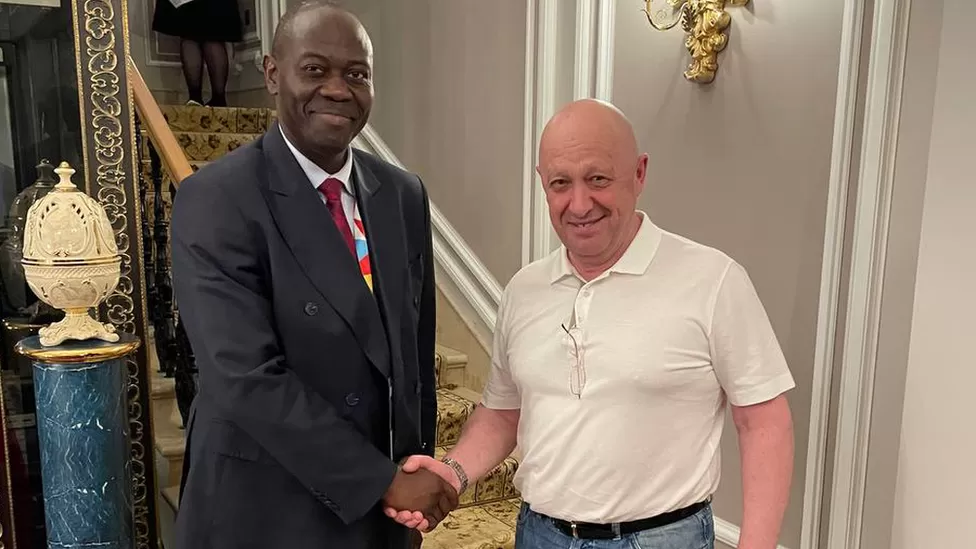
Yevgeny Prigozhin, the leader of Wagner, was recently spotted in St. Petersburg during the Africa-Russia summit.
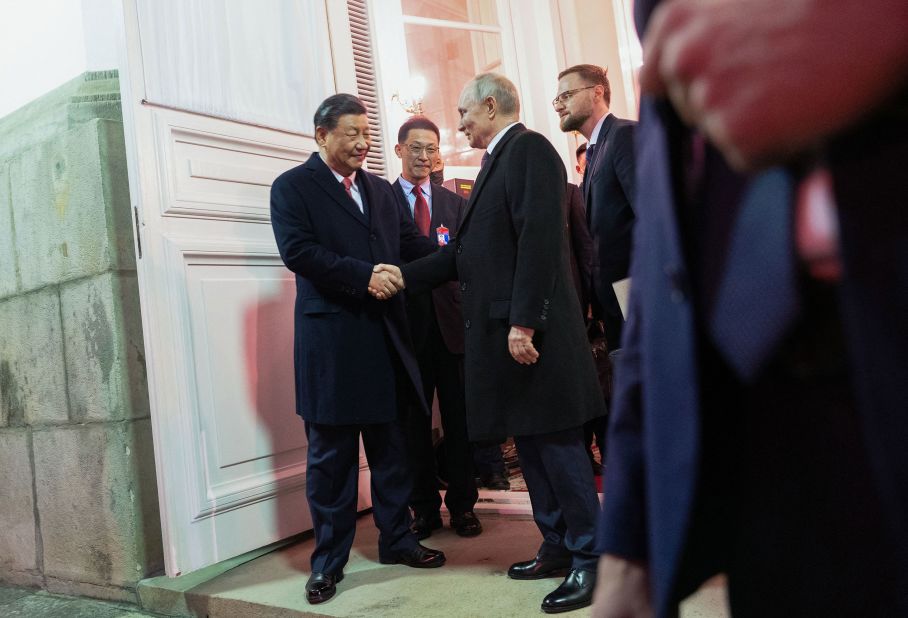
A photograph captured him shaking hands with Ambassador Freddy Mapouka, a high-ranking official from the Central African Republic (CAR). The image was shared on Facebook by Dmitri Syty, who is believed to manage Wagner’s operations in CAR.
This sighting marks the first confirmed appearance of Mr. Prigozhin in Russia since Wagner’s unsuccessful mutiny in June. The meeting between Prigozhin and Mapouka occurred at the Trezzini Palace hotel in St. Petersburg, which was verified by BBC using facial recognition software and matching details from the background of the photo. The hotel is reportedly owned by Prigozhin.
Mr. Mapouka’s lanyard in the photo perfectly matches the official lanyards worn by delegates at the summit, further supporting the authenticity of the image. Notably, this photograph has only recently surfaced online, as no earlier copies were found during searches.
Wagner, a mercenary group, has a presence of several hundred fighters in the diamond-rich CAR, assisting the government in its fight against rebel groups. Recently, the UK imposed sanctions on two heads of Wagner’s operations in CAR, accusing them of committing atrocities against civilians.
Additionally, Mr. Prigozhin made an appearance in Belarus last week, where he was seen welcoming fighters and discussing developments on the frontline in Ukraine. He hinted that Wagner might rejoin the war at a later date.
During the Africa-Russia Summit, Russian President Vladimir Putin expressed readiness to replace Ukrainian grain exports to Africa both commercially and as aid to prevent a potential “global food crisis.”
“We will be ready to provide Burkina Faso, Zimbabwe, Mali, Somalia, Central African Republic and Eritrea with 25-50,000 tonnes of free grain each in the next three to four months,” Putin said. These are all Russian allies, except Somalia which is suffering a severe humanitarian crisis.
Russia recently withdrew from a deal under which Ukrainian grain exports passed through the Black Sea to reach global markets, including Africa.
The EU said it believes Mr Putin is misleading African countries over his promise to send free grain to the continent. The European Commission said Russia was unlikely to honour its pledge.
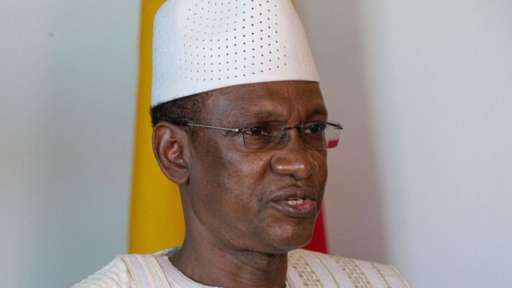
Malian Prime Minister, Choguel Kokalla Maïga, has condemned the US sanctions imposed on the defence minister, air force chief of staff, and his deputy.
He dismissed the sanctions as a mere “distraction” and expressed his unwavering support for the junta officials.
“The sanctions against our valiant officers, Defence Minister Col Sadio Camara, Gen Alou Boi Diarra, Col Adama Bagayoko, have no objectives other than to distract the Malian people. Nothing will distract us from the work of rebuilding Mali,” Mr Maïga has tweeted.
The US Treasury imposed sanction on the three for “facilitating” the expansion of Russia’s Wagner Group in Mali.
The Wagner troops, alongside the Malian army, are facing accusations of committing atrocities in their campaign against jihadists. The United States has reported a significant increase in civilian casualties since their deployment in late 2021.
Among the senior officials in the military government, the Malian Prime Minister stands as the only one to have addressed the issue of sanctions.
The response from Mali, so far, has been measured, in contrast to previous instances where government spokesman Col Abdoulaye Maïga delivered strong rhetoric and accusations of plots to destabilize the ruling junta in diplomatic disputes, particularly with France and the UN.
Founder of Russia’s private military company Wagner, Yevgeny Prigozhin, stated in an interview with Afrique Media TV that his mercenaries intend to maintain their operations in African countries where they are currently deployed.
We continue to work in all the countries where we started or are now doing this work of co-operation and development,” he said in an interview published on the pro-Kremlin TV’s Facebook page.
“If the assistance of the Wagner Group is needed anywhere to combat gangs and terrorists and to protect the interests of the people of these countries, we are ready to begin immediately to fulfil this task after agreeing on the conditions.”
He added that “there was no, and there will be no reduction in our programmes in Africa”.
After rumors surfaced regarding the potential withdrawal of Wagner mercenaries from Mali and the Central African Republic, Yevgeny Prigozhin, the founder of the private military company, addressed the speculation. His statements came in the aftermath of a brief mutiny he staged in Russia on 24 June.
It is worth noting that rights groups have accused Wagner mercenaries of committing human rights abuses in both Mali and the Central African Republic.
Russian security firm Wagner confirmed on Sunday that hundreds of its fighters had arrived in the Central African Republic (CAR) in a statement on the messaging app Telegram.
This development comes amidst ongoing uncertainty surrounding the future of Wagner following a brief mutiny in June.
Since 2018, at least 1,000 Wagner mercenaries have been stationed in the CAR. However, recent reports suggest that approximately 600 mercenaries have departed from the country.
A company connected to the Wagner group has stated that the newly arrived fighters will assist in providing security during a forthcoming referendum in the CAR.
The referendum, scheduled for later this month, will determine whether President Faustin-Archange Touadéra can seek a third term in office.
After the Wagner paramilitary group‘s failed mutiny, Russia’s “General Armageddon” has been gone for ten days.
Former top Russian commander in Ukraine Sergei Surovikin was charged with supporting mercenary leader Yevgeny Prigozhin during the revolt.
His detention and subsequent release have been rumoured in some sources, but they have not been verified.
According to the UK Ministry of Defence, he has not been seen since June 24, but officials stressed that any on-the-record sanctions against him will be ‘divisive’ as he is one of the most respected senior officers within the Russian military.
Surovikin’s deputy defence minister Colonel General Yunus-bek Yevkurov was also ‘notably absent from a televised appearance by the Ministry of Defence’s leadership on July 3,’ the UK MoD said.
Away from the turmoil in Russia, there were reports of long queues at the border between Ukraine and Moldova amid a ‘serious threat’ at the Zaporizhzhia nuclear power plant.
According to reports from Sky News, a number of Ukrainians are now fleeing to the neighbouring ally.
But Daniel Voda, a spokesperson for the Moldovan government, stressed that any increase in numbers of people crossing the border is due to the summer holidays.
Numbers analyzed by Metro.co.uk show there has been no drastic increase in the border crossings in the last 72 hours.
The future of agreements made between several African nations and the Wagner mercenary group, according to Russian Foreign Minister Sergey Lavrov, is a problem for the respective governments of those nations.
On the basis of contracts negotiated directly with the relevant governments, Wagner worked in the Central African Republic (CAR) and other nations, according to Lavrov, who was speaking at a news conference on Friday.
He also said Russia’s defence ministry had long had “several hundred” military advisers working in the CAR.
Wagner mercenaries, known for their involvement in the Ukraine conflict, staged a brief mutiny last Saturday, seizing control of the southern Russian city of Rostov-on-Don and marching towards Moscow before a deal ended their revolt. This incident has raised questions about the presence of Wagner operatives in the Central African Republic (CAR) and other parts of Africa, as well as Moscow’s level of engagement with the group’s activities on the continent.
Russian President Vladimir Putin revealed on Tuesday that Wagner was fully financed by the state, with approximately 86 billion rubles (around $940 million) being allocated to the group between May 2022 and May 2023.
In Mali, where military coups occurred in 2020 and 2021, the country is engaged in a long-standing battle against armed groups linked to ISIL (ISIS) and al-Qaeda. The authorities in Mali have stated that the Russian forces present there are not Wagner mercenaries but rather trainers assisting local troops with equipment acquired from Russia.
Wagner mercenaries have faced accusations of human rights abuses, notably the March 2022 incident in Moura, central Mali, where local troops and suspected Russian fighters allegedly killed hundreds of civilians.
In neighboring Mauritania, thousands of Malians have sought refuge in the M’bera camp since 2021, according to United Nations officials managing the camp. The camp recorded nearly 7,000 new arrivals between March and April 2022 alone.
French President Emmanuel Macron, in February, described the deployment of Wagner troops in Africa as a support system for failing regimes that only brings suffering and misery.
A source from the military has revealed that an air base in eastern Libya, suspected to house mercenaries from the Russian paramilitary group Wagner, was targeted by drone strikes of unknown origin on Thursday night. Fortunately, the attacks did not result in any casualties.
The source, who requested anonymity, told AFP that drones “of unknown origin struck the al-Kharrouba air base, located 150 km south-east of Benghazi (east), where elements of the Wagner group are believed to be based”.
“The strikes caused no casualties”, she added.
Libya has been in the grip of a major political crisis since the fall of Muammar Gaddafi’s regime in 2011, undermined by divisions between east and west and foreign interference.
From April 2019 to June 2020, Khalifa Haftar, the strongman of eastern Libya, used Chadian, Sudanese, Nigerian and Syrian fighters, but above all mercenaries from Wagner, in his failed attempt to seize the capital Tripoli.
Since then, hundreds of Wagner members have remained active in the east, in the area of the oil terminals, and in the south of Libya after some of their troops left for Mali or Ukraine to fight alongside the Russian army.
A putative new headquarters for the exiled Wagner mercenary gang has been revealed by satellite photographs that seem to suggest rapid building at an abandoned military station in Belarus.
Yevgeny Prigozhin, its leader, crossed the border from Russia as part of an agreement to put a stop to the militia’s uprising, which shook the Kremlin.
The dictatorial president of Belarus, Alexander Lukashenko, who is a devoted supporter of Vladimir Putin, offered the guns for hire asylum after they were spared from being tried for treason.
Lukashenko said he had offered the private military company an ‘abandoned military unit’ to set up camp and promised to ‘help with whatever we can’.
‘We’re looking at it pragmatically -– if their commanders come to us and help us, (we get their) experience,’ Lukashenko said.
Although the base’s location has not been made public, Russian media have reported that Wagner could set up at a vacant military facility near the town of Osipovichi, about 50 miles from Minsk.
Images captured by the European Space Agency’s Sentinel 2 satellites on June 27 show rows of long structures in the nearby village of Tsel, in a field which had appeared empty on June 14.
Residents of the city of 30,000 said they were worried by the developments.
Inga, a 43-year-old doctor in Osipovichi, said: ‘There’s military equipment in the streets and Belarusian servicemen — all residents are discussing the arrival of Wagnerites and, frankly speaking, we’re panicking and are not happy about being neighbours with them.
‘I have teenage daughters. … How will we live next to thugs, pardoned murderers and rapists?’
Belarusian opposition and guerrilla activists, who called Wagner fighters ‘a threat to the Belarusian people and (the country’s) independence’, promised action.
Aliaksandr Azarau, leader of the BYPOL guerrilla group of former military members, said: ‘We’re categorically against stationing Russian mercenaries in Belarus and are preparing a “warm” welcome to Wagnerites in Belarus.’
Neighboring Baltic countries also expressed concerns about how this would affect regional security.
In a joint statement Wednesday, parliament speakers in Estonia, Latvia and Lithuania urged the European Union to label Wagner a terrorist organisation.
‘The emergence of the Wagner mercenary group in Belarus could make the security situation on the eastern borders of NATO and the EU even more precarious,’ it read.
Lukashenko has been Putin’s closest ally, allowing Russia to use Belarus to send troops and weapons into Ukraine.
He has welcomed a continued Russian military presence in the country and the deployment there of some of Russia’s tactical nuclear weapons.
But he has stressed that Wagner fighters ‘will not be guarding any nuclear weapons’.
Prigozhin himself arrived in Belarus on Monday, Lukashenko said, but his exact whereabouts are unknown.
He said the mercenaries probably wouldn’t go there in significant numbers and added that Ukraine’s military believes security along their border will remain ‘unchanged and controllable’.
The Central African Republic’s armed forces will continue to get assistance from Russian experts, but the Wagner Group’s actions there are its own, distinct operations, according to the Kremlin.
The Kremlin statement on Wednesday concerns a country with which Russia has had close ties with in recent years. Hundreds of Russian operatives, including many from the Wagner Group, have been helping its government fight rebel uprisings against President Faustin-Archange Touadera since 2018.
And Touadera is scheduled to attend the second Russia-Africa Summit in St Petersburg in July.
But Wagner’s fate is uncertain after its abortive mutiny in Russia on Saturday.
This week, Russian Foreign Minister Sergey Lavrov told state broadcaster Russia Today that Wagner’s work in CAR “as instructors … will continue” and that the weekend’s events would not impact relations between Moscow and its partners and allies.
Meanwhile, Bangui has remained upbeat about the situation with minister and presidential adviser Fidèle Gouandjika telling the Agence France-Presse news agency that what the country had in place was “a defence deal with Russia and not Wagner. … Moscow has subcontracted to Wagner, and if Russia doesn’t agree, it will send us a new contingent.”
The mercenary group has been accused of multiple human rights abuses in CAR, Burkina Faso and Mali.
And no, there are questions about whether the group could still be seen as a stabilising force for tackling armed groups after its mutiny in Russia.
“They will be seen as too unstable and potentially a threat to the leadership in those countries,” Michael Mulroy, a former senior Pentagon official, told the Reuters news agency.
“They almost started a coup in their own [country].”
Preparations are currently underway for Wagner, a private military company, to hand over its heavy military equipment, as stated by Russia’s defense ministry. This comes in the aftermath of a failed rebellion that took place on Saturday.
Russian media reports indicate that the Federal Security Service (FSB) has closed the criminal case against the mutineers from Wagner.
Fighters associated with Wagner have been given three options: they can choose to join the Russian military, return to their families, or relocate to Belarus.
During an address to military personnel on Tuesday, President Putin praised their efforts in “halting a civil war” and called for a minute of silence to honor pilots who lost their lives in clashes with Wagner troops.
Wagner’s leader, Yevgeny Prigozhin, stated on Monday that the short-lived rebellion was in response to government plans to assume direct control over the mercenary group. He later agreed to leave Russia for Belarus after calling off his troops. On Tuesday, a plane connected to Prigozhin landed in the capital city of Minsk.
Belarusian leader Alexander Lukashenko, also in Minsk, described the mutiny as “painful to watch” and stated that he had ordered his country’s army to be “combat ready” during the incident.
Meanwhile, Ukrainian President Volodymyr Zelensky claimed that the counter-offensive had made progress on all fronts.
The military of Ukraine, which is waging its own counteroffensive, as well as our own people here in the Donbas, are attentively following the remarkable developments in Russia.
The very long front line is only shifting by a few meters, a few villages here and there.
Everybody is waiting to see where and when the Ukrainians may commit the bulk of their newly trained forces, with their Western-supplies weapons.
There are potential new opportunities for the Ukrainians to exploit. There are questions about where the Wagner forces have withdrawn from.
Russian forces will no doubt have heard what’s been going on and will be demoralised. There might be in-fighting between rival units in the days to come, depending on what sort of aftershocks there are back in Russia following yesterday’s remarkable events.
Right now, as well as risks of an escalation from Russia, Ukraine will be searching for opportunities from the instability across the border.
The rebellion was ultimately brief. However, for a brief and chaotic 36 hours, hundreds of Wagner warriors commanded by warlord Yevgeny Prigozhin looked to be closing in on the nation’s capital, seriously threatening Russian President Vladimir Putin’s hold on power.
With the private mercenary group claiming to have seized key military sites in two Russian cities, the Kremlin was forced to deploy heavily armed troops to the streets of Moscow and warn residents to stay indoors.
But the face-off never came.
On Saturday, the Kremlin said a deal had been reached to end the insurrection, with Prigozhin heading to neighboring Belarus and Wagner fighters turning back from their march.
“Now is the moment when blood can be shed,” Prigozhin warned on Saturday. “Therefore, realizing all the responsibility for the fact that Russian blood will be shed from one of the sides, we turn our columns around and leave in the opposite direction to the field camps according to the plan.”
Wagner fighters will face no legal action, and the Kremlin has “always respected (Wagner’s) heroic deeds,” said Kremlin spokesperson Dmitry Peskov.
“You will ask me what will happen to Prigozhin personally? The criminal case will be dropped against him. He himself will go to Belarus,” Peskov said, adding that the situation had been resolved “without further losses.”
The abrupt about-face follows a rare, remarkable challenge to the Kremlin that threatened to plunge the country into crisis and destabilize its already stumbling war efforts in Ukraine.
Chechen leader Ramzan Kadyrov, a staunch Kremlin ally, condemned Prighozhin’s actions and said, “bloodshed could have happened.”
“The arrogance of one person could lead to such dangerous consequences and draw a large number of people into the conflict,” he added.
The threat of civil war leaves the country – and the Putin regime – in a very different place Sunday than it had been just two days prior. And with Russia possessing the world’s largest nuclear arsenal, that instability has other nations on edge, prompting emergency meetings and high-level talks.
Threat to Putin
Putin has built a reputation as an autocrat with an iron grip on power since he became president in 2000 – with his reign second in length only to Joseph Stalin, the Communist leader whose image Putin has tried to rehabilitate.
The mysterious deaths of Putin critics over the years, and more recent critics of the Ukraine war, has only bolstered the Kremlin’s veneer of total control and the consequences for those who step out of line.
That has now been shaken badly by the Wagner insurrection – with experts warning Putin may be more exposed than he has been in the last 23 years.
“Putin is clearly weakened. There is blood in the water,” said Evelyn Farkas, executive director of the US-based think tank McCain Institute. She added that this near-crisis could be seen as an opportunity for Putin critics or rivals within the Kremlin.
Moscow has stepped back from civil war with Wagner. But the danger’s not over, experts warn
Some international observers have expressed surprise at what they view as a lackluster Russian response to the insurrection, with the lack of a rapid, cohesive strategy highlighting the military’s weakened capabilities.
Putin will also have to contend with shaky public sentiment within Russia. Civilian support for the war in Ukraine remains high, but cracks had begun to show by early this year, with some Russians tuning out the propaganda on air and others finding ways to circumvent Internet restrictions.
In the months since, the war has arrived on Russian soil as Ukraine launched its counteroffensive. Russia’s Belgorod region saw a cross-border attack by anti-Putin Russian nationals in May, while the Kremlin itself came under alleged drone attacks.
The emerging split between Moscow and some of its civilians was on clear display Saturday, as Prigozhin and his forces prepared to depart the Russian city of Rostov-on-Don, where they had briefly occupied a key military facility. A video verified and geolocated by CNN show Prigozhin’s vehicle stopping as a resident approached to shake the Wagner boss’ hand; around them, residents cheer.
Russian President Vladimir Putin attends the Navy Day Parade in St. Petersburg in July 2022.Getty Images
In pictures: Russian President Vladimir Putin
1 of 41PrevNext
The location adds to the moment’s significance: Rostov-on-Don is an important regional capital with logistical and strategic value, housing the headquarters of Russia’s Southern Military District.
“All of this is spilling out into the Russian heartland,” said retired US Army Brig. Gen. Peter Zwack on Saturday.
Beth Sanner, former deputy director of National Intelligence for Mission Integration, said the incident could see Putin “double down on repression in Russia” in a bid to wrest back control – as well as step up its fighting in Ukraine, in the face of international scrutiny.
“He has been humiliated,” Sanner said. “He’s going to try to reassert (his strength) … Putin will not just stand there and allow all of this to flourish and blossom.”
World on edge
The insurrection has also turned a spotlight to Russia’s nuclear capabilities and what might push Putin to use them – questions that have loomed over the war in Ukraine ever since it began.
Putin has repeatedly engaged in nuclear saber-rattling, announcing earlier this year that it would store tactical nuclear weapons in Belarus, one of Moscow’s closest allies, which helped launch the initial invasion of Ukraine. The first of those weapons arrived this month.
On Saturday, two US officials told CNN that they had not seen any change to Russia’s nuclear posture since the insurrection started.
A State Department spokesperson added that the US has “no reason to adjust our conventional or nuclear force posture,” and that it has “long-standing, established communication channels with Russia on nuclear issues.”
But those channels are now significantly narrower than before. Earlier this year, Russia suspended participation in its only nuclear arms control treaty with the US – meaning the two nations are no longer required to share information like the location of certain missiles and launchers.
US intelligence officials had anticipated last year that there was an internal power struggle between the Wagner group and the Russian government, as the invasion of Ukraine stalled, according to top US officials.
They even saw signs that Prigozhin was making preparations for a major challenge, including by amassing weapons and ammunition, said one Western intelligence official and another person familiar with the intelligence.
But they didn’t anticipate Prigozhin would storm the Rostov region – and the insurrection unfolded so quickly that it caught US and European officials off guard, sources say.
US officials convened emergency meetings on Friday night to assess the events, while US Secretary of State Antony Blinken spoke with counterparts from Canada, France, Germany, Italy, Japan, United Kingdom, and the European Union on Saturday.
The leader of the US, United Kingdom, France and Germany also spoke on Saturday, before Wagner pulled back from its advance, according to Downing Street.
Countries near Russia are also on guard, with the president of former Soviet state Kazakhstan scheduling an emergency meeting of his Security Council on Sunday. The council will form a plan to contain any “possible negative consequences” of the insurrection that could impact Kazakh citizens or the economy, said the presidential office.
Russian reports has it that Wagner fighters are in charge of all military installations in Voronezh, a city midway between Rostov-on-Don (where Wagner also claims to be in charge) and the Russian capital Moscow.
Voronezh city officials are yet to publicly comment on the claim.
Meanwhile, Voronezh region governor Aleksandr Gusev has warned that there are many fake reports circulating about a movement of an armoured column in the region.
He also says the Russian armed forces are now carrying out “operational and combat measures” in the Voronezh region as part of the early declared counter-terrorist operation.
The map below shows you where Voronezh is. It’s still a long way from Moscow, which the Wagner group has threatened to march on.
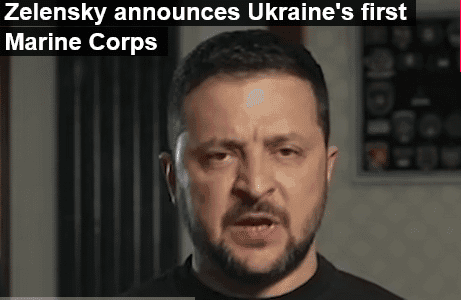
As the leader of Russia’s Wagner mercenary group claimed that military setbacks had allowed Kyiv to create “one of the strongest armies in the world,” Volodymyr Zelensky announced the formation of the country’s first marine corps.
On the force’s national holiday, Zelensky was captured on camera presenting honours to both male and female marines while sporting his well-known khaki army sweatshirt and pants.
In his nightly address, the Donetsk mayor recalled the visit to the area near Vuhledar and Maryinka, saying: “I presented state awards to the warriors and ribbons “For Courage and Bravery” to the best units defending this part of the frontline.”
The president said the Ukrainian government would create a specialised marines corps and promised to provide new weapons and equipment.
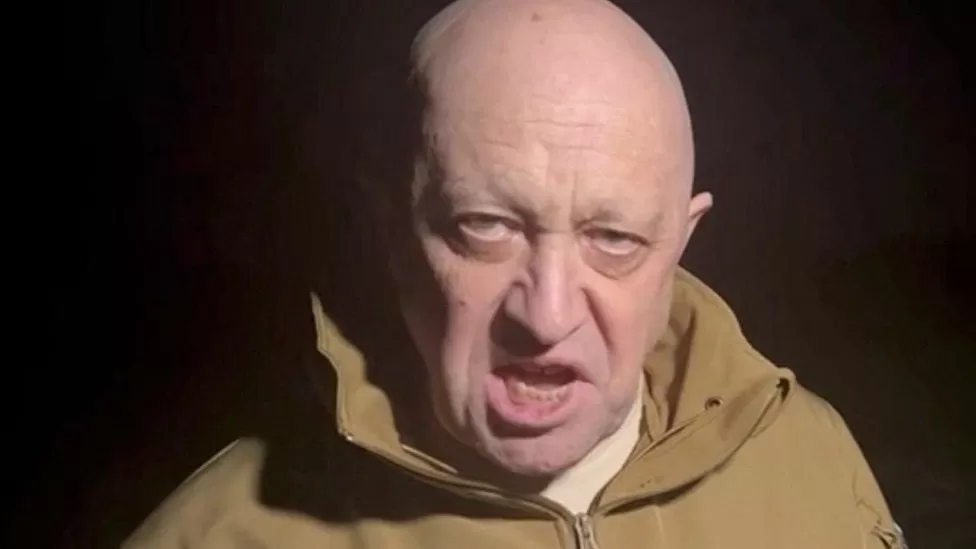
The update came as Yevgeny Prigozhin, founder of the Wagner Group, warned Russia could face a revolution similar to that in 1917 unless the country’s elites get serious about the war.
He again criticised the military leadership, naming defence minister Sergei Shoigu and chief of the defence staff Valery Gerasimov, saying they had ‘f**ked up’ repeatedly, leading to the loss of more men in the battle for Bakhmut than the entire 10-year war in Afghanistan.
Prigozhin said Soviet leader Josef Stalin would not have accepted such failure.
Mocking Vladimir Putin’s purpose for his ‘special military operation’, he said: ‘So the de-Nazification of Ukraine, which we announced – we made Ukraine a nation, known to everyone around the globe.
‘They are like Greeks at their peak, or Romans.’
In an interview with a prominent pro-war blogger posted on his Telegram channel, he went on: ‘We legitimised Ukraine, it became a country which is known to everyone.
‘As for de-militarisation, [this is] a painful issue indeed. So if they had at the start of it 500 tanks – now they have 5,000. If there were 20,000 men who were able to fight – now there are 400,000.
‘So how exactly did we demilitarise it? Quite the opposite! We militarised it up to the brim.
‘I think Ukrainians today are one of the world’s strongest armies. They have high levels of organisation, training, military intelligence.
‘They have various ammunition and moreover, they are able to switch between any system – Soviet, NATO, anything at all – with the same success. They take their losses philosophically.
‘All they do is to achieve the supreme goal, just like us during the Great Patriotic War [Second World War].’
Prigozhin, left, is known as a close ally of Putin (Picture: AP)
Prigozhin lambasted the comfortable elites in Russia ‘shaking their arses’ in the sun while ordinary citizens get theirs back in zinc coffins, adding: ‘This divide can end as in 1917 with a revolution.
‘First the soldiers will stand up, and after that – their loved ones will rise up.
‘There are already tens of thousands of them – relatives of those killed. And there will probably be hundreds of thousands – we cannot avoid that.’
Russia needs to mobilise more men and to gear the economy exclusively to war, Prigozhin said.
He continued: ‘What must we do – not to lose Russia? Because today we are in a state when we can lose Russia.
‘We must introduce martial law. We must call new waves of mobilisation. We must switch everyone to production of weapons.
‘Stop building skyscrapers, new roads, new infrastructure – and work only for the war. We must live like in North Korea for several years, and shut the borders.’
A statement from the head of the private military organisation Wagner, if Russia’s stalling war effort in Ukraine continues, a new “revolution” might shake the nation. His critical evaluation of Moscow’s military readiness may further reveal gaps in Russian President Vladimir Putin’s military hierarchy.
Yevgeny Prigozhin claimed in an interview with pro-Russian blogger Konstantin Dolgov that even when Ukrainian forces invade Russian territory, Moscow’s troops are unprepared to confront them.
Additionally, he commended the Ukrainian army‘s capabilities and encouraged Moscow to step up its military efforts in order to prevent a protracted and expensive battle.
“I believe Ukrainians today are one of the strongest armies in the world,” Prigozhin said. He called Kyiv’s forces “highly organized, highly trained and their intelligence is on the highest level, they can operate any military system with equal success, a Soviet or a NATO one.”
In recent days Moscow suffered embarrassment when a group of anti-Putin Russians entered the Belgorod region in an incursion that caused anger and confusion among Russia’s influential military analysts. Asked about the incident, Prigozhin said Russian defense forces are “absolutely not ready to resist them in any shape or form.”
“Here we are with Ukraine, that is our enemy, in the middle of the war, Russian Volunteer Corps groups come in effortlessly and go through (the border) in tanks and APCs without any repercussions and make their own videos if it,” the Wagner chief vented.
Prigozhin has frequently criticized Russia’s traditional military hierarchy as he sought to win a power struggle against military commanders to lead Putin’s ground effort in eastern Ukraine. Earlier this month he blamed Russian defense chiefs for “tens of thousands” of Wagner casualties because they didn’t have enough ammunition.
But his comments to Dolgov were alarmist even for the free-wheeling Putin ally. As he has frequently done, Prigozhin urged Moscow to step up its war in order to defeat Ukraine – urging Putin to “declare a martial law and a new wave of mobilization.”
He warned that if Russian losses continue to mount, “all these divisions can end in what is a revolution, just like in 1917.”
“First the soldiers will stand up, and after that – their loved ones will rise up. It is wrong to think that there are hundreds of them – there are already tens of thousands of them – relatives of those killed,” he said. “And there will probably be hundreds of thousands – we cannot avoid that.”
Russian forces, primarily made up of Wagner troops, have labored for months over the capture of Bakhmut – a city in Ukraine’s east of relatively insignificant strategic value, where Russia has suffered vast losses – and its larger ground campaign has been in stalemate since a string of successful Ukrainian counter-attacks last autumn.
Russian soldiers may have shot down four military planes that crashed not far from the Ukrainian border.
Following the Saturday crashes of two fighter jets and two military helicopters in the Bryansk region, the commander of Russia’s Wagner private army made the assertion.
Officials from Russia have not yet responded on the reports.
The four planes likely belonged to the same military aviation group.
Speaking on messaging app Telegram, Wagner head Yevgeny Prigozhin said: ‘Four planes, if you draw a circle in the places of their fall, it turns out that this circle has a diameter (and all of them lie exactly in a circle) of 40km (25 miles).
‘Now go on the internet and see what kind of air defence weapon could be in the centre of this circle, and then build your own versions.’
However Mr Prigozhim, whose forces are fighting in the city of Bakhmut, later clarified that he was not ‘in the know’ about the situation.
He has repeatedly criticised the Russian military for its strategy in Ukraine. He also claims it has failed to supply Wagner with the ammunition it needs in Bakhmut.
Yuriy Ihnat, a spokesman for Ukraine’s air force, denied that Ukraine was involved in shooting down the aircraft.
He suggested on Ukrainian television that Russia itself could be responsible, but later claimed he made the remark as a joke.
Shelling from both sides of the border has repeatedly hit Bryansk, which borders the Chernihiv and Sumy provinces of Ukraine.
Russian authorities claim unexplained explosions had derailed two freight trains in the region, and an armed group had crossed the border from Ukraine in March and killed two civilians.
In a dispute over ammunition, the leader of the Russian Wagner Group has threatened to pull his forces out of the Ukrainian city of Bakhmut by Wednesday.
He made his remark after beseeching Russia’s defense minister for more supplies while strolling among the bodies of fallen warriors in a social media video.
“They are dying so that you can gambol in your redwood cabinets,” he said while addressing the government.
“Shoigu! Gerasimov! Where is the… ammunition?… They came here as volunteers and die for you to fatten yourselves in your mahogany offices,” he added.
His troops will leave on 10 May.
Defence Minister Sergei Shoigu and Chief of the General Staff Valery Gerasimov have often been the focus for Prigozhin’s anger.
Prigozhin is a publicity seeker, and his influence has seemingly waned in recent months. He has previously made threats he has not followed through with – subsequently dismissing them as jokes and military humour.
Only last week he told a Russian pro-war blogger that Wagner fighters in Bakhmut were down to their last days of supplies of bullets, and needed thousands of rounds of ammunition.
If shortages were not tackled then his mercenaries would be forced either to retreat or remain and die, he warned: “Then, no matter what our bureaucrats want, everything else will crumble.”
Prigozhin said that his forces had agreed to stay in Bakhmut until 10 May to allow Russia to mark Tuesday’s Victory Day celebrations.
In February, he posted another image of his dead troops and blamed army chiefs for their deaths. Although the military denied deliberately starving his Wagner group of shells, at the time they did respond by increasing supplies to the front line.
In his announcement, standing in front of his men, he said on 10 May they would be “obliged to transfer positions in the settlement of Bakhmut to units of the defence ministry and withdraw the remains of Wagner to logistics camps to lick our wounds”.
The battle for Bakhmut has dragged for months and is thought to have claimed thousands of lives. Ukraine’s armed forces decided to defend the city at all costs in an apparent attempt to focus Russian military resources on one place of relatively little significance.
US-based military analyst Rob Lee argues that Wagner’s latest complaint of shortages likely reflects Russia’s defence ministry rationing ammunition ahead of Ukraine’s long anticipated counter-offensive. The ministry has to defend the whole front, but Prigozhin’s sole concern lies in taking Bakhmut, he wrote on Twitter.
Prigozhin has himself predicted that Ukraine’s counter-offensive will begin by 15 May, as tanks and artillery will be able to advance in dry weather, after the last spring rain.
In a separate move, Prigozhin appears to have hired an army general who was recently dismissed as logistics chief.
Col-Gen Mikhail Mizintsev was dubbed the butcher of Mariupol for his role in last year’s bombardment of Ukraine’s southern port city, captured by Russian forces a year ago.
Videos posted online show in at a Wagner training camp and then visiting positions in Bakhmut.
Prigozhin said earlier he had offered him the post of deputy to a Wagner commander, pointing out that the general had done his best to help supply mercenaries with ammunition and had co-operated with the group’s efforts to recruit convicted prisoners to its ranks.
Col-Gen Mizintsev was only put in charge of army logistics last September, shortly after Prigozhin was filmed inside a Russian prison telling inmates they would be freed from jail if they served with his men in Ukraine.
Diplomatic sources in the region and in Sudan has revealed that the Russian mercenary company Wagner has been delivering missiles to the Rapid Support Forces of Sudan to help them in their conflict with the national army.
The sources said the surface-to-air missiles have significantly buttressed RSF paramilitary fighters and their leader Mohamed Hamdan Dagalo as he battles for power with Gen. Abdel Fattah al-Burhan, Sudan’s military ruler and the head of its armed forces.
In bordering Libya, where a Wagner-backed rogue general, Khalifa Haftar, controls swathes of land, satellite imagery supports these claims, showing an unusual uptick in activity on Wagner bases.
EU sanctions Wagner subsidiary in Sudan after CNN investigation into gold exploitation
The powerful Russian mercenary group has played a public and pivotal role in Moscow’s foreign military campaigns, namely in Ukraine, and has repeatedly been accused of committing atrocities. In Africa, it has helped to prop up Moscow’s growing influence and seizing of resources.
Dagalo and Burhan had been jockeying for power in negotiations over restoring civilian leadership in Sudan before talks broke down, erupting into some of the worst violence the country has seen in decades.
The fighting has claimed hundreds of lives and deprived millions of people from electricity, water and food.