Ukraine and Russia traded prisoners of war on Friday. Each country sent back 75 POWs. This is the first swap of its kind in the past three months, officials said.
The Ukrainian prisoners, including four people who were not soldiers, were brought back to the northern Sumy region on buses. They shouted happily as they got off the boat and called their families to say they were back home. Some people knelt down and kissed the ground, while others covered themselves with yellow-blue flags.
They hugged each other and started crying. Many looked very thin and wore clothes that were not good.
The exchange was the fourth time this year that prisoners were swapped, and it was the 52nd time since Russia invaded Ukraine in February 2022. The Foreign Ministry in Kyiv said that the United Arab Emirates helped to arrange the release of 150 prisoners of war.
Both sides are blaming each other for a decrease in the swaps.
Ukraine has asked Russia before to exchange all prisoners and there are weekly protests in Ukraine asking for the release of prisoners of war. A Ukrainian official named Vitalii Matviienko said that Ukraine is always prepared to coordinate exchanges at the headquarters.
Tatyana Moskalkova, who is responsible for protecting people’s rights in Russia, said that Kyiv is asking for new things without explaining what they are.
On Friday, one of the people who came back to Ukraine was Roman Onyschuk. He works in IT and he joined the Ukrainian forces as a volunteer when the Russian invasion began. He was caught in March 2022 in the Kharkiv area.
“I just want to listen to my wife and son talking. ” He said he missed his friend’s birthday three times. He was in captivity for over 800 days and did not talk to his family. He doesn’t know what city they are in now.
“It’s a bit too much to handle,” Onyschuk said.
Ukraine has received a total of 3,210 Ukrainian soldiers and civilians back since the war began, including those coming back on Friday.
Ukraine and Russia do not say how many prisoners of war there are.
Dmytro Kantypenko was taken as a prisoner on Snake Island in the Black Sea at the beginning of the war. He was one of the people who were released on Friday. He called his mother to tell her that he was back in Ukraine.
“He said he will come home soon and wiped his tears. ” He found out that his wife had gone to Lithuania with their son. The Kantypenko family is from Izium in the Kharkiv region, which was taken over by Russia.
Kantypenko said that the Russians unexpectedly woke him up in the middle of the night without saying why, and gave him only a little time to get dressed before leaving.
The UN found out that most Ukrainian prisoners of war are not getting proper medical care, they are being mistreated and even tortured. The reports also discovered a few cases of Russian soldiers being mistreated, usually when they were captured or being taken to internment sites.
The Coordination Headquarters for the Treatment of POWs says that at least one-third of Ukrainians who came back home had injuries, severe illnesses, or disabilities.
On Friday, 19 Ukrainian fighters came back from Snake Island, 14 people were released from Chernobyl Nuclear Power Plant, and 10 fighters returned from Mariupol city which was taken by Russia.
Five women were released from being prisoners in Ukraine. One of them was Nataliia Manuilova, who was a cook in the Azov regiment and was held captive for over two years. The Russians grabbed her from her home in Mariupol, put a bag over her head, and tied her hands, she said.
I don’t like them. “They stole two years of my life,” she said, hugging her son on Friday. Nataliia Manuilova said, “I can’t believe how much he has grown up. ”
The prisoners traveled through little towns. Then they went to Sumy where they would go to hospitals for two weeks to get better.
Ukrainians with blue and yellow flags went out on the streets and cheered loudly for their military members returning home.
Tag: war
-

Russia and Ukraine swap prisoners of war for the first time in three months
-

Over 400 Ukrainian athletes and officials have died in Russia-Ukraine war – Committee
Ukraine’s Olympic Committee has disclosed that over 400 Ukrainian athletes and officials have died since the beginning of the Russia and Ukraine war on February 24, 2022.
The committee made this known after Oleksandr Pielieshenko, who won the European weightlifting championship twice, also passed away while fighting in the war in Ukraine.
Pielieshenko “was killed in the war against the enemy” last Sunday, the committee announced on Telegram. He was thirty years old.
He joined the military of Ukraine when Russia first invaded.
Pielieshenko returned to competing in 2015 after being suspended for doping, and then won the 2016 European championship in the under-85 kilogram category by just one kilogram. He won the title again in 2017 in Split.
Pielieshenko almost won an Olympic medal in 2016 at the Rio de Janeiro Games, but he came in fourth place, just five kilograms away from getting a medal. He broke the rules again in 2018 by using drugs to cheat.
The Ukrainian weightlifting federation said on Facebook that they are very sad to announce that Oleksandr Pielieshenko, a respected sports master in Ukraine and a two-time European weightlifting champion, has passed away today.
National coach Viktor Slobodianiuk wrote on Facebook, “War brings out the best in us. ” This is a big loss for all the weightlifters in Ukraine. Heroes live forever.
”Over 400 Ukrainian athletes and officials have died in the war”. Mr Slobodianiuk noted -
Students in US intensify rallies against Gaza War nationwide
Last week, Columbia University students started a protest against Israel’s war with Hamas. By Tuesday, students from other universities were also joining in by setting up camps, taking over buildings, and not listening to requests to stop.
Protests had been happening for a few months, but got more intense after over 100 people supporting Palestine were arrested at Columbia University’s upper Manhattan campus on Thursday. Many more protesters were arrested at other schools, and now they may be charged with going into a place illegally or behaving in a disruptive way.
Because students are scared to go to Columbia, the school will do a mix of in-person and online classes for the rest of the semester. This will finish by the end of next week.
Police at the nearby New York University arrested 133 protesters on Monday. They were all released with a ticket to go to court for being disruptive. New York City Mayor Eric Adams said that police officers were hit with bottles and other things during protests this week.
In Connecticut, the police arrested 60 people who were protesting, including 47 students, at Yale University. They were taken into custody because they didn’t want to leave a area in the middle of the campus.
Yale President Peter Salovey said the protesters did not accept an offer to stop their demonstration and talk with the trustees. School officials gave a lot of warnings, then decided that the situation wasn’t safe. The police then removed the camp and arrested people.
In the Midwest, on Tuesday, there were protests at the University of Michigan and the University of Minnesota. Nearly 40 tents were set up at the University of Michigan and nine people were arrested at the University of Minnesota. Hundreds of people gathered at the Minnesota campus in the afternoon to ask for their release.Cal Poly Humboldt on the West Coast of California will be closed until Wednesday because protesters took over a building on Monday night. Three people were taken by the police because they were protesting. The school said on its website that classes will be taught online.
Since the fighting in Gaza started, colleges and universities have had a hard time keeping students safe while also allowing them to express their opinions freely. A lot of protests that used to be allowed are now getting harsher punishments.
Harvard University in Massachusetts has closed most gates to its Harvard Yard and is only allowing people with school ID to enter, in order to avoid protests. The school put up signs that say you need permission to set up tents or tables on campus.
Christian Deleon, a Literature Ph. D student, said he knows why Harvard doesn’t want protests, but students should still be able to share their opinions.
“He said we should all be able to use these places to protest and speak out. ”
Ben Wizner, a lawyer from the American Civil Liberties Union, said that college leaders have to make very difficult choices because they are responsible for making sure that people can share their opinions, even if others don’t like them.
“He said they also need to keep students safe from being harassed, threatened, or intimidated. ” “Sometimes it’s hard to tell where the line is. ”
The New York Civil Liberties Union warned colleges not to rush to involve the police, in a statement on Tuesday.
Donna Lieberman, the head of the group, said that officials should not mix up criticizing Israel with hating Jewish people, or use hate incidents as an excuse to stop people from expressing their political views.
Leo Auerbach, a University of Michigan student, said that the different opinions about the war didn’t make him feel in danger on campus. However, he’s afraid of the “hurtful language and anti-Jewish feelings” that some people are expressing.
“Auerbach said that in order to make everyone feel like they belong on campus, different groups need to talk to each other in a helpful way. ” “And currently, no one is talking. ”
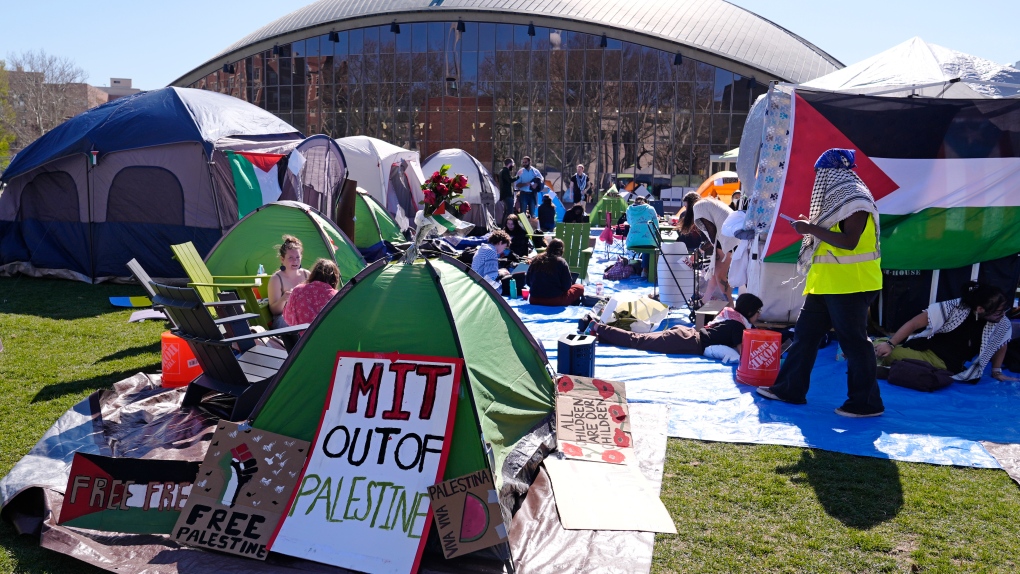
Hannah Didehbani, a senior studying physics at the Massachusetts Institute of Technology, said that the protesters were motivated by the ones at Columbia University.
“Currently, some professors at the campus are receiving money directly from Israel’s ministry of defence for their research,” she said. “We have been asking MIT to stop working with that research. ”
Protesters at the University of California, Berkeley, were inspired by the demonstrators at Columbia University. They had about 30 tents set up on Tuesday. Law student Malak Afaneh said the Columbia demonstrators are the leaders of the student movement.
Columbia’s President Minouche Shafik said she felt very sad about what’s happening on campus. Some Jewish students feel that criticism of Israel has turned into antisemitism.
US House Speaker Mike Johnson is going to visit Jewish students at the university on Wednesday. He will also talk about how to stop hate against Jewish people at college campuses during a press conference.
Columbia has a long history of protests. In 1968, many students were mad about racism and the Vietnam War, so they took over five buildings on campus. A thousand police officers came and removed them after a week, taking 700 people into custody. The news said that 100 students and 15 police officers got hurt.
Protests started on the campus after Hamas attacked southern Israel, killing about 1,200 people, most of them were civilians, and holding around 250 people hostage. In the war, Israel has killed over 34,000 people in the Gaza Strip. The local health ministry says that at least two-thirds of those killed are children and women, but they don’t separate combatants and noncombatants. -
Iraq may be forced into war – Minister
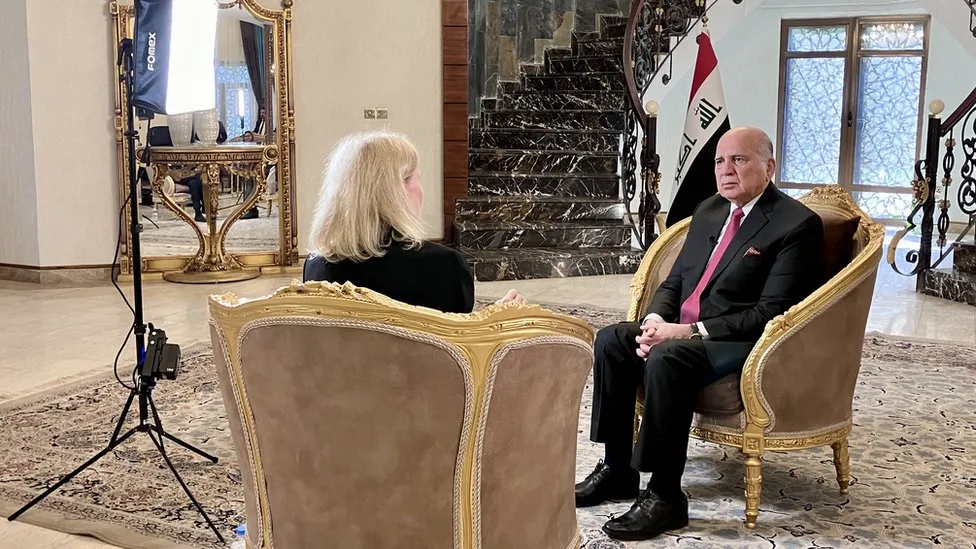
“Iraq’s foreign minister, Dr Fuad Hussein, told the media that the attacks by Iranian-backed militias and US forces could lead to conflict in Iraq. ”
“Right now, Iran and the United States are very tense with each other,” he said.
I want both groups to stop attacking each other. He said they won’t solve their problem in Iraq. “We spent a lot of money. ”
In the last week, the price involved US air strikes that killed 17 fighters from Iranian-supported armed groups. Later, a powerful missile hit a militia commander, Abu Bakir Al Saadi, and his jeep exploded in flames on a street where people live in Baghdad. The government here criticized the attack, calling it a clear assassination without concern for civilian lives or international law. They were shocked that this came from an ally.
The American attacks were because three US soldiers were killed in Jordan. The US military will keep doing what’s needed to keep its people safe.
As the two groups fight, Iraq is suffering.
The minister said they need to start talking again about bringing home 2,500 US troops who have been here as advisors since 2014 to stop the Islamic State from coming back. People are saying that they have been in charge for too long, both in the government and in the community.
Most Iraqis don’t want foreign soldiers in Iraq. We will talk with the Americans who have been invited and work things out. Those who were not invited should go, and we hope they will leave through talking things out.
The people who were not invited, especially by him, are strong groups from Iran who support them and have been attacking US soldiers here. Many people are part of Iraq’s security forces. Critics say they are working for Iran as soldiers.
The minister says that the militias are now being faced with challenges, which is different from before when speaking out would lead to threats. This is a new time in Iraq.
“He said that many political leaders are now starting to talk about this. ” “Many people were too afraid to talk about it. ” This is also a part of what really happens in this country. But now we are discussing it. People tell those guys, “stop it. ”
He said the militias know that if they keep fighting, they will start a war in our country that is not our fight. He also got the message in Tehran, he says.
The foreign minister said that Iran has some control here, but he denies that it is telling Baghdad what to do. Dr Renad Mansour, who works at Chatham House in London, says it’s like always trying to make deals.
“Do they need to listen to Tehran. Sometimes they do, and sometimes they don’t,” he says. “It could change. The Iranians say, “this is the least we will accept, and this is the most we will tolerate. ” They usually come together, but sometimes they move apart. “It’s not so clear-cut. ”
The influence of Iran is very strong here: in politics, in militias, and in the streets. Among the walls and trees, there are posters of Qasem Soleimani, a high-ranking Iranian leader who was killed in a US airstrike at Baghdad airport in January 2020. Here and there, in traffic congestion, you can see the face of Iran’s top leader, Ayatollah Ali Khamenei.
Some of the tuk-tuk taxis driving loudly around Tahrir Square in the afternoon sun have pictures of Sheikh Hassan Nasrallah, who leads Hezbollah, a strong military group in Lebanon supported by Iran.
I asked the minister from another country if he was concerned about how much influence Iran has here. “I’m concerned about the impact of everything around us, not just from Iran. ” We want to remove all these influences. The choice about Iraq needs to be made in Baghdad by the people who live there.
Right now, the country is stuck between fighting with two of its friends: Iran and the US. Neither of them wants their conflict to get much worse, and it seems like they don’t, but it could still happen.
Iranian-supported armed groups in this area have promised to increase their attacks on US troops, following the death of the militia leader in Baghdad. “The Islamic Resistance of Iraq said that his killing broke all the rules of fighting. ” “We ask our fellow fighters to join us in resisting and removing the occupation. ”
The United Nations envoy for Iraq, Jeanine Hennis-Plasschaert, says the situation is still very unpredictable. “Iraq and the surrounding area are in a very tense and dangerous situation,” she says, “and even a small mistake could lead to a big conflict. “ -

Nations we provide arms to shoud follow laws of war – US warns
US President Joe Biden said that countries getting American weapons must follow the rules of international law in a memo on Thursday night.
The new rule says that countries getting military help must promise in writing that they are following the rules of war.
The president admits that Israel went too far in its response in Gaza. This led to the decision to move.
Israel gets the most money for the military from the United States.
President Biden wrote in a memo saying that if foreign governments want to get weapons from the US, they must promise in writing to use them the right way, following international laws.
Foreign governments also need to promise that they will make sure US aid gets to civilians in war zones.
The memo says that Congress and the president should be given this information regularly.
All 100 countries that get weapons from the US have to promise within the next 180 days. But the countries in conflict, like Israel, only have 45 days to respond to the order.
The memo says that if a problem comes up, we need to make a plan to fix it.
It means that they might stop giving weapons or other support, until the problem is fixed.
Every year, Washington gives Israel about $3. 8 billion in military aid, which makes Israel the biggest recipient of this kind of funding in the world.
Government officials said on Thursday that the order does not focus on any specific country. This comes after Democratic lawmakers expressed worries about Israel’s military actions in Gaza and if they followed international laws.
Senator Chris Van Hollen is happy that Congress is trying to make sure that countries who receive military aid have to obey international rules.
Sen Van Hollen said he thinks this will help Biden make sure that all countries getting US military help, like Israel, follow the rules of international humanitarian law and work together to give out humanitarian aid.
The military campaign started because Hamas attacked Israel on October 7th and killed 1,300 people, according to Israeli officials. 250 more people were kidnapped.
Since Israel’s counterattack, over 27,800 Palestinians have been killed and at least 67,000 have been injured, according to the health ministry run by Hamas.
Video from the air above Gaza shows that many buildings in the area have been damaged or destroyed. Approximately 17 million people, which is more than 80% of Gaza’s population, have to leave their homes and stay in other places.
Since the war in October, there hasn’t been as much aid going to the people in Gaza. The UN has said that many people there are in danger of not having enough food to eat.
Earlier this week, the leader of Israel, Benjamin Netanyahu, said that the military has been told to get ready to go to Rafah, a city next to Egypt where 1. 5 million Palestinians are living.
Mr Netanyahu said Israel will soon have a complete victory over Hamas.
The US said on Thursday that attacking the city without a good plan would be a bad idea.
The White House said it wouldn’t support big operations without thinking about the refugees there first. -
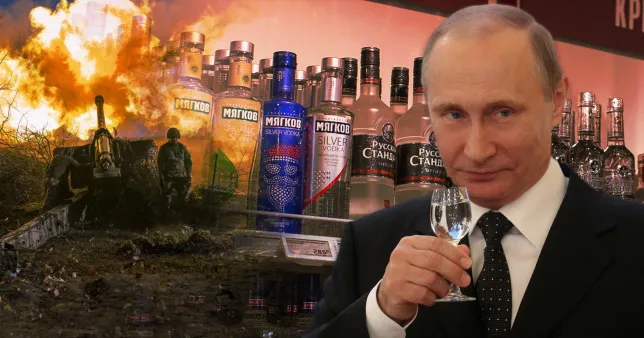
Russians becoming more alcoholic due to Putin’s war in Ukraine
Vladimir Putin wants to control Ukraine and this is causing more Russians to become addicted to drugs.
More and more people in Russia are becoming addicted to alcohol and experiencing alcohol-related mental health problems. This is happening for the first time in 10 years, and it’s happening as the war enters its third year.
Russian men abroad are often seen with a scruffy face, red cheeks, holding a bottle of alcohol, and saying ‘Na Zdorovie’. This has been a common image of them for a long time.
People in Russia used to drink more alcohol than people in most other countries, but they started drinking less since the early 2000s, but now they are drinking more again.
During Dmitry Medvedev’s time as president, the government tried many times to solve the country’s problems with alcohol.
Several rules about alcohol were made. They included not being able to drink alcohol on the street and not being able to advertise it. These rules worked well until the war started.
A problem that is getting bigger.
In 2022, Rosstat found that over 54,000 people were newly diagnosed with alcohol addiction, which is more than the 53,000 diagnosed the year before.
Experts say that the decrease is because of the Covid pandemic, changes in the economy, and increasing tensions between countries.
Svetlana Gordeeva, a professor at Perm University, said there’s nothing surprising here.
People tend to drink more alcohol during tough times like a pandemic or economic crisis, and this can lead to more cases of alcohol-related mental health problems.
The effects of war
A doctor who studies addiction said that Putin’s war has also caused more people to drink alcohol.
“When people were told to get ready for war, the number of people with alcohol-related mental health problems went up the most in places where they had to wait three to six months before going to the battle. ”
Family members of the people who were called to work told me that lots of vodka was delivered there and no one was checking how much was being sold. As a result, people drank so much that they became mentally ill.
I don’t think these cases were included in the official numbers, but it’s possible that they were discovered.
If that’s true, then we likely got around a thousand new cases from these camps that were moved. -
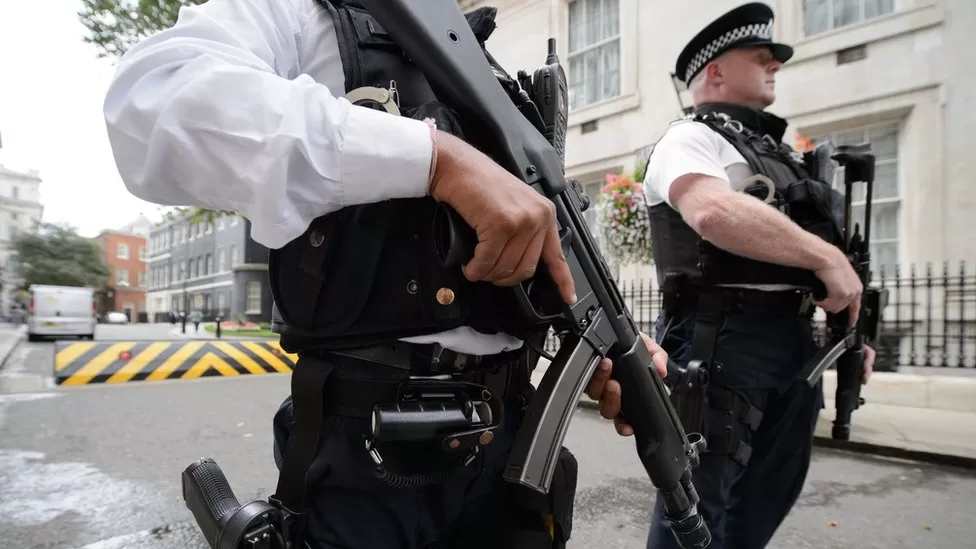
Gaza War was catalyst for radicalization – UK police
The war between Israel and Gaza has made more people in the UK support terrorism, according to the head of counter-terrorism police.
Matt Jukes said that there is a lot of online comments that are not true and are being spread by fake images, which is causing a big problem.
He said the conflict had a similar effect as the wars in Iraq, Afghanistan, and Syria.
33 people have been arrested for terrorism related to Israel-Gaza.
These are people who are taken by the police because of things they said or wrote during protests. Police didn’t say if they found any plans for a terror attack.
The government thinks a terrorism attack is likely, but not certain.
Metropolitan Police Assistant Commissioner Matt Jukes told reporters that a counter-terrorism unit has received 3,000 reports of suspicious activity online.
700 people had been found to have a connection to the UK, and they might have been breaking the law. A few kids, some as young as 11 and 12, were having worrisome talks.
“Matt Jukes said that all the stuff online is creating a dangerous atmosphere. ” It had caused a big change in people’s thinking, possibly leading them towards terrorism.
“He said this is not just empty talk, we are seeing clear signs of a big danger. ”
In 2023, more people were referred to the government’s Prevent program, which tries to stop radicalization and help those at risk. The number of referrals went up by 13%.
Mr Jukes said that terrorist attacks might not happen right away and that becoming radicalized can take a long time.
He said, “When I sit in my seat, I see that some things are not going well. ”
Detectives are most worried about the possibility of an attack from one person who might be unstable and have mental health issues.
Unit that deals with crimes committed during wars.
A group of over 20 officers is focused on looking into possible war crimes, including claims about Israel-Gaza.
This has gotten 92 people talking about the conflict, with 73 of them being against Israel and 19 against Hamas. Research is still in the early stages of review.
The police are being criticized for using their time and money to investigate serious crimes like torture, genocide, and other human rights violations.
However, high-ranking officers say that out of every £100 spent on counter-terrorism policing, only 30p is used to investigate war crimes.
Mr Jukes said that we should not let the UK be a safe place for people who have committed crimes during a war.
High-ranking officials also state that the UK must help the International Criminal Court and investigate the deaths of British people.
Detectives have a problem because they might get some evidence that war crimes happened, but no one saw it happen.
Information usually comes from law firms, charities, and people involved in a conflict.
Unfriendly countries
The counter-terrorism team is also facing a greater danger from unfriendly countries, mostly Russia, Iran, and China.
An Austrian man named Magomed-Husejn Dovtaev was sent to prison for three years. He was caught by security guards doing suspicious activities at an Iranian media company in Chiswick, London. The media company had received threats because of its reporting on Iran.
The police are worried that other countries are hiring criminals in the UK to do illegal things. This is because criminal groups can easily work in different countries and transport weapons.
A new team has been created to stop unfriendly countries from causing harm. They work closely with the security and secret intelligence services, MI5 and MI6. -
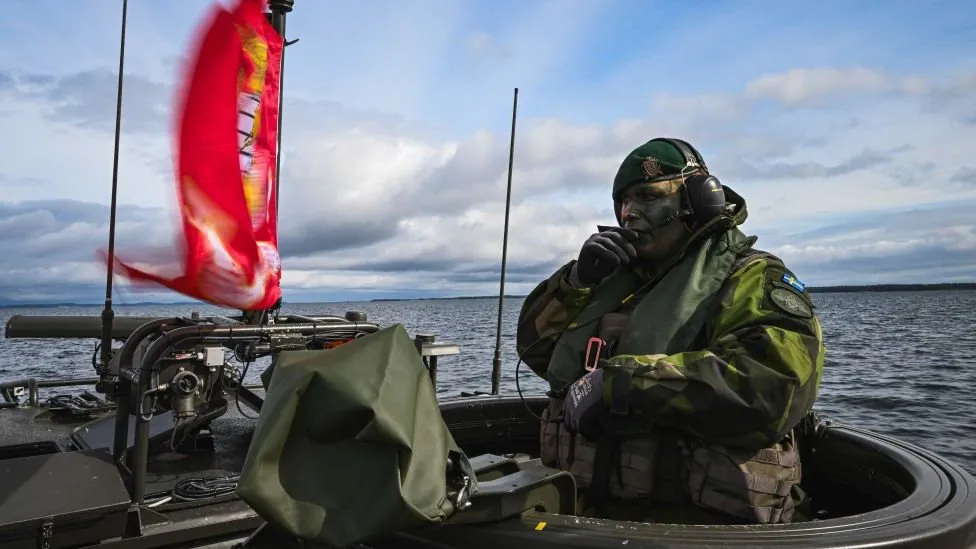
Swedish defense officials warn citizens to get ready for war
Two important defense officials have told Swedes to get ready for war, which has made some people worried and accused them of being too dramatic.
Minister Carl-Oskar Bohlin said at a conference that a war could happen in Sweden.
The military leader, Gen Micael Byden, agrees with the message and thinks all Swedes should get ready in their minds for the possibility.
However, politicians who are against it have disagreed with how the warnings were given.
Former prime minister Magdalena Andersson said on Swedish TV that the security situation is serious, but war is not about to happen right now.
The kids’ rights group Bris said that its national phone line doesn’t usually get calls about the chance of war. This week, many young people called us worried because they saw news or posts on TikTok about it.
“Bris spokeswoman Maja Dahl told the BBC that this was carefully planned and not something said without thinking. ” “They should have given information for kids when they share information for adults. ”
The comments from the civil defence minister and military chief are being seen as a strong warning, even though they were very serious.
After more than 200 years of peace, Sweden is close to joining the Nato defense alliance. It just needs approval from Turkey’s parliament and then from Hungary.
The leader said what he said was not something new.
He went to the eastern part of Ukraine a month ago. Sweden is one of the countries helping to train Ukrainian pilots. Stockholm is thinking about sending powerful Gripen fighter jets to Ukraine.
“I don’t want to scare people. I just want more people to think about their own lives and what they need to do,” said Gen Byden in an interview with Aftonbladet newspaper.
Finland is now part of Nato, and Russian officials are saying it will be the first to have problems if things get worse with Nato.
The civil defence minister of Sweden wants people to be aware of what is happening but not to worry too much. He asked local officials, emergency planners, and people to help.
MrBohlin said he can’t sleep because he thinks things are moving too slowly. He said this at the Society and Defence conference on Sunday.
The President of Ukraine, Volodymyr Zelensky, asked Sweden to work with Ukraine and other countries to make weapons and become stronger together during a conference.
Prime Minister Ulf Kristersson said that by 2024, Sweden will spend 2% of its money on military defense, which is double the amount it spent in 2020.
Oscar Jonsson, a defence expert, said that the warnings from defence leaders were blown out of proportion and that 90% of the concerns came from frustration that not enough was being done to improve civil and military defence.
“He said that time is short and the goal was to urge agencies, people, and departments to take action,” he told the media.
“The Swedish military is very skilled, but it is not very large. ” The new defence bill says we need to create 3. 5 military units, but Ukraine had 28 when the war began.
General Byden is telling people to get ready for war, and this comes right after another warning from the head of Poland’s National Security Bureau, Jacek Siewiera, who said that to avoid a war with Russia, countries near Nato should start getting ready for a confrontation within the next three years.
He said that a report from a German group about preparing for a Russian attack in six years was too hopeful.
Oscar Jonsson, an expert from the Swedish Defence University, said that for a war to happen, a few things would need to happen first: Russia’s war in Ukraine would need to stop, its military would need time to get stronger again, and Europe would need to not have support from the US military.
He said that everything was possible. -

Russian artist receives 7 years imprisonment for anti-war price tags
A person in Russia who is against the ongoing war has been given seven years in jail for putting stickers with anti-war messages on store prices.
Sasha Skochilenko, who is 33 years old, is an artist from St. He has been in jail since April of last year.
She said she started doing activism soon after the war started.
Her lawyers asked for her to be found not guilty because they said her long-term sicknesses mean she could die in jail.
A few weeks after Russia attacked Ukraine, Ms Skochilenko protested by putting anti-war messages on supermarket labels in St Petersburg. She did this with a group of feminists.
The new labels say: “Russian soldiers have wrecked 80% of Mariupol. ” End the fighting.
Sasha Skochilenko put anti-war messages on fake price labels and gave them out.
Sasha Skochilenko changed price labels to show messages against war a few weeks after Russia attacked Ukraine.
In her final words, the artist sounded strong and confident, and questioned the court about the prosecutor’s lack of faith in our state and society. She asked how five small pieces of paper could ruin our state and public security.
“She said I can admit that I was wrong or that I was influenced by others. ” “I will stick to what I believe in and what I know is true. ”
Skochilenko was found guilty of “making the Russian army look bad” under strict laws made after the invasion.
The law makes it illegal to protest against war.
The trial went on for a year and a half because it was one of the first cases to be judged under the new laws.
“We need to find evidence,” said her lawyer Yana Nepovinnova.
Anna, Sasha Skochilenko’s sister, said to the BBC that her sister represents everything that the Russian authorities dislike.
“Anna Skochilenko says she is creative, delicate, homosexual, and has a Ukrainian last name. ”
She was really scared that her sister’s ongoing health problems might cause her to die in jail. Skochilenko has been told she has a disease called coeliac disease. She also has a problem with her heart that makes it stop beating for a few seconds.
Russian President Vladimir Putin has been very harsh on people who disagree with him inside the country at the same time as attacking Ukraine with full force. The same laws used to punish Ms Skochilenko have been used to go after many people who criticized the leader’s rule.
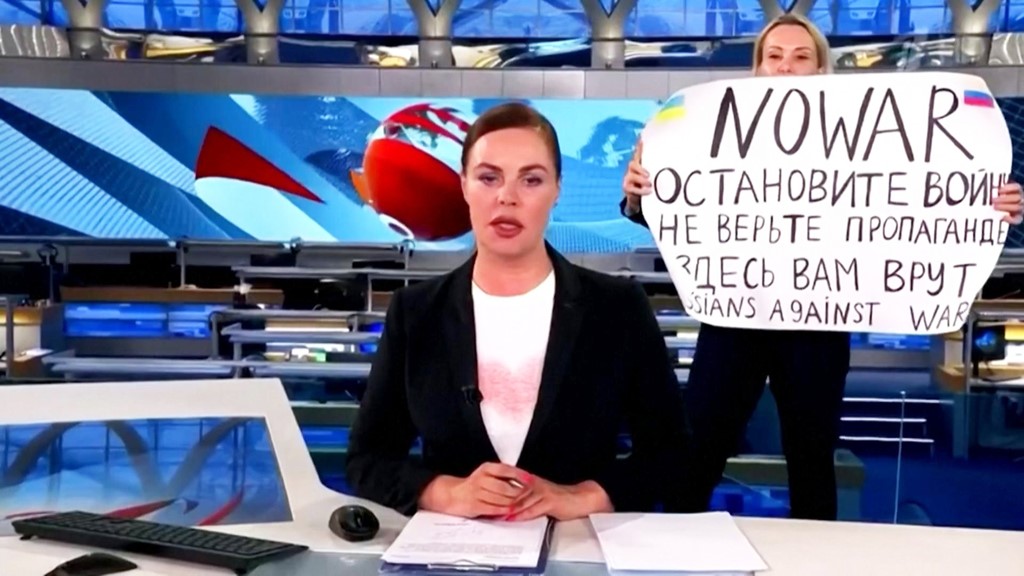
Last month, a journalist named Marina Ovsyannikova spoke out against the war in Ukraine on TV and was sentenced to 8. 5 years in prison even though she wasn’t there. -

Christians in Gaza fear they won’t survive war
In the past month, there has been a lot of fighting in Gaza City. Pope Francis has been calling the priest and people who go to Holy Family Church to make sure they are okay.
He prays and feels very sorry for the person.
George Anton is staying in the church with his wife and three daughters. They feel a bit better when they hear from someone, but they don’t think it will help them stay safe.
“We have faith in Pope Francis, but we feel discouraged because we doubt that other people will listen to the message of peace,” he says sadly. I can’t explain how I feel. It is extremely frightening. You feel like you are just sitting and waiting for it to be your turn to die. You don’t know the time, the way, or the reason.
George, who works for the Roman Catholic charity Caritas, has had difficult discussions with his young daughters who are 8, 10, and 12 years old.
I am explaining everything honestly to them. I tell people that we support Jesus, but I also inform them that they are in a fight. Sometimes, I leave to go buy bread, bring medicine or clothes. I always say “Goodbye” when I go. If I come back, everything is okay. If not, then that’s the end.
He says that his girls cannot avoid or escape the terrible experiences of death and destruction.
This is what 600 people in the church and on the internet are listening to. This is what they can see from the constant bombing in the area. They are too scared to sleep at night. The noise from the rockets is very loud and scary.
When Israeli soldiers told over a million people living in the top part of the Gaza Strip to go to the bottom part, hundreds of thousands of them did not listen.
A lot of people from the small group of Christians, around 1,000 people, decided to bring their families and stay in their churches. They believed that staying there would keep them safe, as they have been during previous conflicts between Israel and the Palestinian armed groups.
After the church building was hit by a powerful Israeli air strike, the feeling of safety was completely gone.
The Greek Orthodox Patriarchate of Jerusalem said the attack was a very serious crime like a war. Israel’s military said it attacked a Hamas base that was close by and used to launch rockets.
In a sad setting, the bodies of people who were crushed to death were placed in white sheets in the church courtyard for a funeral on October 20th. 18 Christian women, men, and children were murdered.
In the West Bank, churches have held special prayers to support and stand with the people in Gaza who are going through difficult times. They also remember those who have lost their lives. Many Christian people from Gaza have family here, but it has been difficult for them to see each other because of the permit system in Israel.
At a church in Beit Sahour, Shireen Awwad lights a candle for her aunt who died in St Porphyrius.
I feel extremely sad and upset. “I can’t think, I can’t move,” she says.
Shireen has relatives in Gaza City, including cousins, uncles, and an aunt. Sadly, her aunt got injured in a church explosion and had to undergo hip replacement surgery without anesthesia at Shifa Hospital. This was because there weren’t enough medical supplies available.
She says her family members are proud people from Gaza who have lived there even during multiple wars.
Every time we asked them if they wanted to leave, they would say no because these are our roots. “This is the place we were born,” Shireen says. However, this time is different because, for the first time, they are uncertain about whether they want to continue staying or if they will even survive.
The small coastal strip has had a Christian population for a very long time. Porphyrius was a bishop in the fifth century. He is buried under the church.
A lot of Christians have left, especially after Hamas took over Gaza in 2007. Israel, just like many other countries, considers the Islamist movement to be a terrorist group. Egypt and another country put a very severe restriction on what can go in and out of Gaza after the takeover.
Reverend Munther Isaac, who is a pastor in Bethlehem, feels very shocked and emotionally hurt after witnessing events in Gaza.
He is also worried about what will happen to one of the oldest Christian communities in the world.
“He says that there were people from the Church in Gaza in the first council of Churches. ” We care about everyone’s life, but our biggest worry is that the long-standing Christian tradition in Gaza might stop.
Pope Francis wants the fighting to stop, but Palestinian Christians are upset with what other Church leaders, like Justin Welby, have said about the war. Justin Welby is the leader of the Church of England and the spiritual leader of millions of Anglicans.
In Gaza City, there was a building called the Greek Orthodox Cultural Centre. It was destroyed by Israeli shelling last week. A person named George Anton is very sad and feels hopeless as he watches the destruction.
We are good people who have done nothing wrong. We don’t have anything to do with politics or military actions at all. We are regular people. “Why would anyone want to target us. What are they targeting us for. ” He wonders
We have had many friends who are not our friends anymore. Some people moved to Khan Younis to live with their family members, but unfortunately, they all died. They were hit by a rocket and all the buildings fell down on top of them. They are all gone, but we don’t have time to be upset.
Every day, you hear that someone died, a family and a home were destroyed, and an institution was eliminated. We cannot take all of this.
Finally, he promises to remain in the church with his loved ones.
“He said we’ve been getting many calls to leave, but we won’t go. ” This is our rightful place. This is where we live. -
The world must take prayers seriously, the enemy is planning a third World War – Archbishop Duncan-Williams
The Presiding Archbishop and General Overseer of the charismatic Action Chapel, Nicholas Duncan-Williams, has issued a warning about the urgent need for prayer, citing a potential plot by unspecified adversaries to incite a third world war.
During his address at the iPLUS40 2023 event, Archbishop Duncan-Williams stressed the importance of prayer in these tumultuous times. He expressed concerns that without vigilant prayer from Christians, unexpected challenges may arise.
He stated, “The world needs prayer; this world is in trouble. If you’re a student of prophecy and you look at the situation with Russia, China, Ukraine, and America, the enemy is setting a stage for a third World War. We might not see it now, but in a few years, you will witness what I am telling you right now. The only thing that can have an impact or delay it is intercession.”
“And if we don’t lead prayer now, and we take this for granted, situations can overtake us. There might be some surprise attacks, things that are not supposed to happen will happen when it is not supposed to happen now,” he added.
The Archbishop highlighted the critical role of intercession in potentially delaying or mitigating the impending threat of a third world war.
He further cautioned that failing to prioritize proactive prayer and intercession could lead to unforeseen events and situations unfolding unexpectedly.
-
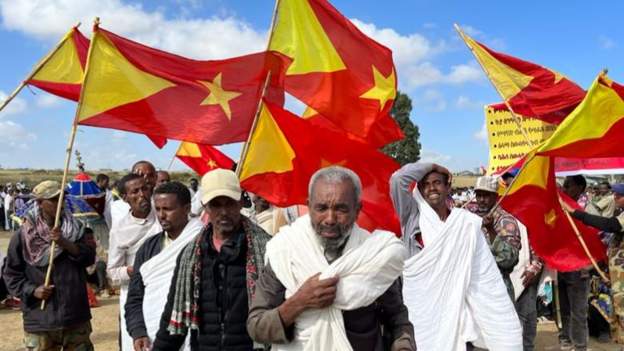
Tigray observes mourning period in memory of its war dead
People in the Ethiopian region of Tigray are gathering to remember and honor those who died in the recent civil war.
A fight that lasted for two years, starting in November 2020, is believed to have caused the deaths of many hundreds of thousands of people.
The war started because the government of Ethiopia and groups in the Tigray region wanted power.
This weekend, I went to three memorial ceremonies in Tigray.
As a way to show respect and remember those who passed away, people came together in churches and mosques during a three-day period of mourning.
Kidu Kiros had to leave her home and now lives in a camp for people who had to leave their homes. She told me that she lost her two sons in the war.
“If we are allowed to have control over our own country and go back to our homes, I believe that the loss of my children would have been worth it. ” We need effective and fair governing. My children have sacrificed their lives for their country, and we want their land back,” she said.
Hagazi Haftu, who lives in the camp and lost family members, said that our children fought for the pride and progress of Tigray. Therefore, we want the independence of Tigray to be recognized and we want to go back to our home.
Getachew Reda, the temporary leader of Tigray, gave a serious speech while people were grieving. He praised the courage and strong dedication of the heroes who died and gave everything for their cause.
In Tigrayan towns, people gathered with candles to remember those who died, while Tigrayans all over the world observed a quiet moment to honor their memory.
The time for grieving will go on until Monday evening. -
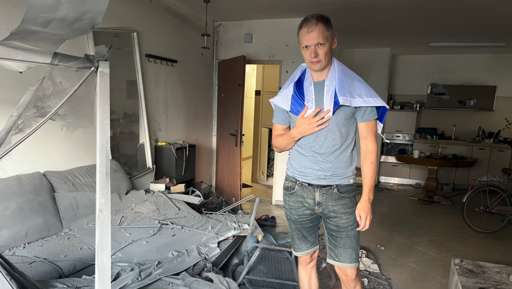
Escalation of war between Israel, Hamas may lead to Iran’s intervention – US
The United States has issued a caution that an intensification of the conflict between Israel and Hamas may open the door to direct involvement by Iran.
In an interview with the BBC’s American affiliate, CBS News, White House National Security Advisor Jake Sullivan expressed concerns about the potential creation of a new theater of conflict on Israel’s northern border with Lebanon.
“We can’t rule out that Iran would choose to get directly engaged some way. We have to prepare for every possible contingency,” he said.
Incidents of cross-border gunfire have occurred involving Israeli forces, Palestinian militant groups, and the Iranian-backed militia group Hezbollah in southern Lebanon.
-
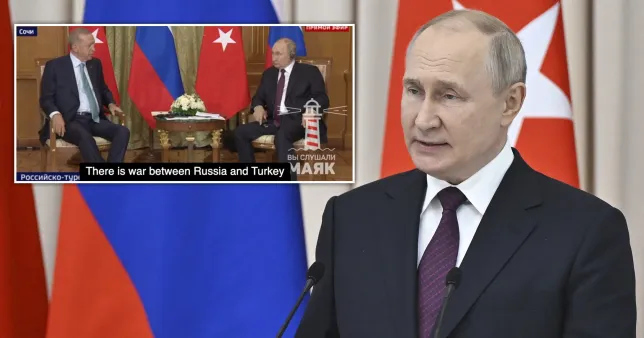
Turkey unintentionally ‘declares war’ on Russia in front Putin
The Turkish president, Recep Tayyip Erdoğan, unintentionally seemed to start a war with Russia because of a mistake in translation during a meeting with Vladimir Putin.
The translator at a meeting in Sochi said that Russia and Turkey are fighting each other in a war.
Turkey is a member of Nato, and if this statement is accurate, it would cause a big war all over the world.
But Putin, who was there to talk about the Black Sea Grain agreement, seemed unfazed by the apparent mistake.
The interpreter made a mistake, causing Turkey’s president to say he is going to start a war with Russia.
It was not clear if the male interpreter was from Russia or Turkey, but the official meeting record showed that the translator, not Erdoğan, had made the mistake.
The Turkish president told Putin that the current situation between Ukraine and Russia is the reason for their visit.
And your invitation – we are happy that we got your invitation. My group is happy to have gotten this invitation.
The meeting was organized to make an agreement on the Black Sea grain initiative, which aims to provide food to the poorest countries in the world.
Putin told Erdoğan that Russia is willing to provide Turkey with up to one million tons of grain at a lower price. Russia sees Turkey as a middleman between them and the western countries.
The meeting was an uncommon visit for a foreign leader to Russia. Putin is feeling more and more alone because of the violent war he is having with Ukraine.
In March, the ruler of a country was given a legal order to be arrested by an international court for doing bad things during the war in Ukraine. This makes it hard for him to go to other countries.
Some believe that the reason for holding the summit in Sochi was because of this, while others argue that it is a way for Putin to hide his rumored health issues.
Putin said during his press conference that he feels like he was tricked by the West regarding the grain export deal. He also reiterated that Russia would only participate in the deal again if the West stops limiting the export of Russian agricultural products to the world.
“The dictator said that our Western partners cheated on us once again, which is something that normally happens. ” ‘And they didn’t keep their promise – once more. ‘
Another agreement made with the United Nations asks for easier conditions to help Russia export food and fertilizers.
Erdoğan suggested that Ukraine should be less strict in its negotiations with Russia for reviving the deal. He also advised Ukraine to send more grain to Africa instead of Europe.
‘Ukraine needs to be more flexible in its approaches so that it is possible to take collaborative actions with Russia,’ he told reporters.
The Ukrainian Foreign Minister, Dmytro Kuleba, said on Ukrainian TV that Kyiv will not change its position but will consider what Turkey has said about the talks in Sochi.
Kuleba said that we should not keep being controlled by Russia’s threats and manipulation. Russia causes problems and then expects others to fix them.
We will protect our beliefs and stand up against sanctions on Russia. -

Humanitarian operations in Niger suspended
In response to coup supporters setting fire to the ousted president‘s party headquarters, Niger’s new ruling junta has issued a ban on all public demonstrations.
During a larger show of support for the coup leaders outside parliament, a small group of arsonists broke away and attacked the PNDS Tarraya party headquarters, leading to the police deploying tear gas to disperse the crowd, as people were also engaged in stoning and burning cars.
The interior ministry released a statement declaring that public demonstrations, regardless of the motive, will remain prohibited until further notice, with a firm commitment to enforcing the law.
“Public demonstrations for any motive whatsoever remain prohibited until further notice. The state will ensure that the law is enforced,” read a statement by the interior ministry.
“These actions, which were perpetrated by lawless individuals, constitute acts of vandalism and wickedness and will not be tolerated,” it added.
The ministry strongly condemned the actions of the lawless individuals, categorizing them as acts of vandalism and wickedness that will not be tolerated.
Additionally, the ministry called upon the security forces to protect the public and their property in the wake of these incidents.
-
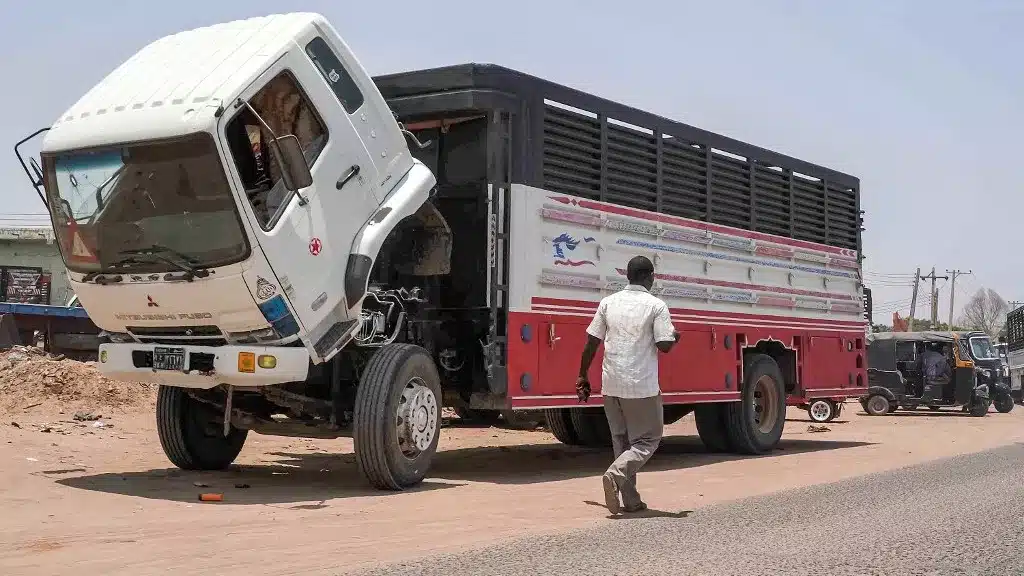
War brings transport to a stand still in Sudan
Mahanna Abderrahmane used to drive his truck to the Red Sea ports four times per month to load cargo for distribution to Sudan’s many regional states, but since the war tore through his nation, he hasn’t done anything.
He is 200 kilometers south of Khartoum‘s capital, in a café near Wad Madani, where he is enjoying coffee and hookah after hookah.
A truck driver for 20 years, he told AFP he had “never seen anything like this”. “I haven’t made a single load in three weeks”, he says.
And he’s far from the only one. All around, hundreds of trucks are parked and their drivers are trying to kill time. Some are playing cards, while others are recommending a cup of tea or coffee to the women who run the small roadside cafés in al-Jazira state, which has probably received the most displaced people from the war.
Since Khartoum was bombed, more than one and a half million people have fled the capital. The easiest destination for most of them has been due south, towards Wad Madani and its vast fertile expanses wedged between the Blue and White Niles.
According to the Sudanese Chamber of Transport, since the army led by General Abdel Fattah al-Burhane and the Rapid Support Forces (RSF) of General Mohamed Hamdane Daglo went to war on 15 April, 90% of road transport traffic has disappeared.
According to the Sudan Ports Authority, total exports since January have peaked at 282 million dollars, compared with 2.5 billion dollars in the first half of 2021.
– Khartoum inaccessible –
Mohammed al-Tijani, who is also a truck driver, has suffered the combined effects of the war and soaring prices.
Since the start of the conflict, “our journeys to the ports have been extended by at least 400 km”, says this man in his fifties, because he now has to bypass Khartoum under a deluge of fire from artillery and fighter planes and checkpoints manned by the various forces deployed.
And at the same time, the price of petrol – if there is any at the pumps – has increased twenty-fold.
Supplies of goods for export have virtually come to a halt: most factories, mainly in Khartoum, have been shelled and storage silos looted.
Passenger coaches have also stopped reaching the capital.
However, as driver Hussein Abdelqader told AFP, “70% of journeys were to and from Khartoum”. “Today, we only travel between the country’s other cities, so we have far fewer journeys.
Moataz Omar has managed to maintain a certain level of activity, as he used to make the 1,000 km journey between Khartoum and the Egyptian border before the war.
For several weeks, he transported hundreds of fleeing families, who preferred exile to being trapped by the fighting.
“But when the fighting became more intense in Khartoum, it became impossible to get in,” he says.
So we had to bypass the capital, but the highly centralised road network meant that journeys between states took longer and longer.
– No pay –
“Now we travel 2,600 km (…). We have to go through the east: the Red Sea state, then the states of Kassala, Gedaref”, in the south-east bordering Ethiopia, “then al-Jazira” further north, forming a long loop, explains Mr Omar.
Passengers are therefore becoming scarce: “sometimes I wait two days before I have people who want to go from Wad Madani to Kassala or Gedaref or even Damazine, in the state of Blue Nile”, which borders Ethiopia, he continues.
“We’re really afraid of losing everything,” laments Mr Tijani, “because our companies won’t pay us if they don’t have any money coming in.
There used to be an alternative to buses: the train. But on 15 April, as the first shots rang out in Khartoum, the trains from Atbara, further north, or from Wad Madani, turned back. Since then, they have not left their stations.
As for the freight wagons, they too have come to a standstill.
Before, they all converged on Khartoum and especially its industrial suburb, Khartoum-North,” says a railway employee.
Today, Khartoum-North is a ghost town with no water or electricity.
And most of its inhabitants miss it. To Wad Madani or Egypt.
-
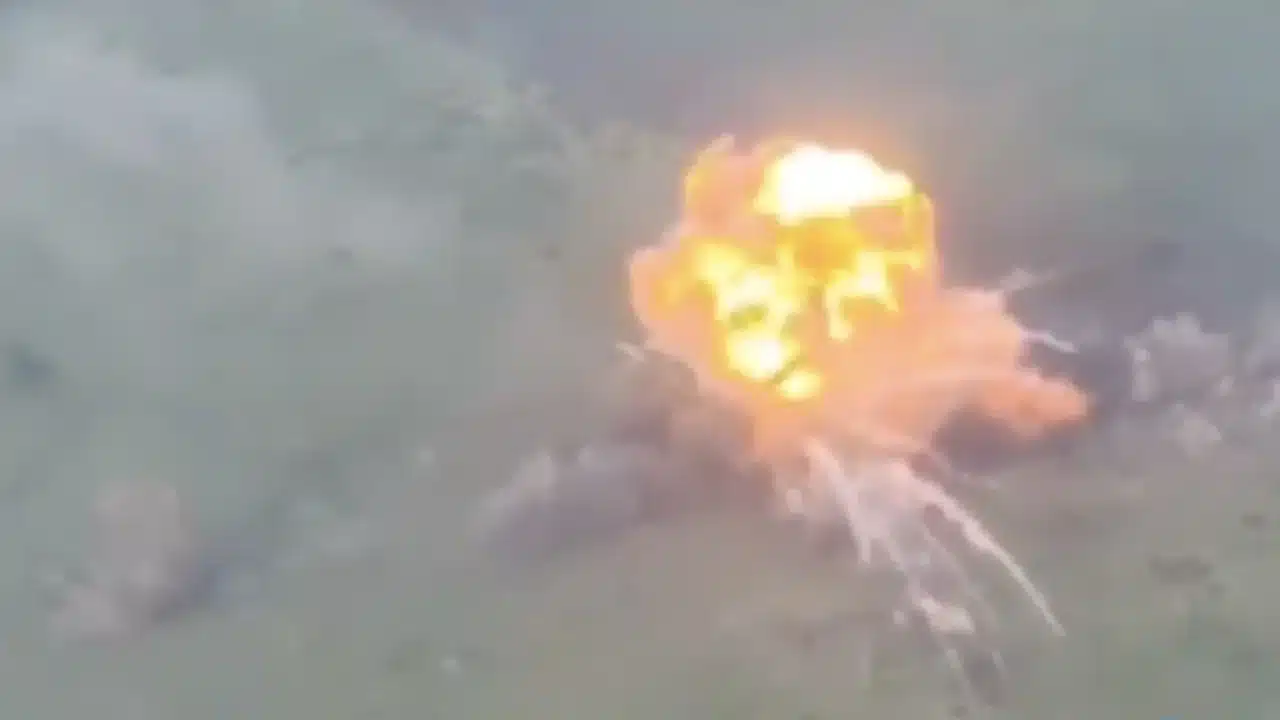
Ukraine War Ecology Group formed as Zelenskyy met Thunberg
Greta Thunberg from Sweden and other notable European leaders have met with Ukraine’s President Volodymyr Zelenskyy in Kyiv to discuss setting up a working group to remedy the ecological damage caused by the 16-month Russian incursion.
The working group on the environment includes Thunberg, former Swedish Deputy Prime Minister Margot Wallström, European Parliament Vice President Heidi Hautala, and former Irish President Mary Robinson.
Zelenskyy said forming the group is “a very important signal of supporting Ukraine. It’s really important, we need your professional help”.
Thunberg said Russian forces “are deliberately targeting the environment and people’s livelihoods and homes. And therefore also destroying lives. Because this is after all a matter of people.”
-
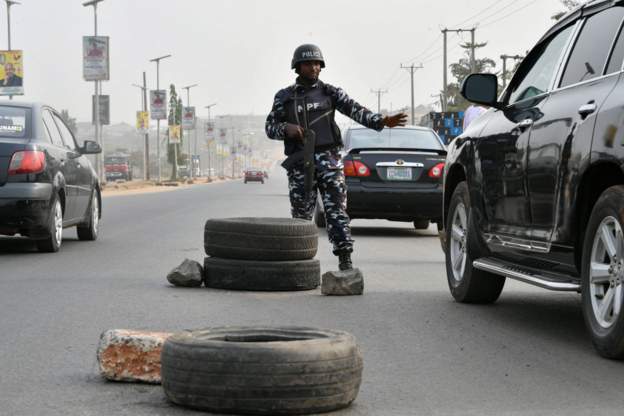
US convoy in Nigeria attacked, 4 killed
Gunmen in Nigeria have launched an assault on a convoy of US personnel, resulting in the tragic deaths of four individuals, including two members of the US consulate and two police officers.
During the attack, three additional individuals were abducted before the assailants set their vehicle ablaze.
The incident occurred in the southeastern region of Anambra state. Authorities have promptly initiated a rescue and recovery operation to address the situation.
It is important to note that no US citizens were present in the targeted convoy, and further information regarding the purpose of the convoy’s presence in the state has not been disclosed.
A Nigerian state police spokesperson expressed regret that the convoy entered the state “without recourse to the police in the area or any security agency”.
The US said its mission in Nigeria was working with Nigerian security services to investigate the incident.
“The security of our personnel is always paramount, and we take extensive precautions when organising trips to the field,” the US State Department said.
Violence in the south-east of the country is just one of the many issues facing president-elect Bola Tinubu, who takes the helm of Africa’s most populous nation later this month. -
Warring parties in Sudan concedes to 7-day truce from May 4
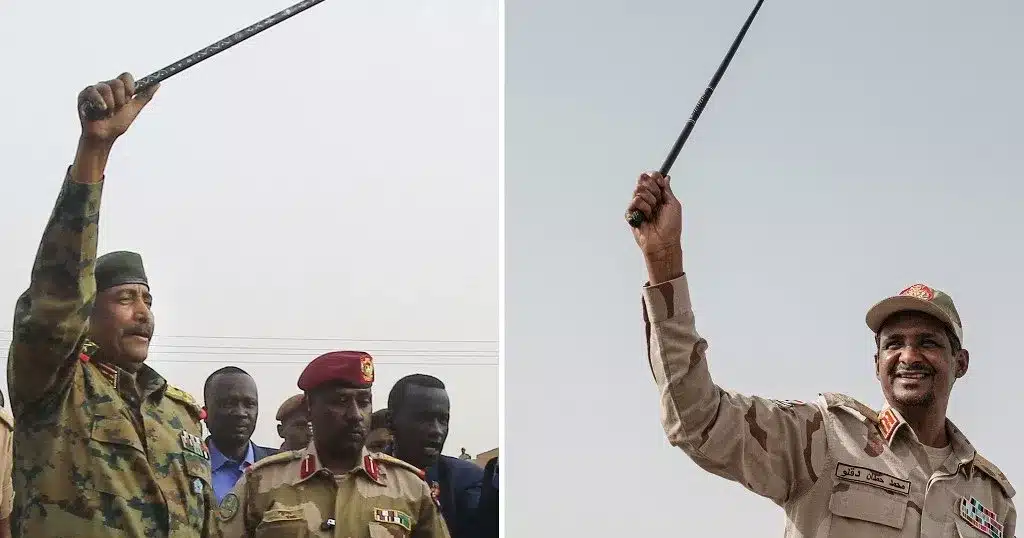
The warring parties in Sudan have agreed to a seven-day truce starting May 4, in a phone conversation with South Sudan‘s President Salva Kiir, the foreign ministry in Juba said Tuesday, raising hopes of an end to weeks of bloodshed.
Sudan’s army chief Abdel Fattah al-Burhan and his deputy turned rival, Mohamed Hamdan Daglo, who commands the paramilitary Rapid Support Forces, “have agreed in principle for a seven-day truce from May 4th to 11th,” the ministry said in a statement.
Hundreds of people have been killed and thousands wounded in the fighting as air strikes and artillery exchanges have pounded swathes of greater Khartoum, sparking the exodus of thousands of Sudanese to neighbouring countries.
The two sides have also agreed “to name their representatives to peace talks to be held at any venue of their choice”, the statement from Juba said.
Kiir was speaking to Burhan and Daglo as part of an initiative by the East African regional bloc IGAD (Inter-Governmental Authority on Development), which has been pushing for an end to the fighting, echoing calls by the African Union and the international community.
Sudan’s rival military forces have accused each other of violating ceasefire as the deadly conflict rumbled on for several weeks despite warnings of a slide towards civil war.
Both sides said a formal ceasefire agreement that was due to expire at midnight would be extended for a further 72 hours. The army said it hoped what it called the “rebels” would abide by the deal but it believed they had intended to keep up attacks. The parties have kept fighting through a series of ceasefires over the past week.
-

China is getting ready to ‘launch a war’ – Taiwan alleges amid ‘serious warning’ to Taipei
A senior legislator from the island nation claims that China appears to be preparing to “launch a war” against Taiwan.
Beijing has issued a warning, claiming that recent exercises simulating the island nation’s encirclement were conducted as a “serious warning” to politicians who support independence.
Taiwan’s foreign minister Joseph Wu stated in an interview with CNN: “Look at the military drills, as well as their rhetoric – they seem to be attempting to get ready to start a war against Taiwan.
“The Taiwanese government looks at the Chinese military threat as something that cannot be accepted and we condemn it.”
The three days of large-scale air and sea exercises named Joint Sword that ended on Monday were a response to Taiwanese President Tsai Ing-wen’s meeting with US house speaker Kevin McCarthy in California last week.
China claims Taiwan as its own territory to be brought under its control by force if necessary and regularly sends ships and warplanes into airspace and waters near the island.
Such missions have grown more frequent in recent years, accompanied by increasingly bellicose language from the administration of Communist Party leader Xi Jinping.
Any conflict between the sides could draw in the US, Taiwan’s closest ally, which is required by law to consider all threats to the island as matters of “grave concern”.
China has kept up military pressure against Taiwan despite the formal conclusion of the military drills.
On Wednesday, Taiwan’s ministry of national defence said it tracked 35 flights by People’s Liberation Army warplanes within the previous 24 hours, as well as eight navy vessels in the waters surrounding the island.
While on Tuesday, President Xi inspected China’s Southern Theatre Command, according to state media.
On his visit, Mr Xi reportedly said it was necessary to deepen military training and preparation, speed up transformation and construction, and comprehensively raise the level of modernisation of the armed forces.
Though the People’s Liberation Army’s Eastern Theatre Command would be the lead force in any potential invasion of Taiwan, the Southern Theatre Command would likely have a significant backup role in any such attack.
The vast majority of Taiwan’s population favours maintaining the current de-facto independent status, while the island’s president, Ms Tsai, has said there is no need for a formal declaration since the democracy is already an independent nation.
Despite that, China – which does not recognise Taiwan’s government institutions and has cut off contact with Ms Tsai’s administration – routinely accuses her of plotting formal independence with outside backing.
When China refers to outside help for Taiwan, it is usually thought to mean the US.
“External forces are intensifying their endeavour of containing China with Taiwan as a tool,” Ms Zhu said.
She also repeated China’s assertion that its military threats are “targeted at Taiwan’s independence separatist activities and interference from external forces, and by no means at our compatriots in Taiwan”.
What that means in practical terms is not clear, although Beijing has long exploited political divisions within Taiwanese society, which boasts a robust democracy and strong civil liberties.
The Chinese military issued a threat as it concluded the exercises, saying its troops “can fight at any time to resolutely smash any form of ‘Taiwan independence’ and foreign interference attempts”.
-

Putin becomes third president to face ICC arrest after Sudan’s Bashir, Libya’s Gaddafi
An arrest order has been issued for Russian President Vladimir Putin by the Hague-based International Criminal Court (ICC).
The basis for the request is the allegation that Putin illegally deported at least 100 children from Ukraine, a nation his troops invaded more than a year ago, committing a war crime.
70-year-old Putin is a former military intelligence officer and the third president who is currently in office who and wanted for arrest.
Colonel Muammar Gaddafi of Libya and Omar Al-Bashir of Sudan were the other two African leaders.
The former is currently in jail after a civilian-led mass protest forced hi from office years ago whiles Gaddafi was killed in the 2011 NATO-backed revolution that threw the North African country into chaos.
Implications of arrest warrant
According to a Reuters report, the legal move will obligate the ICC’s 123 member states to arrest Putin and transfer him to The Hague for trial if he sets foot on their territory.
Moscow has repeatedly denied accusations that its forces have committed atrocities during its one-year invasion of its neighbour and the Kremlin branded the court decision as “null and void”.
Neither Russia nor Ukraine are members of the ICC, although Kyiv granted it jurisdiction to prosecute crimes committed on its territory. The tribunal has no police force of its own and relies on member countries to detain and transfer suspects to The Hague for trial.
While it is unlikely that Putin will end up in court any time soon, the warrant means that he could be arrested and sent to The Hague if travelling to any ICC member states.
Kremlin spokesman Dmitry Peskov said Russia found the very questions raised by the ICC “outrageous and unacceptable”.
Asked if Putin now feared travelling to countries that recognised the ICC, Peskov said: “I have nothing to add on this subject. That’s all we want to say.”
-

ICC issues arrest warrant for Putin
Judges order the issuance of an arrest warrant for the Russian president in connection with the alleged kidnapping of Ukrainian children; Moscow rejects this decision.
For alleged war crimes in Ukraine, the International Criminal Court (ICC) has issued an arrest warrant for Vladimir Putin, the president of Russia.
In a statement released on Friday, the Hague-based court said the warrant was issued due to Putin’s alleged involvement in the forcible removal and transfer of children from the occupied territories of Ukraine to Russia.
“There are reasonable grounds to believe that Mr Putin bears individual criminal responsibility for the aforementioned crimes,” added the court, which has no police force of its own to enforce warrants.
The ICC also issued a warrant for the arrest of Maria Alekseyevna Lvova-Belova, the commissioner for children’s rights in the office of the Russian president on similar allegations.
Situation in #Ukraine: #ICC judges issue arrest warrants against Vladimir Vladimirovich Putin and Maria Alekseyevna Lvova-Belova
— Int'l Criminal Court (@IntlCrimCourt) March 17, 2023
Read more ⤵️
https://t.co/5OMC7Xuuy5Russia, which denies committing atrocities since it invaded Ukraine in February last year, does not recognise the ICC’s jurisdiction and does not extradite its nationals.
“The decisions of the International Criminal Court have no meaning for our country, including from a legal point of view,” Russian foreign ministry spokeswoman Maria Zakharova said on her Telegram channel after the ICC’s announcement.
“Russia is not a party to the Rome Statute of the International Criminal Court and bears no obligations under it.”
But ICC President Piotr Hofmanski told Al Jazeera it was “completely irrelevant” that Russia had not ratified the Rome Statute.
“According to the ICC statute, which has 123 state parties, two-thirds of the whole international community, the court has jurisdiction over crimes committed in the territory of a state party or a state which has accepted its jurisdiction,” he said. “Ukraine has accepted the ICC twice – in 2014 and then in 2015.”
Hofmanski said 43 states had referred “the situation in Ukraine to the court, which means they have formally triggered our jurisdiction.
“The court has jurisdiction over crimes committed on anyone on the territory of Ukraine from November 2013 onwards regardless of nationality of the alleged perpetrators.”
The warrants came a day after a United Nations-backed inquiry accused Russia of committing wide-ranging war crimes in Ukraine, including the forced deportations of children in areas it controls.
Ukraine’s Prosecutor General Andriy Kostin hailed the ICC’s decision.
“The world received a signal that the Russian regime is criminal and its leadership and henchmen will be held accountable,” he said in a statement on social media. “This is a historic decision for Ukraine and the entire system of international law.”
James Bays, Al Jazeera’s diplomatic editor, described the ICC’s move as “very serious”.
He said there were many who welcomed the announcement but there were others who raised questioned whether this would be a problem for diplomacy going forward.
“Now you have the head of state of Russia, a permanent member of the UN Security Council, who is now a wanted man by the ICC,” he said.
“This is going to be a headache for some of those who are going to have to deal with President Putin – how are other countries going to deal with him?” Bays added. “Will President Putin be able to travel?”
-
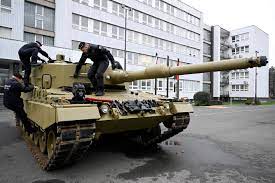
UK still supports deal that would provide Ukraine with German-made tanks
The UK still supports an international deal that would provide Ukraine with German-made tanks, the foreign minister has said this morning.
Western allies pledged billions of dollars in weapons for Ukraine last week, although they failed to persuade Germany to lift a veto on providing Leopard battle tanks, which are held by an array of NATO nations but whose supply to Ukraine would require Berlin’s approval.
“Of course, I would like to see the Ukrainians equipped with things like the Leopard 2 as well as the artillery systems that have been provided by us and by others,” Cleverly said in an interview with Sky News this morning.
“I will keep having those conversations with our NATO allies and friends, to facilitate the donation of the best military equipment to Ukraine to help them defend themselves against this brutal invasion.”
Asked whether Germany was doing enough to help Ukraine, Cleverly said he wanted to see “everybody going as far as they can, but each country will support Ukraine in a way that is most
appropriate to them.”
U.S. Defense Secretary Lloyd Austin urged allies at a meeting on Friday to do more to support Ukraine. But no decision on supplying Leopards was reached, officials said, although pledges were given for large amounts of other weapons.
German Chancellor Olaf Scholz’s Social Democrat party is traditionally sceptical of military involvements and wary of further escalation in the conflict in Ukraine.
Source: SkyNews
-
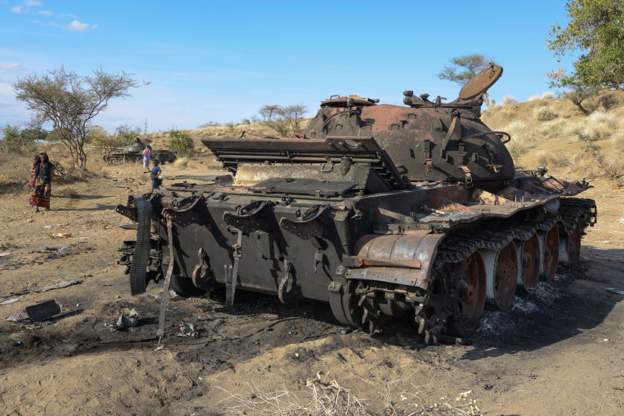
War in Tigray killed 600,000 – AU mediator
The African Union mediator in Ethiopia’s Tigray conflict, Olusegun Obasanjo, has told the Financial Times(FT) that up to 600,000 people may have died in the two-year war.
In an interview with the paper, Mr Obasanjo said the number of the dead was “around 600,000”.
The number of the people who died in the conflict is difficult to verify. Researchers have previously estimated the deaths to be in the hundreds of thousands.
On Sunday, the FT quoted the head of Ethiopia’s human rights commission, Daniel Bekele, as saying that estimates given by all sides needed to be treated with caution as it was impossible “to know the full number of casualties”.
The conflict started in November 2020, when Ethiopian Prime Minister Abiy Ahmed ordered a military offensive against regional forces in Tigray – which he said was a response to an attack on a military base housing government troops.
Last November the Ethiopian government and Tigray rebels signed a ceasefire agreement ending the war.
Source: BBC
-
War in DRC’s east: Demonstrators call out ‘international community’s complicity’
The demonstration took place one day after a meeting in Luanda where the DRC, Burundi, Rwanda as well as the East African Community envoy called for a cease-fire to take effect Friday.
“I mean, we are satisfied with this agreement signed (ceasefire signed in Angola on Wednesday), but we are still pessimistic about its implementation, especially since this is not the first agreement’, Jean Claude Mbambaze, the president of the civil society of Rutshuru said.
“There have been many summits, but the decisions have not been implemented.”
After the summit in Angola, the participants released a statement calling for a cease-fire to begin Friday evening in eastern Congo, followed by a rebel withdrawal from the major towns it holds – Bunagana, Rutshuru and Kiwanja.
Some protesters carried banners in support of the Congolese armed forces who are fighting M23 rebels. Other placards were hostile to the recent agreement.
Demonstrators marched to the French and British consulate.
“We do not understand, when there are rebels who call themselves Congolese, they ask for negotiations, and it is Rwanda and Uganda who represent them. That is why we protest about this complicity, …And there is a notorious silence of the international community, the EAC (East African Countries bloc), the African Union, all are accomplices”, demonstrator Jack Sizahera shouted.
The protestors delivered a letter to both French and British consulates with grievances including an end to the international community’s ambiguous response in the face of the M23 aggression.
“We demand the international community – as a whole – to ask the Rwandan and Ugandan heads of state to urgently withdraw their fighters camouflaged under the label of M23/RDF/UPDF (rebel groups)”, John Banyene, the president of the civil society of Nord-Kivu read.
Adding, we demand the international community “to sanction Rwanda and Uganda for the aggression against DRC for more than 25 years”.
In August, U.N. experts said they had “solid evidence” that members of Rwanda’s armed forces backed the M23 rebels. Kigali denied the allegations.
Source: African News
-
On Remembrance Sunday:UK to observe minute’s silence to remember war dead
Following the death of his mother, Queen Elizabeth II, King Charles will lead the Remembrance Sunday service at the Cenotaph for the first time as monarch.
At 11:00 GMT, the United Kingdom will observe two minutes of silence to pay tribute to the war dead.
Remembrance Sunday was one of the most important royal engagements in the late Queen’s calendar.
The King, politicians, and religious leaders will lay wreaths at the central London memorial.
King Charles’ ring of poppies will incorporate a ribbon of racing colours in a tribute to the ones used by the late Queen and his grandfather King George VI.
During his time as Prince of Wales, King Charles represented the late Queen at the last five Cenotaph services and laid a wreath on her behalf, as she watched from the Foreign Office balcony that overlooks Whitehall.
The beginning of the silence will be marked by Big Ben striking 11 times at 11:00.
The bell has been largely silent for five years after it was dismantled and repaired in a renovation project. While it has run for events such as New Year’s Eve and the late Queen’s funeral, its tolling on Sunday will mark its official return to use.
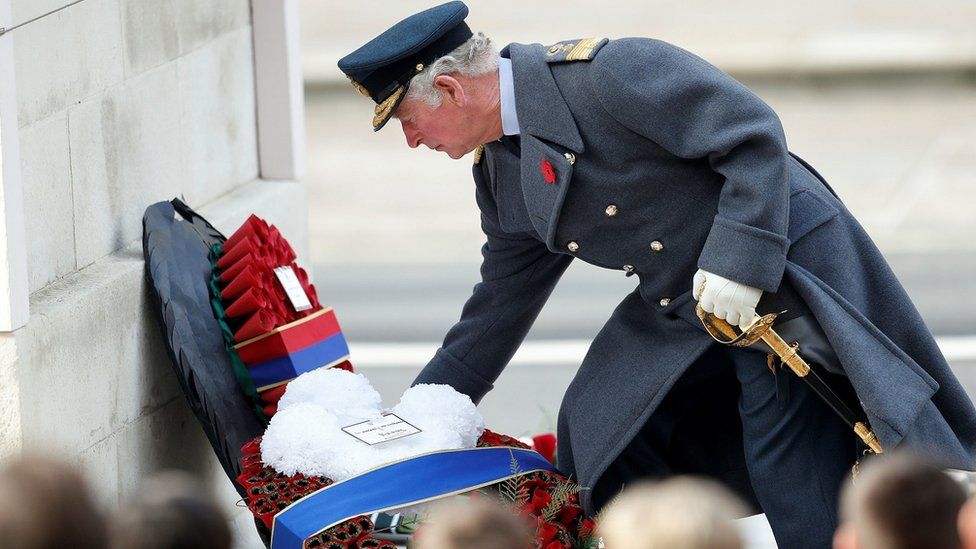
IMAGE SOURCE, PA MEDIA Image caption, King Charles III will lay a wreath for the first time as monarch The service, led by the Bishop of London, will also feature a march past by 10,000 Royal British Legion veterans, representing 300 different Armed Forces and organisations between them.
Among those taking part will be World War Two veterans – fewer in number as each year goes by – and those who have served in more recent conflicts.
To commemorate 40 years since the Falklands War, 400 members of the South Atlantic Medal Association will also take part.
They will be joined by those who have lost loved ones in conflict, with the youngest marcher just eight years old.
A further 10,000 members of the public will line Whitehall to watch the service.
Along with King Charles, Camilla the Queen Consort, the Prince and Princess of Wales, the Earl and Countess of Wessex, Princess Anne and Vice Admiral Sir Tim Laurence, the Duke and Duchess of Gloucester, the Duke of Kent and Princess Alexandra, will attend the service.
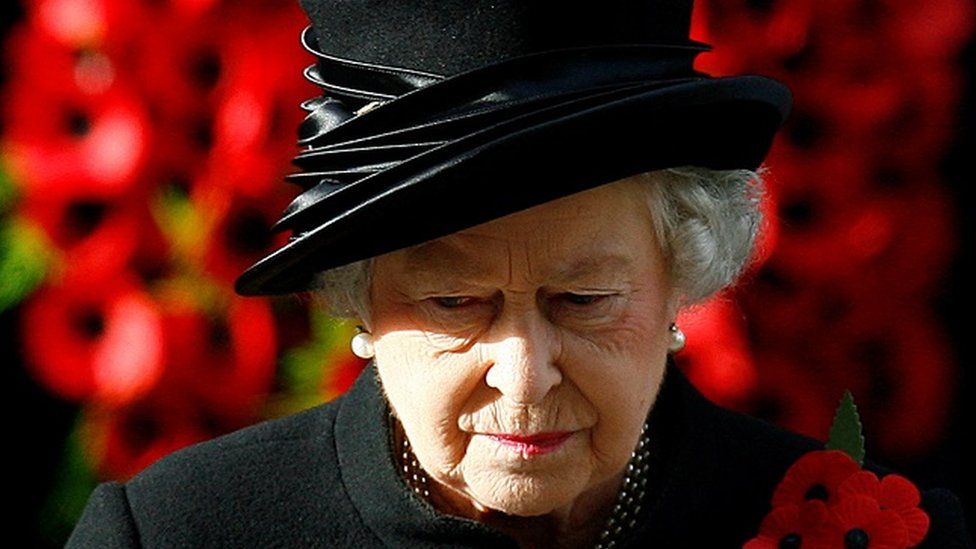
IMAGE SOURCE, REUTERS Image caption, Queen Elizabeth II saw Remembrance Sunday as one of her most important engagements of the year The event will also be attended by senior members of the government.
Speaking ahead of the service, Prime Minister Rishi Sunak and Defence Secretary Ben Wallace commemorated the fallen and also paid tribute to those fighting for Ukrainians’ freedom.
Mr Sunak said: “This year more than ever, we are reminded of the huge debt of gratitude we owe those who lay down their lives to protect their country.
“As we fall silent together on Remembrance Sunday, we will honour the memories of the men and women we have lost and pay tribute to the brave soldiers of Ukraine as they continue their fight for freedom.”
His words were echoed by Mr Wallace, who said Remembrance Sunday was a time to reflect on the sacrifices made by our veterans and service personnel around the world.
“We must never forget those who gave their lives in defence of our values and our great nation,” he said.
“All of us will also be thinking of those brave Ukrainians who are fighting for their very own survival to defend freedom and democracy for all, just as the UK and Commonwealth soldiers did in both world wars.”
More than 100 Falklands War veterans and family members of those who died in the war will take part in a remembrance service and parade in the capital Stanley on Sunday.
They made the 8,000 miles (12,900km) journey via a special flight arranged by the Ministry of Defence, with many of the veterans making an emotional return to the Falklands for the first time since the war with Argentina broke out in 1982.
Over the past few days the veterans, along with mothers, wives and children of those who died, have visited the battlefields where British forces fought, with some shedding tears and placing crosses at cemeteries for fallen comrades and family members.
On Saturday, members of the Royal Family attended the annual Royal British Legion Festival of Remembrance at the Royal Albert Hall.
On Friday, the UK held another silence on Armistice Day to commemorate the end of World War One in 1918.
-
War refugees from Ukraine asked not to return this winter
Ukrainian refugees have been told by their government not to return until spring to help relieve pressure on the energy system following a wave of Russian attacks.
“The networks will not cope,” said Deputy Prime Minister Iryna Vereshchuk. “You see what Russia is doing.”
“We need to survive the winter,” she added.
Ukrainian President Volodymyr Zelensky said Russian air strikes had destroyed more than a third of the country’s energy sector.
Ms Vereshchuk said that although she would like Ukrainians to return in the spring, it was important to refrain from returning for now because “the situation will only get worse”.
“If it is possible, stay abroad for the time being,” she added.
Ukraine’s economy has suffered badly since the war began. Mr Zelensky has called on the world for help urgently to cover an expected budget deficit of $38bn (£33bn) next year.
The International Monetary Fund (IMF) said Ukraine would need $3bn every month to survive the next year – and $5bn if Moscow’s bombardment intensified.
The deputy mayor of the western city of Lviv, Serhiy Kiral, told the BBC on Saturday that Russia’s strategy was to damage critical infrastructure before the winter and bring the war to areas beyond the front line.
Russia says it began attacking Ukraine’s energy networks in retaliation for an attack on a bridge linking mainland Russia to occupied Crimea, although Kyiv has not said it was behind the bridge attack.
Areas targeted by the latest attacks include the Cherkasy region, southeast of the capital Kyiv, and the city of Khmelnytskyi, further west.
On Friday Mr Zelensky accused Russia of planting mines at a hydroelectric dam in the Kherson region of southern Ukraine, which is under the control of Moscow’s forces.
He said that if the Kakhovka hydropower plant was destroyed, hundreds of thousands of people would be in danger of flooding. Russia has denied planning to blow up the dam and said Ukraine was firing missiles at it.
Since the Russian invasion of Ukraine in February, the UN’s refugee agency has recorded about 7.7 million refugees from Ukraine across Europe, including Russia, out of a population of about 44 million.
-
Ethiopia civil war: Hyenas scavenge on corpses as Tigray forces retreat
Hyenas scavenging on the corpses of villagers, cities and towns hit in air strikes, elderly men and young women conscripted into armies – these are the horrific accounts emerging from a war that has left tens, if not hundreds, of thousands dead in Ethiopia’s historic region of Tigray.The region was once a tourist attraction, with visitors drawn to its rock-hewn churches, Muslim shrines and ancient scripts in the Ge’ez language.
Now Tigray is the site of a vicious war, as the Ethiopian and Eritrean armies on the one side, and the army of the Tigray People’s Liberation Front (TPLF) on the other, fight for control in a region that has long been seen as the key to power in Ethiopia – or what was historically part of Abyssinia.
It has been under a blockade for 17 months – with no banking, telephone or internet services – and no media access.
Over the last two years, the fortunes of the two sides have constantly changed on the battlefield, with:
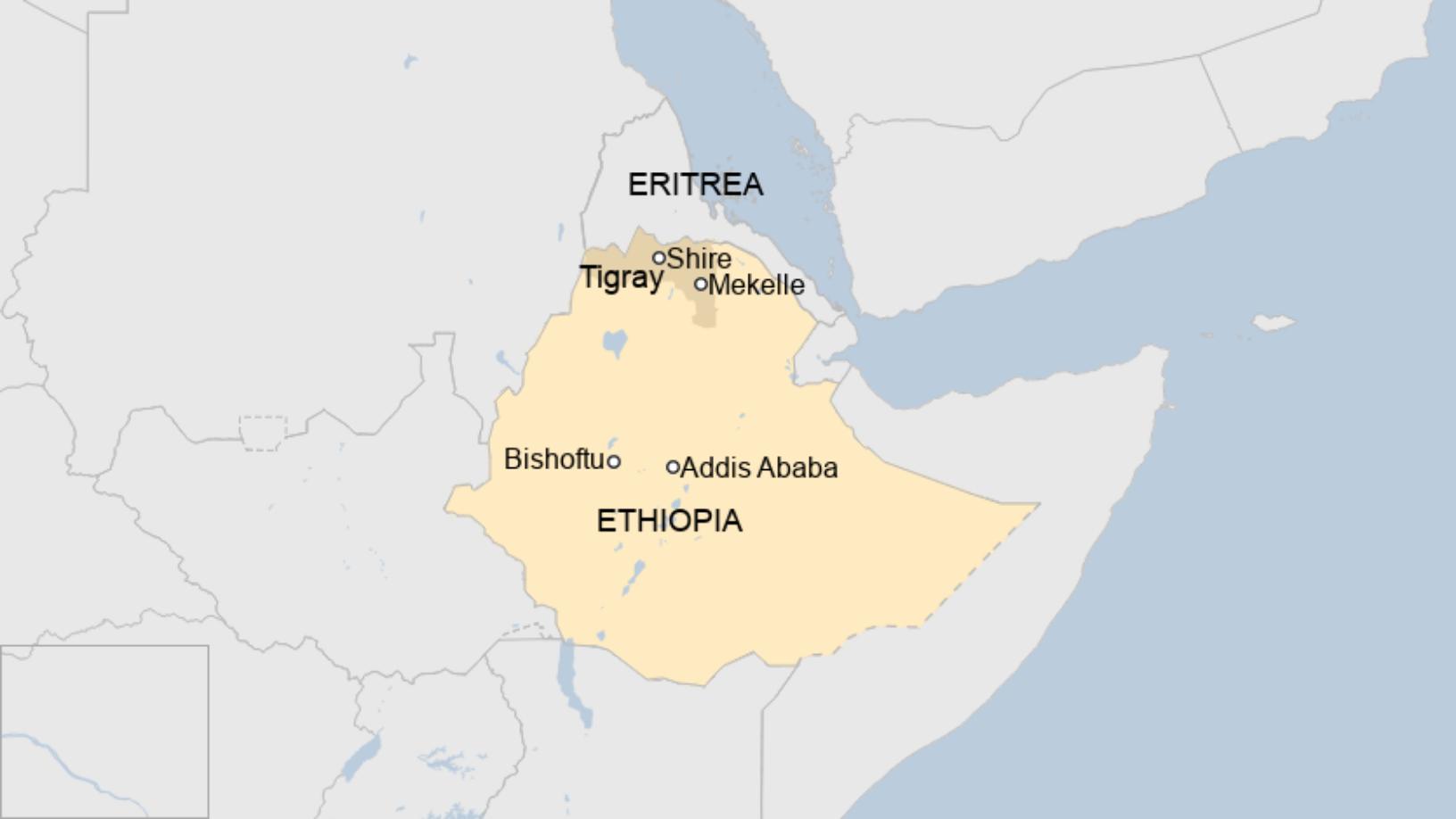
- Ethiopian and Eritrean forces capturing the Tigray capital, Mekelle, in November 2020 after the TPLF was accused of launching a rebellion
- The Tigrayans launching a counter-offensive in the neighbouring Amhara and Afar regions, bringing them close to the federal capital, Addis Ababa, about a year later
- The Ethiopian and Eritrean forces regaining territory in Tigray – including the key city of Shire – in the latest round of fighting, raising the prospect of them trying to capture Mekelle once more.
“There are at least 500,000 Eritrean and Ethiopian federal troops in active combat, plus 200,000 from the Tigrayan side,” said Alex de Waal, the executive director of the US-based World Peace Foundation.
He added that after more than 50 days of non-stop fighting, this week the Tigrayan defence lines around Shire could no longer hold out because of a lack of ammunition.
“It’s a big setback for the Tigrayans. It leaves civilians exposed to massacre, rape and starvation,” Prof De Waal said, though the Ethiopian government has promised aid and the restoration of services in Shire and other areas under its control.
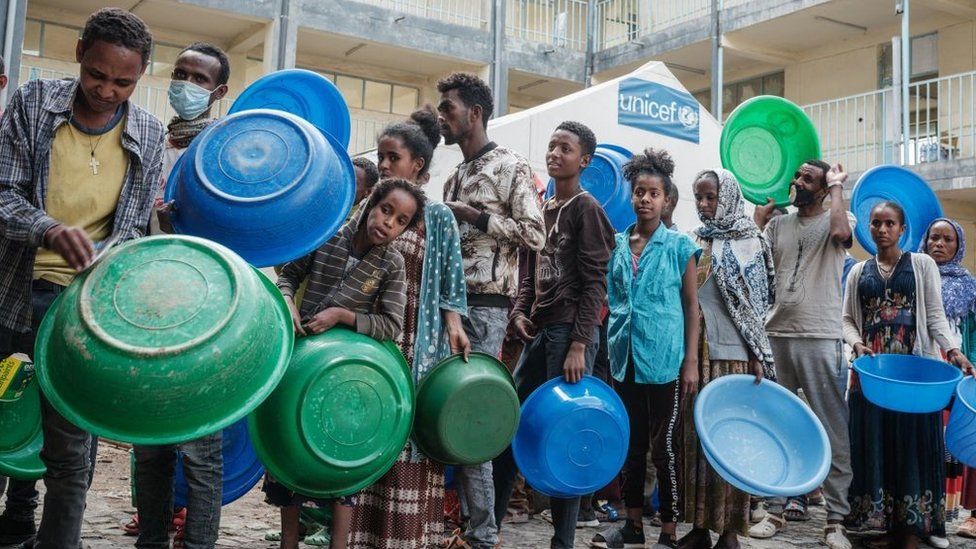
Image source, Getty Images/ Image caption, The war has led to millions of people in Ethiopia needing aid Shire reflects the humanitarian crisis in Tigray, with an aid worker saying that around 600,000 civilians were taking refuge in the city and its surrounding areas after earlier fleeing war-hit areas.
“More than 120,000 were out in the open, sleeping under trees and bushes,” he told the BBC, speaking on condition of anonymity for fear of reprisals.
Almost all humanitarian workers withdrew from Shire last week after it came under ferocious bombardment from Ethiopian forces.
Thousands of residents are also fleeing Shire amid fears that they could be subjected to atrocities – similar to those in other areas that fell under the control of Ethiopian and Eritrean troops.
“Four witnesses reported that in the village of Shimblina in September, 46 people were rounded up and summarily executed. Other villagers found their bodies lying mixed with domestic animals, which had also been killed,” the aid worker said.
“Hyenas had eaten a few of the bodies, and they could be identified only by the remains of their clothing. The witnesses said they had no time to bury the bodies, and the hyenas must have finished them by now,” he added.
What made the atrocity stand out, he said, was the fact that most of the victims came from the small Kunama ethnic group, which has not been involved in the conflict.
“Both sides are losing soldiers, and when they come into a village they take out their anger on locals,” the aid worker added.
Tigrayan forces faced similar accusations – including of rape, extra-judicial killings and looting – during their advances into Amhara and Afar, before being pushed back into Tigray. The region has a population of around seven million, a small number in a country with a population of more than 100 million.
Old-fashioned warfare
Apart from atrocities, all the armies have been accused of forcibly recruiting civilians to fight, and of using the “human wave” tactic to gain ground.
“People are drafted into the armies and, after only a few weeks of training, they are sent in large numbers through mined areas towards the trenches of the enemy,” said UK-based Horn of Africa analyst Abdurahman Sayed.
“The enemy opens fire and kills many of them, but they keep coming in waves until the enemy runs of ammunition and they occupy their trenches.
“It is the old way of warfare. It was first used by the king of Abyssinia to defeat the Italian invaders in the 1890s. Despite their superior airpower, the Italians were overwhelmed by the sheer number of people who confronted them.”
Mr Abdurahman said that this tactic leads to massive casualties, with his estimate being that between 700,000 and 800,000 people have already lost their lives in almost two years of fighting.
“This is the most brutal war in the history of Ethiopia,” he added.
Though US-based Horn of Africa analyst Faisal Roble disputed that the Tigrayans used human wave attacks, his estimate of the death toll was not very different.
“In the first two phases of the war, around 500,000 died in combat, and 100,000 have probably died in this third phase,” he said.
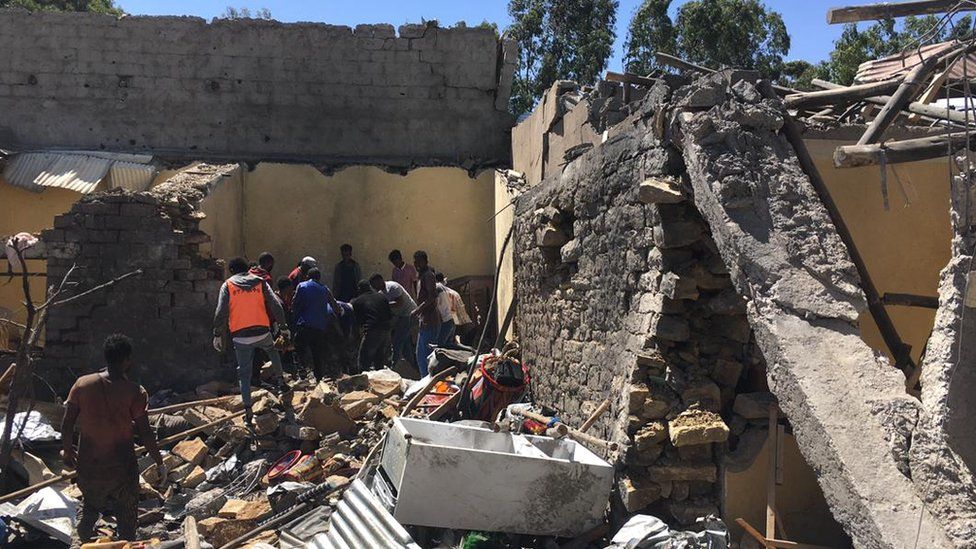
Image caption, Mekelle, which has a population of around 300,000, has been hit by several drone strikes
Mr Roble added that the Tigrayan army was well trained, with “the heart” to fight, but the Ethiopian army had two advantages: numbers and airpower.
“A general who is now an ambassador said they could enlist one million young men every year, and they have fighter jets and Turkish drones that have proved very effective. The Tigrayans have no air force.”
The command of the Ethiopian air force had moved to Eritrea’s capital Asmara, he explained, from where fighter jets were taking off as the city was much closer to Tigray than their usual base in Bishoftu in central Ethiopia.
“The drones are still leaving from Bishoftu,” Mr Roble said.
Settling old scores
Eritrea intervened in the conflict as the TPLF is its sworn enemy. The TPLF dominated a coalition government in Ethiopia until current Prime Minister Abiy Ahmed rose to power in 2018.

Under the TPLF, Ethiopia and Eritrea fought a border war which claimed the lives of about 80,000 people. An international tribunal later ruled that Ethiopia should hand over territory to Eritrea, but the TPLF-controlled government failed to do so.
Eritrea regained the territory soon after the latest war started in November 2020, and its critics say that President Isaias Afwerki is determined to help Mr Abiy finish off the TPLF so that it does not threaten his nation again.
“Eritrea’s concern is that the TPLF wants to either regain power in Ethiopia, or its wants a satellite government in Asmara that will give it access to the Red Sea because Tigray is a landlocked, impoverished region,” Mr Abdurahman said.
As the war in Tigray escalated in recent weeks, Eritrea’s government intensified its military mobilisation and hunted down draft dodgers across the country, multiple sources in Eritrea told the BBC.
In one instance in September, Eritrean troops raided a church in the southern town of Akrur, detaining a priest, young worshippers and choir members who had not heeded the military call-up, the sources said.
Prof De Waal said the call-up showed that Mr Isaias was “not taking any chances”, but he has not deployed conscripts to Tigray in large numbers.
“Eritrea has units in Tigray, but most of the fighting is being done by Ethiopian forces. What Isaias is doing is running the war because he believes he can show Abiy how to win, but the Tigrayans will fight, even if it means with knives and stones because it is a matter of life and death for them,” he said.
Talks unlikely
According to Mr Abdurahman, the war is being fought on four to six fronts, with tens of thousands of Ethiopian and Eritrean troops stationed near the Tigray town of Adigrat.
“They are ready to launch an attack on Adigrat, and Mekelle,” he said.
Sources on the battlefront told the BBC that the two armies were already advancing from Shire towards the historic city of Aksum, as well as Adwa and Adigrat, in an operation that has seen them move from west to east.
While foreign powers have been urging the two sides to resolve the conflict peacefully, Mr Abdurahman said this was unlikely to happen.
“Historically, the ruling classes of Abyssinia, and now Ethiopia, always fought their way to power. The powerful becomes the king of kings until someone else emerges. There is no tradition of resolving matters peacefully. It is a zero-sum game,” he said.
Prof De Waal said that the international community needed to act urgently to impose a ceasefire.
“Otherwise there is the risk of a genocide, and mass starvation,” he said, pointing out that a Belgian-led academic team earlier this year estimated that more than 250,000 Tigrayan civilians had died of hunger and related causes since the war began in November 2020.
“Harvesting is supposed to start now, but the Eritrean-led armies are turning Tigray into a wasteland.”
Source: BBC
-
Russian TV protester validates she has gone on the run
A Russian TV journalist famous for staging an on-air protest against Russia’s war, confirmed she had escaped house arrest over charges of spreading fake news again, saying she had no case to answer.
Marina Ovsyannikova wrote on Telegram: “I consider myself completely innocent, and since our state refuses to comply with its own laws, I refuse to comply with the measure of restraint imposed on me as of 30 September 2022 and release myself from it.”
Ms Ovsyannikova, 44, gained international attention in March after bursting into a studio broadcast on the flagship Channel One with a placard that read “Stop the war” and “They’re lying to you”.
Her lawyer said she was due to turn up to a hearing at 10:00 Moscow time (7am UK time) at a Moscow district court, but that investigators failed to establish her whereabouts.
Ms Ovsyannikova was given two months’ house arrest in August over a protest in July when she stood on a river embankment opposite the Kremlin and held up a poster calling Vladimir Putin a murderer and his soldiers fascists.
She faced a sentence of up to 10 years in prison if found guilty of the charge of spreading fake news about Russia’s armed forces.
Her house arrest was due to last until 9 October but the state-run news outlet Russia Today reported on Saturday that she had fled along with her 11-year-old daughter.
How she left and where she went are still unclear, but on Monday, her name could be seen on the interior ministry’s online list of fugitives from justice, accompanied by a photo.
In Wednesday’s statement on her Telegram social media feed, she confirmed her escape, criticising the article of the criminal code being used to prosecute her and saying she was being persecuted “for telling the truth”.
Russia passed new laws against discrediting or distributing “deliberately false information” about the armed forces on 4 March, eight days after invading Ukraine.
-
Kadyrov says Russia should use low-yield nuclear weapon
After a significant fresh defeat on the battlefield, Ramzan Kadyrov, the leader of Russia’s Chechnya region, suggested on Saturday that Moscow might use a low-yield nuclear weapon in Ukraine.
As Russia confirmed the loss of its stronghold of Lyman in eastern Ukraine, Kadyrov slammed top commanders for their failings and wrote on Telegram: “In my personal opinion, more drastic measures should be taken, right up to the declaration of martial law in the border areas and the use of low-yield nuclear weapons”.
He was speaking a day after President Vladimir Putin proclaimed the annexation of four Ukrainian regions – including Donetsk, where Lyman is located – and placed them under Russia’s nuclear umbrella, saying Moscow would defend the lands it had seized “with all our strength and all our means”.
Russia has the world’s largest atomic arsenal, including low-yield tactical nuclear weapons that are designed to be deployed against opposing armies.
Other top Putin allies, including former president Dmitry Medvedev, have suggested that Russia may need to resort to nuclear weapons, but Kadyrov’s call was the most urgent and explicit.
The influential ruler of the Caucasus region of Chechnya has been a vocal champion of the war in Ukraine, with Chechen forces forming part of the vanguard of the Russian army there. Kadyrov is widely believed to be personally close to Putin, who appointed him to govern restive Chechnya in 2007.
-
Biden announces new $1 bln in weapons for Ukraine
President Joe Biden on Wednesday announced a fresh infusion of $1 billion in weapons for Ukraine that includes anti-ship rocket systems, artillery rockets, howitzers and ammunition.
In a phone call with Ukraine President Volodymyr Zelenskiy, Biden said he told the embattled leader about the new weaponry.
“I informed President Zelenskiy that the United States is providing another $1 billion in security assistance for Ukraine, including additional artillery and coastal defense weapons, as well as ammunition for the artillery and advanced rocket systems,” Biden said in a statement after the 41-minute call.
The president also announced an additional $225 million in humanitarian assistance to help people in Ukraine, including by supplying safe drinking water, critical medical supplies and healthcare, food, shelter, and cash for families to purchase essential items.
The latest weapons packages for Ukraine include 18 howitzers, 36,000 rounds of ammunition for them, two Harpoon coastal defense systems, artillery rockets, secure radios, thousands of night vision devices and funding for training, the Pentagon said.
The aid packages, which come as U.S. Defense Secretary Lloyd Austin is meeting with allies in Brussels, were split into two categories: transfer of excess defense articles from U.S. stocks and other weapons being funded by the Ukraine Security Assistance Initiative (USAI), a separate congressionally authorized program.
Russia’s U.N. Ambassador Vassily Nebenzia on Wednesday accused Western countries of “fighting a proxy war with Russia,” telling reporters: “I would like to say to the Western countries supplying weaponry to Ukraine the blood of civilians is on your hands.”
Ukraine is pressing the United States and other Western nations for speedy deliveries of weapons in the face of increased pressure from Russian forces in the eastern Donbass region.
Oleksandra Ustinova, a member of the Ukrainian Parliament, told reporters at an event organized by the German Marshall Fund: “We need all these weapons to be concentrated in a moment to defeat the Russians, not just keep coming every two or three weeks.”
In May, the Biden administration announced a plan to give Ukraine M142 High Mobility Artillery Rocket Systems after receiving assurances from Kyiv that it would not use them to hit targets inside Russian territory. Biden imposed the condition to try to avoid escalating the Ukraine war.
The rocket artillery in this aid package would have the same range as previous U.S. rocket shipments and is funded using Presidential Drawdown Authority, or PDA, in which the president can authorize the transfer of articles and services from U.S. stocks without congressional approval in response to an emergency, said a source who spoke on condition of anonymity.
For the first time, the United States is sending ground-based Harpoon launchers. In May, Reuters reported the U.S. was working on potential solutions that included pulling a launcher off of a U.S. ship to help provide Harpoon missile launch capability to Ukraine.
Harpoons made by Boeing Co (BA.N) cost about $1.5 million per missile, according to experts and industry executives.
Source: www.reuters.com
-
Ukraine needs strong signal from EU, Macron says ahead of possible visit
President Emmanuel Macron voiced a tougher line on Russia on Wednesday and said Europe needed to send a strong signal to Ukraine as he sought to assuage concerns in Kyiv and among some European allies over his previous stance towards Moscow.
Macron arrived in Romania on Tuesday for a three-day trip to Ukraine’s eastern neighbors including Moldova, before possibly heading to Kyiv on Thursday on a visit with German Chancellor Olaf Scholz, Italian Prime Minister Mario Draghi and Romanian President Klaus Iohannis, two diplomatic sources said
CONSTANTA, Romania, June 15 (Reuters) – President Emmanuel Macron voiced a tougher line on Russia on Wednesday and said Europe needed to send a strong signal to Ukraine as he sought to assuage concerns in Kyiv and among some European allies over his previous stance towards Moscow.
Macron arrived in Romania on Tuesday for a three-day trip to Ukraine’s eastern neighbors including Moldova, before possibly heading to Kyiv on Thursday on a visit with German Chancellor Olaf Scholz, Italian Prime Minister Mario Draghi and Romanian President Klaus Iohannis, two diplomatic sources said.
The symbolic visit would come a day before the European Commission makes a recommendation on Ukraine’s status as an EU candidate, something the biggest European nations have been lukewarm about and are set to discuss at a leaders’ summit on June 23-24.
We are at a point when we (Europeans) need to send clear political signals, us Europeans, towards Ukraine and its people when it is resisting heroically,” Macron said, without giving details.
The French leader has been criticized by Ukraine and eastern European allies for what they perceive as his ambiguous backing for Ukraine in the war against Russia.
French officials have in recent days sought to strengthen the public messaging, while Macron appeared to take a tougher line on Tuesday evening when he was with his troops.
“We will do everything to stop Russia’s war forces, to help the Ukrainians and their army and continue to negotiate,” he told French and NATO troops at a military base in Romania.
Macron has in recent weeks repeatedly said it was vital not to “humiliate” Russia so a diplomatic solution could be found when fighting ended and he has continued to keep communication channels open with the Kremlin open, riling more hawkish allies.
We share a continent. Geography is stubborn and at the end of it, Russia is there. It was there yesterday, it’s there today and will be there tomorrow,” he told reporters.
France leads a NATO battle group in Romania of about 800 troops, including 500 French troops alongside others from the Netherlands and Belgium. Paris has also deployed a surface-to air missile system.
Macron heads to Moldova later on Wednesday to support a country many fear could be drawn into the conflict in neighboring Ukraine.
The focus may turn to Kyiv on Thursday, with diplomatic sources saying the European leaders may head to Ukraine’s capital.
Macron declined to comment on “logistical matters”, but said it was important to hold new talks with Ukraine on military, financial matters and issues related to exporting grains from the country.
Romania’s Iohannis said support should include offering Ukraine candidate status in the European Union.
Source: www.reuters.com
-
Ukraine needs strong signal from EU, Macron says ahead of possible visit
President Emmanuel Macron voiced a tougher line on Russia on Wednesday and said Europe needed to send a strong signal to Ukraine as he sought to assuage concerns in Kyiv and among some European allies over his previous stance towards Moscow.
Macron arrived in Romania on Tuesday for a three-day trip to Ukraine’s eastern neighbors including Moldova, before possibly heading to Kyiv on Thursday on a visit with German Chancellor Olaf Scholz, Italian Prime Minister Mario Draghi and Romanian President Klaus Iohannis, two diplomatic sources said.
The symbolic visit would come a day before the European Commission makes a recommendation on Ukraine’s status as an EU candidate, something the biggest European nations have been lukewarm about and are set to discuss at a leaders’ summit on June 23-24.
“We are at a point when we (Europeans) need to send clear political signals, us Europeans, towards Ukraine and its people when it is resisting heroically,” Macron said, without giving details.
The French leader has been criticized by Ukraine and eastern European allies for what they perceive as his ambiguous backing for Ukraine in the war against Russia.
French officials have in recent days sought to strengthen the public messaging, while Macron appeared to take a tougher line on Tuesday evening when he was with his troops. read more
“We will do everything to stop Russia’s war forces, to help the Ukrainians and their army and continue to negotiate,” he told French and NATO troops at a military base in Romania.
Speaking alongside Iohannis, Macron downplayed those comments, but insisted that Ukraine, which he hoped would win the war, would eventually have to negotiate with Russia.
CONSTANTA, Romania, June 15 (Reuters) – President Emmanuel Macron voiced a tougher line on Russia on Wednesday and said Europe needed to send a strong signal to Ukraine as he sought to assuage concerns in Kyiv and among some European allies over his previous stance towards Moscow.
Macron arrived in Romania on Tuesday for a three-day trip to Ukraine’s eastern neighbors including Moldova, before possibly heading to Kyiv on Thursday on a visit with German Chancellor Olaf Scholz, Italian Prime Minister Mario Draghi and Romanian President Klaus Iohannis, two diplomatic sources said.
Advertisement · Scroll to continueThe symbolic visit would come a day before the European Commission makes a recommendation on Ukraine’s status as an EU candidate, something the biggest European nations have been lukewarm about and are set to discuss at a leaders’ summit on June 23-24.
Register now for FREE unlimited access to Reuters.com
“We are at a point when we (Europeans) need to send clear political signals, us Europeans, towards Ukraine and its people when it is resisting heroically,” Macron said, without giving details.
Advertisement · Scroll to continueThe French leader has been criticised by Ukraine and eastern European allies for what they perceive as his ambiguous backing for Ukraine in the war against Russia.
French officials have in recent days sought to strengthen the public messaging, while Macron appeared to take a tougher line on Tuesday evening when he was with his troops. read more
“We will do everything to stop Russia’s war forces, to help the Ukrainians and their army and continue to negotiate,” he told French and NATO troops at a military base in Romania.
Macron has in recent weeks repeatedly said it was vital not to “humiliate” Russia so a diplomatic solution could be found when fighting ended and he has continued to keep communication channels open with the Kremlin open, riling more hawkish allies. read more
French President Emmanuel Macron delivers a statement as he visits NATO forces at the Mihail Kogalniceanu Air Base, near the city of Constanta, Romania, June 15, 2022. Yoan Valat/Pool via REUTERS
Speaking alongside Iohannis, Macron downplayed those comments, but insisted that Ukraine, which he hoped would win the war, would eventually have to negotiate with Russia.
“We share a continent. Geography is stubborn and at the end of it, Russia is there. It was there yesterday, it’s there today and will be there tomorrow,” he told reporters.
France leads a NATO battle group in Romania of about 800 troops, including 500 French troops alongside others from the Netherlands and Belgium. Paris has also deployed a surface-to air missile system.
Macron heads to Moldova later on Wednesday to support a country many fear could be drawn into the conflict in neighboring Ukraine.
Source: www.reuters.com
-
Central African Republic: Ex-officer arrested for war crimes
Police in France have arrested a former presidential guard from the Central African Republic (CAR) for alleged war crimes and crimes against humanity.
Eric Danboy Bagale was taken to Paris after his arrest in eastern France on Tuesday, the AFP news agency reports.
He is accused of leading a group of largely Christian militias which carried out revenge killings after the CAR’s president was ousted in 2013.
Thousands of people died in the violence that followed.The CAR has faced instability since gaining independence from France in 1960.
But in 2013, Muslim rebels from the Seleka umbrella group seized power in the majority-Christian country.
Mr Bagale has been indicted for both his actions as head of former President François Bozizé’s guard and later as head of the mostly Christian anti-Balaka militias, according to the AFP news agency.
The former president is himself the subject of UN sanctions over the actions of anti-Balaka militias.
A peace deal was signed between the government and 14 armed groups last year, but the violence has continued.
More than a million people have been displaced or forced to leave the country, according to the UN refugee agency.
Source: bbc.com
-
Libya a ‘den of mercenaries’, say war-weary citizens
After 10 months of fighting that has torn their country apart, exhausted Libyans voice deep fears and say their fate is no longer in their own hands.
The oil-rich North African country has been mired in chaos since a 2011 NATO-backed uprising that killed long-time dictator Muammar Gaddafi, with two rival administrations vying for power.
The conflict deepened last April when military strongman Khalifa Haftar, who controls much of Libya’s south and east, launched an assault to seize Tripoli, the base of the UN-recognised Government of National Accord (GNA).
A fragile ceasefire, brokered by Moscow and Ankara, was established on January 12. And at an international summit in Berlin a week later, world leaders agreed to end all foreign interference in Libya and to uphold a weapons embargo.
But on the streets of Libya, war-weary citizens are increasingly hopeless, telling AFP that their resource-rich country has become a plaything of foreign powers.
The fighting has drawn in a range of foreign combatants, among them reportedly Russian mercenaries, Sudanese militiamen for hire and members of pro-Turkish Syrian units.
Mohammad al-Barouni, a student from Tripoli, charged that foreign players had been sending weapons and fighters into Libya “without fear or shame”. “After 10 months of fighting… the capital and its suburbs have become a den of mercenaries where arms are flooding in, in broad daylight”, he said.
Nouri Bengharsa, a civil servant, complained that “since the fall of Gaddafi, Libyans have allowed foreigners to meddle in their affairs, and now they can’t get rid of them”.
Libyan politicians were partly to blame because they are “incapable of dialogue in their own country,” he said while shopping in a vegetable market in Janzour, west of the capital.
“Yet they run to foreign capitals where they have specific agendas dictated to them.”
The UN Security Council has been plagued by divisions over Libya and has been unable to adopt any resolution on the conflict for the past 10 months.
Salem al-Mahmudi, a vendor, said the international community had “not managed to tame” the countries that support eastern commander Haftar or Fayez al-Sarraj’s Tripoli-based GNA.
Those countries were exploiting the truce to dispatch new military reinforcements ahead of a “great battle” in Tripoli, Mahmudi said.
Haftar has the backing of Egypt, the United Arab Emirates and Russia, among others, while the GNA is mainly supported by Qatar and Turkey.
Despite the ceasefire and the commitments made in Berlin, the military escalation has intensified.
Mahmudi said “Libyan airports and ports are used to transfer arms and fighters in the full view of the international community… which doesn’t dare even name the states fuelling the conflict”.
“The warring parties see a military solution as the only way to end the fighting,” said the trader, aged in his 50s, adding that this option was “more realistic” as no political solution had so far been reached.
The UN’s Libya envoy Ghassan Salame last week accused “unscrupulous” foreign actors — without specifying who — of continuing to meddle in Libya’s conflict, in violation of the Berlin commitments.
Warring parties “have continued to receive a sizable amount of advanced equipment, fighters and advisors from foreign sponsors”, he told the Security Council, warning that such moves “threaten to precipitate a new and much more dangerous conflagration”.
Representatives on both sides of the conflict were meeting in Geneva this week in a UN-sponsored joint military commission. They agreed on the principle of turning their shaky truce into a lasting ceasefire, Salame said.
The UN envoy said the two sides would meet again for talks on economic cooperation, in Cairo on February 9, and could hold political talks on resolving the conflict in Geneva in two weeks’ time.
Ibtissam al-Mezoughi, a retired public servant and mother of four, voiced deep scepticism about the ongoing diplomacy in faraway capitals.
Whether meetings are held in “Berlin or Geneva, it’s not a question of ending the war, but of putting the finishing touches on international actors’ areas of influence”, she said.
“The Libyans have lost control. It’s too late”, she said, voicing fear that her country, now divided into zones of foreign influence, was becoming “another Syria”.
Source: AFP