Leaders of West African nations claim that conversation with those responsible for the coup in Niger will form the “bedrock” of their response to the issue.
To explore ways to compel Niger to return to democracy, the regional organisation Ecowas is having a meeting in Nigeria.
Earlier, if former Niger President Mohamed Bazoum was not reinstated, there had been threats of military intervention.
Correspondents report that resistance to a military solution appears to be rising, not least from within Nigeria and from Mali, which has backed the coup leaders, but the coup leaders in Niger have disregarded the warning.
A new 21-member administration run by the military junta has been proclaimed, with crucial positions going to the coup leaders.
To be sure, Mr. Tinubu is confident that this second Ecowas meeting on settling the Niger situation would be a “defining moment” for a “stronger, more resilient, and integrated West Africa.”
In light of the possibility of military intervention from neighbouring neighbours, the leaders of the coup in Niger have temporarily closed the nation’s airspace.
According to the flight tracking service Flightradar24, there aren’t any aircraft flying over Niger right now.
Ecowas, a consortium of West African nations, had previously threatened to use force if President Mohamed Bazoum was not restored by Sunday at 23:00 GMT.
Niger’s armed forces, according to a junta spokesman, are prepared to defend the nation.
The presidential guard commander, Gen. Abdourahmane Tchiani, later proclaimed himself the new leader after Mr. Bazoum was detained on July 26.
International organisations and governments have denounced the military takeover, including the United Nations, the United States, former colonial power France, and the rest of the European Union.
The Niger junta’s spokesperson read a statement on national television on Sunday, claiming to have knowledge that “a foreign power” was getting ready to strike Niger.
Following a crisis conference in Nigeria, the military leaders of Ecowas announced on Friday that they had created a thorough strategy for the potential use of force.
Abdel-Fatau Musah, the Ecowas commissioner for political affairs, peace, and security, stated that “all the elements that will go into any eventual intervention have been worked out here, including the resources needed, the how, and the when we are going to deploy the force.”
He continued, “We want diplomacy to succeed, and we want this message to them [Niger’s junta] clearly transmitted that we are giving them every opportunity to undo what they have done.”
They gave the generals a week to comply with their ultimatum to cede control by midnight local time, but the deadline has since passed.
Nigeria, Senegal, Togo, Ghana, and 14 other West African nations make up the regional commercial bloc known as Ecowas.
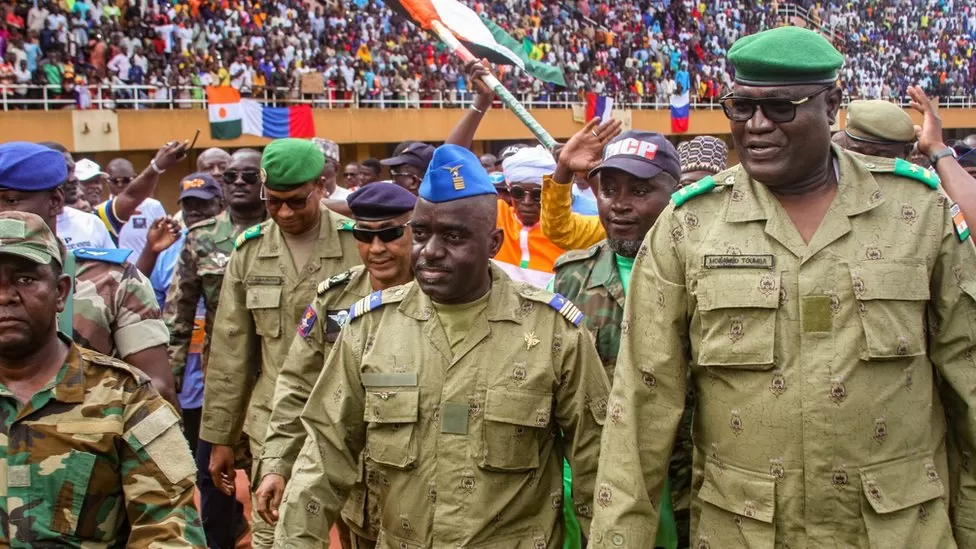
Thousands of the coup leaders’ supporters gathered angrily on Sunday at a stadium in Niamey, the capital of Niger, as they appear unwilling to give up control.
Burkina Faso and Mali, two of Niger’s neighbours, previously issued a warning that they would regard any foreign military intervention in Niger as “a declaration of war” against them. Mali and Burkina Faso are both Ecowas members, although they have both been expelled from the organisation as a result of being governed by military coups.
Under Mr. Bazoum, Niger was an important Western ally in the conflict with Islamist extremists in West Africa’s Sahel area. Niger is a significant producer of uranium, a fuel essential for nuclear power.
West African nations met with European leaders on Tuesday for talks on “homegrown” ways to prevent jihadist conflict in the Sahel threatening to “engulf” countries on the Gulf of Guinea.
Coastal states Ghana, Benin, Togo and Ivory Coast face increasing threats and attacks from Islamist militants across their northern borders with Burkina Faso and Niger.
The summit in Ghana’s capital Accra also comes as more Western nations have withdrawn peacekeepers from Mali after its military junta strengthened cooperation with Russia.
Ghana’s President Nana Akufo-Addo said worsening Sahel security was “threatening to engulf the entire West African region”.
“Terrorist groups, emboldened by their apparent success in the region are looking (for) new operational grounds, a development that has triggered a southward drift of the menace,” he said.
Under the so-called Accra Initiative, heads of state from the Gulf of Guinea and leaders from Niger and Burkina Faso met in Ghana with representatives from the West African bloc ECOWAS, the EU, Britain and France.
Akufo-Addo called for a “home-grown initiative” to answer the threat as well as a comprehensive approach involving economic and social development to tackle the roots of jihadism.
“We remain firm in our commitment to shoulder a greater part of the responsibility.”
– Sahel spill over –
The Sahel conflict began in northern Mali in 2012, spread to Burkina Faso and Niger in 2015 and now states on the Gulf of Guinea are suffering sporadic attacks.
Ghana has beefed up security along its northern frontier and has so far escaped any cross-border attacks.
But Benin and Togo in particular have faced threats from across their northern borders with Burkina Faso.
Benin has recorded 20 incursions since 2021 while Togo has suffered at least five attacks, including two deadly assaults, since November 2021.
“For years we have been talking about the risk of contagion of the terrorist threat from the Sahel to the coastal states. Today this is not a risk anymore, it is a reality,” EU Council president Charles Michel told the summit.
French and other peacekeeping missions had been operating in Mali for almost a decade as a bulwark against the spread of violence.
But after two coups in Mali, the military junta increased cooperation with Moscow and allowed what Western countries call Russian mercenaries into the country.
That prompted France to pull out its troops deployed under its Barkhane anti-jihadist mission. Britain and Germany last week said they would also end peacekeeping missions.
British Armed Forces Minister James Heappey last week said the UK would be “rebalancing” its deployment though he did not give details about what form that would take.
He said Accra Initiative countries would likely need different capabilities than the British long-range reconnaissance forces currently in Mali.
“The United Kingdom’s armed forces already enjoy great relationships with many of the countries within the Accra Initiative and we stand ready to build on that,” he said in Accra.
“But this is a regional problem that you have here in West Africa and it’s right that you seek to provide the solution.”
Across the three Sahel nations, thousands of people have been killed, more than two million displaced and devastating damage has been inflicted to three of the poorest economies in the world.