Tag: whales

  • Curious whale follows kayak as Australia celebrates humpback whale population

    Curious whale follows kayak as Australia celebrates humpback whale population

    A conservation group reported that around 5,000 humpback whales had been observed in Australian seas during a record-breaking annual migration census, with one curious whale being seen trailing a kayaker just off Sydney’s well-known Bondi beach.

    Every year, specialists and the general public travel to the coast of New South Wales to perform an annual count, and on Sunday, the census revealed the biggest number of whales ever—4,792—adding to the already thrilling “megapod” sighting in 2021.

    According to Steve Trikoulis, vice president of the Organisation for the Rescue and Research of Cetaceans (ORRCA), many of the whales were seen only a few yards from the shore.

    “They were traveling to Queensland and Hervey Bay to make babies,” he told CNN. “It was exciting for people (on shore) to see them… jumping around.”

    Better weather and cleaner water were just some factors that contributed to the rise in the number of whales this year, he added.

    “The numbers are healthy and have definitely increased,” Trikoulis said. “We’ve never seen so many of them so early in the season and we strongly believe it’s because of the better weather. We’ve also seen them swimming more closer to shore.”

    Humpback whales are known to swim great distances every year and have one of the longest migrations of any mammal.

    Their annual round-trip journey between June and early September covers up to 6,214 miles (10,000 kilometers).

    Starting in Antarctica, they swim in large groups to Australia – arriving in the northeastern state of Queensland. The area isone of the country’s most popular spots for whale watching.

    Humpback whales spend their summers feeding in sub-tropical waters, where they also mate and give birth, according to Australia’s Department of Agriculture, Water and Environment.

    A rare “megapod” of more than 100 whales was spotted in September 2021 in waters off the town of Bermagui, about 236 miles (380 kilometers) from Sydney.

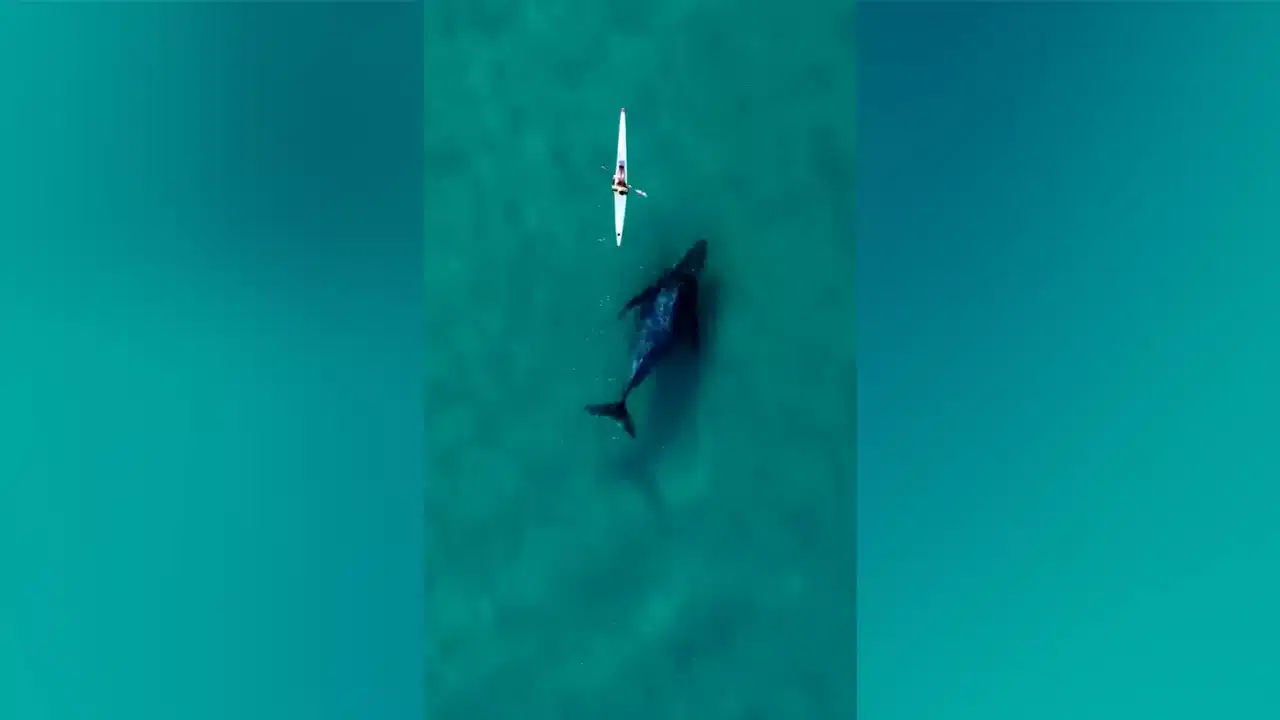
    One kayaker had a particularly close-up view in an encounter that was captured by a drone.

    In the stunning footage, an enormous humpback follows a white kayak in turquoise clear waters off Bondi beach.

    “Whales are always a treat as they cruise up the coast during migration season,” said Jason Iggleden, the drone pilot.

    Iggleden often films other marine creatures like sharks and seals off Australia’s coasts – uploading footage to his Drone Shark app, which provides real-time images of beaches and vital informationfor surfers.

    “There’s a wondrous world in the deep blue and I have had the ability to share it with audiences.” he told CNN. “Human and sea life interactions are always so fascinating and it’s a reminder to all of us to appreciate, respect and coexist with our oceans.”
  • Stranded whales: 230 found on Tasmanian beach

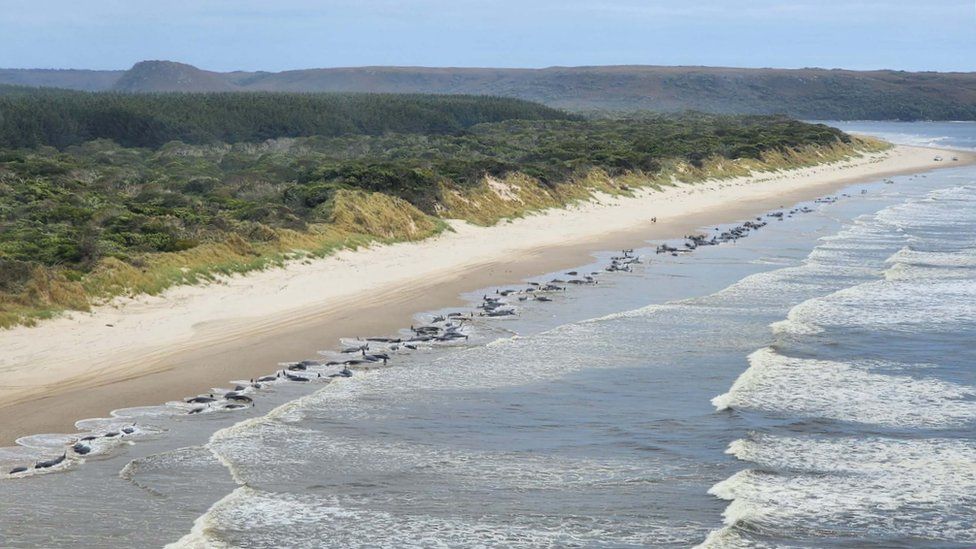
    More than 200 whales have been found stranded on a remote beach on the west coast of Tasmania, Australia. Half of the pod, thought to be pilot whales, are believed to be still alive. Rescuers are being sent to the area.

    It’s unclear what caused the whales to the beach on a sandflat at the entrance to Macquarie Harbour, the same remote location where Australia’s worst stranding occurred two years ago.

    It comes a day after a separate mass stranding in northern Tasmania.

    The incident on Tuesday saw 14 young sperm whales found dead on King Island, in the Bass Strait.

    Experts were planning a rescue of the 230 whales discovered on Wednesday but the operation would be “complex” due to the location, Tasmania’s Department of Natural Resources and Environment said in a statement.

    “It appears about half of the animals are alive.”

    Macquarie Harbour is a large, shallow inlet in a rural area. More of the whales are expected to die overnight.

    Locals have been covering the stranded whales with blankets and pouring buckets of water over them to try to keep them alive.

    Aerial view of whale stranding
    IMAGE SOURCE, DEPARTMENT OF NATURAL RESOURCES AND ENVIRONMENT Image caption, An aerial view of the whales stranded on Tasmania’s west coast

    The state’s environment department said marine conservation experts were traveling to the scene and would try to refloat those whales still healthy enough to survive.

    Pilot whales are highly social mammals and are well known for stranding in groups because they travel in large, close-knit communities which rely on constant communication.

    In September 2020, a huge rescue operation was launched when almost 500 pilot whales became stranded in the same harbor.

    More than 380 of the pilot whales died, but about 100 survived thanks to rescuers.

    Wildlife scientist Vanessa Pirotta told the BBC the similarities between the stranding and the last one – same species, same location, same time of year – are “unusual” and concerning.

    The whales may have “misnavigated”, followed a sick or disoriented leader, or been startled into shallower waters, she said.

    Climate change could have an impact too – changes in the environment, water temperature, or prey habitats could throw the whales off.

    But the reasons behind whale strandings remain a “mystery”, she says, as does why Tasmania sees so many of them.

    There’s lots of marine life in the area – more animals could mean more incidents – and there are also a lot of currents intersecting with the land.

    But the “giant island” itself could just be a navigational hazard for animals that use echolocation, she says.

    “You’re going from essentially open waters and then there’s land all of a sudden.”