Tag: White House

  • Coronavirus: White House plans to disband virus task force

    US President Donald Trump has confirmed the White House coronavirus task force will be winding down, with Vice-President Mike Pence suggesting it could be disbanded within weeks.

    “We are bringing our country back,” Mr Trump said during a visit to a mask-manufacturing factory in Arizona.

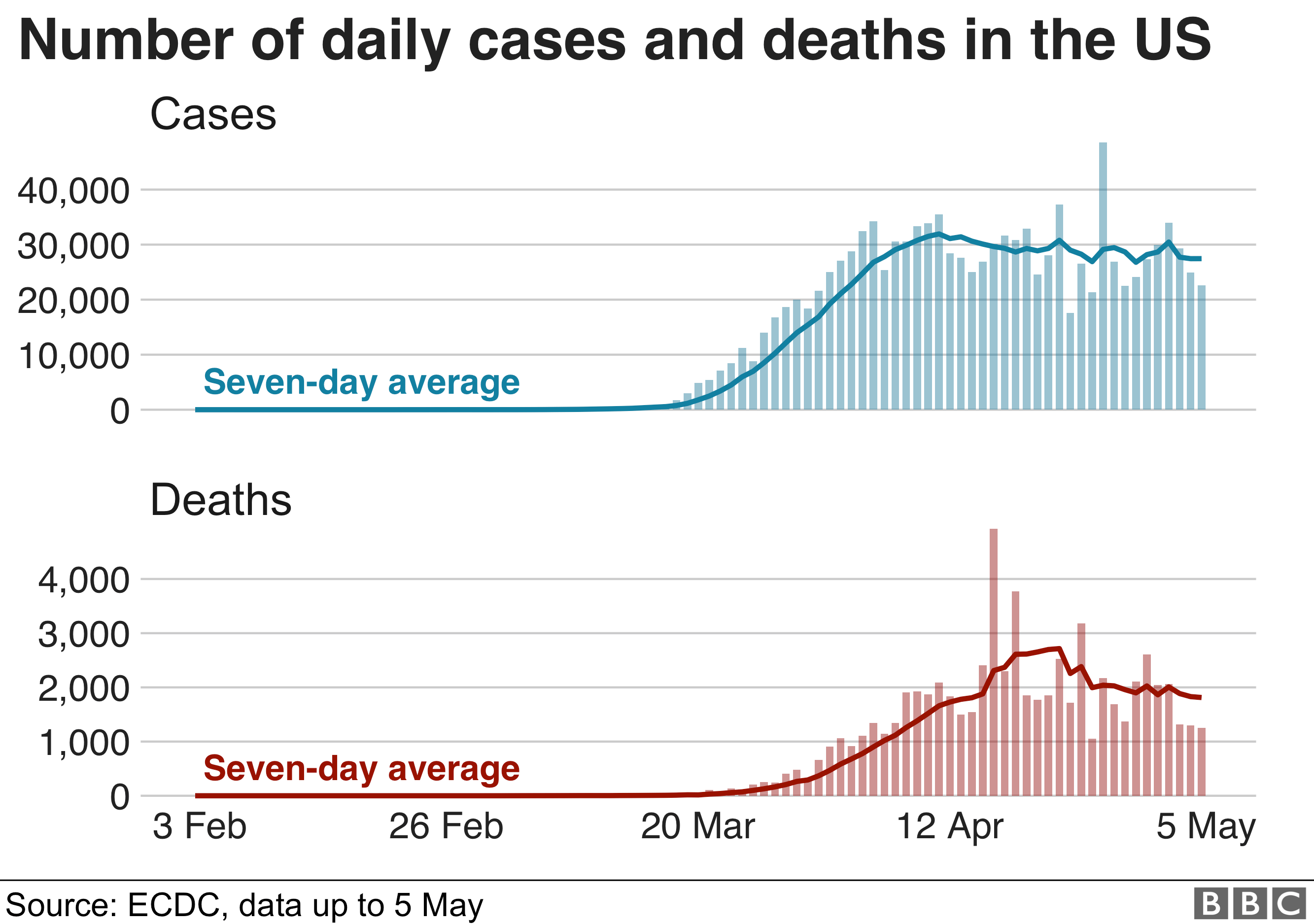
    New confirmed infections per day in the US currently top 20,000, and daily deaths exceed 1,000.

    US health officials warn the virus may spread as businesses begin to reopen.

    The US currently has 1.2 million confirmed coronavirus infections and more than 70,000 related deaths, according to Johns Hopkins University in Baltimore, Maryland, which is tracking the pandemic.

    What did President Trump say?

    During a visit to the plant in Phoenix after weeks holed up at the White House, Mr Trump told journalists: “Mike Pence and the task force have done a great job, but we’re now looking at a little bit of a different form, and that form is safety and opening. And we’ll have a different group probably set up for that.”
    Media captionCoronavirus: How long does it take to recover?

    The president – who wore safety goggles but no face mask during his tour of the facility – was asked if it was “mission accomplished”, and he said: “No, not at all. The mission accomplished is when it’s over.”

    Critics have accused the president of sacrificing Americans’ public health in his eagerness to reopen the US economy ahead of his re-election battle in November.

    In Arizona on Tuesday, Mr Trump said that Democrats were hoping his coronavirus policy would fail “so they can win the election”.

    Acknowledging a human cost to the plans, Mr Trump told reporters: “I’m not saying anything is perfect, and yes, will some people be affected? Yes.

    “Will some people be affected badly? Yes. But we have to get our country open and we have to get it open soon.”

    However, it will be up to individual states to determine how they reopen.

    Some Democratic governors in badly hit states have been cautious, calling for more testing and other safeguards before easing lockdowns. Other states, many led by Republicans in the south and mid-west, have already begun lifting restrictions.

    The task force was set up on 29 January. Mr Pence became its chairman four weeks later and its members include more than 20 experts and leading administration officials. The White House said the task force’s duty was to “lead the administration’s efforts to monitor, contain and mitigate the spread of the virus” and provide the public with information.

    Mr Trump’s once-daily task force briefings became increasingly scarce after he was widely condemned by the medical community for pondering at the podium last month whether injecting bleach into people might kill the virus.

    Dr Deborah Birx has been the task force’s response co-ordinator. The president was asked on Tuesday whether she and another high-profile member, Dr Anthony Fauci, would still be involved in efforts to address the coronavirus.

    “They will be and so will other doctors and so will other experts in the field,” the president said.
    graph showing deaths and cases in the US

    What did the vice-president say?

    Mr Pence earlier on Tuesday told reporters in a briefing that the task force could soon be disbanded.

    He said the Trump administration was “starting to look at the Memorial Day [late May] window, early June window as a time when we could begin to transition back to having our agencies begin to manage, begin to manage our national response in a more traditional manner”.

    He said it was “a reflection of the tremendous progress we’ve made as a country”.

    Mr Pence has led the task force, which reports to the president and co-ordinates with medical institutes, political staff and state governors. The group also consulted medical experts to formulate national guidelines on social distancing.

    White House press secretary Kayleigh McEnany later tweeted that the president “will continue his data-driven approach towards safely re-opening”.

    Media captionCoronavirus: When might Hollywood reopen for business?
    Presentational grey line
    Analysis box by Anthony Zurcher, North America reporter

    Lives and livelihoods

    The White House’s shift in focus from the public health aspect of the coronavirus pandemic to its economic impact continues.

    For more than a month, the task force had been the public face of the administration’s response to the crisis, even though President Trump sometimes veered far from the topic at hand during its press briefings.

    When the president wasn’t talking, however, government public health officials led the conversation.

    Now, it appears, the officials setting the agenda will be ones more concerned with jobs, businesses and the fiscal health of the nation – even though the number of cases of the virus throughout the US continues to increase.

    There is growing frustration among the president’s core supporters, however, with government shelter-in-place orders. Several states, encouraged by the president, have already begun to ease restrictions, even though they have not met White House guidelines for when to do so.

    Those recommendations were set by the current coronavirus task force, of course. And the “different group” in a “different form” that replaces it, as the president describes, may have other ideas.

    Does the US have the pandemic under control?

    Not yet. Besides New York, which is still the US epicentre despite an ongoing drop in new cases, the level of infection continues to climb across much of the country.

    Many states that have allowed some business to resume – including Texas, Iowa, Minnesota, Tennessee, Kansas, Nebraska and Indiana - are seeing more new cases reported daily.

    While some cities such as New York, New Orleans and Detroit have shown improvement, others like Los Angeles, Washington DC and Chicago are seeing the caseload rise every day.

    According to a report from the Federal Emergency Management Agency (Fema), more than 3,000 people may be killed by the virus each day by next month.

    The White House has dismissed the report as inaccurate, with Mr Trump saying it describes a scenario in which Americans make no effort to mitigate the spread of the infection.

    On Sunday, the president increased his forecast for the number of US pandemic deaths to 100,000, after saying two weeks earlier that it would be fewer than 60,000.

    The Institute for Health Metrics and Evaluation at the University of Washington, a public forecast model that has been frequently cited by the White House, now estimates that Covid-19 will account for 135,000 American deaths by 4 August. This more than doubles its 17 April forecast.

    Source: bbc.om

  • Coronavirus: White House plans to disband virus task force

    US President Donald Trump has confirmed the White House coronavirus task force will be winding down, with Vice-President Mike Pence suggesting it could be disbanded within weeks.

    “We are bringing our country back,” Mr Trump said during a visit to a mask-manufacturing factory in Arizona.

    New confirmed infections per day in the US currently top 20,000, and daily deaths exceed 1,000.

    US health officials warn the virus may spread as businesses begin to reopen.

    The US currently has 1.2 million confirmed coronavirus infections and more than 70,000 related deaths, according to Johns Hopkins University in Baltimore, Maryland, which is tracking the pandemic.

    What did President Trump say?

    During a visit to the plant in Phoenix after weeks holed up at the White House, Mr Trump told journalists: “Mike Pence and the task force have done a great job, but we’re now looking at a little bit of a different form, and that form is safety and opening. And we’ll have a different group probably set up for that.”

    The president – who wore safety goggles but no face mask during his tour of the facility – was asked if it was “mission accomplished”, and he said: “No, not at all. The mission accomplished is when it’s over.”

    Critics have accused the president of sacrificing Americans’ public health in his eagerness to reopen the US economy ahead of his re-election battle in November.

    Acknowledging a human cost to the plans, Mr Trump told reporters: “I’m not saying anything is perfect, and yes, will some people be affected? Yes.

    “Will some people be affected badly? Yes. But we have to get our country open and we have to get it open soon.”

    The president was also asked if White House task force experts Dr Deborah Birx and Dr Anthony Fauci would still be involved in efforts to address the coronavirus.

    “They will be and so will other doctors and so will other experts in the field,” the president answered.

    The once daily task force briefings have become increasingly scarce since Mr Trump was widely condemned by the medical community last month after he pondered at the podium whether injecting bleach into people might kill the virus.

    Source: bbc.com

  • Coronavirus: US Senate, W.House agree on $2 trillion rescue for US economy

    The Senate and White House have reached agreement on a $2 trillion stimulus package for the US economy and millions of Americans ravaged by the coronavirus crisis, top lawmakers said early Wednesday.

    “At last, we have a deal,” Senate Majority Leader Mitch McConnell said, hailing the massive “wartime level of investment into our nation” reached after five days of arduous and tense negotiations.

    “We have a bipartisan agreement on the largest rescue package in American history,” top Senate Democrat Chuck Schumer said shortly after McConnell spoke.

    “So many people are being put out of work through no fault of their own. They don’t know what their future is going to be like, how are they going to pay the bills,” Schumer added.

    “Well, we come to their rescue.”

    The Senate and House of Representatives still need to pass the legislation before sending it to President Donald Trump for his signature.

    McConnell said the Senate will vote on the measure later Wednesday.

    The deal aims to buttress the teetering economy by giving roughly $2 trillion to health facilities, businesses and ordinary Americans buckling under the strain of the coronavirus pandemic.

    The measure will put cash directly into the hands of Americans hard hit by the crisis, provides grants to small businesses and hundreds of billions of dollars in loans for larger corporations including airlines, and expands unemployment benefits.

    It will also inject some $130 billion into what Schumer calls “a Marshall Plan for hospitals” and health care infrastructure, referring to the huge American aid program to rebuild Europe after World War II.

    With viral outbreaks spreading coast to coast, hospitals have been in dire need of equipment like protective gear, intensive care beds and ventilators.

    US stocks had already surged Tuesday on expectations of an agreement.

    On Wednesday, Tokyo’s Nikkei closed up eight percent after the stimulus deal was reached. Oil prices rallied in Asia.

    McConnell and Schumer negotiated the deal with Treasury Secretary Steven Mnuchin and other White House officials amid days of bitter partisan infighting over what to put into the final package.

    Mnuchin had shuttled between the Capitol offices of the Senate’s leaders as they and staffers hammered out the language of the bill.

    The agreement followed multiple failed attempts to advance a Republican-led proposal, and pressure had soared to swiftly reach a compromise that provides relief for hundreds of millions of Americans.

    President Donald Trump called for an immediate resolution to the stalemate.

    “Congress must approve the deal, without all of the nonsense, today,” he said Tuesday on Twitter.

    “The longer it takes, the harder it will be to start up our economy. Our workers will be hurt!”

    – ‘Stop negotiating’ –

    Democrats rejected the original package, arguing it put corporations ahead of workers, including health professionals on the front lines of the battle against a pandemic that has infected 55,000 and killed nearly 800 in the US alone.

    As the hours ticked away Tuesday, several lawmakers voiced their anxiety.

    “Pass the damn bill. Stop negotiating. Enough is enough,” a visibly angry Republican Senator Lindsey Graham said on the floor, after accusing Democrats of “nickeling and diming at a time people are dying.”

    Any relief package that passes the Senate will need to clear the Democratic-led House too before going to Trump.

    Speaker Nancy Pelosi unveiled a more generous, roughly $2.5 trillion counterproposal that included ambitious elements like guaranteed paid and family medical leave, student loan forgiveness and oversight of the $500 billion earmarked for corporations.

    But she signalled the House may simply take up the Senate bill and try to pass it.

    “Much of what we have in our bill is reflected in this supposed agreement,” Pelosi said.

    According to Schumer, the compromise legislation includes an oversight mechanism for the company loans, and expanded unemployment provisions for workers laid off or sickened during the pandemic.

    “Every American worker who is laid off will have their salary remunerated by the federal government, Schumer said.

    Pelosi suggested the measure might even pass the House by unanimous consent.

    But getting 435 lawmakers to swallow a gargantuan rescue package without debate could be an uphill proposition in a sharply divided chamber.

    Source: France24

  • Pete Buttigieg drops out of Democratic race for White House

    Pete Buttigieg, the former Indiana mayor who made an ambitious run for president, has announced he is ending his campaign for the White House.

    The 38-year-old became the first openly gay presidential candidate from a major party when he announced he was running for the Democratic nomination.

    But despite a successful start, his campaign lost momentum in recent weeks.

    His decision to drop outcomes ahead of a key day on Tuesday in the Democratic race to take on Trump.

    Fourteen states will vote on Super Tuesday, by the end of which staunch left-winger Bernie Sanders could have an unbeatable lead and be a step closer to the nomination.

    His departure leaves six Democrats still in the running – Joe Biden, Mr Sanders, Michael Bloomberg, Elizabeth Warren, Amy Klobuchar and Tulsi Gabbard.

    Speaking to supporters in his hometown of South Bend, Indiana, Mr Buttigieg stressed the values he said his campaign had hoped to promote.

    “And so we must recognise that at this point in the race, the best way to keep faith with those goals and ideals is to step aside and help bring our party and our nation together,” he said. “So tonight I am making the difficult decision to suspend my campaign for the presidency.”

    He pledged he would do “everything in my power” to ensure a Democratic win in November’s election.

    Mr Buttigieg surprisingly, and narrowly, won the first event of the primary season, the caucuses in Iowa on 3 February. But he failed to repeat that success and win the delegates needed to make him the front- runner and later confirm his nomination. He finished a distant fourth in South Carolina on Saturday.

    Mr Biden praised Mr Buttigieg’s campaigning effort in a tweet.

    Mr Buttigieg’s husband, Chasten, also addressed crowds of supporters in South Bend, saying: “About a year and a half ago, my husband came home from work and told me – well he asked me: ‘What do you think about running for president?’ And I laughed! Not at him, but at life.

    “Life gave me some interesting experiences, on my way to find Pete. After falling in love with Pete, Pete got me to believe in myself… and I told Pete to run [for office] because I knew there were other kids sitting out there in this country who needed to believe in themselves, too.”

    How Buttigieg set his sights on the White House It was one of the least likely runs for the presidency in years: Mr Buttigieg’s only political experience had been as the centrist mayor of the 306th largest city in the US, South Bend, Indiana between 2012 and January this year.

    Before then, he had served as a US Navy intelligence officer and in the Afghan war.

    He was the first millennial to run for the White House, and would have been the youngest president to take office had he won.

    The son of a Maltese immigrant, he had long been rumoured as a possible candidate in the 2020 election. But after announcing his candidacy in April last year, he was able to break through a crowded group to become one of the most recognisable faces in the campaign.

    In that time, he raised more than $82m (£64m), according to the Federal Election Commission, one of the highest totals of all the candidates.

    In recent weeks, his sexuality had been highlighted as an issue by critics – conservative radio host Rush Limbaugh asked if voters would pick a man “kissing his husband on stage”.

    Mr. Buttigieg – pronounced Boot-Edge-Edge – came out as gay aged 33 and married his husband Chasten in June 2018.

    He also struggled to build support among African-American voters, a point emphasized by his poor showing in South Carolina.

    His record as mayor came under fire among minority voters – he had fired South Bend’s first African American police chief and was criticized over how he handled the case of a white police officer who shot dead a black man last year.

    Source: bbc.com
