Despite several scandals surrounding his recent behaviour, rapper Kanye Westhas stated his intention to run for President of the United States in 2024.
The actor, who has legally changed his name to Ye, shared a video of his campaign logo with the caption Ye 24 on social media.
He also claimed to have approached Donald Trump about becoming his running mate.
West previously ran for president in 2020, but his campaign was a flop, garnering only 70,000 votes.
His latest claims were made in a video posted after West was spotted at Trump’s Mar-A-Lago golf club earlier this week, accompanied by prominent white nationalist Nick Fuentes.
West said his request for a running mate left the former president, who recently launched his own re-election campaign, “most perturbed”.
In a video titled Mar-A-Lago Debrief, West claimed: “Trump started basically screaming at me at the table, telling me I’m going to lose. Has that ever worked for anyone in history?”
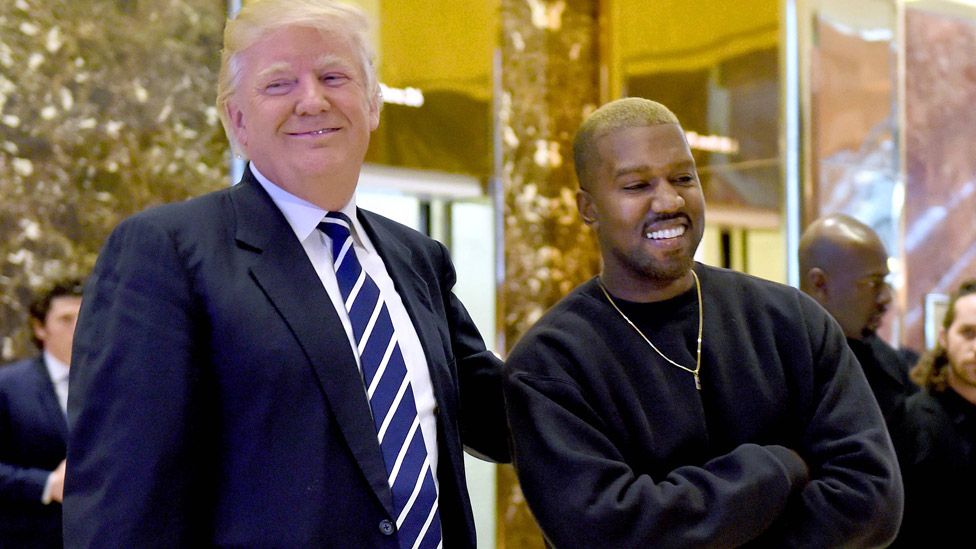
IMAGE SOURCE,AFP Image caption, West previously appeared to be on good terms with Trump
He provoked a storm of criticism after attending Paris Fashion Week in a T-shirt bearing the slogan “White Lives Matter” – a phrase adopted by white supremacists, who began using it in 2015 as a response to the Black Lives Matter movement.
West then claimed his critics were being paid by a secret cabal of Jewish people, a common trope of antisemitism.
As he continued to make antisemitic comments online and in television interviews, the 45-year-old was dropped by his talent agency, while fashion companies including Gap, Adidas and Balenciaga said they would no longer work with him.
The musician later commented that he had lost “two billion dollars in one day”.
Earlier this week, Rolling Stone magazine reported claims that West had used “porn, bullying and mind games” to create a “toxic environment” among Adidas employees working on his Yeezy brand shoes.
The company said on Thursday it had launched an independent investigation into the claims.
When West ran for president in 2020, he announced his campaign too late to appear on the ballot in at least six states.
He held only one rally, in which he broke down in tears as he discussed abortion, and funded two television adverts. In the end, he was only listed as a candidate in 12 states.
For his 2024 bid, the rapper suggested he had enlisted alt-right commentator Milo Yiannopoulos as his campaign manager.
A former editor at the right wing publication Breitbart, Mr Yiannopoulos was largely shunned by mainstream conservatives after a video emerged in 2017 of him appearing to condone paedophilia. He said the comments were “gallows humour” and stated his “disgust” at the sexual abuse of minors.
Most recently, Mr Yiannopolous worked as an intern for Republican congresswoman Marjorie Taylor Greene.
Last month (Oct. 3), the artist formerly known as Kanye West, sparked outrage across the country when he debuted his YZY Season 9’s new designs during Paris Fashion Week. The collection features a series of hoodies and shirts with the phrase “White Lives Matter” emblazoned on the back. The phrase itself is a hurtful message that was used in response to the “Black Lives Matter” slogan and civil rights movement which gained global attention in 2013. It has frequently been used by neo-Nazi leaders and Donald Trump supporters.
The YZY Season debut marked the beginning of a week-long rampage in which Ye spewed racist and antisemitic rhetoric on several high-profile platforms. His actions ultimately led to him losing major deals with Balenciaga, Adidas, and other companies.
Despite Ye’s cancellation, it was last reported that he was still hell-bent on selling his WLM shirts for $20. Luckily, two Black activists, Ramses Ja and Quinton Ward, are making it impossible for the disgraced rapper to sell his collection legally. Ja and Ward are the radio show hosts of Civic Cipher and, as of Oct. 28, they own the rights to the trademark.
“We hope that by having these conversations and talking about these issues, we’re empowering those allies to then take the conversations into their homes, into their circles, and talk with their racist uncles.”
Ja and Ward met nearly 15 years ago when they were building their solo careers in the radio and broadcast media industry. Civic Cipher came much later in their journey. The nationally syndicated radio show in Arizona came together in response to the summer 2020 protests against civil unrest in the aftermath of George Floyd’s murder by police in Minneapolis. “It is a show that was necessary in a hip-hop space because no such programming existed. People were protesting, crying, grieving, and dealing with their frustrations,” Ja explains. “In many cities, there was nothing in that space that really felt like they were giving back to the people who were creating the culture for them to profit from. In our own city, we realized that these protestors, organizers, very powerful women here in Phoenix, Arizona, had bullhorns and signs and brilliant messages, but they didn’t have the infrastructure to reach huge, massive crowds.”
The show hosts thoughtful and educational conversations on issues about race, police brutality, and politics. While their conversations speak directly to the Black experience, they also hold these spaces so non-Black people can listen and learn from the open dialogue. “We hope that by having these conversations and talking about these issues, we’re empowering those allies to then take the conversations into their homes, into their circles, and talk with their racist uncles. We give them the tools they need to diffuse this type of content throughout their circles as well,” Ja adds.
It’s their ability to tackle and discuss such heavy material that ultimately led them to owning the trademark. The “White Lives Matter” trademark was originally owned by another person around 2015. The previous owner, who prefers to remain anonymous, bought the trademark in hopes of keeping it out of the wrong hands during a period in which a spotlight was on Black Lives Matter and civil justice. Ward notes that the phrase had become irrelevant for the past few years, but Kanye’s collection brought newfound attention to it once again.
Image via Image via Civic Cipher/ Eric LaRokk
“Kanye West woke up something that was not in the forefront of anybody’s head right now. I can’t even remember [the last] time I saw or heard it,” Ward tells Complex. “So he jumped off of a cliff and threw that back into popular culture. There’s a lot going on in the world right now.”
With more eyes on the phrase than before, the anonymous owner, who happened to be a fan of Civic Cipher, contacted the hosts. “They explained to us they do not want to be the decider of something that does not affect them directly, in the way that it might affect Q and myself and our community,” Ja said of their conversation with the previous owner. After much consideration, Civic Cipher accepted the trademark as a gift. Both acknowledge the responsibility that comes with owning such a divisive phrase. “It’s a very, very heavy responsibility, but we’re here now, trying to navigate the best way to have something good come of this,” Ward says.
“We’re trying to navigate the best way to have something good come of this.”
A trademark refers to the legal ownership of a word, phrase, symbol or design that can be used to sell a product or service. In this case Civic Cipher LLC has the exclusive rights to the use of “White Lives Matter” on any article of clothing in the United States. This means, as Ja confirms, that “anyone else who sells clothing with that term on it printed anywhere, sewn, embroidered, anything like that, is infringing on our trademark and subject to a lawsuit from our lawyer.” And according to the hosts, the only way someone could use the phrase is if they bought it for $1 billion dollars. To date, Civic Cipher’s lawyers have sent at least 25 cease and desists to individuals that have attempted to sell products using the phrase, but they acknowledge that this can become expensive. Civic Cipher is accepting donations via their website to assist with legal fees, but ultimately, their intention of owning the phrase is to keep it out of the hands of individuals in power.
Image via Getty / Stringer / Jason Davis
The idea here was to keep a person from leaning into doing anything crazy, à la a Donald Trump-level figure. In recent weeks, we’ve seen a person with a lot of status maneuver in such a way to where this term has now become a conversation that people are having at dinner tables around the country,” Ja adds. “I feel like protecting it from an individual like that is realistic because those types of people don’t love lawsuits. If we want to nickel and dime people who are making 1,000 shirts here and there and selling them at Trump rallies, we can certainly do that. That’s a little bit more expensive, but not a fight that we are not willing to have.”
Complex spoke to Civic Cipher’s hosts about how they obtained the trademark, what they intend to do with it, and more, below:
This interview has been condensed and edited for clarity purposes.
What was the process like of getting the trademark for “White Lives Matter?”
Ramses Ja: We weren’t a part of the original acquisition of the trademark. In fact, it was originally registered in 2015 or ‘16. Basically, what happened was, yes, an individual had this trademark. They came to us after another well-known individual [Ye] started making headlines with this phrase, putting it on clothes. They felt like, “Uh oh. Something needs to be done. This might come back on me because I hold this trademark, and I don’t believe [in its messaging].” We don’t know much about the person, but that’s by design. They want to remain anonymous and a private citizen.
They felt like holding it and keeping it in a box wasn’t something they could do privately anymore because of the caliber of the individual who was wearing those shirts. So it occurred to them one day when listening to our show, that maybe we were the right folks to have a conversation with. They live in Arizona, where we live, so it felt like the alignment of the moon and stars and so forth. They reached out, and we had our conversation. They explained to us that they do not want to be the decider of something that does not affect them directly, in the way that it might affect Q and myself and our community. So they wanted to gift this. They had certain conditions with this gift that we intend to respect.
We accepted the responsibility that was asked of us, and here we are.
They said, “You guys are in a better position to decide what the highest good would be from this moment and from this instrument, this document that grants you the rights to make and produce and sell this clothing with this mark, but more importantly prevents other people from doing it. You decide what’s best for your community. I have done my part. I do believe you two, based on the temperament that you have on your show and the caliber of men I believe you to be, to be the next step in this process.” After a lot of deliberation between Q and I, because you can imagine, that’s not something anybody really wants to be associated with, we got everything in line. We accepted the responsibility that was asked of us, and here we are.
What do you feel is your responsibility now that you own the trademark to this phrase? Quinton Ward: The term in and of itself, and all terms in this age that end with “lives matter,” are just contrary to Black Lives Matter. We started saying, as we were being killed on video with impunity, “Hey, everybody, we deserve to exist. Our lives matter.” Then a bunch of people said, “No, all lives matter. No, blue lives matter. No, white lives matter.” It was not just someone echoing their right to exist. It wasn’t like, “Well, yes, Black Lives Matter, and our lives matter, too.” It was just being contrarian to the idea that Black Lives Matter. All of those terms hurt. The way it was presented, a lot of people want to argue that the person in question had some deeper philosophical meaning to wearing that shirt, but all you have to do is look at who he was standing with to know exactly where he was coming from.
Us being hurt and triggered and traumatized by that is our right and is very, very normal, based upon the things that Black Lives Matter was born from. Trayvon Martin was stalked and murdered by someone, and that person has not spent a single day even being sorry. That person went on tour around the country, grossly autographing bags of Skittles because he was celebrated by some of the most disgusting people in the world that thought it was okay, that because this young Black kid had a hoodie on that he could be murdered and that someone could get off for it and be celebrated. George Floyd, we watched him die on video. Us saying Black Lives Matter was in response to that. It’s a very, very heavy responsibility, but we’re here now, trying to navigate the best way to have something good come of this besides some billionaire thinking we should wear this shirt for fashion, that triggers and brings back trauma for millions of people in this country.
Some people perceived Kanye’s shirts and the phrase to be an ironic message. Do you think it is possible for a term that holds so much weight to be used in fashion ironically or to send a larger message?
QW: I’ve never heard him suggest it. I just heard a bunch of people who are fans of his suggest it on his behalf. Him standing locked arms with Candace Owens made it very, very clear that he wasn’t trying to be ironic. He wasn’t even trying to be a unifier. She is a very, very divisive, extreme person in her thoughts and beliefs. She released a documentary trying to debunk everything that we know to be true about the murder of George Floyd, on his birthday. We’re not going to pretend that this is a decent person.
“He can’t be a genius who also pretends that he doesn’t know that these things hurt.”
To wear that shirt, locked arms with her, and to put it out in a way that he did, to stir up controversy, to be a troll, to get attention, whatever the reasons are, we’re either going to call him a genius and then call him evil, or we’re going to call him ignorant. He can’t be both. He can’t be a genius who also pretends that he doesn’t know that these things hurt. In my opinion, it would be very difficult to try to claim it and repurpose it for good because in the same way it’d be hard for us to come out here and try to do a white power shirt and try to reclaim that for us. Black power and white power are not just antonyms. They have no similarities except for the word power. One of those is a uniter and an uplifter and a reaffirmer, and one of those is an oppressor and placing people beneath.
RJ: Kanye West specifically, once upon a time, had a shirt where he used the Confederate flag in one of his fashion things. People were asking him about it. Kanye is not from the South. He’s from Chicago. People were asking him, “Yo, what’s this about?” He says he’s reclaiming it. I think that one of the things that we all have to consider is, if you’re doing something, it needs to create the most good. To think of things almost like business decisions, because business decisions are easy, they tend to make themselves. If most people would be hurt or offended by something, it doesn’t make sense to offend most people and try to change most people’s view of history and connection with racist symbols. There’s a lot of hurt behind that. That flag was waving when people were hung from trees by their neck. People’s ancestors. That’s a part of American history. That’s a part of Black history in this country. So to say, “No, we’re reclaiming it,” ignores the fact that there are centuries of hurt behind that. For this one individual to say, “I’m going to change the narrative,” it dismisses everyone else’s. It’s a very selfish thing to do. I think it’s very similar when we’re looking at something as divisive as white lives matter.
Image via Civic Cipher/ Eric LaRokk
What is the significance of two Black men owning the rights to this phrase?
RJ: I think the optics there matter primarily because recently there was a Black man who was popularizing this phrase and effectively making it OK for non-Black people to wear and share this very hurtful message. For Black people to reclaim that, I’ll never say it was almost worth going through it, but I recognize reading the comments that we see on social media, that people feel like they’ve gotten back a little bit of justice. Bear in mind, this isn’t ours. We didn’t think of this. We’re just at the center of it, for better or worse. This is really Black people’s moment.
“For this one individual to say, ‘I’m going to change the narrative,’ it dismisses everyone else’s. It’s a very selfish thing to do.”
We are just the deciders and the holders of this tool at present. We’re a radio show. We’re two friends. We are not lawyers. We are not trademark people. But for now, it’s important for Black people to sit back and say, “Yes, we needed that. We needed that this month.” It’s like poetic justice… I couldn’t be happier that there are two Black men holding the keys to the future of this phrase. No matter what comes, we are committed to always choosing the highest good or doing the thing that impacts the most number of people positively in our estimation. We’re not trying to be contrarian and change the world by hurting people. You can get a lot more flies with honey than you can with vinegar. We want to make sure that we inspire people, and we don’t hurt them. So here we are. Two Black men.
What do you predict the impact you owning this trademark will have on its use by others?
RJ: We’re learning trademark stuff, too, and in real time because, again, we didn’t expect to be talking to someone as cool as you. The intention was to make sure that a person who has a profile larger than your everyman profile, someone who has real capacity to impact the culture and to change the narrative or to shift the optics of the narrative for a certain group of people in this country, to thinking that it’s OK to wear these type of clothes. The idea here was to keep a person in that position from leaning into doing anything crazy, à la a Donald Trump-level figure. In recent weeks, we’ve seen a person with a lot of status maneuver in such a way to where this term has now become a conversation that people are having at dinner tables around the country. I feel like protecting it from an individual like that is, A, realistic because those types of people don’t love lawsuits. If we want to nickel and dime people who are making a thousand shirts here and there and selling them at Trump rallies, we can certainly do that. That’s a little bit more expensive, but not a fight that we are not willing to have.
QW: At the time that this really became a hot topic, it was at Fashion Week. At that time, Kanye West had billion dollar partnerships with major fashion corporations. So our holding of the trademark stopped people with that level of reach and that level of access to manufacture and distribute such a hateful shirt and such a divisive shirt, from doing so. Like Ramses said, any screen printer in any city can print as many of those shirts as they want, give them out for free or sell them because we just don’t have the capacity to police it on that level. But someone like him, with that level of influence and that level of visibility, it was very, very important. It could be very, very impactful in stopping a Fashion Week show from turning into major fashion with a phrase that was come up with to oppose and be contrarian to the idea that our lives are worth living.
What do you hope will be the final outcome after this?
RJ: We understand the way news works. Six months from now and a year from now, this may not be something that people are talking about. After the next presidential election, depending on how that goes, this specific phrase may be far in the rear view and may not need as vigorous of protecting. At present, we’re just focused on making sure that people aren’t harmed in a significant way and that no one is profiting from this hateful phrase.
QW: Best case scenario, it just goes away. Nobody wants to sell the shirts. Nobody’s saying the phrase. It’s not popular anymore. It’s not buzzing. It’s not hot.
Ramses Ja and Quinton Ward, two Blackactivists who own the rights to “White Lives Matter,” are willing to sell the phrase to Kanye West for a hefty price tag.
As previously reported, Kanye sparked outrage in October when he debuted the “White Lives Matter” designs during the YZY Season 9 fashion show. Last week, Ja and Ward, who host the nationally syndicated radio show Civic Cipher, revealed they were gifted the trademark from an anonymous benefactor sometime in September, shortly before Kanye unveiled the shirts.
While speaking with TMZ this weekend, the radio hosts admitted that, though they’re not looking to sell the trademark, they’d surely consider doing so should someone propose an enticing offer. “Any potential buyer would have to come up with a $1 billion offer to even make them consider selling,” the outlet notes.
The news comes on the heels of Ja and Ward’s recent conversation with ABC News, in which the pair maintained that no one in America can legally sell any “White Lives Matter” products without receiving their authorization. In other words, anyone who was trying to generate a profit from the phrase would have to enter negotiations with the pair’s legal team, and potentially face a lawsuit.
“I recognize that one of two things could happen. Someone could come to our lawyer or us and say, ‘Hey, you have the exclusive right to make and sell those clothes in the United States of America. I would like to buy the trademark for millions of dollars,’” Ja told Capital B News.
“If we were to sell that trademark, for whatever amount of money, we could donate that money to causes that we feel would benefit Black people, like the NAACP or Black Lives Matter organizations. Because, realistically, we cannot stop the shirts from being made right now. We can write cease and desist to people selling these shirts right now, but that is a big monster that requires teams of lawyers and thousands of dollars that we do not have.”
In a post shared on his Instagram Story, Meek Mill has given his thoughts on the artist formerly known as Kanye West amid his “White Lives Matter” t-shirt controversy.
“I used to listen to ye every night and jail for motivation on god!” Meek wrote. “And came home and watched him shit on my name and brand like nothing …. I ain’t say nothing … but I been knew you was on that nerd tryna shit on street n***as you just said it to boosie. It hurts my heart to even know some of y’all this crazy and lame … ion need no verses from no n***as because I been hot since 13 @justinlaboy don’t invite me to none of them weird ass parties wit bro.”
In the post, which was accompanied by a clip of Ye criticizing the lyrical content of popular hip-hop songs, Meek suggested that the 45-year-old multi-hyphenate has internalized racism.
“What you be doing for fame driving you crazy… look how hard you came at me n***as know I’m vocal it’s like you hate your own people,” he continued. “You ain’t even post @vory album after all that work he did for you and he look up to you … you made sure you said Jack Harlow was the hottest in Kentucky overlooked est and vory.”
Ye, who has only doubled down on his “White Lives Matter” stance in a bizarre interview with Tucker Carlson, hasn’t responded to Meek’s comments yet. However, almost every celebrity who has been critical of him has received an intense post on Instagram calling them out. Gigi Hadid, Hailey Bieber, Diddy, and Supreme creative director Tremaine Emory have all faced Ye’s wrath over the past week.
Days after Kanye West exhibited a “White Lives Matter” T-shirt design at Paris Fashion Week, Adidas claims that it is examining its Yeezy collaboration with the rapper.
The company stated that “successful partnerships are founded in mutual respect and shared principles” without mentioning the controversy.
The rapper and fashion designer responded on Instagram, claiming the firm “stole” his designs.
A spokesperson for the German sportswear company also said that the “Adidas Yeezy partnership is one of the most successful collaborations in our industry’s history.”
In his Instagram post, Mr West also used a strong expletive, adding “I AM ADIDAS.”
Earlier this week, he was criticised after he presented a collection at Paris Fashion Week that included T-shirts with the slogan “White Lives Matter”.
The phrase Black Lives Matter, which represents opposition to racism and police brutality, was widely used after George Floyd, an unarmed black man, was killed by a police officer in Minneapolis in the summer of 2020.
Vogue’s Gabriella Karefa-Johnson, who is global fashion editor-at-large at the fashion magazine, was among those that criticised West over the T-shirts, calling the move “hugely irresponsible.”
In response, Mr West responded by lashing out at Ms Karefa-Johnson and posting photographs of her mocking her appearance to his 17.9 million followers.
In a statement, Vogue said it “stands with Gabriella Karefa-Johnson”.
“She was personally targeted and bullied. It is unacceptable. Now, more than ever, voices like hers are needed and in a private meeting with Ye today she once again spoke her truth in a way she felt best, on her terms.”
IMAGE SOURCE, GETTY IMAGES Image caption, Vogue editor Gabriella Karefa-Johnson at this year’s Paris Fashion Week
The almost decade-long partnership between Adidas and West has been strained for some time.
At the centre of their collaboration is a hugely popular range of sneakers – known as Yeezy – which cost hundreds of dollars, with new releases often selling out within minutes.
In June, he accused Adidas of making a shoe that looked similar to the distinctive Yeezy design, but was not part of their deal.
Adidas said it will continue to co-manage the partnership while the review is underway.
The announcement from Adidas comes less than a month after West’s lawyers sent a letter to fashion chain Gap to say he would no longer work with the firm.
Selah Marley has come under fire for rocking Ye’s “White Lives Matter” shirt, and she’s not having it. After the model received backlash for wearing the controversial tee, she responded early on Wednesday morning, taking to her Instagram stories to call out the “hive mentality” she sees in her detractors.
“The past 24 hours has allowed me to realize that most of yall are stuck in a hive mentality. You do what the group tells you to do and think what the group tells you to think,” Bob Marley’s 23-year-old granddaughter said. “Witnessing someone break free from ‘the agenda’ sends you all into such a panic that you will do whatever it takes to force them back into the box that you feel they should exist in.”
Lauryn Hill’s daughter then doubled down on her stance, claiming she did nothing wrong and expressing she wouldn’t allow the internet to “bully” or “manipulate” her.
“You cannot bully me, manipulate me, or coax me into silence. Nor will you bully me into being who I don’t want to be. I don’t care how many tweets you make, DMs you send, or articles you write.
“Throughout all the chaos, I have yet to speak about my experience. If you know me, you know that nothing I do is without deep thought and intention. Wait til you hear what I have to say.”
After her flurry of IG stories, she shifted her attention to Kanye himself, revealing a text message she sent him. The screen grab showed the Marley descendent asking the Chicago designer to expand the conversation and continue the dialogue around the “White Lives Matter” t-shirt.
Kanye West debuted the shirt during his YZY SZN 9 fashion show during the 2022 Paris Fashion Week. He wore the controversial garment as he addressed the intimate crowd, lecturing them on bullies in the fashion industry.
As his shirt and show received backlash, West claimed that the Black Lives Matter movement was a scam.
Selah Marley, the daughter of Lauryn Hill, is defending her choice to participate in Kanye West’s Yeezy fashion show, where Black models donned his YZYSZN9 line, which included T-shirts emblazoned with the phrase “White Lives Matter,” which caused quite the online uproar.
Marley, 23, participated in the surprise Paris fashion show, confidently modeling one of the custom WLM shirts on the runway.
On Tuesday, Marley confronted spectators following the high volume of backlash, including comments, DMS, and tags after being seen in the shirt. She addressed the matter via her Instagram Story, sharing that she won’t be bullied out of her personal beliefs.
“The past 24 hours as allowed me to realize that most of yall are stuck in a hive mentality,” she began in the post. “You do what the group tells you to do and think what the group tells you to think. Witnessing someone break free from ‘the agenda’ sends you all into such a panic that you will do whatever it takes to force them back into the box that you feel they should exist in.”
Lauryn Hill’s daughter, Selah Marley, is defending her decision to walk in Kanye West’s Yeezy fashion show, where Black models wore his YZYSZN9 collection, including T-shirts embellished with the words “White Lives Matter,” which sparked quite the outrage online.
Marley, 23, participated in the surprise Paris fashion show, confidently modeling one of the custom WLM shirts on the runway.
On Tuesday, Marley confronted spectators following the high volume of backlash, including comments, DMS, and tags after being seen in the shirt. She addressed the matter via her Instagram Story, sharing that she won’t be bullied out of her personal beliefs.
“The past 24 hours as allowed me to realize that most of yall are stuck in a hive mentality,” she began in the post. “You do what the group tells you to do and think what the group tells you to think. Witnessing someone break free from ‘the agenda’ sends you all into such a panic that you will do whatever it takes to force them back into the box that you feel they should exist in.”
“You cannot bully me, manipulate me, or coax me into silence. Nor will you bully me into being who I don’t want to be,” she said. “I don’t care how many tweets you make, DMs you send, or articles you write.”
Marley stands by the decision to wear the shirt, especially since it was done with “deep thought and intention.” Marley suggested she would speak more on the topic later and even shared a text message she sent to Ye about having a conversation on the dislike surrounding the shirts and their intention.
“[I] think what we did has obviously created a lot of conversation& [I] would like us to continue that conversation & provide the necessary depth & clarity that we are both extremely capable of,” one of Marley’s texts read.
Fans were outraged by Marley’s stance, questioning how she got to these viewpoints with having such deep-rooted Black parents in the culture. These were some of the responses:
Another Black woman defending Ye is far-right analyst Candace Owens. The latter posted a photo of her and Ye behind the scenes of his surprise Yeezy fashion show sporting the problematic T-shirt with smiles on their face.
Owens defended her choice of wearing the shirt on her Daily Wire podcast by stating there are far more extraordinary circumstances for Black people to pay attention to other than the t-shirt. During her defense rant, Owens listed Black-on-Black crime, education, and obesity while mentioning “Rumors” artist Lizzo distastefully regarding her weight while supporting her argument.
“You know what we should’ve done, we should’ve put a ‘White Lives Matter t-shirt on Lizzo,” Owens said. “Maybe we could have gotten a lot of attention about obesity and how it’s actually killing black Americans.”
Owens went on to say that in her world, all lives matter, and no one specific life is special. She also mentioned a few words on a t-shirt should not dismantle the internet as it did following the picture of her and Ye.
“There is a deep irony and a sad irony when you consider that wearing a t-shirt has led to such a tremor throughout the world. A t-shirt that says ‘White Lives Matters,’ which should be implied,” Owens said. “White lives matter, black lives matter, Asian lives matter — it should be implied, yet people are angry, and they are being vicious online because they can’t believe that we have the audacity to detract from the movement, which is a lie: “Black Lives Matter.”
Another celebrity guest and model asked to wear the divisive gear was Jaden Smith. Smith tweeted about his disappointmentin the choice of apparel and questioned Ye’s leadership.
“I Had To Dip. I Don’t Care Who’s It Is If I Don’t Feel The Message I’m Out,” Jaden tweeted.
“True Leaders Lead. Black Lives Matter,” he added.
According to Newsweek, The Anti-Defamation League (ADL) states the term “White Lives Matter” as a hate slogan used by white supremacists and the Ku Klux Klan.