It appears that Kate Middleton and Prince William will soon be adding a new home to their growing collection.The Sun reports that King Charles has “earmarked” Frogmore House for the new Prince and Princess of Wales,
The house (really, it’s a full-blown mansion) was built in 1684 on the Windsor Estate,and if it sounds familiar that might be because it was the location of Meghan Markle and Prince Harry’s wedding reception. And speaking of the Sussexes, Frogmore House is fully different from their home Frogmore Cottage—which is nearby and also on the Windsor Estate.
A reminder that William and Kate literally just moved from their country home Anmer Hall to Adelaide Cottage, and apparently they aren’t super thrilled about the prospect of moving again now that Charles is King and royal property re-shuffle is taking place. But The Sun reports that while there’s no info on what “the Wales family would do” with Frogmore House, its “attraction may be too great to ignore.”
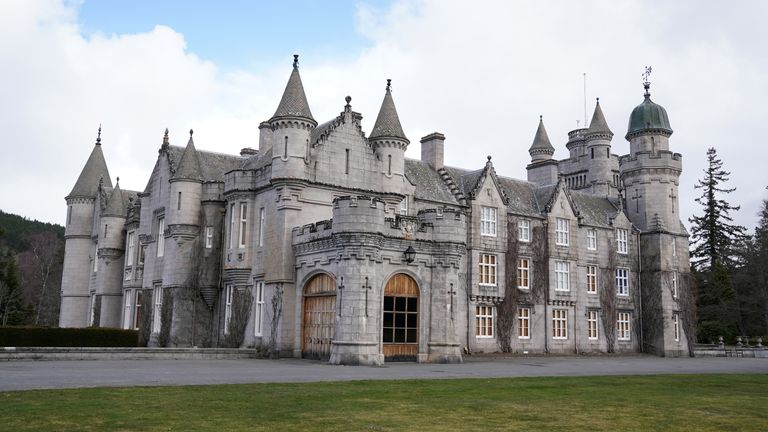
Meanwhile, The Daily Mail recently reported that there’s a “radical drive to overhaul the vast Royal estate,” and there was even some talk of moving William and Kate into Windsor Castle proper. As the outlet put it: “Charles’s wide-ranging plans include turning Balmoral into a museum to the Queen and moving the Duke and Duchess of Cambridge into Windsor Castle.”
“The Prince of Wales [now King Charles] strongly believes that these places have got to deliver something for the public beyond just being somewhere for members of the Royal Family to live,” a source said. “Everything is seen through the lens of the question: ‘What value is this offering to the public? Everybody recognizes it makes no sense to run so many residences but if you give them up entirely you will never get them back when Prince George and the younger Royals grow up and need somewhere to live.”
On the eve of the Queen’s burial, Buckingham Palaceunveiled a never-before-seen portrait of her smiling brilliantly.
The image, taken by photographer Ranald Mackechnie in May prior to the Platinum Jubilee celebrations, depicts the late queen visiting Windsor Castle wearing a blue dress.
The portrait of her beaming at the camera was released as the Queen Consort paid a televised tribute on Sunday evening, recalling her “wonderful blue eyes” and “unforgettable smile”.
As well to her favourite three-strand pearl necklace, in the portrait, the Queen wore aquamarine and diamond clip brooches which were an 18th birthday present from her father, George VI, in 1944.
She wore the brooches when she addressed the nation on the 75th anniversary of VE Day in 2020 and for her televised speech on her Diamond Jubilee in 2012.
Mr Mackechnie also took the Queen’s Platinum Jubilee portrait, which was released in June to mark the start of national celebrations for her 70-year reign, the longest of any British monarch.
The late Queen Elizabeth II‘s body will begin its final journey as part of a grand state funeral later after spending days lying in state. It will first travel to Westminster Abbey for a religious service in front of thousands of people, then move on to Windsor Castle for a more personal committal service, and finally, a private burial.
It will be a day filled with emotion, grandeur, and ceremony unseen since Winston Churchill’s last state burial over 60 years ago.
The Queen’s lying-in-state at Westminster Hall in the heart of London, where people queued for hours to view her coffin, has now come to an end. A short distance away, at Westminster Abbey, the doors have opened for guests to start arriving ahead of the funeral service at 11:00.
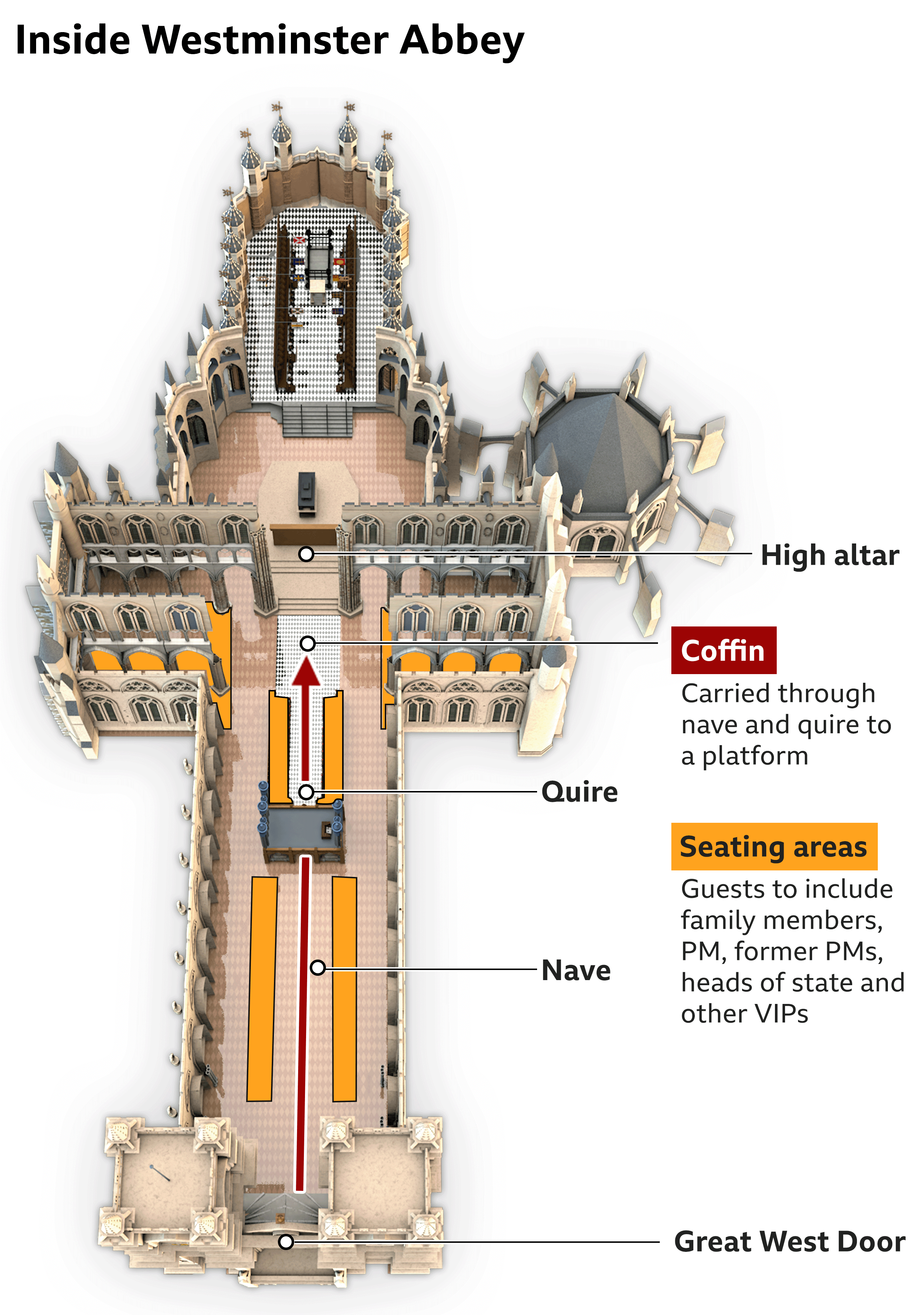
Heads of state from across the world have been flying in to join members of the Royal Family to remember the Queen’s life and service. Senior UK politicians and former prime ministers will also be there.
Members of royal families from across Europe, many of whom were blood relatives of the Queen, are expected – Belgium’s King Philippe and Queen Mathilde and Spain’s King Felipe and Queen Letizia will be there.
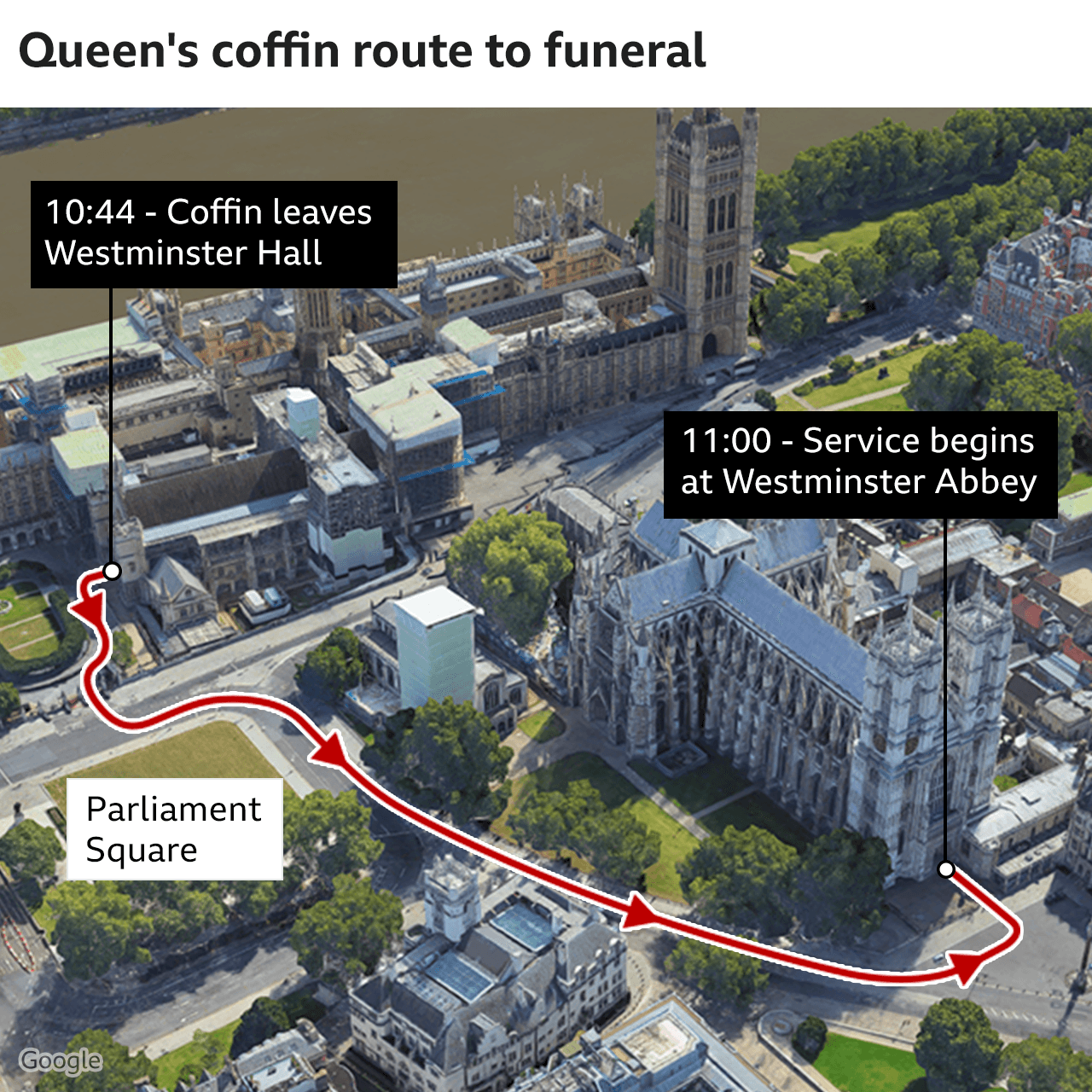
At this point, the ceremonial part of the day will begin in earnest, as the Queen’s coffin is lifted from the catafalque where it has been resting since Wednesday afternoon, and taken to Westminster Abbey, for her funeral service.
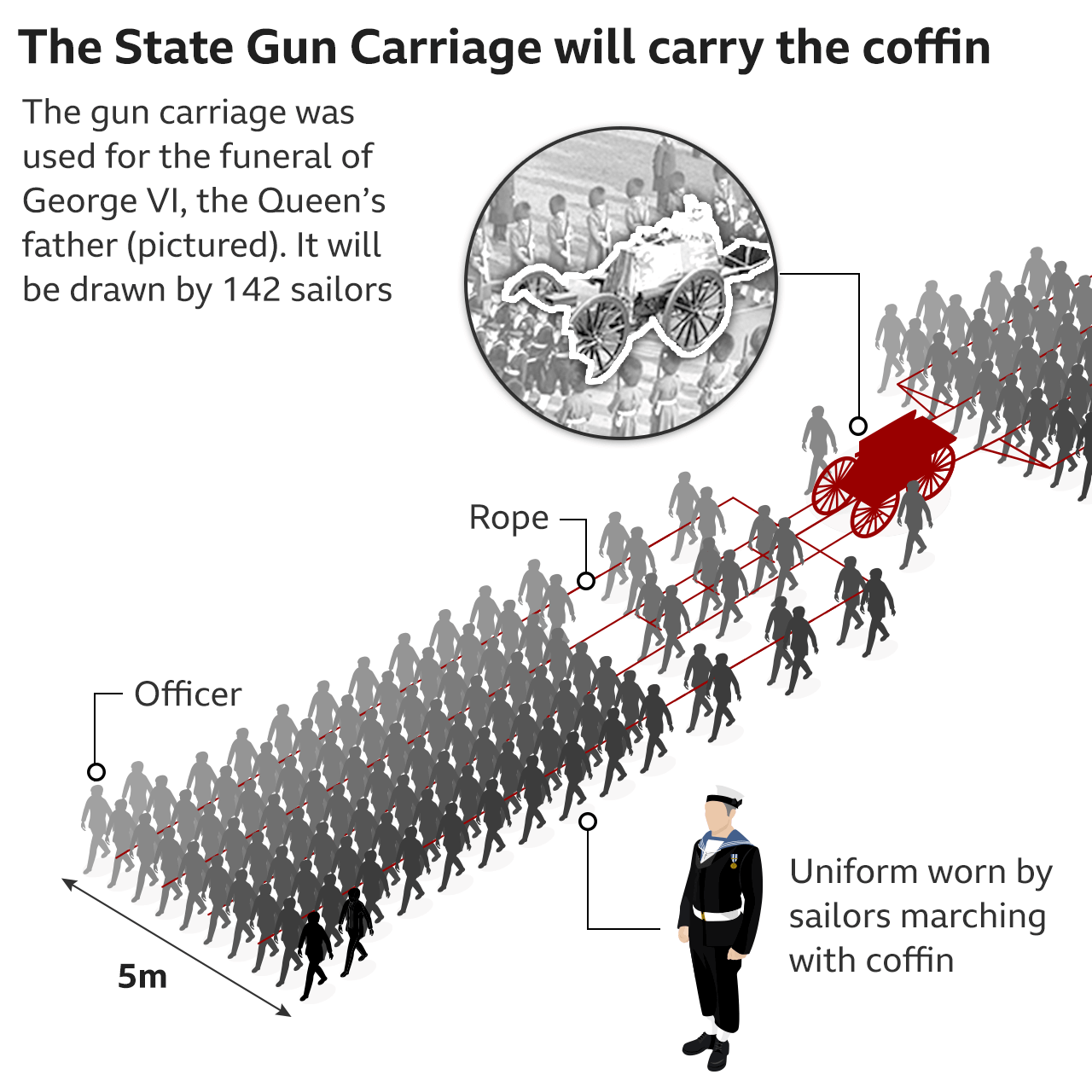
She will be carried on the State Gun Carriage of the Royal Navy, drawn by 142 sailors. The carriage was last seen in 1979 for the funeral of Prince Philip’s uncle, Lord Mountbatten and was used for the Queen’s father, George VI, in 1952.
Senior members of the Royal Family, including the new king and his sons Prince William and Prince Harry, will follow the gun carriage in procession.
The Pipes and Drums of the Scottish and Irish regiments will lead the ceremony, along with members of the Royal Air Force and the Gurkhas.
The route will be lined by the Royal Navy and Royal Marines and a guard of honour will stand in Parliament Square made up of all three military services, accompanied by a Royal Marines band.
The Queen’s funeral service, expected to be attended by 2,000 guests, will begin at Westminster Abbey.
It will be a state funeral – an event typically reserved for kings or queens, which follows strict rules of protocol, such as a military procession and the lying-in-state.
The abbey, hosting the funeral service, is the historic church where Britain’s kings and queens are crowned, including the Queen’s own coronation in 1953. It was also where the then-Princess Elizabeth married Prince Philip in 1947.
There hasn’t been a monarch’s funeral service in the abbey since the 18th Century, although the funeral of the Queen Mother was held there in 2002.
The service will be conducted by the Dean of Westminster David Hoyle, with the Archbishop of Canterbury Justin Welby giving the sermon. Prime Minister Liz Truss will read a lesson.
Towards the end of the funeral service the Last Post – a short bugle call – will be played followed by a two-minute national silence.
The national anthem and a lament played by the Queen’s piper will bring the service to an end at about midday.
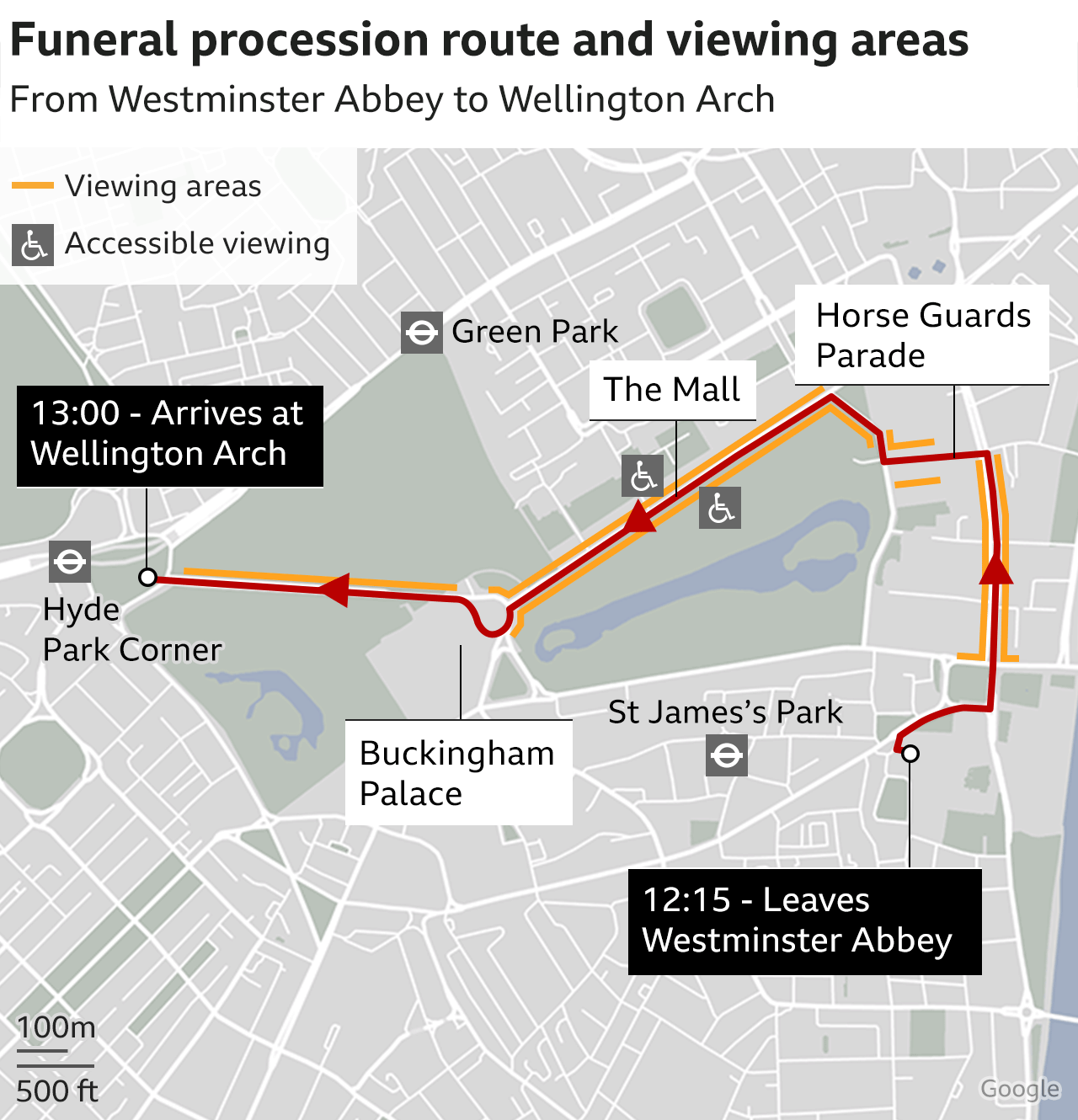
Following the service, the Queen’s coffin will be drawn in a walking procession from Westminster Abbey to Wellington Arch, at London’s Hyde Park Corner.
With the route lined with military personnel and police, Big Ben will toll at one-minute intervals as the procession moves slowly through the streets of the capital. Gun salutes will also fire every minute from Hyde Park.
People can watch the procession in person from designated viewing areas along the route.
The procession, led by the Royal Canadian Mounted Police, will be made up of seven groups, each with its own band. Members of the armed services from the UK and the Commonwealth, the police and the NHS will also be involved.
Once again the King will lead members of the Royal Family walking behind the gun carriage bearing the Queen’s coffin.
Camilla, the Queen Consort, the Princess of Wales, the Countess of Wessex and the Duchess of Sussex will join the procession in cars.
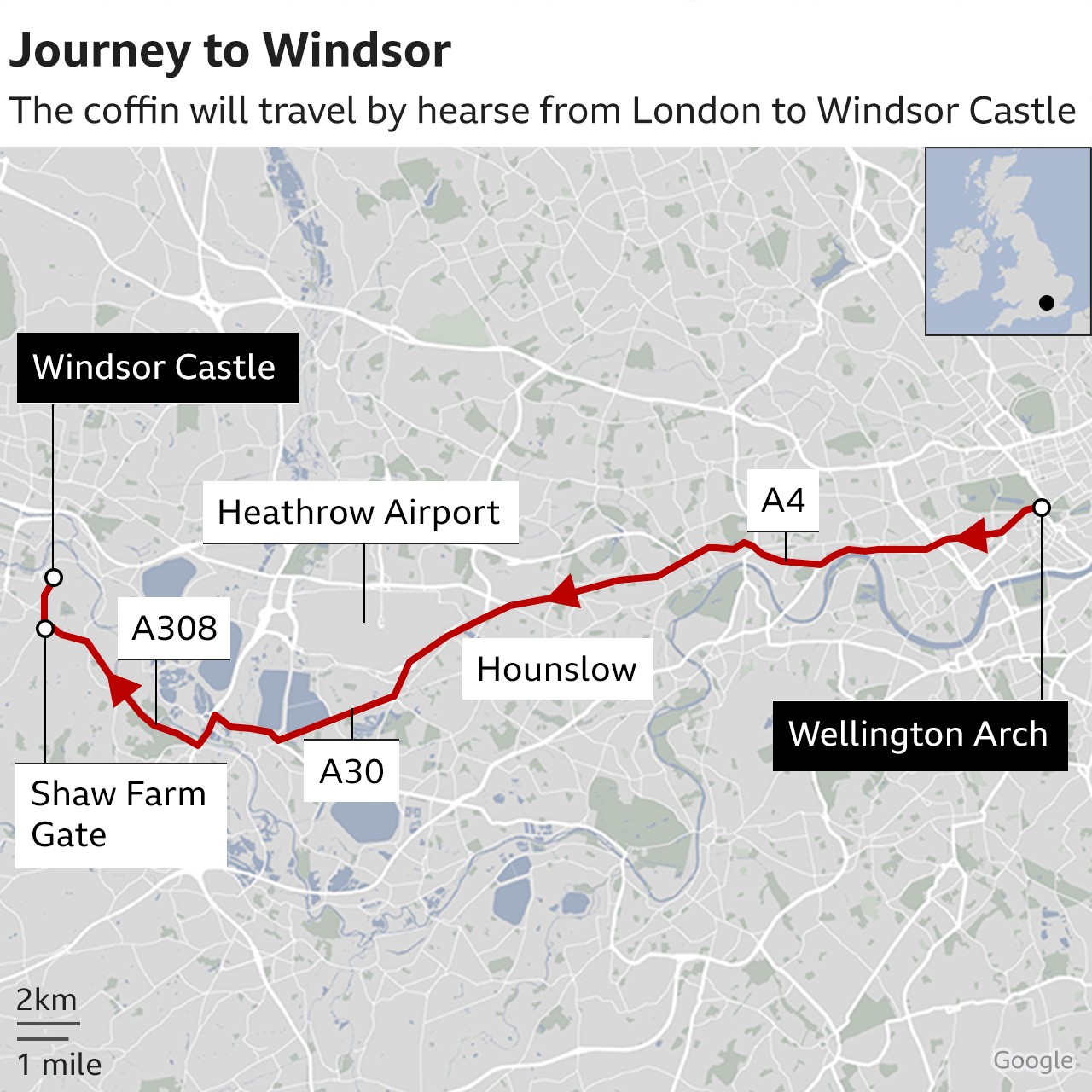
Once at Wellington Arch, at about 13:00, the coffin will be transferred to the new State Hearse for its final journey to Windsor Castle.
The castle, continuously inhabited by 40 monarchs across almost 1,000 years, had special significance to the Queen throughout her life. As a teenager she was sent to the castle during the war years as London faced the threat of bombing, and more recently she made it her permanent home during the coronavirus pandemic.
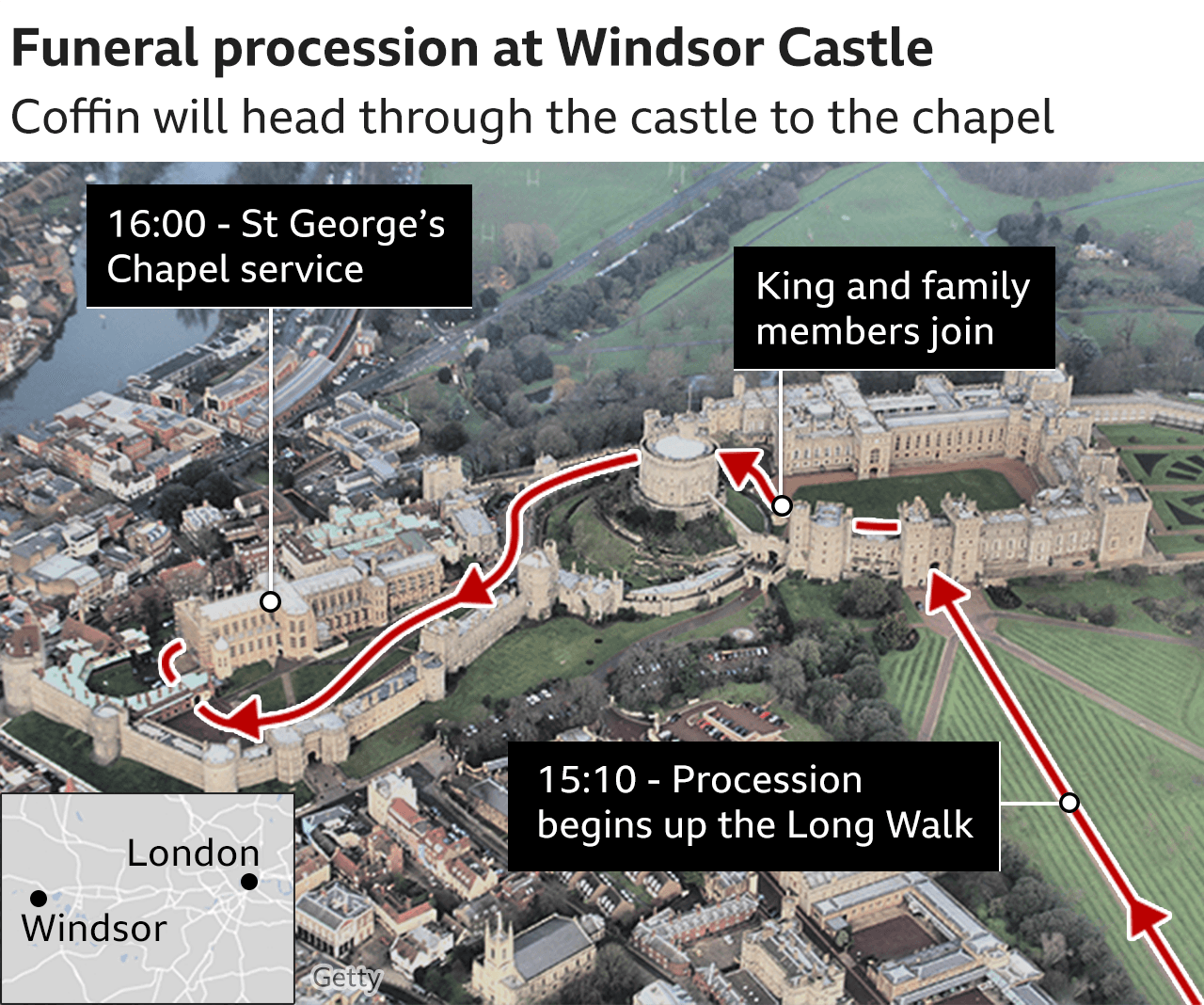
The hearse is expected to arrive for a walking procession up Windsor Castle’s Long Walk. The three-mile (5km) avenue will be lined with members of the armed forces.
Members of the public will be allowed access to the Long Walk to watch the procession pass.
The King and senior members of the Royal Family are expected to join the cortege in the Quadrangle in Windsor Castle a little later.
The castle’s Sebastopol and Curfew Tower bells will be tolled every minute and gun salutes will be fired from the castle’s grounds.
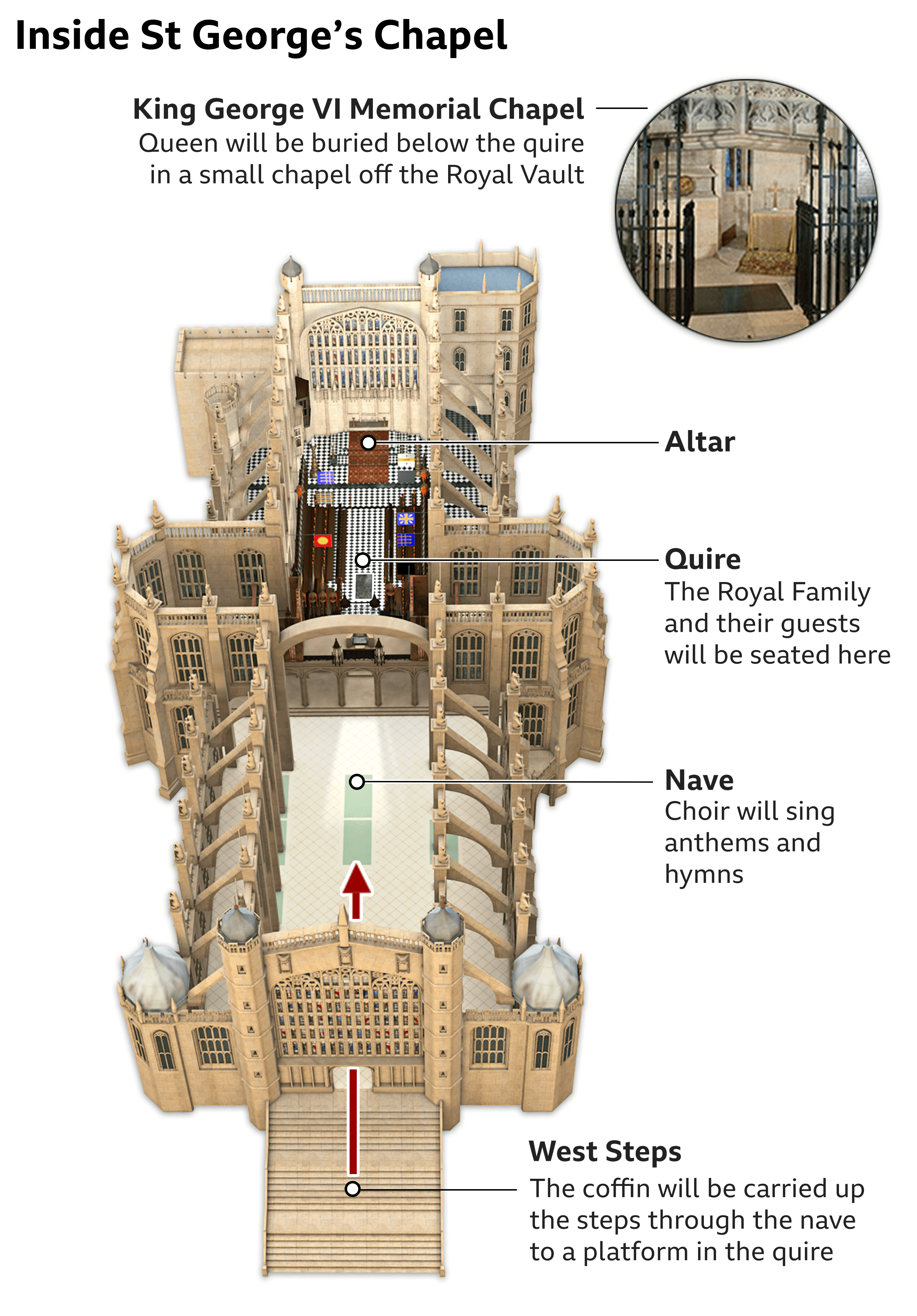
Then the coffin will enter St George’s Chapel for a committal service.
St George’s Chapel is the church regularly chosen by the Royal Family for weddings, christenings and funerals. It is where the Duke and Duchess of Sussex, Prince Harry and Meghan, were married in 2018 and where the Queen’s late husband Prince Philip’s funeral was held.
Attended by a smaller, more personal congregation of about 800 guests, the committal service will be conducted by Dean of Windsor David Conner, with a blessing from Archbishop of Canterbury Justin Welby.
The service will include traditions symbolising the end of the Queen’s reign.
The Imperial State Crown and the Sovereign’s orb and sceptre will be removed from the top of the coffin by the Crown Jeweller, separating the Queen from her crown for the final time.
At the end of the last hymn, the King will then place the Queen’s company camp colour, or flag, of the Grenadier Guards on the coffin. The Grenadier Guards are the most senior of the Foot Guards carrying out ceremonial duties for the monarch.
At the same time, the Lord Chamberlain, former MI5 chief Baron Parker, will “break” his wand of office and place it on the coffin. The snapping of the white staff will signal the end of his service to the sovereign as her most senior official in the Royal Household.
The Queen will then be lowered into the royal vault and the Sovereign’s piper will play before a blessing and the singing of God Save the King. The performance by the piper at Windsor was something the Queen had personally requested, Buckingham Palace said.
The committal service will come to an end and the King and members of the Royal Family will leave the chapel.
That evening, at a private family service, the Queen will be buried together with her late husband, the Duke of Edinburgh, at the King George VI memorial chapel, located inside St George’s Chapel.
Her marble slab will be engraved ELIZABETH II 1926-2022.
“This means that the Privy Council meeting that had been due to take place this evening will be rearranged.”
The Queen remains at Balmoral Castle, where she appointed Liz Truss as the new prime minister on Tuesday.
The Queen appointed new prime minister Liz Truss on Tuesday
The latest advice does not involve a hospital stay for the 96-year-old monarch, who has ongoing mobility issues.
She had been due to hold the Privy Council virtually on Wednesday.
During the proceedings, Ms Truss would have taken her oath as First Lord of the Treasury and new cabinet ministers would have been sworn into their roles, and also made privy counselors if not already appointed as one in past.
The Queen appointed the new prime minister at Balmoral for the first time in her reign, in a break from tradition.
In June, she missed Royal Ascot for the first time since her coronation, with the Duke of Kent taking her place in leading the royal carriage procession.
Earlier in May, the Queen missed the State Opening of Parliament for the first time in 59 years on doctors’ orders after experiencing “episodic mobility issues”.
And she withdrew from the traditional Easter Sunday service at St George’s Chapel in Windsor this year.
The Queen also contracted COVID-19 back in February, and later spoke about how it left her feeling “very tired and exhausted”.
The British monarch, Queen Elizabeth has experienced mobility problems since last autumn, and she now frequently employs a walking stick. She had to reschedule a number of public events earlier this year, which meant that she significantly missed her Platinum Jubilee celebrations.
The Queen will receive the new prime minister at her Balmoral estate in Scotland for the first time in her long reign.
Her Majesty will meet them on 6 September, a day after the new prime minister is announced.
She would normally appoint prime ministers from Buckingham Palace or Windsor Castle.
However, the 96-year-old monarch has been advised to remain at her Balmoral residence in Aberdeenshire, where she is enjoying her summer holiday.
It will be from there that she will install either Rishi Sunak or Liz Truss as prime minister on 6 September, breaking years of royal precedent.
It is understood the decision was taken at this stage in order to provide certainty for the prime minister’s diary.
If the Queen had experienced an episodic mobility issue next week and the plan had been to travel to London or Windsor, it would have led to alternative arrangements needing to be made at the last minute.
Since last autumn, the Queen has suffered from mobility issues and now regularly uses a walking stick.
This year, she has been forced to cut several official engagements short, and she notably missed much of her Platinum Jubilee celebrations, only appearing briefly on the palace balcony.
In June, she missed Royal Ascot for the first time since her coronation, with the Duke of Kent taking her place in leading the royal carriage procession.
She also contracted COVID-19 back in February, and later spoke about how it left her feeling “very tired and exhausted”.
The winner of the Tory leadership contest to succeed Boris Johnson is set to be announced on Monday 5 September.
His successor will then travel to Balmoral to be officially appointed by the Queen the following day.