Tag: woman

  • Connecticut woman gives birth on flight, here’s what was listed as baby’s place of birth

    A pregnant Connecticut woman who was six weeks due unexpectedly gave birth to her son during a September flight to the Dominican Republic. In an interview with WFSB, Kendria Rhoden said she was sleeping on the flight when her son decided it was time to be welcomed into the world.

    “Everything just happened so fast, it just happened so quick,” Rhoden recalled. “While I was asleep I felt someone kick me in my stomach and then my water broke.”

    Rhoden was eventually helped by nurses who were on the flight. But her delivery did not take that long. “They were like ‘oh don’t push, don’t push because we don’t see any head,’” Rhoden recalled. “I’m like ‘the babies [sic] coming!’”

    Rhoden decided to name her son Skylen to represent his unexpected place of birth. Following his birth, the mother and son ended up remaining in the Dominican Republic for a few weeks. But they experienced some setbacks. They eventually returned to the United States where little Skylen was evaluated at a hospital.

    “I feel good now because I’m home and he’s safe, he’s where he needs to be right now,” said Rhoden. “So, I would say I’m happier than I was in the Dominican Republic.”

    Skylen’s place of birth on his passport was listed as “in the air.”


    Source: Face2faceAfrica

  • Woman who shares the same bed with 2 husbands in one house speaks

    Francine Jisele, a Congolese woman who has married two men and lives in the same house with them, says she is uncomfortable meeting both of them in the bedroom at the same time.

    According to her, she wishes the two men had their separate places of abode where she could visit them separately.

    Aside from the discomfort of meeting them both in the bedroom at the same time, Jisele said they have lived in peace together with their children.

    “We eat at the same table, sleep in the same bedroom and on the same bed. I love them both. We live at peace at home,” she said in an interview with Afrimax English.

    Jisele and her first husband, Remi Murula, married about six years ago and had two children.

    However, the man left her and the children to look for greener pastures, leading to a cut in communication. Jisele said hardship made her fall in love with another man, Albert Jarlace, thinking that Murula had completely abandoned her and the children to suffer.

    “Just because life was not easy, the man went on a trip and never came back. I found myself alone out here, I spent three years and half in a single life without my husband,” she told Afrimax.

    Not long after her marriage to the new man, Murula showed up, putting Jisele in a difficult situation as to whom to reject.

    “After those years I lost him I fell in love with this other man. After one year with the second husband, the first one came back.”

    Murula initially argued with Jarlace, trying to take over his wife after returning, having been missing for years. But Jisele asked him to stay his ground.

    “I want to leave and give space to the woman’s ‘hubby as he is her known hubby. If I could get help of a ticket I would leave and let my fellow hubby stay at his house. The woman wouldn’t accept me to move away.

    “The woman asked me not to leave her. So I felt that it was necessary to stay with her and for now we have one child together,” Jarlace recalled in the interview.

    He explained that he met Jisele when I was working in the mining industry and she told him that she had another husband who had abandoned her.

    It became clear that Jarlace had nowhere to go to if he left Jisele, so cool heads prevailed and they agreed to remain a trio.

    They share the same bed, eat at the same table and live under the same roof with their children without fighting.

    “We get along well, this woman is our wife. Since I left I didn’t talk to my wife once. When I came back I found my wife with another man,” Murula said, blaming himself for not contacting his wife while he was away.

    “Murula had initially asked his partner to go but Jarlace insisted he had nowhere else to go.

    “At first I threw a tantrum but I realised if had talked to my wife she wouldn’t have done anything like that. I had no place to go and I was at fault.

    “My family knows my situation and adviced me to calm down because I abandoned my wife.”

    Although polyandry is frowned upon in Africa, Jisele and her two husbands say they are enjoying it out of necessity.

    Remi Murula and Albert Jarlace say one person has to leave for the other to get intimate with Jisele when the need arises.


    Source: Pulse

  • For men: 5 places you shouldn’t touch a woman during s*x

    While the heat is on, you may think there is no boundary as to what to say or touch, but be careful, you may kill the fun while touching these places.

    Sex is always a moment of pleasure that intimate partners often take informally. Lovers usually have no boundaries to their pleasurable activity while the moment is on.

    However, the lovemaking process is very sensitive and couples should curtail the habit of placing their hands on some sensitive parts of the genitals which are listed below.

    Her cervix

    If you reach her cervix during sex, recognize that something is wrong. Remember, this is the narrow canal that connects the vagina to the womb. That isn’t a place you want to go to, so don’t try to touch her there.

    For starters, it’s painful for her to have something rammed against her cervix, and it could be a sign that you need to shift for a position with shallower penetration.

    Head of the clitoris

    We know the clitoris is a super-sensitive zone and has a lot of nerve endings, but stimulating the head of the clitoris vigorously can turn out to be an intense and painful experience for her. Imagine gulping a cup of piping hot coffee immediately followed by an ice-cold beverage. The feeling is not pleasant, right? Instead, try rubbing around in circles or simply at the shaft of the clitoris.

    Feet

    Don’t touch her feet if she’s wearing socks! Wondering why? According to a study from Johns Hopkins University, wearing socks in the sack can increase the chances of having an orgasm. This logic applies to men as well. Another reason is that women need to be completely relaxed to climax, and cold feet can be an uncomfortable distraction.

    Her hair

    You may think that it is strange yet this one is genuine – no lady prefers her hair to be pulled or entangled during sex when she has gone through hours (and wasted thousands!) in the salon on them.

    Her nipple

    Assuming that she’s breastfeeding or going to menstruate, try not to squeeze the nipples. It harms beyond your imagination.

    Source: Pulsenews

  • The story of the wicked Ga queen who stole her way to power but died a miserable death

    The story of this little-known Ga woman started after the death of the warrior king, King Okaikoi.

    After his death, Dode Akabi, the Princess of Obutu, immediately came into the scene, usurped power and installed her authority over the people of Akra (now Accra), beginning a tenure of ruthless rule by the woman described as “an intelligent and masculine woman.”

    Captured in a book titled, ‘History of the Gold Coast and Asante, Third Edition’ and authored by Carl C. Reindorf, the story of this queen is told.

    According to the narration, immediately Dode Akabi rose to the throne, albeit illegally, she exerted her authority over the people, initiating some of the most unheard-of things among the people, such as face-cut marks.

    “After the death of King Okai, Dode Akabi, an intelligent and masculine woman and Princess of Obutu, took possession of the king’s property, usurped the government, knowing that after her death, the young Prince Okaikoi might aspire to the throne. Dode Akabi ruled both the Akras and Obutus with a rod of iron. She invented the Akra face-cut marks, although some people are of opinion that the first Akra immigrants had such marks on their faces,” portions of the book stated.

    Dode Akabi was also very daring in her commands to her people. Further accounts of her story showed that she once asked for a live tiger or lion to be caught for her – a situation that let to the death of many.

    She also commanded that all old men be killed until the last one standing made her take a more forthright decision.

    “She also commanded the men not to use the abusive expression ‘bulu’ or brute to a wife, on pain of death. Her other injunctions were very foolish and cruel, such as to capture a live tiger or lion for her. Many lives were lost in efforts made to carry out her orders.

    “In giving the order to build her palace, she stipulated that it should not be thatched with grass but with clay. She also commanded the young men in her dominions to do away with all the old and elderly men. This wicked order was executed except in one family where the father’s life was spared.

    “When Dode Akabi was urging her people to build the palace and to use swish strings in thatching it, no one knew how to carry out the order. The old man whose life had been saved advised his sons to ask for a sample of the old swish strings used when the palace of her predecessor was thatched so as to imitate it. When this request was made, she knew at once that one of the old men was alive, and ordered the people to tell her the truth. When she was told, she ordered the old man to be brought to her; and he made such a clear demonstration to her that she abandoned her idea of roofing a grass house without the natural materials. This was the origin of constituting seven elders as councillors to advise kings and chiefs in every town,” it added.

    And like all tales, there was sure to be an end to the brutality of this queen but she never quite saw it coming.

    After one of her usual unbelievably difficult orders, the young men who took out the order saw a small window of opportunity to permanently bring an end to her suppression.

    Knowing too well that she insanely abhorred disobedience, the young men hatched the perfect lie and got her to descend into a well she had asked to be dug for her, and when she had, they put to an end to her.

    “Dode Akabi’s death is said to have happened through an order she gave to sink a well in the hill known as Akabikenke (Akabi’s hill). The people had no proper tools and were compelled to sink a well some hundred feet deep. Their rigid taskmasters were very hard upon them, in fact, like the European taskmasters; and at last, the poor, oppressed and afflicted people conspired the life of the Queen.

    “In order to carry out their plot, it was announced that water was discovered, but a man was at the bottom of the well who forbade them to dig any further. The angry Queen with her women retinue rushed to the spot, arrogantly demanding who the man was who dared to impede her work.

    “‘He is at the bottom of the well,’ was the reply. In a great rage she ordered them to lower her down to see the man who ventured to oppose her will. She was lowered accordingly, and when she had reached the bottom, the people shouted: ‘In future that is your abode!’ In a moment a multitude of stones, sticks and rubbish was thrown into the well to fill it up. All the workmen engaged, as well as those from the town, carried stones and earth and threw them in; and those coming late threw stones in heaps all around the well being quite full.

    “Thus ended the cruel and wicked reign of Dode Akabi, which is still remembered by two proverbs: ‘Twine should be twisted according to the ancient samples’; and ‘Never cut your hair like that of Tete when your head is not the same shape.’ This referred to the queen who was not of the royal blood of Akra and should not have assumed the supreme power,” it added.

    Read even more details in the attached snippets from the book:

  • $50,000 Powerball ticket spent over a month forgotten in winner’s purse

    A Missouri woman said she was shocked when a Powerball ticket that was forgotten in her purse for over a month turned out to be a $50,000 winner.The St. Louis County woman told Missouri Lottery officials she bought a Powerball ticket for the July 16 drawing at the Walmart store in Manchester and tucked it into her purse, where it soon became forgotten.

    The woman said it wasn’t until she visited a store to check a different Powerball ticket that she found the forgotten slip of paper in her purse and decided to scan it.

    The ticket, which had spent more than a month in her bag, turned out to be a $50,000 winner.

    “I am just so grateful and happy,” the winner said.

    She said some of the money will go toward paying off her student loans.

    “It’s a good present for me,” she said.


  • South Korea records world’s lowest fertility rate again By Frances Mao

    South Korea has again recorded the world’s lowest fertility rate with the number sinking to a new low.

    The rate in the country first dropped lower than one child per woman in 2018.

    But on Wednesday, figures released by the government showed the figure had dropped to 0.81 – down three points from the previous year, and a sixth consecutive decline.

    In comparison, the average rate across the world’s most advanced economies is 1.6 children.

    Countries need at least two children per couple – a 2.1 rate – to keep their population at the same size, without migration.

    Fertility rates have “declined markedly” in the past six decades says the OECD – Organisation for Economic Co-operation and Development.

    But the trend has been particularly pronounced in South Korea, where family sizes have reduced in the span of a few generations. At the start of the 1970s women had four children on average.

    A declining population can put a country under immense strain. Apart from increased pressure on public spending as demand for healthcare systems and pensions rise, a declining youth population also leads to labour shortages that impact the economy.

    In 2020 there was widespread alarm in South Korea when it recorded more deaths than births for the first time.

    In recent years, economic pressures and career factors have been key considerations for people deciding on children, experts say.

    For the 2021 figures, experts cited higher living costs, a spike in house prices and the impact of the Covid pandemic as factors discouraging them from having children.

    A crisis is brewing. If South Korea’s population continues to shrink, there won’t be enough people to grow its economy, look after its aging population, and conscript into its army.

    Politicians have known for years this is coming but have been unable to fix it. They have thrown billions of dollars at trying to convince people to have children and are still scratching their heads as to why this hasn’t worked.

    Money of course is a factor. Raising children in South Korea is expensive, and many young people are sinking under astronomical housing costs. But this is also about opportunity.

    Women in South Korea are highly educated, yet far from equal in the workplace. The country has the highest gender pay gap of any rich country. Most of the housework and childcare in South Korea still falls to women and it is common for women to stop work after having children or for their careers to stagnate.

    Essentially, many women here are still forced to choose between having a career and having a family. Increasingly they are deciding they don’t want to sacrifice their careers.

    As one women put it to me: “we are on a baby-making strike”.

    Source; BBCnews


  • Woman arrested over Bank cyber attack

    A woman has been arrested in connection with the hacking of the software of one of the universal banks in the country, bringing the number of arrested persons to seven.

    The woman, identified as Aisha Konate, an Ivorian, was arrested following the interrogation of the six men who had been earlier arrested.

    All the seven arrested persons have so far been granted police enquiry bail and will be assisting the police in their investigations, after which they will be put before court.

    Their bail terms include a sum of GH¢8 million, two public servants and one other as sureties.

    The Cyber Crime Unit of the Ghana Police Service arrested six persons after they had allegedly attacked a bank and succeeded in moving more than GH¢46 million into the bank accounts of eight people in different banks.

    Those arrested included a former banker and owner of Adom Sika Savings and Loans Limited, Sam Acquah, and a web developer, James Taylor.

    The others were Hudu Abdul Mumuni, Emmanuel Adams, Moro Issah and Agbenu Febous Chrissy, who were arrested when they showed up to withdraw the money transferred into their accounts through the illegal wire transaction.

    Two other suspects, said to be part of the syndicate and identified only as Boateng Mends and Pussy Cat, are, however, on the run and the police have mounted an intensive search for their arrest.

    The cyber hackers allegedly logged into the banking software of the bank remotely and used the login credentials of some staff of the bank, some of whom were on leave, to effect the illegal transfers.

    The Director of the Cyber Crime Unit of the Criminal Investigation Department (CID) of the Ghana Police Service, Assistant Commissioner of Police (ACP) Dr Gustav Herbert Yankson, who confirmed the incident, said the unit received a complaint about the fraudulent wire transfer on July 2, 2020.

    After receiving the complaints, the banks to which the money had been transferred were alerted to prevent withdrawals, and that prevented the attacked bank from losing any funds.

    Source: Peace FM

  • “My mom said If I keep on dressing like this, I will never find a husband”- See photos a lady shared

    A fine young lady identified as @6wildcat on social media, had taken to the micro-blogging platform, Twitter, to reveal just how her mum did cautioned her over her choice of dressing.

    In her post on social media, she revealed that her mum to had told her repeatedly to take caution on her she dresses, stressing that if she continues on it, no man will ever cross her path as regards to marrying her.

    On the course of sharing some photos of herself dressed on social media, the fine young lady in her words wrote:

    “My mum said if I keep on dressing like this, I so never find a husband”.

    Twitter seemed to be a hotspot for everyone to showcase themselves thsed days.

    See some of the photos she shared on Twitter.

    They say the way you dress is the way you will be addressed…

    Now what is your say on this. Can get dressing her get her a husband?

    Source: opera.com
  • Meet Ghanaian lady with degrees in Mathematics and Actuarial Science who’s a food vendor

    A Ghanaian lady by name Doris Obenewaa Darko has resorted to selling food after studying Mathematics & Actuarial Science. The brilliant young woman who completed her MSc in June 2019 started fending for herself after high school.  By the time she finished SHS, her mother had passed and her father had suffered a stroke.

    Doris Obenewaa Darko, a Ghanaian food vendor, holds two degrees in Mathematics & Actuarial Science after painfully fending for herself since she finished high school. Narrating her story in an interview, Doris indicates that she holds a bachelor’s degree in Mathematics after which she went ahead to study for an MSc in Actuarial Science, both at the Kwame Nkrumah University of Science and Technology.

    Doris grew up in Koforidua-Kukurantumi and had her primary education in Rose’s School Complex after which she attended Akim Commercial College JHS, all of which are in New Tafo Akim.

    During her first year in Akwamuman SHS in Akosombo where she studied General Science, the brilliant young lady lost her mother and in the first year after SHS, her father suffered a terrible stroke.

    Doris’ dream to become a medical doctor immediately vanished as the tuition fee for studying Medicine was simply too much for her and the ailing father to cater for.

    She resorted to studying Mathematics and barely had any support from anyone as she had to virtually do everything for herself and rely on the kindness of some strangers throughout her four-year school period.

    After national service, Doris was offered a 3-month contract and then moved to a contracting company (ESCO company limited) within Goldfields with a role as a Data Analyst.

    In less than a year, she was able to gather enough money and enrolled for her Masters in Actuarial Science in KNUST as a distance learning student. But after a month of starting school, my contract was terminated for the reason that my schooling was taking most of my attention,” Doris recalls.

    All of Doris’ savings were exhausted and she never got any other job, for which reason she had to resort to the sales of hair products and then moved on to start cooking, which was always her hobby.

    In her own words, “I loved to cook, garnish & post on my social media page. So I had people admiring my work and encouraging me to start my own food business. In January 2020, she heeded to the advice & invested the little savings I made from my hair product business to start OB’s Kitchen.

    Speaking of her future aspiration, Doris intends to grow OB’s kitchen into a big restaurant with branches all over Ghana.

    However, she still seeks a corporate job as she desires to put her studies into use and also pursue a PhD.

    Source: yen.com.gh

  • 79-year-old paralyzed mother pulled from grave alive, after her son buried her alive

    A 79-year-old disabled woman who was allegedly buried alive by her son has miraculously survived after being trapped in the pit for nearly three days, authorities have said.

    Police in north-western China’s Shaanxi province rescued the paralyzed mother, known as Wang Mou, on Tuesday, May 5, after the woman’s daughter-in-law reported her missing.

    The 58-year-old son, known as Ma Mou, has been detained and faces an attempted murder charge, according to the police. An investigation on the incident is underway.

    Police in Jingbian County revealed that at 9am on Tuesday morning, the suspect’s partner Zhang Mou went to the Xinzhuang Police Station to report her husband had taken her mother-in-law out on a trolley around 8pm on May 2, but she had not returned.

    She said he had told the family he had sent the pensioner, who cannot walk by herself, to visit relatives; but his wife became suspicious.

    After bringing Ma in for questioning, investigators said he admitted dumping the elderly woman at an abandoned tomb in a forest south of Jingbian County.

    After confirming the location, police immediately excavated the gravesite, and halfway through they heard a faint cry for help. They surprisingly found the paralyzed mother still alive after nearly three days without food or water.

    Her son now faces charges of intentional homicide.

    Source: dailymail.co.uk

  • Woman, child electrocuted during Sunday downpour

    A 22-year-old Augustina Adoku and her son, Sampson Adjei Owuraku, 3, were on Sunday, April 26, electrocuted at James Town in Accra during the morning rains.

    Their bodies were found in their room, a wooden structure at Timber Market, a suburb of Jamestown in Accra after it got flooded.

    Deputy Superintendent of Police (DSP) Effia Tenge, Head of Public Affairs Unit of the Accra Regional Police Command told the media in a briefing.

    She explained that on Sunday, at about 1030 hours, Police had information that the two had been electrocuted and personnel found them dead on reaching the scene.

    “On the spot investigation revealed that during the downpour in the morning, the wooden structure, which serves as living room for deceased persons got flooded, disturbing electricity power to the structure and that resulted in the electrocution of the two occupants.”

    She said when their bodies were inspected, there were no visible marks of assault found on them.

    DSP Tenge said further inspection of the scene revealed personal belongings, including clothing, which were partly burnt.

    Their bodies have been deposited at Korle-Bu Teaching Hospital morgue for preservation and autopsy, she added.

    Source: GNA

  • The crisis forcing mothers to give away their babies

    Dumping babies is forbidden,” the sign created by Eric Mejicano reads. The Venezuelan artist posted the signs on walls across Venezuela after a newborn was found in the rubbish near his apartment block in the capital, Caracas.

    Mejicano says that he launched the campaign to alert people to the fact that in Venezuela “something is becoming common which should never be considered normal”.

    The country’s economy is in freefall and one in three Venezuelans is struggling to put enough food on the table to meet minimum nutrition requirements, according to a study by the UN World Food Programme.

    With contraceptives hard to come by and beyond the financial means of many, unwanted pregnancies are common. Strict abortion laws which only allow for terminations in cases when the mother’s life is in danger further limit women’s choices.

    Amid the economic crisis, one charity said in 2018 that it had seen the number of babies abandoned in the streets or left at the entrances of public buildings increase by 70%.

    The Venezuelan government has not released any official figures in recent years and neither the communications ministry nor the government body dealing with the rights of children answered requests for comment.

    But social services and health workers consulted by the BBC confirmed there had been an increase in the number of abandoned babies as well as a spike in those handed over for informal adoption.

    ‘Shortcuts’

    Nelson Villasmill is a member of a child protection council in one of Caracas’ poorest areas. He explains that, faced with a poorly funded adoption system that is in total disarray, desperate parents sometimes resort to shortcuts.
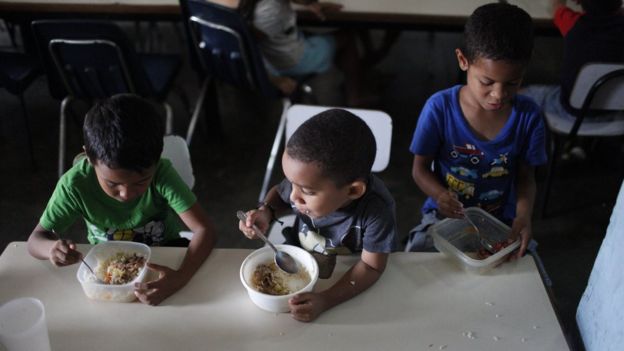
    Children eat lunch at Madre Asuncion's community kitchen on October 9, 2019 in Petare, Caracas, Venezuela.
    Community kitchens have been set up to help feed those in need but even so malnutrition is a major problem

    The story of Baby Tomás (not his real name) is one such case. He was born to a mother living in poverty in Caracas who felt she was in no position to raise him.

    The gynaecologist who was present at Tomás’ birth agreed to help.

    He says it was not the first time he came across a mother who felt she could not bring up her baby. “They almost always change their minds the first time they breastfeed the baby,” he explains. “But sometimes that is not the case, and then you have to find a solution.”

    He contacted one of his patients. In her forties and dreaming of having a baby, Tania (not her real name) had not been able to get pregnant.

    She wanted to help Tomás and his mother, but after some thought decided against taking him in. Instead, she contacted a couple with whom she is friends who agreed to raise Tomás as their own child in their home in rural Venezuela.

    They had to get the baby registered quickly in order not to arouse suspicion, so Tania paid a $250 (£195) bribe for an official to turn a blind eye and put down her friend’s name as Tomás’ birth mother.

    Tomás is now being raised by her friends in the countryside and his new family has just celebrated Tomás taking his first steps.

    Tania says she does not regret what she did and insists that she bypassed the official adoption channels for Tomás’ benefit. “I never thought of doing anything like this but legal adoption doesn’t work in Venezuela and that baby would have suffered a lot of hardships in a public orphanage,” she explains.

    Trapped

    Tomás was given away with his mother’s consent but there is no shortage of people exploiting the desperation of Venezuelan women.

    While she was pregnant with her second child, Isabel’s husband died, making Isabel (not her real name) consider giving up the child she was expecting. “I was alone and feared that I wouldn’t be able to feed my baby,” she says.

    Following the advice of an acquaintance, she flew to the island of Trinidad in the Caribbean to meet a couple she was told were interested in adopting her baby.

    She was told she would have the final say in any decision but soon came under pressure from the Colombian woman making the arrangements.

    “I was told it was going to be all legal and never committed to give my baby away,” she recalls. But once in Trinidad, “I realised I had been trapped in a net of human traffickers”.

    “I was always being watched,” she recalls. Isabel says that she was not allowed to leave the house where she was staying and that the return ticket for the flight she had been promised would take her back to Venezuela never materialised.

    Separated

    Weeks later she gave birth prematurely in a Trinidadian hospital. She decided to keep the baby but immediately was pressured by the Colombian woman and a man who claimed to be a lawyer.

    “They told me that the new parents were waiting in the parking lot and that I had to sign some documents in English that I didn’t understand and to hand over my baby.”

    Isabel refused at first but over the following weeks, her captors increased the pressure, taking away her food, medicine and nappies.

    “In the end, I had to hand over my son to save his life and for me to return to Venezuela to get help,” she says crying.

    With the help of a non-governmental organisation, Isabel has now set off on a legal battle to recover her son who is under the guardianship of the authorities in Trinidad. At present, she is only allowed to see him once a week.

    She says she will not give up until she is reunited with him.

    Source: BBC

  • Women make a living picking through scrap metal

    Between Germiston and Benoni is an open metal dump where more than 20 women survive by collecting scrap metal. Daily they pick through heaps of metal waste dumped by companies on the East Rand, looking for copper, stainless steel, zinc and brass.

    There are no ablution facilities and the women have to use the bush to change into working clothes, to freshen up after the day’s scrap collecting, or to relieve themselves.

    For hours they sit at different spots on top of heaps of scrap. With their bare hands they dig through the scrap to gather whatever they can sell for cash at the nearest scrapyard. Some sit in groups of three or four, chatting while they work. Others prefer to sit alone.

    A typical day begins as early as 6:30am.

    Aida Mainda says, “Passersby often stare at our greasy clothes and faces when we work … But when I put on my makeup to go and shop in town, no one can even tell that I’ve earned the money fishing through a dirty scrap heap.”

    Mayamiko Gonan, from Malawi but now living in Boksburg, scrutinises each item of scrap, then sorts it into 20-litre plastic containers.

    “It’s amazing what valuable pieces one can find in this heap. Maybe one day l will even find gold,” she laughs.

    “Gone are the days when I used to worry about breaking my nails or my hands becoming rough. What’s the use when what matters is making money?” she says.

    Gonan did domestic work but couldn’t make ends meet. A friend showed her the dump six months ago and she has been going there since. On a good day she can make R150.

    Lina-Marie Shongo, from Mozambique and now staying in an informal settlement in Benoni, has been collecting scrap since September last year. She used to have a fruit and vegetable stand.

    “Collecting scrap has changed my life. As a fruit and veg vendor l never used to make much. But now I have gained respect from my family because l am able to put food on the table,” she says. “Here copper is like gold. Filling two or three buckets makes my day.”

    At first she could not tell the difference between metals, but the other women taught her.

    Joyce Morau is South African. She started as a scrap collector, picking through the dump site, but now she buys the load of scrap metal from trucks brought to the dump by firms she knows, and she employs nine women to sort through it for her.

    “People made fun of me when l started off as a scrap picker. They said I should look for something better to do, but now I am a business owner employing other people,” says the single mother of five.

    Morau pays her employees R80 to R100 a day and sells the scrap to big yards in Benoni.

    “Sometimes the dump runs dry and we wait for trucks to come with material. If more metal companies come and dump here it can make our lives easier. The government should support our project by providing us with toilets and fencing our area so that women working here can feel safe,” she says.

    Women working for Joyce Morau sort through a truck load of scrap metal which she has bought.

    GroundUp is being sued after we exposed dodgy Lottery deals involving millions of rands. Please help fund our defence. You can support us via Givengain, Snapscan, EFT, PayPal or PayFast.

    Source: allafrica.com

  • ‘They removed my uterus and I had no idea for 11 years’

    A woman in South Africa has told the BBC how she was sterilised without her consent after she gave birth at the age of 17, and only learned about it 11 years later when she tried to have another child.

    Bongekile Msibi was among 48 women sterilised without consent at state hospitals, the Commission for Gender Equality found.

    Despite being a statutory body, the commission said its inquiry was hampered by the “disappearance” of patients’ files, and its investigators had received a “hostile reception” from hospital staff.

    The commission said its investigators visited 15 hospitals after civil rights groups brought the cases, some dating back to 2011, to its attention.

    South Africa’s health department has not yet given a detailed response to the report, but said its minister, Zweli Mkhize, had requested a meeting with the commission to discuss it.

    Ms Msibi recalled her ordeal to the BBC’s Clare Spencer:

    I woke up after giving birth, looked down and asked: “Why do I have a huge bandage on my stomach?”

    I did not mind. I had just given birth to my baby daughter. She was a big baby and I had been anaesthetised and gone through a Caesarean section.

    Getty Images

    How women are sterilised in SA

    • Hysterectomy:Removal of womb or part of it
    • Tubal ligation:Fallopian tubes blocked or sealed

    Source: South Africa’s Commission for Gender EqualityPresentational white space

    I left hospital five days after giving birth, with a healthy baby daughter and a huge scar across my stomach.

    I did not find out what had really happened for another 11 years.

    Things unravelled when I was trying to conceive again.

    I had been taking the contraceptive pill for that whole time since I had given birth and so it was not strange that I had not had my period.

    But I got engaged and wanted to have another baby so went to the doctor.

    He examined me, sat me down, gave me a glass of water and told me I had no uterus.

    ‘It is very cruel’

    I was devastated and confused. It did not make sense because I was already a mother.

    I worked out my uterus must have been removed and the only time it could have happened was after I had given birth.

    Bongekile MsibiPresentational white space

    It is very cruel what they did to me.

    I went to the press, then the health ministry and eventually ended up back at the hospital where I gave birth with the doctor who said he was there that day.

    He did not say sorry. He told me that he had sterilised me in order to save my life.

    I still do not know what he was trying to save me from. There are no records at the hospital.

    I am not the only one. An inquiry has found there are 47 others. Some were told it was because they had HIV, but I do not. I just don’t know why they did it.

    The doctor told me that I had signed a consent form. I had not. I was a minor at the time so would not have been able to.

    He then said my mother, who was with me at the birth, had signed the consent form. She said she did not.

    The news changed my life.

    In the end I split up with my fiancé. I had to let him go because he really wanted children and I could not give him that.

    When I met the doctor I was asked what I want.

    I want a baby so badly. When I saw a pregnant colleague this week I could not stand it.

    My daughter wants a sibling and when we go past street kids she suggests I bring one up as my own.

    I still have ovaries and so I think the hospital should pay for a surrogate.

    Pregnant woman

    South African law on sterilisation

    • Adultsentitled to it through safe methods
    • Proceduremust be clearly explained, including risks and consequences
    • Consentcan be withdrawn at anytime
    • Formsgiving go-ahead must be understood and signed
    • Separaterules must be followed for those “incapable” of consenting

    Source: South Africa’s Commission for Gender Equality

    I also want somebody to be held accountable.

    We cannot allow doctors to keep on doing this because our rights as women are being violated.

    Doctors need to know that they are under scrutiny, that we know what they get up to when we are lifeless.

    And then I want the doctor who did this to say he is sorry.

    The way this has been handled, you would think they had just removed a finger when actually this is my entire womanhood they have stolen.

    I can never get over that and the scar will always be a reminder.

    Source: BBC

  • Kenyan woman held after disappearance of Belgian woman

    A woman in Nakuru has been charged in connection with the mysterious disappearance of Belgian national Dysseleer Mireille Lesoipa.

    Kiambu Chief Magistrate Patricia Gichohi on Wednesday granted orders allowing the police to continue holding Ms Lucy Waithera Njuguna, the prime suspect in the disappearance of Ms Lesoipa, for an additional eight days as investigations continue.

    The accused was arrested on February 1 at her residence in Milimani, Nakuru, with Ms Lesoipa’s ATM cards. The foreigner, who detectives suspect was murdered and her body dumped in an unknown place, lived in Nakuru Blankets Estate before her disappearance in early 2019.

    Mr Oliver Nabonwe, the lead detective in the case, told the court in a sworn affidavit that in March 2019 immediately after Ms Lesoipa’s disappearance, the suspect and her accomplices, who are still at large, leased the missing person’s residence to a company identified as Avipro East Africa and started collecting rent.

    They later gave Ms Lesoipa’s lawyer a death certificate alleging that she had died at MP Shah Hospital on July 14, 2019.

    “The said death certificate was used to file a succession cause No. 40/2019 at the Nakuru High Court in respect to the missing person’s estate where the respondent is one of the beneficiaries,” Mr Nabonwe says in his affidavit, in which he also revealed that the death certificate was a forgery.

    “The death certificate has since been confirmed to be unauthentic by the State Department of Civil Registration. MP Shah Hospital through its medical director has attested that the missing person was neither treated, nor passed on, at their facility,” says the detective.

    Ms Njuguna was also found in possession of Ms Lasoipa’s passport, with “immigration stamps indicating that (Ms Lesoipa) travelled to India on December 12, 2018 and returned on June 30, 2019.”

    Ms Njuguna explained she had visited Ms Lesoipa at Janaupuri Bhagat Hospital, where she had been admitted since December 2018, but detectives have disputed this theory, saying neither Ms Lesoipa nor Ms Njuguna travelled to India from Kenya.

    ” The respondent has been changing her assertions at one time alleging that (Ms Lesoipa) died in a hospital in India and was cremated at Kariokor. The crematoriums at Kariokor and Langata have no (such) records,” says the investigator.

    Mr Nabonwe told the court that releasing the accused on cash bail or a bond may jeopardise their investigations owing to the seriousness of the case and because the accused has been in contact with possible witnesses and other persons of interest.

    “Our investigations have revealed that the respondent is directly linked to the disappearance of the missing person believed to be dead and if released … will interfere with investigations,” he said.

    Ms Gichohi allowed police to detain the suspect at the Muthaiga Police Station for eight more days. The suspect has been in police custody for 11 days.

    The magistrate noted that the issue is complex and requires more time.

    Stressing that Ms Lesoipa has a constitutional right to life and liberty, Ms Gichohi said that the matter depicts a suspect who wishes to benefit from the violation of such rights.

    The magistrate also noted that the suspect is said to have presented false documents in an attempt to benefit from the victim’s property.

    She said there is no law that compels investigators to reveal the details of their investigations to suspects before investigations are completed.

    Source: allafrica.com

  • Extradited killer jailed for murdering wife and daughters

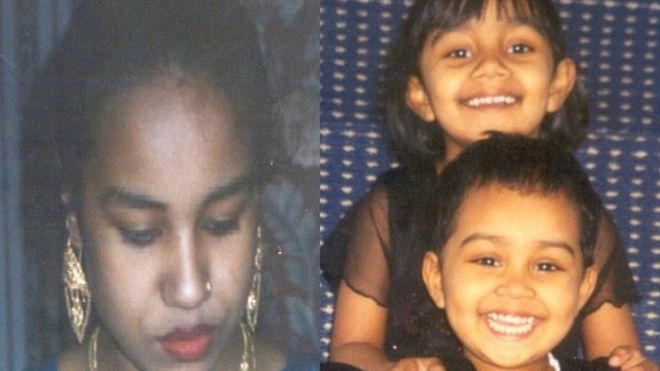
    Juli Begum andImage copyrightMET POLICE
    Image captionMohammed Abdul Shakur murdered his wife and their two children before fleeing to Bangladesh

    An abusive husband who fled the country after murdering his estranged wife and their two daughters has been jailed.

    Mohammed Abdul Shakur, 46, killed Juli Begum, 26, and his two young children Anika and Thanha Khanum at their east London home on New Year’s Day 2007.

    Shakur, who was extradited from Bangladesh in April, had a history of rape and violence against his wife, the Old Bailey heard.

    He was jailed for life, with a minimum prison term of 40 years.

    After the murders, Shakur fled to his home country of Bangladesh where he confessed his crimes to his sister-in-law, warning her: “If you tell the police I will murder you and your children.”

    He later moved to India, illegally, and went to ground for several years before his whereabouts became known.

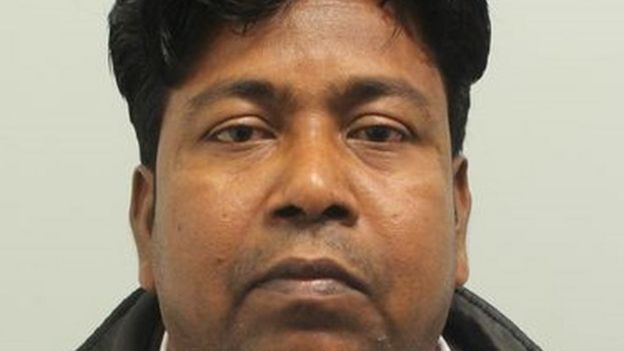
    Mohammed Abdul ShakurImage copyrightMETROPOLITAN POLICE
    Image captionMohammed Abdul Shakur showed little emotion as the judge returned his sentence

    Shakur denied three counts of murder but declined to give evidence in his trial.

    The three bodies were found at the family home in Nelson Street, East Ham, on 10 January after Ms Begum’s sister raised the alarm, the court heard.

    The body of 4ft 8in Ms Begum was discovered beneath a bedcover with Anika laid across her and Thanha nearby.

    Anika, five, had been strangled with a white sock after being “stunned” by a punch or slap to the face, while her six-year-old sister suffered severe blows to the face that fractured her skull.

    Their mother was believed to have been smothered with a soft pillow or cushion.

    ‘Wicked attack’

    The couple had an arranged marriage when Ms Begum was 19, but Shakur had repeatedly been violent towards his wife and did not like their children much because they were not boys, the court heard.

    Sentencing Shakur, Judge Richard Marks QC said: “This was a wicked, vicious and sustained attack on two little girls, and on your wife, who at 4ft and 8in was a tiny woman.

    “You, to this day, have not shown one iota of remorse for what you did.”

    The judge sentenced him to a 40-year jail term, less the six years, six months and six days already spent in custody in India and the UK.

    In a statement, Ms Begum’s sister Sheli said: “[The murder] has destroyed my life – I cannot watch the television or see a film without something triggering back to what happened.

    “It will be with us for the rest of our lives.”