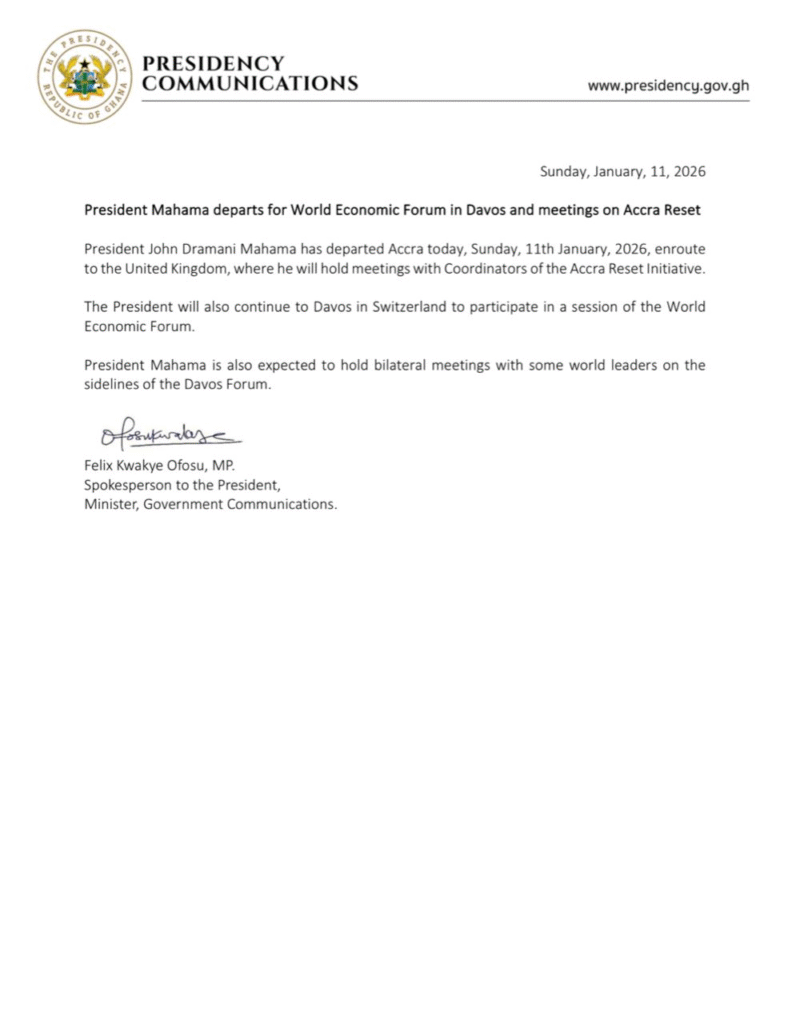
The Presidency has announced the departure of President Mahama to the UK.
In a formal statement shared by the Spokesperson to the President, Minister, and Government Communications, Felix Kwakye Ofosu, on Sunday, January 11, 2026.
He revealed that the president is en route to the UK, where he will hold “meetings with the coordinators of Accra Reset Initiative.
The Accra Reset Initiative is a global development and governance reform framework launched by Ghana’s President John Dramani Mahama in 2025, aimed at reimagining international financing, partnerships, and governance systems to better respond to modern challenges such as debt crises, climate shocks, and post-pandemic recovery.
Also, “the President will continue to Davos in Switzerland to participate in a session of the World Economic Forum. President Mahama is also expected to hold bilateral meetings with some world leaders on the sidelines of the Davos Forum”.
What is World Economic Forum?
The World Economic Forum (WEF) is an international non-governmental organisation established on January 24, 1971, in Switzerland. In the first month of every year, an annual meeting is held in Davos, which brings together global leaders from business, politics, academia, and civil society to discuss major economic and social issues.
Its stated goal is “improving the state of the world by engaging business, political, academic, and other leaders of society to shape global, regional, and industry agendas,” with its headquarters located in Cologny, Canton of Geneva, Switzerland.
Meanwhile, many are anticipating President Mahama’s speech at the meeting, given his outstanding delivery at last year’s 80th United Nations General Assembly at the General Assembly Hall of the United Nations Headquarters in New York City, USA.
He challenged the UN to make reforms and review its policies to suit the evolving world, calling its representation outdated. It was unfair for veto power to be a reserve of just five countries, he stressed in the General Assembly Hall of the United Nations Headquarters in New York City, USA.
Also, President Mahama made calls for a permanent representation of Africa on the United Nations General Assembly, granting the continent the right to veto power.
He explained that the long-standing tradition in which veto power is reserved for just five nations is outdated.
The current arrangement, rooted in the post-World War II order, the President stressed, concentrates power in the hands of a few countries.
He said, “Veto power should not be restricted to five nations, nor should it be absolute. There must be a mechanism for the General Assembly to challenge a veto. No single nation should be able to exercise an absolute veto to serve its own interests in a conflict.”
Currently, five countries hold permanent seats on the United Nations Security Council (UNSC), which automatically grants them veto power. This allows any one of them to block substantive resolutions, even if all other members agree. Named the P5, they include the United States, the United Kingdom, France, Russia, and China.
These countries were granted permanent status and veto rights in 1945, at the end of World War II, as part of the founding structure of the UN. Eight decades later, nothing has changed despite the shifting global order, President Mahama highlighted.
He referred to Africa’s growing and youthful population, citing demographic projections that by 2050, Africa will be home to over a quarter of the world’s population and a third of its youth, hence, “the future is African.”
He emphasised that it is time for the UN to grant Africa permanent representation on its council. He believes that just as Ghana is making adjustments, the UN must “reset” itself in light of the dramatic changes since 1945; however, the UN’s structures have not kept pace.
“A continent as large as Africa, with its numerous UN member states, would have at least one permanent seat on the Security Council. Madame President, I believe that in honour of this milestone celebration, the United Nations should also embark on a process of serious recalibration and establish its own reset agenda. Since the organisation’s founding, the number of UN member nations has nearly quadrupled, and quite frankly, it is not the same world that it was back then when the UN was formed,” he stressed.
He reiterated that if equality were truly upheld, Africa, with its 54 member states, would have at least one permanent seat on the Security Council.
“The most powerful post-World War II nations are still being rewarded with an almost totalitarian guardianship over the rest of the world. And yet, the first sentence in Chapter 2, Article 1 of the UN Charter declares that ‘The Organisation is based on the principle of the sovereign equality of all its members,’” he said.
Ghana has been grappling with an alarming rise in unemployment rates, reaching a staggering 1.85 million unemployed individuals in the third quarter of 2023 according to the Ghana Statistical Service.
Despite this concerning trend, the President’s silence on the matter during the 2024 State of the Nation Address has raised eyebrows about the government’s response to this critical issue.
Adding to the gravity of the situation, the World Economic Forum‘s 2024 Global Risk Report has now identified “unemployment” as the highest risk factor in Ghana.
This signifies a significant structural decline in work prospects and standards, encompassing issues such as erosion of workers’ rights, stagnant wages, increased unemployment and underemployment, as well as challenges stemming from automation or the green transition, all contributing to stagnant social mobility.
The latest labour statistics from the Ghana Statistical Service paint a worrisome picture, showing an upward trajectory in Ghana’s unemployment rate from 5.3% in 2010 to a concerning 14.7% by the third quarter of 2023.
This translates to approximately 1.85 million Ghanaians facing joblessness.
Beyond unemployment, the report highlights other pressing risks such as public debt, inflation, cybercrime, and economic downturn, ranking them in descending order as the 2nd, 3rd, 4th, and 5th risk factors respectively.
Ghana’s current public debt stands at GHS 567.3 billion, averaging GHS 18,300 per capita, while inflation remains in double digits at 23.2% as of February 2024.
Addressing cybersecurity concerns, Ghana ranks third in cyber security readiness in Africa, according to the International Telecommunications Union.
However, reports from the Media Foundation for West Africa and the Bank of Ghana highlight significant financial losses due to cybercrime, underlining the urgent need to bolster cybersecurity measures.
The Global Risk Report underscores the multifaceted nature of risks faced by Ghana, spanning economic, environmental, geopolitical, societal, and technological realms, encompassing 34 risk factors in total.
The “2023 Future of Jobs Report” released by the World Economic Forum (WEF) has identified secretarial roles, cashiers, and clerks as the occupations experiencing the fastest decline worldwide.
This report sheds light on the impact of technology and digitalization on the corporate landscape.
The study emphasizes that a significant number of the fastest declining job roles are clerical or secretarial positions.
Occupations such as Bank Tellers and Related Clerks, Postal Service Clerks, Cashiers, Ticket Clerks, and Data Entry Clerks are expected to face the sharpest decline. These roles, characterized by manual and administrative tasks, are being phased out as automation and digital systems increasingly take over.
The WEF underscores the rapid advancements in technology as the driving force behind these changes. To remain competitive in the evolving job market, the report emphasizes the need for workers to adapt and upskill.
It highlights the importance of reskilling and acquiring digital literacy as essential tools for thriving in the changing workplace.
” The majority of fastest declining roles are clerical or secretarial roles, with Bank Tellers and Related Clerks, Postal Service Clerks, Cashiers and Ticket Clerks, and Data Entry Clerks expected to decline fastest”.
However, the report also brings positive news as it identifies sectors with significant job growth potential. Education, agriculture, digital commerce and trade are expected to experience large-scale job expansion in the coming years.
In the Education industry, the report forecasts a growth rate of approximately 10%, leading to the creation of 3 million additional jobs. Vocational Education Teachers and University and Higher Education Teachers are expected to benefit the most from this trend.
“Jobs for agricultural professionals, especially Agricultural Equipment Operators, are expected to see an increase of around 30%, leading to an additional 3 million jobs. Growth is forecast in approximately 4 million digitally[1]enabled roles, such as E-Commerce Specialists, Digital Transformation Specialists, and Digital Marketing and Strategy Specialists,” the report explained.
The World Economic Forum report indicates that as the global workforce continues to evolve, it is essential for both employees and employers to stay ahead of the curve. The WEF’s Future of Jobs Report aims to provide valuable insights and guide stakeholders in shaping a future where technology and human skills work hand in hand to drive economic growth and prosperity.
The letter, which was published on the sidelines of the World Economic Forum in Davos, Switzerland, by the Patriotic Millionaires in the US and UK, Tax me Now, Oxfam, and Millionaires for Humanity, urges governments to “tax us, the rich, and tax us now.”
According to a comprehensive analysis conducted by the Fight Inequality Alliance, Institute for Policy Studies, Oxfam, and the Patriotic Millionaires, a progressive wealth tax starting at just 2 percent for millionaires and rising to 5 percent for billionaires could generate a staggering $2.52 trillion annually.
As the super-rich signatories of this report join the growing global movement calling for greater taxation of the wealthiest members of society, it is clear that record COVID-19 wealth gains at the top of society have only further exacerbated income inequality.
The ten richest men alone have more than doubled their fortunes to a staggering $1.5 trillion dollars, and the world’s 2,660 billionaires now have wealth equivalent to the size of the entire Chinese economy.
Morris Pearl, former managing director at Blackrock and chairperson of the Patriotic Millionaires, has pointed out that there is no defending a system that endlessly inflates the wealth of the world’s richest people while condemning billions to easily preventable poverty, and that we need deep, systemic change, starting with taxing the rich.
Gemma McGough, British entrepreneur and founder of the Patriotic Millionaires UK, has echoed this sentiment, stating that tax systems the world over have unfairness built-in and that it is time for the wrongs of an unequal world to be righted by taxing the rich.
Oxfam revealed earlier this week that three of Nigeria’s richest men are worth more than 83 million Nigerians. The firm also revealed that the four richest families, previously identified as the Bhimji Depar Shah and Jaswinder Singh Bedi families, as well as the Uhuru family and the family of late Kenyan tycoon Naushad Merali, have a combined wealth of $2.8 billion, which is more than the bottom 40% of Kenya’s poorest 22 million people.
Critics indicate that Iván Velásquez’s accusations represent the newest assault on Guatemala’s anti-corruption officials.
After Guatemala announced it would look into a former anti-corruption investigator assigned to the nation, the UN released a statement expressing “concern.”
According to Guatemalan prosecutors, Iván Velásquez, a Colombian who oversaw the UN’s anti-corruption initiatives in Guatemala from 2013 to 2019, is being looked into for “illegal, arbitrary, and abusive acts.”
But detractors have cautioned that the investigation represents the latest attempt by Guatemala’s government to abandon its anti-corruption initiatives.
UN Secretary-General António Guterres “expresses his concern at the numerous reports suggesting that criminal prosecution is being exercised against those who sought to shed light on cases of corruption and worked to strengthen the justice system in Guatemala”, a spokesperson said on Wednesday.
The UN also underscored that “justice operators and officials” from its former anti-corruption campaign continue to “enjoy privileges and immunities” even after their positions have come to a close.
The campaign started in 2006 when the UN and Guatemala agreed to launch the International Commission against Impunity in Guatemala (CICIG). The aim of the commission was to root out “criminal groups believed to have infiltrated state institutions” in the wake of Guatemala’s decades-long civil war.
In 2007, at the time when the commission was ratified, Guatemala was in the grip of a police scandal, with reports of extrajudicial killings, and there were fears corruption could erode the country’s democratic gains.
Velásquez, a Colombian who formerly served as an auxiliary magistrate to his country’s Supreme Court, was appointed to head the CICIG on August 31, 2013.
Under his leadership, the commission pursued investigations into some of Guatemala’s highest authorities, including the administration of then-President Otto Perez Molina.
Both Molina and his vice president ultimately resigned amid accusations they participated in a corruption scheme known as “La Linea”, which allegedly used customs officials to solicit bribes in exchange for evading import duties.
Molina was sentenced last month to 16 years on fraud and conspiracy charges. He has denied any wrongdoing.
The UN commission’s investigations are estimated to have led to the sentencing of more than 400 people, as well as the disruption of at least 60 criminal networks.
But the CICIG’s work came to a sudden halt in 2019, when Guatemala announced it would withdraw from the 2006 agreement with the UN. The government had previously tried to declare Velásquez a “persona non grata” and deny him entry to the country.
The move prompted fears that 12 years’ worth of government reform would be reversed. “The old actors that have manipulated the judicial system are empowered and will look to debilitate the system again,” a constitutional lawyer from Guatemala told Al Jazeera at the time. But proponents of the move said the CICIG had become a tool of political persecution.
In the years since, the Guatemalan government has faced criticism that it has retaliated against former members of the CICIG, as well as other anti-corruption figures. The Associated Press estimates that about 30 judges, magistrates and prosecutors have been forced into exile from Guatemala under its current administration.
One of the most high-profile cases was that of Juan Francisco Sandoval. Formerly the head of the Guatemalan Special Prosecutor’s Office Against Impunity, he was sacked and fled the country in 2021.
And just this past February, another prominent anti-corruption prosecutor in Guatemala, Virginia Laparra, was arrested. Charged with abuse of authority, she was given a four-year sentence in December.
“The targeted prosecution of justice and media actors undermines Guatemalan rule of law, democracy and prosperity,” the US State Department’s spokesperson Ned Price said in response to Laparra’s sentencing.
Guatemala is now investigating Velásquez, the former CICIG head, in connection to a cooperation agreement with the Brazilian construction firm Odebrecht, a company previously involved in an international bribery scandal.
The case is being led by Guatemalan prosecutor Rafael Curruchiche Cacul, whom the US State Department has previously accused of “disrupting high-profile corruption cases against government officials and raising apparently spurious claims”. He succeeded the exiled Sandoval as leader of the Guatemalan Special Prosecutor’s Office Against Impunity.
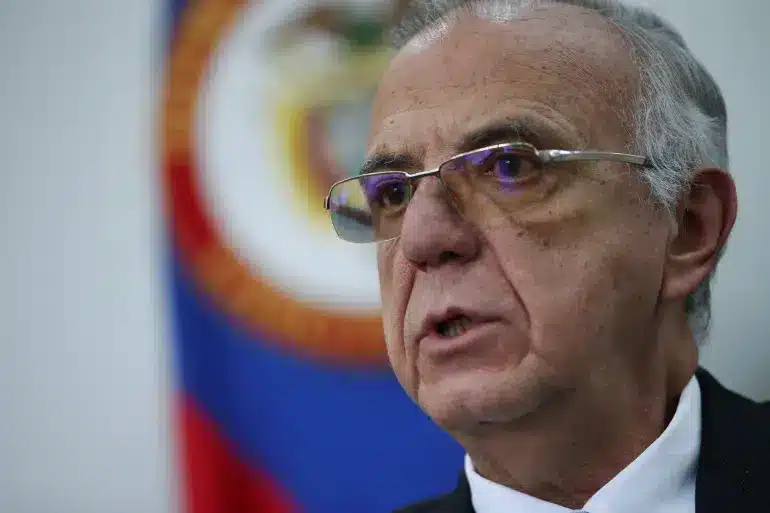
The investigation has sparked tensions between Guatemalan President Alejandro Giammattei and his Colombian counterpart Gustavo Petro, who appointed Velásquez as defence minister.
Speaking from the World Economic Forum in Switzerland, Petro said he would not accept an arrest warrant for the defence minister.
Giammattei, meanwhile, told the Spanish news agency EFE that Velásquez is facing an investigation and not a criminal prosecution at this time.
“It would be nice if someone enlightened Mr Petro on the difference,” Giammattei said. Both presidents have summoned their ambassadors to each other’s country to discuss the diplomatic incident.
“I am deeply grateful to the president [Gustavo Petro] for his expressions of solidarity and trust,” Velásquez wrote.
Referring to corruption as a monster, Velásquez emphasised that he and Petro shared a common goal: “We know the monster, we have seen it up close and, from different trenches, we have fought it. We know how it transforms and the methods it uses, but it doesn’t scare us.”
The shift from fossil fuels to clean renewable energy as the corner stone to the global energy transition has been at the tip of governments’ policy discussions across Africa and the world, with developed countries investing massively in renewable energy as part of efforts by their respective government’s energy security and climate action goals (ESI Africa, 2021).
Gielen D. and Boshell F. (2021), observe that while climate change mitigation remain a powerful driver behind the shift away from fossil fuel-based power generation, another factor influencing the shift is the fact that, renewable power has become the cheapest form of electricity generation and the costs continue to fall thanks to improvements in technology and economies of scale. No wonder the International Energy Agency(IEA), found that the share of renewable energy sources (including hydropower) within the global electricity generation mix has jumped to 28 percent of the power mix in 2021, up from 27 percent in 2019.
Growth in renewables, according to the U.S. Bureau of Labor Statistics (BLS), presents many direct and indirect sustainable economic benefits (with less or no negative effects on the environment) through job creation, reduced energy cost, stable energy prices, energy independence, and avoidance of climate impact et cetera. The International Renewable Energy Agency (IRENA) estimates the expected increase in human welfare from the deployment of renewables as close to 4 percent, far exceeding the 0.8 percent rate of improvement in gross domestic product (GDP). The agency suggest, savings from reduced health and environmental externalities, which are not fully reflected in conventional economic accounting systems, far offset the costs of the energy transition.
Africa missing in the Game
The World Economic Forum (WEF) estimates that by 2050, Africa will have roughly 2 billion inhabitants, and two in five of the world’s children will be born on the continent.
However, the continent which is home to the world’s youngest population, is still energy poor. According to data captured in the IEA Africa Energy Outlook 2022, some 600 million people in Sub-Saharan Africa still don’t have access to electricity, when in global terms only 768 million people lack access to electricity. Again, the data shows that today 970 million Africans lack access to clean cooking. Liquefied petroleum gas (LPG) remain the leading solution to urban population, but recent price spikes are making the commodity unaffordable for 30 million people across the continent, forcing many to revert to traditional use of biomass. This makes the need for clean energy for both consumption and production more crucial; for purposes of socio-economic and human development.
The World Bank (2018), argue that lack of access to energy represents a fundamental barrier to progress, and has impacts on a wide range of development indicators, including health, education, food security, gender equality, livelihoods, and poverty reduction. Renewable energy has therefore been found to play a critical role in closing Africa’s energy gap, which remain a massive obstacle to advancing development continent-wide. IRENA’s paper “Scaling up Renewable Energy Deployment in Africa” shows that Africa has the potential to install 310 gigawatts (GW) of clean renewable power— or half the continent’s total electricity generation capacity, to meet nearly a quarter of its energy needs by 2030.
In another paper Renewable Energy Market Analysis: Africa and its Regions, IRENA and the AfDB (Africa Development Bank) estimate the continent’s solar PV technical potential at 7,900 GW, additional hydropower potential at 1,753 GW, and wind energy at 461 GW; suggesting that the continent possesses a respectable renewable energy potential.
Ironically, a recent paper titled The Renewable Energy Transition in Africa, jointly prepared by Germany’s KfW Development Bank, Deutsche Gesellschaft für Internationale Zusammenarbeit (GIZ), and the International Renewable Energy Agency (IRENA), reports that most inhabitants of sub-Saharan Africa face severe energy poverty, with less than half of the population found to have access to electricity in 2018.
The paper found that in 2018, only 20 percent of the electricity generated in Africa came from renewable sources, a very low investment figure compared with the rest of the world. Further the paper notes that even though in 2019 two-thirds of all newly added energy capacity for supplying electricity worldwide was based on renewable sources, only a mere 2 percent of this new generating capacity was in Africa; confirming IRENA’s report that only 2 percent of global investments in renewable energy in the last two decades were made in Africa, with significant regional disparities.
This is a continent that has vast resource potential in wind, solar, hydro, and geothermal energy, with Central and Southern Africa holding abundant mineral resources (IRENA 2022) essential to the production of electric batteries, wind turbines, and other low-carbon technologies. Furthermore, IEA (2022) finds that Africa is home to 60 percent of the best solar resources globally, yet only 1 percent of installed solar PV capacity. Also, the continent possesses vast resources of minerals that are critical for multiple clean energy technologies. The continent accounts for over 40 percent of global reserves of cobalt, manganese and platinum; and other key minerals such as lithium, graphite, and copper; critical for batteries and hydrogen technologies.
In spite of the immense benefits of renewable energy to the continent, coupled with the resource potential of the African continent, IRENA (2022) finds that the factors that would help accelerate green energy deployment in Africa have not yet been realized, because of exiting obstacles.
Africa’s Obstacles
In IRENA’s estimation, Africa will requires an annual investment of US$70 billion in renewable energy projects until 2030 to effectively transition from fossil fuels to clean energy. But it must not be lost on us that countries within the African continent are largely low-income economies whose capacities are not yet up to the task of funding this emerging form of energy in large-scale. Aside investment and policy related challenges, several economic, institutional, technical and socio-cultural barriers hinders countries from moving from the high to the low emission pathway (Seetharaman et al. 2019; Adeniran and Onyekwena 2020).
The African Development Bank Group asserts that the private sector is key to mobilizing green energy investment and sustainable development in Africa, and that climate change presents a US$3 trillion investment opportunity in Africa by 2030, of which 75 percent of the investment is expected to come from the private sector to complement public sector financing. However, there are few hurdles to surmount if the private sector would inject that level of funding expected of it.
The first hurdle, is the willingness of the private sector to maintain its commitments in accelerating climate related investments in particularly an emerging economy like Africa. Fruman (2016), argues that the willingness would require an enhancement of cooperation between governments and the private sector; to help build trust, close knowledge gaps, spur action, generate a sense of combined ownership of agreed-upon actions, and promote collaboration. Moreover, it is widely acknowledged that developing countries like Africa face obstacles from the policy and regulatory point. To make the Africa market accessible to the private sector investor, policy clarity, enhanced regulation, and a transparent implementation strategies that establishes Africa’s energy transition roadmap is indeed necessary. Additionally, IRENA (2022) finds that investors’ willingness to commit capital to the renewable energy sector is driven by the perceived risk/return profile of investments, combined with risk mitigation— given that the sector face multiple barriers such as front-loaded cost structure of renewable energy projects, project proponents’ often limited knowledge and experience, and the lack of reliable investment data, particularly in developing countries.
Aside private sector investors’ willingness to inject capital in climate related technologies, it is well documented that the regional power pools across the African continent are faced with insufficient investment in infrastructure and network grids designed to accommodate conventional energy sources, resulting in high electricity losses and low supply quality, among other issues (Medillina et al. 2019). Germany’s KfW Development Bank, GIZ & IRENA joint paper The Renewable Energy Transition in Africa, found inadequate grid infrastructures as another barrier to introducing and up-scaling inexpensive variable renewable energy, such as solar and wind. Improving the planning, operation and maintenance of electricity grids is of paramount importance for any form of energy transition and grid stabilization, the report noted. This according to the report, needs to be combined with significant investments in the modernization and expansion of distribution and transmission infrastructure, as well as energy storage and other technology and market solutions that improve system flexibility, reduce greenhouse gas emissions, strengthen national and regional power systems, and reduce technical and commercial losses.
Additionally, there are some African governments and industry players’ unwillingness to change as quickly as required, or introduce incentives to support clean renewables, which often slow the progress we need to see in the energy space (Okafor J. 2020). This is so because the global effort to accelerate the clean energy transition risks dwindling export revenue for Africa’s oil and gas.
McKinsey’s 2022 analysis on ‘The future of African oil and gas: Positioning for energy transition’ found that most African countries are highly exposed to the global energy transition, as their economies depend on oil and gas exports for more than 50 percent of their total export revenues.
The resentment from industry players and government in emerging economies such as Africa is that abandoning their oil and gas resources for clean renewable energy would affect badly their macroeconomic and socio-economic progress. As such Africa wants that space to exploit their fossil resources, earn revenue from exports of same, and ultimately deploy the revenue into infrastructure and services that raise living standards today, while transitioning to renewables and a lower-carbon future.
The World Economic Forum is partnering with the Government of Ghana to launch the first Country Financing Roadmap (CFR) initiative in Africa.
This government-led project, in collaboration with the Sustainable Development Investment Partnership, a World Economic Forum and OECD/DAC joint initiative, seeks to address bottlenecks in the financing of the Sustainable Development Goals (SDGs).
A statement issued by the Forum, says “Just as the global community enters the Decade of Action to deliver on the SDGs, the COVID-19 pandemic has afflicted the world, creating an upheaval in health systems and devastating impact on the global economy.
While the economic and social crisis is seriously affecting every country, Ghana is emerging as a social and sustainability champion. Although the country has been affected by the pandemic, the government continues to work assiduously in containing the impact on society.
Still, Ghana, despite recent economic gains, is threatened by challenges such as climate change and desertification, challenges that could exacerbate inequalities in different parts of the society and set back the economy.
Accordingly, the country stands committed to using the SDGs as its framework for its post COVID-19 recovery, as well as in building back better.â€
“The optimal way to recover from this crisis and build a more inclusive and resilient society is to frame the economic and social recovery in the context of the SDGs. As such, we are delighted to partner with the World Economic Forum on the Country Financing Roadmap. Through this initiative, working closely with other key partners, we will identify key SDGs financing gaps and determine a set of actions to unlock capital for critical investments in our countryâ€, says Dr. Eugene Owusu, Special Advisor to the President of Ghana on SDGs.
Member of the Executive Committee of the World Economic Forum, Terri Toyota, said that, “As the COVID-19 pandemic has led to an economic crisis around the world, it is clear that sufficient finance cannot be mobilized from the public sector alone. The existing financial gap to pursue the 2030 Agenda must be filled by effective private-public cooperation.â€
“The Government of Ghana has shown tremendous leadership as an SDG champion, and our partnership will be instrumental to inform and advance our joint efforts to open new markets,†she added.
Funded by the Government of Denmark, the European Commission, and the Swedish International Development Cooperation Agency, the Ghana CFR initiative builds on existing assessments and experience from the public and private sector, international organizations, civil society and multilateral institutions, with the aim of defining an action plan to scale up financing for the SDGs.
Malawi’s President Peter Mutharika and the country’s electoral commission have formally filed an appeal against a court ruling that overturned his win last year.
“I can confirm that the court has received both appeals by first respondent [the president] and second respondent [electoral commission],” High Court Registrar Agnes Patemba told the Reuters news agency on Friday.
A sworn statement by Malawi Electoral Commission (MEC) Chairperson Jane Ansah, who supports the appeal, said the constitutional court overstepped its powers by ordering parliament to convene within 21 days to amend the Electoral Act.
Ansah’s statement also asserts that the budget for a fresh election would cost Malawi a lot of money unless enforcement of the court’s judgement is suspended.
The constitutional court on Monday annulled last year’s disputed presidential election results, citing “widespread” irregularities and ordering a new vote.
The election last May returned the sitting president to power, leading to deadly confrontations and widespread unrest.
The MEC had declared Mutharika the narrow winner of the May election with 38 percent of votes, followed by Lazarus Chakwera with 35 percent and former Vice President Saulos Chilima third with 20 percent.
Mutharika had denounced the ruling as “a serious subversion of justice, an attack on our democratic systems and an attempt to undermine the will of the people”.
President Muhammadu Buhari says 90 percent of the victims of Boko Haram are Muslims contrary to views that the group is primarily targeting Christians.
He said this in an opinion piece published in “Speaking Out” a guest opinion column for Christianity Today.
The President, in the piece titled “Buhari: Pastor Andimi’s Faith Should Inspire All Nigerians”, extolled the virtues of Pastor Lawan Andimi who was killed by Boko Haram for his refusal to denounce his Christian faith.
Buhari said: “But we may not, yet, be completely winning the battle for the truth. Christianity in Nigeria is not-as some seem intent on believing-contracting under pressure, but expanding and growing in numbers approaching half of our population today. Nor is it the case that Boko Haram is primarily targeting Christians: not all of the Chibok schoolgirls were Christians; some were Muslims, and were so at the point at which they were taken by the terrorists.
“Indeed, it is the reality that some 90 per cent of all Boko Haram’s victims have been Muslims: they include a copycat abduction of over 100 Muslim schoolgirls, along with their single Christian classmate; shootings inside mosques; and the murder of two prominent imams. Perhaps it makes for a better story should these truths, and more, be ignored in the telling.
“It is a simple fact that these now-failing terrorists have targeted the vulnerable, the religious, the non-religious, the young, and the old without discrimination. And at this point, when they are fractured, we cannot allow them to divide good Christians and good Muslims from those things that bind us all in the sight of God: faith, family, forgiveness, fidelity, and friendship to each other.
“Yet sadly, there is a tiny, if vocal, minority of religious leaders-both Muslim and Christian-who appear more than prepared to take their bait and blame the opposite religious side. The terrorists today attempt to build invisible walls between us. They have failed in their territorial ambitions, so now instead they seek to divide our state of mind, by prying us from one from another-to set one religion seemingly implacably against the other.”
The president said the action of the terror the terror group must not be viewed as evidence the terrorists were “fully functional, and undefeated” they resorted to criminal acts by targeting the innocent Nigerians having been degraded.
He called on faith leaders, and Nigerians to focus more on words of concord in their scriptures, saying “There is no place in Nigeria for those who seek to divide us by religion, who compel others to change their faith forcibly, or try to convince others that by so doing, they are doing good.”