Tag: World Vision

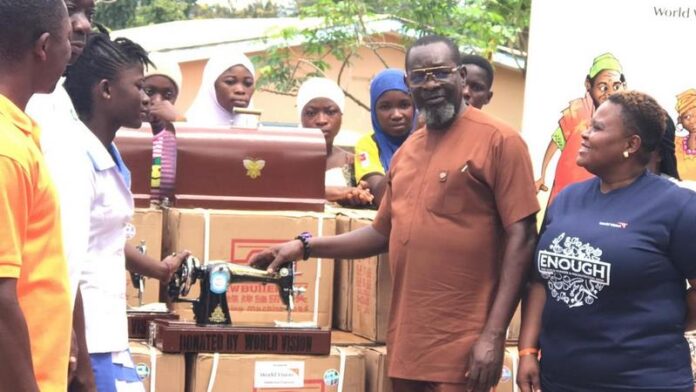
  • World Vision provides sewing machines to over 50 youth in Kadjebi

    World Vision provides sewing machines to over 50 youth in Kadjebi

    World Vision’s Kadjebi Reading Improvement and Skills Enhancement (RISE) Technical Programme has provided sewing machines to launch a youth apprenticeship program to strengthen community resilience and bolster support for children’s education,

    The initiative focuses on adolescents and youths identified as Most Vulnerable Children (MVC), including those who have left school due to factors like teenage pregnancy, disability, or severe poverty.

    A total of 50 youths, consisting of 37 females and 13 males, have received sewing machines and starter kits, and have been assigned to various trades across 7 communities.

    At the handover event, Georgina Harriet Nyameke, the Kadjebi Area Manager, highlighted the significance of equipping young individuals with practical skills for sustainable employment.

    Nyameke expressed that World Vision’s aim is not merely to provide tools but to open doors for youth to learn, develop, and build their futures.

    She noted that this project aligns with World Vision’s mission to enhance the lives of vulnerable children and their families through educational and skill-building opportunities.

    Mrs. Nyameke encouraged the beneficiaries to fully utilize the opportunity provided by the program, emphasizing that the skills gained could lead to self-employment and better livelihoods.

    District Chief Executive (DCE) Wilson Agbanyo, representing the assembly and district education office, thanked World Vision for their timely support, which comes as many young people seek skill and employment opportunities.

    Agbanyo stated that the initiative will help alleviate unemployment and inspire youth to tap into their creativity and entrepreneurial potential.

    The DCE also remarked that the partnership between World Vision and local authorities exemplifies community-led development, demonstrating the benefits of targeted interventions in improving lives.

    Wilson Agbanyo advised the recipients to use the provided items responsibly to enhance their future prospects rather than selling them.

    Kennedy Amponsah-Cheremeh, Project Officer for Reading Improvement and Skills Enhancement at World Vision’s Kadjebi Area Programme, mentioned that in addition to the sewing machines, World Vision has provided head drinks (ɛtiri Nsa) to 48 Master Trainers and supplied all necessary tools for the 50 youths in the apprenticeship program.

    He urged guardians, caregivers, and parents to ensure that their children have adequate food and shelter to support their learning in their chosen trades.

    In an interview with the media, the beneficiaries expressed their appreciation to World Vision for the initiative, recognizing that effectively using the provided items is their best opportunity for a brighter future.

  • Coronavirus: WVG strengthens education in rural communities

    The Sekyere East Cluster Office of the World Vision Ghana (WVG) has embarked on an intensive outreach programme to educate people in rural communities on the novel Coronavirus.

    The aim is to strengthen their understanding of the dangers of the disease and how they could adhere to the various preventive and containment protocols to stay safe.

    Mrs. Georgina Harriet Nyamekeh, Water, Sanitation and Hygiene (WASH) Officer of the Cluster, speaking at one of such outreach programmes at Bomso, said it would augment efforts by the Government to contain the further spread of the virus.

    She said reaching out to people in rural, remote and poverty-prone areas where access to information on the disease and how to prevent its contraction and spread was very challenging.

    However, that was what the WVG was seeking to achieve.

    Mrs. Nyamekeh said the programme was being done in collaboration with the District Directorates of the Information Services, National Commission for Civic Education (NCCE) and the Community Development Department.

    Mr. Emmanuel Arthur, the District Community Development Officer, urged the community members to constantly wash their hands with soap under running water and observe all the preventive protocols, including social distancing, consistent wearing of face masks, avoiding shaking of hands, and others.

    He commended WVG for the support and said, “Our partnership with the WVG is very fruitful since reaching out to persons in the very remote zones would have been very difficult and even impossible due to lack of logistics”.

    Madam Adjoa Fremah, a Community Member of Bomso, commended WVG and partners for the education especially, with the free distribution of Information, Education and Communication materials, such as posters and flyers for the awareness creation.

    She urged community members to put into practice the education and information they had received on the virus.

    Source: GNA

  • Shanghai Disney resort partially reopens

    Although Disneyland in Shanghai will remain closed, parts of the wider resort are to re-open.

    The company said “a limited number of shopping, dining, and recreational experiences” would open as “as the first step of a phased reopening”.

    The complex has been closed since January.

    Source: bbc.com

  • Teach children their mother tongues Pencils of Promise, World Vision

    Two Non-Governmental Organisations, Pencils of Promise (POP) and World Vision have marked this year’s International Mother Language Day celebration in the Volta region on the theme “Indigenous languages matter for development, peace building, and reconciliation”.

    International Mother Language Day marked 21 February is an annual celebration inaugurated by the United Nations Educational Scientific and Cultural Organisation (UNESCO) in 1999, aimed to celebrate and project local dialect worldwide.

    The Krachi West Municipal Director of Ghana Education Service, Mrs. Georgina Mensah in her speech during the event held in Ho, indicated that children are fast in understanding lessons when they are been taught in local dialects and show interest and self-esteem in their academic activities.

    She said in her area, literacy among learners has improved at the basic schools because of the use of local dialect to teach the children, hence, its prudent to equip the pupils with their mother tongues.

    “Education especially literacy in the lower grades is very successful, now most children can read…” she said.

    She called on both government and non-government institutions to use the day to promote and outline policies to “support mother language”.

    The Volta regional Chairman of the Ghana Journalists Association (GIJ), Mr. Kafui Bells Kanyi shared his experience using his local dialect (Ewe) as a Journalist and called for the need to always use mother language.

    He encouraged radio stations in the Volta region to do programmes in local languages as a measure to promote and project it.

    A representative from International Child Development Program (ICDP), Ghana, Ms. Joyce Lanyo bemoaned that, foreigners who visit Ghana are always eager to learn indigenous languages but Ghanaians rather feels shy to use the mother tongues.

    “When foreign volunteers come, the first thing they want to learn is the local language why is it that we are throwing that away?” She quizzed.

    She praised musicians who uses their songs to project mother languages and made reference to Amakye Dede and Ofori Amposah as agents to promote the agenda.” Ms Lanyo promised the organisation’s support to promote the use of mother languages.

    The Country Director of Pencils of Promise, Mr. Freeman Gobah, who spearheaded the event in an interview with Class News urged parents to allow their children to speak the local dialect while learning the international ones.

    The celebration was climax with a panel discussion on how to promote the local languages, and ended by encouraging educational institutions, parents and other stakeholders to make use of the local dialects.

    Source: classfmonline.com