Tag: World War Two

  • Ukraine war: Liberating towns is a shot in the arm for Ukrainian troops

    Oleksii tells me: “I feel safe here because we are on our land and even the ground will bring me help.” That’s despite the nearby sound of small-arms fire, exploding artillery shells landing within sight, and the roar of Russian jets overhead.

    The ground he and the small team of Ukrainian troops now occupy is on the border of the Donetsk and Luhansk regions. The same ground that Russian President Vladimir Putin recently declared as being Russian forever.

    Over the past week, the men of Ukraine’s D1 National Guard Unit have advanced more than 20km (12 miles) east of the recently liberated city of Lyman in the Donetsk region. They now occupy a former Russian position in a wood – still within range of the retreating Russian army. Part of “forever Russia” is already back in Ukrainian hands. Russia’s now the defending army.

    The reversal in fortunes has been a shot in the arm for Ukrainian troops. There’s a palpable sense of confidence among them, even though they’re still within range. Ilya, another member of the unit, tells me: “We can retake territory, but the Russians cannot.” I ask why? “Because they are weak now, they’re scared of us, they’re running from us.”

    This position also tells a story about the difference between Ukrainian and Russian discipline and morale. Strewn across the ground and hanging in trees are remnants of the retreating Russian forces – empty cans, ration packs, boots, bottles, and clothes.

    Ilya picks up a discarded Russian helmet and compares it with his own. “Army of the future,” jokes Ilya as he taps the Russian helmet. “A very bad future,” adds a comrade, laughing.

    It’s not that dissimilar to what Russian troops would have worn in World War Two. They hold up a Russian winter glove and read the label. It says it was made in 2005. “New for Russians,” they joke. Another soldier called Duke says Russia treats its soldiers like meat.

    Oleksii says discarded Russian trash often gives away their positions when they fly their small drone. They rely on one of Elon Musk’s Starlink satellite kits for communication. They say it’s been working all week.

    As you drive around the Donbas there are more signs of Russia’s depleted army. We witnessed Ukrainian forces towing away a troop carrier and a large self-propelled gun – both still marked with the Russian “Z”.
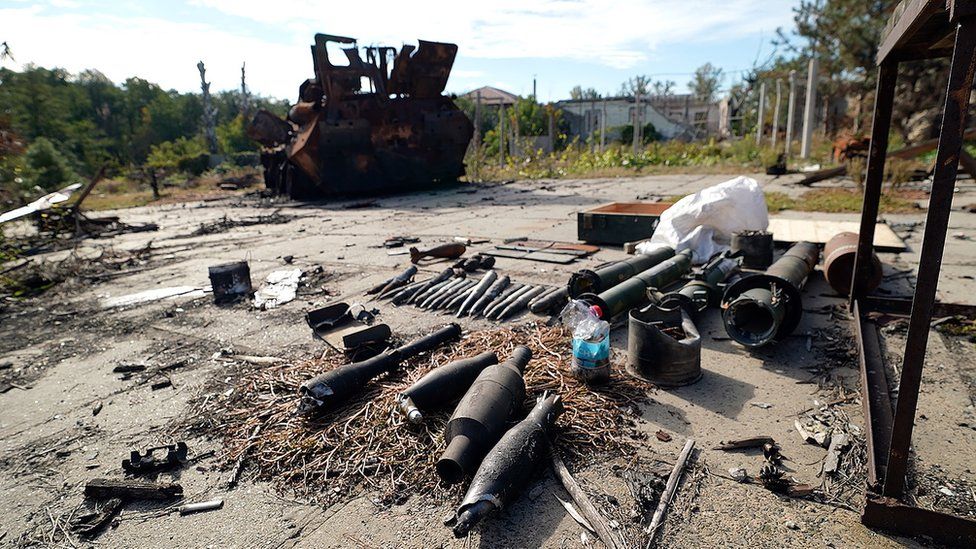
    Collected ordnance
    Image caption, Some of the collected, discarded materiel the Russian leave behind

    Ukraine’s now captured more Russian armour than it’s been supplied by the West. Dozens more burnt-out military vehicles, too damaged to salvage, have been left rusting on the sides of roads. Boxes of unused ammunition are collected to be used against their former owners. The Donbas is also still littered with lethal mines – which will take years to clear.

    Any sense of euphoria among Ukrainian troops is not always shared among the people they’ve freed from Russian control. Liberation comes with a costly legacy.

    Those who survived the shelling are wondering how they’ll make it through the winter. Tens of thousands of people are without power and running water.

    In Lyman we come across Natalia and Vitali, searching in the rubble of a bombed-out house for the wood they can burn. Their fire is now the only way they can stay warm. An estimated 80% of their city has been destroyed or damaged. They narrowly survived a Russian rocket landing on their home – waking them up at 05:30.
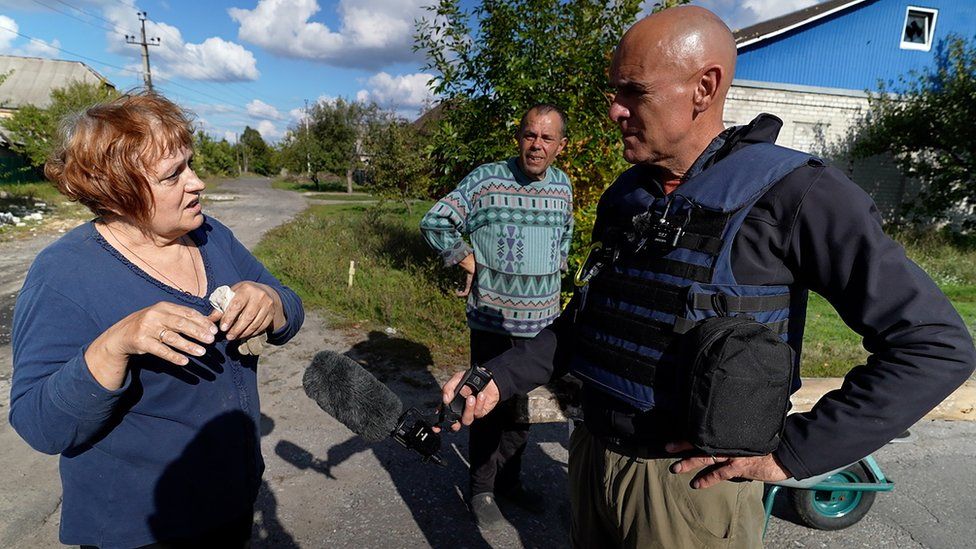
    Natalia and Vitali
    Image caption, Natalia and Vitali speaking to the BBC’s Jonathan Beale

    Natalia describes life now as “hard and simply unbearable”.

    “We are like ants. We were trampled on and those who survived now carry firewood. And those who did not are buried,” she says. Like many here, she tries to avoid blaming either side for her woes.

    When we arrive at the centre of Lyman there’s already a long queue for bread. Many of them appear to be hedging their bets on the future.
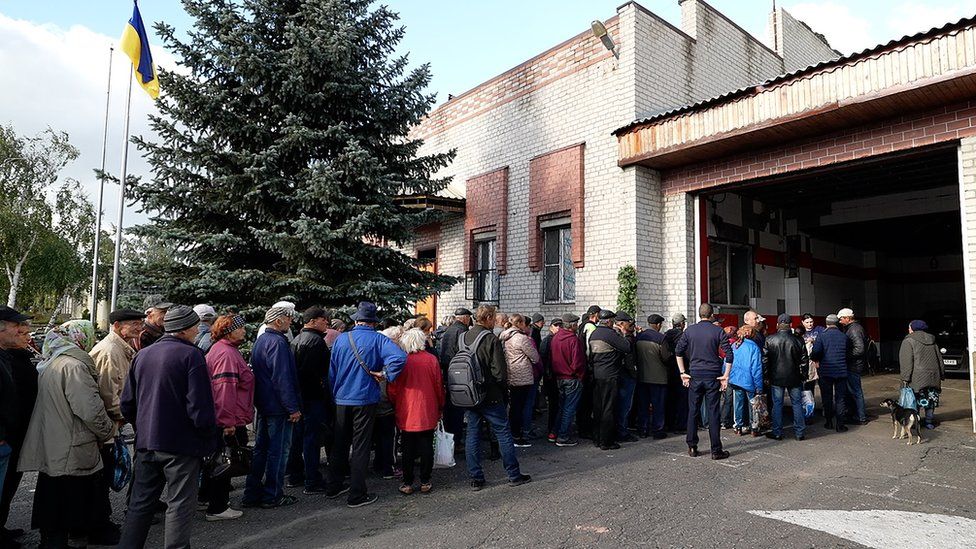
    Lyman bread queue
    Image caption, The queue for bread in Lyman

    Kataryna, a mum with two young children, tries to explain her dilemma: Russia, she says, still “has a lot of power, which is why it is scary that they might return. Because the city has already suffered very badly, and if the city will be passed back and forth from hand to hand, then nothing will remain including people”.

    At the moment she says all she wants is electricity and peace. This winter she’s unlikely to get either.

    DISCLAIMER: Independentghana.com will not be liable for any inaccuracies contained in this article. The views expressed in the article are solely those of the author’s and do not reflect those of The Independent Ghana

    Source: bbc.com


  • Is Meloni the future? At least for a while, certainly

    Was yesterday’s vote for Meloni – or anti-everything and everybody else?

    Probably both in a country that has tried every shade of politics in its almost 70 governments since World War Two.

    Italy beloved by the world for its food, art, history, and culture is just not working for a large part of its own population. A perpetually stagnant economy has helped fuel a massive brain drain.

    The political gerontocracy of recycled ageing men in suits has prompted a massive desire for change. Enough Italians feel that Giorgia Meloni represents that – for better or worse.

    Her rigidity on LGBT rights and immigration finds favour in Italy, where Catholic conservatism still holds sway, and which has long felt it has shouldered the burden of Europe’s migration crisis.

    And while she insists her party has consigned fascism to history, a country that never had the equivalent of Germany’s denazification has allowed traces of its dark past to permeate through its post-war politics.

    There is, undoubtedly, a section of Meloni’s base that still glorifies Il Duce [war-time fascist dictator Benito Mussolini]. She knows it is now incumbent upon her to reassure Italians – and Europeans – that she really has moved on.

    Is Meloni the future? At least for a while, certainly. But in a country whose governments last on average just over a year, she knows Italians’ patience with the latest political novelty can run out quickly.

    DISCLAIMER: Independentghana.com will not be liable for any inaccuracies contained in this article. The views expressed in the article are solely those of the author’s, and do not reflect those of The Independent Ghana

    Source: bbc.com

  • After seven decades of constancy, a door swings shut

    For two minutes today the drumming will cease, the pipers will fall silent, the march of boots on procession routes will still.

    For two minutes today, at the end of the funeral service in Westminster Abbey, before the national anthem is heard, before the coffin is taken away for committal and burial at Windsor, there will be silence.

    And a door will swing shut.

    A reign of seven decades will come to a close. For 10 rather bewildering days we have spoken of the Queen and the new king as if they could somehow both be with us.

    Today that long week of transition comes to an end.

    In the earliest years of her reign, a new Elizabethan Age was proclaimed by some. Such was the excitement over the young queen, the marvels of technology and the new prosperity, after the grinding grey of the depression years, the sacrifice of World War Two and the hard road of recovery after it.

    She – wise in her earliest decades to fickle fashion – dismissed all that talk. But if this was not an age – and who are we to contradict her? – then it was an era, the Elizabethan Era.

    Over decades of wrenching change, she was constancy, for a largely still-conservative country. That profile on the stamps, that voice at Christmas, that bowed head on Remembrance Sunday.

    Today the door swings shut on that.

    It swings shut too on “Prince” Charles, on his many decades as Prince of Wales.

    His staff always bridled at the idea of him as an understudy or apprentice, pointing to his decades of achievement, of carving out a distinct role.

    His challenge, once Royal Mourning is over, is in part to enjoy – and show that he enjoys – the role of monarch.

    His mother understood that part of the job was to rally people – to take people’s minds off bills and dull jobs and complaining relatives, to entertain and divert and sometimes delight.

    That he did good work as prince, transforming so many lives for the better, is unquestionable. But often, alongside, the impression given was that things were grim, that there was a lot of cause for complaint. The word “appalling” seemed to come up a lot.

    Now the door swings shut on that. Britons want to see the best of themselves reflected in their sovereign.

    And, as the silence stretches out across Westminster, across the capital and the country, the door swings shut on Elizabeth, on the woman known to so many and never really known at all, on the little girl known to her grandpa as Lilibet.

    Source: BBC