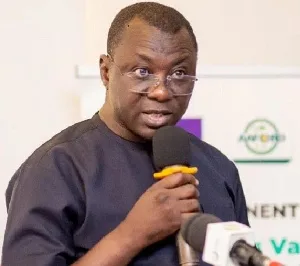
Finance Minister Mohammed Amin Adam is confident that Ghana’s economy will deliver a remarkable growth this year.
Amin Adam sees the recent 4.7% growth in the first quarter as a positive indicator, especially considering the World Bank’s projection of 3.1%.
Addressing a town hall meeting in the UK on Saturday, Adam expressed his optimism.
“This year our economy is going to surprise the whole world.”
“I can tell you that this economy is rebounding strongly. We are rebounding strongly, and it is surprising the world even the IMF and the World Bank.”
He added “They are all surprised. Last year, they projected our economy will grow at 1.5%, we grew at 2.9%. This year in the first quarter of this year, they projected we will grow at 3.1% we grew at 4.7%.” “This economy will grow, and it will grow faster than everybody thinks.”
The UN Environment Programme’s Food Waste Index Report measures how well countries are doing in cutting their food waste in half by 2030.
The UN said that almost twice as many countries reported for the index compared to the first report in 2021. The 2021 report said that 17% of the food made in the world in 2019, which is 931 million metric tons, was thrown away. But the authors said it’s hard to compare because not all countries have enough data.
The report is written by UNEP and an international charity called Waste and Resources Action Programme (WRAP).
Experts studied information from different countries about how people buy food and where they buy it from. They discovered that each person throws away about 79 kilograms (about 174 pounds) of food every year, which is the same as at least 1 billion meals wasted every day around the world.
60 per cent of the waste came from homes. About 28 out of 100 came from restaurants, and about 12 out of 100 came from stores.
“It’s a terrible thing,” said co-author Clementine O’Connor, who focuses on food waste at UNEP. “This problem is tough and hard to understand, but if we work together and take action, we can solve it. ”
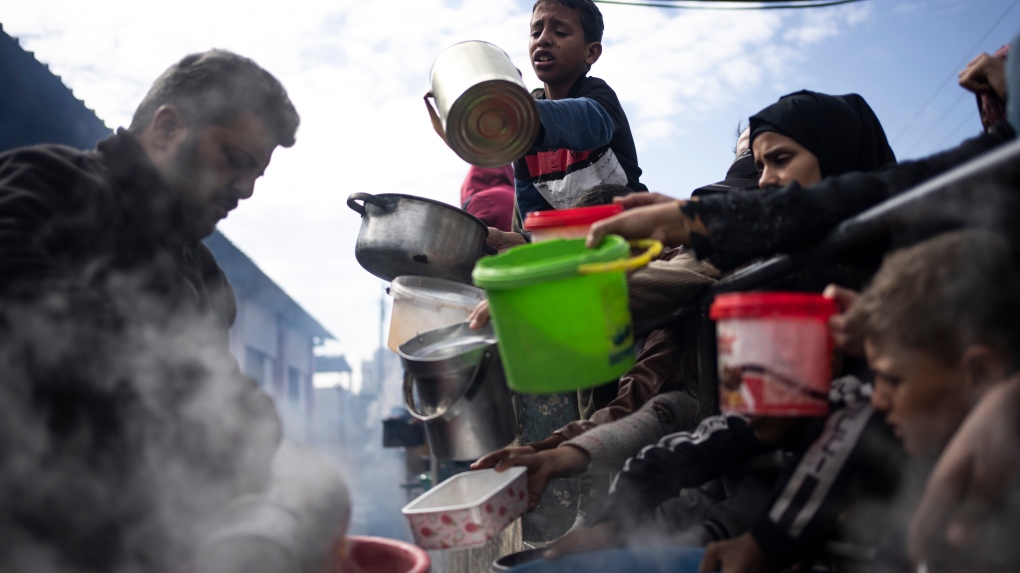
The report is released when 783 million people in the world are always hungry and many places are having serious food problems. The fighting between Israel and Hamas and the violence in Haiti have made the crisis even worse. Experts are saying that hunger is likely to happen soon in northern Gaza and is getting closer in Haiti.
Throwing away food is a big problem for the whole world. It takes a lot of land and water to grow food, and this harms the environment. It also creates greenhouse gases, like methane, which contribute to global warming.
Losing and throwing away food makes 8 to 10 percent of the gases that make the earth’s temperature hotter. If it was a country, it would be the third biggest one after China and the US.
Fadila Jumare is a project associate at Busara Center for Behavioral Economics in Nigeria. She has looked at how to stop food from being wasted in Kenya and Nigeria. She said this problem makes things even harder for people who already don’t have enough food and can’t buy healthy food.
Jumare said that when people waste food, it means there is less food for the poor. Jumare was not part of the report.
Brian Roe, a researcher who studies food waste at Ohio State University, said the index is important for addressing food waste. He was not part of the report.
Roe said that if we waste less food, it can bring many good things like saving resources, less harm to the environment, more food security, and more land for other uses. He wasn’t part of the report.
The report said that there has been a big increase in the amount of attention given to food waste in poorer countries. They said that rich countries may need to take the lead in working together with other countries to make rules to reduce food waste.
The report said that giving extra food to food banks and charities is helpful in reducing wasted food from stores.
Food Banking Kenya is a charity that collects extra food from farms, markets, supermarkets, and packing houses. They then give it to schoolchildren and people who are in need. In Kenya, a lot of food is thrown away each year, about 4. 45 million metric tons. This is a big problem that is getting worse.
John Mukuhi, who helps run the group, said, “We help the community by giving them healthy food and also help the environment by polluting less. ”
The people who wrote the report found that there was not a big difference in the amount of wasted food per person in rich and poor countries.
Richard Swannel, who works at WRAP, said that food waste is not just a problem in wealthy countries. “It’s a problem all around the world. ”
“The data clearly shows that there is a problem worldwide that we could all work on tomorrow to save money and help the environment,” he said.
A study by a group called IQAir found that nine out of the top 10 most polluted cities in the world are in India.
Delhi is the third dirtiest city and the dirtiest capital. The air there has a lot of tiny particles that can be harmful, with an average of 102. 1 micrograms per cubic meter.
The World Health Organization (WHO) recommends that countries try to keep the average PM2.5 concentration at 5 micrograms per cubic meter.
Breathing in dirty air with particle pollution can make you sick with asthma, cancer, lung disease, strokes, and other health problems. It also says that PM2. 5 can stick to the lungs and get into the blood more easily.
In November, New Delhi put limits on the amount of cars on the road to reduce air pollution. But after a few days, pollution covered cities in India, Pakistan, and Bangladesh. Some businesses and schools had to shut down in certain areas.
Reporting from Delhi, the news reporter from Sky News, Neville Lazarus, said on Thursday that pollution is spreading like a disease in the city. Activists have claimed that pollution is the fifth biggest cause of death in India.
He said that a report from the British Medical Journal found that every year in India, 2. 18 million people die because of air pollution.
The numbers are really big. About 30,000 people die in a year due to air pollution. In Delhi, 80 people die every day because of air pollution.
This is a big problem that is hurting the economy. Families are spending almost 4% of their money on healthcare for illnesses caused by air pollution. One sickness makes them very poor.
“But what worries me in this report is that we have noticed air pollution coming from smaller cities in Tier Two, like the unimportant city of Begusarai in the northern state. ”
IQAir’s report said that Begusarai, a city in the Indian state of Bihar, has the worst pollution in the world. The air there has an average annual PM2. 5 concentration of 118. 9 μg/m³
In Pakistan, Lahore had the fifth highest air pollution with an average of 99. 5μg/m³
Bangladesh is the most polluted country.
The report says that Bangladesh has the most pollution in the world, with an annual PM2. 5 concentration of 79. 9μg/m³
Pakistan is the second most polluted country in the world, with India being the third and Tajikistan being the fourth. This makes the South Asia region the most polluted in the world.
IQAir said that only seven countries followed the WHO’s yearly PM2. 5 rule. These countries are Australia, New Zealand, Estonia, Iceland, Grenada, Mauritius, and Finland.
The information in the report comes from over 30,000 stations around the world that measure air quality. These stations are located in 134 different places.
The biggest cruise ship in the world has started its first trip from Miami, Florida. People are worried about the ship causing pollution by releasing methane gas.
The Icon of the Seas is 365 meters long and has 20 floors. It can hold a maximum of 7,600 passengers. Royal Caribbean Group owns it.
The boat is going on a trip to visit different islands in the tropics for seven days.
Environmentalists are saying that the LNG-powered ship will release harmful methane gas into the air.
Even though LNG is cleaner than fuel oil, it can still leak methane into the air.
Methane is a stronger greenhouse gas than carbon dioxide.
“He said using LNG as a marine fuel emits more than 120% extra greenhouse gas emissions than marine gas oil. ”
Earlier this week, the ICCT said that methane emissions from ships using LNG fuel are higher than what current regulations say.
Methane is a very strong greenhouse gas. It holds in 80 times more heat than carbon dioxide in the atmosphere for 20 years. Reducing these gases is very important to help stop the earth from getting too warm.
Royal Caribbean claims that the Icon of the Seas is 24% better at using energy than what is needed for new ships, according to the International Maritime Organization. The company wants to make a ship that doesn’t create any pollution by 2035.
Lionel Messi, the captain of Argentina’s winning World Cup team, who plays for Inter Miami, was at the ship’s naming ceremony on Thursday. He put a football on a stand to break a champagne bottle for good luck.
The building of Icon of the Seas cost $2 billion or £1. 6 billion The resort has seven pools, six big slides, and over 40 places to eat and drink.
They are aphrodisiacs, oils, herbs, potions, or other substances, and their sole function is to improve romantic relations or sex.
It is a combination of two Hausa words – ‘Kayan’ which means; property, or things, and ‘Mata’ which means women. Put together, the word literally means ‘women’s things’.
It appears to have existed for centuries and originated from Northern Nigeria.
Originally, it was used by these women for sexual pleasure, and served as enhancers, or aphrodisiacs, especially for young brides, but in recent times, it has become a really huge trend for women all over the world.
In Ghana, the trend has become very prevalent and these products are even advertised via the internet and on various social media platforms.
Patrons of these products have diverse interests, to attract men for money, sex, marriage, etc.
What some may not know is how the Kayan Mata (kayamata) is used by its clients.
In a post on media personality – Naa Ashorkor’s Facebook page, she indicates how some women with in-depth knowledge about how people use the Kayan Matan for their ‘victims’ shared this with her on her show; ‘Just us’.
According to her, she picked some pointers which include the fact that the Kayan Mata products are in 3 categories; vaginal upgrade, faithfulness, and libido boosting, and the third; favour and attraction potions.
Users of the potion need to talk to the oil and indicate exactly what they want from it and it happens.
“In order to activate the potion, you simply talk to the oil. For instance – “oil, please let me attract rich men who can buy me a car”. When you go out, the men will literally be falling over themselves for you. They can’t help it,” she wrote.
She however indicated that some men who called into the show also shared how the male variation referred to as ‘For girls’ is used by some men for similar interests.
“Interestingly, when I activated the phone lines to ask ladies to share their experiences, only men called! Apparently, Kayan mata is a variation of “For girls’ and the men have interesting stories about the potency of this potion. Scary! One guy said his friend used it to get his wife to accept his marriage proposal. So this woman is currently under a spell. Apparently, a lot of married people are under spells they are not aware of,” Naa Ashorkor narrated.
Naa Ashorkor also shared stories of how some users of these products suffered side effects or had experiences which didn’t go in their favour.
In one instance, a woman who tried using it to attract men ended up attracting mad men. In another, a woman who tried using it on another man who already had activated the ‘For girls’ potion ended up dying.
“A lady who bought and used attraction potion now attracts only “mad men” literally, in traffic, they approach her and try to touch her, they literally chase her around town, sometimes more than one at a time. When she complained to the vendor she bought it from, she told her to go to Benin to see the original seller. There is no other way to undo this charm,” she shared.
Adding, that “The side effects are dire. Sometimes you cannot break away from this spell or spirit even if you want to. My guest shared a story about a girl who used it on a man, the man apparently had more potent potions which killed her. She is dead oo”.
Ghana is among 40 countries who are currently unhappy in theworld.
According to the World Happiness Report Ghana is 111th out of 146 countries.
The 11th annual World Happiness Report is based on economic and social data as well as surveys of people’s perceptions of their happiness.
A statement issued by Dr Isaac Newman Arthur, National Public Relations Officer of the Ghana Psychological Association(GPA), copied to the Ghana News Agency said “Happiness is a human right. Everyone deserves to be happy. Most of our human adventures and interventions are geared towards making happiness possible anytime, anywhere”.
It noted that happiness reflects how satisfied a person was with their quality of life, and it was at the heart of all mental health issues.
It said it was surprising the United Nations had set aside 20th March every year as International Happiness Day to serve as a reminder that happiness was a human right.
The statement said the UN General Assembly in its resolution 65/309 in 2011, encouraged member countries to enact policies that will improve the quality of life of its citizens, and to use various indicators of happiness to guide policy decisions.
It said each year, countries were ranked based on how happy their citizens were using the Gallup World Poll’s 14 indicators of happiness.
It said it included citizen engagement, emotions (wellbeing), diversity, education and families, business and economy, energy and environment, government and politics, law and order, religion and ethics, health, transportation, communication and technology, work, and food and shelter.
The statement said member countries were urged to build societies that ensured that the needs of their citizens were met.
It said all mental disorders affect several areas of a person’s functioning which robs the person of the happiness they deserve or wish for.
“Mental illnesses negatively impacts a person’s ability to cope and adjust to normal life situations, and live independently, form and maintain meaningful relationships, maintain a positive self-identity, and contribute meaningfully to society.” The statement said.
“Ghana has come a long way to improve on mental health services for her citizens, supported by individuals and organizations.”
It said the GPA, together with other mental health organisations had contributed immensely to this cause.
“Can everyone be happy in Ghana, and in other parts of the world? Yes, we can! By actively engaging in activities which maximize our mental wellbeing, that is having a positive attitude towards life, entertaining positive friendships or networks, having ample rest, moderate exercises,
learning to say ‘No’ when overwhelmed with avoidable schedules, having good nutrition, being thankful and grateful by counting our blessings amidst challenges, feelings of contentment, setting realistic goals and expectations, praying and meditating, engaging in hobbies and activities that create humor, forgiving ourselves and others, avoiding needless risks, and endeavoring to take informed decisions in life”.
It said above all, seek professional help if in distress by contacting mental health professionals.
“On this day, International Happiness Day, we wish all Ghanaians, and everyone anywhere a Happy Life.”
Aida Muluneh is a contemporary Ethiopian artist leading the charge in her home region to change the narrative portrayed in the global media about Africa. She has been a victim of war, read about famine in parts of the continent, and come across women and children who are malnourished, but she doesn’t believe it is enough justification for the foreign press to focus on these negatives to tell Africa’s story. There are many positive stories about the continent, and that is why she is investing her talent in her photography project.
Born in 1974 in Addis Ababa, Aida was compelled to live the next decade of her life in England, Yemen, Greece, Cyprus, and later Canada in 1985, due to the civil war in Ethiopia during her formative years, according to hundred heroines. However, her adventure across the globe was brought to a halt when she developed a passion for photography and decided to move back to Ethiopia.
This marriage with photography happened only after wandering along many career paths. She dabbled from being a basketball player to a lawyer until she had an epiphany in a disused darkroom where a Pentax 35-millimeter camera caught her eye. Since then, it’s been no turning back for Aida in her photography journey, she graduated from Howard University with a bachelor’s degree in film, radio, and television.
Her passion to relocate to her home region was also rekindled after briefly working at the Washington Post. It was during this period in her life that she became disturbed by the media’s consistent negative framing of Africa in their reportage. After relocating to Ethiopia in the 2000s, she was determined to work toward presenting an alternative narrative of what Africa stands for.
One of those works is “the world is 9,” an expression her grandmother often used to explain the imperfections of the world. She converted this philosophical expression into a series of photographic works that invites her audience to question life, love, history, and if the world should not be embraced in its imperfect and complete form.
One such piece is titled “All In One”, where Aida focuses on the various religions that define the history of Ethiopia. It first started with Christianity, then Islam, and later Judaism, which symbolizes the union of King Solomon and the Queen of Sheeba. It communicates the message that all religions exist in different forms but what matters is a person’s faith and spirituality, according to CNN.
She also addresses the pressure and conflict that exists between traditional and career women, which she titled “The Morning Bridge”. It depicts how many women are keen to get married as a result of pressure from their families. While there are those who want to be successful with both their careers and marriages but seem to be failing despite the effort, there are others who are desirous of a family but are unable to make the switch between their ambitions and this goal. Her work questions why women can’t have both successful careers and still stay married.
She also dedicates a part to Ethiopia’s 2,000-year history, which had been wiped away by the communist era. She called this “Departure” to coincide with her own experience as a child where she had to go and live in a foreign land because of the dysfunctional system. She uses the train station given as a gift to Emperor Menelik and Haile Selassie and what is left of this relic to tell the story of how Ethiopia fought colonial invasion and preserved its independence from Europe.
Finance Minister Ken Ofori-Atta has defended the process he used to withdraw money from the consolidated fund to sponsor the national cathedral project by saying former President John Mahama’s government used the same process to approve funds for Ghana’s participation in the 2014 World Cup in Brazil.
Testifying before the ad hoc parliamentary committee that investigated some seven allegations against him in connection with a censure motion filed by the minority caucus in an attempt to remove him from office, Mr Ofori-Atta said: “Hon. Co-chairs, in preparing the annual budgets, the practice is that provision is made for indicative expenditures that have not been fully costed (sic) at the time of the budget presentation”.
“Provisions are made in the Contingency Vote to cater for such expenditures”, he explained, citing, for example, “in 2014, there was no specific allocation in the 2014 budget for Ghana’s participation in the FIFA World Cup in Brazil. The Cabinet of President John Mahama, in March 2014, at the time, approved some $9.622 million for that tournament, including that amount which was flown to Brazil in a private jet for the players”.
“A more current example is Ghana’s participation in Qatar. The Black Stars qualified for the 2022 FIFA World Cup, way after the 2022 budget, presented on 16 November 2021, was approved by parliament. No specific amount was budgeted for it but through the Contingency Vote, we have been able to provide funds legitimately for the team to participate in the competition”, he noted.
According to him, “expenditures in respect of the National Cathedral were made from the Contingency Vote under the ‘Other Government Obligations’ vote as has been the practice before my tenure (I have copies of several payments from the Contingency Vote dating back to 2015 to share)”.
Mr Ofori-Atta said “as finance minister, I am fully aware of the approval procedures for the use of the Contingency Fund and have not breached its requirement”, adding: “The national cathedral is 100% owned by the state and is not the president’s cathedral as described by the proponents”.
“Indeed, the Attorney General issued an opinion on 6 January 2022, that the national cathedral is a state-owned company limited by guarantee, under the Ghana Museums and Monuments Board”, he added.
A deliberate attack on NATO energy supplies will be met with a “united and determined response”, the alliance’s chief has vowed.
Secretary-General Jens Stoltenberg pledged to boost protection of critical infrastructure in response to the damage to the Nord Stream gas pipelines.
The EU believes three leaks in the pipelines last month were the work of sabotage and suspicion has fallen on Russia, but it is not known for sure who was responsible.
Mr Stoltenberg said NATO has doubled its presence in the Baltic and the North Sea to more than 30 ships supported by aircraft and undersea activities.
In a speech on Tuesday, he also said the alliance is monitoring Russia’s nuclear forces closely as the country was “losing on the battlefield” in Ukraine.
Meanwhile, Moscow has issued a fresh warning to the West over its involvement in the Ukraine war.
Deputy foreign minister Sergei Ryabkov said Russia will take adequate countermeasures in response to the West’s “growing involvement”.
In the comments reported by the state-owned RIA news agency, he said: “We warn and hope that they realise the danger of uncontrolled escalation in Washington and other Western capitals.”
Russian bombs have rained down on Ukraine, killing at least 14 people on Monday.
Vladimir Putin said the strikes were in retaliation for its “terrorist action” against Russian territory – the attack on the Kerch Strait Bridge in occupied Crimea – but Ukraine has rejected this claim of “provocation”.
Ukrainian President Volodymyr Zelenskyy has vowed to make the battlefield “more painful” for Russian troops in response to the rocket attacks and said air defence was the “number one priority”.
Despite remarkable Ukrainian battlefield successes – both early on in the war with the defence of Kyiv and more recently with counterattacks in Kharkiv and Kherson regions – the war could continue for decades to come, one expert said.
Sky News security and defence analyst Professor Michael Clarke said the war is likely to be a “generational struggle” and could be a “forever conflict” until “something changes in European security or Russia”.
Mr Clarke said the current crisis in Ukraine was the “second war” and the first war was witnessed in 2014 when Russia annexed Crimea.
He added: “My feeling is next year there will be a ceasefire in which the Ukrainians will be better placed and that ceasefire will be unstable and it will break down and there will be a third war and then a ceasefire and a fourth war.
“We’re dealing here with an existential struggle because the Russian establishment thinks that Ukraine has no right to exist and they won’t change their mind in the short-term.
“This is likely to be a generational struggle. Let’s say it’s going to last 30,40 or 50 years.”
Six-time major winner Phil Mickelson on Thursday backed moves to award world ranking points for events on the breakaway LIV Golf circuit, saying it would help maintain the “credibility” of the global leaderboard.
The Saudi-backed LIV Series stages its first event in Asia this week and on Wednesday announced a deal to have tournaments co-sanctioned by the MENA (Middle East and North Africa) Tour and awarded Official World Golf Ranking (OWGR) points.
The OWGR has not announced whether points will now be awarded to LIV events, starting with this week’s tournament in Bangkok.
But Mickelson, whose departure from the US PGA Tour helped kickstart the big-money LIV series, said it was in the ranking body’s interests to do so.
“I think for the World Golf Rankings, this is a great way to keep its credibility, while not bringing politics into the decision-making process,” the 52-year-old left-hander said on the eve of the LIV’s Bangkok Invitational.
LIV has already staged five events but without any ranking points awarded for its players, including British Open champion Cameron Smith and former world number one Dustin Johnson.
Mickelson, Smith and Johnson are all competing at the new Stonehill course outside the Thai capital for a share of $20 million, with $4 million up for grabs for the winner, easily the largest purse for a golf tournament in Asia.
The deep pockets of Saudi Arabia’s Public Investment Fund have allowed LIV to offer eye-watering prize money, last place in Bangkok takes home $120,000, but have also drawn accusations of “sportswashing”, given the kingdom’s dubious human rights record.
A host of top players have joined the series, plunging golf into bitter civil war as the US PGA Tour and the Europe-based DP World Tour have scrambled to hold on to talent while the Asian Tour, and now the lesser-known MENA Tour, have aligned themselves with LIV.
Only the top 50 players in the world qualify automatically for the four majors, so top names have been concerned about slipping down the rankings.
But Mickelson said he had no worries that LIV events would be given points appropriately.
“The reason I’m not concerned is that the number of points are based on the quality of the field and not the organisation that’s running the tournament, and the quality of our field is remarkably strong,” he said.
“I’m sure for the world golf rankings to maintain their credibility, they’ll continue to award the proper number of points that the tournaments deserve for all tours.”
US players who have signed up to LIV Golf have been indefinitely suspended from the PGA Tour, while the DP World Tour has issued fines and short-term bans.
LIV has announced plans to expand from eight events this year to 14 in 2023, with players competing for $405 million in prize money.
The world added 12 percent more clean power capacity in 2019 than the year before, but new renewable energy planned over the next decade falls far short of what is needed to forestall dangerous global warming, the UN warned on Wednesday.
An additional 184 gigawatts (GW) of renewable power – mostly solar and wind – came online last year, according to the Annual Global Trends in Renewable Energy Investment report, jointly issued by the UN Environment Programme and Bloomberg New Energy Finance (BNEF).
One gigawatt is similar to the capacity of a nuclear reactor.
Total investment in renewables in 2019 was $282.2 billion, led by China ($83.4 bn), the United States ($55.5 bn), Europe ($54.6 bn), Japan ($16.5 bn) and India $9.3 bn), with a record 21 countries each spending at least $2 billion.
Developing nations – not including China and India – poured an unprecedented $59.5 billion into clean energy.
The rapidly falling cost of solar and wind power – less expensive in most electricity markets than coal – means more bang for the buck, the report showed.
Investment in 2019 was the same as the year before but yielded an additional 20 GW of installed capacity.
But measured against the Paris climate treaty target of capping global warming at “well below” two degrees Celsius above pre-industrial levels, the transition to clean energy is not happening nearly fast enough, the report said.
The 826 GW of new renewables planned by 2030 – at a cost of about $1 trillion – is only a quarter of the roughly 3,000 GW required to keep us on track for a 2C world, it concluded.
Investment is lagging as well – more than $2.7 trillion were committed to renewables during the last decade.
“Clean energy finds itself at a crossroads in 2020,” said BNEF chief executive Jon Moore, one of the report’s authors. “The last decade produced huge progress, but official targets for 2030 are far short of what is required to address climate change.”
‘Ever-falling price tag’
When the current health crisis eases, he added, governments must not only boost renewable power but the decarbonisation of transport, buildings and industry.
The huge amounts of cash mobilised to jump-start economies stalled by COVID-l9 lockdowns is a once-in-a-generation opportunity to close this “renewables gap” in investment, the authors argue.
“If governments take advantage of the ever-falling price tag of renewables to put clean energy at the heart of COVID-19 economic recovery, they can take a big step towards a healthy natural world,” said UNEP executive director Inger Andersen.
“This is the best insurance policy against global pandemics.”
But the transition from a brown global economy to a green one is strewn with obstacles.
Investment in renewables last year, for example, was barely half the amount governments spent to subsidise fossil fuels, according to a report last week from the International Energy Agency (IEA) and the Organisation for Economic Co-operation and Development (OECD).
Combined subsidies for both consumption and production last year totalled $478 billion in 77 economies, the two intergovernmental agencies found.
That’s an 18 percent drop compared to 2018, but the decrease was due mainly to lower oil and gas prices.
Indeed, subsidies for fossil fuel production in 44 countries increased 38 percent last year, OECD figures showed.
“I am saddened to see some backsliding on efforts to phase out fossil fuel support,” OECD Secretary-General Angel Gurria said in a statement.
Countries around the world are developing Covid-19 smartphone apps to limit the spread of coronavirus and relax lockdown restrictions.
It’s hoped the information they gather can be used to alert people whether they pose a risk of spreading the contagion, and need to isolate. But, over recent weeks, a split has emerged between two different types of app – the so-called centralised and decentralised versions.
Both types use Bluetooth signals to log when smartphone owners are close to each other – so if someone develops Covid-19 symptoms, an alert can be sent to other users they may have infected.
Under the centralised model, the anonymised data gathered is uploaded to a remote server where matches are made with other contacts, should a person start to develop Covid-19 symptoms.
This is the method the UK is pursuing.
By contrast, the decentralised model gives users more control over their information by keeping it on the phone. It is there that matches are made with people who may have contracted the virus. This is the model promoted by Google, Apple and an international consortium.
Both sides have their fans.
Backers of the centralised model say it can give the authorities more insight into the spread of the virus and how well the app is performing. Supporters of the decentralised approach say it offers users a higher degree of privacy, protecting them from hackers or the state itself revealing their social contacts.
Centralised v decentralised apps
In truth, both are unproven at this stage. South Korea, seen as one of the most successful countries at tackling Covid-19, has done it without a contact-tracing app. It has however used other surveillance methods which would be seen as invasive by many.
At the start, the centralised approach was seen pioneering. Singapore’s TraceTogether was widely viewed as the one to emulate. But that changed after it emerged the app was only being used by about 20% of the local population, and there had been a resurgence of Covid-19 cases.
Part of the problem is that TraceTogether does not work properly when in the background on iPhones because of the way Apple restricts use of Bluetooth. The firm has promised to waive these curbs, but only if apps fall into line with its decentralised system. Singapore has since signalled it will do so as a result.
“We are working with Apple and Google to make the app more effective, especially for iOS users,” a spokesman told the BBC.
Australia, another early adopter of the centralised approach, launched its CovidSafe app based on TraceTogether, and faced similar issues as a consequence. It has said it plans to adopt the Apple-Google framework, citing a “big shift in performance of Bluetooth connectivity”. And on Wednesday, Colombia confirmed it too was considering a switch after having to turn off the contact-tracing feature in its CoronApp.
“[We need to] minimise the risk of generating unnecessary alerts,” said presidential advisor Victor Munoz.
‘Apple not helping’ Others, though, are still forging ahead with the centralised approach. France’s digital minister has said it intends to launch its StopCovid app by 2 June, and is attempting to press Apple into a U-turn of its own.
The world is at risk of widespread famines “of biblical proportions” caused by the coronavirus pandemic, the UN has warned.
David Beasley, head of the World Food Programme (WFP), said urgent action was needed to avoid a catastrophe.
A report estimates that the number suffering from hunger could go from 135 million to more than 250 million.
Those most at risk are in 10 countries affected by conflict, economic crisis and climate change, the WFP says.
The fourth annual Global Report on Food Crises highlights Yemen, the Democratic Republic of the Congo, Afghanistan, Venezuela, Ethiopia, South Sudan, Sudan, Syria, Nigeria and Haiti.
In South Sudan, 61% of the population was affected by food crisis last year, the report says.
Even before the pandemic hit, parts of East Africa and South Asia were already facing severe food shortages caused by drought and the worst locust infestations for decades.
Addressing the UN Security Council during a video conference, Mr Beasley said the world had to “act wisely and act fast”.
“We could be facing multiple famines of biblical proportions within a short few months,” he said. “The truth is we do not have time on our side.”
In a call to action, he added: “I do believe that with our expertise and our partnerships, we can bring together the teams and the programmes necessary to make certain the Covid-19 pandemic does not become a human and food crisis catastrophe.”
As the COVID-19 pandemic continues to put city after city under lockdown, there has been a myriad of reports highlighting how bringing life as we know it to a halt has impacted the environment.
China was the first to see historic drops in the harmful pollutant nitrogen dioxide, with one scientist even demonstrating how tens of thousands of lives could be saved from premature deaths linked to air pollution.
A must-read poem.
THE HEALING EARTH
Two centuries ago you came. A century ago you came back. Today, you are here knocking at our door. We thought you will never come. Little did we know you will. Don’t you know we are a new generation? We plead for your departure. For how long will you stay? We are fed up already.
Isolation, we embraced. Nations assumed a new way of life. House arrest for everyone. Streets are empty and quiet. Wildlife in charge of the beautiful romantic landscape. Man is jealous.
Spring touched on not knowing Man can’t welcome it. No sunbathing. No trips. We thought it was just for a while, But reality catches up.
Society learned a new culture. Reading books. Listening. Exercising. Virtual world we go. Instantaneous, Speed we catch. FaceTiming. Tweeting. Facebooking. Gaming. We are technology freaks.
Artists are more creative. Children, Adults, the rich, the poor they play together. And perhaps people learning new ways of being, More deeply they listened. Subtly they eavesdropped.
Faith put to test. Prayer, meditation are the pills for boredom. People begin to think differently. Humanity and hospitality playing out so well.
In solitary, some people living ignorantly, dangerously, meaningless and callously. At the frontline of this rage Sacrifices are being made. Humanity begins to change its ways. The earth is healing. The oceans are blue. The rivers are still and calm. The sky detoxifies and is blue.
We grieve for the dead. New goals we set of uncertainty. Dreaming new visions. New choices we make. Adapting new ways of living. And the sound of victory is occupying each space. The earth is healing.
More than a million cases of coronavirus have been registered globally, according to the latest figures from Johns Hopkins University – another grim milestone as the world grapples with the spreading pandemic.
Nearly 53,000 people have died and more than 210,000 have recovered, according to the US university’s figures.
The US has the most cases, and about 1,000 died there in the past day.
The disease, Covid-19, first emerged in central China three months ago.
Though the tally kept by Johns Hopkins records one million confirmed cases, the actual number is thought to be much higher.
It took a month and a half for the first 100,000 cases to be registered. A million was reached after a doubling in cases over the past week.
Nearly a quarter of cases have been registered in the United States, while Europe accounts for around half.
What’s the latest?
On Thursday, Spain said 950 people had died in the previous 24 hours – thought to be the highest number of deaths of any country in one day.
The number of confirmed Spanish cases rose from 102,136 on Wednesday to 110,238 – an 8% rise that is similar to the rate recorded in previous days. Authorities believe the virus is now peaking and say they expect to see a drop in figures in the days ahead.
Spain, the second-worst hit nation in terms of deaths, has also lost nearly 900,000 jobs.
The US on Thursday said it saw a record 6.6 million new unemployment benefit claims.
How did we get here?
In China at the end of December, a 34-year-old ophthalmologist named Dr Li Wenliang tried to send a message to other medics warning them about a new virus in the city of Wuhan in Hubei Province.
He was later visited by the police and accused of scaremongering. Dr Li died on 6 February after contracting the virus while treating patients in Wuhan.
China first informed the World Health Organization (WHO) about cases of pneumonia with unknown causes on 31 December.
On 3 January, the BBC wrote its first news report about a “mystery virus” in Wuhan. At the time, 44 cases had been confirmed, 11 of which were considered severe.
Many feared there would be a repeat of the 2003 Sars outbreak that killed 774 people. By 18 January the confirmed number of cases had risen to around 60 – but experts estimated the real figure was closer to 1,700.
Just two days later, as millions of people prepared to travel for the lunar new year, the number of cases more than tripled to more than 200 and the virus was detected in Beijing, Shanghai and Shenzhen.
Anglo American said on Friday it would reschedule work at mines in countries such as Chile to contain the spread of coronavirus but added there had been no material disruption on production.
The virus, which has claimed over 10,000 lives globally, has roiled global markets and forced miners such as Rio Tinto and Teck Resources to reduce activity as governments limit the movement of their populations.
“At certain operations, such as those in Chile, we are taking measures to temporarily reschedule operational work in order to help reduce the density of people on site and with it to reduce the probability of the virus spreading,†Anglo said in a statement.
The global miner, which produces copper in Chile, said its supply chains were functioning well at the moment as a result of engagement with suppliers.
Anglo said on Thursday it would reduce operations at its Los Bronces copper mine in Chile and said production losses would be minimal.
Hong Kong, Singapore, and Osaka have just been ranked as the world’s most expensive cities to live in.
But this may not be the case after the full impact of the coronavirus pandemic takes its toll.
Cities that get a large part of their income from tourism could become cheaper as their economies shrink and prices are driven down.
This is one of the predictions made by the Economist Intelligence Unit (EIU), which tracks living costs globally.
Its Worldwide Cost of Living Survey for 2020 was compiled in November 2019, before the coronavirus became a pandemic. Its the next survey could look very different.
“Cities that rely on tourism should see some downward pressure on prices. So Singapore and Hong Kong might not hold the top spot going forward. We could see a different city on top,” said Simon Baptist, the EIU’s chief economist.
The impact of the coronavirus has shaken the world economy, with the travel and tourism industries among the hardest hit. Hong Kong and Singapore are two of the cities that could see a big drop in revenue as demand for leisure activities, restaurants and accommodation plummets. This weaker demand could drive down prices, making these cities cheaper for their inhabitants.
The EIU report saw Osaka knock Paris out of its top three most expensive cities as a stronger yen made Japan’s third-biggest city more costly to live in. The researchers looked at more than 400 prices across 160 products and services. These included cars and electronic goods, which have seen major supply disruptions in China.
While the car industry was badly impacted by China’s factory shutdowns during January and February, production is gradually recovering to pre-coronavirus levels. This could result in cheaper cars as manufacturers and dealers have surplus stock.
“Once demand starts to return, we would generally expect vehicle prices to be lower, rather than higher, as carmakers and dealers try to earn back some lost revenues. In some countries or regions where the auto is an important industry, subsidies will further help to lower prices,” Ana Nicholls, industry director at the EIU said.
Consumers may switch car brands moving to those that have stronger supply chains and less disruption, she added.
The EIU also predicted that the cost of living in some cities may rise as measures to slow the spread of the virus increases businesses overheads.