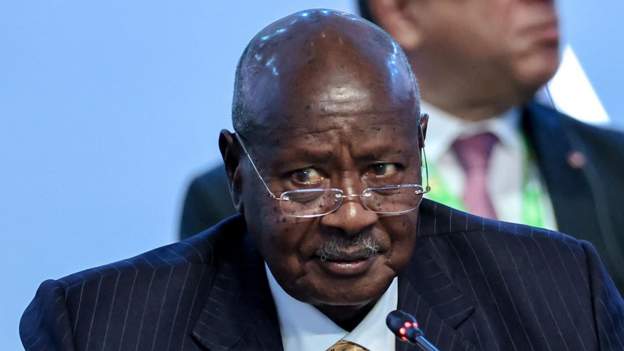
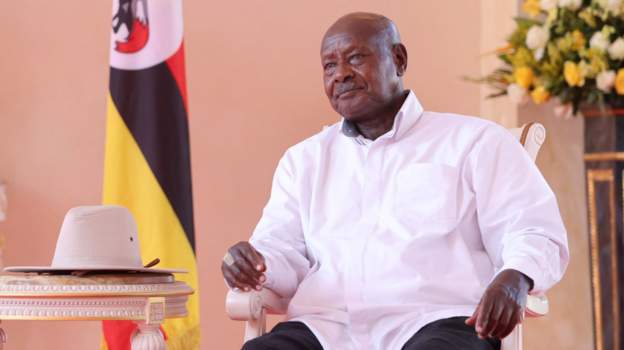
Uganda’s President has played down the significance of the United States’ decision to exclude his country from the African Growth and Opportunity Act (Agoa) due to human rights concerns.
Agoa had allowed Uganda to export goods to the US duty-free for years, but President Joe Biden recently announced the exclusion of Uganda (as well as Gabon, Niger, and the Central African Republic) from the trade agreement starting in January.
The US government had previously considered removing Uganda from Agoa and imposing sanctions following the passage of a contentious anti-homosexuality law in the country.
This law, which includes a death penalty for certain same-sex acts, has faced widespread international criticism.
Uganda’s President, Yoweri Museveni, took to social media to reassure the public, stating that they shouldn’t be overly concerned about the decision.
He added, “As far as Uganda is concerned, we have the capacity to achieve our growth and transformation targets, even if some of the actors do not support us.”
His son-in-law and senior aide, Odrek Rwabwogo, had earlier warned about the potential adverse effects on Ugandan farmers and small business owners due to the expulsion.
Mr. Rwabwogo also expressed Uganda’s willingness to engage in discussions with the US on the matter.
Uganda’s President Yoweri Museveni has once again criticized the World Bank for withdrawing funding, asserting that the organization is mistaken if it believes this action will intimidate the Ugandan people.
In a statement shared on his former Twitter account, Mr. Museveni characterized the World Bank as “superficial and intolerable imperialist agents who lack restraint.”
Last week, the World Bank suspended financial assistance to Uganda due to a controversial anti-homosexuality law enacted in May, which contradicted the organization’s principles.
This law has drawn widespread international criticism due to its severe penalties, including imprisonment or even death for individuals engaging in certain same-sex activities.
In response to the World Bank’s actions, President Museveni accused the institution of attempting to pressure Uganda into reversing the law by ceasing funding. However, he also affirmed that Uganda would continue to progress even without the World Bank’s support.
Reiterating his stance on Thursday, President Museveni emphasized that the discontinued funding would not hinder Uganda’s economic advancement. He suggested that the World Bank’s drastic decision could paradoxically aid Uganda’s efforts to diminish external debt and foster self-sufficiency.
President Museveni further noted that Uganda maintains several Western allies but claimed that these allies were hesitant to continue supporting the country.
Yoweri Museveni, president of Uganda, has once more denounced the World Bank’s decision to stop providing funds, stating that the institution is misguided if it believes that the action will scare Ugandans.
He said this in a statement on his X (formerly Twitter) account.
The World Bank was described by Mr. Museveni as “shallow and intolerable imperialist actors who do not know where to stop” on Thursday.
due to a contentious anti-homosexuality law that was approved in May and went against the principles of the World Bank.
The law has garnered criticism from all over the world for its severe penalties, which include imprisonment or execution for those who commit specific same-sex behaviours.
Last week, Mr. Museveni responded to the World Bank by accusing it of trying to force Uganda to change the legislation by stopping funds, but he said that Uganda will still advance even without the World Bank’s assistance.
Mr. Museveni reaffirmed on Thursday that the financial withdrawal will not stop Uganda’s economic progress. The World Bank’s dramatic action, he said, would actually help Uganda’s efforts to lower its external debt and increase its independence.
Even while Uganda still has a number of Western supporters, Mr. Museveni claimed that they are afraid to continue their support for his country.
In a significant achievement for Brussels, Kenya and the European Union have officially entered into a trade agreement. This deal marks a valuable milestone in the EU’s endeavor to strengthen economic relations with Africa, countering the growing competition posed by China.
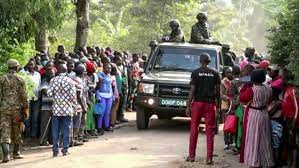
Authorities have blamed Friday’s attack in Mpondwe town, near the border with the Democratic Republic of the Congo (DRC), on the Allied Democratic Forces (ADF), a rebel group that has pledged allegiance to ISIL (ISIS).
In his first remarks since the attack, Ugandan President Yoweri Museveni promised to hunt the assailants “into extinction”.
“Their action – the desperate, cowardly, terrorist action – will not save them,” Museveni said in a statement, vowing to deploy more troops on the Ugandan side of the border.
Pope Francis offered a prayer on Sunday for “the young student victims of the brutal attack” that has shocked Uganda and drawn international condemnation.
United Nations Secretary-General Antonio Guterres called it “an appalling act”, while the United States, a close ally of Uganda, and the African Union also condemned the bloodshed.
Here is what we know so far about the worst attack in Uganda since 2010, when 76 people were killed in twin bombings in the capital, Kampala, by the Somalia-based al-Shabab armed group.
What happened?
Most of the victims died when the dormitory of the Lhubiriha Secondary School, located less than 2km (1.2 miles) from the border, was set on fire late on Friday.
Students told Al Jazeera that they were sleeping when suspected ADF fighters forced their way into the school. Some of them were hacked to death, while others were burned alive using petrol bombs. Some students survived by hiding under the bodies of others.
“We were getting ready to sleep when we heard shouting, we saw men wearing dark green clothes with guns, axes and machetes,” said Bright Mumbere, a student.
“They wanted us to open the dormitory door and then started shooting,” he added.
Uganda’s Minister of Education Janet Museveni, who is also the country’s first lady, said 17 male students were burned in their dormitory while 20 female students were hacked to death with machetes.
An unknown number of attackers, believed to be from the ADF armed group based in the eastern DRC, fled towards the Virunga National Park, a vast area that straddles the border, with six students in captivity, authorities said.
Uganda Peoples’ Defence Forces (UPDF) spokesman Felix Kulayigye said armed forces were pursuing the perpetrators to rescue the abducted students.
Questions have been raised about how the attackers managed to evade detection in a border region with a heavy military presence.
Major General Dick Olum said intelligence suggested the presence of the ADF in the area at least two days before the attack, and an investigation would be needed to establish what went wrong.
Families in mourning
Many of the victims were burned beyond recognition, frustrating efforts to identify the dead and account for the missing.
At a mortuary in Bwera, a town near Mpondwe, families were inconsolable as the bodies of their loved ones were placed in coffins and taken away for burial.
Selevest Mapoze, mayor of the town of Mpondwe-Lhubiriha, said “most of the relatives have come to take their bodies” from the morgue.
But for many others, there was no news of missing relatives. The charred unidentified bodies have been sent to the city of Fort Portal for DNA testing.
“We know that 20 of the students, all girls, were hacked to death using machetes, and 17 boys were burned as petrol bombs were thrown in their dormitory,” Al Jazeera’s Catherine Soi, reporting from the Kenyan capital, Nairobi, said.
Who are the ADF?
The ADF, which the US has designated a “terrorist” group, is considered the deadliest of dozens of armed militias that roam mineral-rich eastern DRC. In March, Washington announced a reward of up to $5m for information leading to the capture of the ADF leader.
The ADF was formed in 1995 by a coalition of rebel forces – including the Uganda Muslim Liberation Army and the National Army for the Liberation of Uganda (NALU) – to fight against the rule of Museveni, who has held power in the East African country since 1986.
Over the years, the group was backed by subsequent DRC governments who were keen on subverting Rwandan and Ugandan influence in the country.
But in 2013, the ADF began attacking Congolese military targets, leading the army to fight back. Consequently, ADF leader Jamil Mukulu fled to Tanzania in 2015, where he was arrested and extradited to his home country to stand trial on charges of “terrorism”.
Past ADF attacks
This was not the first attack on a school in Uganda by the ADF. In June 1998, 80 students were burned to death in their dormitories in an ADF attack on Kichwamba Technical Institute near the DRC border. More than 100 students were abducted.
Ugandan authorities also blamed the group for deadly suicide bombings in the capital in 2021, following which it launched a joint military operation in DRC. But the measures have so far failed to stop the ADF attacks.
On Sunday night, Ugandan President Yoweri Museveni took to Twitter to confirm that he was still self-isolating, countering rumors circulating that he had succumbed to COVID-19.
After testing positive for the virus on June 7, President Museveni announced on the following day that he would be taking a period of “forced leave” to focus on his recovery.
“Greetings. It is now day five of my corona-status. Last night, I slept very well up to the 10th hour of the night (saa kumi za usiku – what the Europeans call 4am)”, the Ugandan leader said in a long Twitter post.
In an effort to combat the ongoing COVID-19 pandemic, President Yoweri Museveni urged the people of Uganda, particularly the elderly, to get vaccinated against the virus and also consider receiving booster shots.
Ugandans and, especially the Bazzukulu.
Greetings. It is now day 5 of my corona-status. Last night, I slept very well up to the 10th hour of the night (saa kumi za usiku –what the Europeans call 4am). This time, the dull headache was not there, nor was the mild throbbing… pic.twitter.com/Zikr4WjBbm
However, rumors circulating on Twitter in recent days falsely claimed that President Museveni had been moved to intensive care and subsequently passed away due to complications from COVID-19. These rumors are unfounded and should be disregarded.
While the World Health Organization (WHO) recently declared that COVID-19 no longer posed a global health emergency, it cautioned that the virus would continue to undergo mutations.
This emphasizes the importance of continued vigilance and adherence to preventive measures, including vaccination, to mitigate the spread and impact of the virus.
Ugandan president Yoweri Museveni announced on Tuesday that lockdowns in two districts have reduced the spread of Ebola cases in the country.
Since the start of the outbreak in late September that at least 55 people have died of the disease. The updated toll points to 141 confirmed cases.
“(In Kasanda, Ed.) The cases have now reduced, during the second 21 days restriction, to one to two cases per day. Progress in Kasanda has been slow because of lack of cooperation. In Mubende, for 18 days we did not get a case”, declared Ugandan President, Yoweri Museveni.
On November 5th, the government extended the containment measures taken in mid-October in the districts of Mubende and Kassanda, in central Uganda and epicentre of the disease.
Uganda’s President Yoweri Museveni has assured foreign visitors that the Ebola outbreak in the East African nation will be brought under control.
In an address to the country on Tuesday, the president noted that foreign tourists were cancelling bookings and international conferences had been cancelled or moved to other countries.
He said the epidemic was localised – with active cases in just six out of 146 districts across the country.
“Uganda is safe and international guests are welcome,” he added.
He said that a list of people exposed to the virus had been provided to immigration authorities to prevent them from international travel.
Some 141 cases with 55 deaths have been recorded since the outbreak was confirmed in September.
The presidentsaid that progress had been made in controlling the epidemic.
For 18 days, there had been no confirmed cases in Mubende district, the epicentre of the outbreak, although one case was reported on Monday, according to health officials.
Mr Museveni said that efforts to control the epidemic were being hampered by some members of the public who were refusing to adhere to health restrictions.
Motorcycle taxis, known as boda boda, were defying lockdown rules in the affected areas and transporting passengers instead of only cargo.
In Kassanda district, 10 members of an extended family died of Ebola after exhuming a body interred by official burial teams and reburying it according to their religious beliefs.
In Kampala, two contacts linked to separate cases escaped from facilities – one to Masaka city and another to Jinja city – and both have since died.
Even though the epidemic has spread to districts far from the epicentre in the central region, Ugandan officials seem confident that the outbreak can be controlled before it spreads.
Bobi Wine, a former pop sensation from Uganda who is now a politician, claims he was detained in Dubai over the weekend after travelling there to take part in a concert.
He claims that throughout his 12-hour detention at the airport, he was questioned about his political affiliation, personal history, and family.
He was later released without charge and the concert, whose proceeds were meant to benefit African migrants in the Gulf country, was later cancelled.
Mr Kyagulanyi has blamed Uganda embassy officials for the cancellation of his music concert
“The information I have is that the Ugandan embassy in Dubai influenced the cancellation of this concert because maybe if I was able to return these girls back home then the government of Uganda will be slapped in the face,” he told the BBC’s Newsday programme.
He added: “I have performed in Dubai many times for the last 15 years but this show was cancelled, and the cancellation was not adequately explained.”
Mr Kyagulanyi participated in last year’s presidential election which he lost to the incumbent Yoweri Museveni.
Two weeks ago, EU legislators approved a resolution alerting the public to the project’s potential for social and environmental harm as well as violations of human rights.
President Yoweri Museveni of Uganda has criticized the EU parliament for urging his administration to cancel a crucial oil pipeline project with Tanzania’s neighbour.
Two weeks ago EU lawmakers passed a resolution warning of human rights abuses and the social and environmental risk posed by the project.
“Some of these EU MPs are insufferable and so wrong that they think they know everything but should calm down,” Museveni said at the annual Uganda International oil & gas summit on Tuesday.
President @KagutaMuseveni: I encourage the oil companies to move on the two, the refinery and the pipeline.
He added: “This is the wrong battleground for them. I hope our partners join us firmly and advise them. For us, we’re moving forward with our programme.”
Mr Museveni has touted the oil pipeline project as one that would boost the country’s economic development.
Rights groups say some 100,000 people risk being displaced and have urged the contractors, France’s Total Energies and the China National Offshore Oil Corporation, to pause the US $10 billion (£8bn) project until they find an alternative route.
The East African Crude Oil Pipeline project will stretch 1,443km (896 miles) from Lake Albert in western Uganda to the Tanzanian port of Tanga on the Indian Ocean.
Uganda’s President Yoweri Museveni is recovering after a “strong” face mask he wore on his trip to Tanzania more than a week ago made him lose his voice.
Mr Museveni said that while face masks protect people against the coronavirus, he “had to put on a very strong one” in Tanzania and “when I came back my voice was affected”.
He did not elaborate, but it led to him calling off a trip to Jinja district in eastern Uganda on Saturday. He sent Vice-President Edward Ssekandi instead.
Tanzania’s President John Magufuli has played down the threat posed by the disease, and has previously said that the country is “coronavirus-free” and God has “spared” it from the virus.
When he welcomed Mr Museveni to the country, Mr Magufuli did not wear a face covering. He had guests laughing when he quoted the Ugandan president as telling him that he would be wearing a mask and he replied that “you can even come with a blanket”.
The two leaders signed an agreement allowing for the construction of a 1,445 km (898 miles) crude oil pipeline.
The $3.5bn (£2.7m) project will connect Uganda’s oil fields to Tanzania’s port of Tanga.
Uganda’s President Yoweri Museveni has declared Saturday a national prayer day for Covid-19.
The president said he got the idea from a Ugandan citizen who had a vision from God.
“God had told him in a vision that I should organise national prayers, scientifically organised, for God to deliver us from Covid-19… I declare 29 August 2020, a day of national prayers and a public holiday. Stay in your houses or compounds and pray,” Mr Museveni said in a social media post
Uganda has so far recorded 2,679 coronavirus cases and 28 deaths.
The government imposed strict restrictions in March after confirming the first case.
Renowned political commentator and former head of Political Intelligence Desk at Internal Security Organization (ISO), Charles Rwomushana, has been charged with disobedience of lawful orders contrary to section 117 of the Penal Code Act.
According to a charge sheet, a copy of which has been seen by this reporter, the 51-year-old presidential aspirant is said to have been found driving at Kamwokya, a Kampala suburb during curfew time.
“Charles Rwomushana on July 29 at around 1am at Kamwokya in Kampala District disobeyed the presidential order or command duly issued by the President of the republic of Uganda when he was found driving a vehicle during curfew time,†reads part of the charge sheet.
Rwomushana who is being jointly charged with two People Power supporters, James Mubiru and Opondo Gaster, is expected to appear at City Hall Court this afternoon.
Mubiru and Opondo were reportedly arrested on their way from visiting a sick friend in hospital.
On the charge sheet is also one Ali Abdallah, a 37-year-old Ugandan-Arabian businessman and resident of Ntinda, Nakawa Division in Kampala.
Rwomushana was on Tuesday night arrested from NBS offices in Kamwokya after being hosted on a talk show where he features as a regular panelist.
The same show also featured MPs Betty Nambooze, Ibrahim Ssemujju, James Kakooza and Fred Nyanzi, a brother to Kyadondo East MP Robert Kyagulanyi alias Bobi Wine.
Unlike Rwomushana, the MPs are reported to have spent a night at the TV station after getting information that police had deployed around the NBS building.
President Museveni announced a curfew starting 9pm to 5:30am as part of the government measures to contain the spread of Coronavirus and criminality in the country.
Uganda on Wednesday confirmed five new infections as the number of virus cases rose to 1,140.
The East African nation has so far registered two virus deaths and 1,028 recoveries since the first case was confirmed in the country in March this year.
Uganda’s President Yoweri Museveni has been addressing concerns about the portions of food relief provided to help people deal with fallout from the coronavirus lockdown.
In theory, every household in need should have got 6kg of the staple maize meal (or posho as it is known in Uganda) per person and 3kg of beans per person.
The food is meant for the urban poor who’ve lost jobs and income because of the lockdown, reports the BBC’s Patience Atuhaire in the capital, Kampala
A film on the president’s Twitter account shows him cutting and weighing out cooked posho.
He announces to an audience of officials that 250g is enough for one person each day.
In later tweets, the president said that the relief food should give you “enough calories to enable you to considerably survive for quite some time” adding that it “should not be consumed wastefully”.
But how much time? Is the question.
By the president’s figures, 6kg of posho will last one person 24 days.
The problem is that the lockdown has now gone on for nearly 50 days.
As a result, there have been complaints that the relief is not reaching everyone and it is not enough.
Ugandan Minister Peter Ogwang has tweeted that 1.3 million Ugandans have now received the aid and more is being distributed.
Mr Museveni is expected to announce this week whether or not the lockdown will be extended.
The ministry of health says the country has 248 confirmed cases of coronavirus and no deaths.
Ugandan President Yoweri Museveni has asked the courts to impose mandatory death sentences for people convicted of murder following a series of kidnapping and killings, including one in which his nephew died.
“You may commit a crime, carelessly taking away the lives of others; however, you will also lose your own life. We need to make this clear to the courts. It must be an eye for eye,” Museveni wrote in a blog post Tuesday.
The president’s nephew, Joshua Rushegyera, was found dead with a gunshot wound near a car parked on a popular highway in Kampala on September 5. A woman with bullet wounds was found dead in the vehicle, according to a statement by the Uganda Police Force investigating the case. No arrests have been made.
In another case, the bodies of a woman and her driver were found August 30, two days after they were abducted from their home. Museveni said the killers have been arrested.
In that case, Museveni said camera footage showed policemen on duty were sleeping and failed to trace the vehicle used by the kidnappers when the victims’ relatives reported the incident. The president said he had given an order for the officers to be prosecuted and dismissed from government service.
“If those who are in uniform today cannot do their job, there are plenty who will replace them,” Museveni said.
CNN has reached out to Uganda’s police spokesman for comment to Museveni’s allegations and is awaiting a response.
Serious crimes, including murder and treason, can be punished with the death sentence in Uganda, but it is not mandatory and only handed out at a judge’s discretion.
Uganda has seen a rise in violent crimes including robberies and kidnapping for ransom in recent years and citizens often complain that security agencies are not doing enough to protect them. An American tourist and her driver were kidnapped at gunpoint from a national park in April and their abductors demanded $500,000 ransom for their release.
Museveni said security is being beefed up and law enforcement is deploying technology to identify and apprehend criminals swiftly.