Tag: Zelensky

  • Ukraine war: Zelensky aide reveals up to 13,000 war dead

    According to a top officer, up to 13,000 Ukrainian soldiers have died since Russia’s incursion began.

    An advisor to Ukrainian President Volodymyr Zelensky named Mykhailo Podolyak estimated that between 10,000 and 13,000 soldiers had died.

    The Ukrainian military has not backed up Mr. Podolyak’s claims, and neither Russia nor Ukraine frequently disclose casualty totals.

    He said in June that every day, 100 to 200 Ukrainian soldiers were killed.

    The most senior US general, Mark Milley, stated last month that since the start of the war, roughly 100,000 Russian and 100,000 Ukrainian soldiers have been killed or wounded.

    Ursula Von der Leyen, the leader of the EU Commission, said that 100,000 Ukrainian soldiers had died in a video message on Wednesday. A representative for the EU Commission later stated that this was an error and that the number really included both the dead and the injured.

    Mr. Podolyak claimed that Kyiv was “openly discussing about the number of the killed” in an interview with Ukrainian television station Channel 24.

    He added: “We have official assessments by the General Staff and the commander-in-chief [Mr. Zelensky], and they range from 10,000 to 12,500-13,000 killed.

    He continued by saying that “substantial” numbers of civilians may have been killed. By the middle of June, 3,600 civilian fatalities had been reported by BBC News. The number is probably considerably higher now.

    According to Ms. von der Leyen, 20,000 civilians in Ukraine were slain. Although the EU Commission did not retract that figure, it was eliminated from later iterations of the movie along with the claim that 100,000 troops had been slain.

    Mr Podolyak also suggested that up to 100,000 Russian soldiers had been killed since the invasion began on 24 February, and that a further 100,000 to 150,000 had been wounded, or were missing or unable to return to combat.

    The BBC’s Russian Service has established that at least 9,311 Russian soldiers of all ranks have been killed since the invasion on 24 February while the true death toll could be more than 18,600.

    In other developments:

    • The Ukrainian military said Russia was using dummy nuclear-capable missiles to exhaust Ukraine’s air defences. Russia was using rockets designed for nuclear use without explosive warheads, Ukrainian military experts said, suggesting this might be because the country has used so many of its other missiles in massive strikes on Ukrainian infrastructure
    • Another senior adviser to President Zelensky, Oleg Ustenko, accused BP of being entitled to hundreds of millions of pounds in “blood money” from investments in Russia. BP said it was no longer receiving any profits from Russian energy giant Rosneft
    • The US and French presidents have said they will keep working together to support Ukraine and hold Russia accountable for its actions. At a press conference during a visit by President Emmanuel Macron to the White House, President Biden also said that he was “prepared to speak to Mr Putin” in order to broker an end to the war
    • TikTok is hosting dozens of videos glorifying violence by Russia’s Wagner group of mercenaries, according to a new report. The videos have been viewed more than a billion times, found US-based organisation NewsGuard. Tiktok said it will act against any content violating its policies.
  • ‘The enemy does not give us gifts’ – Zelensky

    Ukraine’s President Volodymyr Zelensky has said his country is moving “very carefully” following Russia’s announcement that it plans to withdraw its troops from the southern city of Kherson.

    Zelensky called for Ukrainians to be cautious, saying that their enemy did not give out gifts, and did not make “goodwill gestures”.

    Russia’s announced pullout comes just weeks after President Putin said he was annexing Kherson and three other Ukrainian regions, none of which were wholly occupied by Russian forces.

    The commander of Russia’s forces in Ukraine, General Sergei Surovikin, described the decision as difficult. He said defences would be consolidated to the east, on the other side of the Dnipro river from Kherson.

    Source: BBC

  • Hollywood actor Sean Penn gives his Oscar to Zelensky

    American actor Sean Penn has given his Oscar to Ukrainian President Volodymyr Zelensky when he visited the capital Kyiv.

    A video posted on Mr Zelensky’s Telegram channel also showed the president awarding Penn Ukraine’s Order of Merit.

    Penn, who is known for his political activism as much as he is for his films, fled Ukraine in March while filming a documentary about the conflict.

    He later said he considered joining Ukrainian forces to fight against Russia.

    Kremlin officials previously added Penn, and fellow actor Ben Stiller, to Russia’s “stop list”, meaning they are now banned from entering the country.

    Source: BBC

  • John Simpson: Zelensky strikes all the right notes

    It’s always a temptation to see great wars as a clash between individuals – Napoleon against Wellington, Churchill against Hitler – but it’s usually a mistake. There’s vastly more going on in a war across continents than simply a duel between two people.

    But Vladimir Putin’s invasion of Ukraine does have the genuine flavour of a personal battle.

    It was very much his own idea, hatched with a group of three or four officials and generals at a time when Russia was cut off by Covid, even though by now, nearly eight months after it began, millions of lives in Russia and Ukraine have been damaged by it.

    And one man has risen to prominence because he’s opposed it with extraordinary success.

    Volodymyr Zelensky is a quiet, charming, unassuming man. He’s famously an actor by profession, and played the part of the president of Ukraine on television long before he was elected to the actual job. Maybe, of course, the quiet charm and the apparent lack of assumption are part of the act: you’d need to know him a great deal better to be able to be sure about that. My guess is not, though.

    Zelensky seems pretty much as he appears, and like a lot of actors he has a clear-sighted appreciation of himself and the limits of his abilities.

    In the presidential palace, where the main staircase is defended by sandbagged emplacements and you can’t even take a watch with you if you’re a visitor, Zelensky’s trademark dark green T-shirt seemed to fit in perfectly.

    Whichever of his top officials suggested that he should appear on television wearing that during the frightening days of February and March, when the Russians were very close and the streets of Kyiv were full of the rust-coloured steel tank-traps called “hedgehogs”, deserves a special award.

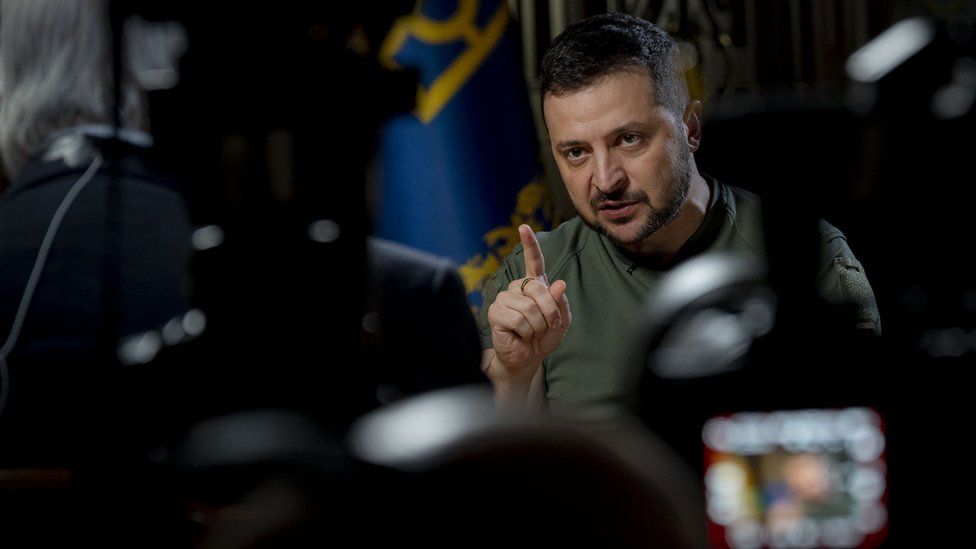
    Zelensky gestures with a finger, dressed in his trademark green T-shirtImage source, Presidential Office

    Zelensky struck precisely the right note – tough, dressed-down, practical and ready for a fight. In those days, most of Ukraine’s friends abroad were certain that the Russians would carve their way through to central Kyiv in no time. It was a sign of Zelensky’s toughness of character that he announced he was staying, whatever happened.

    His ability to continue striking the right note has lasted for eight months.

    A few days ago, though, he got something wrong, and seemed to be calling for a pre-emptive strike to stop Russia using its battlefield nuclear weapons – relatively small-yield bombs that would have an appalling effect locally, but would be fairly limited in the damage they did over a wider area.

    Zelensky’s words weren’t well-chosen, and they handed Moscow an easy win for a few hours. When I interviewed him, he was sufficiently anxious to dampen down the criticism by making his defence in English. He meant, he said, pre-emptive sanctions which the West should impose on Russia to dissuade President Putin and his generals from opening up Europe’s first nuclear war.

    “We’re not terrorists,” he said when I questioned him about this, and that opened up another question. The New York Times has suggested the US now believed that Ukrainian agents were responsible for the car bomb in Moscow last August which killed the ultra-conservative television reporter Darya Dugina, and may have been intended for her equally extreme father, who used to be close to Putin.

    Zelensky insisted that his government had absolutely nothing to do with it. Of course he would.

    Media caption, Watch: Zelensky warns Russians are being prepared for nuclear warfare

    Yet there are plenty of presidents and prime ministers who would turn vicious if you asked them questions like this. Not Volodymyr Zelensky: he stays calm and surprisingly warm. He’s a great deal better at talking about emotions and the effects of the war on ordinary people than he is about detailed questions of policy, but that’s part of the reason for his enormous success, not just in Ukraine but around the world.

    He must be the most popular leader on Earth at the moment, and he is winning his personal public relations duel with President Putin hands down; Putin angry and scowling and reluctant to leave the Kremlin, Zelensky making trips to newly liberated towns. He is even showing sympathy for the young Russian conscripts who are sent to fight in Ukraine, saying to me, “without weapons and body armour – just cannon-fodder”.

    I wondered if his very public refusal to consider negotiating with Vladimir Putin was a signal to other Russian political leaders that if they wanted to end the war they would have to push Putin aside. After speaking to him about it, I decided not.

    He doesn’t seem to have the slightest interest in Putin as a person, and has no respect whatever for him as a war-leader who micro-manages the fighting in angry calls with his generals.

    Did he care if Vladimir Putin fell from power, I asked?

    Zelensky blew out his cheeks and shook his head. “Not in the slightest,” he said.

    Source: BBC

  • Zelensky announces settlements recaptured from Russia

    Ukraine’s President Zelensky said he has “good news”, claiming the recapture of several settlements from Russia.

    Rumours have swirled for days about a possible breakthrough in the eastern Kharkiv region, but with no word from Ukrainian officials.

    Mr Zelensky declined to name which places had been retaken, saying that “now is not the time to name” them.

    Separately, US officials said Ukraine was making “slow but meaningful progress” against Russian forces.

    Speaking in his nightly video address to Ukrainians, President Zelensky said there was “good news” about the rumoured success of Ukrainian troops.

    “I think every citizen feels proud of our soldiers,” he said, naming specific military units and applauding their bravery in combat.

    But he said: “Now is not the time to name the settlements to which the Ukrainian flag returns.”

    Ukraine has tightened its operational security in recent weeks, sharing few details about a widely expected counter-offensive in the east and south.

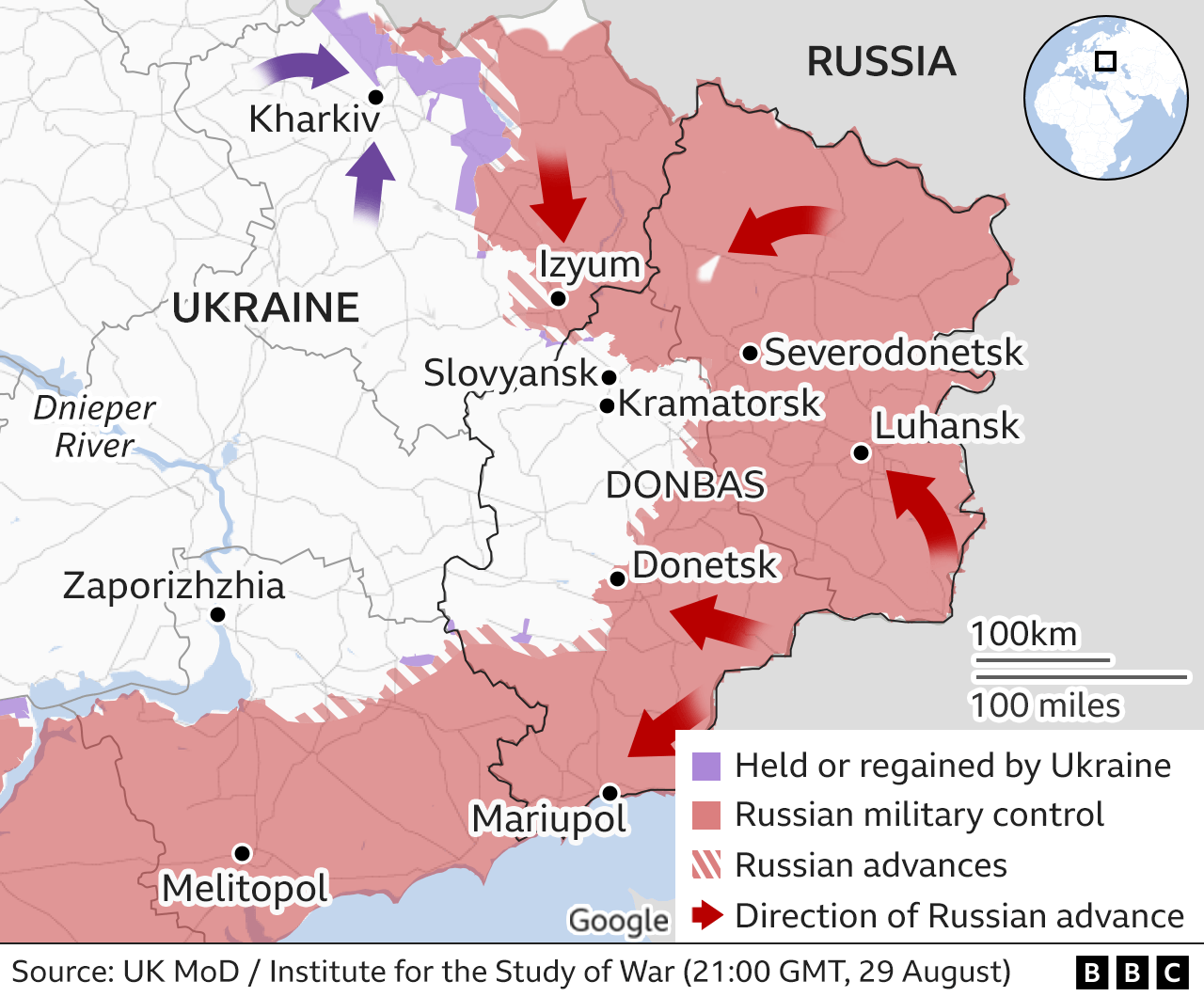
    Ukrainian soldiers have launched an offensive south-east of Kharkiv, towards the eastern region of Donetsk, over which Russia has maintained substantial military control since the war began six months ago.

    Some reports suggest Ukrainian forces may be a few dozen kilometres from the city of Izyum, an important link in Russia’s military supply chain.

    Map showing east Ukraine. 29 Aug

    Speaking at an event in the United States, Colin Kahl – the Under-Secretary of Defense for Policy – suggested that Ukrainian forces were performing better than Russian troops in some areas.

    “It is early days. I think the Ukrainians are making slow but meaningful progress. And we’ll see how things pan out,” he was quoted as saying by Reuters news agency.

    “But I certainly think things are going better on the Ukrainian side right now in the south than is true on the Russian side.”

    The situation, however, remains fraught.

    In its nightly update, the Ukrainian General Staff said on Wednesday that it had “repelled all Russian attacks” in the Kharkiv and Donetsk regions – but that both sides continued to exchange artillery and air strikes, damaging a dozen different places.

    President Zelensky also said on Wednesday that Ukraine’s national budget next year would be that of a country at war – with more than a trillion hryvnia ($27bn; £23.5bn) spent on defence.

    But he promised key social provisions such as pensions would be maintained.

    However, “it is necessary to reduce as much as possible all non-critical expenses”, he warned – “all that does not help defence, does not help the economic development of the country, social and cultural provision of our people”.

    Separately, US and UN observers raised concerns over the fate of civilians in Ukraine as the war continues.

    A senior UN human rights official said the organisation was concerned about the displacement of people in Ukraine – and particularly the fate of children.

    “There have been credible allegations of forced transfers of unaccompanied children to Russian-occupied territory, or to the Russian Federation itself,” warned Ilze Brands Kehris, Assistant Secretary-General for Human Rights.

    Her agency is concerned that Russia has created “a simplified procedure” to provide those children with Russian citizenship, and potentially have them adopted into Russian families, she said.

    Such moves would breach the Geneva Convention, she added.

    The US, also on Wednesday, said it was concerned about a similar forced movement of Ukrainians – but of adults.

    The State Department accused the Kremlin of having lists of Ukrainians to be forced into areas of the country under Russian control as part of what it calls “filtration operations”.

    “Filtration is a dehumanising word, describing a massive campaign that the Kremlin has launched to imprison, to forcibly deport or disappear those Ukrainian citizens Moscow decides could be a potential threat,” spokesman Vedant Patel said.

    “Victims of filtration are given no choice but to submit or face dire consequences.”

    He described the system as a large-scale and advanced operation involving technology such as facial recognition and phone tracking – and said the US had evidence linking Kremlin officials to the project.

    However, Russia’s UN Ambassador, Vasily Nebenzya, said Ukrainians travelling to Russia merely went through a registration procedure.

    Source: BBC

  • Russia-Ukraine war must end with liberation of Crimea Zelensky

    President of Ukraine, Volodymyr Zelensky, has said its war with Russia must end at where it all began, Crimea.

    On Tuesday, he said Crimea must be liberated.

    “This Russian war…began with Crimea and must end with Crimea – with its liberation. Crimea is Ukrainian and we will never give it up,” he is quoted to have said.

    He made the comment following a string of explosions that hit a Russian airbase there, killing one person, leaving eight others injured.

    On Tuesday, a series of explosions rocked the Saky military base near Novofedorivka, in the west of Crimea – which is near seaside resorts popular with Russian tourists.

    Novofedorivka and Saky are about 50km (30 miles) north of the port of Sevastopol, home of Russia’s Black Sea Fleet, which has been leading a blockade of the Ukrainian coastline. The airbase had been used by Russia to launch attacks on targets deep inside Ukraine.

    Footage circulating on social media showed beachgoers running as the explosions hit, with witnesses saying they had heard at least 12 blasts.

    Crimea is globally recognised as part of Ukraine, however, the Black Sea peninsula was annexed by Russia in 2014 after a referendum which the global community sees as illegitimate.

    It is reported that this may have begun the war with Russia.

    On the matter, Russia’s Defence Ministry has indicated that the blasts were due to ammunition that had exploded in a store and that there was no “fire impact” from outside – although this has not been independently verified.

    Also, Ukrainian presidential aide Mykhailo Podolyak has denied allegations that Ukraine was behind the blasts.

    “Of course not. What do we have to do with this?” he is quoted to have said on Dozhd online television channel.

    Per international reports, any attack on Crimea by Ukraine would be considered deeply serious by Moscow.

    Russia sounded a warning last month when ex-President Dmitry Medvedev threatened last month that “Judgement Day will instantly await” if Ukraine targeted Crimea.

    In other news, Ukrainian officials say 13 people were killed in overnight Russian strikes in the central Dnipropetrovsk region, and another one in the Zaporizhzhia region in the south.