Tag: Crude Oil

  • Crude oil prices surpass $100 a barrel as US-Israel war on Iran impedes production and shipping

    Crude oil prices surpass $100 a barrel as US-Israel war on Iran impedes production and shipping

    The ongoing Middle East conflict involving the United States, Israel, and Iran continues to take a toll on the globe. For the first time since 2022, a barrel of crude oil is selling at $100 globally. 

    According to reports, a barrel of Brent crude is currently trading slightly above $107, while West Texas Intermediate (WTI) is selling at around $104.

     The massive increase is expected to negatively impact petroleum product prices in Ghana, particularly in the second pricing window of March.

    COPEC warns that Ghana could soon feel the impact at the pumps, as higher global prices and supply uncertainty may force fuel price adjustments. 

    International energy markets have been thrown into turmoil following a complete shutdown of the Strait of Hormuz, sending crude oil prices soaring above 91 dollars per barrel.

    The Executive Secretary of the Chamber of Petroleum Consumers (COPEC), Duncan Amoah, says the escalation of tensions in the Middle East has effectively crippled one of the world’s most critical oil transit routes.

    Speaking on Saturday, February 28, Mr. Amoah described the situation as a tense naval standoff. He claims forces from Iran, Russia, and China,  a bloc he referred to as the “Iron Triangle,” have positioned naval assets in the strategic corridor, halting oil shipments. 

    He added that U.S. forces are also moving toward the area, raising fears of a broader confrontation.

    According to him, more than 22 percent of the global oil supply that should have moved within the past 24 hours has not been transported.

    In these few days oil prices have jumped sharply from about 67 dollars per barrel to over 91 dollars, representing an increase of more than 30 percent in a single day. The geopolitical premium on oil is now at levels not seen since the 2022 Russia-Ukraine conflict.

    The ongoing tensions have been linked to the death of Iran’s Supreme Leader, Ayatollah Ali Khamenei. Ayatollah Ali Khamenei was reportedly killed in strikes by the Unites States (U.S.) and Israel. This development significantly impacting travelers from Ghana to Asia, Europe, and North America, as Dubai is a major transit hub connecting travelers through the United Arab Emirates.

    On Saturday, 28 February, Emirates flight EK 788 from Kotoka International Airport (ACC) in Accra to Dubai International Airport (DXB) was cancelled, and passengers were advised to contact their airlines for rebooking or refund options due the ongoing tensions.

    The airline suspended its services following reported bombings in Iraq and retaliatory attacks across the region.

    The flight from Accra to Dubai International Airport, scheduled for 7:15 pm GMT on Saturday, 28 February 2026, was canceled at the last minute through a notice.

    Last year, the Minister for Foreign Affairs, Samuel Okudzeto Ablakwa, warned the Israeli Embassy against maltreating Ghanaian nationals. Speaking to the media on Thursday, December 11, Mr. Ablakwa noted that Ghana will respond with equal force if any of its citizens are deported.

    According to him, “If they deport ten Ghanaians, we will deport ten. If they deport twenty, we will deport twenty. If they deport fifty, we will deport fifty. We are not going to accept this.”

    His comments are in response to an incident in which several Ghanaian travellers, including four members of a parliamentary delegation en route to Tel Aviv for an international cybersecurity conference, were detained and deported by Israel Embassy officials.

    Mr. Ablakwa narrated, “We were told that the Ghanaian Embassy was uncooperative, but the facts simply do not support that. Out of the six people on the list that Israel provided, one is not even Ghanaian. He is Gabonese. Our embassy had every right to verify the identity of the individuals involved.

    “One of the people listed was seriously ill, and Israeli doctors themselves advised that she should not travel until she had recovered. How can you deport someone who is unwell and needs medical attention? Another individual had already been issued a travel certificate, so there was no reason to stop their entry into Israel.”

    But in their actions, Israeli officials indicated that six Ghanaians who were supposedly due for deportation failed to provide the necessary details needed by Ghana’s Embassy in Tel Aviv to issue travel certificates.

    The matter adds to broader concerns surrounding deportation practices. In September, eleven West African nationals filed two ex-parte applications at the Labour Division of the High Court in Accra, challenging their alleged detention in Ghana after being deported from the United States (U.S).

    The eleven individuals include Nigerians Daniel Osas Aigbosa, Ahmed Animashaun, Ifeanyi Okechukwu, and Taiwo K. Lawson; Liberian national Kalu John; Togolese nationals Zito Yao Bruno and Agouda Richarla Oukpedzo Sikiratou; Gambian national Sidiben Dawda; and Malians Toure Dianke and Boubou Gassama.

    According to the applicants, they were forcibly transported to Ghana without prior notice. They allege that they were secretly moved from the U.S. detention centers between September 5 and 6 in shackles.

    They want the court to temporarily stop them from being deported back to their home countries until the court decides on their case. Their submission further revealed that Ghanaian authorities allegedly confined them in a military facility.

    They cited Article 14(1) of Ghana’s 1992 Constitution, which guarantees personal liberty, as well as Article 23, which protects the right to administrative justice.

    They are arguing that Ghana is violating international law by trying to send them back to countries where their lives or freedom could be at risk.

    As a result, they have demanded that the Attorney-General, the Chief of Defence Staff, and the Comptroller-General of the Ghana Immigration Service appear before the Human Rights Division of the High Court with valid reasons. The court has fixed Tuesday, September 23, to hear the case.

  • Ghana braces for fuel hikes as oil jumps to $91 amid Middle East tensions

    Ghana braces for fuel hikes as oil jumps to $91 amid Middle East tensions

    International energy markets have been jolted into crisis after a complete shutdown of the Strait of Hormuz, a development that has pushed crude oil prices beyond $91 per barrel.

    On Saturday, February 28, the Executive Secretary of the Chamber of Petroleum Consumers (COPEC), Duncan Amoah, cautioned that the abrupt intensification of tensions in the Middle East has effectively crippled the world’s main oil route, with immediate and serious implications for fuel costs in Ghana.

    He painted a grim picture of a worsening crisis in which diplomatic engagement has given way to a tense naval face-off.

    According to him, the closure is being carried out by a coordinated bloc he identified as the Iron Triangle.

    He confirmed that the naval forces of Iran, Russia, and China have been positioned to shut down the strategic passage, a channel responsible for transporting a large share of global energy supplies.

    “What I can confirm is that the Strait of Hormuz is blocked as we speak,” Mr Amoah stated in Channel One. “The iron triangle is already active. Iran, Russia and China have paraded their maritime infrastructure. Whatever they can deploy in that tunnel is already active. The US is also heading toward that corridor, which means no oil whatsoever has made passage since morning.”

    Price shock: From $67 to $91 in 24 hours

    Oil prices reacted sharply and immediately. Prior to the recent military escalation, which reportedly involved U.S.-Israeli strikes and claims surrounding the death of Iran’s Supreme Leader, crude had been trading steadily between $67 and $69, but by Saturday afternoon the market had shifted dramatically.

    Amoah indicated that trading patterns now point to a jump exceeding 30 percent within just one day.

    “Over 22 percent of the global oil supply that should have moved since last dawn has not moved. Inventories across Europe, the US and Asia will now attract higher premiums. You cannot expect anyone holding oil at this point to sell it cheaper,” he explained.

    Implications for the Ghanaian consumer

    Ghana, which is already grappling with economic pressures outlined in the President’s recent State of the Nation Address (SONA), now faces the likelihood of rising inflation with crude hovering at $91 per barrel.

    COPEC maintains that given the unpredictable nature of the standoff, fuel prices at the pumps could soar unless U.S. naval forces succeed in reopening the vital shipping lane.

    The additional geopolitical premium on oil has climbed to levels not seen since the 2022 invasion of Ukraine. Emirates flights departing from Accra have already been suspended because of restricted airspace, while the Ministry of Foreign Affairs has cautioned against travel to the affected area, deepening concerns that instability in the Middle East could quickly spill over into Ghana’s domestic economy.

    Mr Amoah offered a cautious outlook on what lies ahead. With U.S. carrier strike groups advancing toward the disputed waters, the possibility of a broader naval clash remains high.

    “The situation is fluid and not looking very kind,” Mr Amoah concluded, suggesting that the current inventories held by OMCs (Oil Marketing Companies) will likely be repriced to reflect the new global reality of a $90+ barrel.

    Meanwhile, President John Dramani Mahama’s pledge to revive Ghana’s premier crude oil processing facility, the Team Oil Refinery (TOR) has been fulfilled.

    After several years of inactivity, management of Tema Oil Refinery has announced the resumption of operations. The resumption has become possible following the completion of extensive Turnaround Maintenance (TAM) works on the refinery’s Crude Distillation Unit (CDU). Maintenance works on began on August 1 and October 30 this year. This information was contained in a press statement released by the management on Saturday December 27.

    TOR’s resumption is expected to boost energy security, industrial growth and national development, potentially saving Ghana up to $10.2 billion in oil import bills annually.

    Tema Oil Refinery halted its operations in 2018 citing lack of crude oil which serves as a raw material in maintaining the refinery. Other factors that influenced the closure include broken equipment, piled debt, among others.

    Addressing party delegates in 2023, President Mahama assured the creation of jobs through the revamping of the refinery.

    He pledged to revive the Oil Refinery to its former glory which he claimed was collapsed by the then Akufo-Addo government.

    “Since we (NDC) left office, TOR has never processed crude oil again. I remember before we left office, we sent to TOR the first batch of Ghanaian crude oil from our own oil fields for TOR to process. That oil sat there for several years, eventually, they discounted the oil and sold it out without processing it. I can assure you, when NDC comes back, TOR will stand on its feet again”, he noted.

    In June, this year, Managing Director of TOR Mr. Edmond Kombat has revealed refinery operations will commence in October.

    He informed the Parliamentary Committee on Energy on Sunday, June 22, when he briefed the committee on the leadership’s mandate, work plans for the year 2025, and their operational challenges.

    The engagement forms part of the committee’s oversight responsibility of the agencies under the Ministry of Energy and Green Transition.

    In his submission, Mr. Edmond Kombat indicated that TOR will continue with the gantry and terminal upgrade.

    He noted that the current leadership will also complete ongoing projects commenced by the previous administration as well as work on their debt and financial restructuring as well as retooling of their laboratory.

    He noted that the refinery was wallowing in debt worth $517 million after being inactive for the past four years. The current debt is as of December 2024.

    The Managing Director said: “There were times that the Ministry of Finance in the past had given some funds to TOR and some of it, for example, was grants and then when they entered into the agreement with the IMF, the IMF asked them to reclassify it as debt.

    “So, those things have accumulated to that amount of money and I think the last time TOR traded, some of the trades were not hedged,” he said.

    “We are doing that verification and once we do that verification and authentication of what we have been able to bring down, that will be communicated publicly,” Mr. Edmond Kombat.

    According to him, for the past 6 months, TOR had not audited its financial accounts.

    The Managing Director made a special appeal to the parliamentary committee to help them resolve some of their challenges.

    They include restructuring of their debts with the ESLA receivables, converting GOG debts into equity,reinstating the TOR portion of the ESLA Levy, allowing TOR to participate in the primary distribution margin, and giving TOR a representation on the Laycan Committee, among others.

  • Ghana’s crude oil earnings fall from US$369.25m to US$198.25m in H2 2025 – BoG

    Ghana’s crude oil earnings fall from US$369.25m to US$198.25m in H2 2025 – BoG

    The Bank of Ghana has reported a decline in Ghana’s crude oil earnings in the second half of 2025, according to the latest Ghana Petroleum Funds report.

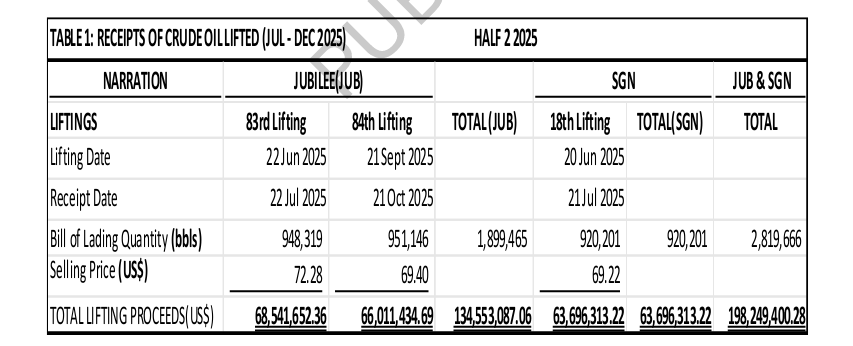
    The semi-annual report showed that receipts from crude oil liftings between July and December 2025 fell to US$198.25 million, down from US$369.25 million recorded over the same period in 2024.

    Data in the report indicated that proceeds from the 83rd and 84th crude oil liftings from the Jubilee field amounted to US$134.55 million, compared with US$144.20 million earned from the 81st and 82nd liftings in the second half of 2024.

    Receipts from the Sankofa Gye-Nyame Field also declined, with the 18th lifting generating US$63.70 million, lower than the US$68.54 million recorded from the 16th lifting in the corresponding period of 2024.

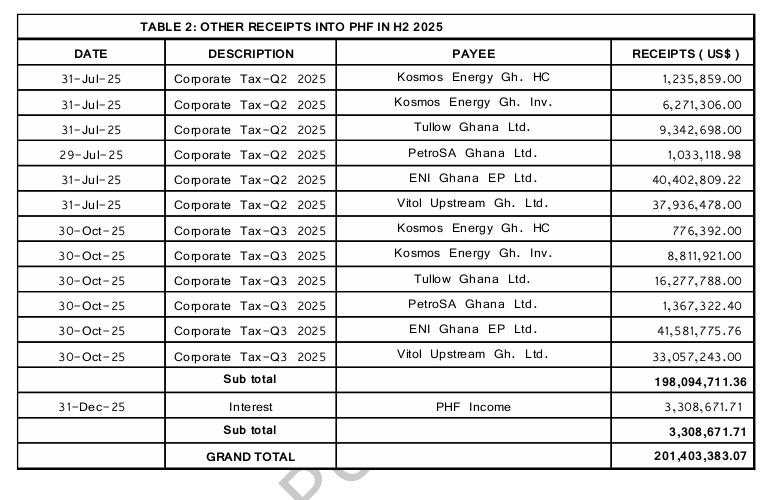
    “During the period under review, a total amount of US$201.40 million was received as other income for corporate income tax and Petroleum Holding Fund interest. The amounts received comprise US$198.09 million for corporate income tax and US$3.31 million for Petroleum Holding Fund interest”, the report said.

    The report noted that total inflows into the Petroleum Holding Fund for the second half of 2025 amounted to US$399.65 million, made up of US$198.25 million from crude oil liftings and US$201.40 million from other income sources.

    It further disclosed that total disbursements from the Petroleum Holding Fund during the period reached US$493.40 million. This included US$134.55 million from the 83rd and 84th Jubilee liftings, US$63.70 million from the 18th lifting at the Sankofa Gye-Nyame Field, and US$295.15 million from other income.

    The Petroleum Holding Fund and the Ghana Petroleum Funds were established under the Petroleum Revenue Management Act, 2011 (Act 815), as amended by Acts 893 and 1138.

    Under Sections 28(1) and (2) of the Petroleum Revenue Management Act, the Bank of Ghana is mandated to report on the performance and operations of the Petroleum Holding Fund and the Ghana Petroleum Funds for the second half of the year ended December 31, 2025.

    Meanwhile, President John Dramani Mahama’s pledge to revive Ghana’s premier crude oil processing facility, the Team Oil Refinery (TOR) has been fulfilled.

    After several years of inactivity, management of Tema Oil Refinery has announced the resumption of operations. The resumption has become possible following the completion of extensive Turnaround Maintenance (TAM) works on the refinery’s Crude Distillation Unit (CDU). Maintenance works on began on August 1 and October 30 this year. This information was contained in a press statement released by the management on Saturday December 27.

    TOR’s resumption is expected to boost energy security, industrial growth and national development, potentially saving Ghana up to $10.2 billion in oil import bills annually.

    Tema Oil Refinery halted its operations in 2018 citing lack of crude oil which serves as a raw material in maintaining the refinery. Other factors that influenced the closure include broken equipment, piled debt, among others.

    Addressing party delegates in 2023, President Mahama assured the creation of jobs through the revamping of the refinery.

    He pledged to revive the Oil Refinery to its former glory which he claimed was collapsed by the then Akufo-Addo government.

    “Since we (NDC) left office, TOR has never processed crude oil again. I remember before we left office, we sent to TOR the first batch of Ghanaian crude oil from our own oil fields for TOR to process. That oil sat there for several years, eventually, they discounted the oil and sold it out without processing it. I can assure you, when NDC comes back, TOR will stand on its feet again”, he noted.

    In June, this year, Managing Director of TOR Mr. Edmond Kombat has revealed refinery operations will commence in October.

    He informed the Parliamentary Committee on Energy on Sunday, June 22, when he briefed the committee on the leadership’s mandate, work plans for the year 2025, and their operational challenges.

    The engagement forms part of the committee’s oversight responsibility of the agencies under the Ministry of Energy and Green Transition.

    In his submission, Mr. Edmond Kombat indicated that TOR will continue with the gantry and terminal upgrade.

    He noted that the current leadership will also complete ongoing projects commenced by the previous administration as well as work on their debt and financial restructuring as well as retooling of their laboratory.

    He noted that the refinery was wallowing in debt worth $517 million after being inactive for the past four years. The current debt is as of December 2024.

    The Managing Director said: “There were times that the Ministry of Finance in the past had given some funds to TOR and some of it, for example, was grants and then when they entered into the agreement with the IMF, the IMF asked them to reclassify it as debt.

    “So, those things have accumulated to that amount of money and I think the last time TOR traded, some of the trades were not hedged,” he said.

    “We are doing that verification and once we do that verification and authentication of what we have been able to bring down, that will be communicated publicly,” Mr. Edmond Kombat.

    According to him, for the past 6 months, TOR had not audited its financial accounts.

    The Managing Director made a special appeal to the parliamentary committee to help them resolve some of their challenges.

    They include restructuring of their debts with the ESLA receivables, converting GOG debts into equity,reinstating the TOR portion of the ESLA Levy, allowing TOR to participate in the primary distribution margin, and giving TOR a representation on the Laycan Committee, among others.

  • Total crude oil production in 2024 stood at 48.24 million barrels – Finance Ministry reports

    Total crude oil production in 2024 stood at 48.24 million barrels – Finance Ministry reports

    Ghana’s total crude oil production in 2024 stood at 48.24 million barrels, according to the Finance Ministry’s 2025 Budget Statement and Economic Policy. 

    The Greater Jubilee field accounted for the highest output, with 31.85 million barrels, representing 66.02% of the total production. The Tweneboa Enyenra-Ntomme (TEN) field produced 6.78 million barrels (14.06%), while the Sankofa-Gye Nyame (SGN) field contributed 9.61 million barrels (19.91%).

    The 2024 production figure reflects a marginal 0.02% decline from the 2023 level of 48.25 million barrels and falls 5.9% below the projected benchmark output of 51.25 million barrels. The decline has been attributed to an increasing gas-to-oil ratio, high water production in the Jubilee and TEN fields, and scale formation in several wells in the Sankofa field.

    The Ghana National Petroleum Corporation (GNPC), on behalf of the state, lifted 8.55 million barrels of crude oil in 2024. The breakdown includes 5.72 million barrels from the Jubilee field, 0.99 million barrels from TEN, and 1.83 million barrels from SGN.

    In terms of revenue, crude oil liftings from January to December 2024 generated $843.52 million (GH¢12.4 billion). Total petroleum receipts, which include crude oil sales and other petroleum revenues, amounted to $1.4 billion (GH¢20.0 billion), marking a 27.81% increase from the $1.1 billion received in 2023. 

    This increase was largely due to a higher number of liftings and an increase in Corporate Income Tax (CIT).

    An analysis of petroleum receipts shows that Carried and Participating Interest (CAPI) contributed the highest share (44.5%), followed by Corporate Income Tax (37%) and Royalties (17.7%).

    In compliance with the Petroleum Revenue Management Act, $493.25 million of petroleum revenues was allocated to the Annual Budget Funding Amount (ABFA) to support government expenditure. 

    The Ghana Petroleum Funds (GPFs) received $584.25 million, with the Ghana Stabilisation Fund (GSF) receiving $408.97 million and the Ghana Heritage Fund (GHF) receiving $175.27 million.

    Additionally, from the ABFA allocations, $24.66 million was transferred to the District Assemblies Common Fund (DACF), $69.06 million to the Ghana Infrastructure Investment Fund (GIIF) for Agenda 111 projects, and $98.50 million to the Accra-Tema Motorway project.

    The government has reiterated its commitment to prudent petroleum revenue management to ensure sustainable economic growth and infrastructure development.

  • Trade surplus recorded as gold, crude oil push Ghana’s exports to $9.23bn in first half of 2024 – BoG report

    Trade surplus recorded as gold, crude oil push Ghana’s exports to $9.23bn in first half of 2024 – BoG report

    Ghana recorded a provisional trade surplus of $1.81 billion for the first half of 2024, driven largely by growth in gold and crude oil exports.

    This is according to the Central Bank of Ghana’s Monetary Policy Report for July 2024, which highlights significant improvements in the country’s export performance compared to the same period in 2023.

    “The trade balance recorded a provisional surplus of US$1.81 billion in the first half of the year, higher than the surplus of US$1.60 billion recorded in the corresponding period of 2023. The improved trade surplus resulted from a higher increase in exports relative to imports,” the report noted.

    Total exports rose by $1.09 billion, a 13.4% increase, bringing the total to $9.23 billion, up from $8.14 billion in the same period last year.

    The surge in export earnings was primarily driven by significant gains in gold and crude oil exports. “The value of gold exports increased by 46.4 percent to US$5.04 billion, driven by both volume and price increases,” the report detailed.

    The volume of gold exports grew by 28.9% to reach 2.4 million ounces, boosted by higher output from small-scale mining operations. In addition, the realized price of gold saw a 13.6% increase, averaging $2,094.5 per fine ounce during the period.

    Crude oil also contributed significantly to the trade surplus, with earnings from oil exports reaching $1.98 billion, an improvement from $1.66 billion recorded in the first half of 2023. This boost in oil revenue was attributed to both increased production and higher global prices for crude oil.

    However, not all sectors performed well. The cocoa industry, a traditionally vital component of Ghana’s export portfolio, faced significant challenges.

    “Receipts from cocoa exports, both beans and products, declined by 47.4 percent, from US$1.454 billion in the first half of 2023, to US$760 million in the first half of 2024,” the report disclosed.

    This sharp decline was attributed to several issues plaguing the sector, including extreme weather conditions, disease outbreaks, and rampant smuggling of cocoa beans.

    Despite the strong export performance, Ghana’s import bill also increased. “The total imports bill rose by 13.5 percent to US$7.42 billion in the first half of the year, driven by both oil and non-oil imports.” Oil imports climbed 6.1% to $2.30 billion, while non-oil imports surged by 17.2% to reach $5.12 billion.

    Commodity Price Trends

    The report highlighted notable price movements for Ghana’s key export commodities in the global market. Cocoa prices experienced a sharp rebound in June 2024, reaching $9,022.6 per tonne following a 19.2% dip in May.

    “From January to June 2024, cocoa prices soared by 113.02 percent, mainly on the back of tight supply,” the report explained, with extreme weather conditions and rising demand contributing to the surge in prices.

    Crude oil prices remained relatively stable during the period, with a slight increase of 0.01% in June to average $83.01 per barrel. “Prices were supported by escalating geopolitical tension in Europe and the Middle East, notwithstanding OPEC+’s decision to boost supply later in the year,” the report added.

    Meanwhile, gold prices saw a slight dip in June, falling by 1.1% to settle at $2,325.34 per fine ounce. “Gold prices were weighed down by a rising US dollar and increasing Treasury yields, but losses were moderated by safe-haven demand amid tensions in the Middle East,” the report noted.

    Despite this minor decline, gold prices have increased by 14.2% since the beginning of the year, driven largely by concerns over global economic uncertainty.

    Commodity Price Index

    In terms of overall export performance, Ghana’s key commodities saw their prices increase on the global market in June 2024.

    “The weighted average price of the three major commodities exported by Ghana (cocoa, gold, and crude oil) increased in the month of June 2024. The index rose to 196.68 from 190.74 in the previous month, representing an increase of 3.1 percent,” the report confirmed.

    The rise in the index was driven by increases in both cocoa and crude oil prices, which outweighed a marginal decline in gold prices.

  • Oil prices decrease as geopolitical tensions remain

    Oil prices decrease as geopolitical tensions remain

    Crude oil prices have fallen as geopolitical tensions and market uncertainties weighed on supply and demand dynamics.

    Despite robust demand in the U.S., oil prices dropped due to ongoing conflicts in the Middle East and unresolved supply issues.

    On Friday, prices decreased as Israel and Hamas initiated new cease-fire and prisoner swap negotiations, and speculation grew over a possible Federal Reserve interest rate cut.

    The market remains uncertain about potential Iranian retaliation following the assassination of a Hamas leader.

    Increased options trading activity reflects market concerns, with investors seeking protection from significant price swings. ING commodities strategists noted heightened interest in $85 per barrel strike options for October and November Brent contracts.

    ICE Brent crude dropped 0.4% to $80.69 per barrel, down from $81.04 previously. Similarly, US benchmark West Texas Intermediate (WTI) fell 0.5% to $77.84 per barrel from $78.16.

    The decline in prices came as cease-fire discussions in the Middle East—home to the majority of global oil reserves—began. According to Cairo News Channel, a ‘high-level’ source reported a strong willingness among all parties involved to reach a cease-fire agreement in Gaza, with initial talks focusing on unresolved issues and implementation.

    The potential for a cease-fire eased supply concerns, putting downward pressure on prices. Meanwhile, uncertainty about the Federal Reserve’s interest rate decisions continues to impact the market.

    Analysts suggest that recent strong retail sales and declining unemployment claims may lead to a 25 basis point rate cut in September, rather than a more substantial 50 basis point reduction.

    The U.S. Energy Information Administration (EIA) reported a decrease in crude oil production by 128,000 barrels per day (bpd) to approximately 13.6 million bpd for the week ending August 9. During the same period, U.S. crude oil imports increased by 61,000 bpd to 6.3 million bpd, while exports rose by 118,000 bpd to 3.7 million bpd.

    The EIA’s Short-Term Energy Outlook (STEO) predicts an average crude oil output of 13.23 million bpd for this year, with a forecast of 13.69 million bpd for next year. Expectations for a cumulative 100 basis point rate cut by the end of the year remain strong.

  • Gold exports in 2023 surge to $7.60bn, crude oil, cocoa, timber exports decline – BOG

    Gold exports in 2023 surge to $7.60bn, crude oil, cocoa, timber exports decline – BOG

    Gold exports reached $7.60 billion, marking a 15.0% increase compared to the previous year.

    This growth is primarily attributed to a 9.2% rise in export volume and a 5.4% increase in the average realized price.

    The surge in export volume was fueled by enhanced gold production, notably from the Newmont Ahafo Mine expansion, resumed operations at Anglogold Ashanti Obuasi Mine, and higher contributions from small-scale miners, as outlined in the 2024 Bank of Ghana Annual Report.

    The average realized price for gold in 2023 stood at $1,843.13 per fine ounce.

    On the other hand, crude oil exports experienced a significant decline of 39.3% in 2023, with earnings totaling $3.84 billion, down by 29.3% from the $5.43 billion recorded in 2022.

    This drop in earnings was influenced by reduced prices and export volumes.

    Export volumes decreased by 13.4% year-on-year to 46.9 million barrels, primarily due to decreased production from the Jubilee and TEN fields. The average realized price also fell by 18.4% to $81.78 per barrel.

    Cocoa exports saw an 8.4% decline, with total earnings amounting to $2.12 billion in 2023, lower than the earnings in 2022. Cocoa beans exports specifically reached $1.31 billion by the end of December 2023, 1.1% lower than in 2022, mainly due to a 0.2% price drop and a 0.9% decrease in export volumes.

    The average price and volume of exports for cocoa beans settled at $2,465.47 per tonne and 533,056.34 tonnes, respectively.

    Meanwhile, cocoa products’ average price increased by 7.1% to $3,289.39 per tonne, but volume dropped by 23.8% to 240,896.35 tonnes, resulting in an 18.4% decrease in earnings to $792.40 million.

    Timber export receipts declined by 11.7% to $142.55 million by the end of December 2023, mainly due to a 15.5% reduction in volume to 290,306.26 cubic meters.

    Nonetheless, the average realized price per cubic meter of timber increased to $491.02 in 2023 from $469.99 in 2022.

  • Crude oil production dwindled from 71.44m to 48.25m in 2023 – PIAC Report

    Crude oil production dwindled from 71.44m to 48.25m in 2023 – PIAC Report

    Ghana’s crude oil production witnessed a downturn for the fourth consecutive year in 2023, as highlighted in the report by the Public Interest and Accountability Committee.

    Delving into the dynamics of the upstream petroleum sector, the report underscored that crude oil production dwindled “from a high of 71.44 million barrels in 2019 to 48.25 million barrels in 2023.”

    This signifies an annual average reduction of 9.2%.

    Out of the 48 million barrels, the Jubilee Fields contributed 63%, SGN contributed 23%, and TEN contributed 14%.

    “For the year 2023, a total of 48,247,036.61 barrels (bbls) was produced from the three producing fields; Jubilee – 30,444,217 bbls (63%); TEN – 6,716,278 bbls (14%) and SGN 11,086,541.61 bbls (23%).”

    For raw gas, a total of 255,171.97 MMSCF was produced in 2023 from the SGN Field (127,203.02 MMSCF, 50%), Jubilee (77,900.05 MMSCF, 30%) and TEN Fields (50,068.90 MMSCF, 20%). The average achieved price by the Ghana Group for all three (3) producing fields during the period under review was US$78.067/bbl.

    As a result, the committee suggested that the government and pertinent regulatory agencies should initiate necessary measures to counteract the decline in production in current fields and facilitate investments in untapped fields.

    The 2023 Annual Report fulfills PIAC’s mandate under the Petroleum Revenue Management Act, 2011 (Act 815), as amended by Act 893, to issue Semi-Annual and Annual Reports.

  • Aliko Dangote’s refinery set to buy 24 million barrels of crude oil

    Aliko Dangote’s refinery set to buy 24 million barrels of crude oil

    Dangote Refinery is seeking millions of barrels of U.S. crude oil, according to a document reviewed by Reuters.

    The refinery, with a capacity of 650,000 barrels per day, aims to operate at full capacity soon, potentially becoming Africa’s largest refinery this year or next.

    The tender document, shared by two traders, indicates that the refinery is looking to purchase two million barrels of West Texas Intermediate (WTI) Midland crude each month for a year, starting in July.

    Meanwhile, Nigeria has a surplus of its own light sweet crude grades.

    Traders reported that Nigeria’s May-loading cargoes are nearly sold out, with at least 30 June cargoes still available.

    Despite the availability of local oil, WTI might not necessarily be cheaper than Nigerian crude.

    The cost will depend on factors such as the timing of the sale and oil delivery, according to two other trade sources.

    Additionally, Angola’s July loading program is expected to be announced soon, even as several June-loading cargoes remain available.

  • Nigeria mandates oil companies to sell to local refineries

    Nigeria mandates oil companies to sell to local refineries

    The Nigerian Upstream Petroleum Regulatory Commission (NUPRC), on behalf of the federal government, has introduced new regulations mandating oil producers to prioritize selling crude oil to local refineries.

    This strategic move aims to lessen the country’s reliance on imported refined products.

    Under the new regulations, all oil companies operating in Nigeria are obligated to supply crude to domestic refineries that cannot source it locally. Only after fulfilling these domestic supply obligations are producers allowed to export crude.

    In cases where agreements on crude supply cannot be reached directly between local refiners and producers, the NUPRC will act as an intermediary. It will facilitate the arrangement of a sales purchase agreement based on a willing-buyer, willing-seller model.

    Payments for crude supplied to domestic refiners can be made in either dollars, naira, or a combination of both, as outlined in the regulations.

    The implementation of the Domestic Crude Oil Supply Obligation initiative is scheduled for the second half of the year. However, the specific quantity of crude each refinery is required to procure has yet to be determined.

  • Fitch adjusts 2024 Crude Oil forecast to $80 

    Fitch adjusts 2024 Crude Oil forecast to $80 

    Leading rating agency, Fitch Solutions, has adjusted its crude oil forecast for 2024 to $80.0 per barrel, marking an increase from the earlier projection of $75. This revision is expected to have significant implications for the global energy landscape, reflecting changing market dynamics and economic considerations.

    However, the rating agency is anticipating a reduced crude oil price for 2025, with a projection of $70 per barrel, aligning with its initial forecast of $70. This outlook suggests a cautious perspective on the trajectory of oil prices in the coming year.

    Currently, the world market sees crude oil priced at $76 per barrel.

    Hence, assuming the forecasted price holds and considering the stability of the cedi, fuel prices at the pumps are not expected to undergo significant changes in 2024.

    The elevated Brent and WTI oil benchmark projections for 2024, as stated, find support in OPEC’s ongoing efforts to bolster oil prices. This includes the recent collaborative decision of several members to join Saudi Arabia and Russia in implementing additional cuts during the first quarter of 2024.

    According to the UK-based firm, the market was likely to be in a deficit of about 1.2 million barrels per day in the second half of 2023, according to the International Energy Agency.

    It explained that OPEC+’s additional curtailments suggest that the deficit could persist in the first half of 2024, provided that compliance with production cuts remain strong.

  • Govt grapples with over GHS143m compensation debt for impacts of road construction – Director of Urban Roads

    Govt grapples with over GHS143m compensation debt for impacts of road construction – Director of Urban Roads


    The Department of Urban Roads, under the leadership of Director Ing. James Amoo-Gottfried, has disclosed that the government faces a road construction compensation debt totaling GH¢143,120,909.10 as of September 2023 across the country.

    Ing. Amoo-Gottfried highlighted that the compensations paid for impacted structures and facilities for specific projects, such as La Beach and Borteyman roads, alone amounted to GH¢56,509,022.29.

    He attributed the issue to the negligence of local assemblies in permitting encroachment on the right of ways. Ing. Amoo-Gottfried suggested that Metropolitan, Municipal, and District Assemblies (MMDAs) should be held accountable for resettling occupants or paying compensation.

    To address this, he recommended deducting these costs from MMDAs’ Common Fund or any other funds owed to them by the central government.

    “The cost of resettling or compensation should be deducted from MMDAs share of the Common Fund or any other monies due them from the central government. We have appealed to the Ministry of Roads and Highways to consult the Ministry of Finance to prepare budgetary support to pay compensation for structures in right of ways”ING. James Amoo-Gottfried suggested during a presentation in Koforidua, Eastern Regional Capital.


    In the short-term solution, the Department of Urban Roads proposes identifying and mapping all roads and transport routes within assemblies, documenting structures within the right of way, and monitoring corridors to prevent further development and illegal encroachment.

    Additionally, there is a suggestion to engage stakeholders, including the land commission, Land Use and Spatial Planning Authority, and telecommunication companies, emphasizing the need to protect the Right of Way.

    In the medium term, the National Engineering Coordinating Team (NECT) secretariat has revived the National, Regional, and Metropolitan, Municipal, and District Assembly (MMDA) Engineering Coordinating Teams to coordinate activities in road reservations, aiming to reduce encroachment.

    Ing. Amoo-Gottried believes that the upcoming review of the road reservation management policy guidelines, in its final stages, will provide guidance to member agencies and the public.

    Looking into the long term, Ing. James Amoo-Gottfried emphasizes that effective coordination among stakeholders is crucial to protect the right of way.

    Discussing the conditions of roads in the country, Ing. Amoo-Gottfried highlights that Ghana’s road network is estimated at 100,000 km, with the national road length reaching 94,203 km as of 2022. He points out that 72% of roads in Ghana lack bitumen, equivalent to 68,000 km. Urban roads are reported to have 47% in good condition, 32% in fair condition, and 21% in poor condition.

    Ing. James Amoo-Gottfried identifies challenges in road infrastructure, including funding constraints, the absence of a credible road development plan for road reservations, inadequate enforcement of land-use regulations, a lack of coordination in land use at all levels, and issues related to encroachment.

    https://youtu.be/WjQm-CajQjY
  • 13% decrease in half-year crude oil production per PIAC reports

    13% decrease in half-year crude oil production per PIAC reports

    During the first half of 2023, crude oil production in the country experienced a significant decline, raising concerns about petroleum revenues and regulatory compliance. The nation’s three offshore producing fields, Jubilee, Tweneboa, Enyenra, Ntomme (TEN), and Sankofa Gye Nyame (SGN), produced a total of 22.4 million barrels (bbls) of crude oil. This marked a substantial 13.2 percent decrease compared to the production volume of 25.8 million barrels (bbls) in the same period of 2022, marking the fourth consecutive year-on-year decline in crude oil production since inception.

    This drop in production was primarily attributed to reduced output from the three producing fields. Jubilee, TEN, and SGN Fields experienced respective declines of 12 percent, 17.5 percent, and 12.9 percent in crude oil production.

    In the Jubilee Field, production fell from 14.9 million bbls in H1 2022 to 13.1 million bbls in H1 2023, representing a 12.03 percent decrease. The average daily oil production in the Jubilee Field during H1 2023 was 72,449 bbls, compared to 82,560 bbls in H1 2022, marking a 12.2 percent reduction.

    Tweneboa-Enyenra-Ntomme also witnessed a decline in production, dropping from 4.4 million bbls in H1 2022 to 3.6 million bbls in H1 2023, a 17.5 percent decrease. Average daily oil production reduced from 24,263.00 bbls in H1 2022 to 20,032.24 bbls in H1 2023.

    In the Sankofa Gye-Nyame (SGN) field, production dipped from 6.5 million bbls in H1 2022 to 5,712,891 bbls in H1 2023, marking a 12.9 percent decrease. Average daily production decreased from 36,206.76 bbls to 31,562.9 bbls during the period.

    These challenges arose following the country’s reduction of existing Petroleum Agreements (PAs) from 14 to 13 as of June 2023, primarily due to the relinquishment of AGM Petroleum’s entire interest in the South Deep Water Tano Contract Area.

    Furthermore, according to the findings in the 12th Semi Annual Report of the Committee, Jubilee Oil Holding Limited (JOHL) failed to remit proceeds from lifts in H1 2023 amounting to US$70,456,719 into the PHF.

    “This is the fourth consecutive time the Company has failed to pay the proceeds of lifts from the Jubilee and TEN Fields, amounting to US$343,108,928,” it was stated.

    Furthermore, it was observed that Kosmos Energy Ghana Limited incorrectly deposited withholding tax totaling US$3.9 million into the Petroleum Holding Fund (PHF) for the years 2020 and 2021.

    During the review period, the Ghana National Petroleum Corporation (GNPC) expended US$6.40 million on production and development costs at the TEN field and lifted a parcel of crude oil from the field in May 2023. However, the Corporation received no revenue from the field, either in terms of its equity interest or its share of net CAPI, despite revenues being deposited in the PHF during H1 2023.

    This situation, as noted by PIAC, violates Section 16(4) of the Petroleum Revenue Management Act (PRMA) as amended, which specifies that the Minister for Finance should ensure the prompt transfer of a relevant portion of revenue due to a national oil company into the Petroleum Holding Fund not later than three working days after receiving petroleum revenue.

    In response to these findings, PIAC reiterated its stance that proceeds from JOHL and other GNPC subsidiary lifts constitute petroleum revenues and should be remitted to the PHF. The committee also stressed the importance of International Oil Companies (IOCs) ensuring that only petroleum revenues, rather than other funds, are deposited in the PHF.

    Furthermore, PIAC called upon the Ministry of Finance to adhere to the provision in Section 16(4) of the PRMA as amended, ensuring the timely release of funds to the National Oil Company within three working days after receiving petroleum revenue in the PHF.

  • Prices of cocoa, gold up but crude oil drops on international market – BoG

    Prices of cocoa, gold up but crude oil drops on international market – BoG

    The Bank of Ghana has reported a mixed reaction to the prices of Ghana’s major export commodities on the international market in the first half of the year.

    The commodities are cocoa, gold and crude oil.

    According to the Monetary Policy Committee Press Release dated 24th July, 2023.

    Cocoa prices surged to record highs last seen over a decade ago, triggered by tight supplies from West Africa coupled with expectations of a global deficit in the 2022/2023 crop season.

    On a year-to-date basis, cocoa beans gained 25.5 percent to settle at US$3,185.29 per tonne in June 2022.

    International benchmark crude oil prices lost 7.8 percent in the year to close at US$74.98 per barrel due to concerns that sluggish global growth could reduce energy demand, the report noted.

    However, decisions by OPEC+ to deepen production cuts moderated the losses somewhat.

    With regards to gold, the price of the commodity went up by 8.1 percent year-to date to settle at US$1,942.07 per fine ounce.

    This was as a result of increased fears over global recession and possible slower interest rate hikes in the United States loom.

    Also, increased demand for the metal from China is said to be another factor for the price hike.

    Source: The Independent Ghana

  • South Sudan concerned about rebel threats to halt crude oil shipments

    South Sudan concerned about rebel threats to halt crude oil shipments

    South Sudan is growing increasingly concerned about the potential impact of the ongoing conflict in neighboring Sudan on its oil transportation and revenue, which are vital for its economy.

    The conflict poses a significant security threat to the transportation of oil, and recently, the Rapid Support Forces (RSF) issued a threat to South Sudan. They warned that they would disrupt the transportation of oil passing through their controlled territories unless they receive a share of the rental and transit fees.

    Furthermore, the RSF has also threatened to shut down the pipeline infrastructure unless South Sudan ceases its contributions to the military leadership led by Gen Abdel Fattah al-Burhan.

    Ezekiel Lol Gatkuoth, a former Petroleum minister, acknowledged that it is unclear whether these threats are genuine or part of the wider propaganda of the war. However, he emphasized that a shutdown of South Sudan’s oil operations would have catastrophic consequences.

    The oil sector is crucial to South Sudan’s economy, and any disruption in oil transportation or production would severely impact the country’s revenue and economic stability.

    “A shutdown would be a loss to South Sudan, Sudan and our oil partners China National Petroleum Corporation, Petronas of Malaysia, and ONGC of India,” Mr Gatkuoth told The EastAfrican.

    The RSF controls pumping stations at Heglig of South Kordofan, while government forces control transport routes to Port Sudan, where the oil is loaded onto cargo ships for international sale.

    Deserting workers

    Juba pays Khartoum fees and a non-commercial tariff to ship its crude abroad.

    South Sudan transports crude oil to the Port of Sudan through the pipeline, with Sudan being the guarantor and protector of all oil infrastructure passing through its territory. Last year, South Sudan paid Sudan $148 million as a cost for oil processing, transportation, and transit fees.

    South Sudan earned $1.4 billion in oil revenue.

    The situation could adversely affect the economy of South Sudan, which depends on oil exports for 95 percent of its income, as oil production has been affected because some contractors ceased operations and foreign workers left oilfields due to fears of insecurity.

    According to the Ministry of Petroleum, South Sudan produces 170,000 barrels per day, and Sudan gets $25 per barrel.

    These threats led the government to announce plans to enhance the collection of non-oil revenue. Currently, the National Revenue Authority collects about $135 million per month in non-oil revenue, but the agency is targeting about $308 million per month by the end of the 2023/2024 fiscal year.

    While Juba depends on oil to run the economy, most of the experts in the oil sector are Sudanese. According to the Ministry of Petroleum, South Sudan produces 170,000 barrels per day, and Sudan gets $25 per barrel.

    In addition, 28,000 barrels a day are refined in Khartoum Refinery at Al-Jaili, and the products are consumed by both countries. The Central Processing Facilities at Al-Jabalain and Heglig are also operated by Sudanese experts.

    The marine terminal at Port Sudan, through which oil is shipped to the international markets, employs hundreds of Sudanese. Al Khair terminal in Sudan has a storage capacity of 50,000 tonnes at a time and handles 67 million tonnes per year.

    To avoid dependency on one route, South Sudan has been considering alternative oil export routes by road through Ethiopia to the port of Djibouti. The country is also constructing the road from the Bentiu oil refinery to Gogrial to transport refined oil and make space for storage.

    The other potential Kenyan route, through the Lamu Port-South Sudan-Ethiopia-Transport corridor, is uncertain due to years of delays in completion.

  • Price of LPG to fall by 7.0% effective tomorrow

    Price of LPG to fall by 7.0% effective tomorrow

    Consumers of Liquefied Petroleum Gas (LPG) are expected to see a fall in the price of the commodity by 7 per cent effective tomorrow, June 16, 2023.

    The LPG Marketers Association has attributed the local decline to the 10% drop in the prices of LPG on the international market.

    According to the Association’s Vice President, Gabriel Kumi, “competition can drive that down to about 10%”.

    In April this year, the price of LPG declined by 5% with the product selling at GHS12.40 per liter from GHS13.20. This will be the fourth consecutive time price of the commodity has seen a marginal drop this year.

    In its May 2023 Monetary Sector Report, the Bank of Ghana noted that crude oil prices have broadly trended downwards since June 2022.

    From US$117.2 per barrel in June 2022, prices plunged to US$81.3 per barrel in December 2022, before moving slightly up to US$82.7 per barrel in April 2023.

    Prices were pressured by concerns over the health of the global economy and prospects of oil demand, despite the announced production cut by OPEC+, the Central Bank noted.

    Source: The Independent Ghana

  • How prices of cocoa, crude oil and gold fared in first four months of 2023

    How prices of cocoa, crude oil and gold fared in first four months of 2023

    The Bank of Ghana has provided an update on the current status of three key commodities that Ghana trades in, namely cocoa, crude oil, and gold.

    In its May 2023 Monetary Sector Report, the Central Bank noted that in the first four months of 2023, cocoa prices were generally positive.

    This was driven by lower production volumes, higher grinding in top-grower Ivory Coast and increased global demand.

    Per the report, prices began the year at US$2,539.86 per tonne in December 2022, and rose to US$2,924.37 per tonne in April this year. This represents 15.2 percent year-to-date increase and 13.0 percent on year-on-year terms.

    With regard to crude oil, prices have broadly trended downwards since June 2022.

    From US$117.2 per barrel in June 2022, prices plunged to US$81.3 per barrel in December 2022, before moving slightly up to US$82.7 per barrel in April 2023.

    Prices were pressured by concerns over the health of the global economy and prospects of oil demand, despite the announced production cut by OPEC+, the Central Bank noted.

    Meanwhile, the BoG says gold has remained strong so far this year.

    Spot gold started the year at US$1,796.2 per fine ounce and surged to an all-time high US$2,000.7 per fine ounce in April 2023, representing a 3.4 percent year-on-year
    growth.

    This was prompted by economic uncertainty amid fears of recession, expectation of lower rate hikes as inflation eases, and the banking crisis in the U.S. and Europe.

    “The weighted average price of the three major commodities exported by Ghana (cocoa, gold and crude oil) increased by 3.9 percent in April 2023.

    The increase in the overall index was on the back of increases in all the three commodities, with the cocoa sub-index increasing by 4.9 percent, the crude oil sub-index by 3.9 percent, and the gold sub-index by 3.7 percent,” the report added.

    Source: The Independent Ghana

  • NPA confiscate 181,000 litres of smuggled crude oil and diesel in Western Region

    NPA confiscate 181,000 litres of smuggled crude oil and diesel in Western Region

    Between January and April 2023, the National Petroleum Authority (NPA) has announced the seizure of a significant quantity of illegally smuggled crude oil and diesel in the Western Region.

    During separate operations conducted by the Ghana Navy and Marine Police, a total of 108,000 litres of diesel and 73,000 litres of crude oil were impounded from smugglers operating on the high seas.

    Sandra Aidoo, the Western Regional Manager of NPA, revealed this information during a media engagement held in Takoradi on June 1, 2023.

    According to Aidoo, the smugglers involved in the diesel seizure have been apprehended and are currently facing trial. As for the crude oil, the smugglers managed to evade capture, but the confiscated product has been transported to Accra, with further details to be disclosed to the public.

    Aidoo emphasized that the activities of these smugglers are not only undermining NPA’s operations but also impacting the quality of fuel supplied at retail stations.

    “Unscrupulous filling station owners purchase these untaxed products at lower prices, posing a risk to consumers. The NPA is determined to prevent such products from entering the market, ensuring the distribution of safe and regulated fuel,” she stressed.

    Ms. Aidoo continued, “We initially confiscated 108,000 litres of diesel on the high seas in January. The smugglers were arrested and are currently standing trial. The other was in April when 73,000 litres of crude oil was confiscated.

    “As part of our monitoring exercises, four retail outlets that did not meet our score were closed down. They are not operating as I speak because they do not meet our requirements,” she is quoted to have said by graphic.com.gh

    During the media engagement, the NPA highlighted its efforts to enforce operational requirements and maintain standards in the petroleum downstream industry.

    In addition, the NPA working closely with security agencies have been able to close down and revoke the licenses of four non-compliant filling stations in the region.

    Ms. Farida Ali-Musah, the Legal Manager at the Legal Directorate of NPA, mentioned that the Authority has been granted prosecutorial powers by the Attorney General to combat crimes within the oil supply chain.

    Mr. Dominic Aboagye, the Head of Planning at NPA on his part provided insights into the country’s fuel consumption, revealing that 80 percent of the demand is met through imports while the remaining 20 percent is produced domestically.

    In an effort to boost local production, the government and private sector are collaborating on initiatives, including the construction of a refinery by a private entity.

    The NPA’s actions demonstrate its commitment to combating illegal activities within the oil sector, ensuring the supply of high-quality fuel and protecting the interests of consumers.

  • Oil prices rise as US Congress approves debt deal

    Oil prices rise as US Congress approves debt deal

    Despite market uncertainty surrounding the upcoming OPEC+ meeting, where no changes in production policy are anticipated, crude oil prices saw an increase as the market factored in the lifting of the US debt ceiling.

    International benchmark Brent crude traded at $75.08 per barrel, representing a 1.07% increase from the closing price of $74.28 a barrel in the previous trading session on Friday.

    The American benchmark West Texas Intermediate (WTI) traded at the same time at $70.82 per barrel, up 1.02% from the previous session’s close of $70.10 per barrel.

    Both benchmarks are on track to slash their marginal weekly losses after investors throughout the week priced in the US debt ceiling decision to set the maximum amount of outstanding federal debt the US government can incur.

    Averting a first-ever catastrophic default on the nation’s debt before a June 5 deadline, the US Senate passed a bill to suspend the debt ceiling late Thursday.

    This came as the US Institute for Supply Management (ISM) released the ISM manufacturing purchasing managers’ index (PMI), which indicated a contraction in the country’s manufacturing sector in May for the seventh consecutive month, limiting crude oil prices’ upward trajectory.

    Another headwind to limit price upticks was the less-than-expected rise in US commercial crude oil inventories, which rose by around 4.5 million barrels to 459.7 million barrels, against the American Petroleum Institute’s forecast of a jump of 5.2 million barrels.

    Positive demand sentiment in the market was supported by reports that manufacturing activity in China recovered for the first time in three months in May. The Caixin China General Manufacturing Purchasing Managers’ Index (PMI) increased to 50.9 in May from 49.5 in April, owing to robust and rapid growth in output in May.

    With a rise above the neutral level of 50, the result marked the first improvement in overall manufacturing sector conditions since February.

    OPEC+ meeting in focus

    As markets await Sunday’s meeting of the Organization of Petroleum Exporting Countries (OPEC) and its allies, known as OPEC+, experts say the group will most probably keep its production level unchanged.

    Rystad Energy on Thursday said the 23-member group could decide to maintain the current production policy, citing tight market conditions expected to lead to higher oil prices in the second half of the year.

    The meeting will be the group’s first ministerial meeting after some OPEC+ countries in April decided to cut output by 1.6 million barrels per day (bpd) on top of their existing cuts of 2 million bpd in place since October last year.

    Without ruling out ‘further production cuts’, Jorge Leon, senior vice president of oil market research at Rystad Energy, predicted that the group might stick to current production levels, taking a ‘wait and see’ approach.

  • IMF report predicts a 24.1% decline in oil prices to $73.1 per barrel in 2023

    IMF report predicts a 24.1% decline in oil prices to $73.1 per barrel in 2023

    Prices of crude oil on the international markets is expected to fall by 24.1 percent to sell at an average of $73.1 per barrel in 2023, this is according to the IMF’s April 2023 World Economic Outlook Report.

    The development will be a significant reduction from the $96.4 per barrel sold in 2022.

    The International Monetary Fund said price of crude oil will however continue to drop in the coming years to an average of $65.4 per barrel in 2026.

    In its April 2023 World Economic Outlook Report, the Fund explained that “uncertainty around this price outlook is elevated in part due to the uncertain rebound in China’s growth, as well as the energy transition”

    In the wake of tough economic conditions on the globe, prices of crude oil retreated by 15.7 percent between August 2022 and February 2023 on the back of weakened demand.

    Market leaders like China have also witnessed their first annual decline in oil consumption due to a resurgence in COVID-19 outbreaks and concerns in the real estate market.

    Fears of a looming economic recession, coupled with inflation hikes, banking sector crisis and tightening of monetary policies in key economies, have all impacted on the oil demand and pricing.

    The IMF report however noted that on the supply side, Western sanctions against Russia and its efforts to export crude oil have also impacted on global market balances.

    “As of March, Russian crude oil exports had held steady since implementation of the Group of Seven (G7) price cap and ban on crude oil imports on December 5 [2023]. Russia rerouted its oil, reportedly sold at a major discount to Brent oil prices, to nonsanctioning countries, primarily India and China,” the IMF report noted.

  • Prices of oil rise by 8% after OPEC reduces output

    Prices of oil rise by 8% after OPEC reduces output

    Oil prices surged as much as 8% at the open after OPEC+ announced it was slashing output by 1.16 million barrels per day.

    Brent crude futures last jumped 5.07% to $83.95 a barrel on that news, and U.S. West Texas Intermediate crude futures soared 5.17% to $79.59 a barrel.

    The voluntary cuts will start from May to end 2023, Saudi Arabia announced, saying it was a “precautionary measure” targeted toward stabilizing the oil market.

    The move comes on the back of Russia’s decision to trim oil production by 500,000 barrels per day until the end of 2023, according to the country’s Deputy Prime Minister Alexander Novak.

    Other member states have also pledged respective cuts, with OPEC Kingpin Saudi Arabia reducing 500,000 barrels per day and UAE cutting 144,000 barrels per day, amongst other cutbacks from Kuwait, Oman, Iraq, Algeria and Kazakhstan.

    “The selected involvement of the largest OPEC+ members suggest that adherence to production cuts may be stronger than has been the case in the past,” Commonwealth Bank of Australia’s Vivek Dhar said in a note.

    Oil at $100 per barrel?

    “OPEC+‘s plan for a further production cut may push oil prices toward the $100 mark again, considering China’s reopening and Russia’s output cuts as a retaliation move against western sanctions,” CMC Markets’ analyst Tina Teng told CNBC.

    Teng noted, however, that the cut could also reverse the decline in inflation, which would “complicate central banks’ rate decisions.”

    In March, oil prices tumbled to their lowest since December 2021, as traders feared the banking rout could dent global economic growth.

    “They’re looking into the second half of this year and deciding they don’t want to relive 2008.” Bob McNally, Founder of Energy Aspects noted.

    The oil cartel and its allies are looking to avoid a repeat of the 2008 crash, one analyst said.

    “They’re looking into the second half of this year and deciding they don’t want to relive 2008,” said Bob McNally, president of Rapidan Energy Group, citing oil prices crashing from $140 to $35 in six months in that year.

    McNally added that while it’s not his base case, oil prices could “make a dash for $100 … if Chinese demand goes back to 16 million barrels a day second half of this year [and] if Russian supply starts to go off because of sanctions and so forth,”

    “Then these cuts, if they stick with them, are going to super tighten the market,” he said.

    According to Wood Mackenzie, China could make up 40% of the world’s demand recovery in 2023.

  • Gold for Oil consignment is much more expensive than other sources – Dr Acheampong

    Gold for Oil consignment is much more expensive than other sources – Dr Acheampong

    Several drawbacks of the gold for oil policy have been raised by an economist and a political risk analyst, Dr Theo Acheampong.

    According to him, the market’s gold for oil consignment prices are greater than those for other fuel sources.

    Dr. Theo Acheampong made the observation that the Bulk Oil Distribution Companies (BDCs) that did not sign up for the program offer fuel at a lower cost.

    He claims that this does not accomplish the policy’s second goal, which is to reduce petrol prices at the pump.

    “As we speak currently in the recent pricing window, the gold for oil product that came in are actually selling slightly higher than products that are on the market that the normal BDCs who are not participating in this policy programme, are doing,” he stated in an interview on JoyNews.

    Giving further details, Dr Acheampong said, “Petrol under gold for oil is selling at about 9.6 cedis per litre and from the non gold for oil sources are selling it at about 9.1 cedis per litre. So you got almost like a 50 pesewa difference. Similar thing with diesel.”

    For this reason he dismissed claims that the gold for oil policy is the reason for a decline in fuel prices at the pumps.

    He explained that, “what is driving the price at the local level which is a function of the international price and crude oil price, is the function of the exchange rate.”

    “It cannot be the case that all the drop that we are seeing is truly attributable to this gold for oil policy,” Dr. Acheampong reiterated.

    But in reaction, the Deputy Energy Minister, Andrew Egyapa Mercer said the comment is not borne out of facts.

    According to him, the price of fuel on the market is a margin game, adding that, “there is a cap within which the OMCs and the BDCs operate. So if you want to remain competitive, you can reduce your margin which is really the profit that you make on the product that you sell.”

    Reading out the flat average prices per pricing window, he said “the window of January 21st when the first consignment came in, PMS by the BDCs was 889.59 per metric tonne and gold for oil was 888.36 per metric tonne.

    “The week of the second February window PMS under the BDC regime is 848.35 and under the gold for oil is 839.83. Also the March 1 window, PMS was 829.73 and under gold for oil is 785.63,” he said.

    It would be recalled that Vice President Dr Mahamadu Bawumia speaking at the commissioning of a new head office for the Bulk Oil Storage and Transportation Company in Accra on March 15 stated that the country will save $4.8 billion annually from the ‘Gold for Oil’ policy which began this year.

    According to him, the ‘Gold for Oil’ policy which is now in its third month is already yielding a positive impact and is expected to cause a reduction in prices of petroleum products at the pumps.

    However, Mr. Bawumia’s assertion was refuted by the Deputy Minority Leader, Emmanuel Armah Kofi Buah saying the recent decline in petroleum products has nothing to do with government’s gold for oil programme.

    The former Minister for Energy and Petroleum said the decline is due to global fall in crude oil prices.

    “Mr Speaker, when we are discussing this matter, we must be very serious. I heard the Vice President saying that petrol prices have gone down because of gold for oil…the reason the fuel prices have gone down is because crude prices were over $100 and it has come down to $72 globally. It has nothing to do with gold for oil,” he stated.

  • Meet the student from KNUST who is turning polymers into diesel

    Meet the student from KNUST who is turning polymers into diesel

    Crude oil was unthinkable, but we have heard and seen plastic trash being recycled into a variety of completed items that help modern civilization.

    Plastic trash has been a “cash cow” for the manufacturing industry over time since it can be recycled into a variety of goods, including bags, furniture, and even building materials.

    However, until a 20-year-old student’s experiment showed otherwise, the ‘layman’ believed that extracting diesel from plastic garbage was impossible.

    With the necessary support, Emmanuel Nimo, a student of the Kwame Nkrumah University of Science and Technology (KNUST) could boost the country’s fuel sector with his latest invention.

    In a TV3 report monitored by GhanaWeb, Emanuel demonstrated the process of using plastic bottles, for instance; the used mineral water containers for diesel.

    In a step-by-step process, he adopted a more pragmatic approach of the scientifically tested ‘Pyrolysis ‘procedure, to extract the oil.

    First, he squeezed the bottles into a saucepan and placed them on fire.

    The bottles melted in a saucepan, leaving behind a thick black substance that he identified as crude oil.

    “Plastic is a by-product of crude oil, these black things that have come out. Now let’s pour the other things in it,” he said while moving on to the next stage.

    Emmanuel then added some chemicals to it, kept it on the heat a bit further and a full bottle of diesel was extracted.

    That’s not all, they tested the substance by using it to power diesel engines of a car and other factory gadgets and it worked.

  • Crude oil prices are rising, reaching $79,47 per barrel

    Crude oil prices are rising, reaching $79,47 per barrel

    On Monday, January 9, the price of crude oil soared as a result of China, one of the largest economies in the world, opening its borders.

    China is one of the biggest crude oil importers, so when their borders were opened again, demand increased and the price of crude oil rose from US$74.67 to US$79.47 a barrel.

    It is anticipated that Ghana’s dual status as an exporter of crude oil and an importer of finished petroleum products will have a double impact on the country’s economy.

    The government will benefit from the increase in commodity prices since it will increase government revenue.

    On the other hand, the rise, coupled with the recent depreciation of the cedi is also expected to lead to increased prices of finished petroleum products at the pumps which would put pressure on consumers.

    Latest figures from the Bank of Ghana indicates that the dollar is currently selling at GH¢9,002 per dollar as at Friday January 6.

    Fuel is currently selling at GH¢12.40 per litre while diesel is selling for GH¢14.60

  • Vitol SA, Woodfields Energy dragged to court over non payment of $500K crude tolling fee

    A totally owned Ghanaian firm, DMT Collateral Management Company Ghana Limited (Plaintiff), has filed a lawsuit for contract violation against Vitol SA, the first defendant, and Woodfields Energy Resources Limited, the second defendant.

    According to the writs issued, the Plaintiff, a limited liability firm involved in the supply of collateral management, product control, and management services, is attempting to recover more than USS514,054.68.

    The plaintiff is also asking for general damages for contract breach, cost reimbursement in full, interest on the amount at the current commercial bank rate from October 2021 until the date of the final payment, and any other judgment or relief the court may find appropriate.

    Statement of claims

    In its statement of claims in the writs filed on August 15, this year, the plaintiff described the first defendant as an energy and commodities company, trading and distributing energy safely and responsibly around the world with over forty global locations including an office in Ghana at the above-stated address.

    The second Defendant, the plaintiff stated, is a limited liability company operating in the petroleum sector trading and supplying crude oil and other refined products to various oil marketing companies and other bulk users in Ghana.

    Plaintiff states that “on or about July 2019, Plaintiff, the Defendants and Tema Oil Refinery executed an Agreement described as a TriPartite Stock Control and Management Agreement for the monitoring of crude delivery through a refining process and subsequent sale to bulk distribution companies as well as exports.

    Plaintiff says it was appointed per the TriPartite Stick Control and Management Agreement by the 1st Defendant to provide the service in respect of crude oil to be delivered from time to time, and other refined products by the first Defendant to the second Defendant.

    Plaintiff contends that its appointment was required to enable the 1st Defendant to properly monitor the supply of crude oil, its refining into various energy products yields and sale to the 2nd Defendant and over which the 1st Defendant had a lien.

    Mandate per contract

    Plaintiff also says the services included inspecting adjoining facilities to detect any challenges during discharge as well as ascertaining the quantities of crude oil discharged upon arrival of vessels and reconciling same with quantities on discharge documents issued at the port of discharge.

    “The Agreement also imposed post-discharge roles on the Plaintiff which included, among others, identification of nominated tanks for refined products, taking daily measurements of stored products, verification of daily quantities of crude processed and product yields, releasing product yields to off-takers per release instructions of the 2-Defendant as well as issuing required daily and progress reports to the respective parties,” the plaintiff stated in its Statement of Claims.

    The plaintiff states that per the express terms of the Tripartite Agreement the fees payable for the services based on the total outcome of the crude oil and refined products, “an outstanding balance of Five Hundred and Fourteen Thousand, Fifty-four United States Dollars and Sixty-eight Cents (US514,054.68),” the Statement of claims noted.

    Termination of agreement

    It is the case of Plaintiff that “the Defendants have evinced a clear intention not to pay the outstanding amount and proceeded to instruct Plaintiff to cease providing the services and hand the same over to them, which Plaintiff has dutifully done.

    “Plaintiff also says that the Defendants have ignored demand notices served on them for the payment of the outstanding amount and have not dignified the same with the courtesy of a response.”

    “Plaintiff further says that the termination of the Agreement by the Defendants was contrary to the express terms and in breach of the prior notice period condition for termination spelt out in the Tripartite Agreement.

    “Plaintiff finally says it has suffered hardship due to the unjustifiable and unlawful refusal of the Defendants to pay the outstanding amount and they will persist in their refusal to pay unless compelled by this honourable Court,” the Plaintiff averred.

    The defendants have since entered appearance in the matter before the Commercial Division of the Accra High Court.

  • Oil drops by 3% to reflect reductions on market

    The cost of crude oil keeps falling. On Monday, the product is being exchanged at a price of roughly 87 dollars per barrel on the global market.

    Fuel prices in Ghana are projected to decrease at the pump in the following pricing window on December 1, 2022, provided that this progress continues and the Bank of Ghana is able to provide enough foreign currency for the BDCs at a favourable rate.

    After falling by more than $2 a barrel on Friday for a second consecutive weekly reduction, oil prices are still falling.
    This is a result of worries about weaker Chinese demand and additional hikes in U.S. interest rates.

    Brent crude is down by 0.72 percent and is being offered at 86 dollars 99 Cents a barrel having reached its lowest level since September at 85 dollars 80 Cents. Should this decline persist petroleum consumers would heave a sigh of relieve as prices could drop a little further.

    A strong Cedi could make this a reality. Currently, price of diesel has dropped from GH¢23.49 a litre to GH¢20.50 a litre. Petrol also reduced from GH¢17.99 to GH¢16.82 per litre.

    Liquified Petroleum Gas has not witnessed a decline on the international market and will increase in the next pricing window, December 1, 2022.

  • Crude oil’s price drops to under $90

    As of September 19, 2022, the price of crude oil had dropped below $90 to trade at $89.17.

    On September 19, 2022, Brent crude sold for $89.17, while WTI crude, which is primarily utilized in the USA, went for $84.20.

    However, since the start of the global recession this year, this is the second time this year that the commodity has dropped to below $90.

    Myjoyonline says that Price Futures Group analyst Phil Flynn said that events in Europe are the main concern for the oil market.

    “Right now, the market is basing its concerns about what will happen due to sharply higher energy prices in Europe, slowing demand in Europe, and interest rates rising,” she said.

    However, Ghana may not benefit from the reduction in global fuel prices due to the depreciation.

    According to him, Ghana will continue to gain little or nothing from the reduction in fuel prices until the cedi begins to appreciate.

    According to him as quoted by citinewsroom.com, “Pricing on the global market have decreased, but our consumers may not profit from that because our local currency, the cedi, which is a crucial factor in determining local market prices, keeps weakening against the world currency, the dollar.

    “If the cedi keeps going in this direction, Ghanaian consumers might not benefit from any price decreases on the global market.
    If we’re unlucky and prices keep going up, we’ll notice a rise in our prices.
    We might begin selling a litre for 17 cedis,” said Nana Amoasi III.

  • TOR permitted to negotiate lease agreement to refine crude oil with Decimal Capital Ltd Management

    Management of the Tema Oil Refinery (TOR) has announced that the Ministry of Energy (MoE) has permitted the Oil Company to negotiate a lease agreement to refine crude oil with a private investor, Decimal Capital Ltd.

    TOR in a press release stated that the “Decimal Capital Ltd. proposal emerged as the most appropriate to meet the needs of the Refinery among the host of proposals that were presented.”

    According to TOR, the deal “is expected to boost the local supply of refined oil products and help stabilize the Ghana Cedi, in the lace of the ongoing international oil market crisis.”

    They noted that “A local Transactional Advisor has been contracted by TOR to lead the negotiations in formulating the lease agreement, which is expected to be completed over the next three to four weeks.”

    “The investment partner is expected to provide funding for a first phase, which will bring the Crude Distillation Unit (CDU) of TOR back on stream to refine about 45.000 barrels per day in the next few months,” parts of the release stated.

    TOR noted that the agreement will “contribute significantly to improving fuel security” in the country.

    “Production from TOR can contribute about a third of the current monthly consumption of diesel, and the full requirement of the Aviation Turbine Kerosene (ATK) and Fuel Oil needs of the country.”

    They added that “Output from Phase One of this partnership project will be used to revamp the Residual Fluid Catalytic Cracker (RFCC) and other associated units of the Company, to maximize production from the Refinery.”

    Source: Myjoyonline


  • Fuel price hikes: Ghana owns only 18% of its crude oil produced daily – NPA

    Ghana owns only 27,000 barrels, representing 18 per cent of the 150,000 barrels of crude oil produced in the country daily.

    This is woefully less than the 96,000 barrels of crude oil the country consumes daily and does not have any significant influence on the continuous increase in prices of petroleum products locally.

    Mr Abass Tasunti, the Head of Economic Regulation, National Petroleum Authority (NPA), said global factors including geopolitics, wars, natural disasters and political unrest were affecting issues of demand and supply, creating shortages and directly influencing prices of petroleum products locally.

    “The price of petroleum products is not determined by crude oil only, but the price of the petroleum products is done through the formula and the key drivers of the prices of petroleum products is what happens on the World Market just like we are seeing right now including the shortage, supply and demand and these directly affect our prices here,” he said.

    Mr Tasunti was speaking in Bolgatanga, Upper East Region, at a media engagement on the quality and pricing formula of petroleum products, organised by the NPA.

    Currently, petrol and diesel are on the average sold at some pump stations at GH₵10.10 and GH₵12.20 per litre, respectively and it was expected to increase in the coming days considering the sanctions on Russia which supplied about 40 per cent of the world crude oil.

    Mr Tasunti said the NPA was not responsible for the determination of prices of petroleum products and indicated that although the revenue accrued from the export of the 27,000 barrels of the crude could be used to cushion consumers in the form of subsidies, such a move was not sustainable.

    He said: “The job of the NPA as a regulator is to ensure that consumers and suppliers get value for money, so we do not determine the prices but make sure that the price is done according to the formula.”

    Mr Saeed Ubeidalah Kutia, the Head of Control, Quality Assurance Directorate, NPA, stated that Ghana had the highest standard of petroleum quality in West Africa and reiterated the commitment of the NPA to continue to deploy the Petroleum Products Marking Scheme to reduce adulteration of petroleum products.

    “For instance, before the PPMC commenced in 2013, a survey was done, and the adulteration level was around 35 per cent but immediately after the policy started the adulteration rate went down to around 1.89 per cent and currently we are doing around 1.59 per cent. It has never been 100 per cent anywhere but it is about keeping it as low as you can.

    He encouraged consumers to report to the Authority any suspected adulteration of petroleum products for investigation and action, adding that if it were established that that damage had been caused as a result of the adulteration, compensation would be paid to the victim.

    Mrs Alpha Welbeck, the Director, Economic Regulation and Planning, NPA, noted that the engagement with the media was to demystify the misconceptions surrounding the operations of the NPA, particularly regarding the quality and pricing of petroleum products.

    Mrs Welbeck said transparency was of importance to the Authority and noted that the move was to equip the media practitioners drawn from the Upper East Region to better educate the public on the causes of hikes in prices, deregulation and quality of petroleum products.

    Source: ghanaweb.com