Tag: Ghana Grid Company Limited

  • Fire at GRIDCo’s Akosombo substation damaged 720MW transmission system – Energy Ministry

    Fire at GRIDCo’s Akosombo substation damaged 720MW transmission system – Energy Ministry

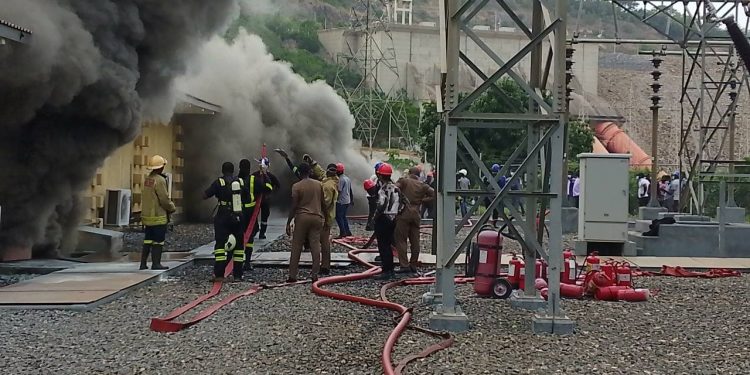
    Ghana faces possible intermittent power outages due to a fire incident at Ghana Grid Company Limited’s (GRIDCo) substation within the Akosombo Hydroelectric Dam complex in the Eastern Region.

    Speaking to the media on Friday, the Spokesperson and Head of Communications at the Ministry of Energy and Green Transition Ghana, Richmond Rockson, disclosed that the blaze which occurred on Thursday, April 23, damaged a transmission system with a capacity of about 720 megawatts.

    He described the development as “a significant hit,” explaining that the affected system supplies electricity to major parts of the country.

    He added, “The system that got affected was about 720 megawatts. That system transmits power to major parts of the country, so this is a significant hit. The Akosombo Dam generates a little over 1,000 megawatts.”   

    Meanwhile, the cause of the fire is yet to be determined by authorities. Recently, the country has been experiencing temporary power outages, locally known as ‘dumsor’, but President John Dramani Mahama insists they are part of ongoing system upgrades.

    While inspecting new transformers acquired for the Northern Electricity Distribution Company Limited (NEDCo), President Mahama noted that “The outages you are facing are not dumsor, it is to enable you to get better quality and stable power.”

    As part of efforts to enhance revenue mobilisation in the energy sector and stabilise power supply, the Ministry of Energy and Green Transition says it will introduce standardised, accurate electricity meters from next month to boost revenue mobilisation and stabilise power supply.

    The Minister disclosed this while answering questions on the floor of Parliament on Monday, March 16. According to him, all households will benefit from upgraded electricity infrastructure.

    “Next month, we will start the large-scale rollout of transformers. Within that same month, we should see a much more massive injection of new, standardised, and accurate meters. That is how we can make sure that there is guaranteed revenue for investment. All meters procured are tested. I can assure you that these meters are of high quality; they meet the standards, and they do the job they are supposed to do,” he said.

    His comments come amid growing concerns from sections of the public, who claim they are being overcharged and that their prepaid credit no longer lasts as long as before.

    Meanwhile, the Communications Director of the Electricity Company of Ghana (ECG), William Boateng, has asserted that heat conditions, wiring, and earthing are most likely contributing factors to excessive electricity consumption affecting its customers.

    This was in response to concerns from sections of the public who have made claims of being overcharged and that their prepaid credit no longer lasts as long as before.

    In an interview on Adom FM’s morning show Dwaso Nsem, Mr. Boateng advised customers to frequently check for possible electrical faults in their homes.

    “When the heat increases, someone can even double the use of cooling appliances. That alone can affect your consumption. Sometimes the issue may be with wiring or earthing. That is why we have certified electrical contractors who can check whether there is leakage or any fault affecting consumption,” he said.”

    Mr. Boateng urged customers who notice irregularities in their billing to report them directly to ECG for investigation, so that engineers can inspect the meter, review consumption patterns, and identify the cause of the problem.

    “We work with machines; it is not about defending anything. There could be a margin of error. If your bill exceeds what you expected or your credit finishes unusually fast, report it to ECG,” he urged, adding that, “When customers report, we can properly investigate, analyse the situation, and resolve it if there is a genuine problem,” he assured.

    Last year, the Director-General of the Ghana Standards Authority (GSA), Professor Alex Dodoo, warned of the dangers associated with uncalibrated electricity meters, which were in use nationwide.

    These uncalibrated metres, being utilised by the Electricity Company of Ghana (ECG), he said, did not guarantee the protection of consumers and also are not able to hold industry accountable for fair charges.

    Calibration of meters ensures that energy usage is measured accurately, preventing overbilling or underbilling for consumers.His comments came amid growing public concerns of overbilling, inconsistent power supply, and inefficiencies in the power-producing company’s services.

    Speaking at a stakeholder conference organized by the International Electrotechnical Commission yesterday, May 20, 2025, in Accra, Prof. Dodoo revealed that many ECG meters in circulation had not been calibrated or verified by the Ghana Standards Authority, as has been mandated by the National Instrumentation Regulation NI2413.

    “Very few of our meters have been calibrated and verified by the GSA. If the meter you are using has not been calibrated or verified by the Ghana Standards Authority, as required by NI2413, its accuracy is questionable. We simply cannot vouch for it,” he said.Prof. Dodoo said meters not being calibrated put consumers at risk of under- and overbilling.

    The NI2413 law mandates that all electricity meters in circulation must be calibrated and verified by the GSA to ensure accuracy, fair billing, and energy efficiency.

    Additionally, the Weights and Measures Decree, NRCD 326 of 1975, empowers the GSA to oversee legal metrology, ensuring that measuring instruments used in trade and industry meet standardized accuracy requirements.

    However, to resolve this, he mentioned that his outfit is currently working with the ECG and Public Utility and Regulatory Commission (PURC) to configure the millions of meters currently in circulation in the country.

    “The law states it must be verified and calibrated. Thankfully, we are working with ECG and PURC to ensure that all the millions of meters in Ghana are properly calibrated and verified by the GSA,” he noted.

    He also linked the issue to national development, emphasizing its importance in the government’s ambition to implement a 24-hour economy.

    “And I know it’s a very troubling issue. But as we support the President in rolling out a 24-hour economy, it’s important that we provide the quality infrastructure that will make the 24-hour economy succeed,” he concluded.

    Prof. Dodoo revealed that many ECG meters in circulation had not been calibrated or verified by the Ghana Standards Authority, asIn the same year, the government, through the Ministry of Energy and Green Transition, approved the procurement of 200 new transformers for the Electricity Company of Ghana (ECG) to strengthen power transmission and distribution to major cities across the country.

    The sector minister, John Abdulai Jinapor, made information public on May 28, 2025, during the opening session of the 18th West Africa Mining and Power Exhibition (WAMPEX) at the Grand Arena and Accra International Convention Centre (AICC) in Accra.The Electricity Company of Ghana (ECG) made a formal request for 200 new transformers in April 2025, and after barely a month, the government gave the green light for the deployment of the transformers.

    “Despite the challenges we inherited, recent reports show that power generation has been very stable” What we need to do is improve the transmission and distribution network. In this regard, I have granted approval to ECG as a matter of urgency to inject about 200 transformers in our major capital cities in order to ensure that we not only generate power but we can distribute power to (sic) consumers effectively and efficiently,” Mr Jinapor said.

    Minister Jinapor noted that initial challenges with power generation have been stabilized, and Ghana is now exporting electricity to neighboring countries.

    The current focus is on improving power transmission and distribution systems.WAMPEX, the largest forum for mining and power industries in West Africa, attracted over 240 exhibitors from 30 countries and more than 5,000 visitors this year.

    The event, however, provided a platform for industry professionals, policymakers, and stakeholders to discuss challenges, innovations, and future opportunities.
  • IPPs to supply GRIDCo with 100MW in coming days

    IPPs to supply GRIDCo with 100MW in coming days

    The Ghana Grid Company Limited (GRIDCo) is expected to receive about 100 megawatts of power supply from the Independent Power Producers (IPP’s) Ghana, in the coming days to reduce power outages.

    This anticipated increase is set to significantly bolster the country’s power generation capacity.

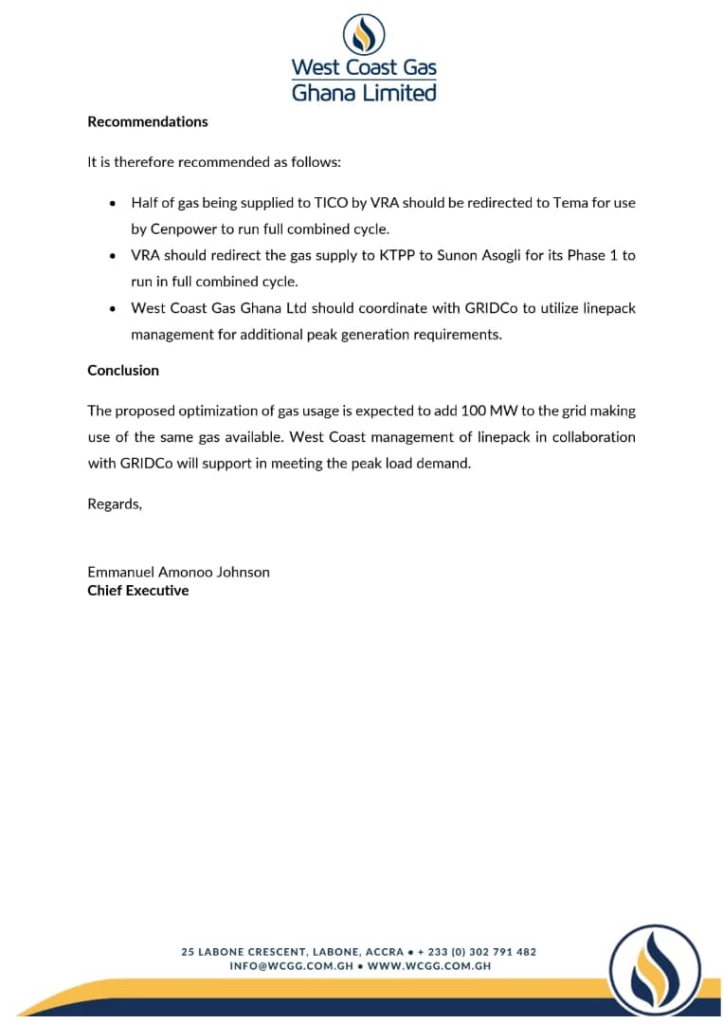
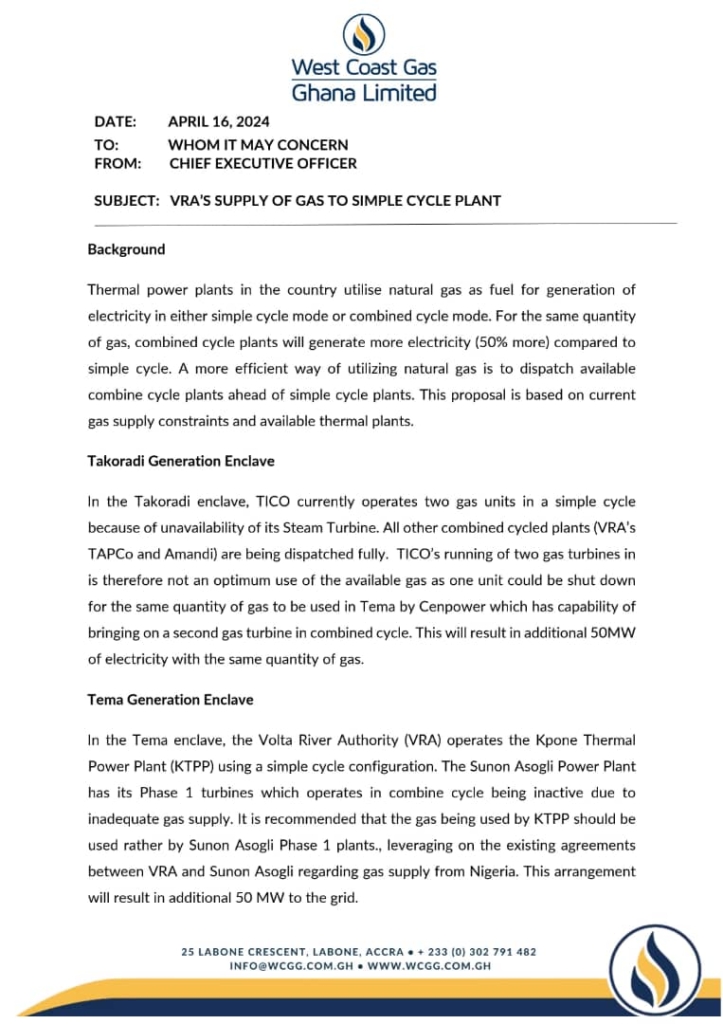
    West Coast Gas Ghana Limited’s recent release indicates a strategic redirection of gas supply to specific power plants.

    This move aims to optimise operations and deliver a heightened level of generation across the nation.

    The statement elaborated on the plan, stating, “A portion of the gas currently supplied to TICO by VRA will be redirected to Cenpower to enable full combined cycle operations. Additionally, VRA will divert gas from Kpone Thermal Power Plant to Sunon Asogli Phase 1 for full combined cycle functionality.”

    This shift reflects a more efficient utilization of natural gas resources, prioritizing combined cycle plants over simple cycle ones based on existing gas supply constraints and the availability of thermal plants.

    See statement below:

  • Communicate openly about the current state of the power sector – IES to GRIDCo

    Communicate openly about the current state of the power sector – IES to GRIDCo

    The Institute for Energy Security (IES) has made a plea to the Ghana Grid Company Limited (GRIDCo) to be more transparent in communicating the current status of the power sector.

    In a statement issued by its Executive Director, Nana Amoasi VII on April 1, the IES emphasized the importance of GRIDCo providing clear estimates to the Electricity Company of Ghana (ECG) regarding the power supply that can be assured within specific time frames.

    This information, according to the IES, is crucial for ECG to plan its load response effectively, with a structured timetable in place.

    The IES stressed the need for ECG to focus on managing its load based on GRIDCo’s power supply and to ensure efficient revenue collection to achieve full cost recovery.

    “Such an information is vital for the ECG to plan its load response with a timetable,” the IES added in a statement signed and issued by its Executive Director, Nana Amoasi VII on April 1.

    Furthermore, the IES urged the Public Utility and Regulatory Commission (PURC) to extend its oversight beyond ECG and audit the upstream segment of the power sub-sector, particularly focusing on GRIDCo and export sales by the Volta River Authority (VRA).

    “The Public Utility and Regulatory Commission (PURC) must look beyond the ECG to audit the upstream segment of the power sub-sector, particularly the GRIDCo, and export sales by the Volta River Authority (VRA),” it added.

    This move, the IES believes, would contribute to a more comprehensive understanding and management of Ghana’s power infrastructure and operations.

    See statement below:

  • We are sorry for the recent power outages – GRIDCo to victims

    We are sorry for the recent power outages – GRIDCo to victims

    Ghana Grid Company Limited (GRIDCo) has apologized to Ghanaians who were affected by the recent power outage.

    Recently, some parts of the country especially Accra experienced power cuts.

    Head of Corporate Communications at GRIDCo, Dzifa Bampoh said the situation was a result of a generational challenge that is out of the control of GRIDCo

    Speaking on News 360 on TV3 Wednesday, May 10, Dzifa Bampoh said “Sincerely, we apologize for the erratic power supply that many Ghanaians may have suffered for the last couple of days.”

    She added “GRIDCo is a transmitter and we are not a generator however, we do have a view of what the generation is like, that is the generation coming from our power plants whether they are hydro or they are thermal or they are solar.

    “Unfortunately, there has been a shortfall in generation capacity, meaning we have not been able to generate as much power as Ghanaians demand.

    “That is out of the control of GRIDCo and it is partly because we don’t have enough gas coming in to power some of these plants. That is why we had some intermittent power supply, so there is no load-shedding.

    “What has happened is, on some occasions, gas supply has been low and as a result, we have had to reduce supply to ECG.”

  • Navrongo SHS gets two mechanised boreholes from GRIDCo

    Navrongo SHS gets two mechanised boreholes from GRIDCo

    Two mechanized boreholes have been donated to the Navrongo Senior High School (NAVASCO) in the Kassena-Nankana Municipality of the Upper East Region by the Ghana Grid Company Limited (GRIDCo), Operator of the National Transmission supply, to improve the school’s water supply.

    This came as a relief to staff and students in the school from their daily struggle for potable water.

    The construction of the facilities which was started late 2022 under the GRIDCo’s Education Support Initiative and valued at GH₵100,000.00 have reservoir tanks with taps connected to the dormitories of the students and other major areas.

    At a handing over ceremony at Navrongo, Ms. Dzifa Bampoh, Manager, Corporate Communications, GRIDCo, said the support was part of one of the core values of the company in supporting stakeholders in its operational areas.

    “It is also in line with GRIDCo’s Sustainable Corporate Social Responsibility and the United Nations Sustainable Development Goals particularly goal six, to ensure the availability and sustainable management of water and sanitation for all,” she said.

    Ms. Bampoh said access to water was critical in fighting critical infections and diseases, especially as the country was recovering from COVID-19, which puts emphasis on the need to practice good hygiene and washing protocols.

    She said due to increasing challenges of climate change, water was becoming scarce especially in Northern Ghana and advised the management and students at the school to ensure maintenance of the facilities.

    Ms. Mercy Babachuweh, the Headmistress of the school, expressed gratitude to GRIDCo for the intervention and said the support came at the right time.

    She said before the intervention, the school had only two mechanised boreholes and four manual ones which were serving 2,034 students and 78 staff staying on campus, adding that this situation was putting lots of pressure on the boreholes leading to constant breakdown and increasing financial loss to the school.

    She said this also affects contact hours as many students have to move out of the campus in search of water.

    “And so, the provision of these two mechanised boreholes to the school is very timely. They are serving six dormitory blocks, that is, one borehole to three dormitory blocks. Students now spend less time searching for water. This will ultimately result in more contact hours for teaching and learning, hence, academic excellence, good personal hygiene and a disciplined student body,” she said.

    The Headmistress, however, appealed for more support to renovate and expand the school’s dining hall which has limited space and is in a dilapidated state with the roof leaking anytime it rains.
    GRIDCo mechanised boreholes Navrongo SHS

    Ms. Alice Ellen Abeere-Inga, the Kassena-Nankana Municipal Director of the Ghana Education Service, expressed optimism that the facilities would improve sanitation practices especially good hygiene among girls during their menstrual periods and advised the management and students to ensure that the facilities last to serve the purpose for which they were provided.

    Mr Simon Anyoka Nyaaba, the Senior Prefect of the school said due to difficulty in getting water on campus, some students took advantage of the situation to move out of the school to engage in unproductive ventures.

    He said the academic work would improve as a result of the support from GRIDCo and thanked them for the kind gesture.

  • A Ugandan delegation studies GRIDCo’s Optic Fiber business

    A Ugandan delegation studies GRIDCo’s Optic Fiber business

    A delegation from the Ugandan Electricity Transmission Company Limited (UETCL) has spent three days at the Ghana Grid Company Limited (GRIDCo) concretising discussions on the Optic Fibre Business due to GRIDCo’s expertise.

    This comes six months after the Board of the UETCL signed a Memorandum of Understanding (MoU) to collaborate with the power-producing company.

    Acting Director, Office of the Chief Executive, Sam Acquah, led the GRIDCo Consult, Southern Network Department, to hold interactive sessions on working models adopted by the power-producing company with regard to the commercialisation of fibre.

    Jumba Abdul Karim, who led the Ugandan delegation, said the UETCL would adopt a good fibre business strategy.

    “We will start a fresh page of a profitable and economically viable fibre business. We will also adopt good fibre business strategy; fibre business roadmap and restructure the ICT organogram accordingly. Additionally, the team will correct the errors made to avoid losses and litigation issues,” Mr. Karim said.

    He indicated that the next step would be to revamp UETCL’s fibre business model in order to incorporate the lessons learned in GRIDCo benchmarking.

    The UETCL, after its commencement in 2001, held a Public Infrastructure Provider’s Licence from the Uganda Communications Commission for owning and operating its optic fibre infrastructure.

    The primary purpose was to support the Supervising Control and Data Acquisition (SCADA) system in ensuring grid availability and reliability in Uganda.

  • Dumsor menace gone due to incessant supply of gas – Ghana Gas CEO

    Dumsor menace gone due to incessant supply of gas – Ghana Gas CEO

    Dr. Ben KD Asante, the Chief Executive Officer (CEO) of the Ghana National Gas Company Limited, has stated that the steady supply of gas from his organization has made Dumsor, a thing of the past.

    “We want to kill dumsor anywhere not just Ghana,” he stated. “Now [with] reliable and incessant supply of gas, that menace of dumsor is gone because we have reliable gas supply now coming.”

    Dr Asante made this known on Wednesday, January 11 when he took his turn at the State of Agencies Report in Accra.

    He said previously there would have been power outage immediately a cable from Ghana Grid Company Limited (GRDICo) falls no matter the amount of gas the country has in store.

    “But the fact that now we are able to provide reliable and sustainable gas to kill that menace of Dumsor, we can all sit here and smile.”

    ‘Commingled gas’

    The Ghana Gas CEO mentioned that aside the supply from Atuabo, there is also reliable supply from the West African Gas Pipeline from Nigeria, giving the country commingled gas to power plants in the Tema enclave, in particular.

    The plants in that enclave include AKSA Energy (203MW), CENPOWER (330MW) and Sunon Asogli (560MW).

    The Company also supplies lean gas to the Volta River Authority’s twin power plant (TAPCO), which generates 330 MW, TICO Plant (330MW), Karpowership (450MW) and Amandi Power Plant (192MW).

    Dr Asante said his outfit’s vision is to supply gas not only across the country but also to the sub-region.

    “The vision of the company is to become a fully integrated gas services firm providing reliable supply of gas and gas derivatives in Ghana and the West African Sub-region,” Dr Asante said.

  • VALCO workers in standoff with management over salary concerns

    The Volta Aluminum Company (VALCO) has been temporarily halted down as management talks to irate employees about their demands for pay raises.

    The company’s management claims that after some employees unexpectedly took control of the Smelter on Monday, a decision was made to shut down VALCO’s operational pot lines in conjunction with the Ghana Grid Company Limited (GRIDCo).

    This was done to preserve it and enable a seamless restart as management tried to break the deadlock.

    VALCO said the development will not cost it US$100,000 per pot in shutting down and US$10million for restarting the plant, as is being peddled in some sections of the media.

    “Rather, it is to prevent such occurrences that management opted for the controlled halt to its operations,” a statement from the company stated.

    VALCO’s Board of Directors, conscious of the smelter’s strategic significance to the ongoing Integrated Aluminium Industry (IAI) project, charged management to ensure that Ghana does not lose the smelter in the event of any agitation that occasions an unplanned shutdown.

    This is to avoid any likely negative consequences – on the project in particular and Ghana’s accelerated economic development in general.

    However, the management of VALCO indicated that the workers, after a series of negotiations led by their union executives, made an initial demand for a 62 percent salary increment and subsequently reduced it to 55 percent.

    “In response, the management of VALCO offered to grant a 22 percent increment in salaries for the workers – with the assurance of further increments in the future as VALCO continues its efforts at finding a strategic investor to retrofit the plant,” the statement captured.

    “VALCO appealed to workers to consider the current state of the aluminium smelter, which for years had been recording losses until the year 2021 – when through prudent management and better supervision, it chalked up some modest gains by recording Earnings Before Interest, Tax, Depreciation and Amortisation (EBITDA) profits. According to management, they are hoping to build on this and retrofit and modernise the plant to improve efficiency and increase its capacity,” it added.

    Management of VALCO further indicated to the workers’ union executives that it will on November 1, 2022 finalise a communique for submission to the National Labour Commission (NLC) for independent third-party adjudication, after negotiations between management and workers ended in a stalemate.

    The unsuccessful engagement with workers led to a full-blown takeover of the smelter. Among other demands, management said workers insist on having their salaries pegged to the dollar as of the last salary adjustment on September 1, 2022; but the parties were unable to reach an agreement.

    The decision to allow some staff who have attained retirement age to stay, management said, was deliberate and tactful – given that they are very experienced and knowledgeable in running a highly technical field and a strategic plant such as the VALCO smelter.

    However, management said it has initiated a succession plan that is already being implemented. It is expected that some of the experienced staff under contract will start exiting by close of the year 2022.

    Management has assured that it will continue to dialogue with labour to find a resolution to the impasse and ensure there is no threat to life and property.

    Meanwhile, VALCO has commenced processes to partner with a strategic investor who will retrofit and modernise the plant to increase its production – from the current 50,000 tonnes out of its 200,000 tonnes installed capacity, to 300,000 tonnes of refined aluminium per year.

  • GRIDCo, Uganda to develop cooperation

    The Ghana Grid Company Limited (GRIDCo) has agreed to cooperate with Uganda to develop the technical competence in the management of that country’s power transmission network to enable it to deliver sustainable and reliable power to its citizens.

    Uganda has reached out to GRIDCo to seek an insight into the progress made over the years in the power transmission business to enable it to benchmark its operations in the areas of commercialisation of communication assets, particularly optic fibre and other data products.

    An eight-member delegation from that country led by the Chairman of the Ugandan Electricity Transmission Company Limited (UETCL), Kwame Ejalu Ejuku, will for the next three days hold discussions with GRIDCo and other power sector players on project implementation in the face of challenges, capacity building among others.

    GRIDCo, on the other hand, is expected to enhance the technical capacity of the visiting team by sharing knowledge and best practices on transmission infrastructure, operations, mitigating vandalism on grid towers among other technical expertise that will be relevant to the delegation.

    Development

    At a meeting with the team, the Board Chairman of GRIDCo, Kabral Blay Amihere, said the acceptance of technology as a key driver of economic growth allowing for efficiency in the production of goods and services was an indication that power was what Africa was using to scale up its development.

    Mr Amihere pointed out that GRIDCo, building on its infrastructure and technical expertise over the years, had allowed the company to be in a strategic position to export power to neighbouring countries such as Burkina Faso, Ivory Coast, Togo and Benin.

    The leader of the delegation, Mr Ejuku in his remarks indicated that UETCL was rolling out a number of projects to double that country’s transmission grid in the next three years, hence their interest to benchmark GRIDCo’s success in the various areas.

    “The UETCL board is aware of the maturity of GRIDCo and its successes with regard to the extent of coverage, as well as management of its telecom assets through Gridtel and we are interested to learn about the commercialisation and other relevant operational areas that will benefit our country,” Mr Ejuku said.

    The Chief Executive Officer of UETCL, Michael Taremwa, in a remark said the company currently had a circuit length of 3.385 kilometres made up of 1,002 kilometres of 220 kilovolt lines.

    The company, he said, purchased power from 41 generators and sold to six distributors, thus requiring the need for them to have a robust network that demanded visibility through the control centre, as well as a reliable grid to evacuate power from generators, “given that demand for power is at distances far away from the generation point,” he said.

    A situation, he said had seen transmission loss standing between 4.2 and 4.5 per cent, posing a danger to their operations.
    GRIDCo

    The Chief Executive of GRIDCo, Ebenezer Essienyi, in his welcome remarks expressed delight at the visit by the Ugandans.

    He said the future depended on how the company positioned itself to meet the ever-growing power needs of Ghanaians, bulk customers and sub-regional obligations.

    Source: GraphicOnline