Author: Amanda Cartey

  • Secure diplomatic, consular measures to safeguard Ghanaians caught up in Middle East tensions- Antwi-Danso appeals to govt

    Secure diplomatic, consular measures to safeguard Ghanaians caught up in Middle East tensions- Antwi-Danso appeals to govt

    International relations scholar and security commentator, Vladimir Antwi-Danso, has called on the government to swiftly pursue diplomatic and consular measures to safeguard Ghanaians caught up in rising tensions across the Middle East, especially in destinations experiencing widespread flight cancellations and disrupted air travel.

    During an appearance on The Pulse on Monday, he underscored the need for Ghana to engage Gulf nations and other allied states to guarantee the protection of its citizens overseas.

    “We are seeing flights cancelled all over. Government must liaise with those countries and coordinate with partners to safeguard the safety and security of our people,” he said.

    His remarks follow mounting anxiety over aviation security within conflict-affected zones. Several airlines operating within and around the Gulf have halted services amid escalating threats, including possible missile attacks and unstable airspace conditions.

    The analyst disclosed a personal concern, noting that his son, who works as a pilot for Qatar Airways, is presently stranded in Qatar due to the suspension of flights.

    “No plane flying in those areas has 100 percent assurance that it can fly in or out safely,” he said, drawing attention to the risks confronting both flight crews and travelers.

    He further appealed to the Ministry of Foreign Affairs to implement practical interventions to shield Ghanaian citizens, such as closely tracking the security situation in affected Gulf countries, offering prompt consular assistance to those stranded, preparing evacuation arrangements if required, and issuing up-to-date information to keep relatives informed.

    In addition, he stressed that Ghana should leverage platforms like the United Nations to advocate for calm and stability in the troubled region.

    Escalating tensions in the Middle East have led to the cancellation of flights from Accra to Dubai.

    The situation involves reported bombings in Iraq and retaliatory attacks across the region, prompting airlines to suspend services.

    Emirates flight EK 788 from Kotoka International Airport (ACC) in Accra to Dubai International Airport (DXB) has been cancelled, and passengers are advised to contact their airlines for rebooking or refund options.

    The flight from Accra to Dubai International Airport, scheduled for 7:15 pm GMT on Saturday, 28 February 2026, was canceled at the last minute through a notice.

    In response to the ongoing tensions, the Embassy of Ghana Doha, State of Qatar has advised Ghanaians living in the area to exercise caution and remain vigilant during this period.

    A press statement from the Embassy of Ghana Doha, State of Qatar read, “Due to missle attack and its impact in Doha, please take shelter until further notice, obtain information from official sources. We urge everyone to stay from military states, remain indoors, avoid crowded areas for any exposure to danger and keep essentials supplies like medication and food”.

    This development is expected to significantly impact travelers from Ghana to Asia, Europe, and North America, as Dubai is a major transit hub connecting travelers through the United Arab Emirates.

    The ongoing tensions have been linked to the death of Iran’s Supreme Leader, Ayatollah Ali Khamenei.

    Ayatollah Ali Khamenei was reportedly killed in strikes by the Unites States (U.S.) and Israel.

    Last year, the Minister for Foreign Affairs, Samuel Okudzeto Ablakwa, warned the Israeli Embassy against maltreating Ghanaian nationals.

    Speaking to the media on Thursday, December 11, Mr. Ablakwa noted that Ghana will respond with equal force if any of its citizens are deported.

    According to him, “If they deport ten Ghanaians, we will deport ten. If they deport twenty, we will deport twenty. If they deport fifty, we will deport fifty. We are not going to accept this.”

    His comments are in response to an incident in which several Ghanaian travellers, including four members of a parliamentary delegation en route to Tel Aviv for an international cybersecurity conference, were detained and deported by Israel Embassy officials.

    Mr. Ablakwa narrated, “We were told that the Ghanaian Embassy was uncooperative, but the facts simply do not support that. Out of the six people on the list that Israel provided, one is not even Ghanaian. He is Gabonese. Our embassy had every right to verify the identity of the individuals involved.

    “One of the people listed was seriously ill, and Israeli doctors themselves advised that she should not travel until she had recovered. How can you deport someone who is unwell and needs medical attention? Another individual had already been issued a travel certificate, so there was no reason to stop their entry into Israel.”

    But in their actions, Israeli officials indicated that six Ghanaians who were supposedly due for deportation failed to provide the necessary details needed by Ghana’s Embassy in Tel Aviv to issue travel certificates.

    The matter adds to broader concerns surrounding deportation practices. In September, eleven West African nationals filed two ex-parte applications at the Labour Division of the High Court in Accra, challenging their alleged detention in Ghana after being deported from the United States (U.S).

    The eleven individuals include Nigerians Daniel Osas Aigbosa, Ahmed Animashaun, Ifeanyi Okechukwu, and Taiwo K. Lawson; Liberian national Kalu John; Togolese nationals Zito Yao Bruno and Agouda Richarla Oukpedzo Sikiratou; Gambian national Sidiben Dawda; and Malians Toure Dianke and Boubou Gassama.

    According to the applicants, they were forcibly transported to Ghana without prior notice. They allege that they were secretly moved from the U.S. detention centers between September 5 and 6 in shackles.

    They want the court to temporarily stop them from being deported back to their home countries until the court decides on their case. Their submission further revealed that Ghanaian authorities allegedly confined them in a military facility.

    They cited Article 14(1) of Ghana’s 1992 Constitution, which guarantees personal liberty, as well as Article 23, which protects the right to administrative justice. They are arguing that Ghana is violating international law by trying to send them back to countries where their lives or freedom could be at risk.

    As a result, they have demanded that the Attorney-General, the Chief of Defence Staff, and the Comptroller-General of the Ghana Immigration Service appear before the Human Rights Division of the High Court with valid reasons. The court has fixed Tuesday, September 23, to hear the case.

  • Barker-Vormawor to challenge GHS5m defamation judgment in favour of Kan Dapaah

    Barker-Vormawor to challenge GHS5m defamation judgment in favour of Kan Dapaah

    Legal practitioner Oliver Barker-Vormawor has announced plans to apply to have the High Court’s decision, which awarded GH₵5.1 million in damages to former National Security Minister Albert Kan Dapaah, set aside, arguing that the process leading to the ruling was unjust.

    Reacting to the March 2 judgment in a Facebook post, the activist pointed to what he termed procedural flaws in the way the matter was handled.

    He contended that his lawyers were prevented from completing their cross-examination of Kan Dapaah and further alleged that although his witness statement was duly filed, the court declined to consider it before delivering its verdict.

    “Of course we will seek to set it aside. But he can take his victory lap,” Barker-Vormawor wrote.

    Background of the case

    On Monday, the High Court in Accra awarded GH₵5 million in general damages against Barker-Vormawor in favour of Kan Dapaah in a defamation suit.

    Additionally, the court imposed costs of GH₵100,000 against the defendant.

    In delivering the ruling, Justice (Rev.) Joseph Owusu Adu-Agyeman granted all the reliefs sought by the plaintiff but reduced the compensation from GH₵10 million to GH₵5 million.

    Kan Dapaah had initiated the lawsuit over allegations that he attempted to bribe the activist.

    Barker-Vormawor had publicly claimed that the former minister, together with certain government officials, met him and offered him money to halt his activism against the administration.

    Before the judgment was delivered, his legal team filed an application seeking to relist their Statement of Defence and Witness Statement, both of which had earlier been struck out.

    However, the court dismissed the application, describing it as inconsistent with the applicable rules.

    Consequently, Barker-Vormawor stood before the court without a recognised defence at the time the judgment was pronounced.

    Explaining the sequence of events on Facebook, he stated that following the appointment of his original lawyer as Deputy Attorney General, he sought and obtained an adjournment to secure new representation.

    Upon taking over the case, the new counsel requested time to review proceedings and submit a witness statement, but the judge declined the request and directed that cross-examination should proceed.

    “He missed Court one day, and when we got the record, the judge had struck out my defense and given a date to give judgement,” Barker-Vormawor wrote.

    “We filed a motion to relist the defense and filed my witness statement and that of my other witness. We also filed a motion to arrest judgment. Judge refused it. Went ahead to give Kan Dapaah judgment.”

    He further urged members of the public to examine the witness statement he said the court refused to admit into consideration.

    “You can read my witness statement; that the court refused to consider if you want!” he wrote.

  • Police warn against violence in Ayawaso East election re-run

    Police warn against violence in Ayawaso East election re-run

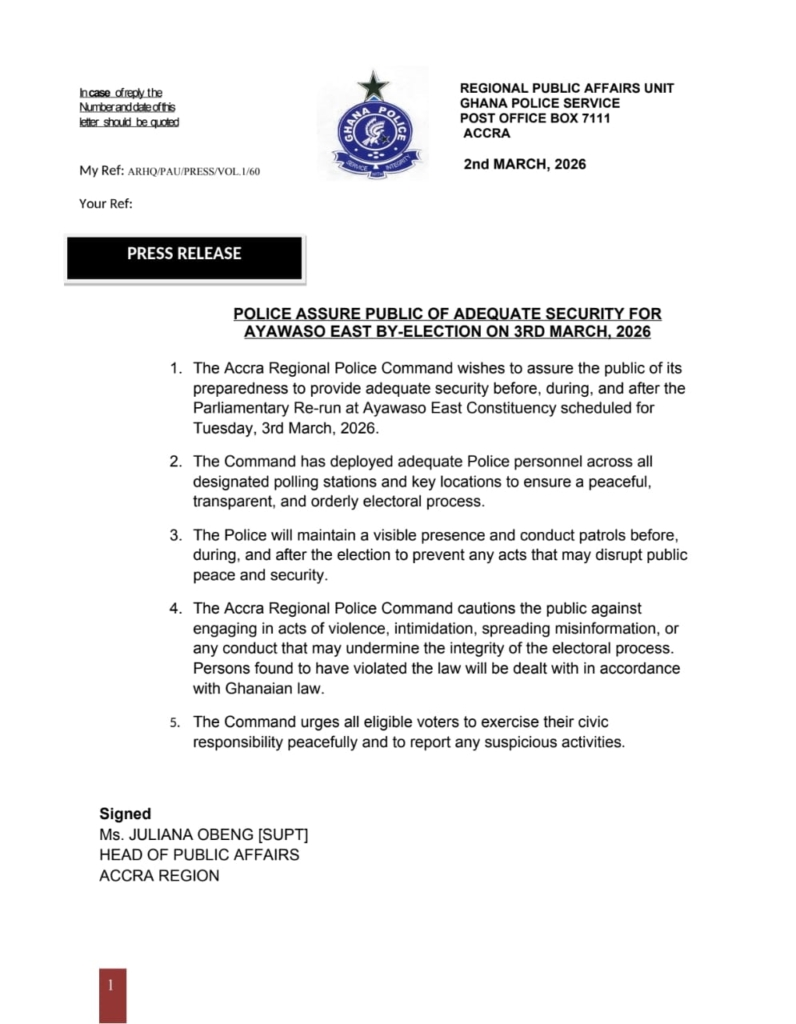
    The Ghana Police Service Accra Regional Command has announced that it is fully ready to guarantee security ahead of, throughout, and after the parliamentary re-run in the Ayawaso East Constituency slated for Tuesday, March 3, 2026.

    In a statement issued on March 2, the Command indicated that enough officers have been stationed at all approved polling centres and strategic points within the constituency to safeguard the voting exercise and maintain order.

    “The Command has deployed adequate Police personnel across all designated polling stations and key locations to ensure a peaceful, transparent, and orderly electoral process,” the statement signed by Supt Juliana Obeng, Head of Public Affairs for the Accra Region, read in part.

    Police officials further assured residents that officers would sustain strong visibility and carry out routine patrols before, during, and after voting to deter any attempts to disturb public safety.

    The Regional Command also warned individuals against actions capable of compromising the credibility of the election.

    “The Accra Regional Police Command cautions the public against engaging in acts of violence, intimidation, spreading misinformation, or any conduct that may undermine the integrity of the electoral process,” the statement warned.

    It stressed that anyone who breaches the law will face legal consequences under the laws of Ghana, underscoring the Command’s resolve to apply the law impartially.

    Security officials also called on qualified voters in the area to cast their ballots peacefully and to promptly alert authorities to any unusual or suspicious behaviour.

    The re-run in Ayawaso East comes after recent events led to the need for a fresh parliamentary contest in the constituency.

    The appeal for restraint and collaboration is being made as constituents gear up to vote on Tuesday.

    The National Democratic Congress (NDC) candidate, Baba Jamal, is projected to win in the upcoming Ayawaso East by-election scheduled for Tuesday, March 3, 2026.

    According to a new poll by Global InfoAnalytics Baba Jamal will secure about 75% of the votes ahead of his main contender, Baba Ali of the New Patriotic Party (NPP).

    The New Patriotic Party’s (NPP) Baba Ali has been projected to trail with 21%, independent candidate Umaru Sanda Muhammed is expected to poll 3% of the vote, with other remaining candidates, Ibrahim Iddrisu and David to garner less than 1%.

    Article image 1

    The survey was conducted between February 28 and March 1, sampling 972 voters across the constituency.

    The EC has scheduled the Ayawaso East by-election for March 3, 2026, the by-election has attracted heightened attention in recent days amid internal developments within the NDC, including allegations of vote buying during its parliamentary primary.

    Mr Baba Jamal Mohammed Ahmed won the Ayawaso East Constituency primary and is set to represent the NDC as its parliamentary candidate in the March 3 by-election, following the party’s internal primary held on February 7, 2026.

    After the close of polls, provisional results showed that Baba Jamal polled 431 votes out of the total votes cast, followed by the widow of the late Ayawaso MP, Naser Toure Hajia Amina Adam who secured 399 votes. Mr Mohammed Ramne, the Ayawaso East NDC Constituency Chairman, placed third with 88 votes.

    Dr Yakubu Azindow obtained 45 votes, while Mr Najib Mohammed Sani recorded one vote.

    The closely contested primary attracted more than 1,100 accredited delegates from across the constituency, reflecting the high stakes involved in selecting a candidate for the by-election in a seat widely regarded as a stronghold of the governing NDC.

    Five aspirants contested the race: Hajia Amina Adam, Mr Baba Jamal, Dr Yakubu Azindow, who had previously contested the late MP in the 2023 primary, Mr. Mohammed Ramne, and Mr Mohammed Sani.

    Although the race was initially considered open, it later narrowed into a tight contest among Mr Jamal, Hajia Amina Adam and Dr Azindow.

    Even though the election was peaceful on Saturday, reports of vote buying emerged on the eve of the election and on election day, involving some candidates, including Baba Jamal, who at the time was Ghana’s High Commissioner to Nigeria and allegedly offered television sets and other items to delegates.

    Videos circulating on social media showed some delegates leaving polling centres carrying television sets and other items.Reacting to the vote-buying allegations, the NDC, in a statement signed by its Secretary, Fiifi Kwetey, announced that it would investigate the allegations. It noted that a three-member committee had been set up to probe the matter.

    In a statement issued on the same day, the NDC said its national executives had taken note of what it described as widespread incidents of inducement and vote buying allegedly perpetrated by some aspirants.

    The party condemned the acts, describing them as an affront to its values and principles, and announced that it had launched investigations into the matter.

    “In line with the Party’s commitment to internal democracy, transparency, and ethical political conduct, the Committee will investigate the allegations and make appropriate recommendations, including sanctions where necessary,” the statement said.

    The Presidency has announced the recall of Ghana’s High Commissioner to Nigeria, Baba Jamal, over voter inducement during the just-ended Ayawaso East primaries held on Saturday, February 7.

    In a statement titled “President recalls Ghana’s High Commissioner to Nigeria,” shared by the Spokesperson to the President, Felix Kwakye Ofosu, and dated February 7, it noted that “President John Dramani Mahama has directed the immediate recall of Mohammed Baba Jamal Ahmed (Baba Jamal) from his position as Ghana’s High Commissioner to the Federal Republic of Nigeria.

    The decision follows allegations of voter inducement during today’s National Democratic Congress (NDC) primaries in the Ayawaso East Constituency, in which Mr Baba Jamal, a candidate, participated.”

    The President stressed that reports of vote buying were made against several candidates seeking to win the Ayawaso East seat, but Baba Jamal stood out because he was the only serving public officer at the time, making his case a peculiar one.

    “In his directive to the Minister for Foreign Affairs recalling Mr Baba Jamal as High Commissioner, the President noted that while allegations of vote-buying were made against multiple candidates who contested the primaries, Baba Jamal was the only serving public officer among them.”

    Consequently, to protect the integrity of public office and to avoid any public suspicion of misconduct or violation of the Government’s Code of Conduct for Political Appointees, the President stated:

    “Without prejudice to the ongoing internal party processes, and strictly in view of the standards of conduct expected of public officers, the President considers it necessary to act decisively to preserve the integrity of public office and to avoid any perception of impropriety or conflict with the Government’s Code of Conduct for Political Appointees.”

    The statement continued that “the recall takes effect immediately, and the Minister for Foreign Affairs has been directed to take the necessary administrative and diplomatic steps to give effect to this directive.”

  • Members of Agradaa’s church to wear “PRAY EVERYDAY” printed t-shirt to welcome her arrival from prison

    Members of Agradaa’s church to wear “PRAY EVERYDAY” printed t-shirt to welcome her arrival from prison

    Members of Heaven Way Champion International Ministry are set to welcome Evangelist Patricia Asiamah, popularly known as Nana Agradaa, from prison on Tuesday, March 3, 2026, in a show of faith and solidarity.

    To mark the occasion, church members will don a specially printed T-shirt carrying the message “PRAY EVERYDAY”, unveiled by her husband, Angel Asiamah.

    The T-shirt has become a symbol of devotion, anticipation, and unity as congregants prepare for her return.

    Speaking during Sunday service, Pastor Asiamah confirmed that the church has undergone repainting and minor renovations in readiness for the influx of worshippers. He said seating and arrangements have been made for a modest reception, urging members to remain orderly and focused on the spiritual significance of the day.

    Angel Asiamah, visibly emotional, joined members in worship as songs of thanksgiving filled the church. “We are ready to welcome her back and celebrate her release while reaffirming our commitment to the ministry,” he said.

    Nana Agradaa’s early release from Nsawam Medium Security Prison follows Ghana’s remission policy. Originally sentenced to 15 years for charlatan advertisement, her term was reduced to one year after a successful appeal.

    The “PRAY EVERYDAY” T-shirts have become more than a wardrobe choice; they serve as a visual expression of faith, community, and hope, signaling both the congregation’s excitement and their dedication to the ministry as Nana Agradaa returns.

    Court document has shown that convicted preacher Evangelist Patricia Asiedua (popularly known as Nana Agradaa), through her lawyers, expressed remorse and begged for her actions in court.

    Presiding judge His Lordship Solomon Oppong-Twumasi noted Agradaa’s lawyers informed the court that their client was extremely fearful ahead of the hearing, to the point where she could not sleep at night and was even afraid to attend the final sentencing.

    This, among others, he explained accounted for the reduction of Agradaa’s  jail term from 15 years to 12 months.

    “The Appellant, through her lawyers, showed a lot of remorse to the extent that she was said to have been afraid to attend the sentencing hearing and could not sleep for days.

    “Her lawyers then went down on their knees to beg the court to spare the Appellant a custodial sentence, pleading that as a mother with young children, such a sentence would affect not only the Appellant but also her innocent children,” part of the judgment noted.

    His Lordship Oppong-Twumasi explained that although five people alleged they had been defrauded by Agradaa, only two individuals were recognised as victims in the case and supported the prosecution. He indicated that the total sum involved was GH¢4,000, and Agradaa had been directed to refund GH¢1,000 to the victims.

    The ruling also pointed out that the Circuit Court failed to factor in the 32 days Agradaa spent in custody before sentencing, describing the initial 15-year jail term as unduly severe.

    Meanwhile, her lawyer maintains that being labelled an ex-convict does not affect her role or calling as a minister of God.

    Background

    Agradaa is serving a prison term at the Nsawam Female Prison after an Accra Circuit Court sentenced her to 15 years on July 3, 2025, for charlatanic advertisement and defrauding by false pretences.

    She was accused of taking money from church members after claiming she had spiritual powers to double cash. The prosecution built its case on her broadcasts on Today’s TV and posts across social media, where she promoted the scheme and invited the public to an all-night church service with promises of multiplying their money through spiritual means.

    Reports indicate that over 1,000 people attended the event and handed over significant amounts of money, but the promise was never fulfilled, leaving several victims in financial difficulty. Agradaa, together with her legal team, later challenged the conviction and made her first appearance before the Amasaman High Court on December 4, 2025.

    Appeal

    Agradaa, through her lawyers, argued that the trial was unfair, that the evidence did not support the ruling, and that the 15-year sentence was excessive.

    On Thursday, February 5, 2026, the Amasaman High Court delivered a landmark judgment, reducing her original 15-year prison term to 12 months.

    The ruling means Nana Agradaa will serve a one-year sentence under the revised judgment unless further legal action is pursued.

    Last month, the Tema High Court directed evangelist Patricia Asiedua, to pay GH¢100,000 in damages to gospel musician Empress Gifty Adorye following a defamation action.

    The decision concluded a legal battle that started in May 2025, when Empress Gifty instituted a GH¢20 million lawsuit, accusing Nana Agradaa of making defamatory remarks about her.

    The matter was determined at the Tema High Court “A”, with Justice Janet Marfo presiding, after both parties reached an agreement to resolve the case outside the courtroom.

    As part of the settlement, the court further ordered Nana Agradaa to withdraw all claims made against Empress Gifty and render an unreserved public apology.

    According to Adom News reporter Mike Two, the ruling effectively brought the dispute between the two personalities to an end. 

    Nonetheless, Nana Agradaa, has been slapped with a fine of GHS12,000 for displaying nude photos of fellow pastor Emmanuel Appiah Fumum, also known as Osofo Biblical.

    She has been further ordered to pay GHS50,000 as compensation to the complainant. Agradaa’s conviction resulted from a plea bargain agreement with the State, concluding a legal battle that had dragged on for nearly three years.

  • Ghana’s creative arts agencies must step up to revive industry – Mr Beautiful

    Ghana’s creative arts agencies must step up to revive industry – Mr Beautiful

    Ghanaian actor Clement Bonney, popularly known as Mr Beautiful, has expressed concern over the lack of innovation and strategic direction within Ghana’s creative arts agencies.

    Speaking on United Showbiz on March 1, 2026, he urged stakeholders in the industry to take a hard look at their own contributions to the sector’s growth.

    “I think our creative arts agencies are not being creative enough for our industry,” he said. “We, the creative arts people, are we being creative enough for our industry? Do we even have an industry? Nothing is happening.”

    Mr Beautiful highlighted that while Ghana has seen unprecedented support from the government, with the current president openly championing the creative arts for the first time since 1992, industry players have not fully leveraged this opportunity.

    “From 1992 to date, this is the first time we are getting a president who loves the creative arts industry. When such a person leaves, we may not get someone like him. That’s because those in the creative arts industry are not doing anything,” he added.

    The actor also questioned the clarity of financial support recently outlined in the national budget. “The money that was mentioned, in what way are we going to access it? Is it a loan or a grant? I want to know what the money will be used for,” he asked.

    Mr Beautiful’s remarks have sparked conversations among creatives and policymakers, with many industry observers noting that agencies must play a more active role in providing guidance, creating opportunities, and ensuring that government support reaches the right people.

    He concluded by urging creatives themselves to be proactive and innovative, emphasizing that the future of the industry depends not only on government goodwill but also on the initiative of its own players.

    Court document has shown that convicted preacher Evangelist Patricia Asiedua (popularly known as Nana Agradaa), through her lawyers, expressed remorse and begged for her actions in court.

    Presiding judge His Lordship Solomon Oppong-Twumasi noted Agradaa’s lawyers informed the court that their client was extremely fearful ahead of the hearing, to the point where she could not sleep at night and was even afraid to attend the final sentencing.

    This, among others, he explained accounted for the reduction of Agradaa’s  jail term from 15 years to 12 months.

    “The Appellant, through her lawyers, showed a lot of remorse to the extent that she was said to have been afraid to attend the sentencing hearing and could not sleep for days.

    “Her lawyers then went down on their knees to beg the court to spare the Appellant a custodial sentence, pleading that as a mother with young children, such a sentence would affect not only the Appellant but also her innocent children,” part of the judgment noted.

    His Lordship Oppong-Twumasi explained that although five people alleged they had been defrauded by Agradaa, only two individuals were recognised as victims in the case and supported the prosecution. He indicated that the total sum involved was GH¢4,000, and Agradaa had been directed to refund GH¢1,000 to the victims.

    The ruling also pointed out that the Circuit Court failed to factor in the 32 days Agradaa spent in custody before sentencing, describing the initial 15-year jail term as unduly severe.

    Meanwhile, her lawyer maintains that being labelled an ex-convict does not affect her role or calling as a minister of God.

    Background

    Agradaa is serving a prison term at the Nsawam Female Prison after an Accra Circuit Court sentenced her to 15 years on July 3, 2025, for charlatanic advertisement and defrauding by false pretences.

    She was accused of taking money from church members after claiming she had spiritual powers to double cash. The prosecution built its case on her broadcasts on Today’s TV and posts across social media, where she promoted the scheme and invited the public to an all-night church service with promises of multiplying their money through spiritual means.

    Reports indicate that over 1,000 people attended the event and handed over significant amounts of money, but the promise was never fulfilled, leaving several victims in financial difficulty. Agradaa, together with her legal team, later challenged the conviction and made her first appearance before the Amasaman High Court on December 4, 2025.

    Appeal

    Agradaa, through her lawyers, argued that the trial was unfair, that the evidence did not support the ruling, and that the 15-year sentence was excessive.

    On Thursday, February 5, 2026, the Amasaman High Court delivered a landmark judgment, reducing her original 15-year prison term to 12 months.

    The ruling means Nana Agradaa will serve a one-year sentence under the revised judgment unless further legal action is pursued.

  • Nigeria announces March arrival of new HIV prevention drug

    Nigeria announces March arrival of new HIV prevention drug

    The National Agency for the Control of AIDS, NACA, has announced that Nigeria will take delivery of Lenacapavir, a groundbreaking HIV prevention drug that has shown 100% effectiveness in preventing HIV infection in clinical trials.

    A short statement released by the Head of Public Relations, NACA, Toyin Aderibigbe, on Monday  mARCH 2, 2026 said the agency has secured regulatory approval from the National Agency for Food and Drug Administration and Control.

    Adding that, “This is part of the Nigerian government’s commitment to strengthen HIV prevention and accelerate progress toward epidemic control,

    Lenacapavir is an injectable treatment administered twice a year, making it a more convenient alternative to daily oral prevention drugs.

    The drug is expected to be available in Nigeria and 119 other low- and middle-income countries at an affordable price of $40 per person annually, thanks to voluntary licensing agreements with generic manufacturers.

    Nigeria has approximately 1.9 million people living with HIV, with a national prevalence of 1.3% among adults aged 15-49 years.

    The country recorded 74,000 new HIV infections and 51,000 AIDS-related deaths in 2021.

    The South-South zone has the highest HIV prevalence at 3.1%, while women aged 15-49 years are more than twice as likely to be living with HIV as men.

  • “I have no doubt you will hold aloft Ghana’s flag” – Ablakwa on Baba Sadiq’s appointment as Ghana’s High Commissioner to Nigeria

    “I have no doubt you will hold aloft Ghana’s flag” – Ablakwa on Baba Sadiq’s appointment as Ghana’s High Commissioner to Nigeria

    The Minister of Foreign Affairs, Samuel Okudzeto Ablakwa, has eulogized Baba Sadiq after being appointed as Ghana’s High Commissioner-designate to Nigeria by President John Dramani Mahama.

    Honourable Ablakwa made shared information about Baba Sadiq’s appointment on March 1, 2026.

    Taking to social media, he wrote, “Congratulations, Baba Sadiq on your well-deserved appointment by President Mahama as High Commissioner designate to the Federal Republic of Nigeria.”

    “I have no doubt you will hold aloft Ghana’s flag and make the youth of our continent proud.”

    As High Commissioner-designate, Baba Sadiq Abdulai Abu is anticipated to lead efforts aimed at strengthening trade relations, promoting cultural ties and deepening diplomatic collaboration between Ghana and Nigeria.

    He will formally assume office once the Nigerian government grants approval and all required diplomatic protocols are concluded.

    His nomination comes after the recall of the immediate past High Commissioner, Mohammed Baba Jamal Ahmed, widely known as Baba Jamal.

    He was withdrawn from the post on February 7, 2026, following claims of voter inducement linked to his involvement and win in the parliamentary primaries of the National Democratic Congress in the Ayawaso East Constituency.

    The Presidency announced a recall of Ghana’s High Commissioner to Nigeria, Baba Jamal, over voter inducement during the just-ended Ayawaso East primaries held on Saturday, February 7.

    In a statement titled “President recalls Ghana’s High Commissioner to Nigeria,” shared by the Spokesperson to the President, Felix Kwakye Ofosu, and dated February 7, it noted that:

    Article image 1

    “President John Dramani Mahama directed the immediate recall of Mohammed Baba Jamal Ahmed (Baba Jamal) from his position as Ghana’s High Commissioner to the Federal Republic of Nigeria. The decision followed allegations of voter inducement during the National Democratic Congress (NDC) primaries in the Ayawaso East Constituency, in which Mr Baba Jamal, a candidate, participated.”

    The President stressed that reports of vote-buying were made against several candidates seeking to win the Ayawaso seats, but Baba Jamal stood out because he was the only person who was a serving public officer at the time, making his case a peculiar one.

    “In his directive to the Minister for Foreign Affairs recalling Mr Baba Jamal as High Commissioner, the President noted that while allegations of vote-buying were made against multiple candidates who contested the primaries, Baba Jamal was the only serving public officer among them.”

    Consequently, to protect the integrity of public office and to avoid any public suspicion of misconduct or violation of the Government’s Code of Conduct for Political Appointees, the President stated:

    “Without prejudice to the ongoing internal party processes, and strictly in view of the standards of conduct expected of public officers, the President considered it necessary to act decisively to preserve the integrity of public office and to avoid any perception of impropriety or conflict with the Government’s Code of Conduct for Political Appointees.”

    The statement further indicated that “the recall took effect immediately, and the Minister for Foreign Affairs was directed to take the necessary administrative and diplomatic steps to give effect to this directive.”

    Meanwhile, Baba Jamal won the party’s internal primary held ahead of the by-election scheduled for March 3.

    After the close of polls, provisional results showed that Baba Jamal secured 431 of the total votes cast, followed by the widow, Hajia Amina Adam, of the late Ayawaso MP, Naser Toure, who obtained 399 votes. Mr Mohammed Ramne, the Ayawaso East NDC Constituency Chairman, placed third with 88 votes.

    Dr Yakubu Azindow obtained 45 votes, while Mr Najib Mohammed Sani recorded one vote.

    Ahead of the elections, a survey conducted by the research and data analytics company Global InfoAnalytics predicted that 58% of members of the ruling NDC supported the widow of the late Mahama Naser Toure, former Member of Parliament (MP) for the Ayawaso East Constituency.

    Last year, fifteen individuals took up roles as ambassadors, high commissioners, and consul-generals following their nomination by President John Dramani Mahama.

    This was announced by the Secretary to the President, Dr. Callistus Mahama, in a letter dated June 10, 2025.

    Among the nominees are Benjamin A. Quashie for the Republic of South Africa, Kojo Bonsu for the People’s Republic of China, Kalsoume Sinare Baffoe for the Kingdom of Spain, Hammed Rashid Tunde Ali for the United Arab Emirates, Hon. Captain George Kofi Nfojoh for the Togolese Republic, and Grace El Mahmoud Marabe for the United Arab Emirates–Dubai.

    The others are Prof. Ohene Adjei for the Federal Republic of Germany, Abdul Nasiru-Deen for the Republic of Turkey, Theresah Adjei-Mensah for the Czech Republic, Prof. Kwasi Obiri-Danso for India, Dora Francisca Edu-Buandoh, Ph.D., for Canada, Dr. Margaret Miewien Chebere for Denmark, Labik Joseph Yaani for Equatorial Guinea, Nii Amasah Namoale for the Federative Republic of Brazil, and Dr. Felix Kumah Godwin Anebo for the Republic of Senegal.

    The letter instructed the Ministry of Foreign Affairs to initiate all required procedures to ensure the nominees’ appointments are successfully processed.

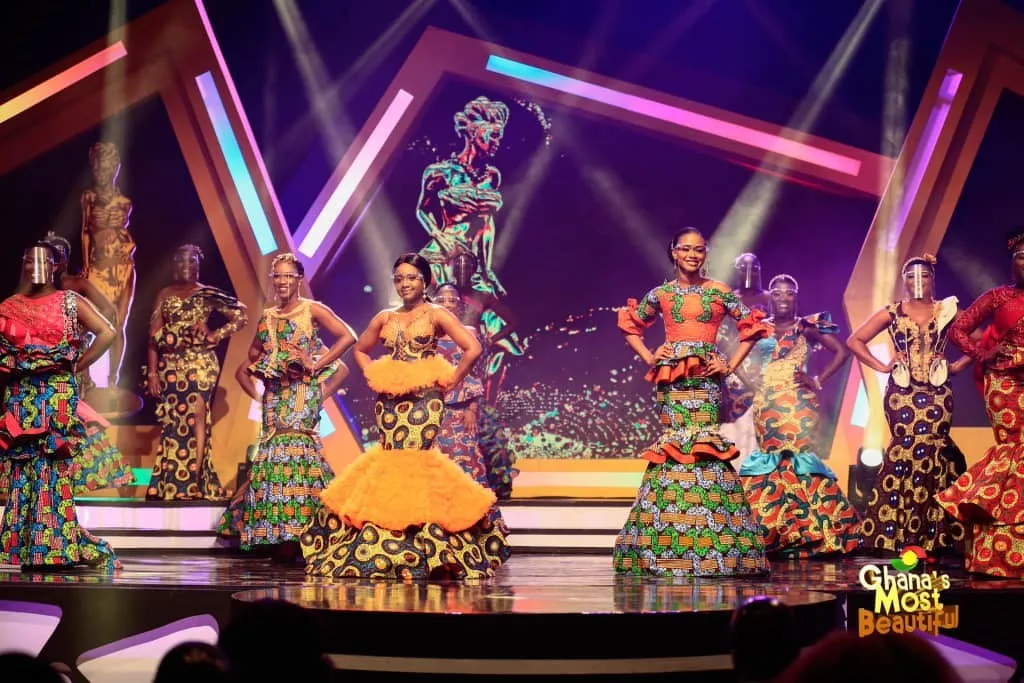
  • ‘Dark truths’ behind beauty pageants and reality shows in Ghana

    ‘Dark truths’ behind beauty pageants and reality shows in Ghana

    Beauty pageants and reality TV shows were once regarded as platforms that gave young people voices, visibility and a chance to build their confidence.

    For many, these public events promised them opportunities and growth, but over time, some of these spaces have drawn criticisms, with concerns that they now prioritise profit and drama over genuine empowerment.

    A former contestant speaks out

    A former female contestant of a beauty pageant, who was a victim of some of the dark sides of these concerns, spoke to Joy FM’s Showbiz A-Z on February 28, 2026, detailing some realities she said are kept away from the public eye.

    According to her, pageants that were meant to build their confidences instead left them feeling rather demoralised.

    The victim, once a beauty queen, said that while they were camped during the contest period, individuals were placed in the house to monitor and intimidate them.

    She claimed that contestants were threatened if they failed to strictly follow instructions from the organisers of these beauty pageants.

    “But there were people placed in the house who would threaten you, telling you that if you didn’t agree to what they wanted, they would make sure you were kicked out of the competition. Some even threatened your life,” she shared.

    Her account paints a troubling picture of fear and pressure, where young women hoping to build careers and confidence instead found themselves navigating intimidation and control.

    Forced to chase sponsorship

    Beyond the alleged threats, the former contestant detailed what she described as another layer of exploitation: being made to secure sponsorship deals for the show.

    She alleged that contestants were transported in groups and dropped off in affluent areas to find potential sponsors, even though sourcing sponsorship was the responsibility of organisers.

    “Girls were being put into cars and told to go and find sponsors. We didn’t come into the pageant with sponsors, and no one forced us to join. But once you were in, they would send you out, drop you off, and expect you to secure sponsors and bring in money,” she alleged.

    According to her, contestants were told that any funds they secured would support their personal projects and boost their voting chances.

    However, she claimed that this was not what happened in practice.

    “We were told that the money would be used for our projects and even help with votes. But that wasn’t true. If you managed to convince a sponsor and sign a contract, when you returned, they took everything.

    “Sometimes, if you were lucky, they would give you a small portion and tell you to use it for your project. Yet, that was never the original agreement. In fact, we weren’t even supposed to be looking for sponsors in the first place. Still, we did all this in the name of beauty,” she noted.

    Her testimony suggests a system where young contestants, eager for recognition and growth, allegedly became unpaid agents raising revenue for organisers under the promise of opportunity.

    A producer’s account of reality TV

    The concerns are not limited to beauty pageants. A producer of a reality TV show, who requested anonymity, also shared insight into how the system works behind the scenes.

    According to him, winning a reality show involves far more than talent alone.

    He said that in the early days, producers allegedly selected contestants they could easily control.

    “If you were outspoken or overconfident, your chances were slim,” he confessed.

    He further explained that reaching the finale could also depend on financial value to the show.

    A contestant, he added, might make it to the final stage if they brought in significant money through votes or sponsorship, or if they were exceptionally talented to the point that eliminating them would raise public suspicions.

    However, even then, he stressed that victory was not guaranteed.

    Organisers, he added, look for contestants who can create drama and attract votes, as controversy and emotional storylines drive audience engagements and revenues.

    “A beauty contest finale alone can generate over GH¢300,000, sometimes even GH¢400,000, for a TV station. So, even when a winner receives a car or a trip, the revenue generated from the show often covers those costs, which is more like the winner has paid for those trips and cars with the revenue generated,” he added.

    Source: GhanaWeb

  • Temporary power outages to hit Greater Accra, Tema, Accra East, Accra West regions from tomorrow – ECG announces

    Temporary power outages to hit Greater Accra, Tema, Accra East, Accra West regions from tomorrow – ECG announces

    The Electricity Company of Ghana (ECG) has outlined both planned and emergency maintenance operations within its service areas, set to run from Sunday, March 1 to Thursday, March 5, 2026.

    These activities are intended to strengthen the power distribution network and enhance the quality of supply, but will lead to temporary blackouts in parts of Greater Accra, Tema, Accra East, and Accra West.

    A release issued on Friday, February 27, and endorsed by the Communications Department, explained that the brief interruptions are essential to carry out vital system upgrades. “ECG will undertake planned maintenance works to improve service delivery. This will result in a temporary outage,” the company stated in multiple notices circulated to the public.

    The maintenance schedule begins on Sunday, March 1, with residents of Trassaco Valley Enclave and nearby communities in the Greater Accra Region expected to be without power from 9:00am to 3:00pm. That same day, customers in the Tema Region — particularly industrial and commercial entities along Western Rod such as Early Power, Apollo Steel, Crown Can, De-Simone, Tropical Cable, Multi Pac, Jon Moore, Cal Bank, and La Bianca — will also experience an interruption within the same time frame.

    An emergency operation has also been slated for Sunday in the Accra West Region, impacting La Darkuman, Kokompe, and adjoining areas. According to the company, the urgent exercise is aimed at resolving critical faults within the network. “ECG regrets the inconvenience that will arise as a result of this exercise,” the notice read.

    On Monday, March 2, a separate planned maintenance task will affect Alogboshie, Achimota Neoplan, Benjilo, Akweteman, and nearby locations in Accra West from 9:00am to 5:00pm.

    Maintenance efforts intensify on Tuesday, March 3, with multiple regions scheduled for outages. In Accra East, electricity supply will be suspended between 9:00am and 5:00pm in areas including Santana Market, Zion Police Station, Teshie Camp 2, ICGC, sections of Labone, Dome Pillar 2, Dome K Boat, No Visa, and Auntie Mary. On the same day, the Tema Region will witness interruptions in Spintex Kotobabi, Inkoom Hospital, Community 11 (Monte Carlo, Shell Filling Station, Gyan Towers), CAC in Community 5, Community 3, and surrounding communities. Accra West will also be affected, with Red Top, Old Barrier, New Aplaku, Kings University, and neighbouring areas scheduled for a 9:00am to 5:00pm outage.

    Attention shifts again to Accra West on Wednesday, March 4, as maintenance work is carried out in Tunga, New Century, Dansoman Police Station, Dansoman Market, Weija Junction, Tetegu, and surrounding communities from 9:00am to 5:00pm.

    Thursday, March 5, marks the final phase of the exercise, covering a wide range of locations. In Accra East, power will be off in parts of Ashongman Estate, Pure Water, Car Price, Railways, C-Root Company, Asiedu Nketia, sections of Oyarifa, Gravel Pit, and Ashiyie between 9:00am and 5:00pm. The Tema Region will record outages from 9:00am to 3:00pm in Jericho, Roman Down, Underbridge Market, State School for the Deaf, Safisana, BBF, Adjei Kodjo, Kanawu, Tsopoli, Dawa, Sege, Korluedor, Adokope, Kasseh, Inglisi, Ada Foah, Big Ada, Totope, Azizanya, Treasure Island, Aqua Safari, and nearby communities. In Accra West, areas such as Doblo, Hebron, Medie, Sarpeiman, Satellite, Tabora No.2 to No.6, Bankyease, Racecourse, Alhaji, and the Rockstar Area at Tantra Hills will also experience outages from 9:00am to 5:00pm.

    Across all its announcements, ECG apologised for the inconvenience the works may cause and advised customers in the affected areas to make adequate preparations. The company encouraged the public to check its official website, www.ecg.com.gh, or follow its Facebook, Instagram, and Twitter platforms for updates.

    Last year, Several areas are experienced blackout which began on Thursday, October 9, due to ECG’s planned maintenance works across five regions. The exercise formed part of the Electricity Company of Ghana’s efforts to make electricity more stable and dependable across the country.

    The selected regions Greater Accra, Ashanti, Central, Volta, and Tema had no lights between 9:00 a.m. and 5:00 p.m.

    For the Greater Accra Region, Otinibi, Danfa, Kerman, Oyibi, Amrahia, New Bortianor, Adanseman, Cassava Farm, Mr. Obeng Block Factory, Oshiyie, Dome Mega Church, Paa Dan, Israel, Alhaji, and surrounding areas were affected by the maintenance exercise.

    Areas such as King Solomon, Santor, Aunty Araba, Agbeshie Laryea, Nelplast, Kubekro, Klagon, Mobole, Otsebreku, Okushibri, Apollonia, Jerusalem, Katamanso, Promised Land, Elegant Homes, Data Centre, and nearby localities were also impacted.

    In the Ashanti Region, the maintenance impacted Atwima Agogo, Mfanse, Mankranso, Kunsu, Sepaase, Nkawie, Mpasaetia, Abuakwa Maakro, Abakomade, part of Tanoso, Pokukrom, Abuakwa, Kasapreko, Formulation, Asonomaso, Atwima Manhyia, Atwima Koforidua, Tabre, Ntensere, Asakraka, Asempaneye, Afari Military Hospital, Seidi, Hiawu-Besease, Kontomire, Nnerebehi, Mankranso, Boatenkrom, and Bonkwaso.

    Affected areas in the Central Region include Ankamu Junction, the Apam District Assembly area, Apam, Manford, and Gomoa Dago.

    The energy-distributing companyextended apologies to residents in the affected areas, emphasizing that the temporary power cut aided in improving the quality of electricity supply in the country.

    ECG launched  the “Operation All Must Pay” initiative to facilitate the retrieval of outstanding debts owed by customers across the nation, as well as prosecute offenders involved in illegal connection.

    The exercise was brought to a close on September 30 after it began on September 9, targeting residential, commercial, industrial, and government institutions such as Ministries, Departments, and Agencies (MDAs)

    A statement released by the Electricity Company of Ghana states, “The exercise will include Bill distribution, Streetlight & SHEP meter capturing & reporting. This exercise will be monitored by special teams who will apprehend and prosecute customers who have connected electricity illegally, or attempt to interfere with the exercise, or undertake illegal self-reconnection after disconnection.”

  • Ghana braces for fuel hikes as oil jumps to $91 amid Middle East tensions

    Ghana braces for fuel hikes as oil jumps to $91 amid Middle East tensions

    International energy markets have been jolted into crisis after a complete shutdown of the Strait of Hormuz, a development that has pushed crude oil prices beyond $91 per barrel.

    On Saturday, February 28, the Executive Secretary of the Chamber of Petroleum Consumers (COPEC), Duncan Amoah, cautioned that the abrupt intensification of tensions in the Middle East has effectively crippled the world’s main oil route, with immediate and serious implications for fuel costs in Ghana.

    He painted a grim picture of a worsening crisis in which diplomatic engagement has given way to a tense naval face-off.

    According to him, the closure is being carried out by a coordinated bloc he identified as the Iron Triangle.

    He confirmed that the naval forces of Iran, Russia, and China have been positioned to shut down the strategic passage, a channel responsible for transporting a large share of global energy supplies.

    “What I can confirm is that the Strait of Hormuz is blocked as we speak,” Mr Amoah stated in Channel One. “The iron triangle is already active. Iran, Russia and China have paraded their maritime infrastructure. Whatever they can deploy in that tunnel is already active. The US is also heading toward that corridor, which means no oil whatsoever has made passage since morning.”

    Price shock: From $67 to $91 in 24 hours

    Oil prices reacted sharply and immediately. Prior to the recent military escalation, which reportedly involved U.S.-Israeli strikes and claims surrounding the death of Iran’s Supreme Leader, crude had been trading steadily between $67 and $69, but by Saturday afternoon the market had shifted dramatically.

    Amoah indicated that trading patterns now point to a jump exceeding 30 percent within just one day.

    “Over 22 percent of the global oil supply that should have moved since last dawn has not moved. Inventories across Europe, the US and Asia will now attract higher premiums. You cannot expect anyone holding oil at this point to sell it cheaper,” he explained.

    Implications for the Ghanaian consumer

    Ghana, which is already grappling with economic pressures outlined in the President’s recent State of the Nation Address (SONA), now faces the likelihood of rising inflation with crude hovering at $91 per barrel.

    COPEC maintains that given the unpredictable nature of the standoff, fuel prices at the pumps could soar unless U.S. naval forces succeed in reopening the vital shipping lane.

    The additional geopolitical premium on oil has climbed to levels not seen since the 2022 invasion of Ukraine. Emirates flights departing from Accra have already been suspended because of restricted airspace, while the Ministry of Foreign Affairs has cautioned against travel to the affected area, deepening concerns that instability in the Middle East could quickly spill over into Ghana’s domestic economy.

    Mr Amoah offered a cautious outlook on what lies ahead. With U.S. carrier strike groups advancing toward the disputed waters, the possibility of a broader naval clash remains high.

    “The situation is fluid and not looking very kind,” Mr Amoah concluded, suggesting that the current inventories held by OMCs (Oil Marketing Companies) will likely be repriced to reflect the new global reality of a $90+ barrel.

    Meanwhile, President John Dramani Mahama’s pledge to revive Ghana’s premier crude oil processing facility, the Team Oil Refinery (TOR) has been fulfilled.

    After several years of inactivity, management of Tema Oil Refinery has announced the resumption of operations. The resumption has become possible following the completion of extensive Turnaround Maintenance (TAM) works on the refinery’s Crude Distillation Unit (CDU). Maintenance works on began on August 1 and October 30 this year. This information was contained in a press statement released by the management on Saturday December 27.

    TOR’s resumption is expected to boost energy security, industrial growth and national development, potentially saving Ghana up to $10.2 billion in oil import bills annually.

    Tema Oil Refinery halted its operations in 2018 citing lack of crude oil which serves as a raw material in maintaining the refinery. Other factors that influenced the closure include broken equipment, piled debt, among others.

    Addressing party delegates in 2023, President Mahama assured the creation of jobs through the revamping of the refinery.

    He pledged to revive the Oil Refinery to its former glory which he claimed was collapsed by the then Akufo-Addo government.

    “Since we (NDC) left office, TOR has never processed crude oil again. I remember before we left office, we sent to TOR the first batch of Ghanaian crude oil from our own oil fields for TOR to process. That oil sat there for several years, eventually, they discounted the oil and sold it out without processing it. I can assure you, when NDC comes back, TOR will stand on its feet again”, he noted.

    In June, this year, Managing Director of TOR Mr. Edmond Kombat has revealed refinery operations will commence in October.

    He informed the Parliamentary Committee on Energy on Sunday, June 22, when he briefed the committee on the leadership’s mandate, work plans for the year 2025, and their operational challenges.

    The engagement forms part of the committee’s oversight responsibility of the agencies under the Ministry of Energy and Green Transition.

    In his submission, Mr. Edmond Kombat indicated that TOR will continue with the gantry and terminal upgrade.

    He noted that the current leadership will also complete ongoing projects commenced by the previous administration as well as work on their debt and financial restructuring as well as retooling of their laboratory.

    He noted that the refinery was wallowing in debt worth $517 million after being inactive for the past four years. The current debt is as of December 2024.

    The Managing Director said: “There were times that the Ministry of Finance in the past had given some funds to TOR and some of it, for example, was grants and then when they entered into the agreement with the IMF, the IMF asked them to reclassify it as debt.

    “So, those things have accumulated to that amount of money and I think the last time TOR traded, some of the trades were not hedged,” he said.

    “We are doing that verification and once we do that verification and authentication of what we have been able to bring down, that will be communicated publicly,” Mr. Edmond Kombat.

    According to him, for the past 6 months, TOR had not audited its financial accounts.

    The Managing Director made a special appeal to the parliamentary committee to help them resolve some of their challenges.

    They include restructuring of their debts with the ESLA receivables, converting GOG debts into equity,reinstating the TOR portion of the ESLA Levy, allowing TOR to participate in the primary distribution margin, and giving TOR a representation on the Laycan Committee, among others.

  • From broken tripod to million views – Three of a Kind content creators share their journey

    From broken tripod to million views – Three of a Kind content creators share their journey

    Content creation can look effortless online, but behind every viral video is a story of struggle, creativity, and persistence. The trio known as ‘Three of a Kind’ has taken Ghanaian audiences by storm on TikTok, but their journey to millions of views was anything but smooth.

    Speaking on The LTS Show on Joy News, the group shared how their journey began in Kumasi.

    “We are based in Kumasi. Rashad and Champagne grew up together. I joined them during work orientation, and we quickly developed a connection. Whenever the three of us are together, the energy is contagious. You cannot help but laugh and have fun,” Ishfaq recounted.

    The group’s first experiments with content started on YouTube.

    “Rashad and I had talked about creating videos just for fun. So we started creating content on YouTube. But it didn’t blow up the way we imagined,” Champagne revealed.

    The breakthrough came when the group shifted focus to TikTok and experimented with food content.

    “Ishfaq brought the idea of a food challenge. We saw what other people were doing and thought we could join the trend too, but make ours unique. That’s how the 3-2-1 eating challenge started,” Rashad narrated.

    Despite the chemistry, creating content as a group was far from easy. All three have full-time jobs, which made scheduling almost impossible.

    “Sometimes we had to meet at midnight, or even past one in the morning,” Rashad recalled. “Everyone is tired, hungry, or not in the mood, but we had to push through to make something worth watching,” he continued.

    Equipment and logistics added to the struggle. Their very first tripod had a broken leg, forcing them to improvise.

    “Our first tripod had a broken leg. We had to balance it on a stone and hope it wouldn’t fall. Every shoot became a test of patience and creativity. It taught us that content creation is as much about problem-solving as it is about ideas,” Champagne disclosed.

    After months of experimenting and pushing through obstacles, the effort paid off.

    “I think on our first video, it was just a bottle flip. It did better than most of our other videos, but it didn’t really blow up until our third eating challenge which was the 3-2-1. That’s when everything changed. Under 24 hours we hit a million views on TikTok,” Ishfaq shared.

    “As Ishfaq said, on our third eating challenge, we reached a million views, then the numbers just kept climbing. Followers started growing, people began noticing us, and many even went to check out our YouTube channel once they realized we were there too,” Champagne added.

    Speaking on their success, the team attributed much of their growth to collaboration and shared responsibility.

    “Being a group has made it possible for us to handle the workload and stay consistent. Rashad is great at planning, Ishfaq brings fresh ideas, and I focus on execution. When one of us is low on energy, the other two lift them up. That balance and support system has been key to keeping our content original, timely, and engaging,” Champagne explained.

    Rashad also added that their success wasn’t just about the ideas, but how they brought them to life.

    “Honestly, it’s not the food challenge itself that makes our content stand out. It’s the energy, the vibe, and the authenticity we put into it. Anyone can copy a trend, but they can’t replicate the way we make it feel real and fun.

    “That’s what keeps people watching and coming back. There is nothing wrong with copying; what matters is how uniquely you execute yours. Anyone can copy a trend; we’re not against that. Copying is allowed, but it has to be done strategically,” Rashad expanded.

    As a group, comparisons and criticism are inevitable, but the trio has learned to handle them with focus and maturity.

    “One thing my pastor always preaches is to be intentional about everything. In any group or even individually, you’ll face ego, pride, jealousy, and selfishness. People will compare you to others, make comments, or even try to pull you down. You have to accept that as part of the journey and stay focused on your goals,” Rashad highlighted.

    “When criticism or comparisons come, it doesn’t overwhelm one person. We support each other, weigh feedback, and stay on course. Being a group means no one carries the burden alone; it’s teamwork, understanding, and conviction that keep us moving forward,” Champagne further emphasized.

    Today, the journey that began with a broken tripod and late-night shoots has transformed into a full-fledged creative enterprise.

    Though TikTok itself doesn’t pay them directly, the trio now works with brands and runs sponsored content, turning their passion into a sustainable business while still managing their 9-to-5 jobs.

    Their story proves that group content creation is not only possible but can thrive with dedication, creativity, and teamwork.

    Source: Adomonline.com

  • Record label contracts are a mess to growth of young artist – Queen eShun

    Record label contracts are a mess to growth of young artist – Queen eShun

    Ghanaian vocalist and songwriter Ethel Esi Eshun, widely recognised by her stage name Queen eShun, has advised rising musicians to steer their own careers instead of committing to record labels, warning that certain agreements can become “death traps” that deprive artistes of their independence.

    During an interview on Starr Showbiz with Feeling Daddy on Starr 103.5 FM on Saturday, February 28, Queen eShun recounted her journey and outlined why handling her own management turned out to be the wiser choice.

    “I realised that managers are looking at their interests, and sometimes that can affect you even more,” she said. “These contracts are death traps. They trap you for a long time. They take your freedom. It kind of stops you from singing for a while. You can’t even release your songs. It’s a whole mess.”

    She noted that although working with managers or distribution firms can offer support, musicians must carefully review and understand the details of any contract before committing. “If you do get a contract, have a lawyer look through it. If they think it’s a great deal, then go ahead. But usually, there are hidden clauses that you overlook, and at the moment you sign, it traps you.”

    Looking back on her path, the artiste disclosed that following a break from music to focus on her education, she returned under the name “Queenie Shawn Music,” running her brand independently and overseeing her own operations. “It’s better for you to do something on your own. You get your team on board, but it’s still your thing. It makes the job easier and gives you peace of mind,” she said.

    She further indicated that differences can arise when a manager’s priorities do not align with the creative goals of the artiste, often resulting in disagreements about image, sound, or direction.

    “If you don’t get a team that understands you, your brand, your style, your goal, your voice, your power, it will mess you up,” she cautioned.

    Her remarks serve as guidance for up-and-coming performers to scrutinise management and recording deals thoroughly, safeguard their artistic liberty, and remain firmly in control of their careers.

    Ghanaian musician Moliy has expressed her contentment of remaining independent of any record label.

    She cited record labels’ restraints on her creativity, issues of trust, as well as hearsay about artists and the challenges that come with being signed to a label.

    Her remarks was in response to a feature of discussion about her career as an independent artiste since her debut in 2020.

    For the sake of creative freedom Moliy says she doesn’t want to be a part of any record label. She said

    “Yeah. I’ve always been kind of hesitant to be a label artist because I’ve just heard so many stories.“I don’t just wanna be a name on a list. Music is very personal to me.

    “So, I think if I did get locked in with a label, I hope it’s something that could be a real, long-lasting, organic relationship.

    “The most freeing part is just getting to do what I want creatively without someone telling me what to do. I don’t like being told what to do” she shared during an interview on July 7 with Revolt TV.

    She said ” I always feel like the people I work with, I want to trust them. I want it to feel organic”.

    Though she has seen significant success with her songs hitting millions on boardsin UK and other streaming platforms, her independent journey hasn’t been without challenges.

    She struggled with getting her music distributed effectively without the backing of a record label:she had to navigate distribution hurdles on her own.

    “I realized at some point, I was actively seeking [distribution]. I hadn’t released music for a whole year in 2024, and me and my manager were trying to get a [distribution deal] so I could put out music.

    The conversations were sounding positive, but nothing was actually happening. I remember thinking,(sic)I still wanna move. I don’t wanna be stagnant,’” she said.

    It was at this point that she realised that “also, if you’re not pushing yourself, if you’re not putting your foot on the gas, no one is gonna do it for you. That’s what I love the most”

    Meanwhile, her journey as an independent artiste has proven quite successful with the awards she’s won and success of her releases over the years.

    In June 2022 she was named Spotify EQUAL Africa Ambassador.She also featured on MTV Base, 3Music TV, and Revolt TV and was later nominated for Ghana Music Awards and honored as BET Amplified Artist of the Month.

  • Why is WhatsApp’s privacy policy facing a legal challenge?

    Why is WhatsApp’s privacy policy facing a legal challenge?

    A landmark legal battle over privacy, data control and the business model of big tech is playing out in India as WhatsApp’s 2021 privacy policy faces close scrutiny from the country’s top court.

    At stake is not just WhatsApp’s policy, but broader questions over privacy rights, consumer choice and regulation of dominant online platforms. WhatsApp is India’s most popular messaging app.

    A few days ago, WhatsApp told the Supreme Court it would comply by 16 March with an order requiring it to give Indian users greater control over how their data is shared with its parent company, Meta.

    In an affidavit, seen by the BBC, the messaging platform added that users could continue using the app even if they opted out of sharing data with Meta for advertising.

    The move comes days after the court criticised WhatsApp’s 2021 privacy policy, warning that it would not allow WhatsApp or Meta to “play with” Indians’ right to privacy or “make a mockery” of the Constitution, which guarantees privacy as a fundamental right.

    The remarks were made during open court hearings on WhatsApp’s January 2021 policy update, which required users to share data with Meta companies to keep using the app – a “take it or leave it” approach that India’s competition watchdog, the Competition Commission of India (CCI), said left users with “no real choice”.

    The update drew criticism from users who said they felt compelled to accept terms they were uncomfortable with, noting it differed from the 2016 policy, which had allowed existing users to opt out of sharing data with Meta for advertising.

    The policy has also been criticised by digital rights activists as invasive and a violation of user autonomy, while others argue that leveraging a platform’s popularity for advertising is common practice in the internet age.

    WhatsApp is ubiquitous in India with about 853 million users, according to World Population Review. Rivals such as Signal, Telegram and homegrown platforms like Koo exist, but none match in popularity.

    Given its vast reach, WhatsApp and its parent company are among the global tech firms closely watched by India’s federal government which has, in recent years, tightened digital regulations and pushed platforms for greater accountability.

    A legal battle over WhatsApp’s privacy policy began in March 2021 when the CCI ordered an investigation, alleging that Meta was engaging in “exploitative and exclusionary conduct”. It said forcing users to share data with Meta companies allowed the firm to leverage WhatsApp’s dominance in India to deny advertising access to rivals.

    In November 2024, the CCI fined Meta $25m for “abusing its dominant position” and ordered it and WhatsApp to implement behavioural remedies within three months. It barred WhatsApp from sharing user data with Meta entities for five years and directed the company to clearly specify the purposes of data sharing in its privacy policy.

    WhatsApp and Meta challenged the order before a company law tribunal, which upheld the penalty but stayed the five-year data-sharing ban. In January 2026, the firms moved the Supreme Court to contest the fine.

    While hearing the case earlier this month, the Supreme Court criticised WhatsApp’s “take it or leave it policy”, saying that it was a way of “committing theft of private information”.

    The court also voiced concern over personal communications being used for targeted advertising and directed WhatsApp to establish a consent-based framework for data sharing.

    In an affidavit to the Supreme Court, WhatsApp reiterated that personal messages are protected by end-to-end encryption and said it would implement the CCI’s data-sharing remedies, which aim to give users greater control over their data.

    The app said it would notify users to allow them to opt out of data sharing and enable them to review or modify their choices through a prominent tab in the app’s settings.

    “Sharing of user data collected on WhatsApp with other Meta companies or Meta company products for purposes other than for providing WhatsApp services shall not be made a condition for users to access WhatsApp service in India,” the affidavit said.

    “All future policy updates shall also comply with these requirements,” it added.

    It also said WhatsApp does not share user data with Meta for advertising purposes “except where a user chooses to use optional features”, and that data will not be shared if those features are not used.

    According to the affidavit, WhatsApp has already started preparing plans to comply with India’s new digital data protection law.

    The law has been challenged in the Supreme Court by petitioners who argue it violates the rights to information and free speech and could be misused for surveillance. A five-judge bench is set to hear the case in March.

    The Supreme Court has not yet ruled on the penalty against Meta and the case is still being heard in court.

    Some users and rights activists have welcomed the move, arguing that big tech companies should not exploit large developing markets solely for profit. Others, including digital rights activist Nikhil Pahwa, say Meta and WhatsApp, as commercial entities, have a legitimate right to monetise user metadata.

    “Advertising is a legitimate business model, and the Internet runs on billions of dollars of advertising,” Pahwa says.

    He also said that since WhatsApp is a messaging service rather than a product, users can opt out and switch to alternatives such as Signal or Telegram if they are uncomfortable with its data-sharing policies.

    “If sharing data to enable better delivery of advertising on a firm’s platforms is an abuse of dominance, then Gmail, Google Maps and Search should also be prevented from sharing data with Google’s advertising business. Where will this end?” Pahwa asks.

    Source: BBC

  • Ghana would have incurred billions of debt in the absence of Cocoa price reduction – President Mahama

    Ghana would have incurred billions of debt in the absence of Cocoa price reduction – President Mahama

    President John Dramani Mahama has defended the recent upward revision of cocoa prices, describing it as a critical measure to shield the country from sliding into fresh debt running into billions of dollars.

    Delivering the 2026 State of the Nation Address (SONA) in Parliament on Friday, the President said the decision formed part of difficult but necessary steps aimed at stabilising the economy and preventing a return to recent fiscal turmoil.

    “We revised the prices of cocoa to achieve competitive pricing. Failure to do this would have meant borrowing billions in borrowed funds. This unplanned expenditure would have taken us right back to the very devasting economic problem we have only recently began to escape,”

    He further assured cocoa farmers that these adjustments are not merely fiscal corrections but the foundation of a structural overhaul, the benefits of which will be realised in the long term.

    “I can firmly assure farmers that the reforms announced by the government will see the total transformation of the sector and ensure they achieve more from the cocoa… These are difficult decisions, but, Mr Speaker, I had to take them,” he said.

    The Majority Caucus in Parliament held a press briefing today, Thursday, February 19, to address concerns surrounding the recently announced cocoa prices. The farmgate price of cocoa was reduced from GH¢3,625 to GH¢2,587 per bag to align with movements on the international market.

    The reduction is part of the government’s reforms to revive the Ghana Cocoa Board (COCOBOD), which faces several challenges, triggering the Ghanaian cocoa fraternity and cocoa farmers repeatedly call on the government to settle months of unpaid arrears.

    Ghana, the world’s second-largest cocoa producer after Côte d’Ivoire, depends heavily on cocoa as a major source of foreign exchange and livelihoods for more than 800,000 farming households. The sector also supports millions of people through transportation, processing, and other related economic activities.

    The cocoa industry has recently experienced major global price swings. Prices rose to record highs of over $10,000 per tonne in 2024 before declining following improved production forecasts and market adjustments. These changes have created uncertainty for both farmers and policymakers.

    President Mahama stressed that decisions on cocoa pricing and reforms must take into account the conditions farmers face, since their earnings depend largely on producer prices announced annually by the Ghana Cocoa Board.

    He noted that policies affecting cocoa farmers directly influence rural incomes, access to education, and household welfare, adding that reforms must focus on sustainability, fairness, and long-term sector growth.

    The summit, organised with support from the Ghana Tree Crops Authority, seeks to attract investment into major tree crops such as cocoa, cashew, rubber, coconut, and oil palm as part of efforts to diversify Ghana’s agricultural sector and increase value addition.

    President Mahama reaffirmed government’s commitment to improving the cocoa industry through better pricing systems, increased productivity, and measures aimed at ensuring farmers receive fair compensation for their produce.

    He added that aligning policies with the lived experiences of farmers will be key to protecting the future of Ghana’s cocoa sector and maintaining its competitiveness on the global market.

    The President has unveiled major reforms that will have Ghana buying its cocoa with local currency and ending the export of unprocessed mineral ores by 2030, signaling a bold move toward greater economic independence.

    At the conclusion of his high-level side event, “Accra Reset’s Addis Reckoning,” held alongside the 39th African Union Assembly of Heads of State, President Mahama outlined urgent measures aimed at freeing Ghana’s cocoa industry from long-standing reliance on restrictive foreign financing.

    “One of the key decisions we’ve made is to stop accepting foreign funding for the purchase of our cocoa. We are going to raise domestic bonds. We have enough Cedis in Ghana to pay for our cocoa,” President Mahama declared, outlining a radical departure from decades-old practices.

    The President explained that Ghana’s cocoa crisis highlighted long-standing problems in the system. When the government set the cocoa price while international cocoa was $7,200 per ton and the Ghana Cedi was 11.5 to the dollar, changes in the market caused big losses as prices dropped to $4,200 and the Cedi strengthened to 10.7 per dollar.

    President Mahama also pointed out that relying on foreign funding has limited Ghana’s ability to add value to its cocoa.

    “You know what the collateral for the funding is? Our own cocoa beans. You collateralise the beans with the financier, buy them, ship them, and they pay you the international market price,” he explained.

    “You know the interesting part? We have the capacity to process 400,000 tons of those beans in Ghana, but because they are collateralised, we cannot even allocate them to local processors. We must ship all the beans outside.”

    Under the new arrangement, Ghana will raise domestic bonds in Ghana Cedis to purchase cocoa directly from farmers, eliminating the need to pledge the beans as collateral. This will immediately unlock 400,000 tons of cocoa beans for local processors, creating thousands of jobs and retaining significantly more value within Ghana’s economy.

    President Mahama went further, setting an ambitious yet firm deadline to end the export of unprocessed minerals from Ghana.

    “I say by 2030, there won’t be any raw mineral ores leaving Ghana. You’re not going to ship raw manganese ore out of Ghana. You’re not going to ship raw bauxite ore out of Ghana. You’re not going to ship raw iron ore out of Ghana. You must process all that locally,” he stated emphatically.

    The announcement represents what President Mahama says is a comprehensive application of the Accra Reset philosophy, his continental initiative aimed at scaling up development across Africa by asserting sovereignty over natural resources and building domestic processing capacity.

    The President framed his bold moves in the context of mounting pressure from Africa’s youthful population, which is increasingly desperate for economic opportunities.

    “That is the only way we can provide opportunities for our young people. Our young people are less patient than our generation. They want to see that progress and prosperity today,” he said.

    He connected the urgency of implementation directly to the migration crisis: “That is why Accra Reset needs that urgency to stop our young people from braving the dangers of the Sahara and the Mediterranean as they try to reach Europe in search of opportunity.”

    Acknowledging that continental transformation requires immediate action rather than endless planning, President Mahama endorsed a proposal for rapid implementation through willing partners.

    “We come with the decisions. We agree. We do the frameworks. What is missing is urgency and implementation. We take time. And we behave like time is waiting for us,” he said, channelling concerns raised during the discussion.

    “That is why Accra Reset is a good idea. But let’s implement urgently. If parts of the continent are not ready, let’s form a coalition of the willing to move this as quickly as possible. And let all the others follow and join.”

    The Accra Reset initiative, introduced by President Mahama, aims to reshape Africa’s economic ties with the rest of the world, focusing on processing resources locally, building industries, and taking control of the continent’s natural wealth to boost prosperity for Africa’s 1.4 billion people.

    Ghana’s statements in Addis Ababa show that the country plans to set an example, putting real actions in place that other African nations can follow as part of a wider movement across the continent.

    “From Addis, we must stop talking and start implementing,” President Mahama concluded, crystallising the theme of the gathering he dubbed “the Addis reckoning.”

  • Law students to receive financial relief under loan scheme – President Mahama

    Law students to receive financial relief under loan scheme – President Mahama

    President John Dramani Mahama has announced that law students will soon benefit from the Student Loan Trust Fund, a move intended to ease the financial burden associated with legal education.

    The President made the disclosure while delivering his 2026 State of the Nation Address in Parliament on Friday, February 27. He indicated that steps are underway to incorporate legal education into the national loan framework, reversing years of exclusion from the scheme.

    “In collaboration with the Student Loan Trust Fund, I have good news for law students. Law students will now be able to access the student loan scheme to pursue their legal education,” he stated.

    The decision marks a notable shift in the financing of professional programmes, particularly law, which is often associated with high tuition and training costs. Extending the facility to law students is expected to improve access and reduce financial obstacles faced by prospective legal practitioners.

    President Mahama explained that the policy aligns with his administration’s commitment to making tertiary education more inclusive and affordable, emphasising that no qualified student should be prevented from advancing academically because of cost.

    He also highlighted progress under the government’s No-Fees-Stress initiative, designed to reduce the financial pressure on first-year students in public tertiary institutions.

    “The No-fees Stress initiative was successfully launched in Koforidua and as I speak, it has generated over 152,000 first year students in public tertiary universities. The number of beneficiaries this year is projected to reach 220,000 first year students,” he said.

    The President noted that the growing number of beneficiaries reflects strong demand for financial support and underscores the impact of targeted policies aimed at broadening access to higher education.

    Students Loan Trust Fund (SLTF) has seen a 50 per cent increase in loan amounts, with beneficiaries now eligible to receive between GH¢2,250 and GH¢4,500 per academic year.

    The adjustment which forms part of sweeping reforms unveiled in a press statement issued on Friday, November 7, is aimed at improving access to affordable tertiary education, following directives from President John Dramani Mahama.

    “Increased Loan Amounts for Regular Students Loan: Regular student loan amounts, disbursed directly to students, have been increased by 50%. Consequently, loan amounts now range from GHC 2,250.00 to GHC 4,500.00 per academic year,” part of the statement outlining the reforms said.

    The interest rate on student loans has also been slashed from 12 per cent compound interest to 6 per cent simple interest during the study and moratorium periods.

    “Interest Rate Reduction: The prevailing interest rate on student loans has been reduced from 12% annual compounded interest to 6% simple interest during the period of study and moratorium,”

    Government has introduced the “Student Loan Plus,” a flagship initiative under the No Fees, No Stress programme as one major highlight of the reforms.

    “Introduction of Students Loan Plus: Tertiary Students can now apply for the Students Loan Plus package, a component of the No Fees Stress Initiative, which provides tertiary students with full fee coverage loans disbursed directly to tertiary institutions,” other parts of the statement read.

    The Students Loan Trust Fund also unveiled  a streamlined application and disbursement process, concealing the long-standing E-zwich requirement.

    “Streamlined Application and Disbursement Process: The E-zwich requirement for loan application is no longer mandated. GCB Bank accounts for disbursement will now be created automatically within the No Fees Stress portal for all new applicants.”

    All the aforementioned reforms, according to SLTF, form part of the government’s ongoing efforts to promote equity and inclusivity in higher learning.

    Earlier this year, the Fund approved financial aid for 9,433 students enrolled in 62 public and private tertiary institutions nationwide.

    The Ministry of Education has also made accessible a registration portal to help first-year students at public tertiary institutions in Ghana apply for financial assistance under the government’s new No-Fee-Stress Policy.

    Launching the portal on Monday, April 29, Education Minister Hon. Haruna Iddrisu described the policy as a bold and strategic move by the government to improve access to tertiary education and invest in the country’s future workforce.

    The SLTF explained that the new system will make it easier for eligible students to register, submit their details, and be assessed for financial support.

    For additional assistance, students are encouraged to call 0302751020 or visit any SLTF zonal office across the country.

    Meanwhile, the government has clarified that first-year public university students who have already paid their academic fees for the current academic year will not receive cash refunds. Instead, the government will apply the equivalent amount as credit toward the students’ second-year fees.

    Earlier, the Trust Fund announced a refund for first-year students at public tertiary institutions who have paid their academic user fees for the 2024/2025 academic year. The refund is expected to take place in June this year under the “No-Fee Stress” initiative. The Trust Fund emphasized that applications submitted will undergo thorough checks.

    Dr. Shiraz added, “We urge all first-year students to apply promptly to secure their reimbursement.”

    Students have been admonished to channel inquiries via the SLTF’s official website. The “No-Fee Stress” initiative was a major campaign promise by then-presidential candidate John Dramani Mahama, who pledged to absorb academic fees for all Level 100 students within the first 120 days of his administration.

    In response, the government has allocated GH¢499.8 million under the 2025 national budget to support the policy.

    The SLTF, established in December 2005 under the Trustee Incorporation Act 1962 (Act 106), is dedicated to managing financial resources efficiently to support students while upholding national principles.

    In August, the Ghana Tertiary Education Commission (GTEC) allocated GH₵67,671,080 to settle five months’ arrears of the non-feeding component of teacher trainee allowances for 30,157 students in 47 public Colleges of Education.

    The Chief Executive Officer (CEO) of the Students Loan Trust Fund (SLTF), Dr. Saajida Shiraz, in a Facebook post on Monday, August 5, disclosed this information.

    According to the Students Loan Trust Fund, it began the disbursement on August 1 to individuals who had completed the verification of their personal and bank details.

    “The Students Loan Trust Fund has received GH₵67,671,080 from the Ghana Tertiary Education Commission to be disbursed as the non-feeding component of teacher trainee allowances for five months to students enrolled in 47 public Colleges of Education. The last of this money was received on July 29, 2025.

    “On August 1, 2025, we proceeded to pay teacher trainee allowances of five months to 30,157 students in 37 public Colleges of Education based on the data available to us at the time,” she wrote.

    The Chief Executive Officer of the Students Loan Trust Fund stated that the Fund has initiated the necessary processes to make a second disbursement to students who have not yet received their allowances. “The Students Loan Trust Fund is committed to transparency in our operations. Please indulge us as we go through the necessary operational motions to ensure you receive the support due you from government,” she added.

    Additionally, the CEO mentioned that the SLTF is actively working on No-Fee-Stress reimbursements, and the extended deadline is to ensure all students eligible for reimbursements are duly registered.

    In June, the Ghana Education Service (GES) asked newly posted teachers to remain calm, as budgetary allocations have been made to settle their unpaid salaries. In a press release issued by the GES Public Relations Officer, Daniel Fenyi, on Tuesday, June 24, it was noted that all legitimately hired teachers who have yet to receive payment will soon be sorted out after the necessary validations and administrative processes are completed.

    “It is important to note that significant progress has already been made. The Service assures all affected staff that every effort is being made to rectify the situation and ensure that all genuinely recruited teachers receive their due remuneration,” parts of the statement read.

  • Restore and pay ‘mysteriously erased’ arrears immediately – Coalition of Unpaid Nurses and Midwives tells govt

    Restore and pay ‘mysteriously erased’ arrears immediately – Coalition of Unpaid Nurses and Midwives tells govt

    The Coalition of Unpaid Nurses and Midwives Ghana has urged the government to immediately probe and restore salary arrears it says were removed from its members’ payment vouchers without any payment being made.

    In a statement signed by its Convener, Stephen Kwadwo Takyi, the coalition explained that several affected members had their salary arrears validated on the government payroll system each month, although the monies were not paid.

    The group noted that during the latest validation in February 2026, the accumulated arrears suddenly disappeared from their payment vouchers.

    “We call on the Government of Ghana to act swiftly to investigate this anomaly, restore and pay all unlawfully removed arrears without delay to avoid any action from us,” part of the statement read.

    The coalition further stated that when the matter was brought into the public domain, the Controller and Accountant-General’s Department denied the claims.

    It, however, maintained that its payroll validators and human resource officers across various health facilities have confirmed that the arrears were cleared from the payment vouchers of the affected nurses and midwives without any corresponding payment.

    “Our questions are: who authorized the removal of our legitimately earned arrears and on what legal or administrative basis were these arrears cleared?” the coalition queried in the statement.

    In 2025, members of the Rotational Nurses and Midwives Association of Ghana complained that they had been working without receiving financial clearance, depriving members of their allowance.

    National President of the Association, Ebenezer Boateng, made this known at a press briefing on Wednesday, May 14, 2025 while noting the economic difficulties over hundreds of rotational health workers have had to face.

    In his delivery, he bemoaned the inactivity of the Health Ministry in ensuring their allowances are paid.

    “We’ve been diligently working since May 2024—almost a full year – without receiving financial clearance, thereby depriving us of our rightful allowances.

    “These repeated delays reflect a broader pattern of neglect that has persisted for over four years, with little to no meaningful intervention from the Ministry of Health.”

    Members of GRNMA on June 2 withdrew from their posts over delays in their 2024 Collective Agreement. In response, the National Labour Commission (NLC) filed an ex parte application on Thursday, June 5.

    A 10-day injunction was placed on the nationwide strike after the Industrial and Labour Division of the High Court in Accra described the protest as illegal.

    The GRNMA disclosed that it was yet to formally receive a court order restraining its ongoing strike. Public Relations Officer of the GRNMA, Joseph Krampah, insisted that the group was proceeding with the strike until an official injunction notice was served.

    Health Minister Mintah Akandoh, on the matter, revealed that the government waas unable to meet the conditions of service for the Ghana Registered Nurses and Midwives Association (GRNMA), currently on strike, this year.

    Engaging the press, the sector minister announced that the conditions of service being requested to be implemented were not captured in the 2025 budget statement; hence, it will “completely throw the economy off gear if implemented in the manner it currently exists.”

    “We are mindful of the serious economic consequences of unbudgeted expenditure and want to avoid the economic slippages that have led to the hardship in the recent past,” the Health Minister revealed.

    The Minority in Parliament entreated the government to put in the necessary measures to ensure the strike action was called off.

    Dr Afriyie Ayew told the government to work towards providing the conditions of service worked on by the previous government.

    “It is our belief that governance is a continuous process regardless of which party is in government public servants are paid, collective bargaining rights which are agreed on remain their rights regardless of which government takes over after elections.”

    The nationwide strike by the Ghana Registered Nurses and Midwives Association (GRNMA) took a heavy toll on the delivery of healthcare services, with many lives being lost due to patients being stranded.

    The Mortuary Workers Association of Ghana (MOWAG) bemoaned the evident rise in mortality cases amid the ongoing strike by nurses and midwives in the country.

    General Secretary of MOWAG, Richard Kofi Jordan, noted that the death rate has increased by approximately 100% to 150% due to nurses not being at post.

    “Looking at the [number] of deaths compared to the past and now, the death toll has increased significantly, and it is not surprising because of the impact of the nurse’s absence. On average, where we are to record about 10 a day, we are recording about 20 to 25. This tells you that the absence of our nurses is becoming so severe,” he said.

    Making reference to Korle-Bu Teaching Hospital, he mentioned that “we know averagely in Korle Bu, you can have about 50 this time. It has risen above that. Other facilities (like) KATH and all that, we are hearing it.”

    According to him, the nurses who are no longer at their posts were mitigating the daily death rate across medical facilities in Accra.

  • Ablakwa discloses death of 55 Ghanaians in Russia–Ukraine conflict

    Ablakwa discloses death of 55 Ghanaians in Russia–Ukraine conflict

    Foreign Affairs Minister, Samuel Okudzeto Ablakwa has announced that at least 55 Ghanaians have been killed fighting in the war in Ukraine, with two others currently being held as prisoners of war.

    Ukrainian authorities presented the figures during high-level discussions in Kyiv between Ghanaian representatives and Ukraine’s Foreign Minister, Andrii Sybiha.

    According to Mr Ablakwa, intelligence from Ukraine shows that 272 Ghanaians have been drawn into the war since 2022 through cross-border criminal trafficking networks. In addition, wider data shared at the meeting indicated that 1,780 Africans from 36 different countries are suspected to have been recruited in similar ways to fight against Ukraine.

    In a social media post reacting to the revelations, the minister described the development as heartbreaking, stating: “These are not mere statistics; they are Ghanaian lives cut short, and families shattered.”

    He emphasised that Ghana cannot afford to ignore the increasing exploitation of its young people in overseas conflicts.

    “This is not our war. We cannot allow our young people to be used as human shields in a conflict that does not concern Ghana,” he said.

    Signalling a stronger response at home, Mr Ablakwa announced plans to step up public awareness campaigns and take firm action against recruitment syndicates.

    “We are determined to track and dismantle every illegal recruitment scheme operating within our jurisdiction, including those on the dark web,” he stated.

    As part of the trip, Ghanaian officials placed wreaths at Kyiv’s Wall of Remembrance to honour victims of the war and engaged in talks aimed at deepening cooperation between the two countries, especially in the fight against human trafficking and unlawful recruitment.

    Meanwhile, the two detained Ghanaians who were given consular access are said to have warned others back home not to be tempted by offers of money, describing conditions on the battlefield as extremely dangerous.

    Concluding his remarks, Mr Ablakwa noted that measures are being strengthened to safeguard vulnerable youth and stop further loss of Ghanaian lives.

    The minister also disclosed that the two Ghanaian nationals detained in Ukraine are alive and in good health, describing his recent engagement as a major diplomatic breakthrough toward securing their release.

    The Minister revealed that he was granted rare access to a tightly secured detention facility where the two men are being held after being captured in the ongoing war in Ukraine. He described the visit as an important step in efforts to bring them home.

    “I can confirm that our citizens are alive and well. Their rights under international law have been commendably respected by Ukrainian authorities,” Mr Ablakwa stated.

    He expressed appreciation to Ukrainian President Volodymyr Zelenskyy and the country’s Foreign Minister Andrii Sybiha for approving what he characterised as an extraordinary request. The Minister noted that the approval is believed to mark the first time an African foreign minister has been permitted such access.

    According to him, Ukraine’s decision reflects the cordial relations between Accra and Kyiv and strengthens optimism that ongoing negotiations will yield positive results.

    “This significant gesture gives me more confidence that our negotiations for their release will be successful,” he said.

    For security considerations, the identities of the detainees have not been disclosed. However, the Minister indicated that both men have expressed a strong desire to turn their experience into advocacy against human trafficking networks.

    “It is refreshing to hear our two compatriots say that they are determined to become advocates against the modus operandi of trafficking networks and willing to devote the rest of their lives educating vulnerable Africans how to avoid such predicaments,” he added.

    Mr Ablakwa’s visit to Kyiv formed part of wider diplomatic engagements between Ghana and Ukraine. During the trip, he also held discussions with President Zelenskyy, with talks reportedly centred on bilateral cooperation and humanitarian concerns relating to the detained Ghanaians.

    The development signals notable progress in Ghana’s efforts to secure the safe return of its citizens and underscores the government’s commitment to protecting nationals caught up in conflicts beyond its borders.

  • NSA pays January 2026 allowance to National Service Personnel

    NSA pays January 2026 allowance to National Service Personnel

    The National Service Authority (NSA) has announced the payment of the January 2026 allowance to National Service Personnel across the country.

    In a statement signed by its Director-General, Ruth Dela Seddoh, the Authority confirmed that the stipends have been processed and disbursed.

    “The National Service Authority (NSA) is pleased to inform all National Service Personnel (NSP) and the general public that the January 2026 allowance has been successfully processed and paid today, Friday 27th February, 2026.”

    The Authority urged all eligible personnel to check their respective GhanaPay accounts to verify receipt of the funds. It added that measures are being implemented to improve administrative systems in order to ensure greater efficiency and promptness in future payments.

    The NSA further expressed gratitude to National Service Personnel for their commitment and contributions to national development, acknowledging the important role they continue to play in supporting public and private institutions across the country.

    The payment is expected to bring relief to thousands of service personnel who depend on the monthly allowance to support their basic needs during their service year.

    A new posting and management system designed to automate allowance payments and eliminate ghost names from the national service payroll has been introduced by the The National Service Authority (NSA).

    Acting Chief Executive Officer of the Authority, Ruth Dela Seddoh, said, the enhanced digital platform integrates directly with Ghana’s national identification database to verify personnel identities and ages against tertiary institution records, effectively eliminating ghost names and duplicate entries.

    He told the media  on Tuesday, October 7, the system introduces end-to-end automation, from posting to allowance processing, to ensure only verified personnel are paid.

    “The payroll is automatically generated from verified and appraised personnel data, ensuring that only eligible and validated service personnel receive their allowances.

    “The system checks, cross-checks, and confirms all records before processing payments,” she explained.

    Ruth Dela Seddoh disclosed that attendance monitoring has been upgraded through geofencing technology, which ensures personnel can only check in when they are physically at their designated workplaces, an initiative designed to curb absenteeism and eliminate proxy attendance.

    Apart from payroll improvements, the upgraded system incorporates a smart placement algorithm that automatically assigns personnel to institutions based on their qualifications, regional choices, and institutional requirements.

    The platform also simplifies approval processes, attendance validation, and report submission, minimizing delays and the need for manual handling.

    Every service personnel will now have access to a customized dashboard showing their posting information, institution details, duty records, and a digital certificate with a QR code for instant authentication.

    Institutions, on the other hand, will benefit from a new interface that enables them to request, supervise, and assess personnel with greater ease.

    Madam Seddoh emphasized that the redesigned platform marks a significant stride toward promoting transparency, accountability, and digital efficiency in the administration of national service.

    “Every click, every activity, and every approval is digitally recorded. It’s a complete audit trail that protects everyone and ensures consistency, transparency, and trust,” she said.

    The new system will link with the NSS Connect mobile app to deliver instant updates, alerts, and access to official information.

    A couple of months ago, Attorney-General (A-G) and Minister for Justice, Dr. Dominic Ayine, revealed that eight individuals, including three former officers of the National Service Authority (NSA), had admitted to their involvement in the misappropriation of funds at the National Service Scheme (NSS).

    Providing an update on the case as part of the Government Accountability Series on Monday, July 28, Dr. Ayine disclosed that eight individuals want to plead guilty in exchange for lighter punishment in this regard.

    He explained that the office intended to file formal charges last week; however, it has been postponed following new revelations regarding the ongoing case.

    The new evidence, he noted, is tied to a Bank of Ghana account linked to former NSA Director-General, Mr. Osei Assibey, suggesting potential embezzlement involving public funds.

    According to him, a total of GH¢189 million was deposited into the account of Mr. Osei Assibey; however, GH¢80 million can not be accounted for.

    Furthermore, nearly GH¢2 million was allegedly withdrawn using two cheques that carried Mr. Assibey’s name and account information.

    The A-G has stated that the office has reached out to the Bank of Ghana, the Ministry of Finance, and the Controller and Accountant-General’s Department for further information and documentation.“The National Service Authority scandal case was due to be filed last week. However, we stumbled upon evidence of malfeasance involving an account at the Bank of Ghana.“Out of the GH¢189 million transferred, GH¢80 million cannot be traced. Two cheques linked to the former Director-General were used to withdraw just under GH¢2 million,” Dr. Ayine stated.

    He added that some of the accused have shown readiness to provide testimony against their fellow accused, with several vendors and service providers also reportedly willing to support the prosecution as witnesses.Earlier this year, a non-profit investigative body, The Fourth Estate, released a report into the payroll records from 2017 to 2023 and the 2024 National Service Year.

    The finding revealed serious irregularities within the NSA, uncovering how a 72-year-old Kenyan, Kwame Donkor, was wrongly listed as a beneficiary. Mr Donkor was enlisted on the payroll with a photo and not an official ID card, which is unusual.

    However, the photo belonged to Emmanuel Mutio, a Human Resource Manager at a private IT company in Kenya. The 72-year-old Kenyan had his name appear on the payroll 226 times as a registered beneficiary.

    The Fourth Estate initially uncovered the issue in November 2024, but the NSA obtained a court order preventing them from publishing the findings.

    After the court lifted the injunction, the report was finally released. In response, President John Dramani Mahama ordered a probe into the matter.

    The NIB, upon the President’s directive, interrogated the former Deputy Director of the National Service Authority (NSA), Gifty Oware-Mensah, and Kwaku Ohene Djan, who is also a former Deputy Executive Director of the National Service Authority.

    The payroll fraud reportedly cost Ghana GHȼ50 million monthly. In May, the Authority interdicted two of its officials in the Brim North District, Eastern Region.

    During a press briefing on Monday, March 24, the AG provided an update on the progress of the investigations, revealing significant findings, particularly regarding financial irregularities within the National Service Scheme.

    He disclosed that investigators had gathered substantial evidence pointing to corruption and financial mismanagement within the scheme.

    “I can confirm that investigation will conclude in the National Service and Sky Train scandals by the middle of April for prosecutions to proceed,” he said during a briefing.

    Dr. Ayine further indicated that authorities had traced suspicious financial transactions involving senior officials.

    “In the National Service scandal, eight suspects have been interrogated, and a good number of them have started ‘singing’ literally. We will give you details of their songs at the appropriate time,” he stated.

    Also in June, the office of the A-G revealed that a whopping GHC548,333,542.65 was lost to the criminal enterprise perpetrated by executives, directors, and staff at NSA.

    Providing a breakdown during a press briefing today, June 13, the A-G stated that “In the 2022/2023 service year, 350,926,977.12 was lost to the state. For the 2023/2024 service year, 32,881,157.07 was lost to the republic.”

    He further added, “The criminal enterprise that resulted in the loss of this colossal loss of sum of money involved the creation of ghost names in the NSA payroll system by some directors and staff, which was subsequently exploited to misappropriate state funds for their gain.”

    Former Deputy Executive Director of the National Service Authority (NSA), Gifty Oware-Mensah, has been named as one of the suspects who will be charged and prosecuted.

    In May, two NSA officials in the Brim North District, Eastern Region, were interdicted by the Authority.

    An official release by the NSA on Wednesday, May 14, found the culprits guilty of their involvement in a “well-orchestrated act of systemic fraud” within the area.

    The NSA explained that the culprits falsified records to approve and process monthly allowances for 78 personnel: at least 29 in the 2024/2025 service year and 49 in the 2023/2024 service year.

    The Authority has noted that the suspension of the district manager and the MIS manager remains in effect pending the outcome of investigations.

    “The Management of the National Service Authority (NSA), through a collaboration with a whistleblower, has uncovered a well-orchestrated act of systemic fraud involving the District Manager and the MIS Manager in the Birim North District of the Eastern Region.

    “During a meeting convened this morning, both individuals were presented with substantial evidence of their misconduct. In further discussions the two officers admitted to their direct involvement in the fraudulent activity. As a result, the Management of the Authority has interdicted the two officers, pending further investigations,” parts of the release read.

    The Attorney-General has pledged to uphold justice by ensuring that all individuals involved are held accountable and made to answer before the law.

    “No individual found culpable will be shielded from accountability,” he assured.

  • SONA 2026: Mahama announces imminent launch of new National Airline

    SONA 2026: Mahama announces imminent launch of new National Airline

    President John Mahama has announced fresh progress toward the re-establishment of a national airline, stating that concrete steps have been taken to ensure the initiative becomes a reality.

    Delivering the State of the Nation Address in Parliament, the President revealed that a ten-member taskforce set up to oversee the process has completed its work and submitted a detailed business model together with an operational framework.

    The documents, he explained, will guide the government in selecting a credible strategic partner to run the new national carrier.

    “In fulfilment of my pledge to re-establish a national airline, a ten member taskforce established to oversee this initiative has submitted a business model and operational framework to guide the selection of a strategic partner for the new national airline. And this new national airline will take off soon. Isha Allah,” President Mahama stated.

    He indicated that the creation of a new national airline forms part of a broader plan to strengthen Ghana’s aviation sector, boost tourism, create jobs, and position the country as a key aviation hub in West Africa.

    The President also highlighted growth in air travel, pointing to increased passenger numbers handled by the Ghana Airports Company Limited. According to him, passenger traffic rose to 3.625 million in 2025, up from 3.4 million recorded in 2024.

    “Mr Speaker, passenger traffic handled by the Ghana Airport Company, increased to 3.625 million passengers in 2025 from 3.4 million in 2024,” he added.

    The rise in passenger movement, he noted, demonstrates renewed confidence in Ghana’s aviation industry and underscores the importance of establishing a national airline to meet growing demand. He expressed optimism that once operational, the airline would enhance connectivity, facilitate trade and investment, and contribute significantly to national development.

    Barely a week after the government announced the reversal of the International Airport to its original name, Accra International Airport, it has formally done so.

    This was announced in a formal statement dated February 3 by the Transport Ministry and released today, Monday, 23. The statement read,

    “The Ministry hereby informs the general public that the Government of Ghana has officially reverted the name of Kotoka International Airport to its original name, Accra International Airport. The facility was originally known as Accra International Airport before its redesignation. The government has considered it appropriate to restore the Airport to its former and internationally recognised name”.

    It continued that the name change would not affect operations or any existing travel arrangements; however, it will involve the systematic update of official documentation, statutory instruments where necessary, airport signage, digital platforms, aviation publications, and related communication materials.

    “This change will not affect airport operations, safety standards, or international travel arrangements. Notably, within the records of the International Civil Aviation Organisation (ICAO), the airport code has remained “ACC”.

    Consequently, the Minister urged the general public and all other stakeholders to comply with the relevant authorities for a seamless transition.

    “ The general public, stakeholders, and international partners are kindly requested to support and cooperate with the relevant authorities to ensure a smooth and seamless transition. The Ministry appreciates the continued cooperation of all stakeholders”, the statement noted.

    About Kotoka and the redesignation to Accra International Airport

    The renaming of Accra International Airport to Kotoka International Airport was done in 1969, after it was opened in 1961, when the then military government redesignated the facility in honour of Lieutenant General Emmanuel Kwasi Kotoka, a Ghanaian army officer who played a key role in the 1966 coup that overthrew President Kwame Nkrumah.

    The airport originally served as a military base for the British Royal Air Force during World War II before being handed over to civilian authorities. In 1956, under President Kwame Nkrumah, a project was launched to convert the site into a passenger terminal.

    The project was completed in 1958, transforming the former military installation into a civilian airport capable of handling about 500,000 passengers a year.

    Article image 1

    The renaming was announced on February 3 by Majority Leader Mahama Ayariga during a parliamentary leadership briefing, noting that the Minister for Transport, Joseph Nikpe, was going to present a bill in Parliament to legally effect the name change.

    The proposed name change is intended to honour the Ga people, reclaim Ghana’s historical identity, and reflect democratic values other than glorifying a coup leader, Lt. Gen. Emmanuel Kwasi Kotoka, a military officer who played a central role in the 1966 coup d’état that overthrew Ghana’s first president, Dr Kwame Nkrumah.

    He explained that the airport was originally called Accra International Airport, but its name was later changed.

    “It is not fair to the people of Accra that they gave out their land for the construction of an airport that was named after them, and the one who received the land changed it and named it with his name,” he said.

    “To honour the people who gave the land, government is going back to using it,” he added.

    Minority reacts to name change

    However, some members of the Minority Caucus in Parliament, including its leader, Afenyo-Markin. Speaking during a media engagement yesterday, February 3, he defended the current name of the airport and criticised the decision to rename it.

    On his part, the name “Kotoka” is among the very few names on national monuments, such as the airport, that celebrate the heroism of Voltarians; therefore, renaming it would deny the people of the Volta Region the recognition they deserve.

    He said, “All these years, we’ve had General Kotoka’s name on the airport, and suddenly it’s being changed. The name Kotoka International Airport, Accra, is already there, so you don’t need to remove Kotoka’s name.

    “How many prominent Voltarians have their names on national assets or monuments? This is the only thing the people of Volta can also see as something that recognises heroism from the Volta Region, and they’re being denied.”

    He added that successive governments had retained the name and accused current NDC leaders from the Volta Region of remaining silent on the issue.

    He described the move as an indictment of the National Democratic Congress (NDC) and urged key figures within the party, particularly those from the Volta Region, to oppose the proposal.

    “Majority Chief Whip Rockson-Nelson Dafeamekpor, NDC General Secretary Fifi Kwetey, Foreign Affairs Minister Okudzeto Ablakwa, First Deputy Speaker Bernard Ahiafor, they’re from Volta, they’re in government and are watching Volta lose its pride. It’s up to them,” he said.

    In February last year, the Democracy Hub, in partnership with the Convention People’s Party (CPP), took legal action at the Supreme Court to push for a change in the name of Ghana’s international airport, Kotoka.

    They asserted that associating the facility with Emmanuel Kwasi Kotoka goes against the country’s democratic values, as he was instrumental in the 1966 government takeover.

    “For 59 years, Ghana has lived with the contradiction of denouncing coups while honouring one of the architects of the first military overthrow of an elected government,” the group stated.

    The CPP and advocacy group Democracy Hub contended that the continued use of Kotoka’s name for the country’s main airport represents an official approval of military takeovers. They argue that renaming the facility would reinforce Ghana’s dedication to democratic governance.

    “It is time for Ghana to make a clear statement that it stands against unconstitutional rule, not just in rhetoric but in practice,” the statement added.

    This court case, initiated with the support of legal professionals from Merton & Everett LLP, follows in-depth historical and legal examinations.

    Democracy Hub appealed to civic organizations, youth movements, and champions of democracy to endorse the lawsuit, describing it as “more than a legal battle—this is about confronting our history.”

    Prominent among those calling for the airport’s name to be changed back is Samia Yaba Christina Nkrumah, daughter of Ghana’s first President, Osagyefo Dr Kwame Nkrumah. She has repeatedly suggested that the facility should return to its original name, Accra International Airport.

  • SONA 2026: Watch Minority MPs brandish cocoa pods in parliament

    SONA 2026: Watch Minority MPs brandish cocoa pods in parliament

    Cocoa pods unexpectedly became the center of political tension in Parliament on Friday, February 28, as Minority Members held a symbolic demonstration just before the President delivered the State of the Nation Address (SONA).

    The dramatic scenes took place immediately after the Speaker of Parliament, Alban Bagbin, invited President John Mahama to speak to the House.

    Majority MPs responded with a celebratory Twi chant — “Ɔde asɛmpa na aba oo, Ɔde asɛmpa na aba ooo (He has brought good news). The chant included references to the government’s proposed “24-Hour Economy,” a plan designed to increase productivity and drive economic growth.

    In response, the Minority group quickly began their own chant, changing the final line to “atɔ nsuom” — literally meaning “it has fallen into water,” a phrase often used to indicate failure.

    However, it was not the musical exchange that captured the most attention. In a bold visual statement, Minority MPs displayed cocoa pods in the chamber, focusing attention on what they describe as a worsening situation in Ghana’s cocoa sector.

    Cocoa remains one of Ghana’s most vital exports and a key part of the national economy. The crop provides livelihoods for hundreds of thousands of farmers and continues to be an important source of foreign currency.

    By bringing cocoa pods into Parliament, the Minority aimed to draw attention to concerns about declining production, financial difficulties in the sector, and the wider economic impact of the slump.

    The protest by the Minority indicates growing dissatisfaction with how these challenges are being handled, especially as the government promotes a narrative of economic recovery and reform.

    While the Majority’s song portrayed the President’s speech as delivering “good news,” the cocoa pods acted as a silent but forceful response — a reminder, according to the Minority, that key parts of the economy are still facing serious problems.

    Aggrieved cocoa farmers picketed at the headquarters of the Ghana Cocoa Board (COCOBOD) in Accra, on Friday, February 20, over a slash in producer prices and delayed payments, which they say have placed them in economic and financial distress.

    With placards bearing inscriptions of government betrayal and chanting slogans, they called on authorities and all stakeholders to protect their livelihoods.

    Some of the inscriptions read: “We worked, you lied,” “Government celebrates, but our families mourn,” and “We can’t pay our kids’ school fees,” among others.

    Article image 1

    The distressed farmers expressed deep concerns through their chants and placards, stating that despite their significant contribution to the economy, their income has been eroded. They warned that unless urgent measures are taken, they may lose their livelihoods, a situation likely to push many farmers away from cocoa farming and potentially affect future production levels which is likely to affect the economy.

    They are demanding an upward review of the prices and expedited processing to ensure the settlement of outstanding payments owed to them by Licensed Buying Companies operating under COCOBOD’s supervision.

    “The prices were not reduced under the previous regimes; why is this administration reducing them. We have no problem with the government; they should just leave the prices to remain the same,” a frustrated woman told journalists.

    According to the farmers, delays in payment and the recent downward adjustment in cocoa prices have made it increasingly difficult to cover basic household needs, including school fees, healthcare, and farm maintenance.

    “We depend entirely on cocoa. When payments are delayed, or prices drop, our families suffer,” one protester said, adding that many farmers are struggling to prepare for the next crop season due to a lack of funds.

    Article image 2

    The demonstration at COCOBOD headquarters follows similar protests in cocoa-growing regions, particularly in the Western North Region, where farmers marched through major towns to protest the reduced farmgate price.

    The unrest comes amid broader challenges facing Ghana’s cocoa sector, including global price volatility, declining output in some regions, and financial pressures on COCOBOD.

    Meanwhile, the new cocoa producer prices set by the government for the remainder of the 2025/26 cocoa season took effect on Friday, February 13.

    This was confirmed in a statement issued to the Ghana News Agency on Tuesday, which indicated that the new price would apply to all cocoa purchased nationwide.

    The statement mentioned that under the revised prices, the producer price to be paid at all buying centres is GH¢1,241.76 per load of 30 kilograms of Grade I and II cocoa beans, naked ex-scale.

    It continued that the newly approved price per bag of 64 kilograms gross is GH¢2,587.00, adding that a tonne of cocoa, comprising 16 bags, now attracts a total payment of GH¢41,392.00.

    Although COCOBOD has announced payments to Licensed Buying Companies to facilitate farmer payments, many producers say the relief has yet to reach them at the farmgate level.

    Barely a week ago, COCOBOD announced a salary cut for some staff members and top management as part of efforts to resolve its cash flow challenges.

    The announcement was contained in a formal press release issued by the Chief Executive, Dr. Ransford A. Abbey, and dated Monday, February 16.

    Article image 3

    The release noted that the cuts would take effect on the same day the announcement was made, explaining that the leaders of the government’s cocoa-regulating agency would bear the reductions for the remainder of the 2025/26 crop year.

    According to the statement, “The Executive Management and the Senior Staff of COCOBOD have, effective today, Monday, February 16, 2026, reduced their salaries for the remainder of the 2025/26 crop year in recognition of the current liquidity challenges in the cocoa industry.”

    It continued, “The Executive Management has taken a twenty (20) percent cut, while the Senior Staff have taken a ten (10) percent reduction in their respective salaries,” as part of a broader cost-containment measure aimed at aligning expenditure with revenue.

    https://youtube.com/watch?v=DHirbO_VuNM%3Frel%3D0%26modestbranding%3D1

    Management indicated that additional steps, “other cost-cutting measures in procurement and a staff rationalisation exercise, are aimed at reducing the overall expenditure of COCOBOD and aligning costs with revenue.”

    Meanwhile, the statement did not disclose how much the salary cuts would save the sector or the size of the liquidity gap.

    The announcement comes at a time of heightened strain in the cocoa industry, marked by rising operational costs, financing pressures, concerns over farmer welfare, and intensified public scrutiny over cocoa pricing and COCOBOD’s financial position.

    In recent weeks, the sector has been at the centre of national debate, particularly over producer prices and the sustainability of cocoa farming.

    Article image 4

    Industry observers have also pointed to the heavy financing burden associated with cocoa purchases, operational commitments, and exposure to global price volatility.

    Last year, the Ghana Cocoa Board (COCOBOD) announced that it would not secure any syndicated loan to finance cocoa purchases for the 2025/26 crop season.

    According to them, the shortage of cocoa beans at the global level informed such a decision.

    “We’re not doing syndication…this year [2025], we’re not doing syndication. What has necessitated us not to do syndication is that we’re experiencing a global shortage of the cocoa bean,” he said.

    He made these remarks during an interview with Accra-based radio station Citi FM on Monday, August 4. The Head of Public Affairs at COCOBOD, Jerome Kwaku Sam, explicitly stated that the Board had not sought syndicated financing for the 2024/2025 season and had no intention of doing so this year.

    “…To be very honest, last year [2024], we didn’t do syndication, and this year [2025], we’re not doing syndication.”

    Mr. Sam further noted that the move also reflects a strategic effort to reduce costs under prevailing market conditions.

    “We’re not doing syndication whereby we’re going to incur additional expenses and what have you. That is out of the system or table for now,” he emphasised.

  • SONA 2026: Ghana’s GDP expected hit $113bn in 2025 – President Mahama

    SONA 2026: Ghana’s GDP expected hit $113bn in 2025 – President Mahama

    President John Mahama has announced that Ghana’s economy has grown significantly, with a $113 billion Gross Domestic Product (GDP) in 2025. This, President Mahama noted, marks a sharp increase from $83 billion at the end of 2024.

    According to President Mahama, this economic growth places Ghana among the top 10 largest economies in Africa, reflecting the nation’s rising influence on the continent.

    “Mr Speaker, our economy has grown significantly, in 2025, Ghana’s GDP is expected to reach one hundred and thirteen billion dollars. An increase from eighty-three bilion dollars at the end of 2024. This has placed Ghana among the top 10 largest economy in Africa ,” President Mahama said while delivering State of The Nation address in Parliament today, Friday, February, 2026.

    Bank of Ghana (BoG) announced a 6.3% Gross Domestic Product (GDP) in the second quarter of 2025. While acknowledging the global financial pressures, the BoG governor, Johnson Pandit Asiama, speaking during the 126th Monetary Policy Committee (MPC) meeting held on September 15, stated that Ghana has seen a 1.0% growth in GDP from the previous 5.3% in the first quarter.

    “Ghana’s recovery is gaining momentum even as the global environment remains uncertain. Worldwide, growth is easing, and financial conditions are still tight amid trade tensions and geopolitical risks; yet domestically, improved fundamentals have strengthened confidence in our outlook. Real activity has firmed. Provisional data show GDP growth accelerated to 6.3 percent in Q2 2025, led by services and agriculture, with non-oil GDP expanding by 7.8 percent,” Dr Asiamah stated.

    According to him, some short-term economic measurements (called high-frequency indicators) show that the economy is still growing. Among the short-term measurements, the Bank of Ghana’s Composite Index of Economic Activity was 6.1% higher in July than it was a year earlier.

    “High-frequency indicators confirm this momentum: the Bank’s Composite Index of Economic Activity was up 6.1 percent year-on-year in July, and recent PMI readings alongside our business and consumer Surveys point to improving sentiment,” he stated.

    In his update, he also touched on inflation, stating that it has gone down from the previous 12.1% in July to 11.5% in August, marking a 0.6 percentage point drop in just one month, marking the eighth consecutive month of decline and the lowest inflation rate since October 2021. He added that, even though there was a decline in remittance, the cedi remains one of the strongest-performing currencies on the global level.

    “On the price front, headline inflation fell further to 11.5 percent in August, its lowest since October 2021, supported by a tight monetary stance, fiscal consolidation, and better food supplies; core measures and expectations continue to re-anchor. External buffers have strengthened. For the first eight months of the year, Ghana recorded a trade surplus of US$6.2 billion, underpinned by robust gold exports and higher cocoa receipts.

    “Gross international reserves stood at US$10.7 billion in August, covering about 4½ months of imports. Despite seasonal pressures and a moderation in remittance inflows in recent weeks, the cedi remains among the strongest currencies globally year-to-date, appreciating by about 21 per cent as of September 12.

    “It now ranks alongside high performers such as the Russian ruble, Swedish krona, Norwegian krone, Swiss franc, Euro, and British pound. This outperformance reflects prudent monetary policy, effective liquidity management, fiscal consolidation, and increased foreign exchange inflows,” he stressed.

    The Bank of Ghana in late July projected that inflation was likely to decline further and fall within the medium-term target range of 6 to 10 percent during the third quarter of 2025, ahead of earlier expectations.

    According to a statement released by the Chairman of the Monetary Policy Committee (MPC) and Governor of the Bank of Ghana, Dr Johnson Asiama, on July 30, 2025, macroeconomic conditions saw a significant improvement, inflation expectations were broadly anchored, external buffers were strengthened, and confidence in the economy was returning.

    “The July forecast also shows that headline inflation is expected to decline further in the third quarter of 2025 and trend within the medium-term target of 8±2 percent by the end of 2025, earlier than initial projections,” the statement indicated.

    It further explained that the external sector outlook was positive, anchored on favourable commodity prices and improved remittance inflows, despite the resumption of external debt service, adding that the cedi has further strengthened against major trading currencies on the back of the strong external sector performance and increased reserve accumulation.

    Meanwhile, the BoG cautioned that there are upside risks to the inflation outlook, which include potential supply chain challenges emanating from the global trade tensions, and upward adjustment in utility tariffs.This notwithstanding, the central bank maintained that the impact of these risks on inflation is expected to be offset by an appropriately tight monetary policy stance and continued fiscal consolidation.

    The IMF projects a decrease in global inflation while predicting slower 2025 economic growth in the U.S. and other regions.

    The Bretton Woods institution attributed this anticipated improvement to the debt restructuring programme implemented by the erstwhile government, noting its positive impact in placing the country on a path toward debt sustainability.

    During the IMF press briefing held on September 11 in Washington, D.C., the Director of Communications, Julie Kozack, responded to a journalist’s question on Ghana’s debt sustainability and the impact of the restructuring agreement. She explained that Ghana’s “debt service indicators” have improved significantly because of the restructuring.

    According to her, this development provides the country with greater space to recover economically and channel resources into key investments.“The recent restructuring agreement has significantly improved debt service indicators for Ghana, and that has created more space for economic recovery and also much-needed investments in the economy,” she stated.

    Kozack added that IMF research indicates Ghana’s public debt will decline from about 82% of GDP in 2022 to around 60% in 2025, describing the trend as a “fairly steep reduction” that demonstrates progress toward fiscal stability.“

    According to our latest assessment, public debt is expected to fall fairly sharply from 82% in 2022. We estimate or project that it will reach 60% of GDP in 2025. That is a fairly steep reduction in public debt and marks a significant step toward durably restoring fiscal sustainability,” she said.Bank of Ghana (BoG) has announced a 6.3% Gross Domestic Product (GDP) in the second quarter of 2025. While acknowledging the global financial pressures, the BoG governor, Johnson Pandit Asiama, speaking during the 126th Monetary Policy Committee (MPC) meeting held on September 15, stated that Ghana has seen a 1.0% growth in GDP from the previous 5.3% in the first quarter.

    “Ghana’s recovery is gaining momentum even as the global environment remains uncertain. Worldwide, growth is easing, and financial conditions are still tight amid trade tensions and geopolitical risks; yet domestically, improved fundamentals have strengthened confidence in our outlook. Real activity has firmed. Provisional data show GDP growth accelerated to 6.3 percent in Q2 2025, led by services and agriculture, with non-oil GDP expanding by 7.8 percent,” Dr Asiamah stated.

    According to him, some short-term economic measurements (called high-frequency indicators) show that the economy is still growing. Among the short-term measurements, the Bank of Ghana’s Composite Index of Economic Activity was 6.1% higher in July than it was a year earlier.

    “High-frequency indicators confirm this momentum: the Bank’s Composite Index of Economic Activity was up 6.1 percent year-on-year in July, and recent PMI readings alongside our business and consumer Surveys point to improving sentiment,” he stated.

    In his update, he also touched on inflation, stating that it has gone down from the previous 12.1% in July to 11.5% in August, marking a 0.6 percentage point drop in just one month, marking the eighth consecutive month of decline and the lowest inflation rate since October 2021. He added that, even though there was a decline in remittance, the cedi remains one of the strongest-performing currencies on the global level.

    “On the price front, headline inflation fell further to 11.5 percent in August, its lowest since October 2021, supported by a tight monetary stance, fiscal consolidation, and better food supplies; core measures and expectations continue to re-anchor. External buffers have strengthened. For the first eight months of the year, Ghana recorded a trade surplus of US$6.2 billion, underpinned by robust gold exports and higher cocoa receipts.

    “Gross international reserves stood at US$10.7 billion in August, covering about 4½ months of imports. Despite seasonal pressures and a moderation in remittance inflows in recent weeks, the cedi remains among the strongest currencies globally year-to-date, appreciating by about 21 per cent as of September 12.

    “It now ranks alongside high performers such as the Russian ruble, Swedish krona, Norwegian krone, Swiss franc, Euro, and British pound. This outperformance reflects prudent monetary policy, effective liquidity management, fiscal consolidation, and increased foreign exchange inflows,” he stressed.

    The Bank of Ghana in late July projected that inflation was likely to decline further and fall within the medium-term target range of 6 to 10 percent during the third quarter of 2025, ahead of earlier expectations.

    According to a statement released by the Chairman of the Monetary Policy Committee (MPC) and Governor of the Bank of Ghana, Dr Johnson Asiama, on July 30, 2025, macroeconomic conditions saw a significant improvement, inflation expectations were broadly anchored, external buffers were strengthened, and confidence in the economy was returning.

    “The July forecast also shows that headline inflation is expected to decline further in the third quarter of 2025 and trend within the medium-term target of 8±2 percent by the end of 2025, earlier than initial projections,” the statement indicated.

    It further explained that the external sector outlook was positive, anchored on favourable commodity prices and improved remittance inflows, despite the resumption of external debt service, adding that the cedi has further strengthened against major trading currencies on the back of the strong external sector performance and increased reserve accumulation.

    Meanwhile, the BoG cautioned that there are upside risks to the inflation outlook, which include potential supply chain challenges emanating from the global trade tensions, and upward adjustment in utility tariffs.This notwithstanding, the central bank maintained that the impact of these risks on inflation is expected to be offset by an appropriately tight monetary policy stance and continued fiscal consolidation.

    The IMF projects a decrease in global inflation while predicting slower 2025 economic growth in the U.S. and other regions.

    The Bretton Woods institution attributed this anticipated improvement to the debt restructuring programme implemented by the erstwhile government, noting its positive impact in placing the country on a path toward debt sustainability.

    During the IMF press briefing held on September 11 in Washington, D.C., the Director of Communications, Julie Kozack, responded to a journalist’s question on Ghana’s debt sustainability and the impact of the restructuring agreement. She explained that Ghana’s “debt service indicators” have improved significantly because of the restructuring.

    According to her, this development provides the country with greater space to recover economically and channel resources into key investments.“The recent restructuring agreement has significantly improved debt service indicators for Ghana, and that has created more space for economic recovery and also much-needed investments in the economy,” she stated.

    Kozack added that IMF research indicates Ghana’s public debt will decline from about 82% of GDP in 2022 to around 60% in 2025, describing the trend as a “fairly steep reduction” that demonstrates progress toward fiscal stability.“

    According to our latest assessment, public debt is expected to fall fairly sharply from 82% in 2022. We estimate or project that it will reach 60% of GDP in 2025. That is a fairly steep reduction in public debt and marks a significant step toward durably restoring fiscal sustainability,” she said.Bank of Ghana (BoG) has announced a 6.3% Gross Domestic Product (GDP) in the second quarter of 2025. While acknowledging the global financial pressures, the BoG governor, Johnson Pandit Asiama, speaking during the 126th Monetary Policy Committee (MPC) meeting held on September 15, stated that Ghana has seen a 1.0% growth in GDP from the previous 5.3% in the first quarter.

    “Ghana’s recovery is gaining momentum even as the global environment remains uncertain. Worldwide, growth is easing, and financial conditions are still tight amid trade tensions and geopolitical risks; yet domestically, improved fundamentals have strengthened confidence in our outlook. Real activity has firmed. Provisional data show GDP growth accelerated to 6.3 percent in Q2 2025, led by services and agriculture, with non-oil GDP expanding by 7.8 percent,” Dr Asiamah stated.

    According to him, some short-term economic measurements (called high-frequency indicators) show that the economy is still growing. Among the short-term measurements, the Bank of Ghana’s Composite Index of Economic Activity was 6.1% higher in July than it was a year earlier.

    “High-frequency indicators confirm this momentum: the Bank’s Composite Index of Economic Activity was up 6.1 percent year-on-year in July, and recent PMI readings alongside our business and consumer Surveys point to improving sentiment,” he stated.

    In his update, he also touched on inflation, stating that it has gone down from the previous 12.1% in July to 11.5% in August, marking a 0.6 percentage point drop in just one month, marking the eighth consecutive month of decline and the lowest inflation rate since October 2021. He added that, even though there was a decline in remittance, the cedi remains one of the strongest-performing currencies on the global level.

    “On the price front, headline inflation fell further to 11.5 percent in August, its lowest since October 2021, supported by a tight monetary stance, fiscal consolidation, and better food supplies; core measures and expectations continue to re-anchor. External buffers have strengthened. For the first eight months of the year, Ghana recorded a trade surplus of US$6.2 billion, underpinned by robust gold exports and higher cocoa receipts.

    “Gross international reserves stood at US$10.7 billion in August, covering about 4½ months of imports. Despite seasonal pressures and a moderation in remittance inflows in recent weeks, the cedi remains among the strongest currencies globally year-to-date, appreciating by about 21 per cent as of September 12.

    “It now ranks alongside high performers such as the Russian ruble, Swedish krona, Norwegian krone, Swiss franc, Euro, and British pound. This outperformance reflects prudent monetary policy, effective liquidity management, fiscal consolidation, and increased foreign exchange inflows,” he stressed.

    The Bank of Ghana in late July projected that inflation was likely to decline further and fall within the medium-term target range of 6 to 10 percent during the third quarter of 2025, ahead of earlier expectations.

    According to a statement released by the Chairman of the Monetary Policy Committee (MPC) and Governor of the Bank of Ghana, Dr Johnson Asiama, on July 30, 2025, macroeconomic conditions saw a significant improvement, inflation expectations were broadly anchored, external buffers were strengthened, and confidence in the economy was returning.

    “The July forecast also shows that headline inflation is expected to decline further in the third quarter of 2025 and trend within the medium-term target of 8±2 percent by the end of 2025, earlier than initial projections,” the statement indicated.

    It further explained that the external sector outlook was positive, anchored on favourable commodity prices and improved remittance inflows, despite the resumption of external debt service, adding that the cedi has further strengthened against major trading currencies on the back of the strong external sector performance and increased reserve accumulation.

    Meanwhile, the BoG cautioned that there are upside risks to the inflation outlook, which include potential supply chain challenges emanating from the global trade tensions, and upward adjustment in utility tariffs.This notwithstanding, the central bank maintained that the impact of these risks on inflation is expected to be offset by an appropriately tight monetary policy stance and continued fiscal consolidation.

    The IMF projects a decrease in global inflation while predicting slower 2025 economic growth in the U.S. and other regions.

    The Bretton Woods institution attributed this anticipated improvement to the debt restructuring programme implemented by the erstwhile government, noting its positive impact in placing the country on a path toward debt sustainability.

    During the IMF press briefing held on September 11 in Washington, D.C., the Director of Communications, Julie Kozack, responded to a journalist’s question on Ghana’s debt sustainability and the impact of the restructuring agreement. She explained that Ghana’s “debt service indicators” have improved significantly because of the restructuring.

    According to her, this development provides the country with greater space to recover economically and channel resources into key investments.“The recent restructuring agreement has significantly improved debt service indicators for Ghana, and that has created more space for economic recovery and also much-needed investments in the economy,” she stated.

    Kozack added that IMF research indicates Ghana’s public debt will decline from about 82% of GDP in 2022 to around 60% in 2025, describing the trend as a “fairly steep reduction” that demonstrates progress toward fiscal stability.“

    According to our latest assessment, public debt is expected to fall fairly sharply from 82% in 2022. We estimate or project that it will reach 60% of GDP in 2025. That is a fairly steep reduction in public debt and marks a significant step toward durably restoring fiscal sustainability,” she said.
  • Ghanaians held in Ukrainian prisons are safe and in stable condition – Ablakwa confirms

    Ghanaians held in Ukrainian prisons are safe and in stable condition – Ablakwa confirms

    Ghana’s Minister for Foreign Affairs, Samuel Okudzeto Ablakwa, has disclosed that the two Ghanaian nationals detained in Ukraine are alive and in good health, describing his recent engagement as a major diplomatic breakthrough toward securing their release.

    The Minister revealed that he was granted rare access to a tightly secured detention facility where the two men are being held after being captured in the ongoing war in Ukraine. He described the visit as an important step in efforts to bring them home.

    “I can confirm that our citizens are alive and well. Their rights under international law have been commendably respected by Ukrainian authorities,” Mr Ablakwa stated.

    He expressed appreciation to Ukrainian President Volodymyr Zelenskyy and the country’s Foreign Minister Andrii Sybiha for approving what he characterised as an extraordinary request. The Minister noted that the approval is believed to mark the first time an African foreign minister has been permitted such access.

    According to him, Ukraine’s decision reflects the cordial relations between Accra and Kyiv and strengthens optimism that ongoing negotiations will yield positive results.

    “This significant gesture gives me more confidence that our negotiations for their release will be successful,” he said.

    For security considerations, the identities of the detainees have not been disclosed. However, the Minister indicated that both men have expressed a strong desire to turn their experience into advocacy against human trafficking networks.

    “It is refreshing to hear our two compatriots say that they are determined to become advocates against the modus operandi of trafficking networks and willing to devote the rest of their lives educating vulnerable Africans how to avoid such predicaments,” he added.

    Mr Ablakwa’s visit to Kyiv formed part of wider diplomatic engagements between Ghana and Ukraine. During the trip, he also held discussions with President Zelenskyy, with talks reportedly centred on bilateral cooperation and humanitarian concerns relating to the detained Ghanaians.

    The development signals notable progress in Ghana’s efforts to secure the safe return of its citizens and underscores the government’s commitment to protecting nationals caught up in conflicts beyond its borders.

  • God launched me into acting after I was sacked from the university – Daniel Etim Effiong

    God launched me into acting after I was sacked from the university – Daniel Etim Effiong

    Nollywood actor Daniel Etim Effiong has narrated how God launched him in the world of acting after being expelled from the Federal University of Technology – Minna  as an engineering student.

    “I was at the University of Technology in Minna, and I didn’t know how I was going to move from this engineering major to the arts. I knew nothing but acting in church. One day I was praying about it in the field. We used to go to the field in FUT Minna to pray, and I heard the Lord say to me that you would make films,” he shared in an interview with Flame TV.

    According to him, the situation took a toll on him as he struggled to understand how that promise could materialise.

    “I was like, how would these things be? Immediately he gave me another word. He said the way the bones are formed in the womb of a mother, the way a baby is born in the womb of the mother – you do not know. So you do not know the way of God. You don’t know how the spirit of God will bring these things to pass, but it will come to pass.”

    Shortly afterward, things shifted dramatically. Effiong recounted that in his first semester at the 300 level, the university released a list of 150 students accused of cult involvement who were to be dismissed, and his name was among them.

    “The school came up with a list of 150 cult members to be expelled from the university. My name miraculously found its way on the list. It was just me and God. My friends had exams to write, so everyone was like, ‘Daniel, this is so terrible but I will be back with you; I have to go study for the exam,’ he explained.

    He explained that his parents hurried to the school to get answers, only to be informed that he would undergo disciplinary hearings.

    Amid the uncertainty, Effiong discovered an audition form for the second season of Amstel Malta Box Office, a Nigerian reality show that trains performers, and chose to apply.

    “While all of that was happening, I saw a reality TV show form, and I picked it up. I watched season one and thought maybe I should apply for season two. I just filled out the form,” he said. Immediately after I got expelled from school, I got invited for an audition. It was like a dream.”

    He progressed through multiple stages of selection.

    “They shortlisted 20 of us from all across Nigeria. After that they shortlisted 10 people to go into the show, and I made the shortlist of 10 housemates,” he recalled. “On that show, we were trained in acting, dancing, performance and singing.”

    Reflecting on it now, Effiong, the director of Nigeria’s hit 2025 film The Herd, believes that the setback turned out to be the answer to his earlier prayers.

    “At the back of my head, I knew it was an answer to prayers. I knew it was God leading me, but everything was happening so fast. It was like a dream. It did not feel real at all. It was years later that it occurred to me that this is the way the spirit of the Lord was leading me to bring this thing to pass. But I could not see it at the time.”

    Now, Daniel Etim Effiong is seen as one of Nollywood’s top actors, recognized for his roles in both movies and TV shows. His journey shows how creative careers can be unpredictable and how challenges can sometimes lead to unexpected opportunities.

    He once shared that, although he briefly engaged in womanizing – an act not accepted by many due to morality—he considers it part of his personal growth.

    The actor who doubles as an engineer said he eventually realized that toeing the path of womanizing was not going to bring him the fulfillment he desired.

    Etim-Effiong explained that, while it may seem fun to be a “player,” the habit can negatively affect one’s ability to commit in the future.

    “Maybe there was a period in my life that I was,” he admitted. “I wouldn’t say for long, but they were periods of learning.”

    “If you develop that lifestyle, it won’t automatically change overnight,” he said. “When you get married, that muscle hasn’t been developed. So when you face challenges, you may feel like walking away instead of working through it.”

    He now uses his experience to advise philanderers, emphasizing the importance of building healthy relationship habits early.

    Another celebrity in Ghana’s entertainment industry, Incredible Zigi, who is a dancer, also revealed that he used to date numerous women in the early days of his dancing career.

    During an interview with the media, he admitted to his past as a Casanova but expressed that he has now chosen to change his ways.

    “I used to date a lot of women earlier in my career but when you get to a certain stage you want to keep a solid brand so such women issues just don’t get your attention anymore. You can’t just be playing around like you used to because womanizing wouldn’t take you anywhere but I used to womanize when I started dancing.”

    Incredible Zigi emphasized that he has successfully abandoned such behaviors, acknowledging that they were merely “time-wasters.”

    He has learned from his past and has now chosen to focus on more meaningful aspects of his life and career.

    “But this is not the time to waste time and energy chasing after women so as for me I’ve paused those kinds of behaviors some years back,” he disclosed.

  • Ablakwa gains uncommon access to Ghana’s two detainees captured in the Ukraine conflict, advocates for their release

    Ablakwa gains uncommon access to Ghana’s two detainees captured in the Ukraine conflict, advocates for their release

    Ghana’s Foreign Affairs Minister, Samuel Okudzeto Ablakwa, has gained uncommon access to two Ghanaians captured in the war in Ukraine, calling the visit an important diplomatic achievement in the ongoing process to secure their freedom.

    He revealed that he was allowed to enter a heavily guarded detention centre where the two men are being kept. He expressed gratitude to Volodymyr Zelenskyy and Ukraine’s Foreign Minister, Andrii Sybiha, for approving what he described as an unusual request — believed to be the first time such access has been granted to an African foreign minister.

    “I can confirm that our citizens are alive and well. Their rights under international law have been commendably respected by Ukrainian authorities,” Mr Ablakwa stated.

    He said the decision by the Ukrainian authorities to allow the visit shows the strong and friendly ties between Ghana and Ukraine. According to him, the gesture also increases hope that the ongoing talks for the men’s release will end successfully.

    “This significant gesture gives me more confidence that our negotiations for their release will be successful,” he said.

    The names of the two detainees have not been made public for security reasons. Still, the minister shared that both men are determined to use their experience to help others avoid similar situations.

    “It is refreshing to hear our two compatriots say that they are determined to become advocates against the modus operandi of trafficking networks and willing to devote the rest of their lives educating vulnerable Africans how to avoid such predicaments,” he added.

    Mr Ablakwa’s trip to Kyiv was part of broader diplomatic discussions between Ghana and Ukraine. During the visit, he also met with President Zelenskyy. The talks reportedly focused on cooperation between the two countries and humanitarian issues concerning the detained Ghanaians.

    This latest development represents meaningful progress in Ghana’s efforts to bring its citizens home safely and highlights the government’s resolve to protect Ghanaians affected by conflicts abroad.

  • 24-Hour Economy to drive higher electricity demand; more capacity needed to sustain 2027–2029 — PURC Boss

    24-Hour Economy to drive higher electricity demand; more capacity needed to sustain 2027–2029 — PURC Boss

    The Executive Secretary of the Public Utilities Regulatory Commission (PURC), Dr Shaffic Suleman, has announced that  government’s proposed 24-hour economy policy will drive higher electricity demand.

    Despite the availability of power currently, Dr Shaffic Suleman says there is a need for expanding generation capacity.

    “Power is available, so all we need to do now is to think of how best or how fast we can get additional capacity to come in and supplement, especially going towards 2027 to 29,” he said on Joy News’ PM Express on Wednesday January 25, 2026

    Electricity consumers in the country are using more power than the expected 8 percent yearly growth rate.

    This is an indication that the economy is improving and power supply has become more stable, according to Dr. Shaffic Suleman.

    Speaking on PM Express on Joy News, Dr. Suleman indicated that demand for power is expanding at a pace faster than energy planners anticipated.

    “We are now consuming more power beyond what has been projected,” he said. “We are looking at an annual projection of 8% per annum, but I can assure you that we are moving. We are moving far faster than that.”

    He attributed the development to a combination of improved electricity reliability and growing economic confidence, which has encouraged households and businesses to increase usage. According to him, previously suppressed demand is now being released as consumers respond to a more stable power supply environment.

    “And it’s because of the stability and availability of power, and then the suppressed demand is now being curtailed, so more consumers are coming on board generally, thanks to the stability of the economy,” he explained.

    The surge in consumption comes at a critical time, as government advances plans for a 24-hour economy a policy expected to significantly increase industrial and commercial activity.

    Dr. Suleman suggested that the rising demand reinforces the need for urgent expansion of generation capacity to avoid future supply gaps.

    “So we have to be fast with additional capacity,” he stated.

    He disclosed that discussions at the highest level of government are already underway to strengthen the country’s generation base. “President Mahama and the Minister of Energy, John Jinapor, are working towards adding additional capacity and ensuring that we have enough,” he said.

    Dr. Suleman further noted that peak load levels are reaching unfamiliar thresholds, a sign that economic activity is intensifying and placing new demands on the grid.

    “Peak load is also experiencing targets or points that we are not familiar with, and obviously, the economy is growing, so we need power,” he added.

    While assuring that current supply remains stable, he stressed the importance of forward planning to sustain growth and meet anticipated demand between 2027 and 2029.

    “Power is available, so all we need to do now is to think of how best or how fast we can get additional capacity to come in and supplement, especially going towards 2027 to 29.”

    The latest figures position the energy sector as both a beneficiary of economic recovery and a critical enabler of Ghana’s next phase of growth, underscoring the urgency of timely infrastructure expansion.

    The Communications Director of the Electricity Company of Ghana (ECG), William Boateng, has asserted that heat conditions, wiring and earthing are most likely contributing factors to excessive electricity consumption affecting its customers.

    This was in response to concerns from sections of the public who have made claims of being overcharged and that their prepaid credit no longer lasts as long as before.

    In an interview on Adom FM’s morning show Dwaso Nsem, Mr. Boateng advised customers to frequently check for possible electrical faults in their homes.

    “When the heat increases, someone can even double the use of cooling appliances. That alone can affect your consumption. Sometimes the issue may be with wiring or earthing. That is why we have certified electrical contractors who can check whether there is leakage or any fault affecting consumption,” he said.”

    Mr. Boateng urged customers who notice irregularities in their billing to report them directly to ECG for investigation, so that engineers can inspect the meter, review consumption patterns, and identify the cause of the problem.

    “We work with machines; it is not about defending anything. There could be a margin of error. If your bill exceeds what you expected or your credit finishes unusually fast, report it to ECG,” he urged, adding that, “When customers report, we can properly investigate, analyse the situation, and resolve it if there is a genuine problem,” he assured.

    Last year, the Director-General of the Ghana Standards Authority (GSA), Professor Alex Dodoo, warned of the dangers associated with uncalibrated electricity meters which were in use nationwide.

    These uncalibrated metres being utilised by the Electricity Company of Ghana (ECG), he said, did not guarantee the protection of consumers and also are not able to hold industry accountable for fair charges.

    Calibration of meters ensures that energy usage is measured accurately, preventing overbilling or underbilling for consumers.

    His comments came amid growing public concerns of overbilling, inconsistent power supply, and inefficiencies in the power-producing company’s services.

    Speaking at a stakeholder conference organized by the International Electrotechnical Commission yesterday, May 20, 2025 in Accra, Prof. Dodoo revealed that many ECG meters in circulation had not been calibrated or verified by the Ghana Standards Authority, as has been mandated by the National Instrumentation Regulation NI2413.

    “Very few of our meters have been calibrated and verified by the GSA. If the meter you are using has not been calibrated or verified by the Ghana Standards Authority, as required by NI2413, its accuracy is questionable. We simply cannot vouch for it,” he said.

    Prof. Dodoo said meters not being calibrated put consumers at risk of under- and overbilling.

    The NI2413 law mandates that all electricity meters in circulation must be calibrated and verified by the GSA to ensure accuracy, fair billing, and energy efficiency.

    Additionally, the Weights and Measures Decree, NRCD 326 of 1975, empowers the GSA to oversee legal metrology, ensuring that measuring instruments used in trade and industry meet standardized accuracy requirements.

    However, to resolve this, he mentioned that his outfit is currently working with the ECG and Public Utility and Regulatory Commission (PURC) to configure the millions of meters currently in circulation in the country.

    “The law states it must be verified and calibrated. Thankfully, we are working with ECG and PURC to ensure that all the millions of meters in Ghana are properly calibrated and verified by the GSA,” he noted.

    He also linked the issue to national development, emphasizing its importance in the government’s ambition to implement a 24-hour economy.

    “And I know it’s a very troubling issue. But as we support the President in rolling out a 24-hour economy, it’s important that we provide the quality infrastructure that will make the 24-hour economy succeed,” he concluded.

    In the same year, the government, through the Ministry of Energy and Green Transition, approved the procurement of 200 new transformers for the Electricity Company of Ghana (ECG) to strengthen power transmission and distribution to major cities across the country.

    The sector minister, John Abdulai Jinapor, made information public on May 28, 2025 during the opening session of the 18th West Africa Mining and Power Exhibition (WAMPEX) at the Grand Arena and Accra International Convention Centre (AICC) in Accra.

    The Electricity Company of Ghana (ECG) made a formal request for 200 new transformers in April 2025, and after barely a month, the government gave the green light for the deployment of the transformers.

    “Despite the challenges we inherited, recent reports show that power generation has been very stable” What we need to do is improve the transmission and distribution network. In this regard, I have granted approval to ECG as a matter of urgency to inject about 200 transformers in our major capital cities in order to ensure that we not only generate power but we can distribute power to (sic) consumers effectively and efficiently,” Mr Jinapor said.

    Minister Jinapor noted that initial challenges with power generation have been stabilized, and Ghana is now exporting electricity to neighboring countries. The current focus is on improving power transmission and distribution systems.

    WAMPEX, the largest forum for mining and power industries in West Africa, attracted over 240 exhibitors from 30 countries and more than 5,000 visitors this year.

    The event, however provided a platform for industry professionals, policymakers, and stakeholders to discuss challenges, innovations, and future opportunities.

  • Rapperholic UK set to Rock Royal Albert Hall on March 6

    Rapperholic UK set to Rock Royal Albert Hall on March 6

    Ghanaian rap superstar Sarkodie is set to headline Rapperholic UK at the legendary Royal Albert Hall on March 6, in a grand celebration of Ghana’s Independence Day.

    In preparation for the event, Sarkodie visited the iconic venue, taking in its historic atmosphere and gearing up for what is expected to be a landmark performance.

    Speaking to the BBC ahead of the concert, the award-winning rapper discussed the significance of the show and its role in promoting Ghanaian music on the international stage.

    During a live Instagram session, he reassured fans that everything is on track for March 6. Sarkodie also expressed gratitude to Bizzle Entertainment and Kilimanjaro Live for their efforts in organizing the event.

    Reflecting on his career journey, Sarkodie shared an Instagram post captioned: “Beautiful journey and I can only be thankful.”

    With excitement mounting, Rapperholic UK promises more than just music—it will be a celebration of Ghanaian talent, resilience, and global influence.

    Rapperholic has moved beyond Ghana to become one of Africa’s most respected hip-hop brands, known for delivering powerful live performances.

    Music industry observers say selling out the Royal Albert Hall is a big deal, as the venue is known for its strict sound standards and refined audience.

    Sarkodie’s ability to fill such a venue confirms his place as one of Africa’s top music acts on the world stage.

    The date of the concert also makes it special.

    By holding the show on Ghana’s Independence Day, Sarkodie has turned the concert into a proud celebration of Ghana’s talent and culture.

    Creative arts experts see the sell-out as a strong sign of Ghana’s growing influence and the global demand for African music.

    The show is expected to draw a wide mix of people, including Ghanaians living in the UK and hip-hop fans from different parts of the world.

    The impact of the concert is also likely to benefit the UK economy, especially hotels and tourism, as fans from across Europe have reportedly bought tickets for the event.

    As excitement builds, the rapper has been giving fans hints of a high-quality show, said to feature a live orchestra and surprise guest appearances from top UK and African artists.

    For Ghana’s creative industry, this sold-out concert stands as an example for other artists, showing that with strong branding and consistency, performing on the world’s biggest stages is possible.

    The concert was held on Saturday, 27, at the Baba Yara Sports Stadium in Kumasi. When the stadium was announced as the venue to host the concert, concerns were raised by football enthusiasts and stakeholders about the authority approving the concert to be held at the stadium when Ghana is preparing for an international match. Ghana has a mixed history when it comes to the quality of our pitches, with rare cases of consistent maintenance often from hosting football, concerts, and rallies. Lack of pitch covers, among others.

    The Baba Yara pitch is undergoing renovations to meet CAF and FIFA standards, including turf upgrades and drainage improvements.

    Hence, to address these concerns, the Director General of the National Sports Authority (NSA), Yaw Ampofo Ankrah, clarified that while his outfit has given the rapper the green light to host the concert at the stadium, he has been banned from extending his activities to the pitch itself.

    Acknowledging the poor state of pitches in the Ghana government’s efforts to renovate and add to the number of stadiums nationwide, he explained that, “Sarkodie is prohibited from using the pitch to host the Rapperholic event. The pitch is important to us, and there is no way the event will be hosted on the pitch,” he said during an appearance on Asempa FM’s Ultimate Sports Show.

    He continued that, while Sarkodie has explicitly been told to stay away from the pitch itself, he cautioned that sanctions would be applied if the arrangements were violated.

    “We are aware that there is an agreement in place stating that a penalty or fine will be incurred should that happen, but we are not interested in pursuing that. There are no pitch covers, so we have to put measures in place to ensure that the pitch is safe,” he noted.

    Sarkodie, responding to the NSA’s directive, took to his social media platform X (formerly Twitter) to assure fans that, as he had been explicitly directed from the outset, he expressed his intention to host the concert at the stadium and would not break any rules.

    “The rules were set from day 1, and we are not ready to break it (sic),” he said.

    When did Rapperholic start

    The Rapperholic Concert was founded in 2012 to showcase Sarkodie’s music, celebrate Ghanaian rap, and thrill fans with exciting performances from both local and foreign artists. The concert is usually headlined by Sarkodie, who mostly gives opportunities to emerging rappers to perform. Rapperholic is mostly nothing short of an actual display of fashion and culture, with fans dressing in streetwear, among others.

    Sarkodie visits Otumfuor

    Sarkodie visited Otumfuo Osei Tutu II at Manhyia Palace to formally seek royal blessing for the Rapperholic Kumasi Edition. During the meeting, Otumfuo warmly welcomed Sarkodie’s initiative and said:

    “They don’t allow me to go out often, but this one, I would like to attend and watch the event myself.”Sarkordie was there with his team to officially inform the King about the upcoming concert and also seek his blessings and consent. 

  • Yaw Dabo, Oboy Siki settle GHS1m defamation dispute after Dr Frank Amoakohene’s intervention

    Yaw Dabo, Oboy Siki settle GHS1m defamation dispute after Dr Frank Amoakohene’s intervention

    Kumawood figures Yaw Dabo and Oboy Siki, also known as Dada Santo, have settled their defamation disagreement without continuing the court process.

    The legal battle began after Yaw Dabo sued Oboy Siki, accusing him of making damaging remarks about him. However, fewer than two days after their initial appearance in court, Dabo chose to withdraw the case following mediation efforts led by the Ashanti Regional Minister, Dr Frank Amoakohene.

    A video released after their meeting with the minister showed both men announcing their decision to end the dispute outside the courtroom.

    As part of the resolution, Oboy Siki retracted the statements in question and rendered an unreserved apology to Dabo for any distress caused.

    He explained that his comments were intended to generate social media attention, but since Dabo was displeased, he opted to take them back.

    Yaw Dabo demands GH¢1m from Oboy Siki over alleged defamatory comments

    “I have already apologised to Dabo before Frank [Dr Amoakohene], but let me state it here that all I said was not true and was said out of anger,” Oboy Siki told the media.

    After addressing bloggers, Oboy Siki approached Dabo, extended a handshake, and publicly requested confirmation that he had been forgiven.

    Dabo responded by confirming that he had accepted the apology. He indicated that the matter had been resolved through the involvement of the regional minister and other influential personalities who had intervened.

    Background

    The dispute traces back to remarks Oboy Siki allegedly made during an interview with Ghpage, where he criticised Dabo’s role in football administration and commented on aspects of his personal life, including allegations relating to infertility.

    He further claimed that Dabo had made insulting comments about President John Dramani Mahama.

    Believing the statements had harmed his public image, Dabo proceeded to file a defamation lawsuit against Oboy Siki, demanding GH₵1 million in compensation.

    On February 23, 2026, both actors made their first appearance at the High Court in Kumasi. Footage shared online captured them at the courthouse with several Kumawood colleagues, among them Sumsum Ahuofe, while the case was called.

    Subsequently, it emerged that the court had postponed proceedings to give the parties room to consider an amicable settlement — a process that has now been concluded.

    Also in the world of music, veteran music producer Fred Kyei Mensah, popularly known as Fredyma, and Highlife musician Ofori Amponsah settled their age-old dispute over how the latter first met the late Daddy Lumba.

    Fredyma took to Facebook on November 5 to announce that he had finally smoked the peace pipe with Ofori Amponsah during an appearance on Joy Prime TV, where Andy Dosty was the host. 

    “This evening on Joy Prime TV hosted by the venerable Andy Dosty, Ofori Amponsah and I settled the seemingly conflict about who introduced him to the late Daddy Lumba.”

    “We both agreed that I did his demo songs, which ushered him to be accepted and to be part of Daddy Lumba’s music kingdom and his subsequent success in the music industry,” Fredyma stated.” 

    The veteran music producer further clarifed; “Apparently, Ofori Amponsah had visited Lumba’s house and made him listen to the demo I did and signed agreements without my knowledge before inviting me to accompany him later to officially present his demo. This was where the whole confusion erupted.”

    Fredyma added that, he knew the late Daddy Lumba for over four decades, but never indulged Ofori Amponsah and his dealings with the late legend.

    “I didn’t ever partake in any of his music dealings through the signing of agreements with the late Daddy Lumba,” he wrote.

    However, in June 1993, he took Ofori for an audition at the National Museums and Monuments Board, a move that eventually opened the door for him to perform at the National Theatre.

    “I took Ofori Amponsah for an audition at the National Museums and Monuments Board in June 1993 for onward performance at the National Theatre,” he recounted.

    According to Fredyma, Ofori Amponsah gained fame at the mainstream with Daddy Lumba after recording two albums in his studio.

    But one of the albums, a Highlife project recorded with Dada Ahuofe in 1995, was never released.

    A Gospel album recorded in 1996 came out before Ofori’s 1999 hit collaboration “Odo Mmra Fie” with Lumba.

    The veteran producer said he had not worked with Ofori Amponsah since 1997 but remains grateful that the long-standing misunderstanding has finally been resolved.

    “Officially, this has been Ofori Amponsah’s moment and journey in my life. I have never worked on any music project with him since 1997 to date. I am grateful that this uncalled-for impasse has been laid to rest. Thanks for your understanding. No malice intended. We move. Daddy Lumba koraa, wa wu so why the fuss?” he concluded.

  • Ghana’s power consumption rate exceeds 8% target amid economic growth — PURC

    Ghana’s power consumption rate exceeds 8% target amid economic growth — PURC


    Electricity consumers in the country are using more power than the expected 8 percent yearly growth rate.

    This is an indication that the economy is improving and power supply has become more stable, according to the Executive Secretary of the Public Utilities Regulatory Commission, Dr. Shaffic Suleman.

    Speaking on PM Express on Joy News, Dr. Suleman indicated that demand for power is expanding at a pace faster than energy planners anticipated.

    “We are now consuming more power beyond what has been projected,” he said. “We are looking at an annual projection of 8% per annum, but I can assure you that we are moving. We are moving far faster than that.”

    He attributed the development to a combination of improved electricity reliability and growing economic confidence, which has encouraged households and businesses to increase usage. According to him, previously suppressed demand is now being released as consumers respond to a more stable power supply environment.

    “And it’s because of the stability and availability of power, and then the suppressed demand is now being curtailed, so more consumers are coming on board generally, thanks to the stability of the economy,” he explained.

    The surge in consumption comes at a critical time, as government advances plans for a 24-hour economy a policy expected to significantly increase industrial and commercial activity.

    Dr. Suleman suggested that the rising demand reinforces the need for urgent expansion of generation capacity to avoid future supply gaps.

    “So we have to be fast with additional capacity,” he stated.

    He disclosed that discussions at the highest level of government are already underway to strengthen the country’s generation base. “President Mahama and the Minister of Energy, John Jinapor, are working towards adding additional capacity and ensuring that we have enough,” he said.

    Dr. Suleman further noted that peak load levels are reaching unfamiliar thresholds, a sign that economic activity is intensifying and placing new demands on the grid.

    “Peak load is also experiencing targets or points that we are not familiar with, and obviously, the economy is growing, so we need power,” he added.

    While assuring that current supply remains stable, he stressed the importance of forward planning to sustain growth and meet anticipated demand between 2027 and 2029.

    “Power is available, so all we need to do now is to think of how best or how fast we can get additional capacity to come in and supplement, especially going towards 2027 to 29.”

    The latest figures position the energy sector as both a beneficiary of economic recovery and a critical enabler of Ghana’s next phase of growth, underscoring the urgency of timely infrastructure expansion.

    The Communications Director of the Electricity Company of Ghana (ECG), William Boateng, has asserted that heat conditions, wiring and earthing are most likely contributing factors to excessive electricity consumption affecting its customers.

    This was in response to concerns from sections of the public who have made claims of being overcharged and that their prepaid credit no longer lasts as long as before.

    In an interview on Adom FM’s morning show Dwaso Nsem, Mr. Boateng advised customers to frequently check for possible electrical faults in their homes.

    “When the heat increases, someone can even double the use of cooling appliances. That alone can affect your consumption. Sometimes the issue may be with wiring or earthing. That is why we have certified electrical contractors who can check whether there is leakage or any fault affecting consumption,” he said.”

    Mr. Boateng urged customers who notice irregularities in their billing to report them directly to ECG for investigation, so that engineers can inspect the meter, review consumption patterns, and identify the cause of the problem.

    “We work with machines; it is not about defending anything. There could be a margin of error. If your bill exceeds what you expected or your credit finishes unusually fast, report it to ECG,” he urged, adding that, “When customers report, we can properly investigate, analyse the situation, and resolve it if there is a genuine problem,” he assured.

    Last year, the Director-General of the Ghana Standards Authority (GSA), Professor Alex Dodoo, warned of the dangers associated with uncalibrated electricity meters which were in use nationwide.

    These uncalibrated metres being utilised by the Electricity Company of Ghana (ECG), he said, did not guarantee the protection of consumers and also are not able to hold industry accountable for fair charges.

    Calibration of meters ensures that energy usage is measured accurately, preventing overbilling or underbilling for consumers.

    His comments came amid growing public concerns of overbilling, inconsistent power supply, and inefficiencies in the power-producing company’s services.

    Speaking at a stakeholder conference organized by the International Electrotechnical Commission yesterday, May 20, 2025 in Accra, Prof. Dodoo revealed that many ECG meters in circulation had not been calibrated or verified by the Ghana Standards Authority, as has been mandated by the National Instrumentation Regulation NI2413.

    “Very few of our meters have been calibrated and verified by the GSA. If the meter you are using has not been calibrated or verified by the Ghana Standards Authority, as required by NI2413, its accuracy is questionable. We simply cannot vouch for it,” he said.

    Prof. Dodoo said meters not being calibrated put consumers at risk of under- and overbilling.

    The NI2413 law mandates that all electricity meters in circulation must be calibrated and verified by the GSA to ensure accuracy, fair billing, and energy efficiency.

    Additionally, the Weights and Measures Decree, NRCD 326 of 1975, empowers the GSA to oversee legal metrology, ensuring that measuring instruments used in trade and industry meet standardized accuracy requirements.

    However, to resolve this, he mentioned that his outfit is currently working with the ECG and Public Utility and Regulatory Commission (PURC) to configure the millions of meters currently in circulation in the country.

    “The law states it must be verified and calibrated. Thankfully, we are working with ECG and PURC to ensure that all the millions of meters in Ghana are properly calibrated and verified by the GSA,” he noted.

    He also linked the issue to national development, emphasizing its importance in the government’s ambition to implement a 24-hour economy.

    “And I know it’s a very troubling issue. But as we support the President in rolling out a 24-hour economy, it’s important that we provide the quality infrastructure that will make the 24-hour economy succeed,” he concluded.

    In the same year, the government, through the Ministry of Energy and Green Transition, approved the procurement of 200 new transformers for the Electricity Company of Ghana (ECG) to strengthen power transmission and distribution to major cities across the country.

    The sector minister, John Abdulai Jinapor, made information public on May 28, 2025 during the opening session of the 18th West Africa Mining and Power Exhibition (WAMPEX) at the Grand Arena and Accra International Convention Centre (AICC) in Accra.

    The Electricity Company of Ghana (ECG) made a formal request for 200 new transformers in April 2025, and after barely a month, the government gave the green light for the deployment of the transformers.

    “Despite the challenges we inherited, recent reports show that power generation has been very stable” What we need to do is improve the transmission and distribution network. In this regard, I have granted approval to ECG as a matter of urgency to inject about 200 transformers in our major capital cities in order to ensure that we not only generate power but we can distribute power to (sic) consumers effectively and efficiently,” Mr Jinapor said.

    Minister Jinapor noted that initial challenges with power generation have been stabilized, and Ghana is now exporting electricity to neighboring countries. The current focus is on improving power transmission and distribution systems.

    WAMPEX, the largest forum for mining and power industries in West Africa, attracted over 240 exhibitors from 30 countries and more than 5,000 visitors this year.

    The event, however provided a platform for industry professionals, policymakers, and stakeholders to discuss challenges, innovations, and future opportunities.

  • Korle Bu hides identities of four interdicted staff

    Korle Bu hides identities of four interdicted staff

    The management of Korle Bu Teaching Hospital has left many questioning the sincerity of its investigations into the circumstances surrounding the death of a hit-and-run victim, Charles Amissah, an engineer at Promasidor Ghana Limited in the North Industrial Area of Accra.

    The 29-year-old was rushed to three major public health facilities in the city after a roadside accident, but he was turned away each time. Only his body was admitted into the Korle-Bu Teaching Hospital mortuary after he died in an ambulance.

    Strangely, the Korle Bu Teaching Hospital has kept the identities of the four health workers confidential in the press statement announcing that two medical doctors and two nurses have been interdicted following their alleged failure to provide emergency medical care to a hit-and-run victim.

    The omission of names and the secrecy surrounding their identities by the health institution with thousands of workers has raised many questions, although the hospital stated, “The Korle Bu Teaching Hospital remains committed to transparency, accountability and the delivery of quality healthcare services”, adding, “Further information will be communicated upon completion of the investigation.”

    Interestingly, one Dr Nkrumah, who was on duty at the Korle Bu Teaching Hospital, was captured by media reports as appearing when the victim had died. He came out to certify the patient as dead and instructed the ambulance crew to convey the body to the mortuary for preservation. Dr Nkrumah’s name was not mentioned in the Korle Bu statement.

    However, the Korle Bu Teaching Hospital was not the only public health facility to refuse Amissah emergency medical treatment, which led to his death in a vehicle owned by the National Ambulance Service. The Police Hospital and the Greater Accra Regional Hospital also refused to treat, even failing to provide First Aid. But the two facilities have yet to announce any investigations or actions against their staff, who also refused emergency treatment for the late Amissah.

    Equally strange is that the police, since 6 February 2026, have not issued any statement on the widely publicised incident, including plans to trace and arrest the driver who knocked down Amissah, leading to his eventual death. This is despite the existence of the Emergency Call Center (ECC), which operates under the National Signals Bureau (NSB), a key national security institution responsible for communication monitoring, intelligence gathering, and security, established under the National Signals Bureau Act, 2020 (Act 1040). The state had spent hundreds of millions of dollars on the construction, but it appears the centre is not fulfilling its intended purpose.

    The statement issued in the name of the management of Korle Bu Teaching Hospital, and dated Monday, 23rd February 2026, said that the investigation was “In line with established administrative procedures, a committee has been constituted to conduct a thorough investigation into the circumstances surrounding the incident and the unfortunate death of the victim”.

    “Pending the outcome of the committee’s work, the Board and Management call on all persons connected to the matter to cooperate fully with the committee to ensure a fair and transparent inquiry”.

    “The Korle Bu Teaching Hospital remains committed to transparency, accountability and the delivery of quality healthcare services. Further information will be communicated upon completion of the investigation”.

    For close to three hours on Friday [February 6, 2026], a victim of a hit-and-run incident at Nkrumah Circle Overpass in Accra was refused emergency care by three major hospitals in Accra, with the explanation of “no vacant bed available,” until he died.

    The Emergency Medical Technicians (EMTs) from the National Ambulance Service received a walk-in call at 10:32 pm that day to attend to an emergency Road Traffic Crash (RTC) at Circle Overpass. They responded and mobilised to the scene within three minutes, arriving by 10:35 pm.

    From that period till around 00:50 am, the EMT from the ambulance service fruitlessly negotiated with the three hospitals to either admit the victim or attend to him in the ambulance before he died.

    That victim was later identified as 29-year-old Charles Amissah, an engineer working at Promasidor Ghana Limited in the North Industrial Area in Accra, producer of Cowbell milk and other food products.

    Charles had closed from work at the North Industrial Area and was on his way home to Adenta on a red motorcycle when he was involved in a hit-and-run incident at the Nkrumah Circle Overpass in Accra.

    Ambulance Service reported in its situational report (SITREP) that the EMT, after responding to the distress call, controlled the bleeding with a gauze bandage, applied a cervical collar, log-rolled the patient onto a spine board, and loaded him into the ambulance. Oxygen therapy was initiated via nasal prongs at 4 litres per minute. Vital signs were monitored every five (5) minutes.

    The initial assessment by the ambulance EMT were: BP: 120/90 mmHg, Pulse: 100 bpm, Respiratory Rate: 25 bpm, SpO₂: 99% and Temperature: 36.4°C.

    They first took the victim, weighing 120kg, with a height of 1.75m, to the Police Hospital, then to the Greater Accra Regional Hospital (Ridge) before Korle Bu Teaching Hospital.

    None of the three major hospitals admitted the victim, nor did the staff offer emergency care, even when the ambulance EMT offered to wait and use the ambulance trolley. Staff at the Police Hospital said there was no space within the facility.

    Over the almost three hours, no hospital staff attended to the casualty, nor were vital signs taken at any of the three hospitals.

    At Korle Bu, the EMT from the ambulance service used 30 minutes to negotiate that, due to the deterioration of the patient’s condition, they were objecting to further transportation and explained that continued movement could place the patient in a dangerous situation.

    This was when Korle Bu, the third hospital they had visited that night, rejected the victim and advised the crew to continue transporting him to the University of Ghana Medical Centre (UGMC) at Legon.

    However, despite several negotiations, more than 30 minutes at Korle Bu in particular, the victim was still refused, and no hospital staff attended to the casualty, nor were vital signs taken.

    The victim went through the ordeal for close to three hours in the ambulance before going into cardiac arrest, and even though cardiopulmonary resuscitation (CPR) was immediately initiated by the ambulance EMT, it yielded no positive outcome.

    The victim died, and it was only then that one Dr Nkrumah, who was on duty at the Korle Bu Teaching Hospital, came out to certify the patient dead and instructed the crew to convey the body to the mortuary. All this time, the family of the victim was not aware of what had happened.

    When he did not return to the house in Adenta, they lodged a complaint at the Adenta Police Station, and he was declared missing. Information about him was shared on social media to help the public locate him.

    Meanwhile, Dr Matilda Amissah, sister of the late Charles Amissah, has described the interdiction of four individuals by Korle Bu Teaching Hospital as a positive step but says it does not ease the pain of losing her brother.

    Reacting to the development on JoyNews on Tuesday, 24 February 2026, Dr Matilda Amissah said the family remains devastated despite the disciplinary action.

    “I think a couple of people spoke to me, and I was like, it won’t bring back Charles. Charles is gone, but at least it’s a step that we have taken. The bigger issue is still there, and we would have to handle it. Charles is gone, and we are still sad,” she said.

    She described her late brother, popularly known as Kwabena Takyi, as a quiet and hardworking young man who played a vital role in supporting the family.

    “He was a very quiet, loving young gentleman. He was the backbone of the house and supported my mum in everything. Because he was an engineer, he could dismantle and put things back together within the twinkle of an eye,” she recounted.

    According to her, the family initially thought he was missing after the accident and reported the matter to the police. She said they were later contacted by the Nima Police Station to identify a victim involved in an accident.

    “We thought he was missing, so we looked for him and reported to the police. They also did their part to search for him until the Nima Police Station called to say there had been an accident and that we needed to identify someone. We went to the Korle Bu mortuary, and there he was. Later, we realised that the National Ambulance Service had picked him up and taken him to three facilities for close to three hours, yet nobody attended to him,” she said.

    “I was like, wow. I know we have many issues in the healthcare system that we have to address, but I was still heartbroken, and I’m still heartbroken. I’m smiling, but my heart is heavy. We’re hoping that things will change,” she added.

    Dr Amissah said the family is relying on faith to cope with the loss while hoping for reforms to prevent similar incidents.

    “We are comforted in the Lord. We know that things will change from whatever has happened. We can’t say much, but we put our trust in God,” she stated.

    How three ‘big’ hospitals defied GHS directives and left a hit-and-run victim to die. She noted that her brother joined Promasidor Ghana after completing his studies in China and later undertaking his national service with the company, where he was retained as a full-time engineer.

    The interdiction by Korle Bu forms part of ongoing administrative processes following public outrage over the circumstances surrounding his death.

    Source: theheraldghana.com

  • Finance Minister unveils national policy designed to build external reserves

    Finance Minister unveils national policy designed to build external reserves

    The Minister of Finance, Dr Cassiel Ato Forson, has unveiled Ghana’s first-ever comprehensive national policy specifically designed to deliberately and sustainably build the country’s external reserves and secure long-term macroeconomic stability.

    Presenting the Ghana Accelerated National Reserve Accumulation Policy (GANRAP) (2026–2028) to Parliament, the minister described the initiative as a historic and strategic shift in how Ghana manages its external buffers, moving away from costly borrowing and short-term reserve-building measures toward a structured, gold-backed and reform-driven accumulation framework.

    Strong Economic Foundation
    Dr Forson told Parliament that the policy builds on the decisive macroeconomic turnaround achieved in 2025 following the 2022–2023 crisis.

    Key indicators at the end of 2025 included:

    • Real GDP growth averaging 6.1% in the first three quarters of 2025
    • Inflation declining sharply from 23.8% in 2024 to 5.4% and further to 3.8% in January 2026.
    • The 91-day Treasury bill rate falling from 27.7% at end-2024 to 6.4% in February 2026
    • Public debt declining from 61.8% of GDP to 45.3%
    • Gross international reserves rising to US$13.8 billion, equivalent to 5.7 months of import cover, up from 4.0 months in 2024.

    Despite these gains, the Minister cautioned that the traditional benchmark of three months of import cover is no longer sufficient in today’s volatile global environment.

    Target: 15 Months of Import Cover by 2028
    Under GANRAP, the government is targeting an ambitious increase in reserves to the equivalent of 15 months of import cover by end-2028.

    The policy sets intermediate milestones of:
    • 8.6 months by end-2026
    • 11.8 months by end-2027
    • 15 months by end-2028

    The Minister described the target as the creation of an “economic war chest” to shield Ghana against commodity price shocks, global financing volatility, geopolitical tensions and climate-related disruptions.

    Gold as the Strategic Anchor
    Central to the policy is a deliberate gold-backed reserve accumulation strategy anchored on the Ghana Gold Board Act, 2025 (Act 1140), which mandates the Ghana Gold Board to generate foreign exchange and support gold reserve accumulation by the Bank of Ghana.

    The government has set an operational weekly gold purchase target of approximately 3.02 tonnes.

    This will be achieved through:
    • Acquisition of at least 2.45 tonnes weekly from the Artisanal Small-Scale Mining (ASM) sector
    • Invocation of pre-emption rights to secure a minimum of 0.57 tonnes weekly from the large-scale mining sector.

    The gold acquired will be refined, added to Ghana’s physical reserves, and may only be sold with prior approval of Cabinet and Parliament.

    Ending Costly Borrowing for Reserves
    The Minister noted that between 2017 and 2024, Ghana relied heavily on Eurobonds, swaps, sale-and-buy-back transactions and commercial bank borrowing to build reserves at significant cost.

    From 2022 to 2024 alone, the Bank of Ghana accumulated US$5.65 billion in reserves through swaps and related transactions at a cost of US$1.16 billion in interest.

    Additionally, Eurobond borrowings between 2018 and 2021 to support reserve build-up cost taxpayers about US$2.5 billion in interest payments alone, with Ghana still servicing these debts.

    Dr Forson stressed that borrowing to accumulate reserves is unsustainable and contributed to the 2022 debt distress.

    In contrast, he revealed that in 2025 alone, the Ghana Gold Board generated approximately US$10 billion in foreign exchange at a cost of US$214 million, significantly lower than the cost of comparable borrowing.

    Broader Structural Reforms
    Beyond gold, the policy integrates structural reforms aimed at expanding foreign exchange inflows and reducing persistent outflows.

    These include:
    • Scaling up non-traditional exports
    • Revitalising cocoa productivity
    • Implementing the National Policy on Integrated Oil Palm Development
    • Accelerating new oil field developments such as Pecan
    • Conserving foreign exchange through a Gas-to-Power Transformation Policy

    The Minister emphasised that maintaining fiscal discipline and sustaining a primary surplus remain critical to protecting the gains achieved.

    Safeguarding Ghana’s Future
    Dr. Forson concluded by urging Parliament to support what he described as a historic and forward-looking policy framework designed to strengthen Ghana’s first line of defence against external shocks.

    The overarching objective, he said, is to build a resilient reserve management system that safeguards macroeconomic stability, sustains investor confidence, improves living standards and secures lasting prosperity for future generations.

    With the unveiling of GANRAP, Ghana becomes one of the few African countries to adopt a structured, legislatively anchored national reserve accumulation strategy driven primarily by domestic resource mobilisation rather than external borrowing.

    Source: GhanaWeb

  • You have 7 days to provide report on rapid prepaid credit depletion – Energy Minister to ECG

    You have 7 days to provide report on rapid prepaid credit depletion – Energy Minister to ECG

    The Ministry of Energy and Green Transition has ordered the Electricity Company of Ghana (ECG) to probe widespread complaints that prepaid electricity credits are vanishing unusually fast.

    Consumers across the country have reported that their power units are running out much sooner than before, even when electricity usage patterns remain unchanged.

    Richmond Rockson, the Ministry’s spokesperson, confirmed on X on February 24, 2026, that Dr John Abdulai Jinapor, the Energy Minister, is treating the situation as urgent.

    The minister has given ECG a strict seven-day timeline to identify the reasons behind the billing irregularities.

    “The Minister… has taken notice of these complaints and has directed ECG to investigate and provide a report to him within seven days for further action,” Rockson said.

    The probe is intended to restore public confidence and ensure transparency in the nation’s electricity billing system.

    Rapid credit depletion has sparked concerns about possible technical glitches, incorrect tariff calculations, or hidden charges on ECG’s digital platforms.

    The Ministry emphasized that the findings of the seven-day investigation will guide subsequent government actions, including corrective measures or policy adjustments to protect consumers.


    The Communications Director of the Electricity Company of Ghana (ECG), William Boateng, has asserted that heat conditions, wiring and earthing are most likely contributing factors to excessive electricity consumption affecting its customers.

    This was in response to concerns from sections of the public who have made claims of being overcharged and that their prepaid credit no longer lasts as long as before.

    In an interview on Adom FM’s morning show Dwaso Nsem, Mr. Boateng advised customers to frequently check for possible electrical faults in their homes.

    “When the heat increases, someone can even double the use of cooling appliances. That alone can affect your consumption. Sometimes the issue may be with wiring or earthing. That is why we have certified electrical contractors who can check whether there is leakage or any fault affecting consumption,” he said.”

    Mr. Boateng urged customers who notice irregularities in their billing to report them directly to ECG for investigation, so that engineers can inspect the meter, review consumption patterns, and identify the cause of the problem.

    “We work with machines; it is not about defending anything. There could be a margin of error. If your bill exceeds what you expected or your credit finishes unusually fast, report it to ECG,” he urged, adding that, “When customers report, we can properly investigate, analyse the situation, and resolve it if there is a genuine problem,” he assured.

    Last year, the Director-General of the Ghana Standards Authority (GSA), Professor Alex Dodoo, warned of the dangers associated with uncalibrated electricity meters which were in use nationwide.

    These uncalibrated metres being utilised by the Electricity Company of Ghana (ECG), he said, did not guarantee the protection of consumers and also are not able to hold industry accountable for fair charges.

    Calibration of meters ensures that energy usage is measured accurately, preventing overbilling or underbilling for consumers.

    His comments came amid growing public concerns of overbilling, inconsistent power supply, and inefficiencies in the power-producing company’s services.

    Speaking at a stakeholder conference organized by the International Electrotechnical Commission yesterday, May 20, 2025 in Accra, Prof. Dodoo revealed that many ECG meters in circulation had not been calibrated or verified by the Ghana Standards Authority, as has been mandated by the National Instrumentation Regulation NI2413.

    “Very few of our meters have been calibrated and verified by the GSA. If the meter you are using has not been calibrated or verified by the Ghana Standards Authority, as required by NI2413, its accuracy is questionable. We simply cannot vouch for it,” he said.

    Prof. Dodoo said meters not being calibrated put consumers at risk of under- and overbilling.

    The NI2413 law mandates that all electricity meters in circulation must be calibrated and verified by the GSA to ensure accuracy, fair billing, and energy efficiency.

    Additionally, the Weights and Measures Decree, NRCD 326 of 1975, empowers the GSA to oversee legal metrology, ensuring that measuring instruments used in trade and industry meet standardized accuracy requirements.

    However, to resolve this, he mentioned that his outfit is currently working with the ECG and Public Utility and Regulatory Commission (PURC) to configure the millions of meters currently in circulation in the country.

    “The law states it must be verified and calibrated. Thankfully, we are working with ECG and PURC to ensure that all the millions of meters in Ghana are properly calibrated and verified by the GSA,” he noted.

    He also linked the issue to national development, emphasizing its importance in the government’s ambition to implement a 24-hour economy.

    “And I know it’s a very troubling issue. But as we support the President in rolling out a 24-hour economy, it’s important that we provide the quality infrastructure that will make the 24-hour economy succeed,” he concluded.

    In the same year, the government, through the Ministry of Energy and Green Transition, approved the procurement of 200 new transformers for the Electricity Company of Ghana (ECG) to strengthen power transmission and distribution to major cities across the country.

    The sector minister, John Abdulai Jinapor, made information public on May 28, 2025 during the opening session of the 18th West Africa Mining and Power Exhibition (WAMPEX) at the Grand Arena and Accra International Convention Centre (AICC) in Accra.

    The Electricity Company of Ghana (ECG) made a formal request for 200 new transformers in April 2025, and after barely a month, the government gave the green light for the deployment of the transformers.

    “Despite the challenges we inherited, recent reports show that power generation has been very stable” What we need to do is improve the transmission and distribution network. In this regard, I have granted approval to ECG as a matter of urgency to inject about 200 transformers in our major capital cities in order to ensure that we not only generate power but we can distribute power to (sic) consumers effectively and efficiently,” Mr Jinapor said.

    Minister Jinapor noted that initial challenges with power generation have been stabilized, and Ghana is now exporting electricity to neighboring countries. The current focus is on improving power transmission and distribution systems.

    WAMPEX, the largest forum for mining and power industries in West Africa, attracted over 240 exhibitors from 30 countries and more than 5,000 visitors this year.

    The event, however provided a platform for industry professionals, policymakers, and stakeholders to discuss challenges, innovations, and future opportunities.

  • Abu Trica back in police custody following NACOC re-arrest

    Abu Trica back in police custody following NACOC re-arrest

    Frederick Kumi, widely known as Abu Trica, has been ordered by a court to remain in police custody after making an appearance before a district court.

    Reports indicate that he was arraigned before the Gbese District Court on February 25, 2026, after being re-arrested by the Narcotics Control Commission (NACOC).

    The court has adjourned the matter to March 18, 2026, when he is expected to reappear.

    His latest detention follows a previous discharge by the same court, where he and others standing trial with him were freed. That discharge came after authorities in the United States filed charges over an alleged $8 million romance fraud scheme said to have targeted elderly Americans.

    Background

    Abu Trica was initially picked up by Ghanaian security agencies on December 11, 2025, after he was indicted by US prosecutors over claims that he played a role in an extensive online romance scam estimated at more than $8 million.

    Court filings unsealed by the United States Attorney’s Office for the Northern District of Ohio accuse him of being part of a criminal syndicate that allegedly targeted elderly individuals across the United States beginning in 2023.

    According to prosecutors, members of the group reportedly relied on artificial intelligence tools to generate fictitious identities and form romantic relationships with older victims on social media and dating platforms.

    Investigators contend that the victims were eventually persuaded to part with money and valuable items under false claims, including urgent medical needs, travel-related costs, and supposed investment deals.

    The charges further suggest that Abu Trica facilitated the sharing and movement of funds that were transferred from Ohio to alleged accomplices in Ghana and other jurisdictions.


    The government has warned that more arrests will follow as it intensifies efforts to crack down on cybercrime.

    This was announced by the Minister for Communications, Digital Technology and Innovations, Samuel Nartey George, during a media engagement.

    He made these remarks while addressing the arrest and detention of a popular Snapchat personality, Frederick Kumi, widely known as Abu Trica, revealing the imminence of three more arrests.

    “There are three more we’re picking up in the next few days,” Sam George noted.

    According to the Ningo Prampram MP, his arrest formed part of a broader enforcement effort by state agencies to deal with individuals whose display of sudden wealth raises serious concerns.

    Speaking in an interview, Mr George said the arrest of Abu Trica formed part of a broader enforcement effort by state agencies to deal with individuals whose display of sudden wealth raises serious concerns. He revealed that the Cyber Security Authority had recently picked up a suspect believed to be living a visibly successful lifestyle without a clear source of income.

    “Just yesterday, one of my agencies, the Cyber Security Authority, picked up an individual who is supposed to be successful. There’s no peace with that kind of success,” the minister said.

    Abu Trica’s arrest

    On December 12, it was reported that 31-year-old Ghanaian from Swedru, Frederick Kumi, popularly known as Abu Trica, had been arrested after he allegedly tricked elderly victims in the United States (U.S) into sending him money by pretending to be in a romantic relationship with them. He was arrested in Ghana on Thursday, December 12.

    Kumi has been charged with conspiracy to commit wire fraud, money laundering conspiracy, and a forfeiture specification. He risks being jailed for 20 years.

    According to the indictment, Kumi had been working with a criminal group since 2023, using Artificial Intelligence (AI) technology to create fake profiles and lure victims into online romantic relationships.

    The indictment further added that Abu Trica and his team contacted the elderly individuals through social media and dating platforms, where they requested money or valuables to sort out urgent medical bills, travel expenses, or investment opportunities. The criminal group’s co-conspirators in Ghana then received funds and valuables defrauded from the elderly victims.

    The Attorney General’s Office, Economic and Organised Crime Office (EOCO), Ghana Police Service, Ghana Cyber Security Authority, Narcotics Control Commission (NACOC), and the National Intelligence Bureau, among others, aided the U.S. in tracing Abu Trica. Meanwhile, these agencies are working to arrest co-conspirators and recover the defrauded funds.

    In October, four Ghanaian nationals—Isaac Oduro Boateng aka “Kofi Boat,” Inusah Ahmed aka “Pascal,” Derrick Van Yeboah aka “Van,” and Patrick Kwame Asare aka “Borgar”—were charged for their roles in an international criminal organization that stole more than $100 million from victims via romance scams and business email compromises.

    United States Attorney for the Southern District of New York, Jay Clayton, and Assistant Director in Charge of the New York Field Office of the Federal Bureau of Investigation (FBI), Christopher G. Raia, announced the unsealing of an indictment charging them.

    Boateng, 36; Ahmed, 40; Van Yeboah, 40; and Asare, 39, are charged with one count of wire fraud conspiracy, which carries a maximum sentence of 20 years in prison; one count of wire fraud, which carries a maximum sentence of 20 years in prison; one count of money laundering conspiracy, which carries a maximum sentence of 20 years in prison; one count of conspiracy to receive stolen money, which carries a maximum sentence of five years in prison; and one count of receipt of stolen money, which carries a maximum sentence of 10 years in prison.

    The charges contained in the indictment are merely accusations, and the defendants are presumed innocent unless and until proven guilty.

    Boateng, Ahmed, and Van Yeboah were extradited and arrived in the U.S. on August 7 and appeared before U.S. Magistrate Judge Robert W. Lehrburger. Asare, on the other hand, remains at large. The case has been assigned to U.S. District Judge Arun Subramanian.

    “As alleged, Isaac Oduro Boateng, Inusah Ahmed, Derrick Van Yeboah, and Patrick Kwame Asare led and participated in an international fraud ring that engaged in a massive conspiracy to defraud vulnerable people and steal from businesses,” said U.S. Attorney Jay Clayton.

    “Offshore scammers should know that we, the FBI, and our law enforcement partners will work around the world to combat online fraud and bring perpetrators to justice.”

    “The defendants have been brought to the United States to be held accountable for their alleged roles in scamming companies and vulnerable Americans out of over $100 million,” said FBI Assistant Director in Charge Christopher G. Raia.

    “Deceiving businesses using email compromise campaigns and tricking innocent elderly victims through fraudulent companionship in order to exploit their trust and finances is not merely appalling but illegal. The FBI will continue to ensure anyone who preys on companies and vulnerable Americans online is made to face the criminal justice system.”

    The indictment revealed that Boateng, Ahmed, Van Yeboah, and Asare were high-ranking members of a criminal organization based in Ghana that committed romance scams and business email compromises against individuals and businesses located across the U.S.

    Many of the conspiracy’s victims were vulnerable older men and women who were tricked into believing that they were in online romantic relationships with people who were, in fact, fake identities assumed by members of the conspiracy.

    Once members of the conspiracy had gained the trust of their victims, they deceived those victims into sending their money to the enterprise or into helping them launder funds from other victims.

    The conspirators also committed business email compromises to trick and deceive businesses into wiring funds to the enterprise. In total, the conspiracy stole and laundered more than $100 million from dozens of victims.

    After stealing the money, the fraud proceeds were then laundered to West Africa, where they were largely funnelled to individuals called “chairmen,” who directed the activities of other members of the conspiracy. Boateng and Ahmed were considered chairmen of the organization.

    The maximum potential sentences in this case are prescribed by Congress and provided here for informational purposes only, as any sentencing of the defendants will be determined

  • Most A-list secular artist are not spiritually fulfilled, they just act happy publicly – Yaw Siki

    Most A-list secular artist are not spiritually fulfilled, they just act happy publicly – Yaw Siki

    Former secular musician turned gospel minister, Yaw Siki, has claimed that many top-tier secular artistes feel spiritually empty despite their fame and financial success.

    Speaking in an interview with Nana Romeo on Okay FM on February 24, 2026, he argued that outward success in the secular music space does not necessarily translate into inner fulfilment.

    “Every A-list secular artiste knows that they’re empty even though they seem happy and making more money. They’re empty because they’re not doing what God wants them to do,” he noted.

    Drawing from his personal journey, Yaw Siki said his perspective is shaped by his past involvement in secular music before he gave his life to Christ. According to him, many artistes who produce secular songs are aware of the motivations behind their craft.

    “Musicians who sing secular songs for people to be happy, we are aware they’re doing it for the money because I’ve been there before,” he said.

    He explained that the pursuit of fame and wealth often makes it difficult for artistes to walk away from secular music after they have invested years of hard work into building their brands.

    “It’s sometimes difficult to repent when artistes get the fame and it’s due to how they toiled hard to get to that point,” he shared.

    Yaw Siki therefore advised emerging musicians to think carefully about their choices before fully committing to the secular path, especially if they are still at the early stages of their careers.

    “If you’re now coming into the industry, it’s not too late. If you’re not big like the A-list artistes, don’t bother yourself to be a secular artiste,” he advised.

    He also encouraged secular artistes who feel called to serve God not to be afraid of losing popularity, money, or public admiration.

    “You should understand that God can restore whatever you would lose while trying to move away from the secular world,” he said.

    Ending his remarks, he urged artistes to focus on fulfilling their divine assignment, stressing that true satisfaction comes from spiritual alignment rather than material achievement.

    “They shouldn’t be scared of what they’ll lose or the people who will criticize them. If they’re able to serve their purpose in life, they’ll be satisfied spiritually and physically,” he added.

  • Comic Nigerian actor Okemesi has passed on

    Comic Nigerian actor Okemesi has passed on

    Nigerian comic actor Bamidele Tope Saint, widely recognised by his stage name Okemesi, has died.

    A report published by GhanaWeb on February 25, 2026, indicated that he was pronounced dead at about 11:50 a.m. on Tuesday, February 24, 2026.

    The report stated that the actor slipped into a coma for several hours before his passing, reportedly due to complications arising from medication he had been given at the hospital.

    In a video posted on Instagram, fellow Nigerian actor Tony Montana Jeff thanked supporters of the late entertainer for their overwhelming assistance during Okemesi’s difficult period.

    “With a heavy heart, I am announcing to the world that Okemesi is dead. The doctor pronounced him dead at exactly 11:50 a.m. this morning, February 24, 2026. Okemesi is gone.

    “On behalf of the entire Bamidele family, I am announcing to the world that Oluwatope Bamidele Saint, popularly known as Okemesi, is dead. We have taken the body to the morgue. To everyone who supported us and donated, may God bless you. To all the fans who stood by him, may God continue to bless you,” he said.

    He further noted that information about his funeral would be made public at a later time.

    “I will share the rest of the arrangements with you. We appreciate everyone who showed up for him. May God forgive Okemesi and grant him eternal rest,” he added.

    Click on link below to watch video;

    https://www.instagram.com/reel/DVJioelCIC0/?utm_source=ig_web_copy_link&igsh=NTc4MTIwNjQ2YQ==

    Nollywood actor Duro Micheal also died last year.

    The news was shared in a social media post by Nigerian film producer Stanley Ontop.

    The deceased is said to have been bedridden for a period of time before his demise.

    Details of the exact cause of his death are not yet known; however, his colleagues have confirmed that he had struggled with his health in recent months.

    “Nollywood actor Duro Michael has kicked the bucket. He died a few days ago after battling a terminal illness. May his soul rest in peace,” Stanley Ontop, in his tribute, stated.

    Months ago, renowned Nollywood actor and distinguished academic, Dr. Columbus Irosanga, sadly passed away.

    Actress Hilda Dokubo announced the news on her Instagram account on Thursday.

    In her heartfelt message, she wrote, “There can’t be a shortage of Angels in heaven that the few here are called home like this na! This one is heavy on Uniport, Rivers State, Nollywood.”

    She continued, “Our uncle Coli @colu_mbusirisoanga has gone to be with the Lord. Ikoli eh dein na mu.”

    Originating from Okrika in Rivers State, Dr. Irosanga became a household name for his compelling performances as chief priests in Nollywood films.

    He is especially remembered for his unforgettable portrayal of “Igbudu” in the 2001 hit film, Isakaba.

    His extraordinary acting skills garnered him numerous prestigious awards, such as Best Actor in a Supporting Role at the Africa Movie Academy Awards (AMAA), Best Actor in a Drama at the City People Entertainment Awards, Most Promising Actor in Nigeria at the Africa Magic Viewers’ Choice Awards (AMVCA), and Best Actor in a Leading Role at the Best of Nollywood Awards.

    Beyond his film career, Dr. Irosanga was a respected senior lecturer in the Department of Theatre Arts at the University of Port Harcourt, where he played a pivotal role in mentoring many budding actors.

    He is survived by his spouse and children, though the circumstances surrounding his death remain undisclosed. His passing represents a profound loss to both the academic and entertainment sectors in Nigeria.

    In 2024, veteran Nollywood actor Emmanuel France passed away at the age of 80, leaving a void in the entertainment world.

    The circumstances surrounding his death were not disclosed at the time.

    The sad news was confirmed by filmmaker Femi Ogedengbe, who honored France’s memory in a heartfelt social media tribute.

    Ogedengbe reflected on the joy of collaborating with him on various projects, including a notable trip to Tanzania in 2006.

    Together, they worked on several films, such as Cross My Sin, She is My Sister, and The Director.

    Born in Ghana, France was widely admired for his gentlemanly nature, humility, and respect for others.

    His infectious warmth and vibrant personality endeared him to both colleagues and fans alike, making him a cherished figure in Nollywood.

    One of his lifelong aspirations was to produce the film Ghana Must Go, a project that remained close to his heart but sadly never materialized.

    Throughout his prolific career in Nollywood, France’s wit, charisma, and immense talent made him a beloved actor.

    His passing represents a great loss to the Nigerian film industry, and he will be sorely missed by all who were fortunate enough to know and work with him.

    France leaves behind a lasting legacy of elegance, professionalism, and invaluable contributions to African cinema.

    Right around the same year, the legendary Joe Zulu Adigwe, a titan of the Nigerian film industry, reportedly bid adieu to this mortal coil, leaving behind a legacy that’ll be remembered as long as there are screens to watch movies on.

    The exact cause of his departure from this world remained a mystery, with his family keeping tight-lipped on the matter. But one thing’s for sure: his absence has left a Zulu-shaped hole in the hearts of fans and fellow actors alike.

    From the silver screen to the small screen, Zulu Adigwe made his mark with his unforgettable performances in countless Nollywood flicks. Whether he was making us laugh, cry, or sit on the edge of our seats, he knew how to command attention and steal the show.

    But it’s not just his acting chops that’ll be sorely missed; it’s the warmth, the charisma, and the sheer presence he brought to every role. The outpouring of love and tributes flooding in from fans and colleagues is a testament to the impact he had on so many lives.

    As we bid farewell to this Nollywood icon, we can’t help but reflect on the other stars who’ve left us too soon. Since the dawn of 2024, the stage lights have dimmed for several other beloved actors, each leaving behind a trail of memories and a profound sense of loss.

    So, let’s take a moment to remember those who’ve taken their final bow, leaving us with nothing but their cinematic legacies to cherish. The list includes the venerable Olofa Ina [Deji Aderemi], the radiant Ethel Ekpe, the vibrant Sisi Quadri, and the ever-comical Mr. Ibu, and most recently, the strong and fierce Junior Pope. Their names may have left the credits, but they’ll forever remain etched in the annals of Nollywood history.

  • Abesim: Ex-footballer who killed and kept minor’s remains in fridge sentenced to life

    Abesim: Ex-footballer who killed and kept minor’s remains in fridge sentenced to life

    The High Court in Accra’s Criminal Court 1 has handed former footballer Richard Appiah a life sentence for the murder of two teenagers, Louis Agyemang, 12, and Stephen Sarpong, 15 and for storing one victim’s remains in a refrigerator.

    The sentence follows a unanimous guilty verdict by a seven-member jury in the Abesim murder trial, where Appiah was found responsible for the killings of 12-year-old Louis Agyemang Jr. and 15-year-old Stephen Sarpong in the Bono Region.

    The verdict was delivered on Monday, February 23, 2026, after both the prosecution and defence presented their final addresses to the jury. Justice Ruby Aryeetey, who presided over the case, then provided a summing-up before the jury reached its decision.

    Court records show that the murders took place in August 2021, with the victims’ bodies later discovered in a locked room at Appiah’s residence. One body was found lying in the room, while the other had been placed inside a refrigerator.

    A pathologist testified that one boy died from strangulation and the other from severe blood loss. Appiah admitted to causing the deaths but sought to defend himself on the grounds of insanity, claiming he suffered from schizophrenia at the time and did not comprehend the nature or wrongfulness of his actions.

    The court heard that Appiah underwent psychiatric evaluation, and though initially declared unfit for trial, he was later deemed fit to stand.

    Prosecution lawyers, however, argued that Appiah acted deliberately. They pointed to evidence showing he concealed the bodies, attempted to destroy evidence, and even participated in search efforts, actions the state said indicated calculated intent and awareness of wrongdoing.

    During the trial, the prosecution called five witnesses. Appiah testified in his own defence and brought forward one witness, his father, to support his case.

    His trial commenced on March 14, 2024, after the date was set at a Case Management Conference held on Wednesday, February 14, 2024, before Justice Ruby Aryeetey.

    The prosecutors used several pieces of evidence in the case. These included statements the accused person gave to investigators after being officially cautioned, medical reports showing the cause of death of the victims, pictures of body parts and burnt objects, and a formal statement of the charges against the accused.

    In 2023, Abesim Township in the Sunyani Municipality was in a state of grief and sorrow when the Dormaa Traditional Council announced the death of Barima Kumi Acheaw II, the town’s chief on Saturday.

    According to the Council, Barima Acheaw II, also the Kyidomhene (chief in charge of crowd) of the Dormaa Traditional Areal, died on September 30, 2022, after short illness.

    He was 70 and reigned for 19 years and left behind a wife and six children.

    Scores of mourners clad in mourning cloth, red armbands, and black headgear could not hold back their tears when Barima Atosi Ababio, the Sumankwaahene (chief in charge of health), broke the news of the death of the chief at the Abesim Palace.

    “As tradition demands, Osagyefo Oseadeeyo Agyemang Badu II, the Paramount Chief of the Dormaa Traditional Area, has asked me to inform you that Barima Acheaw II went for medical treatment, but he could not return and joined his ancestors,” he stated.

    The solemn gathering was greeted with grief and sorrow as the people wailed uncontrollably, amid the sporadic firing of muskets by some traditional warriors.

    Describing the late chief as development-oriented, Nana Kyei Nketiah, the chief of the Adonten royal family of Abesim, later told the Ghana News Agency (GNA) that Barima Acheaw II had played an instrumental role in the development of the Abesim Township and the Dormaa Traditional Area.

    Nana Nketiah said the late chief reigned for 19 years between 2003 and 2022.

    Key among Barima Acheaw II’s achievements, he said, were the construction of the Abesim Police Station, the Ghana National Fire Service command, the Abesim Health Clinic and a maternity block, as well as the Abesim Senior High School and a market.

    Nana Nketiah said that in consultation with Osagyefo Oseadeeyo Badu II, the Abesim Divisional Council had set up a committee to oversee the successful organisation of the final funeral rites of the late chief, which were slated for March 23 to March 27, 2023.

    “The best way we could appreciate the immeasurable contribution of our chief towards the development of the area was to endeavour to give him a befitting burial, as he joined his ancestors, and we were determined to do so because Barima Acheaw II had really paid his dues,” he stated.

  • Mahama urged to probe alleged administrative malpractice in Anloga Schools

    Mahama urged to probe alleged administrative malpractice in Anloga Schools

    Concerned teachers and parents in the Anloga Municipal District have formally petitioned President John Mahama, urging him to take immediate action over what they describe as administrative misconduct, intimidation, and poor management within basic schools in the area.

    The petition, endorsed by more than ten teachers and parents, alleges that the District Director has breached established educational procedures as well as the Teachers’ Code of Conduct (Revised June 2017).

    According to the petitioners, the alleged conduct is weakening the standard of teaching, affecting student outcomes, and lowering staff morale, with possible long-term consequences for the quality of basic education in the municipality.

    In their petition, they accuse the District Director of taking over the setting of end-of-term examinations, a responsibility traditionally handled by classroom teachers.

    They also allege irregularities in the management of examination fees and quotas, claiming that substantial amounts including GH¢16,000, GH¢15,000, GH¢12,000, GH¢10,000 and GH¢9,000 per term per school have been channelled to the Director and external service providers.

    The petition further claims that outside service providers have been engaged to prepare examination questions described as non-standard, with personal or financial interests allegedly placed above students’ academic welfare. Teachers and headteachers who question these practices are said to face intimidation, including transfers and salary suspensions.

    The document also raises concerns about selective and reportedly improper transfers, which it says have left some schools severely understaffed, with as few as five to eleven teachers handling all classes. It adds that students who are unable to fully pay examination fees are allegedly prevented from writing their end-of-term exams, causing emotional distress.

    The petitioners state that an increasing number of teachers are seeking voluntary transfers to senior high and vocational institutions to escape what they describe as a hostile working environment, a trend they believe is weakening foundational education in the district. In some instances, headteachers are said to have engaged SHS graduates to fill teaching gaps, with parents reportedly asked to contribute toward their salaries.

    They argue that students have suffered significantly under the current system. Citing available reports, the petitioners claim that nearly 97 percent of learners have failed terminal examinations over the past nine to ten years. They further contend that high-performing students have seen their results decline to average levels due to a mismatch between classroom instruction and examination content.

    The petition also suggests that students’ motivation and study habits have deteriorated, with limited follow-up from the Directorate to assess and improve academic performance.

    Experienced teachers are said to feel discouraged and excluded from the examination-setting process, while newly posted staff reportedly struggle to build competence in that area. Headteachers, according to the petition, risk transfers if they fail to meet expected examination quotas, and those responsible for marking and preparing reports allegedly receive little financial recognition.

    At a teachers’ durbar, the Directorate reportedly defended its actions, arguing that some teachers fail to properly apply Bloom’s Taxonomy when setting examination questions and asserting that it has the authority to set exams in a manner similar to the West African Examinations Council. The petitioners, however, maintain that concerns about examination standards could be addressed through targeted professional development programmes and strengthened Professional Learning Communities. They also argue that WAEC operates under a defined statutory framework, unlike the present district-level intervention.

    The petitioners are calling for a prompt, independent and impartial investigation into the District Director’s conduct, appropriate sanctions where wrongdoing is established, and redress for affected teachers and learners. They are also demanding protection for whistle-blowers and strict enforcement of the Teachers’ Code of Conduct and relevant educational regulations. Additionally, they are appealing for urgent measures to restore transparency, fairness and accountability within the district’s basic education system.

    Copies of the petition have been forwarded to the Minister for Education, the Director-General of the Ghana Education Service, the Attorney-General, and leaders of teacher unions including the Ghana National Association of Teachers, the National Association of Graduate Teachers and the Coalition of Concerned Teachers Ghana.

    The signatories expressed confidence that the President will act decisively to protect the integrity and standards of education in the Anloga Municipal District.

    More than 100 students of the University of Ghana, Legon, were penalised for flouting the school rules.

    According to reports, for violating the university’s code of conduct, 14 students were on Monday suspended for two academic years after findings by the Disciplinary Committee.

    They were made not to participate in any academic or extracurricular activities during the suspension period.

    The affected students included Mr. Abdul-Yakini Lukman, Mr. Daniel Ansah, Mr. Daniel Deary, Mr. Eugene Boakye Jnr., Mr. Ismael Ali Sherrif, Mr. Kingsley Asante, Mr. Richmond Opoku, Mr. Vincent Appiah, Mr. Yakubu Awudu, Mr. Michael Tetteh Kenney, Mr. Ernest Zor, Mr. Yahaya Chentiwuni, Mr. Mohammed Guru and Mr. Joshua Asugbadek Atimbiok.

    For impersonation, three students were awarded Grade Z and expelled from the premier university.

    Mr. Christian Owusu Yeboah, Ms. Linda Attah Lambongyi were expelled for their involvement in impersonation during MKTG301: Principles of Marketing examination, whereas Ms. Doris Bikpe during UGBS103: Introductory French examination, contrary to Regulation 11.12 of the University of Ghana Regulations on Examinations.

    Some 97 students have been sanctioned, awarded grade Z, for engaging in examination malpractice after formal hearings.

    They were caught leaving the examination hall with the answer booklet, communicating and copying, displaying answers written on the body to another candidate, possessing unauthorized material (a provisional ID with written information on the back) and passing and receiving information (Written answers/notes on question paper/provisional ID cards).

    The university has underscored its commitment to maintaining discipline and protecting academic integrity, stating that it “remains resolute in ensuring a safe and honourable learning environment for all students.”

    In an unrelated event, the sixth inaugural lecture for the 2024/2025 academic year is scheduled to take place on Thursday, 26th June.

    The lecture will be delivered by Prof. Ajediran Idowu Bello, former Head of the Department of Physiotherapy.

    Prof. Bello will speak on the topic: “Beyond Movement: Addressing Musculoskeletal Disorders as a Public Health Imperative.”

    His lecture will examine the burden of musculoskeletal conditions and their far-reaching impact on public health systems.

    The session promises to be an insightful engagement on the intersections of physiotherapy, population health and healthcare delivery in Ghana and beyond.

    Members of the university community and the general public are warmly invited.

  • E/R: How a pack of noodles became a tool for exploiting schoolgirls at Jato

    E/R: How a pack of noodles became a tool for exploiting schoolgirls at Jato

    I had seen strange stories in my years as a journalist. But nothing prepared me for what I found in Jato Village in the Eastern Region.

    There was talk of a “laptop” in the village. Everyone mentioned it casually.

    Before you jump to conclusions, let me clarify. It’s not the sleek, modern machine with screens and keyboards commonly used in the cities.

    In Jato, the term ‘laptop’ refers to a pack of Indomie noodles. Yes, the same instant noodles, shaped like a laptop, and widely known locally as the Indomie laptop.

    I laughed at first. The idea seemed absurd, almost comical. But my laughter faded quickly when I heard the story behind it.

    Jato is a small community where most people earn a living producing Akpeteshie, and motorcycles, or okada, are the primary means of transport. On the surface, the okada riders are a lifeline, offering mobility in a place where walking long distances is part of daily life.

    But, in the same hands that provide this essential service, danger has quietly found its way.

    Some okada riders have begun exploiting the girls in the community, offering Indomie, a simple, cheap, everyday noodle meal, in exchange for sexual favors, earning them the local nickname “Indomie laptops.” What should have been a tool for progress has become a weapon of abuse.

    I was baffled by the revelation. How wicked can some people be? And then my mind kept turning to that Indomie. Just ordinary noodles. Does it even have vegetables, or meat, like we see in the cities? Probably not. And yet, to them, it must feel like a lifeline, a fragile moment of joy in lives too often hollowed by hunger and longing.

    The consequences are devastating. Teenage pregnancies are climbing every year. Childhoods are being stolen. Dreams are being destroyed.

    “Almost every year, we record pregnant candidates taking the BECE, and it is all because of the okada riders,” the Chief of Jato, Baffour Teitey Adjewi Narh III, revealed.

    Chief of Jato, Baffour Teitey Adjewi Narh III

    Now, the big question: why has a simple meal become a tool for exploitation?

    Speaking to some girls, they told me that getting enough to eat daily is a struggle. Others need money for sanitary pads they cannot afford. For them, a single pack of noodles was survival. A pair of sanitary pads was hope. Hence, to survive, they turn to the okada riders for help, often at the cost of their innocence.

    “The girls depend on the okada riders for mainly indomie, and also sanitary pads and other school items,” the Chief confirmed.

    Amid this heartbreaking reality, a glimmer of hope has emerged. Plan International Ghana, stepped in. The organization, as part of a global network working to promote children’s rights and gender equality, has launched its Rooting for Change project in Jato to challenge the cycle of exploitation and give these girls a fighting chance.

    The organization didn’t just bring aid; it brought knowledge, resources, and a lifeline that aimed to protect childhoods before they were lost.

    “In cocoa-growing communities, there are issues of child abuse and teenage pregnancies. With funding from Tony’s Chocolonely, a leading Dutch cocoa company, the Rooting for Change project was introduced to empower at least 800 adolescents, aged 10 to 19, by September 2026. With a focus on ensuring that at least 60% of the beneficiaries are female, the project seeks to provide comprehensive sexual and reproductive health services (SRHR) in a discrimination-free environment,” Project Manager, Bless Vieku said.

    The Chief of Jato, Baffour Teitey Adjewi Narh III, confirmed the change the project has brought to the community.

    “Since Plan International Ghana started this project, we have seen a real shift in the community. They have provided sanitary pads to schools to help the girls, and established centers where children who face abuse can safely report. They have stocked these centers with books and resources that teach girls about the risks of early sexual activity, unwanted pregnancies, and exploitation. Parents are now more aware of their responsibilities, and children know where to turn if they face challenges. As a result, some of the risky behaviors we used to see have reduced significantly,” he said.

    Girls in the community have also felt the difference firsthand. Mary, not her real name, shared her experience:

    “Before this project, I was dating plenty boys at a time. I didn’t understand the risks I was taking. But now, I know how dangerous it could be. I have learned to say no and protect myself. And I even advise my friends too,” she shared.

    Even the okada riders have noticed the change.

    Line Manager of Human Rights and Community Development at the Asentenapa Cocoa Cooperative Union, Ivan Ayivor, recounted that some riders recently approached him, frustrated that their previous influence over the girls no longer worked.

    “They said formerly, when we bring them laptops, the girls would follow them everywhere. Now, they don’t,” he highlighted.

    The impact is clear: when knowledge, resources, and community support come together, childhoods can be protected, and the cycle of exploitation can be broken.

    But how many communities like Jato are out there? How many villages are silently grappling with hunger, exploitation, and teenage pregnancies while the world looks the other way?

    The challenge is far from over. While Plan International Ghana’s Rooting for Change project is making a difference here, there are countless other communities where girls remain vulnerable, where their innocence is still being stolen for something as ordinary as a pack of noodles.

    I remember a moment in one of the schools, when of our cameramen flew a drone. The students went crazy, running to see it, eyes wide, pressing forward, laughing, shouting, unable to take their eyes off it. They even followed him all the way to the car as he packed it up.

    And it dawned on me how easily children are drawn to what feels precious, just like the Indomie that some are being exploited for. That simple pack of noodles, ordinary to us, is extraordinary to them. And it is precisely because of this fragility and curiosity that the stakes are so high.

    A senior journalist once told me, “A true journalist is one who makes impact.”

    And in that moment, I felt it. I am grateful to Plan International Ghana for inviting me to be part of their 2026 media training, a reminder that there is always more to be told, more voices to amplify, more lives to protect.

    Undoubtedly, some journalists across the country are already telling these important stories. But the reality before us demands even more; more voices, more presence, more persistence. Some stories are still unheard. Some communities are still unseen.

    It is in moments like these that the role of journalism becomes critical. We are the fourth estate, the fourth arm of government. Our microphones and platforms are not just tools. They are instruments of change. We must tell these stories, relentlessly and boldly, shining a light on injustice, and holding those who exploit the vulnerable accountable.

    We must go into these communities, listen to their voices, and report with courage. We must amplify the stories of children like Mary, whose lives can be altered by awareness and support, and ensure that no child feels invisible or voiceless.

    The author, Irene Adubea Aning

    This is more than reporting; this is impact-making. This is where journalism stops being about headlines and starts being about lives.

    The Indomie laptop may seem absurd at first glance. But behind its simplicity lies a story of hunger, desperation, and exploitation.

    And unless we speak out, unless we push, unless we report consistently, the cycle will continue. The story is out there, waiting for us to tell it, and it is our duty to ensure it is heard.

    Source: Myjoyonline.com

    DISCLAIMER: Independentghana.com will not be liable for any inaccuracies contained in this article. The views expressed in the article are solely those of the author’s, and do not reflect those of The Independent Ghana

  • Heat conditions, wiring, earthing contribute to excessive electricity consumption – ECG tells customers 

    Heat conditions, wiring, earthing contribute to excessive electricity consumption – ECG tells customers 

    The Communications Director of the Electricity Company of Ghana (ECG), William Boateng, has asserted that heat conditions, wiring and earthing are most likely contributing factors to excessive electricity consumption affecting its customers.

    This was in response to concerns from sections of the public who have made claims of being overcharged and that their prepaid credit no longer lasts as long as before.

    In an interview on Adom FM’s morning show Dwaso Nsem, Mr. Boateng advised customers to frequently check for possible electrical faults in their homes.

    “When the heat increases, someone can even double the use of cooling appliances. That alone can affect your consumption. Sometimes the issue may be with wiring or earthing. That is why we have certified electrical contractors who can check whether there is leakage or any fault affecting consumption,” he said.”

    Mr. Boateng urged customers who notice irregularities in their billing to report them directly to ECG for investigation, so that engineers can inspect the meter, review consumption patterns, and identify the cause of the problem.

    “We work with machines; it is not about defending anything. There could be a margin of error. If your bill exceeds what you expected or your credit finishes unusually fast, report it to ECG,” he urged, adding that, “When customers report, we can properly investigate, analyse the situation, and resolve it if there is a genuine problem,” he assured.

    Last year, the Director-General of the Ghana Standards Authority (GSA), Professor Alex Dodoo, warned of the dangers associated with uncalibrated electricity meters which were in use nationwide.

    These uncalibrated metres being utilised by the Electricity Company of Ghana (ECG), he said, did not guarantee the protection of consumers and also are not able to hold industry accountable for fair charges.

    Calibration of meters ensures that energy usage is measured accurately, preventing overbilling or underbilling for consumers.

    His comments came amid growing public concerns of overbilling, inconsistent power supply, and inefficiencies in the power-producing company’s services.

    Speaking at a stakeholder conference organized by the International Electrotechnical Commission yesterday, May 20, 2025 in Accra, Prof. Dodoo revealed that many ECG meters in circulation had not been calibrated or verified by the Ghana Standards Authority, as has been mandated by the National Instrumentation Regulation NI2413.

    “Very few of our meters have been calibrated and verified by the GSA. If the meter you are using has not been calibrated or verified by the Ghana Standards Authority, as required by NI2413, its accuracy is questionable. We simply cannot vouch for it,” he said.

    Prof. Dodoo said meters not being calibrated put consumers at risk of under- and overbilling.

    The NI2413 law mandates that all electricity meters in circulation must be calibrated and verified by the GSA to ensure accuracy, fair billing, and energy efficiency.

    Additionally, the Weights and Measures Decree, NRCD 326 of 1975, empowers the GSA to oversee legal metrology, ensuring that measuring instruments used in trade and industry meet standardized accuracy requirements.

    However, to resolve this, he mentioned that his outfit is currently working with the ECG and Public Utility and Regulatory Commission (PURC) to configure the millions of meters currently in circulation in the country.

    “The law states it must be verified and calibrated. Thankfully, we are working with ECG and PURC to ensure that all the millions of meters in Ghana are properly calibrated and verified by the GSA,” he noted.

    He also linked the issue to national development, emphasizing its importance in the government’s ambition to implement a 24-hour economy.

    “And I know it’s a very troubling issue. But as we support the President in rolling out a 24-hour economy, it’s important that we provide the quality infrastructure that will make the 24-hour economy succeed,” he concluded.

    In the same year, the government, through the Ministry of Energy and Green Transition, approved the procurement of 200 new transformers for the Electricity Company of Ghana (ECG) to strengthen power transmission and distribution to major cities across the country.

    The sector minister, John Abdulai Jinapor, made information public on May 28, 2025 during the opening session of the 18th West Africa Mining and Power Exhibition (WAMPEX) at the Grand Arena and Accra International Convention Centre (AICC) in Accra.

    The Electricity Company of Ghana (ECG) made a formal request for 200 new transformers in April 2025, and after barely a month, the government gave the green light for the deployment of the transformers.

    “Despite the challenges we inherited, recent reports show that power generation has been very stable” What we need to do is improve the transmission and distribution network. In this regard, I have granted approval to ECG as a matter of urgency to inject about 200 transformers in our major capital cities in order to ensure that we not only generate power but we can distribute power to (sic) consumers effectively and efficiently,” Mr Jinapor said.

    Minister Jinapor noted that initial challenges with power generation have been stabilized, and Ghana is now exporting electricity to neighboring countries. The current focus is on improving power transmission and distribution systems.

    WAMPEX, the largest forum for mining and power industries in West Africa, attracted over 240 exhibitors from 30 countries and more than 5,000 visitors this year.

    The event, however provided a platform for industry professionals, policymakers, and stakeholders to discuss challenges, innovations, and future opportunities.

  • Mahama Cares builds state-of-the-art cardiology centres to diagnose, treat, operate on heart patients across 3 Teaching Hospitals

    Mahama Cares builds state-of-the-art cardiology centres to diagnose, treat, operate on heart patients across 3 Teaching Hospitals

    Minister of State in charge of Government Communications, Felix Kwakye Ofosu has announced that the Ghana Medical Trust Fund ( Mahama Cares) is investing in building state-of-the-art cardiology centres across three Teaching Hospitals.

    According to a Facebook post by the Presidential Spokesman, the three centres will serve the purpose of diagnosing, treating and operating on heart patients.

    “A prime example is the on-going construction of state-of-the-art cardiology centres in three teaching hospitals: Korle Bu Teaching Hospital, Komfo Anokye Teaching Hospital, and Tamale Teaching Hospital,” Mr Ofosu wrote.

    He adds that, these centres will be fully equipped with modern catheterization laboratories, operating theatres, intensive care units, consulting rooms, pharmacies, and dedicated oxygen plants.”

    This complements the fund’s ongoing support for patients with non-communicable diseases, helping them cover the high costs of treatment

    Government, through the Ministry of Health, on Wednesday, March 12 launched the Ghana Medical Care Trust, also known as Mahama Cares, as part of President John Mahama’s campaign promise.

    This program is designed to support people with chronic illnesses like kidney failure, diabetes, and other serious health conditions.

    At the launch event, Health Minister Kwabena Minta Akandoh said the initiative was long overdue. He pointed to World Health Organization (WHO) data showing that non-communicable diseases cause 42% of all deaths in Ghana.

    “Cardiovascular diseases alone make up 90% of these cases, while cancers account for 5%. Many of these deaths could be prevented if people had access to treatment, but the high cost makes it impossible for many,” he said.

    The Minister recognized the importance of the National Health Insurance Scheme (NHIS) in providing healthcare but stressed the need to include specialized treatments.

    To fill this gap, he stated that Mahama Cares would provide financial support to individuals suffering from chronic illnesses.

    Former Director of Health Services, Dr. Koku Awoonor, praised the initiative, saying it would bring relief to many families struggling with medical expenses.

    “Non-communicable diseases put a heavy strain on families both psychologically and financially. Today’s event signals a new approach to making treatment more accessible,” he said.

    President Mahama committed to donating 50 percent of his annual salary to the Fund.

    Vice President Professor Naana Jane Opoku-Agyemang pledged four months of her salary to support the fund.

    The Pharmaceutical Manufacturers Association of Ghana (PMAG) donated GHS2.2 million worth of medicines to contribute to the success of the Ghana Medical Trust Fund, also known as the MahamaCares.

    Items donated by the organization included pain medication, blood tonics, anti-malaria drugs, cardiovascular and anti-diabetic medicines, and asthma management treatments.

    While presenting the items, PMAG President Dr Samuel Tobbin, remarked that the donation seeks to restore “hope and dignity to the thousands of Ghanaians who rely on public health support.”

    “We believe that the MahamaCares Initiative presents a timely opportunity to demonstrate the power of local industry in driving national development,” he added.

    Minister for Health, Kwabena Mintah Akandoh, expressed appreciation to PMAG for the donation, assuring the group that the medications would immediately be sent to the appropriate health facilities.

    Some 11 agencies under the Ministry of the Interior collectively donated GH¢1 million to the Ghana Medical Trust Fund at a short ceremony at Jubilee House in Accra.

    Muntaka Mohammed-Mubarak, who led the team for the donation, explained that it was a gesture of goodwill, as sickness knows no boundaries and can affect anyone.

    The breakdown of the contributions made by the agencies is as follows: Ghana Police Service (GH¢580,000), Ghana Immigration Service (GH¢100,000), Ghana National Fire Service (GH¢50,000), National Disaster Management Organization (NADMO) (GH¢50,000), and the Ghana Prisons Service (GH¢50,000).

    Others include the Narcotics Control Commission (NACOC) (GH¢10,000), National Identification Authority (NIA) (GH¢50,000), Gaming Commission (GH¢50,000), Ghana Refugees Board (GH¢5,000), National Peace Council (GH¢5,000) and the Small Arms and Light Weapons Commission (GH¢10,000).

    The Minister for the Interior and National Security, Alhaji Mohammed Mubarak Muntaka, also made a personal contribution of GH¢50,000, while the Deputy Minister for the Interior, Mr. Ebenezer Okletey Terlabi, also donated GH¢30,000.

    President John Dramani Mahama expressed his gratitude to the Ministry of the Interior and its agencies for their support, emphasizing that the initiative is rooted in compassion, equity, and shared national responsibility.

    To ensure broad-based participation, the President has directed all government appointees to contribute the equivalent of at least one month’s salary to the Fund.

    In addition, the general public has been encouraged to make contributions through the short code *255#, accessible on all mobile networks.

    About Mahama Cares

    The “Mahama Cares” initiative, officially known as the Ghana Medical Care Trust Fund, was launched by the government to provide financial support for individuals suffering from chronic diseases such as cancer, kidney failure, and heart conditions. This initiative, introduced by President John Dramani Mahama, aims to ease the financial burden of treatment and improve access to healthcare for affected individuals.

    The initiative addresses a significant gap in the National Health Insurance Scheme (NHIS), which does not cover many specialized treatments. To guide the fund’s operations, the government has inaugurated the Mahama Cares Technical Taskforce, a team of experts responsible for developing policies, creating a funding structure, and setting eligibility criteria for beneficiaries. The task force is chaired by Reverend Professor Emeritus Seth Aryeetey, a former provost of the College of Health Science

  • I changed my mind on retiring from acting after meeting President Mahama – Dr Likee

    I changed my mind on retiring from acting after meeting President Mahama – Dr Likee

    Renowned Ghanaian comic actor Ebenezer Akwasi Antwi, popularly known as Dr Likee, has disclosed that a surprising encounter with John Dramani Mahama made him reconsider his decision to exit the entertainment scene.

    In an interview with Giovani on Showbiz 360, the comedian said he had been seriously contemplating quitting acting and comedy after years of producing movies and online skits.

    He explained that his perspective shifted following a chance meeting with the President at an airport.

    What seemed like a simple exchange, he noted, turned into a defining experience that reignited his passion for the profession.

    “I wanted to retire, but after meeting President John Dramani Mahama and hearing him say he watches my skits, I was encouraged to continue,” Dr Likee stated.

    Akabenezer stated that the President welcomed him warmly and indicated that he regularly watches and enjoys his comedy productions.

    The comment, he said, came as a surprise and deeply moved him.

    He noted that receiving such affirmation from a national figure prompted him to rethink his plans to step away.

    The actor added that the encounter reminded him that his work carries impact and is valued by a wide audience, including people occupying high public office.

    Dr Likee further indicated that the encouragement inspired him to stay committed to the industry and keep creating content for his supporters.

    He said realising that someone with a busy national schedule still makes time to watch and enjoy his skits strengthened his resolve to continue.

  • A Plus secures 3-year media deal for Gomoa Easter Carnival

    A Plus secures 3-year media deal for Gomoa Easter Carnival

    The Member of Parliament for Gomoa Central, Kwame Asare Obeng, widely known as A Plus, has entered into a three-year media partnership with The Multimedia Group ahead of the Gomoa Easter Carnival.

    The deal was formalised on Monday, February 23, 2026, at the company’s office.

    Representatives of the carnival organisers and selected staff of The Multimedia Group were present at the brief signing ceremony.

    Addressing attendees, A Plus shared his enthusiasm about the collaboration and highlighted plans for the carnival, which is slated to run from April 2 to April 5, 2026.

    “With the strength and reach of The Multimedia Group, this carnival will not just happen. It will be seen, it will be heard, it will be felt across Ghana and beyond,” he noted.

    He added that the collaboration is expected to contribute significantly to the social and cultural development of communities within Gomoa.

    “Through television, radio and digital platforms this partnership will ensure that the young artistes in the Central Region will be seen nationwide, the food vendor will gain customers beyond Easter, the sponsor will gain visibility across the country, the community will gain confidence in its own greatness,” he said.

    The four-day celebration will include three consecutive days of live performances by leading Ghanaian musicians alongside up-and-coming acts from the locality.

    The programme will further feature a barbecue and bonfire gathering, painting activities, an art display, a food fair, masquerade performances and a colourful durbar.

    The Chief Operations Officer of The Multimedia Group, Ken Ansah, pledged the company’s unwavering support in ensuring extensive coverage of the event.

    “We will give our support, we commit fully to supporting this initiative, it is huge, it has a strong and great future, it has a future in the Gomoa area, but it also goes into areas of jobs and employment, and the bigger part of entertainment where we know that a lot of value sits,” he said.

    President of the Ghana Journalists Association and Chair of the Gomoa Easter Carnival planning committee, Albert Kwabena Dwumfour, was also present at the event.

    He assured patrons of high-quality programming and seamless organisation for the celebration.

    “We have been able to bring together the best minds in entertainment [for this event].”

    A full outline of events lined up for the Gomoa Easter Carnival will be formally unveiled at a press launch set for February 28, 2026.

  • Accra, Kumasi Premium Passport Application Centres closed

    Accra, Kumasi Premium Passport Application Centres closed

    The Ministry of Foreign Affairs has confirmed that the Premium Passport Application Centres located in Accra and Kumasi will cease operations from February 20, 2026.

    In a statement released on Monday, February 23, the Ministry indicated that the directive impacts all individuals who rely on those facilities, especially applicants whose requests are yet to be completed.

    “The Ministry of Foreign Affairs wishes to inform the general public of the closure of the Premium Passport Application Centres in Accra and Kumasi effective 20th February, 2026.”

    Clients affected by the development have been encouraged to continue their application processes at the Regional Passport Application Centres.

    “All passport applicants, particularly clients with pending applications at the afore-mentioned Premium Passport Application Centres, are hereby advised to access the Regional Passport Application Centres for the processing of their applications or contact the Passport Office Client Service Unit on 0302-754-200 for assistance,”

    The Ministry further stressed that the shutdown of the premium facilities will not affect service standards, reiterating its resolve to ensure efficient passport delivery across the country.

    “The Ministry of Foreign Affairs wishes to take this opportunity to assure the general public of its commitment to deliver quality public service,” the statement ended.

    Last year, the Ministry of Foreign Affairs debunked reports that it is responsible for the United States government’s revision of the reciprocity schedule for a considerable number of African countries, including Ghana, reducing the B1/B2 visa validity from 5 years multiple entry to 3 months single entry.

    Ghanaian visa applicants can no longer access the 5-year visa and multiple-entry.

    It was reported that the Foreign Ministry had also limited the number of entries and duration given to US passport holders, hence the reciprocity by the US government.

    However, in a statement, the Ministry refuted this claim, noting that consistent with bilateral arrangements, US passport holders are entitled to a maximum visa validity of five years, and in most instances, five-year multiple-entry visas are issued upon request.

    “Some applicants, however, apply for single-entry visas owing largely to limited validity of their passports,” the statement read.

    Besides the maximum five-year multiple visas, Ghana also issues multiple-entry 6-month, one-year, two-year, three-year, and four-year visas based on various considerations.

    From January 2025 to date, 40,648 visas have been issued by Ghana’s missions in Washington, D.C., and New York. Out of this, 28,626 are multiple-entry visas to Ghana.

    The statement further indicated that “The official statistics clearly demonstrate that contrary to false narratives, Ghana has issued, on average, an impressive 70.42% of multiple long-term visas to US passport holders, consistent with our bilateral arrangements.”

    The Foreign Ministry noted that the present limitations imposed by the United States vary substantially from the prior reciprocal arrangements that Ghana has kept with the United States.

    The US’ decision has sparked concerns, and the Ministry has acknowledged the legitimate concerns of Ghanaian travellers to the United States for professional, business, educational, touristic, medical and family purposes inconvenienced.

    The Ministry has expressed its firm solidarity with all thoseGhana recognizes the sovereign right of every country to determine its visa regime.

    While the Government of Ghana studies the current developments more closely and considers its options, it remains committed to working expeditiously with its longstanding partner, the US Government.

    “We hope for an early resolution of the concerns that have led to the revision of the schedule which have been confirmed to be overstays, including by ensuring that the conduct of applicants align with the visa application procedures and requirements of the United States,” the statement added.

    Government has stated that it will, at its highest levels, sustain best efforts in strengthening relations with the United States in a manner that further enhances people-to-people relations in the mutual interest of both countries.

    The updated guidelines, published under the U.S. Visa, reveal that Reciprocity and Civil Documents by Country for Ghana also affect student visa applicants.

    F-1 visa holders, who are typically enrolled in full-time academic programmes in the U.S., will now be issued visas that allow for only one entry and expire after three months.

    Diplomats and government officials will, however, continue to receive multiple-entry visas with validity ranging from 24 to 60 months.

    The K1 visa, issued to the foreign-citizen fiancé(e) of a US citizen intending to marry within 90 days of arrival in the United States, and the K2 visa, provided to the unmarried dependent child (under 21 years old) of a K1 visa holder, are single-entry visas that will be valid for 6 months.

    The K3 visa, for the foreign-citizen spouse of a US citizen, and the K4 visa, for their unmarried dependent child (under 21 years old), are multiple-entry visas that will be valid for 24 months.

    All other visa applicants, including those applying for B-class visas, which cover business and tourism travel, will now be issued single-entry visas valid for just three months.

  • Queen heads to court after revocation of Miss Intercontinental Ghana

    Queen heads to court after revocation of Miss Intercontinental Ghana

    A medical doctor and professional model, Chiaky Otuteye, has taken legal action against Cloudz Entertainment, organisers of Miss Intercontinental Ghana, following the revocation of her title weeks after she was crowned.

    The matter is slated for hearing on Tuesday, February 23, 2026.

    Speaking in an interview with Kwame Dadzie on Joy FM’s Showbiz A-Z, Chiaky recounted how her crown was withdrawn after she had won the Miss Intercontinental Ghana pageant on November 8, 2025.

    She explained that the title was subsequently handed to another contestant over what organisers described as “unforeseen circumstances”.

    She said she later received a call from the Vice President of Cloudz Entertainment requesting her presence at an emergency meeting, accompanied by her mother.

    “They emphasised that when I am coming I should bring my crown and sash. That was when I got fully suspicious because they said it was an official meeting. Initially I was suspicious but then I felt there would be something fishy.”

    According to her, she was presented at the meeting with printed email exchanges between the organisers and their international partners.

    “Apparently, the international organisation was saying that they had received some emails from some concerned people that I did not meet their standards for the international pageant. And based on this they had made a decision to disqualify me,” she said.

    Chiaky stated that when she sought clarification on the specific standards she allegedly failed to meet, she was shown a section of a document listing poise, beauty, charm, intelligence and body.

    “With all these things they were very subjective. The only objective ones were that they said one should be a natural born female which I am, you should also be fully a Ghanaian national. I am fully Ghanaian. I also met the body requirements,” she said.

    She further disclosed that before the meeting, she had faced online trolling after a video recorded by the event’s official blogger was circulated on social media. The comments, she said, targeted her physical appearance and included harsh and disparaging remarks.

    In a separate press release, the organisers announced that Chiaky would no longer represent Ghana at the 53rd Miss Intercontinental pageant scheduled for January 14 to 31, 2026, in Egypt. They stated that “due to unforeseen circumstances, as a result, we have made a difficult decision to appoint a new Queen as our representative to represent Ghana.”

    The statement indicated that the newly appointed queen would be preparing “tirelessly to represent Ghana with pride and dignity” and expressed confidence in her ability to excel at the international competition. The organisers added that they valued public support and would share further updates on the new representative’s preparations.

    Cloudz Entertainment has yet to respond directly to the claims Chiaky made during her appearance on Showbiz A-Z.

    After several decades of existence, Miss Ghana which was launched to propagate Ghana’s cultural values and beautiful diversity to protect our heritage and our culture has been dogged by controversy leaving the brand tattered and overtaken by Miss Malaika.

    The Miss Ghana Pageant has been mired in controversy with allegations of pimping of girls and the use of the so-called Queens to solicit for sponsorship with strict targets.

    Past Queens have alleged that fundraising targets no matter how it is achieved tend to influence who eventually wins.

    Miss Ghana franchise owners, Exclusive Events Ghana Limited headed by Miss Ghana 2004, one Inna Patty has herself been considered controversial, according to former Queens.

    The Miss Ghana has been repeatedly accused of being an “escort agency” by former contestants some of whom were “stripped” of the crown after exposing the pageant.

    According to Antoinette Delali Kemavor, one of the beauty queens, Inna Patty, the organizer of the pageant told her to be ‘sweet’ and ‘acceptable’ of anything a man they were seeking sponsorship from would demand of her.

    First runner-up of the pageant in 2019 Sarah Odei Amoani, decided to resign due to such demands made of her.

    Margaret Dery, Miss Ghana 2017 had earlier resigned too!

    After taking to Twitter to describe Miss Ghana Beauty Pageant as a big SCAM, Miss Margaret Dery, the 2017 Winner of Miss Ghana Beauty Pageant finally resigned.

    Miss Ghana 2010 – Stephanie Karikari, Miss Ghana 2015 – Antoinette Delali Kemavor, Miss Ghana 2013 – Giuseppina Nana Akua Baafi and first-runner-up – Margaret Kuma-Mintah – have all resigned after their participation in the pageant, most with sordid allegations against Inna Patty for trying to pimp them for money.

    Miss Malaika which marked 20 years anniversary this year crowned Zakiya Ahmed as its Emerald Queen, becoming the first Hijab-wearing Queen in the history of the pageant.

    Miss Malaika has succeeded where Miss Ghana failed, since at least 2004 — being scandal-free and fulfilling its unconditional promises to the Queens since 2002.

    The Miss Malaika is produced by Charter House Productions and mostly airs on Ghana television station TV3, GhOne TV as well as DSTV channel Africa Magic. The pageant is produced as a 12- to 13-week reality show and is the first beauty pageant show to be aired as a reality series in Ghana before being joined by TV3’s own Ghana’s Most Beautiful, which is a region and strictly culturally based.

    Most beauty pageant is now all about empowering young women to positively impact society as well as fulfil their aspirations.

    From the conception of Miss Malaika show 2002, it has been presented to the audience as a reality TV show which allows for the viewers to vote for their favourite contestant to be crowned Miss Malaika Ghana.

    Each week, the contestants are given tasks to perform which range from performances to organizing events. This is then assessed by a panel of judges who have a certain degree of power in selecting successful candidates and eliminating others.

    The Miss Malaika pageant is open to single females between the ages of 18 or those who would turn 18 the present year and 26. Hopeful contestants need to be sizes 10 and 14 and must be of “African” origin. Other requirements are that the ladies are high school graduates, have no breast implants and no height restrictions.

    However, the pageant has reviewed some of its requirements discounting body sizes and almost eliminated Bikini modeling requirements.

  • Most musicians cannot fill large stadiums like Northern musicians do – Rapper Maccasio

    Most musicians cannot fill large stadiums like Northern musicians do – Rapper Maccasio

    Ghanaian rapper Maccasio has asserted that numerous Accra-based artistes would find it difficult to achieve the same success Northern musicians have in drawing large crowds.

    In an interview with MX24 TV on February 20, 2026, he remarked that roughly half of the artistes in Accra are unable to stage events on the scale of those organised by their counterparts from the Northern Region.

    “I can boldly say that 50% of the artistes in Accra cannot do the kind of shows that we’re doing. When they rank us, they might put them on top of us, but whenever we do shows in Accra at a place like Bukom Arena, we fill the arena and they don’t talk about it,” he said.

    According to him, despite their ability to pull large crowds even in Accra, Northern artistes receive little media recognition compared to their counterparts in the capital.

    “I think we need to strategize and pay the media to recognize us. We had wanted the media in Accra to also take us as part of the Ghanaian artistes. They see us as just Northern artistes,” he shared.

    Maccasio also claimed that the media frequently neglects to promote events outside Accra, yet gives extensive attention to artists based in the city.

    He disclosed that his team is preparing another large-scale show later this year, expressing confidence that they will once again attract huge audiences.

    “Whenever we play shows in Accra, the media don’t support us, but when it’s artistes from Accra, they go all out. We also deserve some attention. We are planning to do another show this year,” he added.

    In 2023, rapper Amerado, born Derrick Sarfo Kantanka, opened up about his struggles to secure shows in Ghana, emphasizing that he shouldn’t be pressed by fans to perform at the O2 Arena.

    Recently, there has been a growing debate among music enthusiasts in Ghana about the contrasting success of Nigerian and Ghanaian musicians. Nigerian young artists are reportedly filling stadiums internationally, while similar achievements are not as evident among even prominent Ghanaian artists.

    Addressing this matter on United Television in Accra, Amerado asserted that Ghanaian artists could indeed gather a large audience at venues like the O2 Arena. However, he pointed out that the lack of comparable support for Ghanaian artists, unlike their Nigerian counterparts, renders the comparison moot.

    According to Amerado, if the necessary backing and support were provided, Ghanaian artists would have the potential to attract significant crowds wherever they perform.

    “In Ghana, we are thinking of pushing one artiste out and promoting a new one. You’ll produce a hit song, and it will last for one week. The music lovers here have a problem with every artiste. They say Fameye produces funeral songs, and when Black Sherif came, they said he shouts too much. How will the artiste be motivated?

    “We need support to be able to do some of these things. Have you checked the numbers when we organize shows in the country? A Ghanaian will rather go to a wedding or funeral than come to a show because they will give them food at the wedding and funeral.”

    “We as artists are struggling, so we can’t also carry the burden of filling the O2 arena. We are not even getting shows to perform at in Ghana let alone International gigs. How many shows did I perform on in December to think of filling the O2 arena?” he said.

    In 2024, the CEO of Ghana Music Awards UK, Nii Ofori Tackie, popularly known as Alordia forecasted that it will take approximately two years for a Ghanaian artist to achieve a sell-out performance at the prestigious O2 Arena in the United Kingdom.

    This projection followed the resounding success of the Indigo O2 concert headlined by Ghanaian rapper Medikal on May 3, 2024.

    The event, which boasted a stellar lineup including Shatta Wale, Sarkodie, and Bisa Kdei, sold out to enthusiastic fans.

    Further affirming this trend, the subsequent sold-out Legends Night concert featuring Highlife legend Daddy Lumba, alongside Shatta Wale and Medikal, highlighted the growing prominence of Ghanaian music on the global stage.

    During an interview on Joy Prime on May 7, Alordia emphasized the need for sustained promotion over the next one to two years to build a dedicated Ghanaian audience for such high-profile shows.

    He noted that while Ghanaian artists attract moderate attendance, Nigerian counterparts often draw larger crowds due to their broader appeal across African and Caribbean audiences.

    Alordia outlined the necessity for Ghanaian artists to expand their reach internationally, citing the example of Nigerian musicians who attract fans from diverse backgrounds familiar with their music.

    He emphasized the importance of penetrating foreign markets to fill venues like the O2 Arena with enthusiastic supporters.

    “We can do the O2 Arena, but we need another one and a half to two more years to do it. The reason is that Ghanaians come out for shows, but they don’t come out that much.

    “When Nigerian artistes are doing their shows, we get fans from other African countries like South Africa, Jamaica, Nigeria, Ghana, and Zimbabwe, all going to support them because their music cuts across those countries. They know the songs. So as soon as they hear Wizkid is coming, they know Wizkid’s songs, so, they will go,” he said.

    In essence, Alordia’s vision entails bridging cultural boundaries and leveraging global interest in African music to propel Ghanaian artists towards achieving monumental success on an international scale.

  • Togo tops African countries streaming my songs – Celestine Donkor

    Togo tops African countries streaming my songs – Celestine Donkor

    Ghanaian gospel musician Celestine Donkor has revealed that Togo leads the list of African countries streaming her music the most.

    Speaking on Hitz FM, she said, “Yes, Ghana is number three. Togo followed by Benin, then Ghana, and this happens with most of my songs.”

    Celestine further clarified that the trend shifts whenever she releases songs entirely in Twi.

    “I’ve noticed that when I do completely Twi songs, Ghana tops. But the moment you introduce some Ewe, then the conversation changes,” she explained.

    In 2023, young Ghanaian drill musician, Mohammed Ismail Sherif, also known as Black Sherif chalked another success with his latest song ‘Soja’ on the digital streaming platform, Audiomack.

    As you may remember, Black Sherif just released “Soja,” another banger on September 22, 2022, and the single has already made great waves across the country.

    The song’s release date was confirmed by Black Sherif, who was just nominated for a BET Award in the Best International Flow category.

    Since the release of the single, it has recorded a series of achievements and frankly we are not surprised.

    View this post on Instagram

    A post shared by Audiomack Africa (@audiomackafrica)

    The song recently peaked at number one on Ghana’s Apple music defeating Asake’s ‘Terminator’ after leading the charts for a couple of weeks.

    Black Sherif also celebrated after his ‘Soja’ surpassed 1 million views in 3 days on YouTube.

    Well, Blacko has reached another milestone with the song as it becomes the most streamed song on Audiomack this week.

    The list was posted on the digital streaming platform, Audiomack’s social media pages on September 27, 2022.

    The award-winning singer, who has dominated the field in his brief time in the music business, earlier revealed his upcoming album ‘THE VILLAIN I NEVER WAS’ will be available for purchase and streaming on all digital music platforms on Thursday, October 6, 2022, according to the details he shared via his official Apple Music account.

    The album, ‘The Villain I Never Was’, contains 14 tracks which include the ‘Second Sermon’ remix featuring Burna boy, ‘Kweku The Traveller’, and ‘Soja’.

    Black Sherif, has been on fire with his unmatched talent since breaking into the Ghana music industry in 2021 and is arguably the hottest artist in Ghana right now.

    The Empire Records signee has solidified his name by dropping some bangers that are leaving rent-free in our heads, with the likes of First Sermon, Second Sermon, Second Sermon remix, and Kwaku The Traveller, among others.

    The Barbie film has achieved remarkable success, emerging as the biggest film of the year so far in the US and Canada, according to distributor Warner Bros.

    It raked in an estimated $155 million (£120 million) during its opening weekend.

    In the same weekend, another new release, “Oppenheimer,” distributed by Universal Pictures, made $93.7 million (£72 million) in the US.

    These film successes are particularly noteworthy as cinemas have been facing challenges due to competition from streaming platforms.

    However, in the UK, both films created a surge in cinema attendance, with Vue reporting its busiest weekend in four years.

    The cinema chain, which operates in the UK and Ireland, saw a record number of admissions, with around half a million people flocking to Vue screens to catch the movies. “Barbie,” directed by Greta Gerwig, seems to be on track to become the biggest film of 2023 in the region, surpassing “Super Mario Bros.”

    Vue experienced 4,000 sold-out viewings for “Barbie” across the UK and Ireland, further highlighting the film’s popularity and success.

    On Twitter, one user said that it had been years since she had felt like going to the theatres to re-watch a movie, but Barbie had achieved that for her. She said it would “remain a timeless masterpiece over the years – ideas really are forever”.

    Before the films’ release, Odeon in the UK said more than 200,000 advance tickets had been bought and some 10,000 filmgoers were expected to see both the Barbie and Oppenheimer films during the opening weekend.

    Meanwhile, Vue cinema in the UK reported on Friday that Barbie’s pre-sale purchases were “higher than any other blockbuster released this year”. Admissions on Friday were the highest for any Friday since the pandemic – and the chain’s third biggest Friday ever.

    Oppenheimer, distributed by Universal Pictures, has performed exceptionally well in the UK and Ireland, grossing £8.05 million since its release on Friday.

    The film is expected to surpass the opening three-day earnings of Christopher Nolan’s other blockbuster films, including Interstellar, Dunkirk, and Inception.

    However, the premiere of Oppenheimer faced some challenges in July when strike action led stars to leave early due to grievances, including concerns about the increasing influence of artificial intelligence in the filmmaking and writing process in Hollywood.

    Internationally, Oppenheimer also achieved success, making $93.7 million (£75 million) in other markets, contributing to a global total of $174.2 million (£135 million), according to Universal Pictures’ reports.

  • Doreen Andoh should write a book, I’d love to read it – Nana Aba Anamoah

    Doreen Andoh should write a book, I’d love to read it – Nana Aba Anamoah

    Media personality and broadcaster Nana Aba Anamoah has urged celebrated radio presenter Doreen Andoh popularly known as the “Queen of the Airwaves,” to document her journey in a book.

    Nana Aba says she would be among the first to read it.

    “Doreen should be writing a book… because I would love to read that book,” she said in an interview on Joy FM’s Showbiz A-Z on Saturday, 21st February 2026.

    Nana Aba revealed that her admiration for Doreen Andoh began after she made a phone call as an ordinary young woman just out of secondary school.

    She has added Doreen Andoh, to her bucket list of interviewees, revealing that she became fascinated with her after she received a phone call shortly after leaving secondary school.

    “She spoke to me on the phone. I said, ‘Oh, I want to be a media person, but I don’t know what to do,’ and she gave me some advice that I don’t even remember, but it was her voice. It was so soothing on the phone, and I thought, ‘Oh, this woman is adorable,’” Nana Aba recounted.

    Despite crossing paths with Andoh several times throughout her decades-long career, Nana Aba disclosed that she has never shared the story of that life-changing phone call with Doreen.

    For Nana Aba, the driving force behind her desire to sit across from Doreen is to understand the secret behind her remarkable staying power. With Doreen Andoh surpassing three decades in broadcasting, Nana Aba said she remains in awe of how the mid-morning show host has sustained audience loyalty without losing relevance.

    “I don’t know how Doreen has done it… 30 years,” she remarked. “There isn’t a single time you tune into the radio and say, ‘Oh, my bad, I’m tuning off.’ You will listen from the beginning to the end. And she [Doreen] still has that power.”

    While hailing Doreen Andoh, Nana Aba criticised former Deputy Minister of Tourism, Arts, and Culture, Mark Okraku-Mantey, expressing her disappointment in his leadership.

    During a discussion on United Showbiz last year, the topic of Mark Okraku-Mantey’s hesitation to appear on the show surfaced. The former Deputy Minister of Tourism, Arts and Culture explained that he no longer sees the programme as focused on relevant entertainment issues, claiming it has shifted toward politics and other unrelated topics.

    The comments drew strong reactions from the panellists, with Nana Aba Anamoah sharply criticising Okraku-Mantey. She accused him of failing to address crucial challenges in the entertainment industry while in a position of influence.

    Earlier on Peace FM’s Entertainment Review, Okraku-Mantey had suggested renaming United Showbiz, arguing that the show no longer centred on showbiz matters. When asked by Peace FM’s Kwasi Abogye when he would appear on the programme, he said: “When we have proper conversations. Do you know that show is no longer showbiz? You need to change its name. I don’t have a problem with the show. When the ethics work over there, I’ll come. Now, I don’t know where I will fit in.”

    Responding to this on United Showbiz, Nana Aba Anamoah challenged his right to criticise the show. She questioned how Okraku-Mantey had used his own platform to tackle the issues he now highlights.

    “He said there are issues in the entertainment industry. How did he deal with that when he was a radio presenter for a very long time? How did he use his space? How did he use his space to deal with all those issues? He was given a position that could have allowed him to make the space he is complaining about better. What was his impact? It was zero. You know what? He sounds better when he is quiet. He shouldn’t talk about what people are doing in his space because he has not been impactful,” she said, visibly upset.

    While United Showbiz host Empress Gifty referred to Okraku-Mantey as “honourable,” Nana Aba Anamoah rejected the title, insisting he had no claim to it.

    “He is not an honourable. Don’t give people titles when they don’t own them. He is not a member of parliament. He has never been,” she fumed.

    Nana Aba justified her criticism of former Deputy Minister of Tourism, Arts, and Culture,

    Speaking on Joy Prime’s Changes show on February 19, 2025, Nana Aba admitted that she has a “personal problem” with Okraku-Mantey, but not in the way many assumed.

    “Yes, I have a personal problem with him because if my taxes are used to pay your salary, it’s personal. If my taxes are used to fuel your car, it’s personal,” she said.
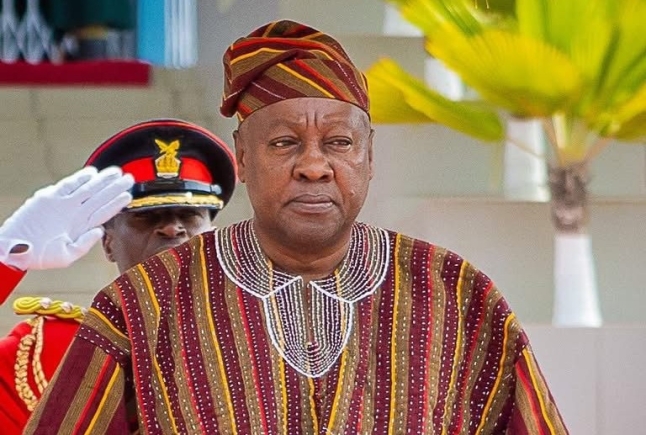
    Her comments come after she openly criticized Okraku-Mantey on United Showbiz on February 15, expressing frustration over what she described as his failure to uplift the creative arts industry.

    While some speculated that her critique stemmed from a personal feud, Nana Aba clarified that she and Okraku-Mantey are merely acquaintances and that her criticism was rooted in professional expectations.

    “I felt his comments were unnecessary. He’s been in the media before and doesn’t get to decide how a media station should run its show. But my main issue was my disappointment in him. For someone coming from this industry, I expected better. I expected him to move the creatives from point A to C, but unfortunately, he failed. So, my rant was born out of my disappointment in him,” she explained.

    Nana Aba noted that under Okraku-Mantey’s leadership, the creative industry continued to struggle, with many artists facing worsening conditions.

    Despite facing backlash, she remains firm in her stance, maintaining that Okraku-Mantey’s tenure was a letdown for the sector.

  • I will interview Multimedia’s Kwasi Twum before I die – Nana Aba Anamoah

    I will interview Multimedia’s Kwasi Twum before I die – Nana Aba Anamoah

    Media icon Nana Aba Anamoah has vowed to interview founder and Chief Executive Officer (CEO) of The Multimedia Group, Kwasi Twum before she departs from the land of the living.

    According to Nana Aba Anamoah in an interview on Joy FM’s Showbiz A-Z on Saturday, 21st February 2026, his dream may never come to pass, but she is resolute things will turn around for her good.

    “I know that will never happen… but you see, in this life, never say never. I know that day will come. It will come before the Lord Almighty calls me. I will interview that one,” she insisted.

    She has also added the “Queen of the Airwaves,” Doreen Andoh, to her bucket list of interviewees, revealing that she became fascinated with her after she received a phone call shortly after leaving secondary school.

    “She spoke to me on the phone. I said, ‘Oh, I want to be a media person, but I don’t know what to do,’ and she gave me some advice that I don’t even remember, but it was her voice. It was so soothing on the phone, and I thought, ‘Oh, this woman is adorable,’” Nana Aba recounted.

    Despite crossing paths with Andoh several times throughout her decades-long career, Nana Aba disclosed that she has never shared the story of that life-changing phone call with Doreen.

    For Nana Aba, the driving force behind her desire to sit across from Doreen is to understand the secret behind her remarkable staying power. With Doreen Andoh surpassing three decades in broadcasting, Nana Aba said she remains in awe of how the mid-morning show host has sustained audience loyalty without losing relevance.

    “I don’t know how Doreen has done it… 30 years,” she remarked. “There isn’t a single time you tune into the radio and say, ‘Oh, my bad, I’m tuning off.’ You will listen from the beginning to the end. And she [Doreen] still has that power.”

    So profound is this admiration that Nana Aba publicly urged the radio goddess to document her journey: “Doreen should be writing a book… because I would love to read that book.”

    While Doreen Andoh remains her top priority, Nana Aba also identified Kwasi Twum as her second dream interview subject. Despite doubts raised by the host, Kwame Dadzie, about the possibility of securing such an interview, Nana Aba stood her ground.

    While hailing Doreen Andoh, Nana Aba criticised former Deputy Minister of Tourism, Arts, and Culture, Mark Okraku-Mantey, expressing her disappointment in his leadership.

    During a discussion on United Showbiz last year, the topic of Mark Okraku-Mantey’s hesitation to appear on the show surfaced. The former Deputy Minister of Tourism, Arts and Culture explained that he no longer sees the programme as focused on relevant entertainment issues, claiming it has shifted toward politics and other unrelated topics.

    The comments drew strong reactions from the panellists, with Nana Aba Anamoah sharply criticising Okraku-Mantey. She accused him of failing to address crucial challenges in the entertainment industry while in a position of influence.

    Earlier on Peace FM’s Entertainment Review, Okraku-Mantey had suggested renaming United Showbiz, arguing that the show no longer centred on showbiz matters. When asked by Peace FM’s Kwasi Abogye when he would appear on the programme, he said: “When we have proper conversations. Do you know that show is no longer showbiz? You need to change its name. I don’t have a problem with the show. When the ethics work over there, I’ll come. Now, I don’t know where I will fit in.”

    Responding to this on United Showbiz, Nana Aba Anamoah challenged his right to criticise the show. She questioned how Okraku-Mantey had used his own platform to tackle the issues he now highlights.

    “He said there are issues in the entertainment industry. How did he deal with that when he was a radio presenter for a very long time? How did he use his space? How did he use his space to deal with all those issues? He was given a position that could have allowed him to make the space he is complaining about better. What was his impact? It was zero. You know what? He sounds better when he is quiet. He shouldn’t talk about what people are doing in his space because he has not been impactful,” she said, visibly upset.

    While United Showbiz host Empress Gifty referred to Okraku-Mantey as “honourable,” Nana Aba Anamoah rejected the title, insisting he had no claim to it.

    “He is not an honourable. Don’t give people titles when they don’t own them. He is not a member of parliament. He has never been,” she fumed.

    Nana Aba justified her criticism of former Deputy Minister of Tourism, Arts, and Culture,

    Speaking on Joy Prime’s Changes show on February 19, 2025, Nana Aba admitted that she has a “personal problem” with Okraku-Mantey, but not in the way many assumed.

    “Yes, I have a personal problem with him because if my taxes are used to pay your salary, it’s personal. If my taxes are used to fuel your car, it’s personal,” she said.
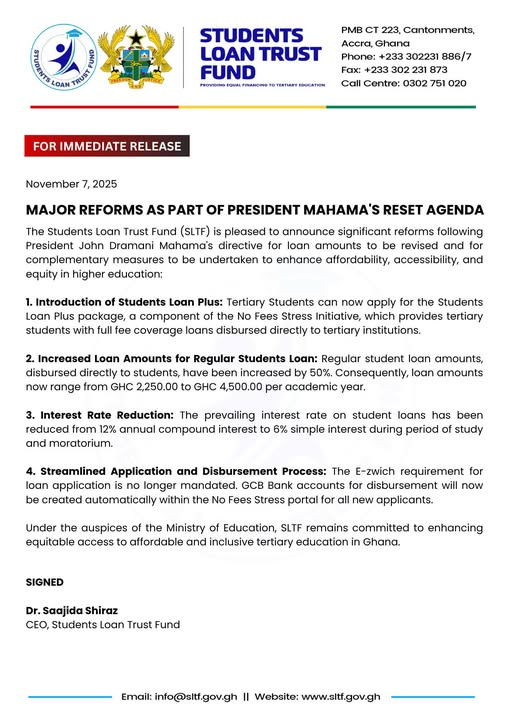
    Her comments come after she openly criticized Okraku-Mantey on United Showbiz on February 15, expressing frustration over what she described as his failure to uplift the creative arts industry.

    While some speculated that her critique stemmed from a personal feud, Nana Aba clarified that she and Okraku-Mantey are merely acquaintances and that her criticism was rooted in professional expectations.

    “I felt his comments were unnecessary. He’s been in the media before and doesn’t get to decide how a media station should run its show. But my main issue was my disappointment in him. For someone coming from this industry, I expected better. I expected him to move the creatives from point A to C, but unfortunately, he failed. So, my rant was born out of my disappointment in him,” she explained.
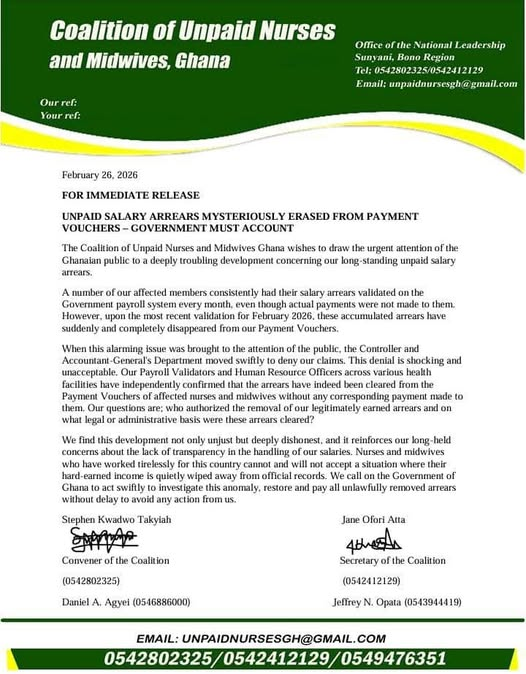
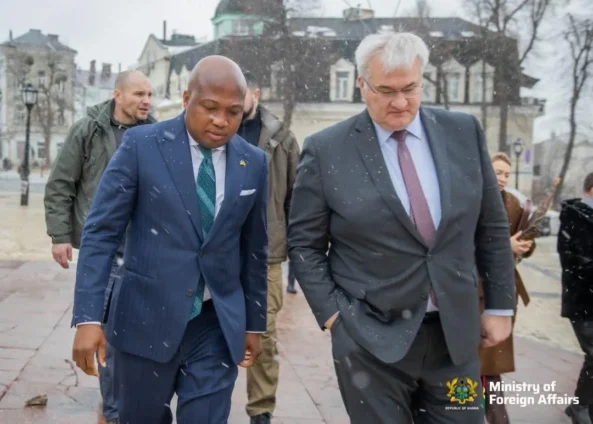
    Nana Aba noted that under Okraku-Mantey’s leadership, the creative industry continued to struggle, with many artists facing worsening conditions.

    Despite facing backlash, she remains firm in her stance, maintaining that Okraku-Mantey’s tenure was a letdown for the sector.


  • Social Media reacts to MUSIGA’s GHS500 contribution to Yaw Sarpong’s family

    Social Media reacts to MUSIGA’s GHS500 contribution to Yaw Sarpong’s family

    The Musicians Union of Ghana (MUSIGA) has faced backlash on social media after donating GH¢500 to the family of late gospel musician Yaw Sarpong during his one-week observation.

    The memorial event was held on Thursday, February 19, 2026, in Kumasi to honour the veteran singer.

    At the ceremony, MUSIGA presented GHS500 to the bereaved family as its contribution toward funeral preparations.

    The donation has since generated divided opinions online.

    While some social media users commended the union for demonstrating support and solidarity, others criticised the amount, arguing that it was too small and failed to reflect the stature and legacy of the celebrated gospel artiste.

    Critics maintained that Yaw Sarpong made significant contributions to Ghana’s music industry, particularly within the gospel community, and said the donation did not match the impact of his life’s work.

    Read the reactions below:

    Veteran Ghanaian gospel musician and founder of the Asomafo gospel group, Yaw Sarpong, has passed away.

    Confirmation of his death was given by his manager, Nana Poku Ashis, in an interview with Myjoyonline.com. Official details on the cause of death have not yet been released.

    His passing follows closely on the death of Maame Tiwa, a prominent member of the Asomafo group, whose loss shook the gospel music community about a month ago.

    Yaw Sarpong had been unwell for several years and had reduced his public appearances while undergoing treatment.

    He is widely recognised as a towering figure in Ghana’s gospel music landscape, having led Yaw Sarpong and Asomafo to national prominence. The group played a significant role in shaping contemporary Akan gospel music, earning respect for its rich lyrical depth and disciplined, doctrine-based musical style.

    Throughout his career, Yaw Sarpong and Asomafo released several well-known gospel songs, including Wo Haw Ne Hwan, Tie Obiaa, Aduro Yesu, and Awurade Kasa, which remain popular in churches across the country.

    In recognition of his contribution to gospel music, Yaw Sarpong received the Lifetime Achievement Award at the 2025 Telecel Ghana Music Awards.

    Celebrated Ghanaian gospel musician Maame Tiwaa also passed away some weeks ago.

    According to reports by UTV, the veteran singer died in the early hours of Sunday, December 7, 2025. She is said to have passed on after a brief illness, although the exact cause of her sudden death has not yet been disclosed.

    Maame Tiwaa was widely admired for her long-standing collaboration with Yaw Sarpong and the Asomafo Band, a partnership that earned her a revered place in Ghana’s gospel music community.

    After four decades in the industry, she recently earned her first nomination at the 3Music Awards 2021, marking a significant milestone in her career.

    Known for her distinctive and angelic voice, Maame Tiwaa featured in several popular songs, including Tenabea Foforo, Yen Nka Nkyere Yen Agya, Sumenaso, and other well-loved gospel hits.

    Since news of her passing broke, social media platforms have been flooded with tributes from fans, with many expressing deep sorrow and extending condolences to Yaw Sarpong and the entire Asomafo family.

    The musician’s family has not yet released an official statement. Further updates will be provided as more information becomes available.

    Veteran actor, director and cultural advocate William Addo, widely known by his stage name Akpatse, is dead.

    According to reports, he died on November 22, 2025, after years of battling severe health complications.

    Veteran actor William “Akpatse” Addo, was loved for his roles on GTV’s Thursday Theatre. His comic talent and stage presence, became a household name in Ghanaian theatre and television.

    Akpatse was a trained scholar, holding a degree in Drama from the University of Ghana and a master’s in Acting and Directing from the University of Leeds.

    He held important roles in the arts, including Director at the National Theatre and Director of Programmes at the National Commission on Culture, and taught many of Ghana’s top actors as a university lecturer.

    In recent years, he battled serious health problems, including vision loss from glaucoma and cataracts.

    His Funeral arrangements will however, be announced soon.

    Last year, renowned Ghanaian actor, Vincent McCauley, famous for his role in the beloved 90s television series “Things We Do For Love,” passed away.

    The news of his demise was confirmed by his colleague actor and friend, Adjetey Annang.

    Known as Max in the TV series, Vincent McCauley is reported to have died on Thursday, January 18, 2024. The cause of his death is currently unknown.

    Vincent McCauley’s notable roles also include appearances in movies such as “Games People Play,” “Fortune Island,” “Office Palava,” “Living With Trisha: House of Secrets,” and “The Idiot and I.”

    Since the announcement of his death, tributes have been pouring in from various sources.

    Adjetey Annan, also known as Pusher, a rival to Max in the 90s series, expressed his sorrow, saying, “Rivals on set ‘Pusher & Max’ since 1999 but cool guys off set. Thank you for being a part of the family and paying your dues very well. Rest in perfect peace brother🙏 Our deepest condolences to the family.”

    Numerous other celebrities have taken to social media to share their condolences.

    R.I.P to a Ghanaian screen legend Vincent McCauley💔 pic.twitter.com/6fiS1Jnqtc— Silverbird Cinemas Ghana (@SilverbirdGhana) January 18, 2024

    In February this year, celebrated actor Mawuli Semevo died after a fire accident.

    The 63-year-old veteran actor’s unfortunate incident happened on Thursday, February 20, 2025, at the Ridge Hospital, where he was receiving treatment after suffering burns.

    On February 8, 2025, Judith Addison of Beyond Burns International, a dedicated non-profit organization committed to providing advocacy and support for burn survivors, reported that Mawuli was in critical condition.

    “Beyond Burns International got an SOS that something unfortunate has happened. We came here today, and veteran actor Mawuli Semevo has been involved in a severe fire accident. I came here to see him, and his life is hanging in the balance,” Judith said in the video report posted on their social media pages.

    According to her, Mawuli was sleeping in his house when it caught fire.

    “He has suffered burns up to 44% of his body. He has respiratory injuries and cannot breathe properly. This is very serious. From his head to his legs. Everywhere caught fire, and he has lost all his hair,” she further stated.

    The report was later corroborated by actors such as Ken Fiati and Edinam Atatsi.

    Mawuli Semevo is known for his immaculate acting skills both on stage and in movies.

    He has played roles in movies such as ‘ Harvest at 17’, ‘A Stab in the Dark’, ‘Escape of Love’, ‘Like Cotton Twines’ and ‘The Good Old Days: The Love of AA.’

    Months ago in Nigeria, renowned Nollywood actor and distinguished academic, Dr. Columbus Irosanga, sadly departed.

    Actress Hilda Dokubo announced the news on her Instagram account on Thursday.

    In her heartfelt message, she wrote, “There can’t be a shortage of Angels in heaven that the few here are called home like this na! This one is heavy on Uniport, Rivers State, Nollywood.”

    She continued, “Our uncle Coli @colu_mbusirisoanga has gone to be with the Lord. Ikoli eh dein na mu.”

    Originating from Okrika in Rivers State, Dr. Irosanga became a household name for his compelling performances as chief priests in Nollywood films.

    He is especially remembered for his unforgettable portrayal of “Igbudu” in the 2001 hit film, Isakaba.

    His extraordinary acting skills garnered him numerous prestigious awards, such as Best Actor in a Supporting Role at the Africa Movie Academy Awards (AMAA), Best Actor in a Drama at the City People Entertainment Awards, Most Promising Actor in Nigeria at the Africa Magic Viewers’ Choice Awards (AMVCA), and Best Actor in a Leading Role at the Best of Nollywood Awards.

    Beyond his film career, Dr. Irosanga was a respected senior lecturer in the Department of Theatre Arts at the University of Port Harcourt, where he played a pivotal role in mentoring many budding actors.

    He is survived by his spouse and children, though the circumstances surrounding his death remain undisclosed. His passing represents a profound loss to both the academic and entertainment sectors in Nigeria.

  • Ghana needs a system that punishes women who engage in paternity fraud – A Plus

    Ghana needs a system that punishes women who engage in paternity fraud – A Plus

    The Member of Parliament for Gomoa Central, Kwame Asare Obeng, popularly known as A Plus, has disclosed his intention to introduce a private member’s bill aimed at sanctioning women found guilty of paternity fraud.

    During an appearance on Prime Time with George Quaye, he stated that there should be “a legislation that prescribes punishment for people who engage in paternity fraud”.

    A Plus argued that in some instances, women are conscious of having had more than one partner within a particular timeframe. He noted that “women knows that between a certain period they were having something to do with one or two men”.

    To support his position, he referenced what he described as observations from a medical facility, saying “out of 10 women who come for DNA with their kids about four do not belong to the men”.

    The lawmaker contended that penalties for paternity fraud must be stringent, especially when the woman involved is married. In his words, “the punishment must be more if she’s married than a single woman”.

    He highlighted what he sees as the psychological and financial strain faced by men who unknowingly raise children who are not biologically theirs. He pointed to cases where “a woman goes to court with her husband and three kids or four kids do not belong to the man”.

    A Plus insisted that there is “no justification” for a woman to mislead a man regarding the paternity of a child, even in situations where she may have endured stigma over infertility. He called for penalties “if a DNA test is done and it is discovered that you the woman went to cheat or for whatever reason the child is not your husband’s and you hadn’t declared it early on”.

    He also referred to what he described as the extreme emotional toll such revelations can have, recalling a situation where “somebody committed suicide somewhere outside” after discovering that the children he had brought up were not his biological offspring.

  • Fiifi Coleman  to revive ‘I Told You So’ as stage play in March 

    Fiifi Coleman  to revive ‘I Told You So’ as stage play in March 

    Ghanaian actor and director Fiifi Coleman is preparing to bring back the timeless story ‘I Told You So’ to the stage at the National Theatre of Ghana in March 2026.

    The play is scheduled to run from March 5 to March 8, with several performances lined up across the four days. Organisers anticipate a strong turnout, citing the story’s enduring cultural significance and its impressive lineup of performers.

    The stage production has its origins in Ghana’s concert party tradition and was later adapted into a film in 1970 under the direction of Egbert Adjesu. That film went on to become a milestone in Ghana’s movie industry, earning praise for its wit, satire and compelling social themes. The narrative itself drew inspiration from the works of renowned dramatist Bob Cole and continues to stand as one of Ghana’s most impactful stories.

    This new staging is being presented by Fiifi Coleman Productions in partnership with the National Theatre. The aim is to reintroduce audiences to core Ghanaian values while boosting interest in local theatre and authentic storytelling.

    The storyline follows Kobina Jones, who returns to Ghana after spending years overseas, hoping to reconnect with love, family and his sense of identity. Instead, he is confronted with surprising truths that force him to rethink his views on relationships, tradition and duty. Central themes include marriage and romance, family pressures, the clash between tradition and modern life, as well as questions of morality and social responsibility.

    The cast brings together seasoned and modern-day talents, among them highlife icon Gyedu-Blay Ambolley, respected actor Fred Amugi, comedian Clemento Suarez, actor Clement Bonney, Ken Fiati, Wofa Kay and Deaconess Abokomah.

    Veteran filmmaker Kwaw Ansah, who served as set designer for the original movie adaptation, is also linked to the revival and was present at the media launch.

    The production is expected to combine elements of drama, humour and music, with Ambolley adding a vibrant musical touch. Organisers say the play is designed not only to entertain but also to safeguard and promote Ghanaian heritage and identity.

    The actor has set ambitious goals for his career. Following the resounding success of his stage production in September 2023, ‘The Dilemma of a Ghost,’ the renowned actor is now determined to pack stadiums with his performances.

    ‘The Dilemma of a Ghost’ achieved sold-out status at the National Theatre in Accra. This play, authored by the late Ghanaian playwright Ama Ata Aidoo, revolves around the narrative of a Ghanaian man who returns to Ghana from the United States with his American wife. Their cultural disparities lead to challenges in their marriage, and they must find a way to bridge the gap between their two worlds.

    He was “humbled and grateful” for the positive reception to the play. According to him, he is now looking to build on the success of the play.

    Fiifi Coleman has unveiled his intentions to produce a series of stage plays in the forthcoming years, with the ultimate aim of filling stadiums with his captivating performances.

    “I am aiming to fill stadiums in the next two years,” he said.