Author: Amanda Cartey

  • Efya’s private event was a knocking ceremony, not a wedding – Management clarifies

    Efya’s private event was a knocking ceremony, not a wedding – Management clarifies

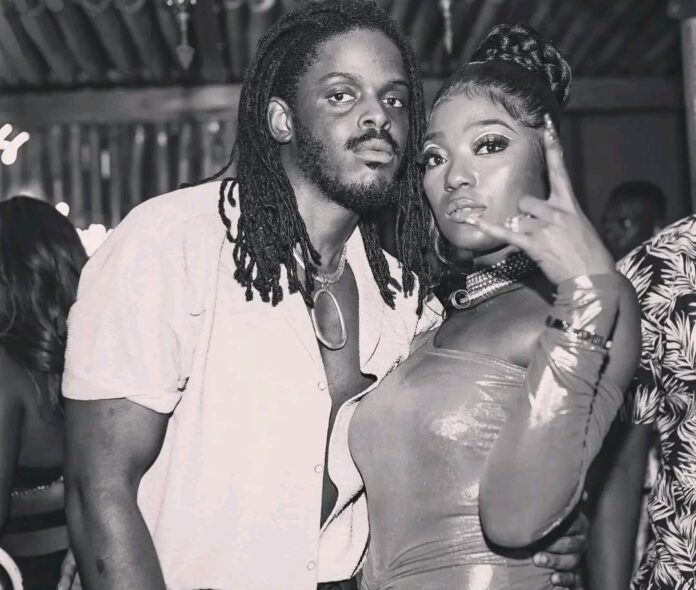
    The management of Ghanaian singer Efya has addressed circulating claims about her supposed marriage to Nigerian musician Tomi Thomas, which was reportedly held in a private event in Accra on Valentine’s Day.

    In an exclusive interview with Adom FM, her team stated that the gathering was a traditional knocking ceremony involving close relatives and friends, stressing that it was not a wedding.

    “The whole thing was not supposed to come out. So, I am wondering why someone would share the videos. Do you know how many people do knocking and nothing happens after? So why would people call it marriage? Because the family is not done, there will even be pressure,” management stated.

    It was reported that Efya got married to Nigerian Hip Hop and R&B musician Tomi Thomas.

    It was a private ceremony held on February 14, 2026.

    The singer became the centre of online discussions after videos of her private wedding surfaced on social media.

    The videos also revealed that the singer was heavily pregnant, and that may have necessitated her plan to marry secretly.

    Efya was seen in a white gown, happily jamming to her colleagues’ R2Bees’ performances.

    In the videos that made rounds online, she appeared confidently displaying her baby bump while dressed in an elegant, custom-made wedding gown.

    Notable figures including Hajia4Real, King Promise, and R2Bees were also reported to have attended the ceremony.

    In 2024, Ghanaian musician Bisa K-dei took a significant step in his personal life by getting married.

    The renowned artist, known for his soulful melodies, has followed in the footsteps of many industry colleagues, embracing the journey of marriage with his partner.

    Bisa K-dei’s wedding was a private and intimate affair, with close friends and family coming together to witness the union of the music icon and his now-spouse.

    The ceremony exuded warmth and joy, reflecting the couple’s deep commitment to each other.

    Congratulations and well-wishes poured in from fans and fellow artists, with the music community expressing their happiness for the artist and sending heartfelt messages of blessings and joy to the newlyweds.

    Kimathi Rawlings, the son of the late former President Jerry John Rawlings, has tied the knot in a blissful wedding ceremony attended by family, friends, and dignitaries.

    A video sighted by The Independent Ghana on social media shows Mr Kimani clad in an alluring white agbada outfit alongside his bride.

    The couple was seen sharing pleasantries with invited guests and family members in the aftermath of the church wedding service.

    A short while later, the couple hit the dance floor to KiDi’s popular song “Odo” with Kimathi drawing attention as he showcased some impressive dance moves.

    About Kimathi Rawlings

    Kimathi Rawlings the youngest of four children born to Jerry John Rawlings and Nana Konadu Ageman, was born in Accra, Ghana during the 1980s. He was named by his father in honour of Dedan Kimathi, a remnowned Keyan freedom fighter known for defending his people and challenging the moral conduct of leaders.

    His siblings include Zanator Agyeman-Rawlings, who currently serves as a Member of Parliament, along with Yaa Asantewaa Rawlings and Amina Rawlings.

    Kimathi began his early education in Accra, attending Morning Star School and North Ridge Lyceum.

    He was named by his father after a Kenyan freedom fighter called Dedan Kimathi who lived and defended the rights of his people and consistently questioned the integrity of his leaders.

    He is the last born of his four siblings: Zanetor Agyemang Rawlings (MP), Yaa Asantewaa Rawlings and Amina Rawlings.

    Kimathi began his early education in Accra at the Morning Star School and North Ridge Lyceum.

    He continued his education in England, UK at the Millfield School where he performed exceptionally well across all subjects.

    Driven by strong interest in Science, business and law, he pirsued higher education at Aston Unversity in Birmingham, where he earned a Bachelor of Science in International Business.

    His LinkedIn profile, indicates that he obtained certifications from MDT International, including training in Negotiation Skills for the Oil & Gas Industry in 2012 & Introduction to Oil and Gas Production in 2013.

    With over a decade of experience, Kimathi has built a career as a Commercial Advisor and Negotiator in oil and gas sector.

    Kimathi Rawlings is also well-versed in areas such as Analytical Skills, Upstream Marketing, Hydrocarbon Accounting, Risk Management, and Corporate Finance.

    Since 2010, he has been serving with Eni, an Oil and Gas conglomerate headquartered in Rome Italy as their Commercial and portfolio advisor.
  • ‘I am a cocoa farmer too, price reductions hit me personally’ – President Mahama

    ‘I am a cocoa farmer too, price reductions hit me personally’ – President Mahama

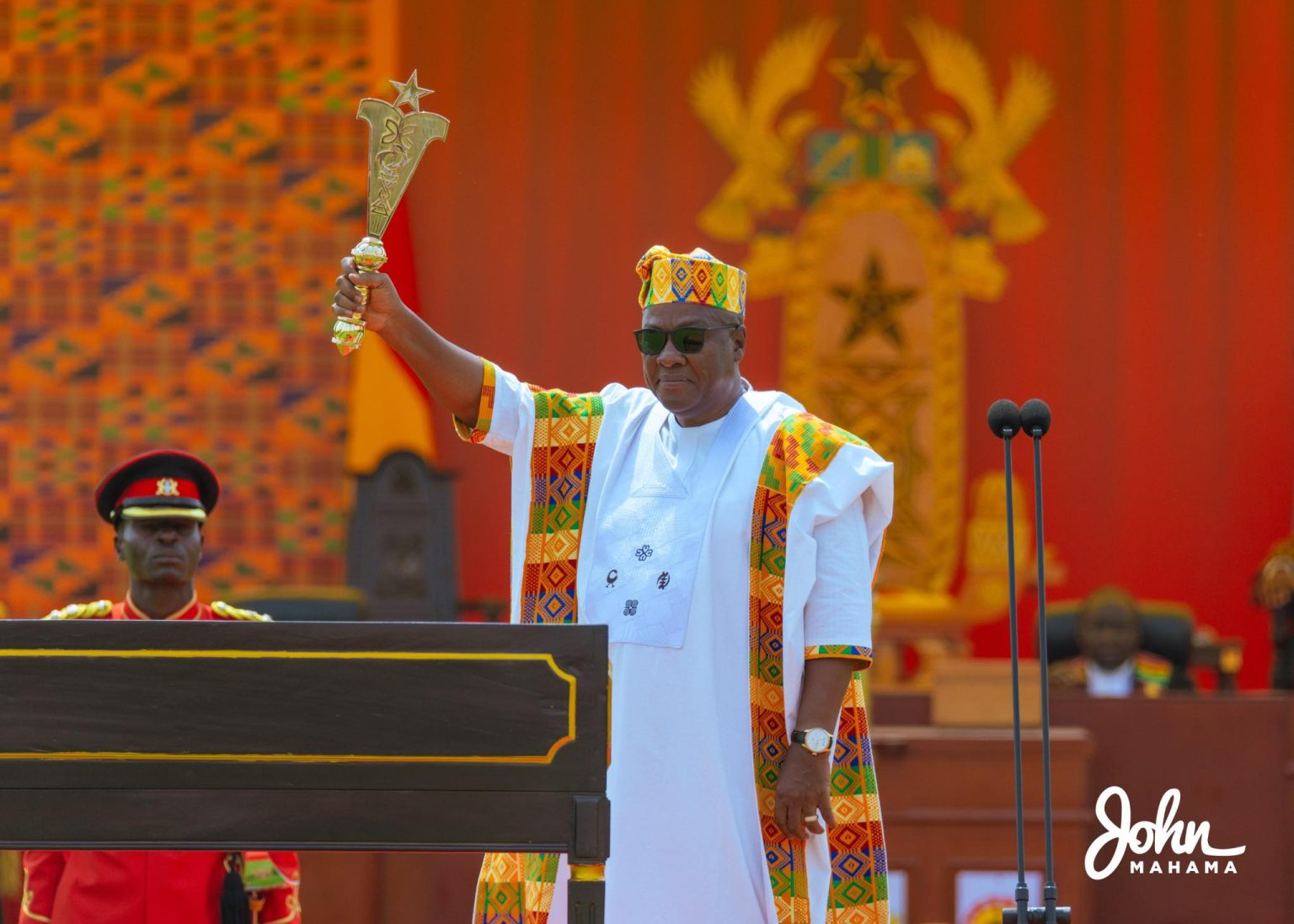
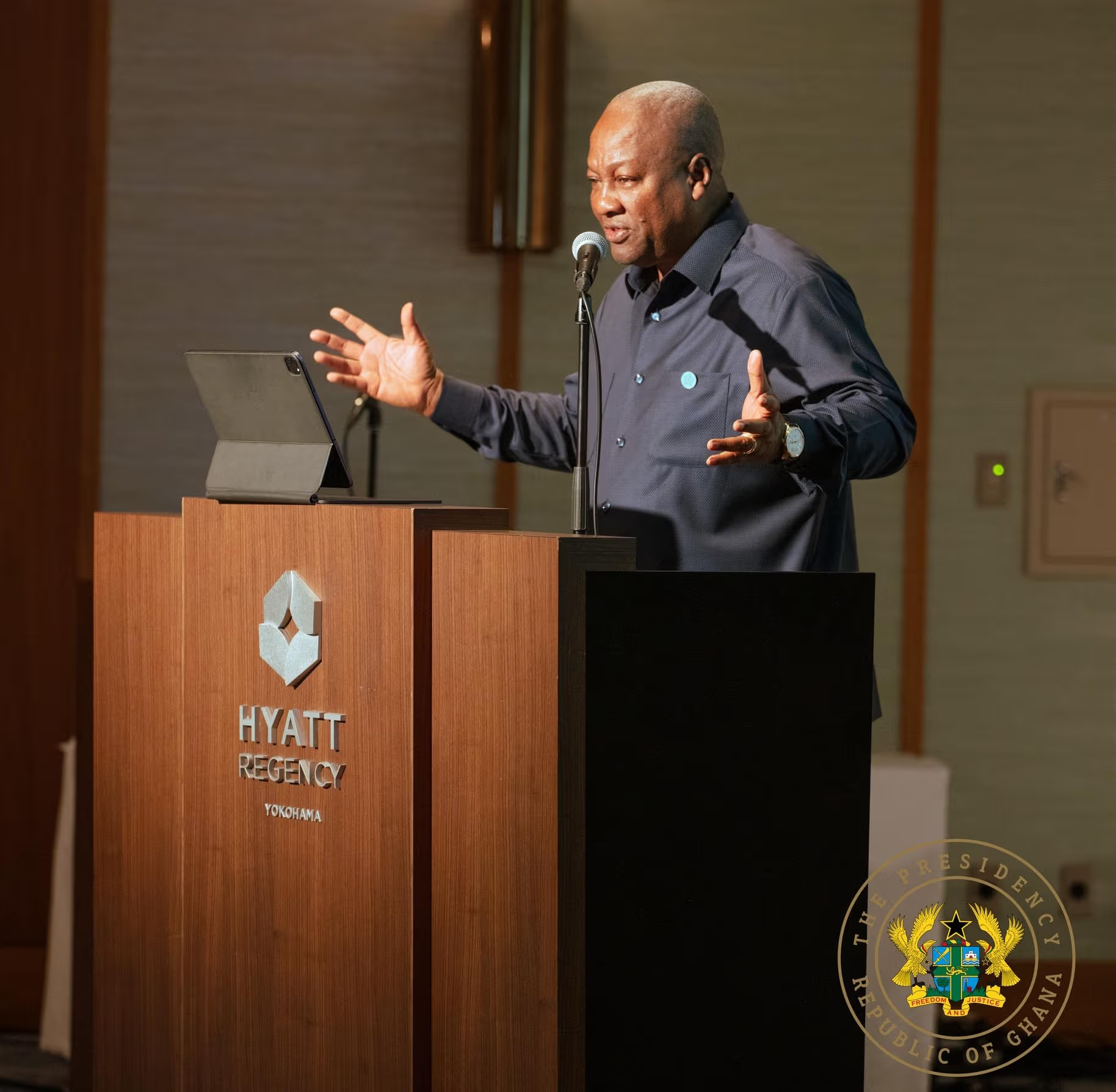
    President John Dramani Mahama has disclosed that cocoa price reductions affect him personally, citing his experience as a cocoa farmer while stressing the need for policies that reflect farmers’ realities.

    Speaking at the Ghana Tree Crops Investment Summit and Exhibition on Tuesday, February 17, the President said he understands the economic challenges confronting cocoa farmers, particularly amid fluctuations in global cocoa prices and ongoing changes within the sector.
    His remarks come in the wake of controversial reforms in the cocoa industry, where the farmgate price was reduced from GH¢3,625 to GH¢2,587 per bag to align with movements on the international market.

    “Nana Kwebu Ewusi gave me 50 acres of land, and I planted cocoa on the 50 acres, so I am a cocoa farmer. So when the price is reduced by the government, it affects me too. I want to be able to empathise with farmers so that when we take any policy decision, we know that it has an effect on farmers and we feel it ourselves,” he said.

    Ghana, the world’s second-largest cocoa producer after Côte d’Ivoire, depends heavily on cocoa as a major source of foreign exchange and livelihoods for more than 800,000 farming households. The sector also supports millions of people through transportation, processing, and other related economic activities.

    The cocoa industry has recently experienced major global price swings. Prices rose to record highs of over $10,000 per tonne in 2024 before declining following improved production forecasts and market adjustments. These changes have created uncertainty for both farmers and policymakers.

    President Mahama stressed that decisions on cocoa pricing and reforms must take into account the conditions farmers face, since their earnings depend largely on producer prices announced annually by the Ghana Cocoa Board.

    He noted that policies affecting cocoa farmers directly influence rural incomes, access to education, and household welfare, adding that reforms must focus on sustainability, fairness, and long-term sector growth.

    The summit, organised with support from the Ghana Tree Crops Authority, seeks to attract investment into major tree crops such as cocoa, cashew, rubber, coconut, and oil palm as part of efforts to diversify Ghana’s agricultural sector and increase value addition.

    President Mahama reaffirmed government’s commitment to improving the cocoa industry through better pricing systems, increased productivity, and measures aimed at ensuring farmers receive fair compensation for their produce.

    He added that aligning policies with the lived experiences of farmers will be key to protecting the future of Ghana’s cocoa sector and maintaining its competitiveness on the global market.

    President John Mahama has unveiled major reforms that will have Ghana buying its cocoa with local currency and ending the export of unprocessed mineral ores by 2030, signaling a bold move toward greater economic independence.

    At the conclusion of his high-level side event, “Accra Reset’s Addis Reckoning,” held alongside the 39th African Union Assembly of Heads of State, President Mahama outlined urgent measures aimed at freeing Ghana’s cocoa industry from long-standing reliance on restrictive foreign financing.

    “One of the key decisions we’ve made is to stop accepting foreign funding for the purchase of our cocoa. We are going to raise domestic bonds. We have enough Cedis in Ghana to pay for our cocoa,” President Mahama declared, outlining a radical departure from decades-old practices.

    The President explained that Ghana’s cocoa crisis highlighted long-standing problems in the system. When the government set the cocoa price while international cocoa was $7,200 per ton and the Ghana Cedi was 11.5 to the dollar, changes in the market caused big losses as prices dropped to $4,200 and the Cedi strengthened to 10.7 per dollar.

    President Mahama also pointed out that relying on foreign funding has limited Ghana’s ability to add value to its cocoa.

    “You know what the collateral for the funding is? Our own cocoa beans. You collateralise the beans with the financier, buy them, ship them, and they pay you the international market price,” he explained.

    “You know the interesting part? We have the capacity to process 400,000 tons of those beans in Ghana, but because they are collateralised, we cannot even allocate them to local processors. We must ship all the beans outside.”

    Under the new arrangement, Ghana will raise domestic bonds in Ghana Cedis to purchase cocoa directly from farmers, eliminating the need to pledge the beans as collateral. This will immediately unlock 400,000 tons of cocoa beans for local processors, creating thousands of jobs and retaining significantly more value within Ghana’s economy.

    President Mahama went further, setting an ambitious yet firm deadline to end the export of unprocessed minerals from Ghana.

    “I say by 2030, there won’t be any raw mineral ores leaving Ghana. You’re not going to ship raw manganese ore out of Ghana. You’re not going to ship raw bauxite ore out of Ghana. You’re not going to ship raw iron ore out of Ghana. You must process all that locally,” he stated emphatically.

    The announcement represents what President Mahama says is a comprehensive application of the Accra Reset philosophy, his continental initiative aimed at scaling up development across Africa by asserting sovereignty over natural resources and building domestic processing capacity.

    The President framed his bold moves in the context of mounting pressure from Africa’s youthful population, which is increasingly desperate for economic opportunities.

    “That is the only way we can provide opportunities for our young people. Our young people are less patient than our generation. They want to see that progress and prosperity today,” he said.

    He connected the urgency of implementation directly to the migration crisis: “That is why Accra Reset needs that urgency to stop our young people from braving the dangers of the Sahara and the Mediterranean as they try to reach Europe in search of opportunity.”

    Acknowledging that continental transformation requires immediate action rather than endless planning, President Mahama endorsed a proposal for rapid implementation through willing partners.

    “We come with the decisions. We agree. We do the frameworks. What is missing is urgency and implementation. We take time. And we behave like time is waiting for us,” he said, channelling concerns raised during the discussion.

    “That is why Accra Reset is a good idea. But let’s implement urgently. If parts of the continent are not ready, let’s form a coalition of the willing to move this as quickly as possible. And let all the others follow and join.”

    The Accra Reset initiative, introduced by President Mahama, aims to reshape Africa’s economic ties with the rest of the world, focusing on processing resources locally, building industries, and taking control of the continent’s natural wealth to boost prosperity for Africa’s 1.4 billion people.

    Ghana’s statements in Addis Ababa show that the country plans to set an example, putting real actions in place that other African nations can follow as part of a wider movement across the continent.

    “From Addis, we must stop talking and start implementing,” President Mahama concluded, crystallising the theme of the gathering he dubbed “the Addis reckoning.”

  • Komenda Sugar Factory buried in debt, utilities disconnected – Trade Minister discloses

    Komenda Sugar Factory buried in debt, utilities disconnected – Trade Minister discloses

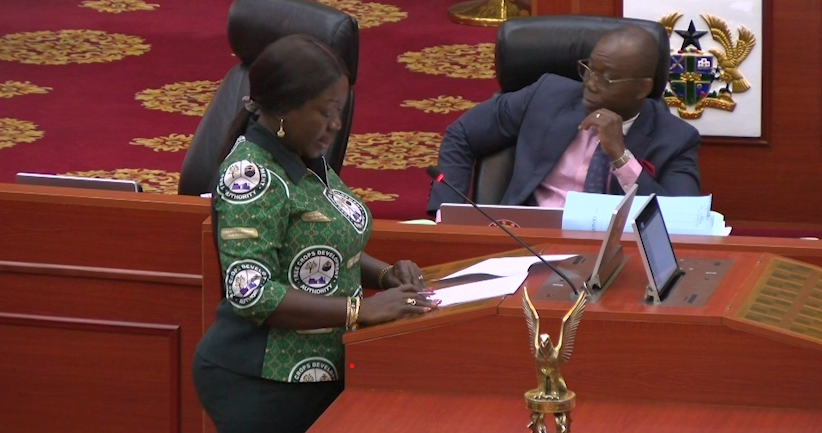
    Trade Minister Elizabeth Ofosu-Adjare has announced that the Komenda Sugar Factory has lost access to electricity and water services because of unpaid utility bills.

    She delivered the update while addressing Parliament of Ghana on Tuesday, February 17, 2026, during a briefing on the condition of the Komenda Sugar Factory.

    “The factory has been disconnected from the national grid by the Electricity Company of Ghana and water supply by Ghana Water Company Limited due to unpaid bills. Added to the poor state of the equipment, the facility has accumulated significant debt,” She stated.

    Operations at the Komenda Sugar Factory have stalled, with the facility failing to produce sugar and deteriorating six years after it was commissioned.

    The lawmaker indicated that the plant is weighed down by heavy debt, which has worsened long-standing technical and operational problems and halted its activities.

    She noted that the factory cannot function at full capacity because its machinery and equipment have serious defects and have not undergone refurbishment since the plant was completed in 2016.

    “Technical and operational deficiencies have prevented the factory from running at full capacity. The machinery and equipment of the factory have not been refurbished since construction in 2016. Equipment generators and motors need maintenance, and the boiler top coil needs replacement to bring the factory back to life,” she told Parliament.

    Mrs Ofosu-Adjare also stated that the facility had been cut off from the national power supply by the Electricity Company of Ghana and from water supply by the Ghana Water Company Limited as a result of outstanding bills.

    Aside from utility and infrastructure difficulties, the Minister identified shortage of raw materials as another major factor delaying the factory’s revival.

    She explained that the farming communities expected to supply sugarcane have withdrawn participation, mainly due to weak institutional backing and unclear procurement systems.

    “The farming community which was expected to anchor the raw material supply remains disengaged due to lack of institutional support and unclear procurement channels,” she noted.

    Outlining government’s intervention plans, Mrs Ofosu-Adjare disclosed that the Ministry of Trade and Industry has prioritised securing a transactional advisor to reorganise and present the factory to private investors.

    “The ministry has prioritised the engagement of a transactional advisor to package the factory and secure a strategic investor to operationalise the factory and farms in the 2026 budget,” she said.

    The Komenda Sugar Factory, which was launched as a major industrial initiative under Ghana’s industrialisation programme, was designed to reduce dependence on imported sugar and generate employment opportunities in the Central Region.

    Nonetheless, continuous operational challenges have left the plant mostly inactive, leading to renewed demands for a lasting recovery plan centred on private sector participation and stronger links between farming and factory operations.

    The Sugarcane Farmers Association of Ghana has urged the Minister of Trade, Agribusiness, and Industry, Elizabeth Ofosu-Adjare, to take swift and decisive steps to revive the long-dormant Komenda Sugar Factory.

    In a statement issued on May 4 2025, the Association voiced deep disappointment with the Ministry’s recent response to their concerns, describing it as “unconvincing” and lacking a sense of urgency.

    The farmers urged the current NDC administration, led by President John Mahama, to avoid repeating the mistakes of the previous NPP government, which they accuse of making repeated promises but failing to get the factory operational.

    They stressed that reviving the factory is critical not only for their livelihoods but also for boosting local industry and reducing sugar imports.

    “We campaigned and voted for John Mahama because we believed he could revive this factory to improve our livelihoods,” the Association stated.

    The Association expressed concern that two months after the Minister’s visit to the Komenda Sugar Factory, no visible progress has been made, and the facility was not even mentioned in the 2025 national budget.

    They are calling on the government to urgently constitute a board of directors for the factory, emphasizing the need for competent leadership and the inclusion of a representative from the farming community.

    “We are ready to feed the factory with sugarcane. All we need is government commitment,” they said.

    Speaking on Yɛn Nsempa, the morning show on Onua FM hosted by Nana Yaa Brefo Danso, Secretary of the Association, Nana Joshua Kingsley Mensah, reiterated the frustrations of the farmers. “We feel deceived. After the Minister’s visit in February, we expected action. But there’s nothing happening on the ground,” he said.

    He added, “The livelihoods of hundreds of sugarcane farmers depend on the revival of this factory. We are ready to work, but the silence from the government side is worrying.”

    Nana Joshua also stressed the need for farmers to be included in the decision-making process. “We are not just suppliers—we are stakeholders. Our representation on the factory board is non-negotiable.”

  • More than half of Ghana’s treated water lost through leaks, theft and meter faults

    More than half of Ghana’s treated water lost through leaks, theft and meter faults

    Ghana’s urban water supply system is facing serious financial and operational pressure, with Ghana Water Limited (GWL) struggling with a growing supply gap, heavy debt, and large volumes of treated water being lost before reaching consumers, a new situational analysis has revealed.

    The February 2026 report, which combines data from the Public Utilities Regulatory Commission (PURC) and GWL’s tariff proposals, indicates that the company currently produces about 945,275 cubic metres of water daily. This falls short of the national urban demand of 1.19 million cubic metres, leaving a deficit of 244,725 cubic metres each day, representing 21% of total demand.

    The shortage has forced several urban communities across Ghana’s 16 regions to depend on irregular water supply and rationing schedules, affecting households, businesses, and critical public services.

    A key concern highlighted in the report is the high level of non-revenue water, which refers to water produced but not billed due to leakages, theft, illegal connections, and faulty meters.

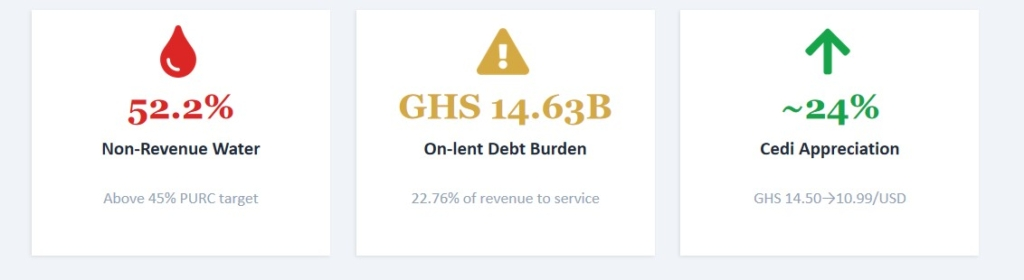
    According to the analysis, 52.2% of water produced in 2024 was either lost or unaccounted for, far above the regulator’s benchmark of 45%.

    The losses are largely linked to ageing pipelines, some over 50 years old, burst transmission lines, illegal connections, and meter tampering. Additional losses come from unbilled water use by some public institutions and illegal suction pumps connected directly to distribution lines.

    GWL is also facing significant financial challenges. The company currently holds on-lent loans totalling GH¢14.63 billion, equivalent to nearly one-quarter of its revenue. Each month, the utility spends approximately GH¢38.94 million on debt servicing, representing 22.76% of its monthly income and limiting funds available for maintenance, infrastructure expansion, and system upgrades.

    Most of the loans were contracted in foreign currencies such as US dollars and euros through government arrangements, exposing the company to exchange rate fluctuations.

    The report also highlights declining payment compliance by Ministries, Departments and Agencies (MDAs). Payment rates from government institutions dropped sharply from 92.53% in 2022 to 18.40% in 2024, creating a substantial revenue shortfall.

    Many public institutions reportedly cite the absence of budget allocations for water bills, while enforcement measures remain difficult due to the sensitive nature of disconnecting water supply to state facilities.

    Illegal small-scale mining, widely known as galamsey, has been identified as a major environmental threat to Ghana’s water supply. The report notes that more than 11 water treatment plants have been affected by mining pollution, particularly those drawing water from the Birim, Pra, Bonsa, Offin, and Black Volta rivers.

    The pollution has increased water treatment costs, forced temporary plant shutdowns, reduced production capacity, and created long-term risks to water quality and public health.

    Much of Ghana’s water infrastructure is outdated, with several systems dating back to the colonial era. Current system utilisation stands at about 60% of installed capacity.

    Energy costs also remain a major challenge, with electricity accounting for about 50% of water production costs and 27% of total operational expenses. This makes the utility highly vulnerable to changes in electricity tariffs and power supply interruptions.

    Despite these challenges, the report notes that the recent appreciation of the Ghana cedi, which strengthened by about 24% against the US dollar between the end of 2024 and February 2026, has helped reduce foreign debt servicing costs and lowered the price of imported chemicals and equipment.

    However, the analysis cautions that this improvement does not address deeper structural problems such as ageing infrastructure, high water losses, and weak revenue mobilisation.

    GWL currently serves 986,078 active customers across 86 water systems nationwide, making it the country’s sole provider of urban water supply.

    Experts warn that without urgent reforms, including tariff adjustments, infrastructure rehabilitation, improved billing systems, and stronger action against illegal mining, Ghana’s urban water security could face worsening shortages in the coming years.

    The report concludes that while recent economic gains provide an opportunity for reform, long-term structural changes will be critical to ensuring a stable water supply for Ghana’s expanding urban population.

  • More than 1k B1/B2 visa interviews available for non-immigrants next week – U.S. Embassy announces

    More than 1k B1/B2 visa interviews available for non-immigrants next week – U.S. Embassy announces

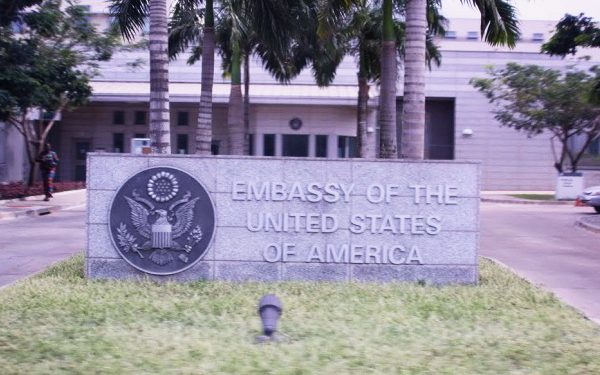
    The U.S. Embassy, Accra has disclosed that over 1,000 appointment slots for non-immigrant visas are now open with immediate effect.

    Officials stated that many B1/B2 visa interview slots, which cover business and tourist travel, are currently accessible and urged applicants to make use of the opportunity.

    The availability is expected to allow travellers to secure interview dates within the coming week.

    In a notice posted on Facebook on Tuesday, February 17, 2026, the embassy encouraged individuals intending to apply for visas to the United States to schedule their interviews promptly.

    “There are more than 1,000 B1/B2 visa appointment slots available in the next week – one of those could be yours,” the notice said.

    The decision is part of wider preparations by the United States to support increased travel ahead of the 2026 FIFA World Cup, which will be jointly hosted by Mexico and Canada.

    Individuals who already have interview dates scheduled later in the year have also been encouraged to reschedule for earlier slots where possible.

    “Book a new appointment – or move up one scheduled for later in the year – we want to interview you now!” the Embassy added.

    Prospective applicants have been directed to visit the embassy’s official visa portal for further details on eligibility requirements and application procedures.

    The announcement is expected to reduce anxiety among travellers who have faced extended waiting periods for interview appointments in recent months.

    The Embassy reported a significant surge in the number of Ghanaians applying for visas to the US, which exceeded the increased resources allocated for faster processing.

    Despite acknowledging that increased travel between the two countries will strengthen people-to-people ties, the US mission is facing challenges due to the tripling of visa applications since 2019, resulting in a growing backlog.

    These comments came at a time when the US Embassy was preparing to transition all visa applications to a new system, which commenced on August 16 2024.

    During a roundtable discussion at the US Embassy in Accra, American Consul General Elliot Fertik highlighted that the high demand was flattering for the US, as it suggested a strong interest among Ghanaians in visiting the United States temporarily.

    “I’ve said before that if you look at the number of people who paid the visa application fee in 2019 before the pandemic and compare it to the number of people who did so in 2023, the number in 2023 is triple what it was in 2019. So certainly, we hope this new system will provide some additional enhancements and will be more efficient” Mr Fertik noted.

    He added “We’re seeing it’s not just non-immigrant visas on the immigrant visa side. Diversity visa. Again, the numbers are through the roof. And, you know, we want to encourage as much legitimate travel between the United States and Ghana as we can. It is incredibly important to us. We want to encourage qualified students to study in the United States. And that’s why, as I said, that’s why we’ve had to bring more resources to doing interviews. Unfortunately, the demand is outstripping even the increased resources we’ve had and we’re going to continue increasing our resources”.

    The U.S. Embassy, Accra transitioned to a new visa services provider on August 26, 2024, causing the previous provider’s website and services to become unavailable after August 16, 2024.

    From August 16 to August 26, 2024, the U.S. Embassy in Accra’s visa services provider was inaccessible as the transition to a new provider took effect. During that period, applicants could not schedule, cancel, or modify visa appointments, but existing non-immigrant visa appointments were still honoured.

    Ghana Scholarships Secretariat (GSS) announced interviews for 2025/2026 Commonwealth Applicants also took place on Monday, 8 December 2025 as well as Tuesday, 9 December 2025.

    According to a letter signed by the registrar of scholarships, Alex Kwaku Asafo-Agyei, the interview starts at 9:30 a.m. at the Conference Room of the Ghana Scholarships Secretariat.

    “The Ghana Scholarship’s Secretariat (GSS) wishes to inform all applicants of the review of applications for the Commonwealth Scholarship tenable in the United Kingdom for 2025/2026 Academic year and is in the process of inviting applicants to attend an interview which will be a crucial step in assessing the suitability of applicants for the scholarship. The interview is scheduled for Monday 8th & Tuesday 9th December, 2025 at 9.30 a.m. at the Conference Room of the Secretariat,” the letter read.

    The letter also urged applicants who applied online but failed to submit hard copies of their applications to the secretariat to come along with the documents and other relevant academic certificates as indicated in “our earlier advertisement in the national daily (Ghanaian Times).”

    It added that all services offered by the Secretariat are free, urging applicants to beware of fraudsters.

    The U.S. Embassy encourages all applicants to take necessary actions before the transition to avoid any disruptions in their visa application process.

  • Burkina Faso trader attack: Ghana’s dependence on external food sources becoming a security risk – Prof Aning

    Burkina Faso trader attack: Ghana’s dependence on external food sources becoming a security risk – Prof Aning

    Ghana’s reliance on food imports has been flagged as a growing national security concern following reports of attacks on Ghanaian traders sourcing tomatoes from Burkina Faso.

    Security consultant and professor at the Kofi Annan International Peacekeeping Training Centre, Kwesi Aning, has warned that the country’s continued dependence on external food supply exposes traders and the wider economy to heightened security risks, particularly in conflict-prone regions.

    The development comes after Ghanaian traders travelling to neighbouring countries to purchase tomatoes reportedly faced violent attacks, raising fresh concerns about cross-border trade safety and Ghana’s local agricultural production capacity.

    Prof. Aning stressed that Ghana must urgently re-evaluate its food production strategies and prioritise sustainable, locally driven agricultural policies to reduce reliance on imports and safeguard national security.

    “We need to bring practical implementable policies that have impactful ends back to people’s lives. It doesn’t cost money or it shouldn’t cost too much money. But we are interested in fancy huge projects that eventually fail. We’ve got to learn to start to feed ourselves. Security is going to be a problem because if you look at the demographics, let me come back in 2030 years we may be around 70 million and with this attitude I would guarantee food insecurity will be our biggest challenge” he told Joy News in a phone-in interview

    A truck carrying Ghanaian tomato traders was attacked by terrorists in Titao, Burkina Faso on Sunday, February, 15. This was contained in a press release issued to media houses and signed by the Minister for the Interior and National Security, Muntaka Mohammed-Mubarak.

    “The Government of Ghana has received disturbing information from Burkina Faso of a truck carrying tomato traders from Ghana, which was caught in a terrorist attack in Titao,” the release said.

    According to the Ministry, Ghana Embassy in Burkina Faso has already launched an investigation into the unfortunate incident.

    “The Ghana Embassy in Burkina Faso is liaising with officials of Burkina Faso to visit the attack site for details and identification of Ghanaians caught in the attack,” the statement added.

    Parts of the Sahel region have recently experienced heightened terrorist attacks.Meanwhile, Burkina Faso, Mali, and Niger have formally broke away from the Economic Community of West Africa States (ECOWAS) due to diplomatic tensions after military takeovers and due to economic and social failures by past governments.

    The military juntas of these countries are led by Captain Ibrahim Traoré, General Assimi Goïta, and General Abdourahmane Tchiani, respectively.

    The trio accused the ECOWAS of failing to safeguard member states and deviating from founding principles and Pan-African spirit.In response to these claims, ECOWAS revealed that it did not receive formal notice before their withdrawal; therefore, it called for a dialogue to address their concerns.

    “The ECOWAS Commission remains seized with the development and shall make further pronouncements as the situation evolves,” it added.

    President John Dramani Mahama extended invitations to the military leaders of Mali, Burkina Faso, and Niger to participate in the official launch of ECOWAS’s 50th anniversary celebrations, which took place in Accra on April 22.

    The invitation to the Sahelian states was part of Ghana’s broader efforts to rebuild relations and enhance cooperation for a stable and united West African region.

    International Relations Analyst Dr. Yaw Gebe endorsed President John Dramani Mahama’s decision, describing the gesture as a positive step toward regional reconciliation.

    He, however, advised the ECOWAS to critically reflect on the underlying reasons behind the exit of the Sahel nations and emphasised the need for the bloc to adopt a more inclusive and problem-solving approach going forward.“My prayer and longing is that whatever the Nigerian President, Bola Tinubu or President John Mahama are doing, they should be conscious of the problems or challenges these countries are facing. The ECOWAS must be willing and ready to tackle those problems collectively. And that is a major shortcoming on the part of ECOWAS,” he said.

    Despite the formal withdrawal of Burkina Faso, Mali, and Niger from the Economic Community of West African States (ECOWAS) on January 29, citizens from these countries will still be able to use their national passports and identity cards bearing the ECOWAS logo for travel within the region.

    ECOWAS has assured that in the interest of regional cooperation and to prevent unnecessary disruptions, all relevant authorities within and outside the bloc’s member states should continue to recognize these travel documents until further notice.

    Additionally, trade and economic activities involving these three nations will not face immediate restrictions. Goods and services from Burkina Faso, Mali, and Niger will continue to receive the same treatment under the ECOWAS Trade Liberalization Scheme (ETLS) and investment policy.

    Citizens from the affected countries will also retain their right to visa-free movement, residence, and establishment across ECOWAS states, ensuring that travel and cross-border activities remain unhindered.

    Furthermore, officials from Burkina Faso, Mali, and Niger working within ECOWAS will be given full support and cooperation in carrying out their assignments.

    These measures will remain in place as ECOWAS leaders work on defining the future relationship between the bloc and the three nations. A special structure has been put in place to facilitate discussions on the next steps.

    The regional body emphasized that these transitional arrangements aim to maintain stability, minimize confusion, and support the people and businesses affected by the withdrawal.

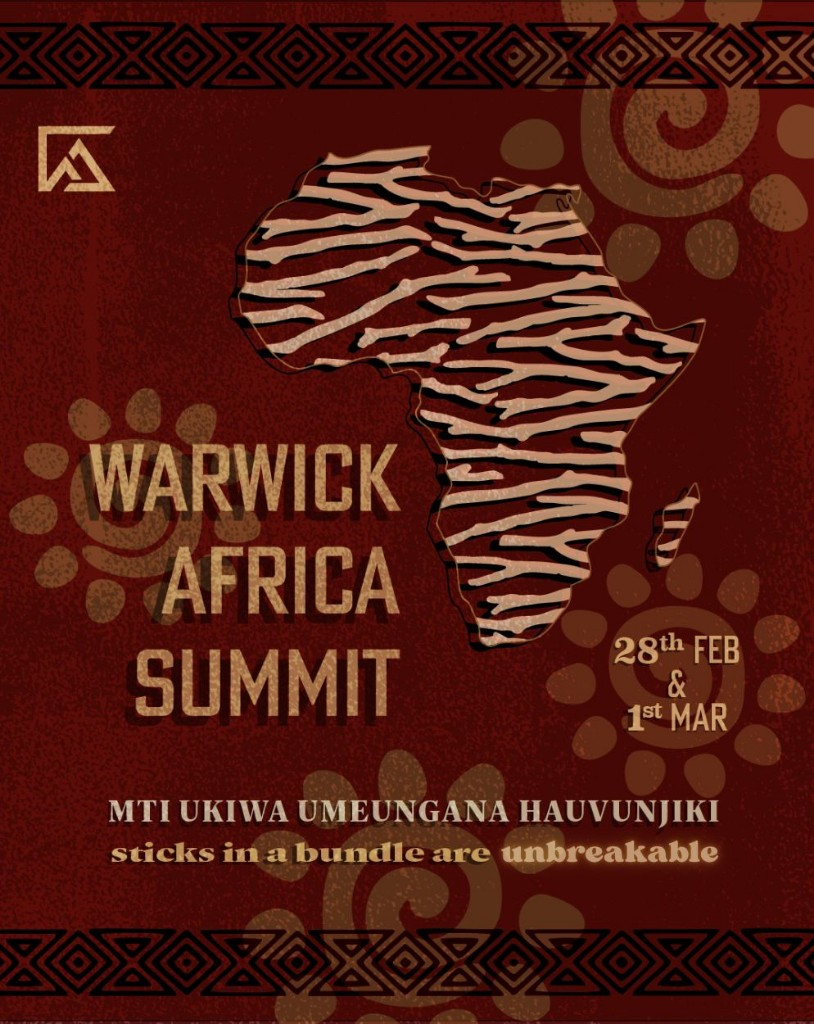
  • Warwick Africa Summit @10: Eve and Twinsdntbeg announced as main acts

    Warwick Africa Summit @10: Eve and Twinsdntbeg announced as main acts

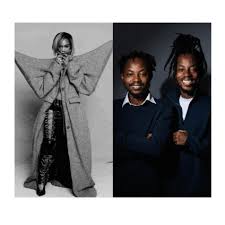
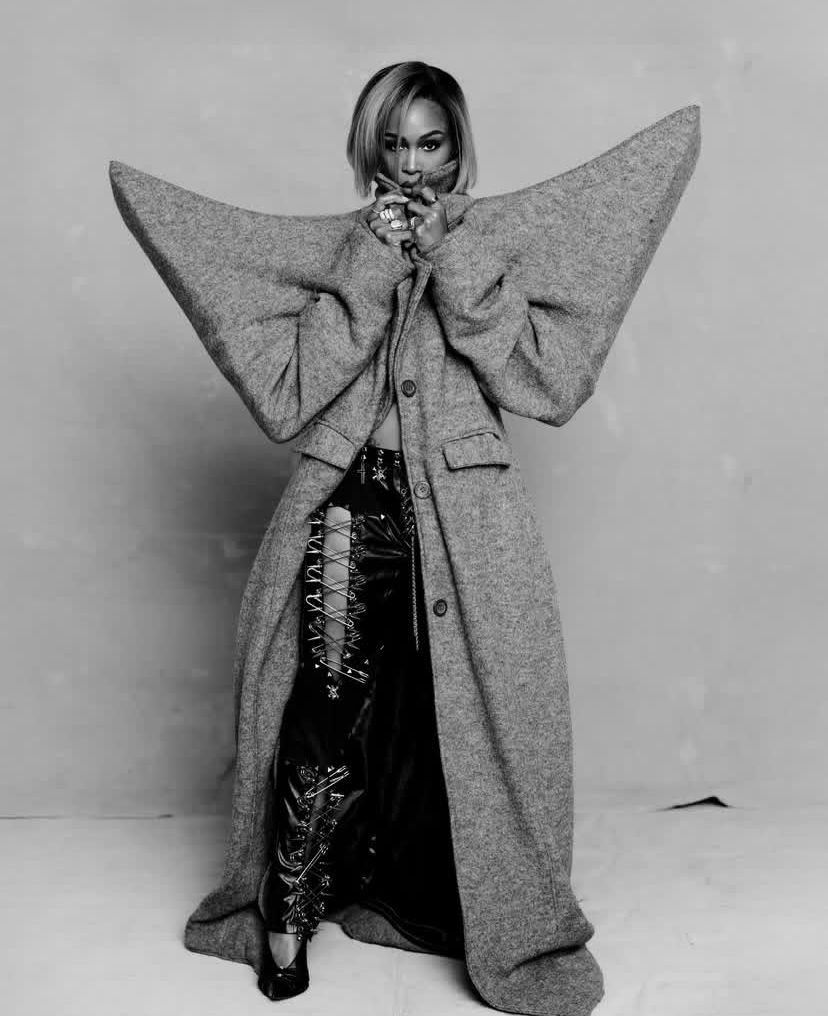
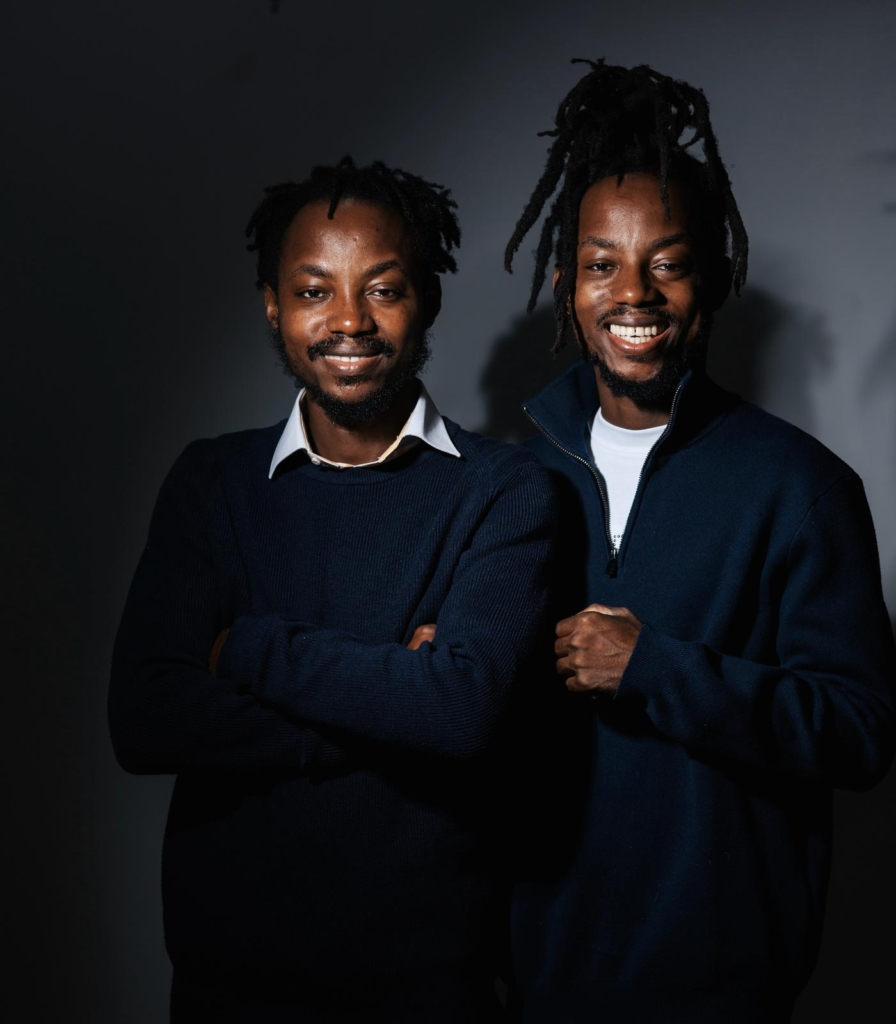
    Grammy Award-winning artist Eve and internationally recognised photography duo Twinsdntbeg have been named headline speakers for the 2026 edition of the Warwick Africa Summit at the University of Warwick.

    Taking place on Saturday 28 February and Sunday 1 March 2026, the Summit will mark its 10th anniversary, celebrating a decade as one of the UK’s leading student-led platforms dedicated to Africa and its global diaspora.

    This year’s theme, “Mti ukiwa umeungana hauvunjiki”, meaning “A bundle of sticks is unbreakable”, reflects the Summit’s focus on unity, collective strength, and cross-sector collaboration in shaping Africa’s future.

    Over the past decade, the Warwick Africa Summit has convened students, academics, policymakers, entrepreneurs, and creatives to engage in forward-looking discussions on leadership, innovation, culture, and development across the continent and the diaspora.

    Eve brings global influence across music, business, philanthropy and entertainment, while Twinsdntbeg are recognised internationally for their distinctive visual storytelling centred on African and diasporic narratives. Their participation signals the Summit’s continued commitment to elevating creative leadership alongside policy and academic dialogue.

    Further information and registration details are available at: https://www.warwicksu.com/venues-events/events/26485/27858/

  • Lands Minister cancels incomplete public land deals without required procedures

    Lands Minister cancels incomplete public land deals without required procedures

    The Emmanuel Armah-Kofi Buah, Minister for Lands and Natural Resources, has declared the termination of all incomplete public land deals carried out between 2017 and 2024 that did not comply with required procedures, while unveiling wide-ranging reforms intended to improve accountability, openness, and cost-effectiveness in managing state lands.

    Speaking at a press briefing, the Minister described the decision as “a critical milestone in our collective efforts to strengthen integrity, transparency, and accountability in the administration of public lands, which are held in trust for the people of Ghana.”

    Presidential directive and committee assessment

    He indicated that on January 10, 2025, John Dramani Mahama instructed the Lands Commission to suspend all processes connected to leasing and handling transactions involving public lands.

    He explained that the directive was introduced to protect state lands from misuse, restore order within land management systems, and ensure that such transactions “deliver value for money to the State.”

    Following the directive, a committee led by the Deputy Minister was established on June 5, 2025, to examine public land leases under the Government’s Resetting Agenda.

    The committee reviewed 8,160 lease applications that were either completed or initiated between 2017 and 2024 across all sixteen regions. These included:

    4,176 Direct Allocations

    2,799 Regularizations

    19 Direct Allocations relating to State Bungalows

    108 Land Swap or Public-Private Partnership arrangements

    795 Subsequent Transactions

    263 Fresh Allocations

    The review revealed that a number of these allocations did not fully comply with the Lands Commission’s internal procedures, thereby undermining transparency and exposing the system to potential abuse.

    Immediate Cancellations and Case-by-Case Reviews

    Cabinet has approved the Committee’s recommendations and directed their immediate implementation. The Minister announced that:

    All uncompleted transactions within the reviewed categories have been cancelled, and affected applicants will be formally notified.

    Completed transactions will undergo case-by-case review, and any allocation processed without full compliance will be cancelled.

    All uncompleted regularisation applications remain suspended pending a comprehensive review and standardisation of procedures.

    “For the avoidance of doubt,” he clarified, “a transaction will be treated as completed where a formal offer has been issued and accepted by the applicant.”

    Both completed and uncompleted application lists will be published region-by-region, beginning with Greater Accra, on the Ministry and Lands Commission websites.

    Completed transactions under review will be assessed against clear benchmarks, including statutory compliance, value for money, conformity with planning requirements, and enhanced disclosure to prevent misuse of corporate structures.

    “These measures are not intended to unfairly disadvantage anyone,” the Minister emphasised, adding that affected applicants will be allowed to reapply under the new regime.

    Major Reforms Introduced

    The Minister outlined six major reform pillars.

    1. Revision of Public Land Application Form (Form 5)

    A key finding was the inconsistent application of Form 5 across regions, resulting in discretionary practices.
    The Ministry has revised Form 5 to serve as the single mandatory application instrument nationwide. It will be published online and made accessible for electronic submission.

    1. Overhaul of Internal Allocation Processes

    The Ministry has also reviewed the Lands Commission’s internal procedures to eliminate inconsistencies and strengthen internal checks.

    Under the revised framework, “no public land will be allocated by the Lands Commission without the prior written approval of the Minister for Lands and Natural Resources.”
    The move, he explained, reinforces ministerial oversight and adds a safeguard against unauthorised allocations.

    1. Legislative Backing

    To prevent a return to past practices, the revised application form and internal processes will be incorporated into a draft Land Regulation currently under review.

    1. New 70% Premium Framework

    One of the most significant changes relates to land valuation.

    The Minister revealed that premiums for public land leases had historically ranged between 1% and 30% of market value, significantly undervaluing state assets.

    Under the new framework, “a minimum of 70 per cent of the assessed market value of public land will be payable upfront as a premium, with the remaining 30 per cent structured over the tenure of the lease as ground rent.”

    He further reminded State Institutions, pursuant to Section 235(4) of the Land Act, 2020 (Act 1036), that allocations confer only user rights and do not permit transactions without prior written ministerial approval.

    1. Publication of Market Value Data

    To enhance transparency, the Ministry and Lands Commission will compile and publish reliable market value data for defined land clusters nationwide.

    The data will serve as a reference for assessing premiums and ensuring objective, predictable decision-making.

    1. Public Land Protection Task Force

    A Public Land Protection Task Force will be established during the reform transition period.

    The Task Force will operate within the framework of the Constitution, the Lands Commission Act, 2008 (Act 767), the Land Act, 2020 (Act 1036), and applicable criminal laws.
    It will comprise personnel from:

    The Ministry of Lands and Natural Resources

    The Ministry of Works, Housing and Water Resources

    The Lands Commission

    The Ghana Police Service and allied security services

    Its mandate will include preventing encroachment, halting unauthorised developments, and protecting public lands under review.

    Ban Lifted, Activities Resume Under New Rules

    The Minister also clarified that the temporary ban on Lands Commission services — including leasing, processing, and regularisation of public lands — has now been lifted.

    “All activities may resume immediately, but strictly in accordance with the new reforms and procedures announced today,” he said, stressing that every transaction must adhere to transparency, accountability, and value-for-money principles.

    Government Commitment to Public Interest

    In his concluding remarks, the Minister underscored that public lands are “vested in the President in trust for the people of Ghana to be administered in the public interest.”

    “They are meant to serve national development objectives, support public infrastructure, and promote equitable access to land. It is therefore our solemn responsibility to safeguard these lands from mismanagement, misuse, and unauthorised disposals.”

    He further announced that the Ministry has secured 100% retention of the Lands Commission’s Internally Generated Funds, with 67% earmarked to fund the Land Bank and Digitalisation Project.
    “This initiative will serve as a catalyst to restore public confidence and ensure that public lands are managed transparently, responsibly, and for the benefit of present and future generations,” he stated.

    With the new premium framework, legislative backing, enhanced oversight, and enforcement mechanisms, the Minister signalled a decisive shift in how public lands will be managed going forward — anchored on discipline, transparency, and national value.

  • GoldBod halts applications for gold trading licences amid policy reforms

    GoldBod halts applications for gold trading licences amid policy reforms

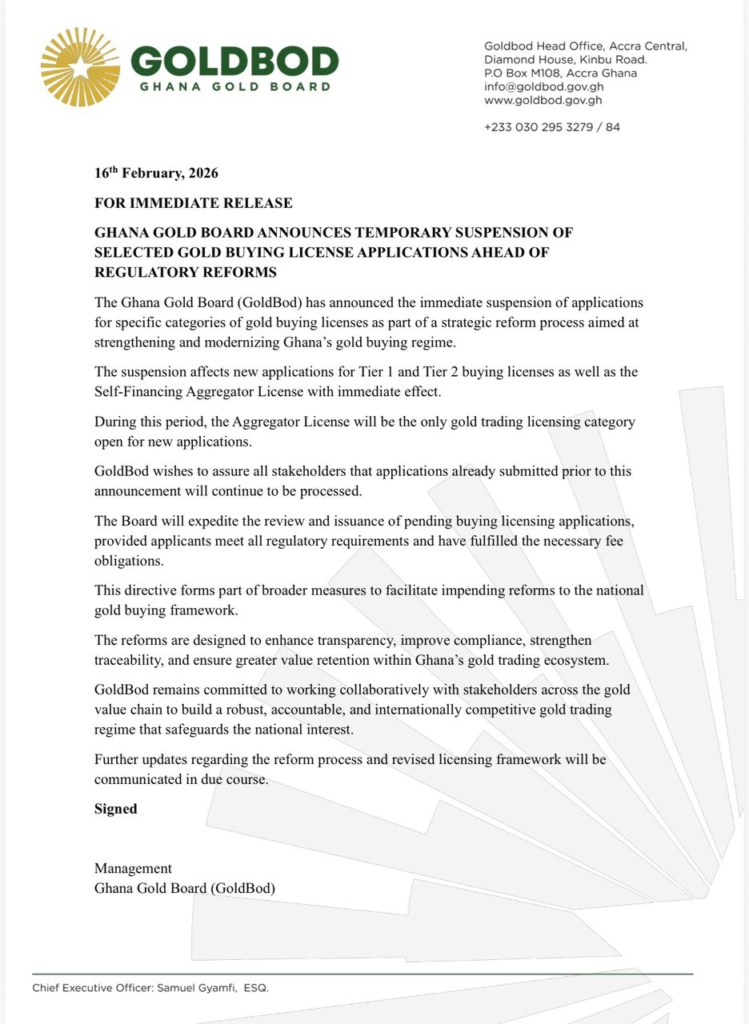
    The Ghana Gold Board (GoldBod) has halted the acceptance of fresh applications for certain gold purchasing licences with immediate effect as part of reforms aimed at reinforcing the country’s gold trade structure.

    In a statement issued on February 16, 2026, the Board indicated that the suspension applies to applications for Tier 1 and Tier 2 buying licences, along with the Self-Financing Aggregator Licence.

    The Board noted that the decision is part of wider efforts to upgrade and streamline gold trading operations in Ghana.

    “The Ghana Gold Board (GoldBod) has announced the immediate suspension of applications for specific categories of gold buying licences as part of a strategic reform process aimed at strengthening and modernising Ghana’s gold buying regime,” the statement said.

    GoldBod, however, stated that applications for the Aggregator Licence will continue to be accepted despite the suspension.

    The Board further assured that all licence requests submitted before the directive will still undergo review.

    “GoldBod wishes to assure all stakeholders that applications already submitted prior to this announcement will continue to be processed,” it said.

    The Board explained that the reforms are designed to promote openness, reinforce regulatory compliance, and improve tracking processes within the country’s gold trading industry, while maximising national gains from gold resources.

    GoldBod also stated that additional information regarding the updated licensing structure and reform initiatives will be communicated later.

    In January this year, GoldBod partnered with the Gold Coast Refinery to enhance Ghana’s gold processing capacity.

    GoldBod Chief Executive Officer Sammy Gyamfi at the signing ceremony on Tuesday, January 20, 2026, indicated that the agreement will significantly enhance the implementation of a track-and-trace system across the gold sector.

    Adding that instead of raw gold, Ghana’s daily gold exports, estimated at one tonne will now be refined to the highest industry standard of 99.9 per cent purity before shipment.

    “This development marks a major milestone in Ghana’s gold trade and will help maximise national benefits from our mineral resources,” Mr Gyamfi said.

    He further highlighted the economic benefits, noting, “The millions of dollars we pay as refinery charges to refineries in Dubai, Switzerland, India, Hong Kong, and other foreign countries will now stay in our banking sector. That money will now stay in our economy.”

    On job creation, he added, “What this agreement also means is that we are creating more direct and indirect jobs, particularly because Gold Coast Refinery has committed to operating 24/7 in line with the government’s 24-hour policy.”

    This major step was taken towards deepening value addition within Ghana’s gold sector to reduce Ghana’s long-standing reliance on exporting raw gold.

    This practice has historically led to significant revenue losses that could otherwise be captured through domestic refining and downstream processing.

    GoldBod explained that the partnership will strengthen local gold processing so Ghana can fully benefit from its status as Africa’s top gold producer.

    A technical, independent report recently presented to GoldBod by economists from the University of Ghana (UG) and the University of Ghana Business School (UGBS), Professor Festus Ebo Turkson,  Professor Agyapomaa Gyeke-Dako and economist, Peter Junior Dotse has indicated that artisanal and small-scale mining (ASM) gold exports rose by 39.4 tons, increasing from 63.6 tons in 2024 to 103 tons in 2025.

    According to the report, GoldBod has mitigated the rate at which gold was being smuggled out of Ghana; now, trading is done officially through the right channels, leading to an increase in the amount of forex coming into the country. The benefits to the economy are much bigger than the trading losses reported by the Bank of Ghana.

    The report explains that each ton of gold is worth about US$96.5 million. Based on this value, the gold that was brought into the formal system is worth about US$3.8 billion in foreign currency.

    This means the benefits are 18 times bigger than the US$214 million loss reported by the Bank of Ghana. In fact, the report says that formalising just 2.2 tons of gold would be enough to cover that loss.

    Prof. Festus Ebo Turkson, one of the report’s authors, emphasised that “GoldBod converts illicit gold flows into formal FX, strengthens Ghana’s external position, and supports macroeconomic stability. Evidence shows it is a high-return policy intervention for the economy.”

    The study also reveals that GoldBod’s initiatives reduced reliance on costly external borrowing. ASM exports facilitated by GoldBod in 2025 generated US$10.8 billion in FX inflows. Had Ghana borrowed equivalent funds externally at interest rates of 7–10%, it would have incurred annual interest costs of US$756 million to US$1.08 billion.

    Even considering only the reduction in smuggling, the avoided annual interest costs range from US$266–380 million, creating a recurring economic benefit.

    Beyond financial gains, the report highlights broader macroeconomic effects:

    Strengthened international reserves (≈ US$11–12 billion), exchange-rate stabilisation, reduced domestic cost of external debt (≈ GHS 6.2 billion), lower import bill valuation (≈ GHS 50.6 billion for Jan–Oct 2025), disinflation through reduced exchange-rate pass-through.

    The report also clarified that the reported losses by the MF in GoldBod’s trading activities were merely an accounting effect and not a cash deficit or loss. GoldBod purchases gold at near-retail exchange rates to deter smuggling, while FX inflows are recorded at the interbank rate. True economic costs are estimated at just 2.5% of the gold value.

    According to the report, GoldBod should be seen as a policy tool for macroeconomic stabilisation rather than a profit-driven entity. Recommendations include sustaining price competitiveness to prevent smuggling, improving transparency in BoG reporting, gradually reducing policy costs, and strengthening governance and oversight.

    Ghana’s Artisanal and Small-Scale Mining (ASM) gold export saw an exponential growth in 2025 from 2024, with approximately US$6.2 billion, a surge of nearly 135%, reflecting the sharpest year-on-year growth within the period.

    This was announced in an infographic shared by Gold Board (GoldBod) on its official X (formerly Twitter) page.

    According to the data shared, ASM gold export earnings rose from US$2.8 billion in 2018 to US$10.8 billion in 2025, representing an increase of about US$8.0 billion, or roughly 286%. The infographic also provided a year-on-year breakdown of exports, along with remarks on the exported commodity, stressing that the data covers exports made through official channels over the past seven years.

    Ghana’s artisanal and small-scale mining (ASM) gold exports stood at 75.7 tons valued at US$2.8 billion in 2018, despite a nationwide ban on small-scale mining, indicating strong underground or regulated output.

    Exports declined to 53.4 tons worth US$2.2 billion in 2019 and further to 39.3 tons valued at US$2.0 billion in 2020, reflecting continued enforcement of mining restrictions and possible COVID-19 disruptions. In 2021, exports collapsed sharply to just 3.4 tons valued at US$185 million following the introduction of a 3% withholding tax on unprocessed ASM gold, which discouraged official exports.

    Volumes recovered in 2022 to 22 tons worth US$1.1 billion after the tax was reduced to 1.5%, with growth continuing in 2023 when exports rose to 37.4 tons valued at US$2.1 billion. A major jump was recorded in 2024, with exports increasing to 63.6 tons valued at US$4.6 billion, driven by improved formalisation and high global gold prices.

  • Russian Embassy acknowledges reports on alleged non-consensual recordings case by an individual

    Russian Embassy acknowledges reports on alleged non-consensual recordings case by an individual

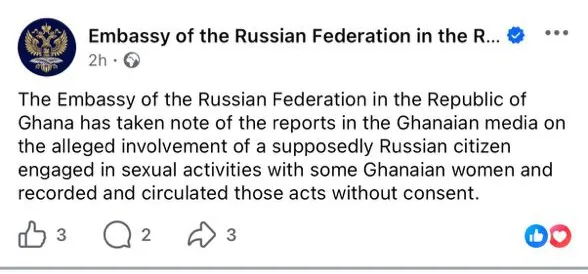
    The Embassy of the Russian Federation in the Republic of Ghana has acknowledged reports circulating in the Ghanaian media concerning the alleged involvement of a man believed to be a citizen of Russia in the non-consensual recording and circulation of intimate encounters with some women.

    “The Embassy of the Russian Federation in the Republic of Ghana has taken note of the reports in the Ghanaian media on the alleged involvement of a supposedly Russian citizen engaged in sexual activities with some Ghanaian women and recorded and circulated those acts without consent,” the Embassy wrote on Facebook.

    Director of Communication, International Cooperation and Strategic Partnership at the Cyber Security Authority (CSA Ghana), Benjamin Madugu, has strongly criticised the conduct of an alleged Russian national connected to videos involving nearly 40 Ghanaian women.

    Madugu made the remarks during an interview with Sammy Kay Media on February 13, 2026, where he described the incident as deeply troubling and contrary to Ghana’s cyber and privacy protection laws.

    He stated that it is inappropriate for any foreign national to visit Ghana and secretly film women in private or intimate situations, particularly when the recordings are intended for online distribution.

    “It is unacceptable for a foreign national to come into our country and, for some reason, decide to record our ladies in the manner that he did. That is not acceptable, and it is condemnable. It is also an offence under the Cybersecurity Authority Act to record intimate images that both parties had agreed to capture at the time they were getting intimate and then leak those images online,” he said.

    Madugu disclosed that the Authority has begun treating the matter with urgency and will undertake investigations to establish key facts. He indicated that determining the whereabouts of the suspect remains a priority for the agency.

    “We want to find if the individual (Yaytseslav) is still within the jurisdiction. But if he has left, maybe he has not even gone back to Russia. Maybe he has gone to a different country and gone into hiding. But we will look into this matter and be sure about what the situation really is and what action ought to be taken,” he said.

    He also warned members of the public against reposting or circulating the videos on social media platforms, stressing that such actions equally breach Ghana’s cybersecurity laws.

    “What we are urging is that if you are not the original person who recorded the video but choose to share it on your social media, that is also an offence under the Act, and it attracts not less than one year and not more than three years’ imprisonment.

    “For those who think, ‘I’m not the one who recorded the video; the video is already out, and I’m only sharing it,’ if the affected individuals decide to make an official complaint to the Cybersecurity Authority, such persons can be brought to book,” he added.

    The controversy emerged after a man identified as Yaytseslav, who claims to be Russian, became a trending topic in Ghana when videos of his encounters with several women surfaced online on February 12, 2026.

    Some of the videos reportedly showed him around the Accra Mall, where he was seen engaging female shoppers and individuals he met during public outings.

    Reports indicate that he allegedly invited some of the women to his residence and recorded conversations and private encounters using Meta glasses without their consent before sharing the content online.

  • Kwabena Kwabena marks 20 years of ‘Aso’ with electrifying Valentine’s concert

    Kwabena Kwabena marks 20 years of ‘Aso’ with electrifying Valentine’s concert

    Music, love, and celebration filled the air at the Palms Convention Hall over the weekend as patrons gathered for Vitamilk Love Night: Aso @20, one of the season’s highly anticipated Valentine’s events.

    Hosted at the La Palm Royal Beach Hotel, the concert celebrated romance while commemorating the 20-year milestone of Kwabena Kwabena’s breakthrough song Aso, which helped cement his legacy in Ghana’s music space.

    Emerging artistes opened the show with energetic performances that warmed up the audience ahead of the headline act. Kwabena Kwabena’s entrance was met with loud cheers as he delivered a series of classic hits that stirred both excitement and nostalgia among patrons.

    The night reached another high point when guest performers such as R2Bees, Stonebwoy, King Promise, D-Black, and Cina Soul thrilled fans with performances of their popular songs.

    Kwabena Kwabena also drew attention with his appearance in the iconic Ghanaian fugu, a traditional outfit that has recently sparked public debate.

    He later paused during the performance to reflect on the significance of the Aso @20 celebration, recounting his musical journey and expressing gratitude to fans for their continued support throughout his career.

    Whenever Valentine’s Day comes around, people often think of expressing love, exchanging romantic gifts, heart-shaped symbols, and dressing in shades of red or pink.

    In recent times, Ghanaian society has marked the day as a National Chocolate Day celebration.

    But what exactly is the story behind this day?

    The origins of Valentine’s Day date back to 268–270 AD in the Roman Empire, during the short reign of Emperor Claudius II Gothicus. A Christian martyr, St. Valentine, lived and served as a priest during this period.

    Historical accounts suggest that St. Valentine secretly performed marriage ceremonies for Christian couples, defying the Emperor’s decree that prohibited marriage.

    Claudius had banned young men from marrying, believing that unmarried men made better soldiers since they had no wives or families to worry about when called to war.

    Eventually, St. Valentine was arrested by Roman soldiers and imprisoned while awaiting execution.

    During his imprisonment, he grew close to the jailer’s daughter and, according to legend, healed her blindness through prayer. On the day of his execution, St. Valentine left her a farewell note signed “from your Valentine”, a gesture that inspired the tradition of sending love notes and flowers on Valentine’s Day.

    St. Valentine was executed on February 14, 270 AD, and buried near the Via Flaminia. Couples who had been married by him began commemorating his sacrifice, and over time, the day became associated with love and romance.

    By the 18th century in England and France, Valentine’s Day had evolved into an occasion for couples to express affection through gifts, flowers, and greeting cards.

    Today, Valentine’s Day is celebrated worldwide as one of the most iconic events dedicated to love. As February 14 approaches, while you share love with your special ones, remember the man whose courage and compassion gave birth to this tradition.

    @ghanaian_times

    Stonebwoy and Kwabena Kwabena performed Aso II together at the Vitamilk Love Night (ASO @20 Edition) 🎶🔥 The crowd erupted with excitement as the two stars shared the stage, delivering a powerful moment to celebrate 20 years of ASO on Valentine’s Day. ❤️✨ #entertainment #valentinesday #love #fyppppppppppppppppppppppp #ghananews

    ♬ original sound – Ghanaian Times
  • Efya Nocturnal allegedly marries privately to Nigerian musician Tomi Thomas

    Efya Nocturnal allegedly marries privately to Nigerian musician Tomi Thomas

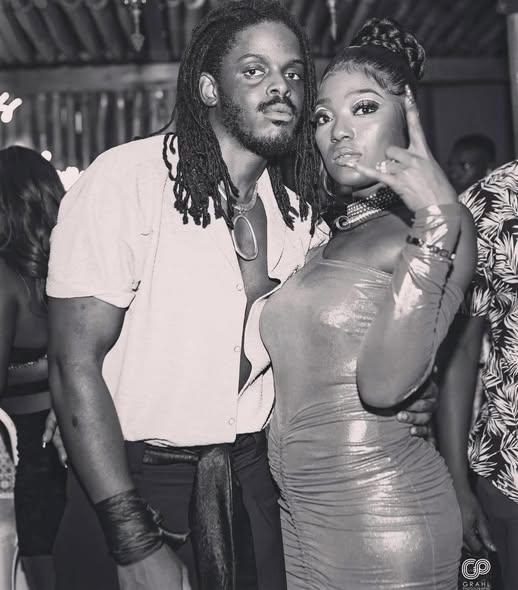
    Acclaimed Ghanaian songstress Efya, born Jane Fara Fauzzier Afia Awindor, is reportedly married to Nigerian Hip Hop and R&B musician Tomi Thomas.

    It was a private ceremony held on February 14, 2026.

    The singer became the centre of online discussions after videos of her private wedding surfaced on social media.

    The videos also revealed that the singer was heavily pregnant, and that may have necessitated her plan to marry secretly.

    Efya was seen in a white gown, happily jamming to her colleagues’ R2Bees’ performances.

    In the videos making rounds online, she appeared confidently displaying her baby bump while dressed in an elegant, custom-made wedding gown.

    Notable figures including Hajia4Real, King Promise, and R2Bees were also reported to have attended the ceremony.

    Ghanaian musician Bisa K-dei took a significant step in his personal life by getting married.

    The renowned artist, known for his soulful melodies, has followed in the footsteps of many industry colleagues, embracing the journey of marriage with his partner.

    Bisa K-dei’s wedding was a private and intimate affair, with close friends and family coming together to witness the union of the music icon and his now-spouse.

    The ceremony exuded warmth and joy, reflecting the couple’s deep commitment to each other.

    Congratulations and well-wishes poured in from fans and fellow artists, with the music community expressing their happiness for the artist and sending heartfelt messages of blessings and joy to the newlyweds.

  • My husband was not insecure when I received a car gift from an admirer – Omotola

    My husband was not insecure when I received a car gift from an admirer – Omotola

    Veteran actress Omotola Jalade Ekeinde has opened up about trust in her marriage, stating that her husband showed no insecurity after an admirer gifted her a car.

    She said on Naija FM, “Women have admirers,” she explained. “Me, who is married, I know how many people have gifted me things, women and men. They’ll just see me and say, ‘Omotola, I’m sending you this.’ They’ve gifted me a car before.”

    Responding to the question of whether she attempted to return the gift, Omotola confidently said, “No, why would I return the car?”

    She attributed the ease with which such situations are managed to her husband’s self-assurance, noting that he is exceptionally secure in himself.

    “Think about it, how would you marry an Omosexy if you’re not secure?” she quipped.

    However, the actress rejected suggestions that women do not lead in Nollywood, maintaining that women form the real backbone of the industry.

    “Women are the ones who hold Nollywood,” she said, stressing that many female actors are not just performers but also business owners, influencers, producers, and entrepreneurs.

    She explained that many actresses she is familiar with operate several businesses in addition to acting, while others also hold full-time jobs.

    Last year on social media, Omotola Jalade-Ekeinde celebrated two special milestones—her husband, Captain Matthew Ekeinde’s birthday and their 29th wedding anniversary.

    To mark the occasion, she shared a heartfelt video capturing a tender moment between them.

    In the clip, Captain Ekeinde showered her with praises, affectionately calling her Nigeria’s hottest.

    Omotola, filled with love and gratitude, wrote a touching tribute to her husband, referring to him as “Big Kohuna” and “HoneyBoy.”

    Reflecting on their nearly three decades together, she expressed pride in calling Captain Ekeinde her own, describing him as a humble, joyful, and honorable man.

    She also appreciated the years of support, laughter, and peace they have shared, looking forward to many more to come.

    Her post has since attracted a wave of congratulations from fans and fellow celebrities, who admire the couple’s enduring love and commitment.

    In 2024, she s “Omosexy,”  celebrated her 46th birthday today, February 7, 2024, with joy and gratitude.The celebrated actress shared a heartwarming snapshot from her recent birthday photoshoot on Instagram, accompanied by a thoughtful caption expressing her excitement.

    In her post, Omotola reflected on the unpredictable nature of life, stating, “The race is not to the swift, nor the battle to the strong, nor bread to the wise, nor riches to men of understanding, nor favour to men of skill. But time and chance happen to them all. Thank you, Lord for +1.”

    The actress received an outpouring of congratulations and well-wishes from fans, followers, and fellow celebrities.Actor Chidi Mokeme showered her with praise, saying, “Oh My Goodness!!! Who let this goddess out of the fortress? O’Sexy! Happy Birthday My Love. Keep blazing the trails. Have Fun and Enjoy Ur Moments Queen.”

    Other celebrities, including Osas Ighodaro, Chizzy Alicia, and Adesua Etomi, joined in the birthday celebrations with heartfelt messages.

    Leading up to her special day, Omotola had been sharing her excitement on social media. On February 4, 2024, she posted a humorous video, exclaiming, “The way I’m looking at Everyone Acting like they Don’t know my Birthday is on the Moses Crossing, 7th of FEBRUARY!!! It’s Aquarius Season! Who’s got Gifts for meh!”

    In 2023, Omotola shared the secret of the success of her marriage in an interview with Potpourri and some other news outlets.

    Omotola has been married to Captain Matthew Ekeinde for 27 years, having been married at the age of 18. Unlike many of her colleagues who could not hold together in a marriage, Omotola’s has become a model from which many entertainers could borrow a leaf.

    She preaches tolerance, submission, and understanding, adding that the greatest mistake a woman can make is to claim equality with her man.

    “A woman must know her place and submit to her husband. The greatest mistake a woman can make is wanting to stand shoulder to shoulder with her man. When you show submission your man will respect and adore you for it, she echoes.

    Article image 1

    Omotola also gave a picture of the understanding that exists between her and her husband, which to many African couples and parents would have seemed inappropriate.

    “I always tell people that women are stronger than men, psychologically. Let me tell you something more, my husband is actually the one who goes to the market. I don’t go to the market because I can’t. Because of my status, I can’t. But my husband didn’t say you know traditionally, a man is not supposed to go to the market, I’m not gonna go, no. My husband actually goes to the market, she has revealed much to the disbelief and outrage of so many.

    “Earlier in my career, I used to go with him but I’d stay in the car, because our cars are tinted, so I’d stay in the car. But then, one time we went to Tejuosho and someone found out I was in the car. It became a major security risk, so he said don’t ever go with me again. He goes and he has fun and he comes back home, and I do the cooking, so you see we strengthen each other,” she had added.

    Article image 2

    Omotola had also confessed that not many men would have been able to stand her personality, adding she probably wouldn’t have married if she had not been so lucky to have had somebody like Captain Ekeinde.

    She said, “ I don’t think there is a man that can handle me apart from my husband. Not because I am a bad person, it is because I have a very strong personality. I can understand why a lot of female artists find it very difficult to find the right person. When you achieve some kind of success, you become really confused as to who really loves you for who you are. It’s not really easy, you know, so it is very hard finding those people who really love you. If you are not a very grounded person ,you too can contribute in some kind of way to your own problems and so I might have contributed to my own problems.”

    “Of course, many men have walked the altar with actresses and oftentimes have found out it is not the heaven it promised to be. The time spent away from home on locations is just too much for some spouses to bear. And so is the limelight that comes with all forms of temptations and vices of life. “

    When Omotola was asked if her husband had ever complained about her career, it was another revelation moulded in love and understanding.

    Article image 3

    “No. Never. When I met him I was already an actress. I wasn’t a big star then, if anything, he was the one even encouraging me. To be honest with you, he’s my biggest movie fan. I don’t even watch most of my own movies, he’s the one who buys and watches them. There’s no one movie of mine he has not bought or watched. He doesn’t just watch them, he frames the posters. Most of the posters he framed them in wood and they are all over the house. The posters are framed into wood,” she told Potpourri in an interview.

    Interestingly, the mother of four is fondly called by all as Omosexy. But few know the origin of the name. It is another product of long years of love and romance as the actress also revealed in another past interview.

  • 88 PWDs receive tools, start-up capital worth over GHS300,000 from Accra Mayor

    88 PWDs receive tools, start-up capital worth over GHS300,000 from Accra Mayor

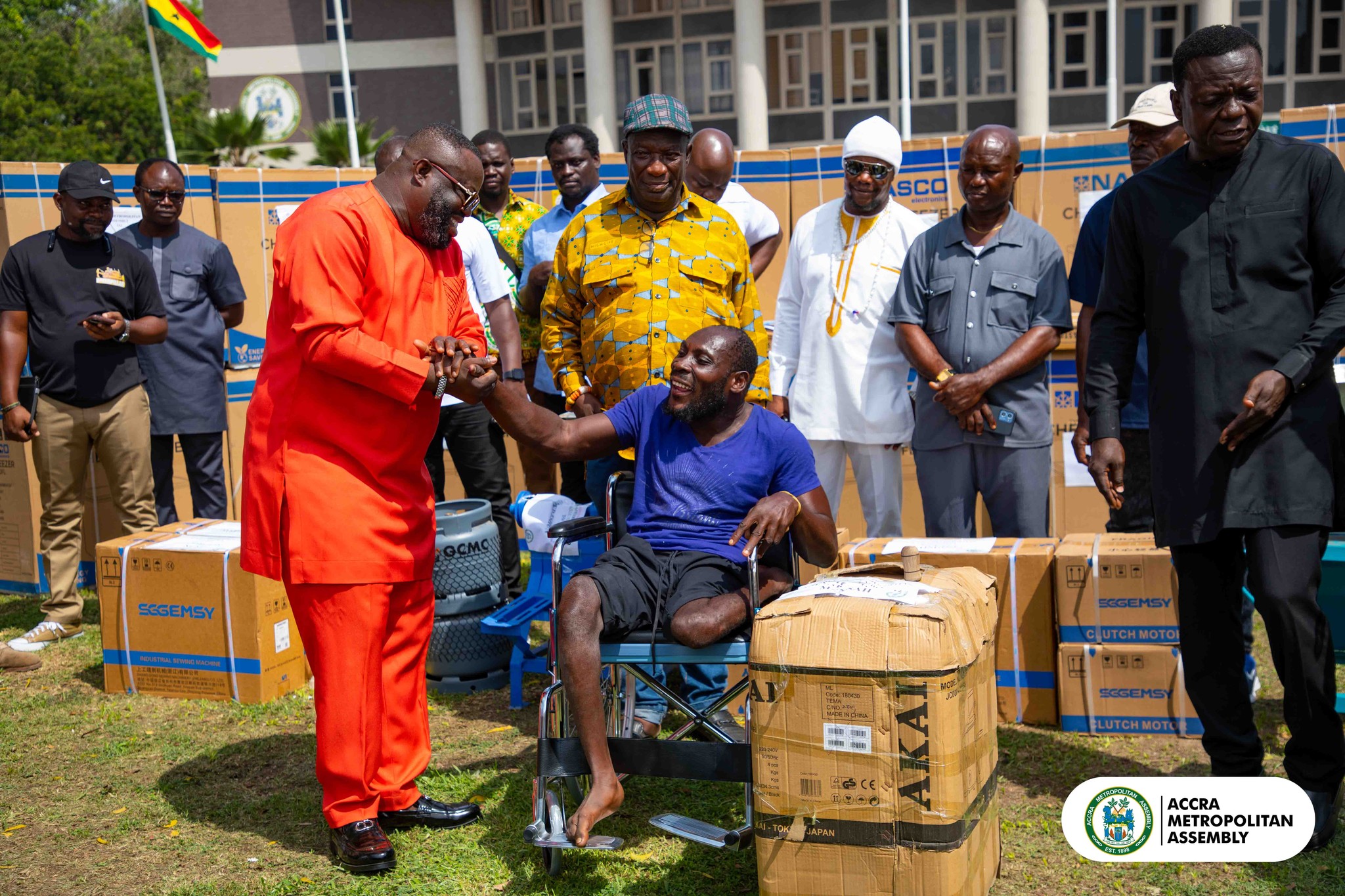
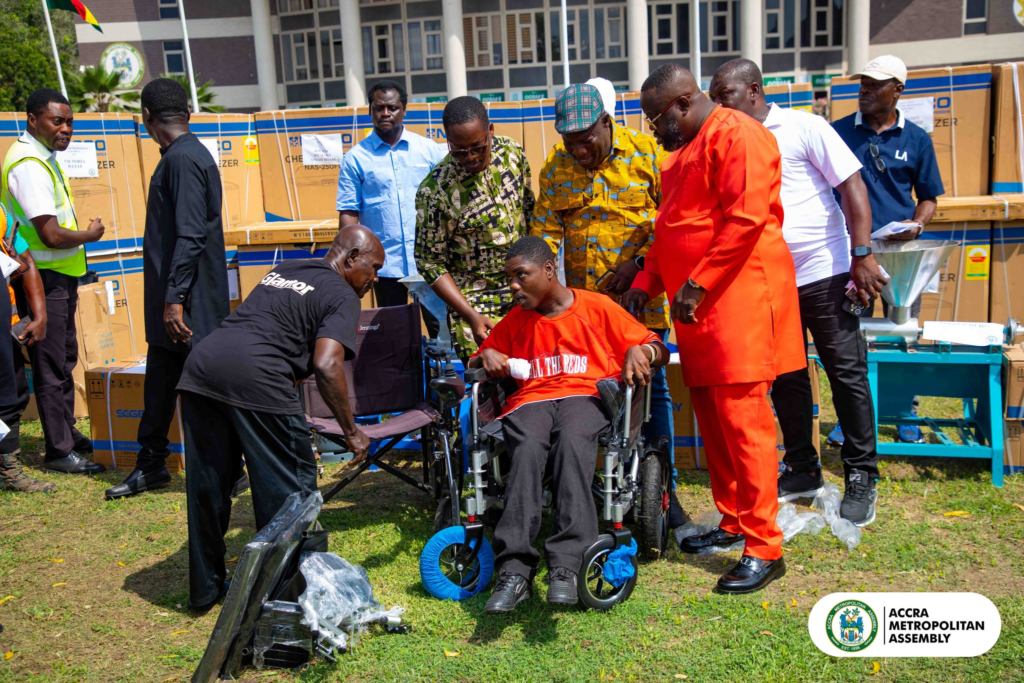
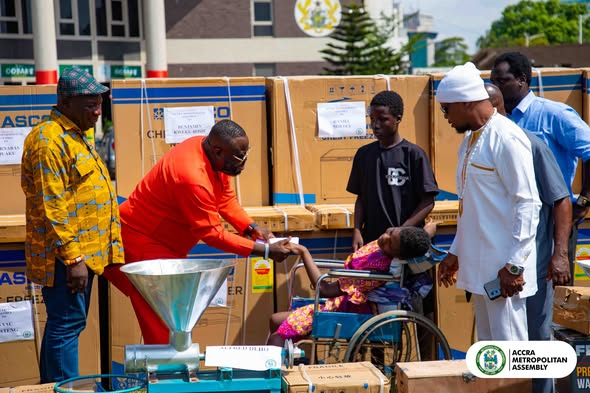
    Eighty-eight persons with disabilities (PWDs) in Accra have received working tools and financial support worth GHS313,919.40 from the Mayor of Accra, Michael Kpakpo Allotey, as part of efforts to promote inclusion and economic empowerment.

    The items distributed included thirty-eight 200-litre Nasco deep freezers, one showcase refrigerator, three fufu blending machines, five industrial sewing machines, one industrial knitting machine with GH¢300 each, three gas popcorn machines with 6kg gas cylinders and GHS500 each, one 2000W high-pressure washer, one electric wheelchair, one pair of hearing aids, and one laptop.

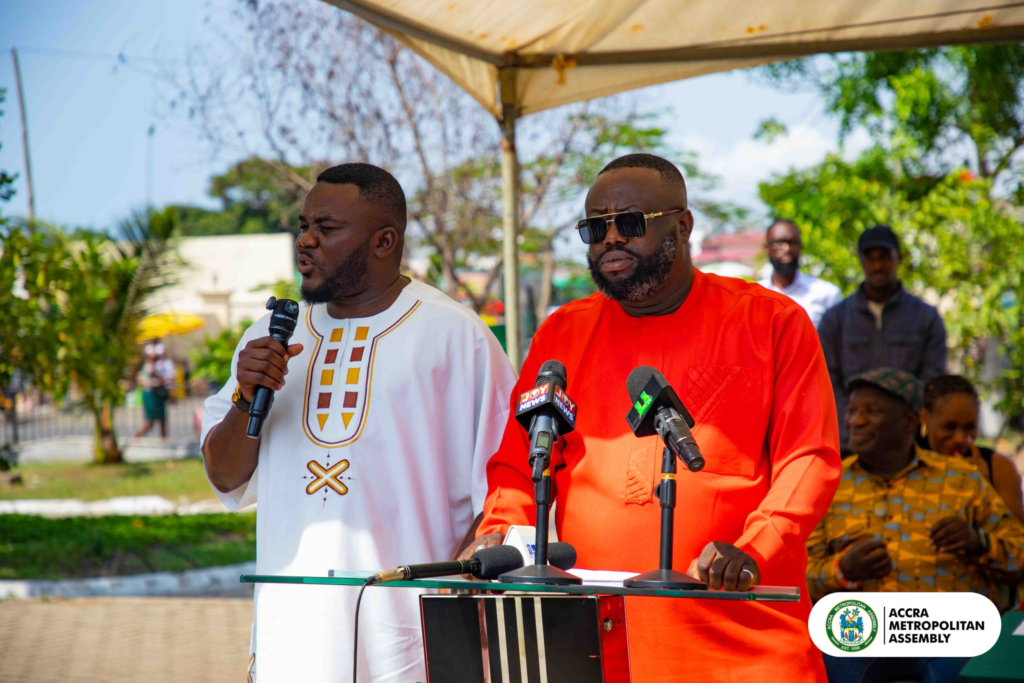
    Addressing the gathering at the presentation held on Friday ahead of the Valentine’s Day celebration, the Mayor said disability was not anyone’s choice and that all people were created equal, adding that physical or sensory challenges did not make anyone less human.

    The Mayor recounted a recent personal experience involving his bodyguard, Gideon Lamptey, popularly known as ‘Adodo’, who is hearing and speech impaired, noting that engaging him had reinforced his belief that persons with disabilities only required understanding and the right support systems to perform effectively.

    Additionally, 32 beneficiaries received financial support of GH¢3,000 each to help expand or start small businesses, while one beneficiary received GH¢3,000 as educational support.

    The beneficiaries comprised 46 physically challenged persons, 11 visually impaired persons, 10 hearing impaired persons, six persons with cerebral palsy, four persons with Down syndrome, two persons with epilepsy, two mentally challenged persons, two persons with multiple disabilities, three intellectually challenged persons, one person with autism, and one person with a learning disability.

    The intervention forms part of ongoing efforts to improve the welfare of persons with disabilities and enhance their ability to earn sustainable livelihoods within the metropolis.

    Mid last year, the Youth Employment Agency (YEA) signed a Memorandum of Understanding (MOU) with Camfed Ghana to support young women and persons living with disabilities across the country.

    At the signing ceremony, YEA Chief Executive Officer Malik Basintale, reaffirmed the agency’s dedication to creating equal and meaningful opportunities for all.

    He highlighted ongoing initiatives such as the YEA-GIZ partnership that trains and employs persons with disabilities in fashion, and announced the soon-to-be-launched Catfish Farming Program tailored for persons with disabilities.

    “This partnership is yet another stride in building a Ghana that leaves no one behind,” the YEA stated in a post.

    The government on May 29, officially commissioned the Make Fashion Inclusive Training Centre after following its launch on September 16, 2024.

    The centre, located in Kumasi, has been designed to empower and equip persons with disabilities (PWDs) by providing skills training, business development support, and others.

    The initiative, led by the Youth Employment Agency (YEA) in partnership with the German Development Corporation, under the broader vision of Invest for Ghana, aims to create sustainable employment opportunities for PWDs in Ghana’s fashion industry.

    Invest for Ghana is an initiative aimed at attracting foreign and local investments to boost Ghana’s economy. It focuses on job creation, industrial growth, and infrastructure development, particularly in sectors like agriculture, energy, digital innovation, and manufacturing.

    Speaking during the commissioning, Acting Chief Executive Officer (CEO) of the Youth Employment Agency (YEA), Malik Basintale, highlighted the government’s commitment towards disability inclusion for national development. Basintale revealed that the hub would not only be trained in fashion designing but other crafts as well.

    He said, “The YEA is proud to be part of this journey that is your journey. As we open the doors of this hub today, we are opening the doors to independence, creativity, and economic opportunity for at least 100 persons living with disabilities to be trained not only in fashion design. But also be trained in embroidery, beading, and millinery works, and they will also be equipped with tools to build your businesses to employ others and to transform your community.”The government would also launch another programme that will train about three hundred PWDs in catfish farming, equipped with over 400 fingerlings to begin a trade.

    “And just to confess, in the next two to three weeks, a new project will be launched from tailoring jobs held, where we would train about 300 persons with disabilities, equipping them with 500 fingerlings of catfish and setting them in the backyard of their houses to sell…” he added.

    The launch saw the presence of Ghana’s Minister for Youth Development and Empowerment, George Opare Addo; GIZ; and other partners of the initiative, as well as local fashion entrepreneurs and PWD beneficiaries.

    Meanwhile, the Mahama-led government, since assuming office, has implemented several programs to help reduce unemployment in the country and empower the youth as well.

    Recently, YEA signed a Memorandum of Understanding (MoU) with the Ghana Fire Service to recruit 5,000 young Ghanaians as fire assistants across the country.

    Also, the government launched the National Apprenticeship Programme (NAP), which is aimed at equipping young Ghanaians with practical, employable skills. It is expected to train 100,000 youth annually across all 261 districts in Ghana. The government has allocated GH¢300 million to cover training costs and monthly stipends for participants.

  • President Mahama declares end to foreign cocoa financing, eyes local bonds

    President Mahama declares end to foreign cocoa financing, eyes local bonds

    President John Mahama has unveiled major reforms that will have Ghana buying its cocoa with local currency and ending the export of unprocessed mineral ores by 2030, signaling a bold move toward greater economic independence.

    At the conclusion of his high-level side event, “Accra Reset’s Addis Reckoning,” held alongside the 39th African Union Assembly of Heads of State, President Mahama outlined urgent measures aimed at freeing Ghana’s cocoa industry from long-standing reliance on restrictive foreign financing.

    “One of the key decisions we’ve made is to stop accepting foreign funding for the purchase of our cocoa. We are going to raise domestic bonds. We have enough Cedis in Ghana to pay for our cocoa,” President Mahama declared, outlining a radical departure from decades-old practices.

    The President explained that Ghana’s cocoa crisis highlighted long-standing problems in the system. When the government set the cocoa price while international cocoa was $7,200 per ton and the Ghana Cedi was 11.5 to the dollar, changes in the market caused big losses as prices dropped to $4,200 and the Cedi strengthened to 10.7 per dollar.

    President Mahama also pointed out that relying on foreign funding has limited Ghana’s ability to add value to its cocoa.

    “You know what the collateral for the funding is? Our own cocoa beans. You collateralise the beans with the financier, buy them, ship them, and they pay you the international market price,” he explained.

    “You know the interesting part? We have the capacity to process 400,000 tons of those beans in Ghana, but because they are collateralised, we cannot even allocate them to local processors. We must ship all the beans outside.”

    Under the new arrangement, Ghana will raise domestic bonds in Ghana Cedis to purchase cocoa directly from farmers, eliminating the need to pledge the beans as collateral. This will immediately unlock 400,000 tons of cocoa beans for local processors, creating thousands of jobs and retaining significantly more value within Ghana’s economy.

    President Mahama went further, setting an ambitious yet firm deadline to end the export of unprocessed minerals from Ghana.

    “I say by 2030, there won’t be any raw mineral ores leaving Ghana. You’re not going to ship raw manganese ore out of Ghana. You’re not going to ship raw bauxite ore out of Ghana. You’re not going to ship raw iron ore out of Ghana. You must process all that locally,” he stated emphatically.

    The announcement represents what President Mahama says is a comprehensive application of the Accra Reset philosophy, his continental initiative aimed at scaling up development across Africa by asserting sovereignty over natural resources and building domestic processing capacity.

    The President framed his bold moves in the context of mounting pressure from Africa’s youthful population, which is increasingly desperate for economic opportunities.

    “That is the only way we can provide opportunities for our young people. Our young people are less patient than our generation. They want to see that progress and prosperity today,” he said.

    He connected the urgency of implementation directly to the migration crisis: “That is why Accra Reset needs that urgency to stop our young people from braving the dangers of the Sahara and the Mediterranean as they try to reach Europe in search of opportunity.”

    Acknowledging that continental transformation requires immediate action rather than endless planning, President Mahama endorsed a proposal for rapid implementation through willing partners.

    “We come with the decisions. We agree. We do the frameworks. What is missing is urgency and implementation. We take time. And we behave like time is waiting for us,” he said, channelling concerns raised during the discussion.

    “That is why Accra Reset is a good idea. But let’s implement urgently. If parts of the continent are not ready, let’s form a coalition of the willing to move this as quickly as possible. And let all the others follow and join.”

    The Accra Reset initiative, introduced by President Mahama, aims to reshape Africa’s economic ties with the rest of the world, focusing on processing resources locally, building industries, and taking control of the continent’s natural wealth to boost prosperity for Africa’s 1.4 billion people.

    Ghana’s statements in Addis Ababa show that the country plans to set an example, putting real actions in place that other African nations can follow as part of a wider movement across the continent.

    “From Addis, we must stop talking and start implementing,” President Mahama concluded, crystallising the theme of the gathering he dubbed “the Addis reckoning.”

  • Automobile dealers drop car prices by 15% due to exchange rate stability, covid 19 levy removal

    Automobile dealers drop car prices by 15% due to exchange rate stability, covid 19 levy removal

    Automobile Dealers Union of Ghana (ADUG) has reduced car prices by 15% following exchange rate stability and the removal of the COVID-19 levy.

    This was announced in a statement signed by its President, Eric Kwaku Boateng, who indicated that the move was influenced by the Union’s long-standing promise to Ghanaians that any meaningful stabilisation of the exchange rate would translate into fairer vehicle pricing rather than excess profiteering.

    The Union also stated that its members have acted in good faith and with a strong sense of national responsibility.

    “The Automobile Dealers Union of Ghana (ADUG) wishes to formally inform the general public that, in line with our earlier commitment, members of the Union have reduced vehicle prices by an average of 15% following the relative stabilization of the Ghana cedi against the US Dollar, as well as the abolition of Covid-19 levy,” a part of the statement read.

    It expressed appreciation to Ghanaians for their patience, trust, and confidence in the organized automobile trade, while reaffirming its resolve to always act in the best interest of consumers and the national economy.

    Over the past months, the cost of vehicles in Ghana has been significantly impacted by exchange rate volatility, high import duties, shipping costs, and global supply chain pressures.

    In November 2025, the National Democratic Congress (NDC) government honoured it promise of scrapping COVID-19 Health Recovery Levy introduced during the pandemic era.

    Introduced on 31 March 2021 under Act 1068 during the tenure of former President Nana Addo Dankwa Akufo-Addo, the levy applied a 1% charge on the supply of goods and services in Ghana, excluding certain items. and on imports of goods and services. According to the New Patriotic Party (NPP), the levy was intended to help the government raise funds to fight the pandemic and support recovery efforts.

    However, presenting the 2026 Budget Statement and Economic Policy to Parliament on Thursday, November 11, Finance Minister Cassiel Ato Forson disclosed that the government has abolished the levy with immediate effect.

    Also, the Value Added Tax (VAT) Bill 2025, expected to make Ghana’s tax system more equitable, transparent, and business-friendly, received parliamentary approval as members of Parliament (MPs) gave the nod on Wednesday, November 26.

    Speaking on the floor of Parliament, Minority Leader Alexander Afenyo-Markin noted that businesses will be burdened with financial challenges as the VAT Bill will affect their operations. Reacting to Afenyo-Markin, the Deputy Finance Minister, Thomas Nyarko Ampem defended that the approved Bill will instead will simplify compliance.

    Presenting the 2026 Budget Statement and Economic Policy to Parliament on Thursday, November 11, Finance Minister Cassiel Ato Forson hinted that the government had completed the design of a modernised Ghana Value Added Tax (VAT) system fit for the country’s economic transformation agenda.

    He mentioned, “As the new VAT reforms will do the following, we will abolish the COVID-19 Health Recovery Levy, Mr Speaker; we will abolish the decoupling of GetFund and National Insurance Levies from the VAT tax base. The current VAT rate will be reduced from 21.9% to 20%.

    “In the 2025 budget, in the mid-year fiscal policy review, government made a firm promise to reform Ghana’s Value Added Tax (VAT) system to make it fairer, simpler, and more efficient. We pledged to remove distortions, address the cascading effects inherited in the VAT system, strengthen compliance, and create a tax regime that supports both businesses and fiscal stability. These distortions have negatively impacted overall welfare, increasing the deadweight loss in the economy and reducing VAT compliance.

    “Today, Mr Speaker, I am proud to report to this House that we have finally delivered on that promise. After months of detailed analysis and broad consultations with stakeholders, we have completed the design of a modernised VAT system fit for Ghana’s economic transformation agenda. Government is therefore submitting to this House today, for approval, a bold package of VAT reforms that will make our tax system more equitable, transparent, and business-friendly.

    “The new VAT reforms will do the following: we will abolish the COVID-19 Health Recovery Levy. We will abolish the decoupling of GetFund and National Insurance Levies from the VAT tax base. We will abolish VAT on the recognition of minerals. We will reduce the effective VAT rate from 21.9% to 20%. We will raise the VAT registration threshold from GH₵200,000 to GH₵750,000.

    “We will extend VAT zero rating on the supply of local manufacturing textiles to 2028. Mr Speaker, for emphasis, we promised to abolish the COVID Levy, and with the support of this House, I am proud to say that today, the COVID Levy is accordingly abolished. By abolishing the COVID-19 Levy, the government is putting GH₵3.7 billion in the pockets of individuals and businesses in 2026 alone”.

  • Alleged Russian content creator sparks backlash over videos involving Ghanaian women at Accra Mall

    Alleged Russian content creator sparks backlash over videos involving Ghanaian women at Accra Mall

    An online controversy involving a man who claims to be Russian and goes by the name Yaytseslav has dominated discussions among Ghanaian social media users, especially on X, between February 12 and 13, 2026.

    The individual has drawn widespread backlash after videos emerged showing his interactions with multiple Ghanaian women.

    Footage circulating on various social media platforms frequently shows him at the Accra Mall, where he approaches shoppers, mainly women, initiates conversations, and records the encounters.

    Posts and shared videos suggest he allegedly convinces some of the women he meets to exchange contact details and, in some cases, persuades them to visit his apartment afterwards.

    Why Thomas Partey is trending after Arsenal’s defeat

    Reports indicate that these encounters, beginning from their first meeting to moments in private spaces, are recorded and packaged as content for his viewers.

    The alleged Russian content creator operates active TikTok and YouTube accounts, where he uploads recap-style videos highlighting these interactions.

    Social media users allege that approximately 40 videos featuring Ghanaian women are available across these platforms.

    In addition to his public content, he is reportedly running a private subscription-based Telegram channel. Access to the platform is said to cost about 400 Russian Rubles, approximately $5 monthly.

    Subscribers are reportedly able to watch extended footage that is restricted on YouTube, including recordings from his apartment and details of his meetings with the women.

    One video that has sparked intense criticism features a woman identified as Angela, whom he allegedly met at the mall. She is later seen at his apartment covered in a large towel, a scene that many online users have described as troubling.

    The development has triggered strong public reactions, with many raising concerns about privacy, consent, and the monetisation of such interactions. Some social media users have urged the Ghana Police Service to intervene.

    “Bro Ghanaian women are very cheap. Ghana Police need to step in and deal with this Russian man immediately,” one netizen wrote.

    “The Russian guy nu it’s not only Ghanaian women o he has done to many Russian women, South Africa, Americans, Nigerians and so many others o. The guy is definitely up to something,” another user indicated.

    “A foreigner took advantage of and recorded intimate conversations and acts with unassuming women and has released these sensitive images and footages and Ghanaian men are on this app framing it as he’s exposing how cheap women are. The journey is long wallahi,” another user wrote.

  • One-Week Observation for gospel legend Yaw Sarpong to take place in Kumasi on February 19

    One-Week Observation for gospel legend Yaw Sarpong to take place in Kumasi on February 19

    The One-Week Observation for gospel icon Yaw Sarpong is scheduled for February 19, 2026, at Asuofua Park in Kumasi.

    Yaw Sarpong’s passing was announced by his manager, Nana Poku Ashis, on January 20, 2026, throwing the Asomafo family and the broader gospel fraternity into profound grief.

    Supporters of the group are also mourning the recent death of Maame Tiwa, a devoted member whose loss deeply affected the group just weeks earlier.

    The event will commemorate Yaw Sarpong’s life and enduring influence, highlighting his impact on Ghana’s gospel music scene. As the founder and leader of Yaw Sarpong and Asomafo, he helped define Akan gospel with a unique style characterised by strong theological messaging, well-trained vocal delivery, and carefully structured choral arrangements.

    The group’s songs, widely recognised for blending spiritual richness with musical excellence, shaped church choir performances across the country and raised the benchmark for gospel presentations and choir leadership. Popular tracks including Wo Haw Ne Hwan, Tie Obiaa, Aduro Yesu, and Awurade Kasa remain widely used in worship and Christian events throughout Ghana.

    His passing follows closely on the death of Maame Tiwa, a prominent member of the Asomafo group, whose loss shook the gospel music community about a month ago.

    Yaw Sarpong had been unwell for several years and had reduced his public appearances while undergoing treatment.

    He is widely recognised as a towering figure in Ghana’s gospel music landscape, having led Yaw Sarpong and Asomafo to national prominence. The group played a significant role in shaping contemporary Akan gospel music, earning respect for its rich lyrical depth and disciplined, doctrine-based musical style.

    Throughout his career, Yaw Sarpong and Asomafo released several well-known gospel songs, including Wo Haw Ne Hwan, Tie Obiaa, Aduro Yesu, and Awurade Kasa, which remain popular in churches across the country.

    In recognition of his contribution to gospel music, Yaw Sarpong received the Lifetime Achievement Award at the 2025 Telecel Ghana Music Awards.

    Celebrated Ghanaian gospel musician Maame Tiwaa also passed away some weeks ago.

    According to reports by UTV, the veteran singer died in the early hours of Sunday, December 7, 2025. She is said to have passed on after a brief illness, although the exact cause of her sudden death has not yet been disclosed.

    Maame Tiwaa was widely admired for her long-standing collaboration with Yaw Sarpong and the Asomafo Band, a partnership that earned her a revered place in Ghana’s gospel music community.

    After four decades in the industry, she recently earned her first nomination at the 3Music Awards 2021, marking a significant milestone in her career.

    Known for her distinctive and angelic voice, Maame Tiwaa featured in several popular songs, including Tenabea Foforo, Yen Nka Nkyere Yen Agya, Sumenaso, and other well-loved gospel hits.

    Since news of her passing broke, social media platforms have been flooded with tributes from fans, with many expressing deep sorrow and extending condolences to Yaw Sarpong and the entire Asomafo family.

    The musician’s family has not yet released an official statement. Further updates will be provided as more information becomes available.

    Veteran actor, director and cultural advocate William Addo, widely known by his stage name Akpatse, is dead.

    According to reports, he died on November 22, 2025, after years of battling severe health complications.

    Veteran actor William “Akpatse” Addo, was loved for his roles on GTV’s Thursday Theatre. His comic talent and stage presence, became a household name in Ghanaian theatre and television.

    Akpatse was a trained scholar, holding a degree in Drama from the University of Ghana and a master’s in Acting and Directing from the University of Leeds.

    He held important roles in the arts, including Director at the National Theatre and Director of Programmes at the National Commission on Culture, and taught many of Ghana’s top actors as a university lecturer.

    In recent years, he battled serious health problems, including vision loss from glaucoma and cataracts.

    His Funeral arrangements will however, be announced soon.

    Last year, renowned Ghanaian actor, Vincent McCauley, famous for his role in the beloved 90s television series “Things We Do For Love,” passed away.

    The news of his demise was confirmed by his colleague actor and friend, Adjetey Annang.

    Known as Max in the TV series, Vincent McCauley is reported to have died on Thursday, January 18, 2024. The cause of his death is currently unknown.

    Vincent McCauley’s notable roles also include appearances in movies such as “Games People Play,” “Fortune Island,” “Office Palava,” “Living With Trisha: House of Secrets,” and “The Idiot and I.”

    Since the announcement of his death, tributes have been pouring in from various sources.

    Adjetey Annan, also known as Pusher, a rival to Max in the 90s series, expressed his sorrow, saying, “Rivals on set ‘Pusher & Max’ since 1999 but cool guys off set. Thank you for being a part of the family and paying your dues very well. Rest in perfect peace brother🙏 Our deepest condolences to the family.”

    Numerous other celebrities have taken to social media to share their condolences.

    R.I.P to a Ghanaian screen legend Vincent McCauley💔 pic.twitter.com/6fiS1Jnqtc— Silverbird Cinemas Ghana (@SilverbirdGhana) January 18, 2024

    In February this year, celebrated actor Mawuli Semevo died after a fire accident.

    The 63-year-old veteran actor’s unfortunate incident happened on Thursday, February 20, 2025, at the Ridge Hospital, where he was receiving treatment after suffering burns.

    On February 8, 2025, Judith Addison of Beyond Burns International, a dedicated non-profit organization committed to providing advocacy and support for burn survivors, reported that Mawuli was in critical condition.

    “Beyond Burns International got an SOS that something unfortunate has happened. We came here today, and veteran actor Mawuli Semevo has been involved in a severe fire accident. I came here to see him, and his life is hanging in the balance,” Judith said in the video report posted on their social media pages.

    According to her, Mawuli was sleeping in his house when it caught fire.

    “He has suffered burns up to 44% of his body. He has respiratory injuries and cannot breathe properly. This is very serious. From his head to his legs. Everywhere caught fire, and he has lost all his hair,” she further stated.

    The report was later corroborated by actors such as Ken Fiati and Edinam Atatsi.

    Mawuli Semevo is known for his immaculate acting skills both on stage and in movies.

    He has played roles in movies such as ‘ Harvest at 17’, ‘A Stab in the Dark’, ‘Escape of Love’, ‘Like Cotton Twines’ and ‘The Good Old Days: The Love of AA.’

    Months ago in Nigeria, renowned Nollywood actor and distinguished academic, Dr. Columbus Irosanga, sadly departed.

    Actress Hilda Dokubo announced the news on her Instagram account on Thursday.

    In her heartfelt message, she wrote, “There can’t be a shortage of Angels in heaven that the few here are called home like this na! This one is heavy on Uniport, Rivers State, Nollywood.”

    She continued, “Our uncle Coli @colu_mbusirisoanga has gone to be with the Lord. Ikoli eh dein na mu.”

    Originating from Okrika in Rivers State, Dr. Irosanga became a household name for his compelling performances as chief priests in Nollywood films.

    He is especially remembered for his unforgettable portrayal of “Igbudu” in the 2001 hit film, Isakaba.

    His extraordinary acting skills garnered him numerous prestigious awards, such as Best Actor in a Supporting Role at the Africa Movie Academy Awards (AMAA), Best Actor in a Drama at the City People Entertainment Awards, Most Promising Actor in Nigeria at the Africa Magic Viewers’ Choice Awards (AMVCA), and Best Actor in a Leading Role at the Best of Nollywood Awards.

    Beyond his film career, Dr. Irosanga was a respected senior lecturer in the Department of Theatre Arts at the University of Port Harcourt, where he played a pivotal role in mentoring many budding actors.

    He is survived by his spouse and children, though the circumstances surrounding his death remain undisclosed. His passing represents a profound loss to both the academic and entertainment sectors in Nigeria.

  • GWR honours couple’s record for most kisses in 30 seconds on Valentine’s Day

    GWR honours couple’s record for most kisses in 30 seconds on Valentine’s Day

    Guinness World Records has marked Valentine’s Day by celebrating a couple’s unique achievement for exchanging the highest number of kisses in 30 seconds.

    Joshua Saunders and his partner, Jenny, set the record last year after completing the challenge within half a minute. The achievement gained renewed attention after the records body shared the moment on X as part of this year’s Valentine’s Day celebrations.

    A short video accompanying the post captured the couple exchanging rapid kisses during their record attempt. The clip has since circulated widely online, drawing attention as a playful display of affection and friendly competition.

    Sharing the video, Guinness World Records wrote: “Happy Valentine’s Day! Last year, Joshua Saunders set a record for the most kisses in 30 seconds by a pair with his partner, Jenny.”

    The post attracted thousands of reactions from social media users, with many commending the couple’s enthusiasm and congratulating them on their achievement.

    The recognition forms part of global Valentine’s Day celebrations, highlighting the creative ways couples express and celebrate love.

    Whenever Valentine’s Day comes around, people often think of expressing love, exchanging romantic gifts, heart-shaped symbols, and dressing in shades of red or pink.

    In recent times, Ghanaian society has marked the day as a National Chocolate Day celebration.

    But what exactly is the story behind this day?

    The origins of Valentine’s Day date back to 268–270 AD in the Roman Empire, during the short reign of Emperor Claudius II Gothicus. A Christian martyr, St. Valentine, lived and served as a priest during this period.

    Historical accounts suggest that St. Valentine secretly performed marriage ceremonies for Christian couples, defying the Emperor’s decree that prohibited marriage.

    Claudius had banned young men from marrying, believing that unmarried men made better soldiers since they had no wives or families to worry about when called to war.

    Eventually, St. Valentine was arrested by Roman soldiers and imprisoned while awaiting execution.

    During his imprisonment, he grew close to the jailer’s daughter and, according to legend, healed her blindness through prayer. On the day of his execution, St. Valentine left her a farewell note signed “from your Valentine”, a gesture that inspired the tradition of sending love notes and flowers on Valentine’s Day.

    St. Valentine was executed on February 14, 270 AD, and buried near the Via Flaminia. Couples who had been married by him began commemorating his sacrifice, and over time, the day became associated with love and romance.

    By the 18th century in England and France, Valentine’s Day had evolved into an occasion for couples to express affection through gifts, flowers, and greeting cards.

    Today, Valentine’s Day is celebrated worldwide as one of the most iconic events dedicated to love. As February 14 approaches, while you share love with your special ones, remember the man whose courage and compassion gave birth to this tradition.

    As the red-and-white bunting goes up across Accra, Kumasi, Takoradi and Tamale, the annual last-minute scramble for the perfect Valentine’s Day gesture between lovers begins.

    For some, the preparation began at the beginning of February, as soon as their pockets were filled with their monthly salaries after Detty December swallowed every note and coin in their bank accounts and MoMo wallets.

    In 2026, the Ghanaian romantic landscape has shifted away from generic imports toward high-end, locally crafted experiences and artisanal luxury.

    The taste for foreign goods has gradually dwindled, with many embracing homegrown pleasure moments on the back of a boost in local attractions and hidden gems unveiled to the world.

    Whether you are navigating the chic boutiques of East Legon or planning a quiet evening at home, these five gift ideas promise to transform the fourteenth of February into an unforgettable celebration of love.

    1. The ‘Gold’ of Ghana: Artisanal luxury chocolates

    Ghana is the world’s second-largest cocoa producer and the leader in premium cocoa, but the real romance lies in our recent “Bean-to-Bar” revolution. Forget the mass-produced bars; this year is all about handcrafted, luxury confectionery.

    • Brands like 57 Chocolate, Moments, Bioko, and customised sensual chocolates that melt the heart by Cocobytes offer elegantly packaged gift boxes.
    • Look for collections featuring Adinkra-themed chocolates, where symbols like Akoma (the heart) are embossed directly onto the cocoa, representing deep-seated love and patience or go for customised chocolates with the photo of your lover, carefully delivered by Cocobytes.
    • High-end retailers such as Shoprite or Palace, and speciality boutiques in Labone or Chocolate Mall in Dzorwulu, can do the trick.

    2. Bespoke Heritage: Personalised Kente and Smock accessories

    For a gift that feels deeply personal and culturally resonant, contemporary Ghanaian fashion accessories are the ultimate power gift.

    • Instead of a traditional full cloth, opt for modern pieces like Kente-bound luxury journals, silk-lined smock (fugu) ties, or bespoke laptop sleeves.
    • It combines the prestige of Ghanaian heritage with everyday functionality, ensuring your lover thinks of you throughout their professional day.

    3. The Great Escape: A romantic retreat to the Volta Lake

    If your love language is quality time, trading the humidity and bustling, stressful aura in the capital for the cool breezes of Akosombo or the Volta Region is a classic move that never fails.

    • The Royal Senchi, Bridgeview Resort, or The Peninsula Resort offer breathtaking views that rival any international destination.
    • A private sunset boat cruise under the Adomi Bridge provides the perfect backdrop for a heartfelt conversation—or even a life-changing question.

    4. Self-Care Sanctuary: Luxury African skincare hampers

    The 2026 wellness trend is all about glow-up kits using indigenous ingredients. Ghana’s organic beauty sector is now a global leader in ethical luxury.

    • Build a hamper featuring R&R Luxury’s Glow Oil, Nokware Skincare’s shea-based butter, or Hamamat’s raw golden shea.
    • Include a hand-woven sapɔ (exfoliating sponge) and liquid black soap for an authentic spa experience at home.

    5. The Ultimate Intimacy: A private chef dining experience

    With popular restaurants in Osu, East Legon and Cantonments usually overbooked, many are choosing the exclusivity of their own dining rooms.

    • Hire a professional private chef to curate a Gourmet Ghanaian fusion menu.
    • Imagine Jollof Arancini starters, followed by Grilled Tilapia and a dessert of Hibiscus-infused (Sobolo) Poached Pears.
    • It offers a level of privacy and personalisation that even the finest five-star hotel cannot replicate.
  • Fuel tanker explosion burns multiple vehicles on Nsawam-Accra highway

    Fuel tanker explosion burns multiple vehicles on Nsawam-Accra highway

    A fuel tanker explosion has destroyed multiple vehicles along the Nsawam-Accra highway in the early hours of Saturday, February 14, 2026, causing heavy traffic congestion on the busy stretch.

    Preliminary reports indicate that the explosion occurred after the tanker was involved in a collision, which caused the vehicle to catch fire.

    Thick black smoke was seen rising from the scene, sparking fear among motorists and residents in nearby communities.

    Personnel from the Ghana National Fire Service responded promptly and are working to bring the blaze under control and prevent it from spreading to other vehicles and properties. Emergency responders have since cordoned off the affected section of the road as firefighting operations continue.

    No casualties have been confirmed so far. However, emergency teams are still assessing the situation and searching the area to ensure that no victims are trapped.

    The incident has caused significant traffic disruption along the Nsawam-Accra route, which serves as a major link between the Eastern Region and Accra.

    Motorists have been advised to exercise caution when approaching the area and to use alternative routes while firefighting and vehicle recovery operations continue. Police personnel are also at the scene managing traffic and ensuring the safety of road users.

    Meanwhile, Eastern South Regional Police Commander, DCOP George Ohene Bossman Boadi, has warned the public against stealing fuel from tankers involved in road accidents.

    The warning comes after a fatal fuel tanker explosion was reported at Ntoaso on the Accra–Nsawam Highway in the Eastern Region, which killed three people and damaged property.

    According to a report by 3News.com, Suhum Fire Service Public Relations Officer ADO1 Akonoh Opare Ohene Daniel explained that the blast occurred when residents tried to steal fuel from the overturned tanker.

    “The residents in this area were siphoning the fuel, leading to the explosion. Traffic had already built up, and a female motorist who was trapped behind was burnt too.This is wrong. Residents along highways must stop engaging in such illegal activities,” he stated.

    He therefore urged the public to refrain from such dangerous and illegal acts and allow experts to manage accident scenes at all times.

    The 3News.com report added that Eyewitnesses revealed that the incident happened around 5:00 a.m. on Saturday, when a fuel tanker heading toward Kumasi reportedly overturned along the shoulder of the busy highway.

    Several residents and motorcycle riders rushed to the scene to steal fuel from the overturned vehicle.

    The situation quickly turned deadly when the tanker ignited, causing an explosion that claimed the lives of two men and one woman.

    The blast also destroyed around five vehicles caught in traffic, including motorcycles believed to belong to the victims. Passengers and bystanders fled as flames spread across the area.

    Personnel from the Ghana National Fire Service, Ghana Police Service, National Disaster Management Organisation (NADMO), and National Ambulance Service responded swiftly.

    Several individuals who sustained life-threatening injuries were rescued and taken to Nsawam Government Hospital, where they are receiving treatment. The bodies of the deceased have been taken to the Suhum Government Hospital morgue.

    Eastern South Regional Police Commander DCOP George Ohene Bossman Boadi stated that police officers would remain at the scene to manage traffic while Fire Service personnel continue efforts to extinguish the flames.

  • Expect more visa waiver agreements in March, April, May 2026 – Foreign Affairs Minister assures Ghanaian Passport holders

    Expect more visa waiver agreements in March, April, May 2026 – Foreign Affairs Minister assures Ghanaian Passport holders

    Holders of the Ghanaian passport have been assured of additional visa waiver agreements expected to take effect between March and May 2026, a move aimed at expanding international travel opportunities for citizens.

    The assurance was given by Foreign Affairs Minister Samuel Okudzeto Ablakwa, after signing a visa-free travel agreement with Zambia weeks ago, on the sidelines of the ongoing AU summit in Addis Ababa, Ethiopia on February 12.

    “Expect more visa waiver agreements this year. Even within the month of March, you’ll be hearing some good news. April, some good news. May, there’ll be some good news. Expect more,” he told journalists.

    The travel arrangements cover a combination of full visa-free entry, visa-on-arrival access, and electronic visa (E-visa) options.

    Countries offering visa-free access include Bahamas – 90 days visa-free stay allowed, Bangladesh – 90 days visa-free stay allowed, Barbados – 180 days visa-free stay allowed, Belize, Benin – 90 days visa-free stay allowed, British Virgin Islands, Burkina Faso, Burundi, Cambodia – 30 days, Cape Verde Islands – 90 days visa-free stay allowed (Requirement to register online 5 days before arrival), Cook Islands, Cote d’Ivoire – 90 days visa-free stay allowed, Dominica – 180 days visa-free stay allowed, eSwatini – 30 days visa-free stay allowed, Fiji – 4 months visa-free stay allowed, Grenada – 90 days visa-free stay allowed, Guinea – 90 days visa-free stay allowed, Guinea-Bissau – 90 days visa-free stay allowed, Guyana – 90 days visa-free stay allowed, Haiti – 90 days visa-free stay allowed, Jamaica – 90 days visa-free stay allowed, Kenya – 90 days visa-free stay allowed, Kiribati – 90 days visa-free stay allowed, Liberia, Malawi – 90 days visa-free stay allowed, Maldives – Free VOA, Mali, Mauritius – 90 days visa-free stay allowed, Micronesia – 30 days visa-free stay allowed, Niger, Nigeria, Palau Islands – Free VOA, Philippines – 30 days visa-free stay allowed, Rwanda – 90 days visa-free stay allowed, Samoa – 60 days visa-free stay allowed, Senegal – 90 days visa-free stay allowed.

    Other destinations providing similar travel privileges include South Africa – 90 days visa-free stay allowed, Tanzania – 90 days visa-free stay allowed, Uganda – 90 days visa-free stay allowed, Vanuatu – 120 days visa-free stay allowed, Zimbabwe – 90 days visa-free stay allowed, Zambia – Visa On Arrival, Bolivia, Burundi, Cambodia, Comoro Islands, Djibouti, Ethiopia, Iran, Jordan, Macao (SAR China), Maldives, Namibia, Nicaragua, Palau Islands, Samoa, Somalia, St. Lucia, Timor-Leste, Tuvalu – E-Visa, Albania, Antigua and Barbuda, Azerbaijan, Bahrain, Botswana, Bolivia, Cameroon, Colombia, Equatorial Guinea, Gabon, Georgia, India, Indonesia, Kazakhstan, Kyrgyzstan, Lesotho, Malaysia, Mauritania, Moldova, Myanmar, Oman, Pakistan, Qatar, São Tomé and Príncipe, Suriname, Syria, Tajikistan, Thailand, Türkiye, Uzbekistan, and Vietnam.

    Mr Ablakwa stressed that the government is determined to enhance the global standing of the national travel document.

    “We want the Ghanaian passport to be the most valued passport in Africa and one of the most valued anywhere in the world. And we are on course. We are very much on course,” he stated.

    He praised officials of the Foreign Affairs Ministry for their role in advancing negotiations and urged them to sustain their efforts.

    “I’m excited about the progress we are making, and I want to congratulate the team of diplomats I work with who are helping me in the negotiations and who are in the advance team doing a lot of heavy lifting as we negotiate with all of these countries. And I’m really excited about what we are achieving with visa waivers since I became foreign minister,” he noted.

    The Minister also highlighted improvements in the security features of Ghana’s new passport.

    “Remember that the passport itself, many people do not know that it is now probably the most secure in terms of the security features we have. It’s now fully chip-embedded, no longer biometric, and we are ahead of so many countries,” Mr Ablakwa stressed.

    Visa waiver arrangements allow citizens to enter participating countries without undergoing the often lengthy and expensive process of applying for a visa before travel.

    For businesses in Ghana, the policy is expected to simplify entry into foreign markets and strengthen cross-border trade. The tourism sector is also anticipated to benefit, as reciprocal visa arrangements could attract more visitors into the country, supporting growth in hospitality, aviation, and related industries.

    Ghana and Zambia no longer require visas for travel between the two countries following a historic visa waiver agreement .

    The move, announced by Minister for Foreign Affairs, Samuel Okudzeto Ablakwa, during President John Dramani Mahama’s three-day state visit to Zambia, is aimed at strengthening diplomatic, economic, and people-to-people relations between the two African countries.

    Narrating the events that preceded the agreement, Mr Ablakwa explained that he was in contact with the Chief Director, who was chairing a technical committee meeting.

    He reminded her of the presidential directive, but there was initially some confusion because Ghana has three types of passports, diplomatic, service, and ordinary—while they only had two, Diplomatic and then the ordinary passport.

    Ablakwa said he stressed that the directive came from the president, leaving the Zambian government with no choice but to agree to the deal.

    “If you want our president to be here and you want his wishes to be granted, then you have to make sure that we reach this deal. And at 11: 30pm last night, they reached out to their president, and he said if it is my brother’s wish, I am going to grant you. So we have the visa-waver agreement,” Ablakwa announced.

    Adding that, “this will bring the number to fifteen visa waiver agreements since President Mahama was sworn into office.”

  • INTERPOL drops red notice on Ofori-Atta as extradition efforts continue

    INTERPOL drops red notice on Ofori-Atta as extradition efforts continue

    The Office of the Special Prosecutor (OSP) has announced that INTERPOL has removed the Red Notice issued against former Finance Minister Kenneth Nana Yaw Ofori-Atta, while legal processes to secure his return to Ghana remain ongoing.

    In a statement released on February 13, 2026, the OSP explained that the Commission for the Control of INTERPOL’s Files ordered the deletion of the notice after reviewing circumstances surrounding its issuance and subsequent developments in the case.

    According to the OSP, the Commission cited concerns relating to political neutrality and notice processing rules. It noted that the situation at the time the Red Notice was issued was influenced by intense public and political commentary about the investigation and extradition process.

    “The Commission directed the deletion of the notice under INTERPOL’s rules on political neutrality and notice processing, citing contextual factors at the time of issuance, including ‘polarized political statements from members of current and former administrations about the conduct of the investigation,’ as well as public controversy surrounding prosecutorial and extradition processes,” the statement said.

    The Commission also took into account acknowledgements by senior officials at the Ministry of Justice that extradition could not be pursued at the time because the case was still at an early procedural stage.

    The OSP further indicated that later developments made the Red Notice unnecessary. These included confirmation of Mr. Ofori-Atta’s location, cooperation between Ghanaian authorities and law enforcement officials in the United States, and the commencement of extradition processes following his arrest on January 6, 2026.

    Despite the removal of the international alert, the OSP stressed that efforts to prosecute the case remain active. It disclosed that summons issued by the Criminal Division of the High Court of Justice, Accra have been forwarded to authorities in the United States to compel Mr. Ofori-Atta to appear in court to answer multiple criminal charges.

    The anti-corruption body emphasised that it continues to pursue the case through established legal and diplomatic channels.

    The OSP reiterated its commitment to carrying out its mandate strictly in accordance with the law, adding that it remains focused on ensuring due process and the fair and impartial prosecution of corruption and corruption-related offences.

    In June last year, the Office of the Special Prosecutor (OSP) refused the legal team of former Finance Minister Ken Ofori-Atta’s request for a virtual session for a probe into allegations of financial loss to the state.

    Ken Ofori-Atta was expected to appear before the Office of Special Prosecutor (OSP) today; however, that was not possible as sources reported deterioration in his health.

    His legal team is said to have formally communicated the development to the OSP and the Human Rights Court, submitting medical reports that detail his current condition and outline scheduled surgical procedures.

    The OSP, in reaction to the request during an engagement with the press today, declared Mr Ofori-Atta a wanted person again and issued an Interpol Red Notice for failing to appear before the OSP after assuring the office of his presence.

    According to the OSP, the lawyers of Mr Ofori-Atta say their client is expected to undergo a medical procedure for cancer later this month.

    It noted the failure of the former minister to inform the OSP of changes in medical procedure that were to have happened in March of this year.

    “He has failed to show any medical report that shows he is a medical risk.”

    “We want him physically, and we insist on it,” the OSP said, while noting that Mr Ofori-Atta cannot indicate the mode of investigation.

    “His conduct is totally unacceptable. We will no longer tolerate him.”

    In February, the OSP declared Ofori-Atta wanted for causing financial loss to the state in several dealings, which include the following:

    Contractual arrangement between Strategic Mobilisation Ghana Limited and the Ghana Revenue Authority for the stated objective of the enhancement of revenue assurance in the downstream petroleum sector, upstream petroleum production, and minerals and metals resource value chain.

    Termination of a distribution, loss reduction, and associated network improvement project contract between the Electricity Company of Ghana Limited and Beijing Xhao Chen Technology BXC.

    Procurement of contractors and materials and activities and payments in respect of the National Cathedral project

    Activities and payments in respect of a contract awarded by the Ministry of Health initially commenced by the Ministry for Special Development Initiative to service Ghana Auto Group Limited for purchases and after-sales service and maintenance of 307 Mercedes-Benz Sprinter 304 5 CDI Ambulances for the National Ambulance Service.

    Payments out of and utilization of the tax refund account of the Ghana Revenue Authority.

    Later, the legal representatives of the former finance minister informed the OSP that their client is currently undergoing medical treatment in the United States and is unable to honor an invitation for questioning.

    Ofori-Atta then assured the OSP of its commitment to appearing for questioning on a fixed date, which influenced the OSP’s decision to temporarily take his name off the list in March.

    However, the office stressed that he is legally obligated to show up on June 2. Failure to do so, an Interpol Red Notice would be issued and extradition proceedings would be initiated in any country where he may be located.

    Ken Ofori-Atta then took legal steps to block the OSP from re-declaring him wanted. His lawsuit argues that the agency’s actions are baseless and unjustified.

    Ofori-Atta has dismissed allegations of financial misconduct and corruption, insisting that he has been cooperating with investigators through his legal representatives.

    In his court filing, he contends that the OSP’s actions have inflicted serious harm on his reputation and personal life. He is seeking a legal injunction to prevent further declarations against him until the case is fully resolved.

    The Human Rights Court has adjourned to June 18 for a ruling on the motion filed by the former Finance Minister, seeking to restrain the OSP from declaring him wanted, among other reliefs.

    INTERPOL Red Notice

    A Red Notice is a request to law enforcement worldwide to locate and provisionally arrest a person pending extradition, surrender, or similar legal action.

    It is based on an arrest warrant or court order issued by the judicial authorities in the requesting country. Member countries apply their own laws in deciding whether to arrest a person.

    INTERPOL cannot compel the law enforcement authorities in any country to arrest someone who is the subject of a Red Notice.

    Each member country decides what legal value it gives to a Red Notice and the authority of their law enforcement officers to make arrests.

  • Cocoa Producer Price now GHS41,392 per tonne – Finance Minister announces

    Cocoa Producer Price now GHS41,392 per tonne – Finance Minister announces

     A new producer price for cocoa has been announced by government with the aim of stabilising the sector and supporting farmers.

    Finance Minister Dr Cassiel Ato Forson, while addressing the Press on Thursday, February 12, explained that the decision was influenced by prevailing circumstances within the international cocoa trade.

    “As a result of that, the PPRC thereby announces that effective today, Thursday 12th February 2026, the new producer price for the remainder of the 2025–2026 crop season will now be 41,392 Ghana Cedis per ton and 2,587 Ghana Cedis per bag,” he said.

    The new price approved by the  Producer Price Review Committee (PPRC) will take effect from Today Thursday, February 12, with the revised price translating to GH¢2,587 per bag.

    This development comes in the aftermath of an emergency Cabinet meeting convened by President John Dramani Mahama On Wednesday, February 11, 2026 to address thousands of cocoa farmers across the country who have been left unpaid for months, with some struggling to afford even basic meals.

    The Finance Minister disclosed that the Government has directed the Ghana Cocoa Board (COCOBOD) to commence immediate payment to all affected cocoa farmers who are owed money

    The Finance Minister revealed that the Cabinet has approved comprehensive reforms to guarantee fair prices to cocoa farmers, secure the financial viability of the cocoa sector, and ensure the long-term sustainability of the industry.

    “To bring relief to unpaid cocoa farmers, Cabinet has accordingly directed the Ghana Cocoa Board to commence immediate payment of all affected cocoa farmers,” he added.

    The Ghana Cocoa Board (COCOBOD) is dealing with about 50,000 metric tonnes of cocoa that remain unsold at the ports, while Licensed Buying Companies (LBCs) are owed roughly GH¢2.04 billion ($185 million) by the regulator.

    Several farmers have gone without payment since November 2025, compelling many to cut down on meals, pull their children out of school, and neglect routine farm upkeep. The situation has further escalated, with reports indicating that some farmers have held purchasing clerks over unpaid cocoa transactions.

    The delays in payment have been attributed to several issues, including the loss of international financial support, a disparity between Ghana’s farmgate pricing and the sharp drop in global cocoa prices, as well as inherited forward sales agreements signed when prices were significantly lower.

    Under the planned reforms, the government intends to submit a new Cocoa Board bill to Parliament aimed at introducing an automatic system for adjusting producer prices.

    The draft legislation seeks to synchronise cocoa producer prices with global market price trends, currency exchange fluctuations, and other essential indicators.

    Importantly, the proposed bill will ensure that cocoa farmers receive no less than 70% of the gross FOB (Free on Board) price.

    “Cabinet has therefore decided on the following reforms to guarantee a fair price to the cocoa farmer, secure the financial viability of the cocoa sector, and ensure the long-term sustainability of the cocoa industry,” Dr Ato Forson stated.

    In May 2025, COCOBOD CEO Dr. Randy Abbey expressed deep concern over the limited results achieved from a major cocoa rehabilitation initiative, despite the significant financial investment it received.

    He revealed that although $263 million was borrowed to restore 156,000 hectares of cocoa farms damaged by disease, only 40,000 hectares had been rehabilitated when he took over leadership.

    “If we had successfully done this 156,000 hectares, it would have contributed up to 200,000 tonnes to our production; we took all this money, and all we have to show is just 40,000 hectares completed,” he said, speaking to farmers in Nkawie in the Ashanti Region.

    The rehabilitation program was introduced after nearly 40 percent of cocoa farms were found to be infected, prompting urgent intervention by COCOBOD’s previous administration—a move Dr. Abbey said was well-intentioned.

    However, he added that the project later received an additional GHS700 million, and he questioned how the funds were applied, given the modest progress achieved. He disclosed that the matter is now under scrutiny by the relevant investigative institutions.

    “There are agencies responsible for the investigation of these things. I am saddened by what has happened because it was the golden opportunity to turn things around in the sector,” he noted.

    To reverse the trend and bolster production, Dr. Abbey said COCOBOD was focused on rehabilitating 21,000 hectares of abandoned cocoa farms at the time.

    He affirmed his personal commitment to seeing it through, stating, “We have left some in the bush, and that is what I am trying to go and work on them and be able to hand them over so we can add them to the productive stock of farms we have.”He also mentioned that the new management inherited road contracts worth GHS21 billion and debt of GHS4.4 billion, posing additional challenges to the sector’s recovery.

  • Crowd at Kenya gave me the most memorable experience – IShowSpeed

    Crowd at Kenya gave me the most memorable experience – IShowSpeed

    Popular American streamer and content creator Darren Watkins Jr., widely known as IShowSpeed, has described his visit to Kenya as the most memorable moment from his recent tour of Africa, highlighting the overwhelming turnout and reception he received from fans in the East African country.

    Reflecting on his experiences across the continent, the online personality recounted the massive crowd that gathered to watch him livestream and interact with fans in Kenya.

    He expressed amazement at the scale of support he witnessed, noting that the experience left a lasting impression on him.

    “My one single favorite memory, that’s a broad question because so much happened, but I would say my Kenya visit was crazy. The number of people who came out was unbelievable. I think it was maybe around 30,000 people from the city just to watch me stream and be part of the experience. I don’t think I’ve ever seen that many people before. Just to think that I could pull that many in Africa… I was astonished,” he said.

    IShowSpeed’s African tour attracted thousands of fans across several countries, with many young followers turning up to engage with the digital star known for his energetic livestreams, gaming content, and spontaneous public interactions.

    His visit to Kenya particularly generated widespread excitement on social media, with videos showing large crowds escorting and cheering him on as he moved through the city.

    The streamer’s growing popularity across Africa reflects the increasing influence of digital creators on global youth culture, as well as the strong connection between African audiences and international online personalities.

    His tour also sparked conversations about the continent’s vibrant fan base and its growing role in shaping global entertainment trends.

    Popular Ghanaian YouTuber and digital storyteller Wode Maya shed light on what truly happened behind the scenes during IShowSpeed’s widely discussed trip to Ghana.

    In an interview with Bola Ray on GHOne TV, he said the viral clips circulating online captured only a fraction of the full experience.

    Wode Maya explained that the visit came with major logistical challenges, noting that problems began shortly after they arrived in Akropong. Within minutes, a massive crowd had formed, effectively bringing the area to a halt. He said the sudden influx of people made it difficult to control movement and maintain their plans.

    He admitted to being particularly disappointed that details of IShowSpeed’s itinerary had circulated prematurely.

    “I wasn’t happy that information about his movements got out early,” he said, explaining that the leaks undermined several carefully planned surprises. Some of the streamer’s ideas were designed to shock and delight audiences, but once the public already knew what to expect, the impact was lost. As a result, a number of activities had to be called off.

    It has emerged that American streamer and YouTuber IShowSpeed could not visit all the places arranged for is tour in Ghana.

    In an interview on Okay FM on January 27, 2026, the deputy CEO of the Ghana Tourism Authority (GTA), Abeiku Santana, said IShowSpeed was supposed to visit five (5) more places before ending his tour in Ghana.

    Unfortunately, limited time and the large crowds following him altered the plan.

    “He was supposed to see Reggie Rockstone and go to the Despite Automobile Museum. However, how things worked out yesterday, he couldn’t visit some of the planned places. Republic Bar, Osu Night Market, Goldbod Jewellery, etc. They were all part of the itinerary, but he couldn’t visit them all,” he said.

    Ghana attracted global attention on January 26, 2026, following the arrival of international streamer and content creator Daren Jason Watkins, popularly known as IShowSpeed, as part of his tour of the African continent.

    During the visit, the content creator travelled to Akropong in the Eastern Region, where traditional authorities received him with an Akan naming ceremony.

    The ceremony exposed the streamer to traditional cultural practices, after which he was given the local name Barima Kofi Akuffo.

    Following the naming rite, IShowSpeed boarded a private helicopter that transported him from Akropong to Burma Camp in Accra before proceeding to the Independence Square for scheduled activities.

    The brief helicopter journey from Akropong to Accra became the most tracked flight globally on Flightradar24.

    Reports indicate that flight 9GAFW AS50 ranked first on the platform on January 26, 2026, with more than 3,000 people monitoring the flight while following the livestream.

    The visit, which generated significant public interest, featured several activities, including car stunt displays, a massage session at the shea butter museum, an interaction with the daughter of Ghana’s first President, Kwame Nkrumah, a boxing experience in Bukom, a backflip at Black Star Square, and a visit to the Asenema Waterfall.

    If you want this tightened further or adjusted to match a news release style, I can refine it

    When American livestreamer iShowSpeed announced plans for an African tour, early reactions from his online audience pointed to Ghana as one of the safest destinations on the continent.

    By January 25, 2026, the streamer arrived in Ghana after visiting several other African countries.

    The visit has sparked debate over the tangible image or economic benefits Ghana stands to gain and whether the impact is mutually beneficial or largely one-sided.

    At face value, the question appears reasonable, particularly around why the arrival of a 21-year-old American streamer has generated significant public interest.

    Understanding the scale of his influence provides some clarity. iShowSpeed has more than 50 million subscribers on YouTube, a figure that surpasses Ghana’s population of just over 30 million.

    In effect, his digital reach exceeds the total number of people living in the country.

    His livestreams often attract more than 200,000 concurrent viewers, with previous broadcasts recording even higher peaks.

    This level of exposure mirrors the audience size governments typically pursue through expensive tourism campaigns, cultural diplomacy, and international branding efforts.

    The tour also challenges traditional tourism promotion models. A single content creator with global reach can achieve in weeks what formal strategies may take years to deliver.

    Unlike state-led marketing campaigns, his streams are not packaged as advertisements, making them appear spontaneous and authentic to viewers.

    Although Speed holds no official tourism ambassador role, his content has

  • “We are not affiliated with ‘Gold Investment Opportunity’ operating in our name” – Goldbod Jewellery warns public 

    “We are not affiliated with ‘Gold Investment Opportunity’ operating in our name” – Goldbod Jewellery warns public 

    Goldbod Jewellery Limited has cautioned the public against engaging with any investment scheme or platform claiming to operate under its name, warning that such activities are fraudulent.

    In a public notice, the company stated that it has not authorised or partnered with any entity operating under the name “Gold Investment Opportunity” or any similar initiative. The company urged the public to treat such claims as deceptive and report them to the appropriate authorities.

    “Goldbod Jewellery Limited wishes to inform the general public that we are not affiliated with, connected to, aware of any scheme or platform described as “Gold Investment Opportunity” operating in our name. Any such representation should be treated as fraudulent and reported to the appropriate authorities.”

    The company clarified that its only approved gold investment product is the Gold Tablet, which is available in 1 gram, 5 grams, 10 grams, and 31 grams.

    “Goldbod Jewellery’s only recognized gold investment product is our Gold Tablet, available in 1 gram, 5 grams, 10 grams, and 31 grams. We do not operate any other investment packages, online trading platforms, or third party gold schemes.”

    Goldbod Jewellery further advised customers to purchase its Gold Tablets exclusively from its official showrooms or through its verified contact channels. The designated outlets include its Accra Showroom located at Diamond House on Kinbu Road, Osu Showroom at the Oxford Street Main Junction, East Legon Showroom at Tele Avenue, Tema Showroom at Community 11 near Hospital Road, Spintex Showroom at Marina Mall, Kumasi Showroom at Ampram Arcade in Adum, and the Prempeh Showroom.

    “Members of the public are advised to purchase Goldbod Jewellery Gold Tablets only from our official showrooms at Accra Showroom (Diamond House, Kinbu Road), Osu Showroom (Oxford Street, Main Junction), East Legon Showroom (Tele Avenue), Tema Showroom (Community 11, Hospital Road), Spintex Showroom (Marina Mall, Kumasi Showroom (Ampram Arcade, Adum) and Prempeh Showroom or through our website at jewellery@goldbod.gov.gh or contact us on 055 810 005 or 0551 522 233. We do not sell through third parties, agents, or audiovisual platforms.”

    The company encouraged the public to remain vigilant and verify all transactions to avoid falling victim to fraudsters impersonating the brand.

    Please be guided accordingly and report any suspicious activity claiming to represent Goldbod Jewellery.

    Unlicensed jewellery manufacturers, gold fabricators and gold refineries operating in the country were given a February 2 ultimatum to regularize their operations.

    According to a press statement issued by Ghana Gold Board (GoldBod) on Wednesday, January 28, emphasised that “Engaging in these activities without a valid GoldBod licence constitutes an offence and punishable under Act 1140.”

    The statement further added that “in light of the above, a team of GoldBod inspectors would be deployed from Monday, February 2, 2026 to ensure that only duly persons engage in jewellery manufacturing, gold fabrication and gold refining businesses in Ghana”.

    Last year, GoldBod directed all existing jewellery manufacturers, fabricators and gold refineries to regularise their operations by 31st December, 2025.

    “On October 22, 2025, the GoldBod issued a press statement which indicated that all existing jewellery manufacturers, fabricators and gold refineries were required to regularize their operations latest by 31st December 2025.”

    As of Wednesday, January 28, about nine of the unlicensed companies have complied with the instructions of the GoldBod. These include Sourcechain Enterprise, Shepaj Limited Company, Koshuuz Enterprise, M.J. Jewellery Limited Company, Mahmoud’s Jewellery Limited, Agyaba Jewellery, and Gold Casting. The others are Goldlovers GH Limited, Wappahs Jewellery, Mahalaxmi Ghana Limited, and Sahara Jewellery Limited Company.

    The Ghana Gold Board (GoldBod) is the sole authority with exclusive right to buy, sell, weigh, grade, assay, value, and export gold and other precious minerals in Ghana.

    The Ghana Gold Board functions under the oversight and supervision of the Ministry of Finance of the Republic of Ghana. It is a body corporate established by an Act of Parliament (ACT 1140) in the year 2025 to oversee, regulate, and undertake the buying, selling, assaying, refining, exporting, and other related activities in respect of Gold and other Precious Minerals in Ghana.

    The GoldBod, per section 78 of ACT 1140, took over the rights, obligations, assets, liabilities, and workforce of the Precious Minerals Marketing Company (PMMC) Limited, which is an offshoot of the Ghana Diamond Marketing Board.

    In 1963, the Ghana Diamond Marketing Board was established and charged with the responsibility of purchasing and marketing Ghana’s diamonds. In 1965, by a Legislative Instrument (LI) 401, the Ghana Diamond Marketing Board was incorporated as a State-Owned Enterprise (SOE).

    Upon the promulgation of the diamonds decree (NRCD 32) in 1972, LI 916 was enacted to change the company’s name to Diamond Marketing Corporation.

    In 1989, PNDC Law 219 was enacted to yet again change the Company’s name to the Precious Minerals Marketing Corporation with enhanced functions to grade, assay, value gold, diamonds and other precious minerals of the country.

    In the year 2000, the Corporation was converted by the Statutory Corporations Conversion to Companies Act (ACT 461) to a Limited Liability Company to operate under the Ghana Companies Code Act (ACT 179) 1963, as Precious Minerals Marketing Company (PMMC) Limited, with the same functions. In the year 2016, the PMMC was appointed the national assayer by the government of Ghana.

    To strengthen industry regulation and optimise national benefits, the Ghana GoldBod was established on 2 April 2025 by the government of Ghana to restructure and streamline the precious mineral trading sector of Ghana.

    The GoldBod initiative is a product of extensive stakeholder consultations and aims at maximising foreign exchange inflows, gold reserve accumulation and value addition for sustainable growth and transformation.

    On July 7, a task force was inaugurated with a special mandate with specific powers as police officers to wage war against smuggling and all forms of illegal gold trading activities in the country.

    According to the Chief Executive Officer (CEO) of Goldbod, Sammy Gyamfi, this will save the government from any leakages in revenue mobilisation in the sector, helping to generate and invest revenue for economic development.

    “(This will) help the state combat and defeat the phenomenon of gold smuggling, the canker of illegal gold trading, and price disruptions that deprive the state of the needed revenue, profit, and the needed forex for our economy and the development of our country.

    He thus cautioned traders to secure the appropriate licence to engage in any form of gold trading in the country, saying, “But for those who are hell bent on trading illegally without the licenses, we are serving notice that we are coming after you,” he announced.

    Earlier, the GoldBod CEO on June 5 also warned that persons who trade without licenses would be prosecuted, adding that his outfit takes no bribes before the said licenses are issued. During a meeting with the Chamber of Licensed Gold Buyers, Mr Gyamfi stated that “I don’t take or demand bribes before I issue a license.”

    The acting CEO noted that the process for registering has been made seamless and is devoid of corruption. “We have removed the human interface element, and so there is no corruption, bribery, inducements, or favouritism. It is a very transparent and competitive process, and once you qualify, you get the license,” he added.

    Lauding his outfit’s results-oriented reforms and initiatives since his takeover as CEO, Sammy Gyamfi, during a media engagement, revealed that GoldBod has exceeded the $5 billion mark in gold export value for the first half of 2025, surpassing the $4.6 billion recorded for the entire year of 2024.

    He expressed optimism that GoldBod would hit the 60-tonne export mark by the end of July 2025, driven by stronger compliance, improved oversight, and the streamlined licensing regime under the Ghana Gold Board Act, 2025 (Act 1140).

    “In the whole of 2024, gold exports stood at 66 tons with an export value of $4.6 billion. We have done only six months, and yet we have crossed the $4.6 billion. We have gone beyond $5 billion, and in terms of volumes, we have done 50 tons and over, and we are optimistic that by the end of next month, we will have hit 60 tons,” he said.

  • Meet the choreographer behind iconic Super Bowl performances

    Meet the choreographer behind iconic Super Bowl performances

    People on social media are praising choreographer Charm La’Donna following her work on Bad Bunny’s NFL Super Bowl LX Halftime Show on Sunday.

    “Let’s applaud @CharmLadonna for the choreography she brings to the Super Bowl! Benito Bowl, Beyoncé’s Christmas Halftime Show, The Weeknd and Kendrick Lamar’s Super Bowl… all brought to life through her incredible choreography,” Karen Civil wrote on X, celebrating La’Donna’s successes in some of the most epic halftime performances.

    Indeed, La’Donna has a remarkable resume, besides choreographing three Super Bowl halftime shows, including Bad Bunny, Kendrick Lamar (2025), and The Weeknd (2021), as well as Beyoncé’s “Beyoncé Bowl.”

    Being on other bigger stages and tours, La’Donna has also worked with musicians such as Dua Lipa, Selena Gomez, Shakira, Pharrell Williams, and Megan Trainor.

    Most recently, she became the fourth Black woman in history to be recognized in the choreography category at the Emmys, joining Debbie Allen, Chloé Arnold, and Fatima Robinson, her mentor.

    “The first thing I say is that I’m blessed and grateful. I’m still in shock. It’s an honor just to be acknowledged on this type of platform. It’s definitely a dream come true,” she said of the nod last year.

    The Compton, California, native started as a dancer before rising to her current level as an award-winning choreographer and creative director.

    Born Charmaine La’Donna Jordan, she began dance training at age 3 and even choreographed and performed a solo at kindergarten graduation.

    Raised by her mom and grandma, La’Donna honed her skills in local recreation center dance classes before entering studios. She had her formal education at Regina’s School of the Arts and the Los Angeles County High School for the Arts.

    As young as 10 years old, she was cast in a video by Robinson, who would become her mentor. Seven years later, Madonna hired her as a dancer while she was still in high school. And while still dancing professionally, La’Donna received a bachelor’s degree in world arts and cultures from the University of California, Los Angeles.

    “Fatima [Robinson] kept me working,” she said to Essence. “I used my tour money and the money I was making with Fatima to pay for UCLA at the time. So yeah, I was broke but I grew up poor. It wasn’t new.”

    “I didn’t work at Starbucks to pay my way through school. I was a choreographer on the schedule of artists and moving around and trying to figure it out. By the grace of God, I got through it.”

    La’Donna always knew she wanted to be in the arts. “I wanted to choreograph, I wanted to perform, I wanted to be in front of the camera as much as possible. Choreography and dance is the door that opened it all up for me.”

    Today, she believes that she is more than just a choreographer as she also sees herself as “a storyteller, tastemaker and soon-to-be-director.”

    “I call myself a hybrid. I have trained in many different styles, art forms of dance, and I feel like all of the styles that I’ve been able to study are blended well and put out through me,” she said to USA Today. “So I take my experiences, I look at the world, and I’m able to blend it in my body, and God allowed me to move and put it out.”

    Before the Emmy nomination, La’Donna won best choreography at MTV’s Video Music Awards, 2024, for her work on Dua Lipa’s “Houdini.” The following year, she was nominated for the same category for Kendrick Lamar’s “Not Like Us” video.

    She now seeks to start directing while expanding her work into TV and film and mentoring other dancers.

    The 37-year-old believes that what sets her apart from other dancers and choreographers is the trust she builds with the artists she works with.

    “I do work with very different artists, and I think for me, the key is doing my best to understand the person. I always say none of my artists could look the same because they’re different. They’re different people. And when you get to know them, you understand that, which is why I think the trust is there,” she told Springhill in 2025.

    “The ‘Beyoncé Bowl’ was my first time working with Beyoncé, and it was just a beyond amazing experience for me,” she said to USA Today that same year. “I’m so grateful and blessed to be able to work with amazing artists across the board — Beyoncé and Kendrick included. I feel like every project that I work on has some impact on me.”

    Source: GhanaWeb

  • IEA poll shows 68% approval for President Mahama amid economic concerns

    IEA poll shows 68% approval for President Mahama amid economic concerns

    A countrywide public opinion survey by the Institute of Economic Affairs (IEA) indicates that President John Dramani Mahama continues to receive notable backing from citizens one year after returning to office, with 68% of Ghanaians expressing satisfaction with his performance.

    The poll, conducted in December 2025 and involving more than 1,000 respondents from every region in the country, found that 22% of participants were dissatisfied with the President’s performance, while 10% said they had no view.

    In a press statement issued on February 11, 2026, the IEA explained that the approval rating points to sustained public confidence in President Mahama’s leadership, even as the country grapples with several economic and social difficulties.

    “Public support for President John Mahama is high, with a 68% job approval rating,” the report stated.

    The findings also revealed strong public anxiety over the escalating cost of living. About 71% of respondents said they are highly worried about the prices of food and other essential goods, while 20% indicated moderate concern.

    In total, 91% of those surveyed acknowledged some degree of worry about increasing prices, underscoring the financial strain many households continue to experience.

    The survey ranked unemployment as the country’s most urgent challenge, with 46% of respondents identifying it as their primary concern. Illegal mining, widely referred to as galamsey, followed with 30%, signalling persistent public unease about environmental destruction and contamination of water bodies.

    Meanwhile, corruption and the overall economic situation were cited by 9% and 8% of respondents, respectively, as the nation’s most critical issues.

    President Mahama was sworn into office on January 7, 2025, at a time when citizens held strong expectations after the country endured economic difficulties marked by heavy debt, a weakening currency, rising inflation, and job losses.

    The IEA observed that although several major economic indicators are showing signs of improvement, the country still faces considerable social and economic hurdles.

    The institute added that while many Ghanaians remain optimistic about President Mahama’s leadership, they are also mindful of the urgent economic and structural challenges that demand attention.

    Senior Presidential Advisor and Special Aide to President John Dramani Mahama, Joyce Bawah Mogtari, has applauded government’s performance to date.

    In a Facebook post on Monday, May 5, she wrote “so far, so great” expressing her optimism over the positive developments under President Mahama’s administration.

    Reflecting on the government’s initial progress, Mogtari pointed to the President’s 57% popular vote and the ongoing approval ratings as strong indicators of the administration’s success.

    “I have been closely following the approval ratings of President John Dramani Mahama’s administration, and like many Ghanaians, I am confident that we are on the right track,” she wrote, highlighting the tangible progress made during the first 120 days of Mahama’s second term.

    Central to her post was an announcement about the forthcoming launch of a new Code of Conduct and Ethics.

    “Today, President Mahama takes a bold step forward. He will formally launch the Code of Conduct and Ethics, which is a framework that will be binding on all public office holders, government officials, politically exposed persons, and their close associates,” Mogtari said.

    She emphasized that the framework, which applies to all public office holders, government officials, politically exposed persons, and their close associates, is specifically designed to eliminate conflicts of interest and strengthen accountability in governance.

    She also explained that one of the central provisions of the new policy is a ban on political appointees and their associates acquiring state assets.

    “At the heart of this policy is a ban on political appointees and their close associates from acquiring state assets,” she emphasized.

    According to Mogtari, the launch of the Code of Conduct sends a clear and powerful message, reinforcing the government’s zero-tolerance stance on conflicts of interest.

    President John Dramani Mahama, in a national address marking the completion of his government’s first 120 days, reaffirmed his commitment to the pledges made under his 120-day contract with Ghanaians.

    He assured citizens that his administration is taking urgent and sincere steps to deliver meaningful reforms.He emphasized the seriousness with which he approaches his promises: “I take my promises seriously. My word is my bond!”

    He highlighted a range of bold measures already underway, describing them as essential building blocks for a national transformation agenda he calls “Resetting Ghana.”

    “From forming a lean government and establishing a robust code of conduct to taking decisive steps to scrap burdensome taxes, initiating inquiries into past wrongdoings, launching major job creation programmes, tackling illegal mining, reviving our environment, promoting our tourism and export sectors, streamlining scholarships, supporting vulnerable populations, and holding our security agencies accountable – the foundation for ‘Resetting Ghana’ and ‘Building the Ghana we want together’ is being laid with speed and determination,” he said.

    Mahama made it clear that these interventions are not for show or political gain, but signal a real departure from business as usual in governance.

    “These actions are not merely checkboxes on a list; they signify a fundamental shift in how government operates – with transparency, accountability, efficiency, and a profound sense of urgency for the well-being of every Ghanaian,” he stated.

  • I have ordered probe into free sanitary pad distribution due to quality concerns – Education Minister 

    I have ordered probe into free sanitary pad distribution due to quality concerns – Education Minister 

    Education Minister Haruna Iddrisu has ordered a thorough investigation into sanitary pads distributed under last year’s government Free Sanitary Pad Initiative following quality concerns.

     The Minister revealed to journalists on Wednesday, February 11, 2026, that the Consumer Protection Agency has raised concerns that have influenced the decision to assess the products supplied to schools across the country.

    “I have asked a team of auditors to go around the schools and do an audit of the quality of some of the sanitary pads that were supplied, because I received concerns from the Consumer Protection Agency of Ghana as to some poor quality of some of the sanitary pads that were supplied last year,” he said.

    Mr. Iddrisu disclosed that he is examining the findings of the assessment and will subsequently guide the government on the next steps to take.

    “I’m now evaluating the report of the assessment and I would advise government whether, how to deal with it into the future,” he added.

    The Minister stressed that firms granted contracts under the initiative are expected to meet required standards and supply products of acceptable quality.

    “But essentially, we want any company that wins a bid to be mindful of standards, minimum standards, that they produce quality and they don’t produce things that can embarrass government, embarrass the user and embarrass the student,” he said.

    He reaffirmed the Ministry’s dedication to ensuring accountability and safeguarding the welfare of students, cautioning that substandard products will not be tolerated.

    “So we are particular about the concerns that have been raised about the quality of the sanitary pads that are supplied and there will be zero tolerance for poor quality sanitary pads,” Mr. Iddrisu stressed.

    In October last year, the Ghana Education Service (GES) provided over 6.6 million sanitary pads to schoolgirls in all 16 regions, as part of efforts to promote menstrual hygiene and ensure girls do not miss school during their periods.

    The program, announced in a statement on Saturday, October 11, coincided with the International Day of the Girl Child, observed worldwide under the theme, “The Girl I am, the change I lead: Girls on the frontlines of the crisis.”

    GES explained that the initiative was designed to support the welfare and dignity of adolescent girls while addressing challenges that hinder girls’ education, particularly those related to menstrual hygiene.

    “This initiative is in fulfilment of the government of Ghana’s promise to provide free sanitary pads to all schoolgirls, from basic to second cycle levels, on a monthly basis throughout their school life,” the statement said.

    The service highlighted that the distribution demonstrated the government’s wider commitment to enhancing menstrual health, promoting gender equality in education, and safeguarding the confidence and well-being of adolescent girls.

    The statement also reaffirmed GES’s ongoing support for girls nationwide, emphasizing their dedication to creating an education system that is inclusive, equitable, and responsive to the needs of every learner.

    GES expressed gratitude to the Ministry of Education for its role in implementing the initiative, describing it as a “life-changing intervention” that will enable girls to remain focused on their studies and fully benefit from educational opportunities.

    Read the full statement below

    Vice President Professor Naana Jane Opoku-Agyemang commissioned Softcare’s new sanitary pads production line, as the company expanded its reach across West Africa and parts of Asia.

    At the commissioning ceremony on Monday, 15th December 2025, she commended Softcare for evolving from a necessity-driven idea into a nationally recognized manufacturer, creating thousands of jobs and producing high-quality sanitary pads that proudly carry the “Made in Ghana” label.

    She reaffirmed the government’s commitment to deepening its partnership with the Company, describing the firm as a strategic domestic player within Ghana’s industrial reset agenda.

    “The government of His Excellency President John Dramani Mahama remains committed to the systematic transformation of Ghana’s economy.”

    “The Ghana Framework for Industrialisation and Transformation is a key mechanism in this effort, and today’s commissioning demonstrates that the strategy is yielding tangible results. The partnership with Softcare shows what is possible when a responsive private sector aligns with a stable and supportive policy environment,” she stated.

    The Vice President praised the company’s sustained growth over the past 15 years, noting that it exemplifies how a capable private sector can thrive within a predictable and business-friendly policy environment.

    With the additional production lines, Softcare is positioned to meet local demand while increasing exports. The Vice President noted that sanitary pads have been classified as a high-potential product under the Accelerated Export Development Programme to broaden Ghana’s export base.

    She stressed the need for Africa to move beyond the export of raw materials, arguing that value addition and processing are essential to expanding the continent’s share of global trade. “This is how we create sustainable employment, build local ownership, and anchor development on capital and technology that support long-term transformation,” she noted.

    The Vice President commended Softcare’s social investments in education and healthcare and said the company stands to benefit from opportunities under the Free Sanitary Pads Programme.

    Chairman of Softcare, Mr Y. C. Shen, commended the government’s policy approach, describing it as a key driver of Ghana’s economic progress.

    He noted that Softcare’s activities are closely aligned with the 24-Hour Economy Initiative, adding that the new production line will improve operational efficiency and create more jobs locally.

    Mr Shen said Softcare, as Africa’s leading manufacturer of sanitary pads and baby diapers, was pleased to support the Free Sanitary Pads Programme, which advances education, gender equity and public health outcomes.

    He called on regulators and industry players to sustain a fair and transparent business environment, stressing that such conditions are essential for attracting investment and promoting inclusive economic growth.

    Softcare’s journey began in 2009 with the trading of hygiene products. Over the years, it has grown into a leading multinational hygiene products company, engaged in the development, manufacturing and sale of baby and feminine hygiene products, including diapers, sanitary pads and wet wipes, with a focus on fast-growing emerging markets in Africa and Latin America.

    Article image 1

    In Ghana, Softcare entered the market in 2009 with the launch of its baby diapers, marking its first foray into Africa. Since then, Softcare Ghana has maintained a leading position in both the baby diaper and sanitary pads segments, contributing to Ghana’s industrialisation drive, strengthening national standards and positioning the country as a manufacturing hub in West Africa.

    The company has also sustained a strong commitment to corporate social responsibility. In 2025, it rolled out several initiatives, including a Mother’s Day donation event at the Korle-Bu Teaching Hospital and a nationwide road safety education campaign.

    Following the launch of Ghana’s Free Sanitary Pads Programme in April 2025, Softcare joined the initiative as a major local supplier, supporting efforts to provide free sanitary pads to more than two million schoolgirls in public basic and secondary schools.

    Through this intervention, the company aims to address period poverty, reduce school absenteeism and promote menstrual hygiene and dignity nationwide.

    Article image 2

    These efforts have earned Softcare significant national recognition. In 2023, the company secured membership of the National Technical Committee on Medical Devices under the Ghana Standards Authority.

    In 2024, it was ranked first in the manufacturing sector at the 21st edition of the Ghana Club 100 Awards by the Ghana Investment Promotion Centre. In 2025, Softcare received multiple honours at the Ghana–West Africa Business Excellence Awards, including Consumer Products Company of the Year, Overall Best Industrial Company of the Year, and Best Corporate Social Responsibility Company of the Year at the Association of Ghana Industries and Quality Awards.

    Softcare says it remains committed to working closely with government to ensure its products meet the highest standards of safety, quality and sustainability, while maintaining deep engagement with local communities through impactful and responsible corporate citizenship.

  • Govt agrees on urgent reforms in cocoa sector after emergency Cabinet meeting – Kwakye Ofosu announces

    Govt agrees on urgent reforms in cocoa sector after emergency Cabinet meeting – Kwakye Ofosu announces

    Minister of State in charge of Government Communications, Felix Kwakye Ofosu, announced that Cabinet has agreed on urgent interventions to fast-track payments to cocoa farmers nationwide.

    He indicated that the approval followed prolonged Cabinet meeting on Tuesday February to tackle the sector’s liquidity challenges.

    Speaking to the press after the emergency Cabinet session, Kwakye Ofosu revealed that the reforms are designed to achieve substantial growth in domestic cocoa processing.

    “We have just concluded a lengthy cabinet meeting, which was an emergency session that discussed the cocoa sector and matters arising there. And at the end of the emergency session, decisive measures have been agreed upon regarding expedited payments of cocoa farmers, regarding the implementation of the most drastic reforms in the cocoa sector,” the Minister stated.

    The urgent intervention follows months of delayed payments to farmers who supplied cocoa beans since November 2025, with COCOBOD reportedly owing Licensed Buying Companies more than GH¢10 billion.

    Mr. Kwakye Ofosu indicated that COCOBOD will undergo broad restructuring aimed at improving efficiency, strengthening transparency, and ensuring better sector management.

    The Minister for Finance is scheduled to address the nation at 11:00 a.m. on Wednesday, where he is expected to present the detailed implementation strategy and financial plan for the reforms.

    The worsening crisis at the Ghana Cocoa Board (COCOBOD) prompted President John Dramani Mahama to convene an emergency Cabinet meeting today, Wednesday, February 11, to address the challenges facing the sector.

    The Minister of State in charge of Government Communications, Felix Kwakye Ofosu, disclosed this development in a Facebook post on Tuesday, February 10.

    The Ghana Cocoa Board (COCOBOD) faces several challenges, with the Ghanaian cocoa fraternity and cocoa farmers repeatedly calling on the government to settle months of unpaid arrears.

    According to the Finance Minister, Dr. Cassiel Ato Forson, the GH¢32 billion in arrears the sector is experiencing is the result of indiscriminate contract awards by the previous administration.

    These contracts were awarded during the tenure of the New Patriotic Party (NPP) without proper checks or budget allocations to fund them. He disclosed that despite these challenges, COCOBOD’s financial pressures have not eased, as its weakened balance sheet prevents it from meeting its obligations.

    “When COCOBOD awards a contract, they have to pay the contractors, not the Finance Ministry. The previous government awarded contracts anyhow, without any sources to pay for these contracts. The COCOBOD CEO inherited GH¢32 billion worth of arrears. He cannot pay it in one year because he doesn’t have the resources. COCOBOD cannot go out and borrow because of its balance sheet, so how is it supposed to pay that?,” he added.

    In May 2025, COCOBOD CEO Dr. Randy Abbey expressed deep concern over the limited results achieved from a major cocoa rehabilitation initiative, despite the significant financial investment it received.

    He revealed that although $263 million was borrowed to restore 156,000 hectares of cocoa farms damaged by disease, only 40,000 hectares had been rehabilitated when he took over leadership.

    “If we had successfully done this 156,000 hectares, it would have contributed up to 200,000 tonnes to our production; we took all this money, and all we have to show is just 40,000 hectares completed,” he said, speaking to farmers in Nkawie in the Ashanti Region.

    The rehabilitation program was introduced after nearly 40 percent of cocoa farms were found to be infected, prompting urgent intervention by COCOBOD’s previous administration—a move Dr. Abbey said was well-intentioned.

    However, he added that the project later received an additional GHS700 million, and he questioned how the funds were applied, given the modest progress achieved. He disclosed that the matter is now under scrutiny by the relevant investigative institutions.

    “There are agencies responsible for the investigation of these things. I am saddened by what has happened because it was the golden opportunity to turn things around in the sector,” he noted.

    To reverse the trend and bolster production, Dr. Abbey said COCOBOD is currently focused on rehabilitating 21,000 hectares of abandoned cocoa farms.

    He affirmed his personal commitment to seeing it through, stating, “We have left some in the bush, and that is what I am trying to go and work on them and be able to hand them over so we can add them to the productive stock of farms we have.”He also mentioned that the new management inherited road contracts worth GHS21 billion and debt of GHS4.4 billion, posing additional challenges to the sector’s recovery.

    Meanwhile, cocoa farmers will earn an extra GH₵400 per 64kg bag following a new price announced by the government for the 2025/2026 crop season.

    The new price, which is now GH₵3,625 per bag, equivalent to GH₵58,000 per tonne, represents a 12.27 per cent increase over the GH₵3,228.75 per bag price announced in August.

    This was revealed by the Minister for Finance, Cassiel Ato Forson, while speaking at an emergency meeting of the Producer Price Review Committee (PPRC) on cocoa in Accra on Thursday, October 2.

    The upward adjustment is believed to be an effort to match local prices with gains in the global cocoa market. Meanwhile, Ghana Cocoa Board (COCOBOD) has expressed its commitment to ensuring that cocoa farmers receive a meaningful and fair boost in their income, despite the hike in the dollar.

    Recently, the government disclosed its intention to reintroduce free fertilisers, aimed at supporting farmers to increase production.Finance Minister, Dr. Ato Forson, noted, “In preparation for the new season, COCOBOD has made available jute sacks and related logistics for the smooth take-off of the 2025/2026 crop Season.

    “Ladies and Gentlemen, and to the cocoa farmer, I am pleased to announce that President John Mahama’s administration has reintroduced the free cocoa fertiliser programme as an additional support to the Ghanaian cocoa farmer, beginning the 2025/2026 crop year.”

    Dr. Forson added that every single farmer will benefit from this initiative.“Beginning this crop year, President Mahama’s administration will supply free cocoa fertilisers (both liquid and granular), free insecticides, free spraying machines, free fungicides, and free flower inducers to farmers,” he added.

    Farmers were therefore cautioned against smuggling.“Government strongly advises cocoa farmers to apply these inputs solely for the purpose of improving cocoa yield and their income. Please do not smuggle them,” he said.

    Minister for Foreign Affairs, Honourable Samuel Okudzeto Ablakwa, and the Ambassador of the Kingdom of Morocco, Her Excellency Imane Ouaadil, on July 28, handed over two thousand (2,000) tons of fertilizer, equivalent to 40,000 bags of fertilizer, to the Ministry of Food and Agriculture.

    According to the Foreign Ministry, the fertilizer was donated to the West African country by the Kingdom of Morocco during the official visit of Mr Okudzeto Ablakwa to Morocco last month as part of the two countries’ commitment to sustainable agriculture to enhance food security.

    Deputy Minister for Food and Agriculture, John Setor Dumelo, received the donated fertilizers on behalf of the Minister for Food and Agriculture, Eric Opoku. He expressed gratitude to the Moroccan government for the donation. He assured that farmers will receive the fertilizers to aid crop production.

    “Yesterday, 40,000 bags of fertilizer were donated to Ghana by the Kingdom of Morocco through the Ministry of Foreign Affairs. On behalf of my boss, Hon Eric Opoku, I want to say a big thank you to Hon Ablakwa and Her Excellency Ouaadil for this kind gesture. We at the Ministry of Agriculture will ensure the fertilizers get straight to the deserving farmers as soon as possible,” he wrote in a post on the X platform on July 29.

    Stakeholders in the agricultural sector have bemoaned the absence of a single chemical fertiliser plant in the country. The Institute for Fiscal Studies noted that the absence of such a plant is having an adverse impact on crop production and the contribution of the agricultural sector to the country’s economy, i.e., the Gross Domestic Product (GDP). The sector’s contribution to the country’s GDP declined from 26.9% in 2010 to 22.7% in 2023.

  • “God, please heal meee,” – Moesha Boduong cries out in new video

    “God, please heal meee,” – Moesha Boduong cries out in new video

    Ghanaian socialite and actress Moesha Boduong has cried out to God for healing in a new video after months of her absence on social media.

    “God please heal me,” she vulnerably cries out, while covering her face with a smile.

    She disclosed that her greatest wish, as she marks her 36th birthday on March 10, is to fully regain her health.

    The video marks Moesha’s first public sighting since reports emerged that she had suffered a stroke and was dealing with related health challenges.

    Her prolonged absence from the public eye had raised concern among fans and colleagues in the entertainment industry, many of whom had been calling for prayers for her recovery.

    The latest video has since sparked an outpouring of support on social media, with fans and well-wishers flooding the comments section with prayers and messages of encouragement.

    Watch video below:

    Moesha Boduong is experiencing a mild stroke.

    It was reported that Moesha slumped and fell, necessitating immediate hospitalization.

    Ghanaian vlogger Clement Asamoah Yeboah revealed that Moesha was swiftly taken to Legon Hospital when the incident occurred.

    Although she is said to be in stable condition and responding to treatment, she has not yet fully recovered to 100%.

    A viral video circulated on social media featuring a Prophet by name Nana Kwabena Joshua, the founder of Glorious Global Empire International Ministries, predicts a dark fate for popular actress Moesha Boudong.

    The prophet claims that he foresaw Moesha’s current predicament back in 2019 and warned against the GOFundMe account set up by Moesha’s brother.

    According to Prophet Nana Kwabena Joshua, Moesha’s troubles are not merely physical but of a spiritual nature.He discloses that, despite his prayers to avert the unfortunate incident, Moesha will struggle to survive, and even if she does, she will face spiritual attacks due to revelations about her past.

    The prophet urges the public to refrain from contributing to the GOFundMe campaign, alleging that the funds may be misused.He emphasizes the importance of Moesha turning to God, claiming that only through embracing Christianity can she find freedom from the spiritual forces tormenting her.

    Quoting a previous prediction by another religious figure, Rev Obofour, from 2019, Prophet Nana Kwabena Joshua asserts that Moesha’s salvation lies in accepting Christ.Failure to do so, he claims, will result in the torment of hidden secrets that will haunt her until her demise.

    Meanwhile, Moesha’s celebrity friends, including singer Efya, Becca and actress Akuapem Poloo, are rallying support through a GOFundMe campaign to raise funds for the ailing actress.“In the year 2019, Rev Oborfuor predicted Moesha Boudong will fall ill, that if she gives her life to Christ she will be set free. If she does not give her life to Christ, she has a lot of peoples secret which will torment her till she dies.

    “She is not battling a physical force but a spiritual force, so this GOFundme account, someone will squander the money for free. People know that when she recovers and takes God as her personal savior, she is going to expose them that is why they are tormenting her,” Prophet Nana Kwabena Joshua stated.

    Entertainment pundit Sally Mann broke down in tears as she passionately appealed to the public to contribute to Moesha Boduong’s GoFundMe account, set up to aid her in her current health crisis.

    Expressing frustration about judgmental attitudes towards Moesha’s past actions, Sally Mann urged people not to criticize but instead focus on supporting her during these challenging times.

    In an emotional interview with Power FM, Sally Mann implored the public to contribute to Moesha’s GoFundMe, emphasizing the urgency of the situation and the potential consequences if assistance is not provided.

    “I beg Ghanaians that if there is a way that we can save that girl’s [Moesha] life, we should help. Because people’s ways are not God’s ways. Maybe you think she is a waste but for all you know she might even be saved in heaven when the time comes.

    “If you’re not going to help don’t stop people from helping her because she is sick and she can die. if that happens, what would you gain from it? Don’t look at what she has done with her life, help her because she is somebody’s daughter,” she said amid tears.

    Sally’s remarks come in the wake of public criticism towards Moesha Boduong, with some questioning her financial preparedness during her past lifestyle and relationships with wealthy individuals.

    Moesha’s brother, Ebito, confirmed her critical health condition due to a stroke and issued a plea for financial assistance through a GoFundMe account.

    Ebito Bodoung emphasized the urgency of Moesha’s medical needs, detailing the impairment of her mobility and speech.

    The public is urged to contribute to the fund, which has a target of $10,000 (GHC123,600), covering expenses such as therapy sessions and assistive devices for Moesha’s recovery.

    Several individuals have already made donations since the fundraising campaign began.

  • There was no feud between Genevieve and I but we are not best of friends – Omotola

    There was no feud between Genevieve and I but we are not best of friends – Omotola

    Famous Nigerian actress Omotola Jalade has addressed the alleged feud with her colleague, Genevieve Nnaji.

    According to her, in an interview on Yanga FM, she was not best friends with Genevieve, but there was no existing feud between them.

    Omotola accuses fans of pitching them against each other, explaining that, “Na them start the quarrel before we know say we dey quarrel. So, we have to catch up with the quarrel. There was no quarrel.”

    The interviewer further asked: “Was there anything like say una been quarrel wey lasted for twenty years before EJ movie?”

    Omotola replied: “People don’t need to be best friends, but we talked. Like behind the film, we dey talk normally. You know the same thing they do with all these music stars, na, we dem take start all those things back then.

    “Na we be the practice that time. You know all this Wizkid, Davido now that they have taken to a different level, na we be the first one now. Really, na them start the quarrel before we know say we dey quarrel. So, we have to catch up with the quarrel. There was no quarrel.

    “We were young, everybody dey do her own thing now. You know how the industry is. You know, them go pitch you against this person, talk say na this one be the hottest girl, na that one be the hottest girl. So, those kind tension go dey normally, but people they read am as other things.”

    In November last year, Nigerian music stars Yemi Alade and Tiwa Savage settled their long-standing seven-year rift.

    Their disagreement traced back to a social media episode in which Yemi Alade made a veiled remark about female celebrities enhancing their backside in pictures to “deceive their fans.”

    The post followed Tiwa Savage’s curve-focused photos. Tiwa quickly hit back, stating, “Don’t start a war you can’t finish.”

    The two artistes finally reconnected on Thursday in Lagos at ‘The Price of Being Her’ panel hosted by Entertainment Week Africa.
    In a widely shared video from the programme, Alade addressed Tiwa directly: “I honestly want you to know that those moments you get rugged and do what you truly want to do, you are standing up for many females. Just continue being you. You are literally walking in strength.”

    Tiwa was visibly touched by the tribute and was later seen in another video singing and embracing Alade warmly.

    Yemi Alade clearly stated that she will choose her peace of mind over a collaboration with colleague, Tiwa Savage.

    In an interview session with Chude, Yemi Alade stated that she fully supports the idea of supporting women on every level but she not in the case of Tiwa Savage.

    She explained; “You know the thing is that fans and media just tend to stir the water where the water is supposed to be still.”

    “I know that the fan-favourite collaboration is the one you mentioned. I’d rather just stay clear; I don’t want problems in my life. I don’t want problems.

    Adding that she’d rather “just exist and not try to make something out of nothing.”

  • Pete Edochie debunks death rumours

    Pete Edochie debunks death rumours

    The recurring hoax about the death of Legendary Nollywood actor Pete Edochie has been quashed by him.

     A false claim alleged the veteran actor was rushed to the hospital and died, with his son Uche Edochie supposedly confirming it on Instagram.

    Debunking the death rumours in a telephone conversation with Vanguard yesterday, February 10, 2026, Pete Edochie said “ “I’m alive and will die when my maker calls me home.” 

    Adding that : “I have been killed about seven times. There was a time they said I travelled abroad and died there .

    At other times, they said that the plane I boarded from Enugu to Ethiopia suddenly crashed and I didn’t survive. There was also a day, my wife woke up to prepare for church service, when her telephone rang and the caller said he heard that I passed away this morning. Last year, somebody from Ghana alleged that Pete Edochie was already in the grave.

    “However, there was something late Nnamdi Azikwe thought me when I interviewed him. He said that anybody who’s wishing you death will die before you. All those people that wished Zik death died before him. That was what I learnt from Zik. On the 7th of March, I will be 79. My father died at 96, so we have longevity in my family,” Pete Edoche said.

    The recent rumour adds to a long history of false reports about his death, with similar claims circulating since 2012, including fabricated stories suggesting he died overseas or was involved in accidents.

    At 78, the actor, widely recognised as Ebubedike, continues to enjoy admiration within the film industry. He has received honours such as the Member of the Order of the Niger (MON) and the AMVCA Industry Merit Award.

    Pete Edochie has voiced his displeasure over the repeated rumours, revealing that he has been falsely declared dead seven times. He is set to mark his 79th birthday on March 7 and attributes his strength and longevity to his family background.

    In 2024, veteran Nollywood actress Joke Silva and wife of veteran actor Olu Jacobs, dismissed rumors of her husband’s death, affirming that he is alive and well.

    It was the second time false reports of the legendary Nigerian actor’s death circulated on social media.

    Responding to an SMS inquiry from our reporter, Joke Silva stated, “My husband is alive and doing just fine.”

    A reliable source close to the family, who preferred anonymity, informed Vanguard over the phone that the President of the AGN (Actors Guild of Nigeria) confirmed speaking with Joke Silva for over an hour, during which no mention of such news arose.

    “Somebody who has lost a husband cannot be that chatty and Gail on phone,” the source remarked.

    Additionally, Betty Irabor, a family associate, has also refuted the rumor.

    Channels TV further debunked the rumor with a broadcast showing them interviewing the actor himself, who confirmed his well-being and mentioned his plans to visit Ikoyi Club later in the evening.

    In the same year, the National President Actors Guild of Nigeria, Emeka Rollas Ejezie, also debunked rumors purporting the death of Nollywood actor Zack Orji.

    In an Instagram post, Emeka shared a photo of the Nigerian actor with the caption, “Mr Zack Orji is alive 💯💯💯💯💯💯 Please ignore mischief makers who enjoy circulating fake news. This is to show how wicked some people can be. It is totally unacceptable. He will not die but live to declare the good works of God in Jesus name
    🙏🙏🙏🙏🙏🙏🙏”

    Meamwhile, the Veteran actor was seen in a critical condition at the beginning of 2023, in a widely circulated video, which prompted various reactions from Nigerians about what could have happened to the actor, amidst various health concerns to the Nollywood veterans.

    The Veteran actor was seen in a critical condition on the eve of new year, in a widely circulated video, which prompted various reactions from Nigerians about what could have happened to the actor, amidst various health concerns to the Nollywood veterans.

    But reports came in later that his condition was stable, thus Zack Orji is doing well currently.

    Hence, the public is encouraged to bear him up in prayers so he can live even longer on earth.

  • Baba Jamal to remain NDC candidate for Ayawaso East By-election despite vote-buying probe

    Baba Jamal to remain NDC candidate for Ayawaso East By-election despite vote-buying probe

    The National Democratic Congress (NDC) has confirmed that Mohammed Baba Jamal will remain its candidate for the upcoming Ayawaso East by-election, despite unresolved claims of vote-buying during the party’s recent parliamentary primary.

    The announcement came from NDC General Secretary Fifi Kwetey after a meeting of the party’s Functional Executive Committee, which reviewed findings from a three-member investigative panel.

    Speaking to the press, Mr. Kwetey explained that while “the committee’s report was to the effect that, ideally, we should have an annulment of the primaries”, certain challenges made it impossible to implement.

    “One, the party’s constitution does not have a provision for an annulment of an election. Two, we are time-bound because we need to be presenting a candidate by tomorrow to the Electoral Commission. So, given these difficulties, and also there are legal challenges that could be mounted by whoever won, and the party clearly would not be able to go through any of that process without presenting a candidate very quickly,” he said.

    He added that, considering these constraints, “we have no option but to present Baba Jamal, who actually won, according to the Electoral Commission declaration.”

    Mr. Kwetey also disclosed that a new, seven-member committee has been set up to design comprehensive reforms aimed at preventing vote-buying in future NDC primaries.

    The original investigative panel had been assigned to probe allegations that candidates offered incentives, including televisions and cash, to delegates during the primary held on Saturday, February 7.

    Mr. Kwetey noted that “inappropriate conduct was exhibited by virtually all the candidates” throughout the election process.

    The Presidency has announced a recall of Ghana’s High Commissioner to Nigeria, Baba Jamal, over voter inducement during the just-ended Ayawaso East primaries on Saturday, February 7.

    In a statement titled “President recalls Ghana’s High Commissioner to Nigeria and shared by Spokesperson to the President, Felix Kwakye Ofosu, dated February 7, it noted that

    “President John Dramani Mahama has directed the immediate recall of Mohammed Baba Jamal Ahmed (Baba Jamal) from his position as Ghana’s High Commissioner to the Federal Republic of Nigeria. The decision follows allegations of voter inducement during today’s National Democratic Congress (NDC) primaries in the Ayawaso East Constituency, in which Mr Baba Jamal, a candidate, participated.”

    The President stressed that reports of vote-buying were made against several candidates seeking to win the Ayawaso seats, but Baba Jamal stood out because he was the only person who was a serving public officer at the time, making his case a peculiar one.

    “In his directive to the Minister for Foreign Affairs recalling Mr Baba Jamal as High Commissioner, the President noted that while allegations of vote-buying were made against multiple candidates who contested the primaries, Baba Jamal was the only serving public officer among them.”

    Consequently, to protect the integrity of public office and to avoid any public suspicion of misconduct or violation of the Government’s Code of Conduct for Political Appointees, the President,

    “Without prejudice to the ongoing internal party processes, and strictly in view of the standards of conduct expected of public officers, the President considers it necessary to act decisively to preserve the integrity of public office and to avoid any perception of impropriety or conflict with the Government’s Code of Conduct for Political Appointees.”

    The statement continued that, “the recall takes effect immediately, and the Minister for Foreign Affairs has been directed to take the necessary administrative and diplomatic steps to give effect to this directive.”

    Meanwhile, Baba Jamal won the party’s internal primary held ahead of the by-election scheduled for March 3.

    After the close of polls, the provisional results showed that Baba Jamal pulled 431 of the total votes cast, followed by the widow (Hajia Amina Adam) of the late Ayawaso MP, Naser Toure, who also won 399 votes. Mr Mohammed Ramne, the Ayawaso East NDC Constituency Chairman, placed third with 88 votes.

    Dr Yakubu Azindow obtained 45 votes, while Mr Najib Mohammed Sani recorded one vote.

    Ahead of the elections, a survey conducted by the research and data analytics company Global InfoAnalytics predicted that 58% of members of the ruling NDC support the widow of the late Mahama Naser Toure, former Member of Parliament (MP) for Ayawaso East Constituency.

    Article image 1

    This was announced by the Executive Director of the research company, Mussa Dankwah, in Accra on Thursday, February 5.

    According to the poll, the widow, Hajia Amina Adam, is the frontrunner among the others in the ongoing Ayawaso East Parliamentary Primary.

    The polling data show that 66% of party members disagree with the claim that she should be barred from contesting. The numbers suggest that narratives questioning her eligibility are failing to gain traction within the party.

    The poll also revealed that the public’s empathy towards her may boost her campaign and influence her chances of winning. About 43% of general voters indicated they would support Hajia Amina Adam because of the way she has been treated during the contest, while 15% of delegates cited the same factor as influencing their vote.

    The analysis basically presents Hajia Adam as securing roughly 54% of the total votes, while Mohammed Baba Jamal, Ghana’s High Commissioner to Nigeria and her main rival, could reach a maximum of 38%.

    He noted a 3.2% margin of error in the prediction, which still preserves her lead.

    “We asked NDC members in our polls whether it was wrong for Hajia to contest, and 66% of NDC voters disagreed. This means they do not think she should be prevented from contesting. When we asked the delegates, 58% of them also disagreed.

    “So both the delegates and the party faithful disagree with that call, which suggests that some people are pushing a narrative that is not selling, yet they keep promoting it,” he said.

    Meanwhile, the filing closed with the wife of the late MP being the last to pick up the forms. He said, “At the close of nominations today, six persons picked nomination forms to contest the upcoming primaries. The wife of the late MP was the last person to pick nominations today. It is going to be a very interesting contest.”

    Explaining her decision in a statement issued on Thursday, January 22, Hajia Adam indicated that she is heeding calls from constituents, party grassroots members, and traditional elders, adding that these individuals want her to carry on the work of her late husband.

    “There has been a clarion call from many quarters in my constituency and beyond for me to step into the shoes of my late husband. After deep reflection and consultations, particularly with elders and grassroots members, I have accepted the call to serve my people,” she stated.

    According to her, after reflecting on the calls, she has decided to heed them, emphasising, “I want to assure them that I will not disappoint them.”

    In addition, individuals who sought to contest the Ayawaso East parliamentary primary in the Greater Accra Region were required to pay a filing fee of GH₵40,000.

  • 15 traffickers, prostitutes arrested by police in Koforidua

    15 traffickers, prostitutes arrested by police in Koforidua

    Fifteen girls have been arrested by the New Juaben South Municipal Police Command for trafficking and other commercial sex-related offences.

    The girls, aged between 15 and 35 years, were apprehended following a complaint from a commercial sex worker who reported being abused by her trafficker and boyfriend for failing to meet her daily sales quota.

    During the operation, police also detained several landlords who had reportedly turned their apartments into brothels, charging GH¢25 per day for their use.

    Speaking to the media on Tuesday, February 10, at the Central Police Station in Koforidua, Municipal Commander Superintendent Ransford Nsiah gave an update on recent law enforcement activities targeting prostitution and human trafficking, warning landlords involved in such practices to stop or face immediate consequences.

    “Last Sunday, we received a complaint from another Nigerian lady that she had been assaulted by her mistress, whom we normally call a ‘queen mother.’ The assault happened because she could not meet the daily target of GH¢400 set by the queen mother.

    “We also arrested another man who had constructed a house and turned it into a brothel where the women are staying.

    “He collects GH¢25 per day from them. So far, about 15 persons, the youngest aged between 15 years and 32 years, are in police custody and will be put before the court immediately,” he said.

    The Municipal Crime Officer, ASP Asante Kusi Augustine, expressed concern about the involvement of 15-year-olds in commercial sex work and urged the public to provide information that could help police apprehend sex traffickers.

    Fifty-seven (57) Nigerian nationals were rescued from a human trafficking and cybercrime syndicate operating at Adom Estates, Community 25.

    This occurred in the aftermath of a strategic operation that took place on Wednesday, October 22, led by the CID’s Operations Unit following intelligence gathered on the group’s activities.

    The operation led to the arrest of five suspects alleged to be the master minds behind the syndicate. They include Joel Nosa, Collins Rotimi, Shadrack Lulu, Austin Amahuaro, and John Uloko.

    According to the Police’s preliminary investigations, which were announced through a statement, these suspects lure their victims with promises of jobs and education, and when they finally arrive, they are forced into fraudulent online activities such as romance scams and other illegal activities.

    According to a press statement issued by Chief Inspector Brigitte Babanawo, Public Relations Officer of the CID, “Upon arrival, the victims, aged between 18 and 26 years, were coerced into engaging in online romance scams and other heinous activities,” the statement said.

    During the operation, police retrieved 77 laptops, 38 mobile phones, two vehicles, three television sets, and other internet-enabled devices suspected to have been used in the crimes. The 57 rescued victims are currently receiving care and support, while the suspects remain in police custody, assisting with further investigations.

    The seized items have been retained for forensic analysis.

    The Police Service has urged the public, especially young people, to be cautious about offers of employment, education, or travel made through social media and other unverified sources.

    “The Police reiterate their determination to combat human trafficking, cybercrime, and related offenses, and urge anyone with credible information on such activities to report to the nearest police station,” the statement added.

    Meanwhile, the Economic and Organised Crime Office (EOCO), in a joint operation on Friday, October 17, busted a human trafficking syndicate operated mainly by Ghanaians and Ivorians.

    In a statement shared the same day, the crime intelligence agency announced that following the raid, it had successfully rescued 26 victims of human trafficking, comprising sixteen (16) Ghanaians and ten (10) Ivorians.

    These nationals had fallen victim to job opportunity scams run by individuals posing as recruitment agents for QNET, a multinational company known for its wellness and lifestyle products.

    The operation, dubbed “Operation Quest,” was conducted by EOCO’s Anti-Human Trafficking Unit in collaboration with QNET, around 10:30 a.m.

    “The operation, code-named Operation Quest, followed intelligence that some foreigners and Ghanaians had been trafficked under the guise of employment with the QNET Company — a reputable organisation that trades in wellness and lifestyle products.

    The suspects include two (2) Ivorians and seven (7) Ghanaians, while the victims were made up of ten (10) Ivorians and sixteen (16) Ghanaians,” the statement noted.

    The organisation clarified that these individuals had no legitimate ties to the company and were exploiting QNET’s reputation to carry out their illicit activities.

    “All nine (9) suspects are currently in the custody of EOCO to assist in investigations,” parts of the statement added.

    A night-time operation by the Drug Enforcement Unit of the Northern Police Command in 2024, also resulted in the arrest of 85 individuals involved in drug trafficking and prostitution in Tamale’s central business district.

    The suspects were caught using the taxi rank as a base for selling and distributing illegal drugs, targeting local youth.

    Their activities also included gambling and dealing in stolen phones.

    Police detained several teenagers engaged in prostitution and sexual activities under the Tamale overpass.

    Those arrested face charges related to drug offenses and possession, and were found with stolen phones and gambling tools.

    The lucrative nature of the illicit activities has led some unemployed young people to turn to sex work for financial support. Some suspects were apprehended for engaging in public sex on motorcycles and unregistered cars.

    During the raid, over 50 suspicious young men and 25 prostitutes were screened, and several Nigerian nationals were also arrested.

    The authorities seized vehicles, motorbikes, and mobile phones from the suspects. The police are continuing their investigation and working to ensure accountability for those involved in these illegal activities.

  • President Mahama orders probe into alleged tax collection on prohibited changfang machines for mining in Amansie Central

    President Mahama orders probe into alleged tax collection on prohibited changfang machines for mining in Amansie Central

    President Mahama has ordered  the Minister for Local Government, Chieftaincy and Religious Affairs, Ahmed Ibrahim, to immediately probe allegations that the Amansie Central District Assembly has been collecting fees from illegal miners operating banned mining equipment.

    “President Mahama has directed Minister for Local Government, Chieftaincy and Religious Affairs, Hon Ahmed Ibrahim, to conduct immediate investigations into the allegations contained in the Joy News report with a view to taking swift action against anyone found culpable,” the Minister for Government Communications, Felix Kwakye Ofosu, announced in a post on X.

    The directive comes after a damning JoyNews Hotline documentary revealed what it called a “galamsey tax” in the Ashanti Region, where miners reportedly pay GHS6,000 a year to use banned changfang machines, allegedly with the silent approval of local officials.

    In this regard, Mr Kwakye Ofosu also indicated that, “the Minister earlier yesterday received a petition from Joy News on the matter and pledged to look into it with dispatch.”

    The investigative documentary showed that even though the use of changfangs, mechanised floating platforms that extract gold directly from water bodies, is banned nationwide, the Amansie Central District Assembly is said to have set up a task force to issue stickers and collect fees on the prohibited machines.

    The report presented evidence of an organised payment system in which miners are charged thousands of cedis annually to operate the machines, effectively granting them permission to contaminate vital water sources.

    A revenue officer known locally as “Red” appeared in the recordings, receiving payments from the operators of the banned equipment.

    In response to the claims, the Amansie Central District Assembly denied creating the system to profit from illegal mining activities.

    The Assembly maintained that collecting fees from operators of earth-moving equipment has been a longstanding practice across several administrations, dating as far back as 2008.

    “The current administration did not introduce this system. It inherited an already existing administrative arrangement,” the Assembly stated, describing the exposé as a misrepresentation of an old administrative practice “to suit a convenient political narrative.”

    A series of raids on illegal mining sites at Akyem Oda in the Birim Central Municipality of the Eastern Region by the National Anti-Illegal Mining Operations Secretariat (NAiMOS)team led to the arrest of five (5) Chinese illegal miners.

    The raid was carried out on Monday, 29 Decemberb 2025, while the Chinese illegal miners were actively mining and washing into the Birim River. 

    According to a report by the Ministry of Lands and Natural Resources on Facebook, “two excavators found at the site were immobilized. One Toyota Hillux pickup and another Toyota Land cruiser used by the arrested Chinese illegal miners were seized by the taskforce. Several makeshift structures erected at the sites were destroyed together some water pumping machines and other mining equipment.|”

    In September last year, the National Anti-Illegal Mining Operations Secretariat task force seized illegal mining equipment in a major swoop in Obuasi in the Amansie Central District of the Ashanti Region.

    Equipment seized during the operation conducted on Monday, November 17, 2025 included motorbikes, vehicles, water pumps, and other tools used for illegal mining activities. Makeshift shelters and assorted equipment at the site were also destroyed.

    The task force also stormed a concession at Anyankyireml, a site that had been taken over by groups of illegal miners. Although the concession is legally owned by Asante Gold Corporation, it has been occupied by these illegal miners, forcing the rightful owners to flee the site.

    However, the intervention of the NAIMOS team drove out the miners and securing the land for its rightful owners. Illegal mining continues to pose a major challenge to the country, with several foreign nationals implicated and multiple arrests made. In June, NAIMOS warned criminal groups to vacate galamsey areas.

    The John Dramani Mahama-led government established the National Anti-Illegal Mining Operations Secretariat in July as part of efforts to curb illegal mining activities in the country.

    Speaking during an update on Wednesday, July 23, the Minister for Lands and Natural Resources, Emmanuel Armah-Kofi Buah, disclosed that the newly established Secretariat would act as the brain of Ghana’s anti-illegal mining operations.

    “To coordinate the efforts of the military, police, and other security agencies, the ministry has established the National Anti-Illegal Mining Operations Secretariat (NAIMOS) as the operational nerve-centre for Ghana’s fight against illegal small-scale mining,” he stated.

    The Secretariat’s responsibility is to collaborate with other key institutions such as the Ministry of Transport, the Ministry of Finance (GRA–Customs Division), and the Ghana Ports and Harbours Authority as part of its mandate.

    This collaboration is expected to ensure that excavators and other earth-moving equipment entering the country are not diverted for illegal mining activities.

    “In collaboration with the Ministry of Transport and the Ministry of Finance (GRA–Customs Division), and the Ports and Harbours Authority, we have initiated a proactive tracking of all imports of excavators and earth-moving equipment from the point of entry,” he added.

    Illegal mining activities continue to pose a major challenge to the country. Several Chinese nationals have been involved in such illegal operations, leading to multiple arrests.

  • Food insecurity in Ghana drops by nearly 22% in 3 years – GSS

    Food insecurity in Ghana drops by nearly 22% in 3 years – GSS

    Ghana has recorded a nearly 22 percent reduction in the number of people experiencing food insecurity over a three-year period, according to the Ghana Statistical Service (GSS).

    Government Statistician, Dr. Alhassan Iddrisu, disclosed that the number of food-insecure persons reduced significantly within the period, although he cautioned that the progress remains vulnerable to economic and seasonal changes.

    “Between 2022 Q1 and 2025 Q3, the number of food-insecure people in Ghana declined from about 16 Million to 12.5 Million, a reduction of nearly 22%. The incidence of food insecurity stood at 38.1% in 2025 Q3 down from 41.1% in 2025 Q2 and 38.7% in 2024 Q3 (a year earlier). Progress is real but remains fragile,” he stated.

    The latest data released by the Service shows that food insecurity levels have generally declined between the first quarter of 2022 and the third quarter of 2025, reflecting gradual improvements in household access to food across the country.

    The figures indicate that while the overall trend shows improvement, food insecurity levels have experienced fluctuations within the period under review.

    Mr. Alhassan Iddrisu added that the report highlights significant disparities in how food insecurity affects different household groups, stressing that household characteristics remain a critical factor.

    He explained that female-headed households, particularly those in rural areas, continue to experience higher levels of food insecurity. He noted that households with children, especially those caring for both children and elderly persons, face the greatest vulnerability.

    Mr. Iddrisu further raised concern about the strong link between food insecurity and child nutrition, indicating that the data shows worrying trends across the country.

    He stated that households with underweight, wasted, or stunted children record food insecurity rates exceeding 44 percent nationally. He added that the situation is more severe among rural female-headed households with underweight children, where food insecurity levels exceed 80 percent.

    Touching on education, Mr. Iddrisu noted that educational attainment plays a key role in reducing vulnerability to food insecurity. He revealed that nearly half of food-insecure households have no formal education, compared to only 15 percent among households with tertiary education.

    He also highlighted what he described as a growing overlap between food insecurity, poverty, and unemployment, referring to it as a “triple burden.” According to him, between the second and third quarters of 2025, the number of people who were food insecure, poor, and unemployed increased by 9.4 percent, representing 19,455 persons.

    Mr. Iddrisu stressed that the findings underscore the need for targeted policy interventions. He recommended directing resources towards high-burden regions with solutions tailored to local conditions, expanding nutrition-sensitive social protection programmes, particularly for female-headed households and families with children and the elderly, and strengthening the link between food security, employment, and skills development, especially for young people and rural communities.

    He further emphasised the importance of investing in education and child nutrition as key measures for reducing long-term vulnerability. He also called for sustained investment in high-frequency data systems to improve targeting and enable early and effective interventions.

    Mr. Iddrisu expressed appreciation to households that participated in the survey, field officers who collected the data, the Government of Ghana and the World Bank for funding support, development partners, the media, and staff of the Ghana Statistical Service for their contribution towards the report.

    He reaffirmed the Service’s commitment to producing reliable data to guide policy decisions, noting that evidence-based data remains essential for saving time, resources, and lives while supporting Ghana’s development planning.

    President John Dramani Mahama says the government is preparing to introduce a significant new policy called the School Agriculture Programme, designed to boost the nation’s food security by giving students hands-on training in agriculture.

    Addressing the National Farmers’ Day event in Ho, the Volta Regional capital, President Mahama explained that the initiative will mandate every secondary and tertiary institution to run its own school farm.

    “We are asking all secondary schools and tertiary education institutions to have a school farm. They can produce their own chickens; they can raise livestock such as goats, sheep, and even larger animals like cattle. They can also grow vegetables like tomatoes, peppers, okra, and other crops they consume,” he said.

    The President noted that a National School Agriculture Coordinator has already been designated to lead the programme and oversee its nationwide rollout.

    He added that he is confident the initiative will improve hands-on learning for students while helping to boost the country’s overall food production.

    The School Agriculture Programme is expected to promote self-sufficiency in schools while encouraging young people to develop greater interest in agriculture.

    Vice President Professor Jane Naana Opoku-Agyeman has revealed that the government will soon engage five thousand (5,000) graduates in agriculture and veterinary science to support farmers nationwide.

    The initiative is aimed at closing the gap between research findings and practical application in the agricultural sector.

    She made this known at the 2025 Asogli Yam Festival held in the Volta Region on October 4, 2025.

    The annual festival, also called Asogli Te Za, began on July 14 and concluded on October 5, under the theme “Together in Honesty and Purpose, We Build a Just, Peaceful and Prosperous Nation.”

    The celebration highlighted the importance of Unity, transparency and national growth.  

    It featured lively cultural performances, drumming and traditional dances.

    It sought to foster peace and togetherness, preserve cultural values, and boost tourism and local business growth in the Volta Region.

    It brought Asogli people together to honour the yam harvest and highlight their enduring culture.

    A colourful durbar took place on October 4, to climax the entire festival.

    “Indeed, the Volta Region is showing her potential to be our agricultural backbone under the Feed Ghana Programme. With an irrigation system that is underutilized and ready to be rehabilitated, the region is ideally placed to scale up crop production, especially rice and yam”.

    The Agbogbomefia of the Asogli state, Togbe afede XIV urged leaders including chiefs and politicians to show commitment to the development of the country. He says corruption is a bane of the country’s underdevelopment and wants people to embrace honesty for a United Ghana.

    Meanwhile, in July this year, Minister for Foreign Affairs, Honourable Samuel Okudzeto Ablakwa, and the Ambassador of the Kingdom of Morocco, Her Excellency Imane Ouaadil, on July 28, handed over two thousand (2,000) tons of fertilizer, equivalent to 40,000 bags of fertilizer, to the Ministry of Food and Agriculture.

    According to the Foreign Ministry, the fertilizer was donated to the West African country by the Kingdom of Morocco during the official visit of Mr Okudzeto Ablakwa to Morocco last month as part of the two countries’ commitment to sustainable agriculture to enhance food security.

    Deputy Minister for Food and Agriculture, John Setor Dumelo, received the donated fertilizers on behalf of the Minister for Food and Agriculture, Eric Opoku. He expressed gratitude to the Morrocan government for the donation. He assured that farmers will receive the fertilizers to aid crop production.

    “Yesterday, 40,000 bags of fertilizer was donated to Ghana by the Kingdom of Morocco through the Ministry of Foreign Affairs. On behalf of my boss Hon Eric Opoku, I want to say a big thank you to Hon Ablakwa and Her Excellency Ouaadil for this kind gesture. We at the Ministry of Agriculture will ensure the fertilizers get straight to the deserving farmers as soon as possible,” he wrote in a post on the X platform on July 29.

  • Why Ghana should declare February 4 National Fugu Day

    When Ghana’s President John Mahama arrived in Zambia on February 4, 2026, he wore a traditional Ghanaian smock known as fugu, banaa, or batakari. Some people in Zambia reacted with laughter and misunderstanding when they saw the outfit, saying it looked unusual or like women’s clothing.

    But the smock tells a deeper story of culture and identity, and this moment shows why Ghana should declare February 4 as a National Fugu Day to honour and explain its meaning to the world.

    In northern Ghana, the smock is a symbol of respect, tradition, and leadership worn at important occasions such as festivals, weddings, ceremonies, and state events. Chiefs, elders, warriors, and respected citizens have worn it for centuries.

    It became a national emblem when Ghana’s first president, Dr Kwame Nkrumah, wore it during the declaration of independence on 6 March 1957. This turned the smock from regional wear into a proud national symbol that stands for cultural identity and pride.

    The reaction in Zambia shows that many people outside Ghana do not understand the smock’s meaning. Instead of seeing it as a sign of culture, some viewed it only as “clothing.” But the smock carries history, dignity, and artistic skill that deserve respect.

    Declaring a National Fugu Day would help educate people both in Ghana and around the world about the true story of the smock. It would turn misunderstanding into learning and cultural pride.

    The smock tradition supports many families and communities. Skilled weavers, dyers, and seamstresses make these garments by hand from cotton and plant dyes. The craft is ancient and passed down through generations, preserving important cultural knowledge.

    A National Fugu Day would boost local artisans and weavers, cultural tourism and made-in-Ghana fashion. It would show that Ghana not only protects heritage, but also uses culture to create jobs and grow the economy.

    National Fugu Day could be celebrated every year on 4 February, the same date as some Zambians mocked the traditional dress. This would link the day to history, identity, and unity.

    On this day, schools, communities, and institutions could wear smocks and share stories of their meaning, hold exhibitions and talks about Ghanaian culture, and promote local designers and weavers.

    Let us not forget that the smock is a culture woven into fabric. It connects Ghana’s past with its present and future. It tells a story of how Ghanaians are strong, proud, and rooted in tradition.

    Declaring National Fugu Day will make that story known, not just in Ghana, but across Africa and the world. It will transform a moment of misunderstanding into one of pride, education, and cultural celebration.

    Source: Myjoyonline.com

    DISCLAIMER: Independentghana.com will not be liable for any inaccuracies contained in this article. The views expressed in the article are solely those of the author’s, and do not reflect those of The Independent Ghana

  • Abu Trica sues gov’t, FBI over alleged torture and rights abuse

    Abu Trica sues gov’t, FBI over alleged torture and rights abuse

    Twenty-seven-year-old Ghanaian, Frederick Kumi, popularly known as Abu Trica, has filed a lawsuit at the High Court against the Government of Ghana and the United States Federal Bureau of Investigation (FBI) over an alleged cyber fraud-related arrest.

    Mr Kumi is accusing the state and the foreign agency of subjecting him to torture, unlawful detention and violations of his fundamental human rights.

    In an application filed at the Human Rights Division of the High Court in Accra, Kumi is demanding GH₵10 million as compensation. He claims he was subjected to what he described as a coordinated act of “cruel, inhuman, and degrading treatment” after his arrest on December 11, 2025.

    The suit lists the Minister for Interior, the Narcotics Control Commission (NACOC), the FBI, the Economic and Organised Crime Office (EOCO), and the Attorney-General as respondents.

    Kumi alleges that his arrest and detention involved physical assault, forced interrogations by foreign officers, and the unlawful seizure of his belongings.

    Court documents indicate that his legal team claims more than 15 armed officers allegedly raided his apartment at the Airport Residential Area while he was playing video games with friends.

    Kumi contends that he was immediately placed in handcuffs and kept restrained from morning until evening without being provided food, water, or rest.

    A key aspect of his claims centres on the alleged involvement of the FBI.

    He alleges that while in the custody of Ghanaian security agencies, he was interrogated by three foreign nationals introduced as FBI agents.

    Kumi further claims the officers allegedly compelled him to sign documents he could not read due to limited literacy and threatened to associate him with fraudulent transactions amounting to $8 million if he refused to provide passwords to his mobile phones.

    “The decision and conduct of officers of the 2nd Respondent in permitting agents of the Federal Bureau of Investigation… to interrogate the Applicant without access to Counsel, was unlawful and in violation of Articles 14 and 19 of the 1992 Constitution,” the motion states.

    Kumi also alleges that officers from NACOC and EOCO conducted searches at his residence in Swedru, known as “Abu Trica’s Mansion,” while he remained in detention.

    He claims the officers seized several luxury items and electronic gadgets, including vehicles such as a Lamborghini, Mercedes-Benz, and Cybertruck.

    The applicant further alleges that several electronic devices, including multiple iPhones ranging from model 7 to 15 Pro, MacBooks, an Alienware laptop, a PlayStation 5 console, and a Starlink Wi-Fi modem, were taken.

    He also claims personal items, including Cartier watches, jewellery and silver chains, were confiscated during the operation.

    Kumi alleges that some of the items seized belonged to his friends and that officers failed to provide any inventory list or receipt for the confiscated properties.

    He is also accusing EOCO of breaching his presumption of innocence after describing him as a “notorious cyber-criminal” in an official publication before any court ruling.

    Apart from seeking GH₵10 million in damages, Kumi is requesting additional reliefs from the court.

    He is seeking an order to prevent the use of any information or items obtained through what he describes as coercive interrogations and unauthorised searches in future legal proceedings.

    He is also asking the court to issue an interlocutory injunction to stop the state from extraditing or deporting him to any foreign country until the case is determined.

    Additionally, he is seeking an order to restrain the FBI and its agents from conducting investigations or interrogations involving him within Ghana.

    The case is expected to be heard at the Human Rights High Court in February 2026.

    The outcome of the case is anticipated to influence the scope of operations of foreign law enforcement agencies in Ghana and reinforce safeguards for citizens involved in cybercrime investigations.

    Abu Trica was initially arrested by Ghanaian security agencies on Thursday, December 11, 2025, following an indictment by United States authorities over his alleged role in a large-scale online romance scam estimated at more than $8 million.

    Unsealed documents from the US Attorney’s Office for the Northern District of Ohio allege that he was part of a criminal network that targeted elderly victims across the United States beginning in 2023.

    Prosecutors say the group relied on artificial intelligence software to create fake identities and establish intimate online relationships with senior citizens through social media and dating platforms. Victims were then allegedly deceived into sending money and valuables under false pretences, including claims of medical emergencies, travel costs, and investment opportunities.

    The indictment further alleges that Abu Trica assisted in distributing funds transferred from Ohio to conspirators in Ghana and other locations. He faces charges of conspiracy to commit wire fraud, conspiracy to commit money laundering, and a forfeiture specification.

    Months ago, a secret FBI operation also led to the arrest of Ghana’s nightlife mogul and alleged crypto kingpin, Nana Kojo Boateng, popularly known as Dada Joe Remix, with possible extradition to the United States of America (U.S.A).

    Sources said he was “scooped up Rambo-style,” over his alleged involvement in fraudulent financial activities.

    Even though people have known him as a big player in the oil and gas business, rumors have it that he might have been involved in shady activities behind the scenes.

    Panic has reportedly gripped Accra’s elite social circles since the news broke.

    Some prominent figures allegedly involved in cryptocurrency, forex trading, and high-end real estate have also allegedly gone into hiding.

    Dada Joe Remix could stand trial and face significant legal consequences if convicted.

    Official details regarding his arrest and the nature of the charges are yet to be released.

    It will be recalled that in 2022, the Nigerian social media influencer, Ramon Abbas, who called himself Ray Hushpuppi and flaunted a lavish lifestyle supported by laundering millions of dollars was sentenced in Los Angeles to more than 11 years in federal prison.

    Ramon Abbas, 40, was also ordered by a federal judge to pay $1.7m in restitution to two fraud victims, according to a statement from the United States Department of Justice.

    Abbas was “one of the most prolific money launderers in the world,” Don Alway, assistant director in charge of the FBI’s Los Angeles office, said in the statement.

    Prosecutors said Abbas and a Canadian man laundered money from various online crimes, including bank cyberheists and business email compromise, or BEC, a prolific crime in which crooks hack into email accounts, pretend to be someone they’re not, and fool victims into wiring money where it doesn’t belong.

    Abbas had more than two million Instagram followers before he was arrested in 2020 in Dubai in the United Arab Emirates.

    His social media posts showed him living a life of luxury, complete with private jets, ultra-expensive cars, and high-end clothes and watches.

    “I hope someday I will be inspiring more young people to join me on this path,” read one Instagram post by Abbas, who pleaded guilty in April 2021 to one count of conspiracy to engage in money laundering.

    In the aftermath of recent FBI-led operations in Ghana involving suspected fraud, entertainment pundit Kwaku Osei Korankye Asiedu, popularly known as KOKA, has pushed for an inquiry into Criss Waddle’s source of wealth.

    His concerns come on the back of Criss Waddle’s frequent display of large sums of money and luxurious vehicles on social media.

    In an interview spotted by The Independent Ghana on social media, KOKA intimated that since the musician criticized Akufo-Addo’s government over economic hardship, it is appropriate to investigate the legitimacy of his wealth too.

    “I am looking for the FBI to ask them to commerce an investigation on Criss Waddle because his source of revenue is questionable to me.”

    “Lately, when our girls are celebrating their birthday, you will see them posting their wish list on Snapchat because they don’t want to fry eggs anymore since there are people buying cars for them.”

    “The FBI should look for him, and also look for all the cars he has shipped into the country…Those who claim that they bought their Rolls-Royce from Acheke should also be investigated,” he added.

    Entertainment pundit Kwaku Osei Korankye Asiedu, popularly known as KOKA, has pushed for an inquiry into Criss Waddle’s source of wealth.

    His concerns come on the back of Criss Waddle’s frequent display of large sums of money and luxurious vehicles on social media.

    In an interview spotted by The Independent Ghana on social media, KOKA intimated that since the musician criticized Akufo-Addo’s government over economic hardship, it is appropriate to investigate the legitimacy of his wealth too.

    “I am looking for the FBI to ask them to commerce an investigation on Criss Waddle because his source of revenue is questionable to me.”

    “Lately, when our girls are celebrating their birthday, you will see them posting their wish list on Snapchat because they don’t want to fry eggs anymore since there are people buying cars for them.”

    “The FBI should look for him, and also look for all the cars he has shipped into the country…Those who claim that they bought their Rolls-Royce from Acheke should also be investigated,” he added.

  • As soon as the surgeon takes a knife, I run out of the operating theatre” — President Mahama on wife’s caesarean sections

    As soon as the surgeon takes a knife, I run out of the operating theatre” — President Mahama on wife’s caesarean sections

    President John Dramani Mahama has revealed that he often ran out of the operating theatre whenever his wife underwent a caesarean section.

    He shared this at the 66th Annual Conference of the West African Association of Surgeons (WAAS) at the University of Professional Studies, Accra (UPSA) on Monday, February 9, 2026, where he was named Grand Patron and admitted as an honorary fellow.

    “Let me thank you very much for the honour done me, but I wonder if I actually deserve to be a fellow of surgeons. My wife had to undergo several caesarean sections for all our children. As soon as the surgeon takes a knife and starts cutting, I run out of the operating theatre,” he said.

    The president also warned that the migration of skilled health professionals is weakening health systems across Africa. He urged governments to take practical steps to improve working conditions for health workers, stressing that retaining professionals is key to strengthening healthcare delivery.

    President Mahama paid tribute to volunteer surgeons whose outreach services have brought relief and dignity to many patients across Ghana. He also commended the college for its long-standing role in training specialists in the sub-region, noting that many surgeons currently serving across West Africa were trained under its programmes.

    Meanwhile, in April last year, a new program dedicated to providing financial aid to those battling with chronic conditions like kidney failure, cancer, and heart diseases, Mahama Cares Ghana Medical Trust Fund, was unveiled by government.

    It was also initiated to alleviate the financial burden faced by patients in need of life-saving medical care.

    The event marking the launch took place at the University of Ghana Medical Centre (UGMC) in Accra on Tuesday, April 29, 2025. The ceremony saw the attendance of key stakeholders from the healthcare sector and the corporate world.

    President John Dramani Mahama, who officially introduced the fund, called on the private sector to support Mahama Cares as part of their corporate social responsibility.

    “I want to encourage corporate Ghana, businesses, the mines, the banks, and all the other companies, that this Ghana Medical Trust Fund, is coming to your clients who save their monies in your banks or do business with you. Some of them are even your own staff.

    “So, as part of your Corporate Social Responsibility (CSR), if you give anything, consider that you are giving to your own staff or customers. So, I would like to encourage all corporations in Ghana, both private and public, to at the end of the year, donate some portion of their annual CSR to Ghana Medical Fund because it is going to do a lot of good to the country,” he stated.

    The Minister for Health, Kwabena Mintah Akandoh, expressed his support for the initiative, describing it as long overdue. He emphasized that the fund would ensure equitable access to healthcare, particularly for individuals facing financial barriers to treatment.

    “The draft bill for the Mahama Care is ready and will be submitted immediately Parliament resumes,” he confirmed.

    Akandoh also announced a significant policy change to strengthen the programme, revealing that the government has removed the capping of the national health insurance firm. This, he explained, will unlock substantial resources for the fund.

    “Most importantly, the uncapping of the capping of the national health insurance firm has been removed. This move has unlocked substantial resources to ensure that a dedicated allocation of funds will now support the Mahama Care Programme,” he added.

    The Mahama Cares fund is expected to play a pivotal role in enhancing healthcare access for many Ghanaians, particularly those battling chronic diseases and unable to afford the necessary medical treatment.

    Nonetheless, the initiative sprung into action ahead of its official rollout, providing immediate and life-saving support to a two-year-old child battling a rare form of cancer in December last year.

    The case of young Meshack, who was afflicted with rhabdomyosarcoma, a rare and aggressive soft-tissue cancer, was brought to the attention of the Trust Fund last week.

    The organization responded with remarkable speed and commitment.

    ​Within 24 hours of learning about the child’s plight, the Trust Fund established contact with the family to assure them of comprehensive support.

    In just 48 hours, the Administrator, Obuobia Darko-Opoku, led the GMTF team to the Oncology Unit of the Department of Child Health at Korle Bu Teaching Hospital.

    ​During the visit, a cheque presentation was made to the family, officially initiating the funding for Meshack’s full treatment plan. This plan includes a critical multi-phase regimen of chemotherapy, surgery, radiotherapy, and essential supportive care.

    ​A representative for the GMTF noted that while the organization’s benefits package is not yet formally operational, “our core mission is already tangible in moments like this. When a young life hangs in the balance, we believe in moving with compassion, speed and unwavering purpose.”

    ​The prompt intervention underscores the driving principle of the Ghana Medical Trust Fund: to be a source of hope that arrives exactly when it is needed most, demonstrating that the ‘MahamaCares’ philosophy is already translating into action.

    MahamaCares is a landmark initiative introduced by the government to decisively confront the growing burden of chronic non-communicable diseases (NCDs).

  • KNUST confirms death of student who died after falling from hostel

    KNUST confirms death of student who died after falling from hostel

    The Kwame Nkrumah University of Science and Technology (KNUST) has confirmed the death of a second-year student following a tragic fall from an off-campus hostel over the weekend.

    According to a statement issued on Monday, February 9, shared by the management of the University, “Mr. Ransford Amankwah Asomani, a student of the BSc Agribusiness Management programme, reportedly fell from the second floor of a hostel in Ayeduase in the early hours of Sunday, February 8, 2026. He was rushed to the KNUST Hospital by his colleagues, with support from the KNUST District Police Patrol Team, but was pronounced dead on arrival.”

    The statement signed by the University’s Relations Officer, Dr. Daniel Norris Bekoe added that the KNUST Police, in collaboration with the university’s security services, has begun investigations into the circumstances surrounding the fall.

    Dr. Bekoe assured that updates would be provided to the public once all facts have been established.

    KNUST reaffirms it committment to the safety, security, and well-being of all students and staff.


    Talking about the death of stidents, the National Graduates Association of Teachers (NAGRAT) in 2023, expressed displeasure over how authorities of a Senior High School handled an incident in the school which resulted in the death of one student.

    President of the group, Angel Carbonu, criticised the authorities of St. Monica’s Senior High School in Mampong, over the death of a female student.

    According to a news reports, the deceased was denied an exeat to go to the hospital by a house mistress, resulting in her untimely death.

    The report stated that the unfortunate incident happened in May 2023 thus the management of the school is being investigated.

    Angel Carbonu who has been devastated by the news, in an audio recording, furiously questioned why the management of the school could act in such a manner by denying a sick girl the access of going to the hospital for treatment.

    He said “A girl falls sick and comes for exeat to go to the hospital, the girl is shown to the house staff. And the girl was denied exeat, leading to the death of this girl. Now people are threatening brimstone against the Ghana Education Service, teachers are being insulted left-right, and center on local radio stations, and so on and so forth.

    “My colleagues, sometimes I don’t know what is wrong with us the teachers, drawing onto ourselves, problems, and challenges that no one compensates us for. If a student is sick, and there is evidence that the student is sick, and the student comes to you for an exeat, what on earth do you benefit from refusing an exeat for the student to go to the hospital? What do you stand to gain as a teacher for refusing to give exeat to a student to go to the hospital?”

    Angel Carbonu further explained that the issue of students being denied exeat to go for treatment or treat other important matters has been going on for a while and it must come to a halt.

    He also argued that teachers are the cause of their own troubles, adding that when they feel they are being overburdened by a lot of responsibilities, they should quit and allow a responsible person to take over.

    “We have reports where parents have come to the schools to take their own children home for this and that reason and school authorities will say I will not allow it. At the end of the day, when there is a problem, you want all of us to share the problem. How much are you being compensated for, for a job that is unnecessarily done by you? That people don’t even recognize? The story in Mampong is a very sad one. An innocent girl lost her life just because a house mistress refused to do her duty.

    “How can you say it’s not time for exeat and therefore whether you are sick or not, dying or not, I’m not going to give you exeat? Colleague teachers, sometimes we attract ourselves into invectives and negative expressions people make against us. If you feel that the housemistress job is too much for you, you can resign. There’s no need for this girl to die at St. Monica’s SHS at all,” he pointed out.

  • Family observes 8th anniversary of Ebony’s demise

    Family observes 8th anniversary of Ebony’s demise

    The family of the late Ghanaian singer Priscilla Opoku-Kwarteng (Ebony Reigns) has commemorated her eighth anniversary.

    Family, friends and admirers of the late dancehall artiste Ebony gathered at the Osu Cemetery on February 8, 2026, to commemorate her memory.

    A video circulating on X showed the singer’s father alongside relatives and fans observing the moment with emotional tributes. They were seen placing a wreath at her graveside and spraying perfumes in her honour during the solemn visit.

    The annual visit has become a tradition for the family, who mark Ebony’s birthday each year with a remembrance ceremony at her gravesite.

    Ebony lost her life in a fatal accident on the Kumasi–Sunyani highway. The crash also claimed the lives of Franky Kuri and Atsu Vondee while they were travelling back to Accra after visiting her mother.

    Last year, the family honored her memory by visiting her gravesite at the Osu Cemetery, marking seven years since her passing.

    Priscilla Opoku Kwarteng, widely known as Ebony Reigns, tragically lost her life in a car accident on February 8, 2018. Since then, her family has made it a tradition to visit her final resting place every year to pay tribute to the young star whose promising career was cut short.

    In a video shared by 1957 News, her father, Nana Opoku Kwarteng, was seen at the gravesite dressed in black and white alongside other relatives, including a woman believed to be her mother.

    “Today is the 7th year since you left us, queen. It has been our ritual yearly not to disrespect but to honor you because you were and still are a queen that we shall adore, appreciate, pamper and accept in every step we take. We shall always adore you, queen,” her father expressed.

    “You shall forever live, your legacy shall always be around for people to see and mention,” he added.

    Ebony, fondly called the 90s Bad Gyal, passed away alongside her best friend Franky Kuri and soldier Atsu Vondee in a tragic accident on the Kumasi-Sunyani road.

    In 2024, entertainment pundit Ola Michael expressed his disagreement with Stonebwoy’s appeal to be recognized as the VGMA Artiste of the Year for 2019.

    Ola believed that altering the award’s history would undermine the lessons learned from that year’s events.

    The 2019 Vodafone Ghana Music Awards were marred by a conflict between dancehall artists Shatta Wale and Stonebwoy. The altercation erupted when Stonebwoy was announced as the Reggae Dancehall Artiste of the Year, leading to a confrontation on stage. Both artists faced charges for their conduct and were subsequently granted bail.

    During the 25th Telecel Ghana Music Awards in June 2024, Stonebwoy, who won the Artiste of the Year award, urged the event organizers, Charterhouse, to retroactively name him the 2019 Artiste of the Year, a title that went unannounced due to the incident.

    Appearing on United Showbiz on June 8, 2024, Ola Michael criticized this idea, arguing that the 2019 incident should remain a part of history as a cautionary tale.

    “I’m disappointed in Robert Klah and Charterhouse for considering Stonebwoy’s request,” Ola stated. “We can’t rewrite history; the 2019 title wasn’t awarded for a reason. Changing that erases the important lessons we should learn from it.”

    Ola also dismissed Stonebwoy’s claims of being the intended winner in 2019, saying, “Every artist has the right to boast, but history should be preserved. Let’s keep it sacred.”

    He proposed that the late Dancehall artist Ebony, who posthumously won the Artiste of the Year in 2018, should be considered the de facto titleholder for 2019.

    “Typically, an Artiste of the Year is named every year. If no one was officially crowned in 2019, it’s only fair to consider Ebony as having retained the title,” Ola argued. “Since the 2019 award wasn’t given, Ebony should be recognized as the reigning Artiste of the Year for that period.”

    Kurl Songx recently shared his pride in having recorded the song “Feeling” with the late Ebony Reigns.

    In an interview with Cape Coast-based Property FM, he expressed a deep sense of loss, revealing that he often reflects on how wonderful it would have been to perform the song alongside Ebony.

    “I always feel a pang of sadness when I listen to ‘Feelings,’ knowing Ebony is no longer here,” he said.

    “But I find comfort in believing she is in a better place, and I am grateful for the chance to have worked with such a remarkable artist.”

    He added that he had hoped to perform the track with Ebony, but accepted that her untimely passing is something beyond their control. Ebony Reigns tragically lost her life in a car accident on February 8, 2018.

  • Legendary Ghanaian highlife musician Ebo Taylor is dead

    Legendary Ghanaian highlife musician Ebo Taylor is dead

    Legendary Ghanaian highlife musician Ebo Taylor is dead.

    The Musicians Union of Ghana (MUSIGA) announced that he died at the age of 90 in the early hours of Saturday, 7 February 2026.

    MUSIGA president Bessa Simons said: “Ghana and indeed the world has lost a great son.” 

    Taylor died only a month after marking his 90th birthday and a day following the inauguration of the Ebo Taylor Festival, which was established to celebrate his musical contributions.

    He was born Deroy Taylor on January 6, 1936, in Cape Coast and grew to become one of Ghana’s most respected guitarists, composers, bandleaders and producers. Over a career spanning more than sixty years, he played a major role in developing highlife and Afrobeat in Ghana and internationally, fusing indigenous rhythms with elements of jazz, funk and soul to form his distinct musical style.

    Taylor gained early recognition in the late 1950s through his involvement with the Stargazers and the Broadway Dance Band. He later travelled to London in 1962 with the Black Star Highlife Band, where he collaborated with Afrobeat trailblazer Fela Kuti and other African artistes, before returning to Ghana to produce songs for renowned musicians such as Pat Thomas and C.K. Mann.

    His work later attracted global attention and reached new listeners worldwide. In the 21st century, his music was sampled by international producers, including Usher on “She Don’t Know” featuring Ludacris, which drew from Taylor’s track “Heaven.” He also produced highly praised albums including Love and Death (2008), Appia Kwa Bridge (2012) and Yen Ara (2018).

    Taylor remained active in live performances and recording well into his late eighties. His most recent project was the Ebo Taylor JID022 album, released in 2025 under the Jazz Is Dead series.

    MUSIGA’s tribute described him as “Saltpond’s light … Ghana’s legend … the world’s icon” and highlighted that he created and managed more than twelve bands throughout his career, with the last being the Ebo Taylor and Family Band.

    His passing has drawn tributes from musicians and admirers across Ghana and the international music scene, many of whom acknowledge his influence in elevating West African music on the global stage.

    The music industry is grieving the death of Kwabena Owusu, better known as Aseibu Amanfi, who died on the morning of Sunday, December 28, 2025, following a short illness.

    A video shared on X the same day highlighted Amanfi’s passing as a powerful reminder of his influence and the mark he left on generations, signalling the close of a chapter in Ghana’s vibrant highlife music history.

    His legendary track, “Kakra b3ka wo” (“a little will tell you” or “little by little will reveal to you”), embodies the virtue of patience and the revelations that come with time.

    Aseibu Amanfi was a towering presence in Ghana’s music scene, celebrated for his emotive voice and the lively rhythms that brought his songs to life.

    He once said, “We have somewhere to go or a journey to embark on,” reflecting on life and mortality during a performance paying tribute to the late Daddy Lumba.

    With unforgettable songs like “Kakra Bɛka Wo,” “Bamaso,” and “Asoko,” Amanfi’s music has become an enduring part of Ghanaian culture, bridging generations and resonating with fans of all ages.

    His work was more than entertainment; it became a cultural legacy, linking people across different times and experiences.

    “In life, when a child is born, joy fills the air, celebrated with white cloth and gifts during naming ceremonies. However, when death strikes, we are left with sorrow and sympathy as we bid farewell,” he once said, capturing the profound emotions tied to life and loss.

    Aseibu Amanfi’s impact went beyond music; he mentored upcoming artists and inspired many, leaving a legacy that will continue to shape the future of highlife music.

    Though his passing leaves a deep void, the melodies he created will live on in the hearts of countless fans.

    The music industry is grieved the death of Kwabena Owusu, better known as Aseibu Amanfi, who died on the morning of Sunday, December 28, 2025, following a short illness.

    A video shared on X the same day highlighted Amanfi’s passing as a powerful reminder of his influence and the mark he left on generations, signalling the close of a chapter in Ghana’s vibrant highlife music history.

    His legendary track, “Kakra b3ka wo” (“a little will tell you” or “little by little will reveal to you”), embodies the virtue of patience and the revelations that come with time.

    Aseibu Amanfi was a towering presence in Ghana’s music scene, celebrated for his emotive voice and the lively rhythms that brought his songs to life.

    He once said, “We have somewhere to go or a journey to embark on,” reflecting on life and mortality during a performance paying tribute to the late Daddy Lumba.

    With unforgettable songs like “Kakra Bɛka Wo,” “Bamaso,” and “Asoko,” Amanfi’s music has become an enduring part of Ghanaian culture, bridging generations and resonating with fans of all ages.

    His work was more than entertainment; it became a cultural legacy, linking people across different times and experiences.

    “In life, when a child is born, joy fills the air, celebrated with white cloth and gifts during naming ceremonies. However, when death strikes, we are left with sorrow and sympathy as we bid farewell,” he once said, capturing the profound emotions tied to life and loss.

    Aseibu Amanfi’s impact went beyond music; he mentored upcoming artists and inspired many, leaving a legacy that will continue to shape the future of highlife music.

    Though his passing leaves a deep void, the melodies he created will live on in the hearts of countless fans.

    Legendary Ghanaian highlife musician Daddy Lumba, born Charles Kojo Fosu, also passed away months ago.

    A statement by the counsel for the Fosu family confirmed that the music veteran passed on today, July 26, after a short illness.

    He succumbed to the illness at the Bank Hospital in Accra, per reports.

    The statement reads: “With profound sorrow and deep grief, the Fosu family announces the passing of Ghana’s beloved musical icon, Charles Kojo Fosu, popularly known as Daddy Lumba, who passed away earlier today, Saturday, July 26, 2025, after a short illness.”

    “Daddy Lumba was more than a musician; he was a cultural icon whose music touched countless lives. His soulful voice provided the soundtrack to our love stories, and his poignant lyrics captured the poetry of our struggles, dreams, and resilience.”

    The bereaved family has respectfully requested privacy as they navigate this profound grief. Details of funeral arrangements will be shared in the coming days.

  • From Hollywood to the homeland: Why African countries are courting black American stars

    From Hollywood to the homeland: Why African countries are courting black American stars

    Although their forefathers were seized from West and Central Africa centuries ago, the bond between African-Americans and their ancestral home has been a lasting one.

    For instance, Liberia, Africa’s oldest republic, was founded by freed black American slaves in 1822. After Ghana became independent in 1957, a wave of black intellectuals and artists moved there from the US. Martin Luther King, Malcolm X and Muhammad Ali subsequently paid high-profile visits to Ghana, while Guinea became home to Black Panther leader Stokely Carmichael.

    This transatlantic connection has ebbed and flowed over time – but in recent years, there has been a real resurgence, helped by the use of DNA tests.

    A number of black American celebrities have sought the nationality of African countries – singer Ciara has become a citizen of Benin, rapper Ludacris and film star Samuel L Jackson are officially Gabonese, actors Meagan Good and Jonathan Majors are citizens of Guinea and musical icon Stevie Wonder has Ghanaian papers.

    Just last week, wildly popular content creator IShowSpeed was approved for a Ghanaian passport after stopping in the country on a whirlwind African tour.

    The celebs have, in most cases, flown out for elaborate citizenship ceremonies and tours of local beauty spots, all of which have been captured for glossy social media content.

    Posting photos of her citizenship ceremony in Guinea, Meagan Good told her 7.8m Instagram followers last month: “This is history in motion”.

    Good, who has featured in films like Think Like A Man and Saw V, and her husband Majors, known for Creed and Marvel flick Ant-Man and the Wasp, became citizens after DNA testing traced their ancestry to Guinea.

    “This recognition goes beyond titles, it is a homecoming and a reconnection to our Afrodescendant roots,” said Good.

    Messaging from the various African governments has echoed this sentiment.

    “In conferring Ghanaian citizenship upon Stevie Wonder,” former president Nana Akufo-Addo said at Wonder’s 2024 ceremony, “we not only extend our warmest embrace to a beloved son of Africa but also reaffirm our belief in the enduring spirit of pan-Africanism and the global African family”.

    Ghana has long promoted its pan-African credentials – for a decade anyone whose ancestors came from Africa have been entitled to Ghanaian nationality, a policy that arguably inspired Benin to launch a similar scheme.

    Ghana also launched the “year of return” in 2019, a buzzy initiative encouraging Africans in the diaspora to relocate there.

    More than 1,000 African-Americans have done so in the past decade, according to Dr Erieka Bennet, ambassador for the Diaspora African Forum, which helps people relocate to Ghana.

    “It is not only about romanticism,” Marie-Roger Biloa, a Cameroonian journalist with a focus on West Africa, tells the BBC.

    “It’s all very much about how can we tap into the potential they have, the Americans.”

    Tourism is an obvious motivator. Governments hope that social media posts from the stars will encourage other black Americans, a large group with a growing economic power, to visit and inject money into their countries.

    Biloa notes that Benin’s president, a former business tycoon, is keenly aware that his country’s former role as a key departure point for slaves makes it a poignant destination for black Americans.

    “President [Patrice] Talon has really started investing in cultural heritage, in a way to engage the African-Americans worldwide. He understood it could be an engine for a new form of tourism and a new branch of economy,” she says, mentioning The Marina Project, a memorial and tourist complex being built in Ouidah, once one of Benin’s main slave ports.

    Positive publicity from stars like Ciara may also encourage diasporans to invest or buy property in Benin, as they have been doing in Ghana since the year of return.

    Soft power is also an important factor – by promoting their culture and building a robust network around the world, countries like Benin, Guinea, Gabon and Ghana stand to gain global influence.

    In this mission, celebrity citizens act as ambassadors, Francis Kpatindé, a Beninois lecturer at France’s Sciences Po University, tells the BBC.

    “Benin has no diamonds like the Democratic Republic of Congo, no petrol, nothing. We just have cotton, the ports and culture,” he says.

    The celebrity ambassadors are “a way for us to be on the record, to be on-screen. Now it’s working. You can go to the social networks. You see Benin everywhere,” Kpatindé says.

    Many peoplefrom the countries involved recognise the economic and political benefits of giving citizenship to black American celebrities, but others are more critical.

    There is an underlying feeling that the stars are bypassing what can be, for those born in the countries, a cumbersome and costly process to get passports.

    Taufic Suleman, a painter and decorator from Ghana, felt “irritated” when the foreign minister announced that IShowSpeed, who grew up in the US but has a Ghanaian mother, had been approved for a passport.

    “It is really, really, really a bad precedent… why do people, your citizens, have to go through vetting? Sometimes others end up being denied,” Suleman, aged 32, tells the BBC.

    “You just can’t hand out a passport to anyone just because the person is a celebrity.”

    AFP via Getty Images People stand under and around the door of no return
    The “door of no return” monument in Ouidah marks the last place seen by many enslaved Africans before they were forced to leave for other continents

    Following the foreign minister’s announcement, Patrick Boamah, a member of the Ghanaian parliament’s Foreign Affairs Committee, told local broadcaster Channel One that the content creator must follow the required legal procedures to get a passport, although the authorities “may waive certain steps for him”.

    Sindé Chekete, the head of Benin’s tourism authority, told the BBC that “citizenship processing is not influenced by celebrity status” and that Ciara “followed the same standard procedure as any other applicant”.

    Another criticism of the celebrity citizenship trend is that it will be superficial and fleeting – the stars will collect their certificates, publish a few social media posts, then go quiet.

    It is not clear whether, in all cases, the celebrities are required to publicise or maintain lasting links to their second homes, but Chekete stressed that Beninois citizenship “is not a transaction and it does not come with contractual obligations, whether promotional, financial, or otherwise”.

    Six months after getting her citizenship, Ciara returned to Benin in January to play at the Vodun Days festival.

    Meagan Good and Jonathan Majors have stressed that their connection with Guinea would be “long-term and evolving”.

    “We could absolutely see ourselves having a home here and spending meaningful time in Guinea,” they told the BBC over email.

    Yaw Nyame, one of the numerous Ghanaians who welcomed IShowSpeed’s naturalisation, says he hopes the content creator uses his passport to set up a base in the country.

    “Even if he’s not going to come to Ghana all the time, at least him having his presence in Ghana or doing a project in Ghana,” Nyame says.

    The doctor says giving IShowSpeed, real name Darren Watkins Jr, a passport is a “brilliant, strategic move” as the creator currently has “all eyes on him”. He has more than 50 million YouTube subscribers, with a recent 20-country tour of Africa contributing to the growth of his platform.

    It will take time for Ghana, Gabon, Guinea and Benin to gauge whether their strategies have paid off – maybe one or two decades, Kpatindé says.

    Earlier this week, Benin’s government said it would open a government agency specifically dedicated to nationalising “Afro-descendants”.

    However, Ghana reached a roadblock in its plans to reconnect with the diaspora, announcing it was pausing its citizenship applications as it needed to make the system more accessible and user-friendly.

    Regardless, Kpatindé believes that by welcoming home some of the diaspora’s brightest stars, the African countries are on the right trajectory.

    People on the continent have long hailed pan-Africanism, “but now we need action,” he says. “We need concrete acts, not to just speak”.

    Source: BBC

    DISCLAIMER: Independentghana.com will not be liable for any inaccuracies contained in this article. The views expressed in the article are solely those of the author’s, and do not reflect those of The Independent Ghana

  • Hamamat will be commissioned as tourism ambassador for shea butter – Abeiku Santana announces

    Hamamat will be commissioned as tourism ambassador for shea butter – Abeiku Santana announces

    The Deputy Chief Executive Officer of the Ghana Tourism Authority (GTA), Abeiku Santana, has announced that model and entrepreneur Hamamat Montia will soon be officially given a role to promote shea butter as part of Ghana’s tourism and cultural promotion efforts.

    Speaking on Joy News, Abeiku Santana disclosed that Hamamat will be joined by award-winning musician Wiyaala and that the two personalities have already been engaged by the Minister for Tourism, Culture and Creative Arts, Dzifa Gomashie in this regard.

    “Our sister Hamamat will be commissioned as a tourism ambassador for shea butter. Wiyaala also is coming on board. The Honourable Minister, Dzifa Gomashie, has engaged these personalities,” he said.

    “Our sister Hamamat will be commissioned as a tourism ambassador for shea butter. Wiyaala also is coming on board. The Honourable Minister, Dzifa Gomashie, has engaged these personalities,” he said.

    Hamamat Montia has earned global recognition not only through her modelling career but also for promoting shea butter and natural skincare products, an industry closely tied to the economy of Northern Ghana and largely driven by women.

    Wiyaala is widely known for showcasing Ghanaian and African culture through her music, language, and traditional style, gaining international praise for her performances and strong cultural representation.

    The move is part of a wider plan by the Ministry of Tourism and the Ghana Tourism Authority (GTA) to use influential Ghanaian personalities to promote local industries, strengthen destination branding, and highlight Ghana’s cultural heritage globally.

    Shea butter is a skin superfood that comes from the seeds of the fruit of the Shea (Karite) tree and that is naturally rich in vitamins A, E and F.

    One of the most viral moments from American streamer Darren Jason Watkins Jr, popularly known as IShowSpeed’s Ghana visit occurred at the Shea Butter Museum, a private cultural space owned by beauty queen and entrepreneur Hamamat Montia.

    During the visit, Speed received a traditional shea butter massage from a group of women.

    As they massaged him, the women repeatedly chanted the phrase “Kuriya Kuriya,” which quickly caught the attention of online viewers, many of whom began asking: what does “Kuriya Kuriya” actually mean?

    “Kuriya Kuriya” is a Ghanaian slang expression rooted in Dagbani culture, commonly found in Northern Ghana.

    It originates from a traditional call-and-response chant sung by women while working together.

    The call, “kuriya kuriya,” is usually answered with “kuri gen gen,” often followed by names or playful phrases.

    Historically, Dagbani women sang this chant during communal activities or other group tasks. It was not religious or ritualistic, but rather a form of entertainment, bonding, and rhythm to make work feel lighter and more enjoyable.

    When the American streamer Darren Jason Watkins Jr, popularly known as IShowSpeed, walked through the streets of Ghana on January 26, 2026, shouting his newly given Akan name, Barima Kofi Akuffo, few could have anticipated the cultural conversations that would follow.

    Streaming live to a global audience of over 50 million, Speed’s visit to Ghana became one of the most talked-about moments of his African tour.

    Known for his viral real-life streams from countries around the world, IShowSpeed has built a massive international following.

    His African tour alone has taken him through Zambia, Ethiopia, Senegal, Rwanda, Morocco, Nigeria, South Africa, Angola, among others.

    However, Ghana stood out, not just for the spectacle, but for the cultural exchange it sparked, particularly among Africans themselves.

    Speed was unable to visit several other locations during his Ghana tour due to time constraints.

    Still, his brief stay managed to open conversations about local languages, traditions, and cultural practices, proving that the tour was not only about showcasing Africa to foreigners, but also about Africans rediscovering and explaining their own cultures.

    Shea butter is one of the most versatile products readily available on the market. Since ancient times, Shea butter has been used for moisturizing skin and also apply to natural locks to promote hair growth and prevent breakages and dandruff.

    The buttery rich cream can also be used to prepare sumptuous local and international dishes.

    Many studies show that it is especially good at penetrating the skin and contains 60% fat, making it highly emollient.

    Thanks to some other special properties, it does more than moisturizing its anti-inflammatory and anti-ageing components right into the skin.

    Did you also know that due that the skin superfood, when applied on saggy breast, can make it firm and perky? Yes, this is another great reason why women should buy 100% natural shea butter.

    To use shea butter to help firm the breasts, warm the butter up between the palms of both hands and massage in a circular motion for about 10-15 minutes.

    Let the shea butter sit on the breasts for another 15 minutes and then remove the excess butter with warm water or a towel.

    Repeating this process three to four times weekly will improve the appearance of sagging breast.

  • Diana Hamilton shares how her song titled ‘Aha Ye’ gained attention

    Diana Hamilton shares how her song titled ‘Aha Ye’ gained attention

    Celebrated Ghanaian gospel artiste Diana Hamilton has opened up about the inspiration behind her highly awaited song Aha Ye, which features veteran musician Elder Mireku.

    Speaking in an interview on TV3, later shared on X on February 5, 2026, she explained that the partnership happened naturally rather than through prior arrangements.

    Diana Hamilton explained that the song emerged during a worship session at Elder Mireku’s home, noting that working together on the track felt seamless.

    “It happened from the onset. When I started writing it, I found myself in Elder Mireku’s house, and we were writing the song and just worshipping. Then the song came to my mind. I put it in and realised that even though it is an all-English song, there is something he is doing that is bringing the song alive,” she said.

    Recounting how South African gospel artiste Ntokozo was later included, Diana Hamilton said her participation also happened spontaneously.

    She stated that Ntokozo came to mind unexpectedly, and when she contacted her about joining the project, she readily accepted the offer.

    “But when I thought of Ntokozo, I remembered we were driving, and then she came to mind. That was when I knew it was her and how easily it all came together.

    “When I called her, she said, ‘I don’t need to hear it, I’m on it, just tell me when.’ She didn’t ask to hear the song until a few days before she was about to fly down, and that was when she said, ‘When you’re done with the song, can I listen?’” she added.

    Several months ago, the musician explained why she doesn’t consider herself a musician by profession despite her widespread success.

    According to her, she always goes back to nursing and doesn’t solely define her career by music.

    “I struggle to say I am doing music professionally because I am not. That is why I would always go back to nursing. I never said this is the right time.

    Anywhere I saw the microphone, and I was given a chance, I picked it,” she emphasized.

    She discovered her love for music at a very early age,highlighting how she’d turn every text, or message into a song when given the least opportunity.

    She recounted how “whenever they gave me a long list to recite something, I would turn it into a song”.

    “I remember in church, at 13, I took the microphone to sing because it was my birthday and my teacher had taught me a song, and I sang it. But even prior to that, she recounted.

    Nursing she insists is a calling she says.

    Diana Hamilton is considered one of the most successful artiste both in the international and local scene.

    Her music career took shape when she became a backing vocalist for gospel legend Francis Agyei around 1991. In 2002, she released her debut album “Ɔsoro Bɛkasa” which introduced her to the Ghanaian gospel scene.

    Following the success of the album, her subsequent songs, including “Ensi Wo Yie”, “Blessings”, and “Yehowah”, cemented her place as one of the most influential gospel artists in Africa and beyond.

    In recent years she has had collaborations with other international acts such as Nigeria’s Mercy Chinwo

    The renowned singer was bestowed with a traditional title in the Oti Region.

    In a video posted on Instagram on January 29, 2025, she announced her enstoolment as the ‘Nkosuohenmaa’ of Dodo-Tamale.

    The footage captured a significant moment where pastors prayed over her following the ceremony.

    During her visit to the region, Diana is also set to inaugurate a newly built five-unit classroom block, reinforcing her dedication to improving local communities.

    Following the news, many fans and well-wishers have flooded social media with congratulatory messages, celebrating this remarkable milestone in her journey.

  • Agradaa’s lawyers begged, expressed remorse to reduce 15-year jail sentencing to one – Court

    Agradaa’s lawyers begged, expressed remorse to reduce 15-year jail sentencing to one – Court

    Court document has shown that convicted preacher Evangelist Patricia Asiedua (popularly known as Nana Agradaa), through her lawyers, expressed remorse and begged for her actions in court.

    Presiding judge His Lordship Solomon Oppong-Twumasi noted Agradaa’s lawyers informed the court that their client was extremely fearful ahead of the hearing, to the point where she could not sleep at night and was even afraid to attend the final sentencing.

    This, among others, he explained accounted for the reduction of Agradaa’s  jail term from 15 years to 12 months.

    “The Appellant, through her lawyers, showed a lot of remorse to the extent that she was said to have been afraid to attend the sentencing hearing and could not sleep for days.

    “Her lawyers then went down on their knees to beg the court to spare the Appellant a custodial sentence, pleading that as a mother with young children, such a sentence would affect not only the Appellant but also her innocent children,” part of the judgment noted.

    His Lordship Oppong-Twumasi explained that although five people alleged they had been defrauded by Agradaa, only two individuals were recognised as victims in the case and supported the prosecution. He indicated that the total sum involved was GH¢4,000, and Agradaa had been directed to refund GH¢1,000 to the victims.

    The ruling also pointed out that the Circuit Court failed to factor in the 32 days Agradaa spent in custody before sentencing, describing the initial 15-year jail term as unduly severe.

    Meanwhile, her lawyer maintains that being labelled an ex-convict does not affect her role or calling as a minister of God.

    Background

    Agradaa is serving a prison term at the Nsawam Female Prison after an Accra Circuit Court sentenced her to 15 years on July 3, 2025, for charlatanic advertisement and defrauding by false pretences.

    She was accused of taking money from church members after claiming she had spiritual powers to double cash. The prosecution built its case on her broadcasts on Today’s TV and posts across social media, where she promoted the scheme and invited the public to an all-night church service with promises of multiplying their money through spiritual means.

    Reports indicate that over 1,000 people attended the event and handed over significant amounts of money, but the promise was never fulfilled, leaving several victims in financial difficulty. Agradaa, together with her legal team, later challenged the conviction and made her first appearance before the Amasaman High Court on December 4, 2025.

    Appeal

    Agradaa, through her lawyers, argued that the trial was unfair, that the evidence did not support the ruling, and that the 15-year sentence was excessive.

    On Thursday, February 5, 2026, the Amasaman High Court delivered a landmark judgment, reducing her original 15-year prison term to 12 months.

    The ruling means Nana Agradaa will serve a one-year sentence under the revised judgment unless further legal action is pursued.

    Last month, the Tema High Court directed evangelist Patricia Asiedua, to pay GH¢100,000 in damages to gospel musician Empress Gifty Adorye following a defamation action.

    The decision concluded a legal battle that started in May 2025, when Empress Gifty instituted a GH¢20 million lawsuit, accusing Nana Agradaa of making defamatory remarks about her.

    The matter was determined at the Tema High Court “A”, with Justice Janet Marfo presiding, after both parties reached an agreement to resolve the case outside the courtroom.

    As part of the settlement, the court further ordered Nana Agradaa to withdraw all claims made against Empress Gifty and render an unreserved public apology.

    According to Adom News reporter Mike Two, the ruling effectively brought the dispute between the two personalities to an end. 

    Nonetheless, Nana Agradaa, has been slapped with a fine of GHS12,000 for displaying nude photos of fellow pastor Emmanuel Appiah Fumum, also known as Osofo Biblical.

    She has been further ordered to pay GHS50,000 as compensation to the complainant. Agradaa’s conviction resulted from a plea bargain agreement with the State, concluding a legal battle that had dragged on for nearly three years.

  • Agradaa’s calling as Minister of God has not changed despite ex-convict label – Lawyer

    Agradaa’s calling as Minister of God has not changed despite ex-convict label – Lawyer

    Evangelist Patricia Asiedua (Nana Agradaa)’s counsel, Lawyer Richard Asare Baffour has dismissed claims that her client’s imprisonment will hinder her work as a preacher.

    According to him, prison, as a correctional institution, exists for everyone, and anyone who fails to order their steps properly could also find themselves there.

    In an interview with Channel One TV on February 5, 2026, following the reduction of Agradaa’s jail term from 15 years to 12 months, Lawyer Asare Baffour referred to the bible recalling some individuals who were also imprisoned while doing the Lord’s work.

    “There are many examples of people in the Bible who went to jail, yet it did not change their calling. So she is not the first person to be imprisoned. There are also many prominent figures in Ghana and beyond who have been jailed at some point in their lives.”

    “Prison is for all of us. The lessons we draw from it are what matter most. Today it is Mama Pat; tomorrow it could be you. If you don’t order your steps well, you may also end up there,” he said.

    The lawyer further added, “The prison gate is not closed; it is there for all of us. It is the lessons learned from the experience that are the most important.”

    Nana Agradaa was jailed after she was convicted by an Accra Circuit Court on charges of defrauding by false pretence and engaging in charlatanic advertisement in July 2025.

  • Ghana Zambia agree on visa-free travel agreement for citizens

    Ghana Zambia agree on visa-free travel agreement for citizens

    Ghana and Zambia no longer require visas for travel between the two countries following a historic visa waiver agreement .

    The move, announced by Minister for Foreign Affairs, Samuel Okudzeto Ablakwa, during President John Dramani Mahama’s three-day state visit to Zambia, is aimed at strengthening diplomatic, economic, and people-to-people relations between the two African countries.

    Narrating the events that preceded the agreement, Mr Ablakwa explained that he was in contact with the Chief Director, who was chairing a technical committee meeting.

    He reminded her of the presidential directive, but there was initially some confusion because Ghana has three types of passports, diplomatic, service, and ordinary—while they only had two, Diplomatic and then the ordinary passport.

    Ablakwa said he stressed that the directive came from the president, leaving the Zambian government with no choice but to agree to the deal.

    “If you want our president to be here and you want his wishes to be granted, then you have to make sure that we reach this deal. And at 11: 30pm last night, they reached out to their president, and he said if it is my brother’s wish, I am going to grant you. So we have the visa-waver agreement,” Ablakwa announced.

    Adding that, “this will bring the number to fifteen visa waiver agreements since President Mahama was sworn into office.”

    Holders of the Ghanaian passport have been assured of additional visa waiver agreements expected to take effect between March and May 2026, a move aimed at expanding international travel opportunities for citizens.

    The assurance was given by Foreign Affairs Minister Samuel Okudzeto Ablakwa, after signing a visa-free travel agreement with Zambia weeks ago, on the sidelines of the ongoing AU summit in Addis Ababa, Ethiopia on February 12.

    “Expect more visa waiver agreements this year. Even within the month of March, you’ll be hearing some good news. April, some good news. May, there’ll be some good news. Expect more,” he told journalists.

    The travel arrangements cover a combination of full visa-free entry, visa-on-arrival access, and electronic visa (E-visa) options.

    Countries offering visa-free access include Bahamas – 90 days visa-free stay allowed, Bangladesh – 90 days visa-free stay allowed, Barbados – 180 days visa-free stay allowed, Belize, Benin – 90 days visa-free stay allowed, British Virgin Islands, Burkina Faso, Burundi, Cambodia – 30 days, Cape Verde Islands – 90 days visa-free stay allowed (Requirement to register online 5 days before arrival), Cook Islands, Cote d’Ivoire – 90 days visa-free stay allowed, Dominica – 180 days visa-free stay allowed, eSwatini – 30 days visa-free stay allowed, Fiji – 4 months visa-free stay allowed, Grenada – 90 days visa-free stay allowed, Guinea – 90 days visa-free stay allowed, Guinea-Bissau – 90 days visa-free stay allowed, Guyana – 90 days visa-free stay allowed, Haiti – 90 days visa-free stay allowed, Jamaica – 90 days visa-free stay allowed, Kenya – 90 days visa-free stay allowed, Kiribati – 90 days visa-free stay allowed, Liberia, Malawi – 90 days visa-free stay allowed, Maldives – Free VOA, Mali, Mauritius – 90 days visa-free stay allowed, Micronesia – 30 days visa-free stay allowed, Niger, Nigeria, Palau Islands – Free VOA, Philippines – 30 days visa-free stay allowed, Rwanda – 90 days visa-free stay allowed, Samoa – 60 days visa-free stay allowed, Senegal – 90 days visa-free stay allowed.

    Other destinations providing similar travel privileges include South Africa – 90 days visa-free stay allowed, Tanzania – 90 days visa-free stay allowed, Uganda – 90 days visa-free stay allowed, Vanuatu – 120 days visa-free stay allowed, Zimbabwe – 90 days visa-free stay allowed, Zambia – Visa On Arrival, Bolivia, Burundi, Cambodia, Comoro Islands, Djibouti, Ethiopia, Iran, Jordan, Macao (SAR China), Maldives, Namibia, Nicaragua, Palau Islands, Samoa, Somalia, St. Lucia, Timor-Leste, Tuvalu – E-Visa, Albania, Antigua and Barbuda, Azerbaijan, Bahrain, Botswana, Bolivia, Cameroon, Colombia, Equatorial Guinea, Gabon, Georgia, India, Indonesia, Kazakhstan, Kyrgyzstan, Lesotho, Malaysia, Mauritania, Moldova, Myanmar, Oman, Pakistan, Qatar, São Tomé and Príncipe, Suriname, Syria, Tajikistan, Thailand, Türkiye, Uzbekistan, and Vietnam.

    Mr Ablakwa stressed that the government is determined to enhance the global standing of the national travel document.

    “We want the Ghanaian passport to be the most valued passport in Africa and one of the most valued anywhere in the world. And we are on course. We are very much on course,” he stated.

    He praised officials of the Foreign Affairs Ministry for their role in advancing negotiations and urged them to sustain their efforts.

    “I’m excited about the progress we are making, and I want to congratulate the team of diplomats I work with who are helping me in the negotiations and who are in the advance team doing a lot of heavy lifting as we negotiate with all of these countries. And I’m really excited about what we are achieving with visa waivers since I became foreign minister,” he noted.

    The Minister also highlighted improvements in the security features of Ghana’s new passport.

    “Remember that the passport itself, many people do not know that it is now probably the most secure in terms of the security features we have. It’s now fully chip-embedded, no longer biometric, and we are ahead of so many countries,” Mr Ablakwa stressed.

    Visa waiver arrangements allow citizens to enter participating countries without undergoing the often lengthy and expensive process of applying for a visa before travel.

    For businesses in Ghana, the policy is expected to simplify entry into foreign markets and strengthen cross-border trade. The tourism sector is also anticipated to benefit, as reciprocal visa arrangements could attract more visitors into the country, supporting growth in hospitality, aviation, and related industries.

  • Maintain economic discipline after IMF exit to avoid return – GNCCI to government

    Maintain economic discipline after IMF exit to avoid return – GNCCI to government

    The government has been urged to manage the country’s finances carefully and stick to good economic decisions as it targets an exit from its current International Monetary Fund (IMF) programme-supported programme this year.

    According to the Ghana National Chamber of Commerce and Industry (GNCCI) CEO, Mark Badu-Aboagye, on Joy News’ PM Express Business Edition on Thursday, February 5, 2025, “If after the exit of the IMF, we cannot manage our economy, then the IMF should bring their head office here and control us.”

    He explained that Ghana usually follows the IMF’s financial guidelines while under the programme, but often returns to poor spending habits once it ends, which pushes the country back to seek help again.

    “There shouldn’t be any reason why we should deviate for these important fundamental changes that the IMF have brought to us; that is why we keep going there.”

    “If after the exit of the IMF, we cannot manage our economy, then the IMF should bring their head office here and control us,” he stated.

    Mr Badu-Aboagye said Ghana’s frequent return to the IMF has become a pattern that needs to stop, emphasising that the changes and financial reforms introduced during IMF programmes are long-term measures the country must continue to follow, not just short-term fixes.

    He warned that failure to manage the economy independently would make the country a permanent client of the Fund.

    He said Ghana will be judged on how it manages its economy after the IMF programme ends, stressing that the country must prove it can control spending, carry out reforms, and keep the economy stable without relying on outside monitoring.

    He said Ghana cannot continue to blame the IMF while still going back to them for help. He explained that the country must take responsibility for the economic changes and treat them as important national plans.

    Mr. Badu-Aboagye’s comments show that many business leaders want Ghana to keep the economy stable and restore investor trust, especially after the challenges the country has faced in recent years.

    He also stressed that leaving the IMF programme should not be seen as the final goal. Instead, he said it should push the country to stay disciplined, manage the economy better and continue the changes that have already been made.

    Meanwhile, a renowned economist at the University of Ghana Business School, Professor Godfred Bokpin, has warned that ending Ghana’s participation in the International Monetary Fund (IMF) programme in 2026 could have serious repercussions for the country.

    He expressed deep concerns, saying that such a decision could be disastrous, remarking, “I find it difficult to see how Ghana will survive after the programme.”

    At an event hosted by the Canada Ghana Chamber of Commerce, Professor Bokpin shared his views on the “2025 Budget in Perspective” and explained that if the government chooses to exit the IMF programme, the country would likely face considerable fiscal challenges. He stressed the importance of being prepared for these challenges.

    He also linked the recent increase in utility costs to IMF-required adjustments, clarifying that the IMF Board made it clear that these measures must be implemented for Ghana to access the vital $360 million balance of payment support.

    Addressing the issue of the IMF programme’s potential end, Bokpin referred to the previous administration’s suggestion not to renew the agreement, despite the economy still facing difficulties. He noted that after 2026, Ghana will begin paying back loans, which could place tremendous strain on the national budget.

    Reflecting on Ghana’s economic history, Professor Bokpin mentioned that despite the country’s initial advantage over nations like Malaysia and Singapore, its economy has never fully taken off since independence.

    He observed, “Since 1992, every budget has talked about macroeconomic stability, which is not an end in itself but a means to an end. Ghana’s economy is still struggling, despite initially performing better than Malaysia and Singapore, which are now far ahead.”

    He highlighted the fact that while Malaysia has never needed the IMF’s help, Ghana has sought IMF bailouts 17 times. He pointed out that although Ghana has invested similar amounts in development as Malaysia and Singapore, it continues to lag behind, attributing this to poor use of fiscal policy to foster economic growth.

    Joe Jackson, the CEO of Dalex, also weighed in, attributing the country’s economic woes to over-borrowing by the previous administration. He noted, “Our difficulties were triggered by over-borrowing. It was alarming to see the government spend 47% of its tax revenue just on debt servicing.” Jackson revealed that in 2020, Ghana’s public debt stood at GH¢ 291 billion, or 76.1% of GDP, and that interest payments consumed 47% of government revenue, which he described as a dire situation.

    Jackson also emphasized that the country’s exchange rate problems stemmed from the high interest payments on external debt and the repatriation of dividends by foreign investors, rather than any issues with the trade balance. “Our exchange rate struggles are not due to our trade balance, as we’ve had a trade surplus for some time. The real issue is the money we’re sending out to service debt and repatriate dividends,” he stated.

    In her opening speech, Linda Vasinani, President of CANCHAM, urged business leaders to take a more active interest in understanding the performance of the economy to better navigate future challenges.

    The session offered an in-depth look at the 2025 Budget and discussed the future of the IMF-supported programme, as well as its implications for the private sector.

  • Ghana to earn up to $1bn from beverage exports annually if 20% tax on juice is not scrapped – Agribusiness Chamber

    Ghana to earn up to $1bn from beverage exports annually if 20% tax on juice is not scrapped – Agribusiness Chamber

    Ghana could generate up to $1 billion annually from beverage exports if the government removes the 20% excise duty imposed on natural fruit juices.

    The Ghana Revenue Authority (GRA) introduced taxes on sweetened beverages, wines, liquors, and e-cigarettes, among other products  intended to reduce sugar consumption.

    But according to the Chamber of Agribusiness Ghana (CAG), the 20% excise duty on natural fruit juices is destroying up to 127,000 jobs across the agricultural and processing value chains, while undermining Ghana’s potential to earn $1 billion annually in juice exports.

    In a statement issued on Wednesday, February 4, 2026, CAG explained that the policy, originally implemented as a public health intervention, is instead causing juice processing plants to function at only 30–45% capacity, far below the preferred 70–85%. This situation is negatively affecting rural farmers who depend on these factories as steady buyers of pineapples, oranges, mangoes, and other fruits.

    Anthony Morrison, Chief Executive Officer of CAG, said, “The 20% excise duty is not just a tax on juice processors; it is a direct attack on the livelihoods of 50,000 to 120,000 farming households across Ghana.

    Farmers face 15-30% price declines, watch 30-40% of their harvest rot in the fields, and lose the reliable markets that contract farming provides.”

    The Chamber also indicated that women, who account for 55–60% of fruit farmers, are bearing a heavier burden. The reduced production levels are also putting youth jobs in processing plants at risk and contributing to economic downturns in rural areas, particularly in the Eastern, Volta, and Central Regions.

    CAG additionally expressed concern that the tax is weakening Ghana’s competitiveness on the global market.

    “Global demand for natural and functional beverages is growing at 6-8% annually. Ghana is uniquely positioned to capture $700 million to $1 billion in exports, but the current tax undermines our competitiveness,” Morrison noted.

    The Chamber has called on the government to promptly remove the excise duty on fully natural fruit juices, warning that inaction could lead to job losses, reduced earnings for farmers, and a decline in Ghana’s standing in the international juice industry.

    The Association of Ghana Industries (AGI) had earlier called on the government to eliminate 20% excise tax on locally made sweetened drinks and fruit juices.

    According to the AGI, getting rid of this tax will help support the government’s 24-hour economy program by allowing local producers to grow their businesses and create more jobs.

    They believe that removing the tax will help juice makers return to full production capacity and even produce more than before.

    The AGI also argued that cutting the tax will provide more job opportunities in local factories.

    Excise tax was introduced in 2023 under the Amendment Act 2023 (Act 1093) and has made things harder for local juice makers.

    Since the tax started, sales for some companies have dropped by over 50%, and their production capacity has fallen from about 85% to just 38%.

    In a letter to the new Minister of Finance, Dr. Cassiel Ato Forson, the AGI said the tax has led to many job losses and allowed imported products to take over the local market.

    Local producers like Ekumfi Fruits and Juices Limited, Healthlife Beverages Limited, Kasapreko Limited, and Aquafresh Limited are also struggling to compete with imported goods, rising production costs, and multiple taxes.

    The AGI has therefore, warned that if the government doesn’t address these problems, the entire sector could collapse, placing the 24-hour economy goals in jeopardy.

    While the Minister of Finance, Dr. Cassiel Ato Forson gears up to present 2025 Budget to Parliament on March 10, the Ghana National Chamber of Commerce and Industry (GNCCI) has called for the inclusivity of pro-business reforms and policies.

    According to the institution, the private sector has experienced significant economic difficulties over the past decade due to lack of fiscal discipline, high fiscal liabilities from the financial and energy sectors, and expensive fiscal response to global shocks. 

    In view of this the GNCCI calls on government to use the 2025 National Budget to initiate policies and incentives that simulate private sector growth as a launch platform to resetting the economy.

    The Ghana Federation of Labour also sent a letter to the government, asking them to reconsider the excise tax, as it is seriously damaging the local beverage production industry.