Veteran Ghanaian actress Irene Opare has shed light on common misconceptions surrounding kissing scenes in movies, explaining that most of the intimate moments viewers see on screen are not genuine.
Speaking in an interview on TV3 on March 6, the experienced actress said many scenes that appear to involve real kisses are often created using camera tricks and carefully planned filming techniques.
She explained that romantic moments in films are usually well-staged during production.
According to Opare, directors and cinematographers typically rely on camera angles, positioning, movement, and editing to create the impression that actors are kissing, even though they are not.
“People think we kiss for real in movies, but we don’t. Let me explain it today because many people believe those scenes are real,” she said.
With more than 45 years of experience in the film and television industry, Opare indicated that although some productions may require actors to kiss genuinely, that has rarely been the case throughout her acting career.
“Maybe some people kiss for real, but I have done a lot of kissing scenes in my 45 years of acting and it’s not real,” she disclosed.
She further explained that filmmakers often depend on creative camera techniques to make such scenes appear believable to audiences.
“For me, about 99 percent of my kissing scenes are not real because there is always a camera trick. You put the lips close together, the heads turn, and it looks like they are kissing. That’s all,” she added.
Ghanaian actress Nadia Buari recently shared insights about filming kissing scenes in numerous movie projects.
During an appearance on TV3’s “The Afternoon Show’ with hosts Godwin Namboh and Anita Akua Akuffo, Buari clarified that these scenes are purely make-believe.
Buari, who recently posted a trailer of an upcoming movie featuring Majid Michel, explained that the goal for actors is to make the scenes convincing to viewers.
She emphasized that any perceived romance is merely part of the characters’ storylines, with no genuine emotions involved for the actors themselves.
She said: “They are not real. It is make-believe. However, we are trying to convince people, so we were really kissing, but it is just that it is real for the characters, not for the actors. There are no feelings involved.”
Nadia Buari explained that actors must keep their emotions separate from kissing scenes, especially since these scenes are often filmed multiple times with a large crew present on set.
Despite her extensive experience with such scenes, Buari shared that she doesn’t have a preferred on-screen kissing partner.
She also acknowledged that, for her, kissing scenes and character portrayal are among the most demanding parts of acting in films.
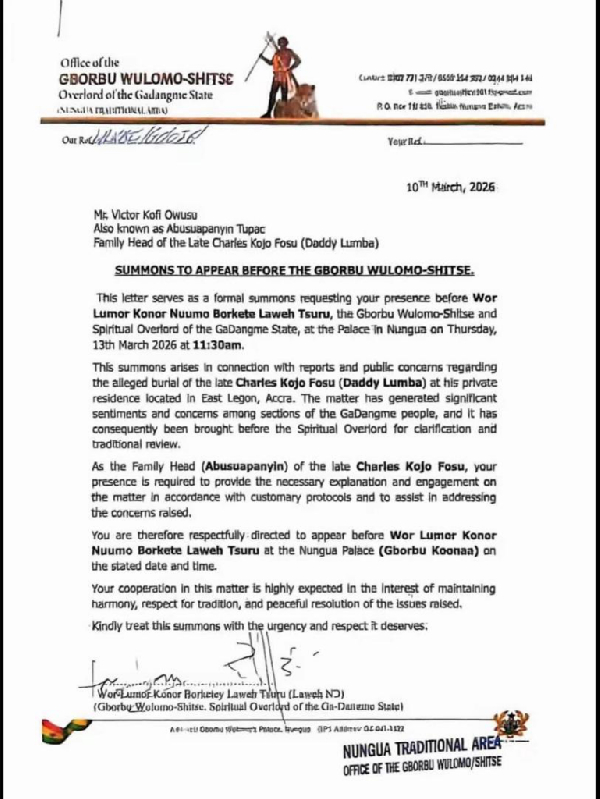
The family head of the late highlife icon Daddy Lumba, Abusuapanyin Kofi Owusu, has been invited to appear before the Spiritual Overlord of the GaDangme people following reports that the musician was buried at his private residence in East Legon.
A letter dated March 10, 2026, issued by the office of Gborbu Wulomo-Shitsɛ of the Nungua Traditional Area, instructs Abusuapanyin Kofi Owusu to present himself before Wor Lumor Konor Nuumo Borkete Laweh Tsuru at the Nungua palace on March 13, 2026, at 11:30 a.m.
The invitation follows reports—also acknowledged by the family head—that the late singer was interred at his residence in East Legon.
“This summons arises in connection with reports and public concerns regarding the alleged burial of the late Charles Kojo Fosu (Daddy Lumba) at his private residence located in East Legon, Accra,” part of the statement read.
According to the Ga traditional authorities, the development has sparked concern among sections of the GaDangme community, prompting the issue to be referred to the Spiritual Overlord for clarification and traditional review.
They explained that the situation has generated strong reactions within the community, making it necessary for the traditional leadership to examine the circumstances surrounding the burial in line with established customs and traditions.
Wor Lumor Konor Nuumo Borkete Laweh Tsuru noted that the presence of the family head is required to provide clarification on the matter in accordance with customary procedures.
“As the Family Head (Abusuapanyin) of the late Charles Kojo Fosu, your presence is required to provide the necessary explanation and engagement on the matter in accordance with customary protocols and to assist in addressing the concerns raised,” the statement indicated.
The letter further called on the family head to fully cooperate with the traditional authorities as they work to address the issue and provide clarity.
“Your cooperation in this matter is highly expected in the interest of maintaining harmony, respect for tradition, and peaceful resolution of the issues raised. Kindly treat this summons with the urgency and respect it deserves,” the statement further indicated.
The final funeral rites of Ghanaian highlife legend Charles Kwadwo Fosu, popularly known as Daddy Lumba, were held in Kumasi at the Baba Yara Sports Stadium.
Lumba died at age 60 in Accra at The Bank Hospital on July 26. Shortly after his passing, a dispute emerged between his maternal and paternal families, as well as between his two wives. On the family front, members of the maternal side accused the paternal family head of sidelining them from the funeral planning and the management of funds.
The disagreement persisted from around August to early December, eventually leading to legal action. The Accra High Court later granted an injunction halting the funeral that had been scheduled for December 13, and also restrained Transitions Funeral Home from releasing the body, citing the alleged exclusion of the immediate family from the arrangements.
The court subsequently recalled the lawyers involved in the case and directed the party seeking to stop the funeral to deposit GH¢2 million by 2:00 p.m. to cover potential costs should the burial be delayed. The court indicated that failure to meet the deadline would allow the funeral to proceed as planned.
The opposing party failed to meet the deadline, and as a result, Daddy Lumba’s funeral went ahead as scheduled.
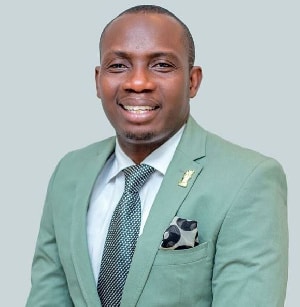
Marriage counsellor George Lutterodt has been released after being held by the Ghana Police Service for questioning over claims that he incited violence.
Reports that surfaced on March 9, 2026, indicated that the counsellor had been taken into custody after allegedly engaging in actions authorities believed could trigger unrest within the community.
Police said his conduct was considered capable of disrupting public order and peace.
After regaining his freedom, Counsellor Lutterodt shared a video explaining why he was seen in handcuffs during his detention.
“They told me they needed a picture, so they took a picture of me in handcuffs,” he said.
He also described his first stop after leaving the detention facility, expressing gratitude to God.
“When I left the detention centre, I came first to church, I walked to the altar to tell God thank you that my arrest was not anybody’s prayer point and I would not believe that whatever I went through was emanated by anybody,” Lutterodt stated.
His arrest followed controversial remarks he made publicly, in which he urged Ga youth to take pickaxes to a residence in East Legon and exhume the body of late highlife icon Daddy Lumba.
Police explained that the counsellor was picked up for allegedly encouraging violence and engaging in conduct likely to breach public peace, referencing provisions under the Criminal Offences Act, 1960 (Act 29) and the Public Order Act, 1994 (Act 491).
In the remarks that sparked the controversy, Lutterodt had advised the youth not to wait for the police but to take action themselves.
Veteran Nollywood actress and evangelist Eucharia Anunobi has reflected on the early stages of her life, sharing how she chose a career in the arts despite her father’s desire for her to study law.
Speaking on The Honest Bunch Podcast, monitored by MyNewsGh, Anunobi disclosed that her father had hoped she would pursue a legal career, a path often regarded by many parents as prestigious.
“My dad wanted me to study law,” she said.
However, she explained that she sensed early on that the profession did not align with her interests.
“I knew by intuition that I didn’t want to be in a structured career like that,” she said.
Anunobi noted that growing up in a strict household also influenced her personality and interests. She said her father’s strict nature limited her social life, which led her to spend much of her time reading.
“My father was very strict, so I didn’t really have friends. My friends were books,” she said.
According to her, reading opened up a new world of imagination and curiosity, exposing her to different cultures and ideas.
“I travelled through time and space through books, learning about places and people I had never seen,” she said.
That curiosity eventually guided her toward the arts, a field that would later define her career in the entertainment industry.
Before becoming widely recognised in Nollywood, Anunobi said modelling played an important role in supporting her education. She recalled that the opportunity helped her become financially independent during her time at the university.
She explained that she entered the modelling industry while studying and quickly gained attention because of her appearance and confidence on stage.
“I realised I had unique features, height and shape, and I maximised it,” she said on The Honest Bunch Podcast monitored by MyNewsGh.
The actress said she frequently worked with fashion designers and was often selected for prominent roles in runway shows.
“In many shows, I was the one who opened the runway with the most dramatic designs,” she explained.
She added that the income she earned from modelling helped her cater for her academic needs.
“I would say I was a rich student because I made money to finance my schooling,” she said.
Her modelling success later introduced her to individuals within the entertainment industry who encouraged her to pursue acting.
Anunobi also recounted a challenging moment at the beginning of her acting career when she faced resistance from a colleague over a film role.
She said the incident occurred while preparations were underway for the sequel to the popular Nollywood film Glamour Girls. According to her, she had already signed a contract to play the role of Anita when another actress questioned why she had been given the script.
“She looked at my script and asked who gave it to me,” Anunobi said.
She later discovered that the actress had approached the producer and requested that she be removed from the project.
“She told the producer to decast me and replace me with someone else,” she said.
Despite the request, the producer declined and maintained her role in the film.
Reflecting on the experience, Anunobi said it taught her a significant lesson about success and competition within the entertainment industry.
“It helped me realise that when you have a bright star, even people who already have their own success can still be envious,” she said.
Beyond her acting career, Anunobi also spoke about her views on ministry and the concept of church. She explained that she believes the work of ministry is not limited to physical church buildings.
Sharing her experience as a preacher, she said she has travelled widely to share the gospel and has spoken to audiences in various places.
“I’ve gone to different parts of the world to preach the gospel and I’ve lost count of the number of altars here in Nigeria,” she said.
According to her, many people mistakenly believe that preaching must take place within the walls of a church building.
“People think the only way to preach the gospel is to have a four-wall building called a church. No, that’s not the church,” she explained.
Anunobi said she believes the true essence of the church lies in the sharing of wisdom and knowledge that can transform people’s lives.
“The church is where illumination and wisdom from God are shared. When two or three gather and something is said that shifts their mindset and transforms their understanding, that is where God is.”
She added that learning and enlightenment themselves reflect God’s presence, describing Him as the source of wisdom and knowledge.
“God is the author of light. God is the author of wisdom and information. If you are in a place where you learn something new and your mindset changes, God is there,” she said.
Ghanaian actress Juliet Ibrahim has encouraged young women to prioritise building stable homes before deciding to have children, stressing the importance of responsible parenting and supportive partnerships.
Speaking in an interview on TV3 Ghana shared on X on March 10, 2026, the actress said she does not support the idea of young women deliberately having children before establishing a stable home environment.
She explained that having a reliable partner and a supportive home structure can make a significant difference in raising children, noting that parenting alone can be extremely challenging and may affect a child’s emotional development.
“When it comes to having children, people should not be planning those kinds of things. I have always believed in having a home before having kids. Even if you are not married legally, you should at least be with someone who understands what it means to co-parent.
“You cannot just have kids and think you can do it on your own. It is very difficult, and those children often need the presence of the other parent figure in their lives. It is not easy doing it alone at all. There are times when those kids come home and see that their friends have both parents, and they begin to ask questions about their own situation,” she said.
Juliet Ibrahim also noted that although some women may be financially capable of raising children on their own, it is still important for young women to carefully consider the long-term implications before making such decisions.
“Do you want to raise someone who might grow up feeling alone, toxic, or dealing with trauma they may never express? That is why I always advise people to think carefully before jumping into something like that.
“These days, many things are happening, and people do it all the time. If you feel you have reached a certain age as a woman, perhaps in your 40s, and you decide to have a child, that may be different because at that stage, you may be financially stable enough to provide a better life for the child. But as a young woman, I would not advise going that way,” she added.
Juliet Ibrahim has revealed that even though she is currently single, she still believes in love and remains open to finding the right partner.
The actress made the disclosure in an interview with Giovani Caleb on Showbiz 360, where she spoke about her relationship status and her outlook on love.
“Yes, I believe in love very much,” she said when asked whether she would give love another chance.
Juliet explained that she is not dating anyone at the moment, noting that the past three years have been focused on personal development and self-improvement.
“I have been working on myself, growing and building myself for the past three years,” she explained.
According to her, stepping away from relationships created the opportunity to focus on her life, career, and personal goals.
Speaking about the qualities she looks for in a partner, the actress said shared goals and a common vision are very important to her.
“I think it’s just having similar goals and vision, and it has to really match up to my status,” she stated.
She added that she has been asked before whether she could date someone under her status, admitting that it would be difficult for her.
Juliet further stressed the importance of intellectual and emotional compatibility in a relationship, explaining that she values meaningful conversations and mutual support.
“When I come back from work or I’m trying to do something, I want to have a conversation with somebody who is impacting and adding value to me. And I also want to add value to him when he is having issues or difficulties in making some decisions,” she said.
“The person has to be a bit like me,” she added.
Juliet Ibrahim was previously married to Ghanaian businessman Kwadwo Safo Junior in 2010. The couple later divorced in 2014.
Since the separation, the actress has kept most aspects of her personal life private. However, her recent comments suggest that while she is currently single, she has not ruled out the possibility of falling in love again.
The actress graduated from Berkeley College in the United States, proudly joining the Class of 2025 as a Bachelor’s degree holder in Marketing Communications.
Celebrating her achievement, she took to Facebook yesterday to express her joy and gratitude as she reflected on the toil that led her to this moment.
“From red carpets to research papers, late-night shoots to late-night study sessions… I DID IT!,” she wrote on Facebook, adding photos of herself beaming with joy and adorned in her graduation gown.
She encouraged her fans that it is never too late to achieve any dream, despite juggling them with other demands of life.
“This is your reminder: You’re never too old to reinvent yourself,” she added. “Cheers to new beginnings, bigger dreams, and breaking every limit.”
Her fans did not hesitate to share in her joy as they flooded her comment session with congratulatory messages, cheering her on to keep advancing in her endeavours.
Juliet Ibrahim is one of the outstanding actresses in Ghallywood and Nollywood.
She is currently featuring in some new movies such as Where Love Ends,” “Ayele, saved by love,” “Deeper than pain,” among others.
She has been an adbvocate for education, women empoerment and mental health awarness.
Juliet made history as first ever female President of Women in Film and Television Ghana (WIFT Ghana).
The actress made this known in a Facebook post with an expression of gratitude and a celebration of what she describes as a personal achievement.
“I’m deeply honored to share that I have been appointed as the first-ever President of Women in Film and Television Ghana (WIFT Ghana) @wiftghana—a monumental step forward for our creative community,” she wrote.
She adds that the opportunity to serve as a woman is pivotal in promoting the agenda of empowering and encouraging women across the globe to pursue and achieve their goals.
“This milestone is not just a personal achievement, but a powerful moment for all women across Ghana’s and Africa’s film, TV, and digital media industries, who continue to break barriers, amplify stories, and reshape narratives both in front of and behind the camera.”
Juliet Ibraghi said WIFT Ghana is now officially part of a worldwide network called Women in Film and Television International (WIFTI)and is also connected to WIFT Africa, which is the regional body.
“WIFT Ghana proudly joins the global network of Women in Film & Television International (WIFTI) and is affiliated with WIFT Africa—strengthening our ties across continents while staying rooted in our local mission: to empower women, create opportunities, and champion inclusion and visibility.”
About WIFT
Women in Film & Television (WIFT) is a global network of non-profit membership chapters made up of more than 40 Women in Film chapters worldwide and over 10,000 members. It is dedicated to advancing the professional development and achievements of women working across all areas of film, television, and other screen-based media.Founded in 1973 in Los Angeles by Tichi Wilkerson Kassel, the organisation expanded rapidly and held its first Women in Film and Television International World Summit in New York City in September 1997.
About WIFT Ghana
WIFT Ghana is a local chapter of Women in Film and Television International (WIFTI), committed to empowering Ghanaian women in film, television, and screen-media-related fields. The chapter aims to achieve this through networking, capacity building, and mentorship.
Meanwhile in the month of May this year, Juliet graduated from Berkeley College in the United States, proudly joining the Class of 2025 as a Bachelor’s degree holder in Marketing Communications.
Celebrating her achievement, she took to Facebook yesterday to express her joy and gratitude as she reflected on the toil that led her to this moment.
“From red carpets to research papers, late-night shoots to late-night study sessions… I DID IT!,” she wrote on Facebook, adding photos of herself beaming with joy and adorned in her graduation gown.
She encouraged her fans that it is never too late to achieve any dream, despite juggling them with other demands of life.
“This is your reminder: You’re never too old to reinvent yourself,” she added. “Cheers to new beginnings, bigger dreams, and breaking every limit.”
Her fans did not hesitate to share in her joy as they flooded her comment session with congratulatory messages, cheering her on to keep advancing in her endeavours.
Juliet Ibrahim is one of the outstanding actresses in Ghallywood and Nollywood.
She is currently featuring in some new movies such as Where Love Ends,” “Ayele, saved by love,” “Deeper than pain,” among others.
She has been an advocate for education, women empowerment and mental health awareness.
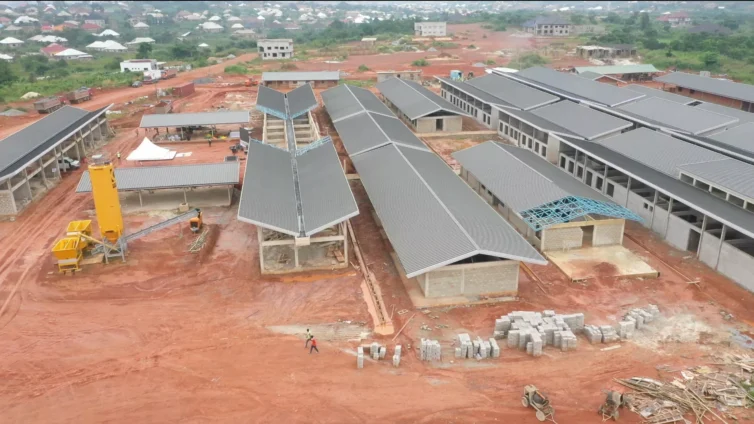
Thirty-five contractors hired under Ghana’s Agenda 111 programme did not move to their assigned sites or executed work that fell short of the advance mobilisation funds they had received, according to the government’s arrears audit findings.
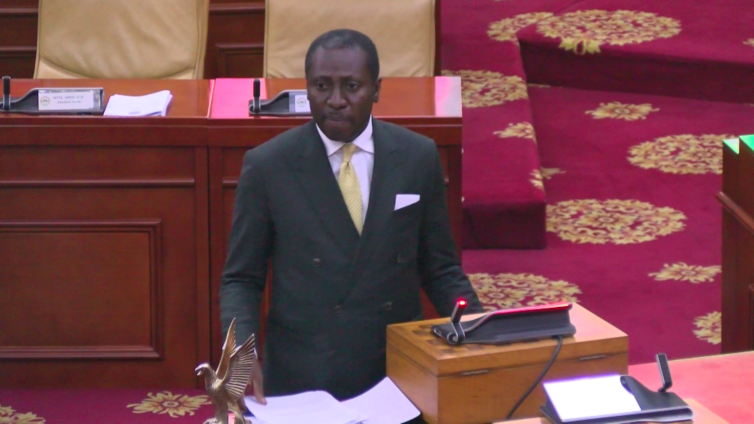
The disclosure was made in Ghana’s Parliament when Deputy Finance Minister Thomas Nyarko Ampem delivered a statement on behalf of Finance Minister Cassiel Ato Forson.
In his address to legislators, Mr Ampem explained that the contractors had collectively been paid approximately US$7.9 million in advance mobilisation funds for the project, yet some failed to commence work while others undertook activities that did not reflect the payments made.
The statement indicated that the Ghana Audit Service has since issued surcharge notices to the contractors implicated in the matter.
These developments have intensified concerns surrounding the administration of the Agenda 111 project, widely regarded as one of the largest healthcare infrastructure programmes initiated during the tenure of former President Nana Akufo-Addo and the New Patriotic Party government.
Introduced in 2021, the project aimed to build 111 district and regional hospitals nationwide to expand healthcare access, particularly in communities lacking adequate medical facilities.
Despite its objectives, the programme has repeatedly come under scrutiny due to construction delays, escalating costs, and concerns about monitoring and accountability.
Mr Ampem also revealed that the advance payment guarantees associated with the 35 contracts have all lapsed, leaving the government with limited contractual safeguards to recover the money should the contractors fail to honour the surcharge directives.
The Ministry of Finance did not specify whether further legal action or recovery strategies would be pursued beyond the measures already initiated by the Ghana Audit Service.
It also remains uncertain how many of the proposed 111 hospitals have been completed or have reached significant stages of construction.
The Minister of Health, Kwabena Mintah Akandoh, has attributed the decision by President John Mahama to order an audit into the Agenda 111 project to the lack of clarity and transparency surrounding its implementation under the previous administration.
Speaking on Asempa FM’s Ekosii Sen, Mr. Akandoh revealed that none of the hospitals promised under the initiative is currently operational.
“None of the Agenda 111 hospitals is operational as we speak, which is why President Mahama has directed that an audit be conducted to understand the true status of the project,” he stated.
He criticised the former Akufo-Addo administration for what he described as poor planning and mismanagement of the health infrastructure project.
“We all know how Agenda 111 started. The way the project was handled wasn’t the best. Even if you intend to build 111 hospitals, you could stagger the project and complete them in phases,” the Minister said.
He pointed out that the Akufo-Addo government had assured the public that some of the hospitals would be completed and handed over before the end of their term. However, none of these facilities are in use.
“He mentioned that they had completed three hospitals and even commissioned some on December 5. But when President Mahama gave his first State of the Nation Address and referenced it, I went to verify, and unfortunately, none of those hospitals was operational,” Mr. Akandoh noted.
Highlighting inconsistencies in the project’s financing, the Minister disclosed that about $400 million had already been spent out of the estimated $1.7 billion to $1.9 billion budgeted for the entire project.
“The interesting part is, if they had staggered the project as they should have, by now we could have completed more than 20 hospitals with that amount. But that wasn’t the case,” he lamented.
With the Agenda 111 initiative now under the purview of the Ministry of Health, Mr. Akandoh said steps are being taken to assess its feasibility and ensure proper execution moving forward.
“President Mahama has directed us to audit the Agenda 111 project and present him with a clear blueprint for the way forward, and we’ve been given timelines,” he added.
The Ministry of Health has dismissed statements made by former Finance Minister Dr. Mohammed Amin Adam, who claimed that three hospitals under the Agenda 111 initiative were completed, furnished with medical equipment, and inaugurated before the previous administration left office.
During a press briefing on Monday, Dr. Adam asserted that three hospitals had been fully completed and that $1.3 billion had been allocated to finish the remaining Agenda 111 projects.
However, in a statement released on Tuesday, March 4, 2025, the Health Ministry denied these assertions and urged the public to disregard them.
The Ministry reported that on March 3, officials visited the Trede and Kokoben hospital sites in the Ashanti Region to evaluate progress. Their assessment found that essential medical infrastructure, including imaging devices, medical gas systems, and mortuary equipment, was yet to be installed.
Despite the previous government investing $400 million in the initiative, the Ministry emphasized that none of the Agenda 111 hospitals had been completed and made operational. Although the facilities at Trede, Kokoben, and Ahanta had been inaugurated by former President Nana Akufo-Addo, construction was still in progress, with an estimated completion rate of 95 percent. Some laboratory sections remained unfinished, and no medical devices had been put in place.
Furthermore, the Ministry clarified that these hospitals had not been handed over to the Ghana Health Service for use. It estimated that an additional $8.03 million would be required to make each of the three hospitals fully functional. The overall cost to complete all pending Agenda 111 hospital projects had now risen to $1.589 billion.
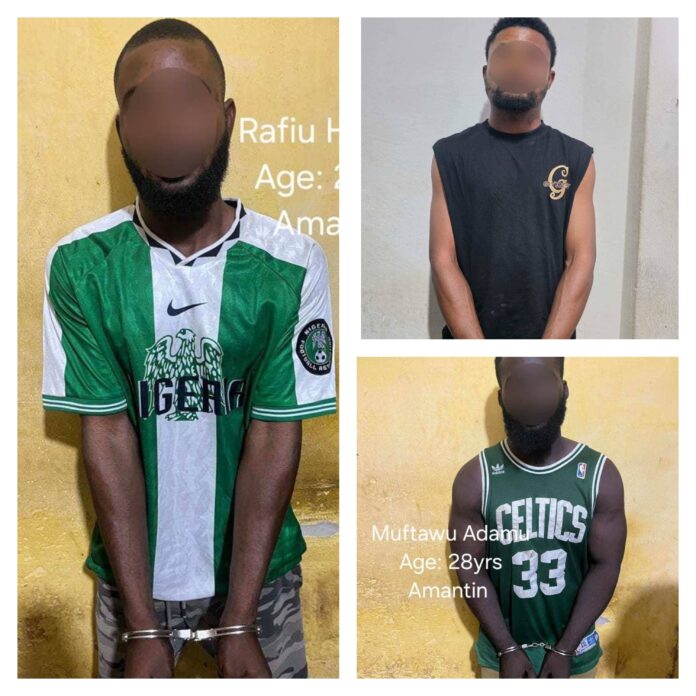
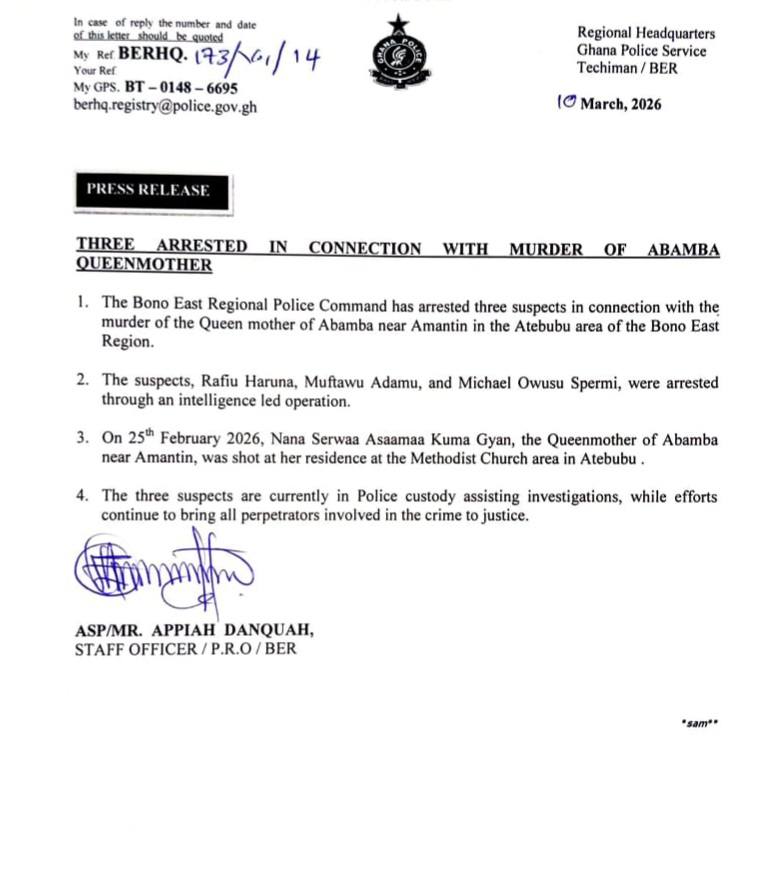
The Bono East Regional Police Command has taken three suspects into custody over the killing of Nana Serwaa Asaamaa Kuma Gyan, Queenmother of Abamba, near Amantin in the Atebubu area.
In a statement on Tuesday, March 10, the police confirmed that Rafiu Haruna, Muftawu Adamu, and Michael Owusu Spermi were apprehended following an intelligence-led operation.
Nana Serwaa Asaamaa Kuma Gyan was shot at her residence in the Methodist Church area of Atebubu on February 25, 2026.
The suspects are helping police with investigations as authorities continue to track down all involved in the crime.
Read the full statement below
Last year, the Kwahuhemaa, Nana Adwoa Gyemfua, was reportedly abducted by armed men in police uniforms claiming to be from the National Security on Monday, November 17.According to reports, the gunmen stormed the palace of the Paramount Chief of the Kwahu Traditional Council at Abene around 4 a.m. and took the official Toyota Land Cruiser of the Kwahuhene.Eyewitnesses said they heard gunshots at the palace prior to the abduction. Authorities are yet to issue an official statement, and the motive behind the raid and the abduction remains unclear.
Last month, the Binduri District of the Upper East Region was thrown into mourning following a shooting incident which resulted in the death of three individuals and left five others injured.
According to reports, gunmen attacked and invaded the residence of the victims on Sunday, October 26, and shot them. Among the three deceased individuals is a five-year-old child who died instantly.
The Manager of Binduri-based Maxx Empire Radio and TV, George Bukari, is reported to be among those who sustained injuries in the aftermath of the incident.
The incident has been linked to the long-running Bawku conflict. The conflict, which resurfaced in 2021, has claimed multiple lives and displaced several families. However, the government has, in several ways, initiated efforts to bring calm to the area. In July this year, the Ghana Armed Forces (GAF) deployed soldiers to conflict-prone areas such as Bawku, Binduri, Nalerigu, and Zebilla.
This update comes less than a week after four individuals lost their lives in a deadly daylight attack at the district office of the National Health Insurance Authority (NHIA) in the region. The unfortunate incident also left several others injured. The deceased individuals include a bystander, an NHIA staff member, a mentally unstable man and Yahaya Bukari, headmaster of Garu D/A Junior High School.
According to eyewitness accounts, the Garu District Office of the NHIA was invaded by four armed men on two motorbikes, who subsequently fired shots wildly. Two of the gunmen are said to have been masks.
“Around 10am there about, we heard gunshots. Initially, we thought it was coming from the rural bank area, but later we found out that the attackers had gone to the health insurance office,” a witness stated.
Speaking to the media, former Presiding Member of the Garu District Assembly and now Assembly Member for Kugri, Edward Ndebugri, recounted that the gunmen later targeted bystanders and fleeing residents.
“There is a public school close to the health insurance office, and when the shooting started, the teachers and pupils began running helter-skelter. The gunmen chased them in the direction they fled, and when one of the teachers fell, they shot him dead,” he added.
The assailants reportedly left the NHIA office with nothing. In response to the incident, heavily armed police and military personnel thronged key areas, including the District Health Insurance Office and the Presbyterian Hospital as of 2 p.m. on Monday.
“The whole town is in shock. This is the first time we are witnessing such an incident. People are living in fear, and we are pleading with the security agencies to investigate and bring the perpetrators to justice,” the Assembly Member for Kugri appealed.
The injured individuals are receiving treatment for gunshot wounds at the Garu Presbyterian Hospital. Meanwhile, police have launched investigations into the incident to determine the motive behind the attack.
Earlier this month, an armed attack at the Gbintri inland checkpoint in the East Mamprusi Municipality of the North East Region has reportedly left an Assistant Immigration Control Officer II (AICOII), Rafiq Mohammed, dead and another officer, AICOII Oppong Daniel, also injured.
While details of the attack remain unclear, reports suggest the incident took place at about 1:30 a.m. on Friday, October 3. However, AK-47 shell casings used by the attackers during the operation have been retrieved by the joint response team, led by Superintendent Francis Brobbey, Gambaga Municipal Police Commander, and DIS Moro Tanko Mohammed, North Regional Intelligence Officer of the GIS.
Meanwhile, AICOII Oppong Daniel is receiving treatment at the Baptist Medical Centre in Nalerigu after sustaining multiple gunshot wounds in the incident.
In July this year, the lifeless body of an immigration officer identified as Stephen King Amoah, also known as Nana Kofi, was discovered in a drainage system near GBC Satellite, opposite Comet Estate, Accra.
The deceased is said to have gone missing five days (since July 3) before his tragic death. This was contained in a press statement by the Ghana Police Service on Thursday, July 10.
Providing more details about the tragic incident, the police noted that the murderer(s) of the 38-year-old also set his body on fire.
The deceased’s remains have been conveyed to the Police Hospital morgue after the relatives positively identified the body as Stephen.
The police have disclosed that their preliminary investigations indicate the deceased had gone to meet his debtor, one Bright Aweh, who had promised to pay the outstanding debt owed on Thursday, July 3, in the evening.
The victim never returned home that night, and his phone remained switched off throughout, raising concerns among family and friends who later reported him missing.
“Investigations revealed that on 3rd July 2025, at about 8:00 p.m., the deceased left his residence at Ashongman Estate after receiving WhatsApp images of cash bundles from one Bright Aweh, who requested to meet him at a spot at Ashongman Estate to settle an outstanding amount.
“According to the complainant, the deceased never returned home that night, and his phone remained switched off thereafter,” the police said.
After the deceased’s family filed a complaint at the police station, Bright Aweh was arrested to assist with the investigation.
He admitted that he met with the deceased and alleged that he gave a cash of GHS500,000 to the deceased, instructing him “to use part of the money to pay off some debts and hold the remaining amount for later collection.”
But the police in their statement noted that “the suspect could not clearly explain the source of the funds and gave conflicting statements.”
Meanwhile, the police pledged to get to the bottom of the case and ensure justice is served to the perpetrators.
“The Regional Police Command strongly condemns such violent and criminal acts and assures the public that it is working diligently to uncover the full circumstances surrounding this incident and bring all responsible persons to justice,” it added.
Subsequently, the Ghana Police announced the arrest of the prime suspect in the gruesome murder of immigration officer Stephen King Amoah, also known as Nana Kofi on August 4.
This follows the discovery of weapons believed to have been used in the murder of Immigration Officer Stephen Amoah.
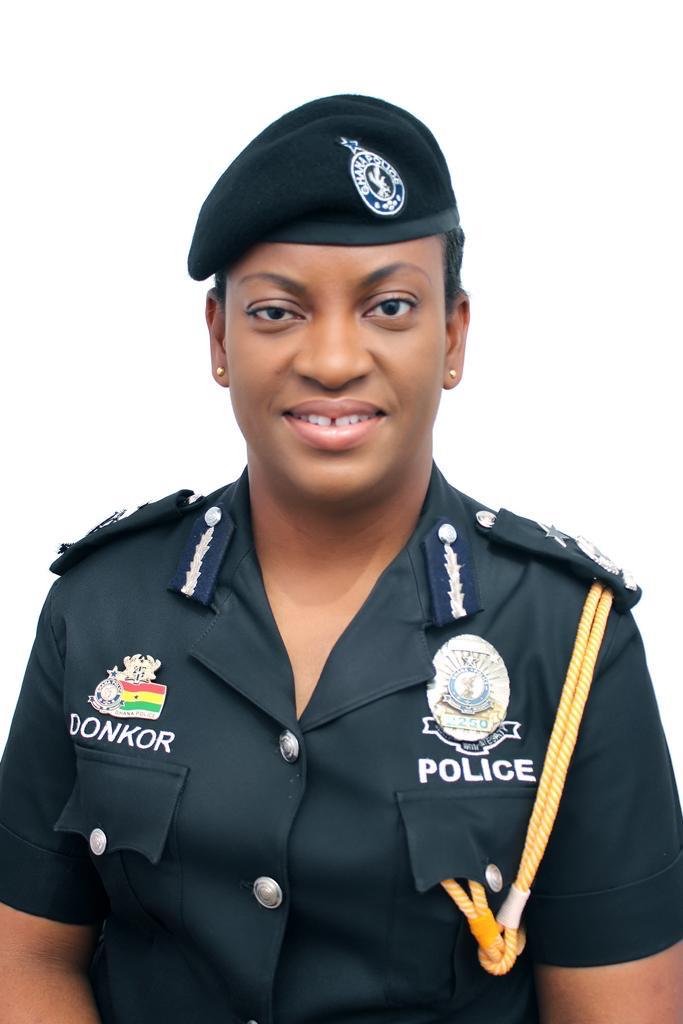
During a press briefing on Monday, August 4, the Director-General of the CID, COP Lydia Yaako Donkor, revealed that bloodstains were found in the living room, on a burnt, blood-soaked carpet, and on a fufu pestle suspected to have been used in the murder by the suspect.
According to the Police, the forensic conducted on Thursday, July 24, also exposed freshly sprayed walls, hinting at an attempted cleanup by the suspect.
“The Kwabenya Teshie Police visited the suspect’s residence, and the forensic inspection revealed the following bloodstains in the living room and evidence of attempted cleanup, freshly sprayed walls, and an empty can of spray paint. A search of a secondary crime scene near the GBC satellite area also uncovered a burnt woolen carpet and partially burnt camouflage fabric.”
“These items were photographed, retrieved and photocopied for forensic analysis. On 24th July, the police received a warrant to search a particular room in the suspect’s house. A search in the room revealed more bloodstains, which were photographed and samples collected for forensic analysis. A further search in the bushes about 100 metres from the suspect’s house also led to the retrieval of the…” the Police said.
The Service has noted that in the coming days, undertake a DNA exercise on the bloodstains with samples from the deceased mother and son, aiding with the process.
“I wish to say that the initial blood sample collected was positive for human blood. To aid the investigations, the deceased mother and son has provided sample for DNA profiling. In the face of these pieces of evidence the suspect who was initially charged with kidnapping has since been rearrested and formally charged with murder. He is currently on remand following his appearance with the Adabraka District Court and is scheduled to reappear on 8th August 2025.
“A special operation is currently underway to identify and arrest his accomplices and we are following other vital leads to gather all necessary evidence against the suspect and his accomplices. The Ghana Police Service wishes to assure the public that the investigations is ongoing and every effort is being made to ensure that all the perpetrators are prosecuted,” she added.
Meanwhile, recent reports suggested that the third suspect involved in the murder of Stephen King Amoah, an Immigration Officer, has succumbed to an illness.
According to sources, the victim’s brother, Kwasi Amoako, revealed this information to the media.
“Yesterday we went to court and I can confirm that the third suspect has passed on. I was told by the Police CID, the one who is in charge of the case. We thank God that our brother has started seeking justice for himself,” he is quoted to have said by MyJoyOnline.
The police are yet to issue a formal statement on the suspect’s death.
The Adabraka District Court on August 22, continued hearing the case after remanding the prime suspect into police custody for two weeks.
The court has adjourned the case involving the murder of immigration officer, Stephen King Amoah, to October 9 following the police’s request for more time to gather the due evidence against the accused parties.
The adjournment of the case was announced during the court hearing at the Adabraka District Court on Thursday, September 4, where the prosecutors prayed the court that the Ghana Police Service needed more time and specialised gadgets to advance investigations.
According to them, a court order had been secured to facilitate the process and prayed that the suspects, Bright Aweh and Thomas Ziggah, remain in custody.
However, Counsel for the suspects, Gordon Aboagye, expressed concerns about the state of his clients, who appeared visibly distressed, suggesting that they may have been held under harsh conditions while in custody.
Referring to the need to uphold democratic principles, he prayed that the court reveal the detention location of the suspects in order for their families to visit them and check their well-being while in custody.
“In line with democratic principles, families of the suspects should be aware of their location to enable visitation”
“My Lord, my client has appeared in court limping and with bloodshot eyes. He has already been treated twice at the Police Hospital without improvement. We respectfully request that he be sent to Korle Bu Teaching Hospital for independent medical attention,” he argued.
However, the prosecution objected, urging the defence to formally apply if it insists on the transfer of its client.
He further appealed to the bereaved family to remain calm and allow the law to take its course. He commiserated with them for their loss.
“We sympathise with the family of the deceased and plead with them to remain calm and allow the law to take its course,” he added.
The court, on the other hand, admonished the family of the bereaved family to stay patient, assuring them that justice would be duly served.
Meanwhile, a dramatic scene unfolded at the court when the aunt of the late officer performed rituals, breaking eggs and invoking curses on those she believes are responsible for his death.
She reportedly said, “Anyone responsible for his death should also suffer the same fate. All your generation will suffer the same fate; the gods should deal ruthlessly with anyone responsible for his murder. The gods shouldn’t spare anyone involved.”
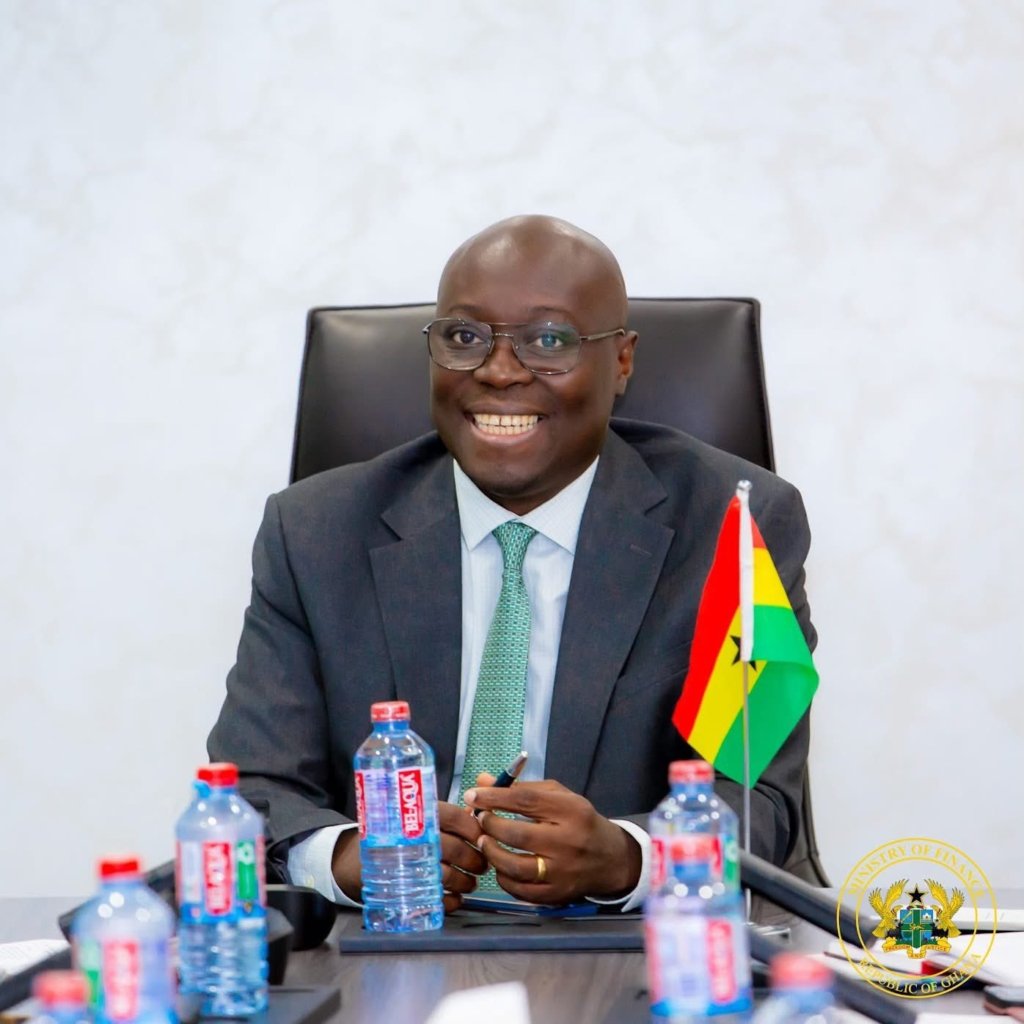
Deputy Minister for Finance Thomas Ampem Nyarko has disclosed that the Auditor-General uncovered a GH¢9.4 million payment made by the Ministry of Finance based on forged documents.
Mr Ampem Nyarko made the revelation while addressing Parliament on Tuesday at the 21st Sitting of the First Meeting of the Second Session of the Ninth Parliament of the Fourth Republic, explaining that auditors had identified irregular transactions backed by falsified documentation.
“Speaker, auditors uncovered transactions worth GH¢9.4 million supported by forged Stores Receipt Advices (SRAs) that had been used to justify requests for payment for goods that were not delivered at the time,” he said.
He explained that the documents used to support the payment indicated that the Ministry of Defence had procured vehicles for a border patrol operation.
“A contract between the Ministry of Defence and a company for vehicles intended for border surveillance and monitoring of the 2024 general election revealed that despite the issuance of a Stores Receipt Advice (SRA), an official document confirming that goods have been received, dated 12th October 2024, the vehicles were never delivered,” he stated.
According to Mr Ampem Nyarko, the Auditor-General’s findings showed that the vehicles in question had not been purchased even though payment had already been made.
He also revealed that auditors identified a similar case involving falsified documents within the Judicial Service.
“Similarly, the Judicial Service appeared to be caught in a web of falsified Stores Receipt Advice. While an SRA dated 25th October, 2024 claimed the receipt of 7 Toyota saloon cars, as soon as the audit was initiated, the supplier wrote to the Judicial Service on 10th April, 2025, indicating their inability to supply the said vehicles as scheduled,” he said.
Mr Ampem Nyarko noted that the incidents point to a broader pattern of fraud where forged documentation is used to obtain payments from the state.
“This shows that fraudulent documents were submitted to the Ministry of Finance for payment,s and steps have been taken to avoid a recurrence,” he stated.
“Speaker, these cases illustrate a disturbing pattern of fraud designed to deprive the people of Ghana of hundreds of millions of cedis of public funds at risk,” Mr Ampem Nyarko lamented.
Meanwhile, Government is set to receive more cash in its coffers as President Mahama’s flagship anti‑corruption initiative Operation Recover All Loots (ORAL) pursue it’s asset and cash recovery efforts.
This was announced by the Attorney-General and Minister of Justice, Dr Dominic Ayine, during an appearance on JoyNews Newsfile on Saturday, January 10. Dr Ayine revealed that preliminary checks have already been done on the amount of money that can realistically be recovered within the year.
He said, “We have developed estimates of what is capable of being collected. Very soon, this year, I am sure things will start flowing into the government’s coffers. Money will start flowing into the government chest with respect to ORAL.”
While he anticipates the cash and assets, he is unable to state mathematically whether the amount expected to be recovered in full under the ORAL initiative. GH¢21 billion is projected to be recovered under the anti-corruption drive.
However, the Attorney-General cautioned that he could not state with absolute certainty whether the government would recover the full GH¢21 billion projected under the initiative.
“The question of whether we will be able to get exactly the 21 billion projected is one that I cannot answer with mathematical certainty at this point,” he added.
President Mahama officially launched ORAL on December 18, 2024, barely two-weeks after he won the 2024 elections. Ghanaians have received the Operation Recover All Loot (ORAL) initiative with a mix of optimism and scepticism. While many welcomed it as a bold anti‑corruption drive to reclaim billions in stolen assets, others criticised it as politicised, slow, and more of a performance than a genuine legal process.However, Dr Ayine clarified that his outfit, in collaboration with the Economic and Organised Crime Office (EOCO) and the National Intelligence Bureau (NIB) are working both locally and internationally to track and recover misappropriated state funds.
He noted that, very soon, their coordinated efforts would produce tangible results and the anticipated results Ghanaians want to see, and in turn draw some money into state coffers, reinforcing the government’s commitment to accountability and the protection of public resources.
“Extensive work is currently underway, both locally and internationally, to track and recover misappropriated state funds. On the local front, my office is working closely with the Economic and Organised Crime Office (EOCO) and the National Intelligence Bureau (NIB). In addition, there is a special clandestine investigations team that reports directly to me. I am confident that the coordinated efforts of local agencies and foreign partners will soon translate into tangible financial recoveries for the state, reinforcing our commitment to accountability and the protection of public resources.”
Meanwhile, President John Dramani Mahama in June last year, stated that in due course, 33 former government appointees have been implicated in corruption-related cases in the Operation Recover All Loot (ORAL) Team report will face prosecution.
President Mahama, while addressing the African Union Advisory Board Against Corruption at the Jubilee House on Tuesday, 3 June, noted that the Attorney General (A-G), Dr Dominic Ayine, is preparing the cases for judicial proceedings.
“We set up the ORAL Committee, and they have identified 33 cases, which were handed over to the Attorney General. We have created special investigative teams to investigate each of them,” he said.
“Some of them have found a lot of evidence of the procurement of properties with illicit wealth. With many of them, they are just at the point of beginning prosecution. Some have also started the prosecution, and others are being lined up.”
Operation Recover All Loot (ORAL)is an initiative set up by the president to gather information on corruption to the appropriate government institutions for further investigation.
The committee is chaired by Samuel Okudzeto Ablakwa, who also serves as the Member of Parliament (MP) for North Tongu.
The other members include former Auditor-General Daniel Domelevo, retired Police Commissioner Nathaniel Kofi Boakye, legal practitioner Martin Kpebu, and investigative journalist Raymond Archer — all renowned for their integrity and strong stance against corruption.Currently, the hundreds of issues presented by the ORAL team to President John Mahama are being investigated by the Attorney-General and Minister for Justice, Dr. Dominic Ayine.
Additionally, its work has increased public awareness about the importance of protecting state resources.
The committee’s report has revealed that approximately $21.19 billion in potential recoveries are from misappropriated state assets and undervalued land transactions.
ORAL Chairman Samuel Okudzeto Ablakwa has indicated that “If we are successful in recoveries, we can retrieve as much as 20.49 billion United States dollars.”
Among the key cases cited were the National Cathedral project, the Power Distribution Services (PDS) deal, and the Saltpond decommissioning project.
Meanwhile, President Mahama has dismissed allegations that ORAL is being used for political vendettas, reassuring that the initiative is purely intended to strengthen Ghana’s anti-corruption efforts.
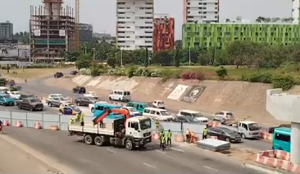
Expansion works on the Accra–Tema Motorway at the Tetteh Quarshie Interchange have been halted after a traffic diversion introduced for construction caused severe congestion.
This has forced contractors to suspend the plan and review their traffic management strategy.
Project Manager Ing. Ben Sackey indicated that a meeting would be held to deliberate on alternative traffic management options.
“We aim to implement a plan that will not impose the level of traffic congestion witnessed yesterday,” he told the media on Tuesday March 10, 2026.
Acknowledging that the suspension may affect the project timeline, Ing. Sackey emphasised the contractors’ responsibility to the public.
“As contractors, we are accountable to the public. We must consider their challenges and factor them into our programme. While this decision may delay our schedule, we are committed to revising the scheme to find a better solution that is conducive both the contractor and the public.”
He explained that the decision to halt works was taken after the diversion, which was intended to facilitate bridge expansion works, caused far more disruption than anticipated.
“Basically, our work programme has reached Tetteh Quarshie, where we are to expand the bridge.”
“The plan is to extend the existing lanes, bringing the bridge to ten lanes by adding three more lanes on each side. To do this, we need to control traffic to allow the launching of the T-beams on the piers already constructed.”
“Yesterday, however, we realised that the real-world impact of the traffic was far worse than what we had expected. Continuing with the plan as it was would have caused unacceptable congestion for the next four months,” he said.
The Minister for Roads and Highways, Governs Kwame Agbodza, has projected a two-year timeline for the completion of all current and upcoming road projects under the government’s “Big Push” initiative.
In an interview with the media on Friday, July 31, Mr Agbodza stated that when road projects were abandoned midway are over, as the government is committed to completing all ongoing and future works within the stipulated timeframe.
According to him, all “Big Push” projects will begin by the end of the month August, excluding the Dambai Bridge, which will commnce once its structural has been finalized.
“The average Ghanaian has come to accept something that is completely unacceptable, because they see road projects start around their backyard, and no one can tell them when it will be completed. We want to reset. ‘Reset’ means we need to change that narrative.
“All the projects have been deliberately structured to span two years, 24 months, and we will not go beyond that,” he said.
“Sometimes, a contractor is awarded 100 kilometers of road. People forget that constructing 100 kilometers is not a small undertaking. There may be people who are more interested in how much it costs — they focus on the money involved. So contractors take the job, and for seven or eight years, they do nothing. We want to avoid that,” he added.
Parliament on July 30 unanimously endorsed the government’s proposal to divert all royalties that will be received from oil revenues and mineral royalties to support the implementation of the Big Push Programme.
This comes after the government requested Parliament approve committing funds to assist in the construction of certain road projects.
Mr Isaac Adongo, the Chairman of the Parliament’s Finance Committee, while presenting the report by the Budget and Finance joint committee to the plenary, said, “the Committee has carefully considered the Referral, and it is of the opinion that the request is in the right direction.”
The Committee also noted that Parliament had already approved the policy and the allocation to the “Big Push” Programme in the 2025 Budget Statement. Granting the request would enable the Government to enter into multi-year contracts to execute the road infrastructure projects under the Programme.
“The Committee accordingly recommends to the House to approve the Request for the multi-year commitments for the selected road projects under the “Big Push” Programme contained in the Mid-Year Fiscal Policy Review of the 2025 Budget Statement and Economic Policy of the Government of Ghana, in accordance with Section 33 of the Public Financial Management Act, 2016, (Act 921),” Mr Adongo said.
The initiative aimed at improving road infrastructure across the country is estimated at GHC13.8 billion, and it is expected to be completed by 2028 with support from the country’s own financial resources.
According to the 2025 budget, GH¢5.75 billion is owed by the Road Fund, with an allocation of GH¢2.81 billion programmed for road maintenance.
This represents a 155.5% increase from the 2024 allocation of GH¢1.1 billion, underscoring the government’s emphasis on sustaining Ghana’s road network.
The Minister for Roads and Highways, Kwame Governs Agbodza, on Wednesday, July 30, revealed that his ministry has undertaken studies and prepared comprehensive engineering interventions and cost estimates for road projects under the Big Push Programme.
The Ministry of Finance has since issued commitment authorizations for some twenty-nine (29) road infrastructure projects under the Big Push Programme which include: Upgrading of Akosombo-Gyakiti-Kudikope Road, Road Dualization of Winneba-Mankessim Road, Rehabilitation of Mankessim-Ajumako-Breman Asikuma-Agona Swedru, Construction of nchi-Elubo Road, and Rehabilitation of Atimpoku-Asikuma Junction Road.
The government has also selected a number of abandoned road projects, for which no dedicated funding was allocated by the previous administration. They include rehabilitation and upgrading of Kasoa-Winneba Road, construction of Suame Interchange and Local Roads, reconstruction of Navrongo-Chuchuliga-Sandema Road, and upgrading of Tumu-Chuchuliga-Navrongo, including construction of a 36m span reinforced concrete bridge over the Kanyibie River and a 24m span reinforced concrete bridge over the Bechelihu river.
The government will, by the end of July, settle GHC4 billion out of the large debt owed to road contractors. Currently, the government owes road contractors GHC21 billion, according to the Roads Minister. President John Mahama emphasized his government’s commitment to infrastructure development under his administration’s 24-hour economy agenda. On his part, prioritising road construction and the swift resumption of stalled road projects holds the key to promoting economic growth and productivity by ensuring adequate regional connectivity.
The announcement has been met with excitement and optimism by many stakeholders in the construction sector. The Ghana Institute of Engineers and the Association of Road Contractors have largely welcomed the president’s announcement, but they have called for transparency.
They have called on the government to publish clear timelines and payment schedules to ensure that contractors can plan and mobilize resources effectively.
In March this year, Deputy Minister for Roads and Highways Alhassan Suhuyini acknowledged the significant financial burden facing the government to clear outstanding debts owed to contractors and suppliers.
His remarks followed the presentation of the 2025 budget by Finance Minister Dr. Cassiel Ato Forson, who disclosed that the government’s total commitments to contractors stand at a staggering GH¢67.5 billion.
He emphasized the importance of prioritizing road maintenance, a sector that has suffered due to poor upkeep. “The minister has stressed that a significant portion of these funds will be directed toward road maintenance.
This is a smart move because our poor maintenance culture has resulted in roads deteriorating within 8 to 10 years instead of lasting longer,” he explained.
Mr Suhuyini noted that, in addition to paying off some existing road maintenance debts, the government is looking at a broader infrastructure push.
“With GH¢10 to GH¢13 billion allocated under the ‘Big Push’ initiative, several new road projects will commence, while some outstanding debts will also be retired,” he added.
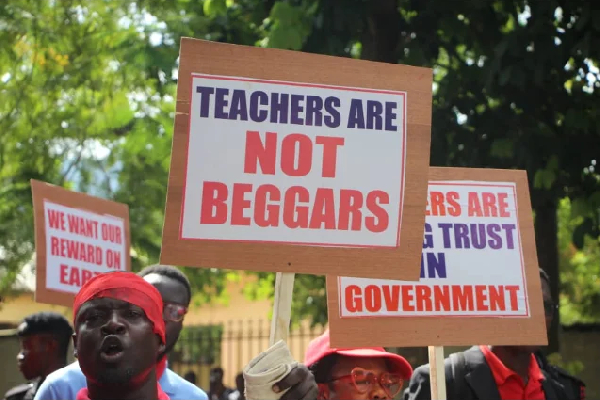
The Ghana Education Service (GES) has warned teachers that abandoning their duty posts to petition at its headquarters or grant media interviews during official school hours will attract sanctions.
Management of the Service says it has observed a growing pattern where some teachers, particularly newly recruited staff, leave their schools to gather at the headquarters, form splinter groups, or engage the media about their concerns during working hours.
“Management of the Ghana Education Service (GES) has observed a growing trend in which some teachers, particularly newly recruited staff, frequently besiege the Headquarters, form unrecognized splinter groups, or engage the media regarding their concerns,” the statement said.
GES cautioned that teachers who leave their duty posts during official school hours to participate in such activities will be treated under the disciplinary provisions of its Code of Conduct.
“Any teacher who leaves their duty post and is found at the Headquarters or elsewhere during official school hours, or who is captured on video or audio granting media interviews or participating in related activities during such hours, shall be treated under ‘Absence from Duty’ as stipulated in the Code of Conduct. The appropriate disciplinary procedures outlined in the Code will be fully applied.”
The Service emphasised that staff concerns must be addressed through the established administrative channels rather than through confrontational approaches directed at the headquarters or the media.
It noted that teachers are expected to first present their concerns to their Heads of School before escalating them through the District and Regional Directorates when necessary.
GES also assured staff that their welfare remains a priority and reaffirmed its commitment to addressing legitimate concerns through structured engagement and due process.
The Minister for Employment and Labour Relations, Abdul-Rashid Pelpuo, has stated that the salary delays affecting thousands of nurses, teachers, and junior doctors are due to lapses under the previous New Patriotic Party (NPP) administration.
Speaking to the media on Wednesday, October 8, Dr. Pelpuo blamed the NPP’s poor recruitment practices and fiscal indiscipline for the current plight of nurses and doctors.
“The situation is currently unfair, but it is a culmination of events that took place in the last regime before the current regime took over. People were engaged to work without due process. For you to work and be paid, you need clearance to show that there is money in the account and that your employment has been approved. That didn’t happen in this respect,” he said.
Ghana, in recent times, has witnessed several protests from government employees, specifically, teachers, nurses, and doctors. According to him, the former government handed over a poorly planned budget that didn’t make room to pay nurses, teachers, and doctors.
As such, he called the protesting groups to call for calm as the ruling National Democratic Congress (NDC) administration will work to rectify the situation.
“We are taking it up very seriously, and I can assure the nurses, teachers, and junior doctors who are caught up in the process that we are going to respond to them before the end of the year,” he stated.
On Tuesday, September 30, Newly Posted Teachers group, comprising of graduates from Colleges of Education and universities submitted their petition to the Finance Ministry, which calls on the government to clear debts owed them.
The group initially declared their intention to hit the streets over salaries owed them on Tuesday, September 23. However, speaking to Citi News, the group’s Lead Convener, Simon Kofi Nartey, noted that the Ministry of Education and other relevant authorities are yet to respond to their earlier petitions, thus rescheduling the protest to September 30.
Simon Kofi Nartey called on the government to settle their 12 months and 8 months, respectively, within the given ultimatum. According to him, the group will have no option but to hit the streets if the government does not treat their demands with urgency.
“It is rather unfortunate that, as we speak, nothing has been done about the concerns we raised at our press conference. We have no option but to take to the streets to let Ghanaians know what is happening. We have already met with the Greater Accra Regional Police Command and agreed on September 30 for the demonstration,” he said.
Also on October 3, the Junior Doctors’ Association of Ghana (JDA-GH) declared its intention to withdrawn nationwide over unpaid salaries and alleged untreatment from the government.
However, the group made U-turn over its nationwide strike, which was expected to commence on Tuesday, October 6. The decision to suspend the withdrawal of services follows constructive discussions with the Ministry of Health (MoH) and other key stakeholders.
This was contained in a press statement issued by the Association’s leadership on Monday, October 6.According to the statement, “After careful consideration and following assurances from the Ministry of Health and relevant stakeholders, the Association has decided to suspend its planned industrial action to allow for the full implementation of the agreed resolutions”.
The group lamented that over 200 junior doctors have been left unpaid for 10 to 14 months. According to the Association, some medical officers have been suspended without explanation, even though they were previously on the government payroll.
It also emphasized that more than 800 medical officers are yet to be assigned to hospitals despite numerous engagements with authorities on the matter.
“Despite goodwill shown towards the government, no solutions have been offered. The continued exploitation of junior doctors will no longer be tolerated,” the statement read.
On Thursday, October 2, the Coalition of Unpaid Nurses and Midwives staged a protest to register similar sentiments. Over 7,000 nurses and midwives who gathered at the Ministry of Finance and the Ministry of Health lamented over working without salaries for nine to ten months.
Convenor of the coalition, Stephen Kwadwo Takyiah, described the situation as unfair and unsustainable. Adding, “We are not comfortable hitting the streets, but it has become necessary. We are citizens, trained as professional nurses and midwives from nursing training colleges and universities.
“We graduated in 2020, completed our rotations, and waited at home for three years. In July 2024, the Ministry of Health announced it had secured financial clearance from the Ministry of Finance for our employment.
“The portals were opened, we registered, and by October 2024, we received postings and reported to work in December. Out of the 15,000 announced, about 13,000 took up postings.
“But in April 2025, only some of our colleagues started receiving salaries. As we speak, just over 6,500 have been paid, while nearly 7,000 of us have worked for close to 10 months without pay”.
In response, the Minister for Health, Hon. Kwabena Mintah Akandoh, urged the group to exercise patience, as the government has taken steps to address their displeasure.
Addressing the aggrieved group on Thursday, October 2, the Minister disclosed that the government will include funds to settle their unpaid salaries in next year’s budget.
Nollywood actress and filmmaker Omotola Jalade-Ekeinde has disclosed that she walked away from several opportunities that could have easily made her a billionaire because they required her to compromise her values.
The award-winning actress said that throughout her career she encountered situations where she could have made enormous financial gains, but chose to protect her principles instead.
Speaking on the Afropolitan Podcast, Omotola explained that her faith and personal convictions have guided many of the major decisions she has taken in life.
“God has tested me many times. I used to tell people that if I wanted to be a billionaire, I would have been one easily. I had been in situations where no one would have known. I would have taken things and compromised my stand, but I would say no and walk away,” she stated.
She indicated that the experiences happened repeatedly during her career and noted that some of the individuals involved in those offers still follow her journey.
“This happened many times and some of these people are even watching me today,” she noted.
Omotola also revealed that some of the offers came from political circles, where she could have received significant financial rewards if she had agreed to compromise her beliefs.
“Even sometimes in politics, where I could have compromised my stand or what I believe in and got paid handsomely for it, but I said no,” she said.
According to her, not all the opportunities were necessarily illegal or outright wrong, but she believed accepting them would have weakened the message and values she stands for.
“Sometimes, they’re not even bad things. They’re just things that could rock your foundation or belief system. Those thoughts start coming that it’s not so bad, but in the long run, you know it would dilute your message and I would have to walk away,” she added.
Veteran actress Omotola Jalade Ekeinde has opened up about trust in her marriage, stating that her husband showed no insecurity after an admirer gifted her a car.
She said on Naija FM, “Women have admirers,” she explained. “Me, who is married, I know how many people have gifted me things, women and men. They’ll just see me and say, ‘Omotola, I’m sending you this.’ They’ve gifted me a car before.”
Responding to the question of whether she attempted to return the gift, Omotola confidently said, “No, why would I return the car?”
She attributed the ease with which such situations are managed to her husband’s self-assurance, noting that he is exceptionally secure in himself.
“Think about it, how would you marry an Omosexy if you’re not secure?” she quipped.
However, the actress rejected suggestions that women do not lead in Nollywood, maintaining that women form the real backbone of the industry.
“Women are the ones who hold Nollywood,” she said, stressing that many female actors are not just performers but also business owners, influencers, producers, and entrepreneurs.
She explained that many actresses she is familiar with operate several businesses in addition to acting, while others also hold full-time jobs.
Last year on social media, Omotola Jalade-Ekeinde celebrated two special milestones—her husband, Captain Matthew Ekeinde’s birthday and their 29th wedding anniversary.
To mark the occasion, she shared a heartfelt video capturing a tender moment between them.
In the clip, Captain Ekeinde showered her with praises, affectionately calling her Nigeria’s hottest.
Omotola, filled with love and gratitude, wrote a touching tribute to her husband, referring to him as “Big Kohuna” and “HoneyBoy.”
Reflecting on their nearly three decades together, she expressed pride in calling Captain Ekeinde her own, describing him as a humble, joyful, and honorable man.
She also appreciated the years of support, laughter, and peace they have shared, looking forward to many more to come.
Her post has since attracted a wave of congratulations from fans and fellow celebrities, who admire the couple’s enduring love and commitment.
In 2024, she s “Omosexy,” celebrated her 46th birthday today, February 7, 2024, with joy and gratitude.The celebrated actress shared a heartwarming snapshot from her recent birthday photoshoot on Instagram, accompanied by a thoughtful caption expressing her excitement.
In her post, Omotola reflected on the unpredictable nature of life, stating, “The race is not to the swift, nor the battle to the strong, nor bread to the wise, nor riches to men of understanding, nor favour to men of skill. But time and chance happen to them all. Thank you, Lord for +1.”
The actress received an outpouring of congratulations and well-wishes from fans, followers, and fellow celebrities.Actor Chidi Mokeme showered her with praise, saying, “Oh My Goodness!!! Who let this goddess out of the fortress? O’Sexy! Happy Birthday My Love. Keep blazing the trails. Have Fun and Enjoy Ur Moments Queen.”
Other celebrities, including Osas Ighodaro, Chizzy Alicia, and Adesua Etomi, joined in the birthday celebrations with heartfelt messages.
Leading up to her special day, Omotola had been sharing her excitement on social media. On February 4, 2024, she posted a humorous video, exclaiming, “The way I’m looking at Everyone Acting like they Don’t know my Birthday is on the Moses Crossing, 7th of FEBRUARY!!! It’s Aquarius Season! Who’s got Gifts for meh!”
In 2023, Omotola shared the secret of the success of her marriage in an interview with Potpourri and some other news outlets.
Omotola has been married to Captain Matthew Ekeinde for 27 years, having been married at the age of 18. Unlike many of her colleagues who could not hold together in a marriage, Omotola’s has become a model from which many entertainers could borrow a leaf.
She preaches tolerance, submission, and understanding, adding that the greatest mistake a woman can make is to claim equality with her man.
“A woman must know her place and submit to her husband. The greatest mistake a woman can make is wanting to stand shoulder to shoulder with her man. When you show submission your man will respect and adore you for it, she echoes.
Omotola also gave a picture of the understanding that exists between her and her husband, which to many African couples and parents would have seemed inappropriate.
“I always tell people that women are stronger than men, psychologically. Let me tell you something more, my husband is actually the one who goes to the market. I don’t go to the market because I can’t. Because of my status, I can’t. But my husband didn’t say you know traditionally, a man is not supposed to go to the market, I’m not gonna go, no. My husband actually goes to the market, she has revealed much to the disbelief and outrage of so many.
“Earlier in my career, I used to go with him but I’d stay in the car, because our cars are tinted, so I’d stay in the car. But then, one time we went to Tejuosho and someone found out I was in the car. It became a major security risk, so he said don’t ever go with me again. He goes and he has fun and he comes back home, and I do the cooking, so you see we strengthen each other,” she had added.
Omotola had also confessed that not many men would have been able to stand her personality, adding she probably wouldn’t have married if she had not been so lucky to have had somebody like Captain Ekeinde.
She said, “ I don’t think there is a man that can handle me apart from my husband. Not because I am a bad person, it is because I have a very strong personality. I can understand why a lot of female artists find it very difficult to find the right person. When you achieve some kind of success, you become really confused as to who really loves you for who you are. It’s not really easy, you know, so it is very hard finding those people who really love you. If you are not a very grounded person ,you too can contribute in some kind of way to your own problems and so I might have contributed to my own problems.”
“Of course, many men have walked the altar with actresses and oftentimes have found out it is not the heaven it promised to be. The time spent away from home on locations is just too much for some spouses to bear. And so is the limelight that comes with all forms of temptations and vices of life. “
When Omotola was asked if her husband had ever complained about her career, it was another revelation moulded in love and understanding.
“No. Never. When I met him I was already an actress. I wasn’t a big star then, if anything, he was the one even encouraging me. To be honest with you, he’s my biggest movie fan. I don’t even watch most of my own movies, he’s the one who buys and watches them. There’s no one movie of mine he has not bought or watched. He doesn’t just watch them, he frames the posters. Most of the posters he framed them in wood and they are all over the house. The posters are framed into wood,” she told Potpourri in an interview.
Interestingly, the mother of four is fondly called by all as Omosexy. But few know the origin of the name. It is another product of long years of love and romance as the actress also revealed in another past interview.
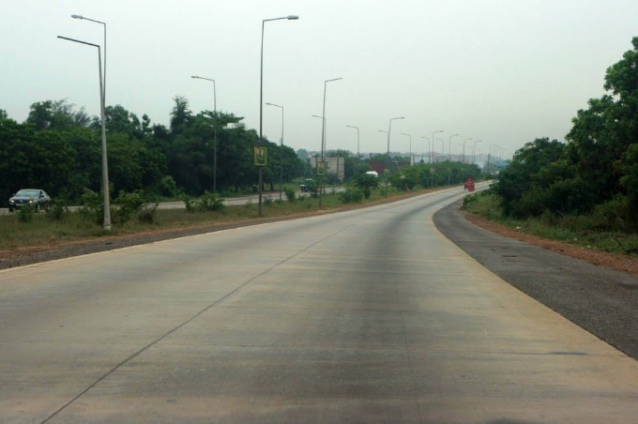
Motorists and commuters experienced long hours of gridlock around the Tetteh Quarshie Interchange after rehabilitation works began in the area.
The project, being undertaken by the Ministry of Roads and Highways, is expected to last four months and has led to temporary road diversions that have reduced available traffic lanes.
The congestion is linked to rehabilitation works along parts of the N1 Highway, particularly the stretch connecting the Accra–Tema Motorway to the Dzorwulu area.
As part of temporary traffic management measures, vehicles travelling from Madina towards Independence Avenue have been diverted onto a three-lane section on the opposite side of the road heading towards Accra.
This arrangement has reduced the usual six-lane dual carriageway to a single carriageway, worsening traffic conditions in the area.
A visit to the scene on Monday, March 9, 2026, showed long queues of vehicles, with many commuters heading to work and other activities stuck in the heavy traffic.
Although personnel from the Motor Traffic and Transport Department were present to direct vehicles and manage the situation, the congestion remained severe.
Parliament has passed the Road Traffic Amendment Bill 2025, giving formal approval for motorcycles, tricycles and quadricycles to be used for commercial transport. Government officials say the move is expected to streamline operations within the transport industry and improve overall road safety.
Approved on Wednesday, December 10, the amendment also adjusts Ghana’s legally permissible alcohol limit for drivers and introduces stricter sanctions designed to curb alcohol-related road offences.
Presenting the rationale behind the changes, the Minister for Transport, Joseph Nikpe Bukari, told lawmakers that the updated law seeks to restore order to a sector that has long faced regulatory inconsistencies.
“The Road Traffic Amendment Bill seeks to sanitise road transport services. We have had several issues involving road users, and this bill aims to introduce stricter punishment, enhance safety measures, and ensure the effective and efficient use of our roads,” he told MPs.
The recently enacted law aims to formalise the operations of commercial riders, especially among the more than one million motorbike and tricycle operators who have worked outside formal regulations for years.
Authorities say the reform will create fresh job opportunities for youth while establishing clearer procedures for licensing, training, and regulatory oversight.
The legislation also revises the legal limit for alcohol levels in drivers.
Parliamentarians argue that the change is vital to ensure enforceable standards and to reduce preventable accidents caused by impaired driving.
Road safety continues to be a critical challenge nationwide. Ghana records roughly 2,000 traffic-related deaths each year, with motorcycles playing a major role in accidents in both cities and surrounding communities.
The Ministry of Transport notes that the new framework will mitigate these dangers through structured rider education, mandatory safety gear, and harsher penalties for violations.
The amendments also complement wider transport sector reforms scheduled for 2025, which include enhanced safety regulations, evidence-based enforcement, and strengthened cooperation among law enforcement agencies.
Following the bill’s approval, the Transport Ministry is set to release operational guidelines for commercial licensing and outline enforcement timelines in the near future.
In July, The Ghana Medical Trust Fund Bill, 2025, also known as MahamaCares, was passed by Parliament.
The Bill, which was laid before Parliament on Monday, July 21, was opposed by the Minority; the caucus warned that it could put a strain on the National Health Insurance Scheme (NHIS) budget and its operations.
It is currently play a pivotal role in enhancing healthcare access for many Ghanaians, particularly those battling chronic diseases and unable to afford the necessary medical treatment.
The Social Protection Bill 2025 intended to aid the establishment of the Social Protection Fund has been successfully passed by parliament.
This will provide a legal framework for social protection programmes that will enhance accessibility and equity in the delivery of social services to the impoverished communities.
“This bill will give legal backing and strengthen regulations of many social intervention initiatives in the country,” the Minister for Gender, Children and Social Protection, Agnes Naa Momo Lartey, said on the floor of Parliament on Thursday, July 31.
The Bill was passed after it faced strong opposition from the Minority in Parliament on Wednesday, July 30, who claimed that the proceedings lacked required quorum.
However, it has paved the way to set up the Social Protection Fund aimed at providing financial resources to tackle emergencies and the mobilisation of funds for social protection delivery.
The programmes include the Livelihood Empowerment Against Poverty LEAP, Ghana School Feeding Programme, Basic Education Capitation Grants, and National Health Insurance Exemption, among others.
The Fisheries and Aquaculture Bill 2025 has also been passed by parliament after taking the Bill through a certificate of urgency on July 16, 2025.
Explaining the purpose of the Bill to the House, the Minister for Fisheries and Aquaculture Hon. Emelia Arthur noted that the Bill had been revised to reflect Ghana’s commitment to the Blue Economy agenda.
She was of the view that this underscores the importance of harnessing marine and aquatic resources sustainably to support economic growth, social inclusion, food security, and environmental protection.
Parliament also passed the University for Development Studies Bill, 2025 after taking the Bill through a certificate of urgency.
Explaining the purpose of the Bill to the House, the Minister of Education, Honourable Haruna Iddrisu noted that the Bill seeks to establish the University for Development Studies(UDS) through the re-enactment of P.N.D.C.L 279.
This, he said, will help to restructure and empower the University for Development Studies to provide quality and higher education to meet the diverse and development needs of the country.
Presenting the report of the Committee to the House, the Chairman of the Committee, Honorable Peter Nortsu-Kotoe, indicated that the Committee acknowledges the significant structural changes that have taken place since the establishment of the UDS over the past 32 years of its existence.
Accordingly, it has become necessary to review P.N.D.C.L 279 to bring the law into conformity with current policy and best practices adopted in public universities in Ghana.
The Ghana Police Service has intensified investigations into several previously reported high-profile cases involving murder, disappearance and violent deaths across the country.
The move forms part of efforts by the Criminal Investigations Department (CID) to revisit unresolved cases that attracted significant public attention.
Speaking at a press briefing on Monday, March 9, 2026, the Director-General of the CID, Lydia Yaako Donkor, said the Department’s Cold Case Unit has taken over a number of the cases and is reinvestigating them using renewed resources, fresh intelligence and forensic support.
“The Criminal Investigation Department wishes to inform the public that its Cold Case Unit has intensified investigations into a number of previously reported high-profile cases involving murder, disappearance, and violent death. These cases, which attracted significant public attention at the time of occurrence, are being reinvestigated with renewed resources, fresh intelligence, and forensic support,” she said.
One of the cases under renewed investigation is the disappearance of Paulina Lamisi Akambodipo, the Tamale West Constituency Women’s Organiser of the National Democratic Congress.
Paulina was reported missing on June 12, 2024, and her whereabouts remain unknown despite earlier investigations. The Cold Case Unit has now assumed responsibility for the case and is appealing to the public to volunteer information that could help determine the circumstances surrounding her disappearance.
Another case under review is the murder of Stella Adjoa Potake Donkor, who was found dead in her room at Tema Gulf City on February 11, 2024. Authorities say the circumstances surrounding her death and the identity of those responsible remain unclear.
“Stella Adjoa Potake Donkor was found murdered in her room at Tema Gulf City on 11 February 2024. The circumstances of her death, including the identity of the perpetrators, remain unresolved. The Cold Case Unit is conducting a comprehensive review of all available evidence and witness accounts with a view to bringing the matter to a conclusive legal end,” she indicated.
The CID is also reinvestigating the murder of Anthony Cudjoe Ahiama, an employee of Dizengoff Ghana, who was killed at Oyarifa on September 18, 2024. Investigations into the case had previously stalled but have now been reassigned to the Cold Case Unit to help identify and prosecute those responsible.
Another high-profile case under review is the death of Francis Yaw Frimpong, popularly known as Nana Poley, a supporter of Asante Kotoko Sporting Club.
He was fatally stabbed during a football match involving Asante Kotoko and Nsoatreman FC following a heated altercation with an unidentified individual. The Sunyani CID is currently pursuing leads that could lead to the arrest of suspects in the case.
The CID Director-General further noted that the Cold Case Unit is also reviewing several other unresolved cases not mentioned during the briefing.
“The Ghana Police Service reaffirms that no case of murder, disappearance, or violent crime will be abandoned. Every victim and every family deserves justice, and the Ghana Police Service remains committed to pursuing all available leads with diligence and thoroughness,” she assured.
Six individuals, including five males and a female, are in police custody for their involvement in the murder of a 25-year-old mason, Nelson Anyena, at Mafi Adidome.
He was murdered after he came to stay with his wife after he left his hometown, Wusuta, in the South Dayi District on December 4, 2024.
The suspects Augustina Fiawoyife (21), 31-year-old herbalist Wisdom Hedidor, Courage Bedzo (31), 42-year-old fetish priest Gblor Noah, Yohannes Gblor (27), and John Gblor (40) were apprehended last month.
They have been remanded into prison and police custody, respectively, and are scheduled to reappear on August 8 as investigation continues.
They were arrested at Blorkorfe and Awakpedome, suburbs of Adidome in the Central Tongu District, by the Volta Regional Police Command.
Per preliminary police investigations, Augustina Fiawoyife, the girlfriend of Wisdom Hedidor, was tasked by her boyfriend to lure Nelson Anyena to a location.
At about 8:00 pm on December 4, Augustina lured the deceased to a secluded location through a phone call under the pretense of having an amorous discussion with him.
Nelson Anyena, upon arrival, was attacked and strangled to death by Wisdom Hedidor and Courage Bedzo.
After the act, Wisdom Hedidor and Courage Bedzo are said to have called Gblor Noah, the fetish priest who earlier approached them to get him a dead body for a ransom, to tell him that they had succeeded in getting him his request.
Noah Gblor and his two brothers, Yohannes Gblor and John Gblor, met Wisdom and Courage and made a payment of Gh¢7000 which they charged, and thereafter, took the body to the shrine at Blorkope.
The police on July 3 obtained an exhumation order from the Ho Magistrate Court 1 to exhume the body of Nelson Anyena as part of investigations.
On July 7, the police detectives, made up of crime scene experts led by the Volta Regional Crime Officer, Supt./Mr. Omari Mic Boakye, and the Environmental Health Officers from the Ho municipality executed the exhumation order and retrieved the body of Nelson Anyena which was buried under a shrine that belongs to Noah Gblor.
The exercise led to the discovery of two more bodies buried at the same shrine after the alleged ritual business.
The suspected body remains of Nelson and the extra two unknown bodies were conveyed to the Police Hospital Mortuary in Accra for preservation awaiting autopsy and DNA profiling.
As the police continue their investigation, the Regional Police Command has entreated the family and close associates of the deceased to remain calm as they pursue justice.
“The Regional Police Command duly appreciates the support of the public in uncovering the heinous crime,” the police added in a statement.
Naa Dode Akaibi I, was the first female ruler of the Ga Kingdom in 1600’s Gold Coast, the present-day Ghana.
She was a Guan and a princess of the Awutu people. Her association with the Ga state was as a result of her marriage to a powerful Ga chief known as Mampong Okai.
She supported her husband under whose reign the Ga state witnessed a significant rise along the coastal areas through the annexation of smaller states during wars and playing middlemen in the gold trade between Europeans and Africans from non-coastal areas.
After the demise of her husband Nii Okai in 1610, custom required their firstborn, Okaikoi, to become the king but he was deemed to be too young to fill the vacuum left by his father.
Determined not to allow the kingship title to leave her family, Nana Dode took the decision to become regent of the Ga State until her son came of age.
Her rule was repugnant to the Ga customary law of succession which only allowed male rulers.
Dode Akaabi became the first female political leader of the Gold Coast who opened a new world of power to her gender.
Some attribute the custom of sitting on stools to Dode Akaabi. Prior to her rule, stools were mainly taken to war and held aloft to lift the spirit of the troops.
She demanded to sit on the war stool to visually symbolize her authority over her people.
She empowered women and forbade men from using the expression “bulu”(fool) in reference to their wives. And when they did, she ordered that a live lion or tiger be captured for her just to deter the men from disrespecting their wives.
She led the Guans comprising the Obutus, Lartehs, Kyereponis, Krachis, Guans, etc to secure many lands including Ayawaso, Nsakina, Ablekuma, Amasaman, etc and even helped the Akwamus in so many wars.
She had her personal war stools situated in places marked in present day Bereku and Larteh.
Naa Dode was buried alive after falling into a pit which she asked to be dug for persons who broke her strict rules.
Ethiopia is testing a new approach to policing with the introduction of unmanned “smart” police stations designed to allow citizens report crimes digitally.
Unlike traditional police stations filled with officers handling paperwork and suspects, the new system relies mainly on touchscreens where visitors can file reports.
At these stations, individuals enter a room equipped with tablets, select the type of issue they want to report — such as a crime, traffic incident, or general concern — and then type in the details of their complaint.
The report is then sent to a police officer at a different location who appears on the screen to continue the conversation and record the statement.
If necessary, patrol officers are dispatched to the location mentioned in the report.
The initiative forms part of the government’s broader digital transformation programme known as Digital Ethiopia 2030, which aims to modernise public services by moving many systems from physical offices to digital platforms.
For now, the smart police station project is still in its early stages. Staff are stationed at the facility to assist first-time users, resolve technical issues, and guide people through the reporting process.
In its first week of operation, the station recorded three cases, including a lost passport, a financial fraud report, and a routine complaint.
However, challenges remain. According to UNESCO, nearly 79 percent of people in Ethiopia still lack internet access, particularly older citizens, low-income communities, and residents in rural areas.
Although traditional police stations remain fully operational, authorities are using the project as a pilot to test whether digital reporting could become a practical option for the future.
The Civil and Local Government Staff Association, Ghana (CLOGSAG) has announced a nationwide strike action, directing all its members within the Civil Service and Local Government Service to stay at home beginning Monday, March 9, 2026, until further notice.
The decision was communicated in a letter dated March 5, 2026, and signed by the association’s Executive Secretary, Isaac Bampoe Addo.
The directive was addressed to the Head of Civil Service and the Head of Local Government Service in Accra, as well as all regional secretaries and members of the association across the country.
According to the notice, the action follows earlier communication from the National Executive Council (NEC) of CLOGSAG regarding its intention to embark on an industrial action.
“As you are aware, the National Executive Council (NEC) of the Civil and Local Government Staff Association, Ghana (CLOGSAG) on Thursday, 19th February, 2026 gave notice of the intention of its members to proceed on an industrial action,” the letter stated.
CLOGSAG indicated that the issues which led to the strike notice remain unresolved, prompting the association to instruct all staff within the Civil Service and Local Government Service to withdraw their services.
“The issues remain unresolved and as a result, all staff of the Civil Service and Local Government Service are enjoined to stay at home with effect from Monday, 9th March, 2026 until further notice,” the statement added.
The association ended the notice with a call for solidarity among its members as it prepares to carry out the nationwide industrial action.
CLOGSAG is one of the major labour unions representing staff within Ghana’s civil and local government institutions, and its strike action is expected to affect administrative services across the country if the impasse is not resolved.
Meanwhile, the latest strike threat comes barely five days after teh Coalition of Unpaid Nurses and Midwives Ghana has urged the government to immediately probe and restore salary arrears it says were removed from its members’ payment vouchers without any payment being made.
In a statement signed by its Convener, Stephen Kwadwo Takyi, the coalition explained that several affected members had their salary arrears validated on the government payroll system each month, although the monies were not paid.
The group noted that during the latest validation in February 2026, the accumulated arrears suddenly disappeared from their payment vouchers.
“We call on the Government of Ghana to act swiftly to investigate this anomaly, restore and pay all unlawfully removed arrears without delay to avoid any action from us,” part of the statement read.
The coalition further stated that when the matter was brought into the public domain, the Controller and Accountant-General’s Department denied the claims.
It, however, maintained that its payroll validators and human resource officers across various health facilities have confirmed that the arrears were cleared from the payment vouchers of the affected nurses and midwives without any corresponding payment.
“Our questions are: who authorized the removal of our legitimately earned arrears and on what legal or administrative basis were these arrears cleared?” the coalition queried in the statement.
This is among several attempts by the Civil and Local Government Staff Association, Ghana (CLOGSAG) to push for the implementation of its agreed conditions of service after earlier warnings and strike actions over the same concerns.
The association gave the government a two-week ultimatum to enforce the agreed conditions of service for its members between June 16 and June 30, 2025.
The directive followed a crunch meeting between government representatives and the National Executive Council (NEC) of CLOGSAG on Thursday, June 12.
At the meeting, members unanimously demanded the full implementation of a revised salary structure and improved service conditions that had earlier been negotiated with the government.
In a statement issued after the meeting and signed by the Executive Secretary of the association, Isaac Bampoe Addo, CLOGSAG urged the Minister for Labour, Jobs and Employment, Rashid Pelpuo, to ensure immediate action on the matter.
“Within two weeks, that is, from Monday, 16th June, 2025 up to 30th June, 2025, CLOGSAG expects a positive response from the government. Failure to initiate implementation, the Association would have no other option than to embark on a nationwide strike,” the statement said.
The association further stressed that the Minister for Labour should ensure the effective implementation of the new salary structure and other agreed conditions of service for its members.
According to CLOGSAG, the conditions are long overdue, warning that any further delays could significantly disrupt public sector operations across the country.
The association has in recent years taken similar actions over the same concerns relating to salaries and service conditions.
On July 3, 2024, CLOGSAG declared a nationwide strike after the government failed to implement a new salary structure that had been agreed upon since January 2023. At the time, the association directed all members to stay away from work indefinitely until the government honoured its commitments.
Another strike followed on November 7, 2024, when the association again withdrew its services after the government failed to finalise the salary structure by October 31, 2024, as previously agreed. CLOGSAG also rejected the government’s proposed January 1, 2025 implementation date, describing it as unrealistic.
During that period, the association accused the Fair Wages and Salaries Commission of acting in bad faith, which led to a complete breakdown in negotiations.
Meanwhile, the latest strike threat comes barely five days after the government reached an agreement with the Ghana Registered Nurses and Midwives Association to end their two-week strike over similar concerns relating to conditions of service and allowances.
RuffTown Records CEO, Bullet, says he faced serious financial challenges while managing the late Ghanaian musician Ebony Reigns.
Speaking in an interview with Nana Romeo on Atuu on UTV, Bullet explained that contrary to public perception, he did not make much money during the early years of the singer’s career.
He said many of the accusations made against him after Ebony’s death were unfair.
“When she was alive, we didn’t make streams. We were not even earning much from the shows we were playing. When she died, a lot of things were said. They wanted to paint a picture that I was misusing her funds. Which money exactly are they talking about?” he questioned.
Bullet also dismissed claims that he had disagreements with Ebony’s father over the musician’s alleged properties.
“They were even saying I was fighting with Ebony’s dad over her properties. Which artiste in Ghana here have acquired properties in two years?” he stated.
According to him, he invested heavily in Ebony’s career before she gained national recognition, including taking loans to support her promotion.
“They have no idea what I went through, but because she was all over, they thought things were smooth. I’m still paying debt till now. I’ve invested a lot of money in her before she was able to get her fame. I took a loan from people just to promote her, but I doubt if people know this,” he added.
If you want, I can also tighten it further into a 25–30 second TV script, which is usually the ideal newsroom length for entertainment stories.
Ghanaian actress Juliet Ibrahim has urged young people to prioritise business knowledge as they advance in life, stressing that understanding investment and financial planning can shape long-term success.
According to the actress in an interview on Joy FM on March 7, 2026, this would be the advice she would give her younger self.
“Knowing what I know now, I would tell my 18-year-old self: ‘You should have done proper investment, taken a proper business course, or gotten a business manager to manage you as a brand at the time,’” she stated.
Reflecting on more than two decades in the entertainment industry, the actress said one of the key lessons she wishes she had learned earlier in her career was how to invest properly as an entertainer.
She explained that when she began her career, many entertainers did not receive proper guidance on how to save or invest for the future.
“One of the things I wish I knew then was how to invest properly as an entertainer because, at the time, we didn’t really have guidance from anyone. We didn’t really have anyone who would say, ‘Let me show actors or entertainers how they can save for the future or invest and become someone in the future.’ From footballers to whoever, if you look down the lane, a lot of people were just living life as it goes,” she said.
She noted that the absence of mentorship and financial education meant many people in the creative and sports industries focused on their careers without clear knowledge about financial planning or long-term investment.
Meanwhile, the actress also indicated that she is open to giving marriage another chance despite the challenges she has faced in her past relationships, explaining that her focus now is on maintaining peace of mind and choosing a partner who truly adds value to her life.
Juliet Ibrahim has revealed that even though she is currently single, she still believes in love and remains open to finding the right partner.
The actress made the disclosure in an interview with Giovani Caleb on Showbiz 360, where she spoke about her relationship status and her outlook on love.
“Yes, I believe in love very much,” she said when asked whether she would give love another chance.
Juliet explained that she is not dating anyone at the moment, noting that the past three years have been focused on personal development and self-improvement.
“I have been working on myself, growing and building myself for the past three years,” she explained.
According to her, stepping away from relationships created the opportunity to focus on her life, career, and personal goals.
Speaking about the qualities she looks for in a partner, the actress said shared goals and a common vision are very important to her.
“I think it’s just having similar goals and vision, and it has to really match up to my status,” she stated.
She added that she has been asked before whether she could date someone under her status, admitting that it would be difficult for her.
Juliet further stressed the importance of intellectual and emotional compatibility in a relationship, explaining that she values meaningful conversations and mutual support.
“When I come back from work or I’m trying to do something, I want to have a conversation with somebody who is impacting and adding value to me. And I also want to add value to him when he is having issues or difficulties in making some decisions,” she said.
“The person has to be a bit like me,” she added.
Juliet Ibrahim was previously married to Ghanaian businessman Kwadwo Safo Junior in 2010. The couple later divorced in 2014.
Since the separation, the actress has kept most aspects of her personal life private. However, her recent comments suggest that while she is currently single, she has not ruled out the possibility of falling in love again.
The actress graduated from Berkeley College in the United States, proudly joining the Class of 2025 as a Bachelor’s degree holder in Marketing Communications.
Celebrating her achievement, she took to Facebook yesterday to express her joy and gratitude as she reflected on the toil that led her to this moment.
“From red carpets to research papers, late-night shoots to late-night study sessions… I DID IT!,” she wrote on Facebook, adding photos of herself beaming with joy and adorned in her graduation gown.
She encouraged her fans that it is never too late to achieve any dream, despite juggling them with other demands of life.
“This is your reminder: You’re never too old to reinvent yourself,” she added. “Cheers to new beginnings, bigger dreams, and breaking every limit.”
Her fans did not hesitate to share in her joy as they flooded her comment session with congratulatory messages, cheering her on to keep advancing in her endeavours.
Juliet Ibrahim is one of the outstanding actresses in Ghallywood and Nollywood.
She is currently featuring in some new movies such as Where Love Ends,” “Ayele, saved by love,” “Deeper than pain,” among others.
She has been an adbvocate for education, women empoerment and mental health awarness.
Juliet made history as first ever female President of Women in Film and Television Ghana (WIFT Ghana).
The actress made this known in a Facebook post with an expression of gratitude and a celebration of what she describes as a personal achievement.
“I’m deeply honored to share that I have been appointed as the first-ever President of Women in Film and Television Ghana (WIFT Ghana) @wiftghana—a monumental step forward for our creative community,” she wrote.
She adds that the opportunity to serve as a woman is pivotal in promoting the agenda of empowering and encouraging women across the globe to pursue and achieve their goals.
“This milestone is not just a personal achievement, but a powerful moment for all women across Ghana’s and Africa’s film, TV, and digital media industries, who continue to break barriers, amplify stories, and reshape narratives both in front of and behind the camera.”
Juliet Ibraghi said WIFT Ghana is now officially part of a worldwide network called Women in Film and Television International (WIFTI)and is also connected to WIFT Africa, which is the regional body.
“WIFT Ghana proudly joins the global network of Women in Film & Television International (WIFTI) and is affiliated with WIFT Africa—strengthening our ties across continents while staying rooted in our local mission: to empower women, create opportunities, and champion inclusion and visibility.”
About WIFT
Women in Film & Television (WIFT) is a global network of non-profit membership chapters made up of more than 40 Women in Film chapters worldwide and over 10,000 members. It is dedicated to advancing the professional development and achievements of women working across all areas of film, television, and other screen-based media.Founded in 1973 in Los Angeles by Tichi Wilkerson Kassel, the organisation expanded rapidly and held its first Women in Film and Television International World Summit in New York City in September 1997.
About WIFT Ghana
WIFT Ghana is a local chapter of Women in Film and Television International (WIFTI), committed to empowering Ghanaian women in film, television, and screen-media-related fields. The chapter aims to achieve this through networking, capacity building, and mentorship.
Meanwhile in the month of May this year, Juliet graduated from Berkeley College in the United States, proudly joining the Class of 2025 as a Bachelor’s degree holder in Marketing Communications.
Celebrating her achievement, she took to Facebook yesterday to express her joy and gratitude as she reflected on the toil that led her to this moment.
“From red carpets to research papers, late-night shoots to late-night study sessions… I DID IT!,” she wrote on Facebook, adding photos of herself beaming with joy and adorned in her graduation gown.
She encouraged her fans that it is never too late to achieve any dream, despite juggling them with other demands of life.
“This is your reminder: You’re never too old to reinvent yourself,” she added. “Cheers to new beginnings, bigger dreams, and breaking every limit.”
Her fans did not hesitate to share in her joy as they flooded her comment session with congratulatory messages, cheering her on to keep advancing in her endeavours.
Juliet Ibrahim is one of the outstanding actresses in Ghallywood and Nollywood.
She is currently featuring in some new movies such as Where Love Ends,” “Ayele, saved by love,” “Deeper than pain,” among others.
She has been an adbvocate for education, women empoerment and mental health awarness.
Ghanaian sound engineer and music producer, Fred Kyei Mensah, popularly known as Fredyma, has expressed disappointment over what he describes as years of neglect by the New Patriotic Party despite his support for the party.
Speaking in an interview on Joy Prime on March 5, 2026, Fredyma said he felt hurt that he had not been considered for opportunities over the past eight years, even though he has been actively involved in politics and the creative industry.
According to him, seeing the support creatives are receiving under John Dramani Mahama’s leadership has made him feel jealous.
“Sometimes, I feel very strongly about certain things. I’m into politics too with my NPP people. For 8 years, whenever they’re travelling, none of them called me because I’m part of the creative industry, so I should join them.
“See what President Mahama has done for Rex Omar and other creatives, I’m jealous of it. I’ve suffered for eight years, but there’s nothing to show for it,” he said.
Fredyma expressed hope that former Vice President Dr Mahamudu Bawumia might remember him if he gets the opportunity to lead the country in the future.
“I hope or maybe if Dr Mahamudu Bawumia comes, he would remember me. It hurts me so bad. The president travels around the world, he takes the creatives along, but excluding me,” he lamented.
The veteran sound engineer also revealed that he had several ideas he wanted to implement to promote Ghana’s creative industry, but were never considered.
According to him, one of his concepts was to visit schools to discover and promote musical talent.
“Someone like me can discover talents for you and you showcase them. I had a concept that we would go to the various schools. I just needed a van, go to them, record Achimota school one song, and put them on social media. All Achimota people in the world will patronise them,” he explained.
Fredyma said he proposed the idea, but it was ignored, adding that similar initiatives are now being implemented.
“I said it to them, but they mind me, but now, President Mahama is implementing it,” he said.
He further lamented that despite being a professional sound engineer, he was rarely contacted to contribute to programs or projects.
“As a sound engineer, there’s no day that they would go for a program and they would ask me to come and fix a mixer,” he shared.
Fredyma noted that creatives often make sacrifices when they support political parties, hoping their contributions will help grow the creative and tourism sectors.
“You can sacrifice for a political party as a creative person, in terms of creativity and tourism is a yardstick for growth. I had a lot of concepts, but none of them was considered. I was neglected and it’s sad,” he added.
Officers from the Preventive Unit of the Ghana Revenue Authority (GRA) Customs Division have intercepted and seized 560 CHANG FANG diesel engines at the Golden Jubilee Terminal at Tema Port, in a consignment authorities suspect was intended for illegal small-scale mining, widely known as galamsey.
The engines were discovered during a routine cargo inspection when vigilant customs officers flagged the shipment for further examination.
Officials said the engines — powerful industrial diesel units often used to power water pumps and dredging equipment at illegal mining sites — had been concealed in a container shipment believed to be headed for unlawful mining activities in parts of the country.
Commissioner-General of the GRA, Anthony Kwasi Sarpong, praised the officers for demonstrating integrity and placing national interest above personal gain.
“Some good behaviour like this from my officers is rewarding and must be recognised by Ghanaians. They chose national interest and preventive duty ahead of personal gains,” he said.
He also indicated that investigations have begun to determine the identity of the importer, the clearing agents involved, and the final destination of the engines.
“We will investigate the importer and the agents involved. Ghana’s ports will not be used as a gateway for equipment that fuels environmental destruction,” the Commissioner-General stated.
The interception forms part of ongoing efforts by authorities to disrupt supply chains that support illegal mining, an activity widely blamed for the destruction of rivers, forests, and other natural resources.
Customs officials at Tema Port have since stepped up cargo screening as government agencies intensify measures to dismantle galamsey logistics networks operating through Ghana’s ports.
The Ghana Police Service arrested 23 suspects involved in illegal mining, as well as disabled and retrieved various mining equipment.
The Sevice has deepened its crackdown on illegal mining through targeted, intelligence-led operations in the Western Region.
In the Wassa Akropong District, police arrested 23 suspects during operations along the Wassa Akropong–Japa–Dadieso road.
The team also extended operations to the Obeng Mining Group site at Wassa Japa, where 64 changfan machines were disabled.
At Wassa Dominase, officers responded to intelligence on illegal mining near the Goil and Energy Oil filling stations along the Agona Amenfi–Gyedua Kesse Junction road.
Seven changfan machines and washing boards were disabled. Three water pumping machines and one pickaxe were retrieved.
In a separate operation in Asankrangwa, police acted on information about illegal mining near the 1D1F building along the Asankra Saah–Asankra Kwabeng road, retrieving three water pumping machines and four motorbikes.
All suspects are in custody assisting with ongoing investigations.
Over 500 arrests have been made from January to May this year in response to efforts to combat illegal mining, locally known as galamsey.
In May, the Ghana Police Service confirmed the arrest of 17 individuals, including seven Chinese nationals and ten Ghanaians, in connection with illegal mining activities in Samreboi, located in the Western Region.
The Central North Police Regional Command’s Special Anti-Galamsey Taskforce on April 7 apprehended five suspects — two Ghanaians and three Chinese nationals — for engaging in illegal mining activities on River Fum at Assin Ayitey, a farming community near Assin Akonfudi in the Assin North Constituency, within the Central North Police Region.
The arrested individuals were identified as Duut Kwabena Sakakba, aged 29; Bismark Asare, aged 36; and three Chinese nationals — Lin Wei, aged 45; Zhao Min, aged 38; and Lu Chen, aged 41.
The effects of illegal mining continue to affect the country adversely. Billions of cedis are lost due to the smuggling of gold by illegal miners. Also, the water bodies and forest reserves are due to the use of mercury, other harmful chemicals, and heavy equipment.
The government has initiated a number of measures to quell the activities of illegal miners in the country.
Excavator owners and operators who have failed to register their machines with the Driver and Vehicle Licensing Authority (DVLA) risk losing them to the state, as the government intensifies efforts to clamp down on illegal mining activities.
To further control the situation, the DVLA, in collaboration with key agencies like the Minerals Commission, National Security, the Ghana Ports and Harbours Authority (GPHA), and the Customs Division of the Ghana Revenue Authority (GRA), has started tagging all newly imported excavators.
Legal small-scale mining sites have also been geo-fenced, with their site coordinates integrated into the Ghana Mine Repository and Tracking software for better oversight.
According to President John Dramani Mahama, the government plans to reclaim 10,000 hectares of mined-out lands from illegal mining activities.
The Inspector-General of Police, Christian Tetteh Yohuno, has ordered an investigation into allegations that some police officers stationed at Kibi were involved in the unauthorised withdrawal of GH¢400,000 from a mobile money agent’s account.
The directive follows the circulation of a viral video on social media claiming that officers may have played a role in the transaction.
In response, the IGP has tasked the Ghana Police Service to refer the matter to its Police Professional Standards Bureau for a full investigation.
Police say the individual believed to be the victim has been contacted and is cooperating with investigators as efforts continue to establish the facts surrounding the incident.
The Ghana Police Service has also assured the public that the investigation will be conducted professionally and transparently, adding that the outcome will be made public once the process is completed.
The development follows a complaint by a mobile money (MoMo) agent who alleged that some police officers attempted to take GH¢400,000 that passed through his account during a transaction linked to an ongoing investigation.
According to the agent, the issue began on December 11 last year when he realised that three SIM cards used for his mobile money business had been blacklisted.
He said he reported the matter to a nearby office of MTN Group, where checks reportedly indicated that the SIM cards had been flagged for investigations, although the reason was not explained to him.
The agent further claimed that shortly after the discovery, some officers from the Kumasi Central Police Station arrived at his MoMo stand and arrested him in connection with an alleged gold robbery case.
He explained that he was later handed over to a CID boss at the station for further questioning.
While at the station, he said police informed him that an individual had earlier visited his MoMo stand and transferred GH¢400,000 through the three SIM cards that were under investigation.
The agent has since expressed concern about how the case is being handled, alleging that some officers are attempting to take the money.
According to the complainant, the officers mentioned in connection with the matter include CID officer Francis Afedzi at Kibi, Crime Officer Osei, and other personnel from Tafo.
He is therefore calling for a proper investigation into the case to determine the origin of the funds and ensure due process.
This is the viral video that prompted Inspector-General of Police Christian Tetteh Yohuno to order the Police Professional Standards Bureau (PPSB) to investigate claims by a Mobile Money agent in the Eastern Region.
Security concerns surrounding mobile money (MoMo) operations had previously been raised by a criminologist at the Kwame Nkrumah University of Science and Technology (KNUST), Dr. Jones Opoku-Ware.
Dr. Opoku-Ware had warned that the way many MoMo vendors operate in open public spaces exposes them to criminal attacks. He explained that the common setup used by small-scale vendors — typically small containers, umbrellas, chairs and tables — makes their financial transactions visible to the public and increases their vulnerability.
“Those small containers and umbrellas with chairs and tables expose their transactions to the public. This is a form of banking, though small-scale, so it should be well covered,” Dr. Opoku-Ware emphasized. “They can get a shop and, if possible, have security on-site.”
He had also called on telecommunications companies to introduce stricter safety requirements for mobile money operators in order to protect vendors and their customers.
According to him, telecom companies should require MoMo vendors to prove that they operate from secured and enclosed spaces that meet basic safety standards.
“The telcos must ensure the vendors can prove they operate in a safe and confined space with adequate security measures in place,” he said. “MoMo is creating a lot of jobs and helping people with their transactions, so it should not be done in open spaces that expose vendors to criminals.”
His comments had come at a time when mobile money services were expanding rapidly across Ghana, offering convenient financial services to many people, particularly in remote communities. However, the growth had also been accompanied by increasing concerns about theft, fraud and attacks targeting vendors.
In one such case in 2023, a police officer, Ernest Agyemang Darko, who was attached to the National Visibility Unit, was arrested for his involvement in a mobile money fraud case.
According to a police situational report obtained by MyNewsGh.com, the officer visited the Kasoa branch of MTN Ghana on November 29, 2023, and conducted transactions amounting to GH¢14,460.
However, he failed to produce the corresponding cash after the transactions were completed. He was later taken to a branch of CBG Bank, where he claimed to hold an account, but the bank had already closed for the day.
The MoMo agent subsequently alerted nearby police officers, which led to his arrest.
In his caution statement, Constable Ernest Agyemang Darko admitted that he had neither cash on him nor funds in his bank account when he carried out the transactions.
He explained that he had proceeded with the transactions because he was under pressure from individuals he owed money to and had also suffered losses through betting.
Meanwhile, MTN had earlier warned against the illegal practice of splitting mobile money cash transactions and encouraged customers to report agents who engaged in such activities.
The company explained that it charges a fixed fee of GH¢10 for withdrawals of GH¢1000 and above at its service centres. However, some agents had been encouraging customers to split withdrawals into multiple transactions in order to collect additional charges.
For instance, a customer withdrawing GH¢3000 could be asked to carry out three separate withdrawals of GH¢1000 each, attracting a GH¢10 fee per transaction instead of a single GH¢10 charge.
Mawuena Agogo, Retail Experience Manager for the Eastern, Volta and Oti regions at MTN, had described the practice as illegal and urged customers to report such incidents to any MTN office or by dialing 100.
“Because such transactions are personal encounters, the system could not capture them, which is why we are urging clients to report them, so the necessary action is taken,” he said.
He added that some agents who had been reported had been sanctioned and ordered to refund the extra charges to affected customers.
Mr. Agogo had made the remarks during a meeting with informal sector clients at Akyem Tafo, where MTN officials engaged customers on fraud prevention and other challenges affecting mobile money users.
Participants at the forum raised several concerns, including high transaction charges, poor network connectivity and fraudulent activities on MoMo platforms.
One trader who attended the meeting complained that she had been charged GH¢40 when withdrawing GH¢4,000 after being asked by an agent to split the withdrawal into four separate transactions.
During the engagement, Georgina Asare-Fiagbenu, Senior Corporate Communications Manager at MTN, urged customers to remain vigilant and avoid responding to unsolicited offers or requests.
She also dismissed claims that MTN agents were directly involved in widespread fraud, explaining that the company’s large customer base often made its users targets for scammers.
“We have more customers than all others, so our customers are easily targeted,” she said.
Customers were therefore advised to exercise caution, as fraudsters could only succeed when individuals complied with their demands or instructions.
The forum also addressed issues such as mobile money education, Ayo insurance, network challenges and other services aimed at improving customer awareness and experience.
Ghana has entered into a debt restructuring deal with Belgium to help strengthen the country’s economic stability.
Finance Minister Dr. Cassiel Ato Forson revealed on Thursday, March 5, that he signed the agreement on behalf of the Ghanaian government, calling it a key milestone in the nation’s ongoing external debt restructuring efforts.
“A while ago, on behalf of the Government of Ghana, I signed a debt restructuring agreement with the Kingdom of Belgium,” he said.
The Minister explained that this agreement is part of a wider initiative by the government aimed at stabilising the economy following the severe fiscal challenges faced in 2022 and 2023.
Dr. Forson reflected on the difficult period the country endured during the crisis, which had compelled the previous administration to declare a debt default.
He added that Ghana is slowly recovering from the crisis and is beginning to show positive signs of economic improvement.
“Today, however, the story is changing. Ghana is recovering and witnessing a significant economic turnaround, while we also put in place stronger systems to ensure we do not return to that point again,” the Finance Minister stated.
Dr. Forson further revealed that the deal with Belgium marks the eighth agreement Ghana has successfully concluded with countries under the Official Creditor Committee (OCC) framework as part of its external debt restructuring programme.
The Finance Minister also acknowledged the Belgian government and its diplomatic team in Ghana for their steadfast support throughout the restructuring process.
“On behalf of the Government and people of Ghana, I expressed my sincere gratitude to the Government of Belgium and to H.E. Carole van Eyll, the Ambassador of Belgium to Ghana, for their support and continued partnership with Ghana,” he said.
France, Ghana’s bilateral creditor, on Friday, July 25, signed an €87.7 million debt relief agreement with the West African country under the Official Creditor Committee (OCC).
France becomes Ghana’s first bilateral creditor to do so after two years of negotiations. Finance Minister Dr Cassiel Ato Forson and Co-Chair of the OCC, Mr William Ross, signed on behalf of the governments of Ghana and France, respectively.
This agreement ensures a hundred percent debt service, as well as a reduction in interest and an extension on maturity.
The Finance Minister expressed immense gratitude to France for standing as a true friend. “It is often said that it is only in difficult times that you see your true friends, and we can say without mincing words that the French Republic came through for Ghana and Ghana is extremely grateful,” Dr Cassiel Ato Forson said.
“Today is a milestone – in the sense that it has taken us some years to get here, but it’s the most significant one that will pave the way for others to this side. Inflation that was once at 54.1 per cent has now come down to 13.7 per cent. We are seeing growth bound to about a five-year high. We are seeing particularly reserves, the external position improving to about four months of import cover, and the primary surplus is at 1.1 per cent of Gross Domestic Product (GDP),” he added.
The sector minister assured that the government of Ghana is “determined to hold the line and sustain the progress we have made year to date, and we believe that in the coming days, Ghana will be able to see investment after the stability.”
Deputy Minister for Finance, Thomas Nyarko Ampem, asserted that the recent agreement is “telling a good story that Ghana is on track.”
On his part, Mr William Ross noted that the economic recovery being made by the government of Ghana is nothing short of impressive and compared the country’s economic performance to other countries such as Zambia.
“We have decided to reduce by 100 per cent as debt service, reduce interest and increase the maturity to give you space for investment, to also negotiate with other creditors and create a real partnership for other stakeholders to contribute to.
“If you look at what we have done for Ghana, it is shorter than what we did for Zambia, but we have continued to improve in the case of Ethiopia… you have been very impressive because you have many people and institutions to engage with,” Mr Ross said.
French Ambassador to Ghana, Mr Jules Armand Aniambossou, highlighted the many initiatives the government has put in place to rectify the many economic challenges it was saddled with. He noted that France holds in high esteem its historical relationship with the West African country. He said Ghana will continue to receive support from France to aid its economic recovery.
“When I came to this country more than two years ago, the country was facing some difficulties. But when your friend or your family is facing difficulties, you have to show that you will not just say, I am sorry, but to take some key actions.
“That is why the French government at the very high level, decided to do. Because we are here today due to the political volunteers from both sides. France decided not to let down Ghana because of our historical relationship and the key role Ghana is playing in our region [Africa],” he stated.
Last year, the government of Ghana reached an agreement on a Memorandum of Understanding (MoU) with its Official Creditor Committee in its debt restructuring efforts.
The OCC, co-chaired by France and China, was instrumental in reaching a debt treatment plan in January 2024.
This paved the way for the International Monetary Fund (IMF) Executive Board to approve the second review of the Fund-supported Post-COVID-19 programme for economic growth (PC-PEG).
The agreement has prevented the government of Ghana from securing more than $250 million in external financing for 2025, and this includes commercial loans, as part of a borrowing ceiling agreed upon.
This served as a structural benchmark to ensure compliance with fiscal discipline as part of the country’s IMF programme.
While presenting the 2025 mid-year budget review on July 24, Finance Minister Dr Cassiel Ato Forson noted that the government’s commitment to fiscal discipline, prudent debt management, and exchange rate appreciation has resulted in significant improvement in Ghana’s debt profile.
He revealed that the public debt reduced from GH¢726.7 billion as of the end of December 2024 to GH¢613 billion as of the end of June 2025. Ghana’s public debt reduced by GH¢113.7 billion in six months.
The sector minister noted that “for the first time in Ghana’s history, there is a negative 15.6% rate of debt accumulation.”
Ghana’s public debt-to-GDP ratio as of the end of June 2025 was 43.8%, down from 61.8% at the end of 2024. Ghana’s public debt as a percent of GDP reduced by 18% in six months. The country’s foreign debt, as a percentage of total public debt, declined from 57.4% as of the end of December 2024 to 49% by the end of June 2025.
“This has significantly improved Ghana’s debt sustainability,” the Finance Minister said while speaking on the floor of the House.
Touching on Ghana’s programme with the International Monetary Fund (IMF), the Finance Minister noted that Ghana remains on track with the implementation of the Programme. He revealed that the government’s commitment to fiscal discipline, prudent debt management and exchange rates has paved the way for a 5th review scheduled for September.
“The 5th Review, which is scheduled for September 2025, will be based on end-June 2025 data. Preliminary data shows that Ghana is on course to achieving most of the targets for the 5th Review. Mr. Speaker, our commitment to fiscal discipline, prudent debt management, and exchange rate appreciation has resulted in significant improvement in Ghana’s debt profile,” he added.
On commercial debt restructuring, the Finance Minister stated that the Ministry has made two debt service payments of about US$700 million to Euro bondholders.
Dr Forson disclosed that beginning in August, the Ministry of Finance will commence the building of cash buffers to support the repayment of Ghana’s domestic debt service obligations relating to the Domestic Debt Exchange Programme bonds, which will fall due in 2027 and 2028.
Nollywood actress Annie Macaulay has taken to social media to set the record straight on how she prefers to be described as a parent.
In an Instagram Story shared on Monday, the actress made it clear that she does not identify with the commonly used label for women raising children on their own.
“I’m not a single mum. I’m a single woman raising two children,” she wrote.
The short but pointed remark quickly sparked reactions online, with many users interpreting it as an attempt to correct what she sees as a misleading description of her situation.
Her statement comes more than a year after Nigerian music star Innocent ‘2Baba’ Idibia confirmed in January 2025 that their marriage had come to an end and that divorce proceedings had begun. The announcement marked the end of one of Nigeria’s most talked-about celebrity unions.
The couple married in 2013 in two separate ceremonies and have two daughters together — Isabel, born in 2008, and Olivia, born in 2014.
Since the separation, 2Baba has moved on and married Natasha Osawaru, a lawmaker with the Edo State House of Assembly. The pair welcomed their first child, a baby boy, in November 2025.
Annie’s latest message appears to underline how she chooses to define her identity while raising her children following the end of the marriage.
In the unfolding drama of love, loss, and reinvention, the name “Idibia” has taken center stage — dropped by one woman, only to be boldly embraced by another.
Annie Macaulay, formerly known as Annie Idibia, has made a striking move — not just on paper but in identity.
She recently reintroduced herself to the world under her maiden name, announcing, in quiet strength, that her chapter with Nigerian music legend 2Baba is over.
Her decision came on the heels of months of speculation, emotional turmoil, and a very public unraveling of a 12-year-long marriage riddled with infidelity rumors and repeated heartbreaks.
The final straw came earlier this year when 2Baba himself confirmed their separation, stating they had filed for divorce. The statement, posted on Instagram, was equal parts personal reflection and public confession.
Yet, just as Annie stepped back, someone else stepped in — loudly.
Natasha Osawaru, a rising political figure and member of the Edo State House of Assembly, has sparked controversy by updating her social media bio to read “Honourable Natasha IDIBIA” — in all caps, no less. The timing was no coincidence. It came immediately after Annie’s name change announcement, and the internet noticed.
Critics were swift, calling Natasha “desperate” and accusing her of disrespect. Many questioned her decision to assume the surname without a known legal marriage to 2Baba, especially so soon after his split with Annie.
But Natasha seems unfazed. She’s been spotted frequently with 2Baba in Benin, attending official functions and public engagements as though cementing her role not just as his partner, but possibly as the next “Mrs. Idibia.” Meanwhile, 2Baba’s mother has broken her silence, expressing concern over her son’s sudden withdrawal from family and suggesting Natasha may have undue influence on him.
While Annie took a much-needed break from the spotlight — reportedly to recover from emotional stress and possible health issues — her return has been graceful. She deleted all her Instagram posts and shared a heartfelt message thanking fans for standing by her.
It’s unclear what lies ahead for any of the trio, but one thing is certain: the Idibia name now carries more weight than ever — not just as a surname, but as a symbol of past love, present controversy, and the uncertain future of Nigeria’s most talked-about love triangle.
Famous Nigerian musician Innocent ‘2Face’ Idibia has revealed that he is separating from his wife, Annie Macaulay, after 13 years of marriage.
Through a social media post, 2Face shared that they had been living separately for some time and felt it was necessary to let his fans know that divorce proceedings were officially underway.
In the Instagram post, which quickly gained attention, he pledged to be open and share all relevant details surrounding their split.
“This thing I have to say is short but also long… Annie Macaulay and I have been separated for a while now and have currently filed for divorce. I will grant a press release soon to share my story—not because it’s anyone’s right to know my personal life, but because I love my people, and I need them to know my innocence or offense. Stay blessed, my people. I love you all.”
The announcement led to mixed reactions from 2Face’s fans and followers.
Shortly after, another post surfaced on the same platform, claiming that 2Face’s account had been hacked and the divorce news was false.
In response, 2Face went live on social media to deny the hacking claim, strongly affirming that he had made the divorce announcement himself and stood by every word.
The situation became even more controversial when, just days before the announcement, 2Face was seen with an unidentified woman at a club, sparking further rumors about his personal life.
Meanwhile, Annie has yet to respond to the announcement.
The couple, who have been together for 24 years and married for 13, share two children.
Ghanaian actress and film producer Juliet Ibrahim has revealed that even though she is currently single, she still believes in love and remains open to finding the right partner.
The actress made the disclosure in an interview with Giovani Caleb on Showbiz 360, where she spoke about her relationship status and her outlook on love.
“Yes, I believe in love very much,” she said when asked whether she would give love another chance.
Juliet explained that she is not dating anyone at the moment, noting that the past three years have been focused on personal development and self-improvement.
“I have been working on myself, growing and building myself for the past three years,” she explained.
According to her, stepping away from relationships created the opportunity to focus on her life, career, and personal goals.
Speaking about the qualities she looks for in a partner, the actress said shared goals and a common vision are very important to her.
“I think it’s just having similar goals and vision, and it has to really match up to my status,” she stated.
She added that she has been asked before whether she could date someone under her status, admitting that it would be difficult for her.
Juliet further stressed the importance of intellectual and emotional compatibility in a relationship, explaining that she values meaningful conversations and mutual support.
“When I come back from work or I’m trying to do something, I want to have a conversation with somebody who is impacting and adding value to me. And I also want to add value to him when he is having issues or difficulties in making some decisions,” she said.
“The person has to be a bit like me,” she added.
Juliet Ibrahim was previously married to Ghanaian businessman Kwadwo Safo Junior in 2010. The couple later divorced in 2014.
Since the separation, the actress has kept most aspects of her personal life private. However, her recent comments suggest that while she is currently single, she has not ruled out the possibility of falling in love again.
The actress graduated from Berkeley College in the United States, proudly joining the Class of 2025 as a Bachelor’s degree holder in Marketing Communications.
Celebrating her achievement, she took to Facebook yesterday to express her joy and gratitude as she reflected on the toil that led her to this moment.
“From red carpets to research papers, late-night shoots to late-night study sessions… I DID IT!,” she wrote on Facebook, adding photos of herself beaming with joy and adorned in her graduation gown.
She encouraged her fans that it is never too late to achieve any dream, despite juggling them with other demands of life.
“This is your reminder: You’re never too old to reinvent yourself,” she added. “Cheers to new beginnings, bigger dreams, and breaking every limit.”
Her fans did not hesitate to share in her joy as they flooded her comment session with congratulatory messages, cheering her on to keep advancing in her endeavours.
Juliet Ibrahim is one of the outstanding actresses in Ghallywood and Nollywood.
She is currently featuring in some new movies such as Where Love Ends,” “Ayele, saved by love,” “Deeper than pain,” among others.
She has been an adbvocate for education, women empoerment and mental health awarness.
Juliet made history as first ever female President of Women in Film and Television Ghana (WIFT Ghana).
The actress made this known in a Facebook post with an expression of gratitude and a celebration of what she describes as a personal achievement.
“I’m deeply honored to share that I have been appointed as the first-ever President of Women in Film and Television Ghana (WIFT Ghana) @wiftghana—a monumental step forward for our creative community,” she wrote.
She adds that the opportunity to serve as a woman is pivotal in promoting the agenda of empowering and encouraging women across the globe to pursue and achieve their goals.
“This milestone is not just a personal achievement, but a powerful moment for all women across Ghana’s and Africa’s film, TV, and digital media industries, who continue to break barriers, amplify stories, and reshape narratives both in front of and behind the camera.”
Juliet Ibraghi said WIFT Ghana is now officially part of a worldwide network called Women in Film and Television International (WIFTI)and is also connected to WIFT Africa, which is the regional body.
“WIFT Ghana proudly joins the global network of Women in Film & Television International (WIFTI) and is affiliated with WIFT Africa—strengthening our ties across continents while staying rooted in our local mission: to empower women, create opportunities, and champion inclusion and visibility.”
About WIFT
Women in Film & Television (WIFT) is a global network of non-profit membership chapters made up of more than 40 Women in Film chapters worldwide and over 10,000 members. It is dedicated to advancing the professional development and achievements of women working across all areas of film, television, and other screen-based media.Founded in 1973 in Los Angeles by Tichi Wilkerson Kassel, the organisation expanded rapidly and held its first Women in Film and Television International World Summit in New York City in September 1997.
About WIFT Ghana
WIFT Ghana is a local chapter of Women in Film and Television International (WIFTI), committed to empowering Ghanaian women in film, television, and screen-media-related fields. The chapter aims to achieve this through networking, capacity building, and mentorship.
Meanwhile in the month of May this year, Juliet graduated from Berkeley College in the United States, proudly joining the Class of 2025 as a Bachelor’s degree holder in Marketing Communications.
Celebrating her achievement, she took to Facebook yesterday to express her joy and gratitude as she reflected on the toil that led her to this moment.
“From red carpets to research papers, late-night shoots to late-night study sessions… I DID IT!,” she wrote on Facebook, adding photos of herself beaming with joy and adorned in her graduation gown.
She encouraged her fans that it is never too late to achieve any dream, despite juggling them with other demands of life.
“This is your reminder: You’re never too old to reinvent yourself,” she added. “Cheers to new beginnings, bigger dreams, and breaking every limit.”
Her fans did not hesitate to share in her joy as they flooded her comment session with congratulatory messages, cheering her on to keep advancing in her endeavours.
Juliet Ibrahim is one of the outstanding actresses in Ghallywood and Nollywood.
She is currently featuring in some new movies such as Where Love Ends,” “Ayele, saved by love,” “Deeper than pain,” among others.
She has been an advocate for education, women empowerment and mental health awareness.
Minority Leader Alexander Afenyo-Markin has withdrawn and apologised for allegations he made against the Interior Minister, Mohammed Mubarak Muntaka, over the ongoing security services recruitment exercise.
The retraction was made on the floor of Parliament on Wednesday, March 4, after the First Deputy Speaker, Bernard Ahiafor, referred Mr Afenyo-Markin to the Privileges Committee for possible contempt.
The referral followed a complaint by the Interior Minister, who described the allegations as unfounded and injurious to his reputation.
Mr Afenyo-Markin had earlier claimed that the engagement of a third-party IT firm in the recruitment process amounted to a scam and imposed an unfair financial burden on applicants.
Addressing the House, the Minority Leader clarified his position and formally withdrew the claims.
“Mr Speaker, I will not do that to hurt him or tarnish his reputation, and if the text of my concern reflected so, it is hereby accordingly withdrawn. I assure you that concerns that will arise out of any matter shall be properly brought to his attention,” he stated.
Responding to the apology, Mr Muntaka said the allegations had caused him significant distress due to their seriousness.
“It is painful to be wrongly accused and be labelled differently from the intention that you have, especially when it is connected with heavy wrongdoing. I am heavily hurt and heavily worried, but who am I to say that I will not accept when my colleague comes to apologise? I accept it wholeheartedly,” he said.
He further appealed to the Speaker to have the matter removed from the official parliamentary records.
“My plea is that, if it is possible, it should be expunged from our records so that it will be as though it never happened,” he added.
The management of the Ghana Immigration Service (GIS) has alerted the general public about a fraudulent recruitment scheme being circulated via the website GOLERNERSHUB.COM.
This site falsely claims the opening of a protocol recruitment portal.
The Service has disassociated itself from this false information and reiterated that the “GIS has not engaged any individual, group, or third-party website to conduct recruitment exercises or sell protocol forms on its behalf.”
The GIS’ Intelligence Section, in collaboration with other state security agencies, is currently pursuing credible leads to apprehend and prosecute the perpetrators behind this fraudulent scheme.
The public has been advised to disregard and report any communication or solicitation from GOLERNERSHUB.COM or similar unofficial sources.
“Anyone who engages with such fraudulent entities does so at their own risk,” the GIS warned.
According to the GIS, no official clearance has been given by the government for any recruitment exercise at this time.
The Service has therefore assured the public that advertisement will be made through the appropriate and credible channels, including the national newspapers and its official platforms when recruitment is authorized.
The Ghana Armed Forces (GAF) has joined the many state institutions dispelling claims of ongoing recruitment.
The GAF in a statement said, “the general public is hereby informed that the Ghana Armed Forces is not undertaking any recruitments/enlistments yet.”
The security institution thus noted that any such advertisement or information of any form “is fake and should be ignored.”
The public is thereby urged to be wary of scammers and fraudsters.
“The general public would be informed of any future recruitments/enlistments, which are always placed only in the Daily Graphic and the Ghanaian Times,” the statement added.
Meanwhile, the Ghana Prisons Service has denied advertising the recruitment of personnel as Prison Office Assistants (POAs) under the Youth Employment Agency (YEA).
The attention of the Prisons Administration has been drawn to a flyer circulating on social media that suggests so.
In a statement, the Prisons Service stated that it “strongly disassociates itself from this advertisement as it has no knowledge or information of the content on the flyer and cautions the public to treat this as fake news.”
The Service noted that the public would be notified through reliable media releases as and when it has collaborated with the Youth and Employment Agency for any such initiative.
It therefore stated that “until such announcement is officially made, all such advertisement must be regarded as fake.”
Eleven fire service personnel, including two senior officers have been dismissed from the service over recruitment fraud.
The management of the Ghana National Fire Service (GNFS) announced this in a statement issued on August 5, 2022.
The dismissed officers were involved in various acts of indiscipline ranging from vacation of post to recruitment fraud.
The statement signed by its Public Relations Officer, T. Osafo-Affum, said the “Service would like to assure the general public of its commitment to uphold the highest disciplinary standards and shall always take appropriate disciplinary action against recalcitrant officers.â€
The statement added, Management would also like to encourage the General Public to report any acts of indiscipline against any personnel of the Service or call the Public Relations Department on 0299341436 for any inquires, clarifications or complaints.
Ghana Black Stars jerseys are witnessing a surge in demand as citizens prepare to mark the country’s 69th Independence Day anniversary.
Unlike the usual trend where sales spike during national team matches, this year’s rush is tied to the Independence Day celebration. Many Ghanaians are purchasing the jerseys to wear as a show of patriotism during the historic occasion.
Videos circulating on social media capture large crowds gathered at retail outlets, with some buyers scrambling to secure a jersey before stocks run out. In a few instances, minor scuffles were reported as demand outpaced supply.
Online discussions suggest that a section of the public believes improved economic conditions have made it easier for citizens to participate in the celebration by buying national symbols such as the Black Stars jersey.
Others attribute the enthusiasm to the team’s recent performances, particularly their qualification for the 2026 FIFA World Cup, which has reignited national pride.
Some supporters have also praised the design of the current jersey, describing it as appealing and symbolic.
A number of fans expressed the view that the Black Stars tend to perform better in the kit, a belief that has further driven patronage ahead of the global tournament.
With Independence Day scheduled for Friday, March 6, 2026, the Black Stars jersey is expected to be a dominant feature of celebrations across the country.
Dozens of Ghanaians storm the Accra Central Business District in a rush for the Ghanaian football jersey, ahead of the 69th Independence Day celebrations. pic.twitter.com/JI432cxsrM
This year, the Ghana Black Stars sports jersey is in unusually strong demand in Accra ahead of the Ghana Independence Day celebrations in a few days.
It's a sign of a new wave of patiotism, fuelled by the strong confidence of Ghanaians in the robust economic and development… https://t.co/zMSxDL6Pfz
— Kweku Opoku-Agyemang, Ph.D (@KwekuOA) March 3, 2026
Let's hope it goes beyond the independence celebration, gets deepen so that we can bring back the level of patriotism required for national development
Ghanaian makeup artist and Guinness World Record holder, Roselyn Akosua Mantey, has opened up about the harsh conditions she endured during her Guinness World Record (GWR) makeup marathon attempt.
In an interview on MX24 on March 3, 2026, she explained that the prolonged hours of work took a serious toll on her body and mind, especially during the night sessions.
“At night, it felt like I was in a witch camp. I still had to do the job. My assistant fainted, I got poisoned along the line because of the water and drinks I was taking in between, it was very challenging,” she disclosed.
Roselyn further revealed that exhaustion at some point affected her vision and concentration, but she was determined to press on in line with the strict guidelines governing the challenge.
“At a point, I was hallucinating, and I didn’t see anything. The rules tell you that even if you’re tired or you want to sip water, one hand shouldn’t stop working. I would be using one hand to sip water, and the other hand was working. At a point, I couldn’t see,” she recounted.
According to her, the attempt was undertaken at a time when public interest in marathon-style record attempts had waned due to earlier disappointments.
“At that point, where Ghanaians were not interested in the marathon because there was so much disappointment coming here and there, so mine was just a few circles. I’m happy, the outcome was awesome, and I made it,” she added.
Despite the difficulties, Roselyn said she is proud of the outcome, describing the achievement as a significant milestone in her career.
Celebrity Chef Hilda Baci reached a culinary milestone by preparing the biggest pot of jollof rice in a Guinness World Record attempt.
According to Reports by News Agency of Nigeria (NAN), she completed the exercise on Saturday, September 13, cooking about 200 bags of rice in a 22,619-litre pot, measuring six metres wide and six metres tall, in about nine hours.
Reacting to this, the Minister of Information and National Orientation, Mohammed Idris, said the effort was another demonstration of Nigeria’s global excellence.
He gave the commendation through Dr Olalekan Fadolapo, the Director-General of the Advertising Regulatory Council of Nigeria, at the event venue.
“We encourage more young Nigerians to channel their creativity and talents into ventures that will not only benefit them personally but also contribute to national development and global recognition,” he said.
Adding that her record attempt would inspire a new generation and creatives.
In 2023, the Guinness World Record (GWR) committee said on social media that the Nigerian Chef has been officially recognised as the new record holder for the longest cooking marathon.
Nearly a month after the GWR had looked through the four-day cookathon’s video, the record had been established.
An adjudicator who only went by the name Mark made the announcement in a video uploaded on the official Twitter account of the Guiness World Records on Tuesday. “I can now announce that with a time of 93 hours and 11 minutes, Hilda Baci is the new holder for the Guiness world Records title of the longest cooking marathon,” he said.
The 26-year-old cooked in a makeshift kitchen for four days, starting on Thursday, May 11, and finishing on Monday, May 15, producing almost 100 pots of food, GWR said on its website.
“When I found out, I cried, prayed and screamed,” Bassey told CNN after learning of her record-breaking feat.
“Then I called my mum and we cried some more. I am so happy. Everything and all the hard work was worth it. I said I wanted to be a record holder and now I am. This is for all my team members and for all the hard work,” Bassey added.
Although Bassey cooked for 100 hours, she was penalized for an error in her scheduled rest breaks, according to the world record committee.
“There was a miscalculation when it came to Hilda’s rest breaks, meaning we are unable to award the 100 hours claimed,” the adjudicator said.
The longest cookathon title was previously held by Indian chef Lata Tondon, who cooked for 87 hours and 45 minutes in 2019.
Basey’s record attempt made her star and was so popular that it crashed the GWR site for two days, “due to the immense volume of traffic we received from her legion of loyal fans,” the organization said.
“I also want to thank Nigerians. They are so awesome. The support was so great. We really did something amazing,” Bassey said.
Afua Asantewaa Owusu Aduonum, the Ghanaian women’s rights advocate, journalist, and event organizer, on Friday concluded her captivating singing marathon Guinness World Record attempt after an impressive 126 hours and 52 minutes.
In a Facebook post on December 30, Mr Ablakwa noted that he is excited a courageous woman would step up to break a world record and in so doing, unite Ghanaians.
He wrote: “It’s such a great feeling when a fellow Ghanaian breaks a world record and sets her own record in the process — more so, when it’s a feat achieved by an exceptionally courageous woman from a relatively small country of 32 million people, breaking the Guiness World Record set by Sunil Waghmare, a man from a mighty 1.4billion populated India.
“The patriotic and unifying support from all Ghanaians regardless of artificial strictures must be highly commended. That is testament that when we come together, we are unstoppable and unbreakable.
“I wish Afua Asantewaa a successful reign — may she bring more glory to herself and our dear nation, and become an ambassador of great renown.”
While the verification process from Guinness World Record judges is still pending, Ghanaians are anxiously awaiting the official statement.
The suspense intensified when a Ghanaian named Abrantie Kwasi Gyamfi tagged the awarding body in a Facebook post, prompting them that Ghana is ready to join the ranks.
In response, Guinness World Records conveyed:
“Thank you for bringing this to our attention. We are aware of Afua Aduonum’s feat, and we eagerly await the evidence to officially crown her as the world’s new individual singing marathon champion.”
“Hi Abrantie, we look forward to receiving evidence, this event certainly seems to have captured the public’s imagination.”
Below is Ablakwa’s congratulatory message.
Even though my attention has been focused on supervising the rapid construction of resettlement homes for my beloved displaced constituents, I wish to take a moment to congratulate the inspirational Afua Asantewaa Aduonum on her historic sing-a-thon journey.
It’s such a great feeling when a fellow Ghanaian breaks a world record and sets her own record in the process — more so, when it’s a feat achieved by an exceptionally courageous woman from a relatively small country of 32 million people, breaking the Guiness World Record set by Sunil Waghmare, a man from a mighty 1.4billion populated India.
The patriotic and unifying support from all Ghanaians regardless of artificial strictures must be highly commended. That is testament that when we come together, we are unstoppable and unbreakable.
I wish Afua Asantewaa a successful reign; may she bring more glory to herself and our dear nation, and become an ambassador of great renown.
As the country marks Ghana Month, it is impossible to overlook the immense contribution of Efua Sutherland to the country’s literary and cultural development.
Born on June 27, 1924, Efua Theodora Sutherland was a playwright, poet, educationist, and cultural advocate whose work laid the foundation for modern Ghanaian theatre.
She dedicated her life to developing authentic African literature and storytelling rooted in Ghanaian traditions.
Efua Sutherland was a strong believer in using drama and literature as tools for education and social transformation.
Some of her most notable plays include ‘The Marriage of Anansewa’ and ‘Edufa’, which combine traditional Ghanaian folklore with contemporary themes.
Through these works, she popularised the character Ananse in modern theatre, helping preserve Ghana’s rich oral storytelling heritage.
She was also a key figure in establishing important cultural institutions in Ghana. She founded the Ghana Society of Writers and played a major role in the development of the Ghana Drama Studio, which later became the School of Performing Arts at the University of Ghana.
Beyond theatre, Efua Sutherland was passionate about children’s education and literacy.
She advocated strongly for children’s literature and community libraries, believing that reading and creativity were essential to national development.
Her influence extended beyond Ghana, as she collaborated with African writers and intellectuals during a time when the continent was redefining its identity after colonial rule.
Efua Sutherland passed away on January 21, 1996, but her legacy continues to inspire generations of writers, playwrights and creatives in Ghana and beyond.
The Electricity Company of Ghana (ECG) has launched investigations into complaints from customers regarding unusually high power consumption, particularly from prepaid meters.
In a statement signed by Director of Communications, William Boateng, ECG emphasized that all electricity meters are carefully tested and calibrated to meet both national and international standards.
“Our meter testing laboratory is state-of-the-art and comparable to leading facilities worldwide. In addition, every meter is independently tested and certified by the Ghana Standards Authority before deployment,” the company said.
Despite this, ECG acknowledged that some customers may have legitimate concerns about their bills. Acting on directives from the Honourable Minister for Energy and Green Transition, the company has begun reviewing all complaints.
To strengthen transparency, ECG has requested the Ghana Standards Authority (GSA) to conduct independent, random testing of meters both in the laboratory and in the field. The results will be incorporated into a comprehensive report submitted to the Minister.
William Boateng, Director of Communications at ECG, said, “We remain committed to responsive, transparent, and accountable service delivery and appreciate the continued support and cooperation of our customers and stakeholders.”
The Communications Director of the Electricity Company of Ghana (ECG), William Boateng, has asserted that heat conditions, wiring and earthing are most likely contributing factors to excessive electricity consumption affecting its customers.
This was in response to concerns from sections of the public who have made claims of being overcharged and that their prepaid credit no longer lasts as long as before.
In an interview on Adom FM’s morning show Dwaso Nsem, Mr. Boateng advised customers to frequently check for possible electrical faults in their homes.
“When the heat increases, someone can even double the use of cooling appliances. That alone can affect your consumption. Sometimes the issue may be with wiring or earthing. That is why we have certified electrical contractors who can check whether there is leakage or any fault affecting consumption,” he said.”
Mr. Boateng urged customers who notice irregularities in their billing to report them directly to ECG for investigation, so that engineers can inspect the meter, review consumption patterns, and identify the cause of the problem.
“We work with machines; it is not about defending anything. There could be a margin of error. If your bill exceeds what you expected or your credit finishes unusually fast, report it to ECG,” he urged, adding that, “When customers report, we can properly investigate, analyse the situation, and resolve it if there is a genuine problem,” he assured.
Last year, the Director-General of the Ghana Standards Authority (GSA), Professor Alex Dodoo, warned of the dangers associated with uncalibrated electricity meters which were in use nationwide.
These uncalibrated metres being utilised by the Electricity Company of Ghana (ECG), he said, did not guarantee the protection of consumers and also are not able to hold industry accountable for fair charges.
Calibration of meters ensures that energy usage is measured accurately, preventing overbilling or underbilling for consumers.
His comments came amid growing public concerns of overbilling, inconsistent power supply, and inefficiencies in the power-producing company’s services.
Speaking at a stakeholder conference organized by the International Electrotechnical Commission yesterday, May 20, 2025 in Accra, Prof. Dodoo revealed that many ECG meters in circulation had not been calibrated or verified by the Ghana Standards Authority, as has been mandated by the National Instrumentation Regulation NI2413.
“Very few of our meters have been calibrated and verified by the GSA. If the meter you are using has not been calibrated or verified by the Ghana Standards Authority, as required by NI2413, its accuracy is questionable. We simply cannot vouch for it,” he said.
Prof. Dodoo said meters not being calibrated put consumers at risk of under- and overbilling.
The NI2413 law mandates that all electricity meters in circulation must be calibrated and verified by the GSA to ensure accuracy, fair billing, and energy efficiency.
Additionally, the Weights and Measures Decree, NRCD 326 of 1975, empowers the GSA to oversee legal metrology, ensuring that measuring instruments used in trade and industry meet standardized accuracy requirements.
However, to resolve this, he mentioned that his outfit is currently working with the ECG and Public Utility and Regulatory Commission (PURC) to configure the millions of meters currently in circulation in the country.
“The law states it must be verified and calibrated. Thankfully, we are working with ECG and PURC to ensure that all the millions of meters in Ghana are properly calibrated and verified by the GSA,” he noted.
He also linked the issue to national development, emphasizing its importance in the government’s ambition to implement a 24-hour economy.
“And I know it’s a very troubling issue. But as we support the President in rolling out a 24-hour economy, it’s important that we provide the quality infrastructure that will make the 24-hour economy succeed,” he concluded.
In the same year, the government, through the Ministry of Energy and Green Transition, approved the procurement of 200 new transformers for the Electricity Company of Ghana (ECG) to strengthen power transmission and distribution to major cities across the country.
The sector minister, John Abdulai Jinapor, made information public on May 28, 2025 during the opening session of the 18th West Africa Mining and Power Exhibition (WAMPEX) at the Grand Arena and Accra International Convention Centre (AICC) in Accra.
The Electricity Company of Ghana (ECG) made a formal request for 200 new transformers in April 2025, and after barely a month, the government gave the green light for the deployment of the transformers.
“Despite the challenges we inherited, recent reports show that power generation has been very stable” What we need to do is improve the transmission and distribution network. In this regard, I have granted approval to ECG as a matter of urgency to inject about 200 transformers in our major capital cities in order to ensure that we not only generate power but we can distribute power to (sic) consumers effectively and efficiently,” Mr Jinapor said.
Minister Jinapor noted that initial challenges with power generation have been stabilized, and Ghana is now exporting electricity to neighboring countries. The current focus is on improving power transmission and distribution systems.
WAMPEX, the largest forum for mining and power industries in West Africa, attracted over 240 exhibitors from 30 countries and more than 5,000 visitors this year.
The event, however provided a platform for industry professionals, policymakers, and stakeholders to discuss challenges, innovations, and future opportunities.
Multiple award-winning Ghanaian singer Efya has reacted to the release of former convict and televangelist Patricia Asiedua Asiamah, widely known as Nana Agradaa, following her discharge from prison on March 3, 2026.
The singer weighed in after a viral video surfaced online showing a member of Agradaa’s church allegedly under anointing and rolling on the floor during a service. The footage triggered widespread debate on social media about the preacher’s return to ministry.
Efya expressed concern over the development, questioning the conduct of the congregants and casting doubt on whether Agradaa had genuinely reformed after serving her sentence. She suggested that the controversial preacher could repeat her past actions if given the opportunity.
“She’s fitting to do it to y’all again and again… we gon see..!!” she wrote.
Agradaa regained her freedom after serving a revised one-year custodial sentence. On February 5, 2026, she appeared before the Amasaman High Court for judgment in her appeal against an earlier ruling.
The court reduced her initial 15-year hard labour sentence to 12 months on counts two and three. In addition, she was fined 200 penalty units, amounting to GH¢2,400, and ordered to refund GH¢1,000 to her two complainants, alongside fines imposed under count one.
While affirming her conviction, the court described the original 15-year sentence as harsh and excessive and exercised its discretion to vary the punishment. The revised term took effect from July 3, 2025, the date of her conviction, meaning the founder of Heaven Way Champion International Ministry served a total of one year in prison before her release.
Read the post below:
🙄🙄🙄🙄🙄🙄🙄🙄🙄🙄🙄🙄🙄🙄 She’s fitting to do it to yall again.. n again.. we gon see ..!! https://t.co/XbKKhXAZAN
Evangelist Patricia Asieduaa Asiamah, popularly known as Agradaa, of Heavens Way International Ministry, is finally out of prison
A video posted on Facebook on March 3, 2026, by her husband, Angel Asiamah, showed Nana Agradaa at home with him and other relatives, all dressed in white.
He accompanied the video with the caption: “Thank God my wife is finally home.”
Earlier, on February 5, 2026, the televangelist appeared before the Amasaman High Court for a ruling on her appeal.
Following several hours of legal proceedings, the court reviewed her initial 15-year jail term and reduced it to 12 months on counts two and three.
Court document has shown that convicted preacher Evangelist Patricia Asiedua (popularly known as Nana Agradaa), through her lawyers, expressed remorse and begged for her actions in court.
Presiding judge His Lordship Solomon Oppong-Twumasi noted Agradaa’s lawyers informed the court that their client was extremely fearful ahead of the hearing, to the point where she could not sleep at night and was even afraid to attend the final sentencing.
This, among others, he explained accounted for the reduction of Agradaa’s jail term from 15 years to 12 months.
“The Appellant, through her lawyers, showed a lot of remorse to the extent that she was said to have been afraid to attend the sentencing hearing and could not sleep for days.
“Her lawyers then went down on their knees to beg the court to spare the Appellant a custodial sentence, pleading that as a mother with young children, such a sentence would affect not only the Appellant but also her innocent children,” part of the judgment noted.
His Lordship Oppong-Twumasi explained that although five people alleged they had been defrauded by Agradaa, only two individuals were recognised as victims in the case and supported the prosecution. He indicated that the total sum involved was GH¢4,000, and Agradaa had been directed to refund GH¢1,000 to the victims.
The ruling also pointed out that the Circuit Court failed to factor in the 32 days Agradaa spent in custody before sentencing, describing the initial 15-year jail term as unduly severe.
Meanwhile, her lawyer maintains that being labelled an ex-convict does not affect her role or calling as a minister of God.
Background
Agradaa is serving a prison term at the Nsawam Female Prison after an Accra Circuit Court sentenced her to 15 years on July 3, 2025, for charlatanic advertisement and defrauding by false pretences.
She was accused of taking money from church members after claiming she had spiritual powers to double cash. The prosecution built its case on her broadcasts on Today’s TV and posts across social media, where she promoted the scheme and invited the public to an all-night church service with promises of multiplying their money through spiritual means.
Reports indicate that over 1,000 people attended the event and handed over significant amounts of money, but the promise was never fulfilled, leaving several victims in financial difficulty. Agradaa, together with her legal team, later challenged the conviction and made her first appearance before the Amasaman High Court on December 4, 2025.
Appeal
Agradaa, through her lawyers, argued that the trial was unfair, that the evidence did not support the ruling, and that the 15-year sentence was excessive.
On Thursday, February 5, 2026, the Amasaman High Court delivered a landmark judgment, reducing her original 15-year prison term to 12 months.
The ruling means Nana Agradaa will serve a one-year sentence under the revised judgment unless further legal action is pursued.
Last month, the Tema High Court directed evangelist Patricia Asiedua, to pay GH¢100,000 in damages to gospel musician Empress Gifty Adorye following a defamation action.
The decision concluded a legal battle that started in May 2025, when Empress Gifty instituted a GH¢20 million lawsuit, accusing Nana Agradaa of making defamatory remarks about her.
The matter was determined at the Tema High Court “A”, with Justice Janet Marfo presiding, after both parties reached an agreement to resolve the case outside the courtroom.
As part of the settlement, the court further ordered Nana Agradaa to withdraw all claims made against Empress Gifty and render an unreserved public apology.
According to Adom News reporter Mike Two, the ruling effectively brought the dispute between the two personalities to an end.
Nonetheless, Nana Agradaa, has been slapped with a fine of GHS12,000 for displaying nude photos of fellow pastor Emmanuel Appiah Fumum, also known as Osofo Biblical.
She has been further ordered to pay GHS50,000 as compensation to the complainant. Agradaa’s conviction resulted from a plea bargain agreement with the State, concluding a legal battle that had dragged on for nearly three years.
Secondary market trading recorded a strong uptick over the past week, with aggregate turnover increasing by 43.77 per cent week-on-week to GH¢2.98 billion.
Activity was largely concentrated in the mid-section of the yield curve. Bonds maturing between 2031 and 2034 accounted for 40.5 per cent of total traded volumes at a weighted average yield of 12.43 per cent.
The 2027 to 2030 maturities also saw substantial demand, capturing 36.7 per cent of overall volumes at a weighted average yield of 11.99 per cent.
In contrast, the long end of the curve experienced relatively lower participation. Tenors spanning 2035 to 2038 contributed 22.8 per cent of total turnover and cleared at a weighted average yield of 12.81 per cent.
“We expect secondary market activity to remain soft in the near term despite rising liquidity,” Databank Research said.
The research firm noted that the GH¢376.3 million cocoa bond coupon payment due in early March 2026 is expected to inject additional liquidity into the market and provide some support for yields.
Nonetheless, it indicated that investors are likely to remain selective as they review reinvestment strategies ahead of the bond market reopening.
The Government of Ghana on Tuesday announced the reopening of the bond market to raise long-term financing.
On the other hand, a payment of GH¢10 billion in interest has been disbursed by the government under the Domestic Debt Exchange Programme (DDEP) in cash.
This marks the sixth interest payment under the programme and the second time bondholders have been paid entirely in cash. The payment follows the agreed terms outlined in the debt restructuring memorandum.
A statement from the Ministry of Finance read, “The Government of Ghana has paid GH¢10 billion in interest obligations under the Domestic Debt Exchange Programme (DDEP).
This payment marks the sixth coupon settlement under the programme and represents the second full cash payment without any Payment-In-Kind component, reflecting strengthened fiscal capacity and solvency.
“The timely payment sends a strong positive signal to domestic and international investors, reinforces market confidence, and is expected to support Ghana’s credit outlook while enhancing stability within the financial sector, including banks and pension funds”.
Last year August, the Ministry of Finance announced another successful coupon payment of GH¢9,698,815,220.17. under the Domestic Debt Exchange Programme. According to information shared on Minister of Finance Ato Forson’s X handle, the amount was paid on August 19 2025.
He wrote that, with this payment, total disbursements under the Domestic Debt Exchange Programme in 2025 alone now stands at GH¢19.4 billion.
Adding that, the payment demonstrates Government’s unwavering commitment to honouring the terms outlined in the Memorandum of Understanding signed under the exchange programme and is expected to strengthen investor confidence and support fiscal credibility.
He said, in line with the 2025 Mid-Year Fiscal Policy Review, the government has established two dedicated sinking fund accounts—a Cedi Sinking Fund Account and a US Dollar Sinking Fund Account—as mandated by the Public Financial Management Act, 2016 (Act 921), as amended.
These will provide liquidity buffers to ensure the timely redemption of loan obligations, including bonds maturing in 2026, 2027, and 2028.Mr Forson said, government has assured investors and the public that subsequent debt obligations, including DDEP obligations, will be honoured fully and on time.
Earlier this year, President John Mahama instructed the Ministry of Finance to pay all outstanding Domestic Debt Exchange Programme (DDEP) coupons and set aside funds for future payments using the Sinking Fund.Following this directive, the Ministry of Finance released GH₵6.081 billion in cash to DDEP bondholders on Monday, February 17.
In addition, GH₵3.46 billion was credited to bondholders’ securities accounts as part of a Payment-In-Kind (PIK) arrangement, following the terms of the DDEP agreement.
To improve debt management, the government also deposited GH₵9.7 billion into the Debt Service Recovery Cedi Account, also known as the Sinking Fund.
This money will help cover the next five DDEP coupon payments scheduled for July and August 2025.
President Mahama assured Ghanaians that his administration remains committed to meeting all DDEP obligations and rebuilding trust in the economy.
He added that the 2025 Budget Statement will introduce new steps to promote responsible financial management, prioritize key expenses, and improve transparency in government spending.
Despite the economic difficulties inherited from the previous government, the administration is working to stabilize the cedi, reduce inflation, and create jobs.Through careful financial planning, Mahama’s government aims to restore economic stability and ensure that public funds are used efficiently.
The Domestic Debt Exchange Programme (DDEP) is an initiative by the Government of Ghana aimed at restructuring the country’s domestic debt to ensure long-term macroeconomic stability.
The DDEP concluded successfully with the issuance and settlement of new bonds, which have now been listed to serve as the new benchmark securities for the fixed income market.
Coupon and principal payments on the old bonds resumed on March 13, 2023. S&P Global Ratings acknowledged the completion of the DDEP by upgrading Ghana’s local currency sovereign credit ratings from selective default (SD) to ‘CCC+/C’.
The program saw a high participation rate, with the majority of eligible bonds being tendered. The government is now focusing on engaging with external creditors to ensure overall debt sustainability.
The Mahama administration has revoked 541 public sector recruitments, appointments and promotions carried out in the final days of the Akufo-Addo government, following the recommendations of a presidential review committee.
Announcing the outcome at a press briefing on Tuesday, Presidential Spokesperson Felix Kwakye Ofosu said the committee found that hundreds of the processes failed to meet the required standards.
“The committee recommended however that the recruitments, appointments and promotions of five hundred and forty one (541) persons be revoked, because the recruitment processes ended after 7th December 2024 and failed to meet the pass mark. They also did not comply with processes and guidelines, slated or dsesigned to govern that process,” Mr Felix Kwakye Ofosu indicated.
The review was triggered by concerns over a surge in hiring activity after the December 7, 2024 general elections. A presidential committee was subsequently set up to examine the circumstances surrounding the appointments.
According to the spokesperson, 2,080 recruitments, appointments and promotions were reported by institutions when they appeared before the committee. Out of that number, 879 had already been revoked by the institutions themselves, while 1,201 were initially left unrevoked.
He explained that after the hearings, the committee recommended that 1,539 of the recruitments, appointments and promotions be upheld because they complied with the prescribed recruitment and promotion procedures and received appointment letters before December 7, 2024.
In addition, 13 institutions revoked appointments in response to the December 7 directive, while 17 others sought guidance from the Office of the President instead of taking immediate action. Sixteen of the cases presented to the committee were mainly payroll-related issues.
Government officials maintain that the exercise was intended to ensure due process and adherence to established recruitment procedures within the public service, rather than serve as a politically motivated purge.
Kwakye Ofosu criticised the Akufo-Addo administration, accusing it of knowingly pushing through non-compliant appointments and dismissing the incoming government’s calls for consultation.
“The previous government was fully aware that basic requirements were not met in those cases and still went ahead to sanction them,” he said, adding that the exercise was carried out “without malice or ill-feeling towards anyone” and was “a necessary step to uphold the rule of law and ensure accountability.”
President John Dramani Mahama rolled out a new Code of Conduct tailored for political appointees, reinforcing his administration’s focus on ethical leadership and transparent governance.
The code, officially launched on Monday, May 5, 2025, formed a key component of the government’s reforms to instill accountability and uphold high standards of public service across all levels of executive authority.
Designed to cover a wide array of appointees, the code’s definition of “Minister” includes not only cabinet-level officials but also deputy ministers, presidential staffers, CEOs and their deputies in public institutions, members of the Council of State, and other political appointees.
It outlined expected values such as integrity, impartiality, competence, and incorruptibility, and encouraged behavior that can stand up to close public scrutiny.
The publicly available portion of the document detailed procedures for avoiding conflicts of interest, maintaining professional conduct, and preserving the dignity of public office—emphasizing the administration’s commitment to leading by example.
He admonished members of his government to appreciate and uphold the responsibility and expectations that come with being in office.
Speaking at an engagement with the Ghanaian community in Ethiopia on Monday, February 17, 2025, the president also challenged his appointees to live up to the level of public accountability that comes with their positions.
“Those of us in leadership must lead by example; we must be prepared to be held accountable for taking the public trust. As I have told every body, if you accept to serve in the public sector, then you must be prepared to answer to the people because it is the people who put you there; you serve at their pleasure.
“The green letter came with a lot of responsibility and expectation, and I have said that while we hold those who came before us accountable, we should remember that we are also going to be held accountable,” the president said.
The president highlighted some key issues for his government, including amending the constitution, stabilizing the economy, and creating job opportunities for the youth.
“So, amending the constitution, holding people accountable for the public trust, and making sure that we stabilize the economy and create opportunities for our young people to work as quickly as possible, is the task ahead of us. We may not be able to complete that process, but at least I am determined that we lay the foundation and put Ghana on the right track,” the President said.
The second prosecution witness in the SkyTrain trial, Kofi Boakye has told the court that the Board of the Ghana Infrastructure Investment Fund (GIIF) did not give final approval for the Accra SkyTrain project.
Testifying under cross-examination by Victoria Barth, Mr Boakye said that although the Board indicated an intention to participate, no recommendations were obtained from the investment committee, and no final Board approval was issued.
He made the comments during the trial of Prof Christopher Ameyaw-Akumfi, former Board Chairman of GIIF, and Mr Solomon Asamoah, former Chief Executive Officer of GIIF.
Both men face charges of wilfully causing financial loss to the State, intentional dissipation of public funds, and conspiracy to commit a crime.
Referring to Board meetings held on September 5, 2018, and November 19, 2019, Mr Boakye said that while some procedural steps were taken, the process never concluded with final approval.
Mrs Barth questioned the witness about his understanding of “approval,” highlighting portions of his statement where he said, “the board did not approve the Sky Train project” and “the board did not approve the $2 million payment.”
In response, Mr Boakye emphasised that approvals at GIIF follow detailed procedures involving multiple committees and recommendations before the Board grants sanction.
He also rejected suggestions that all requested project documents had been presented to Board members, saying that key documents, including the memorandum of understanding (MoU) and concession agreements, were not tabled at Board meetings and were only reviewed later during interrogation by the National Intelligence Bureau.
Mr Boakye further told the court that Ghana Sky Train Limited had been incorporated by the Chief Executive Officer without the Board’s knowledge, reiterating that the Board had not approved the project.
The cross-examination also examined AI Sky Train Consortium Holdings, which holds 510,000 shares in Ghana Sky Train Limited, and noted the absence of Board representation in the special purpose vehicle, contrary to GIIF’s usual practice of appointing Board members to entities in which it holds equity stakes.
Mr Boakye asked for time to review certain documents to complete his responses, after which the court adjourned proceedings to a later date.
The Accra SkyTrain project was planned as an elevated light rail system intended to reduce traffic congestion and air pollution in Accra.
In 2018, the government signed a memorandum of understanding with the AiSky Train Consortium of South Africa.
Following a feasibility study, both parties in November 2019 signed a Build-Operate-Transfer concession agreement to develop the system at an estimated cost of $2.6 billion, with a projected capacity of 10,000 passengers per hour per direction.
Meanwhile, former Railways Development Minister, Joe Ghartey, blamed the New Patriotic Party government’s failure to fulfil its promise of constructing sky trains in Accra on external factors, particularly financial constraints.
The Essikado-Ketan lawmaker stated that the project, which was expected to ease traffic congestion in the capital, stalled after the details of the contract and the overall cost were disclosed.
Speaking on Eyewitness News, Mr. Ghartey explained that the Railway Ministry’s allocation for the 2018 fiscal year was far below the projected cost of the contract.
“We were approached by South Africans who said they could build the sky trains on a BOT [Build, Operate, Transfer] basis, and the amount of money that they were talking about per kilometer, we did not have it in the budget. What I had been given was a limit of $2 billion and that was supposed to be used for the Tema-Mpakadan railway line and the Western railway line.”
He further noted that the number of years the South African contractor and investors proposed to operate the trains before handing them over to the state discouraged continued negotiations.
“So these people came in 2018 and said they would build the sky trains on the build, operate and transfer basis, and so we signed an MoU with them, and they came back after doing some initial studies and said they are in a position to raise money for the project, and so we should sign a concessional agreement for the trains to be transferred to us after 30 years and that was something we had to look into.”
Mr. Ghartey also explained that the government needed to conduct comprehensive feasibility studies to determine the viability of the project, but this process was disrupted by the outbreak of COVID-19, which prevented the South African firm from travelling to carry out the studies.
“In 2019 and 2020, the world including South Africa was under lockdown, so these people could not come to do the feasibility studies and that is why I decided to focus on the railway and kept the sky trains on hold.”
The Government of Ghana signed an agreement with the South African group, Africa Investment (Ai) SkyTrain Consortium, in November 2018 for the development of the Accra Sky Train Project.
Under the agreement, the consortium was expected to complete extensive feasibility studies within nine months and begin construction by 2020. However, five years later, the project had not commenced.
It later emerged that the US$2 million paid by Ghana in 2019 as a premium to acquire ordinary shares for the project resulted in a net liability.
This was contained in a report by the Auditor General on the Public Accounts of Ghana’s Public Boards, Corporations and other Statutory Institutions for the period ended December 31, 2021.
The report revealed that Africa Investor Holdings Limited incorporated a Special Purpose Vehicle (SPV) in Mauritius to establish Ghana Sky Train Limited for the development of the project under a Design, Build, Finance and Operate concession arrangement.
According to the Auditor General, the Government of Ghana, through the Ghana Infrastructure Investment Fund, paid US$2 million to Africa Investor Holdings Limited as full consideration for 10 ordinary shares at US$1.00 per share in Ai Sky Train Consortium Holdings, the SPV.
This meant that a premium of US$199,999 was paid on each share.
The SPV reported a net liability as of December 31, 2020.
The Auditor General warned that the investment in the SPV could not be recovered if the Accra Sky Train Project failed to obtain the required licences and both Executive and Parliamentary approvals.
“We urged Management to continue to monitor the feasibility and the recoverability of the investment in the SPV and make the necessary provisions based on the outcome of the feasibility studies. Management noted the recommendation for compliance”, the audit report recommended.
Filmmaker and director Fiifi Coleman has joined the growing conversation about the “dark truths” emerging within some beauty pageants in Ghana, drawing on his experience as a judge on several reality shows and pageants.
Speaking on Joy FM on February 28, 2026, he indicated that claims of vote manipulation are minor compared to deeper issues within the pageant space.
“It is funny when people talk about vote manipulation, because that is the least of the issues,” he said.
Coleman recounted instances where judges carefully evaluated contestants during auditions and agreed on those deserving to advance, only for organisers to later release a final list that excluded the very names selected by the panel.
“I have sat in auditions where you are clearly asked to make a choice. Let’s say you bring me in as a judge and I select Person A. We all agree on a list. They take that list to go and make the announcement, and suddenly the person we selected is not even on it. Not that their name was mentioned and dropped. It is simply not there,” he shared.
According to Fiifi Coleman, these incidents cast doubt on how transparent some competitions are and whether judges truly influence the final outcome.
He further described what he considers a disturbing trend, where contestants are allegedly directed to use certain items that are said to be unavailable locally.
He cited an example in which participants were informed that a specific pair of shoes needed for a segment could only be obtained from London, where the organiser is based, and were asked to make payments for it to be imported.
“They will define a specific shoe for a segment and say the shoe is in London because the owner of the pageant is in London. Then they tell the contestant to pay a certain amount of money in Ghana to someone, and when the organiser returns, they will bring the shoe in that size,” he narrated.
Coleman further alleged that some contestants are tasked with going out to “engage” people and raise money, with those who generate the most funds gaining a clear advantage in the competition.
“Why do we send contestants to car washes, claiming they are raising money? After they raise the money, where does it go? Why do we send them to casinos to engage people? And the one “who is able to engage people and bring in the most money is almost guaranteed a top three spot. You can see where this is going,” he added.
While acknowledging that voting is often presented as part of the competition structure, Coleman maintained that he is fundamentally opposed to any pageant or reality show model that ties victory to paid votes.
“It is not just about voting. The voting thing is the least. I’m against any pageant that somebody has to vote to win something. Whatever it is, that somebody has to vote to win something out. I’m against it. If the voting is free, they don’t take money out of anybody’s pocket, just the audience just watching and say, it’s a free vote. I like it. Let’s do it that way,” he concluded.
Beauty pageants and reality TV shows were once regarded as platforms that gave young people voices, visibility and a chance to build their confidence.
For many, these public events promised them opportunities and growth, but over time, some of these spaces have drawn criticisms, with concerns that they now prioritise profit and drama over genuine empowerment.
A former contestant speaks out
A former female contestant of a beauty pageant, who was a victim of some of the dark sides of these concerns, spoke to Joy FM’s Showbiz A-Z on February 28, 2026, detailing some realities she said are kept away from the public eye.
According to her, pageants that were meant to build their confidences instead left them feeling rather demoralised.
The victim, once a beauty queen, said that while they were camped during the contest period, individuals were placed in the house to monitor and intimidate them.
She claimed that contestants were threatened if they failed to strictly follow instructions from the organisers of these beauty pageants.
“But there were people placed in the house who would threaten you, telling you that if you didn’t agree to what they wanted, they would make sure you were kicked out of the competition. Some even threatened your life,” she shared.
Her account paints a troubling picture of fear and pressure, where young women hoping to build careers and confidence instead found themselves navigating intimidation and control.
Forced to chase sponsorship
Beyond the alleged threats, the former contestant detailed what she described as another layer of exploitation: being made to secure sponsorship deals for the show.
She alleged that contestants were transported in groups and dropped off in affluent areas to find potential sponsors, even though sourcing sponsorship was the responsibility of organisers.
“Girls were being put into cars and told to go and find sponsors. We didn’t come into the pageant with sponsors, and no one forced us to join. But once you were in, they would send you out, drop you off, and expect you to secure sponsors and bring in money,” she alleged.
According to her, contestants were told that any funds they secured would support their personal projects and boost their voting chances.
However, she claimed that this was not what happened in practice.
“We were told that the money would be used for our projects and even help with votes. But that wasn’t true. If you managed to convince a sponsor and sign a contract, when you returned, they took everything.
“Sometimes, if you were lucky, they would give you a small portion and tell you to use it for your project. Yet, that was never the original agreement. In fact, we weren’t even supposed to be looking for sponsors in the first place. Still, we did all this in the name of beauty,” she noted.
Her testimony suggests a system where young contestants, eager for recognition and growth, allegedly became unpaid agents raising revenue for organisers under the promise of opportunity.
A producer’s account of reality TV
The concerns are not limited to beauty pageants. A producer of a reality TV show, who requested anonymity, also shared insight into how the system works behind the scenes.
According to him, winning a reality show involves far more than talent alone.
He said that in the early days, producers allegedly selected contestants they could easily control.
“If you were outspoken or overconfident, your chances were slim,” he confessed.
He further explained that reaching the finale could also depend on financial value to the show.
A contestant, he added, might make it to the final stage if they brought in significant money through votes or sponsorship, or if they were exceptionally talented to the point that eliminating them would raise public suspicions.
However, even then, he stressed that victory was not guaranteed.
Organisers, he added, look for contestants who can create drama and attract votes, as controversy and emotional storylines drive audience engagements and revenues.
“A beauty contest finale alone can generate over GH¢300,000, sometimes even GH¢400,000, for a TV station. So, even when a winner receives a car or a trip, the revenue generated from the show often covers those costs, which is more like the winner has paid for those trips and cars with the revenue generated,” he added.
Evangelist Patricia Asieduaa Asiamah, popularly known as Agradaa, of Heavens Way International Ministry, is finally out of prison
A video posted on Facebook on March 3, 2026, by her husband, Angel Asiamah, showed Nana Agradaa at home with him and other relatives, all dressed in white.
He accompanied the video with the caption: “Thank God my wife is finally home.”
Earlier, on February 5, 2026, the televangelist appeared before the Amasaman High Court for a ruling on her appeal.
Following several hours of legal proceedings, the court reviewed her initial 15-year jail term and reduced it to 12 months on counts two and three.
First video emerges of Nana Agradaa reuniting with her family following her release from the Nsawam Medium Security Prison, eight months after her conviction. pic.twitter.com/cWvdOnpbtG
Court document has shown that convicted preacher Evangelist Patricia Asiedua (popularly known as Nana Agradaa), through her lawyers, expressed remorse and begged for her actions in court.
Presiding judge His Lordship Solomon Oppong-Twumasi noted Agradaa’s lawyers informed the court that their client was extremely fearful ahead of the hearing, to the point where she could not sleep at night and was even afraid to attend the final sentencing.
This, among others, he explained accounted for the reduction of Agradaa’s jail term from 15 years to 12 months.
“The Appellant, through her lawyers, showed a lot of remorse to the extent that she was said to have been afraid to attend the sentencing hearing and could not sleep for days.
“Her lawyers then went down on their knees to beg the court to spare the Appellant a custodial sentence, pleading that as a mother with young children, such a sentence would affect not only the Appellant but also her innocent children,” part of the judgment noted.
His Lordship Oppong-Twumasi explained that although five people alleged they had been defrauded by Agradaa, only two individuals were recognised as victims in the case and supported the prosecution. He indicated that the total sum involved was GH¢4,000, and Agradaa had been directed to refund GH¢1,000 to the victims.
The ruling also pointed out that the Circuit Court failed to factor in the 32 days Agradaa spent in custody before sentencing, describing the initial 15-year jail term as unduly severe.
Meanwhile, her lawyer maintains that being labelled an ex-convict does not affect her role or calling as a minister of God.
Background
Agradaa is serving a prison term at the Nsawam Female Prison after an Accra Circuit Court sentenced her to 15 years on July 3, 2025, for charlatanic advertisement and defrauding by false pretences.
She was accused of taking money from church members after claiming she had spiritual powers to double cash. The prosecution built its case on her broadcasts on Today’s TV and posts across social media, where she promoted the scheme and invited the public to an all-night church service with promises of multiplying their money through spiritual means.
Reports indicate that over 1,000 people attended the event and handed over significant amounts of money, but the promise was never fulfilled, leaving several victims in financial difficulty. Agradaa, together with her legal team, later challenged the conviction and made her first appearance before the Amasaman High Court on December 4, 2025.
Appeal
Agradaa, through her lawyers, argued that the trial was unfair, that the evidence did not support the ruling, and that the 15-year sentence was excessive.
On Thursday, February 5, 2026, the Amasaman High Court delivered a landmark judgment, reducing her original 15-year prison term to 12 months.
The ruling means Nana Agradaa will serve a one-year sentence under the revised judgment unless further legal action is pursued.
Last month, the Tema High Court directed evangelist Patricia Asiedua, to pay GH¢100,000 in damages to gospel musician Empress Gifty Adorye following a defamation action.
The decision concluded a legal battle that started in May 2025, when Empress Gifty instituted a GH¢20 million lawsuit, accusing Nana Agradaa of making defamatory remarks about her.
The matter was determined at the Tema High Court “A”, with Justice Janet Marfo presiding, after both parties reached an agreement to resolve the case outside the courtroom.
As part of the settlement, the court further ordered Nana Agradaa to withdraw all claims made against Empress Gifty and render an unreserved public apology.
According to Adom News reporter Mike Two, the ruling effectively brought the dispute between the two personalities to an end.
Nonetheless, Nana Agradaa, has been slapped with a fine of GHS12,000 for displaying nude photos of fellow pastor Emmanuel Appiah Fumum, also known as Osofo Biblical.
She has been further ordered to pay GHS50,000 as compensation to the complainant. Agradaa’s conviction resulted from a plea bargain agreement with the State, concluding a legal battle that had dragged on for nearly three years.
International relations scholar and security commentator, Vladimir Antwi-Danso, has called on the government to swiftly pursue diplomatic and consular measures to safeguard Ghanaians caught up in rising tensions across the Middle East, especially in destinations experiencing widespread flight cancellations and disrupted air travel.
During an appearance on The Pulse on Monday, he underscored the need for Ghana to engage Gulf nations and other allied states to guarantee the protection of its citizens overseas.
“We are seeing flights cancelled all over. Government must liaise with those countries and coordinate with partners to safeguard the safety and security of our people,” he said.
His remarks follow mounting anxiety over aviation security within conflict-affected zones. Several airlines operating within and around the Gulf have halted services amid escalating threats, including possible missile attacks and unstable airspace conditions.
The analyst disclosed a personal concern, noting that his son, who works as a pilot for Qatar Airways, is presently stranded in Qatar due to the suspension of flights.
“No plane flying in those areas has 100 percent assurance that it can fly in or out safely,” he said, drawing attention to the risks confronting both flight crews and travelers.
He further appealed to the Ministry of Foreign Affairs to implement practical interventions to shield Ghanaian citizens, such as closely tracking the security situation in affected Gulf countries, offering prompt consular assistance to those stranded, preparing evacuation arrangements if required, and issuing up-to-date information to keep relatives informed.
In addition, he stressed that Ghana should leverage platforms like the United Nations to advocate for calm and stability in the troubled region.
Escalating tensions in the Middle East have led to the cancellation of flights from Accra to Dubai.
The situation involves reported bombings in Iraq and retaliatory attacks across the region, prompting airlines to suspend services.
Emirates flight EK 788 from Kotoka International Airport (ACC) in Accra to Dubai International Airport (DXB) has been cancelled, and passengers are advised to contact their airlines for rebooking or refund options.
The flight from Accra to Dubai International Airport, scheduled for 7:15 pm GMT on Saturday, 28 February 2026, was canceled at the last minute through a notice.
In response to the ongoing tensions, the Embassy of Ghana Doha, State of Qatar has advised Ghanaians living in the area to exercise caution and remain vigilant during this period.
A press statement from the Embassy of Ghana Doha, State of Qatar read, “Due to missle attack and its impact in Doha, please take shelter until further notice, obtain information from official sources. We urge everyone to stay from military states, remain indoors, avoid crowded areas for any exposure to danger and keep essentials supplies like medication and food”.
This development is expected to significantly impact travelers from Ghana to Asia, Europe, and North America, as Dubai is a major transit hub connecting travelers through the United Arab Emirates.
The ongoing tensions have been linked to the death of Iran’s Supreme Leader, Ayatollah Ali Khamenei.
Ayatollah Ali Khamenei was reportedly killed in strikes by the Unites States (U.S.) and Israel.
Last year, the Minister for Foreign Affairs, Samuel Okudzeto Ablakwa, warned the Israeli Embassy against maltreating Ghanaian nationals.
Speaking to the media on Thursday, December 11, Mr. Ablakwa noted that Ghana will respond with equal force if any of its citizens are deported.
According to him, “If they deport ten Ghanaians, we will deport ten. If they deport twenty, we will deport twenty. If they deport fifty, we will deport fifty. We are not going to accept this.”
His comments are in response to an incident in which several Ghanaian travellers, including four members of a parliamentary delegation en route to Tel Aviv for an international cybersecurity conference, were detained and deported by Israel Embassy officials.
Mr. Ablakwa narrated, “We were told that the Ghanaian Embassy was uncooperative, but the facts simply do not support that. Out of the six people on the list that Israel provided, one is not even Ghanaian. He is Gabonese. Our embassy had every right to verify the identity of the individuals involved.
“One of the people listed was seriously ill, and Israeli doctors themselves advised that she should not travel until she had recovered. How can you deport someone who is unwell and needs medical attention? Another individual had already been issued a travel certificate, so there was no reason to stop their entry into Israel.”
But in their actions, Israeli officials indicated that six Ghanaians who were supposedly due for deportation failed to provide the necessary details needed by Ghana’s Embassy in Tel Aviv to issue travel certificates.
The matter adds to broader concerns surrounding deportation practices. In September, eleven West African nationals filed two ex-parte applications at the Labour Division of the High Court in Accra, challenging their alleged detention in Ghana after being deported from the United States (U.S).
The eleven individuals include Nigerians Daniel Osas Aigbosa, Ahmed Animashaun, Ifeanyi Okechukwu, and Taiwo K. Lawson; Liberian national Kalu John; Togolese nationals Zito Yao Bruno and Agouda Richarla Oukpedzo Sikiratou; Gambian national Sidiben Dawda; and Malians Toure Dianke and Boubou Gassama.
According to the applicants, they were forcibly transported to Ghana without prior notice. They allege that they were secretly moved from the U.S. detention centers between September 5 and 6 in shackles.
They want the court to temporarily stop them from being deported back to their home countries until the court decides on their case. Their submission further revealed that Ghanaian authorities allegedly confined them in a military facility.
They cited Article 14(1) of Ghana’s 1992 Constitution, which guarantees personal liberty, as well as Article 23, which protects the right to administrative justice. They are arguing that Ghana is violating international law by trying to send them back to countries where their lives or freedom could be at risk.
As a result, they have demanded that the Attorney-General, the Chief of Defence Staff, and the Comptroller-General of the Ghana Immigration Service appear before the Human Rights Division of the High Court with valid reasons. The court has fixed Tuesday, September 23, to hear the case.
Legal practitioner Oliver Barker-Vormawor has announced plans to apply to have the High Court’s decision, which awarded GH₵5.1 million in damages to former National Security Minister Albert Kan Dapaah, set aside, arguing that the process leading to the ruling was unjust.
Reacting to the March 2 judgment in a Facebook post, the activist pointed to what he termed procedural flaws in the way the matter was handled.
He contended that his lawyers were prevented from completing their cross-examination of Kan Dapaah and further alleged that although his witness statement was duly filed, the court declined to consider it before delivering its verdict.
“Of course we will seek to set it aside. But he can take his victory lap,” Barker-Vormawor wrote.
Background of the case
On Monday, the High Court in Accra awarded GH₵5 million in general damages against Barker-Vormawor in favour of Kan Dapaah in a defamation suit.
Additionally, the court imposed costs of GH₵100,000 against the defendant.
In delivering the ruling, Justice (Rev.) Joseph Owusu Adu-Agyeman granted all the reliefs sought by the plaintiff but reduced the compensation from GH₵10 million to GH₵5 million.
Kan Dapaah had initiated the lawsuit over allegations that he attempted to bribe the activist.
Barker-Vormawor had publicly claimed that the former minister, together with certain government officials, met him and offered him money to halt his activism against the administration.
Before the judgment was delivered, his legal team filed an application seeking to relist their Statement of Defence and Witness Statement, both of which had earlier been struck out.
However, the court dismissed the application, describing it as inconsistent with the applicable rules.
Consequently, Barker-Vormawor stood before the court without a recognised defence at the time the judgment was pronounced.
Explaining the sequence of events on Facebook, he stated that following the appointment of his original lawyer as Deputy Attorney General, he sought and obtained an adjournment to secure new representation.
Upon taking over the case, the new counsel requested time to review proceedings and submit a witness statement, but the judge declined the request and directed that cross-examination should proceed.
“He missed Court one day, and when we got the record, the judge had struck out my defense and given a date to give judgement,” Barker-Vormawor wrote.
“We filed a motion to relist the defense and filed my witness statement and that of my other witness. We also filed a motion to arrest judgment. Judge refused it. Went ahead to give Kan Dapaah judgment.”
He further urged members of the public to examine the witness statement he said the court refused to admit into consideration.
“You can read my witness statement; that the court refused to consider if you want!” he wrote.
The Ghana Police Service Accra Regional Command has announced that it is fully ready to guarantee security ahead of, throughout, and after the parliamentary re-run in the Ayawaso East Constituency slated for Tuesday, March 3, 2026.
In a statement issued on March 2, the Command indicated that enough officers have been stationed at all approved polling centres and strategic points within the constituency to safeguard the voting exercise and maintain order.
“The Command has deployed adequate Police personnel across all designated polling stations and key locations to ensure a peaceful, transparent, and orderly electoral process,” the statement signed by Supt Juliana Obeng, Head of Public Affairs for the Accra Region, read in part.
Police officials further assured residents that officers would sustain strong visibility and carry out routine patrols before, during, and after voting to deter any attempts to disturb public safety.
The Regional Command also warned individuals against actions capable of compromising the credibility of the election.
“The Accra Regional Police Command cautions the public against engaging in acts of violence, intimidation, spreading misinformation, or any conduct that may undermine the integrity of the electoral process,” the statement warned.
It stressed that anyone who breaches the law will face legal consequences under the laws of Ghana, underscoring the Command’s resolve to apply the law impartially.
Security officials also called on qualified voters in the area to cast their ballots peacefully and to promptly alert authorities to any unusual or suspicious behaviour.
The re-run in Ayawaso East comes after recent events led to the need for a fresh parliamentary contest in the constituency.
The appeal for restraint and collaboration is being made as constituents gear up to vote on Tuesday.
The National Democratic Congress (NDC) candidate, Baba Jamal, is projected to win in the upcoming Ayawaso East by-election scheduled for Tuesday, March 3, 2026.
According to a new poll by Global InfoAnalytics Baba Jamal will secure about 75% of the votes ahead of his main contender, Baba Ali of the New Patriotic Party (NPP).
The New Patriotic Party’s (NPP) Baba Ali has been projected to trail with 21%, independent candidate Umaru Sanda Muhammed is expected to poll 3% of the vote, with other remaining candidates, Ibrahim Iddrisu and David to garner less than 1%.
The survey was conducted between February 28 and March 1, sampling 972 voters across the constituency.
The EC has scheduled the Ayawaso East by-election for March 3, 2026, the by-election has attracted heightened attention in recent days amid internal developments within the NDC, including allegations of vote buying during its parliamentary primary.
Mr Baba Jamal Mohammed Ahmed won the Ayawaso East Constituency primary and is set to represent the NDC as its parliamentary candidate in the March 3 by-election, following the party’s internal primary held on February 7, 2026.
After the close of polls, provisional results showed that Baba Jamal polled 431 votes out of the total votes cast, followed by the widow of the late Ayawaso MP, Naser Toure Hajia Amina Adam who secured 399 votes. Mr Mohammed Ramne, the Ayawaso East NDC Constituency Chairman, placed third with 88 votes.
Dr Yakubu Azindow obtained 45 votes, while Mr Najib Mohammed Sani recorded one vote.
The closely contested primary attracted more than 1,100 accredited delegates from across the constituency, reflecting the high stakes involved in selecting a candidate for the by-election in a seat widely regarded as a stronghold of the governing NDC.
Five aspirants contested the race: Hajia Amina Adam, Mr Baba Jamal, Dr Yakubu Azindow, who had previously contested the late MP in the 2023 primary, Mr. Mohammed Ramne, and Mr Mohammed Sani.
Although the race was initially considered open, it later narrowed into a tight contest among Mr Jamal, Hajia Amina Adam and Dr Azindow.
Even though the election was peaceful on Saturday, reports of vote buying emerged on the eve of the election and on election day, involving some candidates, including Baba Jamal, who at the time was Ghana’s High Commissioner to Nigeria and allegedly offered television sets and other items to delegates.
Videos circulating on social media showed some delegates leaving polling centres carrying television sets and other items.Reacting to the vote-buying allegations, the NDC, in a statement signed by its Secretary, Fiifi Kwetey, announced that it would investigate the allegations. It noted that a three-member committee had been set up to probe the matter.
In a statement issued on the same day, the NDC said its national executives had taken note of what it described as widespread incidents of inducement and vote buying allegedly perpetrated by some aspirants.
The party condemned the acts, describing them as an affront to its values and principles, and announced that it had launched investigations into the matter.
“In line with the Party’s commitment to internal democracy, transparency, and ethical political conduct, the Committee will investigate the allegations and make appropriate recommendations, including sanctions where necessary,” the statement said.
The Presidency has announced the recall of Ghana’s High Commissioner to Nigeria, Baba Jamal, over voter inducement during the just-ended Ayawaso East primaries held on Saturday, February 7.
In a statement titled “President recalls Ghana’s High Commissioner to Nigeria,” shared by the Spokesperson to the President, Felix Kwakye Ofosu, and dated February 7, it noted that “President John Dramani Mahama has directed the immediate recall of Mohammed Baba Jamal Ahmed (Baba Jamal) from his position as Ghana’s High Commissioner to the Federal Republic of Nigeria.
The decision follows allegations of voter inducement during today’s National Democratic Congress (NDC) primaries in the Ayawaso East Constituency, in which Mr Baba Jamal, a candidate, participated.”
The President stressed that reports of vote buying were made against several candidates seeking to win the Ayawaso East seat, but Baba Jamal stood out because he was the only serving public officer at the time, making his case a peculiar one.
“In his directive to the Minister for Foreign Affairs recalling Mr Baba Jamal as High Commissioner, the President noted that while allegations of vote-buying were made against multiple candidates who contested the primaries, Baba Jamal was the only serving public officer among them.”
Consequently, to protect the integrity of public office and to avoid any public suspicion of misconduct or violation of the Government’s Code of Conduct for Political Appointees, the President stated:
“Without prejudice to the ongoing internal party processes, and strictly in view of the standards of conduct expected of public officers, the President considers it necessary to act decisively to preserve the integrity of public office and to avoid any perception of impropriety or conflict with the Government’s Code of Conduct for Political Appointees.”
The statement continued that “the recall takes effect immediately, and the Minister for Foreign Affairs has been directed to take the necessary administrative and diplomatic steps to give effect to this directive.”
Members of Heaven Way Champion International Ministry are set to welcome Evangelist Patricia Asiamah, popularly known as Nana Agradaa, from prison on Tuesday, March 3, 2026, in a show of faith and solidarity.
To mark the occasion, church members will don a specially printed T-shirt carrying the message “PRAY EVERYDAY”, unveiled by her husband, Angel Asiamah.
The T-shirt has become a symbol of devotion, anticipation, and unity as congregants prepare for her return.
Speaking during Sunday service, Pastor Asiamah confirmed that the church has undergone repainting and minor renovations in readiness for the influx of worshippers. He said seating and arrangements have been made for a modest reception, urging members to remain orderly and focused on the spiritual significance of the day.
Angel Asiamah, visibly emotional, joined members in worship as songs of thanksgiving filled the church. “We are ready to welcome her back and celebrate her release while reaffirming our commitment to the ministry,” he said.
Nana Agradaa’s early release from Nsawam Medium Security Prison follows Ghana’s remission policy. Originally sentenced to 15 years for charlatan advertisement, her term was reduced to one year after a successful appeal.
The “PRAY EVERYDAY” T-shirts have become more than a wardrobe choice; they serve as a visual expression of faith, community, and hope, signaling both the congregation’s excitement and their dedication to the ministry as Nana Agradaa returns.
Court document has shown that convicted preacher Evangelist Patricia Asiedua (popularly known as Nana Agradaa), through her lawyers, expressed remorse and begged for her actions in court.
Presiding judge His Lordship Solomon Oppong-Twumasi noted Agradaa’s lawyers informed the court that their client was extremely fearful ahead of the hearing, to the point where she could not sleep at night and was even afraid to attend the final sentencing.
This, among others, he explained accounted for the reduction of Agradaa’s jail term from 15 years to 12 months.
“The Appellant, through her lawyers, showed a lot of remorse to the extent that she was said to have been afraid to attend the sentencing hearing and could not sleep for days.
“Her lawyers then went down on their knees to beg the court to spare the Appellant a custodial sentence, pleading that as a mother with young children, such a sentence would affect not only the Appellant but also her innocent children,” part of the judgment noted.
His Lordship Oppong-Twumasi explained that although five people alleged they had been defrauded by Agradaa, only two individuals were recognised as victims in the case and supported the prosecution. He indicated that the total sum involved was GH¢4,000, and Agradaa had been directed to refund GH¢1,000 to the victims.
The ruling also pointed out that the Circuit Court failed to factor in the 32 days Agradaa spent in custody before sentencing, describing the initial 15-year jail term as unduly severe.
Meanwhile, her lawyer maintains that being labelled an ex-convict does not affect her role or calling as a minister of God.
Background
Agradaa is serving a prison term at the Nsawam Female Prison after an Accra Circuit Court sentenced her to 15 years on July 3, 2025, for charlatanic advertisement and defrauding by false pretences.
She was accused of taking money from church members after claiming she had spiritual powers to double cash. The prosecution built its case on her broadcasts on Today’s TV and posts across social media, where she promoted the scheme and invited the public to an all-night church service with promises of multiplying their money through spiritual means.
Reports indicate that over 1,000 people attended the event and handed over significant amounts of money, but the promise was never fulfilled, leaving several victims in financial difficulty. Agradaa, together with her legal team, later challenged the conviction and made her first appearance before the Amasaman High Court on December 4, 2025.
Appeal
Agradaa, through her lawyers, argued that the trial was unfair, that the evidence did not support the ruling, and that the 15-year sentence was excessive.
On Thursday, February 5, 2026, the Amasaman High Court delivered a landmark judgment, reducing her original 15-year prison term to 12 months.
The ruling means Nana Agradaa will serve a one-year sentence under the revised judgment unless further legal action is pursued.
Last month, the Tema High Court directed evangelist Patricia Asiedua, to pay GH¢100,000 in damages to gospel musician Empress Gifty Adorye following a defamation action.
The decision concluded a legal battle that started in May 2025, when Empress Gifty instituted a GH¢20 million lawsuit, accusing Nana Agradaa of making defamatory remarks about her.
The matter was determined at the Tema High Court “A”, with Justice Janet Marfo presiding, after both parties reached an agreement to resolve the case outside the courtroom.
As part of the settlement, the court further ordered Nana Agradaa to withdraw all claims made against Empress Gifty and render an unreserved public apology.
According to Adom News reporter Mike Two, the ruling effectively brought the dispute between the two personalities to an end.
Nonetheless, Nana Agradaa, has been slapped with a fine of GHS12,000 for displaying nude photos of fellow pastor Emmanuel Appiah Fumum, also known as Osofo Biblical.
She has been further ordered to pay GHS50,000 as compensation to the complainant. Agradaa’s conviction resulted from a plea bargain agreement with the State, concluding a legal battle that had dragged on for nearly three years.
Ghanaian actor Clement Bonney, popularly known as Mr Beautiful, has expressed concern over the lack of innovation and strategic direction within Ghana’s creative arts agencies.
Speaking on United Showbiz on March 1, 2026, he urged stakeholders in the industry to take a hard look at their own contributions to the sector’s growth.
“I think our creative arts agencies are not being creative enough for our industry,” he said. “We, the creative arts people, are we being creative enough for our industry? Do we even have an industry? Nothing is happening.”
Mr Beautiful highlighted that while Ghana has seen unprecedented support from the government, with the current president openly championing the creative arts for the first time since 1992, industry players have not fully leveraged this opportunity.
“From 1992 to date, this is the first time we are getting a president who loves the creative arts industry. When such a person leaves, we may not get someone like him. That’s because those in the creative arts industry are not doing anything,” he added.
The actor also questioned the clarity of financial support recently outlined in the national budget. “The money that was mentioned, in what way are we going to access it? Is it a loan or a grant? I want to know what the money will be used for,” he asked.
Mr Beautiful’s remarks have sparked conversations among creatives and policymakers, with many industry observers noting that agencies must play a more active role in providing guidance, creating opportunities, and ensuring that government support reaches the right people.
He concluded by urging creatives themselves to be proactive and innovative, emphasizing that the future of the industry depends not only on government goodwill but also on the initiative of its own players.
Court document has shown that convicted preacher Evangelist Patricia Asiedua (popularly known as Nana Agradaa), through her lawyers, expressed remorse and begged for her actions in court.
Presiding judge His Lordship Solomon Oppong-Twumasi noted Agradaa’s lawyers informed the court that their client was extremely fearful ahead of the hearing, to the point where she could not sleep at night and was even afraid to attend the final sentencing.
This, among others, he explained accounted for the reduction of Agradaa’s jail term from 15 years to 12 months.
“The Appellant, through her lawyers, showed a lot of remorse to the extent that she was said to have been afraid to attend the sentencing hearing and could not sleep for days.
“Her lawyers then went down on their knees to beg the court to spare the Appellant a custodial sentence, pleading that as a mother with young children, such a sentence would affect not only the Appellant but also her innocent children,” part of the judgment noted.
His Lordship Oppong-Twumasi explained that although five people alleged they had been defrauded by Agradaa, only two individuals were recognised as victims in the case and supported the prosecution. He indicated that the total sum involved was GH¢4,000, and Agradaa had been directed to refund GH¢1,000 to the victims.
The ruling also pointed out that the Circuit Court failed to factor in the 32 days Agradaa spent in custody before sentencing, describing the initial 15-year jail term as unduly severe.
Meanwhile, her lawyer maintains that being labelled an ex-convict does not affect her role or calling as a minister of God.
Background
Agradaa is serving a prison term at the Nsawam Female Prison after an Accra Circuit Court sentenced her to 15 years on July 3, 2025, for charlatanic advertisement and defrauding by false pretences.
She was accused of taking money from church members after claiming she had spiritual powers to double cash. The prosecution built its case on her broadcasts on Today’s TV and posts across social media, where she promoted the scheme and invited the public to an all-night church service with promises of multiplying their money through spiritual means.
Reports indicate that over 1,000 people attended the event and handed over significant amounts of money, but the promise was never fulfilled, leaving several victims in financial difficulty. Agradaa, together with her legal team, later challenged the conviction and made her first appearance before the Amasaman High Court on December 4, 2025.
Appeal
Agradaa, through her lawyers, argued that the trial was unfair, that the evidence did not support the ruling, and that the 15-year sentence was excessive.
On Thursday, February 5, 2026, the Amasaman High Court delivered a landmark judgment, reducing her original 15-year prison term to 12 months.
The ruling means Nana Agradaa will serve a one-year sentence under the revised judgment unless further legal action is pursued.
The National Agency for the Control of AIDS, NACA, has announced that Nigeria will take delivery of Lenacapavir, a groundbreaking HIV prevention drug that has shown 100% effectiveness in preventing HIV infection in clinical trials.
A short statement released by the Head of Public Relations, NACA, Toyin Aderibigbe, on Monday mARCH 2, 2026 said the agency has secured regulatory approval from the National Agency for Food and Drug Administration and Control.
Adding that, “This is part of the Nigerian government’s commitment to strengthen HIV prevention and accelerate progress toward epidemic control,
Lenacapavir is an injectable treatment administered twice a year, making it a more convenient alternative to daily oral prevention drugs.
The drug is expected to be available in Nigeria and 119 other low- and middle-income countries at an affordable price of $40 per person annually, thanks to voluntary licensing agreements with generic manufacturers.
Nigeria has approximately 1.9 million people living with HIV, with a national prevalence of 1.3% among adults aged 15-49 years.
The country recorded 74,000 new HIV infections and 51,000 AIDS-related deaths in 2021.
The South-South zone has the highest HIV prevalence at 3.1%, while women aged 15-49 years are more than twice as likely to be living with HIV as men.
The Minister of Foreign Affairs, Samuel Okudzeto Ablakwa, has eulogized Baba Sadiq after being appointed as Ghana’s High Commissioner-designate to Nigeria by President John Dramani Mahama.
Honourable Ablakwa made shared information about Baba Sadiq’s appointment on March 1, 2026.
Taking to social media, he wrote, “Congratulations, Baba Sadiq on your well-deserved appointment by President Mahama as High Commissioner designate to the Federal Republic of Nigeria.”
“I have no doubt you will hold aloft Ghana’s flag and make the youth of our continent proud.”
As High Commissioner-designate, Baba Sadiq Abdulai Abu is anticipated to lead efforts aimed at strengthening trade relations, promoting cultural ties and deepening diplomatic collaboration between Ghana and Nigeria.
He will formally assume office once the Nigerian government grants approval and all required diplomatic protocols are concluded.
His nomination comes after the recall of the immediate past High Commissioner, Mohammed Baba Jamal Ahmed, widely known as Baba Jamal.
He was withdrawn from the post on February 7, 2026, following claims of voter inducement linked to his involvement and win in the parliamentary primaries of the National Democratic Congress in the Ayawaso East Constituency.
The Presidency announced a recall of Ghana’s High Commissioner to Nigeria, Baba Jamal, over voter inducement during the just-ended Ayawaso East primaries held on Saturday, February 7.
In a statement titled “President recalls Ghana’s High Commissioner to Nigeria,” shared by the Spokesperson to the President, Felix Kwakye Ofosu, and dated February 7, it noted that:
“President John Dramani Mahama directed the immediate recall of Mohammed Baba Jamal Ahmed (Baba Jamal) from his position as Ghana’s High Commissioner to the Federal Republic of Nigeria. The decision followed allegations of voter inducement during the National Democratic Congress (NDC) primaries in the Ayawaso East Constituency, in which Mr Baba Jamal, a candidate, participated.”
The President stressed that reports of vote-buying were made against several candidates seeking to win the Ayawaso seats, but Baba Jamal stood out because he was the only person who was a serving public officer at the time, making his case a peculiar one.
“In his directive to the Minister for Foreign Affairs recalling Mr Baba Jamal as High Commissioner, the President noted that while allegations of vote-buying were made against multiple candidates who contested the primaries, Baba Jamal was the only serving public officer among them.”
Consequently, to protect the integrity of public office and to avoid any public suspicion of misconduct or violation of the Government’s Code of Conduct for Political Appointees, the President stated:
“Without prejudice to the ongoing internal party processes, and strictly in view of the standards of conduct expected of public officers, the President considered it necessary to act decisively to preserve the integrity of public office and to avoid any perception of impropriety or conflict with the Government’s Code of Conduct for Political Appointees.”
The statement further indicated that “the recall took effect immediately, and the Minister for Foreign Affairs was directed to take the necessary administrative and diplomatic steps to give effect to this directive.”
Meanwhile, Baba Jamal won the party’s internal primary held ahead of the by-election scheduled for March 3.
After the close of polls, provisional results showed that Baba Jamal secured 431 of the total votes cast, followed by the widow, Hajia Amina Adam, of the late Ayawaso MP, Naser Toure, who obtained 399 votes. Mr Mohammed Ramne, the Ayawaso East NDC Constituency Chairman, placed third with 88 votes.
Dr Yakubu Azindow obtained 45 votes, while Mr Najib Mohammed Sani recorded one vote.
Ahead of the elections, a survey conducted by the research and data analytics company Global InfoAnalytics predicted that 58% of members of the ruling NDC supported the widow of the late Mahama Naser Toure, former Member of Parliament (MP) for the Ayawaso East Constituency.
Last year, fifteen individuals took up roles as ambassadors, high commissioners, and consul-generals following their nomination by President John Dramani Mahama.
This was announced by the Secretary to the President, Dr. Callistus Mahama, in a letter dated June 10, 2025.
Among the nominees are Benjamin A. Quashie for the Republic of South Africa, Kojo Bonsu for the People’s Republic of China, Kalsoume Sinare Baffoe for the Kingdom of Spain, Hammed Rashid Tunde Ali for the United Arab Emirates, Hon. Captain George Kofi Nfojoh for the Togolese Republic, and Grace El Mahmoud Marabe for the United Arab Emirates–Dubai.
The others are Prof. Ohene Adjei for the Federal Republic of Germany, Abdul Nasiru-Deen for the Republic of Turkey, Theresah Adjei-Mensah for the Czech Republic, Prof. Kwasi Obiri-Danso for India, Dora Francisca Edu-Buandoh, Ph.D., for Canada, Dr. Margaret Miewien Chebere for Denmark, Labik Joseph Yaani for Equatorial Guinea, Nii Amasah Namoale for the Federative Republic of Brazil, and Dr. Felix Kumah Godwin Anebo for the Republic of Senegal.
The letter instructed the Ministry of Foreign Affairs to initiate all required procedures to ensure the nominees’ appointments are successfully processed.
Beauty pageants and reality TV shows were once regarded as platforms that gave young people voices, visibility and a chance to build their confidence.
For many, these public events promised them opportunities and growth, but over time, some of these spaces have drawn criticisms, with concerns that they now prioritise profit and drama over genuine empowerment.
A former contestant speaks out
A former female contestant of a beauty pageant, who was a victim of some of the dark sides of these concerns, spoke to Joy FM’s Showbiz A-Z on February 28, 2026, detailing some realities she said are kept away from the public eye.
According to her, pageants that were meant to build their confidences instead left them feeling rather demoralised.
The victim, once a beauty queen, said that while they were camped during the contest period, individuals were placed in the house to monitor and intimidate them.
She claimed that contestants were threatened if they failed to strictly follow instructions from the organisers of these beauty pageants.
“But there were people placed in the house who would threaten you, telling you that if you didn’t agree to what they wanted, they would make sure you were kicked out of the competition. Some even threatened your life,” she shared.
Her account paints a troubling picture of fear and pressure, where young women hoping to build careers and confidence instead found themselves navigating intimidation and control.
Forced to chase sponsorship
Beyond the alleged threats, the former contestant detailed what she described as another layer of exploitation: being made to secure sponsorship deals for the show.
She alleged that contestants were transported in groups and dropped off in affluent areas to find potential sponsors, even though sourcing sponsorship was the responsibility of organisers.
“Girls were being put into cars and told to go and find sponsors. We didn’t come into the pageant with sponsors, and no one forced us to join. But once you were in, they would send you out, drop you off, and expect you to secure sponsors and bring in money,” she alleged.
According to her, contestants were told that any funds they secured would support their personal projects and boost their voting chances.
However, she claimed that this was not what happened in practice.
“We were told that the money would be used for our projects and even help with votes. But that wasn’t true. If you managed to convince a sponsor and sign a contract, when you returned, they took everything.
“Sometimes, if you were lucky, they would give you a small portion and tell you to use it for your project. Yet, that was never the original agreement. In fact, we weren’t even supposed to be looking for sponsors in the first place. Still, we did all this in the name of beauty,” she noted.
Her testimony suggests a system where young contestants, eager for recognition and growth, allegedly became unpaid agents raising revenue for organisers under the promise of opportunity.
A producer’s account of reality TV
The concerns are not limited to beauty pageants. A producer of a reality TV show, who requested anonymity, also shared insight into how the system works behind the scenes.
According to him, winning a reality show involves far more than talent alone.
He said that in the early days, producers allegedly selected contestants they could easily control.
“If you were outspoken or overconfident, your chances were slim,” he confessed.
He further explained that reaching the finale could also depend on financial value to the show.
A contestant, he added, might make it to the final stage if they brought in significant money through votes or sponsorship, or if they were exceptionally talented to the point that eliminating them would raise public suspicions.
However, even then, he stressed that victory was not guaranteed.
Organisers, he added, look for contestants who can create drama and attract votes, as controversy and emotional storylines drive audience engagements and revenues.
“A beauty contest finale alone can generate over GH¢300,000, sometimes even GH¢400,000, for a TV station. So, even when a winner receives a car or a trip, the revenue generated from the show often covers those costs, which is more like the winner has paid for those trips and cars with the revenue generated,” he added.
The Electricity Company of Ghana (ECG) has outlined both planned and emergency maintenance operations within its service areas, set to run from Sunday, March 1 to Thursday, March 5, 2026.
These activities are intended to strengthen the power distribution network and enhance the quality of supply, but will lead to temporary blackouts in parts of Greater Accra, Tema, Accra East, and Accra West.
A release issued on Friday, February 27, and endorsed by the Communications Department, explained that the brief interruptions are essential to carry out vital system upgrades. “ECG will undertake planned maintenance works to improve service delivery. This will result in a temporary outage,” the company stated in multiple notices circulated to the public.
The maintenance schedule begins on Sunday, March 1, with residents of Trassaco Valley Enclave and nearby communities in the Greater Accra Region expected to be without power from 9:00am to 3:00pm. That same day, customers in the Tema Region — particularly industrial and commercial entities along Western Rod such as Early Power, Apollo Steel, Crown Can, De-Simone, Tropical Cable, Multi Pac, Jon Moore, Cal Bank, and La Bianca — will also experience an interruption within the same time frame.
An emergency operation has also been slated for Sunday in the Accra West Region, impacting La Darkuman, Kokompe, and adjoining areas. According to the company, the urgent exercise is aimed at resolving critical faults within the network. “ECG regrets the inconvenience that will arise as a result of this exercise,” the notice read.
On Monday, March 2, a separate planned maintenance task will affect Alogboshie, Achimota Neoplan, Benjilo, Akweteman, and nearby locations in Accra West from 9:00am to 5:00pm.
Maintenance efforts intensify on Tuesday, March 3, with multiple regions scheduled for outages. In Accra East, electricity supply will be suspended between 9:00am and 5:00pm in areas including Santana Market, Zion Police Station, Teshie Camp 2, ICGC, sections of Labone, Dome Pillar 2, Dome K Boat, No Visa, and Auntie Mary. On the same day, the Tema Region will witness interruptions in Spintex Kotobabi, Inkoom Hospital, Community 11 (Monte Carlo, Shell Filling Station, Gyan Towers), CAC in Community 5, Community 3, and surrounding communities. Accra West will also be affected, with Red Top, Old Barrier, New Aplaku, Kings University, and neighbouring areas scheduled for a 9:00am to 5:00pm outage.
Attention shifts again to Accra West on Wednesday, March 4, as maintenance work is carried out in Tunga, New Century, Dansoman Police Station, Dansoman Market, Weija Junction, Tetegu, and surrounding communities from 9:00am to 5:00pm.
Thursday, March 5, marks the final phase of the exercise, covering a wide range of locations. In Accra East, power will be off in parts of Ashongman Estate, Pure Water, Car Price, Railways, C-Root Company, Asiedu Nketia, sections of Oyarifa, Gravel Pit, and Ashiyie between 9:00am and 5:00pm. The Tema Region will record outages from 9:00am to 3:00pm in Jericho, Roman Down, Underbridge Market, State School for the Deaf, Safisana, BBF, Adjei Kodjo, Kanawu, Tsopoli, Dawa, Sege, Korluedor, Adokope, Kasseh, Inglisi, Ada Foah, Big Ada, Totope, Azizanya, Treasure Island, Aqua Safari, and nearby communities. In Accra West, areas such as Doblo, Hebron, Medie, Sarpeiman, Satellite, Tabora No.2 to No.6, Bankyease, Racecourse, Alhaji, and the Rockstar Area at Tantra Hills will also experience outages from 9:00am to 5:00pm.
Across all its announcements, ECG apologised for the inconvenience the works may cause and advised customers in the affected areas to make adequate preparations. The company encouraged the public to check its official website, www.ecg.com.gh, or follow its Facebook, Instagram, and Twitter platforms for updates.
Last year, Several areas are experienced blackout which began on Thursday, October 9, due to ECG’s planned maintenance works across five regions. The exercise formed part of the Electricity Company of Ghana’s efforts to make electricity more stable and dependable across the country.
The selected regions Greater Accra, Ashanti, Central, Volta, and Tema had no lights between 9:00 a.m. and 5:00 p.m.
For the Greater Accra Region, Otinibi, Danfa, Kerman, Oyibi, Amrahia, New Bortianor, Adanseman, Cassava Farm, Mr. Obeng Block Factory, Oshiyie, Dome Mega Church, Paa Dan, Israel, Alhaji, and surrounding areas were affected by the maintenance exercise.
Areas such as King Solomon, Santor, Aunty Araba, Agbeshie Laryea, Nelplast, Kubekro, Klagon, Mobole, Otsebreku, Okushibri, Apollonia, Jerusalem, Katamanso, Promised Land, Elegant Homes, Data Centre, and nearby localities were also impacted.
In the Ashanti Region, the maintenance impacted Atwima Agogo, Mfanse, Mankranso, Kunsu, Sepaase, Nkawie, Mpasaetia, Abuakwa Maakro, Abakomade, part of Tanoso, Pokukrom, Abuakwa, Kasapreko, Formulation, Asonomaso, Atwima Manhyia, Atwima Koforidua, Tabre, Ntensere, Asakraka, Asempaneye, Afari Military Hospital, Seidi, Hiawu-Besease, Kontomire, Nnerebehi, Mankranso, Boatenkrom, and Bonkwaso.
Affected areas in the Central Region include Ankamu Junction, the Apam District Assembly area, Apam, Manford, and Gomoa Dago.
The energy-distributing companyextended apologies to residents in the affected areas, emphasizing that the temporary power cut aided in improving the quality of electricity supply in the country.
ECG launched the “Operation All Must Pay” initiative to facilitate the retrieval of outstanding debts owed by customers across the nation, as well as prosecute offenders involved in illegal connection.
The exercise was brought to a close on September 30 after it began on September 9, targeting residential, commercial, industrial, and government institutions such as Ministries, Departments, and Agencies (MDAs)
A statement released by the Electricity Company of Ghana states, “The exercise will include Bill distribution, Streetlight & SHEP meter capturing & reporting. This exercise will be monitored by special teams who will apprehend and prosecute customers who have connected electricity illegally, or attempt to interfere with the exercise, or undertake illegal self-reconnection after disconnection.”
International energy markets have been jolted into crisis after a complete shutdown of the Strait of Hormuz, a development that has pushed crude oil prices beyond $91 per barrel.
On Saturday, February 28, the Executive Secretary of the Chamber of Petroleum Consumers (COPEC), Duncan Amoah, cautioned that the abrupt intensification of tensions in the Middle East has effectively crippled the world’s main oil route, with immediate and serious implications for fuel costs in Ghana.
He painted a grim picture of a worsening crisis in which diplomatic engagement has given way to a tense naval face-off.
According to him, the closure is being carried out by a coordinated bloc he identified as the Iron Triangle.
He confirmed that the naval forces of Iran, Russia, and China have been positioned to shut down the strategic passage, a channel responsible for transporting a large share of global energy supplies.
“What I can confirm is that the Strait of Hormuz is blocked as we speak,” Mr Amoah stated in Channel One. “The iron triangle is already active. Iran, Russia and China have paraded their maritime infrastructure. Whatever they can deploy in that tunnel is already active. The US is also heading toward that corridor, which means no oil whatsoever has made passage since morning.”
Price shock: From $67 to $91 in 24 hours
Oil prices reacted sharply and immediately. Prior to the recent military escalation, which reportedly involved U.S.-Israeli strikes and claims surrounding the death of Iran’s Supreme Leader, crude had been trading steadily between $67 and $69, but by Saturday afternoon the market had shifted dramatically.
Amoah indicated that trading patterns now point to a jump exceeding 30 percent within just one day.
“Over 22 percent of the global oil supply that should have moved since last dawn has not moved. Inventories across Europe, the US and Asia will now attract higher premiums. You cannot expect anyone holding oil at this point to sell it cheaper,” he explained.
Implications for the Ghanaian consumer
Ghana, which is already grappling with economic pressures outlined in the President’s recent State of the Nation Address (SONA), now faces the likelihood of rising inflation with crude hovering at $91 per barrel.
COPEC maintains that given the unpredictable nature of the standoff, fuel prices at the pumps could soar unless U.S. naval forces succeed in reopening the vital shipping lane.
The additional geopolitical premium on oil has climbed to levels not seen since the 2022 invasion of Ukraine. Emirates flights departing from Accra have already been suspended because of restricted airspace, while the Ministry of Foreign Affairs has cautioned against travel to the affected area, deepening concerns that instability in the Middle East could quickly spill over into Ghana’s domestic economy.
Mr Amoah offered a cautious outlook on what lies ahead. With U.S. carrier strike groups advancing toward the disputed waters, the possibility of a broader naval clash remains high.
“The situation is fluid and not looking very kind,” Mr Amoah concluded, suggesting that the current inventories held by OMCs (Oil Marketing Companies) will likely be repriced to reflect the new global reality of a $90+ barrel.
Meanwhile, President John Dramani Mahama’s pledge to revive Ghana’s premier crude oil processing facility, the Team Oil Refinery (TOR) has been fulfilled.
After several years of inactivity, management of Tema Oil Refinery has announced the resumption of operations. The resumption has become possible following the completion of extensive Turnaround Maintenance (TAM) works on the refinery’s Crude Distillation Unit (CDU). Maintenance works on began on August 1 and October 30 this year. This information was contained in a press statement released by the management on Saturday December 27.
TOR’s resumption is expected to boost energy security, industrial growth and national development, potentially saving Ghana up to $10.2 billion in oil import bills annually.
Tema Oil Refinery halted its operations in 2018 citing lack of crude oil which serves as a raw material in maintaining the refinery. Other factors that influenced the closure include broken equipment, piled debt, among others.
Addressing party delegates in 2023, President Mahama assured the creation of jobs through the revamping of the refinery.
He pledged to revive the Oil Refinery to its former glory which he claimed was collapsed by the then Akufo-Addo government.
“Since we (NDC) left office, TOR has never processed crude oil again. I remember before we left office, we sent to TOR the first batch of Ghanaian crude oil from our own oil fields for TOR to process. That oil sat there for several years, eventually, they discounted the oil and sold it out without processing it. I can assure you, when NDC comes back, TOR will stand on its feet again”, he noted.
In June, this year, Managing Director of TOR Mr. Edmond Kombat has revealed refinery operations will commence in October.
He informed the Parliamentary Committee on Energy on Sunday, June 22, when he briefed the committee on the leadership’s mandate, work plans for the year 2025, and their operational challenges.
The engagement forms part of the committee’s oversight responsibility of the agencies under the Ministry of Energy and Green Transition.
In his submission, Mr. Edmond Kombat indicated that TOR will continue with the gantry and terminal upgrade.
He noted that the current leadership will also complete ongoing projects commenced by the previous administration as well as work on their debt and financial restructuring as well as retooling of their laboratory.
He noted that the refinery was wallowing in debt worth $517 million after being inactive for the past four years. The current debt is as of December 2024.
The Managing Director said: “There were times that the Ministry of Finance in the past had given some funds to TOR and some of it, for example, was grants and then when they entered into the agreement with the IMF, the IMF asked them to reclassify it as debt.
“So, those things have accumulated to that amount of money and I think the last time TOR traded, some of the trades were not hedged,” he said.
“We are doing that verification and once we do that verification and authentication of what we have been able to bring down, that will be communicated publicly,” Mr. Edmond Kombat.
According to him, for the past 6 months, TOR had not audited its financial accounts.
The Managing Director made a special appeal to the parliamentary committee to help them resolve some of their challenges.
They include restructuring of their debts with the ESLA receivables, converting GOG debts into equity,reinstating the TOR portion of the ESLA Levy, allowing TOR to participate in the primary distribution margin, and giving TOR a representation on the Laycan Committee, among others.
Content creation can look effortless online, but behind every viral video is a story of struggle, creativity, and persistence. The trio known as ‘Three of a Kind’ has taken Ghanaian audiences by storm on TikTok, but their journey to millions of views was anything but smooth.
Speaking on The LTS Show on Joy News, the group shared how their journey began in Kumasi.
“We are based in Kumasi. Rashad and Champagne grew up together. I joined them during work orientation, and we quickly developed a connection. Whenever the three of us are together, the energy is contagious. You cannot help but laugh and have fun,” Ishfaq recounted.
The group’s first experiments with content started on YouTube.
“Rashad and I had talked about creating videos just for fun. So we started creating content on YouTube. But it didn’t blow up the way we imagined,” Champagne revealed.
The breakthrough came when the group shifted focus to TikTok and experimented with food content.
“Ishfaq brought the idea of a food challenge. We saw what other people were doing and thought we could join the trend too, but make ours unique. That’s how the 3-2-1 eating challenge started,” Rashad narrated.
Despite the chemistry, creating content as a group was far from easy. All three have full-time jobs, which made scheduling almost impossible.
“Sometimes we had to meet at midnight, or even past one in the morning,” Rashad recalled. “Everyone is tired, hungry, or not in the mood, but we had to push through to make something worth watching,” he continued.
Equipment and logistics added to the struggle. Their very first tripod had a broken leg, forcing them to improvise.
“Our first tripod had a broken leg. We had to balance it on a stone and hope it wouldn’t fall. Every shoot became a test of patience and creativity. It taught us that content creation is as much about problem-solving as it is about ideas,” Champagne disclosed.
After months of experimenting and pushing through obstacles, the effort paid off.
“I think on our first video, it was just a bottle flip. It did better than most of our other videos, but it didn’t really blow up until our third eating challenge which was the 3-2-1. That’s when everything changed. Under 24 hours we hit a million views on TikTok,” Ishfaq shared.
“As Ishfaq said, on our third eating challenge, we reached a million views, then the numbers just kept climbing. Followers started growing, people began noticing us, and many even went to check out our YouTube channel once they realized we were there too,” Champagne added.
Speaking on their success, the team attributed much of their growth to collaboration and shared responsibility.
“Being a group has made it possible for us to handle the workload and stay consistent. Rashad is great at planning, Ishfaq brings fresh ideas, and I focus on execution. When one of us is low on energy, the other two lift them up. That balance and support system has been key to keeping our content original, timely, and engaging,” Champagne explained.
Rashad also added that their success wasn’t just about the ideas, but how they brought them to life.
“Honestly, it’s not the food challenge itself that makes our content stand out. It’s the energy, the vibe, and the authenticity we put into it. Anyone can copy a trend, but they can’t replicate the way we make it feel real and fun.
“That’s what keeps people watching and coming back. There is nothing wrong with copying; what matters is how uniquely you execute yours. Anyone can copy a trend; we’re not against that. Copying is allowed, but it has to be done strategically,” Rashad expanded.
As a group, comparisons and criticism are inevitable, but the trio has learned to handle them with focus and maturity.
“One thing my pastor always preaches is to be intentional about everything. In any group or even individually, you’ll face ego, pride, jealousy, and selfishness. People will compare you to others, make comments, or even try to pull you down. You have to accept that as part of the journey and stay focused on your goals,” Rashad highlighted.
“When criticism or comparisons come, it doesn’t overwhelm one person. We support each other, weigh feedback, and stay on course. Being a group means no one carries the burden alone; it’s teamwork, understanding, and conviction that keep us moving forward,” Champagne further emphasized.
Today, the journey that began with a broken tripod and late-night shoots has transformed into a full-fledged creative enterprise.
Though TikTok itself doesn’t pay them directly, the trio now works with brands and runs sponsored content, turning their passion into a sustainable business while still managing their 9-to-5 jobs.
Their story proves that group content creation is not only possible but can thrive with dedication, creativity, and teamwork.
Ghanaian vocalist and songwriter Ethel Esi Eshun, widely recognised by her stage name Queen eShun, has advised rising musicians to steer their own careers instead of committing to record labels, warning that certain agreements can become “death traps” that deprive artistes of their independence.
During an interview on Starr Showbiz with Feeling Daddy on Starr 103.5 FM on Saturday, February 28, Queen eShun recounted her journey and outlined why handling her own management turned out to be the wiser choice.
“I realised that managers are looking at their interests, and sometimes that can affect you even more,” she said. “These contracts are death traps. They trap you for a long time. They take your freedom. It kind of stops you from singing for a while. You can’t even release your songs. It’s a whole mess.”
She noted that although working with managers or distribution firms can offer support, musicians must carefully review and understand the details of any contract before committing. “If you do get a contract, have a lawyer look through it. If they think it’s a great deal, then go ahead. But usually, there are hidden clauses that you overlook, and at the moment you sign, it traps you.”
Looking back on her path, the artiste disclosed that following a break from music to focus on her education, she returned under the name “Queenie Shawn Music,” running her brand independently and overseeing her own operations. “It’s better for you to do something on your own. You get your team on board, but it’s still your thing. It makes the job easier and gives you peace of mind,” she said.
She further indicated that differences can arise when a manager’s priorities do not align with the creative goals of the artiste, often resulting in disagreements about image, sound, or direction.
“If you don’t get a team that understands you, your brand, your style, your goal, your voice, your power, it will mess you up,” she cautioned.
Her remarks serve as guidance for up-and-coming performers to scrutinise management and recording deals thoroughly, safeguard their artistic liberty, and remain firmly in control of their careers.
Ghanaian musician Moliy has expressed her contentment of remaining independent of any record label.
She cited record labels’ restraints on her creativity, issues of trust, as well as hearsay about artists and the challenges that come with being signed to a label.
Her remarks was in response to a feature of discussion about her career as an independent artiste since her debut in 2020.
For the sake of creative freedom Moliy says she doesn’t want to be a part of any record label. She said
“Yeah. I’ve always been kind of hesitant to be a label artist because I’ve just heard so many stories.“I don’t just wanna be a name on a list. Music is very personal to me.
“So, I think if I did get locked in with a label, I hope it’s something that could be a real, long-lasting, organic relationship.
“The most freeing part is just getting to do what I want creatively without someone telling me what to do. I don’t like being told what to do” she shared during an interview on July 7 with Revolt TV.
She said ” I always feel like the people I work with, I want to trust them. I want it to feel organic”.
Though she has seen significant success with her songs hitting millions on boardsin UK and other streaming platforms, her independent journey hasn’t been without challenges.
She struggled with getting her music distributed effectively without the backing of a record label:she had to navigate distribution hurdles on her own.
“I realized at some point, I was actively seeking [distribution]. I hadn’t released music for a whole year in 2024, and me and my manager were trying to get a [distribution deal] so I could put out music.
The conversations were sounding positive, but nothing was actually happening. I remember thinking,(sic)I still wanna move. I don’t wanna be stagnant,’” she said.
It was at this point that she realised that “also, if you’re not pushing yourself, if you’re not putting your foot on the gas, no one is gonna do it for you. That’s what I love the most”
Meanwhile, her journey as an independent artiste has proven quite successful with the awards she’s won and success of her releases over the years.
In June 2022 she was named Spotify EQUAL Africa Ambassador.She also featured on MTV Base, 3Music TV, and Revolt TV and was later nominated for Ghana Music Awards and honored as BET Amplified Artist of the Month.
A landmark legal battle over privacy, data control and the business model of big tech is playing out in India as WhatsApp’s 2021 privacy policy faces close scrutiny from the country’s top court.
At stake is not just WhatsApp’s policy, but broader questions over privacy rights, consumer choice and regulation of dominant online platforms. WhatsApp is India’s most popular messaging app.
A few days ago, WhatsApp told the Supreme Court it would comply by 16 March with an order requiring it to give Indian users greater control over how their data is shared with its parent company, Meta.
In an affidavit, seen by the BBC, the messaging platform added that users could continue using the app even if they opted out of sharing data with Meta for advertising.
The move comes days after the court criticised WhatsApp’s 2021 privacy policy, warning that it would not allow WhatsApp or Meta to “play with” Indians’ right to privacy or “make a mockery” of the Constitution, which guarantees privacy as a fundamental right.
The remarks were made during open court hearings on WhatsApp’s January 2021 policy update, which required users to share data with Meta companies to keep using the app – a “take it or leave it” approach that India’s competition watchdog, the Competition Commission of India (CCI), said left users with “no real choice”.
The update drew criticism from users who said they felt compelled to accept terms they were uncomfortable with, noting it differed from the 2016 policy, which had allowed existing users to opt out of sharing data with Meta for advertising.
The policy has also been criticised by digital rights activists as invasive and a violation of user autonomy, while others argue that leveraging a platform’s popularity for advertising is common practice in the internet age.
WhatsApp is ubiquitous in India with about 853 million users, according to World Population Review. Rivals such as Signal, Telegram and homegrown platforms like Koo exist, but none match in popularity.
Given its vast reach, WhatsApp and its parent company are among the global tech firms closely watched by India’s federal government which has, in recent years, tightened digital regulations and pushed platforms for greater accountability.
A legal battle over WhatsApp’s privacy policy began in March 2021 when the CCI ordered an investigation, alleging that Meta was engaging in “exploitative and exclusionary conduct”. It said forcing users to share data with Meta companies allowed the firm to leverage WhatsApp’s dominance in India to deny advertising access to rivals.
In November 2024, the CCI fined Meta $25m for “abusing its dominant position” and ordered it and WhatsApp to implement behavioural remedies within three months. It barred WhatsApp from sharing user data with Meta entities for five years and directed the company to clearly specify the purposes of data sharing in its privacy policy.
WhatsApp and Meta challenged the order before a company law tribunal, which upheld the penalty but stayed the five-year data-sharing ban. In January 2026, the firms moved the Supreme Court to contest the fine.
While hearing the case earlier this month, the Supreme Court criticised WhatsApp’s “take it or leave it policy”, saying that it was a way of “committing theft of private information”.
The court also voiced concern over personal communications being used for targeted advertising and directed WhatsApp to establish a consent-based framework for data sharing.
In an affidavit to the Supreme Court, WhatsApp reiterated that personal messages are protected by end-to-end encryption and said it would implement the CCI’s data-sharing remedies, which aim to give users greater control over their data.
The app said it would notify users to allow them to opt out of data sharing and enable them to review or modify their choices through a prominent tab in the app’s settings.
“Sharing of user data collected on WhatsApp with other Meta companies or Meta company products for purposes other than for providing WhatsApp services shall not be made a condition for users to access WhatsApp service in India,” the affidavit said.
“All future policy updates shall also comply with these requirements,” it added.
It also said WhatsApp does not share user data with Meta for advertising purposes “except where a user chooses to use optional features”, and that data will not be shared if those features are not used.
According to the affidavit, WhatsApp has already started preparing plans to comply with India’s new digital data protection law.
The law has been challenged in the Supreme Court by petitioners who argue it violates the rights to information and free speech and could be misused for surveillance. A five-judge bench is set to hear the case in March.
The Supreme Court has not yet ruled on the penalty against Meta and the case is still being heard in court.
Some users and rights activists have welcomed the move, arguing that big tech companies should not exploit large developing markets solely for profit. Others, including digital rights activist Nikhil Pahwa, say Meta and WhatsApp, as commercial entities, have a legitimate right to monetise user metadata.
“Advertising is a legitimate business model, and the Internet runs on billions of dollars of advertising,” Pahwa says.
He also said that since WhatsApp is a messaging service rather than a product, users can opt out and switch to alternatives such as Signal or Telegram if they are uncomfortable with its data-sharing policies.
“If sharing data to enable better delivery of advertising on a firm’s platforms is an abuse of dominance, then Gmail, Google Maps and Search should also be prevented from sharing data with Google’s advertising business. Where will this end?” Pahwa asks.
President John Dramani Mahama has defended the recent upward revision of cocoa prices, describing it as a critical measure to shield the country from sliding into fresh debt running into billions of dollars.
Delivering the 2026 State of the Nation Address (SONA) in Parliament on Friday, the President said the decision formed part of difficult but necessary steps aimed at stabilising the economy and preventing a return to recent fiscal turmoil.
“We revised the prices of cocoa to achieve competitive pricing. Failure to do this would have meant borrowing billions in borrowed funds. This unplanned expenditure would have taken us right back to the very devasting economic problem we have only recently began to escape,”
He further assured cocoa farmers that these adjustments are not merely fiscal corrections but the foundation of a structural overhaul, the benefits of which will be realised in the long term.
“I can firmly assure farmers that the reforms announced by the government will see the total transformation of the sector and ensure they achieve more from the cocoa… These are difficult decisions, but, Mr Speaker, I had to take them,” he said.
The Majority Caucus in Parliament held a press briefing today, Thursday, February 19, to address concerns surrounding the recently announced cocoa prices. The farmgate price of cocoa was reduced from GH¢3,625 to GH¢2,587 per bag to align with movements on the international market.
The reduction is part of the government’s reforms to revive the Ghana Cocoa Board (COCOBOD), which faces several challenges, triggering the Ghanaian cocoa fraternity and cocoa farmers repeatedly call on the government to settle months of unpaid arrears.
Ghana, the world’s second-largest cocoa producer after Côte d’Ivoire, depends heavily on cocoa as a major source of foreign exchange and livelihoods for more than 800,000 farming households. The sector also supports millions of people through transportation, processing, and other related economic activities.
The cocoa industry has recently experienced major global price swings. Prices rose to record highs of over $10,000 per tonne in 2024 before declining following improved production forecasts and market adjustments. These changes have created uncertainty for both farmers and policymakers.
President Mahama stressed that decisions on cocoa pricing and reforms must take into account the conditions farmers face, since their earnings depend largely on producer prices announced annually by the Ghana Cocoa Board.
He noted that policies affecting cocoa farmers directly influence rural incomes, access to education, and household welfare, adding that reforms must focus on sustainability, fairness, and long-term sector growth.
The summit, organised with support from the Ghana Tree Crops Authority, seeks to attract investment into major tree crops such as cocoa, cashew, rubber, coconut, and oil palm as part of efforts to diversify Ghana’s agricultural sector and increase value addition.
President Mahama reaffirmed government’s commitment to improving the cocoa industry through better pricing systems, increased productivity, and measures aimed at ensuring farmers receive fair compensation for their produce.
He added that aligning policies with the lived experiences of farmers will be key to protecting the future of Ghana’s cocoa sector and maintaining its competitiveness on the global market.
The President has unveiled major reforms that will have Ghana buying its cocoa with local currency and ending the export of unprocessed mineral ores by 2030, signaling a bold move toward greater economic independence.
At the conclusion of his high-level side event, “Accra Reset’s Addis Reckoning,” held alongside the 39th African Union Assembly of Heads of State, President Mahama outlined urgent measures aimed at freeing Ghana’s cocoa industry from long-standing reliance on restrictive foreign financing.
“One of the key decisions we’ve made is to stop accepting foreign funding for the purchase of our cocoa. We are going to raise domestic bonds. We have enough Cedis in Ghana to pay for our cocoa,” President Mahama declared, outlining a radical departure from decades-old practices.
The President explained that Ghana’s cocoa crisis highlighted long-standing problems in the system. When the government set the cocoa price while international cocoa was $7,200 per ton and the Ghana Cedi was 11.5 to the dollar, changes in the market caused big losses as prices dropped to $4,200 and the Cedi strengthened to 10.7 per dollar.
President Mahama also pointed out that relying on foreign funding has limited Ghana’s ability to add value to its cocoa.
“You know what the collateral for the funding is? Our own cocoa beans. You collateralise the beans with the financier, buy them, ship them, and they pay you the international market price,” he explained.
“You know the interesting part? We have the capacity to process 400,000 tons of those beans in Ghana, but because they are collateralised, we cannot even allocate them to local processors. We must ship all the beans outside.”
Under the new arrangement, Ghana will raise domestic bonds in Ghana Cedis to purchase cocoa directly from farmers, eliminating the need to pledge the beans as collateral. This will immediately unlock 400,000 tons of cocoa beans for local processors, creating thousands of jobs and retaining significantly more value within Ghana’s economy.
President Mahama went further, setting an ambitious yet firm deadline to end the export of unprocessed minerals from Ghana.
“I say by 2030, there won’t be any raw mineral ores leaving Ghana. You’re not going to ship raw manganese ore out of Ghana. You’re not going to ship raw bauxite ore out of Ghana. You’re not going to ship raw iron ore out of Ghana. You must process all that locally,” he stated emphatically.
The announcement represents what President Mahama says is a comprehensive application of the Accra Reset philosophy, his continental initiative aimed at scaling up development across Africa by asserting sovereignty over natural resources and building domestic processing capacity.
The President framed his bold moves in the context of mounting pressure from Africa’s youthful population, which is increasingly desperate for economic opportunities.
“That is the only way we can provide opportunities for our young people. Our young people are less patient than our generation. They want to see that progress and prosperity today,” he said.
He connected the urgency of implementation directly to the migration crisis: “That is why Accra Reset needs that urgency to stop our young people from braving the dangers of the Sahara and the Mediterranean as they try to reach Europe in search of opportunity.”
Acknowledging that continental transformation requires immediate action rather than endless planning, President Mahama endorsed a proposal for rapid implementation through willing partners.
“We come with the decisions. We agree. We do the frameworks. What is missing is urgency and implementation. We take time. And we behave like time is waiting for us,” he said, channelling concerns raised during the discussion.
“That is why Accra Reset is a good idea. But let’s implement urgently. If parts of the continent are not ready, let’s form a coalition of the willing to move this as quickly as possible. And let all the others follow and join.”
The Accra Reset initiative, introduced by President Mahama, aims to reshape Africa’s economic ties with the rest of the world, focusing on processing resources locally, building industries, and taking control of the continent’s natural wealth to boost prosperity for Africa’s 1.4 billion people.
Ghana’s statements in Addis Ababa show that the country plans to set an example, putting real actions in place that other African nations can follow as part of a wider movement across the continent.
“From Addis, we must stop talking and start implementing,” President Mahama concluded, crystallising the theme of the gathering he dubbed “the Addis reckoning.”
President John Dramani Mahama has announced that law students will soon benefit from the Student Loan Trust Fund, a move intended to ease the financial burden associated with legal education.
The President made the disclosure while delivering his 2026 State of the Nation Address in Parliament on Friday, February 27. He indicated that steps are underway to incorporate legal education into the national loan framework, reversing years of exclusion from the scheme.
“In collaboration with the Student Loan Trust Fund, I have good news for law students. Law students will now be able to access the student loan scheme to pursue their legal education,” he stated.
The decision marks a notable shift in the financing of professional programmes, particularly law, which is often associated with high tuition and training costs. Extending the facility to law students is expected to improve access and reduce financial obstacles faced by prospective legal practitioners.
President Mahama explained that the policy aligns with his administration’s commitment to making tertiary education more inclusive and affordable, emphasising that no qualified student should be prevented from advancing academically because of cost.
He also highlighted progress under the government’s No-Fees-Stress initiative, designed to reduce the financial pressure on first-year students in public tertiary institutions.
“The No-fees Stress initiative was successfully launched in Koforidua and as I speak, it has generated over 152,000 first year students in public tertiary universities. The number of beneficiaries this year is projected to reach 220,000 first year students,” he said.
The President noted that the growing number of beneficiaries reflects strong demand for financial support and underscores the impact of targeted policies aimed at broadening access to higher education.
Students Loan Trust Fund (SLTF) has seen a 50 per cent increase in loan amounts, with beneficiaries now eligible to receive between GH¢2,250 and GH¢4,500 per academic year.
The adjustment which forms part of sweeping reforms unveiled in a press statement issued on Friday, November 7, is aimed at improving access to affordable tertiary education, following directives from President John Dramani Mahama.
“Increased Loan Amounts for Regular Students Loan: Regular student loan amounts, disbursed directly to students, have been increased by 50%. Consequently, loan amounts now range from GHC 2,250.00 to GHC 4,500.00 per academic year,” part of the statement outlining the reforms said.
The interest rate on student loans has also been slashed from 12 per cent compound interest to 6 per cent simple interest during the study and moratorium periods.
“Interest Rate Reduction: The prevailing interest rate on student loans has been reduced from 12% annual compounded interest to 6% simple interest during the period of study and moratorium,”
Government has introduced the “Student Loan Plus,” a flagship initiative under the No Fees, No Stress programme as one major highlight of the reforms.
“Introduction of Students Loan Plus: Tertiary Students can now apply for the Students Loan Plus package, a component of the No Fees Stress Initiative, which provides tertiary students with full fee coverage loans disbursed directly to tertiary institutions,” other parts of the statement read.
The Students Loan Trust Fund also unveiled a streamlined application and disbursement process, concealing the long-standing E-zwich requirement.
“Streamlined Application and Disbursement Process: The E-zwich requirement for loan application is no longer mandated. GCB Bank accounts for disbursement will now be created automatically within the No Fees Stress portal for all new applicants.”
All the aforementioned reforms, according to SLTF, form part of the government’s ongoing efforts to promote equity and inclusivity in higher learning.
Earlier this year, the Fund approved financial aid for 9,433 students enrolled in 62 public and private tertiary institutions nationwide.
The Ministry of Education has also made accessible a registration portal to help first-year students at public tertiary institutions in Ghana apply for financial assistance under the government’s new No-Fee-Stress Policy.
Launching the portal on Monday, April 29, Education Minister Hon. Haruna Iddrisu described the policy as a bold and strategic move by the government to improve access to tertiary education and invest in the country’s future workforce.
The SLTF explained that the new system will make it easier for eligible students to register, submit their details, and be assessed for financial support.
For additional assistance, students are encouraged to call 0302751020 or visit any SLTF zonal office across the country.
Meanwhile, the government has clarified that first-year public university students who have already paid their academic fees for the current academic year will not receive cash refunds. Instead, the government will apply the equivalent amount as credit toward the students’ second-year fees.
Earlier, the Trust Fund announced a refund for first-year students at public tertiary institutions who have paid their academic user fees for the 2024/2025 academic year. The refund is expected to take place in June this year under the “No-Fee Stress” initiative. The Trust Fund emphasized that applications submitted will undergo thorough checks.
Dr. Shiraz added, “We urge all first-year students to apply promptly to secure their reimbursement.”
Students have been admonished to channel inquiries via the SLTF’s official website. The “No-Fee Stress” initiative was a major campaign promise by then-presidential candidate John Dramani Mahama, who pledged to absorb academic fees for all Level 100 students within the first 120 days of his administration.
In response, the government has allocated GH¢499.8 million under the 2025 national budget to support the policy.
The SLTF, established in December 2005 under the Trustee Incorporation Act 1962 (Act 106), is dedicated to managing financial resources efficiently to support students while upholding national principles.
In August, the Ghana Tertiary Education Commission (GTEC) allocated GH₵67,671,080 to settle five months’ arrears of the non-feeding component of teacher trainee allowances for 30,157 students in 47 public Colleges of Education.
The Chief Executive Officer (CEO) of the Students Loan Trust Fund (SLTF), Dr. Saajida Shiraz, in a Facebook post on Monday, August 5, disclosed this information.
According to the Students Loan Trust Fund, it began the disbursement on August 1 to individuals who had completed the verification of their personal and bank details.
“The Students Loan Trust Fund has received GH₵67,671,080 from the Ghana Tertiary Education Commission to be disbursed as the non-feeding component of teacher trainee allowances for five months to students enrolled in 47 public Colleges of Education. The last of this money was received on July 29, 2025.
“On August 1, 2025, we proceeded to pay teacher trainee allowances of five months to 30,157 students in 37 public Colleges of Education based on the data available to us at the time,” she wrote.
The Chief Executive Officer of the Students Loan Trust Fund stated that the Fund has initiated the necessary processes to make a second disbursement to students who have not yet received their allowances. “The Students Loan Trust Fund is committed to transparency in our operations. Please indulge us as we go through the necessary operational motions to ensure you receive the support due you from government,” she added.
Additionally, the CEO mentioned that the SLTF is actively working on No-Fee-Stress reimbursements, and the extended deadline is to ensure all students eligible for reimbursements are duly registered.
In June, the Ghana Education Service (GES) asked newly posted teachers to remain calm, as budgetary allocations have been made to settle their unpaid salaries. In a press release issued by the GES Public Relations Officer, Daniel Fenyi, on Tuesday, June 24, it was noted that all legitimately hired teachers who have yet to receive payment will soon be sorted out after the necessary validations and administrative processes are completed.
“It is important to note that significant progress has already been made. The Service assures all affected staff that every effort is being made to rectify the situation and ensure that all genuinely recruited teachers receive their due remuneration,” parts of the statement read.