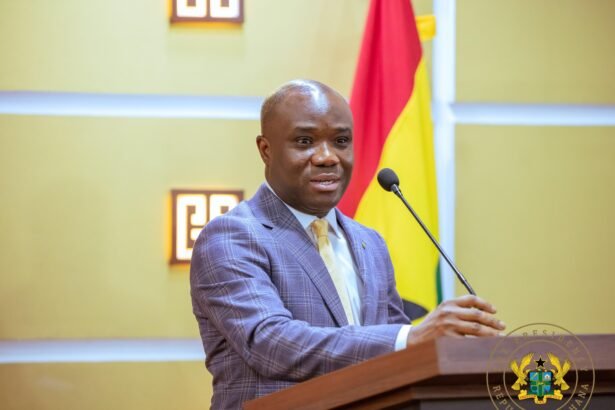
The Ghana Armed Forces (GAF) has announced a 10-day fumigation exercise to take place at the Trauma and Surgical Emergency Unit of the 37 Military Hospital beginning today.
As a result, “the Trauma and Surgical Emergency Unit of the 37 Military Hospital will be temporarily closed for routine fumigation and maintenance from Monday, 4 August, to Wednesday, 13 August 2025,” a statement issued on Facebook by the GAF read.
It added that this scheduled exercise is part of the hospital’s commitment to maintaining the highest standards of hygiene and safety of patients and staff. “During this period, Simango Ward will serve as the temporary ward for receiving all trauma and surgical emergency cases,” the statement read.
The Ghana Armed Forces further assured the public that measures have been put in place to ensure continuity of care and minimize inconvenience, as they appreciate the continued trust and support of the general public.
A couple of months ago, the management of the Hospital announced a temporary shutdown of its Medical Emergency Unit (MEU) for a fumigation exercise to safeguard public health and ensure a clean and healthy environment for health officials as well.
The 10-day exercise was scheduled from Wednesday, June 4, to Saturday, June 14. The health facility made this known through an official statement issued by Lieutenant R.K. Kotoku, on behalf of the Acting Director General of Public Relations of the Ghana Armed Forces (GAF).
It formed part of the hospital’s “routine measures to ensure a clean and safe environment for patients and staff,” parts of the statement read. Management of the facility urged the public to use alternative emergency facilities while they embarked on the 10-day exercise. “We urge the general public to seek medical emergency services at alternative health facilities during the specified period.” the statement read.
Major hospitals like Korle Bu Teaching Hospital, Greater Accra Regional Hospital (Ridge Hospital), Police Hospital and Lekma Hospital were expected to absorb the diverted patient load.
Crucially, Lieutenant Kotoku assured that specialised provisions were made for entitled personnel. “Special arrangements have been made to cater for entitled persons through the Trauma Surgical Emergency Unit, which will remain operational throughout the fumigation period,” he stated.
These individuals continually received emergency medical attention through the Trauma Surgical Emergency Unit (TSEU), which was fully operational throughout the fumigation exercise.
This strategic segregation aimed to minimize disruption to critical care for specific patient populations while the Medical Emergency Unit underwent deep cleansing. Management of the health facility apologised to the general public for inconvenience caused by the anticipated exercise. “We regret any inconvenience caused and thank the public for their cooperation.”
The hospital undertook an earlier fumigation exercise last year in the month of June, however, it is unknown whether management planned to hold fumigation as an annual exercise.
The 37 Military Hospital, one of the largest specialist hospitals in Accra, has long faced several challenges, notably accommodation shortages and the strain of serving both military personnel and civilians.
In view of this, the incumbent government is taking a number of steps to address these challenges. Minister for Defence Dr. Edward Omane Boamah, during a working visit in February, assured that the government was determined to resolve some pressing and critical challenges facing the 37 Military Hospital.
“This working visit forms part of my deliberate intention to actively immerse myself in the challenges of the Ghana Armed Forces to prescribe tailored and cost-effective solutions. The challenges are numerous but not insurmountable,” he told the staff.
In 2021, the hospital closed down its Medical and Emergency Unit to the public in order to undergo a fumigation exercise. According to a statement signed and issued by the Director of Public Relations for the GAF, Col. E Aggrey-Quashie, the closure of the unit took effect from Thursday, January 14 to Thursday, February 4, 2021, to allow the exercise to take place.
The GAF explained that the closure has become necessary to enable the authorities to undertake fumigation as a remedy to any infestation of the Unit. It was worth mentioning that measures had been put in place to ensure patients already on admission were not negatively affected.
However, the general public was advised to redirect all medical and emergency cases to other health facilities during the period. This was for the guidance and information of the general public, the statement added. The GAF however said any inconvenience the closure of the unit might cause to the general public was regrettable.
A mining lease valid for one year and not subject to renewal has been granted to Abosso Goldfields Limited (AGL) with parliamentary approval for gold mining activities in Damang, Wassa West District.
The initial lease agreement was planned to expire on April 18, 2025 and handed over to the government but has now been extended to April 2026 after stakeholder consultations.
Moving the motion for the ratification of the agreement, Minister for Lands and Natural Resources Emmanuel Armah Kofi Buah stated emphatically that “the Governor of Ghana has caused to be laid before Parliament, through the Minister responsible for Lands and Natural Resources, a one-year transitional mining lease agreement between the government of the republic of Ghana and Abosso Goldfields Limited for the mining of the Gold at Damang in the Wassa West District of the Western Region without the option, and I emphasize, without the option of further extension, transfer, mortgage, or any other transactions after April 2026.”
Parliament has explicitly prohibited any further extension beyond the newly extended date. Months ago, tensions flared up at the Damang Mine in Ghana’s Western Region as employees grew anxious over potential job losses following news of a government takeover. More than 1,000 workers represented by the Ghana Mine Workers’ Union were set to protest at government offices due to deep uncertainty about their livelihoods, but they were concretely assured of job security.
Addressing the press on Wednesday, April 16, the Minister for Lands and Natural Resources, Hon. Emmanuel Armah-Kofi Buah, reaffirmed the government’s commitment to safeguarding jobs, maintaining operations, and honouring existing service agreements at the mine.
“We want to assure the hardworking employees, contractors, and service providers at Damang that your dedication has been the backbone of this mine, and it will remain indispensable. All essential services—from security to healthcare, fuel supply to camp management—will continue without interruption. Valid contracts will be honored, wages paid, and operations sustained as we work to regularize arrangements under the State’s stewardship,” the Minister stated.
The earlier decision to assume direct operational control of the mine comes after AGL, a subsidiary of Gold Fields Limited, failed to meet critical requirements necessary for a lease renewal. According to the Minister, the company did not declare verifiable mineral reserves, presented no technical programme to guide operations, and made no financial provisions for exploration—factors that severely undermined the long-term viability of the mine.
Despite these setbacks, the government remains focused on the mine’s contribution to both the local economy and national development. “Despite the challenges that led to our decision, we recognize the importance of Damang Mine to the local economy and the country as a whole. We are committed to ensuring that the mine continues to operate efficiently and effectively, with benefits accruing to the State and its citizens,” Honourable Buah added.
To ensure a seamless transition, the government has put in place a structured plan aimed at preserving the workforce, supporting local enterprises, and maintaining safety and infrastructure at the site. Workers, contractors, and community leaders will be engaged throughout the process to address any concerns and provide timely updates. The Minister emphasized that the government remains dedicated to transparency during the transition.
“We are committed to transparency and accountability throughout this process. Regular updates will be provided to ensure all stakeholders are informed,” he said. The takeover also represents a broader vision for Ghana’s economic future. According to the Minister, this move is part of a national effort to ensure that the country’s mineral wealth contributes more directly to its long-term development agenda.
“Today’s decision will yield a brighter, more sustainable tomorrow. We are confident Damang Mine will continue to play a pivotal role in Ghana’s economic development,” the Lands Minister indicated.
Reiterating the government’s commitment to responsible mining practices, Hon. Buah assured that operations will continue in compliance with the Minerals and Mining Act, 2006 (Act 703), and that the rights of international investors will be respected under applicable laws.
“Ghana remains a beacon of responsible investment and stability. While we remain open to foreign collaboration, we are clear on balancing investor interests with the long-term needs of our people.”
Hon. Armah-Kofi Buah concluded with optimism about the future of the mine, stressing the administration’s determination to keep Damang operational and productive in a way that benefits the nation and its people.
Gold Fields Limited is the seventh-biggest producer of gold in the world and has two operational mines in Ghana, namely the Tarkwa Mine, which is operated by Gold Fields Ghana, and the Damang Mine, which is run by Abosso Goldfields Limited. In 2011, Gold Fields bought out IAMGold’s remaining interest in Damang, and the company now owns a 90 percent stake, with the Government of Ghana holding the remaining 10 percent.
According to the 2024 annual report of Gold Fields, no mineral reserves were declared at Damang, which meant there were no defined gold reserves to be mined there. Actual mining at the mine is said to have stopped in 2023 as the company resorted to processing stockpiles.
It is reported in the Mineral Resources and Reserves Supplement to the Integrated Annual Report of 2023 that no exploration was proposed for the Damang Mine in 2024. Gold Fields took over the Tarkwa mine from the State Gold Mining Company in 1993 and acquired Damang mine in 2002.
Gold Fields contributes significantly to the development of the country through job creation, taxes and royalties, community and infrastructure investments, as well as local procurement and enterprise development.
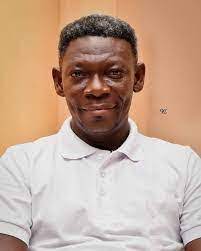
Veteran Ghanaian actress Belinda Naa Ode, widely known as Adwoa Smart, has called on Ghanaians to support her build on a new land she recently received as a gift from colleague actor Kwaku Manu.
She confirmed that Kwaku Manu gave her the land after she complained of not owning a property despite being in the movie industry for over two decades.
“He gave me the land last week. He just gave me the land, so I am waiting for the land’s documents. He took me to the land yesterday, and it is a half-plot of land. He gave me the land because of an interview I did,” she said in an interview with Adom FM, shared on X on August 3, 2025,
However, she called on Ghanaians to support her to begin the building process as soon as possible.
“I am pleading with Ghanaians to assist me so I can put up a building on the land. This would be the first time I am putting up a building,” she added.
Adwoa Smart set the record straight on rumors suggesting that former Vice President Dr. Mahamudu Bawumia gifted her a house.
In a candid interview with Class FM’s Nana Romeo, Adwoa Smart opened up about the pressure these false claims have caused her.
The actress, who has been in the industry for years, shared that despite her successful career, she doesn’t own a house, contrary to popular belief.
She explained that bloggers had circulated a photo of her with Dr. Bawumia, giving the impression that he had handed her the keys to a new home.
Adwoa Smart clarified that the photo was taken at the state funeral of the late Nana Ampadu, and her interaction with Dr. Bawumia at the event had no connection to a house gift. She expressed frustration over the persistent questioning she faces due to the rumors, emphasizing that social media, while beneficial in many ways, also has a darker side.
“Social media can be helpful in bringing attention to issues, but it can also spread harmful falsehoods,” she remarked, adding that the constant inquiries about the supposed house gift have placed unnecessary pressure on her.
She also told Nana Romeo’s listeners that some people used to mock her and called her names when she takes public transporation. She explained that taking commercial taxis without making made her gain weight and feel uncomfortable.
“Walking is really good. Walking is good exercise. It is better than getting on these vehicles. When you walk, people criticise you, and question why you don’t have a car. God has an appointed time for everyone Everyone has their unique streams of income, also. Everyone has their unique glories.”
Adwoa Smart’s candid response serves as a reminder of how quickly misinformation can spread, particularly in the age of social media.
Watch the video below:
Adwoa Smart confirms that Kwaku Manu gave her a half-plot of land so she could construct her first home.
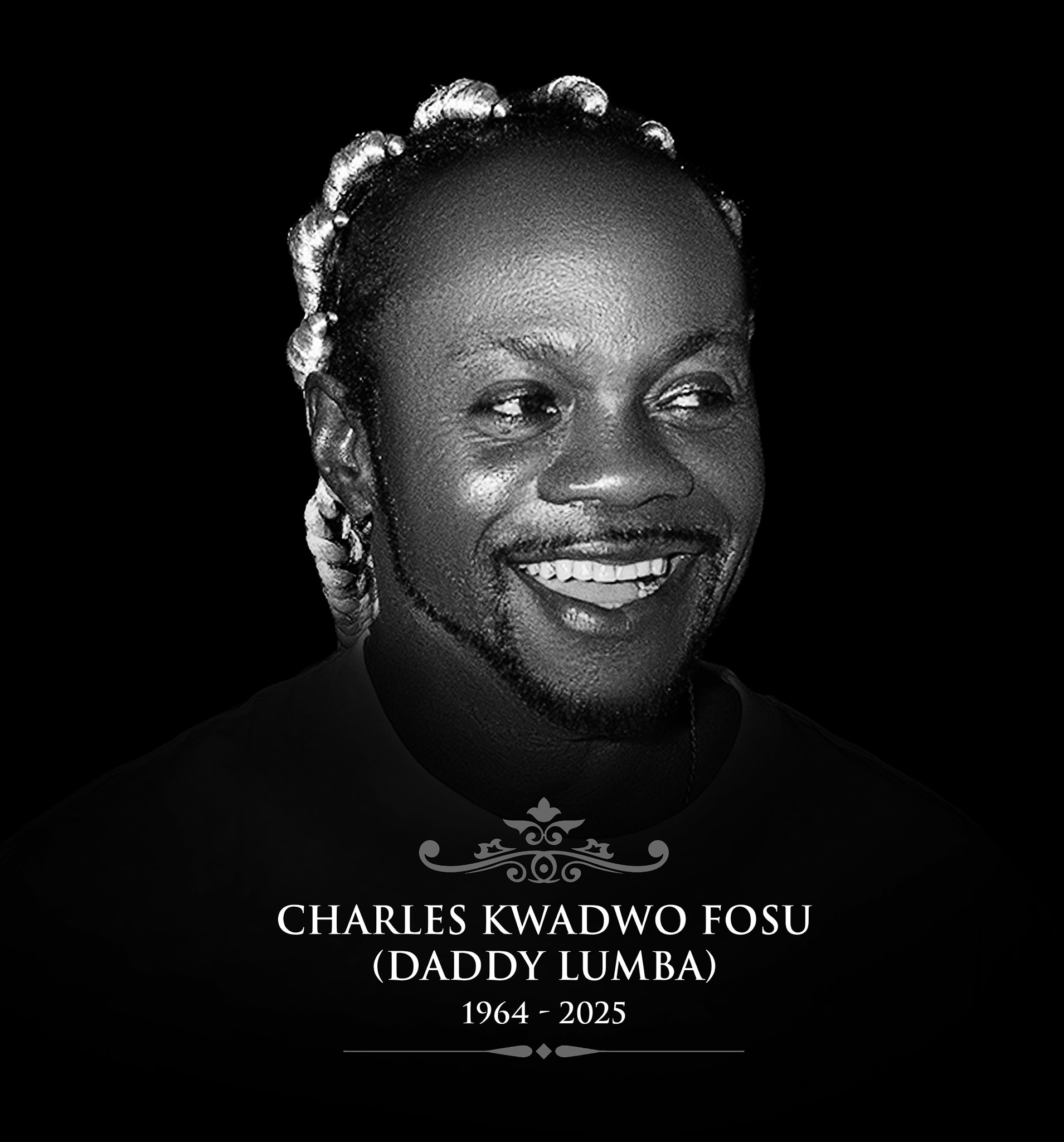
President of the Musicians Union of Ghana, Bessa Simons, Head of the Creative Arts Agency, Gideon Aryeequaye, rapper Sarkodie, gospel musician Kofi Sarpong, and other dignitaries from the creative arts industry joined thousands to honour Daddy Lumba.
They were present at the candlelight vigil held at Independence Square in Accra yesterday, where his songs were played and performed with by his fans.
Daddy Lumba’s candlelight vigil commenced with inspiring ministrations by the Harmonious Chorale followed by sorrowful tributes from MUSIGA, the Creative Arts Agency and the Ministry of Tourism, Culture and Creative Arts.
Most touching of all were tributes read by the children of Daddy Lumba and one read on behalf of his widow.
Instead of candles the audience resorted to using flashlights due to a disruption by heavy winds.
Thousands of fans and well-wishers gathered in large numbers to participate in commemorating the late legend.
Ghana has been left in a state of shock for the past two weeks over the news of Daddy Lumba’s demise after he succumbed to a brief illness on July 26.
The Creative Arts Agency took it upon themselves to organize the vigil as part of a world wide event to celebrate the life and impact of the music icon.
The night came to a head with several hit songs of Daddy Lumba being played while the audience danced their hearts away.
Daddy Lumba’s candlelight vigil was held in other parts of the world serving as a gentle reminder of the impact he has made in the life of people through his songs.
The legendary Ghanaian highlife musician passed away in the early hours of Saturday, July 26.
A statement by the counsel for the Fosu family confirmed the news to the general public.
He succumbed to the illness at the Bank Hospital in Accra, per reports.
The statement read: “With profound sorrow and deep grief, the Fosu family announces the passing of Ghana’s beloved musical icon, Charles Kojo Fosu, popularly known as Daddy Lumba, who passed away earlier today, Saturday, July 26, 2025, after a short illness.”
“Daddy Lumba was more than a musician; he was a cultural icon whose music touched countless lives. His soulful voice provided the soundtrack to our love stories, and his poignant lyrics captured the poetry of our struggles, dreams, and resilience.”
The bereaved family respectfully requested privacy as they navigate this profound grief.
Daddy Lumba’s ex-manager, Roman Fada, has dropped hint about the possibility of a state burial for the musician under President Mahama’s watch.
At Daddy Lumba’s private residence in Accra on July 28, Roman Fada told the media that conversations have commenced to ensure the late singer is given a burial that reflects his legacy.
“We have received positive feedback from the Presidency, and I believe that John Dramani Mahama will respond to the public’s call by granting him a befitting burial,” Roman Fada said.
He explained that the former President’s close relationship with the late singer and his track record in supporting the arts make him confident that the burial will be taken care of by the state.
“I know the kind of love the current President, John Dramani Mahama, has for the creative industry and the strong relationship he shared with Daddy Lumba,” he stated.
The deceased family announced that a book of condolence was opened in honour of the late highlife legend begining Tuesday, 29th July, from 9:00 a.m. to 4:00 p.m.
In an official statement issued on July 27 by his lawyers, Baba Jamal & Associates, on behalf of the bereaved family, the family invited all well-wishers, friends, fans, and family to sign the condolence book, which will be available at Daddy Lumba’s private residence in East Legon.
“As part of the arrangements to honour his memory, the Fosu family wishes to announce the following events to be organised in his honour.
“Book of Condolence in honour of Daddy Lumba: Private residence of the late Daddy Lumba at Kinshasha Crescent, house number 12 (GA-332-9264)” parts of the statement read.
The New Patriotic Party (NPP) shared a compassionate and commiseratory message with the family and friends of the late highlife legend Charles Kwadwo Fosu, widely known as Daddy Lumba.
In a statement dated July 26, the opposition party praised the legend for his stunning and unforgettable contributions to the highlife genre in Ghana and beyond.
Acknowledging the impact of the highlife legend’s contribution to the party’s history, citing the iconic song “Nana Ye Winner,” a campaign song Lumba released for the NPP during their 2008 election campaign.They noted that the powerful lyrics and rhythm of the song were even regarded by their political opponents.
“For us in the New Patriotic Party, his melodious contribution to our campaigns in 2008, 2012, and 2016, through the famous “Nana Ye Winner track in its original and remix versions, remains deeply etched in the political history of our tradition and the country. The power and inspiration behind those songs were acknowledged even by our political opponents,” parts of the statement read.
In a heartfelt X post on July 27, President Mahama expressed sorrow and declared that Daddy Lumba’s “unmatched musical genius” would resonate for generations to come.
“I have learnt with deep sorrow the passing of Ghanaian music legend, Charles Kwadwo Fosu, affectionately known as Daddy Lumba. Lumba’s unmatched musical genius provided the soundtrack to our lives, carrying us through various phases of life,” President Mahama wrote, capturing the collective grief of a nation.
He continued, “The beats to his memorable songs may have died down, but his enduring legacy will echo through the ages. On behalf of the Government of Ghana, I extend heartfelt condolences to his family and loved ones for this irreplaceable loss.”
This sentiment expressed by the president captures the deep emotions and connection many Ghanaians had with his music, which highlighted everyday life experiences with unparalleled artistry.
Former President Akufo-Addo, who has the late legend to be grateful to for his vibrant, energetic, and soul-dancing campaign song, reacted to his death. Taking to his official Facebook page on July 26, he praised him as the greatest among the greats
“With regret, I have received the sad news of the passing of my dear friend and renowned music icon, Charles Kwadwo Fosu.
“Daddy Lumba, as we affectionately call him, was a pantheon among musical greats of all-time and had a special connection with his fans and the entire nation.
“His hit-making songs will remain lasting contributions to my presidential journey and will forever be etched in the annals of political campaign of the New Patriotic Party. He will be sorely missed.
“May he peacefully rest in the Bosom of the Almighty until the Last Day of the Resurrection, when we shall all meet again,” he expressed.
Profile of the late veteran musician
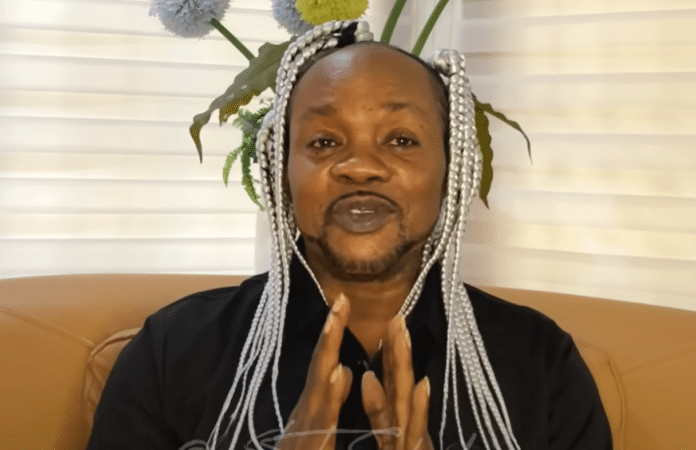
Daddy Lumba was renowned for his incredible talent as a singer, composer, songwriter, recording artist, and producer.
With an illustrious career that has spanned over three decades, Daddy Lumba was widely regarded as the greatest and most influential musician in Ghanaian history.
Many artists in Ghana, including Ofori Amponsah, Sarkodie, Kuami Eugene, Paa Solo of Sibo Brothers, Oheneba Kissi, KiDi, and others, consider him their major inspiration in the music industry.
Daddy Lumba was born 60 years ago to Mr. Johnson Kwadwo Fosuh and Madam Comfort Gyamfi, also known as Ama Saah, in Nsuta, near Mampong in the Ashanti Region of Ghana. Both of his parents were teachers, and he was the second of three siblings.
His educational journey began in Nsuta Kyebi, and he completed junior high school at Suame Methodist, Kumasi in 1979. Subsequently, he attended Adu Gyamfi Senior High School in Jamasi, but later transferred to Juaben Senior High School, where he completed his secondary education in 1984.
Daddy Lumba’s music career took off in the early 80s when he formed the Nkwanta Wesley Singers, gaining fame at the Anokye Krom Cultural Center.
During his time at Juaben Senior High School, he led the school choir and composed the song “Lumba Lumba,” dedicated to the freedom fighters in South Africa. This song’s popularity earned him the nickname “Daddy Lumba”, which later became his stage name. He also formed the Lumba Brothers band during his school days, which included his girlfriend at the time, Theresa.
After completing school, Daddy Lumba, with the help of his high school sweetheart Theresa Abebrese, traveled to Germany. There, he met Ernest Nana Acheampong, and they formed another Lumba Brothers group, recording their debut album, “Yee Ye Aka Akwantuom,” in 1986. Financial constraints delayed the album’s release until 1989, and eventually, the duo split.
Daddy Lumba then launched his solo career and released his debut solo album, “Obi Ate Meso Buo,” in 1990. The album received immense popularity and critical acclaim, featuring classics like the title track and “Theresa,” dedicated to his ex-lover. He has since released 33 albums, including notable ones like “Sika Asem,” “Aben Wo Ha,” “Wo Ho Kyere,” “Awosoo,” “Give Peace A Chance,” and “Ahenfo Kyiniye.” His latest project, “Ofon Na Edi Asem Fo,” was released in December 2022, reuniting him with longtime collaborator Kweku Mensah.
In addition to his own success, Daddy Lumba is renowned for nurturing the careers of budding artists who went on to become legends in their own right.
Some of these artists include Felix Owusu, for whom he produced the debut album “Vida” in 1992, Afia Ampofowaa, Kwabena Sunkwa, Ofori Amponsah with the “Woho Kyere” album in 1999, Selina Orleans, Akua Serwaa Bonsu, Borax, Ateaa Tina, and many others.
His contributions to Ghanaian music and the support he provides to upcoming talents have solidified his status as an iconic figure in the country’s music industry.
With his passion, talent, and dedication to the craft, Daddy Lumba continues to be a role model for aspiring musicians, leaving an indelible mark on the rich musical landscape of Ghana.
Government has fully endorsed RNAQ Foundation’s flagship Food Bank initiative aimed at combating food insecurity and empowering vulnerable communities across Ghana.
According to the foundation, the RNAQ Food Bank initiative will partner with local food vendors to establish accessible food distribution hubs across the country. During the launch event on Friday, August 1, at the La Palm Royal Beach Hotel, the founder, Richard Nii Amarh Quaye, shared a heartfelt reflection on the inspiration behind the project in his keynote address.
“I stand before you as a man who remembers what it feels like to be hungry, not just for food, but for hope, for dignity, and for change. Today, we launched the RNAQ Food Bank. But this is not just about food. This is about justice. It’s about dignity. It’s about telling every Ghanaian… that you also matter.”
He further mentioned that the initiative would begin with five food bank locations in Greater Accra, Korle-Gonno, Kasoa, Ashaiman, Odorkor, and Madina, with plans to expand nationwide.
“These food banks will open every single day, and through them, thousands of people will be fed daily. This is not charity. This is nation-building. This is how we create the Ghana we’ve all been dreaming of, one plate at a time,” he added.
This vision has earned Richard Nii Amarh Quaye applause and massive support from the government. Chief Executive officer of the National Youth Authority (NYA), Osman Abdulai Ayariga, commended the initiative, describing it as a much-needed response to the growing food challenges facing young people and children.
“This food bank offers relief and hope. It is not just charity; it is impactful, and it will touch generations. In Ghana alone, 3.6 million students, about 11.7% of our population, struggle with access to sufficient food, with risk levels exceeding 30% in many northern districts,” Mr. Ayariga said.
Mr Abdulai Ayariga noted that the National Youth Authority and the Ministry of Youth Development are fully in support of the initiative, stressing that food security and youth empowerment are inseparable.
“Without meaningful youth engagement, food sovereignty will remain a mirage,” he said. He also called for cross-sector collaboration to boost food storage capacity and urban farming and adopt environmentally friendly farming technologies.
Deputy Minister for Food and Agriculture, John Setor Dumelo, also praised the foundation’s efforts, linking the initiative to the wider “Feed Ghana” agenda championed by the National Democratic Congress administration.
“We must celebrate one man who is using his wealth well, and that is RNAQ. Most of the people preparing the food are from the communities, so this creates employment. It feeds people and contributes to our Feed Ghana project. Our aim is to feed ourselves, feed the industries, and then export the rest. This food bank project is a valuable addition to that value chain.”
Mr. Dumelo also urged the foundation to support its farming efforts, emphasizing that consistent food prices play a crucial role in Ghana’s agricultural progress. “This is a very good initiative, and we support it 100%. I’ll make sure that every morning, I’ll take my Ghana Card to the food bank so I can also enjoy a hot, fresh meal,” he quipped.
In attendance at the event were celebrated Ghanaian actor Adjetey Anang, traditional leaders, philanthropists, and other notable personalities. Guests and journalists at the launch toured the food bank’s operational hubs in Korle-Gonno, where they observed the meal distribution process to needy families in action.
The RNAQ Foundation noted that the project rests on sustainability, dignity, and community engagement. The Foundation is determined to bridge systemic gaps in food access and wealth inequality with expansion in the Ashanti Region in the coming weeks and eventually nationwide.
Mr. Quaye affirmed that, “This is the Ghanaian dream…where we take care of our own. Where the solution doesn’t come from outside, but from within. And as long as I have breath in me, we will not stop.”
The official food distribution began on Friday, 1st August, with four operational centres strategically positioned in high-need communities across Accra. Locations such as Korle-Gonno, Kasoa, Ashaiman, Odorkor, and Madina were considered to begin the food distribution based on population density and levels of deprivation.
Unlike traditional food relief efforts that distribute uncooked or dry food items, the RNAQ Food Banks will provide hot, ready-to-eat meals sourced directly from local food vendors. According to spokesperson Patricia Hlorbu, the initiative not only guarantees nutritional value but also stimulates local economies by supporting small-scale catering businesses.
“The Food Bank Project marks a significant milestone for the Foundation,” she noted, adding that, “this comes in the wake of Richard Nii Armah Quaye’s transition from his role as Board Chairman of Bills MicroCredit and Chairman and CEO of Quick Angels. Under his leadership, Bills evolved from a startup in 2009 into a key player in Ghana’s microfinance sector, disbursing over GHS 7.5 billion in loans to underserved communities.”
Ghana has recorded a decline in its poverty rate from 26.4 percent in 2023 to 25.9 percent in 2024, according to the International Monetary Fund (IMF).
According to the Fund, the Ghanaian population living in extreme poverty is measured at the international poverty line of $2.15 daily.
In the improved growth outturn recorded last year, particularly in services and agriculture, as well as continued efforts to expand the country’s social protection programmes, led to the drop in poverty.
This included the four highly targeted programmes covered by the programme conditionality: the Livelihood Empowerment Against Poverty (LEAP), the Ghana School Feeding Program (GSFP), the Capitation Grant, and the National Health Insurance Scheme (NHIS).
The Fund stated in its 4th Review Under the Economic Credit Facility Arrangement with Ghana that the government is redoubling efforts to expand social spending and shorten delays in releasing budgeted funds to beneficiaries.
According to the International Monetary Fund, going forward, “staying the course of macroeconomic policy adjustment and reforms is essential to fully and durably restore macroeconomic stability and debt sustainability, while fostering a sustainable increase in economic growth and poverty reduction.”
A student of Kinbu Senior High School (SHS) is currently in police custody for stabbing another student to death on July 31.
Addib Alhassan, a 15-year-old first-year student, was fatally stabbed during an altercation allegedly sparked by a heated argument. The exact cause of the confrontation remains unclear. After sustaining injuries, Alhassan was initially rushed to the Adabraka Polyclinic and later transferred to the Ridge Hospital due to the severity of his injuries. He was later pronounced dead.
In reaction to the unfortunate incident, the Member of Parliament for Klottey-Korle, Dr. Zanetor Agyeman-Rawlings, strongly condemned the murder, describing it as both tragic and senseless.
She expressed deep shock and sorrow over the stabbing in a statement she released on Friday, July 31, 2025. “I strongly condemn this act of violence and I will collaborate with the Ghana Police Service and other relevant authorities to ensure that thorough investigations are swiftly done and that justice is served,” she said.
The Member of Parliament stressed that schools must remain a safe haven for studies and personal development. She encouraged a joint effort from education and security authorities to ensure stronger safety measures are in place across all institutions.
“This tragedy must be a wake-up call for all stakeholders in the education and security sectors to prevent such incidents from recurring,” she stated. Dr. Agyeman-Rawlings offered her condolences to the bereaved family and the Kinbu SHS community, including students and staff.
She made a commitment to partner with the Ghana Education Service (GES), school leadership, and security agencies to strengthen safety and mental health support structures in schools across her constituency.
Earlier this year, Kinbu Secondary Technical and Accra Technical Centre School were involved in a heated altercation, adding to the number of melees recorded this year.
Violence in SHSs has become a trend in the country. Seven months into the year, Ghana has recorded over five violent clashes in SHSs. These incidents have witnessed students possessing weapons, destroying property, and others engaging in brutal confrontations.
Stakeholders have bemoaned the growing indiscipline and insecurity on school campuses, prompting calls for an immediate intervention. Recently, authorities at Sokode Senior High Technical School temporarily shut down the premises over a violent misunderstanding between students.
Kumasi Technical Institute (KTI) and Kumasi Anglican Senior High School clashed after returning from an inter-school competition. One student sustained severe injuries as a result of the event; school properties and private cars belonging to teachers were also damaged.
Salaga Senior High School in the Savannah Region observed the most violent clashes. The confrontation left a student with multiple stab wounds, with the police retrieving locally-produced pistol and ammunition from the scene. Students of Islamic Senior High School (ISSEC) also faced off with local youth, causing injuries and damages to multiple vehicles.
Months ago, a 16-year-old form two student of Osei Kyeretwie Senior High School (OKESS) was arrested by the Tafo Pankrono Divisional Police Command for illegally possessing a locally manufactured firearm.
The police arrested the suspect following a routine dormitory search by school authorities on Wednesday, May 14. According to the accused, the weapon belonged to his stepfather, Mr. Daniel Owusu Baafi, who has been apprehended.
This was disclosed by the Deputy Superintendent of Police Godwin Ahianyo, Head of Public Affairs for the Ashanti Regional Police Command, on Sunday, May 18. Following their arrest, both individuals were granted bail and are to report to the police on Monday, May 19, as investigations continue.
Last month, a fisticuff between two final-year students of Wa T.I. Ahmadiyya Senior High School (Wa Amass) has left one hospitalised and in critical condition, according to reports. It is reported that Iddrisu Ibrahim, also known as Lincoln—an agricultural science student—and his colleague Hafis, who is also known as Baayaawa—a general arts student—engaged in an argument over a video that was recorded.
It is said that Lincoln filmed Hafis without his consent—an action that left the latter displeased. He requested Lincoln to delete the said video, but Lincoln reportedly refused. When matters escalated, Hafis pulled out a knife and stabbed his colleague in the stomach and ribs.
Amid the many violent clashes, the Ministry of Education has granted school heads at Senior High Schools (SHS) across the country the mandate to conduct searches on students. Deputy Minister for Education Clement Apaak in May noted that the action is a part of the government’s series of strategies to eradicate indiscipline in schools, specifically SHSs.
The Deputy Minister has also indicated that Parent Teachers Association (PTA) meetings will be reinstated to ensure teachers and parents collaborate as well as share concerns. This was realised last month.
A directive from President John Dramani Mahama has necessitated the reinstatement of Parent-Teacher Associations (PTAs) in pre-tertiary schools across the country. This was disclosed by the Head of Public Relations at Ghana Education Service (GES), Daniel Fenyi, on Thursday, July 17.
The move, he explained, will ensure effective collaboration between parents and teachers for quality education for students. “All heads of public senior high schools, technical, and STEM schools are to operationalise the reinstatement with immediate effect. This move is aimed at strengthening the collaboration and involvement of parents, communities, and teachers in the delivery of quality education to Ghanaian learners,” parts of the statement added.
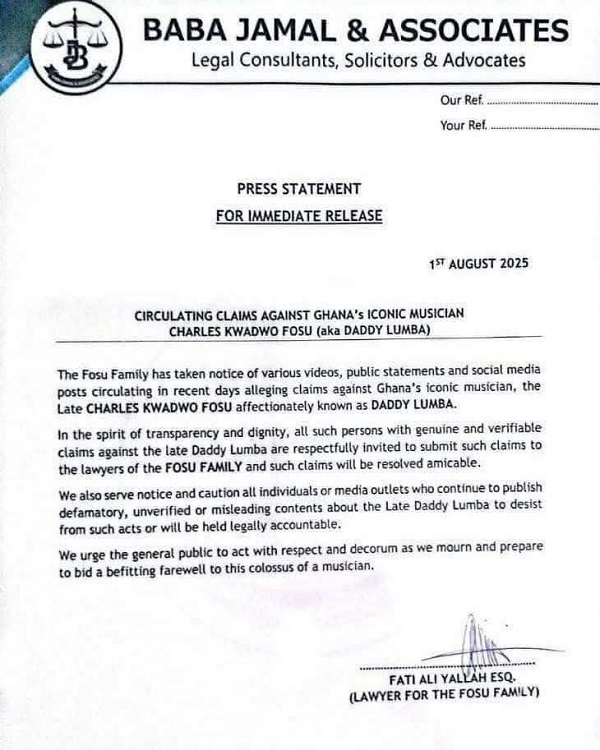
Lawyers of the late Ghanaian Highlife legend, Daddy Lumba, have called on individuals making allegations against the deceased to provide their evidences for amicable resolutions.
A statement released on August 1, 2025, and signed by the late Lumba’s lawyer, Fati Ali Yallah, said,
“The Fosu Family has taken notice of various videos, public statements, and social media posts circulating in recent days alleging claims against Ghana’s iconic musician, the late Charles Kwadwo Fosu, affectionately known as Daddy Lumba.”
“In the spirit of transparency and dignity, all such persons with genuine and verifiable claims against the late Daddy Lumba are respectfully invited to submit such claims to the lawyer of the Fosu family, and such claims will be resolved amicably,” the statement read.
The statement further warned media outlets to desist from publishing defamatory content against Daddy Lumba or face legal consequences.
“We also serve notice and caution all individuals or media outlets who continue to publish defamatory, unverified, or misleading content about the late Daddy Lumba to desist from such acts or will be held legally accountable,” he added.
Meanwhile, the Creative Arts Agency is gearing up for a candlelight vigil in honour of Daddy Lumba.
Scheduled for August 2 at Independence Square in Accra, the event will commence at 6:00 p.m. exactly.
The legendary Ghanaian highlife musician passed away in the early hours of Saturday, July 26.
A statement by the counsel for the Fosu family confirmed the news to the general public.
He succumbed to the illness at the Bank Hospital in Accra, per reports.
The statement read: “With profound sorrow and deep grief, the Fosu family announces the passing of Ghana’s beloved musical icon, Charles Kojo Fosu, popularly known as Daddy Lumba, who passed away earlier today, Saturday, July 26, 2025, after a short illness.”
“Daddy Lumba was more than a musician; he was a cultural icon whose music touched countless lives. His soulful voice provided the soundtrack to our love stories, and his poignant lyrics captured the poetry of our struggles, dreams, and resilience.”
The bereaved family respectfully requested privacy as they navigate this profound grief.
Daddy Lumba’s ex-manager, Roman Fada, has dropped hint about the possibility of a state burial for the musician under President Mahama’s watch.
At Daddy Lumba’s private residence in Accra on July 28, Roman Fada told the media that conversations have commenced to ensure the late singer is given a burial that reflects his legacy.
“We have received positive feedback from the Presidency, and I believe that John Dramani Mahama will respond to the public’s call by granting him a befitting burial,” Roman Fada said.
He explained that the former President’s close relationship with the late singer and his track record in supporting the arts make him confident that the burial will be taken care of by the state.
“I know the kind of love the current President, John Dramani Mahama, has for the creative industry and the strong relationship he shared with Daddy Lumba,” he stated.
The deceased family announced that a book of condolence was opened in honour of the late highlife legend begining Tuesday, 29th July, from 9:00 a.m. to 4:00 p.m.
In an official statement issued on July 27 by his lawyers, Baba Jamal & Associates, on behalf of the bereaved family, the family invited all well-wishers, friends, fans, and family to sign the condolence book, which will be available at Daddy Lumba’s private residence in East Legon.
“As part of the arrangements to honour his memory, the Fosu family wishes to announce the following events to be organised in his honour.
“Book of Condolence in honour of Daddy Lumba: Private residence of the late Daddy Lumba at Kinshasha Crescent, house number 12 (GA-332-9264)” parts of the statement read.
The New Patriotic Party (NPP) shared a compassionate and commiseratory message with the family and friends of the late highlife legend Charles Kwadwo Fosu, widely known as Daddy Lumba.
In a statement dated July 26, the opposition party praised the legend for his stunning and unforgettable contributions to the highlife genre in Ghana and beyond.
Acknowledging the impact of the highlife legend’s contribution to the party’s history, citing the iconic song “Nana Ye Winner,” a campaign song Lumba released for the NPP during their 2008 election campaign.They noted that the powerful lyrics and rhythm of the song were even regarded by their political opponents.
“For us in the New Patriotic Party, his melodious contribution to our campaigns in 2008, 2012, and 2016, through the famous “Nana Ye Winner track in its original and remix versions, remains deeply etched in the political history of our tradition and the country. The power and inspiration behind those songs were acknowledged even by our political opponents,” parts of the statement read.
In a heartfelt X post on July 27, President Mahama expressed sorrow and declared that Daddy Lumba’s “unmatched musical genius” would resonate for generations to come.
“I have learnt with deep sorrow the passing of Ghanaian music legend, Charles Kwadwo Fosu, affectionately known as Daddy Lumba. Lumba’s unmatched musical genius provided the soundtrack to our lives, carrying us through various phases of life,” President Mahama wrote, capturing the collective grief of a nation.
He continued, “The beats to his memorable songs may have died down, but his enduring legacy will echo through the ages. On behalf of the Government of Ghana, I extend heartfelt condolences to his family and loved ones for this irreplaceable loss.”
This sentiment expressed by the president captures the deep emotions and connection many Ghanaians had with his music, which highlighted everyday life experiences with unparalleled artistry.
Former President Akufo-Addo, who has the late legend to be grateful to for his vibrant, energetic, and soul-dancing campaign song, reacted to his death. Taking to his official Facebook page on July 26, he praised him as the greatest among the greats
“With regret, I have received the sad news of the passing of my dear friend and renowned music icon, Charles Kwadwo Fosu.
“Daddy Lumba, as we affectionately call him, was a pantheon among musical greats of all-time and had a special connection with his fans and the entire nation.
“His hit-making songs will remain lasting contributions to my presidential journey and will forever be etched in the annals of political campaign of the New Patriotic Party. He will be sorely missed.
“May he peacefully rest in the Bosom of the Almighty until the Last Day of the Resurrection, when we shall all meet again,” he expressed.
Profile of the late veteran musician
Daddy Lumba was renowned for his incredible talent as a singer, composer, songwriter, recording artist, and producer.
With an illustrious career that has spanned over three decades, Daddy Lumba was widely regarded as the greatest and most influential musician in Ghanaian history.
Many artists in Ghana, including Ofori Amponsah, Sarkodie, Kuami Eugene, Paa Solo of Sibo Brothers, Oheneba Kissi, KiDi, and others, consider him their major inspiration in the music industry.
Daddy Lumba was born 60 years ago to Mr. Johnson Kwadwo Fosuh and Madam Comfort Gyamfi, also known as Ama Saah, in Nsuta, near Mampong in the Ashanti Region of Ghana. Both of his parents were teachers, and he was the second of three siblings.
His educational journey began in Nsuta Kyebi, and he completed junior high school at Suame Methodist, Kumasi in 1979. Subsequently, he attended Adu Gyamfi Senior High School in Jamasi, but later transferred to Juaben Senior High School, where he completed his secondary education in 1984.
Daddy Lumba’s music career took off in the early 80s when he formed the Nkwanta Wesley Singers, gaining fame at the Anokye Krom Cultural Center.
During his time at Juaben Senior High School, he led the school choir and composed the song “Lumba Lumba,” dedicated to the freedom fighters in South Africa. This song’s popularity earned him the nickname “Daddy Lumba”, which later became his stage name. He also formed the Lumba Brothers band during his school days, which included his girlfriend at the time, Theresa.
After completing school, Daddy Lumba, with the help of his high school sweetheart Theresa Abebrese, traveled to Germany. There, he met Ernest Nana Acheampong, and they formed another Lumba Brothers group, recording their debut album, “Yee Ye Aka Akwantuom,” in 1986. Financial constraints delayed the album’s release until 1989, and eventually, the duo split.
Daddy Lumba then launched his solo career and released his debut solo album, “Obi Ate Meso Buo,” in 1990. The album received immense popularity and critical acclaim, featuring classics like the title track and “Theresa,” dedicated to his ex-lover. He has since released 33 albums, including notable ones like “Sika Asem,” “Aben Wo Ha,” “Wo Ho Kyere,” “Awosoo,” “Give Peace A Chance,” and “Ahenfo Kyiniye.” His latest project, “Ofon Na Edi Asem Fo,” was released in December 2022, reuniting him with longtime collaborator Kweku Mensah.
In addition to his own success, Daddy Lumba is renowned for nurturing the careers of budding artists who went on to become legends in their own right.
Some of these artists include Felix Owusu, for whom he produced the debut album “Vida” in 1992, Afia Ampofowaa, Kwabena Sunkwa, Ofori Amponsah with the “Woho Kyere” album in 1999, Selina Orleans, Akua Serwaa Bonsu, Borax, Ateaa Tina, and many others.
His contributions to Ghanaian music and the support he provides to upcoming talents have solidified his status as an iconic figure in the country’s music industry.
With his passion, talent, and dedication to the craft, Daddy Lumba continues to be a role model for aspiring musicians, leaving an indelible mark on the rich musical landscape of Ghana.
Government has launched a storytelling series, dubbed “By the Fire Side” with support from the National Folklore Board (NFB).
“By the Fire Side” storytelling series is an initiative aimed at celebrating Ghana’s rich oral traditions; an event that will be held every second Friday of every month.
Speaking at the launch on Thursday, July 31, 2025, the Executive Director of the NFB, Bernice Ann Deh-Kumah, said the initiative will go beyond celebrating rich Ghanaian cultures as will serve as a catalyst for unity among communities.
“Each session will feature stories from the diverse regions of Ghana, told in local languages to reflect the cultural and linguistic richness of all sixteen regions. Through this initiative, communities will reconnect with their heritage while fostering pride in indigenous knowledge systems. This will also be a platform for the Board to help communities document and archive their indigenous stories, folktales, myths, and legends,” she explained
According to the Executive Director, storytelling offers great benefits for children, serving as one of the most effective and traditional methods of learning.
“Through storytelling, children are motivated to listen to others. They learn to be more patient and to let others speak, and begin to open their minds to other people’s opinions. It is a good way to prepare your children for school because it makes learning easier and more natural. It also improves a child’s concentration, which is a plus for academic success,” she said.
She also pointed out that the “By the Fire Side” initiative aligns with the government’s “Black Star Experience Agenda” because it will help children rediscover and celebrate Ghana’s cultural identity through oral traditions.
In the same vein President John Dramani Mahama on Thursday, May 1, launched the Black Star Experience in a bid to establish Ghana as a leading tourist destination in Africa.
The Black Star Experience is the government’s flagship culture, arts, and tourism brand to make Ghana a preferred tourism destination.
It comes to fulfil one of President Mahama’s promises during the campaign which was included in his 120-Day Social Contract with Ghanaians.
The Blackstar Experience is a year-round celebration in all the major entertainment, artistic and educational disciplines.
The Pan African Month, Celebrating Heritage, History and Diaspora Engagement, The Ghana Film Festival and Awards Month, Ghana Music World, Culinary Month, Architecture, Design, Arts and Crafts, Fashion and Textiles Month and Literacy/Literary Month all forms part of activities lined up for the celebration.
During the launch, President Mahama said the Black Star Experience was about rekindling a sense of national identity, showcasing Ghana’s heritage and harnessing the full power of its cultural, creative and tourism sectors.
He explained that this was not just about introducing a brand. It is about Ghana’s story and presents a renewed, confident image of a bold, vibrant, and resilient nation to the world.
Adding that the Black Star Experience, serves as a statement that Ghana is the beating heart of Africa’s cultural and creative scene.
“We’re determined to redefine how the world sees us and more importantly how we see ourselves,” he stated.
The President stated that Ghana must be recognised not only for its historic achievements, but also for its dynamic present and limitless future.
He said a powerful legacy had shaped the nation from the enduring kingdoms of Akwamun, Dagbon and Ashanti to the fearless pan-Africanist leadership of Osagyefo Dr Kwame Nkrumah, whose vision of African unity still inspires generations.
“And yet for too long we have under-invested in what makes Ghana truly exceptional. That is our culture, our creativity, our warmth and the way of life. And that must change,” he said.
President Mahama said the Black Star Experience was the government solemn pledge to rebrand Ghana and showcase to the world the brilliance of the country’s festivals, the rhythm of music, the beauty of fashion, the power of films, the richness of cuisine, the wisdom in storytelling and the unmatched warmth of the people.
Secondly, he said the launch would create jobs, empower millions of young Ghanaians, particularly women, by unlocking opportunities in the creative and tourism industries, nurturing entrepreneurship and innovation and creating sustainable livelihoods.
The President said the Blackstar Experience initiative would also draw in global investment and forge new pathways for inclusive growth and prosperity, thereby positioning Ghana as Africa’s premier destination for cultural tourism and creative collaboration.
“Let it be known that the Black Star Experience is not a one-off event. It is a 365-day celebration of Ghanaian ingenuity and excellence,” President Mahama said.
He said that through the Black Star Experience, the creative energy of the Ghanaian people would radiate daily from every region and every community.
“Imagine the majestic rhythms of the Hogbetsotso Festival in Anlo, the electrifying art of the Chale Wote Festival right here near the Black Star Square, the dazzling colours of Fetu Afahye in Cape Coast broadcast to global audiences, the Odwira Festivals of Akwapim and Ashanti, Aboakyer Festival of the people of Efutu, Homowo of the people of Ga, and the Bugum Festivals of the Dagbon people,” he said.
President Mahama added, “Imagine if the Kente weavers of Bonwire were celebrated as national treasures, and Kumawood and Gallywood filmmakers were dazzling international screens, with world-class studios stretching from Accra to Takoradi.”
“And let us be reminded of the words of Osagyefo Dr Kwame Nkrumah. He says we face neither east nor west. In Ghana, we face forward,” he said.
“The Black Star Experience is that forward that Nkrumah talked about. It is our pride. It is our legacy. It is our future. And let’s make it legendary.”
The Minister of Tourism, Culture and Creative Arts, Ablah Dzifa Gomashie, said the Blackstar Experience was pivotally designed as a stimulus that moved the nation’s creative impulses and culture from the fringes to the center of national development.
The Presidential Staffer and Co-ordinator of the Blackstar Experience, Rex Omar, said the launch of the Blackstar Experience meant that they were going to rebrand Ghana to align with the world’s 20 most successful countries in tourism.
“Together we can unlock the full potential of Ghana’s creative economy. As we launch the Black Star Experience, I urge every Ghanaian, young and old, to embrace this vision.”
Daddy Lumba’s former teacher, Mama Acheampong, has dismissed the idea of erecting a statue in honour of the late musician.
According to her, Ghanaians have a poor maintenance culture in preserving statues.
She believes that naming a school or facility after Daddy Lumba will preserve his legacy better than a statue could.
“What I would love is for the government to give him a state burial because he deserves that. Apart from that, when statues are made in Ghana, we don’t take good care of them. But if we can name a school or something after him, it would be the best… Something we can see, and it would be there always. I don’t like statues,” she told GhanaWeb’s Isaac Dadzie on July 31, 2025.
She further eulogized Daddy Lumba with some profound memories of him as a multitalented student of music.
“He had a sharp voice and could make music on the spot. So I took him as the choir prefect, and through him, the queen mother of Juaben bought the first choir robes the school had.”
“He formed the Lumba Brothers and later added Theresah Abebrese. He was a good singer and songwriter. Charles was so respectful and intelligent… And children loved him,” she said.
The Creative Arts Agency is gearing up for a candlelight vigil in honour of Daddy Lumba.
Scheduled for August 2 at Independence Square in Accra, the event will commence at 6:00 p.m. exactly.
The legendary Ghanaian highlife musician passed away in the early hours of Saturday, July 26.
A statement by the counsel for the Fosu family confirmed the news to the general public.
He succumbed to the illness at the Bank Hospital in Accra, per reports.
The statement read: “With profound sorrow and deep grief, the Fosu family announces the passing of Ghana’s beloved musical icon, Charles Kojo Fosu, popularly known as Daddy Lumba, who passed away earlier today, Saturday, July 26, 2025, after a short illness.”
“Daddy Lumba was more than a musician; he was a cultural icon whose music touched countless lives. His soulful voice provided the soundtrack to our love stories, and his poignant lyrics captured the poetry of our struggles, dreams, and resilience.”
The bereaved family respectfully requested privacy as they navigate this profound grief.
Daddy Lumba’s ex-manager, Roman Fada, has dropped hint about the possibility of a state burial for the musician under President Mahama’s watch.
At Daddy Lumba’s private residence in Accra on July 28, Roman Fada told the media that conversations have commenced to ensure the late singer is given a burial that reflects his legacy.
“We have received positive feedback from the Presidency, and I believe that John Dramani Mahama will respond to the public’s call by granting him a befitting burial,” Roman Fada said.
He explained that the former President’s close relationship with the late singer and his track record in supporting the arts make him confident that the burial will be taken care of by the state.
“I know the kind of love the current President, John Dramani Mahama, has for the creative industry and the strong relationship he shared with Daddy Lumba,” he stated.
The deceased family announced that a book of condolence was opened in honour of the late highlife legend begining Tuesday, 29th July, from 9:00 a.m. to 4:00 p.m.
In an official statement issued on July 27 by his lawyers, Baba Jamal & Associates, on behalf of the bereaved family, the family invited all well-wishers, friends, fans, and family to sign the condolence book, which will be available at Daddy Lumba’s private residence in East Legon.
“As part of the arrangements to honour his memory, the Fosu family wishes to announce the following events to be organised in his honour.
“Book of Condolence in honour of Daddy Lumba: Private residence of the late Daddy Lumba at Kinshasha Crescent, house number 12 (GA-332-9264)” parts of the statement read.
The New Patriotic Party (NPP) shared a compassionate and commiseratory message with the family and friends of the late highlife legend Charles Kwadwo Fosu, widely known as Daddy Lumba.
In a statement dated July 26, the opposition party praised the legend for his stunning and unforgettable contributions to the highlife genre in Ghana and beyond.
Acknowledging the impact of the highlife legend’s contribution to the party’s history, citing the iconic song “Nana Ye Winner,” a campaign song Lumba released for the NPP during their 2008 election campaign.They noted that the powerful lyrics and rhythm of the song were even regarded by their political opponents.
“For us in the New Patriotic Party, his melodious contribution to our campaigns in 2008, 2012, and 2016, through the famous “Nana Ye Winner track in its original and remix versions, remains deeply etched in the political history of our tradition and the country. The power and inspiration behind those songs were acknowledged even by our political opponents,” parts of the statement read.
In a heartfelt X post on July 27, President Mahama expressed sorrow and declared that Daddy Lumba’s “unmatched musical genius” would resonate for generations to come.
“I have learnt with deep sorrow the passing of Ghanaian music legend, Charles Kwadwo Fosu, affectionately known as Daddy Lumba. Lumba’s unmatched musical genius provided the soundtrack to our lives, carrying us through various phases of life,” President Mahama wrote, capturing the collective grief of a nation.
He continued, “The beats to his memorable songs may have died down, but his enduring legacy will echo through the ages. On behalf of the Government of Ghana, I extend heartfelt condolences to his family and loved ones for this irreplaceable loss.”
This sentiment expressed by the president captures the deep emotions and connection many Ghanaians had with his music, which highlighted everyday life experiences with unparalleled artistry.
Former President Akufo-Addo, who has the late legend to be grateful to for his vibrant, energetic, and soul-dancing campaign song, reacted to his death. Taking to his official Facebook page on July 26, he praised him as the greatest among the greats
“With regret, I have received the sad news of the passing of my dear friend and renowned music icon, Charles Kwadwo Fosu.
“Daddy Lumba, as we affectionately call him, was a pantheon among musical greats of all-time and had a special connection with his fans and the entire nation.
“His hit-making songs will remain lasting contributions to my presidential journey and will forever be etched in the annals of political campaign of the New Patriotic Party. He will be sorely missed.
“May he peacefully rest in the Bosom of the Almighty until the Last Day of the Resurrection, when we shall all meet again,” he expressed.
Profile of the late veteran musician
Daddy Lumba was renowned for his incredible talent as a singer, composer, songwriter, recording artist, and producer.
With an illustrious career that has spanned over three decades, Daddy Lumba was widely regarded as the greatest and most influential musician in Ghanaian history.
Many artists in Ghana, including Ofori Amponsah, Sarkodie, Kuami Eugene, Paa Solo of Sibo Brothers, Oheneba Kissi, KiDi, and others, consider him their major inspiration in the music industry.
Daddy Lumba was born 60 years ago to Mr. Johnson Kwadwo Fosuh and Madam Comfort Gyamfi, also known as Ama Saah, in Nsuta, near Mampong in the Ashanti Region of Ghana. Both of his parents were teachers, and he was the second of three siblings.
His educational journey began in Nsuta Kyebi, and he completed junior high school at Suame Methodist, Kumasi in 1979. Subsequently, he attended Adu Gyamfi Senior High School in Jamasi, but later transferred to Juaben Senior High School, where he completed his secondary education in 1984.
Daddy Lumba’s music career took off in the early 80s when he formed the Nkwanta Wesley Singers, gaining fame at the Anokye Krom Cultural Center.
During his time at Juaben Senior High School, he led the school choir and composed the song “Lumba Lumba,” dedicated to the freedom fighters in South Africa. This song’s popularity earned him the nickname “Daddy Lumba”, which later became his stage name. He also formed the Lumba Brothers band during his school days, which included his girlfriend at the time, Theresa.
After completing school, Daddy Lumba, with the help of his high school sweetheart Theresa Abebrese, traveled to Germany. There, he met Ernest Nana Acheampong, and they formed another Lumba Brothers group, recording their debut album, “Yee Ye Aka Akwantuom,” in 1986. Financial constraints delayed the album’s release until 1989, and eventually, the duo split.
Daddy Lumba then launched his solo career and released his debut solo album, “Obi Ate Meso Buo,” in 1990. The album received immense popularity and critical acclaim, featuring classics like the title track and “Theresa,” dedicated to his ex-lover. He has since released 33 albums, including notable ones like “Sika Asem,” “Aben Wo Ha,” “Wo Ho Kyere,” “Awosoo,” “Give Peace A Chance,” and “Ahenfo Kyiniye.” His latest project, “Ofon Na Edi Asem Fo,” was released in December 2022, reuniting him with longtime collaborator Kweku Mensah.
In addition to his own success, Daddy Lumba is renowned for nurturing the careers of budding artists who went on to become legends in their own right.
Some of these artists include Felix Owusu, for whom he produced the debut album “Vida” in 1992, Afia Ampofowaa, Kwabena Sunkwa, Ofori Amponsah with the “Woho Kyere” album in 1999, Selina Orleans, Akua Serwaa Bonsu, Borax, Ateaa Tina, and many others.
His contributions to Ghanaian music and the support he provides to upcoming talents have solidified his status as an iconic figure in the country’s music industry.
With his passion, talent, and dedication to the craft, Daddy Lumba continues to be a role model for aspiring musicians, leaving an indelible mark on the rich musical landscape of Ghana.
Music legend Samini has dropped a new single titled , ‘Summer King’, an upbeat Afro‑Dancehall anthem crafted by Mix Master Garzy, perfect for beach vibes, house parties and fun in the night.
Summer King,” is Samini’s anthem inviting fans to live in the moment and enjoy the thrill of freedom.
“This one’s for everyone who’s been waiting all year to let loose. Summer is the time to shine, and I’m calling all the ladies over to my yard. We’re partying like never before,” he said.
Samini’s fusion of Afrobeat rythms reflects his artistic growyj and ability to channel the energy of a carefree generation.
Being a national treasure and a continental star, Samini’s new release reaffirms why he remains ahead of the curve.
The song’s dynamic energy and sing-along chorus have many in the industry predicting it will rule the airwaves all season long.
A stunning music video accompanies the release with scenes that mirror its joyful summer-soaked rhythm.
In the video, Samini moves through colourful tropical scenes and dance-filled moments that match the song’s joyful essence.
“Summer King” is Samini’s call to both loyal followers and newcomers to bask in the joy and freedom of the season.
Talking about music, Samini is just not ready to throw in the towel despite his absence when it comes to releasing songs.
Critics and fans alike are betting on the track to take over summer playlists with its energizing beat and catchy melodies.
The song is now streaming on all digital music services, and a visual is available on Samini’s verified YouTube page.
He opened up about why he prefers music over acting, citing the significant pay disparity between the two industries. According to him, acting is a physically and financially draining profession, yet actors in Ghana are not compensated fairly for their efforts compared to musicians.
Speaking on a podcast, Samini explained that while he has dabbled in acting, he finds the financial returns unimpressive.
He revealed that top musicians can earn between GHS 150,000 and GHS 250,000 for a single full-band live performance, with even lesser-known artists making between GHS 15,000 and GHS 20,000 for a 30-minute set in Accra.
However, the situation is entirely different for actors, who often spend weeks on set but earn significantly less.
Samini disclosed that even A-list actors struggle to secure GHS 10,000 to GHS 25,000 for an entire movie project, which could take up to three weeks of filming.
He pointed out that some of the biggest names in the industry might push for GHS 20,000 or GHS 25,000, but that largely depends on the production house hiring them.
Meanwhile, lesser-known actors reportedly earn as little as GHS 2,000 for weeks of work—an amount far below what musicians make for just a few songs on stage.
“It’s crazy when you think about it,” Samini said. “A musician can go on stage for 30 minutes and earn GHS 15,000, while an actor spends weeks filming and barely makes that. Something has to be done about it.”
As an advocate for fair pay, Samini called for the introduction of a standardized salary structure for actors, similar to what exists in the music industry.
He proposed that A-list actors should not be paid below GHS 50,000 per movie, B-list actors should earn at least GHS 30,000, and no mainstream actor should be paid less than GHS 15,000 per role.
“If for nothing at all, there should be some form of regulation so that actors are fairly compensated,” he emphasized.
Samini believes that a structured pay system would not only improve the livelihoods of actors but also enhance the quality of Ghanaian films. He urged producers and industry stakeholders to re-evaluate their compensation structures to ensure actors receive what they truly deserve.
His comments have reignited discussions about the financial realities of acting in Ghana and whether reforms are needed to bridge the pay gap between musicians and actors.
Beyond the shores of Africa, Canadian singer Justin Bieber released his seventh album, featuring 21 tracks on July 11.
It is the first album by the songwriter in the past four years.
The pop star collaborated with rap artist Gunna, gospel singer Dijon, rapper Lil B, comedian Druski, rapper Sexyy Red, musician Cash Cobain and singer-songwriter Eddie Benjamin on the album
In a post on Instagram on Friday, July 11, Dijon wrote “Congratulations @lilbieber for making a wild and deeply inspiring record. Grateful to have been able to witness and be a tiny part of a beautiful thing. Humbled!”
The album is said to reflect Justin Bieber’s vulnerability following his social media post where he opened up about feeling unworthy and broken on separate occasions.
In the “Therapy session” of the 14 track, Justin Bieber tells Druski, “I think that’s been a tough thing for me recently is feeling like, you know, I have had to go through a lot of my struggles as a human, as all of us do, really publicly. And so people are always asking if I’m okay, and that starts to really weigh on me.”
“It starts to make me feel like I’m the one with issues and everyone else is perfect,” the 31-year-old, who welcomed his first child, Jack, in August last year expressed.
On of the songs on the track by Druski titled “Standing on Business” pokes fun at a viral June video where Justin Bieber was seen ranting at paparazzi on the beach, accusing them of trying to provoke him.
Druski humorously highlights how Bieber, even in the heat of the moment, pronounced the word “business’ with perfect clarity.
Away from his album, Justin Bieber and Selena Gomez had a whirlwind romance that made headlines and broke hearts.
The two stars wrote many songs about each other, expressing their love, pain, and confusion.
Even after they parted ways, fans still wonder if they still have a spark. And when he writes a song for his wife, Hailey, some people think it’s secretly about Gomez.
But let’s forget about the drama and focus on the music. Could these Justin Bieber songs be about Selena Gomez?
Gospel musician Reverend Christiana Twene, popularly known as Obaapa Christi, has clearly stated that she will not further her education due to mockery.
The “Meti Ase” hit singer did not specify the level she would start from, but she feels she is too old to enroll in a school and take on the identity of a student again.
Speaking to Andy Dosty on Hitz FM, the woman of God indicated that, “I am not shy to go back to school. But I am quite old and I will be made a mockery of, even though I will also make a mockery of them. However, I am trying to learn as much as I can.”
Despite her reluctance, she is ready to employ other options to equip herself with any knowledge she lacks.
“I am not going to enroll in school and officially become a student. But I can hire someone to teach me privately,” she said.
Though she may struggle to sing an English song, Obaapa Christi sees nothing strange about it because she believes it’s the same way a white person struggles to sing a Twi song.
The gospel musician said she strives to give her all in worship, as her struggle with fluent English cannot be a hindrance to her ministry progress.
Obaapa Christi disclosed in an interview last year that she deliberately chose not to take her Basic Education Certificate Examination (BECE) results after completing the exam.
The artist explained that she had a feeling that she wouldn’t pass all the subjects and, as a result, opted not to return to the school to retrieve her results.
Speaking with Roselyn Felli on Joy Prime’s Prime Morning, Obaapa Christy shared insights into her educational background, revealing her unconventional decision regarding the BECE results.
“I reached JHS, but it’s not that I stopped; I wrote BECE, but I didn’t go for the results,” she said.
“Did you pass”? Roselyn asked.
“I didn’t even go for it to see whether I passed or not because I foresaw that I wouldn’t pass,” the singer replied.
The “Hyebre Sesafo” and “W’asue Me,” hitmaker opened up about growing up underprivileged.
She told Andy Dosty on Hitz FM, July 31, that she was not raised by parents who were well-to-do, as she had to sell ice water on the streets to survive.
“I’m a poor man’s child. I’m a shoemaker’s daughter and I used to be a hawker. My mother used to sell thrift clothes, I move from one village to another to sell them. I even sold ice water and ice-kenkey.”
“When I close from school, I used to peddle oranges’ and I’ve sold a lot of things. We used to live in a single room” she said.
She added, “My parents gave birth to nine children, and I was the second born. I’ve really suffered but I’m not a lazy woman. I worked so hard to get to where I am today.”
Gospel artist Celestine Donkor recently opened up about her upbringing during the ‘Grass to Grace’ edition of Just Being Us.
She recounted the challenges of growing up in a compound house alongside 11 neighbors, where her parents raised a total of 15 children in a single hall and chamber.
In a heartfelt tribute to her mother, Celestine shared how her mom worked tirelessly to provide for the family, ensuring that all her children were well-fed despite their limited resources.
She fondly recalled a particular pot that her mother used for cooking, which her siblings affectionately dubbed the “miracle pot.”
“It was not easy for parents like mine to take care of 15 siblings. I remember how we all had to eat from one pot. There is a particular pot my mom cooked in. At a point, we all agreed it was a miracle pot because when she had 7 kids, the pot was full and enough for everyone. We were 15, and the same pot was full and was enough for everyone, so we called it a miracle pot.”
Celestine also discussed the financial struggles her family faced, noting that her mother engaged in various forms of petty trading to support them.
“My mom did everything to make sure we were fed, like selling everything. I do not know what my mom hasn’t sold in this life.”
Reflecting on her childhood memories, she described the experience of sleeping on a couch in their cramped living situation.
“I grew up in a compound house. It was like 12 different families in one compound at Flat Top, Abeka. I remember very well, it was a chamber and hall, so I grew up sleeping on a couch. I thought the couch was actually the bed. It was strange for me, later in life, to have my own bed.”
The gospel musician also recounted her upbringing in a crowded compound house where she lived alongside 11 neighbors while her parents raised a total of 15 children.
Reflecting on the challenges of her childhood, she praised her mother for her unwavering dedication to ensuring that her family was well-fed despite their difficult circumstances.
She recalled how her siblings and she were amazed at how one particular pot seemed to have miraculous qualities.
“It was not easy for parents like mine to take care of 15 siblings. I remember how we all had to eat from one pot. There is a particular pot my mom cooked in. At a point, we all agreed it was a miracle pot because when she had 7 kids, the pot was full and enough for everyone. We were 15, and the same pot was full and was enough for everyone, so we called it a miracle pot.” she shared.
Celestine also highlighted the financial struggles her family faced, which compelled her mother to take on various small trading ventures to support the household.
“My mom did everything to make sure we were fed, like selling everything. I do not know what my mom hasn’t sold in this life.”
Nostalgically, she recalled the crowded living conditions in their home, where sleeping arrangements were quite limited.
“I grew up in a compound house. It was like 12 different families in one compound at Flat Top, Abeka. I remember very well, it was a chamber and hall, so I grew up sleeping on a couch. I thought the couch was the bed. It was strange for me, later in life, to have my own bed.”
Renowned musician King Paluta shared insights into his upbringing during an interview on The Delay Show aired on March 23, 2024.
He was raised by his mother for the nineteen years (19) in the absence of his father.
He humorously likened his family dynamics to biblical figures, jestingly referring to himself as ‘Jesus.’
Drawing parallels, he highlighted his mother’s name, Mary, and his father’s name, Joseph, alongside his birth out of wedlock.
“I didn’t see my father often,” he said. “I think I was raised by a single mother. Before I was born, my parents weren’t married. When I came into the world, my dad was away. He was in Ghana, but we had no idea of his whereabouts.”
The musician recalled his first encounter with his father when he visited their home, revealing that he was approximately nineteen years old at the time.
“It wasn’t until I was 19 or 20 years old that I met him,” said King Paluta. “He came to my mother, and she discussed marriage with him. My father was the only man my mother had.”
He recounted that throughout this period, his mother consciously chose not to pursue relationships with other men. However, he remained uncertain about her specific reasons, speculating that “her interest in men dwindled after the separation, leading her to prioritize her children.”
King Paluta shared that his father passed away in 2022, but before his death, there had been a reconciliation between his parents.
Reflecting on his musical journey, King Paluta disclosed that he penned his debut song in 2004, demonstrating his dedication to music by investing his school fees in studio sessions.
Today, he has emerged as a respected musician, with his tracks amassing significant views. His notable works include ‘Aha Akye,’ featuring Samini, ‘Sika Aba Fie,’ ‘YaHitte,’ and ‘Aseda.’
Minister for Communications, Digital Technology and Innovation, Sam Nartey George, has disclosed that his outfit, in collaboration with the Ministry of Government Communications, Felix Kwakye Fosu, is taking steps to address piracy concerns in the country.
He explains that while his ministry is responsible for licensing, the Ministry of Government Communications works closely with the National Media Commission (NMC) and the National Film Authority (NFA) over piracy concerns.
However, he has joined Mr Kwakye Ofusu to engage the appriprioate authorities in handling arising concerns of piracy and copyright.
“We’ve taken critical steps, and Mr Felix Kwakye Ofosu met with the National Film Authority and the NMC. We had a joint stakeholder meeting where we discussed this issue, and we are beginning to come up with the framework that is going to guide the broadcast of material and protection of intellectual property rights,” Sam George told the media during a press briefing held on August 1 as part of the Government Accountability Series to update the public on the progress of his ministry and the communications sector.
The Honourable minister further stated that he has given a 30-day ultimatum to the National Media Commission (NMC) to take action on piracy and copyright concerns.
According to him, the law does not permit the Communications, Digital Technology and Innovation ministry to tackle such concerns, and the National Media Commission(responsible for piracy concerns) had also said they are incapacitated of taking necessary action despite concerns raised.
He updated the public on the progress of his ministry and the communications sector, where Sam George said, he has put a system in place to help the National Media Commission take action against those involved in piracy and copyright violations.
“Let me just state that I am writing officially to the National Media Commission and that letter is to give the National Media Commission a 30-day mandate to take advantage of a resource that the National Communications Authority (which is under my ministry) has put at their disposal, the Broadcast Monitoring Centre.”
“The National Media Commission has always complained that they don’t have capacity. We have built capacity as the National Communications Authority, but because by law we don’t deal with content, we have made that available to the National Media Commission. We record and store for at least 90days, every single broadcast in this country, both radio and TV. It comes at a huge expense to us at the NCA,” he told the media.
Ghanaian filmmaker and actress Xandy Kamel has accused Fast TV of airing her newly released movie “Unseen Beauty” without permission.
In a video shared on her Instagram page, the actress in tears expressed anger and deep frustration at the Ghanaian TV station.
According to her, Fast TV stole the movie within two days after she uploaded it on YouTube.
“Why are some Ghanaians like this? You’ve managed to raise money to open a TV station, yet you’re saying you don’t have funds to buy content for it? I released a movie just two days ago and haven’t even made $10 from it, but Fast TV is pirating my film without my permission.”
“I’m struggling to find anyone to help promote it. I’ve shared it with some bloggers to assist in promoting the movie, but none have taken the opportunity to help,” she stated in the video while shedding tears.
Also, Nollywood actress Mercy Johnson has called out Ghanaian TV station, Blazing TV, for airing her movie titled ” The Firstborn” without authorization.
She took to Instagram on July 19, 2025, to express her displeasure with screenshots proving her claim.
“How is this even okay? Blazing TV in Ghana is airing my movie The Firstborn, without my consent. How does this even make sense? How? I am speechless at the audacity of it all,” she wrote beneath her Instagram post.
Mercy Johnson adds to several Nigerian actresses who have been calling out Ghanaian media houses and television stations for airing their movies wiithout authorization.
Several Nigerian filmmakers, including Ruth Kadiri, Bimbo Ademoye, and Omoni Oboli, have recently raised concerns about Ghanaian television stations airing their films without permission, drawing considerable attention online.
In a show of solidarity, some Ghanaian filmmakers have spoken out against the illegal broadcast of copyrighted material, urging stronger enforcement of intellectual property laws.
Their support has amplified the call for reform and accountability within Ghana’s media industry.
This article focuses on three Ghanaian filmmakers who have openly condemned the piracy of Nigerian films by local TV stations.
Juliet Ibrahim
Actress, author, and producer Juliet Ibrahim condemned the actions of the Ghanaian media houses involved in pirating Nigeria movies.
In her a post shared on her Instagram page, she expressed both outrage and deep disappointment.
“This is not a Nigerian issue; it is an African issue, and as a Ghanaian, I am ashamed that our local media houses are playing a central role in such unethical and illegal activities,” she wrote.
Juliet Ibrahim also took the opportunity to remind the public that piracy doesn’t just affect the filmmaker, but the entire ecosystem of professionals behind the scenes.
“Piracy is a crime. Exploiting someone’s hard-earned intellectual property is theft. It undermines years of investment, creativity, and the livelihoods of everyone involved in production,” she added.
She urged authorities to act swiftly and put in place regulatory measures that can protect the African film industry from further exploitation.
“Please step in immediately. We need robust action, regulation, and enforcement to protect content creators and restore the dignity of our film industry.”
Martha Ankomah
Martha Ankomah also added her voice to the growing chorus of creatives who have spoken about the piracy act.
Responding to Omoni Oboli’s Instagram post, Martha Ankomah said:
“I totally agree with you. You really have to take them on this time. They do that all the time and it’s so frustrating.”
Salma Mumin
Actress and entrepreneur Salma Mumin also spoke out against the situation.
She emphasised that filmmakers have the right to own and protect their work.
“I’m a Ghanaian actress but this is a big No! This is your intellectual property and you have every right to take immediate action. They know this is wrong!!!”
Meanwhile, the National Film Authority had earlier issued a letter to television stations warning them that if they air movies without proper authorization, their licenses will be revoked.
However, upon researching this matter, I discovered that the NFA is not even the institution responsible for revoking licenses,” she said.
But MC Yeboah criticizes the authorities for handling the movie piracy challenge with caution letters, describing it as a method that is no longer effective.
Mc Yeboah asserts that releasing a press statement against piracy offenders does not amount to punitive action that can deter culprits.
“Producers invest millions of cedis in making their movies, only for others to take these movies, air them on their platforms without permission, and profit from them.
Meanwhile, the institutions responsible for addressing piracy just issue letters, to avoid appearing inactive,” she said.
Ghanaian gospel musician, Obaapa Christy, has opened up about growing up underprivileged.
She told Andy Dosty on Hitz FM, July 31, that she was not raised by parents who were well-to-do, as she had to sell ice water on the streets to survive.
“I’m a poor man’s child. I’m a shoemaker’s daughter and I used to be a hawker. My mother used to sell thrift clothes, I move from one village to another to sell them. I even sold ice water and ice-kenkey.”
“When I close from school, I used to peddle oranges’ and I’ve sold a lot of things. We used to live in a single room” she said.
She added, “My parents gave birth to nine children, and I was the second born. I’ve really suffered but I’m not a lazy woman. I worked so hard to get to where I am today.”
Gospel artist Celestine Donkor recently opened up about her upbringing during the ‘Grass to Grace’ edition of Just Being Us.
She recounted the challenges of growing up in a compound house alongside 11 neighbors, where her parents raised a total of 15 children in a single hall and chamber.
In a heartfelt tribute to her mother, Celestine shared how her mom worked tirelessly to provide for the family, ensuring that all her children were well-fed despite their limited resources.
She fondly recalled a particular pot that her mother used for cooking, which her siblings affectionately dubbed the “miracle pot.”
“It was not easy for parents like mine to take care of 15 siblings. I remember how we all had to eat from one pot. There is a particular pot my mom cooked in. At a point, we all agreed it was a miracle pot because when she had 7 kids, the pot was full and enough for everyone. We were 15, and the same pot was full and was enough for everyone, so we called it a miracle pot.”
Celestine also discussed the financial struggles her family faced, noting that her mother engaged in various forms of petty trading to support them.
“My mom did everything to make sure we were fed, like selling everything. I do not know what my mom hasn’t sold in this life.”
Reflecting on her childhood memories, she described the experience of sleeping on a couch in their cramped living situation.
“I grew up in a compound house. It was like 12 different families in one compound at Flat Top, Abeka. I remember very well, it was a chamber and hall, so I grew up sleeping on a couch. I thought the couch was actually the bed. It was strange for me, later in life, to have my own bed.”
The gospel musician also recounted her upbringing in a crowded compound house where she lived alongside 11 neighbors while her parents raised a total of 15 children.
Reflecting on the challenges of her childhood, she praised her mother for her unwavering dedication to ensuring that her family was well-fed despite their difficult circumstances.
She recalled how her siblings and she were amazed at how one particular pot seemed to have miraculous qualities.
“It was not easy for parents like mine to take care of 15 siblings. I remember how we all had to eat from one pot. There is a particular pot my mom cooked in. At a point, we all agreed it was a miracle pot because when she had 7 kids, the pot was full and enough for everyone. We were 15, and the same pot was full and was enough for everyone, so we called it a miracle pot.” she shared.
Celestine also highlighted the financial struggles her family faced, which compelled her mother to take on various small trading ventures to support the household.
“My mom did everything to make sure we were fed, like selling everything. I do not know what my mom hasn’t sold in this life.”
Nostalgically, she recalled the crowded living conditions in their home, where sleeping arrangements were quite limited.
“I grew up in a compound house. It was like 12 different families in one compound at Flat Top, Abeka. I remember very well, it was a chamber and hall, so I grew up sleeping on a couch. I thought the couch was the bed. It was strange for me, later in life, to have my own bed.”
Renowned musician King Paluta shared insights into his upbringing during an interview on The Delay Show aired on March 23, 2024.
He was raised by his mother for the nineteen years (19) in the absence of his father.
He humorously likened his family dynamics to biblical figures, jestingly referring to himself as ‘Jesus.’
Drawing parallels, he highlighted his mother’s name, Mary, and his father’s name, Joseph, alongside his birth out of wedlock.
“I didn’t see my father often,” he said. “I think I was raised by a single mother. Before I was born, my parents weren’t married. When I came into the world, my dad was away. He was in Ghana, but we had no idea of his whereabouts.”
The musician recalled his first encounter with his father when he visited their home, revealing that he was approximately nineteen years old at the time.
“It wasn’t until I was 19 or 20 years old that I met him,” said King Paluta. “He came to my mother, and she discussed marriage with him. My father was the only man my mother had.”
He recounted that throughout this period, his mother consciously chose not to pursue relationships with other men. However, he remained uncertain about her specific reasons, speculating that “her interest in men dwindled after the separation, leading her to prioritize her children.”
King Paluta shared that his father passed away in 2022, but before his death, there had been a reconciliation between his parents.
Reflecting on his musical journey, King Paluta disclosed that he penned his debut song in 2004, demonstrating his dedication to music by investing his school fees in studio sessions.
Today, he has emerged as a respected musician, with his tracks amassing significant views. His notable works include ‘Aha Akye,’ featuring Samini, ‘Sika Aba Fie,’ ‘YaHitte,’ and ‘Aseda.’
Ghanaian actor and comedian Agyakoo has pledged his support for rapper Sarkodie, promising to attend his upcoming concert.
Sarkodie is gearing up to bring his popular Rapperholic Concert to the Ashanti Region in September this year.
Agyakoo took to X to assure the rapper of his fulll support and presence for the upcoming concert.
“What’s good? Menua @sarkodie kindly check your DM, I heard about the Raphaholic concert in Kumasi. I will be there to support you live with my band. But trust Kawa, you finish me then, Obede Beat?,” Agyakoo wrote as a caption to a video he shared on X.
The Asantehene Otumfuo Osei Tutu II has also expressed interest in attending the famous concert in Kumasi.
He said, even though he is not permitted to go out, he will do everything possible to attend this particular one.
“They don’t allow me to go out often but this one, I will like to attend and watch the event myself,” Otumfuo said.
The Asantehene made this known during a visit by rap legend, Michael Ofosu Addo, known in the showbiz world as Sarkodie, and his management team at the Manhyia Palace on Friday, July 18, 2025.
Sarkordie was there with his team to officially inform the King about the upcoming concert and also seek his blessings and consent.
After advising the rapper and his team to stay humble, he said he’s happy to attend the event if invited.
The Rapperholic Concert usually happens every year on December 25 in Accra. It has been held for twelve years in a row and is one of the biggest shows in December.
Away from the upcoming concert, the multiple award-winning Ghanaian rapper, Sarkodie, has shared how his song, ‘Goodbye’, was composed.
According to him, the idea and the inspiration for the lyrics came to him while at his mum’s kitchen.
“Wrote this particular song in my mums kitchen (Tema),” Sarkodie tweeted in response to a video of a lady jamming to infectious rythms and lyrics of the 2019 song.
‘Goodbye’ is a track from Sarkodie’s 2012 album Rapperholic and was produced by Kill Beatz and features Mugeez.
The song tells a touching story with a focus on love, regret, and separation.
Ghanaian musician Keddi expressed heartfelt appreciation to Sarkodie for supporting his music career.
Speaking on Daybreak Hitz with Andy Dosty, Keddi shared that Sarkodie boosted his visibility by promoting his song across multiple social media platforms shortly after he released it.
“After I posted it, like a day or two, and then King Sark posted it on his IG, X, and Facebook, and then it went viral, so I’m really grateful to King Sark for what he has done for me,” he said.
Keddi said he was both surprised and honoured when Sarkodie not only shared the track but also called it his “new favorite” in a tweet.
Turning to a different artiste, over the years and to date, Sarkodie has received admiration from many Ghanaians and across the globe.
He has been hailed as a source of inspiration for numerous artists and music enthusiasts across Africa.
More than two million people packed Rio de Janeiro’s Copacabana Beach to watch Lady Gaga perform a free concert — the biggest show of her career so far, according to city officials.
The concert, funded by the city government, was part of a campaign to boost the local economy. Officials estimate the event could bring in around $100 million (about £75 million) in economic activity for Rio.
Held on Saturday, the performance was part of Lady Gaga’s global tour promoting her eighth studio album, Mayhem, which features songs like Abracadabra and Die With a Smile. It also marked her return to Brazil after more than a decade — her last performance there was in 2012.
Dedicated fans, known as her “Little Monsters,” began lining up early in the morning and waited in long queues to secure spots on the beach.
Security at the event was tight. Around 5,000 police officers were deployed, and attendees had to pass through metal detectors. Authorities also used drones and facial recognition technology to ensure safety.
Lady Gaga joins a growing list of global stars who’ve performed for free in Rio. Just last year, Madonna also drew a massive crowd for a city-sponsored concert at the same venue.
“You waited for me, you waited for more than 10 years for me,” an emotional Lady Gaga told the crowds as she unfurled a Brazilian flag.
“Brazil, I’m ready. I’m going to give it my all.”
Lady Gaga thrilled fans by wearing Brazil-inspired outfits during parts of her performance, including costumes that paid tribute to the national football team.
The energy on Copacabana Beach was electric as thousands of fans sang along to her biggest hits like Alejandro, Poker Face, and Abracadabra. Many waved rainbow-colored fans and watched the show on giant screens set up along the beach.
People came from all over Brazil to be part of the historic event. One fan, 28-year-old Luan Messias, shared that he took an overnight bus from Itanhaém, a city in the neighboring state of São Paulo, just to attend the concert.
Alisha Duarte, 22, told AFP news agency she started queuing at 0740 in the morning. “Lady Gaga is worth it! It’s going to get super crowded, but we’ll survive,” she said.
Another fan, Paulo Oliveira, explained why people were so excited about the concert. She “tells us that we can be who we are, that we can be different and that being different is cool,” he told Reuters.
It’s going to be an “unforgettable show”, concert attendee Lai Borges told Reuters on her way in. “It’s going to be emotional and I’m going to cry a lot,” she said.
As the event drew to a close, Lady Gaga told the audience – in a reference to the nickname for Lady Gaga fans – “we are monsters and monsters never die,” and she brought the concert to a close with Bad Romance, perhaps her most famous song.
Read the post below:
What's good? Menua @sarkodie kindly check your DM, I heard about the Raphaholic concert in Kumasi. I will be there to support you live with my band. But trust Kawa you finish me then Obede Beat? pic.twitter.com/uxVEgnZq08
Faustina Fosu, the younger sister of the late Ghanaian Highlife Legend, Daddy Lumba, says she remained hopeful that God would bring her brother back to life following news of his death.
“I didn’t hear of his sickness or anything. When the lawyer called to inform me about the news, my eyes turned yellow. Thanks be to God, I didn’t faint. When I was going to Accra to confirm the news, I was even hoping that God would resurrect him,” she told GHPage on August 1.
Faustina Fosu further revealed that Daddy Lumba played a pivotal role in her life in the absence of their biological parents and grand parents.
Thus his death has created a huge vacuum may not be occupied by anyone.
“We were three kids. Akosua Bremponmaa is the eldest, followed by Lumba and me. He was the only male among us. I am pained by his death. He was a funny person.”
“As I am speaking to you, I have had no sleep after he passed on, because I am going through a lot. My grandparents are dead. My parents are dead, so he was my only source of happiness. He was my mother, father, brother, and everything,” she added.
Nonetheless, she pointed top three of Daddy Lumba’s songs as his favorite.
“My favourite track is Mesom Jesus, because if you don’t know Jesus in this world, you are lost. I also love Ahenfo Kyiniye, because we didn’t all come to this world together, and we’ll leave one after the other,” she added.
The Creative Arts Agency is gearing up for a candlelight vigil in honour of Charles Kwadwo Fosu, popularly known as Daddy Lumber.
Scheduled for August 2 at Independence Square in Accra, the event will commence at 6:00 p.m. exactly.
The legendary Ghanaian highlife musician passed away in the early hours of Saturday, July 26.
A statement by the counsel for the Fosu family confirmed the news to the general public.
He succumbed to the illness at the Bank Hospital in Accra, per reports.
The statement read: “With profound sorrow and deep grief, the Fosu family announces the passing of Ghana’s beloved musical icon, Charles Kojo Fosu, popularly known as Daddy Lumba, who passed away earlier today, Saturday, July 26, 2025, after a short illness.”
“Daddy Lumba was more than a musician; he was a cultural icon whose music touched countless lives. His soulful voice provided the soundtrack to our love stories, and his poignant lyrics captured the poetry of our struggles, dreams, and resilience.”
The bereaved family respectfully requested privacy as they navigate this profound grief.
Daddy Lumba’s ex-manager, Roman Fada, has dropped hint about the possibility of a state burial for the musician under President Mahama’s watch.
At Daddy Lumba’s private residence in Accra on July 28, Roman Fada told the media that conversations have commenced to ensure the late singer is given a burial that reflects his legacy.
“We have received positive feedback from the Presidency, and I believe that John Dramani Mahama will respond to the public’s call by granting him a befitting burial,” Roman Fada said.
He explained that the former President’s close relationship with the late singer and his track record in supporting the arts make him confident that the burial will be taken care of by the state.
“I know the kind of love the current President, John Dramani Mahama, has for the creative industry and the strong relationship he shared with Daddy Lumba,” he stated.
The deceased family announced that a book of condolence was opened in honour of the late highlife legend begining Tuesday, 29th July, from 9:00 a.m. to 4:00 p.m.
In an official statement issued on July 27 by his lawyers, Baba Jamal & Associates, on behalf of the bereaved family, the family invited all well-wishers, friends, fans, and family to sign the condolence book, which will be available at Daddy Lumba’s private residence in East Legon.
“As part of the arrangements to honour his memory, the Fosu family wishes to announce the following events to be organised in his honour.
“Book of Condolence in honour of Daddy Lumba: Private residence of the late Daddy Lumba at Kinshasha Crescent, house number 12 (GA-332-9264)” parts of the statement read.
The New Patriotic Party (NPP) shared a compassionate and commiseratory message with the family and friends of the late highlife legend Charles Kwadwo Fosu, widely known as Daddy Lumba.
In a statement dated July 26, the opposition party praised the legend for his stunning and unforgettable contributions to the highlife genre in Ghana and beyond.
Acknowledging the impact of the highlife legend’s contribution to the party’s history, citing the iconic song “Nana Ye Winner,” a campaign song Lumba released for the NPP during their 2008 election campaign.They noted that the powerful lyrics and rhythm of the song were even regarded by their political opponents.
“For us in the New Patriotic Party, his melodious contribution to our campaigns in 2008, 2012, and 2016, through the famous “Nana Ye Winner track in its original and remix versions, remains deeply etched in the political history of our tradition and the country. The power and inspiration behind those songs were acknowledged even by our political opponents,” parts of the statement read.
In a heartfelt X post on July 27, President Mahama expressed sorrow and declared that Daddy Lumba’s “unmatched musical genius” would resonate for generations to come.
“I have learnt with deep sorrow the passing of Ghanaian music legend, Charles Kwadwo Fosu, affectionately known as Daddy Lumba. Lumba’s unmatched musical genius provided the soundtrack to our lives, carrying us through various phases of life,” President Mahama wrote, capturing the collective grief of a nation.
He continued, “The beats to his memorable songs may have died down, but his enduring legacy will echo through the ages. On behalf of the Government of Ghana, I extend heartfelt condolences to his family and loved ones for this irreplaceable loss.”
This sentiment expressed by the president captures the deep emotions and connection many Ghanaians had with his music, which highlighted everyday life experiences with unparalleled artistry.
Former President Akufo-Addo, who has the late legend to be grateful to for his vibrant, energetic, and soul-dancing campaign song, reacted to his death. Taking to his official Facebook page on July 26, he praised him as the greatest among the greats
“With regret, I have received the sad news of the passing of my dear friend and renowned music icon, Charles Kwadwo Fosu.
“Daddy Lumba, as we affectionately call him, was a pantheon among musical greats of all-time and had a special connection with his fans and the entire nation.
“His hit-making songs will remain lasting contributions to my presidential journey and will forever be etched in the annals of political campaign of the New Patriotic Party. He will be sorely missed.
“May he peacefully rest in the Bosom of the Almighty until the Last Day of the Resurrection, when we shall all meet again,” he expressed.
Profile of the late veteran musician
Daddy Lumba was renowned for his incredible talent as a singer, composer, songwriter, recording artist, and producer.
With an illustrious career that has spanned over three decades, Daddy Lumba was widely regarded as the greatest and most influential musician in Ghanaian history.
Many artists in Ghana, including Ofori Amponsah, Sarkodie, Kuami Eugene, Paa Solo of Sibo Brothers, Oheneba Kissi, KiDi, and others, consider him their major inspiration in the music industry.
Daddy Lumba was born 60 years ago to Mr. Johnson Kwadwo Fosuh and Madam Comfort Gyamfi, also known as Ama Saah, in Nsuta, near Mampong in the Ashanti Region of Ghana. Both of his parents were teachers, and he was the second of three siblings.
His educational journey began in Nsuta Kyebi, and he completed junior high school at Suame Methodist, Kumasi in 1979. Subsequently, he attended Adu Gyamfi Senior High School in Jamasi, but later transferred to Juaben Senior High School, where he completed his secondary education in 1984.
Daddy Lumba’s music career took off in the early 80s when he formed the Nkwanta Wesley Singers, gaining fame at the Anokye Krom Cultural Center.
During his time at Juaben Senior High School, he led the school choir and composed the song “Lumba Lumba,” dedicated to the freedom fighters in South Africa. This song’s popularity earned him the nickname “Daddy Lumba”, which later became his stage name. He also formed the Lumba Brothers band during his school days, which included his girlfriend at the time, Theresa.
After completing school, Daddy Lumba, with the help of his high school sweetheart Theresa Abebrese, traveled to Germany. There, he met Ernest Nana Acheampong, and they formed another Lumba Brothers group, recording their debut album, “Yee Ye Aka Akwantuom,” in 1986. Financial constraints delayed the album’s release until 1989, and eventually, the duo split.
Daddy Lumba then launched his solo career and released his debut solo album, “Obi Ate Meso Buo,” in 1990. The album received immense popularity and critical acclaim, featuring classics like the title track and “Theresa,” dedicated to his ex-lover. He has since released 33 albums, including notable ones like “Sika Asem,” “Aben Wo Ha,” “Wo Ho Kyere,” “Awosoo,” “Give Peace A Chance,” and “Ahenfo Kyiniye.” His latest project, “Ofon Na Edi Asem Fo,” was released in December 2022, reuniting him with longtime collaborator Kweku Mensah.
In addition to his own success, Daddy Lumba is renowned for nurturing the careers of budding artists who went on to become legends in their own right.
Some of these artists include Felix Owusu, for whom he produced the debut album “Vida” in 1992, Afia Ampofowaa, Kwabena Sunkwa, Ofori Amponsah with the “Woho Kyere” album in 1999, Selina Orleans, Akua Serwaa Bonsu, Borax, Ateaa Tina, and many others.
His contributions to Ghanaian music and the support he provides to upcoming talents have solidified his status as an iconic figure in the country’s music industry.
With his passion, talent, and dedication to the craft, Daddy Lumba continues to be a role model for aspiring musicians, leaving an indelible mark on the rich musical landscape of Ghana.
Minister for Communications, Digital Technology and Innovation, Sam Nartey George, has given a 30-day ultimatum to the National Media Commission (NMC) to take action on piracy and copyright concerns.
According to him, the law does not permit the Communications, Digital Technology and Innovation ministry to tackle such concerns, and the National Media Commission (responsible for piracy concerns) had also said they are incapable of taking necessary action despite concerns raised.
During a press briefing today to update the public on the progress of his ministry and the communications sector, Mr Sam George said he has put a system in place to help the National Media Commission take action against those involved in piracy and copyright violations.
“Let me just state that I am writing officially to the National Media Commission and that letter is to give the National Media Commission a 30-day mandate to take advantage of a resource that the National Communications Authority (which is under my ministry) has put at their disposal, the Broadcast Monitoring Centre.”
“The National Media Commission has always complained that they don’t have capacity. We have built capacity as the National Communications Authority, but because by law we don’t deal with content, we have made that available to the National Media Commission. We record and store for at least 90 days every single broadcast in this country, both radio and TV. It comes at a huge expense to us at the NCA,” he told the media.
Honourable Sam George further stated that his outfit, in collaboration with the Minister of Government Communication Felix Kwakye Fosu, is taking steps to address piracy concerns in the country.
He explains that while his ministry is responsible for licensing, the Ministry of Government Communications works closely with the National Media Commission (NMC) and the National Film Authority (NFA) over piracy concerns.
However, he has joined Mr Kwakye Ofusu to engage the appropriate authorities in handling arising concerns of piracy and copyright.
“But we’ve taken critical steps, and Mr Felix Kwakye Ofosu met with the National Film Authority and the NMC. We had a joint stakeholder meeting where we discussed this issue, and we are beginning to come up with the framework that is going to guide the broadcast of material and protection of intellectual property rights,” Sam George told the media.
Ghanaian filmmaker and actress Xandy Kamel has accused Fast TV of airing her newly released movie “Unseen Beauty” without permission.
In a video shared on her Instagram page, the actress in tears expressed anger and deep frustration at the Ghanaian TV station.
According to her, Fast TV stole the movie within two days after she uploaded it on YouTube.
“Why are some Ghanaians like this? You’ve managed to raise money to open a TV station, yet you’re saying you don’t have funds to buy content for it? I released a movie just two days ago and haven’t even made $10 from it, but Fast TV is pirating my film without my permission.”
“I’m struggling to find anyone to help promote it. I’ve shared it with some bloggers to assist in promoting the movie, but none have taken the opportunity to help,” she stated in the video while shedding tears.
Also, Nollywood actress Mercy Johnson has called out Ghanaian TV station Blazing TV, for airing her movie titled “The Firstborn” without authorization.
She took to Instagram on July 19, 2025, to express her displeasure with screenshots proving her claim.
“How is this even okay? Blazing TV in Ghana is airing my movie The Firstborn, without my consent. How does this even make sense? How? I am speechless at the audacity of it all,” she wrote beneath her Instagram post.
Mercy Johnson adds to several Nigerian actresses who have been calling out Ghanaian media houses and television stations for airing their movies without authorization.
Several Nigerian filmmakers, including Ruth Kadiri, Bimbo Ademoye, and Omoni Oboli, have recently raised concerns about Ghanaian television stations airing their films without permission, drawing considerable attention online.
In a show of solidarity, some Ghanaian filmmakers have spoken out against the illegal broadcast of copyrighted material, urging stronger enforcement of intellectual property laws.
Their support has amplified the call for reform and accountability within Ghana’s media industry.
This article focuses on three Ghanaian filmmakers who have openly condemned the piracy of Nigerian films by local TV stations.
Juliet Ibrahim
Actress, author, and producer Juliet Ibrahim condemned the actions of the Ghanaian media houses involved in pirating Nigerian movies.
In a post shared on her Instagram page, she expressed both outrage and deep disappointment.
“This is not a Nigerian issue; it is an African issue, and as a Ghanaian, I am ashamed that our local media houses are playing a central role in such unethical and illegal activities,” she wrote.
Juliet Ibrahim also took the opportunity to remind the public that piracy doesn’t just affect the filmmaker but the entire ecosystem of professionals behind the scenes.
“Piracy is a crime. Exploiting someone’s hard-earned intellectual property is theft. It undermines years of investment, creativity, and the livelihoods of everyone involved in production,” she added.
She urged authorities to act swiftly and put in place regulatory measures that can protect the African film industry from further exploitation.
“Please step in immediately. We need robust action, regulation, and enforcement to protect content creators and restore the dignity of our film industry.”
Martha Ankomah
Martha Ankomah also added her voice to the growing chorus of creatives who have spoken about the piracy act.
Responding to Omoni Oboli’s Instagram post, Martha Ankomah said:
“I totally agree with you. You really have to take them on this time. They do that all the time, and it’s so frustrating.”
Salma Mumin
Actress and entrepreneur Salma Mumin also spoke out against the situation.
She emphasised that filmmakers have the right to own and protect their work.
“I’m a Ghanaian actress but this is a big No! This is your intellectual property and you have every right to take immediate action. They know this is wrong!!!”
Meanwhile, the National Film Authority had earlier issued a letter to television stations warning them that if they air movies without proper authorization, their licenses will be revoked.
However, upon researching this matter, I discovered that the NFA is not even the institution responsible for revoking licenses,” she said.
But MC Yeboah criticizes the authorities for handling the movie piracy challenge with caution letters, describing it as a method that is no longer effective.
Mc Yeboah asserts that releasing a press statement against piracy offenders does not amount to punitive action that can deter culprits.
“Producers invest millions of cedis in making their movies, only for others to take these movies, air them on their platforms without permission, and profit from them.
Meanwhile, the institutions responsible for addressing piracy just issue letters to avoid appearing inactive,” she said.
The Creative Arts Agency is gearing up for a candlelight vigil in honour of Charles Kwadwo Fosu, popularly known as Daddy Lumber.
Scheduled for August 2 at Independence Square in Accra, the event will commence at 6:00 p.m. exactly.
The legendary Ghanaian highlife musician passed away in the early hours of Saturday, July 26.
A statement by the counsel for the Fosu family confirmed the news to the general public.
He succumbed to the illness at the Bank Hospital in Accra, per reports.
The statement read: “With profound sorrow and deep grief, the Fosu family announces the passing of Ghana’s beloved musical icon, Charles Kojo Fosu, popularly known as Daddy Lumba, who passed away earlier today, Saturday, July 26, 2025, after a short illness.”
“Daddy Lumba was more than a musician; he was a cultural icon whose music touched countless lives. His soulful voice provided the soundtrack to our love stories, and his poignant lyrics captured the poetry of our struggles, dreams, and resilience.”
The bereaved family respectfully requested privacy as they navigate this profound grief.
Daddy Lumba’s ex-manager, Roman Fada, has dropped hint about the possibility of a state burial for the musician under President Mahama’s watch.
At Daddy Lumba’s private residence in Accra on July 28, Roman Fada told the media that conversations have commenced to ensure the late singer is given a burial that reflects his legacy.
“We have received positive feedback from the Presidency, and I believe that John Dramani Mahama will respond to the public’s call by granting him a befitting burial,” Roman Fada said.
He explained that the former President’s close relationship with the late singer and his track record in supporting the arts make him confident that the burial will be taken care of by the state.
“I know the kind of love the current President, John Dramani Mahama, has for the creative industry and the strong relationship he shared with Daddy Lumba,” he stated.
The deceased family announced that a book of condolence was opened in honour of the late highlife legend begining Tuesday, 29th July, from 9:00 a.m. to 4:00 p.m.
In an official statement issued on July 27 by his lawyers, Baba Jamal & Associates, on behalf of the bereaved family, the family invited all well-wishers, friends, fans, and family to sign the condolence book, which will be available at Daddy Lumba’s private residence in East Legon.
“As part of the arrangements to honour his memory, the Fosu family wishes to announce the following events to be organised in his honour.
“Book of Condolence in honour of Daddy Lumba: Private residence of the late Daddy Lumba at Kinshasha Crescent, house number 12 (GA-332-9264)” parts of the statement read.
The New Patriotic Party (NPP) shared a compassionate and commiseratory message with the family and friends of the late highlife legend Charles Kwadwo Fosu, widely known as Daddy Lumba.
In a statement dated July 26, the opposition party praised the legend for his stunning and unforgettable contributions to the highlife genre in Ghana and beyond.
Acknowledging the impact of the highlife legend’s contribution to the party’s history, citing the iconic song “Nana Ye Winner,” a campaign song Lumba released for the NPP during their 2008 election campaign.They noted that the powerful lyrics and rhythm of the song were even regarded by their political opponents.
“For us in the New Patriotic Party, his melodious contribution to our campaigns in 2008, 2012, and 2016, through the famous “Nana Ye Winner track in its original and remix versions, remains deeply etched in the political history of our tradition and the country. The power and inspiration behind those songs were acknowledged even by our political opponents,” parts of the statement read.
In a heartfelt X post on July 27, President Mahama expressed sorrow and declared that Daddy Lumba’s “unmatched musical genius” would resonate for generations to come.
“I have learnt with deep sorrow the passing of Ghanaian music legend, Charles Kwadwo Fosu, affectionately known as Daddy Lumba. Lumba’s unmatched musical genius provided the soundtrack to our lives, carrying us through various phases of life,” President Mahama wrote, capturing the collective grief of a nation.
He continued, “The beats to his memorable songs may have died down, but his enduring legacy will echo through the ages. On behalf of the Government of Ghana, I extend heartfelt condolences to his family and loved ones for this irreplaceable loss.”
This sentiment expressed by the president captures the deep emotions and connection many Ghanaians had with his music, which highlighted everyday life experiences with unparalleled artistry.
Former President Akufo-Addo, who has the late legend to be grateful to for his vibrant, energetic, and soul-dancing campaign song, reacted to his death. Taking to his official Facebook page on July 26, he praised him as the greatest among the greats
“With regret, I have received the sad news of the passing of my dear friend and renowned music icon, Charles Kwadwo Fosu.
“Daddy Lumba, as we affectionately call him, was a pantheon among musical greats of all-time and had a special connection with his fans and the entire nation.
“His hit-making songs will remain lasting contributions to my presidential journey and will forever be etched in the annals of political campaign of the New Patriotic Party. He will be sorely missed.
“May he peacefully rest in the Bosom of the Almighty until the Last Day of the Resurrection, when we shall all meet again,” he expressed.
Profile of the late veteran musician
Daddy Lumba was renowned for his incredible talent as a singer, composer, songwriter, recording artist, and producer.
With an illustrious career that has spanned over three decades, Daddy Lumba was widely regarded as the greatest and most influential musician in Ghanaian history.
Many artists in Ghana, including Ofori Amponsah, Sarkodie, Kuami Eugene, Paa Solo of Sibo Brothers, Oheneba Kissi, KiDi, and others, consider him their major inspiration in the music industry.
Daddy Lumba was born 60 years ago to Mr. Johnson Kwadwo Fosuh and Madam Comfort Gyamfi, also known as Ama Saah, in Nsuta, near Mampong in the Ashanti Region of Ghana. Both of his parents were teachers, and he was the second of three siblings.
His educational journey began in Nsuta Kyebi, and he completed junior high school at Suame Methodist, Kumasi in 1979. Subsequently, he attended Adu Gyamfi Senior High School in Jamasi, but later transferred to Juaben Senior High School, where he completed his secondary education in 1984.
Daddy Lumba’s music career took off in the early 80s when he formed the Nkwanta Wesley Singers, gaining fame at the Anokye Krom Cultural Center.
During his time at Juaben Senior High School, he led the school choir and composed the song “Lumba Lumba,” dedicated to the freedom fighters in South Africa. This song’s popularity earned him the nickname “Daddy Lumba”, which later became his stage name. He also formed the Lumba Brothers band during his school days, which included his girlfriend at the time, Theresa.
After completing school, Daddy Lumba, with the help of his high school sweetheart Theresa Abebrese, traveled to Germany. There, he met Ernest Nana Acheampong, and they formed another Lumba Brothers group, recording their debut album, “Yee Ye Aka Akwantuom,” in 1986. Financial constraints delayed the album’s release until 1989, and eventually, the duo split.
Daddy Lumba then launched his solo career and released his debut solo album, “Obi Ate Meso Buo,” in 1990. The album received immense popularity and critical acclaim, featuring classics like the title track and “Theresa,” dedicated to his ex-lover. He has since released 33 albums, including notable ones like “Sika Asem,” “Aben Wo Ha,” “Wo Ho Kyere,” “Awosoo,” “Give Peace A Chance,” and “Ahenfo Kyiniye.” His latest project, “Ofon Na Edi Asem Fo,” was released in December 2022, reuniting him with longtime collaborator Kweku Mensah.
In addition to his own success, Daddy Lumba is renowned for nurturing the careers of budding artists who went on to become legends in their own right.
Some of these artists include Felix Owusu, for whom he produced the debut album “Vida” in 1992, Afia Ampofowaa, Kwabena Sunkwa, Ofori Amponsah with the “Woho Kyere” album in 1999, Selina Orleans, Akua Serwaa Bonsu, Borax, Ateaa Tina, and many others.
His contributions to Ghanaian music and the support he provides to upcoming talents have solidified his status as an iconic figure in the country’s music industry.
With his passion, talent, and dedication to the craft, Daddy Lumba continues to be a role model for aspiring musicians, leaving an indelible mark on the rich musical landscape of Ghana.
The Social Protection Bill 2025 intended to aid the establishment of the Social Protection Fund has been successfully passed by parliament.
This will provide a legal framework for social protection programmes that will enhance accessibility and equity in the delivery of social services to the impoverished communities.
“This bill will give legal backing and strengthen regulations of many social intervention initiatives in the country,” the Minister for Gender, Children and Social Protection, Agnes Naa Momo Lartey, said on the floor of Parliament on Thursday, July 31.
The Bill was passed after it faced strong opposition from the Minority in Parliament on Wednesday, July 30, who claimed that the proceedings lacked required quorum.
However, it has paved the way to set up the Social Protection Fund aimed at providing financial resources to tackle emergencies and the mobilisation of funds for social protection delivery.
The programmes include the Livelihood Empowerment Against Poverty LEAP, Ghana School Feeding Programme, Basic Education Capitation Grants, and National Health Insurance Exemption, among others.
The Fisheries and Aquaculture Bill 2025 has also been passed by parliament after taking the Bill through a certificate of urgency on July 16, 2025.
Explaining the purpose of the Bill to the House, the Minister for Fisheries and Aquaculture Hon. Emelia Arthur noted that the Bill had been revised to reflect Ghana’s commitment to the Blue Economy agenda.
She was of the view that this underscores the importance of harnessing marine and aquatic resources sustainably to support economic growth, social inclusion, food security, and environmental protection.
Parliament also passed the University for Development Studies Bill, 2025 after taking the Bill through a certificate of urgency.
Explaining the purpose of the Bill to the House, the Minister of Education, Honourable Haruna Iddrisu noted that the Bill seeks to establish the University for Development Studies(UDS) through the re-enactment of P.N.D.C.L 279.
This, he said, will help to restructure and empower the University for Development Studies to provide quality and higher education to meet the diverse and development needs of the country.
Presenting the report of the Committee to the House, the Chairman of the Committee, Honorable Peter Nortsu-Kotoe, indicated that the Committee acknowledges the significant structural changes that have taken place since the establishment of the UDS over the past 32 years of its existence.
Accordingly, it has become necessary to review P.N.D.C.L 279 to bring the law into conformity with current policy and best practices adopted in public universities in Ghana.
The Ghana Medical Trust Fund Bill, 2025, also known as MahamaCares, has been passed by Parliament.
The Bill, which was laid before Parliament on Monday, July 21, was opposed by the Minority; the caucus warned that it could put a strain on the National Health Insurance Scheme (NHIS) budget and its operations.
The fund is currently playing a pivotal role in enhancing healthcare access for many Ghanaians, particularly those battling chronic diseases and unable to afford the necessary medical treatment and those battling with chronic conditions like kidney failure, cancer, and heart diseases.
The launch event for the fund took place at the University of Ghana Medical Centre (UGMC) in Accra on Tuesday, April 29, 2025. The ceremony saw the attendance of key stakeholders from the healthcare sector and the corporate world.
President John Dramani Mahama, who officially introduced the fund, called on the private sector to support Mahama Cares as part of their corporate social responsibility.
“I want to encourage corporate Ghana, businesses, the mines, the banks, and all the other companies, that this Ghana Medical Trust Fund, is coming to your clients who save their monies in your banks or do business with you. Some of them are even your own staff.
“So, as part of your Corporate Social Responsibility (CSR), if you give anything, consider that you are giving to your own staff or customers. So, I would like to encourage all corporations in Ghana, both private and public, to at the end of the year, donate some portion of their annual CSR to Ghana Medical Fund because it is going to do a lot of good to the country,” he stated.
President Mahama committed to donating 50 percent of his annual salary to the Fund right at the launch, signaling strong leadership and personal commitment to healthcare equity.
Health Minister Mintah Akandoh also followed suit, announcing a three-month salary donation to back the initiative. He further disclosed that several cabinet colleagues had joined the cause, including Trade, Agribusiness and Industry Minister Elizabeth Ofosu-Agyare and Gender Minister Naa Momo Lartey, who had both pledged one month’s salary each.
To ensure broad-based participation, the President directed all government appointees to contribute the equivalent of at least one month’s salary to the Fund.
Further endorsing the initiative, Honourable Mintah Akandoh expressed his support for the initiative, describing it as long overdue. He emphasized that the fund would ensure equitable access to healthcare, particularly for individuals facing financial barriers to treatment.
Akandoh also announced a significant policy change to strengthen the programme, revealing that the government has removed the capping of the national health insurance firm. This, he explained, will unlock substantial resources for the fund.
“Most importantly, the uncapping of the capping of the national health insurance firm has been removed. This move has unlocked substantial resources to ensure that a dedicated allocation of funds will now support the Mahama Care Programme,” he added.
Vice President Professor Naana Jane Opoku-Agyemang pledged four months of her salary to support the fund.
In addition, the general public has been encouraged to make contributions through the short code *255#, accessible on all mobile networks.
The initiative has recently received a boost with GHC2.2million worth of medicines donated by Pharmaceutical Manufacturers Association of Ghana (PMAG) last week.
Items donated by the organization includes pain medication, blood tonics, anti-malaria drugs, cardiovascular and anti-diabetic medicines, as well as asthma management treatments.
During the presentation of the items by PMAG President Dr Samuel Tobbin, he stated that, “This donation is not just about medicine; it’s about restoring hope and dignity to the thousands of Ghanaians who rely on public health support.”
“We believe that the MahamaCares Initiative presents a timely opportunity to demonstrate the power of local industry in driving national development.”
Telecel Ghana, Alive Industries, East Cantonment Pharmacy, and KMI Energies joined the list of benefactors that had assisted the initiative with their donation.
Telecel Ghana has pledged to support the initiative by equipping three (3) healthcare centers with HPV testing kits, digital colposcopes, and biopsy instruments.
The donation, which will also cover operational costs for these facilities over two years, is expected to enable the screening of at least 5,000 women in the first year, offering free diagnostic services to underserved communities.
Additionally, Alive Industries has donated ₵500,000.00, East Cantonment Pharmacy has contributed ₵50,000.00, and KMI Energies has supported the initiative with ₵5,000.00.
On Friday, May 16, service commanders of the Ghana Armed Forces (GAF) donated one month’s basic salary to support the initiative.
Some 11 agencies under the Ministry of the Interior had collectively donated GH¢1 million to the Ghana Medical Trust Fund at a short ceremony at Jubilee House in Accra.
The breakdown of the contributions made by the agencies is as follows: Ghana Police Service (GH¢580,000), Ghana Immigration Service (GH¢100,000), Ghana National Fire Service (GH¢50,000), National Disaster Management Organization (NADMO) (GH¢50,000), and the Ghana Prisons Service (GH¢50,000).
Others include the Narcotics Control Commission (NACOC) (GH¢10,000), National Identification Authority (NIA) (GH¢50,000), Gaming Commission (GH¢50,000), Ghana Refugees Board (GH¢5,000), National Peace Council (GH¢5,000) and the Small Arms and Light Weapons Commission (GH¢10,000).
The Minister for the Interior and National Security, Alhaji Mohammed Mubarak Muntaka, also made a personal contribution of GH¢50,000, while the Deputy Minister for the Interior, Mr. Ebenezer Okletey Terlabi, also donated GH¢30,000.
The Ghana Journalists Association (GJA) has called on the Ghana Police Service to take decisive action against perpetrators of recent assaults on journalists within seven days or face a nationwide blackout.
According to the Ghana Journalists Association, over ten (10) assault cases on journalists by Police officers and citizens have been recorded so far this year, with the assaults of journalists at the just-ended Ablekuma North by-election and the detention of JoyNews reporters, including Carlos Calony, being the most recent cases.
Delivering a speech at a press conference on Wednesday, July 31, Mr Kwabena Dwumfuor condemned the attacks and revealed that “we have written to the police requesting a full investigative report on all assault cases, including but not limited to that of the Ablekuma North elections re-run and we need that to be done.”
“We expect these demands to be met within seven days from the date of this statement. Failure to do so will leave us with no option but to advise all media houses across the country and our members to boycott all police-related activities and declare them enemies of press freedom. We will instruct our members to withhold coverage of police events, refuse participation in police press briefings, and suspend all forms of editorial engagements involving the police,” he added.
Mr Albert Kwabena Dwumfour has reiterated the need to defend media freedom and address the alarming rate of attacks on journalists. He noted that these attacks have been a major drawback to Ghana’s World Press Freedom Index in recent years, but the GJA is poised to reset this narrative. The Ghana Journalists Association has called on all stakeholders, including the Executive, Legislature, Judiciary, and civil society organizations, to help address the issue of attacks on media practitioners.
The unfortunate incident involving the JoyNews reporters that has been widely condemned took place on the Spintex road in Accra on July 30. The reporter, Carlos Carlony, went to the scene to investigate after reports that a warehouse owned by renowned Ghanaian businessman and Executive Chairman of the McDan Group, Daniel McKorley, was demolished on Monday night by national security operatives.
Upon arrival at the site, Carlos engaged an eyewitness but got interrupted by a man in a military outfit. Carlos revealed he was a journalist who had come to obtain information about the incident. Out of the blue, the security launched an attack on the civilian who served as an eyewitness.
The media personnel were then instructed by the other security officers present to stop videotaping the incident, to which they complied. Recounting the unfortunate incident, Carlos revealed that he was detained by some national security operatives for close to an hour. He shared a brief narration of events that occurred before he was accosted by the security personnel.
“There was no confrontation at all. We were actually filming when they came in and assaulted me….We got there before the military arrived, and I was speaking to an eyewitness who had witnessed the demolition. From nowhere, we heard sirens coming, and the military just stormed the place and interrupted me during the interview. I told them we were journalists just telling the story. Beyond that, I tried to speak to the head of the team to let him understand that we were on the grounds to report,” he said.
He further revealed that he was physically assaulted by one of the security personnel. “Around that time, we were to go on air, so I was speaking to my producer. And in the process of talking to my producer, another military man from behind said it seemed I was filming and so he punched me from behind, two direct blows to my neck. At that point, I lost control and almost fell down.”
Following this, he was arrested and taken to the National Security Head Office. “After all these things happened, they now said I would be arrested, and they pushed me into the vehicle together with the Group CEO of McDan and three others to the National Security Head Office.”
“They kept us there for about 45 minutes. They came in, monitored the room, and asked me questions. I told them I was from JoyNews. At this point, they had taken our phones and went through them. They asked me to write a statement, and I told them I had to hear from my bosses before we take it from there,” he said.
“Briefly, that was what happened. There was no confrontation at all. We were actually filming when they came in and assaulted me.” In reaction to the incident, the Kokomlemle-based media house has condemned this act in the strongest terms. “This is not only an attack on two of our journalists but also a blatant affront to media freedom, the right to information, and the constitutional guarantee of free expression in Ghana. Journalists must be allowed to work freely and safely. We will not relent in our duty to inform the Ghanaian people,” the media house noted.
JoyNews has demanded an immediate and transparent investigation by state authorities; sanctions against the operatives involved. The Presidency has directed the Minister for Defence and the National Security Coordinator to investigate the attempted arrest of a JoyNews reporter, Carlos Calony, and the assault of an eyewitness by a soldier at a demolition site.
According to the Presidency, the “appropriate disciplinary and punitive measures must be applied without delay to ensure accountability and prevent future occurrences.”
The presidency noted that such actions are utterly unacceptable to the John Mahama administration and have no place in the country’s democratic society.
In a statement dated July 30, Minister for Government Communications, Felix Kwakye Ofosu noted that he has been directed by President John Dramani Mahama “to unequivocally reaffirm his unwavering commitment to the freedom and safety of journalists.”
“A free and unfettered press is a cornerstone of our democracy, essential for accountability, transparency, and informed public discourse. Government also reiterates our commitment to ensuring the safety and security of all Ghanaian citizens, whose rights must always be protected,” the statement added.
In recent years, media practitioners have been victims of assault by civilians and security personnel. Despite the condemnation by several stakeholders, such as the government and the Ghana Journalists Association (GJA), the challenge continues to persist. Lives of journalists have been lost. Others have sustained permanent injuries as a result.
This year alone, the country has recorded a number of assaults against journalists during their line of work. During the Ablekuma North parliamentary rerun election, a female JoyNews journalist was slapped by an unknown individual at the Odorkor Methodist polling station.
Also, an officer was caught on camera slapping a journalist with GH One Television, Banahene Agyekum, during the rerun election at Ablekuma North. The police officer in question has been formally charged with assault, according to the Accra Regional Police Command. The officer, who was interdicted shortly after the incident, is now facing criminal charges following a review of video evidence by the police.
In a statement issued by Superintendent Juliana Obeng, Head of Public Affairs, the police said they are analyzing multiple videos from the July 11 poll to identify all individuals involved in the violent incidents that marred the election.
“In line with due process, the Police Officer captured in one of the videos, assaulting a journalist who was interdicted, has been held for criminal charges of assault,” the statement indicated.
It adds that statements have been taken from complainants and witnesses, and victims have been issued Police Medical Report Forms as part of ongoing investigations. The Command noted that it has gathered vital leads and assured the public that arrests will follow soon.
In May, Latif Iddrisu, a JoyNews reporter who was on duty covering a protest sparked by the arrest of the New Patriotic Party (NPP)’s Ashanti Regional Chairman, Bernard Antwi Boasiako—popularly known as Chairman Wontumi—that drew participation from party loyalists and some Members of Parliament, outside the Economic and Organized Crime Office (EOCO) in Accra, was struck at the back of his head by a male supporter.
“I have been assaulted by these individuals on live television,” the visibly frustrated journalist stated during his broadcast. In a statement issued on Sunday, June 8, the police announced that 55-year-old Theophilus Thompson was arrested on Saturday, June 7, at about 5:00 p.m. in Jamestown.
He has been remanded in custody after being denied bail. The New Patriotic Party (NPP) member received support from party leadership, including the National Organiser, Henry Nana Boakye (Nana B), and National Youth Organiser, Salam Mustapha, in court.
Thompson has pleaded not guilty to the charges of assault and threat of death. Amid the surging attacks against journalists, the Ghana Journalists Association (GJA) has urged the Ghana Police Service to take swift action in arresting and prosecuting individuals who attack media practitioners.
Three Members of Ghana’s Parliament have been sworn in as members of Ghana’s delegation to the Pan-African Parliament (PAP), marking the country’s renewed commitment to continental legislative dialogue and integration.
Majority Chief Whip and Member of Parliament for South Dayi, Rockson-Nelson Dafeamekpor; Member of Parliament for Klottey-Korle, Dr Zanator Agyeman Rawlings; and Member of Parliament for Nsawam-Adiagyiri, Frank Annoh-Dompreh, who doubles as Minority Chief Whip, were officially sworn in on Wednesday, July 30th, when they took the oath of office during the fifth Ordinary Session of the Sixth Parliament of the Pan-African Parliament held in Midrand, South Africa.
PAP President Chief Fortune Charumbira and all protocols of the continental body presided over the swearing-in ceremony. The delegation were accompanied by Inusah Mohammed and Edith Adjei as Schedule and Assistant Schedule Officers respectively. The MPs will now join their counterparts from across the African Union (AU).
On the sidelines of the ongoing 5th Ordinary Session of the 6th Parliament, the Pan-African Parliament (PAP) has signed three Memoranda of Understanding (MoUs) with Afrobarometer, the Network of African National Human Rights Institutions (NANHRI), and the Southern Africa Parliamentarians Network Against Corruption (SAPNAC). The agreements were formalised on 29 July 2025. The agreement with NANHRI seeks to integrate human rights considerations into legislative processes, establish joint governance monitoring frameworks, and promote a culture of constitutionalism and the rule of law.
PAP has also pledged its full support for the ratification and domestication of the African Union (AU) Convention on the Elimination of Violence Against Women and Girls. The treaty adopted by the AU Assembly in February 2025, has been hailed as a turning point in the continent’s decades-long struggle to end gender-based violence.
The Women’s Caucus also announced plans to develop a Model Law on Gender Equality and Equity aimed at harmonising legislative responses and eliminating all forms of gender-based violence, including political and online abuse.
The Pan-African Parliament was established in March 2004, by Article 17 of the Constitutive Act of the African Union, as one of the nine Organs provided for in the Treaty Establishing the African Economic Community signed in Abuja, Nigeria, in 1991. The Protocol establishing the PAP was ratified by 49 Member States.
The total number of Members of the PAP is 275. Article 4 of the Protocol establishing the PAP requires that each national Parliament be represented by five members, at least one of whom must be a woman. The representation of each member state must reflect the diversity of political opinions in each National Parliament or deliberative organ. According to Article 5 of the same Protocol, the Pan African Parliamentarians are elected or designated by the national Parliaments of the Member States.
The establishment of the Pan-African Parliament is informed by a vision to provide a common platform for African peoples and their grass-roots organizations to be more involved in discussions and decision-making on the problems and challenges facing the continent.
The seat of the Parliament is in Midrand, South Africa. The Pan-African Parliamentarians represent all the peoples of Africa. The aim of the Pan-African Parliament is to evolve into an institution with full legislative powers, whose members are elected by universal adult suffrage.
Meanwhile, Parliament has voted out Minority Leader Alexander Afenyo-Markin from Ghana’s delegation to the Economic Community of West African States (ECOWAS) Parliament. The Minority Caucus initially nominated Afenyo-Markin to represent them in the ECOWAS Parliament when they submitted their proposed delegation list for parliamentary approval ahead of the plenary session yesterday, Tuesday, July 22.
During a debate on the floor of Parliament on Tuesday, July 22, the Majority Leader, Mahama Ayariga, proposed that Afenyo-Markin be replaced by his deputy, who also doubles as the Member of Parliament (MP) for the Asokwa Constituency, Patricia Appiagyei. This, he proposed, was based on the regional, political, and economic union founded on May 28, 1975, through the Treaty of Lagos’ gender quota ECOWAS gender quotas.
He said, “This decision aligns with long-standing parliamentary practice, which assigns ECOWAS parliamentary roles to Deputy Leaders of the House. It is not unusual, and it is certainly not a slight to any member.”
ECOWAS Gender Quotas aim to promote inclusive representation of women in governance and decision-making across West Africa. While not yet codified in a binding treaty, the ECOWAS Parliament and its Gender Development Centre (EGDC) have adopted a 30% minimum quota for female representation in national delegations to ECOWAS institutions, parliamentary committees and leadership roles, as well as Cabinet positions and public service appointments.
Afenyo-Markin’s replacement was met with fierce objection from the former Minister of Defence, Dominic Nitiwul. He contended that, though the decision is for Parliament to make, it is just a way for the Majority Caucus to force their decision on them, as it holds the numbers in the House.
“I know it is the decision of the House to do it, but it is not for Parliament, because the Majority has the majority, to force the decision of the Majority on the Minority about representation,” he said.
Afenyo-Markin is currently the Third Deputy Speaker of the ECOWAS Parliament. However, his position is quite uncommon for the leaders of the respective caucuses (Minority, Majority) to be part of the country’s official delegation sent to the ECOWAS Parliament or the Pan-African Parliament.
They are rather led by the Deputy Majority and Deputy Minority Leaders. The new delegation is being constituted as part of preparations to travel to Abuja, Nigeria, to participate in preparatory meetings and committee engagements ahead of the Second Ordinary Session of the ECOWAS Parliament, expected later in October or November 2025.
However, Patricia Appiagyei has formally declined her inclusion in Ghana’s reconstituted delegation to the ECOWAS Parliament. Madam Appiagyei, in a memorandum addressed to the Speaker of Parliament, noted that “there was an understanding by leadership that the Minority Leader would be on the ECOWAS Parliament delegation, as was communicated to the Committee of Selection,” hence “it is therefore deeply troubling that a contrary nomination was advanced on the floor without consultation.”
According to her, Mr Alexander Afenyo-Markin, who was elected last year, retains a valid and ongoing mandate under ECOWAS protocols, which grant members a four-year term. “A sitting member cannot be removed unless the member voluntarily resigns, is removed from office, appointed to the Executive or as a Judge, or otherwise becomes ineligible,” she added.
ECOWAS is a regional political and economic union set up on May 28, 1975, through the Treaty of Lagos. The purpose of the regional bloc was to promote economic integration, peace, and development among West African countries. Currently, the bloc has 12 active member states, including Benin, Cabo Verde, Côte d’Ivoire, The Gambia, Ghana, Guinea-Bissau, Liberia, Nigeria, Senegal, Sierra Leone, Togo, and Guinea. Although Guinea remains suspended due to a military coup in 2021, it has not formally withdrawn from the bloc.
However, Mali, Burkina Faso, and Niger in January 2025 withdrew from the bloc. The three military-led countries released a joint statement accusing ECOWAS of betraying its founding principles and becoming a threat to member states and their populations.
The Bank of Ghana has projected that inflation is likely to decline further and fall within the medium term target range of 6 to 10 percent during the third quarter of 2025, ahead of earlier expectations.
According to a statement released by the Chairman of the Monetary Policy Committee (MPC) and Governor of the Bank of Ghana, Dr Johnson Asiama, on July 30, 2025, macroeconomic conditions have significantly improved, inflation expectations are broadly anchored, external buffers have strengthened, and confidence in the economy is returning.
“The July forecast also shows that headline inflation is expected to decline further in the third quarter of 2025 and trend within the medium-term target of 8±2 percent by the end of 2025, earlier than initial projections,” the statement indicated.
It further explained that, the external sector outlook is positive, anchored on favourable commodity prices and improved remittance inflows, despite the resumption of external debt service.
Adding that, the cedi has further strengthened against major trading currencies on the back of the strong external sector performance and increased reserve accumulation.
Mr Asiamah further stated that in the year to 25th July, 2025, the cedi appreciated by 40.7 percent against the US dollar, 31.2 percent against the British pound, and 24.2 percent against the euro.
Meanwhile, the BoG cautioned that there are upside risks to the inflation outlook, which include potential supply chain challenges emanating from the global trade tensions, and upward adjustment in utility tariffs.
This notwithstanding, the central bank maintained that the impact of these risks on inflation are expected to be offset by appropriately tight monetary policy stance and continued fiscal consolidation.
The IMF projects a decrease in global inflation while predicting slower 2025 economic growth in the U.S. and other regions.
Two United States of America.-based songwriters, Olmo Zucca and Jackson LoMastro have dragged 23-year-old South African pop sensation, Tyla, for wrongfully excluding them from production credit and profits for the global hit song, “Water.”
The song was Tyla’s breakthrough single which peaked at No. 7 on the Billboard Hot 100 in 2023 and earned a Grammy Award for Best African Music Performance.
However, reports by Billboard Pro indicated that songwriters Olmo Zucca and Jackson LoMastro have entered a legal battle with the parent business of Tyla’s label Epic Records, Tyla (Tyla Seethal), British producer Sammy SoSo (Samuel Awuku), and Sony Music Entertainment.
The plaintiffs are of the belief that they were deliberately excluded from production credits and earnings despite co-producing the song in a March 2023 session in Los Angeles.
To settle the legal dispute, Zucca and LoMastro are now asking to be officially recognized as producers of the hit song “Water,” a producer fee (the standard payment given to top-line producers on commercial releases) and a royalty increase to 12.5% each, both retroactively and in the future.
The complaint indicates that “Water” has already earned more than $10 million and if its popularity continues, it could generate over $50 million in total, judging by trends in the music industry.
“Because defendants have refused to recognize plaintiffs’ status as topline producers of the song, and have failed to pay plaintiffs all of the royalties they are owed from the song, plaintiffs have each suffered injury in fact,” the lawsuit states.
This will not be the first time Olmo Zucca and Jackson LoMastro bring up a lawsuit against the song “water” as they filed a similar complaint earlier this year, in March 2025.
But it was willingly turned down on July 24, but it was submitted again the next day under new legal counsel.
Zucca and LoMastro claim to have worked with both SoSo and fellow producer Rayo (Rayan El-Hussein Goufar) at the 2023 studio session.
Officially, they are listed as co-writers on the last song, but the two claim that SoSo signed an exclusive contract with Tyla and claimed sole production credit, all the while tricking them into signing what they describe as an unjust and misleading royalty arrangement.
They claim that the contract limited their publication royalties to 10% each, compared to 15% for SoSo, and excluded them totally from producer recognition and remuneration.
“Although plaintiffs tried for months to resolve the matter with Awuku, Awuku refused to cooperate and, instead, engaged in a pattern of deception designed to conceal his nefarious actions,” per the lawsuit.
In a similar event, Gospel singer Celestine Donkor’s manager, Kofi Donkor, has urged music streaming platform Boomplay, to fulfill its royalty payments to his artist.
In the comments under his Facebook post, Mr. Donkor mentioned that Celestine has not received any royalties for more than a year, amid plans by the streaming service to shut down its office in Ghana.
“Boomplay, pay us our royalties before you shut down the Ghana office on Friday! They haven’t made a payment in over a year. Additionally, I’ve heard that they intend to close their Ghanaian office. We must withdraw our funds immediately,” he stated in an interview with MyJoyOnline.
But 3News’ check on Boomplay’s licensing agreement with artistes indicates that the streaming platform does not directly issue payment of royalties to artistes.
Rather, Boomplay has agreement with preferred distribution platforms and distributors for the songs that are submitted on the platform.
The distributors are responsible for music licensing, distribution, and paying the artist their royalties.
“Boomplay artists receive streaming royalties from distributors that are preferred by Boomplay,” the platform’s website said.
Per the streaming platform’s regulations, “artistes can choose a distributor that is preferred by Boomplay to distribute their music. Artistes can receive their royalties monthly and collect them from their bank, PayPal, or Payoneer.”
Meanwhile, Tyla’s hit songs “PUSH 2 START” and “JUMP’ from her deluxe album TYLA+ have been officially recognized by the RIAA for their success.
She is also set to take the stage at the well known Global Citizen Festival in New York this September.
The South African singer, achieved a major milestone by winning the Best New Artist award at the 2024 BET Awards, marking a significant moment in her burgeoning career.
Known for her infectious pop melodies and vibrant energy, Tyla has quickly gained global popularity.
Her breakout single, “Water,” featuring captivating hooks and a dynamic performance style, became a massive hit, distinguishing her in the music industry with its fusion of pop, R&B, and Afrobeat elements.
During her acceptance speech, Tyla expressed heartfelt gratitude to her fans, family, and the BET community.
“Oh my gosh, this is crazy, and it’s also very heavy again,” she began. “First of all, I love Sexyy Red. I love her so much. This is such a gift to be here. I want to dedicate this one to Africa, to all the African superstars before me who didn’t get these opportunities. This is just amazing. Africa to the world, guys,” she passionately stated, as reported by BET.com.
Tyla’s recognition as Best New Artist underscores her exceptional talent and growing international appeal, promising a bright future in the music industry.
Her debut album, “Tyla,” released in March 2024, showcases her distinct blend of Afrobeat, R&B, and pop, resonating with listeners worldwide.
Earlier in the awards ceremony, she also received the “Best International Act” award, presented by actor Coleman Domingo.
In February of the same year, Tyla secured her first Grammy Award for Best African Music Performance with “Water,” released in 2023, triumphing over top contenders like Burna Boy, Davido, and others.
Over the years in Ghana, several Ghanaian artists have faced diverse challenges over copyright infringement by their colleagues at the local and international level.
Some of the musicians publicly admitted to the accusations, however, others proved ignorant about the technicalities surrounding copyright issues.
In 2020, Ghanaian musician Mr Drew, became the centre of public discussion after American-Nigerian artiste Rotimi accused him of stealing his song “Love Riddim.”
Rotimi’s challenge was that Drew had created a cover of his single and titled it “Eat.”
They both acknowledge the problem after a back-and-forth between his management and Rotimi.
At the end, Mr Drew rendered an apology to Rotimi which settled their differences.
Gospel music group, Team Eternity’s “Defe Defe,” song also became embroiled in controversy last year.
Executive Music Producer Kwame Mickey took to Facebook Live, accusing Team Eternity of using unoriginal elements in their composition without copyright clearance.
He said the group had incorporated lyrics from Hallelujah voices’ song into theirs and titled it “Defe Defe.”
Kwame Mickey demanded that the group take the necessary measures by taking the song down or face a lawsuit.
Later on, both parties reached an agreement and settled the issue.
In 2019, Sarkordie and Mr Eazi were accused of copyright infringement by Nigerian veteran artiste Zaaki Azzay on social media after the two released their song titled “Do You.”
Zaaki Azzay claimed that the artists had stolen lines from his 1998 hit song with the title “Marry Am” with his permission.
He also threatened to take the two Ghanaian artistes on if they failed to address the issue.
The Cable News Network (CNN) has provided an update on Professional wrestler Terry Bollea, better known as Hulk Hogan’s death.
Hogan died on Thursday, July 24, at age 71.
His death according to CNN came at a time when he had begun a Netflix documentary centred on his life and career, on and off screen.
One source close to the untitled documentary said over 20 hours of unseen sit-down interviews with Hogan have already been completed, and an additional 30 hours of scenes have already been shot.
Despite the wrestler’s absence, the release of the documentary is assured once completed.
The untitled documentary was made in partnership with World Wrestling Entertainment (WWE) and was being produced with Hogan’s full participation.
A source from CNN said, “People will see a side of him they haven’t seen before.”
Currently, the documentary doesn’t have a confirmed release date yet because Hulk Hogan died unexpectedly and filmmakers will need to make changes to some parts of the documentary.
A source has also disclosed that cameras will be on the ground at WWE Smackdown on Friday evening to capture a planned tribute to Hogan.
The professional wrestler was popularly known as the biggest wrestling star of all time, helping catapult WWE into the massive success it is today.
Officials have confirmed that Hulk Hogan passed away on Thursday due to cardiac arrest. Authorities in Clearwater, Florida, stated during a press briefing that there were no indications for foul play or suspicious circumstances .
They noted that a routine investigation is currently underway.
Hogan is widely recognized for revolutionizing professional wrestling, transforming it into a global entertainment phenomenon.
His dynamic persona during the 1980’s and 1990’s helped cement his status as a cultural icon.
He paved the way for future wrestling stars such as Dwayne “The Rock” Johnson and John Cena to transition successfully from the ring to mainstream entertainment, including film, television and reality programming.
The Netflix documentary centred on Hogan’s life is being directed by Bryan Storkel and produced by Connor Schell’s Words and Picture in partnership with WWE.
News of the documentary was first reported by Puck.
Netflix has, for now, declined to share additional information regarding the project.
The wrestler’s decision to leave the then-World Wrestling Federation for World Championship Wrestling (WCW) in the mid-1990s sent shockwaves around the wrestling world.
His switch from Hero to Villain in 1996 known as a “heel turn,” marked a major moment in wrestling.
As “Hollywood” Hulk Hogan, he plays a key role in helping WCW rise above WWE in TV ratings for 83 straight weeks, something no other wrestling company has done since.
But his time in WcW later took a bad turn as he was involved in a moment called the “Finger Poke of Doom,” where he lightly torched another wrestler. Kevin Nash, who then dramatically fell down and let Hogan win the match.
Fans saw this as a joke and felt it proved that wrestling was fake.
Many were disappointed and started losing interest.
This helped WWE rise again, and eventually, they were able to buy WCW for a surprisingly low price.
In 2019, Promoter Eddie Hearn broke down in tears in paying tribute to American fighter Patrick Day and said boxing must unite to make the sport safer.
Day died at the age of 27 on Wednesday, four days after suffering a brain injury in a 10th-round stoppage defeat by Charles Conwell in Chicago.
The bout took place on a bill promoted by Hearn’s Matchroom Boxing USA.
After becoming upset, Hearn told IFL TV: “You can say ‘it’s boxing’ but it is so hard to justify.”
He added: “It has been a rough year for the sport. We need to make sure we get together as a community, we keep trying to evolve, we keep trying to make the sport safer.
“There are so many things we can look at as a community, particularly [brain] scans. One of the issues is the frequency of scans in my opinion. You can have a yearly scan but sometimes it doesn’t take into account the fights you have had since that scan.”
BBC Radio 5 Live Boxing’s Steve Bunce and Mike Costello, and American boxer Regis Prograis have all had their say on how boxing can be made safer.
‘Indefensible’ boxing saves lives too
Day’s is the fourth death in boxing in recent months, following the passing of Russian Maxim Dadashev, Argentina’s Hugo Santillan and Bulgaria’s Boris Stanchov.
Bunce said: “I have been ringside in the last 30 years for half a dozen deaths and maybe 12 or 15 other fights where boxers have been rushed to emergency procedures.
“I have been in waiting rooms, I’ve been there when doctors have told loved ones that their son, husband and father has died. I have been there when guys have been given no chance and pulled through after six or seven weeks in a coma.
Read:Boxer Patrick Day dies in hospital four days after suffering brain injury in Charles Conwell fight
“I have studied it, its an odd business and I love it, it’s what I do for a living but at the same time it is a sport that is indefensible. But, at the same time, boxing and boxers make perfect sense to me.
“I genuinely cannot see, I have wracked my brains, to come up with anything that can make boxing safer. In Britain, the British Boxing Board of Control (BBBofC) have the worlds’s finest safety measures yet we still have deaths. It is that simple, there is nothing that can be done.
“It’s when you go and meet people at a gym in the worst part of a city and you take their testimony of how this sport has saved their life. That may sound like cliche rubbish and I understand how it looks but that is the bottom line. Unless you are in the business, you can’t understand it. But I am not defending it, it is impossible to do so.”
‘The sport cannot be 100% safe’
Bunce questions whether the idea of scanning fighters before each fight is viable given the costs involved in doing so but says clamping down on white collar boxing events – where competitors pay to fight – would be a step forward.
His 5 Live colleague – BBC boxing correspondent Costello – also said the cost of head scans at every fight night would prove an issue and that fighters policing their own health can be key.
Costello said: “If they feel rough, have headaches, then don’t fight. Unfortunately they get this buzz, this addiction and this opportunity they have to change their life, sometimes it can be the ending of a life.”
Day’s fatal bout was sanctioned by the State of Illinois commission and Hearn praised the speed with which oxygen was administered and how Day was treated before being rushed to hospital.
The BBBofC – who sanction the majority of fights in the UK – has stringent rules in place stating a fighter must pass an annual medical – which includes an MRI scan – and also ensures fight nights meet rules.
The organisation’s chairman Robert Smith told BBC Radio 5 Live: “We work very hard to make the sport as safe as possible but as I have always said, we cannot make the sport 100% safe.
“The medial provisions changed over the last number of years have been immense. But when a boxer gets in the ring he understands the risk and that doesn’t make it right when things go wrong.
“Every boxer will have an annual medical which will cover your brain scans, MRI, bloods, physical examinations, eye tests, etc. Before every bout you are medically examined to make sure you are fit. After the bout you are examined again and if a doctor has any doubts he can put conditions on you boxing again in the future, so it’s very strict.
“Ultimately, it is very difficult to stop these things happening. If you think about the amount of contests and tournaments that take place throughout the world, the number of incidents is relatively small. That doesn’t make it right.”
Read:Jaime Munguia floors Patrick Allotey to retain WBO Super Welterweight belt
‘You become a different person in ring’
American boxer Patrick Day (right) throws a punch during his fight against Charles Conwell (left)
Day – who had a university degree – started boxing at the age of 14 and had lost three of his 21 fights before facing the unbeaten Conwell.
The New York-born fighter was knocked down in the fourth, eighth and 10th rounds in Chicago and suffered seizures on his way to Northwestern Memorial Hospital, where he underwent brain surgery.
Those closest to him – including promoter Lou DiBella – said his fighter “didn’t need to box”, but did so for the love of it.
YouTube videos of Day speaking before his debut in 2013 capture him stating he took up the sport because he wanted to “have something to do” and that he was a “kid who wanted to be part of something”.
American fighter Prograis, who is in the UK to face Scotland’s Josh Taylor in a super-lightweight world-title contest on 26 October, said he met Day on numerous occasions and claimed the late fighter was “always happy”.
Prograis, 30, said Day’s death underlined the dangers faced in the ring, and he gave 5 Live Boxing an insight into the mentality many competitors in the sport adopt in the face of danger.
“As fighters you feel like nothing can stop you,” said Prograis.
“Sometimes you really feel like that, that you’d rather die in the ring. Hearing myself say it right now, it sounds crazy but when you’re in there you feel like ‘I’m not going to stop, you have to almost kill me to stop me’. That is the mindset of a fighter where in your heart you have that.
“I have kids, a family, people who love and depend on me but when you’re in there it really does feel like none of that matters.
“This is not the person who will walk to the ring. The words I say now sound crazy but I know how I feel when I get in the ring. A lot of fighters bring that same mindset to the ring. But you do become a different person.”
Calls for bans and a Day legacy
Brain injury charity Headway reiterated its stance on wanting boxing banned following Day’s death, citing the cases of other fighters who have died in the ring in 2019.
After offering condolences and support to Day’s family, the charity’s chief executive Peter McCabe said: “How many more lives have to be needlessly damaged or lost before this senseless sport is banned?”
Countless fighters – past and present – have paid tribute to Day, including the likes of former world cruiserweight champion Tony Bellew, who urged fighters not to “prolong your stay in the business”, adding: “Get in and get out.”
In confirming Day’s death, his promoter DiBella said the tragedy can be a “call to action” to improve safety.
Hearn concluded: “Knowing what these guys give, we have to make sure as a sport we do better. We need to respect these fighters. There is no one to blame, it is a tragedy of the sport. We have to make sure the positive effect Patrick had on the community remains.
“The outpouring of love shows you the special person he was. He loved the sport, we love the sport but we must never take it, or the fighters, for granted.”
United States singer Ciara Princess Harris has officially been made a citizen of Benin under a new law offering nationality to persons whose descendants were taken from Benin to gain citizenship elsewhere.
Princess Harris made this known in an Instagram post with the caption “July 26, history was made.”
The singer’s post further indicated that she was honoured to receive the citizenship “on this year’s United Nations International Day of Women and Girls of African Descent.”
“I was honored to receive Beninese citizenship, becoming the first person in the world granted nationality under this new initiative! To be welcomed by His Excellency President Patrice Talon, the Office of Benin Tourism, and the beautiful people of Benin is a moment I will never forget,” Ciara added.
Benin joined countries like Ghana and Guinea-Bissau in offering citizenship to people with an African ancestor who were taken from their homeland as part of the transatlantic slave trade by enacting the My Afro Origins Law last year.
On September 2, 2024, Benin enacted Law No. 2024-31, officially granting citizenship to individuals of sub-Saharan African descent whose ancestors were forcibly deported during the trans-Atlantic slave trade.
The African Diaspora Group has reported that, under Benin’s new law granting nationality to descendants of enslaved Africans, individuals are required to apply through the My Afro Origins platform and must be at least 18 years old.
They must not hold citizenship from another African country and be able to prove descent from enslaved people who were deported from sub-Saharan Africa.
Acceptable forms of proof include DNA test results, genealogical records or authenticated testimonies, and civil documents.
Once an application is approved, applicants are issued a certificate of eligibility, which becomes a provisional nationality status valid for several years.
During this period, recipients are expected to visit Benin to at least complete the process and obtain full citizenship.
It also said applicants are required to provide testimonies or family records demonstrating their ancestral links.
A dedicated digital portal, My Afro Origins, launched on July 4, 2025 streamlines the application process.
It includes a $100 application fee to strengthen ties between Benin and the global African diaspora.
Benin occupies a central place in the history of the trans-Atlantic slave trade, with Ouidah and the bight of Benin serving as major departure points.
Historians estimate that close to 1.5 million enslaved Africans were deported from this region to the Americas, from the Caribbean to Brazil, Haiti, and North America.
In an unrelated event, Hollywood actor Jesse Eisenberg officially became a Polish citizen, granted by President Andrzej Duda in recognition of his efforts to highlight Jewish history in his Oscar-winning film A Real Pain.
Eisenberg, who wrote, directed, and starred in the movie, tells the story of two American cousins traveling to Poland to pay tribute to their grandmother, a Holocaust survivor. The character was inspired by his own great aunt.
Speaking at the citizenship ceremony, Eisenberg reflected on his deepening connection with Poland during filming. “As I walked through the streets and grew more familiar with this place, I realized something striking—my family lived here for generations, far longer than we’ve been in New York,” he said.
He acknowledged the painful history that severed those ties. “Beyond the tragedy itself, there was also the loss of connection. My family no longer felt linked to Poland, and that saddened me. It made me determined to reconnect in any way I could,” he shared. “I hope that tonight, through this incredible honor, is the beginning of that journey for me and my family.”
Eisenberg’s inspiration for A Real Pain came after the passing of his great aunt Doris at the age of 106 in 2019. She had fled Poland for the U.S. in 1938, but relatives who remained behind perished in the Holocaust.
President Duda expressed his admiration for Eisenberg’s decision to embrace his heritage. “It’s wonderful to see people from across the ocean recognize their roots, honor their ancestors, and seek to build a connection with Poland,” he remarked.
The film received critical acclaim, earning Eisenberg an Oscar nomination for writing, while his co-star, Kieran Culkin, won the award for Best Supporting Actor.
On his 74th birthday, legendary American singer-songwriter Stevie Wonder made headlines by officially becoming a citizen of Ghana.
The ceremony, held at the Jubilee House in Ghana’s capital, Accra, marked a significant moment as Wonder took the Oath of Allegiance and received his Certificate of Citizenship.
Wonder’s decision to become a Ghanaian citizen follows his earlier announcement in a 2021 interview with Oprah Winfrey, where he expressed his desire to move to Ghana and embrace a more communal lifestyle, free from the political tensions of the United States.
Arriving at Kotoka International Airport on Monday morning, May 13, 2024, Stevie Wonder was greeted warmly by fans and industry figures.
Displaying his enduring love for music, he joined a local music ensemble, showcasing his drumming skills and engaging in friendly exchanges.
Kow Essuman, legal counsel to Ghana’s President Akufo-Addo, celebrated Wonder’s citizenship on social media, welcoming him to Ghana officially.
With 25 Grammy Awards and 74 nominations to his name, Stevie Wonder’s musical legacy spans across R&B, pop, soul, gospel, funk, and jazz genres, making his Ghanaian citizenship a noteworthy milestone in his illustrious career.
Ghanaian media personality and musicianBlakk Rastahas revealed that he declined the opportunity for American citizenship when it was offered by former U.S. President Barack Obama, even though it holds great allure for many.
Blakk Rasta recounted turning down the offer during Obama’s visit to Ghana, saying, “When Obama came to Ghana he offered me the opportunity to become an American citizen, but I told him that if I accept, God will punish me.”
He expressed his belief that his destiny is in Ghana, stating, “God brought me to Ghana, and I feel compelled to contribute to the betterment of this country. If I were to flee to America, I believe I would face divine retribution.”
For Blakk Rasta, choosing to stay in Ghana underscores his dedication to tackling the country’s issues.
He vocally criticizes politicians who put their own interests above public service, stating, “Our politicians are the root of many of our problems. Instead of serving the nation, they see it as an opportunity for personal enrichment.”
His concern stretches to future generations, as he fears the impact of a weak economy and a society where leaving the country appears to be the only answer.
“I am deeply troubled when I think about the future my children will inherit,” he confessed. “It pains me to see them grow up in a country plagued by economic hardship, with so many seeking refuge abroad.”
By declining American citizenship, Blakk Rasta stays committed to his mission of promoting positive change in Ghana, encouraging others to join him in striving for a better future.
Nigerian Movie actor Jim Ike has fired back at Ghanaian socialite Akuapem Poloo over claims that the former staged a walk-out during the 2024 Ghana Movie Awards.
Akuapem Poloo, in an interview with Zionfelix, made claims that Jim Iyke, who was a guest at the event, angrily walked out midway through the ceremony.
However, in an interview with Nana Romeo on July 28, 2025, Jim Iyke dismissed Akuapem Poloo’s allegations, indicating “she can’t be in a good state to talk about my schedule. I was multitasking… If Akuapem Poloo had even bothered to come outside before forming an opinion, she would have seen three cars pull up for me.”
“Sulemana sent the cars, and we had a meeting that evening. Fred is also a great friend of mine, so I said I was going to attend his event and grace the occasion. And after an hour or two, when people from my meeting arrived, I would leave with them,” he explained.
He further cautioned Akupem Poloo to verify her facts before speaking publicly about him.
“Maybe for context, next time Akuapem Poloo should know and understand the full spectrum before she can comment,” he stated.
The 14th edition of the Ghana Movie Awards was organised on Saturday, January 18, at the Accra International Conference Centre (AICC).
Twenty-one (21) awards were presented at the end of the night in categories such as Achievement in Directing, Achievement in Cinematography, Achievement in Editing, Achievement in Sound Mixing and Editing and Achievement in Costume and Wardrobe.
In 2023, Jim Iyke opened up about his challenges in forming lasting friendships.
He explained that he struggles to connect with people who hold onto grudges and prefers relationships with those who focus on the present.
Speaking on Teju Babyface’s “Deep Dive” podcast, Iyke discussed how his continuous personal growth makes it hard for some to keep up.
He mentioned that he values friends who understand his evolving nature and don’t get upset if they don’t hear from him for weeks.
Iyke emphasized that he’s not the type of friend who will be constantly available or remember every occasion.
“We don’t dwell on emotions. We simply don’t have the time for it. That’s why I can’t cultivate friendships with just anyone.
“I require someone who isn’t fixated on my past actions. I’m constantly evolving, and my rate of growth is too rapid for most to keep up with. Who I was yesterday is not who I am today. Not everyone can adapt to that. I need someone who won’t be offended if I don’t contact them for weeks on end.”
He continued, “There was a time I went without contacting a friend for four months, and neither did he reach out to me. It didn’t bother us. But when we do connect, it’s meaningful. I don’t seek a friend who expects my presence every day. It’s simply impractical because I won’t always be available for every occasion.”
“I might miss your child’s birthday or your anniversary. When you face challenges, I might not be the first person you think to reach out to. However, when I sense that you genuinely need me, I’ll move mountains to support you. In essence, you determine the type of friends you want in your life.”
However, he stressed that when he does connect with someone, it’s meaningful, and he will go to great lengths to support them when they need him.
Ultimately, he believes that the kind of friends you have in life is a reflection of your own values and priorities.
He has also boasted about his adventurous dating experiences, claiming to have dated women of various races. According to the thespian, he has had an extensive dating history.
He revealed this interesting aspect of his personal life during the latest episode of the ‘Is This Seat Taken’ audiovisual podcast, where he was hosted by actress Chinasa Anukam.
“I have dated extensively. I have dated across different races. Because I’m always adventurous. I just want to experience and live life.
“So, I have lived in three countries. I’ve met different kinds of women from different walks of life, different races, different religions. There’s rarely a religion you point to or race that I have not been with either romantically or casual dating,” he stated.
The award-winning actor said he grew up as the only boy among 11 women.
The seasoned Nollywood actor also addressed his struggling marriage.
He acknowledged that he had unintentionally neglected his role as a devoted husband and had become solely engrossed in caring for their young child.
Iyke revealed that his primary focus had been on nurturing and tending to their newborn son, inadvertently overlooking his wife’s needs and emotional well-being.
He attributed his inability to sleep and diminished sense of humor to the profound impact of losing his mother.
Regrettably, he admitted to disregarding his wife entirely, as he wholeheartedly dedicated himself to providing undivided attention to their precious bundle of joy.
According to him: “When I lost my mum I couldn’t find my feet for years, there is a lifestyle, understanding and spirituality. I just really wanted to live my life outside the world because the mistake was already made. Note it took them 72hrs to let me know she was dead.
“I am a product of love, my parents were so in love with each other. Just when I was getting over my loss, my woman got pregnant with my first son. Then I had a quiet space there was nobody to take care of anymore because that was my excuse to heal and there was nothing all of sudden. The loss hit me, I couldn’t sleep. I wasn’t the loving man she met, I am the prankster of the family. I don’t even get invited for family meetings because I make them laugh.
“I lost my sense of humor, I lost the lion in me, I gave myself to the elements and so she suffered for that. I became an obsessive dad, I took everything in me to my son, I was changing diapers, and I was the popular stay-at-home dad. I took everything to him and left her behind.
“I was a husband. I was an excellent father and woeful husband. After a while, she said I can’t find who I married. We are friends and I said if she can wait for me to get myself back I will appreciate but if she can’t I will understand. She said we can’t and we are friends.
“I went out of the country to find a place and I told them I couldn’t find myself so I went to a private beach, I cried and poured out my emotions. I went to other countries to chill with white kids and when I got back I said I am here again.”
Reports from Joy News have emerged that the CEO of McDan Group, Daniel McKorley, and three others were forced to kneel at gunpoint during a demolition exercise in Accra.
JoyNews reporter, Carlos Carlony, shared the harrowing experience which involved him and the CEO.
According to him, military operatives physically assaulted him and forced the CEO of McDan Group, Daniel McKorley, and three others to kneel at gunpoint during a demolition exercise in Accra.
Narrating the genesis of the incident, Calos said he was reporting on the demolition of the warehouse allegedly owned by McDan when heavily armed National Security operatives stormed the site.
“In fact, I was punched. By then, the CEO of McDan Group and his three others were asked to kneel. So they were kneeling at gunpoint,” Carlos revealed on The Pulse on JoyNews.
According to him, the soldiers launched an attack on him and an eye witness when they believed the cameraman had captured a scene.
“We tried to capture that moment, but we could not, so we left it. But they thought that we had captured the moment when McDan, the CEO, was kneeling with his three others. But then this eyewitness was also somewhere being beaten by other military people.”
The journalist added that the military operatives accused the group of interfering in a “lawful demolition,” although McDan himself denied being shown any official documents justifying the operation.
“The initial conversation I heard was that they were being charged for interfering in the lawful demolition. But when we spoke to the CEO, he said they were yet to see any official documents from those carrying out the demolition,” Carlos recounted.
The JoyNews reporter said he was arrested in the aftermath of the confrontation and taken to a National Security facility along with McDan and the others.
In the aftermath of the confrontation, Carlos said he was released and driven back to the scene under military escort.
“They gave me a pickup with three military personnel back to the scene. They drove me back to pick my vehicle,” he said. However, even upon return, Carlos says he was subjected to further scrutiny.
“I had my driver’s phone with me, and they demanded to check the visuals on his phone. I had to call the driver to give me the password. Seven armed men stood there while we unlocked and searched the phone.”
The process was repeated at the National Security premises.
“They went through my phones… they really didn’t want me to capture the moment where the CEO was kneeling, which was, I don’t know, a bit demeaning, because guns were pointed at him and his people.”
Meanwhile the The Presidency has directed the Minister for Defence and the National Security Coordinator to investigate the attempted arrest of a JoyNews reporter, Carlos Calony, and the assault of an eyewitness by a soldier at a demolition site.
According to the Presidency, the “appropriate disciplinary and punitive measures must be applied without delay to ensure accountability and prevent future occurrences.”
The presidency noted that such actions are utterly unacceptable to the John Mahama administration and have no place in the country’s democratic society.
In a statement dated July 30, Minister for Government Communications, Felix Kwakye Ofosu noted that he has been directed by President John Dramani Mahama “to unequivocally reaffirm his unwavering commitment to the freedom and safety of journalists.”
“A free and unfettered press is a cornerstone of our democracy, essential for accountability, transparency, and informed public discourse. Government also reiterates our commitment to ensuring the safety and security of all Ghanaian citizens, whose rights must always be protected,” the statement added.
The unfortunate incident that has been widely condemned took place on the Spintex road in Accra. The reporter went to the scene to investigate after reports that a warehouse owned by renowned Ghanaian businessman and Executive Chairman of the McDan Group, Daniel McKorley, was demolished on Monday night by national security operatives.
Upon arrival at the site, Carlos engaged an eyewitness but got interrupted by a man in a military outfit. Carlos revealed he was a journalist who had come to obtain information about the incident. Out of the blue, the security launched an attack on the civilian who served as an eyewitness.
The media personnel were then instructed by the other security officers present to stop videotaping the incident, to which they complied.
Recounting the unfortunate incident, Carlos revealed that he was detained by some national security operatives for close to an hour. He shared a brief narration of events that occurred before he was accosted by the security personnel.
“There was no confrontation at all. We were actually filming when they came in and assaulted me….We got there before the military arrived and I was speaking to an eyewitness who had witnessed the demolition. From nowhere, we heard sirens coming, and the military just stormed the place and interrupted me during the interview. I told them we were journalists just telling the story. Beyond that, I tried to speak to the head of the team to let him understand that we were on the grounds to report,” he said.
He further revealed that he was physically assaulted by one of the security personnel.
“Around that time, we were to go on air, so I was speaking to my producer. And in the process of talking to my producer, another military man from behind said it seemed I was filming and so he punched me from behind, two direct blows to my neck. At that point, I lost control and almost fell down.”
Following this, he was arrested and taken to the National Security Head Office.
“After all these things happened, they now said I would be arrested, and they pushed me into the vehicle together with the Group CEO of McDan and three others to the National Security Head Office.”
“They kept us there for about 45 minutes. They came in, monitored the room, and asked me questions. I told them I was from JoyNews. At this point, they had taken our phones and went through them. They asked me to write a statement, and I told them I had to hear from my bosses before we take it from there,” he said.
“Briefly, that was what happened. There was no confrontation at all. We were actually filming when they came in and assaulted me.”
In reaction to the incident, the Kokomlemle-based media house has condemned this act in the strongest terms.
“This is not only an attack on two of our journalists but also a blatant affront to media freedom, the right to information, and the constitutional guarantee of free expression in Ghana. Journalists must be allowed to work freely and safely. We will not relent in our duty to inform the Ghanaian people,” the media house noted.
JoyNews has demanded an immediate and transparent investigation by state authorities; sanctions against the operatives involved.
In recent years, media practitioners have been victims of assault by civilians and security personnel.
Despite the condemnation by several stakeholders, such as the government and the Ghana Journalists Association (GJA), the challenge continues to persist.
Lives of journalists have been lost. Others have sustained permanent injuries as a result.
This year alone, JoyNews has reported a number of assaults against its reporters.
During the Ablekuma North parliamentary rerun election, a female JoyNews journalist was slapped by an unknown individual at the Odorkor Methodist polling station.
In May, Latif Iddrisu, a JoyNews reporter who was on duty covering a protest sparked by the arrest of the New Patriotic Party (NPP)’s Ashanti Regional Chairman, Bernard Antwi Boasiako—popularly known as Chairman Wontumi—that drew participation from party loyalists and some Members of Parliament, outside the Economic and Organized Crime Office (EOCO) in Accra was struck at the back of his head by a male supporter.
“I have been assaulted by these individuals on live television,” the visibly frustrated journalist stated during his broadcast.
In a statement issued on Sunday, June 8, the police announced that 55-year-old Theophilus Thompson was arrested on Saturday, June 7, at about 5:00 p.m. in Jamestown.
He has been remanded in custody after being denied bail.
The New Patriotic Party (NPP) member received support from party leadership, including the National Organiser, Henry Nana Boakye (Nana B), and National Youth Organiser, Salam Mustapha, in court.
Thompson has pleaded not guilty to the charges of assault and threat of death.
Amid the surging attacks against journalists, the Ghana Journalists Association (GJA) has urged the Ghana Police Service to take swift action in arresting and prosecuting individuals who attack media practitioners.
Mr Albert Kwabena Dwumfour emphasized the need to defend media freedom and address the alarming rate of attacks on journalists.
He noted that these attacks have been a major drawback to Ghana’s World Press Freedom Index in recent years, but the GJA is poised to reset this narrative.
The GJA has called on all stakeholders, including the Executive, Legislature, Judiciary, and civil society organizations, to help address the issue of attacks on media practitioners.
Former Attorney-General Godfred Yeboah Dame has cast doubt on his successor, Dr. Dominic Ayine’s approach to recovering stolen public funds, especially in the high-profile uniBank case.
According to Mr. Dame, the assets Dr Ayine now claims to be recovering had already been identified by the Bank of Ghana-appointed Receivers. He questioned whether any new assets had been discovered and demanded public disclosure of agreements or valuations made before the discontinuation of cases via nolle prosequi.
“Dr. Ayine ought not mislead the public into thinking that through some unprecedented genius, he has recovered assets or money for the State. The record will reflect the fact that, to date, Dr. Ayine has not recovered a single Cedi in the Unibank matter,” he wrote in a Facebook post on July 29.
The former Attorney-General asserted that what Dr Ayine proposes to do, and for which he has already entered nolle prosequi, is to, in the future, use some of the assets already identified by the Receiver to defray what he has unilaterally determined to be owed by the accused persons. Mr Godfred Dame noted that this arrangement is not pursued under any law.
Mr Dame therefore cautioned Dr Ayine that he cannot lay claim to recovering any more assets than what the Receiver already has. He also cannot claim to have recovered for the Republic any money from the accused persons this year.
The Attorney-General and Minister for Justice Dr. Dominic Ayine has revealed that the threshold of 60% recovery in the uniBank legal case has led to the recovery of GH¢ 824 million worth of assets, which will be handed over to the State.
Also, a structured pathway for recovering an additional GH¢ 1.2 billion has been established. Dr Dominic Ayine made this known to the public on July 28, when he engaged the press as part of the Government Accountability Series.
In his submission on Monday, he revealed that “100% recovery was not possible, and a conviction was not guaranteed.”
In an earlier statement, the Office of the Attorney General noted that it established a threshold of 60% recovery of the alleged losses to the state as a condition for reconsidering prosecution in specific cases in collaboration with other relevant state agencies.
This remark was compared to a situation where someone who has stolen six goats is being told by the prosecutor to return four goats and keep two goats by a critic on social media, according to the Attorney-General.
In his clarification, the Attorney-General explained that such an oversimplification of the matter is erroneous, as Dr. Kwabena Duffour and the other persons standing trial were not charged with stealing or looting public funds.
“They were charged with causing financial loss to the state, fraudulent breach of trust, falsification of accounts, dishonestly receiving and money laundering. But the facts and the evidence supporting these charges never alleged that those standing trial personally benefited from the banking transactions that gave rise to the charges,” he explained.
Kwabena Duffuor, the 1st accused person, is a shareholder of uniBank Ghana Limited (uniBank) and the ultimate beneficial owner of HODA Holdings Company Limited (HODA). HODA, the 2nd accused person, is a holding company and the majority shareholder of uniBank.
Johnson Pandit Asiama, the 3rd accused person, was the 2nd Deputy Governor of the Bank of Ghana (BOG) between April 2016 and January 2018. The 4th accused person, Kwabena Duffuor II, formerly a Chief Operating Officer (COO) of uniBank subsequently became the Chief Executive Officer (CEO) of uniBank between June 2017 and March 2018.
The 5th accused person, Ekow Nyarko Dadzie-Dennis, who was a COO of uniBank is a member of the Board of Directors of WAICA Reinsurance Corporation Plc (WAICA-Re), Sierra Leone. The 6th accused person, Elsie Dansoa Kyereh, was an Executive Head of Corporate Banking at uniBank.
The 7th accused person, Jeffrey Amon, was a Senior Relationship Manager of Corporate Banking at uniBank. The 8th accused person, Benjamin Ofori, was the Executive Head of Credit Risk at uniBank. The 9th accused person, Kwadwo Opoku Okoh, was a financial control manager of uniBank and is Head of Finance of HODA.
The charges in the criminal case against the accused persons involved a total amount of GH¢1.2 billion, while the civil case involved a total exposure of GH¢5.7billion.
“It is important to state for the avoidance of doubt that the total exposure in the criminal case is a part of the total civil case exposure. In other words, the GH¢1.2 billion is not on top of GH¢5.7billion,” he said.
The GH¢ 5.7 billion was made up of the following: GH¢2 billion being loans and advances which UNIBANK made to related and connected parties. GH¢3.7 billion being payments made on behalf of or on the instructions of the accused persons.
Then Attorney-General revealed that during the reconciliation exercise, the Accused Persons objected to the inclusion of this GH¢2.1 billion on grounds that the amount did not involve any direct cash outflows that could be recovered. The accused persons also objected to the inclusion of placements of GH¢0.3 billion made to UNISECURITIES. UNISECURITIES, however, is an SEC-regulated (not BoG-regulated) related company that had been placed in liquidation and for which a claim had been filed with the Official Liquidator.
This led to the revision of the previously reported exposure of GH¢ 5.7 billion down to GH¢ 3.3 billion. The adjustment comprised the following: the exclusion of GH¢ 2.1 billion in alleged fictitious amounts booked to the account of the shareholder, which did not involve cash outflows; and the exclusion of GH¢ 0.3 billion relating to uniBank’s placement with the SEC-regulated related company currently in receivership, which is being pursued separately through the insolvency process.
The recovery of this amount is being pursued independently through insolvency proceedings with the Official Liquidator of that entity,” the Minister said.
After prolonged negotiations, the accused persons, by a letter dated 7th May 2025, made a proposal to settle the revised outstanding obligation of GH¢ 3.3 billion through a structured approach.
The accused persons offered to pay GH¢ 2 billion in full and final settlement of the outstanding obligation through the following arrangements: GH¢ 800 million worth of assets to be transferred directly to UNIBANK; and their active cooperation and participation to assist the Receiver to recover an additional GH¢ 1.2 billion from the direct beneficiaries, paid out on their instructions.
Out of the above arrangements, the accused persons have provided landed properties valued at GH¢ 824 million to UNIBANK. Further, the accused persons will also be responsible for any shortfall in the proceeds realized from the sale of the landed properties.
A total of GH¢ 0.5 billion has, to date, been recovered out of the GH¢ 1.2 billion being pursued from the direct beneficiaries. Recovery of the remaining balance of GH¢ 0.7 billion out of the GH¢ 1.2 billion and realization of the landed properties provided are expected to be completed over a timeline of eighteen (18) months.
Dr Dominic Ayien revealed that although the preference would have been for the accused persons to settle the proposed amount in cash, “immediate settlement in cash was not, from my sense of what transpired at the negotiations, a realistic option.”
He added that in assessing the proposal submitted by the lawyers for the accused persons, he took into account the following factors:
The Receiver of UNIBANK acknowledged that the fictitious amounts totaling GH¢ 2.1 billion did not result from cash outflows but related to accounting entries that overstated the asset base of the Bank, which predated uniBank’s placement in Official Administration.
A claim for the placement of GH¢ 0.3 billion with the SEC-regulated related entity was filed by the Receiver with the Official Liquidator in 2019 and its recovery is being pursued separately through that insolvency process.
Both the criminal and civil cases have persisted for over six years with no immediate resolution in sight. The complex nature of the legal proceedings has significantly delayed any meaningful recovery.
While the criminal prosecution was intended to serve as a punitive and deterrent measure, it is through the civil process that actual recovery of funds is effectively pursued. The Accused Persons’ proposal fell within the Receiver’s mandate to maximize recoveries for uniBank in order to settle the Bank’s creditors, mainly Government of Ghana and some of its institutions.
There is also a genuine risk that prolonged litigation could ultimately lead to a lower net recovery, especially when accounting for legal costs, procedural delays, the time value of money and the potential dissipation or concealment of assets.
By contrast, the current arrangement secures the timely resolution of GH¢ 800 million in assets and establishes a structured pathway for recovering an additional GH¢ 1.2 billion, with the active cooperation of the Accused Persons. On the other hand, should the matter continue in court, it will likely face prolonged delays, including multiple procedural applications, adjournments, and appeals. Even if judgment were eventually obtained in either the civil or criminal proceedings, enforcement and execution could take years, further deferring any meaningful recovery.
The terms of the settlement, he said, are structured to ensure that the Attorney-General, the Bank of Ghana, and the Ministry of Finance exercise oversight over the recovery of the negotiated amount.
“Progress under the agreement will be subject to quarterly reviews to ensure that the accused persons fulfill their obligations as agreed,” he added.
President John Dramani Mahama has warned African leaders that democracy cannot flourish in an atmosphere of fear and repression.
Delivering his address at the 13th High-Level Dialogue on Democracy, Human Rights, and Governance in Africa on Tuesday, July 29, at the Accra International Conference Centre, held under the theme “Justice, Right, Reparation, and State Building”, the President called on all participants to prioritize implementation over inspiration through the enforcement of systems that guarantee democratic freedoms.
“I urge this dialogue to take a firm stand on the need for legally binding frameworks across all member states to safeguard our civic space. We must protect the freedom of the press. The voices of the youth, women, and marginalised groups must be heard and protected.”
“Democracy cannot thrive in the presence of fear and repression. The legitimacy of our governments depends on the inclusion of all our people. Government must exist for all our people, not just a privileged few,” he stated.
The event assembled political leaders, governance institutions, and civil society organisations to discuss structural solutions to the continent’s democratic and human rights challenges.
North Tongu Member of Parliament and Minister for Foreign Affairs, Samuel Okudzeto Ablakwa also expressed hope that the conference would inspire meaningful change and foster inclusive progress across the continent saying,
“We aspire for this conference to go beyond conventional dialogue . May it provide a distinguished platform for the exchange of innovative ideas, facilitate open and sincere discussions and cultivate a collective commitment to nurturing an African continent where rights are respected, voices are held, justice is upheld, the democratic dividend is consciously harnessed and opportunities are created for the many and not the few.”
Earlier this year, the President was in Nairobi, Kenya, with other African leaders at a High-Level Retreat on African Union (AU) Institutional Reforms.
The retreat, hosted by Kenya’s President and African Union Champion, William Ruto, ran from January 27 to 28. It was focused on evaluating the progress of AU reforms and exploring strategies for the organization’s sustainable growth and impact.
Discussions centred on Sustainable Financing, a comprehensive review of the AU’s structure, and improving its operational framework to address Africa’s emerging priorities effectively.
President Mahama brought his extensive leadership experience, contributed valuable perspectives during the discussions.
Meanwhile, the just-ended dialogue was designed to foster inclusive engagement around key themes of reparative justice, democratic governance, and institutional accountability.
Among its goals are the amplification of youth and women’s agency, a deeper appreciation of transitional justice frameworks within the AU, and the formulation of actionable policy strategies.
It also seeks to shape a shared Pan-African vision anchored in healing, transformation, and Africa’s collective historical journey.
BACKGROUND:
Africa’s journey toward unity, peace, and prosperity continues to be shaped by the resilience of its people and their unwavering demand for justice, dignity, and inclusion.
This year’s theme was generated to recognize historical injustices that have shaped the continent, from colonialism and enslavement to systemic exclusion.
This theme reaffirms the AU’s commitment to truth-telling, healing, and rebuilding African societies on foundations of accountability, equity, and people-centred governance.
The African Governance Architecture and African Peace and Security Architecture (AGA-APSA) Platform together with the Political Affairs, Peace and Security Department (PAPS), will convene the 13th High-Level Dialogue (HLD), co-hosted by the Government of the Republic of Ghana.
This 13th edition of the Dialogue served as a strategic and inclusive platform for reflection, consensus-building, and collective action. It aimed to explore how reparative justice processes can strengthen democratic institutions, reimagine governance systems, and promote lasting peace rooted in African values and historical contexts.
H.E. John Dramani Mahama, President of the Republic of Ghana, officially opened the High-Level Dialogue (HLD), after which a Leaders’ Panel Session featuring former Heads of State and Government took place, focusing on democracy, justice, reparations, and state-building.
In addition, the Dialogue launched two key reports known as The African Governance Report (AGR-2025), developed by the African Peer Review Mechanism (APRM) and The State of Civil Society Organizations (CSOs) in Africa Report, developed by the Economic, Social, and Cultural Council (ECOSOCC).
Both reports are flagship initiatives of the AGA-APSA Platform and were developed collectively by AU Organs, Regional Economic Communities (RECs), the AUC, and Regional Mechanisms that are part of the AGA-APSA Platform.
A thematic publication comprising various articles by contributors, primarily young Africans from across the continent will also be featured. The publication reflects diverse perspectives on the AU’s theme of the year.
Controversial musician and political activist, A-Plus, has opened up about his personal and unforgettable moments with highlife legend, Daddy Lumba.
He describes it as a memory he will cherish forever.
“Lumba was a very private person. We used to meet at P2 studios. Sometimes it would just be the two of us at his house at Tantra Hill, talking. He’d pick me up and we’d go for ’12-12′ (roasted plantain). These are memories I’ll never forget,” he said.
Responding to the question of whether he had favorites among Daddy Lumba’s songs, A-Plus said it was difficult to say.
“It’s like asking which of Jesus’ miracles stands out. I love ‘Akwanoma’, ‘Theresa’, and ‘Bu Shia Me’. Each Lumba song has its own vibe and message. It depends on the mood,” he explained.
He commended Ghana’s Parliament for taking time to honour the late icon, noting the symbolic weight of such a gesture.
Film producer and entertainment pundit, Ola Michael, has said that he could not immediately believe the news about the passing of Highlife musician Daddy Lumba when it was announced.
According to him, false news about his death was emerging every year; thus, he hesitated to accept the reality that the musician was no more.
“I heard the news in the morning, but I didn’t believe it till later in the day. What made me believe it was the statement released by his lawyer, because we’ve heard this kind of news a lot in the past. Almost every year, we hear rumours of his death,” Ola shared on UTV’s United Showbiz.
Meanwhile a book of condolence has been opened in honour of the late highlife legend Charles Kojo Fosu, popularly known as Daddy Lumba, the family of the musician has announced.
In an official statement issued on July 27 by his lawyers, Baba Jamal & Associates, on behalf of the bereaved family, the family invited all well-wishers, friends, fans, and family to sign the condolence book, which will be available at Daddy Lumba’s private residence in East Legon.
“As part of the arrangements to honour his memory, the Fosu family wishes to announce the following events to be organised in his honour.
“Book of Condolence in honour of Daddy Lumba: Private residence of the late Daddy Lumba at Kinshasha Crescent, house number 12 (GA-332-9264)” parts of the statement read.
The book will be open on Tuesday, 29th July, from 9:00 a.m. to 4:00 p.m. daily.
Also, a candlelight vigil will be held in honour of him on Saturday, August 2, at Independence Square from 6:00 p.m.
The iconic musician passed away at age 60 on the morning of Saturday, July 26, while receiving treatment at the Bank Hospital in Accra, following a short illness, as announced by the family through their lawyer.
Since the news of his passing, scores of Ghanaians have poured in tributes to honour his memory and the legacy he leaves behind.
The New Patriotic Party (NPP) shared a compassionate and commiseratory message with the family and friends of the late highlife legend Charles Kwadwo Fosu, widely known as Daddy Lumba.
In a statement dated July 26, the opposition party praised the legend for his stunning and unforgettable contributions to the highlife genre in Ghana and beyond, which “without a shred of doubt, have touched countless people”.
Acknowledging the impact of the highlife legend’s contribution to the party’s history, citing the iconic song “Nana Ye Winner,” a campaign song Lumba released for the NPP during their 2008 election campaign.They noted that the powerful lyrics and rhythm of the song were even regarded by their political opponents.
“For us in the New Patriotic Party, his melodious contribution to our campaigns in 2008, 2012, and 2016, through the famous “Nana Ye Winner track in its original and remix versions, remains deeply etched in the political history of our tradition and the country. The power and inspiration behind those songs were acknowledged even by our political opponents,” parts of the statement read.
According to NPP, Lumba’s “melodious contribution remains deeply etched in the political history of our tradition and the country.”
Also, President John Dramani Mahama has shared a heartfelt message following the death of Daddy Lumba.
The news came as a shock to Ghanaians and even the international community, given the legend’s influence over the years.
In a heartfelt X post on July 27, President Mahama expressed sorrow and declared that Daddy Lumba’s “unmatched musical genius” would resonate for generations to come.
“I have learnt with deep sorrow the passing of Ghanaian music legend, Charles Kwadwo Fosu, affectionately known as Daddy Lumba. Lumba’s unmatched musical genius provided the soundtrack to our lives, carrying us through various phases of life,” President Mahama wrote, capturing the collective grief of a nation.
He continued, “The beats to his memorable songs may have died down, but his enduring legacy will echo through the ages. On behalf of the Government of Ghana, I extend heartfelt condolences to his family and loved ones for this irreplaceable loss.”
This sentiment expressed by the president captures the deep emotions and connection many Ghanaians had with his music, which highlighted everyday life experiences with unparalleled artistry.
Former President Akufo-Addo, who has the late legend to be grateful to for his vibrant, energetic, and soul-dancing campaign song, reacted to his death. Taking to his official Facebook page on July 26, he praised him as the greatest among the greats
“With regret, I have received the sad news of the passing of my dear friend and renowned music icon, Charles Kwadwo Fosu.
“Daddy Lumba, as we affectionately call him, was a pantheon among musical greats of all-time and had a special connection with his fans and the entire nation.
“His hit-making songs will remain lasting contributions to my presidential journey and will forever be etched in the annals of political campaign of the New Patriotic Party. He will be sorely missed.
“May he peacefully rest in the Bosom of the Almighty until the Last Day of the Resurrection, when we shall all meet again,” he expressed.
Also, Reigning Telecel Ghana Music Awards (TGMA) Artiste of the Year, King Promise, shared a goosebumps-inducing tribute about his late mentor. His heart weeps as the duo’s dream of collaborating on a project has now become a crushed hope following the death of Daddy Lumba.
Photos of the two hugging, hinting at the cooking of another great album, emerged about two months before Lumba’s passing.
King Promise, in a social media post, wrote, “I write this with a heavy heart,” his tribute began. “Two months ago, the legend and I decided to work on a joint album together. He stayed away from the public eye but invited me into his home.”
According to him, the legend admired his style and was enthusiastic about blending it with his own classic touch.
“We were going to sample some of his classics and create a new fusion sound, as he loved what I have already done.”
“Imagine Daddy Lumba telling me how much he loved me and was proud of me. I was dumbfounded… sitting in his living room alone with him, getting advice, and planning this big surprise.”
But that dream was tragically cut short. King Promise revealed that he was devastated when he heard of Lumba’s death, initially hoping it was another false rumour.
“I was hoping this morning’s story was a hoax after so many of them… but this time, sadly, it wasn’t.”
He ended his tribute with “RIP Papa. Heartfelt condolences to the family. We will forever keep your name and legacy flying. Sleep well.”
Artistes such as Stonebwoy, media personalities, and his fans have shared their tributes in honour of the late ‘Aben Wo Ha’ singer.
Daddy Lumba’s ex-manager, Roman Fada, has dropped hint about the possibility of a state burial for the musician under President Mahama’s watch.
At Daddy Lumba’s private residence in Accra on July 28, Roman Fada told the media that conversations have commenced to ensure the late singer is given a burial that reflects his legacy.
“We have received positive feedback from the Presidency, and I believe that John Dramani Mahama will respond to the public’s call by granting him a befitting burial,” Roman Fada said.
He explained that the former President’s close relationship with the late singer and his track record in supporting the arts make him confident that the burial will be taken care of by the state.
“I know the kind of love the current President, John Dramani Mahama, has for the creative industry and the strong relationship he shared with Daddy Lumba,” he stated.
The legendary Ghanaian highlife musician Daddy Lumba, born Charles Kojo Fosu, passed away in the early hours of Saturday, July 26.
A statement by the counsel for the Fosu family confirmed the news to the general public.
He succumbed to the illness at the Bank Hospital in Accra, per reports.
The statement read: “With profound sorrow and deep grief, the Fosu family announces the passing of Ghana’s beloved musical icon, Charles Kojo Fosu, popularly known as Daddy Lumba, who passed away earlier today, Saturday, July 26, 2025, after a short illness.”
“Daddy Lumba was more than a musician; he was a cultural icon whose music touched countless lives. His soulful voice provided the soundtrack to our love stories, and his poignant lyrics captured the poetry of our struggles, dreams, and resilience.”
The bereaved family respectfully requested privacy as they navigate this profound grief, as details of funeral arrangements will be shared in the coming days.
A book of condolence has been opened in honour of the late highlife legend Charles Kojo Fosu, popularly known as Daddy Lumba, the family of the musician has announced.
In an official statement issued on July 27 by his lawyers, Baba Jamal & Associates, on behalf of the bereaved family, the family invited all well-wishers, friends, fans, and family to sign the condolence book, which will be available at Daddy Lumba’s private residence in East Legon.
“As part of the arrangements to honour his memory, the Fosu family wishes to announce the following events to be organised in his honour.
“Book of Condolence in honour of Daddy Lumba: Private residence of the late Daddy Lumba at Kinshasha Crescent, house number 12 (GA-332-9264)” parts of the statement read.
The book will be open on Tuesday, 29th July, from 9:00 a.m. to 4:00 p.m. daily.
Also, a candlelight vigil will be held in honour of him on Saturday, August 2, at Independence Square from 6:00 p.m.
The iconic musician passed away at age 60 on the morning of Saturday, July 26, while receiving treatment at the Bank Hospital in Accra, following a short illness, as announced by the family through their lawyer.
Since the news of his passing, scores of Ghanaians have poured in tributes to honour his memory and the legacy he leaves behind.
The New Patriotic Party (NPP) shared a compassionate and commiseratory message with the family and friends of the late highlife legend Charles Kwadwo Fosu, widely known as Daddy Lumba.
In a statement dated July 26, the opposition party praised the legend for his stunning and unforgettable contributions to the highlife genre in Ghana and beyond.
Acknowledging the impact of the highlife legend’s contribution to the party’s history, citing the iconic song “Nana Ye Winner,” a campaign song Lumba released for the NPP during their 2008 election campaign.They noted that the powerful lyrics and rhythm of the song were even regarded by their political opponents.
“For us in the New Patriotic Party, his melodious contribution to our campaigns in 2008, 2012, and 2016, through the famous “Nana Ye Winner track in its original and remix versions, remains deeply etched in the political history of our tradition and the country. The power and inspiration behind those songs were acknowledged even by our political opponents,” parts of the statement read.
In a heartfelt X post on July 27, President Mahama expressed sorrow and declared that Daddy Lumba’s “unmatched musical genius” would resonate for generations to come.
“I have learnt with deep sorrow the passing of Ghanaian music legend, Charles Kwadwo Fosu, affectionately known as Daddy Lumba. Lumba’s unmatched musical genius provided the soundtrack to our lives, carrying us through various phases of life,” President Mahama wrote, capturing the collective grief of a nation.
He continued, “The beats to his memorable songs may have died down, but his enduring legacy will echo through the ages. On behalf of the Government of Ghana, I extend heartfelt condolences to his family and loved ones for this irreplaceable loss.”
This sentiment expressed by the president captures the deep emotions and connection many Ghanaians had with his music, which highlighted everyday life experiences with unparalleled artistry.
Former President Akufo-Addo, who has the late legend to be grateful to for his vibrant, energetic, and soul-dancing campaign song, reacted to his death. Taking to his official Facebook page on July 26, he praised him as the greatest among the greats
“With regret, I have received the sad news of the passing of my dear friend and renowned music icon, Charles Kwadwo Fosu.
“Daddy Lumba, as we affectionately call him, was a pantheon among musical greats of all-time and had a special connection with his fans and the entire nation.
“His hit-making songs will remain lasting contributions to my presidential journey and will forever be etched in the annals of political campaign of the New Patriotic Party. He will be sorely missed.
“May he peacefully rest in the Bosom of the Almighty until the Last Day of the Resurrection, when we shall all meet again,” he expressed.
Profile of the late veteran musician
Daddy Lumba was renowned for his incredible talent as a singer, composer, songwriter, recording artist, and producer.
With an illustrious career that has spanned over three decades, Daddy Lumba was widely regarded as the greatest and most influential musician in Ghanaian history.
Many artists in Ghana, including Ofori Amponsah, Sarkodie, Kuami Eugene, Paa Solo of Sibo Brothers, Oheneba Kissi, KiDi, and others, consider him their major inspiration in the music industry.
Daddy Lumba was born 60 years ago to Mr. Johnson Kwadwo Fosuh and Madam Comfort Gyamfi, also known as Ama Saah, in Nsuta, near Mampong in the Ashanti Region of Ghana. Both of his parents were teachers, and he was the second of three siblings.
His educational journey began in Nsuta Kyebi, and he completed junior high school at Suame Methodist, Kumasi in 1979. Subsequently, he attended Adu Gyamfi Senior High School in Jamasi, but later transferred to Juaben Senior High School, where he completed his secondary education in 1984.
Daddy Lumba’s music career took off in the early 80s when he formed the Nkwanta Wesley Singers, gaining fame at the Anokye Krom Cultural Center.
During his time at Juaben Senior High School, he led the school choir and composed the song “Lumba Lumba,” dedicated to the freedom fighters in South Africa. This song’s popularity earned him the nickname “Daddy Lumba”, which later became his stage name. He also formed the Lumba Brothers band during his school days, which included his girlfriend at the time, Theresa.
After completing school, Daddy Lumba, with the help of his high school sweetheart Theresa Abebrese, traveled to Germany. There, he met Ernest Nana Acheampong, and they formed another Lumba Brothers group, recording their debut album, “Yee Ye Aka Akwantuom,” in 1986. Financial constraints delayed the album’s release until 1989, and eventually, the duo split.
Daddy Lumba then launched his solo career and released his debut solo album, “Obi Ate Meso Buo,” in 1990. The album received immense popularity and critical acclaim, featuring classics like the title track and “Theresa,” dedicated to his ex-lover. He has since released 33 albums, including notable ones like “Sika Asem,” “Aben Wo Ha,” “Wo Ho Kyere,” “Awosoo,” “Give Peace A Chance,” and “Ahenfo Kyiniye.” His latest project, “Ofon Na Edi Asem Fo,” was released in December 2022, reuniting him with longtime collaborator Kweku Mensah.
In addition to his own success, Daddy Lumba is renowned for nurturing the careers of budding artists who went on to become legends in their own right.
Some of these artists include Felix Owusu, for whom he produced the debut album “Vida” in 1992, Afia Ampofowaa, Kwabena Sunkwa, Ofori Amponsah with the “Woho Kyere” album in 1999, Selina Orleans, Akua Serwaa Bonsu, Borax, Ateaa Tina, and many others.
His contributions to Ghanaian music and the support he provides to upcoming talents have solidified his status as an iconic figure in the country’s music industry.
With his passion, talent, and dedication to the craft, Daddy Lumba continues to be a role model for aspiring musicians, leaving an indelible mark on the rich musical landscape of Ghana.
His Excellency President John Dramani Mahama has indicated that import duties on agro-processing machinery would soon be scrapped.
It forms part of strategic incentives to provide support for Ghana’s growing agribusiness sector.
“This will help to lower costs and incentivize investment in local processing. It will enhance access to technology, improve efficiency, and stimulate private sector participation,” he said.
President Mahama also reiterated the government’s commitment to promoting Made-in-Ghana goods, disclosing that the 24-hour+ Economy Secretariat is currently compiling a list of domestically manufactured products, including agro-processed goods.
During the launch of the National Agribusiness Dialogue at the Kempinski Gold Coast Hotel in Accra, the President said, “Because the government is the biggest spender in the economy, those products would be given priority in case of any procurement by any government agency.”
“It’s only when they cannot find a product that is manufactured in Ghana that they would be permitted to buy a foreign product.”
The President has assured Ghanaian workers of his unwavering commitment to their welfare, promising to establish a system that empowers them to thrive and contribute meaningfully to national transformation.
In a Facebook message marking this year’s Labour Day, Mahama reiterated his appreciation for the efforts of Ghanaian workers, pledging to “create a supportive environment that allows you to thrive and help Reset Ghana.”
Recognising the importance of the 2024 May Day theme—“Striving for peace and stability to drive industrialisation, trade, and decent work for social justice”—he stressed that Ghana’s progress depends on policies that promote sustainable development and guarantee fair working conditions.
“You are the engine of our economy,” Mahama noted. “The builders of our infrastructure, and the innovators who propel us forward.”
He highlighted key government interventions introduced in the last four months to stabilise the economy, stimulate industrial growth, and enhance employment opportunities. According to him, these initiatives are geared towards adding value to raw materials and boosting light industries and manufacturing.
President Mahama explained that improving trade relations at both regional and international levels remains a priority, with the 24-hour economy at the heart of his strategy to open new markets for Ghanaian products and services.
He also reaffirmed his 120-day social contract with Ghanaians, which includes a strong focus on decent work. “This means fair wages, safe working conditions, opportunities for training and skills development, and the protection of workers’ rights,” he stated.
This comes in fulfiment of his word in 2023 where he vowed that farmers across the country will have their needs met and concerns addressed in his administration.
Being the 2024 NDC flagbearer at the time, he said he will “prioritise their welfare and work tirelessly to ensure they have the necessary resources and support to thrive.”
He continued: “Our farmers are the backbone of our economy, and we will continue to invest in their success.”
President Mahama made this known in December 2023 while the country commemorated farmers for their efforts in ensuring food security in the country.
As part of his message shared on his Facebook wall, he encouraged farmers across the country to take a leap of faith and ready themselves to jump onto the NDC’s 24-hour economy programme that would change the agriculture industry for the better.
Referencing recent job creation initiatives, Mahama cited the launch of the National Apprenticeship Programme, the Adwumawura initiative, and the One Million Coders programme, describing them as strategic tools to secure meaningful employment for the youth.
The president acknowledged the country’s economic hurdles, including inflation, unemployment, and infrastructure gaps. Nonetheless, he expressed optimism about Ghana’s future and vowed to confront these challenges directly.
He further emphasized investments in education, skills training, and critical infrastructure such as roads and energy to ensure long-term development and prosperity.
In his closing remarks, the former president urged both employers and employees to embrace cooperation and shared responsibility. “Let us work together to create a more prosperous and equitable Ghana,” he said. “Happy Workers’ Day!”
The Presidency has also announced a withdrawal of the payment of fuel allowance allocation to all political appointees.
This forms part of the government’s efforts to cut expenditure as part of its reset agenda to push funds into what it describes as “priority areas”.
The announcement was made on Tuesday, July 15, in an official statement from the presidency signed by the Minister for Government Communications, Felix Kwakye Ofosu.
“President John Dramani Mahama has, effective immediately, directed the cancellation of payment of fuel allowances and allocation of fuel to all political appointees. The directive forms part of a broader curb in government expenditure aimed at cutting costs and channelling public funds into priority areas”.
President Mahama believes the appointees and officials should also “bear their part of the sacrifices it is calling on the people to make”.
Among such sacrifices the government has asked the people to make include the need to embrace civic duty, reduce waste, and support national development efforts through community engagement and responsible consumption.
It will be recalled that in May 2024, President Mahama announced plans to scrap allowances and suspend the payment of bills for officials, citing accountability and equality in the distribution of the national cake.
President Mahama explained that this move is aimed at saving the country money and that high-profile officials should pay their utility bills like every other citizen.
He stated, “We will discontinue the payment of utility bills, fuel, DSTV, etc., as conditions of service for top government officials, directors, and the political class. We believe that people should be responsible for paying their own electricity and water bills, just as every other Ghanaian does.”
“Unless you are using a government vehicle or are on a government assignment, you should purchase your fuel if you are using your car.. We are going to put an end to that”.
One of the key highlights about the President Mahama led government is its commitment to cut cost and expenditure.
Since its administration began, it has implemented key cost-cutting policies, such as ordering the discontinuation of all DSTV and other satellite TV subscription payments at the Jubilee House.
This is reported to potentially save over GH₵120,000–GH₵240,000 in a year, assuming multiple offices at Jubilee House were subscribed, depending on the number of accounts and packages.oa year, this could translate to GH₵120,000–GH₵240,000 in savings—just from the presidency alone.
Other cost-cutting decisions also include a reduction in government size, where he reduced the number of ministers to 56, four short of his 60-minister cap.
A car crash at Edwenase in the Kwadaso area of Kumasi has led to the death of three individuals, including a driver.
The tragic incident occurred on July 28, when the driver lost control while chasing after a tricycle that had scratched his car.
While going after the tricycle, he veered off course and crashed into a parked vehicle on a sharp turn.
According to a post shared on Instagram by @gharticles, the caption read, “Driver crashes, ends life of two others while chasing a tricycle that scratched his car. According to reports, he ran into a parked commercial vehicle at a sharp curve while in pursuit of the tricycle, ending his life and that of two others in the car, including his grandmother and her caregiver. This happened at Edwenase in the Kwadaso area of Kumasi.”
The driver, his grandmother and her caregiver, all of whom were in the vehicle, died from the impact of the crash.
In April this year, a tragic accident on the Accra-Kumasi Highway also resulted in the deaths of 11 individuals.
The incident occurred around 5:00 a.m. on Tuesday, April 22, near Amanase, close to Suhum.
The crash involved a fuel tanker with the registration number GR 1300-16 and a Benz Sprinter bus, registered GW 6510-23. While the exact cause is still under investigation, initial reports from the police indicate that the driver of the fuel tanker, who was reportedly dozing off, swerved into the lane of the oncoming bus.
The collision was fatal, instantly killing two women and nine men. Several other passengers sustained serious injuries. Emergency teams from the Suhum Fire Service and Police were promptly dispatched to the scene to manage the rescue operations and control traffic on the busy highway.
The Suhum Municipal Public Relations Officer for the Ghana National Fire Service, ADO1 Akonnor Opare Ohene Daniel, confirmed that the survivors are receiving medical treatment at the Suhum Government Hospital.
Meanwhile, Eastern Regional Minister Rita Akosua Awatey expressed her sorrow over the tragedy and is en route to the hospital to assess the situation. She is expected to provide support and ensure the transfer of critically injured individuals to higher-level healthcare facilities if necessary.
Two people have also died in Patasi, Kumasi, after a school bus lost control and ran into them in front of a storey building.
The victims were identified as 74-year-old Maame Serwaa and a man named Alfred, believed to be in his late 40s. A third person was seriously injured and is currently receiving treatment at the Suntreso Government Hospital.
Eyewitnesses said the victims were standing and talking near the building when the bus veered off the road and hit them. The driver said his brakes failed, which caused him to lose control of the vehicle.
The accident also damaged nearby property. Police and fire service personnel had to step in to rescue the victims who were trapped under the bus.
The driver is currently assisting the police as investigations continue.
A tragic accident on the Konongo-Kumasi Highway has claimed the lives of four people, leaving six others with serious injuries. The incident occurred around 11:30 a.m. on Thursday, November 29, 2024.
The crash involved a Mercedes-Benz Sprinter bus with registration number GE 6461-22, which was travelling from Accra to Kumasi with passengers onboard.
According to reports, the bus burst a tyre near Lady Diana on the Juaso-Konongo stretch of the highway.
The driver, 52-year-old Okai Forson Kwesi, lost control of the steering, causing the vehicle to veer off the road and overturn into a ditch.
Emergency responders rushed the injured, including the driver, to Stewards Hospital in Yawkwei.
Unfortunately, four victims were pronounced dead upon arrival. Due to the severity of their injuries, six others were transferred to the Komfo Anokye Teaching Hospital for further treatment.A tragic accident on the Konongo-Kumasi Highway has claimed the lives of four people, leaving six others with serious injuries. The incident occurred around 11:30 a.m. on Thursday, November 29, 2024.
The crash involved a Mercedes-Benz Sprinter bus with registration number GE 6461-22, which was travelling from Accra to Kumasi with passengers onboard.
According to reports, the bus burst a tyre near Lady Diana on the Juaso-Konongo stretch of the highway.
The driver, 52-year-old Okai Forson Kwesi, lost control of the steering, causing the vehicle to veer off the road and overturn into a ditch.
Emergency responders rushed the injured, including the driver, to Stewards Hospital in Yawkwei.
Unfortunately, four victims were pronounced dead upon arrival. Due to the severity of their injuries, six others were transferred to the Komfo Anokye Teaching Hospital for further treatment.
Some seven students from Lawra Senior High School (SHS) have lost their lives after the boat they were travelling by capsized on the Black Volta River at Dikpe.
The unfortunate incident occurred on Saturday, June 14, during a routine morning jogging exercise
Per reports, the group of 10 part of the school’s cadet corps were attempting to cross into Burkina Faso in an overloaded boat.
As of Saturday afternoon, the bodies of four deceased students—two males and two females were retrieved by the rescue team.
By evening, the bodies of three students believed to have been missing were found, pushing the death toll to 7.
Three other students were rescued and provided medical care as well as pyschological support.
According to reports, early morning jogging is a regular activity for the cadet team, however, the rationale behind the groups’s attempt to cross the river remains unclear.
Ghana Education Service (GES) officials the Lawra Municipal Assembly, and the Municipal Security Council are said to have visited the scene and are coordinating ongoing recovery efforts.
This is not the first time lives, especially those of students have been lost to drowning on the Black Volta.
In 2023, some eight students drowned in the Volta Lake in the Sene East District on their way to school.
This prompted calls on the government to provide life jackets to pupils and staff in island communities who commute by water.
Eduwatch Africa called on the Ghana Education Service and other relevant stakeholders to roll out measures to avert such disasters in the future.
“In the immediate term, we urge the Ghana Education Service (GES) to facilitate the availability of life jackets to all school children and staff who sail to and from school, not only in the Sene East district, but all other ‘island and settler communities’ where children and staff commute by water transport to school.
The GES should in collaboration with the relevant state agencies, facilitate health and safety orientation sessions for all its pupils and staff in island communities”, portions of the group’s statement read.
The Ghana Education Service (GES) donated 100 life jackets and learning materials to the Atigagorme and Wayokope communities in the Sene East District.
Then Director-General of GES, Dr Eric Nkansah, said the donation was an interim safety and security measure for school children,
Ghanaian media personality, Serwaa Amihere, has expressed regret for failing to honour Ghana’s Highlife legend, Daddy Lumba’s invitation to eat fufu following news of his demise.
“He asked me to come eat fufu at home. If I knew he wasn’t going to be here this weekend, I would have gone the same day,” she said in a video spotted by The Independent Ghana on TikTok.
Serwaa Amihere, who appeared on Lumba’s radio station for the first time, July 26, 2025, to confirm the singer’s death, expressed regret and sorry saying, “This is my first time coming to Daddy Lumba’s station, and it’s just very unfortunate that I am coming here under these circumstances… I have received so many calls, but it is with deep regret and sorrow that we announce that the legend is gone.”
Being a fan of the late musician, Serwaa Amihere, also disclosed that the two were planning to stage a concert on December 28, 2025, after their recent February 15 show.
“I spoke with Daddy Lumba this week and last week. He spoke with my dad as well. This year, in February, we had a show, and we were supposed to have the same show on December 28,” she added.
Daddy Lumba had over 33 albums to his credit with hit songs such as “Akoma Da Akomas So,” “Poison,” “Dangerous,” “Gold Digger,” “Makra Mo,” and many uncountable classic songs.
book of condolence has been opened in honour of the late highlife legend Charles Kojo Fosu, popularly known as Daddy Lumba, the family of the musician has announced.
In an official statement issued on July 27 by his lawyers, Baba Jamal & Associates, on behalf of the bereaved family, the family invited all well-wishers, friends, fans, and family to sign the condolence book, which will be available at Daddy Lumba’s private residence in East Legon.
“As part of the arrangements to honour his memory, the Fosu family wishes to announce the following events to be organised in his honour.
“Book of Condolence in honour of Daddy Lumba: Private residence of the late Daddy Lumba at Kinshasha Crescent, house number 12 (GA-332-9264)” parts of the statement read.
The book will be open on Tuesday, 29th July, from 9:00 a.m. to 4:00 p.m. daily.
Also, a candlelight vigil will be held in honour of him on Saturday, August 2, at Independence Square from 6:00 p.m.
The iconic musician passed away at age 60 on the morning of Saturday, July 26, while receiving treatment at the Bank Hospital in Accra, following a short illness, as announced by the family through their lawyer.
Since the news of his passing, scores of Ghanaians have poured in tributes to honour his memory and the legacy he leaves behind.
The New Patriotic Party (NPP) shared a compassionate and commiseratory message with the family and friends of the late highlife legend Charles Kwadwo Fosu, widely known as Daddy Lumba.
In a statement dated July 26, the opposition party praised the legend for his stunning and unforgettable contributions to the highlife genre in Ghana and beyond, which “without a shred of doubt, have touched countless people”.
Acknowledging the impact of the highlife legend’s contribution to the party’s history, citing the iconic song “Nana Ye Winner,” a campaign song Lumba released for the NPP during their 2008 election campaign.They noted that the powerful lyrics and rhythm of the song were even regarded by their political opponents.
“For us in the New Patriotic Party, his melodious contribution to our campaigns in 2008, 2012, and 2016, through the famous “Nana Ye Winner track in its original and remix versions, remains deeply etched in the political history of our tradition and the country. The power and inspiration behind those songs were acknowledged even by our political opponents,” parts of the statement read.
According to NPP, Lumba’s “melodious contribution remains deeply etched in the political history of our tradition and the country.”
Also, President John Dramani Mahama has shared a heartfelt message following the death of Daddy Lumba.
The news came as a shock to Ghanaians and even the international community, given the legend’s influence over the years.
In a heartfelt X post on July 27, President Mahama expressed sorrow and declared that Daddy Lumba’s “unmatched musical genius” would resonate for generations to come.
“I have learnt with deep sorrow the passing of Ghanaian music legend, Charles Kwadwo Fosu, affectionately known as Daddy Lumba. Lumba’s unmatched musical genius provided the soundtrack to our lives, carrying us through various phases of life,” President Mahama wrote, capturing the collective grief of a nation.
He continued, “The beats to his memorable songs may have died down, but his enduring legacy will echo through the ages. On behalf of the Government of Ghana, I extend heartfelt condolences to his family and loved ones for this irreplaceable loss.”
This sentiment expressed by the president captures the deep emotions and connection many Ghanaians had with his music, which highlighted everyday life experiences with unparalleled artistry.
Former President Akufo-Addo, who has the late legend to be grateful to for his vibrant, energetic, and soul-dancing campaign song, reacted to his death. Taking to his official Facebook page on July 26, he praised him as the greatest among the greats
“With regret, I have received the sad news of the passing of my dear friend and renowned music icon, Charles Kwadwo Fosu.
“Daddy Lumba, as we affectionately call him, was a pantheon among musical greats of all-time and had a special connection with his fans and the entire nation.
“His hit-making songs will remain lasting contributions to my presidential journey and will forever be etched in the annals of political campaign of the New Patriotic Party. He will be sorely missed.
“May he peacefully rest in the Bosom of the Almighty until the Last Day of the Resurrection, when we shall all meet again,” he expressed.
Also, Reigning Telecel Ghana Music Awards (TGMA) Artiste of the Year, King Promise, shared a goosebumps-inducing tribute about his late mentor. His heart weeps as the duo’s dream of collaborating on a project has now become a crushed hope following the death of Daddy Lumba.
Photos of the two hugging, hinting at the cooking of another great album, emerged about two months before Lumba’s passing.
King Promise, in a social media post, wrote, “I write this with a heavy heart,” his tribute began. “Two months ago, the legend and I decided to work on a joint album together. He stayed away from the public eye but invited me into his home.”
According to him, the legend admired his style and was enthusiastic about blending it with his own classic touch.
“We were going to sample some of his classics and create a new fusion sound, as he loved what I have already done.”
“Imagine Daddy Lumba telling me how much he loved me and was proud of me. I was dumbfounded… sitting in his living room alone with him, getting advice, and planning this big surprise.”
But that dream was tragically cut short. King Promise revealed that he was devastated when he heard of Lumba’s death, initially hoping it was another false rumour.
“I was hoping this morning’s story was a hoax after so many of them… but this time, sadly, it wasn’t.”
He ended his tribute with “RIP Papa. Heartfelt condolences to the family. We will forever keep your name and legacy flying. Sleep well.”
Artistes such as Stonebwoy, media personalities, and his fans have shared their tributes in honour of the late ‘Aben Wo Ha’ singer.
Film producer and entertainment pundit, Ola Michael, has said that he could not immediately believe the news about the passing of Highlife musician Daddy Lumba when it was announced.
According to him, false news about his death was emerging every year; thus, he hesitated to accept the reality that the musician was no more.
“I heard the news in the morning, but I didn’t believe it till later in the day. What made me believe it was the statement released by his lawyer, because we’ve heard this kind of news a lot in the past. Almost every year, we hear rumours of his death,” Ola shared on UTV’s United Showbiz.
A book of condolence has been opened in honour of the late highlife legend Charles Kojo Fosu, popularly known as Daddy Lumba, the family of the musician has announced.
In an official statement issued on July 27 by his lawyers, Baba Jamal & Associates, on behalf of the bereaved family, the family invited all well-wishers, friends, fans, and family to sign the condolence book, which will be available at Daddy Lumba’s private residence in East Legon.
“As part of the arrangements to honour his memory, the Fosu family wishes to announce the following events to be organised in his honour.
“Book of Condolence in honour of Daddy Lumba: Private residence of the late Daddy Lumba at Kinshasha Crescent, house number 12 (GA-332-9264)” parts of the statement read.
The book will be open on Tuesday, 29th July, from 9:00 a.m. to 4:00 p.m. daily.
Also, a candlelight vigil will be held in honour of him on Saturday, August 2, at Independence Square from 6:00 p.m.
The iconic musician passed away at age 60 on the morning of Saturday, July 26, while receiving treatment at the Bank Hospital in Accra, following a short illness, as announced by the family through their lawyer.
Since the news of his passing, scores of Ghanaians have poured in tributes to honour his memory and the legacy he leaves behind.
The New Patriotic Party (NPP) shared a compassionate and commiseratory message with the family and friends of the late highlife legend Charles Kwadwo Fosu, widely known as Daddy Lumba.
In a statement dated July 26, the opposition party praised the legend for his stunning and unforgettable contributions to the highlife genre in Ghana and beyond, which “without a shred of doubt, have touched countless people”.
Acknowledging the impact of the highlife legend’s contribution to the party’s history, citing the iconic song “Nana Ye Winner,” a campaign song Lumba released for the NPP during their 2008 election campaign.They noted that the powerful lyrics and rhythm of the song were even regarded by their political opponents.
“For us in the New Patriotic Party, his melodious contribution to our campaigns in 2008, 2012, and 2016, through the famous “Nana Ye Winner track in its original and remix versions, remains deeply etched in the political history of our tradition and the country. The power and inspiration behind those songs were acknowledged even by our political opponents,” parts of the statement read.
According to NPP, Lumba’s “melodious contribution remains deeply etched in the political history of our tradition and the country.”
Also, President John Dramani Mahama has shared a heartfelt message following the death of Daddy Lumba.
The news came as a shock to Ghanaians and even the international community, given the legend’s influence over the years.
In a heartfelt X post on July 27, President Mahama expressed sorrow and declared that Daddy Lumba’s “unmatched musical genius” would resonate for generations to come.
“I have learnt with deep sorrow the passing of Ghanaian music legend, Charles Kwadwo Fosu, affectionately known as Daddy Lumba. Lumba’s unmatched musical genius provided the soundtrack to our lives, carrying us through various phases of life,” President Mahama wrote, capturing the collective grief of a nation.
He continued, “The beats to his memorable songs may have died down, but his enduring legacy will echo through the ages. On behalf of the Government of Ghana, I extend heartfelt condolences to his family and loved ones for this irreplaceable loss.”
This sentiment expressed by the president captures the deep emotions and connection many Ghanaians had with his music, which highlighted everyday life experiences with unparalleled artistry.
Former President Akufo-Addo, who has the late legend to be grateful to for his vibrant, energetic, and soul-dancing campaign song, reacted to his death. Taking to his official Facebook page on July 26, he praised him as the greatest among the greats
“With regret, I have received the sad news of the passing of my dear friend and renowned music icon, Charles Kwadwo Fosu.
“Daddy Lumba, as we affectionately call him, was a pantheon among musical greats of all-time and had a special connection with his fans and the entire nation.
“His hit-making songs will remain lasting contributions to my presidential journey and will forever be etched in the annals of political campaign of the New Patriotic Party. He will be sorely missed.
“May he peacefully rest in the Bosom of the Almighty until the Last Day of the Resurrection, when we shall all meet again,” he expressed.
Also, Reigning Telecel Ghana Music Awards (TGMA) Artiste of the Year, King Promise, shared a goosebumps-inducing tribute about his late mentor. His heart weeps as the duo’s dream of collaborating on a project has now become a crushed hope following the death of Daddy Lumba.
Photos of the two hugging, hinting at the cooking of another great album, emerged about two months before Lumba’s passing.
King Promise, in a social media post, wrote, “I write this with a heavy heart,” his tribute began. “Two months ago, the legend and I decided to work on a joint album together. He stayed away from the public eye but invited me into his home.”
According to him, the legend admired his style and was enthusiastic about blending it with his own classic touch.
“We were going to sample some of his classics and create a new fusion sound, as he loved what I have already done.”
“Imagine Daddy Lumba telling me how much he loved me and was proud of me. I was dumbfounded… sitting in his living room alone with him, getting advice, and planning this big surprise.”
But that dream was tragically cut short. King Promise revealed that he was devastated when he heard of Lumba’s death, initially hoping it was another false rumour.
“I was hoping this morning’s story was a hoax after so many of them… but this time, sadly, it wasn’t.”
He ended his tribute with “RIP Papa. Heartfelt condolences to the family. We will forever keep your name and legacy flying. Sleep well.”
Artistes such as Stonebwoy, media personalities, and his fans have shared their tributes in honour of the late ‘Aben Wo Ha’ singer.
Ghanaian rapper, Samuel Adu Frimpong, popularly known as Medikal has indicated that his relationship with singer, Eazzy is not an industry-driven-affair but a connection that commenced on Instagram.
Medikal acknowledges that his connection with another musician in the industry may have created the impression that he is quick to get along with ladies in that circle but that is not the case for him.
“It’s not like I go in for people I am in the same field with. We met on Instagram. I proposed to her and she accepted,” he added.
A few days ago, Medikal confirmed that he is in a romantic relationship with singer Eazzy.
His confirmation ended months of swirling rumors and fan speculation following their public appearances at different locations and times, which suggested they are now lovebirds.
The pair have been spotted enjoying cosy moments together, from club appearances to intimate car rides, to posing for seemingly loved-up couple pictures, sparking rumours of a budding romance.
Confirming the rumors on Hitz FM, Medikal quizzed Andy Dosty, “Eazzy First Lady?, adding that, “That’s my woman”.
Andy probed further for explanation as to what Medikal meant by “my woman,” and he responded by singing “My woman, my everything / My woman oh oh, I go fit buy you anything,” a hit song by Patoranking, featuring Wande Coal.
“She’s my girlfriend now… my babe, my rib,” adding that he is going to marry her a grand wedding soon.
“Will I marry her? Yes. Hard. Very, very soon. Definitely. I don’t know how to hide things. I’m open with my life… I hope she will be my last stop. I don’t believe in polygamy,” he said.
Andy Dosty further went on to ask Medikal why he hadn’t collaborated musically with Eazzy, especially since he had done so with his previous partners like Fella Makafui and Sister Deborah.
He intends to take a different turn with Eazzy unlike he did with his former partners, whom he featured in songs. He explained that, though he loves to involve his partners in his business or what he does, this time around he would like to do things differently.
He however confirmed they both have projects together but that is not the focus currently, but what matters is how “they feel about each other”. According to the ‘Omo Ada’ hitmaker, he is not one who hides his relationships hence once he starts making romantic post or other things on his social media platforms, people can easily make meanings out of them.
Recounting how they met, Medikal revealed that, it all started on Instagram. Where he initiated contact, after which she eventually said yes.
Medikal has since declined to comment on whether his romance with Eazzy began before his marriage with Fella Makafui ended.
It would be recalled that Medikal tied the knot with Fella in a beautiful and simple ceremony in March 2020. The ceremony held at Odekye Gardens in East Legon saw the friends and family, including celebrities like Ghanaian dancehall artist Shatta Wale and singer Sista Afia in attendance.
The couple announced the welcome of their daughter, Island Frimpong, and celebrated their one-year anniversary in 2021.
Before the wedding in 2020, Medikal drove with Shatta Wale to go and plead for a second chance with Fella after a fallout which nearly caused their seperation.
Shatta Wale after speaking with Fella, went on his knees to drive home his pleas. “I dey beg give Medikal,” the singer was heard saying.
A supposed fan who was present at the scene also knelt down, saying, if Shatta Wale is kneeling down, then it is prudent that they all have to follow suit. This gesture earned him a $100 note from his idol.
The dancehall artist apology came days after Medikal went public to apologise to Fella to forgive him and to accept his apology.
“Somebody tell Fella I’m sorry, I know say people go bore me but I still go fight for love, Chuck Norris I still love you, you’re my baby,” Medikal had said in his new song El Chapo.
In a previous video that surfaced in an earlier week, the AMG crew visited Fella’s wine shop but were sent away by the Yolo Actress.
However, barely 5 years into the marriage, they announced their separation in March 2024, revealing that they’d be co-parenting.
The two had a tumultuos start, as the ex of Medikal, Sister Derby used to throw subtle jabs at Fella suggesting she was a man snatcher.
Sister Derby did release a song called “Talk to Your Boyfriend” featuring Enam, where she seemingly took shots at Fella Makafui. Some of the lyrics include:
“Na wo nim s3 he dey plus me / Nanso you want minus me / Then we get plus multiply, But you take adwenfi come divide.”
“Match wei wo one outcome p3 / Ebi b3 y3 wo ama w’aka how come p33 / Otwea, koo kyea meko / Kakalika love spray, m’ato”.
Her song suggested that, Fella knew very well Medikal was with her but she mischieviously caused a divide.She then went on to warn her to expect a betrayal from Medikal, just as he had done with her, he will do same with her saying, “the match they are playing has just a single outcome, Fella will be served the same pill she was served and she’d wonder and say how come”? she sang in Twi.
Fella Makafui also released a song called “Over” where she jabbed Sister Derby, with lyrics like, “If it’s yours, come collect”.
Meanwhile, Medikal’s recent song ‘Shoulder’ featuring Shatta Wale and Beeztrap is making waves in Ghana and beyond with a catchy dance style.
It has gained momentum on leading platforms like YouTube Ghana, Audiomack, and Spotify, with fans praising the chemistry and top-shelf visuals by Yaw Skyface.
However, he was threathened with a lawsuit by DJ Azonto for infriengement after use “Ala Woyo” in his track.
According to Azonto, he owns the catchphrase and Medikal is supposed to pay him for adopting it.
He released a statement with a tall list of unrealsitic demands including three Rolls Royce, a diplomatic passport for his mother among other benefits for his three daughters.
Medikal in reaction to this, took to his social media platform, X and wrote “Killa ntua” a popular phrase which suggests he has nothing to give him.
Ghanaian singer Akosua Agyapong has advised parents to invest more into funding the preferred career path of their children rather than forcing them into careers that they have no interest in.
According to her, some parents have destroyed their relationship with their children because they regret following their own parents’ advice on what career to pursue.
“Many people don’t associate with their mothers because of the things the mothers made them do which affected their future. Just pray that, you can push your children to do what they can do best” she told Adom TV on July 27, 2025.
She continued, “Whether football, music or acting, help the child achieve that. Don’t compare him/her to someone and tell the child to be like someone.”
Celebrated Ghanaian dancer, Amofa Michael, widely known as Incredible Zigi, has also shared how his journey into professional dance was initially met with resistance from his family.
Speaking on TV3’s Showbiz 360, Zigi revealed that his relatives were unsupportive at the beginning, largely because they doubted the potential of dance as a viable career path.
“…they were not supportive of it but when they got to see that dance is paying and seeing their son on television and seeing me carry a whole group of people and inspiring them, they supported it,” he said.
The turning point, he noted, came when his achievements began to reflect both financially and socially—earning him recognition on major platforms and allowing him to influence others through his craft.
Zigi added that his family now openly expresses pride in his accomplishments, often bragging about him during video calls.
“Now they are proud of me, they call me on video call and say this is my child. I am also proud now being a dancer and there is nothing more fun about making a career out of something you love doing,” he added.
Known for creating viral dance moves such as Pilolo and Kupe, Incredible Zigi has grown into a household name in Ghana’s dance scene. He is also the founder of the Afrozig Movement, a choreography group that continues to influence dance culture both locally and internationally.
Ghanaian rapper and songwriter Kojo Trip, who hails from Takoradi in the Western Region, has revealed how coming from a deeply musical background has played a role in his music career.
According to the rising artist, both of his parents are passionate music lovers. In a yet-to-be aired interview with The Independent Ghana’s Sebastian Akaho-Tay, the artiste shared that he grew up in a home filled with the sounds of classics from artists like Alpha Blondy and C.K. Mann, among others.
This environment, he believes, shaped his passion for music.
“I come from a musical background, my parents love music. My uncle also loves music. I remember those days when they used to play songs by C.K. Mann, Alpha Blondy, and the rest,” Kojo Trip stated.
He went on to explain that his passion for music wasn’t just influenced by his family but also driven by a personal creative urge to pursue a career in the art form.
He described his desire as a push to create something beautiful on his own.
In addition, Kojo Trip credits the musical greats from Takoradi for playing a significant role in shaping his craftsmanship.
Kojo Trip is a Ghanaian rapper/song writer who hails from Takoradi in the Western Region. His debut project Lifes’ A Trip (LAT), released in March 2019 garnered attention making him one of the promising young acts to look out for.
He went on to release his second project The LUMBERJACK LP in December of the same year and two joint EP’s, Far From Wavy and FANTE FANTE with cohorts Chief Kellz & A-Clipse & Skerie B4DMON & Cousin Mauve, respectively in 2020.
He has worked with some of the finest and seasoned artists from Ghana including Rapper & Producer Jayso of Skillions fame and Pappy Kojo.
He has also been on a number of international platforms including TeamBackPack’s World Emcee Cyphers amongst others.
Renowned Ghanaian stage actor and voiceover artiste Andrew Tandoh-Adote recently shared how his struggles with mathematics influenced his career choice in an interview with Abrantepa on GhanaWeb TV’s ‘Talkertainment’. Tandoh-Adote revealed that his father, an engineer with a strong affinity for mathematics, had envisioned him pursuing a career in pharmacy.
“My father was passionate about the sciences and firmly believed in the importance of mathematics and science-related careers,” Tandoh-Adote recounted.
However, Tandoh-Adote found mathematics particularly challenging, developing a negative attitude towards the subject due to the educational approach and societal perceptions during his school years. He explained that the fear and complexity associated with mathematics discouraged many students from mastering it.
He noted that a more supportive and encouraging educational environment might have changed his perception of the subject.
“For my generation, there was significant negativity surrounding mathematics. It was portrayed as a daunting, complex subject, leading many of us to believe we couldn’t grasp it unless we had a natural inclination for numbers,” he explained.”If math had been taught in a more friendly and encouraging manner, I believe our attitudes towards it would have been more positive.”
Ultimately, Tandoh-Adote decided to pursue his passion for the performing arts, feeling he could have a greater impact as a performer despite his father’s hopes.
Joel Ofori Bonsu, widely known as Olivetheboy, won the “Afrobeats Song Of The Year” award at the 25th TGMA, held on Saturday, June 1, 2024.
Despite his recent recognition, Olivetheboy, in an interview with Nana Romeo of Accra FM, discussed the challenging journey he faced to achieve his current success.
Rising from a budding artist to a mainstream sensation in 2023, Olivetheboy quickly gained a devoted following among music lovers.
However, he reminisced about the obstacles he encountered during his early days in the industry.
Sharing his past struggles, Olivetheboy revealed the difficulties he faced when he decided to fully commit to a music career.
He recounted a particularly tough time when his biological mother considered involving the police due to his frequent absences from Opoku Ware Senior High School, where he was a student, in favor of spending time recording music in the studio.
“My mother couldn’t comprehend why I, a promising science student, would choose to divert my attention to music,” Olive Theboy shared, reflecting on the initial resistance he faced from his family.
Despite the initial opposition, Olivetheboy persevered, driven by his passion for music. “Releasing my first EP in 2021 while still in school caused quite a stir.
“My family was taken aback, and there were even threats of legal action,” he recounted. “But over time, through discussions and persuasion, they came to accept and support my musical aspirations. Today, my mother is proud of my achievements,” he added.
Currently studying Metallurgical Engineering at the Kwame Nkrumah University of Science & Technology (KNUST), Olivetheboy has temporarily paused his studies to focus on his rapidly growing music career.
Juggling academics with his musical ambitions, Olivetheboy remains dedicated to both his education and his art.
Vice President Professor Naana Jane Opoku-Agyeman has encouraged West African countries to work more closely together to stop money from being used for illegal activities like terrorism and weapon smuggling.
Delivering her speech at the 2nd Extraordinary Meeting of the Intergovernmental Action Group Against Money Laundering in West Africa (GIABA) in Accra, the Vice President commended GIABA members for their dedication to ensuring that West African states adopt adequate measures in line with acceptable international practices and standards.
“Your work, often behind the scenes, is of great importance to regional security and sustainable development.
“This is an opportunity for reflection and foresight, and to reimagine how our regional institutions respond to emerging threats, adapt to evolving contexts, and expand the frontiers of cooperation,” she said.
GIABA is an establishment by the Economic Community of West African States (ECOWAS) as a FATF-style regional body (FSRB).
It plays a critical role in assisting member states to implement international standards against financial crimes, and its efforts are essential in a region where illicit financial flows are estimated to cost African economies billions of dollars annually, often fuelling corruption, organised crime, and insurgency.
Professor Opoku-Agyemang urged West African Countries to create a system that can adjust to today’s fast-changing threats like terrorism and money-laundering.
“As leaders and stakeholders, our responsibility is to ensure that our regional architecture for combating Money Laundering and the Financing of Terrorism and Weapons remains robust, inclusive, and forward-looking. That architecture must be capable of addressing emerging threats within stable jurisdictions and across all of West Africa,” she emphasised.
This appeal comes at a critical time, as security threats continue to grow in the Sahel and other parts of West Africa. In these areas, terrorist groups are known to use illegal financial networks to support their activities and buy weapons.
Cutting off these financial channels is a key strategy in the fight against terrorism.
A major part of the Vice President’s message was the importance of involving “all ECOWAS countries, including countries currently in transition.”
This points to nations like Mali, Burkina Faso, and Niger, which have seen military takeovers and are currently suspended from some ECOWAS political structures.
Because of their political instability, these countries often face weak governance, which criminals can take advantage of. That’s why including them in anti-money laundering and counter-terrorism financing efforts is vital for the region’s safety, even when political disagreements exist.
In wrapping up her remarks, Professor Opoku-Agyemang made a strong call for unity and teamwork among member states. “Let this meeting serve not only as a forum for policy, but also as a platform for a partnership that will lead to a more united and resilient West Africa,” she urged.
Ghana, known for its stable democracy and active participation in ECOWAS, continues to support regional security and economic initiatives.
The Vice President’s speech reflects Ghana’s ongoing commitment to promoting unity and taking the lead in addressing threats that put the peace and progress of West Africa at risk.
These efforts will only succeed if there is steady political commitment, stronger cooperation between countries, and full enforcement of global standards on fighting money laundering and terrorism financing.
The Pharmaceutical Manufacturers Association of Ghana (PMAG) last week donated GHS2.2 million worth of medicines to contribute to the success of the Ghana Medical Trust Fund, also known as the MahamaCares.
Items donated by the organization included pain medication, blood tonics, anti-malaria drugs, cardiovascular and anti-diabetic medicines, and asthma management treatments.
While presenting the items, PMAG President Dr Samuel Tobbin, remarked that the donation seeks to restore “hope and dignity to the thousands of Ghanaians who rely on public health support.”
“We believe that the MahamaCares Initiative presents a timely opportunity to demonstrate the power of local industry in driving national development,” he added.
Minister for Health, Kwabena Mintah Akandoh, expressed appreciation to PMAG for the donation, assuring the group that the medications would immediately be sent to the appropriate health facilities.
The government in April this year unveiled the Ghana Medical Trust Fund, an initiative aimed at providing financial assistance to individuals living with chronic diseases across the country.
The initiative continues to receive major support from stakeholders. Some 11 agencies under the Ministry of the Interior have collectively donated GH¢1 million to the initiative.
The breakdown of the contributions made by the agencies is as follows: Ghana Police Service (GH¢580,000), Ghana Immigration Service (GH¢100,000), Ghana National Fire Service (GH¢50,000), National Disaster Management Organization (NADMO) (GH¢50,000), and the Ghana Prisons Service (GH¢50,000).
Others include the Narcotics Control Commission (NACOC) (GH¢10,000), National Identification Authority (NIA) (GH¢50,000), Gaming Commission (GH¢50,000), Ghana Refugees Board (GH¢5,000), National Peace Council (GH¢5,000) and the Small Arms and Light Weapons Commission (GH¢10,000).
The Minister for the Interior and National Security, Alhaji Mohammed Mubarak Muntaka, also made a personal contribution of GH¢50,000, while the Deputy Minister for the Interior, Mr. Ebenezer Okletey Terlabi, also donated GH¢30,000.
President Mahama has committed to donating 50 percent of his annual salary to the Fund. Health Minister Mintah Akandoh also followed suit, announcing a three-month salary donation to back the initiative. He further disclosed that several cabinet colleagues had joined the cause, including Trade, Agribusiness and Industry Minister Elizabeth Ofosu-Agyare and Gender Minister Naa Momo Lartey, who pledged one month’s salary each.
Vice President Professor Naana Jane Opoku-Agyemang has pledged four months of her salary to support the fund. Telecel Ghana has pledged to support the initiative by equipping three (3) healthcare centers with HPV testing kits, digital colposcopes, and biopsy instruments.
The donation, which will also cover operational costs for these facilities over two years, is expected to enable the screening of at least 5,000 women in the first year, offering free diagnostic services to underserved communities.
Additionally, Alive Industries has donated GH₵500,000.00, East Cantonment Pharmacy has contributed GH50,000.00, and KMI Energies has supported the initiative with GH₵5,000.00. Service commanders of the Ghana Armed Forces (GAF) donated one month’s basic salary to support the initiative.
To ensure broad-based participation, the President has directed all government appointees to contribute the equivalent of at least one month’s salary to the Fund. In addition, the general public has been encouraged to make contributions through the short code *255#, accessible on all mobile networks.
A police officer captured on video assaulting a journalist during the Ablekuma North parliamentary re-run has been formally charged with assault, according to the Accra Regional Police Command.
The officer, who was interdicted shortly after the incident, is now facing criminal charges following a review of video evidence by the police.
In a statement issued by Superintendent Juliana Obeng, Head of Public Affairs, the police said they are analyzing multiple videos from the July 11 poll to identify all individuals involved in the violent incidents that marred the election.
“In line with due process, the Police Officer captured in one of the videos, assaulting a journalist who was interdicted, has been held for criminal charges of assault.” the statement indicated.
It adds that statements have been taken from complainants and witnesses, and victims have been issued Police Medical Report Forms as part of ongoing investigations.
The Command noted that it has gathered vital leads and assured the public that arrests will follow soon.
The police also emphasized their commitment to holding accountable anyone found culpable of violence, intimidation, or electoral misconduct. They encouraged the public to share credible information via emergency lines 18555 or 191.
The Electoral Commission (EC) on Friday, July 11, held a rerun election in 19 polling stations of the Ablekuma North to provide its constituents a representative after the 2024 parliamentary elections.
Ewurabena Aubynn polled 34,090 votes to beat the New Patriotic Party’s (NPP) Akua Afriyie, who secured 33,881 votes.
Ablekuma North remained the only constituency in Ghana without a sitting MP, due to unresolved disagreements over the outcome of the parliamentary vote after the 2024 polls.
On December 10, 2024, three days after the national polls, the EC declared Ewurabena Aubynn of the NDC the winner of the Ablekuma North parliamentary seat, defeating the New Patriotic Party’s (NPP) Nana Akua Owusu Afriyieh.
However, the EC later revoked the announcement, revealing that results from 62 of the 281 polling stations had not been included in the initial collation.
Efforts to restart the collation in January 2025 were disrupted by multiple challenges.
These included interruptions due to the submission of unverified pink sheets and a violent intrusion at the collation centre that heightened security concerns.
The Electoral Commission (EC), after extensive deliberations, in July noted that it will hold the rerun election because the 19 scanned polling station results used for the collation, though approved by agents of both political parties, were not verified by the presiding officers responsible for those polling stations.
The EC arrived at this decision after it met with the representatives of the National Democratic Congress (NDC) and New Patriotic Party (NPP) on Tuesday, July 1.
The NDC now has 184 seats in Parliament with Aubynn’s victory, where has the NPP has 87 seats.
In the Fourth Republic, the New Patriotic Party (NPP) has won the Ablekuma North parliamentary election seven times, whereas the National Democratic Congress (NDC) has claimed the seat twice.
Violence mars Ablekuma North rerun election
At the Odorkor Methodist 1 polling station in the Ablekuma North constituency, some individuals engaged in a fisticuff with the police personnel. Also, a JoyNews journalist was slapped by an unknown individual.
Former Minister of Fisheries and Aquaculture Development and Member of Parliament for Ewutu Senya East Constituency, Hawa Koomson, was also assaulted by a group of men. A journalist with GH One Television, Banahene Agyekum, was also slapped by a police officer.
The Ghana Police Service has interdicted one of its officers who was caught on camera slapping a journalist with GH One Television, Banahene Agyekum, during the rerun election at Ablekuma North.
In line with internal disciplinary procedures, he has been referred to the Police Professional Standards Bureau (PPSB) for investigation.
The officer concerned has been withdrawn from the ongoing election duty at Ablekuma North.
The police have assured the public that a thorough investigation will be conducted into the matter and further updates will be communicated.
It is unknown what exactly transpired between the reporter and a group of police officers that led to him being slapped.
The police officer’s action has been condemned by all, including the mayor of Accra, Michael Kpakpo Allotey, who witnessed the unfortunate incident.
Deputy Minister for Government Communications, Shamima Muslim, in reaction to the said incident, commended the police for its swift action to reprimand its officer for such unlawful acts and condemned the recent attacks against civilians and journalists during the Ablekuma North election rerun. “What we are happy about is the swift action that the Ghana Police itself has taken in interdicting the officer in question,” she said. “It is completely unwarranted. Government itself takes a very serious stance, especially on security agencies meting out unwarranted attacks to civilians under any circumstances,” she added.
President of the Ghana Journalist Association (GJA) Albert Kwabena Dwumfuor also condemned the attack on journalists. Due to the chaos that erupted, Inspector General of Police Christian Tetteh Yohuno visited some polling stations in the constituency.
The Minority in Parliament has also condemned the violence that took place during the just-ended Ablekuma North rerun election, accusing members of the ruling National Democratic Congress (NDC) of instigating violent activities.
In a statement signed by Minority Leader Alexander Afenyo-Markin, the caucus said:
“The most disturbing aspect of today’s violence is not just the brutality itself, but the deliberate endorsement and celebration of these attacks by senior government officials. For example, Dr. Hanna Louisa Bissiw, National Women’s Organiser of the NDC and CEO of the Minerals Development Fund, provided perhaps the most damaging response with her statement that “violence begets violence” and her suggestion that the brutal attacks were somehow justified.”
“Even more shocking is the Facebook post by Malik Basintale, Acting Chief Executive Officer of the Youth Employment Agency (YEA) and Deputy National Communications Officer of the NDC, who apparently celebrated the man who attacked Hon. Mavis Hawa Koomson with the disturbing declaration, “From today, I name him the Flying Python. He shall be in charge of the 5k Airforce!” This grotesque celebration of violence against a former Member of Parliament represents a new low in Ghana’s political discourse,” the statement added.
The Minority has registered its displeasure with the operation of the Ghana Police Service at the polling stations.
“The Ghana Police Service’s response raises serious questions about their preparedness and commitment to protecting our electoral process. Security personnel were overwhelmed by the perpetrators, failing to prevent these attacks on political figures, party agents, and journalists. More concerning are allegations surrounding Chief Superintendent Lumor Frederick Senanu and his potential role in facilitating these disruptions.”
The caucus stressed the need for increased protection for voters, electoral officers, journalists, and candidates. It also called on the international community, civil society, and media to monitor developments closely.
Ghana’s Ministry of Finance has intimated that the Ministry will consider the request by businesses for an upward review of the threshold of Withholding Tax (WHT) deductions on the supply of goods, services, and works during the review of the Income Tax Act.
The Acting Director of Revenue/Tax Policy Division at the Finance Ministry, Daniel Nuer during the UK-Ghana Chamber of Commerce (UKGCC) and PwC Ghana’s webinar on “Withholding Tax in Ghana: What Businesses Need to Know.” held last week.
He added that the Ministry, as part of the reviews of the tax laws, will also consider reviewing the rates for depreciation of vehicles together with several other nominal figures in the Act which have not been changed for some time.
Welcoming the news, Senior Manager at PwC Ghana and webinar moderator, Maymuna Haruna, said, “I think that’s good news to most taxpayers. The general sentiment with some of my clients is that the threshold is too small, especially considering it’s an annual threshold that is being applied to several contracts.”
The WHT rates are 3% for goods, 7.5% for services, and 5% for works on cumulative payments to a person exceeding a threshold of GHS 2,000.00 per annum.
Finance Director at Crocodile Matchets, a UKGCC member company and panellist on the webinar, Dr. Charles Atuahene, however, urged the Ministry of Finance not to increase the threshold but rather consider the ease of its practical application.
He urged the Ministry of Finance to seriously consider this issue, explaining that “Companies do not keep individual ledgers for every supplier, making the application of this tax challenging and unfair to businesses.
According to him, “Businesses prefer the threshold to be maintained at GHS 2,000.00 but payment should be one-off no matter its multiplicity. This makes its application simple, enables GRA officers to know exactly how much Withholding Tax to deduct.”
Overview of Withholding Tax in Ghana
WHT is a key mechanism in Ghana’s tax system used by the government to ensure upfront revenue collection and improve tax compliance.
Withholding Tax in Ghana is deducted at source by an authorised agent and accounted later to the Commissioner General of the Ghana Revenue Authority (GRA).
WHT from supply of goods, services, and works requires a resident person to withhold tax on payments for a supply of goods, service fees, works, and contract payments which have a source in the country at specified rates.
Other types of WHT include Withholding by Employees and Withholding from Investment Returns such as residential and commercial rent tax, taxes on interest and on dividend payments, tax on royalties, natural resource payments and consideration received from the realisation of capital assets from a resident and non-resident person.
Withholding Tax Exemptions According to the Assistant Commissioner, Training & Development Department at the GRA and webinar panellist, Lawrence Hotsonyame, the law allows for some exclusions for WHT payments. For instance, premiums paid to a registered insurance company under an insurance contract, and a contract for the sale of goods which constitute trading stock of both the vendor and the purchaser are exempt from Withholding Tax.
Furthermore, the Commissioner General of the GRA, for a good cause shown, may grant an exemption to an institution or a specific contract entered into by an institution upon an application made by the institution. The Commissioner General may also grant an exemption to a person with a satisfactory tax record.
Complying with Withholding Tax The webinar shared that WHT agents are required to file returns by the 15th day of the month following the transaction.
Mr Hotsonyame disclosed that “The WHT agent becomes liable to pay to the Commissioner General, the amount of tax which has not been withheld if they fail to withhold the applicable taxes. They would pay the tax that should have been withheld in the same manner and at the same time as tax that is withheld.”
Where a withholding agent failed to file a withholding tax return on the due date, the Commissioner General shall impose a penalty.
Penalties include the payment of 500 currency points, and a further penalty of 10 currency points for each day of failure.
Where an agent fails to pay the taxes on due date, the Commissioner General shall impose an interest of 125% of the Statutory Rate compounded monthly.
Non-compliance can also trigger a tax audit report risk, tax tribunal arbitration processes, and litigation risk. Mr Hotsonyame, therefore, urged WHT agents to comply with the law and avoid the attendant ramifications.
He also disclosed that the GRA has developed a practice note on WHT. He urged all interested persons to visit the GRA’s website and download the practice note.
“If there are any inquiries or questions, we are always available. You can contact any of the GRA offices or you can send your questions via our online questions portal and we will respond to you,” he said. The webinar also discussed a wide range of related issues, such as the schedule of submission for annual tax returns, WHT under Double Taxation Agreements, overtime payment, and reoccurring expenses.
Ghanaian musician Prince Ofori, popularly known as Bosom P-Yung, has slammed industry colleagues for ghosting his messages requesting for collaborations.
In a fiery post on social media, the Ghanaian rapper described the gesture from his colleagues as fake for ignoring his gesture of love.
“Some GH artists are [sic]. I send them songs, but some ignored, some acted like they never saw my message. Forming like they’ve ‘reached.’ I reached out to y’all out of love. None of y’all dey trap or rap better than me. I don’t need your numbers. No time to fake things now,” he wrote.
‘The Attaa Adwoa’ hit maker, Bosom P-Yung has however, expressed eagerness to continue doing his best to keep his followers and admirers entertained whilst ignoring his doubters to continue hating.
Most people waste a lot of time trying to do their best to prove those who doubt them wrong but Bosom P-Yung said he will rather concentrate on those who believe in his creativity.
In a chit chat with Cape Coast’s finest radio presenter, Amansan Krakye on GBC Radio Central, Bosom P-Yung was asked what he thinks about those who suggest that he’ll fade away very soon in the game.
He responded “No I feel that I shouldn’t prove anybody wrong. I should rather focus on the people loving it and do more for them. I have never made up my mind to prove my doubters and haters wrong.
“I was basically going hard to do more for those who appreciate my creativity but I wasn’t bothered about those who want to bring me down or think that my style will fade away very soon”.
Bosom P-Yung continues to blossom in the music scene with many artistes featuring him on songs such as ’emergency’, ‘yaazo’ ,’asa bone’, ‘dw3 rmx’ amongst other songs.
Ghanaian musician and lyrical powerhouse, Martin King Arthur, popularly known as Kofi Kinaata, on the other hand, has disclosed that despite the opportunities he gets to feature on songs of other artistes, he rarely welcomes other artistes to do the same on his songs.
He explained that the structure of his songs barely leaves room for featuring other artists.
“Sometimes, I can just be miming, and by the time you realise, I am done recording. And when I’m done too, the story is already perfectly completed. There wouldn’t be space for anyone else to add something. They might feel offended, thinking I want to limit their ability,” he shared in an interview with Feeling Daddy on Starr Showbiz on Starr FM.
So far, he has featured dancehall artistes, Shatta Wale and Samini.
“Even in Ghana, I haven’t done many collaborations. The few I’ve done are not that many, but when it comes to me featuring on other people’s songs, those are plenty,” he added.
He came into the
Sme gh artists be pussy ass niggas. I send them songs but sme ignored sme acted like they’ve never seen my message. Forming like they reach. I reached out to yall cos of love. None of yall dey trap or rap better pass any. Ahiaa numbers u go give me. No time to fake things now
Nollywood actress Mercy Johnson has called out Ghanaian TV station, Blazing TV for airing her movie titled ” The Firstborn” without authorization.
She took to Instagram on July 19, 2025, to express her displeasure with screenshots proving her claim.
“How is this even okay? Blazing TV in Ghana is airing my movie The Firstborn, without my consent. How does this even make sense? How? I am speechless at the audacity of it all,” she wrote beneath her Instagram post.
Mercy Johnson adds to several Nigerian actresses who have been calling out Ghanaian media houses and television stations for airing their movies wiithout authorization.
Several Nigerian filmmakers, including Ruth Kadiri, Bimbo Ademoye, and Omoni Oboli, have recently raised concerns about Ghanaian television stations airing their films without permission, drawing considerable attention online.
In a show of solidarity, some Ghanaian filmmakers have spoken out against the illegal broadcast of copyrighted material, urging stronger enforcement of intellectual property laws.
Their support has amplified the call for reform and accountability within Ghana’s media industry.
This article focuses on three Ghanaian filmmakers who have openly condemned the piracy of Nigerian films by local TV stations.
Juliet Ibrahim
Actress, author, and producer Juliet Ibrahim condemned the actions of the Ghanaian media houses involved in pirating Nigeria movies.
In her a post shared on her Instagram page, she expressed both outrage and deep disappointment.
“This is not a Nigerian issue; it is an African issue, and as a Ghanaian, I am ashamed that our local media houses are playing a central role in such unethical and illegal activities,” she wrote.
Juliet Ibrahim also took the opportunity to remind the public that piracy doesn’t just affect the filmmaker, but the entire ecosystem of professionals behind the scenes.
“Piracy is a crime. Exploiting someone’s hard-earned intellectual property is theft. It undermines years of investment, creativity, and the livelihoods of everyone involved in production,” she added.
She urged authorities to act swiftly and put in place regulatory measures that can protect the African film industry from further exploitation.
“Please step in immediately. We need robust action, regulation, and enforcement to protect content creators and restore the dignity of our film industry.”
Martha Ankomah
Martha Ankomah also added her voice to the growing chorus of creatives who have spoken about the piracy act.
Responding to Omoni Oboli’s Instagram post, Martha Ankomah said:
“I totally agree with you. You really have to take them on this time. They do that all the time and it’s so frustrating.”
Salma Mumin
Actress and entrepreneur Salma Mumin also spoke out against the situation.
She emphasised that filmmakers have the right to own and protect their work.
“I’m a Ghanaian actress but this is a big No! This is your intellectual property and you have every right to take immediate action. They know this is wrong!!!”
Ghanaian musician Justice Amoa, popularly known as Patapaa, has explained why his lookalike has not emerged like other Ghanaian artists.
Ghana has lookalikes of artists such as King Promise, Medikal, Kuami Eugene, Mr Drew, Black Sherif, Fameye, and Sarkodie, among others, known in the entertainment industry.
However, the ‘One Corner’ hitmaker, says it will be very challenging for someone to emerge as his lookalike due to his unique traits carefully created by God.
“I am a star, and everyone who is a star like me and leads a lot of people doesn’t have a lookalike. And even if you look like me and call yourself my lookalike, the way you talk can never be like me,” he said in an interview with Amansan Krakye monitored by MyNewsGh.com.
He added, “I am something different, and God intentionally moulded me this way, and your voice can never sound like me if you claim to be my lookalike.”
Patapaa is convinced that his unique performance will make it difficult to be imitated.
“You can’t perform like me, and you can never be like me because it’s not possible; that’s why my lookalike hasn’t emerged.”
Meanwhile, Patapaa’s management team has issued a stern warning that legal steps will be taken against individuals spreading defamatory remarks about their artist.
“It has become common practice for individuals… to speak negatively about our artist both privately and publicly,” a part of the statement mentioned.
It adds that culprits will not be spared if found culpable, as the management is ready to take all necessary legal steps to protect the artist’s image and brand.
“Through this press release, we wish to highlight the harm continuously inflicted upon the Patapaa brand. Management will pursue legal action against anyone who continues to defame Patapaa.”
Patapaa, renowned for his 2017 hit “One Corner,” has once voiced his frustration with critics who downplay his talent and attribute his success to luck.
In an interview with Graphic Showbiz, Patapaa condemned those who undermine his musical abilities, calling them ignorant of his true worth.
He criticized radio and TV commentators, presenters, and industry insiders for perpetuating negative stereotypes that hinder his career.
“They unfairly label me as lacking talent, which is simply not true. Such perceptions are obstacles to my progress,” Patapaa stated, highlighting the irony of critics who act as experts without understanding the industry’s intricacies.
Determined to challenge these misconceptions, Patapaa asserted, “They constantly try to undermine my brand, not realizing the effort it takes to build it. It’s time for this false narrative to end.”
He emphasized his resolve to educate and instill discipline within the music scene, attributing the negative comments to envy rather than fair assessment.
Patapaa expressed gratitude to his loyal fanbase, the Pa2PaSojas, whose unwavering support has kept him motivated.
“The Pa2PaSojas recognize my contributions to music. Critics, often fans of other artists, aim to belittle me for their gain. They should at least acknowledge that ‘One Corner’ brought international attention to Ghana,” he concluded.
Grammy-nominated Ghanaian musician Rocky Dawuni has called on the government to implement a system that will support local artists within the 24-hour economy agenda.
“If you don’t grow artists that are local, we won’t have the capacity to increase that economic contribution of the artists to our economy,” he shared on the Star Chat segment with Bola Ray on Starr 103.5 FM on Thursday, July 17, 2025.
He admonished Ghanaian radio stations to actively promote artistes throughout the day as part of the 24-hour economy agenda.
“If we are talking about 24-hour economy… 24 times Ghanaian artists should be played on Ghanaian radio. We should look at it and say, there’s a policy for it. 24 hours.”
Rocky Dawuni adds that taxis, trucks, and commercial vehicle drivers are not excluded from the promotion agenda.
Yes! They should be playing. And not playing only the ones that we feel that… all should be covered, including Rocky Dawuni’s own.”
Meanwhile, veteran highlife musician Rex Omar has firmly stated that he would not advise his children to pursue a music career in Ghana, pointing out the numerous challenges and disappointments in the industry.
During an interview with Accra-based 3FM, Omar shared his personal struggles and the systemic obstacles faced by Ghanaian musicians, especially on the global stage.
When asked if he would encourage his children to enter the music industry, he replied decisively, “no.” Despite their musical talents, he has managed to steer them away from a professional music path.
“None of my children are into music. I didn’t impose it on them. I told them the truth. They understand that if you play around with music as a Ghanaian, music will disappoint you,” he stated.
Omar recounted his experiences touring South Africa and other countries, where he observed a lack of support from the Ghanaian government. While other artists were greeted with significant support from their embassies, including branded vehicles, he often found himself without any such backing.
“I realized how exposed I am as an artist. It brought my spirit down,” he shared.
He mentioned an instance where he sought assistance from the Minister of Tourism for a tour, but received minimal aid.
“Today, tomorrow, today, tomorrow, today, tomorrow. He said they could sponsor one person, but even with that, I went on the tour for five months. I came back two months later before I was given something small. And even that something small, with the ups and downs, I nearly left it,” he explained.
Rex Omar believes that the industry has neglected its artists, making it difficult for them to achieve international success without a solid support system.
The Asantehene Otumfuo Osei Tutu II has expressed interest in attending the famous Rapperholic Concert slated for September in Kumasi.
“They don’t allow me to go out often but this one, I will like to attend and watch the event myself,” Otumfuo said.
The Asantehene made this known during a visit by rap legend, Michael Ofosu Addo, known in the showbiz world as Sarkodie, and his management team at the Manhyia Palace on Friday, July 18, 2025.
Sarkordie was there with his team to officially inform the King about the upcoming concert and also seek his blessings and consent.
After advising the rapper and his team to stay humble, he said he’s happy to attend the event if invited.
Sarkodie, a well-known rapper, has said he will bring his popular Rapperholic Concert to the Ashanti Region in September this year.
This will be the second time he’s holding the concert there.
The Rapperholic Concert usually happens every year on December 25 in Accra. It has been held for twelve years in a row and is one of the biggest shows in December.
Celeberated Ghanaian musician Kofi Kinaata has been honoured by the Asantehene Otumfuo Osei Tutu II for his con tribution to youth devlopment through music.
As a special ceremony held on Friday, May 9, 2025 at the Manhyia Palace in Kumasi, Kinaata receievd the “Youth in Entertainment Award” in recognition of how his music continues to inspire, guide and educate the younger generation.
Otumfuo Osei Tutu II praised the artist for using his platform to adreas societal challenges and offer wisdom through lyrics that resonate deeply with everyday realities.
“Susuka,” one of Kinaata’s most acclaimed songs, had earlier been described by the Asantehene as a composition “full of wisdom ” during the General Conference of the Ghana Bar Association in September 2024.
Kinaaa’s style, rooted in storytelling and social commentary, has earned him widespread respect for being a voice of the voiceless.
From tackling themes of personal responsibility and social justice to highlighting issues affecting youth, his work stands out in Ghana’s music landscape for his depth and relevance.
The award was presented as part of Otumfuo’s Millennium Excellence Awards-an initiative of Manhyia Palace that celeberates individuals who have made meaninful contributions to national development, particularly those whose efforts support vulnerable groups such as the poor, widows and orphans.
The Minister of Government Communication, Felix Kwakye Ofosu, has disclosed that 246 excavators have been seized since the National Democatic Congress (NDC)took office this year.
Administrator of the Minerals Development Fund (MDF) Dr Hanna Louisa Bisiw-Kotei, had reported that 33 out of 40 excavators handed over to the police for safekeeping because there were no lowbed vehicles available to transport the equipment from the galamsey sites were missing .
Contrary to her claim, Mr Kwakye says, “No excavator has gone missing.”
The Government Communicator further stated that, 518 people have been arrested so far by his office for engaging in galamsey.
He adds that once there is evidence to prove an individual guilty of galamsey, the law will be allowed to take its course without fear or favour.
“If you are seen involved in it. You will be arrested and prosecuted. So your level and the lack of it won’t matter. If there is evidence that you are KingPing. you don’t go to the mine and mine yourself, but you are the one basically sponsoring the activities. we will come for you as well.”
Meanwhile, the government has rolled out an official order requiring all machinery used in mining operations to be registered with the Driver and Vehicle Licensing Authority (DVLA) by 1st August.
A statement issued by the Ministry of the Interior on Tuesday, July 15, states that the state will go ahead to confiscate unregistered mining equipments after the deadline.
“The Government, as part of efforts to reform the mining sector in the country, All Machinery Used in Mining Activities Must be Registered with the Driver and Vehicle Licensing Authority (DVLA) by 1st August 2025. Equipment that remains unregistered after this deadline will be confiscated by the State,” the Ministry stated on its website.
Mr Mubarak has empowered the Ghana Police Service and DVLA to begin strict enforcement of the new rule from August 2.
“The Ghana Police Service and DVLA have been directed to enforce this directive from 2nd August 2025 onward rigorously. The general public, especially those who use mining machinery, are advised to take note and comply with the directive,” he wrote.
The Ministry reiterates its resolve to maintain national peace through effective internal security and law enforcement.
Meanwhile, a similar directive came in two months ago where excavator owners and operators were asked to register their machines with the Driver and Vehicle Licensing Authority (DVLA) within two weeks or risk losing them to the state, as the government intensifies efforts to clamp down on illegal mining activities.
The Chief Executive Officer (CEO) of the DVLA, Julius Neequaye Kotey, issued the directive in Accra, warning that effective June 1, any excavator not registered with the DVLA will be confiscated.
Speaking at a press briefing, Mr. Kotey announced that the Ghana Police Service and the DVLA’s operational team commenced a nationwide enforcement after the deadline, arresting and impounding excavators being used at mining sites or for commercial purposes without proper documentation.
“This exercise will help identify every excavator that enters the country and trace how it is being used. The goal is to ensure we can monitor and hold people accountable,” Mr. Kotey said.
The directive fell in line with Section 38 of the Road Traffic Act, 2004 (Act 683), which mandates the registration of all motor vehicles and trailers, including farm and heavy-duty equipment.
Despite the law, the DVLA found many unregistered excavators operating in mining areas, some of which have been used in illegal activities.
Mr. Kotey emphasized that the DVLA, with its 34 offices nationwide, could register all excavators and farm machinery within two weeks and was ready to strictly enforce the directive.
“Excavators in the hands of illegal miners have worsened the destruction of our environment. This is why we must act,” Mr Kotey said.
To further control the situation, the DVLA, in collaboration with key agencies like the Minerals Commission, National Security, the Ghana Ports and Harbours Authority (GPHA), and the Customs Division of the Ghana Revenue Authority (GRA), commenced tagging all newly imported excavators.
In addition to tagging new imports, the Minerals Commission was tasked to lead a team that would tag all excavators already in the country.
Legal small-scale mining sites have also been geo-fenced, with their site coordinates integrated into the Ghana Mine Repository and Tracking software for better oversight.
The move is part of broader government efforts to combat illegal mining.
Three months ago, Lands and Natural Resources Minister Emmanuel Armah-Kofi Buah announced the rollout of a system to monitor excavator imports and usage, involving port tagging and digital tracking in partnership with several state agencies.
According to the sector minister. The third most valuable item imported into this country is excavators, and it is worth GHC6.2 billion.
However, a joint Military-Forestry Commission task force that conducted targeted operations in high-risk districts across the Ashanti, Western, and Western North Regions led to the seizure of 100 excavators, three bulldozers, and four vehicles.
Ghanaian afro-dancehall artiste, Stonebwoy, has addressed public misconception that artists make it to global stages due to their affiliation with big record labels.
Stonebwoy explained that investors play a major role in achieving such feats.
“The major labels, most of them are from the outside, America, and they are focused on artists not necessarily African artistes… These our Nigerian counterparts that do the big stuff, they do so many things for themselves, they have independent investors who actually support. It’s not a matter of having a big record label,” he to Asempa FM on July 16, 2025 during an interview.
Adding that, “a record label is not necessarily an investor.”
Despite the impact made by investors, Stonebwoy noted that record labels are also known for playing significant roles in the lives of artists.
“Recording labels have different set of agreements. There is licensing agreement that you can license your songs on. Some people have a 360 agreement where the labels are in charge of everything from marketing to everything else so, therefore, they are able to invest their money and everything is coming to them basically,” he said.
Meanwhile, the afro-dancehall artist has reaffirmed his commitment to representing Ghana and Africa globally through his music, in the aftermath of the 26th Telecel Ghana Music Award (TGMA).
Despite missing out on the top honour of Artiste of the Year, which went to King Promise, Stonebwoy celebrated a successful night after taking home three awards.
Expressing his gratitude to his fans after the event, he wrote, “Every year @GHMusicAwards reminds me why we started — not just for the lights and the applause, but for the years of work, sacrifice, and perseverance that goes into it. The journey surely honours consistency and longevity. I’ll forever hoist the flag of Ghana and Africa without a doubt. BIGGEST Love goes to all BHIMNATION whose support fuels the THE STONEBWOY legacy.”
He extended appreciation to his fans and BHIM Nation, stating that their belief in him fuels the stonbwuoy legacy.
The 2025 TGMA saw King Promise crowned Artiste of the Year after a strong run over the past year.
He also won Best Afropop Song for Coco, Afrobeats/Afropop Artiste of the Year, and Album/EP of the Year for True to Self. His album was praised for its sound and relatable themes.
The awards night also saw performances from top artistes, including King Promise, whose performance got celebrities and fans on their feet.
Ghanaian creator Seddy Nam has stated that she deliberately turns down requests from her fans who want to know every detail of her craft on social media.
According to Seddy, she is not oblivious of the expectations from fans to disclose behind-the-scenes information about her work, but mystery is necessary for her to protect her brand.
“When you overshare now, what’s there to share? If I share everything today, what will I share tomorrow? I want to be mysterious and it takes away a bit of suspense,” she said in an interview on TV3’s The Ladies Circle aired on July 13 2025.
For her, she is abituary questioning content creators who share every bit of the lives to fans on social media.
“It’s really surprising when I see things like that because I feel like why are you telling us everything? Putting everything on social media and like I said, it has advantages and disadvantages. It’s different if you’re trying to share your experiences with us and you want us to learn from it, then it makes sense.”
Meanwhile, actress and media personality Naa Ashorkor Mensah-Doku has been advocating for content creators to present a positive portrayal of Africa on the global stage.
Emphasising the importance of narrating genuine African stories free from Western influences, she shared these sentiments during a podcast-style conversation at the Africa’s Business Heroes event in Kigali, Rwanda, on November 23.
With a rich background in creative content creation, including over 200 live shows, Naa Ashorkor stressed the need for a deliberate approach to showcasing African culture.
She recommended the inclusion of African elements such as clothing, hairstyles, and local languages to enhance the global relatability of content.
Encouraging content creators to utilise platforms like TikTok and YouTube, she urged them to disseminate these stories on a global scale.
“Content is global. If I put content on TikTok in Ghana, someone in China will be watching it, and it is an opportunity for me to expose who Africans and Ghanaians are,” she said.
The broadcast journalist urged content creators to “understand that what we have is gold. The best shows about humanity and culture are in Africa. The best stories are told in Africa and we must tell them ourselves.”
“It is about humanity and the wealth in our stories. Create TikTok videos about African stories and tell our stories better because African stories are best told by Africans.”
Rihanna, who is the daughter of the founder and leader of Heaven Way Church, Evangelist Patricia Asiedua, popularly known as Nana Agradaa, has passionately appealed to authorities to release her mother from jail.
Nana Agradaa is currently serving a 15-year jail term for charlatanic advertisement and defrauding by false pretences.
Thus, her daughter is pleading with the court to temper justice with mercy and pardon her mother.
“15 years is long, what am I to do?…I need my mom,” Rihanna said in a video sighted by The Independent Ghana.
The young girl explained that her mother’s incarceration has not just created a big void in her life but has also broken her heart since she is just a kid.
While a section of the public suggests that the court should consider the little girl’s age and reduce her mother’s years in prison, others are enraged because, for them, the plea from the teenager was just an attempt by people in Agradaa’s circle to draw sympathy for the jailed evangelist.
The traditional priestess turned evangelist is currently in prison serving her 15-year jail term for advertising and defrauding by false pretences.
The Circuit Court in Accra delivered its sentence after it confirmed that she was not pregnant.
In 2022, she was accused of luring her victims through claims that she possessed spiritual powers to double their money.
Initially admitting guilt to charges including fraudulent advertising and obtaining money under false pretenses, she spent two weeks in remand before being granted bail of GHS150,000 with three sureties, one requiring justification.
She tricked members of the Godsway International Heaven Church into handing over their cash during a night vigil service at her church in Weija, Accra.
Meanwhile, Ghanaian gospel musician Gifty Oppong Adorye, known in showbiz as Empress Gifty, has also dragged Evangelist Mama Pat, to court for defaming her.
Watch the vido below:
This is sad! Chaley, let’s forgive Nana Agradaa for the sake of her daughter! pic.twitter.com/qHZ1D4fgyN
The New Patriotic Party (NPP) National Council of Elders has presented several proposed amendments to the party’s constitution to address the root causes of its 2024 electoral defeat.
The changes, aimed at deepening internal democracy and revitalizing the party’s structures, are expected to take centre stage at the National Delegates Conference, which opens today, July 19, at the University of Ghana.
The NPP’s defeat in the December 2024 polls saw its flagbearer, Dr. Mahamudu Bawumia, lose to President John Dramani Mahama of the National Democratic Congress (NDC).
The NDC secured 56.55% of the popular vote and a commanding 184 out of 276 parliamentary seats, marking the NPP’s most significant loss in the Fourth Republic and ending their two terms in office.
After suffering a heavy electoral loss in 2024, the NPP faces internal demands for restructuring and soul-searching ahead of the next general elections.
The Council of Elders has contributed to this effort by submitting 59 proposed constitutional amendments.
Usually tasked with mediation and advisory duties, the council is now playing a proactive role in reshaping the party’s direction.
Its recommendations aim to boost internal democracy, restore party cohesion, and empower grassroots participation, which are core concerns identified in the aftermath of the election.
Below are the suggestions of the National Council of the Elders:
AMENDMENT PROPOSAL SUBMITTED BY THE NPP NATIONAL COUNCIL OF ELDERS
All members of the NCOE shall vote in ALL National Elections.
In addition to the Regional Representatives on the NCOE, the Council is allowed to nominate five (5) members for appointment to the Council based on distinguished service, support, and exemplary commitment to the advancement of the Party. This will be done from time to time.
All past Presidents, past Vice Presidents, and past National Chairmen will be inducted to NCOE at the end of their service to ensure the harnessing of their experiences to the Council.
The NCOE must not support or be seen to favour any candidate.
When in power, there shall be a mandatory quarterly meeting with the President where issues of concern will be discussed. This meeting will offer the President or the Presidential Candidate to give account of his/her stewardship for appropriate political counsel.
The NCOE shall be represented by five (5) of its members (Chairman, Vice Chairman, plus three others) on the National Council of the Party.
The NCOE shall be given an operational budget to carry out its functions.
The NCOE shall institute an annual nationwide conference to review the Party’s activities at all levels to secure the foundation upon which the party’s stability and strategic direction can be anchored.
The NCOE shall establish a Judicial Committee consisting of both lawyers and non-lawyers which shall act as the final appeal body within the party. The Committee shall apply wisdom to the law, ADR and no bias to resolve controversies and disputes.
The NCOE shall also be advisory to the National Council of the Party at all levels including the Flagbearer. 40 Circulated by the General Secretary, Justin Kodua Frimpong
Upon election, the Flagbearer shall appear before the NCOE for advice and input into the campaign strategy and direction. Principles regarding the selection of Running Mate (gender, regional balance, religion, etc.)
The Flagbearer, upon selection/ election, shall be introduced to the NCOE by the National Chairman before the official outdooring.
The NCOE must be kept informed of the contents of the Flagbearer’s maiden speech.
The elected President must select ministers, chief executives, MMDCEs in consultation with the NCOE.
Below is the full 59-point constitution review proposal of the NPP.