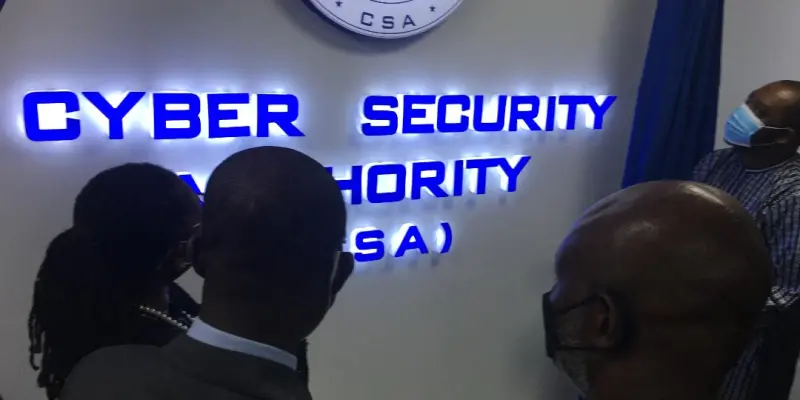
The Cyber Security Authority (CSA) has discovered a growing trend in scams involving the impersonation of well-known brands and service providers.
These include Pizza Hut, Pizzaman/Chickenman, Hisense, Bel Aqua, Papaye, Burger King, etc.
Using Google Map and Google Search, the Authority noted that cybercriminals create fake business profiles or manipulate search results to trick the public into engaging with fraudulent phone numbers, websites, or addresses.
Modus Operandi
These cybercriminals create or alter Google Maps business listings of popular companies, banks, hotels, airlines, courier services, and government agencies. The fraudulent listings include fake phone numbers, emails, and websites.
The CSA noted that when users search for a company’s contact details or service information, they are presented with the fraudulent listing usually at the top of Google results, leading them to contact the cybercriminals instead of the legitimate business.
“The cybercriminals pose as customer service agents of the brands they represent and trick victims into sharing one-time passwords (OTP) or PIN’s, which are used to withdraw funds from their mobile money wallets or make payments for goods and services they never receive,” a statement issued by the CSA added.
As such, the CSA has recommended members of the general public to always cross-check contact details, including phone numbers, from the official websites of institutions instead of relying solely on Google Search or Maps.
Also, “treat top search results with caution; fraudulent listings may appear above legitimate ones, particularly paid “Ad” results. Scammers pay to have their fraudulent links appear at the very top.”
Furthermore, the CSA entreated citizens to stop sharing sensitive information, including PINs and OTPs online.
“If you encounter fake business listings or contacts on Google Maps, report them directly through Google’s reporting tools and notify the CSA,” the statement added.
To institutions, the CSA advised a regular search for their brand online, including Google and Google Maps to identify fraudulent listings or fake websites.
“Proactively share verified contact details on official websites, social media, and other trusted platforms. Monitor reviews and comments online, especially on social media handles for mentions of fraud, as this is often a sign of impersonation,” the statement added.
Institutions are encouraged to acquire official toll-free numbers that can be centrally managed and mapped to their various branches, ensuring consistency and trust.
Alternatively, organisations may acquire dedicated number ranges and actively publicize them to the public as their official contact lines.
The CSA has a 24-hour Cybersecurity/Cybercrime Incident Reporting Point of Contact (POC) for reporting cybercrimes and for seeking guidance and assistance on online activities; Call or Text – 292, WhatsApp – 0501603111, Email – report@csa.gov.gh.
Digital lending cyberbullying incidents between Jan. and May 2025
The Cyber Security Authority (CSA) has recorded an exponential surge in cyberbullying incidents associated with digital lending mobile applications this year.
Between January and May, the Authority received 377 reports, marking a sharp increase compared to the 228 cases reported throughout the entire year of 2024.
The apps that have been identified include Miniloan, Mix Loan, Devtage loan, Ozzy money-cash, Plus Cash Arrow, Fundscredit, Getloan, Kcash, Bestloan, Gcash, Daraloan, Loan Base, Tap Loan, Gh Loans, Sune credit, Urgent Money, Sparkloan, Skyloan, Loancloudgh, Pea Money, Cash Arrow.
The rest are HastyCredit, Lever credit, Molo credit, Sunloan pro, Nina loan, Upper loan, Wohia loan, Morloan pro, MumuMoney, Credit bag, Lever credit, Get loan, Ozzy credit, Molocredit, Soarcredit, E+money, Taploan, Dream Fund, Swftcredit, RocketLoan Turbo, DEVTAGE Financial, Vinvedo Wealth, Credit well, Newgry, Easy Buy, Sika Sika, WePay.
According to Bank of Ghana (BoG) Notices BG/GOV/SEC/2022/10 and BG/GOV/SEC/2023/07, these apps violate the provisions of the Banks and Specialised Deposit-Taking Institutions Act, 2016 (Act 930).
In addition, the owners of the apps have not met the compliance obligations of the Data Protection Commission (DPC), and thus their access and use of the data and PII of users violate the Data Protection Act, 2012 (Act 843).
The CSA has therefore advised the public against subscribing to these mobile applications as they are not sanctioned by the Bank of Ghana (BoG) and the Data Protection Commission.
“Individuals who patronise these services do so at their own risk,” the authority warned.
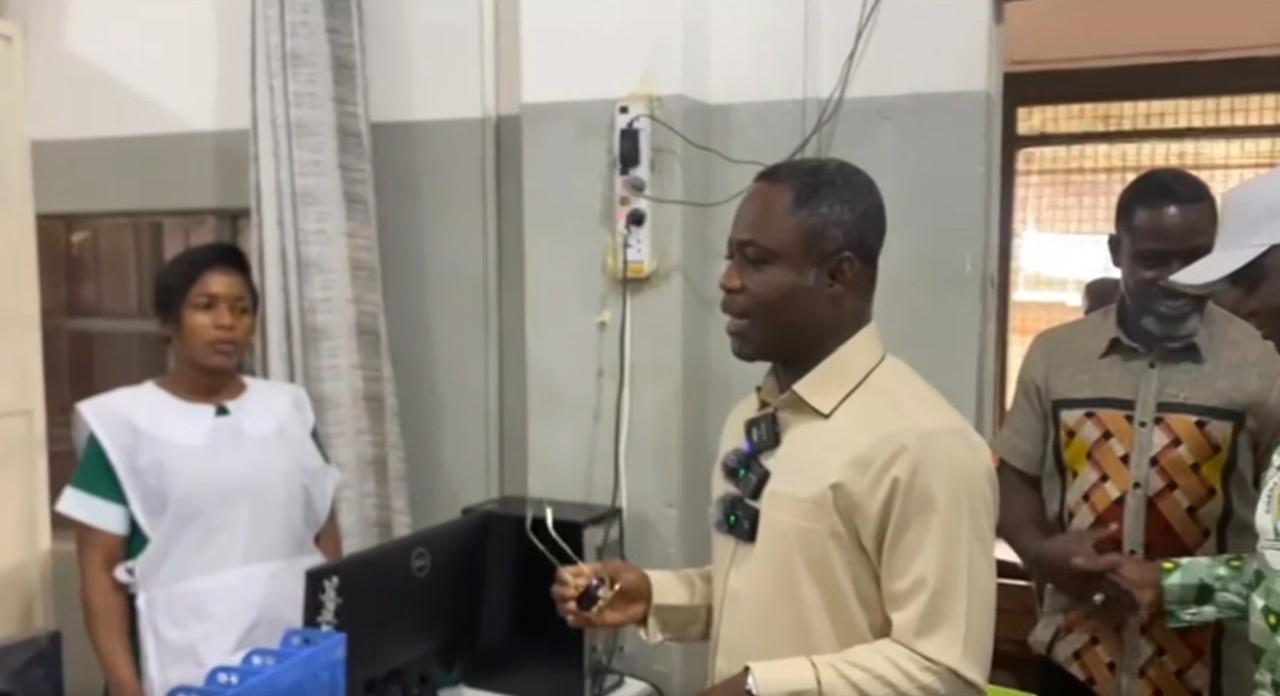
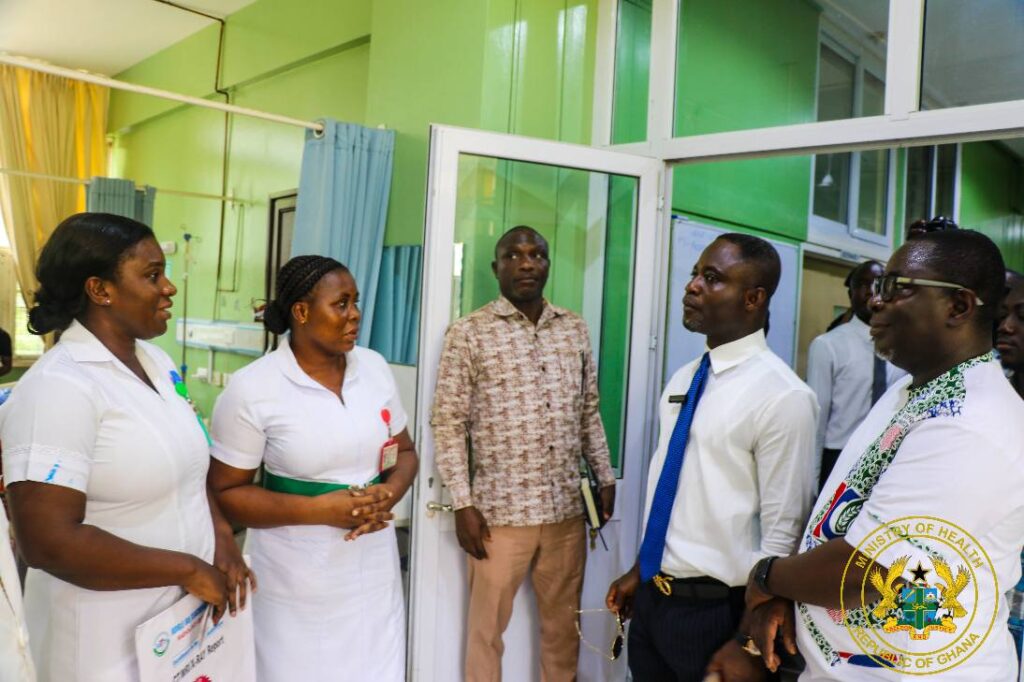
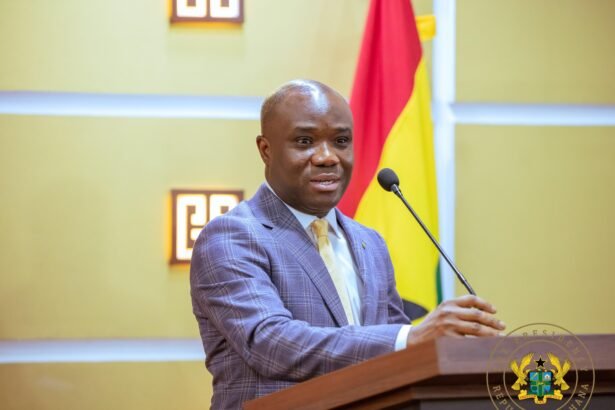
The Minister for Health, Hon. Kwabena Mintah Akandoh, as part of his official tour of the Western North Region, on Friday, August 29, paid a familiarization visit to the Bibiani District Hospital.
At the hospital, the Minister interacted with patients and staff to listen to their concerns and experiences. He was taken on a tour of key departments of the facility by the Medical Superintendent, Dr. Akwesi Adu-Gyamfi.
Areas visited included the washrooms, consulting rooms, Outpatient Department (OPD), Antenatal Care Unit, and the administrative offices. The Minister also held a closed-door meeting with the management of the hospital to discuss challenges and explore ways the Ministry can provide support to improve healthcare services.
The visit formed part of efforts to better understand the challenges faced by health facilities and strengthen healthcare delivery in the region.
In May this year, Kwabena Mintah Akandoh paid a working visit to the Korle Bu Teaching Hospital, where he toured several key departments, including the Obstetrics and Gynaecology Department and the Surgery Department.
His visit followed numerous public complaints and his commitment to improving healthcare delivery across the country.
The sector minister registered his displeasure over the state of maintenance in the departments visited.
Mr Mintah Akandoh stressed the urgent need to address infrastructural and operational challenges affecting patient care.
The minister assured the public that swift action would be taken to engage management and relevant stakeholders to improve conditions at the facility and uphold the highest standards of healthcare delivery.
The minister had been touring key health institutions in the country to assess the quality of health delivery services.
In April, he paid a working visit to the Tamale Teaching Hospital, in response to allegations of malpractice that resulted in the death of a patient who had been referred to the facility.
The situation intensified when the Minister went to assess the public restroom facilities, which were in a deplorable state.
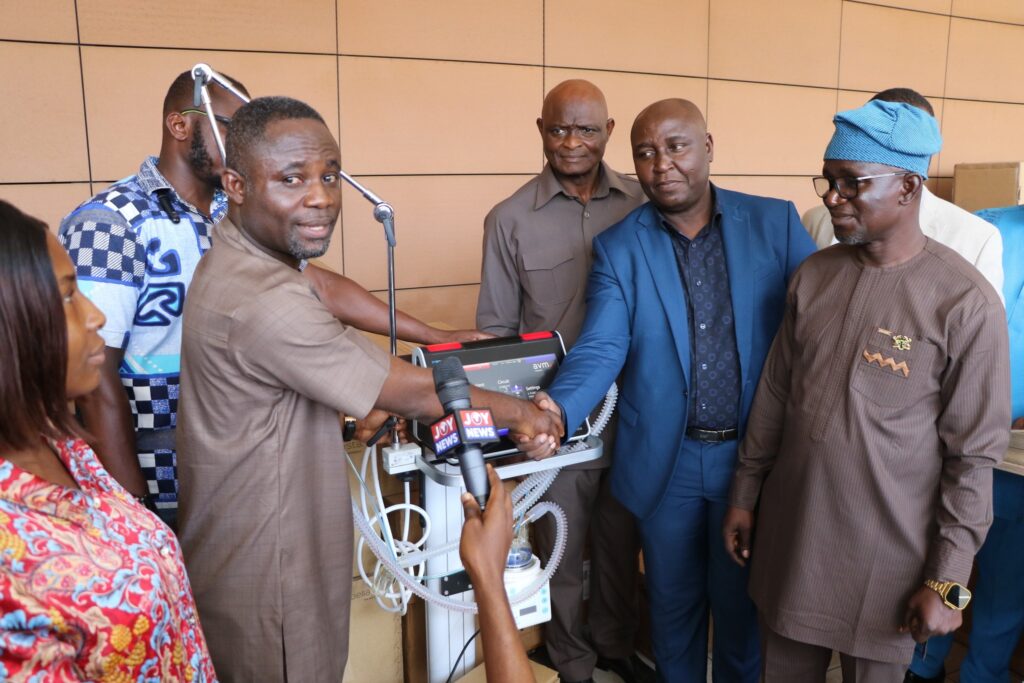
Following the visit, the sector minister donated some essential medical equipment and supplies to the Tamale Teaching Hospital on behalf of the Ministry of Health.
The donation included a wide range of equipment such as ECG machines, ICU ventilators, cardiac monitors, anesthesia machines, infant incubators, and essential consumables amounting to about 35 items. Among the items highlighted were Emergency Health Equipment (EHE) sets, nebulizer sets, and medical-grade towels.
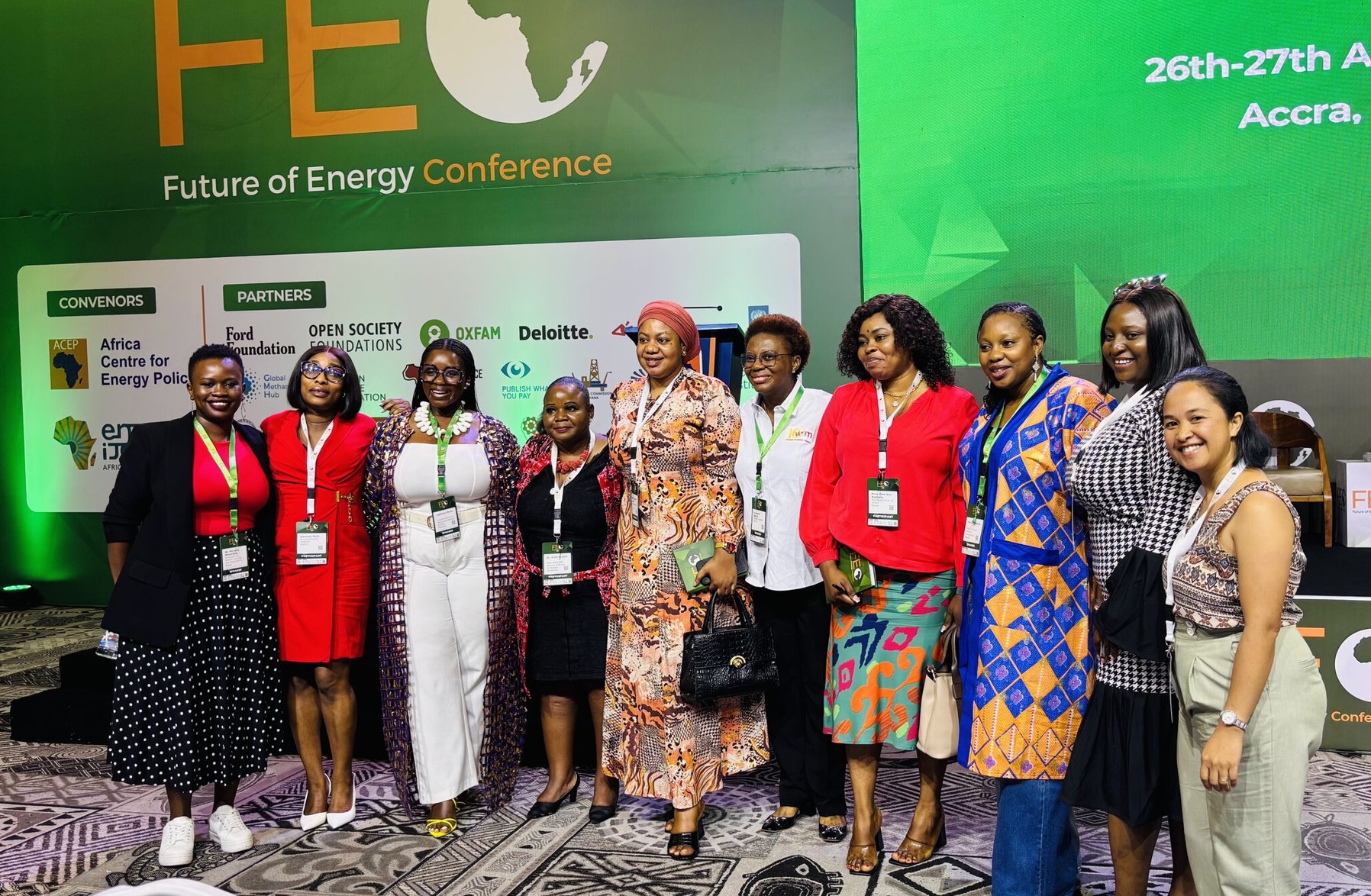
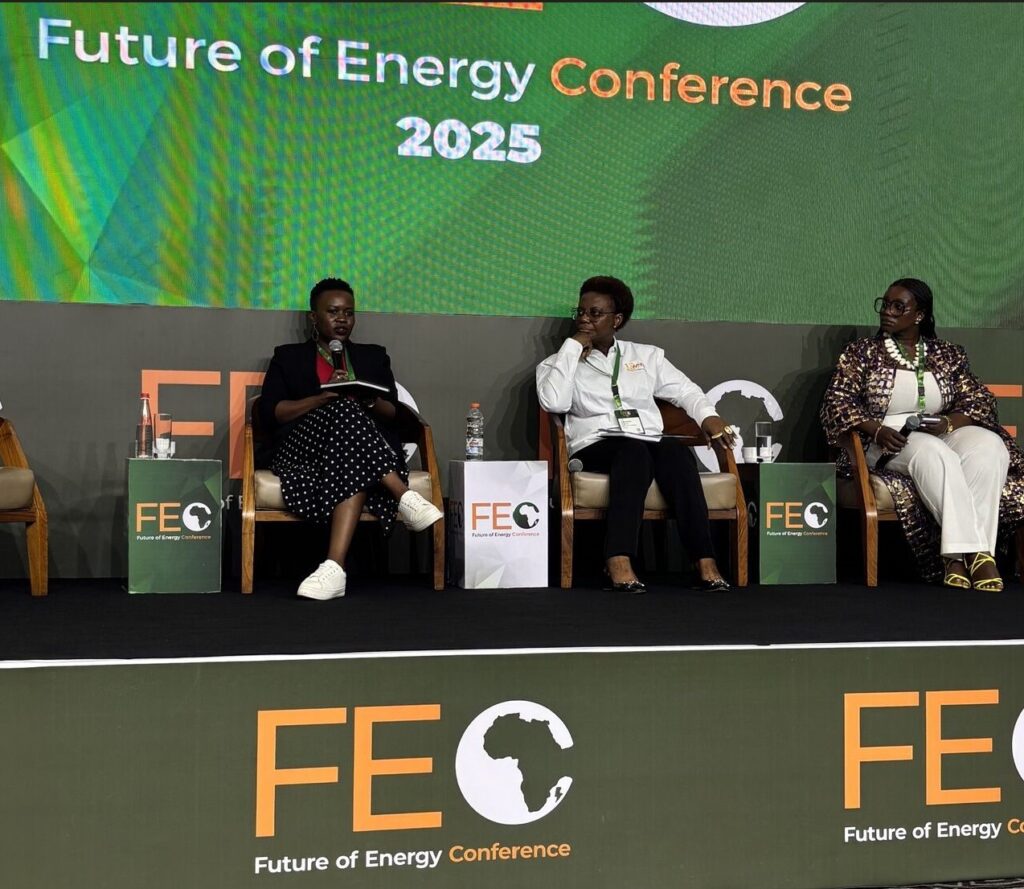
President of Women In Mining Ghana (WIM, Ghana), Georgette Barnes, has noted that women in Ghana’s mining sector stand to boost their earnings and business prospects by adopting responsible mining practices and clean energy.
Speaking as a panelist on Day 2 of the Future of Energy Conference 2025 at the Labadi Beach Hotel in Accra, the mining executive outlined a vision where sustainable methods could unlock significant economic benefits for female miners.
“Women and local communities in mining areas need to be linked to data sources, large-scale mines, and supplier development programs so they can access finance, employment, and business opportunities,” Barnes stated. This forward-looking approach positions sustainable practices as a direct pathway to increased profitability, aligning with the conference’s focus on future energy solutions.
The conference was organised by the Africa Centre for Energy Policy (ACEP), towards examining Africa’s financing needs and strategic pathways to unlock the investments needed to fuel energy access and drive economic transformation.
The WIM President underscored significant hurdles currently faced by women in the sector, citing low levels of financial literacy, limited access to technology and information and a lack of formalisation among many female business owners, particularly in rural areas, as factors limiting women’s access to finance. According to her, lenders generally view mining as high risk, and without clear production data, such as projected output, it becomes nearly impossible to access credit.
On the back of this, the mining executive advocated for the formalisation of existing community-based schemes, like Ghana’s “susu” programs, to help women build a track record that lenders can trust. She cautioned, however, that these schemes alone “are not enough” to expand businesses at scale.
Beyond formalisation, Barnes urged stronger links between women miners and geological surveys, whose data is often required by banks. She also pressed large-scale mining firms to support women’s groups and prioritise local hiring. “If our daughters are hired by large scale mines, we have access to system finance to support the businesses,” she noted.
Currently, many women miners depend on “sponsors” who fund production but then deny them fair prices for their products. To counter this, Barnes pushed for supplier development programs across the value chain so that those doing the initial labor benefit fairly.
She further advised women miners to strengthen cooperation and collective bargaining with suppliers and service providers, especially when traditional bank financing is elusive. “If they were cooperative, they would have a stronger voice and better bargaining power,” she observed.
These insights, gleaned from a World Bank-funded “responsible mining project” with women miners in northern Ghana, illustrate both the challenges and potential solutions for empowering women in a crucial economic sector, with a clear eye on sustainable and profitable practices for the future.
The Conference brought together government agencies, civil society organisations, private sector players, and development partners from across Africa to deliberate on practical solutions for a sustainable and equitable energy future.
The Accra Circuit Court has convicted the eight individuals who were arrested for their involvement in the Ablekuma North electoral violence.
In Court on Friday, August 29, His Honour Isaac Addo ordered each culprit to pay a fine of 500 penalty units (GH¢6,000) or, in default, serve 24 months in prison.
The eight individuals are Mohammed Abubakari, Tijani Mahmudu, Prince Dzakpasu, Anas Mohammed, Mohammed Hamda, Darko Otibu Samuel, Musah Muntari, and Ali Saeed (alias Bomba).
They were charged with conspiracy to commit assault and three counts of assault, contrary to Sections 23(1) and 84 of the Criminal Offences Act, 1960 (Act 29).
They all pleaded guilty to the charges, a decision that fast-tracked the legal case.
Prior to their arrest and conviction, the police expressed their commitment to holding accountable anyone found culpable of violence, intimidation, or electoral misconduct. They encouraged the public to share credible information via emergency lines 18555 or 191.
The Electoral Commission (EC) on Friday, July 11, held a rerun election in 19 polling stations of the Ablekuma North to provide its constituents a representative after the 2024 parliamentary elections.
Ewurabena Aubynn polled 34,090 votes to beat the New Patriotic Party’s (NPP) Akua Afriyie, who secured 33,881 votes.
Ablekuma North remained the only constituency in Ghana without a sitting MP, due to unresolved disagreements over the outcome of the parliamentary vote after the 2024 polls.
On December 10, 2024, three days after the national polls, the EC declared Ewurabena Aubynn of the NDC the winner of the Ablekuma North parliamentary seat, defeating the New Patriotic Party’s (NPP) Nana Akua Owusu Afriyieh.
However, the EC later revoked the announcement, revealing that results from 62 of the 281 polling stations had not been included in the initial collation.
Efforts to restart the collation in January 2025 were disrupted by multiple challenges.
These included interruptions due to the submission of unverified pink sheets and a violent intrusion at the collation centre that heightened security concerns.
The Electoral Commission (EC), after extensive deliberations, in July noted that it will hold the rerun election because the 19 scanned polling station results used for the collation, though approved by agents of both political parties, were not verified by the presiding officers responsible for those polling stations.
The EC arrived at this decision after it met with the representatives of the National Democratic Congress (NDC) and New Patriotic Party (NPP) on Tuesday, July 1.
Violence mars Ablekuma North rerun election
At the Odorkor Methodist 1 polling station in the Ablekuma North constituency, some individuals engaged in a fisticuff with the police personnel. Also, a JoyNews journalist was slapped by an unknown individual.
Former Minister of Fisheries and Aquaculture Development and Member of Parliament for Ewutu Senya East Constituency, Hawa Koomson, was also assaulted by a group of men. A journalist with GH One Television, Banahene Agyekum, was also slapped by a police officer.
The Ghana Police Service has interdicted one of its officers who was caught on camera slapping a journalist with GH One Television, Banahene Agyekum, during the rerun election at Ablekuma North.
In line with internal disciplinary procedures, he has been referred to the Police Professional Standards Bureau (PPSB) for investigation.
The officer concerned has been withdrawn from the ongoing election duty at Ablekuma North.
The police have assured the public that a thorough investigation will be conducted into the matter and further updates will be communicated.
It is unknown what exactly transpired between the reporter and a group of police officers that led to him being slapped.
The police officer’s action has been condemned by all, including the mayor of Accra, Michael Kpakpo Allotey, who witnessed the unfortunate incident.
Deputy Minister for Government Communications, Shamima Muslim, in reaction to the said incident, commended the police for its swift action to reprimand its officer for such unlawful acts and condemned the recent attacks against civilians and journalists during the Ablekuma North election rerun.
“What we are happy about is the swift action that the Ghana Police itself has taken in interdicting the officer in question,” she said.
“It is completely unwarranted. Government itself takes a very serious stance, especially on security agencies meting out unwarranted attacks to civilians under any circumstances,” she added.
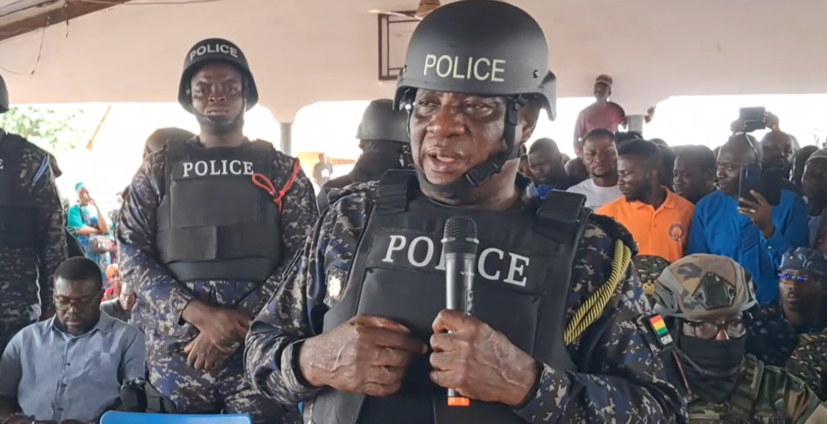
President of the Ghana Journalist Association (GJA) Albert Kwabena Dwumfuor also condemned the attack on journalists. Due to the chaos that erupted, Inspector General of Police Christian Tetteh Yohuno visited some polling stations in the constituency.
The Minority in Parliament has also condemned the violence that took place during the just-ended Ablekuma North rerun election, accusing members of the ruling National Democratic Congress (NDC) of instigating violent activities.
In a statement signed by Minority Leader Alexander Afenyo-Markin, the caucus said:
“The most disturbing aspect of today’s violence is not just the brutality itself, but the deliberate endorsement and celebration of these attacks by senior government officials. For example, Dr.
Hanna Louisa Bissiw, National Women’s Organiser of the NDC and CEO of the Minerals Development Fund, provided perhaps the most damaging response with her statement that “violence begets violence” and her suggestion that the brutal attacks were somehow justified.”
“Even more shocking is the Facebook post by Malik Basintale, Acting Chief Executive Officer of the Youth Employment Agency (YEA) and Deputy National Communications Officer of the NDC,
who apparently celebrated the man who attacked Hon. Mavis Hawa Koomson with the disturbing declaration, “From today, I name him the Flying Python. He shall be in charge of the 5k Airforce!” This grotesque celebration of violence against a former Member of Parliament represents a new low in Ghana’s political discourse,” the statement added.
The Minority has registered its displeasure with the operation of the Ghana Police Service at the polling stations.
“The Ghana Police Service’s response raises serious questions about their preparedness and commitment to protecting our electoral process. Security personnel were overwhelmed by the perpetrators, failing to prevent these attacks on political figures, party agents, and journalists. More concerning are allegations surrounding Chief Superintendent Lumor Frederick Senanu and his potential role in facilitating these disruptions.”
The caucus stressed the need for increased protection for voters, electoral officers, journalists, and candidates. It also called on the international community, civil society, and media to monitor developments closely.
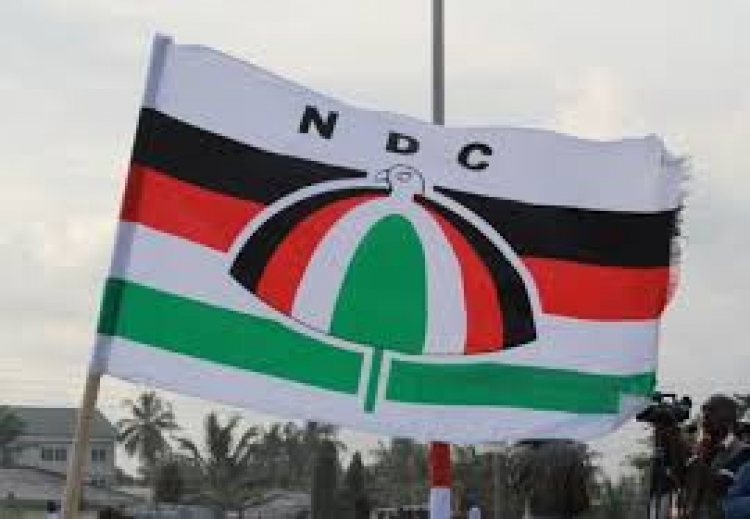
The National Democratic Congress (NDC) has cleared 12 out of 16 aspirants who picked up nomination forms to contest the Tamale Central parliamentary primary.
The 12 aspirants were cleared only after the completion of the vetting process.
The National Democratic Congress (NDC) opened nominations on August 21, for aspirants seeking to contest the Tamale Central Constituency primary.
Nomination forms were available at the Northern Regional Office of the party from Friday, August 22, to Sunday, August 24, 2025, between 8:00 a.m. and 5:00 p.m. each day.
Prospective aspirants will pay a non-refundable nomination fee of GH¢5,000 and a filing fee of GH¢40,000 to be paid in cash only into the party’s official account at UMB Bank, Adabraka Branch. No cheques or bankers’ drafts will be accepted.
There is a slash for …”female aspirants and persons with disabilities are entitled to a 50 per cent reduction on the filing fee. A certified copy of the delegates’ list will be made available to all aspirants after the vetting process.”
A certified copy of the delegates’ list will be made available to all aspirants after the vetting process.
The party has urged all prospective aspirants and stakeholders to ensure strict compliance with these directives and to conduct their campaigns and related activities with decorum, unity, and fairness.”
The Tamale Central by-election will be conducted on September 30, the Electoral Commission (EC) has announced.
This follows the death of its legislator, Alhaji Dr. Ibrahim Murtala Mohammed. He was among the eight individuals who lost their lives in the tragic helicopter accident on August 6. He was laid to rest on August 10.
Individuals interested are entreated to pick up nomination forms via the website www.ec.gov.gh. They have from now until September 10 to do so. Filing fee for applicants is GHC10,000. For female candidates and Persons with Disabilities (PWDs), the nomination form is going for GHC7,500.
These forms are to be submitted to the EC’s Tamale Metropolitan Office from September 8 to 10, from 9am to 12pm and 2pm to 5pm daily.
The criteria for applicants include providing a nomination form proposed and seconded by two registered voters in the constituency and assented to by eighteen others. Nomination forms must be delivered personally by candidates or have them delivered by a proposer or seconder. The forms must be submitted in four copies. Candidates are to provide two recent bust-sized photographs against a red background.
On Monday, August 11, the New Patriotic Party declared its intention not to participate in a by-election in the area. According to a statement signed by NPP General Secretary Justin Kodua Frimpong, the decision was taken by the Party at a National Steering Committee meeting held on Monday, August 11, 2025, at the Party Headquarters pursuant to Article 10(10)(1) of the Party Constitution.
According to the statement, this will be the party’s better way of honoring Dr. Murtala Mohammed and the other crash victims.
“In arriving at the decision, the Party considered many factors, including the circumstances under which the Tamale Central seat has become vacant and the possibility of a further polarization of the country at this critical time.
The NPP is of the belief that it would be inhumane and unconscionable to subject the nation to a competitive processes in search of a replacement for the departed MP. The Party believes that the tension and acrimony often associated with the conduct of by-elections in the country should be avoided.
It is the considered view of the Party that the greatest tribute that the NPP and the rest of the nation can pay in honour of the departed, is not only to win the fight against Galamsey but also to ensure a smooth and peaceful replacement for the good people of Tamale Central.
Consequently, the NPP hereby announces that when the Electoral Commission of Ghana opens nominations for the Tamale Central by-election in line with Article 112 (5) of Ghana’s Constitution, the Party will, in accord with the national interest, not take part in the contest,” a part of the statement read.
Earlier, Chairman of the National Democratic Congress (NDC), Johnson Asiedu Nketia, urged members of the National Democratic Congress to exercise restraint from discussing and announcing their intentions to contest the Tamale Central seat.
He shared the words of caution while lauding the New Patriotic Party’s (NPP) decision not to contest in the Tamale Central by-election.
“I beg our party members not to rush into contesting the Tamale Central constituency. Let’s stay calm and not disrupt the funeral rites of our fallen heroes. The party will meet after the funeral and set timelines to get a replacement for the late Murtala Mohammed,” he said.
Speaking at the final funeral rites of the late Dr. Murtala Mohammed at his family house in Tamale on Tuesday, August 12, Asiedu Nketia described the NPP’s move as one that demonstrates political maturity.
“We thank our brothers in the NPP for declaring that they won’t contest us in Tamale Central,” he said.
Preparations toward Akwatia by-election
The Electoral Commission (EC) announced that the printing of ballot papers for the upcoming Akwatia parliamentary by-election will begin on Wednesday, August 20.
This was disclosed at a meeting convened by the Inspector-General of Police (IGP) with political representatives to discuss security measures and strategies to curb electoral violence. The Commission’s Director of Electoral Services, Benjamin Bano-Bioh, told the media that, “as of now (August 19), we are going to start the printing of ballots from tomorrow (which is today).”
“Procurement has already been done. We have procured all the materials required for the election, so we are already,” he stated. Benjamin Bano-Bioh further explained that his outfit is “poised to deliver on our mandate in a professional way. We call on political parties to play by the rules,” he added.
The Inspector-General of Police, Christian Tetteh Yohuno, also briefed political parties, outlining critical security arrangements for the election.
Following the death of the Member of Parliament for Akwatia, Ernest Yaw Kumi, the by-election has been scheduled to elect his successor. The Electoral Commission (EC) is expected to hold the by-election in the Akwatia Constituency of the Eastern Region on Tuesday, September 2.
The election became necessary after the death of the constituency’s representative, Ernest Yaw Kumi, who was reported dead on Monday, July 7. On Monday, August 4, the Electoral Commission will conduct balloting to ensure fairness in the order in which candidates appear on the ballot paper.
The two major political parties are preparing vigorously for the contest. The National Democratic Congress (NDC) has elected legal practitioner Bernard Bediako Baidoo as its candidate for the upcoming by-election in Akwatia, Eastern Region, scheduled for Tuesday, September 2.
This follows an internal election conducted by the party on Monday, August 4, to select a representative for the by-election. The competition was between former Member of Parliament Henry Boakye, the current NDC Akwatia Constituency Secretary Bernard Bediako Baidoo, and Erasmus Koney Ali.
Bernard Bediako Baidoo polled 380 votes, Erasmus Ali Korney secured 366 votes, and Yiadom garnered 232 votes. On the other hand, the New Patriotic Party (NPP) has selected the Chief Executive of Owuo Mining Company, Solomon Kwame Asumadu, as its parliamentary candidate for the upcoming by-election.
According to the Eastern Regional Chairman of the NPP, Jeff Konadu Addo, the decision was made after extensive consultations with key stakeholders.
He explained, “The National Council of the party set up a committee and we were tasked to find out who could be our candidate or whether we will do primaries or not.
“So, the team went to Akwatia in the constituency, had a lot of engagement with the grassroots, electoral area coordinators, polling station officers, chiefs, opinion leaders, and the majority of the people said that for primaries, we should take it out. We shouldn’t conduct primaries in Akwatia. And that’s exactly what we followed.”
Earlier, reports suggested that the widow of the late Member of Parliament, Mrs. Mavis Kumi, had expressed interest in contesting the seat. However, the Eastern Regional NPP Chairman, Jeff Konadu Addo, on Tuesday, July 15, dismissed such reports, emphasizing that campaign flyers making such claims were false.
“We wish to categorically state that this information is false, misleading, and should be treated with the utmost contempt it deserves,” Jeff Konadu Addo said.
He further clarified that Mrs. Mavis Kumi had no interest in contesting the position but was focused on mourning her husband.
“She has unequivocally communicated that she has no interest in contesting the seat or participating in active politics at this time. Her current focus is to mourn her husband with dignity and in peace,” he added.
Meanwhile, the Minister for the Interior, Mubarak Muntaka, has urged security personnel who will be deployed to oversee the by-election in the Akwatia constituency to remain vigilant while carrying out their duties.
He reminded them to reflect on the recent violence that occurred during the parliamentary election rerun in the Ablekuma North constituency and to work proactively to prevent a recurrence.
According to him, the government will ensure that such incidents are not repeated in future elections. The minister made these remarks at the government’s accountability series in Accra on Monday, July 14.
“This is also a wake-up call for our security agencies to know that probably what happened [in Ablekuma North]…gives our security agencies the opportunity to even plan better towards Akwatia.
“All I can assure the people of Akwatia is that we will use Ablekuma North as a case study to review how we operate in Akwatia—to make sure that the citizens are free to cast their votes and express their will without fear or favour,” Muntaka added.
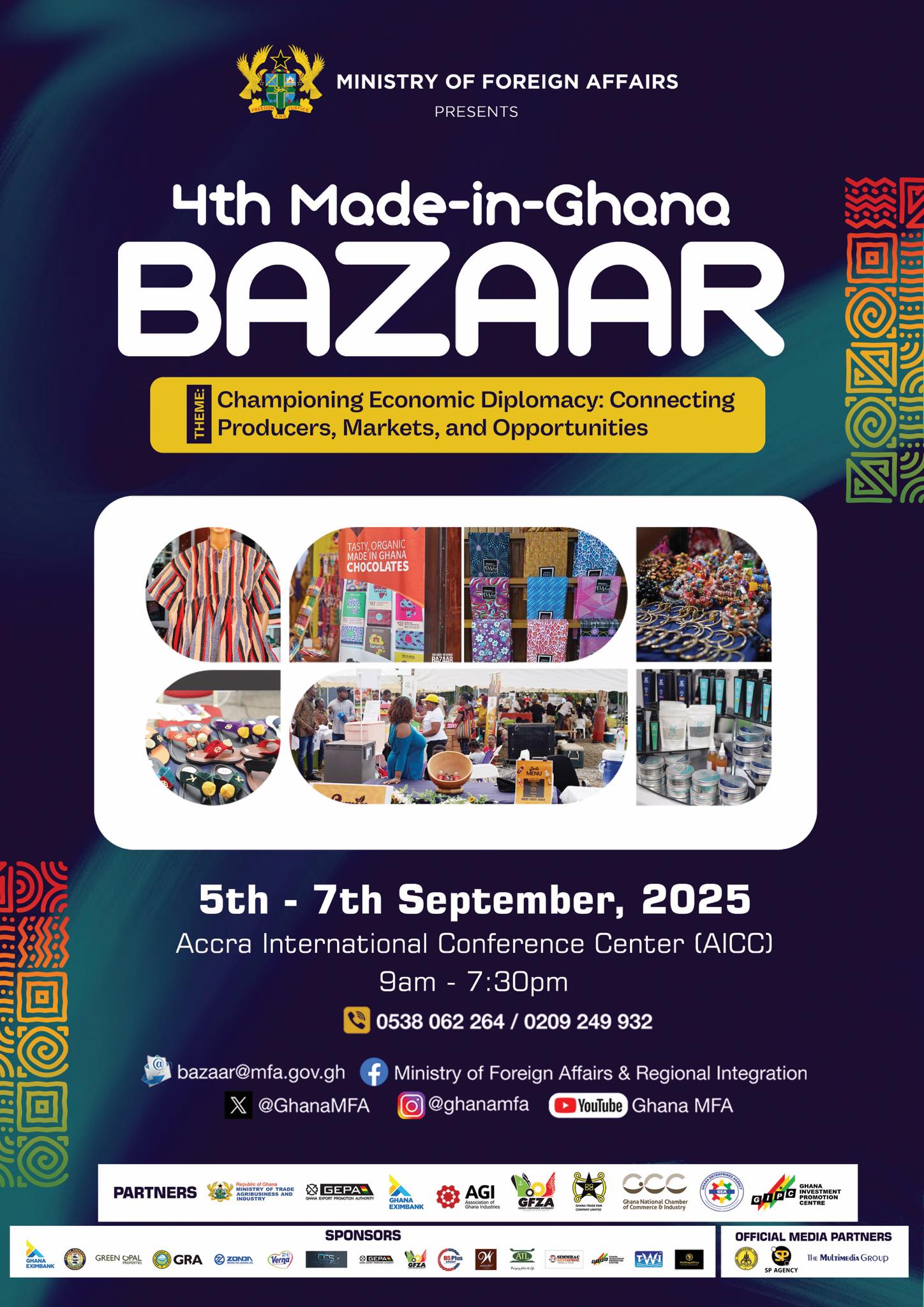
The 4th Made-in-Ghana Bazaar is slated to commence on September 5th at the Accra International Conference Centre (AICC).
The 3-day event will begin from 9am to 7:30pm each day. The event, presented by the Ministry of Foreign Affairs, is under the theme “Championing Economic Diplomacy: Connecting Producers, Markets, and Opportunities.”
The bazaar aims to promote Ghanaian products and services globally through strategic economic diplomacy, as well as connect Ghanaian producers with consumers, investors, diplomats, and foreign buyers.
The event is organized in partnership with institutions including the Ministry of Trade & Industry, GEPA, Ghana Export Promotion Authority, Ghana Investment Promotion Centre (GIPC), Association of Ghana Industries (AGI), Ghana Free Zones Authority (GFZA), Ghana Chamber of Commerce, Ghana Enterprises Agency, and the Ghana National Chamber of Commerce & Industry.
Sponsors include Green Coast, GRA, Zonda, and several others, while the official media partners are The Multimedia Group and SP Agency. For inquiries, interested persons can contact the organizers on 0538 062 264 or 0209 249 932, or via email at bazaar@mfa.gov.gh
Earlier this month, the Ministry of Foreign Affairs launched the 4th Made-in-Ghana Bazaar in Accra. At the media launch, the Minister for Foreign Affairs, Samuel Okudzeto Ablakwa, stated the bazaar seeks to aid micro, small and medium-sized enterprises (MSMEs) as well as increase the country’s export of non-traditional goods.
“We are not merely talking about Made-in-Ghana; we are institutionalising it through bold reforms and strategic action,” he said.
He highlighted that the objective of the event forms part of President John Dramani Mahama’s vision to build Ghanaian companies to be competitive on the international market as well as make the country self-reliant.
In attendance were the Chief Executive Officer (CEO) of the Ghana Trade Fair Company, Ms Naa Amerley Bamba, First Vice President of the Ghana National Chamber of Commerce and Industry, Ms Emelia Assiakwa. They expressed the private sector’s readiness to make the bazaar a success.
“This platform perfectly aligns with our shared vision of advancing economic diplomacy and boosting Ghana’s non-traditional exports,” Ms Assiakwa said.
“Let us drive local production, expand exports and build a resilient private sector for national transformation,” she further urged.
At the event, the foreign minister spoke of the introduction of Ghana’s first ever Key Performance Indicators (KPI), for diplomats and ambassadors tasking them to show tangible outcomes that attract investment and generate employment overseas, starting September 1, 2025.
“On the first of September, the President will be launching the first of its kind, a novel Key Performance Indicators (KPI) for all Ambassadors and diplomats from the Republic of Ghana. This has never happened in our history. And when you peruse that document, you will see that the honorary diplomacy is at the heart of it,” he said.
“The president wants our diplomacy to make an impact. Our diplomacy must lead to the improvement in the lives of the people. Our diplomacy must promote investment. And diplomacy must create a safe haven for all of those who invest in our country and that is what the foreign ministry has been charged to do,” Ablakwa shared.
The sector minister added: “In addition, all humanitarian donations made by the Ministry will henceforth consist only of Made-in-Ghana products. We have already begun by sending two containers of Ghanaian chocolate to Palestine as part of a humanitarian effort.”
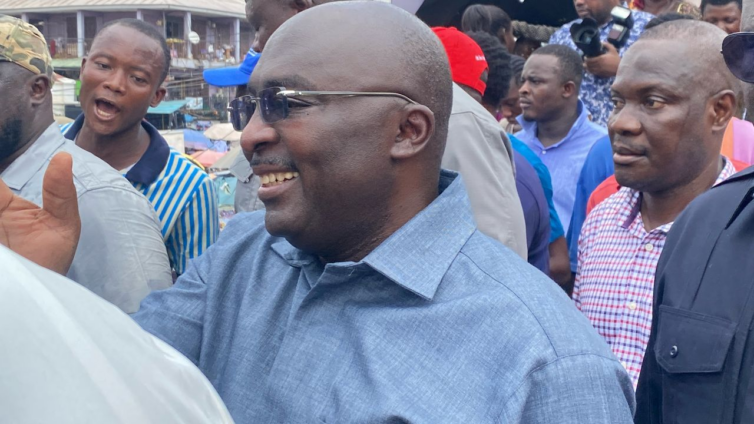
Dr. Mahamudu Bawumia, the 2024 flagbearer and former Vice President, has entreated the rank and file of the New Patriotic Party (NPP) to support his efforts in rebuiling the party following its unprecedented defeat in last year’s election.
He made these remarks after filing his nomination forms on Thursday to participate in the New Patriotic Party’s (NPP) presidential primaries, scheduled for next year.
“I implore you to join me on this journey to rebuild our party and reposition this great tradition to deliver for Ghanaians from 2028. I am committed to doing this with you, the grassroots of the party.
“A future Bawumia government would recognise and reward the sacrifices of our grassroots. Many have lost their jobs under the current government, and we will restore their appointments,” he said.
He also indicated that his experience and achievements make him the most prepared candidate to lead the New Patriotic Party (NPP) into the 2028 general elections.
Engaging party faithful on August 28, the former Vice President noted that being regarded as the most effective Vice President in the 4th Republic demonstrates his capability to lead Ghana as its president.
“Many people say I have been the most effective Vice President in Ghana’s history. This implies that given the opportunity, I can equally become one of the most effective presidents in Ghana as we go forward. I demonstrate my strength by getting results, not by making noise or by insulting or bragging about money. The combined effect of how well Bawumia is known today and my experience as Vice President make me the most prepared person for the NPP’s quest for the 2028 election and governance in 2029,” he said.
Dr. Bawumia stressed that he owes the NPP a duty to provide the party with the most prepared candidate.
“I am offering myself to be elected as flagbearer because I believe we owe a duty to this party to give her a choice to put forward the most prepared candidate for the 2028 election and the most prepared person to be president in 2029. In the last 16 years, I’ve had the privilege of joining each and every constituency at least five times to work hard on the ground and campaign and work for the NPP,” he added.
Videos sighted on social media showed scores of NPP sympathizers trooping to the party’s headquarters ahead of Dr. Bawumia’s filing process. On Tuesday, July 29, the NPP opened nominations for its 2028 flagbearer race. Dr. Mahamudu Bawumia, the party’s 2024 flagbearer and former Vice President, Kennedy Agyapong, Kwabena Agyepong, and Dr. Osei Adutwum all picked up nomination forms.
Former General Secretary of the NPP, Kwabena Agyei Agyepong, officially filed his nomination forms on Tuesday, August 26. Party executives received the forms from former Assin Central MP and presidential hopeful Kennedy Ohene Agyapong on Wednesday, August 27. Former Food and Agric Minister Bryan Acheampong has also submitted his nomination forms, and former Education Minister Dr. Adutwum.
Meanwhile, Dr. Bawumia has received strong backing from 268 former Metropolitan, Municipal, and District Chief Executives (MMDCEs), who paid him a visit in June to pledge their support. Former Energy Minister and running mate of the NPP’s 2024 presidential candidate, Dr. Matthew Opoku Prempeh, has also declared his support for Dr. Bawumia ahead of the party’s presidential primaries in 2026.
In an interview on Asempa FM on August 26, the former minister, popularly known as Napo, expressed gratitude to Dr. Bawumia for making him his running mate despite pressure from party bigwigs to choose someone else.
“I am not ungrateful. Look at this big party and upon all the people who were praying for the running mate slot, he ignored all of them and made me his running mate. I know it was a difficult situation, but a lot of people don’t know. Some bigwigs in the party went to Dr. Bawumia to tell him not to make me the running mate but he ignored them. There are some names that if I mentioned, you would be shocked. Some even took him to offices to advise him against me but still he chose me,” he remarked.
He continued: “So, I cannot be ungrateful to him… For those who stood in the flagbearership contest, everyone knows Kennedy Agyapong is my friend, but I am still for Bawumia.”
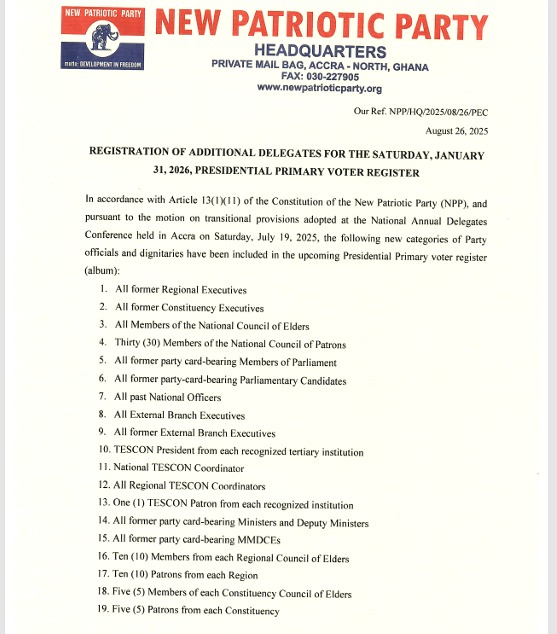
The New Patriotic Party (NPP) has also made provisions for new additions to its approximately 220,000 delegates who are eligible to vote in its presidential primaries, slated for Saturday, January 31, next year.
In a statement dated August 26, signed and shared by the Secretary of the Presidential Elections Committee, Williams Yamoah, the party announced that registration has been opened for an additional 60,000 new delegates, comprising nineteen new categories of people. This directive follows reforms adopted at the party’s National Annual Delegates Conference held in Accra on Saturday, July 19.
The statement explained: “In accordance with Article 13(1)(11) of the Constitution of the New Patriotic Party (NPP), and pursuant to the motion on transitional provisions adopted at the National Annual Delegates Conference held in Accra on Saturday, July 19, 2025, the following new categories of Party officials and dignitaries have been included in the upcoming Presidential Primary voter register.”
The updated voter register, also known as the party album, will now include several new categories of officials and dignitaries. These are: all former regional and constituency executives, members of the National Council of Elders, 30 members of the National Council of Patrons, all past national officers, former party-card-bearing MPs and parliamentary candidates, as well as former party-card-bearing ministers and deputy ministers.
Other groups added to the list are external branch executives, former external branch executives, and key members of the Tertiary Students Confederacy (TESCON), including presidents of recognised institutions, the National TESCON Coordinator, regional coordinators, and one TESCON patron from each institution.
Additionally, 10 members from each Regional Council of Elders, 10 patrons from each region, and five members and patrons from each constituency have also been included.
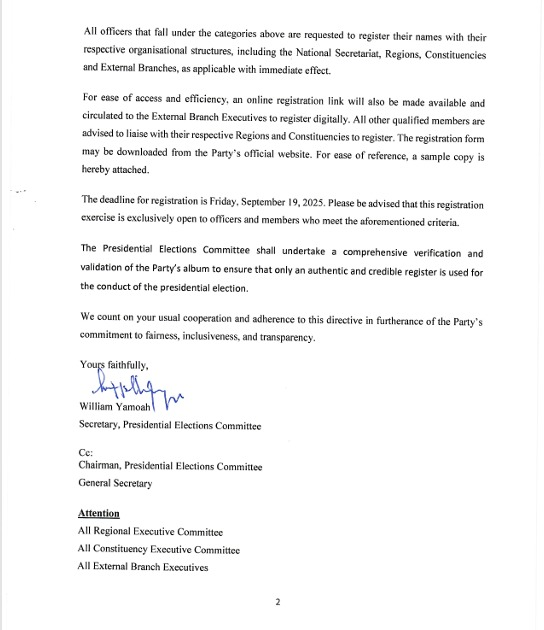
The statement directed that “all officers that fall under the categories above are requested to register their names with their respective organisational structures, including the National Secretariat, Regions, Constituencies and External Branches, as applicable, with immediate effect.”
To facilitate the process, the party clarified that a digital link would be circulated to External Branch Executives for online registration. All other qualified members were advised to liaise with their respective regions and constituencies to register.
However, the forms are to be accessed via the party’s official website. “The registration form may be downloaded from the Party’s official website. For ease of reference, a sample copy is hereby attached,” excerpts of the statement read.
The party further warned that the registration was strictly for the aforementioned categories of people, with a deadline set for Friday, September 19.
“The deadline for registration is Friday, September 19, 2025. Please be advised that this registration exercise is exclusively open to officers and members who meet the aforementioned criteria. The Presidential Elections Committee shall undertake a comprehensive verification and validation of the Party’s album to ensure that only an authentic and credible register is used for the conduct of the presidential election,” the party cautioned, while expressing confidence in members’ cooperation.
“We count on your usual cooperation and adherence to this directive in furtherance of the Party’s commitment to fairness, inclusiveness, and transparency.”
The NPP is on a journey of reset, reinforcement, and healing following its historic defeat in the 2024 elections. Dr. Bawumia lost the presidential race to John Dramani Mahama of the National Democratic Congress (NDC), who secured 6,328,397 valid votes, representing 56.55%, against Bawumia’s 4,657,304 votes, representing 41.61%.
Since the beginning of this year, the party has undertaken several reforms to position itself strongly against the NDC and recapture power.
Among these reforms is the abolition of the electoral college in favour of a broader base of delegates. The party has also added 19 new delegate categories and granted amnesty to suspended members.
The NPP has announced that suspended members have been reinstated and all charges against those facing the disciplinary committee have been dropped.
This decision was taken by the National Council during an emergency meeting held on July 25. In a statement dated August 16 and signed by the Acting National Chairman of the Party, Mr. Danquah Smith Buttey, members were informed that as part of measures to ensure unity and cooperation, all banned members had been given the right to return.
“This measure reflects the Party’s unwavering commitment to fostering internal cohesion, strengthening solidarity, and preparing collectively for the political tasks ahead. I write to inform you that the National Council, at its Emergency Meeting held on Friday, July 25, 2025, resolved, in the interest of unity and reconciliation, to grant a General Amnesty to all Party members who have been suspended or whose disciplinary cases are currently pending before the appropriate disciplinary bodies,” parts of the statement read.
The party further urged all relevant bodies, including Regional and Constituency Executive Committees, to reinstate suspended members in accordance with laid-down rules and guiding principles.
“We hereby serve notice that this directive lifts all such suspensions and nullifies any ongoing proceedings against affected members,” the statement added.
However, the party clarified that this recall does not apply to members who willfully forfeited their membership. In cases where such individuals wish to return, they are required to submit a formal reinstatement request to the party’s secretariat. Upon acceptance, a two-year ban will be imposed, preventing them from contesting in any internal elections.
The National Health Insurance Authority (NHIA) on August 27, disbursed an amount of GHS154 million to health facilities nationwide on August 27.
On August 6, NHIA disbursed over GHC 243 million to healthcare facilities, bringing total claims paid in August 2025 alone to approximately GHS400 million. The total payments made by the NHIA in the past eight months stand at over GH¢1.897 billion.
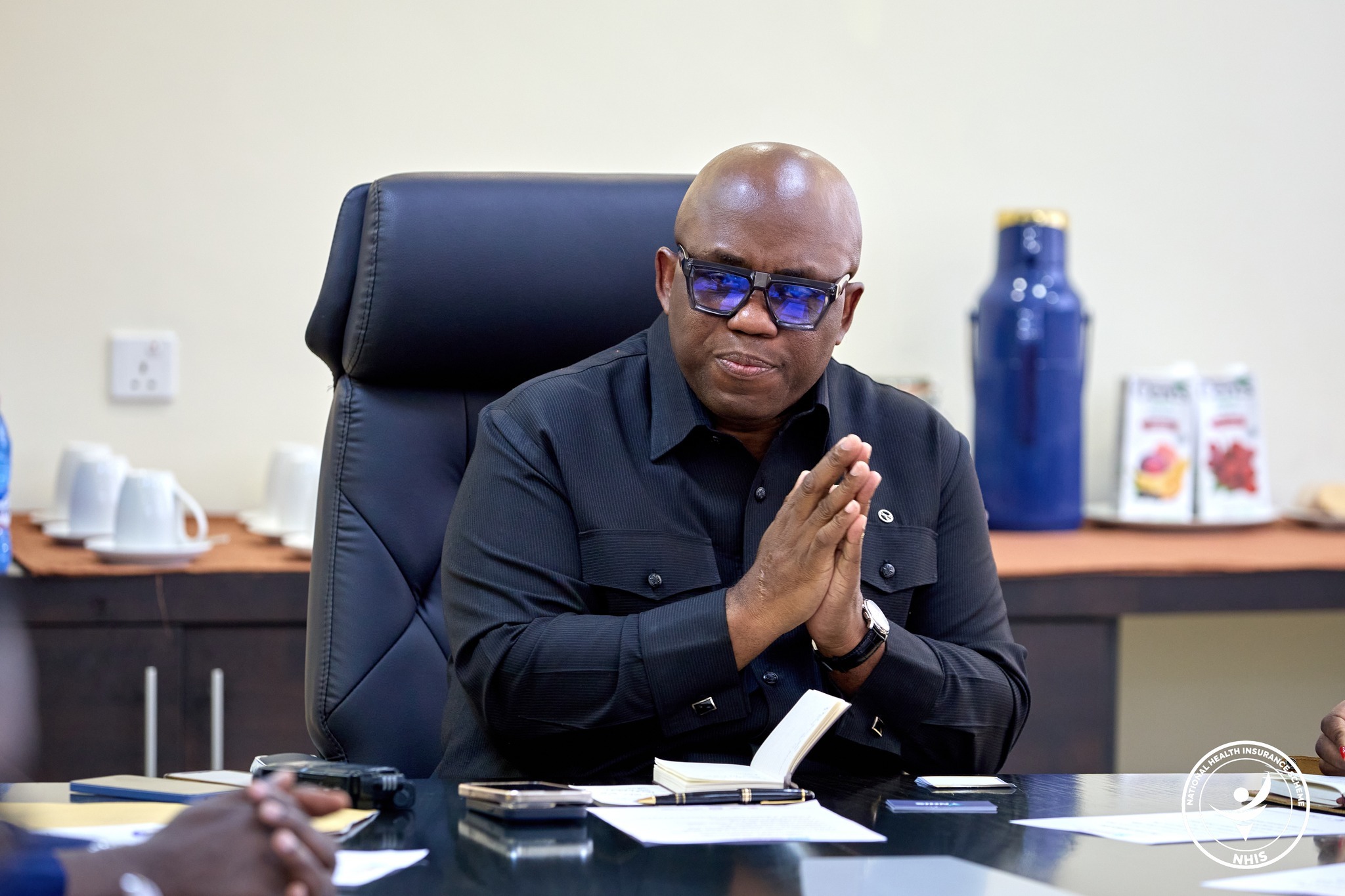
A month ago, the National Health Insurance Authority (NHIA) disbursed an amount of GH¢267.67 million as claims. The disbursement became possible following approval by Chief Executive Dr. Victor Asare-Bampoe.
For the Authority, its significant disbursement demonstrates its unwavering commitment to sustaining the National Health Insurance Scheme (NHIS) and ensuring that healthcare providers are resourced and motivated to deliver quality services to our cherished members.
“The NHIA remains focused on improving efficiency, enhancing provider relations, and delivering on its mandate to ensure financial access to quality healthcare for all residents of Ghana. We thank our stakeholders for their continued support and assure the public of our dedication to transparency, accountability, and timely payments,” the NHIA said in a statement.
The Authority has stated that it is firstly committed to strengthening internal controls and operational efficiencies to ensure the long-term sustainability of the National Health Insurance Scheme (NHIS).
Four months ago, the Private Health Facilities Association of Ghana (PHFAoG) suspended health insurance services for National Health Insurance Scheme (NHIS) cardholders at all its member facilities, citing the National Health Insurance Authority’s (NHIA) failure to settle outstanding claims.
In a statement signed by its President, Dr. Kwame Buabeng-Frimpong, on Friday, April 4, the association disclosed that the NHIA owed service providers for claims dating as far back as September and October 2024, despite multiple assurances.
The PHFAoG highlighted the severe financial strain the delays have placed on member facilities, making it increasingly difficult for them to deliver quality healthcare to NHIS beneficiaries.
The group also expressed disappointment that the NHIA had failed to honour its recent commitment to settle claims by the end of March, as outlined in a March 25, 2025, press release from the Authority.
The association has called for urgent intervention to resolve the impasse to ensure the continuity of health services for Ghanaians enrolled in the scheme. Following the suspension, NHIA paid GH¢834 million to various healthcare providers across the country.
Presently, it is the aim of the Authority to restore public trust and confidence by reducing out-of-pocket payments through frequent tariff reviews, enhanced monitoring and public education, effective provider engagement, and stricter enforcement of NHIS policies.
Meanwhile, the National Health Insurance Authority (NHIA), is making progress on the implementation of the government’s flagship Free Primary Health Care (FPHC) policy, seeking to ensure universal access to affordable and quality health services for all residents in Ghana.
The NHIA Operations Deputy Chief Executive, Dr. Kwesi Senanu Djokoto chaired a crucial meeting on August 26, for a review of the progress made.
He expressed satisfaction with the work accomplished so far and emphasized the need to link the policy to the NHIA core mandate of providing financial risk protection against healthcare costs for all residents in Ghana, in line with the global agenda of Universal Health Coverage (UHC) by 2030.
The NHIA Chief Executive, Senior Technical Advisor, Dr. Chris Atim provided an update on the policy’s development and commended the taskforce and sub-committee teams for their devotion. Dr. Anthony Gingong highlighted key areas identified by the taskforce that required further attention.
These included the request for a comprehensive training manual, the need for basic training and emergency equipment, ensuring the immediate availability of a service package, establishing a clear and transparent payments mechanism, clarifying the governance structure between the Christian Health Association of Ghana (CHAG) and the Ghana Health Service (GHS), defining the nature of referrals and providing a clear distinction between “Mahama Care” and the new Free Primary Healthcare policy.
Representatives of the various Directorates made presentations and demonstrated their commitment to working with the technical team and sub-committees for the successful implementation of the FPHC policy.
The collaborative spirit of the meeting underscored the NHIA’s dedication to ensuring the new policy is well-structured and effective in its delivery of primary healthcare services to the vulnerable populations.
Since the policy’s introduction, the Authority has held a series of stakeholder engagements and designed the blueprint and formed a technical team and subcommittees working assiduously to guarantee the policy’s successful implementation.
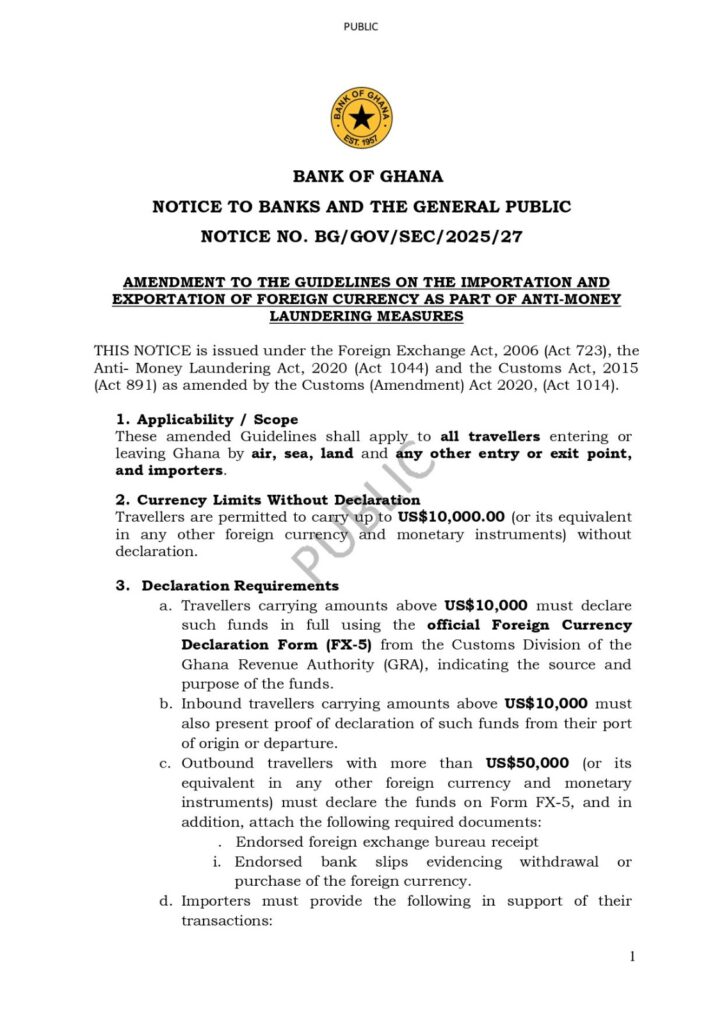
The Bank of Ghana (BoG) has amended the guidelines that apply to all travellers entering or leaving Ghana by air, sea, land, and any other entry or exit point, and importers as part of its anti-money laundering measures.
These guidelines take effect on September 01, and shall remain in force until otherwise amended or revoked by the Bank of Ghana.
Under the new guidelines—declaration requirements—travellers carrying amounts above US$10,000 must declare such funds in full using the official Foreign Currency Declaration Form (FX-5) from the Customs Division of the Ghana Revenue Authority (GRA), indicating the source and purpose of the funds.
Inbound travellers carrying amounts above US$10,000 must also present proof of declaration of such funds from their port of origin or departure.
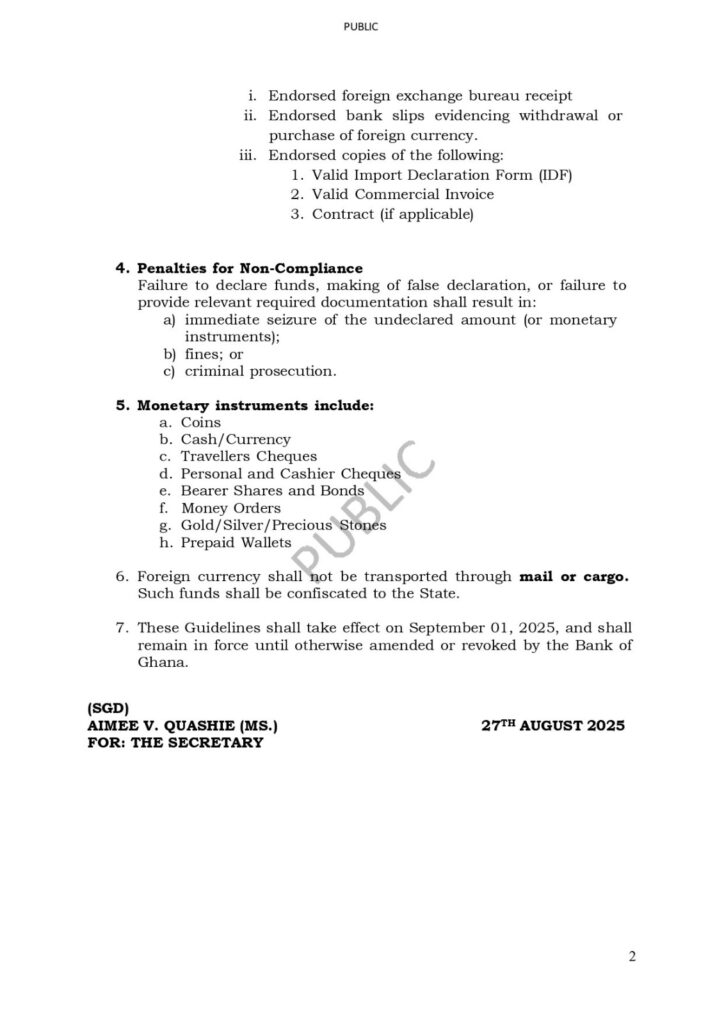
Outbound travellers with more than US$50,000 (or its equivalent in any other foreign currency and monetary instruments) are to declare the funds on Form FX-5. In addition, travellers are to attach the following required documents: an endorsed foreign exchange bureau receipt, bank slips evidencing withdrawal or purchase of foreign currency, and copies of a valid Import Declaration Form (IDF), commercial invoice, and contract if applicable.
However, travellers are permitted to carry up to US$10,000.00 (or its equivalent in any other foreign currency and monetary instruments) without declaration.
The Central Bank announced these guidelines in a notice issued under the Foreign Exchange Act, 2006 (Act 723), the Anti-Money Laundering Act, 2020 (Act 1044), and the Customs Act, 2015. (Act 891), as amended by the Customs (Amendment) Act 2020, (Act 1014).
Individuals who fail to declare funds, make a false declaration, or fail to provide relevant required documentation shall have their undeclared amount seized, fined, or prosecuted.
According to the Bank of Ghana, the foreign currency shall not be transported through mail or cargo. “Such funds shall be confiscated to the State,” the central bank notified.
The monetary instruments include coins, cash/currency, travellers cheques, personal and cashier cheques, bearer shares and bonds, money orders, gold/silver/precious stones and prepaid wallets.
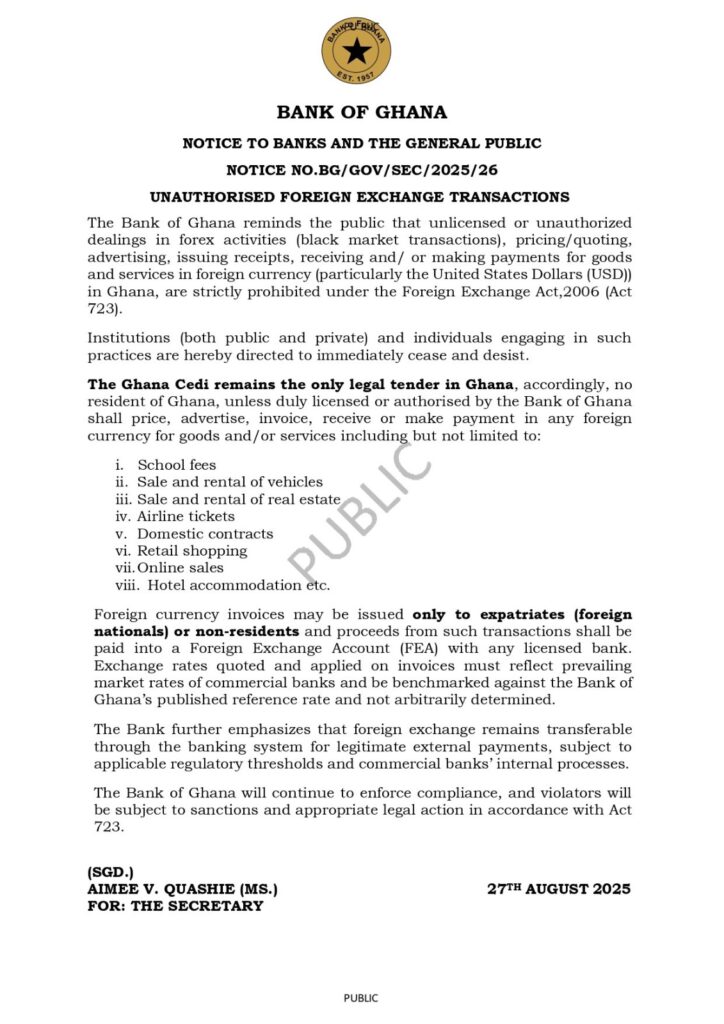
Meanwhile, the Bank of Ghana (BoG) has cautioned Ghanaian residents and businesses not duly licensed or authorised by the central bank against pricing, advertising, invoicing, receiving, or making payment in any foreign currency for goods and services.
These goods and services include but are not limited to “school fees, sale and rental of vehicles, sale and rental of real estate, airline tickets, domestic contracts, retail shopping, online sales and hotel accommodation.”
The central bank noted “that unlicensed or unauthorized dealings in forex activities (black market transactions), pricing/quoting, advertising, issuing receipts, receiving and/or making payments for goods and services in foreign currency (particularly the United States Dollars (USD)) in Ghana are strictly prohibited under the Foreign Exchange Act, 2006 (Act 723).
Institutions (both public and private) and individuals engaging in such practices are hereby directed to immediately cease and desist.”
According to the central bank, foreign currency invoices may be issued only to expatriates (foreign nationals) or non-residents, and proceeds from such transactions shall be paid into a Foreign Exchange Account (FEA) with any licensed bank.
“Exchange rates quoted and applied on invoices must reflect prevailing market rates of commercial banks and be benchmarked against the Bank of Ghana’s published reference rate and not arbitrarily determined,” the Bank noted in a statement issued on August 27.
The Bank further emphasized that foreign exchange remains transferable through the banking system for legitimate external payments, subject to applicable regulatory thresholds and commercial banks’ internal processes.
The Bank of Ghana has pledged to continue enforcing compliance, and violators will be subject to sanctions and appropriate legal action in accordance with Act 723.
About a week ago, the Bank of Ghana (BoG) ordered banks nationwide to refrain from paying foreign currencies to large companies that do not make deposits in the same currency.
This directive was issued by the banks in an official statement dated August 20 and titled “Notice to Banks and the General Public”, expressing concerns over the rising withdrawals by large corporations without initial funding in the same currency.
“The Bank of Ghana has observed with concern the growing practice of foreign currency (FCY) cash withdrawals by Large Corporates (e.g., Bulk Oil Distribution Companies, mining companies, and other similar actors) that are not directly funded by prior FCY cash deposits”, excerpts of the statement read.
BoG explained that these withdrawals put pressure on the country’s foreign exchange, hence the need to protect the country’s foreign reserves and deal with unbalanced foreign currency flows.
“This practice exerts avoidable pressure on the foreign exchange market and undermines efforts to ensure stability”, BoG added.
Consequently, effective August 20, all banks have been ordered to put an end to payouts in dollars. It also ordered banks to keep documents on all the sources of the funds. Among the records the banks are suspected to keep are whether the cash was deposited by the company, whether it was transferred from abroad
“Accordingly, with immediate effect, all banks are directed to discontinue the payment of FCY cash to Large Corporates unless such transactions are fully supported by equivalent FCY cash deposits lodged by the same institution. Banks must retain proper documentation to confirm the source of funds for every payout”, it added.
While the BoG has issued this directive concerning the payment of foreign currencies to the large Corporates, it has assured them of the government’s commitment to make available foreign exchange liquidity to help support and sustain them in their business due to their contribution to the country’s economy
“The Bank of Ghana remains committed to supporting the operations of Large Corporates, recognising their critical role in sustaining petroleum supply, mineral exports, and other essential sectors of Ghana’s economy. To this end, the Bank, in partnership with the Government, has put in place mechanisms to source and provide foreign exchange liquidity to meet legitimate import obligations of Large Corporates. These measures are designed to safeguard market stability while ensuring that vital supply chains remain. Uninterrupted”, it continued, urging compliance from relevant stakeholders. Non-compliant bodies will face the “appropriate sanctions”
“We expect all banks to comply strictly with this directive and to cooperate fully with the Bank of Ghana in ensuring that available foreign exchange resources are applied efficiently and transparently. Non-compliance will attract appropriate regulatory sanctions.
“Relevant industry associations are kindly requested to bring this Notice to the attention of their members and ensure their adherence,” BoG added.
BoG orders banks to halt FCY cash payments to large companies without equivalent deposits#TIG#TIGNews SM4LYF | Wontumi | Raymond Archer | Kumasi | pic.twitter.com/pFI1Ys2JHB
The Ghana cedi has seen a remarkable appreciation against major trading currencies worldwide over the past six months.
During the presentation of the 2025 Mid-Year Fiscal Policy Review yesterday, July 24, the Minister for Finance, Dr. Cassiel Ato Forson, revealed that the cedi has recorded a remarkable turnaround in the first six months of 2025, appreciating by 42.6% against the US dollar.
Dr Forson described the cedi’s performance as “impressive” and the first of its kind in the history of Ghana’s economy. The cedi, which was initially always experiencing depreciation, is currently showing resilience against the dollar. He noted that the cedi, which was previously trading at about GH¢17.0 to the US dollar, had strengthened to GH¢10.4 as of July 23.
“Mr. Speaker, the cedi’s performance in the first half of this year has been impressive! The Ghana cedi experienced significant appreciation against all major trading currencies in the first six months of 2025. I am happy to inform the House that our precious cedi, which once upon a time was trading at about GH¢17.0 to the US dollar, was trading at about GH¢10.4 as of yesterday, 23rd July, 2025,” he revealed.
In high spirits, the minister adopted the catchphrase from Ghanaian highlife musician King Paluta’s energetic party anthem “For the Popping (Apicki),” released on December 27, 2024, and said, “This level of appreciation of the Ghana cedi has never happened in the history of our nation. Ghanafo, cedi no apicki! Apicki apicki apicki!”
He continued that the strength of the cedi has not appreciated against just the US dollar but against the British pound as well. The cedi also gained 30.3% against the British pound and 25.6% against the euro during the same period. This marks a sharp contrast to the same period in 2024, when the cedi depreciated by 18.6% against the dollar, 17.9% against the pound, and 16.0% against the euro.
“Similarly, the cedi, which was once trading at GH¢21.0 to the Great British Pound, was trading at about GH¢14.1 as of yesterday, 23rd July 2025. Mr. Speaker, as of end-June 2025, the cedi appreciated by 42.6% against the US dollar, 30.3% against the British pound, and 25.6% against the euro,” he added.
With these gains over the past few months, Dr Cassiel stated that all the losses in the previous years had been reversed. “Mr. Speaker, I repeat, so far, we have almost reversed all the cedi depreciation in 2022, 2023, and 2024,” he mentioned.
The cedi’s appreciation, the minister continued, can be attributed to the government’s strategic economic policies and programmes, including strong fiscal consolidation, tight monetary policy, improved external sector balances, renewed investor confidence, positive market sentiments, recent credit rating upgrades, and the successful completion of the IMF programme’s fourth review.
He said, “Mr. Speaker, these gains are largely due to strong fiscal consolidation, tight monetary policy, improved external sector balances, renewed investor confidence, positive market sentiments, credit rating upgrades, and successfully securing staff-level agreement and subsequent Board approval on the 4th Review of the IMF programme.”
The current status of the cedi is proof of a growing economy whose foundations are being stabilized. “The cedi’s rebound signals that Ghana’s economic foundations are once again beginning to firm up.”
To maintain the cedi’s appreciation, Dr Ato Forson recommended, “Sustaining this stability will require continued fiscal discipline, supportive monetary policy, strong liquidity sterilisation, robust reserve accumulation supported by activities of the GoldBod and the credible implementation of structural reforms.”
In a related development, Bank of Ghana Governor Dr. Johnson Asiama also highlighted the cedi’s appreciation during the Graphic Business/Stanbic Bank Breakfast Meeting held on Tuesday, 15th July, at the Labadi Beach Hotel under the theme “Sustaining Forex Gains: Business and Economic Impact.”
Delivering his keynote address, the Governor stated, “the Ghanaian Cedi has appreciated by over 42% year-to-date as of June 2025, reversing nearly all the losses incurred in 2022 and 2023,” stressing that the rising cedi must go beyond numbers and lead to real change.
The Governor further noted that Ghana’s gross international reserves now stand at US$11.1 billion, representing 4.8 months of import cover, up from US$8.98 billion at the end of 2024. He added that the country recorded a trade surplus of US$4.14 billion in the first four months of 2025, driven by export growth of over 60%, mainly from gold, cocoa, and oil.
Meanwhile, last month, a group of importers in the country expressed frustration with banks over their refusal to make US dollars available for their business needs.
According to them, what the Bank of Ghana regularly announces as the interbank rate does not reflect reality, leading to the refusal of banks to make dollars available for sale.
“On paper, the cedi is supposed to stabilise, which means we should be able to get dollars at the approved and lower rates from the bank, but that is not the case. We are not getting the dollars from the bank. It is very difficult,” they said in the statement.
The situation, they say, has compelled them to resort to the black market to bear with offers at exorbitant rates.
”As businessmen who import goods, our main trading currency is the US Dollar, which we buy from home for our external transactions. And the Cedi’s recent stability against the US Dollar came as good news to importers and traders, for obvious reasons. However, just as we began to revel in the stability, we are now confronted with another challenge of struggling to buy US Dollars from the banks,” the importers noted.
The group has raised questions about the credibility of the Bank of Ghana’s quoted exchange rate, following persistent challenges in accessing U.S dollars from commercial banks.
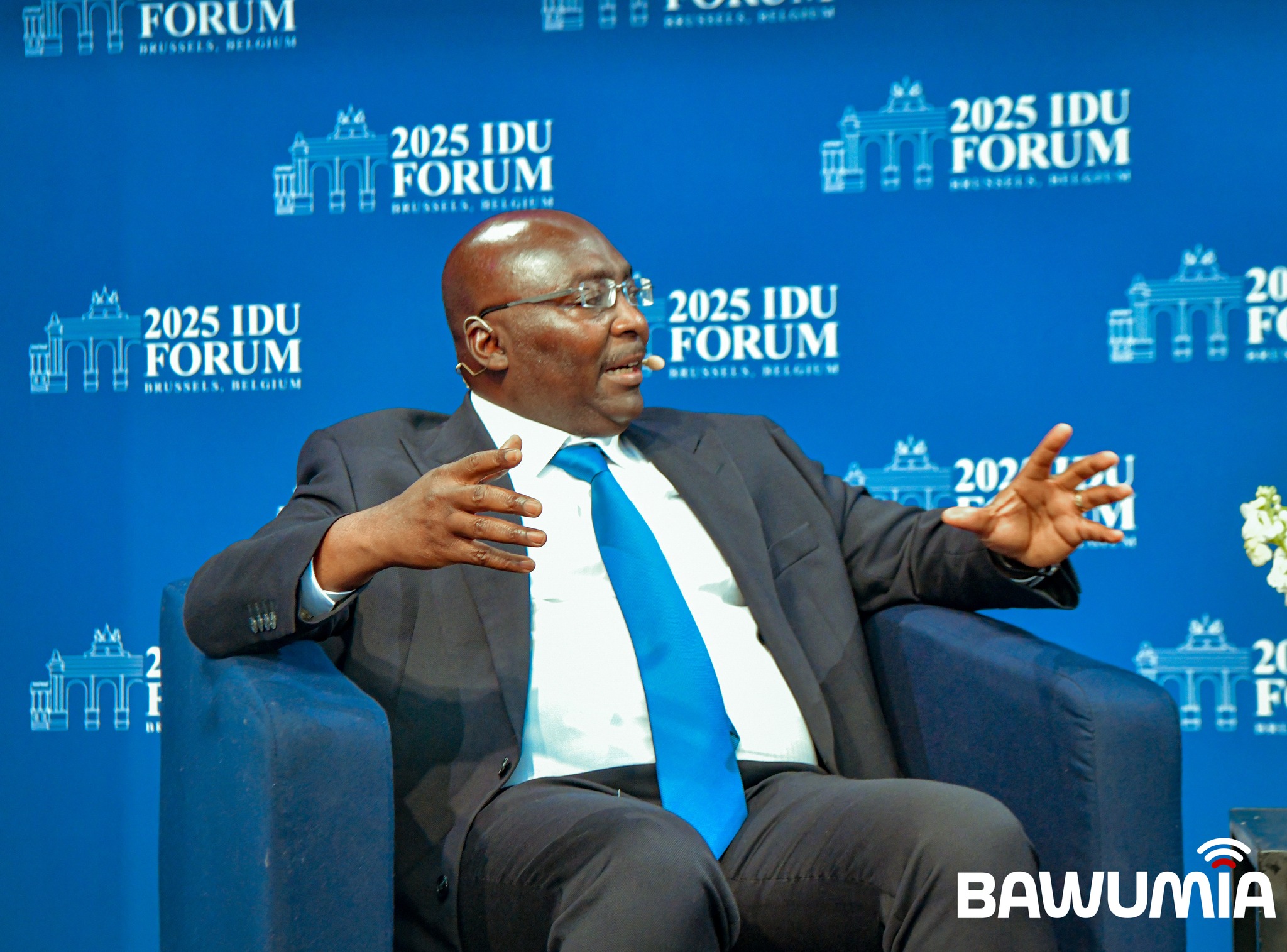
Dr. Mahamudu Bawumia, the 2024 flagbearer and former Vice President has indicated that his experience and achievements make him the most prepared candidate to lead the New Patriotic Party (NPP) in the 2028 general elections.
Engaging party faithful on August 28, the former Vice President noted that being regarded as the most effective Vice President in the 4th Republic proves his capability to lead this country as its president.
“Many people say I have been the most effective Vice President in Ghana’s history. This implies that given the opportunity, I can equally become one of the most effective presidents in Ghana as we go forward
I demonstrate my strength by getting results, not by making noise or by insulting or bragging about money. The combined effect of how well Bawumia is known today and my experience as Vice President make me the most prepared person for the NPP’s quest for the 2028 election and governance in 2029,” he said.
He made the comments after filing his nomination forms to participate in the New Patriotic Party’s (NPP) presidential primaries slated for next year.
Dr Bawumia noted that he owes the NPP a duty to provide it the most prepared candidate.
“I am offering myself to be elected as flagbearer because I believe we owe a duty to this party to give her a choice to put forward the most prepared candidate for the 2028 election and the most prepared person to be president in 2029.
In the last 16 years, I’ve had the privilege of joining each and every constituency at least five times to work hard on the ground and campaign and work for the NPP,” he added.
Videos sighted on social media showed scores of NPP sympathizers trooping to NPP headquarters ahead of Dr. Bawumia’s filing process.
On Tuesday, July 29, the NPP opened nominations for its 2028 flagbearer position. Dr. Mahamudu Bawumia, the party’s 2024 flagbearer and former Vice President, Kennedy Agyapong, Kwabena Agyepong, and Dr. Osei Adutwum have all picked up nomination forms.
Former General Secretary of the NPP, Kwabena Agyei Agyepong, officially filed his nomination forms on Tuesday, August 26. Party executives received the nomination forms from former Assin Central MP and presidential hopeful Kennedy Ohene Agyapong on Wednesday, August 27. Former Food and Agric Minister Bryan Acheampong has also filed his nomination forms. Dr Adutwum is expected to file his nomination forms today.
In the meantime, Dr. Mahamudu Bawumia has received strong backing from 268 former Metropolitan, Municipal, and District Chief Executives (MMDCEs), who paid him a visit in June to pledge their support.
Former Energy Minister and running mate of the New Patriotic Party’s (NPP) 2024 presidential candidate, Dr Matthew Opoku Prempeh, has decided to throw his weight behind Dr Mahamudu Bawumia ahead of the party’s presidential primaries in 2026.
In an interview on Asempa FM on August 26, the former minister noted that he remains grateful to the former Vice President who decided to make him his running mate despite the many individuals who advised him to do otherwise.
According to Dr Opoku Prempeh, popularly known as Napo, Dr Bawumia was engaged countless times by some bigwigs in the party to pick someone else to be his running mate.
“I am not ungrateful. Look at this big party and upon all the people who were praying for the running mate slot, he ignored all of them and made me his running mate.”
“I know it was a difficult situation, but a lot of people don’t know. Some bigwigs in the party went to Dr Bawumia to tell him not to make me the running mate but he ignored them. There are some names that if I mentioned, you would be shocked. Some even took him to offices to advise him against me but still he chose me,” he remarked.
He thus said; “So, I cannot be ungrateful to him… For those who stood in the flagbearership contest, everyone knows Kennedy Agyapong is my friend, but I am still for Bawumia.”
The New Patriotic Party (NPP) has made room for new additions to its already approximately 220,000 delegates who are eligible to vote in its presidential primaries slated for Saturday, January 31, next year.
In a statement dated August 26, signed and shared by the Secretary of the Presidential Elections Committee, Williams Yamoah, the party announced that registration has been opened for an additional 60,000 new delegates, which include nineteen new categories of people. This directive follows reforms adopted at the party’s National Annual Delegates Conference held in Accra on Saturday, July 19.
The statement explained: “In accordance with Article 13(1)(11) of the Constitution of the New Patriotic Party (NPP), and pursuant to the motion on transitional provisions adopted at the National Annual Delegates Conference held in Accra on Saturday, July 19, 2025, the following new categories of Party officials and dignitaries have been included in the upcoming Presidential Primary voter register.”
The updated voter register, also known as the party album, will now include several new categories of officials and dignitaries. These are: all former regional and constituency executives, members of the National Council of Elders, 30 members of the National Council of Patrons, all past national officers, former party-card-bearing MPs and parliamentary candidates, as well as former party-card-bearing ministers and deputy ministers.
Other groups added to the list are external branch executives, former external branch executives, and key members of the Tertiary Students Confederacy (TESCON), including presidents of recognised institutions, the National TESCON Coordinator, regional coordinators, and one TESCON patron from each institution.
Additionally, 10 members from each Regional Council of Elders, 10 patrons from each region, and five members and patrons from each constituency have also been included.
The statement directed that “all officers that fall under the categories above are requested to register their names with their respective organisational structures, including the National Secretariat, Regions, Constituencies and External Branches, as applicable, with immediate effect.”
To make the registration process easier, the statement clarified that a digital link would be circulated to External Branch Executives for online registration. All other qualified members were advised to liaise with their respective regions and constituencies to register.
However, the forms are to be accessed via the party’s official website. “The registration form may be downloaded from the Party’s official website. For ease of reference, a sample copy is hereby attached,” excerpts of the statement read. The statement further warned that the registration was strictly for the aforementioned categories of people, with a deadline set for Friday, September 19.
“The deadline for registration is Friday, September 19, 2025. Please be advised that this registration exercise is exclusively open to officers and members who meet the aforementioned criteria. The Presidential Elections Committee shall undertake a comprehensive verification and validation of the Party’s album to ensure that only an authentic and credible register is used for the conduct of the presidential election,” the party cautioned, while expressing confidence in members’ cooperation.
“We count on your usual cooperation and adherence to this directive in furtherance of the Party’s commitment to fairness, inclusiveness, and transparency.”
The NPP is on a journey of reset, reinforcement, and healing following its historic defeat in the 2024 elections. Dr. Bawumia lost the 2024 presidential election, with John Dramani Mahama of the National Democratic Congress (NDC) securing 6,328,397 valid votes, representing 56.55%, against Dr. Mahamudu Bawumia’s 4,657,304 votes, representing 41.61%.
Since the beginning of this year, the party has undertaken several reforms to position itself strongly against its main opponent, the NDC, and to recapture power.
Among these reforms is the abolition of the electoral college in favour of a broader base of delegates. The party has also added 19 new delegate categories and granted amnesty to suspended members.
The NPP has announced that suspended members have been reinstated, and all charges against those facing the disciplinary committee have been dropped.
This decision was taken by the National Council during an emergency meeting held on July 25. In a statement dated August 16 and signed by the Acting National Chairman of the Party, Mr. Danquah Smith Buttey, members were informed that as part of measures to ensure unity and cooperation, all banned members had been given the right to return.
“This measure reflects the Party’s unwavering commitment to fostering internal cohesion, strengthening solidarity, and preparing collectively for the political tasks ahead.
“I write to inform you that the National Council, at its Emergency Meeting held on Friday, July 25, 2025, resolved, in the interest of unity and reconciliation, to grant a General Amnesty to all Party members who have been suspended or whose disciplinary cases are currently pending before the appropriate disciplinary bodies,” parts of the statement read.
The party further urged all relevant bodies, including Regional and Constituency Executive Committees, to reinstate suspended members in accordance with laid-down rules and guiding principles.
“We hereby serve notice that this directive lifts all such suspensions and nullifies any ongoing proceedings against affected members,” the statement added.
However, the party clarified that this recall does not apply to members who willfully forfeited their membership. In cases where such individuals wish to return, they are required to submit a formal reinstatement request to the party’s secretariat. Upon acceptance, a two-year ban will be imposed, preventing them from contesting in any internal elections.
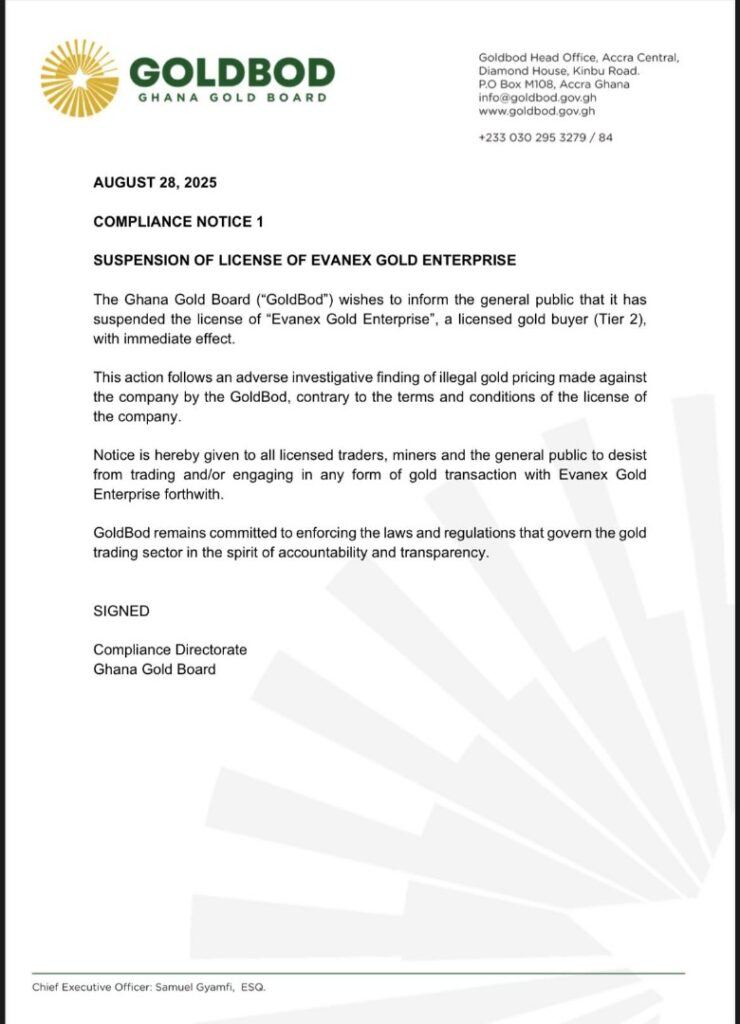
The Ghana Gold Board (GoldBod) has suspended the license of Evanex Gold Enterprise, a licensed gold buyer (Tier 2), with immediate effect.
Goldbod took this action following an adverse investigative finding of illegal gold pricing made against the company, contrary to the terms and conditions of the license of the company.
The GoldBod has thereby cautioned licensed traders, miners, and the general public against trading or engaging in any form of gold transaction with Evanex Gold Enterprise forthwith.
“GoldBod remains committed to enforcing the laws and regulations that govern the gold trading sector in the spirit of accountability and transparency,” a statement issued by GoldBod read.
Miners operating under a valid mining license have been offered a special temporary bonus scheme from the Ghana Gold Board (GoldBod) in efforts to support the industry as well as combat gold smuggling.
The licensed miners will enjoy an additional GH¢832 per pound of gold sold through the Ghana Gold Board. This information was contained in a statement issued by the GoldBod on Wednesday, August 27.
“This novelty is in response to legitimate complaints from licensed miners about the significant reduction in the local price of gold in the last few months due to the continuous appreciation of the Ghana cedi.
“The special bonus will ensure that licensed miners who have contributed immensely to the country’s increased gold output and foreign exchange earnings do not indirectly suffer as a result of the significant appreciation of the Ghana cedi that they have helped the country achieve,” the statement read.
According to GoldBod, the recent development has been made possible as a result of the continuous appreciation of the Ghana cedi. On July 7, a task force was inaugurated with a special mandate with specific powers as police officers to wage war against smuggling and all forms of illegal gold trading activities in the country.
According to the Acting Chief Executive Officer of the Goldbod, Sammy Gyamfi, this will save the government from any leakages in revenue mobilisation in the sector, helping to generate and invest revenue for economic development.
“(This will) help the state combat and defeat the phenomenon of gold smuggling, the canker of illegal gold trading, and price disruptions that deprive the state of the needed revenue, profit, and the needed forex for our economy and the development of our country,” he announced.
He thus cautioned traders to secure the appropriate licence to engage in any form of gold trading in the country, saying, “But for those who are hell bent on trading illegally without the licenses, we are serving notice that we are coming after you”.
Earlier, the GoldBod CEO on June 5 also warned that persons who trade without licenses would be prosecuted, adding that his outfit takes no bribes before the said licenses are issued.
During a meeting with the Chamber of Licensed Gold Buyers, Mr Gyamfi stated that “I don’t take or demand bribes before I issue a licence.”
The acting CEO noted that the process for registering has been made seamless and is devoid of corruption. “We have removed the human interface element, and so there is no corruption, bribery, inducements, or favouritism. It is a very transparent and competitive process, and once you qualify, you get the license,” he added.
Lauding his outfit’s results-oriented reforms and initiatives since his takeover as CEO, Sammy Gyamfi, during a media engagement, revealed that GoldBod has exceeded the $5 billion mark in gold export value for the first half of 2025, surpassing the $4.6 billion recorded for the entire year of 2024.
He expressed optimism that GoldBod would hit the 60-tonne export mark by the end of July 2025, driven by stronger compliance, improved oversight, and the streamlined licensing regime under the Ghana Gold Board Act, 2025 (Act 1140).
“In the whole of 2024, gold exports stood at 66 tons with an export value of $4.6 billion. We have done only six months, and yet we have crossed the $4.6 billion. We have gone beyond $5 billion, and in terms of volumes, we have done 50 tons and over, and we are optimistic that by the end of next month, we will have hit 60 tons,” he said.
The Ghana Gold Board (GoldBod) is the sole authority with exclusive right to buy, sell, weigh, grade, assay, value and export gold and other precious minerals in Ghana. The Ghana Gold Board functions under the oversight and supervision of the Ministry of Finance of the Republic of Ghana.
History of GoldBod
The Ghana Gold Board (GoldBod) is a body corporate established by an Act of Parliament (ACT 1140) in the year 2025 to oversee, regulate and undertake the buying, selling, assaying, refining, exporting and other related activities in respect of Gold and other Precious Minerals in Ghana.
The GoldBod per section 78 of ACT 1140, took over the rights, obligations, assets, liabilities and workforce of the Precious Minerals Marketing Company (PMMC) Limited, which is an offshoot of the Ghana Diamond Marketing Board.
In 1963, the Ghana Diamond Marketing Board was established and charged with the responsibility of purchasing and marketing Ghana’s diamonds.
In 1965, by a Legislative Instrument (LI) 401, the Ghana Diamond Marketing Board was incorporated as a State-Owned Enterprise (SOE).
Upon the promulgation of the diamonds decree (NRCD 32) in 1972, LI 916 was enacted to change the company’s name to Diamond Marketing Corporation.
In 1989, PNDC Law 219 was enacted to yet again change the Company’s name to the Precious Minerals Marketing Corporation with enhanced functions to grade, assay, value gold, diamonds and other precious minerals of the country.
In the year 2000, the Corporation was converted by the Statutory Corporations Conversion to Companies Act (ACT 461) to a Limited Liability Company to operate under the Ghana Companies Code Act, (ACT 179) 1963, as Precious Minerals Marketing Company (PMMC) Limited with the same functions.
In the year 2016, the PMMC was appointed the national assayer by the government of Ghana.
To strengthen industry regulation and optimize national benefits, the Ghana GoldBod was established on 2 April, 2025 by the government of Ghana to restructure and streamline the precious mineral trading sector of Ghana.
The GoldBod initiative is a product of extensive stakeholder consultations and aims at maximizing foreign exchange inflows, gold reserve accumulation and value addition for sustainable growth and transformation.
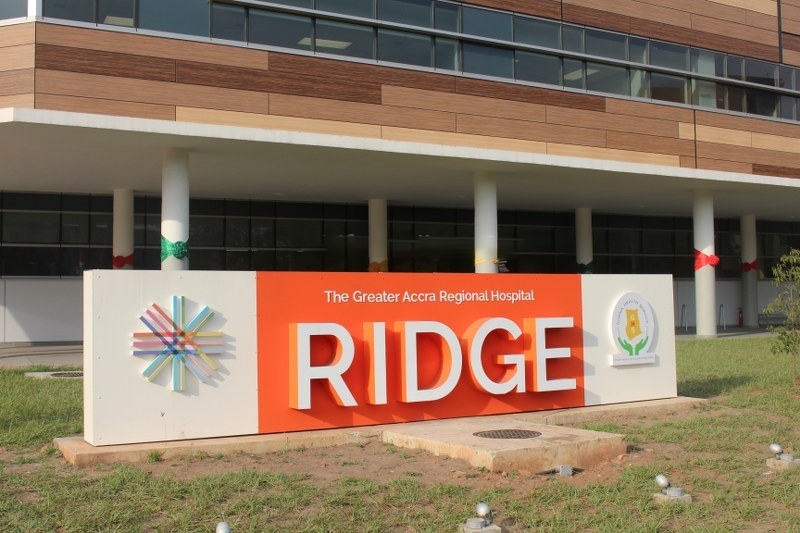
The Ridge Assault Investigative Committee has handed over its report to Health Minister Kwabena Mintah Akandoh regarding the assault incident involving a rotational nurse, Rejoice Tsotso Bortei, that occurred on 17th August at the Emergency Department of the Greater Accra Regional Hospital (GARH).
While submitting its findings to the Minister of Health, Kwabena Mintah Akandoh, on Wednesday, August 27, the Chairman of the Committee, Dr. Lawrence Ofori-Boadu, disclosed that there is no medical evidence indicating that the nurse suffered a dislocation on her shoulder, nor does she have a fracture in her left wrist.
A group of men, including a member of the pressure group Democracy Hub, Mr. Ralph Afful Williams, allegedly stormed the Ridge facility, demanding immediate treatment for an injured finger while medical staff were attending to critically ill patients, including one with an open fracture.
Hospital management was forced to call in the Ghana Police Service after the situation escalated into the alleged assault of a nurse. Following the incident, several groups and individuals have demanded the arrest of Ralph Williams, describing his actions as unlawful.
Dr. Mahamudu Bawumia, the 2024 flagbearer and former Vice President is set to file his nomination forms to participate in the New Patriotic Party’s (NPP) presidential primaries slated for next year.
Videos sighted on social media show scores of NPP sympathizers trooping to NPP headquarters ahead of Dr. Bawumia’s filing process.
On Tuesday, July 29, the NPP opened nominations for its 2028 flagbearer position. Dr. Mahamudu Bawumia, the party’s 2024 flagbearer and former Vice President, Kennedy Agyapong, Kwabena Agyepong, and Dr. Osei Adutwum have all picked up nomination forms.
Former General Secretary of the NPP, Kwabena Agyei Agyepong, officially filed his nomination forms on Tuesday, August 26. Party executives received the nomination forms from former Assin Central MP and presidential hopeful Kennedy Ohene Agyapong on Wednesday, August 27. Former Food and Agric Minister Bryan Acheampong has also filed his nomination forms.
In the meantime, Dr. Mahamudu Bawumia has received strong backing from 268 former Metropolitan, Municipal, and District Chief Executives (MMDCEs), who paid him a visit in June to pledge their support.
Former Energy Minister and running mate of the New Patriotic Party’s (NPP) 2024 presidential candidate, Dr Matthew Opoku Prempeh, has decided to throw his weight behind Dr Mahamudu Bawumia ahead of the party’s presidential primaries in 2026.
In an interview on Asempa FM on August 26, the former minister noted that he remains grateful to the former Vice President who decided to make him his running mate despite the many individuals who advised him to do otherwise.
According to Dr Opoku Prempeh, popularly known as Napo, Dr Bawumia was engaged countless times by some bigwigs in the party to pick someone else to be his running mate.
“I am not ungrateful. Look at this big party and upon all the people who were praying for the running mate slot, he ignored all of them and made me his running mate.”
“I know it was a difficult situation, but a lot of people don’t know. Some bigwigs in the party went to Dr Bawumia to tell him not to make me the running mate but he ignored them. There are some names that if I mentioned, you would be shocked. Some even took him to offices to advise him against me but still he chose me,” he remarked.
He thus said; “So, I cannot be ungrateful to him… For those who stood in the flagbearership contest, everyone knows Kennedy Agyapong is my friend, but I am still for Bawumia.”
The New Patriotic Party (NPP) has made room for new additions to its already approximately 220,000 delegates who are eligible to vote in its presidential primaries slated for Saturday, January 31, next year.
In a statement dated August 26, signed and shared by the Secretary of the Presidential Elections Committee, Williams Yamoah, the party announced that registration has been opened for an additional 60,000 new delegates, which include nineteen new categories of people. This directive follows reforms adopted at the party’s National Annual Delegates Conference held in Accra on Saturday, July 19.
The statement explained: “In accordance with Article 13(1)(11) of the Constitution of the New Patriotic Party (NPP), and pursuant to the motion on transitional provisions adopted at the National Annual Delegates Conference held in Accra on Saturday, July 19, 2025, the following new categories of Party officials and dignitaries have been included in the upcoming Presidential Primary voter register.”
The updated voter register, also known as the party album, will now include several new categories of officials and dignitaries. These are: all former regional and constituency executives, members of the National Council of Elders, 30 members of the National Council of Patrons, all past national officers, former party-card-bearing MPs and parliamentary candidates, as well as former party-card-bearing ministers and deputy ministers.
Other groups added to the list are external branch executives, former external branch executives, and key members of the Tertiary Students Confederacy (TESCON), including presidents of recognised institutions, the National TESCON Coordinator, regional coordinators, and one TESCON patron from each institution.
Additionally, 10 members from each Regional Council of Elders, 10 patrons from each region, and five members and patrons from each constituency have also been included.
The statement directed that “all officers that fall under the categories above are requested to register their names with their respective organisational structures, including the National Secretariat, Regions, Constituencies and External Branches, as applicable, with immediate effect.”
To make the registration process easier, the statement clarified that a digital link would be circulated to External Branch Executives for online registration. All other qualified members were advised to liaise with their respective regions and constituencies to register.
However, the forms are to be accessed via the party’s official website. “The registration form may be downloaded from the Party’s official website. For ease of reference, a sample copy is hereby attached,” excerpts of the statement read. The statement further warned that the registration was strictly for the aforementioned categories of people, with a deadline set for Friday, September 19.
“The deadline for registration is Friday, September 19, 2025. Please be advised that this registration exercise is exclusively open to officers and members who meet the aforementioned criteria. The Presidential Elections Committee shall undertake a comprehensive verification and validation of the Party’s album to ensure that only an authentic and credible register is used for the conduct of the presidential election,” the party cautioned, while expressing confidence in members’ cooperation.
“We count on your usual cooperation and adherence to this directive in furtherance of the Party’s commitment to fairness, inclusiveness, and transparency.”
The NPP is on a journey of reset, reinforcement, and healing following its historic defeat in the 2024 elections. Dr. Bawumia lost the 2024 presidential election, with John Dramani Mahama of the National Democratic Congress (NDC) securing 6,328,397 valid votes, representing 56.55%, against Dr. Mahamudu Bawumia’s 4,657,304 votes, representing 41.61%.
Since the beginning of this year, the party has undertaken several reforms to position itself strongly against its main opponent, the NDC, and to recapture power.
Among these reforms is the abolition of the electoral college in favour of a broader base of delegates. The party has also added 19 new delegate categories and granted amnesty to suspended members.
The NPP has announced that suspended members have been reinstated, and all charges against those facing the disciplinary committee have been dropped.
This decision was taken by the National Council during an emergency meeting held on July 25. In a statement dated August 16 and signed by the Acting National Chairman of the Party, Mr. Danquah Smith Buttey, members were informed that as part of measures to ensure unity and cooperation, all banned members had been given the right to return.
“This measure reflects the Party’s unwavering commitment to fostering internal cohesion, strengthening solidarity, and preparing collectively for the political tasks ahead.
“I write to inform you that the National Council, at its Emergency Meeting held on Friday, July 25, 2025, resolved, in the interest of unity and reconciliation, to grant a General Amnesty to all Party members who have been suspended or whose disciplinary cases are currently pending before the appropriate disciplinary bodies,” parts of the statement read.
The party further urged all relevant bodies, including Regional and Constituency Executive Committees, to reinstate suspended members in accordance with laid-down rules and guiding principles.
“We hereby serve notice that this directive lifts all such suspensions and nullifies any ongoing proceedings against affected members,” the statement added.
However, the party clarified that this recall does not apply to members who willfully forfeited their membership. In cases where such individuals wish to return, they are required to submit a formal reinstatement request to the party’s secretariat. Upon acceptance, a two-year ban will be imposed, preventing them from contesting in any internal elections.
The Minister of Health’s committee, probing the assault at Ridge Hospital, has provided evidence that is contrary to medical records of a rotational nurse, Rejoice Tsotso Bortei, after allegations of assault by a member of the pressure group Democracy Hub, Mr. Ralph Afful Williams.
While submitting its findings to the Minister of Health, Kwabena Mintah Akandoh, on Wednesday, August 27, the Chairman of the Committee, Dr. Lawrence Ofori-Boadu, disclosed that there is no medical evidence indicating that the nurse suffered a dislocation on her shoulder, nor does she have a fracture in her left wrist.
Dr. Lawrence Ofori-Boadu has, however, recommended that the nurse receive psychological support and bed rest.
“Rejoice Tsotso Bortei, who is a rotation nurse, reported her injury to the hospital a day after the incident on the 18th of August and was further treated. There was no evidence of fracture on her left wrist or dislocation of her right shoulder joint as documented by the medical records.
“She has, however, been treated and given pain relief, recommended for bed rest, and received psychological support care,” the committee stated.
A group of men, including a member of the pressure group Democracy Hub, Mr. Ralph Afful Williams, allegedly stormed the Ridge facility, demanding immediate treatment for an injured finger while medical staff were attending to critically ill patients, including one with an open fracture.
Hospital management was forced to call in the Ghana Police Service after the situation escalated into the alleged assault of a nurse. Following the incident, several groups and individuals have demanded the arrest of Ralph Williams, describing his actions as unlawful.
Meanwhile, the nurse at Greater Accra Regional Hospital who was allegedly attacked, Rejoice Tsotsoo Bortei, has dragged her alleged abuser, activist Ralph Saint Williams, to court for physical assault and defamation.
The plaintiff is seeking GH¢5 million in damages for battery and GH¢2 million for defamation, arguing that the defendant’s words have “cast the Plaintiff as a liar, a non-trustworthy person, and a crook”.
When staff requested he obtain a hospital card, the defendant reportedly became aggressive and began recording patients and staff without consent. The plaintiff indicates that despite providing him with initial first aid, the defendant later returned with a group of men and physically assaulted her.
“The Defendant, without provocation, struck the Plaintiff’s left hand with a clenched fist and a metallic cellphone,” the writ states. Following the incident, the defandant during a live video accused Rejoice of being a liar.
“Liar, Wo se wo nsam abu. Duab0 bebam. You say you have suffered an injured hand and a dislocated shoulder. This is cooked up to cover the nonsense going on at the hospital,” he said.
Additional reliefs sought include a court order for a full public apology and retraction, a perpetual injunction against further defamatory publications, a restraining order preventing the defendant from coming within 50 meters of the plaintiff, and legal costs.
The defendant has eight days to enter an appearance upon being served with the writ, or risk a default judgment.
Just days earlier, the Health Minister confirmed that the Ridge Hospital incident that saw the assault of health practitioners had led to several arrests by the Ghana Police Service.
“The law has so far dealt with all those who did something wrong, and we are also investigating as a ministry. Anyone who comes to tell you that no arrest has been made in this matter is probably someone who is not ready to contribute to the resolution of this matter,” the Minister told Asempa FM on August 19, without disclosing the names of the suspects.
In response, the Ghana Registered Nurses and Midwives Association (GRNMA) issued a 48-hour ultimatum to the government to arrest Ralph and his accomplices. The association warned that it would be compelled to “advise itself” if immediate action was not taken.
According to the GRNMA’s General Secretary, Dr. David Tenkorang Twum, the nurse who was attacked sustained injuries and is currently receiving treatment at the hospital. He described the assault as unacceptable and stressed that health workers cannot operate in an unsafe environment.
“If anybody can just walk into a facility, like Ridge Hospital, and throw his weight about and beat like a midwife, and you have other party apparatchiks telling them to egg him on, that is unfortunate. We are not happy at all. Our people are traumatized,” he stated.
He continued, “We are very civilized people. We are professionals. And we are asking the government to arrest the guy immediately and the eight accomplices; we were told there were about 50 guys that day. But those who laid their hands on the lady—there were about eight, including Ralph himself. And therefore, if he’s not arrested within 48 hours, we shall advise ourselves.”
Dr. Tenkorang also referenced Section 119 of Ghana’s Labour Act, which empowers workers to withdraw their services if their health and safety are at risk.
“And we are all guided by law. In that, if you read section 119, subsection 1, it is stated that if you are a worker and you think that your safety is not guaranteed, your life and your health are not guaranteed, and you have every right under the law to remove yourself from that danger. And our people have told us this morning, after interacting with them, that they are not safe. They feel that their safety has been breached,” he said.
The association insists that both Ralph Williams and the eight identified accomplices must be arrested immediately to restore confidence and ensure justice for the victim. Their demand follows the circulation of a viral video showing a violent altercation between some patient relatives and medical staff at the hospital’s emergency department.
The Minority in Parliament has also intensified calls for Ralph’s arrest. In a statement dated Tuesday, August 19, and signed by the Ranking Member on the Health Committee, Dr. Nana Ayew Afriye, the group condemned the actions of Ralph and his team.
They described the conduct as “unlawful, reckless, and deeply inconsiderate,” stressing that hospitals are places of care and confidentiality, not “arenas for political theatrics.” The Minority urged the Ghana Police Service to fully investigate the matter and called on the Health Minister to set up a joint parliamentary inquiry to prevent similar occurrences in the future.
“The sanctity of our health facilities must be preserved at all times,” the statement concluded, urging political actors to refrain from compromising patient care for partisan ends.
In response, the Ministry of Health has announced measures to beef up security at the Greater Accra Regional Hospital. The Ministry said this will ensure the safety of staff, patients, and the general public, while also addressing any gaps that may have contributed to the reported delay in treatment.
Reiterating its commitment to protecting healthcare workers, the Ministry confirmed that Health Minister Hon. Kwabena Mintah Akandoh has already visited the facility to receive firsthand information. He assured hospital management and staff of the Ministry’s full support and protection.
“We call on the public to exercise patience, cooperation, and mutual respect at all times to enable healthcare workers to provide effective and timely care,” the Ministry of Health added in a statement.
Meanwhile, a 24-hour call centre for handling patient complaints across hospitals in the country has been introduced by the Health Minister, Mr. Kwabena Mintah Akandoh.
The minister made this known at a press briefing in Accra on Thursday, August 21, explaining that the initiative will provide the public with a direct channel to report their displeasure regarding healthcare services.
“The best you can do is lodge a complaint. And that brings me to the client service. So this is what we are doing. We have some numbers available where if people feel dissatisfied, you can then call,” he said.
He assured that complaints to the hotline will be managed fairly, but emphasized that this does not automatically mean all complaints will be considered right.
“The fact that you have called to lodge a complaint doesn’t mean that you are right. We will look into the matter and then appropriately deal with it,” he stated.
He added that hospitals have been instructed to display the hotline numbers boldly at facilities to make them easily accessible to patients nationwide.
“We have communicated directly to all the health facilities in the country, to the Director-General and the teaching hospitals, that they must make these suggestion boxes and numbers conspicuously posted at all health facilities. So it is something I am pursuing aggressively,” he said.
Mr. Akandoh noted that the measure seeks to promote accountability and raise the standard of service delivery in the health sector.
Health Minister Honourable Mintah Akandoh and Chargé d’Affaires Rolf Olson of the United States Embassy have held discussions on exploring opportunities to strengthen collaboration in fighting HIV/AIDS, malaria, and other diseases.
The two held discussions on August 26 to discuss ongoing U.S. health assistance to Ghana and the Mahama Administration’s priorities in the health sector. This reaffirms the shared commitment to improving health in Ghana and strengthening the U.S.-Ghana partnership in health.
Govt’s effort to combat Malaria
Ghana has successfully reduced deaths caused by malaria by over 97% between 2014 and 2024, marking a major milestone in the country’s health sector.
In addition to the sharp decline in malaria-related deaths, outpatient department (OPD) cases have dropped by three per cent, while hospital admissions due to malaria have decreased by 17%.
At an event to commemorate the 2025 World Malaria Day, the Minister of Health, Kwabena Mintah Akandoh, highlighted Ghana’s progress and outlined future goals. He said the country’s National Malaria Elimination Strategic Plan (2023 to 2028) was targeting a further 51% reduction in deaths caused by malaria.
In a speech read on his behalf by the Director-General of the Ghana Health Service (GHS), Professor Samuel Kaba Akoriyea, the minister said under the strategic plan, there was also a target to reduce the under-five malaria case fatality rate by 36% in 2024, using 2022 as the baseline. He also emphasized plans to ensure a steady roll-out of the malaria vaccine with over 70% coverage for the first dose.
Tackling Malaria cases in Africa
Pharmaceutical company Novartis has approved a malaria treatment for infants. Some African countries are expected to receive the rollout of treatments later this year. This information was included in a press release by Novartis on Tuesday, July 8.
According to the release, eight African countries, including Burkina Faso, Ivory Coast, Kenya, Malawi, Mozambique, Nigeria, Tanzania, and Uganda collaborated on the clinical trials for the newly approved medicine.
“Together with our partners, we are proud to have gone further to develop the first clinically proven malaria treatment for newborns and young babies, ensuring even the smallest and most vulnerable can finally receive the care they deserve,” parts of the release read.
Per reports, infants weighing less than 4.5 kilograms have long had no approved malaria treatment. Previously, infants received malaria treatments formulated for older children, which increased the risk of adverse effects.
The new medication is specially dosed to meet the needs of the smallest patients. The World Health Organization (WHO) reported that in 2023, 83 countries recorded 597,000 malaria-related deaths.
Africa is home to 94% of global malaria cases, killing children under 5 years old. Meanwhile, the United Nations children’s organization, UNICEF, has rolled out the R21/Matrix-M vaccine in Mali to commerorate World Malaria Day. This makes Mali the 20th country to roll out the vaccine since its launch.
World Malaria Day is commemorated annually on April 25 to raise awareness of the global effort to control and eventually eradicate malaria. The day also draws attention to the need for sustained investment and political commitment towards malaria prevention and control.
Ghana’s fight against HIV
Director-General of the Ghana AIDS Commission, Dr. Kyeremeh Atuahene, has stated that Ghana requires $300 million annually to achieve its HIV/AIDS elimination target by 2030.
According to the Commission, over 500,000 people in Ghana are currently living with HIV/AIDS. The national HIV prevalence rate stands at approximately 1.7%, with regional disparities.
Ghana is facing a concerning rise in HIV-related deaths, with new data revealing a staggering 33% increase in fatalities in 2023.
According to reports from the Ghana AIDS Commission, 12,480 Ghanaians lost their lives to AIDS-related illnesses in 2023, compared to 9,359 deaths recorded in 2022. Unfortunately, deaths resulting from AIDS recorded for persons of all ages were 9,359.
Dr. Atuahene has called for increased efforts to combat AIDS, particularly among the economically active population aged 15 to 49, emphasizing that addressing the AIDS epidemic should be a national priority in Ghana.
He stressed the importance of education, awareness, and access to preventive measures and treatment services in reducing new infections and preventing HIV-related deaths.
As Ghana grapples with the impact of HIV/AIDS, there is an urgent need for coordinated action from government agencies, healthcare providers, civil society organizations, and the private sector to curb the spread of the virus and improve outcomes for those affected.
Vaccine procurement
Health Minister Mr Mintah Akandoh, has noted that the government will require approximately $25 million to procure all necessary vaccines for the country this year.
“It is instructive to note that at this point in time, our partners who assist us in procuring most of our vaccines are gradually fading. This year alone, we need not less than $25 million to import vaccines into this country,” the minister stated while speaking at a meeting with the Pharmaceutical Society of Ghana on Monday, April 14.
President John Dramani Mahama has pledged government support to accelerate local vaccine manufacturing in Ghana, aiming to position the country as a regional hub.
This was announced by the Ministry of Health on their Facebook page in the aftermath of the Ghana Vaccine Manufacturing Investment Forum under the theme: “Mobilising Sustainable Financing to Accelerate Vaccine Development and Manufacturing in Ghana,” where the president served as Special Guest of Honour.
According to the information shared on the Ministry’s page, President John Dramani Mahama, pledged government support to accelerate local vaccine manufacturing in Ghana, aiming to position the country as a regional hub. He announced an additional GHC50 million in seed capital for the National Vaccine Institute, bringing total government funding to GHC75 million.
He noted that this investment is intended to address challenges in vaccine manufacturing, particularly access to financing, and to leverage Ghana’s progress in health regulation, research, and local pharmaceutical production. The President added that the government’s support for vaccine manufacturing aligns with global efforts to strengthen health systems and promote sustainable development.
On Wednesday August 3, 2025, the Ministry of Health, in partnership with the National Vaccine Institute (NVI) and the Ghana Investment Promotion Centre (GIPC), hosted the Ghana Vaccine Manufacturing Investment Forum.
The event brought together a cross-section of government officials, development partners, pharmaceutical manufacturers, research institutions, and local and international financial institutions to explore strategies for funding Ghana’s vaccine production ambitions.
Delivering the keynote address, the Minister for Health, Hon. Kwabena Mintah Akandoh, emphasized Ghana’s determination to move from dependency to self-reliance in vaccine access and production. “Ghana will not beg for vaccines. Ghana will make them,” he declared.
The Minister outlined the urgent need for $115 million in financing to support two key domestic manufacturers, DEK Vaccines Ltd and Atlantic Lifesciences Ltd, to reach operational scale.
He also noted that Ghana’s scientific institutions including Noguchi Memorial Institute for Medical Research, KCCR, and CSIR are already developing vaccine candidates and require capital to advance their work.
The Ministry reaffirmed its commitment to working closely with both local and international stakeholders to realize Ghana’s vision of vaccine self-sufficiency and pandemic preparedness. “The next pandemic will not wait. But neither will Ghana. We are ready to manufacture, ready to regulate, and ready to lead,” the Minister concluded.
The Bank of Ghana (BoG) has cautioned Ghanaian residents and businesses not duly licensed or authorised by the central bank against pricing, advertising, invoicing, receiving, or making payment in any foreign currency for goods and services.
These goods and services include but are not limited to “school fees, sale and rental of vehicles, sale and rental of real estate, airline tickets, domestic contracts, retail shopping, online sales and hotel accommodation.”
The central bank noted “that unlicensed or unauthorized dealings in forex activities (black market transactions), pricing/quoting, advertising, issuing receipts, receiving and/or making payments for goods and services in foreign currency (particularly the United States Dollars (USD)) in Ghana are strictly prohibited under the Foreign Exchange Act, 2006 (Act 723).
Institutions (both public and private) and individuals engaging in such practices are hereby directed to immediately cease and desist.”
According to the central bank, foreign currency invoices may be issued only to expatriates (foreign nationals) or non-residents, and proceeds from such transactions shall be paid into a Foreign Exchange Account (FEA) with any licensed bank.
“Exchange rates quoted and applied on invoices must reflect prevailing market rates of commercial banks and be benchmarked against the Bank of Ghana’s published reference rate and not arbitrarily determined,” the Bank noted in a statement issued on August 27.
The Bank further emphasized that foreign exchange remains transferable through the banking system for legitimate external payments, subject to applicable regulatory thresholds and commercial banks’ internal processes.
The Bank of Ghana has pledged to continue enforcing compliance, and violators will be subject to sanctions and appropriate legal action in accordance with Act 723.
About a week ago, the Bank of Ghana (BoG) ordered banks nationwide to refrain from paying foreign currencies to large companies that do not make deposits in the same currency.
This directive was issued by the banks in an official statement dated August 20 and titled “Notice to Banks and the General Public”, expressing concerns over the rising withdrawals by large corporations without initial funding in the same currency.
“The Bank of Ghana has observed with concern the growing practice of foreign currency (FCY) cash withdrawals by Large Corporates (e.g., Bulk Oil Distribution Companies, mining companies, and other similar actors) that are not directly funded by prior FCY cash deposits”, excerpts of the statement read.
BoG explained that these withdrawals put pressure on the country’s foreign exchange, hence the need to protect the country’s foreign reserves and deal with unbalanced foreign currency flows.
“This practice exerts avoidable pressure on the foreign exchange market and undermines efforts to ensure stability”, BoG added.
Consequently, effective August 20, all banks have been ordered to put an end to payouts in dollars. It also ordered banks to keep documents on all the sources of the funds. Among the records the banks are suspected to keep are whether the cash was deposited by the company, whether it was transferred from abroad
“Accordingly, with immediate effect, all banks are directed to discontinue the payment of FCY cash to Large Corporates unless such transactions are fully supported by equivalent FCY cash deposits lodged by the same institution. Banks must retain proper documentation to confirm the source of funds for every payout”, it added.
While the BoG has issued this directive concerning the payment of foreign currencies to the large Corporates, it has assured them of the government’s commitment to make available foreign exchange liquidity to help support and sustain them in their business due to their contribution to the country’s economy
“The Bank of Ghana remains committed to supporting the operations of Large Corporates, recognising their critical role in sustaining petroleum supply, mineral exports, and other essential sectors of Ghana’s economy. To this end, the Bank, in partnership with the Government, has put in place mechanisms to source and provide foreign exchange liquidity to meet legitimate import obligations of Large Corporates. These measures are designed to safeguard market stability while ensuring that vital supply chains remain. Uninterrupted”, it continued, urging compliance from relevant stakeholders. Non-compliant bodies will face the “appropriate sanctions”
“We expect all banks to comply strictly with this directive and to cooperate fully with the Bank of Ghana in ensuring that available foreign exchange resources are applied efficiently and transparently. Non-compliance will attract appropriate regulatory sanctions.
“Relevant industry associations are kindly requested to bring this Notice to the attention of their members and ensure their adherence,” BoG added.
BoG orders banks to halt FCY cash payments to large companies without equivalent deposits#TIG#TIGNews SM4LYF | Wontumi | Raymond Archer | Kumasi | pic.twitter.com/pFI1Ys2JHB
The Ghana cedi has seen a remarkable appreciation against major trading currencies worldwide over the past six months.
During the presentation of the 2025 Mid-Year Fiscal Policy Review yesterday, July 24, the Minister for Finance, Dr. Cassiel Ato Forson, revealed that the cedi has recorded a remarkable turnaround in the first six months of 2025, appreciating by 42.6% against the US dollar.
Dr Forson described the cedi’s performance as “impressive” and the first of its kind in the history of Ghana’s economy. The cedi, which was initially always experiencing depreciation, is currently showing resilience against the dollar. He noted that the cedi, which was previously trading at about GH¢17.0 to the US dollar, had strengthened to GH¢10.4 as of July 23.
“Mr. Speaker, the cedi’s performance in the first half of this year has been impressive! The Ghana cedi experienced significant appreciation against all major trading currencies in the first six months of 2025. I am happy to inform the House that our precious cedi, which once upon a time was trading at about GH¢17.0 to the US dollar, was trading at about GH¢10.4 as of yesterday, 23rd July, 2025,” he revealed.
In high spirits, the minister adopted the catchphrase from Ghanaian highlife musician King Paluta’s energetic party anthem “For the Popping (Apicki),” released on December 27, 2024, and said, “This level of appreciation of the Ghana cedi has never happened in the history of our nation. Ghanafo, cedi no apicki! Apicki apicki apicki!”
He continued that the strength of the cedi has not appreciated against just the US dollar but against the British pound as well. The cedi also gained 30.3% against the British pound and 25.6% against the euro during the same period. This marks a sharp contrast to the same period in 2024, when the cedi depreciated by 18.6% against the dollar, 17.9% against the pound, and 16.0% against the euro.
“Similarly, the cedi, which was once trading at GH¢21.0 to the Great British Pound, was trading at about GH¢14.1 as of yesterday, 23rd July 2025. Mr. Speaker, as of end-June 2025, the cedi appreciated by 42.6% against the US dollar, 30.3% against the British pound, and 25.6% against the euro,” he added.
With these gains over the past few months, Dr Cassiel stated that all the losses in the previous years had been reversed. “Mr. Speaker, I repeat, so far, we have almost reversed all the cedi depreciation in 2022, 2023, and 2024,” he mentioned.
The cedi’s appreciation, the minister continued, can be attributed to the government’s strategic economic policies and programmes, including strong fiscal consolidation, tight monetary policy, improved external sector balances, renewed investor confidence, positive market sentiments, recent credit rating upgrades, and the successful completion of the IMF programme’s fourth review.
He said, “Mr. Speaker, these gains are largely due to strong fiscal consolidation, tight monetary policy, improved external sector balances, renewed investor confidence, positive market sentiments, credit rating upgrades, and successfully securing staff-level agreement and subsequent Board approval on the 4th Review of the IMF programme.”
The current status of the cedi is proof of a growing economy whose foundations are being stabilized. “The cedi’s rebound signals that Ghana’s economic foundations are once again beginning to firm up.”
To maintain the cedi’s appreciation, Dr Ato Forson recommended, “Sustaining this stability will require continued fiscal discipline, supportive monetary policy, strong liquidity sterilisation, robust reserve accumulation supported by activities of the GoldBod and the credible implementation of structural reforms.”
In a related development, Bank of Ghana Governor Dr. Johnson Asiama also highlighted the cedi’s appreciation during the Graphic Business/Stanbic Bank Breakfast Meeting held on Tuesday, 15th July, at the Labadi Beach Hotel under the theme “Sustaining Forex Gains: Business and Economic Impact.”
Delivering his keynote address, the Governor stated, “the Ghanaian Cedi has appreciated by over 42% year-to-date as of June 2025, reversing nearly all the losses incurred in 2022 and 2023,” stressing that the rising cedi must go beyond numbers and lead to real change.
The Governor further noted that Ghana’s gross international reserves now stand at US$11.1 billion, representing 4.8 months of import cover, up from US$8.98 billion at the end of 2024. He added that the country recorded a trade surplus of US$4.14 billion in the first four months of 2025, driven by export growth of over 60%, mainly from gold, cocoa, and oil.
Meanwhile, last month, a group of importers in the country expressed frustration with banks over their refusal to make US dollars available for their business needs.
According to them, what the Bank of Ghana regularly announces as the interbank rate does not reflect reality, leading to the refusal of banks to make dollars available for sale.
“On paper, the cedi is supposed to stabilise, which means we should be able to get dollars at the approved and lower rates from the bank, but that is not the case. We are not getting the dollars from the bank. It is very difficult,” they said in the statement.
The situation, they say, has compelled them to resort to the black market to bear with offers at exorbitant rates.
”As businessmen who import goods, our main trading currency is the US Dollar, which we buy from home for our external transactions. And the Cedi’s recent stability against the US Dollar came as good news to importers and traders, for obvious reasons. However, just as we began to revel in the stability, we are now confronted with another challenge of struggling to buy US Dollars from the banks,” the importers noted.
The group has raised questions about the credibility of the Bank of Ghana’s quoted exchange rate, following persistent challenges in accessing U.S dollars from commercial banks.
Minister for Energy and Green Transition, John Jinapor, has revealed that the Ghanaian and Nigerian governments are discussing a barter deal for the exchange of gas and electricity.
At the Future Energy Conference (FEC) hosted by the Africa Centre for Energy Policy (ACEP), the Energy Minister said, “We believe we can work together. Ghana takes gas from Nigeria, generates power, and re-exports.”
He added, “We are in discussions to see if we can create a barter arrangement where we take their gas, convert it into power, and supply electricity back to Nigeria in the spirit of West African cooperation.”
This is to strengthen regional energy security while deepening integration across West Africa. Ghana supplies electricity to Benin, Cote d’Ivoire, Togo, and Burkina Faso.
Last year, while serving as the Ranking Member for the Committee on Mines and Energy, John Jinapor noted that Ghana ceased the provision of electricity to Cote d’Ivoire and Burkina Faso.
“The very day the president was delivering the State of the Nation Address and boosting, at that very period, the utility companies were shedding load.
“The situation appears to be exacerbating. Yesterday alone there was a whopping 580MW of deficit, culminating in the stop of power supply to Cote d’Ivoire, Burkina Faso, and Togo,” Mr. Jinapor said.
The Future Energy Conference, ACEP’s annual flagship event, convenes governments, multilateral institutions, private sector actors, academics, and civil society to discuss governance, innovation, and policies required to close Africa’s energy access gap.
This year’s edition, themed “Financing Africa’s Energy Future: Unlocking Investments for Energy Access and Economic Transformation,” focused on mobilising investments to tackle energy poverty and accelerate the continent’s economic transformation.
The Ghana National Gas Company Ltd. (Ghana Gas) on August 16 began a scheduled maintenance shutdown of the Atuabo Gas Processing Plant (Plant) expected to end on 30th August 2025.
This follows the approval of a request sent to the Ministry of Energy and Green Transition. According to the Energy Ministry in a statement signed by Richmond Rockson, Esq.
Spokesperson And Head Of Communication, this “essential maintenance is part of government’s commitment to ensuring the continued safe and reliable operation of the plant.”
In light of this, Ghana Gas will temporarily suspend the supply of gas within the stated period to facilitate this essential maintenance.
During this period, the plant will undergo critical maintenance activities designed to enhance its operational efficiency and overall performance. These activities include inspections, repairs, and upgrades to key equipment and systems.
The ministry in collaboration with key power sector players, has put in place comprehensive measures to mitigate any potential impact on power supply during the maintenance period.
These measures include the strategic deployment of alternative fuel sources to ensure a stable and uninterrupted electricity supply across the country.
The Energy Ministry has reaffirmed its unwavering commitment to maintaining a reliable power supply at all times. “We will keep the public informed by providing regular updates on the progress of the ongoing maintenance,” the statement added.
The West African Gas Pipeline Company Limited (WAPCo), the operator of the West African Gas Pipeline (WAGP), carried out major maintenance work from February 5 to March 2, 2025.
The activities involved pigging and conducting in-line inspections along the 569 km offshore pipeline that spans from Ajido, Lagos State, in Nigeria to Takoradi in Ghana’s Western Region. The project also included replacing essential subsea valves in Tema and Cotonou to improve safety measures.
Due to this maintenance, certain services were temporarily halted, including the reverse flow of natural gas from the Western Region to Tema, as well as gas transport from Nigeria to Cotonou, Lomé, and Tema. Nonetheless, some natural gas transportation from Nigeria to Takoradi remained unaffected to support the pipeline’s cleaning and inspection procedures.
This detailed cleaning and inspection process is required by regulations and adheres to industry best practices to ensure the ongoing safe and effective operation of the WAGP.
The maintenance occurred in two phases. The first phase, which wrapped up in December 2024, addressed the onshore section of the pipeline in Nigeria. The second phase, which began on February 5, 2025, focused on the offshore portion of the pipeline.
The Ministry of Energy and Green Transition disclosed that the gas supplier, ENI, completed a key upgrade on the country’s gas infrastructure.
In a press statement on Monday, July 14, the ministry noted that the new development raises output from 245 million standard cubic feet per day (MMscfd) to 270 MMscfd.
As such, the upgrade supports Ghana’s efforts to boost gas supply for power generation and industrial use.
“This enhancement in gas supply is a significant step towards ensuring a reliable and sustainable energy supply for the nation,” the Ministry stated in an official release issued on Monday, July 14.
The Ministry has lauded ENI and all stakeholders within the power sector for their collective efforts in bringing the project. Before the upgrade, the ministry announced a possible temporary power disruption on Sunday, July 13, to allow ENI to undergo a rehabilitation session.
Meanwhile, Finance Minister Dr. Cassiel Ato Forson has cautioned that without immediate reforms, the energy sector risks collapsing under the weight of growing debt.
According to Dr. Forson, ECG successfully collects only 62% of the electricity it supplies, leaving nearly 40% unaccounted for—either lost due to technical faults or unpaid.
This shortfall has forced the government to provide continuous financial support, with budgetary transfers reaching $2.1 billion over the past two years.
Dr. Forson emphasized that these inefficiencies are severely impacting the economy, as government support for the energy sector has reached unsustainable levels while ECG continues to struggle with operational and revenue challenges.
ECG managed to raise GH¢1.6 billion in revenue in the first half of 2025, against a projected target of GH¢2.5 billion.
However, the Energy Ministry has disclosed the construction of the 161kV Anwomaso to Kumasi transmission line, co-funded by the European Union and the government of France.
The €8.7 million project is expected to assist in stabilizing the low voltage in Kumasi, and Dukwaw mining areas will be constructed by the Ghana Grid Company (GRIDCO).
It is projected to be completed within 12 months. This will facilitate Ghana’s export of power to Burkina Faso.
The reconstruction of the transmission line will enable the provision of double-circuit, twin-bundled transmission line of rated capacity to improve power transfer between the Ahodwo (K1BSP) and the Anwomaso (K2BSP) substations.
On his part, EU Ambassador to Ghana, Mr Irchard Razaly, has noted that the project serves as its commitment to providing greener and more efficient energy for Ghanaians.
The main suspect involved in the attempted trafficking of seven slabs of cocaine weighing a total of 8 kilograms through Swissport at the Kotoka International Airport (KIA) has been apprehended by the Narcotics Control Commission (NACOC).
The suspect, Emmanuel Jared Ohene Obuobi, was arrested after detailed surveillance and intelligence-led operations. He is currently assisting with investigations.
On August 13 and 14, illegal drug consignments were intercepted during separate attempts en route to the United Kingdom.
NACOC has assured the public of its commitment to clamping down on narcotics smuggling and strengthening airport security protocols.
Two months ago, the Narcotics Control Commission destroyed 3.3 tonnes of cocaine worth over $350 million, following court confirmation of the substance.
The cocaine seized earlier this year was earmarked for destruction on Friday, June 20, by the National Intelligence Bureau (NIB).
The Criminal Division of the High Court on Thursday, June 5, ordered the destruction following confirmation testing by the Ghana Standards Authority (GSA).
The Narcotics Control Commission has destroyed 3.3 tonnes of cocaine worth over $350 million, following court confirmation of the substance.
— The Independent Ghana (TIG) (@tignews_) June 20, 2025
Three out of the total 2,970 slabs of the substance were taken randomly in the presence of the trial judge, Justice Ruby Aryeetey, the state and the defence attorneys, the National Intelligence Bureau (NIB) and the Narcotic Control Commission (NCC) officials.
The destruction of the exhibits will take place at Bundase in the Greater Accra Region. A total of 3,319.66 kilogrammes (3.3 tonnes) of substance had been the centre of a trial at the High Court in recent times.
The testing exercise by the GSA was conducted at the NIB headquarters in Ridge, Accra, on Wednesday, June 4.
Background
A staggering 3.3 tonnes of suspected cocaine worth approximately $350 million were intercepted by the NIB in March.
In an attempt to evade inspection, the smugglers wrapped the cocaine in sacks and bags, hidden in heaps of sand in a tipper truck at Pedu Junction in Cape Coast in the Central Region en route to Accra.
Despite their cunning efforts, the vigilant NIB operatives uncovered the illicit cargo.
The interception marked the largest cocaine seizure in the country’s history.
The driver of the truck, 39-year-old Isaac Quaicoo, and his mate, Kenneth Cobbinah, a 25-year-old tertiary-level student, have been accused of importing drugs without lawful authority and are currently standing trial. The case has been adjourned to June 24.
Meanwhile, Kelian Julien Mensah, Jefflean Kwadjo Ntow, and Charles Hagan, who have been declared as prime suspects, remain at large.
Gov’t fight against narcotics
The Narcotics Control Commission Act, 2020 (Act 1019) was passed to restructure NACOC, giving it more autonomy and investigative powers to handle drug crimes. NACOC now uses intelligence gathering and data analysis to proactively target drug trafficking networks.
Ports and airports have been equipped with scanners and surveillance cameras to detect concealed drugs more efficiently. Ongoing training programs are being organized for NACOC officials and other law enforcement personnel to enhance detection and investigation skills.
Ghana collaborates with global institutions like the UNODC, INTERPOL, and regional counterparts for cross-border intelligence sharing and joint operations.
In March, an intelligence-led operation by the narcotics officials resulted in the arrest of a 56-year-old Nigerian, Uchechukwu Chima at Oyarifa, a suburb of Accra. The suspect’s hideout hoarded substances suspected to be narcotic drugs as field tests conducted on the suspected substance proved positive for cocaine and heroin, both narcotic drugs.
NACOC seized and arrested the suspect, saving millions of lives of people who would have otherwise perished from abusing these hard drugs.
In April this year, narcotics officials seized 73 packages of a substance suspected to be cocaine, weighing nearly 89.74 kilograms, destined for the Netherlands. Four Ghanaian nationals were arrested in connection with the incident.
Section 1 of the Narcotics Control Commission Act, 2020 (Act 1019) stipulates that “a person who imports or exports a narcotic drug without a license issued by the Minister responsible for Health for that purpose commits an offence and on conviction is liable to a term of imprisonment of not less than ten years.”
“The Minister may grant a licence for importation of narcotic drugs if on an application made by a prescribed person the Minister is satisfied that the licence can be properly granted.”
Section 3 of the Act, however, states that “a person shall not, without lawful authority, manufacture, produce or distribute narcotic drugs.”
The Electricity Company of Ghana (ECG) has announced that it will today, Wednesday, August 27, undertake maintenance works in some five regions of the country.
They are the Volta Region, Greater Accra Region, Tema Region, Western Region, and Ashanti Region. According to ECG, the planned works, which will result in temporary power outages in the affected communities, will improve service delivery.
Volta Region
Maintenance work will commence at 9:00am and end at 5:00pm. Areas to be affected include Hodzo and its surrounding communities.
Greater Accra Region
Maintenance work will commence at 9:00am and end at 5:00pm. The areas that will be impacted include Tuba, Kokrobite, Old Bortianor, Sowutuom, Israel, Race Course, Gbawe Gonse, Joma Agbozome, Ashongman Village, Ashongman Estate, Ashongman Pure Water, Pantang Hospital, Pantang Borla, Zion City, Kente Junction, Bawaleshi Town, Bawaleshi Pipeline and their surrounding areas.
Tema Region
Maintenance work will commence at 9:00am and end at 3:00pm. Communities such as Santor, Aunty Araba, Agbeshie Laryea, Nelplast, Kubekro, Level 400, Akuaba Estates, Tsopoli, Shilo, Agortor, Luta and their environs will be affected.
Western Region,
Maintenance work will commence at 9:00am and end at 2:00pm. Areas to be affected include Amanteng, Manso, Angu, Eshiem, Inchaban Nkwanta, Benso, Bomba, Kwasikrom, and nearby communities.
Ashanti Region,
The Ghana Grid Company (GRIDCo) will carry out planned maintenance between 10:00am and 3:00pm. The areas to be affected include Rader Steel, Konongo Low Cost, Dwansa, Agogo, Nyaboo, Patrensa, Atonsu, Kokoase Mines, Obenimase, Pekyerekye, Akutuase, Hwediem, Juaso, Odumasi, Kyekyewere, Ahyiaem, Bomfa, Wabere, Asiwa, Ayensu, Ofoase, Hwereso, Nobewam, Duapompo, Koforidua and surrounding areas.
In recent times, the ECG has taken a number of maintenance works in some parts of the country to better its service delivery.
Months ago, Minister for Energy and Green Transition John Abdulai Jinapor has announced what he describes as a remarkable improvement in the Electricity Company of Ghana (ECG)’s revenue collection this year.
According to the sector minister, the company managed to raise GH¢1.6 billion in the first half of 2025, against a projected target of GH¢2.5 billion.
“At the end of the month [June 2025], ECG was able to raise about GHC1.6 billion. Which is a remarkable improvement, even though the target ought to be GHC 2.5 billion. If you do a year-on-year comparison, this month [June] of 2025 as compared to the same month in 2024, there’s a remarkable improvement in terms of the revenue collection,” he made this known on the floor of Parliament on Wednesday, July 2.
Mr John Jinapor also revealed plans to introduce a legislative instrument in Parliament to enforce tougher penalties on those who unlawfully connect electricity for users.
He noted that while some culprits have been arrested and prosecuted, the current punishments have not been effective enough in discouraging the act. He emphasized the importance of introducing harsher consequences to stop the practice.
Earlier, the Electricity Company of Ghana (ECG) Limited commenced its nationwide revenue mobilization exercise to ensure arrears owed the company by consumers are settled.
The 12-day exercise commenced on Monday, June 16, and ended on Friday, June 27.
The revenue mobilization exercise focused on all categories of customers with arrears—residential, commercial, industrial and Ministries, Departments and Agencies.
The exercise was monitored by special teams who apprehended customers who attempted to interfere with the exercise and/or undertook illegal self-reconnection after disconnection.
In October last year, the Africa Centre for Energy Policy (ACEP) raised concerns over the Electricity Company of Ghana’s (ECG) monthly revenue losses, revealing that the company is losing approximately $67 million every month due to unpaid bills.
ACEP attributed these losses to the ECG’s low revenue recovery rate. Kodzo Yaotse, Policy Lead for Petroleum and Conventional Energy at ACEP, emphasized that improving the ECG’s revenue collection must be prioritized by both the government and the company itself.
He warned that the continued failure to collect these revenues would only worsen Ghana’s growing energy sector debt and strain the Independent Power Producers (IPPs), who are already owed significant sums as part of the country’s legacy energy debt.
Per reports, the ECG is drowning in debt over GHC67 billion. The ECG has on numerous occasions embarked on revenue mobilization exercises but is yet to retrieve all the money owed the company.
Executive Secretary of the Public Utilities Regulatory Commission (PURC), Dr Shafic Suleman, has lauded the Electricity Company of Ghana for improved revenue collection in the first quarter of 2025.
According to him, ECG has collected almost GHC1.4 billion every month since the beginning of the year. For him, “that is a step in the right direction to keep the lights on.”
As Chairman of the Cash Waterfall Mechanism, he vowed to ensure continuous cash flow to sustain the operations of ECG following recent engagements with the Energy Minister to upgrade the status of ECG on the Cash Waterfall Mechanism.
Meanwhile, customers have also been urged to use their regular channels, including the ECG Mobile App, to pay their bills. Download the app from the Google Play Store, or call the ECG contact center at 0302611611 or social media handles for assistance.
Former Energy Minister and running mate of the New Patriotic Party’s (NPP) 2024 presidential candidate, Dr Matthew Opoku Prempeh, has decided to throw his weight behind Dr Mahamudu Bawumia ahead of the party’s presidential primaries in 2026.
In an interview on Asempa FM on August 26, the former minister noted that he remains grateful to the former Vice President who decided to make him his running mate despite the many individuals who advised him to do otherwise.
According to Dr Opoku Prempeh, popularly known as Napo, Dr Bawumia was engaged countless times by some bigwigs in the party to pick someone else to be his running mate.
“I am not ungrateful. Look at this big party and upon all the people who were praying for the running mate slot, he ignored all of them and made me his running mate.”
“I know it was a difficult situation, but a lot of people don’t know. Some bigwigs in the party went to Dr Bawumia to tell him not to make me the running mate but he ignored them. There are some names that if I mentioned, you would be shocked. Some even took him to offices to advise him against me but still he chose me,” he remarked.
He thus said; “So, I cannot be ungrateful to him… For those who stood in the flagbearership contest, everyone knows Kennedy Agyapong is my friend, but I am still for Bawumia.”
This is inspiring. Dr. Matthew Opoku Prempeh a.k.a Napo has expressed his unwavering support for Dr. Bawumia, recalling how he was chosen as his running mate for the 2024 presidential election, despite the presence of many other competent figures within the party. ❤️🤌🏽 pic.twitter.com/Ew6LOZjUp5
On Tuesday, July 29, the NPP opened nominations for its 2028 flagbearer position. Dr. Mahamudu Bawumia, the party’s 2024 flagbearer and former Vice President, Kennedy Agyapong, Kwabena Agyepong, and Dr. Osei Adutwum have all picked up nomination forms.
Former General Secretary of the NPP, Kwabena Agyei Agyepong, officially filed his nomination forms on Tuesday, August 26. Party executives are also expected to receive the nomination forms from former Assin Central MP and presidential hopeful Kennedy Ohene Agyapong today, Wednesday, August 27, 2025, ahead of the party’s 2026 presidential primaries.
In the meantime, Dr. Mahamudu Bawumia has received strong backing from 268 former Metropolitan, Municipal, and District Chief Executives (MMDCEs), who paid him a visit in June to pledge their support.
The New Patriotic Party (NPP) has made room for new additions to its already approximately 220,000 delegates who are eligible to vote in its presidential primaries slated for Saturday, January 31, next year.
In a statement dated August 26, signed and shared by the Secretary of the Presidential Elections Committee, Williams Yamoah, the party announced that registration has been opened for an additional 60,000 new delegates, which include nineteen new categories of people. This directive follows reforms adopted at the party’s National Annual Delegates Conference held in Accra on Saturday, July 19.
The statement explained: “In accordance with Article 13(1)(11) of the Constitution of the New Patriotic Party (NPP), and pursuant to the motion on transitional provisions adopted at the National Annual Delegates Conference held in Accra on Saturday, July 19, 2025, the following new categories of Party officials and dignitaries have been included in the upcoming Presidential Primary voter register.”
The updated voter register, also known as the party album, will now include several new categories of officials and dignitaries. These are: all former regional and constituency executives, members of the National Council of Elders, 30 members of the National Council of Patrons, all past national officers, former party-card-bearing MPs and parliamentary candidates, as well as former party-card-bearing ministers and deputy ministers.
Other groups added to the list are external branch executives, former external branch executives, and key members of the Tertiary Students Confederacy (TESCON), including presidents of recognised institutions, the National TESCON Coordinator, regional coordinators, and one TESCON patron from each institution.
Additionally, 10 members from each Regional Council of Elders, 10 patrons from each region, and five members and patrons from each constituency have also been included.
The statement directed that “all officers that fall under the categories above are requested to register their names with their respective organisational structures, including the National Secretariat, Regions, Constituencies and External Branches, as applicable, with immediate effect.”
To make the registration process easier, the statement clarified that a digital link would be circulated to External Branch Executives for online registration. All other qualified members were advised to liaise with their respective regions and constituencies to register.
However, the forms are to be accessed via the party’s official website. “The registration form may be downloaded from the Party’s official website. For ease of reference, a sample copy is hereby attached,” excerpts of the statement read. The statement further warned that the registration was strictly for the aforementioned categories of people, with a deadline set for Friday, September 19.
“The deadline for registration is Friday, September 19, 2025. Please be advised that this registration exercise is exclusively open to officers and members who meet the aforementioned criteria. The Presidential Elections Committee shall undertake a comprehensive verification and validation of the Party’s album to ensure that only an authentic and credible register is used for the conduct of the presidential election,” the party cautioned, while expressing confidence in members’ cooperation.
“We count on your usual cooperation and adherence to this directive in furtherance of the Party’s commitment to fairness, inclusiveness, and transparency.”
The NPP is on a journey of reset, reinforcement, and healing following its historic defeat in the 2024 elections. Dr. Bawumia lost the 2024 presidential election, with John Dramani Mahama of the National Democratic Congress (NDC) securing 6,328,397 valid votes, representing 56.55%, against Dr. Mahamudu Bawumia’s 4,657,304 votes, representing 41.61%.
Since the beginning of this year, the party has undertaken several reforms to position itself strongly against its main opponent, the NDC, and to recapture power.
Among these reforms is the abolition of the electoral college in favour of a broader base of delegates. The party has also added 19 new delegate categories and granted amnesty to suspended members.
The NPP has announced that suspended members have been reinstated, and all charges against those facing the disciplinary committee have been dropped.
This decision was taken by the National Council during an emergency meeting held on July 25. In a statement dated August 16 and signed by the Acting National Chairman of the Party, Mr. Danquah Smith Buttey, members were informed that as part of measures to ensure unity and cooperation, all banned members had been given the right to return.
“This measure reflects the Party’s unwavering commitment to fostering internal cohesion, strengthening solidarity, and preparing collectively for the political tasks ahead.
“I write to inform you that the National Council, at its Emergency Meeting held on Friday, July 25, 2025, resolved, in the interest of unity and reconciliation, to grant a General Amnesty to all Party members who have been suspended or whose disciplinary cases are currently pending before the appropriate disciplinary bodies,” parts of the statement read.
The party further urged all relevant bodies, including Regional and Constituency Executive Committees, to reinstate suspended members in accordance with laid-down rules and guiding principles.
“We hereby serve notice that this directive lifts all such suspensions and nullifies any ongoing proceedings against affected members,” the statement added.
However, the party clarified that this recall does not apply to members who willfully forfeited their membership. In cases where such individuals wish to return, they are required to submit a formal reinstatement request to the party’s secretariat. Upon acceptance, a two-year ban will be imposed, preventing them from contesting in any internal elections.
Minister for Health, Honourable Kwabena Mintah Akandoh, has provided Naomi Oyo Ohene-Oti, a Ghanaian oncology nurse who recently won the 2025 Aster Guardians Global Nursing Award, a GHC50,000 cash support package.
Naomi Oyo Ohene-Oti, who emerged winner of the prestigious international award for her outstanding contributions to cancer care, presented her accolade to the Ministry of Health.
Honourable Mintah Akandoh congratulated Naomi Oyo Ohene-Oti for putting Ghana on the map through her professional excellence, dedication and compassion.
According to Hon. Akandoh, Mrs. Ohene-Oti’s achievement is not just a personal triumph, but also a testament to the hard work of Ghanaian nurses who continue to serve in critical roles across the health system, especially in deprived areas.
“Your achievement is Ghana’s achievement. Today, we are proud of you, and this support package is not just from me but from the Ministry of Health and the people of Ghana who stand behind you,” he said.
The minister noted that her recognition will inspire other health professionals, including doctors, pharmacists, and nurses, to strive for excellence globally.
He emphasized that nurses form the backbone of healthcare delivery, often serving communities where doctors may be absent, and government remains committed to supporting their welfare.
Outlining some recent interventions, the Minister disclosed that nursing training school fees have been cut by almost half compared to last year to ease the financial burden on students. He added that nursing trainee allowances are being paid, and government is in the process of converting some training institutions into degree-awarding facilities.
He further called on the public, regulators, unions, and health training institutions to collaborate closely with the government in shaping a stronger and more resilient health sector. “Wisdom is not in one person’s head. Together, we can make Ghana’s healthcare system one of the best on the continent,” he stressed.
Honourable Mintah Akandoh has pledged to continue recognising and supporting health workers whose contributions advance healthcare delivery and promote Ghana on the world stage
Tamale Teaching Hospital report
The internal committee tasked to establish the exact circumstances that led to the death of a patient at the Tamale Teaching Hospital on April 13, 2025 has presented its final report to Minister for Health, Hon. Kwabena Mintah Akandoh.
The independent committee, chaired by Mr. Abdul Rahim Mohamed, was tasked to assess the clinical, operational, and systemic factors that may have contributed to the incident, which generated widespread public concern and allegations of medical negligence.
Presenting the report on Tuesday, August 26, Mr. Rahim explained that the committee engaged the patient’s family, hospital staff across relevant units, including the emergency department and ICU, as well as reviewed standard operating procedures at the hospital.
He noted that the committee’s findings were accompanied by far-reaching recommendations aimed at improving operational efficiency and restoring public confidence in the hospital’s services.
According to the committee chairman, Tamale Teaching Hospital plays a critical role in providing care not only to residents of the Northern Region but also to neighboring regions and even parts of Burkina Faso, making the strengthening of its systems vital to the wider health sector.
Receiving the report, Hon. Akandoh commended the committee for its dedication and professionalism. He assured the public that the Ministry will thoroughly study the findings and ensure that the recommendations are implemented.
“The ultimate aim is to improve the quality of healthcare services in our country. This report is not just for the Ministry, but for the people of Ghana, who deserve assurance that the system is being strengthened”, the Minister stated.
The Minister emphasized the Ministry’s commitment to transparency and accountability in handling matters of public concern and pledged to continue working with all stakeholders to improve patient safety and healthcare delivery nationwide.
Background
Management of the Tamale Teaching Hospital (TTH) earlier clarified that the patient whose death sparked social media outrage required a critical medical procedure the facility does not currently offer.
In a statement dated April 21, the hospital expressed condolences to the bereaved family and acknowledged the growing public concern over the alleged misconduct. TTH explained that the deceased had been referred from another health centre and needed a specialized intervention that falls outside the scope of services available at the hospital.
Compounding the situation, all four ICU beds at the facility — which serves as the main referral hospital for Northern Ghana — were reportedly occupied when the patient was brought in.
TTH appealed to the public to avoid drawing hasty conclusions, assuring that a full internal probe is underway. “The hospital is committed to full transparency and will communicate the outcomes of the investigation once concluded,” the statement said.
The hospital also reaffirmed its commitment to providing compassionate and quality healthcare, adding that efforts are ongoing to enhance emergency and critical care delivery across the region.
Minister for Health, Hon Kwabena Mintah Akandoh, paid a working visit to the Tamale Teaching Hospital, in response to allegations of malpractice that resulted in the death of a patient who had been referred to the facility.
The purpose of this visit was to obtain first-hand information regarding the circumstances surrounding the patient’s death, which had been reported on social media over the weekend, alleging misconduct by some healthcare personnel.
The situation intensified when the minister went to assess the public restroom facilities.
President John Dramani Mahama relieved the Chief Executive Officer of the Tamale Teaching Hospital (TTH), Dr. Adam Atiku, of his duties pending the internal investigation into the death of the patient.
The Minority in Parliament and the Ghana Medical Association (GMA) opposed the dismissal of the Chief Executive Officer of the Tamale Teaching Hospital (TTH), describing the move as an abuse of authority and a breach of established protocols.
“The manner in which the dismissal was carried out is an affront to due process and abuse of power by the Hon. Minister of Health. The GMA stands in solidarity with our colleagues in the wake of these injustices being perpetuated,” the Association stated.
“These acts, if continued, have the tendency of demoralising committed workers and reducing public confidence in the health system,” the GMA noted.
On Wednesday, April 23, the NPP Members of Parliament issued a statement demanding the “immediate reversal” of Dr. Adam’s dismissal, describing the minister’s move as “unlawful, void, and of no effect.”
“This attitude is not only authoritarian but diametrically opposed to the principles of administrative justice, accountability, and the rule of law,” the statement asserts.
The Minority referenced specific sections of the Ghana Health Service and Teaching Hospitals (Amendment) Act, 2019 (Act 1009), particularly sections 34, 37, and 42, which they claim do not grant the minister the authority to dismiss the CEO of a teaching hospital in the current circumstances.
The caucus also called on health associations and workers’ unions to mobilize and demand Dr. Adam’s reinstatement.
Later, President John Dramani Mahama appointed Dr. Abubakar Bawah Abdulai, a senior official at the University for Development Studies (UDS), as the new Chief Executive Officer of the Tamale Teaching Hospital (TTH) to replace Dr. Adam Atiku.
President John Mahama has admonished the global community to treat Africa fairly in the fight against huge financial gaps in their respective economies.
While acknowledging the impact of financial support and aid provided to African countries over the years, he made a direct yet diplomatic appeal to stakeholders to invest in the continent’s economies and provide access to capital at fair rates, rather than relying solely on charity.
He made these remarks during the opening of the 8th Africa–Singapore Business Forum in Singapore on Tuesday, August 26, citing the need for justice instead of the old and conventional system where Africa is always considered for charity.
President Mahama added that Africa is working to fill the financial gaps in its system, including the climate change finance gap.
“As the African Union Champion on Financial Institutions, I must be candid: the current global financial architecture remains inequitable for low- and middle-income countries. Africa faces an annual financing gap estimated at $1.3 trillion. Infrastructure needs alone run between $181 and $221 billion per year through 2030, and the climate finance gap is about $213 billion annually. We are taking steps to build an African financial system that works for Africa… Yet this opportunity must be matched with capital at the right price and with the right instruments,” he mentioned.
President Mahama also revealed that while Africa is currently working around the existing financial gaps, work is underway to “build an African financial system that works for Africa; accelerate the African Monetary Institute as a precursor to the African Central Bank, and link ten major stock exchanges through the African Exchanges Linkage Project to enhance liquidity.”
“We are also scaling the Pan-African Payment and Settlement System to enable businesses to settle cross-border trade in local currencies,” he further remarked.
He added that Africa holds vast renewable energy potential and is already a global leader in mobile money and fintech adoption. “This is a market ready for scaled solutions. Yet this opportunity must be matched with capital at the right price and with the right instruments.”
With the current constraints on financial access, weak supply chains, and countries becoming more protective of their own economies, President Mahama insisted that cooperation among developing countries, particularly South-South cooperation with nations such as Singapore, is non-negotiable.
“In a world of tightened financial conditions, fragile supply chains, and rising protectionism, South–South collaboration is not optional; it is essential. Africa and Singapore must be champions of open markets, trusted rules, and practical partnerships that deliver jobs, technology transfer, and shared prosperity,” he said.
He pointed to trade growth as evidence of stronger ties. “Africa–Singapore trade rose by about 50 per cent between 2020 and 2024 to nearly US$14 billion, with West Africa accounting for more than half of that. Ghana–Singapore trade has also grown, reaching over US$215 million in 2024.”
In a recommendatory remark, President Mahama presented Ghana as the “most stable and reliable gateway” to Africa, describing it as investable, bolstered by its vibrant youth population.
“Our message is simple: Africa is investable, and Ghana is your reliable gateway to the continent. The continent is the world’s most dynamic emerging market. We are 1.4 billion people today—young, fast-urbanising, digitally connected, and by 2030, Africa’s cities will host more than 700 million consumers. The African Continental Free Trade Area is the largest new free trade area in the world by number of countries, creating a $3.4 trillion market and lowering barriers across supply chains,” he recommended.
As proof of Ghana being a stable and attractive choice for investors, he highlighted the country’s current macroeconomic indicators, such as reduced inflation, a stabilising cedi, and the removal of minimum capital thresholds for foreign investors. He stressed that Ghana’s economy is open for business, citing the effectiveness of the 24-Hour Economy.
“Our economic strategy is anchored in productivity, exports, and jobs. We call it the 24-Hour Economy—for a reason. Ghana is OPEN FOR BUSINESS 24 hours a day. We are aligning infrastructure, incentives, and skills so factories, farms, ports, and service centres can operate round-the-clock shifts safely and competitively. At the core of this is the Volta Economic Corridor—our most ambitious integrated development to date.”
He continued by stating that Ghana is offering a stable and profitable environment for investment, while requesting collaboration, technology, and expertise from Singapore to help both sides grow.
“Our proposition is straightforward: a stable, reform-minded country, connected to the AfCFTA, designed for scale. A 24-Hour Economy that matches your need for speed, reliability, and standards. A pipeline of investable projects in agribusiness, logistics, manufacturing, energy, digital, and tourism. A partner that values integrity, predictability, and long-term relationships. In return, Ghana and Africa ask for what Singapore does best: practical collaboration, technology transfer, disciplined project execution, blended finance, and a shared commitment to skills development.”
President Mahama closed with an invitation to investors: “On day three of this State Visit, as part of the Africa Forum, we will host a Presidential Business Roundtable. Join us. Bring your teams. Put Ghana’s readiness to the test. We will showcase bankable projects, provide direct access to our regulators, outline incentives for strategic investors, and offer a one-stop investor concierge so decisions can be made quickly and confidently.”
Meanwhile, the President is currently on a working visit to Asia. His first stop was in Japan, where he attended the three-day 9th Tokyo International Conference on African Development (TICAD), held from August 20–22, 2025, in Yokohama. The conference was co-hosted by the Government of Japan, the United Nations, UNDP, the World Bank, and the African Union Commission.
During this visit, the Ghanaian and Japanese governments signed a groundbreaking space agreement to leverage space science for Ghana’s development.
Following Ghana’s recent engagement with Japan, the Volivo to Dorfor Adidome Bridge across the Volta River has been revived, the Kumasi inner-city ring road project is set to commence, and a new agreement with Toyota has been reached to expand its operations in Ghana and make the country its West African hub.
Additionally, Ghana and Japan have entered into a strategic industrialization partnership, with Japan considering a dedicated investment of US$1.5 billion in Africa in the short term.
The internal committee tasked to establish the exact circumstances that led to the death of a patient at the Tamale Teaching Hospital on April 13, 2025 has presented its final report to Minister for Health Honourable Kwabena Mintah Akandoh.
The independent committee, chaired by Mr. Abdul Rahim Mohamed, was tasked to assess the clinical, operational, and systemic factors that may have contributed to the incident, which generated widespread public concern and allegations of medical negligence.
Presenting the report on Tuesday, August 26, Mr. Rahim explained that the committee engaged the patient’s family, hospital staff across relevant units, including the emergency department and ICU, as well as reviewed standard operating procedures at the hospital.
He noted that the committee’s findings were accompanied by far-reaching recommendations aimed at improving operational efficiency and restoring public confidence in the hospital’s services.
According to the committee chairman, Tamale Teaching Hospital plays a critical role in providing care not only to residents of the Northern Region but also to neighboring regions and even parts of Burkina Faso, making the strengthening of its systems vital to the wider health sector.
Receiving the report, Hon. Akandoh commended the committee for its dedication and professionalism. He assured the public that the ministry will thoroughly study the findings and ensure that the recommendations are implemented.
“The ultimate aim is to improve the quality of healthcare services in our country. This report is not just for the Ministry but for the people of Ghana, who deserve assurance that the system is being strengthened”, the minister stated.
The minister emphasized the ministry’s commitment to transparency and accountability in handling matters of public concern and pledged to continue working with all stakeholders to improve patient safety and healthcare delivery nationwide.
Background
Management of the Tamale Teaching Hospital (TTH) earlier clarified that the patient whose death sparked social media outrage required a critical medical procedure the facility does not currently offer.
In a statement dated April 21, the hospital expressed condolences to the bereaved family and acknowledged the growing public concern over the alleged misconduct. TTH explained that the deceased had been referred from another health centre and needed a specialized intervention that falls outside the scope of services available at the hospital.
Compounding the situation, all four ICU beds at the facility — which serves as the main referral hospital for Northern Ghana — were reportedly occupied when the patient was brought in.
TTH appealed to the public to avoid drawing hasty conclusions, assuring that a full internal probe is underway. “The hospital is committed to full transparency and will communicate the outcomes of the investigation once concluded,” the statement said.
The hospital also reaffirmed its commitment to providing compassionate and quality healthcare, adding that efforts are ongoing to enhance emergency and critical care delivery across the region.
Minister for Health, Hon Kwabena Mintah Akandoh, paid a working visit to the Tamale Teaching Hospital, in response to allegations of malpractice that resulted in the death of a patient who had been referred to the facility.
The purpose of this visit was to obtain first-hand information regarding the circumstances surrounding the patient’s death, which had been reported on social media over the weekend, alleging misconduct by some healthcare personnel.
The situation intensified when the minister went to assess the public restroom facilities.
President John Dramani Mahama relieved the Chief Executive Officer of the Tamale Teaching Hospital (TTH), Dr. Adam Atiku, of his duties pending the internal investigation into the death of the patient.
The Minority in Parliament and the Ghana Medical Association (GMA) opposed the dismissal of the Chief Executive Officer of the Tamale Teaching Hospital (TTH), describing the move as an abuse of authority and a breach of established protocols.
“The manner in which the dismissal was carried out is an affront to due process and abuse of power by the Hon. Minister of Health. The GMA stands in solidarity with our colleagues in the wake of these injustices being perpetuated,” the Association stated.
“These acts, if continued, have the tendency of demoralising committed workers and reducing public confidence in the health system,” the GMA noted.
On Wednesday, April 23, the NPP Members of Parliament issued a statement demanding the “immediate reversal” of Dr. Adam’s dismissal, describing the minister’s move as “unlawful, void, and of no effect.”
“This attitude is not only authoritarian but diametrically opposed to the principles of administrative justice, accountability, and the rule of law,” the statement asserts.
The Minority referenced specific sections of the Ghana Health Service and Teaching Hospitals (Amendment) Act, 2019 (Act 1009), particularly sections 34, 37, and 42, which they claim do not grant the minister the authority to dismiss the CEO of a teaching hospital in the current circumstances.
The caucus also called on health associations and workers’ unions to mobilize and demand Dr. Adam’s reinstatement.
Later, President John Dramani Mahama appointed Dr. Abubakar Bawah Abdulai, a senior official at the University for Development Studies (UDS), as the new Chief Executive Officer of the Tamale Teaching Hospital (TTH) to replace Dr. Adam Atiku.
Inspector-General of Police (IGP), Christian Tetteh Yohuno, has deployed specialized units after leading a high-level security delegation to the Savannah Region following communal violence that has reportedly claimed the lives of nine (9) individuals.
The altercation at Gbiniyiri, which stemmed from a dispute over a portion of land, occurred on Sunday, August 24. Over the weekend, reports indicated that the violent clashes led to the deaths of five individuals and left six (6) others injured, three of whom were in critical condition.
The violence escalated further. On Monday, August 25, one person was shot dead. Reports also indicate that three more lives were lost on Tuesday, August 26, bringing the total number of deaths to nine, while about twenty-nine (29) people have sustained injuries, some in critical condition.
Several properties have been destroyed, and residents have been displaced due to the land dispute in Gbiniyiri, a farming community in the Sawla-Tuna-Kalba District of the Savannah Region. The conflict is reportedly over a piece of land sold by a chief to a private developer.
District Chief Executive (DCE) for Sawla-Tuna-Kalba, Sinkina Saaka, told the media that some community members resisted when the developer attempted to work on the land, sparking the violent confrontations.
“It all started when the chief sold a piece of land to the developer some years ago. When the developer came to work on the land, the community members prevented him. The chief and his son later visited the community to ascertain the situation and were physically attacked,” Mr. Saaka recounted.
In response to the loss of lives and destruction of property, a joint team of military and police personnel was deployed to the community. Despite this, tensions remain high, prompting the IGP and his team to visit the area. The delegation from the National Police Headquarters is expected to engage chiefs, opinion leaders, and community representatives to discuss ways of resolving the crisis.
“We urge all parties to remain calm and work with the security teams to ensure lasting peace in the area,” the Service said in a statement.
Meanwhile, Mr. Saaka revealed that the District Security Council is collaborating with the regional security team to intensify patrols. Leaders of the disputing parties have been urged to seek an amicable resolution.
In a related development, a clash over land involving individuals from Gomoa Akaman and Awutu Bereku has reportedly resulted in the loss of one life. According to reports, about five individuals sustained injuries.
Those injured, who suffered gunshot and machete wounds, were rushed to the Winneba Trauma and Specialist Hospital, where they are currently receiving treatment.
Sources indicate that the disputed land has been under litigation for years. Nkosouhene of the Anona family of Awutu Bereku, Nai Kweku Adawu, is reported to have said he obtained a court judgment in his favour. He subsequently instructed a group of hired men to grade the said piece of land.
However, the group was attacked by armed men wielding weapons. The Awutu Traditional Council has since called on the government to urgently find a lasting solution to the boundary disputes in the area.
Conflict in other areas of the country
Minister for the Interior, Muntaka Mubarak, has reviewed the curfew hours earlier imposed on Bawku and Nalerigu townships in response to recent violent attacks. The previous curfew, which ran from 6 a.m. to 2 p.m., has now been revised to 6 p.m. to 6 a.m. The decision followed advice from the National Security Council. The curfew affects the Bawku Municipality in the Upper East Region and the East Mamprusi Municipality in the North East Region.
The curfew also provided a window for the evacuation of students from various educational institutions in the affected areas, as some students had been directly targeted in the conflict.
On Saturday evening, July 26, unknown assailants claimed the lives of two male students of Nalerigu Senior High School (SHS) in the Northern Region. According to reports, the armed group stormed the school premises, entered the dormitory, and opened fire on the two students—Lukman and Gideon.
Assembly Member for the Denugu Electoral Area, Dasmani Fuseini, and uncle to one of the deceased students, confirmed the attack to the media. The remains of the deceased were later released to their families for burial.
The police have since commenced investigations into the murders, which have been linked to the renewed Bawku conflict. Management of Nalerigu Senior High School is yet to officially comment, as students continue to mourn the tragic loss of their colleagues. Communities surrounding the school are also in shock.
Authorities have announced a total ban on all persons in the Nalerigu township and its environs from carrying arms, ammunition, or any offensive weapons. Any individual found in possession of such items will be arrested and prosecuted.
The government has appealed to chiefs, elders, opinion leaders, youth, and residents of the area to exercise restraint and to adopt non-violent approaches in addressing the challenges facing them.
In a statement issued on July 27, the government further announced that it is shifting its approach from peacekeeping to peace enforcement in Bawku and other affected areas. The decision was made in response to the recent escalation of violence, which officials fear could derail the peacebuilding process.
The Ghana Armed Forces (GAF) have been deployed to maintain law and order and to take all necessary measures to protect lives and property. Residents have been advised to cooperate fully with the military to ensure peace.
The GAF has emphasised that it will use all means necessary to restore peace in Bawku, in the Upper East Region.
In a press release, the Acting Director General of Public Relations, VA Arhin, explained that the new strategy follows a directive by His Excellency President John Dramani Mahama.
According to the military, its operations will focus on key conflict-prone areas such as Bawku, Binduri, Nalerigu, and Zebilla, in order to restore calm and prevent further escalation.
“The Ghana Armed Forces wishes to inform the general public that following the directive by the President of the Republic and Commander-In-Chief of the Ghana Armed Forces, His Excellency John Dramani Mahama, the Ghana Armed Forces has, with immediate effect, transitioned to peace enforcement has become necessary due to the activities of armed elements that have intermittently resulted in violence, reprisal attacks and innocent deaths highlighting a dangerous pattern that threatens not only Bawku but also the peace and security of our dear Nation.
“Ghana Armed Forces operations during this period will be conducted in areas to include Bawku, Binduri, Nalerigu and Zebilla. This peace enforcement phase will see the Military undertake robust and purposeful operations that would enhance community protection, while ensuring sanity returns to affected areas,” parts of the release read.
Asante Gold Corporation has completed and received the net proceeds from a $125M second utilization under its $150M senior debt facility. A $5 million first utilization under the Senior Debt Facility was completed on August 14, 2025.
The company has announced the full availability of the revolving credit facility in the amount of $20M under the Senior Debt Facility. As a result, the company has now completed its $500M Financing Package with Kinross Gold Corporation (Kinross) to support its operations and expansion plans in Ghana.
The drawdown triggers the release of funds from the company’s bought deal private placement completed on July 7, 2025. That placement involved the sale of 163,300,000 subscription receipts at C$1.45 each, raising gross proceeds of approximately C$237 million.
Following the satisfaction of escrow release conditions, the proceeds—minus commissions and expenses—have been released to Asante Gold, and each subscription receipt has automatically converted into one common share. These shares will remain under a statutory four-month hold period, expiring on November 8, 2025.
The financing package includes a $150 million senior debt facility, a $125 million mezzanine facility, a $50 million gold stream arrangement, and $10 million from a non-brokered private placement.
Asante Gold has restructured certain obligations owing to Kinross by paying to Kinross an aggregate of $53M in cash; issuing to Kinross an aggregate of 36,927,650 Common Shares at a deemed issue price of C$1.45 per Common Share, and issuing to Kinross a secured convertible debenture in a principal amount of approximately $80M (the “Convertible Debenture”).
In connection with the foregoing, Kinross has also relinquished its existing security interest in the downstream entities that own the Chirano Mine in favour of a security package that is the same as, but subordinate to, that held by Company’s senior lenders.
The Common Shares and Convertible Debenture issued to Kinross are subject to a statutory four-month hold period pursuant to applicable Canadian securities laws, which will expire on December 13, 2025.
The company expects the funds to be received in two stages by the end of August 2025. Proceeds will be used to advance development at the Bibiani and Chirano gold mines, settle a cash payment to Kinross Gold Corporation as part of a restructuring deal, retire short-term liabilities, and provide working capital.
Asante Gold operates the Bibiani and Chirano mines and is advancing exploration at its Kubi project and other prospects in Ghana’s Bibiani and Ashanti gold belts. The senior debt facility consists of a $130 million term loan and a $20 million revolving credit facility, led by FirstRand Bank Limited’s Rand Merchant Bank division with commitments also from Appian Capital Advisory Limited, Ecobank Ghana Plc, and Fidelity Bank Ghana Limited.
The mezzanine facility includes $75 million from Appian and $50 million from Helikon Investments, with a seven-year maturity and an interest rate of SOFR + 9.75%. The $50 million gold stream involves the sale of a percentage of payable gold from Bibiani and Chirano at 20% of market price for 24 months, after which the percentage changes.
As part of the financing, Asante has entered a restructuring agreement with Kinross Gold Corporation involving a $53 million cash payment, issuance of 36,927,650 common shares, and an $80 million secured convertible debenture. The financing is expected to close in two stages: about $350 million by August 15, 2025, and the remaining $145 million from the senior debt facility by the end of August 2025.
Earlier this year, the Asante Gold Corporation announced plans to launch underground mining operations at its Bibiani Gold Mine, with annual gold production projected to exceed 250,000 ounces starting in 2026.
The company had completed a Definitive Feasibility Study (DFS) confirming the technical and financial viability of extending the mine’s lifespan through underground development. “We are pleased to confirm the potential for an underground mine development with an initial life of seven years at Bibiani. This will incorporate 831,000 ounces of gold produced and an attractive all-in sustaining cost (AISC) of $1,035 per ounce,” said Dave Anthony, CEO of Asante.
He further highlighted, “Since Asante acquired the Bibiani property in 2021, we have revitalized the operation and reshaped the business plan. We are on a path to achieving annual production of more than 250,000 ounces in 2026 and beyond, further supported by the commencement of underground mining in Q4 2025 and other growth initiatives that have already advanced. These include the Bibiani-Goaso Highway bypass in June 2024 to facilitate access to additional mineralized material and completion of the new sulphide treatment plant, which is on track for Q2 2025.”
The DFS, prepared by Bara International with contributions from Middindi Consulting and SLR Consulting, focuses on the underground mining potential beneath the existing Bibiani Main and Walsh pits. The study outlines the mining of 11.93 million tonnes of ore at an average grade of 2.36g/t gold, with underground reserves as of December 31, 2023.
The estimated initial capital cost stands at $116 million, with projected gold production of 798,000 ounces at an AISC of $1,035 per ounce. The project is expected to generate a post-tax Net Present Value (NPV) of $516 million, assuming a gold price of $2,500 per ounce, with an internal rate of return (IRR) of 71%.
Key next steps include finalizing the combined open pit and underground mine plan, selecting a mining contractor by Q3 2025, and commencing underground operations in late 2025. The development will be funded through ongoing open-pit mining activities.
The DFS also details the equipment selection and infrastructure required for the underground expansion. Mining equipment has been chosen to align with the orebody’s geometry, minimizing dilution while maximizing productivity. Lessons from Asante’s nearby Chirano Gold Mine influenced the selection, ensuring standardization across both sites. The study outlines manpower requirements, remuneration, and cost schedules for development and operational phases.
Ore from the Bibiani underground operations will be processed at the existing Bibiani Process Plant, which was originally designed by Lycopodium in 1997 and refurbished under Asante’s management between 2021 and 2022.
The plant, which includes a gravity concentration circuit and a reconditioned primary gyratory crusher, currently operates at a throughput rate of 2.4 million tonnes per annum (Mtpa). Further upgrades to the sulfide recovery section are scheduled for completion in Q2 2025, ahead of the start of underground mining.
Minister for Health, Honourable Mintah Akandoh, has highlighted the need to strengthen the nation’s pharmaceutical industry and position Ghana as a hub for drug manufacturing in Africa.
He made this call when he engaged pharmaceutical production companies in a strategic meeting on Monday, August 25, 2025, which brought together key players in the local pharmaceutical sector to deliberate on ways to enhance production capacity, improve quality standards, and expand access to essential medicines.
“Ghana is ready to lead Africa in pharmaceutical production. We have the expertise, the capacity and the political will to make this vision a reality,” the Health Minister noted.
The discussions also touched on strengthening regulatory frameworks, ensuring compliance with international standards, and encouraging research and development to sustain the industry’s growth.
Hon. Akandoh reiterated the government’s commitment to supporting local producers with the right policies, infrastructure and incentives to scale up their operations. He emphasised that building a vibrant pharmaceutical sector is crucial not only for Ghana’s health security but also for economic growth and regional competitiveness.
Industry stakeholders welcomed the move, describing it as timely given the rising demand for affordable and high-quality medicines across the continent. They expressed optimism that with the right level of government support, Ghana can achieve self-sufficiency in drug manufacturing and expand its footprint in regional markets.
The engagement forms part of Ghana’s broader industrialization agenda, which includes positioning the country as the pharmaceutical hub of Africa. This initiative is expected to reduce dependence on imported drugs, create jobs and foster innovation in healthcare delivery.
President John Dramani Mahama has pledged government support to accelerate local vaccine manufacturing in Ghana, aiming to position the country as a regional hub. This was announced by the Ministry of Health on their Facebook page in the aftermath of the Ghana Vaccine Manufacturing Investment Forum under the theme: “Mobilising Sustainable Financing to Accelerate Vaccine Development and Manufacturing in Ghana,” where the president served as Special Guest of Honour.
According to the information shared on the Ministry’s page, President John Dramani Mahama, pledged government support to accelerate local vaccine manufacturing in Ghana, aiming to position the country as a regional hub. He announced an additional GHC 50 million in seed capital for the National Vaccine Institute, bringing total government funding to GHC 75 million.
He noted that this investment is intended to address challenges in vaccine manufacturing, particularly access to financing, and to leverage Ghana’s progress in health regulation, research, and local pharmaceutical production. The President added that the government’s support for vaccine manufacturing aligns with global efforts to strengthen health systems and promote sustainable development.
On Wednesday, August 3, the Ministry of Health, in partnership with the National Vaccine Institute (NVI) and the Ghana Investment Promotion Centre (GIPC), hosted the Ghana Vaccine Manufacturing Investment Forum. The event brought together a cross-section of government officials, development partners, pharmaceutical manufacturers, research institutions, and local and international financial institutions to explore strategies for funding Ghana’s vaccine production ambitions.
Delivering the keynote address, the Minister for Health, Hon. Kwabena Mintah Akandoh, emphasized Ghana’s determination to move from dependency to self-reliance in vaccine access and production. “Ghana will not beg for vaccines. Ghana will make them,” he declared.
The Minister outlined the urgent need for $115 million in financing to support two key domestic manufacturers, DEK Vaccines Ltd and Atlantic Lifesciences Ltd, to reach operational scale. He also noted that Ghana’s scientific institutions including Noguchi Memorial Institute for Medical Research, KCCR, and CSIR are already developing vaccine candidates and require capital to advance their work.
The Ministry reaffirmed its commitment to working closely with both local and international stakeholders to realize Ghana’s vision of vaccine self-sufficiency and pandemic preparedness. “The next pandemic will not wait. But neither will Ghana. We are ready to manufacture, ready to regulate, and ready to lead,” the Minister concluded.
The forum featured breakout sessions aimed at building investor confidence and securing partnerships. It also highlighted key investment incentives such as guaranteed national demand, access to regional markets, strong political support, and tax benefits.
Months ago, the government paid $24.5 million to GAVI to secure a regular supply of vaccines, according to the Health Minister, Mr Kwabena Mintah Akandoh. During a press conference on Friday, July 18, at the Government Accountability Series held at the Presidency in Accra, he announced that the government has completed full payment to the vaccine alliance for the purchase of vaccines.
GAVI is a global alliance including both public and private partnerships that helps vaccinate children in lower-income countries against deadly infectious diseases. It brings together governments, the World Health Organisation (WHO), UNICEF, the World Bank, and vaccine manufacturers to improve access to immunisation.
“This year, we increased the budget for vaccines by 46 per cent. As of today, we have fully paid the country’s $24.5 million to GAVI. This prompt payment will help ensure we avoid recurring shortages of critical vaccines, which can lead to outbreaks,” he said.
He mentioned that the payment to GAVI emphasises the government’s commitment to ensuring excellent healthcare in the country by curbing shortages of vital vaccines aimed at preventing disease outbreaks. The Minister reiterated that by August, Ghana would receive hundreds of thousands of vaccine doses ready to reach every community across the nation.
“As we say, investing in our children’s health today is securing Ghana’s tomorrow,” he stated, adding that, “we are not resting on our achievements. The government will continue to prioritise and invest in immunisation to protect every child and build a healthier nation for generations to come.”
Reiterating the vision to make Ghana a vaccine manufacturing hub, Mr Akandoh noted that, “In this regard, the National Vaccine Institute is collaborating with the regulatory authority and pharmaceutical industry stakeholders to bring this plan to reality.”
His comments emphasise President Mahama’s remarks on February 7 this year, where he communicated his vision of making Ghana the pharmaceutical hub of Africa while delivering the State of the Nation Address. He declared,
“My administration is committed to ensuring that we establish a world-class pharmaceutical sector that can meet the needs of not just our country, but the entire continent. I am happy to inform you that one of our private sector partners has obtained market marking the next authorisation from Ghana’s FDA to produce Snake Anti-Venom Serum on a commercial scale, a step in our goal to shift Ghana from a consumer to a producer.”
Also, on May 15, Mr Akandoh cited that Ghana was positioning itself to produce its vaccine with the establishment of the National Vaccine Institute and the readiness of the country’s pharmaceutical company.
“Ghana is strategically positioned now to manufacture its vaccines. We have established the National Vaccine Institute, and our pharmaceutical industry is ready to lead the way. As we all recall during the pandemic, there were countries that looked us in the eye and said they would not allow the export of vaccines until they had satisfied their citizens. We must learn from that experience and prepare adequately for future pandemics,” he remarked.
In his speech during an appearance at the Global Summit on Health and Prosperity through Immunisation in Brussels in June, Mr Akandoh announced the government’s vision to produce 60% of the country’s vaccines.
“At this point, we do not want to wait for the vaccines to reach us; we must begin to manufacture vaccines ourselves. Our goal is to locally produce about 60% of the vaccines Ghana needs.”
In a related development, Ghana on 19th June received its first shipment of the human papillomavirus (HPV) vaccine to protect the health of girls and women against cervical cancer. This information was made known by the lead agency responsible for procuring and shipping the vaccines, the United Nations Children’s Fund (UNICEF) Ghana, on Tuesday, June 18.
According to UNICEF, over 2.5 million additional doses of the HPV vaccine will arrive in the coming weeks, following the initial batch of 441,860 doses. The incoming vaccines will be utilized in a nationwide immunisation campaign led by the Ghana Health Service (GHS).
The campaign exercise is scheduled for September this year and will span five days. The vaccine will be offered for free to girls turning 9 to 14 years old in the country. It added, “By including the HPV vaccine in the national Expanded Programme on Immunisation (EPI) routine vaccines, Ghana is taking a significant step to protect future generations from cervical cancer.”
Meanwhile, it will be recalled that on 8th June, Director for Public Health at the Ghana Health Service (GHS), Dr. Franklyn Asiedu Bekoe, announced that Ghana will soon experience relief in response to the surging cases of monkeypox (Mpox), as the government is engaging international organisations for assistance.
Speaking to the media on Saturday, June 7, Dr. Franklyn Asiedu Bekoe, disclosed that the country is already in talks with the World Health Organisation (WHO) and the Africa Centres for Disease Control and Prevention (Africa CDC) to receive MPOX vaccines.
According to him, the GHS has submitted the requirements for the vaccines. He noted that, unlike before, the country’s current trend of infection has given Ghana the room to receive vaccines. “We’re engaging WHO and the Africa CDC so that we get the vaccines. Somewhere last year, Ghana didn’t have any established human-to-human transmission, so we do not qualify. Now that we have human-to-human transmission. The idea is that we will be able to identify a clear group who will benefit from the vaccine,” he added.
About GAVI and Ghana’s relations with the alliance
GAVI was established in 2000, bringing together different countries to contribute and help support children in lower-income countries against deadly infectious diseases such as polio, measles, Hepatitis B, Yellow fever, Meningitis A, Pneumonia, Diphtheria and HPV among others. The primary reason behind GAVI has been children; however, over the years, the alliance has extended its goodwill to other groups, such as HPV vaccines to prevent cervical cancer, targeting adolescent girls.
Also, during outbreaks of disease such as yellow fever and meningitis, GAVI provides older age groups with vaccines. A case in point is during pandemics (like COVID-19), GAVI helped fund and distribute vaccines for entire populations globally, not just children.
It supports snake anti-venom serum production, which benefits rural adults and farmers. Since the founding of GAVI in 2000, the United States has been one of the major donors, contributing over $8 billion to its programs, and this accounts for roughly 26.7% of GAVI’s overall funding to date.
The Ministry of Health has successfully secured 33,600 vaccines to strengthen Ghana’s fight against the monkeypox (Mpox) virus.
“This is another milestone in safeguarding the health and wellbeing of our citizens,” the ministry said in a Facebook post.
Months ago, the Ministry of Health received a significant boost in its fight against the ongoing Mpox outbreak following the donation of essential medical supplies and public health materials from the World Health Organization (WHO).
During a brief ceremony held at the Ministry, the WHO Regional Director for Africa, Professor Mohamed Yakub Janabi, reaffirmed the organization’s commitment to supporting Ghana’s public health response and acknowledged the country’s commendable leadership in managing the outbreak.
The donation, valued at USD 36,700, includes personal protective equipment (PPE) for frontline health workers, 780 GeneXpert cartridges to improve diagnostic capacity, and 9,000 risk communication posters along with 40 pull-up banners to support community sensitization efforts.
The PPE will help enhance infection prevention and control, while the GeneXpert cartridges are expected to facilitate rapid and accurate testing, particularly at decentralized levels. The risk communication materials are aimed at promoting public awareness and behavioural change.
The Minister for Health, Honourable Kwabena Mintah Akandoh, who received the items on behalf of the government, thanked the WHO for its continued support. He indicated that Ghana is keen to adopt vaccines as part of its response strategy and called on the WHO to expedite assistance in that regard.
He also encouraged the public to maintain good hygiene practices and to seek prompt medical attention if they experience symptoms such as fever, cough, headache, or skin rashes. He noted that the Ministry remains committed to strengthening public health systems and working closely with partners to contain the outbreak and protect the health of all Ghanaians.
The total number of confirmed Mpox cases in the country has surged to 424 cases due to 15 new cases as of August 20, 2025. Currently, there’s no patient on admission.
As of August 14, four hundred and nine (409) total cases were confirmed after thirty-seven (37) new cases were recorded.
According to previous reports, twenty-six (26) new cases of infection were confirmed on August 11, increasing the total to 372, compared to 346 cases reported on August 7. However, the national death toll remains at one.
Health officials explained that the Mpox disease primarily spreads through direct contact with an infected individual. Common signs include fever, skin rashes, and swollen lymph nodes. The Ghana Health Service is urging the public to avoid close interactions with symptomatic persons, maintain regular handwashing with soap and water, refrain from frequently touching the face, and use masks when caring for patients.
The Service added that it is closely monitoring the outbreak, conducting contact tracing, and strengthening public education with the support of regional health directorates.
Following the detection of twenty (20) new infections as of Wednesday, July 30, the Ghana Health Service (GHS) on Monday, July 27, reported the unfortunate demise of one of the individuals who had contracted the disease. Since Ghana recorded its first Mpox case in June 2022, with five cases, this is the first time any of the infected persons has succumbed to the disease.
In its regular updates, the Ghana Health Service noted that as of July 22, twenty-three (23) new cases were recorded, pushing the total confirmed cases to 257 at the time. Ghana’s confirmed Mpox cases rose to 234 following the detection of sixteen (16) new cases as of July 18. The number of cases stood at 218 after twenty-one (21) new infections were detected as of July 14. The Ghana Health Service reported 197 confirmed cases following the detection of eleven (11) new infections as of July 11. The Service, while revealing this information, described the trend as a gradual yet manageable increase and called for sustained public vigilance.
The country has seen a slight uptick in infections. Health officials, however, maintain that the overall situation remains under control. Although many cases are mild, early medical care is crucial to avoid complications.
In light of the growing Mpox cases, the GHS is boosting nationwide information campaigns to ensure citizens remain aware and cautious. Preventive actions such as avoiding direct contact with sick individuals, practicing proper hygiene, and promptly seeking care when symptoms show are being emphasized. Officials stress the importance of swift case detection and notification, with field teams and community health workers diligently monitoring developments. The public is being encouraged to stay watchful, adhere to health precautions, and contribute to collective efforts to stop the virus from spreading.
The government is engaging international organizations for assistance in procuring vaccines to help curb the rising number of cases being reported. The World Health Organization (WHO) Ghana has provided laboratory PCR reagents to enhance the country’s diagnostic capacity. The donation was officially handed over to the Ghana Health Service (GHS) at the National Public Health Reference Laboratory.
Receiving the supplies on behalf of the GHS, Acting Deputy Director General Dr. Caroline Reindorf Amissah expressed gratitude for WHO’s ongoing logistical and technical support. “We promise from our end to do our bit, collaborate, go out there, and look for the cases to make sure that this is really brought under control,” she stated.
WHO Country Representative Dr. Fiona Braka emphasized that the organization hopes the reagents will enable rapid diagnosis and prompt public health responses. The supplies are capable of testing 3,400 suspected Mpox samples, and additional kits provided will allow clade determination for 625 confirmed positive cases.
Global Data
The monkeypox virus was first discovered in Denmark in 1958 in monkeys kept for research, according to the World Health Organization (WHO). A nine-month-old boy from the Democratic Republic of Congo in 1970 was the first person to have contracted the virus.
According to the World Health Organization, following the eradication of smallpox in 1980 and the end of smallpox vaccination worldwide, Mpox steadily emerged in central, east, and west Africa.
“Since then, mpox has been reported sporadically in central and east Africa (clade I) and west Africa (clade II). In 2003, an outbreak in the United States of America was linked to imported wild animals (clade II).
Since 2005, thousands of cases have been reported in the Democratic Republic of the Congo every year. In 2017, mpox re-emerged in Nigeria and continues to spread between people across the country and in travellers to other destinations,” the WHO reports.
In May 2022, an outbreak of Mpox appeared suddenly and rapidly spread across Europe, the Americas, and then all six WHO regions. Since 2022, there has also been an upsurge in Mpox cases and deaths in the Democratic Republic of the Congo. In some areas of the country, a new offshoot of clade I, called clade Ib, has been spreading person-to-person. As of mid-2024, the clade has also been reported in other countries.
Over 120 countries have reported Mpox between January 2022 and August 2024, with over 100,000 laboratory-confirmed cases and more than 220 deaths among confirmed cases.
Following the meeting of the International Health Regulations (2005) Emergency Committee regarding the upsurge of Mpox in 2024, held on June 5, 2025, the World Health Organization stated that “Over the past 12 months, the majority of mpox cases have continued to be reported from the African continent, largely driven by outbreaks of MPXV clade Ib in East African countries, including the DRC, where clade Ia is co-circulating. Sierra Leone, however, is experiencing a rapidly evolving outbreak, which based on available genomic sequencing results, appears to be driven by MPXV clade IIb.”
“Outside of the African region, there continues to be a steady report of monthly cases (between about 500 – 1000 monthly), from all regions, mostly reflecting ongoing circulation of MPXV clade IIb among men who have sex with men (MSM),” the WHO added.
WHO Director-General Dr. Tedros Adhanom Ghebreyesus has declared Mpox a Public Health Emergency of International Concern (PHEIC) twice. The first was in May 2022, and the second time was in August 2024.
The World Health Organization continues to work with member states and partners to prevent and respond to outbreaks of Mpox. This includes coordinating research on vaccines and treatments, strengthening country health systems, and working to facilitate equitable access to vaccines, therapeutics, diagnostics, and other tools.
Minister of State in charge of Government Communications, Felix Kwakye Ofosu, has noted that the ruling party, National Democratic Congress (NDC), will fortify the plans left behind by the late Dr Omane Boamah to enable the party to win the Akwatia by-election.
While expressing sadness over Dr Omane’s Boamah, he noted that the party will ensure it wins the by-election to honour the late minister.
“We all miss Dr Omane Boamah. Before his tragic passing, he had already begun laying the foundations for a resounding victory in Akwatia. In his memory, we will carry out those plans and strengthen them.”
“We will inject even greater momentum and fine-tune the strategy to secure victory for the NDC in Akwatia so that the people can enjoy the same quality representation in Parliament that other constituencies are experiencing,” he said.
The Government of Ghana on Friday, August 15, laid to rest six out of the eight victims of the Adansi helicopter crash after holding a state funeral at the Black Star Square.
The deceased were Dr. Edward Kofi Omane Boamah, Minister for Defence; Samuel Sarpong, Vice Chairman of the National Democratic Congress; Samuel Aboagye, Deputy Director-General of NADMO; Squadron Leader Peter Anala of the Ghana Air Force; Flying Officer Tsum Ampadu of the Ghana Air Force; and Sergeant Ernest Addo of the Ghana Air Force.
Among the eight victims, two Muslims — Minister for Environment, Science, Technology and Innovation, Dr. Ibrahim Murtala Mohammed, and Acting Deputy National Security Coordinator in charge of Human Security, Alhaji Muniru Limuna Mohammed — were laid to rest earlier, on Sunday, August 10, where Janazah prayers were also held at the Forecourt of the State House in Accra before they were buried at the Military Cemetery in Tse Addo.
The Akwatia by-election is slated for Tuesday, September 2. The election has become a necessity following the tragic passing of the Member of Parliament for the area, Ernest Yaw Kumi, who had only served for six months.
In a series of security operations in Akwatia, the Eastern South Regional Police Command has announced the arrest of ten persons, confiscating nine firearms ahead of the upcoming by-election.
The firearms include eight pump-action shotguns and one locally manufactured single-barreled gun.
This was announced in a statement shared on their official Facebook page. They revealed that “These seizures form part of intensified efforts to prevent the unlawful possession and use of weapons during the electoral process”.
The first suspects were intercepted in a vehicle being driven by one Bernard Kumi Ofosu near the St. Dominic Hospital in Akwatia.
Following a search of the vehicle, they found a Tulpar double-barrel pump-action gun, four AAA live cartridges, and two FTB blanks.
Ofosu admitted ownership and presented a valid license. He is currently assisting with investigations while the exhibits undergo verification.
Also, the statement continued that another operation led to the discovery of 15 live cartridges from another suspect, Joshua Amenuku. A later search at his residence led to the discovery of a gun and more live cartridges.
“In a separate operation at the Akwatia Y-Junction snap check, the Police arrested suspect Joshua Amenuku after retrieving 15 live BB cartridges from him. A subsequent search at his residence uncovered one ADLER TULPA pump-action gun and five additional live BB cartridges” the police added.
They also revealed that “later that evening, Police intercepted a Toyota Hilux pick-up at the Boadua Livingstone snap check point and arrested suspects Enoch Asiedu, and Lu Youyan, a Chinese national, after four live BB cartridges were retrieved from the vehicle.
“Preliminary interrogation revealed that the ammunition allegedly belonged to their employer, one Mohammed, identified as the owner of the vehicle. Efforts are underway to trace and arrest suspect Mohammed for interrogation, while the two suspects remain in custody assisting investigations,” the statement said.
The police continued that “Four live BB cartridges were retrieved from the vehicle. Preliminary checks linked the ammunition to their employer, identified as Mohammed, owner of the vehicle. Police are pursuing him for questioning while the two suspects remain in custody.
In another operation on Friday, August 23, “Police officers on duty at the Boadua Livingstone Junction snap check point again arrested suspect Pieterson Joseph, after retrieving one (1) ADLER TULPAR pump-action gun and 46 AAA and BB cartridges from his vehicle. The suspect admitted ownership of the firearm”.
On the same day, the police “officers on snap-check duty at Staff Village Boadua, intercepted a Toyota Tundra pick-up with registration no WR 5535-13 from the Asamankese direction towards Boadua. A search conducted in the Tundra pick up revealed the three pump-action guns, including (1) Pardus pump-action gun, one (1) Hulglu Atroe pump-action and one (1) other pump-action gun. Suspect Stephen Nkansah claimed ownership of two of the pump-action guns and stated that the third pump-action gun belongs to his chief. Meanwhile, suspect Stephen Nkansah has been arrested and detained for investigation”.
Following such successful operations, the Police assured the public and all other stakeholders that, it will intensify operations to ensure the sanity of the elections as well as maintain peace and security in the region ahead of the elections.
A lawsuit has been filed against the Electoral Commission (EC) for the disqualification of a parliamentary aspirant for the upcoming by-election in Akwatia on the ticket of the Action People’s Party (APP), David Ankomah.
The lawsuit filed by the disqualified parliamentary aspirant at the High Court challenges the EC for excluding him for failing to submit his tax clearance certificate.
The disqualified parliamentary aspirant has argued that the Commission gave a short notice to produce the certificate through the Akwatia District Electoral Officer, hence the reason he has failed to provide the required document.
Additionally, he maintains that he has completed all necessary processes needed to participate in the race. He has therefore prayed the Court to suspend the by-election until the case is determined.
Meanwhile, the Inspector General of Police (IGP), Mr. Christian Tetteh Yohuno, has noted that his outfit will stay alert and avert any form of misconduct and electoral violence during the Akwatia by-election slated for Tuesday, September 2.
Engaging the media, the IGP noted that his officers are up to the task.
“We want to assure Ghanaians that the police is ready to handle any type of thing that may come in Akwatia. We are ready with the men. We have the men who can handle this situation and then our eyes are red for Akwatia and nobody, nobody should think of coming to cause trouble,” he said.
IGP Christian Tetteh Yohuno cautioned the political parties participating in the by-election against marching men to the polling stations to distrupt the electoral process.
“No political party should mobilise men to come and foment trouble, and nobody should have in mind the intention of snatching a ballot box. We have prepared our men adequately to handle this situation, and that, I informed the political parties as I met them yesterday [Tuesday],” he explained.
The police has noted that individuals who attempt to cause any form of violence during the Akwatia by-election will be quickly whisked away by police personnel to face the full rigor of the law.
According to the police, a mobile prison will be set up to detain suspects. The IGP made this information known to the media during the final day of a five-day intensive training at the High Risk Operations Training Centre (HROT-C) at Akyeremanteng in the Eastern Region.
“There is no fear for Akwatia, this will be one of the best and peaceful elections because we are fully prepared. If you come quietly to vote, we will receive you quietly, if you have any intention of causing trouble, we will not allow you to go free, we will change your location. We will house you in different forms, before your trouble goes far.”
“Under no circumstances will someone come to the polling station to create a problem, and we will allow the person to go free,” the IGP said.
The training included tactical drills such as rappelling, precision shooting, handcuffing, vehicle stop and search, crowd control, and human rights considerations. Over 5,000 police personnel are expected to be deployed to Akwatia for the by-election.
On 12th August 2025, the IGP and his team held a meeting with the Electoral Commission (EC) to discuss the broader roadmap for the polls. The discussions centered on coordination between the Police and the EC to ensure smooth operations before, during, and after the election. The EC also outlined its operational roadmap for the conduct of the by-election.
Similarly, on 13th August 2025, the Police engaged the Institute of Democratic Governance (IDEG) at the National Police Headquarters. At the meeting, IDEG highlighted concerns related to electoral security, transparency, and the role of stakeholders in sustaining public confidence in the process.
A clash over a piece of land by individuals in Gomoa Akaman and Awuku Bereku has reportedly led to the loss of a life. According to reports, about five individuals have been injured.
Those who got injured by sustaining gunshot wounds and machete wounds have been taken to the Winneba Trauma and Specialist Hospital, where they are receiving treatment.
Sources say the land in question has been under litigation for years. Nkosouhene of the Anona family of Awutu Beraku, Nai Kweku Adawu, is claimed to have said he had a court judgement in his favour. He then instructed a group of men whose services he hired to grade the said piece of land.
However, a group of armed men and weapons launched an attack against them. The Awutu Traditional Council, on the other hand, is calling on the government, as a matter of urgency, to find an amicable solution to the boundary disputes in the area.
In a related event, the Inspector-General of Police (IGP), Christian Tetteh Yohuno, is leading a high-level security delegation to the Savannah Region following communal violence that is reported to have claimed the lives of six (6) individuals.
The altercation at Gbiniyiri that occurred due to a dispute over a portion of land occurred on Sunday, August 24. Over the weekend, it was reported that the violent attacks led to the untimely demise of five individuals and left six (6) others injured, with three (3) in critical condition.
The violence continued, and on Monday, August 25, an individual was shot dead, bringing the total deaths to six. Per reports, about eighteen (18) people have been injured, with some in critical condition.
Several properties have been destroyed, with residents displaced due to the land dispute in Gbinyiri, a farming community in the Sawla-Tuna-Kalba District of the Savannah Region. The chaos is reportedly over a piece of land sold by a chief to a private developer.
District Chief Executive (DCE) for Salwa-Tuna-Kalba, Sinkina Saaka, told the media that some community members resisted when the developer later attempted to work on the land. This birthed the tension that has escalated.
“It all started when the chief sold a piece of land to the developer some years ago. When the developer came to work on the land, the community members prevented him. The chief and his son later visited the community to ascertain the situation and were physically attacked,” Mr. Saaka recounted.
Due to the loss of lives and destruction of properties, a joint team of military and police personnel was deployed to the community. Apparently, tension remains high, now prompting the IGP and his team to visit the area.
The team from the National Police Headquarters is expected to engage chiefs, opinion leaders, and community representatives to discuss several issues.
“We urge all parties to remain calm and work with the security teams to ensure lasting peace in the area,” the Service said in a statement.
Meanwhile, Mr Saaka has revealed that the District Security Council is working with the regional security to intensify patrols. The leaders of the parties involved have been entreated to find an amicable solution.
Conflict in other areas in the country
Minister for Interior, Muntaka Mubarak, has reviewed the earlier curfew hours imposed on Bawku and Nalerigu townships owing to recent attacks.
The earlier curfew that ran from 6am to 2pm has been revised to 6pm to 6am. The minister took this decision after receiving advice from the National Security Council. The Bawku Municipality in the Upper East Region and the East Mamprusi Municipality in the North East Region are affected.
The curfew created an environment conducive for the evacuation of all students in various educational institutions in affected areas, some of whom have been unfortunately targeted in the conflict.
Unknown assailants on Saturday evening, July 26, claimed the lives of two male students of Nalerigu Senior High School (SHS) in the Northern Region. According to reports, the armed group stormed the school premises, proceeded to the dormitory, and opened fire on the two students—Lukman and Gideon.
Assembly Member for the Denugu Electoral Area, Dasmani Fuseini, and uncle to one of the deceased students, is said to have confirmed the attack to the media. The remains of the deceased students were released to the families for burial.
The police have commenced an investigation into the murder of the students that has been linked to the renewed Bawku conflict. Management of Nalerigu Senior High School is yet to officially comment on the matter as school students mourn the loss of their colleagues. Also, communities close to the second cycle institutions are in a state of shock.
There is a total ban on all persons in the Nalerigu township and its environs from carrying arms, ammunition, or any offensive weapons. As such, any individual found with any arms or ammunition will be arrested and prosecuted.
The government has called on the chiefs, elders, opinion leaders, youth, and people of the area to exercise restraint in the face of the challenges confronting them as well as to use non-violent means to channel their energies into ensuring peace.
The government, in a statement issued on July 27, announced that it is stepping up its approach from peacekeeping to peace enforcement in Bawku and other affected areas due to the recent escalation of violence, which could derail the peacebuilding process.
The Ghana Armed Forces have been deployed to maintain law and order and take all necessary measures to protect lives and property. Residents have been advised to fully cooperate with the Ghana Armed Forces to ensure peace.
The Ghana Armed Forces (GAF) has emphasised that it will employ all the necessary force to ensure peace prevails in Bawku, Upper East Region.
In a press release, the Acting Director General of Public Relations, VA Arhin, explained that the new development follows a recent directive by His Excellency President John Dramani Mahama.
According to the military, its new strategies will focus on conflict zone areas, such as Bawku, Binduri, Nalerigu, and Zebilla, to restore calm and prevent further escalation.
“The Ghana Armed Forces wishes to inform the general public that following the directive by the President of the Republic and Commander-In-Chief of the Ghana Armed Forces, His Excellency John Dramani Mahama, the Ghana Armed Forces has, with immediate effect, transitioned to peace enforcement has become necessary due to the activities of armed elements that have intermittently resulted in violence, reprisal attacks and innocent deaths highlighting a dangerous pattern that threatens not only Bawku but also the peace and security of our dear Nation.
“Ghana Armed Forces operations during this period will be conducted in areas to include Bawku, Binduri, Nalerigu and Zebilla. This peace enforcement phase will see the Military undertake robust and purposeful operations that would enhance community protection, while ensuring sanity returns to affected areas,” parts of the release read.
The Inspector-General of Police (IGP), Christian Tetteh Yohuno, is leading a high-level security delegation to the Savannah Region following communal violence that is reported to have claimed the lives of six (6) individuals.
The altercation at Gbiniyiri that occurred due to a dispute over a portion of land occurred on Sunday, August 24. Over the weekend, it was reported that the violent attacks led to the untimely demise of five individuals and left six (6) others injured, with three (3) in critical condition.
The violence continued, and on Monday, August 25, an individual was shot dead, bringing the total deaths to six. Per reports, about eighteen (18) people have been injured, with some in critical condition.
Several properties have been destroyed, with residents displaced due to the land dispute in Gbinyiri, a farming community in the Sawla-Tuna-Kalba District of the Savannah Region. The chaos is reportedly over a piece of land sold by a chief to a private developer.
District Chief Executive (DCE) for Salwa-Tuna-Kalba, Sinkina Saaka, told the media that some community members resisted when the developer later attempted to work on the land. This birthed the tension that has escalated.
“It all started when the chief sold a piece of land to the developer some years ago. When the developer came to work on the land, the community members prevented him. The chief and his son later visited the community to ascertain the situation and were physically attacked,” Mr. Saaka recounted.
Due to the loss of lives and destruction of properties, a joint team of military and police personnel was deployed to the community. Apparently, tension remains high, now prompting the IGP and his team to visit the area.
The team from the National Police Headquarters is expected to engage chiefs, opinion leaders, and community representatives to discuss several issues.
“We urge all parties to remain calm and work with the security teams to ensure lasting peace in the area,” the Service said in a statement.
Meanwhile, Mr Saaka has revealed that the District Security Council is working with the regional security to intensify patrols. The leaders of the parties involved have been entreated to find an amicable solution.
In a related event, a clash over a piece of land by individuals in Gomoa Akaman and Awuku Bereku has reportedly led to the loss of a life. According to reports, about five individuals have been injured.
Those who got injured by sustaining gunshot wounds and machete wounds have been taken to the Winneba Trauma and Specialist Hospital, where they are receiving treatment.
Sources say the land in question has been under litigation for years. Nkosouhene of the Anona family of Awutu Beraku, Nai Kweku Adawu, is claimed to have said he had a court judgement in his favour. He then instructed a group of men whose services he hired to grade the said piece of land.
However, a group of armed men and weapons launched an attack against them. The Awutu Traditional Council, on the other hand, is calling on the government to, as a matter of urgency, to find an amicable solution to the boundary disputes in the area.
Conflict in other areas in the country
Minister for Interior, Muntaka Mubarak, has reviewed the earlier curfew hours imposed on Bawku and Nalerigu townships owing to recent attacks.
The earlier curfew that ran from 6am to 2pm has been revised to 6pm to 6am. The minister took this decision after receiving advice from the National Security Council. The Bawku Municipality in the Upper East Region and the East Mamprusi Municipality in the North East Region are affected.
The curfew created an environment conducive for the evacuation of all students in various educational institutions in affected areas, some of whom have been unfortunately targeted in the conflict.
Unknown assailants on Saturday evening, July 26, claimed the lives of two male students of Nalerigu Senior High School (SHS) in the Northern Region. According to reports, the armed group stormed the school premises, proceeded to the dormitory, and opened fire on the two students—Lukman and Gideon.
Assembly Member for the Denugu Electoral Area, Dasmani Fuseini, and uncle to one of the deceased students, is said to have confirmed the attack to the media. The remains of the deceased students were released to the families for burial.
The police have commenced an investigation into the murder of the students that has been linked to the renewed Bawku conflict. Management of Nalerigu Senior High School is yet to officially comment on the matter as school students mourn the loss of their colleagues. Also, communities close to the second cycle institutions are in a state of shock.
There is a total ban on all persons in the Nalerigu township and its environs from carrying arms, ammunition, or any offensive weapons. As such, any individual found with any arms or ammunition will be arrested and prosecuted.
The government has called on the chiefs, elders, opinion leaders, youth, and people of the area to exercise restraint in the face of the challenges confronting them as well as to use non-violent means to channel their energies into ensuring peace.
The government, in a statement issued on July 27, announced that it is stepping up its approach from peacekeeping to peace enforcement in Bawku and other affected areas due to the recent escalation of violence, which could derail the peacebuilding process.
The Ghana Armed Forces have been deployed to maintain law and order and take all necessary measures to protect lives and property. Residents have been advised to fully cooperate with the Ghana Armed Forces to ensure peace.
The Ghana Armed Forces (GAF) has emphasised that it will employ all the necessary force to ensure peace prevails in Bawku, Upper East Region.
In a press release, the Acting Director General of Public Relations, VA Arhin, explained that the new development follows a recent directive by His Excellency President John Dramani Mahama.
According to the military, its new strategies will focus on conflict zone areas, such as Bawku, Binduri, Nalerigu, and Zebilla, to restore calm and prevent further escalation.
“The Ghana Armed Forces wishes to inform the general public that following the directive by the President of the Republic and Commander-In-Chief of the Ghana Armed Forces, His Excellency John Dramani Mahama, the Ghana Armed Forces has, with immediate effect, transitioned to peace enforcement has become necessary due to the activities of armed elements that have intermittently resulted in violence, reprisal attacks and innocent deaths highlighting a dangerous pattern that threatens not only Bawku but also the peace and security of our dear Nation.
“Ghana Armed Forces operations during this period will be conducted in areas to include Bawku, Binduri, Nalerigu and Zebilla. This peace enforcement phase will see the Military undertake robust and purposeful operations that would enhance community protection, while ensuring sanity returns to affected areas,” parts of the release read.
Minister for Health, Honourable Mintah Akandoh, has revealed that the government has made arrangements to bolster security at the various health institutions in the country.
This decision has been taken following the assault of a nurse at the Greater Accra Regional Hospital (Ridge).
“We will have an arrangement with the police going forward. When incidents like this happen, they shape government policy direction. I am now reflecting not only on Ridge Hospital but also on extending security to other health facilities,” the sector minister said while speaking to the media on August 25.
The Ministry of Health on Monday, August 25, received the report on the assault on health workers at the Greater Accra Regional Hospital (Ridge).
On August 20, a group of men, including a member of the pressure group Democracy Hub, Mr. Ralph Afful Williams, allegedly stormed the Ridge facility, demanding immediate treatment for an injured finger while medical staff were attending to critically ill patients, including one with an open fracture.
Hospital management was forced to call in the Ghana Police Service after the situation escalated into the assault of a nurse. Following the incident, several groups and individuals have demanded the arrest of Ralph Williams, describing his actions as unlawful.
Meanwhile, the nurse at Greater Accra Regional Hospital who was attacked, Rejoice Tsotsoo Bortei, has dragged her alleged abuser, activist Ralph Saint Williams, to court for physical assault and defamation.
The plaintiff is seeking GH¢5 million in damages for battery and GH¢2 million for defamation, arguing that the defendant’s words have “cast the Plaintiff as a liar, a non-trustworthy person, and a crook”.
When staff requested he obtain a hospital card, the defendant reportedly became aggressive and began recording patients and staff without consent. The plaintiff indicates that despite providing him with initial first aid, the defendant later returned with a group of men and physically assaulted her.
“The Defendant, without provocation, struck the Plaintiff’s left hand with a clenched fist and a metallic cellphone,” the writ states.
Following the incident, the defandant during a live video accused Rejoice of being a liar.
“Liar, Wo se wo nsam abu. Duab0 bebam. You say you have suffered an injured hand and a dislocated shoulder. This is cooked up to cover the nonsense going on at the hospital,” he said.
Additional reliefs sought include a court order for a full public apology and retraction, a perpetual injunction against further defamatory publications, a restraining order preventing the defendant from coming within 50 meters of the plaintiff, and legal costs.
The defendant has eight days to enter an appearance upon being served with the writ, or risk a default judgment.
Just days earlier, the Health Minister confirmed that the Ridge Hospital incident that saw the assault of health practitioners had led to several arrests by the Ghana Police Service.
“The law has so far dealt with all those who did something wrong, and we are also investigating as a ministry. Anyone who comes to tell you that no arrest has been made in this matter is probably someone who is not ready to contribute to the resolution of this matter,” the Minister told Asempa FM on August 19, without disclosing the names of the suspects.
Hospital management was forced to call in the Ghana Police Service after the situation escalated into the assault of a nurse. Following the incident, several groups and individuals demanded the arrest of Ralph Williams, describing his actions as unlawful.
In response, the Ghana Registered Nurses and Midwives Association (GRNMA) issued a 48-hour ultimatum to the government to arrest Ralph and his accomplices. The association warned that it would be compelled to “advise itself” if immediate action was not taken.
According to the GRNMA’s General Secretary, Dr. David Tenkorang Twum, the nurse who was attacked sustained injuries and is currently receiving treatment at the hospital. He described the assault as unacceptable and stressed that health workers cannot operate in an unsafe environment.
“If anybody can just walk into a facility, like Ridge Hospital, and throw his weight about and beat like a midwife, and you have other party apparatchiks telling them to egg him on, that is unfortunate. We are not happy at all. Our people are traumatized,” he stated.
He continued, “We are very civilized people. We are professionals. And we are asking the government to arrest the guy immediately and the eight accomplices; we were told there were about 50 guys that day. But those who laid their hands on the lady—there were about eight, including Ralph himself. And therefore, if he’s not arrested within 48 hours, we shall advise ourselves.”
Dr. Tenkorang also referenced Section 119 of Ghana’s Labour Act, which empowers workers to withdraw their services if their health and safety are at risk.
“And we are all guided by law. In that, if you read section 119, subsection 1, it is stated that if you are a worker and you think that your safety is not guaranteed, your life and your health are not guaranteed, and you have every right under the law to remove yourself from that danger. And our people have told us this morning, after interacting with them, that they are not safe. They feel that their safety has been breached,” he said.
The association insists that both Ralph Williams and the eight identified accomplices must be arrested immediately to restore confidence and ensure justice for the victim. Their demand follows the circulation of a viral video showing a violent altercation between some patient relatives and medical staff at the hospital’s emergency department.
The Minority in Parliament has also intensified calls for Ralph’s arrest. In a statement dated Tuesday, August 19, and signed by the Ranking Member on the Health Committee, Dr. Nana Ayew Afriye, the group condemned the actions of Ralph and his team.
They described the conduct as “unlawful, reckless, and deeply inconsiderate,” stressing that hospitals are places of care and confidentiality, not “arenas for political theatrics.” The Minority urged the Ghana Police Service to fully investigate the matter and called on the Health Minister to set up a joint parliamentary inquiry to prevent similar occurrences in the future.
“The sanctity of our health facilities must be preserved at all times,” the statement concluded, urging political actors to refrain from compromising patient care for partisan ends.
In response, the Ministry of Health has announced measures to beef up security at the Greater Accra Regional Hospital. The Ministry said this will ensure the safety of staff, patients, and the general public, while also addressing any gaps that may have contributed to the reported delay in treatment.
Reiterating its commitment to protecting healthcare workers, the Ministry confirmed that Health Minister Hon. Kwabena Mintah Akandoh has already visited the facility to receive firsthand information. He assured hospital management and staff of the Ministry’s full support and protection.
“We call on the public to exercise patience, cooperation, and mutual respect at all times to enable healthcare workers to provide effective and timely care,” the Ministry of Health added in a statement.
Meanwhile, a 24-hour call centre for handling patient complaints across hospitals in the country has been introduced by the Health Minister, Mr. Kwabena Mintah Akandoh.
The minister made this known at a press briefing in Accra on Thursday, August 21, explaining that the initiative will provide the public with a direct channel to report their displeasure regarding healthcare services. “The best you can do is lodge a complaint. And that brings me to the client service. So this is what we are doing. We have some numbers available where if people feel dissatisfied, you can then call,” he said.
He assured that complaints to the hotline will be managed fairly, but emphasized that this does not automatically mean all complaints will be considered right. “The fact that you have called to lodge a complaint doesn’t mean that you are right. We will look into the matter and then appropriately deal with it,” he stated.
He added that hospitals have been instructed to display the hotline numbers boldly at facilities to make them easily accessible to patients nationwide. “We have communicated directly to all the health facilities in the country, to the Director-General and the teaching hospitals, that they must make these suggestion boxes and numbers conspicuously posted at all health facilities. So it is something I am pursuing aggressively,” he said.
Mr. Akandoh noted that the measure seeks to promote accountability and raise the standard of service delivery in the health sector.
President of the Ghana Bar Association (GBA), Efua Ghartey, has called on the media to stop treating women’s leadership as tokenism, urging journalists to instead recognize it as a necessary corrective to structural injustice.
She made the remarks at the HerPress Summit, which also doubled as the graduation ceremony of 20 female journalists from the HerPress Fellowship on August 23.
“Journalism must not treat women’s leadership as tokenism, but recognize it as an essential corrective to injustice. What happens when women’s voices are muted? When half of society is excluded from the stories that shape the nation, the media fails in its duty to serve the public good,” the GBA President said.
Describing women’s leadership as “the practice of taking initiative, exercising influence, and assuming responsibility to drive change,” the GBA President emphasized that it was rooted in empathy, collaboration, and resilience.
However, systemic barriers still prevent many women in media from rising to leadership roles. Among the challenges cited were structural sexism, resource gaps, underrepresentation in decision-making, and credibility-undermining stereotypes.
“As a legal practitioner and mediator, I have seen how systems resist change until persistent voices demand accountability. Journalism must play that same role, amplifying women’s voices not as a gesture, but as a justice imperative,” she charged.
Citing Article 21.1A of Ghana’s 1992 Constitution, which guarantees freedom of speech and of the press, the GBA President described this freedom as “not something placed on a mantle, but the bedrock of our democracy.”
“You, as journalists, are its chief custodians. This duty is both legal and sacred. Scripture tells us to speak up for those who cannot speak for themselves… and this is the call not only of journalists but of the legal profession as well,” she said.
She also issued a compelling call for greater protection and representation of women in journalism, warning that a press environment where women were unsafe or misrepresented could not claim to be democratic or just.
“A free press cannot exist where women are unsafe. Protecting women journalists is not optional. It is a test of whether our media and our democracy truly serve justice,” Madam Efua Ghartey said.
The GBA President addressed ethical lapses in reporting, using recent media coverage of a tragic helicopter accident as an example of how journalism can stray from its duty to uphold human dignity.
“Every word, every image, every headline carries the weight of consequences. Ethical journalism is not just a professional obligation. It is a discipline of truth-telling, guided by integrity and a profound respect for human dignity,” Madam Efua Ghartey pointed out.
Drawing parallels between the legal and journalism professions, the GBA President reminded the gathering that both were called to be “voices for the voiceless and mirrors of truth to power.”
“Women’s leadership is not a symbolic gesture. It is a justice imperative,” she stressed.
She highlighted the role of photojournalism in portraying women’s resilience, especially during elections, and noted how campaign images of women leaders such as Vice President Professor Nana Jane Opoku-Agyemang have inspired new generations to believe in leadership.
“Pictures are not mere illustrations; they are stories in themselves. They preserve history, confront bias, and strengthen the core of equity,” she stated while delivering her speech.
“A single photograph can do what paragraphs of text may struggle to convey, pictures speak a universal language,” she added.
She challenged government regulators, media houses, civil society, and the security services to enforce laws against harassment, implement clear newsroom safety protocols, and establish robust reporting systems to ensure women in journalism are protected and supported.
In closing, she urged the media to ensure that women are not just participants but leaders in shaping the future of journalism, especially as digital platforms continue to redefine news production and consumption.
“The question is no longer whether technology will change the media, but whether women will lead that change.”
The Her Press Fellowship, launched earlier this year by the Dikan Center, is aimed at nurturing a new generation of female journalists through mentorship, safety training, and skills-building workshops. The program also encourages solidarity and leadership among women in the newsroom.
The initiative acknowledges that many of the most powerful, untold stories in Ghana, particularly those affecting women, children, and marginalized communities, are best told by women who understand those lived experiences.
On her part, the Australian High Commissioner to Ghana, Berenice Owen-Jones, highlighted the need for women to be included and regarded in the field of journalism.
Delivering her speech, she pointed to the challenges women journalists face globally.
This, she noted, includes underrepresentation, online harassment, and limited access to leadership roles and the importance of international solidarity in addressing them.
“This is not just a Ghanaian conversation; it’s a global one. But we’re also seeing female journalists succeed, support each other, and change the face of journalism,” she said.
“Women bring perspectives, experiences, and truths that broaden our understanding of the world. And when women do well in journalism, societies become more inclusive, more accountable, and more just,” Mrs Owen-Jones said.
She captured the essence of why initiatives like HerPress matter, not only for the professional development of individual journalists but also for the democratic health of society at large.
“Today, seeing you gathered here, I know that you’re embarking on what I’m sure will be a remarkable career. You’ve been equipped not just with technical skills, but with the confidence to lead and the resilience to thrive,” the Australian High Commissioner told the fellows.
Mrs Owen-Jones paid tribute to pioneering women in Ghanaian media, including Gifty Afenyi Dadzie, the first woman to lead the Ghana Journalists Association (GJA), whose legacy continues to inspire younger generations.
Additionally, she encouraged the Fellows to draw inspiration from Godwin Asediba of Media General for winning the prestigious BBC Komla Dumor Award 2025, eand to carry forward the belief that their voices mattered in shaping both national and continental narratives.
Mrs Owen-Jones commended the Founder of Dikan Center, Paul Ninson, and his team for their role in founding and sustaining the Her Press Initiative.
“You’ve not only provided training. You’ve created a platform for transformation, one where women journalists can flourish, and where Ghana can continue to shape the future of African media,” she said.
she said. “Innovation without justice leads to exclusion.”
Among the notable guests at the event were Gabrielle Gretner, an Australian journalist and CNN producer based in the United States, who shared insights from the global newsroom; Efua Ghartey, President of the Ghana Bar Association; Genevieve Partington, Country Director of Amnesty International; Portia Gabor; and Israel Laryea.
The Australian High Commissioner to Ghana, Berenice Owen-Jones, has highlighted the need for women to be included and regarded in the field of journalism.
Delivering her remarks at the HerPress Summit, which also doubled as the graduation ceremony of 20 female journalists from the HerPress Fellowship on August 23, she pointed to the challenges women journalists face globally.
This, she noted, includes underrepresentation, online harassment, and limited access to leadership roles and the importance of international solidarity in addressing them.
“This is not just a Ghanaian conversation; it’s a global one. But we’re also seeing female journalists succeed, support each other, and change the face of journalism,” she said.
“Women bring perspectives, experiences, and truths that broaden our understanding of the world. And when women do well in journalism, societies become more inclusive, more accountable, and more just,” Mrs Owen-Jones said.
She captured the essence of why initiatives like HerPress matter, not only for the professional development of individual journalists but also for the democratic health of society at large.
The Her Press Fellowship, launched earlier this year by the Dikan Center, is aimed at nurturing a new generation of female journalists through mentorship, safety training, and skills-building workshops. The program also encourages solidarity and leadership among women in the newsroom.
The initiative acknowledges that many of the most powerful, untold stories in Ghana, particularly those affecting women, children, and marginalized communities, are best told by women who understand those lived experiences.
“Today, seeing you gathered here, I know that you’re embarking on what I’m sure will be a remarkable career. You’ve been equipped not just with technical skills, but with the confidence to lead and the resilience to thrive,” the Australian High Commissioner told the fellows.
Mrs Owen-Jones paid tribute to pioneering women in Ghanaian media, including Gifty Afenyi Dadzie, the first woman to lead the Ghana Journalists Association (GJA), whose legacy continues to inspire younger generations.
Additionally, she encouraged the Fellows to draw inspiration from Godwin Asediba of Media General for winning the prestigious BBC Komla Dumor Award 2025, eand to carry forward the belief that their voices mattered in shaping both national and continental narratives.
Mrs Owen-Jones commended the Founder of Dikan Center, Paul Ninson, and his team for their role in founding and sustaining the Her Press Initiative.
“You’ve not only provided training. You’ve created a platform for transformation, one where women journalists can flourish, and where Ghana can continue to shape the future of African media,” she said.
On her part, President of the Ghana Bar Association (GBA), Efua Ghartey, called on the media to stop treating women’s leadership as tokenism, urging journalists to instead recognize it as a necessary corrective to structural injustice.
“Journalism must not treat women’s leadership as tokenism, but recognize it as an essential corrective to injustice. What happens when women’s voices are muted? When half of society is excluded from the stories that shape the nation, the media fails in its duty to serve the public good,” the GBA President said.
Describing women’s leadership as “the practice of taking initiative, exercising influence, and assuming responsibility to drive change,” the GBA President emphasized that it was rooted in empathy, collaboration, and resilience.
However, systemic barriers still prevent many women in media from rising to leadership roles. Among the challenges cited were structural sexism, resource gaps, underrepresentation in decision-making, and credibility-undermining stereotypes.
“As a legal practitioner and mediator, I have seen how systems resist change until persistent voices demand accountability. Journalism must play that same role, amplifying women’s voices not as a gesture, but as a justice imperative,” she charged.
Citing Article 21.1A of Ghana’s 1992 Constitution, which guarantees freedom of speech and of the press, the GBA President described this freedom as “not something placed on a mantle, but the bedrock of our democracy.”
“You, as journalists, are its chief custodians. This duty is both legal and sacred. Scripture tells us to speak up for those who cannot speak for themselves… and this is the call not only of journalists but of the legal profession as well,” she said.
She also issued a compelling call for greater protection and representation of women in journalism, warning that a press environment where women were unsafe or misrepresented could not claim to be democratic or just.
“A free press cannot exist where women are unsafe. Protecting women journalists is not optional. It is a test of whether our media and our democracy truly serve justice,” Madam Efua Ghartey said.
The GBA President addressed ethical lapses in reporting, using recent media coverage of a tragic helicopter accident as an example of how journalism can stray from its duty to uphold human dignity.
“Every word, every image, every headline carries the weight of consequences. Ethical journalism is not just a professional obligation. It is a discipline of truth-telling, guided by integrity and a profound respect for human dignity,” Madam Efua Ghartey pointed out.
Drawing parallels between the legal and journalism professions, the GBA President reminded the gathering that both were called to be “voices for the voiceless and mirrors of truth to power.”
“Women’s leadership is not a symbolic gesture. It is a justice imperative,” she stressed.
She highlighted the role of photojournalism in portraying women’s resilience, especially during elections, and noted how campaign images of women leaders such as Vice President Professor Nana Jane Opoku-Agyemang have inspired new generations to believe in leadership.
“Pictures are not mere illustrations; they are stories in themselves. They preserve history, confront bias, and strengthen the core of equity,” she stated while delivering her speech.
“A single photograph can do what paragraphs of text may struggle to convey, pictures speak a universal language,” she added.
She challenged government regulators, media houses, civil society, and the security services to enforce laws against harassment, implement clear newsroom safety protocols, and establish robust reporting systems to ensure women in journalism are protected and supported.
In closing, she urged the media to ensure that women are not just participants but leaders in shaping the future of journalism, especially as digital platforms continue to redefine news production and consumption.
“The question is no longer whether technology will change the media, but whether women will lead that change,” she said. “Innovation without justice leads to exclusion.”
Among the notable guests at the event were Gabrielle Gretner, an Australian journalist and CNN producer based in the United States, who shared insights from the global newsroom; Efua Ghartey, President of the Ghana Bar Association; Genevieve Partington, Country Director of Amnesty International; Portia Gabor; and Israel Laryea.
The Northern Regional National Disaster Management Organisation (NADMO) Director of Operations, Sakibu Buhari, has revealed that a total of 95,823 residents have evacuated from their communities due to the Bagre Dam water spillage.
Engaging JoyNews during an interview on Monday, August 25, he noted that “They have moved already, about 95,823 people along those communities have packed their things and moved.”
“They saw what happened to them last year, so that is why I say that education has gone down well,: he added.
Touching on relief items, Sakibu Buhari noted that special packages put together are yet to be received to be handed over to the victims.
“This morning, we were expecting the things from Accra to come to the Northern Region so we move there together. When we get there, we will be able to see how best we can put our hands to support them.”
He, however, cautioned that “if you refuse to move, anything that happens will be of your own consequences.”
SONABEL, the power-producing company in Burkina Faso, today began spilling excess water from the Bagré Dam.
The Water Resources Commission had earlier announced that water from the Bagré Dam, a multipurpose facility on the White Volta located near Bagré Village in Burkina Faso, would be spilled from Wednesday, August 27, following updates on water levels from SONABEL, the power-producing company in Burkina Faso.
“The current water level of the Bagré Dam as of Friday, August 22, 2025 is 233.98 metres and the filling rate of the dam is 86.38%,” the Commission revealed in a statement.
However, announcing a change in schedule, the Commission explained that the decision was due to a sudden rise in the Bagré Dam’s water level, which reached a filling capacity of 90.24 percent, with a recorded level of 234.27 metres as of August 23, 2025.
Communities along the White Volta River and adjoining areas have been advised to take the necessary precautions and adhere to safety guidelines issued by local assemblies and relevant agencies.
Water spillages
In May last year, Ghana Water Limited (GWL) cautioned residents of Weija and surrounding communities of a looming “disaster” if they failed to evacuate.
The company began a controlled spillage of excess water from the Weija Dam and, to avert any crisis, warned residents in likely affected communities to move immediately.
A statement from the water supply company, issued on Friday, May 23, indicated that water levels at the dam had reached 45 feet, just two feet below its maximum operating level, due to the onset of the rainy season.
“To safeguard the structural integrity of the dam and avert any potential disaster, minimal spillage has begun,” the statement said.
“The Management of GWL is, by this release, sounding a word of caution to inhabitants downstream to evacuate the area to forestall any eventuality.”
Communities affected by the spillage included Tetegu, Oblogo, Pambros Salt, Lower McCarthy Hill, Lower Weija, Bojo Beach, Adakope, and surrounding areas.
GWL also directed all residents in the flagged zones to move to higher ground and strictly adhere to safety instructions issued by the National Disaster Management Organisation (NADMO) and other relevant agencies.
The key directives included immediate evacuation to higher ground, avoiding low-lying areas, and staying away from flooded roads and bridges to prevent accidents. NADMO further advised residents to secure valuables and disconnect electrical appliances.
Additionally, the company urged the Ga West Municipal Assembly to desilt the estuary and clear refuse along the river course to ensure free flow of water into the sea and minimise flooding risks.
“We kindly request that all affected residents remain cooperative and adhere to any safety instructions issued by the Municipal Assembly to ensure their safety and prevent any untoward incidents,” the statement added.
GWL stressed that public cooperation was crucial to prevent a repeat of past flood disasters caused by dam overflows. Several previous spillages had resulted in the flooding of homes and destruction of properties.
One of the major flooding incidents linked to spillage occurred at the Akosombo Dam in 2023.
The flood, which began in mid-September 2023 and lasted over six weeks, displaced approximately 38,624 residents and devastated properties, schools, health centres, and farmlands in communities such as North, Central, and South Tongu, Ada, and Kpong.
Nearly 1,247 homes, 94 schools, and 17 health facilities were destroyed, while agricultural losses were estimated at $78 million. The immediate past government allocated GH¢220 million as support for victims.
However, it appeared that the funds never reached those affected. Both the victims and the Member of Parliament for North Tongu, Samuel Okudzeto Ablakwa, threatened to drag the government to court.
The committee tasked with investigating the 2023 Akosombo Dam spillage concluded its probe with a report highlighting how poor preparedness and weak communication by the Volta River Authority (VRA), NADMO, and local authorities worsened the disaster’s impact.
The five-member committee, inaugurated by President John Dramani Mahama, spent two months investigating the causes and response to the spillage and submitted its 110-page report to the Minister for Energy and Green Transition, John Abdulai Jinapor, on May 7.
While acknowledging that the primary cause of the spillage was to protect the dam from destruction, the committee strongly criticised the inadequate emergency response mechanisms that followed.
It noted that although the VRA’s Emergency Preparedness Plan (EPP) had been shared with stakeholders and even simulated in some selected communities, political divisions among District Chief Executives (DCEs), Metropolitan Chief Executives (MCEs), and Members of Parliament (MPs) hindered clear communication and disrupted the implementation of relief efforts.
Central to the findings was the failure of effective coordination among key agencies. Moreover, the response from government institutions revealed worrying gaps.
“While there were efforts to provide immediate assistance, gaps in communication, resource allocation, and community engagement were identified,” the committee reported. It added that “operational challenges, such as a lack of local disaster preparedness plans and inadequate evacuation resources, hampered the emergency response process.”
Other challenges included failed resettlement attempts, cultural resistance, and lack of proper consultation.
“The people lament that their opinions were not sought in selecting the sites for the resettlement, and therefore, have refused to relocate and are requesting that the resettlement project be halted as the objective is not served,” the report stated.
The committee further highlighted grievances from communities both upstream and downstream regarding compensation.
“The affected people in these communities have not been adequately compensated for the devastating impact the floods had on their properties and source of livelihoods,” it noted.
To avert future disasters, the committee called for urgent reforms, including stronger stakeholder coordination, improved community engagement, and stricter land use regulations.
The incumbent government under the leadership of President John Dramani Mahama has pledged to compensate the affected individuals.
Ghanaian stand-up comedian, Genesis, is set to headline a comedy event dubbed “Naija Must Laugh with Genesis” to commemorate Nigeria’s Independence Day.
On Wednesday, October 1, Nigeria will commemorate its 65th anniversary.
The event promising an unforgettable night of humor is scheduled for Saturday, October 5, at SOHO, Marina Mall, Airport—Accra. The lineup of some of the finest acts expected to perform includes MC Danfo, DKB, Parrot Mouth, Jacinta Ocansey, and Pararan (MockNews). The show starts at 5pm and goes into midnight.
Tickets are going for GHC200 (Pass), GHC2,000 (VIP), GHC3,000 (Star), GHC5,000 (Premium), and GHC10,000 (Ultimate).
The event is powered by SOHO Bar & Restaurant and supported by leading media partners including The Independent Ghana, GHOne TV, UTV, Joy Prime, Joy News, Adom FM, 3FM 92.7, and GhanaWeb. For reservations, patrons can contact +233 55 964 8078 / +233 54 169 6078 or visit www.sohoghana.com.
Come one, come all to a night of bliss and laughter.
Below are some scenes of the comedy shows at SOHO Bar in recent times.
Nigeria’s independence
On 1 October 1960, Nigeria was granted full independence from Great Britain. Nigeria’s independence was established under Governor General Dr Nnamdi Azikiwe, who later became the country’s first president.
The Ghanaian and Japanese governments have signed a groundbreaking space agreement to leverage space science for the former government’s development.
Minister for Foreign Affairs Samuel Okudzeto Ablakwa made this known in a Facebook post on Sunday, August 24, while revealing that President Mahama’s recent engagement with the Japanese government has “delivered remarkable and tangible outcomes for Ghana.”
After Ghana’s recent engagement with Japan, the Volivo to Dorfor Adidome Bridge across the Volta River has been revived, the Kumasi inner city ring way project is set to commence, and a new agreement with Toyota to expand its operations in Ghana and make Ghana its West African hub has been reached.
Also, about 300,000 Ghanaian youth will benefit from training in AI, modern agriculture, green transition, tech-startups, and biotechnology. There is a special cooperation anchored on latest scientific research to boost rice production in Ghana and attain food security and a US$100 million secured for new agricultural projects
There is a strategic industrialization partnership with Japan, as Japan considers investing a dedicated US$1.5 billion in Africa in the short term.
In March 2022, the Cabinet approved the Ghana Space Policy. Two years later, then-Minister for Environment, Science, Technology and Innovation (MESTI), Ophelia Hayford, on behalf of the government launched a comprehensive policy for the utilisation of space science technology to aid national development.
“Let us leverage it (policy) to promote sustainable practices, drive technological advancement, foster international cooperation, and contribute significantly to the growth of space science in Ghana and across Africa,” the Minister said.
The event, attended by key players from government bodies, educational institutions, private sector organizations, and international space agencies, marked a historic step forward in Ghana’s scientific and technological landscape.
The policy paves the way for the setup of the Ghana Space Agency, which is to coordinate human capital and infrastructure development, as well as the growth of the space science sector.
Director of the Ghana Space Science and Technology Institute, Dr Joseph Bremang Tandoh, highlighted the relevance of space technology.
“Space technology can help us manage resources, track agricultural health, and mitigate climate change. With this policy, we are not just joining the space race but creating opportunities for economic growth, job creation, and technological advancement,” Dr Tandoh added.
Ghana, in 2011, signed the African Square Kilometre Array (SKA) partnership agreement with eight African countries, including South Africa, to develop the largest radio telescope network to explore leading-edge research.
President John Mahama was in Japan for the three-day 9th Tokyo International Conference on African Development (TICAD), scheduled for August 20–22, 2025, in Yokohama. The conference was co-hosted by the Government of Japan, the United Nations, UNDP, the World Bank, and the African Union Commission.
The president touched down in Tokyo aboard Emirates flight EK 318, where he was received by officials of Ghana’s Embassy in Japan and representatives of the host government. The visit was aimed at deepening bilateral relations, expanding trade and investment links, and advancing cooperation on shared development priorities.
Last week, Chief Executive Officer (CEO) and Founder of Degas Limited, a Japanese business, Doga Makiura, announced his company’s decision to invest $100 million over the next four years to help Ghana become an AI-powered agricultural hub on the continent.
Doga Makiura made this known during a meeting with President John Dramani Mahama on the sidelines of the Ghana Presidential Investment Forum.
“Ghana has shown that when technology meets a clear national vision, smallholder farmers can thrive. Our $100 million commitment will scale AI-driven satellite monitoring and precision agriculture techniques so farmers can boost yields, reduce risk, and access fairly priced finance. We’ve already seen incomes double with a 95% repayment rate from the farmers,” he said.
Mr. Makiura revealed that many Japanese partners now consider Ghana’s integrated approach the gold standard for agricultural investment in Africa. He further indicated that “President Mahama’s focus on value-chain integration aligns closely with Japan’s search for credible, scalable partnerships.”
On his part, President John Dramani Mahama noted that the investment reinforces Ghana’s commitment to integrated agricultural value chains that connect farmers to markets, finance, storage, and processing.
“By leveraging AI and precision technologies, we will improve productivity, enhance food security, and create dignified jobs for youth across rural communities,” he added.
Authorities on Monday, August 25, caught an invigilator at the Forces SHTS with a phone loaded with exam questions during the ongoing West African Senior School Certificate Examination (WASSCE).
His phone contained exam questions on Picture Making and Oral English.
On Wednesday, August 20, the West African Examination Council commenced the 2025 West African Senior School Certificate Examination (WASSCE). A total of 461,640 candidates sat for the Oral English exam. The practical papers commenced on August 4.
The number of students who are sitting for this year’s exams saw a 0.22 percent increase. In 2024, a total number of 460,611 sat for the WASSCE. This year’s candidates compromise 207,381 males and 254,259 females.
Ahead of the exams, the Ghana Education Service (GES) released funds to cater for the 2025 WASSCE practical examinations for all Senior High Schools (SHSs) and Senior High Technical Schools (SHTSs) across the country.
An amount of GH¢15,849,920 has been released, according to reports. According to GES, in a statement issued on Saturday, July 27, and signed by the Head of Public Relations, Daniel Fenyi, the funds are expected to provide all necessary materials and supplies for their practical exams.
“ The Managaement of the Ghana Education Service (GES) announces that funds have been released to all Senior High Schools (SHS) and Senior High Technical Schools (SHTS) across the country to cover the fees for the 2025 WASSCE practicals.
“This payment ensures that all practical examinations scheduled for the 2025 WASSCE are fully supported, including the provision of the required materials and other essential resources,” the Service noted.
Additionally, the Service explained that the move is intended to shield guardians as well as parents from extra cost and also create a conducive environment in ensuring that students excel in the upcoming exams.
“With the release of the funds, GES seeks to facilitate a smooth and well-cordinated examination process that enables students to focus on their academic work, while relieving parents and guardians of any such financial burden,” it stated.
The GES cautioned school authorities against diverting the funds from its intended purpose, warning that any misappropriation will attract strict sanctions in accordance with existing financial regulations and disciplinary procedures.
“Regional, district and school authorities are, therefore, strongly urged to ensure the due application of the funds for their intended purpose to guarantee efficiency and accountability. Management will continue to monitor the utilisation processes to ensure compliance and to maintain high standards in the administration of the examination.
“The Ghana Education Service appreciates the cooperation of all stakeholders in advancing quality education and remains dedicated to creating an enabling environment for the success of all students,” part of the release read.
In an unrelated event, the West African Examinations Council has cancelled and withheld the subject results and entire results of some two thousand, two hundred and twenty-eight (2,228) candidates who sat for the 2025 Basic Education Certificate Examination (BECE).
The Council made this known after revealing that it had released provisional results of candidates who sat for the BECE for School Candidates, 2025.
Following the completion of investigations into a number of cases of irregularity detected during the conduct of the examination and marking of scripts, the 36th Meeting of the Final Awards and Examiners’ Appointment Committee for the BECE, 2025, held on Friday August 15, 2025 approved the cancellation of the subject results of 718 candidates and the entire results of 177 candidates.
The committee also withheld the subject results of 1,240 candidates and entire results of 93 candidates.
Meanwhile, the subject results of some candidates from 119 schools have been cancelled. In addition, the subject results of some candidates from 87 schools have been withheld for further scrutiny. The withheld results may be cancelled or released based on the outcome of investigations by September 6, 2025.
WAEC has indicated that candidates whose results have been cancelled or withheld should visit their website for details and reasons for withholding or cancelling the results.
Meanwhile, the Council will dispatch the results of school candidates to their respective schools through the Metropolitan/Municipal/District Directors of Education.
The results are also available on the Council’s official website at www.waecgh.org for candidates who so desire to access them online.
A total of 603,328 candidates, comprising 297,250 males and 306,078 females from 20,395 participating schools, entered for the school examination that commenced on June 11.
This includes 72 candidates with visual impairment, 239 with hearing impairment and 161 candidates with other test accommodation needs. The examination was conducted at 2,237 centres across the country. Out of the total number, 2,526 candidates were absent.
Ahead of the exams, Minister for Education, Haruna Iddrisu, entreated the candidates to remain focused and stay away from exam malpractices.
Barely 72 hours after the commencement of the exams, the West African Examination Council announced that 10 individuals had been caught engaging in exam malpractice.
“These 10 culprits have been handed over to law enforcement agencies. Their actions are criminal under WAEC law, and the police will now work to prosecute them in court.”
“There was one supervisor who had a mobile phone. He had taken smart shots of the questions and posted them on social media. In addition, six other invigilators were found with mobile phones containing pictures of the examination questions,” Head of Public Affairs John Kapi told JoyNews.
Two months ago, four persons were handed a 30-day prison sentence by the Kintampo Circuit Court in the Bono East Region for their involvement in examination malpractices during the recent Basic Education Certificate Examination (BECE).
Presiding Judge Lily Amoah Kankan issued the ruling on Tuesday, June 17. Two others were fined, while three were remanded into police custody for further investigation.
Diana Tii, a teacher at Krabonso D/A School, was caught distributing photocopied materials to candidates in the exam hall. In addition to her 30-day sentence, she signed a two-year bond to be of good behaviour.
Sylvester, also a teacher, was found to have aided one Diana, a candidate, in sneaking the photocopies into the exam hall. He received the same 30-day sentence.
Paul Busi, a student of Kintampo College of Health, was caught with computing questions on his phone. After pleading guilty with remorse, he was fined 100 penalty units, equivalent to GHS1,200.
Edmond Merrato Boi, a teacher at Just Love International School in Kintampo, was caught solving computing questions at the school’s dining hall.
He pleaded guilty with explanation and was sentenced to 30 days in prison with hard labour. Samuel Waabero, an administrator at the same school, was also caught solving computing questions in the dining hall.
He received the same sentence after pleading guilty with explanation. Three other suspects are to reappear in court on July 2, 2025.
Belinda Yaa Adjeiwaa, a fashion designer from Techiman, was found with photocopied answers to the Computing Paper 2. She has been remanded into police custody.
Haruna Mohammed, a teacher at Kintampo SHS, was caught with a mobile phone containing Social Studies questions during the exam. He is also on remand.
Sadique Abubakar, another teacher, was caught with answers to the Computing Paper 1 Objective Test. He was granted court bail of GHS10,000 with two sureties and is expected back in court on the same date.
Proprietor of The Big Six Educational Complex located at Meduma in the Kwabre East Municipality, Afoakwa Sarpong, was also apprehended over an alleged case of assault by imprisonment.
On Monday, June 17, the Educational Director for Kwabre East Municipal, Nana Adu Mensah Asare, accompanied by Ms. Mavis Okyere Anane, Public Relations Officer of the Education Directorate, effected the arrest of Mr. Afoakwa Sarpong.
The arrest stemmed from a disturbing incident that occurred on 16th June during the just-ended Basic Education Certificate Examination (BECE).
Mr. Sarpong is said to have unlawfully prevented two Junior High School (JHS) candidates, whose names have been withheld, from writing the Mathematics paper, citing their failure to pay registration fees.
Preliminary reports indicate that the suspect confined the two candidates in a separate room at the examination centre and released them only after the examination had concluded. He has been handed over to the Mamponteng District Police Command.
The number of candidates that registered for this year’s BECE (SC) is 5.99% higher than the 2024 entry figure.
Overall, 569,236 candidates participated in the 2024 BECE, comprising 282,703 boys and 286,533 girls from 19,505 schools.
Special accommodations were provided for 59 visually impaired candidates, 263 with hearing impairments, and 161 others requiring specific assistance.
The exam took place at 2,123 centres nationwide, though 3,845 candidates were marked as absent.
The BECE for Private Candidates had 1,390 participants, 750 males and 640 females, taking the exam at 15 centres across the country’s regional capitals. Among them, 57 candidates did not show up for the exam.
Some 33 school candidates and 3 private candidates had their results withheld due to investigations into possible irregularities. WAEC also flagged subject results from 149 schools, pending further investigations into reported malpractices.
Following thorough investigations, the Final Awards and Examiners’ Appointment Committee, at its 35th meeting on October 16, 2024, decided to nullify the subject results for 377 school candidates and 3 private candidates.
Also, two teachers were arrested in Jachie Pramso, Ashanti Region, over alleged examination malpractice, following the earlier arrest of three teachers and two residents in Bekwai.
Minister for Foreign Affairs, Samuel Okudzeto Ablakwa, has revealed that the Volivo to Dorfor Adidome bridge project across the Volta River has been revived.
“Both nations commit to immediately provide the additional funding required,” the sector minister noted in a Facebook post on Sunday, August 24.
Minister for Foreign Affairs Samuel Okudzeto Ablakwa made this known in a Facebook post on Sunday, August 24, while revealing that President Mahama’s recent engagement with the Japanese government has “delivered remarkable and tangible outcomes for Ghana.”
After Ghana’s recent engagement with Japan, about 300,000 Ghanaian youth will benefit from training in AI, modern agriculture, green transition, tech-startups, and biotechnology, the Kumasi inner city ring way project is set to commence and new agreement with Toyota to expand its operations in Ghana and make Ghana its West African hub has been reached.
Also, a groundbreaking space agreement has been signed with Japan to leverage space science for Ghana’s development. There is a special cooperation anchored on latest scientific research to boost rice production in Ghana and attain food security and a US$100 million secured for new agricultural projects
There is a strategic industrialization partnership with Japan, as Japan considers investing a dedicated US$1.5 billion in Africa in the short term.
In 2017, the then-Minister for Roads & Highways, Kwasi Amoako-Atta, noted that the Ghana government secured a Yen loan for the construction of a 54-metre cable-stayed bridge over the Volta River from Volivo to Dofor Adidome. This is to form a critical part of the Eastern Corridor Development project.
A year later, the former minister informed Parliament of Ghana that the government had secured US$20 million from the African Development Bank (AfDB) to construct a link road between Volivo and Dorfor Adidome. Albeit the government had earlier secured concessionary funding, work was yet to commence.
Due to the insufficiency of the AfDB facility, the Roads Ministry presented funding proposals to the Ministry of Finance for consideration.
The former minister made this known while speaking on the floor of the House in reaction to a question posed by the Member of Parliament for North Tongu, Samuel Okudzeto Ablakwa, who now doubles as Minister for Foreign Affairs under the Mahama-led administration.
The yet-to-be constructed bridge is expected to serve as an alternative crossing point on the Volta River should there ever be the need to close the Adomi Bridge.
President John Mahama was in Japan for the three-day 9th Tokyo International Conference on African Development (TICAD), scheduled for August 20–22, 2025, in Yokohama. The conference was co-hosted by the Government of Japan, the United Nations, UNDP, the World Bank, and the African Union Commission.
The president touched down in Tokyo aboard Emirates flight EK 318, where he was received by officials of Ghana’s Embassy in Japan and representatives of the host government. The visit was aimed at deepening bilateral relations, expanding trade and investment links, and advancing cooperation on shared development priorities.
The Foreign Minister noted that “Ghana is back on the global stage to inspire and strike strategic partnerships for our collective progress.”
“Ghana – Japan relations couldn’t be better, 98 years after Noguchi sacrificed his life for the extraordinary love he had for our nation,” he added.
President John Dramani Mahama has called on Japanese businesses to invest in the many untapped sectors in the Ghanaian economy at a time when the economy is recording an impressive recovery.
The president revealed the current gains by the local tender, the Ghana cedi, against major trading currencies. He also touched on Ghana’s current ranking, which saw an improvement as a result of the growing economy.
“For those of you who know the history of the Ghanaian cedi, it’s been one of the most volatile currencies in Africa, and a few years back, we were said to be the worst-performing currency. I’m happy to announce that this year, the Ghana cedi has been the best-performing currency in the world.
Inflation rose to a high of almost 23% in 2024 and it’s currently down to 13.7% and we expect that by the end of the year to hit single digit. We’ve been upgraded from junk status to B minus with a stable outlook, and I’m certain that in the next review, we’re going to be upgraded again,” he said.
Highlighting incentives to be benefited by investors, the Ghanaian president shared that investors can export their goods and services to about 50 African nations that have agreed to duty-free trade.
“So far, almost 50 African countries have signed agreements that allow us to export duty-free, tariff-free into each other’s markets. And once you register your product and it meets all the standards, you can export duty-free and tariff-free into each other’s markets,” he remarked.
For President John Dramani Mahama, Japanese investors could focus their attention on the automobile manufacturing sector, the agricultural sector, and the recreational sector, as well as the textile sector, to name a few.
“Japan has a comparative advantage when it comes to automobile manufacturing. Using the opportunity to be able to export into not only our sub-region, but also into Africa, Ghana becomes a good place for the local assembly of automotive products.”
“Already, we have Japanese companies that are based in Ghana and assembling for the local market and also for exporting to the sub-region. We have millions of hectares of land that border that huge lake, and the water can be used to bring about 2 million hectares of land under irrigation.”
“But also we intend to establish industrial parks, so that we can process agri products. We can invest in textile manufacture for export into the EU markets, into the American market and other places,” he said.
According to President Mahama, the technological sector should be harnessed to aid the digital economy. He spoke highly of the Ghanaian youth and their potential to grow the digital economy.
“Ghana has a very young population, English-speaking, and they’re very smart, and quick to upskill in any areas, robotics, AI, fintechs. The FinTech sector is one of the fastest growing in Ghana than in any other African country.”
“Africa is the next frontier for investment. Most parts of the world are saturated when it comes to investment. Africa is opening up, growing, and is a place that Japan should be looking at. And so let us marry Japanese position with Ghanaian potential and create a win-win situation for ourselves,” President Mahama told investors.
About 300,000 Ghanaian youth are set to benefit from a training programme to be conducted by the Japanese government that focuses on Artificial Intelligence (AI), modern agriculture, green transition, tech startups, and biotechnology.
Minister for Foreign Affairs Samuel Okudzeto Ablakwa made this known in a Facebook post on Sunday, August 24, while revealing that President Mahama’s recent engagement with the Japanese government has “delivered remarkable and tangible outcomes for Ghana.”
After Ghana’s recent engagement with Japan, the Volivo to Dorfor Adidome Bridge across the Volta River has been revived, the Kumasi inner city ring way project is set to commence and new agreement with Toyota to expand its operations in Ghana and make Ghana its West African hub has been reached.
Also, a groundbreaking space agreement has been signed with Japan to leverage space science for Ghana’s development. There is a special cooperation anchored on latest scientific research to boost rice production in Ghana and attain food security and a US$100 million secured for new agricultural projects
There is a strategic industrialization partnership with Japan, as Japan considers investing a dedicated US$1.5 billion in Africa in the short term.
Last week, Chief Executive Officer (CEO) and Founder of Degas Limited, a Japanese business, Doga Makiura, announced his company’s decision to invest $100 million over the next four years to help Ghana become an AI-powered agricultural hub on the continent.
Doga Makiura made this known during a meeting with President John Dramani Mahama on the sidelines of the Ghana Presidential Investment Forum.
“Ghana has shown that when technology meets a clear national vision, smallholder farmers can thrive. Our $100 million commitment will scale AI-driven satellite monitoring and precision agriculture techniques so farmers can boost yields, reduce risk, and access fairly priced finance. We’ve already seen incomes double with a 95% repayment rate from the farmers,” he said.
Mr. Makiura revealed that many Japanese partners now consider Ghana’s integrated approach the gold standard for agricultural investment in Africa. He further indicated that “President Mahama’s focus on value-chain integration aligns closely with Japan’s search for credible, scalable partnerships.”
On his part, President John Dramani Mahama noted that the investment reinforces Ghana’s commitment to integrated agricultural value chains that connect farmers to markets, finance, storage, and processing.
“By leveraging AI and precision technologies, we will improve productivity, enhance food security, and create dignified jobs for youth across rural communities,” he added.
President John Mahama was in Japan for the three-day 9th Tokyo International Conference on African Development (TICAD), scheduled for August 20–22, 2025, in Yokohama. The conference was co-hosted by the Government of Japan, the United Nations, UNDP, the World Bank, and the African Union Commission.
The president touched down in Tokyo aboard Emirates flight EK 318, where he was received by officials of Ghana’s Embassy in Japan and representatives of the host government. The visit was aimed at deepening bilateral relations, expanding trade and investment links, and advancing cooperation on shared development priorities.
In a related event, Deputy Minister for Communication, Digital Technology and Innovations, Mohammed Adam Sukparu, stated that the future of African business lies in digital trade and innovation.
His comments came while delivering a speech on behalf of the sector Minister at the Africa Business Festival: “The CEO’s Connect Summit,” held in Accra on August 21, 2025.
“The future of Africa’s business lies not just in its markets, but in its innovation. If we digitize Africa, we globalize Africa,” he strongly stated while reaffirming the Ministry’s unwavering commitment to driving digital transformation across the continent.
Highlighting the summit’s theme, Hon. Sukparu emphasized that digital tools and platforms are no longer optional but are instead the very foundation of competitiveness, resilience, and global relevance. He said, “under the leadership of His Excellency John Dramani Mahama, Ghana is actively implementing bold policies and investments to establish a digitally enabled economy, ranging from e-governance platforms to digital financial inclusion and broadband expansion into rural communities, ensuring no one is left behind.”
He further stated that the Ministry is dedicated to strengthening support for startups, FinTechs, and entrepreneurs, aiming to solidify Ghana’s position as a hub of business and technology in Africa. The Minister further articulated that the future of African business lies in digital trade and innovation. Through e-commerce and digital platforms, African entrepreneurs can access new markets, scale globally, and transform industries. He stressed the critical need for Africa to move beyond being mere consumers of technology to becoming producers and innovators.
This transformation, he noted, necessitates robust collaboration between governments, the private sector, and academia to build resilient digital economies capable of competing on the global stage. The Minister called upon entrepreneurs to adopt digital tools and platforms as a strategy for growth and competitiveness, and urged investors to deepen partnerships with Africa’s thriving tech ecosystem.
The government’s take on AI
In May, Ghana launched the National AI Strategy Stakeholder Consultation Forum to highlight the critical importance of the initiative in positioning Ghana within the rapidly evolving global digital landscape.
The Communications Minister, Sam Nartey George, outlined the enormous potential of AI to transform various sectors, including agriculture, healthcare, logistics, smart cities, and financial inclusion.
He, however, stressed the accompanying responsibilities concerning ethics, data privacy, governance, and inclusion, affirming the government’s determination to ensure that no one is left behind. “Artificial Intelligence is no longer a future concept. It is here and it is already reshaping our world,” the Minister stated emphatically.
Under the leadership of H.E. President John Dramani Mahama, the government has set a clear ambition to make Ghana the AI Hub of Africa. This vision is being supported by concrete steps, including the renaming of the Ministry to explicitly include Digital Technologies and Innovation.
IMF’s view
In 2024, the International Monetary Fund (IMF) indicated that the introduction of Artificial Intelligence (AI) will impact 40 percent of the global workforce.
“A recent IMF study shows that artificial intelligence could affect up to 40 percent of jobs across the world and 60 percent in advanced economies. It could enhance workers’ productivity but also threatens some jobs. Investing in digital infrastructure and skills, as well as in strong social safety nets will determine the pace of AI adoption and its impact on productivity.”
A Ghana Report by PwC has revealed that 59% of Chief Executive Officers (CEOs) in Ghana expect Generative AI to increase their companies’ profits in 2025. However, only 52% of CEOs in Africa and 49% globally expect the same.
“Aligned to these three data points representing CEOs’ trust in GenAI’s potential and their elation over early payoffs is CEOs’ confirmation of their readiness to continue to invest in the technology—66% of Ghana’s CEOs confirmed that they would continue to adopt/ embed GenAI across their companies over the next 12 months, i.e., in 2025,” the report added.
PwC has been tracking CEOs’ interest in GenAI since the technology appeared on the radar of most executives a couple of years ago. Across Ghana, Africa, and globally, the report noted that CEOs’ interest in and appetite for adopting this new and rapidly evolving technology has soared over a short period.
“In 2023, when we asked CEOs about the extent to which they had adopted GenAI in their businesses, less than a quarter of CEOs (23%) in Ghana affirmed having done so. The proportion was slightly higher for Africa CEOs (26%) and discernibly high at the global level—a third of CEOs (32%).”
The report revealed that CEOs’ responses to a question about their plans for the technology in 2025 might, however, suggest a slight softening in their implementation stances for the year. In PwC’s view, “softening” is not to suggest that executive interest in or appetite for the technology is waning. Rather, it reflects CEOs’ caution following their stocktake of the technology’s performance against their expectations for the prior year. This signaled the need for business leaders to be strategic in their investment appraisals of the technology.
In responding to the survey, PwC noted that CEOs reported GenAI made appreciable contributions to their companies’ revenue growth and profitability, as well as to operational and employee efficiencies. “However, this performance slightly lagged CEO expectations for revenue growth and profitability, in particular,” the report added.
An average of 63% of CEOs in Ghana noted they expected the new technology to enhance the time efficiencies of their workforce (including their own efficiency) at work. This matched the average percentage of Africa and global CEOs (61%) who expressed a similar expectation.
“Perhaps, it was this positive sentiment about time efficiencies that led fewer CEOs (10% – 13%) to project workforce increases due to GenAI,” the report added. The report found that CEOs in Ghana appear more trustful of GenAI than CEOs in Africa and globally. “45% of them shared that they have a high degree of trust in having AI/ GenAI embedded into key processes in their company. In comparison, 33% and 35% of CEOs globally and in Africa, respectively, expressed similar sentiments of high trust,” the report noted.
Minister for Foreign Affairs, Samuel Okudzeto Ablakwa, has confirmed that President Mahama’s recent engagement with the Japanese government has “delivered remarkable and tangible outcomes for Ghana.”
President John Mahama was in Japan for the three-day 9th Tokyo International Conference on African Development (TICAD), scheduled for August 20–22, 2025, in Yokohama. The conference was co-hosted by the Government of Japan, the United Nations, UNDP, the World Bank, and the African Union Commission.
The president touched down in Tokyo aboard Emirates flight EK 318, where he was received by officials of Ghana’s Embassy in Japan and representatives of the host government. The visit was aimed at deepening bilateral relations, expanding trade and investment links, and advancing cooperation on shared development priorities.
The objectives have been accomplished, according to Minister for Foreign Affairs Samuel Okudzeto Ablakwa.
In a post on the Facebook platform on Sunday, August 24, listed eight (8) key outcomes of the president’s engagement.
The key accomplishments are as follows:
1. Volivo to Dorfor Adidome Bridge across the Volta River has been revived. Both nations commit to immediately provide the additional funding required.
2. Kumasi inner city ring way project to commence shortly;
3. New agreement signed with Toyota to expand its operations in Ghana and make Ghana its West African hub;
4. Groundbreaking space agreement signed with Japan to leverage space science for Ghana’s development;
5. Ghana to benefit from training of a targeted 300,000 youth in AI, modern agriculture, green transition, tech-startups, and biotechnology;
6. Special cooperation anchored on latest scientific research to boost rice production in Ghana and attain food security;
7. US$100 million secured for new agricultural projects;
8. Arranged a strategic industrialization partnership with Japan, as Japan considers investing a dedicated US $1.5 billion in Africa in the short term.
The Foreign Minister noted that “Ghana is back on the global stage to inspire and strike strategic partnerships for our collective progress.”
“Ghana – Japan relations couldn’t be better, 98 years after Noguchi sacrificed his life for the extraordinary love he had for our nation,” he added.
President John Dramani Mahama has called on Japanese businesses to invest in the many untapped sectors in the Ghanaian economy at a time when the economy is recording an impressive recovery.
The president revealed the current gains by the local tender, the Ghana cedi, against major trading currencies. He also touched on Ghana’s current ranking, which saw an improvement as a result of the growing economy.
“For those of you who know the history of the Ghanaian cedi, it’s been one of the most volatile currencies in Africa, and a few years back, we were said to be the worst-performing currency. I’m happy to announce that this year, the Ghana cedi has been the best-performing currency in the world.
Inflation rose to a high of almost 23% in 2024 and it’s currently down to 13.7% and we expect that by the end of the year to hit single digit. We’ve been upgraded from junk status to B minus with a stable outlook, and I’m certain that in the next review, we’re going to be upgraded again,” he said.
Highlighting incentives to be benefited by investors, the Ghanaian president shared that investors can export their goods and services to about 50 African nations that have agreed to duty-free trade.
“So far, almost 50 African countries have signed agreements that allow us to export duty-free, tariff-free into each other’s markets. And once you register your product and it meets all the standards, you can export duty-free and tariff-free into each other’s markets,” he remarked.
For President John Dramani Mahama, Japanese investors could focus their attention on the automobile manufacturing sector, the agricultural sector, and the recreational sector, as well as the textile sector, to name a few.
“Japan has a comparative advantage when it comes to automobile manufacturing. Using the opportunity to be able to export into not only our sub-region, but also into Africa, Ghana becomes a good place for the local assembly of automotive products.”
“Already, we have Japanese companies that are based in Ghana and assembling for the local market and also for exporting to the sub-region. We have millions of hectares of land that border that huge lake, and the water can be used to bring about 2 million hectares of land under irrigation.”
“But also we intend to establish industrial parks, so that we can process agri products. We can invest in textile manufacture for export into the EU markets, into the American market and other places,” he said.
According to President Mahama, the technological sector should be harnessed to aid the digital economy. He spoke highly of the Ghanaian youth and their potential to grow the digital economy.
“Ghana has a very young population, English-speaking, and they’re very smart, and quick to upskill in any areas, robotics, AI, fintechs. The FinTech sector is one of the fastest growing in Ghana than in any other African country.”
“Africa is the next frontier for investment. Most parts of the world are saturated when it comes to investment. Africa is opening up, growing, and is a place that Japan should be looking at. And so let us marry Japanese position with Ghanaian potential and create a win-win situation for ourselves,” President Mahama told investors.
After concluding his engagements in Japan, President Mahama proceeded to Singapore for a three-day visit focused on strengthening investment ties and engaging with Singaporean leaders and business magnates.
The state visit included a courtesy call on President Tharman Shanmugaratnam, a meeting with Prime Minister Lawrence Wong, participation in the Africa-Singapore Business Forum, and an address at an investment forum to present Ghana’s reform and investment priorities and strengthen private-sector linkages between Ghana and Singapore-based investors.
According to the Presidency, these visits are intended to “attract investment, broaden market access for Ghanaian goods and services, mobilize technical and development cooperation, and bolster partnerships in technology, infrastructure, finance, and human capital development.” The engagements will be concluded today.
The excess water from the Bagré Dam will now be spilled today, Monday, August 25, the Water Resources Commission has revealed.
The Commission had earlier announced that water from the Bagré Dam, a multipurpose facility on the White Volta located near Bagré Village in Burkina Faso, would be spilled from Wednesday, August 27, following updates on water levels from SONABEL, the power-producing company in Burkina Faso.
“The current water level of the Bagré Dam as of Friday, August 22, 2025 is 233.98 metres and the filling rate of the dam is 86.38%,” the Commission revealed in a statement.
However, announcing a change in schedule, the Commission explained that the decision was due to a sudden rise in the Bagré Dam’s water level, which reached a filling capacity of 90.24 percent, with a recorded level of 234.27 metres as of August 23, 2025.
Communities along the White Volta River and adjoining areas have been advised to take the necessary precautions and adhere to safety guidelines issued by local assemblies and relevant agencies.
Water spillages
In May last year, Ghana Water Limited (GWL) cautioned residents of Weija and surrounding communities of a looming “disaster” if they failed to evacuate.
The company began a controlled spillage of excess water from the Weija Dam and, to avert any crisis, warned residents in likely affected communities to move immediately.
A statement from the water supply company, issued on Friday, May 23, indicated that water levels at the dam had reached 45 feet, just two feet below its maximum operating level, due to the onset of the rainy season.
“To safeguard the structural integrity of the dam and avert any potential disaster, minimal spillage has begun,” the statement said.
“The Management of GWL is, by this release, sounding a word of caution to inhabitants downstream to evacuate the area to forestall any eventuality.”
Communities affected by the spillage included Tetegu, Oblogo, Pambros Salt, Lower McCarthy Hill, Lower Weija, Bojo Beach, Adakope, and surrounding areas.
GWL also directed all residents in the flagged zones to move to higher ground and strictly adhere to safety instructions issued by the National Disaster Management Organisation (NADMO) and other relevant agencies.
The key directives included immediate evacuation to higher ground, avoiding low-lying areas, and staying away from flooded roads and bridges to prevent accidents. NADMO further advised residents to secure valuables and disconnect electrical appliances.
Additionally, the company urged the Ga West Municipal Assembly to desilt the estuary and clear refuse along the river course to ensure free flow of water into the sea and minimise flooding risks.
“We kindly request that all affected residents remain cooperative and adhere to any safety instructions issued by the Municipal Assembly to ensure their safety and prevent any untoward incidents,” the statement added.
GWL stressed that public cooperation was crucial to prevent a repeat of past flood disasters caused by dam overflows. Several previous spillages had resulted in the flooding of homes and destruction of properties.
One of the major flooding incidents linked to spillage occurred at the Akosombo Dam in 2023.
The flood, which began in mid-September 2023 and lasted over six weeks, displaced approximately 38,624 residents and devastated properties, schools, health centres, and farmlands in communities such as North, Central, and South Tongu, Ada, and Kpong.
Nearly 1,247 homes, 94 schools, and 17 health facilities were destroyed, while agricultural losses were estimated at $78 million. The immediate past government allocated GH¢220 million as support for victims.
However, it appeared that the funds never reached those affected. Both the victims and the Member of Parliament for North Tongu, Samuel Okudzeto Ablakwa, threatened to drag the government to court.
The committee tasked with investigating the 2023 Akosombo Dam spillage concluded its probe with a report highlighting how poor preparedness and weak communication by the Volta River Authority (VRA), NADMO, and local authorities worsened the disaster’s impact.
The five-member committee, inaugurated by President John Dramani Mahama, spent two months investigating the causes and response to the spillage and submitted its 110-page report to the Minister for Energy and Green Transition, John Abdulai Jinapor, on May 7.
While acknowledging that the primary cause of the spillage was to protect the dam from destruction, the committee strongly criticised the inadequate emergency response mechanisms that followed.
It noted that although the VRA’s Emergency Preparedness Plan (EPP) had been shared with stakeholders and even simulated in some selected communities, political divisions among District Chief Executives (DCEs), Metropolitan Chief Executives (MCEs), and Members of Parliament (MPs) hindered clear communication and disrupted the implementation of relief efforts.
Central to the findings was the failure of effective coordination among key agencies. Moreover, the response from government institutions revealed worrying gaps.
“While there were efforts to provide immediate assistance, gaps in communication, resource allocation, and community engagement were identified,” the committee reported. It added that “operational challenges, such as a lack of local disaster preparedness plans and inadequate evacuation resources, hampered the emergency response process.”
Other challenges included failed resettlement attempts, cultural resistance, and lack of proper consultation.
“The people lament that their opinions were not sought in selecting the sites for the resettlement, and therefore, have refused to relocate and are requesting that the resettlement project be halted as the objective is not served,” the report stated.
The committee further highlighted grievances from communities both upstream and downstream regarding compensation.
“The affected people in these communities have not been adequately compensated for the devastating impact the floods had on their properties and source of livelihoods,” it noted.
To avert future disasters, the committee called for urgent reforms, including stronger stakeholder coordination, improved community engagement, and stricter land use regulations.
The incumbent government under the leadership of President John Dramani Mahama has pledged to compensate the affected individuals.
The excess water from the Bagré Dam will now be spilled on Monday, August 25, the Water Resources Commission has revealed.
The Water Resources Commission earlier announced that water from the Bagré Dam, a multipurpose dam on the White Volta located near Bagré Village in Burkina Faso, will be spilled from Wednesday, August 27, after being updated on water levels of the Bagre Dam from the power-producing company, SONABEL in Burkina Faso.
“The current water level of the Bagré Dam as of Friday, August 22, 2025 is 233.98 metres and the filling rate of the dam is 86.38%,” the Commission revealed in a statement.
However, the Commission, while announcing a change in date, explained that the change in schedule is due to the sudden rise in the Bagre Dam to a filling capacity of 90.24 percent. It also has a water level of 234.27 meters as of August 23, 2025.
Communities along the White Volta River and adjoining areas are advised to take the necessary precautions and adhere to safety guidelines from the local assemblies and the appropriate agencies.
Water spillages
In May last year, the Ghana Water Limited (GWL) cautioned residents of Weija and its surrounding communities of a looming “disaster” if they fail to evacuate.
The company began a controlled spillage of excess water from the Weija Dam, and to avert any crisis, warned residents of communities likely to be affected to move immediately.
A statement from the water supply company issued on Friday, 23 May, revealed that water levels at the dam had reached 45 feet, just two feet shy of its maximum operating level, due to the onset of the rainy season.
“To safeguard the structural integrity of the dam and avert any potential disaster, minimal spillage has begun,” the statement said.
“The Management of GWL is, by this release, sounding a word of caution to inhabitants downstream to evacuate the area to forestall any eventuality.”
Communities affected by the spillage included Tetegu, Oblogo, Pambros Salt, Lower McCarthy Hill, Lower Weija, Bojo Beach, Adakope, and surrounding areas.
GWL also directed all residents in the flagged zone to move to higher grounds and strictly adhere to safety instructions issued by the National Disaster Management Organisation (NADMO) and other relevant agencies.
The key directives included immediate evacuation to higher ground, avoiding low-lying areas, and staying away from flooded roads and bridges to prevent accidents.
NADMO also advised residents to secure valuables and turn off electrical appliances.
The company called on the Ga West Municipal Assembly to ensure that all the estuary is desilted and all refuse is cleared along the river course to ensure the free flow of water into the sea and minimize flooding risks.
“We kindly request that all affected residents remain cooperative and adhere to any safety instructions issued by the Municipal Assembly to ensure their safety and prevent any untoward incidents,” the statement added.
GWL stressed that public cooperation was crucial to prevent a repeat of past flood disasters caused by dam overflows. Several spillages of water from the dam in the past led to flooding of homes and destruction of properties.
Also, one of the major flooding incidents reported due to spillage of water had to do with the Akosombo dam in 2023.
The flood, which began mid-September 2023 and lasted over six weeks, displaced approximately 38,624 residents and wreaked havoc on properties, schools, health centres, and farmlands in communities such as North, Central, and South Tongu, Ada, and Kpong.
Nearly 1,247 homes, 94 schools, and 17 health facilities were destroyed, while agricultural losses were estimated at $78 million. The immediate past government had allocated GH¢220 million as a form of support to the victims.
However, it appeared that such funds never reached the victims, as they, and Member of Parliament for North Tongu, Samuel Okudzeto Ablakwa, threatened to drag the government to court.
The committee tasked to investigate the 2023 Akosombo Dam spillage concluded its probe with a report highlighting how poor preparedness and communication by the Volta River Authority (VRA), the National Disaster Management Organisation (NADMO), and local authorities intensified the devastating impact of the disaster.
The five-member committee, inaugurated by President John Dramani Mahama, spent two months investigating the causes and response to the spillage and submitted its 110-page report to the Minister for Energy and Green Transition, John Abdulai Jinapor, on May 7.
While the committee acknowledged that the primary cause of the spillage was to protect the dam from destruction, it strongly criticised the weak emergency response mechanisms that followed.
It noted that the VRA’s Emergency Preparedness Plan (EPP), though technical and shared with stakeholders, suffered setbacks.
“While VRA had socialised the document with all stakeholders and conducted a simulation exercise for some selected communities before the spill, high turnout and divisions amongst some District Chief Executives (DCEs)/Metropolitan Chief Executives (MCEs) and Members of Parliament (MPs) could have derailed clear communication lines for implementing the plan and distribution of relief items,” the report noted.
Central to the committee’s findings was the failure of effective coordination among key agencies. Moreover, the response from government institutions revealed worrying gaps.
“While there were efforts to provide immediate assistance, gaps in communication, resource allocation, and community engagement were identified,” the committee reported. It added that “operational challenges, such as a lack of local disaster preparedness plans and inadequate evacuation resources, hampered the emergency response process.”
According to the report, other challenges included failed resettlement attempts, cultural resistance, and lack of consultation.
“The people lament that their opinions were not sought in selecting the sites for the resettlement, and therefore, have refused to relocate and are requesting that the resettlement project be halted as the objective is not served,” the report said. The committee highlighted grievances from communities both upstream and downstream regarding compensation.
“The affected people in these communities have not been adequately compensated for the devastating impact the floods had on their properties and source of livelihoods,” it noted. To avert future disasters, the committee called for urgent reforms, including better stakeholder coordination, improved community engagement, and the implementation of stricter land use regulations.
The incumbent government under the leadership of President John Mahama has pledged to compensate the affected individuals.
The West African Examinations Council has cancelled and withheld the subject results and entire results of some two thousand, two hundred and twenty-eight (2,228) candidates who sat for the 2025 Basic Education Certificate Examination (BECE).
The Council made this known after revealing that it had released provisional results of candidates who sat for the BECE for School Candidates, 2025.
Following the completion of investigations into a number of cases of irregularity detected during the conduct of the examination and marking of scripts, the 36th Meeting of the Final Awards and Examiners’ Appointment Committee for the BECE, 2025, held on Friday August 15, 2025 approved the cancellation of the subject results of 718 candidates and the entire results of 177 candidates.
The committee also withheld the subject results of 1,240 candidates and entire results of 93 candidates.
Meanwhile, the subject results of some candidates from 119 schools have been cancelled. In addition, the subject results of some candidates from 87 schools have been withheld for further scrutiny. The withheld results may be cancelled or released based on the outcome of investigations by September 6, 2025.
WAEC has indicated that candidates whose results have been cancelled or withheld should visit their website for details and reasons for withholding or cancelling the results.
Meanwhile, the Council will dispatch the results of school candidates to their respective schools through the Metropolitan/Municipal/District Directors of Education.
The results are also available on the Council’s official website at www.waecgh.org for candidates who so desire to access them online.
A total of 603,328 candidates, comprising 297,250 males and 306,078 females from 20,395 participating schools, entered for the school examination that commenced on June 11.
This includes 72 candidates with visual impairment, 239 with hearing impairment and 161 candidates with other test accommodation needs. The examination was conducted at 2,237 centres across the country. Out of the total number, 2,526 candidates were absent.
Ahead of the exams, Minister for Education, Haruna Iddrisu, entreated the candidates to remain focused and stay away from exam malpractices.
Barely 72 hours after the commencement of the exams, the West African Examination Council announced that 10 individuals had been caught engaging in exam malpractice.
“These 10 culprits have been handed over to law enforcement agencies. Their actions are criminal under WAEC law, and the police will now work to prosecute them in court.”
“There was one supervisor who had a mobile phone. He had taken smart shots of the questions and posted them on social media. In addition, six other invigilators were found with mobile phones containing pictures of the examination questions,” Head of Public Affairs John Kapi told JoyNews.
Two months ago, four persons were handed a 30-day prison sentence by the Kintampo Circuit Court in the Bono East Region for their involvement in examination malpractices during the recent Basic Education Certificate Examination (BECE).
Presiding Judge Lily Amoah Kankan issued the ruling on Tuesday, June 17. Two others were fined, while three were remanded into police custody for further investigation.
Diana Tii, a teacher at Krabonso D/A School, was caught distributing photocopied materials to candidates in the exam hall. In addition to her 30-day sentence, she signed a two-year bond to be of good behaviour.
Sylvester, also a teacher, was found to have aided one Diana, a candidate, in sneaking the photocopies into the exam hall. He received the same 30-day sentence.
Paul Busi, a student of Kintampo College of Health, was caught with computing questions on his phone. After pleading guilty with remorse, he was fined 100 penalty units, equivalent to GHS1,200.
Edmond Merrato Boi, a teacher at Just Love International School in Kintampo, was caught solving computing questions at the school’s dining hall.
He pleaded guilty with explanation and was sentenced to 30 days in prison with hard labour. Samuel Waabero, an administrator at the same school, was also caught solving computing questions in the dining hall.
He received the same sentence after pleading guilty with explanation. Three other suspects are to reappear in court on July 2, 2025.
Belinda Yaa Adjeiwaa, a fashion designer from Techiman, was found with photocopied answers to the Computing Paper 2. She has been remanded into police custody.
Haruna Mohammed, a teacher at Kintampo SHS, was caught with a mobile phone containing Social Studies questions during the exam. He is also on remand.
Sadique Abubakar, another teacher, was caught with answers to the Computing Paper 1 Objective Test. He was granted court bail of GHS10,000 with two sureties and is expected back in court on the same date.
Proprietor of The Big Six Educational Complex located at Meduma in the Kwabre East Municipality, Afoakwa Sarpong, was also apprehended over an alleged case of assault by imprisonment.
On Monday, June 17, the Educational Director for Kwabre East Municipal, Nana Adu Mensah Asare, accompanied by Ms. Mavis Okyere Anane, Public Relations Officer of the Education Directorate, effected the arrest of Mr. Afoakwa Sarpong.
The arrest stemmed from a disturbing incident that occurred on 16th June during the just-ended Basic Education Certificate Examination (BECE).
Mr. Sarpong is said to have unlawfully prevented two Junior High School (JHS) candidates, whose names have been withheld, from writing the Mathematics paper, citing their failure to pay registration fees.
Preliminary reports indicate that the suspect confined the two candidates in a separate room at the examination centre and released them only after the examination had concluded. He has been handed over to the Mamponteng District Police Command.
The number of candidates that registered for this year’s BECE (SC) is 5.99% higher than the 2024 entry figure.
Overall, 569,236 candidates participated in the 2024 BECE, comprising 282,703 boys and 286,533 girls from 19,505 schools.
Special accommodations were provided for 59 visually impaired candidates, 263 with hearing impairments, and 161 others requiring specific assistance.
The exam took place at 2,123 centres nationwide, though 3,845 candidates were marked as absent.
The BECE for Private Candidates had 1,390 participants, 750 males and 640 females, taking the exam at 15 centres across the country’s regional capitals. Among them, 57 candidates did not show up for the exam.
Some 33 school candidates and 3 private candidates had their results withheld due to investigations into possible irregularities. WAEC also flagged subject results from 149 schools, pending further investigations into reported malpractices.
Following thorough investigations, the Final Awards and Examiners’ Appointment Committee, at its 35th meeting on October 16, 2024, decided to nullify the subject results for 377 school candidates and 3 private candidates.
Also, two teachers were arrested in Jachie Pramso, Ashanti Region, over alleged examination malpractice, following the earlier arrest of three teachers and two residents in Bekwai.
A number plate with the Ghana map design being linked to the Driver and Vehicle Licensing Authority (DVLA) has emerged on social media.
Chief Executive Officer (CEO) of the DVLA, Julius Neequaye Kotey, has noted that that design is not emanating from his outfit. He thus has entreated members of the general public to desist from using such a design.
“Please disregard this design. It’s not coming from DVLA. Thank you,” he wrote.
Meanwhile, the Driver and Vehicle Licensing Authority (DVLA) has announced a major shift in its number plate system as it phases out the old method of issuing plate numbers with the year of registration. The new system is expected to take effect in January 2026.
This change was announced by the Authority’s CEO, Julius Neequaye Kotey, during an interview with Channel One’s Umaru Sanda, which was aired on Tuesday, August 19. Mr. Kotey revealed that the new system will identify vehicles by the region in which they are registered rather than the year.
“And now, the concept of putting the year of registration at the end of the car number plate is coming to an end. From next year, we will no longer put the year of registration at the end of the plate.”
Explaining further, he said: “With the new plan, number plates will change. Currently, we have GW 2530. With the new plan, every region will have a regional code. For example, Greater Accra’s code could be GR. At the end of the number, where the year used to be, we will now place an area code. For example: GR 222 AD. That tells you the car was registered in Adenta, a particular district/office. So, instead of just the code, we will also put the region name on top of the plate. For example, Ashanti Region will have ‘Ashanti Region’ written on top, the regional code AS, then the number, and finally the district code — e.g., KM for Kumasi.”
According to him, Ghana currently operates the registration-year plate number system because the older method, which used alphabets, was exhausted when the final letter ‘Z’ was reached, necessitating a switch.
He noted that, globally, Ghana is the only country that issues number plates with the year of registration on them. “No country in the world puts the year at the end of the car. The whole world — there’s no single country, really. When you go to the US, you go to the UK, I’ve been to Germany — there’s no single country. So, it came because they were first using ABC at the end. Then Z came. Then there was nothing left for them to use; ‘Let’s put the 09.’”
Mr. Kotey explained that the removal of the registration year is also intended to curb the misuse of DV and DP plates, encourage proper vehicle registration, and reduce crimes involving unregistered cars. “And now, because of the year, that is why people are not willing to register their cars, and some even rent their cars out for robbery,” he said.
History of number plates in Ghana
Before 2009, Ghana used a system where number plates contained a two-letter regional code and a single letter at the end to denote the year of registration. In 1994, the single-letter code combined with a numeric code was introduced, and this system was phased out in 2009 when the alphabet series was exhausted at “Z.”
For instance, GR denoted Greater Accra, while letters were used to represent the year of registration: P for 1998, Q for 1999, R for 2000, S for 2001, T for 2002, U for 2003, V for 2004, W for 2005, X for 2006, Y for 2007, and Z for 2008. When the change was introduced in 1994, all vehicles were re-registered within three years, from 1994 to 1997, moving sequentially from “A,” “B,” “C,” through to “N” by 1997. “P” was then used in 1998, followed by “Q” in 1999.
Below are the codes for the various regions in Ghana: Ashanti Region (AC, AE, AK, AP, AS, AW), Bono Region (BA, BR, BW), Bono East Region (BT), Central Region (CR), Eastern Region (EN, ER, ES), Greater Accra Region (GB, GC, GE, GG, GH, GL, GM, GN, GT, GS, GW, GX, GY), Northern Region (NR), Upper East Region (UE), Upper West Region (UW), Volta Region (VA, VD, VR) and Western Region (WR, WT).
In addition, the DVLA recently announced plans to roll out an e-licence, as part of its broader digital transformation agenda aimed at modernising service delivery and improving convenience for Ghanaian drivers.
This innovation was announced by CEO Julius Neequaye Kotey on Tuesday, August 5, 2025, during the launch of the DVLA Lorry Terminal Project at Circle.
He explained: “The launch of the Lorry Terminal Project aims to bring DVLA services closer to drivers. The services provided are the acquisition of a driver’s licence, renewal of licence, replacement of missing and expired licences, and conversion of a foreign driver’s licence.”
According to him, the DVLA has intensified its adoption of digital solutions in line with global technological advancements. He emphasised that the e-licence will allow drivers to prove their eligibility to drive without necessarily carrying a hardcopy licence.
“Most of us don’t carry our licenses with us, and it shouldn’t be the case that the police or any other party takes advantage of that. If I don’t have my license with me and I am a driver, I’m still a driver. I should have an app that allows me to identify myself as a legitimate driver on the street and that’s what the e-licence is about.”
Mr. Kotey clarified that the e-licence is not a replacement but a complement to the traditional licence. “It is not here to replace the physical licence but rather to provide an additional option to access your licence on your Android or iPhone.”
The DVLA also issued a warning to the public against the misuse of Defective Vehicle (DV) plates. Providing clarification on their proper usage, Mr. Kotey explained that these plates are designated strictly for car dealers when the vehicle has not yet been certified as roadworthy.
Recent reports go to suggest that the third suspect involved in the murder of Stephen King Amoah, an Immigration Officer, has succumbed to an illness.
According to sources, the victim’s brother, Kwasi Amoako, revealed this information to the media.
“Yesterday we went to court and I can confirm that the third suspect has passed on. I was told by the Police CID, the one who is in charge of the case. We thank God that our brother has started seeking justice for himself,” he is quoted to have said by MyJoyOnline.
The police are yet to issue a formal statement on the suspect’s death.
The Adabraka District Court on August 22, continued hearing the case after remanding the prime suspect into police custody for two weeks.
Earlier this month, the Ghana Police rearrested the prime suspect in the gruesome murder of immigration officer Stephen King Amoah, also known as Nana Kofi.
This followed the discovery of weapons believed to have been used in the murder of Immigration Officer Stephen Amoah.
During a press briefing on Monday, August 4, the Director-General of the CID, COP Lydia Yaako Donkor, revealed that bloodstains were found in the living room, on a burnt, blood-soaked carpet, and on a fufu pestle suspected to have been used in the murder by the suspect.
According to the Police, the forensic investigation conducted on Thursday, July 24, also exposed freshly sprayed walls, hinting at an attempted cleanup by the suspect.
“The Kwabenya Teshie Police visited the suspect’s residence, and the forensic inspection revealed the following bloodstains in the living room and evidence of attempted cleanup, freshly sprayed walls, and an empty can of spray paint. A search of a secondary crime scene near the GBC satellite area also uncovered a burnt woolen carpet and partially burnt camouflage fabric.”
“These items were photographed, retrieved and photocopied for forensic analysis. On 24th July, the police received a warrant to search a particular room in the suspect’s house. A search in the room revealed more bloodstains, which were photographed and samples collected for forensic analysis. A further search in the bushes about 100 metres from the suspect’s house also led to the retrieval of the…” the Police said.
The Service has noted that in the coming days, undertake a DNA exercise on the bloodstains with samples from the deceased mother and son, aiding with the process.
“I wish to say that the initial blood sample collected was positive for human blood. To aid the investigations, the deceased mother and son has provided sample for DNA profiling. In the face of these pieces of evidence the suspect who was initially charged with kidnapping has since been rearrested and formally charged with murder. He is currently on remand following his appearance with the Adabraka District Court and is scheduled to reappear on 8th August 2025.
“A special operation is currently underway to identify and arrest his accomplices and we are following other vital leads to gather all necessary evidence against the suspect and his accomplices. The Ghana Police Service wishes to assure the public that the investigations is ongoing and every effort is being made to ensure that all the perpetrators are prosecuted,” she added.
The suspect is scheduled to appear in court on August 8th. The lifeless body of the immigration officer was discovered in a drainage system near GBC Satellite, opposite Comet Estate, Accra, on Wednesday, July 9.
The deceased is said to have gone missing five days (since July 3) before his tragic death. This was contained in a press statement by the Ghana Police Service on Thursday, July 10.
Providing more details about the tragic incident, the police noted that the murderer(s) of the 38-year-old also set his body on fire.
The deceased’s remains have been conveyed to the Police Hospital morgue after the relatives positively identified the body as Stephen.
The police have disclosed that their preliminary investigations indicate the deceased had gone to meet his debtor, one Bright Aweh, who had promised to pay the outstanding debt owed on Thursday, July 3, in the evening.
The Ghana Police Service has discovered weapons believed to have been used in the murder of Immigration Officer Stephen Amoah at the residence of the main suspect.
During a search of the suspect’s home, police found bloodstains in the living room and evidence of a freshly… pic.twitter.com/kCg8DtVHTz
The victim never returned home that night, and his phone remained switched off throughout, raising concerns among family and friends who later reported him missing.
“Investigations revealed that on 3rd July 2025, at about 8:00 p.m., the deceased left his residence at Ashongman Estate after receiving WhatsApp images of cash bundles from one Bright Aweh, who requested to meet him at a spot at Ashongman Estate to settle an outstanding amount.
“According to the complainant, the deceased never returned home that night, and his phone remained switched off thereafter,” the police said.
After the deceased’s family filed a complaint at the police station, Bright Aweh was arrested to assist with the investigation.
He admitted that he met with the deceased and alleged that he gave a cash of GHS500,000 to the deceased, instructing him “to use part of the money to pay off some debts and hold the remaining amount for later collection.”
But the police in their statement noted that “the suspect could not clearly explain the source of the funds and gave conflicting statements.”
Meanwhile, the police have pledged to get to the bottom of the case and ensure justice is served to the perpetrators.
“The Regional Police Command strongly condemns such violent and criminal acts and assures the public that it is working diligently to uncover the full circumstances surrounding this incident and bring all responsible persons to justice,” it added.
The police have also called on anyone with information relevant to the case to contact the nearest police station or call the police emergency numbers 18555 or 192.
Sixteen aspirants, as of Friday, August 22, picked up nomination forms to contest the Tamale Central parliamentary primary to be conducted by the ruling National Democratic Congress (NDC), according to reports.
The National Democratic Congress (NDC) opened nominations on August 21, for aspirants seeking to contest the Tamale Central Constituency primary ahead of the by-election slated for September 30.
Nomination forms will be available at the Northern Regional Office of the party from Friday, August 22, to Sunday, August 24, 2025, between 8:00 a.m. and 5:00 p.m. each day.
Prospective aspirants will pay a non-refundable nomination fee of GH¢5,000 and a filing fee of GH¢40,000 to be paid in cash only into the party’s official account at UMB Bank, Adabraka Branch. No cheques or bankers’ drafts will be accepted.
There is a slash for …”female aspirants and persons with disabilities are entitled to a 50 per cent reduction on the filing fee. A certified copy of the delegates’ list will be made available to all aspirants after the vetting process.”
A certified copy of the delegates’ list will be made available to all aspirants after the vetting process.
The party has urged all prospective aspirants and stakeholders to ensure strict compliance with these directives and to conduct their campaigns and related activities with decorum, unity, and fairness.”
The Tamale Central by-election will be conducted on September 30, the Electoral Commission (EC) has announced.
This follows the death of its legislator, Alhaji Dr. Ibrahim Murtala Mohammed. He was among the eight individuals who lost their lives in the tragic helicopter accident on August 6. He was laid to rest on August 10.
Individuals interested are entreated to pick up nomination forms via the website www.ec.gov.gh. They have from now until September 10 to do so. Filing fee for applicants is GHC10,000. For female candidates and Persons with Disabilities (PWDs), the nomination form is going for GHC7,500.
These forms are to be submitted to the EC’s Tamale Metropolitan Office from September 8 to 10, from 9am to 12pm and 2pm to 5pm daily.
The criteria for applicants include providing a nomination form proposed and seconded by two registered voters in the constituency and assented to by eighteen others. Nomination forms must be delivered personally by candidates or have them delivered by a proposer or seconder. The forms must be submitted in four copies. Candidates are to provide two recent bust-sized photographs against a red background.
On Monday, August 11, the New Patriotic Party declared its intention not to participate in a by-election in the area. According to a statement signed by NPP General Secretary Justin Kodua Frimpong, the decision was taken by the Party at a National Steering Committee meeting held on Monday, August 11, 2025, at the Party Headquarters pursuant to Article 10(10)(1) of the Party Constitution.
According to the statement, this will be the party’s better way of honoring Dr. Murtala Mohammed and the other crash victims.
“In arriving at the decision, the Party considered many factors, including the circumstances under which the Tamale Central seat has become vacant and the possibility of a further polarization of the country at this critical time.
The NPP is of the belief that it would be inhumane and unconscionable to subject the nation to a competitive processes in search of a replacement for the departed MP. The Party believes that the tension and acrimony often associated with the conduct of by-elections in the country should be avoided.
It is the considered view of the Party that the greatest tribute that the NPP and the rest of the nation can pay in honour of the departed, is not only to win the fight against Galamsey but also to ensure a smooth and peaceful replacement for the good people of Tamale Central.
Consequently, the NPP hereby announces that when the Electoral Commission of Ghana opens nominations for the Tamale Central by-election in line with Article 112 (5) of Ghana’s Constitution, the Party will, in accord with the national interest, not take part in the contest,” a part of the statement read.
Earlier, Chairman of the National Democratic Congress (NDC), Johnson Asiedu Nketia, urged members of the National Democratic Congress to exercise restraint from discussing and announcing their intentions to contest the Tamale Central seat.
He shared the words of caution while lauding the New Patriotic Party’s (NPP) decision not to contest in the Tamale Central by-election.
“I beg our party members not to rush into contesting the Tamale Central constituency. Let’s stay calm and not disrupt the funeral rites of our fallen heroes. The party will meet after the funeral and set timelines to get a replacement for the late Murtala Mohammed,” he said.
Speaking at the final funeral rites of the late Dr. Murtala Mohammed at his family house in Tamale on Tuesday, August 12, Asiedu Nketia described the NPP’s move as one that demonstrates political maturity.
“We thank our brothers in the NPP for declaring that they won’t contest us in Tamale Central,” he said.
Preparations toward Akwatia by-election
The Electoral Commission (EC) announced that the printing of ballot papers for the upcoming Akwatia parliamentary by-election will begin on Wednesday, August 20.
This was disclosed at a meeting convened by the Inspector-General of Police (IGP) with political representatives to discuss security measures and strategies to curb electoral violence. The Commission’s Director of Electoral Services, Benjamin Bano-Bioh, told the media that, “as of now (August 19), we are going to start the printing of ballots from tomorrow (which is today).”
“Procurement has already been done. We have procured all the materials required for the election, so we are already,” he stated. Benjamin Bano-Bioh further explained that his outfit is “poised to deliver on our mandate in a professional way. We call on political parties to play by the rules,” he added.
The Inspector-General of Police, Christian Tetteh Yohuno, also briefed political parties, outlining critical security arrangements for the election.
Following the death of the Member of Parliament for Akwatia, Ernest Yaw Kumi, the by-election has been scheduled to elect his successor. The Electoral Commission (EC) is expected to hold the by-election in the Akwatia Constituency of the Eastern Region on Tuesday, September 2.
The election became necessary after the death of the constituency’s representative, Ernest Yaw Kumi, who was reported dead on Monday, July 7. On Monday, August 4, the Electoral Commission will conduct balloting to ensure fairness in the order in which candidates appear on the ballot paper.
The two major political parties are preparing vigorously for the contest. The National Democratic Congress (NDC) has elected legal practitioner Bernard Bediako Baidoo as its candidate for the upcoming by-election in Akwatia, Eastern Region, scheduled for Tuesday, September 2.
This follows an internal election conducted by the party on Monday, August 4, to select a representative for the by-election. The competition was between former Member of Parliament Henry Boakye, the current NDC Akwatia Constituency Secretary Bernard Bediako Baidoo, and Erasmus Koney Ali.
Bernard Bediako Baidoo polled 380 votes, Erasmus Ali Korney secured 366 votes, and Yiadom garnered 232 votes. On the other hand, the New Patriotic Party (NPP) has selected the Chief Executive of Owuo Mining Company, Solomon Kwame Asumadu, as its parliamentary candidate for the upcoming by-election.
According to the Eastern Regional Chairman of the NPP, Jeff Konadu Addo, the decision was made after extensive consultations with key stakeholders.
He explained, “The National Council of the party set up a committee and we were tasked to find out who could be our candidate or whether we will do primaries or not.
“So, the team went to Akwatia in the constituency, had a lot of engagement with the grassroots, electoral area coordinators, polling station officers, chiefs, opinion leaders, and the majority of the people said that for primaries, we should take it out. We shouldn’t conduct primaries in Akwatia. And that’s exactly what we followed.”
Earlier, reports suggested that the widow of the late Member of Parliament, Mrs. Mavis Kumi, had expressed interest in contesting the seat. However, the Eastern Regional NPP Chairman, Jeff Konadu Addo, on Tuesday, July 15, dismissed such reports, emphasizing that campaign flyers making such claims were false.
“We wish to categorically state that this information is false, misleading, and should be treated with the utmost contempt it deserves,” Jeff Konadu Addo said.
He further clarified that Mrs. Mavis Kumi had no interest in contesting the position but was focused on mourning her husband.
“She has unequivocally communicated that she has no interest in contesting the seat or participating in active politics at this time. Her current focus is to mourn her husband with dignity and in peace,” he added.
Meanwhile, the Minister for the Interior, Mubarak Muntaka, has urged security personnel who will be deployed to oversee the by-election in the Akwatia constituency to remain vigilant while carrying out their duties.
He reminded them to reflect on the recent violence that occurred during the parliamentary election rerun in the Ablekuma North constituency and to work proactively to prevent a recurrence.
According to him, the government will ensure that such incidents are not repeated in future elections. The minister made these remarks at the government’s accountability series in Accra on Monday, July 14.
“This is also a wake-up call for our security agencies to know that probably what happened [in Ablekuma North]…gives our security agencies the opportunity to even plan better towards Akwatia.
“All I can assure the people of Akwatia is that we will use Ablekuma North as a case study to review how we operate in Akwatia—to make sure that the citizens are free to cast their votes and express their will without fear or favour,” Muntaka added.
The centralised Nursing and Midwifery Licensing Examinations have been postponed to September 4, the Ministry of Health has announced.
In an issued statement, the Ministry revealed that the decision was reached at a consultative meeting involving the Minister for Health, the Nursing and Midwifery Council (NMC), and the Conference of Heads of Health Training Institutions (COHHETI).
“It was agreed that the examinations will henceforth be conducted in the respective training institutions, as was previously the practice, to ensure smooth participation and effective supervision by the NMC,” the statement noted.
The directive follows careful consideration of the risks associated with extensive travel by students to designated examination centres.
According to the Minister for Health, Honourable Mintah Akandoh, this measure is necessary to safeguard the safety and well-being of candidates while ensuring fairness and proper monitoring of the examinations.
A revised timetable and detailed guidelines will be issued by the NMC in due course, the Ministry noted.
According to the Health Ministry, Hon. Kwabena Mintah Akandoh is not in support of students travelling from one region to another to sit for examinations.
He assured all stakeholders that the Ministry will provide the necessary logistics to ensure the successful implementation of this directive.
The Ministry has thanked all candidates, training institutions, and stakeholders for their cooperation and understanding in this important exercise.
In July, the government disbursed an amount of GHS 462 million to settle training allowances owed to 120,000 nursing students nationwide.
The six-month payment is part of the government’s wider effort to assist students in Nursing Training Colleges financially.
A statement released by the Ministry of Health on Thursday, July 17, indicated that the new development aligns with President John Dramani Mahama’s campaign promise in 2024.
“The Ministry views this development as a significant step in improving the welfare of nursing trainees and sustaining the motivation of future health professionals. It further aligns with ongoing efforts to strengthen the health sector by ensuring that critical human resources receive the needed support throughout their training,” parts of the statement read.
The Ministry extended its appreciation to President Mahama for facilitating the timely release and distribution of the funds.
It pledged to strengthen its collaboration with nursing schools to uphold the quality of healthcare education countrywide.
“The Ministry extends its appreciation to the president of the Republic of Ghana, His Excellency John Dramani Mahama for fulfilling his promise to the nurses, as well as all other stakeholders involved in facilitating the timely release and distribution of the funds.”
In 2024, President Mahama (who was then an aspirant) encouraged trainee nurses to prioritize securing stable employment over relying on allowances. He highlighted the need for sustainable job opportunities in Ghana’s healthcare sector.
Speaking to trainee nurses on Saturday, he acknowledged their financial difficulties but emphasized that long-term job security is more beneficial than temporary financial support.
He assured them that his administration would focus on job creation within the healthcare industry, ensuring stable and rewarding careers for nurses and other health professionals.
“We know the problems with trainee nurses and that is why when we were in government, we said we were going to substitute your allowance with the students’ loan because we wanted to create more employment for you. What is important for you is not the allowance it is to get a job when you finish school,” he stated.
Adding that “But somebody came and said he will pay the allowances. Unfortunately, it was 419…Come and pay the nurses you owe them almost 30 months of arrears. Some of them have left school without receiving their allowances and some of them are going to leave school again without receiving their allowances.
“…I make you a commitment when I come to the hospitals, we were building that have been abandoned by this government we will continue them.
“When I come to the agenda 111 hospitals, they are building I will continue and finish them so that we can create more space to be able to absorb all of you when you finish school. This election is between Ghana and NPP.”
In May this year, the Ministry of Health unveiled a newly enhanced mobile application designed to streamline the purchase and application process for prospective students seeking admission into Health Training Institutions across Ghana.
This initiative is part of ongoing efforts to improve accessibility, convenience, and transparency in the admissions process.
As part of the deployment, the sale of admission forms, originally scheduled to begin on April 22,was rescheduled to May 5.
The forms were available for purchase until June 5, 2025. The mobile app will allow applicants to purchase their forms digitally, eliminating the need for long-distance travel, reducing the cost, and improving the overall efficiency of the process.
In a related development, the Ministry of Health also announced a reduction in the cost of application forms for the 2025/2026 academic year.
The application fee, which was previously set at GHC200, will now be reduced to GHC150. According to the Ministry, “this reduction is intended to enhance access and affordability for applicants across the country.”
It has also been noted that only GCB Bank PLC and Agriculture Development Banks are authorized to sell the application forms. The official academic year for 2025/2026 will begin on April 22, 2025, and end on June 19, 2025.
The Ministry appreciates the cooperation of all involved as it works towards a more efficient and user-friendly admissions system for prospective students.
The Water Resources Commission has announced that water from the Bagré Dam, a multipurpose dam on the White Volta located near Bagré Village in Burkina Faso, will be spilled from Wednesday, August 27.
The Commission informed stakeholders and the general public only after being updated on water levels of the Bagre Dam from the power-producing company, SONABEL in Burkina Faso.
“The current water level of the Bagré Dam as of Friday, August 22, 2025 is 233.98 metres and the filling rate of the dam is 86.38%,” the Commission revealed in a statement.
Communities along the White Volta River and adjoining areas are advised to take the necessary precautions and adhere to safety guidelines from the local assemblies and the appropriate agencies.
Water spillages
In May last year, the Ghana Water Limited (GWL) cautioned residents of Weija and its surrounding communities of a looming “disaster” if they fail to evacuate.
The company began a controlled spillage of excess water from the Weija Dam, and to avert any crisis, warned residents of communities likely to be affected to move immediately.
A statement from the water supply company issued on Friday, 23 May, revealed that water levels at the dam had reached 45 feet, just two feet shy of its maximum operating level, due to the onset of the rainy season.
“To safeguard the structural integrity of the dam and avert any potential disaster, minimal spillage has begun,” the statement said.
“The Management of GWL is, by this release, sounding a word of caution to inhabitants downstream to evacuate the area to forestall any eventuality.”
Communities affected by the spillage included Tetegu, Oblogo, Pambros Salt, Lower McCarthy Hill, Lower Weija, Bojo Beach, Adakope, and surrounding areas.
GWL also directed all residents in the flagged zone to move to higher grounds and strictly adhere to safety instructions issued by the National Disaster Management Organisation (NADMO) and other relevant agencies.
The key directives included immediate evacuation to higher ground, avoiding low-lying areas, and staying away from flooded roads and bridges to prevent accidents.
NADMO also advised residents to secure valuables and turn off electrical appliances.
The company called on the Ga West Municipal Assembly to ensure that all the estuary is desilted and all refuse is cleared along the river course to ensure the free flow of water into the sea and minimize flooding risks.
“We kindly request that all affected residents remain cooperative and adhere to any safety instructions issued by the Municipal Assembly to ensure their safety and prevent any untoward incidents,” the statement added.
GWL stressed that public cooperation was crucial to prevent a repeat of past flood disasters caused by dam overflows. Several spillages of water from the dam in the past led to flooding of homes and destruction of properties.
Also, one of the major flooding incidents reported due to spillage of water had to do with the Akosombo dam in 2023.
The flood, which began mid-September 2023 and lasted over six weeks, displaced approximately 38,624 residents and wreaked havoc on properties, schools, health centres, and farmlands in communities such as North, Central, and South Tongu, Ada, and Kpong.
Nearly 1,247 homes, 94 schools, and 17 health facilities were destroyed, while agricultural losses were estimated at $78 million. The immediate past government had allocated GH¢220 million as a form of support to the victims.
However, it appeared that such funds never reached the victims, as they, and Member of Parliament for North Tongu, Samuel Okudzeto Ablakwa, threatened to drag the government to court.
The committee tasked to investigate the 2023 Akosombo Dam spillage concluded its probe with a report highlighting how poor preparedness and communication by the Volta River Authority (VRA), the National Disaster Management Organisation (NADMO), and local authorities intensified the devastating impact of the disaster.
The five-member committee, inaugurated by President John Dramani Mahama, spent two months investigating the causes and response to the spillage and submitted its 110-page report to the Minister for Energy and Green Transition, John Abdulai Jinapor, on May 7.
While the committee acknowledged that the primary cause of the spillage was to protect the dam from destruction, it strongly criticised the weak emergency response mechanisms that followed.
It noted that the VRA’s Emergency Preparedness Plan (EPP), though technical and shared with stakeholders, suffered setbacks.
“While VRA had socialised the document with all stakeholders and conducted a simulation exercise for some selected communities before the spill, high turnout and divisions amongst some District Chief Executives (DCEs)/Metropolitan Chief Executives (MCEs) and Members of Parliament (MPs) could have derailed clear communication lines for implementing the plan and distribution of relief items,” the report noted.
Central to the committee’s findings was the failure of effective coordination among key agencies. Moreover, the response from government institutions revealed worrying gaps.
“While there were efforts to provide immediate assistance, gaps in communication, resource allocation, and community engagement were identified,” the committee reported. It added that “operational challenges, such as a lack of local disaster preparedness plans and inadequate evacuation resources, hampered the emergency response process.”
According to the report, other challenges included failed resettlement attempts, cultural resistance, and lack of consultation.
“The people lament that their opinions were not sought in selecting the sites for the resettlement, and therefore, have refused to relocate and are requesting that the resettlement project be halted as the objective is not served,” the report said. The committee highlighted grievances from communities both upstream and downstream regarding compensation.
“The affected people in these communities have not been adequately compensated for the devastating impact the floods had on their properties and source of livelihoods,” it noted. To avert future disasters, the committee called for urgent reforms, including better stakeholder coordination, improved community engagement, and the implementation of stricter land use regulations.
The incumbent government under the leadership of President John Mahama has pledged to compensate the affected individuals.
The Ghana Police Service has denied claims that one of its officers who was involved in an infraction during the Ablekuma North by-election is facing dismissal.
The Police issued a statement after monitoring reports in sections of the media making false claims.
“We wish to note that no such decision has been made,” the Police stated, while explaining that “the internal disciplinary procedures of the Ghana Police Service is a quasi-judicial process, the outcome of which can therefore not be pre-determined.”
According to the Service, there are rules that make provision for multiple sanctions/penalties in the event of misconduct involving an officer, and a decision as to what sanction should apply, if any, is made on a case-by-case basis and dependent on the disciplinary trial.
“We would like to once again assure the public that the Police Service will continue to follow the due process of the law to ensure justice, law and order,” the statement added.
The Ghana Police Service interdicted one of its officers who was caught on camera slapping a journalist with GH One Television, Banahene Agyekum, during the rerun election at Ablekuma North.
In line with internal disciplinary procedures, he was referred to the Police Professional Standards Bureau (PPSB) for investigation.
The officer concerned was withdrawn from the election duty at Ablekuma North. He has been held for criminal charges of assault.
The police officer’s action was condemned by all, including the mayor of Accra, Michael Kpakpo Allotey, who witnessed the unfortunate incident.
Deputy Minister for Government Communications, Shamima Muslim, in reaction to the said incident, commended the police for its swift action to reprimand its officer for such unlawful acts and condemned the recent attacks against civilians and journalists during the Ablekuma North election rerun.
“What we are happy about is the swift action that the Ghana Police itself has taken in interdicting the officer in question,” she said. “It is completely unwarranted. Government itself takes a very serious stance, especially on security agencies meting out unwarranted attacks to civilians under any circumstances,” she added.
The police have assured the public that a thorough investigation will be conducted into the matter and further updates will be communicated.
Inspector General of Police, Christian Tetteh Yohuno recently clarified that the police officer who assaulted a journalist during the Ablekuma North rerun had not been transferred, contrary to rumours, but was interdicted.
“Within the shortest possible time, we withdrew this policeman, and also what we did was that we had to interdict him. When you are interdicted, your uniform is taken away from you, you cannot go back to work. And there is a rumour going around that we have transferred the policeman from where he is to another police station, which is never true,” he stated.
He said investigations into the officer’s conduct had been completed by the Police Professional Standards Bureau.
“That investigation has been completed and handed over to me. So it means that a service enquiry is going to be conducted into his conduct and then the appropriate sanction will follow,” he explained.
He further revealed that disciplinary action will soon be taken. “Just yesterday I received a report from the professional standard who said that we can go ahead and constitute a disciplinary action through our service orders against the police officer,” the IGP said.
Ablekuma North by-election
The Electoral Commission (EC) on Friday, July 11, held a rerun election in 19 polling stations of the Ablekuma North to provide its constituents a representative after the 2024 parliamentary elections.
Ewurabena Aubynn polled 34,090 votes to beat the New Patriotic Party’s (NPP) Akua Afriyie, who secured 33,881 votes.
Ablekuma North remained the only constituency in Ghana without a sitting MP, due to unresolved disagreements over the outcome of the parliamentary vote after the 2024 polls.
On December 10, 2024, three days after the national polls, the EC declared Ewurabena Aubynn of the NDC the winner of the Ablekuma North parliamentary seat, defeating the New Patriotic Party’s (NPP) Nana Akua Owusu Afriyieh.
However, the EC later revoked the announcement, revealing that results from 62 of the 281 polling stations had not been included in the initial collation.
Efforts to restart the collation in January 2025 were disrupted by multiple challenges.
These included interruptions due to the submission of unverified pink sheets and a violent intrusion at the collation centre that heightened security concerns.
The Electoral Commission (EC), after extensive deliberations, in July noted that it will hold the rerun election because the 19 scanned polling station results used for the collation, though approved by agents of both political parties, were not verified by the presiding officers responsible for those polling stations.
The EC arrived at this decision after it met with the representatives of the National Democratic Congress (NDC) and New Patriotic Party (NPP) on Tuesday, July 1.
Violence mars Ablekuma North rerun election
At the Odorkor Methodist 1 polling station in the Ablekuma North constituency, some individuals engaged in a fisticuff with the police personnel. Also, a JoyNews journalist was slapped by an unknown individual.
Former Minister of Fisheries and Aquaculture Development and Member of Parliament for Ewutu Senya East Constituency, Hawa Koomson, was also assaulted by a group of men.
President of the Ghana Journalist Association (GJA) Albert Kwabena Dwumfuor condemned the attack on journalists. Due to the chaos that erupted, Inspector General of Police Christian Tetteh Yohuno visited some polling stations in the constituency.
The Minority in Parliament also condemned the violence that took place during the just-ended Ablekuma North rerun election, accusing members of the ruling National Democratic Congress (NDC) of instigating violent activities.
In a statement signed by Minority Leader Alexander Afenyo-Markin, the caucus said:
“The most disturbing aspect of today’s violence is not just the brutality itself, but the deliberate endorsement and celebration of these attacks by senior government officials. For example, Dr. Hanna Louisa Bissiw, National Women’s Organiser of the NDC and CEO of the Minerals Development Fund, provided perhaps the most damaging response with her statement that “violence begets violence” and her suggestion that the brutal attacks were somehow justified.”
“Even more shocking is the Facebook post by Malik Basintale, Acting Chief Executive Officer of the Youth Employment Agency (YEA) and Deputy National Communications Officer of the NDC, who apparently celebrated the man who attacked Hon. Mavis Hawa Koomson with the disturbing declaration, “From today, I name him the Flying Python. He shall be in charge of the 5k Airforce!” This grotesque celebration of violence against a former Member of Parliament represents a new low in Ghana’s political discourse,” the statement added.
The Minority registered its displeasure with the operation of the Ghana Police Service at the polling stations.
“The Ghana Police Service’s response raises serious questions about their preparedness and commitment to protecting our electoral process. Security personnel were overwhelmed by the perpetrators, failing to prevent these attacks on political figures, party agents, and journalists. More concerning are allegations surrounding Chief Superintendent Lumor Frederick Senanu and his potential role in facilitating these disruptions.”
The caucus stressed the need for increased protection for voters, electoral officers, journalists, and candidates. It also called on the international community, civil society, and media to monitor developments closely.
Recent developments
The eight individuals recently arrested for their involvement in the Ablekuma North by-election violence were put before the Court of Law on Friday, August 22.
Inspector-General of Police (IGP), Christian Tetteh Yohuno, who confirmed the arrest of 8 suspects on Wednesday, made this known. The IGP made this disclosure during a meeting between the Police leadership and executives of the Ghana Journalists Association (GJA).
“As of yesterday, I got 8 suspects. Eight suspects have been arrested, they are being processed, and from the advice I had from the regional commander, it means that tomorrow they will put them before court. Either tomorrow or Friday, all these suspects will be put before court,” Mr Yohuno explained.
In a statement issued by Superintendent Juliana Obeng, Head of Public Affairs, the police said they are analyzing multiple videos from the July 11 poll to identify all individuals involved in the violent incidents that marred the election.
It adds that statements have been taken from complainants and witnesses, and victims have been issued Police Medical Report Forms as part of ongoing investigations.
The Command noted that it has gathered vital leads and assured the public that arrests will follow soon.
The police also emphasized their commitment to holding accountable anyone found culpable of violence, intimidation, or electoral misconduct. They encouraged the public to share credible information via emergency lines 18555 or 191.
Rejoice Tsotsoo Bortei, the nurse at Greater Accra Regional Hospital (Ridge Hospital) who was recently attacked, has dragged her alleged abuser, activist Ralph Saint Williams, to court for physical assault and defamation.
The plaintiff is seeking GH¢5 million in damages for battery and GH¢2 million for defamation, arguing that the defendant’s words have “cast the Plaintiff as a liar, a non-trustworthy person, and a crook”.
Per the writ filed at the High Court in Accra on August 22, the defendant, leading a group of men, allegedly stormed the facility, demanding immediate treatment for an injured finger while medical staff were attending to critically ill patients, including one with an open fracture.
When staff requested he obtain a hospital card, the defendant reportedly became aggressive and began recording patients and staff without consent. The plaintiff indicates that despite providing him with initial first aid, the defendant later returned with a group of men and physically assaulted her.
“The Defendant, without provocation, struck the Plaintiff’s left hand with a clenched fist and a metallic cellphone,” the writ states.
Following the incident, the defandant during a live video accused Rejoice of being a liar.
“Liar, Wo se wo nsam abu. Duab0 bebam. You say you have suffered an injured hand and a dislocated shoulder. This is cooked up to cover the nonsense going on at the hospital,” he said.
Additional reliefs sought include a court order for a full public apology and retraction, a perpetual injunction against further defamatory publications, a restraining order preventing the defendant from coming within 50 meters of the plaintiff, and legal costs.
The defendant has eight days to enter an appearance upon being served with the writ, or risk a default judgment.
Just days earlier, the Health Minister confirmed that the Ridge Hospital incident that saw the assault of health practitioners had led to several arrests by the Ghana Police Service.
“The law has so far dealt with all those who did something wrong, and we are also investigating as a ministry. Anyone who comes to tell you that no arrest has been made in this matter is probably someone who is not ready to contribute to the resolution of this matter,” the Minister told Asempa FM on August 19, without disclosing the names of the suspects.
The arrests stemmed from an incident involving a member of the pressure group Democracy Hub, Mr. Ralph Afful Williams, popularly known as “Fellow Ghanaians.” He reportedly stormed the hospital with about eight men, protesting what he described as delays in treating a critically injured patient on August 17.
Hospital management was forced to call in the Ghana Police Service after the situation escalated into the assault of a nurse. Following the incident, several groups and individuals demanded the arrest of Ralph Williams, describing his actions as unlawful.
In response, the Ghana Registered Nurses and Midwives Association (GRNMA) issued a 48-hour ultimatum to the government to arrest Ralph and his accomplices. The association warned that it would be compelled to “advise itself” if immediate action was not taken.
According to the GRNMA’s General Secretary, Dr. David Tenkorang Twum, the nurse who was attacked sustained injuries and is currently receiving treatment at the hospital. He described the assault as unacceptable and stressed that health workers cannot operate in an unsafe environment.
“If anybody can just walk into a facility, like Ridge Hospital, and throw his weight about and beat like a midwife, and you have other party apparatchiks telling them to egg him on, that is unfortunate. We are not happy at all. Our people are traumatized,” he stated.
He continued, “We are very civilized people. We are professionals. And we are asking the government to arrest the guy immediately and the eight accomplices; we were told there were about 50 guys that day. But those who laid their hands on the lady—there were about eight, including Ralph himself. And therefore, if he’s not arrested within 48 hours, we shall advise ourselves.”
Dr. Tenkorang also referenced Section 119 of Ghana’s Labour Act, which empowers workers to withdraw their services if their health and safety are at risk.
“And we are all guided by law. In that, if you read section 119, subsection 1, it is stated that if you are a worker and you think that your safety is not guaranteed, your life and your health are not guaranteed, and you have every right under the law to remove yourself from that danger. And our people have told us this morning, after interacting with them, that they are not safe. They feel that their safety has been breached,” he said.
The association insists that both Ralph Williams and the eight identified accomplices must be arrested immediately to restore confidence and ensure justice for the victim. Their demand follows the circulation of a viral video showing a violent altercation between some patient relatives and medical staff at the hospital’s emergency department.
The Minority in Parliament has also intensified calls for Ralph’s arrest. In a statement dated Tuesday, August 19, and signed by the Ranking Member on the Health Committee, Dr. Nana Ayew Afriye, the group condemned the actions of Ralph and his team.
They described the conduct as “unlawful, reckless, and deeply inconsiderate,” stressing that hospitals are places of care and confidentiality, not “arenas for political theatrics.” The Minority urged the Ghana Police Service to fully investigate the matter and called on the Health Minister to set up a joint parliamentary inquiry to prevent similar occurrences in the future.
“The sanctity of our health facilities must be preserved at all times,” the statement concluded, urging political actors to refrain from compromising patient care for partisan ends.
In response, the Ministry of Health has announced measures to beef up security at the Greater Accra Regional Hospital. The Ministry said this will ensure the safety of staff, patients, and the general public, while also addressing any gaps that may have contributed to the reported delay in treatment.
Reiterating its commitment to protecting healthcare workers, the Ministry confirmed that Health Minister Hon. Kwabena Mintah Akandoh has already visited the facility to receive firsthand information. He assured hospital management and staff of the Ministry’s full support and protection.
“We call on the public to exercise patience, cooperation, and mutual respect at all times to enable healthcare workers to provide effective and timely care,” the Ministry of Health added in a statement.
Meanwhile, a 24-hour call centre for handling patient complaints across hospitals in the country has been introduced by the Health Minister, Mr. Kwabena Mintah Akandoh.
The minister made this known at a press briefing in Accra on Thursday, August 21, explaining that the initiative will provide the public with a direct channel to report their displeasure regarding healthcare services. “The best you can do is lodge a complaint. And that brings me to the client service. So this is what we are doing. We have some numbers available where if people feel dissatisfied, you can then call,” he said.
He assured that complaints to the hotline will be managed fairly, but emphasized that this does not automatically mean all complaints will be considered right. “The fact that you have called to lodge a complaint doesn’t mean that you are right. We will look into the matter and then appropriately deal with it,” he stated.
He added that hospitals have been instructed to display the hotline numbers boldly at facilities to make them easily accessible to patients nationwide. “We have communicated directly to all the health facilities in the country, to the Director-General and the teaching hospitals, that they must make these suggestion boxes and numbers conspicuously posted at all health facilities. So it is something I am pursuing aggressively,” he said.
Mr. Akandoh noted that the measure seeks to promote accountability and raise the standard of service delivery in the health sector.