Author: Andy Ogbarmey-Tettey

  • Finance Minister swears in ADB and CBG Boards

    Finance Minister swears in ADB and CBG Boards

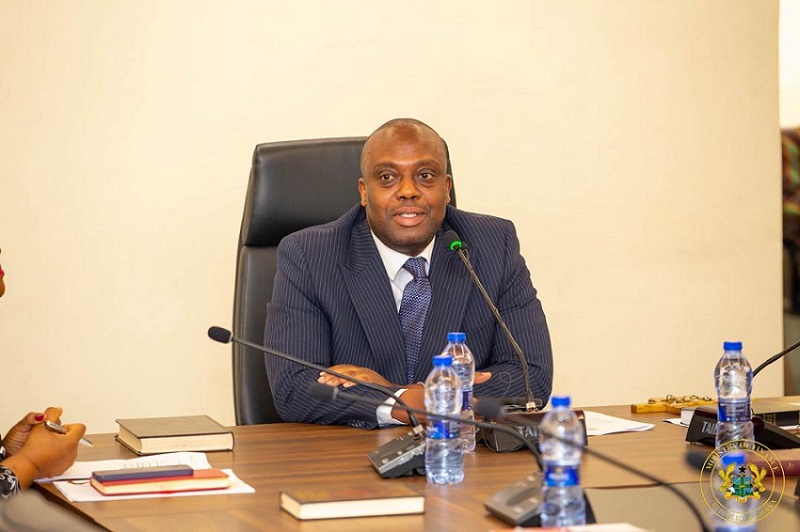
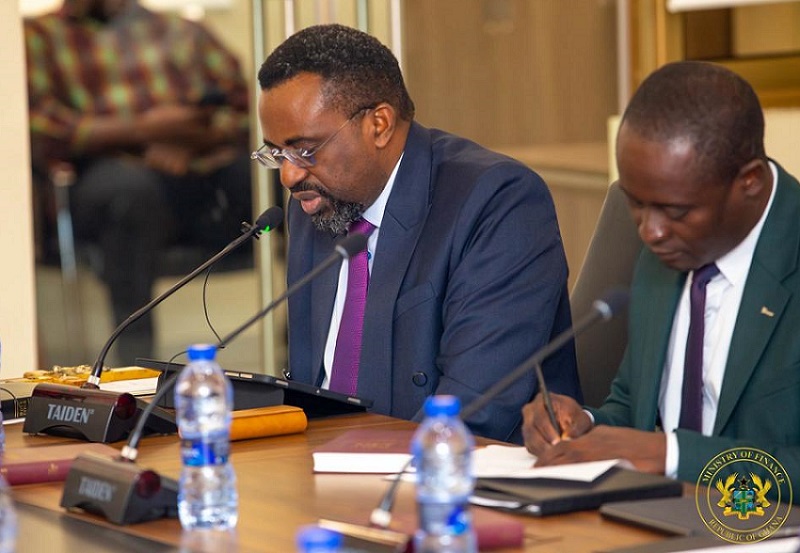
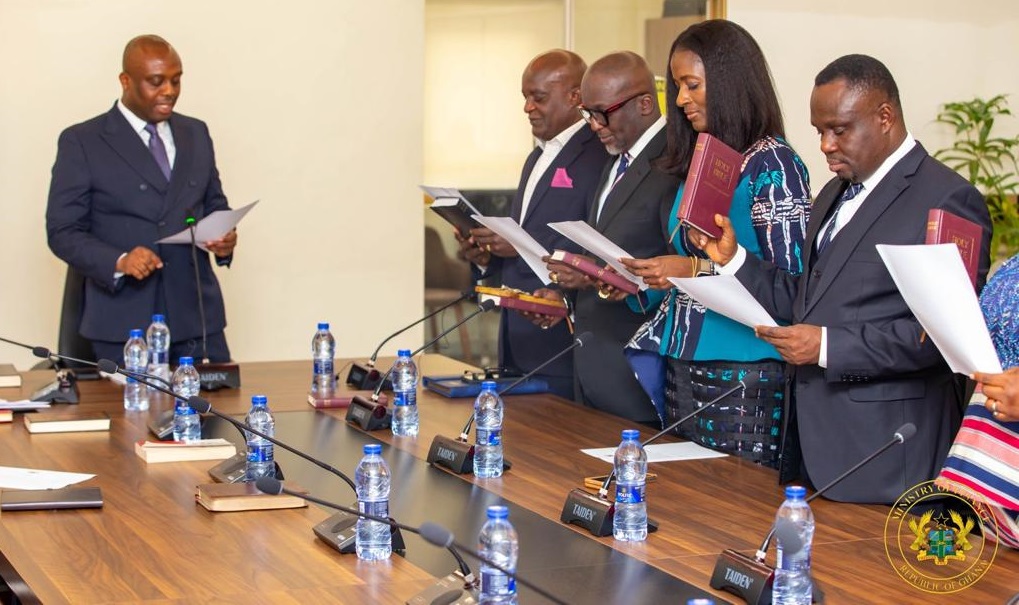
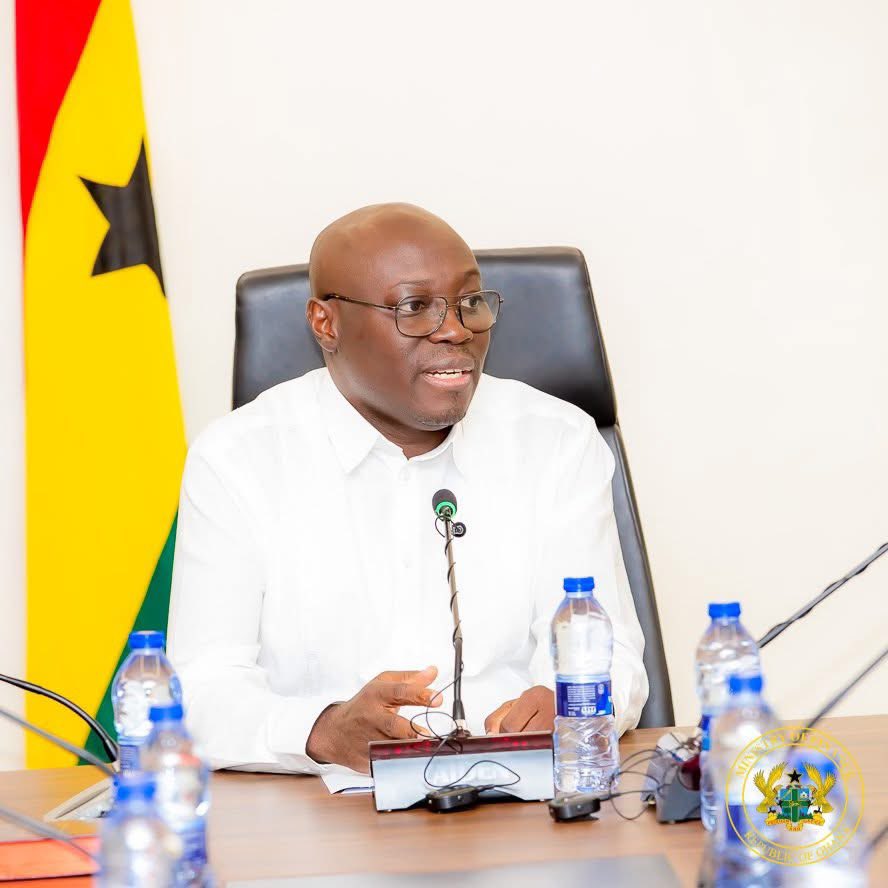
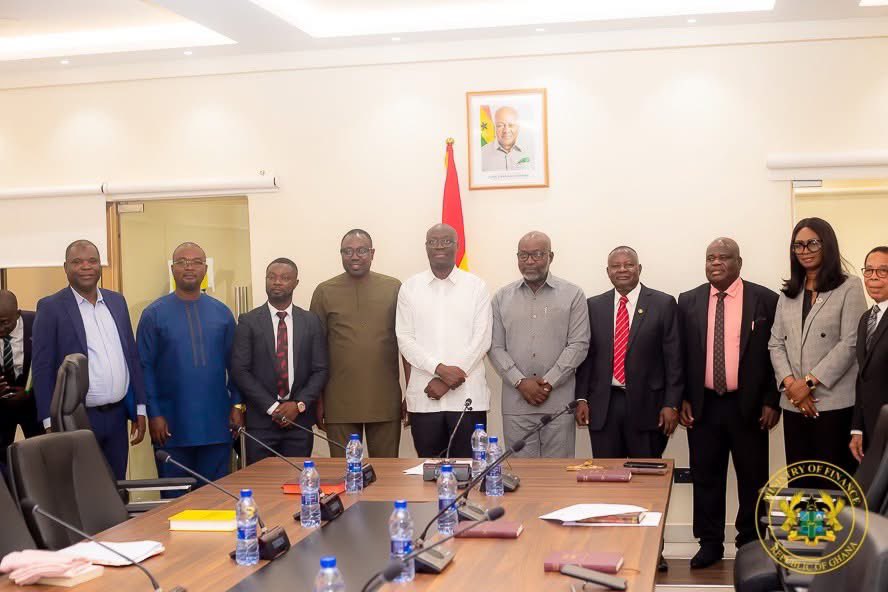
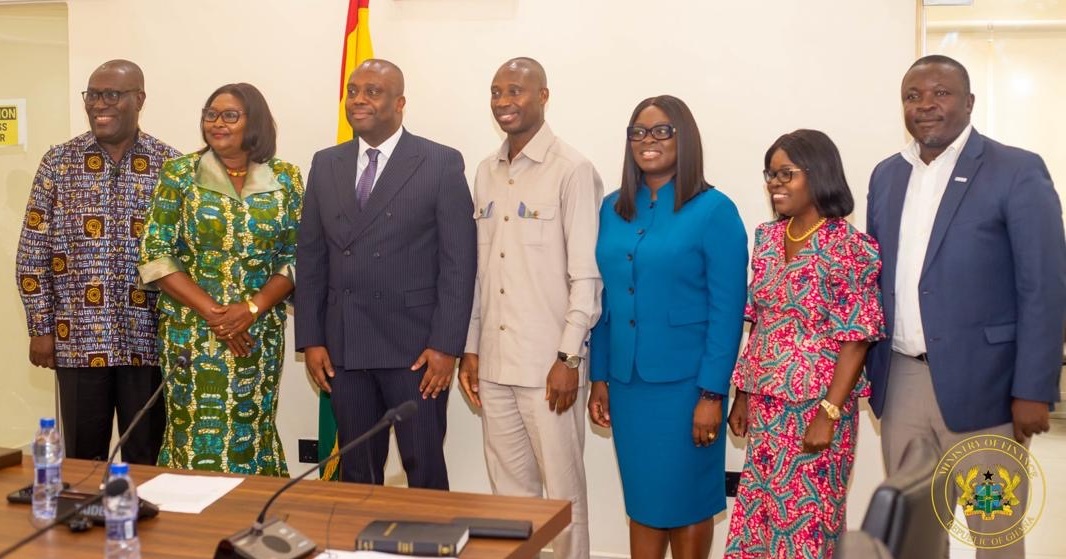
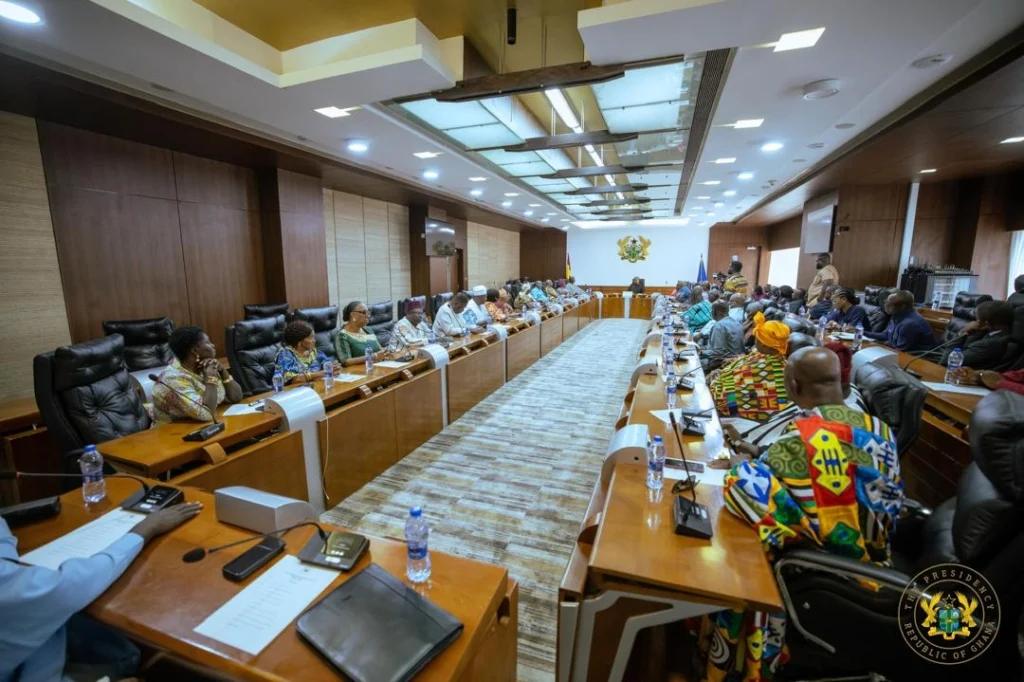
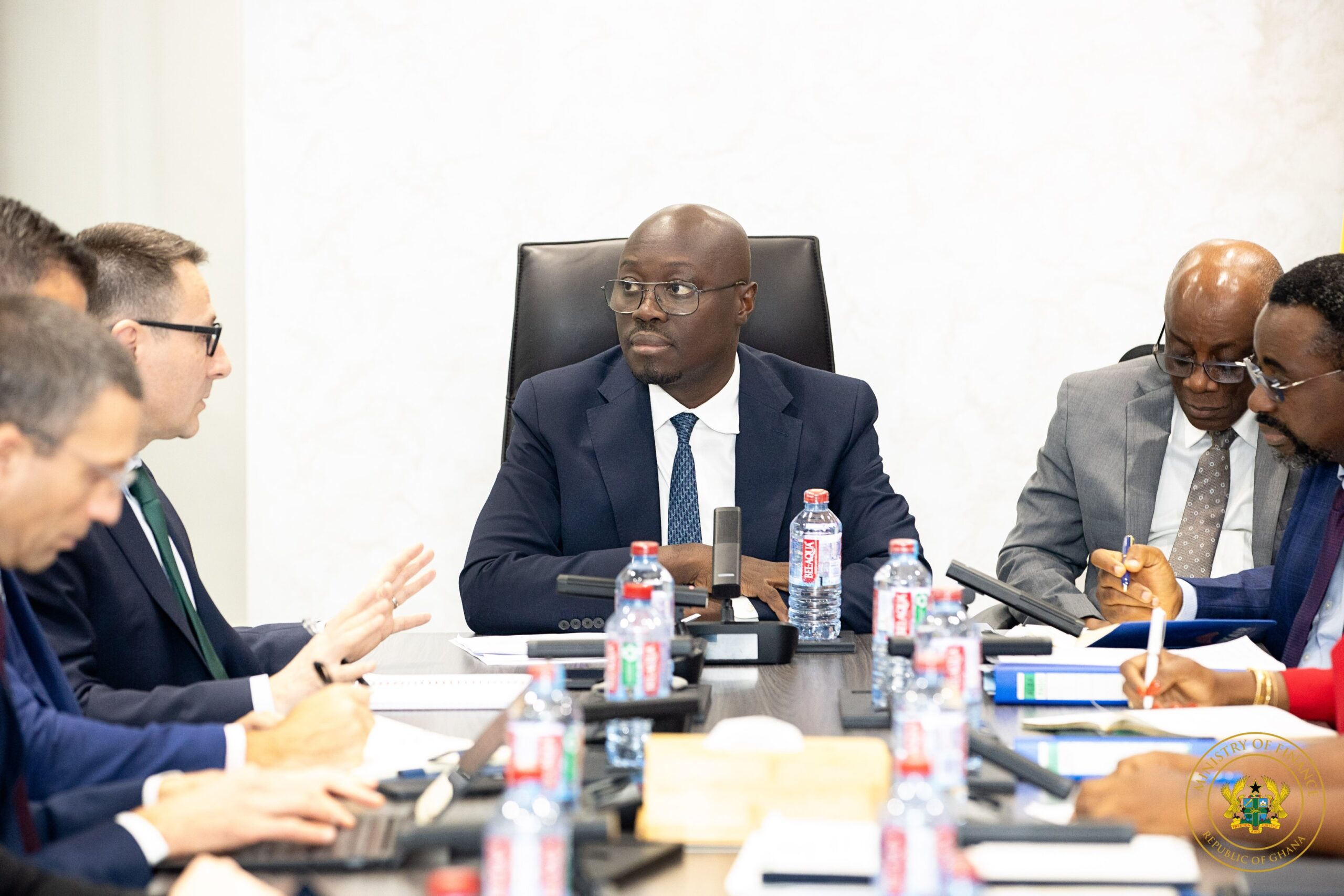
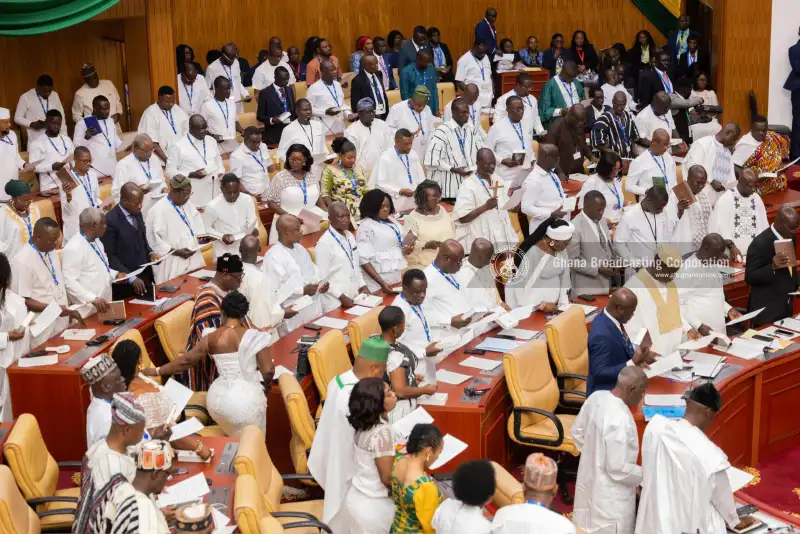
    Minister for Finance, Dr. Cassiel Ato Forson, on Wednesday, July 9, inaugurated the new Board of Directors for the Agricultural Development Bank (ADB) and Board of Directors for Consolidated Bank Ghana Limited (CBG).

    The sector minister highlighted the critical role of agriculture in national development, noting that no country can achieve sustainable growth without a vibrant and resilient agricultural sector.

    He therefore tasked the new board chaired by Mr. Kenneth Kwamina Thompson “to remain focused and guided by their primary mandate—serving Ghana’s agricultural sector.”

    Mr. Edward Ato Sarpong has been appointed as the Managing Director.

    Dr. Ato Forson also assured the new board and management of plans to recapitalize the Agricultural Development Bank in 2026.

    This move, he explained, is aimed at strengthening ADB’s financial position to better support farmers, agribusinesses, and agricultural value chain initiatives.

    The newly inaugurated board is chaired by Mr. Kenneth Kwamina Thompson, with Mr. Edward Ato Sarpong serving as Managing Director.

    Other members of the board include Hon. Andrew Dari Chiwitey, Mr. Siisi Essuman-Ocran, Hon. Dr. E. Prince Arhin, Hon. Misbahu Mahama Adams, Wing Commander Samuel J.A. Allotey, Mr. Courage Akanwunge Asabagna and Mr. Abdul Nasir M. Saani.

    To the Consolidated Bank Ghana Limited (CBG) Board of Directors, the Finance Minister issued a firm warning against the era of excessive salaries and board allowances within State-Owned Enterprises (SOEs). He stressed that such practices would not be tolerated under the current administration.

    “It is equally important that this board safeguards taxpayers’ money, as you have been entrusted with a crucial national asset,” Dr Ato Forson charged.

    He assured the board of the government’s commitment to recapitalize CBG in the coming year. This comes after approximately GH₵30 billion was spent to purportedly salvage and restore confidence in the financial sector.

    Newly appointed Board Chairman, Mr. Ernest Mawuli Agbesi, commended the government’s resolve to recapitalize the bank and pledged that the board would work diligently to deliver value to both the government and the Ghanaian people.

    The newly inaugurated CBG Board also includes Dr. Naomi Wolali Kwetey — Managing Director, Ms. Irene Ackuaku, Mr. David Adom, Mr. Michael Kwasi Anyamesem, Mr. Stephen Kporzih, Dr. Sa-ad Iddrisu, Mrs. Immaculate Kawe Kanlisi and Mr. John Alexander Ackon.

  • Ensure Ghana provides  my entitlements as CJ pending determination of case – Justice Torkornoo to ECOWAS Court

    Ensure Ghana provides my entitlements as CJ pending determination of case – Justice Torkornoo to ECOWAS Court

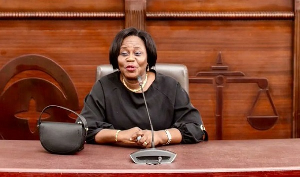
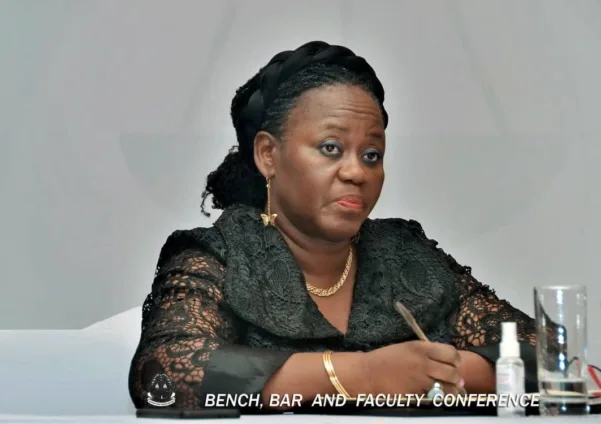
    Ghana’s suspended Chief Justice, Her Ladyship Justice Gertrude Torkornoo, has requested the ECOWAS Community Court to ensure the state continues to provide the paraphernalia and entitlements of her office pending the hearing and determination of the case before it.

    This forms part of the applicant’s precautionary measures aside from the relief she seeks from the court over her suspension from office.

    Justice Torkornoo was suspended on Tuesday, April 22, by President John Dramani Mahama following the establishment of a prima facie case based on separate petitions calling for her removal.

    The action was in accordance with Article 146(6) of Ghana’s 1992 Constitution and comes after consultations with the Council of State.

    The other precautionary measures are “That the Republic of Ghana suspend the disciplinary/ removal from office as Chief Justice process against the Applicant, pending the hearing and determination of the complaint on the merits.”

    “That Ghana refrains from taking any other measures that may harm the rights claimed by the Applicant and /or aggravate or extend the dispute submitted to the Court, or compromise the implementation of any decision that the Court may render.”

    “Given the urgency of the situation, the Applicant respectfully requests the Court to hold a hearing on this request as soon as possible, and that the President of the Court ask Ghana to act in order to allow any order that the Court may issue on the Request for Assignment of Precautionary Measures to have its appropriate effect.”

    As part of her reliefs, Chief Justice, Justice Gertrude Torkornoo, is seeking compensation worth $10 million over her suspension from office by His Excellency President John Dramani Mahama.

    This forms part of 10 reliefs being requested. The Chief Justice’s recent suit follows several unsuccessful cases at the Supreme Court this year after her suspension.

    The suspended Chief Justice notes that the president’s purported prima facie determination contained no reasons or justification and was entirely devoid of the elements of judicial or quasi-judicial reasoning expected under the Constitution.

    She thus wants the ECOWAS Court to declare that the suspension of the Applicant (Justice Gertrude Araba Esaaba Sackey Torkornoo) as the Chief Justice of the Republic of Ghana by the President of the Respondent’s State on 22 April 2025 violated the Applicant’s human rights to a fair hearing guaranteed by Article 7 of the African Charter on Human and Peoples Rights.

    The other reliefs are as follows;

    “A declaration that the panel instituted by the Respondent (Ghana) to investigate and determine the allegations of misconduct against the Applicant was not constituted to guarantee its independence and impartiality and as such has violated the Applicant’s human right to fair hearing guaranteed by Article 7 of the African Charter on Human and Peoples’ Rights.”

    “A declaration that the purported suspension of the Applicant as the Chief Justice of the Republic of Ghana by the President of the Respondent State on 22 April 2025, constitutes a violation of her human right to fair equitable and satisfactory conditions guaranteed by Article 15 of the African Charter on Human and Peoples’ Rights.”

    “A declaration that the purported suspension of the Applicant as the Chief Justice of the Republic of Ghana by the President of the Respondent State on 22 April 2025 has exposed her to public ridicule and odium locally and internationally and the said act constitutes a violation of her human right to dignity guaranteed by Article 5 of the African Charter on Human and Peoples’ Rights.”

    “A declaration that by subjecting the Applicant to an illegal and unfair investigation and trial since April 2025, the Respondent has inflicted injuries on her professional standing and image, thereby ‘exposing her and her family to immeasurable public ridicule.”

    “An order to the Respondent Republic to act immediately to prescribe the rule of procedure to govern the investigation of allegations of misconduct against the Chief Justice of the Republic of Ghana in conformity with the right to fair hearing guaranteed by the Constitution of Ghana and the African Charter on Human and Peoples’ Rights.”

    “An order directing the Respondent to immediately lift the suspension and restore the Applicant to full office until the conclusion of fair constitutional proceedings.”

    “An order restraining the Respondent from continuing with the purported inquiry for the removal of the Applicant as the Chief Justice of the Republic of Ghana in its current form, until it conforms to fair hearing guarantees.”

    “An award of USD 10 million as compensation for moral and reputational damages suffered by the Applicant as a result of her illegal suspension and unfair investigation, and lastly,

    “Any other relief(s) as the Honourable Court deems just.”

    President Mahama set up a five-member committee to probe her removal petitions, including Justice Gabriel Scott Pwamang—Supreme Court Justice (Chairman), Justice Samuel Kwame Adibu-Asiedu—Supreme Court Justice, Daniel Yaw Domelevo—Former Auditor-General Major Flora Bazwaanura Dalugo, Ghana Armed Forces Representative Prof. James Sefah Dzisah, and Associate Professor at the University of Ghana.

    Justice Gertrude Torkornoo has reiterated allegations of unconstitutionality with regard to the process of her removal, as well as infringement of her rights during the hearing by the committee set up by the president.

    She submitted a supplementary affidavit, but the Supreme Court on May 28 dismissed the affidavit filed on May 26, where the suspended Chief Justice made allegations of rights abuse by the committee.

    The suspended Chief Justice wants Justice Gabriel Scott Pwamang, who has been named Acting Chief Justice, from presiding as Chairman of the commitee or participating in the proceedings of the committee set up to inquire into the petitions against her.

    Meanwhile, the government’s spokesperson, Felix Kwakye Ofosu, has refuted claims made by Justice Torkornoo, noting that the Chief Justice’s suspension aligns with the constitution.

  • $10m compensation among reliefs CJ Torkornoo demands from ECOWAS Court over her suspension

    $10m compensation among reliefs CJ Torkornoo demands from ECOWAS Court over her suspension

    Chief Justice, Justice Gertrude Torkornoo, has proceeded to the ECOWAS Community Court in Abuja, Nigeria seeking compensation worth $10 million over her suspension from office by His Excellency President John Dramani Mahama.

    This forms part of 10 reliefs being requested. The Chief Justice’s recent suit follows several unsuccessful cases at the Supreme Court this year after her suspension.

    Deputy Attorney-General and Minister for Justice, Justice Srem Sai, in a post on X dated July 8, revealed that the case was filed on July 4.

    Justice Torkornoo was suspended on Tuesday, April 22, by President John Dramani Mahama following the establishment of a prima facie case based on separate petitions calling for her removal.

    The action was in accordance with Article 146(6) of Ghana’s 1992 Constitution and comes after consultations with the Council of State.

    However, the Chief Justice notes that the president’s purported prima facie determination contained no reasons or justification and was entirely devoid of the elements of judicial or quasi-judicial reasoning expected under the Constitution.

    She thus wants the ECOWAS Court to declare that the suspension of the Applicant (Justice Gertrude Araba Esaaba Sackey Torkornoo) as the Chief Justice of the Republic of Ghana by the President of the Respondent’s State on 22 April 2025 violated the Applicant’s human rights to a fair hearing guaranteed by Article 7 of the African Charter on Human and Peoples Rights.

    The other reliefs are as follows;

    “A declaration that the panel instituted by the Respondent (Ghana) to investigate and determine the allegations of misconduct against the Applicant was not constituted to guarantee its independence and impartiality and as such has violated the Applicant’s human right to fair hearing guaranteed by Article 7 of the African Charter on Human and Peoples’ Rights.”

    “A declaration that the purported suspension of the Applicant as the Chief Justice of the Republic of Ghana by the President of the Respondent State on 22 April 2025, constitutes a violation of her human right to fair equitable and satisfactory conditions guaranteed by Article 15 of the African Charter on Human and Peoples’ Rights.”

    “A declaration that the purported suspension of the Applicant as the Chief Justice of the Republic of Ghana by the President of the Respondent State on 22 April 2025 has exposed her to public ridicule and odium locally and internationally and the said act constitutes a violation of her human right to dignity guaranteed by Article 5 of the African Charter on Human and Peoples’ Rights.”

    “A declaration that by subjecting the Applicant to an illegal and unfair investigation and trial since April 2025, the Respondent has inflicted injuries on her professional standing and image, thereby ‘exposing her and her family to immeasurable public ridicule.”

    “An order to the Respondent Republic to act immediately to prescribe the rule of procedure to govern the investigation of allegations of misconduct against the Chief Justice of the Republic of Ghana in conformity with the right to fair hearing guaranteed by the Constitution of Ghana and the African Charter on Human and Peoples’ Rights.”

    “An order directing the Respondent to immediately lift the suspension and restore the Applicant to full office until the conclusion of fair constitutional proceedings.”

    “An order restraining the Respondent from continuing with the purported inquiry for the removal of the Applicant as the Chief Justice of the Republic of Ghana in its current form, until it conforms to fair hearing guarantees.”

    “An award of USD 10 million as compensation for moral and reputational damages suffered by the Applicant as a result of her illegal suspension and unfair investigation, and lastly,

    “Any other relief(s) as the Honourable Court deems just.”

    The applicant has also requested the ECOWAS Court to assign four precautionary measures to the country.

    The suspended Chief Justice wants the court to ensure she continues to enjoy the paraphernalia and entitlements of her office as the Chief Justice of Ghana pending the hearing and determination of the case.

    The measures are;

    “That the Republic of Ghana suspend the disciplinary/ removal from office as Chief Justice process against the Applicant, pending the hearing and determination of the complaint on the merits.”

    “That Ghana refrains from taking any other measures that may harm the rights claimed by the Applicant and /or aggravate or extend the dispute submitted to the Court, or compromise the implementation of any decision that the Court may render.”

    “Given the urgency of the situation, the Applicant respectfully requests the Court to hold a hearing on this request as soon as possible, and that the President of the Court ask Ghana to act in order to allow any order that the Court may issue on the Request for Assignment of Precautionary Measures to have its appropriate effect.”

    President Mahama set up a five-member committee to probe her removal petitions, including Justice Gabriel Scott Pwamang—Supreme Court Justice (Chairman), Justice Samuel Kwame Adibu-Asiedu—Supreme Court Justice, Daniel Yaw Domelevo—Former Auditor-General Major Flora Bazwaanura Dalugo, Ghana Armed Forces Representative Prof. James Sefah Dzisah, and Associate Professor at the University of Ghana.

    Justice Gertrude Torkornoo has reiterated allegations of unconstitutionality with regard to the process of her removal, as well as infringement of her rights during the hearing by the committee set up by the president.

    She submitted a supplementary affidavit, but the Supreme Court on May 28 dismissed the affidavit filed on May 26, where the suspended Chief Justice made allegations of rights abuse by the committee.

    The suspended Chief Justice wants Justice Gabriel Scott Pwamang, who has been named Acting Chief Justice, from presiding as Chairman of the commitee or participating in the proceedings of the committee set up to inquire into the petitions against her.

    Meanwhile, the government’s spokesperson, Felix Kwakye Ofosu, has refuted claims made by Justice Torkornoo, noting that the Chief Justice’s suspension aligns with the constitution.

  • GDPC and GIIF Boards inaugurated by Dep. Finance Minister

    GDPC and GIIF Boards inaugurated by Dep. Finance Minister

    Deputy Finance Minister Honourable Thomas Ampem Nyarko on July 8 inaugurated the Board of the Ghana Deposit Protection Corporation (GDPC) and Board of the Ghana Infrastructure Investment Fund (GIIF).

    The GDPC Board is chaired by the Governor of the Central Bank of Ghana, Dr. Johnson Pandit Asiamah.

    Honourable Thomas Ampem Nyarko entreated the Board to safeguard the deposits of ordinary Ghanaians and strengthen public confidence in the financial system.

    On his part, Dr. Johnson Pandit Asiamah assured of the Board’s commitment to providing effective leadership and strengthening the deposit protection scheme.

    He revealed the Board’s intention to explore the use of Artificial Intelligence (AI) and integrate Environmental, Social, and Governance (ESG) principles, among other strategies.

    The other members of the Board include Galahad Alex Andoh, Chief Executive Officer of the Ghana Deposit Protection Corporation; Mr. Prosper Ayinbilla Awuni, representing the Ministry of Finance; Benjamin Amenumey; and Paul Kwasi Agyemang.

    Ghana Infrastructure Investment Fund

    The eight-member GIIF Board to be chaired by Mr. Franklin Mensah, has been tasked with prioritize the identification and funding of bankable infrastructure projects that have the potential to attract both local and international investment to advance sustainable economic growth and development.

    In response, Mr. Franklin Mensah assured that the Board will be results-driven and committed to delivering on its mandate.

    He expressed gratitude to President Mahama and the Minister for Finance, Dr Cassiel Ato Forson, for the confidence reposed in the team.

    Other members include GIIF Chief Executive Officer Nana Dwemoh Benneh, Hon. Theresa Lardi Awuni, Dr. Eric Afful, Hon. Thomas Worlanyo Tsekpo, Ms. Harriet Anewenah, Ms. Linda Quaynor, and Nana Ansah Kwao IV.

  • BoG receives $367m from IMF after fourth review – report

    BoG receives $367m from IMF after fourth review – report

    It is reported that the Bank of Ghana (BoG) has received US$367 million (SDR 267.5 million) from the International Monetary Fund (IMF) after the completion of the fourth review under the country’s three-year US$3 billion program.

    MyJoyOnline, citing sources at the central bank, reported that the Finance Minister, Dr Cassiel Ato Forson, will receive the cedi equivalent of the disbursed amount to finance projects named in the 2025 budget.

    This comes after the Executive Board of the International Monetary Fund (IMF) on July 7 completed the fourth review of the US$3 billion, 36-month Extended Credit Facility (ECF) Arrangement, which was approved by the Board in May 2023.

    Following the Executive Board discussion on Ghana, Deputy Managing Director Bo Li issued the following statement:

    “The authorities are strongly committed to restoring fiscal discipline and addressing the structural weaknesses that led to the slippages. This should be supported by continued efforts to enhance domestic revenue mobilization and streamline non-priority expenditure, while creating space for development priorities and enhanced social safety nets.”

    This brings Ghana’s total disbursements under the arrangement to about US$2.3 billion.

    In April, the IMF staff and the Ghanaian authorities reached a staff-level agreement on the fourth review of Ghana’s economic program.

    According to the IMF, the country’s economic recovery prompted the staff-level agreement and subsequent disbursement.

    Ghana’s growth in 2024 and the first quarter of 2025 was higher than expected, reflecting robust activity in the mining, agricultural, ICT, manufacturing, and construction sectors, the Fund noted.

    “The external sector has seen considerable improvement, driven by solid exports—particularly gold and to a lesser extent, oil—and higher remittances. As a result, the accumulation of international reserves has far exceeded the ECF-supported program targets.”

    Notwithstanding, Ghana’s performance under the IMF-supported program deteriorated significantly at the end of 2024.

    “Preliminary fiscal data point to slippages in the run-up to the 2024 general elections, on account of a large accumulation of payables. Inflation exceeded program targets—though recent data points to renewed rapid disinflation. Several reforms and policy actions were delayed across the fiscal, financial, and energy sectors,” the IMF noted.

    In light of this, the current administration, led by President John Mahama, has adopted strong corrective measures to address the fiscal impact of 2024 slippages and ensure the fiscal program remains on track, including achievement of a 1½ percent of GDP fiscal primary surplus in 2025.

    The Fund indicates that this will be achieved through additional revenue mobilization and expenditure rationalization—while protecting the vulnerable from the impact of policy adjustment.

    The Bank of Ghana (BoG) has tightened its monetary policy stance to sustain a continued reduction in inflation and has been successful in rebuilding international reserves. The BoG has implemented risk containment measures to support banking system stability.

    “It appropriately intensified monitoring and escalated measures at weak, undercapitalized banks to promote timely recapitalization; strengthen risk management frameworks and practices, including to reduce NPLs; and ensure effective governance. Looking ahead, the authorities are committed to sustaining their efforts to bolster financial stability,” the Fund revealed.

    Creating an environment more conducive to private sector investment and enhancing governance and transparency remain key to boosting the economy’s potential and underpinning sustainable job creation, according to the Fund.

    The Ghanaian authorities have also continued to make headway on their public debt restructuring. The Memorandum of Understanding (MoU) with Ghana’s Official Creditors Committee (OCC) under the G20 Common Framework has been signed by all parties, and the focus is now on finalizing the bilateral agreements to implement the MoU.

    The authorities are also pursuing good-faith efforts toward reaching agreements with other commercial creditors on debt treatments that are in line with program parameters and the comparability of treatment principles.

    Against the backdrop of these policy actions and the progress on debt restructuring, Ghana’s credit rating has been upgraded by key international credit rating agencies.

    Fitch has upgraded Ghana’s Long-Term Foreign-Currency Issuer Default Rating (IDR) from ‘Restricted Default’ to ‘B-’ with a Stable Outlook.

    Fitch credited the upgrade to the country’s successful restructuring of $13.1 billion in Eurobond debt, steady fiscal consolidation, and the country’s improving macroeconomic outlook.

    The agency also highlighted falling inflation, a strengthening cedi, and a rebound in investor confidence as key indicators of Ghana’s economic turnaround.

    The Fund insists that staying the course of macroeconomic policy adjustment and reforms is essential to fully and durably restore macroeconomic stability and debt sustainability, while fostering a sustainable increase in economic growth and poverty reduction.

  • Ghana’s Mpox cases hit 170

    Ghana’s Mpox cases hit 170

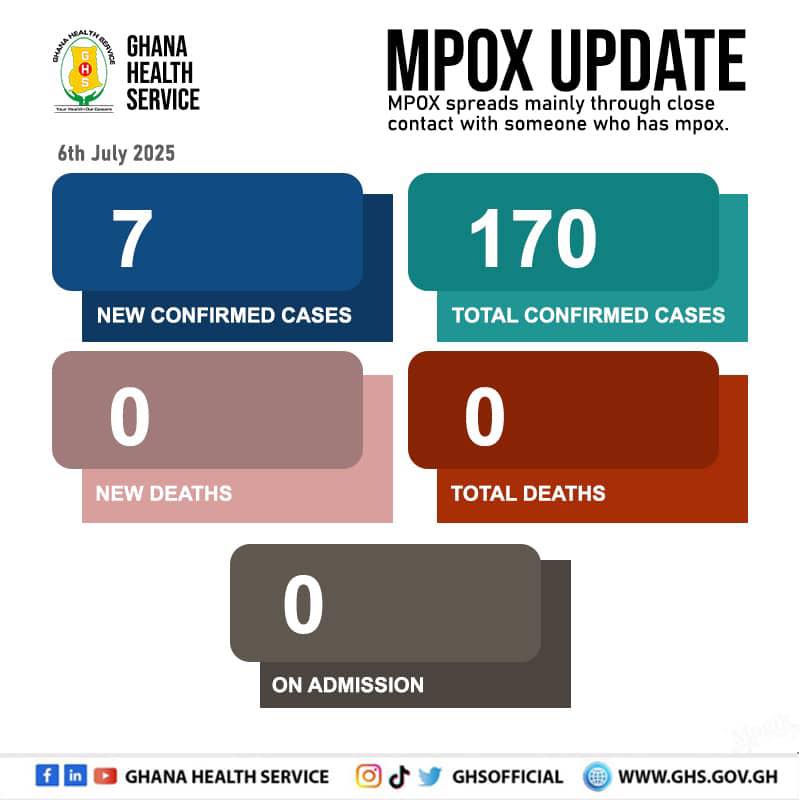
    Seven new confirmed cases as of July 6 have pushed the country’s Mpox cases to 170, according to the Ghana Health Service (GHS).

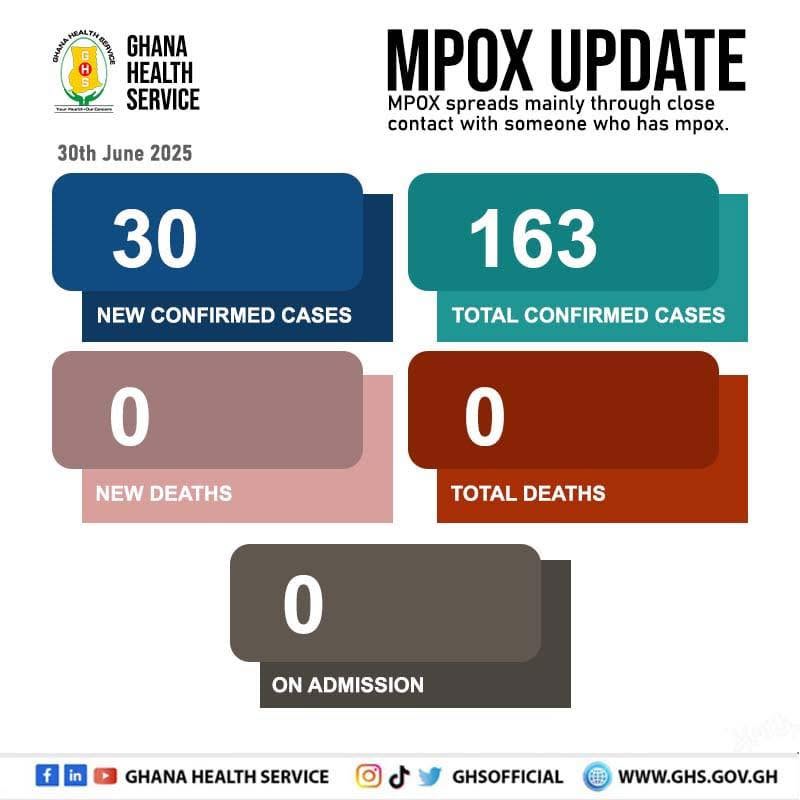
    As of June 30, the number of confirmed cases stood at 163 after the service recorded 30 new cases.

    Over the period, the GHS has observed an increasing rate in contraction of the disease.

    Currently, none of those who have contracted the disease have been admitted. Also, no deaths have been reported.

    Earlier reports indicated that the Western Region was experiencing a sharp rise in infections.

    The government is engaging international organizations for assistance in procuring vaccines to be able to curb the surging number of cases being reported.

    The World Health Organization (WHO) Ghana has provided laboratory PCR reagents to enhance the country’s diagnostic capacity.

    The donation was officially handed over to the Ghana Health Service (GHS) at the National Public Health Reference Laboratory.

    Receiving the supplies on behalf of the GHS, Acting Deputy Director General, Dr. Caroline Reindorf Amissah expressed gratitude for WHO’s ongoing logistical and technical support.

    “We promise from our end to do our bit, collaborate, go out there, and look for the cases to make sure that this is really brought under control,” she stated.

    WHO Country Representative Dr. Fiona Braka emphasized that the organization hopes the reagents will enable rapid diagnosis and prompt public health responses.

    The supplies are capable of testing 3,400 suspected mpox samples, and additional kits provided will allow clade determination for 625 confirmed positive cases.

    Ghana recorded the first Mpox case in June 2022, with five cases, and by November 2023, health authorities had confirmed a total of 34 cases. Despite the increase in cases, Ghana has not recorded any Mpox-related deaths.

    Mpox is a viral illness similar to smallpox. It typically causes fever, swollen lymph nodes, and a rash. The virus spreads through direct contact with an infected person’s skin or bodily fluids, including through sexual contact.

    To reduce your risk, avoid close contact with symptomatic individuals, maintain proper hand hygiene, and refrain from sharing personal items.

    Symptoms may include fever, rash or lesions, tiredness, headaches, muscle and back pain, and swollen glands.

    The government of Ghana has assured its commitment to safeguarding public health by implementing appropriate measures to protect the health and well-being of all residents.

  • Ghanaian B-visa applicants restricted to 3-month single-entry US visas

    Ghanaian B-visa applicants restricted to 3-month single-entry US visas

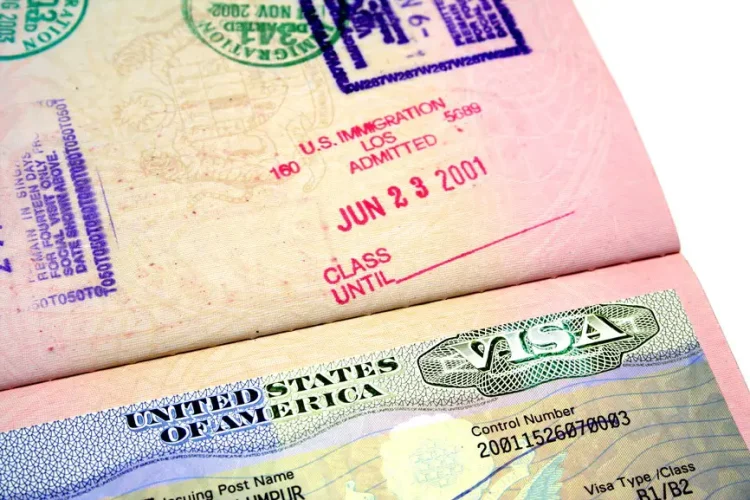
    The U.S. Department of State—Bureau of Consular Affairs has limited the number of entries and duration given under non-immigrant visa classifications.

    Ghanaian visa applicants, including those applying for B-class visas—covering business and tourism travel—will be issued single-entry visas valid for just three months.

    They can no longer access the 5-year visa and multiple-entry.

    The updated guidelines, published under the U.S. Visa, reveal that Reciprocity and Civil Documents by Country for Ghana also affect student visa applicants.

    F-1 visa holders, who are typically enrolled in full-time academic programmes in the U.S., will now be issued visas that allow for only one entry and expire after three months.

    Diplomats and government officials will, however, continue to receive multiple-entry visas with validity ranging from 24 to 60 months.

    The K1 visa, issued to the foreign-citizen fiancé(e) of a US citizen intending to marry within 90 days of arrival in the United States, and the K2 visa, provided to the unmarried dependent child (under 21 years old) of a K1 visa holder, are single-entry visas that will be valid for 6 months.

    The K3 visa, for the foreign-citizen spouse of a US citizen, and the K4 visa, for their unmarried dependent child (under 21 years old), are multiple-entry visas that will be valid for 24 months.

    All other visa applicants, including those applying for B-class visas, which cover business and tourism travel, will now be issued single-entry visas valid for just three months.

    https://travel.state.gov/content/travel/en/us-visas/Visa-Reciprocity-and-Civil-Documents-by-Country/Ghana.html

    In reaction to the US’ new policy that affects Ghana and Nigeria, the Vice President of IMANI-Africa, Bright Simons, quizzed whether or not Ghana and Nigeria can retaliate.

    “Given the scale and scope of the restrictions this time around now, citizen interest is likely to be much higher putting pressure on the government to openly discuss the measures it intends to take in response,” he noted while revealing how diplomatic channels resolved similar actions by the US in the past.

    He called on the government to provide statistics on whether or not US citizens coming to Ghana do not get long-term, multiple-entry visas as often as Ghanaian citizens visiting the US do.

    “Thus, they are trying to frame the issue as one of “reciprocity”. Something that, per policy, they ought to review regularly. Our governments should publish stats on this. Is it true or not?”

    “The visa regimes of some other places Ghanaians like to visit, like Europe, China, and the Middle-East are not any more liberal. Getting long-term, multiple-entry, visas for these places has been quite hard. It may be hard to justify retaliation against the US when visa rules for other places seem just as tight or even tighter. Except, of course, that there is no rule that says that retaliation must be symmetrical,” he added.

  • National Day of Prayer justifies completion of national cathedral project – Board of Directors

    National Day of Prayer justifies completion of national cathedral project – Board of Directors

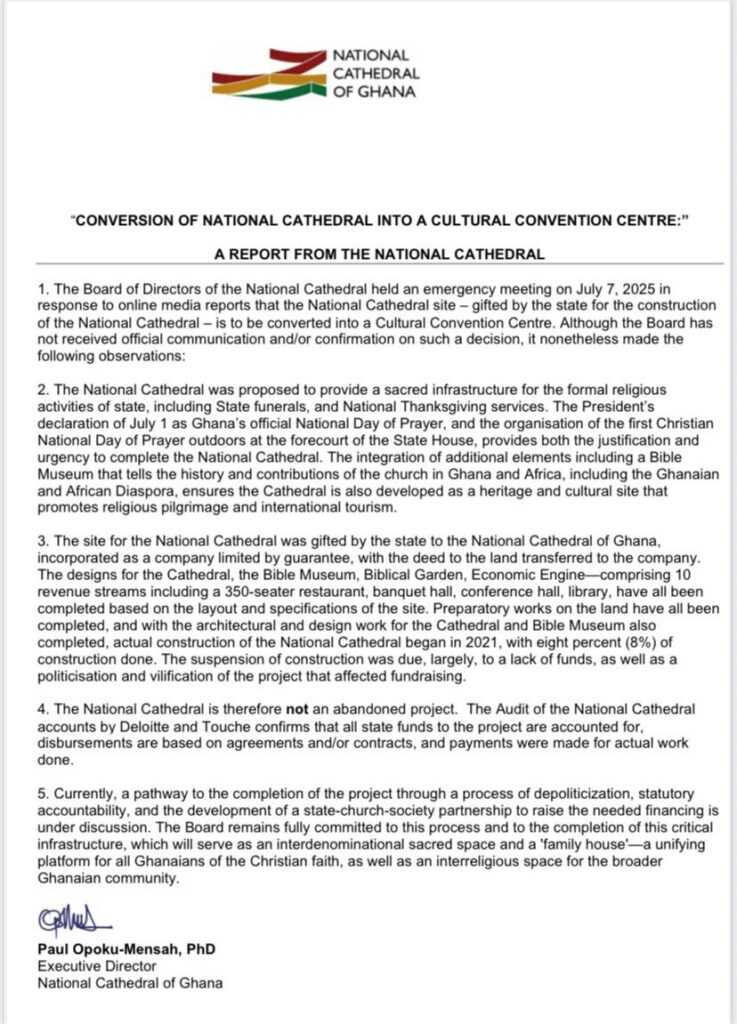
    The Board of Directors of the National Cathedral has called on the government to complete the national cathedral project rather than convert it into a National Cultural Convention Centre (NCCC)

    The Board proposed the project’s completion after holding an emergency meeting on July 7.

    According to the government, the National Cultural Convention Centre (NCCC) become a central hub for Ghana’s creative economy and cultural diplomacy.

    The Board in a statement noted that its calls for the completion of the project is justified by President John Mahama’s declaration of July 1 as Ghana’s official National Day of Prayer

    It further noted that the integration of additional elements including a Bible Museum that tells the history and contributions of the church in Ghana and Africa, including the Ghanaian and African Diaspora, ensures the Cathedral is also developed as a heritage and cultural site that promotes religious pilgrimage and international tourism.

    The Board noted that the designs for the Cathedral, the Bible Museum, Biblical Garden, Economic Engine-comprising 10 revenue streams including a 350-seater restaurant, banquet hall, conference hall, library, have all been completed based on the layout and specifications of the site.

    “Preparatory works on the land have all been completed, and with the architectural and design work for the Cathedral and Bible Museum also completed, actual construction of the National Cathedral began in 2021, with eight percent (8%) of construction done,” the Board further added.

    It noted that the project has not been abandoned despite its suspension due to lack of funds caused by politicisation and vilification of the project.

    Under the new “SH0W24” plan, part of the 24-hour economy for the creative sector, the NCCC will be developed with support from the African Continental Free Trade Area (AfCFTA) Secretariat and host exhibitions, film festivals, trade expos, and major summits.

    The project, the government notes, offers a smart solution to infrastructure challenges without clashing with religious or national values.

    “At the national level, a bold flagship intervention is proposed: converting the National Cathedral site into the National Cultural Convention Centre (NCCC), in partnership with the AfCFTA Secretariat. This venue will serve as Africa’s premier cultural diplomacy and creative economy forum, hosting international exhibitions, film festivals, trade shows, and summits-filling a critical infrastructure gap without conflicting with national values or faith institutions,” the document stated.

    The National Cultural Convention Centre (NCCC) is a key component of a wider strategy to revitalise Ghana’s creative arts, culture, and tourism sectors as major drivers of economic transformation.

    Its development marks a major policy shift regarding the use of the contested National Cathedral site, which has faced public criticism due to delays, rising costs, and questions about its necessity.

    Under the SH0W24 initiative, the NCCC is expected to become the flagship infrastructure project for the creative economy, with the capacity to host global exhibitions, festivals, and large-scale cultural events.

    The first phase of SH0W24 (2025–2026) will focus on feasibility studies, while the centre is expected to be fully operational in Phase 3 (2028–2030). Phase 2 will see the rollout of the Ghana Cultural Passport, regional programmes, and creative districts aimed at energising local economies. Phase 3 will take things further, focusing on exports and cross-border cultural partnerships.

    In addition, the SH0W24 strategy includes the creation of a National Creators Academy, which will train young people in fields such as music, film, fashion, digital media, and cultural performance, using modern tools like AI and virtual reality, along with business and cultural education.

    The government plans to build or upgrade more than 250 community centres across the country as part of the 24H+ Community Centre Network. These centres will stay open all day and night, offering space for training, creative work, exhibitions, and performances to support local arts and boost nighttime business.

    To help local artists reach more people, a new digital platform called the Ghana Cultural Passport will be introduced. It will showcase cultural experiences to tourists, especially those from the diaspora. Ghana’s embassies will help promote creative exports, and artists will get licensing and export support to reach international markets.

    To keep creative businesses running, the plan includes financial support through two funds: the 24H+ Value Chain Financing Facility and a Technical Assistance Grant Facility.

    The National Cathedral, originally proposed under the administration of former President Nana Addo Dankwa Akufo-Addo, was envisioned as a monumental Christian worship centre in Ghana.

    But the project progressed at a snail’s pace, spiralling costs and the use of public funds in a secular state. According to reports, a total amount of $58 million was spent on the project deemed to be Ghana’s most expensive bit. 

    Over a year ago, Member of Parliament for North Tongu, Samuel Okudzeto Ablakwa, raised concerns with the Commission on Human Rights and Administrative Justice (CHRAJ), alleging irregularities in the project’s construction and the operations of the National Cathedral Secretariat.

    After investigating the case for several months, the Commission recommended that the Office of the Auditor-General intervene and conduct a forensic audit to ascertain whether funds allocated for the project were used for their intended purposes.

    The Commission highlighted that GHS225.9 million in “seed money” had been spent on activities including site preparation, contractor mobilization, and consultancy services as of May 31, 2022.

    CHRAJ’s detailed report recommended the potential prosecution of the board of trustees overseeing the National Cathedral project, citing their role in awarding the contract to Ribade Company Limited.

    The report highlighted multiple violations of procurement regulations and warned that the failure of those involved to address the issues could tarnish Ghana’s reputation both locally and internationally.

    The government in April this year dissolved the National Cathedral Secretariat after noting that it would no longer provide funding for the abandoned project.

  • There was no vote on the support of LGBTQI for which Ghana abstained – Foreign Ministry clarifies

    There was no vote on the support of LGBTQI for which Ghana abstained – Foreign Ministry clarifies

    The Ministry of Foreign Affairs has clarified that there was no vote on the support of LGBTQI for which Ghana abstained at the 59th Session of the Human Rights Council (HRC59) on Monday, 7th July.

    The clarification stems from false media commentary on Ghana’s vote at the 59th Session of the Human Rights Council (HRC59) on the resolution for the Renewal of the Mandate of the Independent Expert on Protection Against Violence and Discrimination Based on Sexual Orientation and Gender Identity (SOGI).

    In a statement, the ministry indicated that Ghana rather abstained from the HRC’s vote on the renewal of the Mandate of the Independent Expert on Protection Against Violence and Discrimination Based on Sexual Orientation and Gender Identity.

    “The question before the Council was whether persons who identify as LGBTQI should be protected against violence and discrimination or not. It was not about support for LGBTQI rights.
    Ghana abstained in the vote, to be consistent with Chapter 5, Article 17 of the 1992 Constitution, which specifically prohibits discrimination on the grounds of gender, race, colour, ethnic origin, religion, creed, or social and economic status,” a part of the statement issued on July 9 read.

    https://twitter.com/S_OkudzetoAblak/status/1942961795481678269/photo/1

    The resolution requests the Independent Expert to continue to report annually on the implementation of the mandate to the Human Rights Council and the General Assembly in accordance with their respective programmes of work.

    In a statement delivered by the Permanent Representative of Ghana during the Session, he unequivocally clarified Ghana’s position on the subject by stating inter alia, that ‘Our understanding of the traditional definition of gender is the male sex or female sex, especially when considered with reference to social and cultural differences. Similarly, sex in our view refers to either of the two main categories (male and female) into which humans and most other living things are divided and used for statistical purposes and policy monitoring’.

    The Ministry of Foreign Affairs noted that it is very mindful of the Ghanaian public’s general opposition and the government’s strong stance against the subject of LGBTQI rights.

    As such, it will not act in any manner to undermine this position.

    Earlier, it was reported that Ghana has abstained from a United Nations Human Rights Council vote to renew the mandate of the Independent Expert on protection against violence and discrimination based on sexual orientation and gender identity.

    Reacting to the false reports, the Member of Parliament for Okaikwei Central, Patrick Boamah, has expressed shock over the matter and questioned the government’s purported neutral stance.

    “We were promised by the government of the day that they were not going to support that activity. So, we expected that Ghana should have taken a firm position on that. I was a bit surprised to see that Ghana abstained. So, we will be asking the Minister of Foreign Affairs and the representative of the government as to why Ghana abstained.

    “I intend to file a question to understand the basis of the abstention. This is not a foreign policy matter; this is a cultural issue, a value issue, a constitutional issue, things that are alien to our culture and wellbeing…it was a clear opportunity for the government to demonstrate its position on this matter,” he said in an interview on ChannelOne TV.

    The newly introduced Human Sexual Rights and Family Values Bill, known as the anti-LGBTQ+ Bill, is set to undergo its first reading.

    This was revealed by the Speaker of Parliament, Rt. Hon. Alban Sumana Kingsford Bagbin in May this year.

    When passed, the anti-LGBTQ+ Bill will criminalise LGBTQ+ activities in Ghana, as well as individuals and organizations promoting such activities.

    The bill was once presented in Parliament under the era of former President Akufo-Addo’s administration. However, it didn’t receive ex-president Akufo-Addo’s assent due to a legal tussle.

    Earlier this year, the bill was reintroduced in Parliament after President John Dramani Mahama revealed that the bill was no longer active, as it expired with the previous Parliamentary session.

  • Govt will recapitalise NIB – Finance Minister announces

    Govt will recapitalise NIB – Finance Minister announces

    Finance Minister Dr Cassiel Ato Forson has announced the government’s decision to recapitalize National Investment Bank (NIB).

    Fuller details of this comprehensive recapitalization plan will be unveiled during the upcoming mid-year review, Dr Forson noted in a post on X today, July 9.

    In May last year, the erstwhile government earmarked GH¢2.3 billion for the recapitalization of the National Investment Bank (NIB). 

    “As part of the implementation of the Post Covid-19 Programme for Economic Growth (PC-PEG), Cabinet has approved the plan for restructuring and recapitalization of the National Investment Bank (NIB),” the former Finance Minister Dr. Mohammed Amin Adam said.

    The recapitalization plan was to involve a programmed equity injection of about GHS2.3 billion over a year, with the first tranche of GHS400 million expected to be transferred to NIB before the end of May last year.  

    This initiative was critical to strengthening the governance structure, enhancing operational efficiency, and improving risk management to ensure the financial viability of NIB.

    The International Monetary Fund (IMF) upon approving the disbursement of $370 million to Ghana after reaching a staff-level agreement after the fourth review, noted that further strengthening the country’s financial sector stability “requires fully implementing the plan to strengthen NIB, finalizing the reform strategy to support state-owned banks’ viability and sustainability, and developing contingency plans to address weak banks that fail to recapitalize.”

    Finance Minister Dr Cassiel Ato Forson has inaugurated the new 9-member Board of Directors for the National Investment Bank (NIB).

    The swearing-in ceremony was held today, July 9. The sector minister expressed his congratulations to the new board.

    The Board of Directors will be chaired by Mr. Frank Adu Jnr, who has been appointed as Managing Director.

    Dr Ato Forson noted that under this new leadership, “NIB will operate with the independence and professionalism it deserves.”

    The complete board composition includes distinguished professionals including Dr. Doli-wura Awushi Abdul-Malik Seidu Zakarai (Managing Director), Hon. Dr. Othniel Ekow Kwainoe, Hon. Ebenezer Kwaku Addo, Dr. Mrs. Mercy Naa Aku Ofei-Koranteng, Dr. Shani Bashiru, Mr. Max George Cobbina, Dr. Kwasi Akyem Apea-Kubi and Dr. Alfred Attuquaye Botchway.

  • 9-member NIB Board of Directors sworn in

    9-member NIB Board of Directors sworn in

    Finance Minister Dr Cassiel Ato Forson has inaugurated the new 9-member Board of Directors for the National Investment Bank (NIB).

    The swearing-in ceremony was held today, July 9. The sector minister expressed his congratulations to the new board.

    The Board of Directors will be chaired by Mr. Frank Adu Jnr, who has been appointed as Managing Director.

    Dr Ato Forson noted that under this new leadership, “NIB will operate with the independence and professionalism it deserves.”

    The minister announced that the government has made a bold decision to recapitalize NIB.

    Fuller details of this comprehensive recapitalization plan will be unveiled during the upcoming mid-year review, Dr Forson noted.

    In May last year, the erstwhile government earmarked GH¢2.3 billion for the recapitalization of the National Investment Bank (NIB). 

    “As part of the implementation of the Post Covid-19 Programme for Economic Growth (PC-PEG), Cabinet has approved the plan for restructuring and recapitalization of the National Investment Bank (NIB),” the former Finance Minister Dr. Mohammed Amin Adam said.

    The recapitalization plan was to involve a programmed equity injection of about GHS2.3 billion over a year, with the first tranche of GHS400 million expected to be transferred to NIB before the end of May last year.  

    This initiative was critical to strengthening the governance structure, enhancing operational efficiency, and improving risk management to ensure the financial viability of NIB.

    The International Monetary Fund (IMF) upon approving the disbursement of $370 million to Ghana after reaching a staff-level agreement after the fourth review, noted that further strengthening the country’s financial sector stability “requires fully implementing the plan to strengthen NIB, finalizing the reform strategy to support state-owned banks’ viability and sustainability, and developing contingency plans to address weak banks that fail to recapitalize.”

    The complete board composition includes distinguished professionals including Dr. Doli-wura Awushi Abdul-Malik Seidu Zakarai (Managing Director), Hon. Dr. Othniel Ekow Kwainoe, Hon. Ebenezer Kwaku Addo, Dr. Mrs. Mercy Naa Aku Ofei-Koranteng, Dr. Shani Bashiru, Mr. Max George Cobbina, Dr. Kwasi Akyem Apea-Kubi and Dr. Alfred Attuquaye Botchway.

  • 59% of Ghanaian CEOs expect GenAI to increase their profit in 2025 – PwC report

    59% of Ghanaian CEOs expect GenAI to increase their profit in 2025 – PwC report

    The 28th Annual CEO Survey: Ghana Report by PwC has revealed that 59% of Chief Executive Officers (CEOs) in Ghana expect Generative AI to increase their company’s profit in 2025.

    However, 52% and 49% of CEOs in Africa and globally expect the same.

    “Aligned to these three data points representing CEOs’ trust in GenAI’s potential and their elation over early payoffs is CEOs’ confirmation of their readiness to continue to invest in the technology—66% of Ghana’s CEOs confirmed that they would continue to adopt/ embed GenAI across their companies over the next 12 months, i.e., in 2025,” the report added.

    PwC has been tracking CEOs’ interest in GenAI since the technology appeared on the radar of most executives a couple of years ago.

    Across Ghana, Africa and globally, the report noted that the CEOs’ interest in and appetite for adopting this new and rapidly evolving
    Technology seems to have soared over a short period.

    “In 2023, when we asked CEOs about the extent to which they had adopted GenAI in their businesses, less than a quarter of CEOs
    (23%) in Ghana affirmed having done so.”

    “The proportion was slightly higher for Africa CEOs (26%) and discernibly high at the global level—a third of CEOs (32%).”

    The report revealed that CEOs’ responses to a question about
    what their plans are for the technology in 2025 might, however, suggest a slight softening in their implementation
    stances for the year.

    In PwC’s view, “softening” is not to suggest that executive interest in or appetite for the technology is waning. However, an expression—understandably—of CEOs’ caution following their stocktake of the technology’s performance against their expectations for the prior year.

    This signalled the need for business leaders to be strategic in their investment appraisals of the technology.

    In responding to the survey, PwC noted that CEOs reported
    that GenAI made appreciable contributions to their companies’ revenue growth and profitability, as well as to operational
    and employees’ efficiencies.

    “However, this performance slightly lagged CEO expectations for revenue growth and profitability, in particular,” the report added.

    An average of 63% of CEOs in Ghana noted they expected the new technology to enhance the time efficiencies of their workforce (including their own efficiency) at work.

    This matched the average percentage of Africa and global CEOs
    (61%) who expressed a similar expectation.

    “Perhaps, it was this positive sentiment about time efficiencies that led fewer CEOs (10% – 13%) to project workforce increases
    due to GenAI,” the report added.

    The report found that CEOs in Ghana appear more trustful of
    GenAI than CEOs in Africa and globally.

    “45% of them shared that they have a high degree of trust in having AI/ GenAI embedded into key processes in their company. In comparison, 33% and 35% of CEOs globally and in Africa, respectively, expressed similar sentiments of high trust,” the report noted.

    Govt’s take on AI

    Ghana in May launched the National AI Strategy Stakeholder Consultation Forum to highlight the critical importance of the initiative in positioning Ghana within the rapidly evolving global digital landscape. 

    The Communications Minister, Sam Nartey George, outlined the enormous potential of AI to transform various sectors, including agriculture, healthcare, logistics, smart cities and financial inclusion.

    He, however, stressed the accompanying responsibilities concerning ethics, data privacy, governance, and inclusion, affirming the government’s determination to ensure that no one is left behind. “

    Artificial Intelligence is no longer a future concept. It is here and it is already reshaping our world”, the Minister stated emphatically.

    Under the leadership of H.E. President John Dramani Mahama, the government has set a clear ambition to make Ghana the AI Hub of Africa.

    This vision is being supported by concrete steps, including the renaming of the Ministry to explicitly include Digital Technologies and Innovation.

    IMF’s view

    In 2024, the International Monetary Fund (IMF) indicated that the introduction of Artificial Intelligence (AI) will impact 40 percent of the global workforce.

    “A recent IMF study shows that artificial intelligence could affect up to 40 percent of jobs across the world and 60 percent in advanced economies.

    “It could enhance workers’ productivity but also threatens some jobs. Investing in digital infrastructure and skills, as well as in strong social safety nets will determine the pace of AI adoption and its impact on productivity.”

  • National training drive boosts cervical cancer prevention efforts in Botswana

    National training drive boosts cervical cancer prevention efforts in Botswana

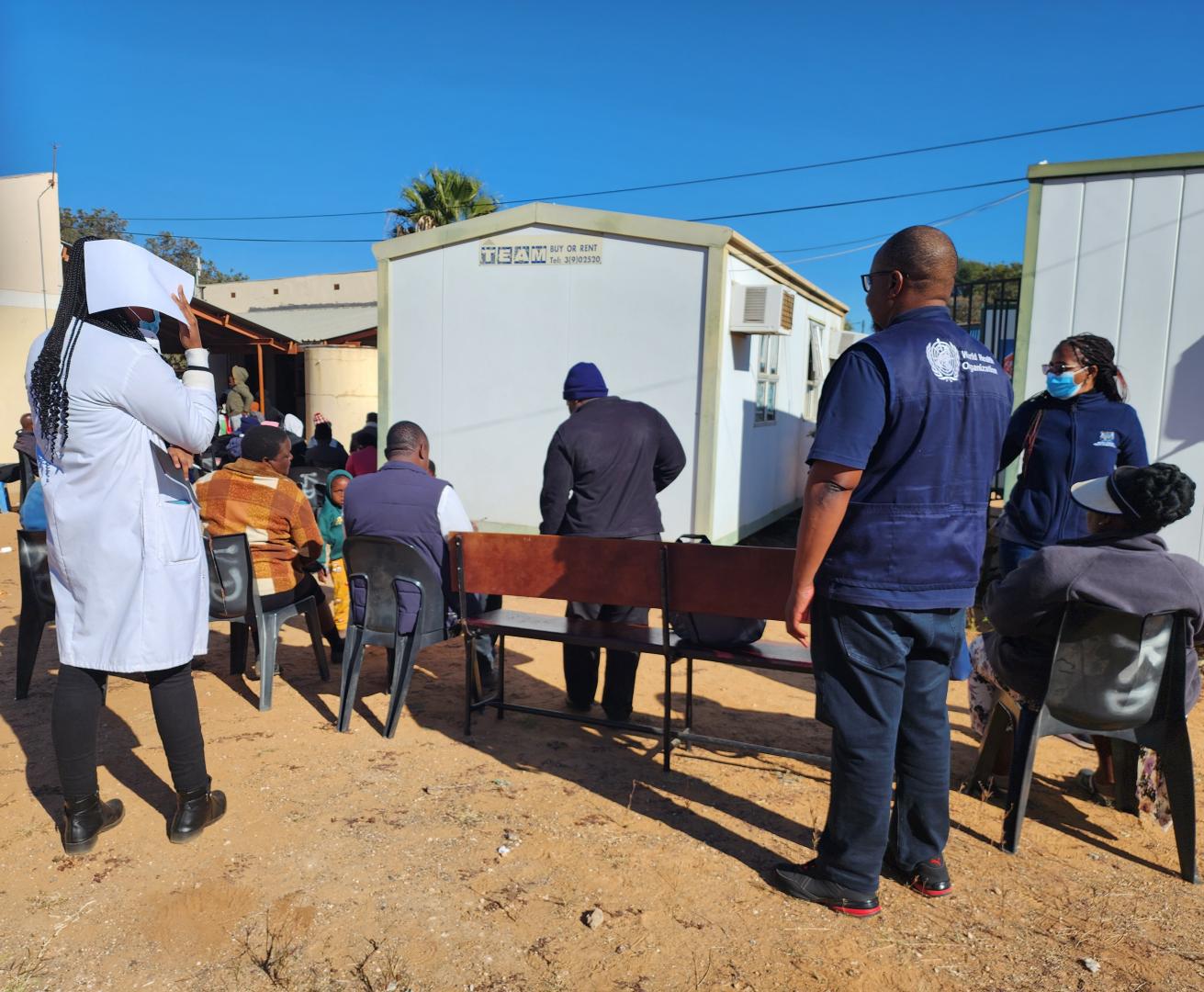
    In a continued effort to reduce the burden of cervical cancer, the Ministry of Health, supported by the World Health Organization (WHO) and other key partners has launched a national training initiative aimed at strengthening the capacity of both doctors and nurses in the screening and treatment of pre-cancerous cervical lesions.

    The two-week training brought together healthcare workers from various districts, including Good Hope, Mochudi, and Palapye.

    The programme focused on equipping six doctors and a group of nurses with advanced clinical skills, particularly in managing cases that require more than basic procedures such as thermal ablation or cryotherapy.

    “Our goal is to ensure that both doctors and nurses are adequately trained to identify and manage cervical pre-cancer,” said Ms Thomamo Pheto, National Coordinator for the Cervical Cancer Prevention Programme at the Ministry of Health. “Many districts in Botswana still lack skilled personnel, and this training is designed to close that gap.”

    Since the inception of the programme in 2015, more than 283 healthcare professionals have been trained in cervical cancer screening and treatment, an achievement made possible through ongoing collaboration with WHO and other development partners.

    Ms Pheto noted that the training has sparked a growing interest in women’s health among healthcare workers and has significantly strengthened capacity at the district level.

    “This time around, we are building a team of professionals who will return to their districts better prepared to screen more women and manage cases early, before they progress to full-blown cancer,” she added.

    Despite the availability of services, Botswana continues to record low cervical cancer screening rates. Ms Pheto attributes this to the asymptomatic nature of pre-cancer and the resulting lack of urgency.

    “When you have a pre-cancer, you don’t feel sick. There’s no pain, no discharge, so many women assume they’re fine,” she said. “This false sense of security is one of the reasons women don’t come forward for screening.”

    She emphasized the importance of reaching women who have never screened. “Those who have never screened are the ones we are most concerned about. Their health status is unknown, and they may already be at risk.”

    In his remarks, WHO Botswana’s focal person for Noncommunicable Diseases (NCDs), Dr Tebogo Madidimalo, reaffirmed the country’s commitment to eliminating cervical cancer as a public health threat.

    “Botswana is committed towards eliminating cervical cancer by 2030, and we all, particularly us health care workers, have a responsibility to ensure that women coming through our facilities are offered cervical cancer screening and timely follow-up care,” said Dr Madidimalo.

    He further highlighted the nation’s strong record in addressing major health challenges: “We have proven before that elimination of communicable diseases is possible in Botswana, and likewise, elimination of cervical cancer is within reach for us. It will, however, take all hands-on deck to achieve the WHO targets for elimination.”

    Ms Pheto echoed this call to action, encouraging communities to support eligible women, especially those aged 25 and above, to come forward for screening.

    “Cervical cancer is a silent killer. By the time symptoms appear, it may already be too late. But with early detection, it is both preventable and treatable.”

    With continued support from WHO and other partners, the Ministry of Health remains committed to scaling up prevention efforts, enhancing healthcare worker capacity, and expanding community outreach.

    “With the right skills, tools, and community support, we can save lives and move closer to eliminating cervical cancer as a public health threat in Botswana,” Ms Pheto concluded.

    Source: WHO

  • High Court dismisses injunction application to halt Ablekuma North rerun election

    High Court dismisses injunction application to halt Ablekuma North rerun election

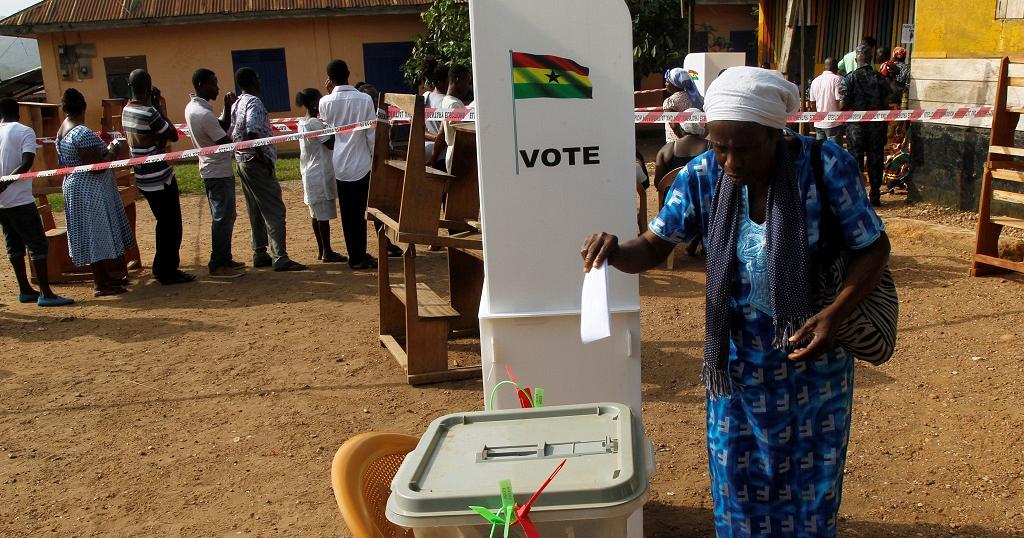
    The New Patriotic Party’s (NPP) interlocutory injunction application seeking to halt the Electoral Commission’s (EC) rerun of parliamentary elections in 19 polling stations within the Ablekuma North Constituency has been dismissed by the High Court.

    The NPP on July 6 filed an interlocutory injunction application to restrain the Electoral Commission (EC) from proceeding with the rerun election.

    General Secretary of the New Patriotic Party (NPP), Justin Frimpong Kodua, has noted that the party won the 2024 Ablekuma North parliamentary election and, as such, will not participate in the rerun election slated for Friday, July 11.

    At a press briefing today, July 8, Frimpong Kodua noted the Electoral Commission to complete collation of results and declare the party’s candidate, Akua Afriyie, as winner.

    “We have our undeniable evidence to clearly show that we won the Ablekuma North parliamentary election. And yesterday, when the National Executive Committee met, we said that under no circumstances will we be intimidated. Under no circumstance will we be coerced to go for a rerun.”

    “We will not go for any rerun. We have won the elections. What we are asking the Electoral Commission is to follow the court directive, finish the collation, and declare our candidate, Akua Afriyie, as the MP-elect for Ablekuma North,” he said.

    Minority Leader Alexander Afenyo-Markin has called on Parliament to summon the leadership of the Electoral Commission (EC) to answer questions on its decision to hold rerun elections in the Ablekuma North Constituency.

    Speaking on the floor of Parliament on Thursday, July 3, the Minority leader described the EC’s decision as unfair. He suggested that the Commission was being intimidated to take such a decision.

    “We are being told there will be a rerun in some polling stations. It is unfair and unjust. I don’t want to believe recent public comments by a senior politician are what’s pushing the EC, perhaps to secure their job. It is not fair,” he said.

    “Maybe today this helps one side, but tomorrow, it could be the other’s turn. Mr. Speaker, I humbly urge that the EC be scheduled to appear before this House. They must explain why, after earlier taking a firm position, they have now changed course.”

    Majority Leader Mahama Ayariga argued otherwise, stating that “let us not politicise this.”

    “Let us not say that just because a chairman made a statement, the EC has been intimidated,” he said.

    The Electoral Commission (EC), after extensive deliberations, noted that it will hold the rerun election because the 19 scanned polling station results used for the collation, though approved by agents of both political parties, were not verified by the presiding officers responsible for those polling stations.

    “It is instructive to note that, the Commission was able to secure the Presiding Officers’ verification and confirmation for 18 scanned polling station results—agents of both parties also approved same. A rerun will therefore not be held in those polling stations,” the Commission noted in a statement.

    The EC arrived at this decision after it met with the representatives of the National Democratic Congress (NDC) and New Patriotic Party (NPP) on Tuesday, July 1.

    The meeting, which was a follow-up to an earlier meeting held on Thursday, 12th June, provided both parties the opportunity to brief the commission on any new developments regarding the said constituency. 

    The parties informed the Commission that their positions put forward at the last meeting remained unchanged.

    The NDC held the view that the election should be rerun in thirty-seven (37) polling stations because scanned pink sheets from 37 polling stations, which were used to collate the results, were provided by the NPP.

    The NPP was of the view that the results from three (3) outstanding polling stations be collated and a winner declared, since the NDC agents had verified and confirmed the scanned polling station results they presented.

    Ablekuma North remains the only constituency in Ghana without a sitting MP, months after the 2024 general elections, due to unresolved disagreements over the outcome of the parliamentary vote.

    On December 10, 2024, three days after the national polls, the EC declared Ewurabena Aubynn of the NDC the winner of the Ablekuma North parliamentary seat, defeating the New Patriotic Party’s (NPP) Nana Akua Owusu Afriyieh.

    However, the EC later revoked the announcement, revealing that results from 62 of the 281 polling stations had not been included in the initial collation.

    Efforts to restart the collation in January 2025 were disrupted by multiple challenges.

    These included interruptions due to the submission of unverified pink sheets and a violent intrusion at the collation centre that heightened security concerns.

    By January 6, only seven polling station results remained uncollated. Yet the process came to a standstill as the EC began engaging both major political parties in an attempt to break the deadlock.

    Both the NPP and the NDC have declared victory in the December parliamentary elections.

    The NPP maintains that its candidate, Nana Akua Afriyie, emerged the winner based on Electoral Commission figures, while the NDC insists that Ewurabena Aubyn was rightfully elected by the people.

    Appearing before Parliament on Thursday, June 19, the Deputy Chairperson of the EC in charge of Corporate Affairs, Dr. Bossman noted the Commission will only resort to a re-run after all measures have been exhausted.

    “So, for Ablekuma North, we have not reached the point where we will say we don’t have the results. When we try and we cannot get the results, that is when we will resort to the rerun. The rerun will be a last option,” he said.

    Meanwhile, the EC has called on the Ghana Police Service to provide the needed security to ensure a safe environment for the conduct of the election.

  • Parliamentary leadership commiserates with family of the late Ernest Kumi

    Parliamentary leadership commiserates with family of the late Ernest Kumi

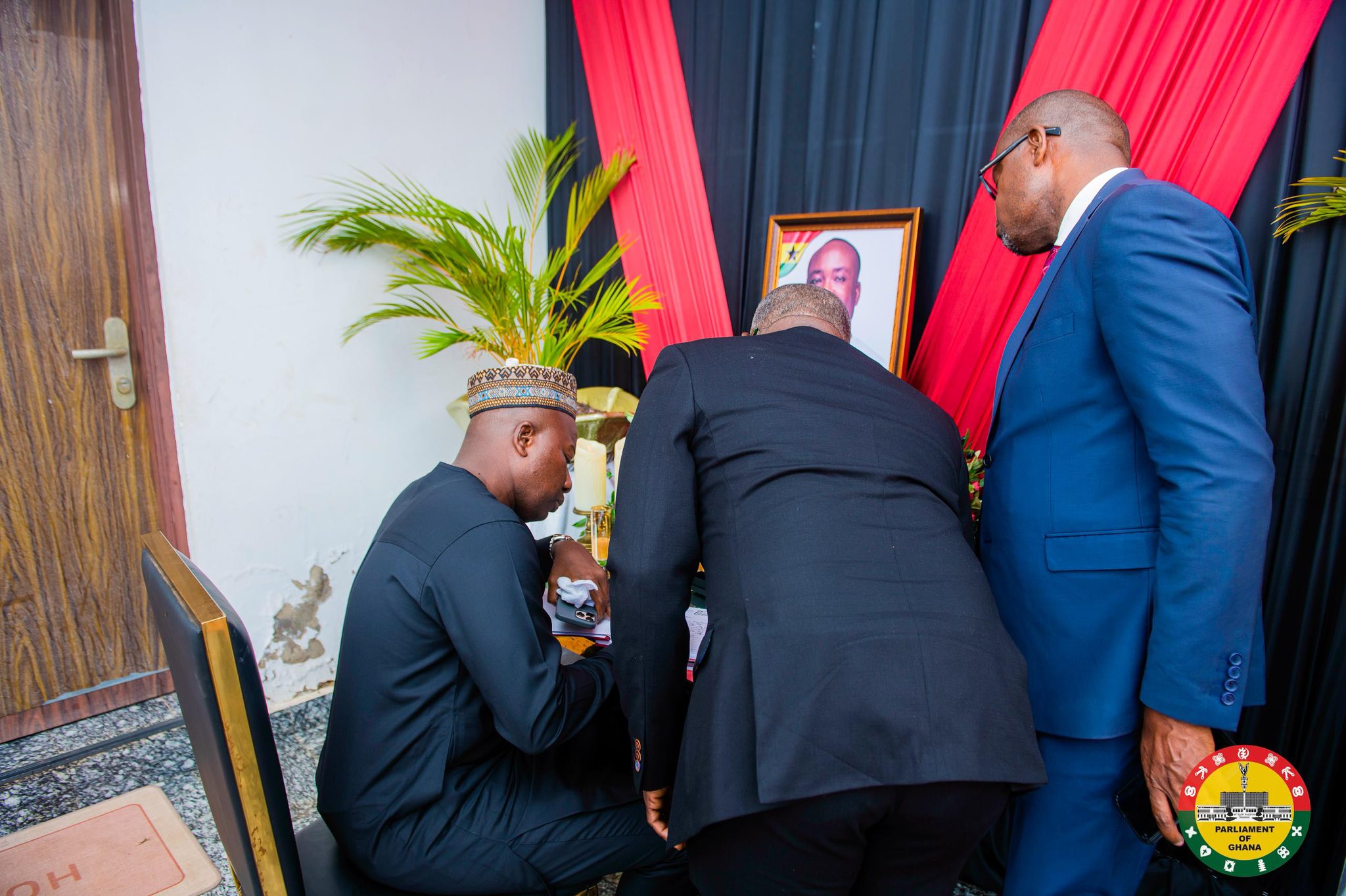
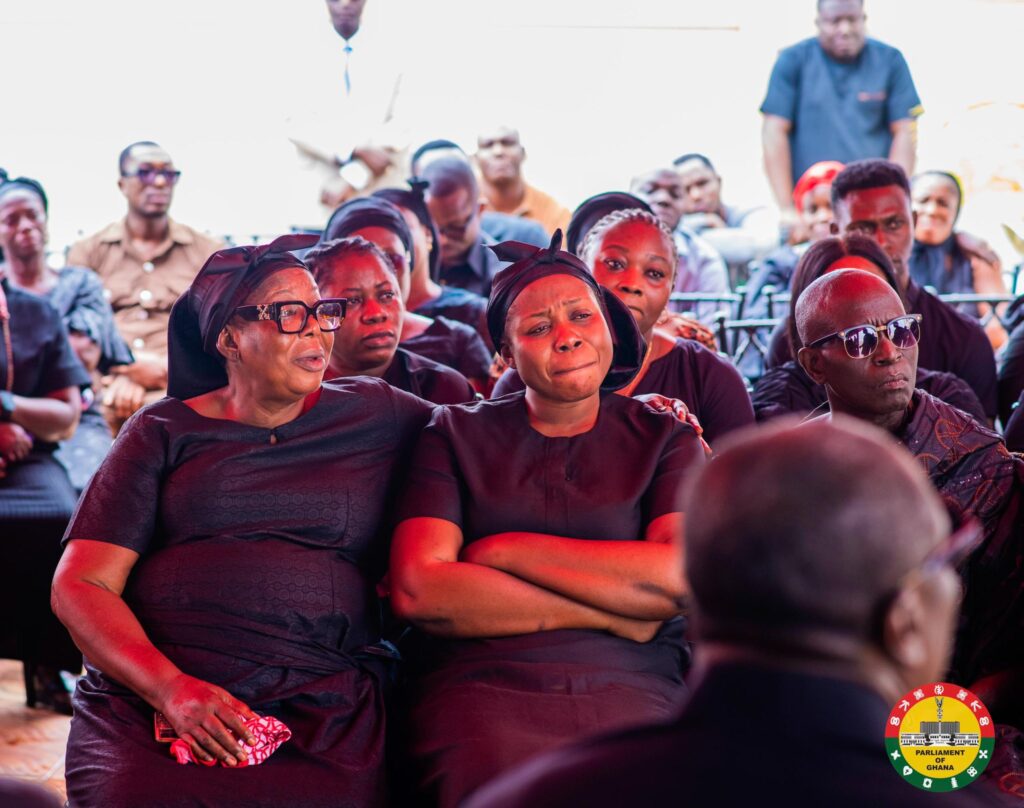
    The leadership of Parliament on Tuesday, July 8, visited the family of the late Member of Parliament for Akwatia, Honourable Ernest Kumi.

    The delegation was led by the Leader of the House, Majority Leader Mahama Ayariga. In attendance were Minority Leader Alexander Afenyo-Markin, Clerk to Parliament Mr. Ebenezer Ahumah Djietror, Oppong-Nkrumah, the legislator for Ofoase-Ayirebi Consituency and others.

    Majority Leader Mahama Ayariga

    Clad in black amidst a sorrowful ambience, they signed a book of condolence on behalf of the House.

    Parliament adjourned shortly on Monday, July 7, after the Minority Leader, Hon. Alexander Afenyo-Markin sadly informed the House about the sudden death of the Member of Parliament of Akwatia Hon. Ernest Kumi.

    Minority Leader Alexander Afenyo-Markin

    Hon. Ernest Kumi was reported dead in the early hours of Monday morning after short illness.

    According to the Minority Leader, the New Patriotic Party (NPP) Caucus, Akwatia Constituency and the Parliament of Ghana have been hit by the death of Hon. Ernest Kumi.

    He made the House aware that Hon. Ernest Kumi was seen going about his parliamentary duties wholeheartedly last week.

    Clerk to Parliament, Mr. Ebenezer Ahumah Djietror

    The Minority Leader later appealed to the First Deputy Speaker, Hon. Bernard Ahiafor who was in the Chair to adjourn the House to allow Members console themselves.

    He later agreed to the appeal of the Minority Leader to adjourn the House and continue public business and proceedings on 8th July.

    Family of the late Ernest Kumi

    The House observed a minute of silence in memory of the late MP for Akwatia, Hon. Ernest Kumi, and adjourned.

    Meanwhile, the Eastern Regional Executive Committee of the New Patriotic Party (NPP) is mourning the passing of Ernest Yaw Kumi.

    In a statement on Monday, July 7, the regional leadership described the incident as heartbreaking and sudden.

    “This heartbreaking news has come as a great shock to the Party, the people of Akwatia, and the nation at large,” parts of the statement said.

    The party further conveyed its condolences to his family, the traditional leaders and people of Akwatia, and the wider NPP fraternity across the nation.

    “May the soul of our beloved brother and compatriot rest in perfect peace,” the statement concluded.

    Former Vice President Dr Mahamudu Bawumia has eulogised the late Kumi as a loyal patriot.

    The post read, “I have received with sadness the passing of Hon. Ernest Yaw Kumi, MP, Akwatia Constituency. Ernest was a loyal patriot. My condolences to the immediate family. May his soul rest in peace”.

  • 1D1F policy has been scrapped – Trade Minister reveals

    1D1F policy has been scrapped – Trade Minister reveals

    Minister of Trade, Agribusiness, and Industry, Elizabeth Ofosu-Adjare, has revealed that the erstwhile government’s One District One Factory (1D1F) policy has been scrapped.

    The minister announced this when she appeared before Parliament on Tuesday, June 8.

    “Mr Speaker, I want to draw the House’s attention to the fact that as of now, there is no policy as 1D1F,” the minister said.

    She added that “The 24-hour economy policy is the new thing on the block and the game changer, which seeks to make Ghana very vibrant irrespective of the minute of the hour or the time of the day.”

    In reaction, Minority Leader Alexander Afenyo-Markin quizzed “Is the ministry MOTAI exploring the establishment of new industrial parks as part of revised investment attraction strategy?”.

    The Trade Minister replied: “We are doing agro-parks which seek to be a great game changer especially in the agro-processing zones and it is being worked on to ensure we are able to produce around the clock for import substitution, export, foreign exchange and to create jobs for our teeming youth.” 

    Earlier this year, Elizabeth Ofosu-Adjare stated that the National Democratic Congress’ (NDC) proposed 24-hour economy initiative will enhance the effectiveness of the One District, One Factory (1D1F) program.

    During her appearance before the Appointments Committee on Wednesday, January 22 for vetting after her nomination, she underscored the shortage of sufficient raw materials as a major hurdle undermining the success of the 1D1F initiative.

    She emphasized that the adoption of the NDC’s 24-hour economy policy would serve as a strategic measure to overcome this challenge.

    She said “The solution lies in the 24-hour economy, where businesses will have access to a steady supply of raw materials. Agribusiness will play a crucial role through commercial contract farming, which will substantially resolve the raw material challenge” she said.

    The Techiman North Member of Parliament further said, “These factories will benefit from tax holidays and other incentives under the 24-hour economy framework.”

    The One District, One Factory (1D1F) initiative, introduced by former President Akufo-Addo, aimed to revolutionize Ghana’s economy by minimizing dependence on raw material exports and imported finished products.

    The program emphasized industrial growth, value enhancement, employment generation, and the export of refined goods.

    Although several factories have been set up under the initiative, its progress has been hampered by numerous challenges.

    Meanwhile, some 55 ministers and the Governor of the Bank of Ghana, Dr. Johnson Pandit Asiama, are expected to appear before the House to respond to questions during the week.

  • Reconstruction of Anwomaso–Ahodwo transmission line project in Kumasi set to begin

    Reconstruction of Anwomaso–Ahodwo transmission line project in Kumasi set to begin

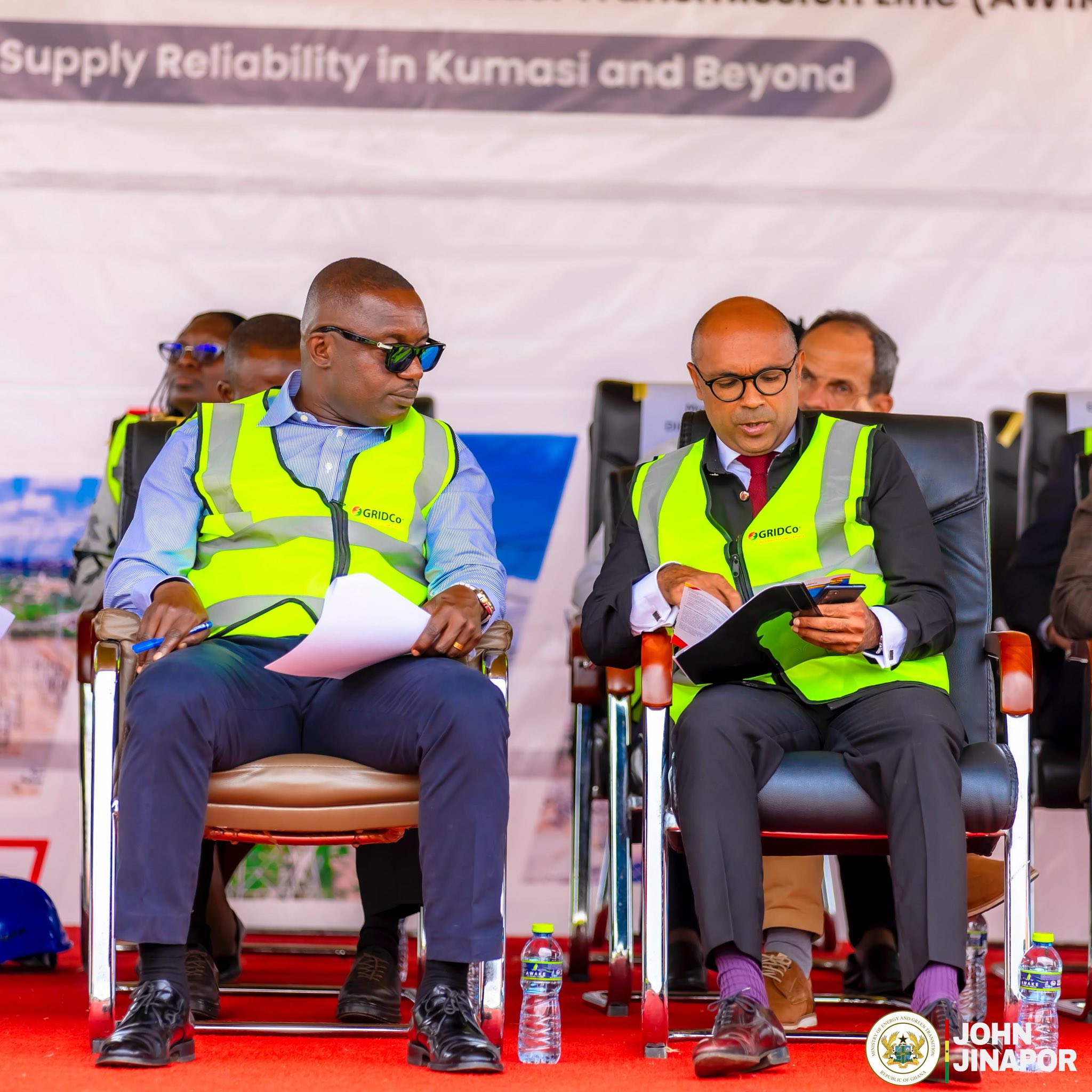
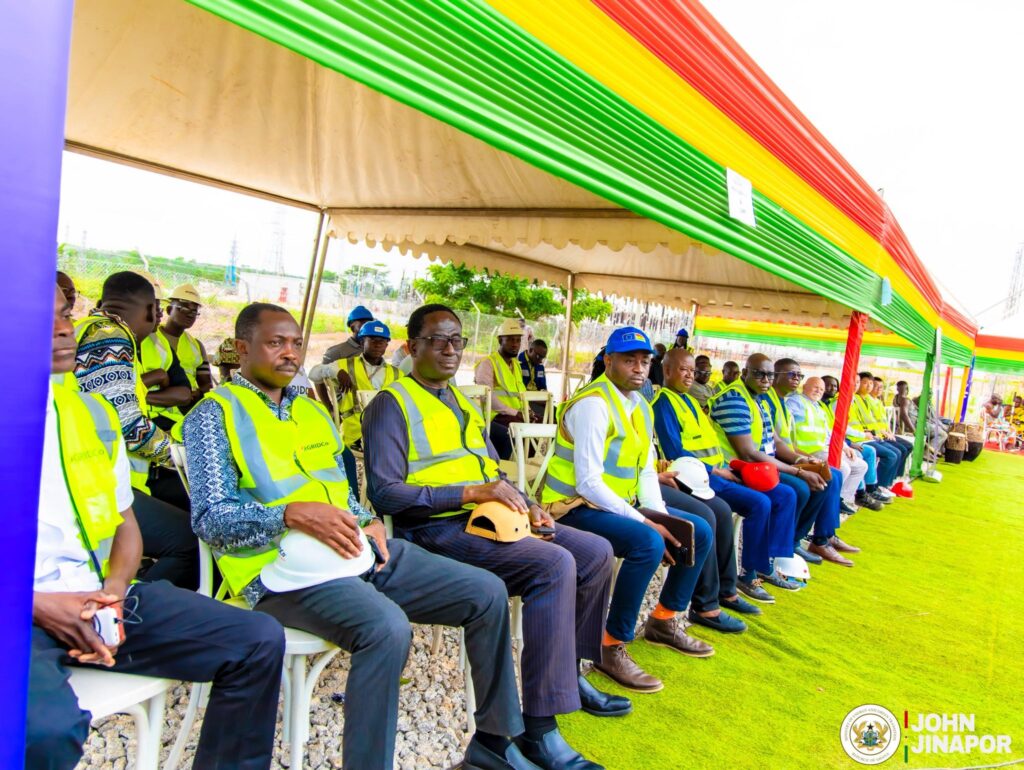
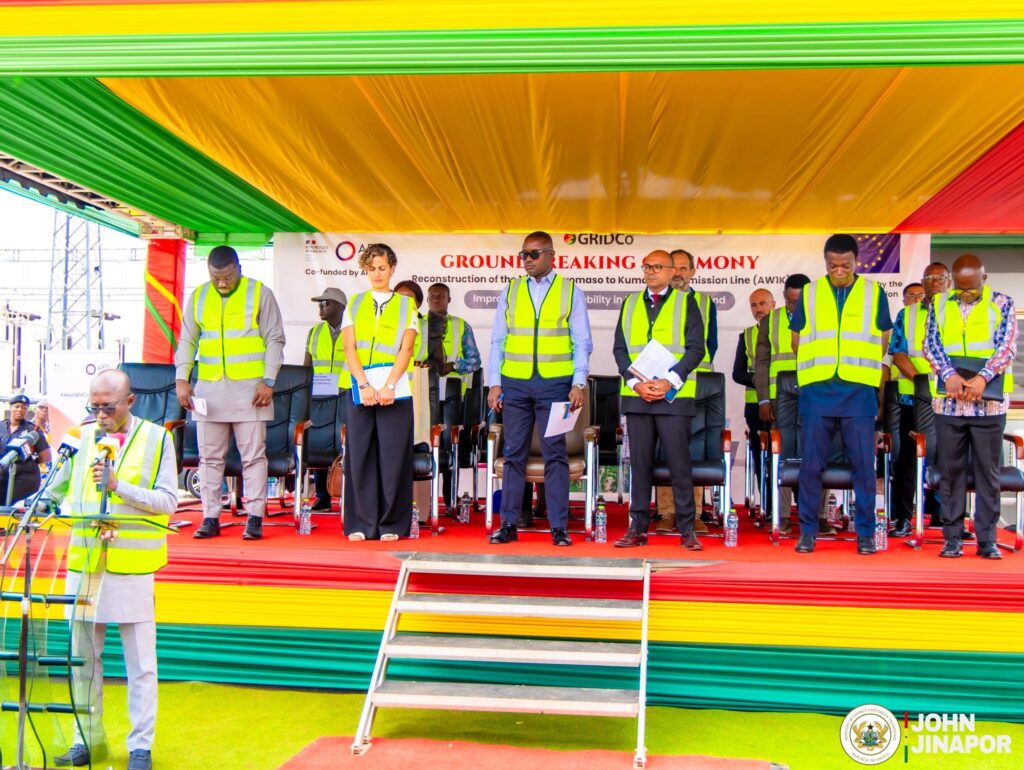
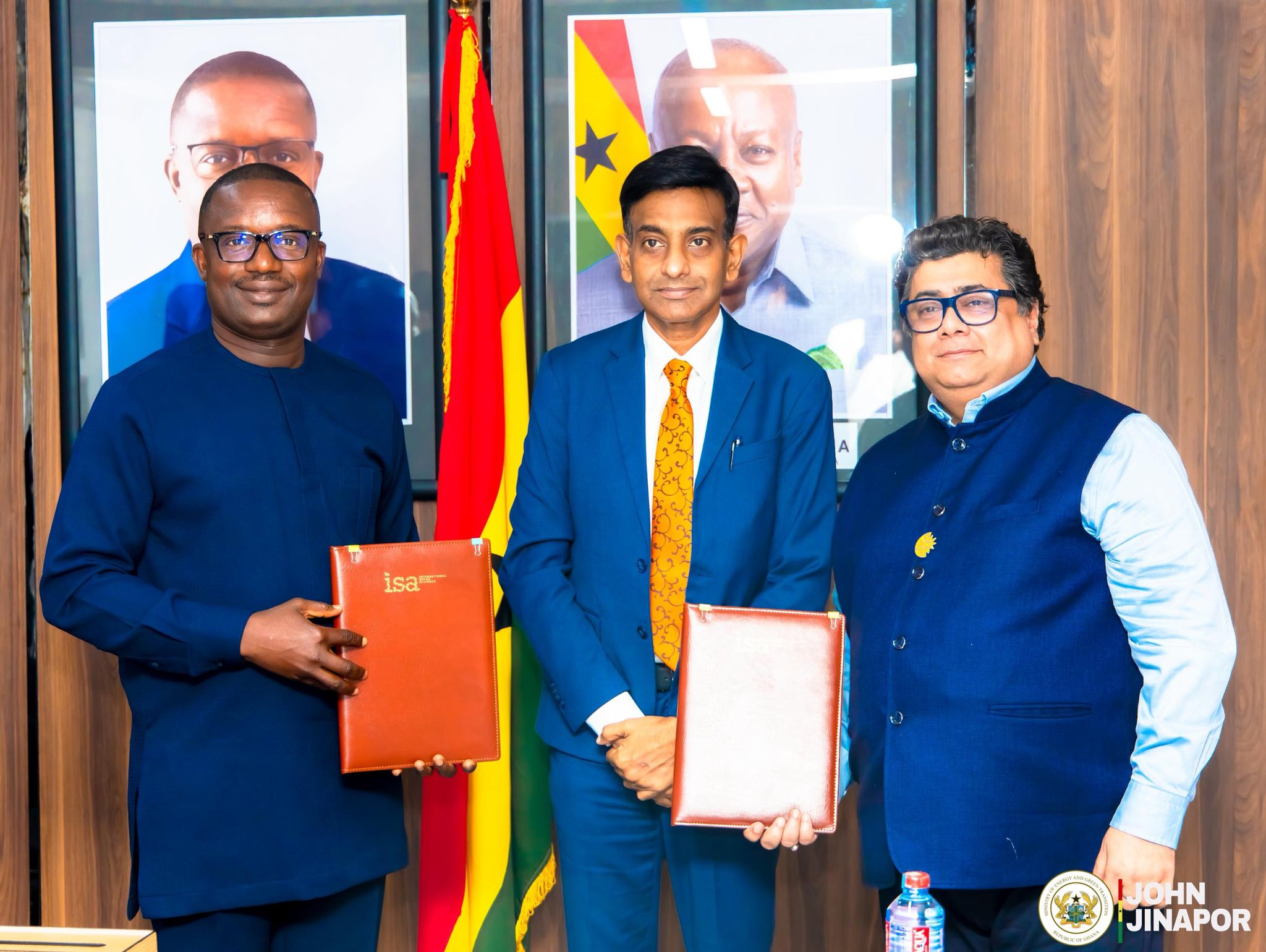
    Minister for Energy and Green Transition, Hon. John Abdulai Jinapor (MP), has broken ground for the commencement of the reconstruction of the Anwomaso–Ahodwo GRIDCo Transmission Line Project in Kumasi as part of government’s drive to modernize the national power grid.

    The €9.7 million project, funded by the European Union in collaboration with Agence Française de Développement (AFD), forms part of broader efforts to enhance Ghana’s electricity transmission infrastructure.

    When completed, the 18-kilometer, 161kV transmission line will be upgraded from a single to a double circuit, tripling its current transmission capacity from 330 MVA to over 1,000 MVA.

    Speaking at the sod-cutting ceremony, the Minister emphasized that the project extends beyond physical infrastructure, describing it as a bold stride towards achieving universal access to stable and affordable electricity. “This initiative will reduce voltage drops, improve system reliability, and propel Kumasi status as a strategic power distribution hub,” he said.

    Hon. Jinapor noted that prior to 2025, Ghana’s power sector faced severe challenges, including a shortfall of about 750MW that strained both domestic supply and export commitments. However, thanks to coordinated interventions by power sector stakeholders; GRIDCo, ECG, the Energy Commission, and the PURC, the sector has seen significant improvements since he assumed office.

    He further announced that Kumasi is set to emerge as a key power generation zone, with efforts underway to boost its installed capacity beyond 1,000MW. Natural gas, he added, will serve as the primary fuel source in line with Ghana’s energy transition agenda.

    Development Partners Underscore Commitment to Ghana’s Energy Reforms

    EU Ambassador to Ghana, H.E. Irchad Razaaly, hailed the transmission project as a testament to the EU’s commitment to Ghana’s energy transition and broader development goals.

    “This is more than just a power project—it represents our shared vision for a resilient and greener energy future,” he said.

    He revealed that the EU’s total investment in Ghana’s grid improvements stand at about €10 million, within a larger €200 million envelope under the Team Europe Global Gateway Strategy.

    Ambassador Razaaly also commended Ghana for implementing critical reforms in the energy sector, and praised GRIDCo’s technical leadership in driving modernization efforts, including integration of SCADA systems and improved telecommunications for real-time grid monitoring.

    Also speaking at the event, Ms. Clémentine Dardy, representing the French Ambassador to Ghana, reaffirmed France’s commitment to Ghana’s energy development.

    “”This project highlights our joint ambition to build a resilient energy sector that fosters industrial growth and energy access for all,” she said. AFD’s current investments in Ghana exceed €262 million, focused on bridging urban-rural energy gaps and driving innovation in renewables.

    Ashanti Region Welcomes Critical Energy Investment

    The Ashanti Regional Minister Dr. Frank Amoakohene expressed gratitude for the government’s focus on stabilizing power supply in the region.

    He underscored the importance of reliable electricity to local businesses, trade, and socio-economic development.

    “The significance of this project for our region cannot be overstated. Stable power is essential for development, investment, and daily life,” he noted.

    Toward a Sustainable Energy Future.

    Hon. John Abdulai Jinapor urged sustained collaboration among stakeholders and support from the public, as the government intensifies efforts to transform the energy sector.

    “This is not just about linking two substations, it represents a strategic leap toward energy independence, regional competitiveness, and inclusive national development,” he stated.

    He also outlined complementary initiatives, including digitization of utility services, promotion of electric vehicles and the green transition agenda and expanded private sector participation in electricity distribution. These, he said, are integral to creating a clean, efficient and transparent energy future for Ghana.

    Source: Ministry of Energy and Green Transition

  • Reduce footprint in the foreign exchange market – IMF to BoG

    Reduce footprint in the foreign exchange market – IMF to BoG

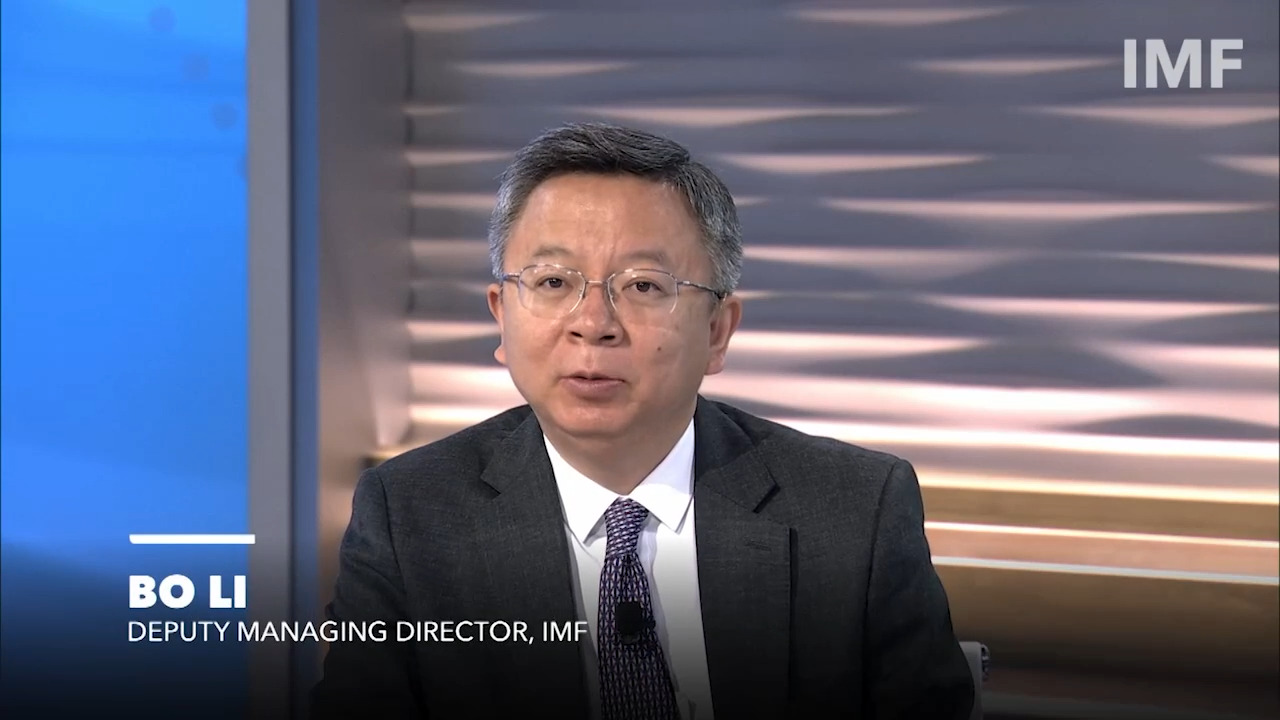
    Deputy Managing Director of the International Monetary Fund Bo Li has entreated the Bank of Ghana (BoG) to limit its intervention in the country’s foreign exchange market.

    The IMF prefers a more market-driven exchange rate, where the value of the cedi is largely determined by supply and demand rather than the central bank draining its forex reserves.

    The Ghanaian authorities have made significant strides toward rebuilding international reserves. Nonetheless, the IMF has called for a limited direct involvement.

    “The Bank of Ghana should maintain an appropriately tight monetary stance until inflation returns to its target, reduce its footprint in the foreign exchange market, and allow for greater exchange rate flexibility, including by adopting a formal internal FX intervention policy framework,” Bo Li said.

    The Bank of Ghana has tightened its monetary policy stance to sustain a continued reduction in inflation and has been successful in rebuilding international reserves. The BoG has implemented risk containment measures to support banking system stability. 

    “It appropriately intensified monitoring and escalated measures at weak, undercapitalized banks to promote timely recapitalization; strengthen risk management frameworks and practices, including to reduce NPLs; and ensure effective governance. Looking ahead, the authorities are committed to sustaining their efforts to bolster financial stability,” the Fund revealed.

    Ghana is set to receive US$367 million (SDR 267.5 million) from the International Monetary Fund (IMF) under its three-year US$3 billion program, bringing Ghana’s total disbursements under the arrangement to about US$2.3 billion.

    This comes after the Executive Board of the International Monetary Fund (IMF) on July 7 completed the fourth review of the US$3 billion, 36-month Extended Credit Facility (ECF) Arrangement, which was approved by the Board in May 2023. 

    Deputy Managing Director Bo Li said the authorities are strongly committed to restoring fiscal discipline and addressing the structural weaknesses that led to the slippages. 

    She, however, added that “This should be supported by continued efforts to enhance domestic revenue mobilization and streamline non-priority expenditure, while creating space for development priorities and enhanced social safety nets.”

    In April, the IMF staff and the Ghanaian authorities reached a staff-level agreement on the fourth review of Ghana’s economic program. According to the IMF, the country’s economic recovery prompted the staff-level agreement and subsequent disbursement.

    Ghana’s growth in 2024 and the first quarter of 2025 was higher than expected, reflecting robust activity in the mining, agricultural, ICT, manufacturing, and construction sectors, the Fund noted.

    “The external sector has seen considerable improvement, driven by solid exports—particularly gold and to a lesser extent, oil—and higher remittances. As a result, the accumulation of international reserves has far exceeded the ECF-supported program targets.”

    Notwithstanding, Ghana’s performance under the IMF-supported program deteriorated significantly at the end of 2024. 

    “Preliminary fiscal data point to slippages in the run-up to the 2024 general elections, on account of a large accumulation of payables. Inflation exceeded program targets—though recent data points to renewed rapid disinflation. Several reforms and policy actions were delayed across the fiscal, financial, and energy sectors,” the IMF noted.

    In light of this, the current administration, led by President John Mahama, has adopted strong corrective measures to address the fiscal impact of 2024 slippages and ensure the fiscal program remains on track, including achievement of a 1½ percent of GDP fiscal primary surplus in 2025. 

    The Fund indicates that this will be achieved through additional revenue mobilization and expenditure rationalization—while protecting the vulnerable from the impact of policy adjustment. 

    Creating an environment more conducive to private sector investment and enhancing governance and transparency remain key to boosting the economy’s potential and underpinning sustainable job creation, according to the Fund.

    The Ghanaian authorities have also continued to make headway on their public debt restructuring. The Memorandum of Understanding (MoU) with Ghana’s Official Creditors Committee (OCC) under the G20 Common Framework has been signed by all parties, and the focus is now on finalizing the bilateral agreements to implement the MoU. 

    The authorities are also pursuing good-faith efforts toward reaching agreements with other commercial creditors on debt treatments that are in line with program parameters and the comparability of treatment principles.

    Against the backdrop of these policy actions and the progress on debt restructuring, Ghana’s credit rating has been upgraded by key international credit rating agencies. Fitch has upgraded Ghana’s Long-Term Foreign-Currency Issuer Default Rating (IDR) from ‘Restricted Default’ to ‘B-’ with a Stable Outlook.

    Fitch credited the upgrade to the country’s successful restructuring of $13.1 billion in Eurobond debt, steady fiscal consolidation, and the country’s improving macroeconomic outlook. 

    The agency also highlighted falling inflation, a strengthening cedi, and a rebound in investor confidence as key indicators of Ghana’s economic turnaround.

    The Fund insists that staying the course of macroeconomic policy adjustment and reforms is essential to fully and durably restore macroeconomic stability and debt sustainability, while fostering a sustainable increase in economic growth and poverty reduction.

  • President Mahama launches special Ghana Gold Board task force to check gold smuggling

    President Mahama launches special Ghana Gold Board task force to check gold smuggling

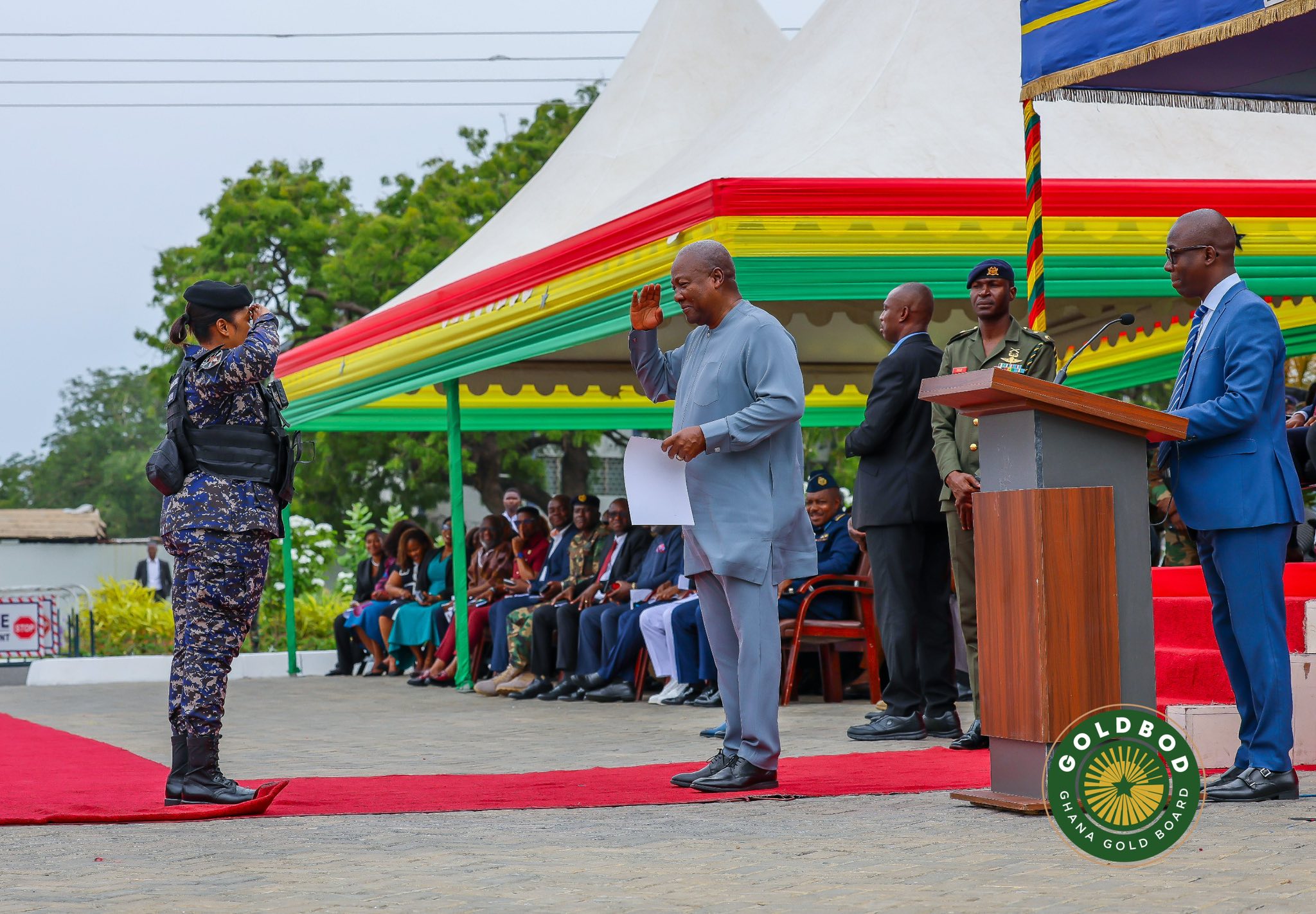
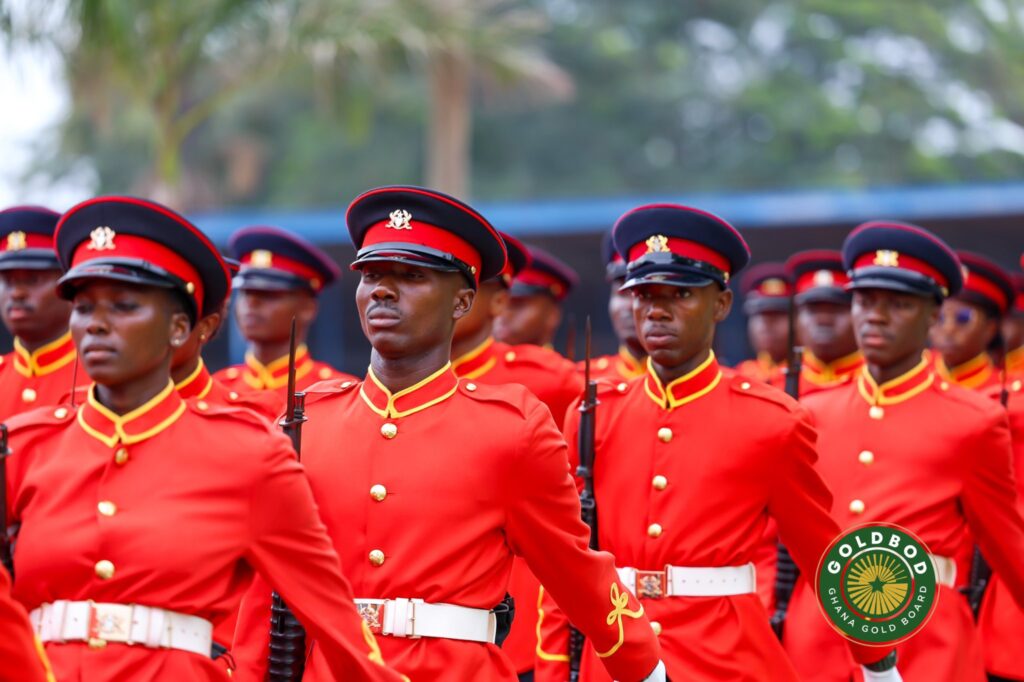
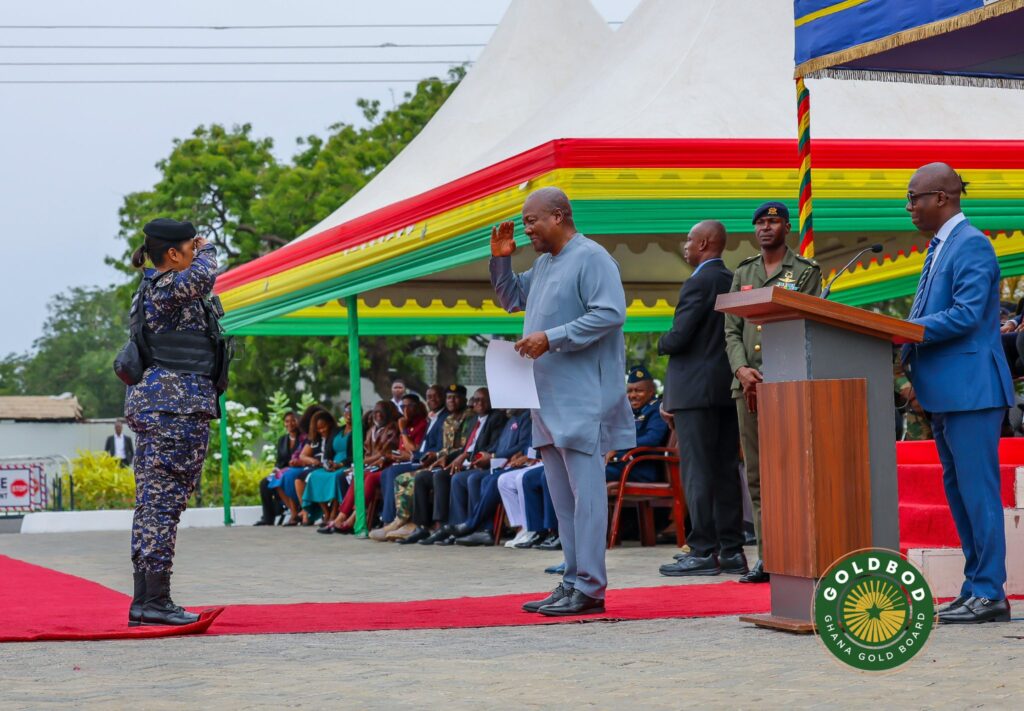
    His Excellency President John Dramani Mahama on Tuesday, July 8, launched a special Ghana Gold Board task force to aid clamping down on illicit gold-smuggling activities in the country.

    In his speech, the president cautioned the Ghana Gold Board task force against abusing their office to undertake unlawful activities.

    “To the task force, let me be clear. Abuse of your authority will not be tolerated. If any of you is found engaging in misconduct, you will face immediate sanctions, and this could include dismissal, prosecution, and forfeiture of your entitlement,” he said.

    The president has also announced government’s decision to provide an incentive to members of the general public who serve as whistleblowers.

    The president noted that informants are eligible to receive 10 percent of the seized gold in cash value.

    “So whistleblowers, get ready. If you blow the whistle on anybody and gold is retrieved or cash is received, you’d get 10 percent of the value of both,” he said.

    The task force will be given a special mandate with specific powers as police officers to wage war against smuggling and all forms of illegal gold trading activities in the country.

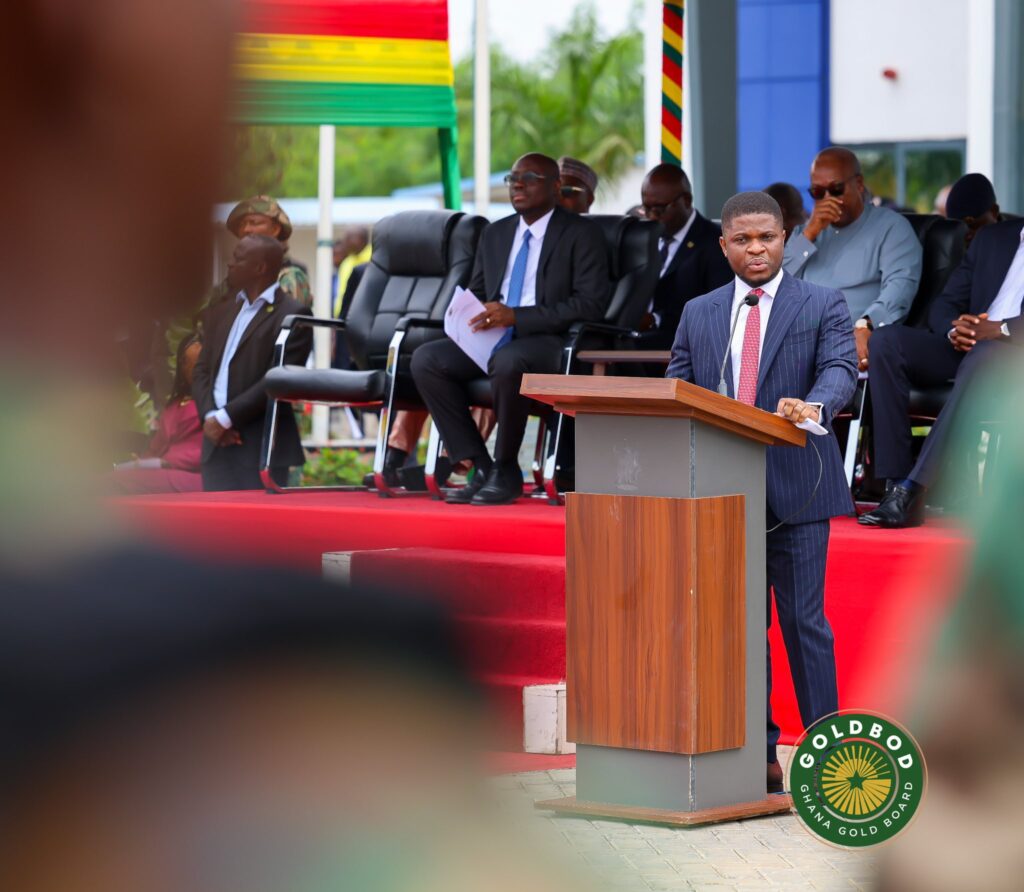
    According to the Acting Chief Executive Officer of the Goldbod, Sammy Gyamfi, this will save the government from any leakages in revenue mobilisation in the sector, helping to generate and invest revenue for economic development.

    “(This will) help the state combat and defeat the phenomenon of gold smuggling, the canker of illegal gold trading, and price disruptions that deprive the state of the needed revenue, profit, and the needed forex for our economy and the development of our country,” he announced.

    He thus cautioned traders to secure the appropriate licence to engage in any form of gold trading in the country, saying, “But for those who are hell bent on trading illegally without the licenses, we are serving notice that we are coming after you”. 

    Earlier, the GoldBod CEO on June 5 also warned that persons who trade without licenses would be prosecuted, adding that his outfit takes no bribes before the said licenses are issued.

    During a meeting with the Chamber of Licensed Gold Buyers, Mr Gyamfi stated that “I don’t take or demand bribes before I issue a licence.”

    The acting CEO noted that the process for registering has been made seamless and is devoid of corruption. “We have removed the human interface element, and so there is no corruption, bribery, inducements, or favouritism. It is a very transparent and competitive process, and once you qualify, you get the license,” he added.

    Lauding his outfit’s results-oriented reforms and initiatives since his takeover as CEO, Sammy Gyamfi, during a media engagement, revealed that GoldBod has exceeded the $5 billion mark in gold export value for the first half of 2025, surpassing the $4.6 billion recorded for the entire year of 2024.

    He expressed optimism that GoldBod would hit the 60-tonne export mark by the end of July 2025, driven by stronger compliance, improved oversight, and the streamlined licensing regime under the Ghana Gold Board Act, 2025 (Act 1140).

    “In the whole of 2024, gold exports stood at 66 tons with an export value of $4.6 billion. We have done only six months, and yet we have crossed the $4.6 billion. We have gone beyond $5 billion, and in terms of volumes, we have done 50 tons and over, and we are optimistic that by the end of next month, we will have hit 60 tons,” he said.

    According to Finance Minister Dr Cassiel Ato Forson, “at the peak of our economic crisis in 2022, 60 tonnes of gold worth an estimated $1.2 billion at the time, left Ghana through illegal channels.”

    It is estimated that about 600 tonnes of gold have been smuggled out of the country in the last ten years, valued at over $12 billion.

  • Properties worth over GHc188m were destroyed by fire in first half of 2025 – GNFS 

    Properties worth over GHc188m were destroyed by fire in first half of 2025 – GNFS 

    The Ghana National Fire Service (GNFS) has disclosed that fire outbreaks across the country in the first half of 2025 led to the destruction of properties valued at over GH¢188 million.

    According to the Head of Public Relations at the GNFS, Desmond Ackah, the Service responded to emergency calls with improved speed, managing to salvage properties estimated at more than GH¢203 million between January and June this year.

    “From January to June this year, we were able to salvage approximately GHS 203,389,679 worth of property, thanks to our improved response system. For all the emergency calls we received, our response time ranged between 5 and 15 minutes. Despite our efforts, property valued at GHS188,423,598 was lost to fire incidents,” Mr Ackah said in an interview on Tuesday, July 8.

    He highlighted that the enhanced response time—ranging from a minimum of five minutes to a maximum of fifteen—played a critical role in reducing the extent of losses during fire emergencies.

    This, he believes, indicates the effectiveness of their efforts, calling for commendation and celebration by the public, particularly media houses and other stakeholders.

    “This demonstrates the effectiveness of our efforts and deserves both celebration and commendation. We call on media outlets and all stakeholders to recognise and appreciate the strides we’ve made. Without our swift intervention, property losses could have exceeded GHS 300 million.”

    Also, GNFS reported a slight increase in fire cases nationwide in the first half of 2025. A comparison of data from January to June last year and that of this year’s first six months indicates that Ghana recorded 3,595 fire cases. That is about 19 more than the 3,576 cases recorded during the same time in 2024, a sharp increase in cases representing a 0.53% rise. 

    The Greater Accra Region recorded the highest number of fire incidents, with 628 cases, followed by the Ashanti Region with 581 cases and the Central Region with 408. The North East Region reported the lowest number of incidents, just 10.

    GNFS blamed the increase in fire cases on the public’s defiance of fire safety protocols, the harsh harmattan conditions experienced in the first quarter of 2025, and general non-compliance with fire safety protocols by sections of the public.

    Meanwhile, GNFS has reported a significant improvement in the fight against prank calls. The Service recorded a dramatic 34.77% reduction in prank calls—having recorded about 364,020 prank calls in the first half of 2024, as against 237,470 in 2025.

    The Service has attributed the reduction in prank calls to consistent public education campaigns and increased awareness of the legal consequences of misusing emergency lines.

    “These efforts are paying off. Reducing prank calls means our emergency lines are more accessible to people in real need,’ a GNFS spokesperson noted.

  • 7-member GSS Board sworn in

    7-member GSS Board sworn in

    Deputy Finance Minister Hon. Thomas Ampem Nyarko has sworn in the seven-member Board of the Ghana Statistical Service (GSS).

    The Board is chaired by former General Secretary of the Ghana Trades Union Congress (TUC), Dr. Anthony Yaw Baah.

    Speaking at the inauguration ceremony, Deputy Finance Minister Hon. Thomas Ampem Nyarko charged the team to ensure accurate and reliable data system for the country’s development.

    He informed the Board that good data was key to making the right decisions, especially when resources were limited.

    Hon. Ampem Nyarko urged them to demonstrate strong leadership and ensure they produce accurate, relevant, and timely data to support the country’s development.

    The Deputy Finance Minister assured the Board of the government’s full support in the discharge of their mandate.

    On his part, Dr. Baah expressed gratitude to President John Dramani Mahama and Finance Minister Dr. Cassiel Ato Forson for the appointment.

    Dr. Baah, who served as General Secretary of TUC for several years before stepping down, brings extensive experience in organizational leadership and policy advocacy to his new role.

    The distinguished Board members include Government Statistician, Dr. Alhassan Iddrisu, Mrs. Nelly Mireku (Director of Research, Ministry of Finance), Dr. Zakaria Mumuni, Prof. Mariama Awumbila, Dr. Philomena Nyarko, and Dr. Paul Kwame Butakor.

  • CJ Torkornoo files case at ECOWAS Community Court over her suspension

    CJ Torkornoo files case at ECOWAS Community Court over her suspension

    Chief Justice, Justice Gertrude Torkornoo, has proceeded to the ECOWAS Community Court in Abuja, Nigeria over her suspension from office by His Excellency President John Dramani Mahama.

    The Chief Justice’s recent suit follows several unsuccessful cases at the Supreme Court this year after her suspension.

    Deputy Attorney-General and Minister for Justice, Justice Srem Sai, in a post on X dated July 8, revealed that the case was filed on July 4.

    “Her Ladyship repeated the same allegations of human rights violations which are currently pending determination before our Supreme Court and, also, before our High Court in respect of the ongoing removal processes,” he noted in his post.

    Justice Srem Sai added that “Essentially, Her Ladyship argues that by her suspension, she ‘has effectively been removed from her official capacity without a final determination, impairing her right to function and serve in a position she was constitutionally appointed to.’”

    Justice Torkornoo was suspended on Tuesday, April 22, by President John Dramani Mahama following the establishment of a prima facie case based on separate petitions calling for her removal.

    The action was in accordance with Article 146(6) of Ghana’s 1992 Constitution and comes after consultations with the Council of State.

    However, the Chief Justice in her fact of case at the Supreme Court noted that the president’s purported prima facie determination contained no reasons or justification and was entirely devoid of the elements of judicial or quasi-judicial reasoning expected under the Constitution.

    Among other things, she seeks a declaration that upon a true and proper interpretation of articles 146(1), (2), (4), 125(3) and (4), 127(1) and (2) and 296 of the Constitution, the purported determination by the President that a prima facie case has been established against the Plaintiff as conveyed in the letter dated 22nd April 2025, together with the warrant of suspension of the Plaintif, constitute an unjustified attempt to remove the Plaintiff as Head of Ghana’s Judiciary and thus, an undue infringement on the independence of the Judiciar

    President Mahama set up a five-member committee to probe her removal petitions, including Justice Gabriel Scott Pwamang—Supreme Court Justice (Chairman), Justice Samuel Kwame Adibu-Asiedu—Supreme Court Justice, Daniel Yaw Domelevo—Former Auditor-General Major Flora Bazwaanura Dalugo, Ghana Armed Forces Representative Prof. James Sefah Dzisah, and Associate Professor at the University of Ghana.

    Justice Gertrude Torkornoo has reiterated allegations of unconstitutionality with regard to the process of her removal, as well as infringement of her rights during the hearing by the committee set up by the president.

    She submitted a supplementary affidavit, but the Supreme Court on May 28 dismissed the affidavit filed on May 26, where the suspended Chief Justice made allegations of rights abuse by the committee.

    The suspended Chief Justice wants Justice Gabriel Scott Pwamang, who as has been named Acting Chief Justice, from presiding as Chairman of the commitee or participating in the proceedings of the committee set up to inquire into the petitions against her.

    Justice Torkornoo has filed an application for judicial review, however, the Attorney General has filed a motion at the Human Rights Division of the High Court, seeking to strike out the application.

    Meanwhile, the government’s spokesperson, Felix Kwakye Ofosu, has refuted claims made by Justice Torkornoo, noting that the Chief Justice’s suspension aligns with the constitution.

  • Abuse of authority will lead to dismissal or prosecution – President Mahama warns GoldBod taskforce

    Abuse of authority will lead to dismissal or prosecution – President Mahama warns GoldBod taskforce

    His Excellency President John Dramani Mahama has cautioned the Ghana Gold Board task force against abusing their office to undertake unlawful activities.

    “To the task force, let me be clear. Abuse of your authority will not be tolerated. If any of you is found engaging in misconduct, you will face immediate sanctions, and this could include dismissal, prosecution, and forfeiture of your entitlement,” he said.

    The president has also announced government’s decision to provide an incentive to members of the general public who serve as whistleblowers to aid clamping down on illicit gold-smuggling activities in the country.

    At the launch of a special Ghana Gold Board task force on July 8, the president noted that informants are eligible to receive 10 percent of the seized gold in cash value.

    “So whistleblowers, get ready. If you blow the whistle on anybody and gold is retrieved or cash is received, you’d get 10 percent of the value of both,” he said.

    The task force will be given a special mandate with specific powers as police officers to wage war against smuggling and all forms of illegal gold trading activities in the country.

    According to the Acting Chief Executive Officer of the Goldbod, Sammy Gyamfi, this will save the government from any leakages in revenue mobilisation in the sector, helping to generate and invest revenue for economic development.

    “(This will) help the state combat and defeat the phenomenon of gold smuggling, the canker of illegal gold trading, and price disruptions that deprive the state of the needed revenue, profit, and the needed forex for our economy and the development of our country,” he announced.

    He thus cautioned traders to secure the appropriate licence to engage in any form of gold trading in the country, saying, “But for those who are hell bent on trading illegally without the licenses, we are serving notice that we are coming after you”. 

    Earlier, the GoldBod CEO on June 5 also warned that persons who trade without licenses would be prosecuted, adding that his outfit takes no bribes before the said licenses are issued.

    During a meeting with the Chamber of Licensed Gold Buyers, Mr Gyamfi stated that “I don’t take or demand bribes before I issue a licence.”

    The acting CEO noted that the process for registering has been made seamless and is devoid of corruption. “We have removed the human interface element, and so there is no corruption, bribery, inducements, or favouritism. It is a very transparent and competitive process, and once you qualify, you get the license,” he added.

    Lauding his outfit’s results-oriented reforms and initiatives since his takeover as CEO, Sammy Gyamfi, during a media engagement, revealed that GoldBod has exceeded the $5 billion mark in gold export value for the first half of 2025, surpassing the $4.6 billion recorded for the entire year of 2024.

    He expressed optimism that GoldBod would hit the 60-tonne export mark by the end of July 2025, driven by stronger compliance, improved oversight, and the streamlined licensing regime under the Ghana Gold Board Act, 2025 (Act 1140).

    “In the whole of 2024, gold exports stood at 66 tons with an export value of $4.6 billion. We have done only six months, and yet we have crossed the $4.6 billion. We have gone beyond $5 billion, and in terms of volumes, we have done 50 tons and over, and we are optimistic that by the end of next month, we will have hit 60 tons,” he said.

    According to Finance Minister Dr Cassiel Ato Forson, “at the peak of our economic crisis in 2022, 60 tonnes of gold worth an estimated $1.2 billion at the time, left Ghana through illegal channels.”

    It is estimated that about 600 tonnes of gold have been smuggled out of the country in the last ten years, valued at over $12 billion.

  • One arrested for series of motorbike thefts in Accra, 4 others at large

    One arrested for series of motorbike thefts in Accra, 4 others at large

    The Accra Regional Police Command has made progress in its investigations into a series of motorbike thefts reported within the country’s capital over the past month.

    The probe follows a complaint by a resident of Madina who reported that his red Royal motorbike, registration number M-25-CW 367, which he had parked in his house the previous night, was stolen while he slept.

    Acting on intelligence, the team arrested Emmanuel Akanpatiba, who was found in possession of the stolen motorbike.

    During interrogation, the suspect admitted to the offence and identified his accomplice as Israel Fredrick Lomotey, who is currently at large.

    Investigations have further revealed that the suspect and his accomplices are responsible for at least 12 motorbike thefts in various parts of the city, including Madina, Adenta, Lapaz, and Teshie, within the past month.

    The suspects, also named Nurudeen, Ali, and Inusah, all based at the Agbogbloshie Onion Market, are the receivers of the stolen motorbikes.

    During interrogation, the suspect revealed that he typically breaks the steering lock of the stolen motorbikes, transports them to Agbogbloshie, and sells them to receivers for amounts ranging between GHC 2,000 and GHC 3,000, depending on the year of registration of the motorbike.

    According to the police, efforts are underway to arrest the remaining accomplices—Israel Fredrick Lomotey, Nurudeen, Ali, and Inusah—and recover additional stolen motorbikes.

    The Accra Regional Police Command has advised the public to secure their motorbikes and other valuables properly and report any suspicious activity to the nearest police station.

    Members of the public with information on the remaining suspects or stolen motorbikes are encouraged to contact the police through 18555 or 192.

  • Police nab suspect in murder of Queenmother at naming ceremony in Gbawe

    Police nab suspect in murder of Queenmother at naming ceremony in Gbawe

    Investigations into the shooting incident that claimed the life of Queenmother Pearl Naa Dodoowa Whitaker on June 19 during a naming ceremony at Gbawe Zero had led to the arrest of a suspect, Gilbert Awuni also known as Starboy.

    Queenmother Pearl Naa Dodoowa Whitaker was killed after some armed individuals with locally manufactured weapons began firing indiscriminately at the ceremony organised by Ibrahim Nii Aryee Quarshie Solomon, which was attended by traditional rulers and Asafo groups.

    Ibrahim Nii Aryee Quarshie Solomon was earlier arrested and admitted to instructing the use of firearms at the event.

    One of the shooters, later identified as Gilbert Awuni alias Starboy, allegedly aimed and fired his weapon at close range, striking the 33-year-old queenmother of Papaase and mother of two in the head, killing her instantly.

    Another victim, Priscilla Naa Aryeley, aged 38, a trader, was also shot in the chest and remains on admission at the University of Ghana Medical Centre, in stable condition.

    Police investigations revealed that the armed men had consumed sobolo drinks allegedly laced with narcotics at the ceremony before the shooting.

    Realizing he had committed the crime, Starboy fled the scene on a motorbike with his friend, known as Oxygen, and sought refuge in Asokore, Ashanti Region.

    Acting on intelligence, a team from the Accra Regional Police Intelligence Directorate (PID), led by the Unit Commander, moved swiftly to Asokore and arrested Gilbert Awuni, a 21-year-old Okada rider and resident of Danchira, Accra.

    He confessed during interrogation that he fired the weapon in a display under the influence of alcohol and fled afterwards.

    Efforts are underway to recover the firearm, which he claimed to have discarded after the incident, according to the Police.

    Another accomplice has been arrested, and a locally manufactured gun, empty cartridges, and gunpowder have been retrieved.

    The Ghana Police Service has strongly condemned the reckless and unlawful use of firearms at public and cultural events, which poses a grave risk to lives and public safety.

    “The Command reminds the public that possessing and discharging firearms without lawful authority is a serious offence, and those who flout the law will face prosecution,” the Police Service noted.

    In an unrelated event, investigations into the tragic killing of Fatima Abukari, an 18-year-old student of Bimbilla Senior High School (SHS), have been launched by the Police.

    The deceased, a second-year student of the Bimbilla SHS, Fatima, was struck by a stray bullet during a Fire Festival, leading to her untimely demise on Saturday, July 5.

    This unfortunate incident occurred when the procession was moving from the regent’s palace to the Wampu Dam, where the fire was to be thrown.

  • We won Ablekuma North parliamentary election – NPP

    We won Ablekuma North parliamentary election – NPP

    General Secretary of the New Patriotic Party (NPP), Justin Frimpong Kodua, has noted that the party won the 2024 Ablekuma North parliamentary election and, as such, will not participate in the rerun election slated for Friday, July 11.

    At a press briefing today, July 8, Frimpong Kodua noted the Electoral Commission to complete collation of results and declare the party’s candidate, Akua Afriyie, as winner.

    “We have our undeniable evidence to clearly show that we won the Ablekuma North parliamentary election. And yesterday, when the National Executive Committee met, we said that under no circumstances will we be intimidated. Under no circumstance will we be coerced to go for a rerun.”

    “We will not go for any rerun. We have won the elections. What we are asking the Electoral Commission is to follow the court directive, finish the collation, and declare our candidate, Akua Afriyie, as the MP-elect for Ablekuma North,” he said.

    The party has filed an interlocutory injunction application to restrain the Electoral Commission (EC) from proceeding with the rerun election in the Ablekuma North constituency.

    Prior to the presser, the party’s parliamentary candidate for Ablekuma North, Akua Afriyie, in an interview on Channel One News, noted that the EC’s decision is unjustifiable as only three polling stations remained to be declared.

    “I am not happy with it. We are not going to accept this decision. My reason is very simple. We have gone through all the collation, and we are at three polling stations for us to complete the collation and declaration, and so what changed? We had the EC coming to Parliament, swearing under oath that we have only three polling stations left, and consistently, that is what it has been so far,” she explained.

    Minority Leader Alexander Afenyo-Markin has called on Parliament to summon the leadership of the Electoral Commission (EC) to answer questions on its decision to hold rerun elections in the Ablekuma North Constituency.

    Speaking on the floor of Parliament on Thursday, July 3, the Minority leader described the EC’s decision as unfair. He suggested that the Commission was being intimidated to take such a decision.

    “We are being told there will be a rerun in some polling stations. It is unfair and unjust. I don’t want to believe recent public comments by a senior politician are what’s pushing the EC, perhaps to secure their job. It is not fair,” he said.

    “Maybe today this helps one side, but tomorrow, it could be the other’s turn. Mr. Speaker, I humbly urge that the EC be scheduled to appear before this House. They must explain why, after earlier taking a firm position, they have now changed course.”

    Majority Leader Mahama Ayariga argued otherwise, stating that “let us not politicise this.”

    “Let us not say that just because a chairman made a statement, the EC has been intimidated,” he said.

    The Electoral Commission (EC), after extensive deliberations, noted that it will hold the rerun election because the 19 scanned polling station results used for the collation, though approved by agents of both political parties, were not verified by the presiding officers responsible for those polling stations.

    “It is instructive to note that, the Commission was able to secure the Presiding Officers’ verification and confirmation for 18 scanned polling station results—agents of both parties also approved same. A rerun will therefore not be held in those polling stations,” the Commission noted in a statement.

    The EC arrived at this decision after it met with the representatives of the National Democratic Congress (NDC) and New Patriotic Party (NPP) on Tuesday, July 1.

    The meeting, which was a follow-up to an earlier meeting held on Thursday, 12th June, provided both parties the opportunity to brief the commission on any new developments regarding the said constituency.

    The parties informed the Commission that their positions put forward at the last meeting remained unchanged.

    The NDC held the view that the election should be rerun in thirty-seven (37) polling stations because scanned pink sheets from 37 polling stations, which were used to collate the results, were provided by the NPP.

    The NPP was of the view that the results from three (3) outstanding polling stations be collated and a winner declared, since the NDC agents had verified and confirmed the scanned polling station results they presented.

    Ablekuma North remains the only constituency in Ghana without a sitting MP, months after the 2024 general elections, due to unresolved disagreements over the outcome of the parliamentary vote.

    On December 10, 2024, three days after the national polls, the EC declared Ewurabena Aubynn of the NDC the winner of the Ablekuma North parliamentary seat, defeating the New Patriotic Party’s (NPP) Nana Akua Owusu Afriyieh.

    However, the EC later revoked the announcement, revealing that results from 62 of the 281 polling stations had not been included in the initial collation.

    Efforts to restart the collation in January 2025 were disrupted by multiple challenges.

    These included interruptions due to the submission of unverified pink sheets and a violent intrusion at the collation centre that heightened security concerns.

    By January 6, only seven polling station results remained uncollated. Yet the process came to a standstill as the EC began engaging both major political parties in an attempt to break the deadlock.

    Both the NPP and the NDC have declared victory in the December parliamentary elections.

    The NPP maintains that its candidate, Nana Akua Afriyie, emerged the winner based on Electoral Commission figures, while the NDC insists that Ewurabena Aubyn was rightfully elected by the people.

    Appearing before Parliament on Thursday, June 19, the Deputy Chairperson of the EC in charge of Corporate Affairs, Dr. Bossman noted the Commission will only resort to a re-run after all measures have been exhausted.

    “So, for Ablekuma North, we have not reached the point where we will say we don’t have the results. When we try and we cannot get the results, that is when we will resort to the rerun. The rerun will be a last option,” he said.

    Meanwhile, the EC has called on the Ghana Police Service to provide the needed security to ensure a safe environment for the conduct of the election.

  • Whistleblowers will receive 10% after seizure of smuggled gold or cash – President Mahama

    Whistleblowers will receive 10% after seizure of smuggled gold or cash – President Mahama

    His Excellency President John Dramani Mahama has announced government’s decision to provide an incentive to members of the general public who serve as whistleblowers to aid clamping down on illicit gold-smuggling activities in the country.

    At the launch of a special Ghana Gold Board task force on July 8, the president noted that informants are eligible to receive 10 percent of the seized gold in cash value.

    “So whistleblowers, get ready. If you blow the whistle on anybody and gold is retrieved or cash is received, you’d get 10 percent of the value of both,” he said.

    President Mahama further cautioned the task force against abusing their office to undertake unlawful activities.

    “To the task force, let me be clear. Abuse of your authority will not be tolerated. If any of you is found engaging in misconduct, you will face immediate sanctions, and this could include dismissal, prosecution, and forfeiture of your entitlement,” he added.

    The task force will be given a special mandate with specific powers as police officers to wage war against smuggling and all forms of illegal gold trading activities in the country.

    According to the Acting Chief Executive Officer of the Goldbod, Sammy Gyamfi, this will save the government from any leakages in revenue mobilisation in the sector, helping to generate and invest revenue for economic development.

    “(This will) help the state combat and defeat the phenomenon of gold smuggling, the canker of illegal gold trading, and price disruptions that deprive the state of the needed revenue, profit, and the needed forex for our economy and the development of our country,” he announced.

    He thus cautioned traders to secure the appropriate licence to engage in any form of gold trading in the country, saying, “But for those who are hell bent on trading illegally without the licenses, we are serving notice that we are coming after you”. 

    Earlier, the GoldBod CEO on June 5 also warned that persons who trade without licenses would be prosecuted, adding that his outfit takes no bribes before the said licenses are issued.

    During a meeting with the Chamber of Licensed Gold Buyers, Mr Gyamfi stated that “I don’t take or demand bribes before I issue a licence.”

    The acting CEO noted that the process for registering has been made seamless and is devoid of corruption. “We have removed the human interface element, and so there is no corruption, bribery, inducements, or favouritism. It is a very transparent and competitive process, and once you qualify, you get the license,” he added.

    Lauding his outfit’s results-oriented reforms and initiatives since his takeover as CEO, Sammy Gyamfi, during a media engagement, revealed that GoldBod has exceeded the $5 billion mark in gold export value for the first half of 2025, surpassing the $4.6 billion recorded for the entire year of 2024.

    He expressed optimism that GoldBod would hit the 60-tonne export mark by the end of July 2025, driven by stronger compliance, improved oversight, and the streamlined licensing regime under the Ghana Gold Board Act, 2025 (Act 1140).

    “In the whole of 2024, gold exports stood at 66 tons with an export value of $4.6 billion. We have done only six months, and yet we have crossed the $4.6 billion. We have gone beyond $5 billion, and in terms of volumes, we have done 50 tons and over, and we are optimistic that by the end of next month, we will have hit 60 tons,” he said.

    According to Finance Minister Dr Cassiel Ato Forson, “at the peak of our economic crisis in 2022, 60 tonnes of gold worth an estimated $1.2 billion at the time, left Ghana through illegal channels.”

    It is estimated that about 600 tonnes of gold have been smuggled out of the country in the last ten years, valued at over $12 billion.

  • VIDEO: Roads Minister engages stakeholders, updates public on govt projects

    VIDEO: Roads Minister engages stakeholders, updates public on govt projects

    Minister for Roads and Highways Kwame Governs Agbodza is engaging stakeholders in the road sector.

    The press conference being held today will allow the sector minister to provide updates on the many road projects in the country.

    He will also tackle issues with regard to outstanding payment to road contractors.

  • Govt to pay GHC4bn out of GHC21bn owed road contractors – Roads Minister

    Govt to pay GHC4bn out of GHC21bn owed road contractors – Roads Minister

    Minister for Roads and Highways Kwame Governs Agbodza has revealed that the government will settle GHC4 billion out of the large debt owed to road contractors.

    Currently, the government owes road contractors GHC21 billion, according to the Roads Minister.

    President John Dramani Mahama has announced the government’s plan to begin paying debts owed to road contractors within this month.

    This, he said, would help revive road construction projects that have been abandoned.

    “The Ministry of Finance has made dedicated financial allocations to address a substantial portion of the outstanding debts. We expect this to bring much-needed relief to the contractors and help accelerate the delivery of critical infrastructure,” the President stated.

    He made these revelations during a meeting with members of the Council of State at the Presidency on Monday, July 7.

    President Mahama emphasized his government’s commitment to infrastructure development under his administration’s 24-hour economy agenda.

    On his part, prioritising road construction and the swift resumption of stalled road projects holds the key to promoting economic growth and productivity by ensuring adequate regional connectivity.

    The announcement has been met with excitement and optimism by many stakeholders in the construction sector.

    The Ghana Institute of Engineers and the Association of Road Contractors have largely welcomed the president’s announcement, but they have called for transparency.

    They have called on the government to publish clear timelines and payment schedules to ensure that contractors can plan and mobilize resources effectively.

    In March this year, Deputy Minister for Roads and Highways, Alhassan Suhuyini, acknowledged the significant financial burden facing the government to clear outstanding debts owed to contractors and suppliers.

    His remarks followed the presentation of the 2025 budget by Finance Minister Dr. Cassiel Ato Forson, who disclosed that the government’s total commitments to contractors stand at a staggering GH¢67.5 billion.

    This amount comprises GH¢49.2 billion in unpaid Interim Payment Certificates and invoices from Ministries, Departments, and Agencies (MDAs), as well as GH¢18.3 billion in outstanding Bank Transfer Advice at the Controller and Accountant-General’s Department.

    Speaking to The Independent Ghana on Tuesday, Suhuyini admitted that while the government is committed to addressing some of these debts, it cannot clear the full amount immediately.

    “They should have absolute confidence that we will settle some of the debts,” he assured. “However, we obviously cannot clear everything at once. The total financial commitment stands at about GH¢100 billion, with unpaid certificates alone amounting to GH¢21 billion. The decision to uncap the Road Fund is a step in the right direction, but it will only make GH¢2 billion available—far from enough to cover even the unpaid certificates.”

    He emphasized the importance of prioritizing road maintenance, a sector that has suffered due to poor upkeep. “The minister has stressed that a significant portion of these funds will be directed toward road maintenance. This is a smart move because our poor maintenance culture has resulted in roads deteriorating within 8 to 10 years instead of lasting longer,” he explained.

    Suhuyini noted that, in addition to paying off some existing road maintenance debts, the government is looking at a broader infrastructure push. “With GH¢10 to GH¢13 billion allocated under the ‘Big Push’ initiative, several new road projects will commence while some outstanding debts will also be retired,” he added.

    As Ghana’s economy is valued at GH¢1.2 trillion, stakeholders are keen on seeing how the government will balance infrastructure development with financial obligations. if you look at the big push and the amount that is allocated, about GHC10 to GHC13 billion, many of the projects under the big push are road projects so that will enable us, you know, start new projects and also retire some of the old debts,” he said.

  • IMF to disburse $367m to Ghana after fourth review

    IMF to disburse $367m to Ghana after fourth review

    Ghana is set to receive US$367 million (SDR 267.5 million) from the International Monetary Fund (IMF) under its three-year US$3 billion program.

    This comes after the Executive Board of the International Monetary Fund (IMF) on July 7 completed the fourth review of the US$3 billion, 36-month Extended Credit Facility (ECF) Arrangement, which was approved by the Board in May 2023.

    Following the Executive Board discussion on Ghana, Deputy Managing Director Bo Li issued the following statement:

    “The authorities are strongly committed to restoring fiscal discipline and addressing the structural weaknesses that led to the slippages. This should be supported by continued efforts to enhance domestic revenue mobilization and streamline non-priority expenditure, while creating space for development priorities and enhanced social safety nets.”

    This brings Ghana’s total disbursements under the arrangement to about US$2.3 billion.

    In April, the IMF staff and the Ghanaian authorities reached a staff-level agreement on the fourth review of Ghana’s economic program.

    According to the IMF, the country’s economic recovery prompted the staff-level agreement and subsequent disbursement.

    Ghana’s growth in 2024 and the first quarter of 2025 was higher than expected, reflecting robust activity in the mining, agricultural, ICT, manufacturing, and construction sectors, the Fund noted.

    “The external sector has seen considerable improvement, driven by solid exports—particularly gold and to a lesser extent, oil—and higher remittances. As a result, the accumulation of international reserves has far exceeded the ECF-supported program targets.”

    Notwithstanding, Ghana’s performance under the IMF-supported program deteriorated significantly at the end of 2024.

    “Preliminary fiscal data point to slippages in the run-up to the 2024 general elections, on account of a large accumulation of payables. Inflation exceeded program targets—though recent data points to renewed rapid disinflation. Several reforms and policy actions were delayed across the fiscal, financial, and energy sectors,” the IMF noted.

    In light of this, the current administration, led by President John Mahama, has adopted strong corrective measures to address the fiscal impact of 2024 slippages and ensure the fiscal program remains on track, including achievement of a 1½ percent of GDP fiscal primary surplus in 2025.

    The Fund indicates that this will be achieved through additional revenue mobilization and expenditure rationalization—while protecting the vulnerable from the impact of policy adjustment.

    The Bank of Ghana (BoG) has tightened its monetary policy stance to sustain a continued reduction in inflation and has been successful in rebuilding international reserves. The BoG has implemented risk containment measures to support banking system stability.

    “It appropriately intensified monitoring and escalated measures at weak, undercapitalized banks to promote timely recapitalization; strengthen risk management frameworks and practices, including to reduce NPLs; and ensure effective governance. Looking ahead, the authorities are committed to sustaining their efforts to bolster financial stability,” the Fund revealed.

    Creating an environment more conducive to private sector investment and enhancing governance and transparency remain key to boosting the economy’s potential and underpinning sustainable job creation, according to the Fund.

    The Ghanaian authorities have also continued to make headway on their public debt restructuring. The Memorandum of Understanding (MoU) with Ghana’s Official Creditors Committee (OCC) under the G20 Common Framework has been signed by all parties, and the focus is now on finalizing the bilateral agreements to implement the MoU.

    The authorities are also pursuing good-faith efforts toward reaching agreements with other commercial creditors on debt treatments that are in line with program parameters and the comparability of treatment principles.

    Against the backdrop of these policy actions and the progress on debt restructuring, Ghana’s credit rating has been upgraded by key international credit rating agencies.

    Fitch has upgraded Ghana’s Long-Term Foreign-Currency Issuer Default Rating (IDR) from ‘Restricted Default’ to ‘B-’ with a Stable Outlook.

    Fitch credited the upgrade to the country’s successful restructuring of $13.1 billion in Eurobond debt, steady fiscal consolidation, and the country’s improving macroeconomic outlook.

    The agency also highlighted falling inflation, a strengthening cedi, and a rebound in investor confidence as key indicators of Ghana’s economic turnaround.

    The Fund insists that staying the course of macroeconomic policy adjustment and reforms is essential to fully and durably restore macroeconomic stability and debt sustainability, while fostering a sustainable increase in economic growth and poverty reduction.

  • NPP files interlocutory injunction application to halt Ablekuma North rerun election

    NPP files interlocutory injunction application to halt Ablekuma North rerun election

    The New Patriotic Party (NPP) has filed an interlocutory injunction application to restrain the Electoral Commission (EC) from proceeding with the rerun election in the Ablekuma North constituency.

    Addressing the press on July 3, the General Secretary of the party, Justin Kodua Frimpong, noted that the NPP will challenge the EC’s decision they deem as “whimsical, capricious” in court.

    “The NDC knows that they lost the election. We are in the NPP, shall stop at nothing in our quest to ensure that the power that has been respected and upheld by the democratic rights and sovereign will of the people of Ablekuma North, as expressed by them on December 7, 2024, is upheld.”

    “Therefore, we have caused our legal directorate to challenge the directive in court. We shall file in court and challenge the whimsical, capricious directive by the EC,” he said.

    Prior to the presser, the party’s parliamentary candidate for Ablekuma North, Akua Afriyie, in an interview on Channel One News, noted that the decision is unjustifiable as only three polling stations remained to be declared.

    “I am not happy with it. We are not going to accept this decision. My reason is very simple. We have gone through all the collation, and we are at three polling stations for us to complete the collation and declaration, and so what changed? We had the EC coming to Parliament, swearing under oath that we have only three polling stations left, and consistently, that is what it has been so far,” she explained.

    Minority Leader Alexander Afenyo-Markin has called on Parliament to summon the leadership of the Electoral Commission (EC) to answer questions on its decision to hold rerun elections in the Ablekuma North Constituency.

    Speaking on the floor of Parliament on Thursday, July 3, the Minority leader described the EC’s decision as unfair. He suggested that the Commission was being intimidated to take such a decision.

    “We are being told there will be a rerun in some polling stations. It is unfair and unjust. I don’t want to believe recent public comments by a senior politician are what’s pushing the EC, perhaps to secure their job. It is not fair,” he said.

    “Maybe today this helps one side, but tomorrow, it could be the other’s turn. Mr. Speaker, I humbly urge that the EC be scheduled to appear before this House. They must explain why, after earlier taking a firm position, they have now changed course.”

    Majority Leader Mahama Ayariga argued otherwise, stating that “let us not politicise this.”

    “Let us not say that just because a chairman made a statement, the EC has been intimidated,” he said.

    The Electoral Commission (EC), after extensive deliberations, noted that it will hold the rerun election because the 19 scanned polling station results used for the collation, though approved by agents of both political parties, were not verified by the presiding officers responsible for those polling stations.

    “It is instructive to note that, the Commission was able to secure the Presiding Officers’ verification and confirmation for 18 scanned polling station results—agents of both parties also approved same. A rerun will therefore not be held in those polling stations,” the Commission noted in a statement.

    The EC arrived at this decision after it met with the representatives of the National Democratic Congress (NDC) and New Patriotic Party (NPP) on Tuesday, July 1.

    The meeting, which was a follow-up to an earlier meeting held on Thursday, 12th June, provided both parties the opportunity to brief the commission on any new developments regarding the said constituency.

    The parties informed the Commission that their positions put forward at the last meeting remained unchanged.

    The NDC held the view that the election should be rerun in thirty-seven (37) polling stations because scanned pink sheets from 37 polling stations, which were used to collate the results, were provided by the NPP.

    The NPP was of the view that the results from three (3) outstanding polling stations be collated and a winner declared, since the NDC agents had verified and confirmed the scanned polling station results they presented.

    Ablekuma North remains the only constituency in Ghana without a sitting MP, months after the 2024 general elections, due to unresolved disagreements over the outcome of the parliamentary vote.

    On December 10, 2024, three days after the national polls, the EC declared Ewurabena Aubynn of the NDC the winner of the Ablekuma North parliamentary seat, defeating the New Patriotic Party’s (NPP) Nana Akua Owusu Afriyieh.

    However, the EC later revoked the announcement, revealing that results from 62 of the 281 polling stations had not been included in the initial collation.

    Efforts to restart the collation in January 2025 were disrupted by multiple challenges.

    These included interruptions due to the submission of unverified pink sheets and a violent intrusion at the collation centre that heightened security concerns.

    By January 6, only seven polling station results remained uncollated. Yet the process came to a standstill as the EC began engaging both major political parties in an attempt to break the deadlock.

    Both the NPP and the NDC have declared victory in the December parliamentary elections.

    The NPP maintains that its candidate, Nana Akua Afriyie, emerged the winner based on Electoral Commission figures, while the NDC insists that Ewurabena Aubyn was rightfully elected by the people.

    Appearing before Parliament on Thursday, June 19, the Deputy Chairperson of the EC in charge of Corporate Affairs, Dr. Bossman noted the Commission will only resort to a re-run after all measures have been exhausted.

    “So, for Ablekuma North, we have not reached the point where we will say we don’t have the results. When we try and we cannot get the results, that is when we will resort to the rerun. The rerun will be a last option,” he said.

    The Inspector-General of Police (IGP), COP Christian Tetteh Yohuno, warned that the continued delay poses a serious threat to Ghana’s democratic reputation and the integrity of its electoral system.

    He cautioned that how the dispute is handled will shape public trust in Ghana’s electoral processes well beyond the current cycle.

    “This is a pivotal moment. The way we handle the collation in Ablekuma North will resonate across the country. It will set the tone, not only for this election, but also for public confidence in the years to come,” Dr. Yohuno stated.

    Meanwhile, the EC has called on the Ghana Police Service to provide the needed security to ensure a safe environment for the conduct of the election.

    .

  • President Mahama acted arbitrarily – Chief Justice argues in main case

    President Mahama acted arbitrarily – Chief Justice argues in main case

    Suspended Chief Justice, Justice Gertrude Torkornoo, has in her fact of case noted that her suspension by President Mahama was carried out in an arbitrary and capricious manner.

    Justice Torkornoo was suspended on Tuesday, April 22, by President John Dramani Mahama following the establishment of a prima facie case based on separate petitions calling for her removal. The action was in accordance with Article 146(6) of Ghana’s 1992 Constitution and comes after consultations with the Council of State.

    However, the Chief Justice in her fact of case noted that the president’s purported prima facie determination contained no reasons or justification and was entirely devoid of the elements of judicial or quasi-judicial reasoning expected under the Constitution.

    “It failed to meet the standard of a judicious and objective assessment and, as such, is arbitrary, capricious, and constitutionally infirm,” the statement added.

    The Chief Justice seeks several reliefs in her statement of case.

    They are “a declaration that upon a true and proper interpretation of articles 17(1) and (2), 19(13) and (14), 146(7) and (8), 281(1) and 295(1) of the Constitution, a Chief Justice has the right to a public hearing in proceedings before a committee appointed by the President to inquire into a petition presented for the removal of the Chief Justice.

    “A declaration that upon a true and proper interpretation of articles 17(1) and (2), 19[13) and (14),23, 146(7) and (8), 281(1) and 295(1) of the Constitution, the right of a Chief Justice to a public hearing and allthe incidents of a fair hearing may only be excluded in the interest of public morality, public safety, or public order.

    “A declaration that upon a true and proper interpretation of articles 17(1) and (2), 19(13) and (14), 23, 146(7) and (8), 281(1) and 295(1) of the Constitution, a Chief Justice who is called upon to participate in a hearing conducted by a committee constituted under article 146(6) tom inquire into the merits of a petition seeking the removal from office of the Chief Justice can waive the privilege of “in camera proceedings.

    “A declaration that upon a true and proper interpretation of articles 19(13), 23, 146(1), (2), (4) and (6) a and 296 of the Constitution, a determination of prima facie case in respect of a petition for the removal of a Chief Justice or a Justice of the Superior Court of Judicature is a quasi-judicial process requiring a judicious evaluation, culminating in a reasoned decision.

    “A declaration that upon a true and proper interpretation of articles 19(13), 23, 146/1), (2), (4)and(6) and 296 ofthe Constitution, the purported prima facie finding in respect of three petitions presented for the removal of the Chief Justice and served on the Plaintiff by a letter dated 22nd April, 2025, does not amount to a proper determination of a prima facie case and is therefore null, void and of noeffect;

    “A declaration that upon a true and proper interpretation of articles 19(13), 23, 146(1),(2),(4) and (6) and 296 ofthe Constitution, the purported prima facie finding in respect of three petitions presented for the removal of the Chief Justice and served on the Plaintiff by a letter dated 22ad April, 2025, does not amount to a proper determination of a prima facie case and is therefore nul, void and of no effect;

    “A declaration that upon a true and proper interpretation of articles 19(13), 23, 146(1), (2), (4) and (6) and 296 of the Constitution, the purported finding by the President that a prima facie case has been made against the Plaintiffand served on the President by a letter dated 22nd April, 2025, was arbitrary, capricious, in violation of the right of the Plaintiff to a fair trial, and therefore unconstitutional, void and of no effect;

    “A declaration that upon a true and proper interpretation of articles 146(1), (2), (4), 125(3) and (4), 127(1) and (2) and 296 of the Constitution, the purported determination by the President that a prima facie case has been established against the Plaintiff as conveyed in the letter dated 22nd April 2025, together with the warrant of suspension of the Plaintif, constitute an unjustified attempt to remove the Plaintiff as Head of Ghana’s Judiciary and thus, an undue infringement on the independence of the Judiciary;

    “A declaration that upon a true and proper interpretation of article 146(6) and (7) of the Constitution,the failure to serve the Plaintiffwith a judicious determination of a prima facie case before appointing a committee to purportedly inquire into the petitions for the removal of the Plaintiff as Chief Justice constitutes a violation of the Plaintiffs right to substantive administrative justice and fair hearing, rendering the entire proceedings initiated null and void;

    “A declaration that upon a true and proper interpretation of article 146(6) and (7) and 296(a) and (b) of the Constitution, the 2nd defendant, Justice Gabriel Scott Pwamang, is not qualified to be a chairman or member of the committee set up by the President to inquire into the petions against the Plaintif on account of having adjudicated and given various rulings in favour of one of the petitioners, Daniel Ofori in actions fled in the Supreme Court.

    “An order prohibiting the 2nd defendant, Justice Gabriel Scott Pwamang, from presiding as Chairman of the commitee or participating in the proceedings of the committee set up to inquire into the petitions against the Plaintiff,

    “An order prohibiting the 3rd defendant, Justice Samuel Kwame Adibu-Asiedu, from siting as a member of or participating in the proceedings of the committee set up to inquire into the petitions against the Plaintif.

    “A declaration that upon a true and proper interpretation of articles 23, 127(1) and (2), 146/(6) and (7) and 296(a) and (b) of the Constitution, the appointment of the 3rd defendant, Justice Samuel Kwame Adibu-Asiedu, as a member of the commitee set up by the President to inquire into the petitions against the Plaintiff, at a time when he had already sat as a member of a panel of the Supreme Court constituted uander article 128(2) of the Constitution to hear an application for interlocutory injunction fled by a Ghanaian citizen challenging the “article 146 proceedings” initiated against the Plaintif, violates the independence of the Judiciary;

    “A declaration that upon a true and proper interpretation of articles 146(1), (2), (4), 23 and 296 of the Constitution and sections 1, 2, and 4 of the Oaths Act, 1972,the 4h, 5th and 6ih defendants are not qualified to undertake the functions entrusted on them as members of the committee set up by the President to inquire into the petitions against the Plaintiff.

    “An order restraining the commite set up by the President to inquire into the three petitions against the Chief Justice composed of the 2nd, 3rd, 4th, 5th and 6th defendants from proceeding to carry out the terms of reference of the commitee set up under article 146(6) as laid out in the letter dated 22nd April, 2025 and any other order(s) as to this Honourable Court may seem meet”.

    The suspended Chief Justice, Gertrude Araba Esaaba Sackey Torkornoo, has refuted the claims outlined in petitions calling for her removal. She has described them as baseless and untrue, adding that she has evidence to prove her innocence.

    Addressing the press on Wednesday, June 25, she noted that the ongoing proceedings set a dangerous precedent for judges in the country, adding that it violates CI 47.

    “The clear danger is that in light of flagrant violation of CI 47, the very rules the Committee claims to be using, and the darkness of the current proceedings being held in camera, my lawyers and I can come to the end of proceedings; the evidence will show that every allegation in the Petitions that were given to me by the President on 27th March 2025 is unfounded and untrue.”

    She raised concerns about transparency concerning the venue for the hearings being conducted.

    “It is clear that the choice of venue, against the background of the secrecy of proceedings, was intended to intimidate me and to prevent any citizen of Ghana from knowing how the proceedings are being conducted,” she added.

    Justice Gertrude Torkornoo reiterated allegations of unconstitutionality with regard to the process of her removal, as well as infringement of her rights during the hearing by the committee set up by the president.

    She expressed her displeasure over the use of the Adu Lodge during hearings as well as the alleged refusal of the committee to give her copies of the petitions presented to them by the President.

    “There has never been a hearing for the removal of the Chief Justice. One would have therefore hoped that if such a process becomes necessary, it will provide good guidance and precedent for nation building.

    Unfortunately, every step of the removal process being undertaken against me is being done in a manner that breaks every rule on how justice is delivered in our country

    This is why I find the need to draw the nation’s attention to the serious violations of the constitution and law in the process and the danger it holds for the development of the nation’s democracy.”

    Background

    On May 21, Justice Torkornoo filed an injunction application, which, among other things, questioned the constitutionality of the committee’s formation and the legality of her suspension announced in April.

    The five-member committee includes Justice Gabriel Scott Pwamang—Supreme Court Justice (Chairman), Justice Samuel Kwame Adibu-Asiedu—Supreme Court Justice, Daniel Yaw Domelevo—Former Auditor-General Major Flora Bazwaanura Dalugo, Ghana Armed Forces Representative Prof. James Sefah Dzisah, and Associate Professor at the University of Ghana.Justice Torkornoo requested the apex court to bar Gabriel Scott Pwamang and Samuel Adib-Asiedu from sitting on the case, citing a conflict of interest.

    She again argued that Justice Samuel Kwame Adibu-Asiedu also served as a Supreme Court panel member who presided over a related injunction application.

    The suspended Chief Justice also raised questions about the eligibility of the three remaining committee members, Daniel Yao Domelovo, Major Flora Bazwaanura Dalugo, and Prof. James Sefah Dzisah, under Articles 146 (1), (2), (4), 23, and 296 of the Constitution and sections of the Oaths Act, 1972.Article 23—This article guarantees administrative justice, stating that all administrative bodies and officials must act fairly and reasonably and comply with the law.

    Article 296—This provision regulates the exercise of discretionary power by public officials, requiring them to act fairly, transparently, and without bias. It prevents arbitrary decision-making and ensures that discretion is exercised within legal limits.

    Oaths Act, 1972—This law governs the oaths of office taken by public officials, ensuring they uphold their duties with integrity.

    The Attorney-General, in response to Madam Torkonoo’s interlocutory injunction, also filed an affidavit on May 26, stating that there is no basis in law for the two Supreme Court judges to be restrained from participating in the petition probe.

    The Supreme Court on May 28 dismissed a supplementary affidavit filed on May 26, where the suspended Chief Justice made allegations of rights abuse by the committee.

    Justice Torkonoo alleged she was subjected to mental torture at the hearing. According to her, upon her arrival at the venue set for her hearing, she was made to go through a body search, her phones and laptops were collected, and her spouse and children were denied access to the room.

    According to the apex court, the events referenced happened before the committee investigated the petitions for her removal — proceedings that, by law, are expected to be held in camera.

    Making a case for the chair of the committee, Justice Pwamang, argued that his participation in cases put before the courts by one of the petitioners cannot constitute evidence of bias.

    Regarding Justice Samuel Adibu Asiedu, the Attorney-General indicated that he did not participate in the injunction hearing and can therefore not be barred.

    The Attorney-General further noted that members of the committee have all taken the necessary oath of office, contrary to claims by the Chief Justice.

    So far, the Supreme Court has dismissed four suits filed against the petitions seeking the removal of the Chief Justice.

    Justice Torkornoo was appointed as Ghana’s 15th Chief Justice in June 2023, succeeding Justice Kwasi Anin-Yeboah. Her appointment marked her as the third woman to serve in the role in Ghana’s history.
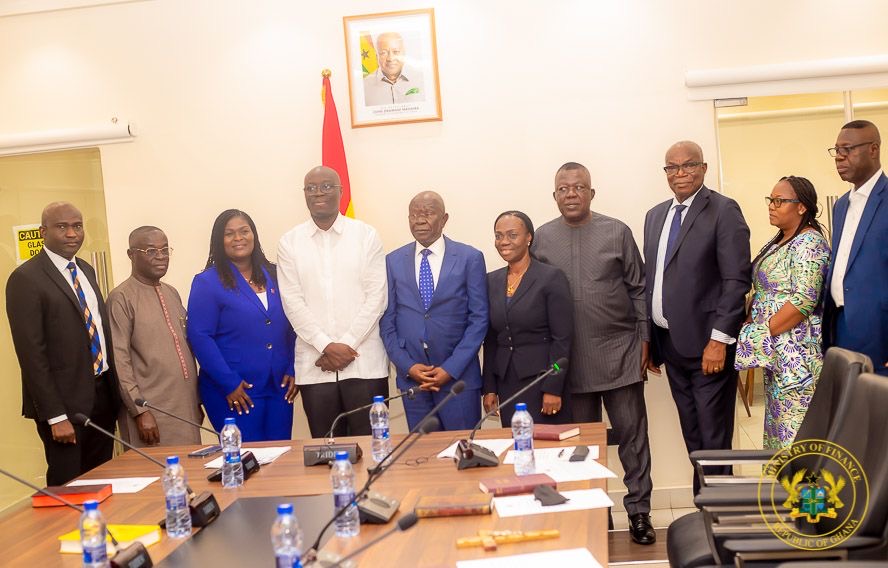
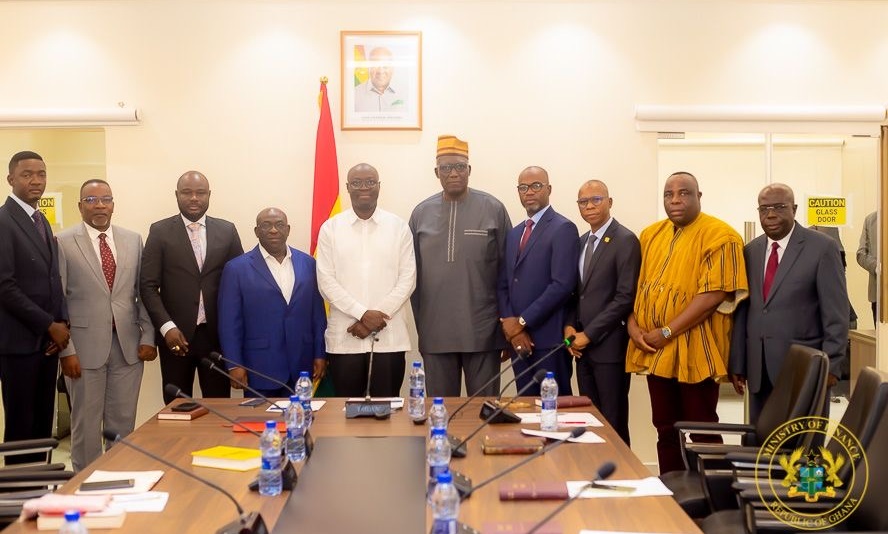
  • Green Climate Fund and UNEP boost climate adaptation with $120m for new projects

    Green Climate Fund and UNEP boost climate adaptation with $120m for new projects

    The Green Climate Fund (GCF) has approved over $120 million in new funding to strengthen climate resilience in Ghana, the Maldives, and Mauritania.

    At the request of the three countries, the UN Environment Programme (UNEP) developed these projects to help vulnerable communities anticipate and adapt to increasingly severe impacts of climate change through nature-based solutions, climate-resilient agriculture, early warning systems and improved water security.

    Henry Gonzalez, Chief Investment Officer of the Green Climate Fund (GCF), said: “The approval of these projects demonstrates how GCF is supporting country ownership of national climate action priorities in Ghana, Maldives, and Mauritania. These investments will positively impact key areas of climate resilience in all three countries.”

    The initiatives are a major step forward in deploying adaptation finance where it is most needed — particularly in Small Island Developing States (SIDS) and the Sahel region. They are expected to benefit more than 3.5 million people.

    “These new projects reflect UNEP’s deep commitment to supporting countries on the frontlines of climate change,” said Martin Krause, Director of UNEP’s Climate Change Division. “Our focus is on contextualizing climate solutions to the benefit of the most vulnerable nations and communities with tailored, locally led, and science-based solutions.”

    Ghana

    Northern Ghana faces increasingly erratic rainfall and long dry seasons that have led to chronic food shortages, drying water bodies, and the destruction of infrastructure from flooding. Smallholder farmers, reliant on rainfed subsistence agriculture, are especially vulnerable. High temperatures reduce the land’s water-retention capacity, and extreme rain events risk dam collapse and downstream flooding.

    In response, the new USD 70 million project – including a USD 63 million GCF grant – aims to build the resilience of agroecosystems and rural livelihoods. The initiative will support 120 communities across eight districts in the North East, Upper East, and Upper West regions. Activities include improving access to climate data and early warnings, enabling dry season farming through water storage solutions, and restoring 28,000 hectares of degraded land to improve soil health, improve water retention and reduce flood risks.

    Implemented by the Government of Ghana through the Environmental Protection Agency and Ghana Meteorological Agency, the project will benefit 619,000 people directly, while early warning alerts will reach up to 2.9 million people. Around 120,000 individuals will experience improved food security as a result of climate-resilient farming practices.

    Maldives

    Maldives is the world’s most exposed country to climate change. Comprising 1,192 islands, nearly 80% of which lie less than one meter above sea level, Maldives faces the constant threat from rising sea levels. In addition to rising seas, the country is vulnerable to more frequent and severe storm surges, floods, heatwaves, coastal erosion, and other hazards exacerbated by climate change. These hazards are already disrupting critical economic sectors such as agriculture, fisheries and tourism, affecting the entire population of Maldives. The poorest, most marginalised and remote communities, and women and children are particularly susceptible.

    To strengthen the country’s ability to adapt to these threats and reduce vulnerability to climate change, UNEP, in coordination with several national and international partners, developed the project, Toward Risk-Aware and Climate-Resilient Communities (TRACT) – Strengthening Climate Services and Impact-Based Multi-Hazard Early Warning in the Maldives.

    The USD 25 million project – expected to benefit more than half a million people – will be implemented over five years under the lead of UNEP. It aligns with the goal of the Early Warnings for All initiative (EW4All) to ensure that everyone on Earth is protected from hazardous climate events through early warning systems by 2027 and it will deliver on the Maldives’ roadmap to achieve the EW4All Initiative, developed by the Government of Maldives and international partners to guide the scaling up of early warning systems in the country. 
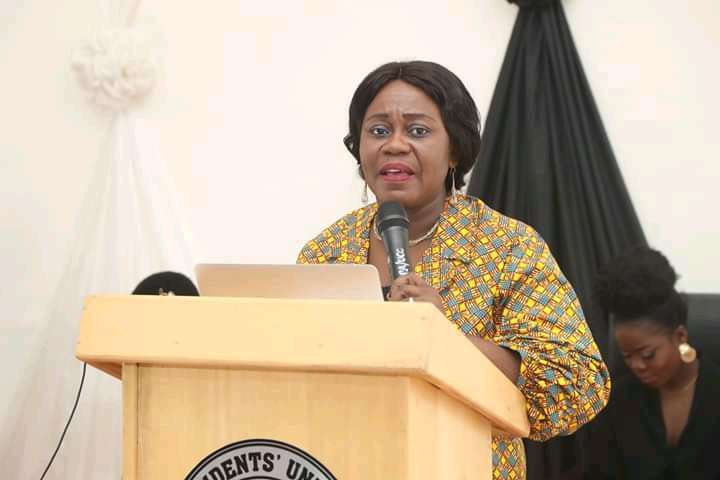
    Mauritania

    In the fragile zone between the Sahara and Sahel, prolonged droughts, sand encroachment, and water scarcity are threatening lives and livelihoods. Mauritania has seen accelerating dune movement, siltation of water sources, and growing pressure on socio-economic infrastructure such as roads and schools. Agricultural output remains extremely low, with the country importing up to 85% of its food.

    With a USD 33 million investment — including a USD 30 million GCF grant — the new UNEP project will restore ecosystems and secure livelihoods in four vulnerable hubs: Aoujeft, Rachid, Tamcheket, and Nema. It will support green-grey infrastructure to fix dunes and control sand encroachment, improve access to water for farming and land rehabilitation, and scale up climate-resilient agriculture to boost food security and incomes.

    Led by Mauritania’s Ministry of Environment and Sustainable Development, the project will directly benefit 85,000 people and improve resilience for 145,000 more. It will also protect 2,100 hectares of land and support the country’s contributions to the Great Green Wall — a multilateral African initiative to combat desertification and build climate resilience across the continent.

    Source: UN Environment Programme

  • UG students protest against NPP Conference on campus over COVID-19 resurgence

    UG students protest against NPP Conference on campus over COVID-19 resurgence

    Some final-year students of the University of Ghana, Legon, are calling for the suspension of the National Annual Delegates Conference at the UG Sports Stadium from July 18 to 19, to be held by the New Patriotic Party.
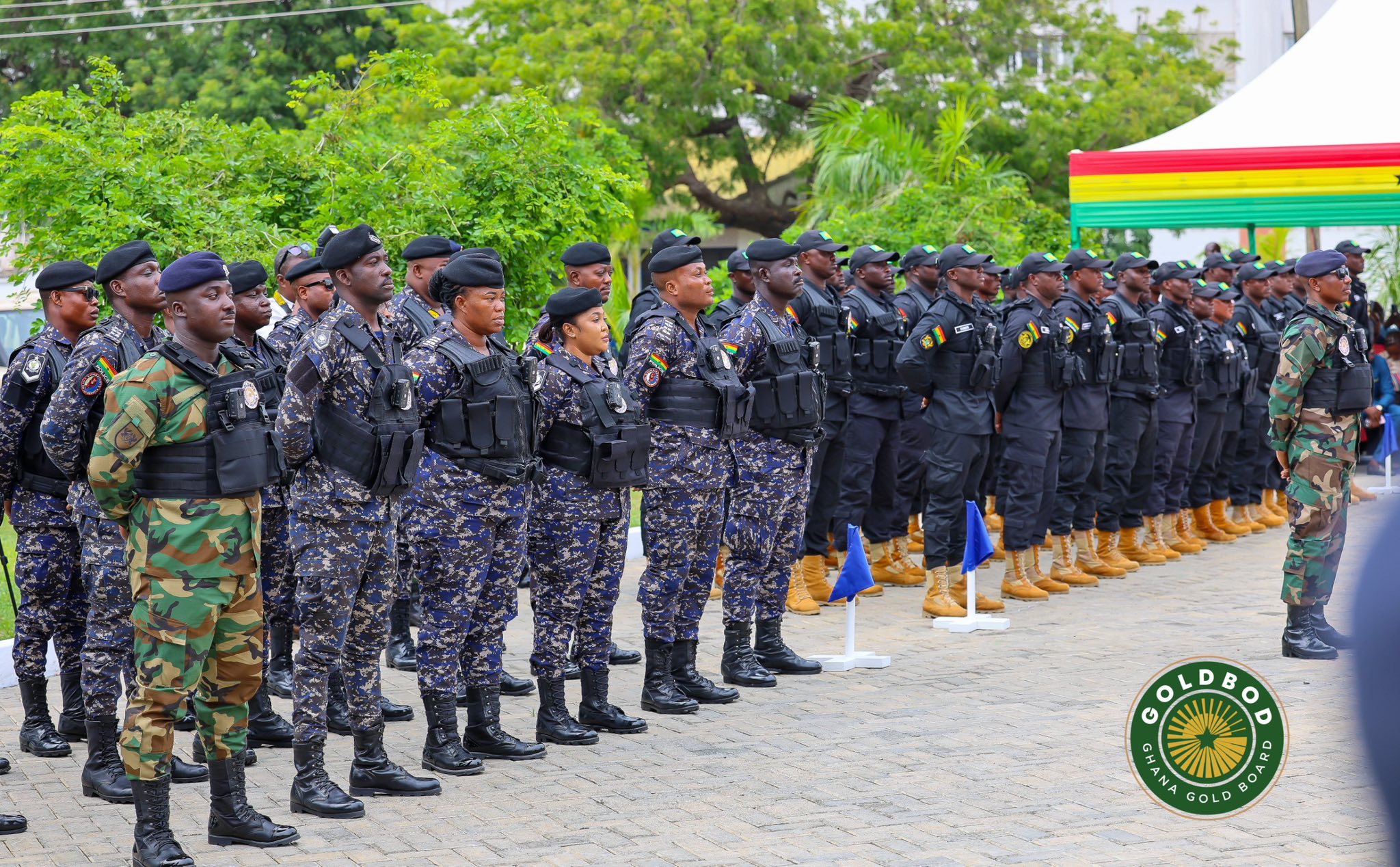
    The students are set to petition the university’s Sports Directorate over concerns that the gathering could escalate the spread of the COVID-19 pandemic.
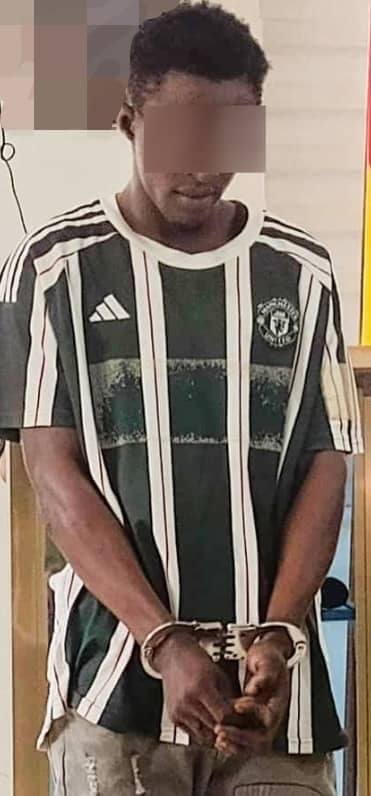
    Appearing before Parliament to provide an update on the resurgence of COVID-19 in the country on Tuesday, July 1, Health Minister Mintah Akandoh noted that as of July 1, 107 out of 316 suspected cases within the University of Ghana community have been confirmed as COVID-19.

    Currently, no deaths have been reported, and no individual is currently on admissions.

    Honourable Akandoh noted that the outbreak is limited to the University of Ghana community, adding that “it has not spread widely to other parts of Accra or the rest of the country.”

    He noted that these cases have been traced to a familiar variant—the Omicron sub-variant.The cases were detected through Ghana’s influenza surveillance system and confirmed by the Noguchi Memorial Institute for Medical Research.

    This national network of sentinel sites operates across all 16 regions.

    He therefore assured Ghanaians that, should there be any cases
    outside the university campus, “our surveillance system remains
    active and ready to detect and respond effectively.”

    The Ghana Health Service (GHS) has revealed that the current COVID-19 cases recorded in the University of Ghana are of mild magnitude.

    The Health Services Directorate of the University of Ghana has reactivated its COVID-19 Response Protocols, including screening and triage measures at health facilities.

    The preventive measures include wearing face masks properly, especially in enclosed or crowded spaces, and washing hands frequently with soap under running water or using alcohol-based hand sanitizers.

    Subsequently, all staff, students, and visitors are strongly advised to remain vigilant and strictly adhere to recommended preventive measures to reduce the risk of infection and community spread.

    In light of this, management of the University of Ghana, Legon, has suspended all social gatherings on campus, excluding official university activities and lectures, to quell the spread of COVID-19 cases

    The head of Biology at the Noguchi Memorial Institute for Medical Research (NMIMR), Professor Kofi Bonnie, has warned that the rainy season could trigger the resurgence of COVID-19. Speaking to Joy News, the virologist explained that influenza-like illnesses surge during rainy days.

    COVID-19 is the disease caused by the SARS-CoV-2 coronavirus. It usually spreads between people in close contact.

    COVID-19 vaccines provide strong protection against severe illness and death. Although a person can still get COVID-19 after vaccination, they are more likely to have mild or no symptoms.

    According to the World Health Organisation (WHO), COVID-19 symptoms typically appear 5 to 6 days after exposure and can last between 1 and 14 days, ranging from common symptoms like fever, chills, and sore throat to less common ones such as muscle aches, severe fatigue, nasal congestion, headache, sore eyes, dizziness, a persistent cough, chest pain, shortness of breath, hoarseness, numbness, appetite loss, nausea, vomiting, abdominal pain, diarrhoea, altered taste or smell, and difficulty sleeping.

    In 2020, COVID-19 was declared a public health emergency of international concern. In March of the period in question, Ghana recorded its first case.

  • Akwatia MP, Ernest Kumi, has died

    Akwatia MP, Ernest Kumi, has died

    Akwatia Member of Parliament, Ernest Yaw Kumi, has passed away, according to reports.

    It is unknown when the legislator who sides with the Minority in Parliament passed on.

    The Minority Leadership is yet to engage the public over the demise of its member.

    Last month, the apex court overturned a ruling by the Koforidua High Court that convicted Mr Kumi of contempt of court.

    The court, on Wednesday, June 11, by a 4–1 majority, granted the legislator’s application to overturn the High Court’s ruling.

    On January 3, 2025, the Koforidua High Court issued an interim injunction restraining Ernest Yaw Kumi from being sworn in as the Member of Parliament for Akwatia.

    The injunction stemmed from a legal challenge by Henry Boakye-Yiadom, the National Democratic Congress (NDC) parliamentary candidate and former MP, who contested the election results.

    Boakye-Yiadom had filed a lawsuit against the Electoral Commission (EC), Kumi, and the Clerk to Parliament, disputing the outcome of the polls. Official results had declared Kumi victorious with 19,269 votes, while Boakye-Yiadom secured 17,206 votes.

    Despite the court’s order, Kumi went ahead with his swearing-in on January 7, 2025. His legal team, led by Lawyer Gary Nimako, later sought to overturn the injunction, but the court dismissed their application.

    On February 19, 2025, the Koforidua High Court issued a bench warrant for Kumi’s arrest, citing his absence from contempt proceedings and his failure to comply with the earlier injunction.

    Reacting to the development, the Minority in Parliament has condemned the court’s decision, arguing that it was excessive. Speaking to the media, Second Deputy Minority Whip Jerry Ahmed Shaib expressed strong disagreement with the ruling.

    In Parliament, Mr Kumi who was a first-time member in the 9th Parliament, served on both the Lands and Natural Resources Committee and the House Committee.

    A by-election as a result of the death of a member of Parliament shall be taken not less than ten days and not more than thirty days from the date of nomination.

  • Education Minister inaugurates NaCCA, NaSIA Board

    Education Minister inaugurates NaCCA, NaSIA Board

    Minister for Education, Honourable Haruna Iddrisu, has inaugurated the Board members of the National Council for Curriculum and Assessment (NaCCA) and National School Inspectorate Authority (NaSia).

    The swearing-in ceremony took place on July 3 in Accra.

    The Board of NaCCA will be chaired by Professor Vincent Assanful. Other members of the board include Dr. Sulemana Iddrisu, Professor Augustine Ocloo, Professor Azeko Tahiru Salifu, Mrs. Comfort Ashiagbor, Professor Ernest Kofi Davies, Mr. Leonard Attivor, Mrs. Ernesticia Lartey Asuinura, and Professor Samuel Ofori Obuobisah Bekoe.

    Maabobor Kor Jacob Aaworb-Nang Ph.D, will chair the NaSIA Board. The other members of the board are Dr. Monique Armstrong-Baidoo, Dr. Christian Addai Poku, Prof. Samuel Ofori Obuobisah Bekoe, Mr. Obenfo Nana Kwasi Gyetuah, Mr. Divine Worlanyo Agbenyo, Mr. Michael Akanvibe Ayuraboya, Ms. Emilia Affi Agbenyo, Dr. Issahaque Munawaru, Jennifer Tachi, Esq., and Ing. Prof. Tahiru Salifu Azeko.

    To both boards, the Education Minister called for prioritization of foundational learning.

    He noted that there is the need to be more attentive to the social and emotional well-being of the students.

    Honourable Iddrisu thus advocated for the introduction of artificial intelligence (AI) and coding in the primary level of education.

    The Chairperson of National Council for Curriculum and Assessment (NaCCA) and National School Inspectorate Authority (NaSia), Professor Vincent Assanful and Maabobor Kor Jacob Aaworb-Nang, Ph.D., respectively, affirmed their commitment to work with key stakeholders to ensure that quality standards of pre-tertiary education are met.

    Honorable Iddrisu further cautioned against the use of weapons by students in schools, describing the trend as deeply worrying and a threat to the safety and well-being of both learners and teachers.

    He emphasized the need to ensure that students adhere to the rules and regulations of the various schools and underscored the need for a collaborative effort to address rising incidents of violence in schools.

    In recent years, the country has seen a surge in violent acts by students in second-cycle institutions.

    These actions have led to the loss of lives as well as the destruction of properties.

    Authorities have called on the government to empower school authorities to immediately dismiss any student who attacks or causes physical injury of any kind to a teacher or any member of staff.

  • GASAE, HALO Trust conclude Weapons Marking and Registration Course 1/25

    GASAE, HALO Trust conclude Weapons Marking and Registration Course 1/25

    The Ghana Army School of Ammunition and Explosives (GASAE), on July 3, concluded its Weapons Marking and Registration Course 1/25 with a closing ceremony held at the Yogiba Grunshie Mess, Michel Camp.

    The initiative, which was held in collaboration with the Hazardous Areas Life Support Organization (HALO Trust), aimed at strengthening national weapons and ammunition life-cycle management.

    According to the Ghana Armed Forces (GAF), the course aligns with the country’s efforts to meet international standards in arms accountability and to ensure full traceability of military weapons within the force and other security institutions.

    Course participants drawn from GAF units as well as the National Commission on Small Arms and Light Weapons (NaCSA) received comprehensive training in workshop layout design, weapons marking techniques, safe storage procedures and the use of weapons marking machines.

    Weapons Marketing Specialist at the HALO Trust, Mr David Hutchison lauded the participants for their dedication and professionalism.

    He noted that the course plays an integral role in advancing the shared goal of strengthening human security through effective weapons and ammunition management capacity development.

    In his closing address, Commander GASAE, Colonel Francis Laapo, highlighted the need for robust weapons identification and control in the context of Ghana’s evolving security environment.

    He said the Ghana Armed Forces is undergoing a transformation that demands stringent control to ensure weapons do not end up in the wrong hands.

    Colonel Laapo announced that henceforth weapons would be marked at GAF Headquarters before distribution to improve arms traceability and accountability.

    Colonel Laapo said the course represents a forward-looking step in pursuit of effective and sustainable arms control measures through inter-agency cooperation and capacity building.

    He urged participants to preserve the knowledge and certificates acquired, as their role in enforcing arms management protocols would be vital in ensuring Ghana’s internal security.

    About HALO

    The HALO Trust is the world’s largest humanitarian landmine clearance organization leading efforts to protect and save lives and restore communities and livelihoods of those threatened by the deadly debris of war.

    Founded in 1988 and backed by the UN, US, and UK governments, HALO locates and destroys landmines, cluster bombs, explosive items, and dangerous stockpiles of weapons and ammunition, as well as educating locals on how to stay safe in contaminated areas.

    Per its website, HALO currently employs over 9,000 locally recruited staff in 26 countries and territories around the world who have paved the way for the development and long-term stability of their homelands.

  • Police probe death of SHS student during Fire Festival as family demands justice

    Police probe death of SHS student during Fire Festival as family demands justice

    The Northern Regional Police Command has begun investigations into the death of a second-year student of the Bimbilla Senior High School, 18-year-old Fatima, who was struck by a stray bullet during the Fire Festival in Bimbilla.

    The Fire Festival in Bimbilla, within the Nanumba North Municipality of the Northern Region, which began joyously, turned catastrophic following the death of the Senior High School student on Saturday, July 5.

    The source of the gunshot remains unknown. Meanwhile, the bereaved family is demanding justice for the death of their loved one, who has been buried in accordance with Islamic customs.

    This unfortunate incident occurred when the procession was moving from the regent’s palace to the Wampu Dam, where the fire was to be thrown.

    “I was at the palace when we heard the incident, so we rushed to the hospital, and the dead body was brought to the hospital. I even helped in removing the dead body,” a reporter with Beat FM, Mohammed Abdul-Rashid Natogmah said.

    According to reports, Fatima and a friend were at the festival without the knowledge of her parents, who had instructed them not to be present.

    “When we asked, the lady told us the girl was from one area called Bayawaya in Bimbilla, and the name is Fatima. She said before they came out, the parents didn’t want them to come out, so they hid and sneaked to the scene,” Mohammed Abdul-Rashid Natogmah said.

    Prior to the incident, the Ghana National Commission on Small Arms and Light Weapons cautioned against the display and misuse of firearms.

    “The Fire Festival is a cherished cultural event meant to foster unity, joy, and tradition—not violence or fear. The reckless use of firearms during celebrations poses grave risks, including accidental shootings, injuries, and fatalities,” a statement from the Commission read.

    The Fire Festival is one of Ghana’s most vibrant traditional events, featuring energetic processions with fire torches, rhythmic drumming, spirited dancing, and communal feasting.

    Last month, the Accra Regional Police Command warned the general public against the use of live ammunition during the lifting of the customary ban on drumming and noise-making in the Greater Accra Region.

    Police Command observed that some participants, especially sections of the youth, have resorted to firing live ammunition instead of using gunpowder or blank rounds.

    The recent surging deaths of citizens during traditional festivals could compel the government to ban the use of live ammunition during such events to safeguard lives.

  • Parliament begins Monday and Saturday sittings

    Parliament begins Monday and Saturday sittings

    Parliamentarians will henceforth hold sittings on Mondays and Saturdays, beginning today, according to the Majority Leader Mahama Ayariga.

    This decision has been taken by the House to allow for the maturity of some Legislative Instruments (L.I.) before Parliament adjourns sine die.

    The Majority Leader made this known on the floor of Parliament when he presented the Business Statement for the seventh week to end on July 12.

    Some bills may be introduced for first reading. He noted that those that will be considered urgent could be taken through the various stages in a day in accordance with Standing Order 160.

    In May, Speaker of Parliament, Alban Bagbin, revealed that the controversial Human Sexual Rights and Family Values Bill, known as the anti-LGBTQ+ Bill, is set to undergo its first reading

    “Three private members bills—the Property Rights of Spouses Bill 2025, the Constitution of the Republic of Ghana Amendment Bill 2025, and the Human Sexual Rights and Family Values Bill 2025—have completed the processes as required by the standing orders and are expected to be presented for a first reading during the course of this meeting,” he stated.

    When passed, the anti-LGBTQ+ Bill will criminalise LGBTQ+ activities in Ghana, as well as individuals and organizations promoting such activities.

    It is likely the bill could be considered urgent by the House following the use of some national landmarks by South African homosexuals, an action that has been criticised by many.

    The Majority Leader who is also the Chairman of the Business Committee further noted that Papers may be laid during the week and reports from committees may also be presented to the House for consideration.

    “Motions may be debated and their consequential Resolutions, if any, taken during the week. In accordance with Standing Order 216(2) and subject to Standing Order 67, the Committee submits to the House, the order in which the business shall be taken,” he stated.

    Meanwhile, some 55 ministers and the Governor of the Bank of Ghana, Dr. Johnson Pandit Asiama, are expected to appear before the House to respond to questions during the week.

    Commenting on the Business Statement, the Minority Leader, Hon. Osahen Alexander Kwamena Afenyo-Markin, urged the Majority Leader to schedule the Electoral Commissioner, Madam Jean Mensa, to brief the House on the rerun of parliamentary elections in 19 polling stations in the Ablekuma North Constituency.

    The New Patriotic Party (NPP) has challenged the Electoral Commission over its decision to hold rerun elections in 19 polling stations of the Ablekuma North Constituency on July 11.

    Addressing the press on July 3, the General Secretary of the party, Justin Kodua Frimpong, noted that the NPP will challenge the directive they deem as “whimsical, capricious” in court.

    “The NDC knows that they lost the election. We are in the NPP, shall stop at nothing in our quest to ensure that the power that has been respected and upheld by the democratic rights and sovereign will of the people of Ablekuma North, as expressed by them on December 7, 2024, is upheld.”

    “Therefore, we have caused our legal directorate to challenge the directive in court. We shall file in court and challenge the whimsical, capricious directive by the EC,” he said.

    The Electoral Commission (EC), after extensive deliberations, noted that it will hold the rerun election because the 19 scanned polling station results used for the collation, though approved by agents of both political parties, were not verified by the presiding officers responsible for those polling stations.

  • President Mahama to inaugurate Goldbod Task Force tomorrow

    President Mahama to inaugurate Goldbod Task Force tomorrow

    President Mahama will launch a special task force to clamp down on illicit gold-smuggling activities in the country tomorrow, July 8, 2025.

    Chief Executive Officer (CEO) of the Ghana Gold Board (GoldBod), Sammy Gyamfi, revealed this information to the general public.

    “This event would be the inauguration of the GoldBod task force. So, 8th of July at 8:30 a.m. at the National Security Secretariat, popularly called Blue Gate — there is a yard in there…  and the media are cordially invited,” he revealed.

    The task force would be given a special mandate with specific powers as police officers to wage war against smuggling and all forms of illegal gold trading activities in the country.

    This, Mr Gyamfi asserts, would save the government from any leakages in revenue mobilisation in the sector, helping to generate and invest revenue for economic development.

    “(This will) help the state combat and defeat the phenomenon of gold smuggling, the canker of illegal gold trading, and price disruptions that deprive the state of the needed revenue, profit, and the needed forex for our economy and the development of our country” he announced.

    He thus cautioned traders to secure the appropriate licence to engage in any form of gold trading in the country, saying, “But for those who are hell bent on trading illegally without the licenses, we are serving notice that we are coming after you”. 

    Earlier, the GoldBod CEO on June 5 also warned that persons who trade without licenses would be prosecuted, adding that his outfit takes no bribes before the said licenses are issued.

    During a meeting with the Chamber of Licensed Gold Buyers, Mr Gyamfi stated that “I don’t take or demand bribes before I issue a licence.”

    The acting CEO noted that the process for registering has been made seamless and is devoid of corruption. “We have removed the human interface element, and so there is no corruption, bribery, inducements, or favouritism. It is a very transparent and competitive process, and once you qualify, you get the license,” he added.

    Lauding his outfit’s results-oriented reforms and initiatives since his takeover as CEO, Sammy Gyamfi, during a media engagement, revealed that GoldBod has exceeded the $5 billion mark in gold export value for the first half of 2025, surpassing the $4.6 billion recorded for the entire year of 2024.

    He expressed optimism that GoldBod would hit the 60-tonne export mark by the end of July 2025, driven by stronger compliance, improved oversight, and the streamlined licensing regime under the Ghana Gold Board Act, 2025 (Act 1140).

    “In the whole of 2024, gold exports stood at 66 tons with an export value of $4.6 billion. We have done only six months, and yet we have crossed the $4.6 billion. We have gone beyond $5 billion, and in terms of volumes, we have done 50 tons and over, and we are optimistic that by the end of next month, we will have hit 60 tons,” he said.

  • 216 bags of cocoa beans being smuggled to Togo seized in June, July – COCOBOD

    216 bags of cocoa beans being smuggled to Togo seized in June, July – COCOBOD

    The Ghana Cocoa Board (COCOBOD) has revealed that in June and July, its anti-cocoa smuggling taskforce made significant strides in cracking down on the activities of syndicates involved in cocoa smuggling.

    The two months saw the seizure of some 216 bags of cocoa beans that were being smuggled across the border to Togo.

    This was possible due to four separate operations at Zebila and Bolga in the Upper East Region.

    The most recent activity led by the taskforce was on Saturday, July 5. The taskforce intercepted 15 bags of cocoa beans at Maame Wata in the Asuogyaman District of the Eastern Region, also bound for Togo.

    Several suspects have been arrested and are currently assisting police with investigations.

    Last year, Reuters reported that Ghana lost about 160,000 tonnes of cocoa to smuggling during the 2023/2024 crop season.

    Presently, COCOBOD is working with Parliament to strengthen laws on cocoa smuggling. This is to introduce harsher sanctions to deter many from engaging in such unlawful acts.

    The Bank of Ghana’s Summary of Macroeconomic and Financial Data for March 2025 revealed that cocoa exports soared by 126 per cent.

    Meanwhile, COCOBOD has urged Ghanaians to support its efforts to stop cocoa smuggling and help safeguard the vital national resource.

    “Report suspicious persons to the nearest police station or the Ghana Cocoa Board. Together, we can protect the livelihood of our hardworking farmers and sustain Ghana’s cocoa legacy,” the Board noted in a post on Facebook.

    Presently, COCOBOD is grappling with a staggering debt of GH¢32.5 billion, with GH¢9.7 billion due by the end of September, President John Dramani Mahama has revealed.

    Delivering the 2025 State of the Nation Address in Parliament, he painted a bleak picture of the cocoa sector’s finances, warning of massive revenue losses for both COCOBOD and Ghanaian farmers.

    According to Mahama, COCOBOD’s financial woes deepened in the 2023/24 crop season when it failed to supply 333,767 metric tonnes of cocoa that had been pre-sold at $2,600 per tonne.

  • NACOC confiscates 738 compressed parcels of suspected cannabis in Accra

    NACOC confiscates 738 compressed parcels of suspected cannabis in Accra

    Some 738 compressed parcels of suspected cannabis were seized by the Narcotics Control Commission (NACOC) at the Swissport Terminal in Accra on July 5.

    These compressed parcels were hidden in some boxes that were labelled “assorted food items.” The boxes were being transported to the United Kingdom.

    According to reports, two suspects have been arrested for their involvement in the transportation of the suspected drugs.

    Currently at large are two other key suspects, Lincoln Nii OKAIJA (born March 27, 1979) and Kate DAVIDSON, alias “Esi.”

    The authorities have called on members of the general public to provide them any relevant information that could aid the capture of the suspects.

    Penalties for drug trafficking in Ghana are severe, with the Narcotic Drugs (Control, Enforcement and Sanctions) Act of 1990 (PNDCL 236) stipulating a minimum of ten years imprisonment for offences related to possession, importation, or exportation of narcotic drugs without lawful authority.

    In April this year, a major drug bust at Ghana’s Swiss Port led to the arrest of four individuals after the Narcotics Control Commission (NACOC) uncovered a large consignment of suspected cocaine

    During the intelligence-driven operation, NACOC officials intercepted seventy-three (73) neatly concealed slabs of a substance suspected to be cocaine.

    The illicit cargo, weighing approximately 89.74 kilograms, was reportedly en route to the Netherlands before it was seized.

    The arrest was part of ongoing efforts by Ghanaian authorities to crack down on transnational drug trafficking through the country’s ports.

    In the same month, a total of 189 cadets were officially inducted into service to support Ghana’s ongoing efforts to combat narcotic drug trafficking and related crimes.

  • Police nab man for murder after altercation in Accra

    Police nab man for murder after altercation in Accra

    The Ghana Police Service has arrested Malcom Fraizer for the murder of a man following a violent altercation in Accra.

    The arrest on July 1 followed intelligence gathered by the National Operations Directorate (NOD) Intelligence Unit at the Police Headquarters.

    The unit identified the suspect’s hideout after a video related to the incident surfaced online.

    Preliminary investigations revealed that the incident occurred on 1st April 2025. During interrogation, the suspect admitted to engaging the deceased in a physical confrontation after learning that the victim was allegedly dating his ex-wife.

    The suspect is currently in police custody assisting investigations.

    In early July, the police arrested two individuals for their involvement in the murder of a Lebanese national.

    The deceased, Omar Mikati (58) was murdered on Friday, June 20, at his residence at East Legon, Accra.

    The deceased was found dead in a pool of blood. A dispatched team from the Crime Scene Management Unit (CSMU) at the Police Headquarters collected relevant forensic evidence to commence the investigation.

    Preliminary investigations suggest that the perpetrator(s) fled the scene with the deceased’s Samsung mobile phone.

    They, however, left behind other items, including two iPhones and a GCB ATM card bearing the name Paul Twumasi Ankrah.

    Further probing led to the arrest of Paul Twumasi Ankrah at Samsam Medie, who implicated his accomplice, one Asiedu Henning, alias Nana Kofi Anum.

    On July 2, Asiedu Henning was arrested in an intelligence-led operation at his hideout in Kutunse.

    He led police to a location where the CSMU team processed the scene and retrieved a knife that had been disposed of by the suspects. The exhibit knife is being processed for forensic analysis.

    Both accused persons were put before the Adabraka District Court 1, where they have been remanded into Police custody to reappear on Tuesday, July 8.

    Meanwhile, the body of the deceased has been conveyed to the morgue for preservation and autopsy.

  • Man jailed 19 years with hard labour for robbery

    Man jailed 19 years with hard labour for robbery

    An armed robber, Paul Avortide, has been jailed for 19 years with hard labour for robbery.

    The 25-year-old convict, on May 21, at about 4:00 am, at Tsikpota near New Housing, Ho, with a machete in his hand, threatened a pregnant woman by the name of Ogechi Chidiebere, a Nigerian resident in Ho.

    The convict, Paul Avortide robbed the victim of her Gh¢ 3,000 and her Tecno Spark 30c mobile phone valued at Gh¢2,500 when she was on her way to attend antenatal care at the Ho Municipal Hospital.

    On June 19, at about 6:00 pm, the Regional Police Intelligence team arrested Harmony Nbonu at the Ho Main Market, who was in possession of the stolen phone.

    During interrogations, he mentioned Paul Avortide as the one who sold the phone to him at the cost of Gh¢ 850.00.

    Coordinated efforts between the Police and the suspect, Hormony Nbonu, led to the arrest of the convict, Paul Avortide, at Matse, a suburb of Ho, when he was running away from Ho Township.

    After police investigations, Paul Avortide was charged with the offence of robbery contrary to Section 149 of the Criminal Offences ACT. 1960 (ACT 29) as amended by the Criminal Offences (Amendment) ACT, 2003 (ACT 646).

    Harmony Nbonu, on the other hand, was charged with the offence of Dishonestly Receiving Contrary to Section 146 of the Criminal Offences ACT, 1960 (ACT 29).

    The two were arraigned before Ho Circuit Court presided over by His Honour, Osman Abdul Hakeem, Esq on Tuesday, July 1.

    The first accused person (A1), Paul Avortide, pleaded guilty to the charge of robbery and was convicted on his own plea and sentenced to a prison term of 19 years in Hard Labour .

    The second accused person, (A2), Harmony Nbonu was acquitted and discharged.

    The convict has since been handed over to the Ho Regional Prison authorities to begin to serve his prison term.

  • Bimbilla Fire Festival: SHS student killed by stray bullet

    Bimbilla Fire Festival: SHS student killed by stray bullet

    The Fire Festival in Bimbilla, within the Nanumba North Municipality of the Northern Region, which began joyously, turned catastrophic following the death of a Senior High School student.

    A second-year student of the Bimbilla Senior High School, Fatima, was struck by a stray bullet, leading to her untimely demise on Saturday, July 5.

    This unfortunate incident occurred when the procession was moving from the regent’s palace to the Wampu Dam, where the fire was to be thrown.

    “I was at the palace when we heard the incident, so we rushed to the hospital, and the dead body was brought to the hospital. I even helped in removing the dead body,” a reporter with Beat FM, Mohammed Abdul-Rashid Natogmah said.

    According to reports, Fatima and a friend were at the festival without the knowledge of her parents, who had instructed them not to be present.

    “When we asked, the lady told us the girl was from one area called Bayawaya in Bimbilla, and the name is Fatima. She said before they came out, the parents didn’t want them to come out, so they hid and sneaked to the scene,” Mohammed Abdul-Rashid Natogmah said.

    The source of the gunshot remains unknown. Also, the Police are yet to commence an investigation into the matter.

    Prior to the incident, the Ghana National Commission on Small Arms and Light Weapons cautioned against the display and misuse of firearms.

    “The Fire Festival is a cherished cultural event meant to foster unity, joy, and tradition—not violence or fear. The reckless use of firearms during celebrations poses grave risks, including accidental shootings, injuries, and fatalities,” a statement from the Commission read.

    The Fire Festival is one of Ghana’s most vibrant traditional events, featuring energetic processions with fire torches, rhythmic drumming, spirited dancing, and communal feasting.

    Last month, the Accra Regional Police Command warned the general public against the use of live ammunition during the lifting of the customary ban on drumming and noise-making in the Greater Accra Region.

    Police Command observed that some participants, especially sections of the youth, have resorted to firing live ammunition instead of using gunpowder or blank rounds.

  • No Ghanaian will be denied tertiary education due to financial constraint – President Mahama

    No Ghanaian will be denied tertiary education due to financial constraint – President Mahama

    President John Dramani Mahama has stated that his government will ensure financial challenges do not bar Ghanaian students from attaining higher education after completing Senior High School (SHS).

    “Let it be known across this land that, from today, no Ghanaian child will be denied tertiary education simply because they cannot afford the academic fees,” he said during the launch of the government’s flagship initiative, the No Fees Stress policy.

    The event was held on Friday, July 4, at the Eastern Regional capital, Koforidua.

    President Mahama noted that his administration cares about restoring dignity to the Ghanaian student.

    “This policy is not about welfare. It is about fairness. It is about affirming that the right to education is not a privilege for the wealthy, but a shared national inheritance,” he added.

    Prior to the launch, Vice President, Professor Naana Jane Opoku-Agyemang, while speaking at the 58th Special Congregation of the Kwame Nkrumah University of Science and Technology (KNUST) said more than 100,000 students have finalized their applications.

    “The government continues to implement funding models that improve access to quality education. One of these is the No Fees Stress policy, under which first-year students in public institutions are exempt from paying academic user fees.

    “Data from the Students Loan Trust Fund, which manages the programme, shows that by mid-June, nearly 130,000 students had accessed the portal, with over 100,000 completing their applications,” she said.

    The “No-Fee Stress” initiative was a major campaign promise by then-presidential candidate John Dramani Mahama, who pledged to absorb academic fees for all Level 100 students within the first 120 days of his administration.

    To support the rollout of the “No-Fee Stress” policy, GH¢499.8 million has been allocated under the 2025 national budget, which was presented to Parliament by Finance Minister Dr. Cassiel Ato Forson on Tuesday, March 11.

    Meanwhile, 35,608 tertiary students across 130 public and private institutions nationwide have received financial support from the Students Loan Trust Fund (SLTF) for the 2024/2025 academic year.

    The SLTF, conversely, has reiterated its resolve to release funds on time to allow students to gain admission into their preferred tertiary institutions without financial hindrance.

    Earlier this year, the Fund approved financial aid for 9,433 students enrolled in 62 public and private tertiary institutions nationwide.

    The Ministry of Education has made accessible a registration portal to help first-year students at public tertiary institutions in Ghana apply for financial assistance under the government’s new No-Fees-Stress Policy.

    Launching the portal on Monday, April 29, Education Minister Hon. Haruna Iddrisu described the policy as a bold and strategic move by the government to improve access to tertiary education and invest in the country’s future workforce.

    The SLTF explained that the new system will make it easier for eligible students to register, submit their details, and be assessed for financial support. 

  • President Mahama launches “No Fees Stress” policy

    President Mahama launches “No Fees Stress” policy

    The government’s flagship initiative, the No Fees Stress policy, was launched on Friday, July 4, by His Excellency President John Dramani Mahama.

    The event was held at the Eastern Regional capital, Koforidua. In his address, the President stated that his government would ensure financial challenges do not bar Ghanaian students from attaining higher education after completing Senior High School (SHS).

    “Let it be known across this land that, from today, no Ghanaian child will be denied tertiary education simply because they cannot afford the academic fees,” he said.

    President Mahama noted that his administration cares about restoring dignity to the Ghanaian student.

    “This policy is not about welfare. It is about fairness. It is about affirming that the right to education is not a privilege for the wealthy, but a shared national inheritance,” he added.

    Prior to the launch, Vice President, Professor Naana Jane Opoku-Agyemang, while speaking at the 58th Special Congregation of the Kwame Nkrumah University of Science and Technology (KNUST) said more than 100,000 students have finalized their applications.

    “The government continues to implement funding models that improve access to quality education. One of these is the No Fees Stress policy, under which first-year students in public institutions are exempt from paying academic user fees.

    “Data from the Students Loan Trust Fund, which manages the programme, shows that by mid-June, nearly 130,000 students had accessed the portal, with over 100,000 completing their applications,” she said.

    The “No-Fee Stress” initiative was a major campaign promise by then-presidential candidate John Dramani Mahama, who pledged to absorb academic fees for all Level 100 students within the first 120 days of his administration.

    To support the rollout of the “No-Fee Stress” policy, GH¢499.8 million has been allocated under the 2025 national budget, which was presented to Parliament by Finance Minister Dr. Cassiel Ato Forson on Tuesday, March 11.

    Meanwhile, 35,608 tertiary students across 130 public and private institutions nationwide have received financial support from the Students Loan Trust Fund (SLTF) for the 2024/2025 academic year.

    The SLTF, conversely, has reiterated its resolve to release funds on time to allow students to gain admission into their preferred tertiary institutions without financial hindrance.

    Earlier this year, the Fund approved financial aid for 9,433 students enrolled in 62 public and private tertiary institutions nationwide.

    The Ministry of Education has made accessible a registration portal to help first-year students at public tertiary institutions in Ghana apply for financial assistance under the government’s new No-Fees-Stress Policy.

    Launching the portal on Monday, April 29, Education Minister Hon. Haruna Iddrisu described the policy as a bold and strategic move by the government to improve access to tertiary education and invest in the country’s future workforce.

    The SLTF explained that the new system will make it easier for eligible students to register, submit their details, and be assessed for financial support. 

  • Ghana to host ISA Africa Regional Committee

    Ghana to host ISA Africa Regional Committee

    The government of Ghana and the International Solar Alliance (ISA) have signed a host agreement, officially designating Ghana as the host for the ISA Regional Committee for Africa.

    The agreement sets the stage for a high-level regional meeting scheduled from September 2–4, 2025.

    The meeting will bring together member countries to coordinate solar energy programmes, exchange technical expertise, and mobilize financial and policy support for the continent’s solar transition.

    The signing ceremony was held in Accra and attended by top officials from both parties, including ISA’s Chief Operations Officer, Mr. Wycliffe Joshua, Shishir Seth (Chief-Governance and Partnerships), Aditya Tiwari (Officer-Governance and Partnerships), and Ghana’s Minister for Energy and Green Transition, Hon. John Abdulai Jinapor and Directors of the Ministry.

    Hon. Jinapor praised the selection of Ghana, and observed the country’s ongoing efforts to promote clean energy and reduce carbon emissions.

    ”Ghana’s selection as host and our position as ISA Regional Vice President underscore our commitment to renewable energy leadership. Under President John Dramani Mahama’s green transition agenda, we are creating a favourable environment for solar development through robust policy reforms and infrastructure investment,” he said.

    The Chief Operations Officer of ISA, Mr. Wycliffe Joshua expressed strong support for Ghana’s leadership and renewable energy ambitions. “We thank Ghana for hosting this vital regional forum.

    This meeting will help assess progress, identify strategic priorities and strengthen cooperation for a solar-powered future. Ghana’s launch of a Renewable Energy Authority and plans for a Green Energy Investment Fund are bold steps that set a precedent across the continent,” he remarked.

    Ghana’s role is expected to catalyze innovation, unlock investment, and accelerate the deployment of solar technologies across Africa. As a founding member of ISA, Ghana has consistently demonstrated its dedication to renewable energy and sustainable development.

    The International Solar Alliance, a global initiative, aims to combat climate change through collaborative solar energy solutions. With Ghana hosting the regional committee, Africa is poised to make significant strides in solar adoption and energy transformation.

    Source: Ministry of Energy and Green Transition

  • You can’t dictate how Ghana conducts its foreign policy – Ablakwa chides US’ Jim Risch

    You can’t dictate how Ghana conducts its foreign policy – Ablakwa chides US’ Jim Risch

    Foreign Affairs Minister Samuel Okudzeto Ablakwa has criticised senior United States lawmaker Jim Risch for his recent remarks over the Ghanaian government’s foreign policy on its debt repayment.

    In a post on X (formerly Twitter), Jim Risch complained about Ghana’s reported failure to honour its commitment to repay United States companies.

    “Instead of a trip to D.C., Ghana’s foreign minister should focus on honoring his government’s commitments to repay U.S. companies and the American taxpayers,” he wrote.

    He added, “We cannot keep subsidizing Ghana while it continues paying far larger debts to China.”

    In response, Mr Ablakwa noted that Jim Risch lacks the moral standing to discuss such matters, as he has refused “to engage in same advocacy for the payment of reparations by the US for its despicable and condemnable role in slavery.”

    He also noted that the lawmaker lacks the authority and cannot dictate to the West African country how it goes about its foreign policy.

    “You will not be allowed to dictate to a sovereign country on how we conduct our foreign policy if you need to be reminded – this is Kwame Nkrumah’s Ghana – the first African nation to defeat colonialism and imperialism.”

    “Let me be clear, those measly debts compared to what you owe us in reparations would be paid when we deem appropriate based on our prudent economic recovery program even though the debt was not created by the new Mahama Administration. Unlike you, we take responsibility and honour our national obligations,” Mr Ablakwa added.

    Debt restructuring

    Ghana’s Domestic Debt Exchange Programme (DDEP), launched in December 2022, has significantly influenced the domestic debt market. The government has relied on short-term securities to finance the budget, raising GH¢45.4 billion in net proceeds from treasury bill issuances.

    The government remains committed to honoring its debt obligations, having successfully paid GH¢19.0 billion in DDEP bond coupons in 2024 and an additional GH¢9.5 billion in February 2025. The Finance Ministry believes these efforts, coupled with effective engagement with market participants, will enhance transparency, restore investor confidence, and stabilize the financial market.

    Payment of reparation

    President John Dramani Mahama has thrown his full weight behind the African Union’s agenda this year to seek justice for Africans and people of African descent who have been directly and indirectly affected by colonialism and slavery.

    Delivering his African Day 2025 message based on the Union’s theme this year, “Justice for Africans and People of African Descent through Reparations,” the president emphasized the need for a united front in addressing the lingering effects of slavery, colonialism, and neo-colonialism, which he described as historical injustices that have cast a shadow on the lives and progress of Africans and Africans in the diaspora.

    “As the AU Champion for this critical cause, I am deeply committed to working with you all to achieve this vital objective. Reparations are not merely about financial compensation. They are about acknowledging the profound and enduring damage inflicted upon our people,” he said.

    The president further outlined an approach to justice that involves official apologies from complicit nations and institutions, cancellation of unjust debt burdens, and return of stolen cultural artifacts, encouraging increased investment in African education and development as part of the reparation process.

    “We seek justice—justice that encompasses a comprehensive range of measures. Addressing the crippling debt burden that continues to stifle economic growth in many African nations—a direct consequence of exploitation and unfair trade practices—is essential,” he said.

    President Mahama urged fellow African leaders, civil society organizations, youth groups, and members of the diaspora to join hands in pushing for reparations, stressing the importance of advocacy, dialogue, and solidarity.

    “Let us work together to build a future where justice prevails, where the wounds of the past are healed, and where the potential of every African and person of African descent is fully realized,” he said.

    He called on African leaders, civil society, and the diaspora to forge a united front. “Let Africa Day 2025 be a turning point. Let the pursuit of reparations be a testament to our resilience and belief in a brighter future,” he remarked.

    In an address on behalf of the African Union Commission (AUC), Chairperson H.E. Mahmoud Ali Youssouf highlighted Africa’s resolve to secure justice for past wrongs while building a continent anchored in prosperity and unity.

    “Justice and reparations remain long overdue,” he said, adding that “the continent continues to sacrifice and strive towards freedom from conflict, underdevelopment, and war.”

    H.E. Youssouf underscored Africa’s strategic assets—including a youthful and growing population, vast natural resources, and renewable energy potential—as key drivers of a transformative future. With Africa’s population expected to surpass 2.5 billion by 2050, he described the continent not just as the future but as “the engine of global transformation.”

    H.E. Ambassador Hadera Abera, Ethiopia’s State Minister of Foreign Affairs, remarked that reparatory justice goes beyond redressing past wrongs. “It is about affirming the dignity of our people and shaping a future rooted in fairness and accountability,” she said.

    Ambassador Abera called for deeper bonds between Africa and its diaspora to push for global recognition and restitution. She also pointed to the role of youth and digital innovation as critical to Africa’s future and urged investments in emerging sectors like artificial intelligence and big data.

    She concluded by pledging Ethiopia’s unwavering support for Agenda 2063, the African Union’s strategic vision for a prosperous, peaceful, and self-reliant continent.

    Meanwhile, UNESCO has reaffirmed its solidarity with the African Union’s agenda. Dr. Rita Bissoonauth, the Director and UNESCO representative, announced the launch of a high-level roundtable later this year themed “Reparations, Memory and Sovereignty: African Liberation Movements and the Relevance of Pan-Africanism Today.” She described the initiative as a platform for policy exchange and action, not mere symbolism.

    Righting the wrongs with African states

    In 2024, the United Kingdom returned 32 gold and silver treasures stolen from the Asante Kingdom more than 150 years ago on a six-year loan. 

    The artefacts, comprising 15 items from the British Museum and 17 from the Victoria and Albert Museum (V&A), were looted from the court of the Asante king during the turbulent 19th-century clashes between the British and the Asante people.

    The relics, including gold and silver regalia associated with the Asante Royal Court, have been showcased at the Manhyia Palace Museum in Kumasi, the capital of the Ashanti region, as part of the yearlong celebration honouring Asantehene Otumfuo Osei Tutu II’s silver jubilee.

    Three years ago, Benin received two dozen treasures and artworks stolen in 1892 by French colonial forces during the sacking of the royal Palace of Abomey.

    Currently, a Dutch museum is taking measures to send more than a hundred precious artefacts back to Nigeria. The Wereldmuseum in Leiden is preparing a collection of Benin Bronzes looted during a violent British raid in 1897.

  • Energy Ministry confirms commercial viability of Eban-Akoma discoveries in CTP Block 4

    Energy Ministry confirms commercial viability of Eban-Akoma discoveries in CTP Block 4

    The Ministry of Energy and Green Transition has announced the formal submission of the Declaration of Commerciality (DoC) for the Eban-Akoma discoveries located within the Cape Three Points Block 4 (CTP-B4).

    According to the ministry, this development is a significant milestone in Ghana’s upstream petroleum sector.

    The Declaration of Commerciality was submitted by the Joint Venture (JV) Partners comprising Eni Ghana Exploration & Production Ltd, Vitol Upstream Tano Ltd, Woodfields Upstream Ghana Ltd, and GNPC Exploration & Production Company Ltd (Explorco) in collaboration with the Ghana National Petroleum Corporation (GNPC).

    This declaration, submitted on 3rd July 2025, follows the successful completion of the Eban-Akoma Appraisal Programme pursuant to the Petroleum (Exploration and Production) Act, 2016 (Act 919) and the CTP-B4 Petroleum Agreement.

    The appraisal confirms the commercial viability of hydrocarbons discovered in the Eban-1X (oil) and Akoma-1X (gas and condensate) wells, paving the way for the development of new domestic energy sources.

    Minister for Energy and Green Transition, Hon. John Abdulai Jinapor, described the declaration as a clear testament to the Government’s commitment to the sustainable development of Ghana’s hydrocarbon resources.

    “The Declaration of Commerciality for the Eban-Akoma discoveries is a major boost to our oil and gas sector. It highlights the immense potential of our offshore resources to fuel economic transformation, enhance energy security, and drive Ghana’s industrialization agenda.”

    “We commend the JV Partners and GNPC for their dedication to this strategic national asset,” the sector minister stated.

    Following the declaration, the JV Partners intend to initiate the preparation of a comprehensive Plan of Development (PoD), which will focus on optimal resource recovery, value maximization, and the promotion of local content participation in line with national policy.

    The ministry, working closely with the Petroleum Commission and GNPC, has noted that it will continue to provide the necessary oversight and support to ensure that the development of the Eban-Akoma project is conducted efficiently and in alignment with government priorities.

    Further technical and commercial evaluations will also be undertaken to finalize a development framework that is mutually beneficial and aligned with Ghana’s long-term energy strategy.

    “This milestone underscores the Government’s unwavering commitment to fostering a transparent, investor-friendly, and resilient energy sector that delivers long-term value for the Ghanaian people,” the ministry noted.