Author: Chris Kodo

  • Nollywood actress Halima Abubakar quits acting

    Ailing Nollywood actress Halima Abubakar has announced she is quitting acting.

    The controversial actress broke the news on her official Instagram page on Tuesday morning.

    Although she didn’t state the reasons behind the decision, the post caption, ‘rejuvenate and continue healing,’ suggests it may have to do with her health.

    “Halima Abubakar quit acting. Rejuvenate and continue healing. We all love you, my sweet sis. We are waiting for you, diva,” her post read.


    View this post on Instagram


    A post shared by Halima Abubakar (@halimabubakar)

    The decision also coincides with charges the Founder of Omega Fire Ministries International, Apostle Johnson Suleman, filed against her for alleged defamation.

    In September, the actress’ siblings called Apostle Suleman over her deteriorating health.

    In a post on Ms Abubakar’s Instagram story, the family members asked the cleric to stay away from her. The post showed her in a bedridden state.

    When PREMIUM TIMES called her management on Wednesday, the responder identified herself as Ms Abubakar’s sister and said she wasn’t responding to inquiries.

    Case continues

    Meanwhile, having failed to meet the demands of Mr Suleman, who served her a cease and desist notice through his legal representatives, Ms Abubakar has been taken to court.

    Mr Suleman’s legal representative, Rodney Adzuanaga, told this newspaper that a writ has been filed against Ms Abubakar seeking several reliefs against her on the cleric’s behalf

    “The Chief Justice has to assign the case to a court, after which a date will be scheduled. This usually takes about two weeks. So in the coming weeks, we will start proceedings against her.”

    “Among other things, we seek a declaration that her publication is defamatory. We are also asking her to tender an unreserved apology and other monetary damages,” he said.

    Background

    In September, Apostle Suleman reacted to several sex allegations against him by the actress.

    For months unending, the erstwhile famous actress accused the controversial cleric of reneging on his promise to marry her.

    She also said he was behind an undisclosed life-threatening ailment that had plagued her for years.

    She alleged that Mr Suleman had sexual affairs with several actresses, including Shan George and Iyabo Ojo, a claim the cleric and his handlers ignored.

    Ms Abubakar, who began acting in 2001, when she played a minor role in ‘Rejected’, revealed that she had an affair with the preacher because he told her he was a divorcee with three children.

    On Instagram, she said her life was in danger and that the cleric should be held responsible for whatever happened to her.

    The preacher then issued a cease and desist notice to the actress.

    A cease and desist notice is a cautionary letter sent to an alleged wrongdoer describing the alleged misconduct and demanding a stop to the alleged wrongdoing.

    In the notice signed by Mr Adzuanaga, the cleric accused Ms Abubakar of publishing malicious, defamatory, and demeaning statements about the apostle on several microblog sites.

    The letter, a copy made available to this newspaper, stated that the defamatory statements published by Ms Abubakar on her Instagram not only attribute that the Apostle is diabolical but that he is responsible for whatever medical condition she is suffering.

    It said the statements are false, untrue, malicious, defamatory, baseless, and a tool for blackmailing Apostle Suleman while reducing him in the eyes of responsible and right-thinking members of society.

    Other demands

    Other than restraining herself from further comments, it stated that Ms Abubakar must publish a retraction of her earlier statements in five national dailies within three days from Thursday.

    They also demanded that she delivers a letter to the Apostle stating her full assurance and undertaking that she would desist from publishing previous and further defamatory statements against him.

    She must also repay him for all costs incurred in defending and protecting his reputation.

    Despite the notice, the numerous allegations are still visible on the actress’ Instagram page, which boasts 1 million followers.

    Source:myjoyonline.com


  • Surge in poverty-stricken children in Eastern Europe, Central Asia

    The impact of the war in Ukraine and subsequent economic downturn on child poverty in eastern Europe and Central Asia, warns that ripple effects of the surge could result in a steep rise in school dropouts and infant mortality.

    Data from 22 countries across the region shows that children are bearing the heaviest burden of the economic crisis stemming from Russia’s 24 February invasion of Ukraine.

    While they make up only 25 per cent of the population, they account for nearly 40 per cent of the additional 10.4 million people forced into poverty this year.

    Children all over the region are being swept up in this war’s terrible wake”, said UNICEF Regional Director for Europe and Central Asia Afshan Khan.

    Rooted in war

    Sparked by the Ukraine war and a cost-of-living crisis across the region, Russia accounts for nearly three-quarters of the increase in child poverty – with an additional 2.8 million now living in households below the poverty line.

    Ukraine is home to half a million additional children living in poverty, the second largest share, followed by Romania, where there has been an increase of 110,000, the study notes.

    “Beyond the obvious horrors of war – the killing and maiming of children, mass displacement – the economic consequences of the war in Ukraine are having a devastating impact on children across eastern Europe and Central Asia”, said Ms. Khan.

    Beyond money woes 

    The consequences of child poverty stretch far beyond families living in financial distress.

    The sharp increase could result in an additional 4,500 babies dying before their first birthdays and learning losses could mean an extra 117,000 dropping out of school this year alone, the study says.

    “If we don’t support these children and families now, the steep rise in child poverty will almost certainly result in lost lives, lost learning, and lost futures”, warned the UNICEF official.

    Cycle of poverty

    The poorer a family is, the higher the proportion of income that must go towards food, fuel, and other necessities.

    When the cost of basic goods soars, the money available to meet other needs such as healthcare and education, falls, the study points out.

    The subsequent cost-of-living crisis means that the poorest children are even less likely to access essential services, and are more at risk of violence, exploitation, and abuse.

    And for many, childhood poverty lasts a lifetime, perpetuating an intergenerational cycle of hardship and deprivation.

    When governments reduce public expenditure, raise taxes, or add austerity measures to boost their economies, they diminish support services for those that depend on it.

    “Austerity measures will hurt children most of all – plunging even more children into poverty and making it harder for families who are already struggling”, said Ms. Khan.

    Plan for assistance

    The study makes recommendations to help those in financial distress, such as providing universal cash benefits for children; expanding social assistance to families with children in need; and protecting social spending.

    It also suggests supporting health, nutrition, and social care services to pregnant mothers, infants, and preschoolers as well as introducing price regulations on basic food items for families.

    Meanwhile, UNICEF has partnered with the EU Commission and several EU countries to pilot the EU Child Guarantee initiative to mitigate the impact of poverty on children.

    Strong response needed

    With more children and families being pushed into poverty, a robust response is essential, across the region.

    UNICEF is calling for expanded support to strengthen social protection systems in high and middle-income countries in Eastern Europe and Central Asia; and social protection programme funding for vulnerable children and families.

    “We have to protect and expand social support for vulnerable families before the situation gets any worse”, underscored the UNICEF Regional Director.

    Source: BBC

  • FLASHBACK: BoG Governor ‘pressured’ Agongo’s bank to merge with UMB before ‘killing’ it – Adongo

    The Member of Parliament for Bolgatanga Central, Isaac Adongo, accused the Bank of Ghana of double standards over the revocation of Heritage Bank’s license during the financial sector clean-up exercise.

    At a presentation at Takoradi Technical University on Thursday, 17 October 2019, Adongo said: “Three weeks before the revocation of the license of Heritage Bank, the Bank of Ghana Governor invited the MD of Heritage of Bank, the Board Chairman of Heritage Bank, our own venerable Prof Kwesi Botchwey and the 70 percent shareholder of the bank, Seidu Agongo, to a meeting at the conference room of the Bank of Ghana.”

    “In that meeting, Dr. Addison recommended that Heritage Bank should merge with UMB,” he added.


    The MP for Bolgatanga Central, Mr Isaac Adongo has accused the Bank of Ghana Governor, Dr. Ernest Addison of double standards as far as the revocation of the license of Heritage Bank is concerned.

    According to the opposition lawmaker, Dr. Addison tried forcing Heritage Bank to merge with UMB three weeks prior to the revocation of the license of Agongo’s bank on grounds that he was being prosecuted in a criminal case, thus, failing the fit-and-proper test.

    At a presentation at Takoradi Technical University on Thursday, 17 October 2019, Adongo said: “Three weeks before the revocation of the license of Heritage Bank, the Bank of Ghana Governor invited the MD of Heritage of Bank, the Board Chairman of Heritage Bank, our own venerable Prof Kwesi Botchwey and the 70 percent shareholder of the bank, Seidu Agongo, to a meeting at the conference room of the Bank of Ghana”.

    “In that meeting, Dr. Addison recommended that Heritage Bank should merge with UMB”.

    The MP said that the meeting took place in mid-December 2018 at which the Governor “pressured” Heritage Bank to kowtow to the merger with UMB. B

    “But after due diligence conducted by KPMG, Heritage Bank noticed that UMB was in a difficult position to become a merger partner. As a result, the Board of Heritage Bank declined the offer by the Bank of Ghana.

    “Days later, the Bank of Ghana revoked the license of Heritage Bank Limited, the bank they were pressurizing to merge and willing to supervise a merger between it and UMB”, Mr Adongo said.

    He, thus, wondered: “So, at the time that the Governor invited Seidu Agongo for merger talks with UMB, didn’t he know he was in court? If the Heritage Bank-UMB merger had materialized, it meant the Governor would have had no problem with that even though Seidu Agongo was still the 70 percent shareholder of Heritage Bank and was still being prosecuted?”

    “So, all the reasons are equivalent to announcing the death of a man who has been killed by witches and finding a name for the sickness”, he noted.

    The BoG revoked Heritage Bank’s license on Friday, 4 January 2019 on the basis that the majority shareholder, Mr Agongo, among other things, used proceeds realised from alleged fraudulent contracts he executed for the Ghana Cocoa Board (COCOBOD), for which he and former COCOBOD CEO, Dr Stephen Opuni are being tried, to set up the bank.

    Announcing the withdrawal of the license, the Governor of the central bank, Dr Ernest Addison told journalists – when asked if he did not deem the action as premature, since the COCOBOD case was still in court – that: “The issue of Heritage Bank, I wanted to get into the law with you, I don’t know if I should, but we don’t need the court’s decision to take the decisions that we have taken. We have to be sure of the sources of capital to license a bank; if we have any doubt, if we feel that it’s suspicious, just on the basis of that, we find that that is not acceptable as capital. We don’t need the court to decide for us whether anybody is ‘fit and proper’, just being involved in a case that involves a criminal procedure makes you not fit and proper”.

    However, Mr Agongo responded with a press statement in which he said that the “not fit and proper” tag stamped on him by the central bank was “capricious, arrogant, malicious and in bad faith”.

    According to Mr Agongo, “In purportedly making the determination, the central bank obviously had little regard for the time-honored principle that a person is presumed innocent until proven guilty by a court of competent jurisdiction”, adding that: “The fact that I have a case pending before the High Court is a matter of public knowledge but my guilt or innocence is yet to be determined by the Honourable Court.”

    “The determination that I am not a fit and proper person to be a significant shareholder of HBL because the central bank suspects the funds are derived from illicit or suspicious contracts with Cocobod is not only calculated to pre-judge the outcome of the criminal proceedings but also violative of the principle of presumption of innocence to which every individual is entitled. Since when has suspicion become a substitute for credible evidence?” Mr Agongo asked.

    Also, the erstwhile Prof Botchwey Board issued a statement on the matter in which it said: “Heritage Bank was by the Bank of Ghana’s own admission, a solvent bank. It NEVER received liquidity support from the Bank of Ghana. Its corporate governance record had never been impugned by the Bank of Ghana. We believe we have been done a grave injustice and a terrible precedent set that does not bode well for the future.”

    Source: Ghanaweb

  • We failed Galamsey fight collectively, not just government – Lecturer

    The entire nation, not just the government, must share in the failure to effectively address illegal mining and its attendant devastation.

    Law lecturer and practitioner, Mr. Kwame Gyan insists the failure is a collective one, explaining that everyone has a role to play to ensure the safety of the country and its resources.

    According to him, there is no need in apportioning blame to a particular government or the other.

    In an interview on JoyFM’s Super Morning Show, Mr Gyan said Ghanaians should focus on the impacts of the menace seen now and how it can be addressed once and for all.

    We failed Galamsey fight collectively, not just government - Lecturer
    Kwame Gyan

    He insisted that, until that is done, the menace will continue resurfacing after fights upon fights by governments.

    “The fight against illegal mining (galamsey) is a collective fight. What we are all calling a failure is a collective failure. We shouldn’t blame anybody. So if you sit here today and say it is the current government that has failed in the fight, I will not agree.

    We failed Galamsey fight collectively, not just government - Lecturer
    Kwame Gyan

    “We Ghanaians, any time we fall, love to concentrate on where we have fallen instead of concentrating on where we slipped and fell.

    “So, we should not look at just what we are seeing today and ascribe responsibility that it is just this current government that has not been able to deal with galamsey or illegal mining,” he insisted.

    The government’s anti-galamsey policies and strategies have come under criticism with many questioning the will to rid the country of the menace.

    Last week, the Akufo-Addo administration came under fire from Asantehene, who claims the much-touted fight is shrouded in falsehood.

    According to Otumfuo Osei Tutu II, the fight would remain a sham unless the appropriate individuals, particularly financiers, who are responsible for the illegal mining scourge, are identified.

    “Are they saying they don’t know those behind galamsey in Ghana? The gold ends up being sold abroad. So who is behind the sale of gold abroad? Is it not the financier? How come he is not arrested?”

    But Mr Gyan believes everyone has a role to play in ending the menace.

    Source: Myjoyonline

  • Ghana Energy Awards 2022: Nominations close October 18

    Nominations into the 2022 Ghana Energy Awards (GEA) come to an end close of day 18th of October, after a ninety-day window since the official opening at the Media Launch on July 14.

    GEA’22 is under the theme, “Global Decarbonisation: A Just and Equitable Energy Transition in Ghana”.

    This year’s event features 23 categories in all. Competitive categories include the prestigious Energy Personality of the Year (Male and Female), Chief Executive of the Year (Power and Petroleum), Visionary Leadership Award, Eco-Innovation Business Award, Outstanding Energy Management Award, and Sustainable Energy Partnership of the Year.

    Others are the Energy Institution of the Year, Energy Company of the Year, Brand of the Year, Rising Star Award, and Energy Reporter of the Year, among others.

    The Ghana Energy Awards scheme is an industry-accepted initiative put together to recognise excellence and innovation in the country’s energy sector, and as well as acknowledge deserving players striving in various aspects and industries of the sector.

    It is organised by the Energy Media Group, in partnership with GP Business Consulting, with endorsement from the Ministry of Energy, and the World Energy Council, Ghana.

    Before the main event in November, the Awards Secretariat has lined up a number of activities, including Courtesy Calls on industry partners; Nominees’ Announcement; Site Visitation to Prospective Nominees’ Project Sites to ascertain the accuracy of claims made by nominees on the ground.

    This makes the GEA one of few award schemes which insist on field verification to ensure awards won by players at the close of the review period are duly deserved.

    Industry partners for this year’s GEA include the Volta River Authority, Ghana Gas, Bui PowerAuthority, COPEC-Ghana, National Petroleum Authority, Meinergy Technology, Sunon Asogli Power, GOIL, Energy Commission, PURC, ECG, Tullow Ghana, BOST, and Hendan Transport and Logistics.

    Prospective candidates should send their nomination applications to GhanaEnergyAwards

  • How can Ghana end up with a Vice President who cannot calculate inflation? – Adongo

    The Member of Parliament for Bolgatanga Central, Isaac Adongo, has taken a swipe at the Vic President, Dr Mahamudu Bawumia, for his “inability” to solve Ghana’s economic challenges.

    According to him, Dr. Bawumia who is the Head of the Economic Management of the country has not been able to accurately calculate the inflation of the country and also ascertain the rate at which the cedi is depreciating.

    Adongo said the Vice President is the one to blame for the economic woes in the country.

    “However, in all of this, the context must clearly situate the main person behind the current economic anxiety and the mess we face. How did Ghana end up with a Vice President and Head of Economic Management team who cannot correctly calculate inflation or even the depreciation rate of the cedi and had to be thought this elementary lesson by one of the professionals of the NDC that he so gleefully touted as incompetent?” he queried.

    The Ghana cedi has been ranked as the worst-performing currency against the US dollar in the world after it overtook Sri Lanka.

    Inflation rates have continued rising to hit 37.2% in recent times.

    Adongo noted that “the most important qualities, in my view, that the leader of the EMT must have are (a) credibility (b) a consensual approach underpinned by balanced thinking. My view is that Bawumia lacks these qualities. Credibility is key because stakeholders must trust your utterances and believe in your good intentions.”

    He however stated that leaders of EMT must know when to reconsider their actions and initiatives and be bold to admit failures when they occur.

    “Nations such as the UK and the USA have in recent times had leaders of their economic management team admit failures, accept blame, and chart a new course based on scientific evidence,” he said.

    Source: Ghanaweb

  • GUTA members are just interested in closing their shops – Deputy Trade Minister

    Deputy Minister of Trade and Industry, Michael Okyere Baafi has responded to threats by members of the Ghana Union of Traders Association (GUTA) to close their shops over the harsh economic conditions.

    He said the traders are being intransigent in their demands.

    GUTA on Tuesday declared a strike action and directed all traders to close their shops beginning Wednesday, October 19 to Monday, October 24.

    The action is to express their displeasure with what they term exorbitant tax rates and the continuous depreciation of the local currency against the US dollar.

    This, the traders say, is adversely affecting their businesses and depleting their capital and profit margins.

    Reacting to this decision by GUTA, the Deputy Minister in charge of Industry said the action taken by the traders is surprising.

    According to him, the government had engaged the leadership of GUTA to call off any intended protest as government makes some adjustments to meet their demands halfway.

    He said government had committed to implementing some measures by the close of Wednesday, October 19 to reduce the plight of the traders.

    But despite this, GUTA has resolved to continue with its protest. Thus, Mr. Okyere Baafi said, “It seems to us that they are just interested in going on demonstration or close down their shops.”

    “They raised some issues, clearly government has listened to all those issues and we have made some concessions. Clearly, these concessions are so beneficial to them and they themselves alluded to them at the meeting that it is going to help them ,” he said on Top Story, Tuesday.

    The Deputy Trade and Industry Minister explained that at the meeting with GUTA last Thursday, both parties even agreed not to discuss any of the issues on any media platform.

    He stressed that some of the agreements reached at the meeting included; “knockdown a particular rate and use the BoG’s interbank rate, get them a figure that will help them in customs arrangement and also with their VAT flat rate arrangement.”

    Source: Myjoyonline

  • ‘Urgent interventions needed to stop haemorrhaging of the Cedi’ – John Kwakye

    Director of Research at the Institute of Economic Affairs (IEA), Dr John Kwakye, has called on government to devise strategic measures to stop the continuous depreciation of the local currency.

    His comment comes after the cedi was adjudged by Bloomberg the world’s worst-performing currency against the US Dollar.

    Bloomberg reported that the cedi lost about 45.1% to the US dollar this year to sell at GH¢11.2625 per dollar.

    This makes the cedi’s depreciation the worst among 148 currencies tracked by Bloomberg, overtaking Sri Lanka’s rupee whose depreciation has been 44.7%.

    Reacting to this in a tweet sighted by GhanaWeb, Dr John Kwakaye said, “Urgent interventions are needed to stop the haemorrhaging of the cedi.”

    Meanwhile, Ghana is targeting an amount of $3 billion over a three-year period from the IMF once an agreement on a programme is reached.

    The new amount requested as a loan is double the government’s initial target of $1.5 billion.

    The IMF programme is aimed at restoring macroeconomic stability and safeguarding debt sustainability among many others.

  • Antony Baffoe urges Football Kenya Federation and government to reach an agreement amid FIFA suspension

    Former Ghana international, Antony Baffoe has charged the Football Kenya Federation and the government of Kenya to reach an agreement to have the FIFA suspension lifted.

    Kenya have been banned from world football because of governmental interference in the running of the game.

    Kenya’s sports ministry disbanded the Football Kenya Federation (FKF) over alleged misappropriation of funds and appointed a caretaker committee last November. A FIFA ban means Kenya cannot take part in international competitions until the suspension is lifted.

    “We also had a period, where we were under normalization, It’s important to get everything right in terms of government ethically,” Baffoe said as quoted by the-star.co.ke.

    “Kenyans love football, they need football, the government and football fraternity should come together for the sake of the game. I think FIFA and CAF are handling it. Let’s see when we can come to Kenya again.”

    FIFA said it would only lift the suspension upon “receipt of confirmation from the FKF and its management, led by Vice-President Doris Petra and General Secretary Barry Otieno that the FKF and its premises are once more under their full and unconditional control.”

  • Photos of Lydia Forson in her beautiful natural hairstyles

    Lydia Forson has a gorgeous and enviable natural hair.

    Thus, she’s always seen in beautiful hairstyles to complement her hair.

    Most of her hairstyles serve as an inspiration for others to copy from.

    She is also the brand ambassador for some hair products.

    Photos of Lydia Forson in her beautiful natural hairstyles

    The Ghanaian actress is obviously a pro in matching her hairstyles with her outfits for elegant results.

    Photos of Lydia Forson in her beautiful natural hairstyles

    Lydia’s hairstylists are doing a great job because most people (both men and women) with natural hair can attest to the fact that, maintaining natural hair can be quite tedious

    Photos of Lydia Forson in her beautiful natural hairstyles

    But Miss Forson is ahead of the game anytime natural hairstyles are mentioned.

    Photos of Lydia Forson in her beautiful natural hairstyles

    On her Instagram page (lydiaforson) are beautiful photos of the great actress.

    Source:myoyonline

  • Expand knowledge of new Insurance Act to resolve related cases – Chief Justice to judges

    Chief Justice of the Supreme Court, Kwasi Anin-Yeboah, has charged judges in the country to expand their knowledge and understating of the new Insurance Act, 2021 (Act 1061).

    This comes after the repeal of the Insurance Act, 2006 (Act 724) which occupied the insurance industry for about 15 years.

    According to him, critically studying the new Act would ensure judges of various courts properly apply and resolve cases related to insurance under the Act.

    In a speech read on his behalf at the opening ceremony of the Nationwide Insurance Workshop for High Court Judges by the National Insurance Commission (NIC), Justice of the Appeal Court and Acting Director of the Judicial Training Institute, Justice Dennis Adjei emphasised on the importance of understanding the new changes captured in new Insurance Act.

    He said new insurance law covers both statutory regime and common law in addition to new charges introduced by the Act.

    “As judges, we are mandated to resolve all disputes and legalities that may come before us under the Act and we should be able to resolve them in accordance and purpose for which the Act was enacted,” Justice Dennis Adjei stated.

    “We as judges must understand what the Act seeks to address and apply the Act to promote the interests of stakeholders in the insurance industry, particularly the citizenry,” he added.

    He explained the Insurance Act, 2021 (Act 1061) comprises of 261 sections that covers different aspects of insurance.

    These, according to him include; solvency and capital requirements, transfers and mergers, licensing, statutory deposits, mediation of complaints, whistle-blowing, financial provisions, among others.

    Justice Dennis Adjei further called on the insurance regulator; NIC to ensure the workshop and sensitisation exercise on the new Insurance Act is extended to magistrates, circuit and district court judges across the country.

    For now, the insurance workshop is targeted at judges of the High Court, Appeal Court, and Supreme Court of Ghana.

    Commissioner of Insurance, Dr. Justice Ofori, in his remarks, said the Ghana Insurance College will soon begin engagements with the Judicial Training Institute to incorporate Alternative Dispute Resolution (ADR) into the College’s training modules.

    “This is to inculcate good negotiation and other ADR skills in insurance practitioners themselves in order not to impede amicable settlement of insurance cases, thus reducing insurance-related litigations,” Dr. Ofori said.

    Source: Ghanaweb

  • Haitian singer dies after collapsing on stage

    Haitian singer and musician Mikaben has died following a medical incident on stage in Paris over the weekend, according to a statement from the venue for the performance. He was 41.

    Mikaben, whose name is Michael Benjamin, was performing with the Haitian group Carimi at the Accor Arena on Saturday when he became ill, the venue said in a statement on Twitter.

    “Last night during the Carimi concert, one of the singers, Michael Benjamin, Mikaben,” the arena tweeted Sunday, “died after fainting on stage and despite the intervention of emergency services. The whole team at Accor Arena is terribly affected and sends all of its support to his family and loved ones during this painful time.”

    His wife, Vanessa Fanfan, wrote that she had “lost her other half” in tributes shared on Instagram.

    “Heavenly Father, I know you don’t make mistakes and you won’t give us what we can’t bare [sic] but…this pain is very heavy. Help me please or merciful Lord,” Fanfan wrote.

  • Closure of shops won’t affect exchange rate, rather affect your businesses – TAGG to shop owners

    The Traders Advocacy Group Ghana (TAGG) has called on shop owners to as a matter of urgency reopen their shops.

    According to the group, the closure of shops by traders gives undue advantage to multinational businesses such as malls in Ghana.

    It further said the refusal of traders to reopen their shops will rather heap hardship on them as the interest on loans keeps piling up and other debts remain unsettled.

    TAGG in a press statement issued on Monday, October 17, 2022, said, “The interest on our loans will keep piling up, our children’s fees will remain unpaid and we shall lose the very few customers we have been trying to maintain. Fellow traders, we are by this press conference strongly urging you to keep your shops open to keep body and soul together for the meantime while we fight for your welfare.”

    “TAGG believes that closing our shops will not affect the exchange rate but will rather spell doom for our already struggling businesses as our foreign competitors are already stifling the local industry,” it added.

    It however said traders can continue with the protest by wearing red arm bands, and red and black outfits in their various shops.

    “We also believe the protest must continue so we are urging our members to sustain the protests by wearing red arm bands, black or red attires and by putting red banners in front of their shops starting from Tuesday, October 18, 2022, rather than closing our shops and hit on the street,” part of the statement read.

    It would be recalled that on Monday, October 10, 2022, some traders in Kumasi locked up their shops in protest of the frequent depreciation of the cedi.

    They also cited the high cost of doing business and the collection of exorbitant taxes by the government as some reasons for the protest against the government.

    According to the traders within the central business district, the demonstration will last for three days.

    They explained that the protest also aims to kick against the decision by the Ghana Revenue Authority (GRA) to station their officers at each shop to record Value Added Tax (VAT) on products they sell.

    The Ghana Union of Traders Association have also announced the closure of shops in Accra on Wednesday, October 19, 2022.

    Source: Ghanaweb

  • My mother had doubts about my sole focus on music – Black Sherif

    Rapper Black Sherif has revealed that his mother was initially hesitant to support his decision to solely focus on music after completing senior high school.

    Speaking on Twitter’s Behind The Tweets, he explained that his mother expected him to go to school but he took time off for his music.

    The Soja hitmaker said this was during the time he was still trying to perfect his sound and figure out the kind of artiste he wanted to be.

    “My mum, she got plenty of doubts. She had doubts about me fully focusing on music because I had to go to school and I took that gap year just to focus on music,” Black Sherif said.

    However, he was soon to get his mother’s full support after she saw him do an interview on TV for the first time.

    “I was just right back from an interview on Adom TV and she called me, she was so emotional, how she was talking, I knew she was crying but she didn’t tell me, but I knew,” Black Sherif recalled and added that his mum’s reaction inspired him explaining “because it never used to be like that.”

    Meanwhile, in the short years he has been in the industry, he has gained favour in the eyes of music lovers in Ghana and beyond.

    He was recently nominated for MTV Europe Music Awards and also earned a BET Hip Hop Awards nomination.

    His new album ‘The Villain I Never I Was‘ has surpassed 100 million views on Boomplay.

    Black Sherif has also been nominated for four awards in the 2022 All Africa Music Awards.

    SOURCE:MYJOYONLINE.COM


  • Ghana takes off on AfCFTA with first sale to Kenya

    Through its initial trade with a factory in Ghana and Kenya, Ghana has achieved its first notable entry into the Africa Continental Free Trade Area (AfCFTA).

    The second week of October 2022 saw the first sale to Kenya made in accordance with AfCFTA rules by the KEDA Ceramics Company Limited, a maker of Twyford Ceramic Tiles in the Shama District of the Western Region.

    Business clusters in the Ashanti Region were disclosed by the AfCFTA Secretariat, who also introduced them to the trading hub. This move is meant to reduce and simplify customs barriers for trade between African nations.

    Senior Programs Officer for Capacity Building and Stakeholder Engagement, Grace Mimi Antwi Asante told GHOne News Keda Ceramics met all requirements, having sourced materials for production from the continent and traded with another African country.

    Keda qualified with its rules of origin because it sourced the materials it used from African Region so it was able to export and enjoy the tariff waivers under AfCFTA.

    She assured that the AfCFTA Coordination Office is working on the National AfCFTA Policy Framework which encompasses trade policies, trade infrastructure, trade finance and enhancing production capacity to aid Ghana to implement and accept the AfCFTA agreement.

    The forum for businesses with export capacity, held by the Ghana Export Promotion Authority, saw a different cluster of Kumasi-based businesses in attendance.

    The Authority is using these platforms to shore up Ghana’s trading position as the country ventures the African Continental Free Trade Area with its Nontraditional Export Commodities.

    Deputy Zonal Director for Ashanti, Ahafo, Bono, and Bono East Regions, Francis Fosu Kwarkye was positive the success stories give a further push to Ghana’s Non-Traditional Export Development Strategy.

    “We are on a ten-year strategy to achieve a substantial increase in Non-Traditional Export Value where we are targeting to raise some 25.3 billion dollars. It involves everyone in the country so we are devolving these regional sensitizations from the regional to the district level to create awareness among businesses.”

    Speaking to Ivan Heathcote – Fumador, some Small and Medium Scale Enterprises in production and manufacturing in Kumasi however pointed to their inability to raise slow capital to invest in the right industrial machines needed to ramp up their production capacity.

    CEO of IFOK Footwear Company Limited, Emmanuel Atakora Manu explained: “the world is at the industry 4.0 where production is being automated to improve efficiency for output. I think the government should come in to help us and this will expand our production, automate our processes and ultimately increase our sales volumes.”

    The campaign to get more SMEs involved in exports is expected to create jobs; expand Ghana’s economy and generate the foreign exchange needed to support the value of the Ghana Cedi.

  • Ghana defender Alidu Seidu signs new Clermont Foot contract

    Ghana defender Alidu Seidu has ended speculation around his future by signing a new contract with Clermont Foot.

    The 22-year-old has penned a five-year deal with the Ligue 1 side after successful negotiations,

    Seidu has been one of the consistent players for his side, appearing in all 11 league games for Clermont Foot so far this season


    .

    “I am very happy to have extended for 2 additional years at Clermont Foot 63. My objective is to maintain this good dynamic with the team and to keep our place in Ligue 1 Uber Eats. I thank all the supporters as well as the coach, the staff and the whole club for their trust. Go Clemont!,” said the Ghanaian defender.

    Seidu joined the French side in 2020 from JMG Abidjan.

  • Sacking of GES Director-General disappointing – NAGRAT

    The National Association of Graduate Teachers (NAGRAT) says it is worried about President Akufo-Addo’s dismissal of the Director-General of the Ghana Education Service (GES).

    According to NAGRAT, the development is disappointing.

    The President of the Association, Angel Carbonu, in a media interview on Tuesday, said it also has left his members overwhelmingly disappointed.

    “This is very disappointing. We are surprised because we had someone who was able to build a very positive relationship and rapport with the union”, Mr Carbonu said.

    Sacking of GES Director-General disappointing - NAGRAT
    Professor Kwasi Opoku Amankwa

    Prof Kwasi Opoku-Amankwa was dismissed on Monday, October in a letter from the Presidency signed by the Secretary to the President, Nana Bediatuo Asante.

    Sacking of GES Director-General disappointing - NAGRAT
    The letter from the Presidency

    According to the said letter, his skills are no longer required at the GES.

    “The Ministry of Education has informed this Office that the exigencies that required your skills and expertise as Director-General of the Ghana Education Service do not exist any longer”, the letter explained.

    The President wished him well in his future endeavors.

    “The President thanks you for your service to the nation and wishes you the very best in your future endeavours”, the letter added.

    Source: Myjoyonline

  • GUTA rejects Council of State’s plea to reopen shops

    The Ghana Union of Traders Association (GUTA) says its members will continue to have their shops closed.

    This is in spite of a plea by members of the Council of State on Tuesday, October 18 for the traders to rescind their decision.

    According to the aggrieved traders, their protest has become necessary due to the high cost of doing business in recent times.

    They also insisted that the continuous plummeting of the Ghanaian Cedi on the exchange market and the high inflation rate have exacerbated their plight.

    In a media interview shortly after the engagement with the Council of State members, President of GUTA, Dr. Joseph Obeng said their action is to compel the government to act quickly to ameliorate their plight.

    “It is obvious that, we cannot contain these challenges any longer as it is becoming increasingly challenging.

    We want to send a hint to the government to recognise that, there is a sense of urgency in this situation. On this note, by the power vested in me by the trading community, I declare that all shops in the Greater Accra Region be closed tomorrow till Monday”.

    GUTA on Tuesday declared a strike action and directed all traders to close their shops beginning Wednesday, October 19 to Monday, October 24.

    The action is to express their displeasure with what they term exorbitant tax rates and the continuous depreciation of the local currency against the US dollar.

    This, the traders say, is adversely affecting their businesses and depleting their capital and profit margins.

    Currently, a dollar is selling for over GHC12 at many forex bureaus.

    Source: Myjoyonline

  • Economic crisis: Cut down your government – Joe Jackson to Akufo-Addo

    Director of Operations at Dalex Finance, Joe Jackson has said that the huge size of the government is the bane of Ghana’s economic problems and not the Minister of Finance, Ken Ofori-Atta.

    President Akufo-Addo has stated that calls for him to sack the Finance Minister were unjustified.

    Speaking on Kumasi-based OTEC FM on Monday, President Akufo-Addo said there is absolutely no basis for him to relieve the Finance Minister of his position.

    There have been several calls from some Civil Society Organizations (CSOs) and other critics alike for the President to sack the Finance Minister as the nation grapples with harsh economic conditions.

    But the President contends he cannot turn his back on the Finance Minister because he’s been excellent on the job.

    However, commenting on the issue, Mr. Jackson says President Akufo-Addo should take bold decisions that will bring some economic gains to the country.

    “If you are looking for a solution to the problem it is not the Minister or the person per se. It is the change of behaviour and the change of policy that will signal that you are serious. Remember that in the UK where a Ghanaian Kwasi Kwarteng was made a scapegoat and dismissed. It also followed immediately with a new appointment and a complete reversal of the policies that were planned,” he said.

    “What matters to the market was not that Kwasi Kwarteng in particular was sacked, what matters to the market is that the policies were reversed. If the new person that had come and still put the same agenda nothing will have changed,” Joe Jackson told Starr News.

    According to the Delex Finance Director, what can save the economic challenges of the country is slimming down the size of the government.

    For me what matters is not because a particular individual has been changed, it is that we change our behavior, we cut expenditure, we cut the size of the government. We signal to the market conclusively that we are prepared to take the hard decision. That is more important than changing a specific individual.”

    Mr. Jackson also added that Ghanaians are looking at what is happening and observing will want to see positive signs from the President.

    “I haven’t seen any definite signs yet, I want to see the size of the government cut down. I don’t want you to change and replace. I want you to cut the size of the government. It is not about changing individuals and replacing ministers with another. It is not about reshuffle, it is about significantly slimming down the government. Let’s not divert the argument to whether an individual should be changed or not.”

  • Guterres calls for ‘sustained political commitment’ for a healthier world

    To accomplish this, “wealthier countries and international financial institutions need to support developing countries to make these crucial investments”, said UN Secretary-General António Guterres.

    In an address to the opening of the World Health Summit in Berlin, via a video message, he began by noting how poorly prepared most of the world is, for crises. The annual gathering is being hosted by the presidents of Germany, France and Senegal, alongside WHO Director General Tedros Adhanom Ghebreyesus.

    Women’s burden

    “Women have been among the hardest hit. They are shouldering an increased burden of care, in families and as frontline workers”, he said. But at the same time, many women has lost income due to job loss, and inadequate safety nets.

    He said COVID and now the food, energy and financial shocks spinning out from Russia’s invasion of Ukraine, are threatening the 17 Sustainable Development Goals, and poverty reduction efforts.

    To advance the SDGs, “we must recalibrate multilateralism and strengthen global cooperation”, he added.

    Failing the developing world

    Too little is being invested in health and well-being and the “unbalanced global financial system is failing the developing world”, he declared.

    “This must change. All people need inclusive, impartial and equitable access to health services, to deliver universal health coverage”, including neglected mental healthcare services.

    Combined, good health is the foundation, for peaceful and stable societies, he said.

    Paradigm shift away from ‘sick care’: Tedros

    In his remarks at the opening ceremony, WHO chief Tedros said to fulfill the theme of “taking global health to a new level” in the year ahead, this translated into three key priorities.

    First, the new pandemic accord being negotiated by countries, and for countries, was key, so the world can truly come together as one in the face of further pandemics on a par with COVID-19.

    “It will not give WHO any powers to do anything without the express permission of sovereign nation States”, he reassured.

    Second, a new “global architecture” is needed “that is coherent and inclusive.” The fractured COVID response made it clear that new and better tools are needed to shore it all up.

    Thirdly, a new global approach must be taken which prioritises promoting health and preventing disease, not just treating the sick. Too many health systems “do not deliver healthcare, they deliver sick care”, he said.

    Healthcare needs to be no longer just about one ministry or sector, but “of the whole of government, and the whole of society.”

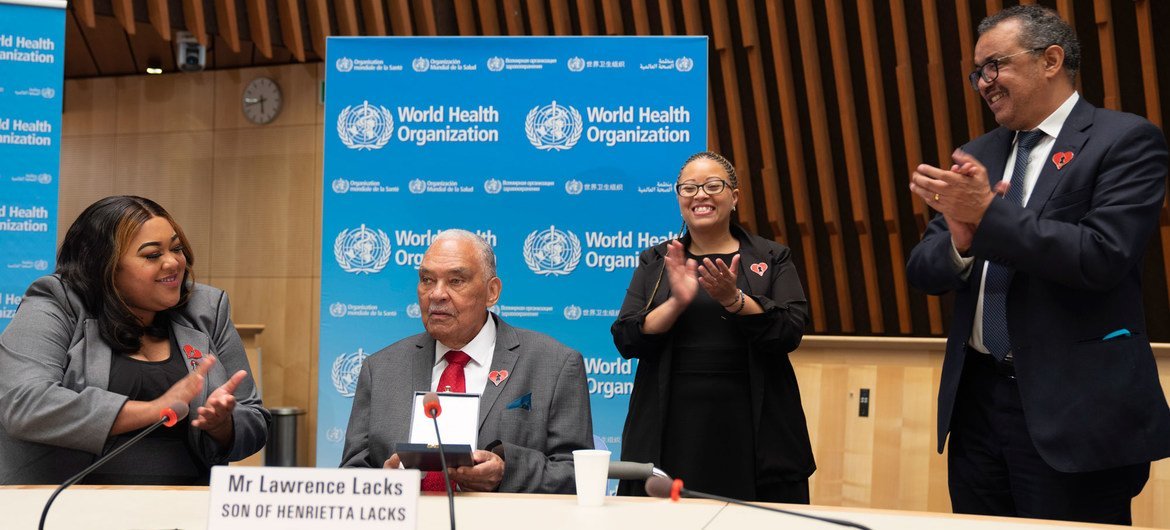
    Dr. Tedros Adhanom Ghebreyesus welcomes the family of Henrietta Lacks for a special dialogue at WHO headquarters in Geneva.

    Dr. Tedros Adhanom Ghebreyesus welcomes the family of Henrietta Lacks for a special dialogue at WHO headquarters in Geneva.

    Lacks family in new Goodwill Ambassador role

    In another development on Sunday, WHO chief Tedros announced the appointment of the Lacks family, as WHO Goodwill Ambassadors for Cervical Cancer Elimination.

    Henrietta Lacks, an impoverished African-American woman, died in 1951 from the disease, but left behind an extraordinary legacy through the unique properties of her cancer cells, which became the first “immortal” cell line, able to replicate outside the human body, providing countless medical breakthroughs since then.

    The so-called HeLa cells were taken from her without her knowledge or consent: “Much like the injustice of Henrietta Lacks’ story, women all over the world from racial and minority ethnic groups, face disproportionately higher risks from cervical cancer”, said Tedros.

    Cervical cancer elimination

    “WHO’s goal is to eliminate cervical cancer, which means the innovations created”, with her cells, “must be made available equitably to all women and girls. We look forward to working with the Lacks family to raise awareness on cervical cancer and advance racial equity in health and science.”

    Speaking at a ceremony during the World Health Summit, Alfred Lacks Carter Jr. said the family was accepting the honour to serve as Goodwill Ambassadors, “in the spirit of my mother, Deborah Lacks, who lost her mother, Henrietta, to cervical cancer, and worked to make certain the world recognizes her impact.”

    Source: news.un.org

  • FX committee did its best but cedi worthless against dollar – Franklin Cudjoe

    President of Imani Africa, Franklin Cudjoe, has said the FX Committee set up by government to help tackle the depreciation of the Cedi did its best to advise government on the local currency notwithstanding, the Cedi has become the most worthless against the US Dollar.

    In a social media post, Mr Cudjoe noted that the FX Committee tried to prevent the Cedi from becoming the most worthless against the US Dollar, adding that the government should have just dealt with the problem of the Cedi depreciation rather than set up a committee on it.

    “The Ghanaian currency, the Cedi is officially the most worthless against the $. My Cedi Committee did its best to advice against this eventually. Alas, when you see a snake, just kill it. No need setting up a Committee on snakes,” Mr Cudjoe revealed.

    Government in 2020 set up an FX Committee made to advise it on how to stem the depreciation of the Cedi, particularly against the US Dollar.

    The establishment of the committee, named the FX Developments Committee, is in fulfilment of a promise made by the ministry to constitute a bi-partisan committee to look into the problem and help address it.

    Inaugurating the committee, Deputy Finance Minister, Charles Adu Boahen said the committee will work to complement the efforts of the Bank of Ghana in curtailing the usual poor performance of the cedi against other major foreign currencies.

    “The formation of this committee is not to infringe on the independence of the central bank in its foreign exchange operations,” he said.

    The admission of failure by Franklin Cudjoe, who controversially accepted to be a member of the Committee, puts paid to claims that the committee has not had any impact on the value of the Cedi.

    Source: Ghanaweb

  • 2022/23 FA Cup season will be exciting – Chairman Wilson Arthur

    Chairman of the MTN FA Cup Committee, Wilson Arthur, has promised that the 2022/23 competition will be exciting and better.

    Clubs from divisions one and two leagues have been paired in the preliminary stage of the competition, which is expected to be played from Tuesday, November 1 to 10, 2022.

    The winners will join the Ghana Premier League clubs from the Round of 64 stage.

    “This year, I can assure you given the preparations I have seen, we will have a much better tournament coming up this year. Everything is poised for a wonderful season.” Wilson Arthur said at the preliminary stage draw held at the premises at the Ghana Football Association on Tuesday.

    The Round of 64 will be played from December 20-29, 2022 before the Round of 32 which has also been scheduled for January 20-23, 2023.

    The 2022/2023 season is the final year of MTN’s headline sponsorship deal.

    The relationship which commenced in the 2010-11 season was re-started for three (3) seasons commencing from the 2020/21 season.

    “We are grateful to MTN,” he said. This is the last year of the sponsorship.

    “I can see signs that they will continue. We are hoping that they will continue and we will attract more sponsors to join them,” he added.

    The grand finale of this season’s FA Cup competition will be staged on June 17, 2023, at a venue to be decided by the Ghana Football Association.

    Hearts of Oak are the defending Champions of the tournament after beating Bechem United in last season’s final.

    Source: Footballghana

  • Comedian James Corden apologises after Balthazar restaurant ban

    Comedian James Corden was temporarily banned from a New York restaurant on Monday after being “extremely nasty” to staff on two occasions, the owner said.

    Keith McNally, who owns popular New York eatery Balthazar, said Corden had been an “abusive customer” after some errors with his orders.

    But he later revealed the actor and TV host had since called and “apologised profusely”.

    Mr McNally then lifted the ban, saying, “I strongly believe in second chances.”

    In an earlier post laying out what happened, Mr McNally had described the host of The Late Late Show as “a hugely gifted comedian, but a tiny cretin of a man”.

    He said the first incident was in June, when Corden had eaten at Balthazar and showed a hair to the manager after his main course – the implication being it was in his food.

    Mr McNally observed that “although this is diabolical, it happens very occasionally in all restaurants.” He said Corden was unpleasant and told the manager: “Get us another round of drinks this second. And also take care of all our drinks so far.”

    A second run-in followed in November, the restaurant owner said. An omelette was the cause of the alleged rudeness.

    “Mr Corden’s wife ordered an egg yolk omelette with gruyere cheese and salad. A few minutes after they received the food, James called their server… and told her there was a little bit of egg white mixed with the egg yolk,” Mr McNally wrote on Instagram.

    Balthazar’s staff remade the dish, but they “unfortunately sent it with home fries instead of salad”, he added.

    “That’s when James Corden began yelling like crazy to the server: “You can’t do your job! You can’t do your job! Maybe I should go into the kitchen and cook the omelette myself!”

    Mr McNally described the comedian as being “the most abusive customer” since the business opened 25 years ago.

    The BBC has contacted Corden’s team for comment. He has not addressed the allegations in public.

    The row appears resolved from the restaurant’s side, with Mr McNally observing: “Anyone magnanimous enough to apologise to a deadbeat layabout like me (and my staff) doesn’t deserve to be banned from anywhere. Especially Balthazar.”

    Source: BBC

  • A bag of 5kg rice to hit GH¢90 by Christmas

    Food prices on the Ghanaian market have skyrocketed in recent months, raising serious concerns about the country’s rising cost of living.

    The development is largely driven by the depreciation of the cedi and the steep rise in prices of petroleum products, which has led to the upward adjustment in transport fares across the country. 

    The Independent Ghana conducted a survey at the Dome market, one of Accra’s major markets, to sample current commodity prices in comparison to prices in the second to third quarter of this year.

    The survey was designed to assess how recent increases in fuel prices, transportation fares, and currency depreciation had affected food prices in the run-up to the holiday season in December.

    By reducing the income of workers in the public and private sectors, whose salaries have largely remained static since January 2022, this recent phenomenon is threatening financial and  food security for a lot Ghanaians.

    On the market, a 5kg of Lele and Cindy rice is currently sold at GH¢68 and GH¢77 respectively as against GH¢32 and GH¢35 three months ago. 

    According to Madam Sarah who deals in the retail of rice and other commodities, the price of a bag of 5kg rice could shoot up to about GH¢85 or GH¢90 by December.

    “50kg bag of Lele rice currently sold at  GH¢790 by December will be sold at  GH¢900 or GH¢1000 if the cost of goods do not reduce” she revealed.

    “50kg bag Royal Aroma currently sold at GH¢530 by December could be sold at GH¢600 or GH¢650”.

    She lamented that due to the cost of goods, customers are unable to buy, making business very slow.

    She blamed the situation on the cost of transport, adding that the depreciation of the dollar against the cedi could be a major factor. 

    She, therefore, appealed to authorities to implement policies to mitigate the rate at which prices of goods and services keep increasing by the day.

    Meanwhile, a 100kg bag of sea salt now sells at GH¢1000 as against GH¢800 in June this year, while a small-sized sachet of U2 iodized salt and Anapuna salt is now GH¢2 when it was previously sold at GH¢1. Now the sea salt is no longer tied and sold at GH¢1.

    A 5 litre gallon of cooking oil is now sold at GH¢505 when it was previously sold at GH¢408 according to Madam Awo, a trader at the market who sells various kinds of cooking oil. She explained that she is unable to purchase Frytol cooking oil because it is very expensive.

    A gallon of red oil according to her is GH¢120 which was formerly at GH¢100.

    In relation to products measured using olonka, one olanka of gari, according to Mama Gee costs GH¢12 which was formerly sold at GH¢11 a month ago. Other traders, however, sell theirs for GH¢13 and GH¢14. And one olonka of beans ranges from GH¢22 to GH¢30. 

    The majority of the traders, largely women, who interacted with the Independent Ghana during the random survey blamed the rise in food prices on the increase in fuel prices, and subsequently called for swift government intervention to help stabilise the prices.

    “Once they increase petrol prices, the cost involved in transporting the goods from the farm gates to the market centers also goes up. This affects the prices of the foodstuffs. The hardship is too much, so the government should do something about it,” a trader added.

    Source: The Independent Ghana

  • Afrobeats gets a place on America Music Awards

    The American Music Awards (AMAs) has introduced a category dedicated to recognising Afrobeats.

    The new category is called ‘Favourite Afrobeats Artist’.

    It is the first award in a major US award show dedicated to recognising African artistes that have transcended the African borders with the now globally recognised genre.

    Fans of Afrobeats artistes can vote for their favourite stars who have been nominated. Unfortunately, for the category’s debut, no Ghanaian act was nominated.

    The nominees for the 2022 AMA ‘Favourite Afrobeats Artist’ are; Burna Boy, CKay, Fireboy DML, Tems, and Wizkid.

    Tems has another nomination in the ‘Collaboration of the Year’ category for her collab on Wait For U with Future and Drake.

    Meanwhile, Afrobeats is not the only music genre to have a spot in the AMAs.

    The K-Pop genre also landed a category. The category is named ‘Favourite K-Pop Artist’. Fans of K-Pop also now have the chance to vote for their favourite artiste or group.

    Afrobeats gets a place on America Music Awards

    The K-Pop artists nominated are Blackpink, BTS, Seventeen, Tomorrow X Together and Twice.

    BTS is also nominated in the ‘Favourite Pop Duo or Group category.’

    This comes weeks after calls for The Recording Academy, organisers of Grammy, to add Afribeats as a category to the awards scheme.

    In September, the Chief Executive Officer (CEO) of The Recording Academy said there is a possibility the event will in the near future have a category for Afrobeats.

    Speaking to the media on his arrival in Ghana, Harvey Mason Jr, noted that The Recording Academy recently had a meeting with leaders of the Afrobeats community including producers, songwriters, executives and others to learn more about the genre – and will continue to do so.

    “We just talked about what are the different sub-genres (of Afrobeats), the needs, the desires, and my goal is to represent all genres of music including Afrobeats at the Grammys, but it has to be done properly,” Mr Mason said.

    Meanwhile, in March 2022, Billboard created the U.S. Afrobeats Songs chart – a standard record chart ranking the 50 most popular Afrobeats songs in the United States weekly.

    Source:myjoyonline.com

  • Ethiopia civil war: Federal army seizes Shire and two other Tigray towns

    Ethiopia says its soldiers have seized three towns in the northern Tigray region from forces it has been fighting in the 23-month civil war.

    It has promised to take “maximum care” to protect civilians from harm.

    The news comes as diplomats grow increasingly worried about the impact of the war on citizens.

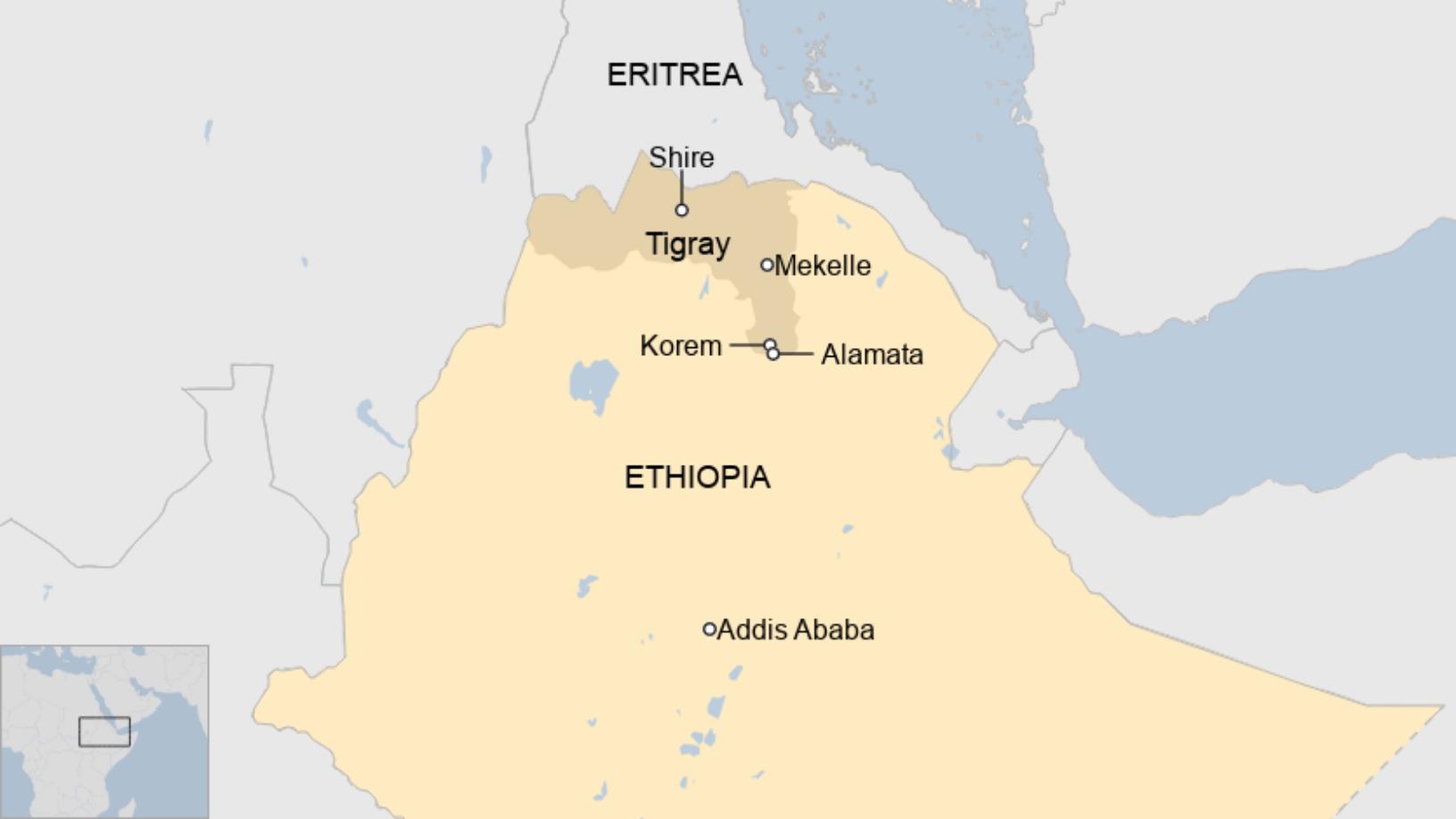
    The loss of the strategic city of Shire, with its airport and road links to the regional capital, comes as a significant blow to Tigrayan forces.

    Alamata and Korem are the two other towns now claimed by Ethiopian federal troops.

    This is the latest escalation in the conflict with the Ethiopian government, whose troops are being bolstered by Eritrean allies.

    Ethiopia on Tuesday promised to work with humanitarian agencies to bring vital aid to all parts of Tigray now under its control, but many analysts are sceptical because similar promises have been made and broken in the past.

    Most of Tigray has been under a virtual blockade by the federal government since June 2021, when Tigrayan forces recaptured much of the region.

    Shire is one of Tigray’s biggest cities with some 100,000 residents.

    Reporters on the ground in the regional capital, Mekelle, say there was a mix of anger and shock over the news of the loss of Shire.

    Residents are glued to radio sets and discussing the information on street corners, while others are preparing food to support the Tigrayan Defence Forces and also stocking up for themselves as a precaution.

    One woman said “we will not give up defending ourselves from those who are coming to humiliate us”. Another feared for her sister living in Shire, saying “they [the federal forces] will kill her”.

    Thousands of residents are already leaving Shire, despite the Tigray People’s Liberation Front (TPLF) insisting that the loss of control to federal troops is only temporary.

    Map

    Many of the people leaving had previously been forced to flee their homes in other parts of Tigray, and had come to Shire where they were living in makeshift camps in schools and university campuses.

    The TPLF have said they are locked in a “life and death struggle” and called on all Tigrayans to keep fighting, but have also sought to play down developments saying “during war movement out of areas is natural”.

    The war has left a humanitarian disaster in its wake.

    The UN says that currently 5.4 million people – around three-quarters of Tigray’s population – need some kind of food aid as the fighting has disrupted supplies.

    UN Secretary General António Guterres said on Monday that the situation in Tigray was “spiralling out of control” and hostilities must end immediately, and the African Union has called for the same.

    But the violence shows no sign of ending and attempts to start peace negotiations – though welcomed by both sides – have not yet borne fruit.

    Diplomats have been warning of a civilian bloodbath if more TPLF forces are pushed out of other towns and cities.

    Within less than 100km (62 miles) from Shire are two other major cities – the historic Axum and Adwa.

    Emboldened by its gains, the federal government could head for Axum and Adwa, which would then give them access to the main highway leading to Mekelle.

    In August, Prime Minister Abiy Ahmed alleged that planes carrying weapons were landing at night in Shire – presumably to support Tigrayan forces. Mr Abiy did not specify where the flights were coming from.

    In a statement on Monday, the government’s communication office accused Tigrayan forces of colluding with unnamed “hostile” foreign actors in violating Ethiopia’s airspace as a justification for the decision to control airports.

    Fighting began in November 2020, when federal Ethiopian forces tried to wrest control of the region from the TPLF.

    Source: BBC

  • Cedi depreciation, high inflation temporary – BoG

    The second Deputy-Governor of the Bank of Ghana (BoG), Elsie Addo Awadzi, is optimistic that the current economic turmoil will soon be a thing of the past.

    Describing the high inflation and rapid depreciation of the Ghana Cedi as a temporary situation, Madam Addo Awadzi stated that her outfit, together with the Finance Ministry, is working tirelessly to cushion the economy. 

    She disclosed that with the proposed programme by the International Monetary Fund (IMF) both inflation and cedi depreciation will be stabilised.

    Speaking at the 21st annual RCB CEOs Conference held in the Volta Region, Madam Awadzi stated that, “recent global developments have heightened economic and business uncertainties for businesses and individuals. Our domestic economy is not spared from these developments. 

    “The Bank of Ghana is working closely with the Ministry of Finance and other key stakeholders to negotiate a sound economic reform programme supported by the IMF, to stabilise and transform our economy,” she added. 

    Ghana’s inflation rate has seen an astronomical hike in 2022.

    The Ghana Statistical Service (GSS) disclosed that inflation (year-over-year) soared by 3.3% to 37.2% in the month of September.

    This, according to GSS, is against 33.9% recorded in August 2022.

    The cedi, on the other hand, has been classified as the worst-performing currency in the world.

    The local currency is trading around GH¢12 to the US dollar at the forex bureaus or the retail market.

    Despite the economy being in shambles with hikes in basic commodities such as food, fuel, etc, the second Deputy-Governor of BoG is insistent that the economy will soon get back on track.

    She, thus, cautioned all and sundry to refrain from speculative behaviour which tends to aggravate the situation. 

    “We at the Bank of Ghana are confident about the outlook for our economy. The current high inflation and cedi depreciation are temporary, and we must avoid speculative behaviour that only works against attaining stability sooner.”

     Source: The Independent Ghana

  • Bawumia caused this economic mess – Adongo lists government’s failed policies

    Isaac Adongo, the member of parliament for Bolgatanga Central, blames Dr. Mahamudu Bawumia, the vice president, for the country’s current economic woes.

    He claimed that the well-known economist was hailed as a financial wizard who knew how to stabilize Ghana’s economy. The nation’s actual position, however, does not reflect this.

    “In all of this, the context must clearly place the principal person behind the current economic anxiety and the problem we confront,” the vice president stated, blaming him.

    Adongo stated that the economic policies implemented by President Nana Addo Dankwa Akufo-Addo were influenced by Bawumia, however, these policies have not yielded the intended results.

    In an article authored by the Bolga Central MP, he wrote: “Aside from his divisive politics, it is also quite clear that a significant portion of the economic policies implemented by the NADAA government is touted Bawumia ill-conceived ideas.”

    “Do you remember the one district, one dam, one constituency, one million cedis, the development authorities as they then were, the quite clearly botched synohydro credit facility that had a shifting figure from 20 billion dollars to its current meager amount, and the bullish increase in the participation of foreign entities in the local bonds market?” he added.

    Explaining further, he noted that these initiatives have either failed or have only been able to offer temporal solutions to the economy’s problems.

    “These initiatives were problematic on several fronts,” he said.

    1. They only sought short-term reliefs, which were unsustainable with the dire consequence we face presently as an outcome. For instance, our exchange rate has suffered massively anytime international investors panicked and seek to move their funds.

    2. They introduced unnecessary friction into the public sector bureaucracy, especially the disastrous development authorities and the supposed initiatives of about a million cedis per constituency. Why for instance was NABCO not situated under the national service scheme or YEA?

    3. Were costly and a massive waste of money with no clear sustainable medium to long-term impact on social equity, upward economic mobility, improvement in livelihoods, and business growth.

    4. Exposes Bawumia as a person who is not susceptible to reasoned argument, unwilling to engage experts, especially within the public sector bureaucracy, and who has dissenting opinions,” he detailed.

    He also accused the Vice President of deliberately avoiding discussions on “the economic mess he has created” and is seeking to find new allies and new stuff to occupy his time.”

  • Nico Williams named Man of the Match after providing an assist in Athletic Bilbao draw with Getafe

    Ghana target Nico Williams was adjudged named Man of the Match after registering an assist for Athletic Bilbao in their 2-2 draw against Getafe in LaLiga on Tuesday.

    The 20-year-old put an impressive display as his side secured a point at the Coliseum Alfonso Perez.

    His brother Inaki Williams marked his 350th appearance by scoring a second-minute goal after excellent work from former Manchester United and PSG midfielder Ander Herrera.

    The goal did no last long as Carles Aleñá equalized for the home side in the 27th minute.

    The visitors continued to press Getafe after halftime and it paid off in the 62nd minute. Nico Williams sent a wonderful pass to Raul Garcia who made it 2-1.

    Nico Williams was substituted in the 74th minute and replaced by Oier Zarraga.

    Getafe shocked the visitors who were cruising to a win. Duarte sent in a ball that found Munir in the 76th minute to make it 2-2.

    The draw extended Athletic’s winless run to four games following their goalless stalemate against Atletico Madrid on Saturday and they have now slipped from third to sixth on the table on 18 points from 10 matches, seven behind leaders Real Madrid, who play Elche on Wednesday.

    Nico Williams has scored three goals and provided three assists in 10 league games this season.

    Source: Footballghana

  • Exchange rate too high, reduce it now – Importers to government

    Concern over the nation’s high exchange rate on import levies has been voiced by certain Ghanaian importers.

    The New Patriotic Party administration under President Akufo-Addo should swiftly lower the exchange rate on import duties, according to the importers, in order to help Ghana’s struggling economy.

    The exchange rate for port duties was recently reviewed by the GRA’s Customs Division.
    Exchange rates increased from GH8.29 to GH9.54 as a result.

    Mr Amoateng and Asirifi, Ghanaian importers, stated on MYABCTV’s ‘Bekyeremu’ show on Saturday that the high exchange rate is steadily imploding their businesses.

    According to them, at the beginning of this year, 2022, the exchange rate on import duties was 4.6 however, the Ghana Revenue Authority (GRA) has inflated it to 10 in recent days.

    They truly think Ken Ofori-Atta, the finance minister, is not top of his job because he should have been able to peg it at 6.8 amidst the dollar which is trading at GHc12.

    “Exchange rate on import duties is too high. The government should have pegged it by 6.8 by now. Because in the beginning this year, it was 4.8 but it has been increased to 10 as we speak.”

    They added that “The government is unable to give us money to work so what finance minister, Ken Ofori-Atta and President Akufo-Addo must do is to reduce the exchange rate at the ports.”

  • ‘The suffering is real’ – Sam George on economic challenges

    Ningo-Prampram Member of Parliament, Sam Nartey George, has said only God can save Ghana’s ailing economy.

    His comments come on the back of the country’s current economic challenges.

    Ghana’s annual inflation rate accelerated to 37.2 per cent in September 2022, for the 16th straight month from 33.9 per cent in August.

    This was the highest reading since July 2001.

    Also, prices of imported goods accelerated faster than domestic items.

    This is largely due to the weakening cedi.

    Mr Nartey George, who referred to one of the icons the governing New Patriotic Party (NPP) used in the 2016 election campaign, Kalyppo, said despite the sweet taste of the fruit juice, Ghanaians are witnessing the opposite.

    “Kalyppo is supposed to be sweet but what we are seeing is a completely different ball game, oh”.

    “Even Akpeteshi would not burn us like this,” Mr Nartey George stated in a Facebook post on Monday, October 17, 2022.

    He added: “The suffering is extreme! Only God can save us now.”

    Prior to the 2016 elections, drinking Kalyppo became a trend as leading members of the NPP, including Vice-President Mahamudu Bawumia and his wife, Samira, among others were seen sipping on the drink.

    Ghanaians joined in the trend, too, to support the then-flagbearer of the NPP, Nana Addo Dankwa Akufo-Addo.

    Source: Ghanaweb

  • Ghana’s inflation largely due to domestic factors – IMF

    According to the International Monetary Fund, Ghana’s rising inflation is primarily caused by domestic factors.

    Abebe Selassie, the African Director at the IMF, claims that Ghana is one of the nations where internal forces are mostly to blame for inflation.

    As of September 2022, Ghana’s inflation rate—which has been rising since the year’s beginning—was 37.2%.

    However, the government has stated that the COVID-19 epidemic and the Russia-Ukraine war are just two examples of the global events that have contributed to the inflation.

    Speaking at a press conference at the recent IMF/World Bank Spring Meetings, Abebe Selassie, said “on inflation, I mean, again, there are always trade-offs when you’re doing policy calibration, and so in our regional economic outlook, we are very careful to flag that there are some countries where inflation has clearly been driven more by domestic factors than exogenous factors. I think Ghana would fall in that camp.”

    “But there are also quite a lot of other countries where the inflation we are seeing is more important, so the scope and the space and the ability of monetary policy to address that is limited. So again, it depends on country-specific circumstances, and on time,” he is quoted by myjoyonline.com.

    The IMF added that the adjustments of the monetary policy must be done swiftly because the adjustments affect how inflation is driven in the economy.

    He said, “exchange rates are moving, commodity prices are moving, so it’s an area where calibration must be very, looked at again and again and again, as the months proceed.”

    “That’s why, Central Bank can say you have to be forward-looking, data-driven, so our advice is also, very much, subject to those considerations,” he added.

    According to the GSS, the factors that influenced inflation were, Housing, Water, Electricity, Gas and Other fuels (68.8%); Furnishings, Household Equipment, and Routine Household Maintenance (51.1%); Transport (48.6%); Personal Care, Social Protection and Miscellaneous Goods and Services (42.6%) as well as Food and Non-Alcoholic Beverages (37.8%).

  • My customized Range Rover has become their headache – Shatta Wale

    Dancehall musician, Shatta Wale was on October 17 presented with a customized red Range Rover as a birthday gift in his newly-acquired glass house.

    As expected, there have been many questions surrounding the birthday gift that critics claim is an old car that was pimped and presented to the artists as a brand-new whip just for trends.

    The celebrant and the man of the moment have taken time to respond to the hundreds of questions and allegations made against him by critics. Tagging them as haters in a Facebook post just a day after his birthday, Shatta mentioned that they can never match up to his standard despite the negative comments.

    “Because your eye no open, somebody en customized car too be problem for you…aboa buy some u go hung saaaaa for this Ghana.”

    According to the famous Dancehall musician, nothing he does including his music will ever please naysayers who have singled him out for failure.

    Typical of Shatta Wale, the self-acclaimed richest Ghanaian musician reminded critics of his wealth.

    Check out the post below:

    Source: Ghanaweb

  • IES warns of fuel shortage

    The Institute for Energy Security (IES) has served notice concerning an impending nationwide shortage of petroleum products. 

    Speaking to the media on Tuesday, October 18, 2022, the Executive Director of IES, Nana Amoasi VII, said the depreciation of the cedi and the lack of working capital of importers and distributors of fuel to sustain their businesses are the factors for the looming shortage.

    He added that importers and Bulk Oil Distribution Companies(BDCs) have difficulty in acquiring refined crude oil.

    “There is something to be much worried about and that’s the likelihood of the shortage of the commodity on the market on the back of a reported shortage of dollars for the Bulk Oil Distribution Companies, the importers and the erosion of working capital of some of these importers. The price of crude oil remains high and the cedi value continues to decline”.

    “We first raised these concerns in March this year and in the following month there were reports of the pocket of shortages of fuel across the country”, he explained.

    According to Nana Amoasi VII, fuel crisis would be inevitable if the government does not implement measures to avoid the situation.

    “This time around any incident of shortage may be widespread if we fail to plan against it. It is more serious”.

    Earlier in September, the Bulk Oil Storage and Transportation Limited (BOST) said that there will be no fuel crisis as many have declared.

    The company explained that estimations from the National Petroleum Authority (NPA) indicated that  the entire amount of fuel  as of September 20, 2022, was equivalent to 43 days worth of national consumption, not 13 days as circulated.

    “Instead of the expected minimum of six weeks of national demand in storage as per the second mandate, BOST currently has stocks which can only last 13 days in the event no further imports of products are carried.

    “At any material moment, the total quantities of product available in the country, thus across all tank farms as tracked by the National Petroleum Authority, includes BOST stocks and stocks of private BDCs,” the release explained.

    Petroleum products are now costing more at the pump, some Oil Marketing Companies (OMCs) are selling petrol per litre for GHC13.00 instead of the prior price of GHC11.10, a 16% increase.  

    Also, the cost of diesel per litre has increased dramatically from its prior price of around GHC 13.90 to roughly GHC15.99. This represents a 12% rise. 

    Meanwhile, the cost of Liquefied Petroleum Gas (LPG) is expected to increase by 10%. 

    Source: The Independent Ghana

  • Insurance development critical to journalism profession in Ghana – GJA to NIC

    Albert Kwabena Dwumfour, president of the Ghana Journalists Association (GJA), has emphasized the critical part that insurance has played in the growth of the Ghanaian journalism industry.

    He asserts that insurance is essential to protecting the lives of journalists, who under Ghana’s social and democratic system are regarded as the fourth estate of the realm.

    On October 18 in Accra, Albert Dwumfour praised the Commissioner of Insurance, Dr. Justice Ofori, for his valiant efforts in advancing the insurance business so far. He was speaking during a courtesy call to the National Insurance Commission (NIC).

    He however commended the Commissioner for the introduction of the Motor Insurance Database (MID) and other significant reforms and policies aimed at improving the insurance space.

    “I want to commend Dr. Justice Ofori for his excellent performance since his appointment into office as the Insurance Commissioner which has led to the many policies and accumulation of several awards both to his honour and that of the Commission,” he noted.

    “I am also here to share the new vision of the Ghana Journalists Association with the Commission towards the advancement of the insurance sector, particularly for journalists in the country,” the GJA president added.

    He further touched on the relevance of new media in today’s journalism practice and the need to incorporate new media into the traditional media in a bid to move journalism practice to meet higher standards in the country.

    Commissioner of Insurance Dr. Justice Ofori on his part expressed gratitude to the GJA executives and indicated that the Commission is keen on working with the Association in attaining greater heights in the country.

    Present during the courtesy call were the newly elected executives of the Ghana Journalists Association (GJA) led by Mr. Albert Kwabena Dwumfour, GJA President, Mad. Linda Asante Agyei, GJA Vice President, Mad. Rebecca Ekpe, Public Affairs Officer of the GJA, Mr. Dominic Hlordzi, Organizing Secretary of the GJA, and Mad. Audrey Dekalu, Treasurer of the GJA.

    Also present at the engagement was Dr. Justice Ofori, Commissioner of Insurance and other officials of the Commission.

    The courtesy call was aimed at formally introducing themselves to the Insurance Commissioner and strengthen the working relationship that exists between the Association and the Commission.

  • Moliy releases highly-anticipated EP ‘Honey Doom’

    Rising sensation, Ghanaian-American songstress Moliy, is set to drop her highly-anticipated full EP Honey Doom, on October 19th.

    The eight-track project is the follow-up to her mini-EP “Mahogany St,” and the first full release since 2020’s Wondergirl skyrocketed the artist to virality, via her hit track “Sad Girlz Luv Money”, featuring Amaarae and Kali Uchis, which has amassed nearly 250 million streams to date.

    ‘Honey Doom’ features some of Moliy’s most vulnerable, raw storytelling to date, and tracks her personal development as a young woman unpacking love and relationships; alongside her own experimental journey with her sound, which remains otherworldly, airy and optimistic, while expanding to include more of her influences globally.

    Moliy teased the project back in February when she dropped the first single “Love Doc,” featured in PAPER Magazine, who described it as “smooth, effortless, tender and bewitching…an easy, glistening single that captures a moment in her life when she was heartbroken.”

    The follow-up single, “Hard,” is a lo-fi, sparkling, staccato anthem, unapologetically crafted for sexually liberated women (and people) globally. Moliy uses the hypnotic track to flex her expanding prowess, experimenting with her rap flow alongside South African star Moonchild Sanelly, who is widely known for her major contribution to Beyonce’s Black is King album.

    The project also features legendary Ghanaian-British producer Juls, considered a pioneer in the African music diaspora, and best known for his production work with the likes of Burna Boy, Mr. Eazi, Stonebwoy and more. Juls produced Honey Doom’s opening track “Together,” Moliy’s up-tempo, wistful ode to her first love, and came to Ghana to record with Moliy in person.

    The painfully honest, and ostensibly upbeat “Freak” is another vulnerable standout, the delicate, self-reflecting work of a young woman confronting her own demons, and the toxicity that has plagued her past relationships.

    She croons, “won’t be a punching bag just because you can’t communicate…I’m not your freak anymore, got put on the floor, you probably should have acted right, cold to the core.” She’s defiant, she’s growing up, and she’s not embarrassed by the ghosts of her past – she’s empowered and confronting them, and she wants to talk about what’s happened to her, and hopefully be a conduit for other women to share their own stories.

    The rest of the project features hypnotic dance tracks paired with intentional, sometimes heartbreaking storytelling, buoyed by Moliy’s classic sound, like her floating, airy vocals on the haunting “Prisoner,” or “Body on Fire.”

    The experimental “Banana” also showcases her undeniable maturation – the singer has been working hard, she’s more confident in the upper-register pocket that buoyed her to stardom than ever before, and she’s pushing the boundaries of her own sound, and what fans have come to expect from her.

    2020’s Wondergirl, was highlighted on BBC News This is Africa, Apple Music via Ebro Discovery, topped Billboard charts, and led to her becoming a new member to the Recording Academy Class of 2022.

    The superstar also dropped surprises for fans in the meantime, like her mini-EP Mahogany St., including Love Doc, also featured on Apple Music’s Global Chart show, where Moliy was featured as an emerging talent in February. She also premiered visuals for the reggae-tinged “9-5,” which you can view here.

    As one of Ghana’s foremost rising artists, the alté and afrofusion singer has been on a consistent rise since the viral celebrity of Sad Girlz Luv Money, and was recently featured in Spotify’s Equal Africa campaign, including a featured billboard in Times Square. Her original track The Place was also highlighted in Apple Music’s 2022 Juneteenth Freedom Songs playlist, in which Moliy was the only African artist featured alongside artists like 6LACK, Kranium, Lupe Fiasco, and more.

    And this is only the beginning — the further Moliy goes, she’s hoping to open more doors for other women in music throughout her native country of Ghana. “They need to know there is no limit to what we can achieve, regardless of our background,” Moliy says. “I would love for all women to feel confident and empowered, even on the saddest and hardest of days.”

    About MOLIY:

    Molly Ama Montgomery, professionally known as MOLIY, is a singer and songwriter of Ghanaian and American descent. Deeply influenced by her rich Ghanaian ancestry, Moliy’s childhood fluctuated between Accra and Orlando, Florida where the musical sounds of Afrobeats, Reggae, Soul, Jazz, and Hip-Hop inspired her musical pursuits at a very young age.

    Her profound love for music was also inspired by frequent Karaoke performances alongside family and friends, which gradually developed her unique musical prowess with vocals and melodies that are deeply rooted in soul. Self-identifying as a genre-bender who embraces all forms of music, Moliy took advantage of the global digital space to introduce her creative versatility and sound through provocative freestyles on social platforms.

    Despite a year beset with a global pandemic in 2020, Moliy captured audiences by strategically releasing Wondergirl, which skyrocketed the artist to virality, via her hit track “Sad Girlz Luv Money,” which has amassed nearly 250 million streams to date.

    The project which was highlighted on BBC News This is Africa, Apple Music via Ebro Discovery, topped Billboard charts, and led to her becoming a new member of the Recording Academy. Her mini-EP Mahogany St., was featured on Apple Music’s Global Chart show.

    As one of Ghana’s foremost rising artists, the alté and afrofusion singer has been on a consistent rise, and was featured in Spotify’s Equal Africa campaign, including a billboard in Times Square. Moliy was also highlighted in Apple Music’s Juneteenth Freedom Songs playlist, in which Moliy was the only African artist featured alongside artists like 6LACK, Kranium, Lupe Fiasco, and more.

    As one of Ghana’s foremost new artists, Moliy’s main objective is to authenticate herself in the new crop of vibrant female singers that are carving a path for themselves in the mostly male-dominated industry. With Ghanaian music on the global rise, expect to see and hear Moliy on stages and platforms worldwide for years to come.

    Source: Ghanaweb

  • Ghana Cedi now world’s worst-performing currency – Bloomberg

    The Ghana cedi, which has lost 45.1% of its value against the US dollar this year, is now the worst-performing currency in the world.

    This revelation was contained in a report by Bloomberg on October 17, 2022.

    Per the report, Ghana’s currency depreciated 3.3 per cent as of Monday, October 17.

    The local currency is currently trading around GH¢12 to US$1 – indicating a 50% depreciation since the beginning of the year.

    As a result, Ghana’s currency has dropped to the bottom, switching positions with the Sri Lankan rupee, which is now the second-worst performer with a 44.7 per cent drop to the dollar this year.

    Other African currencies that have declined sharply, besides the Ghanaian cedi, include the Nigerian naira and the South African rand.

    Even though the U.S. dollar continues to surge against other currencies, Pakistan’s volatile rupee (PKR) became the world’s best-performing currency as of October 7. PKR made the largest gain of 3.9%

    Why the Cedi fall

    The cedi depreciated sharply this year as demand for forex overtook supplies at a time when high debts and low investor confidence have made it impossible for the country to access the international capital market for borrowing.

    Government intervention

    As part of measures to stabilise the currency, the Bank of Ghana disclosed its initiative to increase foreign currency supplies to banks in the short term to help meet growing foreign currency demands.

    The central bank and some security officials also spearheaded a crackdown on the illegal market in some parts of Accra, in order to stop additional cedi depreciation.

    Also, with the first tranche of the $1.3 billion Cocoa Syndicated Loan hitting BoG’saccount, it may help boost the bank’s reserves.

    This could help in slowing the sharp depreciation of the cedi.

    Source: The Independent Ghana

  • Citrus industry gets big boost

    The Central Citrus Processing Limited cooperation for crop improvement and replacement support has over 1,100 farmers in the AAK district in the central region thrilled (CCPL).

    In the coming months, the CCPL will put into operation one of the biggest citrus processing facilities, which will be able to turn over 15 tons of oranges an hour into fruit juice.

    Ghana will become a leader in the production of natural fruits and juices thanks to the firm’s relationship with Ekumfi juices and processing business.

    This project has come in timely to the farmers of the district as over the years they have not been making profits from their citrus farms and were cutting them down to grow other crops.

    These farmers are 75 years in age and had lost hope in the industry as their children shy away from citrus farming.

    Today with the intervention of CCPL, the youths have gained employment through the mechanised community crop management services. It is expected that this factory processes fruit from an average of 6000 acres per year into both juices and oils both meant for exports and local markets

    Last year, the Agricultural Development Bank (ADB) partnered the OVCF with an aim to revamp the citrus industry.

    Through this partnership, ADB gave financial support to the Central Citrus Processing Limited to develop and cultivate the over 3,000 acres of abandoned citrus farms located in Cape Coast in the Central Region

    It is estimated that the company will generate an income of about GH¢250million annually.

    This support by ADB was expected to go a long way in creating more sustainable jobs and also cut down on the importation of fruit juice into the country.

    Central Citrus Limited will be getting a direct off-take from the Ekumfi Fruits and Juices Factory to make sure their produce is used to blend the Eku tropical varieties to enhance their taste.

    This support by ADB means the bank has bought into the vision of President Nana Addo Dankwa Akufo-Addo to take off the shelves most of these foreign products and bring in Ghanaian products.

    Ghana has the two most suitable sources of oranges coming after South Africa, which makes it a prudent venture that ADB has signed onto.

    The decision by ADB to go into this venture will lead to the creation of more jobs – promoting processing, reducing importation and shielding the cedi from unnecessary pressure.

    The enclave has over 75 thousand acres of citrus, and with the support from ADB it will scale up economic activities sharply.

    The average citrus farmers have abandoned their farms because of poor revenue coupled with insect infestation and plant diseases, together with unproductive work processes which often hamper cultivation. Many of the seedlings are pest-ridden, making them useless for further planting.

    This frustration usually makes the farmers switch over to the cultivation of rubber and cassava.

    For the past 10 years most citrus farms have been abandoned, as the importation of finished products has outweighed the processing opportunities in the country.

    ADB’s financial support was to help improve the quality of citrus production and increase sustainable income for all actors along the citrus value chain.

    Citrus fruit have long been valued as part of a nutritious and tasty diet. The flavours provided by citrus are among the most preferred in the world, and it is increasingly evident that citrus not only tastes good but is also good for people.

    It is well established that citrus and citrus products are a rich source of vitamins, minerals and dietary fibre (non-starch polysaccharides) that are essential for normal growth and development as well as overall nutritional well-being.

  • Ivorian Haller ‘going well’ after cancer treatment

    Borussia Dortmund’s Ivorian striker Sebastien Haller has raised hopes he will be able to return to the professional game after undergoing chemotherapy for a testicular tumour.

    Haller received warm applause from the audience when he walked on stage to present the Yashin Trophy for best goalkeeper, which was won by Real Madrid’s Thibaut Courtois.

    “Everything is fine. I am here because everything is OK and going as well as it can,” Haller told compatriot and event co-host Didier Drogba.

    “It is important to be present at this kind of ceremony to show that we are fighting and that we are strong, because we represent a lot of people out there.”

    Haller, whose shaved head reflects weeks of treatment, placed 13th of the 30 players nominated for the Ballon d’Or, which was won by France striker Karim Benzema.

    Ivory Coast international Haller finished top scorer in the Eredivisie last season with 21 goals, scoring 34 times in 43 appearances in all competitions for Ajax in 2021-22.

    Dortmund in no rush

    After a successful campaign with the Dutch giants, the former Eintracht Frankfurt and West Ham player signed a four-year deal with Dortmund for a fee that could increase to 34.5m euros.

    Despite his latest public appearance, Dortmund’s general manager Hans-Joachim Watzke has said last season’s Bundesliga runners-up will not rush Haller back into action.

    “We are hopeful that he can play again in the second half of the season. But only he will decide that,” Watzke told Bild earlier this month.

    “We don’t want to and shouldn’t put him under pressure. The tumour was massive and he has all the time in the world to return whenever he wants.”

    Haller represented France at youth level before switching allegiance to Ivory Coast, and has also previously played for Auxerre and Utrecht.

    He has scored four goals in 15 appearances for the West African nation and played all four matches as the Elephants exited this year’s Africa Cup of Nations in the last 16.

    Source: BBC

  • How I became one of Ghana’s biggest in my field – Male makeup artiste speaks

    He is now a master in his field, with the wild ability to transform faces with his makeup products and tools, in an arguably women-dominated field.

    Nathaniel Amewugah, popularly known as Kruz K, is arguably one of Ghana’s best when it comes to the craft but his specialty is in special effects; what is usually known as SFX.

    Having won awards including, the Best Special Effects Makeup Artiste from the Ghana Beauty Awards, Prestigious West Africa Photo Arena Awards 2019 and Makeup Artiste of the Year at the Ghana Arts and Culture Awards among others, Kruz K shared his success story when he took his turn on GhanaWeb’s People & Places show;

    “Everything came when I was in school, in GH Media, and I went to acting class one day and our directing lecturer; Major Vine, he was the one who taught us a little bit of Halloween makeup. He was just doing a sketch of Halloween makeup and I was like; ‘this is so nice’, I was loving the whole thing.

    “So I came to the hostel that night and borrowed a friend’s laptop and I was using the school’s wifi, and then I went online, watching more videos and all and I realized this looks really interesting so I decided to take it up,” he told host, Wonder Ami Hagan on People & Places.

    According to Kruz K, this decision wasn’t an easy one because there were barely the right materials to begin his journey with but his determination led him to improvise.

    “Funny enough, there were no materials at that time in Ghana and even till now, so watching the videos and trying to create the thing was so difficult because you don’t have the materials available, so how then do you create?

    “So I decided to start research and found new ways to improvise and still do good work in special effects, talking to people who were there before me, so that was how everything started

    “Before I started getting my products from Nigeria, I was using the normal food colour, glue, tissue, cotton, it’s all about your creativity,” he further noted.

    Having excelled in his field, Kruz K was also sure to acknowledge persons he says were part of his growth journey.

    “I wasn’t the one who brought special effects. I only drove people’s interests into special effects but then there were pioneers before me – Mr. Johnson, the one who did the makeup for Kyeiwaa, and Kojo Hilton, the Art Ambassador for West Africa,” Kruz K stated.

    Source: Ghanaweb

  • Hunger could kill huge numbers of Somali children – UN

    Drought in Somalia threatens to cause deaths of children on a scale not seen in half a century, the UN children’s agency, UNICEF, has warned.

    At least one child is being admitted in hospital for malnutrition in Somalia every minute, Unicef said.

    In August alone, more than 44,000 children were in hospital with severe malnutrition.

    Pressure is now mounting on the authorities to formally declare famine in order to facilitate an emergency response.

    The worst-affected parts of the country are largely occupied by militants from the al-Shabab group, who have curtailed the humanitarian response.

    The drought, which is linked to climate change, is the worst to hit the country for 40 years.

    Five failed rainy seasons have led to massive crop failure, livestock deaths and mass displacements.

    The UN is warning that 6.7 million people will need food aid in Somalia in the coming months – about 40% of the population.

    The current situation in Somalia already looks worse now than in 2011 when famine killed more than 250,000 people, many of them children under five, Unicef said.

    Source: BBC

  • Cedi depreciation to blame for surge in fuel prices – NPA

    The National Petroleum Authority (NPA) has attributed the rise in fuel prices to the dramatic depreciation of the local currency against the US dollar.

    On Monday, October 17, 2022, some oil marketing companies adjusted their prices upwards, selling petrol and diesel for GH¢13.10 and GH¢15.99 per litre, respectively. 

    The upward adjustments represent more than a 10% increment from the last pricing window, with diesel and petrol then selling at an average GH¢11.05 and GH¢13.98 respectively. 

    Explaining the correlation between the exchange rate and the prices of petroleum, the Head of Economic Regulation at NPA, Abass Tasunti, stated that the high exchange rate is affecting the prices of fuel at the international market as well as the cost of importation.

    Speaking in an interview, he said, “the cedi is a major problem. The most volatile items in there in determining the ex-pump prices are the exchange rate and the world market price. We are really exposed to the exchange rate, which has continuously depreciated.”

    “The rate also affects the supply of the product because if the cedi is not available and the BDCs bring the product, they will not be able to pay the suppliers, and we will have challenges. Availability of the dollar is key,” Mr Abass Tasunti added.

    The increase in fuel prices directly affects transport fares and indirectly affects the prices of basic commodities.

    After the announcement of the new price window at the pumps, the Ghana Private Road Transport Union (GPRTU) is demanding a 40% increase in transport fares.

    The situation could exacerbate the plight of citizens in an already burdened economy.

    As such, scores of Ghanaians have called on the NPA to regulate and stabilize fuel prices. 

     Responding to the call, the NPA has stated that the authority is not mandated to determine or stabilize the price of petroleum products at the pump.

    Absolving itself of blame, NPA has asked the Bank of Ghana and the Economic Management Team to take immediate steps to halt the fast decline of the Cedi against the US Dollar to stabilise fuel prices. 

    Cedi depreciation 

    Currently, the local currency is sold at GH¢12.45 to the US dollar at the forex bureaus or the retail market.

    As of October 14, the Ghana cedi lost 9.03% in value to the US dollar.

    In the latest report by Bloomberg, the cedi has been ranked as the world’s worst-performing currency after Sri Lanka’s rupee among 150 economies tracked.

    Meanwhile, the energy think tank, Institute for Energy Security (IES) is predicting a shortage of widespread petroleum products across the country.

    According to IES, the scarcity of dollars and depreciation of the cedi, which has eroded some working capital of the Bulk Oil Distribution Companies are the reasons that will trigger the shortage.

    Source: The Independent Ghana |

  • Let’s put aside politics and save the cedi – Prince David Osei begs

    Actor Prince David Osei has once again called on Ghanaians to come together and save the country amidst the current economic crisis and the cedi’s poor performance against the dollar.

    Prince who campaigned for the sitting president and the New Patriotic Party (NPP) during the 2020 presidential elections has pleaded with citizens to put aside their political difference and suggest “ideas or in-depth knowledge on how to stop the further depreciation of our currency and stabilize our economy”.

    He maintained that he will speak against negative moves by the NPP although he campaigned for them.

    His tweet dated October 18, 2022 read: “Can we all put aside politics, humble ourselves and seek help from whoever has the ideas or in-depth knowledge on how [to] stop the further depreciation of our currency and stabilize our economy… Because at this point it’s all-inclusive.”


    His call comes after he proposed a demonstration to register citizens’ displeasure against the government’s poor management of the country.

    The statement was, however, shot down by a section of Twitter users who instead called him out for campaigning for the political party that has been blamed for the nation’s woes.

    Unperturbed by the backlash, the actor admonished such persons to have a “change of mindset”.

    “There is a country I know in Africa, if you speak positivity and try as much as possible to be honest they don’t like it, but if you speak tomfoolery, full of negativity and insults you will be glorified as a hero! How pathetic for such a nation… Folks need a change of mindset,” he said.

    Check out his tweets below:


  • Only 6% of imports insured in 2021 – Insurance Commission

    Dr. Justice Ofori, the commissioner of the National Insurance Commission (NIC), has revealed that the Insurance Act of 2006 does not cover 22.3 billion Ghana cedis ($23.7 billion) of all cargoes imported into Ghana (Act 724)

    This indicates that only 6% of the total value of imported products in 2021 was covered by insurance.

    He asserts that importers often break the law despite though Ghana’s rules require all commodities entering the nation, with the exception of items for personal effects, to be insured with a local insurer.

    “But this is yet to substantially impact our industry, simply because goods are usually imported on cost, insurance, and freight (CIF) instead of cost and freight as prescribed by section 222 of the Insurance Act, 2021 to the detriment of the local market,” he is quoted by graphiconline.com reports on October 18, 2022.

    Dr. Ofori added that the practice affects the insurance companies’ ability to generate the needed premium income necessary for financing long-term investments.

    He further stated that “But all that is about to change and this training could therefore not have come at a better time.”

    “With the support of the Marine Protocol, Marine and Aviation Insurance Database (MAID), and more importantly your expertise, the future looks promising,” he said during a training for Insurance brokers.

  • Kwacha v cedi: The best and worst of African currencies

    A cocktail of factors has sent the global economy into a tailspin in recent years.

    Beginning with the COVID-19 crisis in 2020 that saw international trade almost grind to a halt, and the invasion of Ukraine by Russia in February this year.

    For African economies, trouble had been brewing even before these global crises.

    Debt obligations had been on the rise and commodity prices falling, eroding foreign-exchange earning power in some countries.

    And with that, the goose for many African currencies against the US dollar had been cooked.

    But most recently, the tale has been two-sided with the best-performing as well as the worst-performing currencies against the US dollar being from the continent.

    Over the course of this year, the Zambian kwacha has risen to become the best-performing currency in the world against the dollar.

    It has gained 15% so far in 2022 and was quoted at 15.93 to the dollar in Tuesday trading.

    Experts have pegged these gains on President Hakainde Hichilema’s efforts to turn around the economy, mainly by reorganising its foreign debt to make it sustainable.

    In September, the southern Africa country agreed a crucial deal with the International Monetary Fund for a bail-out loan amounting to $1.3bn (£1.15bn).

    The amount will give a lifeline to key social economic programmes such as funding schools and hospitals as the government embarks on renegotiation of expensive debt with China and other creditors.

    The move has restored foreign investors’ faith in the copper producer.

    This has also seen inflation cool off consistently at a time when even the most developed economies in the world are grappling with rapidly rising prices.

    Zambia’s inflation has fallen from a high of 21% in October last year to 9.9% last month.

    The Cedi
    Getty ImagesCopyright: Getty Images

    Further west in Ghana, the cedi is where the kwacha was in 2015.

    On Monday, it was marked the world’s worst-performing currency, according to the Bloomberg currency tracker that watches 148 currencies.

    In midday trading on Tuesday, the cedi was quoted at 11.64 to the US dollar. This indicates a 48% loss in value in the last 12 months.

    The cedi’s position has been worsened by foreign investors losing confidence in the country and opting to dump Ghanaian dollar-denominated bonds from their portfolios.

    According to the country’s Central Securities Depository, the amount of domestic government and corporate bonds in the hands of foreign investors fell to 12.3% in August.

    This has seen Ghana fail to access cheap money from the international debt markets, and a Zambia-like deal with the IMF for $3bn in emergency funding is still in the works.

    As a result, the cost of living in Ghana has been accelerating for the last 16 months with inflation hitting 37.2% in September.

    On Monday, traders in Accra threatened to close down businesses for a second time in two months decrying the high cost of doing business.

    Source: BBC

  • The economic situation is now unbearable – Ayariga

    Hassan Ayariga, the founder and head of the All People’s Congress (APC), claims that the nation’s economic hardships are now intolerable.

    In a statement, he claimed that while Ghanaians’ earnings stay stagnant without a rise, the cost of goods and services keeps rising.

    He continued by saying that numerous young people have turned to suicide as a result of the intolerable economic situation.

    “The youth are crying and some are committing suicide, the fathers are having sleepless nights, the mothers are bitter every minute, the churches are singing hallelujah, and the politicians are changing Ghana Cedis to Dollars every minute and stocking it,” he said.

    “The dollar is running whilst the Cedi is sleeping, and the government of the day is campaigning in the five northern regions for a re-election in 2024,” Hassan Ayariga said.

    He suggested that Ghanaians consider voting the APC into power in the 2024 general elections.

  • I know Ghanaians are suffering – Akufo-Addo

    President Akufo-Addo has acceded to the assertion that Ghanaians are currently facing severe economic hardship that has compromised their wellbeing.

    The President told the media that he has been furnished with the general outlook of the country’s economy, which indicates that the cost of living is high.

    Speaking on Kumasi-based OTEC FM on Monday, he said “I know times are hard for Ghanaians. The data comes to me. So I’m very much aware. I know things are hard for Ghanaians.”

    President Akufo-Addo, who is on a four-day tour of the Ashanti Region, however, assured that “we (experts in his government) have a plan and programme to help us resolve this.”

    He cited the ongoing discussions between the International Monetary Fund (IMF) and the government delegation led by Finance Minister Ken Ofori-Atta as one of the measures put in place to restore the crippled economy. 

    “It’s part and parcel of a larger programme of development we want to embark upon to solve the current hardship in the country. So it is not like the government is not doing anything about it,” he reiterated.

    It would be recalled that in December 2021, President Akufo-Addo made a similar comment, admitting that Ghana is facing some economic challenges.

    He, however, made it clear that he was not responsible for the deteriorating state of the wellbeing of Ghanaians.

    “I admit that Ghanaians are going through difficult times. Some people are trying to say that it is my fault, but you know that is not the case.”

    Ghana is working to come out of an economy that is recording a consistent rise in inflation and further depreciation of the local currency.

    According to recent international reports, the Ghana Cedi has fallen in value against the US dollar by 40.05% since January.

    At forex bureaus in the Greater Accra Region, a dollar is trading at GHS12.

    Again, as of September 2022, Ghana’s inflation stood at 37.2%. Eastern region, with 47.1% maintained its lead as the region with the highest inflation. 

    It was followed by the Greater Accra (45.3%) and Central regions (41.9%).

    The rise in general prices has been attributed to a price surge in housing, water, electricity, gas, and other energy sources (68.8%).

    In September this year, electricity and water tariffs were increased by  27.15% and 21.55%, respectively. 

    A litre of petrol, that cost about GHS7 in January 2022, now costs GHS13.10.

    A rise in the price of fuel products has, in some cases, have led to the adjustment of transport fares. Transport fares increased by 15% in February and 20% in May.

    As most economic activities engage in transportation as part of the production process, any surge in the price of fuel products and transport fares will translate to an increase in the price of a commodity.

    According to the government, it is aware of these trends and is “working hard to try and find a solution to these problems.”


    Source: The Independent Ghana

  • Ramaphosa backs Western Sahara independence

    South Africa is “unapologetic” in its support of the Sahrawi Arab Democratic Republic (SADR) in Western Sahara, President Cyril Ramaphosa has said.

    He is hosting Brahim Ghali, the visiting leader of Polisario Front – the republic’s pro-independence group.

    Western Sahara – a former Spanish colony is considered a “non-self-governing territory” by the United Nations.

    Morocco, which controls 80% of the territory and claims ownership on the entire replublic, has clashed with neighbouring Algeria which has backed the Polisario Front since the 1970s after the Spanish left.

    “We are concerned about the silence that persists in the world about the struggle for self determination for the people of Western Sahara,” Mr Ramaphosa said on Tuesday.

    “It’s a just struggle, it’s a noble struggle, it’s an honourable struggle, a people who want to determine their own destiny though self determination,” said Mr Ramaphosa, drawing comparison with South Africa’s fight against white minority apartheid regime.

    Source: BBC

  • Dozens injured in Zimbabwe political skirmishes

    Dozens of people, including an opposition MP, were injured and property damaged in south-west Zimbabwe following violent clashes between political parties on Monday.

    They were allegedly attacked as they campaigned ahead of by-elections this coming weekend.

    Thirty people sought medical treatment for a various injuries, a local human rights group told the BBC.

    Increasing numbers of incidents of political violence have raised concerns as Zimbabwe prepares for general elections next year.

    The group from the opposition party Citizens Coalition for Change say the Monday attack was carried out by ruling party members.

    The same group was attacked over the weekend with some pictures showing some women in the group were stripped off their clothes.

    Police say they received complaints from both parties and are investigating.

    Human rights lawyers have decried the levels of violence against the opposition in recent months.

    Source:BBC

  • Several supermarkets have shut down due to economic difficulties – FABAG

    Food and Beverage Association of Ghana (FABAG) has disclosed that several of their members who operate supermarkets and other businesses have folded up.

    Secretary of the Association, Samuel Aggrey, revealed the depreciation of the Ghana cedi, exorbitant taxes, and cost of going business have left several businesses to lay off their workers, close some of their branches with others collapsing and leaving the country.

    He added that “almost every business in Ghana had lost 50% of their investments, and that is not something we anticipated. We can no longer make projections. We cannot find the money to buy the dollar. Those who can buy, buy the dollar at an expensive rate”.

    Mr. Aggrey who was speaking on Frontline on Rainbow Radio 87.5Fm, said supermarkets such as Citydia, Spar and others have all folded up and left the country.