Author: Chris Kodo

  • New cocoa producer price will kill the industry – Coalition for Cocoa Sector Reforms

    In order to avoid the detrimental effects that the new GH800.00 per bag of cocoa beans will have, the Coalition for Cocoa Sector Reforms (CCSR) GH has requested that the government, through COCOBOD, review the 2022/23 producer price announced.

    Through the FOB pricing process, which was utilized to determine the price for the commodity for the past two decades, farmers were consistently guaranteed over $100.00 from the world market price for each bag of cocoa sold.
    However, it is regrettable and unexpected that the government paid farmers less than $80.00 for a bag of cocoa this year.

    “This is rather a decrease in producer price than an increase hence COCOBOD must come again. In these times of increasing inflation, prices of inputs, fuel and economic hardship, this treatment to our hardworking cocoa farmers must change”.

    This was in a statement jointly signed by Ayisi Kumah Thomas Kwesi, and Mr Hedidor Alexander Yaw, President and Secretary of the coalition respectively and copied to the Ghana News Agency in Accra.

    The statement said the producer price announced by the Minister of Food and Agriculture was not only low, but demotivating and should therefore be reviewed.

    It said the analysis carried out by the Coalition showed that, further reduction of Cocoa price was disincentive to cocoa farmers and would lower productivity, given the fact that both Cost of living and Cost of production had increased astronomically in Ghana, owing to inflation and rapid depreciation of the cedi against the Dollar.

    It said hopes of cocoa farmers would be shattered by the new price especially when neighbouring Ivory Coast who had comparatively maintained relative stable currency and economy.

    “It is clear and beyond all doubts that with this lowering of cocoa prices (dollar terms), Government and COCOBOD will render Cocoa farming unattractive to the youth by worsening the economic plight of cocoa farmers.”

    “Cocoa farmers are already impoverished and overwhelmed by our current economic situation and to further reduce the price of Cocoa will worsen their plight.”

    “This is an industry that has supported this country for over 30years with revenue from exports, but there seems to be a clear lack of foresight, or an ill-will in the management and sustenance of the sector by its current managers: COCOBOD. ”

    The statement said the decision of reducing cocoa price (in dollar terms) came in the midst of reports of cocoa farmers selling their arable land to illegal mining operatives (Galamsey), neighboring country Ivory Coast raising its farm gate price to CFA900 equivalent to GH¢852.00, increasing prices of inputs, increased unemployment, and ageing farmer population.

    The statement said about 19,000 acres of cocoa lands were lost to galamsey activities last year and it would not be surprising that the figure would be tripled in the ensuing year, while cocoa beans would be further smuggled along the border towns, with farms receiving little or no investments.

    It said the credibility of COCOBOD in acquiring future loans would be impaired and eventually the industry would suffer existential threat and called on government to review the current situation

    “We believe that any government interested in discouraging smuggling, fighting against galamsey, increasing annual cocoa volumes, and improving the lives of its gallant cocoa farmers should rather increase prices to discourage negative tendencies and sustain the economy.”

    “Before the dust could settle on the topic of this Cocoa price reduction, BOG came with a hike in monetary policy rate to tighten the economy”.

    “This came after drawing down on the $1.13bn syndicated cocoa loan to be used to shore up its Forex reserves and stabilize our currency. The hike in monetary policy rate which will directly or indirectly increase lending rates, the cost of goods and services including cost of cocoa inputs. Closure of shops in Kumasi and the intentions of GUTA to also close shops in Accra is evident of an expected increased cost of living which farmers cannot escape”.

    It said the once revered once revered cocoa industry that had pillared the country for over three decades and hitherto provided dignified living conditions to its farmers, purchasing clerks and District

    Managers of LBC’s, Depot Keepers and Port Officers, was suffering an imminent collapse if good measures were not taken.

    “In this period of rising youth unemployment, it will be sad to witness the collapse of another vibrant sector of our economy and we therefore call on all stakeholders in the supply chain to throw their weight behind CCSR GH to compel government and COCOBOD to review the price or come out with a bonus package.”

    “Though the significant depreciation of the cedi has been a major contributory factor to the degrading economic fundamentals, the dichotomy is that increased exchange differential gives government room to relieve cocoa farmers with a higher producer price for the season. The voices of Cocoa farmers must be heard for if there’s No cocoa, there will not be COCOBOD.”
  • GES Director-General Prof Opoku-Amankwa dismissed

    The Director-General of the Ghana Education Service (GES), Professor Kwasi Opoku-Amankwa has been relieved of his duties.

    His dismissal was announced in a letter from the Presidency signed by the Secretary to the President, Nana Bediatuo Asante, on Monday, October 17.

    According to the letter, the circumstances that required his skills at the GES no longer exist.

    “The Ministry of Education has informed this Office that the exigencies that required your skills and expertise as Director-General of the Ghana Education Service do not exist any longer”, part of the letter noted.

    “The President thanks you for your service to the nation and wishes you the very best in your future endeavours”, the letter added. 

    Prof. Opoku-Amankwa was appointed on secondment from Kwame Nkrumah University of Science and Technology in January 2021. His contract was extended again in June 2021. 

    However, according to his dismissal letter, the extension was in “contravention of the Human Resource Policy Framework and manual of the Public Services Commission as it purports to extend your secondment beyond the 3-year maximum limit.”

    Before his appointment, Prof Opoku-Amankwa was the Dean of the International Programmes Office (IPO) at Kwame Nkrumah University of Science and Technology (KNUST) before he was replaced by Mr Jacob Kor who was Director-General of the GES from January 2015 – April 2017.

    Prof Opoku-Amankwa has a PHD in Language and Education from the University of Reading in the United Kingdom. He studied Social Sciences at the KNUST

    He was also was an Associate Professor in the Department of Publishing Studies at the KNUST and has knowledge about the social, political, economic, and cultural life in Ghana, having studied, worked, and researched in a number of communities across the country for over three decades. 

    Source: The Independent Ghana

  • DR Congo president promotes a dead general

    An announcement by the presidency‘s office promoting a deceased general has caused some hilarity and confusion in the Democratic Republic of Congo.

    People have been tweeting clips of the announcements, with many wondering how the error was made.

    General Floribert Kisembo Bahemuka was killed in 2011 during an operation, but his name was on a list of military leaders being retired or promoted by President Felix Tshisekedi on Monday.

    The deceased was appointed to lead military operations in the northern Equateur province which borders neighbouring Republic of Congo. It is relatively peaceful and has not experienced major security threats compared to those in the eastern region.

    The DR Congo army confirmed the veracity of the list when contacted by the BBC.

    The presidency told us that a “data operator” was to blame for the error.

    Source: BBC

  • Leverage partnerships to tackle challenges in agribusiness – US Ambassador

    The United States ambassador to Ghana, Ambassador Virginia Evelyn Palmer, has urged those involved in the agricultural sector to use partnerships to address issues impeding the industry’s expansion and development.

    She referred in particular to the country’s challenges in obtaining agricultural financing and asserted that by collaborating, farmers and agribusinesses may have more access to inexpensive and commercial financing, enhancing food security and fostering sustainable economic growth.

    Ambassador Palmer made the call when she addressed the 2022 Agribusiness Investment Summit held in Accra on the theme: “Strategic Partnerships for Sustainable Agricultural Financing,” organised by the United States Agency for International Development (USAID)-supported Feed the Future Ghana Mobilizing Finance in Agriculture (MFA) Activity.

    The Summit provided a platform for stakeholders in the agribusiness space to share information and knowledge on innovative agricultural financing in the country and showcased economically viable agribusiness investment opportunities in the maize, soy, groundnut, cowpea, mango, pineapple, cashew, and shea value chains.

    Ambassador Palmer expressed concern about economic challenges confronting the country and called on the government to adopt steps to improve the nation’s macro-economic conditions.

    “It is a challenging time for farmers and the finance sector, in particular because of high inflation and depreciation of the cedi. Additionally, fertilizer prices have been high, reducing usage which could lead to smaller yields in the coming months”, she said.

    The US government, she indicated, was creating opportunities to promote job creation and support of incomes in the country.

    “In just the past two months, our programmes facilitated US$16 million in financing through 15 financial institutions.

    This financing in turn supported more than 7,500 agribusinesses, including 3,600 female-led enterprises”, Ambassador Palmer added.

    In a speech on his behalf, Dr. Owusu Afriyie Akoto, the Minister for Food and Agriculture, entreated financial institutions to support the development of climate-smart agriculture interventions to increase food productivity.

    This would help financial institutions to manage climate change risks in agricultural lending, he said, adding “agricultural financing needs to be innovative to attract private capital and deepen the resilience of agriculture finance markets.”

    Dr. John Apontuah Kumah, a Deputy Minister of Finance, said the government had adopted a paradigm shift to transform agricultural financing to reposition the sector and make it a true driver for sustainable economic growth and development.

    He said the Ministry had created a special unit to liaise with key sector players for collection of data, policy analysis on the agriculture sector, and research on agribusiness financing options to boost commercial agriculture in the country.

    Dr. Victor Antwi, the Chief of Party of MFA Activity, said the Activity would help mobilize more than US$260 million in financing for the agribusiness sector.

    He announced “in approximately two years of the activity, MFA has mobilized over US$178.5 million (72.5 percent from commercial banks) for 18,636 farmers and agribusinesses, including 54 per cent female-led agribusinesses in the country.

    The Activity is also implementing a US$2.77 million COVID-19 Relief and Resilience Challenge Fund to benefit more than 29,000 smallholder farmers with 66 per cent being women, Dr. Antwi stated.

  • Cedi now most worthless currency against US dollar – Franklin Cudjoe

    The Founding President of think-tank IMANI Centre for Policy and Education, Franklin Cudjoe, has bemoaned the depreciation of the cedi against the US dollar.

    The cedi currently trades at above GH¢12 against US$1.

    In a Facebook post on Monday, 17 October 2022, Mr Cudjoe described the Ghanaian currency as the most worthless against the US dollar.

    “The Ghanaian currency, the cedi, is officially the most worthless against the dollar.

    “My Cedi Committee did its best to advise against this eventuality,” he wrote.

    He noted that setting up committees in the country, to deal with important issues such as the depreciation of the Ghana Cedi is a waste, as the recommendations of such committees are not enforced.

    “Alas, when you see a snake, just kill it. No need to set up a committee on snakes,” Mr Cudjoe remarked.

  • Zambians shun national prayer day

    Zambia‘s national prayer day has been marked with an unusual occurrence – there were thousands of empty seats at the main stadium in the capital, Lusaka, where the main event was held.

    Launched in 2015 by former President Edgar Lungu, the annual event became a big draw for tens of thousands.

    Even though attendance has been falling in recent years, the empty seats on Tuesday were shocking in a country which, by constitution, is a Christian nation.

    Source:BBC

  • EPA revokes licences of some small miners

    The quest to clamp down on small mining, popularly known as galamsey, and its associated activities in the country is on course, as the Environmental Protection Agency (EPA) has indicated that it has initiated stringent measures to deal with companies engaging in galamsey. 

    According to the EPA, it has revoked the licences of a lot of companies engaged in some small mining in an effort to curtail the activity.

    “We have sanctioned a lot and we have been able to revoke their licences,” Executive Director of the Environmental Protection Agency, (EPA) Dr. Henry Kokofu, told JoyNews on Monday, October 16, 2022. 

    Illegal mining has been a prolonged subject of discussion in the country, following its adverse impact on the environment. 

    Despite numerous initiatives put forth by succeeding administrations, such as the creation of task forces to crack down on illegal miners, the canker still exists in the nation. 

    There have also been calls for the reclamation bond to be implemented.

    A reclamation bond is a surety bond that checks the performance of a mining activity or operation after the activity is completed. It ensures that the mined area is returned to its pre-mined state or condition.

    Regulation 23 of the Environmental Assessment Regulations, 1999 (L.I 1652) mandates the EPA to ensure that prospective small-scale miners post reclamation bonds in the form of cash into an escrow account based on approved reclamation plans before they are issued permits to mine.

    In other jurisdictions, reclamation bonds have been deployed in the large-scale mining sector to promote sustainability in operations. In Ghana, however, the regulation has been left unimplemented. 

    In 2021, the Auditor-General surcharged EPA a total amount of GH¢524,300 for failing to ensure 12 small-scale miners pay for reclamation bonds before being issued with permits.

    Fast-forward, in July 2022, the Environmental Protection Agency (EPA) served notice that effective September this year, it will enforce the law that requires small-scale mining companies operating in the country to post reclamation bonds for reclaiming mined lands.

    During the interview with JoyNews on Monday, Mr Kokofu noted that further actions are being taken by his outfit in collaboration with the Minerals Commission to activate the implementation of the reclamation bond by small-scale miners.

    Source: The Independent Ghana

  • Gold mining threatening forest giraffes in DR Congo

    Environmental groups in the Democratic Republic of Congo are warning that gold mining in the north-east of the country is threatening the habitat of the forest giraffe, or okapi.

    The stripy-legged herbivore – the only living relative of the more familiar giraffe – is already considered an endangered species.

    Organisations including the Congolese Alert Network for the Environment and Human Rights say that mining operations in the Okapi Wildlife Reserve, a UNESCO World Heritage Site are expanding, despite an official ban on their activities.

    The national park is also home to endangered forest elephants and chimpanzees.

    They are calling on the Congolese government to protect the unique forest ecosystem and the communities that depend on them.

    They also accuse miners of hunting threatened species for food and of trading okapi skins and elephant ivory.

    Source: Complex.com

  • Economic crunch: GUTA members starts week-long strike October 19

    To protest the worsening economic condition, members of the Ghana Union of Traders Association (GUTA) will close their businesses in Accra on Wednesday, October 19.

    The group termed the strike as a “pinch” on the government to immediately address the falling cedi, high interest rate, and inflation. The strike will finish on Monday, October 24.

    After a three-hour discussion with some Council of State members, GUTA made their decision public.

    In a press briefing after the meeting, the President of GUTA, Dr Joseph Obeng, said the resolve to close shops was a distress call to the nation.

    He said even though there was a global dimension to the economic situation, thus the Russia-Ukraine War and COVID-19, the nation could not dwell on those events, which had no end in sight.

    “Our immediate neighbours in this global village are Cote d’Ivoire, Togo, and Burkina Faso. If they have not been consumed by these global phenomena, then, there is something fundamentally wrong with our economy,” he said.

    The Association has among other things called on government to ascertain the factors leading to excessive demand for the forex while reviewing investment laws to retain forex and push foreign investors into productive sectors of the economy.

    “Government should adopt other alternative currencies like the Chinese Yuan to reduce the pressure on the Dollar, especially. There should be the immediate implementation of the road map set out to flush out all illegal foreigners in the retail trade sector,” said Dr Obeng.

    Sharing his thought on the outcome of the meeting, Mr Samson Asaki Awingobit, the Executive Secretary of the Importers and Exporters Association-a member of GUTA, explained that the Council of State indicated that it could not help with exchange rate and inflation.

    “This means our problems cannot be solved; hence, we’re asking any businessperson, anyone who clears goods at the port, anybody who operates a shop, including cold stores to close down their shops tomorrow.

    “The District Assemblies who will be coming to our shops for tickets (tax) will be denied, then the consumer who’ll also come to buy will be denied, and the end of the day, the Government will be losing some revenue,” Mr Awingobit said.

    Madam Pearl Poku, a trader, told the Ghana News Agency that businesses were collapsing due to high-interest rate and exchange rate pressures as debtors chased them.

    “We give thumbs up to the Council of State, they’ve done well, but we want more improvement in the economy, ” she said.

    The Council of State on August 25, this year, impressed upon GUTA to put an earlier decision to close shops on hold for a one-month period following assurances to address the Association’s concern.

    A joint committee was set up and tasked to find solutions to the issues.

    Unsatisfied with the output of the joint committee, the Association announced the closure of shops this week.

    Ghana currently has an interbank exchange rate of GH¢11.5 to US$1, inflation rate of 37.2 percent, and a monetary policy rate of 24.5 percent.

  • GRA new tax system: GMA threatens to shut down all health facilities nationwide

    In opposition to a new tax scheme by the Ghana Revenue Authority that is intended to underpay them, the Ghana Medical Association has threatened to push the government to close down healthcare facilities across the country.

    The new tax structure that GRA is implementing will deduct taxes from the money that the association generates, according to GMA President Dr. Frank Serebour.

    Since their members have already paid taxes on the wage they deduct their dues from, the Association contends that GRA’s request for them to pay these taxes is unreasonable.

    Dr. Frank Serebour has therefore threatened to lead the association to an unprecedented nationwide protest if GRA fails to rescind the decision to surcharge them.

    Speaking on Pure FM on Saturday, October 15, 2022, Dr. Serebour said this was the first time GRA is calling on the Association to pay such tax since its inception in over six decades.

    “We won’t sit down to allow anybody, whether it is a government agency or the government itself, to collapse the association. That will not happen under my watch.”

    He stressed that there should have been more dialogue on the taxes by the GRA.

    “If anything at all, the first point was engagement. If something like that is going to happen, somebody should be engaging and not write that kind of letter.”

  • Medics and patients kidnapped in Nigeria hospital attack

    Gunmen have carried out a deadly attack on a hospital in central Nigeria, abducting a number of staff, as well as patients and relatives.

    The governor of Niger state, Sani Bello, condemned the raid on Gulu general hospital in the Lapai area as callous and inhuman.

    There’s no official word on the number of people involved in the attack staged in the early hours of Tuesday, but a resident told the BBC that three people had died and about 20 had been kidnapped.

    Niger is one of the states badly affected by a sustained wave of abductions and killings by armed gangs.

    Source: BBC

  • KiDi’s favourite Ghanaian albums of all time

    The reigning VGMA Artiste of the Year, KiDi has named 5 Ghanaian musicians who, according to him, hold the record of producing the best albums with songs that he considers timeless.

    The likes of Highlife musicians Ofori Amponsah and Akwaboah, rappers Sarkodie and EL and Dancehall artiste Stonebwoy made it to his cut.

    KiDi’s October 18 tweet that has generated tons of reactions read: “My top 5 Ghanaian Albums/projects of all time Ofori Amponsah – Otoolege Akwaboah – Matters of the Heart Sarkodie – Mary Stonebwoy – EOM EL – Bar 1 What are yours?

    In barely 24 hours, the singer’s tweet has been reshared more than 986 times with music lovers sharing their top five records by their greatest musicians.

    According to fans of the Lynx Entertainment signee, his 2020 Blue EP is one of the best projects in the history of modern-day tunes. It made it to the top 5 list of greatest albums.


  • U.K, Germany and France pledge support to Ghana amid IMF discussions

    Finance Minister, Ken Ofori-Atta has revealed that Ghana’s bilateral partners have pledged to support the country as it engages the International Monetary Fund (IMF) to address its economic challenges.

    The United Kingdom, Germany and France, Mr Ofori-Atta said, made the announcement during an in-camera bilateral meeting in Washington, DC, USA.

    Speaking to the press after the meeting, the Finance Minister stated that in cognizance of the fact that “Ghana still has great strengths to build on, as our productive sectors are still growing, expenditures are being contained…, our bilateral partners are demonstrating increased support for our recovery plan.”

    Ghana has sought economic assistance from the International Monetary Fund (IMF) and according to the Finance Minister, “formal conclusion of IMF negotiations should support our balance of payments position.”

    The balance of payment for Ghana, which is a statement that summarises the transactions of an economy with the rest of the world, has been worrying.

    In October 2022, the Bank of Ghana pegged the country’s debt stock at ₵402 billion as of July 2022, representing 68% of Gross Domestic Product (GDP)

    It is a gloomy picture for the country, as the IMF has projected that the West African country will end the year with a Debt-to-GDP of 90.7%.

    Official negotiations between the Government of Ghana and the International Monetary Fund (IMF) for an economic programme took off on Monday, September 26, 2022, after the Finance Minister reached out to the Fund in July this year.

    A delegation from the IMF has already visited Ghana to assess the economic situation in the country. Findings show that the COVID-19 and Russia-Ukraine war have exacerbated the economic crisis facing the country.

    Currently, the Finance Ministry is in the United States to continue further discussions.

    The Enhanced Domestic Programme (EDP) Ghana is seeking contains a set of time-bound structural reforms and fiscal consolidation measures to address debt levels and fiscal accounts on a sustainable path over the medium term.

    Source: The Independent Ghana

  • How newly discovered iron ore can make Ghana rich

    Iron ore, with the element number 26 and the symbol Fe, is the most prevalent metallic element in the universe.
    It is a dark, silvery-gray metal, but as it oxidizes, it can occasionally show traces of red, orange, and yellow colors.

    Around 50 countries produce iron, with Australia, Brazil, China, and India being some of the top producers of iron ore globally.

    Ghana made progress in 2020, ranking as the 88th-largest iron ore exporter in the world after sending $3.66k to nations like Germany.

    There are even more prospects for the country following its recent discovery of high-grade iron ore in the Oti Region by the Ghana Geological Survey Authority.
    Joshua G. Makubu, Oti regional Minister who announced this noted that the mineral was found in the Guan, Biakoye, Jasikan, Kadjebi, and Krachi East Districts of the region.

    The Ghana Geological Survey Authority also noted that the iron ore deposits discovered are of the highest grade – 55.22 weight percent (fu).

    With iron being one of the most wanted minerals for the steel industry among others, the question remains, how Ghana’s discovered iron ore will bring maximum yield not only for the Oti Region but also for the entire nation.

    Steel and iron production:

    Steel, one of the world’s most important materials is made out of 98 percent of iron ore.

    Considering its importance in fields like construction and engineering, for the making of materials including roofing sheets, iron rods, etc., and for vehicles, and even in the domestic sense, for cooking utensils, Ghana stands to gain much if it puts the right structures in place and the necessary policies to guide its exploitation.

    Raw iron is not as strong in its natural form and therefore is mostly alloyed with a variety of elements (such as tungsten, manganese, nickel, vanadium, chromium) to strengthen and harden it, making useful steel for construction, automobiles, and other forms of transportation such as trucks, trains and train tracks. Iron is sometimes used in its alloyed forms for beds, cutlery, surgical instruments and jewelry among others.

    Iron is also used in other forms for different products and materials.

    Powdered iron is used in metallurgy products, magnets, high-frequency cores, auto parts, catalyst. Radioactive iron is used in medicine, tracer element in biochemical and metallurgical research. Iron blue is used in paints, printing inks, plastics, cosmetics (eye shadow), artist colors, laundry blue, paper dyeing, fertilizer ingredient, baked enamel finishes for autos and appliances, industrial finishes whereas Black iron oxide is used as pigment, in polishing compounds, metallurgy, medicine, magnetic inks, in ferrites for electronics industry.

    Increase exportation and reduce importation:

    Demand for iron ore remains very high around the world and Ghana is one of the exporters of Iron Ore. However, the country still imports some amount of the mineral.

    In 2020 for instance, Ghana is said to have exported $3.66k in Iron Ore, making it the 88th largest exporter of Iron Ore in the world.

    According to the Observation of Economic Complexity (OEC), Ghana mostly exports to Germany.

    This implies that Ghana has huge exports of revenue generation from iron ore exports if the mineral is well exploited and regulated.

    The exploitation of iron ore in the country will further reduce the country’s rate of importation thereby easing the pressure on foreign exchange reserves.

    This will lead to retention of revenue from the sector in the country, which will result in the growth of the Ghanaian economy

    Job creation:

    The discovery and exploitation of iron ore in the Oti Region will create jobs in the mining communities where they have been discovered which will translate to the region and the country as a whole.

    More people will be employed both to mine and also for the production of the raw material into refined products.

    This will also lead to the empowerment of locals through investors and industry players such that revenue and profits stay in the country.

    Investors:

    So far some 10 investors have expressed interest in mining the ore in the Oti Region as confirmed by Farouk Aliu Mahama, Board Chairman of the Ghana Integrated Iron and Steel Development Corporation (GIISDC).

    These investors included Africa Exploration and Mining Ghana Limited, Gem Global Ventures, Cloudline Ghana Ltd, Q3 Company Ltd, and Star Steels Ltd, Shokram Ltd, B5 Plus Ltd, Fabrimetal Ltd, Planet One Group and Magya Mining and Contract Services Ltd. among others.

    It is assured however that none of these investors would exclusively own a concession but rather sign a Memorandum of Understanding with GIISDEC and the host communities to mine within a specific region to the benefit of the region and the nation at large.

    Meanwhile, the Ghana Geological Survey Authority has noted that it has blocked out the reserved areas where iron ore has been discovered in the Oti region and is working on it to know the depth and volume of the ore.

    After all details have been established, real mining could commence.

    Joshua G. Makubu, Oti regional Minister has noted that government is determined to add value to the raw commodity, saying that the Ghana Integrated Iron and Steel Development (GIISDEC) would work closely with the GGSA and the community to provide full value chain.

    “Currently we are at a stage the technical people will call it mineral resource estimation to get the actual tonnage available on the land before mining can start,” the Minister disclosed.

  • Somali press union boss re-arrested in Mogadishu

    Somali security forces have re-arrested Abdalle Ahmed Mumin, the secretary-general of the country’s journalists union.

    He was re-arrested following an arrest warrant issued by the Somali police commissioner, privately-owned Radio Risala website reported.

    Mr Mumin was first arrested last week after he criticised a government directive banning local media outlets from reporting on activities of the militant group al-Shabab.

    The information ministry had then said that Mr Mumin was being “held on security-related charges” without giving further details.

    He was freed by a regional court a day ago.

    The journalists rights’ watchdog, the Committee to Protect Journalists, has called on the Somali authorities to immediately release Mr Mumin “and bring an end to this victimisation”.

    Source: BBC

  • Over 8 million Ghanaians living in multidimensionally poor households – GSS

    Data from the Ghana Statistical Service (GSS) indicates that a total of 8,986,059 individuals in the country live in multidimensionally poor households. 

    Multidimensional poverty, according to the World Bank, is a measure of poverty that captures deprivations in education and access to basic infrastructure in addition to income or consumption at the $2.15 international poverty line.

    Ashanti Region topped the chart as the region with the highest number of people living in multidimensionally poor households, with a total of 1,248,482 people. The Northern region came second with a total of 1,123,529 people. 

    Meanwhile, the Nkwanta-North district was ranked as the district with the highest poverty rate. 

    The figures show that this district has a poverty rate of 79.7%, which is more than twice the national average of 29.9%.

    Only North East Gonja in Savannah (77.7%) and Sekyere Afram Plains in Ashanti (75.3%) have more than three-quarters of their households living in poverty, joining Nkwanta North.

    These data are highlights from the Multidimensional Poverty District League Table released by the GSS in commemoration of this year’s International Day for the Eradication of Poverty, under the theme “Dignity for All in Practice.”

    Three of the top 10 districts with the greatest rates of persons living in multidimensionally poor households are in the Northern Region, with two districts each in the North East and Oti areas.

    Nanumba North (114,226) and Gusheigu (103,852) municipalities, in the Northern Region are the only districts with over 100,000 personspeople living in multidimensionally poor households.

    Four out of the 10 districts with the largest population living in poverty are in the Northern Region, two are in Oti, with Savannah, North East, Western and Volta having one each.

    New Juaben South Municipal in the Eastern Region has the lowest poverty rate in the country (4.8%) and is one of the 21 districts with a multidimensional poverty rate of less than 10%. Six out of the 10 districts with the lowest poverty rates are in Greater Accra.

    Source: The Independent Ghana

  • High inflation, Cedi fall only temporary – BoG

    Amid high inflation and a fast-depreciating local currency which have caused turmoil in the economy this year, Second Deputy-Governor of the Bank of Ghana (BoG) Mrs. Elsie Addo Awadzi has assured that the situation is temporary, as her outfit together with the finance ministry are working hard to keep it under control with the proposed programme with the International Monetary Fund (IMF).

    Data from Ghana Statistical Services (GSS) show that inflation for September hit 37.2 percent, the highest recorded in more than 21 years (since June 2021); and the cedi is currently trading around GH¢12 to US$1 – indicating a 50 percent depreciation since beginning of the year.

    Scary as these figures are, though, the Second Deputy-Governor says she is confident about the economy’s outlook, given the plans both BoG and the Ministry of Finance have tabled before the IMF for a programme to transform the economy – adding that all must avoid speculative behaviour which tends to aggravate the situation.

    “Recent global developments have heightened economic and business uncertainties for businesses and individuals. Our domestic economy is not spared from these developments. The Bank of Ghana is working closely with the Ministry of Finance and other key stakeholders to negotiate a sound economic reform programme supported by the IMF, to stabilise and transform our economy.

    “We at the Bank of Ghana are confident about the outlook for our economy. The current high inflation and cedi depreciation are temporary, and we must avoid speculative behaviour that only works against attaining stability sooner,” she said at the 21st annual RCB CEOs Conference held in the Volta Region.

    RCBs must brace up for digitalisation

    Speaking on the theme ‘Positioning Rural Banking at the Centre of Financial Services Delivery in Ghana – The Role of Stakeholders’, Mrs. Awadzi urged the Rural and Community Banking (RCB) sector to embrace digitalisation, as that is the direction the financial sector is going; hence, failure to follow suit will lead to disastrous consequences for industry players.

    “It is also important to situate the RCB sector’s strengths within the rapid changes taking place in the financial services industry all around the world and here in Ghana. For a start, technology is fast disrupting traditional business models for delivering finance all around the world, and is redefining financial services as we knew them.

    “Digital financial services are now the future, and are creating opportunities to reach existing customers and the previously unbanked in cost-effective ways. This also means that universal banks are now able to reach communities and people with their services much easier and cheaper than they previously could, thereby competing with the RCB sector on your own turf.

    “At this rate, any financial institution that has not already adopted and implemented a digital transformation strategy is already behind the curve. The RCB sector therefore cannot afford to wait much longer before it begins to leverage emerging technologies to modernise their business models to meet the fast-changing needs of their customers and remain relevant to the segment of the economy that was traditionally served by the sector,” she said.

    She further cautioned them on the heightened concerns about cybersecurity – one of the disadvantages of going digital; saying RCBs must invest in good infrastructure to take care of this associated risk.

    “Digitalisation comes with its own complexities and risks – including cyber security risks, third and fourth party/outsourcing risk, data privacy breaches, technology failure risk, increased AML/CFT risks, and consumer protection risk among others. Needless to say, a lot is required by way of strong governance and risk management systems to help mitigate these risks as financial institutions seek to exploit the benefits of digitalisation.

    “RCBs will therefore need to augment their capital base as needed in order to deploy more sophisticated systems and structures in line with the Bank of Ghana’s 2018 Cyber and Information Security Directive. The Directive provides for the adoption of minimum technical, governance, data protection protocols; and transaction monitoring and fraud detection and mitigation tools to help mitigate key risks from digitisation,” Mrs. Awadzi said.

    Source:Ghanaweb

  • Ghana’s inflation now at 101% – Prof. Hanke challenges official rate of 37.2%

    According to Professor Steve Hanke, a professor of Applied Economics at Johns Hopkins University, Ghana’s inflation rate is currently 101 percent.

    He revealed this in response to a Bloomberg piece on Ghana’s economy, which indicated that the official government estimate of Ghana’s inflation rate—37.2%—was incorrect, according to the American economist.

    Most media coverage on the nation’s economy are “either inaccurate or useless,” according to Prof. Steve Hanke, who has consistently reported on Ghana’s inflation rates.

    Prof Hanke tweeted on Tuesday, October 18, “Bloomberg reports that #Ghana’s inflation has hit 37.2%/yr in September—a 21-yr high. That’s the official rate. It’s WRONG.

    “Today, I measure Ghana’s inflation at 101%/yr. Remember my 95% Rule: 95% of what you read in the press is either wrong or irrelevant.”

    Ghana’s inflation rate was 37.2% in September, the Ghana Statistical Service said, as it announced changes to the way it calculates the data.

    The local currency, the Ghana Cedi, is struggling.

    The Cedi has been reported by Bloomberg to be the world’s worst-performing currency this year as investors continued to squeeze foreign capital into the west African country before a deal with the International Monetary Fund.

    The currency of the world’s second-biggest cocoa producer depreciated as much as 3.3% Monday, before paring the loss to 11.2750 per dollar at 3:30 p.m. in the capital Accra. That took its losses this year to more than 45%, the most among 148 currencies tracked by Bloomberg.

  • Film Review: The Art of Healing documentary spotlights the untold story of transatlantic slave trade

    The Art of Healing, a feature documentary that tells the story of transatlantic trade from the Ghanaian perspective, has premiered.

    The documentary, which was inspired by the works of Ghanaian sculptor Kwame Akoto-Bamfo, premiered at Silverbird Cinemas in Accra last Sunday, with some attendees from the diaspora and some top personalities gracing the occasion.

    The feature documentary themed: “Finding Freedom from the Descendant Pain of Slavery” is a production of V1 Film Studios with Mr. Amar Deep Singh Hari as the Executive Producer and was directed by Yaw Pare and Darius Matheson.

    The documentary captures scenes of Akoto-Bamfo’s Nkyinkyim museum, which showcases various artistic monuments, including the 1500 concrete life-size heads and 3000 terracotta miniature sculpted heads.

    According to Akoto-Bamfo, these installations at his museum represent captive Africans who were abducted and sold forcibly during the transatlantic slave trade.

    “The healing from the trauma of the slave trade has not been fully addressed by us. So on my journey in trying to find myself as an African and Ghanaian, I came across all forms of trauma in people and that is why I saw the need to do this documentary so that Africans can heal and move forward, especially considering our dark history,” he told pressmen at the documentary premiere.

    He added: “The Nkyinkyim museum is a creative space that seeks to contribute to telling our story, and it has over the years incorporated our understanding of what it means to promote and preserve our intangible cultural heritage.”

    The documentary details the shock, horror, distress, and anger that occurred during the peak of the transatlantic slave trade and also recalls how the slavery phenomenon started.

    Mr Yaw Pare, a co-director of the documentary, was elated with the massive turnout of the premiere and stated the commitment of his outfit to make more of such a series.

    “This documentary is the beginning of creating a dialogue between the diaspora and also bridging the communication gap so that we can both understand each other about the real happenings of slavery so that we can move forward,” he said.

    The feature documentary is expected to be made available on Netflix in the coming weeks.

    Source: GNA


  • Fourth UN peacekeeper dies after Mali blast

    A fourth UN peacekeeper in Mali has died as a result of a blast caused by an improvised explosive device.

    The UN patrol was checking for landmines in Tessalit in northern Mali when the blast took place on Monday.

    All of those who died were from Chad.

    About a 180 peacekeepers have been killed during the decade-long UN mission in Mali.

    It began in response to a jihadist insurgency, but the violence has persisted and spread.

    The head of the mission, El-Ghassim Wane, told a meeting of the UN Security Council in New York that more help was desperately needed.

    Source: BBC

  • Forex Bureaus sell $1 at GH¢12.90, BoG GH¢10.87 as of October 19

    Our forex bureau rates are provided by Afriswap Bureau De Change in Osu, Accra.


    On the Interbank forex rates from the Bank of Ghana on, October 19, 2022, the Ghana Cedi is trading against the dollar at a buying price of 10.8655 and a selling price of 10.8763.

    As compared to yesterday’s trading of a buying price of 10.8655 and a selling price of 10.8763. At a forex bureau in Accra, the dollar is being bought at a rate of 12.65 and sold at a rate of 12.90.

    Against the Pound Sterling, the Cedi is trading at a buying price of 12.2747 and a selling price of 12.2892 as compared to yesterday’s trading at a buying price of 12.3769 and a selling price of 12.3903.

    At a forex bureau in Accra, the pound sterling is being bought at a rate of 13.60 and sold at a rate of 13.90.

    The Euro is trading at a buying price of 10.6848 and a selling price of 10.6965 as compared to yesterday’s trading at a buying price of 10.6909 and a selling price of 10.7007.

    At a forex bureau in Accra, Euro is being bought at a rate of 11.70 and sold at a rate of 12.00.

    The South African Rand is trading at a buying price of 0.5988 and a selling price of 0.5993 compared to yesterday’s trading at a buying price of 0.6035 and a selling price of 0.6040.

    At a forex bureau in Accra, South African Rand is being bought at a rate of 0.45 and sold at a rate of 0.80.

    The Nigerian Naira is trading at a buying price of 40.5017 and a selling price of 40.5670 as compared to yesterday’s trading at a buying price of 40.5017 and a selling price of 40.5670.

    At a forex bureau in Accra, Nigerian Naira is being bought at a rate of 14.00 Naira for every 1 Cedi and sold at a rate of 16.50.

  • Detained Egyptian activist’s family protest in UK

    The family of prominent Egyptian activist, Alaa Abdel-Fattah, have begun a sit-in outside the UK’s foreign office in London, in the hope of generating more pressure for his release.

    Mr Abdel-Fattah was a major figure in the 2011 revolt that toppled Egypt’s long-time autocrat Hosni Mubarak.

    He was sentenced by a Cairo court in December to five years in prison – accused of “broadcasting false news” and has since been on hunger strike.

    The activist gained UK citizenship in April from inside prison, through his British-born mother.

    His sister, Sanaa Seif says he’s becoming increasing frail and time is running out to save him.

    Source: BBC

  • Stop fanning unnecessary fires – Richie tells media amidst Kuami Eugene’s alleged exit


    Lynx Entertainment CEO, Richie Mensah, has advised the media to desist from escalating every story that is being circulated on social media.

    Richie’s comments follows reports that his artiste, Kuami Eugene, intends to exit the record label.

    “I try saa say I go stay, buh chaley I for leff. Suro Nipa.” Eugene’s recent tweet which triggered the exit talks read.

    But speaking on the issue, Richie has shot down such assertions.

    Describing such an information as a mere ‘rumour’, the Lynx CEO cautioned that the media should not give attention to every story.

    “I think sometimes the media shouldn’t give attention to every story. That’s why I don’t say anything because what you do is you are now fanning unnecessary fires. Because whatever I’m saying right now is going to be written about. A story which isn’t even relevant is going to be continued.

    “So now, instead of the headlines being about how Kuami Eugene and KiDi are doing in Europe, right now, it’s going to be about what Richie said about what A-Plus said, about what he heard from someone somewhere,” he stated in an interview with 3FM’s Caleb Boye.

    Richie also cautioned other industry stakeholders to be careful about what they give attention to.

    “I think as media and industry professionals, we need to guard the industry. The people in Australia, who are waiting for Kuami Eugene to come and play a show there, will google and not see how good the show is and rather be reading this. We need to dismiss certain things. That Kuami Eugene is going to leave Lynx. If he leaves Lynx, everyone will know,” he stressed.


  • Finance Ministers must always be held responsible for economic challenges – IEA

    Dr. John Kwakye, an economist, has disputed President Akufo-assertion Addo‘s that the present finance minister, Ken Ofori-Atta, has performed his job admirably and does not require removal from office.

    Speaking on Kumasi’s OTEC FM, the President insisted that there was no need to fire Ken Ofori-Atta since he thought it was the appropriate move to keep him on as his finance minister for another term.

    “I came to office in 2017 under a stringent IMF programme. This same man was able to manage the affairs of our economy in such a way that the first four years of my first term, we were one of the fastest-growing economies in the world, an average growth rate of 7% a year from the beginnings of an IMF programme.

    “An economy that allowed us to initiate the programme Planting for Food and Jobs. So, somebody who has been able to do that and the current economic difficulties are not his faults. So how do I do that (sack him)? What will be the basis? What will be the rationale?”

    “If we were to say he didn’t do well in the first term, then I shouldn’t have repeated him for my second term? So, for me, their performance in my first term was excellent. Let me use that word. Excellent,” President Akufo-Addo said in an interview with the radio station.

    But Dr John Kwakye reacting to the comments argued that Finance Ministers must always be held responsible for the economic situation of every country and must therefore take the blame.

    “Finance Ministers must always be held responsible for a country’s economic problems no matter the source. Kwesi Kwarteng is a clear example,” The IEA director of research said in a tweet.

    He however noted that the solution to Ghana’s current economic challenges cannot rest solely on the International Monetary Fund and the World Bank.

    “The answer to our problems doesn’t lie in Washington. It lies right here in Ghana,” he stressed.

    Touching on the depreciation of the cedi against the US dollar, Dr. John Kwakye called for urgent interventions to slow down its depreciation which is now reaching alarming levels.

    Meanwhile, the International Monetary Fund has stated that Ghana’s rising inflation is largely domestic-driven.

    According to African Director at the IMF, Abebe Selassie, Ghana is among countries whose inflation is caused mainly by internal factors.

    In September 2022, figures released by the Ghana Statistical Service showed that country’s inflation has risen to 37.2%, making it one of the highest in 20 years.

  • Ethiopia civil war: Hyenas scavenge on corpses as Tigray forces retreat

    Hyenas scavenging on the corpses of villagers, cities and towns hit in air strikes, elderly men and young women conscripted into armies – these are the horrific accounts emerging from a war that has left tens, if not hundreds, of thousands dead in Ethiopia’s historic region of Tigray.

    The region was once a tourist attraction, with visitors drawn to its rock-hewn churches, Muslim shrines and ancient scripts in the Ge’ez language.

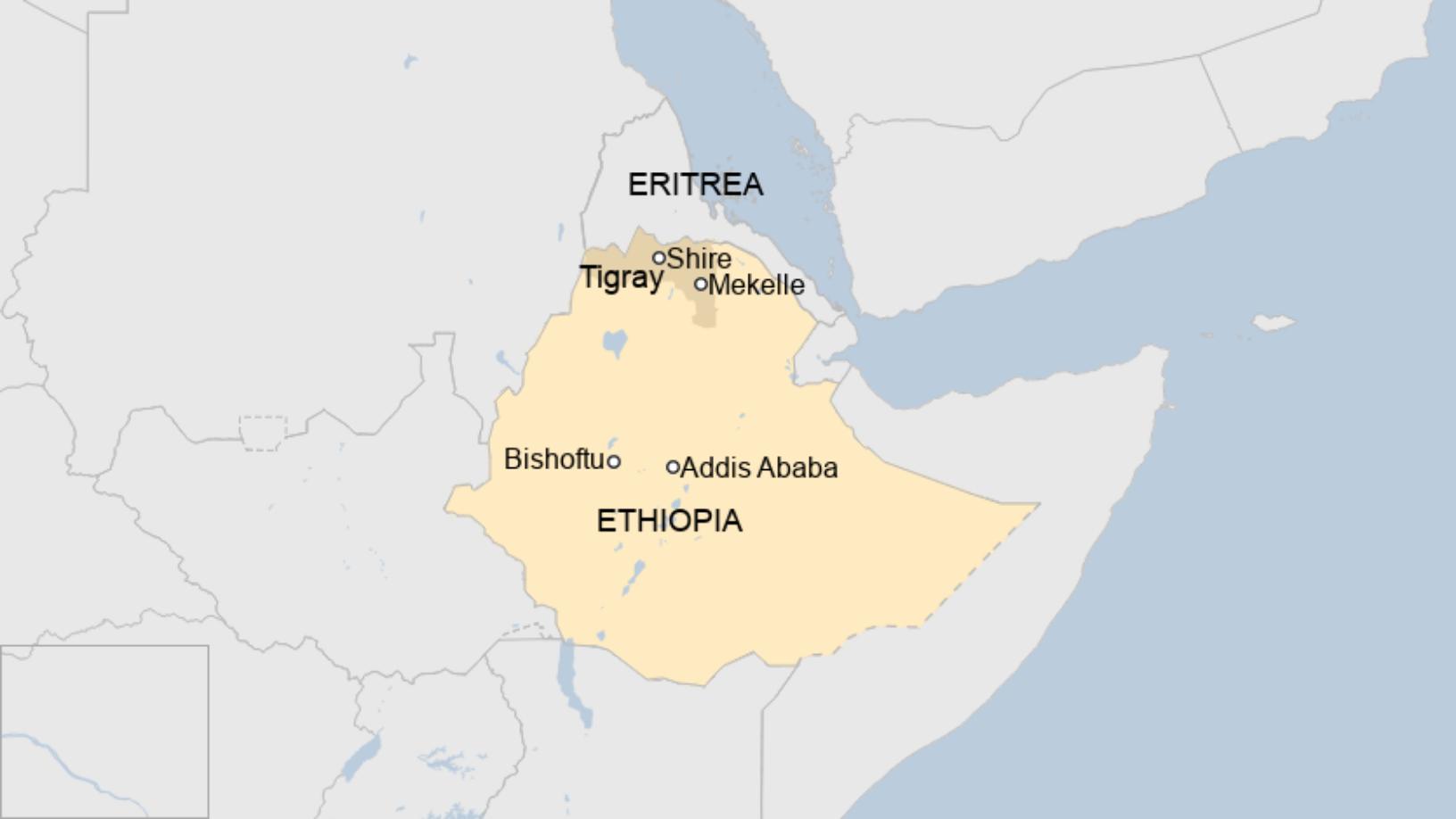
    Now Tigray is the site of a vicious war, as the Ethiopian and Eritrean armies on the one side, and the army of the Tigray People’s Liberation Front (TPLF) on the other, fight for control in a region that has long been seen as the key to power in Ethiopia – or what was historically part of Abyssinia.

    It has been under a blockade for 17 months – with no banking, telephone or internet services – and no media access.

    Over the last two years, the fortunes of the two sides have constantly changed on the battlefield, with:

    • Ethiopian and Eritrean forces capturing the Tigray capital, Mekelle, in November 2020 after the TPLF was accused of launching a rebellion
    • The Tigrayans launching a counter-offensive in the neighbouring Amhara and Afar regions, bringing them close to the federal capital, Addis Ababa, about a year later
    • The Ethiopian and Eritrean forces regaining territory in Tigray – including the key city of Shire – in the latest round of fighting, raising the prospect of them trying to capture Mekelle once more.

    “There are at least 500,000 Eritrean and Ethiopian federal troops in active combat, plus 200,000 from the Tigrayan side,” said Alex de Waal, the executive director of the US-based World Peace Foundation.

    He added that after more than 50 days of non-stop fighting, this week the Tigrayan defence lines around Shire could no longer hold out because of a lack of ammunition.

    “It’s a big setback for the Tigrayans. It leaves civilians exposed to massacre, rape and starvation,” Prof De Waal said, though the Ethiopian government has promised aid and the restoration of services in Shire and other areas under its control.

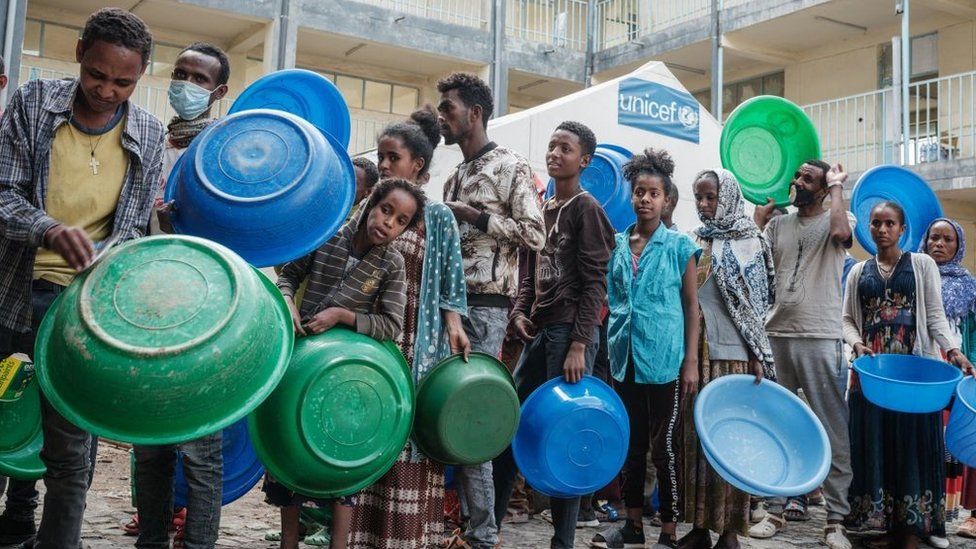
    People who fled the violence in Ethiopia's Tigray region wait to receive injeras, Ethiopia's staple food of sour fermented flatbread, from their kitchen as only meal of the day at May Weyni secondary school, now hosting 10500 displaced people as an IDP camp, in Mekele, the capital of Tigray region, on June 19, 2021
    Image source, Getty Images/ Image caption, The war has led to millions of people in Ethiopia needing aid

    Shire reflects the humanitarian crisis in Tigray, with an aid worker saying that around 600,000 civilians were taking refuge in the city and its surrounding areas after earlier fleeing war-hit areas.

    “More than 120,000 were out in the open, sleeping under trees and bushes,” he told the BBC, speaking on condition of anonymity for fear of reprisals.

    Almost all humanitarian workers withdrew from Shire last week after it came under ferocious bombardment from Ethiopian forces.

    Thousands of residents are also fleeing Shire amid fears that they could be subjected to atrocities – similar to those in other areas that fell under the control of Ethiopian and Eritrean troops.

    “Four witnesses reported that in the village of Shimblina in September, 46 people were rounded up and summarily executed. Other villagers found their bodies lying mixed with domestic animals, which had also been killed,” the aid worker said.

    “Hyenas had eaten a few of the bodies, and they could be identified only by the remains of their clothing. The witnesses said they had no time to bury the bodies, and the hyenas must have finished them by now,” he added.

    What made the atrocity stand out, he said, was the fact that most of the victims came from the small Kunama ethnic group, which has not been involved in the conflict.

    “Both sides are losing soldiers, and when they come into a village they take out their anger on locals,” the aid worker added.

    Tigrayan forces faced similar accusations – including of rape, extra-judicial killings and looting – during their advances into Amhara and Afar, before being pushed back into Tigray. The region has a population of around seven million, a small number in a country with a population of more than 100 million.

    Old-fashioned warfare

    Apart from atrocities, all the armies have been accused of forcibly recruiting civilians to fight, and of using the “human wave” tactic to gain ground.

    “People are drafted into the armies and, after only a few weeks of training, they are sent in large numbers through mined areas towards the trenches of the enemy,” said UK-based Horn of Africa analyst Abdurahman Sayed.

    “The enemy opens fire and kills many of them, but they keep coming in waves until the enemy runs of ammunition and they occupy their trenches.

    “It is the old way of warfare. It was first used by the king of Abyssinia to defeat the Italian invaders in the 1890s. Despite their superior airpower, the Italians were overwhelmed by the sheer number of people who confronted them.”

    Mr Abdurahman said that this tactic leads to massive casualties, with his estimate being that between 700,000 and 800,000 people have already lost their lives in almost two years of fighting.

    “This is the most brutal war in the history of Ethiopia,” he added.

    Though US-based Horn of Africa analyst Faisal Roble disputed that the Tigrayans used human wave attacks, his estimate of the death toll was not very different.

    “In the first two phases of the war, around 500,000 died in combat, and 100,000 have probably died in this third phase,” he said.

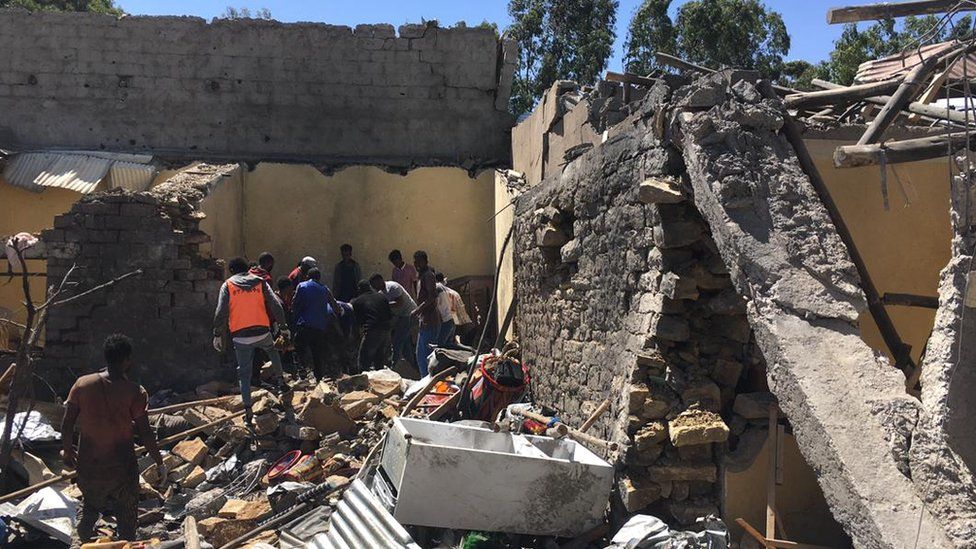
    Site of an airstrike in Mekelle, Tigray in Ethiopia - November 2021Image source, AC

    Image caption, Mekelle, which has a population of around 300,000, has been hit by several drone strikes

    Mr Roble added that the Tigrayan army was well trained, with “the heart” to fight, but the Ethiopian army had two advantages: numbers and airpower.

    “A general who is now an ambassador said they could enlist one million young men every year, and they have fighter jets and Turkish drones that have proved very effective. The Tigrayans have no air force.”

    The command of the Ethiopian air force had moved to Eritrea’s capital Asmara, he explained, from where fighter jets were taking off as the city was much closer to Tigray than their usual base in Bishoftu in central Ethiopia.

    “The drones are still leaving from Bishoftu,” Mr Roble said.

    Settling old scores

    Eritrea intervened in the conflict as the TPLF is its sworn enemy. The TPLF dominated a coalition government in Ethiopia until current Prime Minister Abiy Ahmed rose to power in 2018.

    Map

    1px transparent line

    Under the TPLF, Ethiopia and Eritrea fought a border war which claimed the lives of about 80,000 people. An international tribunal later ruled that Ethiopia should hand over territory to Eritrea, but the TPLF-controlled government failed to do so.

    Eritrea regained the territory soon after the latest war started in November 2020, and its critics say that President Isaias Afwerki is determined to help Mr Abiy finish off the TPLF so that it does not threaten his nation again.

    “Eritrea’s concern is that the TPLF wants to either regain power in Ethiopia, or its wants a satellite government in Asmara that will give it access to the Red Sea because Tigray is a landlocked, impoverished region,” Mr Abdurahman said.

    As the war in Tigray escalated in recent weeks, Eritrea’s government intensified its military mobilisation and hunted down draft dodgers across the country, multiple sources in Eritrea told the BBC.

    In one instance in September, Eritrean troops raided a church in the southern town of Akrur, detaining a priest, young worshippers and choir members who had not heeded the military call-up, the sources said.

    Prof De Waal said the call-up showed that Mr Isaias was “not taking any chances”, but he has not deployed conscripts to Tigray in large numbers.

    “Eritrea has units in Tigray, but most of the fighting is being done by Ethiopian forces. What Isaias is doing is running the war because he believes he can show Abiy how to win, but the Tigrayans will fight, even if it means with knives and stones because it is a matter of life and death for them,” he said.

    Talks unlikely

    According to Mr Abdurahman, the war is being fought on four to six fronts, with tens of thousands of Ethiopian and Eritrean troops stationed near the Tigray town of Adigrat.

    “They are ready to launch an attack on Adigrat, and Mekelle,” he said.

    Sources on the battlefront told the BBC that the two armies were already advancing from Shire towards the historic city of Aksum, as well as Adwa and Adigrat, in an operation that has seen them move from west to east.

    While foreign powers have been urging the two sides to resolve the conflict peacefully, Mr Abdurahman said this was unlikely to happen.

    “Historically, the ruling classes of Abyssinia, and now Ethiopia, always fought their way to power. The powerful becomes the king of kings until someone else emerges. There is no tradition of resolving matters peacefully. It is a zero-sum game,” he said.

    Prof De Waal said that the international community needed to act urgently to impose a ceasefire.

    “Otherwise there is the risk of a genocide, and mass starvation,” he said, pointing out that a Belgian-led academic team earlier this year estimated that more than 250,000 Tigrayan civilians had died of hunger and related causes since the war began in November 2020.

    “Harvesting is supposed to start now, but the Eritrean-led armies are turning Tigray into a wasteland.”

    Source: BBC

  • Shortage of petroleum products likely to hit Ghana – IES warns

    The Institute of Energy Security has issued a warning about a coming nationwide shortage of petroleum products.

    The anticipated shortage, according to the research tank’s executive director Nana Amoasi VII, can be linked to the cedi’s ongoing depreciation, the degradation of working capital for bulk oil distribution companies, and a lack of sufficient dollar supplies.

    The IES Executive Director voiced alarm about the development, which he believes could have an impact on Ghanaians, in an interview with Joy Business on October 18.

    “There is something to be much worried about and that’s the likelihood of the shortage of the commodity on the market on the back of a reported shortage of dollars for the Bulk Oil Distribution Companies, the importers and the erosion of working capital of some of these importers. The price of crude oil remains high and the cedi value continues to decline”.

    “We first raised these concerns in March this year and in the following month there were reports of the pocket of shortages of fuel across the country”, he explained.

    Proffering some solutions to address the matter, Nana Amoasi VII said government must, as matter of urgency, adopt stringent measures to avert an imminent fuel shortage.

    “This time around, any incident of shortage may be widespread if we fail to plan against it. It is more serious,” the IES boss warned.

    Meanwhile, consumers of petroleum products have begun witnessing an adjustment in prices at various pumps across the country.

    Checks by GhanaWeb Business show that some Oil Marketing Companies from October 16, 2022, increased the prices of petrol and diesel to about 16 percent and 12 percent respectively.

    Petrol is now selling for GH¢13.10 per litre from an earlier price of GH¢11.10 while diesel is going for GH¢15.99, from a previous price of GH¢13.90.

    The significant hike is however attributed to the marginal increase in the price of crude oil on the global market and the persistent depreciation of the cedi against the US dollar.

  • How does current inflation compare with previous years?

    As we’ve been reporting, inflation has risen to 10.1%. We’re all experiencing this already – in the higher prices we’re paying for basic goods, from buying loaves of bread to boiling the kettle.

    Inflation is also looked at when employers consider pay rises, and when the government considers increasing state pensions and benefits.

    Here’s a look at how that figure compares with previous years.

    Source: BBC

  • Tackling the cost of living – special coverage from Sunderland

    As we all face soaring prices, BBC News is talking to people across the UK about how they are coping with the financial pressures and providing support and advice on saving money from our experts.

    Today we’re reporting from Sunderland in north-east England. Unemployment levels are higher here compared to the rest of the UK and workers earn less than people in other parts of the country.

    We’ll be hearing from households, businesses and families about how the rise in living costs is affecting them.

    You’ll be able to follow this across the BBC – whether that’s here on the website, on BBC Breakfast and the News Channel, or on Radio 5 Live and Radio 1’s Newsbeat.

    Later we’ll bring you coverage of a special programme hosted by Nicky Campbell exploring issues and solutions – you’ll be able to watch that at the top of this page.

    Source: BBC

  • Inflation hikes: ‘This is not election year, treat Ghanaians as citizens’ – Gabby to NPP members

    A member of the governing NPP named Gabby Asare Otchere-Darko has counseled party members to simply treat Ghanaians as voters during election years and to refrain from using inflation statistics as a tool for equalization politics.

    He believes that this is not the appropriate time for NPP members to engage in equalization politics with NDC opponents.

    The Ghanaian people, he claimed, should be treated more like citizens at this time because of the economy’s high rates of inflation, high interest rates, and the weakening cedi.

    He maintains that currently the world is experiencing an unprecedented economic crisis and Ghana is suffering badly from the situation because it is recovering from the COVID-19 pandemic.

    “NPP shouldn’t play the politics of equalization with the NDC on inflation, interest rates & cedi depreciation.

    “The world is facing an economic crisis like never before in peace time. Ghana has been hit very hard because our economic recovery was being delicately managed pre-COVID,” Gabby Asare Otchere-Darko tweeted.

    “This is not election year, so don’t treat Ghanaians like voters but citizens. Politics of comparisons works when elections are before us.

    “Right now people just care about how to make ends meet. Use your energy in showing what is being done to bring relief,” he warned.

    Ghana’s inflation rate has increased to 37.2 percent in September 2022. The Ghana Cedi, is struggling.

    The Cedi has been reported by Bloomberg to be the world’s worst-performing currency this year as investors continued to squeeze foreign capital into the west African country before a deal with the International Monetary Fund.

    The currency of the world’s second-biggest cocoa producer depreciated as much as 3.3% Monday, before paring the loss to 11.2750 per dollar at 3:30 p.m. in the capital Accra. That took its losses this year to more than 45%, the most among 148 currencies tracked by Bloomberg.

  • Removal of GES boss disappointing – NAGRAT

    The National Association of Graduate Teachers (NAGRAT) is worried about the President’s dismissal of Prof. Kwasi Opoku-Amankwa as Director-General of the Ghana Education Service (GES).

    NAGRAT said the development is not only surprising but also has left members of the association with overwhelming disappointment.

    “This is very disappointing. We are surprised because we had someone who was able to build a very positive relationship and rapport with the union”, said NAGRAT President, Angel Carbonu.

    Prof. Opoku-Amankwa was relieved of his position in a letter dated Monday, October 17, 2022, because his services were no longer needed, according to a statement from the Presidency.

    Having been appointed in April 2017, specific reference was made to his secondment in January 2021 from the Kwame Nkrumah University of Science and Technology (KNUST).

    The contract was extended again in June 2021, but this extension according to the letter was in “contravention of the Human Resource Policy Frame and Manual of the Public Services Commission, as it purports to extend your secondment beyond the 3-year maximum limit.”

    NAGRAT believes the termination of Prof. Opoku-Amankwa’s appointment will affect critical decisions concerning better conditions of service for teachers.

    “A lot of our discussions with him had reached advanced stages. So for this termination to come at this time, I think there is someone at the Jubilee House who is not aware of the work going on at the GES. As far as I am concerned, this controversial termination is going to affect us.”

    When asked about his expectation of a new Director-General for the GES, Angel Carbonu said he does not expect the next appointee to be a political party operative.

    “I expect the new Director-General to be someone who has gone through the mill of the GES, risen through the ranks and understands the intricacies of the service. I also expect someone who will extricate himself from the political party that appoints him and sees himself as professional and not a party operative by opening his doors to the union in addressing issues”, he suggested.

    Meanwhile, Prof. Opoku-Amankwa has been instructed to return to the KNUST.

    Source: citinewsroom


  • Inflation figures will cause concern – foreign secretary

    Foreign Secretary James Cleverly has acknowledged that the inflation figures are “concerning” for people across the country.

    He says the figure of 10.1% is in the range the government was expecting, adding that the government’s energy price support will have helped to lower inflation overall.

    Under the energy price guarantee – made in response to soaring energy prices – a typical annual household bill will be limited to £2,500 until April.

    “I think the response to the energy price increases that we brought out in the statement a few weeks ago will have helped to suppress some of that inflation, but of course it is still something which is concerning,” Cleverly tells the BBC.

    He adds that global factors – such as the war in Ukraine – have played a part in the rise in inflation.

    “We want to make sure that we take action to try and limit the rate of inflation.

    “That’s why it’s so very important that we protect people in businesses from those energy price rises, but we also try and address some of the core drivers of inflation, including the war in Ukraine, which has pushed up energy prices, and that’s had a knock-on effect for the prices in so many people’s baskets.”

    Source: BBC

  • I will ensure lights stay on in Ghana, you deserve it – Energy Minister 

    Intermittent power supply across the country will no longer be tolerated, according to Energy Minister Dr Matthew Opoku Prempeh.

    According to Dr Opoku Prempeh, the Energy Ministry is “determined to ensure that the lights stay on” since he believes “Ghanaians deserve no less.”

    Dr Opoku Prempeh, who also doubles as the Manhyia South Constituency Member of Parliament, gave his word after President Akufo-Addo commissioned the 330KV Kumasi-Bolgatanga Transmission Line Project at Anwomaso, near Kumasi in the Ashanti Region.

    The project, which covers a distance of approximately 550km, has increased transmission capacity to meet growing demand in Ashanti Region, the northern part of Ghana and beyond.

    There has also been a reduction in transmission line overloads and associated high transmission losses in the Ashanti, Bono, and Bono East Regions, according to the Energy Minister.

    Since the beginning of 2022, several parts of the country have witnessed power interruptions, mostly due to maintenance work being executed by the Ghana Grid Company (GRIDCo) on faulty transmission lines.

     In September this year, some homes were plunged into darkness as they could not purchase prepaid credits from outlets belonging to the Electricity Company of Ghana (ECG).

    The challenge has, however, been addressed and consumers can now access electricity.

    Following the incidents, Dr Matthew Opoku Prempeh reiterated that “power remains a critical aspect of our daily lives” thus “President Akufo-Addo is focused on ensuring that the sector is fit for purpose.”

    He further added that the government will continue to make the necessary investments in power generation, transmission, and distribution.

    Source: The Independent Ghana

  • Otto Addo to announce Black Stars World Cup provisional squad on Friday – Reports

    Black Stars coach, Otto Addo, is set to announce his provisional squad for Ghana’s upcoming campaign for the 2022 FIFA World Cup on Friday, October 21, 2022.

    According to reports, the manager submitted the list to the Ghana Football Association last Friday and is expected to make the list public this week.

    Further reports suggest that the German-based trainer has named 35 players in his provisional list. However, it will be later trimmed to 26 a week before the start of the competition in Qatar.

    This would mean that any player who misses out on the provisional list would not make it to the World Cup.

    The 22nd edition of the world’s most prestigious football competition will kick off on November 19, 2022, and as such, the 32 competing teams will begin campaigning in the first week of November.

    As part of the FIFA regulations for the World Cup, the 32 competing teams in this year’s Mundial are mandated to submit a list of between 35-50 players as their provisional list.

    The Black Stars have been paired in Group H alongside South Korea, Portugal, and Uruguay.


  • Illegal thatch ‘motels’ sprawl in Ada estuary enclave

    The Ada estuary enclave is part of the Tema operational region of the Ghana Tourism Authority (GTA), and it has warned visitors to be aware of illegal and inappropriate thatch cottages.

    According to the GTA, these facilities, which number more than 10, especially in Azizanya, Kewunor, and other neighboring settlements in the estuary, have not been granted a license to function as tourist accommodations.

    According to reports, there are more of these accommodations located around the country’s coastline.

    The Tema Regional Director of the GTA, Charles Buabin, told the B&FT that this canker is becoming pervasive as some tourists – predominantly from the Caribbean and others from Europe – prefer the weird experience of lodging in such thatch and dilapidated straw facilities.

    In a recent periodical enforcement exercise in the region, he disclosed that these facilities just like some other unbefitting structures are not registered or licenced, and are operating below the acceptable standard and minimum requirements set out for accommodation units.

    The Regional Director said some other facilities across the region have registered but refused to renew their licences, an act which contravenes the Tourism Act, Act 817.

    Revenue loss

    With most of these illegal thatch structures being in operation for more than 20 years, the GTA has admitted that a substantial amount of revenue has been lost in registration and licencing fees over the years.

    “These edifices began as NGOs and prayer-camps when tourism was not at the forefront. It was a strategic location between the river and the sea, which connotes a certain form of spirituality for people.

    “These facilities have however been changed to accommodation units for tourists, operating for more than two decades as visitor numbers increased to the area. Unfortunately, most tourists want this weird experience of lodging in this kind of building,” Mr. Buabin noted.

    Even though these thatch houses are declared not fit for purpose, some grand modern hotels are also contravening the law, Mr. Buabin disclosed.

    Security

    The GTA said all thatch structures have been designated as security risk zones because they do not display police reports, which is a document needed to obtain a licence from the Authority.

    “We can only ask patrons to be cautious and ask for the right documents – GTA licence, police report and environmental protection reports in such circumstances before patronising such structures.

    Lack of 24-hour presence at the location

    The Tema Regional Office of the GTA has called on the District Assembly in Ada to deepen surveillance on the area and ensure that such structures do not pose threats to visitors.

    “We have appealed to the district to ensure that such facilities are monitored and given facelift by the owners to create a befitting experience. Failure to do this risks the area being prone to delinquencies” Mr. Buabin added.

  • Price hikes caused by local factors – IMF

    The International Monetary Fund (IMF) has asserted that the incessant increase in prices of commodities is mainly due to domestic factors in the country.

    According to the Director of the IMF’s African Department, Abebe Aemro Selassie, it would be misleading to pin the whole blame on external factors such as the Russia-Ukraine invasion.

    At a press conference on the sideline of the IMF/World Bank Spring Meetings from 10-16 October 2022 in Washington, D.C., US, he explained that “on inflation, I mean, again, there are always trade-offs when you’re doing policy calibration, and so in our regional economic outlook, we are very careful to flag that there are some countries where inflation has clearly been driven more by domestic factors than exogenous factors. I think Ghana would fall in that camp.”

    His comment, however, suggests that both domestic and external factors have a role to play in the country’s extremely high inflation rate.

    Since January this year, inflation has been on the rise. From 13.9%, Ghana’s inflation rate now stands at 37.2% as of September 2022, according to the Ghana Statistical Service (GSS).

    As inflation rose this year, the price of petroleum products also saw an increase. During the period when fuel prices were hiked, transport fares were adjusted twice.

    Consequently, the cost of goods and services has also surged.

    The Bank of Ghana has adjusted the Monetary Policy Rate (MPR) to check rising inflation. Increasing the rate from 17%, then to 19% and 22% seems to have not aided the reduction of the inflation rate.

    Despite failed efforts, the central bank has recently increased the policy rate to 24.5% in a bid to control the high inflation rate.

    The Bank of Ghana is optimistic that its many measures will address the worrying rate.

    As the adjustment in policy rate has failed to check inflation, some experts have asserted that imported inflation could be driving Ghana’s inflation.

    Such views have not been discarded, as Ghana remains a heavily imported dependent country.

    Mr Abebe Selassie also hinted at such an assertion, however, did not categorically state that Ghana falls under such a category.

    “But there are also quite a lot of other countries where the inflation we are seeing is more imported inflation, so the scope and the space and the ability of monetary policy to address that is limited. So again, it depends on country-specific circumstances, and on time”.

    Mr. Abebe also said a volatile exchange rate affects a country’s inflation rate. Currently, a dollar is trading at over GH¢12 at the forex bureaus.

    Source: The Independent Ghana

  • Ballon d’Or: Which African players ever received a vote?

    George Weah

    To date, the only African player to ever win the Ballon d’Or, Weah clinched the award in 1995—the first year that the prize was opened to non-European players.

    In that year, he defeated Jurgen Klinsmann—in second place—by 144 votes to 108, and would also pick up 13 votes the year afterwards.

    Finidi George

    One of the players defeated by Weah in 1995, Finidi actually picked up six votes that year—the only occasion when the Nigeria wideman would receive any Ballon d’Or recognition.

    This return left him level with Franco Baresi down in joint-21st in the rankings, and ahead of the likes of Roberto Baggio and Ronaldo.

    1995 was arguably Finidi’s peak year, as he clinched five titles with Ajax, including the Champions League and the Eredivisie.

    Tony Yeboah

    A Golden Boot winner in both England and Germany, Yeboah received five votes in 1995 as he made an excellent early impact at Leeds United.

    The Ghana international scored 24 goals in his first 40 league appearances in England, and was twice named the Premier League Player of the Month in 1995.

    Nwankwo Kanu

    A year after Finidi had received his only Ballon d’Or vote, Kanu was also in the running for the prestigious award, having scored 13 goals in 30 Eredivisie matches before securing an ill-fated move to Internazionale.

    He received 14 votes in the 1996 Ballon d’Or voting, putting him ahead of the 1995 winner Weah, and above the likes of Gabriel Batistuta, Raul and Didier Deschamps.

    In 1999, he received two further votes, putting him level with Ronaldo and Hernan Crespo.

    Victor Ikpeba

    1997 was a year to remember for Ikpeba, the Prince of Monaco, as he became a Ligue 1 winner with the Club of the Principality.

    He received two votes in the Ballon d’Or—the only African player to do so—and also won the African Footballer of the Year award.

    El-Hadji Diouf & Papa Bouba Diop

    2002 was Senegal’s year.

    They may have fallen just short in the Africa Cup of Nations, but they followed up their run to the final in that competition by reaching the quarter-finals of the World Cup—at the time, only the second African nation to do so.

    Diouf and Diop—both on whom received two votes in the Ballon d’Or voting—were among the key figures in those tournaments.

    The former, in particular, excelled on the fields of Japan and South Korea, while the latter netted the winner as Senegal defeated reigning world and European champions France 1-0 in the World Cup opener.

    Samuel Eto’o

    He may have never won a Ballon d’Or, but Eto’o received votes in eight separate years, and was nominated—but received no votes—on two further occasions.

    In 2004—the first year in which he picked up points—he received seven votes—and would make the standings every season for the next eight campaigns.

    Didier Drogba

    Drogba, like his rival Eto’o, also received votes for the first time in 2004, tying with the likes of Frank Lampard and Gianluigi Buffon on five points.

    The Ivorian powerhouse—a Champions League winner with Chelsea in 2012—also matched Eto’o in receiving votes in eight years.

    Intriguingly, Drogba’s best year was 2007, when he finished fourth behind Kaka, Cristiano Ronaldo, and Lionel Messi, and not his European Cup-winning campaign.

    Michael Essien

    Drogba’s Chelsea teammate Essien received votes in two separate years; 2005 and 2007.

    2005, of course, was the year when the Bison ended his time in France at Olympique Lyonnais, with a Ligue 1 winner’s medal, before moving to Chelsea where he’d go on to clinch another title in 2006.

    In terms of performances, however, perhaps 2006-07 was Essien’s zenith; he was named Chelsea’s Player of the Year, Ghana Player of the Year, and won two domestic cups.

    It’s tantalizing to imagine what he could have achieved over the subsequent years had injury not intervened.

    Fredi Kanoute

    One of Africa’s underrated modern greats, Kanoute received his one and only Ballon d’Or nomination in 2007.

    He finished a respectable 11th on the ballot, ahead of former winner Ronaldinho and Steven Gerrard, but with a fraction of the votes of eventual winner Kaka.

    This was arguably the Mali international’s finest year, as he won a cup treble with Sevilla and became the first player born outside Africa to win the African Footballer of the Year award.

    Emmanuel Adebayor

    In 2008, it was the turn of another fine African striker—Adebayor—to receive his one and only Ballon d’Or nomination.

    This was the year when the Togo frontman enjoyed the most productive campaign of his career, netting 24 goals in 36 league appearances for Arsenal as they finished third in the top flight and reached the Champions League quarter-finals.

    Yaya Toure

    Nominated for the Ballon d’Or on five occasions between 2009 and 2015, Yaya established himself as the finest African midfielder of his generation and rubbed shoulders with some of the world’s top stars—in the tier just below Ronaldo and Messi—during his time at Manchester City.

    In 2009, while still at Barcelona, Toure secured his only Champions League title—and received his first Ballon d’Or nomination.

    Asamoah Gyan

    Another African striker whose finest year was rewarded with Ballon d’Or votes.

    For Gyan, whose club career has left a lot to be desired, 2010 represented the pinnacle of his career, as he made an unforgettable contribution to Ghana’s World Cup campaign as the Black Stars reached the quarter-finals in South Africa.

    Unfortunately, Gyan has never subsequently been able to truly recapture the magic of that summer.

    Riyad Mahrez
    Algeria’s Mahrez has been included in the Ballon d’Or classement on four separate occasions, including finishing 12th in the ranking this time around.

    Unsurprisingly, his highest position came in 2016—the year of Leicester City’s miraculous title-winning campaign—when he came seventh in the ranking, while he was also inside the top 10 in 2019.

    Not an undisputed starter for Manchester City this season, and absent from the World Cup, is this the last we’ll see of Mahrez in the Ballon d’Or ranking?

    Pierre-Emerick Aubameyang

    As Yaya stepped down from the limelight at Manchester City, as Pep Guardiola swept into the Etihad Stadium on a wave of new ideas, Aubameyang stepped into his place as Africa’s pre-eminent global star.

    The Gabon international has featured in the Ballon d’Or rankings on three occasions, beginning in 2016, the same year he won the Bundesliga Player of the Year award.

    Sadio Mane

    The reigning African Footballer of the Year has made little secret of his desire to win the Ballon d’Or, and after finishing fourth on the podium in 2019, he went closer again this year when he finished second – pipped only by Robert Lewandowski.

    Mane won the Champions League in 2019, and followed that up with the Premier League title in 2020.

    This year, his second-placed finish in the Ballon d’Or was preceded by his influential displays in Senegal’s maiden Africa Cup of Nations success, and he still has the World Cup ahead of him.

    Mohamed Salah

    Salah has finished inside the top six in the Ballon d’Or rankings in 2018 and 2019, and like Mane, may yet have the chance to reach the pinnacle of the sport.

    However, he may never get a better opportunity than in 2018, when he enjoyed a record-breaking maiden season in Liverpool and inspired the Reds to the Champions League final.

    Had injury not brought a premature end to that final against Real Madrid—and overshadowed his World Cup—might Salah have finished a little higher in the standings?

    He finished seventh in 2021, and fifth again this year.

    Kalidou Koulibaly

    A regular feature in the Serie A Team of the Season, and the division’s reigning Defender of the Year, Koulibaly made the Ballon d’Or standings in 2019 for the first time.

    It was a magnificent achievement for the Napoli centre-back, who became the first African defender ever to receive any votes for the finest individual prize in the game.

    Sebastien Haller

    Following his goalscoring exploits in the Eredivisie last term, Haller made his debut in the Ballon d’Or rankings this season, finishing in 13th place overall.

    The striker netted 21 goals in the top flight and 11 in eight Champions League games, endearing himself to Ajax fans, but illness has prevented him from taking to the field yet this season.

    Asisat Oshoala

    Oshoala became the first African woman to make the shortlist for the Ballon d’Or Feminin when she finished 16th in the rankings this year.

    Source: Ghanaweb

  • Paris murder: Killing of Lola, 12, sparks immigration row in France

    Grief and outrage in France over the murder of a 12-year-old girl found dumped in a plastic trunk in Paris has turned into a political row over the migrant status of the suspect.

    Lola’s body was found last Friday in a courtyard outside the apartment block where she lived.

    A 24-year-old woman has been remanded in custody on suspicion of murder, rape as well as acts of torture.

    It has also emerged she is an Algerian immigrant under orders to leave France.

    Shortly after President Emmanuel Macron met the murdered girl’s parents at the Élysée Palace on Tuesday and promised his full support, political opponents on the right and far right accused the government of failing the family.

    During an animated session in the National Assembly, Marine Le Pen of the far-right National Rally party condemned the government’s “lax” migration policy.

    “The suspect in this barbaric act should not have been in our country; what’s keeping you from finally putting a stop to this uncontrolled, clandestine immigration?” she said.

    Prime Minister Elisabeth Borne appealed to her to “show a little decency” and respect the parents’ pain and Lola’s memory, saying: “Let the police and judiciary do their job.”

    Lola disappeared last Friday after failing to make the short walk home from school in the 19th district of north-east Paris. By late evening her body had been found inside a trunk on wheels.

    Members of the public stand in front of bunches of flowers displayed outside the building in Paris on October 17, 2022
    Image source, AFP/ Image caption, Lola was last seen alive in the hall of her block of flats

    A post-mortem examination found she had suffered cardiorespiratory failure “with signs of asphyxiation and cervical compression”. Wounds were found to her face, back and neck but had not led to her death.

    As her father is the building’s caretaker, he soon retrieved CCTV video showing the suspect, Dahbia B, with his daughter in the hall of the block of flats on Friday afternoon. A man aged 43 has been accused of helping to hide the girl’s body.

    The government’s political opponents have been quick to highlight Dahbia B’s status as an illegal immigrant.

    She was initially stopped at a French airport on 20 August because her residence permit had run out. She had entered France legally as a student six years ago. Dahbia B was told to leave French territory within a month, under an order known as an OQTF (obligation de quitter le territoire français).

    Although some orders are more immediate, Dahbia B had no criminal record so she was not placed in detention. OQTF orders are notorious because only one in 10 are observed, and Algerians are among the nationalities considered most likely to abuse the system.

    Interior Minister Gérald Darmanin appealed to the far right to reflect on the consequences of their words, after far-right former presidential candidate Éric Zemmour labelled the crime a “Francocide”, or the killing of a French person. There was, the minister told RTL radio, a great deal of indecency in some of the political responses.

    Several other figures on the right were also critical of the government, with Republican MP Éric Pauget telling the justice minister that “Lola lost her life because you didn’t expel this national”.

    Mystery surrounds the motive behind the killing and the suspect’s lawyer has condemned the various rumours circulating locally. The Paris prosecutor has revealed that a figure one and a zero were written under the victim’s feet, but have not suggested why.

    One potential motive cited by sources close to the investigation is a dispute between the main suspect and Lola’s mother. Dahbia B had been living in the same building with her sister but when she asked for a pass to enter the block of flats Lola’s mother refused.

    The suspect is being held in isolation at Fresnes prison, south of Paris. Reports suggest she was a victim of domestic abuse several year ago and she is due to undergo a psychiatric examination.

    A silent protest in tribute to Lola has been called off on Wednesday after a request from the family. However, a rally is expected to take place the following day, at which several far-right politicians are expected to take part.

    Source: BBC

  • Akufo-Addo commissions residential accommodation for Appeals Court judgesudges

    A residential complex for Court of Appeal Judges in the Ashanti Region, among other infrastructure projects, has been completed and commissioned by President Akufo-Addo for use.

    This, according to the President, is in an effort to bridge the housing deficit associated with the judiciary.

    The newly built, ultramodern Kumasi Court of Appeal complex, along with twenty (20) townhouses and a guest house, will serve as the permanent residences for Court of Appeal Judges based in Kumasi, who will be tasked with handling appeals from the northern region of the country.

    In addition to the court complex, the President also hinted at constructing some one hundred and twenty (120) courts and one hundred and fifty (150) bungalows across the country, of which he mentioned some have already been completed.

    Explaining the motive for this, the President indicated that, in the course of his first term in office, the government took note of the inadequate number of courts in various parts of the country, resulting in citizens travelling long distances to gain access to courts.

    He cited, for instance, that “there was no Court between Adjabeng and Amasaman in the Greater Accra Region, nor was there a Court between Adum in Kumasi and Asante Bekwai or Obuasi in the Ashanti Region.

    “I was also informed that some judges lived in insecure housing, and were subject to abuse and threats after their judgements,” he said.

    “That is why, in my Message on the State of the Nation, on 9th March 2021, Government, through the Ministry of Local Government and the District Assembly Common Fund, has commenced, in an unprecedented initiative, the construction of ninety (90) courts with accompanying accommodation for judges across the country, to help address the
    problem of inadequate court infrastructure,” he added.

    He added that through the efficiency and ingenuity of the Administrator of the District Assembly Common Fund, Hon. Irene Naa Torshie Addo, “we [government] are, in fact, constructing one hundred and twenty (120) courts and one hundred and fifty (150) bungalows and not the ninety (90) that was contemplated earlier.”

    According to the President, seventy percent (70%) of these projects have already been completed.

    Projects under construction Six new Regional High Courts are also being constructed in the newly created regions, i.e., Ahafo, Bono East, North East, Oti, Savannah and Western North.

    Three of the Courts, that is those in Ahafo, Bono East and Oti Regions, have been completed and are ready for commissioning.

    The other three, that is those in North East, Savannah and Western North, which are at eighty percent (80%) completion, will be ready for commissioning by the end of the first quarter of 2023.

    Following the completion of about 70% of the projects and the commissioning of the residential complex for the Court of Appeal judges in the Ashanti region, the President declared all other projects completed.

    “With the commissioning of this residential complex here, in Kumasi, and the Magistrates Court in Toase later this afternoon, I deem all the completed projects duly commissioned.”

    He, thus, charged the Chief Justice to take over and start posting officers to commence work with immediate effect.

    The President believes that this substantial investment in infrastructure will motivate the judiciary to work even harder to advance the rule of law and justice in the country.

    He pledged to continue to support the judiciary during his term as a result.

    “We will continue to implement policies to advance the rule of law, and, thereby, reinforce the confidence of the people, and shore up our nation’s reputation as a country governed by the rule of law,” he said.

    He also acknowledged people who were instrumental in the execution of these projects.

    “The efforts of Chief Justice Anin Yeboah, his predecessor, Chief Justice Sophia Akuffo, the former Minister for Local Government and Rural Development, Hajia Alima Mahama, and Hon. Irene Naa Torshie Addo, Administrator of the District Assemblies Common Fund, must be warmly commended,” he added.

    Source: The Independent Ghana

  • 45-year-old Komfo Anokye Maternity Block 60% complete

    The Komfo Anokye Maternity and Children’s block, which had been abandoned for about 45-years, pulled down and reconstructed by the Akufo-Addo led administration, is about 60% complete.

    The President received this information on Monday, October 17, 2022, while inspecting the project, which is currently undergoing remodelling, as part of his four-day working visit to the Ashanti region.

    After a JoyNews documentary on the building’s deplorable state aired in 2020, a series of activities were launched to remodel it.

    The remodelling process began with the demolition of the structure after tests on the structural integrity of the building revealed that it was too weak to withstand the test of time.

    President Akufo-Addo then, in May 2020, President Akufo-Addo cut sod for the reactivation of work on the facility with an assurance that the project would be completed within a period of 36 months. 

    Contract to remodel the KATH Maternity and Children block

    The Health Ministry on November 6, 2019, employed Contract Construction UK Limited for the design, execution, and completion of works and the remedying of any defects, which included the re-modelling and completion of shell spaces for the existing building structure.

    Subsequently, after the Contractor’s structural integrity report for the existing building structure, the Government decided to revise the scope of works in November 2020 to include a complete demolition of the old existing structure, and a redesign, construction and complete equipping of the new and modern mother and child health facility.

    The revised contract also includes the provision of a 3-year maintenance program for medical equipment with training and technical assistance, procurement of medical and non–medical consumables, and the training of needed human resource training, technical assistance and mentorship programs.

    The new design has 8 floors, 22 consulting rooms, 3 group consulting rooms, 2 consulting rooms for adult emergencies, 2 consulting rooms for Paediatric Emergencies, 3 Auditorium (45 seats, 43 seats and 145 seats), 5 seminar rooms (14 seats) and 506 Beds with the capacity to hold, 199 paediatric cots, 136 Paediatric beds, 19 birthing beds and 152 Adult beds.

    Additionally, the block will also have 1 Obstetrics Theatre, 7 General theatres, Pharmacy, Dispensaries, Laboratories as well as Ancillary spaces.

    Once completed, it will house an intensive care unit, a high-dependency unit, isolation rooms, and student lecture halls, with the capacity to provide catering services for staff, patients, and students.

    The expanded work has also resulted in the ongoing reconstruction of the Station Basic School classroom block at the UDDARA Barracks, which is scheduled to be completed by January 2023.

    Source: The Independent Ghana

  • Why Shatta Wale’s ‘GoG’ has delayed

    It has been a day after the advertised release date for Shatta Wale‘s feverishly anticipated album.

    In August, performing at the ‘SummerStage’ event in New York City, the reggae/dancehall star excited the audience when he informed them they were first to know when the album would be out. “17 October,” he said.

    17 October is Shatta Wale‘s birthday and so it was quite convincing for fans that the long play (LP or album) would be released as part of the celebration. That did not happen.

    Rather, a song, purported to be an official single from the project was released on Sunday, October 16. It is called ‘Cash Out’.

    Shatta Wale has not offered an official explanation for this delay but in an interview on Accra-based Joy FM on Saturday, October 15, he said all that has been said about the album so far was part of a marketing effort to whip up anticipation.

    “This is where everbody around should give me a round of applause for keeping people talking for three years about ‘GoG’. That’s a whole marketing strategy,” the ‘On God’ hitmaker drew applause from the in-studio audience.

    “It’s so beautiful that everyone is talking about it,” the Shatta Movement (SM) boss remarked and assured: “There is a ‘GoG’ album.”

    According to the multiple award-winning musician and record producer who celebrated his 38th birth anniversary yesterday, the LP would have been out in the first year it was announced but for marketing concerns and logistics.

    “Due to this, we had to fix some strategies and plans, you know and [find out] how to make people talk. We’ve already informed the fans. I’ve done this for three years,” he explained.

    “When it comes, everybody should embrace it,” he added and boasted: “Because in the history of Ghana, I don’t know any artiste who has kept an album for three years and still had people talk about it for three years.”

    He emphasised the uniqueness of his ploy and his brand resilience by adding should a different artiste “try this thing, you won’t [be engaged to] play a show(s) again in your life.”

    Source: Ghanaweb


  • Kizz Daniel confirmed to perform at 2022 World Cup

    In June 2022, Kizz Daniel said a prayer on Twitter: “God I want to perform [my song] ‘Buga’ for [the] world cup with a mass choir” and asked fans to “help me say amen.”

    Four months after, the prayer has been answered.

    The Nigerian singer-songwriter born Oluwatobiloba Daniel Anidugbe announced the good news by tweet-quoting his June post with the words: “and the Lord said see you in Qatar.”

    Initially, Kizz’s fellow Nigerian Davido was announced as the African singer billed to grace the world stage in Qatar.

    Other artistes involved with the 2022 FIFA event are Americans Lil Baby and Trinidad Cardona and Doja Aisha from Qatar.

    The first time the World Cup is taking place in the Middle East, 32 countries will compete for the coveted trophy starting from Sunday, November 20.

    Meanwhile, Kizz Daniel, nicknamed Vado the Great, has earned another number one hit just days after release with a song titled ‘Cough’. It features EMPIRE.

    He has also announced the 2023 release of a new album named ‘Alcohol and Cigarettes’.

    Source: classfmonline.com

  • Thieves rob Women farmer group of irrigation equipment

    Thieves have allegedly robbed a Women’s group in Woredaa, a suburb of Zanlerigu community in the Nabdam District of the Upper East Region, of a solar panel pump controller they used for irrigation farming.

    The alleged thieves forcefully broke the padlock of the iron fence to the garden and took away the solar pump controller and wires that were connected to the solar panel of the mechanized borehole.

    The pump controller is a component of the solar water pump system that adjusts the pump system parameters to meet user needs and shield the pump system.

    Mrs Modester Azumah, the leader of the group, said the group members were saddened by the event as the rains were subsiding and they would be unable to engage in irrigation farming would adversely affect their livelihood.

    “I see myself and my colleagues as the saddest people at this moment, we are so devastated, most of us had nothing to do before we were engaged in dry season farming, through which we get nutritious vegetables and earn income to support our families, but look at what just happened, we are stranded and hopeless,” she stated.

    “We will really suffer if we do not get immediate help to continue farming, and only God knows what will become of us then, therefore we are appealing for help from benevolent organisations so that we can have something to depend on,” she added.

    Mrs Yenpoka Zure, a member of the group, said any effect on them would trickle down to those they fed as the livelihoods of their families were also dependent on their irrigation farming.

    Exif_JPEG_420

    “Women are such that whatever we get no matter how little it is, gets to the kitchen to prepare food for our children, and so it affects us directly as irrigation farmers and extends to our children and some of our unemployed husbands who depend in one way or the other on us,” she lamented.

    “I am surprised, what sort of thieves are these without mercy on their mothers like us, how much would they sell it to benefit them”, she quizzed.

    The irrigation project, which donated the equipment to the women, is being funded by Mezure, a German organization and implemented by the Navrongo-Bolgatanga Catholic Diocese Development Organisation  (NABOCADO).

    It is aimed at empowering women and serving as a source of livelihood for them to support their families.

    Source:GNA  

  • Eight communities appeal for bridge to link them to Dambai

    Eight farming communities in the Krachi East Municipality of the Oti Region have appealed to the authorities and government to help construct a bridge over river “Kagyakaburi” to link the communities with the Municipal capital, Dambai.

    The communities are Abongo No1, Pumpi, Wulubu, Yariga NO1, Yariga NO2, Ofosu, Kanyetin and Tamanja.

    The communities said the construction of a bridge over “Kajakaburi” river would help to restore social and economic activities, which had come to a standstill in the area.

    Obor Tamanja Uje, headman of the community, told the Ghana News Agency (GNA) during a visit that, bags of beans, cassava dough, yams and other foodstuff were locked up in the area as a result of the predicament.

    The Chief called on the Krachi East Assembly to remedy the situation to save the farmers.

    Madam Mary Ngambe, a resident of Abongo No1, told GNA that pregnant, sick people and nursing mothers had not been spared as several lives had been lost while others had miscarriages due to the several potholes and poor road network.

    Mr Sampson Putan, a resident, said motorcycle riders who use alternative longer and dangerous routes due to the nature of the road, had usually ended in accidents, resulting in loss of lives and many injuries.

    Some other community members called for swift action to save the situation.

    Source:GNA

  • Public Procurement Authority receives commendation

    Dr Archibald Yao Letsa, Volta Regional Minister, has commended the Public Procurement Authority (PPA) for its efforts at training key stakeholders before rolling out the Electronic Procurement System.

    The training, he said, was in the right direction and extolled the Authority for leaving no stone unturned in getting all the public institutions across the sixteen (16) regions enrolled on the system.

    The Minister, speaking at a ceremony of the roll-out implementation of Ghana’s e-Procurement System training in Ho in the Volta region, said the programme formed a significant part of the government’s agenda in transforming the economy through digitalization.

    Dr Letsa said he was glad that the digitalisation agenda was extended to the Public Procurement Authority as it would ensure business confidence and value for money in the procurement of goods, works and services for national development.

    The Minister said the implementation of the e-Procurement System was to help reduce the incidence of corruption in the procurement process to the barest minimum if not to eradicate it.

    He said a chunk of government revenue was used for procurement of goods, services and works, thus if “we are able to improve on the management of the procurement process, reducing human interface, we are bound to enjoy immense associated benefits as a nation.”

    Mr Kwame Prempeh, Deputy Chief Executive Officer for the PPA, said the system aimed at digitalising all public procurement systems to enhance transparency and judicious use of public funds.

    He said the system would help reduce the use of paper, increase efficiency in the public procurement process and allow more suppliers to participate because suppliers would have access to any tender that was published.

    The Deputy CEO said the system would ensure value for money because there would be more responses to tender, reduce costs associated with printing tender and contract documents and evaluation, among others.

    Some participants, who spoke to the Ghana News Agency, were very happy about the training, saying the knowledge and skills they acquired would help in the delivery of their duties.

    They were taught how to create an electronic tender, invite suppliers electronically, do the tender opening, tender evaluation, and contract administration, among others.

    Source:GNA

  • Morocco takes preemptive measures to tackle water problem

    The Kingdom of Morocco has taken various preemptive measures by building over 50 large and medium-scale dams to tackle the perennial water challenges faced by the Kingdom and make drinking water available to all.

    His Majesty King Mohammed VI, King of Morocco noted that “Since my accession to the throne, I have keenly sought to continue the policy of building dams. More than 50 large and medium-sized dams have been built, and 20 more are under construction.

    The King stated that regardless of the rainfall they may receive in the years ahead, he was keen to make sure they speed up the completion of the projects planned under the National Priority Program for Water in all regions and corners of the Kingdom.

    “Water is the source of all life. It is an essential ingredient in the development process, and it is critical for all projects and productive sectors,” the King said.

    Hence, it has become urgent to address the water resource management issue, especially as Morocco is experiencing a period of severe drought – the most serious in more than three decades.

    To face up to this situation, we have taken a series of preemptive measures, since last February, under the plan to combat the effects of drought. The aim is to make sure drinking water is available, to assist farmers and to safeguard the livestock.

    He called for the launch of more ambitious programmes and initiatives, and to leverage modern technology for water-saving and wastewater reuse purposes.

    Also, special attention is needed to the rational use of groundwater and preserve the water table by tackling illegal pumping and the erratic drilling of wells as well as updating sectoral strategies continuously, considering the pressure on water resources and the future development of those resources.

    Speaking at the first opening session of the second legislative year of the 11th legislature, the King noted that aside from the pressing challenges of water, investment promotion ought to be fast-forwarded.

    He noted that the Kingdom was “counting on productive investment as a lever for boosting our economy and making sure our country engages in the promising sectors which provide job opportunities for young people as well as funding for various social and development programs.

    “I expect the new investment charter to significantly enhance Morocco’s attractiveness as far as both domestic and foreign investment is concerned.”

    His Majesty King Mohammed VI was accompanied to the Parliament by HRH Crown Prince Moulay El Hassan.

    Source:GNA 

  • Infection prevention, control shared responsibility – CO 37 Military Hospital

    Infection Prevention and Control (IPC) is a collective responsibility of all healthcare staff, patients and visitors of hospitals, the Commanding Officer (CO) of the 37 Military Hospital, Col Seth Attoh has said.

    He explained that Infection Prevention and Control was not an area of interest to only a few trained specialists, but rather it was the role of all stakeholders in the health sector.

    Col Attoh said this yesterday in Accra at the launch of the International IPC week which was held on the theme “The future is infection prevention: 50 years of infection prevention.”

    International IPC week is an annual event celebrated globally to emphasise the importance of infection prevention and control in healthcare facilities.

    It is also to celebrate infection prevention teams all over the world.

    He stated that the hospital environment sometimes posed a risk of contracting infections to patients and healthcare staff, adding that “in view of this every effort at infection prevention and control in healthcare facilities should be vigorously pursued.”

    According Col Attoh, it had been indicated by a research that up to seven per cent of patients in developed countries and more than 10 per cent in developing countries would acquire at least one health care associated infection.

    He said a large percentage of health care associated infections were preventable through effective infection prevention and control measures, stating that IPC was pivotal to quality health care delivery.

    He said the World Health Organisation (WHO) required all levels of healthcare facilities to implement infection prevention control programmes and that the relevant guidelines had been provided for all healthcare facilities in the discharge of their duties.

    The CO of 37 Military Hospital said Water, Sanitation and Hygiene (WASH) had been added to IPC because studies had shown that effective infection prevention and control could not be practiced without proper WASH.

    He said series of activities had been lined up for the week-long celebration which included workshop, competitive inspections for all divisions, departments and wards to assess their level of compliance with IPC and an award ceremony.

    The Deputy Director of Quality Assurance at the Ghana Health Service (GHS), Dr Mary Ashinyo, said the service was ready to partner the Ghana Armed Forces to build the capacity of health workers of the hospital.

    She said guidelines would be developed to support workers in the discharge of their duties, adding that it was important to understand the transmission of infections and entreated all stakeholders to support in the fight against infectious diseases.

    The Chief Nursing Officer, Clinical, Col Patience  Owusu Aidoo, said the fight against infectious micro-organisms would never end and that healthcare providers should strive to ensure that healthcare was delivered in a safe environment for all stakeholders.

    Source:ghanaiantimes.com

  • Your efforts will be rewarded – Lawra Naa

    Naa Puowele Karbo IV, the Paramount Chief of the Lawra Traditional Area, has commended the Vice President Dr Mahamudu Bawumia for his efforts in supporting and assisting the president in steering the affairs of the nation.

    He expressed his admiration and lauded the Vice President for his hard work, focus and bringing dignity to the high Office of the Vice President and hoped that his efforts would be rewarded for his digitisation and transformation agenda to assist President Nana Addo Dankwa Akufo-Addo.

    “Since assuming the high Office of the Vice President, you have brought dignity, respect and prestige to that office and we pray your efforts are sustained and your competence, effectiveness, efficiency, commitment, hard work, determination and dedication to the duties and responsibilities of the office are widely acclaimed locally and internationally,” Naa Karbo stated.

    He made the commendation when the Vice President, Dr Mahamudu Bawumia, paid a courtesy call on him at his palace.

    Touting the achievements of the vice president, Naa Karbo noted that his conduct, demeanour, focus, steadfastness and working harmoniously with the president should enable both of them to achieve their vision so as to galvanise the youth to take appropriate steps to take leadership roles and transform society.

    “In particular, you have shown by your conduct, demeanour and steadfast support and assistance to the president that a vice president can work harmoniously with a sitting president and enable him to achieve their common vision.

    “It is my prayer and hope that your effort at galvanising the youth to remain focus, steadfast and determined to realise the common vision of both the president and his vice will be rewarded by the youth with the appropriate price of leadership at the appropriate time,” Naa Karbo stressed.

    Source:ghaniantimes

  • Unite to spur growth of c’nities – Yaw Basoa

    Nana Yaw Basoa, the Ahafo Regional Council of State Representative, has called for peace, unity and harmony among Ahafo residents to spur progress, growth and development.

    “Our region can progress, grow and develop as expected to improve residents’ living standards when there is absolute peace, unity, educational background and location should not be hindrance,” he noted.

    Nana Basoa indicated that if communities sustain their prevailing peace, unity and cohesion, regardless of their numbers, there was nothing they could not achieve if they put their minds to it.

    He made the call at Bechem in the Tano South District at the launch of the ‘Ahafo Home Coming Festival 2022’ and observed that the culture where people expected the government to solely provide all development projects should be reviewed and encouraged self-help projects that would improve livelihoods to create wealth.

    “It is not the duty of any government to create jobs but create the enabling environment for the citizenry to initiate projects and venture into entrepreneurship to thrive so as to create jobs and wealth to ameliorate plight of the people as part of their contribution towards progress, growth and development, but certainly not everything we require as a region.

    “Instead, I expect financially sound residents and those with the best lobbying skills and knowledge to make good use of them to help bring progress, growth and development to the doorsteps of residents in order to transform our communities to help achieve the aim of why the Ahafo Region was created,” Nana Basoa entreated.

    Nana Ofori, one of the brains behind the Ahafo Homecoming Festival initiative, indicated that the idea was muted after thorough discussion with traditional authorities and other opinion leaders in the region and appealed to all citizens of Ahafo, both home and abroad, to play their part to ensure success of the festival to the benefit of the region.

    “Some investors and indigenes outside the region and the country have expressed their interest to be part of the three-day festival to ensure it realises massive development trends to attract investors in and out of Ahafo and the country,” he hinted.

    George Boakye, Ahafo Regional Minister, expressed his delight for the festival, expected to influence progress and growth of the region, and pledged the Coordinating Council’s support and assistance before, during, and after the festival.

    Source:ghanaiantimes.com

  • Impact Week Ghana 2022 ends in Accra

    International Coaches from Impact Week, a non-profit programme, has ended a nine-day Impact Week Ghana 2022 event promoting innovation and entrepreneurship in developing and emerging economies as a foundation for sustainable growth.

    The programme sought to support developing and emerging economies as a foundation for sustainable growth by establishing sustainable business models using Design Thinking.

    It equips the next generation for employment to become inspiring leaders – successful agripreneurs, entrepreneurs and game-changers, regardless of their field or level of expertise.

    Mr Conrad Kakraba, Chairman, Local Planning Committee, Impact Week 2022, told the GNA that to make sure that the programme was sustainable, they conduct a “train the coach” workshop to educate junior coaches and faculty staff of the Heritage Christian College.

    The teams worked around seven focused areas of Entrepreneurship, Youth Unemployment, Female Empowerment, Sanitation, IT Security, Agriculture and Sustainability.

    He said the College played host to a team of 29 Impact Week coaches and organizers from 10 countries across the world for an insightful and adventurous experience in Design Thinking.

    He said Impact Week was a programme that unites people from a variety of countries and organizations.

    The Local Organising Committee Chairman said participants have gained skills, team spirit, innovation, international exposure, and support to bring their ideas to life.

    He said the Senior Coaches of the Impact Week Team trained 25 local coaches, who were faculty members of Heritage Christian College and 18 others from Lufthansa Group.

    “The trained coaches in turn trained 98 participants, most of whom are students at the College,” he added.

    He said the College was glad to be connected to the global movement to train the next generation of problem solvers and innovators to foster innovation, entrepreneurship, and intercultural exchange through Design Thinking.

    After a three-year break, the Impact Week returned to Ghana for its second on-site event.

    During the practical phase, the trained coaches apply their new skills and help students identify challenges within their respective societies and solve them using innovative business models.

    Source:GNA 

  • Justice Ackah-Yensu calls for ADR in addressing galamsey menace

    Justice Frances Barbara Ackah-Yensu, a Supreme Court Justice nominee Tuesday called for the application of Alternative Dispute Resolution, (ADR) in addressing environmental crimes including galamsey.

    Consequently, she has called for the amendment of the current ADR laws.

    She said: “Speaking as a Judicial officer, we will determine if any case comes before us on the harmful nature of galamsey, we will look at the particular circumstances of each case and apply the law and decide. But as a proponent of ADR, I think that a section of environmental matters in the ADR Act probably will have to be looked at again so that we can try applying ADR mechanisms in resolving galamsey.”

    Justice Ackah-Yensu made the call when she appeared before Parliament’s Appointment Committee to be vetted.

    The Appointments Committee of Parliament Tuesday began the vetting of four Supreme Court justice nominees.

    President Nana Addo Dankwa Akufo-Addo July nominated four: three justices of the Court of Appeal and a Justice of the High Court to fill up expected vacancies at the apex court.

    The nominees from the Court of Appeal are; Justice Barbara Frances Ackah-Yensu, Justice George Kingsley Koomson and Justice Samuel Kwame Adibu Asiedu.

    Justice Ernest Yao Gaewu is the only nominee from the High Court.

    Their appointments are now subject to subsequent approval or rejection by Parliament.

    Justice Akah-Yensu call was in response to a question from Mr Haruna Iddrisu, the Minority leader on the galamsey menace.

    When asked the role ADR would play specifically in dealing with galamsey cases, she told the Committee that “ADR will come between the communities and the perpetrators if they are made to sit together and have a conversation, ” she said.

    Mr Joseph Osei-Owusu, Chairman of the Committee asked whether the nominee had ever been to a galamsey site before to appreciate the level of devastation, but the Justice nominee answered, “Mr Chairman No.”

    Touching on the lack of confidence in the judiciary by the public, Justice Ackah-Yensu admitted that most of the public had lost confidence in the Judiciary, however, she was hopeful they had trust in the judicial system hence the increase in several cases judges had to deal with every day.

    Source:GNA