Author: Chris Kodo

  • Saudi Arabia denies Netanyahu held secret meeting with crown prince

    The Saudi Foreign Minister, Faisal bin Farhan Al Saud, denied on Monday reports that Israeli Prime Minister Benjamin Netanyahu made a secret trip to Saudi Arabia to meet Crown Prince Mohammed bin Salman.

    Israeli news outlets reported Netanyahu went for a meeting that was also attended by US Secretary of State Mike Pompeo on Sunday.

    “I have seen press reports about a purported meeting between HRH the Crown Prince and Israeli officials” during Pompeo’s visit, Faisal wrote on Twitter.

    “No such meeting occurred. The only officials present were American and Saudi,” he added.

    Earlier on Monday, the Haaretz newspaper reported, citing unnamed sources, that Netanyahu was accompanied by the Head of the Intelligence Agency Mossad, Jossi Cohen, to the Saudi city of Neom for the talks.

    The apparent visit, which was not confirmed by Netanyahu’s office, comes after Israel established full diplomatic relations with two other Gulf Arab States, the United Arab Emirates and Bahrain.

    The newly allied countries share a common enemy in Iran, which they see as the biggest threat to peace in the region.

    Saudi Arabia, a traditional Sunni rival to Shiite Iran, had reacted with caution to Israel’s establishment of diplomatic ties with its much smaller neighbours.

    Riyadh has, however, allowed flights between Israel and the two Gulf states to fly over its territory.

    Source: GNA

  • EPL: Fans back into stadiums Dec 2, but 7 clubs still not permitted to admit any

    Football fans will be back in stadiums next Wednesday — but thousands are still going to be locked out.

    Culture Secretary Oliver  Dowden yesterday  confirmed the lifting of the national ban from December 2.

    How many fans each Premier League club will be allowed based on October tiers

    Source: The sun

  • Congolese ex-warlord ‘Sheka’ sentenced to life in prison

    A former militia leader in the Democratic Republic of Congo was sentenced Monday to life in prison for war crimes and mass rape, a decision hailed by the United Nations as a blow against the “impunity” of armed groups in the country.

    Ntabo Ntaberi Sheka was convicted of “murder, rape, sexual slavery and enlisting children under 15 years old”, a military court ruled at the end of a trial that lasted two years.

    The UN representative in DR Congo, Leila Zerrougui, said the ruling showed that “impunity is not inevitable”.

    Sheka founded the Nduma Defence of Congo (NDC) militia, active in DR Congo’s restive North Kivu province, where he claimed to be fighting the Rwandan Hutu rebels of the FDLR.

    A warrant was issued for his arrest in January 2011 after a series of attacks in which the NDC and two other groups allegedly raped nearly 400 people in 13 villages between July 30 and August 2, 2010.

    The NDC was also accused of having recruited at least 154 children into its ranks.

    His soldiers were blamed for razing almost 1,000 homes and businesses and leading about 100 people off into forced labour.

    Due to the rape accusations and other acts that could constitute crimes against humanity, Sheka had been subject to UN sanctions including the freezing of his assets and a worldwide travel ban.

    Despite the warrant for his arrest, the former minerals trader unsuccessfully stood in the country’s 2011 general election as a candidate for parliament.

    After evading arrest for years, Sheka turned himself in to UN peacekeepers in July 2017 and was prosecuted along with three co-defendants.

    One of his co-accused was also sentenced to life in prison on Monday, another to 15 years in prison and the last was acquitted, according to the verdict of the North Kivu Operational Military Court.

    “We are satisfied with this verdict, it is a strong signal to other warlords,” Kahindo Fatuma, a spokesman representing the victims, told AFP. “The victims will be a little bit relieved.”

    Sheka’s conviction “is an important step in the fight against impunity and a testament to all those who took personal risks in the pursuit of justice,” said Thomas Fessy, senior Congo researcher at Human Rights Watch.

    ‘Incredibly complex’

    “The authorities have proven today that they are capable of handling an incredibly complex case, both legally and from a security point of view,” Daniele Perissi, head of the Great Lakes Program of the NGO TRIAL International, said in a statement.

    Dozens of armed groups are active in eastern DR Congo, a lawless region rich in mineral resources. They have wrought havoc there in the decades since the official end of a 1998-2003 war, which claimed millions of lives.

    The NDC still exists under the name NDC-Renovated, or NDC/R.

    Last July, a faction of the NDC/R overthrew its leader, Guidon Shimiray Mwissa, accusing him of “serious violations”.

    The new leaders of the movement also affirmed their willingness to “surrender their weapons”.

    Over eight months, around 1,300 people were killed in the provinces of Ituri, North Kivu and South Kivu, according to a UN estimate in June.

    The ADF, among the most notorious of the armed groups plaguing the eastern provinces, is accused of killing more than 800 civilians in the Beni region since October 2019.

    Source: africanews.com

  • Ethiopia Conflict: The story of a pregnant refugee

    Like all mothers-to-be, Berekhti Burro dreamt of bringing new life into the world in a safe place, with love and care at home to give her baby the best start.

    But Burro, nine-months pregnant, was forced to flee intense fighting near her home in Humera in Ethiopia’s northern Tigray region, trekking for hours in the blazing sun to safety in neighbouring Sudan.

    Now the 27-year-old sits with her husband in their new home; a makeshift shelter in the rapidly growing tent-town of Um Raquba refugee camp, some 80 kilometres (50 miles) from the border.

    With her baby due any day now, she has only one thought; what will become of her child?

    “It’s all I think, about day and night,” Burro told AFP.

    “I am really scared to give birth here. What if he got sick, or needs an operation. What will I do then?”

    She is not alone. UNFPA, the UN Population Fund, estimates there are more than 700 pregnant women among the new arrivals of refugees.

    Thousands of refugees

    Ethiopian Prime Minister Abiy Ahmed, last year’s Nobel Peace Prize winner, unleashed a military campaign on November 4 against Tigray’s dissident leaders, accusing them of attacking federal military camps and trying to destabilise his government.

    Hundreds are reported to have been killed, and thousands of refugees have fled into neighbouring Sudan. Fighting continues, with Ethiopia’s army on Sunday warning civilians to flee the key city of Mekelle before an all-out assault.

    Sudan’s government is already burdened by its own economic woes and grinding poverty, but authorities immediately sought to prepare camps.

    The numbers of people arriving are overwhelming.

    Some 36,000 Ethiopians have already come, according to Sudan’s refugee commission, but the United Nations warns numbers could rise to 200,000 within months.

    “Sudan is receiving more new refugees per day than most European countries accept in a year,” Jan Egeland, head of the Norwegian Refugee Council, one of the aid agencies providing support, said Sunday. “We must help all in need.”

    Conditions are tough; one mother, pregnant for nine months, lost her baby in Um Raquba “due to a lack of services,” said Massimo Diana, UNFPA’s head in Sudan.

    “No woman should have to go through this,” Diana said in a statement. “We are working to ensure services are available to save lives.”

    Basic clinic

    Um Raquba camp once housed refugees who fled Ethiopia’s 1983-85 famine that killed more than a million people, but it was closed 20 years ago.

    Now it has reopened, with a makeshift clinic set up in an old building.

    “We can only do check-ups at this clinic,” said midwife Nawal Adel, who has examined several expectant mothers, who she notes are “fatigued and lacking proper nutrition.”

    The clinic provides basic healthcare, with medics treating patients suffering from sicknesses such as malaria and dysentery, made worse because the refugees are sleeping in the open with limited hygiene facilities.

    “Child delivery would be very tough here,” Adel said.

    There are also fears of Covid-19, although there have been no reported coronavirus cases among the refugees.

    Aid workers worry about the conditions at the crowded camp.

    “We don’t even have a proper building to provide appropriate medical care,” said Mohamed al-Moatasem, a doctor at Um Raquba.

    “Most medicines are lacking especially life-saving ones, like antibiotics and anti-malarial drugs.”

    ‘Can’t go back’

    In a makeshift shelter, Berekhti Calaio rocks her crying son, who was born less than a month ago.

    “I struggle to feed my baby because I have not been eating well myself for more than week — and I can’t afford to buy milk,” said Calaio.

    The UN is providing kits with basic supplies to help mothers give birth safely, while medics say several pregnant women have been taken to local hospitals.

    Despite the conditions, Berekhti Burro says she knows she made the right decision to flee Ethiopia.

    “I know I can’t go back home to Tigray and that it is much safer here, despite the lack of proper food, water or health facilities,” she said.

    “I just keep wishing to deliver my baby somewhere clean and safe. All I want for him is to be healthy.”

    Source: africanews.com

  • Polls close for presidential, legislative elections in Burkina Faso

    Polls for combined presidential and general elections in Burkina Faso have closed as scheduled at 1800 hours local time on Sunday, and provisional results are expected on Monday.

    Incumbent President Roch Marc Christian Kabore, seeking a second term of office, has faced 12 other candidates, while 10,652 candidates were vying for 127 parliament seats.

    As polling stations closed, Newton Ahmed Barry, Chairman of the National Independent Electoral Commission, said voter turnout has been satisfactory.

    In total, 6,490,144 voters were registered inside and outside Burkina Faso to cast their ballots in about 21,000 polling stations that opened at 0600 hours on Sunday.

    According to official figures, about 10,000 national and international observers witnessed the electoral process, 80 of which deployed by the Economic Community of West African States (ECOWAS).

    In its initial report on Sunday, the ECOWAS mission said political parties’ representatives were present in all polling stations; 91.49 per cent of election materials were available, and 91.89 per cent of voters have cast their ballots without any problem.

    Source: GNA

  • Ethiopia: Tigray rejects 72 hours ultimatum to surrender

    Leader of the Tigray People’s Liberation Front (TPLF) Gebretsion Micheal rejected Monday the 72 hours ultimatum issued by the Ethiopian Prime Minister Abiy Ahmed for the dissident region of Tigray to surrender.

    Nearly three weeks after the start of a military operation aimed at restoring its authority over this region of northern Ethiopia, the federal government on Sunday said it plans to “encircle” Mekele, the capital of Tigray and seat of the local government of the Tigray People’s Liberation Front (TPLF), which it wants to replace with “legitimate authorities”.

    Ten days ago, Mr. Abiy issued a first ultimatum to the Tigrayan fighters, calling on them to defect and join the federal army. A few days later, he announced that the military intervention in Tigray, launched on November 4, was entering its “final phase”.

    “How many times (Abiy Ahmed) has he said three days? He doesn’t understand who we are. We are a people of principles and ready to die to defend our right to administer our region,” the president of Tigray and leader of the TPLF, Debretsion Gebremichael said on Monday.

    “This is to cover up the defeat that (Ethiopian soldiers) suffered today on three fronts. In order to have time to regroup,” he added, without specifying which fronts it was about.

    “Your destruction”

    The TPLF also announced, via its official news agency, Tigray Mass Media Agency, to have fired rockets on Monday at the airport of Bahir Dar, capital of the neighboring region of Amhara. This is the third time this airport has been targeted by TPLF attacks, which claims that it is used by Ethiopian aircraft bombing Tigray.

    On Monday, two residents of Bahir Dar told AFP they heard rockets falling. “Three rockets fell on the city near the airport area. We do not know if there are casualties or damage,” said one of them.

    Field and independent verification of each side’s claims is very difficult, as Tigray has been virtually cut off since the beginning of the conflict.

    No accurate account of the fighting, which has resulted in at least hundreds of deaths, is available either.

    More than 40,000 Ethiopian refugees have arrived in Sudan since November 10, fleeing the government offensive against Tigray, the United Nations High Commissioner for Refugees (UNHCR) said Monday.

    “The road to your destruction is coming to an end,” Mr. Abiy, prime minister since 2018 and Nobel Peace Prize winner the following year, wrote Sunday to TPLF leaders.

    The federal government now claims to control the locality of Edaga Hamus, 100 kilometers north of Mekele, and the army said last week that it controls Mehoni, 125 kilometers to the south. Both towns are on the main road to the regional capital.

    Attempts at mediation

    The army warned Sunday of an imminent attack on Mekele, which it intends to “surround with tanks”. One of its spokesmen invited its half million inhabitants to “save themselves”, announcing that there would be “no mercy”.

    The Prime Minister accused the TPLF on Sunday of having destroyed many infrastructures in Tigray, including the airport of the ancient city of Aksum (northwest), also controlled by the federal army according to Addis Ababa, as well as “schools, medical centers, bridges and roads that were the property of the country”.

    Calling for a rapid de-escalation of the conflict, the international community launched several mediation attempts. The African Union (AU), in particular, appointed former Mozambican president Joaquim Chissano, Liberian Ellen Johnson-Sirleaf and South African Kgalema Motlanthe as special envoys.

    On Monday, the spokesman of the government crisis unit for Tigray, Redwan Hussein, declined in substance this mediation, but said that the government would “talk with these envoys out of respect for (…) African leaders.

    “There could be several scenarios in which the issue of a lasting peace could be discussed, but not with” the TPLF, Redwan said.

    The UN Security Council will hold its first meeting on Tuesday on the war in Tigray, at the request of South Africa, Niger, Tunisia and St. Vincent and the Grenadines, diplomatic sources said Monday. This virtual meeting will be held behind closed doors.

    Tensions between Addis Ababa and the TPLF, which has controlled Ethiopia’s political and security apparatus for nearly three decades, culminated in September in Tigray in a vote that the federal government called “illegitimate”.

    Abiy justified sending the army to Tigray by accusing the TPLF of subsequently attacking two federal army bases in the region, which the Tigrayan authorities deny.

    Source: africanews.com

  • Nigeria’s economy slips into ‘worst’ recession in decades, with recovery forecast

    There is hope for Nigeria to recover from its current economic recession which is widely seen as the worst recorded by the West African nation in almost four decades, said local experts.

    Official data released on Saturday showed that Nigeria’s economy slipped into recession for the second time in four years as oil prices plunged in the midst of the COVID-19 pandemic.

    The country’s gross domestic product (GDP) contracted by 3.62 per cent year-on-year in real terms in the third quarter of 2020, the National Bureau of Statistics (NBS) reported, attributing the contraction to slow oil production and the COVID-19 pandemic.
    “Cumulative GDP for the first 9 months of 2020, therefore, stood at -2.48 per cent,” the NBS said.

    The economy shrank by 6.1 per cent in Q2, indicating that two consecutive quarters of negative growth have been recorded in 2020. Experts, however, think the country has good prospects to recover from the recession.

    The current slowdown is an indication that “the worst is over” and the economy would resume growth in Q1 or Q2 of 2021, barring any new disruptions, said Muda Yusuf, Director-General of the Lagos Chamber of Commerce and Industry.

    “From an economic perspective, 2020 has been a very bad year … the worst in recent history,” the expert said, noting that the recession was not shocking, as the country had been faced with the double jeopardy of spiralling inflation and a stumbling economy. Nigeria’s inflation rate rose to 14.23 per cent in October, the highest in 10 months, Yusuf noted. “This condition in economic parlance is characterized as stagflation.”

    In 2016, the biggest oil producer in Africa fell into recession, the first time in over two decades. Since emerging in 2017, it has been seeking ways to fully recover from the slowdown.

    To quicken the recovery of the economy, the expert said, there is a need to restore normalcy to the foreign exchange market, show greater commitment to the fixing of the structural issues to reduce production and operating costs for investors.

    Uche Uwaleke, an Economic Expert, said he sees “a quick V-shaped recovery as the effect of COVID-19 recedes and the impact of the interventions by the government and the Central Bank of Nigeria begin to manifest.”

    In Uwaleke’s opinion, the Q3 GDP figures have confirmed the fact that the Q2 2020 “represents the worst experience for Nigeria.”

    There is a strong probability that Nigeria’s economy will recover gradually in Q1 of 2021, said Ken Ife, a visiting Professor at the Nigerian Defence Academy.

    “The unusual type of recession we dropped into, stagflation, is one where, rather than the economy experiencing low inflation, low-interest rates, with expansionary policies, we are just seeing the opposite in galloping inflation, high-interest rates, and fiscal and monetary policy challenges despite quantitative domestic finance interventions,” Ife said.

    With a 3.62-per cent contraction, “Nigeria might jump out of recession in the Q4 of 2020,” he said, noting the recession is an aftermath of both “the COVID-19 lockdown and the ongoing macroeconomic headwinds.”

    The national statistics office classified the Nigerian economy into the oil and non-oil sectors. For the oil sector, it said that the average daily oil production recorded in the third quarter of 2020 stood at 1.67 million barrels per day, lower than the average production recorded in the same quarter of 2019 and the production volume recorded in the second quarter of 2020.

    In Q3 2020, the oil sector witnessed a sharp contraction of 20.38 per cent relative to the rate recorded in the corresponding quarter of 2019, contributing 8.73 per cent to total real GDP, down from 9.77 per cent and 8.93 per cent respectively recorded in the corresponding period of 2019 and the preceding quarter in 2020, said NBS.

    “Whilst the oil GDP growth rate went deeper into the red at -13.89 per cent and with a reduced contribution to GDP, the non-oil sector outperformed by returning a marginal decline in the non-oil GDP growth rate of -2.51 per cent,” Ife noted, adding the non-oil sector performance “was boosted by the positive growth of 18 sectors compared to 13 sectors in Q2.”

    Source: GNA

  • Coronavirus-related death toll in Africa nears 50,000

    The COVID-19 related death toll in the African continent has reached 49,412, the Africa Centers for Disease Control and Prevention (Africa CDC) has said.

    The continental disease control and prevention agency said in a statement that the total reported cases of COVID-19 cases in the continent has reached 2,057,001 as of Sunday afternoon.

    A total of 1,737,277 people infected with COVID-19 have recovered across the continent so far, according to the Africa CDC.

    The most COVID-19 affected African countries in terms of the number of positive cases include South Africa, Morocco, Egypt, and Ethiopia, figures from the Africa CDC showed.

    The southern Africa region is the most COVID-19 affected region both in terms of the number of confirmed positive cases as well as the number of deaths, it was noted.

    The northern Africa region is the second most COVID-19 affected African region, according to the Africa CDC.

    South Africa currently has the most COVID-19 cases, which hit 765, 409.

    The country also has the highest number of deaths related to COVID-19, at 20, 845.

    Morocco comes next with 320,962 confirmed cases and 5,256 deaths, followed by Egypt with 112,676 confirmed cases and 6,535 deaths, Africa CDC said.

    Source: GNA

  • Five killed, 18 abducted in mosque attack in Nigeria

    Nigerian police on Sunday confirmed that five worshippers were killed and 18 others abducted when gunmen attacked a congregational mosque in the country’s northwestern state of Zamfara.

    The incident occurred on Friday in the Dutsen Gari community of Maru local government area in Zamfara, police spokesman, Muhammad Shehu, told Xinhua.

    An Imam of the mosque was among those kidnapped by the gunmen, who disguised as congregants and later began to shoot at the worshippers, killing two instantly.

    Three others died while receiving treatment at the hospital, Shehu said.

    Witnesses told Xinhua that the gunmen rode into the community on motorbikes, but disguised as guest worshippers.

    They fled through a nearby bush after the attack. The police had immediately deployed more operatives to the area, in search of the fleeing gunmen, Shehu told Xinhua.

    Banditry, kidnapping, and other criminal activities have recently become rampant in Nigeria’s northwest region.

    Source: GNA

  • Police should have stopped fans from entering the stadium – Albert Commey

    The Chief Executive Officer of Techiman Eleven Wonders, Albert Commey, has explained that the club cannot be faulted for the fans that were at the Ohene Ameyaw Park to watch their Ghana Premier League game against Ebusua Dwarfs.

    The Ghana Football Association had issued out a directive on all Premier League games to be played behind closed due to a spike in the coronavirus infections.

    Premier Clubs were supposed to adhere to the Ghana Football Association Matchday COVID-19 protocols by allowing the required number of designated persons to be at their venues on match days.

    Eleven Wonders had flouted the rules as about 500 fans attended their game against Ebusua Dwarfs at the Ohene Ameyaw Park on Friday.

    The GFA has referred Eleven Wonders to the Disciplinary Committee for breaking the matchday protocols.

    Speaking in an interview, Albert Commey claims Eleven Wonders did no wrong as fans entry into the stadium was due to lack of security personnel which the club had no power over.

    “Before the game, the match commissioner counted the number of people and they were around 80 people,” he told Ohene-Bampoe Brenya on Happy FM.

    “Since there was not going to be any gate fees our concentration was on the game. The supporters climbed the stadium walls to watch the games. It is not my responsibility to stop people from climbing the walls but rather the police. Instances where I saw fans coming in, I stopped them,” he added.

    Eleven Wonders are expected to file a defence when they face the Disciplinary Committee or face the necessary sanctions.

    The Techiman-based team won the game by 2-0 to record their first win of the season.

    Source: Happy 98.9FM

  • Ghana FA finally agrees for clubs to record Premier League games

    Premier League Clubs have been permitted to record their league matches after a meeting with the Ghana Football Association (GFA) on Monday.

    The meeting, held via video call, had Chief Executive Officers of clubs participating.

    Joy Sports gathers there was a unanimous voice from the premiership clubs as they kicked against the directive of the governing body barring them from videotaping matches for non-commercial use.

    The directive led to a hard-hitting response from Asante Kotoko, who described the move of the FA as “absurd, primitive and backward.”

    The position of Kotoko was initially backed by seven clubs, but it appears they had more support on Monday as all the others showed solidarity with the record Ghana league champions.

    Asante Kotoko also demanded a copy of the contract between the GFA and StarTimes, but that was not made available to members.

    That said, the Porcupine Warriors continue to insist they need a copy of the agreement reached between the Chinese broadcaster and the football governing body.

    It is unclear when the contract will be given to Kotoko, but what is definite is that the Porcupines will not renege on their request.

    Joy Sports sources say the Clubs will formally petition GFA for a copy of the contract after the FA failed to show signs of willingness to avail a copy to members at the meeting.

    Medeama is believed to be a notable club backing the demand for the contract.

    Source: Joy Sports 

  • Excellent WASSCE results have shamed free SHS critics, naysayers – Akufo-Addo

    President Nana Addo Dankwa Akufo-Addo has applauded the first batch of beneficiaries of the Free Senior High School policy for their excellent showing in the 2020 West African Secondary School Certificate Examination (WASSCE).

    According to President Akufo-Addo, “I am reliably informed that the WASSCE results of Aburi Girls Senior High School, and, indeed, of all 2020 SHS graduates, was extremely impressive. Those who claimed that the policy was not achievable must be very ashamed now. I will shelve that conversation for now so we deal with it another day.

    The President continued, “However, I wish to congratulate all the students for their brilliant performance in WASSCE examinations,” President Akufo-Addo said.

    President Akufo-Addo made this known on Monday, 23rd November 2020, when he addressed party faithful and traditional rulers at Aburi, on day 2 of his 2-day tour of the Eastern Region.

    Indeed, the 2020 results of the WASSCE candidates is the only year in the past six (6) years that more than fifty percent (50%) of candidates who sat the examination obtained A1-C6 in all core subjects.

    Further analysis of the 2020 results revealed that performances in Mathematics and English Language were the highest, recording 65.71 and 57.34 per cent, respectively. Social Studies and Integrated Science recorded 64.31 and 52.53 per cent, respectively, the checks further indicated.

    The data also shows that about 60% of the 342,500 candidates who wrote the WASSCE, representing over 200,000, scored between A1 and C6 in their best six subjects, including English and Mathematics, which qualifies them for tertiary education.

    Source: Daily Mail

  • NCA rejects claims it plans to disrupt internet, broadcast signals on Election Day

    The National Communication Authority (NCA) has refuted claims that it intends to cause disruptions in media broadcast and internet service on December 7, 2020.

    This comes on the back of media reportage attributed to the flagbearer of the National Democratic Congress (NDC), John Mahama, suggesting that the NCA is scheming to interfere with broadcasting signals and internet connectivity.

    In a statement, the NCA asked the public to disregard the “misleading” publication because it has no basis.

    “The National Communications Authority (NCA) has taken note of remarks on the online news portal Ghanaweb, dated 22nd November 2020, and attributed to former President John Mahama in which he claims the NCA might shut down the internet on Election Day, 7th December 2020. The NCA hereby advises Ghanaians to disregard the remarks as completely unfounded”, portions of the statement read.

    Additionally, the NCA also described as “wholly false”, accusations in a separate publication that were attributed to a Deputy Communication Minister, Ato Sarpong, who blasted the NCA for allegedly taking Abusua FM off-air before an interview with Mr. Mahama.

    The Authority, in furtherance, expressed worry over allegations that it orchestrated the break in transmission experienced by Accra-based Joy FM during the airing of a documentary on the NLA on Wednesday, November 18, 2020.

    “Finally, a break in transmission of a documentary by Accra-based station, Joy FM, which was, apparently, experienced on multiple digital platforms on the night of 18th November 2020, was also erroneously attributed by some to deliberate interference by the NCA”, the statement added.

    The NCA explained that, as part of its mandate, it has licensed several categories of service providers to deliver
    internet connectivity to Ghana and thus does not have access or “keys” to any of these networks, and therefore cannot remotely shut the internet down.

    It, therefore, stated that” “the Authority has not directed any of its licensees to shut the Internet down on Election Day as claimed in the news report, and there is no intention to do so. The NCA does not have the capability to block, jam or interfere with broadcasting signals. As a telecommunications and broadcasting regulator, and in line with global best practice, the NCA has frequency spectrum monitoring equipment whose ability is limited to receiving signals and detecting their source, but not to jam them.”

    About NCA

    The National Communications Authority, (NCA), was established by an Act of Parliament, Act 524 in December 1996, which has been repealed and replaced by the National Communications Authority Act, 2008 (Act 769).

    The Authority is the statutory body mandated to license and to regulate electronic communication activities and services in the country.

    Source: citinewsroom

  • High Court orders EC to respond to disqualification suit by Gane

    An Accra High Court has ordered the elections management body in Ghana, the Electoral Commission (EC), to respond to a suit challenging the disqualification of an independent Presidential aspirant, Marricke Kofi Gane.

    The court gave the EC up to Tuesday, November 24 to respond to the suit.

    Mr. Gane, who is one of the five disqualified presidential aspirants, sued the EC to challenge the decision to disqualify him.

    The EC disqualified him on the basis of alleged forged signatures on his nomination forms.

    Dissatisfied by the decision, Mr Gane sued the EC in court.

    In ordering the EC to respond, the High Court also said Mr. Gane and the lawyers of the EC must reappear at the Criminal Court 2 Division of the High Court for the case to be heard.

    Source: 3 News

  • Volta Secessionists trial: 10 new suspects arraigned

    Defence lawyers in the ongoing Volta Secessionists case have clashed with prosecution over the jurisdiction of the court where the accused persons were arraigned.

    The Prosecution led by ASP Sylvester Asare today amended the charge sheet earlier filed on November 9 which had some 24 accused persons standing trial to 32 after two persons were discharged.

    The latest amended charge sheet has 10 new suspects who are Samuel Yao Fiagbedzi, Samuel Atsu Gagbetor, Atsu Awudzi, Akorlie Dzitotor, Papa Denyo, Joseph Nyamewu, Afetorgbo Kpogo, Selorm Dorpe, Charles Gakpe Agbohla and Mawuta Gadri.

    It is the contention of the defence team that some of the charges including the charge of treason felony is an indictable trial and therefore the Circuit Court does not have the jurisdiction to deal with the issue.

    They wondered why prosecution who is on the say page with them on the jurisdiction of the court would continue to arrange the accused persons at the Circuit Court.

    The defence team, therefore, urged the court to strike out those charges it does not have jurisdiction and deal with those it had jurisdiction.

    According to the defence lawyers, the position of the prosecution is a plan to infringe on the fundamental human rights of the accused persons and also abuse of court processes

    This was after the prosecution had asked the court to remand the accused persons into custody for the prosecution to continue with their investigations.

    The court presided over by Her Honour Rosemond Baah Tosu however asked the defence lawyers to come with a formal application for the prosecution to respond to it.

    The court has therefore adjourned sitting to December 9, 2020, after the General Elections.

    The two who were discharged to go home were Komla Kovi and Atto Kodak Fiagbe.

    Source: Starr FM

  • Koku Anyidoho finally reacts to Rawlingss death

    Founder of the Atta Mills Institute, Koku Anyidoho, has finally reacted to news of the passing of ex-president Jerry John Rawlings.

    Former President Rawlings, who in a few weeks buried his mother, died Thursday, November 12, 2020, at the Korle Bu Teaching Hospital.

    Reacting to the news, Mr Anyidoho, who is also mourning the passing away of his eight-year-old daughter, took to his Twitter page to mourn the late President.

    According to him, though November has been very tough for him with the passing away of his daughter and the passing away of Papa J, it has rather made him tougher for the life ahead.

    Sharing photos of himself and Mr Rawlings, Mr Anyidoho said the battles are not for him to fight; adding that God is in full control.

    He said “November has been very tough for me with the passing away of my daughter on the 7th, and the passing away of Papa J on the 12th: but it has made me tougher for the life ahead. The battles are not mine to fight; God is in full control”.

    Source: Peace FM

  • BNI changes name to National Intelligence Bureau (NIB)

    The Bureau of National Investigations (BNI) has changed its name to the National Intelligence Bureau (NIB).

    This is in line with Section 12 of the Security and Intelligence Agencies Act, 2020 (ACT 1030).

    The Director-General of the National Intelligence Bureau in a publication in the Daily Graphic newspaper on Monday, November 23, 2020 asked the public to take note of the change in name which is with “immediate effect.”

    “The Bureau of National Investigation wishes to inform the general public that, per Section 12 of the Security and Intelligence Agencies Act, 2020, (ACT 1030), the Bureau is now named the NATIONAL INTELLIGENCE BUREAU with immediate effect.”

    “All are to take note accordingly,” the public notice said.

    more to follow…

    Source: Graphic.com.gh

  • GNPC, Fist of Fury gurus clash over $30,000 sponsorship money

    The Ghana National Petroleum Corporation (GNPC) is locked up in a stand-off with the organisers of the national boxing league, Bukom Fist of Fury, over $30,000 sponsorship money.

    This follows what the organisers deem to be a breach of contract on the part of GNPC, which is one of the sponsors of the special boxing competition.

    According to sources close to the organisers of the boxing league, the state-owned company issued a cheque for GHc30,000 to the organisers as a way of fulfilling their contractual obligation but that was rejected on the grounds of bad faith.

    The sources told Graphic Sports in an exclusive interview that GNPC sponsored the maiden edition of the Fist of Fury in 2019 with $34,000 and agreed to support the second edition with $30,000 but reneged on its promise in January this year.

    The sources said the GNPC cheque was rejected because the sponsor was obliged to pay $30,000 as stated in the contract.

    The sources wondered why the GNPC decided to pay a lesser amount despite having the exact figure clearly stated in the contract.

    The sources also believed the turn of events could affect the resumption of the league and, therefore, appealed to top GNPC officials to step in and sort things out.

    “It was agreed in the contract that GNPC will support us with $30,000, but when the cheque came, it was GHc30,000 and that baffled us.

    “We really need the money to help in our organisation and it will be good for the GNPC leadership to come to our aid to sort this matter out,” the source told the Graphic Sports.

    The Bukom Fist of Fury is an annual boxing league made up of juvenile, amateur and professional fights. It is a collaborative league being organised by the Ghana Boxing Authority (GBA) and Ghana Amateur Boxing Federation (GBF).

    The competition was suspended following the ban on all sporting activities in the country due to the COVID-19 restrictions. But with the green light now given by the government for contact sports to resume, the organisers are looking forward to staging one fight night before the end of the year.

    Source: Graphic.com.gh

  • Im still waiting for the bus from Asantehene – Alhaji Grusah

    Bankroller of King Faisal Football Club (FC), Alhaji Karim Grusah, has said he is still waiting for the bus he appealed for from Asantehene Otumfuo Osei II.

    Alhaji Grusah was reacting to the donation of a bus to the team by Vice President Dr. Mahamudu Bawumia.

    The second gentleman of the land last week donated a brand new 39-seater bus to King Faisal.

    He commended the Vice President saying he has done well, and he hopes the Asantehene will add his so they will get two buses.

    “This shows that Manhyia must donate us a bus. Manhyia is huge, and, so, the bus we appealed for must come,” he added.

    Source: rainbowradioonline.com

  • Mohammed Kudus provides update on injury recovery

    Ajax Amsterdam midfielder Mohammed Kudus reveals he has made significant progress on his road to recovery after undergoing surgery for a leg injury.

    The 20-year-old went under the knife after suffering a meniscus injury while in Champions League action for the Dutch giants against English champions Liverpool.

    The game was his maiden appearance in the elite European inter-club championship after sealing a five-year deal reportedly worth € 9 million from Danish Superliga side Nordsjaelland in July.

    “The operation went well. I have received nice messages from everyone. I want to thank everyone for those boosts,” said Kudus in a video interview with his club.

    “It |injured leg] is almost back to normal now. I can do almost everything again, such as driving and walking without crutches. I am doing rehab and it is now back to normal.”

    According to Ajax last month, Kudus’ injury will keep him in the treatment room for “many months”.

    He was just beginning to find his feet in Amsterdam, having scored once and provided three goal assists in four competitive appearances for the Eredivisie outfit.

    “I watch every game [of the club since my injury]. In my mind, I am with them, even though I am physically not there. I support them at every game,” Kudus revealed.

    “Of course I was new, but my teammates and the staff helped me. The African fellow players made it easy to find my way around.”

    Although Ajax has failed to give a definite injury return date for Kudus, media reports say the attacker is expected to be out for between three to six months.

    The midfielder’s recent setback made him unavailable for Ghana’s 2022 Africa Cup of Nations (Afcon) qualifying double-header against Sudan earlier this month.

    In his absence, the Black Stars beat Sudan 2-0 in Cape Coast, five days before falling to a 1-0 away defeat in Omdurman.

    Kudus is likely expected to be back in action by March next year when the Afcon qualifiers resume.

    He has so far made two appearances for Ghana, including a scoring debut against South Africa in an Afcon qualifier last year.

    Source: goal.com

  • Burundi tells UN to close local office by January

    Burundi has told the United Nations secretary general that the office of the organisation’s special envoy must shut by the end of the year.

    UN Secretary General Antonio Guterres recently asked that the office remain in operation for one more year owing to a “fragile” situation in the country.

    The envoy’s office was established in 2016 to track tension in Burundi, which had plunged into a political crisis a year earlier when then President Pierre Nkurunziza ran for a disputed third term.

    In a notice seen by AFP and confirmed by a senior Burundian diplomat, the foreign affairs ministry notified Guterres of “the formal closure and liquidation of the office of the special envoy to Burundi on December 31, 2020.”

    UN officials in New York said the body did not intend to comment immediately.

    The UN sought to extend the envoy’s mission by a year despite a positive change on the part of new President Evariste Ndayishimiye, who took office after Nkurunziza died in June, describing the situation in Burundi as still “fragile”.

    The foreign affairs ministry replied by commenting that a UN “political presence” was no longer “pertinent” given that the situation was now “calm and stable” and a recent election had led to a “historic political transition”.

    “Our decision is sovereign and irrevocable, we no longer need an office that fosters the idea of a crisis that exists only in the minds of certain foreign powers,” a ministry source said.

    The source was likely referring to the European Union and western countries.

    A UN diplomat said on condition of anonymity that Burundi’s decision was possibly aimed at “negotiating a more flexible political relation with the UN.”

    In its note, the Burundi foreign ministry said that “socio-economic development is the only leading domain that requires assistance” from the UN.

    Source: theeastafrican.co.ke/afp

  • Ex-South Africa midfielder Anele Ngcongca killed in car crash

    Former South Africa midfielder Anele Ngongca has been killed in a crash.

    The 33-year-old, who played for Bafana Bafana at the 2010 World Cup, died at the scene of the accident as he was driving between Johannesburg and Durban in South Africa.

    Ngcongca was travelling to Durban to meet up with his new AmaZulu team-mates, who he was joining on loan from Mamelodi Sundowns.

    He had helped Sundowns win a third straight Premier Soccer League title last season.

    The two clubs released a joint statement confirming the death and paying tribute to Ngcongca.

    “AmaZulu and Mamelodi Sundowns FC extend their deepest condolences to the Ngcongca family, former clubs, teammates, supporters and the broader football fraternity as well as everyone who was touched by the life of this exceptional football ambassador,” the announcement read.

    His career included nine years with Belgian club Genk for whom he made more than 200 appearances, his final season was spent on loan in France with Troyes.

    At international level as well as playing at the World Cup he was part of the Bafana Bafana squad for both the 2013 and 2015 Africa Cup of Nations finals.

    Source: BBC

  • Africa-Europe relations: 2020 was a lost year

    There was a sense of optimism about the European Union’s relationship with the African continent in March 2020 when EU development commissioner Jutta Urpilainen and EU High Representative Josep Borrell announced their new Africa Strategy.

    “The European Union is Africa’s first partner by all accounts: trade, investment, development, cooperation, security. We want this to remain, to scale it further and make it even more efficient,” Borrell told journalists.

    2020 was expected to be a crucial year for the two continents to develop their relationship.

    The new strategy announcement was seen as a curtain-raiser with a planned AU-EU summit rounding off the year.

    In October 2020, the heads of state from 55 African Union and 27 EU nations and their delegations were supposed to celebrate the new partnership at a summit in Brussels.

    In addition, a successor to the Cotonou Agreement, which regulates economic relations between the EU and more than 70 former colonies in Africa, Asia and the Pacific region, was to be hammered out.

    With Germany holding the EU Council presidency from July to December, the country was expected to play a decisive role.

    “Africa is an important aspect of our foreign policy,” promised German Chancellor Angela Merkel during a keynote speech in May.

    Two continents that need each other

    Things turned out differently than expected, though.

    The EU-Africa summit has been postponed to 2021 because of the coronavirus pandemic, while a proposition for a virtual meet-up failed to find support.

    The new Africa strategy still hasn’t been approved by EU member states.

    And a replacement for the Cotonou Agreement, which expires in December 2020, is nowhere in sight.

    “The EU is very much preoccupied with itself — partly due to the COVID-19 crisis,” says Mathias Mogge from VENRO, an umbrella organization for development NGOs in Germany. “Partnerships with Africa have since faded into the background.”

    But it’s not just the Europeans who are pulling the hand brake. African nations are also frustrated with the current relationship with Europe.

    “Relations between Europe and Africa were never fair. Despite terms like ‘international cooperation,’ it’s an unequal exchange where Europe plays the role of a mentor and Africa plays the role of a school pupil,” says Nigerian researcher Lynda Iroulo from the German-based GIGA Institute of African Affairs.

    Those working for civil society in Africa have a similar view. According to a recent VENRO poll of 221 employees from various African NGOs, half of them said cooperation with Europe “does not work well” or “not at all.”

    Conflicts over trade and migration

    Economic relations are a major point of dispute. With 31% of exports and 29% of imports, the EU is an important trading partner for Africa.

    But the relationship is extremely unequal. European states import mainly raw materials from Africa while exporting valuable manufactured goods to the continent. African economies barely stand a chance of escaping a vicious dependence cycle.

    “This lopsided structure doesn’t help eliminate the continent’s problems like high unemployment rates and a large informal sector,” says Robert Kappel, a political scientist focusing on Africa.

    Migration is another hotly contested topic. The EU routinely pressures African countries to secure their borders to stem the influx of irregular migrants crossing into Europe. Those who do so are rewarded with hefty sums of money from Europe.

    It’s difficult for most Africans to legally migrate to Europe unless they belong to specific professional groups desperately needed by Europe.

    “African governments are certainly not satisfied with this,” Ghanaian migration expert Stephen Adaawen told DW last year.

    Well-educated African returnees are important for developing local economies. In addition, governments benefit from the remittances sent by citizens living abroad, Adaawen pointed out.

    Little enthusiasm

    Also, the EU’s new Africa Strategy has failed to draw much interest. The EU wants to work more closely with Africa in five key areas: green transition, digital transformation, sustainable growth and jobs, peace and governance, and migration and mobility.

    But, says Mathias Mogge von VENRO, the strategy is one-sided.

    “We would like to develop such strategies with the African Union, and African and European civil society. That way, it wouldn’t look as if the EU was dictating something that Africans have to react to,” he says.

    Whether 2021 will now become the crucial year for EU-Africa relations depends on whether the planned AU-EU summit takes place early in the year.

    Critically, leaders on both continents need to agree on the summit’s objectives.

    “Relations between Europe and Africa can’t continue as is,” says political scientist Kappel. “A completely new start is needed.”

    Source: dw.com

  • Ghana Premier League match-week two wrap: Asante Kotoko denied at the death

    A late Berekum Chelsea equaliser denied Asante Kotoko three points in their Ghana Premier League (GPL) showdown on Sunday.

    Emmanuel Keyekeh broke the deadlock for the visiting Porcupine Warriors in the 15th minute but Emmanuel Clottey’s effort in stoppage time ensured the sharing of the spoils in the match-week two tie at the Golden City Park in Berekum.

    Kotoko and Chelsea have each drawn their opening two games of the season, leaving them seventh and eighth on the league table, respectively.

    Elsewhere on Sunday, Issah Ibrahim scored in the third minute of injury time to snatch a 2-1 home triumph for Dreams over Medeama. Joseph Esso opened the scoring for the hosts in the 14th minute before Godfred Kwadwo Asamoah’s 74th minute effort drew the away side level.

    Aduana Stars’ first taste of 2020-21 GPL action, having had their matchday one opener against Hearts of Oak postponed, ended in a 1-1 draw away at King Faisal.

    Bright Adjei shot the visitors into the lead two minutes prior to half-time but Boateng Frimpong hit back for the home side after the break. The visitors were reduced to 10 men in the 66th minute when Isaac Kwain was sent off.

    Karela United marked their return to the refurbished Crosby Awuah Memorial (CAM) Park with a 1-0 home triumph over Inter Allies, courtesy of a Diawisie Taylor 76th minute effort. The striker has scored in both games played thus far.

    On Friday, a 3-0 win over Legon Cities propelled Great Olympics to the top of the league table. Gladson Awako, Maxwell Abbey Quaye and Samuel Ashie Quaye were on target for the hosts at the Accra Sports Stadium.

    At the Nduom Sports Stadium, Elmina Sharks were held to a 1-1 draw by Liberty Professionals who, having missed a penalty on the hour mark, drew a 90th minute equaliser from Kwaku Karikari after Benjamin Tweneboah’s first-half opener.

    Earlier on Saturday, Hafiz Konkoni Wontah’s 28th minute goal helped Bechem United to a 1-0 home win over Wafa. The winners are currently third on the league table.

    Eleven Wonders are just behind Olympics on the table following their 2-0 home victory over Ebusua Dwarfs. Mohammed Tetteh Nortey and Prince Okraku scored to ensure three points for their side.

    On Tuesday, Hearts of Oak will host Ashanti Gold in the last game of matchday two at the Accra Sports Stadium.

    Source: goal.com

  • Kotoko forward Kwame Opoku dedicates goal against Berekum Chelsea to birthday boy Felix Annan

    Asante Kotoko striker Kwame Opoku has dedicated his second goal of the season to goalkeeper Felix Annan who was celebrating his birthday on Sunday.

    Opoku scored as Kotoko was held to a 1-1 draw by Berekum Chelsea at the Golden City Park, following a late stunner from former striker Emmanuel Clottey.

    Felix Annan, who was celebrating his 26th birthday, had to be replaced late in the game after picking up an injury.

    “I promise the street my loyalty. Felix Annan, it’s your birthday u asked me to score for you. From deep down my heart l dedicate this goal to you. Much love..speedy recovery Kapito .. 1 love,” he posted on Twitter after the game.

    Kwame Opoku has been in good form since joining the Porcupine Warriors in the transfer window, having scored during the preseason and has now netted both Ghana Premier League goals for the Porcupine Warriors this season.

    Meanwhile, Felix Annan will undergo tests today to determine the extent of his injury but it is understood he could be out for two to three weeks.

    Kotoko will next play high flying Great Olympics in Accra.

    Source: Ghana Soccernet

  • FC Porto continue talks to sign Ghanas Kwadwo Asamoah

    Talks between representatives of Kwadwo Asamoah and officials of FC Porto have intensified with the Portuguese club keen on securing the services of the Ghana international.

    The experienced wing-full-back who can play as a midfielder ended his stay with Inter Milan in the summer transfer window and is now a free agent.

    While many reports have linked him with transfers to a number of clubs, Italian portal Tuttosport says there are talks with Porto and the club is now the preferred destination.

    According to the news outlet, talks could be completed at the end of this week with the two parties likely to reach an agreement for a deal to happen.

    If subsequent news comes out good, a pre-contract could be signed that will see Kwadwo Asamoah sealing a move to FC Porto in the winter transfer window.

    Previously, the Ghana asset had successful spells with Udinese, Juventus, and Inter Milan.

    Source: footballghana.com

  • New Gbele to get organic shea nut storehouse

    The Wildlife Division of the Forestry Commission will be putting up an organic shea nut storehouse for the people of New Gbele to promote the collection and sale of shea nuts to its partners-Savannah Fruits Company.

    Executive Director of the Wildlife Division of the Forestry Commission, Bernard Asamoah-Boateng, has hinted that the shea nut storehouse will be financed by the Livelihood Improvement Programme under the Sustainable Land and Water Management Project (SLWMP).

    Mr Asamoah-Boateng said this in a speech read on his behalf by Dr Richard Gyimah, during the Inauguration of the new Gbele community in the Sissala West District of the Upper West Region.

    He noted that the women of Gbele would be allowed to gather essential non-timber forest products (NTFPs) such as the Baobab seeds, shea nuts and Dawadawa from the Reserve when these fruits were in the season even though they have moved out.

    He said the success story of the resettlement programme paved the way for both the Wildlife Division and the people of Gbele together with other stakeholders to create opportunities in wildlife conservation, which came with many socio-economic benefits to all.

    “There are now new opportunities for development partners, donors and private sector to invest in the Gbele Resource Reserve and new Gbele for the benefit of all including the three political districts fringing the Reserve and indeed the Upper West Region and Ghana as a whole”, Mr Samoah-Boateng said.

    The Executive Director of the Wildlife Division of the Forestry Commission noted that the Division would like to treat the old Gbele settlement as a heritage site, calling for investment into developing the idea that could yield positive socio-economic benefits to the people of new Gbele, the Wildlife Division and the adjoining districts.

    Mr Asamoah-Boateng noted that the Gbele Resource Reserve had a huge potential for eco-tourism development with products such as game viewing, bird hunting and wildlife photography, among other tourism products that could be developed.

    “We call on the private sector to team up with the Wildlife Division to develop and market these products that could serve as employment avenues for the youth of new Gbele”, he said.

    Dr Hafiz Bin Salih, the Upper West Regional Minister noted that agriculture was the mainstay of the people and thanked the Commission for securing 300 hectares of land from the people of Dasima Community to support the agricultural activities of new Gbele.

    Kuoro Kasim Kanton IV, the Chief of Gbele, in a speech read on his behalf by Mr Luki Yussif Fuo, a member of the community, noted that they thought the idea of resettling them out of the forest was just a dream until they came to count their houses in 2007 and 2014 respectively.

    He thanked the Wildlife Division of the Forestry Commission and the government for fulfilling their dream and appealed for the community to be enrolled unto the school feeding programme as well as the provision of two additional boreholes and a CHPS Compound to address the needs of the people.

    Kuoro Kanton also appealed to the Assembly and for that matter government to extend electricity to the community to enhance security at night while also promoting local socio-economic activities and entertainment.

    Source: GNA

  • A vote for Akufo-Addo is a vote for better future of the younger generation – Abronye DC

    Kwame Baffoe Abronye, Bono Regional Chairman of the New Patriotic Party (NPP) has urged electorates to retain President Nana Addo Dankwa Akufo-Addo in power to secure a better future for the younger generation.

    According to him, the NPP has demonstrated it is ”the only party that builds the future of people” through the implementation of good programs, policies, and social interventions that had inured to the benefit of the citizenry.

    This, he said, warrants President Akufo-Addo to be given another term in office to continue his agenda for the country.

    Chairman Abronye was speaking at a durbar organised by the various professional groups in the Berekum West Constituency to canvass for more votes for the parliamentary candidate Hon Kwaku Agyenim Boateng and President Akufo-Addo ahead of the elections.

    He admonished the various groupings in the Party to eschew every element of complacency and put in hard work in order to secure a resounding victory for the party in the 2020 General Elections.

    Present at the durbar were the Regional Secretary Kofi Ofosu Boateng, 1st Vice Chairman Mr Joseph Mensah, 2nd Vice Chairperson Doris Asoma, Financial Secretary Mr Henry Oppong, Deputy Organizer Kofi Darko, Communications Director Asare Bediako Seth among other bigwigs in the party.

    Source: Peace FM

  • Eastern Region records 317 deaths through accidents in 2020

    Three-hundred and seventeen people have been killed in road accidents in the Eastern Region between January-October 2020 and 1,925 were injured within the same period.

    The accidents involved 1,243 vehicles comprising 585 commercial vehicles, 465 private vehicles, and 213 tricycles/motorcycles

    According to police reports, the commercial vehicles accounted for 142 deaths, the private vehicles accounted for 84 deaths while tricycles/motocycles also accounted for 91 deaths.

    Briefing the GNA, Police Chief Superintendent Mr. Stephen Kofi Ahiatafu, Regional Commander of the Motor Traffic and Transport Department (MTTD), said the figure indicated a slight increase as compared to 2019 figures, within the same period under review.

    He expressed worry at the spate of road accidents, particularly that of the triclyes/motocycles and the resultant deaths, and advised all road users especially drivers to obey the road traffic regulations.

    He said their checks and reports indicated that most of the drivers on the roads had no valid licenses and flout the road traffic regulations and cautioned people who had no license to desist from driving.

    The Police Chief indicated that due to Covid-19, police personnel were no longer conducting road checks as it used to be, however, his outfit had fashioned out plans to engage the various private road transport unions to deliberate on how to make the roads safe for all as Christmas approached.

    Source: GNA

  • See the uniforms Police Officers will wear on Election Day (PHOTOS)

    The Ghana Police Service has warned its officers who wear unpermitted clothing for election duties on December 7 that they will be subject to disciplinary proceedings.

    The Police in a statement said the Inspector-General of Police (IGP), Mr James Oppong-Boanuh has also directed that no Police Officer wears a beard, except those who have been advised by medical officers not to have a close shave.

    However, plain-clothed officers of the Criminal Investigations and Police Intelligence Departments (CID and PID) will wear their approved overt and covert uniforms with their ID cards readily available for identification.

    The directives from the IGP follow public enquiries on the police uniforms to be used for this year’s Presidential and Parliamentary Elections after a video made the rounds showing Police Officers seated on a Police Armoured Vehicle.

    Speculation on social media suggested that the occupants of the Vehicle were vigilantes but the Police insist the speculations are untrue and unfortunate. 

    “The persons seen in the video are sworn officers of the Ghana Police Service, who were engaged in special operations of a route march in the Upper East region. The brown uniform and headgear worn by some of them are training apparel,” the statement said.

    “In view of public enquiries on the police uniforms to be used for this year’s Presidential and Parliamentary Elections, the Inspector-General of Police Mr. James Oppong-Boanuh has directed that all Police Officers wear the traditional police uniforms which are in the colours of blue-black, black and police camouflage; be it office or operational wear with the appropriate headgear for police duties. Plain clothe officers of the Criminal Investigations and Police Intelligence Departments (CID and PID) will, however, wear their approved overt and covert uniforms with their ID cards readily available for identification.

    “The IGP has further directed that no Police Officer wears a beard, except those who have been advised by medical officers not to have a close shave, supported by “Excused Shaving” document.

    “The public should note that any Police Officer who wears any unpermitted clothing for election duties would be engaging in professional misconduct, which is subject to disciplinary proceedings”.

    Read the entire statement below;

    PRESS RELEASE

    VIDEO SHOWING POLICE ARMOURED VEHICLE GP 2619

    1. The attention of the Police Administration has been drawn to speculations that a video showing Police Officers seated on the Police Armoured Vehicle with registration number GP 2619 is a video of Vigilantes. The speculations are untrue and the Administration considers them unfortunate.

    2. The persons seen in the video are sworn officers of the Ghana Police Service, who were engaged in special operations of a route march in the Upper East region. The brown uniform and headgear worn by some of them are training apparel

    3. In view of public enquiries on the police uniforms to be used for this year’s Presidential and Parliamentary Elections, the Inspector-General of Police Mr. James Oppong-Boanuh has directed that all Police Officers wear the traditional police uniforms which are in the colours of blue-black, black and police camouflage; be it office or operational wear with the appropriate headgear for police duties. Plain clothe officers of the Criminal Investigations and Police Intelligence Departments (CID and PID) will however, wear their approved overt and covert uniforms with their ID cards readily available for identification.

    4. The IGP has further directed that no Police Officer wears a beard, except those who have been advised by medical officers not to have a close shave, supported by “Excused Shaving” document.

    5. The public should note that any Police Officer who wears any unpermitted clothing for election duties would be engaging in professional misconduct, which is subject to disciplinary proceedings.

    Source: Graphic.com.gh

  • NDC supporters mass up at Police Headquarters to protect election materials

    Members of the National Democratic Congress (NDC) on Friday massed up at the Upper East Regional Police Headquarters in Bolgatanga to demand a padlock.

    The padlock they explained was to secure the room where election materials are being stored ahead of the elections.

    The election materials are said to have arrived earlier Friday morning and were eventually stored in a room at the police headquarters.

    The NDC supporters said a standard procedure where each political party provided a padlock for the security of the election materials was being ignored though it had been allowed during the previous elections.

    The Upper East Regional police argued that if the political parties were allowed to provide a padlock for the security of the room, then it would not be easily accessible in case there was an emergency situation like a fire outbreak.  

    But that did not go down well with the NDC youth who threatened to spend the night at the premises of the police headquarters if their demand was not met.

    Regional Secretary of the NDC, Mr. Donatus Akamugri managed to calm the youths by setting up a meet with the Regional Director of Operations of the Ghana Police Service in the Upper East region to see how best the situation will be resolved.

    The Regional Director of Operations of the Ghana Police Service in the Upper East, Gyan Kofi assured the group he was going to take full responsibility for the election material until the said padlocks arrived.

    “Gyan Kofi has assured us that he will sleep at the place with his men and watch over the place. So tomorrow morning we will be back, He will then lead us to the Regional Police Command to make sure the right thing is done

    “We do not have any problem with the police, our problem is to ensure that the ballot papers are not tempered with,” he said.

    Mr. Akamugri however cautioned the Police not to fail in coming through with their promise of doing what is expected or face a crowd of dissatisfied NDC youth supporters.

    Source: myjoyonline

  • GPCC cautions pastors against prophesying outcome of 2020 polls

    Chairman of the Ghana Pentecostal and Charismatic Council (GPCC), Reverend Professor Paul Frimpong Manso has cautioned Christian leaders against prophesying the outcome of the December polls.

    According to him, such prophecies are a recipe for chaos ahead of the election.

    Rev. Prof. Frimpong-Manso who spoke at a forum organized by the Ministry of Parliamentary Affairs said “we as clergies are not to give prophecies on winners of 2020 polls. We have seen what is happening in America. Elections in this country are won solely on campaigns, convincing people to vote, after which the Electoral Commission declares winners.”

    He further explained that such prophecies have the tendency of causing commotions in the country.

    “We of GPCC have not sanctioned such things. We are not a party to this. And we believe that continuous prophecies of winners will bring confusion. Have we thought of situations where people do not win elections, especially after their pastors have assured them of victory? That alone can bring confusion, so we are appealing to the clergy not to get involved in politics.”

    “How can God say that candidate A will win and the same God will tell another pastor that candidate B will win? It is confusing, totally ridiculous,” he added.

    He said most of the pastors behind such prophecies cannot be traced under any recognisable umbrella body.

    “Unfortunately, these things are attributed to the charismatic and pentecostal churches, and the irony of it is most of these people are not known.”

    Desist from prophesying about election 2020 Kontihene

    Nana Oboaman Bofotia Boamponsem II, Kontihene of the Sunyani Traditional Council, earlier made the same call urging religious leaders to desist from prophesying the outcome of the upcoming polls.

    He said such prophesies are bound to cause political tension in the country since every political party is eager to win.

    Source: citinewsroom

  • Ayariga: I don’t recall telling Ken Agyapong about Amidu’s health condition

    The Member of Parliament for Bawku Central, Mr Mahama Ayariga says he does recall telling the Member of Parliament for Assin Central, Mr Kennedy Agyapong about the health condition of his uncle, Mr Martin Amidu.

    Likewise, he said he does not have any medical record of Mr Martin Amidu that indicates he has been to Germany for medical reasons.

    In a radio interview with Accra based Citi FM Thursday evening, [November 19, 2020], Mr Ayariga said, “it is unfortunate that the issues are turning around to medical records. But I don’t have any medical records of my uncle, Martin Amidu.”

    “I think that its unfortunate that I’m being put in the centre of this whole controversy about his [Amidu] resignation. I think we should focus on the real reasons why he has resigned and deal with it.” 

    The Office of Special Prosecutor is in court with Mr Ayariga over the importation of some vehicles.
    Happy Farmers day

    Mr Ayariga’s name has popped up through Mr Ken Agyapong who in a television interview said Ayariga told him about Amidu’s medical condition in a conversation in Parliament when Amidu was first appointed and he was to appear before the Appointment Committee of Parliament.

    Speaking to Citi FM, Mr Ayariga said as a family member of Mr Amidu, he has already indicated that when he picks the signal that Mr Amidu’s life was in danger and feels threatened, he, as a son will always go to his aid first to protect his life before they go back to court to settle their issues.

    “Let me put on record that I don’t have any medical records of him being sent to Germany for treatment.”

    “I don’t recall having discussions with Hon. Kennedy in which I made reservations about medical condition and treatment in Germany etc. And so I will say, I should be left out of the conversation, I’m in court and today I was in court…and I’m fighting my matter in court.

    What Ken Agyapong said

    “Ayariga was going to take him on to produce his medical records and explain why he went to Germany but [John] Mahama told him to stop. Don’t raise this question at the Appointments Committee [of Parliament], Mahama advised them not to raise that issue about the medical record and it was never brought up because they knew that one day this will happen,” this is what Mr Agyapong said on the television interview.

    But reacting in the Citi FM interview, Mr Ayariga said he does not recall having any such conversation with Mr Agyapong.

    “Infact John never spoke to us in terms of any medical records. Indeed former President John Dramani Mahama when the issue of Martin Amidu came up gave us the clearance that we could go ahead and approve him to be the Special Prosecutor.

    more to follow…

    Source: Graphic.com.gh

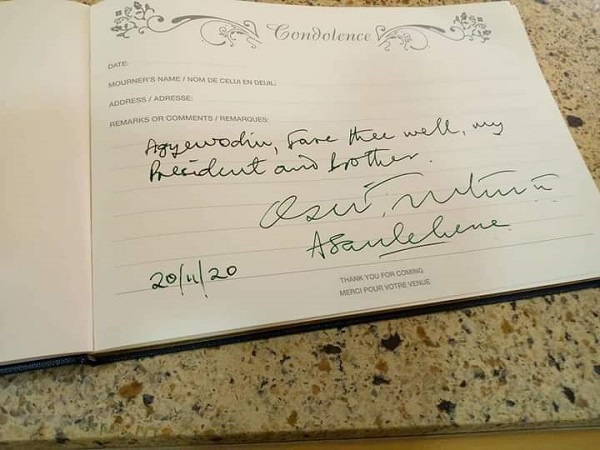
  • What Otumfuo Osei Tutu II wrote in Rawlings’s book of condolence

    While the demise of former President Jerry John Rawlings is still a shock to many, people from all walks have expressed their condolences.

    The government on Monday opened the book of condolence to persons in higher authority to pen their messages to the departed former president at the Accra International Conference Centre.

    With statesmen, ambassadors, the general public granted the chance to eulogize the late president, the Asantehene, Otumfuo Osei Tutu II’s words written in the book has gained some attention.

    According to an image available to GhanaWeb, the King of the Asante kingdom wrote, “Agyewodin, fare thee well, my president and brother.”

    See the image below:

    Source: www.ghanaweb.com

  • Election 2020: EC outlines measures for announcement of results

    The Electoral Commission (EC) has mandated the Returning Officer to announce results of Election for a Constituency after first summing-up the total number of votes cast for each candidate at all polling stations in the constituency.

    Outlining measures for the collation of results at the Constituency Collation Centre, the EC in its Election 2020 Guide to Voters manual available to the Ghana News Agency in Accra mandate the Returning Officer to count all votes cast including votes cast on special voting day.

    Mr Kwame Amoah, EC Greater Accra Regional Director, told the GNA that Returning Officers were the sole authority to declare the winner for the Parliamentary Election at the end of every collation in the constituency at the Constituency Collation Centre.

    The Returning Officer is also under the obligation to announce the collated provisional results in respect of the Presidential Election at the Collation Centre and forward same to the Commission.

    After the announcement, the Returning Officer will endorse the results of the election on the Writ of Election (forms 1A and 1B) and forward it to the District Officer.

    In addition, a copy of the Constituency Summary Result Sheets (Forms 1D and 10) duly endorsed by the Returning Officer and Collation Agents should be sent to the District Electoral Officer and a copy posted in a conspicuous place at the Constituency Collation Centre.

    The EC also stressed that before the Regional Collation Officer publically announces the Presidential Election Results for the region, he or she must first collate the constituency results by adding the total number of votes cast for each candidate as seen on the Presidential Election Results Summary Sheet (Form 10) for all the various constituencies in the region.

    After the announcement, the RCO will send a copy of the Presidential Results Summary Sheet (Form 12) to the Chairperson of the Commission, while a copy is posted at the Regional Office of the Commission.

    Source: GNA

  • WHO predicts spike in COVID-19 cases ahead of Christmas

    The World Health Organisation has predicted a spike in COVID-19 cases ahead of the Christmas and New Year festivities which will witness an increase in social gatherings.

    The WHO Regional Director for Africa, Dr Matshidiso Moeti, said this during a webinar attended by select African journalists on Thursday.

    Moeti urged countries to be on high alert for a possible surge in COVID-19 cases even as nearly 20 countries in the region experience an uptick in cases.

    She said, “As we near the time of year when people get on the move to spend their holidays together, there is a bigger risk of COVID-19 transmission.”

    “New clusters of cases can emerge in places that have so far been unaffected as people travel or gather for festivities. But we can lower the risks by wearing masks, limiting the numbers of people who come together, observing physical distancing and practising good hand hygiene. We can celebrate yet do so safely,” said Moeti.

    According to the WHO director, after reporting a downward trend then a plateau, Africa has been experiencing a rise in cases since early October.

    She said unlike the first wave of cases which was triggered by hotspots in southern Africa, the latest increase is driven by the North African region, where temperatures are beginning to fall.

    According to her, in the 47 countries in the WHO African Region, 19 countries have reported over a 20 per cent increase in new cases in the past 28 days compared with the previous four weeks.

    However, 17 countries are also reporting a more than 20 per cent drop in the number of new cases over the past 28 days, compared with the previous four weeks. There have also been increased reports of health worker infections and deaths, particularly among more experienced health workers.

    The WHO urged member states to conduct risk assessments at the sub-national level and identify areas of high risk.

    Based on this analysis, local governments can adjust their public health measures accordingly and be agile in their decision-making.

    Moeti said WHO is helping to prepare for a potential rise in hospital admission by training additional contact tracers and clinicians to better handle cases, ensuring crucial supplies are on hand and boosting screening at border crossing points.

    The WHO identified a worrying trend of disregarding safety measures among populations.

    The health body also launched the “Mask Up, Not Down” campaign which aims to reach over 40 million young people in Africa with positive messages on the correct use of masks through social media, and to combat complacency, fatigue and misunderstanding around COVID-19 prevention measures.

    “In the face of COVID-19, complacency can be dangerous. At this critical moment as Africa begins to see an uptick in cases, we need to re-energize and recommit to wearing masks. I know many are finding the public health measures cumbersome, but without action from everyone, Africa risks a new surge in COVID-19 cases,” Moeti said.

    Source: punchng.com

  • Family of man who shot himself at Ayeduase demands independent probe

    Family of the suspect in the Ayeduase shooting incident Francis Azabanga is calling for an independent probe into the shooting incidence to establish whether the suspect really shot himself.

    Speaking on Akoma FM’s morning show GhanAkoma on Thursday, November 19, sister to the suspect Lydia Azabanga told host Aduanaba Kofi Asante Ennin in Twi that the family “suspects the police shot and killed my brother contrary to what they came out to tell the media”.

    They said Francis Azabanga did not shoot himself after an altercation in traffic contrary to the preliminary report of the police.

    Scenes captured in a video Akoma FM intercepted brought about interesting twist to the story.

    The family is calling for an independent probe.

    “Our major premise of their claims is to clear the air that the deceased our brother Francis Azabanga committed suicide. Meanwhile, the videos we are receiving indicate that the police shot him.”

    The Azabanga family says they will initiate independent autopsy report into the issue to bring the truth to bare.

    Source: 3 News

  • IPPs creating unnecessary tension with threats over monies owed them Deputy Minister

    Government has accused the umbrella body of Independent Power Producers, the Chamber of Independent Power Producers Distributors and Bulk Consumers of exhibiting traits of a pressure group.

    A Deputy Minister for Energy in charge of power, William Owuraku Aidoo says the Chamber is creating unnecessary tension with their threats to interrupt power supply over monies owed them by the government.

    He said it is unfortunate that the Chamber is issuing such threats when the country is heading into elections next month.

    “The Chamber is being used as a pressure institution to pressure government into doing things that it is already doing; having one on one discussions with individual power producers and so on. With three weeks to elections, it is very unfortunate to hear this Chamber of Independent Power Producers coming out to say they will pull the plug on us, creating unnecessary panic within the system. My recent interaction with them shows there is no cause for alarm, so it is very worrying that they will come out and say things the individual power producers are not saying,” he said.

    William Owuraku Aidoo said the government remains committed to settling debt owned Independent Power Producers in the country.

    He explains that the Cash Waterfall Mechanism instituted in 2019 has been instrumental in servicing such legacy debts.

    Source: citinewsroom

  • Election 2020: 6,000 troops to be deployed Ghana Armed Forces

    The Ghana Armed Forces (GAF) says it will deploy some 6,000 troops to complement allied security agencies to maintain peace and order in the upcoming general elections.

    Asides from the deployment of the troops, logistics from the Ghana Navy and the Ghana Air Force would also be deployed for the elections.

    “The GAF will deploy over 6,000 troops from December 4, 2020, and withdraw them on December 15, 2020, if there is no run-off. However, if there is a run-off, the withdrawal will be on January 10, 2021,”

    This was revealed by the Lieutenant Colonel Alexander Godwin Azera of the Lands Operations Unit of the GAF during a media sensitization held at the Burma Camp.

    The deployment from the GAF will complement the 67,974 personnel forming the national security task force for the upcoming elections.

    According to Lieutenant Colonel Alexander Godwin Azera, the deployment of the GAF troops would take effect from December 4 to December 15, 2020.

    Ghanaians will on December 7, 2020, go to the polls to elect a President and Members of Parliament as part of a four-year constitutional mandate in a general election.

    Source: www.ghanaweb.com

  • Burkinabé ready for Sunday’s presidential election

    The walls of Burkina Faso’s capital Ouagadougou are smothered in posters as more than a dozen rivals try to win over voters ahead of Sunday’s general election.

    It’s the campaign colour of President Roch Marc Christian Kabore, who is running for a second term, defying criticism of his failure to blunt a jihadist insurgency.

    Kabore, 63, is the big favourite in Sunday’s presidential election.

    His supporters are hoping for an outright victory in the first round, obviating the need for a runoff vote.

    But in the West African country’s most open elections in years, Kabore faces a stiff challenge from Zephirin Diabre, the runner-up in 2015’s election, and Eddie Komboigo, standing for the party of former president Blaise Compaore, who was ousted in a popular uprising in 2014.

    Burkina Faso’s security crisis has dominated the campaign. Kabore has relied on the military to fight the threat, but some are now saying that dialogue with the jihadists should be explored.

    Located in the heart of the Sahel, this impoverished country of some 20 million people is in the fifth year of a crisis that has claimed more than 1,200 lives and forced a million people from their homes.

    “The priority is peace, that’s the first thing that the next president should deal with,” Marcelin Sandwidi, a 30-year-old Diabre supporter sporting the candidate’s yellow and green on his cap, said at an opposition rally in Ouagadougou on Sunday.

    But Kabore’s supporters say he has a long-term plan for combatting the jihadists — and now is not the time to rock the boat.

    “Only Roch can respond and win the war,” said orange-clad Barry Amadou.

    Kabore is focusing on a military solution to the crisis, hoping that a civilian auxiliary militia created last year called the Volunteers for the Defence of the Nation will provide a vital push.

    But the poorly equipped and disorganised army is flailing, analysts say.

    Kabore’s strategy “has not radically changed” over the years, a western diplomatic source told AFP.

    Despite frequent claims of success, it depends on France’s Barkhane anti-jihad mission in the Sahel, a reliance that is a source of political discomfort for the government.

    Almost every week brings grim news of military losses.

    In the latest attack, 14 soldiers were killed last week in an ambush at Tin Akoff, near the border with Niger.

    Most candidates called a 48-hour suspension in their campaign to mourn the dead.

    Swathes of Burkina Faso remain outside the state’s control.

    Voters in nearly 1,500 out of 8,000 villages — amounting to 17.7 percent of the country’s area — will be unable to cast their ballot in Sunday’s presidential and parliamentary elections.

    Jihadism expert Mahamoudou Savadogo said that under Kabore there has been a “denial of seeing the reality of the problem.”

    “Realisation (of the problem) came too late, and the response has been ill-matched and inadequate.”

    The idea of talking to the jihadists in the Sahel, some linked to al-Qaeda and others to the Islamic State group, entered the political arena in the region several months ago.

    Several presidential candidates are in favour of exploring the notion of dialogue, while Kabore is against.

    Diabre last Sunday said people “should not close themselves off to the idea”.

    “Military action alone has never been able to defeat terrorism in any part of the world. There has to be other action, alongside military action.”

    Source: africanews.com

  • Ghana midfielder Afriyie Acquah sure of AFCON qualification

    Ghana midfielder Afriyie Acquah is sure of qualification to the 2021 Africa Cup of Nations tournament despite shock defeat at the hands of Sudan.

    Black Stars lost 1-0 in Omdurman after conceding a 92nd-minute goal scored by Abdelrahman Mohamed.

    After three straight wins, a draw against North Africans would have ensured early qualification to Cameroon for Charles Akonnor’s side.

    Black Stars now have to avoid defeat in the last two games against Sao Tome and Principe (away) and South Africa (home) to progress.

    “Of course I think the team can qualify but in football, things have changed so the most important thing is for us to work hard as a team and focus to qualify.”

    “We have to perform well against Sao Tome and South Africa to seal our qualification,” he told reporters.

    Acquah made a return to the team for the double-header against Sudan after over a year absent.

    The Yeni Malatyaspor ace has been capped 36 times by Ghana.

    Source: Ghana Soccernet

  • Pelosi wins bid to lead Democrats in US House

    US Democratic lawmakers on Wednesday chose House Speaker Nancy Pelosi, 80, to lead the party into the Joe Biden era and preside over their narrow House majority as the most powerful person in Congress.

    “Congratulations to @SpeakerPelosi, once again elected by House Democrats to be our fearless leader and nominee for Speaker of the House for the 117th Congress!” the Democratic caucus tweeted.

    Pelosi, the chief nemesis of outgoing President Donald Trump in Congress, has led her House caucus since 2003. While there have been calls within the ranks for new leadership, number 2 Democrat Steny Hoyer and number 3 James Clyburn were also on track to be re-elected to their leadership posts.

    A formal House floor vote for the speakership occurs in January after the new congressional session begins, and shortly before Biden takes office as the 46th US president.

    Source: punchng.com

  • Police break up large Berlin protests as Germany passes tougher coronavirus laws

    Several thousand people gathered in central Berlin, banging pans and blowing whistles, to protest Chancellor Angela Merkel and the German government’s push to better enforce coronavirus restrictions on Wednesday.

    Some 190 protesters were arrested and nine police officers were hurt in the clashes that ensued, Berlin police said.

    “Police calling on demonstrators to leave. Lots of booing. Demonstrators want to access cordoned-off area around parliament where new additions to infection law are being debated [at the moment,],” DW’s Nina Haase reported from the scene.

    A tense standoff ensued, as police tried to convince the crowd to disperse amid cries of “We are the people!” and as some protesters started singing the national anthem.

    Police officers in riot gear lined up to stop demonstrators from getting too close to the parliament building, seeking to avoid scenes from August when a similar protest reached the Reichstag parliament building. Back then, during a weekend demo, politicians were not in session.

    Federal Interior Minister Horst Seehofer defended the police action, saying that the top government bodies were able “to work without restrictions today.”

    “The democratic constitutional state is alive and the police are its protective shield,” he added.

    “The conservative politician thanked the emergency forces “for this very important service in our country.”

    What do the new rules entail?

    Germany’s lower and upper houses passed changes to Germany’s existing infection protection law, catering more specifically to the coronavirus pandemic. The new measures will enable the government to impose restrictions on social contact, rules on mask-wearing, drinking alcohol in public, shutting shops and stopping sports events.

    Advocates say the bill provides a more solid legal basis for various anti-pandemic measures. It also covers rules on school and daycare closures, and restrictions on educational institutions.

    Dubbed the Infection Protection Act, the law passed in the German Bundestag with a 415 majority of lawmakers backing it, 236 voting against it and eight abstaining. It then went to the Bundesrat, the upper house of parliament, where it passed with a clear majority. President Frank-Walter Steinmeier then signed it into law.

    Some 17,561 new coronavirus cases were reported in Germany on Wednesday, bringing its total number of infections to 833,307.

    The latest infection figures are a slight drop from the same day last week, when Germany reported 18,487 cases, and daily case numbers have plateaued somewhat in recent days. But infection levels are still far higher than the government deems acceptable in most of the country, and more than four times the government’s own limit in Berlin itself.

    Hitler’s enabling act invoked by sceptics

    Demonstrators who took part in the Wednesday protests did not actively wear masks or socially distance. But one participant wore a face mask with the words “Merkel-Muzzle,” while others held banners with slogans such as “For Enlightenment. Peace and Freedom.”

    Critics say the coronavirus laws would give the government too much power and endanger citizens’ civil rights.

    The right-wing populist Alternative for Germany (AfD) has even gone as far comparing the proposed measures with the Enabling Act of 1933 that paved the way towards Adolf Hitler’s dictatorship, particularly in its social media postings. A senior AfD member, Bernd Baumann, drew the same parallel in the Bundestag.

    Social Democrat MP Helge Lindh told DW that the right to protest must be respected, but a comparison to the Nazi regime was too far.

    “It must be possible to demonstrate and to criticize,” Lindh told DW by telephone. “But tolerance can not go so far to accept that the infection protection law is being equated with the beginning of the Nazi dictatorship, with the Enabling Act of 1933.”

    “This is blindness towards the lessons of history,” said Lindh. “And it is a complete trivialization of National Socialism.”

    Andreas Wirsching, director of the Institute of Contemporary History in Munich, told DW the analogy was “complete nonsense.”

    A bid by the AfD, Germany’s largest opposition party in the current parliament, to halt proceedings in the Bundestag failed early Wednesday.

    According to Berlin newspaper Tagesspiegel, several lawmakers accused their AfD colleagues of allowing some demonstrators to enter the parliament building without permission.

    One of these activists was filmed berating CDU politician and Economy Minister Peter Altmeier as he was waiting to take the elevator. Lawmakers reported being harassed by the anti-coronavirus demonstrators that allegedly snuck into the building.

    Source: dw.com

  • US election: Inside a govt bureaucrat’s pressure-filled decision to delay the transition

    As the only obstacle between President-elect Joe Biden and the formal start of the presidential transition, General Services Administrator Emily Murphy is struggling with the weight of the presidential election being dropped on her shoulders, feeling like she’s been put in a no-win situation, according to people who have spoken to her recently.

    This was never a position that Murphy thought she would find herself in, the people said. But as the government official in charge of signing off on the election result, President Donald Trump’s refusal to concede the election has thrown Murphy into the middle of a political firestorm.

    Facing mounting pressure from both sides, and even death threats, the sources say Murphy is working to interpret vague agency guidelines and follow what she sees as a precedent to wait to sign off on the election result, a process known as “ascertainment” that would allow the official presidential transition to begin.

    “She’s doing what she believes is her honest duty as someone who has sworn true allegiance to the Constitution of the United States of America, and the laws that govern her position,” the friend added.
    Murphy declined an interview request for this story, and GSA declined to comment.

    A technocrat with a lengthy career

    Sources close to Murphy describe her as a technocrat and policy wonk, with a lengthy career as a congressional aide and at GSA. It’s not clear what specific actions Murphy is waiting on before granting ascertainment. Sources tell CNN she is basing her decision on what she sees as the precedent set by the 2000 election, where there was not a clear winner for more than a month.
    Two sources close to the transition told CNN that Trump’s disastrous day in court last Friday had moved the dial forward, but days later there was still no ascertainment letter from Murphy.

    The impending results from Georgia’s recount, which are expected to be certified Friday with no dramatic shift in results, along with other states beginning to certify the election are also factors in Murphy’s decision, these sources said. But Murphy has not publicly said what the definitive line will be.

    “My experiences with Emily have led me to believe she is an ethical and moral person, but I strongly disagree with her current decision not to ascertain the election,” said a former administration official and colleague of Murphy’s who had spoken to her in recent days. “I think she’s absolutely making the wrong decision. President-elect Biden clearly won. And there really is no question about that… It is wrong to delay, even by another minute, the signing of the ascertainment.”

    It’s been more than a week since CNN and other news organizations called the presidential election for Biden, and the Trump campaign’s lawsuits challenging the result have been repeatedly tossed out of court, while failing to challenge enough votes that would change the result.

    But Trump has continued to make repeated false claims that he did not lose the election, and Murphy’s decision not to ascertain the result has locked Biden and his team out of access to contacts with the federal agencies, funding to help ramp up government hiring for the new administration and access to classified intelligence briefings.

    The Biden team also does not have access to the federal government’s coronavirus vaccine distribution efforts. “More people may die if we don’t coordinate,” Biden said Monday. There are also concerns among national security experts that a delayed transition could leave the government vulnerable to security risks, both domestic and abroad.

    Speaking to her predecessor

    Democrats are furious with Murphy for playing into Trump’s false fantasies that the election was stolen from him. At the same time, Republicans are pressuring her to stand firm and not sign the ascertainment.
    Previous colleagues of Murphy told CNN that despite being a political appointee, she was not an avid Trump supporter or loyalist.
    “She’s going to be really thoughtful about both the letter of the law, any guidelines, explicit guidance, any precedence, as well as the overall intent. She comes out of contracts, where that is the whole nature of the work,” the friend and former colleague said.

    In a sign she sensed the post-election trouble awaiting her, Murphy held a call before November 3 with one of her predecessors, David Barram, who was in charge of GSA during the 2000 election, according to two sources with direct knowledge of the call. Barram, a Bill Clinton political appointee, eventually ascertained Bush as then winner of the 2000 election after the Supreme Court ended the Florida recount. The call was set up by mutual associates as a way for Barram to discuss his experience and the difficult position he was put in, the sources said.

    The Associated Press first reported the call.

    While GSA has compared the current situation to the standoff between George Bush and Al Gore, Barram said in a podcast last week that this election was “dramatically different” than what happened in 2000. “It was all about Florida. One state, and something like 537 votes. Everyone knew that once Florida was settled, the winner would become clear,” Barram said.

    From the Hill to GSA

    Murphy has been in charge of GSA since 2017, making her one of the longer-serving Trump appointees. Before her nomination, she served as a senior adviser to her predecessor at GSA, as an aide for the House Armed Services and Small Business Committees, as a lawyer in private practice and as GSA’s chief acquisition officer during the George W. Bush administration.
    Multiple sources described Murphy as a political person, but not a Trump person and “not a partisan hack.”

    Originally from Missouri, Murphy was introduced at her confirmation hearing by former Missouri Democratic Sen. Claire McCaskill, who praised her lengthy career in government. She was confirmed in the Senate by voice vote.
    Suzette Kent, the Federal Chief Information Officer appointed by Trump in 2018, co-chaired a government board with Murphy, and described her as a professional who “demonstrated a high degree of integrity” and “extremely competent.”

    Since the election was called, Democrats on Capitol Hill have demanded Murphy explain why she hasn’t granted ascertainment, sending her a letter last week that she’s yet to respond to. But Biden’s team is arguing to congressional Democrats that it makes the most strategic sense for now to let public pressure build on Trump preventing the transition, rather than trying to subpoena Murphy.

    Sen. James Lankford, an Oklahoma Republican, said last week that he would “step in” last Friday if Biden was still not receiving intelligence briefings that are supposed to be given to the president-elect. That deadline has come and gone. On Tuesday, Lankford said he and his staff have been in touch with GSA, and defended Murphy’s decision not to grant ascertainment.

    “I did step in, I did talk to them on Friday,” Lankford said, though he did not say if he’d spoken to Murphy.

    “There’s no way they can ascertain,” Lankford added. “GSA is not the electors.”

    Controversy over FBI HQ

    This isn’t Murphy’s first brush with controversy as a Trump appointee. In 2018, she was part of a controversial decision to scrap plans for a new FBI headquarters outside Washington, DC, and instead rebuild on the same location — across the street from the Trump International Hotel. She faced questions at a 2018 congressional hearing over whether the White House was involved in the decision, which critics charged Trump influenced in order to keep a competitor from gaining the space across from his hotel.
    Murphy had spoken to Trump about the project in the Oval Office, which she did not disclose to lawmakers. The GSA Inspector General charged that her testimony “left the misleading impression that she had no discussions with the President or senior White House officials in the decision-making process about the project.” Murphy said the inspector general’s conclusion was “unfounded and unfair.”

    “Despite a rocky start, we developed a constructive, productive, ongoing relationship,” Rep. Mike Quigley of Illinois, the top Democrat on the House Appropriations Subcommittee that oversees GSA, told CNN. “It’s my fervent hope she will do the right thing here.”

    Alan Chvotkin, a senior executive at a Washington, DC, trade association who has worked with Murphy for more than 20 years, said he was a strong proponent of her nomination because of her deep understanding of how the agency operates and her commitment to understanding the nature of the issues she’s dealing with.

    He said when Murphy faced a decision, she would consult broadly, ask others for research, and ensure she knew the scope and ramifications of a decision before making it.

    “In a heightened political atmosphere, many people don’t know her, and they certainly don’t know the job that she’s responsible for,” Chvotkin said. “If you just isolate one or two topics it’s easy to reach the wrong conclusion.”
    Former Republican Missouri Sen. Jim Talent told CNN he has known Murphy 25 years and that she worked for him when he chaired the House Small Business Committee during the Clinton administration. Talent praised Murphy’s integrity, blaming the law for putting the onus on the GSA.
    “Something is wrong with the system where the responsibility for declaring the winner of a Presidential election seems to devolve upon the General Services Administration — it’s the Government’s landlord. They buy furniture,” Talent said. “I understand people’s frustration, but the problem is an electoral system that cannot come to a finality. It’s not Emily or the GSA.”

    Still, Murphy’s stalled sign-off is one of the more confounding decisions made since the election, since it’s clear Biden won and Trump’s legal challenges won’t change the outcome. Biden’s team has warned the delay has real-world consequences to national security and their Covid-19 response.
    Sources who spoke to CNN could not say whether Murphy has been in touch with the White House on the issue.

    “She absolutely feels like she’s in a hard place. She’s afraid on multiple levels. It’s a terrible situation,” one friend and former colleague of Murphy’s told CNN. “Emily is a consummate professional, a deeply moral person, but also a very scrupulous attorney who is in a very difficult position with an unclear law and precedence that is behind her stance.

    Source: CNN

  • 39-year-old man to die by hanging for killing lover

    An Abeokuta High Court on Wednesday sentenced a 39-year-old man, Musiliu Owolabi, to death by hanging for killing his lover, Afusat Idowu.

    Owolabi, an automobile mechanic was convicted on one count of murder.

    The Chief Judge of Ogun State, Justice Mosunmola Dipeolu, while delivering her judgment, submitted that the prosecution had proved its case beyond reasonable doubts that Owolabi was guilty of the offence charged, hence, convicted him.

    Dipeolu, said the offence committed contravened the provisions of section 319 of the Criminal Code, Laws of Ogun 2006.

    She held that the evidence presented by the prosecution was tenable and therefore, sentenced Owolabi to death by hanging.

    Earlier, the state prosecution counsel, Mr James Mafe, Director of legal Drafting, Planning Research and Statistics, said the convict committed the offence on Feb.1, 2018, at Camp area in Abeokuta.

    Mafe said the convict took his lover to a hotel for pleasure after a while she complained of stomachache and later started foaming from her mouth.

    Mafe added, “The convict took her to his vehicle, on his way he noticed she was dead, and secretly took the deceased to an uncompleted building, dug a shallow grave and buried her without disclosing to anybody.

    “The convict was arrested when the younger brother of the deceased went to the police station to complain that his sister who told him she was going for a naming ceremony at Bode Olude area never returned.

    “Upon police investigation, with the help of tracking the deceased phone, it was discovered that the convict was the last person that spoke with the deceased.

    “On his arrest, he made a confessional statement to the police and took them to where he buried his lover .”

    The convict had earlier been arraigned on Nov. 12, 2019, and had pleaded not guilty to the charges.

    Source: punchng.com

  • Ouattara mocks opposition call for ‘transitional council’

    Ivorian President Alassane Ouattara, re-elected for a controversial third term, mocked Tuesday an opposition “plan”, assuring that there would be “no transition”, but also inviting him to dialogue.

    “All those who have ideas about a transition, they can always dream, there will be no transition,” President Ouattara said at a political council of his party, the Rally of Houphouëtists for Democracy and Peace (RHDP), in Abidjan.

    Re-elected in the presidential election of October 31 with 94.27% of the vote (“as some would say, a Stalinist score”, noted Mr Ouattara who does not hesitate to use humour in his speeches), the head of state ironically said: “Where does this idea of transition come from? Three years before we know that there is an election, we sit in his living room and then we say that there is a transition”.

    Not recognising Mr Ouattara’s re-election because they considered a third term unconstitutional, leaders of the opposition, who boycotted the election, proclaimed a “National Transitional Council”.

    After several days of tension, marked by the arrest of several opposition leaders, however, a dialogue began with a meeting on November 11 between Mr Ouattara and the leader of the opposition, former President Henri Konan Bédié.

    While saying he was “outraged” by the “87 deaths” (the government had counted 85 so far) caused by clashes during the election period, as well as by the fact that nearly 1.5 million Ivorians were unable to vote because of “civil disobedience” by the opposition, Mr Ouattara called for “mutual forgiveness and tolerance.

    “We have to talk to each other, we have to stop this,” he said. “We must continue to live together in peace,” he insisted.

    On Friday the opposition had demanded “acts of appeasement” of the government as a “prerequisite” to any political dialogue, to try to put an end to the electoral violence.

    Source: africanews.com

  • How climate change threatens African coffee farmers

    Some savour the taste, others drink it to stay awake. Whatever the reason, the world has a seemingly insatiable taste for coffee.

    Some 169 million bags of coffee were produced in the 2019/2020 coffee year, according to the International Coffee Organisation.

    But the future of coffee is gloomy. About 60% of wild coffee strains worldwide are in danger of extinction, according to a study by the US journal Science Advances.

    This includes Arabica, a coffee species that accounts for over half of worldwide coffee production.

    Climate change is coffee’s biggest enemy

    Coffee farmers like Mercy Njambi in Kenya have long felt this worrying trend.

    “We used to produce a lot of coffee,” she told DW pointing to the red coffee cherries dotting the plants on her farm in Muranga County in central Kenya. “What we are harvesting now is nothing compared to 10, 20 or so years ago.”

    The coffee plant used to thrive in the moderate temperatures and high altitudes of this Muranga County. Now, due to rising temperatures and erratic rainfall caused by climate change, the coffee plants are suffering.

    Neighbouring coffee farmer Maina Thuku is also worried.

    The droughts last longer, and there are more pests causing damage, the father of two said.

    “People drink coffee all over the world. We ask them to help us because the environment is changing, and soon you might not get to enjoy that cup of coffee,” he added.

    Coffee vital to East African economies

    Not only is coffee indigenous to Africa, it is also the region with the most coffee-producing countries.

    About 10 million farmers plant coffee across 25 African nations. Ethiopia, where the habit of drinking coffee first developed, along with Uganda, Tanzania and Kenya produce 80% of Africa’s total coffee exports, according to the UN Conference on Trade and Development.

    From an agricultural standpoint, East Africa is one of the world’s best regions for coffee farming. The highlands have moderate temperatures but enough rainfall to keep the soil fertile.

    Future could see coffee-growing land halved

    Climate change is threatening this delicate balance. “Without appropriate measures, experts assume that climate change will reduce coffee growing areas by about 50 per cent worldwide by 2050,” finds a new study by the World Resources Institute.

    This would have serious consequences for Africa, says Hauke Engel from the McKinsey consulting group.

    “This number actually hides a much bigger problem. While some other areas may become suitable for coffee farming due to climate change, growers cannot simply get up and move away,” he told DW.

    To keep small-scale farmers going, coffee buyers should invest in training their coffee suppliers, Engel said.

    Will coffee still be around in 30 years?

    One such buyer is Muthoni Schneidewind, the founder of the online shop Chania Coffee, which sells fair-trade coffee from Kenya.

    Schneidewind grew up in a family of coffee growers in the heart of Kenya and her father is one of her suppliers.

    “I can’t promise my customers that they’ll be able to buy coffee from me in the 30 years time,” she told DW.

    At the moment, she’s focusing on ways to help coffee growers stay in business.

    “My whole village relies on coffee, it is our heritage and we have to preserve it,” Schneidewind said, adding that her business has begun training farmers to get the most out of their plants.

    “We started supplying these coffee farmers with new coffee plants, we were able to test the soil and decide to see where coffee was better suited to grow,” she explained.

    Additionally, her company encourages farmers to grow a diverse range of crops such as bananas, macadamias and others alongside coffee to provide additional sources of income.

    Coffee farmers can learn from cocoa

    Coffee farmers could learn from cocoa farming in a bid to save itself from climate change, said senior researcher and cocoa expert Friedel Hütz-Adams at the Südwind Institute for Economy in Bonn, Germany.

    “Cocoa and coffee are relatively sensitive to changes in climate and finding strains of coffee resistant to climate change and farming them would help,” Hütz told DW.

    Without support from governments and companies, coffee farming in its present form can’t be saved, Hütz-Adams believes.

    “Investments are necessary because it takes years for coffee or cocoa plants to bear fruit, and it costs thousands of dollars,” he said.

    For small-scale coffee farmers, who often earn just enough to keep their families fed, these sums of money are impossibly large.

    “If we want to develop a sustainable coffee growing system, we have to pay prices that allow farmers to make the necessary investments,” Hütz-Adams said.

    Without this, coffee production in Kenya, Uganda and Ethiopia could cease in just a few decades.

    Farmer’s like Muthoni Schneidewind’s father face losing their way of life but also their coffee-growing heritage.

    Source: dw.com

  • Africa’s debt crisis grows amid COVID-19 pandemic

    Hardly anyone would want to take the job of Angola’s minister of finance, Vera Daves. By the end of this year, the country’s gigantic amount of debt is expected to grow to over 120% of gross domestic product (GDP).?

    Even in normal times, without the coronavirus pandemic burden, this is a considerable challenge.

    “Our priority is to survive, save as many lives as possible, and prevent the healthcare system from collapsing. Then we want to reach a bearable debt level,” Daves said in October.?

    However, one step has been taken: Donors have pledged to relieve Angola of around €5.3 billion ($6.3 billion) in debt over the next few years. But this relief doesn’t mean Africa’s fifth-largest economy is out of trouble yet.?

    According to the International Monetary Fund (IMF), African states need almost €410 billion to pay off all foreign debts due by 2023.?

    No money for schools and hospitals

    Nobody wants to imagine what else happens, warns Jürgen Kaiser of the development policy network erlassjahr.de.?”States would cease to fulfill basic needs: security, education, health care,” Kaiser told DW, adding that “many people no longer see a future in their home countries.”?

    But even now, some countries feel the pinch due to the pressure to pay the due debts.?

    Zambia is a case in point — the southern African country is on the brink of defaulting on its foreign debt after failing to pay more than $40 million last month. A grace period will expire on Friday, making it Africa’s first nation to default on its sovereign debt since the COVID-19 pandemic started.?

    Zambia was already struggling to reduce its $12 billion external debt burden, but it is not the only African country in this trouble. Mozambique also slipped into the debt crisis due to corruption scandals worth billions of dollars.?”If we had to pay our debts, the situation would be tough,” Adriano Nuvunga of the civil society network FMO in Mozambique told DW.?

    “Because we need funds to support the poorest of the poor. Since coronavirus began, they have not received any support at all,” Nuvunga said.?

    While Mozambicans must pay for billions stolen by few individuals in power, other countries’ liabilities grew for different reasons: With comparatively cheap money on the capital markets or borrowed from China, they financed massive infrastructure projects, bridges, and railroad lines.?

    COVID-19 pandemic aggravates the situation

    The rich-in-natural-resource countries had hoped to repay the loans by selling minerals, but then came coronavirus.”We have an important factor that affects countries like Angola, Gabon, or the Republic of Congo — it’s the drop-in oil prices,” says expert Kaiser.?

    Gabon’s Finance Minister Jean-Marie Ogandaga had projected the country’s economy to grow by up to 5%, with an oil price of $57 per barrel in the current budget. Now he expects the economy to grow by a maximum of 0.5% in 2020 — with an estimated oil price of $26 per barrel.?

    “If you suddenly get half your salary, you can’t just continue to pay your debts as if nothing was wrong,” Ogandaga said in May.?

    The International Monetary Fund (IMF) and the World Bank have already promised to help some states. The 20 leading industrialized and emerging countries (G20) have allowed 73 particularly heavily indebted countries to suspend repayments until the end of June 2021.?

    But the initiative is only considered a first step. “The moratorium helps a lot, but it only postpones payments. But some countries need substantial debt relief,” World Bank head, David Malpass, told DW in October.?

    Private donors have another problem: Some African countries have borrowed large sums of money on the global financial markets in recent years. Now they must pay off the loans with incredible difficulty.?

    Next year, an estimated €18 billion in repayments to private creditors will be due. In contrast to public donors, however, there are still no signals that private donors will cut their debts.? “I, as a taxpayer, do not want to accept waivers so that Blackrock and the Deutsche Bank can continue to cash in,” Kaiser said.?

    Counting on the G20

    Hopes are now resting on the G20: the finance ministers of the most industrialized and emerging countries want to discuss debt relief for hard-hit countries at their meeting on November 13. They had already developed a corresponding procedure in October.

    According to media reports, however, an essential demand by experts and civil society is to be met: In the future, debt relief initiatives should include all donors — Western states, China, and also private creditors. A possible candidate for such a procedure is Zambia — which already had to ask its creditors for a payment extension in October.

    Source: dw.com

  • FC Porto interested in signing Kwadwo Asamoah

    Ghanaian international Kwadwo Asamoah is set to join Portuguese giants FC Porto according to reports in the media.

    The 32-year old currently is a free agent after parting ways with Inter Milan in the summer.

    The former Juventus wing-back was reported to be joining Sampdoria before transfer deadline day but the deal broke down in the last minute.

    Asamoah has been linked to clubs in the Serie B and the Major League Soccer but the Black Stars midfielder is weighing up options of taking a challenge outside Italy.

    He might consider Porto who are also interested in signing him as a back up for Zaidu Sanusi.

    Kwadwo Asamoah has had stints with Italian side Udinese, Juventus and Inter Milan.

    He was won a lot of laurels with Juventus and was part of the squad that played in the 2015 UEFA Champions League final against Barcelona which they lost.

    Source: Ghana Soccernet

  • Hudson-Odoi urges Bayern wonderkid Musiala to pick Three Lions over Germany

    Callum Hudson-Odoi is trying to sway Jamal Musiala to choose England over Germany after the pair lined up together again with England’s Under-21 team.

    The Chelsea forward both played and went to school with Musiala while he was in the Blues academy before he made the switch to join Bayern Munich in 2019.

    Musiala was born in the German city of Stuttgart but grew up in England, making him eligible for the two countries. His father also holds a Nigerian passport so he is also able to play for the Super Eagles if he so chooses.

    But even the DFB (German Football Association) concede that England are most likely to convince the wonderkid to play for them after seeing his debut and score for Aidy Boothroyd’s side over the international break.

    Still, Musiala can change his mind until he makes his senior debut in a competitive match for any country, and Hudson-Odoi has offered his opinion to his fellow young star.

    “We talked about it. I said he should be staying with England,” Hudson-Odoi said after the pair both scored in the 5-0 win over Albania. “He knows a lot of the boys already and has been really welcomed into the team.

    “I said to him, ‘I can’t choose for you but it would be nice if you stayed with England.’ Hopefully, he gets to the seniors as quickly as possible.”

    The excitement over Musiala’s talent is highlighted by two records broken at Bayern, with the 17-year-old having to become the club’s youngest Bundesliga appearance-maker and goalscorer in recent months.

    After signing Musiala, Bayern have had several attempts to sign Hudson-Odoi rejected by Chelsea. Hudson-Odoi spoke of being reunited with Musiala for his country after the clubs failed to do business in the summer once again.

    “Jamal is a top, top player. I have known him from young, when he was at Chelsea,” he continued. “He is a great player and I’ve watched him for a while. He went to the same school as me as well.

    “On day one, I wanted to welcome him to the U21s as soon as possible. He is a good guy, very shy, and before the game I wanted to see he was feeling himself and confident and not scared or shy. I said, ‘Play your own game and get a goal for yourself,’ which he did.

    “I was really happy for him. I have always said to him, ‘Keep doing your thing day in, day out, and you will get to the seniors sooner rather than later.’

    “Wherever he is I will be watching him and seeing he is doing himself proud.”

    England eased to qualification for next year’s U21 European Championships with two victories over the international break to ensure they reached 28 points from a possible 30 in their qualification group.

    Source: goal.com