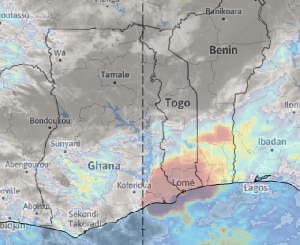
Early on March 7, 2023, the Ghana Meteorological Agency published a weather report outlining the reasons why heavy rains were predicted to fall in some areas of the nation.
The storm alert read: “Southeastern Ghana has been engulfed by a rain bearing cloud. This is producing rain of varying intensity within the Volta region.”
It continued: “Areas within the Greater Accra and Eastern will be affected before drifting to the Central, Western and parts of the Ashanti,” it concluded.
“The rain is likely to lead to flash floods in parts of Greater Accra. Be advised accordingly,” the Agency stated in a followup tweet.
At the time of filing this report, GhanaWeb could confirm that heavy rains were hitting parts of the capital Accra.
It appeared however that the rain was drifting per our checks on social media, with some tweeps calling the attention of the Meteo on Twitter that the rains had stopped where they were.
The full impact of the rains is likely to be known in the early hours of this morning. It is the first very heavy rain for the year 2023.
Whenever it rains heavily, issues of flooding and sometimes displacement has often been recorded in parts of the capital.
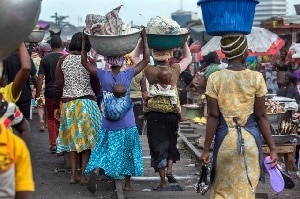
A non-governmental organization, Rise-Ghana, which is based in theNorthern region, has protested the government’s decision to build hostel facilities for head-porters, popularly known as “Kayayei,” in Accra.
According to the NGO, the issue of constructing hostels will rather encourage rural-urban migration.
This comes on the back of the sod-cutting ceremony to begin construction of a four-storey hostel facility at Adjen Kotokuand other parts of Accra to accommodate 300 head porters.
Speaking on the Morning Starr with Naa Dedei Tetteh Thursday, the Executive Director of Rise Ghana, Awal Ahmed Kariama admonished the government to rather solve the problem at source where these head porters are from.
“We need to have a system down here in the North where we will be able to place children who have completed Junior High School in the public sector and government places so they can earn some money. At the end of the day, people are doing this because they want to put food on the table. They want to be able to acquire the necessary tools that they need to go to school. If you interview some of them, they will tell you they want to become an apprentice but they cannot afford their apprenticeship fees.
“So what the government needs to do is identify the challenges of the people which is the source of the problem. The government should put things in place so these people can have the opportunity to feed themselves and earn the income that they need. So that they won’t find it attractive to travel to these places,” Mr. Karima stated.
He further added that building these hostels will create another problem of rural-urban migration as many of them will love to come due to the hostels.
“Today if we have 100 people coming from the North to engage in a Kayayei job. And if you build a hostel that has the capacity to accommodate 100 people, that hostel will attract another set of 100 or 200 people. What we tell these ladies is that most of their sisters sleep on the street and they are exposed to all forms of risk. There have been instances where some of them have been abused sexually, some of them have been killed and others.
So, we use that as a basis to create awareness for people not to go. So, the situation that now we have a shelter, that argument alone will not stand. It is going to open up the floodgate for more people who want to travel to engage in that business,” Mr. Kariama explained.
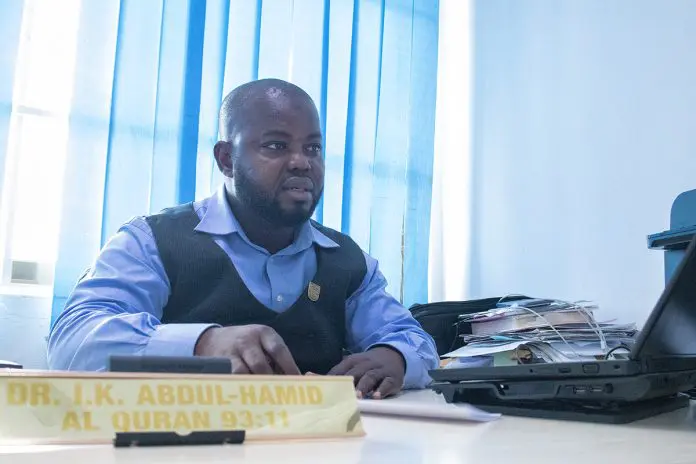
The University of Professional Studies, Accra (UPSA) has appointed Dr. Ibn Kailan Abdul-Hamidas the new head for the Department of Marketing.
His appointment took effect from January 1, 2023. He takes over at a time when the Department of Marketing is undergoing major transformation and expansion in areas such as new programme development, faculty growth and an increased student population.
Dr Abdul-Hamid, holds a PhD in Marketing from the University of Ghana. He has Bachelor’s Degree in Marketing from the Institute of Professional Studies (IPS) and a Master of Philosophy (MPhil) in Marketing.
He is a member of the Chartered Institute of Marketing(CIM)—UK, the Chartered Institute of Marketing Ghana (CIMG), and the Association of International Business.
Dr Kailan Abdul-Hamid, an alumnus of UPSA, revealed in an interview with UPSA Media that he plans to collaborate closely with other faculty members to develop marketable programs to increase overall student enrollment.
“I am also looking forward to improving student services at the department while developing mentorship programmes and activities to enhance student performance,” he said.
He also intends to make an impact in areas of staff welfare and faculty capacity building, where he plans to encourage collaboration, mentorship and team spirit with other faculty to help with the promotion of faculty members.
About Dr Ibn Kailan Abdul-Hamid
Dr Abdul-Hamid joined the University of Professional Studies, Accra, as an Assistant Lecturer in 2016. After two years of exceptional service, he was promoted to the rank of lecturer in 2018 by the Management of the University.
In 2019, he was appointed the first Coordinator of the MABC programme where he was instrumental in increasing the number of course enrolments from 18 students in 2019 to 76 in 2020, 120 in 2021, and 150 in 2022.
He is an astute lecturer and has published in many reputable journals. He has also demonstrated sufficient capacity to build strong relationships with students, faculty, and alumni – a skill many believe will make him successful in his new role.
The GaDangme Council has urged government to build technical and vocational training facilities in the northern region.
This it said will help the youth, especially young women who migrate to the capital for menial jobs, develop business skills.
That would be a better option for stemming the regular flow of teeming youths into the national capital for non-existent jobs, than a proposed construction of a hostel for kayayei (female head porters) in Accra.
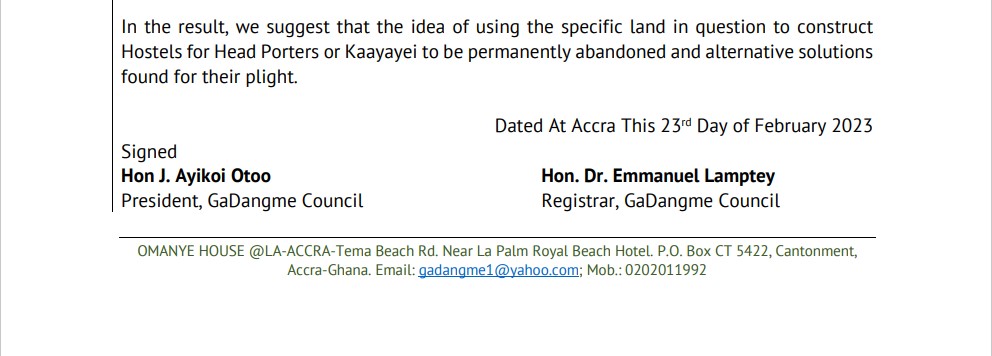
The Council has in a statement therefore, urged the government not to go ahead with the advertised construction of the hostel for the head porters but return the land earmarked for the hostel project to its owners, in line with constitutional provisions on land acquisition and usage by the State.
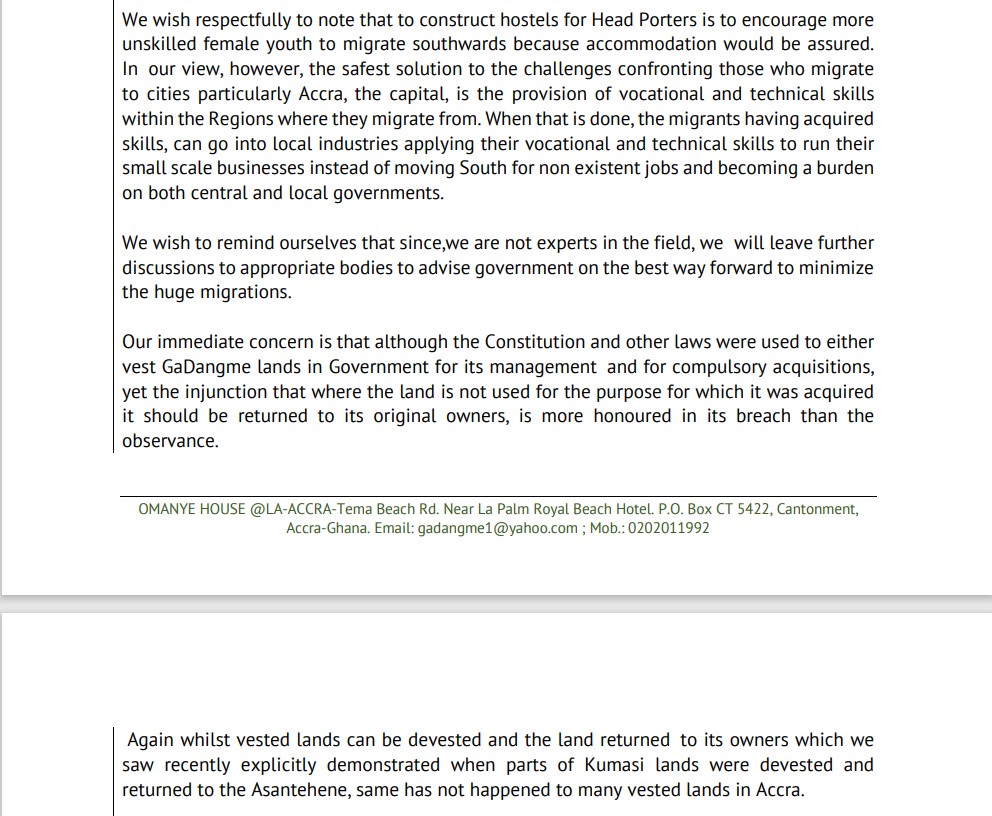
The Council, in the statement signed by its president and former Attorney-General Ayikoi Otoo, and Registrar, Dr. Emmanuel Lamptey, also noted that “to construct hostels for Head Porters is to encourage more unskilled female youth to migrate southwards because accommodation would be assured.”
“In our view, however, the safest solution to the challenges confronting those who migrate to cities particularly Accra, the capital, is the provision of vocational and technical skills within the Regions where they migrate from. When that is done, the migrants having acquired skills, can go into local industries applying their vocational and technical skills to run their small scale businesses instead of moving South for non existent jobs and becoming a burden on both central and local governments.”
Return our lands as you did for Kumasi
“Our immediate concern is that although the Constitution and other laws were used to either vest GaDangme lands in Government for its management and for compulsory acquisitions, yet the injunction that where the land is not used for the purpose for which it was acquired it should be returned to its original owners, is more honoured in its breach than the observance.
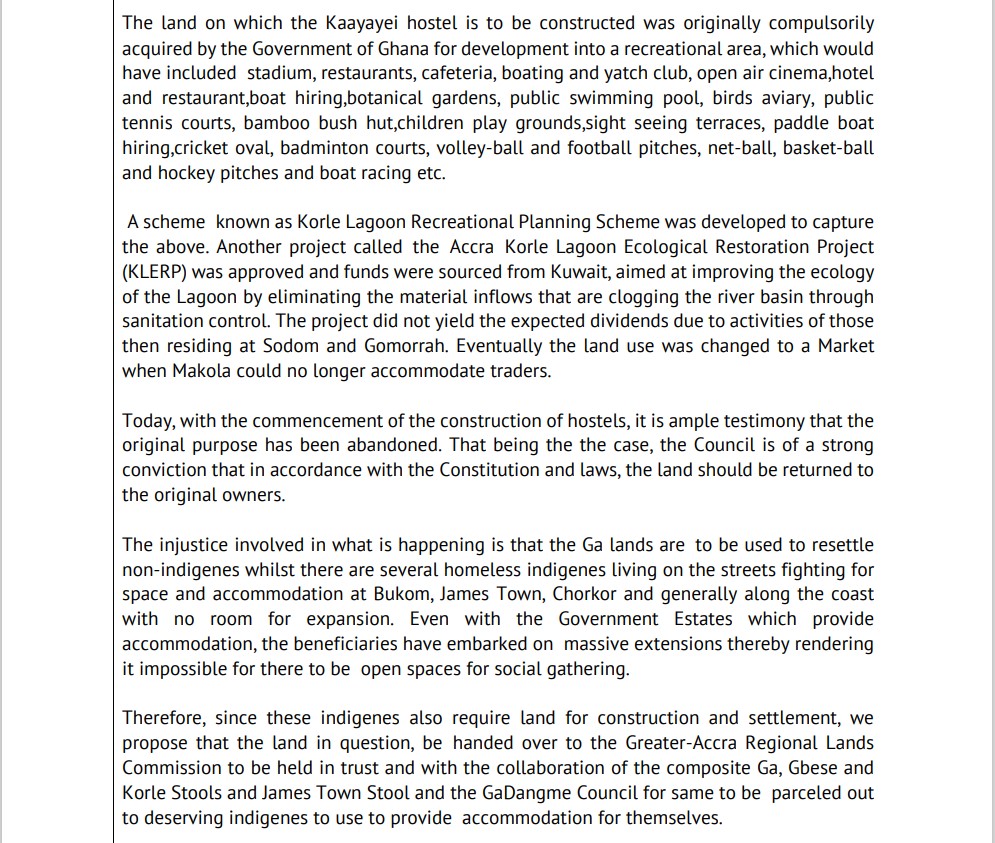
“Again whilst vested lands can be devested and the land returned to its owners which we saw recently explicitly demonstrated when parts of Kumasi lands were devested and returned to the Asantehene, same has not happened to many vested lands in Accra. The land on which the Kaayayei hostel is to be constructed was originally compulsorily acquired by the Government of Ghana for development into a recreational area, which would have included stadium, restaurants, cafeteria, boating and yatch club, open air cinema, hotel and restaurant, boat hiring, botanical gardens, public swimming pool, birds aviary, public tennis courts, bamboo bush hut, children play grounds, sight-seeing terraces, paddle boat hiring, cricket oval, badminton courts, volley-ball and football pitches, net-ball, basket-ball and hockey pitches and boat racing etc.
“A scheme known as Korle Lagoon Recreational Planning Scheme was developed to capture the above. Another project called the Accra Korle Lagoon Ecological Restoration Project (KLERP) was approved and funds were sourced from Kuwait, aimed at improving the ecology of the Lagoon by eliminating the material inflows that are clogging the river basin through sanitation control. The project did not yield the expected dividends due to activities of those then residing at Sodom and Gomorrah. Eventually the land use was changed to a Market when Makola could no longer accommodate traders.
“Today, with the commencement of the construction of hostels, it is ample testimony that the original purpose has been abandoned. That being the case, the Council is of a strong conviction that in accordance with the Constitution and laws, the land should be returned to the original owners. The injustice involved in what is happening is that the Ga lands are to be used to resettle non-indigenes whilst there are several homeless indigenes living on the streets fighting for space and accommodation at Bukom, James Town, Chorkor and generally along the coast with no room for expansion. Even with the Government Estates which provide accommodation, the beneficiaries have embarked on massive extensions thereby rendering it impossible for there to be open spaces for social gathering.
“Therefore, since these indigenes also require land for construction and settlement, we propose that the land in question, be handed over to the Greater-Accra Regional Lands Commission to be held in trust and with the collaboration of the composite Ga, Gbese and Korle Stools and James Town Stool and the GaDangme Council for same to be parcelled out to deserving indigenes to use to provide accommodation for themselves.”
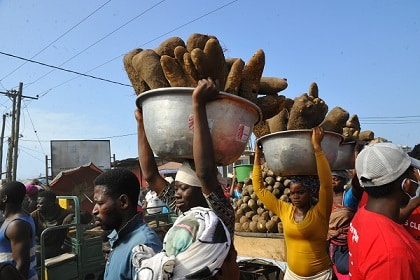
Traders at Western Regional Market and lorry station in Agbogbloshie Marketin Accra, have petitioned the Member of Parliament(MP) for Jomoro to intervene in the alleged construction of hostels and toilets for head porters (Kayayei) at their premises.
As a result, the market’s residents risk losing their sources of income.
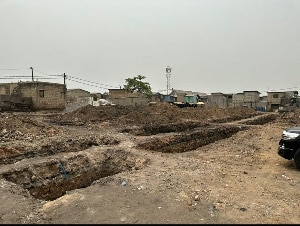
The foundation is currently being dug in more than half of the land in preparation for the start of the project.
The traders and drivers claim to have lived on that plot of land for over 40 years, only to arrive at work on Monday to discover that their properties on the land had been destroyed.
Five vehicles stationed on the land at the time of the operation were towed to the Accra Metropolitan Assembly’s office (AMA).
The drivers claim they had to pay 5,000 Ghana cedis (GHc5,000) each before they were released.
They had no choice but to seek assistance from two of their members of parliament, Dorcas Afo Toffey for Jomoro and Emmanuel Armah Kofi Buah forElembelle.
Madam Afo Toffey explained to traders and drivers in Accra that when she received the call about their ejection without notification, she called the Greater Accra Regional Minister, Henry Quartey, who denied knowledge of the ejection.
She said the Minister told her the location is not under his jurisdiction, but rather that of Accra’s Mayor, Elizabeth Sackey. She assured them that what is happening to them is affecting her as well, and that she will do everything she can to get to the bottom of the problem, and that even if the land is taken, they will be relocated.
“What the government wants to do by building a hostel and toilet on the land is not a bad idea,” Madam Afo Toffey said in Twi.
She stated that over 2000 women are trading on that parcel of land, and if such land is taken away from them, they will be unable to provide for their families, as women are the ones who take care of their homes.
“If the government is doing such things for the Kayayei, then traders and drivers also need a befitting place to do their business and not to push them away”. She promised to meet with the Mayor of Accra to resolve the issue amicably.
Brigadier-General Nana Adu, a retired Army officer and truck owner who operates at the station, said he does not understand why the government must take such action. He admitted that the government can take land for such development, but taking it by force is not the right way to go about it.
He said that there should have been a dialogue with the people for peace to reign. Brigadier-General Adu stated that an arrangement should have been made as to where the occupiers would be taken, but for the government to wait until Friday when the area is calm before storming in with police and military to take over is not the right way.
“We know the army and the police are controlled by the government and so the moment these people came to take over the place for the construction of the project, we are convinced the government has a hand in it”.
National Secretary for Coconut Oil Dealers Association, J. B. Gbolor, called for an injunction on the project until the determination of the matter.
He said day in and day, the contractor is bringing construction equipment unto the lord which is not in their interest. The Chairman of the Drivers Union who gave his name as Life explained that the station receives trucks from the Ivory Coast and Nigeria with goods and as such taking over the place would affect such businesses.
He stated that because of what has occurred, all of the women are stranded, which will have an impact on them. The Chairman stated that those who arrived were armed, but they do not want any violence and preferred an amicable resolution to the issue.
Some of the traders have petitioned President Akufo-Addo and Dr. Bawumia, whose names have been mentioned, to halt the project because the location is vital to their livelihood.
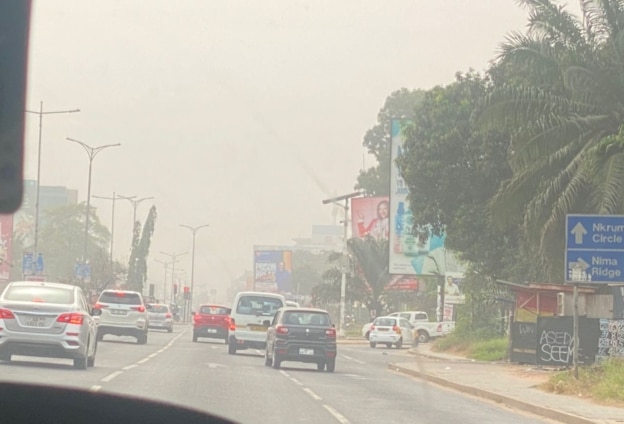
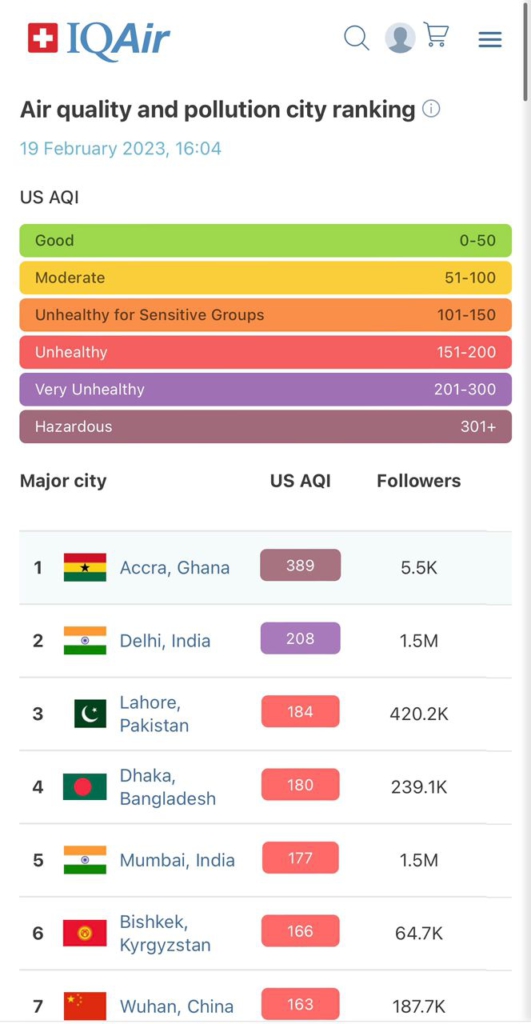
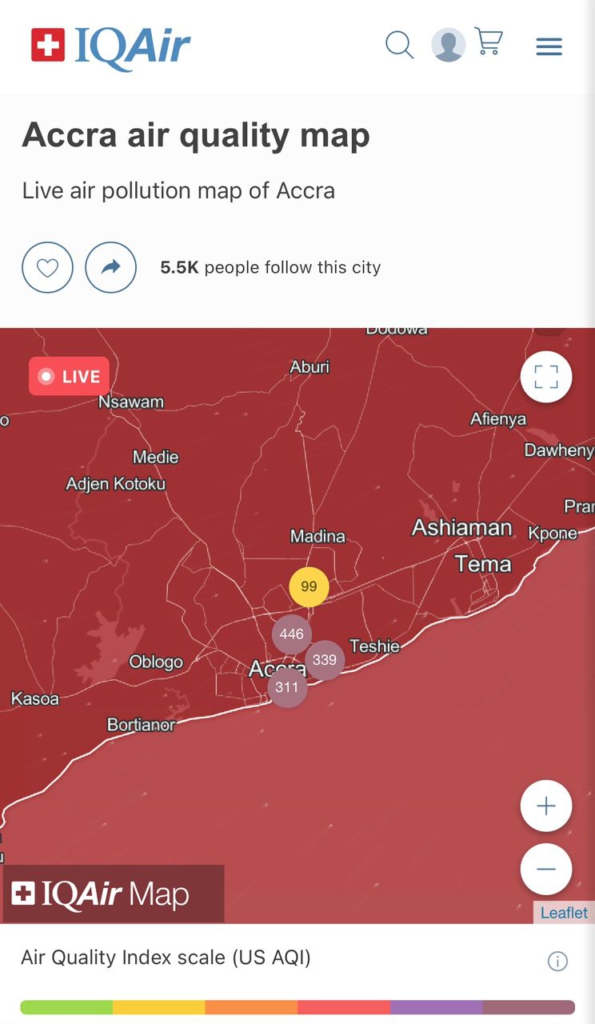
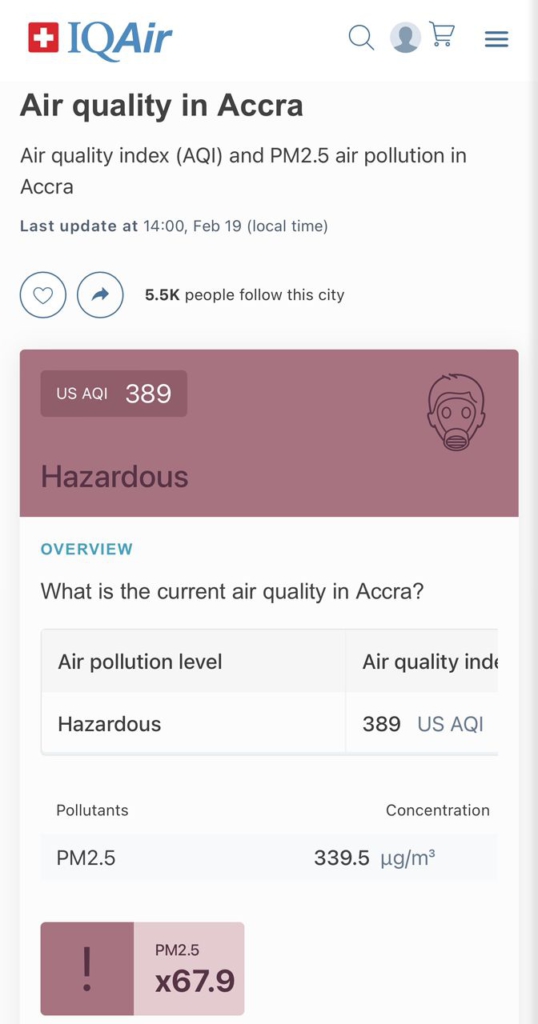
IQAir’s AirVisual, a real-time air quality information platform, says Ghana’s air quality is currently 49.6 times the WHO annual air quality guideline value.
This, the site, attributes to the high concentration of PM2.5 in Accra’s atmosphere.
PM2.5 refers to particles found in the air, including dust, soot, dirt, smoke and liquid droplets with a diameter of 2.5 micrometres or less.
Data as of 16:04 on Sunday, February 19, 2023
These particles are so small they can get deep into the lungs and into the bloodstream and cause havoc to one’s organs.
It is believed the high concentration of PM2.5 in the air has been compounded by the resurgence of the Harmattan as a result of regional dust storms pushing into Southern Ghana.
Due to the highly damaging effects of pollution exposure on vulnerable members of society, i.e. young children and the elderly, pregnant women, those with heightened sensitivity towards pollution, as well as those with pre-existing illnesses or compromised immune system, the population is advised to wear a mask outdoors, run an air purifier, close windows to avoid dirty outdoor air and avoid outdoor exercise.
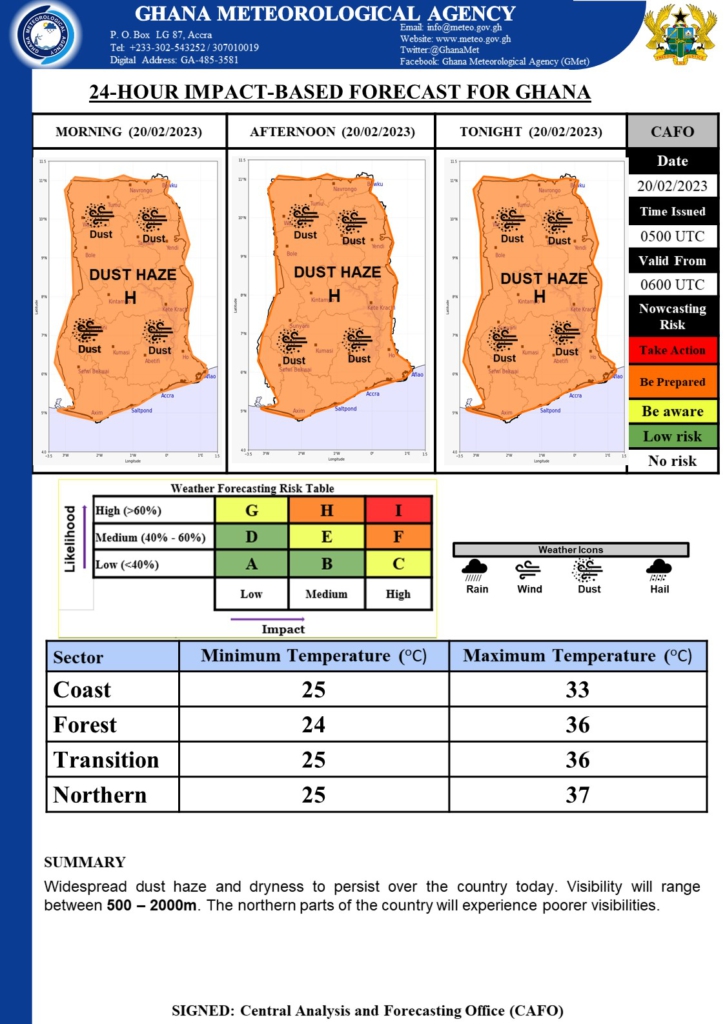
Meanwhile, the Ghana Meteorological Agency has forecasted widespread dust haze and dryness across the country on Monday.
This has the propensity to affect visibility, especially in Ghana’s northern parts.
Survivors of the shooting which occurred on Tuesday showed LuvNews their bullet-ridden vehicles and recounted their ordeal.
The stunned drivers say they decided to drive out of Bawku with their perishable goods after the police refused to grant them escort out of the community.
These cargo vehicles, one driven from the scene of the shooting in Bawku to Akomadan and Suame in Kumasi bear evidence of what took place on Tuesday.
Bullet holes on the windscreen, side and rear of the vehicles show aggressive spontaneous shooting.
Kwaku Karl, 44, the driver of the cargo truck, parked at Akomadan, survived the assault but lost his son, 22-year-old, Kofi Karl.
He narrates how the two of them lay on their side on the floor of the vehicle in an attempt to escape the rain of bullets.
“We laid low in the car to prevent sustaining wounds. I hid my head somewhere with my son’s legs on top of me. Sadly, he sustained some bullets and could not survive. This is just how we positioned ourselves” he stated.
Yakubu Asaripue, the owner of one of the cargo trucks that were attacked, said the incident has gotten him scared.
“The car leading the team is mine. Unfortunately, I lost my driver due to the incident even after putting in much effort to rescue them” he said.
Haruna Issah sustained multiple gunshot wounds from the incident.
“They chased us right after we got into the community. After releasing multiple gunshots at us, we were forced to hide under the car seats but even with that, my driver could not survive and my other mate, is receiving treatment” he explained the situation to Luv News.
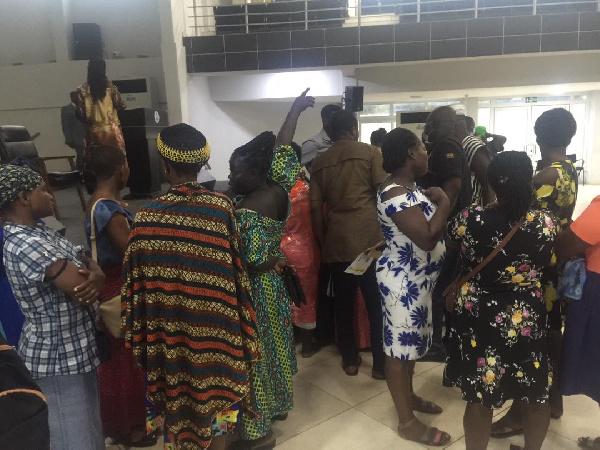
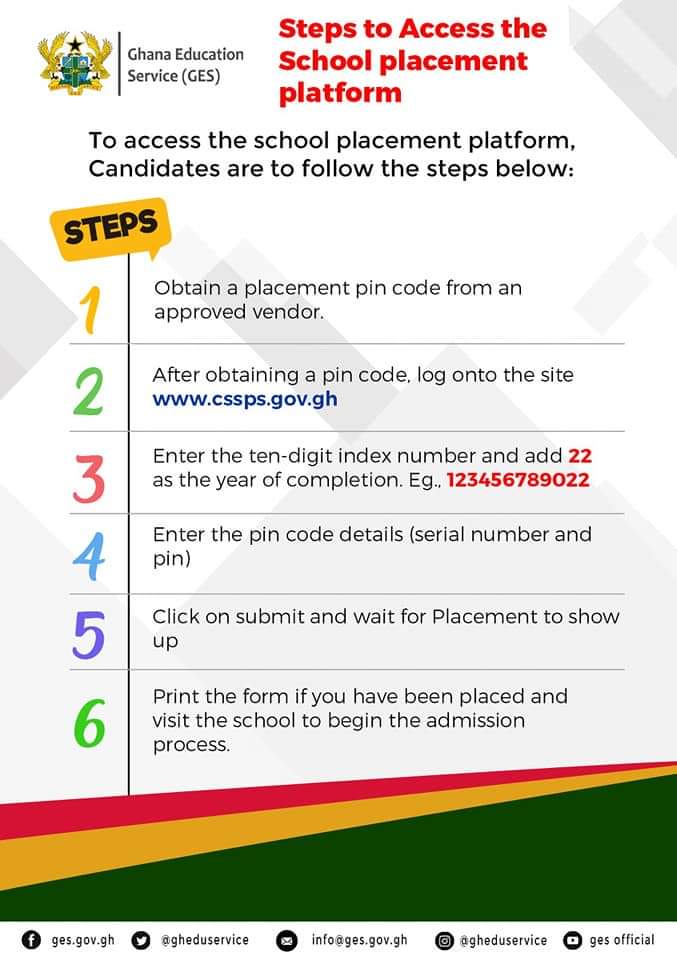
The GNAT Hall inAccra is crowded with parents and students who took the Basic Education Certificate Examination (BECE) in 2022 to get placement.
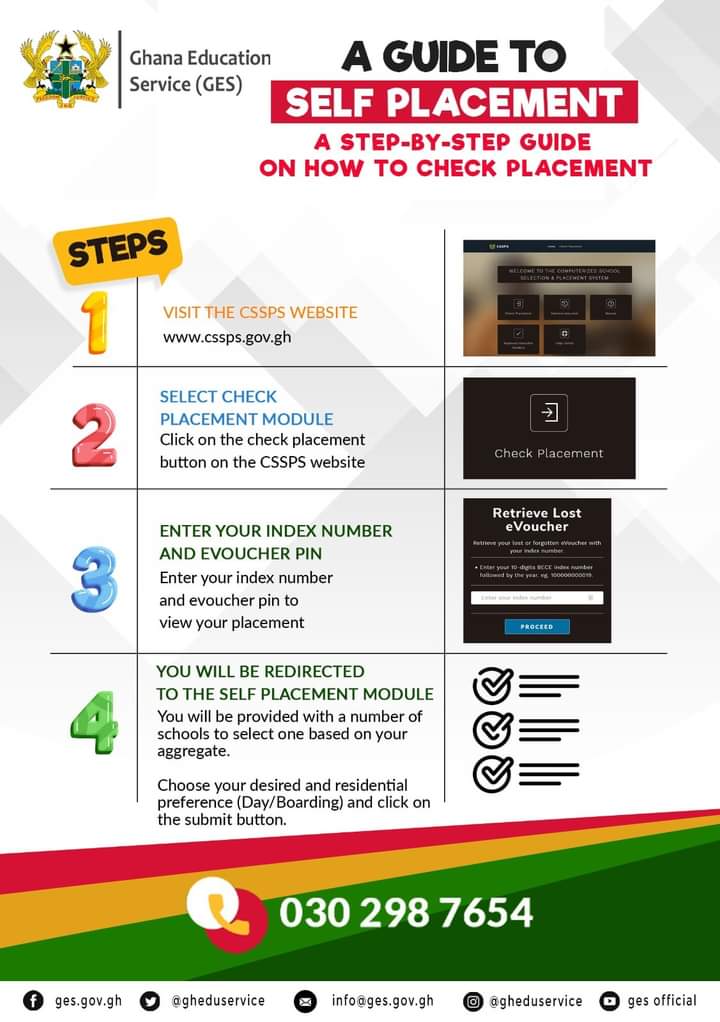
The center was set up by the Ghana Education Service(GES) to help with both self-placement and replacement of students in available schools in all categories, excerpt category ‘A’ schools.
According to the GES, “Out of the 547,329 candidates who sat for the examination, 538,399 qualified for school placement. out of these, 372,780 candidates have automatically been placed into various schools.”
This leaves a total of “165,601 candidates who will have to do self-placement because they could not be matched to their school of choice.”
Speaking in an interview with JoyNews, the Deputy Coordinator for Free SHS, Nana Afrah Sika Mensah said “the exercise is going to run for six weeks.”
“We are doing the placement into secondary schools, TVET schools and the new STEM schools” she added.
According to one parent, Meshach Fred Mintah, her daughter who got aggregate 9 could not get placement into her first choice school, Holy Child SHS.
“She was rather offered her 4th choice Suhum SHS. She has worked hard so I want a better school for her to study General science.”
Meanwhile, another parent who got a boarding school for his child said, he wants a Day School for her instead.
Reacting to the activities of middlemen, Nana Afrah Mensah warned parents against dealing with such persons.
“The only accredited people you can approach are the people wearing tags. If you are a parent and anyone approach to take money from you and place you in any school, report them to us ” she warned.
The GES has also set up help centers in all 16 regional offices to assist with placement issues across the country.
Henry Quartey, the Greater Accra Regional Minister, has urgedGhanaiansto join his fight against indiscretion in the city.
Mr Quartey is calling on Civil Society Organisations, Churches, the Media and Commercial drivers to join his efforts in making Accra the cleanest city in Africa.
In his view, fighting indiscipline in the capital city must be a collaborative effort and not the work of an individual.
“I want to see a system working than a Henry Quartey doing everything, and I have laid the foundations so today let me make this passionate call again to the good people of this region, I cannot do it alone, but I need everybody on board,” theRegional Ministersaid on the Point of View on Wednesday, February 15.
Mr Quartey also assured of his preparedness to remove all unauthorized billboards across the city.
According to him, the indiscipline associated with the indiscriminate erection of billboards across the city is worrisome, vowing that all illegally erected billboards will be pulled down.
“We are going to start with billboards. We commissioned Mr Dadzie of AAG to do some extensive work over the last 15 months and I will engage them in the next two months. We will send signals around, and we will remove every unauthorised billboard.
“Nobody should come to me and say he is a party person because I won’t even listen,” the Regional Minister told host Bernard Avle.
More than 30,000 printed Ghanaian passports are gathering dust at the Accra and Kumasi passport application centres following the failure of the applicants to collect them.
Even though the passport office has communicated to the applicants that their passports are ready, they have still not collected them.
The Ministry of Foreign Affairs and Regional Integration under which the passport office operates has expressed concern over the growing number of uncollected printed passports.
In a statement dated Monday, January 30, 2023, the Ministry called on all passport applicants who are yet to collect their passports to visit their respective passport application centres to do so, as they would be required for future renewal.
Below is a copy of the statement
UNCOLLECTED PASSPORTS AT VARIOUS PASSPORT APPLICATION CENTRES
ACCRA, 30TH JANUARY, 2023 – The Ministry of Foreign Affairs and Regional Integration wishes to inform the general public, particularly passport applicants about the urgent need for them to collect their printed passports from the various Passport Application Centres (PACs).
The Ministry is concerned that even though applicants have been informed through text messages that their passports have been printed and sent to the various Passport Application Centres, most of them are yet to be collected. Accra and Kumasi Passport Application Centres alone have about thirty thousand (30,000) uncollected passports.
In view of the above, the Ministry is calling on passport applicants who are yet to collect their passports to visit their respective Passport Application Centres to do so, as they would be required for future renewal.
Passport Applicants can also call the Ministry’s Client Service Unit on the following numbers to confirm the status of their passport applications — 024 079 3072, 024 091 3284.
While thanking the general public for their cooperation on this important matter, the Ministry takes the opportunity to assure that the Passport Office remains committed to its mandate of delivering enhanced service to the general public.
The Ashanti Region and the Greater Accra Region are considered to have Ghana’s deadliest and most dangerous roadways, respectively.
This is supported by data on the amount of mishaps and fatalities in these two regions’ cities, particularly in the capital cities of Accra and Kumasi.
Data from the Road Safety Authority of Ghana shows that the two regions recorded the most accidents and fatalities for 2022 and this has been the story for years.
In 2022, Greater Accra Region, for instance, recorded the greatest number of accidents in the country with nearly 46 percent of the total number of accidents recorded in 2022. It recorded some 6658 accidents followed by the Ashanti Region which recorded 3372 accidents, representing over 23 percent of accidents in Ghana.
The Oti Region recorded the lowest number of accidents in 2022 with only 0.64 percent of the total accidents recorded in 2022. Three other regions including the North East, Savana and the Upper West contributed less than 1 percent each to the total number of accidents recorded in 2022.
In terms of death and injuries, the two regions recorded the highest in the country with Greater Accra recording 485 accident deaths (25.01 percent of total road accident deaths) and 1989 injuries while the Ashanti Region recorded 382 deaths and 1202 injuries.
But does this mean that Greater Accra and Ashanti are the regions with the deadliest roads in Ghana?
The two regions according to statista.com host more than one-third of Ghana’s population so it should not be surprising if they see more road accidents and deaths. To check the rate of accidents and casualties, cases recorded are conventionally measured per 100,000 population.
The number of accidents per 100000 people in all the regions shows that the Greater Accra and Ashanti have the highest rate of accidents in Ghana.
The Greater Accra Region recorded approximately 123 accidents per 100000 population while the Ashanti Region recorded approximately 62 accidents per 100000 people.
However, when it comes to road accident deaths, the two regions with the highest rate of accidents, do not have the highest rate of deaths.
The Eastern Region has the highest rate of accident deaths in Ghana with approximately 11 deaths per 100,000 population compared to Greater Accra which has 9 road accident deaths per 100,000 population.
The Ashanti Region, which has the second highest rate of road accidents in Ghana, has a lower death rate (7.03 deaths per 100,000 population) compared to regions like the Western North (7.44 deaths per 100,000 population) and Ahafa (8.33 deaths per 100,000 population) which have lower accident rates.
So, it can be concluded that even though the Ashanti and Greater Accra Regions have high rates of accidents, they do not necessarily have the most dangerous roads in Ghana.
A witness in the trial involving Dr Ato Forson, a former Deputy Minister of Finance and two others, says the financing agreement between Stanbic Bank and the Government of Ghana was cancelled.
“I am unable to say why the financing agreement between Stanbic Bank and Government was not signed,” Mr Emmanuel Evan Mensah said.
Mr Mensah gave his evidence after which the defence cross examined him in Accra.
Dr Forson, a Former Deputy Minister of Finance, was granted a self-recognisance bail of GH¢3 million for allegedly willfully causing financial loss of 2,370,000 euros to the State.
He is also facing an additional charge of “intentionally misapplying public property contrary to section 1 (2) of the Public Property Protection Act, 1977 (SMCD 140).”
Dr Sylvester Anemana, a Former Chief Director at the Ministry of Health, was also granted a bail of GH¢1 million with three sureties one of whom shall be a public servant not below the rank of a director.
Mr Richard Dzakpa, a businessman, also in the trial, was granted a GH¢5 million bail with three sureties one of whom must be justified with documents of a landed property.
Asked that in his experience as a finance professional at the Ministry of Finance, could a Letter of Credit (LC) be lawfully established without approval from the Minister of Finance, he answered in the affirmative.
Dr Abdul Aziz Bamba, Counsel for Dr Forson asked the witness how the alleged authorisation was done by the then Former Deputy Minister of Finance and Mr Mensah said it was a written letter.
The witness confirmed the letter in open court and was given the opportunity to read in open court.
The Counsel said the letter indicated on the face value that it was written for the Minister of Finance, and the witness agreed.
Asked following the cancellation of the agreement, what other financing options were available to the government at that time, the witness said there were so many options.
The witness said one of the options was to look for replacement for the Stanbic agreement, while also consulting cabinet and approval from Parliament for other options.
Mr Mensah said another option was to postpone the whole agreement entirely, while looking at government coffers to finance the purchase of the ambulances.
The Counsel suggested to the witness that, the Minister of Finance could approve any other alternative financing options, but Mr Mensah disagreed.
He explained that because each option had processes, the Minister could not solely approve them, and stressed he had to follow due processes, including going to Parliament for approval.
Mr Alex Owureidu Dankwa, lawyer for Dr Anemana, in a cross examination, suggested to the witness that the agreement was never signed, and the witness agreed.
The case was adjourned to January 17, 2023, for continuation.
Some principal streets in Accra have been taken over by filth shortly after the three-day Christmas holidays, the Ghana News Agency observed during a tour of some streets of the capital on Tuesday.
However, the sanitation situation was better on some streets around the Ministries, Independence Square, areas near the Accra Psychiatric Hospital and Holy spirit Cathedral, and Osu Oxford Street.
Though measures have been put in place to ensure proper sanitation in the city during the festive season in line with the Government’s vision of making Accra the cleanest city in Africa, filth continues to remain a challenge in the capital.
Madam Akosua Oteng, a street vendor around the Kwame Nkrumah Interchange, attributed the garbage heaps on the streets to pedestrians, who litter indiscriminately and evening traders who dump their garbage during the night.
“Those who dump here are often passers-by and some traders. When you confront them, they tell you that Zoomlion will come and sweep,” she said.
She further stated how the various Assemblies had refused to do their jobs hence causing the practice to be perpetuated with impunity. She said this was a bad attitude that needed to change.
Adwoa Amankwa Boadi, a food vendor at the Kaneshie market, attributed the delay in emptying rubbish bins at the market as one of the causes for poor sanitation and the habit of littering, which she said had increased during the festive season.
Madam Boadi was more concerned with the choked underground drains that had not been desilted for a long time, which she said could end causing flooding and disease outbreak with the slightest rain.
“The pile of rubbish since we hit December has increased because a lot of people have flocked to town to trade and shop. Though rubbish bins have been provided, they are usually not emptied on time so there is always a spillage which end up in the underground drain which is already choked. What I am afraid now is flooding when it rains and a cholera outbreak”, She said.
Evans Boakye, a coconut seller at the Tema Station, was not surprised at the level of filth that had engulfed the surroundings, as according to him, this had always been the trend and increases during the yuletide.
For him, the solution to the problem is for traders, passengers, and drivers to cease the habit of littering and for the Assemblies to enforce the byelaws on sanitation.
Festus, a driver nearby, agreed with him that an attitude change was a prerequisite for cleanliness but, more stringent actions such as the arrest and prosecution of sanitation offenders needed to be applied.
Poor sanitation, according to a 2012 desk study carried out by the Water and Sanitation Program (WSP) and published by the World Bank costs Ghana more than US$290 million each year, an equivalent of US$12 per person in Ghana per year or 1.6 per cent of the national Gross Domestic Product (GDP).
In 2017, the President, Nana Addo Dankwa Akufo-Addo pledged to make Accra the neatest and best city in Africa by the end of his first term of office.
However, for more than two years into his second administration, the issue of Sanitation continues to remain a challenge in the country, particularly in Cosmopolitan areas such as Accra, Kumasi among other urban areas with huge populations.
The first photo library in Africa has been commissioned for use in Accra.
This is an ultra modern photo library and exhibition centre which is expected to boost photography and visual story telling that target at harnessing imagery resources across the continent has been commissioned at South La neighborhood in Accra.
Known as Dikan Centre, the multi million dollar project which is an initiative of the Ghanaian-American trained documentary photographer, Paul Ninson has in stock over 30,000 photo books.
It will offer a golden opportunity to facilitate photographic talent hunt and also be used as reference centre for the African photography industry.
Apart from the library, the Dikan Centre has an art gallery, photo studio and editing department where editing of films and other productions take place.
In his welcome address at the commissioning, the Founder and CEO of the Dikan Centre, Mr Paul Ampofo Ninson paid a glowing tribute to Mr Brandon Stanton, CEO of Creator of Humans of the United State of America for making his dream come to fruition .
He said the centre is poised to mobilise efforts to sharpen the identity of the African creative arts industry that has been left untapped, undeveloped and unattended to for centuries, adding that the centre is gathering power and momentum to use the tools of visual education to bring into richness the continent’s creative –visual-arts industry into fine form and commercial viability.
“We are determined never to leave behind any person, idea, history, culture, concept and facility necessary in re-imagining and firming the place of visual education in building a modernised African economy – If you know and have knowledge, see and/or hear, you are a storyteller Dikan will find you” said Mr Paul Ninson.
The centre offers refresher courses and professional training programmes expected to attract photography students and visual story tellers from around the world.
The centre teaches leadership skills, critical thinking and innovation as a complement to its interdisciplinary programme with a strong foundation crafted around the African context.
He said for centuries, African history, culture and society lacked the central ingredients for transforming its potential into a commercially viable creative-visual-arts workforce.
The Dikan journey pivots the very essence of the emerging African dream.
Mr Ninson expressed worry that the African continent is crippled by the enormous confrontations that undermine dreams of people while it is desperate to participate in the opportunities of this world.
The ideas, fortitude, talent and skillsets of the bulk of this continent never gets materialised or amplified.
According to him, the failure of private enterprises and the weaknesses of our institutions of government have fed into global terrorism and migration crisis.
“Millions on the continent are surviving below the poverty line and our youth are desperate for new opportunities.
“We cannot fail them,” he said.
The Dikan Centre frameworks the urgency to accelerate the new African dream of providing real opportunities.
The library started with Paul’s private collection during his studies in New York. He invested his income and savings in books on photography and filmmaking, hoping to bridge the gap between both the unavailability and inaccessibility of such books in Africa. Others were donated by institutions such as the International Center of Photography and the Howard Greenberg Gallery.
After years of investing and collecting books in New York and other libraries across the world, Paul returned to Ghana in 2021 to start Dikan, a home to photographers and other creatives that tell impactful stories.
In the short-term Paul hopes to secure and make other visual instructional materials accessible both online and offline by securing iPads, and laptops at the Dikan library.
One of Dikan’s marquee project is the Black book room, a space with resources documenting black visuals spanning generations. This project is to foster accessibility of books and other resources dedicated to Africans.
The collection is envisioned to advance learning, teaching, research and support educational programme.
Parts of the capital Accra have experienced another earth tremor six days after two mild tremors struck some areas in the region.
People took to social media to post about the incident, with most asking other users for confirmation if they felt it too because they were a bit sceptical and doubtful an earth tremor will occur a few days after a confirmed shake.
Of particular mention is persons residing in Kasoa, most of whom say they felt a shake around 7:30 pm on Saturday, December 17.
When the first two tremors struck on Monday, December 12, 2022, the Ghana Geological Survey Authority confirmed the incident and assured the public that investigations would be launched to ascertain the magnitude and epicentre of the shake, but that is yet to happen and Ghanaians are reported experiencing a third occurrence in less than a week
Another earth tremor just a minute ago, tell me it’s a lie coz maybe I felt it alone #EarthTremor#earthquake
Some may not be surprised at this current shake after the Principal Seismologist at the Ghana Geological Survey Authority (GGSA), Nicholas Opoku warned residents of Accra to be prepared for more earth tremors in the future after the December 12 tremor.
Mr. Opoku said the country has been recording some occasional shakes except that their magnitude wasn’t high enough to be felt.
“This is not a new thing. We have been experiencing this from time to time…even the most recent ones were in 2018, 2019, and 2020. What we have been saying all this while is that Accra and its environs are situated in the earthquake-prone zones so from time to time, we will be experiencing these minor earthquakes until such a time that a major one will occur.”
Mr. Opoku said there was a “shake that occurred on December 16 at about 5:45 am and a major one occurred at 6:03 am at a 2.7 magnitude.”
The police have shot and killed two armed robbers over the weekend after a gunfight.
According to the police, the shootout followed its intelligence operations regarding the attack and robbery on a woman at Caprice in Accra on Friday, December 9.
“Sustained police intelligence operations since 9th December 2022, took the fight to the robbery gang at their hideout (name of location withheld for now),” the police said in a press release on Sunday, December 11.
“The robbers engaged the police in a shoot-out and in the process two were shot dead and one was arrested.
“One police officer sustained gunshot injury to his thigh and is receiving medical attention.”
The statement said the rest of the gang are being pursued.
A Labour Consultant Mr Austin Akufo Gamey has said that hiring freeze must be discriminatory.
He stated that no matter how difficult the situation is, the application cannot be total.
Speaking on the Ghana Tonight show with Alfred Oansey on TV3 Monday November 28, Mr Gamey said “It is obvious that no matter how hard the situation is they cannot do it flat-footed, they will have to do it in selective application.
“Teaching is teaching, you necessarily must have teachers in the classroom, nursing and all other health service providers and some emergency type of public service, first respondent if there is a disaster you have no choice therefore they have to be selectively.”
The Secretary General of the Trades Union Congress (TUC) Dr Yaw Baah has also said that net freeze on employment into the public sector is better than total embargo.
He explained that net freeze is when retirees are replaced when they exit. This, he said, allows productivity and efficiency to go on.
Total freeze on the other hand, he added, is when the retirees are not replaced neither are new employees recruited. That will be detrimental to productivity hence, they do not want that to happen.
Speaking in an interview with TV3’s Daniel Opoku on the sidelines of a post budget analyses forum held by the TUC in Accra on Monday November 28, Dr Yaw Baah said “we still don’t have the details of the IMF conditionality but you will not be wrong if you think this is part of IMF conditions. Since 1965 when Ghana Government started going to IMF, employment freeze has always been part, in the last one that ended, employment freeze was one but in that case it was net.
“Net meant that if somebody retires you can replace the person. So the net freeze is what we need. But this one, we don’t know the details, whether it is the net freeze or total freeze.
“If it is a net freeze then it is like the previous one but if it is a total freeze it is another ball game all together. There are 644,000 people on the single spine. Let us assume without admitting that about 5 per cent of them retire yearly.
“If only five percent retire every year, we are talking now about over 30,000 people retiring and if the 30,000 people retire and they don’t replace them it will affect service delivery. If you reduce numbers by over 30,000 and they are not replaced then your effectiveness in service delivery will be affected.”
The Minister of Finance Ken Ofori-Atta announced in the 2023 budget a freeze on employment into the civil and public service.
He also said there shall be no new government agencies established in 2023. He said these while presenting the budget in Parliament on Thursday November 23.
Mr Ofori-Atta said as a first step toward expenditure rationalisation, government has approved a number of directives which takes effect from January, 2023.
These are “All Ministries, Departments and Agencies (MDAs), Metropolitan, Municipal and District Assemblies (MMDAs) and State-Owned-Enterprises (SOEs) are directed to reduce fuel allocations to Political Appointees and heads of MDAs, MMDAs and SOEs by 50%. This directive applies to all methods of fuel allocation including coupons, electronic cards, chit system, and fuel depots. Accordingly, 50% of the previous years (2022) budget allocation for fuel shall be earmarked for official business pertaining to MDAs, MMDAs and SOEs;
“A ban on the use of V8s/V6s or its equivalent except for cross country travel. All
government vehicles would be registered with GV green number plates from
January 2023; Limited budgetary allocation for the purchase of vehicles. For the avoidance of doubt, purchase of new vehicles shall be restricted to locally assembled vehicles;
“Only essential official foreign travel across government including SOEs shall be
allowed. No official foreign travel shall be allowed for board members.”
The Finance Minister added “Accordingly, all government institutions should submit a travel plan for the year 2023 by mid-December of all expected travels to the Chief of Staff; As far as possible, meetings and workshops should be done within the official environment or government facilities; Government sponsored external training and Staff Development activities at the Office of the President, Ministries and SOEs must be put on hold for the 2023 financial year; Reduction of expenditure on appointments including salary freezes together with suspension of certain allowances like housing, utilities and clothing, etc.;
“A freeze on new tax waivers for foreign companies and review of tax exemptions for free zone, mining, oil and gas companies; A hiring freeze for civil and public servants, No new government agencies shall be established in 2023; There shall be no hampers for 2022; There shall be no printing of diaries, notepads, calendars and other promotional, merchandise by MDAs, MMDAs and SOEs for 2024; All non-critical project must be suspended for 2023 Financial year.”
Parts of the Kantamanto market in Accra have been destroyed by fire.
The incident on Tuesday morning destroyed many goods and shops worth thousands of cedis. It is not clear yet what started the inferno.
The fire has already engulfed more than 200 shops in the area.
Eyewitnesses say initial efforts by the Ghana National Fire Service to douse it did not yield the desired results as they ran out of water in the process.
Some personnel are still at the scene doing their best to halt the blaze.
Over seven fire tenders are said to have been dispatched with two more expected to join soon.
Other vendors stood by helpless as their wares burned on, waiting for the appropriate time to count their losses.
Hopeson Adorye of the New Patriotic Party (NPP) has questioned the realistic nature of a recent budgetary directive to the effect that the use of V8 within Accra has been banned.
He questions whether or not those with V8 cars will be given new saloon cars in order for them to quit the usage of the V8s.
“With the issue of V8s, I am wondering how it will be done. Are we going to buy new saloon cars for Ministers or what? Because most of them use V8s already,” he submitted on Oman FM’s Boiling Point programme, November 24.
He also questioned the issue of fuel cuts of 50% for appointees: “Even this government fuel that has been slashed, how do we want the appointees to work? As for that one, I disagree, so what should they do?
“Some of these things must be tackled realistically. Imagine a Minister with a fuel coupon of 2,000 cedis, now having 1000 cedis but his full tank costs 1,800, so if their car runs out of fuel after three days, what do I do?” he quizzed.
What Ofori-Atta said about V8s and fuel allocations
Under the section of the budget on “Implementation of the Cabinet directives on expenditure measures,” the Minister said:
Mr. Speaker, as the first step toward expenditure rationalisation, the Government has approved the following directives which take effect from January, 2023:
● All MDAs, MMDAs and SOEs are directed to reduce fuel allocations to Political Appointees and heads of MDAs, MMDAs and SOEs by 50%. This directive applies to all methods of fuel allocation including coupons, electronic cards, chit systems, and fuel depots. Accordingly, 50% of the previous year’s (2022) budget allocation for fuel shall be earmarked for official business pertaining to MDAs, MMDAs and SOEs;
● A ban on the use of V8s/V6s or its equivalent except for cross-country travel. All government vehicles would be registered with GV green number plates from January 2023;
● Limited budgetary allocation for the purchase of vehicles. For the avoidance of doubt, the purchase of new vehicles shall be restricted to locally assembled vehicles;
● Only essential official foreign travel across government including SOEs shall be allowed. No official foreign travel shall be allowed for board members. Accordingly, all government institutions should submit a travel plan for the year 2023 by mid-December of all expected travels to the Chief of Staff.
The National Chairman of the New Patriotic Party (NPP), Stephen Ayensu Ntim, on Tuesday, 22nd November 2022, inaugurated the various Standing and Ad-hoc Committees of the party’s National Council.
The said solemn event came off at the party headquarters, Asylum Down, Accra.
Having taken the relevant oaths which were administered by the National Chairman, members of the various committees are expected, under the party constitution, other applicable laws and regulations, to assist the National Executive body in administering the party.
In his brief remarks, Chairman Stephen Ayensu Ntim congratulated the members of the committees, whom he said, were all carefully chosen by the National Council on the basis of their proven experience, competence, and expertise in the various committees they have been appointed to serve on. He thus, implored them to work assiduously to justify the confidence reposed in them by the Party.
The General Secretary of the party, Justin Kodua Frimpong, also congratulated the members of the various committees on their deserving appointments and took the opportunity to remind them of their responsibilities and the huge expectations of the Party. He noted that the committees are expected to meet regularly and present a report to the National Council as required by the party’s constitution.
Speaking on behalf of the committees, Hon. Osei Bonsu Amoah, Chairman of the Research Committee, thanked the party Leadership for the confidence reposed in them. He said it was an honour for them to be chosen among the many qualified persons in the party, and therefore, gave a firm assurance that they would not disappoint the party.
The Standing Committees that were inaugurated in accordance with Article 10(3) of the Party Constitution were: the National Disciplinary Committee, Finance Committee, Organization Committee, Research Committee, and Constitutional and Legal Committee. The Ad-hoc Committees that were inaugurated included the Welfare and Communications Committees.
Find below the composition of the various committees:
NATIONAL DISCIPLINARY COMMITTEE
1. Hon Kwasi Amoako Atta (Chairman)
2. Dr. Gladys Norley Ashitey
3. Mabel Sarpong
4. Robert Kutin Jnr.
5. Ing. Akwasi Abeasi
6. Hon. Patrick Boamah
7. Hon. Sheila Bartels
8. Mr. Kwaku Osei Asare
FINANCE COMMITTEE
1. Mr. Abankwa Sekyere (Chairman)
2. H.E Amb. Edward Boateng
3. Dr. Charles Dwamena
4. Madam Adelaid Ahwireng
5. Nana Adwoa Dokua
6. Madam Janet Ananse
7. Mr. Ernest Akore
1. Lord Oblitey Commey (Chairman)
2. Henry Nana Boakye
3. Mr. Samuel Awuku
4. Hon. Eric Nana Agyemang Prempeh
5. Hon. Ali Maiga Halidu
6. Hon. Catherine Afeku
7. Ali Suraj
RESEARCH COMMITTEE
1. Hon. Osei Bonsu Amoah (Chairman)
2. Dr. Antoinette Tsibu Darko
3. Laurette Korkor Asante Otchere Esq
4. Dr. Nyame Baafi
5. Mr. Ernest Kumi
6. Mr. Matthew Kyeremeh
7. Dr. Owusu Mensah
8. Dr. Tina Abrefa
9. Amma Frimpongmaa
10. Mr. Peter Oteng Darko
11. Dr. Kingsley Agyeman
12. Mohammed Tahiru
13. Ayisha Salifu
14. Evans Nimako
15. Sharika A. Isahaku
16. Hajia Rukaya Ahmed
17. Albert Bediako
18. Nelson Owusu Ansah
COMMUNICATION COMMITTEE
1. Nana Akomea (Chairman)
2. Madam Oboshie Sai Coffie
3. Dr. Kabiru Mahama
4. Yaw Adomako Baafi
5. Kofi Ofosu Nkansah
6. Hon. Davis Opoku Ansah
7. Richard Ahiagba
8. Dennis Aboagye
9. Kojo Oppong Nkrumah
10. Kwabena Sarpong
11. Hon. Ben Ayeh
12. Mr. Akwasi Afriyie
13. Hon. Titus Glover
14. Mr. Yofi Grant
15. Hon. Dr. Stephen Amoah
16. Mr. Kwabena Kwakye
17. Frances Essiam
18. Maame Afia Akoto
WELFARE COMMITTEE
1. Madam Rita Asobayire (Chairperson)
2. Dr. Charles Dwamena
3. Mr. William Yamoah
4. Madam Vida Dugbartey
5. Mr. Samuel Yeboah
6. Madam Kate Gyamfua
7. Madam Mary Porsch Oduro
8. Mr. Kwabena Frimpong
9. Bella Ofori
10. Madam Afua Gyekyewaa
Albert Kan-Dapaah, Minister of National Security, has warned that terrorists may take advantage of the galamsey activities in the country.
This is because the revenue generated from galamsey activities will be able to fund the criminal activities of these terrorists.
According to Kan-Dapaah, terrorists in countries like Burkina Faso and Mali, have been attracted to gold mining areas but he assured that his Ministry has taken cognizance of the development and working hard to avert the consequences.
He noted, the Accra Initiative, which aims to prevent the spillover of terrorism from the Sahel and to address transnational organized crime and violent extremism in ECOWAS member countries’ border areas.
“In Mali, in Burkina Faso, the terrorists have always been attracted to gold mining areas. Clearly, they try to make money from gold mining activities to undertake the criminal activities that they do. The criminals may want to take advantage of galamsey activities in our country to raise money to do what they do in other countries and what they may plan to do in our country.
“We are aware of this. We are studying it. We do know what has to be done in this area, and we work hard to make sure we are not overtaken by events. But clearly, one way that you can make cheap money to go and undertake some of these criminal activities is galamsey, so it’s of interest,” Albert Kan-Dapaah explained at a press briefing in Accra.
The West African sub-region has been confronted with terrorist threats, as Ghana’s neighbours Côte d’Ivoire and Burkina Faso have suffered attacks from terror groups in recent times.
The development has compelled the government to launch the “See Something, Say Something” campaign, which is aimed at encouraging citizens to report any suspicious activity.
Eight people have been granted GH¢100,000 bail with two sureties each by an Accra Circuit Court for allegedly engaging in illegal currency trade on the ‘black market’.
One of the sureties must be justified by land documents or any property equivalent to GH¢100,000.
The accused were also ordered to report to the police twice a month.
They have been charged with engaging in the business of dealing in foreign exchange without licence.
They all pleaded not guilty.
The court presided over by Mrs. Adelaide Abui-Keddey set December 12 for the next hearing.
Arguing for bail, counsel for the accused, Victor Kojogah Adawudu, told the court that his clients were engaged in decent work such as trading, security work, and commercial dispatch ‘Okada‘ riding at Tudu.
He added that it was unfortunate that the accused were at the wrong place when the police conducted a swoop to arrest people engaged in illegal currency trade at the location.
He added that his clients had a fixed place of abode, posed no flight risk, and had family and friends ready to stand in as sureties.
In opposition, Chief Inspector Isaac Babayi expressed concern that granting the accused bail may interfere with their investigations as they were on the hunt for other culprits, whose accused may tip off when released.
He added that the accused also posed a flight risk and pointed to defense counsel’s submission that one of the accused Barkisu Yakubu was travelling to Nigeria for business when she was nabbed.
The facts led by Chief Insp Babayi were that the accused were Mohammed Ali, Barkisu Yakubu, Shaibu Suleman Issah, and Baryl Ali.
The others were Bashiru Saadu, Saadu Hamidu, Mumudu Shamsudeen and Karim Yahaya.
Chief Insp. Babayi said on November 10, 2022, a team of police personnel in collaboration with officials of the Bank of Ghana embarked on an intelligence-led operation to clamp down on illegal activities of forex trade business in Ghana.
That operation, he said, led them to Tudu in Accra where they arrested the accused who was transacting the business of exchanging currencies.
He added that investigations later disclosed that the accused were engaged in foreign exchange business without a license.
Chief Insp. Babayi told the court that a search conducted on the accused revealed thousands of Ghana Cedis and other foreign currencies on some of them.
He said others succeeded in passing monies on to their accomplices who fled with it.
“These monies were retrieved from the accused as indicated against their names; Mohammed Ali GH¢2,300 and $87 USD, Barikisu Yakubu
GH¢10,010 and ₦6,002 Naira, Shaibu Suleman Issah GH¢3,850 and CFA65, 000, Baryi Ali GH¢ 848, CFA 80,000 and USD $70.
“Bashiru Saadu GH¢ 52.00 and ₦25 Naira, Saadu Hamidu GH¢ 361 and Karim Yahaya GH¢42,” he told the court.
The Mayor of Accra, Elizabeth Kwatsoe Tawiah Sackey has assured of her commitment towards strengthening the existing relationship between Accra and Switzerland.
She made this known when the new Switzerland Ambassador to Ghana, Her Excellency Simone Giger called on her at the Accra City Hall on Tuesday to formally introduce herself to the city administration and explore areas of collaboration.
The purpose of her visit touched on areas such as urban mobility, waste management, climate change, women empowerment and sister-city relationship, among others.
Ambassador Simone Giger in a remark outlined urban mobility and waste management as some areas that needed adept intervention adding that urban mobility is one of the areas where there could be a high impact with financial resources available.
“I think it is certainly one key area that is very striking when you arrive here and that’s urban transport. I feel urban mobility is one of the things where we can have quite a high impact with our limited financial resources that we have available” she said.
The Mayor of Accra, Elizabeth Kwatsoe Tawiah Sackey in her welcome address highlighted some areas of collaboration including climate change, women empowerment, and solid waste management among others.
She reiterated the Assembly’s ardent effort to mitigate the issue of solid waste management and cited solid waste separation and the procurement of street sweepers as some actions her outfit had already set in motion to address the canker of filth.
“Recently, there was a take-off in operations concerning solid waste separation to manage the amount of waste that is received by the city to help in proper waste management.”
Concerning that as well, the mayor also said, “hopefully, this month we’ll be launching the Sweepers on the Streets Programme with respect to how to manage Street Sweepers like it is done in Europe” she noted.
On solid waste management, her Excellency Simone Giger lauded the Mayor for her efforts to champion and rid the city of filth.
However according to her, even though a lot has been done so far to tackle the issue of solid waste management, she believes the problem is still prevalent suggesting possible solutions that can be put in place to curb the problem.
She also disclosed that her outfit was ready to assist the Assembly in terms of resources to tackle the issue of urban mobility in Accra citing a possible partnership with heads of transport in the various MMDAs to regulate public transport and improve data collection.
“We have been working together with the cooperation for the Ghana urban mobility and accessibility project. This is a project that wants to assist the heads of transport within the MMDA’s to regulate public transport and of course, also improve data collection. The very good news here is that we have 1 million in grant funding to ease six notoriously congesting junctions and integrate into the Accra region” she added.
The Lady Mayor of Accra, Hon Sackey also proposed a capacity-building program for staff, through exchange programs for individuals of the Assembly to acquire knowledge on climate change and global warming as well as solutions to combat climate risks.
The Chief Executive of the Accra Metropolitan Assembly (AMA), Hon Elizabeth Kwatsoe Tawiah Sackey expressed appreciation to the Swiss Ambassador, Her Excellency Simone Giger and was looking forward to partnering with her outfit to undertake the aforementioned projects.
Ambassador Simone Giger who leads an all-female management team at the Swiss Embassy was accompanied by Simone Harberli, Deputy Head of Mission and Head of Cooperation.
Present at the meeting was the Presiding Member of the Accra Metropolitan Assembly (AMA), Hon. Alfred Adjei, Head of Development Planning, Richard Kwame Oduro, Director of Finance for the AMA, Francis Anaba and the Director for Transport, Alex Johnson, among others.
The Interbank forex rates from the Bank of Ghana today, November 14, 2022, have shown that the Ghana Cedi is trading against the dollar at a buying price of 13.0694 and a selling price of 13.0824.
As compared to Friday’s trading of a buying price of 13.0694 and a selling price of 13.0824. At a forex bureau in Accra, the dollar is being bought at a rate of 14.20 and sold at a rate of 14.80.
Against the Pound Sterling, the Cedi is trading at a buying price of 15.4179 and a selling price of 15.4347 as compared to Friday’s trading of a buying price of 15.2572 and a selling price of 15.2751.
At a forex bureau in Accra, the pound sterling is being bought at a rate of 15.90 and sold at a rate of 16.70.
The Euro is trading at a buying price of 13.5079 and a selling price of 13.5214 as compared to Friday’s trading of a buying price of 13.2983 and a selling price of 13.3104.
At a forex bureau in Accra, Euro is being bought at a rate of 13.80 and sold at a rate of 14.70.
The South African Rand is trading at a buying price of 0.7563 and a selling price of 0.7570 compared to Friday’s trading of a buying price of 0.7490 and a selling price of 0.7498.
At a forex bureau in Accra, South African Rand is being bought at a rate of 0.65 and sold at a rate of 1.10.
The Nigerian Naira is trading at a buying price of 33.8799 and a selling price of 33.9839 as compared to Friday’s trading of a buying price of 33.8835 and a selling price of 34.0337.
At a forex bureau in Accra, Nigerian Naira is being bought at a rate of 16.00 Naira for every 1 Cedi and sold at a rate of 21.00.
For the CFA, it is trading at a buying price of 48.5125 and a selling price of 48.5610. At a forex bureau in Accra, CFA is being bought at a rate of 19.30 CFA for every 1 Cedi and sold at a rate of 23.50 CFA for every 1 Cedi.
Our forex bureau rates are provided by Afriswap Bureau De Change in Osu, Accra.
On the Interbank forex rates from the Bank of Ghana as of November 11, 2022, the Ghana Cedi is trading against the dollar at a buying price of 13.0694 and a selling price of 13.0824.
As compared to yesterday’s trading of a buying price of 13.0494 and a selling price of 13.0624. At a forex bureau in Accra, the dollar is being bought at a rate of 14.30 and sold at a rate of 14.90.
Against the Pound Sterling, the Cedi is trading at a buying price of 15.2572 and a selling price of 15.2751 as compared to yesterday’s trading at a buying price of 15.0890 and a selling price of 15.0890.
At a forex bureau in Accra, the pound sterling is being bought at a rate of 15.90 and sold at a rate of 16.75.
The Euro is trading at a buying price of 13.2983 and a selling price of 13.3104 as compared to yesterday’s trading at a buying price of 13.0850 and a selling price of 13.0993.
At a forex bureau in Accra, Euro is being bought at a rate of 13.90 and sold at a rate of 14.90.
The South African Rand is trading at a buying price of 0.7490 and a selling price of 0.7498 compared to yesterday’s trading at a buying price of 0.7348 and a selling price of 0.7355.
At a forex bureau in Accra, South African Rand is being bought at a rate of 0.65 and sold at a rate of 1.10.
The Nigerian Naira is trading at a buying price of 33.8835 and a selling price of 34.0337 as compared to yesterday’s trading at a buying price of 33.8835 and a selling price of 34.0337.
At a forex bureau in Accra, Nigerian Naira is being bought at a rate of 13.50 Naira for every 1 Cedi and sold at a rate of 17.50.
It was all joy and applause when Hon Joe Ghartey stated at a meeting of the Expanded Regional Executive Committee of the Western Region of the New Patriotic Party that as long as the sun rises in the east and sets in the west, God willing, “I will definitely contest for the Flagbearer position for the New Patriotic Party.”
Addressing the gathering at a meeting held in Sekondi-Takoradi on Monday, 7th November 2022, Joe Ghartey stated that it had come to his attention that some Presidential Aspirants had already come into the Region to meet some delegates. He said that he would also meet them soon, but he was serving notice that he would definitely contest the Presidential Primaries.
Joe Ghartey recollected that about five days before the 2020 general elections, he was interviewed on Radio 360, a radio station in Takoradi. The host asked him whether he would run for Parliament in 2024.
Joe Ghartey, who has been an MP since 2004, said he would not. Pressed further whether he would aspire to be president, Joe Ghartey said he responded yes.
He said he told the presenter that he had contested in 2012, and he placed third after the President and Alan Kyeremanteng, and he would contest again, God willing.
Hon Ghartey told the gathering that after that, Asaase Radio flew a team from Accra to Takoradi to interview him a few days before the election.
The host, Kojo Mensah, asked him the same question about whether he would contest for the presidential slot in 2024, and he answered yes.
Joe Ghartey told the gathering that after the election, the president addressing MPs elect, said he would exclude from his Government anyone who had declared that he would contest for presidential Primaries.
Joe Ghartey said he was told by a senior member of the party that he should have said he was now thinking about it when he was asked the question. Joe Ghartey told the gathering that he was not in the business of lying or waffling, and he spoke the truth, and the truth set him free.
He had thought about it already, and that is why he answered that way. He assured the Region that he would definitely come around soon.
Hon. Ghartey is a former Attorney General Minister of Justice and former Deputy Speaker of Parliament.
Former Member of Parliament (MP) for Kumbungu constituency, Ras Mubarak, has abandoned his luxury lifestyle due to the current economic hardship and increasing cost of living in Ghana.
He joined public transport, popularly called ‘trotro’, over the weekend due to fuel hikes.
The former National Democratic Congress MP was part of the ‘Ku Me Preko’ demonstration in Accra to pile pressure on President Nana Akufo-Addo to resign for his inability to manage the Ghanaian economy.
Ras Mubarak took to Facebook to share his frustration.
Programmes Director of the Peasant Farmers Association of Ghana, Dr Charles Nyaaba has expressed doubt that food prices will go down in December.
This is due to the challenges farmers are going through including high cost of doing business, he said.
Dr Nyaaba told TV3’s Roland Walker on the Big Issue, Friday November 4 that “depending on the commodities, food prices will not come down, it is going to be extremely difficult for prices to come.”
This comes at a time the Minister of Food and Agriculture Dr. Owusu Akoto Afriyie assured that the Ministry is introducing an initiative to sell food at cheaper prices in Accra.
Dr. Owusu Akoto Afriyie said at a meeting with farmers in Sefwi Wiaso in the Western North Region, that “the ministry itself is going to take its own initiative.”
He added “We are going to link up with the farm gate so that we make all the arrangements to ensure that we put up kiosks on our compounds at the ministry, specifically for food from Sefwi Wiaso and we are going to give it a lot of publicity.”
Calls for President Akufo-Addo to resign as Ghana’s president have become intense as hundreds of protestors thronged the streets of Accra.
The aggrieved citizens clad in red and black attires are demonstrating against the country’s current economic state.
The cedi had lost more than 30% of its purchasing power against the US dollar as of September, partly pushing inflation rate to 37.2 per cent, the highest in almost two decades.
The local currency is selling at about GHS13.7182 against the dollar on the forex.
Currently, a litre of petrol is going for about GHS18, and that for diesel, close to GHS24, as such, transport operators have increased transport fares.
Meanwhile Ghanaians are demanding that government should relief the Finance Minister, Ken Ofori-Atta as well as the Minister of State at the Finance Ministry, Charles Adu Boahen of their duties.
The Kaneshie District Court has imposed a GH¢6,000 fine on Francis Awusi, an evangelist, for making false and offensive statements about Prophet Gabriel Akwesi Sarpong, General Overseer of Cross of Miracles International, Accra.
Awusi, who is also a YouTube host, would in default serve one-year imprisonment.
The said publications indicated that Prophet Sarpong (the complainant) was an occult pastor and a murderer, who had killed his wife for occultism to run his church.
The court ordered Awusi to go to Peace FM, a private radio station, Daily Graphic Newspaper, and use his YouTube channel where he had defamed the complainant and render an apology.
Awusi who was charged with offensive conduct and publication of false news earlier pleaded not guilty.
However, when sitting resumed, Awusi, who was represented by a lawyer, informed the court that he wanted to change his plea.
The prosecution had called three witnesses and played three videos at the ongoing trial.
The court presided over by Ms. Ama Adomako Kwakye convicted Awusi on his own plea.
His counsel, prayed the court to have mercy on him, saying he was a first offender, married with children, and was a man of God with a huge congregation.
Prosecuting, Detective Chief Inspector Richard Amoahsaid the complainant was Prophet AkwesiSarpong.
The court said the convict was also a host of a YouTube channel programme, known as “Hell and Heaven”, whiles Isaac Gyasi, the second accused, aka K2 Temple, was at large.
Chief Insp Amoah said Prophet Sarpong said the complainant reported to the police that in August 2020, Gyasi whose face was covered with a veil, made certain false and offensive statements about the complainant during a live YouTube TV programme, hosted by Awusi.
Prosecution said Gyasi alleged among other things that the complainant, Prophet Sarpong, was an occult pastor and a murderer, who had killed his wife for occultism powers to run his church.
Chief Insp Amoah said Awusi, who was hosting the live TV programme, also published the pictures and videos of some church activities of the complainant on the screen and had warned the public to stay away from his church.
The prosecution said Awusi was arrested and during investigations, it was established that Awusi hosted the programme with Gyasi as his guest.
Chief Insp Amoah said Awusi also supported the allegations made against the complainant by showing pictures and videos of the complainant on the YouTube channel on the internet.
The prosecution said Awusi admitted the offence and explained that he only interviewed Gyasi, who was invited to participate in his programme by his producer and that he did not know Gyasi personally.
The Minority in Parliament is asking the government to use part of the over GH¢8 billion revenue accrued from petroleum products to cushion petroleum consumers against the current price hikes.
The Minority says the government has received over GH¢8 billion from petroleum resources
in less than 3 months, as against its GH¢6 billion projection for the year.
Speaking to journalists on Wednesday, November 2, 2022, the Ranking Member on the Mines and Energy Committee of Parliament, John Jinapor urged the government to act in halting the escalation of fuel prices which he bemoans has seen over 300 percent increase in less than a year.
“In less than three months, the government has received over GH¢8 billion from our petroleum resources. So in three months, the government has received more than it projected for the whole year, so government is making supernormal profits. In fact, even the Price Stabilization and Recovery Levy which are supposed to subsidize fuel, government projected that in the first two quarters, it will receive GH¢269 million and as we speak, from the Ministry of Finance’s own record, the Government has received GH¢800 million. And so this notion that Government is not making any money is a fallacy”.
“Government is making so much money from our petroleum resources, I, therefore, call on President Akufo-Addo and the outgoing Minister of Finance that they should do something about this pricing increment. They should sit up and think outside the box and apply these supernormal profits to cushion the ordinary Ghanaians.”
Mr. Jinapor indicated that the economic crisis worsens by the day as he receives calls every day from some of his constituents seeking diverse assistance to enable them to stay afloat.
“I receive calls every day from members in the Constituency from people who cannot even afford one square meal a day, people who cannot even send their kids to school because of the exorbitant fuel prices which are having a cascading effect on food prices, and general cost of living.”
“We hold the view that Government can do something about the fuel price increment, Government must sit up, Government must do something and the Government must cushion the ordinary Ghanaians.”
Ghana’s Competitive African Rice Platform (CARP) has been launched officially in Accra to boost the country’s rice sector.
The platform seeks to offer a voice and space for national rice stakeholders in Ghana to scale their local impact on sustainability and competitiveness. Overall, the CARP seeks to reduce the overdependence on imported rice and strengthen public-private dialogue.
The platform is supported by the UK’s Foreign, Commonwealth & Development Office (FCDO), AGRA (formerly Alliance for a Green Revolution in Africa), and the Gesellschaft für Internationale Zusammenarbeit (The platform seeks to offer a voice and space for national rice stakeholders in Ghana).
Under the initiative, small farmers across West Africa are being supported in boosting their rice harvests, improving product quality, and raising their incomes. Mr. Yaw Adu Poku, Board Chair for CARP Ghana, said: “We are honoured to have been selected to host the CARP, as Ghana’s first national rice chapter, and we see this as a great opportunity to collaborate with the government, international organizations, researchers and farmers to drive a transformation in Ghana’s rice sector.”
Following the launch in Accra on Tuesday, a secretariat to run the CARP will be set up to drive its operationalisation. A statement issued by Rebecca Weaver of AGRA explained that at a previous stakeholders meeting, the CARP’s governance structure was formalized, board members and executives appointed, and technical committees set up.
Based on field research and recommendations from public and private sector partners across ECOWAS member states, a regional “ECOWAS Rice Observatory” (ERO) had been previously created by the ECOWAS Commission and its partners. The ERO aims to coordinate rice sector-related programs, public/private investments, and policy recommendations for key decision-makers.
At the same time, national rice platforms, such as the CARP in Ghana, are being established across West Africa. The platform comprises primarily of private sector stakeholders across the value chain, as well as representation from research, government, and civil society, to coordinate country-specific investments and policies.
“Rice is a very important product for Ghana, accounting for nearly 15% of the country’s GDP. The CARP’s launch is, therefore, very timely as it will help different stakeholders to coordinate their investments in driving the transformation needed to boost the growth of the sub-sector for the benefit of local producers and the country at large,” said the Executive Secretary of ERO, Dr. Boladale Adebowale Abiola.
The National Identification Authority (NIA) will on Monday (31 October) close down its special service centre at the El-Wak Sports Stadium in Accra.
“Applicants requesting update and card replacement services should visit the nearest NIA district or regional office,” the NIA announced on Friday.
“All applicants yet to pick up their cards having successfully undergone an update or card replacement process before the closure should do so at the NIA Greater Accra regional office, located at PWD, Kinbu.
“Applicants requesting the card verification service should visit the NIA head office at Shiashie, Accra. For further information and assistance, kindly call 0302 999 306.”
The NIA on 28 March this year moved the update of personal records, verification and replacement of cards to the El-Wak Stadium. That move came a few days after a stampede at the premises of the National Identification Authority headquarters in Accra led to one person being rushed to the hospital, reports the Daily Graphic.
The Ghana Card is the primary and sole identity card for sim re-registration and for other official requirements in state and some private institutions.
The Dental and Medical Council has called on Health professionals not to seek greener pastures abroad as the country is losing health professionals.
This call was made at the induction of newly qualified Medical and Dental practitioners.
Speaking as the chairperson of the induction ceremony, Member of the Dental and Medical Council, Dr. Constance Addo-Yobo, who acknowledged this phenomenon, pleaded with the newly inducted health professionals not to seek greener pastures abroad to the detriment of the health sector in the country.
Dr. Addo-Yobo also urged doctors to make sacrifices within the country too.
“Please accept postings to the regions and the districts outside Accra and Kumasi. You will learn a lot there,” she said.
“Also, do not be tempted to look for greener pastures in places like the UK and other countries, like some of your colleagues are already doing.”
“Let us halt this brain drain. It has taken the taxpayer a lot to invest in your education,” Dr. Addo-Yobo implored.
Private legal private practitioner, Martin Kpebu, has berated President Akufo-Addo for failing to transform the economy from a Guggisberg state within eighteen months as he promised while in opposition.
According to him, the situation was painful to the extent that it compelled citizens like himself to discharge a constitutional obligation by ‘speaking truth to power’.
Reacting to Akufo-Addo’s state of the economy address on Accra-based Joy News on Sunday, October 30, the lawyer said President Akufo-Addo’s speech was full of sloganeering stressing that nothing was going to change in terms of the prices of goods and services.
Although he said some supporters of the New Patriotic Party (NPP) are not happy with the state of the economy, they expect persons like himself to applaud the president.
Kpebu, who admits to being a staunch supporter of Akufo-Addo in the 2016 and 2020 elections, emphasized he cannot applaud the president since he has done nothing new in his administration to deserve it.
He was reacting to a question on whether or not assurances from the president to move the economy from being largely import-dependent to becoming export-oriented was enough.
“… that’s the one I made the point over and over. That’s what he [president Akufo-Addo] refers to as the Guggisberg economy that we are not adding much value, and so when he came, 18 months…now we have done six years…I have seen some of the comments on social media. It’s painful. Sometimes it’s difficult for me to comment this way, but there is nothing else we have to do.
“The constitution says that citizens must also play their roles, and part of the role-playing is that we speak truth to power because sometimes when I look at some of the comments on the platforms, the one from NPP sympathizers, you can see they are not happy. They expect that we should applaud the president, but there’s nothing new. You heard what GPRTU said,” Kpebu stated.
“Bottom line, the price from Accra to Kasoa is staying the same tomorrow. The price of kenkey is staying the same as GH₵3; Koko, that has increased from GH₵1 to GH₵3 tomorrow morning, will still be GHC3. Kufuor gallon that’s the oil that was GH₵500 has now gotten to GH₵1200. Tomorrow Kufuor gallon oil will still be GH₵1200. Nido, which about two weeks ago GH₵45 and was increased top GH₵60 a few days ago, tomorrow will still be GH₵60.
“I have been checking prices over the past two weeks, and so the prices that increase from about two weeks ago, tomorrow when we go to the market will still be the same. So in such a case, it’s difficult to applaud the president,” he added.
Martin Kpebu used the opportunity to further rally support for his upcoming ‘kume preko’ demonstration slated for November 5.
Akufo-Addo, in his October 30 address on the economy, admitted that the country was in crisis while rallying support for various government interventions to stem the tide.
“We are in a crisis; I do not exaggerate when I say so. I cannot find an example in history when so many malevolent forces have come together at the same time.
“But, as we have shown in other circumstances, we shall turn this crisis into an opportunity to resolve not just the short-term, urgent problems but the long-term structural problems that have bedevilled our economy,” he said.
But like before, President Akufo-Addo blamed the Covid-19 pandemic and the ongoing Russia-Ukraine war as causative factors for the economic woes.
A Kumasi High Court has adjourned the alleged bribery case, involving Alexander Sarfo Kantanka, the ex-nominee for the position of Chief Executive for the Juaben Municipal Assembly in the Ashanti region.
Kantanka was alleged to have paid monies to some assembly members to influence them to confirm his nomination by President Akufo-Addo.
The case was adjourned to 27 February 2023, after the court granted a request by the prosecution to hear the case omnibus.
“The prosecution had pleaded with the court to fix the trial for a week to help reduce the risk and cost of travelling from Accra to Kumasi for the trials and that request was granted.
The judge also fixed 28 February, 1 March and 2 March for the hearing”, reported Asaase News’ Jonathan Ofori.
Meanwhile, a second prosecution witness Prince Opong Kyekyeku an assembly member for Bomfa Ahenbronum electoral area mounted the box and was cross-examined by the counsel for the accused person, Denis Osei Antwi.
Oppong Kyekyeku has also denied receiving a bribe from the accused person.
He, however, recalled that he received an amount of GHC1000 from a personal assistant of the accused person to take a mentally challenged person to the hospital.
Amadu Emmanuel Basintale, who represented the Office of the Special Prosecutor, told journalists after the proceedings at the court that the prosecution intended to call five witnesses for the trial.
They would include three assembly members, a police officer, and an officer from the Office of the Special Prosecutor.
Former President John Dramani Mahama will address the nation this evening (October 27) about issues related to the economic crisis the nation is now experiencing.
The event is set to begin at 7 pm in the auditorium of the University of Professional Studies, Accra (UPSA).
It is free and open to the public with the topic “Building the Ghana we want.”
Mahama is anticipated to discuss topics like the rate of inflation, the devaluation of the Cedi, the government’s IMF program, as well as take aim at calls to fire Ken Ofori-Atta as finance minister and give solutions to the country’s economic problems.
“John Mahama speaks on Ghana’s collapsed economy and the unprecedented hardships sweeping across the land and the way forward on Thursday 27th October 2022,” Mahama’s aide Joyce Bawah Mogtari wrote on Facebook.
He is on record to have stressed that with the passing of each day, Ghana’s economic situation was getting worse.
“Distressing! Every passing day makes our economic situation worse. Gov’t must work with greater alacrity to lock in a programme with the Fund in order to create a more predictable economic outlook,” John Mahama tweeted on October 4.
The former president also in an October 19 tweet said the economic hardship confronting the country is the worst in thirty years.
He made the remark while reacting to news that a man had died by electrocution on a high-tension pylon near Kasoa.
“I returned from a trip to the sad news of Kakra who electrocuted himself. Levels of hardship in Ghana are dire; the worst in 3 decades. But suicide is never an answer. Even in the darkest night, there’ll come dawn. The sun will rise again. Let’s be each other’s keeper & keep hope alive,” Mahama tweeted.
The anticipated address by John Mahama will be his second major presentation on the economy in recent times. On May 2, the former president engage with Ghanaians on the topic “Ghana at a Crossroads.”
38-year-old sex worker, Ama Serwaa, has disclosed that out of 24 friends who travelled to Accra to work, only three are still alive.
In a chat on Ghetto Life Story on SVTV Africa, Ama Serwaa mentioned that she came to the capital 22 years ago as a 16-year-old but only engaged in sex work two years ago.
She revealed that 23 other females who came from her hometown to work in Accra are now deceased. Speaking on the dangers of working as a prostitute, Ama Serwaa disclosed that life in the ghetto itself is a risk.
“Some offer Ghs500 to Ghs1000 and you would go because you need the money but it may be dirty money. I won’t go because 21 of us have died.
“Twenty-four of us came to work here and only three of us are left. Some were prostitutes; they had infections and died. Some were thieves, and others smoked and died from hunger,” she said.
The 38-year-old mother of one added that she left her uncle’s house due to mistreatment and has been on the streets for the past 17 years. According to Serwaa, she was knocked down by a car while selling in traffic for a few years.
“I sold pure water and worked as a bus conductor until I started sex work two years ago. My boss sacked me. I was jobless for three years until a friend introduced me to it, but I want to stop because it’s not helping,” she told DJ Nyaami.
Ama advised the youth to be cautious of friends because they can be their downfall or their salvation.
Dr Joel Agorinya, a psychiatrist at the Accra Psychiatric Hospital, has advised the public to normalise seeking help for mental health issues.
He said there were a lot of people walking on the streets who had mental health issues but were shy to seek help even though there is help.
“There are patients who will invite you to their homes in Ghana to attend to them or those who would like to come to the hospital early in the morning around 5AM because they do not want to be seen entering the psychiatric hospital,” he said.
Dr Agorinya gave the advice when he trained selected member of the Ghana Federation of Disability Organisations (GFD) and some Social welfare officials on mental health issues.
The training organised by Basic Needs Ghana, an NGO with a focus on mental health issues was supported by Ghana Somubie Dwumadie, a disability focused programme on mental health and the UK Aid.
The training is expected to enhance participants’ knowledge on mental health and to help them understand persons with mental health issues.
Dr Agoriyna said there was a need to desist from stigmatising persons with mental health issues and encourage them to seek help.
“Elsewhere, there is nothing shameful about seeking help for one’s mental health issues, you see some celebrities take to social media to announce that they have depression or they are taking a break to enable them go through rehabilitation,”
There is nothing shameful about mental health, it is also a kind of illness that can happen to anyone but in Ghana people tend to hide or sneak into the Psychiatric hospital whenever they need help,” Dr Agoriyna said.
He said that now psychiatry care has been decentralized and every health facility in Ghana, even the CHPS compound has someone who is a trained mental health care professional.
Dr Agoriyna said mental health care if not well handled could cost the country billions of dollars because people with mental health issues tend to be non-productive at work.
Estimating the cost of mental healthcare in Ghana, Dr Agorinya who had an interest in global mental health issues, said it could cost a family about GHS4000 monthly to provide care for their loved one with mental health issues.
He urged Ghanaians to stop stigmatising and abusing persons with mental health conditions, saying, “There is never any justification for abusing any person with mental illness.
Former Gender Minister, Nana Oye Bampoe Addo (formerly Nana Oye Lithur) says the circumstances that led to the 1948 riots in Accra are currently looming in Ghana.
According to the past NDC appointee, the triggers that led to the historic protest can be seen across the country.
On the 24th of February 1948, three unarmed ex-servicemen were shot during a protest. This infuriated other citizens who took to the streets to call out the colonial regime for its bad leadership and mismanagement.
Speaking in an interview on the AM Show on Thursday, the gender advocate said the same anger that fueled the 1948 protests is lurking, hence the need for government to urgently address the prevailing economic crisis.
“If you remember the 1948 riots, it seems like we are just seeing it being replayed. Where the traders were up in arms about the high cost of living and shops were closed. Then it led to Sergeant Adjetey and co., marching on to the seat of the colonial government.
[With] the ramifications of what happened; over a hundred people dying and how the riots [was] all over Ghana because of the economic situation. And you see it playing, right? History is actually repeating itself”, she said.
She also added that the recent incidents of booing the President at public functions are a worrying development which reflects the displeasure of the populace.
Madam Oye Addo’s comments add to the repeated calls for the President to invest more efforts in bettering the economy to prevent any untoward events.
Currently, Ghana is in a dire economic situation with citizens feeling the brunt of the hardship.
The economic crisis is evident in the constant depreciation of the local currency, in addition to the rising rate of inflation.
These developments have become very topical, with stakeholders constantly bemoaning the situation.
Meanwhile, in the wake of the widespread public agitations about the state of the economy, government maintains that it is working tirelessly around the clock to put the smiles back on the faces of Ghanaians.
According to the government, the economic situation has been exacerbated by the Russia-Ukraine war, as well as the effects of the COVID-19 pandemic.
The Ghana Union of Traders Association (GUTA) has advised residents in Accra to buy all items they would need for their respective homes before Wednesday, October 19, 2022, since they will shut down all shops in the region.
President of GUTA, Dr. Joseph Obeng, who disclosed this said they are in solidarity with traders in Kumasi, who locked their shops in protest of what they say are exorbitant taxes imposed on businesses by government.
The traders are also kicking against a decision by the Ghana Revenue Authority to station their officers at each shop to record Value Added Tax (VAT) on products they sell.
Dr. Obeng said the issues raised by the traders were not limited to that Kumasi traders but nationwide hence traders across the country, are not in good standing at the moment.
Speaking on Nyankonton Mu Nsem on Rainbow Radio 87.5Fm, he said aside from the killer taxes, the depreciation of the cedi against the dollar is also threatening the expansion and successful operation of Ghanaian businesses.
“The issues raised by the traders in Kumasi are not only limited to Kumasi. GUTA is in full support of their action. Traders in Tamale, Accra and other regions are also experiencing the same problem. The exorbitant taxes imposed on our businesses are not the best,” Dr Obeng said.
“We are struggling. The cedi depreciation and other challenges confronting businesses are collapsing our businesses. We have complained, but we have not been given the attention,” he stated.
“As a result, we are asking Accra residents to go out and buy household items because we will close our shops next week on Wednesday, October 19, 2022. We didn’t know when we’d reopen the shops after closing them. So, please, go out there and buy what you need so that when we close our shops, you won’t have to struggle,” he stated.
Workers of Metro Mass Transit Limited are embarking on a sit down strike over their two months unpaid salaries.
The workers also say that the nationwide strike action is as a result of five years of incompetent administration by the management of the company.
They want the immediate removal of the management team.
Anthony Secretary to the Senior Staff division of the Union, Anthony Appiah spoke to Citi News saying, “everything of ours is not working. If you have been given room for five years as executives and for the first time in the history of this company, there are three managing directors and we are not seeing anything from them in terms of growth, workers’ welfare and service to the nation, we have to embark on a sit-down strike.”
In Kumasi in the Ashanti Region, both senior and junior workers at the depot of the company joined in the nationwide sit-down strike over their conditions of service.
According to them, aside from not receiving salaries for months, several other pertinent concerns that have been raised over the years have not been addressed.
A visit to the Metro Mass terminal in Kumasi by Citi News‘ Middle Belt Bureau Chief, Edward Oppong Marfo showed that indeed the drivers have refused to work as all vehicles have been parked.
Management members at the terminal have also laid down their tools, saying the failure to resolve their concerns has made life unbearable for them.
“For about three months now, about 90 percent of workers have not been paid, and they haven’t given us any tangible reason. It’s pathetic”, one of the management members spoke toCiti News on condition of anonymity.
Retail trade in the country could grind to a halt by the close of work on Wednesday as the Greater Accra Regional branch of the Ghana Union of Traders Association (GUTA) joins their counterparts in Kumasi to close down their shops.
This is in protest of what they describe as the unfair implementation of tax measures by the Ghana Revenue Authority (GRA).
The shutdown of shops is in its third day in Kumasi and the traders have vowed to sustain the action until the GRA withdraws their personnel stationed at shops, restaurants, and other businesses to record sales of products for tax purposes.
The National President of GUTA, Dr. Joseph Obeng, in this regard urged its members nationwide to close their shops, accusing the GRA of unfairness and high handedness in the implementation of the policy.
“You have a system that does not ensure fairness, you have a system that does not ensure equity, you have a system that runs trade concurrently in the same market that we have the standard rate that one pays 90.25 percent and then we have VAT rate of four percent and then we have those who do not pay the VAT at all and they are all legitimate. What system is this?” he questioned GRA.
The Authority has already shut down major trading franchises including the China Mall, Palace Mall and the Regal Chinese Restaurant in Osu for failing to list.
The officials of the GRA are on the move again saying there are more companies that will suffer closure if they ignore the caution.
Mr. Phillip Acquah, the Assistant Commissioner, VAT Administration, at the GRA urged businesses to cooperate with the Authority to ensure that their systems are onboard the platform.
Meanwhile, an executive member of the Adum Traders Association in Ghana, Charles Appiah Kubi said that until the challenges are resolved, they will remain closed indefinitely.
According to him, as businesses, they are not against the payment of taxes, however the structure of the VAT system is hindering the payment.
“We have not said that we don’t want to pay taxes … our market is so unique that you do not impose taxes that do not sit with the dynamics within the market ..so when you introduce VAT into our system, you have few businesses that have registered for VAT if they have to add the six percent levy on it, their prices go so high that customers do not to buy from them and rather buy from those not registered for VAT with cheaper prices,” he said.
An Accra High Court on Thursday, October 13, 2022, will begin hearing the case involving #FixTheCountry Convenor Oliver Barker-Vormawor.
This comes after the Ashaiman District Court on Monday, August 1, 2022, committed the activist to stand trial at the High Court on a charge of treason felony.
The High Court trial was scheduled to commence on September 1, 2022, after the circuit court concluded the committal proceedings with a bill of indictment indicating the state’s readiness to prosecute the activist.
Meanwhile, the #FixTheCountry convener, through his lawyers, has filed an application to quash the circuit court’s committal proceedings and also to strike out the charge against him.
“Last week, Oliver Barker-Vormawor’s lawyers filed two motions at the High Court in respect of the Treason Felony charges that the Ghana Government has brought against him.
“The first motion is for an order of certiorari to quash the committal proceedings of the Ashaiman District Magistrate Court on the grounds that the Magistrate breached the committal procedure.
“The second motion is a prayer for an order to strike out the charges in the bill of indictment on the grounds that they offend the rule against duplicity and the rule against multiplicity,” a statement by #FixTheCountry noted.
According to the statement, the applications will be heard by the Criminal Division 3 of the Accra High Court on Thursday, October 9, 2022.
Barker-Vormawor was arrested in February this year for allegedly threatening to stage a coup after the government passed the controversial Electronic Transfers Levy (E-Levy).
A Tema High Court in April granted him bail pending the outcome of his trial.
President Akufo-Addo has disclosed that Ghana’s capital town, Accra, has been named the United Nations Educational, Scientific and Cultural Organisation (UNESCO) world book capital for 2023.
In a series of tweets shared on October 10, the president said that this honour is an acknowledgement of the country’s progress in its development process.
He added that it also means that Accra is now part of prestigious cities in the world which have been UNESCO world book Capital
“I am happy to inform you that Accra has been named the UNESCO world book capital for 2023, making our vibrant city part of the prestigious world book capital cities network.
“This is an acknowledgment of the giant strides that Ghana and Africa are making in developing our book and creative art industry and we thank you for your diverse contribution that made this possible,” he said.
According to UNESCO, the World Book Capital programme is used to acknowledge cities’ commitment t promoting books and fostering reading
It added that cities designated as UNESCO World Book Capital undertake to carry out activities to encourage a culture of reading and diffuse “its values in all ages and population groups in and out of the national borders”.
Meanwhile, President Akufo-Addo, while addressing the 215th Meeting of the Executive Board of UNESCO, on Monday, October 10, 2021, charged member states of UNESCO to ensure that education remains a priority in the common development agenda of countries.
“At this moment, we cannot pick and choose between funding guns and education. We cannot pick and choose between the interests of the present generation and the future of our girls and boys.
“We cannot choose geopolitical concerns over preserving our cherished cultural heritages, lest we perish universally,” he said.
Read the President’s tweets below:
This is an acknowledgement of the giant strides that Ghana and Africa are making in developing our book and creative art industry and we thank you for your diverse contribution that made this possible.
The dollar has hit the ¢11 to $1 mark as some forex bureaus in parts of Accra are selling a dollar at an average of ¢11.2 on Saturday, October 8, 2022.
Checks by Joy Business indicate that the demand for the dollar keeps surging, as there is very little dollars in circulation.
Some forex bureau operators who spoke to Joy Business on condition of anonymity said the recent action by the Bank of Ghana has yielded little return.
According to them, there are no dollars in circulation.
But, they hope the inflows from the $1.13 billion cocoa syndicated loan will help improve supply and slow down the rate of depreciation of the currency. The first tranche is expected by the end of this month.
On the interbank market, the Bank of Ghana quoted the dollar at 9.63 (selling) on Friday, October 7, 2022.
Meanwhile, the cedi is also not faring well against the Pound and Euro.
It is going for ¢12.5 to the Pound and ¢10.57 to the Euro respectively.
Analysts say the local unit continues to post heavy losses on the interbank market as unrelenting foreign exchange demand continued to weigh down the cedi against the dollar.
Demand exceeded supply by last BoG Forex Forward Auctioning
The last Forex Forward by the Bank of Ghana indicated that demand exceeded supply by $75.25 million in the latest auction.
This is compared with the $82.75 million recorded a month ago.
Cedi loses 40% in value to the dollar – Bloomberg
Bloomberg quotation had earlier put the depreciation of the Ghana cedi at 40.05% in value to the US dollar in nine months of 2022.
This ranked it as the second worst-performing currency in the world in the 147th position, according to Bloomberg.
Also, this decline in the local currency against the American currency is the worst in over three decades.
Cedi loses 37.5% in value to a dollar as of September 30, 2022 – BoG
However, the Bank of Ghana said the Ghana cedi depreciated by 37.5% to the US dollar as of the end of September 2022.
At the same time, the cedi had depreciated by 24.1%, and 27.5% against the Pound, and Euro.
On the Interbank forex rates from the Bank of Ghana on, October 7, 2022, the Ghana Cedi is trading against the dollar at a buying price of 9.6302 and a selling price of 9.6398.
As compared to Thursday’s trading of a buying price of 9.6302 and a selling price of 9.6398. At a forex bureau in Accra, the dollar is being bought at a rate of 10.82 and sold at a rate of 11.00.
Against the Pound Sterling, the Cedi is trading at a buying price of 10.7742 and a selling price of 10.7860 as compared to Thursday’s trading of a buying price of 10.8513 and a selling price of 10.8641.
At a forex bureau in Accra, the pound sterling is being bought at a rate of 11.95 and sold at a rate of 12.25.
The Euro is trading at a buying price of 9.4677 and a selling price of 9.4772 as compared to Thursday’s trading of a buying price of 9.4978 and a selling price of 9.5082.
At a forex bureau in Accra, Euro is being bought at a rate of 10.45 and sold at a rate of 10.72.
The South African Rand is trading at a buying price of 0.5380 and a selling price of 0.5387 compared to yesterday’s trading of a buying price of 0.5401 and a selling price of 0.5404.
At a forex bureau in Accra, South African Rand is being bought at a rate of 0.45 and sold at a rate of 0.80.
The Nigerian Naira is trading at a buying price of 45.2257 and a selling price of 45.2382 as compared to yesterday’s trading of a buying price of 45.2776 and a selling price of 45.3679.
At a forex bureau in Accra, Nigerian Naira is being bought at a rate of 13.00 Naira for every 1 Cedi and sold at a rate of 15.50.
British actress Michaela Coelhas taken her American Vogue cover to the streets of Accra.
Coel, who has been cast in Marvel’s blockbuster Black Panther: Wakanda Forever is Vogue’s November cover star – and she chose to have the photo shoot in her ancestral home, Ghana, alongside her father, Derek Kwesi Coel, and grandmother Jemima Andam.
She was photographed by Senegalese-Italian model Malick Bodian.
“They asked me where I’d like to shoot it and I thought to myself ‘shoot for the stars aim for the moon’, and I said ‘Ghana’, and they were like ‘sure’.”
Speaking to Vogue about a previous visit to Ghana in 2018, Coel said: “I’d been to Africa before – Kenya and Uganda – but when I came here, I was really seeing people who looked like me.”
“I remember looking at all the kids playing, and it hit me, like, Wow, this could’ve been me and I think I would have really enjoyed that,” she continued.
“Yes, there are a lot of sad things, poverty, unemployment, struggle. There’s also a lot of peace and friendliness. There’s a lack of anxiety.”
In her Vogue interview, Coel also spoke about her upcoming rolein Black Panther where her character falls in love with her warrior colleague, played by Florence Kasumba.
“That sold me on the role, the fact that my character’s queer,” Coel said. “I thought: I like that, I want to show that to Ghana.”
Coel was born and raised in East London after her parents emigrated from Ghana. She is most famous for writing, directing, and starring in the comedy-drama series I May Destroy You.
About eight cold stores within the Tema cold store enclave at a place known as Takyi Yard in Community 1, have absconded upon receiving hints that the Ghana Revenue Authority’s VAT invigilation taskforce was in the area to check if their businesses are tax compliant.
The eight have not erected any signpost of their business names, and some buyers who were around at the time of the visit confirmed not being issued VAT receipts.
The Area Enforcement Manager of GRA in charge of Accra Central, Mr Joseph Annan who led the taskforce during the operations, told the B&FT that the shops would remain closed until the right thing is done.
“We will come back again to effect arrest since they have all run away” Mr Annan said.
He said it was important for these cold stores to register and honour their tax obligations to government, a phenomenon that would enable them to be regarded as legal and responsible businesses.
Meanwhile, the Underbridge Event Centre at East Legon, have also been closed by the GRA for non-registration for VAT.
Others, including, Perez Frozen Foods, Isaac Glavi Trading Enterprise, Wanmafe Company Ltd, Josh Nartey Enterprise were also closed down and arrested for various infractions including non-registration, non-issuance among others.
The various infractions contravene the VAT Act 2013, Act 870.
The Ghana Armed Forces (GAF) has announced that it rescued over 100 residents of Weija and its environs who were stranded due to the spillage of excess water from the Weija Dam.
According to the army, the residents were rescued in some five communities by its officers from the 48 Engineers on October 4, 2022.
“Personnel from the 48 Engineer Regiment of the Ghana Armed Forces (GAF) conducted rescue operations in the general areas of Tetegu and New Weija following the floods that ensued from the opening of the Weija Dam spill gates.
“The Tuesday 4 October 2022 exercise was conducted as part of OP BOAFO with about 40 GAF personnel partaking in rescue efforts around Tetegu, Sampa Valley, New Weija, White Rose and Top Down. Personnel were able to rescue over 100 stranded residents.
“The Ghana Armed Forces continues to support citizens in these emergency situations as part of its civic duty to help mitigate destruction of property and loss of life,” parts of a Facebook post shared by GFA on October 6, 2022 read.
Like the floods of Accra that have become a perennial occurrence, residents of Weija have once again had to wake up to the devastating effects of the spillage of the Weija Dam by the Ghana Water Company Limited.
The annual spillage of the dam is meant to release excess water from the dam.
The maximum level of water the dam is built to hold is about 46 feet, but the level came up to 48 feet, thereby threatening its safety, hence the decision to spill.
Residents have been forced to move around in canoes, as many houses have been completely submerged under the water.