Tag: Bawku

  • President Mahama to receive detailed report on Bawku mediation efforts Dec 11

    President Mahama to receive detailed report on Bawku mediation efforts Dec 11

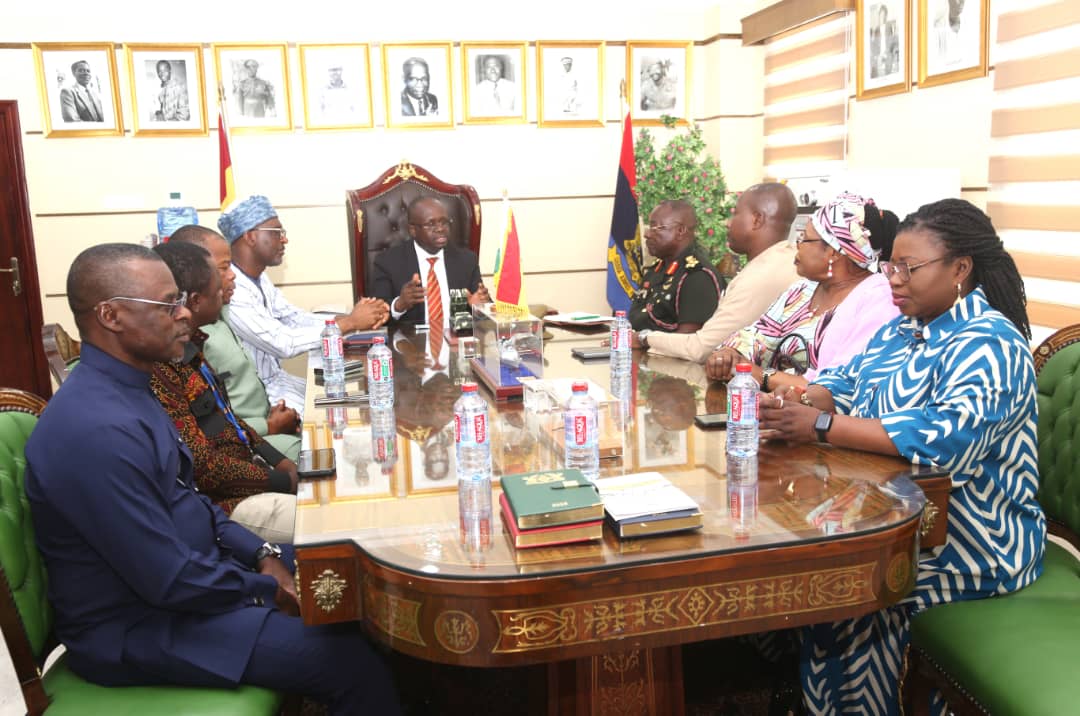
    President John Dramani Mahama is expected to officially receive the report on the Bawku Mediation on Thursday, December 11, at the Jubilee House in Accra.


    Institutions to witness the presentation are the National Peace Council, the Christian Council, the Office of the National Chief Imam, the Catholic Secretariat, UNDP, the British High Commission, and key regional authorities, including the Ministers for Upper East and North East, as well as representatives from the Upper East Regional House of Chiefs and National Security.

    Senior government officials, traditional leaders, the mediation team, and selected dignitaries are all expected to attend the ceremony.


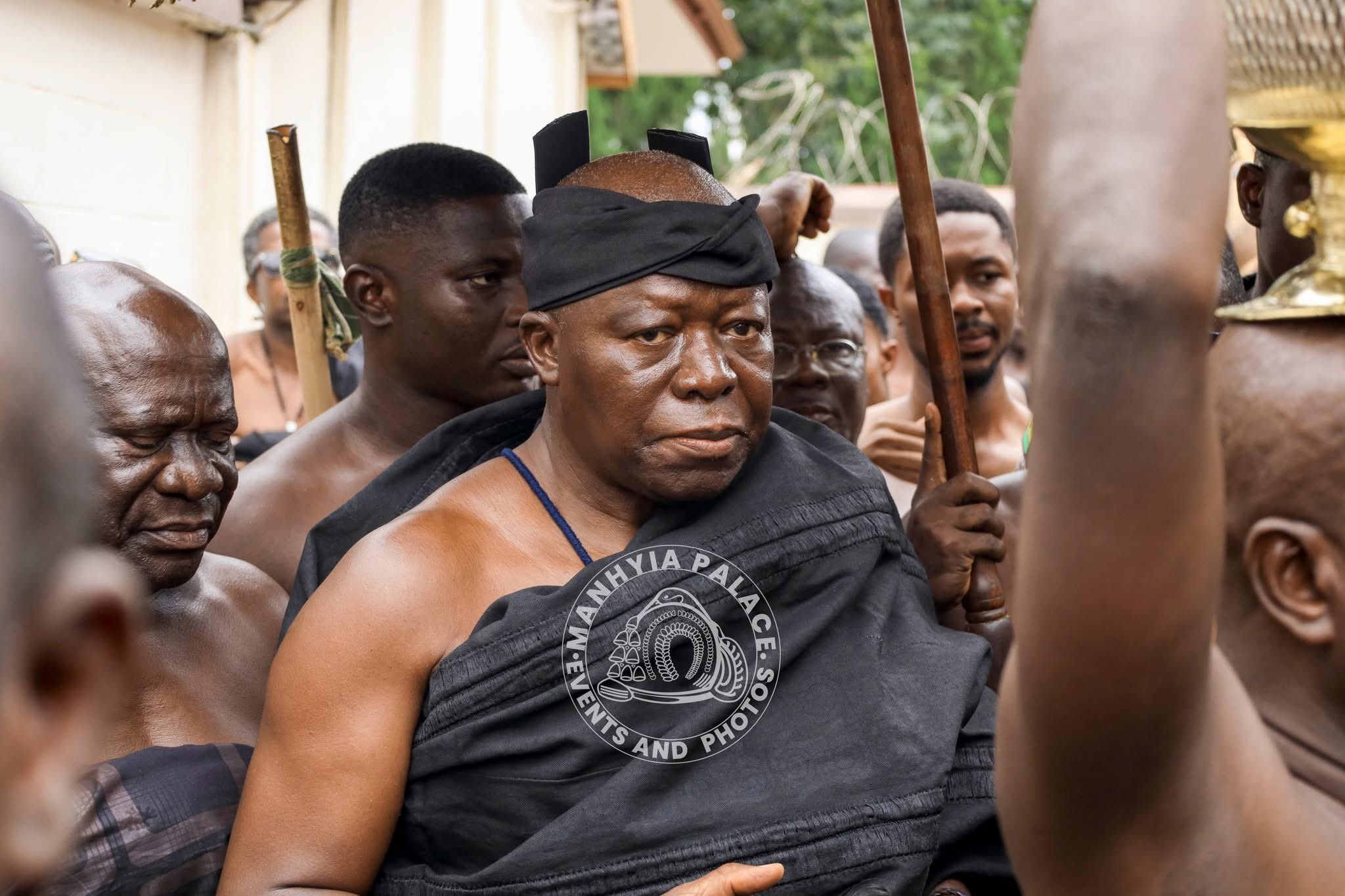
    The mediation talks began months ago, spearheaded by the Asantehene, Otumfuo Osei Tutu II. During the last gathering, the Asantehene, Otumfuo Osei Tutu II, urged the factions involved in the Bawku chieftaincy dispute to cease power struggles and work towards lasting peace.


    He made the call on Monday, December 1, at the Manhyia Palace Jubilee Hall in Kumasi while speaking to representatives of the Mamprugu and Kusasi.


    “Whatever the outcome of the mediation, you will still have to live together as brothers and sisters,” he added. Otumfuo’s engagement with the groups was to find lasting solutions to end the ongoing feud, which resurfaced in 2024 in Bawku, Upper East Region.


    Bawku, which had remained relatively peaceful for a period, saw conflict erupt once more in late 2024. The resurgence of violence was largely sparked by the return of Alhaji Seidu Abagre, a Mamprusi chief who had been enskinned in 2022, only to be exiled later when his enskinment was ruled illegal.


    His return to Bawku followed the withdrawal of an arrest warrant against him by a Kumasi High Court in October 2024, reigniting tensions between the Kusasi and Mamprusi communities. The renewed violence has resulted in deadly confrontations, including attacks on both civilians and security forces.


    Otumfuo Osei Tutu II’s involvement in the peace process has been met with widespread approval, with many hopeful that his leadership will play a critical role in restoring peace and stability to the troubled Bawku region.


    Colonel Festus Aboagye (Retired), a distinguished security expert, has called for greater support for Otumfuo’s initiative, stressing the importance of embracing multi-track diplomacy to strengthen the peace process.


    Colonel Aboagye urged a more inclusive approach to the mediation, calling for the involvement of various national stakeholders such as diaspora leaders, youth advocates, and women’s peacebuilding networks.


    He believes that a broader, multi-dimensional strategy will result in a more sustainable and inclusive solution to the conflict. “Support Otumfuo Osei Tutu II’s mediation through multi-track diplomacy, incorporating diaspora leaders, youth influencers, and women’s peacebuilding networks,” he proposed.


    He also cautioned that traditional diplomatic efforts alone might not be enough to resolve the deep divisions that have fueled the protracted conflict.


    Meanwhile, the community of Binduri in the Upper East Region, along with surrounding districts, has recorded a series of murders in recent times, leaving residents in fear and panic.


    The victims were killed by unknown armed men, prompting the police to launch investigations to arrest the perpetrators. In a recent update, the Ghana Police Service has offered a one-million Ghana cedi reward for information leading to the arrest of Mark Agingre, a native of Binduri who has been labeled the prime suspect in the ongoing killings.


    This announcement comes after a man, his wife, and their three children were murdered in Binduri, leaving another child in critical condition. The surviving child is currently receiving treatment at the Bolgatanga Government Hospital.


    Earlier, on October 27, an elderly man and his two children were also killed by unknown assailants. Preliminary police investigations have linked these incidents to Mark Agingre.


    The police have urged individuals with information on Mark Agingre’s whereabouts to contact 191, 18555, or report to the nearest police station.


    Authorities have assured the public that the prime suspect and all others involved in the gruesome murders will be brought to justice.


    Taking to Facebook on Saturday, November 8, the police wrote, “Suspect Mark Agingre, a native of Binduri, is wanted by the Police for his involvement in a series of brutal murders in the Binduri District and nearby communities in the Upper East Region.
    Suspect Agingre is wanted in connection with the murder of a man, his wife, and three children on 7th November 2025, which also left another child in critical condition at the Bolgatanga Government Hospital.”


    It added, “He is further suspected of the murder of an elderly man and his two children on 27th October 2025 at Binduri. Preliminary investigations indicate that he may be behind several other targeted killings.


    “A reward of One Million Ghana Cedis GH₵1,000,000.00 has been earmarked for anyone who is able to share relevant and credible information that will lead to the arrest of the suspect.


    The post concluded, “Anyone with credible information on his whereabouts is urged to contact the nearest police station or call 191, 18555 immediately. The Police assure the public that every effort is being made to track down the suspect and bring him to justice.”


    On Sunday, October 26, a shooting incident left three individuals dead and five others injured. Reports indicate that gunmen invaded the victims’ residence and shot them, including a five-year-old child who died instantly.


    George Bukari, Manager of Binduri-based Maxx Empire Radio and TV, is reported to have sustained injuries. The incident has been linked to the long-running Bawku conflict, where ethnic tensions have periodically sparked violence, making the area one of the most heavily monitored in northern Ghana.


    The government has, in several ways, sought to restore calm. In July, the Ghana Armed Forces (GAF) deployed soldiers to conflict-prone areas, including Bawku, Binduri, Nalerigu, and Zebilla.


    Four other individuals were killed in a daylight attack at the Garu District Office of the National Health Insurance Authority (NHIA), which also left several others injured on Monday, October 20.
    The deceased included a bystander, an NHIA staff member, a mentally unstable man, and Yahaya Bukari, headmaster of Garu D/A Junior High School.


    Eyewitnesses reported that four armed men on two motorbikes fired shots wildly upon arriving at the office.


    “Around 10 a.m., we heard gunshots. Initially, we thought it was coming from the rural bank area, but later we found out that the attackers had gone to the health insurance office,” a witness stated.


    Edward Ndebugri, former Presiding Member of the Garu District Assembly and current Assembly Member for Kugri, recounted that the gunmen targeted bystanders and fleeing residents.


    “There is a public school close to the health insurance office, and when the shooting started, the teachers and pupils began running helter-skelter. The gunmen chased them, and when one of the teachers fell, they shot him dead,” he added.


    The assailants reportedly left the NHIA office with nothing. In response, heavily armed police and military personnel patrolled key areas, including the District Health Insurance Office and the Presbyterian Hospital.


    “The whole town is in shock. This is the first time we are witnessing such an incident. People are living in fear, and we are pleading with the security agencies to investigate and bring the perpetrators to justice,” the Assembly Member for Kugri appealed.


    In April, the Ghana Police Service directed all regional commands to implement immediate protective measures for police officers and their families in the Upper East Region, particularly in Bawku, Pusiga, and Sindi.


    The directive followed intelligence suggesting that unknown operatives, potentially linked to names such as “King Doormathin” and “Nectwart Ermonnel,” may be targeting police officers and their relatives.


    “Recent developments suggest that police officers and their families, whether indigenous or non-indigenous, have become potential targets,” the internal message stated.


    It instructed that all movements in these communities must be carried out under armored escort and warned that strict compliance is non-negotiable.


    Although the identities and motives of the suspected individuals remain unclear, security analysts are actively investigating potential links to escalating unrest. Residents have been advised to remain vigilant and report any suspicious activity.


    “We’re working to ensure safety in these communities, but cooperation from the public is vital,” a senior police official, speaking on condition of anonymity, told the Independent Ghana.

  • Asantehene to give verdict on Bawku conflic today after months of mediation

    Asantehene to give verdict on Bawku conflic today after months of mediation

    Overlord of the Ashanti Kingdom, Otumfuo Osei Tutu, is set to give his judgment following months of mediation process of the long-standing Bawku conflict.

    As part of the mediation process, Otumfuo heard arguments, reviewed history, and consulted stakeholders; he will give a definitive judgment today, Monday, December 1, at the Manhyia Palace.

    Manhyia, on November 10, announced the verdict date in a statement. Ahead of a two-day mediation, work which formed a key part of his continuing work to bring the Kusasi and Mamprusi groups in Bawku together and resolve their long-running conflict.

    In April this year, President John Mahama tasked the Asantehene to resume mediation of the Bawku conflict with sessions scheduled for April 28 – May 1, 2025. 

    Manhyia confirmed the resumption in a statement on April 15. The Asantehene began by meeting both representatives from both factions between April 28 and 30 to reopen dialogue and set the stage for meaningful engagement.

    However, the sessions were postponed due to the complexity of the dispute in the locality. However, the mediation continued on May 13, where the Asantehene mentioned that the period had caused some relative peace in the area.  In June, the Asantehene was expected to meet with the Kusaug as part of ongoing efforts to restore peace in Bawku.

    After June 2025, the mediation process did not immediately conclude. Instead, it entered a slower phase with calls for more government support, and eventually, the Asantehene set a final mediation date for late November and early December 2025.

    According to the Manhyia Palace, today’s session marks the culmination of extensive peace-building efforts.

    Bawku, which had remained relatively peaceful for a period, saw conflict erupt once more in late 2024. The resurgence of violence was largely sparked by the return of Alhaji Seidu Abagre, a Mamprusi chief who had been enskinned in 2022, only to be exiled later when his enskinment was ruled illegal.

    His return to Bawku followed the withdrawal of an arrest warrant against him by a Kumasi High Court in October 2024, reigniting tensions between the Kusasi and Mamprusi communities.

    The renewed violence has resulted in deadly confrontations, including attacks on both civilians and security forces. Otumfuo Osei Tutu II’s involvement in the peace process has been met with widespread approval, with many hopeful that his leadership will play a critical role in restoring peace and stability to the troubled Bawku region.

    Colonel Festus Aboagye (Retired), a distinguished security expert, has called for greater support for Otumfuo’s initiative, stressing the importance of embracing multi-track diplomacy to strengthen the peace process.

    Colonel Aboagye urged a more inclusive approach to the mediation, calling for the involvement of various national stakeholders such as diaspora leaders, youth advocates, and women’s peacebuilding networks.

    He believes that a broader, multi-dimensional strategy will result in a more sustainable and inclusive solution to the conflict.“Support Otumfuo Osei Tutu II’s mediation through multi-track diplomacy, incorporating diaspora leaders, youth influencers, and women’s peacebuilding networks,” he proposed.

    He also cautioned that traditional diplomatic efforts alone might not be enough to resolve the deep divisions that have fueled the protracted conflict.

    Meanwhile, the community of Binduri in the Upper East Region, along with surrounding districts, has recorded a series of murders in recent times, leaving residents in fear and panic.

    The victims were killed by unknown armed men, prompting the police to launch investigations to arrest the perpetrators. In a recent update, the Ghana Police Service has offered a one-million Ghana Cedis reward for information leading to the arrest of Mark Agingre, a native of Binduri who has been labeled the prime suspect in the ongoing killings.
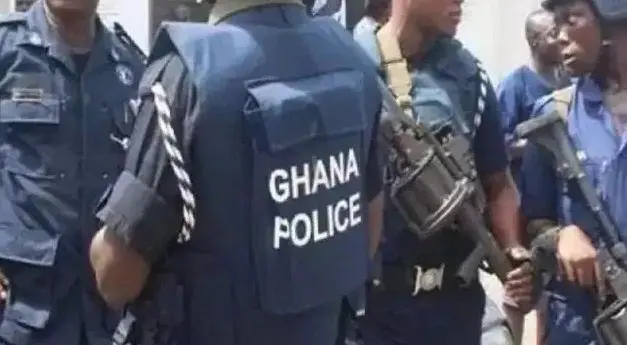
    This announcement comes after a man, his wife, and their three children were murdered in Binduri, leaving another child in critical condition. The surviving child is currently receiving treatment at the Bolgatanga Government Hospital.

    Earlier, on October 27, an elderly man and his two children were also killed by unknown assailants. Preliminary police investigations have linked these incidents to Mark Agingre.
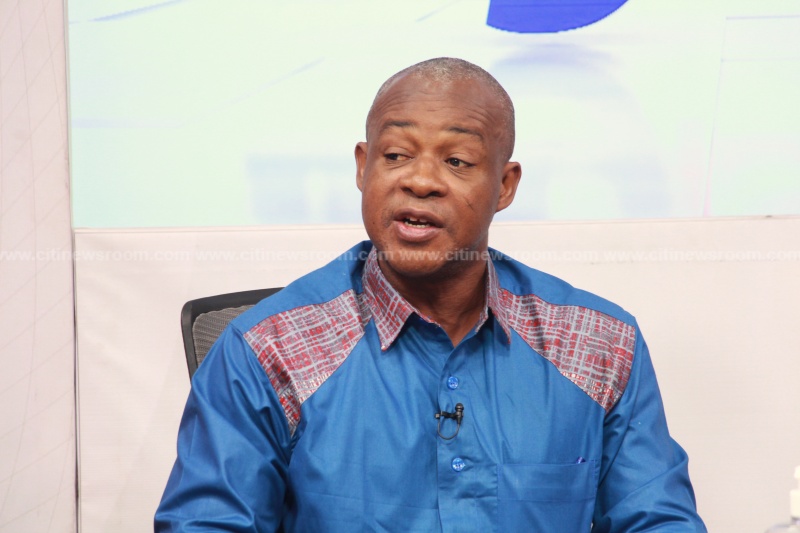

    The police have urged individuals with information on Mark Agingre’s whereabouts to contact 191, 18555, or report to the nearest police station.

    Authorities have assured the public that the prime suspect and all others involved in the gruesome murders will be brought to justice. Taking to Facebook on Saturday, November 8, the police wrote, “Suspect Mark Agingre, a native of Binduri, is wanted by the Police for his involvement in a series of brutal murders in the Binduri District and nearby communities in the Upper East Region.

    Suspect Agingre is wanted in connection with the murder of a man, his wife, and three children on 7th November 2025, which also left another child in critical condition at the Bolgatanga Government Hospital.”

    It added, “He is further suspected of the murder of an elderly man and his two children on 27th October 2025 at Binduri. Preliminary investigations indicate that he may be behind several other targeted killings.

    “A reward of One Million Ghana Cedis GH₵1,000,000.00 has been earmarked for anyone who is able to share relevant and credible information that will lead to the arrest of the suspect.

    The post concluded, “Anyone with credible information on his whereabouts is urged to contact the nearest police station or call 191, 18555 immediately. The Police assure the public that every effort is being made to track down the suspect and bring him to justice.”

    On Sunday, October 26, a shooting incident left three individuals dead and five others injured. Reports indicate that gunmen invaded the victims’ residence and shot them, including a five-year-old child who died instantly.

    George Bukari, Manager of Binduri-based Maxx Empire Radio and TV, is reported to have sustained injuries. The incident has been linked to the long-running Bawku conflict, where ethnic tensions have periodically sparked violence, making the area one of the most heavily monitored in northern Ghana.

    The government has, in several ways, sought to restore calm. In July, the Ghana Armed Forces (GAF) deployed soldiers to conflict-prone areas, including Bawku, Binduri, Nalerigu, and Zebilla.

    Four other individuals were killed in a daylight attack at the Garu District Office of the National Health Insurance Authority (NHIA), which also left several others injured on Monday, October 20.

    The deceased included a bystander, an NHIA staff member, a mentally unstable man, and Yahaya Bukari, headmaster of Garu D/A Junior High School.

    Eyewitnesses reported that four armed men on two motorbikes fired shots wildly upon arriving at the office.

    “Around 10 a.m., we heard gunshots. Initially, we thought it was coming from the rural bank area, but later we found out that the attackers had gone to the health insurance office,” a witness stated. Edward Ndebugri, former Presiding Member of the Garu District Assembly and current Assembly Member for Kugri, recounted that the gunmen targeted bystanders and fleeing residents.

    “There is a public school close to the health insurance office, and when the shooting started, the teachers and pupils began running helter-skelter. The gunmen chased them, and when one of the teachers fell, they shot him dead,” he added.

    The assailants reportedly left the NHIA office with nothing. In response, heavily armed police and military personnel patrolled key areas, including the District Health Insurance Office and the Presbyterian Hospital.

    “The whole town is in shock. This is the first time we are witnessing such an incident. People are living in fear, and we are pleading with the security agencies to investigate and bring the perpetrators to justice,” the Assembly Member for Kugri appealed.

    In April, the Ghana Police Service directed all regional commands to implement immediate protective measures for police officers and their families in the Upper East Region, particularly in Bawku, Pusiga, and Sindi.

    The directive followed intelligence suggesting that unknown operatives, potentially linked to names such as “King Doormathin” and “Nectwart Ermonnel,” may be targeting police officers and their relatives.

    “Recent developments suggest that police officers and their families, whether indigenous or non-indigenous, have become potential targets,” the internal message stated.

    It instructed that all movements in these communities must be carried out under armoured escort and warned that strict compliance is non-negotiable.

    Although the identities and motives of the suspected individuals remain unclear, security analysts are actively investigating potential links to escalating unrest. Residents have been advised to remain vigilant and report any suspicious activity.

    “We’re working to ensure safety in these communities, but cooperation from the public is vital,” a senior police official, speaking on condition of anonymity, told the Independent Ghana.

  • Bawku, Nalerigu curfews reviewed by govt

    Bawku, Nalerigu curfews reviewed by govt

    Minister for Interior, Muntaka Mubarak, has reviewed the earlier curfew hours imposed on Bawku and Nalerigu townships owing to recent attacks.

    The earlier curfew that ran from 6am to 2pm has been revised to 6pm to 6am. The minister took this decision after receiving advice from the National Security Council.

    The Bawku Municipality in the Upper East Region and the East Mamprusi Municipality in the North East Region are affected.

    The curfew has created an environment conducive for the evacuation of all students in various educational institutions in affected areas, some of whom have been unfortunately targeted in the conflict.

    Unknown assailants on Saturday evening, July 26, claimed the lives of two male students of Nalerigu Senior High School (SHS) in the Northern Region. According to reports, the armed group stormed the school premises, proceeded to the dormitory, and opened fire on the two students—Lukman and Gideon.

    Assembly Member for the Denugu Electoral Area, Dasmani Fuseini, and uncle to one of the deceased students, is said to have confirmed the attack to the media. The remains of the deceased students are in the custody of the police at the time of reporting. The families are working to retrieve the bodies for burial. 

    The police have commenced an investigation into the murder of the students that has been linked to the renewed Bawku conflict. Management of Nalerigu Senior High School is yet to officially comment on the matter as school students mourn the loss of their colleagues. Also, communities close to the second cycle institutions are in a state of shock.

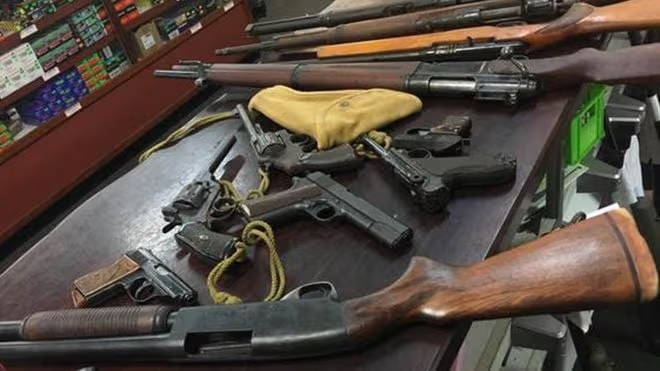
    There is a total ban on all persons in the Nalerigu township and its environs from carrying arms, ammunition, or any offensive weapons. As such, any individual found with any arms or ammunition will be arrested and prosecuted.

    The government has called on the chiefs, elders, opinion leaders, youth, and people of the area to exercise restraint in the face of the challenges confronting them as well as to use non-violent means to channel their energies into ensuring peace.

    The government, in a statement issued on July 27, announced that it is stepping up its approach from peacekeeping to peace enforcement in Bawku and other affected areas due to the recent escalation of violence, which could derail the peacebuilding process.

    The Ghana Armed Forces have been deployed to maintain law and order and take all necessary measures to protect lives and property. Residents have been advised to fully cooperate with the Ghana Armed Forces to ensure peace.

    The Ghana Armed Forces (GAF) has emphasised that it will employ all the necessary force to ensure peace prevails in Bawku, Upper East Region.

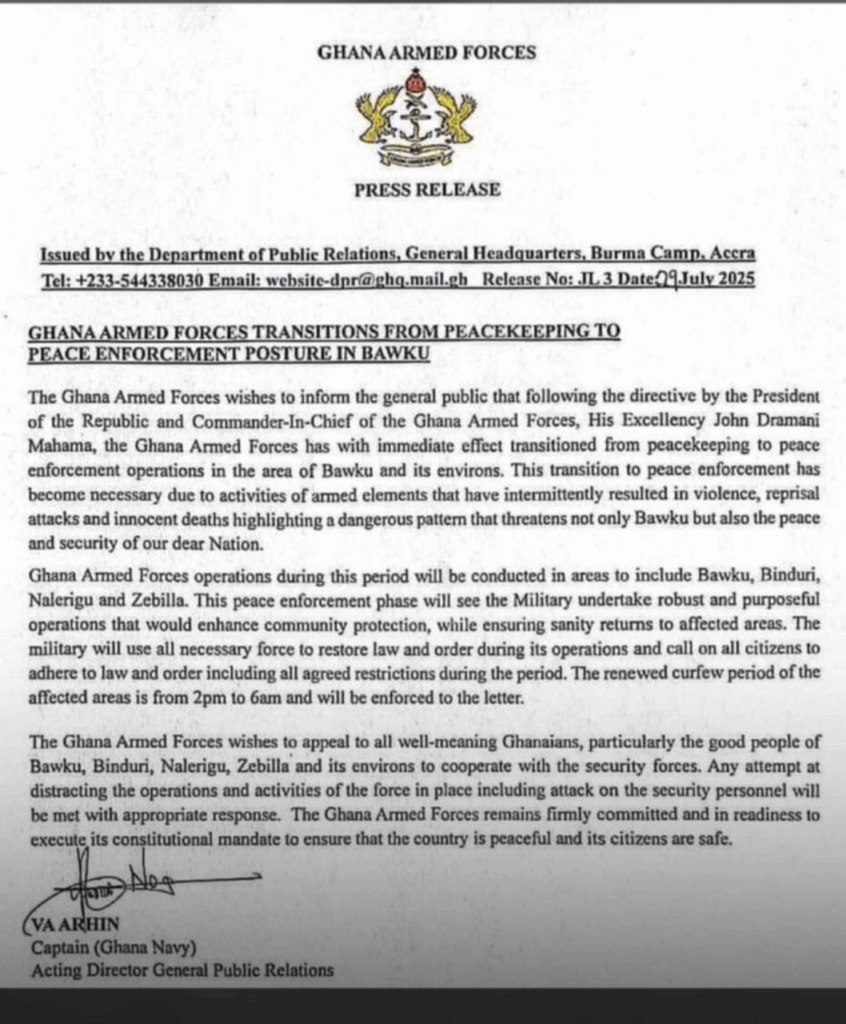
    In a press release, the Acting Director General of Public Relations, VA Arhin, explained that the new development follows a recent directive by His Excellency President John Dramani Mahama.

    According to the military, its new strategies will focus on conflict zone areas, such as Bawku, Binduri, Nalerigu, and Zebilla, to restore calm and prevent further escalation.

    “The Ghana Armed Forces wishes to inform the general public that following the directive by the President of the Republic and Commander-In-Chief of the Ghana Armed Forces, His Excellency John Dramani Mahama, the Ghana Armed Forces has, with immediate effect, transitioned to peace enforcement has become necessary due to the activities of armed elements that have intermittently resulted in violence, reprisal attacks and innocent deaths highlighting a dangerous pattern that threatens not only Bawku but also the peace and security of our dear Nation.

    “Ghana Armed Forces operations during this period will be conducted in areas to include Bawku, Binduri, Nalerigu and Zebilla. This peace enforcement phase will see the Military undertake robust and purposeful operations that would enhance community protection, while ensuring sanity returns to affected areas,” parts of the release read.

    Earlier, the Minister of Defence, Dr. Edward Omane Boamah, indicated that the Ghana Armed Forces is fully prepared to contain any form of escalation in Bawku and its surrounding areas. Providing an update on the state of his sector on Monday, July 21, he acknowledged the tense situation in Bawku but assured that the military has implemented strong and effective security measures to respond to any threats and maintain stability.

    “We acknowledge that the situation in Bawku and Alavanyo and their immediate surroundings remains volatile. The Ghana Armed Forces is actively monitoring and has put in place robust mechanisms to ensure any potential escalation is swiftly contained in the interest of the people and long-lasting resolution of the conflict through dialogue,” he said.

    He warned that any individuals or groups who take advantage of the conflict to commit crimes will face strict action from the authorities. “In doing so, we shall always separate crimes from traditional matters, enabling us to deal appropriately and legally with criminals who foment trouble in the name of chieftaincy conflict,” he said.

    A few weeks ago, a confrontation between some members of the Ghana Armed Forces and locals in Bawku resulted in the death of five civilians and the destruction of a statue of the Bawku Naba, Naba Asigri Abugrago Azoka II.

    The reconstruction of the statue is expected to begin in the coming days, following a directive from His Excellency, President John Dramani Mahama. The statue, which was erected in 2024, is in honour of the Zugraan (Overlord) of the Kusaug Traditional Area, Asigri Abugrago Azoka II, a culturally revered figure in Bawku. It served as a strong emblem of tradition and communal pride.

    The reconstruction of the statue is expected to begin in the coming days, following a directive from His Excellency, President John Dramani Mahama. Minister of Defence Dr. Edward Omane Boamah, in collaboration with other security agencies, has been tasked with overseeing the process as well as restoring calm in the area.

    “To assure that His Excellency President John Dramani Mahama, the Commander in Chief of the Ghana Armed Forces (GAF), remains committed to bringing an end to decades-old conflict. To address, the recent happenings the National Security Coordinator, myself, the Minister for the Interior, the Chief of the Defence Staff and the IGP have all been tasked to play coordinated but differentiated roles to ensure that peace and calm are restored immediately, and this includes restoration of the statue of the Zugran of the Kusasis traditional area,” he added.

    According to him, the government is working with security to contain the situation and protect lives and property. “I have directed thorough investigations into the recent matter and promised to take swift action based on recommendations,” he said.

    On Tuesday, July 15, some Members of Parliament in the Upper East area called for the prosecution of the soldiers involved and compensation for the victims. Bawku, which had remained relatively peaceful for a period, saw conflict erupt once more in late 2024.

    The resurgence of violence was largely sparked by the return of Alhaji Seidu Abagre, a Mamprusi chief who had been enskinned in 2022, only to be exiled later when his enskinment was ruled illegal. His return to Bawku followed the withdrawal of an arrest warrant against him by a Kumasi High Court in October 2024, reigniting tensions between the Kusasi and Mamprusi communities.

    The renewed violence has resulted in deadly confrontations, including attacks on both civilians and security forces. In May, the government renewed the curfew in Bawku Municipality and its surrounding areas in the Upper East Region through an Executive Instrument.

    The minister, in a statement, urged chiefs, elders, opinion leaders, youth, and residents to remain calm and use peaceful, non-violent means to address the challenges facing the area and work towards lasting peace.

    The government also reminded the public that there is a total ban on the possession of arms, ammunition, or any offensive weapons in the area. Anyone found in violation will be arrested and prosecuted.

    On April 15, Otumfuo formally announced that the critical mediation sessions would take place from April 28 to May 1 at the Manhyia Palace in Kumasi. However, it was postponed due to the complexity of the dispute in the locality. Otumfuo Osei Tutu II’s involvement in the peace process has been met with widespread approval, with many hopeful that his leadership will play a critical role in restoring peace and stability to the troubled Bawku region.

    The government has commended His Majesty Otumfuo Osei Tutu II for mediating the conflict and appreciates all stakeholders who are supporting the peace process. The Otumfuo mediation, with the genuine help of Nayiri and Zugraana, had almost brought finality to the conflict until the very recent killings, which have necessitated drastic actions to protect all in the interests of the greater good. The government is urging all parties to refrain from violence and support the peace process. 

  • We will use all necessary force to enforce peace in Bawku – GAF declares

    We will use all necessary force to enforce peace in Bawku – GAF declares

    The Ghana Armed Forces (GAF) has emphasised that it will employ all the necessary force to ensure peace prevails in Bawku, Upper East Region.

    In a press release, the Acting Director General of Public Relations, VA Arhin, explained that the new development follows a recent directive by His Excellency President John Dramani Mahama.

    According to the military, its new strategies will focus on conflict zone areas, such as Bawku, Binduri, Nalerigu, and Zebilla, to restore calm and prevent further escalation.

    “The Ghana Armed Forces wishes to inform the general public that following the directive by the President of the Republic and Commander-In-Chief of the Ghana Armed Forces, His Excellency John Dramani Mahama, the Ghana Armed Forces has, with immediate effect, transitioned to peace enforcement has become necessary due to the activities of armed elements that have intermittently resulted in violence, reprisal attacks and innocent deaths highlighting a dangerous pattern that threatens not only Bawku but also the peace and security of our dear Nation.

    “Ghana Armed Forces operations during this period will be conducted in areas to include Bawku, Binduri, Nalerigu and Zebilla. This peace enforcement phase will see the Military undertake robust and purposeful operations that would enhance community protection, while ensuring sanity returns to affected areas,” parts of the release read.

    The resurgence of violence was largely sparked by the return of Alhaji Seidu Abagre, a Mamprusi chief who had been enskinned in 2022, only to be exiled later when his enskinment was ruled illegal.

    His return to Bawku followed the withdrawal of an arrest warrant against him by a Kumasi High Court in October 2024, reigniting tensions between the Kusasi and Mamprusi communities.

    The renewed violence has resulted in deadly confrontations, including attacks on both civilians and security forces. On Saturday evening, July 26, two male students of Nalerigu Senior High School (SHS) in the Northern Region, Lukman and Gideon, were shot dead by unknown assailants.

    The armed group reportedly invaded the school premises, making their way to the dormitory, and opened fire on the victims. The deceased students have been laid to rest. The Police have commenced an investigation into the murder of the students that has been linked to the renewed Bawku conflict.

    Also in Bawku, a third-year student of Bawku Senior High School, Hakim Kundima, was killed on the school campus on Saturday evening by some armed men. Similar to the Nalerigu Senior High School incident, the armed men found their way into the school’s premises, dragged the deceased from the dormitory, and shot him. The Bawku Senior High School has been temporarily closed by the Municipal Education Directorate following the fatal shooting.

    In reaction to the recent violent attack, the Minister for the Interior, Muntaka Mubarak, on the advice of the North East Regional Security Council and by Executive Instrument, has imposed curfew hours on Nalerigu Township and its environs in the North East Region from 2pm to 6am, effective Sunday, July 27, until further notice.

    The curfew has created an environment conducive to the evacuation of all students in various educational institutions in affected areas, some of whom have been unfortunately targeted in the conflict. The government has called on the chiefs, elders, opinion leaders, youth, and people of the area to exercise restraint in the face of the challenges confronting them as well as to use non-violent means to channel their energies into ensuring peace.

    Meanwhile, the government has reviewed the curfew hours for Bawku Municipality and its environs in the Upper East Region from 2pm to 6am, effective Sunday, July 27, until further notice. The government, in a statement issued on July 27, announced that it is stepping up its approach from peacekeeping to peace enforcement in Bawku and other affected areas due to the recent escalation of violence, which could derail the peacebuilding process.

    The Ghana Armed Forces have been deployed to maintain law and order and take all necessary measures to protect lives and property. Residents have been advised to fully cooperate with the Ghana Armed Forces to ensure peace.

    Earlier, the Minister of Defence, Dr. Edward Omane Boamah, indicated that the Ghana Armed Forces (GAF) is fully prepared to contain any form of escalation in Bawku and its surrounding areas.

    Providing an update on the state of his sector on Monday, July 21, he acknowledged the tense situation in Bawku but assured that the military has implemented strong and effective security measures to respond to any threats and maintain stability.

    “We acknowledge that the situation in Bawku and Alavanyo and their immediate surroundings remains volatile. The Ghana Armed Forces is actively monitoring and has put in place robust mechanisms to ensure any potential escalation is swiftly contained in the interest of the people and long-lasting resolution of the conflict through dialogue,” he said.

    He warned that any individuals or groups who take advantage of the conflict to commit crimes will face strict action from the authorities.

    “In doing so, we shall always separate crimes from traditional matters, enabling us to deal appropriately and legally with criminals who foment trouble in the name of chieftaincy conflict,” he said.

    A few weeks ago, there was a confrontation between some members of the Ghana Armed Forces (GAF) and locals, which resulted in the death of five civilians and the destruction of a statue of the Bawku Naba, Naba Asigri Abugrago Azoka II.

    Recently, the government banned the possession of arms, ammunition, or any offensive weapons in the area. It emphasised that anyone found in violation will be arrested and prosecuted.

    On April 15, Otumfuo formally announced that the critical mediation sessions would take place from April 28 to May 1 at the Manhyia Palace in Kumasi. However, it was postponed due to the complexity of the dispute in the locality.

    Otumfuo Osei Tutu II’s involvement in the peace process has been met with widespread approval, with many hopeful that his leadership will play a critical role in restoring peace and stability to the troubled Bawku region.

    The government has commended His Majesty Otumfuo Osei Tutu II for mediating the conflict and appreciates all stakeholders who are supporting the peace process. The Otumfuo mediation, with the genuine help of Nayiri and Zugraana, had almost brought finality to the conflict until the very recent killings, which have necessitated drastic actions to protect all in the interests of the greater good. The government is urging all parties to refrain from violence and support the peace process. 

  • Gov’t bans possession of arms and ammunition in Nalerigu, Bawku

    Gov’t bans possession of arms and ammunition in Nalerigu, Bawku

    Carrying arms, ammunition, or any offensive weapons in the Nalerigu and Bawku Townships and their environs has been banned by the government.

    The government has warned that anyone who flouts the directive will face immediate arrest and prosecution without exception.

    On Sunday, July 27, curfew hours was imposed on Nalerigu Township and its environs in the North East Region from 2:00 pm to 6:00 am by the Minister for the Interior, on the advice of the North East Regional Security Council and by Executive Instrument.

    “Government calls on the Chiefs, Elders, Opinion Leaders, Youth and people of the area to exercise restraint in the face of the challenges confronting them as well as to use non-violent means to channel their energies into ensuring peace,” a statement said.


    However, on Sunday, July 27 the curfew hours have been reviewed for Bawku Municipality and its environs in the Upper East Region from 2:00 pm to 6:00 am.


    “Meanwhile, there is a total ban on all persons in the Bawku Municipality and its environs from carrying arms, ammunition or any offensive weapons and any persons found with any arms or ammunition will be arrested and prosecuted,” another statement said.

    The restrictions in these areas is stemmed from a recent shooting incident that occurred at the Nalerigu Senior High School on Saturday evening, July 26.


    On Saturday evening, July 26, two male students of Nalerigu Senior High School (SHS) in the Northern Region; Lukman and Gideon were shot dead by unknown assailants.


    The armed group reportedly invaded the school premises, making their to the dormitory, and opened fire on the victims.


    The shooting incident was disclosed by the Assembly Member for the Denugu Electoral Area, Dasmani Fuseini who is said to be an uncle to one of the deceased students while speaking to the media.


    The remains of the deceased students are in the custody of the police at the time of reporting. The families are working to retrieve the bodies for burial.


    The Police have commenced an investigation into the murder of the students that has been linked to the renewed Bawku conflict.


    Management of Nalerigu Senior High School is yet to officially comment on the matter as school students mourn the loss of their colleagues. Also, communities close to the second cycle institutions are in a state of shock.
    Meanwhile, Minister of Defence, Dr. Edward Omane Boamah, has indicated that the Ghana Armed Forces (GAF) is fully prepared to contain any form of escalation in Bawku and its surrounding areas.


    Providing an update on the state of his sector on Monday, July 21, he acknowledged the tense situation in Bawku but assured that the military has implemented strong and effective security measures to respond to any threats and maintain stability.


    “We acknowledge that the situation in Bawku and Alavanyo and their immediate surroundings remains volatile. The Ghana Armed Forces is actively monitoring and has put in place robust mechanisms to ensure any potential escalation is swiftly contained in the interest of the people and long-lasting resolution of the conflict through dialogue,” he said.


    He warned that any individuals or groups who take advantage of the conflict to commit crimes will face strict action from the authorities.“In doing so, we shall always separate crimes from traditional matters, enabling us to deal appropriately and legally with criminals who foment trouble in the name of chieftaincy conflict,” he said.


    The Minister’s remarks come a few weeks after a recent altercation in Bawku, where a confrontation between some members of the Ghana Armed Forces (GAF) and locals resulted in the death of five civilians and the destruction of a statue of the Bawku Naba, Naba Asigri Abugrago Azoka II.


    The reconstruction of the statue is expected to begin in the coming days, following a directive from His Excellency, President John Dramani Mahama. The statue, which was erected in 2024, in honour of the Zugraan (Overlord) of the Kusaug Traditional Area, Asigri Abugrago Azoka II, a culturally revered figure in Bawku.

    It served as a strong emblem of tradition and communal pride.
    The reconstruction of the statue is expected to begin in the coming days, following a directive from His Excellency, President John Dramani Mahama.

    Minister of Defence, Dr. Edward Omane Boamah, in collaboration with other security agencies, has been tasked with overseeing the process as well as restoring calm in the area.


    “To assure that His Excellency President John Dramani Mahama the Commander in Chief of the Ghana Armed Forces (GAF), remains committed to bringing an end to decades-old conflict.


    “To address, the recent happenings the National Security Coordinator, myself, the Minister for the Interior, the Chief of the Defence Staff and the IGP have all been tasked to play coordinated but differentiated roles to ensure that peace and calm is restored immediately and this includes restoration of the statue of the Zugran of the Kusasis traditional area,” he added.


    According to him, the government is working with security to contain the situation and protect lives and property. “I have directed thorough investigations into the recent matter and promised to take swift action based on recommendations,” he said.


    On Tuesday, July 15, some Members of Parliament in the Upper East area called for the prosecution of the soldiers involved and compensation for the victims.


    Bawku, which had remained relatively peaceful for a period, saw conflict erupt once more in late 2024.
    The resurgence of violence was largely sparked by the return of Alhaji Seidu Abagre, a Mamprusi chief who had been enskinned in 2022, only to be exiled later when his enskinment was ruled illegal. His return to Bawku followed the withdrawal of an arrest warrant against him by a Kumasi High Court in October 2024, reigniting tensions between the Kusasi and Mamprusi communities.The renewed violence has resulted in deadly confrontations, including attacks on both civilians and security forces. In May, the government renewed the curfew in Bawku Municipality and it’s surrounding areas in the Upper East Region through an Executive Instrument.


    The Minister, in a statement, urged chiefs, elders, opinion leaders, youth, and residents to remain calm and use peaceful, non-violent means to address the challenges facing the area and work towards lasting peace.


    The government also reminded the public that there is a total ban on the possession of arms, ammunition, or any offensive weapons in the area. Anyone found in violation will be arrested and prosecuted.


    On April 15, Otumfuo formally announced that the critical mediation sessions would take place from April 28 to May 1 at the Manhyia Palace in Kumasi. However, it was postponed due to the complexity of the dispute in the locality.


    Otumfuo Osei Tutu II’s involvement in the peace process has been met with widespread approval, with many hopeful that his leadership will play a critical role in restoring peace and stability to the troubled Bawku region.


    Colonel Festus Aboagye (Retired), a distinguished security expert, has called for greater support for Otumfuo’s initiative, stressing the importance of embracing multi-track diplomacy to strengthen the peace process.
    Colonel Aboagye urged a more inclusive approach to the mediation, calling for the involvement of various national stakeholders such as diaspora leaders, youth advocates, and women’s peacebuilding networks.


    He believes that a broader, multi-dimensional strategy will result in a more sustainable and inclusive solution to the conflict.

    “Support Otumfuo Osei Tutu II’s mediation through multi-track diplomacy, incorporating diaspora leaders, youth influencers, and women’s peacebuilding networks,” he proposed.


    He also cautioned that traditional diplomatic efforts alone might not be enough to resolve the deep divisions that have fueled the protracted conflict. Meanwhile, GAF has called on residents and the wider public to cooperate with ongoing security operations, as efforts to restore normalcy in the region.

  • Armed forces fully alert in Bawku – Minister of Defence

    Armed forces fully alert in Bawku – Minister of Defence

    Minister of Defence, Dr. Edward Omane Boamah, has indicated that the Ghana Armed Forces (GAF) is fully prepared to contain any form of escalation in Bawku and surrounding areas, such as in the Upper East region.

    Providing an update on the state of his sector on Monday, July 21, he acknowledged the tense situation in Bawku but assured that the military has implemented strong and effective security measures to respond to any threats and maintain stability.

    “We acknowledge that the situation in Bawku and Alavanyo and their immediate surroundings remains volatile. The Ghana Armed Forces is actively monitoring and has put in place robust mechanisms to ensure any potential escalation is swiftly contained in the interest of the people and long-lasting resolution of the conflict through dialogue,” he said.

    He warned that any individuals or groups who take advantage of the conflict to commit crimes will face strict action from the authorities.

    “In doing so, we shall always separate crimes from traditional matters, enabling us to deal appropriately and legally with criminals who foment trouble in the name of chieftaincy conflict,” he said.

    The Minister’s remarks come a few weeks after a recent altercation in Bawku, where a confrontation between some members of the Ghana Armed Forces (GAF) and locals resulted in the death of five civilians and the destruction of a statue of the Bawku Naba, Naba Asigri Abugrago Azoka II.

    The reconstruction of the statue is expected to begin in the coming days, following a directive from His Excellency, President John Dramani Mahama.

    The statue, which was erected in 2024, in honour of the Zugraan (Overlord) of the Kusaug Traditional Area, Asigri Abugrago Azoka II, a culturally revered figure in Bawku. It served as a strong emblem of tradition and communal pride.

    The reconstruction of the statue is expected to begin in the coming days, following a directive from His Excellency, President John Dramani Mahama.

    The Minister of Defence, Dr. Edward Omane Boamah, in collaboration with other security agencies, has been tasked with overseeing the process as well as restoring calm in the area.

    “To assure that His Excellency President John Dramani Mahama the Commander in Chief of the Ghana Armed Forces (GAF), remains committed to bringing an end to decades-old conflict.

    “To address, the recent happenings the National Security Coordinator, myself, the Minister for the Interior, the Chief of the Defence Staff and the IGP have all been tasked to play coordinated but differentiated roles to ensure that peace and calm is restored immediately and this includes restoration of the statue of the Zugran of the Kusasis traditional area,” he added.

    According to him, the government is working with security to contain the situation and protect lives and property.

    “I have directed thorough investigations into the recent matter and promised to take swift action based on recommendations,” he said.

    On Tuesday, July 15, some Members of Parliament in the Upper East area called for the prosecution of the soldiers involved and compensation for the victims.

    Bawku, which had remained relatively peaceful for a period, saw conflict erupt once more in late 2024.

    The resurgence of violence was largely sparked by the return of Alhaji Seidu Abagre, a Mamprusi chief who had been enskinned in 2022, only to be exiled later when his enskinment was ruled illegal.

    His return to Bawku followed the withdrawal of an arrest warrant against him by a Kumasi High Court in October 2024, reigniting tensions between the Kusasi and Mamprusi communities.

    The renewed violence has resulted in deadly confrontations, including attacks on both civilians and security forces.

    In May, the government renewed the curfew in Bawku Municipality and it’s surrounding areas in the Upper East Region through an Executive Instrument.

    The Minister in a statement urged chiefs, elders, opinion leaders, youth, and residents to remain calm and use peaceful, non-violent means to address the challenges facing the area and work towards lasting peace.

    The government also reminded the public that there is a total ban on the possession of arms, ammunition, or any offensive weapons in the area. Anyone found in violation will be arrested and prosecuted.

    On April 15, Otumfuo formally announced that the critical mediation sessions would take place from April 28 to May 1 at the Manhyia Palace in Kumasi.

    However, it was postponed due to the complexity of the dispute in the locality.

    Otumfuo Osei Tutu II’s involvement in the peace process has been met with widespread approval, with many hopeful that his leadership will play a critical role in restoring peace and stability to the troubled Bawku region.

    Colonel Festus Aboagye (Retired), a distinguished security expert, has called for greater support for Otumfuo’s initiative, stressing the importance of embracing multi-track diplomacy to strengthen the peace process.

    Colonel Aboagye urged a more inclusive approach to the mediation, calling for the involvement of various national stakeholders such as diaspora leaders, youth advocates, and women’s peacebuilding networks.

    He believes that a broader, multi-dimensional strategy will result in a more sustainable and inclusive solution to the conflict.

    “Support Otumfuo Osei Tutu II’s mediation through multi-track diplomacy, incorporating diaspora leaders, youth influencers, and women’s peacebuilding networks,” he proposed.

    He also cautioned that traditional diplomatic efforts alone might not be enough to resolve the deep divisions that have fueled the protracted conflict.

    Meanwhile, GAF has called on residents and the wider public to cooperate with ongoing security operations, as efforts to restore normalcy in the region.

  • Zugran statue destroyed amid Bawku conflict to be rebuilt

    Zugran statue destroyed amid Bawku conflict to be rebuilt

    The statue of the Bawku Naba, Naba Asigri Abugrago Azoka II, which was allegedly destroyed by some members of the Ghana Armed Forces (GAF) during a confrontation with locals last week in Bawku, Upper East Region, will be rebuilt by the government.

    The statue, which was erected in 2024, in honour of the Zugraan (Overlord) of the Kusaug Traditional Area, Asigri Abugrago Azoka II, a culturally revered figure in Bawku. It served as a strong emblem of tradition and communal pride.

    The reconstruction of the statue is expected to begin in the coming days, following a directive from His Excellency, President John Dramani Mahama.

    The Minister of Defence, Dr. Edward Omane Boamah, in collaboration with other security agencies, has been tasked with overseeing the process as well as restoring calm in the area.

    This information was made known by the Minister of Defence, Dr Edward Omane Boamah a durbar with all ranks of the Ghana Armed Forces (GAF) at the Burma Camp on Wednesday, July 17.

    “To assure that His Excellency President John Dramani Mahama the Commander in Chief of the Ghana Armed Forces (GAF), remains committed to bringing an end to decades-old conflict.

    “To address, the recent happenings the National Security Coordinator, myself, the Minister for the Interior, the Chief of the Defence Staff and the IGP have all been tasked to play coordinated but differentiated roles to ensure that peace and calm is restored immediately and this includes restoration of the statue of the Zugran of the Kusasis traditional area,” he added.

    The recent altercation in Bawku has reportedly led to the deaths of five locals.

    On Tuesday, July 15, some Members of Parliament in the Upper East area called for the prosecution of the soldiers involved and a compensation for the victims.

    Bawku, which had remained relatively peaceful for a period, saw conflict erupt once more in late 2024. The resurgence of violence was largely sparked by the return of Alhaji Seidu Abagre, a Mamprusi chief who had been enskinned in 2022, only to be exiled later when his enskinment was ruled illegal.

    His return to Bawku followed the withdrawal of an arrest warrant against him by a Kumasi High Court in October 2024, reigniting tensions between the Kusasi and Mamprusi communities.

    The renewed violence has resulted in deadly confrontations, including attacks on both civilians and security forces.

    On April 15, Otumfuo formally announced that the critical mediation sessions would take place from April 28 to May 1 at the Manhyia Palace in Kumasi.

    However, it was postponed due to the complexity of the dispute in the locality.

    Otumfuo Osei Tutu II’s involvement in the peace process has been met with widespread approval, with many hopeful that his leadership will play a critical role in restoring peace and stability to the troubled Bawku region.

    Colonel Festus Aboagye (Retired), a distinguished security expert, has called for greater support for Otumfuo’s initiative, stressing the importance of embracing multi-track diplomacy to strengthen the peace process.

    Colonel Aboagye urged a more inclusive approach to the mediation, calling for the involvement of various national stakeholders such as diaspora leaders, youth advocates, and women’s peacebuilding networks.

    He believes that a broader, multi-dimensional strategy will result in a more sustainable and inclusive solution to the conflict.

    “Support Otumfuo Osei Tutu II’s mediation through multi-track diplomacy, incorporating diaspora leaders, youth influencers, and women’s peacebuilding networks,” he proposed.

    He also cautioned that traditional diplomatic efforts alone might not be enough to resolve the deep divisions that have fueled the protracted conflict.

  • Recent military brutality in Bawku unacceptable – Mahama Ayariga

    Recent military brutality in Bawku unacceptable – Mahama Ayariga

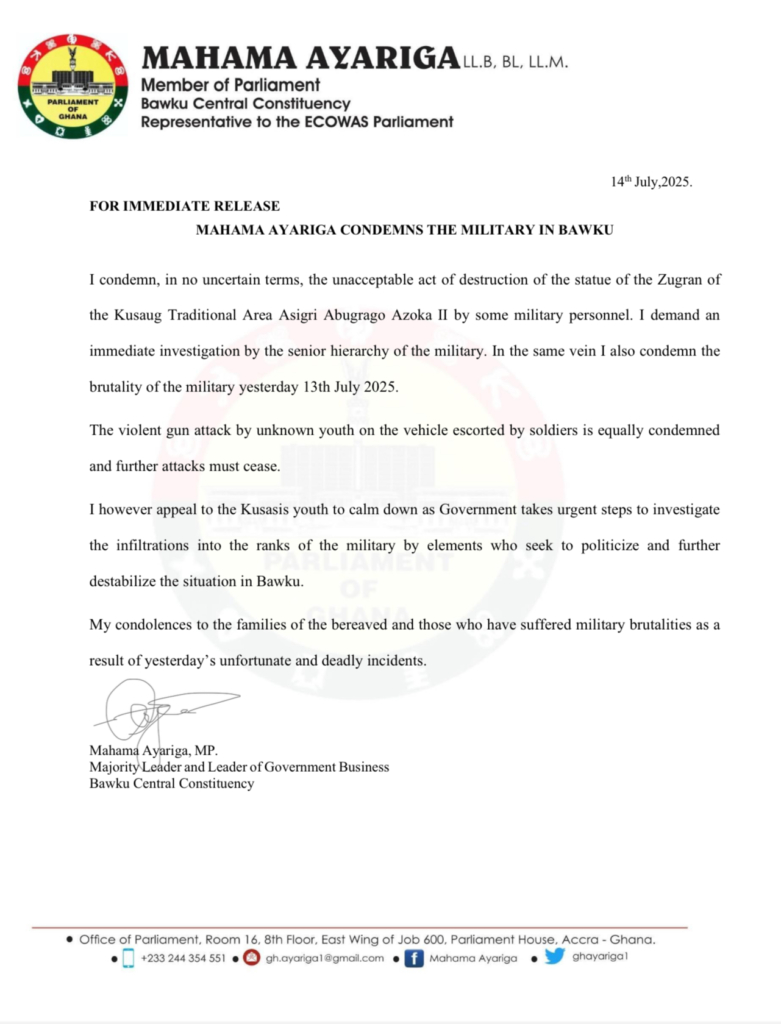
    Majority Leader and Member of Parliament for Bawku Central, Mahama Ayariga, has criticised the recent conduct by military personnel against civilians in the area on Sunday, July 13.

    In a press statement issued on Monday, July 14, the Bawku Central MP described the incident as unacceptable and called for an immediate probe.

    “I condemn, in no uncertain terms, the unacceptable act of destruction of the statue of the Zugran of the Kusaug Traditional Area, Asigri Abugrago Azoka II, by some military personnel,” Mr Ayariga stated.

    Military personnel in Bawku reportedly destroyed a culturally significant statue in the area following a confrontation between civilians, leading to the death of several others.

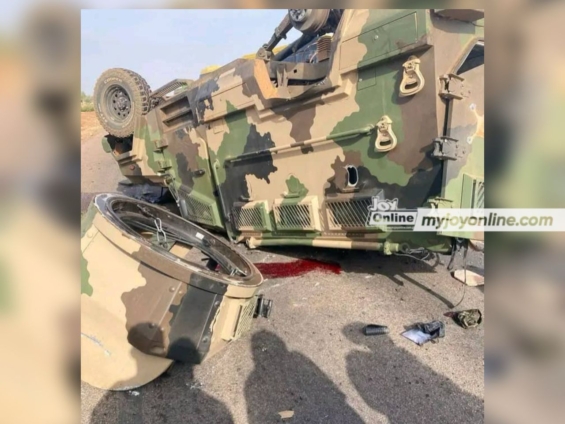
    Mr Ayariga also criticised the violent attack by unknown assailants on a vehicle that contained soldiers.

    “The violent gun attack by unknown youth on the vehicle escorted by soldiers is equally condemned, and further attacks must cease,” he noted.

    Meanwhile, the Minister for Defence, Dr Edward Omane Boamah, has reinforced the government’s commitment to restoring peace and stability in Bawku.

    “We are, once again, urging restraint and calm in Bawku regarding the latest developments as of yesterday,” he stated.

    According to him, the government is working with security to contain the situation and protect lives and property.

    “I have directed thorough investigations into the recent matter and promised to take swift action based on recommendations,” he said.

    Bawku, which had remained relatively peaceful for a period, saw conflict erupt once more in late 2024. The resurgence of violence was largely sparked by the return of Alhaji Seidu Abagre, a Mamprusi chief who had been enskinned in 2022, only to be exiled later when his enskinment was ruled illegal.

    His return to Bawku followed the withdrawal of an arrest warrant against him by a Kumasi High Court in October 2024, reigniting tensions between the Kusasi and Mamprusi communities.

    The renewed violence has resulted in deadly confrontations, including attacks on both civilians and security forces.

    On April 15, Otumfuo formally announced that the critical mediation sessions would take place from April 28 to May 1 at the Manhyia Palace in Kumasi.

    However, it was postponed due to the complexity of the dispute in the locality.

    Otumfuo Osei Tutu II’s involvement in the peace process has been met with widespread approval, with many hopeful that his leadership will play a critical role in restoring peace and stability to the troubled Bawku region.

    Colonel Festus Aboagye (Retired), a distinguished security expert, has called for greater support for Otumfuo’s initiative, stressing the importance of embracing multi-track diplomacy to strengthen the peace process.

    Colonel Aboagye urged a more inclusive approach to the mediation, calling for the involvement of various national stakeholders such as diaspora leaders, youth advocates, and women’s peacebuilding networks.

    He believes that a broader, multi-dimensional strategy will result in a more sustainable and inclusive solution to the conflict.

    “Support Otumfuo Osei Tutu II’s mediation through multi-track diplomacy, incorporating diaspora leaders, youth influencers, and women’s peacebuilding networks,” he proposed.

    He also cautioned that traditional diplomatic efforts alone might not be enough to resolve the deep divisions that have fueled the protracted conflict.

  • Bawku deserves peace, not conflict – Defence Minister urges

    Bawku deserves peace, not conflict – Defence Minister urges

    Renewed attacks in Bawku on Sunday, July 13, have compelled the Minister for Defence, Dr Edward Omane Boamah, to call for restraint.

    In a statement posted on his official Facebook page on Monday, July 14, the minister reinforced the government’s commitment to restoring peace and stability in Bawku.

    “We are, once again, urging restraint and calm in Bawku regarding the latest developments as of yesterday,” he stated. 

    According to him, the government is working with security to contain the situation and protect lives and property.

    “I have directed thorough investigations into the recent matter and promised to take swift action based on recommendations,” he said.

    Bawku, which had remained relatively peaceful for a period, saw conflict erupt once more in late 2024. The resurgence of violence was largely sparked by the return of Alhaji Seidu Abagre, a Mamprusi chief who had been enskinned in 2022, only to be exiled later when his enskinment was ruled illegal.

    His return to Bawku followed the withdrawal of an arrest warrant against him by a Kumasi High Court in October 2024, reigniting tensions between the Kusasi and Mamprusi communities.

    The renewed violence has resulted in deadly confrontations, including attacks on both civilians and security forces.

    On April 15, Otumfuo formally announced that the critical mediation sessions would take place from April 28 to May 1 at the Manhyia Palace in Kumasi.

    However, it was postponed due to the complexity of the dispute in the locality.

    Otumfuo Osei Tutu II’s involvement in the peace process has been met with widespread approval, with many hopeful that his leadership will play a critical role in restoring peace and stability to the troubled Bawku region.

    Colonel Festus Aboagye (Retired), a distinguished security expert, has called for greater support for Otumfuo’s initiative, stressing the importance of embracing multi-track diplomacy to strengthen the peace process.

    Colonel Aboagye urged a more inclusive approach to the mediation, calling for the involvement of various national stakeholders such as diaspora leaders, youth advocates, and women’s peacebuilding networks.

    He believes that a broader, multi-dimensional strategy will result in a more sustainable and inclusive solution to the conflict.

    “Support Otumfuo Osei Tutu II’s mediation through multi-track diplomacy, incorporating diaspora leaders, youth influencers, and women’s peacebuilding networks,” he proposed.

    He also cautioned that traditional diplomatic efforts alone might not be enough to resolve the deep divisions that have fueled the protracted conflict.

  • IGP Yohuno spotted in protective gear in Bawku

    IGP Yohuno spotted in protective gear in Bawku

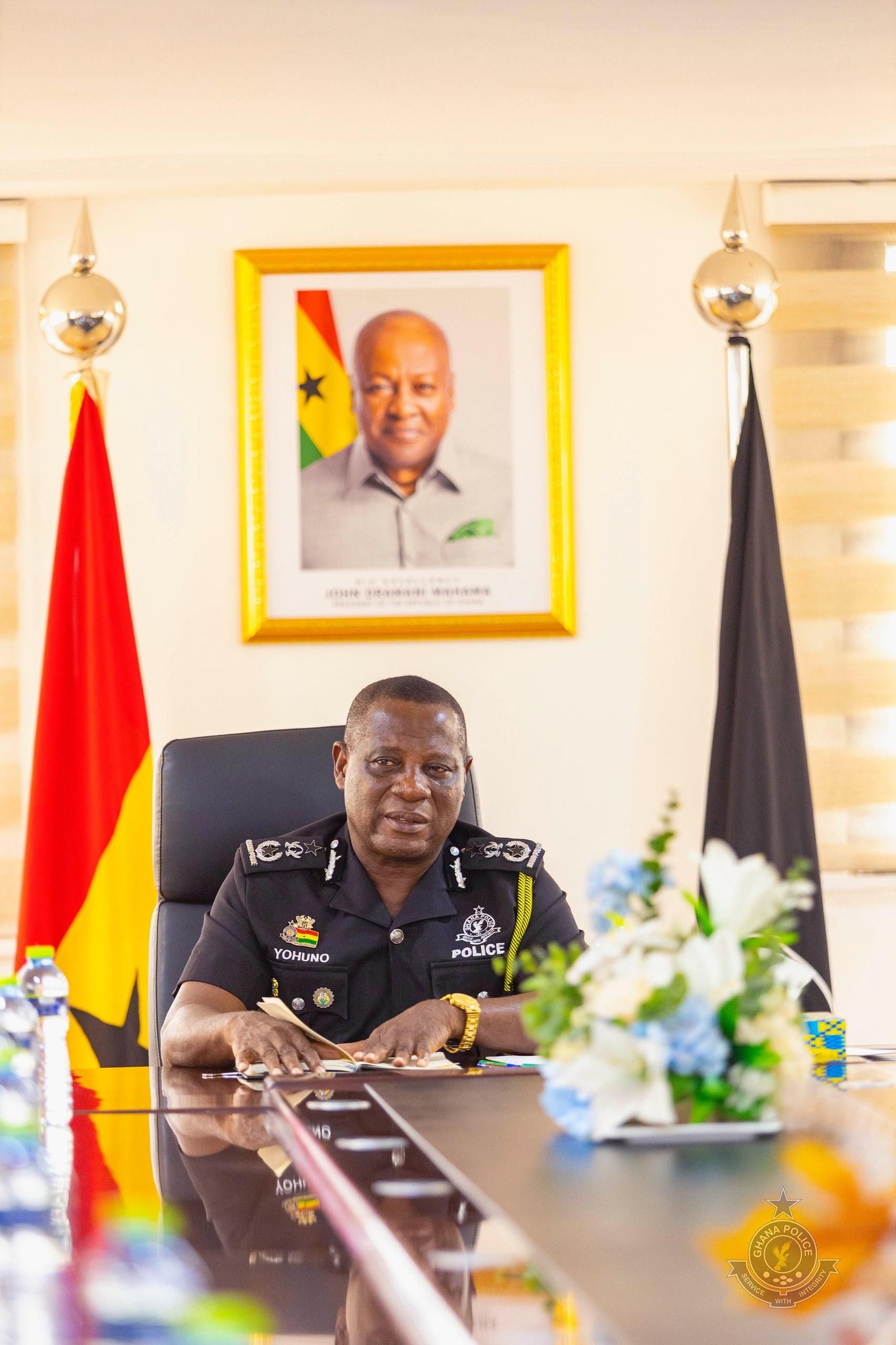
    Inspector-General of Police (IGP) Mr. Christian Tetteh Yohuno has been spotted in police protective gear as he leads a team of officers in Bawku in the Upper East Region following a violent incident in the area.

    On Thursday, 10th April, he led a senior team of operations, investigations, and intelligence officers after a clash involving some youth of the town and the Police on Wednesday. One person, Fuseini Iddrisu, unfortunately lost his life during the incident.

    Five other persons, including one Police officer and one Immigration officer sustained gunshot injuries and are on admission receiving medical attention, the Police noted in a statement.

    Some properties belonging to the police including two vehicles and a rented police accommodation at Binduri as well as houses of some of the Police officers were damaged.

    The visit forms part of efforts by the Ghana Police Service to obtain firsthand information on the situation and to evaluate the current security dynamics on the ground.

    The delegation’s mission is to reinforce the ongoing collaboration between the Ghana Police Service and the Ghana Armed Forces in stabilizing Bawku and its surrounding communities.

    Meanwhile, the Police Service has assured residents that all necessary security arrangements are being intensified to protect lives and property while working toward a lasting resolution to the tensions in the area.

    Authorities have urged the public to remain calm and cooperate with security personnel as operations continue to restore normalcy.

    The Ghana Police Service reaffirmed its commitment to ensuring peace and security across the country, emphasizing that any individuals found to be perpetuating violence will be dealt with according to the law.

  • Peace process for Bawku crisis could hit a snag over security mistrust – Security expert

    Peace process for Bawku crisis could hit a snag over security mistrust – Security expert

    Dr. Victor Doke, a security expert and lecturer at the Kofi Annan International Peacekeeping Training Centre, has warned that the fragile peace process in Bawku risks being derailed if trust between residents and security agencies is not urgently restored.

    In an interview on the AM Show on JoyNews, Dr. Doke stressed that effective security operations depend heavily on the confidence of the people they are mandated to protect.

    He noted that without a strong relationship between the community and security forces, ongoing efforts to stabilize the troubled region could be severely compromised.

    “The absence of trust in security institutions is a dangerous gap that could easily undo the progress made toward peace,” Dr. Doke emphasized.

    “Security personnel must demonstrate their commitment to impartial protection and community safety to win back the confidence of the people.”

    Dr. Doke further explained that rebuilding trust would require not just the prevention of attacks but also proactive engagement with local leaders and the broader community.

    He highlighted that visible fairness, professionalism, and accountability from the security forces are crucial steps toward convincing the population that their safety is a priority.

    As tensions in Bawku continue to simmer despite peace initiatives, Dr. Doke urged authorities to invest in confidence-building measures, warning that failure to do so could lead to renewed hostilities and a prolonged conflict.

    “The road to lasting peace is through trust. If people feel the security system is biased or unreliable, no peace process will succeed,” he concluded.

  • IGP heads to Bawku after recent clash claimed a life, injured 5 and destroyed police accommodation

    IGP heads to Bawku after recent clash claimed a life, injured 5 and destroyed police accommodation

    Inspector-General of Police (IGP) Mr. Christian Tetteh Yohuno on Thursday, 10th April, led a senior team of operations, investigations, and intelligence officers to Bawku in the Upper East Region following a violent incident in the area.

    There was a clash involving some youth of the town and the Police on Wednesday. One person, Fuseini Iddrisu, unfortunately lost his life during the incident.

    Five other persons, including one Police officer and one Immigration officer sustained gunshot injuries and are on admission receiving medical attention, the Police noted in a statement.

    Some properties belonging to the police including two vehicles and a rented police accommodation at Binduri as well as houses of some of the Police officers were damaged.

    The visit forms part of efforts by the Ghana Police Service to obtain firsthand information on the situation and to evaluate the current security dynamics on the ground.

    The delegation’s mission is to reinforce the ongoing collaboration between the Ghana Police Service and the Ghana Armed Forces in stabilizing Bawku and its surrounding communities.

    Meanwhile, the Police Service has assured residents that all necessary security arrangements are being intensified to protect lives and property while working toward a lasting resolution to the tensions in the area.

    Authorities have urged the public to remain calm and cooperate with security personnel as operations continue to restore normalcy.

    The Ghana Police Service reaffirmed its commitment to ensuring peace and security across the country, emphasizing that any individuals found to be perpetuating violence will be dealt with according to the law.

  • Police Commander’s house burnt in latest clash that killed one in Bawku

    Police Commander’s house burnt in latest clash that killed one in Bawku

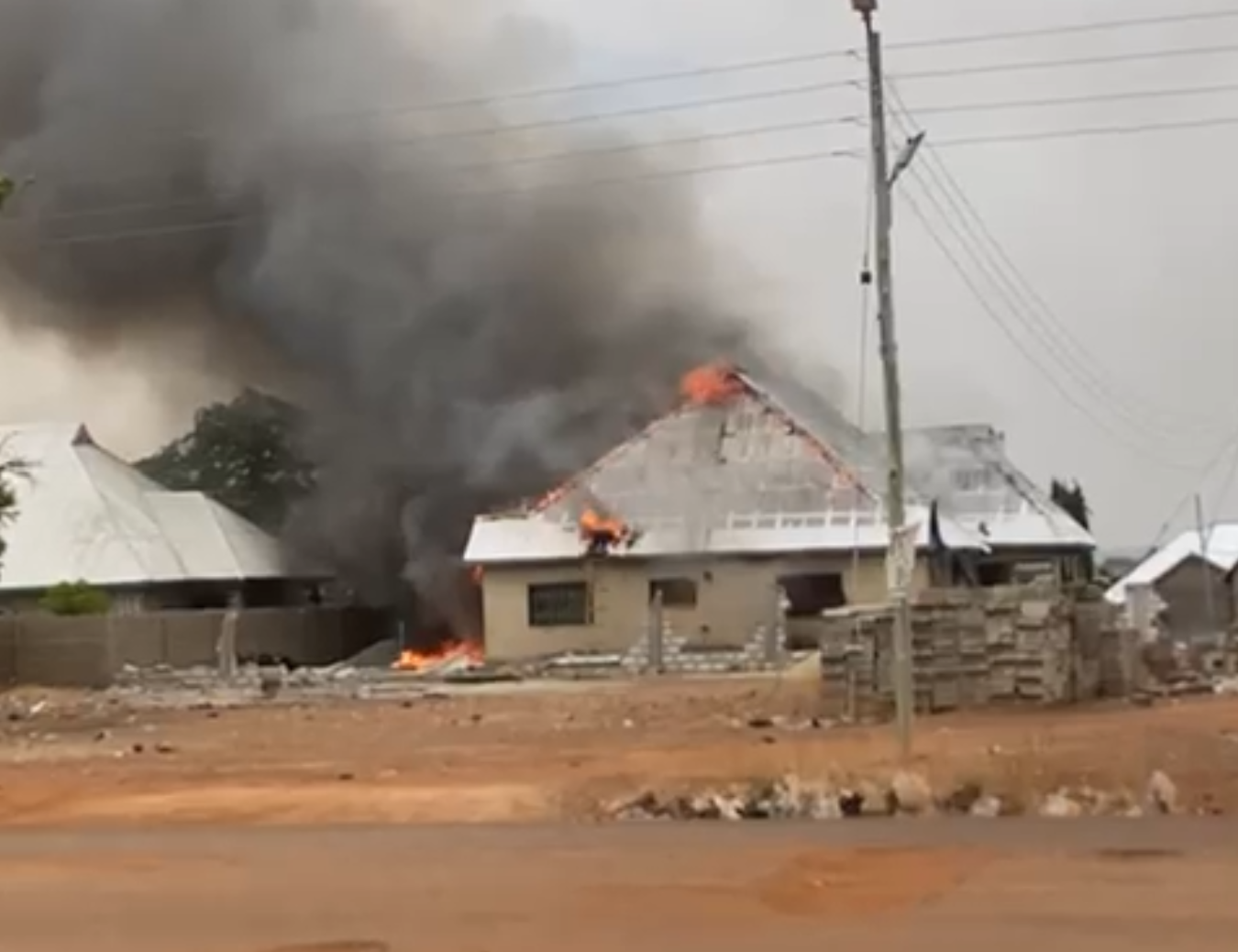
    Fresh violence erupted in Bawku in the Upper East Region on Wednesday afternoon, leaving one person dead and several others injured, with the private residence of the Bawku Divisional Police Commander, ACP Adamu Seidu, set on fire.

    According to reports, at least two people sustained critical injuries during the renewed clashes, which stemmed from tensions linked to the town’s long-standing chieftaincy dispute.

    Sources say the violence was triggered after members of one faction demanded that women believed to belong to the opposing side vacate the local market where they were trading. The confrontation quickly escalated, prompting police officers to intervene.

    However, attempts by the police to de-escalate the situation reportedly met resistance, with some youth allegedly opening fire on the officers, prompting an exchange of gunfire. One civilian was killed in the crossfire, while two others were seriously wounded.

    Following the incident, enraged youth reportedly launched an attack on the police commander’s private residence, setting it ablaze. It remains unclear whether anyone was inside the building at the time of the attack.

    Additional reports indicate that a police barracks was also targeted during the unrest, with a police vehicle reportedly set on fire.

    Security remains tense in Bawku as authorities move to contain the situation.

  • One dead, Police Commander’s Residence burnt in renewed Bawku conflict

    One dead, Police Commander’s Residence burnt in renewed Bawku conflict

    Renewed violence in Bawku, a town in Ghana’s Upper East Region, has claimed the life of one civilian and left two others critically injured.

    The clashes, which occurred on Wednesday afternoon, also saw the private residence of the Bawku Divisional Police Commander, ACP Adamu Seidu, set ablaze.

    The unrest reportedly began when one faction involved in the longstanding chieftaincy dispute demanded that women from the opposing faction vacate the market where they were trading.

    This demand led to a confrontation, prompting police intervention to restore order.

    During the scuffle, some youth allegedly opened fire on the police, who responded with gunfire. The exchange resulted in the death of one civilian and injuries to two others. The incident further escalated when radical youth retaliated by attacking the police commander’s private residence and setting it on fire.

    It remains unclear whether anyone was inside the house at the time of the attack. Additionally, reports indicate that a police barracks was targeted, with a police vehicle set ablaze. The situation forced the evacuation of police personnel from the barracks.

    As tensions continue to rise, security agencies are working to restore calm in the area. Neither the police nor the regional security council has issued a statement regarding the incident. The prolonged chieftaincy dispute in Bawku remains a source of instability, with periodic outbreaks of violence affecting the community.

  • My brothers and sisters in Bawku, give peace a chance – Mahama

    My brothers and sisters in Bawku, give peace a chance – Mahama

    President John Dramani Mahama has made a heartfelt appeal to the people of Bawku, urging them to embrace peace and unity as they mark the holy month of Ramadan.

    Speaking at the National Eid-ul-Fitr celebration hosted by the National Chief Imam at Black Star Square, he emphasized the significance of Ramadan as a period for reconciliation and healing.

    Addressing the prolonged conflict in Bawku, the President called on all parties involved to set aside their differences and work toward lasting peace.

    “Finally, as we celebrate this Ramadan, I want to urge my brothers and sisters in Bawku to give peace a chance. Ramadan is a period for togetherness,” he stated.

    Mahama also encouraged religious and traditional leaders to take an active role in mediating disputes and fostering dialogue among the factions.

    Reaffirming his government’s commitment to resolving the crisis, he urged residents to reflect on values of unity and forgiveness.

    “Let us use this sacred occasion to reflect on the values of love, forgiveness, and harmony. Together, we can build a stronger and more united community,” he added.

    The Bawku conflict, stemming from a longstanding chieftaincy dispute between the Kusasi and Mamprusi ethnic groups, has led to recurrent violence in the Upper East Region.

    Since October 2024, at least 58 people have lost their lives as tensions escalated, with armed clashes becoming a frequent occurrence in Bawku township and along major routes, including the Bawku-Bolgatanga-Tamale highway.

    Despite interventions by security forces, peace remains elusive as sporadic gun battles continue to disrupt the lives of residents.

  • Ransacking homes over murder of soldier in Bawku unjustifiable – Mahama Ayariga

    Ransacking homes over murder of soldier in Bawku unjustifiable – Mahama Ayariga

    Member of Parliament for Bawku Central, Mahama Ayariga, has criticized the military over reported brutalities inflicted on civilians in Bawku on Tuesday, in response to the murder of an officer.

    While acknowledging the tragic loss of the military officer, Mr Ayariga insisted that retaliatory attacks on innocent civilians were unjustifiable.

    Per reports, women, children, and elderly residents have been subjected to all sorts of maltreatment. The legislator is demanding full accountability from the military regarding their conduct.

    “I regret the accidental killing of a military personnel and I condemn that dastardly act,” he stated. “However, ransacking homes, beating innocent civilians, and holding the entire town to ransom cannot be justified. The rule of law must prevail, and those responsible for maintaining order should never engage in such acts of violence.”

    Mr Ayariga who doubles as the Majority Leader in Parliament called on the military leadership and local authorities to collaborate in investigating the killing of the soldier rather than resorting to what he described as indiscriminate aggression.

    He extended his condolences to the bereaved family of the fallen soldier and urged restraint on all sides.

    Expressing disappointment that his earlier appeals for the military to act with caution were ignored, he lamented, “I regret that the military command did not heed my appeal not to react violently, and they went ahead to do what they did. We need to work together to restore peace.”

    Looking ahead, Mr Ayariga expressed hope that all parties involved in the Bawku conflict would trust in the peace mediation efforts led by the Asantehene, Otumfuo Nana Osei Tutu II.

    “I have confidence that all sides will repose trust in His Majesty the Asantehene to bring finality to the situation in Bawku and end the violence we are experiencing,” he stated.

    The MP reiterated his commitment to advocating for peace and ensuring that justice is served for the victims of both the initial attack and the military’s response.

  • Military officer fatally shot in Bawku by unknown men – Reports

    Military officer fatally shot in Bawku by unknown men – Reports

    Ghana Armed Forces officer has reportedly been shot and killed by unknown gunmen in Bawku, located in the Upper East Region.

    News of the tragic incident has spread widely on social media, with many sharing reports about the fatal shooting of the officer, who is believed to be a warrant officer.

    According to reports, he was walking to his destination when the attackers targeted and shot him.

    Violence in Bawku has intensified in recent weeks, leading to a rise in deadly attacks.

    In February, a woman and her two daughters were allegedly killed in their home by men dressed in military uniforms. Since then, tensions between civilians and the military have worsened, with some residents even calling for the withdrawal of soldiers from the area.

    This latest attack has sparked fear among residents, who worry that the military might respond forcefully in an attempt to find those responsible.

    Many people have taken to social media to express their concerns, urging the government to take action, especially after its commitment to resolving the ongoing conflict.

    With armed individuals now daring to target security forces, many fear the situation in Bawku is becoming even more dangerous.

    In recent months, Bawku has witnessed several violent incidents targeting security personnel. On January 6, 2025, armed civilians attacked a military-escorted bus near the Bawku Prisons Service, killing the driver and injuring some passengers. Later, on January 16, 2025, a cargo truck heading from Kulungugu to Bawku was ambushed at Missiga, though fortunately, no casualties were reported.

    On February 10, 2025, gunmen attacked a bus traveling from Bawku to Bolgatanga at Bazua, resulting in one death and five injuries, despite a military escort being present. These incidents highlight the growing security challenges faced by personnel operating in the region.

  • Lay down your weapons – Asantehene appeals to Bawku residents

    Lay down your weapons – Asantehene appeals to Bawku residents

    Asantehene, Otumfuo Osei Tutu II, has called on all factions involved in the Bawku conflict to put an end to the violence and embrace dialogue as a path to lasting peace.

    He assured that efforts to resolve the longstanding dispute are progressing, with discussions ongoing among key stakeholders.

    Speaking at the Manhyia Palace when he received a delegation led by the Ashanti Regional Minister, Dr. Frank Amoakohene, on Monday, March 17, 2025, the Asantehene expressed optimism that peace could soon be restored in Bawku.

    “We are still on the Bawku issue. Now gun violence is on the low. I have invited the leaders of the parties involved; Bawku Naaba and the Nayiri. I have also spoken with the Mossi and Hausa ethnic groups,” he disclosed.

    He further indicated that ongoing consultations would continue, including engagements with representatives of the Nayiri, who was unable to attend due to ill health.

    “The Nayiri was not feeling very well, but I am waiting for a representative from his palace to come and see me on Tuesday. Then we can all have a conversation about the conflict,” he added.

    Reiterating his call for peace, the Asantehene urged all involved to lay down their arms and commit to finding solutions through dialogue.

    “I want to appeal to everyone in Bawku to lay down their weapons. I told all the stakeholders to inform their people to lay down their tools. We are discussing addressing all the historical challenges, which is fuelling the conflict.”

    His call comes amid ongoing efforts to mediate between the feuding parties and restore stability to the conflict-prone area.

  • Reprisal attack in Bawku results in one fatality

    Reprisal attack in Bawku results in one fatality

    A resident of Sagabo has been shot dead in what is believed to be a reprisal attack, following the shooting of two Level 400 students from Gambaga College of Education on Wednesday, March 12, 2025.

    The victim was attacked while tending to his cattle in the Sagabo-Zoogin area of Bawku.

    Earlier that same day, gunmen opened fire on two students in Gambaga township, an incident suspected to be linked to the ongoing Bawku conflict.

    Tensions in Bawku have been high since November 2021, when a dispute over the installation of a parallel chief escalated into violence. The conflict has flared up again since October 2024, claiming the lives of at least 73 people, including women and children.

  • Level 400 student in Gamba killed in attack linked to Bawku conflict

    Level 400 student in Gamba killed in attack linked to Bawku conflict

    A final-year student of Gambaga College of Education in the North East Region has been shot dead in what authorities suspect may be linked to the ongoing violence in Bawku.

    The student’s lifeless body was discovered outside the school’s perimeter fence with suspected gunshot wounds, prompting an immediate response from both school authorities and security agencies.

    Following the incident, academic activities at the college have been suspended as students and staff come to terms with the tragedy.

    While the motive behind the attack remains unclear, sources suggest the killing could be connected to the prolonged tensions in Bawku, which have resulted in sporadic outbreaks of violence in recent months.

    The police have been notified and have begun investigations into the incident. Meanwhile, the Chief of Gambaga has summoned the Principal of the college for discussions on the matter.

    Authorities are urging calm as efforts are made to unravel the circumstances surrounding the killing and ensure the safety of students on campus.

  • Bawku: Chaos erupts during peace ceremony, five students sustain injuries

    Bawku: Chaos erupts during peace ceremony, five students sustain injuries

    A reconciliation event meant to ease tensions between students of Bawku Senior High School and Bawku Technical Institute took a violent turn on Tuesday, February 25, resulting in multiple injuries.

    The gathering, held at Bawku Technical Institute, was organized by school officials in collaboration with the Kpalwega traditional leadership to put an end to ongoing conflicts between the two institutions.

    As part of the peace initiative, the traditional authorities introduced a symbolic ritual—the burial of an okra stick—intended to signify the resolution of hostilities.

    However, what began as a solemn event quickly escalated into chaos when hostilities flared up, leading to students hurling stones at one another. The sudden outbreak of violence left at least five students with serious injuries, while several others sustained minor wounds.

    Officers from the Bawku Divisional Police Command promptly arrived at the scene to contain the situation. The injured were quickly transported to Quality and Vineyard hospitals in Bawku for medical attention.

    Despite the disorder, school authorities and representatives from the Ghana Education Service (GES) proceeded with the symbolic ceremony, ensuring its completion with the participation of the senior prefects from both schools.

  • Bawku curfew renewed, govt imposes weapons ban

    Bawku curfew renewed, govt imposes weapons ban

    The government has extended the curfew imposed on Bawku Municipality and its surrounding areas in the Upper East Region, following a directive from the Ministry for the Interior.

    Interior Minister Muntaka Mohammed-Mubarak, through an Executive Instrument, announced a revision of the curfew hours, which will now run from 8:00 PM to 5:00 AM, effective Monday, February 24, 2025. This adjustment was communicated in an official statement released on the same day.

    In light of ongoing tensions in the area, the government has called on traditional leaders, community elders, youth, and residents to promote peace and exercise restraint while encouraging dialogue as the path to resolving disputes.

    The statement also declared a strict ban on carrying arms, ammunition, and any offensive weapons within the affected communities. Authorities have warned that any individual caught violating this directive will face arrest and prosecution.

    The government reiterated its commitment to restoring peace and ensuring the safety of residents in the Bawku area as efforts to resolve conflicts continue.

  • Accident near Bawku leaves soldier dead, others injured

    Accident near Bawku leaves soldier dead, others injured

    A tragic accident involving an armored military vehicle has claimed the life of a soldier and left several others severely injured at Saka, a community in the Bawku West District of the Upper East Region.

    The soldiers were reportedly traveling from Bawku to Bolgatanga when disaster struck. According to eyewitness accounts, “a tyre burst caused the driver to lose control of the vehicle, resulting in it overturning.”

    In the aftermath of the crash, local residents quickly rallied to support the emergency response. “The deceased and the injured were transported to the Zebilla District Hospital with the help of community members and the police,” a source confirmed.

    Authorities have yet to release the identity of the deceased officer, while investigations are ongoing to determine the full circumstances surrounding the incident.

  • Spillover of Bawku Chieftaincy issues affecting the Savannah Region – Regional Minister

    Spillover of Bawku Chieftaincy issues affecting the Savannah Region – Regional Minister

    Savannah Regional Minister, Salisu Be-Awuribe, has expressed deep concern over the growing impact of the Bawku chieftaincy conflict on his region, warning that instability from the protracted dispute is beginning to spill over into Savannah.

    His concerns follow recent security disturbances in Walewale, which have been linked to tensions in Bawku. This development, he noted, has heightened fears of a broader security crisis spreading beyond the conflict’s original boundaries.

    Speaking to journalists after a high-level stakeholder meeting, the minister stressed the need for immediate security interventions to prevent further escalation. He emphasized that proactive measures must be implemented to safeguard the Savannah Region from potential infiltration by groups seeking to extend the hostilities.

    “The spillover of the Bawku Chieftaincy issues is affecting the Savannah region. You know that if you pass through the Sandema area, you can come through to Daboya.

    “And because of that conflict, some of the traffic is diverted from the main route of passing through the North East region. So if you don’t put in the necessary structures and define the system, some people can transpose the conflict from their area to our area here. And this is something that we are taking seriously,” he stated.

    The minister underscored that the geographic proximity of Savannah Region to conflict-prone areas makes it vulnerable to unrest. He pointed to Walewale as a key example, noting that disturbances in the town are already linked to the ongoing Bawku crisis.

    Security agencies, he assured, are working closely with local authorities to monitor the situation and implement necessary strategies to maintain peace and stability.

  • Bawku conflict claims four young lives in 3 weeks

    Bawku conflict claims four young lives in 3 weeks

    Between January 25 and February 14, 2025, four children, aged between five months and 13 years, have lost their lives in Bawku amid escalating violence.

    The first attack occurred on January 25 when armed men targeted a 13-year-old boy who was tending cattle in the Posum-Singnatinga-Possum area. The assailants allegedly strangled him before fleeing with the livestock. He has been identified as Sherif.

    On February 8, gunmen dressed in military-style gear stormed a residence in Tensungo, opening fire and killing a seven-month-old infant, a two-year-old child, and their mother.

    In a separate assault, a woman’s five-month-old baby was shot dead when armed men ambushed them.

    Since hostilities reignited in October 2024, at least 58 people have been killed in Bawku. The situation remains highly unstable, with frequent armed confrontations within the town and attacks along the Bawku-Bolga-Tamale highway.

  • Otumfuo at the forefront of traditional measure to check Bawku conflict – Defence Minister

    Otumfuo at the forefront of traditional measure to check Bawku conflict – Defence Minister

    Defence Minister, Dr. Edward Omane Boamah, has acknowledged the critical role of Asantehene Otumfuo Osei Tutu II in leading traditional efforts to resolve the protracted Bawku conflict.

    During a visit to the Asantehene on Friday, February 14, Dr. Boamah highlighted the importance of Otumfuo’s mediation in addressing the deep-rooted tensions in the area.

    “Otumfuo is the traditional leader who has been leading and finding a traditional solution to the dispute,” he stated, underscoring the relevance of chieftaincy in conflict resolution.

    The Defence Minister assured that the government is committed to supporting these traditional peace efforts with robust security interventions to restore stability.

    This dual approach, combining traditional mediation with security enforcement, aims to tackle both the historical grievances fueling the dispute and the immediate threats to peace and safety in Bawku.

    Dr. Boamah expressed optimism that the collaboration between the government and traditional authorities would yield meaningful results in resolving the conflict.

    Renewed clashes have led to loss of lives and growing insecurity. One of the most tragic incidents occurred recently when a five-month-old baby girl was brutally killed by armed assailants. The child was reportedly snatched from her mother, who had been ambushed and assaulted, before being thrown to the ground.

    This shocking act of violence adds to the rising death toll from the conflict, which has claimed 55 lives since October 2024, particularly along the Bolgatanga-Tamale highway. Despite increased security presence, attacks continue to instill fear among residents and travelers.

    He reiterated President John Dramani Mahama’s firm commitment to working closely with Otumfuo and other stakeholders to ensure lasting peace in the region.

  • Mahama is intensifying security, traditional measures to check Bawku conflict – Defence Minister tells Asantehene

    Mahama is intensifying security, traditional measures to check Bawku conflict – Defence Minister tells Asantehene

    Minister for Defence, Dr. Edward Omane Boamah, has reaffirmed President John Dramani Mahama’s commitment to resolving the ongoing conflict in Bawku through a combination of security enforcement and traditional mediation.

    Speaking during a visit to the Asantehene, Otumfuo Osei Tutu II, on Friday, February 14, Dr. Boamah outlined the government’s strategy for tackling the crisis.

    “President John Dramani Mahama is committed to bringing lasting peace to Bawku. He is intensifying a two-track (security and traditional) solution,” he stated.

    The Defence Minister assured that efforts to stabilize the region remain a top priority, emphasizing that both military interventions and engagements with traditional leaders will play a key role.

    “As promised earlier this week, we remain committed to restoring sustainable peace in Bawku,” he added.

    Dr. Boamah, alongside Interior Minister Muntaka Mubarak and the Chief of the Defence Staff, met with the Asantehene to discuss possible solutions to the crisis. The Asantehene, who has been actively involved in mediation efforts, was recognized for his leadership in seeking a peaceful resolution.

    The visit came amid heightened tensions in Bawku, where renewed clashes have led to loss of lives and growing insecurity. One of the most tragic incidents occurred recently when a five-month-old baby girl was brutally killed by armed assailants. The child was reportedly snatched from her mother, who had been ambushed and assaulted, before being thrown to the ground.

    This shocking act of violence adds to the rising death toll from the conflict, which has claimed 55 lives since October 2024, particularly along the Bolgatanga-Tamale highway. Despite increased security presence, attacks continue to instill fear among residents and travelers.

    The chieftaincy dispute in Bawku, which has simmered for decades, remains at the core of the unrest. The long-standing rivalry between the Mamprusi and Kusasi ethnic groups over control of the Bawku Traditional Area has fueled tensions, with both sides holding historical and political claims to leadership.

  • Bawku conflict: 5-month-old baby killed

    Bawku conflict: 5-month-old baby killed

    A five-month-old baby girl has become the latest victim of the protracted conflict in Bawku after armed assailants brutally seized her from her mother and threw her to the ground, leading to her tragic death.

    The grieving mother, who had gone out to trade, was reportedly ambushed by the attackers, mercilessly assaulted, and had her infant snatched from her before the horrifying act was carried out.

    This heartrending incident adds to the growing toll of violence in Bawku and along the Bolgatanga-Tamale highway, where renewed clashes have claimed 55 lives since October 2024.

    Despite heightened security interventions aimed at restoring peace and protecting civilians, armed groups continue to perpetrate deadly attacks, leaving residents and travelers in constant fear.

    The violence in the region has intensified in recent days. On February 12, a gunfight in Bawku claimed three lives, while a similar attack near Wulugu on the Bolgatanga-Tamale highway on February 11 left three passengers dead, with their bus set ablaze.

    The Bawku chieftaincy dispute remains one of Ghana’s most protracted and contentious conflicts, deeply rooted in historical, ethnic, and political factors. At the heart of the issue is the struggle for chieftaincy legitimacy between the Mamprusi and Kusasi ethnic groups in the Bawku Traditional Area. While the Mamprusi assert historical rights to the Bawku skin, the Kusasi claim it based on demographic majority and political support gained in recent decades.

    Amid growing tensions, the Asantehene, Otumfuo Osei Tutu II, has urged rival factions to prioritize peace for the area’s development. He cautioned that prolonged violence would lead to poverty, stagnation in infrastructure, and worsening living conditions. He called on all parties to reflect on their actions and seek peaceful solutions for the sake of future generations.

    Meanwhile, Defence Minister Dr. Edward Omane Boamah has assured the public that the government remains committed to resolving the Bawku conflict through traditional mechanisms as part of a broader effort to restore lasting peace.

  • We will resolve Bawku conflict through traditional means – Defence Minister

    We will resolve Bawku conflict through traditional means – Defence Minister

    The government remains committed to resolving the Bawku conflict through traditional mechanisms as part of a broader effort to restore lasting peace, Defence Minister Dr Edward Omane Boamah has assured.

    In a Facebook post on Wednesday, February 12, Dr Boamah reaffirmed the government’s resolve following a high-level security meeting with key officials.

    The meeting, held at the Ministry of Defence, brought together the Minister for the Interior, Muntaka Mubarak, the Chief of the Defence Staff, Majority Leader Mahama Ayariga, and other Members of Parliament to assess the security situation in Bawku.

    “As President John Dramani Mahama has assured the people, we will continue to follow the comprehensive roadmap to resolve this conflict through traditional means,” Dr Boamah stated.

    He emphasized that ensuring peace and stability in Bawku and other conflict-prone areas remains a top priority for the government.

    The Defence Minister also pledged to support all necessary interventions aimed at achieving a lasting resolution to the crisis, calling on all parties to work together towards peace.

    “We must restore peace and stability to Bawku and other communities, and I am determined to support that cause,” he concluded.

  • Gunmen ambush bus in Bazua, kill one, injure five

    Gunmen ambush bus in Bazua, kill one, injure five

    Gunmen launched an assault on a bus en route from Bawku to Bolgatanga, claiming one life and leaving five others in critical condition.

    Despite military personnel escorting the vehicle, the attackers ambushed the bus, but security forces managed to prevent further casualties.

    The wounded passengers were swiftly transported to the Upper East Regional Hospital in Bolgatanga for emergency treatment.

    While the attackers’ motives remain uncertain, the assault is believed to be connected to the ongoing chieftaincy dispute in Bawku.

    This attack follows a recent incident in which armed assailants, disguised in military uniforms, invaded a residence and gunned down a woman along with her two children.

    After a brief period of calm, hostilities have reignited, bringing the total number of fatalities in the conflict to 46 since its resurgence in October 2024.

    Terrified residents are calling for heightened security measures to curb the violence and restore stability in the area.

  • 13-year-old killed amid rising tensions in Bawku

    13-year-old killed amid rising tensions in Bawku

    Bawku has once again been gripped by tragedy following the brutal killing of a 13-year-old boy in the Singnatinga-Possum area of the town.

    The victim, identified as Sherif, lost his life while tending to livestock near the old cattle market in the township.

    This devastating incident adds to the growing number of fatalities in the region’s prolonged conflict, bringing the total to 42 since October.

    Local reports indicate that Sherif was herding animals in what was believed to be a relatively secure area when unidentified attackers ambushed him.

    The assailants reportedly killed the boy by breaking his neck before stealing his livestock, leaving the community in shock and sorrow.

    While the exact motive for the attack remains unknown, it is suspected to be linked to the ongoing unrest driven by ethnic and territorial disputes in the area.

    Sherif’s body was promptly retrieved and taken to Kpalugu, a nearby community, where he was laid to rest in line with Islamic funeral traditions.

  • Special Cybersecurity Taskforce setup to tackle Bawku conflict

    Special Cybersecurity Taskforce setup to tackle Bawku conflict

    The Cyber Security Authority of Ghana has established a Special Cybersecurity Taskforce dedicated to addressing the escalating conflict in Bawku.

    The taskforce is mandated to investigate, apprehend, and prosecute individuals using social media to incite violence in the area.

    Citizens are encouraged to report any audios, photos, Facebook accounts, or other social media content linked to acts of provocation or violence related to Bawku. Reports can be forwarded to the taskforce via WhatsApp at 0501603111 for swift action.

    In a bid to tackle international offenders, the taskforce plans to collaborate with Ambassadors and High Commissioners in countries where some instigators reside. The goal is to engage foreign authorities to report such individuals and, where necessary, request their extradition to Ghana.

    These individuals could face charges under international laws, including anti-terrorism conventions and provisions related to genocide, which are recognized as crimes under global statutes.

    President John Dramani Mahama has directed the Cyber Security Authority to collaborate with National Security to eradicate the misuse of social media as a tool for inciting violence and armed conflict. This directive targets not only Bawku in the Upper East Region but also Walewale in the North East Region, both of which have been plagued by unrest.

    The government has already imposed a dawn-to-dusk curfew in Bawku following tensions surrounding the controversial return of Seidu Abagre amid a chieftaincy dispute. Despite these measures, violence has continued, with over 30 fatalities reported in recent weeks.

    To complement these efforts, security forces have deployed surveillance drones to monitor movements and identify individuals involved in the attacks. This strategy has led to multiple arrests and the confiscation of firearms, with authorities optimistic about the role of technology in restoring calm to the region.

  • New approach needed to break cycle of violence in the country – Security analyst

    New approach needed to break cycle of violence in the country – Security analyst

    Security expert Dr. Adam Bonaa is advocating for tackling conflicts on a more localized level within Ghana.

    This call follows an alarming rise in reports of violence that could jeopardize the nation’s recent peace efforts.

    The violence has left communities in fear, especially those directly impacted.

    Speaking on Starr Today with Tutuwaa Danso, Dr. Bonaa highlighted that addressing these issues locally is essential, as failing to do so will only lead to their recurrence.

    “We have over-centralized the fight against conflict in this country. As a result, we do not have a policy that addresses conflicts in a localized manner. For instance, we tend to apply a one-size-fits-all approach to conflict resolution, using the same methods in different contexts. This approach has failed in various instances. For example, the method used to resolve the Dagbon crisis is being applied to the Bawku situation, and the approach used in Bawku is being attempted in Anyensuano and Nkwanta South, with no success.”

    “Some of us have argued that conflict resolution should be localized. If a conflict is not of national scale, the solution should also be local. Unfortunately, over the years, we have tried to impose a universal solution. I have called for a more tailored approach, and we have the national security policy document, which I believe is a good framework that can be developed further. However, have we assessed the key performance indicators (KPIs) outlined in that document to determine if we can localize solutions effectively? We have yet to do that.”

    “The Peace Council lacks the authority to enforce its decisions. It cannot hold anyone accountable. The National Commission for Civic Education (NCCE) is also under-resourced and incapacitated, making it difficult for them to educate local communities on past conflicts. Until these issues are addressed, we will continue to face recurring conflicts across the country. There needs to be a solution to this,” he added.

    In parallel, Muqtar Mumuni Muqthar, Executive Director of the West African Centre for Counter-Extremism (WACCE), has called on the government to seize firearms in Bawku to help reduce escalating tensions in the area.

  • Gunmen launch attack on military-escorted vehicle in Bawku

    Gunmen launch attack on military-escorted vehicle in Bawku

    Unidentified gunmen attacked a vehicle traveling from Kulungugu to Bawku township, opening fire on it.

    The vehicle, with registration number GA 4454-09, was being escorted by the military. Despite the presence of the officers, the attackers proceeded with the assault.

    Although no deaths have been reported, eyewitnesses described the shooting as intense.

    Bawku continues to be unstable, despite several efforts to bring peace, including the enforcement of a dawn-to-dusk curfew.

    On Tuesday, January 16, President John Mahama visited Bawku and Nalerigu to explore long-term solutions to the ongoing conflict in the region.

  • Bawku conflict: Mahama to meet Asantehene on Jan 19

    Bawku conflict: Mahama to meet Asantehene on Jan 19

    Former President John Dramani Mahama will meet the Asantehene, Otumfuo Osei Tutu II, on January 19 as part of his continued efforts to find lasting peace in the conflict-affected Bawku area in the Upper East Region.

    This visit forms part of Mahama’s ongoing mediation efforts following a recent trip to Bawku and Nalerigu on January 14, where he engaged with local leaders and communities in a bid to promote dialogue and reconciliation in the conflict-stricken area.

    During his meeting with the Mamprugu overlord, Naa Bohagu Mahami Abdulai Sheriga II, Mahama assured the traditional leader of his government’s determination to prioritize peacebuilding and stability.

    “I just came to appeal to him and his subjects to exercise restraint and patience and trust that we will resolve this matter amicably. So, I’m just appealing to my father that they should exercise patience while I set up the government,” he said.

    He further reflected on discussions he had with former President Nana Akufo-Addo, revealing that some peace initiatives had been explored during the latter’s administration.

    “In my last briefing with Nana Akufo-Addo, before he left office, he briefed me about some mediation efforts that they were undertaking. I wish to be able to discuss it with him and see how we can continue that effort. I know that he and the late Yagbonwura and Otumfuo were the ones who solved the Dagbon problem,” he recalled.

    Mahama stressed the significance of his upcoming visit to Otumfuo Osei Tutu II, acknowledging the Asantehene’s instrumental role in helping to resolve the Dagbon crisis.

    “Nana Addo gave me a hint that Otumfuo has been playing some role, and so I’m supposed to be with Otumfuo on the 19th of this month. So, when I go, it is one of the issues I will discuss with him. Whatever comes out of it, I will inform my father [Naa Bohagu Mahami Abdulai Sheriga II],” Mahama stated.

    The former President’s peace initiative aims to bring together influential traditional authorities to help bring an end to the prolonged conflict in Bawku, which has affected the region for decades.

  • Distrust is the biggest challenge in Bawku crisis –  National Peace Council

    Distrust is the biggest challenge in Bawku crisis – National Peace Council

    Executive Secretary of the National Peace Council, Dr. George Amoh, has identified deep-seated distrust among factions as the primary obstacle to lasting peace in Bawku, a community grappling with prolonged conflict.

    Speaking on Joy News’ PM Express, Dr. Amoh stressed the critical role of trust and effective leadership in resolving the longstanding chieftaincy dispute in the area.

    “The issue of trust is critical in peacebuilding, and I think that has been the biggest challenge in the Bawku crisis,” he stated, emphasizing that misunderstandings often arise due to entrenched suspicions between factions.

    “Even when people mean well, the level of distrust is so significant that intentions are often misunderstood or ignored,” he added.

    Dr. Amoh described former President John Mahama’s recent visit to Bawku as a significant gesture toward reconciliation, explaining that such actions can have a positive psychological impact in conflict resolution.

    “In peacebuilding, signals are very important, and his presence there, the words he’s spoken, are very critical,” he noted.

    Commending Mahama’s decision to prioritize Bawku as a key destination outside Accra, Dr. Amoh highlighted its importance in the broader peace process.

    “This is his first trip outside of Accra, apart from Pomadze, where he joined the Ahmadiyya community last week. Going to Bawku is very significant. He has met the Bawku Naba, and I believe he will also meet the Nayiri, which is very critical,” he said.

    The National Peace Council, according to Dr. Amoh, has remained steadfast in advocating for dialogue and coexistence as pillars of peace.

    “If you look at the statement we issued, we are trying to emphasize the need for us to coexist and promote peace. Without peace, no development can stand, so we are in search of peace,” he reiterated.

    Drawing comparisons to unrest in other regions like Ejura, Dr. Amoh called for impartial leadership and urged that appointees in conflict areas be seen as neutral figures capable of unifying divided communities.

    Former Defence Minister Dominic Nitiwul’s recent comments on trust issues in Bawku were echoed by Dr. Amoh, who further underscored the need for credible leadership.

    “Trust has been damaged to the extent that even if you mean well, people do not give your actions the attention they deserve. This is why leaders need to be deliberate about restoring faith and confidence,” he said.

    Dr. Amoh called on all stakeholders, including political leaders, traditional authorities, and civil society organizations, to collaborate more effectively to restore peace in Bawku.

    He concluded by reaffirming the Peace Council’s commitment to facilitating dialogue and reconciliation efforts in the region.

    “President Mahama’s visit is a step in the right direction, but we need sustained efforts and consistent engagement to rebuild trust and ensure peace,” Dr. Amoh stated.

    The Bawku conflict, rooted in a chieftaincy dispute, has led to significant violence and displacement of residents, posing serious challenges to the region’s stability and development.

  • Mahama to engage Bawku traditional leaders over resurging conflict

    Mahama to engage Bawku traditional leaders over resurging conflict

    Former President John Dramani Mahama is set to meet with traditional leaders in Bawku on Tuesday, January 14, 2025, as part of efforts to address the resurging conflict in the region.

    The visit underscores Mahama’s commitment to promoting peace and reconciliation in Bawku, a region historically affected by tensions and disputes. His engagements will focus on encouraging dialogue among the conflict factions and key stakeholders to explore lasting solutions.

    “The President is determined to resolve the decades-old conflict in Bawku and will use the visit to engage the conflict factions and key stakeholders to promote dialogue to achieve lasting peace,” stated Felix Kwakye Ofosu, Acting Presidential Spokesperson.

    Mahama’s peace initiative aligns with his broader vision for a harmonious Ghana, where conflicts are resolved through diplomacy and inclusive dialogue.

    Following his meetings in Bawku, Mahama will visit Nalerigu before returning to Accra later in the day, reaffirming his administration’s focus on peace, reconciliation, and national unity as essential pillars of governance.

    Last year, security forces in Bawku introduced drones to assist in tracking weapons and identifying those responsible for ongoing attacks in the area.

    The initiative has already resulted in the arrest of several suspects and the seizure of firearms. The drones, which are equipped to operate at high altitudes, are being used to monitor and track the movements of individuals involved in the violent activities. Once suspects are identified, security forces move in to make arrests.

    https://twitter.com/Citi973/status/1879110033386135660

  • Malnutrition claims two children’s lives in Bawku

    Malnutrition claims two children’s lives in Bawku

    Malnutrition has claimed the lives of at least two children in the Bawku Municipal area, with 65 reported cases in 2024.

    The ongoing regional conflict has worsened the situation, further straining the lives of local families. As a result, many children are suffering from severe malnutrition, and there have also been reports of anaemia affecting pregnant women.

    In a recent interview with Citi News, Bathomio Asigri, the Bawku Municipal Health Nutrition Officer, disclosed that the number of malnutrition cases saw a sharp increase in 2023, with a total of 297 cases recorded.

    “Within the Bawku municipality, what we think could be the cause of these high cases that we are recording, could partly be blamed on the conflict, I am saying this because Bawku municipality is regarded as a business hub even within the Country.

    “Unfortunately, within the past three years, a lot of trading activities are not going as they used to, so families are not in good standing as they used to be when it comes to their nutrition and their food security,” he revealed.

    He pointed out that numerous studies have been conducted to assess the eating habits of residents in the municipality.

    The results show that as trade activities have slowed in the area over the last few years, there has been a noticeable drop in the number of meals people consume daily.

    This change could be a significant factor in the rising malnutrition rates observed in the town.

    “We have done a lot of surveys and we have seen the number of meals taken before and after the conflict within some areas…we admit to the fact that the number of times they feed in a day has reduced and that in a way has a bearing on the number of cases that we are recording.”

    Malnutrition occurs when there is a mismatch between the nutrients your body requires and the nutrients it receives.

    This imbalance can manifest as either undernutrition or overnutrition.

    It can result from not getting enough calories in general, or it may involve deficiencies in specific nutrients like proteins, vitamins, or minerals.

  • Drones deployed to Bawku to aid in tracking gunmen amid ongoing clashes

    Drones deployed to Bawku to aid in tracking gunmen amid ongoing clashes

    Security forces in Bawku have introduced drones to assist in tracking weapons and identifying those responsible for ongoing attacks in the area.

    The initiative has already resulted in the arrest of several suspects and the seizure of firearms. The drones, which are equipped to operate at high altitudes, are being used to monitor and track the movements of individuals involved in the violent activities. Once suspects are identified, security forces move in to make arrests.

    This morning, gunmen opened fire around 6 AM, with reports of heavy shooting in the Bawku-Gingande and Kpalore areas. However, no fatalities have been reported from the confrontation.

    The drone deployment follows a series of killings by unknown assailants. On December 16, two individuals were killed in separate incidents. Moro Aziz, a mentally ill man from Gozesi, was found dead near the Bawku cemetery, while Kasim was shot dead in Daduri while attempting to relocate.

    These incidents bring the total number of fatalities in Bawku since the renewed violence in late October to 35.

  • Upper East: Chieftaincy tensions in Bawku contribute to voter apathy across constituencies

    Upper East: Chieftaincy tensions in Bawku contribute to voter apathy across constituencies

    Voter turnout in the Upper East Region has seen a significant decline in the just ended 2024 general elections, raising alarms about voter participation, especially in areas marked by political and social unrest.

    In Bawku, where chieftaincy disputes have resurfaced, reports of voter intimidation have emerged, further contributing to the reduced turnout.

    It is claimed that some voters are being pressured to avoid supporting certain political parties, particularly in regions with heightened tribal and political tensions. This has resulted in a notable decrease in voter engagement in these areas.

    In contrast, the 2020 general elections in the region recorded a much higher voter turnout of approximately 82.34%, according to figures comparing registered voters to those who cast their ballots.

    The ongoing election has, however, seen a sharp drop in participation, particularly in volatile constituencies such as Bawku, where political unrest is prevalent.

    Election observers are urging both the Electoral Commission and security agencies to take immediate steps to ensure voters can exercise their rights freely, without fear of intimidation. The situation highlights the urgent need for enhanced measures to ensure a peaceful and fair electoral process across the country.

  • Heightened security in Bawku amid ongoing elections

    Heightened security in Bawku amid ongoing elections

    Security has been tightened in Bawku as Ghanaians head to the polls today for the crucial December 7 general elections. Travellers entering the town are subjected to strict checks before being escorted into the area, identified as a potential trouble spot.

    With tensions high, authorities are not taking any risks. More security officers have been deployed, and strict rules are in place to ensure peace and safety.

    However, local reports indicate that some voters in Bawku are struggling to return home to cast their votes due to challenges with transportation.

    “Voters are struggling to get back home to vote. Since the start of the week, it seems like people have been left to their fate. The authorities, who should help organize transportation, are not around, so we decided to handle it ourselves. In other areas, buses are being provided for voters, but not here,” said a local source.

    In the Ashanti Region, voting is underway for what is expected to be a large voter turnout, with over 3.2 million registered voters set to vote.

    In the Upper West Region, everything is also set for the elections. Regional Electoral Director, Ali Osman Adamu, confirmed to the media yesterday that all election materials had been delivered.

  • Bawku conflict almost spread to Accra, other areas – Adam Bonaa

    Bawku conflict almost spread to Accra, other areas – Adam Bonaa

    A security expert, Dr. Adam Bonaa, has warned that the ongoing Bawku conflict poses a significant risk to the safety of all Ghanaians if the violence is not curbed.

    In an interview with GhanaWeb TV’s George Ayisi, Dr. Bonaa emphasized the potential dangers the decades-old chieftaincy dispute could have on the country’s security, especially with the 2024 general elections approaching.

    He pointed out that violent incidents tied to the Bawku conflict have already spread to other parts of the country, far from the conflict zone, raising concerns about the national impact.

    “You know, this thing spread all the way to Ashaiman, Kasoa, Madina, and other places… the very Bawku conflict, because you have Kusaasis who are in Accra, you have Kusaasis who are in Kumasi, you have Kusaasis who are in Wa, who are in Kejetia, who are in Mamprobi, they are everywhere. You have Mamprusis who are also in these areas as well, and they live together.

    “Nobody is too far away. If you heard about ‘kill the cockroaches,’ the Rwandan genocide, ‘Kill the cockroaches.’ Houthis and the Tutsis. So my point is that what is happening is that some persons are sleeping. So if you thought that you are in Accra, they will fight and bring it to Accra, and it will affect all of us. I said the thing nearly entered Accra; some people were injured in Ashaiman and other places,” Dr. Bonaa said.

    Dr. Bonaa also highlighted the grave implications of the Bawku conflict, warning that it could escalate into ethnic cleansing if not effectively addressed.

    “Ethnic cleansing, that is what we risk. You know the Bawku conflict: you have the Kusaasis on one side, Mamprusis on one side, and depending on which tribe you are, you are seen to be associated with either the Mamprusis or the Kusaasis. To the extent that even if you are our nomadic friends, even if you are a Fulani, you are perceived to belong to one side, so sometimes you are shot and killed,” he said.

    The recent spike in violence in Bawku has led to the deaths of around 25 people and left many others injured.

    Dr. Bonaa attributed the ongoing conflict to a failure in leadership and called on the government to take immediate action to address and resolve the situation.

  • Two killed in Bawku as violence escalates; several suffer gunshot wounds

    Two killed in Bawku as violence escalates; several suffer gunshot wounds

    Violent clashes in Bawku’s Daduri suburb on Tuesday, November 12, 2024, left two people dead and several others injured by gunfire.

    The incident, which involved an exchange of gunfire, resulted in two homes being set ablaze, worsening the area’s ongoing security crisis.

    This latest violence has raised Bawku’s recent death toll to 25, following the killing of an elderly man last week who was attacked after losing his way home from the hospital.

    The intensifying conflict has led many residents to flee, with six buses escorted by the military seen transporting people from Bawku to Bolgatanga for safety.

    The clashes have severely disrupted daily life, forcing the closure of schools and businesses, and posing a serious threat to local security and economic stability. Tensions have escalated further with the recent return of rival chief Alhaji Seidu Abagre, who had been in exile, as well as multiple ambushes targeting travelers in recent weeks.

    In response, authorities have imposed a strict curfew from 6:00 am to 6:00 pm, enforced by security forces to help restore order and peace.

  • Almost every household in Bawku is armed – Samson Lardy

    Almost every household in Bawku is armed – Samson Lardy

    Private legal practitioner, Samson Lardy Anyenini, has highlighted the widespread presence of firearms in Bawku, a town plagued by years of ethnic tension and chieftaincy disputes.

    “We have said over and again, almost every home in Bawku has a stash of guns. How to retrieve them is the problem,” the host of JoyNews’ Newsfile, said on November 2.

    His comments came as Kofi Bentil, Vice President of IMANI Africa, alleged that influential figures in Accra are funding and supplying arms to the area.

    “There are big men in Accra. Put funds together, buy guns and send them there, and some of the guys here are armed,” Bentil stated.

    The recent surge in violence follows the return of Alhaji Seidu Abagre, a rival chief who was exiled in February 2023 due to a disputed installation. On October 17, 2024, a High Court ruling in Kumasi annulled the warrant for Abagre’s arrest, allowing him to return on October 26. His return reignited conflict, leading to gunfire that left two dead and several others injured.

    With tensions still high, a curfew from 6:00 p.m. to 6:00 a.m. has been imposed to maintain order, as the death toll from the unrest now stands at approximately 21.

  • Big men in Accra are buying guns and sending them to Bawku – Kofi Bentil

    Big men in Accra are buying guns and sending them to Bawku – Kofi Bentil

    Vice President of IMANI Africa, Kofi Bentil, has alleged that influential figures in Accra are pooling funds to purchase guns and supply them to people in Bawku amidst the ongoing violence.

    “There are big men in Accra. Put funds together, buy guns and send them there, and some of the guys here are armed,” he said on Newsfile on November 2.

    In response, Newsfile host Samson Lardy Anyenini remarked, “We have said over and again, almost every home in Bawku has a stash of guns. How to retrieve them is the problem.”

    For years, Bawku in the Upper East Region, has been marred by ethnic tensions stemming from chieftaincy disputes. The violence recently escalated with the return of Alhaji Seidu Abagre, a rival chief who had been exiled in February 2023 due to his controversial installation as chief in Nalerigu.

    On October 17, 2024, a High Court in Kumasi annulled the warrant for Abagre’s arrest, allowing him to return on October 26. His reappearance sparked renewed conflict, resulting in gunfire that left two dead and several others injured. Currently, tensions remain high, with a 6:00 p.m. to 6:00 a.m. curfew enforced by security forces to help restore order. It is estimated that approximately 21 people have lost their lives in the ongoing unrest.

  • Four courts closed due to Bawku conflict reopened

    Four courts closed due to Bawku conflict reopened

    Four courts in the Upper East Region, previously closed due to the escalating conflict in Bawku, have been reopened on the orders of Chief Justice Gertrude Torkornoo.

    The courts were initially directed to shut down on October 29 after judges and court staff raised concerns about their safety.

    The closure affected the High Court, Circuit Court, and District Court in Bolgatanga, as well as the District Court in Bongo. However, areas like Bolgatanga, Zuarungu, and Bongo, which are located several kilometers away from the conflict zone, voiced dissatisfaction with the directive and promptly petitioned the Chief Justice for the reopening.

    In response, a circular dated November 8 and signed by Judicial Service Secretary, Justice Cyra Pamela Koranteng JA, confirmed the reopening of the courts, reversing the earlier closure notice.

    After a period of relative calm, violence erupted again following the return of Alhaji Seidu Abagre, a rival chief who had been in exile since February 2023.

    Abagre had previously fled Bawku due to an arrest warrant issued against him after his controversial installation as chief in Nalerigu.

    However, a High Court ruling in Kumasi on October 17, 2024, annulled the warrant, enabling him to come back. His return on October 26 reignited the longstanding chieftaincy conflict, resulting in gunfire that claimed two lives and left several others injured.

    The community is now grappling with heightened tensions and concerns over potential further violence.

    In response to the unrest, a curfew from 6:00 am to 6:00 pm has been imposed, and security forces are actively enforcing these restrictions to help restore order.

    About 21 people are believed to have been killed.

  • Four courts in Upper East to reopen after closure due to Bawku crisis

    Four courts in Upper East to reopen after closure due to Bawku crisis

    Chief Justice Gertrude Torkornoo has instructed the reopening of courts in the Upper East Region following the ongoing Bawku conflict.

    The courts had been temporarily closed on October 29 due to security concerns raised by court staff and judges in response to the escalating violence in Bawku.

    However, areas such as Bolgatanga, Zuarungu, and Bongo, which were not directly affected by the conflict, voiced dissatisfaction with the closure and petitioned the Chief Justice for the courts to reopen, as they were located several kilometers away from the conflict zone.

    On November 8, a circular signed by the Judicial Service Secretary, Justice Cyra Pamela Koranteng, announced the reopening of four key courts in the region:

    1. High Court, Bolgatanga

    2. Circuit Court, Bolgatanga

    3. District Court, Bolgatanga

    4. District Court, Bongo

    The circular requested that the registrars of these courts take the necessary steps to resume operations immediately.

  • Military reopens Bawku Municipal Assembly offices amid tensions

    Military reopens Bawku Municipal Assembly offices amid tensions

    Military personnel in Bawku have reopened the offices of the Municipal Assembly, which were forcibly closed by unidentified individuals amid rising chieftaincy clashes.

    The offices had been locked down by a group on November 4, demanding the arrest of Alhaji Seidu Abagre before they would allow the reopening.

    The situation stems from Abagre’s return to Bawku on October 26, following his exile due to a February 2023 arrest warrant issued in connection with his contested installation as a rival chief by the Nayiri.

    A High Court in Kumasi quashed the arrest warrant on October 17, 2024, clearing the way for Abagre’s return.

    His arrival has reignited the longstanding chieftaincy dispute, leading to violent clashes that have resulted in at least two fatalities and several injuries.

    The unrest has severely disrupted essential services in Bawku, with schools closed due to safety concerns.

    Additionally, the Ghana Water Company Limited and the Northern Electricity Distribution Company (NEDCo) have suspended operations, leaving residents without water and electricity.

    In response to the escalating violence, authorities have imposed a curfew from 6 am to 6 pm, with security personnel enforcing the order in an effort to maintain peace.

  • Bawku conflict: Death toll hit 21 as one more person killed

    Bawku conflict: Death toll hit 21 as one more person killed

    Another person has been killed, and his vehicle burnt to ashes in Bawku on Saturday, November 2, leading to sporadic gunfire in the vicinity.

    The deceased, a commercial driver known as Maadi, was attacked while travelling to Bolgatanga, raising the death toll from recent violent incidents to 21.

    After a period of relative calm, violence erupted again following the return of Alhaji Seidu Abagre, a rival chief who had been in exile since February 2023.

    https://www.youtube.com/watch?v=aBA53bZDic0

    Abagre had previously fled Bawku due to an arrest warrant issued against him after his controversial installation as chief in Nalerigu.

    However, a High Court ruling in Kumasi on October 17, 2024, annulled the warrant, enabling him to come back. His return on October 26 reignited the longstanding chieftaincy conflict, resulting in gunfire that claimed two lives and left several others injured.

    The community is now grappling with heightened tensions and concerns over potential further violence.

    In response to the unrest, a curfew from 6:00 am to 6:00 pm has been imposed, and security forces are actively enforcing these restrictions to help restore order.

  • Bawku Crisis: “There would be some bloodshed” – Spokesperson on calls for removal of Chief Abagre Seidu

    Bawku Crisis: “There would be some bloodshed” – Spokesperson on calls for removal of Chief Abagre Seidu

    Spokesperson for the Mamprusi in Bawku and a member of the Nayiri Legal Team has expressed his concerns regarding the calls for the removal of Chief Abagre Seidu.

    On his part, such a move could have significant negative repercussions on the social fabric of the community.

    Salifu emphasised the importance of maintaining unity and stability in the area, suggesting that destabilising leadership could lead to deeper social conflicts.

    “Don’t forget that he is a father, grandfather, head of the family, head of the clan, and his people need his spiritual and wise guidance,” Salifu remarked, stressing the cultural importance of respecting elders and traditional leaders.

    He cautioned against the idea of exiling Chief Seidu, warning that such a decision could incite unrest.

    “You cannot exile somebody and ask that they don’t come back to your hometown because when you do, there would be some bloodshed,” Salifu stated, highlighting the delicate balance within the social structure and the risks of conflict without reconciliation.

    Salifu based his argument on the constitutional provisions governing chieftaincy in Ghana, particularly citing Article 277, which outlines the necessary qualifications for an individual to be recognised as a chief.

    He stressed the importance of adhering to these legal standards in discussions surrounding chieftaincy matters.

    “Nobody has said that Seidu does not hail from Bawku, a royal lineage, and that his enskinment was not done according to the custom of the Mamprusi,” he noted, indicating the complexity of the legitimacy debate around Chief Seidu.

    This situation raises crucial questions around tradition and legality in Bawku, a society deeply rooted in lineage and cultural practices.

    “People say there was an illegality; is it to say that it did not comply with Article 277 or any other provision under the Chieftaincy Act?” Salifu asked, underscoring the need for clear adherence to established norms.