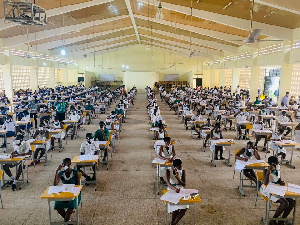
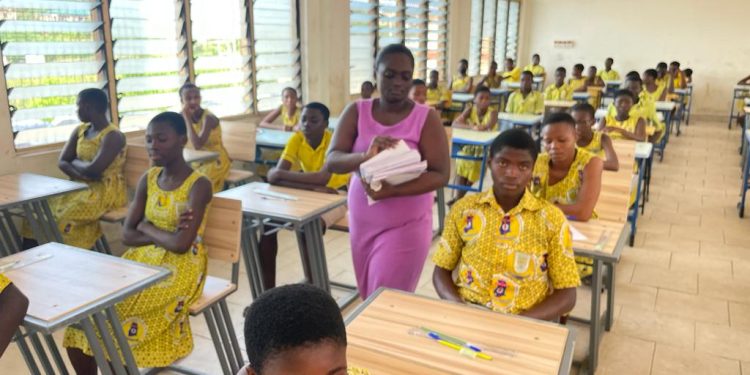
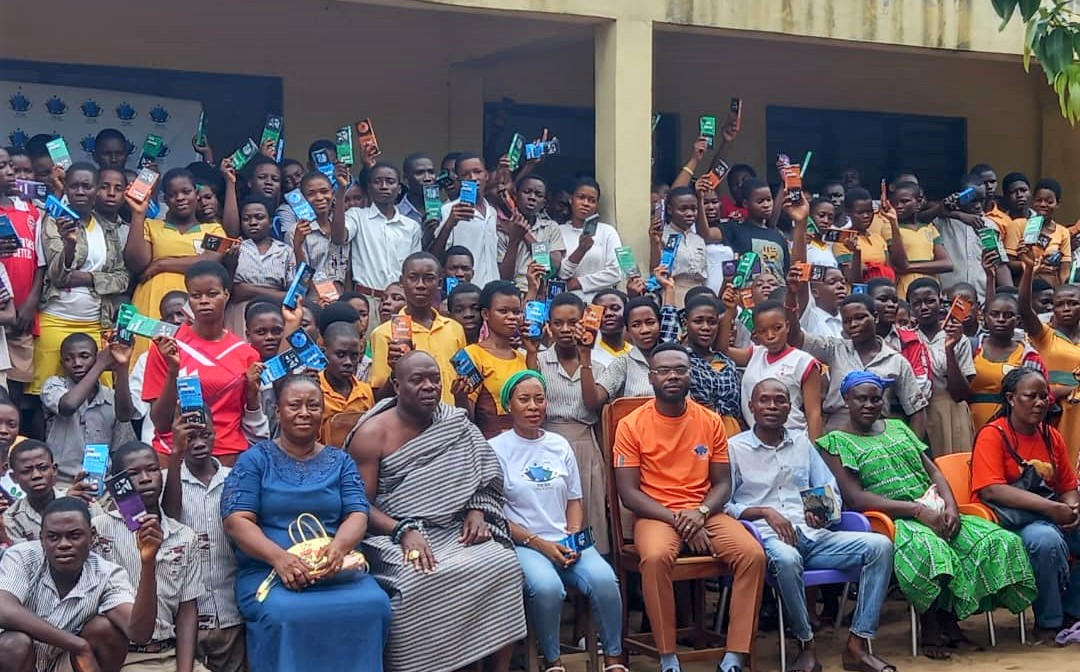
According to a report by TV3 journalist Joseph Armstrong, candidates at the St Kizito examination centre are prohibited from wearing shoes or belts, a directive reportedly issued by the Ghana Education Service (GES) to prevent cheating.
Armstrong, reporting from the scene, described the situation: “The candidates are standing outside, and they are being briefed by the GES here as to what to do and what not to do. But one thing we have noticed today, and we are told it is a directive from the GES; they are not supposed to wear shoes, and that is across the board, male, female.” Camera footage showed students in line, clad in slippers and sandals, with no belts in sight.
In a notable incident, a Muslim female candidate was reportedly also instructed to remove her veil, suggesting a stringent interpretation of the GES’s anti-cheating protocols.
The report also observed that students were not subjected to intensive searches upon entering the exam hall, leading to speculation that such measures might have been conducted earlier.
The St Kizito examination centre has garnered particular interest due to the recent Akosombo dam spillage, which disrupted the lives and education of many in the region. The spillage reportedly displaced an estimated 35,857 people, including children, with schools either destroyed or rendered inaccessible.
“We want to know if all of them were able to sit for the exam as we are told some of them, after registering, dropped out along the way due to the impact of the dam spillage,” Armstrong mentioned.
The GES is yet to confirm if this directive originated from them and whether it is specific to the St Kizito examination centre or applies nationwide.
As the exams proceed, it remains to be seen how these measures will impact the overall conduct and integrity of the BECE in the North Tongu District.
All BECE candidates writing the exams this morning at the St Kizito examination centre in the North Tongu District are not allowed to put on shoes or belts.
As part of its efforts to prevent exams malpractice or cheating in the exam hall, the GES has issued this directive.… pic.twitter.com/Faf3cQhF1S
Head of the Public Affairs Unit at the West African Examinations Council (WAEC), John Kapi, has indicated that the current format of the Basic Education Certificate Examination (BECE) is set to be revised in response to Ghana’s changing needs.
In an interview with Bernard Avle on the Citi Breakfast Show on Citi FM, Mr. Kapi emphasized WAEC’s readiness for the ongoing BECE, assuring that all necessary measures are in place to maintain exam integrity.
Regarding discussions about potential changes to the exam format, Mr. Kapi noted the possibility of adaptation based on Ghana’s growing population and workforce demands.
He stated, “There is always a possibility of changing the format depending on the population and the manpower needs of the country and so it is possible that the exam’s format can change.”
The proposed Free SHS bill, yet to be presented to parliament, aims to abolish the BECE requirement for entry into secondary school. Dr. Yaw Osei Adutwum clarified that under this bill, SHS certification would become Ghana’s primary academic qualification, replacing the current BECE certification.
Dr. Adutwum highlighted that the education system restructuring would integrate junior high school (JHS) into a six-year secondary education framework, with schools potentially co-locating JHS and SHS students on the same campuses.
Mr. Kapi urged all stakeholders involved in the examination process to refrain from any form of malpractice.
“We have appealed to all the candidates, parents, guardians, teachers, and supervisors, and what we are saying is that we don’t expect the candidates to come to the exam hall with any foreign material and they should do independent work and should not solicit support from anybody within or outside the examination hall. No smart watches or any form of electronic gadget should be brought to the exam hall.”
President Akufo-Addo has conveyed his heartfelt wishes to the 2024 Basic Education Certificate Examination (BECE) candidates, encouraging them to stay focused.
He urged the candidates to remain composed and perform to their utmost potential, highlighting that a promising future awaits them. The President assured them of the nation’s support.
“Remember, your hard work and dedication have brought you this far,” he advised.
The message emphasized the candidates’ achievement as a significant milestone in their educational journey, thus urging them to refrain from any form of examination malpractice.
“Honesty and integrity are values that will serve you well throughout your lives.
“Approach each paper with a clear mind, answer the questions to the best of your ability, and trust in the knowledge and skills you have acquired over the years,” the President stated.
The West African Examinations Council (WAEC) has reported that 569,095 candidates are scheduled to take this year’s BECE, beginning on Monday, July 08.
Among them, there are 282,648 males and 286,447 females, from 19,506 participating schools.
“This figure represents a decrease of 5.29 per cent compared to the 2023 entry figure of 600,900.” Mr John K Kapi, Head of Public Affairs, WAEC National Office, announced this at a press conference in Accra, ahead of the examination.
The examination will be conducted across 2,123 locations nationwide, with 2,123 supervisors, 1,889 assistant supervisors, and 19,973 invigilators ensuring smooth administration of the test.
President Nana Akufo-Addo extends his best wishes to all BECE candidates ahead of the BECE examination which starts tomorrow. pic.twitter.com/FNlelVRZd4
Today, Monday, July 8, 569,095 candidates will sit for this year’s Basic Education Certificate Examinations (BECE) at 2,123 designated centres nationwide.
The exams will conclude on Monday, July 15, 2024.
In a statement released on Sunday, July 7, by Casandra Twum Ampofo, the management of the Ghana Education Service (GES) commended the candidates for their dedication and perseverance.
GES also extended its appreciation to teachers, school heads, directors of education, parents, guardians, and all stakeholders for their vital contributions in preparing the candidates for the exams.
“Candidates, invigilators, supervisors, school authorities, teachers, and parents are advised to avoid any form of examination malpractice. GES, WAEC, and the security services are working jointly to ensure the smooth conduct of the examinations at all centres across the country,” the statement said.
Additionally, it informed parents, candidates, and the general public that the school selection process will begin after the BECE, with details to be provided later.
The government, in a crucial move aimed at ensuring the smooth conduct of the 2024 Basic Education Certificate Examination (BECE), has released an additional GHC55 million to the West African Examinations Council (WAEC).
The West African Examinations Council (WAEC) earlier clarified that it received only GH¢47 million from the government for the conduct of the Basic Education Certificate Examination (BECE).
This timely disbursement comes as part of efforts to settle outstanding debts owed to WAEC, allowing the council to effectively organize and administer the upcoming examinations.
Head of Public Affairs at WAEC’s National Office, Mr. John K. Kapi, made the announcement during a recent press conference held in Accra. He emphasized that the government’s financial support was essential for WAEC to prepare adequately for the BECE, which is scheduled to commence on Monday, July 8, 2024.
The funds released amount to GHC55,873,689.87, and they are part of a larger effort to cover the total examination fees owed to WAEC.
Mr. Kapi highlighted that this disbursement follows earlier allocations, with arrangements underway for the release of the remaining funds required for the examination process.
Preparations for the 2024 BECE
With over 569,000 candidates expected to participate in this year’s BECE, WAEC has mobilized resources to ensure a seamless administration across 2,123 examination centers nationwide. This includes the deployment of 2,123 supervisors, 1,889 assistant supervisors, and 19,973 invigilators who will oversee the examination process.
Candidates will begin their examinations with English Language on July 8, concluding with Arabic by Monday, July 15, 2024. Mr. Kapi noted that out of the total candidates, 282,648 are males and 286,447 are females, representing 19,506 schools participating in the examinations.
Support for Private Candidates and Special Measures
In addition to school candidates assessed under the newly introduced Common Core Curriculum, WAEC has registered 1,366 private candidates for the BECE. This group, comprising 735 males and 631 females, will be examined based on the old syllabus at 15 designated centers, mainly in regional capitals.
Mr. Kapi assured that WAEC had undertaken comprehensive preparations, including the distribution of examination materials such as objective answer cards, answer booklets, and pencils to District Education Offices nationwide. The council has also organized sensitization programs to educate candidates on the rules and regulations governing the examination.
The West African Examinations Council (WAEC) has announced that 569,095 candidates will be taking this year’s Basic Education Certificate Examination (BECE), starting on Monday, July 8, 2024.
This announcement follows the government’s release of GHȼ55,873,689.87 to WAEC, with additional funds expected to cover the remaining examination fees.
Head of Public Affairs at WAEC’s National Office, Mr. John K. Kapi, shared these details during a press conference in Accra. The event aimed to update stakeholders and the public about the forthcoming BECE for both public schools and private candidates.
The candidates will commence the examination with English Language on July 8, 2024, and conclude with Arabic on Monday, July 15, 2024. Among the total candidates, 282,648 are males and 286,447 are females, representing 19,506 schools.
“This figure represents a decrease of 5.29 percent compared to the 2023 entry figure of 600,900,” noted Mr. Kapi.
The examination will be conducted at 2,123 centers across the nation, with the involvement of 2,123 supervisors, 1,889 assistant supervisors, and 19,973 invigilators to ensure the smooth administration of the exam.
School candidates will be assessed based on the newly introduced Common Core Curriculum, while private candidates will follow the old syllabus.
To facilitate a smooth examination process, WAEC has developed and distributed the Guidelines, Scheme, and Structure of the examination to all school heads, with additional access available on the WAEC website for interested stakeholders.
For the private candidates, WAEC registered 1,366 individuals this year, consisting of 735 males and 631 females. This number reflects a 25.7 percent decrease compared to the 2023 entry figure of 1,839. The examination for private candidates will be held at 15 centers, primarily located in regional capitals.
In preparation for the BECE, WAEC has organized sensitization programs to educate candidates on the examination’s rules and regulations. The Council has also distributed necessary examination materials, including objective answer cards, answer booklets, and pencils, to District Education Offices nationwide.
Additionally, WAEC has made provisions to accommodate candidates with special educational needs, ensuring that no candidate is excluded from the examination process.
Head of Public Affairs for theWest African Examination Council (WAEC), John Kapi, has issued a stern warning to BECE candidates about attempting to bribe invigilators by placing money and contact information in their answer booklets.
Speaking at a press conference to outline the 2024 BECE rules and regulations, Mr. Kapi highlighted a troubling trend where candidates seek external assistance during exams.
He emphasized that such actions are serious offences and assured that those caught will face strict consequences.
“The council has noted with concern a number of cases where candidates write telephone numbers or phrases such as ‘call me,’ ‘help me,’ or ‘just call my mom,’ etc. in their answer booklets.
Others also insert various sums of money in their answer booklets soliciting help from examiners.
“We wish to state clearly that this is classified as seeking external assistance and is a punishable offence,” he added.
Mr. Kapi also issued a warning against the use of mobile phones and other electronic communication devices by candidates in the exam halls.
He stated that candidates caught committing such offences will have their entire exams cancelled.
He urged parents to ensure their children comply with these directives to avoid the risk of having their results invalidated.
“Mobile phones and other electronic communication devices are prohibited at examination centres.
Neither supervisors, invigilators nor candidates are permitted to bring mobile phones into examination halls,” he stressed.
Education Minister, Dr Adutwum has revealed that, the proposed Free Senior High School (SHS) Bill which is yet to be tabled before Parliament seeks to extend the secondary school level system to a period of six years , a three years addition to the previous years.
Under the bill, junior high school (JHS) would be separated from basic school and integrated into a six-year secondary education framework.
The BECE would solely serve as a tool for school placement.
During a media engagement, Dr. Adutwum explained that if the Bill is passed, SHS certification would become the primary academic qualification in Ghana, replacing the current BECE certification.
The minister emphasized that this restructuring would ensure a continuous six-year secondary education, with new schools accommodating both JHS and SHS students on the same campuses.
Existing schools with combined JHS and SHS programs would continue this practice, resembling the traditional model where students from different levels studied together.
Dr. Adutwum highlighted that the bill aims to revive a system similar to the old Middle School and Secondary School setup, where theCommon Entrance Examinationdetermined school placement and the Hall Examination served as certification for employment or further education opportunities.
The proposed Free SHS bill, yet to be presented in parliament, aims to overhaul the education system by removing the Basic Education Certificate Examination (BECE) as a prerequisite for entry into secondary school, according to Graphic.com.gh.
Under the bill, junior high school (JHS) would be separated from basic school and integrated into a six-year secondary education framework. The BECE would solely serve as a tool for school placement.
Dr. Adutwum explained that if passed, SHS certification would become the primary academic qualification in Ghana, replacing the current BECE certification.
The minister emphasized that this restructuring would ensure a continuous six-year secondary education, with new schools accommodating both JHS and SHS students on the same campuses.
Existing schools with combined JHS and SHS programs would continue this practice, resembling the traditional model where students from different levels studied together.
Dr. Adutwum highlighted that the bill aims to revive a system similar to the old Middle School and Secondary School setup, where the Common Entrance Examination determined school placement and the Hall Examination served as certification for employment or further education opportunities.
Why Legislation?
During an interaction with journalists, Dr. Adutwum highlighted the importance of legislating Free SHS. He noted that while the current policy is not mandatory, future governments might discontinue it if they deem it unnecessary.
“We need a law that ensures free, compulsory universal secondary education. This means the minimum education for Ghanaians should be senior high school, not junior high school,” he stressed.
The proposed bill seeks to expand on the constitutional guarantee of free compulsory universal basic education (FCUBE) provided by the 1992 Constitution, extending this right to secondary education in line with Article 38.
This article mandates the state to furnish educational facilities across all levels and ensure access for every citizen.
Dr. Adutwum highlighted the significant impact of the Free SHS policy, which saw a record enrollment of over 505,000 students in its inaugural year.
Despite this achievement, he expressed concern about students not continuing toSHS due to age-related issues, arguing that mandatory secondary education could mitigate vulnerabilities to crime and societal challenges.
The minister praised the Free SHS policy’s positive influence in northern regions, where junior to senior high school transition rates notably exceed those in the south. For example, the Northern Region boasts a 95% transition rate compared to the Volta Region’s 66%.
Majority Leader Alexander Afenyo-Markin challenged the Minority in Parliament to clarify their position on the Free SHS legislation. He announced Executive approval for the Free SHS Bill, slated for imminent introduction in Parliament.
In response, Minority Leader Dr. Cassiel Ato Forson clarified that the Minority Caucus does not oppose the bill and urged swift presentation to Parliament.
Dr. Forson reiterated Minority support for policies aimed at sustaining and enhancing the Free SHS initiative.
Since its inception in 2017, the Free SHS policy has benefited over 3.04 million students but has also faced criticism regarding issues like feeding, accommodation, extended vacations, and uncertainties in the SHS academic calendar.
Some educators and think tanks advocate for policy reviews to address these challenges and ensure sustainable funding.
The proposed Free SHS legislation, yet to be introduced in Parliament, aims to adjust the education system by abolishing the Basic Education Certificate Examination (BECE) as a prerequisite for entry into Senior High School (SHS), according t reports.
The bill proposes restructuring the educational framework by separating junior high school (JHS) from basic school and integrating it into a six-year secondary education continuum.
Under this plan, the BECE would solely serve as a means for school selection.
Dr. Adutwum explained that upon passage of the bill, SHS certification would become the primary formal academic qualification in the country, superseding the current BECE certification.
The minister stressed that this restructuring would ensure a seamless six-year secondary education, with new schools hosting both JHS and SHS students on the same campuses. Existing schools with combined JHS and SHS facilities would continue this practice, akin to the old system where students from ordinary and advanced levels studied together.
Dr. Adutwum highlighted that the bill aims to revive a system reminiscent of the former Middle School and Secondary School relationship, where the Common Entrance Examination determined school placement and the Hall Examination served as certification for employment or further education.
The Need for Legislation
In discussions with journalists, Dr. Adutwum underscored the importance of enshrining Free SHS into law.
He emphasized that while the current policy is not obligatory, future administrations could potentially terminate it if they perceive it as unnecessary.
“We need a law that ensures free, compulsory universal secondary education. This means the minimum education for Ghanaians should be senior high school, not junior high school,” he stressed.
The 1992 Constitution already mandates free compulsory universal basic education (FCUBE). The proposed bill aims to extend this guarantee to secondary education, aligning with Article 38, which mandates the state to provide educational facilities at all levels and ensure access for all citizens.
Dr. Adutwum pointed out that due to the Free SHS policy, over 505,000 students enrolled in their first year this year, marking the highest enrollment in the country’s history. However, he expressed concern that some students who are not yet of working age opt out of continuing to SHS. The minister argued that mandating secondary education would prevent such students from becoming susceptible to crime and other societal issues.
The minister lauded the positive impact of Free SHS in northern regions, where transition rates from JHS to SHS are significantly higher than in southern regions. For example, the Northern Region boasts a 95% transition rate compared to the Volta Region’s 66%.
Majority Leader Alexander Afenyo-Markin challenged the Minority in Parliament to clarify its position on the Free SHS legislation.
He announced that the Free SHS Bill had received executive approval and would soon be presented to Parliament.
In response, Minority Leader Dr. Cassiel Ato Forson stated that the Minority Caucus has not opposed the bill and urged the government to expedite its presentation to Parliament.
Dr. Forson reiterated that the Minority supports policies aimed at sustaining and enhancing the Free SHS initiative.
While the Free SHS policy has benefited over 3.04 million students since its inception in 2017, it has also faced criticism concerning issues such as feeding, accommodation, lengthy vacations, and uncertainties in the SHS academic calendar.
Some educators and think tanks have called for a review of the policy to address these challenges and ensure sustainable funding.
Majority Chief Whip, Frank Annoh-Dompreh, has made a notable announcement in Parliament revealing that the Ministry of Finance has allocated GH¢80 million to support the West African Examinations Council (WAEC) in organizing the Basic Education Certificate Examination (BECE).
This development comes after concerns voiced by Yusif Sulemana, the Member of Parliament for Bole-Bamboi, regarding the government’s outstanding payments to WAEC.
Initially, WAEC had received only GH¢2.3 million of the required GH¢95.83 million.
The council had requested at least 50% of the total amount to facilitate the BECE and additional funds to manage the examination process and release the results.
Scheduled to occur from July 8 to July 15, 2024, at examination centers nationwide, the BECE faced uncertainty due to financial constraints.
In his address, Frank Annoh-Dompreh reassured Parliament that the full GH¢80 million required for the WAEC examinations had been disbursed.
He affirmed that he had personally followed up on the matter and received confirmation from Minister of State Abena Osei-Asare that the funds had indeed been released.
“You raised an issue about the release to WAEC for the conduct of exams and the respected ranking member gave you copies.
So, myself and the Chief Whip, we followed up and spoke to the Minister of State, Abena Osei-Asare, she got back to the ministry and confirmed that indeed, they have made a significant release.
We are told an amount of 80 million has been released,” Annoh-Dompreh said.
Candidates preparing for the Basic Education Certificate Examination (BECE) can now breathe a sigh of relief amid concerns over potential cancellation of the July 2024 exams due to funding challenges.
Majority Chief Whip, Frank Annoh-Dompreh, has hinted at the government’s allocation of GH₵80 million to the West Africa Examination Council (WAEC) during a parliamentary session on Friday June 21, 2024.
The announcement came after Yussif Sulemana, MP for Bole-Bamboi, raised alarm over outstanding debts and urged prompt action to ensure WAEC could proceed with the exams.
WAEC had expressed serious apprehensions about delayed funds critical for exam preparation and administration.
With the July 8, 2024 exam date approaching, time is running short to secure essential logistical requirements.
John Kapi, WAEC’s Director of Public Affairs, highlighted that the council has received ₵2,284,618 so far, leaving a significant balance of ₵93,552,688 still required for the BECE.
He stressed that the received amount of $2 million falls short of what is necessary to effectively facilitate the examination.
West African Examination Council (WAEC) has warned that the upcoming Basic Education Certificate Examination (BECE) in July 2024 might be cancelled due to significant funding shortages.
The council has attributed this dire situation to the government’s failure to release essential funds needed for the preparation and administration of the exams.
WAEC stated that the government’s outstanding debt has hindered their ability to procure necessary examination materials for the exams scheduled to commence on July 8, 2024.
In an interview with JoyFM, John Kapi, WAEC’s Director of Public Affairs, disclosed that the council is owed a total of GH₵95,837,306 by the government, of which only GH₵2,284,618 has been paid, leaving a balance of GH₵93,552,688.
Kapi emphasised that the GH₵2 million received is insufficient for the comprehensive planning and preparation required for the examinations, which are now less than a month away.
Earlier, the Minority Caucus in Parliament called on the government to release a payment schedule.
Ranking Member on Parliament’s Education Committee, Peter Nortsu-Kotoe, suggested a meeting with the Finance Minister, the Education Minister, and WAEC to create a plan for fund disbursement.
He asserted that this would allow WAEC to conduct the BECE and secure the necessary funds.
Nortsu-Kotoe also highlighted that the upcoming West African Secondary School Examination (WASSCE) in August requires funding, emphasising the importance of developing a payment plan to avoid any disruptions in the examination schedule.
However, Dr. Prince Hamidu Armah, the Vice Chairman of the Committee, dismissed these concerns, noting that successive governmentshave always owed WAEC.
He reassured me that the government’s debt to the council would not impede the examinations.
Armah stated that the government is committed to settling its debts with WAEC promptly and has established mechanisms for swift payment.
Final-year Junior High School (JHS) students across the country will encounter three new subjects in the upcoming Basic Education Certificate Examination (BECE) for School Candidates.
These newly introduced subjects are Career Technology, Creative Art and Design, and Arabic. Career Technology and Creative Art and Design, derived from the former Basic Design and Technology (BDT) course, will be compulsory for all candidates, as stated by the West African Examinations Council (WAEC).
However, Arabic will be an elective subject for candidates attending Islamic basic schools.
Extended Examination Duration
Due to the inclusion of these new subjects, the 2024 examination period has been extended to six days from the previous five.
The examination will commence on Monday, July 8, 2024, and conclude on the following Monday, July 15, 2024.
Providing further details on the 2024 examination, WAEC’s Head of Public Affairs, John Kapi, informed the Daily Graphic that new subjects could be introduced at any time, as the BECE is uniquely Ghanaian, allowing the government to determine the curriculum content.
Mr. Kapi mentioned that candidate registration had recently concluded, and WAEC was now finalizing the breakdown of candidates writing each subject. He assured that WAEC was fully prepared for the examination, with all related meetings concluded and sample questions distributed to schools and posted on the council’s website.
Regarding Arabic, Mr. Kapi noted that this was the first time the subject would be examined at the BECE. He described Arabic as an elective subject, available for candidates who felt proficient in it and sought certification.
Timetable
According to the official timetable released by WAEC, English Language and Religious and Moral Education will be written on Monday, July 8, 2024. On Tuesday, July 9, 2024, candidates will sit for Science and Computing, previously known as Information, Communication and Technology (ICT), followed by Social Studies and Creative Art and Design on Wednesday.
Mathematics and Ghanaian Language examinations are scheduled for Thursday, July 11, 2024, while French and Career Technology will take place on Friday, July 12, 2024.
Arabic will be examined on Monday, July 15, 2024.
Before the BECE registration, the Ghana Education Service outlined the mandatory subjects as English Language, Mathematics, General Science, Social Studies, Religious and Moral Education, Career Technology, and Creative Art and Design.
Ghanaian languages were categorized as elective subjects, with French, Arabic, and Computing listed as optional subjects.
Curriculum
This year’s BECE candidates will be the first cohort to sit the examination under the Common Core Curriculum. Consequently, WAEC stated that school and private candidates would be assessed differently due to the curriculum’s implementation.
The curriculum aims to enhance learning experiences and shift learners from rote learning to acquiring critical learning skills.
Final-year junior high school (JHS) students in Ghana will be tested on three new subjects in this year’s Basic Education Certificate Examination (BECE) for School Candidates.
These subjects are Career Technology, Creative Art and Design, and Arabic. Career Technology and Creative Art and Design, derived from the previous Basic Design and Technology (BDT) subject, will be mandatory for all candidates, according to the West African Examinations Council (WAEC).
Arabic, however, will be an optional subject for candidates in Islamic basic schools.
The addition of these new subjects has led to the extension of the examination period from five days to six days, running from Monday, July 8, 2024, to Monday, July 15, 2024.
Explaining further, the Head of Public Affairs of WAEC, John Kapi, stated to the Daily Graphic that new subjects could be introduced at any time, as the examination was solely Ghanaian, and the government determined its content.
He also mentioned that WAEC had completed the registration of candidates and would now proceed to organize the examination, with all necessary preparations already made. Sample questions have been distributed to schools and posted on the council’s website to assist candidates in their preparations.
“The printing exercise will start very soon, and so we are on course,” he emphasised. In the case of Arabic, he said it was the first time the subject was being examined at the BECE.
He clarified that the subject could be considered an elective, open to individuals who feel proficient in Arabic and desire a certification for it.
According to the official timetable released by WAEC, the examination schedule is as follows:
Monday, July 8, 2024: English Language and Religious and Moral Education
Tuesday, July 9, 2024: Science and Computing (previously Information, Communication and Technology or ICT), followed by Social Studies and Creative Art and Design on Wednesday, July 10, 2024
Thursday, July 11, 2024: Mathematics and Ghanaian Language
Friday, July 12, 2024: French and Career Technology
Monday, July 15, 2024: Arabic
Prior to the registration for the BECE for School Candidates, the Ghana Education Service outlined the mandatory subjects as English Language, Mathematics, General Science, Social Studies, Religious and Moral Education, Career Technology, and Creative Art and Design. Ghanaian languages were categorized as elective subjects, along with French, Arabic, and Computing.
This year’s BECE candidates will be the first cohort to sit the examination under the Common Core Curriculum. Consequently, WAEC noted that school and private candidates would be assessed differently due to the introduction of this curriculum, which aims to enhance learning experiences and shift learners from rote memorization to acquiring critical learning skills.
The Ghana National Association of Private Schools (GNAPS) has issued a warning that it may boycott the Basic Education Certificate Examination (BECE) and the West African Secondary School Certificate Examination (WASSCE) if the West Africa Examination Council (WAEC) raises registration fees without consulting them.
Currently, students from private schools pay GH¢465 and GH¢214 for WASSCE and BECE, respectively. GNAPS is calling on the government to recognize low-fee private schools as social interventions aimed at educating children in deprived communities and to provide support accordingly.
This announcement was made during the launch of a Pre-Tertiary Private Schools Manifesto, where GNAPS highlighted key challenges they want the next government to address in Ghana’s private school education sector. Professor Damasus Tuurosong, the National President of GNAPS, also advocated for the extension of the Free Senior High School policy to private schools.
He appealed to the government to “scrap the 30% priority placement system. Just as it does for the public school candidates, the government must absorb the Basic Education Certificate Examination (BECE) and West African Secondary School Certificate Examination (WASSCE) registration fees paid by private school candidates.”
“Extend the Free SHS programme to private school students. Review the Education Regulatory Bodies Act 2020 (Act 1023) to do away with exorbitant regulatory charges by the National Schools Inspectorate Authority, National Teaching Council and National Council for Curriculum and Assessment.
“Abolish nuisance taxes that are affecting businesses and review property rates and business operations permit charged by the assemblies and above all fix the country’s economy to create a conducive business environment for the operation of private schools,” he added.
GNAPS also threatened to take action if their concerns are ignored.
“We entreat WAEC to always negotiate with GNAPS prior to any fee increase. Let me serve notice that GNAPS will lead all pre-tertiary private schools to boycott next year’s BECE should WAEC arbitrarily increase the fees.
“This year we got the notice late, it could have happened. But we are serving the notice early that from next year if there is no negotiation, private schools will not be part of next year’s BECE, and this is not a mere threat. We are lacing our boots towards that,” he stated.
The West African Examinations Council (WAEC) has commenced registration for the 2024 Basic Education Certificate Examination (BECE), West African Senior Schools Certificate Examination (WASSCE), and General/Advanced Business Certificate Examination candidates.
Registration for BECE candidates opened on Monday, March 11, 2024, and will close on Friday, April 19, 2024. The BECE exams are scheduled to be administered from Monday, July 8 to Friday, July 12, 2024.
WASSCE examinations will start on Monday, August 5, 2024, and conclude on September 27, 2024. The General/Advanced Business Certificate Examination (G/ABCE) is set to take place from Friday, August 2, 2024, to Monday, September 2, 2024.
John Kapi, Head of Public Affairs at the National Office of WAEC, made this announcement at a press conference in Accra. He also mentioned that the registration site for the G/ABCE opened on Tuesday, March 5, 2024, and will close on Friday, April 19, 2024.
Kapi explained that due to changes in the syllabus following the introduction of the common core curriculum, school candidates for BECE will be examined differently from private candidates.
“While school candidates would be examined based on the common core curriculum, the private candidates would be examined on the old syllabus. All private candidates are therefore to note and be careful when selecting their subjects.”
According to Mr. Kapi, the registration fee for the BECE per candidate is GH¢214.01, while the WASSCE registration fee for entry in seven to nine subjects is GH¢465.00.
“The figure is exclusive of the fees for practical or oral tests which range between GH¢14.50 and GH¢19.50 per test,” he added.
Mr. Kapi stated that the WASSCE examination would be a “Ghana-only version,” with registration for private candidates taking place between Friday, October 25, 2024, and Wednesday, December 18, 2024.
The registration portal will be open from April 2 to August 30, 2024, and the examination fees will vary depending on the number of subjects a candidate registers for.
He emphasized that despite the change in the examination period, the standard of the exam would remain unchanged.
“Question papers are compiled by officers across the member countries. At the end of the examination, international preliminary coordination meets are held to finalise draft marking schemes.
“Furthermore, right after the marking scheme, the International Awards Committee meets to determine the grade boundaries for all subjects. These processes ensure that the examination written by Ghana only still maintains its international status,” he said.
Mr. Kapi clarified that the WASSCE and BECE for school candidates are only available to students in their third or final year of regular Senior and Junior High School.
He emphasized that it is against the examination’s rules and regulations for schools to register students who have not been enrolled in Senior/Junior High schools from their first years and have progressed to the third year without the required continuous assessment records.
“The grading for the school examination is 70 per cent external examination score and 30 per cent continuous examination score. If for some reason some students were transferred from one school to another, they should have evidence of the necessary continuous assessment / cumulative records.”
Mr. Kapi explained that WASSCE students aiming to improve their grades in one or more subjects were required to register as private candidates.
He also highlighted that the council had implemented reasonable adjustments to ensure that candidates with special educational needs could access the examination.
Furthermore, he mentioned that the council, as part of measures to ensure test security, had conducted inspections of schools that had requested accreditation to present candidates for the examination.
The Ghana Education Service (GES) has officially rescheduled the 2024 West African Senior School Certificate Examination (WASSCE), shifting the examination period from August 5 to September 27.
This alteration deviates from the previously announced timeframe of July 1 to August 31, 2024.
Concurrently, the 2024 Basic Education Certificate Examination (BECE) remains scheduled for July 8 to July 12.
In a circular dated March 12, 2024, addressed to regional directors, the acting Director of the Schools and Instructions Division of GES, Prince C. Agyemang-Duah, communicated the revised WASSCE date.
The communication emphasized the need for all senior high school (SHS) heads to acknowledge and prepare candidates accordingly for the updated examination period.
This new schedule supersedes the earlier one and aims to provide candidates with ample time for preparation.
While no official reason was provided for the date change, sources suggest it is to ensure candidates are adequately prepared for the examination.
Head of Public Affairs at the West African Examinations Council (WAEC), John Kapi, confirmed that Ghana would proceed with the Ghana Only Version of the WASSCE-SC due to the shift in dates.
This marks the third time Ghanaian candidates will sit for the WASSCE-SC exclusively, as other WAEC member countries—Nigeria, Liberia, Sierra Leone, and The Gambia—have reverted to their traditional May/June examination calendar post-COVID-19.
Mr Kapi clarified misconceptions surrounding the Ghana Only Version, emphasizing that it adheres to the same rigorous standards as the examination administered in other WAEC member countries.
The examination process, content compilation, and grading standards remain unchanged, ensuring parity with international standards.
Despite the adjustment in the examination schedule, Mr Kapi affirmed that WAEC remains committed to releasing results promptly to facilitate students’ transition to tertiary institutions.
“It is just that we have decided to push ours further so that our students are able to make time for it to be able to write and write it well,” he explained.
“We usually have a timetable after examinations.
So, obviously yes.
Yes, I believe so,” he added.
Additionally, he noted that registration for the WASSCE-SC commenced on March 11 and will conclude on April 19, 2024.
The Member of Parliament (MP)representing the Ablekuma North constituency, Sheila Bartels, has highlighted her achievements since taking office on January 7, 2021.
During an interview on Adom FM’s morning show, Dwaso Nsem Thursday, the MPaffirmed her annual commitment to organizing free extra classes for candidates gearing up for the Basic Education Certificate Examination (BECE) within her constituency.
Additionally, she disclosed that she has sponsored three students to university and provided equipment for the municipal hospital, organizing free health screenings every year.
“Since I became MP, our major problem has been roads so that was my primary target. We have so far done several roads in the constituency. We have also fixed damaged traffic lights. When it comes to education, I have built and renovated some school blocks in my constituency.
“Every year I give BECE free extra classes and give provisions to SHS goers. I have also sponsored three students to the university. We have also provided equipment for our municipal hospital and every year we offer free health screening,” she said.
She also mentioned her efforts in building and renovating school blocks within her constituency.
Addressing the prominent issue of roads in the constituency, Sheila Bartels emphasized her focus on road construction and the repair of damaged traffic lights.
She also outlined her contributions to enhancing the constituency’s road infrastructure and bringing improvements to the education and health sectors.
Confident in her leadership, Bartels believes she is the right candidate to lead the New Patriotic Party to victory in the 2024 general election. Currently seeking re-election, she faces competition from former MP Nana Akua Owusu Afriyie in the January 27 NPP parliamentary primaries.
Their examination results, ranging between aggregates 16 and 31, ensure their progression to the next level of the academic ladder.
This group includes 26 juveniles from the Senior Correctional Centre in Accra, nine inmates from the Nsawam Medium Security Prisons, eight inmates from the Kumasi Central Prison, and four each from the Ankaful Maximum Security and Sunyani Central Prisons.
Among them, 13 juveniles have been discharged upon completing their terms, while the remaining 38 inmate Senior High School (SHS) freshmen are still serving their sentences. Currently, 13 juveniles remain in prison custody.
Juvenile inmates serve sentences ranging from a minimum of three months to a maximum of three years. In a statement issued by the Head of Media Relations of the Ghana Prisons Service, Deputy Superintendent of Prisons (DSP) Irene Pokuah Wiredu, it was highlighted that “the inmate students have, over the years, justified the investments made in their education.”
The schools
Upon further investigation, The Daily Graphic found that the juvenile inmates, including those who have been discharged, have been placed in various pre-tertiary institutions such as Mfantsipim Senior High School (SHS) in Cape Coast, Labone SHS, St Thomas Aquinas SHS, Accra Technical Training Centre, and Forces SHS, all located in Accra. Juvenile inmates serving sentences attend regular SHSs and are escorted to and from school by prison officers.
Adult inmates who took the BECE are pursuing General Arts or Business courses at SHSs within the Prisons Service premises, under the supervision of the Ghana Education Service. These students benefit from the Free SHS initiative, receiving free tuition, meals, and educational materials from the GES.
The statement highlighted theGhana Prisons Service’s commitment to its reformation and rehabilitation mandate, aligning with modern universal best practices. The introduction of formal education for inmates includes subjects like English, Mathematics, Science, and Social Studies.
“Formal education gained its popularity in the prisons in 2007, with the support of the Centre for National Distance Learning and Open Schooling and the Ghana Education Trust Fund,” it added.
Director-General’s remarks The statement quoted the Director-General of Prisons, Isaac Kofi Egyir, as saying that “prisoner education is one of the surest and safest ways the service had prioritised over the years to reform inmates and provide them with better living upon their release.’’
“It is worthy to note that there is a drastic reduction in the rate of recidivism (the tendency of a convicted criminal to reoffend) for the prisoners who participated in prison education programmes, thereby reducing the recidivism rate in the prisons to the barest minimum,” Mr Egyir stated.
“For those who are serving lengthy sentences, prison education has had a profound and often life-changing benefit on them such as a substantial reduction in violence and disciplinary infractions, breaking down religious and ethnic barriers that sometimes created tension in prisons, significantly improving relations between officers and the inmates, and enhancing the inmates’ self-esteem,” the statement further quoted the Director-General of Prisons.
Other educational projects
Beyond basic school and SHS, the Prisons Service, in partnership with the University of Cape Coast and the Plan Volta Foundation, has introduced the University of Cape Coast Distance Learning Programme which provides tertiary education for prison inmates of the Nsawam Medium Security and Nsawam Female prisons who have excelled in their West African Senior School Certificate Examination (WASSCE) over the years.
The educational programmes run by the service include University of Cape Coast Distance Programme, National Vocational Training Institute (NVTI)/ICT and Proficiency for Tradesmen, Energy Commission Training and CTVET Electrical Certification Programme.
These, the statement said, would soon be extended to the other prisons across the country.
Currently, it said, 162 prisoners had been enrolled in the College of Distance Education (University of Cape Coast) to study for a Bachelor of Education degree with specialisation in English Language and Social Studies or Mathematics and Science, and a Bachelor of Commerce with specialisation in Accounting and Management.
About eight juveniles, who successfully completed SHS while in detention at the Senior Correctional Centre between 2020 and 2022, are pursuing various programmes at the University of Science and Technology in Kumasi, the University of Energy and Natural Resources in Sunyani, the University of Professional Studies, Accra, and the Technical universities of Accra, Ho and Koforidua, among others.
The boy, identified as Evans, was a top performer at his junior high school (JHS) in Tema, a city in the Greater Accra region. He had gained admission to Presec Legon, one of the best schools in the country, but his mother refused to allow him to attend school due to her religious belief that opposed his need for further formal education.
Evans’ mother, according to sources, had recently joined the God’s Kingdom at Last church, whose tenets seem to have strong reservations on formal education. She had therefore reportedly relocated from Egypt to Ghana to ensure that her son did not defy her faith by going to senior high school (SHS), even after his impressive academic achievements.
Despite two weeks of relentless persuasion by Evans’ teachers, school officials, and Kofi Asare, Executive Director of Africa Education Watch, the mother remained steadfast in her refusal. Mr. Asare expressed his concerns on Facebook, acknowledging the potential need for legal action if persuasion failed.
“Its been two weeks of persuasion. Let’s hope it works,” Mr. Kofi Asare in a Facebook post in December 2023.
Mr. Kofi Asare said he had been unable to contact the church leader directly to intercede on Evans’ behalf, as calls and messages to the mother went unanswered or resulted in being blocked.
“Compulsion through the law courts should be the last option. It can take forever to litigate on matters like this, as we want the boy in school early January, yet have no idea where he is being kept,” said Mr. Asare, indicating legal action may be necessary if other attempts at persuasion failed.
Ghana Education Servicehad been asked to hold Evans’ placement at Presec Legon in the hopes he could still take up his spot in January 2024.
Update
The Independent Ghana has learned from a credible source that the young boy has finally been admitted to Presec Legon in Accra.
Key stakeholders, including Africa Education Watch, Social Welfare, CHRAJ, and others, intervened in the matter, ensuring the bright student could pursue his education.
Despite the mother’s initial resistance and her son’s compliance with her opposition, the collective efforts of concerned parties, including his JHS, prevailed. The boy’s admission serves as a testament to the collaborative determination to secure his educational future.
However, apprehensions persist about Evans’ well-being in his mother’s care, prompting calls for him to be entrusted to a reliable relative or guardian.
The mother’s reaction to the recent development remains undisclosed, given her earlier emotional stance and reported threats to his teachers.
The 16-year-old’s initial agreement with his mother’s stance now appears to have been influenced by confusion and overwhelming pressure. In a positive turn, he is now reportedly happy about attending school, signifying a significant shift in his perspective.
As the boy commences his educational journey at Presec Legon, the focus shifts to ensuring ongoing support and monitoring to secure his academic success.
Member of Parliament for Ningo-Prampram, Sam Nartey George, opens up about his youthful romance, revealing how a broken heart during Junior High School affected his education.
According to him, the breakup happened just before the Basic Education Certificate Examination (BECE), disrupting his preparation and leading to academic challenges.
In an interview with Bola Ray on Starr FM, monitored by GhanaWeb on Thursday, December 14, 2023, Sam George candidly discusses the impact of this heartbreak on his academic performance.
Bola Ray: Have you ever suffered a broken heart before?
Sam George: Yes
Bola Ray: Really? How did it happen and when was that?
Sam George: It was at my young age
Bola Ray: How did you take that?
Sam George: It affected my performance in the Basic Education Certificate Examination (BECE). Although I passed, the way I was supposed to excel didn’t happen that way.
The West African Examinations Council (WAEC) has initiated investigations into over 2,000 candidates who participated in this year’s Basic Education Certificate Examination (BECE) due to suspected malpractice.
WAEC has opted to withhold the results of certain subjects for these candidates until the investigations are concluded.
The examination council disclosed on November 9, 2023, that the scripts of 22,270 candidates, across specific subjects, are currently under scrutiny for reported instances of widespread cheating.
This announcement came following the release of the provisional results for the 2023 BECE for both public schools and private candidates.
Candidates involved in the investigation have been summoned to WAEC’s offices to respond to questions regarding alleged irregularities detected during the exams. Concerned parents also accompanied the affected candidates to WAEC’s offices in the Ashanti Region to address the situation.
According to WAEC, their results may be cancelled or released based on the outcome of investigations.
President of the National Association of Graduate Teachers (NAGRAT), Eric Angel Carbonu, has expressed concern over the consequences of the Akosombo Dam Spillage on students.
The spillage, causing displacement of over 20,000 individuals in the Lower Volta Basin, has led to a complete halt in activities, including schooling, as the affected communities are submerged.
Mr Carbonu, addressing the media, emphasized the devastating impact of the flooding on academic pursuits, with schools closed for over a month in all Lower Volta Basin communities.
He highlighted the urgency, as these students will be sitting for the same exam as those unaffected by the Akosombo Dam Spillage and still attending school.
“The students who are in there have been gratefully affected by this disaster. They have not been able to go to school since this happened, and they are going to write the same exams as kids from Accra, Kumasi, and other places not affected by this.”
“The senior high schools in the areas have also been closed down, and what we need now is an intervention for them to catch up on the time they have lost. Now some of the schools and houses are not habitable, and this is something we need to tackle to get academic exercise back on,” he said on Rainbow Radio Accra.
He also encouraged teachers to reconsider their decision of not returning to the communities in the Lower Volta Basin to resume their duties, emphasizing the importance of supporting and guiding both the environment and the prospects of future generations.
“Teachers should bear in mind that they will soon go back to teach the kids and should accept that situations have changed on the grounds of the disaster and must use every resource, no matter how little, to help these kids catch up.”
Child psychologist, Dr. Peace Tetteh underscores the importance of parents adopting a supportive and understanding approach towards their children, particularly in light of concerns raised by the West African Examination Council (WAEC).
The council disclosed that the scripts of 22,270 candidates in specific subjects are currently under scrutiny due to reported cases of widespread cheating.
During an interview on Adom FM, as reported by mynewsgh, Dr. Tetteh raised questions about the relevance of the Basic Education Certificate Examination (BECE) and proposed considering alternative approaches.
She proposed, “Continuous assessment through ongoing cumulative records would be more effective than the BECE. Parents should take it easy on their kids and support them, avoiding insults as they may already be traumatized.”
Highlighting her concerns about challenges within the educational system, Dr. Tetteh advocates for a shift from addressing symptoms to tackling core issues.
She urges WAEC to conduct an investigation focused on identifying and addressing the root problems rather than merely treating the symptoms.
Dr. Tetteh emphasized, “The problem has come already. WAEC should investigate and address the core problem rather than addressing the symptoms. Parents should encourage the kids as every ward has their own gift. Schools have challenges; it’s not a perfect situation. Parents should make alternative plans for the child even after failing or not passing exams.”
The West African Examinations Council (WAEC) has indicated that it is awaiting the release of funds from the government to cover the costs of marking and releasing results for this year’s West African Senior School Certificate Examination (WASSCE) and the Basic Education Certificate Examinations (BECE).
Head of Public Affairs at WAEC, Mr. John K. Kapi, said the government had given WAEC GHC10.5million to start with the BECE and conveyed that the prompt allocation of funds would streamline the examination processes.
“That is what we have used for the examination. Now that the examination is over, we expect the release of some monies to be able to go through the marking process and the release of the results,” he said.
Mr. Kabi stated that the Council had a meeting with the Minister of Education, Dr Osei Adutwum, on September 25, 2023, where he acknowledged that the funds allocated to the Council were likely insufficient to cover the entire process and consequently instructed the Chief Director to take steps to secure additional funding.
But according to Mr Kapi, “as we speak now, no money has hit our accounts yet.”
He mentioned that WAEC had completed its preparatory tasks for the marking process and that the Council would commence coordinating its examiners on Wednesday, October 4, 2023.
Mr. Kapi explained that between Wednesday, October 4, and Saturday, October 7, 2023, the coordination process with the examiners would be finalized, paving the way for the actual marking to commence on Monday, October 9, 2023.
The Head of Public Affairs added that the Council had a total of over 22,000 examiners who would need to be compensated.
“The fear we have now is that if the government does not release funds, we may not be able to complete the process and what it means is that we may not be able to pay the examiners.
“We have made this clear to government and we hope that government keep the promise to release funds to enable us to complete the process.”
Mr. Kapi emphasized that the release of the results hinged on the government’s allocation of funds.
He said the Council was looking at releasing the results of BECE in the last week of October 2023, adding that “as soon as we are done with the swapping of the regions in respect of WASSCE, then marking will start”.
Member of Parliament for Builsa South, Dr. Clement Apaak, has issued a warning to the government regarding the possible repercussions of neglecting a GHC33 million debt owed to the West African Examinations Council (WAEC).
Dr. Apaak has emphasized that the failure to promptly settle these outstanding arrears may result in substantial delays in the grading procedures for the Basic Education Certificate Examination (BECE) and the West African Senior School Certificate Examination (WASSCE) for the year 2023.
In a Twitter post on October 2, 2023, Dr. Apaak disclosed, “Gov’t owes WAEC 33M for BECE and WASSCE 2022. According to deep throat sources, if gov’t fails to pay the 33M arrears immediately, it could result in delays in grading BECE and WASSCE 2023 as WAEC will struggle to meet its obligations to those engaged to grade the papers.”
Gov't owes WAEC 33M for BECE and WASSCE 2022. According to deep throat sources, if gov't fails to pay the 33M arrears immediately, it could result in delays in grading BECE and WASSCE 2023 as WAEC will struggle to meet it's obligations to those engaged to grade the papers.
The debt owed to WAEC, the overseeing body for these crucial examinations, plays a critical role in ensuring the efficient and timely grading of BECE and WASSCE papers.
Potential delays in the grading process could have wide-ranging implications, impacting students, educational institutions, and the broader education system as a whole.
The Suhum Divisional Police Command has apprehended a 22-year-old man named Akoko from Suhum in the Eastern Region. He is suspected of poisoning his 17-year-old pregnant girlfriend, Matilda Dankwa.
Matilda Dankwa had recently completed her Junior High School (JHS) education and was awaiting her Basic Education Certificate Examination (BECE) results.
According to reports, Akoko, who works as a motorcycle taxi (okada) rider in the same village, was in a romantic relationship with Matilda and was also the father of her unborn child.
Their relationship took a troubling turn when Akoko allegedly pressured Matilda to terminate her pregnancy, but she refused to do so.
Jesse Amankwah, a reporter for Despite Media in the Eastern Region, provided details of the incident during an interview on Okay FM on September 27, 2023.
Amankwah explained that Matilda declined Akoko’s request to have an abortion, informing him that if he did not wish to take responsibility for the child, her parents would offer support instead.
He recounted how Akoko allegedly lured Matilda to his place with the help of a friend before supposedly giving her food that was believed to have caused her to lose her baby and ultimately led to her demise.
“Matilda was pregnant while taking her BECE exams, and it was during this period that Akoko confronted her about terminating the pregnancy.
When the said friend brought her to his place, “it is alleged that Akoko, who wanted to terminate the pregnancy, poisoned Matilda’s food. So, as I speak Matilda is dead.
“The Suhum police commander has informed me that the guy was on a run but he has been arrested this morning and is assisting with investigations,” he added.
The Ashanti Regional Directorate of the Ghana Education Service (GES) has reported that a total of 108 pregnant girls and 104 nursing mothers participated in the 2023 Basic Education Certificate Examination (BECE) in the region.
Alongside these candidates, a total of 117,084 students took part in the examination.
According to the Public Relations Officer for the regional directorate, in an interview with the media on August 15, 2023, the overall candidate count included 57,973 males and 59,111 females.
The examination also saw 314 candidates marked as absent due to various reasons, including dropouts, illness, and travel.
Additionally, it was revealed that the Kumasi Metropolis had the highest number of examination centers with 36, accommodating a total of 9,878 candidates.
In contrast, the Sekyere Afram Plains District recorded the lowest number of candidates, with a total of 367 students participating.
Between August 23 and September 4, 2023, the process of school selection will take place across regional, district education directorates, and schools.
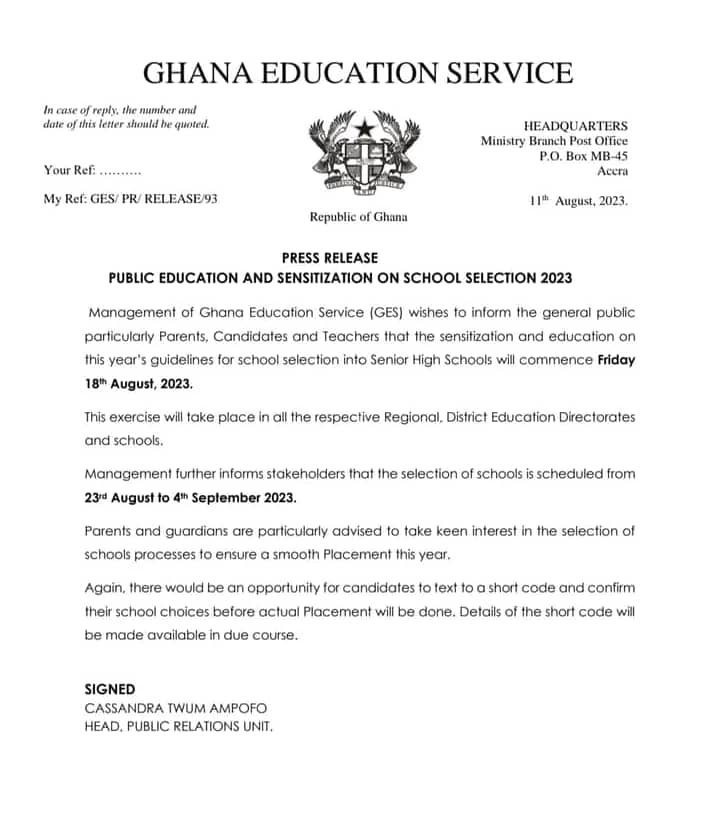
The GES in a statement signed by the Head of Public Relations Unit, Cassandra Twum Ampofo, said, “Management of Ghana Education Service (GES) wishes to inform the general public, particularly Parents, Candidates and Teachers that the sensitization and education on this year’s guidelines for school selection into Senior High Schools will commence Friday 18th August 2023.”
“This exercise will take place in all the respective Regional, District Education Directorates and schools. Management further informs stakeholders that the selection of schools is scheduled from 23rd August to 4 September 2023”.
The Head of the Public Relations Unit said candidates will be offered the opportunity to text a short code to confirm their school choices before actual placement.
“There would be an opportunity for candidates to text to a short code and confirm their school choices before actual Placement will be done. Details of the shortcode will be made available in due course”.
The BECE which started Monday, August 7, ended Friday, August 11.
The Ministry of Education (MoE) has declared the initiation of the process for school selection for the 2023 Basic Education Certificate Examination (BECE) participants.
In a statement issued on Friday, 11 August 2023, signed by its spokesperson Kwasi Kwarteng, the Ministry revealed that it has developed an informative video that elaborates on the school selection guidelines in order to provide clarity and guidelines on the school selection process.
“The video will be featured within schools and extensively broadcast on various television networks across the country. The video and the selection form will also be accessible on the official website of the Free Senior High School Secretariat,” the GES indicated.
Thus the in “School Showing of Selection Guidelines Video will start on August 21 to August 25 2023” with the specific date and time communicated to candidates by their Junior High School (JHS) headteachers.
While the “School Selection period has been scheduled from August 23 to September 4 2023. This is the period where you get the selection forms complete and submit them to your JHS head teacher,” the statement added.
Meanwhile, this year’s BECE has ended. The examination ended on Friday, August 11, 2023, across all centres in the country.
Member of Parliament representing the Ejura Sekyedumase Constituency, Mohammed Bawa Braima, has raised alarm over the issue of drug misuse among the youth in that region.
The legislator expressed his distress over the increasing prevalence of marijuana consumption and the usage of other illicit drugs in Ejura.
He shared his worries following a visit to various centers where the ongoing Basic Education Certificate Examination (BECE) is being conducted within his electoral district.
“As parents, we have a responsibility to cater for our children. We do not have to abandon them. We have to be there for them all the time. We cannot send them to school and abandon them. We have a responsibility to provide them with the care they need to be responsible adults.
The rate of abuse of marijuana and hard drugs is alarming. It will not benefit our children. These things are caused by negative influences, and as parents, we have to protect our children.”
“Some of the young people are abusing drugs,” he continued, “and I am concerned.” That is why I am pleading with parents to be patient and care for their children. When I have the opportunity to speak about these topics, I emphasise the need for us to speak out against drug use. It will devastate and ruin our society, and as parents, we must advise our children to avoid narcotics.”
The Ministry of Education (MoE) is gearing up to commence the Senior High School (SHS) selection process for this year’s Basic Education Certificate Examination (BECE) candidates, starting from Wednesday, August 23.
To ensure clarity and guidance throughout the school selection process, the MoE has developed an informative video explaining the selection guidelines.
MoE’s spokesperson, Kwasi Kwarteng, announced this in a statement released in Accra on Friday.
“The video will be featured within schools and extensively broadcasted on various television networks nationwide. Additionally, the video and selection form will be accessible on the official website of the Free Senior High School (FSHS) Secretariat at www.freeshs.net,” he added.
Kwarteng revealed that the in-school presentation of the selection guidelines video will take place from August 21st to August 25th, 2023.
“Your JHS head teacher will communicate the specific date and time for your school. The School Selection Period is scheduled from August 23rd to September 4th, 2023. During this period, you will receive, complete, and submit the selection forms to your JHS head teacher,” he explained.
He conveyed the ministry’s gratitude to all participants for their involvement in facilitating an informed and transparent school selection process.
The Ghana Education Service (GES) has announced plans to sensitize candidates who recently took the Basic Education Certificate Examination (BECE) on the procedures for selecting Senior High Schools. This informative session is scheduled for August 18, 2023.
The school selection process itself will occur from August 23 to September 4, 2023, across various regional, district education directorates, and schools.
In a statement signed by Cassandra Twum Ampofo, the Head of Public Relations Unit at GES, said “the management of Ghana Education Service (GES) wishes to inform the general public, particularly parents, candidates, and teachers, that the sensitization and education on this year’s guidelines for school selection into Senior High Schools will commence on Friday, August 18, 2023.”
She further emphasized, “This exercise will take place in all the respective Regional, District Education Directorates, and schools. Management further informs stakeholders that the selection of schools is scheduled from August 23 to September 4, 2023.”
As part of the process, candidates will have the opportunity to confirm their school preferences by texting a designated short code before the actual placement is finalized. The specific details of the shortcode will be communicated in due time.
The BECE, which began on Monday, August 7, concluded on Friday, August 11.
The Deputy Minister for Education, Rev. John Ntim Fordjour, has officially confirmed that there are ample spaces available to accommodate the entire cohort of 600,714 candidates participating in this year’s Basic Education Certificate Examination (BECE) across more than 900 Senior High Schools (SHS) and Technical and Vocational Education and Training (TVET) institutions.
Emphasizing the significance of success in the BECE, the Deputy Minister stressed that meeting the requirements of the examination would grant students access to the Free SHS program, a progressive initiative aimed at supporting their educational journey.
This affirmation was made during an interactive session with BECE candidates while they were engrossed in their examination at St. Thomas Aquinas Senior High School in Accra.
Rev. Ntim Fordjour, joined by Mr. Stephen Bamfo, the Director of Education for Greater Accra, reassured the candidates of the government’s unwavering commitment to furnishing them with optimal educational assistance.
“Free SHS/Free TVET awaits you, so work hard to benefit from this novel policy and shape your future dreams,” he said.
He encouraged the students with a powerful message, stating, “Free SHS/Free TVET awaits you, so work hard to benefit from this groundbreaking policy and mold your aspirations for the future.”
The Member of Parliament for Assin South additionally advised the candidates to concentrate solely on their own assessments and avoid seeking external aid, as each candidate was presented with a distinct set of questions, despite sharing the same examination environment.
Following a post-monitoring press briefing, the Deputy Minister took the opportunity to dispel unfounded speculations regarding the potential cancellation of the BECE, firmly asserting, “There is no intention or policy to terminate the BECE now or in the near future. Such notions should be dismissed.”
Furthermore, Rev. Ntim Fordjour clarified the crucial role played by the West African Examinations Council (WAEC) in Ghana’s educational advancement, highlighting the continuous allocation of resources to WAEC to facilitate its mandated responsibilities.
Reflecting on WAEC’s supportive contributions, he emphasized, “We consistently allocate funds to WAEC based on their requirements and ongoing initiatives.”
Expressing dismay over a few isolated incidents of misconduct observed at specific examination centers across the nation, the Deputy Minister condemned such actions and pledged strict consequences for those implicated. He believed that the apprehension of some educators underscored the stringent measures enforced to eradicate all forms of exam malpractice.
Rev. Ntim Fordjour’s confidence in the ongoing efforts to maintain the integrity of the examination process was evident in his remarks, showcasing the government’s commitment to upholding educational standards and promoting a fair and equitable testing environment.
Deputy Minister for Education, Rev John Ntim Fordjour, has rejected assertions that the Basic Education Certificate Examination (BECE) will be discontinued after the year 2023.
He stated that the Ghana Education System (GES) does not have intentions to eliminate the BECE, but rather, there will be a revised structure maintaining the same examination standard set by the West African Examination Council (WAEC).
Rev. Ntim Fordjour explained that the new format will be reflective of the curriculum that is being used in the various basic schools in Ghana.
Speaking in an interview with TV3 on Wednesday, August 8, 20023, Rev John Ntim Fordjour entreated the general public to disregard claims of the abolition of BECE after the 2023 edition.
“There’s no decision whatsoever to write off or jettison BECE, so that notion or perception should be disregarded.
“Well, we are going to have the same form as we’ve been doing. Of course, the test items each year will have it in a different format, as WAEC determines, but the standard is going to be the same, and it’s going to be reflective of the curriculum that we have put in place. What they have been taught is exactly what is going to come up,” he told TV3.
Rev John Ntim Fordjour’s comment comes in response to claims of a possible cancellation of the Basic Education Certificate Examination (BECE) after the 2023 edition over the introduction of a new examination for Basic schools in Ghana.
The Builsa South Member of Parliament, Dr. Clement Apaak, has expressed concerns about the West African Examination Council (WAEC) facing challenges in marking and grading the 2023 Basic Education Certificate Examination (BECE) if the government doesn’t settle its outstanding GH¢55 million debt to the examination body.
Dr. Apaak was surprised to learn that out of the total GH¢70 million owed to WAEC, the government had only paid GH¢10.5 million.
He stressed that this delay in debt payment could disrupt WAEC’s essential functions.
During an interview with the media on August 7, 2023, Dr. Clement Apaak urgently called on the government to promptly clear the debt owed WAEC.
“ It comes to us as a shock and surprise that WAEC is now telling us that contrary to what the government had indicated, only a paltry GH¢10.5 million out of about GH¢70 million has been provided.
“So we will like to call on the government to immediately make the resources available to WAEC because if that does not happen after the papers have been written, they wouldn’t be marked and they wouldn’t be graded. This is a very dire situation that calls for urgent attention,” he said according to 3news.com.
He emphasized that the papers written may not be marked or graded if the resources are not provided in a timely manner, highlighting the seriousness of the situation.
According to John Kapi, the Head of Public Affairs at WAEC, the government has paid GH¢10.5 million out of the total debt, but there are still outstanding arrears for the years 2021 and 2022. While the printing for the ongoing BECE has been covered, further processes such as marking and finalizing results will require additional funds.
The situation underscores the importance of resolving the financial matters promptly to ensure the smooth operation of the examination process and to avoid potential disruptions.
“So far for BECE 2021 and 2022, yes we have received the arrears but for this year 2023, we received about GH¢10.5 million which is 15 percent of the total payment due. So obviously there are still some arrears that should be settled. They promise of course that they are going to send some money to us so we are waiting.
“So far what we’ve been able to do is the printing for what we are conducting. But for the marking and final processing of the result, we will have to get some more money otherwise sections of the process will suffer,” 3news.com quoted him as having said.
Two tutors, Albert Adu-Gyan and Yaw Adadai, from PEEBLE Calvary and Oxford Santech schools, were apprehended on Monday, August 7, 2023, by the police.
They were arrested for allegedly attempting to aid their students in answering questions during the ongoing Basic Education Certificate Examination exam (BECE).
The incident occurred at the Dunkwa Secondary Technical Centre in the Upper Denkyira East Municipality in the Central Region.
Two mobile phones and answers to questions on two distinct papers were recovered from the suspects.
Both suspects are being held in jail and will appear in court.
In a related turn of event, four individuals have been apprehended by the West African Examination Council (WAEC) for their suspected involvement in exam misconduct during the commencement of the BECE on Monday, August 7, 2023.
Head of Public Affairs at WAEC, John Kapi, made this known to the public during an interview on JoyNews. He noted that the suspects attempted to aid candidates in cheating.
According to him, the arrests were made in the Ashanti Region, Central Region and Tema Central in the Greater Accra Region.
Education officials in Sekyere Afram Plains, Ashanti Region are depending on drones to distribute examination papers to students taking this year’s Basic Education Certificate Examination (BECE).
This is as a result of the challenges facing the West African Examination Council (WAEC) in delivering materials to students in the Sekyere Afram Plains area after the Sene River overflowed its banks, education authorities have turned to drones as a solution.
The Director of Education for the Sekyere Afram Plains District, Prince Owusu Ansah, has revealed that drones will be utilized throughout the duration of the examination.
“We will be conducting the exams throughout the week, with the drones facilitating the delivery of questions to the candidates. These questions will be securely housed at the Anyinam police station. Once the exams conclude on Friday, we are hopeful that the road conditions will have improved, the water levels would have receded, allowing us to transport all the answer scripts by road to the depot at Mampong,” stated Mr. Ansah.
Across the nation, a total of over 600,000 students are participating in the week-long Basic Education Certificate Examination. Among them, there are 300,323 males and 300,391 females from 18,993 schools nationwide.
This year’s cohort of candidates marks the final group to undertake the Basic Education Certificate Examination, which has been a part of the educational landscape for over three decades.
Personnel from the Ghana Police Service (GPS), National Investigations Bureau (NIB), along with external invigilators, have been dispatched to address any instances of examination misconduct that might arise at various examination centers during the Basic Education Certificate Examination (BECE) in the New Juaben South Municipality of the Eastern Region.
A total of 2,488 candidates from 76 different primary schools are currently participating in the BECE at four examination centers located in Koforidua.
The Municipal Director of Education, Mustapha Haruna Appiah, emphasized that comprehensive measures have been established to prevent any form of examination misconduct at all the Koforidua centers.
He stated, “Stringent entry protocols have been put in place. If a search reveals no unauthorized materials, candidates will be allowed into the examination hall. We have also engaged with the students, conducting sessions last week to enlighten them about the consequences of engaging in examination malpractice. We believe they have attentively heeded this advice and will exhibit appropriate behavior.”
“During our visits, we observed a high level of confidence among the candidates. This indicates that the risk of examination misconduct is low, given our proactive measures. Additionally, the presence of the BNI and other security personnel serves as a deterrent. Students are well aware that any misbehavior will result in legal consequences,” he asserted.
Isaac Appau Gyasi, the Municipal Chief Executive, expressed commendation for both the involved stakeholders and the candidates themselves, highlighting their exemplary attitude and behavior. He pledged the assembly’s commitment to support academically talented but financially challenged students in their pursuit of further education, contingent on their successful performance.
“Today’s observations underscore the effectiveness of the teachers’ preparations, and the students’ dedication is evident. This fills me with satisfaction, and I am confident that the outcomes will be favorable for all parties involved.”
“We want to assure the students that the assembly remains dedicated to their success. Our support will continue, as it has in the past. Our primary desire is for them to excel and excel admirably,” he affirmed.
Four individuals have been apprehended by the West African Examination Council (WAEC) for their suspected involvement in exam misconduct during the commencement of the Basic Education Certificate Examination (BECE) on Monday, August 7, 2023.
Head of Public Affairs at WAEC, John Kapi, made this known to the public during an interview on JoyNews. He noted that the suspects attempted to aid candidates in cheating.
According to him, the arrests were made in the Ashanti Region, Central Region and Tema Central in the Greater Accra Region.
“One individual was picked up in the Ashanti region when he was trying to approach the examination hall with some prepared materials for the candidates. We also picked somebody from Tema Central where the lady had a tablet that has some information she intended to pass on to candidates.
“In the Central region, Dunkwa-On Offin to be specific, we picked up two people who were answering the questions in the middle of the paper that they intended sending to candidates who were writing,” he explained.
On Monday, candidates sat for Religious and Moral Education 2 (Essay), Religious and Moral Education 1 (Objective), English Language 2 (Essay), and English Language I (Objective). Both Papers 2 & 1 for each subject were taken at one sitting without break.
John Kapi has stressed that exam malpractice in any shape or form cannot be condoned.
Those arrested are expected to be charged and sent to court, Mr Kapi added.
This measure is designed to effectively prevent unsuspecting individuals and students from participating in any form of malpractice.
The figure comprises 300,323 males and 300,391 females from 18,993 participating schools.
The 5-day examination will be undertaken under the supervision of the West African Examination Council (WAEC).
The exam commences from 9am to 3pm and nine subjects will be written in total. However, candidates with visual and hearing impairments are to be allowed an additional 50% of the time allotted to other candidates.
On Tuesday, the candidates will be examined on Integrated Science and Ghanaian Language and Culture.
Social Studies and Basic Design and Technology will be written tomorrow, August 8. On the fourth day, August 9, the candidates will sit for Mathematics and Information and Communication Technology.
The last day, Friday, the candidates will sit for just one subject, French. The students will commence at 9am and conclude at 10:45am.
A total of 600,714 candidates sat for this year’s Basic Education Certificate Examination (BECE) for school and private candidates, which began today, August 7, 2023.
Reports indicate that 906,000 students enrolled in kindergaten in 2012. It was expected that all things being equal, the exact would have progressed through the primary stages and present themselves as candidates for the BECE.
However, just 67% of the total figure sat for this week’s exams. About 43% of the students are not accounted for.
Executive Director of the Africa Education Watch EduWatch, Mr. Kofi Asare, in an interview on JoyFM’s Super Morning Show on Monday, highlighted some issues that might have led to this.
Prior to that, he clarified that “They (students) haven’t disappeared from the surface of the earth. Perhaps they have disappeared from the government education system. This is not the first time. Last year and two years ago, we asked similar questions.
“We have been trying to establish the survival rate within our education system by trying to use the numbers that enter KG1 and numbers that complete by way of writing BECE for both private and public schools.”
Branching to international programmes
According to Mr Kofi, at such a tender age, some children are enrolled into international programme such as the International Baccalaureate.
The International Baccalaureate is a highly regarded international education program that offers a comprehensive and balanced curriculum for students aged 3 to 19.
It is known for its rigorous academic standards, focus on developing critical thinking skills, and emphasis on international-mindedness. The IB programme includes the Primary Years Programme (PYP), the Middle Years Programme (MYP), and the Diploma Programme (DP), which is often referred to as the “IB Diploma.”
Mr Kofi estimates that about “10,000 people per cohort (made the move). So that is like 3 or 4 percent of the number we are looking for.”
Deaths
There is also the issue of the loss of lives. The Executive Director of the Africa Education Watch EduWatch argues that is “less than 2 percent.”
Migration
Some parents send their wards outside the country, he noted. However, Mr Kofi noted that the number of parents who migrate their children is relatively less due to poverty.
“Also, there is the idea that people may travel out of the country. I see that idea also to be realistic. If we have high number of the ‘dropout’ emerging from urban areas, but we should look at the statistics, you’d realize that although 33 percent are not making it to BECE at the national level, in the five northern regions, the percentage is more than 40 percent.
“Which means that there is a correlation between poverty and the survival rate. So I don’t think that the argument that many have traveled outside the country would hold so much because this is the case that majority of them are coming from the poverty part of the county where traveling outside the county is a luxury,” he explained.
Also, Mr Kofi is confident that majority of students “are subject of dropout.”
He cited reports from United Nations Children’s Fund (UNICEF), which touched on the cohort survival rate and this measures an education system’s holding power and internal efficiency.
Rates approaching 100 percent indicate high retention and low dropout levels.
According to Mr Kofi, UNICEF’s current rating for Primary 6 is 18 percent.
“The meaning is that before these students got to primary 6, 18 percent had dropped out,” he stated.
The cohort survival rate measures an education system’s holding power and internal efficiency. Rates approaching 100 percent indicate high retention and low dropout levels.
Per Mr Kofi, data from the Ministry of Education indicates that between Primary 6 and Junior High School 1, the drop out rate in deprived areas is about 20 percent.
He attributed this phenomenon to the lack of Junior High Schools in such areas. He pegs that about 25 percent of primary schools in rural areas do not have Junior High Schools.
“Apart from that, you come to the the realization that in the northern regions alone, 60 percent of private schools do not have JHS. So when they graduate, many graduate back into the community due to long distance,” he added.
Head of Public Affairs at the West African Examination Council (WAEC), John K. Kapi has characterised the initial day of the ongoing Basic Education Certificate Examination (BECE) as trouble-free, despite receiving notifications of exam irregularities in three regions.
John Kapi disclosed instances of misconduct were detected in the Ashanti, Greater Accra, and Central regions.
For instance, in the Ashanti Region, he mentioned that a student was apprehended while trying to enter the examination hall with unauthorized materials.
He also emphasized that measures have been put in place to deal with persons who flout examination regulations to make sure fairness prevails.
Speaking in an interview with JoyNews, the Head of Public Affairs for WAEC highlighted the report of malpractices they received on the first day and how they would deal with the culprits.
“I guess we’ve had a good day so far. No reports have come from anywhere, so I guess everything’s okay. We’ve received a few reports from the Ashanti Region where one individual was picked up, but he was trying to approach the examination hall with some foreign material for the candidates. We’ve also picked somebody up from Tema Central, where the lady had some information that she intended to pass on to the candidates. In the Central Region, We picked up two people who were answering the questions in the middle of the paper that intended to send to the candidate writing exam.
“Anybody who breaches any of these rules, what you do is simply report you to the law enforcement agencies. They apply our rules, and then they are charged. They are sent to court. We still have our monitors in the field. We have our own officers who are monitoring the centers. We have the National Investigative Bureau who are working with us. We also have our own locally-recruited personnel who are monitoring these centers. And so, we’ll continue to maintain momentum. We’ll sustain momentum until the exams are over,” he said.
He further commended the soaring female population for dominating this year’s examination and for breaking the jinx of male domination over the past years.
“We know now that we’re having more female candidates going into this examination as compared to the male population. Over the years, we’ve had the males dominating in examinations. So if there are many more females who are coming up, I think it’s a good thing that is worth celebrating for us as a society and as a nation,” he added.
A member of the Communication Unit of WAEC, Mr. John Kapi who confirmed this said on Starr FM that the government has given GHC10 million which is equivalent to 15 percent of the total arrears.
“So far for BECE 2021 and 2022 yes we have received the arrears but for this year 2023 we received about 10.5 million Ghana cedis that is 15 percent of the total payment due. So obviously there are still some arrears that should be settled. They promise off course that they are going to send some money to us so we are waiting,” Mr. Kapi stated.
He further mentioned that in the event the government cannot provide additional funds, it will adversely affect the procedures associated with the examinations.
“So far what we’ve been able to do is the printing for what we are conducting. But for the marking and final processing of the result we will have to get some more money otherwise sections of the process will suffer,” Mr. Kapi stated.
His remarks follow concerns raised by the Minority in Parliament.
Prior to this year’s Basic Education Certificate Examination (BECE), the Minority in Parliament had alerted to the issue that WAEC owed examiners, invigilators, and supervisors for their roles in the 2022 examination.
Speaking to Starr News the ranking member on the Education Committee in Parliament, Peter Nortsu-Kortoe advised the government to pay WAEC as soon as possible.
According to him, the government must attach some level of urgency with the matter since Ghana risked losing the Headquarters status over the huge debts owed to the examination body.
Meanwhile, the BECE commenced Monday, August 7, 2023, across the country, with over 600,000 students taking the exam. They include 300,323 males and 300,391 females from 18,993 schools across the country.
The ongoing Basic Education Certificate Examination (BECE) of 2023 has been marred by allegations of financial mismanagement by a headteacher and heartrending consequences for some final year students in the Gomoa East district.
The headteacher of the Gomoa Budu Atta DA Junior High School stands accused of misappropriating registration fees, leaving distraught students unable to sit for their exams.
As of the start of the exam on August 7, 2023, the school principal was nowhere to be found.
Some final year students were seen in tears after not being able to participate in the exam due to the situation that left them devastated.
Meanwhile, the Basic Education Certificate Examination (BECE) for 2023 commenced on August 7, 2023, and will be written by over 600,000 candidates from 18,993 schools across the country; they consist of 300,323 boys and 300,391 girls.
These candidates will be the final group of students to take the BECE.
Following the implementation of the new curriculum in 2019, a new exam will be given in 2024.
In 2024, students will write their Junior High School leaving examination, which will be based on the new Standard-based curriculum.
What this means is 2024 will see the introduction of a new BECE and a new era in examining students.
However, it must be noted that BECE has been in existence for over 30 years.
Candidates participating in this year’s Basic Education Certificate Examinations (BECE) in Effia-Kwesimintsim struggled to find exam centers at Takoradi Technical University (TTU) and Takoradi Secondary School on Monday morning, August 7, 2023.
This year’s BECE test has 3,365 candidates, with 99 public and private schools participating in the Effia-Kwesimintsim Directorate of Education.
According to reports at the Takoradi Technical University campus, where 76 test centers had been established, some school teachers and their students were trapped in locating their center with only three minutes until the commencement of the Religious and Moral Education examination.
Effia-Kwesimintsim Director of Education, Catherine Biney, speaking to the media, she explained that the initial challenges of candidates finding their centers were typical for the first day.
She attributed the situation, largely, to Takoradi Technical University’s ongoing session, which resulted in scattered centers across the campus.
“We have 7 centers: six at Takoradi Technical University and one at Takoradi Secondary School. TTU has 76 schools writing here, and 23 are at Takoradi Secondary School. Exam preparation is well organized with materials distributed to centers. On the first day, we expect center location problems, which we are resolving. Everything is set, and we are awaiting the papers,” Biney stated.
Due to TTU’s ongoing classes, Biney clarified that the university provided part of its premises for the exam centers, resulting in scattered locations. She highlighted the role of invigilators and supervisors in guiding candidates to their assigned centers and ensuring a smooth process.
“We have 7 centres and for Takoradi Technical University we have six centres and the remaining one is at Takoradi Secondary School. For TTU alone, 76 schools are writing here and 23 are writing at Takoradi Secondary School. So far the exam preparation is well organized with materials distributed to the various centres. Today being the first day, we will have problems with candidates looking for their centres and that is what we are sorting out, but everything is set, and we are waiting for the papers to come.”
“They have to give us the centres to write the exams but because school is in session for TTU, they just gave us part of their premises that would cater for the number of candidates that are coming here. So the centres are scattered. You just can’t have all of them in one place, if you don’t know the terrain, you will have difficulty in locating a centre, but the invigilators and supervisors will take them there and direct themselves as to what to do,” she said.
Media star, MzGee has motivated and encouraged Alajo No1’s Junior High School 2 and 3 students, boosting their spirits for the forthcoming Basic Education Certificate Exams (BECE).
The visit aimed to ignite their aspirations, urging them to chase excellence and fulfill their dreams, bringing pride to both themselves and their parents.
Engaging with the students, the UTV show host shared valuable insights from her past, inspired by her senior house mistress’s wisdom.
The advice centered on cultivating a positive academic journey, underscoring the significance of hard work and dedication in achieving their goals.
MzGee emphasized that parents’ investments in their children signify a desire for a brighter future, underscoring the importance of excelling in the exams to progress to the next educational stage.
“We come to school to learn. Beyond learning English, we learn Mathematics and other subjects and you have to pass those subjects to go to the next level,” she said.
“How will you feel after choosing all the schools you want to attend and then they say you didn’t get the grades so they’d decide where you should attend?
“There’s the need to put in more effort. Everything you want to be, you can become but it depends on your effort. If you put your mind to it and work towards it, you can become it.
“Your parents brought you here for a purpose and the purpose is for you to come and excel and make them proud. A lot of us are supposed to live the life our parents didn’t live and that’s why they are investing in us,” MzGee added.
The BECE 2023 is scheduled from August 7th to August 11th, 2023, marking a significant step in these young learners’ educational journey.
Within the Ketu South Municipal area, the Dei Foundation, a Non-Governmental Organization, has extended its support to approximately 200 candidates preparing for the Basic Education Certificate Examination (BECE) at Avoeme Basic School.
This academic institution has enrolled 196 candidates for the upcoming Basic Education Certificate Examination scheduled to commence in the following week. In an effort to equip these candidates for their final examination, the Dei Foundation collaborated with the school’s administration to conduct a brief preparatory program aimed at enhancing their mental readiness for the exams.
As a part of this program, the Foundation distributed mathematical set instruments to the 196 candidates. This initiative is intended to mitigate challenges associated with solving questions related to construction within mathematics and science subjects.
Xornam Alayi-Hussey, the Public Relations Officer of the Dei Foundation, emphasized that mathematical sets are crucial educational tools; however, not all parents are able to afford them for their children. Hence, the Foundation chose to step in and provide this support.
“It has become necessary to do this because we have realized that not all students have some of this simple things and it’s not their fault, some of them, their parents cannot afford and as an NGO poised for such supports, we deemed it necessary and considering the high number of Avoeme, we chose them as our maiden project in this regard,” she said.
Torgbui Labi I, the Dufia of Avoeme Yokoe and an alumnus of the school, honored the occasion with his presence. He utilized this opportunity to inspire the candidates, assuring them of achieving a flawless 100 percent pass rate.
In his words of wisdom, he urged the candidates to approach their revisions diligently during these final days and encouraged them to excel in their endeavors.
“This year, your worst aggregate should be 23 to maintain your performance records, don’t let my coming here be in vain” Torgbui said.
Addressing the students, Mr. Courage Babanawo, a seasoned professional nurse, offered insights into medical matters that could impact them and strategies to manage anxiety during the examination period.
He counseled them against staying up late the night before the exam day and stressed the importance of taking their health conditions seriously.
“Those of you who have asthma or any serious medical issues, don’t forget to take your medications along and don’t starve yourselves before going for exams, you can’t write exams on empty stomach,” he advised.
The students displayed significant motivation and expressed their gratitude towards the Dei Foundation. They believed that the provision of mathematical sets would greatly aid them in approaching construction-related questions with confidence.
Regarding their level of readiness, the students conveyed their confidence in the extensive efforts their teachers had invested in them. This confidence led them to believe that they would excel in their exams.
Mr. Maclean Mensah, the Assistant Headteacher, shared in their optimism, expressing his belief in achieving satisfactory results.
“They all have a very bright future if only they will take all that we shared with them very serious…I see another 100% pass record this year because we have prepared them very well academically for the exams,” Mr. Mclean said
Avoeme Basic School has a total of about 1,896 pupils from kindergarten to JHS 3 with 196 BECE candidates this year.
The school recorded 100 per cent twice in their Basic Education Exams within the last five years.
The exam will commence at 9am to 3pm and nine subjects will be written in total. However, candidates with visual and hearing impairments are to be allowed an additional 50% of the time allotted to other candidates. Ahead of the exam, the Council released the various topics to be studied.
Subjects to be written on Monday, August 7, are Religious and Moral Education 2 (Essay), Religious and Moral Education 1 (Objective), English Language 2 (Essay), and English Language I (Objective).
According to WAEC, both Papers 2 & 1 for each subject will be taken at one sitting without break.
“Where the duration indicated on the question paper differs from what is on the timetable, the one on the question paper should be followed”, WAEC added.
On Tuesday, the candidates will be examined on Integrated Science and Ghanaian Language and Culture.
Social Studies and Basic Design and Technology will be written on the third day. On the fourth day, August 9, the candidates will sit for Mathematics and Information and Communication Technology.
The last day, being Friday, the candidates will sit for just one subject, French. The students will commence at 9am and conclude at 10:45am.
Meanwhile, WAEC has announced that it will disqualify BECE candidates found to have been illegally registered.
This comes after the Council discovered that some parents moved their children from private schools to public schools to be registered while they were yet to complete the JHS education.
The number of candidates that registered for this year’s BECE (SC) is 8.8% higher than the 2022 entry figure of 552,276.
With regards to the BECE for private candidates, a total entry figure of 1,743 candidates was recorded and this is made up of 889 males and 854 females. This year’s figure is 5.4% higher than the entry figure of 1,132 for 2022.