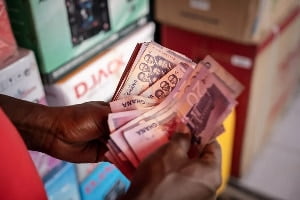
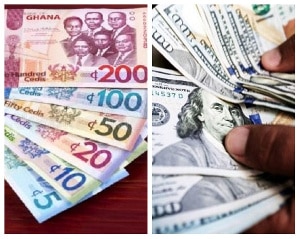
Bank of Ghana’s interbank exchange rates has it that the Ghana Cedi is now trading against the dollar at a purchasing price of 10.9654 and a selling price of 10.9764 as of today, June 14, 2023.
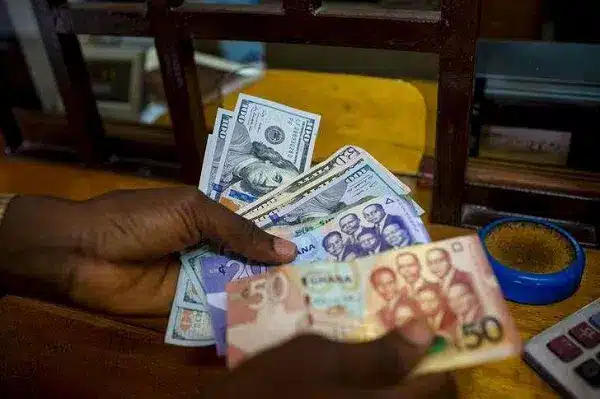
At a forex bureau in Accra, the dollar is being bought at a rate of 11.50 and sold at a rate of 11.80.
Against the Pound Sterling, the Cedi is trading at a buying price of 13.8456 and a selling price of 13.8617.
At a forex bureau in Accra, the pound sterling is being bought at a rate of 14.35 and sold at a rate of 14.95.
The Euro is trading at a buying price of 11.8491 and a selling price of 11.8550.
At a forex bureau in Accra, Euro is being bought at a rate of 12.20 and sold at a rate of 12.80.
The South African Rand is trading at a buying price of 0.5911 and a selling price of 0.5917.
At a forex bureau in Accra, South African Rand is being bought at a rate of 0.30 and sold at a rate of 0.90.
The Nigerian Naira is trading at a buying price of 42.9206 and a selling price of 42.0299.
At a forex bureau in Accra, Nigerian Naira is being bought at a rate of 12.00 Naira for every 1 Cedi and sold at a rate of 19.00.
For the CFA, it is trading at a buying price of 55.7128 and a selling price of 55.7682.
At a forex bureau in Accra, CFA is being bought at a rate of 17.00 CFA for every 1 Cedi and sold at a rate of 21.00 CFA for every 1 Cedi.
Our forex bureau rates are provided by Afriswap Bureau De Change in Osu, Accra.
Note that these rates may be different at a forex bureau near you. Our forex bureau rates are provided by Afriswap Bureau De Change in Osu, Accra.
The Interbank forex rates from the Bank of Ghana today, June 8, 2023, have shown that the Ghana Cedi is trading against the dollar at a buying price of 10.9654 and a selling price of 10.9764.
At a forex bureau in Accra, the dollar is being bought at a rate of 11.40 and sold at a rate of 11.80.
Against the Pound Sterling, the Cedi is trading at a buying price of 13.6783 and a selling price of 13.6930.
At a forex bureau in Accra, the pound sterling is being bought at a rate of 14.20 and sold at a rate of 14.80.
The Euro is trading at a buying price of 11.7622 and a selling price of 11.7739.
At a forex bureau in Accra, Euro is being bought at a rate of 12.00 and sold at a rate of 12.70.
The South African Rand is trading at a buying price of 0.5622 and a selling price of 0.5628.
At a forex bureau in Accra, South African Rand is being bought at a rate of 0.30 and sold at a rate of 0.90.
The Nigerian Naira is trading at a buying price of 42.3119 and a selling price of 42.4250.
At a forex bureau in Accra, Nigerian Naira is being bought at a rate of 12.00 Naira for every 1 Cedi and sold at a rate of 18.00.
For the CFA, it is trading at a buying price of 55.7128 and a selling price of 55.7682.
At a forex bureau in Accra, CFA is being bought at a rate of 16.00 CFA for every 1 Cedi and sold at a rate of 21.00 CFA for every 1 Cedi.
Our forex bureau rates are provided by Afriswap Bureau De Change in Osu, Accra.
Note that these rates may be different at a forex bureau near you. Our forex bureau rates are provided by Afriswap Bureau De Change in Osu, Accra.
The Ghanaian cedi exhibited a deceleration in its depreciation against the dollar, with the local currency experiencing a loss of only 1.28% on the retail market last week.
The cedi also lost 2.60% in value to the pound, while it weakened 2.01% to the euro.
This is coming after the Bank of Ghana provided approximately $14.5 million in spot market support, while allocating $20 million to Bulk Oil Distributing Companies, but this support was insufficient to alleviate demand pressures for the greenback.
Analysts are, however, anticipating a mixed performance of the cedi against the major foreign currencies this week.
With the International Monetary Fund programme taking shape, it is expected that demand for the local currency will ease.
The cedi came under severe pressure two weeks ago losing nearly 9.0% in value in the retail market.
However, this has slowed down, keeping the year-to-date loss at a little above 12% to the American greenback. But on the interbank market, the cedi has depreciated by about 20%.
The World Bank Country Director to Ghana, Pierre Laporte, last week indicated that the Bretton Wood institution would likely disburse $300 million to Ghana in September 2023 as the first tranche of the about $1.1 billion budget deficit assistance under the International Monetary Programme.
This many market watchers and experts believe will help reduce the expected pressure on the cedi.
Ghana in December 2022 suspended payments of external loans to help restructure its debt, a move that significantly reduce foreign outflows.
The Bank of Ghana has released today’s Interbank forex rates, providing insights into the currency exchange dynamics on June 5, 2023. According to the data, the Ghana Cedi is currently trading against the US dollar at a buying price of 10.9654 and a selling price of 10.9764.
At a forex bureau in Accra, the dollar is being bought at a rate of 11.40 and sold at a rate of 11.90.
Against the Pound Sterling, the Cedi is trading at a buying price of 13.6783 and a selling price of 13.6930.
At a forex bureau in Accra, the pound sterling is being bought at a rate of 14.00 and sold at a rate of 14.80.
The Euro is trading at a buying price of 11.7622 and a selling price of 11.7739.
At a forex bureau in Accra, Euro is being bought at a rate of 12.00 and sold at a rate of 12.70.
The South African Rand is trading at a buying price of 0.5622 and a selling price of 0.5628.
At a forex bureau in Accra, South African Rand is being bought at a rate of 0.30 and sold at a rate of 0.90.
The Nigerian Naira is trading at a buying price of 42.3119 and a selling price of 42.4250.
At a forex bureau in Accra, Nigerian Naira is being bought at a rate of 12.00 Naira for every 1 Cedi and sold at a rate of 18.00.
For the CFA, it is trading at a buying price of 55.7128 and a selling price of 55.7682.
At a forex bureau in Accra, CFA is being bought at a rate of 16.00 CFA for every 1 Cedi and sold at a rate of 21.00 CFA for every 1 Cedi.
Our forex bureau rates are provided by Afriswap Bureau De Change in Osu, Accra.
Note that these rates may be different at a forex bureau near you. Our forex bureau rates are provided by Afriswap Bureau De Change in Osu, Accra.
The Bank of Ghana‘s interbank forex rates for today, May 31, 2023, show that the Ghana Cedi is trading versus the dollar at a purchasing price of 10.9670 and a selling price of 10.9780.
At a forex bureau in Accra, the dollar is being bought at a rate of 11.40 and sold at a rate of 12.00.
Against the Pound Sterling, the Cedi is trading at a buying price of 13.5925 and a selling price of 13.6072.
At a forex bureau in Accra, the pound sterling is being bought at a rate of 14.00 and sold at a rate of 15.00.
The Euro is trading at a buying price of 11.7562 and a selling price of 11.7669.
At a forex bureau in Accra, Euro is being bought at a rate of 12.00 and sold at a rate of 12.70.
The South African Rand is trading at a buying price of 0.5561 and a selling price of 0.5566.
At a forex bureau in Accra, South African Rand is being bought at a rate of 0.30 and sold at a rate of 0.90.
The Nigerian Naira is trading at a buying price of 42.2438 and a selling price of 42.3450.
At a forex bureau in Accra, Nigerian Naira is being bought at a rate of 12.00 Naira for every 1 Cedi and sold at a rate of 18.00.
For the CFA, it is trading at a buying price of 55.7459 and a selling price of 55.7967.
At a forex bureau in Accra, CFA is being bought at a rate of 17.00 CFA for every 1 Cedi and sold at a rate of 21.00 CFA for every 1 Cedi.
Our forex bureau rates are provided by Afriswap Bureau De Change in Osu, Accra.
Note that these rates may be different at a forex bureau near you. Our forex bureau rates are provided by Afriswap Bureau De Change in Osu, Accra.
The local currency has lost 1.48 percent of its recent advances. At the end of last week, it was worth GH10.98 to the US dollar.
Initially, positive market sentiments prevailed and were attributed to approval of the US$3billion International Monetary Fund (IMF) bailout programme. However, an increase in demand for hard currency exerted pressure on the local unit despite tight supply conditions.
During a recent Monetary Policy Committee meeting, the Bank of Ghana decided to maintain its policy rate at 29.5 percent. This decision took into account factors such as easing inflationary pressure observed in April, which stood at 41.2 percent compared to 45 percent in March and 52.8 percent in February.
The relative stability of foreign exchange rates in recent weeks was also considered. Despite these factors, projections indicate sustained pressure on the cedi due to the spike in foreign currency demand – particularly for the American greenback.
Executive Director of the Young Investors’ Network (YIN), Kofi Busia Kyei, in recent comments emphasised the impact of ongoing discussions in the United States regarding the debt ceiling.
He noted that the feedback and uncertainty surrounding the negotiations had reversed gains made by the cedi within a short period.
“The cedi continues to depreciate at a concerning rate,” he noted.
The recent developments in the US, where top officials have reached a tentative deal to suspend the federal government’s US$31.4trillion debt ceiling, have directly influenced performance of the cedi. It is expected that the cedi’s depreciation could worsen if the US Congress reaches and passes an agreement.
The market analyst highlighted the importance of government implementing effective measures to address the issue and prevent further depreciation.
“Unless the Ghanaian government implements effective measures to address this issue, the cedi is likely to continue depreciating. It is possible that the second tranche from the IMF inflows could provide some relief for the local currency, but this is dependent on other factors remaining stable,” he said.
“Overall, it is crucial that the Ghanaian government takes proactive steps to mitigate effects of the cedi’s depreciation on the economy,” he added.
At the end of the last trading week, the cedi experienced a bearish performance against major currencies. The US$/GH¢ currency pair ended the week at GH¢10.98 per US dollar, indicating a loss of -1.48 percent in value of the cedi against the dollar, according to the official rate. On the retail side, it had dipped to GH¢11.4 to a dollar.
Conversely, the GB£/GH¢ currency pair recorded a rate of GH¢13.54 per pound sterling, signalling a gain in the pound’s value while the cedi slumped by -0.29 percent relative to the pound.
“We project sustained pressure on the cedi in the coming days with the spike in hard currency demand,” stated AZA Finance in its review of the FX market.
While the second tranche of the IMF loan inflows – valued at US$600million and to be disbursed in November if certain benchmarks are met – holds the potential to provide some temporary relief for the local currency, the cedi’s exposure to shocks remains a cause for concern.
The tentative agreement on the US debt ceiling will suspend the limit through January 2025, along with spending caps for the 2024 and 2025 budgets. Additional provisions of the deal include reclaiming unused COVID-19 funds, expediting the permitting process for specific energy projects, and incorporating additional work requirements for food aid programmes targetting impoverished Americans.
The agreement’s success hinges on its passage through Congress, given the narrow divide between parties. The Treasury department warned that it will face a shortage of funds to cover obligations if the debt ceiling issue is not resolved by June 5.
The Bank of Ghana’s interbank forex rates for today, May 30, 2023, show that the Ghana Cedi is trading against the dollar at a purchasing price of 10.9932 and a selling price of 11.0042.
At a forex bureau in Accra, the dollar is being bought at a rate of 11.30 and sold at a rate of 12.00.
Against the Pound Sterling, the Cedi is trading at a buying price of 13.5788 and a selling price of 13.5935.
At a forex bureau in Accra, the pound sterling is being bought at a rate of 14.00 and sold at a rate of 15.00.
The Euro is trading at a buying price of 11.7728 and a selling price of 11.7846.
At a forex bureau in Accra, Euro is being bought at a rate of 12.00 and sold at a rate of 12.70.
The South African Rand is trading at a buying price of 0.5594 and a selling price of 0.5599.
At a forex bureau in Accra, South African Rand is being bought at a rate of 0.30 and sold at a rate of 0.90.
The Nigerian Naira is trading at a buying price of 42.1277 and a selling price of 42.2441.
At a forex bureau in Accra, Nigerian Naira is being bought at a rate of 12.00 Naira for every 1 Cedi and sold at a rate of 18.00.
For the CFA, it is trading at a buying price of 55.6622 and a selling price of 55.7180.
At a forex bureau in Accra, CFA is being bought at a rate of 17.00 CFA for every 1 Cedi and sold at a rate of 21.00 CFA for every 1 Cedi.
Note that these rates may be different at a forex bureau near you. Our forex bureau rates are provided by Afriswap Bureau De Change in Osu, Accra.
Our forex bureau rates are provided by Afriswap Bureau De Change in Osu, Accra.
The Bank of Ghana’s interbank forex rates for today, May 29, 2023, show that the Ghana Cedi is trading versus the dollar at a purchasing price of 10.9700 and a selling price of 10.9810.
At a forex bureau in Accra, the dollar is being bought at a rate of 11.30 and sold at a rate of 12.00.
Against the Pound Sterling, the Cedi is trading at a buying price of 13.3314 and a selling price of 13.3459.
At a forex bureau in Accra, the pound sterling is being bought at a rate of 13.70 and sold at a rate of 14.70.
The Euro is trading at a buying price of 11.5905 and a selling price of 11.6021.
At a forex bureau in Accra, Euro is being bought at a rate of 11.75 and sold at a rate of 12.55.
The South African Rand is trading at a buying price of 0.5594 and a selling price of 0.5599.
At a forex bureau in Accra, South African Rand is being bought at a rate of 0.30 and sold at a rate of 0.90.
The Nigerian Naira is trading at a buying price of 42.8768 and a selling price of 42.9816.
At a forex bureau in Accra, Nigerian Naira is being bought at a rate of 13.00 Naira for every 1 Cedi and sold at a rate of 18.00.
For the CFA, it is trading at a buying price of 56.5378 and a selling price of 56.5944.
At a forex bureau in Accra, CFA is being bought at a rate of 17.00 CFA for every 1 Cedi and sold at a rate of 21.00 CFA for every 1 Cedi.
Our forex bureau rates are provided by Afriswap Bureau De Change in Osu, Accra.
Note that these rates may be different at a forex bureau near you. Our forex bureau rates are provided by Afriswap Bureau De Change in Osu, Accra.
The Bank of Ghana’s interbank forex rates for today, May 26, 2023, show that the Ghana Cedi is trading versus the dollar at a purchasing price of 10.7747 and a selling price of 10.7855.
At a forex bureau in Accra, the dollar is being bought at a rate of 11.30 and sold at a rate of 12.00.
Against the Pound Sterling, the Cedi is trading at a buying price of 13.2938 and a selling price of 13.3082.
At a forex bureau in Accra, the pound sterling is being bought at a rate of 13.80 and sold at a rate of 14.80.
The Euro is trading at a buying price of 11.5589 and a selling price of 11.5693.
At a forex bureau in Accra, Euro is being bought at a rate of 11.80 and sold at a rate of 12.60.
The South African Rand is trading at a buying price of 0.5456 and a selling price of 0.5462.
At a forex bureau in Accra, South African Rand is being bought at a rate of 0.30 and sold at a rate of 0.90.
The Nigerian Naira is trading at a buying price of 43.0961 and a selling price of 43.1323 .
At a forex bureau in Accra, Nigerian Naira is being bought at a rate of 13.00 Naira for every 1 Cedi and sold at a rate of 18.00.
For the CFA, it is trading at a buying price of 56.6981 and a selling price of 56.7491.
At a forex bureau in Accra, CFA is being bought at a rate of 17.00 CFA for every 1 Cedi and sold at a rate of 21.00 CFA for every 1 Cedi.
Our forex bureau rates are provided by Afriswap Bureau De Change in Osu, Accra.
Note that these rates may be different at a forex bureau near you. Our forex bureau rates are provided by Afriswap Bureau De Change in Osu, Accra.
In recent months, the Ghanaian cedi has emerged as the top-performing currency worldwide against the US dollar, exhibiting a remarkable 33% increase since November.
This outstanding surge places the cedi ahead of approximately 150 currencies tracked by Bloomberg, surpassing its counterparts in both emerging and frontier markets.
Market observers and investors attribute this impressive appreciation to the growing confidence surrounding Ghana’s imminent board approval from the International Monetary Fund (IMF) for a $3 billion bailout package.
The relentless strengthening of the cedi persists, with the currency recording gains for a fourth consecutive day and reaching a trading level of 10.95 per US dollar as of 9:57 a.m. in Accra.
This sustained rally has bolstered investor confidence, leading to substantial returns of nearly 12% on Ghana’s dollar-denominated bonds.
This performance surpasses the average return of 3.6% achieved by similar instruments in emerging and frontier markets, as indicated by a Bloomberg index.
Economists and analysts closely monitor the developments regarding the IMF bailout, anticipating that the positive sentiment and potential disbursement of the initial tranche of funds could further drive the appreciation of the cedi in the coming days.
Daniel Kavishe, an Africa economist at Rand Merchant Bank, highlights the correlation observed in other markets that have received IMF programs and immediate fund disbursements, suggesting a similar positive reaction in Ghana.
Kavishe expresses his belief that the cedi could potentially trade at a rate below 10-to-1 against the US dollar if the authorities receive the initial funding.
The Ghanaian cedi’s surge against the US dollar has caught the attention of investors worldwide. As Ghana’s economic landscape continues to evolve, the nation is poised to leverage this momentum to attract greater investment and foster sustainable growth in the years to come.
Today, May 10, 2023, the Ghana Cedi is trading against the dollar at a purchasing price of 10.9493 and a selling price of 10.9603, according to the Bank of Ghana’s Interbank Forex Rates.
At a forex bureau in Accra, the dollar is being bought at a rate of 11.50 and sold at a rate of 12.00.
Against the Pound Sterling, the Cedi is trading at a buying price of 13.8148 and a selling price of 13.8297.
At a forex bureau in Accra, the pound sterling is being bought at a rate of 14.30 and sold at a rate of 15.20.
The Euro is trading at a buying price of 11.9982 and a selling price of 12.0091.
At a forex bureau in Accra, Euro is being bought at a rate of 12.50 and sold at a rate of 13.20.
The South African Rand is trading at a buying price of 0.5879 and a selling price of 0.5884.
At a forex bureau in Accra, South AfricanRand is being bought at a rate of 0.30 and sold at a rate of 0.90.
The Nigerian Naira is trading at a buying price of 42.1824 and a selling price of 42.2719.
At a forex bureau in Accra, Nigerian Naira is being bought at a rate of 14.00 Naira for every 1 Cedi and sold at a rate of 19.00.
For the CFA, it is trading at a buying price of 54.6217 and a selling price of 54.6713.
At a forex bureau in Accra, CFA is being bought at a rate of 17.00 CFA for every 1 Cedi and sold at a rate of 21.00 CFA for every 1 Cedi.
The cedi will lose 30% of its value against the dollar in 2023, according to the Economist Intelligence Unit (EIU).
However, this is less severe than the local currency’s approximate 44% depreciation in 2022.
The UK-based company stated that it anticipates the cedi to decline sharply this year in its 2023 Country Report on Ghana.
“We now expect the currency to weaken to ¢12.46:US$1 at end 2023 (from ¢10.95:US$1 as at mid-April).”
It further said that the cedi depreciation will be driven by increased demand for hard currency due to high import prices, inflation, capital flight, rising profit repatriation by Ghanaian-based multinationals and weak investor sentiment in the face of the ongoing debt crisis.
However, sustained fiscal and monetary tightening and the anticipated Executive Board approval of an IMF program by mid-2023 will slow the cedi’s relative decline over the second half of the year.
It added “we expect further gradual depreciation in 2024-2027, to ¢14.70: US$1 at end 2027, but at a much slower pace than in 2022-2023 as debt-restructuring uncertainties abate. Ghana’s sustained depreciation reflects the country’s structural current-account deficit and higher inflation than its trading partners”.
It concluded that reserves will average 3.3 months of import cover over 2023-2027, just above the internationally regarded prudential minimum of three months.
The cedi begun trading May 2, 2023 at ¢12.10 pesewas to the dollar on the forex or retail market.
It is also selling at ¢14.98 to the pound and ¢13.00 to the euro.
The cedi remains relatively strong despite weak economic fundamentals, says market observers GCB Capital and Constant Capital.
Although the local unit has lost 4.4 percent against the US dollar as of March 28, the performance beats market expectations due to anticipated seasonality effects in Q1 2023 amid weaker foreign exchange reserve position and the highly bearish end to 2022, while the interbank reference rate has depreciated by 22 percent.
This is believed to result from efforts by the Bank of Ghana to tighten market spreads and quell speculation. Despite concerns over a weaker forex reserve position, export receipts have helped to drive a year-on-year (y/y) surplus for the merchandise trade account.
GCB Capital, in its report analysing the recent Monetary Policy Committee (MPC) decision to increase the policy rate by 150bps, suggested that limited trading activity on the Ghana Fixed Income Market [GFIM] has slowed down FX demand pressure from portfolio reversals – further supporting the cedi’s strength.
“We believe this surplus trade balance and the ongoing gold purchase programme have limited the rate of reserve depletion and sustained the central bank’s FX liquidity management efforts, on both the spot and forward market for build distributing companies,” GCB Capital said.
Additionally, the breakthrough in negotiations with China has brought the country closer to securing International Monetary Fund (IMF) Executive Board approval – with an official start of the IMF programme expected to unlock a balance of payment backstop for the cedi’s resilience in the second half of 2023.
“We believe the local unit’s near-term performance hinges on progress of Ghana’s external debt restructuring – including securing assurances from its bilateral creditors and capital market bondholders, as well as the delayed IMF Executive Board approval for an economic programme,” Constant Capital said.
Expressing a similar view, Apakan Securities mentioned that progress made on the local debt treatment alongside further engagements by government with its external creditors has improved market sentiments.
“After kicking off the year on a weaker foot against the US dollar and other major trading pairs, the local currency has regained its footing in recent weeks. This is primarily driven by the central bank’s continuous FX support on the market amid lower demand. Additionally, progress made on the local debt treatment with further engagements by government with its external creditors has improved market sentiments,” Apakan Securities said.
The market generally holds the view that the country’s breakthrough in negotiations with China has brought it closer to securing IMF Executive Board’s approval, which should unlock a balance of payment backstop – further supporting the cedi’s resilience through the second half of 2023. However, analysts noted that near-term performance of the local unit hinges on progress in Ghana’s external debt restructuring and securing assurances from its bilateral creditors and capital market bondholders.
“We believe the Ghanaian economy is facing significant challenges, but the resilience of the currency so far is positive news for investors,” said GCB Capital. “The currency’s strength will depend on progress in talks with creditors and the IMF, as well as efforts to manage liquidity and inflation.”
Although the Domestic Debt Exchange Programme (DDEP) has been less of a liquidity problem than expected, there have been solvency concerns for some commercial banks. The two percent reduction in the cash reserve ratio has led to excess liquidity in the interbank market, but banks have been cautious over loan book expansion due to uncertainties and heightened risks.
As a result, there has been a strong growth in broad money supply; which could be inflationary.
In response the MPC hiked the monetary policy rate by 150bps, which was seen as a surprise, as well as an additional measure of raising the cash reserve ratio (CRR) on domestic currency deposits from 12 percent to 14 percent, effective 13th April 2023.
GCB Capital suggests that the move signals commitment to sustaining a tight monetary policy stance until the disinflation process strengthens. However, this decision has trade-offs for growth and employment, particularly as the growth pulse has softened since second-half 2022.
“The decision has high trade-offs for growth and employment, particularly with the growth pulse softening considerably since 2H22,” GCB Capital added.
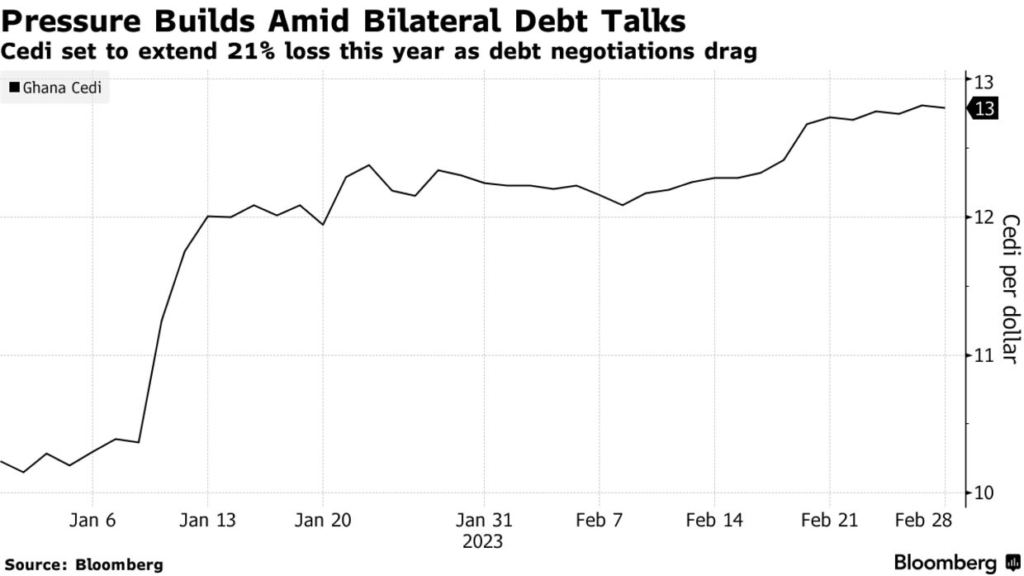
Ghana’s local currency, cedi, the second-worst performing currency in the world this year, is doomed to further suffering after the nation missed a deadline it set for itself to restructure its bilateral debt and go closer to receiving international aid.
In order to be eligible for a $3 billion International Monetary Fund program, Finance Minister Ken Ofori-Atta wanted to negotiate a restructuring agreement with bilateral creditors by the end of February.
Ghana has only partially finished the exchange program’s domestic debt component so far.
After the Lebanese pound, the cedi has underperformed among the more than 100 currencies tracked by Bloomberg, falling 21% versus the dollar in 2023.
Still, the missed deadline doesn’t automatically derail the talks.
Rather, it highlights the difficulties Ghana faces as it tries to reduce its debt load and contend with critics ranging from international bondholders to local trade unions.
“For the foreseeable future the cedi will continue to be volatile until we are able to make substantial progress on the external debt restructuring front,” Kweku Arkoh-Koomson, an economist at Databank Group, said by phone.
“The IMF deal is what will cause a clear stability in the cedi.”
Local bondholders have been asked to voluntarily exchange ¢130 billion of debt for new bonds that will pay between 8.35% and 15% interest, compared with an average of 19% on old bonds.
Ghana stands to ask external creditors to write off as much as 50% of the debt it owes them — far higher than the 30% the government initially considered, S&P Global Ratings said in a report Tuesday.
“Uncertainty on when the rest of the restructuring will be completed” is influencing cedi volatility, said Courage Boti, an economist at Accra-based GCB Capital Ltd.
“To the extent that those things are hanging in the balance now — in that timelines are not very certain — the volatility of the cedi will continue.”
To date, local investors have exchanged ¢87.8 billion, or 67.5% of bonds under restructuring, for new securities, against an overall target of 80%.
The country will have to reorganize obligations owed to local pension funds to complete the domestic exchange, a move that’s running into criticism from trade unions.
The government aims to start “substantive” discussions with international bondholders and their advisers in the coming weeks, Ofori-Atta said last month, offering eurobond holders some losses while seeking to reschedule payments on bilateral obligations.
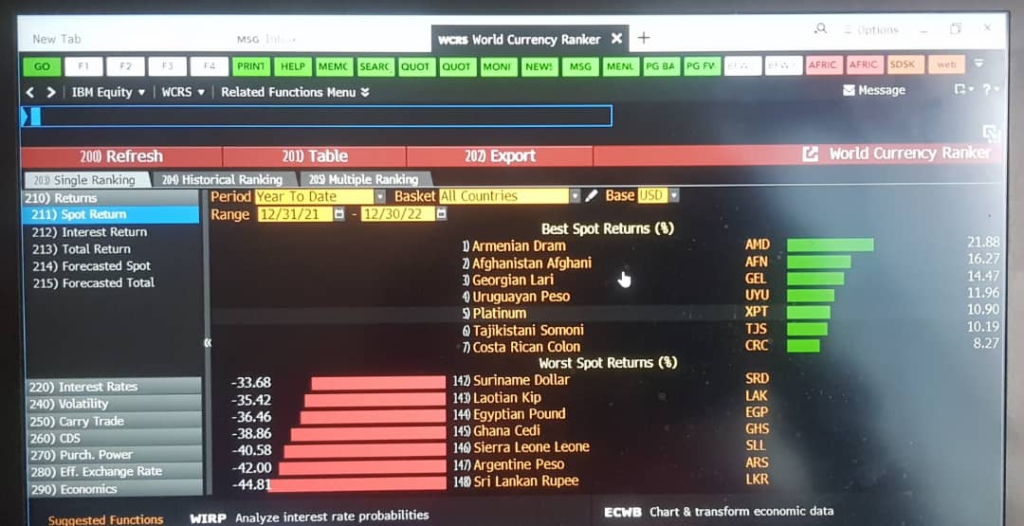
With a year-to-date loss of 38.86% against the US dollar, the Ghana Cedi finished 2022 as the second-weakest currency on the African continent, according to Bloomberg.
The local currency came in 145th position overall. The Argentina Peso and Sierra Lankan Rupee were ranked 147th and 148th, respectively, while the Sierra Leone Leone rated 146th.
According to Bloomberg, they are the currencies having the “Worst Spot Returns.”
All of these nations faced economic difficulties because their debt loads had grown to unmanageable levels and their budget deficits had alarmingly widened.
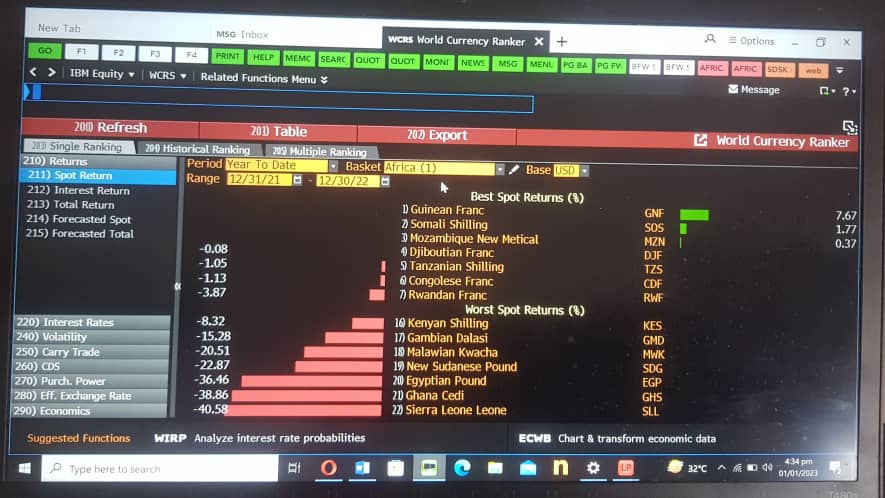
In Africa, the Kenyan Shilling (-8.32%), The Gambian Dalasi (-15.28%), Malawian Kwacha (-20.51), New Sudanese Pound (-22.87%), Egyptian Pound (-36.46%), Ghana Cedi (-38.36%) and Sierra Leone Leone (-40.58%) were the currencies with the “Worst Spot Returns”.
For the “Best Spot Returns”, the Guinea Franc (7.67%), Somali Shilling (1.77%), Mozambique New Metical (0.37%), Djibouti Franc (-0.08%), Tanzania Shilling (-1.05%), Congolese Franc (-1.13%) and Rwanda Franc (-3.87%) were the strongest currencies in Africa in 2022.
The Ghana cedi under significant pressure in 2022, dropping almost 50% of its value at one point before recovering in December as a result of a staff-level agreement made between the International Monetary Fund and the Government of Ghana. This drastically cut its year-to-date losses.
Before then, the Domestic Exchange Program’s debut was announced by Finance Minister Ken Ofori-Atta.
Thus, by the end of 2022, the local currency was selling on the retail or foreign market, on average, at roughly 11.60 to the American “greenback.”
According to some observers, the cedi’s rebound in December 2022 was more the result of general uncertainty and speculative activity than it was genuinely supported.
They argued that the cedi should be more susceptible to depreciation than appreciation due to an inflation rate of more than 50%, several years of consecutively high budget deficits leading to debt distress, and a forex reserves cover of less than three months of import cover.
However, they countered that a stable cedi in 2023 will mostly depend on a support program from the IMF.
Cedi records 18.21% depreciation to dollar in quarter 1
The cedi recorded an 18.21% rate of depreciation to the US dollar in the first quarter of 2022, according to Bloomberg.
This ranked the local currency as the worst among African currencies with the “Worst Spot Returns”.
However, for the timely intervention by the Bank of Ghana, the situation could have been worse.
Cedi loses 16.86% value to dollar in first half-year of 2022
In the first-half of 2022, the Ghana cedi lost 16.86% in value to the US dollar on the interbank market but over 20% in the retail forex market.
However, the rate of depreciation of the cedi slowed down in the last two months (May and June 2022), after stern monetary actions from the Bank of Ghana coupled with some fiscal measures to halt the free fall in the first four months of 2022.
Cedi loses 40% value to dollar in nine months of 2022; places 147th position in world – Bloomberg
In the first nine months of 2022, the Ghana cedi lost 40.05% in value to the US dollar, ranking it as the second worst performing currency in the world in the 147th position, according to Bloomberg.
This decline in the local currency against the American currency was the worst in over three decades.
There was a free fall of the cedi in the months of August 2022 and September 2022.
The cedi took a climb to GH¢11 to $1 in October. This came as a shock to many as Ghanaians were expecting an appreciation from the local currency against the trading currencies.
As part of measures to avert the depreciation of the cedi, the government run to the International Monetary Fund (IMF) for financial bailout.
The IMF bailout would help rescue the cedi, as well as, stabilize the economy that has taken a nose dive.
While Ghana awaits the money from IMF, international credit rating agencies; Moody’s, Fitch, Standard and Poors’, remarked that Ghana’s economy looked gloomy.
This led to a hike in the monetary policy rate by the Bank of Ghana to 24. 5%. The hike in the policy rate was to stem the soaring inflation which has subsequently led to an increase in goods and services.
Cedi depreciates further, highest decline in 22 years – Report
Bloomberg has on Thursday, October 20, 2022, reported that Ghana’s local currency – the cedi – has diminished in value by 9.6%.
This, the news portal said, makes the total loss of the cedi in 2022 almost 52%, the highest recorded in 22 years.
The free fall of the cedi now places the currency at the 148 position of worst performing currencies in the world.
The currency had lost up to 54 per cent of its value at the end of November, making it one of the worst performing currencies in the world.
Meanwhile, Government of Ghana is targeting an amount of $3 billion over a three-year period from the International Monetary Fund (IMF) once an agreement on a programme is reached.
The new amount requested as a loan is double the government’s initial target of $1.5 billion.
The IMF programme is aimed at restoring macroeconomic stability and safeguarding debt sustainability among many others.
UK based Economist Intelligence Unit (EIU) has however predicted doom for the cedi.
It said the cedi will depreciate about 22% against the dollar in 2023.
This, EIU said will rank the local currency as the third weakest performing currency on the African continent.
He asserted that the strengthening of the cedi will be another another historic achievement for Ghana.
He stated, “The Cedi has gained 61% of its value versus the $,” in a tweet seen by GhanaWeb. Another historic achievement is about to happen! Yes, Ghana, we can.
As of Monday, December 26, 2022, the Ghana cedi is trading against the dollar at a purchasing price of 8.2988 and a selling price of 8.3088 according to the Bank of Ghana’s interbank exchange rates.
Against the Pound Sterling, the Cedi is trading at a buying price of 10.0200 and a selling price of 10.0325 as compared to yesterday’s trading of a buying price of 9.9633 and a selling price of 9.9741.
At a forex bureau in Accra, the pound sterling is being bought at a rate of 11.00 and sold at a rate of 14.50.
President Akufo-Addohas called on traders and other industry players to reduce the prices of goods and services.
Speaking on Sunday during the Centenary Celebration of the Ga Presbytery of the Presbyterian Church of Ghana, the President asserted that adjusting prices of commodities is the best way to alleviate the already burned citizens as the cedi regains its strength against major international currencies.
“I add my voice to those of GUTA, GRTCC and others, to appeal to manufacturers, traders and transport operators, that with the height of the cedi’s recent depreciation and increased prices of goods and services, to reduce their prices of goods and services now that the cedi is regaining much of its strength. I believe this is not only a fair request but also a just one.”
In recent times, the two main drivers of the economy (the local currency and fuel prices) have seen tremendous adjustments in prices.
The Ghana cedi is currently trading at GH¢8 on the forex market, according to the Bank of Ghana.
It will be recalled that the Ghana cedi, which lost 45.1% of its value against the US dollar this year, was tagged by Bloomberg as the worst-performing currency in the world on October 17, 2022.
In a turn of event, the Ghana cedi witnessing an overwhelming appreciation in value against the dollar has been adjudged as the best performing currency against the US dollar by Bloomberg.
Also, a litre of petrol and diesel now sells at ¢13 and ¢16 respectively.
Commenting on the cedi appreciation, Akufo-Addo noted that the local currency is performing so well due to prudent financial decisions his government has implemented to salvage Ghana’s economy.
“Things are beginning to turn around, what seemed impossible yesterday is now becoming possible. Today the cedis is appreciating against the dollar and all major currencies and the prices of petroleum products are reducing at the pumps.The strengthening of the cedi has not happened by chance but the deliberate policies of the government in collaboration with the Bank of Ghana,” President Akufo-Addo stated.
Even if it is a positive indicator, he thinks the admiration will pass quickly.
“It is impossible to predict how long it will persist because it is not supported by solid economic foundations.
But at least what we saw was positive.
It indicates that the system is adapting to the changes, according to Prof. Bokpin, who gave an interview at a roundtable discussion in Accra that the Citizen’s Coalition arranged.
“We have seen how the cedi is responding, but there is still a lot of work to be done. The Staff Level Agreement with the IMF is not the same as the programme. There is a lot of work because our debt level is unsustainable. The debt exchange in its current form is not in a good shape and may systematically weaken the balance sheet of the participating financial institutions,” he added.
He however urged government to ensure that the debt restructuring protects financial stability.
“If we are not careful, in our attempt to polish our public debt, we may be creating a crisis that will later come to bite us. Let us do the restructuring in a way that protects financial stability,” he noted.
“Because it is not driven by strong economic fundamentals, you cannot say it is going to last. But at least, what we have seen is good. It means the system is responding to the changes,” Prof. Bokpin added.
IMF programme insufficient to address Ghana’s problems – Prof. Bokpin
Ghanaian farmer and politician, John Dumelo, has projected that Ghana will next year January return to a period where the cedidepreciates further against the dollar.
His projection comes at a time when the cedi has been adjudged the best-performing currency against the dollar since it has appreciated by 3.12% against the dollar on the retail market.
According to Mr Dumelo, this is so because import-driven companies have already secured their stock for the Christmas and no longer need the dollar to import more stuffs.
“$$ will keep coming down in the next few weeks. Reason: 1. Importers don’t need $$ now, they have enough goods for the Xmas period. 2. $$ are in the system due to Xmas visitors,” he tweeted.
However, he noted that after the Yuletide season, importers would not to restock, thus more dollar would be demanded, which would result in the depreciation of the cedi once again as seen in 2022.
“But $$ might go up in Jan cos importers need to restock & foreign companies have to repatriate profits,” he added.
Since the beginning of the year, the cedi has lost more than 50% of its value against major trading currencies.
This has been attributed to external factors fueled by the USA’s revision of its interest rate to check inflation and internal factors such as speculation and dependence on imported products normally prices in dollars.
According to reports, a dollar is now trading a little over GH10.
John Philpot, an international human rights attorney from Montreal, Canada, has commended Ghana’s ‘gold-for-oil’ strategy, which Vice President Dr. Mahamudu Bawumia recently developed and put into action.
Philpot, who has extensive knowledge of international politics pertaining to the continent and has previously lived in Africa, said Ghana’s decision is a courageous as well as the appropriate step because it would stop currency depreciation and stabilize prices.
He continued by predicting that other other nations would soon adopt a similar policy.
“The U.S dollar is having a lot of inflation so..it has less value because of the inflation…Gold is more of a universal value and they (Ghana) are doing this to internally avoid the devaluation of their currency and I think this is going to be a tendency worldwide,” Philpot said during an interview with Press TV Iran.
“It would appear that [the policy] will avoid poverty and stabilise prices because countries in Africa, their money is pegged to the U.S dollar. Prices go up much faster and the money is much less value for the people working in the salaries of those countries. I lived in Tanzania…people I know living on Tanzanian salaries were having a very hard time. This [gold for oil policy] will stabilise prices,” he said.
He said Ghana’s move is a “return to multilateral approach and obviously having better relations with Russia and China and other countries too…The United Nations was built on the concept of sovereignty. You are not sovereign if the U.S. dollar controls your economy so if they get a form of universal or more democratic trade, it increases your sovereignty.”
Vice President Dr Mahamudu Bawumia announced recently that Ghana would kick off a policy of using gold reserves to purchase refined crude productsfrom the world market from 2023 rather than using the U.S. dollar.
In a speech delivered at the 2022 Ghana Energy Awards held the night of Sunday, November 27th, the Vice President said the move is aimed at stopping the cedi’s depreciation and its attendant effects on the local economy.
“A major source of cedi depreciation has been the demand for foreign exchange to finance the import of oil products…Persistent cedi depreciation increases the cost of living with higher prices for fuel, transportation, utilities, food and so on,” Bawumia said.
““…To address this fundamental challenge of the persistent depreciation and its impact on fuel, utility prices, food and so on, government has decided to implement a policy of using our gold to buy oil products. That is something new and it is the barter of sustainably mined gold for oil and is one of the most important policy changes in Ghana since independence. If we implement it as we have envisioned, it will fundamentally change our balance of payments and significantly reduce the persistent depreciation of our currency with its associated increases in fuel, electricity, water, transport and food prices,” he added.
In a similar move, the reserve bank of Zimbabwe introduced gold coins into the market in July this year amidst rising inflation and rapid depreciation of the local currency.
The introduction of the gold coins was part of the Central Bank’s measures to tackle the country’s currency crisis through exchange rate stabilisation.
Estimates made using the 2022 budget shows that , every Ghanaian owes approximately GH¢15,175.32.
Given the current public debt stated in the budget amounting to GH¢467.37 billion (US$48.87 billion), shared among the 30.8 million Ghanaian population, amounts to a debt of GH¢15,175.32 per person.
The domestic debt component, according to the budget, is GH¢195.65 billion making a 31.79 percent of GDP while the external debt stock was at 58.1 percent of GDP with GH¢271.71 billion.
For a decade now, the public debt has increased by about 159.67% – from US$ 18.82 billion (GH¢35.38 billion) in 2012 to US$ 48.87 billion (GH¢467.37 billion) in 2022.
The year 2022, has been on a downward stream with rising inflation and depreciating of the cedi.
Loss to depreciation of the cedi amounted to added external debt stock of of GH¢93.86 billion There have also been vast increases in the public debt on month-on-month bases.
The diagram gives the public debt per person for the year 2022. The increase per month is associated with the increases in the public debt.
On average the public debt person increased by 32.89% from January 2022 to October 2022.
The farmers reaffirmed that a box of eggs will now cost 45 Ghana cedis on their farms.
The association’s Public Relations Office (PRO), Mr. Asiedu Kwame, warned the Nyankonton Mu Nsem on Rainbow Radio 87.5Fm that the country’s chicken business would collapse if the association failed to sell it at the aforementioned price.
He pleaded with Ghanaians to be patient as the cost of doing business continues to rise, and failure to raise the price would jeopardize their operations.
The economy of Ghana was described as a model economy for a developing country and praised by many experts as one of the fast-growing economies in the world. In 2021, Bloomberg published a report that Ghana’s economic growth was faster for two years running, outperforming forecasts of government and the International Monetary Fund. The IMF described the economy as better than expected. The World Bank also indicated a growth of about 7% for 2017-19. With all these impressive testimonies and figures, one question remains: what went wrong? Well, journey with me as we explore the ‘why’ behind the economic recession and the Ghanaian cedi being forced to its knees.
Bonds
A debt (bond) in itself is not a bad thing, but the use of the proceeds can make a whole lot of difference. Although when sovereign bonds are issued government assumes a liability, foreign currency flowed into the economy. Every tranche of the bond proceeds received into the economy supplied more US dollarsthan demanded by the market. This gave strength to the cedi. The US dollars needed for importing production materials were readily available at a relatively cheaper price, thus production increased at a cheaper cost.
Ghana’s economic fundamentals showed resilience, with impressive numbers during the COVID-19 pandemic when the rest of the world struggled. One of the main reasons accounting for this was the covid restrictions. Yes, the covid restrictions. Ghana, just like most of its peers on this continent, is an import-based economy that spends billions of dollars on imports annually. There was less demand for the US dollar as a result of covid-restrictive measures on importation. This resulted in the cedi holding up strongly against the US dollar.
There are two sides to the many reasons that have been attributed to depreciation of the cedi and economic recession. One side is government blaming depreciation of the cedi on naysayers and speculators, COVID-19 and the Russia-Ukraine war. On the other hand, a section of the citizenry is blaming it on corruption and the failure of economic managers. Let’s journey together as we find out if these accusations indeed have any merit.
COVID-19
COVID-19 sent a great shock-wave through the global economy. Rising fears of the COVID-19 pandemic pushed the global economy toward recession. Global commodity prices came tumbling down. And one of the main sources of income streams and foreign exchange earnings for Ghana is commodity exports. Many investors – in an attempt to avoid the exposure upon seeing the hits to the commodity market – fled the emerging-market assets; thus creating a huge trade deficit. This increased pressure on the cedi. And the covid pandemic fears brought the global economy to a stop with all the restrictions.
At the pandemic’s peak, many companies recorded losses. When the covid restrictions were eased, economies went into overdrive in an attempt to rapidly recover from the impact of covid; and Ghana was no exception. Countries in a bid to revive their economies increased production. The demand for production materials increased more than the market could supply. This resulted in price increases. Ghana, an import-based economy, faced the challenge of high prices on the international market, thus creating high demand for the US dollar and further weakening the cedi.
The high prices on the international market together with depreciation of the cedi against the US dollar triggered inflation in the local market.
The Russia-Ukraine war
The Russia-Ukraine war is a global catastrophe. Russia and Ukraine are the production factories of the world. Russia produces 31.2% of the total grain imported. In the first two months of 2022, 50.0% and 39.2% of flour and fertiliser imports, respectively, were also from Russia. Over 60% of Ghana’s iron ore and steel imports were from Ukraine. The construction and agricultural sectors of Ghana’s economy were greatly hit by the supply disruptions and price increase of these commodities. This also fuelled the local market’s inflation, consequently weakening the cedi.
There have been arguments about the impact of speculation on depreciation of the cedi: but if history is anything to go by, we can make reference to black Wednesday – popularly known as the day speculators, led by George Soros, broke the British pound sterling. In the early 1990s, the UK joined the ERM (Exchange Rate Mechanism) to stimulate unification of the European economies. The UK, trailing in the Germans’ shadow, increased interest rates in its desperation to attract investors to the depreciating pound sterling. George Soros backed his speculation by taking a short position in the pound sterling. George Soros pocketed a profit of US$1billion from the £3.3billion the British Treasury lost in its failed attempt to hold up the pound.
The use of policy rate
The fear of covid pandemic and the Russian-Ukraine war have greatly disrupted the demand and supply chain, and triggered inflation across the globe. Most central banks in their attempt to combat inflation are raising their policy rate, and Ghana did the same. The question, then, is why did this strategy rather increase the rate of inflation? This can be attributed to the fact that the policy rate was raised too slowly. This allowed inflation to gather momentum and thus become too difficult to stop.
The longer high prices linger, the more future inflation expectations build. This resulted in people buying more in anticipation of prices rising further – perpetuating high demand and speeding up inflation in the process. The US Federal Reserve led by Paul Volcker raised the policy rate from 11.20% to 20% in the 1980s. The economy went into a recession, but the double-digit inflation was tamed. Paul Volcker raising the rates too quickly is like slamming the brakes on a car that’s speeding downhill: the economy came to a standstill, allowing economic managers to press the reset button and take control of affairs.
Printing and Introduction of the New Note
Contrary to slowing inflation, printing and introducing new notes into the economy did not increase Ghana’s economic output. It only increased the inflation. When the new notes were introduced, the amount of cash circulating in the economy increased. Now more money was chasing fewer goods in the economy. When the demand for goods became more than the supply, the market responded by adjusting price upward triggering inflation. This also resulted in the cedi losing value against the US dollar.
Rising debt
Ghana has relied on the international bonds market to fund government expenditures. This has increased the country’s interest costs on international bonds in the capital market. Repayment of maturing interests created high demand for the US dollar. Labelled junk, Ghana’s bond market saw investors flee our securities. With its inability to raise funds on the international capital market, Ghana was forced to supply debit domestically – crowding out businesses and slowing down productivity. The value of the cedi dropped.
Reset button
The country’s economic predicaments have gone beyond the fundamentals. Panic and speculation rule the day. People are rushing for the US dollar as a safe haven. Investments and savings are no longer appealing as a result of the ‘haircut’ speculation. Some traders are holding up their products in anticipation of a price increase. Other traders are also increasing prices in anticipation of future cedi depreciation. There is a loss of confidence in the economic managers.
The country’s economic outlook looks gloomy, but not all hope is lost. This is the right time to press the reset button and start from scratch. Government should make a deliberate attempt to restore confidence. This is the period when government must come clean on the true state of the nation with enhanced debt transparency; because hidden debts, most of the time, become known at the worst possible time and thereby deepen any crisis. The country’s leadership must communicate the challenges facing us as a nation. Government should reshuffle its economic managers. The president’s team of communicators should sing the same version of the song, and not otherwise.
The president should let the citizenry see that he recognises we are in difficult times, by drastically reducing the size of his government and budget allocations. This will create a little fiscal space for government. Government should communicate a pragmatic programme to get us out of this situation, and this should be backed by actions.
Social interventions
Targetted social interventions toward the poor and vulnerable are highly recommended, as depreciation of the cedi and the high inflation level have left the majority of Ghanaians impoverished. Research shows that more than 50% of Ghanaian households’ income goes into food expenditure. In the short-term, Ghanaians should revise the planting-for-food programme as a top priority project. Crops with harvesting times of three months to a year should be prioritised. This is to enable the citizenry get access to cheaper foods within the shortest time possible. Abundant food supplies will lower food prices and reduce inflation. Also, the cedi will start gaining strength against the US dollars since the importation of some food items will decline.
The Bank of Ghana
The central bank plays a pivotal role in every economy, but can only do so much with its foreign reserves and management of the banking system; it cannot control inflation. Over-reliance on the central bank by government as the fallback lender depleted the foreign reserves, which caused currency depreciation. Government should leave the central bank to attend to its business – managing the banking system and creating liquidity in the economy.
Government should desist from monetisation of the debt (financing debts by printing money). The public debt should be brought to sustainable levels with economic growth, spearheaded by the agricultural sector and taxation. The tax regime must be reviewed. Some taxes on fuel and the import of essential commodities must be scrapped to further lower the price of fuel and essentials to lessen the difficulties of Ghanaians in turbulent times. The tax managers must be tasked to find innovative methods of ensuring everybody in the informal sector pays tax.
Government should improve the quality of its spending. Public spending should be more performance-oriented. Government should reduce its reliance on high-cost, short-term funding. Economic managers should be more prudent in managing debt so as to reduce debt service costs. There should be massive reforms in the state-owned enterprises to make them profitable.
Now the verdict
The cedi’s fall cannot be attributed to any single isolated cause but a collective one: external uncontrollable events (covid, Russia-Ukraine war), mismanagement, wrong economic decisions and speculation by citizens.
Yes, the cedi will regain its strength. Yes, we will recover from this recession. But we all have to play our part, as citizens and as government, to fight the uncontrollable external events. Now more than ever, we will have to live the adage “a single broomstick breaks easily when bent; but together with other broomsticks and bent from every angle, it will not break”.
Some residents in the Cape Coast Metropolis have called on the Government to be tactful with its expenditure and invest in productive ventures to spur economic growth.
Speaking in separate interviews with the Ghana News Agency, the residents said the Government’s move to halt the depreciation of the Cedi should work at all costs.
Mrs. Gladys Baidoo, a banker, said the country’s prudent management of scarce economic resources through technology remained the ultimate goal to save it from the difficulties.
“It is, therefore, important for government to improve its financial management and budgeting practices to create the environment which could support the possibility for prudent and sustainable borrowing for public infrastructure and services at the local level,” she stated.
In addition, she praised efforts to support Metropolitan, Municipal and District Assemblies (MMDAs) to step up their revenue mobilization to improve development at the local level and reduce their dependence on the central government.
“The huge potential in property rate collection remains untapped. There are many property owners who are yet to pay any rate to the Assemblies because the Assemblies have not yet approached them to collect the rates.
“The MMDAs must, therefore, find innovative ways of mobilizing resources in an equitable and efficient manner,” she urged.
Mr. Jones Kofi Darko, an entrepreneur, also commended the President for the resolve to ban the imports of some goods that could be produced locally to revive the local industrial sector.
He said a country’s development, depended on its level of industrialization, however, any nation that neglected that sector will be a burden to itself and its people, as it will have to depend on the importation of all kinds of goods at great cost to meet the needs of its populace.
It was for this reason, he noted, that in the immediate post-independence period, Ghana set out to build some industries for rapid development.
As a result of the resolve to speed up the country’s progress, the Tema industrial township was built, in addition to the creation of industrial enclaves in Accra and many parts of the country.
Many private individuals and companies also set up industries which provided hope for the future of the new independent country which was the envy of many a country on the continent and beyond.
Nevertheless, decades down the line, however, many of the manufacturing establishments, that provided the youth with job opportunities everywhere, have become “ghosts” and trading activities have taken over, defeating the country’s attempts at import substitution.
On the country’s negotiation with the International Monetary Fund (IMF), Mr. Daniel Danso, an educationist, said the whole of Ghana seemed to be waiting for the ‘presumed saviour IMF’ that has not been able to save us on its 16 previous occasions.
“The Government opting for an IMF programme will not address the current difficulties but would rather worsen them.
“The impact of the IMF programme would be worse than the reliefs the country would be seeking,” he said.
Mr. David Annan, a driver, asked President Akufo-Addo to redeem his promise to transform Ghana in 18 months if voted.
“Yes, he promised to turn around the fortunes of Ghana and create opportunities for all and he charged all of us to be citizens and not spectators.
“A significant number of us citizens associated the promises with good and noble intentions in return and despite our best efforts, the Ghanaian people have offered the NPP a clear mandate in 2017 to steer the affairs of our dear country but with nothing to show for,” he said.
The Ghana Private Road Transport Union (GPRTU) has revealed that from Saturday, October 29, 2022, transport fares would increase by 19%.
General Secretary of the Union, Godfred Abulbire, made this known in an interview on JoyNews.
According to him, the new rate was agreed upon by the Union after an extensive discussion with President Akufo-Addo, together with other transport operators across the country.
Public transport operators have attributed the yet to be implemented rate to the recent hikes in fuel prices coupled with the galloping inflation and the current depreciation of the Cedi.
The new transport fares were to be announced by the GRPTU on Monday, but due to further engagement, the Union was unable to.
This is the third time transport fares have been increased this year. In February, fares were increased by 15%. Two months after, fares rose by 20 per cent.
Since the beginning of the year, transport fares have risen by 54 per cent.
Minister for Information, Kojo Oppong-Nkrumah is currently topping trends on social media platform; Twitter, after he broke the silence on the cedi depreciation.
This comes after many Ghanaians took to social media to react to the high cost of living and the lack of government effort to curb the cedi depreciation.
On the Interbank forex rates from the Bank of Ghana on October 24, 2022, the Ghana Cedi is trading against the dollar at a buying price of 12.5244 and a selling price of 12.5370.
However, on October 24, the information minister revealed that the government is engaged is in a series of consultations with relevant stakeholders in the financial sector to solve the issue of the cedi depreciation.
Aside from that, the Economic Management Team, chaired by Vice-President Mahamudu Bawumia, will also hold a series of meetings with other stakeholders, Asaaseradio.com adds.
This consultation will end with a cabinet retreat, after which the president will address the nation with steps taken to solve the current economic hardship.
Following these revelations, the information minister has topped Twitter trends as many have expressed mixed reactions to this development.
Pharuk FK posted “I’m certain that Kojo Oppong Nkrumah in his private moments will have regrets being the minister of information now. The most difficult job in Ghana now is attempting to defend this government.”
Another user said “The hardest job on earth today is being an information minister to Akufo Addo’s government. Man will say shit then they’ll ask you to come and clarify. I pity Oppong Nkrumah. His credibility gone all in the name of being a minister.”
Here are some of the tweets:
Oppong Nkrumah and the NPP are waiting for cocoa Syndicate loan to stabilise the cedi for 2 weeks max! This loan is a great canker! Oppong Nkrumah is gradually becoming a clown in the face of Ghanaians. He will realise it when he is out of power! @NAkufoAddo
The hardest job on earth today is being an information minister to Akufo Addo’s government. Man will say shit then they’ll ask you to come and clarify. I pity Oppong Nkrumah. His credibility gone all in the name of being a minister.
So wait ooh, Does this mean Ghana as a country don’t have any gold reserve? Other countries that don’t even produce gold do have reserves. If we had a reserve,I think it would have helped us a lot as a country in times like this. ???????? The NPP NDC Len Ofori Atta Kojo Oppong Nkrumah
I can’t believe this. Kojo Oppong Nkrumah on Joy FM, rattled like a Parrot on the deficiencies of the NDC/JDM. It was bcs he said he cld defend the incompetence of Akufo Addo, that was why Hamid was removed & he given the position. How can he be tired now? What a shame. https://t.co/S61kW6X9Sp
President Akufo-Addo has entreated Ghanaians to keep their faith in God and in him to address the current economic challenges facing the country.
Speaking to congregants of the St. Mark Anglican Church during the inauguration of the Kyebi Archdeaconry on Sunday, October 23, 2022, he has kept faith in God and is optimistic that the good days are yet to come.
“Let’s keep our faith in God and let’s trust God to use me to turn the fortunes of the nation around. Don’t lose your faith in me. Keep believing me, know that this too shall pass,” he remarked.
The Diocesan Bishop of the Anglican Church, Rt. Rev. Felix Odei Annanxy, who acknowledged the global economic crisis, pleaded with the president to have “direct contact with God for vision to lead the country right and change the economy.”
Currently, the Ghana Cedi has been cited by a Bloomberg report as the worst-performing currency against the dollar worldwide.
The local currency also lost further grounds Friday morning to trade at ¢14.70 to the dollar, quotations from the forex bureaus indicate.
The free fall of the local currency is having adverse effects on importers who rely on the dollar to trade.
Already, Oil Marketing Companies (OMCs) have also increased the prices of petroleum products at the pumps.
Currently, some OMCs are selling a litre of petrol for ¢13.10 from the previous price of ¢11.10, representing about 16% increase.
On the other hand, the price of diesel per litre has shot up to about ¢15.99, from the previous price of ¢13.90 – this is about a 12% surge.
These, among others, have led to a cost of living crisis in the country, leading to some Ghanaians calling on the government to act quickly to right the situation.
“It is a tough time but I expect that the rate will slow down. The rate will slow down because at this moment, it is very hard to find dollars to buy and most of the people we have, are giving up on buying dollars and are slowing,” he said.
“Very soon there will be no dollars in the market and we are going to see some stabilization because the government will announce domestic debt restructuring package,” Joe Jackson added.
Bloomberg on Thursday, October 20, 2022, reported that Ghana’s local currency – the cedi – has depreciated in value by 9.6%.
This, the news portal said, makes the total loss of the cedi in 2022 almost 52%, the highest recorded in 22 years.
Global leader in financial services and US firm, JP Morgan is against a restructuring of Ghana’s debt.
According to the US firm, such an initiative would further weaken the Ghana cedi, even when an increase in Foreign Exchange Forward Auction sizes or reversal of the foreign exchange (FX) purchase policy results in short-term respite for the cedi.
JP Morgan further noted that the Bank of Ghana is responsible for the decrease in value of the local currency.
It argued that the cedi has fallen because of the B central bank’s decision to purchase dollars from mining and oil companies, inadvertently reducing forex availability within the inter-bank market is one of the reasons behind the falling value of the cedi.
It also said the loss of confidence domestically has resulted in a significant drain from the financial account, even though portfolio outflows have been relatively limited.
“The cedi has now weakened by around 60% against the US dollar this year, as uncertainties about the need for, and extent of, debt restructuring increased. The drain of FX reserves year-to-date means the Bank of Ghana (BoG) now has limited firepower to smooth FX volatility. However, we believe the main trigger for the move to 14.875 (mid) in spot over recent days can be traced to BoG’s decision to purchase dollars from mining and oil companies, inadvertently reducing FX availability within the inter-bank market.”
“Although the current account deficit (CAD) is only moderately wider, the loss of confidence domestically has resulted in a significant drain from the financial account, even though portfolio outflows have been relatively limited. Based on our risk-reward scorecard, Ghana now looks attractive, but we expect concerns about the scope of debt restructuring to continue dominating, potentially leading to even more GHS weakness, even if an increase in FX forward auction sizes or reversal of the FX purchase policy results in short-term respite for the cedi”, it added.
Furthermore, it pointed out that the Bank of Ghana’s purchase of dollars from mining companies has resulted in a squeeze in the FX market, adding, while the new FX purchase policy is only a few months old, it has shifted FX away from the secondary market, thus resulting in increased FX pressure.
In the meantime, the Central Bank has not increased the size of its fortnightly FX forward auctions, where it continues to sell $25 million, despite receiving demand amounting to $100 million per auction.
“To reduce volatility, we believe the BoG may need to use proceeds from mining sector FX purchases to increase interventions, or alternatively, reverse the FX purchase policy. Since the policy was implemented, the central bank reports that it had purchased around $84 million as at end-September [2022] and expects to have purchased $500 million by year-end”.
Change in FX policy to provide some relief in near-term
Continuing, the US banking giant said the recent volatility of the cedi is mostly policy driven, but medium-term pressure to persist
However, it stressed that a change in FX purchase policy could provide some near-term relief.
It also said the FX reserves have been drained at a breath-taking pace, noting, “Gross international reserves have declined to $6.6 billion as at end-September, from $9.7 billion at the start of the year. However, net reserves have declined at a faster pace, reaching $2.7 billion in September [2022], from $6.1 billion in January’.
At that pace, JP Morgan said gross reserves will have declined to $5.6 billion by the end of this year ($1.6 billion for net reserves), although disbursement of the $1.1 billionCocobod syndicated loan should provide a boost to FX reserves.
Furthermore, the Bank of Ghana’s decision to purchase most dollars from mining companies may have dampened confidence further and could result in a further acceleration of dollarization and outflows by residents.
Economist, Professor Lord Mensah says comments by the Finance Minister urging Ghanaians not to panic over the continuous depreciation of the cedi cannot be accepted.
According to Bloomberg, the Ghana cedi is the worst-performing amongst 148 currencies in the world, having depreciated by nearly 52% this year.
Finance Minister, Ken Ofori-Atta has said increased importations during Christmas are accounting for the rush for the dollar and assured that once a deal is concluded with the IMF, the slide in the value of the cedi will be halted.
But in an interview, Professor Lord Mensah said, until Ghana moves away from import dependency, there will be constant pressure on the cedi, leading to astronomical depreciation in value as is happening currently.
“We have a cause to worry because we do not produce much in Ghana. So, once everything on the shelf is imported with the dollar, the Minister cannot say we cannot worry about the dollar. We need to get worried about the dollar because we know getting to Christmas, the demand for the dollar is high adding to the depreciation of the dollar and the rate for this year alone is unbearable.”
The Ghana cedi has lost close to 50 percent of its value since the beginning of the year.
Currently, the cedi is selling at over GH¢13.00.
Ghana’s inflation for September 2022 stands at 37.2 percent while Producer Price Inflation for the same month has risen to 45.5 percent.
Despite these, government says Ghana’s economy is recording some marginal growth despite recent ravaging shocks.
A cocktail of factors has sent the global economy into a tailspin in recent years.
Beginning with the COVID-19 crisis in 2020 that saw international trade almost grind to a halt, and the invasion of Ukraine by Russia in February this year.
For African economies, trouble had been brewing even before these global crises.
Debt obligations had been on the rise and commodity prices falling, eroding foreign-exchange earning power in some countries.
And with that, the goose for many African currencies against the US dollar had been cooked.
But most recently, the tale has been two-sided with the best-performing as well as the worst-performing currencies against the US dollar being from the continent.
Over the course of this year, the Zambian kwacha has risen to become the best-performing currency in the world against the dollar.
It has gained 15% so far in 2022 and was quoted at 15.93 to the dollar in Tuesday trading.
Experts have pegged these gains on President Hakainde Hichilema’s efforts to turn around the economy, mainly by reorganising its foreign debt to make it sustainable.
In September, the southern Africa country agreed a crucial deal with the International Monetary Fund for a bail-out loan amounting to $1.3bn (£1.15bn).
The amount will give a lifeline to key social economic programmes such as funding schools and hospitals as the government embarks on renegotiation of expensive debt with China and other creditors.
The move has restored foreign investors’ faith in the copper producer.
This has also seen inflation cool off consistently at a time when even the most developed economies in the world are grappling with rapidly rising prices.
Zambia’s inflation has fallen from a high of 21% in October last year to 9.9% last month.
Getty ImagesCopyright: Getty Images
Further west in Ghana, the cedi is where the kwacha was in 2015.
On Monday, it was marked the world’s worst-performing currency, according to the Bloomberg currency tracker that watches 148 currencies.
In midday trading on Tuesday, the cedi was quoted at 11.64 to the US dollar. This indicates a 48% loss in value in the last 12 months.
The cedi’s position has been worsened by foreign investors losing confidence in the country and opting to dump Ghanaian dollar-denominated bonds from their portfolios.
According to the country’s Central Securities Depository, the amount of domestic government and corporate bonds in the hands of foreign investors fell to 12.3% in August.
This has seen Ghana fail to access cheap money from the international debt markets, and a Zambia-like deal with the IMF for $3bn in emergency funding is still in the works.
As a result, the cost of living in Ghana has been accelerating for the last 16 months with inflation hitting 37.2% in September.
On Monday, traders in Accra threatened to close down businesses for a second time in two months decrying the high cost of doing business.
A cocktail of factors has sent the global economy into a tailspin in recent years.
Beginning with the Covid-19 crisis in 2020 that saw international trade almost grind to a halt, and the invasion of Ukraine by Russia in February this year.
For African economies, trouble had been brewing even before these global crises.
Debt obligations had been on the rise, commodity prices falling and thus eroding foreign exchange earning power in some countries.
And with that, the goose for many African currencies against the US dollar had been cooked.
But most recently, the tale has been two-sided with the best performing as well as the worst performing currencies against the US dollar being from the continent.
Over the course of this year, the Zambian Kwacha has risen to become the best performing currency in the world against the dollar.
It has gained 15% so far into 2022 and was quoted at 15.93 to the dollar in Tuesday trading.
Experts have pegged these gains on President Hakainde Hichilema’s efforts to turn around the economy, mainly by reorganising its foreign debt to make it sustainable.
In September, the southern Africa country inked a crucial deal with the International Monetary Fund for a bail-out loan amounting to $1.3bn (£1.15bn).
The amount will give a lifeline to key social economic programmes such as funding schools and hospitals as the government embarks on renegotiation of expensive debt with China and other creditors.
The move has restored foreign investors’ faith in the copper producer.
This has also seen inflation cool off consistently at a time when even the most developed economies in the world are grappling with runaway inflation.
Zambia’s inflation has fallen from a high of 21% in October last year to 9.9% last month.
Further west in Ghana, the cedi is where the kwacha was in 2015.
On Monday, it was marked the world’s worst performing currency, according to the Bloomberg currency tracker that watches 148 currencies.
In midday trading, Tuesday, the Cedi was quoted at 11.64 to the US dollar. This indicates a 48% loss in value in the last 12 months.
The cedi’s position has been worsened by foreign investors losing confidence in the country and opting to dump Ghanaian dollar-denominated bonds from their portfolios.
According to the country’s Central Securities Depository, the amount of domestic government and corporate bonds in the hands of foreign investors fell to 12.3% in August.
This has seen Ghana fail to access cheap money from the international debt markets, and a Zambia-like deal with the IMF for $3bn in emergency funding is still in the works.
As a result, the cost of living in Ghana has been accelerating for the last 16 months with inflation hitting 37.2% in September.
On Monday, traders in Accra threatened to close down businesses for a second time in two months decrying the high cost of doing business.
On the Interbank forex rates from the Bank of Ghanaon, October 18, 2022, the Ghana Cedi is trading against the dollar at a buying price of 10.8655 and a selling price of 10.8763.
As compared to Monday’s trading of a buying price of 10.7115 and a selling price of 10.7223. At a forex bureau in Accra, the dollar is being bought at a rate of 12.38 and sold at a rate of 12.65.
Against the Pound Sterling, the Cedi is trading at a buying price of 12.3769 and a selling price of 12.3903 as compared to Monday’s trading at a buying price of 11.9916 and a selling price of 12.0057.
At a forex bureau in Accra, the pound sterling is being bought at a rate of 13.30 and sold at a rate of 13.70.
The Euro is trading at a buying price of 10.6909 and a selling price of 10.7007 as compared to Monday’s trading at a buying price of 10.4265 and a selling price of 10.4370.
At a forex bureau in Accra, Euro is being bought at a rate of 11.55 and sold at a rate of 11.85.
The South African Rand is trading at a buying price of 0.6035 and a selling price of 0.6040 compared to Monday’s trading at a buying price of 0.5851 and a selling price of 0.5857.
At a forex bureau in Accra, South African Rand is being bought at a rate of 0.45 and sold at a rate of 0.80.
The Nigerian Naira is trading at a buying price of 40.5017 and a selling price of 40.5670 as compared to Monday’s trading at a buying price of 41.1033 and a selling price of 41.1248.
At a forex bureau in Accra, Nigerian Naira is being bought at a rate of 14.00 Naira for every 1 Cedi and sold at a rate of 16.50.
The dollar has hit the ¢11 to $1 mark as some forex bureaus in parts of Accra are selling a dollar at an average of ¢11.2 on Saturday, October 8, 2022.
Checks by Joy Business indicate that the demand for the dollar keeps surging, as there is very little dollars in circulation.
Some forex bureau operators who spoke to Joy Business on condition of anonymity said the recent action by the Bank of Ghana has yielded little return.
According to them, there are no dollars in circulation.
But, they hope the inflows from the $1.13 billion cocoa syndicated loan will help improve supply and slow down the rate of depreciation of the currency. The first tranche is expected by the end of this month.
On the interbank market, the Bank of Ghana quoted the dollar at 9.63 (selling) on Friday, October 7, 2022.
Meanwhile, the cedi is also not faring well against the Pound and Euro.
It is going for ¢12.5 to the Pound and ¢10.57 to the Euro respectively.
Analysts say the local unit continues to post heavy losses on the interbank market as unrelenting foreign exchange demand continued to weigh down the cedi against the dollar.
Demand exceeded supply by last BoG Forex Forward Auctioning
The last Forex Forward by the Bank of Ghana indicated that demand exceeded supply by $75.25 million in the latest auction.
This is compared with the $82.75 million recorded a month ago.
Cedi loses 40% in value to the dollar – Bloomberg
Bloomberg quotation had earlier put the depreciation of the Ghana cedi at 40.05% in value to the US dollar in nine months of 2022.
This ranked it as the second worst-performing currency in the world in the 147th position, according to Bloomberg.
Also, this decline in the local currency against the American currency is the worst in over three decades.
Cedi loses 37.5% in value to a dollar as of September 30, 2022 – BoG
However, the Bank of Ghana said the Ghana cedi depreciated by 37.5% to the US dollar as of the end of September 2022.
At the same time, the cedi had depreciated by 24.1%, and 27.5% against the Pound, and Euro.
Residents of Wuru, a community in the Sissala East Municipality of the Upper West Region, have reportedly avoided using the Ghana cedi as a legal tender for trading following its continuous depreciation.
The Wuru residents have resorted to using the West African CFA franc, which is used by a number of West African countries such as Benin, Burkina Faso, Mali, Senegal, and Togo in their trade with people from neighbouring countries. Upper West Region: Wuru community residents refuse to trade in Ghana cedis prefer CFA
“People come here to tell us that it is illegal for us to spend the CFA other than the cedis. We also tell them it is not our fault because the only way for us to survive is to accept the CFA since all the goods come from Burkina-Faso,”he said.
The area’s head, Wurupio Mahama Bataachia Dawuri IV, who spoke to the media, argued that residents’ decision to not trade in the Ghana cedi is not far-fetched as they are yet to see a major development in the area by the government.
According to him, members of the town no longer regard themselves
as Ghanaians and, therefore, are on the lookout for themselves. ”We think of ourselves as being in a neutral zone. Nobody cares about us, so we don’t know if we
belong to Ghana or Burkina Faso,”he said.
The lack of good roads is one of the major challenges facing the community, with a population of over 3,000 that engage in animal
and crop farming. Also, there is no network service available in the area, so residents have been unable to register for their Ghana cards.
To ensure the use of the Ghana cedi during commerce, the people of Wuru have called on the government to see to it that the Sissala East Municipality sees an
uplift.
On the interbank board today, June 8, 2021, the Ghana cedi is trading against the dollar at a buying price of 5.7473 and a selling price of 5.7531 as compared to yesterday’s trading of a buying price of 5.7441 and selling price of 5.7499.
Against the Pound Sterling, the cedi is trading at a buying price of 8.1457 and a selling price of 8.1544 as compared to yesterday’s trading of a buying price of 8.1383 and a selling price of 8.1470.
The Euro is trading at a buying price of 7.0095 and a selling price of 7.0164 as compared to yesterday’s trading of a buying price of 6.9892 and a selling price of 6.9961.
The South African Rand is trading at a buying price of 0.4253 and a selling price of 0.4256 as compared to yesterday’s trading of a buying price of 0.4264 and a selling price of 0.4268.
The Nigerian Naira is trading at a buying price of 71.3019 and a selling price of 71.4758 as compared to yesterday’s trading of a buying price of 71.3416 and a selling price of 71.5156.
For the CFA, it is trading at a buying price of 93.4891 and a selling price of 93.5811 as compared to yesterday’s trading of a buying price of 93.7604 and a selling price of 93.8529.
Ghana’s cedi has weakened every year since at least 1994. Now the central bank appears to have drawn a line in the sand, ready to intervene should the currency slip out of the tight range it’s held since May.
The Bank of Ghana has sold dollars in the spot and forward markets to stabilize the cedi, and closely monitors foreign-exchange trading to keep speculation to a minimum, according to traders and analysts who spoke to Bloomberg.
The central bank is well-armed with foreign-exchange reserves after a $3 billion Eurobond sale in February.
That means the currency probably won’t weaken much beyond the 2.1% decline it’s posted this year – which would be its best performance since 2006, when it dropped 1.4%.
The cedi has slumped 18.8% a year on average over the past two-and-a-half decades, according to data compiled by Bloomberg.
“The central bank has been coming onto the market to match dollar demand in the last couple of months,” Edem Kporku, senior research analyst at Apakan Securities Ltd., said by phone. “They are trying to maintain the currency at a fairly stable trading range.”
Ghana’s cedi has weakened every year since at least 1994. Now the central bank appears to have drawn a line in the sand, ready to intervene should the currency slip out of the tight range it’s held since May.
The Bank of Ghana has sold dollars in the spot and forward markets to stabilize the cedi, and closely monitors foreign-exchange trading to keep speculation to a minimum, according to traders and analysts who spoke to Bloomberg.
The central bank is well-armed with foreign-exchange reserves after a $3 billion Eurobond sale in February.
That means the currency probably won’t weaken much beyond the 2.1% decline it’s posted this year – which would be its best performance since 2006, when it dropped 1.4%.
The cedi has slumped 18.8% a year on average over the past two-and-a-half decades, according to data compiled by Bloomberg.
“The central bank has been coming onto the market to match dollar demand in the last couple of months,” Edem Kporku, senior research analyst at Apakan Securities Ltd., said by phone. “They are trying to maintain the currency at a fairly stable trading range.”
In addition to the Eurobond, the country received a $1 billion emergency loan from the International Monetary Fund and a $100 million package from the World Bank after the coronavirus struck.
The central bank concluded a $1 billion repo arrangement with the U.S. Federal Reserve, helping sustain international reserves that eased to $9.2 billion in June from $9.9 billion in March.
The regulator sells about $40 million each month on the spot market and $50 million on the forward market, according to Anthony Asare, head of treasury at GCB Bank Ltd. Though the amounts aren’t large, “these interventions reduce speculation and give direction to the market,” he said.
The cedi was little changed at 5.7817 per dollar on Thursday. It’s been trading in a range around that level since rebounding from a decline to a record 6.0401 in the wake of the COVID-19 sell-off in April.
While risks, including elections in the U.S. and Ghana, may weigh on the cedi, it’s unlikely the central bank will allow sustained weakness, said Neville Mandimika, a Johannesburg-based economist at Rand Merchant Bank Ltd.
Market intervention
“Any weakness is likely going to invite the Bank of Ghana to sell dollars into the market to stabilize it,” Mandimika said.
U.S. heads to the polls in November while Ghana follows in the month after. Ahead of the previous election in 2016, the cedi lost 11% to the U.S. currency. President Nana Akufo-Addo of the NPP will face off with NDC’s John Mahama, in a third consecutive contest.
A $1.3 billion inflow from the Ghana Cocoa Board’s syndicated loans for cocoa purchases is expected in October, and that will top up the central bank’s reserves, Courage Martey, an economist at Databank Group, said by phone.
“Our external obligations for the short-term have already been catered for,” Martey said. That will take pressure off the currency even in the run-up to elections, he said.
The head of financial markets at the Bank of Ghana, Steve Opata, didn’t answer Bloomberg’s calls seeking comment.
A final year student at the Bluecrest University College has developed an App that can help the blind detect currency in Ghana.
According to the student, Daniel David Lezu, he sees the need to help the society especially the physically challenged with the knowledge he has acquired in the university.
“Although we are moving into cashless society, physical money will still be comprehensively used for standard trades and businesses but how will the visually impaired people do money transactions smoothly� he quizzed.
As part of the Students final year project work, Lezu came about with the currency detector App for the visually impaired to help them learn and detect all set of Ghanaian currencies.
The application uses speech-to-text methodology. It pronounces the detected currency audible to the users. The App has a feature which can be used to make a call. The visually impaired can give a command by speech by mentioning the contacts he/ she want to call. The interface of the App is very simple and it interacts with the user via audio.
This is a first ever currency detector App for the visually impaired in Ghana and it will go a long way in shaping our society by developing more inclusive projects for the physically challenged people.
Eye health problems are high among the priority health needs of the people living in Ghana.
According to a recent Blindness and Visual Impairment Study the prevalence of blindness in Ghana is 0.74% and 1.07% of the population has severe visual impairment. A large proportion of those with low vision (88.9%) and blindness (67.7%) are due to avoidable causes. The SRC started supporting eye care services in Ghana in collaboration with the Ministry of Health (MOH), Ghana Health Services (GHS) and Ghana Red Cross Society (GRCS) in 1991 expanding these services to the Upper West, the Brong-Ahafo and the Northern Region. It has offered outpatient department and community outreach attendance, school screenings and surgical operations and made significant impact on the eye health of the ordinary citizen of the Northern part of Ghana, considered as one of the poorest.
The Application which is yet to be launched on Google Play Store has yielded a lot of accolades from some visually impaired people who have got the privilege to use the App in its testing period.
Daniel David Lezu, the student who developed the App wishes to add more features in the app. He lamented on the need for the App to sum up the detected currency and also detected counterfeit money. All this ideas are future scope of the project which can be possible if he gets grants and supports from the Governments and other stakeholders in the country.
Professor Edmund Akpor Mensah, the supervisor of the App, urged students to be innovative in their respective fields and think outside the box.
He said the currency detector App is just what the blind community needed.
In his view, they have been neglected for far too long and it was about time innovative minds develop contents to make their living much easier.
A special operation by the Ghana Police Service has led to the arrest of 15 women, who are part of a gang printing and spreading fake currency notes across the Kumasi Metropolis.
The gang was rounded up at separate locations in the metropolis on Wednesday, May 27, 2020, police sources confirmed to Dailymailgh.com
A member of the gang, Joyce Ama Asare, 33, had earlier been arrested at the Ejura market on May 24, when she was going round buying items with some fake 100 and 200 Cedi notes to the sum of ¢1,100.
The arrest of her accomplices followed earlier operations at other locations in the Metropolis and other Districts in what officers have described as most significant to detect counterfeiting.
Arrest
When police arrived at Embassy Hotel, one of the hideouts in Kumasi at about 10pm, eight persons were arrested. They have been named as; Diana Asamoah, 24, Abena Boatemaa, 33, Afia Pokuah, 40, Abena Gyamfuah, 28 and Charlotte Oforiwaa, 29.
The others are; Joana Yeboah, 29, Sandra Oforiwaa, 30 and Serwaa Rebecca, a teenager.
A genuine cash sum of ¢32,658 while another ¢17,000 worth of suspected fake notes — in denominations of 200, 100, 50, 20 and 10 — were retrieved from the suspects.
The team also made a stop at the Ducor Hotel at Abrepo in Kumasi where the seven other suspects were arrested. They were in separate hotel rooms when police stormed the facility just before 11pm.
They have also been identified as Antwiwaa Ama Victoria, Esther Akua Asamoah, Theresa Adwoa Oforiwaa, Irene Ama Serwaa, Yaa Afful and Patience Nyarko.
A genuine cash sum of ¢2,000 and suspected counterfeit notes in various denominations totaling ¢24,110 were seized by the armed policemen.
“Assorted items like microwave, wall clock, bicycle, cooking oil, silver set, soap, pepper, tubers of yam, agro chemicals were retrieved from them purported to have been purchased with fake currencies just to gain genuine currencies,†the police said in a statement.
The suspects have since been detained and will face court soon while the seized cedi notes have also been sent to the Bank of Ghana for examination.
Other investigations
Police believe the two hotels could have a role to play in the illicit printing of the notes and may invite management for questioning.
Efforts are also underway to arrest other accomplices, the police said.
At the time of filing this report, however, a nursing mother was also in custody at the Feyiase Police Station after a bag load of fake notes were found on her.
She was arrested on Tuesday, by traders at the Aputuogya market where she embarked on a shopping spree. Witnesses say she may have been lynched but for the timely intervention of the police.
A number of agencies and market women were consulted by officials of the Bank of Ghana (BoG) for their inputs into the decision that went into the introduction of the GH¢200 and GH¢100 notes, Mr Phillip Ottoo, Director of Research at the BoG, has revealed.
Speaking at a training workshop for members of the Institute of Financial and Economic Journalists (IFEJ) in Koforidua on Saturday November 30, Mr Ottoo explained that the BoG sdid not spring surprise on Ghanaians with the new notes.
He said it took 2 years of research work to arrive at the decision to usher in the new notes.
“The introduction of the new notes was as result of 2yr research work that was done. It started in March 2017. After the research the conclusion was that still 70 per cent of the population still rely on cashâ€
He added : “The BoG visited market centres, spoke to market women and other agencies and the conclusion was that still about 70 per cent of people still rely on cash for their activities.â€
The Governor of the central bank Dr Ernest Addison has announced that a new GHS100 and GHS200 notes has been introduced by the Central bank.
Similarly, the BoG has also introduced GH¢2 coin, Dr Addison further revealed.
He announced these at a press conference in Accra on Friday, 29 November 2019.
He said : “As is the normal practice in all jurisdictions, Central Banks do periodically undertake a review of the structure of their currencies with the view to making sure that they are aligned with macroeconomic conditions and demand.
“In fact international best practices requires monetary authorities to review their currency regimes at intervals of between five (5) and ten (10) years with the aim of ensuring that demand for banknotes are well aligned with economic activity, address weaknesses and challenges associated with the management of notes and coins in circulation, assess the non-usage of a particular series to ensure efficiency in printing, and address technological innovations that impact the usage of currencies.â€
“A lot of thinking went into the decision to introduce the higher denomination banknotes. The structure of the banknote should align well with the needs of the people who use it for their daily transactions. We need banknotes and coins that are convenient for most people to use, high quality, secure and cost effective.
“Accordingly, in March 2017, the Bank of Ghana begun a process of conducting a thorough review of the structure of the currency including on the note/coin boundary and acceptability and use of the individual currency series.
“The review exercise which involved conducting a nationwide survey with market operatives, businesses and international stakeholders as well as some empirical exercise. The outcome of these exercise revealed the resurgence of deadweight burden issues on the economy due to past significant inflation and perennial depreciation of the currency, significant increase in the demand for higher denomination banknote and increased cost of printing.â€
1. Why has the Bank of Ghana introduced higher denomination?
Answer: To address the deadweight burden on the economy from the past inflation and cedi depreciation. Also, the structure of the banknotes denomination has changed resulting in a shift in demand for higher denominations (GH¢50 and GH¢20 account for about 70% of the total demand), reflecting the expansion in income and prices. Introduction of the higher value denominations in circulation are therefore necessary to ensure customer convenience, reduction in the costs of printing and other currency management processes.
2. What are the benefits of introducing these higher denominations?
Answer: Ensuring customer convenience; efficiency in high value transactions in cash; and reduces cost of printing as well as currency management including processing, transporting, and storing banknotes.
3. Will the new higher denomination banknotes lead to higher inflation?
Answer: No. Higher denomination is introduced to only ease high transaction. These notes will only replace some of the large cash transactions done with the existing GH¢50 and GH¢20 banknotes. Again, the value of currency depends on what you can buy with it, rather than what the face value is. Bank of Ghana will remain committed to preserving the purchasing power of the currency.
4. What will happen to the GH¢1 and GH¢ 2 banknotes?
Answer: The GH¢1 and GH¢2 banknotes remain legal tender
5. Why has the Bank of Ghana introduced GH¢2 coins?
Answer: Bank of Ghana intends to gradually replace its lower banknotes denominations with coins to reduce its cost of printing. BoG will also embark on a vigorous campaign among road transport workers, market operators, small businesses, supermarkets, vendors and others to create avenues for the usage of the coins including develop infrastructures for coin usage.
6. Is the 1Gp still a legal tender?
Answer: The bank has no immediate plan of withdrawing the 1Gp from circulation.
7. Are the new higher denominations going to be in the ATMs?
Answer: No. The circulation of the higher denomination banknotes are intended to be minimal.
8. How will the Bank of Ghana ensures that Ghanaians are aware of the security features of the new banknotes and coins?
Answer: There will be a nationwide educational campaign focused on the security features, proper handling of banknotes and promote usage of coins.
9. What is the need for higher denominations when other countries are moving towards the paperless mode of payments?
Answer: Introduction of higher denomination banknotes should not be misinterpreted to mean a shift away from the Central Banks policy of pursuing a cashless society and promoting the use of electronic modes of payments.
The Bank of Ghana is rigorously pursuing paperless payment systems and recently implemented a regulatory framework for E-Payments and also introduced interoperability. These have enhanced growth in digital payments particularly growth in mobile money transfers and payments. More recently, the Bank announced exploration of issuing Central Bank Digital Currency.
While vigorously pursuing financial inclusion by accelerating the migration to e-payment platforms, the bank is mindful of the relevance of cash in our day-to-day dealings. Undeniably, cash still remains the preferred medium of payment by the large informal sector in the country.
This is why we continue to pay attention to enhancements in the structure, security features and management of cash within the economy.
An economist, Dr. Laud Mensah has said that the introduction of the GH¢ 100, GH¢ 200 denomination notes by the Bank of Ghana may cause inflation.
He said prices of goods of lower categories such as water will shoot up as result of the development.
“For me, I think it has the tendency of causing inflation because when you are pricing, you will look at the minimum and what is convenient to handle and at the end of the day, the lower categories of consumption like water and others will start shooting up. The inflation that we have been struggling for it to come down over the years, we will end up going up again,†Dr. Mensah noted in a Citi News interview.
The Bank of Ghana has indicated that the introduction of the new denominations will not cause inflation.
It said the new notes will only replace transactions done with the GH¢50 and GH¢20.
The BoG in addressing some frequently asked questions on the development on its website, said it is committed to preserving the purchasing power of the currency.
“Higher denomination is introduced to only ease high transaction volumes. These notes will only replace some of the large cash transactions done with the existing GH¢50 and GH¢20 banknotes. Again, the value of currency depends on what you can buy with it, rather than what the face value is. Bank of Ghana will remain committed to preserving the purchasing power of the currency,†the BoG said.
The Governor, Dr. Ernest Addison, who announced the introduction of the new denominations at a press conference on Friday said the Central Bank went through a thorough thinking process before arriving at the decision.
He said the Bank of Ghana consulted broadly and conducted a survey that indicated a demand for the higher denomination of banknotes.
“In March 2017, Bank of Ghana began a process of conducting a thorough review of the structure of the currency including the note, coin boundary, and acceptability and use of the individual currency series,†the BoG Governor said, adding that the process involved a nationwide survey with market operators, businesses and “international stakeholders as well as some empirical exercise,†he noted.
It says the deadweight burden, reflected in high transaction cost has re-emerged.
This set of higher denominations will address this increased transaction cost, especially in high-valued transactions in a cash based economy.
It added that also the structure of the Banknotes denomination has changed resulting in a shift in demand for higher denominations (GH¢50 and GH¢ 20 account for about 70? of the total demand), reflecting the expansion in income and prices.
“The introduction of the higher value denominations in circulation are therefore necessary to ensure customer convenience, reduction in the costs of printing and other currency management processes,†the Bank stated.
Benefits of introducing the higher denominations
According to the Bank, ensuring customer convenience, reducing high transaction cost; efficiency in high value transactions in cash; reduction of cost of printing as well as currency management including processing, transporting, and storing banknotes, are some of the benefits that come with the introduction of the new notes.
Will The Higher Denomination Banknotes Lead To higher inflation?
The Bank indicated that the introduction of the new notes will not lead to higher inflation.
It says higher denomination is introduced to only ease high transaction volumes.
“These notes will only replace some of the large cash transactions done with the existing GH¢50 and GH¢20 banknotes,†it explained, adding that “again, the value of currency depends on what you buy with it, rather than what the face value is.
Will the new denomination banknotes be a transaction note?
According to the Central Bank, the GH¢100 will complement the existing high denomination banknotes to ease high value transaction.
It says the GH¢ 200 banknote will be introduced gradually into circulation and will be in limited quantities.
Why has BoG Introduced GH¢2 Coins?
The Bank says it intends to gradually replace its lower banknotes denominations with coins to reduce its costs of printing.
It says it will also embark on a vigorous campaign among road transport workers, market operators, small businesses, supermarkets, vendors and others to create avenues for the usage of the coins including develop infrastructures for coin usage.
There will be a nationwide educational campaign focused on the security features, proper handling of banknotes and promote usage of coins, according to the bank.
Following the release of GHC 2 coin, 100 and 200 Cedi notes into the circulation by the Bank of Ghana, a number of Ghanaians have been reacting to the news.
The reactions show that Ghanaians have received the news with mixed feelings and as expected, some have received the news with humour while others have done so with anger.
A careful sieve through the reactions, however, suggest that people are generally not happy with the introduction.
Some of the people reacting to the introduction of the notes are apprehensive, saying should the unfortunate happen for one to lose their wallet containing just three of the 200 cedi notes, the pain will be way too much to bear.
The Governor of Bank of Ghana, Ernest Addison, announcing the introduction of the new notes said they were meant align well with the needs of the people.
Meanwhile, the Governor of Bank of Ghana, Ernest Addison, has explained the rational behind the introduction of the new notes, saying they were meant to align well with the needs of the people.
“A lot of thinking went into the decision to introduce the higher denomination banknotes. The structure of the banknote should align well with the needs of the people who use it for their daily transactions.
“We need banknotes and coins that are convenient for most people to use, high quality, secure and cost-effective. Accordingly, in March 2017, the Bank of Ghana begun a process of conducting a thorough review of the structure of the currency including on the note/coin boundary and acceptability and use of the individual currency series,†Dr Addison said.