Tag: COCOBOD

  • Shame on you for completely destroying COCOBOD – Edudzi to CEO

    Shame on you for completely destroying COCOBOD – Edudzi to CEO

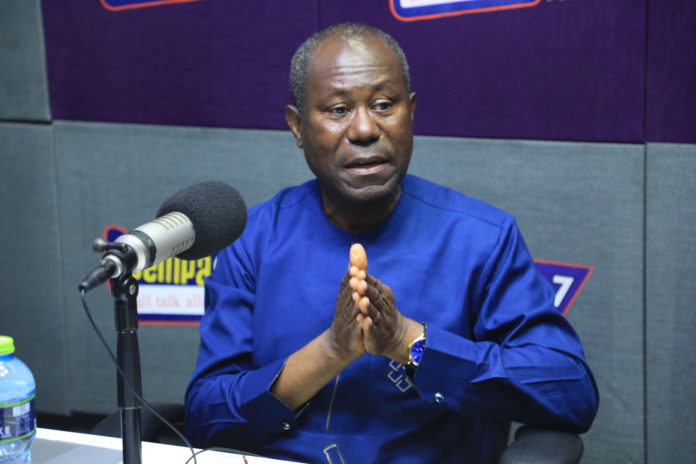
    A leading member of the National Democratic Congress (NDC), Edudzi Tameklo, has described the Chief Executive of Ghana Cocoa Board (COCOBOD), Mr. Joseph Boahen Aidoo, a “very wicked man” who has “completely destroyed” the once-creditworthy state enterprise.

    According to Mr Tameklo, Mr Aidoo has run down COCOBOD to the point where international banks now view it as unattractive for business.

    Mr Tameklo’s remarks come in response to COCOBOD’s recent announcement at a media briefing on August 20, 2024.

    The announcement revealed that the organization is departing from its 32-year tradition of relying on offshore borrowing for cocoa purchases through its syndication program.

    Mr. Aidoo stated that, starting with the 2024/2025 cocoa crop season beginning in September 2024, COCOBOD will shift to self-financing in an effort to reduce its reliance on external funds.

    “Is it good that always, COCOBOD should be heard going to borrow? Are we comfortable with that tag?” he asked rhetorically before announcing: “Today, you have heard that COCOBOD is not going to borrow,” adding: “It is quite a good time for any human being to learn his or her lessons.” 

    “In 32 years, we have learned our lessons, and we think that it is high time we wean ourselves from the offshore international financial markets and then finance the crop ourselves here. And that is exactly what we are going to do. And I think it comes with a lot of projectory benefits,” Mr Aidoo noted.

    He mentioned: “We are looking for $1.5 billion this crop season, and looking at the interest rates last year, which were over 8 per cent, plus the cost, it means that we can save more than $150 million by the decision not to go offshore.”

    Mr. Tameklo who doubles as the Director of Legal Affairs for the National Democratic Congress, took to Facebook to criticize Mr. Aidoo’s announcement.

    Mr Tameklo argued that rather than acknowledging his role in COCOBOD’s financial difficulties and poor production figures, Aidoo is attempting to capitalize on the “mess” he created for personal gain.

    “Cocoa production has fallen to 500,000 metric tonnes. Instead of admitting that you are responsible for this mess, you are here creating [a] useless impression,” wrote Mr Tameklo, who insisted: “This man should be arrested.”

    According to Mr Tameklo, “All he [the COCOBOD CEO] is interested in is the award of sole-sourced contracts to Bawumia’s brother and others,” exclaiming: “Shame!”

  • COCOBOD’s crop loan request rejected by international banks – Minority

    COCOBOD’s crop loan request rejected by international banks – Minority

    The Minority in Parliament has expressed serious concerns regarding COCOBOD’s financial stability, following reports that international banks have declined to approve a loan requested by the organization for the 2024/2025 cocoa season.

    The opposition argued that the refusal to grant this loan is a troubling sign of diminishing confidence in COCOBOD’s management.

    They believe this situation underscores ongoing issues with financial mismanagement and poor decision-making that have plagued COCOBOD in recent years.

    Traditionally, COCOBOD has relied on offshore syndicated loans to fund the purchase of cocoa beans.

    The latest rejection by international banks suggests a significant erosion of trust in COCOBOD’s financial stewardship.

    In response, COCOBOD’s Chief Executive Officer, Joseph Boahen Aidoo, has announced that for the first time in three decades, the organization will not be able to secure offshore syndicated loans for cocoa procurement.

    Instead, COCOBOD plans to use its own resources to finance the purchase of approximately 650,000 metric tonnes of cocoa for the upcoming season.

    The Minority has raised alarms that this development could severely impact the cocoa industry, a vital sector for Ghana’s economy.

    They caution that without adequate funding, COCOBOD may struggle to meet its purchasing targets, potentially harming cocoa farmers and the broader economic landscape.

    The Minority has called for urgent government intervention to address the underlying issues contributing to this loss of confidence.

    They advocate for a review of COCOBOD’s management practices and the implementation of corrective measures to restore the organization’s credibility with international financial institutions, ensuring the stability and strength of the cocoa sector.

    The statement highlights that, for the first time in 32 years, COCOBOD’s request for a $1.5 billion prepayment loan to purchase cocoa did not attract any interest from international banks.

    This failure is attributed to COCOBOD’s deteriorating financial health and the overall decline of the cocoa sector under the current administration.

    The statement also points to a dramatic drop in cocoa production from 969,000 metric tonnes in the 2016/2017 crop year, inherited from the previous administration, to just over 400,000 metric tonnes for the 2023/2024 season.

    This significant reduction in production, combined with mismanagement, has affected COCOBOD’s ability to fulfill its contractual obligations.

    “For the first time in 32 years, International Banks have rejected Ghana Cocoa Board’s (COCOBOD) request for a prepayment loan to finance the purchase of cocoa.”

    “In June 2024, COCOBOD issued a Request for Proposal of $1.5 billion loan to purchase up to 650,000 metric tonnes of cocoa for the 2024/2025 crop year. But this request did not attract any interest from the international banks due to the poor health of COCOBOD and the collapse of the cocoa sector under its present management.

    “From a production level of 969,000 metric tonnes inherited from the NDC in the 2016/2017 crop year, cocoa production has declined to just a little over 400,000 metric tonnes for the 2023/2024 cocoa season. The significant decline in cocoa production in the last eight years and the mismanagement of the cocoa sector have impacted COCOBOD’s ability to meet its contractual obligations,” an excerpt of the statement said.

    Read statement below:

  • We will not seek financial aid from international banks for 2024/25 cocoa crop season – COCOBOD

    We will not seek financial aid from international banks for 2024/25 cocoa crop season – COCOBOD

    The Ghana COCOBOD has revealed that, for the first time in 30 years, it will not pursue an offshore syndicated loan to fund the purchase of cocoa beans for the 2024/2025 crop season.

    Aiming to procure around 650,000 metric tonnes of cocoa beans for the season, COCOBOD stated that it will fund the purchases through its internal operations.

    During a press briefing, Chief Executive Joseph Boahen Aidoo revealed that there is a comprehensive plan to reduce COCOBOD’s reliance on high-interest loans from offshore lenders.

    He stressed that it is not financially wise for COCOBOD to continue depending on loans from international banks when it has the ability to raise funds domestically at a lower cost to purchase the beans.

    “For the first time in the history of Ghana COCOBOD, we want to wean COCOBOD off from offshore syndication. We want to be self-financing. Since 1992 COCOBOD has been going offshore to borrow from a consortium of banks. It is a good time to learn our lessons”.

    Mr. Boahen Aidoo insisted that COCOBOD can self-finance its operations and purchases, providing all the proceeds it will accrue to the government of Ghana for other developmental projects.

    “In the previous year, COCOBOD has paid interest of more than US$150 million. That money could have been used for other things in the country”, he said.

    Defending the decision, he stressed that move has received all the support of major stakeholders in the sector to make the farmer the ultimate beneficiary in the value chain.

    “We have always being looking out for the interest of the farmer. The farmer is the most important person. Ghana and Ivory Coast pushed for the Living Income Differential of 400 dollars per tonne for the farmer”, he recalled.

    Meanwhile Mr. Boahen Aidoo announced that the 2024/2025 crop season will start from 1st September this year.

  • 6 cocoa road projects cancelled over lack of funds

    6 cocoa road projects cancelled over lack of funds

    Ghana Cocoa Board (COCOBOD) has announced the discontinuation of six cocoa road projects due to financial challenges.

    These initiatives were among 14 road projects started by COCOBOD between 2015 and 2016, covering seven regions and estimated to cost 370 million Ghana cedis.

    After nearly ten years, none of these roads have been finalized.

    In a presentation to the Public Accounts Committee, COCOBOD’s Chief Executive Officer, Joseph Boahen Aidoo, explained that the institution’s financial challenges have made it unfeasible to proceed with six of these initiatives.

    He added that a table provided to the committee outlines the official cessation of these six projects, while the remaining ones are being reorganized for completion.

    Mr Aidoo assured the committee that should resources become available in the future, the cancelled projects may be reconsidered. “But I give that assurance that one’s resources are available they would be definitely taken on board.”

    Regarding a separate matter involving an 8.3 million cedis rent debt noted by the Auditor-General, COCOBOD is facing difficulties in retrieving 6.8 million cedis owed by the Produce Buying Company (PBC). Ray Ankrah, COCOBOD’s Deputy CEO for Finance and Administration, offered an update on the issue.

    “The rent arrears for Jubilee House, amounting to 102,000 cedis, have been fully settled. Additionally, the outstanding rent for properties on Lake Road in Kumasi, totaling 263,307.06 cedis, has been recovered. The Sunyani Jubilee House rent of 74,771 cedis has also been collected. This accounts for approximately 67% of the total outstanding debt.

    “However, we are facing challenges with the PBC’s debt of 6,851,517.51 million cedis, which remains unpaid. Management has engaged with PBC to discuss and agree on a payment plan, and we are confident that as the new season begins, we will be able to recover these funds through their Credit to Revenue (C2R) arrangements,” Mr Ankrah explained.

  • EXPLAINER: Why COCOBOD has ditched plans to borrow from international banks after 32 years

    EXPLAINER: Why COCOBOD has ditched plans to borrow from international banks after 32 years

    Ghana’s cocoa regulator, COCOBOD, is breaking away from a 32-year tradition of seeking funds from international banks for the annual cocoa crop season to adopt a method of self-reliance at the start of the 2024/2025 cocoa crop season in September 2024.

    Cocoa, which is a key export commodity for Ghana, has generated significant revenue streams for the country over the years. 

    Cumulatively, Ghana and Ivory Coast account for about 60 percent of the global supply for cocoa beans. 

    While some argue that cocoa and gold are Ghana’s top exports, there is contention over the country’s ability to meet global supply and consumer demand like its counterpart Ivory Coast.

    Why is this transition necessary?

    Chief Executive Officer of COCOBOD, Joseph Boahen Aidoo, has explained that the decision to move away from seeking syndicated loans from external sources is part of a broader strategy towards self-reliance and reducing dependency. 

    Ghana’s cocoa production output reached 429,323 metric tons at the end of the harvest in June this year, according to data released by COCOBOD.

    This production output is less than 55 percent of the average seasonal output. The decline in output has been attributed to disastrous harvests caused by poor weather conditions, swollen pod disease, and illegal mining activities taking place in cocoa-growing areas.

    These developments have not only disrupted COCOBOD’s operations but have impacted the supply chain, pushing prices for cocoa beans up on the international market.

    Additionally, the COCOBOD CEO on Tuesday, August 21, 2024, told journalists that the regulator has often relied on these external funds to undertake activities in the cocoa crop season over three decades, a move which he says has strained its finances and operations with regards to loan repayment obligations.

    “Is it good that COCOBOD should always be heard going to borrow? Are we comfortable with that tag? Today, you have heard that COCOBOD is not going to borrow. It is quite a good time for any human being to learn his or her lessons.

    “In 32 years, we have learned our lessons and we think that it is high time we wean ourselves from the offshore international financial markets and then finance the crop ourselves here, and that is exactly what we are going to do. And I think it comes with a lot of projectory benefits,” he explained.

    The COCOBOD boss said the regulator is aiming to save more than $150 million as part of this self-reliance strategy during the upcoming 2024-2025 cocoa season.

    “We are looking for $1.5 billion this crop season, and looking at the interest rates last year, which were over 8 percent, plus the cost, it means that we can save more than $150 million by the decision not to go offshore,” he explained.

    How will COCOBOD fund itself?

    While Ghana’s cocoa regulator is yet to provide a more detailed insight into how it will fund its activities moving forward, it plans to tap from domestic sources to fund cocoa purchases from farmers in the new season.

    However, the absence of cocoa funding will mean that the Bank of Ghana will have to tap into revenue accrued from the sale of cocoa beans to build foreign reserves instead of relying on the bulk amount it receives every October when the harvesting season begins.

    “Whatever cocoa we sell is sold in dollars, and so the revenue from our cocoa will be paid in dollars. Our forward contracts will all be paid for in dollars when we deliver the cocoa so the dollars will come in to shore up the cedi,” the COCOBOD CEO briefly explained.

    Also, for the upcoming 2024-2025 cocoa crop season, production output has been cut by 20 percent to 650,000 tons on the back of poor weather concerns, lack of fertilizer, disease, and poor environmental practices in growing areas also known as galamsey.

    These disruptions have also placed Ghana in the second spot behind Ivory Coast, who is at the top spot of the summit.

    On the international market, demand and supply disruptions continue to impact cocoa prices, with futures rising above $11,000 per ton for the first time, according to Bloomberg Commodities. 

    What’s in it for farmers?

    Ghana’s COCOBOD says farmers will remain the topmost priorities during this transition, emphasizing that they will not be short-changed in pricing measures and decisions.

    “It is not true that COCOBOD is not giving the farmers a fair price. If you follow the narrative, you will notice that from 2017 on, COCOBOD has been even more than fair. The government had been more than fair to farmers because this was a time when prices had collapsed, but the government and COCOBOD did not reduce the farmers’ price,” the COCOBOD CEO stated.

    Conclusion

    Even as Ghana’s cocoa regulator will continue to remain under significant scrutiny as it embarks on a transition toward self-reliance, the success of this strategy is crucial for the country. 

    Cocoa is a significant contributor to the country’s economy, providing livelihoods for millions of farmers and being a major export commodity for Ghana.

    Source: Ghanaweb

  • No more borrowing, COCOBOD set to finance itself in coming days – CEO

    No more borrowing, COCOBOD set to finance itself in coming days – CEO

    Ghana Cocoa Board (COCOBOD) has announced that it will transition to self-financing for the 2024/2025 cocoa crop season, starting in September 2024.

    For the past 32 years, COCOBOD has relied on offshore borrowing to finance cocoa purchases through its cocoa syndication programme.

    However, the organization is shifting its strategy to reduce dependency on external funds.

    Speaking to the media on Tuesday, August 20, COCOBOD’s CEO, Joseph Boahen Aidoo, explained that this new approach is expected to save an estimated $150 million.

    “Is it good that always COCOBOD should be heard going to borrow? Are we comfortable with that tag? Today, you have heard that COCOBOD is not going to borrow. It is quite a good time for any human being to learn his or her lessons.

    “In 32 years, we have learned our lessons and we think that it is high time we wean ourselves from the offshore international financial markets and then finance the crop ourselves here and that is exactly what we are going to do. And I think it comes with a lot of projectory benefits.

    “We are looking for $1.5 billion this crop season and looking at the interest rates last year, which were over 8 percent, plus the cost, it means that we can save more than $150 million by the decision not to go offshore.

    He also denied assertions that COCOBOD was short-changing farmers with its pricing of cocoa.

    “It is not true that COCOBOD is not giving the farmers a fair price. If you follow the narrative, you will notice that from 2017 on, COCOBOD has even been more than fair.

    “The government had been more than fair to farmers because this was a time when prices had collapsed but the government and COCOBOD did not reduce the farmers’ price.”

  • Zenith Bank has frozen over GHS1.6m of our funds due to DDEP – COCOBOD

    Zenith Bank has frozen over GHS1.6m of our funds due to DDEP – COCOBOD

    The Ghana Cocoa Board (COCOBOD) has revealed that more than GH¢1.6 million of its investments are currently tied up with Zenith Bank due to the government’s Domestic Debt Exchange Programme (DDEP).

    During a session with the Public Accounts Committee of Parliament, Ray Ankrah, Deputy CEO of COCOBOD for Finance and Administration, reported that while GH¢200,000 has been recovered from an initial sum exceeding GH¢1.8 million, efforts are ongoing to reclaim the remaining balance.

    “COCOBOD is pursuing the amount. So far Zenith has paid GH¢253, 550 of the total amount so we are still pursuing the remaining amount.”

    “Honourable chair, what we do is every now and then we hold meetings with them, we remind them with letters so we are sure that once the funds are available they will transfer it into our account,” he stated.

    The auditors reported that from the total amount exceeding GH¢1.8 million, GH¢255,403 had been recovered or repaid, leaving an outstanding balance of GH¢1,611,884.45. A payment plan for the remaining balance has yet to be determined.

  • COCOBOD expects 800,000 metric tons of cocoa in 2024/25 season after GHC943m investment

    COCOBOD expects 800,000 metric tons of cocoa in 2024/25 season after GHC943m investment

    The Ghana Cocoa Board (COCOBOD) is projecting a significant boost in cocoa production for the 2024/25 season, anticipating over 800,000 metric tons, following a substantial GHC943 million investment aimed at rehabilitating aged and disease-ridden cocoa farms.

    This effort is part of a broader strategy to revive the cocoa sector and support the livelihoods of farmers.

    COCOBOD’s Chief Executive Officer, Joseph Boahen Aidoo, revealed that the nearly billion-cedi investment made last year was crucial to restoring cocoa farms affected by the devastating swollen shoot virus disease (CSSVD) and aging trees.

    These initiatives, he explained, are essential to sustaining the country’s cocoa output and ensuring the welfare of farmers.

    In an interview, Mr. Aidoo and his Deputy CEO in charge of Finance and Administration, Ray Ankrah, addressed concerns raised in the media regarding COCOBOD’s rising administrative expenses, which reportedly hit GH¢3.4 billion last year.

    The CEO clarified that this figure includes the substantial funds allocated to rehabilitate cocoa farms, countering claims that the money was solely spent on administrative overhead.

    “The money was used to fund the cutting down of diseased and aged farms, nurse, and plant seedlings as well as maintain the rehabilitated farms before handing them over to farmers across the country,” Mr. Aidoo stated. He stressed that these strategic investments were necessary and justified the increase in administrative costs.

    Mr. Ankrah further elaborated that a significant portion of the administrative costs was related to the GHC943 million expenditure on productivity enhancement programs (PEPs).

    He noted that this expenditure, which was supported by a loan from the African Development Bank (AfDB), was a one-time cost that played a pivotal role in sustaining the livelihoods of affected farmers and boosting future cocoa production.

    The Deputy CEO dismissed claims that the administrative expenses were excessive, stating, “The GH¢943 million was actually used to rehabilitate diseased and moribund farms to sustain the livelihood of the affected farmers and increase cocoa production, starting with the 2024/25 season.”

    He added that, excluding this one-off expenditure, COCOBOD’s administrative costs had actually decreased in 2023.

    Addressing the broader impact of the swollen shoot virus disease, Mr. Aidoo emphasized that the rehabilitation of cocoa farms is critical for maintaining the sector’s viability. The disease, which significantly reduces cocoa yields before killing the trees, has been a major factor in the recent decline in national cocoa production.

    COCOBOD’s efforts, he said, are vital to preventing further loss of productive land and ensuring the continued benefits derived from cocoa farming.

    Mr. Aidoo also highlighted the board’s commitment to supporting farmers with adequate and timely inputs for the upcoming season, including hand pollination, pruning, and irrigation initiatives.

    These efforts are not only aimed at increasing production but also at making cocoa farming more appealing to the younger generation, encouraging more youth to enter the sector.

    On the financial front, Mr. Ankrah pointed to COCOBOD’s successful turnaround in 2023, where the board recorded a profit of GH¢2.3 billion, a significant recovery from the GH¢4.2 billion loss in 2022.

    He attributed this to prudent financial management and ongoing efforts to enhance cocoa production and profitability, despite the challenges posed by the COVID-19 pandemic.

    In conclusion, Mr. Aidoo assured farmers of COCOBOD’s continued commitment to implementing better policies and programs in the upcoming season, in line with the government’s goals of improving farmer livelihoods and sustaining the country’s cocoa production.

  • Massive! Money laundering, corruption allegations hit COCOBOD as CEO award billions in contracts to his son – Netizen alleges

    Massive! Money laundering, corruption allegations hit COCOBOD as CEO award billions in contracts to his son – Netizen alleges

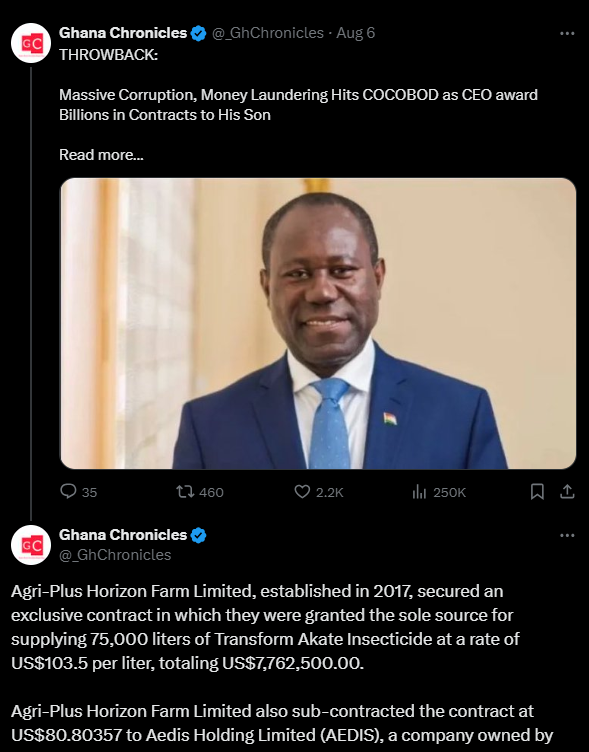
    An exposé shared by the Gh Chronicles Twitter handle has raised serious allegations against Joseph Boahen Aidoo, the Chief Executive Officer (CEO) of COCOBOD, suggesting his involvement in a questionable transaction.

    The report claims that the COCOBOD CEO awarded lucrative contracts worth billions to his son.

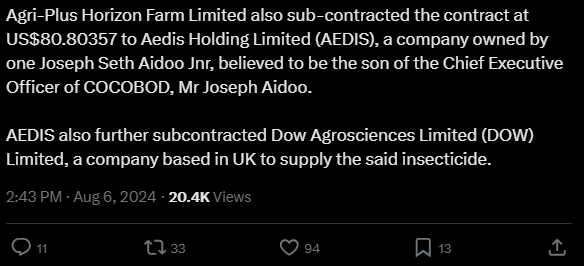
    According to the allegations, a company named Agri-Plus Horizon Farm Limited, reportedly owned by Joseph Seth Aidoo Jnr., who is believed to be the son of the COCOBOD CEO, was granted an exclusive contract.

    This contract allegedly involved the sole supply of 75,000 litres of Transform Akate Insecticide at a rate of US$103.5 per litre, amounting to a total of US$7,762,500.00.

    It is further alleged that Agri-Plus Horizon Farm Limited subcontracted the supply of this insecticide to Dow AgroSciences Limited (DOW), a company based in the UK.

    These allegations have sparked a wave of mixed reactions among netizens, fueling a heated debate on social media.

    See below post:

  • COCOBOD addresses loan default claims, clarifies debt status

    COCOBOD addresses loan default claims, clarifies debt status

    The Ghana Cocoa Board (COCOBOD) has addressed allegations of repeated loan defaults, providing clarity on its financial obligations and repayment status.

    As of December 31, 2022, COCOBOD’s total debt to the Bank of Ghana was reported at GH¢8.24 billion.

    This debt includes a GH¢1.99 billion loan facility with a 10-year term and an overdrawn Cocoa Bills Retirement Account totaling GH¢6.86 billion.

    COCOBOD clarified that the GH¢1.99 billion loan, secured in 2013, was meant to cover outstanding cocoa bills from the 2010/2011 season. The loan included a moratorium until 2018 due to cash flow issues worsened by low cocoa prices during the COVID-19 pandemic.

    Although there have been delays in repaying the principal, COCOBOD has consistently met interest payments and has set up a revised repayment plan to start in October 2024. The Board firmly denied any default on this loan.

    For the overdrawn Cocoa Bills Retirement Account, COCOBOD attributed the deficit to non-marketable cocoa bills from the 2016/2017 season, which were crucial for maintaining cocoa production amid falling international prices and changing agricultural trends.

    These bills were rolled over at elevated interest rates due to prevailing economic conditions.

    During the 2023 Domestic Debt Exchange Program, the government assumed a substantial portion of this debt, providing COCOBOD with a 50% discount. The remaining debt balance is still noted but does not reflect the initial amount claimed.

    COCOBOD’s Public Affairs Department emphasizes that the Board has not defaulted on its commitments and is managing its debt obligations responsibly.

    Read full response in the statement below:

  • A-G orders BoG to recover COCOBOD’s GHS8.241bn debt

    A-G orders BoG to recover COCOBOD’s GHS8.241bn debt

    The Auditor-General’s 2023 report has urged the Bank of Ghana to take steps to recover GH¢8.241 billion that the Ghana Cocoa Board (COCOBOD) owes.

    The report highlights that COCOBOD has consistently failed to meet its loan repayment obligations to the central bank.

    By December 31, 2022, the outstanding principal amount had reached GH¢8.241 billion.

    It suggested that the central bank should adopt measures to reduce its risk exposure to quasi-government entities and set up clear repayment schedules for future loans.

    The report also recommended that the Bank of Ghana formalize its “Gold Purchase Programme” with the Precious Mineral Marketing Company (PMMC).

    The Auditor-General pointed out the lack of a formal agreement for these transactions, which has left key details, such as fees or commissions paid to PMMC, unconfirmed.

    It stressed the importance of having formal agreements for such transactions to ensure both transparency and accountability.

  • COCOBOD owes BoG over GHC8bn – Auditor General

    COCOBOD owes BoG over GHC8bn – Auditor General

    The 2023 Auditor General Report has called on the Bank of Ghana to recover GH¢8.241 billion owed by the Ghana Cocoa Board (COCOBOD).

    The report highlights that COCOBOD has repeatedly defaulted on loans provided by the Bank of Ghana, resulting in an outstanding principal amount of GH¢8.241 billion as of December 31, 2022.

    The Auditor General has recommended that the Central Bank establish policies to mitigate its exposure to quasi-government entities and ensure clear repayment plans are in place for loans.

    Furthermore, the report urges the Bank of Ghana to formalize its “Gold Purchase Programme” agreement with the Precious Minerals Marketing Company (PMMC). The Central Bank had engaged PMMC to handle gold purchases and sales on its behalf.

    However, the Auditor General found that a formal agreement for these transactions was missing.

    “As a result, we could not confirm salient terms of the engagement including fees or commissions paid to PMMC for their services. Transactional relationships of this nature must be formalized with an agreement,” the report emphasized.

  • COCOBOD makes $149.8m profit through restructured debt – Auditor General’s report

    COCOBOD makes $149.8m profit through restructured debt – Auditor General’s report

    Ghana’s Cocoa Marketing Board (Cocobod) reported a profit of GH¢2.3 billion ($149.84 million) for the 2022/23 fiscal year, largely due to debt restructuring, according to an Auditor General report obtained by Reuters on Tuesday.

    The report revealed that this was Cocobod’s first profit after experiencing six consecutive years of losses.

    As the world’s second-largest cocoa producer, Ghana has been working to restructure its $30 billion debt, including that from the cocoa sector, to support a $3 billion, three-year International Monetary Fund program and recover from its most severe economic crisis in decades.

    Last month, Ghana concluded a deal with its official creditor committee and reached a preliminary agreement with two bondholder groups to restructure approximately $13 billion of its debt, advancing its debt overhaul efforts.

    These developments followed a domestic debt restructuring program in 2023, during which various bonds, including cocoa bills used to address Cocobod’s short-term liquidity needs, were exchanged for long-term securities with reduced yields.

    Cocobod “ended the year with a profit of 2.3 billion cedi, compared with a loss of 4.2 billion cedi in 2022,” said the auditor general report on public corporations and boards yet to be published.

    Ray Ankrah, deputy CEO of Cocobod, said the recovery was largely on the back of the debt restructuring.

    “There were huge financing costs; we were paying something in the range of 34% but it’s now down to 13% (after the restructuring),” he said.

    Mr. Ankrah noted that rising global cocoa prices, higher sales of cocoa beans, currency stability, and improved cost management all contributed to the profit.

    The audit report indicated that Cocobod’s revenue grew by 41.7% to GH¢17.7 billion in 2023, driven by increased sales of cocoa beans.

    According to the report, Cocobod may still face challenges in meeting its short-term financial commitments due to inadequate liquidity.

    Cocoa prices have more than doubled this year, primarily due to poor harvests in Ghana and Ivory Coast, which together account for 60% of the world’s cocoa supply.

  • COCOBOD designs forward sales strategy for cocoa beans to mitigate price increase

    COCOBOD designs forward sales strategy for cocoa beans to mitigate price increase

    Chief Executive Officer of the Ghana Cocoa Board (COCOBOD), Joseph Boahen Aidoo, has noted that the cocoa bean forward sales is imperative in fostering sectoral growth and sustainability.

    His remarks come in response to calls from several Civil Society Organizations for COCOBOD to reconsider its forward sales cocoa marketing system, especially in light of escalating market prices.

    Speaking to Joy Business following visits to farms in the Western and Central regions, Mr. Boahen Aidoo underscored that employing forward sales is a deliberate strategy designed to mitigate price risks and manage stock effectively.

    “I am not ruling out spot for sales but it is always better to do forward sales. The buyer himself want forward sales just as the sellers. At all times, forward sales have been better than spot”.Mr. Boahen Aidoo explained that “The situation only changed for last year due to some announcement from the World Meteorological Centre on the El Nino which caused the market to panic a bit which resulted in people raising the price of cocoa.“Now, El Nino has retreated and the prices of cocoa have started coming down” he added.

    Mr. Boahen Aidoo advised cocoa farmers across the seven regions to adopt hand pollination practices.

    He noted that some farmers have experienced notable productivity gains, resulting in increased incomes since the introduction of hand pollination interventions in 2017.

    Additionally, he endorsed the use of motorized slashers and pruners to enhance cocoa tree exposure to sunlight and air, which aids in increasing fruit production.

    “Now that prices are good on the international market, what is needed is more yields to make farmers benefit. That’s why we’ve deliberately come up with the hand pollination programme. So, all cocoa farmers should embrace it,”

    “Ordinarily, if you allow even pruned farms to fruit on their own, for the natural insects to do the pollination, you may end up getting about five to eight bags per hectare, but some farmers were producing between 20 bags and 30 bags per hectare. That’s where we want all our farmers to get to” he added.

    The Ghana Cocoa Board is also asking farmers to stop the use of cocktail chemicals which is the practice of mixing insecticides and fungicides to spray farms, but rather use poultry manure to improve soil nutrients to support higher yields of produce.

    “Now that prices are good on the international market, what is needed is more yields to make farmers benefit. That’s why we’ve deliberately come up with the hand pollination programme. So, all cocoa farmers should embrace it,”

    “Ordinarily, if you allow even pruned farms to fruit on their own, for the natural insects to do the pollination, you may end up getting about five to eight bags per hectare, but some farmers were producing between 20 bags and 30 bags per hectare. That’s where we want all our farmers to get to” he added.

    The Ghana Cocoa Board is urging farmers to cease using cocktail chemicals—mixtures of insecticides and fungicides for spraying farms—and to instead utilize poultry manure to enhance soil nutrients for increased crop yields.

  • World Bank supports COCOBOD with US$100m to rehabilitate cocoa farms

    World Bank supports COCOBOD with US$100m to rehabilitate cocoa farms

    The Ghana Cocoa Board (COCOBOD) has secured a US$100 million financing facility from the World Bank to rehabilitate old cocoa farms across six districts in the country, including Assin Fosu, New Edubiase, Nkawkaw, and Juaso.

    This four-year project will support the cutting down of cocoa trees that are over 20 years old, prepare the land, and provide planting materials such as seedlings and suckers.

    COCOBOD’s Chief Executive Officer, Mr. Joseph Boahen Aidoo, announced this during a field trip to farms in Assin Fosu, Central Region, on July 4, 2024.

    The visit aimed to assess the work of extension officers, evaluate government interventions for farmers, and educate them on best practices to increase cocoa yields.

    Mr. Aidoo explained that while the trees to be cut down are not diseased, they have outlived their lifespan, with some being over 30 years old, becoming ‘moribund.’

    He emphasized that cocoa trees over 20 years old are unproductive and require rehabilitation to rejuvenate the farms and increase production.

    “Once cocoa hits 20 years and above, it has spent its life span, and from that stage, you realise that it bears no fruits, no pods, and the flowers don’t come, yet the farmer would be maintaining such a farm, and this is not productive,” he said.

    COCOBOD will support farmers with plantain suckers, labor for planting, and provide extension officers to assist with farm management for optimal yields. Mr. Aidoo noted that without such support, farmers would struggle to achieve the desired outcomes.

    He highlighted a similar project implemented with support from the African Development Bank (AfDB) under the Cocoa Rehabilitation Programme, which focused on ending Cocoa Swollen Shoot Virus Disease (CSSVD).

    During the visit, farmers urged the government to expedite road construction in cocoa-growing areas to reduce post-harvest losses and improve transport of produce. They also called for more extension officers, recognizing their valuable training and assistance.

    Nana Kweku Appotoi IV of Assin Nyankomase expressed concern over deplorable roads in cocoa-growing communities, urging COCOBOD to address this issue. He also committed to preventing illegal miners from taking over cocoa farms and encouraged farmers to adhere to best practices and share their knowledge.

    Mr. Aidoo assured farmers that the government would allocate funds to fix roads in cocoa-growing communities following cocoa price hikes. He advised against growing cocoa in sandy and clay soils, burning weeds, and selling cocoa branches for firewood. Instead, he recommended using these branches as mulch and avoiding harmful weedicides like ’round-up’ and glyphosate, which damage soil health and reduce crop yields.

    Since 2020, COCOBOD has procured about 100,000 motorized slashers and pruners to help clear cocoa farms and increase production, urging farmers to access them from district offices.

    Mr. Aidoo also noted that COCOBOD has improved the extension officer-to-farmer ratio from one-to-three thousand to one-to-600, nearing the Food and Agriculture Organization’s (FAO) international standard of one officer-to-500 farmers.

  • Fiifi Boafo to serve as spokesperson for NAPO

    Fiifi Boafo to serve as spokesperson for NAPO

    The Head of Corporate Affairs at COCOBOD, Fiifi Boafo, has been named as the spokesperson for the New Patriotic Party’s (NPP) running mate, Dr. Matthew Opoku Prempeh.

    According to reliable sources from MyNewsGh.com, Boafo will manage all communication activities for Dr. Opoku Prempeh, drawing on his extensive experience in the media sector to effectively convey the governing party’s messages.

    Many are questioning whether Mr Boafo will step down from his role as Corporate Affairs Director at COCOBOD as the campaign season intensifies.

    In preparation for Dr. Opoku Prempeh’s formal introduction on July 9, 2024, in the Ashanti Region, additional appointments are expected to bolster his campaign team and ensure a robust start.

  • World Bank supports COCOBOD’s cocoa rehabilitation with $100m

    World Bank supports COCOBOD’s cocoa rehabilitation with $100m

    The Ghana Cocoa Board (COCOBOD) has successfully obtained a US$100 million financing facility from the World Bank, aimed at rehabilitating aged cocoa farms across six key cocoa-growing districts in the country.

    The project will cover Assin Fosu, New Edubiase, Nkawkaw, and Juaso districts.

    This four-year initiative focuses on rejuvenating cocoa farms by cutting down trees that have lived for over 20 years, preparing the land, and providing necessary planting materials such as seedlings and plantain suckers.

    The Chief Executive Officer of COCOBOD, Mr. Joseph Boahen Aidoo, shared these details during a media interaction on July 4, 2024, as part of a field visit to farms in Assin Fosu in the Central Region.

    During the visit, aimed at evaluating the efforts of extension officers and government interventions, Mr. Boahen Aidoo explained that while the trees to be cut down are not diseased, they have outlived their productive lifespan, with some exceeding 30 years and becoming unproductive.

    “Once cocoa hits 20 years and above, it has spent its life span, and from that stage, you realise that it bears no fruits, no pods, and the flowers don’t come, yet the farmer would be maintaining such a farm, and this is not productive,” he noted.

    The rehabilitation project is expected to rejuvenate these farms, thereby boosting cocoa production. COCOBOD will support farmers with plantain suckers and labor for planting, along with providing extension officers to educate and assist farmers in managing their farms for optimal yields.

    Mr. Boahen Aidoo emphasized the necessity of comprehensive support, noting that simply providing seedlings would not be sufficient for the farmers to achieve the desired outcomes.

    Highlighting the scale of the project, he mentioned an example where farmers were working on a 30-hectare farm.

    “If you cut the trees from this 30-hectare land, and you want the farmer to provide plantain suckers within one year, they cannot. That’s why we’re supporting them,” he explained. He also referenced a similar project executed with support from the African Development Bank (AfDB), which aimed to combat the Cocoa Swollen Shoot Virus Disease (CSSVD).

    During the visit, farmers urged the government to expedite the construction of roads in cocoa-growing areas to facilitate the transport of produce and reduce post-harvest losses.

    They also called for more extension officers, acknowledging the significant help provided by these officers in their farming activities.

    Nana Kweku Appotoi IV, Aboabohene of Assin Nyankomase, lamented the poor road conditions in cocoa-growing communities and urged COCOBOD to lead efforts in improving the infrastructure.

    Responding to these concerns, Mr. Boahen Aidoo assured farmers that the government would allocate funds to improve roads in cocoa-growing areas following recent increases in cocoa prices.

    He advised farmers on best practices, such as avoiding cocoa cultivation in sandy and clay soils, not burning weeds, and using tree branches as mulch rather than selling them as firewood.

    He also cautioned against the use of harmful weedicides and materials like poultry manure, which can damage soil health and reduce crop yields.

    Mr. Boahen Aidoo highlighted COCOBOD’s efforts to equip farmers with modern tools, noting that since 2020, they had procured about 100,000 motorized slashers and pruners to help clear cocoa farms and increase production. He encouraged farmers to access these tools from various district offices.

    Additionally, he pointed out that COCOBOD had improved the extension officer-to-farmer ratio from one officer per 3,000 farmers to one officer per 600 farmers, nearly meeting the Food and Agriculture Organization’s (FAO) standard of one officer per 500 farmers.

  • COCOBOD Trial: GSA conducted test on Lithovit fertilizer in a wrong laboratory

    COCOBOD Trial: GSA conducted test on Lithovit fertilizer in a wrong laboratory

    In the trial of the former COCOBOD boss and two others, it has been revealed that the test result on Lithovit liquid fertilizer, presented by the prosecution as evidence, was conducted in the wrong lab at the Ghana Standards Authority (GSA).

    Moreover, the lab used specifications meant for a different product, not fertilizers, for its report.

    The Court learned that the Drugs, Cosmetics, and Forensic lab, which conducted the disputed test, used specifications and ranges intended for testing water, not fertilizers.

    Consequently, the GSA test conducted by Peter Quartey-Papafio in 2017 concluded that Lithovit “is harmful to humans, animals, as well as hazardous to water.”

    In a twist, the third prosecution witness, Dr. Yaw Adu-Ampomah, disclosed that a COCOBOD board member informed him that Lithovit liquid fertilizer is like water that farmers drink on their farms.

    The accused, including former COCOBOD Chief Executive Dr. Stephen Opuni, businessman Seidu Agongo, and Agricult Ghana Limited, face 27 charges, including defrauding by false pretences and willfully causing financial loss to the state.

    During court proceedings presided over by Justice Aboagye Tandoh, it emerged that the Drugs, Cosmetics, and Forensic lab was unsuitable for fertilizer analysis, with the appropriate lab being the General Chemistry lab under the Material Science Department.

    This discrepancy raises doubts about the validity of the prosecution’s evidence on Lithovit’s effectiveness as a fertilizer. The prosecution heavily relied on this flawed report, calling witnesses who used it to challenge Lithovit’s efficacy.

    Further revelations in court indicated that Dr. Adu-Ampomah excluded a favorable GSA test result from his report, which he knew of through meetings at EOCO and the office of the former Senior Minister, Yaw Osafo Marfo.

    Although Quartey-Papafio claimed to have subcontracted part of the testing, there is no evidence to support this assertion.

    Head of the Material Science Department, Mrs. Genevieve Baah Mante, confirmed learning about the Quartey-Papafio report during an EOCO meeting but denied involvement from her department.

    Additionally, Chief Scientific Officer Ms. Fiona Gyamfi from the Water Laboratory denied any role of her lab in Quartey-Papafio’s report during her testimony.

    The trial also highlighted that the GSA lacked a standard for cocoa fertilizer at the time, which further complicates the case.

    Ms. Gyamfi clarified the GSA’s subcontracting procedures and reiterated that no record exists of her lab receiving a subcontracted sample for testing.

    The court learned that the Quartey-Papafio report used GS175 standards for drinking water quality, not suitable for fertilizer testing. This standard does not cover elements crucial for fertilizer analysis, such as calcium, magnesium, and urea, which are specified in GS220 2014 for natural mineral water.

    These revelations underscore serious procedural flaws and misuse of standards in the prosecution’s case against the accused persons during the ongoing six-year trial.

    Find below excerpts of Tuesday’s proceedings:

    Q: Yesterday, we ended up on the statement you gave at EOCO, and I was asking if there was any discussion with EOCO on the Quartey-Papafio report.

    A: Yes.

    Q: What was the discussion?

    A: I remember when we were about to leave, I was finally asked that if I should give remarks on that report, what would I say?

    Q: And what did you say?

    A: And then I said the result stated in the report is not adequate enough for me to make a remark.

    Q: So when you said that, what did they say?

    A: They said it’s fine; it’s okay.

    Q: In relation to your statement, what did they do?

    A: They asked me to write it, so I stated it in my statement.

    Q: And with respect to cocoa, what did you tell them, and what did they ask you to do?

    A: Because in their request, they wanted us to also find out if the sample was suitable for cocoa growth, and we could not determine that, they asked us why, and then I responded that we did not have a standard for cocoa fertilizer at the time of the work; that was why we could not do it.

    Q: So your response on that, what did they ask you to do?

    A: We were asked to also write it in our statement.

    Q: And did you?

    A: Yes.

    Q: When you say ‘we,’ who do you mean, and who went to EOCO?

    A: My HOD and myself.

    Q: Was there any other meeting in respect of this test between your department and any other person or institution that you know about?

    A: Yes. We received an invitation to meet with Honourable Osafo Marfo.

    Q: Did you know his designation at the time?

    A: He was the Senior Minister by then.

    Q: And when you say ‘we received an invitation,’ who received the invitation?

    A: Mrs. Genevieve Baah Mantey and myself.

    Q: In respect of what?

    A: The analysis we conducted on the samples.

    Q: Did the meeting come on?

    A: Yes.

    Q: You personally, were you at that meeting?

    A: No.

    Q: Why were you not at the meeting?

    A: When the invitation came, the time for the meeting was 5 pm, and at that time, my nanny had travelled, so I had to go and pick my children from school myself, so I could not make it to the meeting.

    Q: But do you know whether the meeting came on anyway, although you were not there?

    A: Yes, my HOD told me.

    Q: You talked about subcontracting a test to the forensic lab. That is a very normal procedure with the Ghana Standards Authority. Is that the case?

    A: Yes.

    Q: How is it done?

    A: Because of the nature of our work, every laboratory has its scope of work. So, if you receive a sample and you cannot analyze it, or the lab does not have the capacity to do a particular parameter or test, the authority allows us to give it to any of our sister labs.

    Q: And what is the procedure?

    A: We have the subcontracting form, so you fill it with the sample particulars together with the parameter or the test you want to carry out. Then you send the sample together with the subcontract form you fill to the lab you are subcontracting to. The lab will also take it, fill part of the form, and then return a copy back to you. They will tell you when you can come for the result or when the result will be ready. The lab can pick it up by itself or it would be sent to the secretary for dispatch to the lab.

    Q: Are those subcontracts entered into your books?

    A: When you are sending the sample, you don’t enter it, but when you receive the sample, you enter it.

    Q: So the General Chemistry lab would enter it when they receive it?

    A: Yes.

    Q: Tell this Court. Do you have a Material Science Department?

    A: Yes.

    Q: The Material Science Department, what do they do?

    A: It is a department that houses the six various laboratories under it.

    Q: So when somebody says that they subcontracted the sample to the Material Science laboratory, in your institution, Ghana Standards Authority, what would that mean?

    A: It could be one of the labs under the department.

    Q: Have you seen Exhibit H page 105 where Quartey-Papafio’s result is? Look at the next page where the results are. Mr. Quartey-Papafio’s test relies on some standard; he quoted a standard at the specification column.

    A: GS175 part 1.

    Q: You have a copy of GS175 part 1?

    A: Yes.

    Q: What document is the GS175?

    A: Water quality specification for drinking water.

    Q: At Ghana Standards Authority, what do you use GS175 for?

    A: It is used at the water laboratory for testing drinking water.

    Q: Look at the photocopy I gave you. Is that photocopy an extract of the cover page, foreword, and pages 1 to 7 of GS175?

    A: Yes.

    Counsel for 2nd and 3rd Accused: We wish to tender it through her.

    Counsel for Republic: We don’t have an objection.

    Counsel for 1st Accused: We don’t have an objection and we wish to add that as contained in Exhibit H with the Ghana Standard Authority report by Quartey Papafio, it states that the specification is GS175 and that is the document we have.

    By Court: The extract, Ghana Standard GS175: 2017, 5th Edition (Water Quality – Specification for drinking water), is tendered without an objection from counsel for A1 and the Prosecution and is admitted and marked as Exhibit 147/A2 and A3.

    Q: Tell this Court, look through the GS175, the copy you have and the extract Exhibit 147, and tell this Court if there is any standard or reference for fertilizer.

    A: There is none.

    Q: Can GS175, Exhibit 147, be the standard for testing fertilizer?

    A: No.

    Q: You have Exhibit H page 106 where the results are. You would find the entry there; calcium and the specification for calcium is 19.7. Have you seen it?

    A: Yes.

    Q: Is there any range, standard, or reference for calcium in GS175 Exhibit 147?

    A: No.

    Q: What about magnesium, is there any range, reference, or standard in Exhibit 147, GS175?

    A: No.

    Q: Is the reference, standard, or range for urea in Exhibit 147?

    A: No.

    Q: Mr. Quartey-Papafio told the Ghana Police that he subcontracted the Exhibit to the Material Science Laboratory. Would you know the laboratory where he subcontracted to?

    A: No.

    Q: Did you at the General Chemistry Laboratory ever get to know during all your discussions about the test that the forensic lab subcontracted the test resulting in the result in Exhibit H for testing? Did you get to know?

    A: No.

    Q: Did it come up at any time in your meetings in EOCO that Mr. Quartey-Papafio subcontracted the sample to another institution?

    A: No.

    Q: If you look at the same Exhibit H page 106, it talks about calcium, magnesium, and urea. If you want the reference for calcium and magnesium, where would you find it?

    A: It would be found in the GS220 2014. That is the water quality specification for natural mineral water.

    Q: What do you have in your hand?

    A: An extract of the GS220 2014.

    Q: There is a table in the GS2014 itself where the specifications are. Is that correct?

    A: Yes.

    Q: Mr. Quartey-Papafio told the police that the remarks and recommendations were based on the result of the test and the standard used, being that it did not conform with the specifications. Tell this Court, is it possible in science to rely on GS175 to determine whether the sample is good for cocoa?

    A: No.

    Q: Go back to page 106 of Exhibit H. Mr. Quartey-Papafio was very detailed in his remark. He said, “From the foregoing examination and testing, the sample has been adulterated and does not meet the specifications of the standard.” Can you, from looking at his report, state which standard he based his testing and analysis on?

    A: I believe he was referring to GS175 part 1.

    Q: He went on, interestingly, to state that the sample is not recommended for its intended purpose. How do you normally determine the intended purpose of the sample?

    A: To determine that, usually a performance test must be done on the sample before you can ascertain its intended purpose.

    Q: And then he was emphatic, “The sample, therefore, cannot be used as foliar nutrient on cocoa from nursery, growth, and yield stage.” Look at the results stated in the table on page 106 of Exhibit H. Can that lead to the conclusion reached by Mr. Quartey-Papafio?

    A: No, because with the specifications, if you look at our standards, it should come either in maximum or minimum before we can say that the results are within or not within the specification.

    Q: Can you use your standards at the Ghana Standards Authority to determine whether a product can be used as a foliar nutrient from nursery, growth, and yield stage?

    A: No.

    Q: Can this table on page 106 of Exhibit H truly form the basis of the conclusion that “it is harmful to humans, animals, as well as hazardous to water”?

    A: No.

    Q: You have in your hand a photocopy of GS220. Is that correct?

    A: Yes.

    Q: You told this Court that that is where you can get the range of calcium and magnesium. On which page is the table?

    A: Page 5.

    Counsel for 2nd and 3rd Accused: We wish to tender it through her.

    Counsel for Republic: I have no objection.

    Counsel for 1st Accused: I don’t have any objection.

    By Court: A photocopy of the Ghana Standard GS220:2014, 5th Edition (Water Quality – Specification for Natural Mineral Water), is tendered without objection from Counsel for A1 and the Prosecution and is admitted and marked as Exhibit 148/A2 and A3.

    Q: Open page 5 of Exhibit 148; table 2 under the heading ‘Physical and Macro Constituent’. What is the first item under characteristic, pH value?

    A: It is the acidity or the basicity—how acidic or basic a substance is.

    Q: Is that the test you do for fertilizer?

    A: No.

    Q: So when Mr. Quartey-Papafio based his conclusion on the fact that the pH value is 9.3 in Exhibit H page 106, he definitely was not testing for fertilizer, was he?

    A: I don’t know if it was part of the request EOCO made when they submitted the sample to him.

    Q: But what I want to find out is this: Would you need to test for pH value when you are testing fertilizer?

    A: At the time of the work, there was no Ghana Standard for fertilizer, so I don’t know why Mr. Quartey-Papafio tested for it.

    Q: Did you, as the laboratory manager, test for pH value when you are testing for fertilizer?

    A: We normally do not test for pH value.

    Q: In 2017, did you have any standard for urea?

    A: No.

    Q: So the reference for urea in Mr. Quartey-Papafio’s report, Exhibit H page 106, was not available amongst the GSA standards in 2017, was it?

    A: At that time, there was no standard.

    Cross-Examination of DW6/A2 and A3 by Counsel for A1:

    Q: Look at Exhibit 147. It is the present existing Ghana Standard Authority standards on drinking water?

    A: Yes.

    Q: And this is what is referred to by Mr. Quartey-Papafio as the specification he used in the first Ghana Standard Authority report contained in Exhibit H.

    A: Yes.

    Q: Until 2017, the previous standards on drinking water were GS175/2013. Is that not so?

    A: That is so.

    Q: What the Ghana Standard Authority does is that it keeps on improving upon standards by bringing on board international standards to an already existing standard in order to bring it up to best practice existing at the time. Is that not so?

    A: No. What is done is, the standards are reviewed between 4 and 5 years based on situations to improve them.

    Q: You would agree with me that when the reviews are done, they are done to improve the existing standards. Is that not so?

    A: Yes.

    Q: All these standards with respect to GS175 concern standards for drinking water. Is that not so?

    A: It is.

    Q: In fact, when it comes to the scope of drinking water, you have a standard for packaged bottled drinking water which is different from packaged bottled natural water.

    A: Yes.

    Q: When it comes to even the committee which agrees or works on the standards, you have various governmental bodies and representatives from the Ghana Research Institute, the chemistry department of the University of Ghana together with other persons and officials from the Ghana Standard Authority. These constitute the technical committee members on water quality. Is that not so?

    A: Yes.

    Q: In 2017, when these standards, i.e., GS175 2017, were published, it was as a result of an agreement by this committee on drinking water standards.

    A: Yes.

    Q: Can you tell us the standards for packaged natural mineral water?

    A: That is GS220 2014.

    Q: So that is Exhibit 148. Is that not the case?

    A: Yes.

    Q: In 2017, when your committee reviewed the standards for packaged and bottled drinking water, you had a different committee also for natural mineral water.

    A: At that time, in 2017, the GS220 2014 was already available.

    Q: But you had a technical committee for this natural mineral water which is different from the drinking water.

    A: Yes.

    Q: The technical committee of which you were a member, they took into consideration 40 references in coming to the specification for drinking water.

    A: If that is what is here, then yes.

    Q: In agreeing on the standards for drinking water, the technical committee undertook some technical evaluation including identifying different kinds of definitions for water for purposes of standards.

    A: Yes.

    Q: In terms of water by way of standardization under 175, we have different types of it including packaged bottled water, prepared water, spring water, water defined by origin. That is it?

    A: Yes.

    Q: When it comes to water defined by origin, you look at water which comes from underground or from the surface of water. Is that not it?

    A: Yes.

    Q: Then when it comes to natural mineral water, you are dealing with microbiologically wholesome water which originates in an underground water table or deposit. Is that not it?

    A: Yes.

    Q: All these different kinds of water as contained in Exhibit 147, GS175, are important for purposes of standardization.

    A: Yes.

    Q: Turn to page 5 of Exhibit 147. It is a very basic thing that you also have prepared water and under-prepared water, this is water that does not comply with the provisions of water under section 4 of this Exhibit 147.

    A: Yes.

    Q: As a scientist in GSA and the lab, even if you are not in the water laboratory, some of these standards, particulars of which are contained in this Exhibit 147, would definitely be known to the scientists in the laboratory.

    A: No.

    Q: If they don’t know because it is not their specialty, once they are required to do a test and they state and or reference it in their test as a standard, that person would definitely have seen it. Do you agree?

    A: I don’t agree.

    Q: I am putting it to you that it is not possible for somebody who is testing for a substance in a lab and using Exhibit 147 as a standard not to make reference and or take into consideration the standards contained in Exhibit 147 before coming out with a report.

    A: It is possible you have not seen it before. What we normally do is, if the lab is not your lab and the sample has been subcontracted to you, you are supposed to attach that report to your report; you don’t lift the figures from the subcontracted test report and report as if you worked on it.

    Q: If you are not in the water lab and you have a sample of any substance and you state in your report that you are testing the sample against the standards of water then it is a necessary requirement that you have to take into consideration the standards for water before coming out with your report. Is that not it?

    A: Yes. For instances like what we are going through, it is important for the person reporting to be sure of what he or she is putting in the report.

    Q: In testing for the chemical requirement of what would constitute or what is standard water, you are required as contained on page 6 of Exhibit 147 to consider 15 chemical requirements which are listed there.

    A: Yes.

    Q: When you consider any substance against the standard, if you don’t get these 15 chemical requirements then the water cannot be said to have passed the standards of what is good water in Ghana.

    A: No, because it is not only these parameters we base on to say that water is wholesome but there are others.

    Q: But with respect to drinking water, these are the chemical requirements.

    A: Yes.

    Q: You also have different standards for agricultural water, i.e., water for irrigation. Do you?

    A: I have not seen any.

    Q: When it comes to standardization and when you talk about drinking water as it is contained in Exhibit 147 and specifically page 1 with respect to the scope, you can only refer to drinking water for human beings as this is the definition contained herein.

    A: I believe so.

    Q: You would also agree that all personnel in the various laboratories of the Ghana Standards Authority are not oblivious to the fact that their work relates to specialized testing of standards of particular products.

    A: Everybody there is specialized to his or her lab or scope.

    Q: It is due to this level of specialization that the Ghana Standards Authority has a protocol where a particular lab will subcontract a particular testing or a part of it because it is not in its area of expertise with respect to maybe an aspect of it.

    A: Yes. There are a number of reasons why we do subcontracting. Examples could be 1. Specialization 2. Equipment, etc.

    Q: Even when a sample, and in this case, water, is submitted for testing by the chemistry laboratory, the aspect on toxicology would be subcontracted to another lab in the GSA because of the expertise. Is that not so?

    A: Yes.

    Q: Where is Mr. Quartey-Papafio now? Is he on pension?

    A: Yes, he is on retirement.

    Q: When did he go on retirement?

    A: I cannot remember.

    Q: You would agree with me that because of the level of specialization by way of testing of products at the GSA, all the lab technicians, yourself inclusive, are aware of their area of specialization.

    A: Yes.

    Q: You would also agree with me that the forensic, drugs, and cosmetic department is a different department from the Material Science Department which has control over the chemistry lab.

    A: Yes.

    Q: So can any agency, EOCO inclusive, decide to send a sample to any department for testing?

    A: Yes, because they might not know where exactly to take it to.

    Q: In the course of your work at the Ghana Standards Authority, have you had an instance where a sample had been brought to your department which should have been sent to another department for testing?

    A: A lot.

    Q: When it happens what do you do?

    A: When we notice that the sample had already been received mistakenly, we will quickly call the client because we take their contact and advise the client on which laboratory is specialized to do that analysis and then a new contract would be signed but in instances that the client is not reachable, we will take it to the right lab as a subcontracted work and then we pick the report on behalf of the client and give it to the client.

    Q: In respect to the first Ghana Standards Authority report, I will refer to Mr. Quartey-Papafio’s report which is contained on page 106 of Exhibit H. You can confirm that the forensic science laboratory is not the proper department to conduct a test on fertilizer.

    A: Looking at their scope of work, fertilizers do not fall within. So they are not the right people to do the analysis.

    Q: By the normal procedure of the Ghana Standards Authority as you have outlined, what should have happened was that EOCO should have been called back to take the sample to the chemistry lab, or if EOCO could not be reached, the forensic science laboratory should on its own have subcontracted the chemistry lab to do the analysis. Is that not it?

    A: Yes.

    Q: Have you had instances where the clients or the customer has insisted that a particular laboratory should conduct the test even when its attention has been drawn to the fact that it is not the competent laboratory to conduct the test?

    A: I have not experienced any such situation before.

    Q: But in your stay or in your duties as a staff of GSA, you had a few instances, but at least some, in which the reports of the GSA have been challenged by an opposing party.

    A: Yes.

    Q: This happens because either the sample for testing which was brought to GSA was not well handled and therefore a wrong result was obtained. Is that not it?

    A: No. The contentions are not usually with how we handle the samples. It is usually when the samples are not fulfilling requirements because for GSA, a number of measures are taken before tests are carried out, including how the samples are even handled, and then also for us to issue a report that a sample is failing, a number of tests would have been done before.

  • COCOBOD reforms show signs of progress – Report

    COCOBOD reforms show signs of progress – Report

    Director of the Economic Strategy and Research Division at the Ministry of Finance, Dr. Alhassan Iddrisu, reported positive developments in the domestic cocoa industry due to ongoing reforms aimed at improving efficiency and financial sustainability.

    Addressing the Inaugural Quarterly Economic Roundtable, Dr. Iddrisu underscored the cooperative initiatives between the Ministry of Finance and Ministry of Food and Agriculture to rejuvenate the Ghana Cocoa Board (COCOBOD).

    “We are working together to ensure that COCOBOD is put on the radar and being monitored to be certain we improve its operational efficiency and financial viability,” he stated.

    One of the key reforms showing positive outcomes is COCOBOD’s phasing out of road construction activities. Dr. Iddrisu explained, “COCOBOD is phasing out its road construction. The consensus is that there’s a Ministry of Roads and the ministry is a better place to do some roads than COCOBOD itself”.

    This shift has already led to significant cost reductions, with Dr. Iddrisu noting: “The huge COCOBOD Roads expenditures that were hitting the books of COCOBOD have been rationalised and reduced significantly”.

    Another promising reform involves changes to the producer price determination mechanism. The new system, based on FOB prices, aims to reduce shocks to COCOBOD’s finances by reflecting global price volatilities more accurately. “That’s the way to go, so when there are volatilities in the prices they are reflected immediately into the pricing regime – reducing any shock to the books of COCOBOD,” Dr. Iddrisu explained.

    Dr. Iddrisu also emphasized that the Ministry of Finance is enhancing its supervision of COCOBOD, which he believes will enhance the organization’s financial stewardship.

    These advancements are consistent with Ghana’s implementation of reforms in the cocoa sector under the International Monetary Fund’s (IMF) US$3 billion Extended Credit Facility program. Stéphane Roudet, the IMF Mission Chief for Ghana, recently commended the nation’s progress in this regard.

    “We understand that government and COCOBOD are committed to ensuring their activities, such as quasi-fiscal activities, are being curtailed and kept within an envelope which ensures their finances are sustainable,” Mr. Roudet stated.

    As Ghana, the world’s second-largest cocoa producer, presses on with these reforms, initial signs of progress are promising. Streamlined spending, enhanced pricing strategies, and strengthened financial supervision all point to COCOBOD moving in the right direction towards increased efficiency and financial resilience.

    These reforms are anticipated to profoundly influence Ghana’s cocoa sector, potentially transforming cocoa production across West Africa.

  • Ghana rolls out new strategy for sustainable cocoa cultivation

    Ghana rolls out new strategy for sustainable cocoa cultivation

    Ghana has launched a new initiative in partnership with the United Nations Development Programme (UNDP), the Forestry Commission, and the Ghana Cocoa Board (COCOBOD), supported by funding from the Swiss State Secretariat for Economic Affairs (SECO).

    This collaboration marks Ghana’s participation in the third phase of the Green Commodities Programme (III), which builds on progress made since 2010 toward sustainable agricultural production. The initiative, titled Effective Collaborative Action for Sustainable Commodity Production and Trade, aims to drive meaningful change and promote environmentally friendly practices within Ghana’s agricultural sector.

    Specifically, the project seeks to enhance governance within Hotspot Intervention Areas (HIA) and strengthen stakeholder effectiveness to address issues like deforestation, forest degradation, farm resilience, cocoa farmers’ incomes, and poverty reduction.

    This initiative is aligned with the Ghana Cocoa Forest REDD+ Programme (GCFRP) HIA structure, facilitating dialogue and collaborative action among cocoa sector stakeholders through a multi-stakeholder platform. Originally launched in 2015 focusing on Peru and Indonesia, the Green Commodities Programme now extends to Brazil, Malaysia, and Ghana (cocoa).

    In Ghana, GCP III targets the vital cocoa production landscape, crucial for the country’s economy and environmental sustainability. Ayirebi Frimpong, Forest Specialist at UNDP Ghana, expressed enthusiasm for the initiative, emphasizing its role in enhancing sustainable cocoa production through strengthened coordination mechanisms at sub-national levels.

    The initiative responds to the 2021 Glasgow World Leaders Declaration on Forests and Land Use, aiming to halt deforestation by 2030. GCP Phase III emphasizes multi-stakeholder collaboration to enhance national, social, and environmental performance in agricultural commodity sectors.

    This strategic partnership aims to promote sustainable agriculture practices, support smallholder farmers, and assist Ghana in achieving its 2030 Agenda climate goals while maintaining its status as a leading cocoa producer.

    Melissa Salazar, Programme Specialist at UNDP Food and Agricultural Commodity Systems, highlighted the critical need to address agricultural growth challenges, advocating for policies and practices that ensure a sustainable future during the national inception workshop.

    This initiative represents a significant step in Ghana’s commitment to sustainable cocoa production. Leveraging the Green Commodities Programme, Ghana aims to create a collaborative environment supporting smallholder farmers and enhancing agricultural practices.

    The outcomes of this partnership are expected to contribute significantly to Ghana’s economic and environmental objectives, serving as a model for sustainable agriculture globally.

  • Galamsey, poor weather and smuggling contribute to $500m decline in Ghana’s cocoa income

    Galamsey, poor weather and smuggling contribute to $500m decline in Ghana’s cocoa income

    Illegal mining activities, adverse weather conditions, the Cocoa Swollen Shoot Virus Disease (CSSVD), and widespread smuggling have collectively caused a substantial drop in Ghana’s cocoa revenue for the first quarter of 2024.

    Head of Public Affairs at COCOBOD, Fiifi Boafo, outlined these critical factors during an interview on JoyNews Desk, explaining that they contributed to a staggering decline of over $500 million in cocoa revenue, as reported by the Bank of Ghana.

    “Illegal mining activities are cutting off farmers from their farms,” he stated, highlighting the detrimental impact of these illicit activities on cocoa production.

    In addition to illegal mining, adverse weather conditions exacerbated the revenue decline.

    The Cocoa Swollen Shoot Virus Disease (CSSVD) has further compounded the situation, leading to the loss of over 500,000 hectares of cocoa farms.

    “Over $200 million was spent to rehabilitate farms affected by Cocoa Swollen Shoot Virus Disease,” Boafo explained, underscoring the scale of the problem.

    To address these issues, COCOBOD has implemented several measures. Legal actions against smugglers and illegal miners are underway, with “five individuals already incarcerated and numerous cases pending in court,” Boafo revealed.

    COCOBOD is also providing financial support to cocoa farmers.

    “We are motivating cocoa farmers by paying them more for their produce,” Mr Boafo stated.

    Furthermore, COCOBOD’s legal team is supporting farmers in prosecuting miners who encroach on their farms.

    The environmental impact of illegal mining has also been profound, with polluted water bodies adversely affecting irrigation.

    “Our legal team is assisting farmers in prosecuting miners who disrupt the use of their farms,” he said.

    Despite the production setbacks, Boafo expressed confidence in COCOBOD’s ability to secure necessary funding.

    “Our production challenges will not hinder our access to the cocoa syndicated loan,” he assured, highlighting the organization’s commitment to maintaining financial stability.

  • Ghana records over $500m decline in cocoa revenue due to galamsey, others

    Ghana records over $500m decline in cocoa revenue due to galamsey, others

    Ghana’s cocoa industry has suffered a significant financial setback in the first quarter of 2024, with revenue dropping by over $500 million.

    This alarming decline has been attributed to a combination of illegal mining activities, adverse weather conditions, the Cocoa Swollen Shoot Virus Disease (CSSVD), and rampant smuggling.

    Fiifi Boafo, Head of Public Affairs at COCOBOD, detailed the key factors contributing to this downturn during an interview on JoyNews Desk. Boafo highlighted the severe impact of illegal mining activities on cocoa production.

    “Illegal mining activities are cutting off farmers from their farms,” he stated, emphasizing how these illicit activities disrupt cocoa harvesting.

    The environmental consequences of illegal mining have also been detrimental. Polluted water bodies, essential for irrigating cocoa farms, have compounded the challenges faced by farmers. “Illegal mining activities are polluting water bodies needed to irrigate cocoa farms,” Boafo noted.

    Adverse weather conditions have further exacerbated the situation. The El Niño phenomenon, which caused warmer and drier conditions, has led to lower cocoa yields. “The El Niño phenomenon caused warmer and drier conditions, leading to lower yields,” Boafo explained.

    Public Affairs Manager of Cocobod

    Adding to these woes is the Cocoa Swollen Shoot Virus Disease (CSSVD), which has decimated over 500,000 hectares of cocoa farms. Boafo underscored the scale of this problem, noting, “Over $200 million was spent to rehabilitate farms affected by Cocoa Swollen Shoot Virus Disease.”

    In response to these challenges, COCOBOD has implemented several measures. Legal actions against smugglers and illegal miners are underway, with “five individuals already jailed and several cases pending in court,” Boafo disclosed. COCOBOD is also providing financial support to cocoa farmers by offering higher payments for their produce. “We are motivating cocoa farmers by paying them more for their produce,” Boafo stated.

    Additionally, COCOBOD’s legal team is assisting farmers in prosecuting miners who interfere with their farms. “Our legal team is helping farmers who seek to prosecute miners who interfere with the usage of their farms,” Boafo said.

    Despite the production shortfall, Boafo remains optimistic about COCOBOD’s ability to secure necessary funding. “Our production shortfall would not affect our chances of accessing the cocoa syndicated loan,” he assured, indicating COCOBOD’s confidence in maintaining financial stability.

    The cocoa industry’s challenges highlight the urgent need for sustainable solutions to protect and support Ghana’s cocoa farmers. With continued efforts and strategic interventions, COCOBOD aims to mitigate these issues and restore the industry’s economic health.

  • Provide documents to prove I left you nothing at COCOBOD – Opuni dares Boahen Aidoo

    Provide documents to prove I left you nothing at COCOBOD – Opuni dares Boahen Aidoo

    The former Chief Executive of COCOBOD, Dr. Stephen Kwabena Opuni, has publicly refuted claims by his successor, Joseph Boahen Aidoo, regarding the financial status of the institution he led for four years during the Mahama administration.

    Dr. Opuni dismisses Mr. Aidoo’s assertion that he inherited empty coffers in 2017.

    Three days ago, Mr. Aidoo insisted that COCOBOD was facing significant financial challenges when he assumed office in January 2017.

    However, Dr. Opuni, who has remained silent since leaving office seven years ago, has now challenged Mr. Aidoo to publish the audited financial report of COCOBOD to provide documentary evidence that there was no money.

    There are also claims of a handing-over note from Dr. Opuni to Mr. Aidoo, which paints a different picture from what the current COCOBOD boss suggests. Dr. Opuni believes this will enable the public to ascertain the true state of affairs at COCOBOD at the time.

    “It is trite knowledge that before you secure any loan, you need to show your audited financial statement; therefore, if Joseph Boahen Aidoo wants Ghanaians to know that he inherited a broke institution, he should make COCOBOD’s audited financial statement for the 2016/2017 financial year public to back his claims,” Dr. Opuni stated in a release issued by his office on Thursday, June 13, 2024.

    Mr. Aidoo, in an interview with Accra-based Joy FM on June 12, 2024, claimed, “They bought about 600,000 metric tonnes before we came in. With cocoa, the peak harvest period is October, November, December, and January. So, within the first quarter of the season, from October to December 2016, the previous administration bought over 600,000 metric tonnes. When we assumed office, there was no money; meanwhile, we had to buy cocoa till the end of the season from January to September (2017).”

    On June 13, 2024, Dr. Opuni countered Mr. Aidoo’s claim using his own words. He explained that COCOBOD secured a $1.8 billion syndicated loan to cover COCOBOD’s activities from October 2016 to September 2017 cocoa crop season. Dr. Opuni noted that COCOBOD sold forward over 600,000 tonnes of cocoa at $2,993.60 per tonne, which was used as collateral to secure the loan.

    “Just multiply $2,993.60 by the over 600,000 stated by Mr. Boahen Aidoo, and you would realize that as of January 2017, COCOBOD had already bought enough cocoa from our cocoa farmers to pay off the $1.8 billion syndicated loan COCOBOD secured,” Dr. Opuni stated.

    Available records show that even after buying over 600,000 metric tonnes between October and December 2016, License Buying Companies (LBCs) still had some of the monies COCOBOD had advanced to them, which they were expected to use to buy more cocoa.

    During his tenure from January 2014 to early January 2017, COCOBOD secured syndicated loans at about 1.5% interest for each loan. Dr. Opuni highlighted that COCOBOD always had the option to return to the syndicated banks for an additional $200 million loan if more cocoa needed to be bought, which was more prudent than taking loans from local banks at much higher rates.

    “It was prudent to take a loan at 1.5% instead of going for a loan from the local banks at 30% or more. It is, therefore, strange that the current management of COCOBOD under Boahen Aidoo, instead of taking advantage of the $200 million option from the syndicated loan banks, always resorts to the local banks and the Central Bank. This is nothing short of gross financial mismanagement,” Dr. Opuni emphasized.
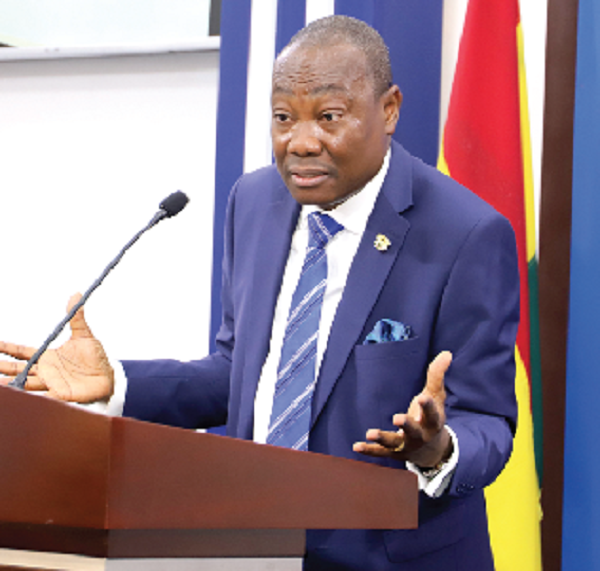
    Dr. Opuni asserted that from January 2014 to early January 2017, COCOBOD never took loans from the Central Bank or local banks to undertake any COCOBOD activity. However, under Mr. Aidoo’s administration, COCOBOD has been taking loans from the Central Bank and local banks even after securing syndicated loans.

    Apart from 2017, when Mr. Aidoo admitted taking a 2 billion Ghana Cedi loan from the Central Bank, the administration has continued to take more loans from local banks and the Central Bank in subsequent years at higher costs, leading to COCOBOD’s indebtedness to local banks amounting to about 20 billion Ghana Cedis.

    For instance, while Dr. Opuni secured syndicated loans at 1.5%, the current COCOBOD management under Mr. Aidoo took a syndicated loan of $800 million in 2013/2024 at 8%, reflecting a lack of confidence in COCOBOD’s financial credibility.

    According to Reuters News Agency, COCOBOD is unable to deliver 350,000 tonnes of cocoa to their clients abroad, who have contracts with COCOBOD at $2,600 per tonne. The current world price of cocoa is above $9,000 per tonne, indicating that Ghana stands to lose about $6,000 or more per tonne of cocoa, potentially resulting in a loss of around $2 billion.

    Furthermore, cocoa production under Mr. Aidoo’s management continues to decline, adding to the challenges faced by COCOBOD. Dr. Opuni’s revelations and challenges to the current administration highlight the need for transparency and accountability in managing the nation’s vital cocoa industry.

  • Farmers to receive over 40,000 rehabilitated cocoa farms from COCOBOD in July

    Farmers to receive over 40,000 rehabilitated cocoa farms from COCOBOD in July

    In the coming month, more than 40,000 cocoa farmlands, temporarily used for rehabilitation to enhance production, will be returned to their original owners.

    Initially scheduled for release in April, the Ghana Cocoa Board (COCOBOD) postponed the handover to July.

    The rehabilitation efforts aim to counteract declining annual yields, with the goal of boosting income for cocoa farmers and stakeholders.

    According to Fiifi Boafo, COCOBOD’s Head of Public Affairs, the farms will officially be handed back in July, as reported by Citi Business News.

    “The over 40,000 farms will be handed over next month. That is in July. Initially, it was planned to take place in April, but there was a change in plan.

    “So the decision is that July next month, those farms will be handed over to the owners. I am referring to the farmers who originally owned these farms, “Mr. Boafo noted.

  • COCOBOD to release over 40,000 rehabilitated cocoa farms in July

    COCOBOD to release over 40,000 rehabilitated cocoa farms in July

    Ghana Cocoa Board (COCOBOD) has announced that over 40,000 farmlands belonging to cocoa farmers, which were temporarily taken for rehabilitation to enhance production, are set to be returned next month.

    The release, initially scheduled for April, was postponed to July.

    The rehabilitation project aims to address the decline in annual cocoa yields, ultimately leading to increased income for farmers and stakeholders in the cocoa industry.

    The head of Public Affairs at COCOBOD, Fiifi Boafo, confirmed to Citi Business News that the handover of the farms will indeed take place in July.

    Mr. Boafo stated, “The over 40,000 farms will be handed over next month. That is in July. Initially, it was planned to take place in April, but there was a change in plan. So the decision is that July next month, those farms will be handed over to the owners. I am referring to the farmers who originally owned these farms.”

    The rehabilitation of these cocoa farms is expected to significantly improve cocoa production in Ghana, which is one of the leading cocoa-producing countries in the world.

  • COCOBOD recorded GHC2bn profit in 2022/2023 – CEO

    COCOBOD recorded GHC2bn profit in 2022/2023 – CEO

    Joseph Boahen Aidoo, the Chief Executive Officer of the Ghana Cocoa Board (Cocobod), has revealed that the organization recorded a significant profit of over GH₵2 billion for the 2022/2023 fiscal year.

    This announcement comes as a stark contrast to Cocobod’s financial performance in 2021, when it recorded a loss of GH₵2 billion.

    Mr. Aidoo explained that despite facing significant financial challenges when he assumed office, Cocobod has turned the corner to generate more revenue for the cocoa industry.

    He attributed this success to strategic decisions made by the organization, including maintaining farmer payments despite financial strain.

    “It was a nationally prudent decision that Cocobod maintained the money it paid to farmers which resulted in losses for Cocobod. This is because we were torn between the national interest and the Cocobod interest. The national interest here is the cocoa industry itself,” Mr. Aidoo explained in an interview on Joy FM’s Super Morning Show.

    Describing the cocoa industry as Ghana’s backbone and oxygen, Mr. Aidoo noted that Cocobod was justified in prioritizing national interest over its immediate financial interests to prevent further erosion of the cocoa farming sector.

    The sector has faced numerous challenges, including adverse weather conditions, bean diseases, and illegal gold mining activities that displace cocoa farms.

    Additionally, Ghanaian farmers have been smuggling more cocoa beans to neighboring countries to sell them at higher prices than those offered by the state purchasing price, further diminishing the available crop for delivery in Ghana.

    Reports indicate that Ghana, the world’s second-largest cocoa producer, is considering delaying the delivery of up to 350,000 tons of beans to the next season due to poor crop yields.

    This situation has led chocolate makers worldwide to raise prices for consumers, as the value of cocoa has more than doubled this year following a third consecutive year of poor harvests in Ghana and Ivory Coast, which together account for 60% of global production.

  • Previous administration secured $1.8bn syndicated loan in 2016 – COCOBOD CEO

    Previous administration secured $1.8bn syndicated loan in 2016 – COCOBOD CEO

    Chief Executive Officer of the Ghana Cocoa Board (Cocobod), Joseph Boahen Aidoo, has disclosed that the previous administration he took over from secured. $1.8 billion in 2016.

    Speaking on Joy FM’s Super Morning Show, Mr. Aidoo, while sharing the significant financial challenges he encountered when he took office in January 2017, disclosed that despite this there were no funds left when he assumed leadership of Cocobod.

    According to Mr. Aidoo, the money had been spent on purchasing cocoa and covering other operational costs.

    “They bought about 600,000 metric tonnes before we came in. With cocoa, the peak harvest period is October, November, December, and January. So within the first quarter of the season, from October to December 2016, the previous administration bought over 600,000 metric tonnes,” he explained.

    “When we assumed office, there was no money, meanwhile, we had to buy cocoa till the end of the season from January to September,” he continued.

    This left Cocobod in a precarious position, needing to continue cocoa purchases without any available funds.

    Faced with this daunting task, Mr. Aidoo and his team sought assistance from the Bank of Ghana.

    “We were forced to go to the Bank of Ghana to borrow. Within that period, we bought over 300,000 metric tonnes and we had to pay the farmers, we had to pay for haulage, the buyer’s margin, and operational costs,” he said.

    The Bank of Ghana acted as an intermediary between Cocobod and consolidated banks, facilitating a loan of over GH₵2 billion to keep operations running.

    The cocoa industry in Ghana has been beset by numerous challenges, including adverse weather conditions, bean diseases, and illegal gold mining activities that displace cocoa farms.

    Additionally, Ghanaian farmers have been smuggling more beans to neighboring countries to sell them at higher prices than those offered by the state purchasing price, further diminishing the available crop for delivery in Ghana.

    Recent reports indicate that Ghana, the world’s second-largest cocoa producer, is considering delaying the delivery of up to 350,000 tons of beans to the next season due to poor crop yields.

    This situation has led chocolate makers worldwide to raise prices for consumers, as the value of cocoa has more than doubled this year following a third consecutive year of poor harvests in Ghana and Ivory Coast, which together account for 60% of global production.

  • We borrowed from BoG when I assumed office because we were broke – COCOBOD CEO

    We borrowed from BoG when I assumed office because we were broke – COCOBOD CEO

    Chief Executive Officer of the Ghana Cocoa Board (Cocobod), Joseph Boahen Aidoo, recently shared the significant financial challenges he encountered when he took office in January 2017.

    Speaking on Joy FM’s Super Morning Show, Mr. Aidoo disclosed that despite the previous administration securing $1.8 billion in 2016, there were no funds left when he assumed leadership of Cocobod.

    According to Mr. Aidoo, the money had been spent on purchasing cocoa and covering other operational costs.

    “They bought about 600,000 metric tonnes before we came in. With cocoa, the peak harvest period is October, November, December, and January. So within the first quarter of the season, from October to December 2016, the previous administration bought over 600,000 metric tonnes,” he explained.

    “When we assumed office, there was no money, meanwhile, we had to buy cocoa till the end of the season from January to September,” he continued.

    This left Cocobod in a precarious position, needing to continue cocoa purchases without any available funds.

    Faced with this daunting task, Mr. Aidoo and his team sought assistance from the Bank of Ghana.

    “We were forced to go to the Bank of Ghana to borrow. Within that period, we bought over 300,000 metric tonnes and we had to pay the farmers, we had to pay for haulage, the buyer’s margin, and operational costs,” he said.

    The Bank of Ghana acted as an intermediary between Cocobod and consolidated banks, facilitating a loan of over GH₵2 billion to keep operations running.

    The cocoa industry in Ghana has been beset by numerous challenges, including adverse weather conditions, bean diseases, and illegal gold mining activities that displace cocoa farms.

    Additionally, Ghanaian farmers have been smuggling more beans to neighboring countries to sell them at higher prices than those offered by the state purchasing price, further diminishing the available crop for delivery in Ghana.

    Recent reports indicate that Ghana, the world’s second-largest cocoa producer, is considering delaying the delivery of up to 350,000 tons of beans to the next season due to poor crop yields.

    This situation has led chocolate makers worldwide to raise prices for consumers, as the value of cocoa has more than doubled this year following a third consecutive year of poor harvests in Ghana and Ivory Coast, which together account for 60% of global production.

  • Cocobod had no money when I took over as CEO – Joseph Boahen

    Cocobod had no money when I took over as CEO – Joseph Boahen

    The CEO of the Ghana Cocoa Board, Joseph Boahen Aidoo, has revealed the substantial financial hurdles he confronted upon assuming office in January 2017.

    During an interview on Joy FM’s Super Morning Show, Mr. Aidoo disclosed that despite the previous administration securing $1.8 billion in 2016, there were no remaining funds when he assumed leadership of Cocobod.

    He explained that the funds had been utilized for purchasing cocoa and covering operational expenses.

    “They bought about 600,000 metric tonnes before we came in. With cocoa, the peak harvest period is October, November, December, and January. So within the first quarter of the season, from October to December 2016, the previous administration bought over 600,000 metric tonnes.

    “When we assumed office, there was no money, meanwhile, we had to buy cocoa till the end of the season from January to September,” he said.

    Upon taking office, Mr. Aidoo observed that Cocobod was confronted with the formidable challenge of continuing cocoa purchases without any funds.

    He indicated that the most viable solution was for Cocobod to seek help from the Bank of Ghana.

    “We were forced to go to the Bank of Ghana to borrow. Within that period, we bought over 300,000 metric tonnes and we had to pay the farmers, we had to pay for haulage, the buyer’s margin, and operational costs.

    “We sought help from the Bank of Ghana who became an intermediary between the Board and the consolidated banks and we got over GH₵2 billion,”he explained.

    Ghana’s cocoa industry has grappled with adverse weather conditions, bean diseases, and illegal gold mining, which often displaces cocoa farms.

    Additionally, Ghanaian farmers have been smuggling more beans to neighboring countries to capitalize on higher prices, further depleting the available crop for domestic delivery.

    Reports indicate that Ghana, the world’s second-largest cocoa producer, is contemplating delaying the delivery of up to 350,000 tons of beans to the next season due to poor crops.

    Consequently, chocolate makers worldwide are increasing prices for consumers in response to cocoa prices doubling this year, driven by a third consecutive year of poor harvests in Ghana and Ivory Coast, which together account for 60% of global production.

  • Osafo-Maafo fingered once again in Opuni/Agongo trial

    Osafo-Maafo fingered once again in Opuni/Agongo trial

    In the ongoing trial of former COCOBOD Chief Executive Dr. Stephen Opuni and businessman Seidu Agongo, fresh revelations have emerged regarding the involvement of former Senior Minister Yaw Osafo-Maafo in initiating their prosecution.

    Notably, one of Mr. Osafo-Maafo’s relatives, Evelyn Keelson, serves as a state attorney prosecuting the case. Despite this, Osafo-Maafo maintains his position as Senior Presidential Advisor in the Akufo-Addo government.

    During proceedings presided over by Justice Aboagye Tandoh on Tuesday, June 11, 2024, it was disclosed that Mr. Osafo-Maafo convened a meeting in his office in 2017 to discuss the controversial lithovit liquid fertilizer at the center of the trial.

    Head of the Material Science Department at the Ghana Standards Authority, Genevieve Baah Mante, testified as a subpoenaed witness of Seidu Agongo, shedding light on the meeting’s discussions.

    “We discussed the results of the two institutions (Ghana Standards Authority and the University of Ghana’s Chemistry Department) and pointed out possible discrepancies in the reports. These included different batch numbers of the same sample supplied to the different institutions.

    “The second was the difference in environmental and testing conditions. And the third was the protocol used in testing the samples.

    “The fourth was how the sample was sampled (picked). The two institutions requested further testing of the samples.”

    Counsel for Mr Agongo, Benson Nutsukpui, then asked the witness, “All these you just told the court took place in Honourable Osafo-Maafo’s office?”

    Mrs Genevieve Baah Mante answered in the affirmative, “Yes, my lord”.

    The trial involves Dr. Opuni, Mr. Agongo, and Agricult Ghana Limited facing multiple charges related to the purchase of Lithovit Liquid Fertilizer between 2014 and 2016, including defrauding by false pretences and willfully causing financial loss to the state.

    According to Mrs. Baah Mante, the meeting in Osafo-Maafo’s office involved officials from COCOBOD and the Chemistry Department of the University of Ghana.

    They deliberated on discrepancies between test results from different institutions regarding the fertilizer.

    It was revealed that Osafo-Maafo’s involvement in the prosecution stemmed from a petition he submitted to the police CID in 2017, effectively halting an ongoing EOCO investigation into the matter.

    Despite the presence of a substantive Minister of Finance overseeing COCOBOD affairs, Osafo-Maafo’s petition led to the CID taking over the investigation, raising questions about his locus in the matter.

    When the investigator was asked about the locus and by what authority Yaw Osafo-Maafo petitioned the police when there was a substantive minister who had oversight on COCOBOD affairs, he replied:

    “My Lord, during the transition, investigation of agencies were conducted and on one of this sub committees which did the investigation recommended that investigation should be conducted into the activities of A1 during his tenure as the CEO of Ghana COCOBOD. It is on this basis that the Senior Minister signed this petition.”

    The trial has drawn attention to Osafo-Maafo’s active involvement in COCOBOD affairs and his niece’s role as a prosecutor, adding complexity to the legal proceedings.

    The revelations underscore the significance of the 2017 meeting convened by Osafo-Maafo, which followed conflicting test results regarding the efficacy of the lithovit fertilizer.

    Mrs. Baah Mante clarified that her department’s testing confirmed the presence of essential nutrients in the fertilizer, consistent with fertilizer standards.

    However, the absence of specific cocoa fertilizer standards in Ghana prevented a conclusive assessment of its suitability for cocoa.

    The testimony sheds light on the standards development process at the Ghana Standards Authority, emphasizing stakeholder involvement and adherence to international standards.

  • COCOBOD reportedly planning to borrow up to $1.5b for cocoa purchases in 2024–2025

    COCOBOD reportedly planning to borrow up to $1.5b for cocoa purchases in 2024–2025

    Ghana’s cocoa regulator intends to borrow up to $1.5 billion by September in order to finance the purchases of cocoa for 2024–2025 and compensate for low output ss per two COCOBOD sources who are aware of the arrangement.

    The world’s second-largest cocoa producer, after neighboring Ivory Coast, relies on an annual syndicated loan to fund bean purchases from farmers. This loan is typically secured at the beginning of the season in September.

    However, this year’s $800 million loan encountered delays due to the season’s low cocoa output.

    COCOBOD has since withdrawn $600 million and canceled the remainder, as the season’s cocoa output is projected to be nearly 40% below expectations, making it impossible to guarantee the full loan.

    “A request for proposal sent to banks indicates COCOBOD will borrow up to $1.5 billion next season. It is understood the banks are sizing it and together (with COCOBOD), they will decide an optimal amount,” said one COCOBOD source.

    A second source from COCOBOD expressed confidence that the syndication would proceed as planned.

    According to the same source, at least one international bank has visited Ghana to inspect cocoa farms before making a decision on the offer, with another scheduled to visit next month.

    Production is anticipated to rebound to 810,000 metric tons next season, as per the sources, who preferred not to be identified as they have not been authorized to speak to the media.

    COCOBOD did not provide a response to a request for comment.

    Ghana’s cocoa production has been impacted by adverse weather, diseases, and cocoa smuggling. It is projected to fall nearly 40% short of the target in the 2023/24 season, according to COCOBOD.

    The regulatory body stated that approximately 150,000 tons of cocoa beans were lost to smuggling and illegal gold mining, locally known as galamsey, in the 2022/23 season.

    It anticipates even greater losses this season due to a global increase in cocoa prices, which serves as an incentive for more smuggling.

    Between 2018 and 2024, the swollen shoot virus decimated around 590,000 hectares of farmland, according to COCOBOD.

    One source expressed confidence that Ghana would still meet next season’s target of 810,000 tons, citing expected improvements in weather conditions and increased output from rehabilitated cocoa farms.

    Ghana’s cocoa export revenue plummeted by nearly 50% year-on-year in the first four months of the year, according to central bank data released this week.

  • Scholarship scheme now Education Trust – COCOBOD

    Scholarship scheme now Education Trust – COCOBOD

    The Ghana Cocoa Board (COCOBOD) has clarified its decision to discontinue its longstanding scholarship program, unveiling a new educational initiative in its stead.

    This shift comes in response to the government’s implementation of free senior high school education.

    COCOBOD announced the cessation of its scholarship program, which historically aided the education of children of cocoa farmers, citing the redundancy brought about by the free SHS policy.

    In a statement released on Thursday, COCOBOD introduced the Cocoa Board Education Trust, aimed at enhancing primary school infrastructure in underserved cocoa-growing regions.

    However, COCOBOD emphasized that some individuals misunderstood this transition as the dissolution of the scholarship program.

    The board stressed that the redirection of resources signifies not the termination of their educational support but rather a strategic reallocation to address more urgent educational needs.

    The newly established trust seeks to bridge the gap in infrastructure between rural and urban schools by providing vital resources such as classrooms, libraries, teachers’ residences, and other facilities to create an enabling learning environment.

    COCOBOD urged the public to endorse this transition, highlighting that the trust represents a broadening of their efforts to meet the changing educational requirements in rural communities.

  • BoG Governor named chair of COCOBOD’s educational trust fund

    BoG Governor named chair of COCOBOD’s educational trust fund

    Governor of the Bank of Ghana, Dr. Ernest Addison, has been appointed as the chairman of a newly formed five-member committee tasked with overseeing COCOBOD’s educational trust fund.

    The committee comprises key figures such as Dr. Eric Nkansah, Director General of the Ghana Education Service (GES), Bismarck Fuachie, the 2022 National Best Cocoa Farmer, and officials from COCOBOD including Dr. Emmanuel A. Opoku, Ray Ankrah, and Francis Opoku.

    The primary objective of the committee is to enhance primary educational infrastructure in cocoa-growing regions, aiming to benefit the children of cocoa farmers in underserved areas.

    During the committee’s inauguration in Accra on Monday, May 20, Dr. Addison emphasized their commitment to making a meaningful difference in the lives of cocoa farmers and their communities through education.

    “I acknowledge the calibre of individuals chosen to serve with me on the trust, their collective experience and expertise will undoubtedly enrich our effort and lead us towards success.

    “I have every confidence that their dedication and insights will be invaluable in advancing the goals of the trust. Having previously served as the chairman of the COCOBOD scholarship scheme for a few years now, I am deeply humbled once again to be entrusted with a leadership role this time with the COCOBOD educational trust fund.”

  • COCOBOD scraps Scholarship Scheme due to Free SHS initiative

    COCOBOD scraps Scholarship Scheme due to Free SHS initiative

    The Ghana Cocoa Board (COCOBOD) has announced the termination of its long-standing scholarship scheme, attributing this decision to the implementation of the government’s Free Senior High School (SHS) initiative.

    In place of the scholarship program, COCOBOD has launched the Cocoa Board Education Trust, which focuses on providing essential primary school infrastructure in underserved cocoa-growing communities.

    The chairman of the board, Peter Mac Manu, explained that the Free SHS initiative has significantly impacted the relevance of the scholarship scheme. “As we bid farewell to the Scholarship Scheme, we must look forward and prioritise the continued educational advancement of the cocoa farming community. It’s with this vision that the board of directors has decided to establish the Ghana Cocoa Board Education Trust.

    The COCOBOD Scholarship Scheme had been providing financial support to students from cocoa-farming communities for many years.

    However, with the introduction of Free SHS, the board has chosen to redirect its resources to address the need for primary school infrastructure in underserved areas.

    The newly inaugurated Cocoa Board Education Trust aims to establish model basic schools in cocoa-growing communities.

    According to Peter Mac Manu, this initiative underscores the board’s commitment to the prosperity and well-being of cocoa farmers and their children.

  • Ignore reports that composition of panel overseeing former COCOBOD boss’ case is unconstitutional – A-G

    Ignore reports that composition of panel overseeing former COCOBOD boss’ case is unconstitutional – A-G

    The Office of the Attorney-General and Ministry of Justice has dismissed media reports alleging misrepresentation regarding changes in the panel overseeing the trial of former COCOBOD CEO, Dr. Steven Opuni.

    The Attorney-General stated that these reports appear to be intentionally crafted to provoke public dissatisfaction with the Judiciary.

    In a press release issued on Tuesday, May 14, the Office refuted allegations made by The Herald and comments on social media by individuals such as Prof. Kweku Asare.
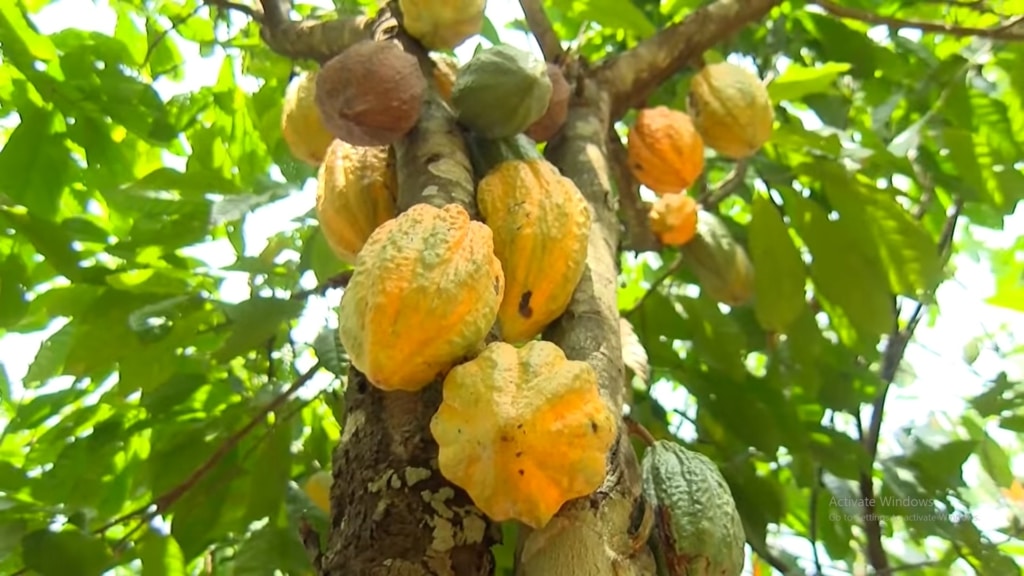
    It clarified that these claims were full of inaccuracies and insinuated that the composition of the panel during the appeal hearing on May 8, 2024, was irregular, questionable, or unconstitutional.

    The Office’s statement emphasized the need to uphold public trust in the judiciary and condemned any efforts to undermine its integrity through misleading narratives.

    It urged the public to ignore the reports, stating that the allegations were baseless and lacked merit.

    “The attention of the Office of the Attorney-General and Ministry of Justice has been drawn to deliberate misrepresentations in the media (traditional and social) about the composition of a panel to hear an appeal in the Supreme Court in a case entitled ‘Republic vrs. Dr Stephen Opuni & 2 Others’.”

    Publications in various newspapers, particularly the Herald, and commentary on social media by some persons including, Prof Kweku Asare, are laden with falsehood and contain an imputation that the composition of the panel for the hearing of the appeal on 8th May, 2024 was unusual, questionable or in violation of the Constitution.,” an excerpt of the statement said.

  • Dr Opuni’s Trial: ‘You’ve no power to do that – ASEPA drags Chief Justice over panel changes

    Dr Opuni’s Trial: ‘You’ve no power to do that – ASEPA drags Chief Justice over panel changes

    Alliance for Social Equity and Public Accountability (ASEPA) criticised Ghana’s Chief Justice, Justice Gertrude Torkonoo, following reports of sudden changes in the Supreme Court panel overseeing the appeal of Dr. Stephen Opuni, the former CEO of COCOBOD, and businessman Seidu Agongo.

    In a statement released on Monday, May 13, 2024, the civil society organisation asserted that the Chief Justice’s abrupt alterations to the panel handling the case of the former COCOBOD CEO constitute interference in the administration of justice.

    ASEPA added that the action of the Chief Justice is a violation of Article 157(3) of the 1992 Constitution, which provides that “no person sitting in a Superior Court for the determination of any cause or matter shall, having heard the arguments of the parties to that cause or matter and before judgement is delivered, withdraw as a member of the court or tribunal, or as a member of the panel determining that cause or matter, nor shall that person become functus officio in respect of that cause or matter, until judgement is delivered.

    “We find it extremely unusual that a panel would be reconstituted in such fundamental terms without an explanation from the Court.

    In our view, the sudden move raises the possibility of judicial interference, undermines judicial independence, and casts a negative slur on the administration of justice,” part of the statement signed by the Executive Director of ASEPA, Mensah Thompson, reads.

    “We remind the Chief Justice that her power to empanel is not a constitutional power. It is exercised as a result of the Court’s norms.

    Furthermore, she has no power to interfere with the operations of a constituted panel. Therefore, if she reshuffled the Opuni panel, then she acted ultra vires the Constitution.

    We have no doubt that the reshuffling of panels is contra to Article 296, which calls for administrative powers to be exercised without caprice,” it added.

    The group also noted that “it is this propensity for abuse and interference that forms the basis of why ASEPA has always advocated for the amendment of the law to make the process of empanelment a purely administrative process, away from the quasi-political clutches of the Chief Justice and putting it right in the hands of the Registrar of the Supreme Court, who is a permanent officer of the Court.”

    A report by theheraldghana.com revealed that the panel for the case underwent a last-minute change on the day of judgement, leaving many legal experts, including Dr. Opuni’s counsel, Lawyer Samuel Codjoe, perplexed.

    Both the legal teams of the plaintiff and the accused individuals had presented their arguments before an earlier panel and submitted their written submissions, anticipating the court’s verdict.

    The original panel, consisting of Justice Mariama Owusu (presiding), Justices Yaw Darko Asare, Emmanuel Yonny Kulendi, George Kingsley Koomson, and Henry A. Kwofie, was replaced. The new panel was composed of Chief Justice Gertrude Torkonoo (presiding), Justices Mariama Owusu, Henrietta Mensa-Bonsu, Yaw Darko Asare, and Ernest Gaewu.

    Dr. Opuni, businessman Seidu Agongo, and Agricult Ghana Limited are facing 27 charges, including defrauding by false pretences, wilfully causing financial loss to the state, corruption by public officers, and contravention of the Public Procurement Act.

  • We have returned $250m loan procured from ADB for cocoa farm irrigation – COCOBOD

    We have returned $250m loan procured from ADB for cocoa farm irrigation – COCOBOD

    The Chief Executive Officer (CEO) of the Ghana Cocoa Board (COCOBOD), Joseph Boahen Aidoo, has revealed that the organization has reimbursed $250 million obtained from the African Development Bank earmarked for irrigation initiatives in cocoa farms.

    Mr Aidoo explained that the Ghana Irrigation Authority, serving as consultants for the project’s execution, advised against its feasibility due to the contamination of rivers by illegal mining activities, posing a threat to cocoa trees.

    “When Cocoa Board went to the African Development Bank to secure some US$600 million, then we had to return $250 million. Part of that money was intended for irrigation.

    “We commissioned the Ghana Irrigation Development Authority to do a pre-appraisal for our assessment, and the report we brought was that almost all the rivers were contaminated.”

    He stressed that without addressing illegal mining activities, the cocoa industry remains at risk.

    Mr Aidoo highlighted that most rivers in cocoa-growing regions are polluted, rendering the water unfit for cocoa cultivation.

    This predicament, he noted, has compelled farmers to incur additional expenses by transporting water from their homes to their farms.

    “Previously, the farmer gets to the nearest stream around the farm, and then he fetches the water to do the mass spraying and all that. But now, you cannot, because the leaves have process, which we call the stomata.

    “And once you spray this muddy water onto it, the mud is going to block, this stomata and within a short time, you find all the leaves coming down. The trees will die. You cannot also use it for irrigation because it means that you have to be changing your filters almost every day,” he said.

  • COCOBOD intercepts 634 bags of cocoa being smuggled out of Ghana

    COCOBOD intercepts 634 bags of cocoa being smuggled out of Ghana

    The National Anti-Cocoa Smuggling Task Force under the Ghana Cocoa Board (COCOBOD) has effectively intercepted 634 bags of cocoa beans destined for smuggling out of Ghana, within the Eastern Region.

    This accomplishment follows a month-long operation fueled by intelligence-driven strategies.

    On April 15, authorities seized a truck transporting 504 bags of cocoa beans concealed within poultry feed products.

    Subsequently, on May 7, another 130 bags of cocoa beans, hidden beneath gravel in a tipper truck, were confiscated in Mpraeso, Kwahu South Municipality.

    The suspects, Kwasi Edem (55) and Dennis Hodo (28), a tipper truck driver, were apprehended during an attempt to cross the Afram River by ferry from Suhum to Kwahu Adawso, as they sought to exit the Volta Region towards Togo.

    They are currently in police custody at the Mpraeso Central Police Station, cooperating with ongoing investigations.

    Simultaneously, the police have wrapped up inquiries into the initial arrest and are set to arraign the suspect on Wednesday, May 8.

    Emmanuel Atta Ofori-Snr, the Municipal Chief Executive for Kwahu South, confirmed to Agoo FM that National Security had identified the Kwahu area as a significant transit point for smugglers since last year.

    Consequently, the District Security Council remains on heightened alert to combat such illicit activities.

  • Opuni joined COCOBOD after test on lithovit was completed – CRIG scientist reveals

    Opuni joined COCOBOD after test on lithovit was completed – CRIG scientist reveals

    The prosecution’s claim that former COCOBOD Chief Executive, Dr. Stephen Opuni instructed CRIG scientists to hasten the testing of fertilizers, particularly lithovit, has been rebutted by a new defense witness, a soil scientist from CRIG.

    Court proceedings have unveiled that even prior to Dr. Opuni’s assumption of office, CRIG had completed its evaluation of lithovit foliar fertilizer supplied by Agricult Ghana Limited and had compiled the scientific report on the product.

    Jerome Agbesi Dogbatse, who contributed to the preliminary report on lithovit foliar fertilizer, testified before the Accra High Court on April 25, 2024, stating that CRIG concluded its examination of lithovit well before November 2013.

    Joining the Cocoa Research Institute of Ghana (CRIG) on November 4, 2013, Dogbatse asserted, “I informed the police that the product (lithovit) was tested and finalized before I became part of CRIG.”

    Despite Dr. Opuni’s appointment in December 2013, he officially assumed his role as the Chief Executive of the Ghana Cocoa Board in January 2014.

    “What I told the police was that they showed me a report and asked me that have I seen this report before, and I said yes, I have seen the report before, and then they mentioned that this is the final report on the work on lithovit. then I told them if that is the final report, nobody showed it to me, but what I worked on was the draft report,” the witness said.

    “Did you tell the police anything about making comments on any report?” lawyer Benson Nutsukpui, counsel for Seidu Agongo, asked Mr Dogbatse.

    The witness replied, “Yes, my Lord, I told them that I made some comments for the attention of the lead author. That is what I meant by review.”

    The initial prosecution witness, Dr. Franklin Manu Amoah, alleged during his testimony in July 2018 that Dr. Opuni directed scientists to expedite the testing of fertilizers, including lithovit, upon assuming office.

    However, Dr. Francis Baah, who purportedly attended a meeting where this directive was issued, vehemently denied any such occurrence during proceedings on April 17, 2024.

    Additionally, Mr. James Kofi Kutsoatsi, also claimed to be present at the alleged meeting, did not join COCOBOD until April 2014, rendering his attendance impossible during the specified timeframe.

    Jerome Agbesi Dogbatse further discredited Dr. Amoah’s claim, stating that he did not meet the testing requirements for lithovit fertilizer.

    “The difference between them are that the treated seedlings are doing better than the untreated seedlings,” he recalled.

    Dogbatse’s testimony aligned with his previous statements to investigative bodies, affirming that the testing had concluded before his tenure at CRIG began.

    “It is clear and obvious that there was a calculated attempt to dirty Dr Stephen Opuni with false claims. This is just to besmirch a man with reputable credibility,” a journalist who doesn’t want to be named pointed out.

    The defense posits that Dr. Opuni’s alleged involvement seems improbable given the timeline and the presence of a substantive COCOBOD chief executive at the time.

  • COCOBOD CEO must be dismissed immediately – CSO tells govt

    COCOBOD CEO must be dismissed immediately – CSO tells govt

    A civil society organization, United Voices for Change (UVC), has demanded the immediate dismissal of Dr. Joseph Aidoo, the CEO of the Ghana Cocoa Board (COCOBOD), citing mismanagement and significant financial losses during his tenure.

    The convener for the group, Slyvestine Ronald, expressed serious concern over Dr. Aidoo’s continuous leadership at COCOBOD despite overseeing substantial financial losses within the institution.

    “We call for the dismissal of Dr. Joseph Aidoo, the CEO of COCOBOD with immediate effect. He has presided over financial decline and recklessness and has failed to fulfill his mandate of generating profit and revenue,” he added.

    Highlighting alarming financial losses incurred by COCOBOD in recent years, Ronald pointed to figures indicating losses of GH¢161.3 million in 2017, GH¢78.22 million in 2018, GH¢320.57 million in 2019, GH¢32 million in 2020, and a staggering GH¢2.44 billion in losses in 2021.

    “These losses, which began in 2016, are ballooning by the years, reaching GH¢2.44 billion in 2021,” he stated.

    The organization also held President Akufo-Addo responsible for the consistent losses incurred by State-Owned Enterprises (SOEs), including COCOBOD.

    United Voices for Change called for urgent measures to be taken to rescue the declining state institution, emphasizing its importance as a significant source of employment in Ghana.

    “To make the SOEs function again, the CSO says all CEOs who are sleeping on the job should be sacked,” he added.

  • COCOBOD worried about cost of new EU regulations on deforestation for farmers

    COCOBOD worried about cost of new EU regulations on deforestation for farmers

    The Chief Executive Officer of Ghana Cocoa Board (COCOBOD), Joseph Boahen Aidoo, has expressed serious concerns about the implementation of the new EU Regulations on Deforestation and its potential cost implications for farmers and producing countries.

    The new regulations require producing countries to comply with strict measures aimed at protecting the environmental ecosystem, leading to sustainable and ethically sourced cocoa.

    While acknowledging the noble intentions behind these regulations, which align with efforts already underway in some countries, such as Ghana, there are significant ethical and economic concerns. Countries like Ghana, Cote d’Ivoire, and Cameroon are grappling with the question of who will bear the extra costs of compliance.

    Ghana, for instance, had already initiated and completed the Cocoa Management System (CMS), a critical requirement for the cocoa traceability system, with full roll-out planned for October this year.

    However, Joseph Boahen Aidoo emphasized that the cost implications of compliance cannot be overlooked. It has the potential to not only increase the cost of cocoa but also pose social and economic challenges to farmers already struggling with difficult economic conditions in their respective countries.

    “Ghana is very much aligned to implementing the European Union regulations but this will come at a cost to farmers and producing countries which is likely to increase the cost of cocoa from Ghana, Cote d’Ivoire and Cameroun,” Mr Boahen Aidoo emphasised on Tuesday during a panel discussion at the ongoing World Cocoa Conference in Brussels, Belgium.

    Mr. Boahen Aidoo emphasized that well before the EU contemplated the new regulations, producing countries, notably Ghana, had already taken steps to tackle the numerous challenges linked to climate change and its impact on production.

    “Yes, the regulations are meant to enhance the awareness of sustainable production, but for us we were already bothered about the way climate change was affecting production and disrupting local activities, so even before the idea of the regulations were conceived, Ghana had already started mapping farms which is another element because without the polygon maps you cannot trace the source of the cocoa,” he stressed.

    However, he noted that the new regulations overlook issues related to costs and the responsibilities for the expensive technologies and tools required to implement these programs. He pointed out that these costs are prohibitive for individual farmers to bear.

    “So now the conclusion is that having done all that, who pays for the cost, right from the polygon maps, bringing in the technology and the training because you need real time data to make it work, which means that since this has not been factored in the new EU regulations, the operator has to pay and this is going to make cocoa from Ghana, Cote d’Ivoire and Cameroun very expensive.”

    In light of this, some argue that the burden of paying for the cost of compliance should be shared, with a portion borne by the wealthier nations that consume the majority of the cocoa produced.

    Given the significant investments required for compliance and the economic pressures faced by producing countries, proponents of this view believe that the EU and other developed countries should be willing to support cocoa-producing countries in their efforts to source cocoa ethically and sustainably.

  • Galamsey will cost Ghana its premium position in international cocoa market – COCOBOD

    Galamsey will cost Ghana its premium position in international cocoa market – COCOBOD

    The Ghana Cocoa Board (COCOBOD) has raised concerns about the potential loss of Ghana’s premium position in the international cocoa market due to illegal mining activities.

    In an interview on The Point of View with Bernard Avle, Prof. Michael Kwarteng, Director of the Anti-Corruption Galamsey Unit of COCOBOD, highlighted the detrimental impact of illegal mining, or “galamsey,” on cocoa production.

    These remarks follow a warning by the former Chief Executive Officer of the Environmental Protection Agency (EPA), Henry Kokofu, regarding a potential embargo on Ghana’s cocoa bean exports due to the escalating activities of illegal miners.

    “Per what we’re seeing, if nothing is done to stop this act [illegal mining], we may lose even our position as the number one premium cocoa. In terms of quality, we all know that, in the whole world, Ghana’s cocoa is the best. If we continue to this, then we’re going to lose that, the quality of our cocoa beans is going to be affected seriously.”

    “I know our Cocoa Research Institute is researching that, and I’m sure they will come out with their findings. But per what we’re all seeing, we stand the risk of losing, so he’s right.”

    In response to the EU’s report suggesting a potential ban on Ghana over cocoa cultivated on deforested land, he advocated for an evaluation of cocoa’s benefits to the citizens of Ghana.

    “I think we have not realized the benefits we’re getting from cocoa production as a nation. COCOBOD is doing so much, cocoa production is offering us employment, even road construction. Our cocoa farmers rely on cocoa for their livelihoods. I think that as a nation, we should begin to assess the importance of cocoa production,” he opined.

    Prof. Kwarteng expressed concern about the challenges cocoa farmers face in accessing water for irrigation on their farms due to pollution of most water bodies.

    “There’s no way we can put cocoa aside and concentrate on the minerals. All our water bodies are going, now for farmers to get water to nurse their crops is even difficult, some buy sachet water and take it to the farms.”

    Ghana has experienced the lowest cocoa production in the past 10 years.

  • 58% increase in cocoa farmgate price falls below expectations – Concerned Farmers Association

    58% increase in cocoa farmgate price falls below expectations – Concerned Farmers Association

    President of the Concerned Farmers Association of Ghana, Nana Oboadie Boateng Bonsu, has voiced dissatisfaction with the government’s recent adjustment of cocoa farmgate prices for the 2023/24 season.

    He deems the increase as significantly insufficient, given the strenuous efforts farmers invest in cultivating cocoa, Ghana’s primary foreign exchange earner.

    Despite the government’s announcement of a 58.26% increment in cocoa producer prices, which has elicited jubilation among farmers, Nana Oboadie Boateng Bonsu contended that the raise, from GH¢ 20,928 to GH¢ 33,120.00 per metric tonne, falls short of adequately compensating farmers.

    The adjustment, effective April 5, 2024, also includes an elevation of the buyers’ margin to GH¢ 2,980.00 per tonne for the same cocoa season.

    In a statement issued by the Cocoa Board (COCOBOD), the price adjustment is justified as a means to enhance cocoa farmers’ income, aligning with the NPP government’s vision and addressing the escalating cocoa prices in the international market.

    However, in an interview with Daakyehene Ofosu Agyemang on New York-based Adinkra Radio, Nana Oboadie Boateng Bonsu criticized the increment, urging the government to truly reward cocoa farmers with a more substantial increase in the producer price.

    He disparaged some farmers who lauded the government for the adjustment, labeling them as politically motivated individuals who lack firsthand experience of farming realities.

    Moreover, Nana Oboadie Boateng Bonsu highlighted the threat of cocoa smuggling to neighboring countries due to the persistently low pricing of cocoa.

    “Some farmers say they have accepted the price because you will get some political farmers like the award winners who are political because they themselves don’t till the land to now how it feels, they have hired people to work for them and so as soon as there is price increase, they put on their cloth and go to the Presidency and thank the President for the increment. But those who are on the field who actually work are not happy with the increment. it is painful, but because we are in an election year, even if you say the truth others will think you are doing politics.

    “When cocoa farms were being cut down for illegal mining activities in towns at Atiwa West, what did the COCOBOD do to stop the development. it is we the Concerned Farmers Association that stood up and fought the destruction of cocoa farms. The Dunkwa Chief bears us witness that we met the youth and advised the to go into farming which they did instead of going into galamsey.”

    He emphasized the importance of addressing this issue to prevent further economic losses and safeguard the interests of Ghanaian cocoa farmers.

  • COCOBOD slams Minerals Commission over MIGOP Mining Limited’s presence on cocoa farms

    COCOBOD slams Minerals Commission over MIGOP Mining Limited’s presence on cocoa farms

    Chief Executive Officer of COCOBOD, Joseph Boahen Aidoo, has chastised the Minerals Commission over the lack of due diligence after issuing an exploration licence to MIGOP Mining Limited, a foreign-owned gold mining firm.

    The company is accused of endangering the livelihoods of cocoa farmers in the Atwima Nwabiagya South Municipality, Ashanti Region.

    It has been revealed that approximately 400 acres of cocoa farms are under threat due to the exploration activities conducted by MIGOP Mining Limited.

    Mr. Aidoo noted that although the Commission had granted an exploration license to the mining company, it failed to follow up to ensure that no mining took place.

    “The Minerals Commission is also complicit in whatever that is going on. In this instance that we are discussing, they were issued with an exploration license and not a mining lease. It is only when you’ve gone through all the necessary processes and procedures, then you need the final stage to establish that you have a commercial precious mineral there that is only when you will be issued with a mining lease but in this instance, they only have exploration license from the minerals commission,” he stated.

    “The minerals commission has not followed up to see whether they are doing exploration or mining and by law, they are not supposed to use heavy machinery through any cocoa farm. So, whatever is going on there is unlawful and COCOBOD is going to assist the farmers to have the get compensation for whatever disruption might have occurred to their farms,” he added.

    Mr Aidoo asserts that the attempts by the mining company to explore and mine in the affected communities, resulting in the destruction of several cocoa farms, are unlawful and unacceptable.

    “It is unlawful to destroy any cocoa tree or even to remove any tree on the cocoa farm. Which means that you can’t even go there and mine. Even if loggers cannot go and take timber trees, then it means that as for mining, it cannot come to any cocoa farm at all.

    The potential commencement of full-scale operations by the firm could have detrimental effects on five cocoa-growing communities in the area.

    The CEO assured that COCOBOD is dedicated to supporting the affected farmers and will help secure fair compensation for any disruptions caused to their farms.

  • You can’t mine on a cocoa farm, it is illegal – COCOBOD to MIGOP Mining Limited

    You can’t mine on a cocoa farm, it is illegal – COCOBOD to MIGOP Mining Limited

    Chief Executive Officer of COCOBOD, Joseph Boahen Aidoo, has strongly condemned the actions of MIGOP Mining Limited, a foreign-owned gold mining firm accused of endangering the livelihoods of cocoa farmers in the Atwima Nwabiagya South Municipality, Ashanti Region.

    Mr Aidoo asserts that the attempts by the mining company to explore and mine in the affected communities, resulting in the destruction of several cocoa farms, are unlawful and unacceptable.

    It has been revealed that approximately 400 acres of cocoa farms are under threat due to the exploration activities conducted by MIGOP Mining Limited. The potential commencement of full-scale operations by the firm could have detrimental effects on five cocoa-growing communities in the area.

    In a firm stance, the CEO of COCOBOD declared the company’s actions as illegal, emphasizing the protection afforded to cocoa trees under the law.

    “It is unlawful to destroy any cocoa tree or even to remove any tree on the cocoa farm. Which means that you can’t even go there and mine. Even if loggers cannot go and take timber trees, then it means that as for mining, it cannot come to any cocoa farm at all.

    “The Minerals Commission is also complicit in whatever that is going on. In this instance that we are discussing, they were issued with an exploration license and not a mining lease. It is only when you’ve gone through all the necessary processes and procedures, then you need the final stage to establish that you have a commercial precious mineral there that is only when you will be issued with a mining lease but in this instance, they only have exploration license from the minerals commission,” he stated.

    Mr. Aidoo also criticized the Minerals Commission for its lack of oversight, pointing out that although the commission had granted an exploration license to the mining company, it failed to follow up to ensure that no mining took place.

    The CEO assured that COCOBOD is dedicated to supporting the affected farmers and will help secure fair compensation for any disruptions caused to their farms.

    “The minerals commission has not followed up to see whether they are doing exploration or mining and by law, they are not supposed to use heavy machinery through any cocoa farm. So, whatever is going on there is unlawful and COCOBOD is going to assist the farmers to have the get compensation for whatever disruption might have occurred to their farms,” he added.

  • Mining exploration in Atwima Nwabiagya threatens safety of 400 acres of cocoa farms

    Mining exploration in Atwima Nwabiagya threatens safety of 400 acres of cocoa farms


    In the Atwima Nwabiagya South Municipality of the Ashanti Region, the livelihoods of cocoa farmers are under imminent threat as a foreign-owned gold mining firm, MIGOP Mining Limited, conducts exploration activities.

    This poses a significant risk to over 400 acres of cocoa farms, spanning five cocoa-growing communities in the area.

    These farms, which have recently undergone rehabilitation by the Ghana Cocoa Board to combat the Cocoa Swollen Shot Virus Disease outbreak, are now facing destruction due to the encroachment of the mining firm.

    The affected communities, including Apuoyem, Brahebebome, Brosanko, Ouagadougou, and Nkotonmire, stand to suffer considerable economic losses.

    According to Ghana COCOBOD, the monetary value of cocoa produced by these communities exceeds GH¢316,000, highlighting the significant impact of the mining activities on the local economy.

    Expressing concern over the situation, Head of the anti-illegal mining Units at COCOBOD, Professor Michael Kwarteng, condemned the actions of MIGOP Mining Limited.

    “Yesterday I received a call from the executive director of the cocoa health and extension division that there is this mining company, MIGOP Mining Limited. They’ve come to this our cocoa district. To them, they’ve been given license to do prospecting and they’ve destroyed a lot of our cocoa farms. Farmers have been preventing them but they are using security personnel to intimidate them and then going ahead with their activities. So when I received this I said no, I can’t sit down for even a day.

    “Looking at what is happening, the evidence is there. They’ve destroyed some of the cocoa farms. COCOBOD we are not aware of what is going on. I always say whenever you are securing any concession, you have to contact the regulator of that production, being cocoa, or whatever.

    “Meanwhile when you go to the minerals commission, the Mining Acts 703 sections 18(1)(2), it tells you that mining companies are supposed to contact bodies that regulate that farm. So they are violating that aspect of their own law. So, mining companies are taking advantage of this and are destroying our farms everywhere,” he stated.

    He pointed out instances of cocoa farm destruction and intimidation of farmers by security personnel deployed by the mining company.

    In response, MIGOP Mining Limited claims to have obtained permits from the Minerals Commission to conduct exploration in the area.

    However, they acknowledge the inadvertent destruction of some cocoa farms during the exploration process.

    The Community Relations Officer for MIGOP Mining Limited, Richard Gyasi, assured that affected farmers are being compensated for their losses. He emphasizes that the company is currently in the exploration phase and refutes claims of widespread crop destruction.

    Despite these assurances, concerns persist regarding the long-term implications of mining activities on cocoa production and the livelihoods of affected communities.

    The clash between mining interests and agricultural sustainability underscores the delicate balance between economic development and environmental conservation.

    “We are only doing exploration so we are not destroying any crop. Even though at least one or two crops have been affected we are using the government rate to pay them. For now, we are in the exploration stage, we will now move to the development stage before we start the mining. So, we are not destroying crops as it has been portrayed,” he stated.

  • Ghanaian cocoa farmers earn $47 more per tonne than Ivorian counterparts – COCOBOD

    Ghanaian cocoa farmers earn $47 more per tonne than Ivorian counterparts – COCOBOD

    Amid public criticism accusing the government, via the Ghana Cocoa Board, of undercutting cocoa farmers in cocoa bean pricing, COCOBOD’s Public Relations Officer, Fiifi Boafo, has refuted these allegations.

    Boafo stated that Ghanaian cocoa farmers receive $47 more per tonne compared to their Ivorian counterparts.

    Speaking on Citi TV’s Point of View program, Boafo emphasized that the government did not exploit cocoa farmers when it announced an increase in farmgate prices for cocoa beans.

    “The difference between how much Ghana is paying cocoa farmers, and the Ivorians are paying cocoa farmers, we’re paying $47 more to our Ghanaian farmers compared to Ivorian farmers,” he said.

    He added that, “the people who told us to replicate what the Ivorians have done now say that what we have done is wrong and we are cheating the cocoa farmers. If I’m asked to do something someone is doing and I do the same, do you accuse me of doing the wrong thing, no.”

    The Public Relations Officer of COCOBOD also highlighted that the government has consistently provided cocoa farmers with an improved producer price over the years.

    He referenced benefits such as fertilizer subsidies that Ghanaian cocoa farmers receive during the crop season.

    “Last year [2023] due to the exchange rate, the Ivorians’ price got better than Ghana’s. But the government in the last 7 years, with the exception of last year [2023] has paid better price to cocoa farmers as compared to the Ivorian counterparts,” Mr Boafo stated.

    “In Cote D’Ivoire, there’s nothing like cooling down periods for cocoa farmers. There’s nothing like a subsidized fertilizer given to cocoa farmers. All interventions COCOBOD is giving to farmers in Ghana, the Ivorian counterparts are not enjoying same,” he added.


    The price of cocoa beans has been increased from GH¢20,928 per tonne to GH¢33,120.00 for the remainder of the 2023/2024 cocoa season.

    COCOBOD has stated that the raise aims to improve the income of cocoa farmers and deter the smuggling of cocoa beans to neighboring countries.

    However, some Ghanaians, including cocoa farmers, have expressed dissatisfaction, arguing that the 58 percent increment is insufficient.

  • Gov’t pays Ghanaian cocoa farmers $47 more than Ivory Coast farmers – COCOBOD

    Gov’t pays Ghanaian cocoa farmers $47 more than Ivory Coast farmers – COCOBOD

    Public Relations Officer of the Ghana Cocoa Board (COCOBOD), Fiifi Boafo has praised the achievements of the Akufo-Addo government in the cocoa sector despite facing criticism from the minority in Parliament.

    Speaking on The Point of View on Citi TV, Boafo defended the government against accusations of shortchanging cocoa farmers, highlighting a 58% increase in the producer price for cocoa.

    He pointed out that Ghanaian cocoa farmers have consistently received higher payments than their Ivorian counterparts over the past seven years, except for 2023.

    “The difference between how much Ghana is paying cocoa farmers, and the Ivorians are paying cocoa farmers, we’re paying $47 more to our Ghanaian farmers compared to Ivorian farmers. And the people who told us to replicate what the Ivorians have done, now say that what we have done is wrong and we are cheating the cocoa farmers. If I’m asked to do something someone is doing and I do the same, do you accuse me of doing the wrong thing, no.

    “Last year [2023] due to the exchange rate, the Ivorians’ price got better than Ghana’s. But the government in the last 7 years, with the exception of last year [2023] has paid better price to cocoa farmers as compared to the Ivorian counterparts, “  Fiifi Boafo stated.

    Boafo refuted claims of exploitation, stating that Ghanaian cocoa farmers receive $47 more than those in Cote d’Ivoire, challenging accusations of cheating farmers.

    “The premium levels are different I admit, but in Côte D’Ivoire, there’s nothing like cooling down periods for cocoa farmers. There’s nothing like a subsidised fertiliser given to cocoa farmers. All interventions COCOBOD is giving to farmers in Ghana, the Ivorian counterparts are not enjoying same.”

    “We’re treating more of our farms affected, you can say today that the numbers are not looking good, but it’s as a result of an action taken to ensure going into the future, we are in a better position to produce cocoa,” he said.

    Regarding lower production levels in Ghana compared to Cote d’Ivoire, Boafo attributed this to factors like infested farms, swollen shoot disease, and adverse weather conditions.

    He emphasised the government’s actions for long-term sustainability in cocoa production.

    Boafo also addressed allegations of cocoa smuggling, clarifying that the major smuggling point is at the Togo border, not the Ivory Coast.

  • New farmgate prices an insult – Cocoa farmers to COCOBOD

    New farmgate prices an insult – Cocoa farmers to COCOBOD


    The recent rise in cocoa farmgate price by the government has drawn criticism from the Ghana National Cocoa Farmers Association, who deem it insufficient.

    On April 5, 2024, the Ghana Cocoa Board (COCOBOD) declared a 58.26 percent increase, establishing the price at GH¢33,120 cedis per ton for the 2023/2024 crop season. This adjustment aims to equitably allocate the benefits of the escalating global cocoa prices and discourage cocoa bean smuggling.

    However, Stephenson Anane Boateng, President of the Ghana National Cocoa Farmers Association, argues that cocoa farmers are being treated unjustly.

    In response to COCOBOD’s decision, Anane Boateng stated, “Cocoa has been raised globally to $10,000 per metric ton. So if you compare, and you convert to our currency, it is running into over GH¢9,000. We totally disagree with them. We pay our labour, we buy inputs for the farm, and then we also pay ourselves.”

    “So in a nutshell, we get only GH¢600 for that while COCOBOD also gets GH¢7,000. So what work did COCOBOD do and give us that money? It’s an insult!” he asserted.

  • Cocoa farmers reject COCOBOD’s 58% increase in cocoa farmgate price

    Cocoa farmers reject COCOBOD’s 58% increase in cocoa farmgate price

    Some cocoa farmers in Ghana are disappointed with the government over the recent increase in the cocoa farmgate or producer price for the 2023/24 season.

    The announcement of a 58.26% increase from GH¢20,928 per tonne to GH¢33,120.00 per tonne for the remainder of the season has left some farmers feeling shortchanged.

    According to members of the Ghana National Cocoa Farmers Association, they deserve more, especially considering the current global surge in cocoa prices.

    The association’s President, Stephenson Anane Boateng, expressed this sentiment in a media interview, describing the increment as inadequate and an insult to the hard work of cocoa farmers.

    Boateng urged the government to reconsider and provide a more equitable price for cocoa farmers. He also criticized COCOBOD, accusing them of withholding farmers’ money without valid reasons.

    “Cocoa has been raised globally to $10,000 per metric ton. So if you compare and you convert to our currency, it is running over GH¢9,000. We totally disagree with them. We pay our labor, we buy inputs for the farm, and then we also pay ourselves.

    “So in a nutshell, we get only GH¢600 for that while COCOBOD also gets GH¢7,000. So what work did COCOBOD do that they give us that money. It’s an insult!”

    The Ghana Cocoa Board (COCOBOD) recently announced a substantial 58.26 percent increase in cocoa prices, setting the rate at GH¢33,120 cedis per ton for the 2023/2024 crop season. This adjustment took effect on April 5, 2024.

    COCOBOD explained that the decision was made to ensure that cocoa farmers benefit from the high global cocoa prices and to discourage the smuggling of cocoa beans.

    Despite COCOBOD’s rationale, the Minority in Parliament has criticized the new price, arguing that it is insufficient and fails to adequately compensate cocoa farmers.